A Chinese spacecraft touched down on grasslands in China’s Inner Mongolia region in June 2024, carrying the first-ever rock samples from the far side of the moon. A scientific breakthrough in itself, the success also advanced China’s plan to put astronauts on the moon by 2030 and build a lunar base by 2035. Such momentum is worrying American space officials and lawmakers, who have their own ambitions to build moon bases.
Unlike the original space race between the Americans and the Soviets, the goal of the U.S. and China isn’t just to make a short trip to the moon. It is to build permanent human outposts on its most strategic location, the lunar south pole. And as both nations gear up to build stations there one day, it is looking likely that tensions in orbit will mirror those on Earth.
Some U.S. officials fear China is planning a land grab. Chinese officials suspect the same of the Americans and are teaming up with Russia and other friendly nations for its south-pole outpost. The successful completion of the Chang’e 6 mission shows that, by one measure, China is ahead for now. Its lunar program has now soft-landed on the moon four times since 2013, the latest mission scooping up rocks near the south pole with robotic arms…
Meanwhile, after a decades-long moon-landing hiatus, two U.S. companies this year launched lunar-surface missions under NASA contracts. One lander tipped on its side after touching down. The other didn’t try to land because of technical problems. At least two more private missions, with funding from NASA, are slated to try to get to the moon later this year….All this is piling pressure upon the world’s most storied space agency. Through its Artemis exploration program, the National Aeronautics and Space Administration plans to conduct multiple landings in the coming years, develop a logistics station in lunar orbit and eventually build permanent camps on the moon’s surface. But Artemis has faced repeated delays and cost overruns while relying on a complex mix of government workers and private contractors…
“Unlike the U.S.-Soviet space race of the 20th century, this new round of competition centers on the water ice at the lunar south pole, with its extraction and use as a common goal,” wrote four scientists affiliated with China’s Academy of Sciences in a paper published in May. “The ability to collect and utilize lunar resources is a mark of national prestige and geopolitical influence. “We’re talking about colonizing the solar system,” said Greg Autry, a NASA official during the Trump administration.
Excerpts from Stu Woo, Historic Moon Mission Moves China Ahead in Space Race With U.S., WSJ, June 25, 2024
In recent years, space agencies from all over the world have launched studies looking at the feasibility of constructing orbiting solar power plants. Such projects would be challenging to pull off, but as the world’s attempts to curb climate change continue to fail, such moonshot endeavors may become necessary.
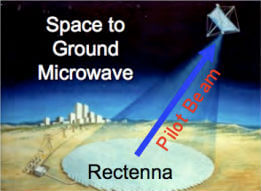
Solar power plants in space, exposed to constant sunshine with no clouds or air limiting the efficiency of their photovoltaic arrays, could have a place in this future emissions-free infrastructure. But these structures, beaming energy to Earth in the form of microwaves, would be quite difficult to build and maintain…
A space solar power plant would have to be much larger than anything flown in space before. The orbiting solar power plant will have to be enormous, and not just to collect enough sunlight to make itself worthwhile. The main driver for the enormous size is not the amount of power but the need to focus the microwaves that will carry the energy through Earth’s atmosphere into a reasonably sized beam that could be received on the ground by a reasonably sized rectenna. These focusing antenna would have to be 1 mile (1.6 kilometers) or more wide, simply because of the “physics you are dealing with. Compare this with the International Space Station, at 357 feet (108 meters) long the largest space structure constructed in orbit to date…
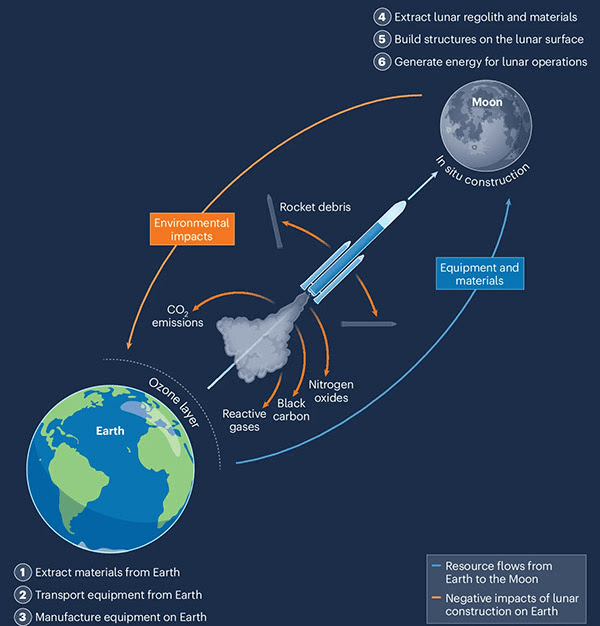
In every case, building a space-based solar power plant would require hundreds of rocket launches (which would pollute the atmosphere depending on what type of rocket would be used), and advanced robotics systems capable of putting all the constituent modules together in space. This robotic construction is probably the biggest stumbling block to making this science fiction vision a reality.
Converting electricity into microwaves and back is currently awfully inefficient Airbus, which recently conducted a small-scale demonstration converting electricity generated by photovoltaic panels into microwaves and beaming it wirelessly to a receiving station across a 118-foot (36 m) distance, says that one of the biggest obstacles for feasible space-based solar power is the efficiency of the conversion process… Some worry that microwave beams in space could be turned into weapons of mass destruction and used by evil actors to fry humans on the ground with invisible radiation.
A spaced-space solar plant transmits energy collected from the sun to a rectenna on earth by using a laser microwave beam. Image from wikipediia
The vast orbiting structure of flat interweaving photovoltaic panels would be constantly battered by micrometeorites, running a risk of not only sustaining substantial damage during operations, but also of generating huge amounts of space debris in the process. For the lifecycle of the station, you have to design it in a way that it can be maintained and repaired continuously…
And what about the whole thing once it reaches the end of its life, perhaps after a few decades of power generation? It is assumed that, by the time we may have space-based solar power plants, we are most likely going to see quite a bit of permanent infrastructure on the moon. Space tugs that don’t exist yet could then move the aged plant to the moon, where its materials could be recycled and repurposed for another use…We could also have some kind of recycling center on the moon to process some of the material..
Excerpts from Tereza Pultarovanal, Can space-based solar power really work? Here are the pros and cons, Space.com, Dec. 23, 2022

 Law-In-Action