Tag Archives: moon manufacturing

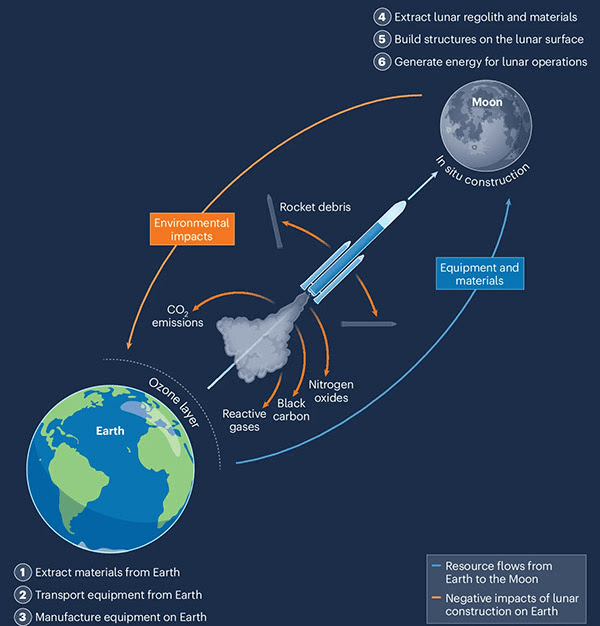
Building on the Moon: the Environmental Impact

The Environmental Burden of Building on the Moon

Who Will be the First to Colonize the Solar System?

A Chinese spacecraft touched down on grasslands in China’s Inner Mongolia region in June 2024, carrying the first-ever rock samples from the far side of the moon. A scientific breakthrough in itself, the success also advanced China’s plan to put astronauts on the moon by 2030 and build a lunar base by 2035. Such momentum is worrying American space officials and lawmakers, who have their own ambitions to build moon bases.

Unlike the original space race between the Americans and the Soviets, the goal of the U.S. and China isn’t just to make a short trip to the moon. It is to build permanent human outposts on its most strategic location, the lunar south pole. And as both nations gear up to build stations there one day, it is looking likely that tensions in orbit will mirror those on Earth.

Some U.S. officials fear China is planning a land grab. Chinese officials suspect the same of the Americans and are teaming up with Russia and other friendly nations for its south-pole outpost. The successful completion of the Chang’e 6 mission shows that, by one measure, China is ahead for now. Its lunar program has now soft-landed on the moon four times since 2013, the latest mission scooping up rocks near the south pole with robotic arms…

Meanwhile, after a decades-long moon-landing hiatus, two U.S. companies this year launched lunar-surface missions under NASA contracts. One lander tipped on its side after touching down. The other didn’t try to land because of technical problems. At least two more private missions, with funding from NASA, are slated to try to get to the moon later this year….All this is piling pressure upon the world’s most storied space agency. Through its Artemis exploration program, the National Aeronautics and Space Administration plans to conduct multiple landings in the coming years, develop a logistics station in lunar orbit and eventually build permanent camps on the moon’s surface. But Artemis has faced repeated delays and cost overruns while relying on a complex mix of government workers and private contractors…

“Unlike the U.S.-Soviet space race of the 20th century, this new round of competition centers on the water ice at the lunar south pole, with its extraction and use as a common goal,” wrote four scientists affiliated with China’s Academy of Sciences in a paper published in May. “The ability to collect and utilize lunar resources is a mark of national prestige and geopolitical influence. “We’re talking about colonizing the solar system,” said Greg Autry, a NASA official during the Trump administration.

Excerpts from Stu Woo, Historic Moon Mission Moves China Ahead in Space Race With U.S., WSJ, June 25, 2024

The Moon Miners

The joint announcement by China and Russia in March 20211 on their collaboration to explore the moon has the potential to scramble the geopolitics of space exploration, once again setting up competing programs and goals for the scientific and, potentially, commercial exploitation of the moon. This time, though, the main players will be the United States and China, with Russia as a supporting player.

In recent years, China has made huge advances in space exploration, putting its own astronauts in orbit and sending probes to the moon and to Mars. It has effectively drafted Russia as a partner in missions that it has already planned, outpacing a Russian program that has stalled in recent years. In December 2020, China’s Chang’e-5 mission brought back samples from the moon’s surface, which have gone on display with great fanfare in Beijing. That made China only the third nation, after the United States and the Soviet Union, to accomplish the feat. In the coming months, it is expected to send a lander and rover to the Martian surface, hard on the heels of NASA’s Perseverance, which arrived there in February 2021..

 According to a statement by the China National Space Administration, they agreed to “use their accumulated experience in space science research and development and use of space equipment and space technology to jointly formulate a route map for the construction of an international lunar scientific research station.”

After the Soviet Union’s collapse, Russia became an important partner in the development of the International Space Station. With NASA having retired the space shuttle in 2011, Russia’s Soyuz rockets were the only way to get to the International Space Station until SpaceX, a private company founded by the billionaire Elon Musk, sent astronauts into orbit on its own rocket last year. China, by contrast, was never invited to the International Space Station, as American law prohibits NASA from cooperating with Beijing. 

China pledged to keep the joint project with Russia “open to all interested countries and international partners,” as the statement put it, but it seemed all but certain to exclude the United States and its allies in space exploration. The United States has its own plans to revisit the moon by 2024 through an international program called Artemis. With Russia by its side, China could now draw in other countries across Asia, Africa and Latin America, establishing parallel programs for lunar development….

Excerpts from China and Russia Agree to Explore the Moon Together, NYT, Mar. 10, 2021
Building Factories in Space: DARPA

DARPA announced on February 5, 2021  its Novel Orbital and Moon Manufacturing, Materials and Mass-efficient Design (NOM4D) program. The effort, pronounced “NOMAD,” seeks to pioneer technologies for adaptive, off-earth manufacturing to produce large space and lunar structures,  “NOM4D’s vision is to develop foundational materials, processes, and designs needed to realize in-space manufacturing of large, precise, and resilient Defense Department systems,” said Bill Carter, program manager in DARPA’s Defense Sciences Office. “We will also explore the unique features of in-situ resources obtained from the moon’s surface as they apply to future defense missions.” 

Concerning mass-efficient designs, the vision is for completely new concepts that could only be manufactured in space….In order to take the next step, we’ve got to go about materials, manufacturing, and design in a completely new way.

Excerpts from Orbital Construction: DARPA Pursues Plan for Robust Manufacturing in Space, DARPA Website, Feb. 5, 2021