Tag Archives: National Oceanic and Atmospheric Administration

A Brand New World: Mapping the Ocean Floor

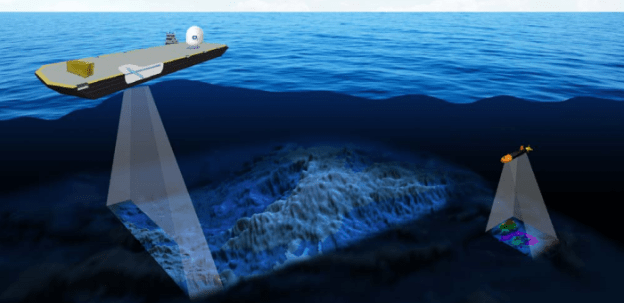
Mapping of the ocean floor may expand under an order signed by President Donald Trump on in  November, 2019 to create a federal plan to explore U.S. coastal waters. The announcement…comes amid growing international interest in charting the sea floor as unmanned aquatic drones and other new technologies promise to make the work cheaper and faster. The maps, also created by ship-towed sonar arrays, are crucial to understanding basic ocean dynamics, finding biological hot spots, and surveying mineral, oil, and gas deposits.

But much of the ocean floor remains unmapped; an international campaign called Seabed 2030 aims to map all of it in detail by 2030. Such maps cover just 40% of the 11.6 million square kilometers in the U.S. exclusive economic zone, which extends 320 kilometers from the coasts of all U.S. states and territories—an area larger than the total U.S. land mass. Today, those maps are a hodgepodge drawn from government, industry, and academic research, says Vicki Ferrini, a marine geophysicist at Columbia University’s Lamont-Doherty Earth Observatory in Palisades, New York. The federal plan, she says, could be a “game changer.”

Excerpts from  United States to Survey Nearby Sea Floor, Science, Nov. 29, 2019, at 6469
Resuscitating Collapsed Fisheries: catch shares

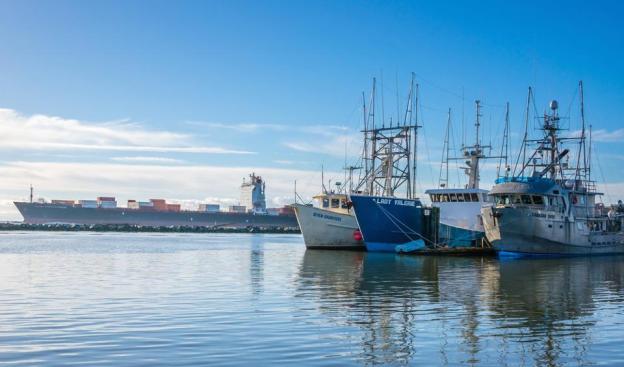
For American fish, this is a good time to be alive. On May 14th, 2012 the National Oceanic and Atmospheric Administration (NOAA) reported that a record six federal fisheries returned to health last year. After a decade of similar progress, 86% of America’s roughly 250 federally monitored commercial fish stocks were not subject to overfishing; 79% were considered healthy…

In the late 1980s cod fisheries in the Gulf of Maine and Georges Bank collapsed. This led to efforts to improve the fishery act, in 1996 and 2006, which forced the eight regional bodies that manage federal fisheries to introduce science-based quotas and ten-year recovery programmes for depleted fisheries. The recent recovery of species, including New England scallops, mid-Atlantic bluefish and summer flounder and Pacific lingcod, is the result. This signals another truth: given a break, the marine environment can often replenish itself spectacularly.

America’s fisheries are probably now managed almost as well as the world’s best, in Norway, Iceland, New Zealand and Australia. Yet there is plenty of room for improvement. State-run fisheries, which tend to be close to shore and dominated by small-scale and inefficient fishermen, are less well funded and well managed and much poorer for it. New England groundfish stocks, including cod, have also not recovered: they account for 13 of the remaining depleted populations. This appears to be partly the result of environmental change, climatic or cyclical.

And the politicians are still interfering. On May 9th the House passed legislation forbidding NOAA from developing an innovative means of apportioning fishing quotas, known as catch shares. These are long-term, aiming to give fishermen a stake in the future of their fisheries; market-based, since they can be traded; and, in practice, good for fish. Sadly, the two Republican congressmen behind the ban consider they have been designed “to destroy every aspect of American freedom under the guise of conservation”.

Fish stocks: Plenty more fish in the sea, Economist, May 26, 2012, at 32