
Tag Archives: oil and gas pipelines on seafloor

The Undeclared War in the Baltic

In January 2025, NATO launched the operation, dubbed Baltic Sentry, after a string of undersea cables and pipelines were damaged by ships—many with links to Russia—that had dragged their anchors.  “We are functioning as security cameras at sea,” said Kockx, the Belgian commander, whose usual duty is clearing unexploded mines from the busy waterway… New undersea drones are keeping a watchful eye on pipes and cables. NATO surveillance planes from the U.S., France, Germany and occasionally the U.K. take turns scanning the seaway from high above. NATO has also strengthened its military presence on the Baltic…NATO’s goal is to prevent more damage to subsea infrastructure and respond faster if something occurs…

The Baltic, a central theater in two world wars, is littered with wrecks and explosives that still pose danger. Surrounding NATO members are world leaders in finding and disposing of sea mines, officials say….Commercial traffic on the Baltic ranks among the world’s densest, with more than 1,500 ships plying its waves on any day, so policing it all is difficult. Further complicating NATO’s sentry duty initially was a lack of comprehensive information about all the critical infrastructure snaking across the sea’s muddy bottom. Details of pipes and cables have traditionally been kept by national governments or private companies. Nobody had a picture of everything...NATO’s new undersea infrastructure center in 2024 assembled the first unified map of the Baltic’s floor.

Excerpt from Daniel Michaels, How NATO Patrols the Sea for Suspected Russian Sabotage, Mar. 31, 2025
Mapping the Seafloor: Why Is It Important for War?

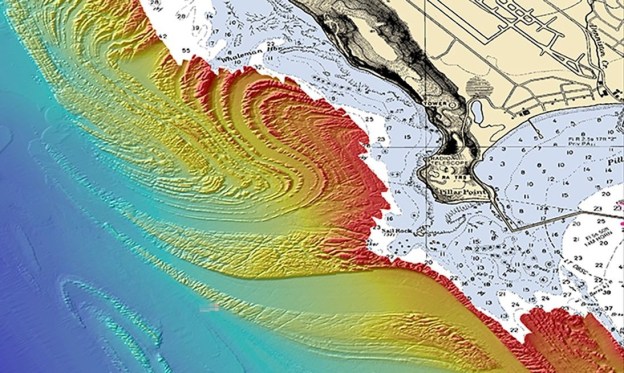
China’s fleet has triggered protests from Japan, India and others, but that hasn’t stopped Beijing from launching long missions to map the sea floor. The data they obtain has numerous applications, from science to the emerging industry of deep-sea mining, but it is the Chinese government’s commandeering of civilian research for military use that threatens American allies.

India’s navy drove a Chinese research ship away in 2019, but more have returned. In recent weeks, two of China’s most advanced research vessels, the Xiang Yang Hong 01 and the newer Dong Fang Hong 3 have conducted lawnmower-style sweeps across vast stretches of the eastern Indian Ocean.

Chinese civilian vessels are pursuing expeditions around the world—there are as many as a dozen or so active at any given time. The data they gather, including on currents, temperature and salinity, can have an array of applications. Detailed scanning of the seabed, for instance, can provide information about the visibility of naval mines and the accuracy of sonar.  The surveys can also help determine what minerals could be extracted…Recent missions have spurred complaints by at least half a dozen governments. China says its marine research activities fully comply with the United Nations Convention on the Law of the Sea, the international treaty that established the legal regime for the world’s oceans….

The U.S. Navy also carries out maritime surveys for military purposes…. Under the U.N. convention, coastal states have jurisdiction over research in their exclusive economic zones, which extend 200 miles from the coast. The U.S., which recognizes but hasn’t ratified the convention, argues that military surveys are exempt and U.S. Navy oceanographic ships regularly conduct studies near China. China appears to be moving closer to the American stance, “as they’re doing more oceanographic research without the permission of coastal states.”

Excerpts from Austin Ramzy, China Is Mapping the Seabed to Unlock New Edge in Warfare, WSJ, Mar. 12, 2025

The Leaky Oil Pipelines on Our Seafloor

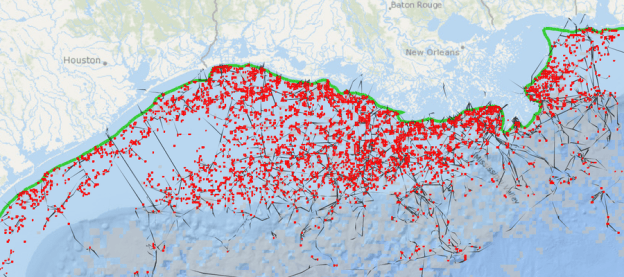
Federal officials aren’t adequately monitoring the integrity of 8,600 miles of active oil-and-gas pipelines on the Gulf of Mexico’s seafloor, and for decades have allowed the industry to abandon old pipelines with little oversight, a new report to Congress shows. The Government Accountability Office report faults the Interior Department’s offshore oil-safety regulator’s reliance on surface observations and pressure sensors, rather than  subsea inspection, to monitor for leaks.

The report urges the regulator, the Bureau of Safety and Environmental Enforcement (BSEE), to resume work on a long-stalled update to pipeline rules. BSEE currently requires monthly inspections of pipeline routes in the Gulf by helicopter or marine vessel, to look for oil sheens or gas bubbles on the surface to determine whether a pipeline is leaking. By comparison, the bureau’s Pacific office requires subsea pipeline inspections, in part because of seismic concerns, on its much smaller network of 200 miles of active pipelines.

The GAO also found that BSEE and its predecessors allowed the oil industry to leave thousands of miles of decommissioned pipelines on the seafloor rather than incur the cost of raising them back to the surface. Federal regulations allow BSEE to permit operators to decommission pipelines in place, cleaning and burying them in the seabed. The GAO found that the agency doesn’t ensure standards are followed, even as it allowed 97% of the miles of decommissioned pipelines taken out of active use in the Gulf since the 1960s—nearly 18,000 miles—to remain in place.

BSEE also has failed to fully consider whether decommissioned pipelines represent a hazard to navigation and commercial fishing, like trawlers that can be damaged by snagging equipment on undersea pipelines, the report said. Eighty-nine trawlers reported damage from snagging on oil-and-gas equipment between 2015 and 2019, the report found.

BSEE’s failure to inspect decommissioned pipelines also means officials don’t have a complete record of which equipment has been properly cleaned and buried, or whether hurricanes and underwater landslides have moved buried pipelines, potentially creating navigation hazards and environmental damage. A buried 9-mile pipeline segment was swept 4,000 feet out of place by Hurricane Katrina, the report said.

BSEE also allowed oil producers to leave in place some 250 decommissioned “umbilical lines” that carry electricity and hydraulic power to subsea equipment, the report said, over objections of some Interior officials who were concerned that these lines often contain hazardous chemicals that could leak over time as the equipment degrades.

Excerpt from Ted Mann, U.S. Needs to Better Monitor Oil, Gas Pipelines in Gulf of Mexico, Report Says, WSJ, Apr. 19, 2021