Tag Archives: old nuclear warheads

The Real Nuclear Weapons Doctrine of the United States

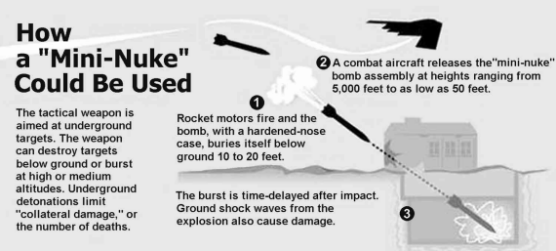
The U.S. Joint Chiefs of Staff in mid-June 2019 briefly published the Pentagon’s official doctrine on the use of nuclear weapons. The joint chiefs quickly pulled the document — Joint Publication 3-72, Nuclear Operations from the public website. [But a public copy has been preserved] “Using nuclear weapons could create conditions for decisive results and the restoration of strategic stability,” the doctrine opines. “Specifically, the use of a nuclear weapon will fundamentally change the scope of a battle and create conditions that affect how commanders will prevail in conflict.”

The joint chiefs published the nuclear document around the same time that the Stockholm International Peace Research Institute (SIPRI) published its annual 2019 report, detailing the world’s atomic arsenals.  At the start of 2019, Russia, the United States, and seven other countries possessed 13,865 nuclear weapons, SIPRI found. That represents “marked decline” from the 14,465 atomic weapons in world arsenals at the beginning of 2018, according to SIPRI….But the cuts could reverse. New START will expire in 2021 unless both parties agree to extend the treaty. “…

A senior U.S. intelligence official on May 29, 2019 accused Russia of secretly conducting nuclear tests in violation of an international treaty and the country’s own moratorium on such tests….But the Arms Control Association in Washington, D.C. was skeptical of the general’s claim. “Ashley would only say that Russia had the ‘capability’ to conduct very low-yield supercritical nuclear tests in contravention of the treaty, a capability which Russia, China and the United States have long had. He did not say that Russia has conducted or is conducting such tests.”  Ashley’s allegation is consistent with repeated attempts by Pres. Donald Trump, his administration and his allies in Congress to dismantle existing arms-control regimes by accusing Russia of violating them, thus justifying a U.S. withdrawal from the same regimes and clearing the way for a U.S. arms build-up.

The Trump administration echoed the administration of Pres. Barack Obama in accusing Russia of willfully violating the 1987 Intermediate-Range Nuclear Forces treaty, an accusation Russia has denied. The White House in February 2019 announced the United States’ withdrawal from the treaty, which bans land-based, medium-range missiles in Europe.

There’s irony in Ashley accusing Russia of violating the 1996 Comprehensive Test Ban Treaty, which according to the Arms Control Association “prohibits any nuclear test explosions that produce a self-sustaining, supercritical chain reaction and creates a robust international verification regime.”  “The United States has signed but not ratified the treaty,” the association pointed out. “The most effective way for the United States to enforce compliance with the zero-yield standard is for the Trump administration and the U.S. Senate to support ratification of the treaty and help to bring it into force, which would allow for intrusive, short-notice, on-site inspections to detect and deter any possible cheating.”

Davide Axe, Oops: The Pentagon Just Revealed Its Nuclear Doctrine, National Interest, June 20, 2019
Nuclear Industry in Siberia

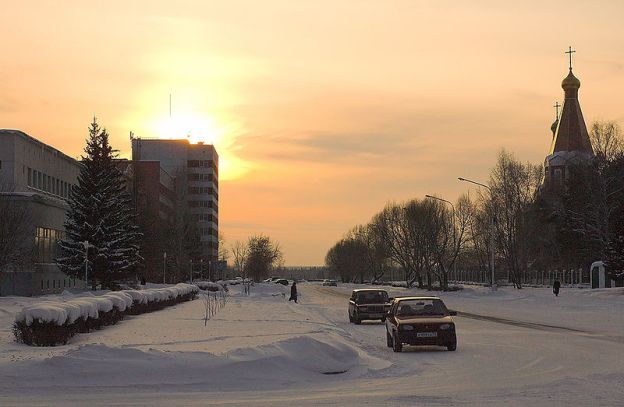
Professor Leonid Rikhvanov says he has a number of questions about the potential damage to the community from reactors that have been used since the Soviet Era .His plea comes as the Siberian Chemical Combine  (SCC) in Seversk, a secretive city located 15 miles north of Tomsk, prepares for the construction of a new experimental fast reactor  known as BREST-300…

‘I would also like to raise the question of conducting a complex study on how the SCC’s reactors have affected the environment over the past 50 years. Before making a decision on new projects, it’d be worth estimating the outcomes of the old ones’…Siberian Chemical Combine in Seversk, a secretive city located 15 miles north of Tomsk, prepares for the construction of a new experimental fast reactor.

‘And lastly I would ask about warheads [housed at SCC as recently as the 1990s]. Have they been replaced or not? If not, in what conditions are they kept?’He added: ‘I’m not radical and I support the idea of nuclear energy. But the approach to its use, and to estimating risks, should be totally different. Russian nuclear enterprises as they are now are so dangerous that it’d definitely be better if they didn’t exist at all.’

On April 6 2015 it was reported in Seversk that construction was already under way of a pilot plant for the production of fuel for the experimental BREST-300 reactor.The new reactor will work on special ‘pills’ made from the spent nuclear fuel and taken from the old reactors, with officials saying it will allow waste-free production of energy.  It is thought the pilot plant will begin operating in 2017, with the full new BREST-300 reactor up and running from 2020.

Prof Rikhvanov stressed that he is not anti-nuclear but insisted that it has to be used correctly with the proper safety and environmental considerations in place. An accident at a new plant at the Siberian Chemical Combine in February 2015 resulted in an employee receiving burns to his hands.And, of course, a massive explosion at the site in April 1993 resulted in the release of a radioactive gas cloud in an incident listed as one of the world’s worst nuclear accidents.Prof Rikhvanov was one of the experts flown into Seversk following the incident, allowing him a rare glimpse inside the secretive city to analyse the state of the plant.

‘First of all, we got to see what is there,’ he recalled. ‘I visited all the production facilities, I saw the reactors, the well where the waste is put to, and the warehouses where the nuclear warheads were stored with my own eyes.’I saw about 23,000 decommissioned warheads stored there. And I doubt they have been moved elsewhere since then. By the way, at the time, they were stored in terrible conditions and I don’t know what it is like now.’ The professor also found out that a facility for storing liquid radioactive waste in aquifers was located near to where the water supply was sourced on the Tom River.  As far as he is aware, the situation remains the same. He said: ‘We pump water from aquifers on the left side of the river, and store some of the most hazardous elements humanity has ever created in aquifers on the other side of the river…

Another concern he has is that the city is ‘still not prepared’ for a mass evacuation in the event of a major incident.’The road to Maryinsk is terrible, the second branch of the railway hasn’t spring out yet,’ he said. ‘There is also no separate railway to ship the radioactive materials to SCC without going through Tomsk. Such freights are now going through city railway station which creates additional risks.’

Excerpts from Olga Gertcyk & Derek Lambie, Expert raises serious questions over state of the nuclear industry in Siberia,  Siberian Times, May 2, 2015

The Y-12: Nuclear Weapons Alive and Well

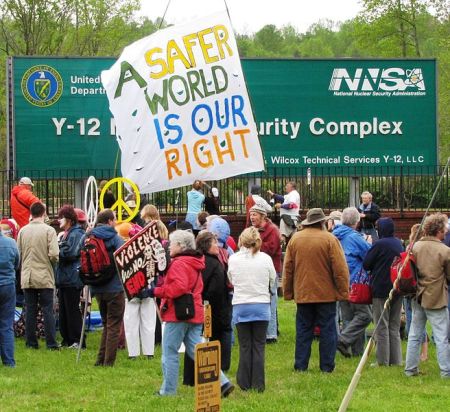
Nearly three weeks after a stunning security breach shut down the Y-12 nuclear weapons plant, the government on Wednesday (Aug. 15, 2012) authorized the restart of nuclear operations…..B&W Y-12, the managing contractor, ordered a “security stand-down” on Aug. 1, 2012 soon after the unprecedented intrusion July 28 by three Plowshares protesters, who reportedly scaled a ridge on the north side of Y-12 and walked all the way to the plant’s high-security inner core. The protesters …. used bolt-cutters to pass through a series of sensor-laden security fences and reach the fortresslike uranium storehouse, which they defaced with spray-painted protest messages and human blood. The breach raised deep questions about site vulnerabilities and prompted multiple investigations, which are still under way.The approval to restart nuclear operations has no bearing on the “show cause” notice that the National Nuclear Security Administration sent to B&W Y-12 last week, Wyatt said.

In the Aug. 10, 2015 letter to the contractor, the NNSA said security concerns raised by the break-in and the response to it were so severe as to potentially harm the ability to carry out the Y-12 contract. ….It wasn’t clear how long it would take Y-12 to get the uranium operations and other activities, including the dismantlement of old warhead parts, up and running or restart manufacturing programs.  In its “show cause” letter to B&W, the NNSA said a “high number” of cameras associated with the plant’s PIDAS (Perimeter Intrusion Detection and Assessment System) were inoperable at the time of the July 28, 2012intrusion in the predawn hours. ”

Excepts from   Frank Munge, Feds authorize restart of Y-12’s nuke operations,
Knoxville News Sentinel, Aug. 15, 2012