Tag Archives: small island states and climate change

First French Village to Relocate due to Climate Change

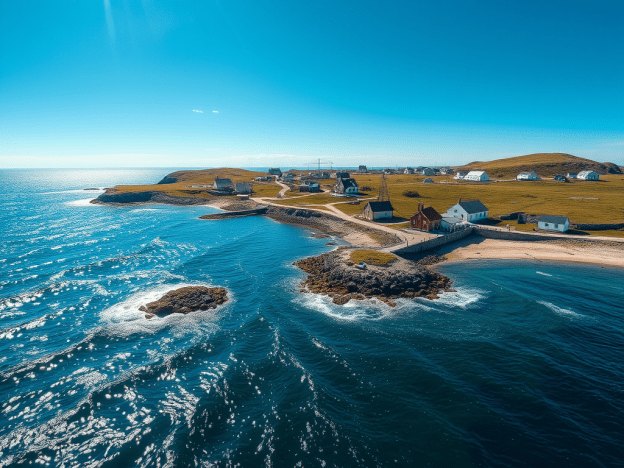
[T]he village of Miquelon sits only 2 meters above sea level on the archipelago of Saint-Pierre and Miquelon. Situated off the Canadian coast to the south of Newfoundland, it is an “overseas collectivity” of France, and the country’s last foothold in North America…’

But it was not until 2022 that the local government started thinking in earnest about relocating after the village narrowly missed being hit by Hurricane Fiona, one of the most expensive weather events ever in Canada. The move, when it is complete, will give Miquelon the unenviable title of the first French village to relocate because of the climate emergency. ..For now, relocation is voluntary, and nearly 50 people have signed up to move…At the same time, workers started to extend Miquelon’s water and electricity supplies to the new site. The goal is to keep the two sites connected as people move across the bridge between them.

Even though the signs of the climate crisis are obvious on the island – the ocean is slowly eating away at the isthmus that connects the parts of the island – many believe they have more time…

Excerpt from Sara Hashemi, How do you move a village? Residents of France’s last outpost in North America try to outrun the sea, Guardian, Oct. 28, 2025

Stealing Land from the Ocean: An Engineered Way to Address Climate Change

The Maldives is an 820-kilometre-long chain of nearly 1,200 islands dotting the Indian Ocean. The nation has become one of the most popular luxury tourism destinations in the world because of its Instagrammable beaches and its advertising slogan: “the sunny side of life”. But the Maldives is also one of the countries most vulnerable to sea-level rise. With 80% of its land less than one meter  above sea level, some scientists predict that the islands could be completely submerged by 2100. In an effort to keep the country above water and thriving, the government is adopting a strategy used by many nations around the globe: land reclamation...


Dutch planners are often considered the founders of land reclamation, with a history of water engineering going back some 800 years. Over the centuries, land-forming projects have shaped some of the world’s major cities, including Singapore, London, New York and Miami. In recent decades, most of the reclaimed land has been in East Asia. In China, Shanghai has reclaimed 350 square kilometres  — more than three times the size of Paris — over the past few decades. Colombo has added 100 km2 in just 4 years, and 65 km2 of Mumbai is reclaimed. A study on twenty-first-century coastal-land reclamation found that of 135 large coastal cities with populations of more than one million people, 75% had reclaimed land.

With projects stretching back to 1997, the Maldives is a veteran of large-scale land reclamation…Although the nation’s territory covers 90,000 km2, more than 99% of it is ocean. The Maldives’ 1,200 islands are all atolls — rings of coral reef that surround lagoons. When the government decides to reclaim land, it takes sand from the lagoons using boats outfitted with suction pipes, which collect sand and coral debris from the ocean floor like giant vacuum cleaners. The boat then deposits the material in a different spot, either inside or outside the atoll, to form new land. Sometimes reclamation projects fill in the entire lagoon…. [However, these projects] destroy coral reefs and seagrass meadows and harm the fishing and tourism industries…’

“Islands can’t occur anywhere,” says Virginie Duvat, a coastal geographer at La Rochelle University in France, who has studied the effects of land reclamation in the Maldives. “If you put an island where there was naturally no island, you create vulnerable land and you will necessarily have to build strong engineered structures, breakwaters and sea walls,” she says…In a 2019 study4, Duvat and Alexandre Magnan, a geographer at the Institute for Sustainable Development and International Relations — Sciences Po in Paris, assessed the scale of coastal changes that humans had made to 107 inhabited islands in the Maldives between 2004–06 and 2014–16. On almost half the islands, the researchers found significant degradation in the reefs’ abilities to weaken waves and provide natural sources of sediments. One-fifth of the islands had almost entirely or entirely “lost their natural capacity to respond and adjust to ocean climate-related pressures”, the researchers say. “It means that a decision you have taken one day to rely on reclaimed land will necessarily cause you to invest more money,” says Duvat. “You are locked into the engineered path for decades and decades and potentially the rest of the century.”=

Excerpts from Jesse Chase-Lubitz, The Maldives is racing to create new land. Why are so many people concerned?, Nature, Apr. 24, 2024

How to Relocate a Whole Nation

Small island states will not, most likely, be swallowed by the sea… In research published in 2010, Paul Kench measured the size of 27 atolls over a period of decades and found that while 14% had shrunk and a couple had disappeared, 43% stayed the same size and another 43% became bigger. Many of the ring-shaped coral reefs have been able to adapt to sea-level rise, changing shape as sediment is eroded and pushed around. Tuvalu’s land surface, for instance, increased by 3% between 1971 and 2014 despite a rise in the local sea level of 4mm a year, twice the global average for that period…

But there are other, more immediate effects of climate change that threaten the lives and livelihoods of the citizens of these countries. They are less arresting, harder to explain and, as in the changing shape and size of islands, sometimes counterintuitive. But the upshot is the same: the countries may soon become uninhabitable.

One is “king tides”, high tides that briefly but entirely inundate the narrow strips of low-lying land that comprise most atoll, are becoming more frequent. The saltwater can kill crops such as banana and papaya and seeps into groundwater, making it unfit to drink

There are also ways to keep islands habitable: Kiribati plans to dredge its lagoons and use the sand to raise the surrounding islands higher above the sea. Tuvalu has embarked on a land-reclamation project. But the spectre of climate change makes it harder to drum up investment for such schemes. “I am trying to change the minds of the many people who say, ‘We cannot invest in your country, you’re finished’,” says Kiribati’s Mr Tito.

The depressing long-term solution may be to move. The Marshall Islands hopes to renegotiate its post-colonial “Compact of Free Association” with America, which expires in 2023, to ensure a permanent right of residence in the United States for all Marshallese. Tuvalu has no such option. Maina Talia, a climate activist, thinks that the government should take Fiji up on its offer of a home where Tuvaluans could practice the same culture rather than “be dumped somewhere in Sydney’‘.

Earlier this year, the government of Tuvalu, which until recently insisted that there would be no Plan B, established a new un initiative. Its aim is to work with “like-minded countries” to figure out how and where such countries could be relocated, how they could continue to function ex-situ, and whether they could still lay claim to vast exclusive economic zones if their land disappeared under water.

Relocating a country would raise other big questions, too, for both the international system and the way in which people think about statehood. “How to prepare to move a nation in dignity, that has never been done before,” says Kamal Amakrane, a migration expert whose ideas helped spark the UN initiative. 

Excerpt from Moving story: Pacific countries face more complex problems than sinking, Economist, August 7, 2021
The Green Climate Fund and COVID-19

 The Green Climate Fund has promised developing nations it will ramp up efforts to help them tackle climate challenges as they strive to recover from the coronavirus pandemic, approving $879 million in backing for 15 new projects around the world…The Green Climate Fund (GCF) was set up under U.N. climate talks in 2010 to help developing nations tackle global warming, and started allocating money in 2015….

Small island states have criticised the pace and size of GCF assistance…Fiji’s U.N. Ambassador Satyendra Prasad said COVID-19 risked worsening the already high debt burden of small island nations, as tourism dived…The GCF  approved in August 2020 three new projects for island nations, including strengthening buildings to withstand hurricanes in Antigua and Barbuda, and installing solar power systems on farmland on Fiji’s Ovalau island.

It also gave the green light to payments rewarding reductions in deforestation in Colombia and Indonesia between 2014 and 2016. But more than 80 green groups opposed such funding. They said deforestation had since spiked and countries should not be rewarded for “paper reductions” in carbon emissions calculated from favourable baselines…. [T]he fund should take a hard look at whether the forest emission reductions it is paying for would be permanent.  It should also ensure the funding protects and benefits forest communities and indigenous people…

Other new projects included one for zero-deforestation cocoa production in Ivory Coast, providing rural villages in Senegal and Afghanistan with solar mini-grids, and conserving biodiversity on Indian Ocean islands.  The fund said initiatives like these would create jobs and support a green recovery from the coronavirus crisis.

Excerpts from Climate fund for poor nations vows to drive green COVID recovery, Reuters, Aug. 22, 2020