Tag Archives: water crisis

How to Manage Water Like Money and Fail: Australia

Australia’s Darling River…provided fresh water to farmers seeking to tame Australia’s rugged interior.  No longer. The Darling River hasn’t flowed for eight months, with long stretches completely dried up. A million fish died there in January 2019.  Kangaroos, lizards and birds became sick or died after drinking from toxic pools of stagnant water.  Australia’s water-trading market is drawing blame. The problems with the system, created more than a decade ago, have arisen as similar programs are being considered in the U.S.

Water crises are unfolding across the world as surging populations, industrial-scale farming and hotter temperatures deplete supplies.  Australia thought it had the answer: a cap-and-trade system that would create incentives to use water efficiently and effectively in the world’s driest inhabited continent. But the architects of water trading didn’t anticipate that treating water as a commodity would encourage theft and hoarding.   A report produced for a state resources regulator found the current situation on the Darling was caused by too much water being extracted from the river by a handful of big farmers. Just four license holders control 75% of the water extracted from the Barwon-Darling river system.

The national government, concerned that its water-trading experiment hasn’t turned out as intended, in August 2019 requested an inquiry by the country’s antitrust regulator into water trading.  Anticorruption authorities are investigating instances of possible fraud, water theft and deal making for water licenses. In one case, known as Watergate, a former agriculture minister allegedly oversaw the purchase of a water license at a record price from a Cayman Islands company co-founded by the current energy minister. The former agriculture minister said he was following departmental advice and had no role in determining the price or the vendor. The energy minister said he is no longer involved with the company and received no financial benefit from the deal.

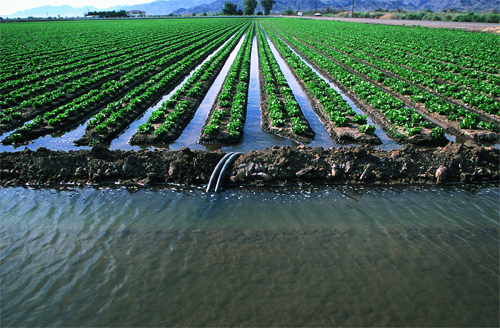
Since 2007, Australia has allowed not only farmers but also investors who want to profit from trading to buy and sell water shares. The water market is now valued at some $20 billion.    But making water valuable had unintended consequences in some places. “Once you create something of real value, you should expect people to attempt to steal it and search for ways to cheat,” says Mike Young, a University of Adelaide professor. “It’s not rocket science. Manage water like money, and you are there.”  Big water users have stolen billions of liters of water from rivers and lakes, according to local media investigations and Australian officials, often by pumping it secretly and at night from remote locations that aren’t metered. A new water regulator set up in New South Wales investigated more than 300 tips of alleged water thefts in its first six months of operation.  In 2018, authorities charged a group of cotton farmers with stealing water, including one that pleaded guilty to pumping enough illegally to fill dozens of Olympic-size swimming pools.  Another problem is that water trading gives farmers an incentive to capture more rain and floodwater, and then hoard it, typically by building storage tanks or lining dirt ditches with concrete. That enables them to collect rain before it seeps into the earth or rivers.

The subsequent water shortages, combined with trading by dedicated water funds and corporate farmers, have driven up prices. Water in Australia’s main agricultural region, the Murray-Darling river basin, now trades at about $420 per megaliter, or one million liters, compared with as low as $7 in previous years.  David Littleproud, Australia’s water-resources minister, says 14% of water licenses are now owned by investors. “Is that really the intent of what we want this market to be?” he asks. “Water is a precious commodity.”

Excerpts from Rachel Pannett , The U.S. Wants to Adopt a Cap-and-Trade Plan for Water That Isn’t Working, WSJ, Sept. 4, 2019
Not Sharing, even a Glass of Water: the Water Crisis in India

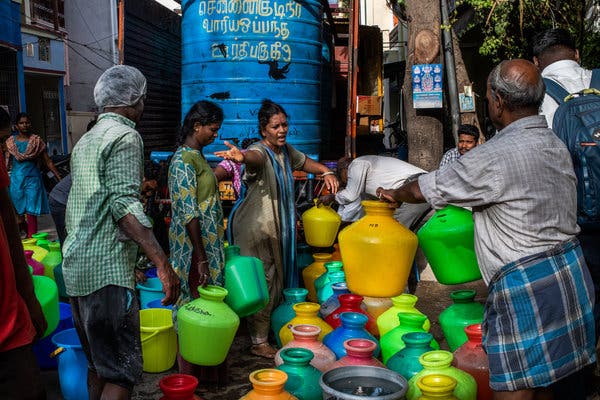
The southern city of Chennai—India’s fifth largest with a population of around 10 million—has been meeting only two-thirds of its water needs for weeks, the product of years of drought and decades of failure to manage the region’s water resources.   Residents have been scrambling around the clock to get water—spending hours chasing government tankers or paying private companies to deliver water.  Recent light rains broke a 200-day streak without rain. But the first month of India’s annual monsoon brought one-third less rain than the 50-year average, the driest June in five years, according to the India Meteorological Department.

The acute water shortage in one of India’s largest cities has been building for decades through a mix of population growth, poor planning and increasingly erratic monsoon rains….

The situation in Chennai reflects a larger water crisis spreading across India. Half the country’s population—600 million people—live in areas where water resources are highly or extremely stressed. About 100 million people living in 21 of India’s biggest cities may see their groundwater exhausted by the end of next year, according to a 2018 study by NITI Aayog, an Indian government policy think tank.  By 2030, demand for water will be double the country’s supply, the report said. And the impact will go far beyond the areas actually affected by water shortages: Almost one-third of the country’s agricultural output comes from areas most affected by water shortages…

The scarcity has led to clashes between neighbors. “No one is ready to share even a glass of water,” she said.

Excerpts from Vibhuti Agarwal and Krishna Pokhare Indians Hunt Through the Night for Water as a Megacity Runs Dry, WSJ, July 6, 2018

Salt Lakes of the World


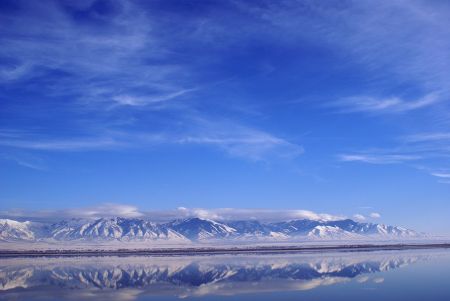
Utah Great Salt Lake has shrunk to a depth of about 14 feet—nearly half its former average since it was settled by the Mormons 170 years ago. Under a controversial engineering plan, the lake would recede even further….State engineers want to siphon off some of the river water that flows into the lake and use it for the Salt Lake City area’s booming population. Proponents say the plan, which calls for lapping up a fifth of Bear River’s current unused flow, is essential for meeting the region’s needs.

But critics note that the diversion would cause the lake to drop by almost a foot, according to state estimates, eventually exposing 30 square miles of lake bed and potentially worsening the dust storms that regularly blanket the region and ruining a fragile wetlands habitat.

The debate echoes concerns heard in many other arid parts of the world. Salt lake ecology is especially delicate and requires a certain amount of fresh water to maintain a saline balance. Brine shrimp, for instance, could die off if the water becomes too salty.

In the Middle East, diversion of the Jordan and other rivers that feed the Dead Sea has shriveled the famous body of saltwater and its once robust tourism. The Aral Sea between Kazakhstan and Uzbekistan has shrunk to about 10% of its original size after diversions.

Critics, including environmental groups and affected businesses, say that under the new diversion plan lake-dependent businesses such as brine shrimp fishing would suffer, as would farmers whose land could be inundated upstream if existing dams are raised to retain more water. In all, the lake accounts for an estimated $1.3 billion in annual economic output, according to Utah State University, much of it from the shrimping industry, as well as mineral extraction and tourism.

The plan would also destroy wetlands along the lake shoreline that provide food and habitat for an estimated eight million birds, said Zach Frankel, executive director of Utah Rivers Council, an environmental group opposed to the project.

But proponents say the diversion of up to 72 billion gallons of water—enough to meet the needs of a city of one million for a year—is needed to forestall anticipated shortages for one of the fastest-growing regions in the country….“If Utah continues to grow, it’s not a matter of if but when we are going to need more water,” said state Sen. Stuart Adams, the Republican majority whip, who sponsored a bill to begin funding the estimated $1.5 billion project.

Excerpt from Utah Searches for Water Solution, Wall Street Journal, Sept. 14, 2017

Coke as a Scapegoat

A potent blend of pride, economic nationalism and mounting concern over water security have the world’s two biggest cola brands in a bind in southern India.  Shopkeepers in drought-hit Kerala state decided on March 15, 2017 to promote local brands over Coca-Cola Co. and PepsiCo Inc. beverages after counterparts in neighboring Tamil Nadu boycotted the multinational drinks. While retail groups claim the companies are siphoning off groundwater and selling products tainted with pesticides, academics and analysts say the soda giants have become scapegoats for a water crisis that’s become mired in politics and patriotism.

India is one of the most water-challenged nations, and fights over water have erupted between users periodically for decades. Failed monsoon rains over as many as the past three years in some states have parched rivers and dams, forcing farmers, manufacturers and municipal water suppliers to rely more on wells to meet their needs. Problem is, those too are drying up, and that’s hurting farmers, India’s economic mainstay.

“The root cause for the boycott isn’t the multinational companies, but the enduring fight between industrial users and farmers, especially in several drought-hit states,” said P.L. Beena, an associate professor with the Centre for Development Studies in Thiruvananthapuram, Kerala.  On top of that, Prime Minister Narendra Modi’s call to companies to “make in India” has given rise to a pro-India push — and, in some cases, an anti-foreigner backlash — that’s supporting local brands….

The latest action means drinks from Coca-Cola and PepsiCo, which together have a 96 percent hold on India’s $4.9 billion soda market, will be kept off the shelves of more than 1 million shops.  Vendors would rather lose business than sell the products, said A. M. Vikrama Raja, president of a retailers’ association in Tamil Nadu with about 1.5 million members. The boycott started March 1, 2017 a day before the Madras High Court dismissed a petition seeking a ban on the American soda-makers drawing water from the local Thamirabarani river.

“Instead of foreign sodas, we will promote local beverages,” said T. Naseeruddin, president of a retailers’ group that says it has more than 700,000 retailers in Kerala, which is facing its worst drought in 115 years.

The group stopped short of joining the boycott in Tamil Nadu after a meeting Wednesday with Kerala Chief Minister Pinarayi Vijayan, a spokesman said. Instead, retailers will pursue “sensitization against multinational products” via a state-level conference, and seek a policy response from the state government.  India has at least 50 local drink brands, which are typically 20 percent cheaper than the global cola brands, brokerage Kotak Securities Ltd. said in a Feb. 23 report.  Manpasand Beverages Ltd., based in Vadodara, Gujarat state’s cultural capital, is “aggressively expanding its reach in Tamil Nadu to take advantage of the ongoing cola ban,”….

Excerpts from PepsiCo, Coca-Cola Fight Patriotism in Parched Indian State, Bloomberg Business Week, Mar. 15, 2017