Monthly Archives: April 2024

The Essence of a Nightmare: PFAS on Ocean Waves

PFAS, or forever chemicals, are ubiquitous in our environment. In the U.S. alone, there are more than 57,000 sites contaminated with these chemicals. They’re in our drinking water, our soil, our products—and our ocean. And according to new research, when waves crash onto shores around the world, they spray hundreds of thousands of PFAS particles into the air, creating a cycle in which these chemicals go from land to sea and back again. PFAS (per- and polyfluoroalkyl substances) are a class of synthetic chemicals largely used to make products stain-, grease-, and water-resistant. They’ve been dubbed “forever chemicals” because they don’t easily break down and so stay in our environments for thousands of years. They’re linked to harmful effects to health, including cancer, decreased fertility, developmental delays, and more.

Excerpts from Kristin Toussaint, Ocean waves contain more ‘forever chemicals’ than industrial pollution. That’s bad news if you live on the coast,  FastCompany, April 24, 2024

Will the 4 Waves of Sanctions Stop Russia?

Supercooled gas has quickly become one of the world’s most important energy sources—and a flashpoint between Russia and the U.S. Nowhere is that contest more apparent than in Russia’s Arctic north. An enormous new coastal facility is being built there to produce liquefied natural gas, a key project for Russian President Vladimir Putin. The U.S. is using a barrage of sanctions to cripple the initiative, known as Arctic LNG 2. These have stopped Russia from taking delivery of specialized, colossal tankers that it needs to transport the gas, and made it hard to build alternative vessels domestically. “Our role is to ensure Arctic LNG 2 is dead in the water,” Geoffrey Pyatt, the U.S. assistant secretary of state for energy resources, told a conference in Switzerland in April 2024.

Globally, LNG is ascendant. Demand is buoyant as governments ditch dirtier coal and the uptake of power-hungry artificial intelligence accelerates. Supply is surging too, and players such as industry heavyweight Qatar have major expansion plans. For Russia’s part, Putin aims to more than triple LNG exports in the coming years. His goal: Bring in more money to fund the war in Ukraine and offset a decline in Russia’s traditional business of exporting gas via pipelines. ..

About 32 million metric tons a year of capacity are under construction, according to Rystad Energy, a consulting firm, on top of an existing 29 million tons. In December 2023, the first of three liquefaction plants, known in the industry as trains, was completed at Arctic LNG 2, and the facility began producing LNG. The milestone, despite U.S. sanctions, was lauded as a win for Moscow by analysts and Russian officials. A few months later, however, victory looks less certain.

Exports were supposed to begin in the first quarter of 2024, according to Russia’s energy minister. But the custom-built ships that Novatek, the Russian energy giant behind the project, needs to break through frozen parts of the Arctic Ocean haven’t been delivered.

Hanwha Ocean, a South Korean shipbuilder, said it has canceled plans to build three vessels for Arctic LNG 2 for sanctions-related reasons. Mitsui O.S.K. Lines, a Japanese shipping company, has said it also won’t provide vessels to Arctic LNG 2 despite having planned to charter three carriers. Without ships, Novatek can’t export any gas. As a result, LNG output has ground to a halt, and the facility is mostly recirculating already-produced gas, according to people familiar with the plant. Novatek didn’t respond to a request for comment.

France’s TotalEnergies, which holds 10% of Arctic LNG 2, declared a force majeure earlier this year, indicating it can’t supply customers due to circumstances beyond its control. Total said it was complying with sanctions and doesn’t plan to deliver gas from the project this year.

In total, the U.S. has hit Russia’s fledgling LNG industry with four waves of sanctions since September. It has targeted operating companies for the Arctic LNG 2 project, storage vessels, shipping companies it suspected were seeking to buy specialized carriers for the project, and companies working on a second facility near the Baltic Sea.

Excerpts from Anna Hirtenstein, The U.S. Is Trying to Cripple Russia’s Vast Arctic LNG Project, WSJ, Apr. 14, 2024

Algorithmic Cartels and the Rentiers

Legal pressure is mounting on a property-management software company, RealPage, facing allegations that it illegally fixes apartment rent prices at buildings across the U.S….The Justice Department  has opened a criminal investigation into the company, according to people familiar with the matter….RealPage’s algorithmic pricing system analyzes huge troves of information about the apartment rental market. It then recommends to landlords how much to increase rent for each lease renewal, or what to ask for newly vacated apartments. At issue is whether the use of this pricing system amounts to an illegal rent-setting cartel among landlords, artificially boosting the rents paid by apartment tenants over many years. 

Arizona Attorney General Kris Mayes alleges that, in Phoenix and Tucson, RealPage pooled nonpublic pricing data from competing building owners, then fed the data into an algorithm that told landlords to push rents higher than they might have otherwise. RealPage then discouraged landlords from deviating from the algorithm’s suggested rents, according to the attorney general’s filing.“There is no competitive rental market in Arizona anymore, ” Mayes said in an interview. “Because RealPage sets the price.”

Texas-based RealPage was founded in 1998. It acquired the YieldStar pricing platform from publicly traded landlord Camden Property Trust in 2002. Private-equity firm Thoma Bravo purchased RealPage in 2021 for nearly $10 billion.  Federal charges could prove disastrous not only for RealPage but also for the many landlords and property managers who use its technology. That includes some of the largest real-estate companies on Wall Street. 

Excerpts from Will Parker, Alleged Rent-Fixing of Apartments Nationwide Draws More Legal Scrutiny, WSJ, Apr. 15, 2024

From Human Bones to Food: Another Soylent Green

A new book “Bones of Contention: The Industrial Exploitation of Human Bones in the Modern Age” argues that in the19th century human bones became a sought-after raw commodity. Scientists had just discovered its usefulness of human bones for agriculture as a source of phosphates for fertilizers and for the sugar industry, the use of bone char for beet sugar processing.

The high demand for these ingredients had one major unexpected consequence: the plundering of cemeteries and battlefields …in Britain, France, Belgium, Germany, Austria, Algeria and the United States. When countries out of bones in Europe, they turned to their colonies. The French plundered cemeteries in Algeria and shipped the bones to sugar factories in Marseilles. The British imported mummies and bones from Egypt on an industrial scale…

On Soylent Green, see Wikipedia

Excerpts from Science, Why Europe’s Battlefield Bones Are Missing?, Science, Apr.5, 2024

The Best Way to Ruin a Country is to Corrupt its Currency

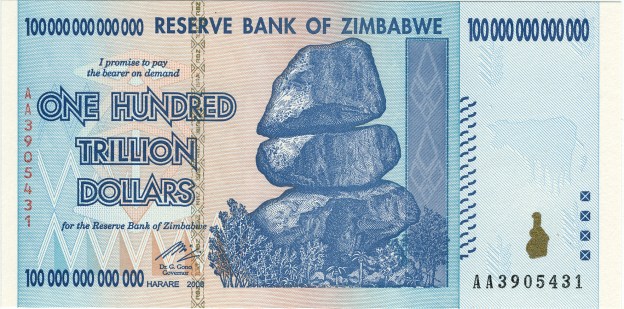
The Reserve Bank of Zimbabwe, which gained global notoriety in 2008 for printing one-hundred-trillion-dollar notes, said in April 2024 that it was launching a new national currency, promising, once again, to end years of monetary turbulence. John Mushayavanhu, who took over as the central bank’s new governor in April 2024 said the new unit, Zimbabwe Gold, or ZiG, will replace the current Zimbabwe dollar, which has lost around three-fourths of its value this year.

The currency most recently traded at more than 30,674 Zimbabwean dollars to the U.S. dollar, according to the central bank. When the bank relaunched the local unit in 2019, $1 bought 2.50 Zimbabwean dollars. Mushayavanhu said the new currency would initially be valued at 13.56 ZiGs for $1 and later at a rate determined by the market.

To shore up confidence in the currency, Mushayavanhu said it would be fully backed by Zimbabwe’s reserves of U.S. dollars and precious metals, particularly gold. He also pledged to end a long-running practice of the bank issuing more money to finance government spending…

Zimbabwe abolished the Zimbabwe dollar in 2009, after a bout of hyperinflation that, by some estimates, saw prices rise by 500 billion percent. For nearly a decade, the country then operated on U.S. dollars and other foreign currencies. When the central bank was no longer able to pay out savings in cash dollars, it reintroduced the Zimbabwe dollar in 2019.

Excerpt from Gabriele Steinhauser, Zimbabwe Launches a New Currency…Again, WSJ, April 5, 2024

Who Craves Baby Eels: the Industry and its Black Market

The growing craving for eel over the decades, concurrent with the rise of China’s middle class, has triggered overfishing in Japan and Europe, leading to a decline in the species’ population. The European Union banned the import and export of eels in 2010, which led seafood wholesalers to look for alternative sources, bringing the trade—and thousands of poachers—to Canada… Fishermen say elver poachers outnumbered licensed harvesters 10-to-1 during the 2023 abbreviated season, closed after 18 days due to concerns about illegal fishing.

There is a lot of money at stake. Fishers use mesh nets to scoop up baby eels as they enter Canada’s east coast river systems, and sell them on to aquaculture operations in Asia to raise them until they are ready for market. Baby eell demand “has resulted in unsustainable eel fishing,” according to a Justice Department indictment filed in 2022 with the U.S. District Court of New Jersey, in relation to charges filed against a seafood distributor and eight of its employees—four of whom are based in China—on allegations of illegally trafficking large volumes of juveniles. “A multibillion-dollar international black market for freshwater eels flourishes.” At its peak, a pound of elvers fetched about $1,800, but fishers say the price has dropped due to black-market activity…

It is difficult to stamp out illegal harvesting entirely. Officials say it happens in the evening and often in isolated locations. The barrier to entry is low, because all poachers need is a pair of rubber boots, a headlight, and a good-quality dip net purchased from a sporting goods store. Illegally-caught baby eels can still be packaged and shipped to Hong Kong in mislabeled boxes, mixed either with legally-caught eels or other seafood, like lobster, officials say.

Excerpts from Paul Vieira, Guns and Death Threats Spur Canada to Reel in Baby-Eel Fishing, WSJ, Apr. 5, 2024