Tag Archives: Congress and Yucca Mountain

The Nuclear Waste Problem of Power-Hungry AI

A nuclear power renaissance—driven in part by power-hungry AI data centers—has revived a thorny problem: what to do with the radioactive waste left behind. Already, more than 90,000 metric tons of spent nuclear fuel is being stored at sites in 39 states. These include 73 commercial nuclear power plants and more than three dozen university and government facilities, according to a 2024 report by the Pacific Northwest National Laboratory…Meanwhile, nuclear reactors continue to provide almost 20% of U.S. electricity and produce about 2,000 metric tons of waste each year. As additional plants become available to meet the demands of data centers, industrial plants, homes and electric vehicles, the waste pile is poised to grow even more.  The US first new reactors in three decades were completed last year in Georgia. Plans are in the works to reopen closed reactors in Michigan, Iowa, Pennsylvania and South Carolina…

France generates 70% of its electricity from nuclear energy, recycles about 96% of its waste into new fuel and stores the remainder in a centralized cooling pool in Normandy. French officials expect to start construction in 2027 on a permanent underground repository in northeastern France to open by 2035.  In November 2025, Canadian officials selected a permanent site for nuclear waste to be dug out of bedrock in northwestern Ontario. But U.S. efforts stalled decades ago, when a $15 billion project to build a permanent, underground storage facility at Yucca Mountain, Nevada, was halted amid opposition by elected officials in the state. The Yucca Mountain failure cast a shadow over efforts to build a permanent disposal site, according to interviews with nuclear experts, policymakers and elected officials. 

Excerpts Eric Niiler, Nuclear Power’s Revival Is Here. What Do You Do With All the Radioactive Waste?, WSJ, Mar. 5, 2025
Forget Nevada! How America Buries its Nuclear Waste 1999-2019

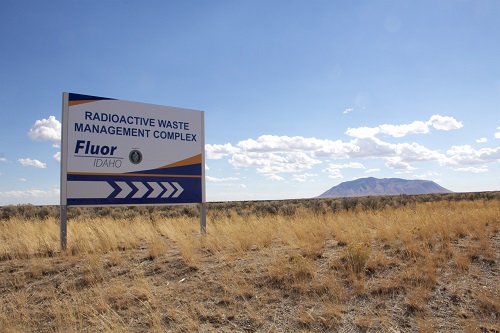
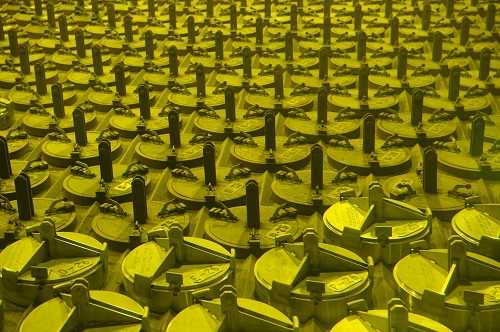
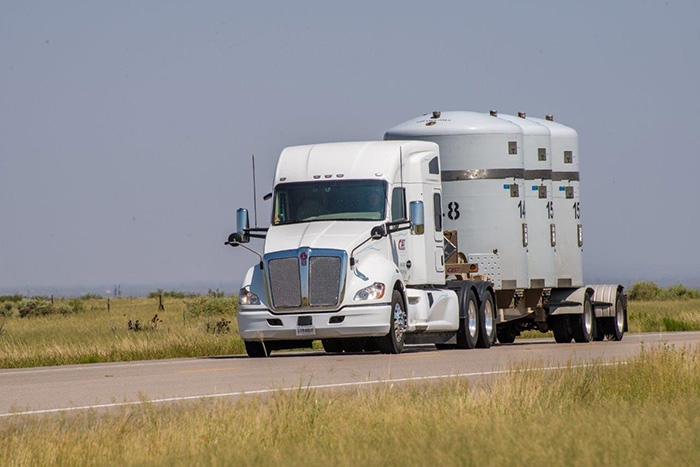
Just before midnight on June 27, 2019, the Waste Isolation Pilot Plant (WIPP), Carlsbad, New Mexico received its 12,500th transuranic (TRU) waste shipment since operations began there in 1999.

Nuclear Waste heading to WIPP from Idaho

The shipment originated from the EM program at Idaho National Laboratory, which has sent WIPP the most TRU waste shipments — 6,500 and counting — of all Departement of Energy (DOE) generator sites over the past 20 years…

Idaoho National Laboratory Nuclear Waste Management

WIPP drivers have safely traveled over 14.9 million loaded miles, transporting more than 178,500 waste containers for permanent disposal 2,150 feet underground.

Excerpts from WIPP Reaches 12,500-Shipment Milestone, Press Release US Department of Energy, July 2, 2019

Stop Fukushima Freeways


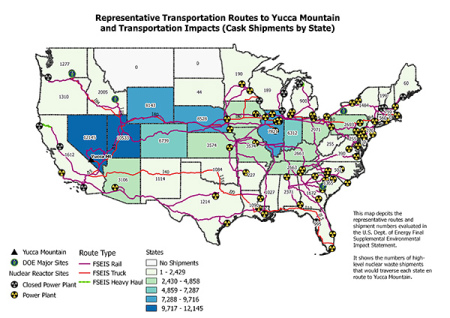
Over 250 intensely radioactive nuclear waste shipments would cross through
the Washington DC metropolitan area and thousands more would travel across the roads, rails  and waterways of the nation, if [the Yucca Mountain permanent repository in Nevada is approved]….The Nuclear Information and Resource Service (NIRS), an NGO, released maps of the likely routes radioactive shipments would use…

According to the map, highly radioactive waste fuel from nuclear power reactors in Virginia and Maryland would pass through the DC area on railroad tracks next to Metro Rail trains, including passing though Union Station. Each shipment contains several times more radioactive material than the Hioshima bomb blast released, with 20 to 50 tons of irradiated fuel assemblies in each  canister….  [Accident may happen during the shipments]…The shipments would also be vulnerable to attack or sabotage….Large-scale nuclear waste transport would also occur if, as some in Congress advocate, a“centralized interim storage” site for high-level radioactive waste were created.

Excerpts from Stop Fukushima Freeways Campaign Kicks Off, Nuclear Information and Resource Service Oct. 27, 2015