Tag Archives: free trade

The New Opium War: How the World Got Addicted to China

 A fundamental axiom of economics is that when two individuals or countries trade, both are better off. In the decades after World War II, the U.S. was the world’s largest exporter and economy and as it grew, it imported more, helping its partners. As they grew, they bought more of what the U.S. made. Expanding trade helped everyone specialize, leading to more competition, innovation and choice, and lower costs.

China is now the world’s second-largest economy and its largest exporter, but its philosophy is quite different. It has never believed in balanced trade nor comparative advantage. Even as it imported critical technology from the West, its long-term goal was always self-sufficiency. In 2020, Chinese leader Xi Jinping codified this approach as “dual circulation.” This would, he said, “tighten the international industrial chain’s dependence” on China while ensuring China’s production was “independent” and “self-sustaining.”

And as China expands into high-end manufacturing such as aircraft and semiconductors, Xi has decreed it must not relinquish low-end production such as toys and clothes. Beijing has discouraged Chinese companies that invest abroad from transferring key know-how, such as in the production of iPhones and batteries. Xi has rejected fiscal reforms that would tilt its economy away from investment, exports and saving and toward household consumption and imports.

Excerpt from Greg Ip, World Pays a Price for China’s Growth, WSJ, Dec. 6, 2025

Disputes between States and Foreign Investors

Investor-state dispute settlement (ISDS)cases*are decided by extrajudicial tribunals composed of three corporate lawyers. Although ISDS has existed for decades, its scope and impact has grown sharply in the last decade. As ISDS has been written into over 3,000 Bilateral Investment Treaties (BITs) and numerous Free Trade Agreements (FTAs), the opportunities for ISDS claims are huge and growing.

Originally justified as necessary to protect foreign corporate investments abroad from nationalization or expropriation by governments controlling national judiciaries, [it is claimed that] foreign corporations have used ISDS to change sovereign laws and undermine national regulations...Already, India, Indonesia and Ecuador have advised their treaty partners that they are considering ending their BITs because of ISDS. To reduce abuses, investors could be required to first prove discrimination in national courts before being allowed to proceed to ISDS arbitration. Alternatively, national courts could exercise judicial review over ISDS awards. Also, arbitrators could be required to be independent of the ISDS process, with set salaries, security of tenure and no financial ties to litigants while investor status for ISDS claims could be defined more strictly.

Excerpts from Jomo Kwame Sundaram ISDS Corporate Rule of Law, IPS, Dec. 1, 2016

*While ISDS is often associated with international arbitration under the rules of ICSID (the International Centre for Settlement of Investment Disputes of the World Bank), it often takes place under the auspices of international arbitral tribunals governed by different rules or institutions, such as the London Court of International Arbitration, the International Chamber of Commerce, the Hong Kong International Arbitration Centre or the UNCITRAL Arbitration Rules. ISDS has been criticized because the United States has never lost any of its ISDS cases. Some say the system is biased to favor American companies and American trade over other Western countries, and Western countries over the rest of the world (wikipedia)

Subsidize Exports: US Export-Import Bank

[T]he Export-Import Bank of the U.S., which was so successful at expanding exports that scores of other nations have copied the model. Now — for the second time in a year — small-government advocates are trying to abolish the bank, saying it distorts the free market by using tax dollars to pick business winners and losers. …

Unless Congress acts, the Export-Import Bank’s lending authority will expire June 30, 2015. Tea Party Republicans, who want to limit government intervention in the free market, say the bank provides a form of corporate welfare. Some airlines, including Delta, say the bank’s loan guarantees for Boeing jets unfairly subsidize its international competitors. Congress is now considering four bills that would reauthorize the lender with some reforms. But Republican Representative Jeb Hensarling, head of the House committee that oversees the bank, is still calling for its abolition.

The Export-Import Bank was started by President Franklin D. Roosevelt in 1934 as a New Deal program to boost exports….It provides loan guarantees, loans and insurance to help foreign companies — sometimes those with less-than-perfect credit — buy U.S. goods when private banks can’t or won’t make loans in industries including aerospace, energy and manufacturing. Though Democrats widely support Ex-Im, Barack Obama criticized it while campaigning for president in 2008, calling it “little more than a fund for corporate welfare” at a time when opposition to government spending, triggered by the bailouts that year, was growing. Ex-Im authorizationssoared, reaching a peak of $114 billion in total outstanding financial commitments at the end of fiscal 2013, from $58 billion in 2008. President Obama now supports Ex-Im reauthorization.

In May 2015, the U.S. Chamber of Commerce began a national ad campaign in favor of the bank, arguing that without it, jobs might be lost to competitors in China or Russia. …[Another issue] is “corruption” at Ex-Im, after a former bank employee pleaded guilty to accepting over $78,000 in bribes between 2006 and 2013. While about 90 percent of Ex-Im’s deals help U.S. small businesses, an analysis by Veronique de Rugy, a bank critic at George Mason University, found that Boeing benefited from about 30 percent of the bank’s authorizations in 2013.

Excerpt from : Brian Wingfield, U.S. Export-Import Bank: From Apple Pie to Endangered Species, Bloomberg, June 25, 2015

Tar Sands from Canada to Europe

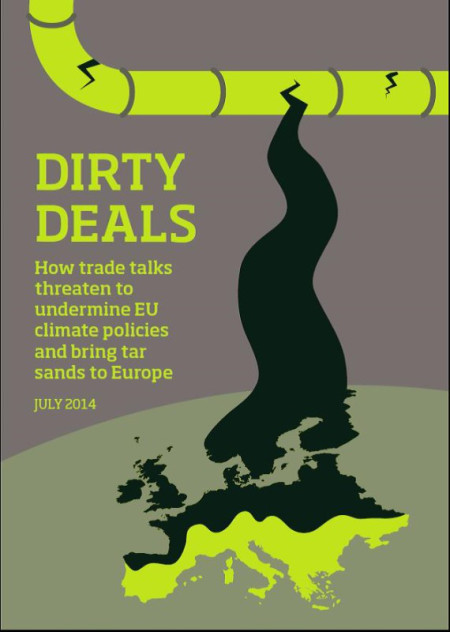
Canada and the US have threatened to pull out of TTIP [Transatlantic Trade and Investment Partnership] trade talks unless the EU ignores the massive emissions of oil from tar sands – and the EU is collapsing under the pressure…For five long years the federal government and the oil industry have lobbied against the European Union labeling oilsands (also called tar sands) bitumen as ‘dirty oil’ in its Fuel Quality Directive (FQD).  A new report [authored by environmental groups] reveals the how recent involvement of the US in the lobby offensive to keep the EU market open for bitumen exports has tipped the scales in favour of oilsands proponents….

The report shows the EU Fuel Quality Directive, a piece of legislation designed to reduce global warming greenhouse gas (GHG) emissions in the EU’s transportation sector, is unlikely to acknowledge fuels from different sources of oil – conventional oil, oilsands, oil shale – have different carbon footprints.  All oil is the same – no matter how great the disparity in emissions  Instead all oils will more than likely be treated as having the same GHG emissions intensity ‘value’ in the Directive. This is exactly what Canada, the oil industry and now the US have been pushing for…

The EU has not fallen for the federal government’s argument that bitumen produces only marginally more GHG emissions than conventional oil in extraction, processing, and use.  A European Commission study found bitumen’s carbon footprint is between 12% – 40% higher than conventional oil as so much of the bitumen produced from the tar sands is burnt to fuel the energy-intensive extraction process.  The report reveals trade, not science, is the cause of the EU backing off from implementing the Fuel Quality Directive as it was originally meant to be implemented.

The US in some ways has been more open [than Canada] about its lobbying against the Fuel Quality Directive.  US Trade Representative Michael Froman confirmed he “raised these issues [of the FQD implementation] with senior Commission officials on several occasions, including in the context of the Transatlantic Trade and Investment Partnerships (TTIP).” The TTIP is the highly controversial trade agreement between the US and the EU currently under negotiation.  European Commission documents obtained by Friends of the Earth Europe reveal the US trade missions has “substantive concerns” with the Fuel Quality Directive singling out fuels produced from bitumen as having a higher carbon footprint than conventional oil.    Like Canada and the oil industry, the US wants all oil – regardless of GHG emissions – to be treated the same as conventional oil in the Directive…Recently eleven members of US Congress sent a letter to the US trade mission expressing their concerns “that official US trade negotiations could undercut the EU’s commendable efforts to reduce carbon pollution.”

Excerpts, Derek LeahyIgnore tar sands emissions! EU buckles under US, Canada pressure in TTIP talks, Ecologist, July 23, 2014