Tag Archives: Himalayas glaciers

Caring for the Third Pole

The Tibetan Plateau and its surrounding mountains [the Himalayas], often termed the Third Pole, contain more ice than anywhere outside the Arctic and Antarctic. This region is also the source of the nine largest rivers in Asia, providing fresh water, food, and other ecosystem services to more than 1.5 billion people…In recent decades, air temperature at the Third Pole has warmed significantly faster than the global average…Meanwhile, intensive anthropogenic activities, such as overgrazing, deforestation, urbanization, and expansion of infrastructure projects such as construction of roads, dams, and electrical grids, are causing widespread landcover changes within the region.

Together, these changes are altering the Third Pole’s biogeochemical cycles and pushing the fragile ecosystem toward degradation and possible collapse, which would cause irreversible harm on a regional and global scale. To avoid this, all nations must meet the standards laid out in the Paris Agreement. At the regional level, we strongly urge the relevant nations (including Afghanistan, Bhutan, China, India, Kyrgyzstan, Myanmar, Nepal, Pakistan, and Tajikistan) to cooperate in addressing these impending threats through systematic changes to management policies. Rapid and unprecedented coordination will be necessary, including a regional cooperation treaty and formation of a cross-border biodiversity conservation plan for the Third Pole region. Meanwhile, any infrastructure projects undertaken must be environmentally sustainable, and a practicable grazing management policy should be adopted.

Excerpts from Jie Liu, Protect Third Pole’s Fragile Ecosystem, Science,  Dec. 21, 2018

Final Development Frontier in Nepal

While India, Pakistan and China have all developed massive hydropower plants along the Himalayan mountains, Nepal’s civil war and political instability scared off investment for decades.  Now, thanks to an inclusive peace process that allowed the country’s main rebel leader to be elected prime minister twice, the focus is shifting to Nepal. Hydropower projects worth billions of dollars are in progress, with geologists and investors scouring the landscape for more.

Government surveys show Nepal’s abundant water resources can feasibly yield hydropower equal to more than 40% of U.S. output, a 40-fold increase from today. Officials project almost a third more hydropower capacity will come online this year. More than 100 projects under construction—over 40 since last year—and others in development will yield at least a tenfold increase in the next decade to 10 gigawatts of power, they say.

Nepal is ramping up its development of hydroelectric power plants in the Himalayas, but building in the region can be risky work. Photo: Brian Sokol for The Wall Street Journal  “There’s such an energy shortage that any project you build will find a market,” said Allard Nooy, CEO of InfraCo Asia, a development body funded by the U.K., Swiss and Australian governments that is financing one hydro project and seeking to develop two more.

Still, power companies don’t face an easy ride.  Among the hurdles are natural ones: earthquakes, landslides and inland tsunamis from glacial lakes as warmer temperatures prompt ice melt. Two years ago a series of massive quakes killed 9,000 people and shattered the country.

Opposition from environmental groups is another difficulty, especially for a new generation of dam projects. In the past, the World Bank and Japan’s Asian Development Bank have withdrawn support for projects amid opposition from environmental groups that say large dams can damage natural habitats like wetlands, threaten migratory fish stocks, and displace traditional farming communities.

Activists are concerned over the effects hydropower projects have on the environment and communities. Here are some of their top worries.

Displacement Dams flood valleys and in many cases require communities to abandon their land. A number of dam projects under consideration in Nepal would require whole villages to relocate.
Earthquakes A growing body of research suggests large dams can trigger quakes by adding pressure to areas near fault lines, a phenomenon known as “reservoir-induced seismicity.”
Wildlife Projects can disrupt the natural migration of fish and other river life. Environmentalists in Nepal are particularly concerned about the country’s small population of endangered Ganges River Dolphins.
Seasonal River-based hydropower projects, which are popular in Nepal, only generate electricity when water is flowing, making them less effective in the dry season. Dams can generate power in any season.

The greater stability has boosted momentum for rising investment in the Himalayas—a region dominated by Nepal, India and Bhutan that is considered the final development frontier in South Asia. Hydro energy projects are the biggest focus.  “The only resource we have, like the Arabian countries have oil, is water,” said Chhabi Gaire, project manager at the Rasuwagadhi Hydroelectric Project, a 1f11-megawatt plant under construction near China’s border.

Funding for projects is increasingly coming from Nepalese working abroad, says the Nepal Electricity Authority. Their remittances reached $6.7 billion in 2015, according to the World Bank, more than even Thai and South Korean workers abroad sent to their own countries.  Meanwhile, India’s cabinet approved $850 million in February to build a plant on Nepal’s Arun River that would export most of its energy to India. A month earlier, the Chinese-state owned China Three Gorges Company agreed to a joint venture with Nepal’s government to build a $1.6 billion hydropower plant on Nepal’s Seti River, also mainly for electricity export to India…

Workers on Nepal’s hydropower projects face sometimes deadly risks in the steep mountain valleys of the Himalayas such as landslides, falling boulders and flash floods…  [T] he 456-megawatt Upper Tamakoshi project, funded by a group of Nepal’s major banks and pension funds, is now under construction and set to open in mid-2018 with a reservoir to enable energy generation in the dry season.  It’s is also a risky project.

To the East the dangerous glacial lake Tsho Rolpa threatens to burst its banks. To the West, the Gongar river routinely spits boulders the size of two-story buildings over the valley wall. A bridge the developers built over the Gongar was swept away in a flash flood during monsoon season. Landslides triggered by quakes swept away swaths of the access road. To keep working, project developers built a steel truss bridge and drilled a new road tunnel through a collapsed valley wall.  Moreover, the project is built on such volatile terrain that the turbines and delicate transmission equipment were buried 460 feet beneath the surface.

Excerpts from In the Himalayas, a New Power Rises: Water, Wall Street Journal, May 18, 2017
 

Exploiting Himalaya Rivers

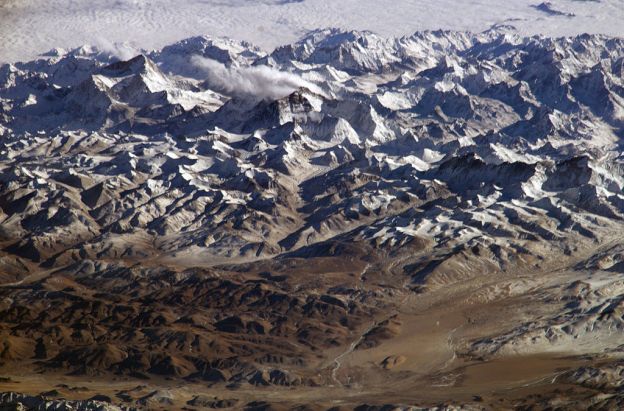
Himalayan rivers, fed by glacial meltwater and monsoon rain, offer an immense resource. They could spin turbines to light up swathes of energy-starved South Asia. Exports of electricity and power for Nepal’s own homes and factories could invigorate the dirt-poor economy. National income per person in Nepal was just $692 last year, below half the level for South Asia as a whole.

Walk uphill for a few hours with staff from GMR, an Indian firm that builds and runs hydropower stations, and the river’s potential becomes clear. An engineer points to grey gneiss and impossibly steep cliffs, describing plans for an 11.2km (7-mile) tunnel, 6 metres wide, to be blasted through the mountain. The river will flow through it, before tumbling 627 metres down a steel-lined pipe. The resulting jet—210 cubic metres of water each second—will run turbines that at their peak will generate 600MW of electricity.  The project would take five years and cost $1.2 billion. It could run for over a century—and produce nearly as much as all Nepal’s installed hydropower.

Trek on and more hydro plants, micro to mighty, appear on the Marsyangdi. Downstream, China’s Sinohydro is building a 50MW plant; blasting its own 5km-long tunnel to channel water to drive it. Nearby is a new German-built one. Upstream, rival Indian firms plan more. They expect to share a transmission line to ill-lit cities in India.

GMR officials in Delhi are most excited by another river, the Upper Karnali in west Nepal, which is due to get a 900MW plant. In September the firm and Nepal’s government agreed to build it for $1.4 billion, the biggest private investment Nepal has seen.

Relations between India and Nepal are improving. Narendra Modi helped in August as the first Indian prime minister in 17 years to bother with a bilateral visit. Urged by him, the countries also agreed in September to regulate power-trade over the border, which is crucial if commercial and other lenders are to fund a hydropower boom…. Another big Indian hydro firm agreed with Nepal’s government, on November 25th, to build a 900MW hydro scheme, in east Nepal, known as Arun 3. Research done for Britain’s Department for International Development suggests four big hydro projects could earn Nepal a total of $17 billion in the next 30 years—not bad considering its GDP last year was a mere $19 billion.

All Nepal’s rivers, if tapped, could feasibly produce about 40GW of clean energy—a sixth of India’s total installed capacity today. Add the rivers of Pakistan, Bhutan and north India and the total trebles.  Bhutan has made progress: 3GW of hydro plants are to be built to produce electricity exports. The three already generating produce 1GW out of a total of 1.5GW from hydro. These rely on Indian loans, expertise and labour….

A second reason, says Raghuveer Sharma of the International Finance Corporation (part of the World Bank), was radical change that opened India’s domestic power market a decade ago. Big private firms now generate and trade electricity there and look abroad for projects. India’s government also presses for energy connections over borders, partly for the sake of diplomacy. There has even been talk of exporting 1GW to Lahore, in Pakistan—but fraught relations between the two countries make that a distant dream.

An official in India’s power ministry says South Asia will have to triple its energy production over the next 20 years. Integrating power grids and letting firms trade electricity internationally would be a big help. It would expand market opportunities and allow more varied use of energy sources to help meet differing peak demand. Nepal could export to India in summer, for example, to run fans and air conditioners. India would export energy back uphill in winter when Nepali rivers dry and turbines stop spinning.

Governments that learn to handle energy investments by the billion might manage to attract other industries, too. Nepal’s abundant limestone, for example, would tempt cement producers once power supplies are sufficient. In the mountains, it is not only treks that are rewarding.

South Asia’s Hydro-Politics: Water in them hills, Economist, Nov. 29, 2014, at 38

Himalayas and Climate Change: the Third Pole

Though the amount of ice on the plateau of Tibet and its surrounding mountains, such as the Himalayas, Karakoram and Pamirs, is a lot smaller than that at the poles, it is still huge. The area’s 46,000 glaciers cover 100,000 square kilometres (40,000 square miles)—about 6% of the area of the Greenland ice cap. Another 1.7m square kilometres is permafrost, which can be up to 130 metres deep. That is equivalent to 7% of the Arctic’s permafrost. Unlike the ice at the poles, the fate of this ice affects a lot of people directly. The area is known by some as Asia’s water tower, because it is the source of ten of the continent’s biggest rivers. About 1.5 billion people, in 12 countries, live in the basins of those rivers. Welcome, then, to the Earth’s “Third Pole”.

Until recently studies of the Third Pole were piecemeal—not surprising, given its remoteness, the altitude, the harsh weather and the fact that little love is lost between the countries among which it is divided. In 2009, however, Yao Tandong of the Institute of Tibetan Plateau Research, in Beijing, Lonnie Thompson of the Ohio State University and Volker Mosbrugger of the Senckenberg World of Biodiversity, in Frankfurt, started an international programme involving these countries, called the Third Pole Environment (TPE). Last month, its fourth workshop met in Dehradun, India.

One question on everyone’s mind is whether the glaciers are retreating, as is happening in parts of the real polar regions. The Intergovernmental Panel on Climate Change’s report in 2007 foolishly suggested that the Himalayas’ glaciers could disappear as early as 2035. Given the amount of ice they contain, it would take weather gods armed with blow torches to melt them that quickly, and this suggestion was rapidly discredited…..

One outcome of the workshop, then, has been to establish that the overall ice cover of the Third Pole, like that of the two real poles, is shrinking. Another is to show how precarious and piecemeal data about the area are. Its role as the source of so many rivers means that absence of data matters. The Chinese Academy of Sciences, of which both Dr Yao’s and Dr Wu’s institutes are part, has therefore set up a fund of 400m yuan ($65m) for research on the Third Pole and, crucially, a quarter of this is earmarked for work outside China.

The TPE’s researchers will now monitor a set of bellwether glaciers every six months. They will set up observatories to measure solar radiation, snowfall, meltwater and changes in the soil, as well as air temperature, pressure, humidity and wind. And they plan to take cores from the ice on the Tibetan plateau. These will let them reconstruct the area’s climate over the past few hundred thousand years. Together, these data will give them a better grip on how much—and why—the Third Pole is changing.

The climate of Tibet: Pole-land, Economist,, May 11, 2013,  at 84