Tag Archives: hydrothermal vents

Unbelievable! The Astonishing Underworld of Seafloor

A scientific expedition into a region of the Pacific Ocean named for Hades, Greek god of the underworld, has uncovered an other-worldly ecosystem 30,000 feet deep. “It’s a totally new thing that has not been seen before,” said Dominic Papineau, an exobiologist at China’s State Key Laboratory of Deep-sea Science and Intelligence Technology in Sanya.

Papineau is co-author of a groundbreaking research paper published in the journal Nature, describing the astonishing array of creatures who live in this daunting and dark environment, sustained by chemicals that leach from the ocean floor. Researcher Mengran Du told The Washington Post she wasn’t sure what expect when she descended in a three-person submersible into one of the deepest trenches in the Pacific. What she and others from China’s Institute of Deep-sea Science and Engineering saw when they got there was, she said, “unbelievable.”

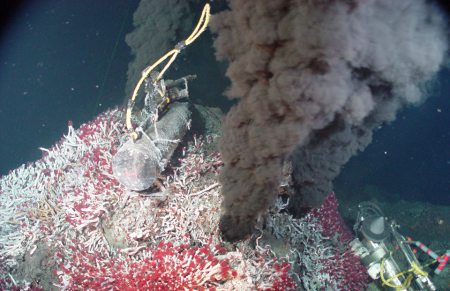
Like skyscrapers, thick clusters of tubeworms with red-tinged tentacles jutted from the ocean floor, phosphorescent snails scaling them like window washers, she said. In between, white bristly creatures wriggled and writhed…

Scientists have long studied organisms that thrive around hydrothermal vents. But those native to areas known as cold seeps — where gases like methane and hydrogen sulfite leach from the seafloor at near-freezing temperatures — have been little studied. 

“Flourishing chemosynthetic communities had long been postulated to exist in the trenches, but this is the first paper that documents their existence below 9 kilometers and at multiple locations,” she said.  The adaptability of organizations in those trenches is a shot in the arm for scientists searching for evidence of life in oceans on other celestial bodies, including Europa, a moon of Jupiter.

Excerpt from Scientists Find New Ecosystem in Deepest Trenches of Pacific Ocean, US News and World Report, Aug. 4, 2025
 

Saving the Climate by Fouling the Oceans

The Norwegian government in June 2023 opened the door for deep-sea mining in its waters, despite opposition from environmental groups and a growing list of nation states arguing to ban the practice.  The government said it was proposing parts of the Norwegian continental shelf be opened for deep sea mining and other commercial seabed mineral activities…Companies and countries are scouring the planet to find and secure additional sources of metals and minerals critical for the energy transition, including cobalt, manganese and nickel.  To date deep-sea mining has focused on the extraction of seabed nodules—tennis-ball sized pieces of rock which contain manganese, cobalt and nickel, all of which are used in electric-vehicle batteries

So far much of the attention has centered on the Clarion Clipperton Zone in the Pacific Ocean: An area of water between Mexico and Hawaii that contains millions of tons of nodules.  In Norway however, the focus will be on seabed crusts on the country’s continental shelf. The target crusts contain copper, zinc and cobalt, as well as some rare-earth elements, according to the Norwegian Petroleum Directorate…

Countries including France and Germany have called for moratoriums on deep-sea mining, while in May 2023 a report found that when researching the pacific seabed, 90% of the more than 5,000 marine creatures found living in the Clarion Clipperton Zone were new species. Companies including Maersk and Lockheed Martin have also been divesting their deep-sea mining investments. 

Excerpts from Yusuf Khan, Norway Opens Door for Deep-Sea Mining of Copper and Other Critical Materials, WSJ, June 20, 2023

The Diversity of Submarine Mountains

There are about 30 000 mountains under the sea, the so-called “seamounts.”  One of them the Tropic Seamount started as a volcano, 120 million years ago. It lies at the southern tail of a chain that includes submerged peaks as well as the Canary Islands off the coast of Western Sahara. The seamount rises 3 kilometers from the ocean floor and is topped by a plateau 50 kilometers wide, 1 kilometer below the sea surface. Above ground, it would rank among the world’s 100 tallest mountains…. Much of its surface is encrusted with minerals that precipitated out of the seawater over eons, coating the lava at the excruciatingly slow rate of 1 centimeter or less every 1 million years.

That coating has caught the eye of prospectors. Called ferromanganese crust, it can contain high concentrations of cobalt, tellurium, and rare-earth elements used in electronics such as wind turbines, batteries, and solar panels. By one estimate, seamounts in just one chunk of the North Pacific Ocean could hold 50 million tons of cobalt—seven times the worldwide total that’s economical to dig up on land. Such estimates arrive at a time when the International Energy Agency in Vienna is warning of a possible cobalt supply crunch by 2030, caused in part by the growing production of battery-powered cars.

Companies hoping to extract those metals from the seabed are focusing first on abyssal plains. Those flat expanses of the deep ocean floor can be littered with potatolike nodules rich in nickel, copper, and cobalt. They are also looking at hydrothermal vents that spew mineral-laden water, creating thick crusts and fantastical rock chimneys. Seventeen companies have permits to explore for minerals in one abyssal region, the Clarion-Clipperton Zone in the Pacific Ocean between Hawaii and Mexico. And in 2017, Japan became the first nation to conduct large-scale experimental mining of a dead hydrothermal vent off the coast of Okinawa, inside Japan’s national waters. But the crusts on seamounts have particularly high concentrations of sought-after metals, making them a tempting target…

[Scientists are worried] that what they have learned from the the Tropic Seamount puts mining and conservation on a collision course. “The conditions that seem to favor the growth of the crusts,” he says, “also seem to favor the colonization by a lot of corals and sponges.”

Seamounts cover roughtly the same area as Russia and Europe combined, by one estimate, making them one of the planet’s largest habitats. The peaks have long been known as oases for sea life….Schools of fish—brick-red orange roughy, silvery pelagic armorheads, and goggle-eyed black oreos—often congregate at seamounts, as do sharks and tuna. Some migratory humpback whales appear to use them as navigational markers, spawning grounds, and resting spots. Seabirds gather above them, and myriad corals and sponges cling to their rocky surfaces, creating ample cover for other creatures.

Interest in seamounts is particularly high in countries that either host companies interested in deep-sea mining or are considering allowing mining in their national waters. In 2018, the Chinese research ship Kexue (meaning “science”) spent about 1 month surveying the Magellan Seamounts near the Mariana Trench, which several nations see as a potential source of industrial minerals. Brazilian researchers teamed up with Murton’s MarineE-tech project to examine an area in international waters where the country has a preliminary mining claim. Japanese scientists sent robots to survey seamounts that might be ripe for mining. In late July, the International Seabed Authority (ISA) in Kingston, a part of the United Nations that governs deep-sea mining in international waters, released 18 years of environmental data gathered by companies pursuing mining claims, including on seamounts….

The design of seamount mining equipment is closely guarded by competing countries and companies. But it could work much like equipment being tested for hydrothermal vents: enormous, remote-controlled machines that resemble bulldozers, equipped with toothed wheels designed to grind the crust into bits that can be carried to the ocean surface for processing.

Although no seamount has been mined yet, scientists point to the damage from deep-sea fishing to underscore why they worry this heavy machinery would do irreparable damage. In the late 1990s, Australian scientists documented devastation from nets dragged across seamounts near Tasmania to catch orange roughy. Hard corals had been wiped out, and the sheer mass of life on the mountains was half that on nearby ones too deep to be fished. Fifteen years after trawling was halted on some New Zealand seamounts, Clark and other researchers found little evidence of recovery.

Excerpts from Warren Cornwall, Sunken Summits, Science, Sept 13, 2019
Mining the Ocean: the Fate of Sea Pangolin

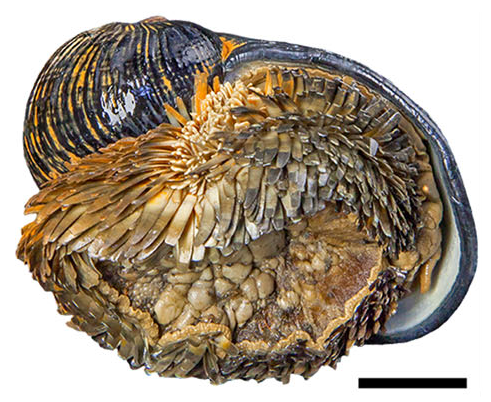
A snail that lives near hydrothermal vents on the ocean floor east of Madagascar has become the first deep-sea animal to be declared endangered because of the threat of mining.  The International Union for Conservation of Nature (IUCN) added the scaly-foot snail (Chrysomallon squamiferum) to its Red List of endangered species on 18 July, 2019 — amid a rush of companies applying for exploratory mining licenses…. The scaly-foot snail is found at only three hydrothermal vents in the Indian Ocean.  Two of those three vents are currently under mining exploration licences,…Even one exploratory mining foray into this habitat could destroy a population of these snails by damaging the vents or smothering the animals under clouds of sediment..

Full-scale mining of the deep seabed can’t begin in international waters until the International Seabed Authority (ISA) — a United Nations agency tasked with regulating sea-bed mining — finalizes a code of conduct, which it hopes to do by 2020….The biggest challenge to determining whether the scaly-foot snail warranted inclusion on the Red List was figuring out how to assess the extinction risk for animals that live in one of the weirdest habitats on Earth…

When the IUCN considers whether to include an organism on the Red List, researchers examine several factors that could contribute to its extinction. They include the size of a species’ range and how fragmented its habitat is…The IUCN settled on two criteria to assess the extinction risk for deep-sea species: the number of vents where they’re found, and the threat of mining.   In addition to the scaly-foot snail, the researchers are assessing at least 14 more hydrothermal vent species for possible inclusion on the Red List.

Excerpts from Ocean Snail is First Animal to be Officially Endangered by Deep-Sea Mining, Nature, July 22, 2019

On Sea Pangolins see YouTube video

Mining the Seabed

In the 1960s and 1970s, amid worries about dwindling natural resources, several big companies looked into the idea of mining the ocean floor. They proved the principle by collecting hundreds of tonnes of manganese nodules…rich in cobalt, copper and nickel. As a commercial proposition, though, the idea never caught on. Working underwater proved too expensive and prospectors discovered new mines on dry land.

The International Seabed Authority, which looks after those parts of the ocean floor beyond coastal countries’ 200 nautical-mile exclusive economic zones, has issued guidelines for the exploitation of submarine minerals.

One of the most advanced projects is that of Nautilus Minerals, a Canadian firm. In January 2016 Nautilus took delivery of three giant mining machines (two rock-cutters and an ore-collector) that move around the seabed on tracks, like tanks. It plans to start testing these this year. If all goes well the machines could then start operating commercially in Nautilus’s concession off the coast of Papua New Guinea, which prospecting shows contains ore with a copper concentration of 7%. (The average for terrestrially mined ore is 0.6%.) This ore also contains other valuable metals, including gold.

This approach (which is also that taken by firms such as Neptune Minerals, of Florida, and a Japanese consortium led by Mitsubishi Heavy Industries) is different from earlier efforts. It involves mining not manganese nodules, but rather a type of geological formation unknown at the time people were looking into those nodules—submarine hydrothermal vents. These rocky towers, the first of which was discovered in 1977, form in places where jets of superheated, mineral-rich water shoot out from beneath the sea floor. They are found near undersea volcanoes and along the ocean ridges that mark the boundaries between Earth’s tectonic plates. They generally lie in shallower waters than manganese nodules, and often contain more valuable substances, gold among them.

They are not, though, as abundant as manganese nodules, so if and when the technology for underwater mining is proved, it is to nodules that people are likely to turn eventually. These really are there in enormous numbers. According to Dr Hannington, the Clarion-Clipperton fracture zone, a nodule field that stretches from the west coast of Mexico almost to Hawaii, contains by itself enough nickel and copper to meet global demand for several decades, and enough cobalt to last a century.

Mining, whether on land or underwater, does come at an environmental cost, though… [T]he sediments the nodules are found in play host to microscopic critters that would be most upset by the process of trawling that is needed to bring the nodules to the surface. They might take decades to recover from it.

Excerpts from, Oceanography: Fruits de mer, Economist, Feb. 25, 2017