Tag Archives: IAEA standards

Immobilizing Nuclear Waste

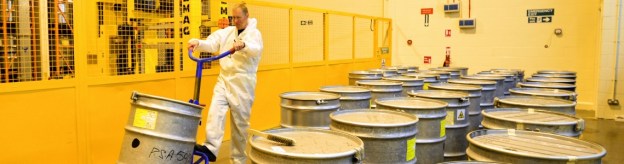
Several options are available to immobilise waste resulting from nuclear fuel reprocessing. One of these is vitrification – a mature technology which has been used for high-level nuclear waste immobilization for over 50 years…Argentina is considering vitrification as a viable option for dealing with its high-level nuclear waste. The Argentine National Programme for Radioactive Waste Management aims to build capacities to implement vitrification processes for radioactive waste….
The vitrified radioactive waste is extremely durable, and ensures a high degree of environmental protection. Although the process of vitrification requires a high initial investment and then operational costs, waste vitrification has important advantages: it significantly reduces the volume of waste, and allows simple and cheap disposal possibilities. The overall cost of vitrified radioactive waste is usually lower than alternative options when transportation and disposal expenses are taken into account. For this reason, the process is very attractive for sates seeking effective and reliable immobilisation solutions for their radioactive waste stocks.

Excerpts from Taking a Closer Look at Vitrification: How the IAEA Helps Countries Utilise Advanced Immobilisation Technologies, IAEA Press Release, Mar. 24, 2017

Secrecy at the International Atomic Energy Agency

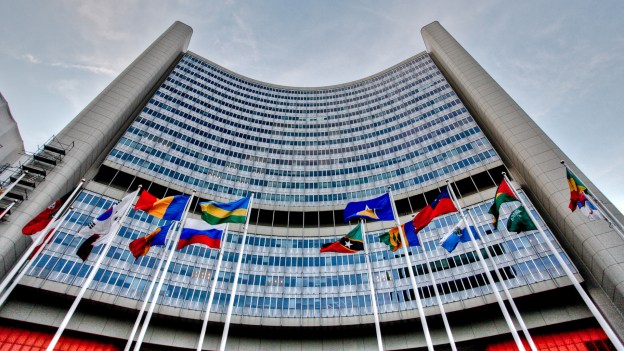
The IAEA [International Atomic Energy Agency], which is charged with both promoting the peaceful use of nuclear power and controlling fuel that could be used in weapons, is holding its quadrennial safeguards meeting behind closed doors for the first time in at least 12 years this week in Vienna. The agency also decided to withdraw information about nuclear projects that have led to proliferation risks.

The IAEA restricted access to the symposium [Linking, Implementation, Safety, Nuclear, Safeguards, Atomic Energy, Technology, Science, Energy, Chemistry, Physics] held between October 20 and October 24, 2014, so participants aren’t “inhibited,” spokeswoman Gill Tudor said in an e-mail while noting that the opening and closing ceremonies will be public. Information about technical cooperation, which has been progressively restricted since 2012, will be made available again in the “coming weeks,” IAEA public-information director Serge Gas said in an e-mail….

To be sure, some IAEA members such as Iran would like to see the agency impose even greater controls over information. President Hassan Rouhani’s government asked the IAEA in a Sept. 19 open letter to investigate leaks of confidential data that it said could violate the interim agreement it signed with world powers last year.

Iran’s stance shows the agency is guilty of a double failure, according to Tariq Rauf, a former IAEA official who is now a director at the Stockholm International Peace Research Institute. While the public is increasingly excluded from the scientific debate that shapes policy decisions, “the agency routinely allows secret information about nuclear programs to be given to select Western countries, which then leak it out,” he said.… The U.S. Government Accountability Office said in a 2011 report it’s wary about IAEA help to Cuba, Iran, Sudan and Syria.  Past IAEA technical assistance probably wound up helping Pakistan discover and mine the uranium that went into its nuclear weapons. In Syria, the agency developed a uranium-ore production facility that later drew scrutiny after the Middle East country allegedly built a secret reactor…

Scientists at this week’s meeting will explain how they can use rooftop sensors to sniff out the gases given off during plutonium production, according to the meeting agenda. Others will look at new ways to analyze satellite imagery, more sensitive methods for measuring traces of radioactivity and the difficulties in keeping track of nuclear material at places like Japan’s $20 billion plutonium-separation facility in Rokkasho. 

Excerpts from Jonathan Tirone. Nuclear Secrecy Feeds Concerns of Rogues Getting Weapons, Bloomberg, Oct 22, 2014n

Nuclear Accidents of the Future

Three major atomic accidents [Three Mile Island US 1979, Chernobyl USSR 1986, Fukushima Japan 2011] in 35 years are forcing the world’s nuclear industry to stop imagining it can prevent more catastrophes and to focus instead on how to contain them.  As countries such as China and India embrace atomic power even after the Fukushima reactor meltdowns in 2011 caused mass evacuations because of radiation fallout, scientists warn the next nuclear accident is waiting to happen and could be in a country with little experience to deal with it.

“The cold truth is that, no matter what you do on the technological improvements side, accidents will occur — somewhere, someplace,” said Joonhong Ahn, a professor at the Department of Nuclear Engineering of University of California, Berkeley. The consequences of radiation release, contamination and evacuation of people is “clear and obvious,” Ahn said. That means governments and citizens should be prepared, not just nuclear utilities, he said.

While atomic power has fallen from favor in some western European countries since the Fukushima accident — Germany, for example, is shutting all of its nuclear plants — it’s gaining more traction in Asia as an alternative to coal. China has 28 reactors under construction, while Russia, India, and South Korea are building 21 more, according to the World Nuclear Association. Of the 176 reactors planned, 86 are in nations that had no nuclear plants 20 years ago, WNA data show…

The problem is that the causes of the three events followed no pattern, and the inability to immediately contain them escalated the episodes into global disasters with huge economic, environmental and political consequences. Even if no deaths have yet been officially linked to Fukushima radiation, for example, cleanup costs have soared to an estimated $196 billion and could take more than four decades to complete.

If nuclear is to remain a part of the world’s energy supply, the industry must come up with solutions to make sure contamination — and all other consequences — do not spread beyond station grounds, Gregory Jaczko, ex-chairman of the U.S. Nuclear Regulatory Commission, said in an interview in Tokyo….

Since the introduction of nuclear stations in the 1950s, the industry has focused safety efforts on design and planning. Research and innovation has looked at back-up systems, passive technology that would react even if no human operator did, and strengthened materials used in construction of atomic stations….

The official toll from the reactor explosion at Chernobyl was put at 31 deaths. Radiation clean-up work, however, involved about 600,000 people, while 200,000 locals had to be relocated.  The accident contaminated 150,000 kilometers of land and according to the last Soviet leader Mikhail Gorbachev it was a factor in bringing about the collapse of the Soviet Union in 1991.

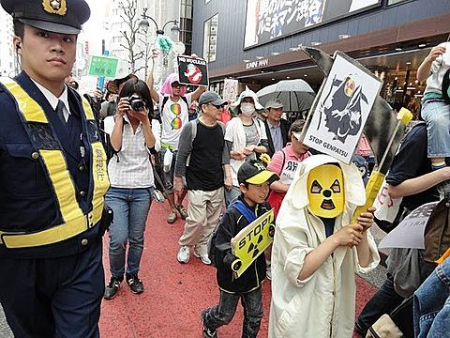
In Japan, the meltdown of three Fukushima reactors helped unseat premier Naoto Kan and forced the evacuation of about 160,000 people, destroying local fishing, farming and tourism industries along the way. It also brought tens of thousands of anti-nuclear protesters out onto the streets in the country’s biggest demonstrations since the 1960s. Tokyo Electric Power Co., the plant operator and once the world’s biggest non-state power producer, would have been bankrupted by the Fukushima accident but for billions of dollars in government aid…

Building a plant that would contain an accident within the facility boils down to cold cash, he said.  The review calls for new reactor designs to make a major release of radioactive fallout outside the station site “practically impossible,” the IAEA said. The standard would be “crucial for public acceptance and for the sustainability of nuclear energy.” Specialists on the review met for the first time in March and no conclusions are yet available, IAEA spokesman Greg Webb said by e-mail.

The problem with an engineering solution, an ever better reactor design or grander safety systems, is that based on the premise that all technology is fallible those defense systems can also fail, Berkley’s Ahn said.  “This is an endless cycle,” Ahn said. “Whatever is your technology, however it is developed, we always have residual risk.”  When the next nuclear accident occurs the world needs to have better knowledge of how to limit the spread of radiation and do the clean-up, including removing radiation from the soil, water and having an efficient evacuation drill for the population in danger zones, Ahn said. We also need more understanding of the impact of low-dose radiation on organisms, he said.  “This is about recovery from an accident, not preventing an accident,” Ahn said. “It’s completely different. And I think this concept is very necessary for the future of nuclear utilization.”

Excerpts from Yuriy Humber, World Needs to Get Ready for the Next Nuclear Plant Accident, Bloomberg, Apr. 4, 2014
The Hundred Defects in Nuclear Plants: Europe

Hundreds of defects have been found throughout Europe’s nuclear reactors and mostly in France, according to a EU stress test report leaked to the German and French media.  A leaked EU stress test report says it it will cost €25 billion to bring Europe’s nuclear reactors up to international saftey standards   The stress tests assess whether any of Europe’s 143 licensed nuclear power plants can withstand extreme events such as earthquakes and terrorists attacks.  The tests were introduced after the nuclear accident in Japan’s Fukushima some 18 months ago. EU energy commissioner Gunther Oettinger is to present the final report and recommendations in the upcoming EU summit on 18 and 19 October…

The European Nuclear Safety Regulators Group (Ensreg), a group of senior officials from the national nuclear regulatory authorities from all 27 member states, said on Monday (October 1, 2012) in a statement said they have yet to be informed of the content of the report.  “The commission had not made available to Ensreg any draft of the communication. However, the content of a draft was known by some Ensreg members and this draft raised major problems and concerns in Ensreg,” said the group’s chairperson Tero Varjoranta.

Meanwhile, a preview into the content by French daily Le Figaro and German daily Die Welt suggests none of France’s 58 nuclear power plants meet, to varying degrees, the international security standards outlined by the International Atomic Energy Agency (IAEA).  “For the very first time in history, we know for all the nuclear power plants in Europe whether these very high standards are actually used or not used,” said Holzner.

Nineteen French reactors have no seismic measuring instruments, says Le Figaro. The paper also notes that safety and rescue equipment in case of disaster is not adequately protected unlike at German, British and Swedish reactors.  The report does not recommend shutting down any one EU nuclear power plant, say the papers, but notes that getting them up to standard would cost some €25 billion.

National regulators carry out the initial stress tests inspections. Teams of safety experts from the EU member states and the commission then scrutinize their conclusions followed by on-site spot checks.  For its part, Belgium’s national regulator, the federal agency for nuclear control (FANC), decided to shut down two of its seven reactors in August after having discovered thousands of cracks.  The discovery of the cracks came two months after having submitted their peer-reviewed EU stress tests in April.  “Results of the stress tests are still perfectly valid. In any case they had an altogether different purpose,” said FANC at the time.

Leaked EU nuclear stress tests reveal hundreds of defects, EUobserver.com, Oct. 2, 2012