Tag Archives: India nuclear submarines

Owning Nuclear Submarines: the Benefits

President Trump has given approval  in October 2025 for South Korea to build a nuclear-powered submarine in the U.S., granting Seoul a coveted piece of hardware that could rattle China and North Korea—and potentially spark a race by its Asian neighbors to acquire similar technology. The stealthy submarine—which is difficult to detect because it can stay underwater…

It often takes the U.S. more than five years, if not much longer, to make one…Trump said the submarine will be made at a shipyard in Philadelphia owned by a South Korean firm, Hanwha Ocean, which purchased the facility in 2024. Hanwha makes large naval submarines in South Korea, but this would be its first nuclear-powered sub….

The U.S. maintains considerable military dominance underwater across the Indo-Pacific due to its nuclear-powered subs. With roughly 70 of them, the U.S.’s nuclear-submarine fleet outnumbers China by more than five to one…. But China is rapidly catching up, aided by diesel-powered submarines that are quieter, travel faster and can carry advanced weapons.

Excerpt from Timothy W. Martin, As China Raises Pressure, U.S. to Support Seoul in Building Nuclear-Powered Sub, WSJ
Nuclear Operators: Who Helps India and Pakistian with their Atomic Bombs

Using open-source data, the nonprofit Centre For Advance Defense Studies (C4ADS) report published in April 2020 provides one of the most comprehensive overviews of networks supplying the rivals, in a region regarded as one of the world’s most dangerous nuclear flashpoints.

To identify companies involved, C4ADS analysed more than 125 million records of public trade and tender data and documents, and then checked them against already-identified entities listed by export control authorities in the United States and Japan. Pakistan, which is subject to strict international export controls on its programme, has 113 suspected foreign suppliers listed by the United States and Japan. But the C4ADS report found an additional 46, many in shipment hubs like Hong Kong, Singapore and the United Arab Emirates. The father of Pakistan’s atomic bomb, AQ Khan, admitted in 2004 to selling nuclear technology to North Korea, Iran and Libya. He was pardoned a day later by Pakistani authorities, which have refused requests from international investigators to question him.

India has a waiver that allows it to buy nuclear technology from international markets. The Indian government allows inspections of some nuclear facilities by the International Atomic Energy Agency, but not all of them. C4ADS identified 222 companies that did business with the nuclear facilities in India that had no IAEA oversight. Of these, 86 companies did business with more than one such nuclear facility in India.

Both countries are estimated to have around 150 useable nuclear warheads apiece, according to the Federation of American Scientists, a nonprofit group tracking stockpiles of nuclear weapons.

Excerpts from Alasdair Pal, Exclusive: India, Pakistan nuclear procurement networks larger than thought, study shows, Reuters, Apr. 30, 2020

India’s Drones and Nukes

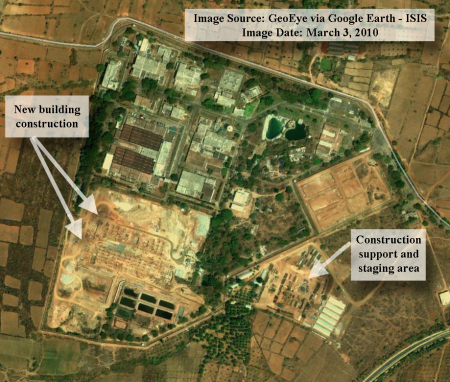
Washington-based Institute for Science and International Security (ISIS) suggests that India appeared to have followed through on its publicly announced intention to build the  Special Material Enrichment Facility (SMEF) and started constructing a large enrichment centrifuge complex near Chitradurga, Karnataka.  Furthermore, [o]n June 20, 2014 IHS Jane’s revealed that India was possibly extending Mysore’s Indian Rare Metals Plant into clandestine production of uranium hexafluoride that could theoretically be channelled towards the manufacture of hydrogen bombs.

This week the Washington-based Institute for Science and International Security (ISIS) suggested that the country appeared to have followed through on its publicly announced intention to build the SMEF and started constructing a large enrichment centrifuge complex near Chitradurga, Karnataka, where, between 2009 and 2010, approximately 10,000 acres of land were allegedly diverted for various defence purposes.

Within this walled-off tract, 1,410 acres in Ullarthi Kaval and 400 acres in Khudapura were allocated to the Bhabha Atomic Research Centre for the purpose of developing the SMEF, the ISIS said, adding that a further 4,000 acres in Varavu Kaval and 290 acres in Khudapura were allocated to the Defence Research and Development Organisation for the purpose of developing and testing “long-endurance (48-72 hours) Unmanned Aerial Vehicles and Unmanned Combat Aerial Vehicles.”…

The report’s authors, David Albright and Serena Kelleher-Vergantini, said that the new facility “will significantly increase India’s ability to produce enriched uranium for both civil and military purposes, including nuclear weapons”, urging India to therefore announce that the SMEF would be subject to International Atomic Energy Agency safeguards, committed only to peaceful uses….At the heart of India’s apparently strong enrichment thrust is an urgent need for Highly Enriched Uranium for the indigenously developed INS Arihant nuclear-powered ballistic missile submarine and probably for nuclear and thermonuclear weapons.

Excerpt from NARAYAN LAKSHMAN. Karnataka home to second covert nuke site, drone testing: report,  The  Hindu, July 2, 2014