Tag Archives: mining companies

Mining Giants and Little People: Mariana Dam Disaster

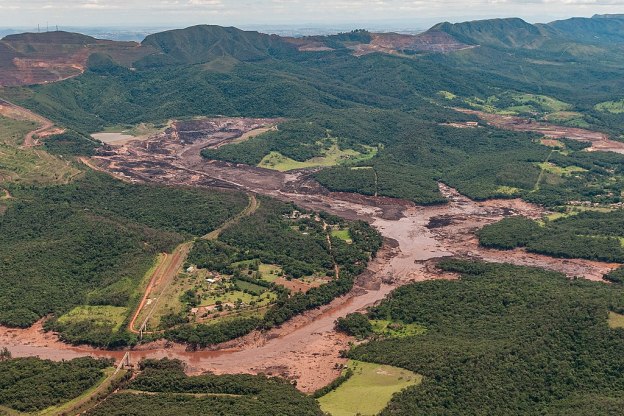
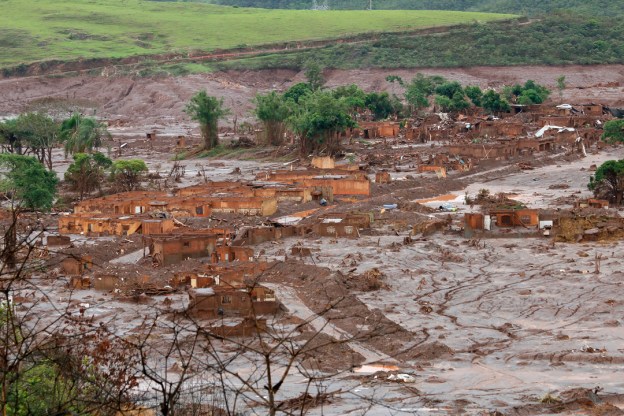
Mining company BHP has been found liable on November 13, 2025 for a 2015 dam collapse in Brazil,….[Note that this disaster was followed by yet another disaster in 2019 the Brumadinho dam disaster] The dam collapse killed 19 people, polluted the river and destroyed hundreds of homes. The civil lawsuit, representing more than 600,000 people including civilians, local governments and businesses, had been valued at up to £36bn ($48bn).

The dam in Mariana, southeastern Brazil, was owned by Samarco, a joint venture between the mining giants Vale and BHP. The claimants’ lawyers argued successfully that the trial should be held in London because BHP headquarters “were in the UK at the time of the dam collapse”. A separate claim against Samarco’s second parent company, Brazilian mining company Vale, was filed in the Netherlands, with more than 70,000 plaintiffs.

The dam was used to store waste from iron ore mining. When it burst, it unleashed tens of millions of cubic metres of toxic waste and mud. The sludge swept through communities, destroying hundreds of people’s homes and poisoning the river. Judge Finola O’Farrell said in her High Court ruling that continuing to raise the height of the dam when it was not safe to do so was the “direct and immediate cause” of the dam’s collapse, meaning BHP was liable under Brazilian law.

Excerpt from Ione Wells, UK court finds mining firm liable for Brazil’s worst environmental disaster, BBC, Nov. 14, 2025

———-

According to the UN Special Rapporteur who visited Brazil in 2019 and met BHP and Vale on numerous occasions, ” BHP and Vale rushed to create the Renova Foundation to provide the communities [affected by the collapse of the dam] an effective remedy. Unfortunately, the true purpose of the Renova Foundation appeared to be limit liability of BHP and Vale, rather than provide any semblance of an effective remedy

Furthermore, inadequate information was available about the toxicity of the waste after the Mariana disaster, the companies insisted that it was non-toxic, and rejected calls for precaution. Only three weeks after concerns were raised was information availed. When health impacts in Barra Longa emerged years later, Renova sought to exert ownership of epidemiological and toxicological studies by Ambios to suppress disclosure. Read the full report of the Special Rapporteur here.
Shut Up and Give Up: How to Deal with Environmental Disasters

The worst day of Bathsheba Musole’s life was February 18, 2025. It started with a deafening crash when the 30-foot wall around a toxic-waste pool collapsed at the Chinese copper mine above her village. A poisonous river of a stinking yellow liquid rushed downhill, inundating homes and fields, including the one where she grew corn to feed her eight children. The floodwater, laden with cyanide and arsenic, rose chest-high. “I thought I would drown,” said Musole, 48 years old, in a recent interview.

In August 2025, months after the Feb. 18, 2025 disaster, officials from Sino Metals, a unit of the state-owned China Nonferrous Mining Corp., showed up at Musole’s half-acre farm, which the Zambian government says is too toxic to sustain crops for at least three years. They were there to make things right, she recalled them saying. Their offer was $150, but it came with a catch. To get the money, she would have to agree never to talk about the spill, take legal action against Sino Metals or even reveal the contents of the nondisclosure agreement itself…

Zambia’s government and economy.. have grown reliant on China. Zambia collects about $2 billion a year in mining taxes, mostly from Chinese mining companies. Half of the copper mined in Zambia, much of it by Chinese companies, is exported to China. In 2024, the Zambian government announced that Chinese miners would invest $5 billion in the country by 2031…

After months of investigation, Drizit Environmental, a South African firm contracted by Sino Metals, concluded that 1.5 million tons of toxic waste had overflowed into the Kafue valley, 30 times what the company had said. Sino Metals terminated the firm’s contract a day before the final report was due…

Excerpt from Nicholas Bariyo, China Pushes to Silence Victims of African Mining Disaster, WSJ, Oct. 27, 2025

How to Kill People 8 000 Feet Below Ground

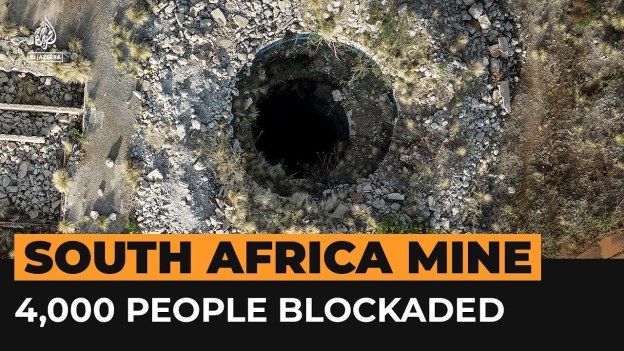
The South Africa’ government has been trying to starve out 1,000 informal prospectors so as to force them out of the Buffelsfontein mine, which extends some 8,000 feet below ground. For months in 2024, police have been sealing most entrances to the tunnels, blocking food and water deliveries and stationing guards at remaining exits to arrest any miners who make their way to the surface. In recent days, nearly 1,200 have surrendered. Police estimate that hundreds of men remain below, but it isn’t clear if they are unwilling or unable to reach the surface.

The operation is part of what police call their “Close the Hole” plan to combat illegal mining, an acute problem in what was once the gold-mining capital of the world. The South African government estimates that illegal gold mining costs the country the equivalent of over $3.8 billion a year in lost revenue, and is often associated with a jump in violent crime in nearby communities and an influx of migrants from neighboring countries… Facing a 42% unemployment rate, impoverished South Africans and migrants from nearby countries pry open sealed entrances and venture thousands of feet underground to try their luck. Locals call the men zama zamas, a Zulu phrase meaning “take a chance.”

Whole ecosystems exist below ground, with entrepreneurs selling miners everything from soda to toothpaste to sex.  The miners in Stilfontein, 100 miles southwest of Johannesburg, are suffering from hunger and dehydration, according to police. Industry experts say the zama zamas are often the lowest-level workers for larger criminal gangs that ultimately sell the gold abroad. Those who have migrated from elsewhere are sometimes victims of abuse, forced to work underground to pay off debts. Police said most miners who emerge will be charged with crimes and imprisoned or deported. 

Excerpt from Alexandra Wexler, The Standoff Deep Inside an Abandoned South African Gold Mine, WSJ, Nov. 15, 2024

Ethical Mining 2020

Less than half of the world’s larger miners have released safety and environmental details about their mine-waste dams, showing the mixed success of investors’ demands for greater transparency after the deadly Brumadinho dam collapse in Brazil. In January, 2019, 270 people died following the collapse of a tailings dam owned by Brazil’s Vale SA. The incident prompted a coalition of investors who manage more than $13 trillion to ask 726 companies in the mining and oil-sands business to disclose information on their dams. Nearly 55% of companies hadn’t delivered as of November 2019. While some of the largest miners—including Vale, BHP , and Anglo American have disclosed their information, others have yet to do so. Investors are increasingly examining ethical issues when looking at mining.

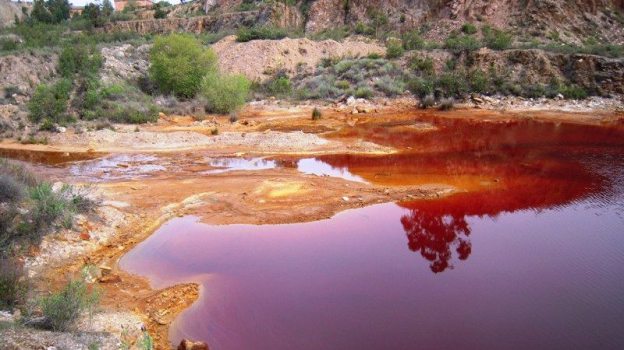
Tailings, the waste material from extracting valuable minerals, are often held for decades behind dams that can be risky if they are poorly constructed, ill-maintained or filled with too much waste. Major failures of tailings dams have become more frequent as mining companies ramp up production to meet the world’s growing demand for commodities. Norilsk Nickel one of world’s most valuable miners with a market capitalization of roughly $43 billion, hasn’t publicly released details on its tailings dams. In 2016, heavy rainfall caused a Norilsk Nickel tailings dam in northern Russia to overflow, coloring a local river red. Miners of potash and phosphate—minerals used mainly in fertilizers—have been slow to disclose.

Another big company that has not released details is Canada-based Nutrient. Satellite images show two of the company’s six Saskatchewan mines are located a few miles from residential communities and one neighbors a bird-breeding area. A tailings pond at the company’s North Carolina phosphate mine is located next to the Pamlico River, which feeds into the state’s largest estuary.

In 2017, Israel Chemicals reported that the partial collapse of a subsidiary’s dike in Israel released 100,000 cubic meters of acidic wastewater that flowed into a nearby nature reserve. The wastewater resulted from the production of phosphate fertilizer.Vancouver-based Imperial Metals Corp.is tied to what is considered one of Canada’s worst environmental catastrophes. In 2014, a British Columbia dam owned by the company burst, sending some 25 million cubic meters of mining waste pouring into a pair of glacial lakes

Large Chinese miners such as Jiangxi Copper, Zijin Mining Group Co.  and Zhongjin Gold Corp. also haven’t shared information with the investor coalition. There are 8,869 documented tailings dams, of which 16% are within about half a mile of a residential area, school or hospital, according to research led by the School of University of Science and Technology in Beijing. Karen Hudson-Edwards, a mining specialist at Britain’s University of Exeter, said the actual number in China is estimated at around 12,000 dams and there is little transparency on tailings risk in the country. There have been at least 12 serious tailings-dam accidents in China since the 1960s, with one in 2008 killing 277 people, according to the World Information Service on Energy, a Netherlands-based nonprofit.

Alistair MacDonald et al, Many Mining Companies Fail to Provide Waste-Dam Data, WSJ, Dec. 18, 2019