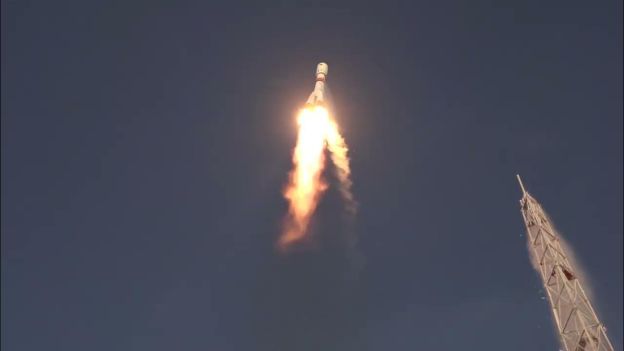
Russia launched a satellite, Cosmos-2553, into space in February 2022. The satellite is designed to test components for a potential antisatellite weapon that would carry a nuclear device, U.S. officials said, according to the WSJ. The satellite that was launched doesn’t carry a nuclear weapon…The eventual weapon, if and when deployed in orbit, could wipe out satellites in a part of space dominated by American government and commercial assets, they said, including SpaceX’s Starlink constellation, which has proved critical for Ukraine’s war effort.
Excerpt from Warren P. Strobel, Russia Launched Research Spacecraft for Antisatellite Nuclear Weapon Two Years Ago, U.S. Officials Say, WSJ, May 16, 2024
The Defense Advanced Research Projects Agency (DARPA) is testing a technology known as “nuclear thermal propulsion”… DARPA spacecraft will carry a small nuclear reactor. Inside, uranium atoms will be split to generate tremendous heat…to produce thrust. Such a spacecraft could climb to a geostationary orbit above the Earth, nearly 36,000km up, in mere hours. Satellites that burn normal rocket fuel need several days for the same trip. Nuclear-powered satellites with abundant power would also be hard to destroy—their trajectories could be changed often enough to become unpredictable. DARPA wants to test its spacecraft, dubbed DRACO (Demonstration Rocket for Agile Cislunar Operations), in orbit in 2025.
Other proposals are for radioisotope thermoelectric generators (RTGs). These kinds of “nuclear batteries” have long been used to power probes sent into deep space, where solar power is especially feeble. Instead of building a nuclear reactor, an RTG uses devices called thermocouples to produce a modest wattage from heat released by the decay of radioactive isotopes. Plutonium-238, which is a by-product of weapons development, has been used by NASA to power both the Voyager probes, launched in the 1970s and still functioning, as well as the Curiosity rover currently trundling around Mars. Plutonium-238, however, is heavily regulated and in short suppl..Cobalt-60, with a half-life of 5.3 years, is a promising alternative and available commercially.
How safe is it, however, to send nuclear devices, especially reactors, into space?…A danger is accidental atmospheric re-entry. The Soviet Union flew at least 33 spy satellites with nuclear reactors for onboard power (but not propulsion). In one accident, the reactor in a satellite named Kosmos 954 failed to ascend into a high-enough “disposal orbit” at the end of its mission. In 1978 it ended up spraying radioactive debris over a swathe of Canada’s Northwest Territories…The fuel for the Soviet Kosmos 954…was 90% uranium-235, similar to the material used in the atom bomb detonated over Hiroshima in 1945…
America is not alone in its nuclear quest. China and Russia are also developing nuclear power for space. China’s wish list includes a fleet of nuclear-powered space shuttles. Russia is designing an electric-propulsion cargo spacecraft called Zeus, which will be powered by a nuclear reactor. Roscosmos, Russia’s space agency, hopes to launch it in 2030. The prospect of more capable satellites will, no doubt, raise suspicions among spacefaring nations. Nuclear spacecraft with abundant electrical energy could be used to jam satellite communications…..
And not all of the interest in nuclear power comes from the armed forces. NASA…wants a nuclear plant to power a base on the Moon.
Excerpt from Faster, higher, stronger: Why space is about to enter its nuclear age, Economist, Feb. 5, 2022


 Law-In-Action