Tag Archives: rivers as legal persons

Environmental Victories of 2024

End of Fossil Fuels? The year 2024 r saw some extraordinary breakthroughs for climate and nature. The UK closed its last coal-fired power plant in 2024….As countries aim to rapidly decarbonise their economies, many former fossil fuel power plants are proving to be promising sites for industrial-scale batteries.…Renewable energy sources are growing rapidly around the world. In the US, wind energy generation hit a record in April 2024, exceeding coal-fired generation….By the end of this decade, renewable energy sources are set to meet almost half of all electricity.  The lion’s share of this growth comes from just one country:

The rivers, mountains, waves and whales given legal personhood
Back in 2021, the Ecuadorian government issued a landmark ruling stating that mining in its Los Cedros cloud forest violated the rights of nature. Another ruling in Ecuador stated that pollution had violated the rights of the Machángara River that runs through the capital, Quito. Beyond Ecuador, a growing number of natural features and spaces were granted legal personhood in 2024. In New Zealand, the peaks of Egmont National Park – renamed Te Papakura o Taranaki – were recognised as ancestral mountains and jointly became a legal person, known as Te Kāhui Tupua.] In Brazil, part of the ocean was given legal personhood – with the coastal city of Linhares recognising its waves as living beings, granting them the right to existence, regeneration and restoration. Meanwhile, a new treaty formed by Pacific Indigenous leaders saw whales and dolphins officially recognised as “legal persons”.

New ocean protections for the Azores
The North Atlantic saw a new marine protected area (MPA) announced by the Azores. When established, it will be the largest in the region, spanning 30% of the sea around the Portuguese archipelago. Half of the 111,000 sq miles (287,000 sq km) protected area will be “fully protected”, with no fishing or other natural resource extraction, according to the initiative behind the MPA. The other half will be “highly protected”.
The area contains nine hydrothermal vents, 28 species of marine mammals and 560 species of fish, among many others. 

Deforestation in the Brazilian Amazon
dropped to a nine-year low in 2024, falling by more than 30% in the 12 months to July, 2024 according to data released by Brazil’s national space research institute, INPE. nt

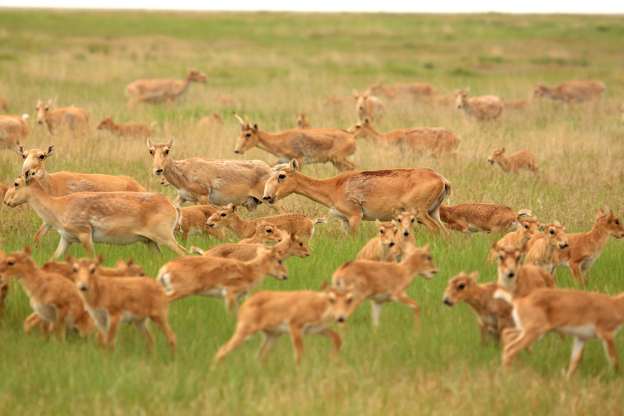
The Altyn Dala Conservation Initiative saved the critically endangered in the Golden Steppe grassland from extinction. The project used careful, science-based monitoring, tagging and habitat protection and restoration to ensure the best recovery for the Saiga Antelope, which numbered just 20,000 in 2003. Today, 2.86 million of the antelope roam the Golden Steppe, and it has been moved from “critically endangered” to “near threatened” status on the International Union for Conservation of Nature’s Red List.

After a 100-year hiatus, salmon were spotted in Oregon’s Klamath River basin, following an historic dam removal further downstream in the California stretch of the Klamath. In August 2024, the final of four dams were removed – in what was America’s biggest dam removal project – following pressure from environmentalists and tribes.

Excerpts from Isabelle Gerretsen et al., Seven quiet breakthroughs for climate and nature in 2024 you might have missed, BBC, Dec. 16, 2024

Exist, Evolve, Be Restored: the Rights of Nature

Only a few years ago, the clear, shallow waters of Mar Menor, a saltwater lagoon off eastern Spain that is Europe’s largest, hosted a robust population of the highly endangered fan mussel, a meter-long bivalve. But in 2016, a massive algal bloom, fueled by fertilizer washing off farm fields, sucked up the lagoon’s oxygen and killed 98% of the bivalves, along with seahorses, crabs, and other marine life.

The suffocating blooms struck again and again, and millions of dead fish washed onto shore. In 2021 local residents—some of whom benefit from tourism to the lagoon—had had enough. Led by a philosophy professor, activists launched a petition to adopt a new and radical legal strategy: granting the 135-square-kilometer lagoon the rights of personhood. Nearly 640,000 Spanish citizens signed it, and on 21 September, Spain’s Senate approved a bill enshrining the lagoon’s new rights. The new law doesn’t regard the lagoon and its watershed as fully human. But the ecosystem now has a legal right to exist, evolve naturally, and be restored. And like a person, it has legal guardians, including a scientific committee, which will give its defenders a new voice.

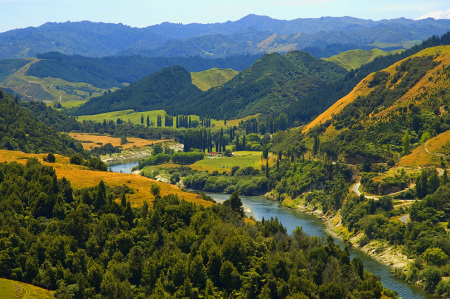
The lagoon is the first ecosystem in Europe to get such rights, but this approach to conservation has been gaining popularity around the world over the past decade…The clearest success story, scholars say, is the Whanganui River in New Zealand, which was given legal rights by an act of Parliament in 2017. Like a person, the river and its catchment can sue or be sued, enter contracts, and hold property. In that case, the aim was not to stop pollution but to incorporate the Māori connection between people and nature into Western law. “The river and the land and its people are inseparable,” Niko Tangaroa, a Māori elder of the Whanganui Iwi people and a prominent activist for the river, wrote in 1994.

Excerpts from Erik Stokstad, This Lagoon is Effectively a Person, New Spanish Law Says, Science, Oct. 7, 2022

How Rivers Die

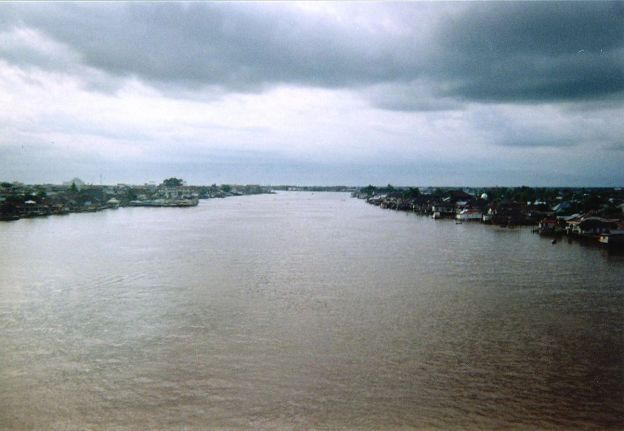
Kapuas, Indonesia’s longest river support somes 3m people…One reason that the water is so murky is deforestation. Since the 1970s logging has enriched locals while stripping away the vegetation that held the soil in place. The Centre for International Forestry Research (CIFOR) found that between 1973 and 2010 over 100,000 square kilometres of forest was lost on Kalimantan, or a third of the original coverage. A national moratorium that began in 2011 has done little to still the axes. As a result, torrential tropical rains wash lots of loose earth into the Kapuas.

Illegal gold-mining compounds the problem. Locals tear up the riverbed with diggers or blast the banks with high-pressure hoses, then sieve the mud for gold. Mercury, which the miners use to separate gold from sediment, but which is poisonous to humans and fish alike, leaks into the river.

The riverbank is punctuated with corrugated-iron towers, which emit birdsong from loudspeakers. These are designed to lure swiftlets, who make their nests with saliva. The nests of swiftlets  are considered a delicacy and aphrodisiac by many Chinese.* Deane, a shop owner, built his tower last December after seeing others do the same. He sells the nests to a wholesaler for about 15m rupiah ($1,025) a kilogram…

In Kapuas Hulu, an upstream district, half the population rely on the river for drinking water. A quarter have no toilet. Even where bathrooms do exist along the river, they are often floating cubicles with a hole in the floorboards. Cows and goats, living in wooden riverside cages, also defecate straight into the Kapuas

The Kapuas passes through seven districts. Midstream ones, such as Sintang and Sanggau, earn hefty tax revenues by encouraging palm-oil plantations. But downstream districts suffer from the resulting silt, traffic and run-off without receiving any of the benefits. The same problem occurs at a village level. Mr Hadi says that fishing by sprinkling poisonous leaves on the water (the stricken fish float to the surface) is forbidden but other village heads do not enforce the rules…

A study by CIFOR on the income of villagers living near the Kapuas river found that the best-paid palm-plantation workers earned 50% more than the most successful fishermen. (Gold miners made three times as much—and spent more on education.)…But the environmental damage is plain to see. The river here is brown, clouded by silt. A study published in 2016 found that levels of phosphates in the water, from fertilisers and villagers washing themselves with soap, are highest near urban areas and palm plantations.

Down in Pontianak, the river water is darker still, occasionally brightened by oil slicks. Water bottles and instant-noodle packets cling together to form plastic islands.

Excerpts from  Indonesia’s Longest River,  Economist, Aug. 25, 2018

*According to Wikipedia: Authentic bird’s-nest soup is made from nests of some species of swiftlet.  Instead of twigs, feathers and straw, these swiftlets make their nest only from strands of their gummy saliva, which hardens when exposed to air. Once the nests are harvested, they are cleaned and sold to restaurants. Eating swiftlet nest material is believed to help maintain skin tone, balance qi (“life energy”) and reinforce the immune system… (Dictionary of Traditional Chinese Medicine, The History of Chinese Medicine and the Nutrition Table).

Rivers as Legal Persons

The new law that declares the Whanganui river, New Zealand’s third-longest, a legal person, in the sense that it can own property, incur debts and petition the courts, is not unprecedented. Te Urewera, an area of forested hills in the north-east that used to be a national park, became a person for legal purposes in 2014….

The law, which was approved on March 15th, 2017 stems from disputes over the Treaty of Waitangi, by which New Zealand’s indigenous Maori ceded sovereignty to British colonialists in 1840. The treaty was supposed to have protected Maori rights and property; it was observed mainly in the breach. In recent years the government has tried to negotiate settlements for breaches of the treaty with different Maori iwi, or tribes. For the Whanganui iwi, the idea of the river as a person is nothing new. The iwi professes a deep spiritual connection to the Whanganui: as a local proverb has it, “I am the river and the river is me.” The law acknowledges the river as a “living whole”, rather than trying to carve it up, putting to rest an ownership dispute that has dragged on for 140 years. When it was passed, members of the iwi in the gallery of parliament broke into a ten-minute song of celebration.

In practice, two guardians will act for the river, one appointed by the government and one by the iwi. Mr Finlayson, the minister in charge of negotiations tied to the Treaty of Waitangi, hopes the change will help bring those who do environmental damage to the river to book. Under the settlement the government will also pay the iwi NZ$80m ($56m) as compensation for past abuses and set up a fund of NZ$30m to enhance the “health and well-being” of the river. It is one of 82 deals that aim to remedy breaches of the treaty, including one with the Tuhoe iwi that made Te Urewera into a person.

Days after the law passed, an Indian court declared two of the biggest and most sacred rivers in India, the Ganges and Yamuna, to be people too. Making explicit reference to the Whanganui settlement, the court assigned legal “parents” to protect and conserve their waters. Local lawyers think the ruling might help fight severe pollution: the rivers’ defenders will no longer have to prove that discharges into them harm anyone, since any sullying of the waters will now be a crime against the river itself. There is no doubt that of the 1.3bn-odd people in India, the Ganges and the Yamuna are among the most downtrodden.

Excerpts from Hydrological Jurisprudence: Try me River, Economist, Mar. 25, 2017

See also Do Trees have Standing? by Christopher Stone