Tag Archives: robotics in space

Secrecy in Space

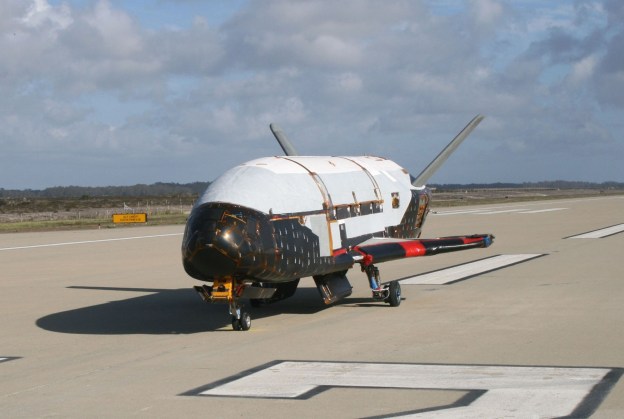
A Pentagon spaceplane called X-37B zoomed into orbit this week for its eighth mission. When it will come back is a secret. The uncrewed vehicle can spend months or years in space before it re-enters the atmosphere.. That combination of flexibility and endurance has made it a favorite tool for military officials looking to quickly deploy new technologies on the final frontier. A SpaceX rocket launched X-37B on August 21, 2025 from Florida’s Kennedy Space Center. Government and commercial engineers have spent years experimenting with lasers that allow satellites to share large amounts of data in space. The Pentagon is also testing tools like the inertial sensor, which could help improve navigation in situations where Global Positioning System signals aren’t available.

The spacecraft has spent the last five months on Earth after a 434-day mission that included tests of orbital maneuvers known as “aerobraking.” The move helps the vehicle use the drag from the planet’s atmosphere to change its orbit without using much fuel.  Military officials haven’t disclosed many details about the payloads that X-37B carries, but past missions included testing different materials in orbit and an experiment that transmitted solar energy to the ground. Its fifth flight released three small satellites that government officials didn’t acknowledge until they had fallen back to Earth. There’s a global strategic interest in saying what you’re putting in space,” said Jonathan McDowell, a researcher at the Harvard-Smithsonian Center for Astrophysics. If the U.S. hides its satellites, “then the Chinese are going to start doing it too, and that’s not in our interest.”

China now fields more than 1,000 satellites and has developed a range of radio jammers, antisatellite missiles and other weapons capable of targeting Pentagon assets, according to a U.S. Air Force document released in May 2025. It also operates a competing spaceplane, called Shenlong, that has flown several missions.]

Excerpt from Drew FitzGerald, The Pentagon’s Mysterious X-37B Space Plane Embarks on New Mission, WSJ, Aug. 22, 205

What is the Purpose of Graveyards in Space

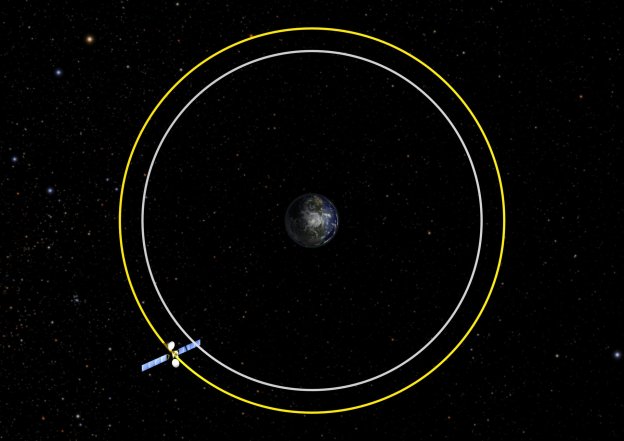
Launched in 1969, just a few months after humans first set foot on the Moon, Skynet-1A was put high above Africa’s east coast to relay communications for British forces. When the spacecraft ceased working a few years later, gravity might have been expected to pull it even further to the east, out over the Indian Ocean. But today, curiously, Skynet-1A is actually half a planet away, in a position 22,369 miles (36,000km) above the Americas. Orbital mechanics mean it’s unlikely the half-tonne military spacecraft simply drifted to its current location. Almost certainly, it was commanded to fire its thrusters in the mid-1970s to take it westwards. The question is who that was and with what authority and purpose?…

You might also reasonably ask why it still matters. After all, we’re talking about some discarded space junk from 50 years ago…No matter how Skynet-1A  got shifted to its present position, it was ultimately allowed to die in an awkward place when really it should have been put in an “orbital graveyard“. This refers to a region even higher in the sky where old space junk runs zero risk of running into active telecommunications satellites. Graveyarding is now standard practice, but back in the 1970s no-one gave much thought to space sustainability.

Attitudes have since changed because the space domain is getting congested and  collisions between defunct satellites  generate large amounts of space debris or space junk…”We need to avoid…super-spreader events. When these things explode or something collides with them, it generates thousands of pieces of debris that then become a hazard to something else that we care about.”

Excerpt from Jonathan Amos, Somebody moved UK’s oldest satellite, and no-one knows who or why, Science, Nov. 8, 2024

Who Will be the First to Colonize the Solar System?

A Chinese spacecraft touched down on grasslands in China’s Inner Mongolia region in June 2024, carrying the first-ever rock samples from the far side of the moon. A scientific breakthrough in itself, the success also advanced China’s plan to put astronauts on the moon by 2030 and build a lunar base by 2035. Such momentum is worrying American space officials and lawmakers, who have their own ambitions to build moon bases.

Unlike the original space race between the Americans and the Soviets, the goal of the U.S. and China isn’t just to make a short trip to the moon. It is to build permanent human outposts on its most strategic location, the lunar south pole. And as both nations gear up to build stations there one day, it is looking likely that tensions in orbit will mirror those on Earth.

Some U.S. officials fear China is planning a land grab. Chinese officials suspect the same of the Americans and are teaming up with Russia and other friendly nations for its south-pole outpost. The successful completion of the Chang’e 6 mission shows that, by one measure, China is ahead for now. Its lunar program has now soft-landed on the moon four times since 2013, the latest mission scooping up rocks near the south pole with robotic arms…

Meanwhile, after a decades-long moon-landing hiatus, two U.S. companies this year launched lunar-surface missions under NASA contracts. One lander tipped on its side after touching down. The other didn’t try to land because of technical problems. At least two more private missions, with funding from NASA, are slated to try to get to the moon later this year….All this is piling pressure upon the world’s most storied space agency. Through its Artemis exploration program, the National Aeronautics and Space Administration plans to conduct multiple landings in the coming years, develop a logistics station in lunar orbit and eventually build permanent camps on the moon’s surface. But Artemis has faced repeated delays and cost overruns while relying on a complex mix of government workers and private contractors…

“Unlike the U.S.-Soviet space race of the 20th century, this new round of competition centers on the water ice at the lunar south pole, with its extraction and use as a common goal,” wrote four scientists affiliated with China’s Academy of Sciences in a paper published in May. “The ability to collect and utilize lunar resources is a mark of national prestige and geopolitical influence. “We’re talking about colonizing the solar system,” said Greg Autry, a NASA official during the Trump administration.

Excerpts from Stu Woo, Historic Moon Mission Moves China Ahead in Space Race With U.S., WSJ, June 25, 2024

Whoever Controls Space Controls Everything

The U.S. military wants allies to train and plan together for space operations, in the same way that they already do in ground, air and naval combat, Gen. Chance Saltzman, chief of space operations, said in an interview in July 2023. The move comes amid concerns about China and Russia’s ability to disrupt the West’s satellites and new technology the two countries have developed, including satellites that can grab others

Russia, for instance, has conducted operations to disrupt Ukraine’s space-enabled communications. Saltzman said that Russia has been sending satellites “irresponsibly close” to those of other nations to shadow them. Moscow has “nesting doll” satellites, which can release an object that can be used to attack other objects in space, while China has tested robotic arms that can be used to grab other satellites. Both countries have demonstrated missiles that can destroy orbiting satellites…

“Quantity is a quality in itself,” he said, using an expression often employed in the military. For example, the satellites of a large coalition would be harder to target than those of one nation, he added.

Excerpt from Alistair MacDonald, U.S. Pushes Military Cooperation in Space, WSJ, July 18, 2023

The Quiet Revolution in Space

National security critically depends on space, and the Defense Advanced Research Projects Agency (DARPA) is focused today on creating the capabilities needed to help make that environment a real-time operational domain, DARPA Director Dr. Arati Prabhakar…

“The questions we ask ourselves at DARPA about the space domain … is what would it take to make the space domain robust for everything that we need militarily and for intelligence, and what would it take to make space a real-time operational domain, which it’s not at all today,” the director said, noting that many other nation-states now are active in orbit and space is a domain where conflict is becoming a real possibility.

Through a national security lens, she added, nothing needed from an intelligence or military perspective can be done effectively without access to space. Something as simple as navigation completely depends on GPS in nearly every part of the world and in every operating regime.

In an era of declining budgets and adversaries’ evolving capabilities, quick, affordable and routine access to space is increasingly critical for national and economic security. Today’s satellite launch systems require scheduling years in advance for a limited inventory of available slots and launches often cost hundreds of millions of dollars each. The Defense Advanced Research Projects Agency created its Experimental Spaceplane, or XS-1, program to help overcome these challenges and reduce the time to get capabilities to space. DARPA artist-concept graphics  “Because of the demands on launch, from the day you know you have to put an asset on orbit to the time you can plan on a launch today is still unacceptably long,” Prabhakar said.

Commercial capabilities will help, she added, “but if in a time of war we imagine if we could go to space not in a month or next week but tomorrow, think about how that would completely change the calculus for an adversary that’s thinking about [using an antisatellite] weapon to take out one of our satellites

”With that ambition in mind, DARPA is now starting Phase 2 of its Experimental Spaceplane, or XS-1.“It’s a reusable first stage that’s designed to be able to put 3,000 or 5,000 pounds into low earth orbit … at a very low cost point — a few million dollars — but very significantly the objective on the DARPA program is by the end of the program to fly that spacecraft 10 times in 10 days,” Prabhakar said, “something that’s inconceivable with any of the spacecraft we have today.”

A second piece of the puzzle is what can be done in orbit, she added, referring to low earth orbit, or LEO, an orbit around Earth whose altitude is between 99 and 1,200 miles.

“We’re doing some amazing work with geo[synchronous]-robotics and rethinking [geostationary Earth orbit]-architectures once you have an asset that would allow you to extend the life or do inspection or simple repairs at GEO, which is something you can’t do today.  GEO [geostationary orbit]is a stable region of space 22,370 miles from Earth.  And because GEO is a stable environment for machines — but hostile for people because of high radiation levels — DARPA thinks the key technology there is space robotics.  DARPA’s Phoenix program seeks to enable GEO robotics servicing and asset life extension while developing new satellite architectures to reduce the cost of space-based systems.

The program’s goal is to develop and demonstrate technologies that make it possible to inspect and robotically service cooperative space systems in GEO and to validate new satellite assembly architectures. Phoenix has validated the concept that new satellites could be built on orbit by physically aggregating “satlets” in space, according to DARPA.

Satlets are small independent modules that can attach together to create a new low-cost, modular satellite architecture, DARPA says. Satlets incorporate essential satellite functionality — power supplies, movement controls, sensors and others — and share data, power and thermal management capabilities. DARPA now is working to validate the technical concept of satlets in LEO [Low earth orbit an orbit around Earth whose altitude is between 99 and 1,200 miles.]

Excerpts from  Cheryl Pellerin Director: DARPA Space Projects Critical to Shifting Trajectories , US DOD News, Nov. 22, 2016