Tag Archives: Space X and Ukraine Russia War

The Drone Experiment of Ukraine

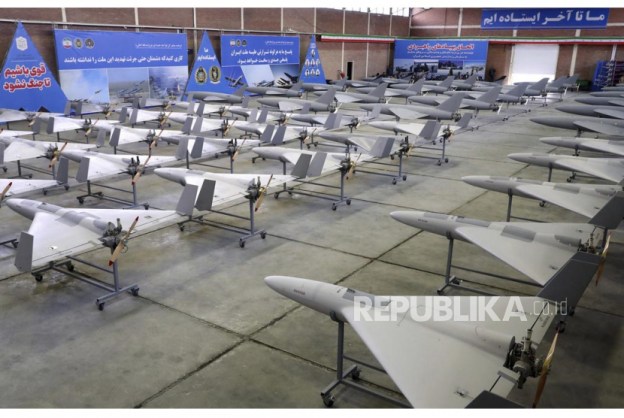
U.S. startups have spent billions of venture-capital dollars in hopes of developing the small drones that the Pentagon says it needs for future conflicts, but many have produced only expensive aircraft that don’t fly very well. Ukrainian drone makers, meanwhile, have mastered mass-producing drones despite limited resources and are looking for new customers and capital…

“No U.S. company is keeping up with Ukraine,” said CX2 co-founder Nathan Mintz. “You know their stuff works. They’ve got the ultimate high-stakes laboratory meant to battle-proof all this stuff.”

The U.S. has the capacity to build up to 100,000 drones a year, according to one Defense Department estimate. In 2024, Ukraine built more than two million drones. Some of the Ukraine-built drones that the Defense Department wants can fly hundreds of miles with explosives and have been used in attacks inside Russia…“Ukraine has made it pretty clear that they intend on being the drone capital of the planet once this war is over,” said Derek Whitley, co-founder of startup Vivum, which sells its AI software for autonomous systems to the Defense Department.

Ukrainian drones often sell for one-tenth the price of American options. They have proven on the battlefield that they can work when radio and satellite communication is blocked by electronic jamming…American startups are slower to build, deliver and update their drones, which also have often failed to weather severe electronic warfare. Many U.S. companies that brought their drones to Ukraine watched them fall out of the sky or fail to complete missions.

Excerpt from Heather Somerville, America Turns to Ukraine to Build Better Drones, WSJ, Mar. 11, 2025
 

How Europe Gave In to Musk Space X

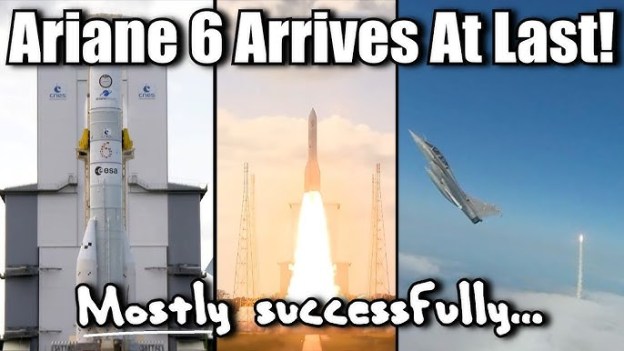
A new European rocket is poised to blast into space with a mission that officials here say is vitally important: reducing the region’s reliance on Elon Musk and SpaceX. Europe’s satellites and military intelligence have come to depend on the U.S. company after delays and malfunctions left the continent unable to get to orbit with its own rockets. Officials fear that dependence could extend to the battlefield: SpaceX’s Starlink internet service has been crucial for Ukraine to fight off Russia, fanning worries in Europe that its armies might also need Musk for satellite communications in a war.  Governments say the Ariane 6 rocket, operated by the European consortium Arianespace, will begin to change that equation. It is set to lift off from French Guiana on in July 2024, Europe’s first rocket to launch in a year.

“Clearly, we must deliver. We must restore autonomous access to space” for Europe, Stéphane Israël, chief executive of Arianespace, said in an interview.  With European rockets stuck on the ground, SpaceX stepped in to fill the void. Its Falcon 9 rocket has launched all of Europe’s most important satellites over the past year, including two that were supposed to be handled by Arianespace. The most recent blow came last month when Europe’s weather-satellite agency canceled a contract to launch in 2025 with Ariane 6 and hired SpaceX instead. The decision left European space officials crestfallen, with the head of the French space agency saying: “How far will we, Europeans, go in our naivety?”…

The rise of SpaceX has upended Europe’s rocket industry and its champion, Arianespace, which used to lead the world in commercial launch services. SpaceX’s mastery of reusable rocket technology has left Arianespace struggling to compete on price and more than a decade behind with its own reusable rocket.  The French government is the biggest backer of Arianespace and is aiming to keep the consortium in business amid doubts in Germany that it is still worth subsidizing. French officials say they fear the continent would be happy to let SpaceX keep launching for Europe. ArianeGroup, Arianespace’s parent company, is vital to what France calls its strategic autonomy because it has a military arm that provides the rocket technology for France’s nuclear arsenal.

Excerpts from Matthew Dalton, The Mission for Europe’s New Rocket: Challenge SpaceX, WSJ, July 8, 2024

Whoever Controls Space Controls Everything

The U.S. military wants allies to train and plan together for space operations, in the same way that they already do in ground, air and naval combat, Gen. Chance Saltzman, chief of space operations, said in an interview in July 2023. The move comes amid concerns about China and Russia’s ability to disrupt the West’s satellites and new technology the two countries have developed, including satellites that can grab others

Russia, for instance, has conducted operations to disrupt Ukraine’s space-enabled communications. Saltzman said that Russia has been sending satellites “irresponsibly close” to those of other nations to shadow them. Moscow has “nesting doll” satellites, which can release an object that can be used to attack other objects in space, while China has tested robotic arms that can be used to grab other satellites. Both countries have demonstrated missiles that can destroy orbiting satellites…

“Quantity is a quality in itself,” he said, using an expression often employed in the military. For example, the satellites of a large coalition would be harder to target than those of one nation, he added.

Excerpt from Alistair MacDonald, U.S. Pushes Military Cooperation in Space, WSJ, July 18, 2023