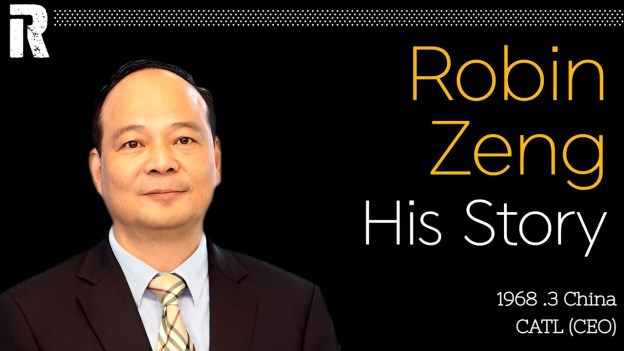
The United States has spent the past few years ghosting Robin Zeng, China’s fourth-richest man. To the U.S. government, Chinese battery maker CATL is a geopolitical threat to be warded off with tariffs and national-security curbs. Yet CATL has grown to become the world’s largest electric-vehicle battery manufacturer thanks to its technology and low costs. It posted record profit of more than $10 billion in 2025, and an estimated one in three EVs sold around the world carries its batteries. Ford recently ditched South Korea’s SK Group as its joint-venture partner for battery projects, focusing instead on its plan to build CATL-designed batteries at a $3 billion factory in Michigan. Ford is paying to license the Chinese company’s intellectual property, a workaround the U.S. allows while it puts up legal and political barriers to prevent CATL from building its own plants. General Motors is set to import China-made batteries from CATL and put them in its new Chevrolet Bolt—also legal, albeit only by swallowing a 60% tariff. And Tesla is using CATL technology for a battery plant in Nevada producing energy-storage systems, a business that is growing strongly while Tesla’s core EV business has stalled.
Critics of China argue that embedding a Chinese battery maker in the U.S. supply chain would make the U.S. even more vulnerable to Beijing’s economic coercion and undercut the chances of American battery companies catching up. CALT was placed in 2025 on a Pentagon list of companies working with China’s military.
Founded just 15 years ago, CATL benefited from a Beijing policy in the second half of the 2010s that gave Chinese EV makers subsidies if they used batteries from approved supplies such as CATL. It also received government money directly—more than $500 million in the first half of 2024 alone, according to CATL filings. Only state-owned petrochemical company Sinopec got more among mainland-China-listed companied. The iron-based battery chemistry, called lithium ferrophosphate, or LFP, costs up to 30% less a kilowatt-hour compared with nickel-manganese-cobalt batteries, the type South Korean and Japanese companies usually produce, industry experts say. In 2025, CATL developed an LFP battery with 500 miles of driving range that can be powered for up to 320 miles in just five minutes.
CATL’s technology is the reason Ford chose it for the Michigan factory tie-up, said Lisa Drake, a Ford executive on the project. “It probably would’ve taken us a decade to catch up and have LFP technology on our own,” Drake said in 2025. She lamented that LFP batteries were invented in the U.S., but Chinese firms such as CATL figured out how to make them viable in cars. “We just didn’t commercialize that technology,” she said.
Excerpt from Yoko Kubota, The Chinese Billionaire Who Says America’s EV Market Is Doomed Without Him, WSJ, Mar. 23, 2026
 Law-In-Action