Category Archives: geoeconomics

Rare Earths Pollution: Australia, Malaysia and Lynas Corp.

According to the Oeko Institute, a non-profit association: The facility for refining Australian ore concentrate rich in rare earth metals of Lynas Corporation in Malaysia has several deficiencies concerning the operational environmental impacts. The environment is affected by acidic substances as well as from dust particles, which are emitted into the air in substantially larger concentrations than would be state-of-the-art in off-gas treatment in Europe. The storage of radioactive and toxic wastes on site does not prevent leachate from leaving the facility and entering ground and groundwater. For the long-term disposal of wastes under acceptable conditions concerning radiation safety a sustainable concept is still missing. These are the results of a study of Oeko-Institute on behalf of the Malaysian NGO SMSL.

In its facility in Kuantan/Malaysia Lynas refines ore concentrate for precious rare earth metals. These strategic metals are applied for example to produce catalysts…The ore concentrate to be refined in Malaysia additionally contains toxic and radioactive constituents such as Thorium. The NGO commissioned Oeko-Institute to check whether the processing of the ore leads to hazardous emissions from the plant or will remain as dangerous waste in Malaysia.

Storage of wastes insufficient

The storage of wastes, that are generated in the refining process, shall be stored in designated facilities on the site, separately for three waste categories. According to chemist and nuclear waste expert Gerhard Schmidt, there will be problems with the pre-drying of wastes that is of a high Thorium content. “Especially in the wet and long monsoon season from September to January, this emplacement process doesn’t work”, says Schmidt. “The operator has not demonstrated how this problem can be resolved without increasing the radiation doses for workers”.

Additionally the storages are only isolated with a one-millimeter thick plastic layer and a 30 cm thick clay layer. This is insufficient to reliably enclose the several meters high and wet waste masses. “For the long-term management of these wastes Lynas has urgently to achieve a solution”, claims Gerhard Schmidt, and adds: “in no case those wastes should be marketed or used as construction material, as currently proposed by the operator (Lynas) and the regulator (AELB/MOSTI). According to our calculations this would mean to pose high radioactive doses to the public via direct radiation”.

One of the most serious abnormalities is that in the documents relevant data is missing, which prevents reliably accounting for all toxic materials introduced”, says project manager Gerhard Schmidt. “So it is not stated which and to what amount toxic by-products, besides Thorium, are present in the ore concentrate. Also in the emissions of the facility via wastewater only those constituents are accounted for that are explicitly listed in Malaysian water regulation, but not all emitted substances.” The salt content of the wastewater is as high that it is comparable to seawater. This is discharged without any removal into the river Sungai Balok.

The scientists at Oeko-Institute evaluate the detected deficiencies as very serious. Those deficiencies should have been already detected in the licensing process, when the application documents were being checked. However the operator received a construction license in 2008 and a temporary operating license in 2012.

Especially for the safe long-term disposal of the radioactive wastes a suitable site that meets internationally accepted safety criteria has to be selected urgently. A consensus has to be reached with the affected stakeholders, such as the local public and their representatives. “If it further remains open how to manage those wastes in a long-term sustainable manner, a future legacy associated with unacceptable environmental and health risks is generated”, considers Schmidt. “The liability to prevent those risks and to remove the material is so shifted to future generations, which is not acceptable.”

Rare earths are important metals that are used in future technologies such as efficient electro motors, lighting and catalysts. In its study from 2011 “Study on Rare Earths and Their Recycling” Oeko-Institute showed that no relevant recycling of these metals is performed so far. Albeit recent positive developments in this direction: satisfying the prognosticated global requires the extension of the worldwide primary production.

Rare earth refining in Malaysia without coherent waste management concept, Oeko Institute Press Release, Jan. 28, 2013

See also  Oeko Report on Lynas (pdf)e
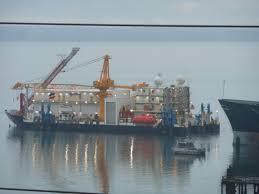
The Arctic Challenger: ready for Arctic oil spills

Shell Oil has been building and testing equipment designed for the Arctic Ocean in Puget Sound, Seattle, United States.  In September, a key test of underwater oil-spill equipment was a spectacular failure.  It forced the energy giant to postpone drilling into oil-bearing rocks beneath the Arctic Ocean until next summer. Shell and its federal regulators have been tight-lipped about the failed test.  But a freedom-of-information request reveals what happened beneath the surface of Puget Sound.

Before Shell can drill for oil in the Arctic Ocean, it needs to prove to federal officials that it can clean up a massive oil spill there. That proof hinges on a barge being built in Bellingham called the Arctic Challenger.  The barge is only one component of Shell’s plans for handling oil spills off the remote north coast of Alaska. But the Obama Administration won’t let oil drilling get under way until the 36-year-old barge and its brand new oil-spill equipment are in place,  On board the Arctic Challenger is a massive steel “containment dome.” It’s a sort of giant underwater vacuum cleaner. If efforts to cap a blown-out well don’t work, the dome can capture spewing oil and funnel it to a tanker on the surface.

The Arctic Challenger passed several US Coast Guard tests for seaworthiness in September. But it was a different story when its oil-spill containment system was put to the test in 150-foot-deep water near Anacortes, Washington.  The federal Bureau of Safety and Environmental Enforcement required the test of the oil-spill system.

According to BSEE internal emails obtained by KUOW, the containment dome test was supposed to take about a day. That estimate proved to be wildly optimistic.

•Day 1: The Arctic Challenger’s massive steel dome comes unhooked from some of the winches used to maneuver it underwater. The crew has to recover it and repair it.

•Day 2: A remote-controlled submarine gets tangled in some anchor lines. It takes divers about 24 hours to rescue the submarine.

•Day 5: The test has its worst accident. On that dead-calm Friday night, Mark Fesmire, the head of BSEE’s Alaska office, is on board the Challenger. He’s watching the underwater video feed from the remote-control submarine when, a little after midnight, the video screen suddenly fills with bubbles. The 20-foot-tall containment dome then shoots to the surface. The massive white dome “breached like a whale,” Fesmire e-mails a colleague at BSEE headquarters.

Then the dome sinks more than 120 feet. A safety buoy, basically a giant balloon, catches it before it hits bottom. About 12 hours later, the crew of the Challenger manages to get the dome back to the surface. “As bad as I thought,” Fesmire writes his BSEE colleague. “Basically the top half is crushed like a beer can.”

Representatives of Shell Oil and of BSEE declined to answer questions or allow interviews about the mishaps. In an email, Shell spokeswoman Kelly op de Weegh writes:  Our internal investigation determined the Arctic Challenger’s dome was damaged when it descended too quickly due to a faulty electrical connection, which improperly opened a valve. While safety systems ensured it did not hit the bottom, buoyancy chambers were damaged from the sudden pressure change.

Environmental groups say the Arctic Challenger’s multiple problems show that Shell isn’t prepared for an Arctic oil spill.

Excerpt, By John Ryan, Sea Trial Leaves Shell’s Arctic Oil-Spill Gear “Crushed Like A Beer Can”, Kuow.org. Nov. 30, 2012

An Independent Kurdistan? Ask the Oil Companies

Iraq is blessed with abundant oil that is cheap to extract and close to newly built export terminals. Production has hit a three-decade high and continues to rise steadily. By 2035, predicts the International Energy Agency (IEA) Iraqi output could more than double, to 8.3m barrels per day (b/d).  But Western oil firms are increasingly reluctant to play a part in this boom. ExxonMobil appears keen to sell its stake in West Qurna, one of the giant fields in southern Iraq that will provide much of the production growth. Royal Dutch Shell and BP are both still working in the south, but unhappily so. Suffocating bureaucracy and onerous contract terms make life difficult. Heavier-than-expected costs and delays to infrastructure undercut profits.

Three years ago when they signed contracts with the Iraqi government, the oil majors were prepared to accept hiccups. But their patience has thinned with the arrival of an alternative source of Iraqi oil. Kurdistan, the semi-autonomous province in the country’s north, has been offering competing and much more lucrative deals. ExxonMobil’s decision last year to acquire six blocks in the region angered the central government, which considers the deal illegal and lays claim to Kurdish oil. But the world’s largest oil company started a trend. In July Total, Chevron and Gazprom all signed contracts with the Kurdistan regional government, potentially dooming their chances of winning future business in the south. BG, a British firm, was in Erbil, the Kurdish capital, on a scouting mission in late October.

“Kurdistan is 11 years ahead of the rest of Iraq in terms of political and commercial development,” says Luay al-Khatteeb, head of the Iraq Energy Institute, a London-based think-tank. Kurdistan’s potential oil reserves of around 45 billion barrels are less than a third of those in southern Iraq. Still, the Kurdish oil minister, Ashti Hawrami, believes output of 1m b/d is possible within three years.

The tricky part is getting the oil to market. The Kurds today export around 200,000 b/d through pipelines controlled by the central government. Mr Hawrami wants to build a new Kurdish-owned pipe to Turkey, feeding long-held dreams of Kurdish independence. That unnerves Turkey which is fighting Kurdish separatists in its south-east. Some Turkish officials seem to acknowledge the possibility of an eventual Kurdish state in northern Iraq and seek to make it commercially dependent on Turkey. Co-operating with the Iraqi Kurds would also generate lucrative transit fees and offer Turkey an alternative to oil from Russia and Iran.

The Iraqi government is pondering how to respond. It could sweeten the terms of its contracts with the oil firms in the south. That might staunch the flow of Western capital to Kurdistan. In the meantime, the main beneficiaries of the majors’ receding interest in southern Iraq are Asian oil firms. Chinese will account for about 2m b/d of Iraq’s production by 2020. Fatih Birol, the IEA’s chief economist, talks of a “Baghdad-to-Beijing” axis.

Iraq’s oil: The Kurdish opening, Economist,Nov. 3, at 49