Category Archives: marine pollution

Nigeria and the Oil Companies: the ECOWAS Judgment

Amnesty International and Socio-Economic Rights and Accountability Project (SERAP) have hailed last [Economic Community of West African States] ECOWAS Court of Justice ground-breaking judgment as a “key moment in holding governments and companies to account for pollution.”  In the case, SERAP v. Nigeria, the Court unanimously found the Nigerian government responsible for abuses by oil companies and makes it clear that the government must hold the companies and other perpetrators to account.

The Court also found that Nigeria violated articles 21 (on the right to natural wealth and resources) and 24 (on the right to a general satisfactory environment) of the African Charter on Human and Peoples’ Rights by failing to protect the Niger Delta and its people from the operations of oil companies that have for many years devastated the region.  According to the Court, the right to food and social life of the people of Niger Delta was violated by destroying their environment, and thus destroying their opportunity to earn a living and enjoy a healthy and adequate standard of living. The Court also said that both the government and the oil companies violate the human and cultural rights of the people in the region.

The Court ruled that the government’s failure to enact effective laws and establish effective institutions to regulate the activities of the companies coupled with its failure to bring perpetrators of pollution “to book” amount to a breach of Nigeria’s international human rights obligations and commitments.  The Court emphasized that “the quality of life of people is determined by the quality of the environment. But the government has failed in its duty to maintain a general satisfactory environment conducive to the development of the Niger Delta region”.

“This judgment confirms the persistent failure of the Nigerian government to properly and effectively punish oil companies that have caused pollution and perpetrated serious human rights abuses, and is an important step towards accountability for government and oil companies that continue to prioritise profit-making over and above the well-being of the people of the region,” said Femi Falana SAN, and Adetokunbo Mumuni for SERAP.  “This is a crucial precedent that vindicates the human right to a healthy environment and affirms the human right of the Nigerian people to live a life free from pollution. It also makes it clear that the government must hold the oil companies to account,” said Michael Bochenek, Director of Law and Policy at Amnesty International.  “The judgment makes it clear that the Nigerian government has failed to prevent the oil companies causing pollution. It is a major step forward in holding the government and oil companies accountable for years of devastation and deprivation.” said Bochenek.

The court affirmed that the government must now move swiftly to fully implement the judgment and restore the dignity and humanity of the people of the region.

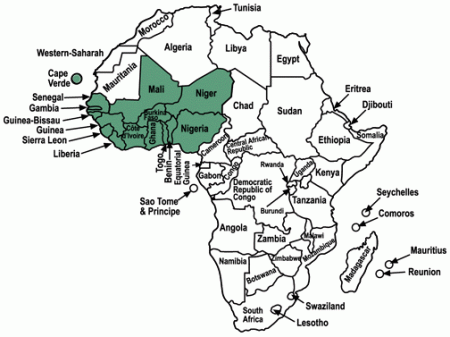
“The judgment has also come at a time when oil is being discovered in the majority of the member states of the ECOWAS. It is vital that other states take heed of this judgement, which has laid down minimum standards of operations for government and oil companies involved in the exploitation of oil and gas in the region,” Falana and Mumuni also said.  “The time has come for the Nigerian government to stand up to powerful oil companies that have abused the human rights of the people of the Niger Delta with impunity for decades,” said Bochenek.  “We commend the ECOWAS Court for standing up for the rights and dignity of the people of the Niger Delta. We also acknowledge the important legal contribution of Dr Kolawole Olaniyan of Amnesty International, to the case,” said Falana and Mumuni.

he case was filed against the Federal Government and six oil companies over alleged violation of human rights and associated oil pollution in the Niger Delta. Specifically, the plaintiff alleged: “Violations of the right to an adequate standard of living, including the right to food, to work, to health, to water, to life and human dignity, to a clean and healthy environment; and to economic and social development – as a consequence of: the impact of oil-related pollution and environmental damage on agriculture and fisheries.”  SERAP also alleged “oil spills and waste materials polluting water used for drinking and other domestic purposes; failure to secure the underlying determinants of health, including a healthy environment, and failure to enforce laws and regulations to protect the environment and prevent pollution.”

The Court dismissed the government’s objections that SERAP had no locus standi to institute the case; that the ECOWAS Court had no jurisdiction to entertain it; and that the case was statute-barred. The Court also rejected efforts by the government to exclude a 2009  Amnesty International report on oil pollution from being considered. The report was based on an in-depth investigation into pollution caused by the international oil companies, in particular Shell, and the failure of the government of Nigeria to prevent pollution or sanction the companies.

The suit number ECW/CCJ/APP/08/09 was argued by SERAP counsel, Femi Falana SAN, Adetokunbo Mumuni and Sola Egbeyinka.  The judgment was delivered by a panel of 6 judges: Justice Awa Nana Daboya, Justice Benefeito Mosso Ramos, Justice Hansine Donli, Justice Alfred Benin, Justice Clotilde Medegan and Justice Eliam Potey.

Article 15(4) of the ECOWAS Treaty makes the Judgment of the Court binding on Member States, including Nigeria. Also, Article 19(2) of the 1991 Protocol provides that the decisions of the Court shall be final and immediately enforceable. Furthermore, non-compliance with the judgment of the Court can be sanctioned under Article 24 of the Supplementary Protocol of the ECOWAS Court of Justice, and Article 77 of the ECOWAS Treaty.

SERAP Press Release, December 2012

See also decision of the ECOWAS Community Court on Jurisdiction
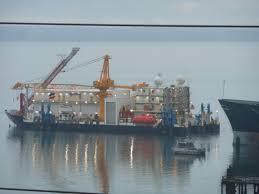
The Arctic Challenger: ready for Arctic oil spills

Shell Oil has been building and testing equipment designed for the Arctic Ocean in Puget Sound, Seattle, United States.  In September, a key test of underwater oil-spill equipment was a spectacular failure.  It forced the energy giant to postpone drilling into oil-bearing rocks beneath the Arctic Ocean until next summer. Shell and its federal regulators have been tight-lipped about the failed test.  But a freedom-of-information request reveals what happened beneath the surface of Puget Sound.

Before Shell can drill for oil in the Arctic Ocean, it needs to prove to federal officials that it can clean up a massive oil spill there. That proof hinges on a barge being built in Bellingham called the Arctic Challenger.  The barge is only one component of Shell’s plans for handling oil spills off the remote north coast of Alaska. But the Obama Administration won’t let oil drilling get under way until the 36-year-old barge and its brand new oil-spill equipment are in place,  On board the Arctic Challenger is a massive steel “containment dome.” It’s a sort of giant underwater vacuum cleaner. If efforts to cap a blown-out well don’t work, the dome can capture spewing oil and funnel it to a tanker on the surface.

The Arctic Challenger passed several US Coast Guard tests for seaworthiness in September. But it was a different story when its oil-spill containment system was put to the test in 150-foot-deep water near Anacortes, Washington.  The federal Bureau of Safety and Environmental Enforcement required the test of the oil-spill system.

According to BSEE internal emails obtained by KUOW, the containment dome test was supposed to take about a day. That estimate proved to be wildly optimistic.

•Day 1: The Arctic Challenger’s massive steel dome comes unhooked from some of the winches used to maneuver it underwater. The crew has to recover it and repair it.

•Day 2: A remote-controlled submarine gets tangled in some anchor lines. It takes divers about 24 hours to rescue the submarine.

•Day 5: The test has its worst accident. On that dead-calm Friday night, Mark Fesmire, the head of BSEE’s Alaska office, is on board the Challenger. He’s watching the underwater video feed from the remote-control submarine when, a little after midnight, the video screen suddenly fills with bubbles. The 20-foot-tall containment dome then shoots to the surface. The massive white dome “breached like a whale,” Fesmire e-mails a colleague at BSEE headquarters.

Then the dome sinks more than 120 feet. A safety buoy, basically a giant balloon, catches it before it hits bottom. About 12 hours later, the crew of the Challenger manages to get the dome back to the surface. “As bad as I thought,” Fesmire writes his BSEE colleague. “Basically the top half is crushed like a beer can.”

Representatives of Shell Oil and of BSEE declined to answer questions or allow interviews about the mishaps. In an email, Shell spokeswoman Kelly op de Weegh writes:  Our internal investigation determined the Arctic Challenger’s dome was damaged when it descended too quickly due to a faulty electrical connection, which improperly opened a valve. While safety systems ensured it did not hit the bottom, buoyancy chambers were damaged from the sudden pressure change.

Environmental groups say the Arctic Challenger’s multiple problems show that Shell isn’t prepared for an Arctic oil spill.

Excerpt, By John Ryan, Sea Trial Leaves Shell’s Arctic Oil-Spill Gear “Crushed Like A Beer Can”, Kuow.org. Nov. 30, 2012

Ship Breaking – Greens against workers

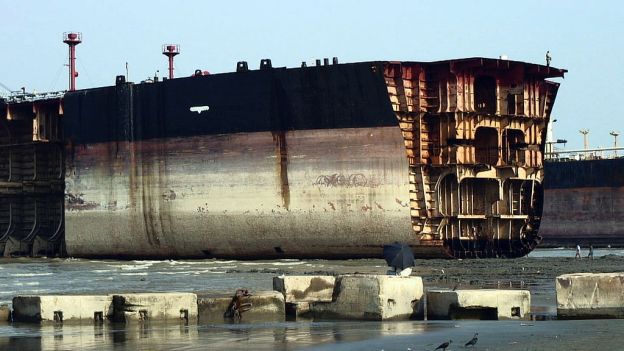
At its height in 2008 Bangladesh’s ship-breaking industry accounted for half of all ships scrapped in the world, according to IHS, a consultancy. Today the country accounts for around a fifth. In these years Bangladeshi ship breakers found themselves at the forefront of criticism as NGOs and pressure groups exposed some of the worst practices causing environmental and human harm. These included high health risks due to injuries, noxious fumes and the handling of asbestos. Critics say one way in which Bangladesh competes on cost is that poor workers are unlikely to file claims for accidents or bad health. Another advantage is (or was) the use of child labour.

In 2009 the Bangladesh Environmental Lawyers Association (BELA), a public-advocacy group, convinced the Supreme Court to ban all ship recycling not meeting certain environmental standards. The court’s decision meant that by 2010 the ship-breaking industry had come to a halt. Zahirul Islam of PHP, a local manufacturer with a big ship-breaking division (the industry prefers to call it ship recycling), says that for 14 months the company was unable to import a single vessel for breaking.  Knock-on effects hurt the wider economy. A World Bank study estimated that ship breaking employed over 200,000 in Bangladesh. Many of the jobs were subsequently lost. And domestic steel prices rose sharply. Half of all Bangladesh’s steel comes from breaking ships.  Under pressure from the ship breakers, Bangladesh’s prime minister, Sheikh Hasina, has since relaxed the regulations. Hefzatur Rahman, president of the Bangladesh Ship Breakers Association, believes this has saved the industry. From just a score of vessels scrapped in the main part of Chittagong two years ago, about 150 were broken up in 2011.

Greens are not happy and want the ban reimposed. Delphine Reuter of the Shipbreaking Platform, an NGO in Brussels, describes ship recycling as “close to slavery”. It and BELA are leading the call for more regulation. That bothers international shipping firms and ship brokers, which argue that Bangladeshi ship breakers have cleaned up their act.

At the International Maritime Organisation, the UN agency responsible for curbing shipping pollution and ensuring safety, the head of pollution prevention, Nikos Mikelis, says environmentalists present Bangladesh with a false choice. “They say they are happy to have the industry, but not on the beaches. Where do they want it? In the mountains?”

Ship breaking in Bangladesh: Hard to break up, Economist, Oct. 27, 2012, at 44

Japan and the Polluted Radioactive Water

Japan’s crippled nuclear power plant is struggling to find space to store tens of thousands of tonnes of highly contaminated water used to cool the broken reactors, the manager of the water treatment team has said.About 200,000 tonnes of radioactive water, enough to fill more than 50 Olympic-sized swimming pools, are being stored in hundreds of gigantic tanks built around the Fukushima Daiichi plant.

Operator Tokyo Electric Power Company (TEPCO) has already chopped down trees to make room for more tanks and predicts the volume of water will be more than tripled within three years.  “It’s a time-pressing issue because the storage of contaminated water has its limits, there is only limited storage space,” the water-treatment manager, Yuichi Okamura, told the AP news agency in an exclusive interview this week.  The Yotukura fishing village was one of the areas devastated by the Mar. 11, 2011 tsunami that caused the nuclear plant meltdown.

Dumping massive amounts of water into the melting reactors was the only way to avoid an even bigger catastrophe after the meltdown at TEPCO’s Fukushima Daiichi nuclear power reactor, caused by the Mar. 11, 2011 tsunami.  Okamura remembers frantically trying to find a way to get water to spent fuel pools located on the highest floor of the 50m high reactor buildings.  Without water, the spent fuel likely would have overheated and melted, sending radioactive smoke for miles and affecting possibly millions of people.

But the measures to keep the plant under control created another huge headache for the utility: What to do with all the radioactive water that leaked out of the damaged reactors and collected in the basements of reactor buildings and nearby facilities.  “At that time, we never expected high-level contaminated water to turn up in the turbine building,” Okamura said.  He was tasked with setting up a treatment system that would make the water clean enough for reuse as a coolant, and was also aimed at reducing health risks for workers and at curbing environmental damage.  At first, the utility shunted the tainted water into existing storage tanks near the reactors.

Meanwhile, Okamura’s 55-member team scrambled to get a treatment unit up and running within three months of the accident, a project that would normally take about two years, he said.  Using that equipment, TEPCO was able to circulate reprocessed water back into the reactor cores.  But even though the reactors now are being cooled exclusively with recycled water, the volume of contaminated water is still increasing, mostly because groundwater is seeping through cracks into the reactor and turbine basements….

Masashi Goto, a nuclear engineer and university lecturer, said the contaminated water build-up posed a major long-term threat to health and the environment.  He said he was worried that the radioactive water in the basements may already be getting into the underground water system, where it could reach far beyond the plant via underground water channels, possibly reaching the ocean or public water supplies.  “There are pools of some 10,000 or 20,000 tonnes of contaminated water in each plant, and there are many of these, and to bring all of these to one place would mean you would have to treat hundreds of thousands of tonnes of contaminated water which is mind-blowing in itself,” Goto said.  “It’s an outrageous amount, truly outrageous,” Goto added.

The plant will have to deal with contaminated water until all the melted fuel and other debris is removed from the reactor, a process that will easily take more than a decade.

Japan Struggling to Store Nuclear Water, Inter Press Service, Oct. 25, 2012

BP: Culture of Corporate Recklessness

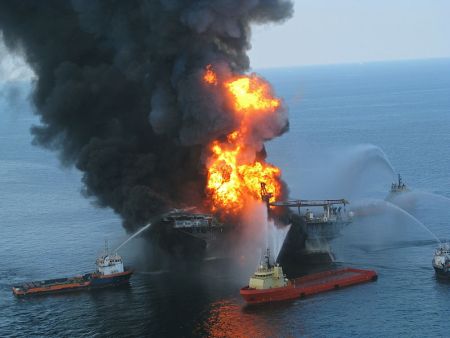
The Obama administration has accused BP of gross negligence and willful misconduct in causing the Deepwater Horizon oil spill of 2010. In a new court filing, the Department of Justice appears bent on blaming BP for the worst oil disaster in U.S. history.  The court document blasts BP’s leadership in no uncertain terms. Referring to “A Culture of Corporate Recklessness,” it states that “The behaviour, words and actions of these BP executives would not have been tolerated in a middling size company manufacturing dry goods for sale in a suburban mall.” It criticizes “the utter lack of any semblance of investigation of the systemic management causes deeply implicating the corporate managers and leadership who caused and allowed the rig-based mechanical causes to fester and ultimately explode in a fireball of death, personal injury, economic catastrophe, and environmental devastation.”

Referring to a “negative pressure test” performed by BP and Transocean hours before the blowout, the report states, “That such a simple, yet fundamental safety-critical test could have been so stunningly, blindingly botched in so many ways, by so many people, demonstrates gross negligence.”  The designation of “gross negligence” under the Clean Water Act, is an important distinction because it would mean the company could face $21 billion in civil damages alone—almost quadruple the penalty if “gross negligence” is not confirmed. BP also faces criminal charges.

The case may not go to trial, which is scheduled to begin January 14. Both sides are negotiating to reach a settlement to resolve both civil and criminal violations.  The Justice Department reportedly sought a $25 billion agreement from BP, but now may be willing to settle for $15 billion.

Justice Dept. Accuses BP of “Gross Negligence” over Gulf Oil Spill, AllGov.com, Sept. 7, 2012