Tag Archives: mining

Mining Giants and Little People: Mariana Dam Disaster

Mining company BHP has been found liable on November 13, 2025 for a 2015 dam collapse in Brazil,….[Note that this disaster was followed by yet another disaster in 2019 the Brumadinho dam disaster] The dam collapse killed 19 people, polluted the river and destroyed hundreds of homes. The civil lawsuit, representing more than 600,000 people including civilians, local governments and businesses, had been valued at up to £36bn ($48bn).

The dam in Mariana, southeastern Brazil, was owned by Samarco, a joint venture between the mining giants Vale and BHP. The claimants’ lawyers argued successfully that the trial should be held in London because BHP headquarters “were in the UK at the time of the dam collapse”. A separate claim against Samarco’s second parent company, Brazilian mining company Vale, was filed in the Netherlands, with more than 70,000 plaintiffs.

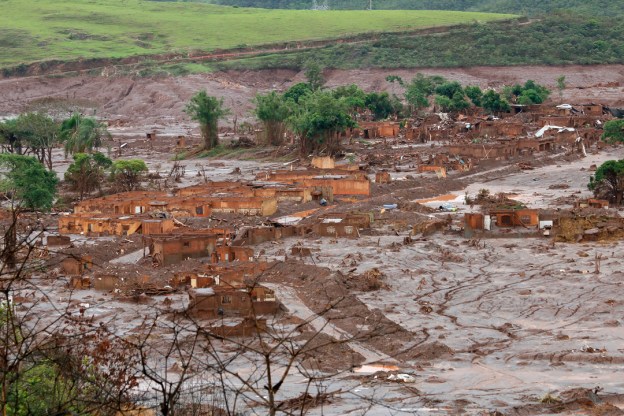
The dam was used to store waste from iron ore mining. When it burst, it unleashed tens of millions of cubic metres of toxic waste and mud. The sludge swept through communities, destroying hundreds of people’s homes and poisoning the river. Judge Finola O’Farrell said in her High Court ruling that continuing to raise the height of the dam when it was not safe to do so was the “direct and immediate cause” of the dam’s collapse, meaning BHP was liable under Brazilian law.

Excerpt from Ione Wells, UK court finds mining firm liable for Brazil’s worst environmental disaster, BBC, Nov. 14, 2025

———-

According to the UN Special Rapporteur who visited Brazil in 2019 and met BHP and Vale on numerous occasions, ” BHP and Vale rushed to create the Renova Foundation to provide the communities [affected by the collapse of the dam] an effective remedy. Unfortunately, the true purpose of the Renova Foundation appeared to be limit liability of BHP and Vale, rather than provide any semblance of an effective remedy

Furthermore, inadequate information was available about the toxicity of the waste after the Mariana disaster, the companies insisted that it was non-toxic, and rejected calls for precaution. Only three weeks after concerns were raised was information availed. When health impacts in Barra Longa emerged years later, Renova sought to exert ownership of epidemiological and toxicological studies by Ambios to suppress disclosure. Read the full report of the Special Rapporteur here.
Mines and the Meaning of Eternity

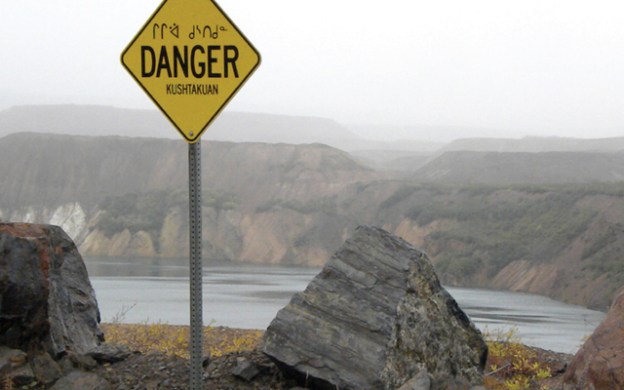
There are 237,000 metric tons of arsenic trioxide locked in the subterranean caverns of Giant Mine on the edge of Yellowknife, an unwanted byproduct from what was once one of the largest gold mines in Canada’s Northwest Territories. Consider that it only takes 140 milligrams of arsenic trioxide to kill a person; there’s enough of the poison here to kill 1.7 trillion people. The local indigenous people refer to the arsenic as a sleeping monster. Company and government officials hoped the arsenic would remain frozen underground forever. But mining operations and climate change caused the permafrost to melt, raising fears in the city of 20,000 people that toxic material could mix with the runoff and slither into the nearby waters of Great Slave Lake, the world’s 10th-largest freshwater body. From there, it could snake 1,000 miles along the Mackenzie River to the Beaufort Sea in the Arctic Ocean, poisoning the wildlife, the land and the water along its path.

The gold mine was one of the largest in Canada’s Northwest Territories, producing 7.6 million ounces of gold between 1948 and 2004—and leaving behind a toxic legacy.
But extracting minerals from the North carries high, and enduring, risks and costs. Current estimates put the cost of cleaning up Giant Mine at $3.2 billion, making it the most expensive mine remediation in Canadian history. The last owner, Royal Oak Mines, went bankrupt and left the bill to the government…

Canada’s government estimates there are roughly 24,000 contaminated sites across the country, which will cost 10 billion Canadian dollars—or $7.25 billion—to clean up. “Mining is a necessary evil. Fundamentally, it’s a license to pollute,” said David Livingstone, former chairman of the Giant Mine Oversight Board, an independent advisory body that monitors the Giant Mine cleanup. 

The arsenic at Giant Mine is the legacy of five decades of gold mining. Between 1948 and 2004, the mine produced 7.6 million ounces of gold, worth roughly $20 billion at today’s prices. There was so much gold that local indigenous people named Yellowknife “Somba K’e,” which means Money Place…But the precious metal was embedded in arsenopyrite, a mineral containing iron, sulfur and arsenic. To get to the gold, miners had to roast the rock, a process that also transformed the once-stable arsenic into toxic gas.

In the early years, miners ejected the arsenic out of a smokestack, believing the poison would be diluted in the air. Instead, the smoke condensed and fell to earth as a fine dust. It collected in the water and on the land. Cows and other livestock sickened and died. In 1951, an indigenous toddler died after eating arsenic-laden snow. After that, miners collected the dust and pumped it back underground, theorizing the arsenic would remain frozen in permafrost. For decades, the system worked. But the Canadian North is warming at a rate four times faster than the rest of the world, and the once-frozen ground is thawing.  Water is trickling into Giant Mine, a potentially catastrophic situation because the highly soluble arsenic trioxide could get carried into Baker Creek.
The creek runs through the mine site, and then into Yellowknife Bay in Great Slave Lake.
The headwaters for the Mackenzie River originate at Great Slave Lake. The river travels more than 1,000 miles to the Beaufort Sea in the Arctic Ocean…

Today, maintenance of the mine is an ongoing task. Waste materials, called tailings, are kept in large reservoirs around the mine. To stop dust contaminated with arsenic and cyanide from flying downwind, workers spray the tailings with a chemical mix called Rhino Snot, a blue-green dust suppressant developed by the U.S. military. But there are still times when wind carries dust southeast toward Ndilǫ, an indigenous community located on the west side of Great Slave Lake’s Yellowknife Bay, less than 2 miles from the mine as the crow flies. When the clouds of dust descend, the Yellowknives Dene council calls residents to warn them to shut their windows and stay indoors, said Ndilǫ Chief Fred Sangris, one of two chiefs of the Yellowknives Dene. “We tell them the mine is coming,” he said.

Sangris is so angry about what Giant Mine has done to the Dene’s traditional hunting grounds that he can’t even look at it. “It’s a poison place,” he said. “It’s a place to avoid.”…“They say forever, and they mean 100 years,” he said. “They don’t know what forever is.” 

Excerpt from Vipal Monga et al., Deep in an Abandoned Gold Mine, a Toxic Legacy Lurks, WSJ, May 5, 2025

How to Kill People 8 000 Feet Below Ground

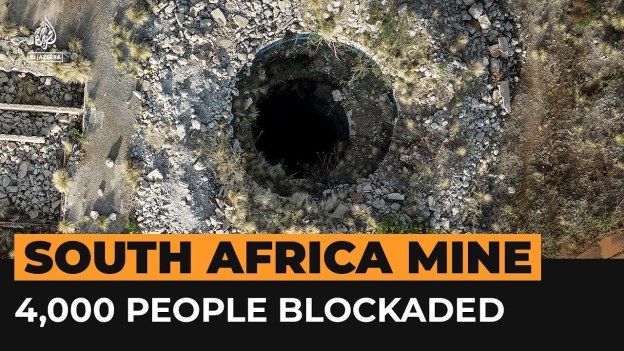
The South Africa’ government has been trying to starve out 1,000 informal prospectors so as to force them out of the Buffelsfontein mine, which extends some 8,000 feet below ground. For months in 2024, police have been sealing most entrances to the tunnels, blocking food and water deliveries and stationing guards at remaining exits to arrest any miners who make their way to the surface. In recent days, nearly 1,200 have surrendered. Police estimate that hundreds of men remain below, but it isn’t clear if they are unwilling or unable to reach the surface.

The operation is part of what police call their “Close the Hole” plan to combat illegal mining, an acute problem in what was once the gold-mining capital of the world. The South African government estimates that illegal gold mining costs the country the equivalent of over $3.8 billion a year in lost revenue, and is often associated with a jump in violent crime in nearby communities and an influx of migrants from neighboring countries… Facing a 42% unemployment rate, impoverished South Africans and migrants from nearby countries pry open sealed entrances and venture thousands of feet underground to try their luck. Locals call the men zama zamas, a Zulu phrase meaning “take a chance.”

Whole ecosystems exist below ground, with entrepreneurs selling miners everything from soda to toothpaste to sex.  The miners in Stilfontein, 100 miles southwest of Johannesburg, are suffering from hunger and dehydration, according to police. Industry experts say the zama zamas are often the lowest-level workers for larger criminal gangs that ultimately sell the gold abroad. Those who have migrated from elsewhere are sometimes victims of abuse, forced to work underground to pay off debts. Police said most miners who emerge will be charged with crimes and imprisoned or deported. 

Excerpt from Alexandra Wexler, The Standoff Deep Inside an Abandoned South African Gold Mine, WSJ, Nov. 15, 2024

Mining Gold and Cyanide Pollution

The $4 billion that two Canadian companies, Barrick Gold and Goldcorp, have poured into developing Pueblo Viejo, a gold mine, since 2009 amounts to the largest single foreign investment in the history of the Dominican Republic. The companies say that the money has turned the polluted ruins of what was the state-owned Rosario mine, abandoned in 1999, into a “truly world-class” operation that should provide the country’s government with $10 billion over its 25-year life.

But the project has been controversial. Just weeks after the mining started in January 2013, President Danilo Medina, who was elected last year, declared: “For every $100 of gold exports, Barrick will receive $97 and the Dominican people $3. That is simply unacceptable.” (In fact, Pueblo Viejo Dominicana Corporation, or PVDC, the company operating the mine, is 60% owned by Barrick and 40% by Goldcorp.) Mr Medina demanded that the contract be renegotiated; otherwise, he said, he would raise taxes on the mine’s profits.

This month the two sides agreed to changes that have front-loaded tax payments and could see the government get an extra $1.3 billion in 2013-16 provided that the gold price rises and stays above $1,600 an ounce (it is now around $1,350). Gustavo Montalvo, Mr Medina’s chief of staff, tweeted: “Together we ensured that words like ‘national sovereignty’, ‘justice’ or ‘transparency’ were transformed into something more concrete.”

Yet that may not calm local unrest over the mine, sited about 100 kilometres (60 miles) north of Santo Domingo, the capital. The investment was presented by both the government and company as including a clean-up of Rosario’s toxic mess and the installation of systems to keep local watercourses clean. But residents are suing PVDC, claiming that the new mine is poisoning rivers, causing illnesses and the death of farm animals. They want the government to release the environmental-impact assessment for Pueblo Viejo, which it has so far refused to do.

One farmer, María de la Cruz Mariano, said that she began to suffer skin allergies and other ailments in 2010, after PVDC began work. Tests on her blood conducted by a private laboratory showed high levels of lead, sulphur, cyanide and zinc. Some of her cattle have died from bovine anaemia, which can be caused by ingesting cyanide. Other residents report that previously clean local rivers have become polluted since PVDC built a dam to collect water containing cyanide, which is used to leach gold from crushed rock.

PVDC has signed the international code of practice for the handling of cyanide. It says it is “in the process of capturing all the surface flows” from the old and the new mines, sending the water to storage ponds where it is treated. PVDC says that, together with local people, it conducts regular, public tests on water and air.

But community leaders say they have no knowledge of such tests. The company has not answered requests to provide the dates on which they were conducted. Tests by the environment ministry, released only after a freedom of information request, found the water in the Margajita river downstream from the mine to be highly acidic, as well as containing sulphides and copper above legal limits. The ministry has made little effort to act on these results.

The old Rosario mine left some streams red with acid. PVDC’s clean-up obligations extend only within the mine perimeter; the rest was for the government. The firm points out that it has paid $75m ($37.5m of it a loan) to finance the government’s share of the work. It has also removed around 130,000 cubic metres (4.6m cubic feet) of contaminated soil. But Demóstenes Martínez, a congressman from the ruling party, argues that PVDC is violating both the constitution and the mining law.

It is not clear whether the pollution is being caused by PVDC’s operations, or is a legacy of the past. The government claims to have lost records of past tests on the rivers. But on its own the new agreement may not be enough to ensure that the mine regains the consent of the community. That will require greater candour.

Mining in the Dominican Republic:  Sickness and wealth, Economist, Sept. 21, 2013

Tibet – Mineral Resources, Fragile Ecology

The ecology of the Tibetan plateau, noted the Ministry of Land and Resources two years ago, is “extremely fragile”. Any damage, it warned, would be difficult or impossible to reverse. But, it went on, the China National Gold Group, a state-owned company, had achieved “astonishing results” in working to protect the environment around its mine near the region’s capital, Lhasa. On March 29th at least 83 of the mine’s workers lay buried under a colossal landslide. Its cause is not yet certain, but critics of Tibet’s mining frenzy feel vindicated.

The disaster at the Jiama copper and gold mine, about 70km (45 miles) north-west of Lhasa, has clearly embarrassed the government in Beijing. According to China Digital Times, a California-based media-monitoring website, the Communist Party ordered newspapers to stick to reports issued by the government and the state-owned news agency, Xinhua.

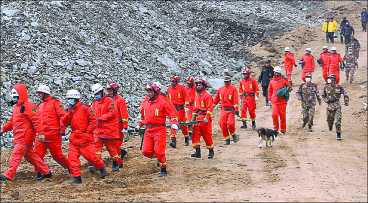
Foreign reporters are rarely allowed into Tibet, least of all to cover sensitive incidents. The official media have avoided speculation about any possible link between the landslide and mining activities in the area. They say the landslide covered a large area with 2m cubic metres of rubble. By the time The Economist went to press, 66 bodies had been pulled out by teams of rescuers with sniffer dogs. The high altitude and lack of oxygen made rescue work hard. A deputy minister of land and resources, Xu Deming, said preliminary investigations had shown that the landslide was caused by a “natural geological disaster”. Fragments of rock left behind by receding glaciers are being blamed, though officials do not explain why the workers’ camp was set up so close to such an apparent hazard.

The Tibetan government-in-exile based in India says it fears the disaster was caused by work related to the mine, which appears to have grown rapidly since construction began in 2008. It was formally opened two years later, at a ceremony attended by Tibet’s most senior officials. The $520m investment was described at the time as the biggest in Tibet’s mining industry by a firm belonging to the central government. The mine is owned by China Gold International Resources, a company listed in Hong Kong and Toronto. China National Gold Group is the controlling shareholder.

Tibet has been trying hard in recent years to encourage such companies to dig up the plateau’s metals and minerals. It has a lot of them to offer: China’s biggest reserves of copper and chromite (used in steel production), among the world’s biggest of lithium (used to make batteries), as well as abundant reserves of uranium, gold, borax (a component of ceramics and glass) and oil. Extracting these, however, often involves boring into a landscape considered sacred by Tibetans.

The Jiama mine, in a valley known to Tibetans as Gyama and revered as the birthplace of a seventh-century Tibetan king, has been the focus of protests by locals angered by environmental and other issues. Water from the valley flows into the Lhasa river. Woeser, a Tibetan activist based in Beijing, has blogged about locals’ fear that their water supplies will be polluted.

Tibetan resentment has been fuelled by the mining industry’s failure to provide much direct employment.

Excerpts, Mining in Tibet: The price of gold, Economist, April 6, 2013, at 54