Tag Archives: Starlink constellation satellites

The Nasty Fight over Satellite Spectrum

Telecom mogul Charlie Ergen’s war chest is at risk after a U.S. regulator questioned his company’s use of cellular and satellite spectrum licenses—including a chunk of airwaves long sought by Elon Musk’s SpaceX. The Federal Communications Commission told Ergen, the chairman and co-founder of network operator EchoStar that the agency’s staff would investigate the company’s compliance with federal requirements to build a nationwide 5G network. EchoStar owns both the Dish Network pay-TV brand and Boost Mobile’s wireless service. 

The U.S. government in 2019 set several construction milestones for Dish to maintain cellular licenses worth billions of dollars. The company has spent years wiring thousands of cellphone towers to help Boost become a wireless operator that could rival AT&T, Verizon and T-Mobile, but the project has been slow-going. Boost’s subscriber base has shrunk in the five years since Ergen bought the brand from Sprint.

“The terms of the deal were clear,” FCC Chairman Brendan Carr wrote to Ergen in a letter viewed by The Wall Street Journal. “The FCC structured the buildout obligations to prevent spectrum warehousing and to ensure that Americans would gain broader access to high-speed wireless services, including in underserved and rural areas.”…

Ergen and Musk have been sparring for years in regulatory filings over spectrum rights. The battle has intensified as Apple and other big technology companies press for an edge in orbit….SpaceX said in an April 2025 letter that EchoStar’s spectrum in the 2 gigahertz band “remains ripe for sharing among next-generation satellite systems.” EchoStar accused SpaceX of seeking to “cloak another land grab for even more free spectrum.”

Excerpts from Drew FitzGerald, FCC Threatens Charlie Ergen’s Hold on Satellite, 5G Spectrum Licenses, May 14, 2025

Mourning the Loss of Dark and Quiet Sky

The number of working satellites has soared in the past five years to around 11,000, mostly because of constellations of orbiters that provide Internet connectivity around the globe. Just one company, SpaceX in Hawthorne, California, has more than 7,000 operational Starlink satellites, all launched since 2019; OneWeb, a space communications company in London, has more than 630 satellites in its constellation. On paper, tens to hundreds of thousands more are planned from a variety of companies and nations, although probably not all of these will be launched.

Satellites interfere with ground-based astronomical observations, by creating bright streaks on images and electromagnetic interference with radio telescopes. The satellite boom also poses other threats, including adding pollution to the atmosphere…

Before the launch of Starlinks, astronomers had no centralized reference for tracking satellites. Now, the International Astronomical Union (IAU) has a virtual Centre for the Protection of the Dark and Quiet Sky from Satellite Constellation Interference (CPS), which serves as an information hub…One of the centre’s tools, called SatChecker, draws on a public database of satellite orbits, fed by information from observers and companies that track objects in space. Astronomers can use SatChecker to confirm what satellite is passing overhead during their observations…Tools such as SatChecker help telescope operators avoid problems by allowing them to target a different part of the sky when a satellite passes overhead or by simply pausing observations as it flies by. It would aid astronomers if SatChecker had even more accurate information about satellite positions, but there are constraints on improving the system. SatChecker data come from the US Space Force, which draws on a global network of sensors that tracks objects in orbit and issues updates on satellite locations as often as several times a day. The frequency of these updates is limited by factors such as how often a sensor can observe an object and whether the sensor can distinguish what it’s looking at.

Excerpts from   Alexandra Witze, Swarms of satellites are harming astronomy. Here’s how researchers are fighting back, Nature, Mar. 18, 2025


The Billionaires Who Conquer the World One Country at a Time

Elon Musk is so popular in this farming region of Brazil that his face is plastered in stores alongside herds of cows, and local magazines depict him as a superhero. The billionaire’s appeal is simple: His satellite company Starlink has connected Brazil’s vast rural and jungle expanses to the internet.  “We were all rooting for Starlink to come to Brazil…we knew what a big change it would make,” said Arthur Cursino, a ginger farmer here who once had to climb a tree to get a cellphone signal and now, thanks to Starlink, runs one of Brazil’s most popular YouTube channels on farming.

But Starlink’s rapid expansion has come as officials in the administration of leftist President Luiz Inácio Lula da Silva have raised concerns about Musk’s growing influence over the country. After getting regulatory approval two years ago, Starlink eclipsed competitors in May 2024 to become the country’s biggest satellite internet provider.  Musk, a billionaire whose companies include social-media platform X and electric-car maker Tesla, has courted right-wing leaders around the world, including da Silva’s predecessor and rival, Jair Bolsonaro. Musk threw his support behind the candidacy of former President Donald Trump.

The regions where Starlink has become popular—Brazil’s agricultural heartland and the Amazon rainforest—are Bolsonaro strongholds where da Silva faces deep political opposition. Now, Brazil’s federal audit court is investigating Starlink’s use by public authorities in the country, threatening to place restrictions on the service. Anatel, the telecoms regulator, has opened a separate inquiry into Starlink, saying that its rapid growth in subscribers of more than 20% a month could crowd out new players.

Excerpt from Samantha Pearson, Brazil Sees Elon Musk’s Starlink as a Political Threat, July 26, 2024

Planning for the Invasion: Taiwan

If China were to invade Taiwan, it might start by severing the 14 undersea internet cables that keep the island connected to the world. Taiwan is adding cables and planning how to defend their landing points. But it is also testing antennae in 700 locations, including some outside Taiwan. These would be able to send and receive signals by means of satellites in low orbit, like the ones Starlink uses. The goal is to make the antennae “as mobile as possible” to survive an attack…China has the capability to shoot down satellites. But Starlink developed by SpaceX (Elon Musk) is made up of over 4,000 of them and aims eventually to have tens of thousands…Unsurprisingly, Taiwan is looking to reduce its dependence on others including Starlink. Its space agency is developing its own low-orbit communication satellites. The first is expected to be launched in 2025.

China’s low-orbit ambitions are much larger. In 2020 the government filed papers with the International Telecommunication Union, a UN body, for a 12,992-satellite constellation. A year later the government established China Satellite Networks Group Limited and tasked it with developing satellite internet. At least seven state-owned and private Chinese companies are building satellite factories, with the expectation that they will soon be able to produce several hundred small communications satellites per year.

Officials in Beijing have developed a space-race mentality. Specific orbits and radio frequencies are “rare strategic resources” that Starlink wants to “monopolize”, warned the Liberation Army Daily in 2022….The Liberation Army Daily complains that there is only room for 50,000 satellites in low-Earth orbit and that Starlink may eventually take up more than 80% of that space. But the calculation is not that straightforward, says Juliana Suess of the Royal United Services Institute, a think-tank in Britain. Imagine low orbit as a highway, she says. What needs to be calculated is how many moving cars that highway can safely accommodate. Much will depend on the size of satellites and their trajectories.” But at this moment, there is lack of norms surrounding traffic in low orbit.

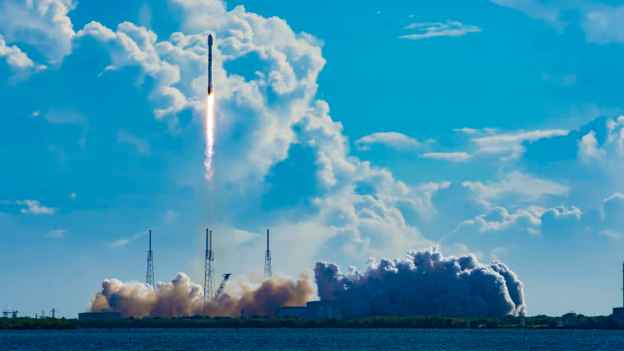
Spacex has an important advantage. Satellites in low orbit don’t last very long, so the company replaces them on a regular basis. That entails a large number of rocket launches. Spacex has the world’s best system for that, the partially reusable Falcon 9 rocket. Now it is working on a much larger, fully reusable spacecraft called Starship which could launch hundreds of satellites at a time. Some Chinese companies appear to be trying to build knock-offs.

Excerpts from China in Space: A New Mandate in the Heavens, Economist, May 20, 2023


Space Control in the Future of War: Ukraine

The Starlink constellation of SpaceX currently consists of 3,335 active satellites and has become an integral part of Ukraine’s military and civil response to Russia’s invasion…Appropriately enough, the story started with a tweet, one sent by Mykhailo Fedorov, Ukraine’s minister of digital transformation, two days after the invasion:

@elonmusk, while you try to colonize Mars —Russia try to occupy Ukraine! While your rockets successfully land from space—Russian rockets attack Ukrainian civil people! We ask you to provide Ukraine with Starlink stations and to address sane Russians to stand.

Mr Musk replied to him within hours, saying that the Starlink service had been turned on over Ukraine and that the hardware would follow. Within days lorries full of the pizza-sized flat dishes used to access the satellites began to arrive in Ukraine.

By May 2022 around 150,000 people were using the system every day. The government quickly grew to rely on it for various communication needs, including, on occasion, the transmission of the nightly broadcast by Volodymyr Zelensky, Ukraine’s president. Because the dishes and their associated terminals are easily portable and can be rigged to run off a car battery, they are ideal for use in a country where the electricity and communication networks are regularly pounded by Russian missiles. When Kherson was liberated in November 2022 Starlink allowed phone and internet services to resume within days.

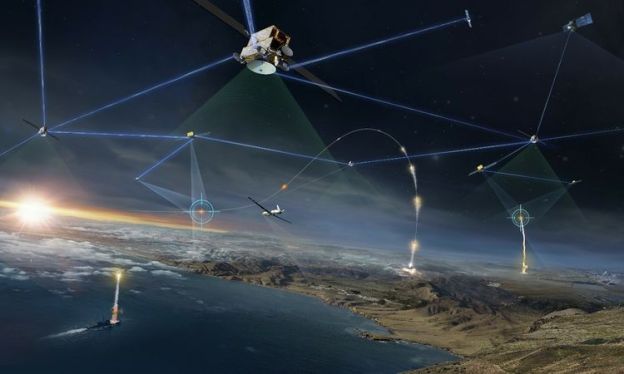
Crucially, Starlink has become the linchpin of what military types call C4ISR (command, control, communications, computers, intelligence, surveillance and reconnaissance). Armies have long relied on satellite links for such things…But Most satellite communications make use of big satellites which orbit up at 36,000km. Perched at such a height a satellite seems to sit still in the sky, and that vantage allows it to serve users spread across very large areas. But even if such a satellite is big, the amount of bandwidth it can allocate to each user is often quite limited.

The orbits used by Starlink’s much smaller satellites are far lower: around 550km. This means that the time between a given satellite rising above the horizon and setting again is just minutes. To make sure coverage is continuous thus requires a great many satellites, which is a hassle. But because each satellite is serving only a small area the bandwidth per user can be high. And the system’s latency—the time taken for signals to get up to a satellite and back down to Earth—is much lower than for high-flying satellites. 

Franz-Stefan Gady, of the International Institute for Strategic Studies, a think-tank, recently visited the Ukrainian front lines and saw an example of what cheap, ubiquitous connectivity makes possible: a sort of Uber for howitzers. .. “Ukrainian military operations are hugely dependent on having access to the internet,” says Mr Gady, “so Starlink is a most critical capability.” A Ukrainian soldier puts it more starkly. “Starlink is our oxygen,” he says. Were it to disappear “Our army would collapse into chaos.”…

Starlink signals are strong compared with those from higher flying satellites, which makes jamming them harder. And the way that the dishes use sophisticated electronics to create narrow, tightly focused beams that follow satellites through the sky like invisible searchlights provides further resistance to interference…

If its signals cannot be jammed, the system itself could be attacked instead….Cyber-attacks like the one aimed at Ukraine’s legacy satellite system on February 24, 2022 are one possibility. So far, though, similar sallies against Starlink appear to have been ineffective, in part thanks to SpaceX’s ability to quickly update the system’s software. Dave Tremper, director of electronic warfare for the Office of the Secretary of Defense, has said the speed of the software response he witnessed to one attack was “eye-watering”.

And then there are the satellites themselves. America, China, India and Russia have missiles that can shoot satellites out of the sky. Again, though, using them would seem a severe escalation. It would also be a lot less useful against a constellation like Starlink than against older systems. Knocking out a single Starlink would achieve more or less nothing. If you want to damage the space-based bit of the system, you need to get rid of lots of them…

In 2020 China filed documents with the International Telecommunication Union, a UN body, for a 13,000-satellite constellation of its own.

Excerpts from The Satellites that Saved Ukraine, Economist, Jan. 7, 2023