Monthly Archives: February 2026

U.S. CIA In China

The U.S. Central Intelligence Agency (CIA) released a new video on on Feb. 13, 2026 seeking to capitalize on upheaval at the top of China’s armed forces to recruit potential spies. The 95-second Mandarin-language video shows an officer walking through a military installation musing about ruthless power struggles at the top of the armed forces. “What the leaders are truly protecting is only their own selfish interests,” the narrator states. “Their power is built on countless lies. But now, these walls of lies are crumbling, leaving us only to clean up the mess.” The highly produced video was released less than a month after Chinese leader Xi Jinping purged two top generals, including his highest-ranking deputy in the military, Gen. Zhang Youxia

“Anyone with leadership ability will inevitably be feared and ruthlessly eliminated,” the narrator says. “I cannot allow these madmen to shape my daughter’s future world.”

Xi has removed more than 60 top officers and defense-industry executives since 2023…The turmoil has left the Central Military Commission, the top body that controls the military, with just two members: Xi himself and the head of the military’s body for internal investigations.

The video concludes with the officer opening a laptop while parked in an isolated spot and calling up a page that says “Contact the CIA” in Chinese. The closing credits display a CIA address on Tor, an anonymizing network.

The CIA posted the videos on YouTube, which is blocked in China, as are many other Western social-media and news sites. Those sites can be accessed using VPNs, and the CIA’s advertisements occasionally run in Hong Kong, where YouTube isn’t blocked.

CIA’s efforts in China were devastated between 2010 and 2012 when nearly 20 spies working for the CIA were executed or imprisoned, leaving the agency struggling to rebuild its human espionage capabilities in China.

Excerpt from CIA Seeks to Recruit Spies Out of China’s Military Turmoil, WSJ, Feb. 13, 2026
How AI Capital Flows to U.A.E.: the Tahnoon Coup

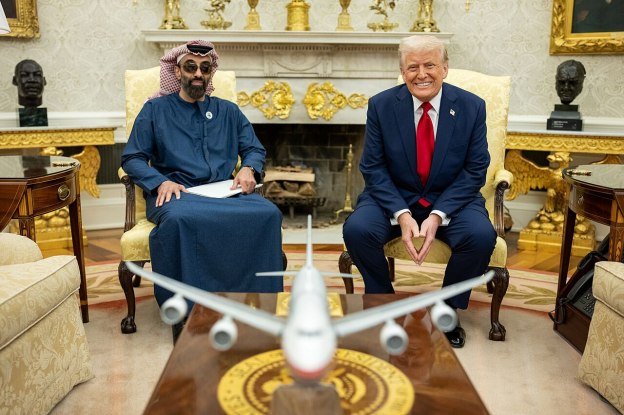
Four days before Donald Trump’s inauguration in 2025, lieutenants to an Abu Dhabi royal secretly signed a deal with the Trump family to purchase a 49% stake in their fledgling cryptocurrency venture World Liberty Financial for half a billion dollars… The buyers would pay half up front, steering $187 million to Trump family entities.. 

The investment was backed by Sheikh Tahnoon bin Zayed Al Nahyan, an Abu Dhabi royal who has been pushing the U.S. for access to tightly guarded artificial intelligence chips… Tahnoon—sometimes referred to as the “spy sheikh”—is brother to the United Arab Emirates’ president, the government’s national security adviser, as well as the leader of the oil-rich country’s largest wealth fund. He oversees a more than $1.3 trillion empire funded by his personal fortune and state money that spans from fish farms to AI to surveillance, making him one of the most powerful single investors in the world. The deal marked something unprecedented in American politics: a foreign government official taking a major ownership stake in an incoming U.S. president’s company.

Under the Biden administration, Tahnoon’s efforts to get AI hardware had been largely stymied over fears that the sensitive technology could be diverted to China. Of particular concern was one of Tahnoon’s own companies, the AI firm G42, which had stoked alarm among intelligence officials and lawmakers over its close ties to the sanctioned tech giant Huawei and other Chinese firms…

In 2025, the Trump administration decided to supply UAE with access to around 500,000 of the most advanced AI chips a year—enough to build one of the world’s biggest AI data center clusters. The framework agreement called for roughly one-fifth of the chips to go to G42…

The agreement was widely viewed as a coup for the emirate’s ruling family, overcoming longstanding U.S. national security concerns …Proponents hailed the deal for unlocking a flood of investment into the U.S. and for helping entrench American technology as the global standard….What wasn’t publicly known: Tahnoon’s emissaries had signed the deal to purchase 49% of World Liberty Financial cryptocurrency firm controlled by the Trump family.

Excerpt from Sam Kessler et al., Spy Sheikh’ Bought Secret Stake in Trump Company, WSJ, Jan. 31, 2026

It’s the Internet, Stupid! How U.S. Infiltrated Iran

After Iranian authorities smothered mounting unrest in January 2026 by killing thousands of protesters and severely cutting internet connectivity, the U.S. smuggled roughly 6,000 of the satellite-internet kits into the country, the first time the U.S. has directly sent Starlink into Iran…

Some 30 million Iranians used U.S.-funded VPNs during the country’s widespread protests in 2022, according to internal State Department data…Some VPN companies dependent on U.S. funding said in 2026 that they are struggling to provide their service to Iranians… Psiphon, a technology company that provides uncensored internet access to users, now receives about $5.9 million in U.S. funding, compared with $18.5 million in 2024… Psiphon had about 18.4 million active Iranian users in January 2026, the same month Tehran shut off the internet, though the company detected only 1,500 people operating Psiphon with Starlink when the regime cut off nearly all online access. 

Excerpt from Alexander Ward, U.S. Smuggled Thousands of Starlink Terminals Into Iran After Protest Crackdown, WSJ, Feb. 12, 2026

This Fight Will Never Be Over: U.S. versus Islamic State

The U.S. began in January 2026 to move Islamic State prisoners from northeast Syria to Iraq, aiming to relocate about 7,000 detainees. The removal of the detainees could set the stage for further U.S. troop withdrawals from Syria. U.S. airstrikes against Islamic State are expected to continue in 2026. The U.S. military said that in the first two months of 2026 American forces had struck more than 100 targets with over 350 precision munitions, and had captured or killed more than 50 Islamic State fighters.

Excerpt from Michael R. Gordon et al, U.S. Vacates a Key Military Base in Syria, WSJ, Feb. 12, 2026

The Brute Force of Capital: A 2026 Update

In 1985, IBM was America’s most valuable company, one of its most profitable, and among its largest employers, with a payroll of nearly 400,000. Today, Nvidia is nearly 20 times as valuable and five times as profitable as IBM was back then, adjusted for inflation. Yet it employs roughly a 10th as many people. That simple comparison says something profound about today’s economy: Its rewards are going disproportionately toward capital instead of labor. Profits have soared since the pandemic, and the market value attached to those profits even more. The result: Capital, which includes businesses, shareholders and superstar employees, is triumphant, while the average worker ekes out marginal gains….The brute financial force of all that wealth means market fluctuations… Meanwhile, artificial intelligence could funnel even more of economic output toward capital instead of labor. Amid reports in February 2026 that layoffs are climbing and job openings plunging, especially for professionals exposed to AI, the Dow Jones Industrial Average closed above 50 000 for the first time.

Excerpt from Greg Ip, The Big Money in Today’s Economy Is Going to Capital, Not Labor, WSJ, Feb. 9, 2026

We Should Have Done it 30 Years Ago: Gallium

Gallium is processed with nitrogen and arsenic to make substrates for high-performance semiconductors. In chips, gallium can handle high levels of electricity and is more heat- and moisture-resistant than silicon. Beyond cellphones and laptops, it is also used in satellites to protect components from radiation in space.

China, which accounts for most of the world’s production of critical minerals, introduced export controls on gallium in 2023. In 2024, it banned gallium exports to the U.S. outright. China later suspended the ban, but could reinstate it later in 2026….Benchmark prices for gallium outside of China have roughly tripled over the past two years. January’s 2026 average price was a record high at nearly $1,572 a kilogram,. 

One project the Trump administration has targeted is in Wagerup, Western Australia. Alcoa has operated a refinery there since the 1980s that processes bauxite to make alumina. The bauxite also contains trace amounts of gallium, so Alcoa intends to build a plant to extract it.  The U.S. government plans to provide funding for the effort, along with Australia and Japan. In return, Alcoa said, the governments will receive a share of the metal from the plant. The plant is expected to eventually account for about 100 metric tons of gallium, or 10% of global gallium demand, according to Alcoa. Worldwide, 760 tons of gallium were produced in 2024…“There’s a lot of work to be done on how we do collaborate and work together to develop this industry,” Madeleine King, Australia’s mining minister, said Feb. 4, 2026.

“We should have done it 20 or 30 years ago.”

Excerpt from Bob Tita, The Defense Department Is Infatuated With This Drippy Silver Metal, WSJ, Feb. 9, 2025

When Artificial Intelligence Goes to War

Anthropic scored a major endorsement in the summer of 2025 when it won a contract worth up to $200 million from the United States Defense Department. Now, the AI startup’s relationship with the Pentagon is on the rocks…According to Anthropic’s terms and condition Claude can’t be used for any actions related to domestic surveillance. That limits how many law-enforcement agencies such as Immigration and Customs Enforcement (ICE) and the Federal Bureau of Investigation (FBI) could deploy it. Anthropic’s focus on safe applications of AI—and its objection to having its technology used in autonomous lethal operations (e.g., drones)—have continued to cause problems…

Other AI companies including OpenAI and Google are also working with the military.

Excerpt from Keach Hagey, Anthropic-Pentagon Clash Over Limits on AI Puts $200 Million Contract at Risk, WSJ, Jan. 29, 2026

Imperialism versus Green Imperialism

In 2022, a Netherlands-based conservation group, the International Fund for Animal Welfare (IFAW), helped the government of Malawi truck 263 elephants from Liwonde National Park in the south, which had too many elephants, to Kasungu National Park in central Malawi, which had far fewer. The 280-mile relocation was part of the country’s broader conservation efforts. “The goal was to ease pressure on Liwonde and help rebuild a viable elephant population in Kasungu,” an IFAW spokesman said.  The 2022 effort tripled the elephant population in Kasungu park, boosting Malawi’s tourism industry with it. IFAW used images of elephants being lifted by cranes to raise money for further wildlife-protection projects…

Within 24 hours of their release, elephants strayed out of the park, crossed the border into Zambia and trampled two farmers to death.  The toll on the human side over the between 2022 and 2025: 26 villagers dead, scores injured, $4.5 million in crops destroyed and hundreds of homes damaged, according to Warm Heart Initiative, a Zambian nonprofit…The resulting anger, according to villagers, has had broader consequences for conservationism in the countries. Many locals no longer report poachers to wildlife authorities; instead, they hunt down and kill stray elephants…Victims of attacks, meanwhile, have threatened to sue IFAW, according to British law firm Leigh Day, which is representing potential plaintiffs.

Excerpt from Nicholas Bariyo, A Plan to Save Elephants Sparked a Deadly Conflict, WSJ, Jan. 29, 2026

Who Rents Your Phone Behind your Back: Airbnbs of the Internet

On January 28, 2026, Google used a federal court order to get dozens of domains belonging to Ipidea removed from the internet… The mysterious Chinese company is an unsavory enterprise that sneaks unwanted and dangerous software on millions of phones, home computers and Android devices.

Control of the domains allowed Google to both shut down the public websites and technical back-end of the company, which operates using more than a dozen brand names. Google has also taken steps to remove hundreds of apps affiliated with the company from Android devices…The actions are expected to knock more than nine million Android devices off Ipidea’s network. They target a little known but important part of the internet that has increasingly worried cybersecurity experts.

Called residential proxy” networks, these online services are built out of apps that are installed on virtually any type of internet-connected device—among them media players, PCs and mobile phones. Companies such as Ipidea then rent out access to the devices to paying customers who want to use the internet anonymously. The businesses operate like Airbnbs for network bandwidth, except the people whose devices are being rented out often don’t realize what is happening.

There are legitimate uses for Ipidea’s service, which can be used to surf the internet anonymously or to scrape websites for data…See Oxylabs…Residential proxies have also become a go-to service for criminals and state-sponsored hackers who want to cover their tracks, said John Hultquist, chief analyst with Google’s Threat Intelligence Group. “It’s a consumer issue and it’s a national-security issue at the same time,” he said. “It’s enabling some of the most serious threats to our country.”…

The Russia-linked hacking group known as Midnight Blizzard, blamed for a 2023 hack of Microsoft, used a residential proxy service to cover its tracks, Google said.

Excerpt from Robert McMillan, Google Aims Knockout Blow at Chinese Company Linked to Massive Cyber Weapon, WSH, Jan. 28, 2026