President Obama intends to renew a nuclear cooperation agreement with China. The deal would allow Beijing to buy more U.S.-designed reactors and pursue a facility or the technology to reprocess plutonium from spent fuel. China would also be able to buy reactor coolant technology that experts say could be adapted to make its submarines quieter and harder to detect.,,
The Nuclear Energy Institute, an industry trade group, argues that the new agreement will clear the way for U.S. companies to sell dozens of nuclear reactors to China, the biggest nuclear power market in the world. Yet the new version of the nuclear accord — known as a 123 agreement under the Atomic Energy Act of 1954 — would give China leeway to buy U.S. nuclear energy technology at a sensitive moment: The Obama administration has been trying to rally support among lawmakers and the public for a deal that would restrict Iran’s nuclear program — a deal negotiated with China’s support.,,,
If Congress rejects the deal, “that would allow another country with lower levels of proliferation controls to step in and fill that void,” said a senior administration official…
{T}he current nuclear agreement with China does not expire until the end of the year (2015)…Henry Sokolski, executive director of the Nonproliferation Policy Education Center, has been urging lawmakers to insist on requiring advance consent for the reprocessing of spent fuel from U.S.-designed reactors into plutonium suitable for weapons. He also is concerned about the sale of certain nuclear energy technologies, especially coolant pumps with possible naval use.
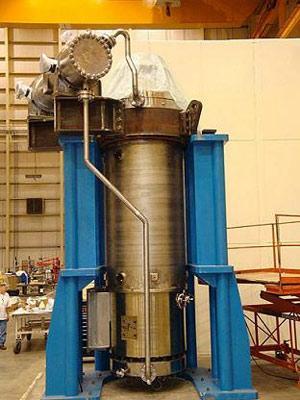
Charlotte-based Curtiss-Wright developed advanced coolant pumps for the U.S. Navy’s submarines. The same plant produces a scaled-up version for the Westinghouse AP1000 series reactors, each of which uses four big pumps. These pumps reduce noises that would make a submarine easier to detect…..An Obama administration official said the reactor coolant pumps are much too big to fit into a submarine. However, a 2008 paper by two former nuclear submarine officers working on threat reduction said that “the reverse engineering would likely be difficult” but added that “certainly, the Chinese have already reversed engineered very complex imported technology in the aerospace and nuclear fields.”…
The United States has bilateral 123 agreements with 22 countries, plus Taiwan, for the peaceful use of nuclear power. Some countries that do not have such agreements, including Saudi Arabia, Jordan and Malaysia, have expressed interest in clearing obstacles to building nuclear reactors.
China and the United States reached a nuclear cooperation pact in 1985, before China agreed to safeguards with the International Atomic Energy Agency. IAEA safeguards went into force in 1989, but Congress imposed new restrictions after the Chinese government’s June 1989 crackdown on protesters in Tiananmen Square. The 123 agreement finally went into effect in March 1998; President Bill Clinton waived the 1989 sanctions after China pledged to end assistance to Pakistan’s nuclear weapons program and nuclear cooperation with Iran.
In December 2006, Westinghouse Electric — majority-owned by Toshiba — signed an agreement to sell its AP1000 reactors to China. Four are under construction, six more are planned, and the company hopes to sell 30 others, according to an April report from the Congressional Research Service (CRS)….“Missile proliferation from Chinese entities is a continuing concern.” The United States wants China to refrain from selling missiles capable of carrying nuclear weapons, a payload of 1,100 pounds, as far as 190 miles
China has a pilot plant engaged in reprocessing in Jiu Quan, a remote desert town in Gansu province. Satellite photos show that it is next to a former military reprocessing plant, according to Frank von Hippel, a Princeton University physics professor who specializes in nuclear arms control.
Excerpts from Steven Mufson, Obama’s quiet nuclear deal with China raises proliferation concerns, Washington Post May 10, 2015


 Law-In-Action