Tag Archives: Arctic Challenger

China’s Polar Silk Road — A U.S. Nightmare

Chinese research submarines for the first time traveled thousands of feet beneath the Arctic ice the summer of 2025, a technical feat with chilling military and commercial implications for America and its allies. Beijing views future sea routes through the High North as a shortcut for global commerce, a so-called Polar Silk Road. China sent a cargo ship, in the summer of 2025, to the Polish port of Gdansk by skirting the North Pole, a route twice as fast as travel times using the Suez Canal..

Chinese and Russian military planes in 2025 flew patrols near Alaska for the first time, with Chinese long-range bombers operating from a Russian air base. Such cooperation not only gives China new abilities to strike North America but raises the prospect of a joint attack by America’s most powerful adversaries….In the Arctic, the U.S. and NATO worry most about subsea warfare. Submarine navigation relies on detailed knowledge of ocean-floor topography and undersea conditions. China is cataloging the world’s oceans to build computer models to guide submarines and help them evade detection, military experts say…U.S. analysts say data China gathered from its Arctic dives north of Alaska and Greenland isn’t just about studying climate change, but also to educate the Chinese navy, which operates relatively noisy submarines that are easily tracked by U.S. forces. ..

China’s ultimate aim, said Adm. Samuel Paparo, head of U.S. Indo-Pacific Command, is to end “American undersea dominance,” he told a conference in Canada in 2024.

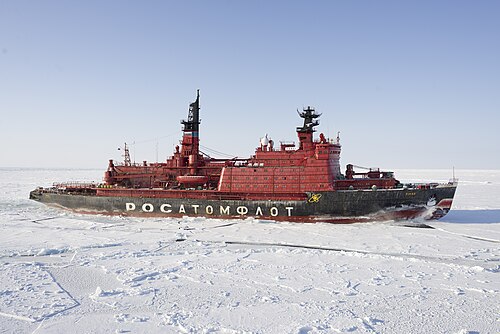
Both Beijing and the U.S. are short of vessels capable of navigating thick Arctic ice compared with Russia, which has more than 40. China in 2025 commissioned its fifth icebreaker. The U.S. has only two such vessels in operation, and Trump is buying more. After years of development, China launched its first domestically built icebreaker in 2019 with Finnish help. In 2025, it built and deployed its first domestically designed icebreaker in 10 months, a swift accomplishment noted with worry in Arctic countries.

Excerpt from Daniel Michaels, China’s Push to Master the Arctic Opens an Alarming Shortcut to U.S., WSJ
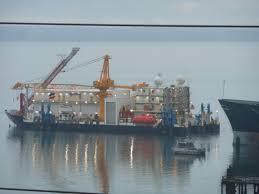
The Arctic Challenger: ready for Arctic oil spills

Shell Oil has been building and testing equipment designed for the Arctic Ocean in Puget Sound, Seattle, United States.  In September, a key test of underwater oil-spill equipment was a spectacular failure.  It forced the energy giant to postpone drilling into oil-bearing rocks beneath the Arctic Ocean until next summer. Shell and its federal regulators have been tight-lipped about the failed test.  But a freedom-of-information request reveals what happened beneath the surface of Puget Sound.

Before Shell can drill for oil in the Arctic Ocean, it needs to prove to federal officials that it can clean up a massive oil spill there. That proof hinges on a barge being built in Bellingham called the Arctic Challenger.  The barge is only one component of Shell’s plans for handling oil spills off the remote north coast of Alaska. But the Obama Administration won’t let oil drilling get under way until the 36-year-old barge and its brand new oil-spill equipment are in place,  On board the Arctic Challenger is a massive steel “containment dome.” It’s a sort of giant underwater vacuum cleaner. If efforts to cap a blown-out well don’t work, the dome can capture spewing oil and funnel it to a tanker on the surface.

The Arctic Challenger passed several US Coast Guard tests for seaworthiness in September. But it was a different story when its oil-spill containment system was put to the test in 150-foot-deep water near Anacortes, Washington.  The federal Bureau of Safety and Environmental Enforcement required the test of the oil-spill system.

According to BSEE internal emails obtained by KUOW, the containment dome test was supposed to take about a day. That estimate proved to be wildly optimistic.

•Day 1: The Arctic Challenger’s massive steel dome comes unhooked from some of the winches used to maneuver it underwater. The crew has to recover it and repair it.

•Day 2: A remote-controlled submarine gets tangled in some anchor lines. It takes divers about 24 hours to rescue the submarine.

•Day 5: The test has its worst accident. On that dead-calm Friday night, Mark Fesmire, the head of BSEE’s Alaska office, is on board the Challenger. He’s watching the underwater video feed from the remote-control submarine when, a little after midnight, the video screen suddenly fills with bubbles. The 20-foot-tall containment dome then shoots to the surface. The massive white dome “breached like a whale,” Fesmire e-mails a colleague at BSEE headquarters.

Then the dome sinks more than 120 feet. A safety buoy, basically a giant balloon, catches it before it hits bottom. About 12 hours later, the crew of the Challenger manages to get the dome back to the surface. “As bad as I thought,” Fesmire writes his BSEE colleague. “Basically the top half is crushed like a beer can.”

Representatives of Shell Oil and of BSEE declined to answer questions or allow interviews about the mishaps. In an email, Shell spokeswoman Kelly op de Weegh writes:  Our internal investigation determined the Arctic Challenger’s dome was damaged when it descended too quickly due to a faulty electrical connection, which improperly opened a valve. While safety systems ensured it did not hit the bottom, buoyancy chambers were damaged from the sudden pressure change.

Environmental groups say the Arctic Challenger’s multiple problems show that Shell isn’t prepared for an Arctic oil spill.

Excerpt, By John Ryan, Sea Trial Leaves Shell’s Arctic Oil-Spill Gear “Crushed Like A Beer Can”, Kuow.org. Nov. 30, 2012