Monthly Archives: November 2015

Chinese Drones

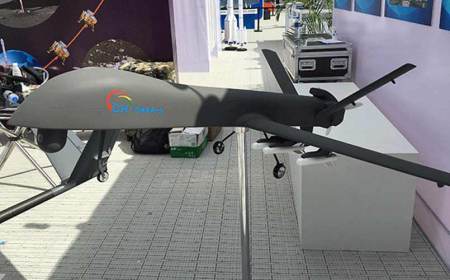
China has displayed its latest and biggest military unmanned aircraft at an industry expo in Shenzhen, Guangdong province…Considering the rule that China’s defence sector never publicly displays advanced weapons solely designed for the People’s Liberation Army (PLA), the public debut of CH-5 at the China (Shenzhen) International Unmanned Vehicle Systems Trade Fair has an unmistakable indication: China is eager to sell it.  “We have sold the CH-3 to several foreign nations and now we plan to launch the export version of the CH-5 to the international market. It can perform air-to-ground strike, reconnaissance and transport operations,” said Shi Wen, chief designer of the CH series at China Academy of Aerospace Aerodynamics..  They did not disclose which countries have introduced the CH series, but earlier reports quoted Vasily Kashin, a senior analyst with the Moscow-based Centre for Analysis of Strategies and Technologies, as saying Egypt, Saudi Arabia and Iraq have deployed drones from the CH family.…[T]he drone can stay in the air for as long as about 40 hours and operate at an altitude of up to 10 km.  Compared with other military drones that usually have a maximum take-off weight of less than 1,500 kg, the CH-5 is much more powerful-it is able to fly with a weight of 3,000 kg and carry 900 kg of equipment and weapons.

Excerpt from China displays biggest drone, The Hindu, Nov. 21, 2015
Concentration-Camp Approach to Migration

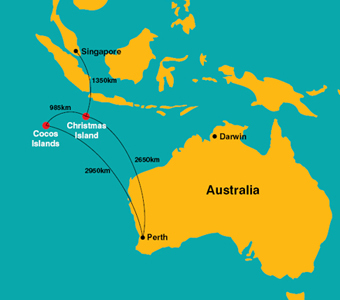
In 2012, Australia’s Human Rights Commission concluded that the country’s “system of mandatory detention breaches fundamental human rights.” Christmas Island, which the commission found “is not an appropriate place in which to hold people in immigration detention“, is at the centre of that system.

While little is known about what actually happened during the November 2015  riots, and after them, what preceded them is revealing.  Fazel Chegeni, an Iranian Kurd who’d been tortured in Iran and granted refugee status in Australia, still found himself in the immigration detention system.  Over four years, in which, as Fairfax Media discovered, five immigration ministers “defied repeated advice that this was the last place he should be”, the damaged and vulnerable asylum-seeker was incarcerated beyond hope and understanding.  Fazel Chegeni escaped the centre. But escaping here is not really escaping. There’s nowhere to go, and no way to get there.

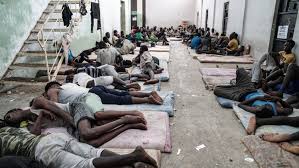
His body was found two days later. How did he die? No one has said. But his death appears to have triggered a furious reaction from some of the men he was incarcerated with. Riots. $10 million worth of damage. Seven detainees, including New Zealanders, handcuffed and flown out to a maximum security prison in Perth.  And then the clean-up, and the consequences, including reports of men who hadn’t rioted, but couldn’t escape the riots, being held in cages

Back in New Zealand, United Future leader Peter Dunne wrote: “The modern concentration camp approach Australia has taken is simply wrong. It was wrong when the British tried it in Northern Ireland in the 1970s; it is wrong in Guantanamo Bay, or in Israel today. Australia is no different.”

His words have had widespread coverage in Australia, with a surprising amount of agreement. But, Gordon Thomson (head of the local government at Christmas island) who wants the centre gone from his beloved island, said: “That’s the whole purpose of it. The remote location is ideal for the government’s purposes – that’s to have a secret, the most secretive regime that they can possibly achieve within our legal system, and Christmas Island is the place they can do that best.”

Excerpts from  John Campbell, Unlocking Christmas Island’s secrets, Radio New Zealand News, Nov. 16, 2015

Nuclear Fusion Technologies: ARPA

ARPA-E, or Advanced Research Projects Agency-Energy is a United States government agency tasked with promoting and funding research and development of advanced energy technologies. It is modeled after the Defense Advanced Research Projects Agency (DARPA).

From the ARPA website

Fusion energy holds the promise of virtually limitless, clean power production. Although fusion has been demonstrated in the laboratory, scientists have been unable to successfully harness it as a power source due to complex scientific and technological challenges and the high cost of research….Attaining [the conditions for the production of fusion] conditions is a very difficult technical challenge. Additionally, many current experimental techniques are destructive, meaning that pieces of the experimental setup are destroyed with each experiment and need to be replaced, adding to the cost and time required for research.

Los Alamos National Laboratory (LANL), along with HyperV Technologies and other partners, will design and build a new driver technology that is non-destructive, allowing for more rapid experimentation and progress toward economical fusion power.   LANL’s innovation could accelerate the development of cost-effective fusion reactors, which may provide a nearly limitless supply of domestic power and eliminate dependence on foreign sources of energy.

Fusion reactors offer nearly zero emissions and produce manageable waste products. If widely adopted, they could significantly reduce or nearly eliminate carbon emissions from the electricity generation sector. LANL’s approach, if viable, could enable a low-cost path to fusion, reducing research costs to develop economical reactors.

Partners
HyperV Technologies Corp.
University of Alabama in Huntsville
University of New Mexico
Brookhaven National Laboratory
Tech-X Corporation

National Security and Nuclear Industry

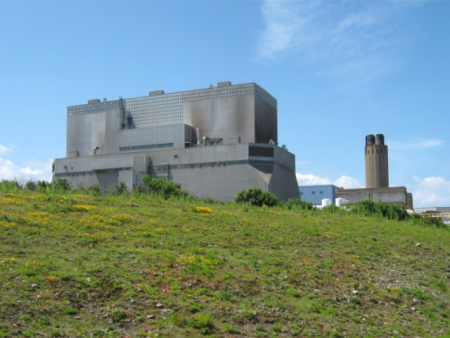
[A third nuclear reactor is to be built in Flamanville, France  by Electricité de France (EDF)]…Called Flamanville 3, is likely to become the focus of international attention because it is the model for an imminent expansion across the channel…EDF has agreed on October 21st agreed with China General Nuclear Power Corp (CGN), a state-owned entity, to build two reactors of the same design in south-west England called Hinkley Point C. EDF will own two-thirds of the project and CGN a third. The plant in Somerset is supposed to open by 2025, after construction that is forecast to cost £24.5 billion ($37.8 billion)…

The history of Flamanville 3, where work began in 2007, indicates how difficult that might be. It was planned as a five-year scheme, but this month EDF, which is mostly state-owned, formally asked officials to extend the deadline to 2020. Its original budget of €3.3 billion has more than tripled, to €10.5 billion ($11.9 billion). Getting its new European Pressurised Reactor (EPR) into service is proving harder than expected. One problem is the troubled condition of Areva, another mostly state-owned French firm, which supplies reactor components. It reported losses of nearly €5 billion in March, because of soaring costs and long delays at the only other EPR being built in Europe, Olkiluoto 3, in Finland. Work began in 2005 but it will not open before 2018 at the earliest.

The main technical problem at Flamanville 3 concerns suspicions of high levels of carbon in the steel of a crucial component, the vessel, already installed under the dome of the new reactor. Replacing it now, if inspectors conclude it is too brittle, would be costly. In June the company also said it was double-checking the working of safety valves.

Meanwhile EDF’s financial burden grows. It boasts of €73 billion in global revenues, but faces a threefold strain. Demand for electricity is stalling in France, its main market—and, as problematic, the country plans to cut nuclear’s share of electricity generation to half of the total, by 2025, from 75%. Next, though details are not finalised, EDF will absorb the nuclear unit of troubled Areva. Last, it has to upgrade, or at least maintain, France’s stock of ageing reactors. Mr Lévy told French radio on October 18th that capital expenditure for that alone would be around €50 billion.

No wonder ratings agencies judge that EDF’s financial prospects are secure only because of its state backing.  EDF’s prospects, indeed those of any nuclear company, depend on the backing of politicians who want to preserve nuclear expertise and jobs at home.

EDF’s Nuclear Ambitions: French Lessons, Economist,Oct. 24, 2015, at 63

Slavery Markets for Kids

Crowdsourcing project Tomnod (part of the DigitalGlobe company) is working with the public-private partnership The Global Fund to End Slavery to produce accurate and public data on slavery.More than 20,000 children are forced into slavery on Lake Volta, Ghana, the International Labour Organization estimates.They work 19-hour days and carry out dangerous tasks which leave many disabled, disfigured or even dead, campaigners say. Yet the size of the lake, 8,500  square kilometres (3,280 sq miles), makes it difficult to map from the ground and provide an exact figure of the number of child slaves, said Caitlyn Milton at Tomnod, part of the satellite company DigitalGlobe..  More than 10,000 volunteers have contributed to the campaign since it launched in mid-October 2015.

Although child labour is illegal in Ghana, thousands of children are sent away by parents who believe traffickers’ promises of an education and a better life.  In reality, children as young as four years old risk their lives diving into the lake’s murky waters to untangle nets, and end up working in such horrendous conditions that many die.  For other parents, selling some of their children into slavery is the only way to feed the rest of their family.  The average couple in the Lake Volta region earns little over $2,000 a year, meaning that a family with eight children will have only $2 a week – the price of a loaf of bread – to feed each child, according to The Global Fund to End Slavery….

“Unfortunately you don’t have to look hard to find children working on the lake, but it takes a lot to mount rescue operations that are backed up by the long-term support necessary to ensure children are not retrafficked,” Kofi Annan said.  Yet hard data could increase the government’s efforts to end slavery, by prosecuting traffickers and providing social support so that there is somewhere for children to escape to, he added.

Tomnod has run other projects including monitoring illegal fishing in Costa Rica and locating elephant poachers in the Democratic Republic of Congo…

Excerpts from Eyes in the sky: online “mappers” track child slavery in Ghana, Reuters, Oct. 28, 2015

How to Kill a Country-Zimbabwe

Zimbabwe: Deflation has taken root as consumer demand shrinks and the economy struggles with a shortage of dollars. Once bustling factories in Harare are now rusty shells, devastated by the 1999-2008 recession that cut GDP by about half.  In addition, the mines are reeling from the fall in commodity prices and a drought has left 16% of the population needing food aid. Formal unemployment stands at more than 80% and power shortages are getting worse…

A year ago, Mugabe, the President of Zimbabwe,  turned to “old friend” China, but behind the official warmth Beijing made clear the days of blank cheques were over, forcing Zimbabwe to make repayments on $1 billion of loans made over the previous five years….

Zimbabwe has also opened talks on fresh loans from the World Bank, IMF and African Development Bank for the first time since 2009, when it started defaulting on its foreign debt, which now stands at $10.4 billion or 74% of GDP….

In the past, Mugabe parcelled out land seized from white commercial farmers, raised wages for state workers and printed money to finance government spending to shore up his support. Now he has little room to manoeuvre after the adoption of the US dollar in 2009. The government can no longer devalue the currency, print money to stimulate the economy or influence interest rates…

But new international loans will require reforms, including selling some loss-making state firms, which are a constant drain on the public purse, analysts said.Harare would need to plug leaks in its finances, increase transparency in mining revenue, redistribute idle farms to competent farmers and ease black economic empowerment laws requiring foreign-owned firms to sell majority shares to locals.  “By far the biggest reform is that of the civil service. The government needs to cut spending on salaries, which the authorities are conscious of,” said a Western diplomat who has helped Harare in discussions with foreign creditors.  Wages take up 83% of Zimbabwe’s $4 billion annual budget. Finance Minister Patrick Chinamasa has said the bill should be cut in half, but there is no consensus within cabinet on how to do it.  The government is now the biggest employer with 550,000 workers of the total 800,000 formal jobs. Most Zimbabweans earn a living in the informal sector and on the streets.

Excerpts from Zimbabwe’s Mugabe warms to the West as economy wobbles, Reuters, Oct. 22, 2015

Population Resettlement at Fukushima: who dares?

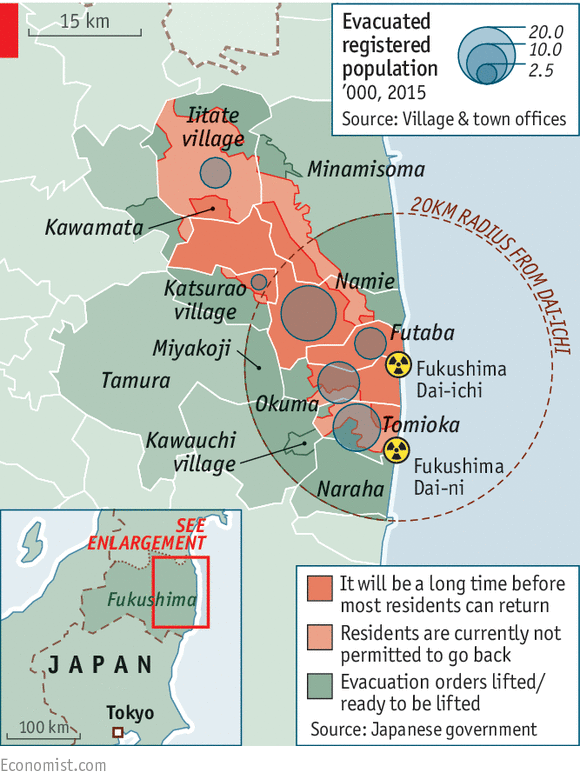
By the time Fukushima prefecture finishes the task of decontaminating houses and farmland around the Dai-ichi plant, it will have spent an estimated $50 billion on the work.  Some argue it would have been wiser to have spent the money on resettling former residents elsewhere. Already many of the 80,000 or so people displaced from the areas around the plant have begun new lives. Those moving back are mainly elderly. Local officials expect that half of the evacuees, especially those with children who are more vulnerable to radiation, may never return.

Fear of radiation, and distrust of data from the government and from the Tokyo Electric Power Company (TEPCO), the Dai-ichi operator, on the risk it poses, are the biggest reasons. On October 20th, 2015 it was announced that a worker who had helped to contain the accident had developed cancer linked to the meltdown. It was the first such diagnosis, but a recent medical study found a huge leap in cases of thyroid cancer among children and adolescents in Fukushima prefecture since the catastrophe.

Public faith in Japan’s institutions suffered a severe blow as a result of the government’s bungled response to the accident in 2011. So when officials of Tamura city wanted to open the Miyakoji district in 2013, residents resisted and demanded more decontamination work.

A year after the lifting of the evacuation order on his village, Yuko Endo, the mayor of Kawauchi, says distrust is so widespread that he doubts his community will return even near to its former size. But he has visited the area around Chernobyl in Ukraine, the site of the world’s worst nuclear disaster 29 years ago. He says the sight there of abandoned villages resembling graveyards has stiffened his resolve to rebuild. Those who have now returned are still deeply sceptical about the assurances they receive. Many ask why, for instance, if the soil is safe, they must take their locally grown produce to be checked for radiation.

There is a particular ray of hope in Naraha—more of one than is evident in Miyakoji and Kawauchi. The town will benefit from jobs related to the decommissioning of the nearby nuclear plants, including Dai-ni, which got through the earthquake and tsunami relatively unscathed. Another of Naraha’s immediate projects is to erect new streetlights. It will be helped by dollops of government aid. Mr Matsumoto, the mayor, talks of luring people back by making his town much more attractive than it was before. But for now, many streetlights do not even work. It is dark at night and the atmosphere is eerie.

Nuclear Power in Japan: Back to the Nuclear Zone, Economist, Oct. 24, 2015, at 39

Sumatran Rhinos

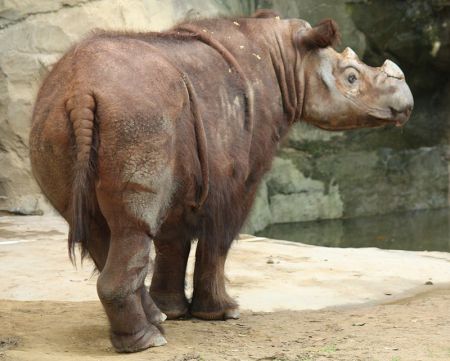
The last Sumatran rhino in the Western Hemisphere began a journey on October 30, 2015 from Ohio, United States to its ancestral southeast Asian homeland on a mission to help preserve the critically endangered species. …Conservationists hope Harapan can mate with one or more of the three females in the Sumatran Rhino Sanctuary in Way Kambas National Park….Numbers of the two-horned “hairy rhinos,” descendants of Ice Age wooly rhinos, have fallen by some 90 percent since the mid-1980s as development of their forest habitat and poachers seeking their horns took their toll. Including three Sumatran rhinos in a sanctuary in Malaysia, only nine are in captivity globally.

Harapan’s departure ends the Cincinnati Zoo’s captive breeding program for the species that produced three rhinos….Indonesian officials are anxious to get Harapan to their sanctuary. They have said they don’t want to be dependent on other countries in conservation efforts by sending rhinos to be bred abroad, but welcome technological or scientific assistance for their breeding program.Conservationists and government officials met in Singapore in 2013 for a Sumatran Rhino Crisis Summit to discuss ways to save the species.

Excerpts from DAN SEWELL, Sumatran Rhino Begins US-Asia Trip to Ancestral Home, Associated Press, Oct. 30, 2015


Stop Fukushima Freeways


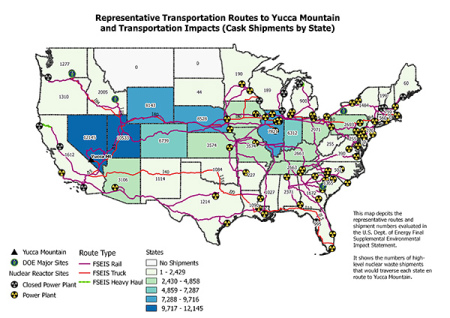
Over 250 intensely radioactive nuclear waste shipments would cross through
the Washington DC metropolitan area and thousands more would travel across the roads, rails  and waterways of the nation, if [the Yucca Mountain permanent repository in Nevada is approved]….The Nuclear Information and Resource Service (NIRS), an NGO, released maps of the likely routes radioactive shipments would use…

According to the map, highly radioactive waste fuel from nuclear power reactors in Virginia and Maryland would pass through the DC area on railroad tracks next to Metro Rail trains, including passing though Union Station. Each shipment contains several times more radioactive material than the Hioshima bomb blast released, with 20 to 50 tons of irradiated fuel assemblies in each  canister….  [Accident may happen during the shipments]…The shipments would also be vulnerable to attack or sabotage….Large-scale nuclear waste transport would also occur if, as some in Congress advocate, a“centralized interim storage” site for high-level radioactive waste were created.

Excerpts from Stop Fukushima Freeways Campaign Kicks Off, Nuclear Information and Resource Service Oct. 27, 2015

Cannibalism and Rape in South Sudan

The African Union Commission of Inquiry on South Sudan, Excerpt on Human Rights Violations, released October 27,2015

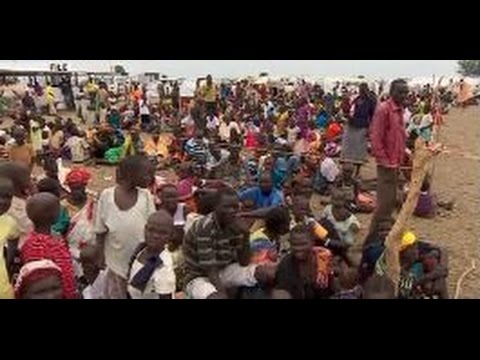
The Commission found cases of sexual and gender based violence committed by both parties against women. It also documented extreme cruelty exercised through mutilation of bodies, burning of bodies, draining human blood from people who had just been killed and forcing others from one ethnic community to drink the blood or eat burnt human flesh. Such claims were registered during interviews of witnesses of crimes committed in Juba.

Elsewhere, witnesses of crimes committed in Bor Town, also provided evidence of brutal killings and cruel mutilations of dead bodies. In Malakal town, reports of abduction and disappearance of women from churches and the hospital where communities had sought refuge during the hostilities that began in December 2013 were rife. In Unity State, Bentiu, the capital has been the focus of much of the fighting, having changed hands several times between government and opposition soldiers during the course of the conflict. Bentiu town is largely destroyed. In Leer county, the Commission heard testimony of civilians, including children and teenagers killed, houses, farms and cattle burned, and of sexual violence.

The Commission found that most of the atrocities were carried out against civilian populations taking no active part in the hostilities. Places of religion and hospitals were attacked, humanitarian assistance was impeded, towns pillaged and destroyed, places of protection were attacked and there was testimony of possible conscription of children under 15 years old….

The Commission also found that civilians were targeted in Malakal, which was under the control of both parties at different times during the conflict. Serious violations were committed in Malakal Teaching Hospital through the killings of civilians and women were raped at the Malakal Catholic Church between 18th and 27th February 2014. In Bentiu the Commission heard testimony of the extremely violent nature of the rape of women and girls – that in some instances involved maiming and dismemberment of limbs. Testimony from women in UNMISS PoC Site in Unity State detailed killings, abductions, disappearances, rapes, beatings, stealing by forces and being forced to eat dead human flesh.