Tag Archives: UAE nuclear power

Under the Radar: How the U.A.E. is Colonizing Africa

The petrostate, United Arab Emirates, has invested billions of dollars on the other side of the Arabian peninsula, in Africa, where it is now emerging as a significant player, at times muscling out China and annoying the U.S. and others. It has taken sides in local wars and spent heavily on buying farmland, ports and other projects that could help reduce its own dependence on oil in the decades to come.

The U.A.E. government says investments in Africa amounted to about $110 billion over the past decade….Its portfolio includes renewable-energy projects in Egypt, leased rice and wheat farmlands in the muddy plains of northern Angola and a majority stake in one of Zambia’s largest copper mines. U.A.E.-backed port projects are dotted around the coasts of the Atlantic, the Red Sea and the Indian Ocean. The Gulf state is also trying to become a key supplier of the minerals used in a new generation of batteries.  

The Wall Street Journal has reported that the U.A.E. shipped weapons including antiaircraft missiles and drones, to Sudan’s Rapid Support Forces, which is waging a civil war against the Iran-backed Sudanese military and has perpetrated a series of well-documented atrocities against civilian populations, especially in Darfur. It also sold armed drones to Ethiopia’s government, while the U.S. was pushing for a peace deal with Ethiopian rebel groups. Before that, U.N. investigators say it transferred arms to Libyan militia leader Khalifa Haftar in violation of a United Nations Security Council arms embargo…

There are signs of pushback in parts of Africa, too. In Chad, local Zaghawa communities have repeatedly staged protests against the U.A.E.’s use of Amdjarass airport in the east of the country to ship supplies to the RSF, according to activists and videos shared online. .

Excerpts from Nicholas Bariyo, The New Investment Superpower Outflanking China and the U.S. in Africa, WSJ, Nov. 6, 2024

Why OpenAI Flirts with UAE and What Happened to Women’s Rights

In February 2024, OpenAI CEO Sam Altman said the UAE could serve as the world’s “regulatory sandbox” to test artificial intelligence. Emirati President Sheikh Mohammed bin Zayed Al Nahyan’s first official trip to the United States in September 2024 aimed to push the United Arab Emirates-U.S. relationship to a new “geo-economic phase” centered on economic growth and innovation..,

Microsoft has invested  $1.5 billion investment in the UAE’s top artificial intelligence firm, G42, in April.   BlackRock, Global Infrastructure Partners, Microsoft and the Mubadala-backed MGX investment company also recently announced the Global AI Infrastructure Investment Partnership, underscoring the UAE’s strategic focus on U.S. technology and AI to drive future economic growth…The United States and the UAE have a trade and investment partnership that spans more than five decades. In 2023, bilateral trade between the UAE and the U.S. was worth around $31.4 billion, with U.S. exports to the UAE exceeding $24.8 billion, according to the UAE Embassy in Washington, D.C. The UAE, which produces nearly 4% of the world’s oil supply, also has investments in the United States that total $1 trillion. The UAE sovereign wealth funds including the Abu Dhabi Investment Authority and Mubadala are major investors in American real estate, infrastructure and technology sectors.

The UAE has remained a key strategic defense and security partner to Washington, playing host to the American air base in Al Dhafra, while working as a key partner alongside the U.S. in Afghanistan and Iraq….

On the systemic discrimination against women at the UAE, see letter of Human Rights Watch. Human Rights Watch has documented numerous incidents of enforced disappearances by the UAE in recent years, including the case of three Emirati sisters who were forcibly disappeared in 2015 after posting comments critical of the government on social media. Human Rights Watch has also documented cases of denial of adequate medical care to women who have since died or attempted suicide

Excerpt from Emma Graham and Dan Murphy, UAE hoping to expand $1 trillion partnership with U.S. through AI, Investment, CNBC, Sept. 20, 2024

The Nuclear Middle East Kingdom

Russia’s state nuclear energy producer Rosatom is in talks with “several” countries in the Middle East and North Africa to explore development of nuclear power… Saudi Arabia is one of the countries that Rosatom is ready to work with when the kingdom puts out tenders, including to provide the fuel or build the plants…Rosatom was selected to help provide the enriched uranium for the UAE‘s first nuclear power plant, and is building the first nuclear power plants in both Turkey and Egypt.

Egypt’s El-Dabaa project is expected to start production in 2028…The Akkuyu project in Turkey will supply 35 TWh of electricity annually for 60 years, or 10% of Turkey’s consumption. Turkish President Tayyip Erdogan said the plant’s first unit would come online in May 2023.

Excerpt from Claudia Carpenter, Rosatom in talks with ‘several’ Middle East countries about starting nuclear power plants, S&P Global, Jan. 19, 2022

From Nuclear Powerhouse to Nuclear Mafia: South Korea

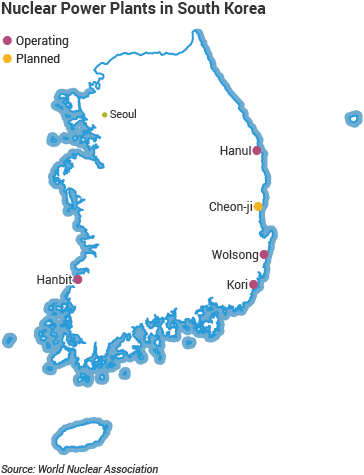
South Korea, which is roughly the size of Indiana, eventually became the most reactor-dense country in the world, with 23 reactors providing about 30% of the country’s total electricity generation…. South Korea’s reactors…are mostly packed into a narrow strip along the densely populated southeastern coast. The density was a way of cutting costs on administration and land acquisition. But putting reactors close to one another—and to large cities—was risky. … 

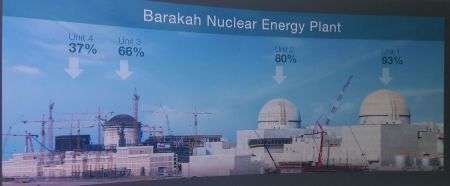
In December 2009, the UAE had awarded a coalition led by Korea Electric Power Corporation (KEPCO) a $20 billion bid to build the first nuclear power plant in the UAE. Barakah was chosen as the site to build four APR-1400nuclear reactors successively.  In 2012 to Park Geunhye the newly elected president pledged to increase South Korea’s reactor fleet to 39 units by 2035 and making sales trips to potential client states such as the Czech Republic and Saudi Arabia bulding on prior success like the UAE deal mentioned above. …


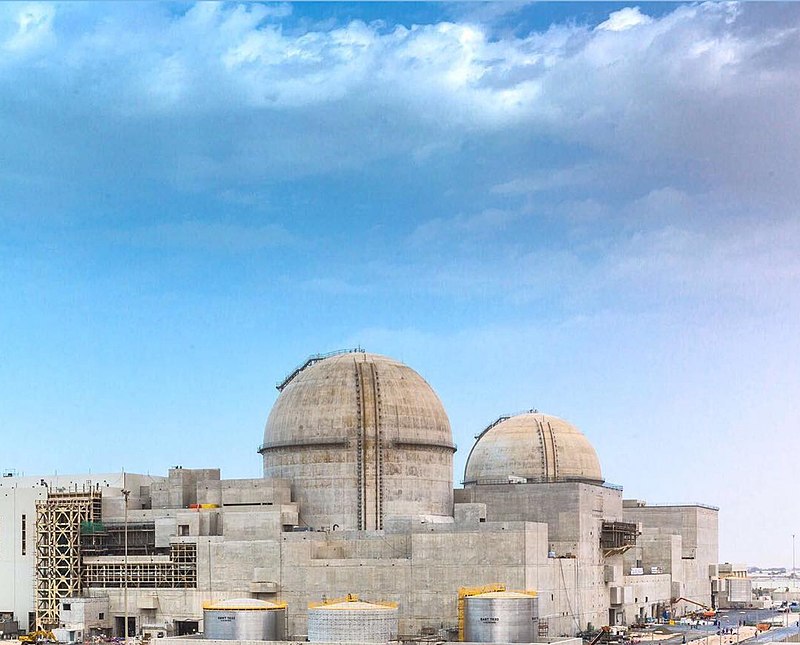
Barakah under construction in UAE

But on September 21, 2012, officials at Korea Hydro & Nuclear Power (KHNP), a subsidiary of the Korea Electric Power Corporation (KEPCO),  received an outside tip about illegal activity among the company’s parts suppliers. Eventually, an internal probe had become a full-blown criminal investigation. Prosecutors discovered that thousands of counterfeit parts had made their way into nuclear reactors across the South Korea, backed up with forged safety documents. KHNP insisted the reactors were still safe, but the question remained: was corner-cutting the real reason they were so cheap?

Park Jong-woon, a former manager who worked on reactors at KEPCO and KHNP until the early 2000s, believed so. He had seen that taking shortcuts was precisely how South Korea’s headline reactor, the APR1400, had been built…After the Chernobyl disaster in 1986, most reactor builders had tacked on a slew of new safety features.KHNP followed suit but later realized that the astronomical cost of these features would make the APR1400 much too expensive to attract foreign clients.“They eventually removed most of them,” says Park, who now teaches nuclear engineering at Dongguk University. “Only about 10% to 20% of the original safety additions were kept.”  Most significant was the decision to abandon adding an extra wall in the reactor containment building—a feature designed to increase protection against radiation in the event of an accident. “They packaged the APR1400 as ‘new’ and safer, but the so-called optimization was essentially a regression to older standards,” says Park. “Because there were so few design changes compared to previous models, [KHNP] was able to build so many of them so quickly.”

Having shed most of the costly additional safety features, KEPCO was able to dramatically undercut its competition in the UAE bid, a strategy that hadn’t gone unnoticed. After losing Barakah to KEPCO, Areva CEO Anne Lauvergeon likened the Korean nuclear plant to a car without airbags and seat belts. At the time Lauvergeon’s comments were dismissed as sour words from a struggling rival.

By the time it was completed in 2014, the KHNP inquiry had escalated into a far-reaching investigation of graft, collusion, and warranty forgery; in total, 68 people were sentenced and the courts dispensed a cumulative 253 years of jail time. Guilty parties included KHNP president Kim Jong-shin, a Kepco lifer, and President Lee Myung-bak’s close aide Park Young-joon, whom Kim had bribed in exchange for “favorable treatment” from the government.

Several faulty parts had also found their way into the UAE plants, angering Emirati officials. “It’s still creating a problem to this day,” Neilson-Sewell, the Canadian advisor to Barakah, told me. “They lost complete faith in the Korean supply chain.”

Excerpts from Max S. Kim,  How greed and corruption blew up South Korea’s nuclear industry, MIT Technology Review, April 22, 2019

Nuclear Power in Abu Dhabi

The Barakah nuclear-power plant under construction in Abu Dhabi will never attract the attention that the Burj Khalifa skyscraper in neighbouring Dubai does, but it is an engineering feat nonetheless. It is using three times as much concrete as the world’s tallest building, and six times the amount of steel. Remarkably, its first reactor may start producing energy in the first half of this year—on schedule and (its South Korean developers insist) on budget. That would be a towering achievement.

In much of the world, building a nuclear-power plant looks like a terrible business prospect. Two recent additions to the world’s nuclear fleet, in Argentina and America, took 33 and 44 years to erect. Of 55 plants under construction, the Global Nuclear Power database reckons almost two-thirds are behind schedule .  The delays lift costs, and make nuclear less competitive with other sources of electricity, such as gas, coal and renewables.

Not one of the two technologies that were supposed to revolutionise the supply of nuclear energy—the European Pressurised Reactor, or EPR, and the AP1000 from America’s Westinghouse—has yet been installed, despite being conceived early this century. In Finland, France and China, all the EPRs under construction are years behind schedule. The main hope for salvaging their reputation—and the nuclear business of EDF, the French utility that owns the technology—is the Hinkley Point C project in Britain, which by now looks a lot like a Hail Mary pass.

Meanwhile, delays with the Westinghouse AP1000 have caused mayhem at Toshiba, its owner. The Japanese firm may announce write-downs in February of up to $6bn on its American nuclear business. As nuclear assets are probably unsellable, it is flogging parts of its core, microchip business instead.

This month, Oregon-based NuScale Power became the first American firm to apply for certification of a small modular reactor (SMR) design with America’s nuclear regulators.

“Clearly the momentum seems to be shifting away from traditional suppliers,” says William Magwood, director-general of the OECD’s Nuclear Energy Agency. Both small and large reactors are required. In places like America and Europe, where electricity demand is growing slowly, there is rising interest in small, flexible ones. In fast-growing markets like China, large nuclear plants make more economic sense.

If the South Koreans succeed with their first foreign nuclear programme in Abu Dhabi, the reason is likely to be consistency. Nuclear accidents such as Three-Mile Island in 1979 and Chernobyl in 1986 caused a long hiatus in nuclear construction in America and Europe. But South Korea has invested in nuclear power for four decades, using its own technology since the 1990s, says Lee Jong-ho, an executive at Korea Electric Power (KEPCO), which leads the consortium building Barakah. It does not suffer from the skills shortages that bedevil nuclear construction in the West.

KEPCO always works with the same, familiar suppliers and construction firms hailing from Korea Inc. By contrast, both the EPR and AP1000, first-of-a-kind technologies with inevitable teething problems, have suffered from being contracted out to global engineering firms. Also, South Korea and China both keep nuclear building costs low through repetition and standardisation, says the World Nuclear Association (WNA), an industry group. It estimates that South Korean capital costs have remained fairly stable in the past 20 years, while they have almost tripled in France and America.

Excerpts The nuclear options: How to build a nuclear-power plant, Economist, Jan. 28 2017, at 57


For the Fear of Iran: The Nuclear Power in the Gulf

Saudi Arabia is pressing ahead with its ambitious plans to develop nuclear power to meet rising electricity demand and save oil for export.  But the outlook for other Arab states is less promising because of political turmoil and a lack of financial resources.  The Saudis have built a foreign assets cushion of around $500 billion from oil exports. It has used this immense wealth to buy its way out of trouble; for instance, heading off pro-democracy protests with massive social spending in recent years.  But, the Middle East Economic Digest observed, “a more serious set of challenges now faces the kingdom that threaten to be even more destabilizing.  “Inefficient and wasteful energy consumption, coupled with a rising population, is leading the kingdom to burn even more of its natural resources at home rather than selling them abroad and adding to the proceeds of the half-trillion-dollar cash pile.  “Unless action is taken, the kingdom could find it needs the oil price to be $320 a barrel by 2030 just to balance the budget,” the weekly, published in the United Arab Emirates, warned.  Nuclear power is seen as the solution. But, as MEED stressed, “time is of the essence.”

For one thing, Saudi Arabia and other Arab states, including the United Arab Emirates, Kuwait, Qatar and Egypt, have no wish to lag any further behind Iran and Israel in developing nuclear technologies.  In 2010, the King Abdallah Center for Atomic and Renewable Energy, known as KAcare, was established to oversee the gulf state’s nuclear program under its president, Hashim bin Abdullah Yamani, who was accorded ministerial powers.  KAcare consultant Ibrahim Babelli said in 2010 it took 3.4 million barrels of oil equivalent a day — known as boe/d — to power electricity generation. This is expected to more than double by 2028 to 8.3 million boe/d.

The aim of the Saudis’ $100 billion nuclear program is to achieve an electricity output of 110 gigawatts by 2032.  The Financial Times reports that in 2009, the latest data available, Saudi electricity capacity was 52GW from 79 power stations.  At least 16 nuclear reactors, each costing around $7 billion, are planned, with the first producing by 2019.  Some estimates state the kingdom, the world’s largest oil exporter, will burn as much as 1.2 million barrels of oil daily on electricity production, almost double the 2010 total, to meet domestic and industrial demand.  This is crucial, as the Saudis are driving to build an industrial infrastructure to sustain the economy when the oil fields run down. Some have already begun to decline.  For total reliance on nuclear power, Babelli says, 40-60 reactors would be needed by 2030. That’s four-six reactors per year from 2020.  “That’s stretching it,” he said. “The answer is an energy mix.”

That means fossil fuels will still be needed, probably as the primary energy source, while wind, solar and nuclear power capabilities are developed. KAcare is developing solar power projects that MEES estimates should produce 41GW within 20 years with geothermal and waste-to-energy systems providing 4GW.  The Emirates, which launched its nuclear energy program in 2009, is the most advanced in the Arab world, with Saudi Arab running second.  The United Arab Emirates’ $30 billion program — $10 billion more than originally planned — is smaller in scale than that in Saudi Arabia.  Both states benefit from political stability and vast financial reserves. Other regional states are less fortunate.

Bahrain, Qatar, Kuwait, Egypt and Jordan all have announced plans to invest in nuclear energy to crank up electricity generation but all have lagged behind or scrapped their programs because of lack of funds or foreign investment.  “Kuwait has the cash,” MEED reported, “but it’s been through eight governments in the past six years.”  Sunni-ruled Bahrain, an island state neighboring Saudi Arabia, “continues to face destabilizing protests by its majority Shiite population and its budget is already in deficit.”  Egypt remains convulsed by the political turmoil that ensued following the February 2011 overthrow of President Hosni Mubarak, its economy sagging dangerously.  In Jordan, heavily reliant on foreign aid, parliament recently scrapped nuclear plans as “hazardous and costly.”  Failure to start boosting electricity generation for burgeoning populations in the coming decades almost certainly will mean more political upheavals.

Saudis, Emirates push nuclear power plans, UPI,July 26, 2012