Monthly Archives: December 2022

Space-based Solar Power: Endless Sunshine to a Fried Earth

In recent years, space agencies from all over the world have launched studies looking at the feasibility of constructing orbiting solar power plants. Such projects would be challenging to pull off, but as the world’s attempts to curb climate change continue to fail, such moonshot endeavors may become necessary.

Solar power plants in space, exposed to constant sunshine with no clouds or air limiting the efficiency of their photovoltaic arrays, could have a place in this future emissions-free infrastructure. But these structures, beaming energy to Earth in the form of microwaves, would be quite difficult to build and maintain…

A space solar power plant would have to be much larger than anything flown in space before. The orbiting solar power plant will have to be enormous, and not just to collect enough sunlight to make itself worthwhile. The main driver for the enormous size is not the amount of power but the need to focus the microwaves that will carry the energy through Earth’s atmosphere into a reasonably sized beam that could be received on the ground by a reasonably sized rectenna. These focusing antenna would have to be 1 mile (1.6 kilometers) or more wide, simply because of the “physics you are dealing with. Compare this with the International Space Station, at 357 feet (108 meters) long the largest space structure constructed in orbit to date…

In every case, building a space-based solar power plant would require hundreds of rocket launches (which would pollute the atmosphere depending on what type of rocket would be used), and advanced robotics systems capable of putting all the constituent modules together in space. This robotic construction is probably the biggest stumbling block to making this science fiction vision a reality.

Converting electricity into microwaves and back is currently awfully inefficient
Airbus, which recently conducted a small-scale demonstration converting electricity generated by photovoltaic panels into microwaves and beaming it wirelessly to a receiving station across a 118-foot (36 m) distance, says that one of the biggest obstacles for feasible space-based solar power is the efficiency of the conversion process… Some worry that microwave beams in space could be turned into weapons of mass destruction and used by evil actors to fry humans on the ground with invisible radiation.
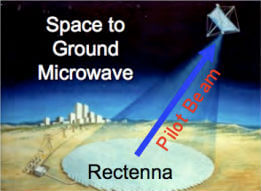
A spaced-space solar plant transmits energy collected from the sun to a rectenna on earth by using a laser microwave beam. Image from wikipediia

The vast orbiting structure of flat interweaving photovoltaic panels would be constantly battered by micrometeorites, running a risk of not only sustaining substantial damage during operations, but also of generating huge amounts of space debris in the process. For the lifecycle of the station, you have to design it in a way that it can be maintained and repaired continuously…

And what about the whole thing once it reaches the end of its life, perhaps after a few decades of power generation?  It is assumed that, by the time we may have space-based solar power plants, we are most likely going to see quite a bit of permanent infrastructure on the moon. Space tugs that don’t exist yet could then move the aged plant to the moon, where its materials could be recycled and repurposed for another use…We could also have some kind of recycling center on the moon to process some of the material..

Excerpts from Tereza Pultarovanal, Can space-based solar power really work? Here are the pros and cons, Space.com, Dec. 23, 2022
Miracles Performed by Wild Crops

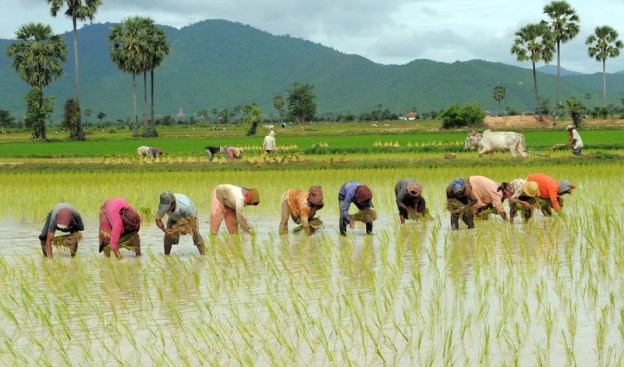
Grains that grow year after year without having to be replanted could save money, help the environment, and reduce the need for back-breaking labor. Now, the largest real-world test of such a crop—a perennial rice grown in China—is showing promise. Perennial rice can yield harvests as plentiful as the conventional, annually planted crop while benefiting the soil and saving smallholder farmers considerable labor and expense, researchers have found…

All rice is perennial to some extent. Unlike wheat or corn, rice roots sprout new stems after harvest. The trouble is that this second growth doesn’t yield much grain, which is why farmers plow up the paddies and plant new seedlings. The improved perennial rice, in contrast, grows back vigorously for a second harvest. Researchers developed it by crossing an Asian variety of rice with a wild, perennial relative from Nigeria. Improving the offspring took decades, and in 2018 a variety called Perennial Rice 23 (PR23) became commercially available to Chinese farmers. This was a “scientific breakthrough,” says Koichi Futakuchi, a crop scientist at the Africa Rice Center…

Over 4 years PR23 averaged 6.8 tons of rice per hectare, slightly higher than the annual rice, they report today in Nature Sustainability. As hoped, the perennial crop tended to grow back again and again without sacrificing the size of the harvest. In the fifth year, however, the yields of PR23 declined for some reason, suggesting it needed to be replanted. The perennial rice also improved the soil.

Researchers note potential risks. Because PR23 enables farmers to till less, fungi and other pathogens can build up in the fields. Insects can persist in the stubble after harvest, because it’s not plowed under, then transmit viruses when they feed on the regenerating sprouts in the spring. And without tilling, weeds can flourish; the researchers found that fields with PR23 needed one to two more herbicide treatments than regular rice. They also note that it’s more work to resow the perennial rice when its yield falters, because its larger and deeper roots need to be killed.

Excerpts from ‘Perennial’ rice saves time and money, but comes with risks, Science, Nov. 7, 2022

Reversing Industrialization: the Future of Plants?

Is it possible that the microbiomes of ancestors of our crops can be used to “rewild” microbiomes of current crops reinstating their diverse microbiota that were lost through domestication and industrialization processes, including including the (over)use of antibiotics, pesticides, and fertilizers?

Similar to reversing industrialization-associated changes in human gut microbiota , plant microbiome rewilding builds on the premise that wild ancestors harbor microbial genera with specific traits that are not found (or are strongly depleted) in the microbiome of modern crops. To date, however, it is unknown for most plant species whether (and which) microbial genera and functions were lost during plant domestication, and to what extent rewilding can enhance the health and sustainability of modern crops. In animal systems, the effectiveness of rewilding approaches is intensely debated , and similar discussions are needed for crop rewilding approaches.

Plant domestication is one of the most important accomplishments in human history, helping drive the transition from a nomadic to a sedentary lifestyle. Through stepwise processes, crop plants acquired a suite of new traits, including larger seeds, determinate growth, photoperiod sensitivity, and reduced levels of bitter substances. Although this led to a more continuous food supply, domestication caused a reduction in plant genetic diversity because only desired alleles were spread, while genomic regions next to the target genes suffered selective sweeps (6). This so-called “domestication syndrome” decreased the ability of crops to withstand pests and diseases

Excerpts from JOS M. RAAIJMAKERS AND E. TOBY KIERM, Microbiota of crop ancestors may offer a way to enhance sustainable food production, Science, Nov. 11, 2022

The Battle for Biodiversity and Human Rights

From the lush Amazon rainforest to the frigid Arctic Ocean, the world’s landscapes — and all the wildlife they contain — are under threat, and the world needs to set aside a third of all land and sea territories to save them, U.N. experts say.

The call is central to the global agreement being hashed out in December 2022 at the U.N. biodiversity summit in Montreal. If approved, governments would be agreeing to set aside 30% of their land and sea territories for conservation by 2030 – the so-called 30-by-30 goal, doubling the amount of land area and more than tripling the ocean territory currently under conservation…

A June 2022 study in the journal Science found, however, that at least 44% of global land area would be needed to protect areas with a high diversity of species, prevent the loss of intact ecosystems, and optimize the representation of different landscapes and species. But more than 1.8 billion people live in these areas

One of the key tension points that has emerged in the 30-by-30 debate at COP15 is whether the target should be carried out globally or at a national level…It is an important distinction, scientists and negotiators said. Some countries are small, without much land to set aside for nature. Others are vast and still contain a high degree of biodiversity, such as tropical forest nations like Brazil and Indonesia. Were such countries to protect only 30% of their territories, that could actually result in a significant loss of nature…Currently, just under 50% of the Amazon is under some form of official protection or indigenous stewardship, so a national pledge to conserve 30% would represent a significant downgrade.

The other dispute plaguing 30-by-30 is over what should count as protection. Some countries might allow people to live within protected areas or promote indigenous stewardship of these lands. Some might even allow for extractive industries to operate under permits and regulation. In other cases, conservation areas are off limits to everyone. The European Union has proposed allowing activities like logging, mining and fishing to be carried out under conservation management for 20% of protected areas, while 10% would be held under stricter protections.

The idea caused environmental nonprofit Greenpeace to accused the EU last week of trying to water down language on 30-by-30, which the EU denied.

Excerpts from Gloria Dickie, Protecting 30% of the planet to save nature is not as simple as it sounds, Reuters Dec. 14, 2022

Sins of Environmentalism

During the opening ceremony of the (Conference of the Parties) COP15 of the Biodiversity Convention taking place in early December 2022,  Canadian Prime Minister Justin Trudeau called for a global agreement to protect 30% of the world’s land and water by 2030. This so-called ’30×30′ plan is opposed by a number of groups that promote the rights of indigenous peoples. According to Survival International, an organization campaigning for Indigenous rights, 30 x 30 will be the biggest land grab in history.

Already in many Protected Areas around the world local people, who have called the land home for generations, are no longer allowed to live on and use the natural environment to feed their families, gather medicinal plants or visit sacred sites.

Fortress Conservation’ is one example of a conservation model that excludes Indigenous communities. It began with the formation of Yosemite, the world’s first national park, in North America over 150 years ago.  To preserve the ‘pristine wilderness’ humans needed to be expelled so the native Americans, who had lived in and cared for the region for thousands of years, were evicted.

Only 3 per cent of the world’s land remains ecologically intact, and biodiversity loss continues at an alarming rate.  In 2010, member states of the Convention on Biological Diversity (CBD) committed to placing 17 per cent of the world’s land within protected areas by 2020. Yet during that decade global biodiversity actually declined significantly.

There have also been systemic human rights abuses. Rainforest Foundation UK protects the world’s rainforests by supporting and empowering the Indigenous people and local communities which live in them.  But its research into 34 Protected Areas in the Congo Basin showed that without the presence of Indigenous communities, animal populations dwindled, and extractive activities increased. This was despite large investments having been channeled into them.  It also uncovered widespread disregard for local communities’ rights and livelihoods and conflict between forest peoples and conservationists in this region.

According to Joe Eisen, Executive Director of Rainforest Foundation UK, human rights abuses are commonplace in the Congo Basin. “Our research has shown these human rights abuses are not just the isolated actions of rogue park rangers but are rather part of a system in which displacement, torture, gender-based violence and extrajudicial killings are used to control Indigenous peoples and other local communities who live in, and depend on, areas of high conservation value,” he says.

Protected Areas are often managed by major international conservation organizations, who employ armed guards to evict the local population and prevent their return. These actions have long-term consequences and destroy Indigenous livelihoods and cultures.

There are calls for the development of a community-based conservation model, which empowers Indigenous people, rather than removing them from their ancestral lands.

Excerpts from Plans to protect 30% of the planet by 2030 could be ‘devastating’ for Indigenous people, Euronews, Dec. 8, 2022

Bacteria Can Rescue World One Building at a Time

Concrete is one of the world’s most important materials. But making the cement that binds it generates about 8% of anthropogenic carbon-dioxide emissions. This is not just because of the heat involved. That could, in principle, be supplied in environmentally friendly ways. It is, rather, embedded in the very chemistry of the process. The heat is applied to limestone, to break up its principal constituent, calcium carbonate, into calcium oxide (cement’s crucial ingredient) and CO2…

Intriguingly, this may be an area where microbes can come to the rescue….One proposal is to recruit the services of chlorophyll-laden, photosynthezing organisms called cyanobacteria. That has allowed Prometheus Materials, a firm in Colorado, to develop a cement-making process in which the energy comes not from heat but light—something easily generated from electricity that has, in turn, been provided by renewable sources. Moreover, and perhaps more importantly, photosynthesis subtracts CO2 from the atmosphere rather than adding it.

Applications for biocement extend beyond conventional construction, too. America’s Department of Defense, for one, has shown interest. Its aim is to be able to build things in remote areas without having to hump in cement and other materials. That would be doubly valuable if the territory through which the humping would otherwise be happening were hostile. Indeed, it was the Defense Department that catalyzed the formation of Prometheus, by awarding the team at the University of Colorado which later founded the firm a grant of $1.8m back in 2017.

The department is also, in the guise of the Defense Advanced Research Projects Agency (DARPA) and the Air Force Research Laboratory, collaborating with Biomason to develop biocement sprays that can turn sand or loose soil into runways. Michael Dosier, Biomason’s chief technologist (and the boss’s husband), says the hardening involved could require less than 72 hours.

Kathleen Hicks, America’s deputy secretary of defense, during a talk at the DARPA Forward conference, outlined a goal that is literally out of this world: an ability to spray a bacterial liquid on lunar or Martian regolith, in order to “grow a landing pad”.

Excerpts Green Construction: Building with Bacteria, Economist,  Nov. 26, 2022

Nuclear Waste Helps Reach Dark Places of Universe

European scientists are developing a breed of battery for space missions that is powered by nuclear waste. The European Space Agency (ESA) hopes that the technology will, by the end of the decade…Ministers at ESA’s ministerial council meeting in Paris on 22 and 23 November, 2022 agreed to fund a €29-million (US$30-million) program called European Devices Using Radioisotope Energy (ENDURE). This aims to develop long-lasting heat and electricity units powered by the radioactive element americium-241, in time for a series of ESA Moon missions in the early 2030s.

Americium, a by-product of plutonium decay, has never been used as a fuel. For missions in which solar power would not suffice — either because of shade or because of distance from the Sun — ESA has relied on US or Russian partners, which have used plutonium-238 batteries to power missions since the space race. 

The lack of a power source has long restricted the solo missions that European scientists propose, and limited others. The agency felt its lack of radioisotope power keenly in 2014, when its comet-landing Philae probe was operational for less than three days because it ended up in a shaded spot where its solar panels were useless. “For years, European scientists have been saying that if you want to go far, or to dark and cold places, there is no other way,” says Coustenis.

Americium’s big advantage over plutonium is that it is cheaper and more abundant, repurposing waste that would otherwise be useless…Americium has a longer half-life than plutonium-238, which means it lasts longer but packs less power per gram. But because americium is more readily available, producing one watt of power costs about one-fifth as much as it does using plutonium…

Excerpts from Elizabeth Gibney, How Nuclear Waste Will Help Spacecraft Explore the Moon and Beyond, Nature, Dec. 6, 2022

Stargazing as a Right and Colonization of Skies

Do people have a right to an unobstructed view of the heavens? For most of human history, such a question would have been considered nonsensical—but with the recent rise of satellite mega constellations, it’s now being asked again and again. Mega constellations are vast groups of spacecraft, numbering in the thousands, that could spark a multitrillion-dollar orbital industry and transform global connectivity and commerce. But the rise of mega constellations also threatens to clutter the night sky, disrupt the work of some astronomers and create space debris that harms people on Earth and in space alike. The mega constellation era began in May 2019, when Elon Musk’s firm SpaceX launched the first 60 satellites in its Starlink constellation… Today the constellation’s numbers have swelled to more than 3,000 and account for fully half of all active satellites in space.

Ramon Ryan has argued in the in the Vanderbilt Journal of Entertainment and Technology Law that the regulatory approval of these satellites by the U.S. Federal Communications Commission (FCC) may breach environmental law as part of the U.S. National Environmental Policy Act (NEPA) enacted in 1970. Specifically, he argued that the natural aesthetic of the night sky and the profession of astronomy may be protected under NEPA—but that the FCC has so far sidestepped NEPA’s oversight , thanks to a “categorical exclusion” the agency was granted in 1986 (when it simply wasn’t licensing that many satellites)….  

In November 2022, the US General Accounting Office (GAO) published a report that suggest that the FCC should revisit its categorical exclusion from NEPA and consider whether it should update its procedures in light of the rise of mega constellations. “We think they need to revisit [the categorical exclusion] because the situation is so different than it was in 1986,” says Andrew Von Ah, a director at the GAO…The White House Council on Environmental Quality (CEQ) recommends that agencies “revisit things like categorical exclusions once every seven years,” Von Ah says. But the FCC “hasn’t really done that since 1986.”

According to the report’s recommendations, the FCC should review whether mega constellations affect the environment…The findings showed there were concerns in a number of areas, not just the brightness of the satellites but also the collision risk they pose in space and the possible creation of space junk, the interference to radio astronomy caused by satellite radio transmissions and even the potential for satellites reentering the atmosphere to affect Earth’s climate or harm humans on the ground. ..

The day after the GAO report’s release, the FCC  announced the creation of a new bureau for its space activities, which will help the agency handle the applications for 64,000 new satellites it is presently considering…

Excerpts from  Jonathan O’Callaghan Satellite Constellations Could Harm the Environment, New Watchdog Report Says, Scientific American, November 24, 2022