Monthly Archives: January 2025

The Under-the-Hood Cyberattacks

The Biden administration sanctioned a Chinese company in January 2025  it said was behind the vast cyber intrusions into U.S. telecommunications networks that swept up phone calls of scores of U.S. government officials as well as those of incoming President Donald Trump.

The U.S. Treasury Department said that Sichuan Juxinhe Network Technology Co. was directly involved in the deep compromises of the telecommunications firms, which U.S. officials and lawmakers have said is a historically damaging espionage campaign carried out on behalf of the Chinese government. The firm is based in the Sichuan province of China and advertises itself as a technology-services and cybersecurity company.

Separately, U.S. authorities sanctioned a Shanghai-based hacker, Yin Kecheng, whom they allege was involved in an unrelated breach of sensitive systems within the Treasury Department itself. Neither Sichuan Juxinhe nor Yin Kecheng could immediately be reached for comment.

The sanctions… are the most direct public response to the telecom hacks, which were first revealed by The Wall Street Journal in 2024 and have been attributed to a hacking group dubbed Salt Typhoon. The sanctions will block U.S. transactions with Sichuan Juxinhe and allow for the seizure of any property or interests the firm has within the U.S. It couldn’t be immediately established whether the firm, for which little information was available online, had any U.S.-held assets or property.

Hackers compromised at least nine American telecommunications firms, scooping up enormous amounts of call-log data and the unencrypted texts and call audio from several dozen specific high-value targets. They also accessed wiretap-surveillance systems at victim companies Verizon Communications and AT&T in an apparent effort to learn how much the FBI and others understood about Beijing’s spies operating in the U.S. and internationally, according to investigators.

In the Treasury Department hack, China is believed to have accessed unclassified files located on compromised work computers of a range of senior officials, including Secretary Janet Yellen… The intrusion occurred through a hacked third-party software vendor called BeyondTrust, which was able to remotely access virtually any Treasury work computer, the people said. The department’s sanctions office itself—the same one that imposed penalties—was breached in the hack, as were other offices that possess sensitive nonpublic information. 

Excerpt from The U.S. Sanctions Beijing Firm Behind Major ‘Salt Typhoon’ Telecom Hacks, WSJ, Jan. 17, 2025

The Battle to Block Access to AI

The U.S. is imposing some of its strongest measures yet to limit Chinese advances in artificial intelligence, requiring companies to get government approval to export certain information about their AI models and set up large AI computing facilities overseas.

The rules, in January 2025, are a final push by the Biden administration in a yearslong effort to use export controls to stem China’s advances in chip-making and AI, and they have sparked a backlash from companies including Nvidia. The rules impose caps on how many advanced AI chips can be exported to certain countries and require a license to export the data that underpins the most sophisticated AI systems.

Strict sales restrictions on these chips are already in place for China, Iran and other U.S. adversaries, and the new rules carve out exemptions for a group of 18 close U.S. allies and partners. These include countries such as the U.K., France and Germany, a senior administration official said. But a broad category of more than 120 other countries, including U.S. allies in the Middle East and Asia, are set to face new hurdles in setting up huge AI computing facilities.

While the impact of the rules isn’t yet clear, they threatened to limit sales of AI chips from Nvidia, which has built a large business out of satisfying demand for AI infrastructure in countries such as the United Arab Emirates and Saudi Arabia. Company officials said they expected to bring in almost $10 billion of revenue last year from so-called “sovereign AI,” where countries around the world increasingly see AI computing facilities as national assets.

Under the new rules, companies that produce AI models—the likes of OpenAI and Google—would need export licenses to send the “weights” attached to those models to many foreign countries. Model weights are the secret sauce in advanced AI systems like ChatGPT, a series of digital knobs that fine-tune their performance.

Excerpts from Asa Fitch and Liza Lin U.S. Targets China With New AI Curbs, Overriding Nvidia’s Objections, WSJ, Jan. 13, 2025

Appalling Human Rights Violations in South Africa Mining Sector

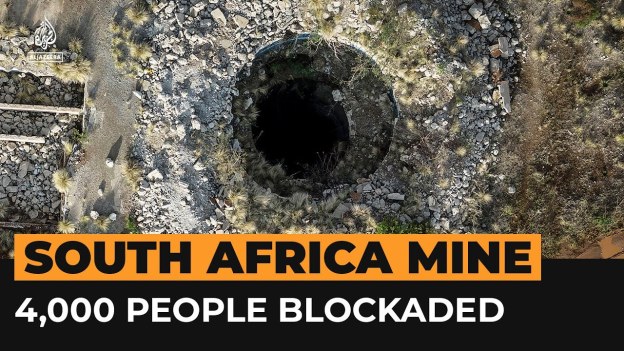
With hundreds of miners trapped below ground without food or water, two men from down the road volunteered to venture where no police, government officials or professional rescuers were willing to go.

On their first descent into the shaft this week, Mandla Charles and Mzwandile Mkwayi, wearing white hardhats, headlamps and T-shirts, stepped out of a red cage dangling on a cable from a crane on the surface 4,200 feet above them. Their lights illuminated a sea of emaciated faces, men crowded into a chamber who were crying and pleading to be saved from the pitch black of the abandoned Buffelsfontein gold mine. The miners’ lights had burned out weeks or months earlier. The volunteers made more than 30 round trips underground over the next three days, bringing up 246 living prospectors and the remains of 78 more. The cage, designed to hold six people in close confinement, lifted as many as 13 men to the surface on some trips.

“I can’t explain the smell down there,” Charles, 38, told The Wall Street Journal at the mine entrance in Stilfontein, 100 miles southwest of Johannesburg. “They told us they were eating human flesh and cockroaches. They had lost hope.” The rescue mission, which concluded January 16,2025 when no more survivors could be found, ended a monthslong standoff between miners who had been illegally digging for gold and a government determined to force them to the surface. The miners had been holed up since the police cut off their supplies of food and water in August 2024. 

For about five months, the informal workers were trapped underground as police tried to “smoke them out,” in the words of Khumbudzo Ntshavheni, minister in the South African presidency. The operation was part of the police’s “Close the Hole” plan to combat illegal mining, which has reached crisis levels here. A staggering 42% unemployment rate in South Africa has led to high levels of chronic poverty, leaving many men with little choice but to clamber down gold shafts closed by some of the world’s biggest mining companies, in order to feed their families. The zama zamas are often the lowest-level workers for larger criminal gangs that ultimately sell the gold abroad.

Excerpts from Alexandra Wexler, Hundreds of Miners Were Trapped for Months—Until an Extraordinary Two-Man Rescue Mission, WSJ, Jan. 17, 2025

Why Plastic is the Salvation of Oil Industry

As people switch to electric cars, or at least buy more fuel-efficient versions of traditional vehicles, energy companies will have too much oil on their hands. ..Energy companies hope consumers will soak up the glut through their clothing, food and electronic goods. Exxon Mobil expects demand for products that have fossil fuel-derived components and shells like “cellphones and medical supplies, as well as products necessary to preserve food and improve hygiene” to increase.

Crude oil and natural gas are turned into petrochemical feedstocks such as naphtha or natural gas liquids in a gas-processing plant or at an oil refinery. They are then “cracked” into the building blocks of common plastics. Ethylene is processed into polyethylene, which winds up in plastic bags, shampoo bottles and children’s toys. Polypropylene is used for everything from car bumpers to carpets. ..Today, 15.4% of global oil demand is driven by petrochemicals, according to data from Wood Mackenzie. The share is expected to rise to 19.1% by 2035 as emerging markets become wealthier and swelling middle classes spend more on synthetic clothing and do their grocery shopping at big supermarket chains, where food is more likely to be wrapped in plastic to prolong its shelf life.  Advanced economies like the U.S. use up to 20 times more plastic than developing nations on a per capita basis, according to the IEA. Big Oil’s bet is that shoppers in emerging markets will close at least part of that gap.

Energy companies are pouring billions of dollars into petrochemical facilities, notably in China where ethylene capacity has almost doubled since 2019. Capacity is also rising in the U.S. and Middle East. Saudi Arabia wants to invest $600 billion into petrochemicals by the end of the decade to secure nonfuel uses of its crude oil. 

But the global petrochemical industry is already saturated and capacity is expected to outstrip demand until at least 2030. This points to weak profit margins and less-than-ideal utilization rates at petrochemical facilities.  Plants in high-cost regions are shutting down. Exxon Mobil sold refineries in Italy last year and plans to close an ethylene cracker in Normandy, France…Pumping money into petrochemicals as governments are trying to solve the problem of plastic waste feels risky…. A worldwide ban on single-use plastic would wipe out a third of global plastic demand that comes from things like mini hotel toiletries, fast-food packaging and disposable cutlery, although there would probably be exemptions for categories like medical intravenous bags that are hard to substitute. 

Excerpts from Carol Ryan, Driving an EV? Big Oil Hopes You Don’t Cut Down on Plastic Too, WSJ, Dec. 24, 2024

Ousting Indigenous Peoples is a Brutal Way to Protect the Environment

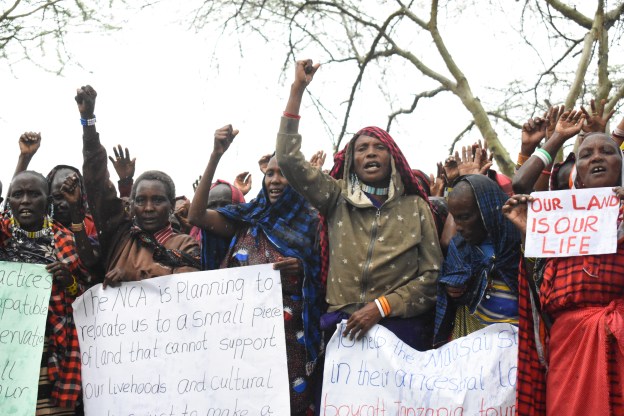
The government of Tanzania claims that the Maasai, the indigenous people of Tanzania,  present a threat to the ecosystem of the Serengeti National Park. The government says the seminomadic cattle farmers are a threat to the savannas and watering holes in an area that sustains the country’s money-spinning safari resorts and hunting reserves and, more recently, a swath of new carbon-credit projects.

To protect these areas, President Samia Suluhu Hassan’s government has outlawed human settlement there and begun evicting some of the more than 110,000 Maasai from the Ngorongoro Conservation Area—the vast zone of grass-, wood- and wetlands adjacent to the Serengeti that the Maasai have used for both herding and tourism for the past 65 years.

The area includes the famous Ngorongoro Crater, the world’s largest, fully-intact caldera and home of one of Africa’s densest populations of zebras, gazelles and other large mammals…The government argues that the number of Maasai living in Ngorongoro has expanded from just 8,000 in 1959, outpacing Tanzania’s overall population growth. The herders, along with their cattle, are overwhelming the area’s fragile ecosystem, it says. Similar warnings have been issued by the United Nations Educational, Scientific and Cultural Organization, or Unesco, which declared the Ngorongoro Conservation Area a World Heritage site in 1979.


But for the Maasai, the evictions are endangering a centuries-old way of life they say is much closer to nature than the rest of rapidly urbanizing Tanzania. They accuse the government of giving priority to revenue from foreign tourists, investors and conservation groups over the lives and livelihoods of some of its own citizens. ..Experts and activists focused on the rights of indigenous people say the Maasai are the latest group caught in the murky intersection of tourism, biodiversity protection and global climate goals. Similar conservation-related evictions have also targeted indigenous communities in the Brazilian Amazon and the Nouabalé-Ndoki rainforest in the Republic of Congo.

Revenue from tourism jumped 40% to $3.5 billion in 2023, about 17% of Tanzania’s gross domestic product, and according to government projections could reach $6 billion by 2025. The government has already set aside swaths of land around the Ngorongoro Crater previously reserved for the Maasai for the construction of a China-funded geological park, where tourists and researchers can explore fossils, rock paintings and other archaeological artifacts dating as far back as 4 million years ago. To the south of the Ngorongoro Conservation Area, a local company called Carbon Tanzania is selling carbon credits linked to about 273,000 acres of land that the Maasai have also used for grazing and limited cultivation. The project restricts the cutting down of trees but allows cultivation in some zones…

One of the most violent standoffs between the Maasai and Tanzanian authorities took place in mid-2022 in the grassy plains of Loliondo, about 100 miles west of Serengeti. Heavily armed police and rangers stormed Maasai villages, fired tear gas and live rounds, and bulldozed hundreds of houses as they sought to seize some 37,000 acres of land for a new game reserve. One police officer was killed by an arrow shot by the Maasai, authorities said. Many Maasai were wounded in the clashes, and thousands fled into neighboring Kenya to seek medical treatment. Dozens of others were arrested. After the mayhem in Loliondo, authorities appeared to have opted for a more tactical approach in neighboring Ngorongoro, closing down schools, water sources and hospitals to force residents out of homes, Maasai activists say.

Excerpts from Nicholas Bariyo, The Safaris and Carbon-Credit Projects Threatening the Serengeti’s Maasai, WSJ, Dec. 22, 2024

Environmental Victories of 2024

End of Fossil Fuels? The year 2024 r saw some extraordinary breakthroughs for climate and nature. The UK closed its last coal-fired power plant in 2024….As countries aim to rapidly decarbonise their economies, many former fossil fuel power plants are proving to be promising sites for industrial-scale batteries.…Renewable energy sources are growing rapidly around the world. In the US, wind energy generation hit a record in April 2024, exceeding coal-fired generation….By the end of this decade, renewable energy sources are set to meet almost half of all electricity.  The lion’s share of this growth comes from just one country:

The rivers, mountains, waves and whales given legal personhood
Back in 2021, the Ecuadorian government issued a landmark ruling stating that mining in its Los Cedros cloud forest violated the rights of nature. Another ruling in Ecuador stated that pollution had violated the rights of the Machángara River that runs through the capital, Quito. Beyond Ecuador, a growing number of natural features and spaces were granted legal personhood in 2024. In New Zealand, the peaks of Egmont National Park – renamed Te Papakura o Taranaki – were recognised as ancestral mountains and jointly became a legal person, known as Te Kāhui Tupua.] In Brazil, part of the ocean was given legal personhood – with the coastal city of Linhares recognising its waves as living beings, granting them the right to existence, regeneration and restoration. Meanwhile, a new treaty formed by Pacific Indigenous leaders saw whales and dolphins officially recognised as “legal persons”.

New ocean protections for the Azores
The North Atlantic saw a new marine protected area (MPA) announced by the Azores. When established, it will be the largest in the region, spanning 30% of the sea around the Portuguese archipelago. Half of the 111,000 sq miles (287,000 sq km) protected area will be “fully protected”, with no fishing or other natural resource extraction, according to the initiative behind the MPA. The other half will be “highly protected”.
The area contains nine hydrothermal vents, 28 species of marine mammals and 560 species of fish, among many others. 

Deforestation in the Brazilian Amazon
dropped to a nine-year low in 2024, falling by more than 30% in the 12 months to July, 2024 according to data released by Brazil’s national space research institute, INPE. nt

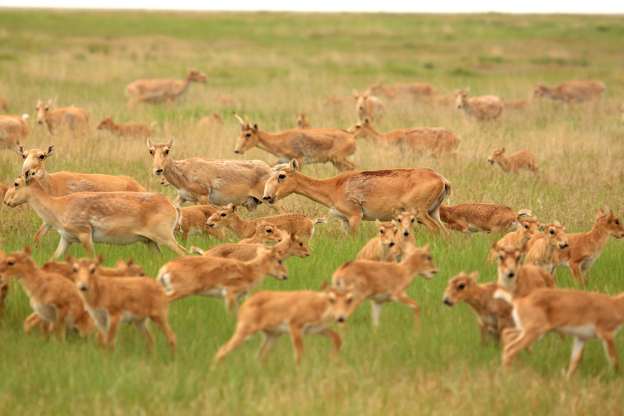
The Altyn Dala Conservation Initiative saved the critically endangered in the Golden Steppe grassland from extinction. The project used careful, science-based monitoring, tagging and habitat protection and restoration to ensure the best recovery for the Saiga Antelope, which numbered just 20,000 in 2003. Today, 2.86 million of the antelope roam the Golden Steppe, and it has been moved from “critically endangered” to “near threatened” status on the International Union for Conservation of Nature’s Red List.

After a 100-year hiatus, salmon were spotted in Oregon’s Klamath River basin, following an historic dam removal further downstream in the California stretch of the Klamath. In August 2024, the final of four dams were removed – in what was America’s biggest dam removal project – following pressure from environmentalists and tribes.

Excerpts from Isabelle Gerretsen et al., Seven quiet breakthroughs for climate and nature in 2024 you might have missed, BBC, Dec. 16, 2024

Satellites Reveal Depth of Destruction Vietnam War

During the Vietnam War, the United States dropped more than 8 million tons of bombs and sprayed 74 million liters of Agent Orange and other herbicides in Vietnam, Cambodia, and Laos. Nearly 50 years after the war’s end, the deadly impacts of these campaigns persist: Unexploded ordnance continues to maim and kill, while hot spots of dioxin, a potent toxin in the herbicides, might still be contributing to cancers and birth defects today. Now, using declassified military satellite photos, scientists have identified the likely locations of these hidden dangers, which could help direct remediation and cleanup efforts based on research, presented on December 11, 2024 at the annual conference of the American Geophysical Union (AGU)

Identifying these risky areas in the modern landscape is challenging. Tenacious vegetation growth has long since hidden the scars of war, and historical records of bombing and herbicide spraying are both incomplete and imprecise. That’s why Philipp Barthelme, a graduate student in geoscience at the University of Edinburgh, and his colleagues turned to declassified satellite photos from the KH-9 HEXAGON and KH-4a/b CORONA missions, which were sharp enough to reveal details as small as 0.6 meters.

Although the satellite data alone cannot identify unexploded bombs, the researchers surmised they are most likely to be found in regions that were heavily bombarded. The craters from the exploded bombs stand out in the satellite images as bright white splotches. The researchers used machine learning, a kind of artificial intelligence, to pinpoint more than 500,000 such craters in Vietnam’s Quang Tri province, which was the most heavily bombed during the war, as well as a region near the borders of Vietnam, Laos, and Cambodia.

In collaboration with the nonprofit Conflict and Environment Observatory, Barthelme also used satellite data to study herbicide spraying in southern Laos. The U.S. sprayed these compounds in secretive wartime campaigns to destroy crops and improve visibility by defoliating the lush jungles. However, the dioxin in the herbicides killed and debilitated hundreds of thousands of people…The zones of defoliation from the herbicides appear in satellite data as bright, sinuous lines….

Excerpts from Maya Wei-Haas, Declassified satellite photos reveal impacts of Vietnam War, Science, Dec. 14, 2024