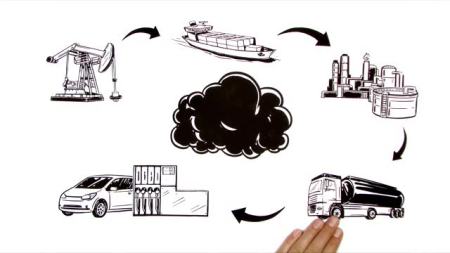
Sweden’s parliament passed a law in June which obliges the country to have “no net emissions” of greenhouse gases into the atmosphere by 2045. The clue is in the wording. This does not mean that three decades from now Swedes must emit no planet-heating substances; even if all their electricity came from renewables and they only drove Teslas, they would presumably still want to fly in aeroplanes, or use cement and fertiliser, the making of which releases plenty of carbon dioxide. Indeed, the law only requires gross emissions to drop by 85% compared with 1990 levels. But it demands that remaining carbon sources are offset with new carbon sinks. In other words greenhouse gases will need to be extracted from the air…
[I]f the global temperature is to have a good chance of not rising more than 2ºC above its pre-industrial level, as stipulated in the Paris climate agreement of 2015, worldwide emissions must similarly hit “net zero” no later than 2090. After that, emissions must go “net negative”, with more carbon removed from the stock than is emitted…
To keep the temperature below a certain level means keeping within a certain “carbon budget”—allowing only so much to accumulate, and no more. Once you have spent that budget, you have to balance all new emissions with removals. If you overspend it…you have a brief opportunity to put things right by taking out more than you are putting in…
Climate scientists like Mr Henderson have been discussing negative-emissions technologies (NETs) with economists and policy wonks since the 1990s. [But] NETs were conspicuous by their absence from the agenda of the annual UN climate jamboree which ended in Bonn on November 17th 2017.
Reforesting logged areas or “afforesting” previously treeless ones presents no great technical challenges. More controversially, they also tend to invoke “bioenergy with carbon capture and storage” (BECCS). In BECCS, power stations fuelled by crops that can be burned to make energy have their carbon-dioxide emissions injected into deep geological strata, rather than released into the atmosphere….
The Carbon Capture and Storage (CCS) technologies that exist today, under development by companies such as Global Thermostat in America, Carbon Engineering in Canada or Climeworks of Switzerland, remain pricey. In 2011 a review by the American Physical Society to which Ms Wilcox contributed put extraction costs above $600 per tonne, compared with an average estimate of $60-250 for BECCS…
Much of the gas captured by Climeworks and other pure NETs firms (as opposed to fossil-fuel CCS) is sold to makers of fizzy drinks or greenhouses to help plants grow. It is hard to imagine that market growing far beyond today’s total of 10m tonnes. And in neither case is the gas stored indefinitely. It is either burped out by consumers of carbonated drinks or otherwise exuded by eaters of greenhouse-grown produce…..
One way to create a market for NETs would be for governments to put a price on carbon. Where they have done so, the technologies have been adopted. Take Norway, which in 1991 told oil firms drilling in the North Sea to capture carbon dioxide from their operations or pay up. This cost is now around $50 per tonne emitted; in one field, called Sleipner, the firms have found ways to pump it back underground for less than that. A broader carbon price—either a tax or tradable emissions permits—would promote negative emissions elsewhere, too…
Another concern is the impact on politicians and the dangers of moral hazard. NETs allow politicians to go easy on emission cuts now in the hope that a quick fix will appear in the future.
Excerpt from Sucking up Carbon, Combating Climate Change, Economist, Nov. 18, 2017



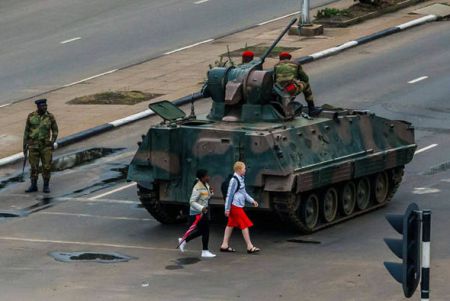
 As the overthrow of despot Robert Mugabe entered a stalemate on November 17, 2017, eyes turned to China — Zimbabwe’s largest foreign investor and a key ally — amid speculation over its role in the military coup.Source in Harare believe the Zimbabwean conflict within the ruling party Zanu PF is involving two rival camps has direct links to China and Russia with both countries trying to control and protect their own economic interests.

 When Doundou Chefou first took up arms as a youth a decade ago, it was for the same reason as other ethnic Fulani herders along the Niger-Mali border: to protect his livestock. He had nothing against the Republic of Niger, let alone the United States of America. His quarrel was with rival Tuareg cattle raiders.




 Daniel Stiles, a self-styled ape trafficking detective in Kenya, had been scouring Instagram, Facebook and WhatsApp for weeks, looking for pictures of gorillas, chimps or orangutans. He was hoping to chip away at an illicit global trade that has captured or killed tens of thousands of apes and pushed some endangered species to the brink of extinction.
 Law-In-Action