Category Archives: public health

Nuclear Waste and Environmental Justice

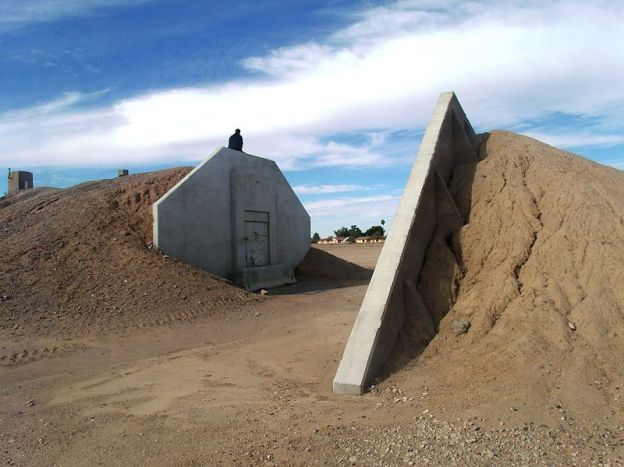
After California regulators refused to allow the U.S. Air Force to label residue from radioactive aircraft instruments as “naturally occurring” – declaring it unsuitable for a Bakersfield-area dump – the military turned to Idaho with the same story.  There, military officials met with success. The Air Force is now sending radioactive waste from Sacramento County’s McClellan Air Force Base to a Grand View, Idaho, hazardous waste landfill.

This solution involved a bit of legal semantics rejected in California despite 10 months of Air Force lobbying: The military claimed radium dust left over from glow-in-the-dark aircraft instruments actually was naturally occurring, putting it the same relatively lax regulatory category as mine tailings, according to government memos obtained by California Watch through a public records request.  Larry Morgan, a health physicist with the California Department of Public Health, disagreed with that characterization. Radioactive paint does not “meet the definition” of naturally occurring waste, he wrote in a September 2011 memo.

The Idaho facility’s permit allows it to accept materials defined as natural without notifying state regulators, leaving the state’s hazardous waste manager in the dark.  “I’m not familiar with this particular waste stream. I intend to find out now that you’ve contacted me,” Robert Bullock, hazardous waste permits manager for the Idaho Department of Environmental Quality, said during an October interview.  The redefinition of the waste as natural might not even have been necessary, given Idaho’s different standards for waste containing trace amounts of radium.

Days after the Idaho Department of Environmental Quality told California Watch that the agency was unaware of the Air Force waste, an official went out to inspect the landfill. Interviewed after that visit, engineer Dennis Meier said the dumping was legal because of the low concentration of radium in the soil, despite the source.  “It’s not waste that has to go to a radioactive waste facility,” he said. “The concentration is way below what we would accept.”

Nonetheless,California health officials and environmental activists accused the Air Force of bending the truth to get its way.  “Illuminated instrument dials do not naturally occur,” said Daniel Hirsch, a lecturer on nuclear policy at UC Santa Cruz who leads the environmental group Committee to Bridge the Gap. “I can’t dig into the soil and discover naturally occurring radium instrument dials.”

The radioactive dirt in question hails from the former McClellan Air Force Base northeast of Sacramento,now a commercial development site.“At least 24 sites” on the base “all have low levels of radium mixed in with the soil, and there are many thousands of cubic yards” of contaminated soil, according to Philip Mook, Western region senior representative for the Air Force Civil Engineer Center, which is in charge of cleanups at Air Force installations. “A little bit of radium goes a long way.”  The Air Force has sent 22,000 tons of radioactive dirt from McClellan out of state so far, according to Charlotte Fadipe, a spokeswoman for the California Department of Toxic Substances Control.

According to the federal Environmental Protection Agency, if significant radium is inhaled or ingested, it can increase the risk of diseases such as lymphoma, bone cancer and leukemia. While the concentrations in the McClellan soil are low, they are above limits the federal government has set to protect human health.  Before these medical effects became evident, aircraft dials and gauges were painted with glowing radium so pilots could see them better at night. Air Force officials speculate that the radium became dispersed in the soil at McClellan “probably in cleanup water, like mop water or solvents that were used to clean the equipment or to clean up spills of radium,” Mook said. Although radium paint wasn’t used on the base after the 1950s, items contaminated with it remained…

Stephen Woods, chief of the California Department of Public Health’s Division of Food, Drug and Radiation Safety, argued in a Nov. 4, 2011, letter that the dirt should be sent to “a licensed low-level radioactive waste disposal facility.” The Idaho facility where the soil is now going does not meet that criteria. Neither do any California waste disposal facilities.  That’s partly because of vocal opposition from local Kern County residents and environmental groups.  “Hazardous waste landfills in low-income communities of color in California aren’t the right places for” nuclear waste, said Caroline Farrell, executive director of the Center on Race, Poverty & the Environment, which for almost two decades has fought to limit the Buttonwillow landfill’s expansion and impact on local residents.

But in the past, the landfill has accepted nuclear waste. In 1998 and 1999, the Army Corps of Engineers sent residue from the Manhattan Project, the World War II-era research and development program that produced atomic bombs dropped in Japan, to the landfill.  The move outraged civilian officials.  Democratic U.S. Sen. Barbara Boxer testified before a Senate committee on July 25, 2000: “When I learned that the Corps had disposed of 2,200 tons of radioactive waste at an unlicensed hazardous waste facility in Buttonwillow, California, I was shocked. The facility sits atop aquifers that supply water to the Central Valley of California.”  Since the Manhattan Project controversy, the facility’s permit has been tightened. Yet the landfill’s current permit states that it may accept naturally occurring radioactive materials at low concentrations….

US Ecology, which operates the hazardous waste landfill in Grand View, Idaho, seemed to accept the terminology.  Steve Welling, senior vice president of sales and marketing for US Ecology, said in an interview that “state law and our permits” allowed the facility to accept the waste that the Air Force had characterized as naturally occurring.

Katharine Mieszkowski and Matt Smith, Air Force Ships Calif. Radioactive Waste To Idaho Landfill, NBC, Nov. 9, 2012

Ship Breaking – Greens against workers

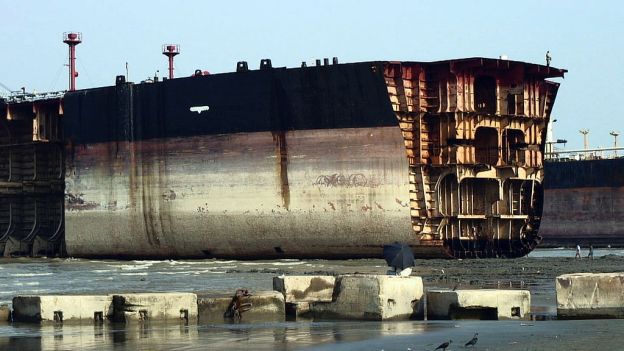
At its height in 2008 Bangladesh’s ship-breaking industry accounted for half of all ships scrapped in the world, according to IHS, a consultancy. Today the country accounts for around a fifth. In these years Bangladeshi ship breakers found themselves at the forefront of criticism as NGOs and pressure groups exposed some of the worst practices causing environmental and human harm. These included high health risks due to injuries, noxious fumes and the handling of asbestos. Critics say one way in which Bangladesh competes on cost is that poor workers are unlikely to file claims for accidents or bad health. Another advantage is (or was) the use of child labour.

In 2009 the Bangladesh Environmental Lawyers Association (BELA), a public-advocacy group, convinced the Supreme Court to ban all ship recycling not meeting certain environmental standards. The court’s decision meant that by 2010 the ship-breaking industry had come to a halt. Zahirul Islam of PHP, a local manufacturer with a big ship-breaking division (the industry prefers to call it ship recycling), says that for 14 months the company was unable to import a single vessel for breaking.  Knock-on effects hurt the wider economy. A World Bank study estimated that ship breaking employed over 200,000 in Bangladesh. Many of the jobs were subsequently lost. And domestic steel prices rose sharply. Half of all Bangladesh’s steel comes from breaking ships.  Under pressure from the ship breakers, Bangladesh’s prime minister, Sheikh Hasina, has since relaxed the regulations. Hefzatur Rahman, president of the Bangladesh Ship Breakers Association, believes this has saved the industry. From just a score of vessels scrapped in the main part of Chittagong two years ago, about 150 were broken up in 2011.

Greens are not happy and want the ban reimposed. Delphine Reuter of the Shipbreaking Platform, an NGO in Brussels, describes ship recycling as “close to slavery”. It and BELA are leading the call for more regulation. That bothers international shipping firms and ship brokers, which argue that Bangladeshi ship breakers have cleaned up their act.

At the International Maritime Organisation, the UN agency responsible for curbing shipping pollution and ensuring safety, the head of pollution prevention, Nikos Mikelis, says environmentalists present Bangladesh with a false choice. “They say they are happy to have the industry, but not on the beaches. Where do they want it? In the mountains?”

Ship breaking in Bangladesh: Hard to break up, Economist, Oct. 27, 2012, at 44

Palm Oil Industry: environmental and human impacts

Indonesia’s largest palm oil company, Sinar Mas, ran into trouble recently when communities in Liberia complained about a 33,000 ha. operation being developed on their lands by its indirectly-owned subsidiary, Golden Veroleum in Butaw District, Sinoe County. Alfred Brownell, the lawyer from Green Advocates representing the Kru tribes impacted by the project who is attending the 10th Roundtable on Sustainable Palm Oil (RSPO) being held in Singapore this week noted:

Golden Veroleum is in clear violation of the RSPO’s New Planting Procedure as it has not advertised its plans to clear and plant oil palms and carry out and publicise a High Conservation Value Assessment in advance of expanding its operations. Under the RSPO procedure, the company should now cease clearance until due process is followed. The villagers are concerned that their lands are being taken without their fully informed or free consent.

This is the second palm oil development involving a prominent RSPO member to run into controversy in Liberia. Last year, a subsidiary of Malaysia’s largest palm oil consortium, Sime Darby, was criticised for expanding its operations without respecting local peoples’ rights. The company was in the early stages of developing a 220,000 ha. operation but was halted in its tracks by complaints, which, to its credit, the company has responded to by entering into dialogue with the communities.

The spotlight is now on two large palm oil operations in Cameroon. One is planned by a company called BioPalm, a subsidiary of India-based corporation Siva Group which is marking out its planned operations without consultation on the lands of the Bagyeli “Pygmies” in Océan Département in western Cameroon. The company claims to be an RSPO member but does not show up on the RSPO’s membership lists. Messe Venant, Project Coordinator of the community-based indigenous NGO Okani says:  As the affected Bagyeli communities have told us, the forest is their memory. If they lose it, they lose their past, their present and their future. They will no longer be Bagyeli. To destroy the forest is to reduce them to nothingness.

Another palm oil developer is SG Sustainable Oils Cameroon PLC (SGSOC), owned by Herakles Farms from the USA and an affiliate of Herakles Capital, which is also involved in the telecommunications, energy, infrastructure, mining and agro-industrial sectors in Africa. SGSOC is developing an oil palm plantation further north in Cameroon, but has also run into sustained opposition from local communities and concerned NGOs and has announced it will pull out of the RSPO.

Other cases are highlighted in a searching review of 15 companies’ operations carried out by the Forest Peoples Programme and SawitWatch with a consortium of other NGOs and community organisations in Liberia, Cameroon, the Democratic Republic of Congo, the Philippines, Malaysia and Indonesia.

One case examined is the operation being developed by Genting Plantations, a client of HSBC, and a subsidiary of the vast Genting group which runs a casino, hotel and property empire in Malaysia. Both companies are prominent RSPO members. Genting is now in a protracted land dispute with the Dusun and Sungai peoples in Tongod District in Sabah over the imposition of the oil palm plantation. Leonard Alaza representing the Indigenous Peoples Network of Malaysia or Jaringan Orang Asal SeMalaysia (JOAS) at the 10th Roundtable of the RSPO underway in Singapore, says:  The communities have been objecting to this plantation since 2000 and filed a court case 10 years ago asking the court to recognise their rights and freeze the company’s expansion. But instead of recognising our rights, as the RSPO standard requires, the company has been contesting even the admissibility of our case and meanwhile has taken over and planted all the disputed lands.

Excerpt from Press Release of Forest Peoples Programme, New oil palm land grabs exposed: Asian palm oil companies run into trouble in Africa, Nov. 1, 2012

Top Five Worst Polluters in Gas Flaring

An international coalition led by the World Bank is calling for state-backed and private oil producers to reduce “gas flaring” by an additional 30 percent over the next five years, saying that doing so would be equivalent to taking 60 million cars off of the roads.  Analysts widely characterised the goal as both ambitious and significant, though it follows on an apparent levelling out in flaring reductions in recent years.

Since a major new push began in 2005, the World Bank-led Global Gas Flaring Reduction (GGFR)* partnership estimates that, through 2011, its actions have brought down gas flaring by 20 percent, eliminating around 274 million tonnes of carbon dioxide emissions.  But according to the GGFR – a coalition of 20 major oil companies and 19 countries..both the economic and environmental impacts of gas flaring require far greater reductions.  “A 30 percent cut in five years is a realistic goal,” Rachel Kyte, the World Bank’s vice-president for sustainable development, said…

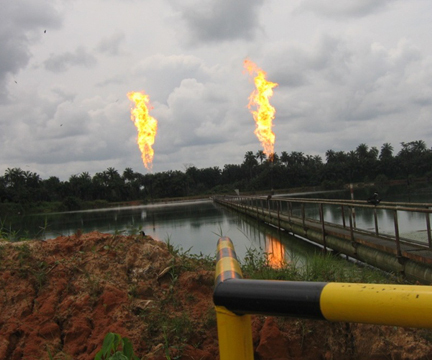
Oil producers resort to flaring when gas, a by-product of oil, is brought up to the surface but cannot easily be repurposed for consumers. Instead, producers simply burn off the product, the value of which the World Bank, based here in Washington, puts at some 50 billion dollars a year.  The total amount of gas estimated to have been flared last year, about five trillion cubic feet, is said to equal the amount of natural gas used in the United States over a full year.

Environmentalists have long called for the outright banning of the practice, though flaring does in fact release far lower levels of greenhouse gases than simply allowing the gas to evaporate. However, the process does not deal with one notorious pollutant, nitrogen oxide, and still releases significant carbon dioxide, and thus significant greenhouse gas-related worries remain.

Alternative uses for this gas range from producing power, refining it for use in local markets, or even putting it back into the ground. But analysts say the economic benefits for companies in doing so are low.  Nonetheless, the World Bank reports slow but steady success in reductions, particularly since 2005. According to data released Mexico has cut its flaring by two-thirds and Azerbaijan by half in just two years, while Kuwait gotten its flaring down to just one percent of previous levels.  In addition, Qatar and Congo have been singled out for using the gas to make electricity.

Significant improvements have also been seen in many of the world’s worst flaring offenders. “Huge investments” by GGFR partners have reportedly helped Nigeria to reduce its flaring by nearly a quarter through 2011, while Russia, the most significant culprit in this regard, has reduced flaring by around 40 percent, though those figures rose last year.  Still, the World Bank warned that both of these countries, particularly Russia, in addition to Mexico, Iraq and Kazakhstan, need to make significant improvements.

Missing from this list, however, is one of the most significant outliers in the global push against gas flaring: the United States, which has increased its gas flaring by more than three times since 2007, more than any other country.  The U.S. is currently in the midst of a sea-changing boom in natural gas production, thanks almost entirely to new technologies (so-called hydraulic fracturing or “fracking”) that have allowed for the exploitation of previously off-limits gas deposits in shale and other geological formations.

Against the promising country-by-country numbers, total global gas flaring actually increased last year by around two billion cubic metres, which World Bank analysts have put down to output from Russia and, specifically, the U.S. state of North Dakota.  “The small increase underlines the importance for countries and companies to sustain and even accelerate efforts to reduce flaring of gas associated with oil production,” Bent Svensson, manager of the GGFR partnership, said when the 2011 figures became available in July. “It is a warning sign that major gains over the past few years could be lost if oil-producing countries and companies don’t step up their efforts.”

The U.S. is now the fifth-largest flarer, behind Russia, Nigeria, Iran and Iraq. While part of this is due to the multifold increase in production in recent years, it also appears to be due to a lag in implementing the necessary infrastructure.  “Due to insufficient natural gas pipeline capacity and processing facilities … over 35% of North Dakota’s natural gas production … has been flared or otherwise not marketed,” the U.S. government reported in late 2011. “The percentage of flared gas in North Dakota is considerably higher than the national average; in 2009, less than 1% of natural gas produced in the United States was vented or flared.”…But based on new EPA rules, “the U.S. is going to have 100 percent no-flaring by 2015, which will be pretty good in terms of the rest of the world,” Kyle Ash, a Washington-based legislative analyst with Greenpeace, an advocacy group, told IPS.

Excerpts, By Carey L. Biron, U.S. Outlier in New Push to Reduce Gas Flaring,Inter Press Service,Oct. 24, 2012
*The GGFR partners include: Algeria (Sonatrach), Angola (Sonangol), Azerbaijan, Cameroon (SNH), Ecuador (PetroEcuador), Equatorial Guinea, European Bank for Reconstruction and Development (EBRD), France, Gabon, Indonesia, Iraq, Kazakhstan, Khanty-Mansijsysk (Russia), Mexico (SENER), Nigeria, Norway, Qatar, the United States (DOE) and Uzbekistan; BP, Chevron, ConocoPhillips, ENI, ExxonMobil, Marathon Oil, Maersk Oil & Gas, Pemex, Qatar Petroleum, Shell, Statoil, TOTAL; European Union, the World Bank Group; Associated partner: Wärtsilä.

Japan and the Polluted Radioactive Water

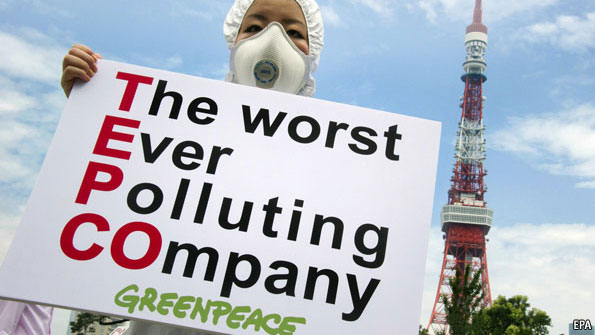
Japan’s crippled nuclear power plant is struggling to find space to store tens of thousands of tonnes of highly contaminated water used to cool the broken reactors, the manager of the water treatment team has said.About 200,000 tonnes of radioactive water, enough to fill more than 50 Olympic-sized swimming pools, are being stored in hundreds of gigantic tanks built around the Fukushima Daiichi plant.

Operator Tokyo Electric Power Company (TEPCO) has already chopped down trees to make room for more tanks and predicts the volume of water will be more than tripled within three years.  “It’s a time-pressing issue because the storage of contaminated water has its limits, there is only limited storage space,” the water-treatment manager, Yuichi Okamura, told the AP news agency in an exclusive interview this week.  The Yotukura fishing village was one of the areas devastated by the Mar. 11, 2011 tsunami that caused the nuclear plant meltdown.

Dumping massive amounts of water into the melting reactors was the only way to avoid an even bigger catastrophe after the meltdown at TEPCO’s Fukushima Daiichi nuclear power reactor, caused by the Mar. 11, 2011 tsunami.  Okamura remembers frantically trying to find a way to get water to spent fuel pools located on the highest floor of the 50m high reactor buildings.  Without water, the spent fuel likely would have overheated and melted, sending radioactive smoke for miles and affecting possibly millions of people.

But the measures to keep the plant under control created another huge headache for the utility: What to do with all the radioactive water that leaked out of the damaged reactors and collected in the basements of reactor buildings and nearby facilities.  “At that time, we never expected high-level contaminated water to turn up in the turbine building,” Okamura said.  He was tasked with setting up a treatment system that would make the water clean enough for reuse as a coolant, and was also aimed at reducing health risks for workers and at curbing environmental damage.  At first, the utility shunted the tainted water into existing storage tanks near the reactors.

Meanwhile, Okamura’s 55-member team scrambled to get a treatment unit up and running within three months of the accident, a project that would normally take about two years, he said.  Using that equipment, TEPCO was able to circulate reprocessed water back into the reactor cores.  But even though the reactors now are being cooled exclusively with recycled water, the volume of contaminated water is still increasing, mostly because groundwater is seeping through cracks into the reactor and turbine basements….

Masashi Goto, a nuclear engineer and university lecturer, said the contaminated water build-up posed a major long-term threat to health and the environment.  He said he was worried that the radioactive water in the basements may already be getting into the underground water system, where it could reach far beyond the plant via underground water channels, possibly reaching the ocean or public water supplies.  “There are pools of some 10,000 or 20,000 tonnes of contaminated water in each plant, and there are many of these, and to bring all of these to one place would mean you would have to treat hundreds of thousands of tonnes of contaminated water which is mind-blowing in itself,” Goto said.  “It’s an outrageous amount, truly outrageous,” Goto added.

The plant will have to deal with contaminated water until all the melted fuel and other debris is removed from the reactor, a process that will easily take more than a decade.

Japan Struggling to Store Nuclear Water, Inter Press Service, Oct. 25, 2012

How Iran Copes with Sanctions?

According to the latest figures from the Natural Gas Vehicle Knowledge Base, Iran, with the world’s second-largest natural gas reserves after Russia, in 2011 became the world leader in natural gas vehicles with some 2.9 million on the road, narrowly edging Pakistan, which is trailed by Argentina, Brazil and India, respectively.  Iran’s reliance on its cleaner fossil fuel seems unlikely to diminish as international sanctions continue to bear down on its nuclear program, which in turn have curbed imports of gasoline; though Iran has large oil reserves, its ability to refine its own gasoline falls well short of its needs.  But for ordinary Iranian motorists, natural gas is less a geopolitical or environmental issue than a pocketbook concern. “This sort of fuel is cheap, and it gets me home every day — that’s what I care about,” said Sasan Ahmadi, a 42-year-old office assistant filling up his Iranian-made Kia Pride at a natural-gas station for his hour commute home.

The government began promoting natural gas about a decade ago, and not just in response to American-led sanctions. A big initial reason was the increasingly thick yellow blankets of smog that often engulf greater Tehran and its 12 million inhabitants. That was a result of rising auto sales by domestic carmakers like Iran Khodro and Saipa, which took off as oil revenue began rising sharply around 15 years ago, enriching tens of millions of Iranians…..

As a means to counter outside economic pressure, natural gas’s usefulness is clear. Because of its inadequate investment in oil refineries, Iran has long been forced to refine a portion of its own crude at refineries in Europe to satisfy rising domestic demand for gasoline. So when the European Union in July barred gasoline sales to the country, natural gas helped to blunt the blow.

Despite the sanctions against Iran, motorists like Mr. Ahmadi can make their commute for the equivalent of less than a penny a mile using the alternative fuel at subsidized prices. Gasoline is more expensive, especially because government subsidies have been reduced, but it is still incredibly cheap by Western standards: less than $1 a gallon….

Excerpt, THOMAS ERDBRINK, Oil-Rich Iran, Natural Gas Turns Wheels, New York Times, Oct. 23, 2012

The Deadly Weapon Dumps

Taking stock of an ammunition depot can be a deadly task…Last year was the worst yet, with 442 victims from 46 explosions. One of the biggest ever happened in March this year: an accident in Congo-Brazzaville that killed 250, showering munitions over a two-mile radius.  Thousands of ill-run weapons stores are in restless parts of Africa and the Middle East, often near towns or cities. The end of the cold war left unneeded weapons all over the Soviet empire. Moldova spends a quarter of its defence budget guarding obsolete munitions. Ukraine alone has half a million tonnes.

Most high explosives are inherently stable. But the propellant that launches projectiles from gun barrels is not. Over time it eats away at the stabilising compounds—especially in hot weather—until spontaneous detonation occurs. In rich and strict countries munitions are tested and dealt with before that happens. In poorer places, the temptation is to trust to luck. Many are also reluctant to give up their arsenals, particularly if they are unsure they can be replaced. Somaliland, an independence-seeking statelet in the Horn of Africa, for example, has curbed the destruction of its ageing weapons because international sanctions stop it buying new ones.

Small slip-ups can have grave consequences. At a weapons dump in the Rajasthan desert in India, a gardener was sacked to save money. Unkempt long grass then caught fire, triggering an explosion in April 2000 that killed two soldiers and destroyed $90m of ammunition.

Bad management of weapons dumps makes life easier for thieves and dodgy customers. It is a big headache for Western countries worried about advanced weapons such as shoulder-launched missiles, or those suitable for use by insurgents or independent militias. This is a particular problem in Libya, where Muammar Qaddafi, the former dictator, spread his arms around more than 500 supply points to avoid NATO’s air strikes.

The simplest means of disposal is to blow weapons up in a hole in a remote location. But they must be expertly stacked to ensure everything explodes properly. And for big stockpiles, and in countries with tough environmental rules, that may not be possible. Alternative solutions include movable facilities that remove explosives from their casings, cut them into small pieces and burn them in a furnace. But for big munitions such schemes are costly and so far still untested.

Landmines get far more money and legal scrutiny than ammunition dumps, because of their dire effects. But perhaps too much. Adrian Wilkinson, a UN explosives specialist, reckons landmines have killed roughly five times as many people, but at least 100 times more is spent on dealing with them.

Ammunition depots: Storing up risk, Economist, Sept. 29, 2012, at 66

Nuclear Waste Island, Orchid, Taiwan

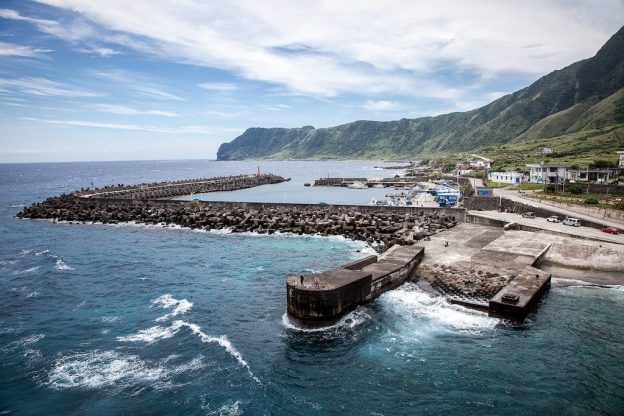
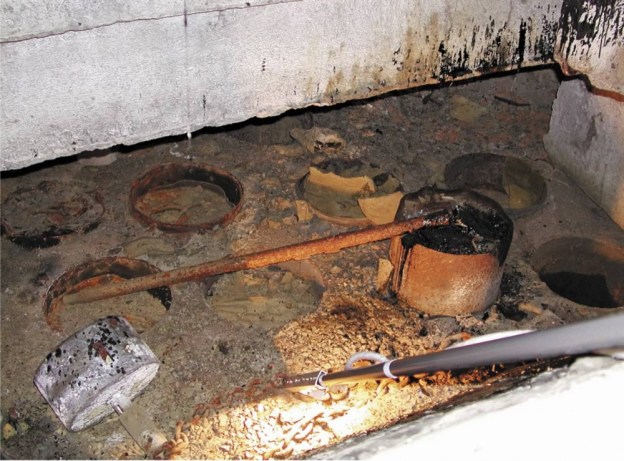
Most people on the windswept outpost, 62 kilometres east of Taiwan’s mainland, would love to see the 100,277 barrels of nuclear waste gone. But many admit they are concerned about their livelihoods if that day comes.  Orchid Island has been a flashpoint for Taiwan’s environmental movement since nuclear waste was first shipped there in 1982. Local residents, mostly members of the Tao aboriginal group, say the waste was put on the island without their consent. Periodic protests have claimed negative health and environmental effects.

In response, Taiwan Power Co has showered the community with cash handouts, subsidies, and other benefits.  Orchid Island received subsidies worth 110 million Taiwan dollars in 2011, according to company data. That doubled local government spending, according to township secretary Huang Cheng-de.  “The current situation, basically, is that Taipower gives us quite a bit of money, and our people are becoming pretty reliant,” Huang said.  Most of the funds are divided into government-managed accounts for each of the island’s 4,700 residents, who can apply for it if they have a business or career-oriented need. Residents also receive free electricity, health-related emergency evacuations, scholarships for higher education and a 50-per-cent discount on all transportation costs to Taiwan’s mainland.  Statistics indicate local residents are taking advantage of the benefits. In 2011, they used nearly twice as much electricity per household as the national average, according to company data.

Protests have weakened and for many residents, including Chou the restaurant owner, the existence of nuclear waste has become more acceptable.  “Most people here are against the nuclear waste, but since its already here, they should pay us for using our land,” Chou said. “For now, I’m okay with it as long as they don’t add any more barrels.”  The utility plans to move the waste off the island by 2021, but only if another township in Taiwan agrees by referendum to take it, according to Huang Tian-Huang, a company deputy director.  If it goes to plan, “so goes the compensation,” Huang said, although he acknowledged that gaining consent from another community will be difficult.  Questions remain on what would support Orchid Island’s economy if those subsidies end.

For Taiwan aborigines, nuclear waste is blessing and curse, http://www.timeslive.co.za, Sept. 16, 2012

Nuclear Waste Russia: Andreyeva Bay

Andreyeva Bay, the former naval technical base come solid radioactive waste storage facility has undergone many improvements, but problems also remain. Andreyeva Bay is one of the hottest radioactive spots in Northwest Russia and work deadlines are hard to meet.  Founded in between 1960 and 1964, Andreyeva Bay’s task was to remove, store and ship for reprocessing at the Ural Mountains Mayak Chemical Combine spent nuclear fuel from nuclear submarines. After a 1982 accident in the spent nuclear fuel storage, Russia Ministery of Defense decided to reconstruct the facility. But the turbulent political and economic conditions of the 1980s and 1990s scuttled the plans. Andreyeva Bay was assigned to Minatom, Rosatom’s precursor, in 2000.  The beleaguered facility, which is nearby the Norwegian border is of special concern to Oslo. Norway’s Deputy Ambassador in Moscow, Bård Svendsen, noted that the two countries had cooperated on solving the Andreyeva bay issue for many years.  “Over these years, much has been done and much remains to be done,” said Svendsen. “Norwegian authorities will continue this work, which costs some €10 million euro a year.”  According to Rosatom’s deputy head of Department for Project Implementation and Nuclear and Radiaiton Safety, Anatoly Grigorieyev, the last 10 years have seen the installation of constant radiation monitoring and significant improvements in the conditions in which radioactive waste and spent nuclear fuel is stored.  A new installation for working with spent nuclear fuel is expected to be installed at Andreyeva Bay in 2014, and by 2015 the fuel is slated for removal – the same year a facility for handling radioactive waste should be installed, he said in remarks reported by Regnum news agency.  “The work we have planned will allow for the territory to be brought up to suitable conditions within 10-15 years,” said Grigorieyev.

Vladimir Romanov, deputy director of the Federal Medical and Biological Agency, said that studies conducted by his institute confirm that the radiological conditions at Andreyeva Bay and at Gremikha – the second onshore storage site at the Kola Peninsula for spent nuclear fuel from submarines – are indeed on the mend…. According to Valery Panteleyev, head of SevRAO, the Northwest Russian firm responsible for dealing with radioactive waste Some 846 spent fuel assemblies have been taken from storage at the former naval based to the Mayak Chemical Combine for reprocessing thanks to infrastructure built for fuel unloading purposes.  Panteleyev said Gremikha still currently is home to used removable parts from liquid metal cooled reactors submarine reactors, spent fuel assemblies, a reactor from an Alpha class submarine and more than 1000 cubic meters of solid radioactive waste.  Panteleyev said that by the end of 2012, all standard and non-standard fuel will have been sent to Mayak from Gremikha. He said that between 2012 and 2020 the removable parts of the liquid metal cooled reactors would also be gone, and that during the period between 2012 and 2014, 4000 cubic meters of solid radioactive waste would also be removed to long term storage at Saida Bay.  If all goes according to schedule, the Gremikha site will be rehabilitated by 2025.

Rosatom also presented detailed reports on an international project to build long-term storage for reactor compartments at the Saida Bay storage site for aged submarine reactors.  Panteleyev said none of the achievements at either Saida Bay or Gremikha would have been possible without international help.  The projects are being completed with funding from Germany, Italy, France, Norway, Sweden, Great Britain and the EBRD.  “These countries are investing in the creation of infrastructure for handling radioactive waste and spent nuclear fuel, dismantlement of nuclear vessels of the atomic fleet and in the infrastructure for the safe storage or reactor compartments,” said Panteleyev….

Another item of special concern at the Bellona/Rosatom seminar was the disposition of the floating spent nuclear fuel vessel, the Lepse. A former technical support vessel, taken out of service in 1988 the Lepse presents the biggest nuclear and radiation risk of all retired nuclear service ships in Russia. The Lepse’s spent nuclear fuel storage holds – in casks and caissons – 639 spent fuel assemblies, a significant portion of which are severely damaged.  Extraction of these spent fuel assemblies presents special radiological risks and technical innovation. The vessel is currently moored at Atomflot in Murmansk, the base of Russia’s nuclear icebreaker fleet.  Mikhail Repin, group director for the Russian Federal State Unitary Enterprise the Federal Center for Nuclear and Radiation Safety, said work on the Lepse is divided into three categories: transfer of the vessel to the ship repair yard Nerpa in the Murmansk Region, fixing it to an assembly based, removing the spent fuel and dividing into blocks. The work is expected to be complete by 2012.  But the barriers to enacting this project, however, remain largely bureaucratic.  “One gets the impression that international and Russian bureaucrats are capable of muddling any project, as shown by the experience with the Lepse,” said Bellona’s Niktin. The project of dismantling the Lepse have remained on paper since 1995.  The Lepse was built in 1930, and the vessel has been afloat for 75 years, said Repin… The equipment necessary for removing the spent fuel assemblies must be fabricated for specifically this project. The equipment must first ensure the safety of the workers, meaning the work will have to be done essentially remotely to ensure minimum exposure.

The iPhone, radioactive waste and rare earths: the Lynas case

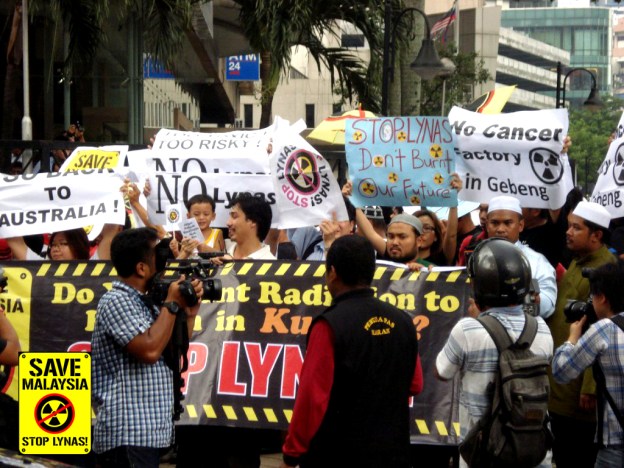
Lynas Corporation, an Australian based mining company are constructing a rare earth processing plant, known as the Lynas Advanced Materials Plant (LAMP) in Gebeng industrial estate in Kuantan, Malaysia. The LAMP will process lanthanide concentrate which will be trucked from the mine site in Mt Weld Western Australia to the Port of Fremantle where it will be shipped to Malaysia. This report provides an assessment of the emissions from the LAMP plant rather than Lynas Corporation‟s activities in Western Australia. The LAMP plant will have significant atmospheric, terrestrial and waterborne emissions of toxic chemicals and radionuclides including uranium, thorium and radon gas.

________________________________________________________

A Malaysian high court put on hold until October 4 a temporary operating license granted to Lynas Corp Ltd’s controversial rare earth plant near the eastern city of Kuantan, prompting an 8 percent fall in the Australian firm’s shares on Tuesday (Sept. 24, 2012).  The rare earth plant – the world’s biggest outside China – has been ready to fire up since early May, but the company has been embroiled in lengthy environmental and safety disputes with local residents since construction began two years ago [regarding the handling of radioactive waste at the plant].

The plant is considered important to breaking China’s grip on the processing of rare earths, which are used in products ranging from smartphones to hybrid cars.

Lynas confirmed the Kuantan High Court’s decision on Tuesday, but said it would not affect production at the plant and that it plans to strongly assert its rights at the next court hearing…Lynas shares plunged more than 8 percent after the court order to A$0.795, their lowest close in almost three weeks as investors closely track each move in the sensitive case. Earlier this month they rose up to 50 percent when Malaysia approved the license.

Activists linked to the environmental group, Save Malaysia Stop Lynas, want the court to suspend the temporary license until two judicial review cases challenging the government’s decision allowing the plant to operate are heard.  “It’s a small victory, but there is still a long way to go,” Tan Bun Teet, a spokesman for the group, told Reuters after the court decision. “We will fight tooth and nail. We have a lot at stake,” he added.  The group’s previous attempts to legally stop the plant had failed.

Lynas received a temporary operating license for its long-delayed $800 million rare earth plant earlier this month, enabling it to start production as early as October.  The Malaysian Atomic Energy Licensing Board (AELB) issued the permit following an earlier recommendation from a government committee.  Protests over possible radioactive residue have drawn thousands of people and the project has become a hot topic ahead of an election that must be held by early next year.

Sources

Lee Bell, Rare Earth and Radioactive Waste: A Preliminary Waste Stream Assessment of the Lynas Advanced Materials Plant, Gebeng, Malaysia, National Toxics Network. April 2012

Siva Sithraputhran, Malaysian court puts license on hold for Lynas rare earth plant, Reuters, Sept. 25, 2012

Nuclear Protests in India and Foreign-Funded NGOs

This week police in Kudankulam, in southern Tamil Nadu, fired at thousands of anti-nuclear protesters on the beach, killing a fisherman. The locals were opposing a new, Russian-designed, 2,000MW nuclear plant, India’s biggest, which is now being filled with fuel. The 2004 Indian Ocean tsunami killed over 10,000 Indians. Now fears grow of another big wave that could bring a Fukushima-style disaster.  Protesters also claim harassment, saying officials have slapped sedition notices against 8,000 who have dared speak out. Opposition has flared before. The state’s chief minister, Jayaram Jayalalitha, once backed the protests but has now swung in favour of the plant—perhaps betting that anger over power shortages trumps anti-nuclear outbursts.

The reaction of the national government, under the prime minister, Manmohan Singh, has been mixed. Committees of investigation called the plant safe. The High Court in Chennai heard, and ruled against, a petition by locals over safety. The Supreme Court will hear an appeal.  The government’s argument that politicians not protesters should decide the country’s energy mix is reasonable. But, twitchy at criticism, it veered off in suggesting opponents merely did the bidding of a foreign hand. Mr Singh, in an interview with a science magazine in February, blamed protests on NGOs, “mostly I think based in the United States”. A tough new law is in force, severely restricting foreign money going to local NGOs.  Mr Singh’s frostiness is best understood in the context of America’s moans that a civil-nuclear deal signed with India has not led to American investors getting energy contracts. Strict liability laws scare its private investors, whereas government-backed ones, such as Russians, feel more secure. Could Mr Singh be implying that American activists are stirring the trouble in Kudankulam because the plant is Russian-built?

Nuclear Power in India: The Kudankulam conundrum, Economist, Sept. 15,2012, at 39

BP: Culture of Corporate Recklessness

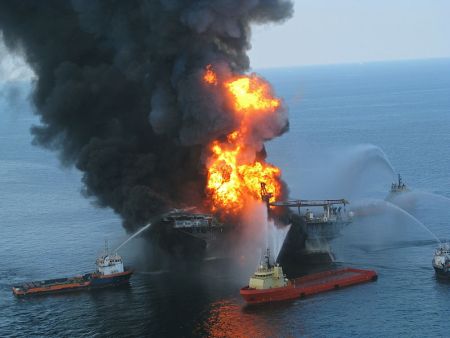
The Obama administration has accused BP of gross negligence and willful misconduct in causing the Deepwater Horizon oil spill of 2010. In a new court filing, the Department of Justice appears bent on blaming BP for the worst oil disaster in U.S. history.  The court document blasts BP’s leadership in no uncertain terms. Referring to “A Culture of Corporate Recklessness,” it states that “The behaviour, words and actions of these BP executives would not have been tolerated in a middling size company manufacturing dry goods for sale in a suburban mall.” It criticizes “the utter lack of any semblance of investigation of the systemic management causes deeply implicating the corporate managers and leadership who caused and allowed the rig-based mechanical causes to fester and ultimately explode in a fireball of death, personal injury, economic catastrophe, and environmental devastation.”

Referring to a “negative pressure test” performed by BP and Transocean hours before the blowout, the report states, “That such a simple, yet fundamental safety-critical test could have been so stunningly, blindingly botched in so many ways, by so many people, demonstrates gross negligence.”  The designation of “gross negligence” under the Clean Water Act, is an important distinction because it would mean the company could face $21 billion in civil damages alone—almost quadruple the penalty if “gross negligence” is not confirmed. BP also faces criminal charges.

The case may not go to trial, which is scheduled to begin January 14. Both sides are negotiating to reach a settlement to resolve both civil and criminal violations.  The Justice Department reportedly sought a $25 billion agreement from BP, but now may be willing to settle for $15 billion.

Justice Dept. Accuses BP of “Gross Negligence” over Gulf Oil Spill, AllGov.com, Sept. 7, 2012

Canada and its Nuclear Waste

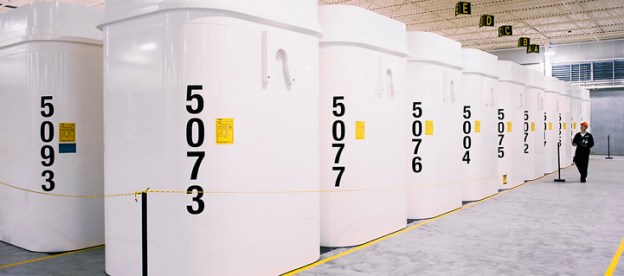
Since the 1960s,  Canada’s nuclear power plants have generated more than two million bundles of highly radioactive used fuel. And they’re all still stored on the sites of the plants that produced them.But the pace of finding a site to store Canada’s most potent radioactive waste permanently is about to pick up.  Twenty Canadian communities have said they’ll consider volunteering to host the storage site.  That list is about to close. The Nuclear Waste Management Organization, whose job it is to find and build the site, will stop taking new names on Sept. 30, 2012.  The impending cut-off is ratcheting up the pressure on the technocrats charged with selecting a site; on the boosters who want to snare the multi-billion-dollar repository for their community; on the activists who harbour deep suspicions about safety; and on the aboriginal leaders who say they’ve been cut out of the process….

A fuel bundle for a Candu nuclear power reactor is about the size of a fireplace log. As of June 30, 2011, Canada had 2,273,873 used fuel bundles stored at its nuclear plants in Ontario, Quebec and New Brunswick.  Another 85,000 or so have been added since then.  In total, they’d fill about six NHL hockey rinks, stacked up as high as the boards.

The Nuclear Waste Management Organization, formed by the three electric utilities that run nuclear reactors, wants to bury the waste deep underground in caverns excavated from stable rock, where it can lie undisturbed forever.  The depth will probably depend on the site’s geology. A facility proposed to hold less-potent radioactive waste at the Bruce nuclear site near Kincardine will be 680 metres deep. By comparison, the CN Tower is 553 metres tall.  The NWMO is looking for a “willing” community to agree to take the $16-to-$24-billion project. The host community itself will decide how to define “willing.” Candidate communities will have multiple opportunities to withdraw if they get cold feet, the NWMO says.  As it moves through a nine-stage selection process, the NWMO hopes to have narrowed the field to one or two communities by 2015, then spend until about 2020 deciding on a specific site within the chosen community.  After that, it will take three to five years to do an extensive environmental assessment of the site. The proponents will also have to satisfy the Canadian Nuclear Safety Commission that their plan makes sense, and obtain a license to construct and operate the facility.  Then, it will take six to 10 years to build. The NWMO doesn’t expect the first bundles to be stored until 2035.  The plan is to seal the waste in sturdy, radiation-proof containers and store it deep in a stable rock formation where — even if the containers were to crack and leak — there’s be no danger of contaminating groundwater used by humans. (Although that’s the current strategy, the NWMO says it would consider a different plan if compelling evidence emerged that another technique is superior.)

Current designs call for surface buildings and facilities to cover about 100 hectares (250 acres), says the NWMO’s Michael Krizanc.  “As well, there may be a need to limit activities in the immediate area surrounding the surface facilities in order to meet regulatory or other requirements.”  Underground, the excavated caverns will cover an area of about 2.5 kilometres by 1.5 kilometres. That’s 375 hectares, or 930 acres.  “The NWMO would need to have rights to the land above the repository,” says Krizanc, but “alternative uses could be considered, with the community, for portions of the land.”….

Meanwhile in Saugeen Shores, a lively battle is under way as members of a citizens group dubbed save Save Our Saugeen Shores, or SOS, fights what they see as an attempt to impose the waste site on their community on the shore of the Great Lakes….SOS also worries that U.S. power plants might be able to force Canada to take U.S. nuclear waste in a Canadian waste site, through terms of the free trade agreement between the countries…..Up in Elliot Lake, contractors Stephen Martin and Marc Brunet can’t wait for the project to start….Elliot Lake has been identified with uranium since its founding, he shrugs: “We’re the uranium capital of the world…. This thing will be a tourist attraction. I think it’s the best thing that could happen.”

John Spears, Nuclear waste seeks a home, Toronto Star, Sept. 1, 2012

UNESCO World Heritage: Failed States and Kleptocratic Elites

UNESCO’s World-Heritage regime began life 40 years ago, when dozens of countries signed up to the idea that the world’s cultural and natural patrimony was under threat not only from “traditional causes of decay” but also because of “changing social and economic conditions”. Among those who endorsed the principle was the Republican administration of Richard Nixon, which gave remarkably high priority to conservation and the environment. (Since then, America has had a stormy relationship with UNESCO; it cut off payments to the agency last year, under a law which denies funding to any body that admits Palestine.)

In many poorer countries which host heritage sites, the biggest changes since 1972 have been exploding populations and a huge rise in global tourism, combined with a lack of the governance needed to cope with both phenomena. Angkor Wat, a temple complex in Cambodia, and the Inca fortress of Machu Picchu in Peru (pictured above) are often cited as places of world-historical importance where a vast influx of tourists may be causing serious damage. By recognising and thus publicising individual sites, UNESCO and other cultural watchdogs risk harming the cause of conservation, which would be better served if visitors to the country were spread around a broader range of places.

But there are no easy ways to maintain heritage sites in relatively poor countries; it requires delicate balancing acts, much local diplomacy and long-term engagement, according to organisations that work in that field. Even a well-functioning state, be it democratic or authoritarian, will fail to conserve monuments unless local people see an interest in maintaining their heritage and using it rationally, says Vincent Michael, new chairman of the Global Heritage Fund (GHF), based in California. The effort will collapse if cultural heritage is seen either as a pesky impediment to making money, or as something to be exploited for short-term gain. Nor should local economies ever be too reliant on tourism, which can fall as rapidly as it rises….

But in many places where sites are at risk, government either does not operate at all, or functions only in the interest of a kleptocratic elite. In some such places, so-called non-state players (from warlords to private firms to religious leaders) are about the only things that really function at all…

One of the biggest global challenges to conservation, says the WMF’s president, Bonnie Burnham, is that national agencies which control precious places (culture ministries, for example) often have no say over what goes on—in terms of development, transport or sanitation—in the surrounding areas. That is one of the obstacles to conserving Inca sites in Peru…

As part of her agency’s [UNESCO] effort to stop the traffic in stolen art, Ms Bokova  [UNESCO’s director-general]has started a dialogue—a constructive one, she says—with commercial auction houses. Perhaps she should also be talking more to tour operators, and even darker forces, from the conservationists’ viewpoint, like road-builders and mining companies.

Excerpts, The Heritage Debate: Living Treasure, Economist, July 14, 2012, at 73

Indigenous Peoples Rights and Energy Projects: the Inter-American Court of Human Rights

Deep in the rainforest, the village of Sarayaku is two days by river from the nearest town. But its 1,200 Kichwa Indians are now in the spotlight. On July 25th the Inter-American Court of Human Rights ruled that Ecuador’s government had ignored the rights of Sarayaku’s residents when granting permission for an energy project—putting governments in the Americas on notice that big physical investments are not legal until the indigenous people they affect have had their say.

The dispute began in 1996 when Petroecuador, the state oil firm, signed a prospecting deal with a consortium led by Argentina’s Compañía General de Combustibles (CGC). Much of the area it covered was the ancestral land of Sarayaku’s residents, who were not consulted. CGC later offered locals medical aid for their consent. Some villages signed up, but Sarayaku held out.  Nonetheless, by early 2003 CGC had drilled 467 boreholes around the town for seismic surveying, and packed them with 1,433kg of high explosives. They were never detonated, and remain buried in the forest. As well as felling trees and destroying a sacred site, the company ruined some of Sarayaku’s water sources. Work ceased in 2003, and CGC’s contract ended in 2010.

The court found that the state had breached the villagers’ rights to prior consultation, communal property and cultural identity by approving the project, and that CGC’s tests had threatened their right to life. It ordered the government to pay damages, clear the remaining explosives and overhaul its consultation process. In future affected groups must be heard in a plan’s “first stages…not only when the need arises to obtain the approval of the community.” However, the judges did not ban prospecting on Sarayaku lands. The right to consultation does not grant a veto.

The ruling will be studied closely in the myriad Latin American countries struggling to balance big investments with local rights. A narrow reading of the decision suggests that governments must tiptoe around indigenous concerns, but can act more boldly when other groups protest, since the ruling was based partly on the International Labour Organisation’s Indigenous and Tribal Peoples Convention.

The ruling also shows that the regional justice system has not lost its mettle. In 2011 the Inter-American Commission on Human Rights, which litigates cases at the court, asked Brazil to halt work on the huge Belo Monte dam because its neighbours were not given a sufficient chance to speak up. Brazil’s government, which had authorised the dam only after a long public debate, saw this as a violation of its sovereignty. It did not comply, and stopped contributing money to the commission.  The commission was weakened by angering the region’s biggest country and by the criticism that it had exceeded its mandate. After Brazil presented new evidence in the case, the commission reversed its stance on Belo Monte. Moreover, last month the Organisation of American States voted to draft a reform plan for the commission, which some fear could strip it of important powers. Ecuador was among the commission’s loudest critics.

The Sarayaku case was not as heated as Belo Monte, since Ecuador’s government had already promised to pay damages. However, the court’s decision did strongly reassert its right to intervene in development cases. Moreover, Ecuador’s government plans to tender a big chunk of the Amazon for oil exploration later this year, despite indigenous opposition. If neither side backs down and the protesters appeal, the court’s next ruling on development in Ecuador may be far more contentious.

Indigenous rights in South America: Cowboys and Indians, Economist,July 28, 2012, at 32

How to Falsify Radiation Levels: Japan

Japan’s Ministry of Health, Labor and Welfare is investigating a report that workers at the damaged Fukushima Daiichi nuclear power plant were told to use lead covers in order to hide unsafe radiation levels, an official said.The alleged incident happened December 1, nine months after a major earthquake and tsunami ravaged northern Japan and damaged the plant.”We’ll firmly deal with the matter once the practice is confirmed to constitute a violation of any law,” said the ministry official, who could not be named in line with policy.  An official with the plant’s operator, TEPCO, said the company received a report of the alleged incident Thursday from subcontractor Tokyo Energy & Systems. The report said a second subcontractor, Build-Up, created the lead covers and ordered workers to use them over their dosimeters, pocket-size devices used to detect high radiation levels.The TEPCO official could also not be named in line with policy.  okyo Energy & Systems said in its report that the workers never used the covers, the TEPCO official said. Japan’s Asahi Shimbun newspaper, however, reported Saturday that while some workers refused the orders to use the lead covers, nine others did use them for several hours.

The newspaper’s report cited plant workers, who described the lead covers as fitting snugly over the dosimeters inside the breast pockets of the workers’ protection suits.

TEPCO told CNN it ordered Tokyo Energy & Systems Inc. to conduct an investigation and is awaiting a reply.

Report: Japan nuclear workers told to hide radiation levels, CNN, July 21, 2012

Drug Markets, Patents and the Developing World

Sales of antiretroviral drugs in America and the five biggest European markets reached $13.3 billion in 2011, according to Datamonitor, a research outfit…. Publicly funded research has played a larger role in developing drugs for HIV than for other diseases. A study published last year in Health Affairs found that HIV drugs were three times as likely to involve a patent from the public sector. HIV also has special status among regulators. America’s Food and Drug Administration (FDA) created a faster way to review HIV drugs, allowing them on the market before the most expensive stage of clinical trials.

In total, public and private investment has yielded more than two dozen HIV drugs. In 1987 Burroughs-Wellcome (now part of GlaxoSmithKline) introduced the first one, tackling an enzyme that helps the virus progress inside human cells. In 1995 Hoffmann-La Roche, a Swiss drug firm, launched the first protease inhibitor, which interrupts the virus at a later stage of replication….One company stands out: Gilead, of California. A late entrant to the HIV race, Gilead quickly took the lead. Its strategy was simple: the more convenient the treatment, the better. In 2004 Gilead launched Truvada, a once-a-day, one-pill combination of two drugs. In 2006 it introduced Atripla, a once-a-day, one-pill combination of Truvada and another treatment. Atripla’s average wholesale price in America is nearly $25,000 per patient, per year. In 2011 its global sales reached $3.2 billion.  More good news for Gilead has come in recent weeks. An FDA panel recommended Truvada for preventive use: ie, to protect healthy people from contracting the virus. Another FDA panel endorsed Gilead’s new Quad pill, which is the simplest, most effective combination drug to date.

If the process for developing HIV drugs has been unusual, selling them has been even more so. America is the rich world’s biggest market, with 841,000 patients diagnosed—ten times as many as in Britain. More than 60% of HIV drugs in America are bought with public money. Insurers give HIV special treatment: patients are rarely pressed to buy the cheapest pills, as they might be if they had another disease.

Distributing drugs in poor countries is harder. A decade ago, hardly any poor people could afford them. At first, drugs firms handled this badly. In 1998, 39 big Western firms sued South Africa to protect their HIV patents. Global uproar ensued; the firms backed down in 2001.  Then two things changed. First, rich countries started donating vast sums to fight AIDS in poor ones. In 2000 there was less than $2 billion for HIV programmes each year; by 2010 there was $15 billion, thanks to the Global Fund to Fight AIDS, Tuberculosis and Malaria and George Bush junior’s President’s Emergency Plan for AIDS Relief (PEPFAR).

Second, the price of AIDS drugs plunged. In May 2000 a year’s “triple cocktail” therapy cost $10,000 or so. By 2011 the same pills sold for $62 in poor countries. PEPFAR cash buys generic versions of patented drugs, which may be supplied only to poor countries. Last year two drugmakers won most of PEPFAR’s contracts: Aurobindo, an Indian firm, and Matrix, an Indian firm acquired in 2007 by Mylan, an American one. PEPFAR’s bidding system keeps margins slim even by the standards of the generics industry, says Rajiv Malik, the president of Mylan. But volumes are huge.

Can treatment expand further? Despite the subsidies and the plunge in prices, less than half of those infected with HIV take HIV drugs. Those who do, however, live a long time, and they have to keep taking the pills. What’s more, new studies show that it helps to start treating patients early, so demand is sure to rise.  Alas, aid dipped in 2009 and 2010, thanks to the financial crisis. To make matters more complicated, there is a trade-off between more drugs and better ones. Most patients in poor countries get outdated pills, according to Médecins Sans Frontières. Allowing generics firms to copy yet more patented drugs might help. Since 2006 Gilead has licensed drugs to generics firms for 5% royalties. Last year it went further, agreeing to license drugs to a “patent pool” to centralise royalty deals for a range of firms. So far, however, Gilead is the only Western company to join….

There are two distinct HIV markets. In rich countries, many good treatments jostle for market share. The best will generate fat profits, since patients have to take their pills every day. But Datamonitor predicts that growth will slow after 2017, as many drugs lose patent protection and prices crash. In poor countries, by contrast, Big Pharma makes very little money but the most efficient copycats thrive. Meanwhile, the world still waits for a cure.

The business of HIV: Battling the virus, Economist, June 2, 2012,at 80

Chevron and Amazon: the $18 billion Ecuador Liability

The D.C. Circuit Court of Appeals  on June 12, 2012  (pdf) dealt another setback to Chevron over its $18 billion Ecuador liability, reversing a lower court decision that allowed the oil giant access to documents from a prominent consulting group for the Amazon rainforest communities that sued the company.