Monthly Archives: January 2026

Owning Nuclear Submarines: the Benefits

President Trump has given approval  in October 2025 for South Korea to build a nuclear-powered submarine in the U.S., granting Seoul a coveted piece of hardware that could rattle China and North Korea—and potentially spark a race by its Asian neighbors to acquire similar technology. The stealthy submarine—which is difficult to detect because it can stay underwater…

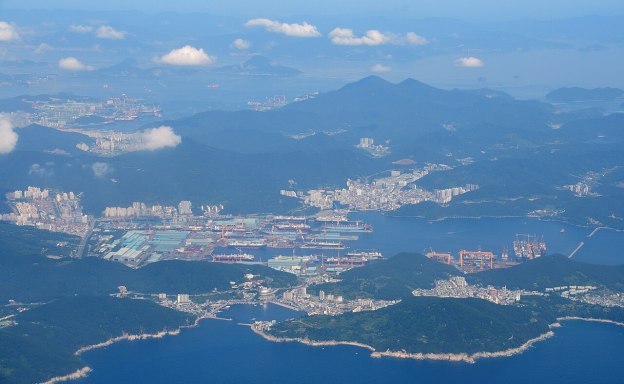
It often takes the U.S. more than five years, if not much longer, to make one…Trump said the submarine will be made at a shipyard in Philadelphia owned by a South Korean firm, Hanwha Ocean, which purchased the facility in 2024. Hanwha makes large naval submarines in South Korea, but this would be its first nuclear-powered sub….

The U.S. maintains considerable military dominance underwater across the Indo-Pacific due to its nuclear-powered subs. With roughly 70 of them, the U.S.’s nuclear-submarine fleet outnumbers China by more than five to one…. But China is rapidly catching up, aided by diesel-powered submarines that are quieter, travel faster and can carry advanced weapons.

Excerpt from Timothy W. Martin, As China Raises Pressure, U.S. to Support Seoul in Building Nuclear-Powered Sub, WSJ

How to Make Money No Matter What

Sales of U.S. weapons to Israel have surged since October 2023, with Washington approving more than $32 billion in armaments, ammunition and other equipment to the Israeli military…Israel responded to the Oct. 7, 2023, attack led by Hamas, which killed about 1,200 people and took 251 hostages, with a military invasion that has killed more than 68,000 people in Gaza—including more than 18,000 children—according to Gaza health authorities…The fighting throughout the region has presented a fresh opportunity for defense companies in the American heartland and, to a lesser extent, tech giants on the West Coast…

The American company that has brought in the most Israeli business since the Gaza war began is Boeing. The U.S. greenlighted an $18.8 billion sale of Boeing F-15 strike fighters in 2024 to Israel for delivery beginning in 2029. In 2025, various partnerships in which Boeing plays a leading role got approval for $7.9 billion of sales of guided bombs and associated kits…The biggest defense sales approved by Washington are for jet fighters and airborne-guided bombs, reflecting the crucial role of aerial bombings in the conflict…Israel’s Eitan armored fighting vehicles, which have been used widely across Gaza, are equipped with a hull from Wisconsin-based Oshkosh and an engine made by Rolls-Royce’s U.S. unit in Michigan. Caterpillar’s D9 armored bulldozers—used to clear rubble and destroy residences and other structures in Gaza—have been ubiquitous.

In some cases, companies have faced a backlash from investors and employees over their sales to the Israeli military. In 2024, three Norwegian investment funds have sold their stakes in Oshkosh, Palantir Technologies, Caterpillar and Thyssenkrupp over the use of their products for the war in Gaza. On Oct. 1 2025, Dutch pension fund ABP—the biggest in the Netherlands, with more than $400 billion under management—sold its €387 million, or $448 million, stake in Caterpillar, citing concerns over Gaza.

In September 2025, Microsoft disabled the Israeli Defense Ministry’s access to some cloud services in response to staff protests. Before the war began, Microsoft and a partnership between Alphabet-owned Google and Amazon.com had clinched deals with Israel to provide artificial-intelligence and cloud-computing services to the military. Meanwhile, AI giant Palantir, co-founded by Trump ally Peter Thiel, entered into a partnership with the Israeli Defense Ministry in January 2024. At a May 2025 conference, Palantir Chief Executive Alex Karp responded to accusations from a protester that Israel used Palantir’s technology to kill Palestinians, saying that those who were killed were “mostly terrorists.”

American companies have also found business opportunities in responding to the humanitarian crisis sparked by the war. The U.S. State Department said in June 2025 that it had allocated $30 million to the Gaza Humanitarian Foundation, led by former Trump adviser Johnnie Moore, to oversee aid handouts. The foundation hired American contractors Safe Reach Solutions and UG Solutions to provide security for the distribution efforts, which have been beset by dysfunction and violence.

In its 2025 annual report, Lockheed Martin said it had benefited from increased American defense funding related to Israel and Ukraine, notably munitions purchases. Revenue at its missiles division rose 13% last year to $12.7 billion…Armored-vehicles maker Oshkosh said an Israeli order of tactical vehicles had extended the lifespan of a production line that was due to shut in 2024.  In its latest 2025 report, Italian contractor Leonardo, whose U.S. unit is selling tanker trailers to Israel, said its international sales should remain stable in 2025 because of “the continuing conflicts in both Ukraine and Israel.”

Excerpt from Benoit Faucon, The Gaza War Has Been Big Business for U.S. Companies, WSJ, Nov. 12, 2025

The Essentials and the Expendables: the New Division of Humanity

For Lynn Lee, at 65, it was her fourth layoff in April 2025. Yet tears still rushed down her cheeks.“I remember thinking, ‘What are the odds this would happen again?’ ” Lee said. Lee has survived a rolling tide of economic forces that have transformed manufacturing in rural America. The textile plants that moved to Brazil in the mid-2000s. The glass-fiber plant that shut down several years later. The sign-making company that shed workers during the Covid-19 pandemic. After each layoff, Lee found something new. Now, she was at retirement age. But like many older Americans with little savings and heavy financial burdens, retirement was out of the question.

She had $7,000 in mostly out-of-pocket medical debt left over from breast-cancer treatment in 2020 and a heart procedure in 2024. Plus, there was the $42,000 she still owed from a second mortgage on her home.Lee was back to searching for work. This time, she would be competing against a legion of other job seekers in an unforgiving market. Nearly a quarter of unemployed people have been without a job for at least 27 weeks. …Excerpt from The Bruising Reality of Searching for a Job at 65, WSJ, Dec. 26, 2025

According to Jack Clark, co-founder of Anthropic: “By the summer of 2026, I expect that many people who work with frontier AI systems will feel as though they live in a parallel world to people who don’t. And I expect this will be more than just a feeling – similar to how the crypto economy moved oddly fast relative to the rest of the digital economy, I think we can expect the emerging “AI economy” to move very fast relative to everything else… But a crucial difference is that the AI economy already touches a lot more of our ‘regular’ economic reality than the crypto economy.” Excerpt from Import AI 438: Siren sirens, flashing for us all, by Jack Clark, Dec. 22, 2025

The Dirty Job of Cracking Rocks for Oil-Toxic Water

Producers in the Permian Basin of West Texas and New Mexico extract roughly half of the U.S.’s crude oil. They also produce copious amounts of toxic, salty water, which they pump back into the ground. Now, some of the reservoirs that collect the fluids are overflowing—and the producers keep injecting more. A buildup in pressure across the region is propelling wastewater up ancient wellbores, birthing geysers that can cost millions of dollars to clean up. …Swaths of the Permian appear to be on the verge of geological malfunction.

When pressure of the injected into the ground wastewater exceeds 0.5 pound per square inch per foot, the liquid…can flow to the surface and pose a risk to underground sources of drinking water.

The fracas above ground is raising questions about how the Permian can sustain red-hot production without causing widespread environmental damage that could leave taxpayers on the hook—and complicate the region’s economic plans. The basin is trying to lure data centers with cheap land and energy and has plans to become a hub for burying carbon dioxide captured at industrial plants and sucked out of the air.

“You need to have a stable, locked-down geology that’s going to behave as it’s supposed to,” said Adam Peltz, a director at the Environmental Defense Fund, a nonprofit advocacy group. “Otherwise, you’re going to cause a huge, expensive mess that Texans will pay for for generations.” The industry is working to clean up its act, but solutions to treat and ditch meaningful volumes of water far from the oil fields remain years away.

In the Delaware portion of the Permian, its most prolific region, drillers crank out between 5 and 6 barrels of water, on average, for every barrel of oil. For years, they pumped the toxic water deep into the ground—and triggered hundreds of earthquakes, some with a magnitude of over 5. They caused little damage in the sparsely populated Permian, but they were felt as far as Dallas, El Paso and San Antonio, where a historic building was damaged.

In 2021, the Railroad Commission of Texas, the agency that oversees the oil-and-gas industry in the state, began cracking down on deep disposal. Companies pivoted to shallow reservoirs, which now absorb roughly three-quarters of the billions of barrels of water that they inject in the Permian every year. The shift largely cured the tremors but has created unintended consequences. 

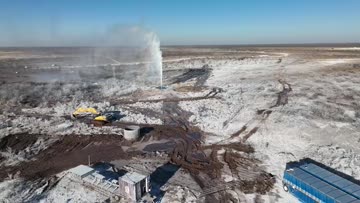
As more and more of toxic water is injected in shallow underground reservoirs pressure is built and the toxic water migrates up some of the decaying wells that litter the Permian erupting back on the surface. In 2022, a 100-foot column of toxic water erupted from an abandoned well in Texas’ Crane County near the unincorporated community of Tubbs Corner. Chevron, which owned the well, plugged it. But nearly two years later, water started to ooze from a different well in the same area, a sign that bottling up the geyser likely repressurized the subsurface and triggered the new outburst, scientists said. It took the Railroad Commission about 53 days and roughly $2.5 million to plug that leak. Eventually, the agency quietly shut in the injection wells that it said were likely causing the increase in pressure.

Researchers at the Bureau of Economic Geology painted a critical picture of the frenzied injection in the Permian basin. Operators were injecting wastewater with little concern over how it might travel underground or its impact on reservoir pressure, they said.

Excerpt from Benoît Morenne et al., America’s Biggest Oil Field Is Turning Into a Pressure Cooker, WSJ, Dec. 25, 2025