Author Archives: Stoa

Mini Bombs: the CLAW

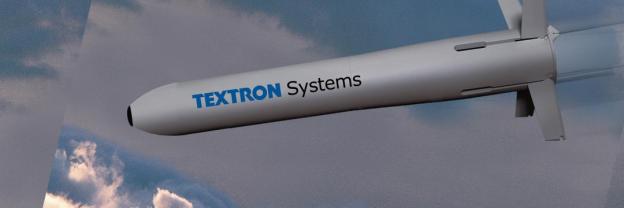
Textron Defense Systems, announced  that it has entered into a cooperative research and development agreement (CRADA) with the U.S. Special Operations Command (USSOCOM) Program Executive Office (PEO) Fixed Wing for development of standoff precision guided munition capability. Initial activities will focus on Textron Defense Systems’ Guided Clean Area Weapon (G-CLAW), a cost-effective, lightweight, guided precision unitary weapon providing anti-personnel and anti-material capabilities, as well as features for low collateral damage and hazardous unexploded ordnance (UXO) prevention.

Under the CRADA, the organizations intend to integrate the G-CLAW into PEO Fixed Wing’s common launch tube dispenser and complete the required testing to secure flight and weapons safety certifications. From there, Textron Defense Systems and USSOCOM will conduct inert and live-fire demonstrations of precision unitary munition delivery from a tactical carrier aircraft such as the MC-130W Dragon Spear. Integration activities will culminate in an end-to-end, live-fire demonstration.

Our G-CLAW allows users to shape the attack over a broad area, and to achieve precision effects using GPS targeting and a powerful warhead,” says Senior Vice President and General Manager Ellen Lord of Textron Defense Systems. “Further, it incorporates all of the safety features we’ve carefully designed, developed, tested and demonstrated to prevent UXO. Integrating this unitary system into the USSOCOM common launch tube could bring G-CLAW capabilities and performance to multiple new aircraft platforms for the gamut of irregular warfare missions.”

Textron Defense Systems’ weapons incorporate multiple, redundant safety features, including self-destruct and self-neutralization mechanisms, to eradicate the threat of UXO. The G-CLAW is designed for flexible integration into tactical munitions dispensers, as well as from unmanned aircraft platforms.

Textron Defense Systems and USSOCOM Enter CRADA for Standoff Precision Guided Munitions, Globe Newswire, Aug. 27, 2012

US Cyberattacks against Enemies: Afghanistan

The U.S. military has been launching cyberattacks against its opponents in Afghanistan, a senior officer says, making an unusually explicit acknowledgment of the oft-hidden world of electronic warfare.  Marine Lt. Gen. Richard P. Mills’ comments came last week at a conference in Baltimore during which he explained how U.S. commanders considered cyber weapons an important part of their arsenal.  “I can tell you that as a commander in Afghanistan in the year 2010, I was able to use my cyber operations against my adversary with great impact,” Mills said. “I was able to get inside his nets, infect his command-and-control, and in fact defend myself against his almost constant incursions to get inside my wire, to affect my operations.”

Mills, now a deputy commandant with the Marine Corps, was in charge of international forces in southwestern Afghanistan between 2010 and 2011, according to his official biography. He didn’t go into any further detail as to the nature or scope of his forces’ attacks, but experts said that such a public admission that they were being carried out was itself striking.  “This is news,” said James Lewis, a cyber-security analyst with the Washington-based Center for Strategic and International Studies. He said that while it was generally known in defense circles that cyberattacks had been carried out by U.S. forces in Afghanistan, he had never seen a senior officer take credit for them in such a way.  “It’s not secret,” Lewis said in a telephone interview, but he added: “I haven’t seen as explicit a statement on this as the one” Mills made.  The Pentagon did not immediately respond to an email seeking comment on Mills’ speech.

U.S. defense planners have spent the past few years wondering aloud about how and under what circumstances the Pentagon would launch a cyber attack against its enemies, but it’s only recently become apparent that a sophisticated program of U.S.-backed cyberattacks is already under way.  A book by The New York Times reporter David Sanger recently recounted how President Barack Obama ordered a wave of electronic incursions aimed at physically sabotaging Iran’s disputed atomic energy program. Subsequent reports have linked the program to a virus dubbed Flame, which prompted a temporary Internet blackout across Iran’s oil industry in April, and another virus called Gauss, which appeared to have been aimed at stealing information from customers of Lebanese banks. An earlier report alleged that U.S. forces in Iraq had hacked into a terrorist group’s computer there to lure its members into an ambush.

Herbert Lin, a cyber expert at the National Research Council, agreed that Mills’ comments were unusual in terms of the fact that they were made publicly. But Lin said that the United States was, little by little, opening up about the fact that its military was launching attacks across the Internet.  “The U.S. military is starting to talk more and more in terms of what it’s doing and how it’s doing it,” he said. “A couple of years ago it was hard to get them to acknowledge that they were doing offense at all — even as a matter of policy, let alone in specific theaters or specific operations.”

Mills’ brief comments about cyberattacks in Afghanistan were delivered to the TechNet Land Forces East conference in Baltimore on Aug. 15, but they did not appear to have attracted much attention at the time. Footage of the speech was only recently posted to the Internet by conference organizers

Marine General: We Launched Cyberattacks Against Afghanistan, CBS News, Aug. 24, 2012

Foreign Soldiers who Die in Afghanistan: the insider attacks

At the height of this dusty summer, American troops are dying at unprecedented rates at the hands of their Afghan allies. And both sides are struggling to explain why, even as they search for ways to stem what are known in military parlance as “insider” attacks.  This month, at least 10 U.S. troops — including a U.S. service member shot Sunday and five members of America’s elite special-operations forces slain earlier — have been killed by Afghan police, soldiers or civilian workers at military installations. As of Sunday, that accounted for a stunning 32% of the 31 American military fatalities in Afghanistan reported thus far in August by the monitoring website icasualties.org.  [I]nsider shootings have wider-ranging repercussions. They have provided a propaganda bonanza to the Taliban, and could threaten a linchpin of the Western exit strategy: training Afghan security forces in preparation for handing over most fighting duties to them by 2014.

The military says only a very small share of insider attacks is carried out by Taliban “sleepers” in the police or army. But that opens the way to perhaps an even more alarming conclusion: that the majority of the assailants are undertaking what are in effect spontaneous, self-assigned suicide missions, because many insider shooters are killed on the spot in return fire.

The military says it is working to address the threat. Changes in recent months have included the posting of armed Western troops — so-called guardian angels — to watch over others in mess halls, sleeping tents and gyms. Last week, the American commander of the NATO force, Gen. John Allen, ordered that NATO troops across Afghanistan keep a loaded magazine in their weapons, even when on base.  This year, an Army captain described an informal buddy system at his base of troops signaling each other to keep a close watch on armed Afghans nearby, especially if one of their comrades was diverted by some task.  “‘Shona-ba-shona,’ OK,” the captain said, invoking the “shoulder-to-shoulder” slogan of the NATO force and its Afghan partners. “But also: ‘Eyes on, all times.'”…..

How to guard against such attacks is the subject of considerable debate in military leadership circles, because overtly heavy-handed measures can send a signal to the Afghans that they are not trusted, which can be taken as an insult. And in traditional Afghan culture, perceived insult can swiftly lead to exactly the sort of violence the attacks represent…The phenomenon is so pervasive that the killings have their own evolving nomenclature. Previously, the military called them green-on-blue attacks, a color-coded reference to Afghan and Western forces. Now the preferred, more encompassing term is “insider threat,” stemming from the fact that assailants have included not only uniformed police and soldiers, but also civilian members of the Afghan security apparatus, or simply someone with access to a coalition base, even in a low-level capacity.

The Taliban movement has noted the rising number of insider shootings with ill-concealed delight, boasting of having infiltrated all branches of the Afghan security forces. In the past, the Taliban leadership claimed responsibility for virtually every such attack, but lately the group’s publicity machine often cites individual initiative by those without links to the insurgency.  “Our fighters are in the ranks of the police, army and intelligence service, but there are also some who carry out attacks on foreign troops only because they are Afghans and Muslims and act on their religious obligation to protect their country from invading forces,” said Zabiullah Mujahid, a spokesman for the group. “It is an indication of utter hatred against the foreigners.”…….

Some analysts believe part of the problem is the sheer longevity of the war, now in its 11th year. In the conflict’s early stages, such attacks were an extreme rarity.  “I wouldn’t say it’s normal, but I think it’s understandable in a war situation which is lasting for more than a decade,” said Fabrizio Foshini of the Afghan Analysts Network. “The conflict has been becoming worse, nastier — and the presence of foreign troops doesn’t seem in the eyes of many Afghans to have brought positive changes.”

Laura King, Afghanistan ‘insider’ attacks pose threat to West’s exit strategy, LA Times, August 20, 2012

Torture Techniques in Clandestine Prisons

The al Qaeda suspects who were subjected to so-called harsh interrogation techniques, and the lawyers charged with defending them at the Guantanamo Bay military tribunals, are not allowed to talk about the treatment they consider torture.  Defense attorneys say that and other Kafkaesque legal restrictions on what they can discuss with their clients and raise in the courtroom undermine their ability to mount a proper defense on charges that could lead to the death penalty.  Those restrictions will be the focus of a pretrial hearing that convenes this week.  Prosecutors say every utterance of the alleged al Qaeda murderers, and what their lawyers in turn pass on to the court, must be strictly monitored precisely because of the defendants’ intimate personal knowledge of highly classified CIA interrogation methods they endured in the agency’s clandestine overseas prisons.  Defense attorneys called that view extreme.  “Everything is presumptively top secret. So if my client had a tuna fish sandwich for lunch, I couldn’t tell you that,” Cheryl Bormann, who represents defendant Walid bin Attash, said after the May arraignment of the men charged with plotting the 9/11 attacks on the World Trade Center.  At one point in the arraignment, another of bin Attash’s attorneys, Air Force Captain Michael Schwartz, was explaining why his client refused to cooperate. Just when things got interesting, a security officer cut the audio feed to the media and others observing the proceedings from behind a soundproof glass wall with a 40-second audio delay.  “The reason for that is the torture that my client was subjected to by the men and women wearing the big-boy pants down at the CIA, it makes it impossible …,” Schwartz said during the blocked portion of the arraignment, according to a partial transcript later declassified.  Prosecutors have said in court filings that any revelations about the defendants’ interrogations could cause “exceptionally grave damage.”

Civil libertarians argue that if those interrogation methods really are top secret, then the CIA had no business revealing them to al Qaeda suspects.  Defense attorneys will challenge the secrecy rules at the pretrial hearing that begins on Wednesday at the Guantanamo Bay U.S. Naval Base.  Prosecutors have about 75,000 pages of evidence to turn over to defense attorneys in the 9/11 case, but they won’t do it until the judge, Army Colonel James Pohl, issues protective orders aimed at safeguarding the material.

Hundreds of men suspected of supporting al Qaeda or the Taliban were rounded up in Afghanistan, Pakistan and elsewhere and shipped to Guantanamo in response to the September 11 attacks. (Of the 779 men who have been held at Guantanamo since the prison operation began in 2002, 168 remain.)  The CIA took custody of the “high-value” captives believed to have top-level information that could help the U.S. and its allies prevent further attacks.  It held them incommunicado for three or four years and transferred them among secret overseas prisons, questioning them with interrogation methods that defense attorneys say amounted to torture and which the Obama administration has since banned.  Some details of the program, including waterboarding, mock executions and sleep deprivation, have already been disclosed by Bush and the CIA itself. Jose Rodriguez, a former CIA official, recently defended them in news interviews to promote his book, “Hard Measures: How Aggressive CIA Action After 9/11 Saved American Lives.”

Yet in both the 9/11 case and that of Abd al Rahim al Nashiri, who is accused of sending suicide bombers to ram a boat full of explosives into the side of the USS Cole off Yemen in 2000, the government presumes that every word spoken by the defendants, in the past and in the future, is classified at the highest level — “Top Secret,” with a “Sensitive Compartmented Information,” which is routinely shortened to TS/SCI.  The defendants’ words are also “born classified,” a status their lawyers said has previously been used only to safeguard details about nuclear weapons. So are all documents and legal motions related to their cases, which cannot be made public unless they’re cleared by a Department of Defense Security Classification Review team.  How that team works is a secret.  “I’ve never seen them. I’ve never communicated (with them). No one has ever been able to tell me that,” said James Connell, a lawyer for 9/11 defendant Ali Abdul Aziz Ali.  The Pentagon would say only that the review team includes both civilians and uniformed military personnel and that it can take up to 15 business days to make its decisions.

Proscribed topics include details of the defendants’ capture, where they were held and under what conditions, the names and descriptions of anyone who transferred, detained or interrogated them and the methods used to get information from them, according to the court documents.

Defense lawyers say the classification system used at Guantanamo violates President Barack Obama’s 2009 order that prohibits using secrecy labels to conceal lawbreaking or prevent political embarrassment. They say it also “eviscerates” the legal defense protections Congress set down in the law that authorizes the Guantanamo tribunals.  The government’s secrecy rules mean that every lawyer, paralegal and expert on the prosecution and defense teams must undergo an extensive background check and obtain a TS/SCI clearance. Once they get clearance, they are briefed on what has to stay secret. The document that forms the basis of the presumptive classification is itself secret.  “It is ridiculous,” said Army Captain Jason Wright, one of the lawyers for accused 9/11 mastermind Khalid Sheikh Mohammed. “The briefing is classified, so I can’t discuss what I can and cannot discuss.”
Mohammed’s lawyers have asked the UN special rapporteur for torture, Juan E. Mendez, to investigate claims that their client was tortured. But they could only share with Mendez the information that has been publicly declassified.  “We are prohibited from sharing any details of his mistreatment, even to the special rapporteur,” Wright said.

The American Civil Liberties Union has filed a challenge arguing that the government has no legal authority to classify information that it not only disclosed to the defendants but forced them to learn.  “The question here is: Can the government subject people to torture and abuse and then prevent them from talking about it?” said Hina Shamsi, director of the ACLU’s National Security Project.  The ACLU said the claim of broad authority to gag defendants infringes on the American public’s right to open trials and goes far beyond what the courts have allowed, namely that censorship must be narrowly tailored and aimed at protecting a compelling government interest.

Excerpt, Jane Sutton and Josh Meyer, Insight: At Guantanamo tribunals, don’t mention the “T” word, Reuters, Aug. 20, 2012

The Y-12: Nuclear Weapons Alive and Well

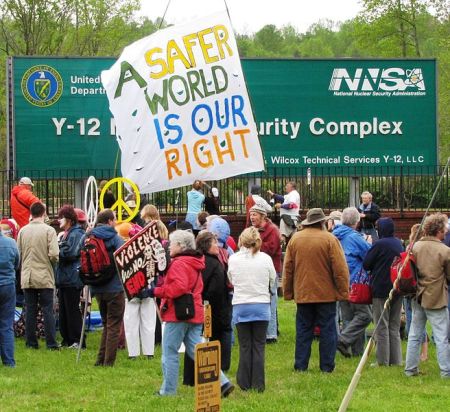
Nearly three weeks after a stunning security breach shut down the Y-12 nuclear weapons plant, the government on Wednesday (Aug. 15, 2012) authorized the restart of nuclear operations…..B&W Y-12, the managing contractor, ordered a “security stand-down” on Aug. 1, 2012 soon after the unprecedented intrusion July 28 by three Plowshares protesters, who reportedly scaled a ridge on the north side of Y-12 and walked all the way to the plant’s high-security inner core. The protesters …. used bolt-cutters to pass through a series of sensor-laden security fences and reach the fortresslike uranium storehouse, which they defaced with spray-painted protest messages and human blood. The breach raised deep questions about site vulnerabilities and prompted multiple investigations, which are still under way.The approval to restart nuclear operations has no bearing on the “show cause” notice that the National Nuclear Security Administration sent to B&W Y-12 last week, Wyatt said.

In the Aug. 10, 2015 letter to the contractor, the NNSA said security concerns raised by the break-in and the response to it were so severe as to potentially harm the ability to carry out the Y-12 contract. ….It wasn’t clear how long it would take Y-12 to get the uranium operations and other activities, including the dismantlement of old warhead parts, up and running or restart manufacturing programs.  In its “show cause” letter to B&W, the NNSA said a “high number” of cameras associated with the plant’s PIDAS (Perimeter Intrusion Detection and Assessment System) were inoperable at the time of the July 28, 2012intrusion in the predawn hours. ”

Excepts from   Frank Munge, Feds authorize restart of Y-12’s nuke operations,
Knoxville News Sentinel, Aug. 15, 2012

Who is Trapwire? CIA’s surveillance machinery

Trapwire is the name of a program revealed in the latest Wikileaks bonanza—it is the mother of all leaks, by the way….. “Former senior intelligence officials have created a detailed surveillance system more accurate than modern facial recognition technology—and have installed it across the U.S. under the radar of most Americans, according to emails hacked by Anonymous.  Every few seconds, data picked up at surveillance points in major cities and landmarks across the United States are recorded digitally on the spot, then encrypted and instantaneously delivered to a fortified central database center at an undisclosed location to be aggregated with other intelligence. It’s part of a program called TrapWire and it’s the brainchild of the Abraxas, a Northern Virginia company (has been acquired by Cubic corporation) staffed with elite from America’s intelligence community.  The employee roster at Arbaxas reads like a who’s who of agents once with the Pentagon, CIA and other government entities according to their public LinkedIn profiles, and the corporation’s ties are assumed to go deeper than even documented. The details on Abraxas and, to an even greater extent TrapWire, are scarce, however, and not without reason. For a program touted as a tool to thwart terrorism and monitor activity meant to be under wraps, its understandable that Abraxas would want the program’s public presence to be relatively limited. But thanks to last year’s hack of the Strategic Forecasting intelligence agency, or Stratfor, all of that is quickly changing.”  So: those spooky new “circular” dark globe cameras installed in your neighborhood park, town, or city—they aren’t just passively monitoring. They’re plugged into Trapwire and they are potentially monitoring every single person via facial recognition.

Excerpts, David Seaman, WIKILEAKS: Surveillance Cameras Around The Country Are Being Used In A Huge Spy Network, Businessinsider.com, Aug. 10, 2012

See also Top Secret America

The Alliance between CIA and Pakistan

And, perhaps most crucially, the two fractious allies’ top spies are talking again, with a view to enhancing their cooperation as the 2014 deadline for a withdrawal of U.S. troops from Afghanistan looms.   The relationship between the CIA and Pakistan’s Inter-Services Intelligence (ISI) agency has been at the core of Washington and Islamabad’s alliance for over a decade now — and sometimes the source of the mutual misery. After 9/11, both intelligence agencies collaborated closely to capture scores of al-Qaeda suspects. But over the past two years, as suspicions have grown, the two sides have become near adversaries.

The ISI is often accused of supporting jihadist proxies attacking U.S. and NATO troops in Afghanistan — and is widely considered to have been either incompetent or complicit when it came to Osama bin Laden’s presence in Pakistan. The CIA was found to be operating independently within Pakistan’s jealously guarded territory, running unauthorized contractors, recruiting local informants and showering drones at their fiercest pace yet.  But as bitter memories of those disputes begin to recede and new faces assume leadership roles, there is some cautious optimism going forward now — this despite domestic imperatives in both countries (an election year in the U.S., the heated anti-American populism in Pakistan) making rapprochement difficult. Last month the new head of ISI, Lieut. General Zaheer-ul-Islam, made his first visit to Washington, meeting with top intelligence, defense and Administration officials. Tentative agreements were made in terms of joint operations against militants in the region, the Wall Street Journal reported. But, officials from both sides say, fundamental differences linger.

Little is known about General ul-Islam, but a change at the top of ISI will please U.S. security officials. The previous ISI chief, now retired Lieut. General Ahmad Shuja Pasha, had become fiercely hostile to Washington in his final year — engaging in “shouting matches” with then CIA director Leon Panetta, cutting cooperation down to a minimum, ordering the harassment of U.S. diplomats in Pakistan and locking up Shakil Afridi, the physician who ran a vaccination program in the town where bin Laden was found hiding.

Afridi is currently serving a 33-year sentence handed down to him by a tribal court. The charges were not explicitly for spying for the U.S., but there is little doubt in observers’ minds that this is the reason he was punished. Afridi wasn’t arrested for the alleged offenses he has been convicted for until the ISI discovered his vaccination program and links to the CIA. At one point, according to a Pakistani military official familiar with the discussions, the CIA suggested that the ISI strip Afridi of his nationality and hand him over to the U.S. General Pasha angrily refused, saying it would set a bad precedent — one that could encourage others to spy for foreign countries if there were no consequences. U.S. Congressmen reacted angrily to Afridi’s imprisonment, voting to cut $33 million of U.S. assistance to Pakistan, one million for each year he’s serving in prison. The question of Afridi’s fate will likely have come up during ul-Islam’s visit to the U.S. There may be no movement soon, but if relations between Washington and Islamabad grow warmer, the ISI may eventually be persuaded to arrange for Afridi’s quiet release.

The harassment of U.S. officials hasn’t changed much, says a U.S. official. Vehicles are constantly stopped, security personnel searched with unusual rigor, and there is even pressure on the U.S. to abandon the construction of a new consulate in Peshawar. On other fronts, ul-Islam has maintained a low profile, a decision thought to be influenced by his predecessor’s controversial visibility. “Unlike General Pasha,” says a senior politician from Pakistan’s opposition Pakistan Muslim League-Nawaz party, “we don’t see the new head of the ISI interfering in politics — yet.”

During the new ISI chief’s visit, U.S. officials repeated their long-standing concerns about the Haqqani network, a potent jihadist group linked to al-Qaeda that is based in Pakistan’s North Waziristan tribal territory along the Afghan border. From their sanctuary there, say U.S. officials, the group contentedly plots terrorist attacks on U.S. and NATO troops in Afghanistan, before slipping back across the border. The ISI is widely suspected of offering the group support, with Admiral Mike Mullen, former Chairman of the Joint Chiefs of Staff, even describing the Haqqanis as “a veritable arm of the ISI” in his valedictory testimony before Congress last year.

The Pakistanis deny backing the Haqqanis but concede links with them and their reluctance to confront them. They plaintively cite a lack of resources and insist their priority is targeting militants mounting attacks inside Pakistan, but tellingly add that the Haqqanis will be crucial to any future Afghan settlement that Pakistan hopes to be a part of. But a series of unremitting, violent attacks in and around Kabul, authored by the Haqqanis, has intensified the pressure on the Pakistanis.

Last October, Pakistan’s army chief, General Ashfaq Kayani, discussed the possibility of “limiting the space” given to the Haqqanis in North Waziristan with Clinton during her visit to Islamabad. The Pakistani army said it had certain contingency plans in place for limited, surgical operations to reclaim territory in some of North Waziristan’s main towns. These plans were shelved soon after, with the deaths of the Pakistani soldiers in November 2011. Now, as pressure builds again, with enduring attacks and Congressmen calling for the Haqqani network to be designated as a foreign terrorist organization, the plans will have to be revisited. The new U.S. ambassador to Pakistan, Richard Olson, told U.S. lawmakers during his confirmation hearings last month that he will be committed to taking on the Haqqanis.

Without a Pakistani military operation against the Haqqanis, the CIA has focused on drone strikes against them and other militants in the region. The strikes, U.S. officials insist, are effective. Some Pakistani military officials also have conceded improved accuracy. But there are limits to what can be achieved by a drone-only strategy, and there are political costs. Drone strikes have not only become hugely unpopular in Pakistan, where the parliament has united in denouncing them, but also across the world. A Pew Research Center survey published in June found that majorities in countries as diverse as France, Germany, the Czech Republic, China, Japan, Brazil and Turkey opposed the widespread use of drone strikes.

An acknowledgment of the accumulating political costs may temper the frequency with which the CIA uses drone strikes. General David Petraeus, the new CIA director, is said to appreciate that the program is unsustainable. Previous CIA director Panetta was seen as being indulgent of “the CT guys and their shiny toys,” says the official. Drone strikes increased to a pace of one every four days at their height.

But there are certain points at which they are seen as a necessity — and they will continue to be used despite ul-Islam’s insistence last month in Washington that they stop. Just days after Clinton’s apology and the reopening of the NATO supply lines, a drone strike in North Waziristan reportedly killed 20 suspected militants. The actual figure, the U.S. official says, was lower. But it was a truck packed with explosives heading across the border. “It was a clear shot,” the official says. “We had to take it.” And that is one of the many differences in opinion that both sides will somehow have to learn to live with.

Omar Waraich.The CIA and ISI: Are Pakistan and the U.S.’s Spy Agencies Starting to Get Along?, Time, Aug. 7, 2012

Rogue Army or Rogue Soldiers? Haditha Massacre, Iraq

Defense Secretary Leon Panetta has directed a panel of experts to assess whether reforms are needed in the way the military justice system handles crimes committed by U.S. forces against civilians in combat zones, the Pentagon said on Friday (Aug. 3, 2012).  While the Pentagon said the decision was not linked to any specific case, it follows a spate of incidents in Afghanistan that have outraged the local population, including one in which a soldier is suspected of killing 16 villagers in a shooting rampage.   “There is no one case that motivates this,” said Jeh Johnson, the Pentagon’s top lawyer, who explained Panetta’s decision to undertake the review.  “We’ve now been in deployed areas for over 10 years,” he said. “We want to ask ourselves every once in a while: Is the system working like it should? Are there reforms that could be brought about to better apply military justice in deployed areas when the offense involves civilians?”

Panetta asked a subcommittee of the newly established Defense Legal Policy Board to review cases over the past decade in which U.S. forces committed crimes against civilians in Iraq and Afghanistan to see whether judicial procedures need to be improved.  “Abuses have been rare among our professional fighting force, but they became huge flash points that threatened to undermine our entire mission and the foundation of our relationship with the host government and its people,” Panetta said in a memorandum to the Pentagon leadership.  “For offenses that take place in a country in which we operate alongside the civilian population, it is critical that our system of military justice be efficient, fair, dependable and credible,” he added.

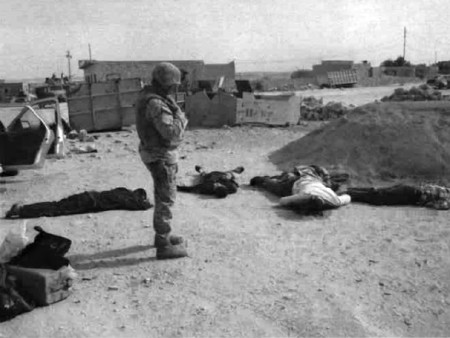
The review is expected to look into cases like the Haditha massacre in Iraq, where Marines killed 24 civilians. Of the eight Marines originally charged in the case, only one was found guilty — of dereliction of duty.  Cases like the one against Army Staff Sergeant Robert Bales, who is accused in the slayings of 16 Afghan civilians earlier this year, may not factor into the investigation. Panetta’s instructions call for the panel not to “intrude upon any pending case or investigation.”

The review panel will be led by former top Pentagon lawyer Judith Miller and retired Major General Walter Huffman, a former Army judge advocate general. While largely made up of lawyers, the panel also includes retired military commanders and a former police criminal investigator.  The group is expected to deliver a report within seven months to the Defense Legal Policy Board, which will review the findings before passing them to the defense secretary.

Panetta orders review of military justice in combat zones, August 03, 2012|David Alexander | Reuters

UNESCO World Heritage: Failed States and Kleptocratic Elites

UNESCO’s World-Heritage regime began life 40 years ago, when dozens of countries signed up to the idea that the world’s cultural and natural patrimony was under threat not only from “traditional causes of decay” but also because of “changing social and economic conditions”. Among those who endorsed the principle was the Republican administration of Richard Nixon, which gave remarkably high priority to conservation and the environment. (Since then, America has had a stormy relationship with UNESCO; it cut off payments to the agency last year, under a law which denies funding to any body that admits Palestine.)

In many poorer countries which host heritage sites, the biggest changes since 1972 have been exploding populations and a huge rise in global tourism, combined with a lack of the governance needed to cope with both phenomena. Angkor Wat, a temple complex in Cambodia, and the Inca fortress of Machu Picchu in Peru (pictured above) are often cited as places of world-historical importance where a vast influx of tourists may be causing serious damage. By recognising and thus publicising individual sites, UNESCO and other cultural watchdogs risk harming the cause of conservation, which would be better served if visitors to the country were spread around a broader range of places.

But there are no easy ways to maintain heritage sites in relatively poor countries; it requires delicate balancing acts, much local diplomacy and long-term engagement, according to organisations that work in that field. Even a well-functioning state, be it democratic or authoritarian, will fail to conserve monuments unless local people see an interest in maintaining their heritage and using it rationally, says Vincent Michael, new chairman of the Global Heritage Fund (GHF), based in California. The effort will collapse if cultural heritage is seen either as a pesky impediment to making money, or as something to be exploited for short-term gain. Nor should local economies ever be too reliant on tourism, which can fall as rapidly as it rises….

But in many places where sites are at risk, government either does not operate at all, or functions only in the interest of a kleptocratic elite. In some such places, so-called non-state players (from warlords to private firms to religious leaders) are about the only things that really function at all…

One of the biggest global challenges to conservation, says the WMF’s president, Bonnie Burnham, is that national agencies which control precious places (culture ministries, for example) often have no say over what goes on—in terms of development, transport or sanitation—in the surrounding areas. That is one of the obstacles to conserving Inca sites in Peru…

As part of her agency’s [UNESCO] effort to stop the traffic in stolen art, Ms Bokova  [UNESCO’s director-general]has started a dialogue—a constructive one, she says—with commercial auction houses. Perhaps she should also be talking more to tour operators, and even darker forces, from the conservationists’ viewpoint, like road-builders and mining companies.

Excerpts, The Heritage Debate: Living Treasure, Economist, July 14, 2012, at 73

Indigenous Peoples Rights and Energy Projects: the Inter-American Court of Human Rights

Deep in the rainforest, the village of Sarayaku is two days by river from the nearest town. But its 1,200 Kichwa Indians are now in the spotlight. On July 25th the Inter-American Court of Human Rights ruled that Ecuador’s government had ignored the rights of Sarayaku’s residents when granting permission for an energy project—putting governments in the Americas on notice that big physical investments are not legal until the indigenous people they affect have had their say.

The dispute began in 1996 when Petroecuador, the state oil firm, signed a prospecting deal with a consortium led by Argentina’s Compañía General de Combustibles (CGC). Much of the area it covered was the ancestral land of Sarayaku’s residents, who were not consulted. CGC later offered locals medical aid for their consent. Some villages signed up, but Sarayaku held out.  Nonetheless, by early 2003 CGC had drilled 467 boreholes around the town for seismic surveying, and packed them with 1,433kg of high explosives. They were never detonated, and remain buried in the forest. As well as felling trees and destroying a sacred site, the company ruined some of Sarayaku’s water sources. Work ceased in 2003, and CGC’s contract ended in 2010.

The court found that the state had breached the villagers’ rights to prior consultation, communal property and cultural identity by approving the project, and that CGC’s tests had threatened their right to life. It ordered the government to pay damages, clear the remaining explosives and overhaul its consultation process. In future affected groups must be heard in a plan’s “first stages…not only when the need arises to obtain the approval of the community.” However, the judges did not ban prospecting on Sarayaku lands. The right to consultation does not grant a veto.

The ruling will be studied closely in the myriad Latin American countries struggling to balance big investments with local rights. A narrow reading of the decision suggests that governments must tiptoe around indigenous concerns, but can act more boldly when other groups protest, since the ruling was based partly on the International Labour Organisation’s Indigenous and Tribal Peoples Convention.

The ruling also shows that the regional justice system has not lost its mettle. In 2011 the Inter-American Commission on Human Rights, which litigates cases at the court, asked Brazil to halt work on the huge Belo Monte dam because its neighbours were not given a sufficient chance to speak up. Brazil’s government, which had authorised the dam only after a long public debate, saw this as a violation of its sovereignty. It did not comply, and stopped contributing money to the commission.  The commission was weakened by angering the region’s biggest country and by the criticism that it had exceeded its mandate. After Brazil presented new evidence in the case, the commission reversed its stance on Belo Monte. Moreover, last month the Organisation of American States voted to draft a reform plan for the commission, which some fear could strip it of important powers. Ecuador was among the commission’s loudest critics.

The Sarayaku case was not as heated as Belo Monte, since Ecuador’s government had already promised to pay damages. However, the court’s decision did strongly reassert its right to intervene in development cases. Moreover, Ecuador’s government plans to tender a big chunk of the Amazon for oil exploration later this year, despite indigenous opposition. If neither side backs down and the protesters appeal, the court’s next ruling on development in Ecuador may be far more contentious.

Indigenous rights in South America: Cowboys and Indians, Economist,July 28, 2012, at 32

For the Fear of Iran: The Nuclear Power in the Gulf

Saudi Arabia is pressing ahead with its ambitious plans to develop nuclear power to meet rising electricity demand and save oil for export.  But the outlook for other Arab states is less promising because of political turmoil and a lack of financial resources.  The Saudis have built a foreign assets cushion of around $500 billion from oil exports. It has used this immense wealth to buy its way out of trouble; for instance, heading off pro-democracy protests with massive social spending in recent years.  But, the Middle East Economic Digest observed, “a more serious set of challenges now faces the kingdom that threaten to be even more destabilizing.  “Inefficient and wasteful energy consumption, coupled with a rising population, is leading the kingdom to burn even more of its natural resources at home rather than selling them abroad and adding to the proceeds of the half-trillion-dollar cash pile.  “Unless action is taken, the kingdom could find it needs the oil price to be $320 a barrel by 2030 just to balance the budget,” the weekly, published in the United Arab Emirates, warned.  Nuclear power is seen as the solution. But, as MEED stressed, “time is of the essence.”

For one thing, Saudi Arabia and other Arab states, including the United Arab Emirates, Kuwait, Qatar and Egypt, have no wish to lag any further behind Iran and Israel in developing nuclear technologies.  In 2010, the King Abdallah Center for Atomic and Renewable Energy, known as KAcare, was established to oversee the gulf state’s nuclear program under its president, Hashim bin Abdullah Yamani, who was accorded ministerial powers.  KAcare consultant Ibrahim Babelli said in 2010 it took 3.4 million barrels of oil equivalent a day — known as boe/d — to power electricity generation. This is expected to more than double by 2028 to 8.3 million boe/d.

The aim of the Saudis’ $100 billion nuclear program is to achieve an electricity output of 110 gigawatts by 2032.  The Financial Times reports that in 2009, the latest data available, Saudi electricity capacity was 52GW from 79 power stations.  At least 16 nuclear reactors, each costing around $7 billion, are planned, with the first producing by 2019.  Some estimates state the kingdom, the world’s largest oil exporter, will burn as much as 1.2 million barrels of oil daily on electricity production, almost double the 2010 total, to meet domestic and industrial demand.  This is crucial, as the Saudis are driving to build an industrial infrastructure to sustain the economy when the oil fields run down. Some have already begun to decline.  For total reliance on nuclear power, Babelli says, 40-60 reactors would be needed by 2030. That’s four-six reactors per year from 2020.  “That’s stretching it,” he said. “The answer is an energy mix.”

That means fossil fuels will still be needed, probably as the primary energy source, while wind, solar and nuclear power capabilities are developed. KAcare is developing solar power projects that MEES estimates should produce 41GW within 20 years with geothermal and waste-to-energy systems providing 4GW.  The Emirates, which launched its nuclear energy program in 2009, is the most advanced in the Arab world, with Saudi Arab running second.  The United Arab Emirates’ $30 billion program — $10 billion more than originally planned — is smaller in scale than that in Saudi Arabia.  Both states benefit from political stability and vast financial reserves. Other regional states are less fortunate.

Bahrain, Qatar, Kuwait, Egypt and Jordan all have announced plans to invest in nuclear energy to crank up electricity generation but all have lagged behind or scrapped their programs because of lack of funds or foreign investment.  “Kuwait has the cash,” MEED reported, “but it’s been through eight governments in the past six years.”  Sunni-ruled Bahrain, an island state neighboring Saudi Arabia, “continues to face destabilizing protests by its majority Shiite population and its budget is already in deficit.”  Egypt remains convulsed by the political turmoil that ensued following the February 2011 overthrow of President Hosni Mubarak, its economy sagging dangerously.  In Jordan, heavily reliant on foreign aid, parliament recently scrapped nuclear plans as “hazardous and costly.”  Failure to start boosting electricity generation for burgeoning populations in the coming decades almost certainly will mean more political upheavals.

Saudis, Emirates push nuclear power plans, UPI,July 26, 2012

The Next Pandemic and the US Military

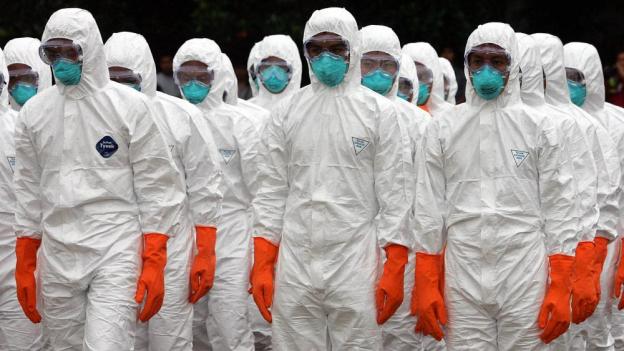
U.S. military forces are the front line of U.S. national security, but as a globally deployed force they are also on the front line of any new pathogen-based health threat that may emerge [including also due to biological warfare]. As overall human activity pushes ever further into previously undeveloped territory, the likelihood of exposure to new pandemic diseases increases.  The 2009 Army Posture Statement, cites a World Health Organization estimate of between 20 and 50 percent of the world’s population being affected if a pandemic were to emerge. WHO forecasts “it may be six to nine months before a vaccine for a pandemic virus strain becomes available.” In a separate report on pandemic influenza, the WHO describes several challenges to producing sufficient volumes of vaccine using current, egg-based protein-production technology, including the likelihood that two doses per person could be required due to the absence of pre-existing immunity.

In short, the potential for a pandemic exists and current technological limitations on defensive measures put the health and readiness of U.S. military forces at risk. A technological solution to increase the speed and adaptability of vaccine production is urgently needed to match the broad biological threat.

DARPA’s Blue Angel program seeks to demonstrate a flexible and agile capability for the Department of Defense to rapidly react to and neutralize any natural or intentional pandemic disease. Building on a previous DARPA program, Accelerated Manufacture of Pharmaceuticals, Blue Angel targets new ways of producing large amounts of high-quality, vaccine-grade protein in less than three months in response to emerging and novel biological threats. One of the research avenues explores plant-made proteins for candidate vaccine production.“Vaccinating susceptible populations during the initial stage of a pandemic is critical to containment,” said Dr. Alan Magill, DARPA program manager. “We’re looking at plant-based solutions to vaccine production as a more rapid and efficient alternative to the standard egg-based technologies, and the research is very promising.”

In a recent milestone development under Blue Angel, researchers at Medicago Inc. produced more than 10 million doses (as defined in an animal model) of an H1N1 influenza vaccine candidate based on virus-like particles (VLP) in one month….“The results we’ve achieved here with plant-based production of vaccines represent both significant increase in scale and decrease in time-to-production over previous production capabilities in the same time period. The plant-made community is now better positioned to continue development and target FDA approval of candidate vaccines,” Magill said. “Once the FDA has approved a plant-made vaccine candidate, the shorter production times of plant-made pharmaceuticals should allow DoD to be much better prepared to face whatever pandemic next emerges.”

DARPA Makes 10 Million Strides in the Race to Contain a Hypothetical Pandemic, July 25, 2012

How to Falsify Radiation Levels: Japan

Japan’s Ministry of Health, Labor and Welfare is investigating a report that workers at the damaged Fukushima Daiichi nuclear power plant were told to use lead covers in order to hide unsafe radiation levels, an official said.The alleged incident happened December 1, nine months after a major earthquake and tsunami ravaged northern Japan and damaged the plant.”We’ll firmly deal with the matter once the practice is confirmed to constitute a violation of any law,” said the ministry official, who could not be named in line with policy.  An official with the plant’s operator, TEPCO, said the company received a report of the alleged incident Thursday from subcontractor Tokyo Energy & Systems. The report said a second subcontractor, Build-Up, created the lead covers and ordered workers to use them over their dosimeters, pocket-size devices used to detect high radiation levels.The TEPCO official could also not be named in line with policy.  okyo Energy & Systems said in its report that the workers never used the covers, the TEPCO official said. Japan’s Asahi Shimbun newspaper, however, reported Saturday that while some workers refused the orders to use the lead covers, nine others did use them for several hours.

The newspaper’s report cited plant workers, who described the lead covers as fitting snugly over the dosimeters inside the breast pockets of the workers’ protection suits.

TEPCO told CNN it ordered Tokyo Energy & Systems Inc. to conduct an investigation and is awaiting a reply.

Report: Japan nuclear workers told to hide radiation levels, CNN, July 21, 2012

The Essence of Imperialism: Australia in the Pacific

Nor is it the first time Vanuatu has clashed with the Australian Federal Police (AFP). In 2004 its government closed down the AFP offices in the capital, Port Vila, and expelled officers, after allegations that they were spying and interfering with domestic politics. The AFP’s main concerns in Vanuatu have been over the country marketing itself vigorously as an international tax haven, and over the risk posed by the volatile Vanuatu Mobile Force, the paramilitary wing of the local police force. Protecting Australia’s national interests under the guise of so-called capacity-building can quickly lead to tensions.

The AFP’s activities in Vanuatu have been part of a broader expansion over the past decade of Australian policing across the Pacific. Peacekeeping missions to Timor-Leste since 1999 and to the Solomon Islands, beginning in 2003, boosted police numbers. In the past decade, the AFP has trebled in size and increased its budget fivefold. The AFP commissioner now has an influential role on the Australian cabinet’s national-security committee. In Australia most domestic policing is carried out by state police forces, leaving the federal force largely free, outside aboriginal communities in the Northern Territory, to focus on international deployments.

Their efforts have often led to accusations of heavy-handedness. In 2005 a mission to Papua New Guinea was abandoned after that country’s Supreme Court ruled that legal immunities granted to AFP officers were unconstitutional. In 2006 the Solomon Islands’ police chief, Shane Castles, an Australian, was sacked and declared an “undesirable immigrant” after a raid by his police officers on the office of the prime minister. That raid was connected with the AFP’s long-standing pursuit of the Solomon Islands’ then attorney-general, Julian Moti, on charges of sex with an underage girl. Mr Moti was deported to Australia in 2007, arrested and brought before the courts. In December 2011 the High Court threw the case out, finding that Australian officials had colluded in Mr Moti’s illegal deportation.

The Australian Federal Police in the Pacific: Booting out big brother, Economist, May 19, 2012, at 49

Resuscitating Collapsed Fisheries: catch shares

For American fish, this is a good time to be alive. On May 14th, 2012 the National Oceanic and Atmospheric Administration (NOAA) reported that a record six federal fisheries returned to health last year. After a decade of similar progress, 86% of America’s roughly 250 federally monitored commercial fish stocks were not subject to overfishing; 79% were considered healthy…

In the late 1980s cod fisheries in the Gulf of Maine and Georges Bank collapsed. This led to efforts to improve the fishery act, in 1996 and 2006, which forced the eight regional bodies that manage federal fisheries to introduce science-based quotas and ten-year recovery programmes for depleted fisheries. The recent recovery of species, including New England scallops, mid-Atlantic bluefish and summer flounder and Pacific lingcod, is the result. This signals another truth: given a break, the marine environment can often replenish itself spectacularly.

America’s fisheries are probably now managed almost as well as the world’s best, in Norway, Iceland, New Zealand and Australia. Yet there is plenty of room for improvement. State-run fisheries, which tend to be close to shore and dominated by small-scale and inefficient fishermen, are less well funded and well managed and much poorer for it. New England groundfish stocks, including cod, have also not recovered: they account for 13 of the remaining depleted populations. This appears to be partly the result of environmental change, climatic or cyclical.

And the politicians are still interfering. On May 9th the House passed legislation forbidding NOAA from developing an innovative means of apportioning fishing quotas, known as catch shares. These are long-term, aiming to give fishermen a stake in the future of their fisheries; market-based, since they can be traded; and, in practice, good for fish. Sadly, the two Republican congressmen behind the ban consider they have been designed “to destroy every aspect of American freedom under the guise of conservation”.

Fish stocks: Plenty more fish in the sea, Economist, May 26, 2012, at 32

Military Robots and Automated Killing

Military robots come in an astonishing range of shapes and sizes. DelFly, a dragonfly-shaped surveillance drone built at the Delft University of Technology in the Netherlands, weighs less than a gold wedding ring, camera included. At the other end of the scale is America’s biggest and fastest drone, the $15m Avenger, the first of which recently began testing in Afghanistan. It uses a jet engine to carry up to 2.7 tonnes of bombs, sensors and other types of payload at more than 740kph (460mph).

On the ground, robots range from truck-sized to tiny. TerraMax, a robotics kit made by Oshkosh Defense, based in Wisconsin, turns military lorries or armoured vehicles into remotely controlled or autonomous machines. And smaller robotic beasties are hopping, crawling and running into action, as three models built by Boston Dynamics, a spin-out from the Massachusetts Institute of Technology (MIT), illustrate.  By jabbing the ground with a gas-powered piston, the Sand Flea can leap through a window, or onto a roof nine metres up. Gyro-stabilisers provide smooth in-air filming and landings. The 5kg robot then rolls along on wheels until another hop is needed—to jump up some stairs, perhaps, or to a rooftop across the street. Another robot, RiSE, resembles a giant cockroach and uses six legs, tipped with short, Velcro-like spikes, to climb coarse walls. Biggest of all is the LS3, a four-legged dog-like robot that uses computer vision to trot behind a human over rough terrain carrying more than 180kg of supplies. The firm says it could be deployed within three years.

Demand for land robots, also known as unmanned ground vehicles (UGVs), began to pick up a decade ago after American-led forces knocked the Taliban from power in Afghanistan. Soldiers hunting Osama bin Laden and his al-Qaeda fighters in the Hindu Kush were keen to send robot scouts into caves first. Remote-controlled ground robots then proved enormously helpful in the discovery and removal of makeshift roadside bombs in Afghanistan, Iraq, and elsewhere. Visiongain, a research firm, reckons a total of $689m will be spent on ground robots this year. The ten biggest buyers in descending order are America, followed by Israel, a distant second, and Britain, Germany, China, South Korea, Singapore, Australia, France and Canada.

Robots’ capabilities have steadily improved. Upload a mugshot into an SUGV, a briefcase-sized robot than runs on caterpillar tracks, and it can identify a man walking in a crowd and follow him. Its maker, iRobot, another MIT spin-out, is best known for its robot vacuum cleaners. Its latest military robot, FirstLook, is a smaller device that also runs on tracks. Equipped with four cameras, it is designed to be thrown through windows or over walls.

Another throwable reconnaissance robot, the Scout XT Throwbot made by Recon Robotics, based in Edina, Minnesota, was one of the stars of the Ground Robotics Capabilities conference held in San Diego in March. Shaped like a two-headed hammer with wheels on each head, the Scout XT has the heft of a grenade and can be thrown through glass windows. Wheel spikes provide traction on steep or rocky surfaces. In February the US Army ordered 1,100 Scout XTs for $13.9m. Another version, being developed with the US Navy, can be taken to a ship inside a small aquatic robot, and will use magnetic wheels to climb up the hull and onto the deck, says Alan Bignall, Recon’s boss.

Even more exotic designs are in development. DARPA, the research arm of America’s Department of Defence, is funding the development of small, soft robots that move like jerky slithering blobs. EATR, another DARPA project, is a foraging robot that gathers leaves and wood for fuel and then burns it to generate electricity. Researchers at Italy’s Sant’Anna School of Advanced Studies, in Pisa, have designed a snakelike aquatic robot. And a small helicopter drone called the Pelican, designed by German and American companies, could remain aloft for weeks, powered by energy from a ground-based laser….

A larger worry is that countries with high-performance military robots may be more inclined to launch attacks. Robots protect soldiers and improve their odds of success. Using drones sidesteps the tricky politics of putting boots on foreign soil. In the past eight years drone strikes by America’s Central Intelligence Agency (CIA) have killed more than 2,400 people in Pakistan, including 479 civilians, according to the Bureau for Investigative Journalism in London. Technological progress appears to have contributed to an increase in the frequency of strikes. In 2005 CIA drones struck targets in Pakistan three times; last year there were 76 strikes there. Do armed robots make killing too easy?

Not necessarily….. Today’s drones, blimps, unmanned boats and reconnaissance robots collect and transmit so much data, she says, that Western countries now practise “warfare by committee”. Government lawyers and others in operation rooms monitor video feeds from robots to call off strikes that are illegal or would “look bad on CNN”, says Ms Cummings, who is now a robotics researcher at MIT. And unlike pilots at the scene, these remote observers are unaffected by the physical toil of flying a jet or the adrenalin rush of combat.

In March Britain’s Royal Artillery began buying robotic missiles designed by MBDA, a French company. The Fire Shadow is a “loitering munition” capable of travelling 100km, more than twice the maximum range of a traditional artillery shell. It can circle in the sky for hours, using sensors to track even a moving target. A human operator, viewing a video feed, then issues an instruction to attack, fly elsewhere to find a better target, or abort the mission by destroying itself. But bypassing the human operator to automate attacks would be, technologically, in the “realm of feasibility”, an MBDA spokesman says……

Traditional rules of engagement stipulate that a human must decide if a weapon is to be fired. But this restriction is starting to come under pressure. Already, defence planners are considering whether a drone aircraft should be able to fire a weapon based on its own analysis. In 2009 the authors of a US Air Force report suggested that humans will increasingly operate not “in the loop” but “on the loop”, monitoring armed robots rather than fully controlling them. Better artificial intelligence will eventually allow robots to “make lethal combat decisions”, they wrote, provided legal and ethical issues can be resolved…..

Pressure will grow for armies to automate their robots if only so machines can shoot before being shot, says Jürgen Altmann of the Technical University of Dortmund, in Germany, and a founder of the International Committee for Robot Arms Control, an advocacy group. Some robot weapons already operate without human operators to save precious seconds. An incoming anti-ship missile detected even a dozen miles away can be safely shot down only by a robot, says Frank Biemans, head of sensing technologies for the Goalkeeper automatic ship-defence cannons made by Thales Nederland.  Admittedly, that involves a machine destroying another machine. But as human operators struggle to assimilate the information collected by robotic sensors, decision-making by robots seems likely to increase. This might be a good thing, says Ronald Arkin, a roboticist at the Georgia Institute of Technology, who is developing “ethics software” for armed robots. By crunching data from drone sensors and military databases, it might be possible to predict, for example, that a strike from a missile could damage a nearby religious building. Clever software might be used to call off attacks as well as initiate them.

In the air, on land and at sea, military robots are proliferating. But the revolution in military robotics does have an Achilles heel, notes Emmanuel Goffi of the French air-force academy in Salon-de-Provence. As robots become more autonomous, identifying a human to hold accountable for a bloody blunder will become very difficult, he says. Should it be the robot’s programmer, designer, manufacturer, human overseer or his superiors? It is hard to say. The backlash from a deadly and well-publicised mistake may be the only thing that can halt the rapid march of the robots.

Robots go to war: March of the robots, Economist Technology Quarterly, June 2, 2012

Beyond GPS: All Source Positioning and Navigation

DARPA’s All Source Positioning and Navigation (ASPN) program seeks to enable low cost, robust, and seamless navigation solutions for military users on any operational platform and in any environment, with or without GPS. In particular, ASPN will develop the architectures,  abstraction methods, and navigation filtering algorithms needed for rapid integration and reconfiguration of any combination of sensors. This will enable rapid adaptation to evolving missions as well as reduction of the system integration costs and time-to-market for navigation solutions in general.

The goal of Phase 2 of ASPEN is to address the issues of optimization and real-time operation, showing capabilities beyond basic plug-and-play flexibility. Solutions must be capable of adapting to a diverse set of sensor and IMU inputs and selectively choosing the subset of measurements that produces the best possible solution, ideally mirroring the result from a tuned filter solution for that same scenario….Phase 2 solutions will need to demonstrate real-time operation in representative field (non-laboratory) environments. Although adaptability is the main goal of the ASPN program, the possibility of ASPN accuracy being substantially better than current state of art should be considered, given accommodation by ASPN of larger and more diverse sensor suites, ease of optimizing ASPN to immediate applications, and potential synergistic benefits of an open architecture.

What is In-Q-Tel? Technology Branch of CIA

Throughout its lifetime, the CIA has operated at the cutting edge of science and technology. From the U-2 spy plane to the CORONA satellite, CIA’s “wizards of Langley” earned a reputation for bold innovation and risk taking, working in advance of the private sector and other branches of government. Much of CIA’s technology success was a result of identifying gaps and opportunities.  By the late 1990s, the pace of commercial innovation had overtaken the ability of government agencies to develop and incorporate new technologies. Private industry represented technical insights and innovation far too important to ignore. Driven by private sector R&D investment, these commercial technologies addressed many of the same information technology, biotechnology, communications, and energy challenges that faced the Intelligence Community.

In 1998, CIA identified technology as a top strategic priority, and set out a radical plan to create a new venture that would help increase the CIA’s access to private sector innovation. In-Q-Tel was chartered in February 1999 by a group of private citizens at the request of the Director of Central Intelligence and with the support of the U.S. Congress. IQT was tasked with building a bridge between the Agency and a new set of technology innovators.

From the website IQT (2012)

Industrial Revolution in Genetic Engineering: Military

From DARPA’s Website: Living Foundries

Current approaches to engineering biology rely on an ad hoc, laborious, trial-and-error process, wherein one successful project often does not translate to enabling subsequent new designs. As a result, the state of the art development cycle for engineering a new biologically manufactured product often takes 7+ years and tens to hundreds of millions of dollars (e.g. microbial production of artemisinic acid for the treatment of malaria and the non-petroleum-based production 1,3-propanediol).

[DARPA Goal]

Transforming biology into an engineering practice would enable on-demand production of new and high-value materials, devices and capabilities for the Department of Defense (DoD) and address complex challenges that today have no or few solutions.

The Living Foundries Program seeks to create the engineering framework for biology, speeding the biological design-build-test cycle and expanding the complexity of systems that can be engineered. The Program aims to develop new tools, technologies and methodologies to decouple biological design from fabrication, yield design rules and tools, and manage biological complexity through abstraction and standardization. These foundational tools would enable the rapid development of previously unattainable technologies and products, leveraging biology to solve challenges associated with production of new materials, novel capabilities, fuel and medicines. For example, one motivating, widespread and currently intractable problem is that of corrosion/materials degradation. The DoD must operate in all environments, including some of the most corrosively aggressive on Earth, and do so with increasingly complex heterogeneous materials systems. This multifaceted and ubiquitous problem costs the DoD approximately $23 Billion per year. The ability to truly program and engineer biology, would enable the capability to design and engineer systems to rapidly and dynamically prevent, seek out, identify and repair corrosion/materials degradation.

Accomplishing this vision requires an approach that is more than multidisciplinary – it requires a new engineering discipline built upon the integration of new ideas, approaches and tools from fields spanning computer science and electrical engineering to chemistry and the biological sciences. The best innovations will introduce new architectures and tools into an open technology platform to rapidly move new designs from conception to execution.  Performers must ensure and demonstrate throughout the program that all methods and demonstrations of capability comply with national guidance for manipulation of genes and organisms and follow all guidance for biological safety and Biosecurity.

A Broad Agency Announcement (BAA) solicitation for phase one, Advanced Tools and Capabilities for Generalizable Platforms (ATCG), closed in November, 2011. The BAA called for the development of the advanced, translatable tools and capabilities that will make up an end-to-end technology platform for rapidly, safely and predictably engineering biological production systems. The goals of these advanced tools and capabilities are to compress the biological design-build-test cycle by at least 10x in both time and cost while increasing the complexity of the systems that can be designed and executed by orders of magnitude. These advancements should enable the ability to rapidly design and build new systems to create novel capabilities and to address complex challenges.

Kamikaze Drones: Shortening the Kill Chain

The 2-foot-long Switchblade drone [unmanned aerial vehicle (UAV)] is so named because its wings fold into the fuselage for transport and spring out after launch. It is designed to fit into a soldier’s rucksack and is fired from a mortar-like tube. Once airborne, it begins sending back live video and GPS coordinates to a hand-held control set clutched by the soldier who launched it.  When soldiers identify and lock on a target, they send a command for the drone to nose-dive into it and detonate on impact. Because of the way it operates, the Switchblade has been dubbed the “kamikaze drone.”

The Obama administration, notably the CIA, has long been lambasted by critics for its use of combat drones and carelessly killing civilians in targeted strikes in Pakistan, Afghanistan, Iraq, Yemen and Somalia. In 2010, a United Nations official said the CIA in Pakistan had made the United States “the most prolific user of targeted killings” in the world.

The Switchblade drone appears to be an improvement as an alternative to traditional drone strikes, in terms of minimizing civilian harm, but it also raises new concerns, said Naureen Shah, associate director of the Counterterrorism and Human Rights Project at Columbia Law School.  She pointed out that when a drone strike is being considered there are teams of lawyers, analysts and military personnel looking at the data to determine whether lethal force is necessary. But the Switchblade could shorten that “kill chain.”  “It delegates full responsibility to a lower-level soldier on the ground,” she said. “That delegation is worrisome. It’s a situation that could end up in more mistakes being made.”  Arms-control advocates also have concerns. As these small robotic weapons proliferate, they worry about what could happen if the drones end up in the hands of terrorists or other hostile forces.

The Switchblade “is symptomatic of a larger problem that U.S. military and aerospace companies are generating, which is producing various more exotic designs,” said Daryl Kimball, executive director of the Arms Control Assn. “This technology is not always going to be in the sole possession of the U.S. and its allies. We need to think about the rules of the road for when and how these should be used so we can mitigate against unintended consequences.”

The Switchblade is assembled in Simi Valley by AeroVironment Inc., the Pentagon’s top supplier of small drones, which include the Raven, Wasp and Puma. More than 50 Switchblades will be sent to the war zone in Afghanistan this summer under a $10.1-million contract, which also includes the cost of repairs, spare parts, training and other expenses. Officials would not provide details about where the weapons would be used, how many were ordered and precisely when they would be deployed.  AeroVironment, based in Monrovia, developed the weapon on its own, thinking the military could use a lethal drone that could be made cheaply and deployed quickly by soldiers in the field, said company spokesman Steven Gitlin.

“It’s not inexpensive to task an Apache helicopter or F-16 fighter jet from a base to take out an [improvised explosive device] team when you consider fuel, people, logistics support, etc.,” he said.

About a dozen Switchblades were tested last year by special operations units in Afghanistan, according to Army officials, who said the drone proved effective.  The Army is considering buying $100 million worth of the drones in a few years under a program called the Lethal Miniature Aerial Munition System, Nichols said. The Air Force and the Marine Corps have also expressed interest in the technology.

AeroVironment is not the only company pursuing small, lethal drones. Textron Defense Systems is also working on a small kamikaze-style drone. Named the BattleHawk Squad-Level Loitering Munition, the drone is being tested at an Army facility in New Mexico.

Excerpts, W.J. Hennigan, Pentagon to soon deploy pint-sized but lethal Switchblade drones, LA Times, June 11, 2012

Drug Markets, Patents and the Developing World

Sales of antiretroviral drugs in America and the five biggest European markets reached $13.3 billion in 2011, according to Datamonitor, a research outfit…. Publicly funded research has played a larger role in developing drugs for HIV than for other diseases. A study published last year in Health Affairs found that HIV drugs were three times as likely to involve a patent from the public sector. HIV also has special status among regulators. America’s Food and Drug Administration (FDA) created a faster way to review HIV drugs, allowing them on the market before the most expensive stage of clinical trials.

In total, public and private investment has yielded more than two dozen HIV drugs. In 1987 Burroughs-Wellcome (now part of GlaxoSmithKline) introduced the first one, tackling an enzyme that helps the virus progress inside human cells. In 1995 Hoffmann-La Roche, a Swiss drug firm, launched the first protease inhibitor, which interrupts the virus at a later stage of replication….One company stands out: Gilead, of California. A late entrant to the HIV race, Gilead quickly took the lead. Its strategy was simple: the more convenient the treatment, the better. In 2004 Gilead launched Truvada, a once-a-day, one-pill combination of two drugs. In 2006 it introduced Atripla, a once-a-day, one-pill combination of Truvada and another treatment. Atripla’s average wholesale price in America is nearly $25,000 per patient, per year. In 2011 its global sales reached $3.2 billion.  More good news for Gilead has come in recent weeks. An FDA panel recommended Truvada for preventive use: ie, to protect healthy people from contracting the virus. Another FDA panel endorsed Gilead’s new Quad pill, which is the simplest, most effective combination drug to date.

If the process for developing HIV drugs has been unusual, selling them has been even more so. America is the rich world’s biggest market, with 841,000 patients diagnosed—ten times as many as in Britain. More than 60% of HIV drugs in America are bought with public money. Insurers give HIV special treatment: patients are rarely pressed to buy the cheapest pills, as they might be if they had another disease.

Distributing drugs in poor countries is harder. A decade ago, hardly any poor people could afford them. At first, drugs firms handled this badly. In 1998, 39 big Western firms sued South Africa to protect their HIV patents. Global uproar ensued; the firms backed down in 2001.  Then two things changed. First, rich countries started donating vast sums to fight AIDS in poor ones. In 2000 there was less than $2 billion for HIV programmes each year; by 2010 there was $15 billion, thanks to the Global Fund to Fight AIDS, Tuberculosis and Malaria and George Bush junior’s President’s Emergency Plan for AIDS Relief (PEPFAR).

Second, the price of AIDS drugs plunged. In May 2000 a year’s “triple cocktail” therapy cost $10,000 or so. By 2011 the same pills sold for $62 in poor countries. PEPFAR cash buys generic versions of patented drugs, which may be supplied only to poor countries. Last year two drugmakers won most of PEPFAR’s contracts: Aurobindo, an Indian firm, and Matrix, an Indian firm acquired in 2007 by Mylan, an American one. PEPFAR’s bidding system keeps margins slim even by the standards of the generics industry, says Rajiv Malik, the president of Mylan. But volumes are huge.

Can treatment expand further? Despite the subsidies and the plunge in prices, less than half of those infected with HIV take HIV drugs. Those who do, however, live a long time, and they have to keep taking the pills. What’s more, new studies show that it helps to start treating patients early, so demand is sure to rise.  Alas, aid dipped in 2009 and 2010, thanks to the financial crisis. To make matters more complicated, there is a trade-off between more drugs and better ones. Most patients in poor countries get outdated pills, according to Médecins Sans Frontières. Allowing generics firms to copy yet more patented drugs might help. Since 2006 Gilead has licensed drugs to generics firms for 5% royalties. Last year it went further, agreeing to license drugs to a “patent pool” to centralise royalty deals for a range of firms. So far, however, Gilead is the only Western company to join….

There are two distinct HIV markets. In rich countries, many good treatments jostle for market share. The best will generate fat profits, since patients have to take their pills every day. But Datamonitor predicts that growth will slow after 2017, as many drugs lose patent protection and prices crash. In poor countries, by contrast, Big Pharma makes very little money but the most efficient copycats thrive. Meanwhile, the world still waits for a cure.

The business of HIV: Battling the virus, Economist, June 2, 2012,at 80

International Law-Making by Tacit Consent: Drone Killings

When Thomas de Maizière, the German defense minister, told a gathering of army reservists last month that he considered the U.S. strategy of using drones for targeted killings a “strategic mistake,” his remarks received almost no coverage.  Only the online news edition of the German public television broadcaster ARD carried the story.  According to their reporter, Mr. de Maizière said he thought it was unwise to have U.S. commanders direct such attacks from their base in the United States.  Repeated requests to the reservists’ association for a full transcript of the speech went unanswered. Nor did the Defense Ministry publish the remarks.  Mr. de Maizière is not the only politician in Europe to feel uneasy with the United States’ frequent use of unmanned drones to target what it says are terrorism suspects in Afghanistan, Pakistan and Yemen. But many are reluctant to speak out about their doubts.

The German chancellor, Angela Merkel; the E.U. foreign policy chief, Catherine Ashton; and the new French president, François Hollande, are among the many officials unwilling to publicly criticize the practice of remote control, targeted killings….Even when several German nationals — accused of being militants who had undergone training in terrorist camps in Pakistan — were killed in a U.S. drone attack in Pakistan in 2010, the German government played down the incident.  In an official reply to queries by opposition parties in the German Parliament, the government said on nearly every count that either it had no reliable information or that the information it did have was confidential.

In contrast, the Obama administration has had to start explaining the issue of drone attacks as human rights organizations, security experts and the military have begun asking the White House to justify their legality. John O. Brennan, the president’s counterterrorism chief, gave a major speech on the issue in April. He said that the targeted attacks did not breach international law because the United States has been acting in self-defense since the terrorist attacks in New York and Washington on Sept. 11, 2001.  Mr. Brennan added that the White House was doing everything possible to balance security and transparency.

Legal experts say, however, that most of the targeted killings are carried out by the C.I.A. The agency is not subject to the same transparency or accountability as the military would be.  “The laws of war do not prohibit intelligence agencies from taking part in combat operations,” said James Ross, legal adviser to Human Rights Watch. “But states are obligated to investigate credible allegations of war crimes and actually provide redress for victims of unlawful attacks, and that is difficult in the case of intelligence agencies.”

Apart from the legal issues, the Obama administration has also been accused of leaking details from secret drone attacks to reap political mileage during the presidential election campaign.  Republicans sharply criticized the White House’s announcement last week that Al Qaeda’s deputy leader, Abu Yahya al-Libi, had been killed during a drone attack in Pakistan.

Analysts suggest that European governments prefer to turn a blind eye to the drone attacks because they see the Islamist militants targeted by the United States as a danger to Europe, too. Having this threat eliminated outweighs what qualms they may have about the method employed.  “E.U. countries have their own interests in tacitly condoning these tactics,” said Nathalie Van Raemdonck, a guest researcher at the Istituto Affari Internazionali, an independent research center in Rome. “Since they are not involved in any such operations, they cannot be accused of playing any role in targeted killings. The Europeans are content with letting the U.S. do their dirty work.”

European governments, however, are not united on this issue. Britain has armed drones in Afghanistan, and other European countries also employ them for surveillance purposes so the issue of targeted killings does not directly concern them. Government officials point to this to explain their silence.  Analysts say this approach is short-sighted. The United States intends to arm Italian surveillance drones in Afghanistan beginning next year. France has plans for military drones for reconnaissance and attack missions. NATO is trying to get member states to finance surveillance drones that eventually may also be armed.  Even more importantly, China, Russia and other non-Western countries are also working on developing armed drones.  This could lead to a free-for-all situation unless standards for the use of these weapons are agreed upon, legal experts say. It is time, said Mr. Bütikofer, the European Parliament lawmaker, for Europe to break its silence.

Excerpts, JUDY DEMPSEY, Europe Stays Quiet Despite Unease About Drones, NY Times,June 11, 2012

China and its Collaborators in Africa

Congolese critics accuse Sassou-Nguesso [President of Congo] of using the Chinese-backed building boom to move from his ‘authoritarian-authoritarian’ model to something nearer the ‘developmental authoritarian’ style of Rwanda’s President Paul Kagame. However, Sassou-Nguesso was in triumphant mode as he inaugurated a spate of Chinese construction projects in the country’s hinterland on 14-18 May. These projects are intended to bring the benefits of oil-backed growth to regions previously isolated from the bustling cities of Brazzaville and Pointe-Noire.  Now known locally as ‘The Cutter of Ribbons’, Sassou-Nguesso is using oil money and plans to develop Congo-Brazzaville’s mineral resources to shape a new relationship with China. Once a key commercial and diplomatic ally of France, Sassou-Nguesso’s headlong rush to Beijing coincides with the election of President François Hollande. Hollande’s African policy team promises to break with the old Françafrique networks. Among their advisors is the activist lawyer William Bourdon, who has been pursuing a case against Sassou-Nguesso in France for stealing Congolese state assets…..

From fibre-optic installation and new dams to more than 1,000 kilometres of paved roads, companies like China Road and Bridge Corporation and China State Construction Engineering Corporation have quietly landed most of the major contracts issued by the Brazzaville government.  That means large profits and more deals to come.

Congo-Brazzaville, for so long the preserve of European companies, is drawing serious attention from China. The two countries have signed deals to develop special economic zones, build a new oil port and revamp an ageing refinery. For the Chinese investors, the lure is Congo-Brazzaville’s rich but under-exploited resource base. Having relied for decades on offshore oil riches and forestry, the country has until recently made little effort to exploit its mineral deposits, develop its more remote regions or diversify the economy into commerce and services. That could change if the new Asian relationships live up to their billing. For Sassou-Nguesso, the big attraction is an engagement based purely on economic and financial criteria, with a partner who does not impose awkward governance or human rights conditions.

This is not Congo’s first encounter with Asian investment. South Korean and Malaysian companies, via the Consortium Congo Malaisie Corée, had proposed a huge resources-for-infrastructure deal that would build new rail lines in exchange for access to forestry and mining permits in 2008. That deal didn’t work out but the Chemin de Fer Congo Océan received part of its order of engines and cars from Korail in August 2011. Malaysian investors have looked at opportunities in the hydrocarbons sector and – building on their experience of rural Congo in the timber business – palm oil production. In 2010 Atama Plantation agreed to invest $300 million in new oil palm plantations and processing capacity.

The most recent interest from Chinese entities takes the engagement a step further. Alain Akouala Atipault, a Minister in the Presidency, was China’s guest at an international infrastructure and investment forum in Macau where, on 24 April, he signed an agreement with the China Friendship Development International Engineering Design and Consult Corporation (FDDC) – an offshoot of the Trade Ministry in Beijing.  FDDC will seek out Chinese investors interested in setting up operations in four special economic zones, which Congo plans to establish in Brazzaville, Pointe- Noire, Ouesso and the Oyo-Ollombo area. FDDC will also help to mobilise financing for the zones, build their infrastructure and carry out feasibility studies……

China’s engagement in Congo is typical of its strategy elsewhere in Africa. Beijing often takes a long-term view of whether projects will generate an economic return. Viability is seen in broad terms, encompassing not just the specific project’s concerns but also the wider trade and political benefits of partnership and the political goodwill that could open up access to valuable natural resources. Congo has both major reserves of high-value timber – a sector where Congo Dejia Wood Industry, Jua Ikié, Million Well Congo Bois, Sino-Congo Forêt and Société d’Exploitation Forestière Yuan Dong are already active – and reserves of minerals such as iron ore and potash, which are largely untouched.

China National Complete Plant Import & Export Corporation is developing the potash reserves at Mengo with Canada’s MagIndustries; Australia’s Sundance Resources relies on finance and expertise from Hanlong Mining and other Chinese infrastructure companies to make its designs on iron-ore projects in Cameroon (Mbarga) and Congo-Brazzaville (Nabeba) viable. Sundance is waiting for final approvals from Yaoundé and Brazzaville and expects all the paperwork to be signed before the end of 2012.

Beijing’s policy of ignoring questions of democracy and human rights is certainly helpful to Sassou-Nguesso’s regime – which has a poor human rights record, is marred by widespread corruption and remains fundamentally authoritarian despite the trappings of a multiparty system.

Excerpt, Congo-Brazzaville: Sassou Draws in Beijing,AllAfrica.com, June 2, 2012

Chevron and Amazon: the $18 billion Ecuador Liability

The D.C. Circuit Court of Appeals  on June 12, 2012  (pdf) dealt another setback to Chevron over its $18 billion Ecuador liability, reversing a lower court decision that allowed the oil giant access to documents from a prominent consulting group for the Amazon rainforest communities that sued the company.

SOCOM: United States Special Operations Command

Admiral McRaven’s [head of the SOCOM] broad goal is to obtain new authority from the Defense Department to move his elite forces faster and outside normal Pentagon deployment channels. That would give him more autonomy to position his personnel and their fighting equipment where intelligence and world events indicate they are most needed. It would also allow the Special Operations forces to expand their presence in regions where they have not operated in large numbers for the past decade, especially in Asia, Africa and Latin America.

At a time of declining Pentagon budgets and a waning public appetite for large wars of occupation, the Obama administration hopes to rely more on foreign troops and security forces to tackle extremist threats abroad. These new realities have led to a larger debate within the military about its future priorities, and not all senior officers welcome Admiral McRaven’s ambitious proposals, suspecting a power grab that might weaken the authority of regional commanders.  “I was trying to figure out how to stand in front of this juggernaut that is the Special Operations Command, particularly in today’s world,” Adm. Timothy J. Keating, a former head of the military’s Northern and Pacific commands, said at a Special Operations conference in April in Washington. “I don’t fundamentally understand what needs fixing.”

While it is not unusual for branches of the armed services or combatant commands to lobby Congress for troop benefits or weaponry, like new fighter jets or artillery systems, the Special Operations Command’s hurried pitch because of the pending legislation did not go down well.  In its request in April 2012, the command sought a new $25 million fund to buy uniforms, build barracks and ferry foreign troops rather than using existing Pentagon and State Department aid programs that could have added months to the process. That required changes in the law, so the command asked to tuck them into a Pentagon budget bill the House was poised to pass.

In a three-page, confidential draft legislative proposal, the command argued that by coupling the proposed changes with its existing special fast-track acquisition authorities, it could provide “a fast turnaround resource for dealing with breaking issues.” Special Operations officers would work closely with American ambassadors in each country and the State Department to support foreign policy goals.  The legislative draft filled in some details of a plan sketched out for Congress on March 27 by the Pentagon’s top civilian Special Operations policy official, Michael A. Sheehan. Citing Africa as a prime example, Mr. Sheehan, a West Point graduate who is assistant secretary of defense for Special Operations and low-intensity conflict, told the Senate Armed Services Committee, “We will need different authorities, we will need different types of programs in order for us to engage with the range of countries, from Libya down through Mali, which is obviously in the middle of chaos right now, to Mauritania, all the way — and, quite frankly, all the way over to Nigeria.”

But lawmakers and State Department officials were puzzled. Only last year, Mr. Gates and Mrs. Clinton, backed by Congress, agreed to pool resources from their two departments in a new fund to respond more quickly to counter emerging threats from Al Qaeda and other militants in places like Yemen and the Horn of Africa.  The program, the Global Security Contingency Fund (pdf), is small as government programs go — $250 million a year, mostly from the Pentagon — but it is meant to address many of the needs the command’s proposal outlined.

A report accompanying the military budget bill that the House approved last month summed up the objections of not only lawmakers in the House and Senate, but also high-ranking administration officials who met on May 7 at the White House to work out the dispute. “The committee is concerned that the proliferation of similar, overlapping and/or competing building partner capacity authorities creates unnecessary confusion and friction,” the House report said.

Excerpt, ERIC SCHMITT, Elite Military Forces Are Denied in Bid for Expansion, New York Times, June 4, 2012

The Kill List and Body Count: Drones

Just days after taking office, the president [Obamaa] got word that the first strike under his administration had killed a number of innocent Pakistanis. “The president was very sharp on the thing, and said, ‘I want to know how this happened,’ “ a top White House adviser recounted.  In response to his concern, the C.I.A. downsized its munitions for more pinpoint strikes. In addition, the president tightened standards, aides say: If the agency did not have a “near certainty” that a strike would result in zero civilian deaths, Mr. Obama wanted to decide personally whether to go ahead.

The president’s directive reinforced the need for caution, counterterrorism officials said, but did not significantly change the program. In part, that is because “the protection of innocent life was always a critical consideration,” said Michael V. Hayden, the last C.I.A. director under President George W. Bush.  It is also because Mr. Obama embraced a disputed method for counting civilian casualties that did little to box him in. It in effect counts all military-age males in a strike zone as combatants, according to several administration officials, unless there is explicit intelligence posthumously proving them innocent.  Counterterrorism officials insist this approach is one of simple logic: people in an area of known terrorist activity, or found with a top Qaeda operative, are probably up to no good. “Al Qaeda is an insular, paranoid organization — innocent neighbors don’t hitchhike rides in the back of trucks headed for the border with guns and bombs,” said one official, who requested anonymity to speak about what is still a classified program.

This counting method may partly explain the official claims of extraordinarily low collateral deaths. In a speech last year Mr. Brennan, Mr. Obama’s trusted adviser, said that not a single noncombatant had been killed in a year of strikes. And in a recent interview, a senior administration official said that the number of civilians killed in drone strikes in Pakistan under Mr. Obama was in the “single digits” — and that independent counts of scores or hundreds of civilian deaths unwittingly draw on false propaganda claims by militants.

But in interviews, three former senior intelligence officials expressed disbelief that the number could be so low. The C.I.A. accounting has so troubled some administration officials outside the agency that they have brought their concerns to the White House. One called it “guilt by association” that has led to “deceptive” estimates of civilian casualties.  “It bothers me when they say there were seven guys, so they must all be militants,” the official said. “They count the corpses and they’re not really sure who they are.”

Excerpt, JO BECKER and SCOTT SHANE, Secret ‘Kill List’ Proves a Test of Obama’s Principles and Will, NY Times, May 29, 2012

United States, Iran and the Stuxnet Worm

From his first months in office, President Obama secretly ordered increasingly sophisticated attacks on the computer systems that run Iran’s main nuclear enrichment facilities, significantly expanding America’s first sustained use of cyberweapons, according to participants in the program.  Mr. Obama decided to accelerate the attacks — begun in the Bush administration and code-named Olympic Games — even after an element of the program accidentally became public in the summer of 2010 because of a programming error that allowed it to escape Iran’s Natanz plant and sent it around the world on the Internet. Computer security experts who began studying the worm, which had been developed by the United States and Israel, gave it a name: Stuxnet.  At a tense meeting in the White House Situation Room within days of the worm’s “escape,” Mr. Obama, Vice President Joseph R. Biden Jr. and the director of the Central Intelligence Agency at the time, Leon E. Panetta, considered whether America’s most ambitious attempt to slow the progress of Iran’s nuclear efforts had been fatally compromised.  “Should we shut this thing down?” Mr. Obama asked, according to members of the president’s national security team who were in the room.  Told it was unclear how much the Iranians knew about the code, and offered evidence that it was still causing havoc, Mr. Obama decided that the cyberattacks should proceed. In the following weeks, the Natanz plant was hit by a newer version of the computer worm, and then another after that. The last of that series of attacks, a few weeks after Stuxnet was detected around the world, temporarily took out nearly 1,000 of the 5,000 centrifuges Iran had spinning at the time to purify uranium.

This account of the American and Israeli effort to undermine the Iranian nuclear program is based on interviews over the past 18 months with current and former American, European and Israeli officials involved in the program, as well as a range of outside experts. None would allow their names to be used because the effort remains highly classified, and parts of it continue to this day.  These officials gave differing assessments of how successful the sabotage program was in slowing Iran’s progress toward developing the ability to build nuclear weapons. Internal Obama administration estimates say the effort was set back by 18 months to two years, but some experts inside and outside the government are more skeptical, noting that Iran’s enrichment levels have steadily recovered, giving the country enough fuel today for five or more weapons, with additional enrichment.

Whether Iran is still trying to design and build a weapon is in dispute. The most recent United States intelligence estimate concludes that Iran suspended major parts of its weaponization effort after 2003, though there is evidence that some remnants of it continue.

Iran initially denied that its enrichment facilities had been hit by Stuxnet, then said it had found the worm and contained it. Last year, the nation announced that it had begun its own military cyberunit, and Brig. Gen. Gholamreza Jalali, the head of Iran’s Passive Defense Organization, said that the Iranian military was prepared “to fight our enemies” in “cyberspace and Internet warfare.” But there has been scant evidence that it has begun to strike back.

The United States government only recently acknowledged developing cyberweapons, and it has never admitted using them. There have been reports of one-time attacks against personal computers used by members of Al Qaeda, and of contemplated attacks against the computers that run air defense systems, including during the NATO-led air attack on Libya last year. But Olympic Games was of an entirely different type and sophistication.

It appears to be the first time the United States has repeatedly used cyberweapons to cripple another country’s infrastructure, achieving, with computer code, what until then could be accomplished only by bombing a country or sending in agents to plant explosives. The code itself is 50 times as big as the typical computer worm, Carey Nachenberg, a vice president of Symantec, one of the many groups that have dissected the code, said at a symposium at Stanford University in April. Those forensic investigations into the inner workings of the code, while picking apart how it worked, came to no conclusions about who was responsible.

A similar process is now under way to figure out the origins of another cyberweapon called Flame that was recently discovered to have attacked the computers of Iranian officials, sweeping up information from those machines. But the computer code appears to be at least five years old, and American officials say that it was not part of Olympic Games. They have declined to say whether the United States was responsible for the Flame attack.

Mr. Obama, according to participants in the many Situation Room meetings on Olympic Games, was acutely aware that with every attack he was pushing the United States into new territory, much as his predecessors had with the first use of atomic weapons in the 1940s, of intercontinental missiles in the 1950s and of drones in the past decade. He repeatedly expressed concerns that any American acknowledgment that it was using cyberweapons — even under the most careful and limited circumstances — could enable other countries, terrorists or hackers to justify their own attacks.

“We discussed the irony, more than once,” one of his aides said. Another said that the administration was resistant to developing a “grand theory for a weapon whose possibilities they were still discovering.” Yet Mr. Obama concluded that when it came to stopping Iran, the United States had no other choice.If Olympic Games failed, he told aides, there would be no time for sanctions and diplomacy with Iran to work. Israel could carry out a conventional military attack, prompting a conflict that could spread throughout the region.

The impetus for Olympic Games dates from 2006, when President George W. Bush saw few good options in dealing with Iran. At the time, America’s European allies were divided about the cost that imposing sanctions on Iran would have on their own economies. Having falsely accused Saddam Hussein of reconstituting his nuclear program in Iraq, Mr. Bush had little credibility in publicly discussing another nation’s nuclear ambitions. The Iranians seemed to sense his vulnerability, and, frustrated by negotiations, they resumed enriching uranium at an underground site at Natanz, one whose existence had been exposed just three years before.

Iran’s president, Mahmoud Ahmadinejad, took reporters on a tour of the plant and described grand ambitions to install upward of 50,000 centrifuges. For a country with only one nuclear power reactor — whose fuel comes from Russia — to say that it needed fuel for its civilian nuclear program seemed dubious to Bush administration officials. They feared that the fuel could be used in another way besides providing power: to create a stockpile that could later be enriched to bomb-grade material if the Iranians made a political decision to do so.  Hawks in the Bush administration like Vice President Dick Cheney urged Mr. Bush to consider a military strike against the Iranian nuclear facilities before they could produce fuel suitable for a weapon. Several times, the administration reviewed military options and concluded that they would only further inflame a region already at war, and would have uncertain results.

For years the C.I.A. had introduced faulty parts and designs into Iran’s systems — even tinkering with imported power supplies so that they would blow up — but the sabotage had had relatively little effect. General James E. Cartwright, who had established a small cyberoperation inside the United States Strategic Command, which is responsible for many of America’s nuclear forces, joined intelligence officials in presenting a radical new idea to Mr. Bush and his national security team. It involved a far more sophisticated cyberweapon than the United States had designed before.

The goal was to gain access to the Natanz plant’s industrial computer controls. That required leaping the electronic moat that cut the Natanz plant off from the Internet — called the air gap, because it physically separates the facility from the outside world. The computer code would invade the specialized computers that command the centrifuges.  The first stage in the effort was to develop a bit of computer code called a beacon that could be inserted into the computers, which were made by the German company Siemens and an Iranian manufacturer, to map their operations. The idea was to draw the equivalent of an electrical blueprint of the Natanz plant, to understand how the computers control the giant silvery centrifuges that spin at tremendous speeds. The connections were complex, and unless every circuit was understood, efforts to seize control of the centrifuges could fail.

Eventually the beacon would have to “phone home” — literally send a message back to the headquarters of the National Security Agency that would describe the structure and daily rhythms of the enrichment plant. Expectations for the plan were low; one participant said the goal was simply to “throw a little sand in the gears” and buy some time. Mr. Bush was skeptical, but lacking other options, he authorized the effort.  It took months for the beacons to do their work and report home, complete with maps of the electronic directories of the controllers and what amounted to blueprints of how they were connected to the centrifuges deep underground.  Then the N.S.A. and a secret Israeli unit respected by American intelligence officials for its cyberskills set to work developing the enormously complex computer worm that would become the attacker from within.  The unusually tight collaboration with Israel was driven by two imperatives. Israel’s Unit 8200, a part of its military, had technical expertise that rivaled the N.S.A.’s, and the Israelis had deep intelligence about operations at Natanz that would be vital to making the cyberattack a success. But American officials had another interest, to dissuade the Israelis from carrying out their own pre-emptive strike against the Iranian nuclear facilities. To do that, the Israelis would have to be convinced that the new line of attack was working. The only way to convince them, several officials said in interviews, was to have them deeply involved in every aspect of the program.

Soon the two countries had developed a complex worm that the Americans called “the bug.” But the bug needed to be tested. So, under enormous secrecy, the United States began building replicas of Iran’s P-1 centrifuges, an aging, unreliable design that Iran purchased from Abdul Qadeer Khan, the Pakistani nuclear chief who had begun selling fuel-making technology on the black market. Fortunately for the United States, it already owned some P-1s, thanks to the Libyan dictator, Col. Muammar el-Qaddafi.  When Colonel Qaddafi gave up his nuclear weapons program in 2003, he turned over the centrifuges he had bought from the Pakistani nuclear ring, and they were placed in storage at a weapons laboratory in Tennessee. The military and intelligence officials overseeing Olympic Games borrowed some for what they termed “destructive testing,” essentially building a virtual replica of Natanz, but spreading the test over several of the Energy Department’s national laboratories to keep even the most trusted nuclear workers from figuring out what was afoot.

Those first small-scale tests were surprisingly successful: the bug invaded the computers, lurking for days or weeks, before sending instructions to speed them up or slow them down so suddenly that their delicate parts, spinning at supersonic speeds, self-destructed. After several false starts, it worked. One day, toward the end of Mr. Bush’s term, the rubble of a centrifuge was spread out on the conference table in the Situation Room, proof of the potential power of a cyberweapon. The worm was declared ready to test against the real target: Iran’s underground enrichment plant.

“Previous cyberattacks had effects limited to other computers,” Michael V. Hayden, the former chief of the C.I.A., said, declining to describe what he knew of these attacks when he was in office. “This is the first attack of a major nature in which a cyberattack was used to effect physical destruction,” rather than just slow another computer, or hack into it to steal data…  Getting the worm into Natanz, however, was no easy trick. The United States and Israel would have to rely on engineers, maintenance workers and others — both spies and unwitting accomplices — with physical access to the plant. “That was our holy grail,” one of the architects of the plan said. “It turns out there is always an idiot around who doesn’t think much about the thumb drive in their hand.”

In fact, thumb drives turned out to be critical in spreading the first variants of the computer worm; later, more sophisticated methods were developed to deliver the malicious code.  The first attacks were small, and when the centrifuges began spinning out of control in 2008, the Iranians were mystified about the cause, according to intercepts that the United States later picked up. “The thinking was that the Iranians would blame bad parts, or bad engineering, or just incompetence,” one of the architects of the early attack said.  The Iranians were confused partly because no two attacks were exactly alike. Moreover, the code would lurk inside the plant for weeks, recording normal operations; when it attacked, it sent signals to the Natanz control room indicating that everything downstairs was operating normally. “This may have been the most brilliant part of the code,” one American official said.

Later, word circulated through the International Atomic Energy Agency, the Vienna-based nuclear watchdog, that the Iranians had grown so distrustful of their own instruments that they had assigned people to sit in the plant and radio back what they saw.  “The intent was that the failures should make them feel they were stupid, which is what happened,” the participant in the attacks said. When a few centrifuges failed, the Iranians would close down whole “stands” that linked 164 machines, looking for signs of sabotage in all of them. “They overreacted,” one official said. “We soon discovered they fired people.”

Imagery recovered by nuclear inspectors from cameras at Natanz — which the nuclear agency uses to keep track of what happens between visits — showed the results. There was some evidence of wreckage, but it was clear that the Iranians had also carted away centrifuges that had previously appeared to be working well.  But by the time Mr. Bush left office, no wholesale destruction had been accomplished. Meeting with Mr. Obama in the White House days before his inauguration, Mr. Bush urged him to preserve two classified programs, Olympic Games and the drone program in Pakistan. Mr. Obama took Mr. Bush’s advice….

But the good luck did not last. In the summer of 2010, shortly after a new variant of the worm had been sent into Natanz, it became clear that the worm, which was never supposed to leave the Natanz machines, had broken free, like a zoo animal that found the keys to the cage. It fell to Mr. Panetta and two other crucial players in Olympic Games — General Cartwright, the vice chairman of the Joint Chiefs of Staff, and Michael J. Morell, the deputy director of the C.I.A. — to break the news to Mr. Obama and Mr. Biden.

“I don’t think we have enough information,” Mr. Obama told the group that day, according to the officials. But in the meantime, he ordered that the cyberattacks continue. They were his best hope of disrupting the Iranian nuclear program unless economic sanctions began to bite harder and reduced Iran’s oil revenues.

American cyberattacks are not limited to Iran, but the focus of attention, as one administration official put it, “has been overwhelmingly on one country.” There is no reason to believe that will remain the case for long. Some officials question why the same techniques have not been used more aggressively against North Korea. Others see chances to disrupt Chinese military plans, forces in Syria on the way to suppress the uprising there, and Qaeda operations around the world. “We’ve considered a lot more attacks than we have gone ahead with,” one former intelligence official said….

Mr. Obama has repeatedly told his aides that there are risks to using — and particularly to overusing — the weapon. In fact, no country’s infrastructure is more dependent on computer systems, and thus more vulnerable to attack, than that of the United States. It is only a matter of time, most experts believe, before it becomes the target of the same kind of weapon that the Americans have used, secretly, against Iran.

DAVID E. SANGER,Obama Order Sped Up Wave of Cyberattacks Against Iran, New York Times, June 1, 2012