Category Archives: Energy

The Arctic Challenger: ready for Arctic oil spills

Shell Oil has been building and testing equipment designed for the Arctic Ocean in Puget Sound, Seattle, United States.  In September, a key test of underwater oil-spill equipment was a spectacular failure.  It forced the energy giant to postpone drilling into oil-bearing rocks beneath the Arctic Ocean until next summer. Shell and its federal regulators have been tight-lipped about the failed test.  But a freedom-of-information request reveals what happened beneath the surface of Puget Sound.

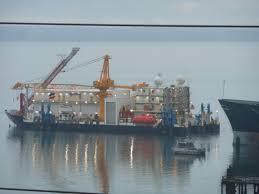
Before Shell can drill for oil in the Arctic Ocean, it needs to prove to federal officials that it can clean up a massive oil spill there. That proof hinges on a barge being built in Bellingham called the Arctic Challenger.  The barge is only one component of Shell’s plans for handling oil spills off the remote north coast of Alaska. But the Obama Administration won’t let oil drilling get under way until the 36-year-old barge and its brand new oil-spill equipment are in place,  On board the Arctic Challenger is a massive steel “containment dome.” It’s a sort of giant underwater vacuum cleaner. If efforts to cap a blown-out well don’t work, the dome can capture spewing oil and funnel it to a tanker on the surface.

The Arctic Challenger passed several US Coast Guard tests for seaworthiness in September. But it was a different story when its oil-spill containment system was put to the test in 150-foot-deep water near Anacortes, Washington.  The federal Bureau of Safety and Environmental Enforcement required the test of the oil-spill system.

According to BSEE internal emails obtained by KUOW, the containment dome test was supposed to take about a day. That estimate proved to be wildly optimistic.

•Day 1: The Arctic Challenger’s massive steel dome comes unhooked from some of the winches used to maneuver it underwater. The crew has to recover it and repair it.

•Day 2: A remote-controlled submarine gets tangled in some anchor lines. It takes divers about 24 hours to rescue the submarine.

•Day 5: The test has its worst accident. On that dead-calm Friday night, Mark Fesmire, the head of BSEE’s Alaska office, is on board the Challenger. He’s watching the underwater video feed from the remote-control submarine when, a little after midnight, the video screen suddenly fills with bubbles. The 20-foot-tall containment dome then shoots to the surface. The massive white dome “breached like a whale,” Fesmire e-mails a colleague at BSEE headquarters.

Then the dome sinks more than 120 feet. A safety buoy, basically a giant balloon, catches it before it hits bottom. About 12 hours later, the crew of the Challenger manages to get the dome back to the surface. “As bad as I thought,” Fesmire writes his BSEE colleague. “Basically the top half is crushed like a beer can.”

Representatives of Shell Oil and of BSEE declined to answer questions or allow interviews about the mishaps. In an email, Shell spokeswoman Kelly op de Weegh writes:  Our internal investigation determined the Arctic Challenger’s dome was damaged when it descended too quickly due to a faulty electrical connection, which improperly opened a valve. While safety systems ensured it did not hit the bottom, buoyancy chambers were damaged from the sudden pressure change.

Environmental groups say the Arctic Challenger’s multiple problems show that Shell isn’t prepared for an Arctic oil spill.

Excerpt, By John Ryan, Sea Trial Leaves Shell’s Arctic Oil-Spill Gear “Crushed Like A Beer Can”, Kuow.org. Nov. 30, 2012

Oil Sands of Canada

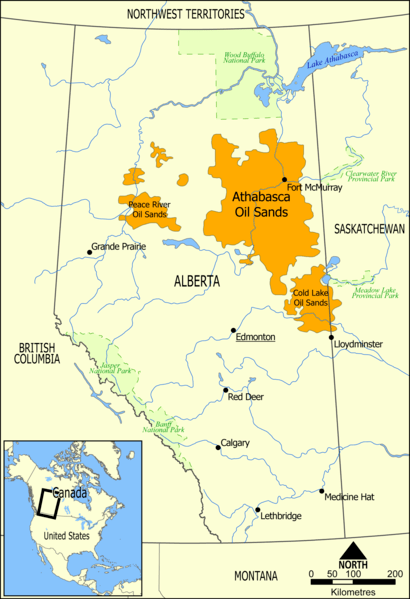
Canada’s oil sands contain some 170 billion barrels of oil that can be recovered economically with today’s technology (and perhaps ten times that in total). Canada thus has the world’s third-largest proven oil reserves, after Saudi Arabia and Venezuela. And since most oil-rich nations’ reserves are under state control, Canada has the largest reserves that private companies are free to invest in—more than half of the global total, reckons Ken Hughes, Alberta’s energy minister.

Other countries welcome the idea of plentiful energy from a stable democracy. It could reduce the rich world’s dependence on the Middle East. There are “no bribes or body bags”, grins an oil-industry booster. And the potential is immense. A new study by the Alberta Geological Survey estimates that the province has huge resources in its shale beds as well as its oil sands: 3,400 trillion cubic feet of natural gas and 420 billion barrels of oil—numbers comparable to America’s.  However, Canada’s output of 3.5m barrels of oil a day is less than half that of America. (America’s output is set to exceed Saudi Arabia’s; see article.) Several problems hobble Canadian energy: geology, capital, people and pipes.

First, geology. Canadian oil is hard to extract. It mostly comes in the form of bitumen, which is “hard as a hockey puck” at 10°C, as the Canadian Association of Petroleum Producers (CAPP), an industry body, puts it. If it is far below ground, it must be blasted with steam to make it flow, and then pumped out. This process (known as “steam-assisted gravity drainage”) was developed in Alberta. In the past decade, with high oil prices, it has made the oil sands economical to exploit. But precariously so: the best projects break even when oil is $30 a barrel, but many new ones need it to be $80 or more. (West Texas Intermediate is currently $85.)

Canada gets less than it should for its oil because it lacks enough pipelines. Environmentalists oppose them, arguing that pipes leak (which is always possible) and that Canada’s heavy oil causes more greenhouse-gas emissions than other oil (which is true, but not by much). President Barack Obama has delayed the approval of a pipeline called Keystone XL, which would move Canadian oil to America’s Gulf coast. A decision is expected soon.

Alex Pourbaix of TransCanada, the firm behind the Keystone pipeline, insists that the project will be good for both countries. Canada forgoes a fortune—perhaps $20 a barrel—because it cannot get its oil to the sea. Canadian gas sells at a discount, too: North American prices are far lower than those in Asia.  Another proposed pipeline, Northern Gateway, would carry oil to Canada’s west coast, whence it could be shipped to Asia. Canada would benefit from having a choice of customers. But the government of British Columbia, and various aboriginal groups, have yet to say yes.

To exploit its hydrocarbons, Canada needs capital: some $50 billion-60 billion a year, on recent trends. Such sums are “far more than Canadian capital markets can raise,” says Dave Collyer of the CAPP. Canada gets plenty of foreign investment: Syncrude, one of the biggest oil-sands developers, is a joint venture that includes American, Chinese and Japanese partners. But lately the country has grown frostier towards foreign capital.

In October Canada’s federal government temporarily blocked a $5.2 billion bid by Petronas, Malaysia’s state energy giant, for Progress Energy Resources, a Canadian natural-gas company. It has yet to approve a $15 billion offer by CNOOC, a Chinese state-owned firm, for Nexen, a Canadian oil-and-gas firm. A deadline passed last week; a decision may come next month. Mr Hughes says he is keen on foreign investment so long as foreign firms abide by the same rules as Canadians; but it is not up to the provincial government.

The other big bottleneck is human capital. Hardly anyone lives near the oil sands, so labour must be imported, from other parts of Canada and from abroad. People from 127 countries live in Fort McMurray, says Ken Chapman of the Oil Sands Developers’ Group. They speak 69 languages. The Walmart in town looks like the United Nations, except that all the shivering Africans are buying woolly hats. Mr Hughes expects to see a skills shortfall of 100,000 people in Alberta by 2017. Canada’s immigration rules are more liberal than America’s, but firms still gripe about delays. An Irish worker in Fort McMurray complains of having to fly to Calgary to sit a test of English proficiency. It’s her native language, and the test is online.

Companies poach staff from each other, bidding up labour costs. It would be easier to attract workers to Fort McMurray if the town were more liveable; a one-bedroom flat can cost $2,000 a month. To build more homes, however, the town must wrestle with provincial red tape—and also attract legions of builders, plumbers and electricians, all at inflated wages.

Working conditions in the oil sands are tough. Touch a metal pipe with your bare hand at minus 40 and it sticks. “It’s not for everybody,” shrugs an oil-firm boss. At remote work camps, companies provide hot food, warm cabins, broadband and squash courts. All this is costly. Many firms make equipment elsewhere and truck it in, so that fewer people have to toil in the cold. Some are hoping dramatically to raise the proportion of man-hours worked off-site.

With so many bottlenecks and a volatile oil price, firms are growing cautious. Suncor Energy and Canadian Natural Resources, among others, are putting new investments on hold. “It’s the uncertainty,” says Marcel Coutu, the boss of Canadian Oil Sands, a firm that owns 37% of Syncrude. “No one knows when or whether those pipelines will be built.”

Canadian energy: The sands of grime, Economist, Nov. 17, 2012, at 62

Wall Street Manipulation of Energy Markets

The U.S. Federal Energy Regulatory Commission (FERC) is taking on big banks for their questionable energy trade.  The Federal Energy Regulatory Commission has slammed Barclays (pdf) with a demand to pay $470 million in fines for allegedly manipulating electricity markets in the western US to benefit the bank’s financial swap positions from 2006 to 2008.  Messages and email exchanges between Barclays energy traders released earlier this month reflect their efforts to manipulate and cheat their way to profits. What’s more disturbing is the glee the Barclay’s traders took in manipulating the energy markets with a total disregard for the costs to consumers.

The Barclays traders’ own words are damning:

“I totally f**kked with the Palo mrkt today. . . . Was fun. Need to do that more often.”

The attitude expressed doesn’t get much clearer than that.

In another instant message, the same Barclays trader wrote, “I’m gonna try to crap on the NP light and it should drive the SP light lower.”

The response from his colleague: “That is fine.”

Enron’s energy traders could have written the Barclays’ traders’ scripts. Remember Enron traders gloating, “He just f—s California,” and “He steals money from California to the tune of about a million” a day?  Only the traders’ attitudes are more obscene than their language. So saturated in arrogance, the traders had no concern they might get caught — which makes it even better that they did.

Though FERC hasn’t historically had much to do with regulating Wall Street, that is changing. FERC now also is going after JPMorgan Chase (pdf) and Deutsche Bank  (pdf) on similar charges.  The Los Angeles Times reports that JP Morgan’s questionable trades in the power market in 2010 and 2011 may have cost California residents and businesses more than $200 million. The no-holds-barred pursuit of profiteering no matter what laws and regulations are violated or what the cost is to the public has become a hallmark of Wall Street from Enron to Barclays.

While Wall Street may not have gotten the message that Enron-esque conduct is wrong, it’s gratifying to see FERC step up to hold banks accountable using the power from a post-Enron law. The 2005 Energy Policy Act gave FERC the authority to prevent market manipulation in the energy markets.  Not only does FERC have the power to fine companies as much as $1 million a day per violation, but it also has the ultimate weapon: the ability to suspend authorization to sell. JP Morgan knows that FERC is not afraid to flex this muscle.

Just last week, FERC suspended the authorization for a JPMorgan unit, J.P. Morgan Ventures Energy Corp., to sell electricity at market-based rates for six months beginning next April. FERC took this step because it found that JPMorgan had filed “factual misrepresentations” and omitted material information in filing with FERC and in communications with the California Independent System Operator. JPMorgan will be able to offer electricity for sale only at prices based on specified factors, so that utilities can continue to be able to meet demand.  FERC is relatively new to dealing with Wall Street, but it is quickly learning that a strong jolt is necessary to get banks to comply.

The Commodity Futures Trading Commission, which often works side-by-side with FERC, is expected to see similar cases of energy market manipulation as a result of whistleblower information provided to the CFTC’s new whistleblower reward program created under Dodd-Frank. The outcome of the FERC cases against Wall Street could provide a useful roadmap for future whistleblowers.

Excerpt from, Erika Kelton, Barclays’ Traders Show How Much Fun Wall Street Has Manipulating Markets, Forbes, Nov. 20, 2012

Top Five Worst Polluters in Gas Flaring

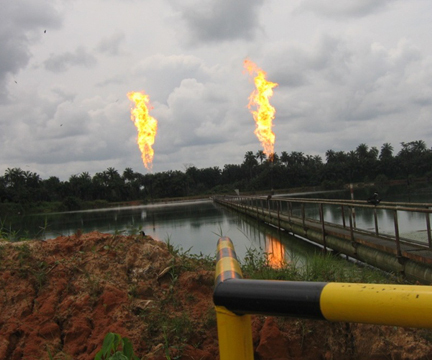
An international coalition led by the World Bank is calling for state-backed and private oil producers to reduce “gas flaring” by an additional 30 percent over the next five years, saying that doing so would be equivalent to taking 60 million cars off of the roads.  Analysts widely characterised the goal as both ambitious and significant, though it follows on an apparent levelling out in flaring reductions in recent years.

Since a major new push began in 2005, the World Bank-led Global Gas Flaring Reduction (GGFR)* partnership estimates that, through 2011, its actions have brought down gas flaring by 20 percent, eliminating around 274 million tonnes of carbon dioxide emissions.  But according to the GGFR – a coalition of 20 major oil companies and 19 countries..both the economic and environmental impacts of gas flaring require far greater reductions.  “A 30 percent cut in five years is a realistic goal,” Rachel Kyte, the World Bank’s vice-president for sustainable development, said…

Oil producers resort to flaring when gas, a by-product of oil, is brought up to the surface but cannot easily be repurposed for consumers. Instead, producers simply burn off the product, the value of which the World Bank, based here in Washington, puts at some 50 billion dollars a year.  The total amount of gas estimated to have been flared last year, about five trillion cubic feet, is said to equal the amount of natural gas used in the United States over a full year.

Environmentalists have long called for the outright banning of the practice, though flaring does in fact release far lower levels of greenhouse gases than simply allowing the gas to evaporate. However, the process does not deal with one notorious pollutant, nitrogen oxide, and still releases significant carbon dioxide, and thus significant greenhouse gas-related worries remain.

Alternative uses for this gas range from producing power, refining it for use in local markets, or even putting it back into the ground. But analysts say the economic benefits for companies in doing so are low.  Nonetheless, the World Bank reports slow but steady success in reductions, particularly since 2005. According to data released Mexico has cut its flaring by two-thirds and Azerbaijan by half in just two years, while Kuwait gotten its flaring down to just one percent of previous levels.  In addition, Qatar and Congo have been singled out for using the gas to make electricity.

Significant improvements have also been seen in many of the world’s worst flaring offenders. “Huge investments” by GGFR partners have reportedly helped Nigeria to reduce its flaring by nearly a quarter through 2011, while Russia, the most significant culprit in this regard, has reduced flaring by around 40 percent, though those figures rose last year.  Still, the World Bank warned that both of these countries, particularly Russia, in addition to Mexico, Iraq and Kazakhstan, need to make significant improvements.

Missing from this list, however, is one of the most significant outliers in the global push against gas flaring: the United States, which has increased its gas flaring by more than three times since 2007, more than any other country.  The U.S. is currently in the midst of a sea-changing boom in natural gas production, thanks almost entirely to new technologies (so-called hydraulic fracturing or “fracking”) that have allowed for the exploitation of previously off-limits gas deposits in shale and other geological formations.

Against the promising country-by-country numbers, total global gas flaring actually increased last year by around two billion cubic metres, which World Bank analysts have put down to output from Russia and, specifically, the U.S. state of North Dakota.  “The small increase underlines the importance for countries and companies to sustain and even accelerate efforts to reduce flaring of gas associated with oil production,” Bent Svensson, manager of the GGFR partnership, said when the 2011 figures became available in July. “It is a warning sign that major gains over the past few years could be lost if oil-producing countries and companies don’t step up their efforts.”

The U.S. is now the fifth-largest flarer, behind Russia, Nigeria, Iran and Iraq. While part of this is due to the multifold increase in production in recent years, it also appears to be due to a lag in implementing the necessary infrastructure.  “Due to insufficient natural gas pipeline capacity and processing facilities … over 35% of North Dakota’s natural gas production … has been flared or otherwise not marketed,” the U.S. government reported in late 2011. “The percentage of flared gas in North Dakota is considerably higher than the national average; in 2009, less than 1% of natural gas produced in the United States was vented or flared.”…But based on new EPA rules, “the U.S. is going to have 100 percent no-flaring by 2015, which will be pretty good in terms of the rest of the world,” Kyle Ash, a Washington-based legislative analyst with Greenpeace, an advocacy group, told IPS.

Excerpts, By Carey L. Biron, U.S. Outlier in New Push to Reduce Gas Flaring,Inter Press Service,Oct. 24, 2012

*The GGFR partners include: Algeria (Sonatrach), Angola (Sonangol), Azerbaijan, Cameroon (SNH), Ecuador (PetroEcuador), Equatorial Guinea, European Bank for Reconstruction and Development (EBRD), France, Gabon, Indonesia, Iraq, Kazakhstan, Khanty-Mansijsysk (Russia), Mexico (SENER), Nigeria, Norway, Qatar, the United States (DOE) and Uzbekistan; BP, Chevron, ConocoPhillips, ENI, ExxonMobil, Marathon Oil, Maersk Oil & Gas, Pemex, Qatar Petroleum, Shell, Statoil, TOTAL; European Union, the World Bank Group; Associated partner: Wärtsilä.

How Iran Copes with Sanctions?

According to the latest figures from the Natural Gas Vehicle Knowledge Base, Iran, with the world’s second-largest natural gas reserves after Russia, in 2011 became the world leader in natural gas vehicles with some 2.9 million on the road, narrowly edging Pakistan, which is trailed by Argentina, Brazil and India, respectively.  Iran’s reliance on its cleaner fossil fuel seems unlikely to diminish as international sanctions continue to bear down on its nuclear program, which in turn have curbed imports of gasoline; though Iran has large oil reserves, its ability to refine its own gasoline falls well short of its needs.  But for ordinary Iranian motorists, natural gas is less a geopolitical or environmental issue than a pocketbook concern. “This sort of fuel is cheap, and it gets me home every day — that’s what I care about,” said Sasan Ahmadi, a 42-year-old office assistant filling up his Iranian-made Kia Pride at a natural-gas station for his hour commute home.

The government began promoting natural gas about a decade ago, and not just in response to American-led sanctions. A big initial reason was the increasingly thick yellow blankets of smog that often engulf greater Tehran and its 12 million inhabitants. That was a result of rising auto sales by domestic carmakers like Iran Khodro and Saipa, which took off as oil revenue began rising sharply around 15 years ago, enriching tens of millions of Iranians…..

As a means to counter outside economic pressure, natural gas’s usefulness is clear. Because of its inadequate investment in oil refineries, Iran has long been forced to refine a portion of its own crude at refineries in Europe to satisfy rising domestic demand for gasoline. So when the European Union in July barred gasoline sales to the country, natural gas helped to blunt the blow.

Despite the sanctions against Iran, motorists like Mr. Ahmadi can make their commute for the equivalent of less than a penny a mile using the alternative fuel at subsidized prices. Gasoline is more expensive, especially because government subsidies have been reduced, but it is still incredibly cheap by Western standards: less than $1 a gallon….

Excerpt, THOMAS ERDBRINK, Oil-Rich Iran, Natural Gas Turns Wheels, New York Times, Oct. 23, 2012

Water/Oil/Gas Wars: the Stans of Central Asia

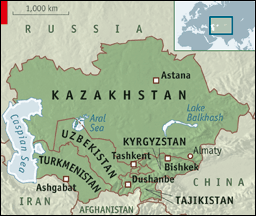
Tajikistan’s president, Emomali Rakhmon, likes things big. He has built the world’s tallest flagpole. Last year he opened the region’s largest library (with few books in it so far). But one gigantic project is proving contentious with the neighbours: building the world’s tallest hydroelectric dam.

Islam Karimov, the strongman who rules downstream Uzbekistan, says the proposed 335-metre Rogun dam, on a tributary of the Amu Darya, will give Tajikistan unfair control over water resources and endanger millions in the event of an earthquake. On September 7th, he said such projects could lead to “not just serious confrontation, but even wars”.  Mr Karimov wasn’t talking only about Tajikistan. Upstream from Uzbekistan on a tributary of the region’s other major river, the Syr Darya, Kyrgyzstan is seeking investment for a project of its own, called Kambarata. The two proposed dams (Rogun at 3.6 gigawatts and Kambarata at 1.9) would theoretically end their respective countries’ frequent power shortages and provide badly needed export earnings.

Both were conceived in the twilight of the communist era and stalled when subsidies from Moscow evaporated at independence. Soviet leaders envisioned managing the region’s water flows, energy trades and competing interests, and their Russian successors still maintain an interest. During a visit to Bishkek on September 20th, Russia’s president, Vladimir Putin, promised help with Kambarata in exchange for, among other things, an extension of military-basing rights in Kyrgyzstan. Tajikistan has sought Russian help for Rogun, too. Mr Putin promised $2 billion for the dam in 2004. But that deal fell apart three years later, when the two countries could not agree about the dam’s height.

Spurring on both projects is Uzbekistan’s bad behaviour, egregious even in a tetchy region. Unlike Uzbekistan, neither Tajikistan nor Kyrgyzstan, the two poorest former Soviet republics, has reliable access to oil or gas. Uzbekistan’s Mr Karimov has a habit of changing gas prices and cutting deliveries during the coldest months. He has prevented electricity supplies to his indigent neighbours from transiting his country’s Soviet-era grid. Uzbekistan has also unilaterally closed most border checkpoints with both upstream countries, set mines along parts of the boundary with Tajikistan, and often holds up commercial traffic. When a rail bridge in southern Uzbekistan mysteriously exploded last autumn, depriving southern Tajikistan of its rail connections, few believed Uzbek claims of a terrorist attack. Indeed, rather than fix the track, the Uzbeks dismantled it. Tajikistan calls the actions a blockade.

Though it seems unlikely Mr Karimov will drive his tanks over the border just yet, shoot-outs on the disputed borders are not uncommon. All of this worries NATO officials. All three countries help supply the war in Afghanistan and will be crucial for NATO’s withdrawal.

Excerpt, Water wars in Central Asia: Dammed if they do, Economist, Sept. 29, 2012, at 44

One the international agreements between states on water and electricity exchanges, see Elli Louka International Environmental Law

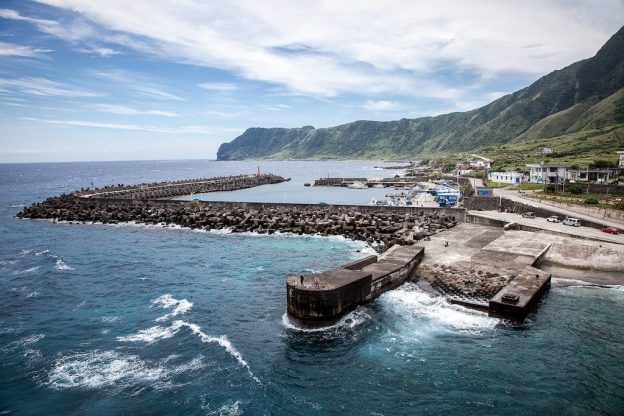
Nuclear Waste Island, Orchid, Taiwan

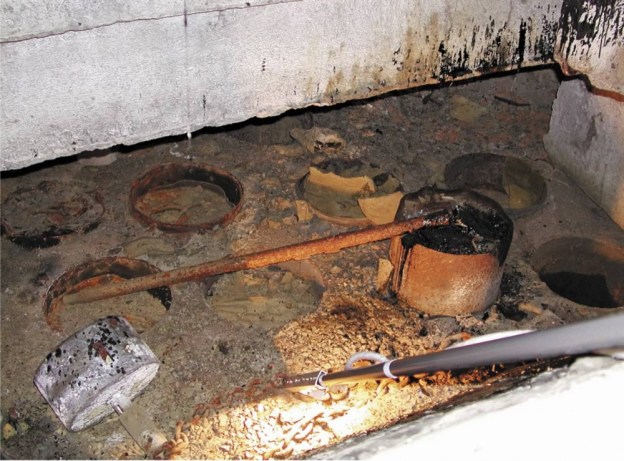
Most people on the windswept outpost, 62 kilometres east of Taiwan’s mainland, would love to see the 100,277 barrels of nuclear waste gone. But many admit they are concerned about their livelihoods if that day comes.  Orchid Island has been a flashpoint for Taiwan’s environmental movement since nuclear waste was first shipped there in 1982. Local residents, mostly members of the Tao aboriginal group, say the waste was put on the island without their consent. Periodic protests have claimed negative health and environmental effects.

In response, Taiwan Power Co has showered the community with cash handouts, subsidies, and other benefits.  Orchid Island received subsidies worth 110 million Taiwan dollars in 2011, according to company data. That doubled local government spending, according to township secretary Huang Cheng-de.  “The current situation, basically, is that Taipower gives us quite a bit of money, and our people are becoming pretty reliant,” Huang said.  Most of the funds are divided into government-managed accounts for each of the island’s 4,700 residents, who can apply for it if they have a business or career-oriented need. Residents also receive free electricity, health-related emergency evacuations, scholarships for higher education and a 50-per-cent discount on all transportation costs to Taiwan’s mainland.  Statistics indicate local residents are taking advantage of the benefits. In 2011, they used nearly twice as much electricity per household as the national average, according to company data.

Protests have weakened and for many residents, including Chou the restaurant owner, the existence of nuclear waste has become more acceptable.  “Most people here are against the nuclear waste, but since its already here, they should pay us for using our land,” Chou said. “For now, I’m okay with it as long as they don’t add any more barrels.”  The utility plans to move the waste off the island by 2021, but only if another township in Taiwan agrees by referendum to take it, according to Huang Tian-Huang, a company deputy director.  If it goes to plan, “so goes the compensation,” Huang said, although he acknowledged that gaining consent from another community will be difficult.  Questions remain on what would support Orchid Island’s economy if those subsidies end.

For Taiwan aborigines, nuclear waste is blessing and curse, http://www.timeslive.co.za, Sept. 16, 2012

Nuclear Waste Russia: Andreyeva Bay

Andreyeva Bay, the former naval technical base come solid radioactive waste storage facility has undergone many improvements, but problems also remain. Andreyeva Bay is one of the hottest radioactive spots in Northwest Russia and work deadlines are hard to meet.  Founded in between 1960 and 1964, Andreyeva Bay’s task was to remove, store and ship for reprocessing at the Ural Mountains Mayak Chemical Combine spent nuclear fuel from nuclear submarines. After a 1982 accident in the spent nuclear fuel storage, Russia Ministery of Defense decided to reconstruct the facility. But the turbulent political and economic conditions of the 1980s and 1990s scuttled the plans. Andreyeva Bay was assigned to Minatom, Rosatom’s precursor, in 2000.  The beleaguered facility, which is nearby the Norwegian border is of special concern to Oslo. Norway’s Deputy Ambassador in Moscow, Bård Svendsen, noted that the two countries had cooperated on solving the Andreyeva bay issue for many years.  “Over these years, much has been done and much remains to be done,” said Svendsen. “Norwegian authorities will continue this work, which costs some €10 million euro a year.”  According to Rosatom’s deputy head of Department for Project Implementation and Nuclear and Radiaiton Safety, Anatoly Grigorieyev, the last 10 years have seen the installation of constant radiation monitoring and significant improvements in the conditions in which radioactive waste and spent nuclear fuel is stored.  A new installation for working with spent nuclear fuel is expected to be installed at Andreyeva Bay in 2014, and by 2015 the fuel is slated for removal – the same year a facility for handling radioactive waste should be installed, he said in remarks reported by Regnum news agency.  “The work we have planned will allow for the territory to be brought up to suitable conditions within 10-15 years,” said Grigorieyev.

Vladimir Romanov, deputy director of the Federal Medical and Biological Agency, said that studies conducted by his institute confirm that the radiological conditions at Andreyeva Bay and at Gremikha – the second onshore storage site at the Kola Peninsula for spent nuclear fuel from submarines – are indeed on the mend…. According to Valery Panteleyev, head of SevRAO, the Northwest Russian firm responsible for dealing with radioactive waste Some 846 spent fuel assemblies have been taken from storage at the former naval based to the Mayak Chemical Combine for reprocessing thanks to infrastructure built for fuel unloading purposes.  Panteleyev said Gremikha still currently is home to used removable parts from liquid metal cooled reactors submarine reactors, spent fuel assemblies, a reactor from an Alpha class submarine and more than 1000 cubic meters of solid radioactive waste.  Panteleyev said that by the end of 2012, all standard and non-standard fuel will have been sent to Mayak from Gremikha. He said that between 2012 and 2020 the removable parts of the liquid metal cooled reactors would also be gone, and that during the period between 2012 and 2014, 4000 cubic meters of solid radioactive waste would also be removed to long term storage at Saida Bay.  If all goes according to schedule, the Gremikha site will be rehabilitated by 2025.

Rosatom also presented detailed reports on an international project to build long-term storage for reactor compartments at the Saida Bay storage site for aged submarine reactors.  Panteleyev said none of the achievements at either Saida Bay or Gremikha would have been possible without international help.  The projects are being completed with funding from Germany, Italy, France, Norway, Sweden, Great Britain and the EBRD.  “These countries are investing in the creation of infrastructure for handling radioactive waste and spent nuclear fuel, dismantlement of nuclear vessels of the atomic fleet and in the infrastructure for the safe storage or reactor compartments,” said Panteleyev….

Another item of special concern at the Bellona/Rosatom seminar was the disposition of the floating spent nuclear fuel vessel, the Lepse. A former technical support vessel, taken out of service in 1988 the Lepse presents the biggest nuclear and radiation risk of all retired nuclear service ships in Russia. The Lepse’s spent nuclear fuel storage holds – in casks and caissons – 639 spent fuel assemblies, a significant portion of which are severely damaged.  Extraction of these spent fuel assemblies presents special radiological risks and technical innovation. The vessel is currently moored at Atomflot in Murmansk, the base of Russia’s nuclear icebreaker fleet.  Mikhail Repin, group director for the Russian Federal State Unitary Enterprise the Federal Center for Nuclear and Radiation Safety, said work on the Lepse is divided into three categories: transfer of the vessel to the ship repair yard Nerpa in the Murmansk Region, fixing it to an assembly based, removing the spent fuel and dividing into blocks. The work is expected to be complete by 2012.  But the barriers to enacting this project, however, remain largely bureaucratic.  “One gets the impression that international and Russian bureaucrats are capable of muddling any project, as shown by the experience with the Lepse,” said Bellona’s Niktin. The project of dismantling the Lepse have remained on paper since 1995.  The Lepse was built in 1930, and the vessel has been afloat for 75 years, said Repin… The equipment necessary for removing the spent fuel assemblies must be fabricated for specifically this project. The equipment must first ensure the safety of the workers, meaning the work will have to be done essentially remotely to ensure minimum exposure.

Safety of Nuclear Fuel at Pools: From Fukushima to Yucca Mountain

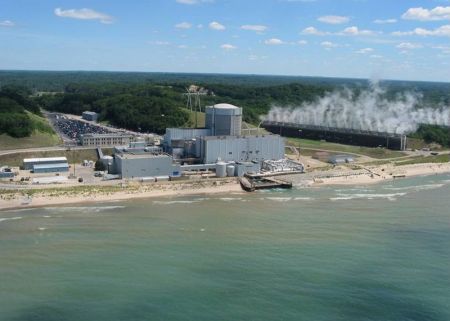
An Entergy Corp.  unit sued the U.S. for $100 million alleging the government breached a contract for disposal of nuclear waste at two plants in Michigan.  Entergy Nuclear Palisades LLC, owner of the Palisades Nuclear Plant and the Big Rock Point plant, alleged yesterday that the Energy Department collected fees under a 1983 contract without ever starting to dispose of the radioactive material. The suit is in the U.S. Court of Federal Claims in Washington.  Entergy and a previous owner of the shuttered Big Rock Point plant “have fully complied with all their fee payment obligations under the contract,” according to the complaint. “The government, however, has failed to perform its reciprocal obligation to dispose of spent nuclear fuel, and currently has no plan to meet these obligations.”

Entergy’s lawsuit is the latest legal challenge stemming from the federal government’s failure to create a central, long- term facility to store nuclear waste.  Most nuclear-plant owners continue to store spent nuclear fuel onsite despite contributing for decades into a fund meant to finance a central waste depository.

The U.S. Nuclear Regulatory Commission is freezing U.S. operating licenses for at least two years as it reassesses waste-storage risks and strategies in response to a June 8 order by the U.S. Court of Appeals in Washington.  See US Court of Appeals

Entergy Corp., based in New Orleans, is the second-largest owner of nuclear plants in the U.S.  Through June 30, Entergy and Consumers Energy Co., the former owner of Big Rock Point, have paid about $274 million into the fund under the contract, the company said. Charles Miller, a Justice Department spokesman, declined to comment on the lawsuit.

The case is Entergy Nuclear Palisades LLC v. U.S., 12-cv- 1641, U.S. Court of Federal Claims (Washington).

By Tom Schoenberg and Julie Johnsson, Entergy Sues U.S. for Failure to Dispose of Nuclear Waste, Bloomberg, Sep 27, 2012

WTO and the Level Playing Field: Europe v. Russia

Europe’s trade chief threatened to take Russia to the World Trade Organization over a string of restrictive practices saying Moscow needed to play by the rules now it was a member of the global body.  Trade Commissioner Karel De Gucht singled out Russia’s ban on European live animal imports, plans to levy fees on imported vehicles, two anti-dumping cases and another trade defense case launched by Moscow against Europe in recent months.  In the same week that the European Commission opened an investigation into Russia’s Gazprom and China’s solar panel exports, De Gucht said the measures sent “the wrong signal”, Reuters reports.

“Membership of the WTO means a country is subject to the dispute settlement mechanism of that organization,” he told an EU-Russia seminar in Helsinki. “Russia should understand that Europe takes that mechanism very seriously and that we will not hesitate to enforce our rights where they are violated,” he added.

Russia joined the WTO last month after an 18-year wait. President Vladimir Putin said on Wednesday the country would use its membership to try to develop freer trade across the world, but he’ll also be hoping it will further boost the energy-driven $1.9 trillion economy.  De Gucht said Russia was violating WTO rules by keeping its markets closed to competitors.  “What these and other measures … have in common is that they affect products where significant market opening is due to take place under Russia’s WTO commitments,” De Gucht said.  “This is the wrong signal to send at a time when liberalization is supposed to be moving forward.”

Russia and the EU are deeply intertwined, with Europe relying heavily on Russian energy exports and Russians hungry for EU products and access to its 500 million consumers.  But the two sides argue over issues ranging from energy supplies, trade and market access to human rights. While relations are at times frosty, both refer to each other as “strategic partners” and meet for twice-yearly summits.  Negotiations between Russia and the EU towards closer economic and political ties have also stalled, and Brussels is concerned by Putin’s plan to develop a “Eurasian union” of ex-Soviet states, including Kazakhstan and Belarus.

EU warns Russia to play by WTO rules or face action, Reuters, Sept. 7, 2012

Russian President Vladimir Putin signed a decree giving the government the right to protect its natural gas-export monopoly, OAO Gazprom (GAZP), from an anti-trust inquiry by the European Union.  Putin’s measure bans strategic companies from disclosing information, disposing of assets or amending contracts without government approval in case claims are made by foreign states or entities, the president’s office said in an e-mailed statement from Moscow today. The Russian leader on Sept. 9 warned the EU, which relies on Russia for a quarter of its gas needs, that there would be “losses on both sides” if the issue isn’t resolved. He accused the 27-nation bloc of trying to shift responsibility for subsidizing former communist EU members onto Russia by forcing Gazprom to cut prices for customers in eastern and central Europe.

Excerpt, By Henry Meyer, Putin Moves to Protect Gazprom From EU Pricing Dispute, Bloomberg, Sept. 11, 2012

The Hundred Defects in Nuclear Plants: Europe

Hundreds of defects have been found throughout Europe’s nuclear reactors and mostly in France, according to a EU stress test report leaked to the German and French media.  A leaked EU stress test report says it it will cost €25 billion to bring Europe’s nuclear reactors up to international saftey standards   The stress tests assess whether any of Europe’s 143 licensed nuclear power plants can withstand extreme events such as earthquakes and terrorists attacks.  The tests were introduced after the nuclear accident in Japan’s Fukushima some 18 months ago. EU energy commissioner Gunther Oettinger is to present the final report and recommendations in the upcoming EU summit on 18 and 19 October…

The European Nuclear Safety Regulators Group (Ensreg), a group of senior officials from the national nuclear regulatory authorities from all 27 member states, said on Monday (October 1, 2012) in a statement said they have yet to be informed of the content of the report.  “The commission had not made available to Ensreg any draft of the communication. However, the content of a draft was known by some Ensreg members and this draft raised major problems and concerns in Ensreg,” said the group’s chairperson Tero Varjoranta.

Meanwhile, a preview into the content by French daily Le Figaro and German daily Die Welt suggests none of France’s 58 nuclear power plants meet, to varying degrees, the international security standards outlined by the International Atomic Energy Agency (IAEA).  “For the very first time in history, we know for all the nuclear power plants in Europe whether these very high standards are actually used or not used,” said Holzner.

Nineteen French reactors have no seismic measuring instruments, says Le Figaro. The paper also notes that safety and rescue equipment in case of disaster is not adequately protected unlike at German, British and Swedish reactors.  The report does not recommend shutting down any one EU nuclear power plant, say the papers, but notes that getting them up to standard would cost some €25 billion.

National regulators carry out the initial stress tests inspections. Teams of safety experts from the EU member states and the commission then scrutinize their conclusions followed by on-site spot checks.  For its part, Belgium’s national regulator, the federal agency for nuclear control (FANC), decided to shut down two of its seven reactors in August after having discovered thousands of cracks.  The discovery of the cracks came two months after having submitted their peer-reviewed EU stress tests in April.  “Results of the stress tests are still perfectly valid. In any case they had an altogether different purpose,” said FANC at the time.

Leaked EU nuclear stress tests reveal hundreds of defects, EUobserver.com, Oct. 2, 2012

Nuclear Protests in India and Foreign-Funded NGOs

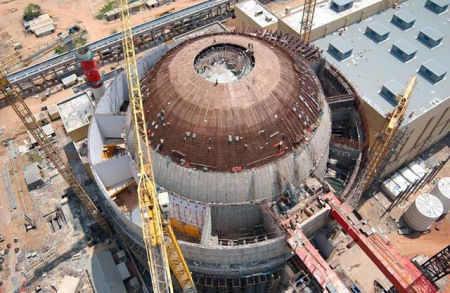
This week police in Kudankulam, in southern Tamil Nadu, fired at thousands of anti-nuclear protesters on the beach, killing a fisherman. The locals were opposing a new, Russian-designed, 2,000MW nuclear plant, India’s biggest, which is now being filled with fuel. The 2004 Indian Ocean tsunami killed over 10,000 Indians. Now fears grow of another big wave that could bring a Fukushima-style disaster.  Protesters also claim harassment, saying officials have slapped sedition notices against 8,000 who have dared speak out. Opposition has flared before. The state’s chief minister, Jayaram Jayalalitha, once backed the protests but has now swung in favour of the plant—perhaps betting that anger over power shortages trumps anti-nuclear outbursts.

The reaction of the national government, under the prime minister, Manmohan Singh, has been mixed. Committees of investigation called the plant safe. The High Court in Chennai heard, and ruled against, a petition by locals over safety. The Supreme Court will hear an appeal.  The government’s argument that politicians not protesters should decide the country’s energy mix is reasonable. But, twitchy at criticism, it veered off in suggesting opponents merely did the bidding of a foreign hand. Mr Singh, in an interview with a science magazine in February, blamed protests on NGOs, “mostly I think based in the United States”. A tough new law is in force, severely restricting foreign money going to local NGOs.  Mr Singh’s frostiness is best understood in the context of America’s moans that a civil-nuclear deal signed with India has not led to American investors getting energy contracts. Strict liability laws scare its private investors, whereas government-backed ones, such as Russians, feel more secure. Could Mr Singh be implying that American activists are stirring the trouble in Kudankulam because the plant is Russian-built?

Nuclear Power in India: The Kudankulam conundrum, Economist, Sept. 15,2012, at 39

How to Avoid the Carbon Tax

According to the Union of Concerned Scientists (UCS),  a Climate of Corporate Control, statements and actions on climate science and policy by 28 U.S. companies, shows how these contributions can be problematic, and suggests steps that Congress, the public, the media, and companies themselves can take to address the problem.  Corporations have the right, of course, to weigh in on public policy issues that affect their interests. But too often they do so irresponsibly, misrepresenting and misusing science at the public’s expense, and in recent years their influence has grown.

Corporations skew the national dialogue on climate policy in a variety of ways—making inconsistent statements across different venues, attacking science through industry-supported organizations, and taking advantage of the secrecy allowed them by current legal and regulatory structures.

Inconsistency: Having It Both Ways–Some corporations are contradictory in their actions, expressing concern about the threat of climate change in some venues—such as company websites, Security and Exchange Commission (SEC) filings, annual reports, or statements to Congress—while working to weaken policy responses to climate change in others.  For example, ConocoPhillips has acknowledged on its website that “human activity…is contributing to increased concentrations of greenhouse gases in the atmosphere that can lead to adverse changes in global climate.” Yet in its comments on the 2009 EPA Endangerment Finding, the company claimed that “the support for the effects of climate change on public health and welfare is limited and is typified by a high degree of uncertainty.”

Using Outside Organizations: Contrarians By Proxy–One way a company can work against effective climate policy while avoiding accountability for that work is to provide funding to outside groups that lobby against climate legislation and regulation or engage in advocacy campaigns against climate science. Such groups range from business associations such as the National Association of Manufacturers to front groups like the Heartland Institute.

Echoing the inconsistency in their other statements and actions on the issue, many companies belong to groups lobbying on both sides of the climate policy debate. For example, Caterpillar is affiliated both with the World Resources Institute and Nature Conservancy, which advocate global warming solutions, and with the Cato Institute and Heritage Foundation, which oppose them.  Of course, corporations may point out that the organizations they support work on many issues besides climate—but the fact remains that many of these groups take starkly anti-science positions on climate change and work aggressively to challenge science-based climate policies.

A Lack of Transparency–When business interests can hide their influence on policy-making processes from public view, it becomes easier for them to manipulate perceptions of science and skew policy discussions. There are several areas in which greater transparency is needed:  Charitable contributions. Current law only requires corporate foundations to disclose their donations to the IRS; companies can get around this requirement by making their donations directly, bypassing their foundations. This information is also hidden from shareholders: several corporations have received proposals from their shareholders demanding access to the company’s charitable contributions, and legislation to require such disclosure has been proposed in Congress.  Lobbying and political expenditures. While companies are legally required to report their total expenditures on political contributions and lobbying, they are not required to disclose the particular issues for which these contributions are targeted. So it is not possible to determine how much lobbying corporations are doing on climate issues. Business risks from climate change. Publicly traded companies are required to discuss risks that might materially affect their business in their annual SEC filings. The report shows that compliance with this requirement with regard to climate change is not consistent; some companies address climate-related risks fully, some discuss only the possible impacts of climate regulation, neglecting the physical impacts of climate change, and others ignore the issue entirely.

Good and Bad Behavior–It’s not all bad news out there: The report shows that some companies, such as NIKE, appear to be consistently constructive in their climate-related statements and actions.  At the other extreme, some companies appear to be almost uniformly obstructionist on climate issues. This list is dominated by fossil-fuel companies such as Peabody Energy and Marathon Oil.  But because of the lack of disclosure, it is impossible to say for sure whether companies are completely constructive or obstructionist.  Inappropriate corporate influence on the national dialogue on climate science and policy is a large-scale, complex problem requiring large-scale, complex solutions.

Excerpt from A Climate of Corporate Control

BP: Culture of Corporate Recklessness

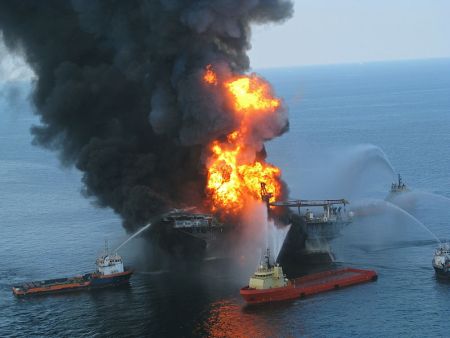
The Obama administration has accused BP of gross negligence and willful misconduct in causing the Deepwater Horizon oil spill of 2010. In a new court filing, the Department of Justice appears bent on blaming BP for the worst oil disaster in U.S. history.  The court document blasts BP’s leadership in no uncertain terms. Referring to “A Culture of Corporate Recklessness,” it states that “The behaviour, words and actions of these BP executives would not have been tolerated in a middling size company manufacturing dry goods for sale in a suburban mall.” It criticizes “the utter lack of any semblance of investigation of the systemic management causes deeply implicating the corporate managers and leadership who caused and allowed the rig-based mechanical causes to fester and ultimately explode in a fireball of death, personal injury, economic catastrophe, and environmental devastation.”

Referring to a “negative pressure test” performed by BP and Transocean hours before the blowout, the report states, “That such a simple, yet fundamental safety-critical test could have been so stunningly, blindingly botched in so many ways, by so many people, demonstrates gross negligence.”  The designation of “gross negligence” under the Clean Water Act, is an important distinction because it would mean the company could face $21 billion in civil damages alone—almost quadruple the penalty if “gross negligence” is not confirmed. BP also faces criminal charges.

The case may not go to trial, which is scheduled to begin January 14. Both sides are negotiating to reach a settlement to resolve both civil and criminal violations.  The Justice Department reportedly sought a $25 billion agreement from BP, but now may be willing to settle for $15 billion.

Justice Dept. Accuses BP of “Gross Negligence” over Gulf Oil Spill, AllGov.com, Sept. 7, 2012

The Nuclear Proliferation Potential of Laser Enrichment

The following is being released by Physicians for Social Responsibility:  The U.S. Nuclear Regulatory Commission (NRC) is putting U.S. nuclear non-proliferation policy at risk if it decides not to require a formal nuclear proliferation assessment as part of the licensing process for a uranium laser enrichment facility in Wilmington, N.C.  That’s the message from 19 nuclear non-proliferation experts in a letter sent today asking the NRC to fulfill its statutory responsibility to assess proliferation threats related to the technologies it regulates. The letter is available online at http://www.psr.org/nrcassessment.

Global Laser Enrichment, LLC, a joint venture of General Electric (USA), Hitachi (Japan) and Cameco (Canada), has applied for a license to operate a laser enrichment facility in Wilmington, North Carolina, based on Australian SILEX technology. The NRC licensing review schedule sets September 30, 2012 as the date of license issuance.  One of the authors of the letter, Catherine Thomasson, MD, executive director, Physicians for Social Responsibility, said:“It is a widely shared view that laser enrichment could be an undetectable stepping-stone to a clandestine nuclear weapons program. To strengthen U.S. policy and protect the U.S. and the world from nuclear proliferation, the NRC should systematically and thoroughly assess the proliferation risks of any new uranium enrichment technology BEFORE issuing a license allowing their development.”  Dr. Ira Helfand, co-president of International Physicians for the Prevention of Nuclear War, said: “If the U.S. is going to have moral authority in dealing with proliferation threats in other nations, such as Iran, it must do a better job of taking responsible steps in relation to proliferation threats in our own backyard. In fact, a persuasive case can be made that laser enrichment technology requires even more immediate action, since this is a known danger that can be addressed directly by the NRC under its existing regulatory authority.”

In the letter, the experts note that the NRC has no rules or requirements for a nuclear proliferation assessment as part of this licensing process. The experts are concerned that the Commission is falling short in its duties since a 2008 NRC manual on enrichment technology clearly states that laser enrichment presents “extra proliferation concerns due to the small size and high separation factors.”

Previous letters to the NRC asking for a proliferation assessment, signed by many of today’s signatories, have been rebuffed. NRC is on record stating that the National Environmental Policy Act does not require preparation of a proliferation assessment. However, a March 27, 2012 memorandum from the Congressional Research Service clearly concludes that the NRC has legal authority “to promulgate a regulation” requiring a proliferation assessment as part of the licensing process.  Both the Nuclear Non-Proliferation Act of 1978 and the Atomic Energy Act are cited by the experts as statutory basis of the NRC’s responsibility to assess proliferation risks.

Excerpt, 19 Experts: Nuclear Proliferation Risks Of Laser Enrichment Require Fuller NRC Review, PRNewswire, Sept 5, 2012

Canada and its Nuclear Waste

Since the 1960s,  Canada’s nuclear power plants have generated more than two million bundles of highly radioactive used fuel. And they’re all still stored on the sites of the plants that produced them.But the pace of finding a site to store Canada’s most potent radioactive waste permanently is about to pick up.  Twenty Canadian communities have said they’ll consider volunteering to host the storage site.  That list is about to close. The Nuclear Waste Management Organization, whose job it is to find and build the site, will stop taking new names on Sept. 30, 2012.  The impending cut-off is ratcheting up the pressure on the technocrats charged with selecting a site; on the boosters who want to snare the multi-billion-dollar repository for their community; on the activists who harbour deep suspicions about safety; and on the aboriginal leaders who say they’ve been cut out of the process….

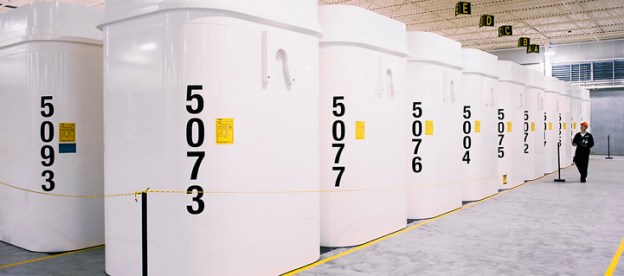
A fuel bundle for a Candu nuclear power reactor is about the size of a fireplace log. As of June 30, 2011, Canada had 2,273,873 used fuel bundles stored at its nuclear plants in Ontario, Quebec and New Brunswick.  Another 85,000 or so have been added since then.  In total, they’d fill about six NHL hockey rinks, stacked up as high as the boards.

The Nuclear Waste Management Organization, formed by the three electric utilities that run nuclear reactors, wants to bury the waste deep underground in caverns excavated from stable rock, where it can lie undisturbed forever.  The depth will probably depend on the site’s geology. A facility proposed to hold less-potent radioactive waste at the Bruce nuclear site near Kincardine will be 680 metres deep. By comparison, the CN Tower is 553 metres tall.  The NWMO is looking for a “willing” community to agree to take the $16-to-$24-billion project. The host community itself will decide how to define “willing.” Candidate communities will have multiple opportunities to withdraw if they get cold feet, the NWMO says.  As it moves through a nine-stage selection process, the NWMO hopes to have narrowed the field to one or two communities by 2015, then spend until about 2020 deciding on a specific site within the chosen community.  After that, it will take three to five years to do an extensive environmental assessment of the site. The proponents will also have to satisfy the Canadian Nuclear Safety Commission that their plan makes sense, and obtain a license to construct and operate the facility.  Then, it will take six to 10 years to build. The NWMO doesn’t expect the first bundles to be stored until 2035.  The plan is to seal the waste in sturdy, radiation-proof containers and store it deep in a stable rock formation where — even if the containers were to crack and leak — there’s be no danger of contaminating groundwater used by humans. (Although that’s the current strategy, the NWMO says it would consider a different plan if compelling evidence emerged that another technique is superior.)

Current designs call for surface buildings and facilities to cover about 100 hectares (250 acres), says the NWMO’s Michael Krizanc.  “As well, there may be a need to limit activities in the immediate area surrounding the surface facilities in order to meet regulatory or other requirements.”  Underground, the excavated caverns will cover an area of about 2.5 kilometres by 1.5 kilometres. That’s 375 hectares, or 930 acres.  “The NWMO would need to have rights to the land above the repository,” says Krizanc, but “alternative uses could be considered, with the community, for portions of the land.”….

Meanwhile in Saugeen Shores, a lively battle is under way as members of a citizens group dubbed save Save Our Saugeen Shores, or SOS, fights what they see as an attempt to impose the waste site on their community on the shore of the Great Lakes….SOS also worries that U.S. power plants might be able to force Canada to take U.S. nuclear waste in a Canadian waste site, through terms of the free trade agreement between the countries…..Up in Elliot Lake, contractors Stephen Martin and Marc Brunet can’t wait for the project to start….Elliot Lake has been identified with uranium since its founding, he shrugs: “We’re the uranium capital of the world…. This thing will be a tourist attraction. I think it’s the best thing that could happen.”

John Spears, Nuclear waste seeks a home, Toronto Star, Sept. 1, 2012

Oil, Somalia and the Fnal Frontier

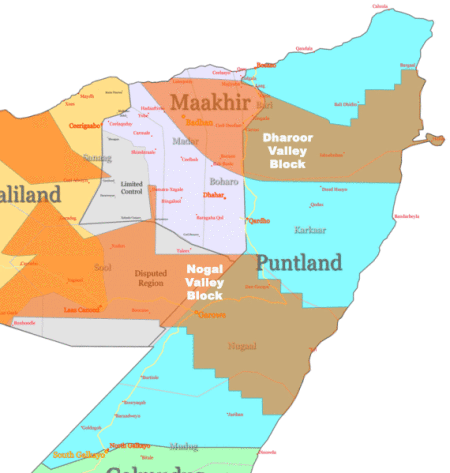
Canadian oil and gas exploration company Horn Petroleum said  it had encountered only water in a well it drilled in Somalia’s semi-autonomous Puntland region earlier this year, the first to be sunk in the country since civil war erupted two decades ago.  The well, Shabeel North-1, reached a total depth of 3,945 metres and is now being plugged, Horn said.  Because there were no shows of oil and gas, Horn Petroleum determined a second well it drilled earlier in the year, Shabeel-1, also was dry and said the company would not test it further for hydrocarbon potential

“While we were disappointed that we were not able to flow oil from the first two exploration wells in our Puntland (Somalia) drilling campaign, we remain highly encouraged that all of the critical elements exist for oil accumulations, namely a working petroleum system,” Horn’s chairman Keith Hill said in a statement.  While there has been speculation about finding oil in the anarchic Horn of Africa country for decades, it has no proven hydrocarbon reserves. The prospect of oil beneath Dharoor’s sandy, arid plains has elicited excitement among officials of the impoverished region. The companies estimated there could be as much as 300 million barrels of recoverable oil in the northern part of Somalia.  Somalia, mired in conflict since warlords in the early 1990s and then Islamist militants reduced the government to impotence, represents one of the final frontiers in Africa to be explored.

Horn Petroleum’s Somali wells come up dry, Reuters, Aug. 28, 2012

Indigenous Peoples Rights and Energy Projects: the Inter-American Court of Human Rights

Deep in the rainforest, the village of Sarayaku is two days by river from the nearest town. But its 1,200 Kichwa Indians are now in the spotlight. On July 25th the Inter-American Court of Human Rights ruled that Ecuador’s government had ignored the rights of Sarayaku’s residents when granting permission for an energy project—putting governments in the Americas on notice that big physical investments are not legal until the indigenous people they affect have had their say.

The dispute began in 1996 when Petroecuador, the state oil firm, signed a prospecting deal with a consortium led by Argentina’s Compañía General de Combustibles (CGC). Much of the area it covered was the ancestral land of Sarayaku’s residents, who were not consulted. CGC later offered locals medical aid for their consent. Some villages signed up, but Sarayaku held out.  Nonetheless, by early 2003 CGC had drilled 467 boreholes around the town for seismic surveying, and packed them with 1,433kg of high explosives. They were never detonated, and remain buried in the forest. As well as felling trees and destroying a sacred site, the company ruined some of Sarayaku’s water sources. Work ceased in 2003, and CGC’s contract ended in 2010.

The court found that the state had breached the villagers’ rights to prior consultation, communal property and cultural identity by approving the project, and that CGC’s tests had threatened their right to life. It ordered the government to pay damages, clear the remaining explosives and overhaul its consultation process. In future affected groups must be heard in a plan’s “first stages…not only when the need arises to obtain the approval of the community.” However, the judges did not ban prospecting on Sarayaku lands. The right to consultation does not grant a veto.

The ruling will be studied closely in the myriad Latin American countries struggling to balance big investments with local rights. A narrow reading of the decision suggests that governments must tiptoe around indigenous concerns, but can act more boldly when other groups protest, since the ruling was based partly on the International Labour Organisation’s Indigenous and Tribal Peoples Convention.

The ruling also shows that the regional justice system has not lost its mettle. In 2011 the Inter-American Commission on Human Rights, which litigates cases at the court, asked Brazil to halt work on the huge Belo Monte dam because its neighbours were not given a sufficient chance to speak up. Brazil’s government, which had authorised the dam only after a long public debate, saw this as a violation of its sovereignty. It did not comply, and stopped contributing money to the commission.  The commission was weakened by angering the region’s biggest country and by the criticism that it had exceeded its mandate. After Brazil presented new evidence in the case, the commission reversed its stance on Belo Monte. Moreover, last month the Organisation of American States voted to draft a reform plan for the commission, which some fear could strip it of important powers. Ecuador was among the commission’s loudest critics.

The Sarayaku case was not as heated as Belo Monte, since Ecuador’s government had already promised to pay damages. However, the court’s decision did strongly reassert its right to intervene in development cases. Moreover, Ecuador’s government plans to tender a big chunk of the Amazon for oil exploration later this year, despite indigenous opposition. If neither side backs down and the protesters appeal, the court’s next ruling on development in Ecuador may be far more contentious.

Indigenous rights in South America: Cowboys and Indians, Economist,July 28, 2012, at 32

How to Falsify Radiation Levels: Japan

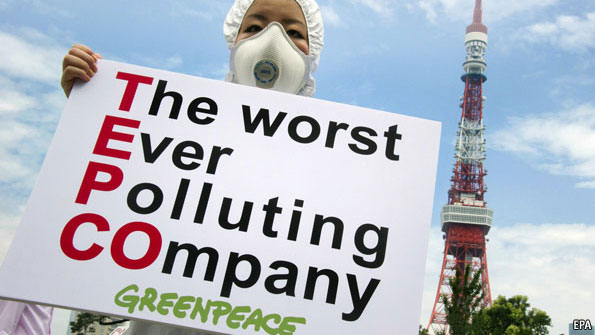
Japan’s Ministry of Health, Labor and Welfare is investigating a report that workers at the damaged Fukushima Daiichi nuclear power plant were told to use lead covers in order to hide unsafe radiation levels, an official said.The alleged incident happened December 1, nine months after a major earthquake and tsunami ravaged northern Japan and damaged the plant.”We’ll firmly deal with the matter once the practice is confirmed to constitute a violation of any law,” said the ministry official, who could not be named in line with policy.  An official with the plant’s operator, TEPCO, said the company received a report of the alleged incident Thursday from subcontractor Tokyo Energy & Systems. The report said a second subcontractor, Build-Up, created the lead covers and ordered workers to use them over their dosimeters, pocket-size devices used to detect high radiation levels.The TEPCO official could also not be named in line with policy.  okyo Energy & Systems said in its report that the workers never used the covers, the TEPCO official said. Japan’s Asahi Shimbun newspaper, however, reported Saturday that while some workers refused the orders to use the lead covers, nine others did use them for several hours.

The newspaper’s report cited plant workers, who described the lead covers as fitting snugly over the dosimeters inside the breast pockets of the workers’ protection suits.

TEPCO told CNN it ordered Tokyo Energy & Systems Inc. to conduct an investigation and is awaiting a reply.

Report: Japan nuclear workers told to hide radiation levels, CNN, July 21, 2012
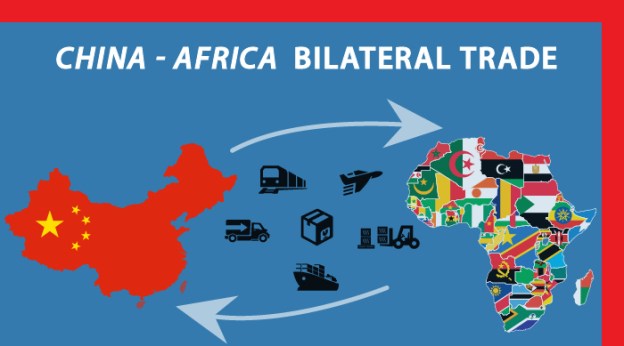
China and its Collaborators in Africa

Congolese critics accuse Sassou-Nguesso [President of Congo] of using the Chinese-backed building boom to move from his ‘authoritarian-authoritarian’ model to something nearer the ‘developmental authoritarian’ style of Rwanda’s President Paul Kagame. However, Sassou-Nguesso was in triumphant mode as he inaugurated a spate of Chinese construction projects in the country’s hinterland on 14-18 May. These projects are intended to bring the benefits of oil-backed growth to regions previously isolated from the bustling cities of Brazzaville and Pointe-Noire.  Now known locally as ‘The Cutter of Ribbons’, Sassou-Nguesso is using oil money and plans to develop Congo-Brazzaville’s mineral resources to shape a new relationship with China. Once a key commercial and diplomatic ally of France, Sassou-Nguesso’s headlong rush to Beijing coincides with the election of President François Hollande. Hollande’s African policy team promises to break with the old Françafrique networks. Among their advisors is the activist lawyer William Bourdon, who has been pursuing a case against Sassou-Nguesso in France for stealing Congolese state assets…..

From fibre-optic installation and new dams to more than 1,000 kilometres of paved roads, companies like China Road and Bridge Corporation and China State Construction Engineering Corporation have quietly landed most of the major contracts issued by the Brazzaville government.  That means large profits and more deals to come.

Congo-Brazzaville, for so long the preserve of European companies, is drawing serious attention from China. The two countries have signed deals to develop special economic zones, build a new oil port and revamp an ageing refinery. For the Chinese investors, the lure is Congo-Brazzaville’s rich but under-exploited resource base. Having relied for decades on offshore oil riches and forestry, the country has until recently made little effort to exploit its mineral deposits, develop its more remote regions or diversify the economy into commerce and services. That could change if the new Asian relationships live up to their billing. For Sassou-Nguesso, the big attraction is an engagement based purely on economic and financial criteria, with a partner who does not impose awkward governance or human rights conditions.

This is not Congo’s first encounter with Asian investment. South Korean and Malaysian companies, via the Consortium Congo Malaisie Corée, had proposed a huge resources-for-infrastructure deal that would build new rail lines in exchange for access to forestry and mining permits in 2008. That deal didn’t work out but the Chemin de Fer Congo Océan received part of its order of engines and cars from Korail in August 2011. Malaysian investors have looked at opportunities in the hydrocarbons sector and – building on their experience of rural Congo in the timber business – palm oil production. In 2010 Atama Plantation agreed to invest $300 million in new oil palm plantations and processing capacity.

The most recent interest from Chinese entities takes the engagement a step further. Alain Akouala Atipault, a Minister in the Presidency, was China’s guest at an international infrastructure and investment forum in Macau where, on 24 April, he signed an agreement with the China Friendship Development International Engineering Design and Consult Corporation (FDDC) – an offshoot of the Trade Ministry in Beijing.  FDDC will seek out Chinese investors interested in setting up operations in four special economic zones, which Congo plans to establish in Brazzaville, Pointe- Noire, Ouesso and the Oyo-Ollombo area. FDDC will also help to mobilise financing for the zones, build their infrastructure and carry out feasibility studies……

China’s engagement in Congo is typical of its strategy elsewhere in Africa. Beijing often takes a long-term view of whether projects will generate an economic return. Viability is seen in broad terms, encompassing not just the specific project’s concerns but also the wider trade and political benefits of partnership and the political goodwill that could open up access to valuable natural resources. Congo has both major reserves of high-value timber – a sector where Congo Dejia Wood Industry, Jua Ikié, Million Well Congo Bois, Sino-Congo Forêt and Société d’Exploitation Forestière Yuan Dong are already active – and reserves of minerals such as iron ore and potash, which are largely untouched.

China National Complete Plant Import & Export Corporation is developing the potash reserves at Mengo with Canada’s MagIndustries; Australia’s Sundance Resources relies on finance and expertise from Hanlong Mining and other Chinese infrastructure companies to make its designs on iron-ore projects in Cameroon (Mbarga) and Congo-Brazzaville (Nabeba) viable. Sundance is waiting for final approvals from Yaoundé and Brazzaville and expects all the paperwork to be signed before the end of 2012.

Beijing’s policy of ignoring questions of democracy and human rights is certainly helpful to Sassou-Nguesso’s regime – which has a poor human rights record, is marred by widespread corruption and remains fundamentally authoritarian despite the trappings of a multiparty system.

Excerpt, Congo-Brazzaville: Sassou Draws in Beijing,AllAfrica.com, June 2, 2012

Chevron and Amazon: the $18 billion Ecuador Liability

The D.C. Circuit Court of Appeals  on June 12, 2012  (pdf) dealt another setback to Chevron over its $18 billion Ecuador liability, reversing a lower court decision that allowed the oil giant access to documents from a prominent consulting group for the Amazon rainforest communities that sued the company.