Monthly Archives: December 2015

Nuclear Waste in the Seabed, Sweden


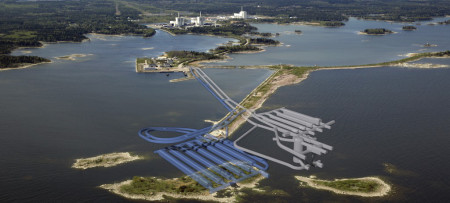
Sweden keeps its radioactive operational waste SKB’s Final Repository for Short-Lived Radioactive Waste is located at Forsmark in the municipality of Östhammar. The facility started operating in 1988 and was then the first of its kind in the world.  The radioactive waste deposited in the SFR is low and medium level waste. This means that unlike spent nuclear fuel it does not have to be cooled and is relatively short-lived.  The SFR is situated 50 metres below the bottom of the Baltic and comprises four 160-metre long rock vaults and a chamber in the bedrock with a 50-metre high concrete silo for the most radioactive waste.  Two parallel kilometre-long access tunnels link the facility to the surface.

Except from http://www.skb.com/our-operations/sfr/

Platform Capitalism: FANG

Hardly a day goes by without some tech company proclaiming that it wants to reinvent itself as a platform. …Some prominent critics even speak of “platform capitalism” – a broader transformation of how goods and services are produced, shared and delivered.   Such is the transformation we are witnessing across many sectors of the economy: taxi companies used to transport passengers, but Uber just connects drivers with passengers. Hotels used to offer hospitality services; Airbnb just connects hosts with guests. And this list goes on: even Amazon connects booksellers with buyers of used books.d innovation, the latter invariably wins….

But Uber’s offer to drivers in Seoul does raise some genuinely interesting questions. What is it that Uber’s platform offers that traditional cabs can’t get elsewhere? It’s mostly three things: payment infrastructure to make transactions smoother; identity infrastructure to screen out any unwanted passengers; and sensor infrastructure, present on our smartphones, which traces the location of the car and the customer in real time. This list has hardly anything to do with transport; they are the kind of peripheral activity that traditional taxi companies have always ignored.

However, with the transition to knowledge-based economy, these peripherals are no longer really peripherals – they are at the very centre of service provision.There’s a good reason why so many platforms are based in Silicon Valley: the main peripherals today are data, algorithms and server power. And this explains why so many renowned publishers would team up with Facebook to have their stories published there in a new feature called Instant Articles. Most of them simply do not have the know-how and the infrastructure to be as nimble, resourceful and impressive as Facebook when it comes to presenting the right articles to the right people at the right time – and doing it faster than any other platform.

Few industries could remain unaffected by the platform fever. The unspoken truth, though, is that most of the current big-name platforms are monopolies, riding on the network effects of operating a service that becomes more valuable as more people join it. This is why they can muster so much power; Amazon is in constant power struggles with publishers – but there is no second Amazon they can turn to.

Venture capitalists such as Peter Thiel want us to believe that this monopoly status is a feature, not a bug: if these companies weren’t monopolies, they would never have so much cash to spend on innovation.  This, however, still doesn’t address the question of just how much power we should surrender to these companies.

Making sure that we can move our reputation – as well as our browsing history and a map of our social connections – between platforms would be a good start. It’s also important to treat other, more technical parts of the emerging platform landscape – from services that can verify our identity to new payment systems to geolocational sensors – as actual infrastructure (and thus ensuring that everybody can access it on the same, nondiscriminatory terms) is also badly needed.

Most platforms are parasitic: feeding off existing social and economic relations. They don’t produce anything on their own – they only rearrange bits and pieces developed by someone else. Given the enormous – and mostly untaxed – profits made by such corporations, the world of “platform capitalism”, for all its heady rhetoric, is not so different from its predecessor. The only thing that’s changed is who pockets the money.

Excerpt from Evgeny Morozov, Where Uber and Amazon rule: welcome to the world of the platform, Guardian, Nov. 15, 2015

The Japan-India Nuclear Deal, 2015


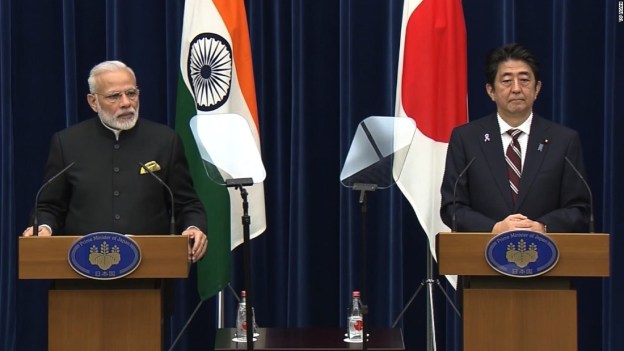
Prime Minister Shinzo Abe’s agreement in principle to supply nuclear power technology to India may run counter to Japan’s stated commitment against the proliferation of nuclear weapons.  The deal was reached on Dec. 12, 2015 during a meeting between Abe, who is visiting New Delhi, and his Indian counterpart, Narendra Modi. If an actual nuclear power agreement is signed, it would mark the first for Japan with a nation that has not signed the Nuclear Nonproliferation Treaty. The latest move by Japan was met swiftly with criticism in Hiroshima and Nagasaki.

Japan and India began negotiating a nuclear power agreement in 2010 when the Democratic Party of Japan was still in power. Japan had wanted a provision in any such deal that would allow it to immediately stop any nuclear power cooperation should India resume testing of nuclear weapons, which has been on hold since 1998.  Although a joint declaration and a memorandum regarding a nuclear power agreement were released on Dec. 12, 2015 no provisions were included regarding a suspension of cooperation should India resume nuclear testing.  In the joint declaration, the two leaders confirmed that a nuclear power agreement would be signed after completion of the technological details through further negotiations between the two nations.

Excerpt from Japan’s nuclear power deal in principle with India a first with an NPT non-signer,  ASAHI SHIMBUN, Dec. 13, 2015


Fukushima Waste Disposal under Ocean Floor

The industry ministry will consider the feasibility of burying high-level radioactive waste from nuclear power plants under the seabed, which a working panel said Dec. 11, 2015 could be a “highly appropriate” solution.  In an interim report on disposal methods of highly contaminated materials from spent nuclear fuel, the panel said such waste could be disposed of in adjacent waters within 20 kilometers of the coastline.

It called the disposal method relatively realistic because the circulation of groundwater at sea is not as strong as on land. The panel said the site should be created in adjacent waters so that nuclear waste can easily be transported by ships.  The panel included the under-the-seabed disposal plan in nearby waters as a viable option for the final disposal site.

Based on this proposal, the ministry will set up an expert panel in January 2016 to discuss what specific technical challenges lay ahead.  The expert panel will discuss locations of active faults under the seabed and the impact of sea level changes to evaluate the feasibility of the project. It is expected to issue its recommendations by next summer.

While the government has encouraged municipalities to submit candidate sites for nuclear waste disposal, it is being forced to rethink this policy because no local government has come forward to provide a realistic disposal site.  Instead, it will hand-pick the “candidate sites from scientific perspectives” and unilaterally request local governments to comply with its research and inspection efforts.

Japan to consider ocean disposal of nuclear waste, THE ASAHI SHIMBUN, Dec. 12, 2015

The New Saddam Husseins

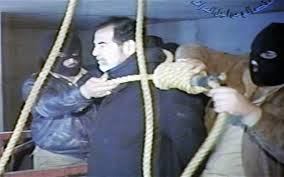
[The] intelligence network Islamic State has put in place since it seized vast stretches of Iraq and neighbouring Syria… [is overseen by] former army and intelligence officers, many of whom helped keep former Iraqi strongman Saddam Hussein and his Baath Party in power for years. …The Baathists have strengthened the group’s spy networks and battlefield tactics and are instrumental in the survival of its self-proclaimed Caliphate, according to interviews with dozens of people, including Baath leaders, former intelligence and military officers, Western diplomats and 35 Iraqis who recently fled Islamic State territory for Kurdistan.  Of Islamic State’s 23 portfolios – equivalent to ministries – former Saddam regime officers run three of the most crucial: security, military and finance, according to Hisham al-Hashimi, an Iraqi analyst who has worked with the Iraqi government….In many ways, it is a union of convenience. Most former Baathist officers have little in common with Islamic State. Saddam promoted Arab nationalism and secularism for most of his rule.  But many of the ex-Baathists working with Islamic State are driven by self preservation and a shared hatred of the Shi’ite-led government in Baghdad. Others are true believers who became radicalised in the early years after Saddam’s ouster, converted on the battlefield or in U.S. military and Iraqi prisons….

Baathists began collaborating with al Qaeda in Iraq – the early incarnation of what would become Islamic State – soon after Saddam Hussein was ousted in 2003. Saddam had run a brutal police state. The U.S. occupation dissolved the Baath Party and barred senior and even middling party officials from joining the new security services. Some left the country, others joined the anti-American insurgency…..By 2014, the Baathists and the jihadists were back to being allies. As Islamic State fighters swept through central Iraq, they were joined by the Army of the Men of the Naqshbandi Order, a group of Baathist fighters..That has boosted Islamic State’s firepower and tactical prowess….Emma Sky, a former adviser to the U.S. military, believes Islamic State has effectively subsumed the Baathists. “The mustached officers have grown religious beards. I think many have genuinely become religious,” she said.

Among the most high profile Baathists to join Islamic State are Ayman Sabawi, the son of Saddam Hussein’s half brother, and Raad Hassan, Saddam’s cousin, said the senior Salahuddin security official and several tribal leaders. Both were children during Saddam’s time, but the family connection is powerfully symbolic. More senior officers now in Islamic State include Walid Jasim (aka Abu Ahmed al-Alwani) who was a captain of intelligence in Saddam’s time, and Fadhil al-Hiyala (aka Abu Muslim al-Turkmani) whom some believe was a deputy to Islamic State leader Abu Bakr al-Baghdadi until he was killed in an airstrike earlier this year.

The group’s multi-layered security and intelligence agencies in Mosul, the biggest city in northern Iraq, are overseen by an agency called Amniya – literally ‘Security’. The agency has six branches, each responsible for maintaining a different aspect of security…..They also run a network of informants, placing children such as 14-year-old Mohannad in mosques and markets, and women at funerals and family gatherings, according to residents of Mosul…

Islamic State execution squads often arrive in a large bus with tinted windows, another resident said. Police seal off streets surrounding the place where a killing is to be carried out. Men dressed in black with balaclavas either shoot people, or behead them with swords.The bodies of those deemed to have committed the worst offences – cursing God or the group – are thrown in an area called al-Khafsa, a deep natural crater in the desert just south of Mosul, residents in the city said. Those killed for lesser crimes are returned to their families wrapped in a blanket.

Excerpts from  Isabel Coles and Ned Parker, The Baathists: How Saddam’s men help Islamic State rule, Reuters, Dec. 11, 2015

Weather Engineering and Climate Change

Maharashtra is one of the largest and wealthiest of India’s 30 states, with 110 million residents. It encompasses Mumbai and other large cities, plus vast swaths of farmland. Like other agricultural regions of India, it’s in its third consecutive year of drought. More than 80 percent of its farms depend on rain for irrigation, and agriculture production has dropped by almost a third since 2013. The human impact has been severe—1,300 debt-trapped farmers have committed suicide in Maharashtra in just the past six months.In July, 2015 the state’s minister of revenue, Eknath Khadse, took a gamble: He hired Koliwad to carry out a $4.5 million cloud-seeding program over three months and across 100 square miles in the middle of the state, the largest campaign of this kind ever attempted in India.

So Koliwad called Weather Modification Inc., the world’s largest private aerial cloud-seeding company, based in Fargo, N.D. WMI’s chief executive, Patrick Sweeney, developed a five-year technology transfer program with Koliwad that’s now in its first year. Pederson and other WMI staff are training Indian pilots, meteorologists, and Doppler radar technicians to seed clouds.

Sweeney has seeded clouds all over the world for more than 20 years, but the Maharashtra project is unique in that the circumstances are so dire. “The hardest part is managing expectations,” he says. “People in Maharashtra are hoping for a cure-all to drought. They come out and dance in the streets when it rains, they hug our pilots and say, ‘Do it again.’ But we can’t guarantee that the clouds will be there—and willing to cooperate.”..

Despite the uncertainty, the industry is on the rise. According to the World Meteorological Organization, more than 52 countries have active cloud-seeding operations—up from 42 four years ago. In the U.S. last year, 55 cloud-seeding projects were reported to NOAA. There’s even a luxury cloud-seeding market emerging—one European company, for instance, charges a minimum of $150,000 to guarantee good wedding weather by forcing clouds to rain in the days before the event….

Sweeney also built ICE (Ice Crystal Engineering), a company that makes cloud-seeding chemicals and supplies flares to 25 countries. ICE adds a decent sidestream of income for Sweeney, with revenue of about $3 million a year. But the bigger advantage is that it helped WMI become the only aerial seeding company that “does a full turnkey,” says Neil Brackin, WMI’s president—meaning it customizes and operates the planes and radars, manufactures the flares, and flies the missions.

They do have competitors. There are 34 private companies worldwide that do weather modification, but there’s no bigger rival in aerial cloud seeding than the Chinese government, which spends hundreds of millions a year seeding clouds in 22 of its 23 provinces, both to clear pollution above cities and to enhance rainfall for farming. China has yet to allow private companies to enter its market, but Sweeney is making inroads; he sold his first cloud-seeding plane to Beijing last year.

Thailand’s government has a Bureau of Royal Rainmaking, with hundreds of employees that WMI helped train, though the program’s still using old technology—releasing mounds of table salt from trap doors in the bellies of its planes. And when the Argentine government took over the cloud-seeding program WMI built for the country, it cut costs. Soon after, two pilots died seeding clouds above a mountain, and the project was suspended…

Brackin adds that while scientists want to achieve a 99.99 percent probability that a technology consistently works, the industry doesn’t need that kind of certainty or consistency to succeed. He likens cloud seeding to a cutting-edge medication that’s still in development: “If you’re dealing with a serious ailment and you were offered a medicine that had a 60 percent chance of working, or even 20 percent, would you take it? You probably would.”

Excerpts from  Amanda Little, Weather on Demand: Making It Rain Is Now a Global Business, Bloomberg, Oct. 28, 2015

Organized Corruption: Moldova

During the country’s previous general-election campaign November 2014, Moldova was hit by a bombshell. A leaked report revealed that up to $1 billion, equivalent to more than one-eighth of the country’s GDP, had been stolen from three banks. It named the 28-year-old Mr Shor, an Israeli-born financier who is one of Moldova’s richest men, as being at the centre of a web of companies connected to the heist. Mr Shor denies any involvement. The government, trying and failing to stave off the banks’ collapse, pumped in money, leaving Moldovans, whose average salary is $200 a month, to foot the bill. According to the Organised Crime and Corruption Reporting Project, a watchdog, the banks were part of a scheme which, in the seven years up to 2014, laundered $20 billion of Russian money using a British shell company and a Latvian bank account.

Although nobody has been convicted of any crime, Moldovans are seething with rage that their political leaders did not see fit to police the banking system better….Under the leadership of the purportedly pro-European parties, Moldova has inched forward on some fronts. It secured visa-free entry to Europe’s passportless Schengen zone and signed a key integration deal with the European Union in 2013. Now the banking scandal has discredited both the politicians and their cause. Igor Botan, an analyst, says they are “blackmailing” Moldovans. “They say, ‘We are pro-European thieves, but if you don’t like us the pro-Russians will come’.”

Excerpt from Moldova on the edge: Small enough to fail, Economist,  Nov. 21, 2015, at 50

From Cities to Shantytowns: Basra, Iraq

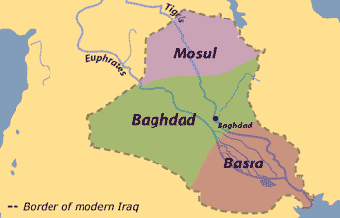
Basra should be Iraq’s most successful province. It lies furthest from IS’s front lines and has a tradition as the country’s most cosmopolitan city. It remains the country’s dynamo. It has Iraq’s only ports, and oil production that generates around 95% of the government’s oil revenues. But four decades of war, sanctions, occupation, neglect and Shia infighting have rendered it decrepit and dysfunctional. Its utilities are worse than those of Mosul, Iraq’s second city, which is controlled by IS. Power cuts last most of the day. The water is stickily saline. The air is acrid from oil plumes and from sewage that dribbles into collapsed canals which once saw Basra called “the Venice of the East”. Cholera is back. “Our health was better under sanctions and Saddam Hussein,” says a local councillor.

With nothing to do, the city’s youth turn to militias for jobs. They are probably the province’s largest employer...International oil companies might have kick-started the economy, but chose to locate all but essential operations abroad. Though local hire is cheaper, under their oil contracts, whoever they hire the Iraqi government pays. Such are the inflated costs that producing a barrel of Iraqi oil costs twice as much as in Saudi Arabia.

The oil companies argue that foreign labour is more reliable. But had the security environment been better and had Iraq paid its dues, they might have established training centres and universities in Iraq just as they did in Saudi Arabia. By sealing themselves off from Iraq, they are creating a vicious circle. As the gap between them and the locals widen, grievances mount. Worried about the prospects, Occidental Petroleum Corp, America’s fourth-largest producer, asked the government to buy back its stake in Zubair, a large southern oilfield, last month.

Iraqi politics compounds the lack of opportunity. The ruling parties in Baghdad divvy up the oil revenues before they trickle south. Their local representatives immobilise the rest. Basra’s governor, council head and mayor all belong to rival religious Shia parties. Each vetoes the others’ decisions and projects. Their militiamen jostle for control on the streets. In October 2014 Badr, the most powerful militia group, took over Saddam’s palace, from where the British ran their occupation in 2003, and pinned portraits of Iran’s supreme leader, Ali Khamenei, and Shia Iraq’s own religious leader, Ali al-Sistani, on its walls. Posters of their martyrs line Basra’s highways. The limited political freedoms gained since Saddam’s fall are receding…

“The middle class are selling what assets they still have and are fleeing the country,” says a local journalist, who is toying with following them. Flights bound for Istanbul leave full and return half empty. But the numbers in Basra are quickly replenished. Land clearance for oilfields has triggered a rural flight, ringing the city in shantytowns. More arrive from poorer neighbouring provinces with no oil. As an urban middle class is replaced by more conservative, poorer people from the countryside, Basra’s character is changing…. Restoration of the city’s grand old Jewish and Greek palaces stopped when Saddam was overthrown.

An hour’s drive north of Basra, the city of Amara shows what could be possible. There, the Shia religious parties co-operate, holding each other to account rather than blocking each others’ projects. The province has revamped its roads and sewage system and sports flashy government buildings. Chinese contractors shop in the markets without their security escorts. Two new gas-powered plants are set to fire up next year. But much worse can happen, too. In 2013 Iraqis in the disenfranchised north-west staged months of protests, which the authorities ignored and then fiercely repressed. Islamic State took their place, offering another way.

Excerpts from Iraq: The blighted city, Economist,  Nov. 21, 2015, at 48.

When the Buying Stops the Killing Can too: Endangered Species

[O]n October 15th, 2015 China announced a one-year ban on the import of ivory hunting trophies from Africa, closing a big loophole. Wildlife activists are delighted….The world’s elephant population has dived from 1.2m in 1980 to under 500,000 today. In 1989 the sale of ivory was banned worldwide. But in 1999 and again in 2008, the Convention on International Trade in Endangered Species (CITES), a conservation pact, allowed the sale of stockpiles of ivory from southern Africa to China. The countries vowed to use the proceeds for conservation; China claimed it had a robust registration system that would keep illegal ivory out. But conservationists rightly predicted the concession would fuel more smuggling and so more killing.  Permitted sales became a cover for illegal ones. In 2010-12 about 100,000 elephants were slain for their tusks. In the past five years, Mozambique and Tanzania have lost half their elephants to poaching…

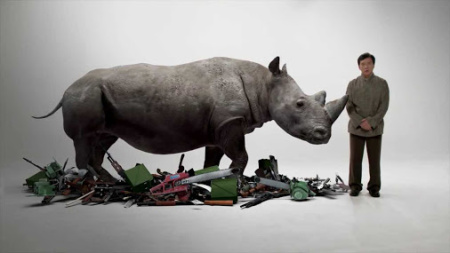
Despite strong demand for ivory among China’s rising middle class, attitudes may gradually be changing. As of 2012, nearly half of Chinese people saw elephant poaching as a problem, according to a survey by WildAid. The figure has been boosted by the support of celebrities. Yao Ming, a basketball player, and Jackie Chan, an actor, appear on posters everywhere with the message: “When the buying stops, the killing can too.” The government has donated $200m worth of media space every year since 2008.

Opinion on ivory has shifted fast, says Mr Knights, partly because of the success of another campaign, to protect sharks. In the markets of Guangzhou, the global centre for the trade, dried shark fins have fallen from 3,000 yuan ($470) per kilo five years ago to 1,000 yuan today, as Chinese people abjure shark-fin soup, a delicacy.  WildAid raised its voice over that issue, too, but more important was the Communist Party’s ban in 2013 of shark-fin soup at official banquets, part of a drive against corruption and excess. The Hong Kong government followed, as did airlines and hotels. A survey in 2013 found 85% of people said they had stopped eating shark-fin soup in the past three years.

One scourge is untouched by all this: the illegal trade in rhinoceros horn. More than 1,200 rhinos were killed for their horns in 2014 in South Africa alone, up from just 13 killed in 2007. This partly reflects a huge rise in demand in Vietnam, but China is also a consumer. Ground rhino horn is believed to cure fever and improve sexual performance. One kilo can cost up to $70,000.

Ominously, some African nations now want a one-off sale of rhino-horn stocks, as happened twice with ivory. To secure this, South Africa must win two-thirds of the member states at the next CITES conference…

Excerpts from Animal conservation: The elephants fight back, Economist, Nov. 21, 2015, at 44

The CIA Khost Force in Afghanistan

The CIA continues to run a shadow war in the eastern part of Afghanistan, overseeing an Afghan proxy called the Khost Protection Force (KPF), according to local officials, former commanders of that militia and Western advisers.  The highly secretive paramilitary unit has been implicated in civilian killings, torture, questionable detentions, arbitrary arrests and use of excessive force in controversial night raids, abuses that have mostly not been previously disclosed.

Here in Khost–the strategic eastern border province, which has long served as a key gateway for militants entering from Pakistan, the KPF fights in conjunction with the CIA out of Forward Operating Base Chapman.In Khost, the KPF is more influential than the Afghan army and police, and is unaccountable to the provincial government, often acting outside normal chains of command. Locally, militias such as the KPF are called “campaign forces,” an informal name Afghans use for pro-government armed groups….

But a visit to Khost last month revealed that although there is coordination with the security directorate — the NDS — the CIA is still directing the KPF’s operations, paying fighters’ salaries, and training and equipping them. American personnel were gathering biometric data of alleged suspects, according to witnesses, former KPF commanders and local officials who regularly meet with the force and their American overseers.

The KPF was one of several large paramilitary forces created by the CIA in the months after the Taliban was ousted following the 9/11 attacks. Recruits were drawn from local tribes in Khost with promises of salaries, equipment and conditions that were better than in the Afghan military.The force largely operates along the border with North Waziristan, the Pakistani tribal region that is a nerve center for the Taliban, its ally, the Haqqani Network, and al-Qaeda. Fighters receive as much as $400 a month in salary, twice what a soldier in the Afghan security forces earns. Commanders earn $1,000 or more a month, as much as an Afghan army general. Equipped with night-vision goggles, they drive tan Humvees and armored trucks mounted with machine guns.CIA operatives often travel along on raids with the KPF in order to call in airstrikes, from U.S. warplanes or drones, if needed, said Sardar Khan Zadran, a former top KPF commander who still maintains close links to the force.  “They are accountable to no one but the Americans,” Zadran said…

On Nov. 7, 2015 hundreds of angry villagers took to the streets of Khost city. There had been another night raid in which the KPF killed two people, described by the protesters as civilians. The corpses were placed in pickup trucks, and the crowd moved toward Camp Chapman. Some clutched sticks and tree branches. Others carried white Taliban flags.“Death to Americans,” they chanted. “Death to American slaves.”

It was the latest sign of a growing backlash against the CIA and its proxy.The provincial council, several of its members said, has received thousands of complaints about the KPF, not just about the deadly night raids, but also about strict roadblocks that can last for hours. “If their problems are not solved, those people might start cooperating with the insurgents,” said Bostan Walizai, a human rights activist.

Excerpts from  Sudarsan Raghavan, CIA runs shadow war with Afghan militia implicated in civilian killings, Washington Post,  Dec. 3, 2015

The Science of Killing: snipers


TrackingPoint, a Texan firm has a system that collects and crunches almost all the variables (distance to target; air temperature and pressure; compass bearing, to allow for the Earth’s spin; and even the size of the area on the target that will produce a kill) which might cause a dumb round to miss. The sniper has only to add wind speed and direction, and then pull the trigger. The gun waits until its calculations suggest all is well before firing the bullet. According to John McHale, TrackingPoint’s boss, a marksman can “close his eyes at this point and just wiggle his gun” until it fires….TrackingPoint’s system is now available—and more than 45 of the world’s defence ministries would, indeed, like to avail themselves of it. At the moment, unless their address is in Arlington, Virginia, they cannot; the American government has forbidden the system’s export. This, though, has not stopped people trying. TrackingPoint has suffered so many cyber attacks that details are now kept strictly offline. Yet sooner or later, the secret will out. When it does, the mystique of the sniper may simply evaporate, as every infantry grunt in an army that can afford it becomes a sharpshooter in his own right.

Excerpt, The Future of Sniping: Enemy at the Gates, Economist, Nov. 21, 2015 at 73

Anadarko Fined for Gulf of Mexico Spill

Anadarko Petroleum Corp. was ordered to pay almost $160 million for its role as part-owner of the doomed Gulf of Mexico well that in 2010 caused the biggest offshore oil spill in U.S. history.  The fine was the last big uncertainty hanging over Anadarko from the disaster. The order on November 30, 2015  comes after the government told U.S. District Judge Carl Barbier in New Orleans that the company should be fined more than $1 billion for its role in the well’s blowout, which killed 11 people and spewed oil for almost three months. Anadarko, which had a 25 percent stake in the Macondo well, argued it shouldn’t be required to pay fines simply because it owned part of the well, as the accident wasn’t its fault. In 2014, The Woodlands, Texas-based company set aside $90 million for the case when it offered to settle for that amount.

Barbier said the fine reflected his finding that Anadarko didn’t have a role in causing the spill. Under the law, he could have imposed as much as $1,100 per barrel of oil spilled, or about $3.5 billion.  The fine is “only 4.5 percent of the maximum penalty, and therefore on the low end of the spectrum,” Barbier said in his order. “The court finds this amount strikes the appropriate balance between Anadarko’s lack of culpability and the extreme seriousness of this spill.”

Barbier rejected Anadarko’s argument that a heavy penalty could cause minority partners to seek a larger role in offshore operations, which might complicate safety and drilling decisions. “A penalty of this size might encourage non-operators to avoid investing with careless operators,” he said.  The company said it’s pleased the penalty is less than what the government sought and that it’s reviewing whether to file an appeal. “While we respect the court’s decision, we continue to believe that penalizing a non-operator for events beyond its control is inconsistent with the intent of the Clean Water Act,” Anadarko said in a statement posted on its website.

David Berg, a Houston attorney who has tracked the oil spill litigation and often sues polluters on behalf of municipalities, said given the damage from the spill, the fine is “not a slap on the wrist; it’s a tongue kiss from the judge.”  David Uhlmann, former head of the Justice Department’s environmental crimes unit, said the fine is “too small to be an effective deterrent.” It “will not have a significant effect on a company worth approximately $30 billion,” said Uhlmann, now a University of Michigan law professor.

The professor said Anadarko wasn’t a silent partner in its dealings with BP Plc, which owned 65 percent of the well.  “Anadarko urged BP to continue drilling deeper, even when BP wanted to stop,” he said. “Yet the judge refused to consider evidence of Anadarko’s risky behavior, which may explain the small size of Anadarko’s fine.”

Excerpt from Anadarko Ordered to Pay $159.5 Million for 2010 Gulf Spill, Bloomberg Business, Nov. 30, 2015

Demand for Carbon Tax

“You can argue that Big Oil is becoming Big Gas,” says Occo Roelofsen of McKinsey, a consulting firm. Others are going in for renewables. Total of France has a majority stake in SunPower, one of the world’s biggest solar-power firms. Eldar Saetre, the boss of Statoil, Norway’s state-run oil company, says that in 15 years there may be more opportunities outside oil and gas than within.

Plenty of oil firms (Exxon among them) are also calling for governments to enact a “carbon tax” on emitters of greenhouse gases. Their critics argue that this is less altruistic than it appears. For one thing, such a tax would hurt the coal industry especially, thereby boosting the oil firms’ gas businesses. And governments, especially in the developing world, where fossil-fuel demand is still surging, may find such a tax politically impossible anyway; the oilmen are calling for it, opponents say, in the knowledge that such countries will never introduce it….

On November 4th New York’s attorney-general, Eric Schneiderman, subpoenaed documents from Exxon to investigate how much it has known since the 1970s about the effects of fossil fuels on the climate. Exxon is reportedly being investigated under the Martin Act, dating back to 1921, which gives prosecutors wide-ranging powers to investigate securities fraud. Exxon says it has long disclosed information about the risks to its business from climate change, and from action to prevent it, in reports to its shareholders. But the firm’s run-in with the New York justice department may be a portent of what is to come.

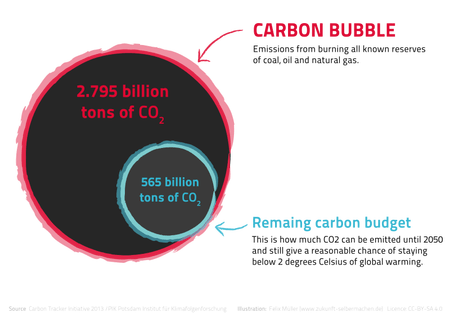
Another worry for oil executives is pressure from investors spooked by the financial risks of climate change. Policymakers, such as Mark Carney, governor of the Bank of England, talk about the possibility of many oilfields turning into “stranded assets”, or “unburnable carbon”, if governments get serious about climate-change action. Anthony Hobley of Carbon Tracker, a climate-advisory firm, says that if the Paris pledges are taken at all seriously, the oil and gas industry may become “ex-growth”. Oil executives dispute that. But shareholders, if motivated, could force the industry to shrink just by limiting the funds they provide for new oil discoveries.

Curiously, the present situation may provide a foretaste of this—though cyclically, because of falling oil prices, rather than structurally, because of rising temperatures. Faced with a world awash in crude, oil majors are abandoning high-cost reserves in the Arctic, Canada, North Sea and Gulf of Mexico. One oil executive ruefully calls it a “practice run” for the day in the distant future when fears of global warming, or the emergence of cheap, clean alternative technologies, mean that demand for fossil fuels starts to wane.

Excerpt from Oil Companies and Climate Change: Nodding Donkeys, Economist, Nov. 14, 2015, at 61