Monthly Archives: May 2016

Tuna Boats in Mozambique

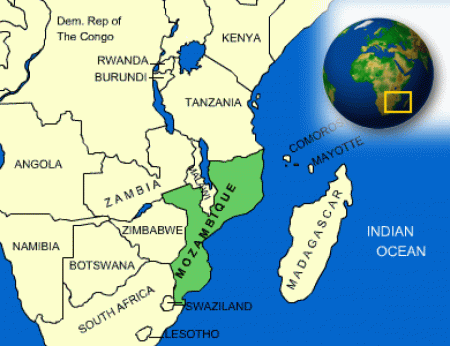
Mozambique’s tuna fishing fleet needs to be refitted to meet European Union standards, Finance Minister Adriano Maleiane said on May 23, 2016 piling more costs onto a project at the centre of a debt crisis.

The boats were paid for out of an $850 million loan arranged in 2013 by Credit Suisse and Russia’s VTB to finance “fishing infrastructure”. The cash came in the form of a government-backed bond to state tuna-fishing company Ematum.

Nearly three years later, the fishing project, initially touted as self-sustaining, has severely underperformed and added to a sovereign foreign debt mountain equal to 80 percent of GDP that could bankrupt the [country]….Not only did Ematum fall short of its targets but $500 million of the “tuna bond” was subsequently designated for “maritime security” and reallocated to the defence budget.The 24 boats, which were built in France, will now be modified in South Africa so they can export tuna to Europe…Mozambique’s government cannot afford to have them all upgraded at once. “The costs involved in refitting the boats are high, hence the work is being done in phases,” Maleiane was quoted by the state news agency as saying.

Deepening the mire, a further $1.35 billion of previously undisclosed government-backed debt emerged last month, prompting the International Monetary Fund and Western governments to suspend budgetary aid support.  The loans included $622 million for Proindicus, a state-owned company tasked with providing maritime security, and a $535 million for Mozambique Asset Management (MAM) to build a shipyard for gas projects…The hidden loans have exposed widespread government mismanagement that risks pushing a promising African economy, one that emerged from a ruinous 1976-92 civil war, into crisis.

Excerpts from Mozambique to refit tuna fleet, compounding debt crisis, Reuters, May 24, 2016
Justice 4 Fish

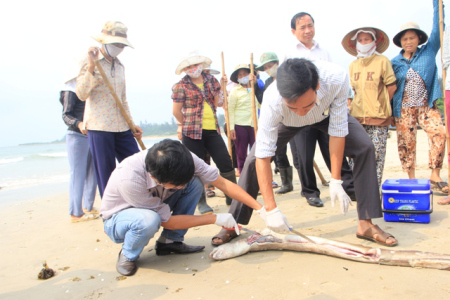
Hundreds of people have held a rare protest in Vietnam against the unexplained mass death of fish on the country’s central coast. Vast numbers of dead fish have appeared across some 200km (125 miles) of coastline since early April. A government investigation has so far found no links to a steel plant owned by Taiwanese firm Formosa Plastics.But many of the demonstrators in Hanoi blamed the company, and carried placards saying “Formosa Out”. Other signs read “Formosa destroying the environment is a crime” and “Who poisoned the central region’s waters?”

Environment Minister Tran Hong Ha said the die-off was “a very huge and serious environment disaster” and admitted that the government had been slow to react.He said Formosa Plastics had been ordered to dig up an illegal waste pipe at its plant.  Fishermen along the affected coastline are banned from selling their stocks, but seafood industry officials said exports, that bring in $6.6b a year, would not be affected.

Excerpt from Vietnam protest over mystery fish deaths, BBC, May 1, 2016

Crocodile Farms for Hermes Bags

Over 20 countries export crocodilian skins, according to statistics from the UN Environment Programme. More than half the global tally is from caimans and alligators farmed in Colombia and the United States. The skins are largely sold to tanners in Italy and France, and also in Singapore.The industry has grown apace since the late 1970s, when conservationists began loosening an export ban designed to defend the animals from hunting (the trade is still controlled under CITES, an intergovernmental effort to protect endangered creatures). Grahame Webb, a biologist, says that many of the 5,000 or so farms are tiny set-ups in Asian villages. The largest outfits, however, now boast as many as 70,000 crocs. Some are getting snapped up by big leather-buyers at fashion houses such as Hermès and Louis Vuitton.

Excerpt from  Crocodile Farming: Snapping Dressers, Economist, May 14, 2016, at 55

Stealing from Central Banks: hacking attacks

A little-noticed lawsuit details a hacking attack similar to one that stole $81 million from Bangladesh’s central bank, saying cybercriminals stole about $9 million in 2015 from a bank in Ecuador…..…A third attack, from December 2015 at a commercial bank in Vietnam, was detailed last week by the Society for Worldwide Interbank Financial Telecommunication, or Swift. That bank detected the fraudulent requests and stopped the movement of funds, the central bank in Vietnam said.  In the January 2015 Ecuador hack, as with the Bangladesh case, hackers managed to get the bank’s codes for using Swift, the global bank messaging service, to procure funds from another bank, according to court papers.

The Ecuadorean bank, Banco del Austro, filed a lawsuit in New York federal court in 2016 accusing Wells Fargo & Co. of failing to notice “red flags’’ in a dozen January 2015 transactions and to stop them before the thieves transferred about $12 million, most of it to banks in Hong Kong.  Lawyers for the two banks didn’t immediately return phone calls asking to comment about the case and Swift’s complaints that they had failed to notify the messaging network….

There are similarities in method, including thieves accessing the bank’s system to log on to the Swift network through customer sites, and doing so after bankers’ hours, apparently to reduce the likelihood someone would ask questions about specific transactions…

According to that filing on behalf of Banco del Austro, or BDA, “For each of the unauthorized transfers, an unauthorized user, using the Internet, hacked into BDA’s computer system after hours using malware that allowed remote access, logged onto the Swift network purporting to be BDA, and redirected transactions to new beneficiaries with new amounts.” Using that method, just before midnight on Jan. 14, 2015, a payment order made to a Miami company for less than $3,000 was altered to send $1.4 million to an account in Hong Kong, according to the court filing. There were 12 suspect transfers carried out over a 10-day period in January 2015, according to the lawsuit.  BDA’s lawsuit argues Wells Fargo should have noticed several anomalies in the transfers and, at a minimum, asked questions about them.  “The unauthorized transfers were made in unusual times of the day, in unusual amounts, to unusual beneficiaries in unusual geographic locations,’’ the bank’s lawyers argued in the filing. “Despite the numerous anomalies in the unauthorized transfers, [Wells Fargo] inexplicably failed to block them and/or alert BDA of the suspicious activity.’’

Excerpts from DEVLIN BARRETT and KATY BURNE, Now It’s Three: Ecuador Bank Hacked via Swift, Wall Street Journal, May 19, 2016

Nuclear-Powered Aircraft Carrier, India

India’s navy has finalised plans for a nuclear-powered super-carrier, which is scheduled to be built in Kochi with US help.  In preparation for the long-gestation project, estimated for the year 2028, the navy is setting up the building blocks that will identify the aircraft to be based on the carrier.  The carrier is  to be called the INS-Vishal.

Nuclear energy enables a carrier to sail for months without needing to dock for refuelling. The navy wants a nuclear-powered carrier….to enhance its reach beyond territorial waters.  It has determined that the carrier will need a nuclear reactor generating 180MW for propulsion, and may go for two reactors of 90MW each. Talks with the Bhabha Atomic Research Centre (Barc) are at an advanced stage.

The navy has bolstered its case for a nuclear-powered carrier by citing the nuclear deals India has signed not only with the US but also with Japan and Germany, albeit for peaceful uses of nuclear technology…The navy had invited preliminary inquiries from foreign entities for the design and development of the Vishal: DCNS of France, Rosoboronexport of Russia, Lockheed Martin of the US. Within the top brass, however, there is now a congealing of opinion that the US option may be the one to go after.

This is as much because of the technology regime that India promises to enter following the nuclear deals as because the US is actually operating carriers and building them, the latest being the Gerald R Ford class

“In the Arihant (the Indian nuclear submarine now in sea trials) we have gained, with some Russian help, the ability to develop a reactor for our purpose. Barc is confident that it can build for the carrier too,” the officer said…The only Indian operational carrier now is the Vikramaditya. At 45,000 tonnes it has a flight deck that is still too small for the new dimensions of carrier operations the navy is envisaging from the Vishal, the officer said.

Excerpts from Plan for nuclear-driven carrier with US help, the Telegraph (Calcutta) May 16, 2016


Defenses Against the Sea: Bangladesh

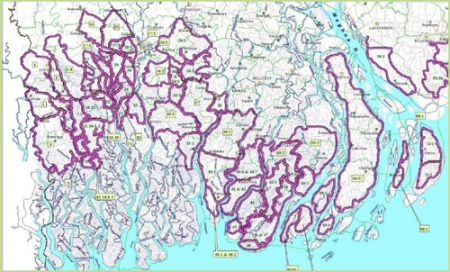
Facing the bleak prospect of millions of its citizens being displaced in coming years due to storms and sea level rise caused by climate change, Bangladesh is building up existing coastal embankments in a bid to protect coastal lands and people. On November 2015, the Bangladesh Water Development Board (BWDB) signed a deal with the Chinese firm First Engineering Bureau of Henan Water Conservancy to start work on the Coastal Embankment Improvement Project-1… And as per the agreement, the Chinese firm is helping rebuild four polders in two coastal districts – Khulna and Bagerhat.

Bangladesh is a low-lying delta, making it one of the most vulnerable countries to climate change. The coastal region adjoining the Bay of Bengal is characterised by a vast network of active tidal rivers. The strength of the tides and the flatness of the delta causes the tides to influence river processes a long way upstream in the southern estuaries. And climate change has intensified the tides in recent years.

“We will repair all 139 coastal polders considering the climate-induced changes presumed to take place by 2050 to protect coastal people from recurrent climatic disasters like cyclone and storm surge,” Water Resources Minister Anisul Islam Mahmud told IPS.  He said the water development board is currently working to rebuild 17 coastal embankments in its first phase, and the remaining polders will be repaired gradually.

The Coastal Embankment Improvement Project Phase-1 (CEIP-1) involving 400 million dollars to rebuild 17 polders in six coastal districts – Khulna, Satkhira, Begerhat, Pirojpur, Barguna and Patuakhali. The height of 200-kilometre-long embankments will be increased by one to two metres and 58 regulators will be set up in the first phase.

Since the 1960s, Bangladesh built 139 polders to protect about 1.2 million hectares of land from seawater…

Excerpts from Rafiqul Islam , Raising Walls Against the Sea, IPS News Service, May 12, 2016

Destruction of Chemical Weapons: DARPA

Chemical weapons are banned by treaties, though that hasn’t stopped a few countries from maintaining stockpiles. Right now it’s possible to clean up that mess, but it’s a tremendous amount of work, and expensive work too….[DARPA] has in the works the “Agnostic Compact Demilitarization of Chemical Agents” or ACDC. Their goal: a machine that turns chemical-weapon-tainted soil into fertile soil, that can fit roughly in a shipping container, and is a fraction of the cost to process the chemicals today…

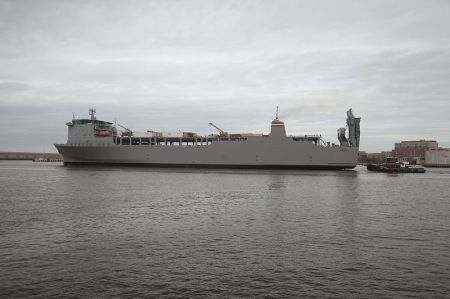
After chemical weapons were used in the Syrian civil war, the Syrian government, under international supervision, revealed their stockpile and turned it over to an international team. That team, using the U.S. Navy’s Cape Ray ship, incinerated and neutralized tons of chemical agents over the better part of a year, while at sea. The cost was around $250 million.

[Southwest Research Institute]’s approach combines a commercially available reforming-engine technology that, along with local soil, can convert organic molecules to non-hazardous components. The engine is designed such that, as part of the destruction process, the organic molecules act as a fuel and efficiently generate recoverable energy that can be converted to electricity. The SwRI process is agnostic to the chemical to be degraded, and is a much greener process than either conventional hydrolysis or incineration, both of which are logistically intensive and require subsequent secondary treatment of large amounts of hazardous waste.

The project is only nine months along. Next year, the team is hopeful they’ll have a demonstration of the technology, and then, when the project’s 36 months are up, they are aiming for a chemical cleaning tool just 1 percent as expensive as the Cape Ray mission. The cost of ACDC, if all goes according to plan, is expected to be just $2.6 million.

Excerpt from Kelsey D. Atherton, DARPA WANTS TO TRANSFORM CHEMICAL WAR SITES INTO FERTILE SOIL, Popular Science, May 12, 2016

Re-Creating the Rhino

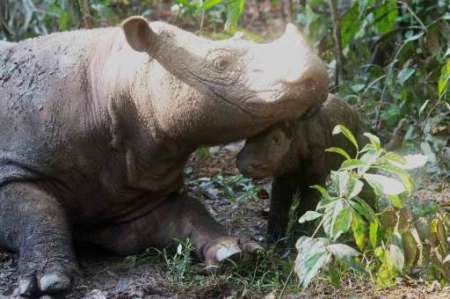
A Sumatran rhinoceros born in Indonesia has given renewed hope to environmentalists looking to save the critically endangered species.  A rhino named Ratu gave birth to the female calf on May 12, 2015, at a rhino sanctuary in the Way Kambas National Park on the island of Sumatra.

The new arrival for 15-year-old Ratu, and her mate Andalas*, follows the couple’s first baby Andatu, who made history in 2012 as the first rhino born in captivity in Indonesia in more than a century.

* Andalas, was born at the Cincinnati Zoo in 2001…. In 2001 he was the first captive Sumatran rhino born in 112 years  He moved to the sanctuary in Indonesia in 2007.

Excerpts from Rare Sumatran rhino born in Indonesia, Reuters,  May 13, 2016

Messaging Secrecy: US Military

The United States Department of Defense and DARPA [seek to establish] a secure messaging system that can provide repudiation or deniability, perfect forward and backward secrecy, time to live/self delete for messages, one time eyes only messages, a decentralized infrastructure to be resilient to cyber-attacks, and ease of use for individuals in less than ideal situations….The messaging platform will transfer messages via a secure decentralized protocol that will be secured across multiple channels, including but not limited to: 1) Transport protocol, 2) Encryption of messages via various application protocols, 3) Customized blockchain implementation of message deconstruction and reconstruction, and decentralized ledger implementation

Excerpts from SBIR.defense business. org

A Barbed Wire for Outer Space

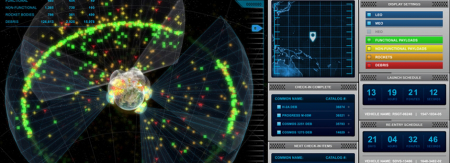
In 2007 a missile launch by the Chinese in 2007 blew up a dead satellite and littered space with thousands of pieces of debris. But it was another Chinese launch  in 2013 that made the Pentagon really snap to attention, opening up the possibility that outer space would become a new front in modern warfare.  This time, the rocket reached close to a far more distant orbit — one that’s more than 22,000 miles away — and just happens to be where the United States parks its most sensitive national security satellites, used for tasks such as guiding precision bombs and spying on adversaries.

The flyby served as a wake-up call and prompted the Defense Department and intelligence agencies to begin spending billions of dollars to protect what Air Force Gen. John Hyten in an interview called the “most valuable real estate in space.”..[I]nstead of relying only on large and expensive systems, defense officials plan to send swarms of small satellites into orbit that are much more difficult to target–GPS III is the next generation of GPS satellites..

At the same time..[a]gencies have begun participating in war-game scenarios involving space combat at the recently activated Joint Interagency Combined Space Operations Center. The Pentagon is even developing what is known as the “Space Fence,” which would allow it to better track debris in space.

National security officials are not only concerned that missiles could take out their satellites but also that a craft’s equipment could be easily jammed. Potential enemies could “dazzle” sensors, temporarily blinding them, or deploy tiny “parasitic satellites” that attach to host satellites and do their worst. That could lead to soldiers stranded on the battlefield with little means of communication or missiles that would not be able to find their targets.  “We have considered space a sanctuary for quite some time. And therefore a lot of our systems are big, expensive, enormously capable, but enormously vulnerable,” said Deputy Defense Secretary Robert O. Work.

Pentagon officials say that Russia and China have been developing the capability to attack the United States in space…Pentagon officials fear its satellites could be sitting ducks. Navy Adm. Cecil Haney, commander of the U.S. Strategic Command, said recently that North Korea has successfully jammed GPS satellites, that Iran was busy building a space program and that “violent extremist organizations” were able to access space-based technologies to help them encrypt communications, among other things.

The Pentagon spends $22 billion on space programs and is investing an additional $5 billion in space efforts this year, including $2 billion for what is known as “space control,” which includes its highly classified offensive programs. Hyten declined to discuss the ways in which the United States is preparing to attack other countries in space. But the United States has had the capability to blow up satellites since 1985, when an F-15 fighter pilot fired a missile into space that took out an old military observation satellite.

Excerpts from  Christian Davenport: A fight to protect ‘the most valuable real estate in space, Washington Post, May 9, 2016

Biometrics Gone Wrong

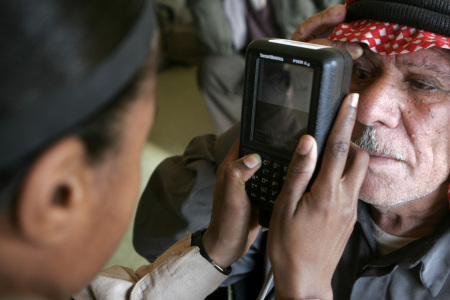
Despite their huge potential, artificial intelligence and biometrics still very much need human input for accurate identification, according to the director of the Defense Advanced Research Projects Agency.  Speaking at  an Atlantic Council event, Arati Prabhakar said that while the best facial recognition systems out there are statistically better than most humans at image identification, that when they’re wrong, “they are wrong in ways that no human would ever be wrong”….

“You want to embrace the power of these new technologies but be completely clear-eyed about what their limitations are so that they don’t mislead us,” Prabhakar said. That’s a stance humans must take with technology writ large, she said, explaining her hesitance to take for granted what many of her friends in Silicon Valley often assume  — that more data is always a good thing.  More data could just mean that you have so much data that whatever hypothesis you have you can find something that supports it,” Prabhakar said

DARPA director cautious over AI, biometrics, Planet Biometrics, May 4, 2016

Blowing up Fishing Boats: illegal fishing

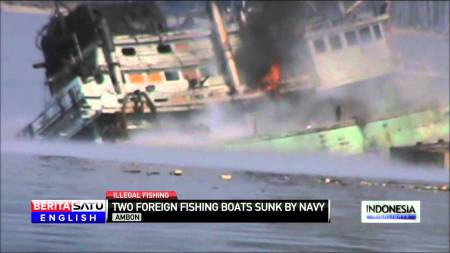
On April 5th, 2016, Indonesia’s maritime-affairs minister, Susi Pudjiastuti, watched live feed from seven different places as 23 Malaysian and Vietnamese trawlers, seized for illegal fishing in Indonesian waters, were blown to smithereens…

Indonesia is already seething with anger at China’s reaction to an incident last month in which a Chinese coastguard cutter rammed free a Chinese fishing boat as the Indonesian authorities were towing it to port, having just caught it poaching in waters off Indonesia’s Natuna islands…. In fact, it seems almost certain. Indonesia’s possession of the Natunas is undisputed, and under international law the Chinese were well inside its “exclusive economic zone”. Yet China defended the crew by claiming they were in waters that were “traditional Chinese fishing grounds”. The waters are inside the sweeping “nine-dash line” that China draws on its maps (and even passports) to mark its claim over almost the entire South China Sea.

Chinese fishermen have been detained in Japan, the Philippines, Taiwan and Vietnam, all of whose maritime claims overlap with or mirror China’s. But it is not just in contested waters that they get into trouble. Chinese have also been detained in the Russian Far East, North Korea and Sri Lanka in recent years. In 2011 a Chinese fisherman stabbed a South Korean coastguard to death. The next year one was killed by the police in Palau, a tiny Pacific republic. Farther afield, on December of 2015 two dozen African countries called on China to stop illegal fishing off west Africa. And on April 2016 our Chinese fishermen were freed from detention in Argentina.

China’s government sees food security as a priority and fishing as a good source of jobs (14m of them). In 2013 the president, Xi Jinping, visited Tanmen, a fishing port on the southern island of Hainan, and urged fishermen there to “build bigger ships and venture even farther into the oceans and catch bigger fish.” The government provides subsidies for new boats, fuel and navigation aids….Fishing can have strategic uses. Like China’s splurge on building artificial islands on reefs in the South China Sea, the habitual presence of big numbers of Chinese boats in disputed waters…underpins the notion that China has “traditional” claims. And at times fishermen have indeed been used to advance those claims. In 1974 armed fishing trawlers acted as China’s advance guard as it seized the southern part of the Paracel archipelago from the regime of the former South Vietnam. Similar tactics worked in driving the Philippines out of two other parts of the South China Sea: Mischief Reef in 1995 and Scarborough Shoal in 2012.

Giving state backing to poaching or to fishing in contested waters is a dangerous ploy, however. The grave rise in tension with Japan over the uninhabited Senkaku, or Diaoyu, islands in the East China Sea dates back to September 2010, when a Chinese trawler, apprehended for illegal fishing, rammed a Japanese coastguard vessel. As the seas become more militarised, the risks of clashes mount. To date, the Chinese navy has rarely been involved. But some Chinese fishing ports have expanded their “maritime militias”—ie, armed civilian vessels—and both China and other coastguards are becoming better armed.

Excerpts from Trawling for trouble: Why do Chinese fishermen keep getting arrested, Economist,  Apr. 16, 2016, at 34

Unhackable GPS

South Korea has revived a project to build a backup ship navigation system that would be difficult to hack after a recent wave of GPS signal jamming attacks it blamed on North Korea disrupted fishing vessel operations, officials say.Global Positioning System (GPS) and other electronic navigation aids are vulnerable to signal loss from solar weather effects, radio and satellite interference and deliberate jamming.

South Korea, which says it has faced repeated attempts by the rival North to interfere with satellite signals, will award a 15 billion won ($13 million) contract this month to secure technology required to build an alternative land-based radio system called eLoran (enhanced LOng-RAnge Navigation), which it hopes will provide reliable alternative position and timing signals for navigation….

GPS vulnerability poses security and commercial risks, especially for ships whose crews are not familiar with traditional navigation techniques or using paper charts.The General Lighthouse Authorities of the UK and Ireland, which tried to pioneer an eLoran system in Europe, conducted simulated communications attacks on ships at sea and said the results “demonstrated the devastating effects of jamming on the ships’ electronic bridge systems”.The United States, Russia and India are all looking into deploying versions of eLoran, which sends a much stronger signal and is harder to jam, as backup.

Installing an eLoran receiver and antenna on a ship would cost thousands of dollars, although cheaper options could include incorporating eLoran systems into satnav devices, according to technical specialists.

Excerpts from South Korea Revives GPS Backup After Cyber Attack  , euters, May 1, 2016