Category Archives: climate change

Oil Shale: Costs and Benefits

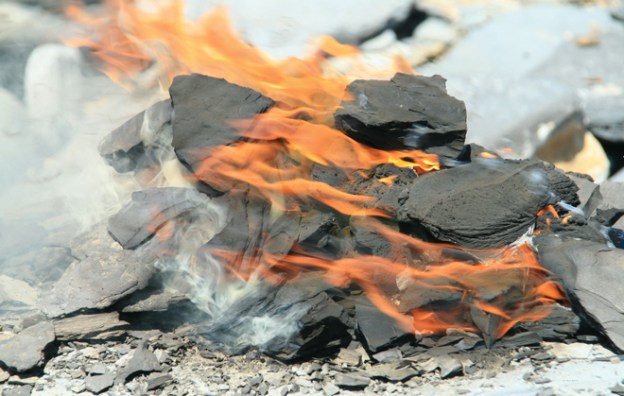
[A] second shale revolution is in prospect, in which cleaner and more efficient ways are being found to squeeze the oil and gas out of the stone. The Jordanian government said on June 12th that it had reached agreement with Enefit, an Estonian company, and its partners on a $2.1 billion contract to build a 540MW shale-fuelled power station. Frustratingly for Jordan, as it eyes its rich, oil-drenched Gulf neighbours, the country sits on the world’s fifth-largest oil-shale reserves but has to import 97% of its energy needs.

In Australia, Queensland Energy Resources, another oil-shale company, has just applied for permission to upgrade its demonstration plant to a commercial scale. Production is expected to start in 2018. Questerre Energy, a Canadian company, also said recently that it would start work on a commercial demonstration project, in Utah in the United States.

In all these projects, the shale is “cooked” cheaply, cleanly and productively in oxygen-free retorts to separate much of the oil and gas. In Enefit’s process the remaining solid is burned to raise steam, which drives a generator. So the process produces electricity, natural gas (a big plus in Estonia, a country otherwise dependent on Russian supplies) and synthetic crude, which can be used to make diesel and aviation fuel. The leftover ash can be used to make cement. Enefit’s chief executive, Sandor Liive, says his plants, the first of which started production in December 2012, should be profitable so long as oil prices stay above $75 a barrel (North Sea Brent oil was around $113 this week).

Although the new methods of exploiting the rock are cleaner than old ones, environmentalists still have plenty to worry about. Oil shale varies hugely in quality. Estonia’s is clean, Jordan’s has a high sulphur content, Utah’s is laden with arsenic. Like opencast coal mining, digging up oil shale scars the landscape. Enefit has solved that in green-minded Estonia, by landscaping and replacing the topsoil. Other countries may be less choosy.

Some of the world’s biggest energy firms have also experimented with mining and processing oil shale, only to give up, after finding that it took so much energy that the sums did not add up. However, Shell says it is making progress with a new method it is trying, also in Jordan, in which the shale is heated underground with an electric current to extract the oil.

These rival technologies have yet to prove their reliability at large scale—and they are far from cheap. Mr Liive reckons it will cost $100m to get a pilot project going in Utah (where his firm has bought a disused oil-shale mine), and another $300m to reach a commercial scale. A fall in the oil price could doom the industry, as happened in the 1980s when a lot of shale mines went out of business…America this week loosened its ban on crude exports. If the second shale revolution succeeds, it will have a lot more oil to sell.

Oil shale: Flaming rocks, Economist, June  28, 2014, at 58

Un-addicted to Coal – United States

The U.S. Environmental Protection Agency released on June 2, 2014 the Clean Power Plan proposal, which for the first time cuts carbon pollution from existing power plants, the single largest source of carbon pollution in the United States…

Power plants account for roughly one-third of all domestic greenhouse gas emissions in the United States. While there are limits in place for the level of arsenic, mercury, sulfur dioxide, nitrogen oxides, and particle pollution that power plants can emit, there are currently no national limits on carbon pollution levels.

[Goals to be achieved by 2030]

· Cut carbon emission from the power sector by 30 percent nationwide below 2005 levels, which is equal to the emissions from powering more than half the homes in the United States for one year;

· Cut particle pollution, nitrogen oxides, and sulfur dioxide by more than 25 percent as a co-benefit;

· Avoid up to 6,600 premature deaths, up to 150,000 asthma attacks in children, and up to 490,000 missed work or school days—providing up to $93 billion in climate and public health benefits; and

· Shrink electricity bills roughly 8 percent by increasing energy efficiency and reducing demand in the electricity system.

The Clean Power Plan will be implemented through a state-federal partnership under which states identify a path forward using either current or new electricity production and pollution control policies to meet the goals of the proposed program. The proposal provides guidelines for states to develop plans to meet state-specific goals to reduce carbon pollution and gives them the flexibility to design a program that makes the most sense for their unique situation. States can choose the right mix of generation using diverse fuels, energy efficiency and demand-side management to meet the goals and their own needs. It allows them to work alone to develop individual plans or to work together with other states to develop multi-state plans.

Also included in today’s proposal is a flexible timeline for states to follow for submitting plans to the agency—with plans due in June 2016, with the option to use a two-step process for submitting final plans if more time is needed. States that have already invested in energy efficiency programs will be able to build on these programs during the compliance period to help make progress toward meeting their goal.

Excerpt, EPA Proposes First Guidelines to Cut Carbon Pollution from Existing Power Plants/Clean Power Plan is flexible proposal to ensure a healthier environment, spur innovation and strengthen the economy, US EPA Press Release, June 2, 2014

Dumping Coal in the Sea

Until recently Colombia was lax in enforcing its environmental laws. So it came as a shock to the country’s mining industry when, in January, the government halted coal exports from a port operated by Drummond, an American miner, in a row over pollution. The suspension has been costly not only for Drummond: its operations generate $66m a month in royalties and taxes for the Colombian treasury.

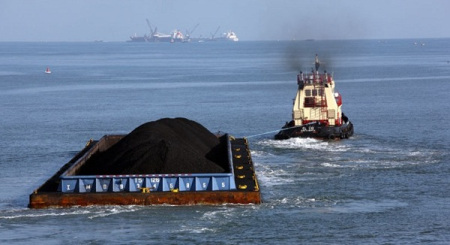
The mining minister, Amylkar Acosta, confirmed this week that the government would let the company resume its exports later this month, when it completes improvements to the port facility to prevent contamination of nearby beaches. The government has been under pressure to take action since environmentalists photographed an incident last year in which more than 500 tonnes of coal were dumped into the Bay of Santa Marta to stop a barge from sinking. Last month six employees at the port were charged, and face possible jail sentences. Drummond has been fined $3.6m and told to clean up the mess.

The case is an illustration of how the government, having welcomed foreign miners, is now having to contend with public disquiet over both pollution and the way the country’s mineral wealth is shared. In an election in May, President Juan Manuel Santos will seek a second term. So he cannot ignore the “hostile” climate of public opinion on the issue, says Alvaro Ponce, a Colombian mining expert.

Protests by nearby residents have delayed several big projects, including AngloGold Ashanti’s proposed gold mine in Tolima province and Eco Oro’s planned gold and silver mine in Santander province. A study by Colombia’s national audit office, published in January, found that economic and social development in towns next to large mining operations is worse than in places where illegal coca crops are grown for making cocaine.

The environment ministry is seeking new powers to require licences for exploration as well as extraction. Mining firms grumble that the process of getting projects approved is already tortuous enough. This and the recent fall in world prices of some minerals mean that up to $7.3 billion of investments are stalled, they say. Mr Acosta says the miners must accept that besides getting their official permits, they have to convince local communities to accept their presence, earning a “social licence” to operate. “Without that, the projects become unviable,” he says.

The backlash against mining has been building for some years. In the mid-2000s, when commodity prices were booming and Colombia’s internal conflicts were subsiding, the government offered incentives for foreign firms to come in and create mining jobs. It awarded exploration permits for swathes of territory, including in areas hitherto off limits, such as the fragile páramo tundra in the Andes. “The floodgates were opened,” says James Lockhart-Smith of Maplecroft, a risk-analysis firm.

But Colombia’s regulators were ill-prepared. In 2011 the government stopped accepting new applications for licences while it dealt with a backlog of 19,000. It rejected 90% of these, then turned its attention to 10,000 projects that had already been given licences, finding that 92% were failing in some way to comply with their conditions.

Despite all the stumbles and setbacks, Colombia is getting somewhere in its drive to exploit its mineral reserves. In 2013 mining investment was $3.6 billion, 21% more than in 2012. Mining already accounts for 2.3% of GDP and 7% of exports, and foreign companies are still lining up to explore new prospects. By the standards of resource-rich emerging economies, it is a fairly well-run place, so the chances are that it will succeed in coming up with a licensing regime that eases public worries without deterring investment. As in richer countries, mining projects will still be welcomed, but not at any price.

Mining in Colombia: Digging itself out of a hole, Economist, Mar. 15, 2014, at 61

Angry about Pollution: China

China is now emitting almost twice as much carbon dioxide as the next-biggest polluter, America. At current rates, it will produce 500 billion tonnes of carbon dioxide between 1990 and 2050—as much as the whole world produced between the start of the Industrial Revolution and 1970. Pollutants in the air in Beijing have hit 40 times the level decreed safe by the World Health Organisation. Yet China did not have a ministry devoted to environmental protection until 2008, and the government has done its best to keep information about the levels of filth in the air and water under wraps. Even now, the state is keeping secret a nationwide survey of soil pollution.

The new rules that have just come into effect signal the beginning of a move towards openness. They require 15,000 enterprises, including some of the biggest state-owned ones, to make public in real time details of their air pollution, waste water and heavy-metals discharges…Things are opening up at a local level, too. In 2012 only a few cities, including Beijing, published statistics on air quality. Now 179 do. And more firms are volunteering information about pollution—especially those that need foreign investors.

The impetus behind this new transparency is not a sudden enthusiasm for liberalism. Rather, the government is worried that people are increasingly angry about pollution—a recent Pew survey of the concerns of Chinese citizens found that pollution was fourth, behind inflation, corruption and inequality, but was rising fast—and attempts to clean the country up by central-government fiat are foundering.

China’s environment: A small breath of fresh air, Economist, Feb. 8, 2013, at  14

Governing the Oceans Dysfunction

About 3 billion people live within 100 miles (160km) of the sea, a number that could double in the next decade as humans flock to coastal cities like gulls. The oceans produce $3 trillion of goods and services each year and untold value for the Earth’s ecology. Life could not exist without these vast water reserves—and, if anything, they are becoming even more important to humans than before.

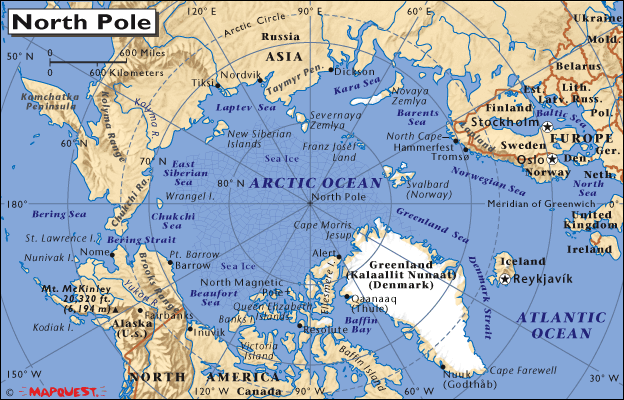
Mining is about to begin under the seabed in the high seas—the regions outside the exclusive economic zones administered by coastal and island nations, which stretch 200 nautical miles (370km) offshore. Nineteen exploratory licences have been issued. New summer shipping lanes are opening across the Arctic Ocean. The genetic resources of marine life promise a pharmaceutical bonanza: the number of patents has been rising at 12% a year. One study found that genetic material from the seas is a hundred times more likely to have anti-cancer properties than that from terrestrial life.

But these developments are minor compared with vaster forces reshaping the Earth, both on land and at sea. It has long been clear that people are damaging the oceans—witness the melting of the Arctic ice in summer, the spread of oxygen-starved dead zones and the death of coral reefs. Now, the consequences of that damage are starting to be felt onshore…

More serious is the global mismanagement of fish stocks. About 3 billion people get a fifth of their protein from fish, making it a more important protein source than beef. But a vicious cycle has developed as fish stocks decline and fishermen race to grab what they can of the remainder. According to the Food and Agriculture Organisation (FAO), a third of fish stocks in the oceans are over-exploited; some estimates say the proportion is more than half. One study suggested that stocks of big predatory species—such as tuna, swordfish and marlin—may have fallen by as much as 90% since the 1950s. People could be eating much better, were fishing stocks properly managed.

The forests are often called the lungs of the Earth, but the description better fits the oceans. They produce half the world’s supply of oxygen, mostly through photosynthesis by aquatic algae and other organisms. But according to a forthcoming report by the Intergovernmental Panel on Climate Change (IPCC; the group of scientists who advise governments on global warming), concentrations of chlorophyll (which helps makes oxygen) have fallen by 9-12% in 1998-2010 in the North Pacific, Indian and North Atlantic Oceans.

Climate change may be the reason. At the moment, the oceans are moderating the impact of global warming—though that may not last.,,Changes in the oceans, therefore, may mean less oxygen will be produced. This cannot be good news, though scientists are still debating the likely consequences. The world is not about to suffocate. But the result could be lower oxygen concentrations in the oceans and changes to the climate because the counterpart of less oxygen is more carbon—adding to the build-up of greenhouse gases. In short, the decades of damage wreaked on the oceans are now damaging the terrestrial environment.

Three-quarters of the fish stocks in European waters are over-exploited and some are close to collapse… Farmers dump excess fertiliser into rivers, which finds its way to the sea; there cyanobacteria (blue-green algae) feed on the nutrients, proliferate madly and reduce oxygen levels, asphyxiating all sea creatures. In 2008, there were over 400 “dead zones” in the oceans. Polluters pump out carbon dioxide, which dissolves in seawater, producing carbonic acid. That in turn has increased ocean acidity by over a quarter since the start of the Industrial Revolution. In 2012, scientists found pteropods (a kind of sea snail) in the Southern Ocean with partially dissolved shells…

The high seas are not ungoverned. Almost every country has ratified the UN Convention on the Law of the Sea (UNCLOS), which, in the words of Tommy Koh, president of UNCLOS in the 1980s, is “a constitution for the oceans”. It sets rules for everything from military activities and territorial disputes (like those in the South China Sea) to shipping, deep-sea mining and fishing. Although it came into force only in 1994, it embodies centuries-old customary laws, including the freedom of the seas, which says the high seas are open to all. UNCLOS took decades to negotiate and is sacrosanct. Even America, which refuses to sign it, abides by its provisions.

But UNCLOS has significant faults. It is weak on conservation and the environment, since most of it was negotiated in the 1970s when these topics were barely considered. It has no powers to enforce or punish. America’s refusal to sign makes the problem worse: although it behaves in accordance with UNCLOS, it is reluctant to push others to do likewise.

Specialised bodies have been set up to oversee a few parts of the treaty, such as the International Seabed Authority, which regulates mining beneath the high seas. But for the most part UNCLOS relies on member countries and existing organisations for monitoring and enforcement. The result is a baffling tangle of overlapping authorities that is described by the Global Ocean Commission, a new high-level lobby group, as a “co-ordinated catastrophe”.

Individually, some of the institutions work well enough. The International Maritime Organisation, which regulates global shipping, keeps a register of merchant and passenger vessels, which must carry identification numbers. The result is a reasonably law-abiding global industry. It is also responsible for one of the rare success stories of recent decades, the standards applying to routine and accidental discharges of pollution from ships. But even it is flawed. The Institute for Advanced Sustainability Studies, a German think-tank, rates it as the least transparent international organisation. And it is dominated by insiders: contributions, and therefore influence, are weighted by tonnage.

Other institutions look good on paper but are untested. This is the case with the seabed authority, which has drawn up a global regime for deep-sea mining that is more up-to-date than most national mining codes… The problem here is political rather than regulatory: how should mining revenues be distributed? Deep-sea minerals are supposed to be “the common heritage of mankind”. Does that mean everyone is entitled to a part? And how to share it out?

The biggest failure, though, is in the regulation of fishing. Overfishing does more damage to the oceans than all other human activities there put together. In theory, high-seas fishing is overseen by an array of regional bodies. Some cover individual species, such as the International Commission for the Conservation of Atlantic Tunas (ICCAT, also known as the International Conspiracy to Catch All Tuna). Others cover fishing in a particular area, such as the north-east Atlantic or the South Pacific Oceans. They decide what sort of fishing gear may be used, set limits on the quantity of fish that can be caught and how many ships are allowed in an area, and so on.

Here, too, there have been successes. Stocks of north-east Arctic cod are now the highest of any cod species and the highest they have been since 1945—even though the permitted catch is also at record levels. This proves it is possible to have healthy stocks and a healthy fishing industry. But it is a bilateral, not an international, achievement: only Norway and Russia capture these fish and they jointly follow scientists’ advice about how much to take.  There has also been some progress in controlling the sort of fishing gear that does the most damage. In 1991 the UN banned drift nets longer than 2.5km (these are nets that hang down from the surface; some were 50km long). A series of national and regional restrictions in the 2000s placed limits on “bottom trawling” (hoovering up everything on the seabed)—which most people at the time thought unachievable.

But the overall record is disastrous. Two-thirds of fish stocks on the high seas are over-exploited—twice as much as in parts of oceans under national jurisdiction. Illegal and unreported fishing is worth $10 billion-24 billion a year—about a quarter of the total catch. According to the World Bank, the mismanagement of fisheries costs $50 billion or more a year, meaning that the fishing industry would reap at least that much in efficiency gains if it were properly managed.

Most regional fishery bodies have too little money to combat illegal fishermen. They do not know how many vessels are in their waters because there is no global register of fishing boats. Their rules only bind their members; outsiders can break them with impunity. An expert review of ICCAT, the tuna commission, ordered by the organisation itself concluded that it was “an international disgrace”. A survey by the FAO found that over half the countries reporting on surveillance and enforcement on the high seas said they could not control vessels sailing under their flags. Even if they wanted to, then, it is not clear that regional fishery bodies or individual countries could make much difference.

But it is far from clear that many really want to. Almost all are dominated by fishing interests. The exceptions are the organisation for Antarctica, where scientific researchers are influential, and the International Whaling Commission, which admitted environmentalists early on. Not by coincidence, these are the two that have taken conservation most seriously.

Countries could do more to stop vessels suspected of illegal fishing from docking in their harbours—but they don’t. The FAO’s attempt to set up a voluntary register of high-seas fishing boats has been becalmed for years. The UN has a fish-stocks agreement that imposes stricter demands than regional fishery bodies. It requires signatories to impose tough sanctions on ships that break the rules. But only 80 countries have ratified it, compared with the 165 parties to UNCLOS. One study found that 28 nations, which together account for 40% of the world’s catch, are failing to meet most of the requirements of an FAO code of conduct which they have signed up to.

It is not merely that particular institutions are weak. The system itself is dysfunctional. There are organisations for fishing, mining and shipping, but none for the oceans as a whole. Regional seas organisations, whose main responsibility is to cut pollution, generally do not cover the same areas as regional fishery bodies, and the two rarely work well together. (In the north-east Atlantic, the one case where the boundaries coincide, they have done a lot.) Dozens of organisations play some role in the oceans (including 16 in the UN alone) but the outfit that is supposed to co-ordinate them, called UN-Oceans, is an ad-hoc body without oversight authority. There are no proper arrangements for monitoring, assessing or reporting on how the various organisations are doing—and no one to tell them if they are failing.

Governing the high seas: In deep water, Economist, Feb. 22, 2014, at 51
Madagascar Sells Polluting Rights to Microsoft

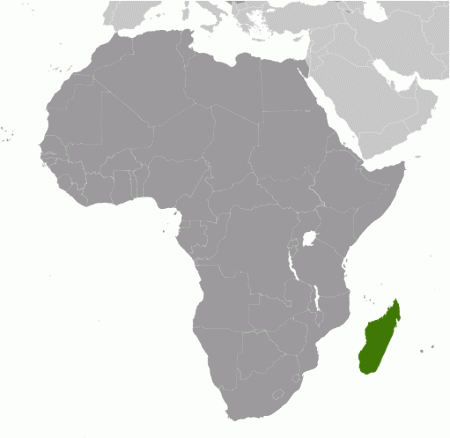
Madagascar’s government has agreed to sell forest-related carbon credits to Microsoft and Zurich’s zoo, which will help protect the Makira National Park, in the first sale of state-owned REDD+ credits in Africa, according to the group that manages the park.  The Wildlife Conservation Society (WCS), an international charity headquartered in New York City, said the revenues from selling carbon credits generated by avoided deforestation in Makira will finance the conservation of one of Madagascar’s most pristine rainforest ecosystems, while supporting the livelihoods of local people.

The funds will be used by the government for activities under its Reducing Emissions from Deforestation and Forest Degradation “plus” conservation (REDD+) programme, and by WCS to manage Makira park. But the largest share – half of the proceeds – will go to support local communities in areas around Makira for education, health and other projects, WCS said.

The Makira forest, which spans nearly 400,000 hectares (over 1,500 square miles), is home to an estimated 1 percent of the world’s biodiversity, including 20 lemur species, hundreds of species of birds, and thousands of plant varieties, some unique to the location. The forests also provide clean water to over 250,000 people in the surrounding landscape.

Jonathan Shopley, managing director of The CarbonNeutral Company, which handled the purchase for Microsoft, said its clients are increasingly looking for opportunities to manage the entire environmental impact of their organisation, driven by the need to make their supply chains more resilient…In Madagascar, burning for agricultural land and extraction of wood for household energy leads to around 36,000 hectares (139 square miles) of natural forest being lost each year, WCS said.

BY MEGAN ROWLIN, Madagascar: Microsoft Buys Carbon Credits From Madagascar Rainforest, AllAfrica.com, Feb. 13, 2014

Organized Crime: rhino horn to waste dumping

[A]ccording to America’s Congressional Research Services,  illegal trade
in endangered wildlife products is worth as much as $133 billion annually. Commodities such as rhino horn and caviar offer criminals two benefits rarely found together: high prices and low risk. Rhino horn can fetch up to $50,000 per kilogram, more than gold or the American street value of cocaine. Get caught bringing a kilogram of cocaine into America and you could face 40 years in prison and a $5m fine. On January 10th, by contrast, a New York court sentenced a rhino-horn trafficker to just 14 months…Organised crime is globalising and diversifying. Mono-ethnic, hierarchical mafias are being replaced by multi-ethnic networks that operate across borders and commit many types of offence. In an ongoing investigation into rhino-horn trafficking, the Fish and Wildlife Service (FWS) arrested Irish travellers using indigent Texans to procure material for Chinese and Vietnamese buyers. Europol, the European Union’s law-enforcement agency, estimates that just a quarter of Europe’s roughly 3,600 organised-crime groups have a main nationality, and that some operate in dozens of countries. A third are involved in more than one criminal enterprise, with half of those linked to drug-trafficking.

And though traditional trafficking in drugs, guns and people is still lucrative, gangs are increasingly moving into lower-risk, higher-reward areas—not just wildlife, but fraud and illegal waste-disposal….Gangs in Britain make around £9 billion ($14.8 billion) a year from tax, benefit, excise-duty and other fraud—not much less than the £11 billion they earn from drugs. In America cigarette-trafficking deprives state, local and federal governments of $5 billion in tax revenues annually. The European Union estimates that losses within its borders from cigarette smuggling, tax fraud and false claims on its funds by organised groups total €34 billion ($46.5 billion) a year. But member states bring fewer than ten cases each a year for defrauding the EU, and sentences tend to be light.

According to the FLARE Network, an international group of campaigners against organised crime, criminal groups in Italy make around €14 billion a year from being mixed up in agriculture. In some parts of the country mafias control food production and distribution; Franco La Torre, FLARE’s president, says they also enrich themselves through fraudulent claims on EU agricultural funds. Increasingly strict regulation of waste disposal has created another profitable opportunity for organised crime in Europe—particularly, according to Europol, for the Italian Camorra, ’Ndrangheta and Cosa Nostra…

Old-style loan sharks and drug-dealers are finding a new role as distributors for the modern mobsters who manage the supply chains, marketing, finance and human resources needed to move goods, money and people across borders. “The new generation are very talented businessmen and technologically advanced experts,” says Mr La Torre. They prefer invisibility to showy violence. Many also have legitimate business interests.  Clever criminals acting across borders are extremely difficult to prosecute. They profit from gaps in enforcement and regulation, and conceal their illegal acts in complex supply chains. If a network of Nigerian scammers based in Amsterdam defrauds French, Australian and American credit-card holders, where does the crime occur? And who has the motivation, not to mention the jurisdiction, to prosecute?

A commodity such as oil, ivory or fish will be transported on a ship flying a flag of convenience, explains Mr Leggett. The ship will be owned by a holding company registered in a tax haven with a phoney board. Thus the criminals can disguise the provenance of their ill-gotten goods and middlemen can plead ignorance….

Until then, illicit goods will keep coming in quantities too great for governments to stop. One FWS inspector estimates that for all the peering, prodding and chirping, for all the rewards promised and rhino-horn traffickers caught, the agency picks up perhaps 5% of wildlife brought illicitly into America. For criminals, that is merely a light tax on the profits from the rest.

Excerpts, Organised crime: Earning with the fish,Economist, Jan. 18, 2014, at 59

Saving Forests through Forced Evictions

For decades, the Kenyan government has attempted to evict indigenous people from the forests of Embobut and Cherangany, in the western county of Elgeiyo Marakwet. Past tactics have even included torture and setting fire to homes, those affected say…The government – accused in recent weeks of preparing to carry out yet another forced eviction – maintains that communities living in 12 forest glades must leave so it can rehabilitate the degraded forest and the water services it provides to the surrounding regions and beyond.

“This is a government initiative aimed specifically at conserving the country’s second-largest water tower – nothing else,’’ said Inspector Stephen Chessa, who works for the Kenya Forest Service (KFS) and is in charge of the Embobut eviction…

But one forest warder who preferred to remain anonymous told Thomson Reuters Foundation he and his colleagues had been instructed to evict forcefully anyone who resists the move.  The U.N. special rapporteur on the rights of indigenous peoples, James Anaya, expressed deep concern about this prospect, urging the Kenyan government “to ensure that the human rights of the Sengwer indigenous people are fully respected, in strict compliance with international standards protecting the rights of indigenous peoples”.  Most families are asking for more time to assemble their things and harvest crops before leaving the forest.   But Solomon Mibei, head of conservation for the KFS, said families would not be given extra time and the evictions would continue as planned. “They have no reason to continue staying in the forest – they were compensated,’’ he said.

The situation is complex because there are different communities living in Embobut: the Sengwer indigenous people; groups displaced by disasters and political violence; and others who have come to benefit from cultivation opportunities.  “Why should the government treat us equally with the victims of post-election violence and landslides?’’ asked Sengwer spokesperson Yator Kiptum. “The forest is our home – our case is different, it’s not fair at all.”…According to Article 63 of the constitution, community land shall be vested in and held by communities identified on the basis of ethnicity, culture or similar community of interest. Community land consists of ancestral lands and lands traditionally occupied by hunter-gatherers.

Justin Kenrick of the Forest Peoples Programme (FPP), a UK-based rights organisation, said the government’s justification for evicting people is forest conservation, but research has long since shown that forests are best preserved not by evicting ancestral communities but by supporting them to regain secure rights to their land.  Payments to evictees by the government are “intended to distract the public and the communities themselves from addressing the real issues”, Kenrick said. “According to international treaties to which Kenya is a party, the Sengwer should have been consulted, and accepted or rejected the proposal,’’ he added.  Kiptum, however, claims the Sengwer were not consulted, did not sign anything, and have not agreed to hand over their land for the small amount of money that has been paid into some people’s bank accounts.  “You cannot create a humanitarian crisis for the sake of conserving biodiversity while there are other ways of doing it better,” said Stephen Cheboi, coordinator of the North Rift Human Rights Network based in nearby Eldoret town. He also called for an audit of the compensation process.

Excerpts from Caleb Kemboi, Indigenous rights clash with forest protection in Kenya, Reuters, Jan. 17,, 2014

See also Biodiversity and Human Rights

The Scramble for Antarctica

Over the past two decades China’s annual Antarctic spending has tripled to $55m, three times its Arctic investment… The Southern Ocean is full of fish. A large petroleum field was recently discovered in West Antarctica. The continent also has deposits of coal and other valuable minerals. The Protocol on Environmental Protection, a document signed in Madrid in 1991 by countries involved in Antarctica, has imposed a mining ban until 2048, when it is to be reviewed.

China acceded in 1983 to the Antarctic Treaty, which maintains the continent as a demilitarised science preserve and forms the basis of a system of governance. The goal of its current five-year polar plan, says Chen Lianzeng of China’s State Oceanic Administration, is to increase the country’s status and influence. On November 7th China’s 30th Antarctic expedition, complete with construction crew, set sail from Shanghai. It will scout a site for China’s fifth station, in Terra Nova Bay. Its fourth base, Taishan, is still unfinished.

Sovereignty in Antarctica is disputed. States assert themselves by building bases. “You put a huge flag on a flagpole close to the research station,” says Klaus Dodds, a professor of geopolitics at the University of London. “It is not very subtle.” If China builds all five planned stations it will have more than either Britain or Australia, and only one fewer than America.

Science matters, too. It gives cachet and influence in matters of joint governance. In 2008 China built Kunlun station, a base with capabilities for deep-space research in a place so remote that it took six attempts to get there. The ice underneath could help scientists work out the climatic record of the past 1.5m years, which would be a scientific coup.But the influx of new Antarctic actors has rattled the old establishment and its former scientific hegemony. “China is saying, ‘We don’t give a damn about Shackleton, Scott, all these white European heroes. You can keep that. What we’re interested in is the future,” says Mr Dodds. The Chinese have raised even more concerns by giving Chinese names to more than 350 places, including Great Wall Bay.  Chinese scholars call the Antarctic Treaty a “rich man’s club”, in which China has only second-class citizenship—with some justification, says Ms Brady, since the choicest spots for research stations were snapped up by the first countries to arrive. Publicly, though, China buries its grumbles and complies with protocol. An inspection regime installed by the treaty is ineffectual, and there is little check on states’ affairs.

Meanwhile, the exploitation of Antarctic resources may come sooner than predicted. At a recent meeting of the Commission for the Conservation of Antarctic Marine Living Resources, delegates from 24 countries failed to agree on proposals for two marine protected areas. Plans for the reserves have been discussed for decades, but consensus was required and China, Russia and Ukraine withdrew their support. If Antarctica and the Southern Ocean are to remain some of the planet’s last unspoilt wilderness, an updated framework is needed, and quickly.

Antarctic research: They may be some time, Economist, Nov. 16, 2013, at 50

What is the Cost of Carbon?

The market price of carbon is €4.90 ($6.70) per tonne of CO2 in the EU, $11.50 in California. Big oil companies charge $34 or more. That is closer to the “social cost of carbon”—the damage from an extra tonne of CO2—than to the market price. America’s administration recently estimated the social cost at $37 a tonne. These prices change behaviour. A huge amount of attention is paid to government action. But the sort of carbon price some companies are using for planning would, if it became a market price, have a much bigger impact than any of the policies that governments are now talking about.

Companies and Emissions: Carbon Copy, Economist, Dec. 14, 2013, at 70

Buying their Way out of Water Crisis: Gulf States

Scientists are now warning of “Peak Salt” – the point at which the Gulf becomes so salty that relying on it for fresh water stops being economically feasible.  “The average Arab citizen has eight times less access to renewable water than the average global citizen, and more than two thirds of surface water resources originate from outside the region,” says the U.N.Development Programme (UNDP) in a new study released this week.  Titled “Water Governance in the Arab Region: Managing Scarcity and Securing the Future,” the report warns that water scarcity in the region is fast reaching “alarming levels, with dire consequences to human development”….

A recent satellite study by the U.S. National Aeronautics and Space Administration (NASA) found the region has lost, since 2003 alone, far more groundwater than previously thought – an amount the size of the Dead Sea…Threatened by future scarcities, several Arab countries, including the UAE, have expanded their use of non-conventional water resources including desalination; treated wastewater; rainwater harvesting; cloud seeding; and irrigation drainage water.

Currently, the Arab region leads the world in desalination, with more than half of global capacity.  Desalinated water is expected to expand from 1.8 percent of the region’s water supply to an estimated 8.5 percent by 2025.  Most of the increase is expected to concentrate in high-income, energy-exporting countries, particularly the Gulf countries, because desalination is energy- and capital-intensive…According to the UNDP study.Arab region’s oil wealth has allowed some states to mask their water poverty, giving them the false impression they can buy their way of out of the coming crisis…

Excerpt, By Thalif Deen, Arab World Sinks Deeper into Water Crisis, Warns UNDP, IPS, Nov. 29, 2013

The Struggle for Water: Tanzania

As farmers and herders fight over dwindling water levels in the Pangani River Basin in northeastern Tanzania, a new dispute is emerging between farmers and the state-run power utility firm over this precious resource. The Tanzania Electric Supply Company or TANESCO manages three hydropower plants located on the Pangani River near Muheza district, which are meant to provide 17 percent of the country’s electricity…For the last four years Tanzania has been experiencing a drought that locals say is the worst to have ever hit the region. Thousands of farmers and herders who earn a living here have been affected.  Jumanne Mujuni, a councilor from Mombo town, which is located a few kilometres from the Hale hydropower station in Muheza district, told IPS that the drought has pushed many to the brink as they compete with TANESCO for dwindling water supplies. He added that many locals are now embroiled in disputes with the state-run utility.“All these problems that we face are rooted in the drought. There were hardly any [problems] when there was enough water in the river,” he said.

Excerpt from Kizito Makoye,Power Struggle Rises Over Tanzania’s Pangani River, IPS, Oct. 24, 2013

Rivers as Fiefs: Dams in China

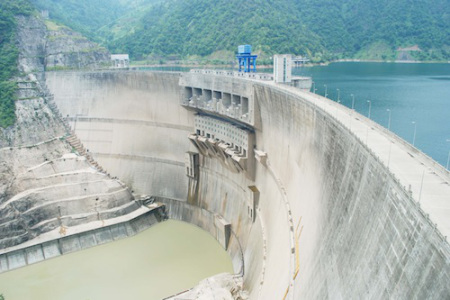
Though the Chinese authorities have made much progress in evaluating the social and environmental impact of dams, the emphasis is still on building them, even when mitigating the damage would be hard. Critics have called it the “hydro-industrial complex”: China has armies of water engineers (including Hu Jintao, the former president) and at least 300 gigawatts of untapped hydroelectric potential. China’s total generating capacity in 2012 was 1,145GW, of which 758GW came from coal-burning plants.

An important motive for China to pursue hydropower is, ironically, the environment. China desperately needs to expand its energy supply while reducing its dependence on carbon-based fuels, especially coal. The government wants 15% of power consumption to come from clean or renewable sources by 2020, up from 9% now. Hydropower is essential for achieving that goal, as is nuclear power. “Hydro, including large hydro in China, is seen as green,” says Darrin Magee, an expert on Chinese dams at Hobart and William Smith Colleges in New York state.

There is also a political reason why large hydro schemes continue to go ahead. Dambuilders and local governments have almost unlimited power to plan and approve projects, whereas environmental officials have almost no power to stop them.

The problems begin with the planning for China’s rivers, which are divided into fiefs by the state-owned power companies that build dams in much the same way as the Corps of Engineers and the Bureau of Reclamation divided up American rivers in the early 20th century. Though the staff of the water-resources ministry in Beijing know a lot about the environment, they have no say. “Big hydro projects are designed and approved by everybody but the ministry of water resources,” says Mr Magee.

Local governments, meanwhile, view dams as enticing economic development projects. The dambuilders, which have special privileges to borrow, put up the financing. The extra electricity supports industrial expansion and brings in revenues. Local officials are promoted for meeting economic performance targets and some collude for personal gain with the dambuilders. Because of the decentralised nature of the industry, local officials try to include dams in their plans. Once they have done so, they can expect the environmental impact assessments that follow to be a formality—if only because the consultants who undertake them are paid by the hydropower companies.

Environmental officials who have not been financially captured by the dambuilding economy find themselves as scarce as some of the fish they are charged to protect. Environmental activists, meanwhile, can request access to public records and demand public hearings, both required by law. But they say that these avenues are barred when they are most needed—on controversial projects that face vocal opposition. For example, the authorities have rejected requests for public records on Xiaonanhai and they have not granted a public hearing.

If environmental regulators and activists want any hope of halting a project, they must go outside normal bureaucratic channels to lobby powerful Politburo members or the national media. Although that may not always work, it did in 2004, when Wen Jiabao, then prime minister, halted construction of a cascade of 13 dams on the Nu River in south-west China in order to protect the environment. Even then some work on the projects still proceeded. Meanwhile, smaller schemes race ahead unchecked. Promoted by dambuilders and local governments, nearly 100 smaller hydroelectric projects in the Nu river region went forward without needing permission from higher up. Some began before they had even received the final approval.

China’s new leaders in recent months have signalled that they want yet more dams, approving several ambitious new projects, including what would be the highest dam in the world, on the Dadu river. After Mr Wen stepped down from his posts in the party and the government, the dams on the Nu river that he blocked received the go-ahead again.

Chinese leaders have for millennia sought to tame the country’s great rivers, which have sustained and destroyed countless lives with cycles of abundance, famine and floods. Indeed their legitimacy as rulers has long been linked to their ability to do so. The Communist Party has built thousands of large dams since 1949. China is also the world’s leading builder of big dams abroad; International Rivers, a pressure group, says that Chinese companies and financiers are involved in about 300 dam projects in 66 countries.

The politics of dam-building: Opening the floodgates, Economist, Sept. 21, 2013, at 47

Biofuels from Agricultural Waste

Ethanol, for instance, is an alcoholic biofuel easily distilled from sugary or starchy plants. It has been used to power cars since Ford’s Model T and, blended into conventional petrol, constitutes about 10% of the fuel burned by America’s vehicles today. Biodiesel made from vegetable fats is similarly mixed (at a lower proportion of 5%) into conventional diesel in Europe. But these “first generation” biofuels have drawbacks. They are made from plants rich in sugar, starch or oil that might otherwise be eaten by people or livestock. Ethanol production already consumes 40% of America’s maize (corn) harvest and a single new ethanol plant in Hull is about to become Britain’s largest buyer of wheat, using 1.1m tonnes a year. Ethanol and biodiesel also have limitations as vehicle fuels, performing poorly in cold weather and capable of damaging unmodified engines.

In an effort to overcome these limitations, dozens of start-up companies emerged over the past decade with the aim of developing second-generation biofuels. They hoped to avoid the “food versus fuel” debate by making fuel from biomass feedstocks with no nutritional value, such as agricultural waste or fast-growing trees and grasses grown on otherwise unproductive land. Other firms planned to make “drop in” biofuels that could replace conventional fossil fuels directly, rather than having to be blended in…..

Even if second-generation processes can be economically scaled up, however, that might in turn highlight a further problem. To make a significant dent in the 2,500m litres of conventional oil that American refineries churn through each day, biofuel factories would have to be able to get hold of a staggering quantity of feedstock. Mr Ghisolfi of Beta Renewables points out that a factory with an annual output of 140m litres needs 350,000 tonnes of biomass a year to operate. “There are only certain areas, in Brazil and some parts of the US and Asia, where you can locate this much biomass within a close radius,” says Mr Ghisolfi. “I am sceptical of scaling to ten times that size, because getting 3.5m tonnes of biomass to a single collection point is going to be a very big undertaking.”

Billions of tonnes of agricultural waste are produced worldwide each year, but such material is thinly spread, making it expensive to collect and transport. Moreover, farms use such waste to condition the soil, feed animals or burn for power. Diverting existing sources of wood to make biofuels will annoy builders and paper-makers, and planting fuel crops on undeveloped land is hardly without controversy: one man’s wasteland is another’s pristine ecosystem. Dozens of environmental groups have protested against the EPA’s recent decision to permit plantations of fast-growing giant reed for biofuels, calling it a noxious and highly invasive weed. Just as the food-versus-fuel argument has proved controversial for today’s biofuels, flora-versus-fuel could be an equally tough struggle for tomorrow’s.

Biofuels: What happened to biofuels?, Economist Technology Quarterly, Sept. 7, 2013

Yasuni National Park Oil Drilling: Ecuador, Amazon

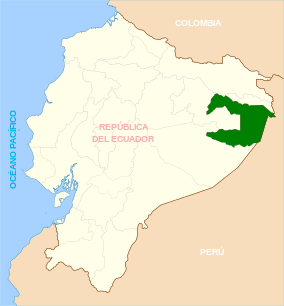
Ecuador’s parliament on Thursday (Oct. 3, 2012) authorized drilling of the nation’s largest oil fields in part of the Amazon rainforest after the failure of President Rafael Correa’s plan to have rich nations pay to avoid its exploitation.  The socialist leader launched the initiative in 2007 to protect the Yasuni jungle area, which boasts some of the planet’s most diverse wildlife, but scrapped it after attracting only a small fraction of the $3.6 billion sought.

The government-dominated National Assembly authorized drilling in blocks 43 and 31, but attached conditions to minimize the impact on both the environment and local tribes. Though Correa says the estimated $22 billion earnings potential will be used to combat poverty in the South American nation, there have been protests from indigenous groups and green campaigners.  About 680,000 people have signed a petition calling for a referendum.  “We want them to respect our territory,” Alicia Cauilla, a representative of the Waorani people who live around the Yasuni area, said in an appeal to the assembly. “Let us live how we want.”  Correa has played down the potential impact of oil drilling in the area, saying it would affect only 0.01 percent of the entire Yasuni basin…

Oil output in OPEC’s smallest member has stagnated since 2010 when the government asked oil investors to sign less-profitable service contracts or leave the country. Since then, oil companies have not invested in exploration.  State oil company Petroamazonas will be in charge of extraction in blocks 43 and 31, which are estimated to hold 800 million barrels of crude and projected to yield 225,000 barrels per day eventually. Ecuador currently produces 540,000 bpd

Excerpt, By Alexandra Valencia, Ecuador congress approves Yasuni basin oil drilling in Amazon, Reuters, Oct. 4, 2013


Weather Modification and the CIA

image from wikipedia

According to US website ‘Mother Jones’ the CIA is helping fund a study by the National Academy of Sciences (NAS) that will investigate whether humans could use geoengineering – which is defined as deliberate and large-scale intervention in the Earth’s climatic system – to stop climate change.The NAS website describes the study as an investigation into “a limited number of proposed geoengineering techniques, including examples of both solar radiation management (SRM) and carbon dioxide removal (CDR) techniques.”  The purpose of this is to comment “generally on the potential impacts of deploying these technologies, including possible environmental, economic, and national security concerns”, the website claims.  Solar radiation management (SRM) is a theoretical branch of geoengineering which moots the idea of reflecting sunlight in an attempt to block infrared radiation and halt rising temperatures.

The cost of the project is reported to be $630,000, which NAS is splitting with the CIA, the National Oceanic and Atmospheric Administration, and NASA reports say.  A reference on the NAS website to “the US intelligence community” funding the project refers to the CIA, an NAS spokesman claimed.

Much speculation has surrounded claims that the US government has long been involved in types of weather manipulation, including a much-discussed attempt to cloud-seed – the process of dispersing substances into the air to create cloud condensation or ice nuclei and subsequently rain or snow – during the Vietnam war.

It was also widely reported that the Chinese government seeded clouds ahead of the 2008 Olympics opening ceremony to create a downpour elsewhere and keep the stadium dry by firing iodide crystals into rain clouds over Beijing.

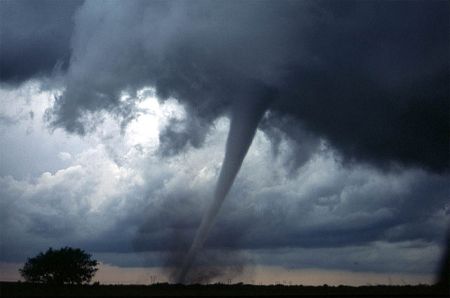
Weather manipulation was most recently in the news after claims by some American commentators that devastating tornadoes in Oklahoma, along with other extreme weather events like Hurricane Sandy, were created by the US government using the Haarp antenna farm in Alaska.

CIA backs $630,000 study into how to control global weather through geoengineering,The Independent, July 21, 2013

Antarctica: Environment and Geopolitics

The meeting  (week of July 14, 2013)of the Conservation of Antarctic Marine Living Resources (CCAMLR) offers a “unique opportunity” for representatives of 24 countries and the European Union to…  designate the world’s largest marine reserves  Nature conservation is also a question of geopolitical interests — an arena in which no country wants to lose influence. The countries at the meeting are those active in Antarctica, in either a business or scientific capacity. So far, two opposing camps have remained insistent on their positions.

On the one side, the Western nations have proposed marine reserves. The United States and New Zealand are proposing to protect the Ross Sea area along Antarctica’s east coast. In some areas, fishing would be banned; in other areas, strict limits would be imposed. But China, Japan, Ukraine, Norway and and Russia, in particular, have shown little interest in an agreement. All have considerable business interests in the region.

Norwegian ships also catch vast quantities of krill off the coast of Antarctica to feed large salmon farms back home. The government in Oslo has little interest in major marine reserves on the southern continent. Norway has considerable influence, as well. The CCAMLR negotiations in Oslo are being led by Terje Løbach, an official at the Norwegian Fisheries Ministry. At the last CCAMLR meeting in Australia, his country was among those that offered the most adamant resistance to creating marine reserves. Participants claim Løbach used his advantage as the leader of the meeting to further the positions of his government rather than seek compromises. The conference in Australia ultimately failed to reach any agreement…

Russian representatives, for example, are leading the opposition against the US-New Zealand proposal for a marine protection area in the Ross Sea area. New Zealand and the US are proposing fishing quotas for the 2.3 million-square-kilometer area. But the Russians feel they have been cheated in the considerations. “They fear that the bear skin will be divided up without them,” one participant said.

Antarctica Conference: Deal Could Preserve Pristine Waters, Associated Press, July 15, 2013

Air Pollution: the Palm Oil Conglomerates


Since the mid-1980s, when Indonesia first began to clear its bountiful forests on an industrial scale in favour of lucrative palm-oil plantations, “haze” has become an almost annual occurrence in South-East Asia. The cheapest way to clear logged woodland is to burn it, producing an acrid cloud of foul white smoke that, carried by the wind, can cover hundreds, or even thousands, of square miles.

The intervening decades have seen the passage of numerous national and international regulations to stop the fires, but all, it seems, to no avail. The past two weeks have seen some of the worst smog ever, taking a severe toll not only on peoples’ lungs, throats and tempers, but also on diplomatic relations and Indonesia’s attempts to improve its environmental image. Worse still, despite the outcry, it is hard to see how matters are going to improve over the next few years.

Most of the burning, which starts every dry season, is concentrated this year in Riau province on the east coast of Sumatra. Indonesia is the world’s biggest palm-oil producer and Riau its most productive province. Sadly for Singapore and Malaysia, it lies just across the Strait of Malacca from them. From June 16th Singapore and large parts of Malaysia were smothered in smog from this year’s fires.

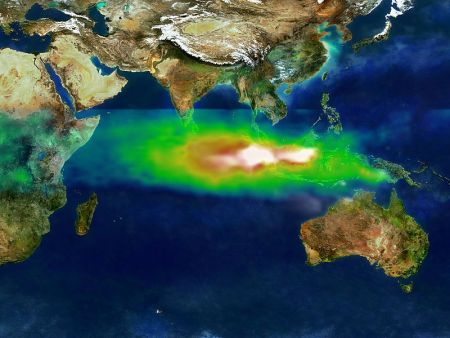
In Singapore the pollution was the worst ever, pummelling the previous records set in 1997, when the haze affected six countries and perhaps 70m people. Then, the Pollutants Standard Index (PSI) in Singapore, a measure of air quality, hit a panic-inducing 226, defined as “very unhealthy”. On June 19th, by contrast (the day of the satellite picture above), the PSI climbed to over 300, defined as “hazardous”, before peaking at 401 on June 21st. The government issued face masks and almost everyone took its advice to stay indoors. Malaysia declared a state of emergency in parts of its southern state of Johor when the Air Pollution Index, only slightly different from Singapore’s PSI, exceeded 500; it reached 750 on June 23rd. Kuala Lumpur, the capital, and coastal cities were also badly affected, as was Riau province itself, where hundreds were evacuated.

Fraternal relations within the Association of South-East Asian Nations (ASEAN), the regional political grouping, quickly dissolved into acrimonious finger-pointing. Agung Laksono, the minister in charge of Indonesia’s response to the crisis, said that Singaporeans were behaving “like children, in such a tizzy”. Singaporeans and Malaysians pointed out that Indonesia was the only ASEAN member not to have ratified a 2002 Agreement on Transboundary Haze Pollution. It was only on June 24th, when the damage was done, that its president, Susilo Bambang Yudhoyono, apologised to his irate neighbours.

At least three laws in Indonesia prohibit the burning and clearance of forests, and in particular Sumatra’s extensive peat wetlands. But environmental campaigners argue that the government has never seriously enforced these laws. Despite the arrest in Sumatra this week of eight farmers, supposedly caught red-handed, hardly anyone has been successfully prosecuted over the years for lighting fires. Palm oil’s economic importance to Indonesia seems to afford the industry protection. Last year exports totalled $17.9 billion, second only to coal. Some 5m people live off the industry. These are big numbers in a relatively poor country.

About half of the vast amount of land on which the fires are burning in Sumatra belongs to big palm-oil conglomerates, many of them Malaysian-owned. They have been accused of setting illegal fires in the past, in order to clear more of their concessions for palm oil. Satellite imagery clearly shows fires burning on the land of some of them, and the Indonesian government has named eight companies that it wants to investigate. Even so, it is going to be very difficult to apportion blame. One company, Singapore-based Asia Pacific Resources International Limited, acknowledges that there have been three fires on its land, but claims these had “originally started outside of its concession area”.

Another perennial problem is corruption. This year’s disaster was preceded on June 14th by the arrest of Rusli Zainal, the governor of Riau since 2003. He was charged, among other crimes, with dishing out illegal logging permits to finance a forthcoming re-election campaign. Under the country’s political decentralisation in 2001, generally considered to be good for democracy, the power to regulate land use passed from Jakarta to regional and often district-level politicians. They have often abused this authority to raise money.

Much of the area now burning in Riau is peat wetland, almost all that’s left after years of rampant deforestation. Peat, which can go down to a depth of 30m in Sumatra, is highly combustible, even many metres down. A fire doused on the surface might smoulder underground long after. It is illegal to burn peat for commercial development. But as the past few weeks have proved, the law is not enough. And, ominously for those hoping for clear skies and clean air, a lot of peat is left.

South-East Asia’s smog: Unspontaneous combustion, Economist, June 29, 2013, at 39

Deforestation: Rubber Barons and their Bankers

Along Route 7 in Cambodia’s remote north, dozens of small tractors known as “iron buffaloes” are plying a dilapidated piece of highway. Under cover of darkness, they transport freshly cut timber into nearby sawmills. The drivers wear masks, their tractors fitted with just one dim lamp at the front. Each carries between three and six logs which locals say were felled illegally on or near the Dong Nai rubber plantation, owned by Vietnam Rubber Group (VRG).

Illegal logging and land-grabbing have long been problems in Cambodia. A new report entitled “Rubber Barons” by Global Witness, a London-based environmental watchdog, has highlighted the issue once again. Dong Nai features prominently in the report, which claims that luxury timbers like rosewood, much in demand for furniture in China and guitars in the West, were culled as a 3,000-hectare (7,400-acre) section of forest was illegally cleared.

Global Witness says that local and foreign companies have amassed more than 3.7m hectares of land in Cambodia and Laos since 2000, as governments have handed out huge land concessions, many in opaque circumstances. Two-fifths of this was for rubber plantations, dominated by state companies from Vietnam, the world’s third-largest rubber producer.

The report claims that VRG and another Vietnamese company, HAGL, are among the biggest land-grabbers, and have been logging illegally in both Cambodia and Laos. It says that, through Vietnam-based funds, the two companies have received money from Deutsche Bank, while HAGL also has investment from the IFC, the private-sector arm of the World Bank. The two Vietnamese companies have denied any wrongdoing. Deutsche Bank and the IFC say they are studying the findings.

The report says that the two companies have failed to consult local communities or pay them compensation for land they formerly used. The companies routinely use armed security forces to guard plantations. Large areas of supposedly protected intact forest have been cleared, in violation of forest-protection laws and “apparently in collusion with Cambodia’s corrupt elite”.

Global Witness is urging authorities in Cambodia and Laos to revoke the two companies’ land concessions, which cover 200,000 hectares and are held through a network of subsidiaries. It thinks both companies should be prosecuted.

Logging in South-East Asia: Rubber barons, Economist, May 18, 2013

See also Bankers with Chainsaws


Blackstone, China, Secrecy: Guyana

The government of Guyana wants to move forward with an $840m project at Amaila Falls, deep in the forested interior. At full capacity of 165MW, it could supply more power than Guyana’s present needs.  The lead developer is Sithe Global, part of the Blackstone Group. Sithe wants a guaranteed 19% return on its equity stake, and plans to start construction this year. China Railway First Group signed an engineering contract in September. The China Development Bank will lend most of the money. The Inter-American Development Bank has been asked to chip in $175m; the World Bank was initially involved, but has pulled out.

Amaila’s supporters point out that it will flood less than 55 square km (21 square miles). No villages will be displaced and little wildlife will be disturbed. Guyana would no longer rely on fossil fuels for electricity. After two decades, ownership would pass to the government, construction costs paid off.

Opponents worry that clean electricity will not come cheap. Guyana Power and Light (GPL), the state-owned electricity company, will pay about $100m a year to the Amaila consortium. Electricity bills are unlikely to fall (three people were killed last year in protests over electricity charges). And Amaila’s power may not be reliable. The El Niño weather pattern can bring a year-long drought. In normal years, the plant will run below capacity between October and April. GPL will have to pay for backup thermal power. The IMF has urged “careful consideration of the [financial] risks”.

Plans to build Amaila date from 1997, though Sithe only got involved in 2009. The estimated cost has risen steadily. An access road is unfinished. There is as yet no economic feasibility study for the project; when completed, the study will remain confidential, as is GPL’s outline power-purchase agreement. Opposition parties complain that the government is being “secretive” about Amaila. On April 24th they blocked funds for a government equity-stake in the project. If Amaila is as beneficial as its backers claim, an open debate might generate broader support for the project, and cut its $56m bill for political risk insurance.

Hydropower in Guyana: Shrouded in secrecy, Economist, May, 4, 2013, at 39

Himalayas and Climate Change: the Third Pole

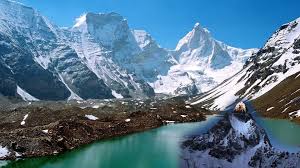
Though the amount of ice on the plateau of Tibet and its surrounding mountains, such as the Himalayas, Karakoram and Pamirs, is a lot smaller than that at the poles, it is still huge. The area’s 46,000 glaciers cover 100,000 square kilometres (40,000 square miles)—about 6% of the area of the Greenland ice cap. Another 1.7m square kilometres is permafrost, which can be up to 130 metres deep. That is equivalent to 7% of the Arctic’s permafrost. Unlike the ice at the poles, the fate of this ice affects a lot of people directly. The area is known by some as Asia’s water tower, because it is the source of ten of the continent’s biggest rivers. About 1.5 billion people, in 12 countries, live in the basins of those rivers. Welcome, then, to the Earth’s “Third Pole”.

Until recently studies of the Third Pole were piecemeal—not surprising, given its remoteness, the altitude, the harsh weather and the fact that little love is lost between the countries among which it is divided. In 2009, however, Yao Tandong of the Institute of Tibetan Plateau Research, in Beijing, Lonnie Thompson of the Ohio State University and Volker Mosbrugger of the Senckenberg World of Biodiversity, in Frankfurt, started an international programme involving these countries, called the Third Pole Environment (TPE). Last month, its fourth workshop met in Dehradun, India.

One question on everyone’s mind is whether the glaciers are retreating, as is happening in parts of the real polar regions. The Intergovernmental Panel on Climate Change’s report in 2007 foolishly suggested that the Himalayas’ glaciers could disappear as early as 2035. Given the amount of ice they contain, it would take weather gods armed with blow torches to melt them that quickly, and this suggestion was rapidly discredited…..

One outcome of the workshop, then, has been to establish that the overall ice cover of the Third Pole, like that of the two real poles, is shrinking. Another is to show how precarious and piecemeal data about the area are. Its role as the source of so many rivers means that absence of data matters. The Chinese Academy of Sciences, of which both Dr Yao’s and Dr Wu’s institutes are part, has therefore set up a fund of 400m yuan ($65m) for research on the Third Pole and, crucially, a quarter of this is earmarked for work outside China.

The TPE’s researchers will now monitor a set of bellwether glaciers every six months. They will set up observatories to measure solar radiation, snowfall, meltwater and changes in the soil, as well as air temperature, pressure, humidity and wind. And they plan to take cores from the ice on the Tibetan plateau. These will let them reconstruct the area’s climate over the past few hundred thousand years. Together, these data will give them a better grip on how much—and why—the Third Pole is changing.

The climate of Tibet: Pole-land, Economist,, May 11, 2013,  at 84

Dams in Brazil

Some 20,000 labourers are working around the clock at Belo Monte on the Xingu river, the biggest hydropower plant under construction anywhere. When complete, its installed capacity, or theoretical maximum output, of 11,233MW will make it the world’s third-largest, behind China’s Three Gorges and Itaipu, on the border between Brazil and Paraguay.  Everything about Belo Monte is outsized, from the budget (28.9 billion reais, or $14.4 billion), to the earthworks—a Panama Canal-worth of soil and rock is being excavated—to the controversy surrounding it. In 2008 a public hearing in Altamira, the nearest town, saw a government engineer cut with a machete. In 2010 court orders threatened to stop the auction for the project. The private-sector bidders pulled out a week before. When officials from Norte Energia, the winning consortium of state-controlled firms and pension funds, left the auction room, they were greeted by protesters—and three tonnes of pig muck.

Since then construction has twice been halted briefly by legal challenges. Greens and Amerindians often stage protests. Xingu Vivo (“Living Xingu”), an anti-Belo Monte campaign group, displays notes from supporters all over the world in its Altamira office… But visit the site and Belo Monte now looks both unstoppable and much less damaging to the environment than some of its foes claim…

Brazil already generates 80% of its electricity from hydro plants—far more than other countries. But two-thirds of its hydro potential is untapped. The snag is that most of it lies in untouched rivers in the Amazon basin. Of 48 planned dams, 30 are in the rainforest. They include the almost completed Jirau and Santo Antônio on the Madeira river, which will add 6,600MW to installed capacity. But it is Belo Monte, the giant among them, that has become the prime target of anti-dams campaigners.Opponents say that dams only look cheap because the impact on locals is downplayed and the value of other uses of rivers—for fishing, transport and biodiversity—is not counted. They acknowledge that hydropower is low-carbon, but worry that reservoirs in tropical regions can release large amounts of methane, a much more powerful greenhouse gas.

In the 20th century thousands of dams were built around the world. Some were disasters: Brazil’s Balbina dam near Manaus, put up in the 1980s, flooded 2,400 square km (930 square miles) of rainforest for a piffling capacity of 250MW. Its vast, stagnant reservoir makes it a “methane factory”, says Philip Fearnside of the National Institute for Amazonian Research, a government body in Manaus. Proportionate to output, it emits far more greenhouse gases than even the most inefficient coal plant.

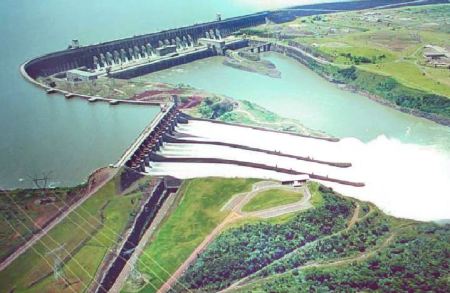
But many dams were worth it (though the losers rarely received fair compensation). Itaipu, built in the 1970s by Brazil’s military government, destroyed some of the world’s loveliest waterfalls, flooded 1,350 square km and displaced 10,000 families. But it now supplies 17% of Brazil’s electricity and 73% of Paraguay’s. It is highly efficient, producing more energy than the Three Gorges, despite being smaller.

Of Brazil’s total untapped hydropower potential of around 180,000MW, about 80,000MW lies in protected regions, mostly indigenous territories, for which there are no development plans. The government expects to use most of the remaining 100,000MW by 2030, says Mr Ventura. But it will minimise the social and environmental costs, he insists. The new dams will use “run of river” designs, eschewing large reservoirs and relying on the water’s natural flow to power the turbines. And they will not flood any Indian reserves.,,,

The protesters’ legal challenge to Belo Monte is based on the claim that they have not been properly consulted, something the government denies. The constitution says that before exploiting any resource on Amerindian lands, the government must consult the inhabitants. But it is silent on how this should be done. The International Labour Organisation (ILO) has a similar clause in its Convention 169 on indigenous rights, to which Brazil is a signatory.  The government says that since no demarcated territories will be flooded, such formal protections do not apply. “We hold consultations about the projects we’re doing not because we have to, but because it is right,” says Mr Ventura. Between 2007 and 2010 there were four public hearings and 12 public consultations about Belo Monte, as well as explanatory workshops and 30 visits to Indian villages.

In 2011, in response to a complaint filed by Indian groups, the Inter-American Commission on Human Rights called for a halt to construction pending further consultation. That was “precipitate and unjustified”, said the government, refusing the request. The ILO has asked Brazil’s government for more information on how it intends to fulfil its legal obligations.

The legal uncertainty surrounding Belo Monte is bad for both the Indians and contractors, says Mr Sales—not to mention Brazil as a whole. A draft law detailing how to consult indigenous people is expected by the end of the year. But before Congress legislates, ground is likely to have been broken on most of the new dams….

Belo Monte was given an initial budget of 16 billion reais, which had risen to 19 billion reais by the time of the auction. Norte Energia’s winning bid for Belo Monte offered a price of 77.97 reais/MWh. Since then, its budget has risen by a third.  Officials insist that the costs are Norte Energia’s problem. That looks disingenuous. The group is almost wholly state-owned. In November, the national development bank gave Norte Energia a loan of 22.5 billion reais—its largest-ever credit. If Belo Monte turns out to be a white elephant, the bill will fall on the taxpayer.

Dams in the Amazon: the Rights and Wrongs of Belo Monte, Economist, May 4, 2013, at 37

The Risk of Unburnable Carbon

Several  reports suggest that markets are overlooking the risk of “unburnable carbon”. The share prices of oil, gas and coal companies depend in part on their reserves. The more fossil fuels a firm has underground, the more valuable its shares. But what if some of those reserves can never be dug up and burned?

If governments were determined to implement their climate policies, a lot of that carbon would have to be left in the ground, says Carbon Tracker, a non-profit organisation, and the Grantham Research Institute on Climate Change, part of the London School of Economics. Their analysis starts by estimating the amount of carbon dioxide that could be put into the atmosphere if global temperatures are not to rise by more than 2°C, the most that climate scientists deem prudent. The maximum, says the report, is about 1,000 gigatons (GTCO2) between now and 2050. The report calls this the world’s “carbon budget”.

Existing fossil-fuel reserves already contain far more carbon than that. According to the International Energy Agency (IEA), in its “World Energy Outlook”, total proven international reserves contain 2,860GTCO2—almost three times the carbon budget. The report refers to the excess as “unburnable carbon”.

Most of the reserves are owned by governments or state energy firms; they could be left in the ground by public-policy choice (ie, if governments took the 2°C target seriously). But the reserves of listed oil companies are different. These are assets developed using money raised from investors who expect a return. Proven reserves of listed firms contain 762GTCO2—most of what can prudently be burned before 2050. Listed potential reserves have 1,541GTCO2 embedded in them.

So companies and governments already have far more oil, gas and coal than they need (again, assuming temperatures are not to rise by more than 2°C). Logically, the response to this would be for governments to leave their reserves untouched and for companies to run theirs slowly down, returning more of what they earn to shareholders. Neither of these things is happening. State-owned companies are taking an increasing share of total energy output. And in 2012, says Carbon Tracker, the 200 largest listed oil, gas and coal companies spent five times as much—$674 billion—on developing new reserves as they did returning money to shareholders ($126 billion). ExxonMobil alone plans to spend $37 billion a year on exploration in each of the next three years.

Such behaviour, on the face of it, makes no sense. One possible explanation is that companies are betting that government climate policies will fail; they will be able to burn all their reserves, including new ones, after all. This implies that global temperatures would either soar past the 2°C mark, or be restrained by a technological fix, such as carbon capture and storage, or geo-engineering.Recent events make such a bet seem rational. On April 16th the European Parliament voted against attempts to shore up Europe’s emissions trading system against collapse. The system is the EU’s flagship environmental policy and the world’s largest carbon market.  Putting it at risk suggests that Europeans have lost their will to endure short-term pain for long-term environmental gain. Nor is this the only such sign. Several cash-strapped EU countries are cutting subsidies for renewable energy. And governments around the world have failed to make progress towards a new global climate-change treaty. Betting against tough climate policies seems almost prudent.

The markets are [also] mispricing risk by valuing companies as if all their reserves will be burned. Investors treat reserves as an indicator of future revenues. They therefore require companies to replace reserves depleted by production, even though this runs foul of emission-reduction policies. Fossil-fuel firms live and die by a measure called the reserve replacement ratio, which must remain above 100%. Companies see their shares marked down if the ratio falls, even when they pull the plug on dodgy, expensive projects. This happened to Shell, for example, when it suspended drilling in the Arctic in February….

At the moment neither public policies nor markets reflect the risks of a warmer world.

Energy Firms and Climate Change: Unburnable Fuel, Economist, May 4, 2013, at 68

Flooding Vietnam: Climate Change

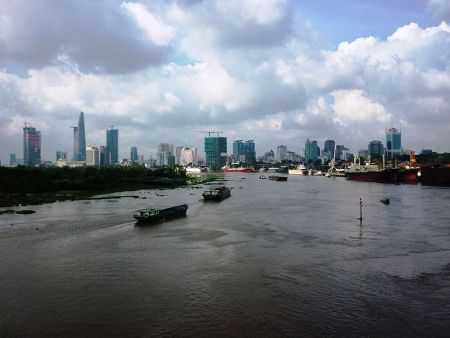
Ho Chi Minh City (known locally as HCMC), Vietnam, a city full of rivers and canals,  has so far been spared a devastating flood, and donors have so far been eager to help. The World Bank, for example, has upgraded stormwater and canal infrastructure in a few central districts, and on April 8th, 2013 officials from the Dutch city of Rotterdam were in town to promote a joint Dutch-Vietnamese project designed to help HCMC adapt to climate change.Yet nearly half the city lies less than one metre above sea level, and scientists say groundwater extraction, which causes land subsidence, may be having a huge unseen effect. Nearly 70% of the city is already vulnerable to extreme flooding, according to the Asian Development Bank.

Flood risks are rising in HCMC’s lower-lying districts, in part because the property boom that accompanied Vietnam’s 2007 entry to the World Trade Organisation led many developers to build wherever they could. One potential victim is an Intel factory inside a high-tech park on HCMC’s eastern outskirts. The threat to such a big firm is troubling because the city accounts for more than half of foreign direct investment in Vietnam, and exports have helped offset weak consumer demand. In Vietnam urban floods also pose public health risks in the form of outbreaks of cholera or dysentery…

The government is promoting a plan to build a 172-km (106-mile), $2.6 billion system of ring dykes to protect urban areas west of the Saigon River. But the financing is not yet secure, and the World Bank has said such large flood-control solutions may be unsustainable.

A better option may be a smaller $1.4 billion dyke proposed by Royal HaskoningDHV, a Dutch consultancy that has managed similar projects in New Orleans and other flood-prone places. But officials at the Ministry of Agriculture and Rural Development typically prefer expensive infrastructure projects, which offer opportunities for kickbacks. “They love dykes,” says Ho Long Phi, a professor at Vietnam National University in HCMC.  Mr Phi may be Saigon’s best flood-control asset. Unlike many Vietnamese officials, he understands that bigger flood-protection measures are not necessarily better, and that if the city is to prosper in the long term, it will need to work with, rather than against, nature. Today’s policies will only transfer flooding risks to future generations. In Mr Phi’s view, the only thing that may change the government’s short-sighted approach to flood prevention is a catastrophe,

Up a creek: A low-lying city must take drastic action to prevent flooding, Economist, May 4,  2013, at 41

Greening the Shipping Industry

The shipping industry faces the cost of complying with a deluge of new rules(issued by the International Maritime Organisation (IMO)). To make matters worse, it is in the middle of a slump caused by too many ships chasing too little trade.  As the deadlines for all these rules approach, shipping bosses are firing off distress flares. Masamichi Morooka, chairman of the International Chamber of Shipping (ICS), a lobby group, lamented on March 19th that the cost could run into “hundreds of billions” of dollars. He begged regulators to take into account the dire state of shipping

One of the first big expenses will be for cleaner fuel. Ships used to burn the cheap, unrefined crud, laden with sulphur and other nasties, that is left over when oil is refined. The fine soot that such fuel gives off can cause premature deaths from asthma and heart attacks. So in 2005 the IMO started to limit the sulphur content of maritime fuel, especially in “emission-control areas” along heavily populated coasts in North America and Europe. These limits are set to be tightened drastically,  Such fuels currently cost about 50% more than unrefined “residual” grades…

Shipping firms are also under pressure to cut their emissions of carbon dioxide and other greenhouse gases. The IMO reckons that ships cause about 2.7% of total man-made emissions, a bit more than planes but a lot less than cars and trucks. Under a convention it has brought into force this year, ships will have to introduce fuel-economy measures with the aim of reducing their emissions by 20% by 2020 and 50% by 2050….

The IMO is also pressing on with planned new rules on cleaning up ships’ ballast water. These may come into effect this year, once enough national governments have signed up for them. A study last year in the Journal of Marine Engineering and Technology* reckoned that around 60,000 ships worldwide would need refitting with one or more cleansing units, costing up to $1.7m each. In that case, shipping firms could be whacked with a bill of the order of $50 billion…

New proposals to make shipping greener, and push it further into the red, keep popping up. This week the European Parliament’s environment committee backed proposals for recycling levies on vessels calling at EU ports. This would pay for safer scrapping of old ships, which can contain asbestos and other toxic materials….

At a conference in Athens recently John Platsidakis, a Greek shipping boss who chairs an association of bulk-cargo operators, grumbled: “We carry 90% of world trade and we emit only 2.7% of the CO2 but still we are treated as if we are acting with indifference to the environment.”…[A]irlines, for example, have lobbied more shrewdly than shipping firms. But then again, the shipping industry is bigger and more fragmented than aviation, making it harder for it to present a united front. Many small, family-owned shipping firms have publicity-shy bosses and lack the sophisticated public-relations machines that giant firms deploy….[T]he ICS seeks to represent the entire global merchant-shipping fleet with just 20 people. The industry’s sluggish lobbying has meant that rules get passed before it has a chance to object to them. And once they are passed, it is much harder to get them changed.

The shipping industry: Sinking under a big green wave, Economist, Mar. 30, 2013, at 69

Water Shortages in the MIddle East: Tigris and Euphrates

According to a study in Water Resources Research, an American scientific journal, between 2003 and 2009 the region that stretches from eastern Turkey to western Iran lost 144 cubic kilometres of fresh water.  That figure is vast. It is equivalent in volume to the Dead Sea and, according to the study’s senior author, Jay Famiglietti of the University of California, Irvine, implies that the region is suffering the world’s second-fastest rate of water depletion after northern India. The water table sank by 0.3 metres (one foot) a year in 2006-09. At the point where the Euphrates crosses from Syria into Iraq, it now flows at only 70% of the rate it once did. All this in an area that already faces severe water shortages.

The study provides the first accurate estimate of all the water in the basin. National statistics are flawed and incomplete; some figures are even state secrets. But the study uses satellite data from America’s NASA which is not subject to these restrictions. These satellites not only measure surface water by photographs but, thanks to precise measurements of the effect of bodies of water on the atmosphere, can even calculate the amount of water in the aquifer below them.

The main reason for the depletion turns out to be that more water is being taken out of the underground aquifer, mainly by farmers. The rate of loss accelerated after drought hit the region in 2007. Between 2007 and 2009, in response to reduced flows of water in the rivers, Iraq’s government dug 1,000 new wells and abstracted four-fifths of all its groundwater reserves. The aquifer is not being replenished at anything like that rate, so this cannot continue for long.

The rapid depletion has implications for managing the basin, which is shared by Turkey, Syria, Iraq and Iran. All the countries have extensive dams, reservoirs and other sorts of infrastructure on both rivers which control the water’s flow. But they have no international treaty governing when and by how much they can shut the flow down.

Over the years, this has not mattered much. The countries have rubbed along, sometimes amicably, sometimes not, with downstream ones (notably Syria and Iraq) assuming there would always be enough water in the upstream reservoirs of Turkey for them all. But if the new study is any guide, that assumption may not hold for much longer.

The Tigris and Euphrates: Less fertile crescent, Economist, Mar. 9, 2013, at 42

Anti-Nuclear Protests: Taiwan

In what organizers called the largest anti-nuclear protest in Taiwan, an estimated 200,000 people took to the streets in several parts of the island on March 9, 2013 to call for the scrapping of nuclear power plants.  The protest was held simultaneously in northern, central, southern and eastern Taiwan just two days before the second anniversary of the meltdown of Japan’s Fukushima nuclear power plant in the wake of the big earthquake and tsunami on March 11, 2011.

The march participants demanded that the government not allocate any more funding for the construction of Taiwan’s fourth nuclear power plant in New Taipei City. Construction of the plant has stretched over 14 years and has so far costed taxpayers US$10 billion. It is scheduled to be completed later this year.  But there are increasing concerns over safety, especially given several flooding incidents at the plant being built by the state-run Taipower. Protesters urged the government not to allow fuel rod filling at the new power plant.  More than 6.5 million people, including the residents of Taipei, live within just 80 kilometers of the plant.

Protesters also demanded the speedy decommissioning of Taiwan’s first, second and third nuclear power plants now under operation. All three plants are around three decades old.  In addition, protesters called for the removal of stored nuclear waste from Taiwan’s outlying Orchid Island immediately, as well as a review of the government’s policy to eventually phase out the use of nuclear power, and the government’s implementation of “zero growth for electricity demands.”

A spokeswoman for the Presidential Office said President Ma Ying-jeou was willing to have dialogues with anti-nuclear groups and listen to their suggestions on how Taiwan can find alternatives for nuclear power.Garfi Li cited Ma as saying that the government’s nuclear power policy is based on the premises of “no shortage of electricity, reasonable electricity prices, and honoring the promise to cutting carbon emission to the international community.”…

Previously, the economics ministry, which oversees Taiwan’s state-owned Taipower — the operator of the nuclear power plants — has said Taiwan needs nuclear power so as to avoid being overdependent on imported energy raw material and rising international prices for them. The economics minister has also warned of an energy shortage if the fourth plant is not put into operation….Most importantly, protesters argued that safety, rather than carbon emission reduction and cheap energy prices, should be top priority. They argue that Taiwan’s power plants are among the most dangerous in the world — they are located near fault lines and in densely populated areas, much more densely populated than Fukushima.said they were adamantly opposed to the increase of thermal power, adding that Taichung should increase the use of solar and wind power instead….

In Taitung, eastern Taiwan, the protesters called for nuclear waste to be removed from their area. More than 2,000 people took part in that protest, the largest mass movement in years in Taitung.”We have to take to the streets for the good of the next generation,” one organizer said.Following Orchid Island off the Taitung County, Nantien village in the county’s Dajen township has been slected as one of the possible nuclear waste storage site

200,000 TAKE PART IN TAIWAN’S ANTI-NUCLEAR PROTEST. Focus Taiwan News Channel, Mar. 9, 2013


The Polar Bear: An Animal or Icon

The Inuit see the animal as a fierce predator, a cultural symbol and a valuable source of food, warmth and money in a part of the world where all three are in short supply.Yet to animal-welfare and green groups in warmer places the polar bears are both an icon in the fight against climate change and an animal under threat of extinction. The melting of the Arctic’s ice cap, which the bears use as a hunting platform, means the estimated population of between 20,000 and 25,000 will decline sharply, they say. They see hunting the bears as an anachronism and want international trade in bear pelts and parts, already severely restricted, completely banned.

These opposing views are set to clash at a meeting of the Convention on International Trade in Endangered Species of Wild Fauna and Flora (CITES), an intergovernmental agreement, between March 3rd and 14th in Bangkok. Having failed at the previous meeting of CITES in 2010, the United States is again leading a move to switch the polar bear from Appendix II of the convention to Appendix I, which would ban trade in all but “exceptional” circumstances. The American proposal is backed by Russia but opposed by Canada, Norway, Denmark (which represents Greenland) and the CITES secretariat.

The debate promises to be emotional. What it lacks are facts. The Americans acknowledge that only eight of the 19 known groups of polar bears have been surveyed since 2000. Of the remaining 11, four have never been surveyed. The submission relies on a controversial forecast undertaken for the US Fish and Wildlife Service in 2007 that suggests the decline in sea ice will lead to the disappearance of two-thirds of the world’s polar bears by 2050.  Should the United States obtain the two-thirds majority needed to change the bear’s status, it will be a blow to the Inuit. Their trade in walrus tusks and narwhal horns has dried up because of curbs on sales of ivory designed largely to protect elephants. The trade in seal pelts and meat was curtailed by a 2009 import ban by the European Union, though this granted a limited exemption to indigenous peoples.

In Canada polar bears are hunted under annual quotas set by territorial governments. The Inuit trade bear pelts, claws and teeth, and sell some of the quota to trophy hunters, who employ local guides and buy local supplies…..

Countries which want to become observers at the Arctic Council, an intergovernmental body, will be reluctant to vote against Canada, Norway and Denmark on the issue. Canada takes over as chairman of the council in May. Still, it will take resolve to stand up to the United States, also a council member, and the array of animal-welfare and environmental groups backing its position.

The Inuit also argue that if the problem is climate change, to ban trade in polar bears is to attack the symptom rather than the cause. That was the argument of the European Union’s environment commissioner, Janez Potocnik, when the European Parliament debated the issue earlier this month. But the MEPs still voted in support of the American position.

Canada’s Inuit: Polar-bear politics, Economist, Feb. 23, at 36

The Evaporation of Andes Glaciers: a study

The glacier retreat in the tropical Andes over the last three decades is unprecedented since the maximum extension of the Little Ice Age (LIA, mid-17th–early 18th century). In terms of changes in mass balance, although there have been some sporadic gains on several glaciers, we show that the trend has been quite negative over the past 50 yr, with a mean mass balance deficit for glaciers in the tropical Andes that is slightly more negative than the one computed on a global scale. A break point in the trend appeared in the late 1970s with mean annual mass balance per year decreasing from −0.2 m w.e. in the period 1964–1975 to −0.76 m w.e. in the period 1976–2010.

In addition, even if glaciers are currently retreating everywhere in the tropical Andes, it should be noted that this is much more pronounced on small glaciers at low altitudes that do not have a permanent accumulation zone, and which could disappear in the coming years/decades. Monthly mass balance measurements performed in Bolivia, Ecuador and Colombia show that variability of the surface temperature of the Pacific Ocean is the main factor governing variability of the mass balance at the decadal timescale. Precipitation did not display a significant trend in the tropical Andes in the 20th century, and consequently cannot explain the glacier recession. On the other hand, temperature increased at a significant rate of 0.10 °C decade−1 in the last 70 yr. The higher frequency of El Niño events and changes in its spatial and temporal occurrence since the late 1970s together with a warming troposphere over the tropical Andes may thus explain much of the recent dramatic shrinkage of glaciers in this part of the world.

A. Rabatel, et al.,Current state of glaciers in the tropical Andes: a multi-century perspective on glacier evolution and climate change. The Cryosphere: An Interactive Open Access Journal of the European Geosciences Union

The Desert at the Heart of the Amazon Rainforest

An area of the Amazon rainforest twice the size of California continues to suffer from the effects of a megadrought that began in 2005, finds a new NASA-led study. These results, together with observed recurrences of droughts every few years and associated damage to the forests in southern and western Amazonia in the past decade, suggest these rainforests may be showing the first signs of potential large-scale degradation due to climate change.

An international research team led by Sassan Saatchi of NASA’s Jet Propulsion Laboratory, Pasadena, Calif., analyzed more than a decade of satellite microwave radar data collected between 2000 and 2009 over Amazonia. The observations included measurements of rainfall from NASA’s Tropical Rainfall Measuring Mission and measurements of the moisture content and structure of the forest canopy (top layer) from the Seawinds scatterometer on NASA’s QuikScat spacecraft.

The scientists found that during the summer of 2005, more than 270,000 square miles (700,000 square kilometers, or 70 million hectares) of pristine, old-growth forest in southwestern Amazonia experienced an extensive, severe drought. This megadrought caused widespread changes to the forest canopy that were detectable by satellite. The changes suggest dieback of branches and tree falls, especially among the older, larger, more vulnerable canopy trees that blanket the forest.

While rainfall levels gradually recovered in subsequent years, the damage to the forest canopy persisted all the way to the next major drought, which began in 2010. About half the forest affected by the 2005 drought – an area the size of California – did not recover by the time QuikScat stopped gathering global data in November 2009 and before the start of a more extensive drought in 2010.

“The biggest surprise for us was that the effects appeared to persist for years after the 2005 drought,” said study co-author Yadvinder Malhi of the University of Oxford, United Kingdom. “We had expected the forest canopy to bounce back after a year with a new flush of leaf growth, but the damage appeared to persist right up to the subsequent drought in 2010.”

Recent Amazonian droughts have drawn attention to the vulnerability of tropical forests to climate change. Satellite and ground data have shown an increase in wildfires during drought years and tree die-offs following severe droughts. Until now, there had been no satellite-based assessment of the multi-year impacts of these droughts across all of Amazonia. Large-scale droughts can lead to sustained releases of carbon dioxide from decaying wood, affecting ecosystems and Earth’s carbon cycle.

The researchers attribute the 2005 Amazonian drought to the long-term warming of tropical Atlantic sea surface temperatures. “In effect, the same climate phenomenon that helped form hurricanes Katrina and Rita along U.S. southern coasts in 2005 also likely caused the severe drought in southwest Amazonia,” Saatchi said. “An extreme climate event caused the drought, which subsequently damaged the Amazonian trees.”

Saatchi said such megadroughts can have long-lasting effects on rainforest ecosystems. “Our results suggest that if droughts continue at five- to 10-year intervals or increase in frequency due to climate change, large areas of the Amazon forest are likely to be exposed to persistent effects of droughts and corresponding slow forest recovery,” he said. “This may alter the structure and function of Amazonian rainforest ecosystems.”

The team found that the area affected by the 2005 drought was much larger than scientists had previously predicted. About 30 percent (656,370 square miles, or 1.7 million square kilometers) of the Amazon basin’s total current forest area was affected, with more than five percent of the forest experiencing severe drought conditions. The 2010 drought affected nearly half of the entire Amazon forest, with nearly a fifth of it experiencing severe drought. More than 231,660 square miles (600,000 square kilometers) of the area affected by the 2005 drought were also affected by the 2010 drought. This “double whammy” by successive droughts suggests a potentially long-lasting and widespread effect on forests in southern and western Amazonia.

The drought rate in Amazonia during the past decade is unprecedented over the past century. In addition to the two major droughts in 2005 and 2010, the area has experienced several localized mini-droughts in recent years. Observations from ground stations show that rainfall over the southern Amazon rainforest declined by almost 3.2 percent per year in the period from 1970 to 1998. Climate analyses for the period from 1995 to 2005 show a steady decline in water availability for plants in the region. Together, these data suggest a decade of moderate water stress led up to the 2005 drought, helping trigger the large-scale forest damage seen following the 2005 drought…

Results of the study were published recently in the Proceedings of the National Academy of Sciences. Other participating institutions included UCLA; University of Oxford, United Kingdom; University of Exeter, Devon, United Kingdom; National Institute for Space Research, Sao Jose dos Campos, Sao Paulo, Brazil; Boston University, Mass.; and NASA’s Ames Research Center, Moffett Field, Calif.

Study Finds Severe Climate Jeopardizing Amazon Forest, NASA Press Release, Jan. 17, 2013

Water in the Middle East: investment

Amidst a growing water crisis in the predominantly arid Middle East and North Africa (MENA), some of the world’s most influential water experts will meet Jan. 15-17 at the International Water Summit (IWS) in Abu Dhabi, United Arab Emirates (UAE) to look for sustainable solutions.The World Bank has already warned that MENA is the world’s “most water-scarce region, home to 6.3 percent of the world’s population but with just 1.4 percent of renewable fresh water.”

The six countries that comprise the Gulf Cooperation Council – Bahrain, Kuwait, Oman, Qatar, Saudi Arabia and UAE – are expected to spend a staggering 725 billion dollars over the next two decades on new water projects, desalination plants, infrastructure-building and high-tech innovations…

At the Abu Dhabi summit, Project Stream will offer a major opportunity for developers and investors to “connect and accelerate the building of sustainable water solutions”.  The summit, which is is part of the Abu Dhabi Sustainability Week being hosted by Masdar, described as “a sustainable green energy city of the future”, will also bring together financiers and some of the world’s leading engineering, technology and service providers.

Peter McConnell, show director for IWS, says that GCC countries have been investing heavily in water sustainability over the last few years.  “And Project Stream will in essence become a networking platform that will connect solution providers from around the world to project developers from the region,” he added.  These projects, McConnell, said range from multi-billion-dollar government infrastructure ventures to high-tech innovations in areas such as low-energy desalination, water leakage prevention and water efficiency.  “These will contribute in a significant way to address the worldwide challenges surrounding clear water supply,” he added…

The industry think-tank Global Water Intelligence (GWI), which is collaborating with Project Stream in Abu Dhabi, has reported major planned investments by Gulf countries, amounting as much as 725 billion dollars over the next two decades.  Between 2013 and 2017, Qatar is planning to invest some 1.1 billion dollars in desalination capacity through independent water and power projects (IWPPs).  Kuwait has a combined municipal water/wastewater capital expenditure budget of 4.4 billion dollars from 2013 to 2016, while the UAE’s budget reaches 13.0 billion dollars.  Saudi Arabia is expected to spend about 53.9 billion dollars over the next two decades to build, operate and maintain water projects to meet the growing demand in the Kingdom, according to GWI estimates

Excerpts,  Thalif Deen, Water Summit to Focus on Resolving Scarcities in Mideast, IPS, Jan. 11, 2012

Reversing Deforestation in the Amazon

Brazilian policymakers can take some of the credit for a dramatic slowdown in the deforestation rate in the Brazilian Amazon, say experts – but that’s not the whole story.  In November Brazil (2012) announced deforestation rates in the Amazon declined 27 percent from August 2011 to July 2012, reaching the lowest rates ever recorded for the fourth consecutive year.  According to Brazil’s National Institute for Space Research (INPE), 4656 square kilometres of Amazon rainforest were cleared over the twelve months, compared with 27,772 square kilometres in 2004.

Brazil’s government says this represents a 76 percent reduction since 2004 – coming close to the country’s commitment to reduce deforestation in the Amazon region 80 percent by 2020.  It has attributed the dramatic results to a package of policies known as PPCDAm (The Action Plan for Prevention and Control of Legal Amazon Deforestation) that were first implemented in 2004.

PPCDAm comprises more than 200 initiatives across 14 ministries that together aim to reduce deforestation in the Amazon…Over the last decade, the country has established new protected areas, indigenous lands and sustainable use areas covering 709,000 square kilometres.  This has decreased both deforestation and the incidence of fires – and crucially, more of them than previously are located near particularly threatened areas, making them more effective.We know every day where deforestation is going on in the Amazon…from detection to having people in the field stopping illegal loggers takes just five days….Brazil’s space agency, remote sensing centre, and law enforcement agencies collaborate to detect and precisely locate deforestation and forest degradation, and to apprehend perpetrators.  From detection to having people in the field stopping illegal loggers takes just five days….  Last year [Brazil]  confiscated 110 chainsaws, nine bulldozers, and 329 trucks…

Jorge Hargrave – who  worked with Wunder on the UNEP report (pdf) – and colleagues assessed the effectiveness of the PPPDAm policies.  They found that these policies were responsible for curbing deforestation – and that the command-and-control policies, particularly the issuance of environmental fines, had the most impact.  The government’s decision to focus on 36 specific municipalities where deforestation was most intense was also very effective, they found, as was the cross sector coordination and high-level political support for the program.

However, Hargrave also cautioned against over-confidence about the recent encouraging results. “It’s not clear that if the government changes or the policy changes, deforestation can’t go up again,” he said.  “In addition, the lack of land tenure security in the region was consistently identified as a key problem and the biggest bottleneck to further progress.”

In another recent study, Clarissa Costalonga e Gandour and colleagues from the Climate Policy Initiative showed that environmental policies are important – but are only part of the deforestation-reduction story.  The study found that agricultural prices – particularly meat and soybeans – had a significant impact on deforestation as well…The study makes special mention of a 2008 policy that made rural credit for agricultural activities in the Amazon conditional on proof of compliance with environmental regulations – with exceptions for smallholders.

Excerpts, KATE EVANS, How much credit can Brazil take for slowing Amazon deforestation – and how low can it go?, CIFOR, Jan. 15, 2013

The Battery of Europe – Swiss hydroelectricity is not Green

Swiss energy companies are determined to turn the country into a ‘battery for Europe’. Vast investments are made in big-scale water power projects. But it is not certain they will eventually pay off.  With the decision for a nuclear shutdown, the spotlight in Switzerland and Germany has switched to renewable energy sources. In Germany there’s a massive boost to solar and wind energy production, while Switzerland’s energy companies focus on increasing their storage capacities in the Alps.  About 11 percent of Europe’s electricity flows through Switzerland. The Swiss electricity industry stresses the advantages of the country’s central location in Europe and its topography. On the European energy map, Swiss mountain lakes could function as a huge battery for unsteadily generated renewable energy, and generate high revenues.

Natural and artificial mountain lakes are an essential component of Switzerland’s energy supply. Water power makes up 57 percent of the country’s electricity production. Some of these lakes aren’t just natural water reservoirs though, but serve as basins for pumped-storage hydro power plants (PSPs).  The system is simple and has long been a good business. Throughout the day, cheap, spare electricity is bought on the market and then used to pump water from a lower reservoir to a basin further up the mountain. At times when demand for electricity is high, stored water is released and drives turbines that produce electricity, which can then be sold on the market for a higher price.  Currently, 11 such plants are running in Switzerland with a combined 1400 megawatt capacity. Three other projects are under construction, to increase Swiss pumped-storage capacity to 3500 megawatts by 2017. Two more PSPs are being planned: ‘Grimsel 3′ at the Grimsel Pass in the Bernese Alps and ‘Lago Bianco’ at the Bernina Pass in Grisons.

“The symbiosis between nature and technology has defined the character of this landscape,” writes the Grimsel region’s tourism agency. Ernst Baumberger, press officer at the regional energy company KWO looks at Grimsel through two lenses: while praising the region’s beauty, Baumberger points out that a plenty of precipitation, glaciation, rock as building ground and the immense altitude difference make it ideal for water power use. KWO put its first power plant at Grimsel in operation 80 years ago.  The company recently was licenced to implement its 1.2 billion Swiss francs project ‘KWOplus’, including the construction of a second PSP (‘Grimsel 3′). The plant will have a 660 megawatt capacity, which is about the power of an average Swiss nuclear plant. The plan is controversial, both politically and economically.

“Switzerland doesn’t need any additional PSPs. There’s neither a lack of batteries, nor a grid stability problem,” argues Jürg Buri, managing director of the Swiss Energy Foundation (SES). He says that no country operates as many flexible power stations as Switzerland….Environmental organisations say that mainly cheap electricity from coal and nuclear plants is used for the pumping and that during the process, about a quarter of the energy is lost. Even worse, at windy times, PSPs keep coal and nuclear plants running.  There’s nothing green about pumped-storage hydroelectricity anyway. “If today’s PSPs were supplied with clean energy, that business would be unprofitable,” Buri says. “The revenues of the peak current wouldn’t make up for the purchase price and the energy lost for pumping.”

According to the licence, KWO is obliged to run Grimsel 3 with as much renewable energy as “economically and technically possible.” No fixed share was defined however. KWO’s Baumberger stresses that in the long term, the company’s PSPs should run solely with green electricity. “However, the primary criteria will remain the profitability,” he adds.  While the energy company praises Grimsel 3 as an important contribution to the security of energy supply for the country, Jürg Buri claims that the pumped-storage business further strains transmission lines. “In fact, to run Grimsel 3, even more lines would have to be built, something which people often forget about….

The Swiss Association for Water Management (SWV) views investments in PSPs as risky and their profitability as volatile. At the Bernische Kraftwerke (BKW), which holds half of KWO’s shares and manages electricity trade, the media officer declines to comment on the prospects of pumped-storage hydroelectricity…

In contrast to environmental organisations, KWO’s Baumberger remains optimistic. He stresses that in the light of booming wind and solar energy in Europe, the demand for further storage capacities will grow. “What Switzerland so far offers in terms of energy storage is nothing but a drop in the ocean.”  While opinions on the future of Swiss pumped-storage hydroelectricity differ sharply, one thing seems sure: the industry’s prospects lie in the hands of European, not Swiss politicians and businessmen.

Excerpts from Ray Smith, Swiss Battery May Lose Power, IPS, Dec. 8, 2012

Coerced Transparency: Leaked Climate Change Report

The fifth assessment report (AR5) by the Intergovernmental Panel on Climate Change, which is not due to be published in full until September 2013, was uploaded onto a website called Stop Green Suicide on Thursday and has since been mirrored elsewhere on the internet.  The IPCC, which confirmed the draft is genuine, said in a statement: “The IPCC regrets this unauthorized posting which interferes with the process of assessment and review. We will continue not to comment on the contents of draft reports, as they are works in progress.”

A little-known US-based climate sceptic called Alex Rawls, who had been accepted by the IPCC to be one of the report’s 800 expert reviewers, admitted to leaking the document. In a statement posted online, he sought to justify the leak: “The addition of one single sentence [discussing the influence of cosmic rays on the earth’s climate] demands the release of the whole. That sentence is an astounding bit of honesty, a killing admission that completely undercuts the main premise and the main conclusion of the full report, revealing the fundamental dishonesty of the whole.”  Climate sceptics have heralded the sentence – which they interpret as meaning that cosmic rays could have a greater warming influence on the planet than mankind’s emissions – as “game-changing”.

The isolation by climate sceptics of one sentence in the 14-chapter draft report was described as “completely ridiculous” by one of the report’s lead authors. Prof Steve Sherwood, a director of the Climate Change Research Centre at the University of New South Wales, told ABC Radio in Australia: “You could go and read those paragraphs yourself and the summary of it and see that we conclude exactly the opposite, that this cosmic ray effect that the paragraph is discussing appears to be negligible … It’s a pretty severe case of [cherry-picking], because even the sentence doesn’t say what [climate sceptics] say and certainly if you look at the context, we’re really saying the opposite.”  The leaked draft “summary for policymakers” contains a statement that appears to contradict the climate sceptics’ interpretation.  It says: “There is consistent evidence from observations of a net energy uptake of the earth system due to an imbalance in the energy budget. It is virtually certain that this is caused by human activities, primarily by the increase in CO2 concentrations. There is very high confidence that natural forcing contributes only a small fraction to this imbalance.”  By “virtually certain”, the scientists say they mean they are now 99% sure that man’s emissions are responsible. By comparison, in the IPCC’s last report, published in 2007, the scientists said they had a “very high confidence” – 90% sure – humans were principally responsible for causing the planet to warm.

Richard Betts, a climate scientist at the Met Office Hadley Centre and an AR5 lead author, tweeted that the report is still a draft and could well change: “Worth pointing out that the wording in the leaked IPCC WG1 [working group 1, which examines the “physical science basis” of climate change] draft chapters may still change in the final versions, following review comments.”  Bob Ward, policy and communications director at the Grantham Research Institute on Climate Change and the Environment at London School of Economics and Political Science, said that Rawls appeared to have broken the confidentiality agreement signed by reviewers: “As a registered reviewer of the IPCC report, I condemn the decision by a climate change sceptic to violate the confidentiality of the review process. The review of the IPCC report is being carried out in line with the principles of peer review which operate throughout academic science, including an expectation of high standards of ethical behaviour by reviewers. It is disappointing, if not surprising, that climate change sceptics have been unable to meet these high standards of ethical behaviour.”

The IPCC, which publishes a detailed synthesis of the latest climate science every seven years to help guide policy makers, has experienced leaks before. In 2000, the third assessment report was leaked to the New York Times, while the fourth assessment report was published in 2006 by the US government a year ahead of its official publication.

Prof Bill McGuire, Professor of Geophysical & Climate Hazards at University College London and contributing author on the recent IPCC report on climate change and extreme events, said that sceptics’ reading of the draft was incorrect: “Alex Rawls’ interpretation of what IPCC5 says is quite simply wrong. In fact, while temperatures have been ramping up in recent decades, solar activity has been pretty subdued, so any interaction with cosmic rays is clearly having minimal – if any – effects. IPCC AR5 reiterates what we can be absolutely certain of: that contemporary climate change is not a natural process, but the consequence of human activities.”

Prof Piers Forster, Professor of Climate Change at the University of Leeds, said: “Although this may seem like a ‘leak’, the draft IPCC reports are not kept secret and the review process is open. The rationale in not disseminating the findings until the final version is complete, is to try and iron out all the errors and inconsistencies which might be inadvertently included. Personally, I would be happy if the whole IPCC process were even more open and public, and I think we as scientists need to explore how we can best match the development of measured critical arguments with those of the Twitter generation.”

Landmark climate change report leaked online, Guardian, Dec. 14,2012

The Arctic Challenger: ready for Arctic oil spills

Shell Oil has been building and testing equipment designed for the Arctic Ocean in Puget Sound, Seattle, United States.  In September, a key test of underwater oil-spill equipment was a spectacular failure.  It forced the energy giant to postpone drilling into oil-bearing rocks beneath the Arctic Ocean until next summer. Shell and its federal regulators have been tight-lipped about the failed test.  But a freedom-of-information request reveals what happened beneath the surface of Puget Sound.

Before Shell can drill for oil in the Arctic Ocean, it needs to prove to federal officials that it can clean up a massive oil spill there. That proof hinges on a barge being built in Bellingham called the Arctic Challenger.  The barge is only one component of Shell’s plans for handling oil spills off the remote north coast of Alaska. But the Obama Administration won’t let oil drilling get under way until the 36-year-old barge and its brand new oil-spill equipment are in place,  On board the Arctic Challenger is a massive steel “containment dome.” It’s a sort of giant underwater vacuum cleaner. If efforts to cap a blown-out well don’t work, the dome can capture spewing oil and funnel it to a tanker on the surface.

The Arctic Challenger passed several US Coast Guard tests for seaworthiness in September. But it was a different story when its oil-spill containment system was put to the test in 150-foot-deep water near Anacortes, Washington.  The federal Bureau of Safety and Environmental Enforcement required the test of the oil-spill system.

According to BSEE internal emails obtained by KUOW, the containment dome test was supposed to take about a day. That estimate proved to be wildly optimistic.

•Day 1: The Arctic Challenger’s massive steel dome comes unhooked from some of the winches used to maneuver it underwater. The crew has to recover it and repair it.

•Day 2: A remote-controlled submarine gets tangled in some anchor lines. It takes divers about 24 hours to rescue the submarine.

•Day 5: The test has its worst accident. On that dead-calm Friday night, Mark Fesmire, the head of BSEE’s Alaska office, is on board the Challenger. He’s watching the underwater video feed from the remote-control submarine when, a little after midnight, the video screen suddenly fills with bubbles. The 20-foot-tall containment dome then shoots to the surface. The massive white dome “breached like a whale,” Fesmire e-mails a colleague at BSEE headquarters.

Then the dome sinks more than 120 feet. A safety buoy, basically a giant balloon, catches it before it hits bottom. About 12 hours later, the crew of the Challenger manages to get the dome back to the surface. “As bad as I thought,” Fesmire writes his BSEE colleague. “Basically the top half is crushed like a beer can.”

Representatives of Shell Oil and of BSEE declined to answer questions or allow interviews about the mishaps. In an email, Shell spokeswoman Kelly op de Weegh writes:  Our internal investigation determined the Arctic Challenger’s dome was damaged when it descended too quickly due to a faulty electrical connection, which improperly opened a valve. While safety systems ensured it did not hit the bottom, buoyancy chambers were damaged from the sudden pressure change.

Environmental groups say the Arctic Challenger’s multiple problems show that Shell isn’t prepared for an Arctic oil spill.

Excerpt, By John Ryan, Sea Trial Leaves Shell’s Arctic Oil-Spill Gear “Crushed Like A Beer Can”, Kuow.org. Nov. 30, 2012

Oil Sands of Canada

Canada’s oil sands contain some 170 billion barrels of oil that can be recovered economically with today’s technology (and perhaps ten times that in total). Canada thus has the world’s third-largest proven oil reserves, after Saudi Arabia and Venezuela. And since most oil-rich nations’ reserves are under state control, Canada has the largest reserves that private companies are free to invest in—more than half of the global total, reckons Ken Hughes, Alberta’s energy minister.

Other countries welcome the idea of plentiful energy from a stable democracy. It could reduce the rich world’s dependence on the Middle East. There are “no bribes or body bags”, grins an oil-industry booster. And the potential is immense. A new study by the Alberta Geological Survey estimates that the province has huge resources in its shale beds as well as its oil sands: 3,400 trillion cubic feet of natural gas and 420 billion barrels of oil—numbers comparable to America’s.  However, Canada’s output of 3.5m barrels of oil a day is less than half that of America. (America’s output is set to exceed Saudi Arabia’s; see article.) Several problems hobble Canadian energy: geology, capital, people and pipes.

First, geology. Canadian oil is hard to extract. It mostly comes in the form of bitumen, which is “hard as a hockey puck” at 10°C, as the Canadian Association of Petroleum Producers (CAPP), an industry body, puts it. If it is far below ground, it must be blasted with steam to make it flow, and then pumped out. This process (known as “steam-assisted gravity drainage”) was developed in Alberta. In the past decade, with high oil prices, it has made the oil sands economical to exploit. But precariously so: the best projects break even when oil is $30 a barrel, but many new ones need it to be $80 or more. (West Texas Intermediate is currently $85.)

Canada gets less than it should for its oil because it lacks enough pipelines. Environmentalists oppose them, arguing that pipes leak (which is always possible) and that Canada’s heavy oil causes more greenhouse-gas emissions than other oil (which is true, but not by much). President Barack Obama has delayed the approval of a pipeline called Keystone XL, which would move Canadian oil to America’s Gulf coast. A decision is expected soon.

Alex Pourbaix of TransCanada, the firm behind the Keystone pipeline, insists that the project will be good for both countries. Canada forgoes a fortune—perhaps $20 a barrel—because it cannot get its oil to the sea. Canadian gas sells at a discount, too: North American prices are far lower than those in Asia.  Another proposed pipeline, Northern Gateway, would carry oil to Canada’s west coast, whence it could be shipped to Asia. Canada would benefit from having a choice of customers. But the government of British Columbia, and various aboriginal groups, have yet to say yes.

To exploit its hydrocarbons, Canada needs capital: some $50 billion-60 billion a year, on recent trends. Such sums are “far more than Canadian capital markets can raise,” says Dave Collyer of the CAPP. Canada gets plenty of foreign investment: Syncrude, one of the biggest oil-sands developers, is a joint venture that includes American, Chinese and Japanese partners. But lately the country has grown frostier towards foreign capital.

In October Canada’s federal government temporarily blocked a $5.2 billion bid by Petronas, Malaysia’s state energy giant, for Progress Energy Resources, a Canadian natural-gas company. It has yet to approve a $15 billion offer by CNOOC, a Chinese state-owned firm, for Nexen, a Canadian oil-and-gas firm. A deadline passed last week; a decision may come next month. Mr Hughes says he is keen on foreign investment so long as foreign firms abide by the same rules as Canadians; but it is not up to the provincial government.

The other big bottleneck is human capital. Hardly anyone lives near the oil sands, so labour must be imported, from other parts of Canada and from abroad. People from 127 countries live in Fort McMurray, says Ken Chapman of the Oil Sands Developers’ Group. They speak 69 languages. The Walmart in town looks like the United Nations, except that all the shivering Africans are buying woolly hats. Mr Hughes expects to see a skills shortfall of 100,000 people in Alberta by 2017. Canada’s immigration rules are more liberal than America’s, but firms still gripe about delays. An Irish worker in Fort McMurray complains of having to fly to Calgary to sit a test of English proficiency. It’s her native language, and the test is online.

Companies poach staff from each other, bidding up labour costs. It would be easier to attract workers to Fort McMurray if the town were more liveable; a one-bedroom flat can cost $2,000 a month. To build more homes, however, the town must wrestle with provincial red tape—and also attract legions of builders, plumbers and electricians, all at inflated wages.

Working conditions in the oil sands are tough. Touch a metal pipe with your bare hand at minus 40 and it sticks. “It’s not for everybody,” shrugs an oil-firm boss. At remote work camps, companies provide hot food, warm cabins, broadband and squash courts. All this is costly. Many firms make equipment elsewhere and truck it in, so that fewer people have to toil in the cold. Some are hoping dramatically to raise the proportion of man-hours worked off-site.

With so many bottlenecks and a volatile oil price, firms are growing cautious. Suncor Energy and Canadian Natural Resources, among others, are putting new investments on hold. “It’s the uncertainty,” says Marcel Coutu, the boss of Canadian Oil Sands, a firm that owns 37% of Syncrude. “No one knows when or whether those pipelines will be built.”

Canadian energy: The sands of grime, Economist, Nov. 17, 2012, at 62

Bankers with Chainsaws – logging companies and their banks

Some big banks do little more than pay lip service to environmental issues. HSBC likes to think of itself as different. It has signed up to many initiatives, including the Equator Principles, a set of social and environmental standards launched in 2003 for project financiers….

Sarawak (Malaysia) has lost more than 90% of its “primary” forests to logging and has the fastest rate of deforestation in Asia. Sarawak has only 0.5% of the world’s tropical forest but accounted for 25% of tropical-log exports in 2010. As timber stocks have become depleted, the loggers have moved into the palm-oil business, clearing peat-swamp forests to make way for plantations. The deforestation has been accompanied by abuses against indigenous groups, including harassment and illegal evictions. Allegations of corruption and abuse of public office dog Abdul Taib Mahmud, Sarawak’s chief minister, finance minister and planning-and-resources minister, who is believed to have firm control over the granting of logging licences. Mr Taib has long denied being corrupt.

Global Witness, a campaigning group, has analysed the publicly available financial records of seven of Sarawak’s largest logging and plantation companies.  It identified loans and other financial services from HSBC that it estimates have generated at least $116m in interest payments and $13.6m in fees for the bank since 1977. Although lending has declined over the past decade, HSBC continues to list Sarawak loggers among its clients, in apparent violation of its own Forest Land and Forest Products Sector Policy.

On paper HSBC’s forest policy gets high marks, including from BankTrack, a network of NGOs that monitors lenders. When it was drawn up in 2004, the policy required clients to have 70% of their activities certified by the Forest Stewardship Council (FSC), or equivalent, by 2009, with evidence that the remainder was legal. (The FSC is a global non-profit body that sets standards and does independent certification for logging and forest products.)

Not only did the seven firms analysed fail to meet that deadline, but none has any FSC-certified operations today. Ta Ann Holdings, for example, listed HSBC as a “principal banker” in its 2011 annual report. Ta Ann does not have FSC certification, and has failed to obtain full verification of the legality of its Sarawak concession under the independent “Verified Legal Origin” scheme. The firm has been accused of clear-felling rainforest that is home to endangered orangutan and of cutting down conservation forest for plantations. Ta Ann told Global Witness it is “collaborating closely with HSBC towards achieving full compliance” with its forest policy.

Another forestry conglomerate that is still banking with HSBC, according to its annual report, is WTK Holdings, whose intensive logging is widely believed by pressure groups to have caused landslides that ended up blocking a 50km (31-mile) stretch of river in 2010. None of WTK’s operations is FSC-certified.

In all, Global Witness identified six loans, totalling $25m, made by HSBC to non-compliant Sarawak loggers since the bank introduced its forest policy. HSBC said in 2004 that it would stop doing business with clients that failed to make a reasonable effort to comply by 2009.  The Economist asked HSBC to comment. The bank declined to discuss its clients because of confidentiality, but said it is “not accurate” to state that its clients are in violation of its forestland and forest-products policy. It said current data show that 99% of its forest-sector clients worldwide (by size of lending) are “compliant” or “near-compliant” with its policy. What precisely it means by “near-compliant” is unclear…..HSBC’s  continued involvement, however modest, allows logging firms to claim credentials they don’t deserve. Ta Ann, for instance, has run adverts saying it holds forest-policy certification from HSBC. That looks like a figleaf.

Deforestation in Sarawak: Log tale, Economist, Nov. 3, 2012, at 75

Palm Oil Industry: environmental and human impacts

Indonesia’s largest palm oil company, Sinar Mas, ran into trouble recently when communities in Liberia complained about a 33,000 ha. operation being developed on their lands by its indirectly-owned subsidiary, Golden Veroleum in Butaw District, Sinoe County. Alfred Brownell, the lawyer from Green Advocates representing the Kru tribes impacted by the project who is attending the 10th Roundtable on Sustainable Palm Oil (RSPO) being held in Singapore this week noted:

Golden Veroleum is in clear violation of the RSPO’s New Planting Procedure as it has not advertised its plans to clear and plant oil palms and carry out and publicise a High Conservation Value Assessment in advance of expanding its operations. Under the RSPO procedure, the company should now cease clearance until due process is followed. The villagers are concerned that their lands are being taken without their fully informed or free consent.

This is the second palm oil development involving a prominent RSPO member to run into controversy in Liberia. Last year, a subsidiary of Malaysia’s largest palm oil consortium, Sime Darby, was criticised for expanding its operations without respecting local peoples’ rights. The company was in the early stages of developing a 220,000 ha. operation but was halted in its tracks by complaints, which, to its credit, the company has responded to by entering into dialogue with the communities.

The spotlight is now on two large palm oil operations in Cameroon. One is planned by a company called BioPalm, a subsidiary of India-based corporation Siva Group which is marking out its planned operations without consultation on the lands of the Bagyeli “Pygmies” in Océan Département in western Cameroon. The company claims to be an RSPO member but does not show up on the RSPO’s membership lists. Messe Venant, Project Coordinator of the community-based indigenous NGO Okani says:  As the affected Bagyeli communities have told us, the forest is their memory. If they lose it, they lose their past, their present and their future. They will no longer be Bagyeli. To destroy the forest is to reduce them to nothingness.

Another palm oil developer is SG Sustainable Oils Cameroon PLC (SGSOC), owned by Herakles Farms from the USA and an affiliate of Herakles Capital, which is also involved in the telecommunications, energy, infrastructure, mining and agro-industrial sectors in Africa. SGSOC is developing an oil palm plantation further north in Cameroon, but has also run into sustained opposition from local communities and concerned NGOs and has announced it will pull out of the RSPO.

Other cases are highlighted in a searching review of 15 companies’ operations carried out by the Forest Peoples Programme and SawitWatch with a consortium of other NGOs and community organisations in Liberia, Cameroon, the Democratic Republic of Congo, the Philippines, Malaysia and Indonesia.

One case examined is the operation being developed by Genting Plantations, a client of HSBC, and a subsidiary of the vast Genting group which runs a casino, hotel and property empire in Malaysia. Both companies are prominent RSPO members. Genting is now in a protracted land dispute with the Dusun and Sungai peoples in Tongod District in Sabah over the imposition of the oil palm plantation. Leonard Alaza representing the Indigenous Peoples Network of Malaysia or Jaringan Orang Asal SeMalaysia (JOAS) at the 10th Roundtable of the RSPO underway in Singapore, says:  The communities have been objecting to this plantation since 2000 and filed a court case 10 years ago asking the court to recognise their rights and freeze the company’s expansion. But instead of recognising our rights, as the RSPO standard requires, the company has been contesting even the admissibility of our case and meanwhile has taken over and planted all the disputed lands.

Excerpt from Press Release of Forest Peoples Programme, New oil palm land grabs exposed: Asian palm oil companies run into trouble in Africa, Nov. 1, 2012

Top Five Worst Polluters in Gas Flaring

An international coalition led by the World Bank is calling for state-backed and private oil producers to reduce “gas flaring” by an additional 30 percent over the next five years, saying that doing so would be equivalent to taking 60 million cars off of the roads.  Analysts widely characterised the goal as both ambitious and significant, though it follows on an apparent levelling out in flaring reductions in recent years.

Since a major new push began in 2005, the World Bank-led Global Gas Flaring Reduction (GGFR)* partnership estimates that, through 2011, its actions have brought down gas flaring by 20 percent, eliminating around 274 million tonnes of carbon dioxide emissions.  But according to the GGFR – a coalition of 20 major oil companies and 19 countries..both the economic and environmental impacts of gas flaring require far greater reductions.  “A 30 percent cut in five years is a realistic goal,” Rachel Kyte, the World Bank’s vice-president for sustainable development, said…

Oil producers resort to flaring when gas, a by-product of oil, is brought up to the surface but cannot easily be repurposed for consumers. Instead, producers simply burn off the product, the value of which the World Bank, based here in Washington, puts at some 50 billion dollars a year.  The total amount of gas estimated to have been flared last year, about five trillion cubic feet, is said to equal the amount of natural gas used in the United States over a full year.

Environmentalists have long called for the outright banning of the practice, though flaring does in fact release far lower levels of greenhouse gases than simply allowing the gas to evaporate. However, the process does not deal with one notorious pollutant, nitrogen oxide, and still releases significant carbon dioxide, and thus significant greenhouse gas-related worries remain.

Alternative uses for this gas range from producing power, refining it for use in local markets, or even putting it back into the ground. But analysts say the economic benefits for companies in doing so are low.  Nonetheless, the World Bank reports slow but steady success in reductions, particularly since 2005. According to data released Mexico has cut its flaring by two-thirds and Azerbaijan by half in just two years, while Kuwait gotten its flaring down to just one percent of previous levels.  In addition, Qatar and Congo have been singled out for using the gas to make electricity.

Significant improvements have also been seen in many of the world’s worst flaring offenders. “Huge investments” by GGFR partners have reportedly helped Nigeria to reduce its flaring by nearly a quarter through 2011, while Russia, the most significant culprit in this regard, has reduced flaring by around 40 percent, though those figures rose last year.  Still, the World Bank warned that both of these countries, particularly Russia, in addition to Mexico, Iraq and Kazakhstan, need to make significant improvements.

Missing from this list, however, is one of the most significant outliers in the global push against gas flaring: the United States, which has increased its gas flaring by more than three times since 2007, more than any other country.  The U.S. is currently in the midst of a sea-changing boom in natural gas production, thanks almost entirely to new technologies (so-called hydraulic fracturing or “fracking”) that have allowed for the exploitation of previously off-limits gas deposits in shale and other geological formations.

Against the promising country-by-country numbers, total global gas flaring actually increased last year by around two billion cubic metres, which World Bank analysts have put down to output from Russia and, specifically, the U.S. state of North Dakota.  “The small increase underlines the importance for countries and companies to sustain and even accelerate efforts to reduce flaring of gas associated with oil production,” Bent Svensson, manager of the GGFR partnership, said when the 2011 figures became available in July. “It is a warning sign that major gains over the past few years could be lost if oil-producing countries and companies don’t step up their efforts.”

The U.S. is now the fifth-largest flarer, behind Russia, Nigeria, Iran and Iraq. While part of this is due to the multifold increase in production in recent years, it also appears to be due to a lag in implementing the necessary infrastructure.  “Due to insufficient natural gas pipeline capacity and processing facilities … over 35% of North Dakota’s natural gas production … has been flared or otherwise not marketed,” the U.S. government reported in late 2011. “The percentage of flared gas in North Dakota is considerably higher than the national average; in 2009, less than 1% of natural gas produced in the United States was vented or flared.”…But based on new EPA rules, “the U.S. is going to have 100 percent no-flaring by 2015, which will be pretty good in terms of the rest of the world,” Kyle Ash, a Washington-based legislative analyst with Greenpeace, an advocacy group, told IPS.

Excerpts, By Carey L. Biron, U.S. Outlier in New Push to Reduce Gas Flaring,Inter Press Service,Oct. 24, 2012

*The GGFR partners include: Algeria (Sonatrach), Angola (Sonangol), Azerbaijan, Cameroon (SNH), Ecuador (PetroEcuador), Equatorial Guinea, European Bank for Reconstruction and Development (EBRD), France, Gabon, Indonesia, Iraq, Kazakhstan, Khanty-Mansijsysk (Russia), Mexico (SENER), Nigeria, Norway, Qatar, the United States (DOE) and Uzbekistan; BP, Chevron, ConocoPhillips, ENI, ExxonMobil, Marathon Oil, Maersk Oil & Gas, Pemex, Qatar Petroleum, Shell, Statoil, TOTAL; European Union, the World Bank Group; Associated partner: Wärtsilä.

How to Avoid the Carbon Tax

According to the Union of Concerned Scientists (UCS),  a Climate of Corporate Control, statements and actions on climate science and policy by 28 U.S. companies, shows how these contributions can be problematic, and suggests steps that Congress, the public, the media, and companies themselves can take to address the problem.  Corporations have the right, of course, to weigh in on public policy issues that affect their interests. But too often they do so irresponsibly, misrepresenting and misusing science at the public’s expense, and in recent years their influence has grown.

Corporations skew the national dialogue on climate policy in a variety of ways—making inconsistent statements across different venues, attacking science through industry-supported organizations, and taking advantage of the secrecy allowed them by current legal and regulatory structures.

Inconsistency: Having It Both Ways–Some corporations are contradictory in their actions, expressing concern about the threat of climate change in some venues—such as company websites, Security and Exchange Commission (SEC) filings, annual reports, or statements to Congress—while working to weaken policy responses to climate change in others.  For example, ConocoPhillips has acknowledged on its website that “human activity…is contributing to increased concentrations of greenhouse gases in the atmosphere that can lead to adverse changes in global climate.” Yet in its comments on the 2009 EPA Endangerment Finding, the company claimed that “the support for the effects of climate change on public health and welfare is limited and is typified by a high degree of uncertainty.”

Using Outside Organizations: Contrarians By Proxy–One way a company can work against effective climate policy while avoiding accountability for that work is to provide funding to outside groups that lobby against climate legislation and regulation or engage in advocacy campaigns against climate science. Such groups range from business associations such as the National Association of Manufacturers to front groups like the Heartland Institute.

Echoing the inconsistency in their other statements and actions on the issue, many companies belong to groups lobbying on both sides of the climate policy debate. For example, Caterpillar is affiliated both with the World Resources Institute and Nature Conservancy, which advocate global warming solutions, and with the Cato Institute and Heritage Foundation, which oppose them.  Of course, corporations may point out that the organizations they support work on many issues besides climate—but the fact remains that many of these groups take starkly anti-science positions on climate change and work aggressively to challenge science-based climate policies.

A Lack of Transparency–When business interests can hide their influence on policy-making processes from public view, it becomes easier for them to manipulate perceptions of science and skew policy discussions. There are several areas in which greater transparency is needed:  Charitable contributions. Current law only requires corporate foundations to disclose their donations to the IRS; companies can get around this requirement by making their donations directly, bypassing their foundations. This information is also hidden from shareholders: several corporations have received proposals from their shareholders demanding access to the company’s charitable contributions, and legislation to require such disclosure has been proposed in Congress.  Lobbying and political expenditures. While companies are legally required to report their total expenditures on political contributions and lobbying, they are not required to disclose the particular issues for which these contributions are targeted. So it is not possible to determine how much lobbying corporations are doing on climate issues. Business risks from climate change. Publicly traded companies are required to discuss risks that might materially affect their business in their annual SEC filings. The report shows that compliance with this requirement with regard to climate change is not consistent; some companies address climate-related risks fully, some discuss only the possible impacts of climate regulation, neglecting the physical impacts of climate change, and others ignore the issue entirely.

Good and Bad Behavior–It’s not all bad news out there: The report shows that some companies, such as NIKE, appear to be consistently constructive in their climate-related statements and actions.  At the other extreme, some companies appear to be almost uniformly obstructionist on climate issues. This list is dominated by fossil-fuel companies such as Peabody Energy and Marathon Oil.  But because of the lack of disclosure, it is impossible to say for sure whether companies are completely constructive or obstructionist.  Inappropriate corporate influence on the national dialogue on climate science and policy is a large-scale, complex problem requiring large-scale, complex solutions.

Excerpt from A Climate of Corporate Control