Category Archives: nuclear weapons

United States Military Strategy: 2015 and beyond

The United States [is developing]  a “third offset strategy”… It is the third time since the second world war that America has sought technological breakthroughs to offset the advantages of potential foes and reassure its friends. The first offset strategy occurred in the early 1950s, when the Soviet Union was fielding far larger conventional forces in Europe than America and its allies could hope to repel. The answer was to extend America’s lead in nuclear weapons to counter the Soviet numerical advantage—a strategy known as the “New Look”.

A second offset strategy was conceived in the mid-1970s. American military planners, reeling from the psychological defeat of the Vietnam war, recognised that the Soviet Union had managed to build an equally terrifying nuclear arsenal. They had to find another way to restore credible deterrence in Europe. Daringly, America responded by investing in a family of untried technologies aimed at destroying enemy forces well behind the front line. Precision-guided missiles, the networked battlefield, reconnaissance satellites, the Global Positioning System (GPS) and radar-beating “stealth” aircraft were among the fruits of that research…The second offset strategy,  the so-called “revolution in military affairs” was hammered home in 1991 during the first Gulf war. Iraqi military bunkers were reduced to rubble and Soviet-style armoured formations became sitting ducks. Watchful Chinese strategists, who were as shocked as their Soviet counterparts had been, were determined to learn from it.

The large lead that America enjoyed then has dwindled. Although the Pentagon has greatly refined and improved the technologies that were used in the first Gulf war, these technologies have also proliferated and become far cheaper. Colossal computational power, rapid data processing, sophisticated sensors and bandwidth—some of the components of the second offset—are all now widely available.

And America has been distracted. During 13 years of counter-insurgency and stabilisation missions in Afghanistan and Iraq, the Pentagon was more focused on churning out mine-resistant armoured cars and surveillance drones than on the kind of game-changing innovation needed to keep well ahead of military competitors. America’s combat aircraft are 28 years old, on average. Only now is the fleet being recapitalised with the expensive and only semi-stealthy F-35 Joint Strike Fighter.  China, in particular, has seized the opportunity to catch up. With a defence budget that tends to grow by more than 10% a year, it has invested in an arsenal of precision short- to medium-range ballistic and cruise missiles, submarines equipped with wake-homing torpedoes and long-range anti-ship missiles, electronic warfare, anti-satellite weapons, modern fighter jets, integrated air defences and sophisticated command, control and communications systems.

The Chinese call their objective “winning a local war in high-tech conditions”. In effect, China aims to make it too dangerous for American aircraft-carriers to operate within the so-called first island chain (thus pushing them out beyond the combat range of their tactical aircraft) and to threaten American bases in Okinawa and South Korea. American strategists call it “anti-access/area denial”, or A2/AD.  The concern for America’s allies in the region is that, as China’s military clout grows, the risks entailed in defending them from bullying or a sudden aggressive act—a grab of disputed islands to claim mineral rights, say, or a threat to Taiwan’s sovereignty—will become greater than an American president could bear. Some countries might then decide to throw in their lot with the regional hegemon.

Although China is moving exceptionally quickly, Russia too is modernising its forces after more than a decade of neglect. Increasingly, it can deploy similar systems. Iran and North Korea are building A2/AD capabilities too, albeit on a smaller scale than China. Even non-state actors such as Hizbullah in Lebanon and Islamic State in Syria and Iraq are acquiring some of the capabilities that until recently were the preserve of military powers.

Hence the need to come up with a third offset strategy.….America needs to develop new military technologies that will impose large costs on its adversaries

The programme needs to overcome at least five critical vulnerabilities.

  • The first is that carriers and other surface vessels can now be tracked and hit by missiles at ranges from the enemy’s shore which could prevent the use of their cruise missiles or their tactical aircraft without in-flight refuelling by lumbering tankers that can be picked off by hostile fighters.
  • The second is that defending close-in regional air bases from a surprise attack in the opening stages of a conflict is increasingly hard.
  • Third, aircraft operating at the limits of their combat range would struggle to identify and target mobile missile launchers.
  • Fourth, modern air defences can shoot down non-stealthy aircraft at long distances.
  • Finally, the satellites America requires for surveillance and intelligence are no longer safe from attack.

It is an alarming list. Yet America has considerable advantages…. Those advantages include unmanned systems, stealthy aircraft, undersea warfare and the complex systems engineering that is required to make everything work together.

Over the next decade or so, America will aim to field unmanned combat aircraft that are stealthy enough to penetrate the best air defences and have the range and endurance to pursue mobile targets. Because they have no human pilots, fewer are needed for training. Since they do not need to rest, they can fly more missions back to back. And small, cheaper American drones might be used to swarm enemy air defences.

Drones are widespread these days, but America has nearly two decades of experience operating them. And the new ones will be nothing like the vulnerable Predators and Reapers that have been used to kill terrorists in Yemen and Waziristan. Evolving from prototypes like the navy’s “flying wing” X-47B and the air force’s RQ-180, they will be designed to survive in the most hostile environments. The more autonomous they are, the less they will have to rely on the control systems that enemies will try to disrupt—though autonomy also raises knotty ethical and legal issues.

Some of the same technologies could be introduced to unmanned underwater vehicles. These could be used to clear mines, hunt enemy submarines in shallow waters, for spying and for resupplying manned submarines, for example, with additional missiles. They can stay dormant for long periods before being activated for reconnaissance or strike missions. Big technical challenges will have to be overcome:.. [T]he vehicles will require high-density energy packs and deep undersea communications.

Contracts will be awarded this summer for a long-range strike bomber, the first new bomber since the exotic and expensive B-2 began service two decades ago. The B-3, of which about 100 are likely to be ordered, will also have a stealthy, flying-wing design…

If surface vessels, particularly aircraft-carriers, are to remain relevant, they will need to be able to defend themselves against sustained attack from precision-guided missiles. The navy’s Aegis anti-ballistic missile-defence system is capable but expensive: each one costs $20m or so. If several of them were fired to destroy an incoming Chinese DF-21D anti-ship ballistic missile, the cost for the defenders might be ten times as much as for the attackers.

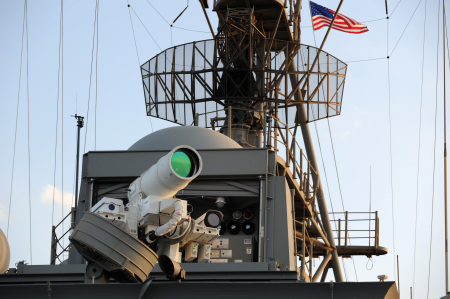
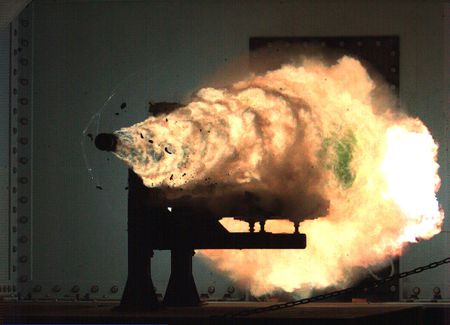
If carriers are to stay in the game, the navy will have to reverse that ratio. Hopes are being placed in two technologies: electromagnetic rail guns, which fire projectiles using electricity instead of chemical propellants at 4,500mph to the edge of space, and so-called directed-energy weapons, most likely powerful lasers. The rail guns are being developed to counter ballistic missile warheads; the lasers could protect against hypersonic cruise missiles. In trials, shots from the lasers cost only a few cents. The navy has told defence contractors that it wants to have operational rail guns within ten years.

Defending against salvoes of incoming missiles will remain tricky and depend on other technological improvements, such as compact long-range radars that can track multiple targets. Finding ways to protect communications networks, including space-based ones, against attack is another priority. Satellites can be blinded by lasers or disabled by exploding missiles. One option would be to use more robust technologies to transmit data—such as chains of high-altitude, long-endurance drones operating in relays….

As Elbridge Colby of the Centre for a New American Security argues: “The more successful the offset strategy is in extending US conventional advantages, the more attractive US adversaries will find strategies of nuclear escalation.” The enemy always gets a vote.

Weapons Technology: Who’s Afraid of America, Economist, June 13, 2015, at 57.

Detecting Plutonium: the Watchman

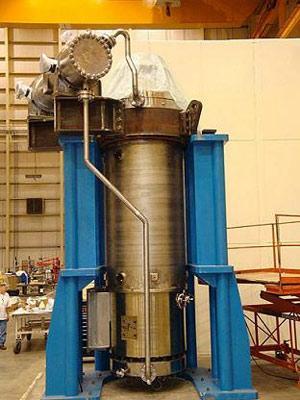
The Water Cherenkov Monitor for Antineutrinos, or WATCHMAN, brainchild of the energy department and the National Nuclear Security Administration, should be able to spot a suspicious nuclear reactor up to 1,000km away. A network of such devices, set up within range of someone who might be producing plutonium, should indeed verify whether he can be trusted.

The WATCHMAN is a neutrino detector—or, to be precise, an antineutrino detector….No amount of shielding can stop them [neutrinos] escaping from a nuclear reactor. If it were possible to tell both where the particles were coming from, and whether that source was natural or artificial, then it would be impossible to hide a nuclear reactor. The WATCHMAN’s designers think they can do that…

A prototype WATCHMAN is under construction in an old salt mine (to shield it from cosmic rays and other sources of interference) in Painesville, Ohio. This is 13km from a nuclear power station at North Perry, on Lake Erie. Though the Perry reactor is built for electricity generation rather than plutonium production, all reactors create some plutonium as a by-product, so its proximity will be a good test for the WATCHMAN system.

If that system works, and the decision is taken to deploy it, then there will still be the question of where and how. The predicted 1,000km range means quite a bit of diplomatic arm-wrestling may be involved, for the detectors would be of little use if built on American soil. But if, say, a country like Turkey could be persuaded to house one, the nuclear activities of a neighbour such as Iran might thus be monitored without inspectors having to set foot on the soil of the country in question. If that can be done, the WATCHMAN may help make the world a safer place.

Nuclear proliferation:The watcher in the water, Economist, May 16, 2015, at 73

Unleashing Nuclear Power – Iran

China was expected to build two nuclear power plants for Iran as part of the country’s new nuclear direction under the controversial nuclear deal that was signed July 15, 2015. The plants were set to be located on the Makran coast, near the neighboring Gulf of Oman, Iran’s Atomic Energy Organization head Ali Akbar Salehi announced on July 22, 2015.

Uninhibited by sanctions, Iran announced plans for four new nuclear power plants. Chinese contractors will be building two of the four planned. “We will simultaneously launch construction of four new nuclear power plants in the country in the next two to three years,” Salehi said, according to Indo-Asian News Service. “We plan to engage more than 20,000 workers and engineers in this large-scale construction.”

When it comes to United Nations sanctions, China had always been an advocate for Iran, along with Russia, generally opposing Washington’s proposed restrictions. On July 20, 2015, the United Nations adopted the nuclear deal between Tehran and Washington, after the “P5+1” countries — the U.S., Britain, France, Russia, China and Germany — unanimously approved it, also voting to lift a series of economic sanctions that were previously imposed on Iran.

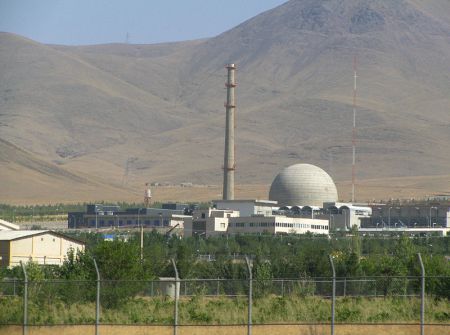
China has played a unique, hands-on role in the nuclear deal involving Iran’s Arak reactor, which has been described previously as a “pathway” to nuclear weapons for Iran.

“China has put forward the idea of the modification of the Arak heavy water reactor. … This is the unique role China has played in resolving the Iranian nuclear issue,” Chinese Foreign Minister Wang Yisaid in a statement…..  [The nuclear deal]  has also opened up a door to increased business opportunity in Iran, particularly for China.  Following the announcement of the landmark deal, Wang said that China played a pivotal role in negotiations, and he expressed hope that Iran would take part in China’s “one belt, one road” ambition to revive the Silk Road route.

Excerpts from Michelle FlorCruz, Iran Nuclear Deal: China To Build 2 Nuclear Power Plants For Islamic Republic Following Landmark Agreement, International Business Times, July 22, 2015

Full text of Iran Nuclear Deal Signed July 15, 2015
Joint Comprehensive Plan of Action
Annex I: Nuclear-related commitments
Annex II: Sanctions-related commitments
Attachments to Annex II
Annex III: Civil nuclear cooperation
Annex IV: Joint Commission
Annex V: Implementation Plan

The Runit Nuclear Tomb

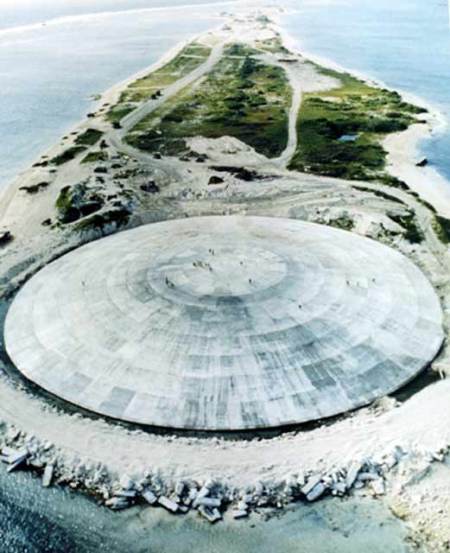
[The debris left by the United States nuclear testing at the Marshall islands  were buried under] a vast structure is known as the Runit Dome. Locals call it The Tomb. Below the 18-inch concrete cap rests the United States’ cold war legacy to this remote corner of the Pacific Ocean: 111,000 cubic yards of radioactive debris left behind after 12 years of nuclear tests.  Brackish water pools around the edge of the dome, where sections of concrete have started to crack away. Underground, radioactive waste has already started to leach out of the crater: according to a 2013 report by the US Department of Energy, soil around the dome is already more contaminated than its contents.  Now locals, scientists and environmental activists fear that a storm surge, typhoon or other cataclysmic event brought on by climate change could tear the concrete mantel wide open, releasing its contents into the Pacific Ocean….

Enewetak Atoll, and the much better-known Bikini Atoll, were the main sites of the United States Pacific Proving Grounds, the setting for dozens of atomic explosions during the early years of the cold war.  The remote islands – roughly halfway between Australia and Hawaii – were deemed sufficiently distant from major population centres and shipping lanes, and in 1948, the local population of Micronesian fishermen and subsistence farmers were evacuated to another atoll 200 km away.  In total, 67 nuclear and atmospheric bombs were detonated on Enewetak and Bikini between 1946 and 1958 – an explosive yield equivalent to 1.6 Hiroshima bombs detonated every day over the course of 12 years.

The detonations blanketed the islands with irradiated debris, including Plutonium-239, the fissile isotope used in nuclear warheads, which has a half-life of 24,000 years.  When the testing came to an end, the US Defence Nuclear Agency carried out an eight-year cleanup, but Congress refused to fund a comprehensive decontamination programme to make the entire atoll fit for human settlement again.

The DNA’s preferred option – deep ocean dumping – was prohibited by international treaties and hazardous waste regulations, and there was little appetite for transporting the irradiated refuse back to the US.  In the end, US servicemen simply scraped off the islands’ contaminated topsoil and mixed it with radioactive debris. The resulting radioactive slurry was then dumped in an unlined 350-foot crater on Runit Island’s northern tip, and sealed under 358 concrete panels.

But the dome was never meant to last. According to the World Health Organization, the $218m plan was designed as temporary fix: a way to store contaminated material until a permanent decontamination plan was devised.  Meanwhile, only three of the atoll’s 40 islands were cleaned up, but not Enjebi, where half of Enewetak’s population had traditionally lived. And as costs spiralled, resettlement efforts of the northern part of the atoll stalled indefinitely.  Nevertheless, in 1980, as the Americans prepared their own departure, the dri-Enewetak (“people of Enewetak”) were allowed to return to the atoll after 33 years.

Three years later, the Marshall Islands signed a compact of free association with the US, granting its people certain privileges, but not full citizenship.  The deal also settled of “all claims, past, present and future” related to the US Nuclear Testing Program – and left the Runit Dome under the responsibility of the Marshallese government.  Today, the US government insists that it has honoured all its obligations, and that the jurisdiction for the dome and its toxic contents lies with the Marshall Islands.  The Marshallese, meanwhile, say that a country with a population of 53,000 people and a GDP of $190m – most of it from US aid programs – is simply incapable of dealing with the potential radioactive catastrophe left behind by the Americans.

Today, Runitis still uninhabited, but it receives regular stream of visitors heading from neighboring islands to its abundant fishing grounds or searching for scrap metal to salvage.…Three decades after the Americans’ departure, abandoned bunkers dot the shoreline, and electric cables encased in black rubber snake across the sand.Nowhere on the beaches or the dome itself is there a warning to stay away – or even an indication of radioactivity.

The US has yet to fully compensate the dri-Enewetak for the irreversible damage to their homeland, a total amounting to roughly $244m as appraised by the Nuclear Claims Tribunal.+++ Many locals are deeply in debt, and dependent on a supplemental food program funded by the US Department of Agriculture, which delivers shipments of process foods such as Spam, flour and canned goods. The destruction a centuries-old lifestyle have lead to both a diabetes epidemic and regular bouts of starvation on the island….

Other – and more worrying – traces of Enewetak’s history have also reached China: according to a 2014 study published in Environmental Science & Technology, plutonium isotopes from the nuclear tests have been found as far a the Pearl River Estuary in Guangdong province.

Many people in Enewetak fear that one day the dome will break open, further spreading highly radioactive debris.  As catastrophic weather events become more frequent, recent studies – including 2013 study of the Runit Dome’s structural integrity carried out by the DoE – have warned that typhoons could destroy or damage the cement panels, or inundate the island. A 2013 report commissioned by the US Department of Energy to the Lawrence Livermore National Laboratory acknowledged that radioactive materials are already leaching out of the dome, but downplays the possibility of serious environmental damage or health risks….

Independent scientists say that salvaging Runit’s scrap metal may expose locals to much higher risks.“Those guys are digging in the dirt breathing in stuff in hot spots. That has to be hundreds of thousands times higher doses of potential health effects than swimming,” said Ken Buessler, a senior scientist and marine chemist at the Woods Hole Oceanographic Institution, who visited Runit and gathered samples of sediment in the lagoon earlier this year…

“Why Enewetak?” asked Ading, Enewetak’s exiled senator during an interview in the nation’s capital. “Every day, I have that same question. Why not go to some other atoll in the world? Or why not do it in Nevada, their backyard? I know why. Because they don’t want the burden of having nuclear waste in their backyard. They want the nuclear waste hundreds of thousands miles away. That’s why they picked the Marshall Islands.” “The least they could’ve done is correct their mistakes.”

Excerpts from Coleen Jose et al., The radioactive dome on Enewetak atoll, Guardian, July 3, 2015

+++In June 1983, the Agreement Between the Government of the United States and the Government of the Marshall Islands for the Implementation of Section 177 of the Compact of Free Association (referred to as 177 Agreement) established the Claims Tribunal “with jurisdiction to ‘render final determination upon all claims past, present and future, of the Government, citizens and nationals of the Marshall Islands which are based on, arise out of, or are in any way related to the Nuclear Testing Program.”The Tribunal was established in 1988.

See also UN Human Rights report Mission to the Marshall Islands

Nuclear Weapons are Here to Stay

[D]espite the establishment in 2009 of [a process to] discuss multilateral disarmament, not much has happened. The main reason is the chilling of relations between Russia and the West, which predated Russia’s annexation of Crimea. An offer by Mr Obama in 2013 of new negotiations to reduce each side’s stock of warheads by a third was met with stony silence.

More recently Russia has, according to America, violated both the 1987 Intermediate Nuclear Forces treaty, by testing a banned missile, and the Budapest Memorandum of 1994 that guaranteed Ukraine’s security when it gave up the nuclear weapons it had inherited on the break-up of the Soviet Union. The Russians are also refusing to attend next year’s Nuclear Security Summit, a meeting to prevent fissile material falling into the wrong hands.

Without further cuts in American and Russian nuclear forces (which account for more than 90% of the world’s nuclear weapons), China, the most opaque of the P5 power (US, UK, Russia, China, France), will block attempts to get multilateral disarmament talks going. However, Rose Gottemoeller, America’s under-secretary of state for arms control, praises China for its leading role in producing a common glossary of nuclear terminology. This may not sound much, but it is seen within the P5 as essential for future negotiations.

Ms Gottemoeller is also keen to stress that, despite the Russian impasse, America has tried to meet its obligations. It is eliminating “excess” warheads at the rate of almost one a day and closing down old bits of nuclear infrastructure. …It is doubtful whether these modest, incremental efforts will cut much ice with the Humanitarian Impacts of Nuclear Weapons Initiative, a movement supported by civil-society groups and championed by Austria, Norway and Mexico. Faced with what they see as foot-dragging by the P5 (which are modernising their nuclear forces to maintain their long-term effectiveness), the initiative’s backers, some of which want to make nuclear weapons illegal, may question whether working through the NPT serves any purpose…

Another source of friction is the failure to hold the conference on creating a WMD-free zone in the Middle East that was promised in 2010. Israel,…insists that regional security arrangements must precede any talks on disarmament, whereas Egypt says the first step is for Israel to accede to the NPT—a non-starter.

Excerpts from Nuclear weapons: Fractious, divided but still essential, Economist, May 2, 2015, at 54

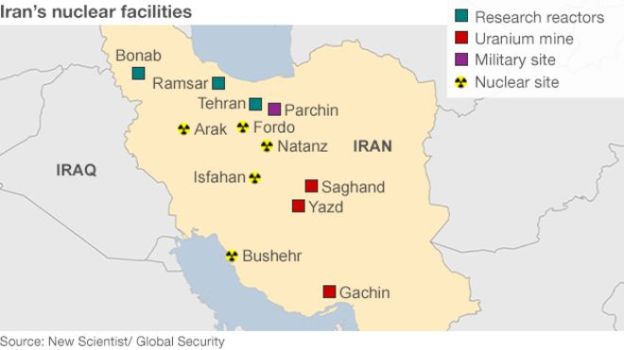
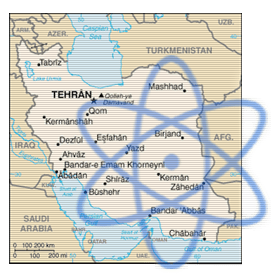
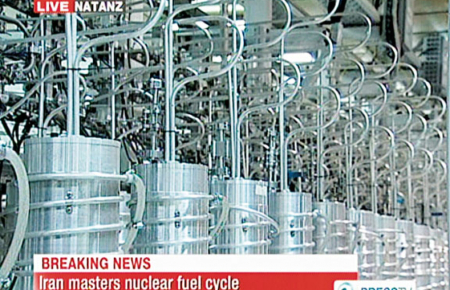
Nuclear Capability of Iran – Natanz, Fordow, Parchin

One [of the problems] is the ambiguity about what rights the Iranians will have to continue nuclear research and development. They are working on centrifuges up to 20 times faster than today’s, which they want to start deploying when the agreement’s [the currently negotiated agreement between Iran and United States/Europe]  first ten years are up. The worry is that better centrifuges reduce the size of the clandestine enrichment facilities that Iran would need to build if it were intent on escaping the agreement’s strictures.

That leads to the issue on which everything else will eventually hinge. Iran has a long history of lying about its nuclear programme. It only declared its two enrichment facilities, Natanz and Fordow, after Western intelligence agencies found out about them. A highly intrusive inspection and verification regime is thus essential, and it would have to continue long after other elements of an agreement expire. Inspectors from the IAEA would have to be able to inspect any facility, declared or otherwise, civil or military, on demand…

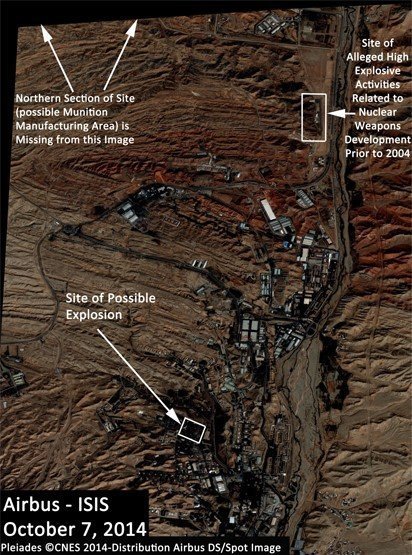
For a deal to be done in June 2015, Iran will have to consent to an [intrusive] inspection regime. It will also have to answer about a dozen questions already posed by the IAEA about the “possible military dimensions” of its nuclear programme. Yet on March 23, 2015Yukiya Amano, the agency’s director, said that Iran had replied to only one of those questions. Parchin, a military base which the IAEA believes may have been used for testing the high-explosive fuses that are needed to implode, and thus set off, the uranium or plutonium at the core of a bomb, remains out of bounds. Nor has the IAEA been given access to Mohsen Fakhrizadeh, the physicist and Revolutionary Guard officer alleged to be at the heart of the weapons development research. The IAEA’s February 19, 2015 report on Iran stated that it “remains concerned about the possible existence…of undisclosed nuclear-related activities…including activities related to the development of a nuclear payload for a missile.”

Excerpts from, The Iran Nuclear Talks: Not Yet the Real Deal, Economist, Apr. 4, 2015, at 43

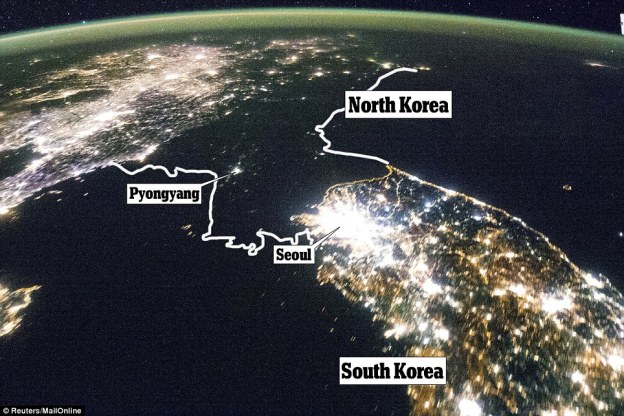
Iran Wants to Be North Korea: nuclear weapons

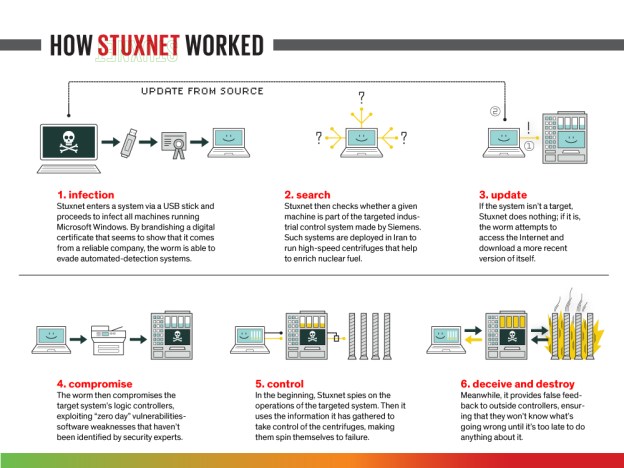
The US tried to deploy a version of the Stuxnet computer virus to attack North Korea’s nuclear weapons programme five years  (2010) ago but ultimately failed, according to people familiar with the covert campaign.  The operation began in tandem with the now-famous Stuxnet attack that sabotaged Iran’s nuclear programme in 2009 and 2010 by destroying a thousand or more centrifuges that were enriching uraniumc. Reuters and others have reported that the Iran attack was a joint effort by US and Israeli forces.

According to one US intelligence source, Stuxnet’s developers produced a related virus that would be activated when it encountered Korean-language settings on an infected machine…But the National Security Agency-led campaign was stymied by North Korea’s utter secrecy, as well as the extreme isolation of its communications systems...North Korea has some of the most isolated communications networks in the world. Just owning a computer requires police permission, and the open internet is unknown except to a tiny elite. The country has one main conduit for internet connections to the outside world, through China.  In contrast, Iranians surfed the net broadly and had interactions with companies from around the globe.

The US has launched many cyber espionage campaigns, but North Korea is only the second country, after Iran, that the NSA is now known to have targeted with software designed to destroy equipment.

Experts in nuclear programmes said there were similarities between North Korea and Iran’s operations, and the two countries continue to collaborate on military technology. Both countries use a system with P-2 centrifuges, obtained by Pakistani nuclear scientist AQ Khan, who is regarded as the father of Islamabad’s nuclear bomb, they said. Like Iran, North Korea probably directs its centrifuges with control software developed by Siemens AG that runs on Microsoft Corp’s Windows operating system, the experts said. Stuxnet took advantage of vulnerabilities in both the Siemens and Microsoft programmes…

Despite modest differences between the programmes, “Stuxnet can deal with both of them. But you still need to get it in,” said Olli Heinonen, senior fellow at Harvard University’s Belfer Center for Science and International Affairs and former deputy director general of the International Atomic Energy Agency…

The Stuxnet campaign against Iran, code-named Olympic Games, was discovered in 2010. It remains unclear how the virus was introduced to the Iranian nuclear facility in Natanz, which was not connected to the Internet.,,,According to cybersecurity experts, Stuxnet was found inside industrial companies in Iran that were tied to the nuclear effort. As for how Stuxnet got there, a leading theory is that it was deposited by a sophisticated espionage programme developed by a team closely allied to Stuxnet’s authors, dubbed the Equation Group by researchers at Kaspersky Lab…

In addition, North Korea likely has plutonium, which does not require a cumbersome enrichment process depending on the cascading centrifuges that were a fat target for Stuxnet, they said.

Excerpts from NSA tried Stuxnet cyber-attack on North Korea five years ago but failed, Reuters, May 29, 2015

The 2015 US-China Nuclear Deal

President Obama intends to renew a nuclear cooperation agreement with China. The deal would allow Beijing to buy more U.S.-designed reactors and pursue a facility or the technology to reprocess plutonium from spent fuel. China would also be able to buy reactor coolant technology that experts say could be adapted to make its submarines quieter and harder to detect.,,

The Nuclear Energy Institute, an industry trade group, argues that the new agreement will clear the way for U.S. companies to sell dozens of nuclear reactors to China, the biggest nuclear power market in the world.  Yet the new version of the nuclear accord — known as a 123 agreement under the Atomic Energy Act of 1954 — would give China leeway to buy U.S. nuclear energy technology at a sensitive moment: The Obama administration has been trying to rally support among lawmakers and the public for a deal that would restrict Iran’s nuclear program — a deal negotiated with China’s support.,,,

If Congress rejects the deal, “that would allow another country with lower levels of proliferation controls to step in and fill that void,” said a senior administration official…

{T}he current nuclear agreement with China does not expire until the end of the year (2015)…Henry Sokolski, executive director of the Nonproliferation Policy Education Center, has been urging lawmakers to insist on requiring advance consent for the reprocessing of spent fuel from U.S.-designed reactors into plutonium suitable for weapons. He also is concerned about the sale of certain nuclear energy technologies, especially coolant pumps with possible naval use.

Charlotte-based Curtiss-Wright developed advanced coolant pumps for the U.S. Navy’s submarines. The same plant produces a scaled-up version for the Westinghouse AP1000 series reactors, each of which uses four big pumps. These pumps reduce noises that would make a submarine easier to detect…..An Obama administration official said the reactor coolant pumps are much too big to fit into a submarine. However, a 2008 paper by two former nuclear submarine officers working on threat reduction said that “the reverse engineering would likely be difficult” but added that “certainly, the Chinese have already reversed engineered very complex imported technology in the aerospace and nuclear fields.”…

The United States has bilateral 123 agreements with 22 countries, plus Taiwan, for the peaceful use of nuclear power. Some countries that do not have such agreements, including Saudi Arabia, Jordan and Malaysia, have expressed interest in clearing obstacles to building nuclear reactors.

China and the United States reached a nuclear cooperation pact in 1985, before China agreed to safeguards with the International Atomic Energy Agency. IAEA safeguards went into force in 1989, but Congress imposed new restrictions after the Chinese government’s June 1989 crackdown on protesters in Tiananmen Square. The 123 agreement finally went into effect in March 1998; President Bill Clinton waived the 1989 sanctions after China pledged to end assistance to Pakistan’s nuclear weapons program and nuclear cooperation with Iran.

In December 2006, Westinghouse Electric — majority-owned by Toshiba — signed an agreement to sell its AP1000 reactors to China. Four are under construction, six more are planned, and the company hopes to sell 30 others, according to an April report from the Congressional Research Service (CRS)….“Missile proliferation from Chinese entities is a continuing concern.” The United States wants China to refrain from selling missiles capable of carrying nuclear weapons, a payload of 1,100 pounds, as far as 190 miles

China has a pilot plant engaged in reprocessing in Jiu Quan, a remote desert town in Gansu province. Satellite photos show that it is next to a former military reprocessing plant, according to Frank von Hippel, a Princeton University physics professor who specializes in nuclear arms control.

Excerpts from Steven Mufson, Obama’s quiet nuclear deal with China raises proliferation concerns,   Washington Post  May 10, 2015

Nuclear Industry in Siberia

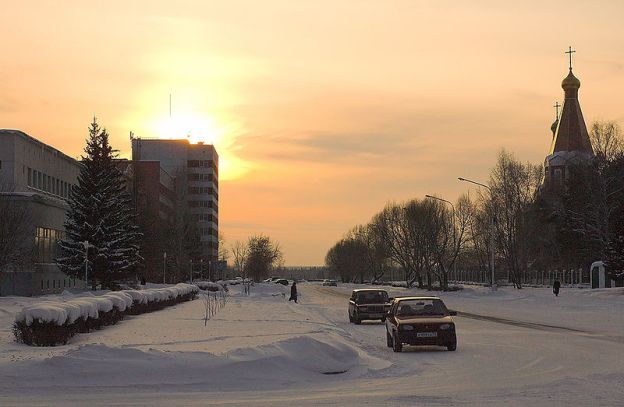
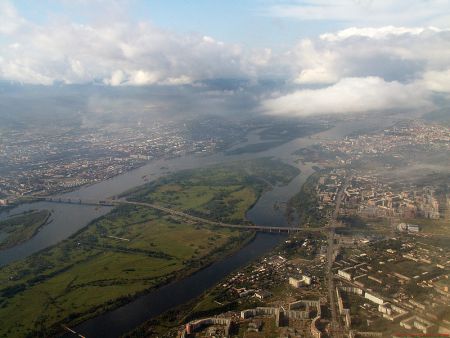
Professor Leonid Rikhvanov says he has a number of questions about the potential damage to the community from reactors that have been used since the Soviet Era .His plea comes as the Siberian Chemical Combine  (SCC) in Seversk, a secretive city located 15 miles north of Tomsk, prepares for the construction of a new experimental fast reactor  known as BREST-300…

‘I would also like to raise the question of conducting a complex study on how the SCC’s reactors have affected the environment over the past 50 years. Before making a decision on new projects, it’d be worth estimating the outcomes of the old ones’…Siberian Chemical Combine in Seversk, a secretive city located 15 miles north of Tomsk, prepares for the construction of a new experimental fast reactor.

‘And lastly I would ask about warheads [housed at SCC as recently as the 1990s]. Have they been replaced or not? If not, in what conditions are they kept?’He added: ‘I’m not radical and I support the idea of nuclear energy. But the approach to its use, and to estimating risks, should be totally different. Russian nuclear enterprises as they are now are so dangerous that it’d definitely be better if they didn’t exist at all.’

On April 6 2015 it was reported in Seversk that construction was already under way of a pilot plant for the production of fuel for the experimental BREST-300 reactor.The new reactor will work on special ‘pills’ made from the spent nuclear fuel and taken from the old reactors, with officials saying it will allow waste-free production of energy.  It is thought the pilot plant will begin operating in 2017, with the full new BREST-300 reactor up and running from 2020.

Prof Rikhvanov stressed that he is not anti-nuclear but insisted that it has to be used correctly with the proper safety and environmental considerations in place. An accident at a new plant at the Siberian Chemical Combine in February 2015 resulted in an employee receiving burns to his hands.And, of course, a massive explosion at the site in April 1993 resulted in the release of a radioactive gas cloud in an incident listed as one of the world’s worst nuclear accidents.Prof Rikhvanov was one of the experts flown into Seversk following the incident, allowing him a rare glimpse inside the secretive city to analyse the state of the plant.

‘First of all, we got to see what is there,’ he recalled. ‘I visited all the production facilities, I saw the reactors, the well where the waste is put to, and the warehouses where the nuclear warheads were stored with my own eyes.’I saw about 23,000 decommissioned warheads stored there. And I doubt they have been moved elsewhere since then. By the way, at the time, they were stored in terrible conditions and I don’t know what it is like now.’ The professor also found out that a facility for storing liquid radioactive waste in aquifers was located near to where the water supply was sourced on the Tom River.  As far as he is aware, the situation remains the same. He said: ‘We pump water from aquifers on the left side of the river, and store some of the most hazardous elements humanity has ever created in aquifers on the other side of the river…

Another concern he has is that the city is ‘still not prepared’ for a mass evacuation in the event of a major incident.’The road to Maryinsk is terrible, the second branch of the railway hasn’t spring out yet,’ he said. ‘There is also no separate railway to ship the radioactive materials to SCC without going through Tomsk. Such freights are now going through city railway station which creates additional risks.’

Excerpts from Olga Gertcyk & Derek Lambie, Expert raises serious questions over state of the nuclear industry in Siberia,  Siberian Times, May 2, 2015

Nuclear Benefits – Pakistan/Saudi Arabia Friendship

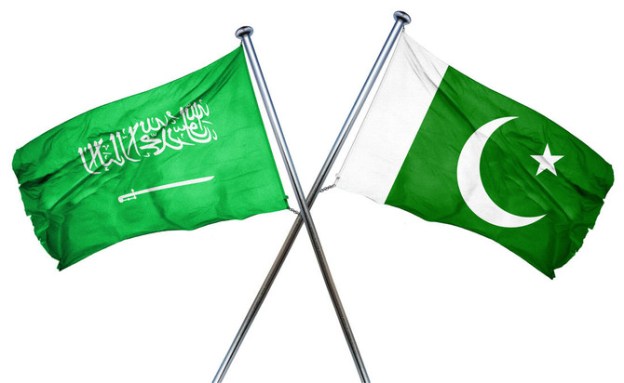
The Pakistani Parliament, even while stating its commitment to protect the territory of Saudi Arabia, recently adopted a resolution not to join the Saudi-led coalition fighting Houthi rebels in Yemen….The foreign affairs minister of the United Arab Emirates, Anwar Gargash, blasted the decision as “contradictory and dangerous and unexpected,” accusing Pakistan of advancing Iran’s interests rather than those of its own Persian Gulf allies. Pakistan was choosing neutrality in an “existential confrontation,” he said, and it would pay the price… Millions of Pakistanis work in the Persian Gulf, sending back vast remittances. Many of Pakistan’s politicians and generals have major investments in the region, and some have a deep affinity for Wahhabism. Rich Arabs in Pakistan are treated like royalty, allowed to flout hunting and environmental protection laws… [S]ome backpedaling has begun. The Pakistani military agreed to commit naval vessels to help enforce an arms embargo against the Houthis. This, however, will not undo the damage: The recent deterioration of Pakistan’s ties with its Arab benefactors, even if it turns out to be temporary, is unprecedented.

For Saudi Arabia, the Pakistani Parliament’s surprising assertion of independence was especially worrisome because it came on the heels of the American-backed preliminary nuclear deal with Iran…This development undermines Saudi Arabia’s longstanding nuclear strategy. In the 1970s, partly to extend its influence, partly in the name of Muslim solidarity, it began bankrolling Pakistan’s nuclear program. In gratitude, the Pakistani government renamed the city of Lyallpur as Faisalabad, after King Faisal of Saudi Arabia. When Pakistan seemed to dither after India tested five nuclear bombs in May 1998, the Saudi government pledged to give it 50,000 barrels of oil a day for free. Pakistan soon tested six of its own bombs. Later, the Saudi defense minister at the time, Prince Sultan, visited the secret nuclear and missile facilities at the Kahuta complex near Islamabad… In exchange for its largesse, Saudi Arabia has received Pakistani military assistance in the form of soldiers, expertise and ballistic missiles.

The Saudi government has taken the quid pro quo to imply certain nuclear benefits as well, including, if need be, the delivery at short notice of some of the nuclear weapons it has helped pay for. Some Pakistani warheads are said to have been earmarked for that purpose and reportedly are stocked at the Minhas air force base in Kamra, near Islamabad. (Pakistan, which has as many as 120 nuclear warheads, denies this..)

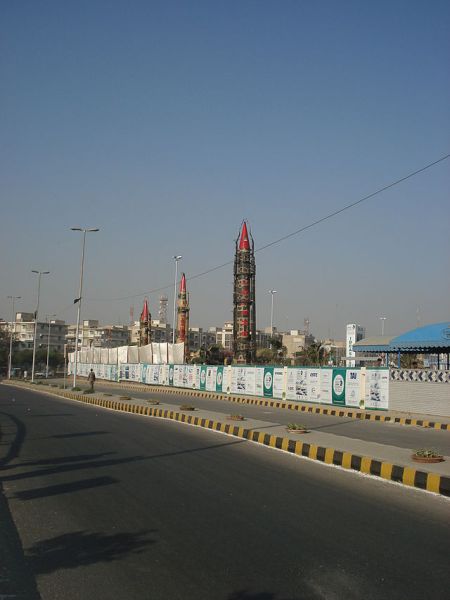
The Saudis have also come to expect that they fall under the nuclear protection of Pakistan, much like, say, Japan is covered by the United States’s nuclear umbrella. Pakistan’s nuclear forces were developed to target India, but they can strike farther, as was recently demonstrated by the successful test launch of the Shaheen-3 missile, which has a range of 2,750 kilometers.

In March 2015 Saudi Arabia signed an agreement with South Korea “to assess the potential” for the construction of two nuclear reactors in Saudi Arabia. It plans to build 16 nuclear-power reactors over the next 20 years, with the first reactor expected to be on line in 2022, according to the World Nuclear Association. It insists on having a full civilian fuel cycle, leaving open the possibility of reprocessing weapon-grade plutonium from nuclear waste.

Excerpts, Pervez Hoodbhoy, Pakistan, the Saudis’ Indispensable Nuclear Partnership, NY Times, Apr. 21, 2015

The Nuclearization of Sub-Saharan Africa

Kenya and Uganda are among the countries making progress in nuclear technology in sub-Saharan Africa with both involved with the pre-feasibility study stage in their atomic energy programmes.  According to the the International Atomic Energy Agency (IAEA), Kenya successfully completed its pre-feasibility stage while Uganda is currently conducting its own.

A pre-feasibility stage involves assessing energy needs, proposing roadmaps, developing expertise and training human resources, establishing policy and regulatory frameworks and mobilizing funding as a country prepares to conduct feasibility studies for nuclear plants.

“Kenya and Uganda join their sub-Saharan Africa counter-parts, Ghana, Nigeria, Sudan and Niger while in North Africa – Egypt, Algeria, Morocco, Tunisia and Libya have taken notable steps,” Jin Kwang Lee, African Regional Officer at IAEA told a conference on energy and nuclear power in Kwale….James Banaabe Isingoma, Uganda’s acting Commissioner for Energy Efficiency and Conservation told East African Business Week while it is perceived Uganda will build a nuclear plant by 2026, this projection is too ambitious, because financing for reactors is hard to find.  Kenya aims to have a nuclear plant by 2025…

Kenya hopes to establish a 1,000 MW reactor between 2022 and 2027. Njoroge said, “We are committed to the introduction of nuclear energy to our country’s energy mix which is currently dominated by hydro-power projects. We will soon deplete geothermal and hydro generation hence be left with no choice, but to go nuclear,” he said.  “We are injecting Ksh 300 million (about $3 million) in human resource training annually and we think nuclear will be a game changer. It is economically strategic because all other available resources will be exploited by 2031,” Njoroge said.He said, “It means we will be able to drive ironuclear power plantn and steel production, electric rails, powering mills and petroleum pipelines.”

Currently, the two regional neighbours are grappling with insufficient power supply as demand increases with economic growth and rural electrification programmes that are putting more people on the grid.

Excerpt from Uganda: Kenya and Uganda Eye Nuclear Power, allAfrica.com, Apr. 19, 2015

Weapons-Grade Uranium-S. Africa: better than gold

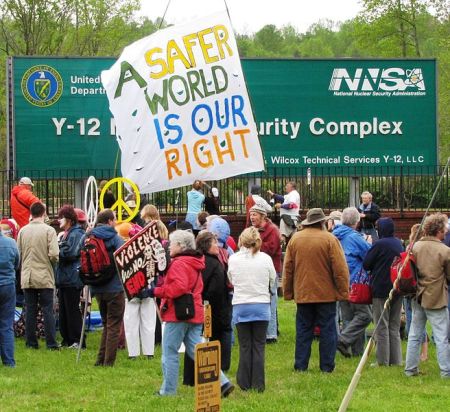
In the early hours of 28 July 2012, three people, one of them an 82-year-old nun named Megan Rice, broke into the Y-12 Nuclear Security Complex near the city of Oak Ridge, Tennessee. Y-12 is where all of America’s highly enriched uranium (HEU) – for making nuclear weapons is stored… in November 2007, two groups of intruders cut through the security fences surrounding South Africa’s 118-acre Pelindaba Nuclear Research Centre, west of Pretoria. They got as far as the emergency operations centre before a barking dog alerted a stand-in security office….=

Pelindaba houses South Africa’s stockpile of HEU, which was extracted in 1990 from the six or seven nuclear bombs that the old National Party government had built. According to the Center for Public Integrity (CPI) report, the HEU was melted down and cast into ingots, which were stored at Pelindaba. Over the years, some of the HEU was used to make medical isotopes for sale…..

Now, according to the CPI report, about 220 kg of the HEU remains, with no immediate purpose. This gives Pretoria the theoretical ability to make nuclear weapons again. But what really bothers the US officials who the CPI interviewed is that terrorists could steal the HEU and use it to make nuclear weapons. The report says Pelindaba contains enough weapons-grade uranium to fuel half a dozen bombs, each powerful enough to obliterate central Washingt

…US President Barack Obama has been trying very hard since 2011 to persuade President Jacob Zuma to relinquish the HEU stockpile, as part of his global effort to mop up such fissile material from nuclear states.

So why won’t South Africa give up its HEU stockpile? …Pelindaba is now probably more secure than most US nuclear facilities – especially after the US spent nearly US$10 million in helping South Africa to upgrade security there after the 2007 break-in. … [T]he main reason Pretoria wants to keep its HEU is because ‘it’s a stick they are using to beat up on the US for not dismantling its own nuclear weapons.’

In the end though, the 220 kg of highly enriched uranium stored away in the depths of Pelindaba has much more than commercial or tactical value…the stockpile is a symbol of South Africa’s sovereignty, its power and its integrity: of its ability to use nuclear energy for peaceful purposes – and even of its technical ability to construct an atomic weapon. But also of its firm moral determination never to do so.  In that sense, the 220 kg of highly enriched uranium ingots are more precious to the African National Congress government than all the gold bullion in the Reserve Bank. They aren’t going anywhere.

Excerpt from Peter Fabricius, Foreign Editor, Independent Newspapers, South Africa ISS,  Why is Pretoria so jealously guarding it fissile material? Mar. 19, 2014

400 Nuclear Safety Failures: Nuclear Weapons, U.K.

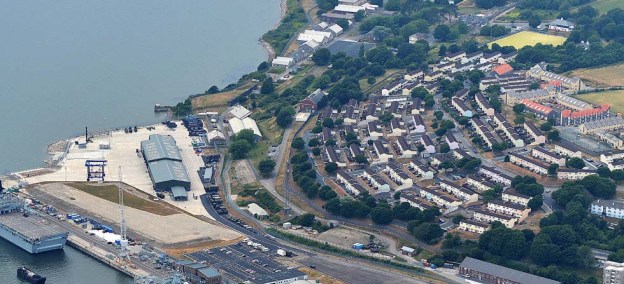
Britain’s nuclear weapons base has suffered from a dozen serious nuclear safety failures in recent years, according to official records.  Over the last six years HM Naval Base Clyde, where Britain’s Trident nuclear submarine fleet is based, suffered from nearly 400 “widespread” nuclear safety events relating to a “poor safety culture”.

In 12 of these cases the problems involved an “actual or high” risk of unplanned exposure to radiation or contained release of radiation within a building or submarine, according to information released by ministers in the last week.  Last year the number of nuclear safety events involving nuclear propulsion nearly doubled, from 57 in 2013 to 99 in 2014.  In one incident in 2012, contractors working on the base were exposed to radiation while repairing submarine equipment.

The 12 most serious events at the base, classified by the Ministry of Defence as “Category B”, are ones in which there is an “actual or high potential for a contained release [of radiation] within building or submarine or unplanned exposure to radiation”.  According to the Ministry’s own criteria, this classification is used for safety events that involve a “major failure in administrative controls or regulatory compliance”.

Other serious nuclear safety events included the unsafe operation of a crane on a jetty handling explosives, faulty radiation testing, and low-level radioactive contamination around a pipe that dumps supposedly decontaminated waste into the sea.  Despite the problems, the base has not recently suffered from any of the most serious category of safety failures – ‘Category A’ – which would have involved release into the environment in the surrounding area.

Excerpt from JON STONE,Britain’s nuclear weapons base suffers from ‘serious’ nuclear safety incidents and ‘poor safety culture, Independent, Mar. 2, 2015

Nuclear Renaissance: Egypt-Russia Deal

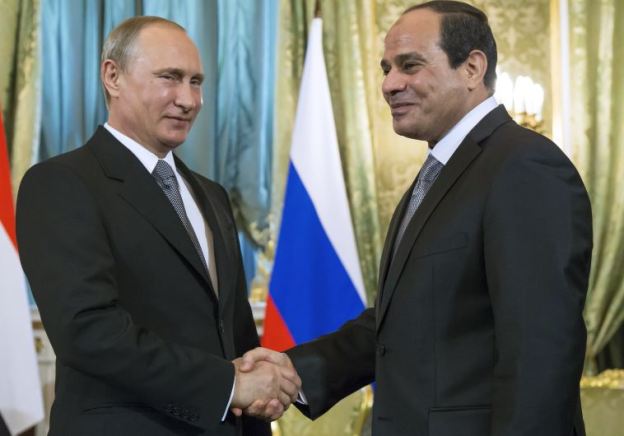
Russian President Vladimir Putin and Egyptian President Abdel Fattah el-Sisi signed a preliminary agreement to jointly build Egypt’s first nuclear power plant, after the two leaders met in Cairo on February 9-10, 2015.  This announcement comes after multiple reports last November (2014) about Russia’s state nuclear power company Rosatom’s agreement to help Iran build several nuclear reactors, including reactors at Iran’s Russian-built Bushehr nuclear power plant.

Putin had travelled to Cairo this week upon Sisi’s invitation. Russian-Egyptian relations began improving after the July 2013 military ouster of former president Mohamed Morsi, when U.S.-Egyptian relations began to decline.  Cairo grew increasingly concerned with what it perceived to be U.S. engagement with the Muslim Brotherhood, and felt abandoned in its fight against terrorists, particularly in the restless Sinai—a hotbed of radicalism and instability going back to President Hosni Mubarak’s time. Washington also delayed weapons deliveries to Egypt, withheld military aid, and later halted the nascent bilateral strategic dialogue. The decline of U.S.-Egyptian relations created an opportunity for Putin to step in and assert his national interests in Egypt.

Putin and Sisi see eye to eye on a number of issues. Putin would certainly prefer to see a secular government in Egypt. Unlike President Obama, Putin enthusiastically endorsed Sisi’s bid for Egyptian presidency. Russia’s Supreme Court has designated the Muslim Brotherhood a terrorist organization in February 2003. Russia continues to battle an increasingly-radicalized insurgency in the Caucasus and the Kremlin has long believed the Brotherhood helped arm radical Islamists in Russia. Putin certainly won’t criticize Sisi on his democratic backslide.

Economic relations have significantly improved between Egypt and Russia in recent years….Putin’s trip to Cairo created a political opportunity for him to show to the West, in light of his aggression in Ukraine, that he is not isolated, no matter what the West says…

Cairo used to be Washington’s partner on energy cooperation. This is no longer the case.In February 2006, the George W. Bush administration announced the Global Nuclear Energy Partnership (GNEP). It aimed to create an international partnership, which would advance safe and extensive global expansion of nuclear power through so-called “cradle-to-grave fuel services” within a regulated market for enriched uranium, where several large countries would provide enriched uranium to smaller countries. This plan aimed to address crucial concerns about nuclear weapons proliferation and waste management, and to eliminate the need for smaller countries to build facilities for uranium processing and disposal in the first place, saving them billions. Egypt was among participant countries in GNEP. President Obama, however, effectively scrapped parts of GNEP and now shows little interest in expanding the strategic energy partnership with Egypt. Putin is only too happy to fill the gap, and is not concerned with the safeguards inherent to GNEP.

Excerpt from Anna Borshchevskaya, Russia-Egypt Nuclear Power Plant Deal: Why Ignoring Egypt’s Needs Is Bad For The U.S., Forbes, Feb. 13, 2015

Nuclear Weapons of Saudi Arabia via Pakistan

The visit by the chairman of Pakistan’s Joint Chiefs of Staff Committee in Feb. 2015 will likely prompt concern in Washington and other major capitals that Saudi Arabia and Pakistan have reconfirmed an arrangement whereby Pakistan, if asked, will supply Saudi Arabia with nuclear warheads. The main meeting on Gen. Rashid Mahmoud’s itinerary was with King Salman — the topics discussed were reported as “deep relations between the two countries and … a number of issues of common interest.”…For decades, Riyadh has been judged a supporter of Pakistan’s nuclear weapons program, providing financing in return for a widely assumed understanding that, if needed, Islamabad will transfer technology or even warheads…

Although Pakistani nuclear technology also helped Iran’s program, the relationship between Islamabad and Riyadh has been much more obvious.  In 1999, a year after Pakistan tested two nuclear weapons, then Saudi defense minister Prince Sultan visited the unsafeguarded uranium enrichment plant at Kahuta outside Islamabad — prompting a US diplomatic protest.

Excerpts from SIMON HENDERSON, Saudi Arabia and Pakistan may have just renewed a secret nuclear weapons pact, Business Insider, Feb. 4, 2014

U.S. Military Spending 2015

U.S. Deputy Defense Secretary Robert Work on Wednesday, Jan. 28, 2015 urged NATO allies to develop and make more innovative weapons, and said bold action was needed to stay ahead of rapid weapons development by China, Russia and other countries.  Work said the Pentagon has a new plan called “Defense Innovation Initiative” and a separate effort targeting longer-term projects to ensure that the United States continues to have a decisive competitive advantage against potential foes.

Work said concerns about advances by other countries were a key reason that the Pentagon’s fiscal 2016 budget plan to be delivered to Congress will exceed budget caps set by Congress and reverse five years of declines in U.S. military spending.   He said the budget would include “significant” investments in nuclear weapons, space control capabilities, advanced sensors, missile defense and cyber, as well as unmanned undersea vehicles, high-speed strike weapons, a new jet engine, high-energy lasers and rail gun technology…..Lockheed Martin Corp  and Boeing  and other key weapons makers have repeatedly urged the Pentagon to step up investments in key technologies….

Kendall said the department would also earmark funds for development and prototyping of a new “next-generation X-plane” that would eventually succeed the F-35 fighter jet, and a new engine.

Excerpts, ANDREA SHALAL, Pentagon official urges NATO to focus on innovative weapons. Jan 28, 2015

Israel Nuclear Ambiguity Benefits U.S.

Defense officials are fighting a three-year-old request under the Freedom of Information Act to release a 1987 report supposedly discussing Israel’s nuclear technology.  Grant Smith of the Institute for Research: Middle Eastern Policy  filed the request in 2012 and raised the issue in court after he said the request “went nowhere” for several years. He has been a critic of many U.S. policies related to Israel and of what he believes to be the inordinate influence of Israel in the American government.

In a seldom-used legal move known as optional review, Pentagon officials have asked the Israeli government to review the report before they consider releasing it.  Smith said the Defense Department has denied being able to locate the report, claimed it contained sensitive Israeli government information and cited FOIA exemptions, non-disclosure agreements and patents to intellectual property rights in its efforts to block the release of the report.

The unclassified report in question, titled “Critical Technology Issues in Israel and NATO Countries,” has surfaced in media stories and nonprofit research but has never been released to the public, according to court documents filed by Smith.  Smith’s legal complaint mentioned a 1995 publication called the Risk Report, which supposedly cited findings from the Pentagon document without referencing it by name.  The Risk Report claimed “the United States approved the sale of powerful computers that could boost Israel’s well-known but officially secret A-Bomb and missile programs” and identified the report only as “a 1987 Pentagon-sponsored study.”

Smith called the Department of Defense’s decision to seek Israeli approval a “cover-up” in the response he filed with the court Jan. 7.  “There is pressing urgency to release this report in the current context of regional nuclear negotiations which can only have a productive outcome if Americans and other concerned parties are more fully informed of the true state of affairs,” his response said.

Jonathan Schanzer, vice president for research at the Foundation for Defense of Democracies, called the likely existence of Israeli nuclear weapons an “open secret” in the international community….Israel… has never disclosed its alleged arsenal, nor has the U.S. ever formally acknowledged its existence….

“Making sure that the Israelis have the ambiguity they need on nuclear issues actually boosts our nonproliferation diplomacy by preventing tensions in the region and backlashes from Israel’s neighbors,” said the official, who requested anonymity.

U.S. District Court Judge Tanya Chutkan issued an order Jan. 8, 2015 requiring Defense officials to say whether they planned to invoke a non-disclosure provision that would allow them to keep the report secret at Israel’s request by Feb. 12. If not, Chutkan will begin the process of privately reviewing the report herself.  Defense officials said they expect the Israeli government to complete its review of the report by Jan. 16, 2015

BY SARAH WESTWOOD , Legal battle to publish unclassified DOD report on Israeli nukes nears end, Jan. 8, 2015

UK Nuclear Tests in Australia: Maralinga

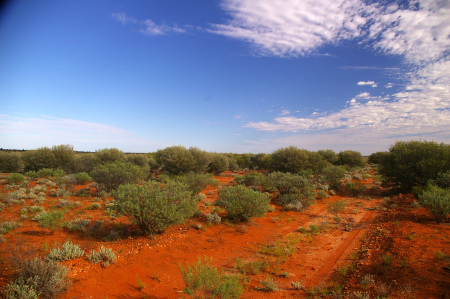
In the mid-1950s, seven bombs were tested at Maralinga in the south-west Australian outback. The combined force of the weapons doubled that of the bomb dropped on the Japanese city of Hiroshima in World War Two.  In archive video footage, British and Australian soldiers can be seen looking on, wearing short sleeves and shorts and doing little to protect themselves other than turning their backs and covering their eyes with their hands.Some reported the flashes of the blasts being so bright that they could see the bones of their fingers, like x-rays as they pressed against their faces.

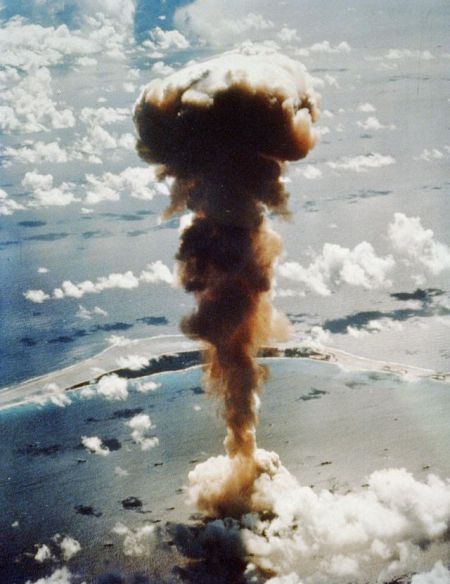
A cloud hangs over Australia’s Monte Bello Islands after Britain tested its first atomic bomb
Much has been written about the health problems suffered by the servicemen as a result of radiation poisoning. Far less well-documented is the plight of the Aboriginal people who were living close to Maralinga at the time….”A lot of people got sick and died,” said Mima Smart, an aboriginal community leader.”It was like a cancer on them. People were having lung disease, liver problems, and kidney problems. A lot of them died,” she said, adding that communities around Maralinga have been paid little by way of compensation.  It’s a ten hour drive to the nearest big city, Adelaide. But people here say that the Australian government was wrong to let the tests go ahead and that Britain acted irresponsibly…

“They didn’t want to do it in their own back yard because their back yard wasn’t big enough,” said Robin Matthews, caretaker of the Maralinga Nuclear Test Site.”They thought they’d pick a supposedly uninhabited spot out in the Australian desert. Only they got it wrong. There were people here.”During the 1960s and 70s, there were several large clean-up operations to try and decontaminate the site.  All the test buildings and equipment were destroyed and buried. Large areas of the surface around the blast sites was also scraped up and buried.

But Mr Matthews said the clean-up, as well as the tests themselves, were done very much behind closed doors with a high level of secrecy.“You’ve got to remember that this was during the height of the Cold War. The British were terrified that Russian spies might try and access the site,” he said.  The indigenous communities say many locals involved in the clean-up operation also got sick.  Soil at the nuclear site grow so hot from the blast that it melted and turned to silicon has long been declared safe. There are even plans to open up the site to tourism.

But it was only a few months ago that the last of the land was finally handed back to the Aboriginal people. Most, though, say they have no desire to return there….And even almost 60 years on, the land still hasn’t recovered. Huge concrete plinths mark the spots where each of the bombs was detonate

Excerpt from Jon Donnison, Lingering impact of British nuclear tests in the Australian outback, BBC, Dec. 31, 2014

Marshall Islands against 9 Nuclear States

On April 24, 2014, the Republic of the Marshall Islands (RMI) filed applications in the International Court of Justice against the nine nuclear-armed states, United States, United Kingdom, France, Russia, China, India, Pakistan, Israel, and North Korea.  The RMI also filed a companion case against the United States in U.S. federal court in San Francisco….

Three of the nine states possessing nuclear arsenals, the UK, India, and Pakistan, have accepted the compulsory jurisdiction of the Court when the opposing state has done so, as the Marshall Islands has. The cases are proceeding as to those states, and developments can be followed on the ICJ website, http://www.icj-cij.org.  As to the other six states, RMI is calling on them to accept the jurisdiction of the Court in these cases and to explain to the Court their positions regarding the nuclear disarmament obligations. However, China has already notified the Court that it declines to accept the Court’s jurisdiction in this matter.

The claims in the ICJ cases are for:

1)      breach of the obligation to pursue in good faith negotiations leading to nuclear disarmament, by refusing to commence multilateral negotiations to that end and/or by implementing policies contrary to the objective of nuclear disarmament;

2)      breach of the obligation to pursue negotiations in good faith on cessation of the nuclear arms race at an early date;

3)      breach of the obligation to perform the above obligations in good faith, by planning for retention of nuclear forces for decades into the future;

4)      failure to perform obligations relating to nuclear disarmament and cessation of the nuclear arms race in good faith by effectively preventing the great majority of non-nuclear weapon states from fulfilling their part of those obligations.

For the Nuclear Non-Proliferation Treaty (NPT) nuclear-weapon states, the U.S., UK, France, Russia, and China, the claims are made under both the NPT and customary international law. For the four states possessing nuclear arsenals outside the NPT, India, Pakistan, Israel, and North Korea, the claims are made under customary international law only. The customary obligations are based on widespread and representative participation of states in the NPT and the long history of United Nations resolutions on nuclear disarmament, and reflect as well the incompatibility of use of nuclear weapons with international law.

Hearings on preliminary issues – whether the cases are suitable for decision by the Court – probably will take place by late 2015 or early 2016. Proceedings on the merits could take another two or three years.

Excepts from The Marshall Islands’ Nuclear Zero Cases in the World Court:. Background and Current Status, Lawyers Committee on Nuclear Policy/November 2014

Nuclear Waste Mismanagement: Los Alamos to WIPP

The Timeline

June 2011: Las Conchas Fire threatens transuranic nuclear waste stored at Los Alamos.

Jan. 5, 2012: New Mexico Environment Department and Los Alamos National Laboratory (LANL) prioritize cleanup of above-ground legacy waste and agree on a June 30, 2014, deadline to ship all Cold War-era nuclear waste to the Waste Isolation Pilot Plant (WIPP).

June 26, 2012: Gov. Susana Martinez visits Los Alamos to celebrate the 1,000th shipment of waste to WIPP.

Aug. 1, 2012: LANL changes policy, requiring organic kitty litter instead of the clay-based variety to absorb liquids in packaging of nuclear waste.

September 2012: The lab begins using organic kitty litter exclusively as an absorbent in waste.

August 2013: LANL officials authorize waste packaging contractor EnergySolutions to add neutralizer to acidic waste, despite manufacturer’s warnings about incompatibility.

Dec. 4, 2013: Waste Drum 68660 is packaged at Los Alamos for shipment to WIPP.

Feb. 5, 2014: An underground truck fire forces evacuation at WIPP.

Feb. 14, 2014: A chemical reaction causes the drum to rupture, triggering a radiation leak that exposed more than 20 workers to contamination and indefinitely shut down WIPP.

May 2014: The first public reports emerge that organic kitty litter may have been a factor in the radiation leak at WIPP, and WIPP officials learn details about the waste from LANL that indicate the lab hid certain truths about its contents and their volatility.

June 17, 2014: LANL scientists conclude heat from the ruptured drum at WIPP could have made up to 55 more drums stored nearby more volatile.

July 23, 2014: LANL officials acknowledge a lead-contaminated glove in the waste drum that burst at WIPP has been added to the factors being investigated as the possible cause.

Sept. 30, 2014: U.S. Department of Energy announces full resumption of activities at WIPP could be five years away and estimates the recovery cost at $500 million.

Oct. 1, 2014: U.S. Department of Energy Office of Inspector General issues a report condemning LANL for failing to follow its own internal safety procedures and warnings against mixing volatile components in the drum that ruptured at WIPP.

In the summer of 2012, Gov. Susana Martinez visited the hilltop facilities of Los Alamos National Laboratory to commemorate a milestone. The lab, under an agreement with the state, had just shipped its 1,000th truckload of Cold War-era nuclear waste from the grounds of Los Alamos to a salt cavern deep under the Southern New Mexico desert.  The achievement meant the lab was well on its way to meeting a June 30, 2014, deadline imposed by Martinez to remove radioactive gloves, machinery and other equipment left over from decades of nuclear weapons research.

For Los Alamos National Security LLC, the private consortium that operates the lab, the stakes were high. Meeting the deadline would help it secure an extension of its $2.2 billion annual contract from the U.S. Department of Energy.

But the following summer, workers packaging the waste came across a batch that was extraordinarily acidic, making it unsafe for shipping. The lab’s guidelines called for work to shut down while the batch underwent a rigid set of reviews to determine how to treat it, a time-consuming process that jeopardized the lab’s goal of meeting the deadline.
Instead, the lab and its various contractors took shortcuts in treating the acidic nuclear waste, adding neutralizer and a wheat-based organic kitty litter to absorb excess liquid. The combination turned the waste into a potential bomb that one lab chemist later characterized as akin to plastic explosives, according to a six-month investigation by The New Mexican.

The lab then shipped a 55-gallon drum of the volatile material 330 miles to the Waste Isolation Pilot Plant, the nation’s only underground repository for nuclear waste, southeast of Carlsbad. Documents accompanying the drum, which were supposed to include a detailed description of its contents, were deeply flawed. They made no mention of the acidity or the neutralizer, and they mischaracterized the kitty litter as a clay-based material — not the more combustible organic variety that most chemists would have recognized as hazardous if mixed with waste laden with nitrate salts, according to interviews and a review of thousands of pages of documents and internal emails obtained through a Freedom of Information Act request.

In Feb. 14, with the campaign to clear the waste from Los Alamos more than 90 percent complete, the drum’s lid cracked open. Radiation leaked into the air. Temperatures in the underground chamber soared to 1,600 degrees, threatening dozens of nearby drums. At least 20 workers were contaminated with what federal officials have described as low levels of radiation.

The facility, meanwhile, remains shut down as an estimated $500 million recovery effort expected to last several years gets underway, leaving thousands of containers of nuclear waste destined for WIPP stranded at national laboratories across the country.

Documents and internal emails show that even after the radiation leak, lab officials downplayed the dangers of the waste — even to the Carlsbad managers whose staff members were endangered by its presence — and withheld critical information from regulators and WIPP officials investigating the leak. Internal emails, harshly worded at times, convey a tone of exasperation with LANL from WIPP personnel, primarily employees of the Department of Energy and Nuclear Waste Partnership, the contractor that operates the repository.

Taken together, the documents provide a window into a culture of oversight at the lab that, in the race to clean up the waste, had so broken down that small missteps sometimes led to systemic problems….

The National Nuclear Security Administration’s Accident Investigation Board, an arm of the Energy Department, is expected to soon release findings of its investigation on the cause of the radiation leak. And the New Mexico Environment Department is set to begin levying fines against LANL that some lab officials expect could total $10 million or more.  As its report takes shape, the federal board is exploring what role LANL contractors’ profit motive and the rush to meet the deadline imposed by the state Environment Department — a key objective necessary to fully extend its lucrative contract — played in the missteps that caused the leak.,,,

More than three months after the leak, LANL chemist Steve Clemmons compared the ingredients of the drum, labeled Waste Drum 68660, to a database of federal patents and found that together, the drum’s contents match the makeup of patented plastic, water-gel and slurry explosives, according to a memo.  “All of the required components included in the patent claims would be present,” Clemmons wrote in the May 21 memo.
Personnel at WIPP were oblivious to Clemmons’ discovery….

Frustrations over LANL’s reluctance to share what it knew about Waste Drum 68660 had been percolating at WIPP long before the discovery of the memo that suggested the drum contained all the ingredients of a patented plastic explosive.  A May 5 email between WIPP employee James Willison and federal contractor Fran Williams suggested LANL was reluctant to acknowledge the most basic details about what Waste Drum 68660 held. “LANL used a wheat-based kitty litter rather than clay-based kitty litter as a stabilizer,” Willison wrote. “They fessed up after we nailed down the general area.

Excerpts from Patrick Malone, LANL officials downplayed waste’s dangers even after leak, The New Mexican, Dec. 9, 2014
Nuclear Power Love – Saudi Arabia

The government of Saudi Arabia is feeling anxiety over the evident progress in nuclear talks between the United States and Iran. Indeed, as Riyadh’s regional rival moves closer to receiving international recognition for its nuclear program, the kingdom’s own nuclear aspirations seem to have stalled completely: a proposed U.S.-Saudi nuclear agreement has been at a standstill for six years. And the stalled talks are only one of several issues that have hurt the relationship between Riyadh and Washington in recent years.

The U.S.-Saudi nuclear talks were initiated in 2008, when then Secretary of State Condoleezza Rice and her Saudi counterpart, Prince Saud al-Faisal, signed a Memorandum of Understanding on Nuclear Energy Cooperation. At the time, many observers expected that the two countries were forging a new pillar for their 80-year-long strategic partnership. Indeed, Saudi Arabia soon announced its intention to build 16 nuclear power plants (at an estimated cost of $112 billion), which would have made it the world’s largest civilian nuclear program and generated tens of thousands of high-paying jobs for the kingdom’s growing population. Riyadh has justified its nuclear ambitions by pointing to the country’s dependence on oil and gas exports, which constitute 80 percent of national revenue; if Saudi Arabia could meet its own growing energy demands through nuclear energy, it wouldn’t have to curtail its sale of oil on the international market.

But before Saudi Arabia enjoys its first watt of nuclear energy, it needs to find partners who are willing to help build its nuclear infrastructure—and at the moment, the United States doesn’t seem willing to play that role. Washington has said that it would first need to reach an agreement with Riyadh on adherence to the Atomic Energy Act of 1954, a U.S. law that regulates nuclear commerce—and those efforts have stalled over the question of whether Saudi Arabia would be subject to the so-called Gold Standard provision that would proscribe Riyadh from enriching uranium or reprocessing plutonium.

Riyadh is unsurprisingly incensed at any suggestion that it wouldn’t be accorded the same right to enrich uranium that the United States effectively granted to Iran under the interim agreement between those two countries. Sources familiar with the negotiations say that Riyadh has argued that the Gold Standard represents an unacceptable infringement on its national sovereignty, emphasizing that the Nuclear Non-Proliferation Treaty, of which Saudi Arabia is a signatory, stipulates that countries have a right to develop peaceful nuclear energy.

The White House has so far seemed reluctant to offer any compromise….Complicating matters is the fact that Israel is likely to oppose any nuclear deal with Saudi Arabia that doesn’t adhere to the Gold Standard and will pressure its allies in Washington to do the same. (Israel tacitly approved the 2009 nuclear deal between the United States and the UAE, which was compliant with the Gold Standard.)

Saudi Arabia, should it fail to reach an understanding with Washington, might instead choose to partner with either France or Russia to develop its nuclear program. Last January, during a state visit by French President François Hollande to Riyadh, the French company Areva, the world’s largest nuclear firm, signed a Me moandums of Understanding with five Saudi companies that aim to develop the industrial and technical skills of local companies. Similarly, the CEO of Russia’s Rosatom, Sergei Kiriyenko, announced in July that Russia and Saudi Arabia expect to sign an agreement on civilian nuclear cooperation later this year. If Saudi Arabia follows through on these agreements, it would be to the detriment of U.S. companies—and, perhaps, the broader U.S.-Saudi strategic partnership.

At present, a compromise between Saudi Arabia and the United States seems unlikely…. [But] One promising precedent is the U.S.-Vietnam nuclear agreement of 2014, which allowed Hanoi to obtain any nuclear reactor fuel that it needs for its reactors from the international market, rather than produce the material itself—a model that was dubbed the Silver Standard. This arrangement would likely be acceptable to Riyadh, as it is consistent with the agreement that Rice and Faisal signed in 2008. It’s unclear, however, whether it would be acceptable to Congress. U.S. politicians who claim to fear “Saudi nukes”—or the prospect that Riyadh’s nuclear program could fall into the hands of Islamist extremists—are unlikely to accept anything short of the Gold Standard.

Excerpt, Sigurd Neubauer, Saudi Arabia’s Nuclear Envy, Foreign Affairs, Nov. 16, 2014

India as a Nuclear Power

In a major step towards realizing its nuclear energy ambitions, India is engaged in talks with the European Union to sign a civil nuclear cooperation agreement and the deal is expected to be inked by next year.  “An agreement is expected to be signed between the India’s department of atomic energy and joint research centre of the European Union. It will mostly focus on areas of research and energy,” EU’s ambassador to India Joao Cravinho told PTI…Cravinho said talks between the two sides are on and the agreement should be signed next year (2015). He, however, did not give any specific time frame on when the agreement will be inked.”There were concerns raised by few countries about signing an agreement because India is not a signatory of the Non-Proliferation Treaty, but there is a consensus on this now,” he said….

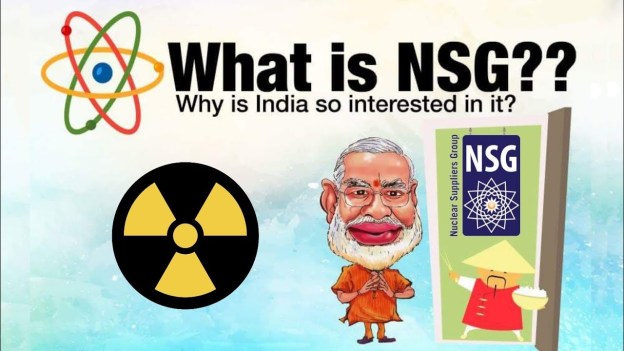
The deal would provide a major boost to India’s efforts in getting an entry to the elite Nuclear Suppliers Group, considering the clout of the EU on the global platform.  After the landmark Indo-US nuclear deal, India has signed nuclear deals with Russia, Kazakhstan, United Kingdom, South Korea, Mongolia, and France.  It also signed a nuclear cooperation agreement with Australia in September, paving way to import uranium for its reactors.

India, EU to sign civil nuclear pact by next year, PTI,  Nov 16, 2014

Secrecy at the International Atomic Energy Agency

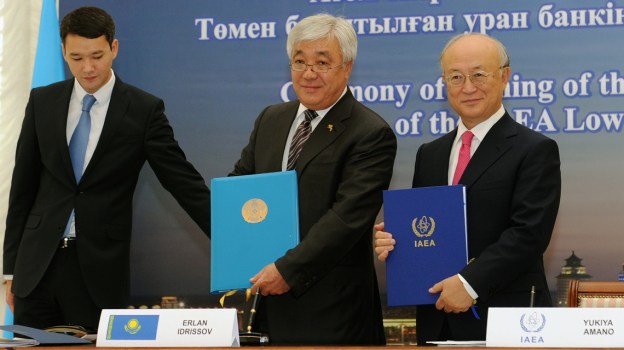
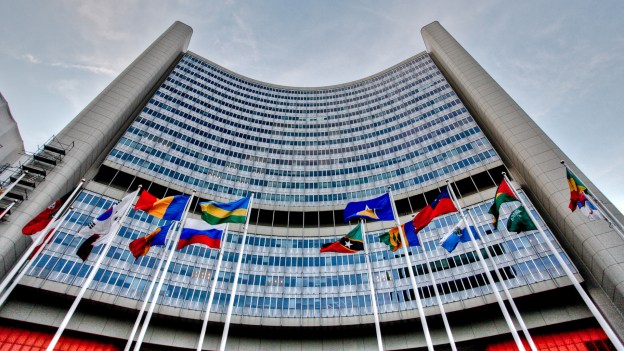
The IAEA [International Atomic Energy Agency], which is charged with both promoting the peaceful use of nuclear power and controlling fuel that could be used in weapons, is holding its quadrennial safeguards meeting behind closed doors for the first time in at least 12 years this week in Vienna. The agency also decided to withdraw information about nuclear projects that have led to proliferation risks.

The IAEA restricted access to the symposium [Linking, Implementation, Safety, Nuclear, Safeguards, Atomic Energy, Technology, Science, Energy, Chemistry, Physics] held between October 20 and October 24, 2014, so participants aren’t “inhibited,” spokeswoman Gill Tudor said in an e-mail while noting that the opening and closing ceremonies will be public. Information about technical cooperation, which has been progressively restricted since 2012, will be made available again in the “coming weeks,” IAEA public-information director Serge Gas said in an e-mail….

To be sure, some IAEA members such as Iran would like to see the agency impose even greater controls over information. President Hassan Rouhani’s government asked the IAEA in a Sept. 19 open letter to investigate leaks of confidential data that it said could violate the interim agreement it signed with world powers last year.

Iran’s stance shows the agency is guilty of a double failure, according to Tariq Rauf, a former IAEA official who is now a director at the Stockholm International Peace Research Institute. While the public is increasingly excluded from the scientific debate that shapes policy decisions, “the agency routinely allows secret information about nuclear programs to be given to select Western countries, which then leak it out,” he said.… The U.S. Government Accountability Office said in a 2011 report it’s wary about IAEA help to Cuba, Iran, Sudan and Syria.  Past IAEA technical assistance probably wound up helping Pakistan discover and mine the uranium that went into its nuclear weapons. In Syria, the agency developed a uranium-ore production facility that later drew scrutiny after the Middle East country allegedly built a secret reactor…

Scientists at this week’s meeting will explain how they can use rooftop sensors to sniff out the gases given off during plutonium production, according to the meeting agenda. Others will look at new ways to analyze satellite imagery, more sensitive methods for measuring traces of radioactivity and the difficulties in keeping track of nuclear material at places like Japan’s $20 billion plutonium-separation facility in Rokkasho. 

Excerpts from Jonathan Tirone. Nuclear Secrecy Feeds Concerns of Rogues Getting Weapons, Bloomberg, Oct 22, 2014n

Nuclear Waste Management in Russia

NO RAO, the Russian state’s national operator for dealing with radioactive waste, has announced it will build an underground research laboratory near Krasnoyarsk to determine the feasibility of building a final disposal point for the country’s high-level radioactive waste by 2024,

The government agency reported it had chosen the Nizhnekansky Rock Mass in the Krasnoyarsk Region of Central Siberia as the site for the lab and eventual long term underground storage repository…The project to build the repository will only go ahead pending the results of the lab studies, NO RAO said.  Russian state nuclear corporation Rosatom said that phase one of the proposed repository would hold 20,000 tons of intermediate and high level nuclear wastes, which would be retrievable, World Nuclear News reported…

Krasnoyarsk Citizens’ Assembly Chairman Alexei Menshikov was reported as saying the decision to build the repository in the region’s Nizhnekansky Rock Mass would not be decided without “wide public discussion and the creation of effective means for civil control, because [the repository] concerns environmental safety and the livelihood of citizens.”  Many of those present at the meeting pressed questions on precisely those points.

This area in Siberia is no stranger to massive nuclear undertakings. The nearby closed nuclear city of Zheleznogorsk through the decades of the Cold War produced bomb grade plutonium.  The city is also gearing up to build a new pilot spent nuclear fuel storage and reprocessing facility, which will reprocess two of Russia’s thorniest types of spent nuclear fuel: that produced by VVER-1000 reactors and spent fuel from Chernobyl-style RBMKs.

The search for a repository to store Russia’s high-level radioactive waste in safe conditions for the coming millennia has been in full swing since late last year when Rosatom in October 2013 unveiled a “roadmap” …This roadmap focused on the possibility of building as many as 30 long-term repositories as well as temporary waste storage facilities, 10 of which would be located in Northwest Russia, close to Norway and Finland, and didn’t discuss citing a repository in Siberia.

Excerpts from Charles Digges, http://www.bellona.org, Oct. 21, 2014

Sabotaging Iran’s Nuclear Program

A U.S. security institute said it has located via satellite imagery a section of a sprawling Iranian military complex where it said an explosion or fire might have taken place earlier this week. (pdf).

Iran’s official IRNA news agency on Monday cited an Iranian defence industry body as saying that two workers were killed in a fire at an explosives factory in an eastern district of Tehran.  Iran’s Defence Industries Organisation said the fire broke out on Sunday evening, IRNA said, giving no further detail.  An Iranian opposition website, Saham, described the incident as a strong explosion that took place near the Parchin military complex around 30 km southeast of the capital. It did not give a source and the report could not be independently verified….  The dissident National Council of Resistance of Iran (NCRI) exposed Iran’s uranium enrichment plant at Natanz and a heavy water facility at Arak in 2002. But analysts say it has a mixed track record and a clear political agenda.

The Washington-based Institute for Science and International Security (ISIS) said it had obtained commercially available satellite imagery on which six buildings at Parchin appeared damaged or destroyed.  However, the images ISIS issued indicated the site of the possible blast was not the same location in Parchin where the U.N. nuclear agency suspects that Iran, possibly a decade ago, carried out explosives tests that could be relevant for developing a nuclear arms capability. Iran denies any such aim.

The U.N. International Atomic Energy Agency wants to visit this area of Parchin, but Iran has so far not granted access. Iran says Parchin is a conventional military facility and that its nuclear programme is entirely peaceful. It has often accused its enemies of seeking to sabotage its atomic activities.

ISIS said its analysis of the satellite imagery from Oct. 7 and 8 indicated an explosion could have taken place at a southern section of Parchin.  “Several signatures that coincide with those expected from an explosion site are visible here,” it said on its website.  “Two buildings that were present in August 2014 are no longer there, while a third building appears to be severely damaged. In total at least six buildings appear damaged or destroyed,” ISIS added.

Israel and the United States have not ruled out military action against Iran if diplomacy fails to resolve a decade-old dispute over Tehran’s nuclear programme. Israel is widely believed to be the Middle East’s only nuclear-armed power.

U.S. think-tank says it located possible blast at Iran military site, Reuters, Oct. 9, 2014

The Nuclear Plants of South Africa

South Africa signed a partnership agreement (Sept 2014) with Russia’s state-owned nuclear company, Rosatom Corp. to build reactors in Africa’s second-biggest economy.  “The agreement lays the foundation for the large-scale nuclear power plants procurement and development program” using Russian VVER reactors with installed capacity of about 9,600 megawatts, or as many as eight nuclear units, Rosatom and the South African government said in an e-mailed statement. The country also has a draft nuclear cooperation pact with China.

South Africa’s integrated resources plan envisions 9,600 megawatts of nuclear energy being added to the national grid to help reduce reliance on coal, which utility Eskom Holdings SOC Ltd. uses to generate 80 percent of the country’s electricity. The state-owned company is struggling to meet power demand,The National Treasury said in February 2013 that a 300 billion-rand ($27 billion) nuclear program was in the final stages of study…

The collaboration will result in orders worth at least $10 billion to local industrial companies, Rosatom Director General Sergei Kirienko said in the statement.In addition to building the nuclear units, the agreement provides for partnerships including the construction of a Russian technology-based research reactor, assistance in the development of South African nuclear infrastructure and education of specialists at Russian universities, the parties said in the statement.  Rosatom currently holds projects for the construction of 29 nuclear power plants, including 19 foreign commissions in countries including India, China, Turkey, Vietnam, Finland and Hungary.

Excerpts from Paul Burkhardt , South Africa Signs Agreement With Russia for Nuclear Power, Bloomberg,  Sep 22, 2014

Making Nuclear Power in Vietnam

American firms have urged the US Congress to ratify the Vietnam-US cooperation agreement in the nuclear sector in order to create more jobs, and Russia and Japan have signed nuclear cooperation agreements with Vietnam….  [T]he Vietnamese and US representatives signed a Vietnam-US nuclear cooperation agreement in Hanoi on May 6, 2014 (Agreement 123)….

The US Nuclear Energy Institute (NEI) and the US nuclear energy firms have unanimously urged the US Congress to ratify the agreement soon, emphasizing that the strengthened cooperation with Vietnam in the sector would help boost exports and create more jobs.  The US firms can expect to earn $10-20 billion from the deals with Vietnam.

Vietnam plans to produce 10,000 MW  of nuclear electricity by 2030. It is believed to be the second largest nuclear power market in East Asia following to China, while market value is expected to reach $50 billion in the next two decades.  According to the World Nuclear Association (WNA), rapid modernization in Vietnam has led to a sharp increase in the demand for electricity, estimated to increase by 10-15 percent per annum.  David Durham from GE Hitachi Nuclear Energy (GHE) has warned that if the US Congress does not ratify the agreement, US firms will lose the lucrative market of Vietnam.

Excerpts from Vietnam nuclear power market eyed by three major countries, VietNamNet Bridge, Sept. 7, 2014

India’s Drones and Nukes

Washington-based Institute for Science and International Security (ISIS) suggests that India appeared to have followed through on its publicly announced intention to build the  Special Material Enrichment Facility (SMEF) and started constructing a large enrichment centrifuge complex near Chitradurga, Karnataka.  Furthermore, [o]n June 20, 2014 IHS Jane’s revealed that India was possibly extending Mysore’s Indian Rare Metals Plant into clandestine production of uranium hexafluoride that could theoretically be channelled towards the manufacture of hydrogen bombs.

This week the Washington-based Institute for Science and International Security (ISIS) suggested that the country appeared to have followed through on its publicly announced intention to build the SMEF and started constructing a large enrichment centrifuge complex near Chitradurga, Karnataka, where, between 2009 and 2010, approximately 10,000 acres of land were allegedly diverted for various defence purposes.

Within this walled-off tract, 1,410 acres in Ullarthi Kaval and 400 acres in Khudapura were allocated to the Bhabha Atomic Research Centre for the purpose of developing the SMEF, the ISIS said, adding that a further 4,000 acres in Varavu Kaval and 290 acres in Khudapura were allocated to the Defence Research and Development Organisation for the purpose of developing and testing “long-endurance (48-72 hours) Unmanned Aerial Vehicles and Unmanned Combat Aerial Vehicles.”…

The report’s authors, David Albright and Serena Kelleher-Vergantini, said that the new facility “will significantly increase India’s ability to produce enriched uranium for both civil and military purposes, including nuclear weapons”, urging India to therefore announce that the SMEF would be subject to International Atomic Energy Agency safeguards, committed only to peaceful uses….At the heart of India’s apparently strong enrichment thrust is an urgent need for Highly Enriched Uranium for the indigenously developed INS Arihant nuclear-powered ballistic missile submarine and probably for nuclear and thermonuclear weapons.

Excerpt from NARAYAN LAKSHMAN. Karnataka home to second covert nuke site, drone testing: report,  The  Hindu, July 2, 2014

Iran Nuclear Talks: the Khamenei Card

On July 7, 1014 as critical nuclear negotiations got underway in Vienna between Iran, the United States, Europe, Russia and China, Khamenei (Iranian Supreme Leader) started talking hard numbers.  The Supreme Leader’s remarks were unprecedented both because they represented a blatant intervention from his perch in Tehran in the super-sensitive talks in Vienna, and because they relayed confidential technical details that had not been aired publicly before by Iranian officials.

The moment could not be more critical. An agreement is supposed to be reached before July 20, 2014 that will rein in the threat of Iran acquiring nuclear weapons and end or curtail the Western sanctions that have put so much pressure on Tehran. Failure to reach an accord will add yet more potentially apocalyptic uncertainties to the Middle Eastern scene…

The Supreme Leader started talking about SWUs, which it is fair to say few Iranians, or for that matter Americans, Europeans, Russians or Chinese ever have heard of.  In this context the acronym stands for “separative work units,” which relates directly to Iran’s ability to enrich uranium to levels that might feed into nuclear weapons. SWU defines the capability derived from the number of uranium-enriching centrifuges and their efficiency. For example one thousand AR1 centrifuges with the efficiency of 0.9 translates into 900 SWU, whereas 225 AR2 centrifuges with an efficiency of 4 translates into 900 SW…

“They want us to be content with 10,000 SWUs,” he said. That is, he estimates the bottom line the West will accept. “But they have started from 500 and 1000 SWUs,” he added. “Our people say that we need 190,000 SWUs,” he went on. That’s a big spread to try to close.  Khamenei then raised the problem of American and European objections to the more-or-less bomb-proof underground facility Iran has built at Fordo, where much of its enrichment goes on. “They emphasize Fordo because they cannot get to it,” said Khamenei. “They say you must not have a place which we cannot strike. Isn’t this ridiculous?”

Last December [2013] Khamenei said publicly he would not interfere in the negotiations and would leave the details to the diplomats. Now it appears he is playing a more shadowy game, either dictating terms to the Iranian team in Vienna or, perhaps, providing them the cover they need to stand firm.

A source close to the negotiations told IranWire that the numbers Khamenei cited are precisely what American negotiators have put on the table, and constitute one of the confidential topics being discussed over the past few months. Two days before Khamenei spoke, Under Secretary of States for Political Affairs Wendy Sherman, the senior American negotiator, said that Iran must end up with a fraction of the centrifuges it currently runs, but she did not cite any numbers.

The source said that Khamenei’s statements are technically significant, and are in line with the terms of the negotiations, which deal with SWUs rather than the number of centrifuges as such.

According to a European diplomat who is a member of his country’s nuclear negotiating team, the accuracy of the numbers leaked by Khamenei is both astonishing and worrisome, because he is limiting publicly the concessions that might be made by Iranian President Hassan Rouhani’s team….

It is clear Khamenei wants to leave no doubt about his regime’s red lines in the negotiations…  But Khamenei doesn’t see this crisis only in terms of nukes. For the West, he says, the nuclear issue “is just an excuse” to pressure Iran, he said. “If it is not the nuclear issue they will come up with another excuse—human rights, women’s right, etc.”

Excerpts from Reza HaghighatNejad, Iran Supreme Leader Spills the Nuke Talk Secrets, Daily Beast, July 9, 2014

Nuclear Materials in Iraq – 2014 War

The U.N. atomic agency said on Thursday (July 10, 2014) it believed nuclear material which Iraq said had fallen into the hands of insurgents was “low grade” and did not pose a significant security risk.  Iraq told the United Nations that the material was used for scientific research at a university in the northern town of Mosul and appealed for help to “stave off the threat of their use by terrorists in Iraq or abroad”.

Iraq’s U.N. envoy this week also said that the government had lost control of a former chemical weapons facility to “armed terrorist groups” and was unable to fulfill its international obligations to destroy toxins kept there.  An al Qaeda offshoot, Islamic State in Iraq and the Levant, took over swathes of Syria and Iraq before renaming itself Islamic State in June and declaring its leader caliph – a title held by successors of the Prophet Mohammad.

The U.N. International Atomic Energy Agency (IAEA) “is aware of the notification from Iraq and is in contact to seek further details”, IAEA spokeswoman Gill Tudor said.  “On the basis of the initial information we believe the material involved is low grade and would not present a significant safety, security or nuclear proliferation risk,” she said. “Nevertheless, any loss of regulatory control over nuclear and other radioactive materials is a cause for concern.”

Iraqi U.N. Ambassador Mohamed Ali Alhakim told U.N. Secretary-General Ban Ki-moon in a July 8 letter that nearly 40 kg (88 pounds) of uranium compounds were kept at the university.  “Terrorist groups have seized control of nuclear material at the sites that came out of the control of the state,” he said.

However, a U.S. government source said it was not believed to be enriched uranium and therefore would be difficult to use to manufacture into a nuclear weapon. Russian Foreign Ministry spokesman Alexander Lukashevich said the reported seizure likely posed no direct threat. But, he said: “The sheer fact that the terrorists … show unmistakeable interest in nuclear and chemical materials is, of course, very alarming”.

Any loss or theft of highly enriched uranium, plutonium or other types of radioactive material is potentially serious as militants could try to use them to make a crude nuclear device or a “dirty bomb”, experts say.  Olli Heinonen, a former IAEA chief inspector, said that if the material came from a university it could be laboratory chemicals or radiation shielding, consisting of natural or depleted uranium.  “You cannot make a nuclear explosive from this amount, but all uranium compounds are poisonous,” Heinonen told Reuters. “This material is also not ‘good’ enough for a dirty bomb.”  In a so-called “dirty bomb”, radioactive material such as might be found in a hospital or factory is combined with conventional explosives that disperse the hazardous radiation.

Citing U.N. investigations dating back ten years or more, Heinonen said there should be no enriched uranium in Mosul. The Vienna-based IAEA helped dismantle Iraq’s clandestine nuclear programme in the 1990s – during Heinonen’s three decades there.  “Iraq should not have any nuclear installation left which uses nuclear material in these quantities,” he said.  Another proliferation expert, Mark Hibbs of the Carnegie Endowment think-tank, said: “The Mosul region and several university departments were scoured again and again by U.N. inspectors for a decade after the first Gulf War (1990-1991) and they know what materials were stored there.”  “These included tons of uranium liquid wastes, sources, uranium oxides, and uranium tetrafluoride. Some of these items are still there, but there’s no enriched uranium,” he said.

Excerpts from Fredrik Dahl, UPDATE 4-Seized nuclear material in Iraq “low grade” – UN agency, Reuters, July 10, 2014

Geopolitics of Nuclear Weapons: India

The United States, Britain and others have argued that nuclear-armed India should join the secretive 48-nation Nuclear Suppliers Group (NSG) – established in 1975 to ensure that civilian atomic trade is not diverted for military purposes.  But other NSG states have voiced doubt about accepting a country that built up a nuclear arsenal outside a 189-nation treaty set up four decades ago to prevent states from acquiring such weapons of mass destruction.

Days ahead of the June 26-27 NSG meeting in Buenos Aires, India said it was ratifying an agreement, a so-called Additional Protocol, with the International Atomic Energy Agency to expand oversight over its civilian nuclear programme.  The United States said this marked another “important step in bringing India into the international non-proliferation mainstream”. But some critics questioned the step’s significance, as it would not affect India’s nuclear weapons programme and sensitive atomic fuel activities.  They said the Indian agreement was a much weaker version of a deal most other IAEA members have, giving the U.N. watchdog wide inspection powers to make sure there are no covert nuclear activities in a country.  “India’s version of the Additional Protocol is a paper tiger,” said Daryl Kimball of the U.S.-based Arms Control Association, a research and advocacy group….

The diplomatic tussle centres on whether the emerging power should be allowed into a key forum deciding rules for civilian nuclear trade, even though it never joined the 1970 Non-Proliferation Treaty (NPT), under which it would have to give up its nuclear weapons…

India – Asia’s third-largest economy – would need the support of all NSG states to join the cartel that has a pivotal role in countering nuclear threats and proliferation.  If India eventually were to become a member, it would boost its standing as an atomic power. It would be the only member of the suppliers group that has not signed up to the NPT.

Supporters say it is better if the country is inside than outside the NSG as it is already an advanced nuclear energy power and will in future become a significant exporter as well.  Those who are sceptical argue it could erode the credibility of the NPT, which is a cornerstone of global nuclear disarmament efforts.

Diplomats have said that China and some others have been doubtful. Beijing’s reservations are believed to be influenced by its ties to its ally Pakistan, India’s rival, which has also tested atomic bombs and is also outside the NPT, analysts say.

Excerpts,Nuclear Suppliers Group to discuss ties with India,Reuters, Jun 24, 2014

Iran Defeats Sanctions through Chinese Networks

A Chinese citizen faces U.S. criminal charges that he conspired to export to Iran products that could be used in that country’s nuclear program, the U.S. Justice Department.  Sihai Cheng supplied thousands of parts that have nuclear applications to Eyvaz, a company involved in Iran’s nuclear weapons program, in violation of U.S. sanctions on Iran, federal prosecutors said.

Sihai Cheng of Shanghai and Seyed Abolfazl Shahab Jamili of Tehran allegedly plotted between 2009 and 2011 to send pressure measuring sensors, or transducers, ordered from MKS Instruments Inc. in Andover, USA, to Eyvaz Technic Manufacturing Co., a Tehran-based business that has supplied parts to Iranian nuclear facilities.  Transducers are used in commercial products, but can also be used in gas centrifuges to convert natural uranium into a form suited for nuclear weapons, the indictment states.

Prosecutors said MKS Instruments sent the transducers to China without knowing they were ultimately bound for Iran.

In February 2009, Jamili wrote to Cheng that Eyvaz Technic was seeking to obtain a type of transducer. Eyvaz has “supplied parts for Iran’s development of nuclear weapons,” the indictment states.  After receiving the 2009 e-mail, Cheng allegedly plotted with unidentified coconspirators at MKS-Shanghai, a wholly owned Chinese subsidiary of MKS in Andover, to set up front companies to pose as the intended recipients of the materials, which were ordered from the Andover office.  In addition, MKS-Shanghai employees listed other legitimate Chinese companies as recipients in purchase orders sent to Andover, authorities said.  More than 1,000 orders for MKStransducers with a combined value of over $1.8 million were placed between April 2009 and January 2011, the indictment said. Once the parts arrived in China, Cheng had them shipped to Eyvaz, the Iranian company accused of supplying material for Iran’s nuclear enrichment facilities.

Prosecutors wrote that MKS in Andover “unwittingly assisted MKS-Shanghai in fraudulently obtaining an export license for a large quantity of pressure transducers.”  Authorities say there is evidence MKS products reached the Natanz nuclear enrichment facility in Iran, which began operating thousands of gas centrifuges as early as 2007.  “Publicly available photographs of Natanz [with then President Mahmoud Ahmadinejad] show numerous MKS pressure transducers attached to Iran’s gas centrifuge cascades,” the indictment says.

Excerpt from Chinese national indicted in US over exports to Iran,  Reuters, Apr. 4, 2014 and from Travis Andersen and Jennifer Smith, Men accused of sending nuclear supplies to Iran, Boston Globe, Apr. 5, 2014

Benefits of Threshold Nuclear Power: Japan v. China

China has urged Japan to return over 300 kilograms of weapons grade plutonium to the Unites States and to explain how it intends to resolve its surplus plutonium problem. At a regular press briefing in Beijing on 17 February 2014, and in response to a question on Japan’s plutonium stocks, a Foreign Ministry spokeswoman stated:

“China attaches great importance to nuclear proliferation risks and potential threats posed by nuclear materials to regional security. China has grave concerns over Japan’s possession of weapons-grade nuclear materials… Japan’s failure to hand back its stored weapons-grade nuclear materials to the relevant country has ignited concerns of the international community including China.”

As reported in January 2014, agreement has been reached between the United States and Japan for the return of plutonium used in the Fast Critical Assembly (FCA) in JAERI Tokai Research Establishment, Tokai-mura, Ibaraki Prefecture. The formal agreement is expected to be concluded at the Nuclear Security Summit in the Netherlands in March 2014. In its latest declaration to the International Atomic Energy Agency (IAEA) and in its 2012 plutonium management report Japan stated that the FCA facility has the total of 331 kg of plutonium, of which 293 kg is fissile plutonium. The largest share of this plutonium was supplied by the United Kingdom in addition to that supplied by the United States.

Commenting further, the Chinese Foreign Ministry declared:

“China believes that Japan, as a party to the Treaty on the Non-Proliferation of Nuclear Weapons, should strictly observe its international obligations of nuclear non-proliferation and nuclear security. The IAEA requires all parties to maintain a best possible balance of supply and demand of nuclear materials as contained in the Guidelines for the Management of Plutonium. Japan’s large stockpile of nuclear materials including weapons-grade materials on its territory is an issue concerning nuclear material security, proliferation risks and big supply-demand imbalance.”

In addition to the call for the return of the weapon’s grade plutonium, the Chinese statement also raises a question over Japanese fuel cycle policy and its inability to use its existing plutonium stocks. With all 48 nuclear power reactors shutdown there is currently no demand for its separated plutonium as mixed oxide (MOX) fuel. However, Japanese policy continues to plan the commercial operation of the Rokkasho-mura reprocessing plant as early as October 2014, following a safety assessment by the Nuclear Regulatory Authority (NRA). In its latest declaration to the IAEA, Japan’s Atomic Energy Commission reported that as of 31 December 2012, Japan held 44,241 kg of separated unirradiated plutonium, of which 9,295 kg was stored in Japan and 34,946 kg was stored abroad. Japan’s plutonium program, its challenges and alternatives was recently addressed at a Tokyo symposium and in detailed analysis by IPFM.

As yet, there has been no official response from the Japanese government to the Chinese Foreign Ministry statement, which has been extensively reported through Chinese media outlets

By Shaun Burnie with Mycle Schneider, China calls on Japan to return weapons grade plutonium to the United States, International Panel on Fissile Materials, Feb 18, 2014

Military Capabilities of India – 2014

India’s first-ever dedicated military satellite, Rukmini or GSAT-7, “seamlessly networked” around 60 warships and 75 aircraft during the massive month-long naval combat exercise in the Bay of Bengal that ended on Feb. 28, 2014…Apart from GSAT-7, the exercise this year also saw the “maiden participation” of nuclear-powered submarine INS Chakra, on a 10-year lease from Russia for $1 billion, and the newly-acquired P-8I  [Boeing P-8 Poseidon] long range maritime patrol aircraft [bought from the United States].

While the over 8,000-tonne INS Chakra is not armed with long-range nuclear missiles because of international treaties like the Missile Technology Control Regime, it serves as “a potent hunter-killer” of enemy warships and submarines, apart from being capable of firing land-attack cruise missiles.  INS Chakra adds some desperately-needed muscle to underwater combat arm at a time when the Navy is grappling with just 13 ageing diesel-electric submarines, three of which are stuck in life-extension refits  As for the P-8Is, the Navy has till now inducted three of the eight such sensor and radar-packed aircraft ordered in 2009 for $2.1billion from the US. Also armed with potent anti-submarine warfare capabilities, the P-8Is are working in conjunction with medium-range Dorniers [from Germany] and Israeli Searcher-II and Heron UAVs (unmanned aerial vehicles) to create a three-tier surveillance grid in the heavily-militarized IOR.  India, in fact, is in the process of ordering another four P-8I aircraft.

Excerpt from Rajat Pandit, Navy validates massive exercise under country’s first military satellite’s gaze, The Times of India Mar. 1, 2013

The Bikini Atoll Nuclear Experiment 60 years after

The Marshall Islands marked the 60th anniversary Saturday of a U.S. hydrogen bomb test at Bikini Atoll, holding a commemorative program in the capital Majuro for people who suffered exposure to radiation from the United States’ biggest ever nuclear experiment.  The program began with a memorial walk by some 500 people in honor of the victims and survivors of the so-called “Bravo” test on March 1, 1954..Other participants included Rose Gottemoeller, acting U.S. undersecretary of state for arms control and international security…

Acknowledging the sacrifices of the Marshallese people and recognizing the effects of nuclear testing, Gottemoeller said the United States “has acted on its responsibility” by continuously providing medical and environmental programs in the Marshall Islands, on top of the $600 million it has extended as direct assistance and subsides, financial support for rehabilitation of the affected atolls, site monitoring and ongoing healthcare programs…

But Loeak and local resident Nerje Joseph, 65, who was exposed to the radiation, dismiss Gottemoeller’s pronouncement as nothing new and lament that their demand for additional compensation for the victims and the cleanup of the islands continues to fall on deaf ears.  Loeak reiterated that based on the assessment of an independent tribunal, the legitimate claims for damages amount to more than $2 billion, making the $150 million contribution of the United States in 1986 “a tiny and inadequate drop in an ocean of pain and suffering.”

“We remain the closest of friends with the United States but there is unfinished business relating to the nuclear weapons testing that must be addressed if that legacy of distrust is to become one of mutual confidence and respect,” he said.  “The United States must finally come clean and live up to its responsibility to help the Marshall Islands live with the devastation caused by their nuclear testing,” he added.

Excerpt from, Marshall Islands marks 60th anniversary of Bikini Atoll nuclear test, Kyodo News International, Feb. 28, 2014

See also Elli Louka: International Environmental Law: Fairness, Effectiveness and World Order

A Leaking Atom Bomb: Hanford, USA

There are “significant construction flaws” in some newer, double-walled storage tanks at Washington state’s Hanford nuclear waste complex, which could lead to additional leaks, according to documents obtained by The Associated Press.  Those tanks hold some of the worst radioactive waste at the nation’s most contaminated nuclear site.

One of the 28 giant underground tanks was found to be leaking in 2013. But subsequent surveys of other double-walled tanks performed for the U.S. Department of Energy by one of its Hanford contractors found at least six shared defects with the leaking tank that could lead to future leaks, the documents said. Thirteen additional tanks also might be compromised, according to the documents.  Questions about the storage tanks jeopardize efforts to clean up radioactive waste at the southeastern Washington site. Those efforts already cost taxpayers about $2 billion a year.  “It is time for the Department (of Energy) to stop hiding the ball and pretending that the situation at Hanford is being effectively managed,” Sen. Ron Wyden, D-Ore., wrote this week in a letter to Energy Secretary Ernest Moniz…

Hanford contains some 53 million gallons of high-level radioactive wastes from the production of plutonium for nuclear weapons. They are stored in 177 underground storage tanks, many of which date back to World War II and are single-walled models that have leaked. The 28 double-walled tanks were built from the 1960s to the 1980s.

Current plans call for transferring wastes from leaking single-walled tanks to the newer and bigger double-walled tanks, where the waste will be stored while a $13 billion plant for treating the waste is constructed. But the treatment plant is plagued with design problems and construction has stalled.  The situation did not appear dire until the news in October 2012 that the oldest of the double-walled tanks, called AY-102, had leaked, becoming the first of those 28 tanks to do so.

At the time, the Energy Department blamed construction problems with this particular tank for the leak and said it “seems unlikely” that the other double-walled tanks would leak.  However, Wyden said engineering reviews of six other double-walled tanks “found significant construction flaws in those six tanks essentially similar to those at the leaking tank.” Those six tanks contain about 5 million gallons of radioactive wastes, wrote Wyden, who is chairman of the Senate Energy and Natural Resources Committee….

Hanford, located near the city of Richland, stores about two-thirds of the nation’s high-level radioactive waste.  Officials have said the leaking materials pose no immediate risk to public safety or the environment because it would take perhaps years for the chemicals to reach groundwater.  The federal government built Hanford at the height of World War II as part of the Manhattan Project to build the atomic bomb.

Excerpts from Drew Vattiat, Hanford’s worst radioactive waste vulnerable to leaks from flaws in newer storage tanks, Associated Press, Feb. 28, 2014

Living with Nuclear Waste: New Mexico

Unusually high levels of radioactive particles were found at an underground nuclear waste site in New Mexico on Saturday, Feb. 16, 2014 in what a spokesman said looked like the first real alarm since the plant opened in 1999.  U.S. officials were testing for radiation in air samples at the site where radioactive waste, such as plutonium used in defense research and nuclear weapon making, is dumped half a mile below ground in an ancient salt formation.

“They (air monitors) have alarmed in the past as a false positive because of malfunctions, or because of fluctuations in levels of radon (a naturally occurring radioactive gas),” Department of Energy spokesman Roger Nelson said.  “But I believe it’s safe to say we’ve never seen a level like we are seeing. We just don’t know if it’s a real event, but it looks like one,” he said.  It was not yet clear what caused the air-monitoring system to indicate that radioactive particles were present at unsafe levels, Nelson said.

No one was underground at the Department of Energy Waste Isolation Pilot Plant near Carlsbad, in New Mexico’s south east, when the alarm went off at 11:30 p.m. MST on Friday, and none of the 139 employees working above ground at the facility was exposed to radioactive contaminants, he said.  Workers were asked to shelter where they were until the end of their shifts and were allowed to leave the facility at 5 p.m. local time on Saturday, Nelson said. No air exchange with the surface was occurring after the ventilation system automatically switched to filtration, he said…A different part of the site was evacuated this month after a truck used to haul salt caught fire. Several workers suffered smoke inhalation, an agency statement said.

Possible radiation leak at New Mexico military nuclear waste site, Reuters, Feb. 16, 2014

Trapping the Dirty Bomb

Nuclear and radiological materials slipped out of regulatory control 2,331 times between 1995 and the start of 2013, according to the Incident and  Trafficking Database compiled by the International Atomic Energy Agency (IAEA). The materials are widely used in industry, agriculture and medicine. They are kept in many poorly guarded X-ray and cancer-treatment clinics. Such places are often not overseen with terrorism in min  d. They have even been bought by crooks as front operations, says Rajiv Nayan, of India’s Institute for Defence Studies and Analyses. Raids on abandoned uranium mines in the Democratic Republic of Congo are more frequent, according to that country’s General Atomic-Energy Commission. The problem is most acute in the former Soviet Union: in Ukraine alone, roughly 2,500 organisations use radiological materials.

In Georgia a counter-trafficking unit set up by the interior ministry seven years ago has arrested two or three teams smuggling radiological material every year save 2009. The lure of profits is so strong that some ex-cons get back into the business, says Archil Pavlenishvili, leader of the unit. Interpol has said such trafficking is growing: an acute “real threat to global security”.  It all sounds scary enough. But the reality has been less so. Moreover, by many accounts the most plausible dangers appear to be declining.

For a start, an “overwhelming” number of buyers turn out to be undercover cops, says Mark Hibbs of the Carnegie Endowment for International Peace, a think-tank. A sizeable network of informers helps Georgia’s interior ministry to keep a close eye on the four or five cells in the country currently trying to obtain or sell radiological material, says Mr Pavlenishvili. ..Beyond this, intelligence agencies are hunting down traffickers with help from special “link analysis” computer programs. Also known as “network analysis” software, this crunches data from numerous sources to identify people whose travel, purchases, web searches, communications, schooling and so forth may spell trouble—perhaps an employee in radiation therapy who begins frequenting an inconveniently located bar whose owner receives phone calls from a drug-runner with growing operations.

Half a dozen Western governments “pay huge amounts of attention” to this, says an executive at a developer of the software. At least one spy agency in America, Australia, Britain, Canada, New Zealand, and an unnamed European country pays more than $1m a month to use it. The counter-trafficking units in both Georgia and Romania note that link-analysis software made by i2, owned by the giant IBM computer company, has helped to nab traffickers. Atsuko Nishigaki, the unit’s boss, says Japan’s economy ministry employs ten analysts to use a competitor’s software to identify traffickers in nuclear or radiological material.

America’s National Nuclear Security Administration has sponsored the installation of radiation-detection kit at ports in 23 countries and counting. The Megaports Initiative, as it is called, aims to have half of the world’s maritime container cargo routinely scanned by 2015. Networked systems are also being developed with detectors small enough to be worn on a police officer’s belt. The idea is to relay data on potentially dangerous radiation through a mobile-phone network to a central computer. Knowing each device’s location and the strength of the radiation it detects, the computer can “triangulate” the source’s approximate location.

Difficult problems remain. False alarms triggered by anything from a pallet of cat litter to radiation-therapy patients and nuclear-power-plant shipments have slowed research and development on one such network at the Lawrence Livermore National Laboratory in California, says Simon Labov, a co-ordinator there. Even so, the lab’s work continues to be financed by America’s defence, energy and homeland-security departments. In October 2013 the latter’s Domestic Nuclear Detection Office asked for proposals for a similar system, dubbed Human Portable Tripwire. Other outfits that have developed technology for such schemes include Smiths Detection in Britain and, in America, Berkeley Nucleonics, General Electric, GENTAG, Passport Systems and Purdue University.

The sheer danger of making a dirty bomb is a factor too. Without the right equipment and expertise, the really nasty stuff can kill the maker of a bomb before it is ready—part of the reason, perhaps, that no spectacular dirty-bomb attack has yet been launched. F

Dirty Bombs: Glowing in the dark, Economist, Dec. 14, 2013, at 67

Indian Nuclear Submarines firing from land, air and sea

The miniature reactor on board India’s first indigenous nuclear submarine INS Arihant has gone “critical”, which marks a big stride towards making the country’s long-awaited “nuclear weapons triad,” an operational reality.  Sources, in the early hours of Saturday, said the 83 MW pressurized light-water reactor attained “criticality” after several months of “checking and re-checking” of all the systems and sub-systems of the 6000-tonne submarine at the secretive ship-building centre at Visakhapatnam.

INS Arihant, till now, was being tested in the harbor on shore-based, high-pressure steam. With the reactor going critical now, the submarine will eventually head for open waters for extensive “sea- acceptance trials”, which will include firing of its 750-km range K-15 ballistic missiles. The sea trials will take at least another 18 months before INS Arihant can become fully operational.

When that happens, India will finally get the long-elusive third leg of its nuclear triad — the capability to fire nuclear weapons from the land, air and sea. The first two legs — the rail and road-mobile Agni series of ballistic missiles and fighters like Sukhoi 30MKIs and Mirage-2000s capable of delivering nuclear warheads — are already in place with the armed forces.

The capability to deploy submarine-launched ballistic missiles (SLBMs) is crucial since India has a declared “no first-use policy” for nuclear weapons, and hence needs a robust and viable second-strike capability

Rajat Pandit, Reactor of India’s first indigenous nuclear submarine INS Arihant goes ‘critical’, The Times of India, Aug. 10, 2013


Choking Uranium Markets to Stop Nuclear Weapons

Making nuclear weapons requires access to materials—highly enriched uranium or plutonium—that do not exist in nature in a weapons-usable form.   The most important suppliers of nuclear technology have recently agreed guidelines to restrict access to the most sensitive industrial items, in the framework of the Nuclear Suppliers Group (NSG). Nevertheless, the number of countries proficient in these industrial processes has increased over time, and it is now questionable whether a strategy based on close monitoring of technology ‘choke points’ is by itself a reliable barrier to nuclear proliferation.  Time to tighten regulation of the uranium market?

Not all the states that have developed a complex nuclear fuel cycle have naturally abundant uranium. This has created a global market for uranium that is relatively free—particularly compared with the market for sensitive technologies….

Many African states have experienced increased investment in their uranium extractive sectors in recent years. Many, though not all, have signed and ratified the 1996 African Nuclear Weapon Free Zone (Pelindaba) Treaty, which entered into force in 2009. Furthermore, in recent years, the relevant countries have often worked with the IAEA to introduce an Additional Protocol to their safeguards agreement with the agency…

One proliferation risk inherent in the current system is that inadequate or falsified information connected to what appear to be legitimate transactions will facilitate uranium acquisition by countries that the producer country would not wish to supply….

A second risk is that uranium ore concentrate (UOC) is diverted, either from the site where it was processed or during transportation, so the legitimate owners no longer have control over it. UOC is usually produced at facilities close to mines—often at the mining site itself—to avoid the cost and inconvenience of transporting large quantities of very heavy ore in raw form to a processing plant.,,,UOC is usually packed into steel drums that are loaded into standard shipping containers for onward movement by road, rail or sea for further processing. The loss of custody over relatively small quantities of UOC represents a serious risk if diversion takes place regularly. The loss of even one full standard container during transport would be a serious proliferation risk by itself. There is thus a need for physical protection of the ore concentrate to reduce the risk of diversion at these stages.

A third risk is that some uranium extraction activity is not covered by the existing rules. For example, uranium extraction can be a side activity connected to gold mining or the production of phosphates. Regulations should cover all activities that could lead to uranium extraction, not only those where uranium extraction is the main stated objective.

Restricting access to natural uranium could be an important aspect of the global efforts to obstruct the spread of nuclear weapons

Excerpts, from  Ian Anthony and Lina Grip, The global market in natural uranium—from proliferation risk to non-proliferation opportunity, SIPRI, Apr. 13, 2013

Covert Operations in Iran

Washington believed that covert action against Iran’s nuclear facilities would be more effective and less risky than an all-out war… In fact, Mark Fitzpatrick, former deputy assistant secretary of state for non-proliferation said: “Industrial sabotage is a way to stop the programme, without military action, without fingerprints on the operation, and really, it is ideal, if it works.”The US has a long history of covert operations in Iran, beginning in 1953 with the CIA orchestrated coup d’état that toppled the popularly elected Iranian prime minister Mohammad Mossadegh and installed a dictator, Reza Shah. The US has reorganised its covert operations after the collapse of the shah in 1979…

In January 2011, it was revealed that the Stuxnet cyber-attack, an American-Israeli project to sabotage the Iranian nuclear programme, has been accelerated since President Barack Obama first took office. Referring to comments made by the head of Mossad, then US secretary of state Hillary Clinton confirmed the damages inflicted on Iran’s nuclear programme have been achieved through a combination of “sabotage and sanctions”.

Meanwhile, several Iranian nuclear scientists were assassinated. The New York Times reported that Mossad orchestrated the killings while Iran claimed the attacks were part of a covert campaign by the US, UK and Israel to sabotage its nuclear programme….

There are at least 10 major repercussions arising from the US, West and Israeli policy of launching covert war and cyber-attacks against Iranian nuclear facilities and scientists.

First, cyber war is a violation of international law. According to the UN Charter, the use of force is allowed only with the approval of the UN Security Council in self-defence and in response to an attack by another country. A Nato-commissioned international group of researchers, concluded that the 2009 Stuxnet attack on Iran’s nuclear facilities constituted “an act of force”, noting that the cyber-attack has been a violation of international law.Second, the US covert operations are a serious violation of the Algiers Accord. The 1981 Algiers Accords agreed upon between Iran and the US clearly stated that “it is and from now on will be the policy of the US not to intervene, directly or indirectly, politically or militarily, in Iran’s internal affairs”.

Third, the cyber war has propelled Tehran to become more determined in its nuclear efforts and has made major advancement. According to reports by the International Atomic Energy Agency (IAEA), prior to covert operations targeting the nuclear programme, Iran had one uranium enrichment site, a pilot plant of 164 centrifuges enriching uranium at a level of 3.5 per cent, first generation of centrifuges and approximately 100 kg stockpile of enriched uranium.Today, it has two enrichment sites with roughly 12,000 centrifuges, can enrich uranium up to 20 per cent, possesses a new generation of centrifuges and has amassed a stockpile of more than 8,000kg of enriched uranium.

Fourth, the strategy pursued has constituted a declaration of war on Iran, and a first strike. Stuxnet cyber-attack did cause harm to Iran’s nuclear programme, therefore it can be considered the first unattributed act of war against Iran, a dangerous prelude toward a broader war.

Fifth… [s]uch short-sighted policies thicken the wall of mistrust, further complicating US-Iran rapprochement and confidence-building measures.

Sixth, Iran would consider taking retaliatory measures by launching cyber-counter-attacks against facilities in Israel, the West and specifically the US…

Seventh, Iran is building a formidable domestic capacity countering and responding to western cyber-warfare. Following the Stuxnet attack, Iran’s Supreme Leader issued a directive to establish Iran’s cyber army that is both offensive and defensive. Today, the Islamic Revolutionary Guards Corps (IRGC) has the fourth biggest cyber army in the world. Israel’s Institute for National Security Studies (INSS) acknowledged that IRGC is one of the most advanced nations in the field of cyberspace warfare.

Eighth, Iran now has concluded that information gathered by IAEA inspectors has been used to create computer viruses, facilitate sabotage against its nuclear programme and the assassinations of nuclear scientists. Iranian nuclear energy chief stated that the UN nuclear watchdog [IAEA] has been infiltrated by “terrorists and saboteurs.” Such conclusions have not only discredited the UN Nuclear Watchdog but have pushed Iran to limit its technical and legal cooperation with the IAEA to address outstanding concerns and questions.

Ninth, worsening Iranians siege mentality by covert actions and violations of the country’s territorial sovereignty could strengthen the radicals in Tehran to double down on acquiring nuclear weapons. Iran could be pondering now the reality that the US is not waging a covert war on North Korea (because it possesses a nuclear bomb), Muammar Gaddafi lost his grip on power in Libya after ceding his nuclear programme, and Iraq and Afghanistan were invaded (because they had no nuclear weapon).

Tenth, the combination of cyber-attacks, industrial sabotage and assassination of scientists has turned public opinion within Iran against western interference within the country…[P]rovocative western measures have convinced the Iranian government that the main issue is not the nuclear programme but rather regime change.

Excerpts from  Seyed Hossein Mousavian, Ten consequences of US covert war against Iran, Gulf News, May 11, 2013

The Sanctions Busters: Iran and Friends

The past 15 months have been grim for Iranian businesses which trade with the outside world. America has tightened sanctions against Iran’s financial system; the European Union has put an embargo on its oil; and international traders are wary of dealing with the country.Iranian businesses are used to fighting for survival. The Islamic Republic has faced sanctions of one sort or another since its creation in 1979. Parts for Iran’s ageing civilian airliners trickle in from the black market. A host of sanctioned products, from industrial chemicals to anti-aircraft missiles, come from China. Almost any good can be found in Iran, at a price.  Amir, a manager in a mining business, says he regularly meets British and German suppliers in Turkey, to obtain the most advanced equipment to tap Iran’s mineral wealth. “Foreign firms are terrified of doing something illegal, but in the end they are businessmen,” he says. “The Europeans send our cargoes to Dubai, documented as the final destination. From there we are in charge.” Amir uses Gulf middlemen to change the documents, for a fee of 3-5%, before the goods are shipped to Bandar Abbas, Iran’s largest port.

Because few international banks deal with sanctioned Iranian institutions, Iranian importers have to find roundabout ways of paying suppliers. Amir uses a network of Iranian go-betweens who own companies in South Africa and Malaysia to pay his suppliers’ Western banks. He says 30% of his revenues are spent on avoiding sanctions—not counting the time involved.

The sanctions have hit Iran’s oil industry the hardest. Iran’s government depends on oil for more than half of its revenue, but exports have fallen and grown more volatile. The country’s total production is a quarter less than the 3.6m barrels per day it pumped in 2011.  One way of keeping sales going is to dress up Iranian oil as Iraqi. Another trick is to move Iranian oil onto foreign tankers on the open sea. Once crews have switched off their ships’ tracking beacons, this is all but undetectable. The oil is sold at a discount. Fujairah, in the United Arab Emirates (UAE), is a big market for Iranian oil. Business is down, says Sajad, but European firms still trade with Iran, using Swiss subsidiaries which broker deals with the Iranians and collect the crude using tankers under the flag of a third country.

The sanctions have been a fillip for the few institutions still handling Iranian money. One foreign bank charges 5% on cash moving in or out of Iran, says an Iranian shipping source. Normal business rates are a fraction of a percent, but Iranian firms have little choice.

Sometimes the fear of sanctions is more effective than the sanctions themselves. A customer in the UAE owed $1.3m to Sajad’s shipping firm but would only send it in costly small instalments. Sajad flew to the Gulf to pick up the balance in cash. “I was nervous about what I would say to customs from either country if they checked my suitcase,” he says. “I decided I would tell the truth. I am not a criminal.” But no one did.

Dodging sanctions in Iran: Around the block, Economist, Mar. 3, 2013, at 68

The Swiss Nuke Smugglers, CIA and Libya

Three Swiss engineers are set to escape jail for nuclear smuggling, in part because they helped the CIA bust a global ring that was supplying Libya’s atomic weapons program.  Urs Tinner, his brother Marco, and their father Friedrich are accused of aiding the smuggling network of Pakistani nuclear scientist Abdul Qadeer Khan.  But according to Swiss prosecution documents released Tuesday setting out a plea bargain deal, the three also cooperated with U.S. authorities who were able to seize a shipment of nuclear equipment destined for Libya in 2003.  The CIA operation ultimately destroyed the Khan network and Libya gave up its efforts to acquire nuclear weapons.

Prosecutors say their work was hampered by the Swiss government’s decision to destroy key evidence in the case.  The plea bargain will be put before a Swiss court for approval next week.

Swiss nuke smugglers who helped CIA to escape jail, Associated Press, Sept. 18, 2012

The Nuclear Proliferation Potential of Laser Enrichment

The following is being released by Physicians for Social Responsibility:  The U.S. Nuclear Regulatory Commission (NRC) is putting U.S. nuclear non-proliferation policy at risk if it decides not to require a formal nuclear proliferation assessment as part of the licensing process for a uranium laser enrichment facility in Wilmington, N.C.  That’s the message from 19 nuclear non-proliferation experts in a letter sent today asking the NRC to fulfill its statutory responsibility to assess proliferation threats related to the technologies it regulates. The letter is available online at http://www.psr.org/nrcassessment.

Global Laser Enrichment, LLC, a joint venture of General Electric (USA), Hitachi (Japan) and Cameco (Canada), has applied for a license to operate a laser enrichment facility in Wilmington, North Carolina, based on Australian SILEX technology. The NRC licensing review schedule sets September 30, 2012 as the date of license issuance.  One of the authors of the letter, Catherine Thomasson, MD, executive director, Physicians for Social Responsibility, said:“It is a widely shared view that laser enrichment could be an undetectable stepping-stone to a clandestine nuclear weapons program. To strengthen U.S. policy and protect the U.S. and the world from nuclear proliferation, the NRC should systematically and thoroughly assess the proliferation risks of any new uranium enrichment technology BEFORE issuing a license allowing their development.”  Dr. Ira Helfand, co-president of International Physicians for the Prevention of Nuclear War, said: “If the U.S. is going to have moral authority in dealing with proliferation threats in other nations, such as Iran, it must do a better job of taking responsible steps in relation to proliferation threats in our own backyard. In fact, a persuasive case can be made that laser enrichment technology requires even more immediate action, since this is a known danger that can be addressed directly by the NRC under its existing regulatory authority.”

In the letter, the experts note that the NRC has no rules or requirements for a nuclear proliferation assessment as part of this licensing process. The experts are concerned that the Commission is falling short in its duties since a 2008 NRC manual on enrichment technology clearly states that laser enrichment presents “extra proliferation concerns due to the small size and high separation factors.”

Previous letters to the NRC asking for a proliferation assessment, signed by many of today’s signatories, have been rebuffed. NRC is on record stating that the National Environmental Policy Act does not require preparation of a proliferation assessment. However, a March 27, 2012 memorandum from the Congressional Research Service clearly concludes that the NRC has legal authority “to promulgate a regulation” requiring a proliferation assessment as part of the licensing process.  Both the Nuclear Non-Proliferation Act of 1978 and the Atomic Energy Act are cited by the experts as statutory basis of the NRC’s responsibility to assess proliferation risks.

Excerpt, 19 Experts: Nuclear Proliferation Risks Of Laser Enrichment Require Fuller NRC Review, PRNewswire, Sept 5, 2012

The Y-12: Nuclear Weapons Alive and Well

Nearly three weeks after a stunning security breach shut down the Y-12 nuclear weapons plant, the government on Wednesday (Aug. 15, 2012) authorized the restart of nuclear operations…..B&W Y-12, the managing contractor, ordered a “security stand-down” on Aug. 1, 2012 soon after the unprecedented intrusion July 28 by three Plowshares protesters, who reportedly scaled a ridge on the north side of Y-12 and walked all the way to the plant’s high-security inner core. The protesters …. used bolt-cutters to pass through a series of sensor-laden security fences and reach the fortresslike uranium storehouse, which they defaced with spray-painted protest messages and human blood. The breach raised deep questions about site vulnerabilities and prompted multiple investigations, which are still under way.The approval to restart nuclear operations has no bearing on the “show cause” notice that the National Nuclear Security Administration sent to B&W Y-12 last week, Wyatt said.

In the Aug. 10, 2015 letter to the contractor, the NNSA said security concerns raised by the break-in and the response to it were so severe as to potentially harm the ability to carry out the Y-12 contract. ….It wasn’t clear how long it would take Y-12 to get the uranium operations and other activities, including the dismantlement of old warhead parts, up and running or restart manufacturing programs.  In its “show cause” letter to B&W, the NNSA said a “high number” of cameras associated with the plant’s PIDAS (Perimeter Intrusion Detection and Assessment System) were inoperable at the time of the July 28, 2012intrusion in the predawn hours. ”

Excepts from   Frank Munge, Feds authorize restart of Y-12’s nuke operations,
Knoxville News Sentinel, Aug. 15, 2012

For the Fear of Iran: The Nuclear Power in the Gulf

Saudi Arabia is pressing ahead with its ambitious plans to develop nuclear power to meet rising electricity demand and save oil for export.  But the outlook for other Arab states is less promising because of political turmoil and a lack of financial resources.  The Saudis have built a foreign assets cushion of around $500 billion from oil exports. It has used this immense wealth to buy its way out of trouble; for instance, heading off pro-democracy protests with massive social spending in recent years.  But, the Middle East Economic Digest observed, “a more serious set of challenges now faces the kingdom that threaten to be even more destabilizing.  “Inefficient and wasteful energy consumption, coupled with a rising population, is leading the kingdom to burn even more of its natural resources at home rather than selling them abroad and adding to the proceeds of the half-trillion-dollar cash pile.  “Unless action is taken, the kingdom could find it needs the oil price to be $320 a barrel by 2030 just to balance the budget,” the weekly, published in the United Arab Emirates, warned.  Nuclear power is seen as the solution. But, as MEED stressed, “time is of the essence.”

For one thing, Saudi Arabia and other Arab states, including the United Arab Emirates, Kuwait, Qatar and Egypt, have no wish to lag any further behind Iran and Israel in developing nuclear technologies.  In 2010, the King Abdallah Center for Atomic and Renewable Energy, known as KAcare, was established to oversee the gulf state’s nuclear program under its president, Hashim bin Abdullah Yamani, who was accorded ministerial powers.  KAcare consultant Ibrahim Babelli said in 2010 it took 3.4 million barrels of oil equivalent a day — known as boe/d — to power electricity generation. This is expected to more than double by 2028 to 8.3 million boe/d.

The aim of the Saudis’ $100 billion nuclear program is to achieve an electricity output of 110 gigawatts by 2032.  The Financial Times reports that in 2009, the latest data available, Saudi electricity capacity was 52GW from 79 power stations.  At least 16 nuclear reactors, each costing around $7 billion, are planned, with the first producing by 2019.  Some estimates state the kingdom, the world’s largest oil exporter, will burn as much as 1.2 million barrels of oil daily on electricity production, almost double the 2010 total, to meet domestic and industrial demand.  This is crucial, as the Saudis are driving to build an industrial infrastructure to sustain the economy when the oil fields run down. Some have already begun to decline.  For total reliance on nuclear power, Babelli says, 40-60 reactors would be needed by 2030. That’s four-six reactors per year from 2020.  “That’s stretching it,” he said. “The answer is an energy mix.”

That means fossil fuels will still be needed, probably as the primary energy source, while wind, solar and nuclear power capabilities are developed. KAcare is developing solar power projects that MEES estimates should produce 41GW within 20 years with geothermal and waste-to-energy systems providing 4GW.  The Emirates, which launched its nuclear energy program in 2009, is the most advanced in the Arab world, with Saudi Arab running second.  The United Arab Emirates’ $30 billion program — $10 billion more than originally planned — is smaller in scale than that in Saudi Arabia.  Both states benefit from political stability and vast financial reserves. Other regional states are less fortunate.

Bahrain, Qatar, Kuwait, Egypt and Jordan all have announced plans to invest in nuclear energy to crank up electricity generation but all have lagged behind or scrapped their programs because of lack of funds or foreign investment.  “Kuwait has the cash,” MEED reported, “but it’s been through eight governments in the past six years.”  Sunni-ruled Bahrain, an island state neighboring Saudi Arabia, “continues to face destabilizing protests by its majority Shiite population and its budget is already in deficit.”  Egypt remains convulsed by the political turmoil that ensued following the February 2011 overthrow of President Hosni Mubarak, its economy sagging dangerously.  In Jordan, heavily reliant on foreign aid, parliament recently scrapped nuclear plans as “hazardous and costly.”  Failure to start boosting electricity generation for burgeoning populations in the coming decades almost certainly will mean more political upheavals.

Saudis, Emirates push nuclear power plans, UPI,July 26, 2012