Category Archives: property rights

Oil Pollution in Nigeria – Shell

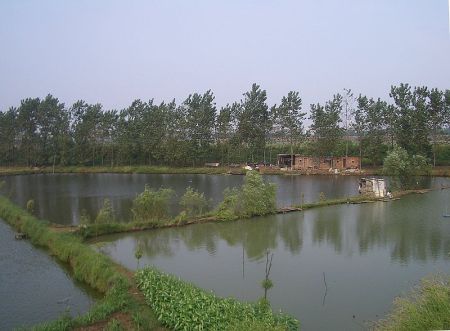
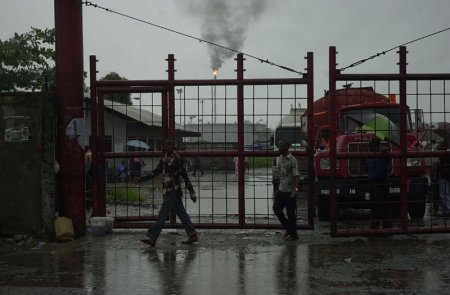
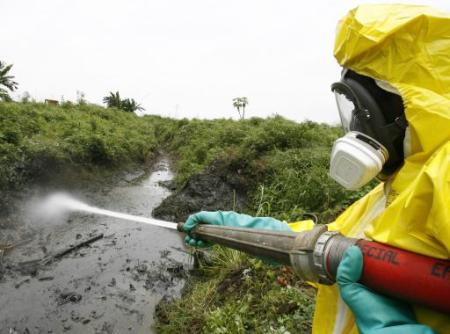
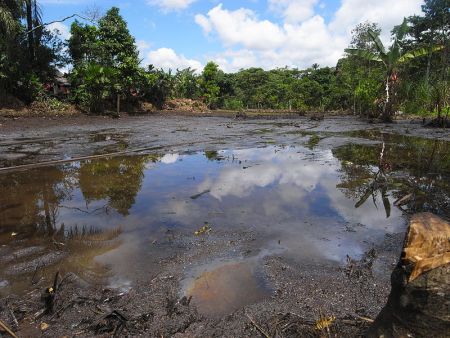
Farmers impacted by the Shell Petroleum Development Company, SPDC, Kolo Creek oil fields spill in Otuasega, Ogbia Local Government Area of Bayelsa State, have gone to court over the April 15, 2015 spill, which polluted their farms.According to the farmers, they were excluded from a Joint Investigation Visit to probe the impact of the spill despite their attempt to draw the attention of the team to their impacted farms.

A fish farmer, Mr. Aku Asei, whose three ponds were impacted, said the affected farmers numbering over 50 resolved to take legal action over the incident in the wake of the alleged claim of sabotage by Shell.”This is a clear case of the powerful and rich oil firm against the weak and poor farmers. They are claiming that the spill was caused by sabotage and abandoned the polluted environment. The regulations which they relied on to absolve themselves clearly stated that the operator of the field where pollution occurs must clean up the site irrespective of the cause but SPDC officials declined to capture the farms as impacted areas….[T]he spill was as a result of negligence by SPDC surveillance contractors deployed to guard the facility…

The farmers, made up of fish farmers, banana and plantain plantation owners in the area also appealed to Bayelsa State Government to assist them in prevailing on the oil firm to clean up the areas and pay compensation to them.

Nigeria: Farmers Take Shell to Court Over Oil Spill Impact in Bayelsa, AllAfrica.com, May 12, 2015

Corruption Begets Corruption: Nigeria Oil

Dead fish wash up on the once-fertile shores of creeks around Bodo, a town in the Niger delta, that are covered with crude oil more than six years after two massive spills. Locals have only now received compensation from Shell, the oil firm responsible for the leaks. For the first time in half a decade, fishermen have cash to start businesses, repair their houses and send children to school… “Look,” says the chief of a tiny town called B-Dere, just a few miles from Bodo. He gestures to the deathly-black banks still bearing the marks of the slicks. “There is nothing to drink, nowhere to fish. What good has come from it?”

The cash that the oil industry provides has greased Nigerian politics for decades. Gross mismanagement and corruption in the industry are the causes of much of the inequality and discontent with the ruling party in an economy that is not just Africa’s largest but that ought to also be one of its wealthiest…

Nigeria pumps something like 2m barrels of oil a day. These account for most of its exports and about 70% of government revenues. But official figures are as murky as its polluted creeks. Volumes are recorded only at export terminals rather than at the wellhead, says Celestine AkpoBari of the Port Harcourt-based advocacy group, Social Action. Were a proper tally kept, he says, corruption would be exposed on a scale that would shock even the most cynical Nigerian.

It seems likely that more than 100,000 barrels of crude are stolen (or “bunkered” in the local parlance) every day, at a cost to the state and investors of billions of dollars a year. Politicians, oil workers and security forces are said to be behind the complex cartels that steal, illegally refine and sell crude oil. They have amassed almost unimaginable wealth in a country where poverty is still rife.

Oil’s taint has seeped into almost all levels of government and business. Yet the central problem is found in the petroleum ministry, which wields vast unaccountable power. The Nigerian National Petroleum Corporation (NNPC), a state-owned behemoth, is responsible for all aspects of the industry, from exploration to production and regulation. It is among the most secretive oil groups in the world, and is “accountable to no one”, says Inemo Samiama, country head of the Stakeholder Democracy Network, a non-profit group.

In 2013 the former governor of the central bank, Lamido Sanusi, alleged that $20 billion in oil revenues was missing from state coffers. He was fired for his troubles soon after. …

Even where cash has not been nicked, it has often been squandered. Take the Excess Crude Account (ECA), a sovereign-wealth fund intended to cushion Nigeria’s budget against falling oil prices. Most of it was spent over the past two years, despite oil prices being relatively high for most of that period.

The industry itself is in as sorry a state as the government’s finances. Although oil practically gushes from the ground in parts of the delta, oil output has been stagnant for years and billions of dollars of investment are stalled because of uncertainty over a new law for the industry.  This is holding back Nigeria’s economy almost across the board. Because the industry has failed to build the infrastructure to pipe gas to domestic consumers such as power plants, much of it is simply flared and burned: Britain reckons that some $800m worth of Nigeria’s gas a year goes up in smoke. The country is also chronically short of fuel even though it has four state-owned oil refineries. Because of poor maintenance and ageing equipment they operate at well below capacity, forcing Nigeria to import about 70% of the fuel it needs. There is little incentive for reform since the government pays hefty subsidies to NNPC to keep on importing…

But a starting point should be to halt subsidies for fuel imports. At a stroke that would undercut a major source of corruption and crime (both on land and at sea) that spills into neighbouring countries, the destination for smuggled consignments of cheap Nigerian fuel. It should also take a close look at NNPC, which should not be allowed both to participate in the market and regulate it. Some of its assets could be privatised. The ruling party and opposition are considering both….

For communities in Ogoniland, the most pressing problem is cleaning up. Shell has promised to mop up the mess around Bodo, though the process has yet to start. Compensation is one thing, Bodo residents say, but what they really want is their livelihood back.

Nigeria’s oil: Crude politics, Economist,  Mar. 28, 2015, at 54

Green Dams that Kill

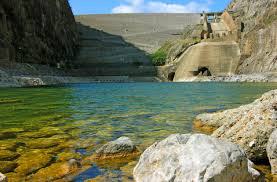
A planned mega-dam in Guatemala, whose carbon credits will be tradable under the EU’s emissions trading system, has been linked to grave human rights abuses, including the killing of six indigenous people, two of them children.  Several European development banks and the World Bank’s International Finance Corporation (IFC) have provided funds for the $250m (£170m) Santa Rita dam.

But human rights groups back claims from the Mayan community that they were never consulted about the hydro project, which will forcibly displace thousands of people to generate 25MW of energy, mostly for export to neighbouring countries.  The issue has become a focus of indigenous protest in Guatemala – which has led to a march on the capital and severe political repression.

“At the moment our community is living under the same conditions as they did during the war,” Maximo Ba Tiul, a spokesman for the Peoples’ Council of Tezulutlán told the Guardian. “Our civilian population is once again being terrorised by armed thugs.”  Around 200,000 Mayans died or were “disappeared” during the civil war of the early 1980s, leading to the conviction of the country’s former president, Efraín Ríos Montt, in 2013 on genocide charges.

Augusto Sandino Ponce, the son of a local landowner who community leaders allege worked as a contractor to Montt’s junta during the civil war, is at the centre of new accusations of human rights violations. Last April Ponce and his bodyguards allegedly opened fire on a Mayan community ceremony in which families asked the Earth for permission to plant their crops. One local man, Victor Juc, was killed and several were injured. Ponce reportedly claims he was acting in self defence…

In a letter to the United Nations Framework Convention on Climate Change’s (UNFCCC) clean development mechanism (CDM) executive board,  the People’s Council of Tezulutlán outlined a litany of human rights abuses in the region, including kidnappings, evictions, house burnings, attacks by men wielding machetes and guns, and the arrest of community leaders.  The council also says that an environmental impact assessment for the dam suggests that it would create a 40ft-high wall, flooding local communities and depriving them of access to water, food, transport and recreation.  In approving projects, the CDM board pursues a narrow remit focused on emissions reductions. The reign of terror in the Alta Verapaz region, falls outside it – as did similar events in Honduras….

Perhaps the most shocking incident took place on 23 August 2013, when two children were killed by an allegedly drunken Santa Rita hydroelectricity company worker looking for David Chen, a community leader in the Monte Olivo region.   Chen was meeting with the rapporteur of the Inter American Commission on Human Rights at the time. When the worker could not find him, he is said to have lined up two of Chen’s nephews, David Stuart Pacay Maaz, 11 and Haggai Isaac Guitz Maaz, 13, and killed them with a single bullet to one child’s head that continued through the throat of the other. The killer has since been killed himself.  The annual report of the UN’s High Commissioner for Human Rights implicitly blamed the approval of the dam project for the killings….

Eva Filzmoser, the director of Carbon Market Watch said: “We want the CDM board to take responsibility and establish a grievance and redress mechanism for local communities to appeal, ask for problematic decisions to be rescinded and gain redress. We will be pushing for this at the Paris climate summit to apply to all forms of climate finance in the future.”Efforts to reform the CDM were boosted last month, when 18 countries signed a “Geneva declaration” calling for human rights norms to be integrated into UNFCCC climate decisions….Signatory countries to the declaration include France, Sweden, Ireland, Mexico, Uruguay and Peru.

Excerpts Green’ dam linked to killings of six indigenous people in Guatemala, Guardian, Mar. 26, 2015

Land for Nuclear Waste – Fukushima

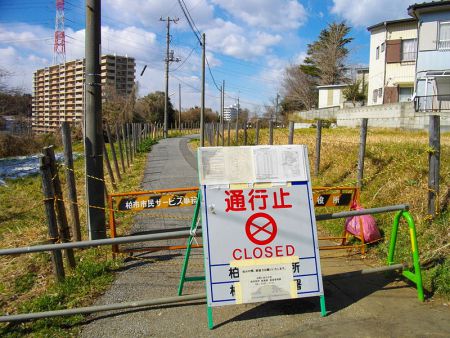
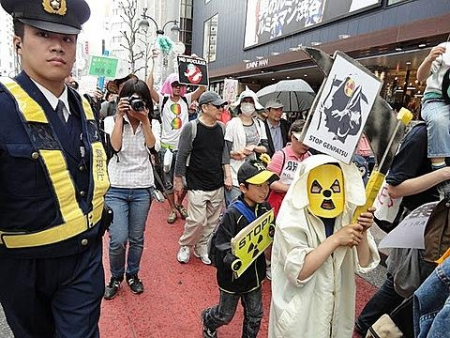
The March 11, 2011 earthquake and subsequent tsunami tore through coastal towns in northern Japan and set off meltdowns at Tokyo Electric Power’s Fukushima Daiichi plant, which sits partly in Okuma.  Japan has since allocated more than $15 billion to an unprecedented project to lower radiation in towns around the plant, such as Okuma. Every day across Fukushima prefecture, teams of workers blast roads with water, scrub down houses, cut branches and scrape contaminated soil off farmland.  That irradiated trash now sits in blue and black plastic sacks across Fukushima, piled up in abandoned rice paddies, parking lots and even residents’ backyards.  Japan plans to build a more permanent storage facility over the coming years in Okuma and Futaba, another now-abandoned town close to the Fukushima nuclear plant – over the opposition of some local residents.

“This land has our blood and sweat running through it and I can’t just let go of it like that,” said Koji Monma, 60, an Okuma resident who heads a local landowners’ group.  Fukushima’s governor agreed to take the waste facility after Tokyo said it would provide $2.5 billion in subsidies, and promised to take the waste out of the prefecture after 30 years. Mayors of Futaba and Okuma have since agreed to host the 16 square km (6.2 square mile) facility – about five times the size of New York’s Central Park – which will wrap around the Fukushima plant and house multiple incinerators.

Some 2,300 residents who own plots of land in Futaba and Okuma which the government needs for the waste plant face what many describe as an impossible choice...Distrust of government promises runs deep among residents here. …

The ministry has hired around 140 real estate representatives to negotiate land sales with individual owners.

Excerpts from BY MARI SAITO, Fukushima residents torn over nuclear waste storage plan, Reuters, Mar. 9, 2014

Oil Pollution in Amazon Peru

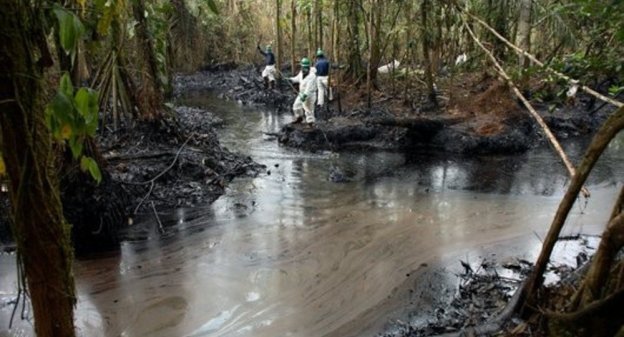
Hundreds of indigenous people deep in the Peruvian Amazon are blocking a major Amazon tributary following what they say is the government’s failure to address a social and environmental crisis stemming from oil operations.   Kichwa men, women and children from numerous communities have been protesting along the River Tigre for almost a month, barring the river with cables and stopping oil company boats from passing.  Oil companies have operated in the region for over 40 years, and have been linked by local people to pollution that has led the government to declare “environmental emergencies” in the Tigre and other river basins….

The oil concession where the protest is taking place, Lot 1-AB, is Peru’s most productive, but the contract, held by Pluspetrol, expires in August 2015. The government has committed to relicensing it and consulting the indigenous communities involved, but leaders say the contamination and other issues must be addressed first.   “What we want is remediation, compensation, and to be consulted, according to international norms, about the relicensing,” says Fachin. “We won’t permit another 30 years of work otherwise.”…The Kichwas are now they are demanding 100 million Peruvian nuevo soles, from Pluspetrol, for “compensation after almost 45 years of contamination.”

“The state declared an environmental emergency, but hasn’t done anything,” says Guillermo Sandi Tuituy, from indigenous federation Feconat. “It must find a solution to this problem if it wants to relicense the concession.”...Pluspetrol took over Lot 1-AB from Occidental in 2000. It did not respond to requests for comment.

Peru’s indigenous people protest against relicensing of oil concession, Guardian,  Feb, 2, 2012

Only One Protester was Killed: Kenya

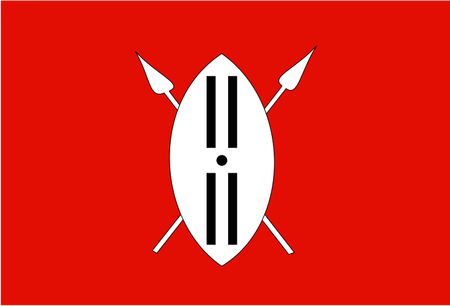
One person was killed and several injured in January 26, 2015 when Kenyan police clashed with Maasais protesting against a local governor they accuse of misappropriating tourism funds from the Maasai Mara game reserve, an official said.  Police fired shots and teargas as thousands of people from the Maasai ethnic group, clad in traditional red cloaks, marched to the governor’s office in Narok town, the administrative centre of the sprawling Maasai Mara park, witnesses said.

Narok County Commissioner Kassim Farah, an official appointed by the president, said: “Only one protestor was killed by a bullet.  “We regret it but the organisers of the demonstration should be held responsible, not the police.” Kenya Red Cross said seven people injured in the clashes were taken to a nearby hospital.

Demonstrators marched to the gates of Governor Samuel Tunai’s office, shouting: “Tunai must go.” Some hurled rocks. The dispute began when Tunai’s administration contracted a company to collect Maasai Mara park entry fees, a deal the locals say was suspect.

Visitors to the Maasai Mara, one of Africa’s biggest tourist draws, pay $80 per day to roam an area full of wildlife such as lions, rhinos and giraffes. Upmarket lodges and luxury tented camps can charge hundreds of dollars per person per day for the experience, although a spate of militant attacks in Kenya as well as the Ebola epidemic on the other side of Africa have scared off many tourists….

Local government finance has come under increased scrutiny from Kenyans since a newly devolved system was introduced in 2013 under which local governments receive about 43 percent of the national budget directly and are responsible for raising their own additional revenues.  Devolution was designed to spread wealth and help local communities benefit from revenue earned in their areas but analysts say corruption and other issues that have blighted national politics have now also spread to local bodies

Corruption protest in Kenya’s Maasai Mara region turns deadly, Reuters, Jan. 27, 2015

UK Nuclear Tests in Australia: Maralinga

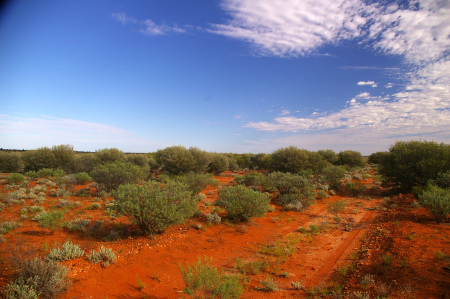
In the mid-1950s, seven bombs were tested at Maralinga in the south-west Australian outback. The combined force of the weapons doubled that of the bomb dropped on the Japanese city of Hiroshima in World War Two.  In archive video footage, British and Australian soldiers can be seen looking on, wearing short sleeves and shorts and doing little to protect themselves other than turning their backs and covering their eyes with their hands.Some reported the flashes of the blasts being so bright that they could see the bones of their fingers, like x-rays as they pressed against their faces.

A cloud hangs over Australia’s Monte Bello Islands after Britain tested its first atomic bomb
Much has been written about the health problems suffered by the servicemen as a result of radiation poisoning. Far less well-documented is the plight of the Aboriginal people who were living close to Maralinga at the time….”A lot of people got sick and died,” said Mima Smart, an aboriginal community leader.”It was like a cancer on them. People were having lung disease, liver problems, and kidney problems. A lot of them died,” she said, adding that communities around Maralinga have been paid little by way of compensation.  It’s a ten hour drive to the nearest big city, Adelaide. But people here say that the Australian government was wrong to let the tests go ahead and that Britain acted irresponsibly…

“They didn’t want to do it in their own back yard because their back yard wasn’t big enough,” said Robin Matthews, caretaker of the Maralinga Nuclear Test Site.”They thought they’d pick a supposedly uninhabited spot out in the Australian desert. Only they got it wrong. There were people here.”During the 1960s and 70s, there were several large clean-up operations to try and decontaminate the site.  All the test buildings and equipment were destroyed and buried. Large areas of the surface around the blast sites was also scraped up and buried.

But Mr Matthews said the clean-up, as well as the tests themselves, were done very much behind closed doors with a high level of secrecy.“You’ve got to remember that this was during the height of the Cold War. The British were terrified that Russian spies might try and access the site,” he said.  The indigenous communities say many locals involved in the clean-up operation also got sick.  Soil at the nuclear site grow so hot from the blast that it melted and turned to silicon has long been declared safe. There are even plans to open up the site to tourism.

But it was only a few months ago that the last of the land was finally handed back to the Aboriginal people. Most, though, say they have no desire to return there….And even almost 60 years on, the land still hasn’t recovered. Huge concrete plinths mark the spots where each of the bombs was detonate

Excerpt from Jon Donnison, Lingering impact of British nuclear tests in the Australian outback, BBC, Dec. 31, 2014

Exploiting Himalaya Rivers

Himalayan rivers, fed by glacial meltwater and monsoon rain, offer an immense resource. They could spin turbines to light up swathes of energy-starved South Asia. Exports of electricity and power for Nepal’s own homes and factories could invigorate the dirt-poor economy. National income per person in Nepal was just $692 last year, below half the level for South Asia as a whole.

Walk uphill for a few hours with staff from GMR, an Indian firm that builds and runs hydropower stations, and the river’s potential becomes clear. An engineer points to grey gneiss and impossibly steep cliffs, describing plans for an 11.2km (7-mile) tunnel, 6 metres wide, to be blasted through the mountain. The river will flow through it, before tumbling 627 metres down a steel-lined pipe. The resulting jet—210 cubic metres of water each second—will run turbines that at their peak will generate 600MW of electricity.  The project would take five years and cost $1.2 billion. It could run for over a century—and produce nearly as much as all Nepal’s installed hydropower.

Trek on and more hydro plants, micro to mighty, appear on the Marsyangdi. Downstream, China’s Sinohydro is building a 50MW plant; blasting its own 5km-long tunnel to channel water to drive it. Nearby is a new German-built one. Upstream, rival Indian firms plan more. They expect to share a transmission line to ill-lit cities in India.

GMR officials in Delhi are most excited by another river, the Upper Karnali in west Nepal, which is due to get a 900MW plant. In September the firm and Nepal’s government agreed to build it for $1.4 billion, the biggest private investment Nepal has seen.

Relations between India and Nepal are improving. Narendra Modi helped in August as the first Indian prime minister in 17 years to bother with a bilateral visit. Urged by him, the countries also agreed in September to regulate power-trade over the border, which is crucial if commercial and other lenders are to fund a hydropower boom…. Another big Indian hydro firm agreed with Nepal’s government, on November 25th, to build a 900MW hydro scheme, in east Nepal, known as Arun 3. Research done for Britain’s Department for International Development suggests four big hydro projects could earn Nepal a total of $17 billion in the next 30 years—not bad considering its GDP last year was a mere $19 billion.

All Nepal’s rivers, if tapped, could feasibly produce about 40GW of clean energy—a sixth of India’s total installed capacity today. Add the rivers of Pakistan, Bhutan and north India and the total trebles.  Bhutan has made progress: 3GW of hydro plants are to be built to produce electricity exports. The three already generating produce 1GW out of a total of 1.5GW from hydro. These rely on Indian loans, expertise and labour….

A second reason, says Raghuveer Sharma of the International Finance Corporation (part of the World Bank), was radical change that opened India’s domestic power market a decade ago. Big private firms now generate and trade electricity there and look abroad for projects. India’s government also presses for energy connections over borders, partly for the sake of diplomacy. There has even been talk of exporting 1GW to Lahore, in Pakistan—but fraught relations between the two countries make that a distant dream.

An official in India’s power ministry says South Asia will have to triple its energy production over the next 20 years. Integrating power grids and letting firms trade electricity internationally would be a big help. It would expand market opportunities and allow more varied use of energy sources to help meet differing peak demand. Nepal could export to India in summer, for example, to run fans and air conditioners. India would export energy back uphill in winter when Nepali rivers dry and turbines stop spinning.

Governments that learn to handle energy investments by the billion might manage to attract other industries, too. Nepal’s abundant limestone, for example, would tempt cement producers once power supplies are sufficient. In the mountains, it is not only treks that are rewarding.

South Asia’s Hydro-Politics: Water in them hills, Economist, Nov. 29, 2014, at 38

States Captured by their Energy Companies – Canada

Few governments have aligned their interests so closely to those of their country’s energy and mining firms as Canada’s Conservative administration. The prime minister, Stephen Harper, has boasted of Canada as an “emerging energy superpower”. Under the banner of “responsible resource development”, his government has done its best to ease the way for minerals firms, at home and abroad, including directing some foreign aid to countries where Canadian firms wanted to drill. Ministers point with pride to the C$174 billion ($169 billion) in export revenues from sales of minerals, oil and gas in 2013 and to the fact that Canada is home to more than half of the world’s publicly listed exploration and mining companies.

But the downside of seeming so cosy with extractive firms is that whenever one of them gets in trouble—an inevitable occurrence with 1,500 firms active in more than 100 countries—the country’s image is tarnished too. So the government has recently begun to reduce that vulnerability by taking a stricter line on corporate social responsibility (CSR) and bribery by Canadian firms operating abroad. Protecting the national brand is “a huge part of it,” says Andrew Bauer of the Natural Resource Governance Institute, a group that monitors the industry and lobbies for openness.

Ed Fast, the international trade minister, admitted as much on November 14th, as he introduced new rules that require Canadian resources firms involved in disputes with local communities to take part in a resolution process. If any firms refuse, the government will withdraw its economic diplomacy on their behalf…[In the meantime there are ] protests against Canadian firms’ projects, from Romania where environmentalists are objecting to plans for an opencast gold mine, to Guatemala, where guards at a nickel mine have been accused of gang rape…

A new Canadian law  was introduced in October 2014 to curb bribery by mining and energy firms by demanding more transparency from them. The law, which still must be fleshed out in detailed regulations, requires them to disclose all payments made to domestic and foreign governments…It helped that the law was backed by an unusual coalition of non-government organisations and mining companies themselves. T  It seems that the miners’ experience in dealing with local communities is making them more sensitive to their concerns about corruption and other ills. In contrast, the oil and gas firms are lobbying for the transparency law to be weakened. They want to be given exemptions in countries whose local laws conveniently prohibit the disclosure of such payments. They also want to avoid having to give a project-by-project breakdown of their payments, without which the information would be of little use.

Excerpt Canada’s natural-resources companies: Reputation management, Economist, Nov. 22, 2014

Deforestation: mixed picture

In a new study of the Centre for Global Development (CGD), a Washington think-tank, Jonah Busch and Kalifi Ferretti-Gallon look at 117 cases of deforestation round the world. They find that two of the influences most closely correlated with the loss of forests are population and proximity to cities (the third is proximity to roads). Dramatic falls in fertility in Brazil, China and other well-forested nations therefore help explain why (after a lag) deforestation is slowing, too. Demography even helps account for what is happening in Congo, where fertility is high. Its people are flocking to cities, notably Kinshasa, with the result that the population in more distant, forested areas is thinning out.

Two of the countries that have done most to slow forest decline also have impressive agricultural records: Brazil, which became the biggest food exporter of all tropical countries over the past 20 years; and India, home of the green revolution. Brazil’s agricultural boom took place in the cerrado, the savannah-like region south and east of the Amazon (there is farming in the Amazon, too, but little by comparison). The green revolution took place mostly in India’s north-west and south, whereas its biggest forests are in the east and north.

But if population and agricultural prowess were the whole story, Indonesia, where fertility has fallen and farm output risen, would not be one of the worst failures. Figures published inNature Climate Change in June show that in the past decade it destroyed around 60,000 sq km of primary forests; its deforestation rate overtook Brazil’s in 2011. Policies matter, too—and the political will to implement them.

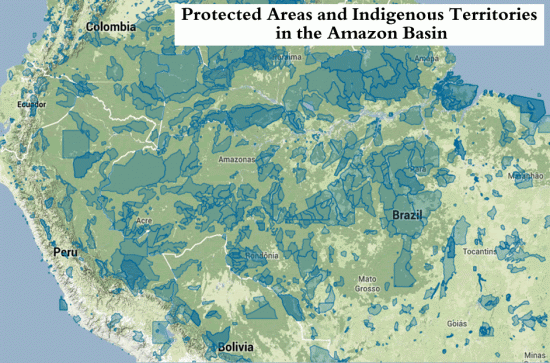
The central problem facing policymakers is that trees are usually worth more dead than alive; that is, land is worth more as pasture or cropland than as virgin forest. The benefits from forests, such as capturing carbon emissions, cleaning up water supplies and embodying biodiversity, are hard to price….The most successful policies therefore tend to be top-down bans, rather than incentives (though these have been tried, too). India’s national forest policy of 1988 explicitly rejects the idea of trying to make money from stewardship. “The derivation of direct economic benefit”, it says, “must be subordinated to this principal aim” (maintaining the health of the forest). In Brazil 44% of the Amazon is now national park, wildlife reserve or indigenous reserve, where farming is banned; much of that area was added recently. In Costa Rica half the forests are similarly protected. In India a third are managed jointly by local groups and state governments.

Top-down bans require more than just writing a law. Brazil’s regime developed over 15 years and involved tightening up its code on economic activity in forested areas, moratoriums on sales of food grown on cleared land, a new land registry, withholding government-subsidised credit from areas with the worst deforestation and strengthening law enforcement through the public prosecutor’s office. (The most draconian restriction, requiring 80% of any farm in the Amazon to be set aside as a wildlife reserve, is rarely enforced.)

Two developments make bans easier to impose. Cheaper, more detailed satellite imagery shows in real time where the violations are and who may be responsible. Brazil put the data from its system online, enabling green activists to help police the frontier between forest and farmland. Its moratoriums on soyabeans and beef from the Amazon, which require tracing where food is coming from, would not have worked without satellites…

The Forestry Ministry of Indonesia, [on the other hand] is rated the most corrupt among 20 government institutions by Indonesia’s Corruption Eradication Commission in 2012. Some within government are hostile to anti-deforestation schemes, which they see as “foreign”, says Ade Wahyudi of Katadata, an Indonesian firm of analysts. Perhaps the biggest problem is the lack of a single, unified map including all information on land tenure and forest licensing: efforts to create one have been slowed by unco-operative government ministries and difficulties created by overlapping land claims.

Excerpts from Tropical Forests: A Clearing in the Trees, Economist,  Aug. 23, 2014, at 56

Columbia River: Salmon Restoration

When Dwight Eisenhower, then president of the United States, and John Diefenbaker, his Canadian counterpart, signed a treaty in 1961 to jointly control the unruly Columbia river, they hailed their collaboration as a model for the rest of the world. Fifty years after the treaty was implemented, in 1964, cracks are appearing.

The treaty involved a series of new dams and an agreement to share the power generated as a result. It has worked well. There has been no repeat of the catastrophic flood that wiped out the second-largest city in Oregon in 1948. The United States dutifully hands over Canada’s share of the hydropower generated, worth an average of C$215m ($170m) a year between 1998 and 2013. But the Americans in particular are keen to make changes. Nigel Bankes of the University of Calgary says there is “zero chance” that the disagreements between the two countries can be resolved before September 16th, 2014—after which date either country can give ten years’ notice that it wishes to terminate the agreement.

Money is one of two main differences. In return for building three dams—Duncan, Hugh Keenleyside and Mica —on its side of the border, Canada received an upfront payment from the United States and a guaranteed share of the extra power that could be generated downstream as a result of more dependable water flows. The Americans think Canada has been more than reimbursed for the costs of dam construction, and want to whittle away the annual energy payment known as the Canadian Entitlement. In an open letter to Barack Obama in April, 26 senators and congressmen from the Pacific north-west said a reduction should be part of a renegotiated deal.

Not so fast, say the Canadians. They point out that people were displaced and fertile land flooded to create the dams. That represents a continuing loss. There are also benefits not captured in the treaty, says Bill Bennett, the minister of energy and mines for British Columbia (BC), which implements the treaty for Canada. More dependable water flows lead to improved navigation and irrigation south of the border; BC also co-operates when the United States asks it to spill water over its dams to help meet obligations under endangered-fish-species legislation.

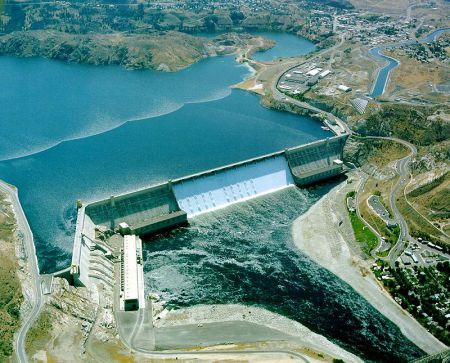
In fact, fish are the other slippery issue.The restoration of salmon migration on the upper reaches of the Columbia river is being pushed by First Nations (native Indian) tribes on both sides of the border. The United States wants salmon on the negotiating table, but the Canadians do not. None of the treaty dams was built with fish ladders and they would be costly to construct today. “Salmon migration in the Columbia river ended 26 years before the treaty was ever ratified,” says Mr Bennett. “It was eliminated by the Grand Coulee dam in 1938, and our position is that’s an important issue but it’s not part of the Columbia River Treaty discussion.”

Excerpt, The Columbia River Treaty: Salmon en route, Economist, June 7. 2014, at 42

Palau Fights Big Fishing Countries

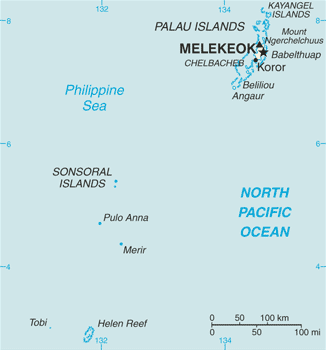
The traditional prescription for an ailing reef is a fishing ban called a bul. Local chiefs may declare a bul to rest a busy fishing spot or protect endangered sea turtles. Now Palau’s president has a more drastic plan. He proposes a complete ban on commercial fishing—a bul to turn the 600,000 square kilometres (232,000 square miles) of Palau’s Exclusive Economic Zone (EEZ) into a marine reserve the size of Ukraine. Locals could still fish close to shore, but not for export. The ban would last until world leaders implement programmes “to reverse the devastation to our oceans and seas”, Palau’s president, Tommy Remengesau, recently told the United Nations. Environmentalists have rallied to his cause. Such reserves are usually declared by countries with fishing grounds and cash to spare. Palau has a population of 20,000 and a GDP of $246m. I

A total ban might hurt Palau, which is part of Micronesia, 800km (500 miles) east of the Philippines. Though small, its waters are full of bigeye and yellowfin tuna. Japanese and Taiwanese boats pay to fish there, helping Palau earn $5m in revenue from fishing taxes and licensing fees in 2013. That is a lot for a microstate with an annual government budget of only $70m. And fishing revenues have been growing thanks to a regional negotiating block. Together, eight remote Pacific states control 14m square km of tuna-rich waters. They have forced Asian and American ships into a cap-and-trade scheme that boosts access fees by limiting total fishing days. In an age of collapsing fish stocks, the relative health of fisheries in the western Pacific has given island states a rare measure of economic influence. Palau’s bet, however, is that its fish are worth more in the water than out. Mr Remengesau doubts that small islands will ever capture more than “a drop” of a tuna fishery worth billions but dominated by foreign fleets. Ecotourism, meanwhile, accounts for about half of Palau’s GDP. Palau’s leaders hope that a national marine reserve will lure enough tourists to offset lost fishing revenue….

Palau has only one boat capable of patrolling its EEZ. Many tuna bandits escape detection. Technology could help: last year the country tested surveillance drones. The problem is money. Japan and America have helped fund enforcement. Both have an interest because of their fishing deals with Palau. But they may not want to fund a system that locks them out of its waters altogether,

Marine protection in the Pacific: No bul, Economist, June 7,  2014, at 46

Peru Pipelines and Indigenous Peoples

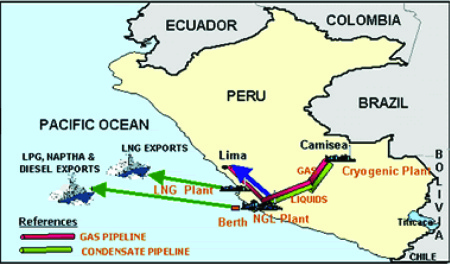
Peru’s government said in June 2014 that three companies have qualified to submit bids for a contract to build and operate a multi-billion dollar gas pipeline project in the country’s southern region, the state news agency Andina reported.  State investment promotion agency ProInversion said that two of the contenders for the Southern Peru Gas Pipeline concession are consortia.

The consortium Gasoducto Sur Peruano is made up of Brazilian construction giant Odebrecht and the firm Enegas. The consortium Gasoducto Peruano del Sur is made up of France’s GDF Suez, as well as the firms Sempra, Techint and TGI. The third contender is Energy Transfer.  The technical proposals are expected to be submitted on June 26, 2014 and the concession is scheduled to be awarded on June 30, 2014. The bid consists in the design, financing, construction and maintenance of a 32″ pipeline, in three sections.

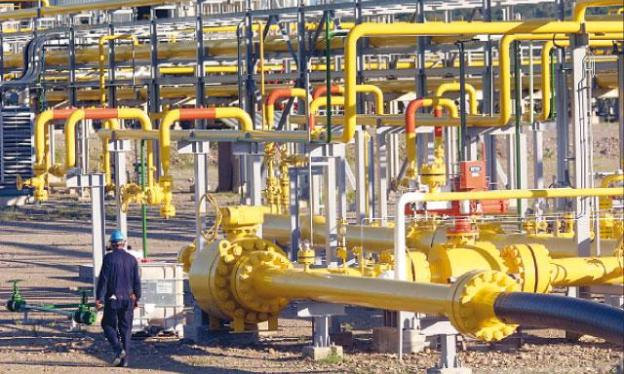
The Southern Peru Gas Pipeline will extend some 1,000 kilometers, transporting natural gas from the Camisea fields in Peru’s south-eastern Amazon region to the Peruvian coast. The project is expected to require an investment of some $4 billion.  The government says the pipeline is to provide inexpensive gas to southern Peru, helping to spur development in one of the country’s poorer regions.  [However NGOS have argued that the project will harm indigenous peoples living in the region].

According to the UN Special Rapporteur on the rights of indigenous peoples,, James Anaya (see Remarks on the extension of exploration and extraction of natural gas  in Block 88 of the Camisea project, March 24, 2014)

“[S]everal national and international NGOs have claimed a number of environmental and health problems in relation to the expansion plan of the project, in some cases stating that any activity of extractive industry within the reserve is simply incompatible with its protection goals. The Special Rapporteur has found that in many cases these claims are speculative and vague, and without relation to the information contained in the EIA of the company or the findings of government.”

But the rapporteur stated also that:

“Assessing the impacts that mining activity could have on indigenous peoples within the reserve and to establish effective safeguards, it is necessary to have adequate knowledge beforehand, to the extent possible, these peoples and their dynamics, in observance the principle of non-contact remote villages. However, while there is relatively extensive information on indigenous reserves within the sustained or sporadic contact with settlements, the available information on indigenous peoples in isolation is outdated and incompleteThis information gap has generated divergent opinions and a lack of trust in relation to the protective measures that the Government has demanded that Pluspetrol is committed to implement in the context of extractive activities in the reserve.

Excerpts, Three Contenders for Peru’s Southern Gas Pipeline,  Peruvian Times, June 6, 2014 and the Remarks on the extension of exploration and extraction of natural gas in Block 88 of the Camisea project, March 24, 2014

Battle Against Nuclear Waste in Australia

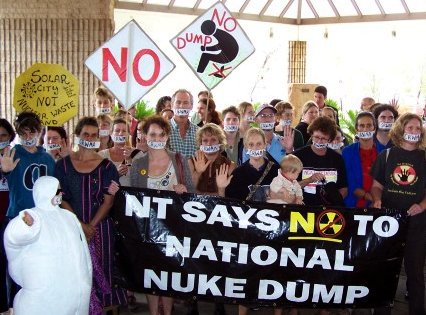
Muckaty Station in the Northern Territory [Australia] was nominated in early 2007 as a site to store low and intermediate radioactive waste under a deal negotiated with the Aboriginal Ngapa clan.

While Australia does not use nuclear power, it needs a site to store waste, including processed fuel rods from the country’s only nuclear reactor at Lucas Heights, on the outskirts of Sydney,…..Opponents have fought against the dump for years, with a trial starting in the Federal Court in Melbourn in June 2014 alleging Muckaty’s nomination was invalid due to a failure of the government and the land council to obtain the consent of all Aboriginal owners.  “What we’re here to say is ‘no more’ and that this process was so legally flawed that it is invalid,” Ron Merkel, who is representing traditional owners, told the court.  “The opposition is in no small part based on a spiritual affiliation to the land and that radioactive waste will poison the land,” he said in comments cited by Australian Associated Press

In Australian Federal Court, Aborigines continue the fight against radioactive waste dumping on their land, Agence France Presse, June 3, 2014

Cheap Wild Meat: Nigeria

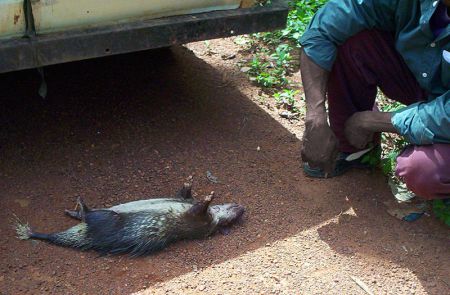
Just as the bush meat delicacy is gaining acceptance in all parts of the country [Nigeria] and fast becoming a source of living for many Nigerians, infrastructural development, including roads construction, have also contributed greatly in threatening plant species with most plants going into extinction.  It is a common site when travelling across the country to see hunters, women and children displaying bush meat on the highway for sale.

The bush meat business, according to Mrs Janet Efe, a bush meat merchant a long Okpela-Benin road, has come to stay. “There is no job for our husbands and children and rather than going into robbery and other dubious trades it is better they hunt in the forest where the animals roam about.”  She said that so long as human beings exist, animals will always be available for people to eat.

Bush meat is a recognised trade at rural and urban centres. Wild animals’ meat is the main source of cheap protein for the majority of rural communities in Nigeria. Over 80 per cent of the population are rural dwellers who depend on bush meat, compared with urban dwellers that depend on abattoir supplies of cow and other ruminant meat…

According to the Food and Agriculture Organization (FAO), the present level of information on the status of non-fish aquatic animal resources in Nigeria is still scanty and limited to a few inventories of wild stocks in the National Parks. A holistic approach to their management and conservation is required and recognition that the conservation of aquatic animals, including fish, is important because of their genetic resources, biological, and food values and the socio-economic implications of their extinction.

Excerpts from ALEX ABUTU, Nigeria: Biodiversity – Nigeria’s Wasting Goldmine, AllAfrica, May 21, 2014

Amazon Protected Areas: 215 Million Fund

Brazil’s government, the World Wildlife Fund and various partners are expected to unveil an agreement that would establish a $215 million fund for conservation of protected jungle in the Amazon rainforest.  The fund, which seeks to ensure conservation of over 90 protected areas in the Amazon, comes as renewed developmental pressures mount in the region, resulting last year in an uptick in deforestation figures after years of record lows.

Under the terms of the agreement, partners in the fund will make annual contributions to help Brazil meet financing needs for the protected lands, whose combined area totals more than 60 million hectares, or an area 20 percent larger than Spain.  Contributions, partners said, will be contingent upon conditions required of Brazil, including audits of the government body that will administer the fund and continued staffing and financing of government offices required to administer the rainforest areas.

Money from the fund would be used for a range of basic conservation measures, including fences and signs to delineate protected areas and to pay for vehicles used to patrol them…

Brazil’s government through 2012 made large inroads against deforestation, largely through strict environmental enforcement and financial measures that blocked credit for companies and individuals caught doing business with loggers, ranchers, farmers or others known to exploit illegally cleared land.

In recent years, however, the government has made changes to environmental agencies and regulations that critics say make it easier for would-be developers to target protected areas. The government has also altered borders of some parkland to make way for infrastructure projects, including hydroelectric dams on various Amazon tributaries.

Financing for the new fund, expected to pay out over 25 years, was secured from private and public sources including the German government, the Inter-American Development Bank, the World Bank, philanthropists and the Amazon Fund, an existing facility financed mostly by the Norwegian government and administered by Brazil’s national development bank.

Together, the forest zones targeted by the fund are known as the Amazon Region Protected Areas, or ARPA, a program established in 2002 to coordinate financing and conservation strategy in the region.

Whereas previous financing for the effort relied on cumulative fundraising efforts, partners this time agreed to an all-or-nothing approach, borrowed from private-sector financing practices, to build momentum toward a target total. The $215 million is the amount calculated as necessary to help the Brazilian government, over the 25 years, become self-sufficient in terms of financing the rainforest areas.

Excerpts from  PAULO PRADA, Donors commit $215 million for Amazon conservation in Brazil, Reuters, May 21, 2014

Marine Protected Areas: PIPA, Kiribati

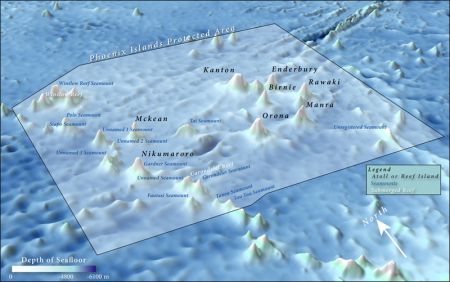
After years of claiming untruthfully that the world’s most fished marine protected area was “off limits to fishing and other extractive uses,” President Anote Tong of the Pacific island state of Kiribati and his cabinet have voted to close it to all commercial fishing by the end of the year.  The action, if implemented, would allow populations of tuna and other fish depleted by excessive fishing to return to natural levels in the Phoenix Islands Protected Area (PIPA), a patch of ocean the size of California studded with pristine, uninhabited atolls.

The move comes at a time global fish populations are steadily declining as increasingly efficient vessels are able to extract them wholesale from ever-more-remote and deep waters around the globe.  While no-take zones of comparative size exist in Hawaii, the Chagos Islands and the Coral Sea, none are as rich in marine life, making this potentially the most effective marine reserve in the world.,,,

In a speech still he gave at the Delhi Sustainable Development Summit two years ago still visible on Youtube, Tong mentions “the initiative of my country in closing off 400,000 square kilometres of our [waters] from commercial fishing activities,” calling it “our contribution to global ocean conservation efforts.”

In fact, when PIPA was created, only in the three percent of the reserve that’s around the islands, where virtually no fishing was going on, fishing was banned. In the rest of the reserve, the catch increased, reaching 50,000 tonnes in 2012 – an unheard-of amount in any protected area.

Christopher Pala, Kiribati Bans Fishing in Crucial Marine Sanctuary, IPS, May 15, 2014

The Fate of Nuclear Waste from Oil Drilling

Scotoil Services Ltd, a company which disposes of radioactive waste from the North Sea oil industry, inadvertently pumped dangerous particles into Aberdeen Harbour over several months.  The pollution included materials such as lead-210, radium-226 and radium-228, which both glow blue in the dark, and polonium-210, which was used to poison the former Russian spy, Alexander Litvinenko.  An investigation by the Scottish Environment Protection Agency (Sepa) found one “gross” breach and several “major” breaches of the firm’s operating conditions.

However, the public was never told about the leak, which continued unchecked from November 2011 until April 2012, and it also appears that the Scottish Government was not informed either.   While Scotoil had installed equipment to remove solid material from their liquid effluent, in April 2012, they informed Sepa that a final filter they were using had potentially failed Sepa said in a statement.

Scotoil has long been at the centre of concerns about radioactive particles washing up on the southern end of Aberdeen Beach, known as Foot Dee.  Drilling for oil and gas causes Naturally-Occurring Radioactive Material (NORM) to build up on offshore equipment – an estimated 50 to 100 tonnes each year from the North Sea alone.  For years, Scotoil and other operators could allow small particles of NORM to be discharged into the sea with the water they used to clean the drills and other pieces of essential kit.

However, tighter restrictions brought in from October 2011 mean that all particles must now be screened out and sent to secure landfill sites in sealed drums, along with the bulk of the solid waste.  Following a Freedom of Information request by this newspaper, it emerged that Sepa became aware of the potential Scotoil leak in April, 2012.  The company contacted Sepa to report “that particles of NORM have been discharged in their liquid effluent to the marine environment… Scotoil’s view is that the filters failed allowing the solid material into the environment”.

Excerpt  from, Ben Borland, Scots kept in the dark over radiation leak into harbour at Aberdeen, Scottish Express, Apr. 26, 2014

Governing the Oceans Dysfunction

About 3 billion people live within 100 miles (160km) of the sea, a number that could double in the next decade as humans flock to coastal cities like gulls. The oceans produce $3 trillion of goods and services each year and untold value for the Earth’s ecology. Life could not exist without these vast water reserves—and, if anything, they are becoming even more important to humans than before.

Mining is about to begin under the seabed in the high seas—the regions outside the exclusive economic zones administered by coastal and island nations, which stretch 200 nautical miles (370km) offshore. Nineteen exploratory licences have been issued. New summer shipping lanes are opening across the Arctic Ocean. The genetic resources of marine life promise a pharmaceutical bonanza: the number of patents has been rising at 12% a year. One study found that genetic material from the seas is a hundred times more likely to have anti-cancer properties than that from terrestrial life.

But these developments are minor compared with vaster forces reshaping the Earth, both on land and at sea. It has long been clear that people are damaging the oceans—witness the melting of the Arctic ice in summer, the spread of oxygen-starved dead zones and the death of coral reefs. Now, the consequences of that damage are starting to be felt onshore…

More serious is the global mismanagement of fish stocks. About 3 billion people get a fifth of their protein from fish, making it a more important protein source than beef. But a vicious cycle has developed as fish stocks decline and fishermen race to grab what they can of the remainder. According to the Food and Agriculture Organisation (FAO), a third of fish stocks in the oceans are over-exploited; some estimates say the proportion is more than half. One study suggested that stocks of big predatory species—such as tuna, swordfish and marlin—may have fallen by as much as 90% since the 1950s. People could be eating much better, were fishing stocks properly managed.

The forests are often called the lungs of the Earth, but the description better fits the oceans. They produce half the world’s supply of oxygen, mostly through photosynthesis by aquatic algae and other organisms. But according to a forthcoming report by the Intergovernmental Panel on Climate Change (IPCC; the group of scientists who advise governments on global warming), concentrations of chlorophyll (which helps makes oxygen) have fallen by 9-12% in 1998-2010 in the North Pacific, Indian and North Atlantic Oceans.

Climate change may be the reason. At the moment, the oceans are moderating the impact of global warming—though that may not last.,,Changes in the oceans, therefore, may mean less oxygen will be produced. This cannot be good news, though scientists are still debating the likely consequences. The world is not about to suffocate. But the result could be lower oxygen concentrations in the oceans and changes to the climate because the counterpart of less oxygen is more carbon—adding to the build-up of greenhouse gases. In short, the decades of damage wreaked on the oceans are now damaging the terrestrial environment.

Three-quarters of the fish stocks in European waters are over-exploited and some are close to collapse… Farmers dump excess fertiliser into rivers, which finds its way to the sea; there cyanobacteria (blue-green algae) feed on the nutrients, proliferate madly and reduce oxygen levels, asphyxiating all sea creatures. In 2008, there were over 400 “dead zones” in the oceans. Polluters pump out carbon dioxide, which dissolves in seawater, producing carbonic acid. That in turn has increased ocean acidity by over a quarter since the start of the Industrial Revolution. In 2012, scientists found pteropods (a kind of sea snail) in the Southern Ocean with partially dissolved shells…

The high seas are not ungoverned. Almost every country has ratified the UN Convention on the Law of the Sea (UNCLOS), which, in the words of Tommy Koh, president of UNCLOS in the 1980s, is “a constitution for the oceans”. It sets rules for everything from military activities and territorial disputes (like those in the South China Sea) to shipping, deep-sea mining and fishing. Although it came into force only in 1994, it embodies centuries-old customary laws, including the freedom of the seas, which says the high seas are open to all. UNCLOS took decades to negotiate and is sacrosanct. Even America, which refuses to sign it, abides by its provisions.

But UNCLOS has significant faults. It is weak on conservation and the environment, since most of it was negotiated in the 1970s when these topics were barely considered. It has no powers to enforce or punish. America’s refusal to sign makes the problem worse: although it behaves in accordance with UNCLOS, it is reluctant to push others to do likewise.

Specialised bodies have been set up to oversee a few parts of the treaty, such as the International Seabed Authority, which regulates mining beneath the high seas. But for the most part UNCLOS relies on member countries and existing organisations for monitoring and enforcement. The result is a baffling tangle of overlapping authorities that is described by the Global Ocean Commission, a new high-level lobby group, as a “co-ordinated catastrophe”.

Individually, some of the institutions work well enough. The International Maritime Organisation, which regulates global shipping, keeps a register of merchant and passenger vessels, which must carry identification numbers. The result is a reasonably law-abiding global industry. It is also responsible for one of the rare success stories of recent decades, the standards applying to routine and accidental discharges of pollution from ships. But even it is flawed. The Institute for Advanced Sustainability Studies, a German think-tank, rates it as the least transparent international organisation. And it is dominated by insiders: contributions, and therefore influence, are weighted by tonnage.

Other institutions look good on paper but are untested. This is the case with the seabed authority, which has drawn up a global regime for deep-sea mining that is more up-to-date than most national mining codes… The problem here is political rather than regulatory: how should mining revenues be distributed? Deep-sea minerals are supposed to be “the common heritage of mankind”. Does that mean everyone is entitled to a part? And how to share it out?

The biggest failure, though, is in the regulation of fishing. Overfishing does more damage to the oceans than all other human activities there put together. In theory, high-seas fishing is overseen by an array of regional bodies. Some cover individual species, such as the International Commission for the Conservation of Atlantic Tunas (ICCAT, also known as the International Conspiracy to Catch All Tuna). Others cover fishing in a particular area, such as the north-east Atlantic or the South Pacific Oceans. They decide what sort of fishing gear may be used, set limits on the quantity of fish that can be caught and how many ships are allowed in an area, and so on.

Here, too, there have been successes. Stocks of north-east Arctic cod are now the highest of any cod species and the highest they have been since 1945—even though the permitted catch is also at record levels. This proves it is possible to have healthy stocks and a healthy fishing industry. But it is a bilateral, not an international, achievement: only Norway and Russia capture these fish and they jointly follow scientists’ advice about how much to take.  There has also been some progress in controlling the sort of fishing gear that does the most damage. In 1991 the UN banned drift nets longer than 2.5km (these are nets that hang down from the surface; some were 50km long). A series of national and regional restrictions in the 2000s placed limits on “bottom trawling” (hoovering up everything on the seabed)—which most people at the time thought unachievable.

But the overall record is disastrous. Two-thirds of fish stocks on the high seas are over-exploited—twice as much as in parts of oceans under national jurisdiction. Illegal and unreported fishing is worth $10 billion-24 billion a year—about a quarter of the total catch. According to the World Bank, the mismanagement of fisheries costs $50 billion or more a year, meaning that the fishing industry would reap at least that much in efficiency gains if it were properly managed.

Most regional fishery bodies have too little money to combat illegal fishermen. They do not know how many vessels are in their waters because there is no global register of fishing boats. Their rules only bind their members; outsiders can break them with impunity. An expert review of ICCAT, the tuna commission, ordered by the organisation itself concluded that it was “an international disgrace”. A survey by the FAO found that over half the countries reporting on surveillance and enforcement on the high seas said they could not control vessels sailing under their flags. Even if they wanted to, then, it is not clear that regional fishery bodies or individual countries could make much difference.

But it is far from clear that many really want to. Almost all are dominated by fishing interests. The exceptions are the organisation for Antarctica, where scientific researchers are influential, and the International Whaling Commission, which admitted environmentalists early on. Not by coincidence, these are the two that have taken conservation most seriously.

Countries could do more to stop vessels suspected of illegal fishing from docking in their harbours—but they don’t. The FAO’s attempt to set up a voluntary register of high-seas fishing boats has been becalmed for years. The UN has a fish-stocks agreement that imposes stricter demands than regional fishery bodies. It requires signatories to impose tough sanctions on ships that break the rules. But only 80 countries have ratified it, compared with the 165 parties to UNCLOS. One study found that 28 nations, which together account for 40% of the world’s catch, are failing to meet most of the requirements of an FAO code of conduct which they have signed up to.

It is not merely that particular institutions are weak. The system itself is dysfunctional. There are organisations for fishing, mining and shipping, but none for the oceans as a whole. Regional seas organisations, whose main responsibility is to cut pollution, generally do not cover the same areas as regional fishery bodies, and the two rarely work well together. (In the north-east Atlantic, the one case where the boundaries coincide, they have done a lot.) Dozens of organisations play some role in the oceans (including 16 in the UN alone) but the outfit that is supposed to co-ordinate them, called UN-Oceans, is an ad-hoc body without oversight authority. There are no proper arrangements for monitoring, assessing or reporting on how the various organisations are doing—and no one to tell them if they are failing.

Governing the high seas: In deep water, Economist, Feb. 22, 2014, at 51
Food Security Strategies: the Gulf

Feliance on food imports is problematic when countries such as Argentina suddenly restrict their exports in response to rising prices. Buying farmland in countries such as Sudan, Tanzania and Pakistan is another Gulf ploy. The UAE and Saudi Arabia are among the top ten investors in land abroad, according to Land Matrix, a body that tracks such deals. But this has drawbacks, too. Getting big projects off the ground in places that lack infrastructure is tricky. And Gulf states who fund them have sometimes been accused of being neocolonial.

Many of the region’s rulers are now considering investing in food companies abroad, often in more developed countries. The UAE’s Al Dahra Agriculture, which works closely with the government and owns land abroad, recently bought eight farm companies in Serbia for $400m. It has also invested in an Indian rice producer. In addition, countries like Saudi Arabia are looking at ways of keeping strategic food reserves.

Gulf rulers may end up following a mixture of such strategies to fill their peoples’ stomachs. They should at least be commended for grappling with the problem, says a regional food expert. Poorer and hungrier Arab countries, like Egypt and Yemen, are far less willing to address it.

Food security in the Gulf: How to keep stomachs full, Economist,  Feb. 22, 2014

Archipelago for the Military: Chagos

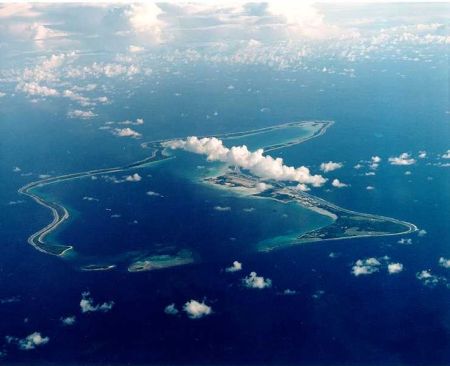
In November 1965, the UK purchased the entire Chagos Archipelago from the then self governing colony of Mauritius for £3 million to create the British Indian Ocean Territory (BIOT), with the intent of ultimately closing the plantations to provide the uninhabited British territory from which the U.S. would conduct its military activities in the region. On 30 December 1966, the U.S. and the UK executed an Agreement through an Exchange of Notes which permit the United States Armed Forces to use any island of the BIOT for defense purposes for 50 years (through December 2016), followed by a 20-year optional extension (to 2036) to which both parties must agree by December 2014. As of 2010, only the atoll of Diego Garcia has been transformed into a military facility.  The indigenous populations of the islands were relocated to Mauritius and the Seychelles to make way for a joint United States-United Kingdom military base on Diego Garcia.

There are two transnational political issues which affect the status of the Chagos archipelago.  First, the island nation of Mauritius claims the Chagos Archipelago (which is coterminous with the BIOT), including Diego Garcia. A subsidiary issue is the Mauritian opposition to the 1 April 2010 UK Government’s declaration that the BIOT is a Marine Protected Area with fishing and extractive industry (including oil and gas exploration) prohibited.

Second, the issue of compensation and repatriation of the former inhabitants of several of the archipelago’s atolls, exiled since 1973, continues in litigation and as of 23 August 2010 has been submitted to the European Court of Human Rights by a group of former residents.Litigation continues as of 2012 regarding the right of return for the displaced islanders and Mauritian sovereignty claims. In addition, advocacy on the Chagossians’ behalf continues both in the United States and in Europe.  According to a document released by wikileaks the marine protected area in the Chagos archipelago was established to prevent former inhabitants “to pursue their claim for resettlement on the islands.”

Excerpts from wikipedia Chagos Archipelago

More on IPS environment


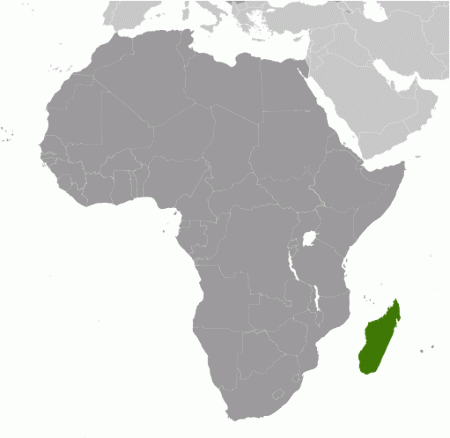
Madagascar Sells Polluting Rights to Microsoft

Madagascar’s government has agreed to sell forest-related carbon credits to Microsoft and Zurich’s zoo, which will help protect the Makira National Park, in the first sale of state-owned REDD+ credits in Africa, according to the group that manages the park.  The Wildlife Conservation Society (WCS), an international charity headquartered in New York City, said the revenues from selling carbon credits generated by avoided deforestation in Makira will finance the conservation of one of Madagascar’s most pristine rainforest ecosystems, while supporting the livelihoods of local people.

The funds will be used by the government for activities under its Reducing Emissions from Deforestation and Forest Degradation “plus” conservation (REDD+) programme, and by WCS to manage Makira park. But the largest share – half of the proceeds – will go to support local communities in areas around Makira for education, health and other projects, WCS said.

The Makira forest, which spans nearly 400,000 hectares (over 1,500 square miles), is home to an estimated 1 percent of the world’s biodiversity, including 20 lemur species, hundreds of species of birds, and thousands of plant varieties, some unique to the location. The forests also provide clean water to over 250,000 people in the surrounding landscape.

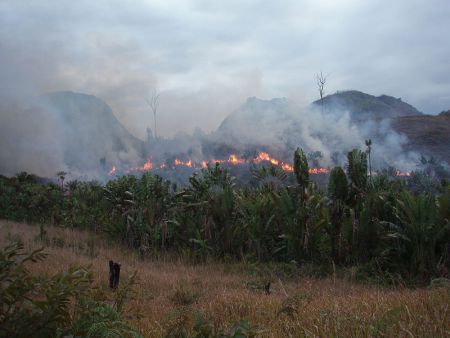
Jonathan Shopley, managing director of The CarbonNeutral Company, which handled the purchase for Microsoft, said its clients are increasingly looking for opportunities to manage the entire environmental impact of their organisation, driven by the need to make their supply chains more resilient…In Madagascar, burning for agricultural land and extraction of wood for household energy leads to around 36,000 hectares (139 square miles) of natural forest being lost each year, WCS said.

BY MEGAN ROWLIN, Madagascar: Microsoft Buys Carbon Credits From Madagascar Rainforest, AllAfrica.com, Feb. 13, 2014

Saving Forests through Forced Evictions

For decades, the Kenyan government has attempted to evict indigenous people from the forests of Embobut and Cherangany, in the western county of Elgeiyo Marakwet. Past tactics have even included torture and setting fire to homes, those affected say…The government – accused in recent weeks of preparing to carry out yet another forced eviction – maintains that communities living in 12 forest glades must leave so it can rehabilitate the degraded forest and the water services it provides to the surrounding regions and beyond.

“This is a government initiative aimed specifically at conserving the country’s second-largest water tower – nothing else,’’ said Inspector Stephen Chessa, who works for the Kenya Forest Service (KFS) and is in charge of the Embobut eviction…

But one forest warder who preferred to remain anonymous told Thomson Reuters Foundation he and his colleagues had been instructed to evict forcefully anyone who resists the move.  The U.N. special rapporteur on the rights of indigenous peoples, James Anaya, expressed deep concern about this prospect, urging the Kenyan government “to ensure that the human rights of the Sengwer indigenous people are fully respected, in strict compliance with international standards protecting the rights of indigenous peoples”.  Most families are asking for more time to assemble their things and harvest crops before leaving the forest.   But Solomon Mibei, head of conservation for the KFS, said families would not be given extra time and the evictions would continue as planned. “They have no reason to continue staying in the forest – they were compensated,’’ he said.

The situation is complex because there are different communities living in Embobut: the Sengwer indigenous people; groups displaced by disasters and political violence; and others who have come to benefit from cultivation opportunities.  “Why should the government treat us equally with the victims of post-election violence and landslides?’’ asked Sengwer spokesperson Yator Kiptum. “The forest is our home – our case is different, it’s not fair at all.”…According to Article 63 of the constitution, community land shall be vested in and held by communities identified on the basis of ethnicity, culture or similar community of interest. Community land consists of ancestral lands and lands traditionally occupied by hunter-gatherers.

Justin Kenrick of the Forest Peoples Programme (FPP), a UK-based rights organisation, said the government’s justification for evicting people is forest conservation, but research has long since shown that forests are best preserved not by evicting ancestral communities but by supporting them to regain secure rights to their land.  Payments to evictees by the government are “intended to distract the public and the communities themselves from addressing the real issues”, Kenrick said. “According to international treaties to which Kenya is a party, the Sengwer should have been consulted, and accepted or rejected the proposal,’’ he added.  Kiptum, however, claims the Sengwer were not consulted, did not sign anything, and have not agreed to hand over their land for the small amount of money that has been paid into some people’s bank accounts.  “You cannot create a humanitarian crisis for the sake of conserving biodiversity while there are other ways of doing it better,” said Stephen Cheboi, coordinator of the North Rift Human Rights Network based in nearby Eldoret town. He also called for an audit of the compensation process.

Excerpts from Caleb Kemboi, Indigenous rights clash with forest protection in Kenya, Reuters, Jan. 17,, 2014

See also Biodiversity and Human Rights

The Scramble for Antarctica

Over the past two decades China’s annual Antarctic spending has tripled to $55m, three times its Arctic investment… The Southern Ocean is full of fish. A large petroleum field was recently discovered in West Antarctica. The continent also has deposits of coal and other valuable minerals. The Protocol on Environmental Protection, a document signed in Madrid in 1991 by countries involved in Antarctica, has imposed a mining ban until 2048, when it is to be reviewed.

China acceded in 1983 to the Antarctic Treaty, which maintains the continent as a demilitarised science preserve and forms the basis of a system of governance. The goal of its current five-year polar plan, says Chen Lianzeng of China’s State Oceanic Administration, is to increase the country’s status and influence. On November 7th China’s 30th Antarctic expedition, complete with construction crew, set sail from Shanghai. It will scout a site for China’s fifth station, in Terra Nova Bay. Its fourth base, Taishan, is still unfinished.

Sovereignty in Antarctica is disputed. States assert themselves by building bases. “You put a huge flag on a flagpole close to the research station,” says Klaus Dodds, a professor of geopolitics at the University of London. “It is not very subtle.” If China builds all five planned stations it will have more than either Britain or Australia, and only one fewer than America.

Science matters, too. It gives cachet and influence in matters of joint governance. In 2008 China built Kunlun station, a base with capabilities for deep-space research in a place so remote that it took six attempts to get there. The ice underneath could help scientists work out the climatic record of the past 1.5m years, which would be a scientific coup.But the influx of new Antarctic actors has rattled the old establishment and its former scientific hegemony. “China is saying, ‘We don’t give a damn about Shackleton, Scott, all these white European heroes. You can keep that. What we’re interested in is the future,” says Mr Dodds. The Chinese have raised even more concerns by giving Chinese names to more than 350 places, including Great Wall Bay.  Chinese scholars call the Antarctic Treaty a “rich man’s club”, in which China has only second-class citizenship—with some justification, says Ms Brady, since the choicest spots for research stations were snapped up by the first countries to arrive. Publicly, though, China buries its grumbles and complies with protocol. An inspection regime installed by the treaty is ineffectual, and there is little check on states’ affairs.

Meanwhile, the exploitation of Antarctic resources may come sooner than predicted. At a recent meeting of the Commission for the Conservation of Antarctic Marine Living Resources, delegates from 24 countries failed to agree on proposals for two marine protected areas. Plans for the reserves have been discussed for decades, but consensus was required and China, Russia and Ukraine withdrew their support. If Antarctica and the Southern Ocean are to remain some of the planet’s last unspoilt wilderness, an updated framework is needed, and quickly.

Antarctic research: They may be some time, Economist, Nov. 16, 2013, at 50

Mining in Africa: who gets the money?

Most west African governments have signed—or pledged to sign—the Extractive Industries Transparency Initiative (EITI). The EITI tries to ensure that contracts and accounts of taxes and revenue generated by concessions are open to public scrutiny. But that is easier said than done. Last year Liberia’s government asked a British accounting firm, Moore Stephens, to carry out an audit of Liberian mining contracts signed between the middle of 2009 and the end of 2011. The audit, published in May 2013, found that 62 of the 68 concessions ratified by Liberia’s parliament had not complied with laws and regulations. The government has yet to take action after a string of recommendations emerged from an EITI retreat in July 2013.

Regional governments also fret over a practice known as “concession flipping”, whereby foreign mining companies that do not have the capacity to exploit sites sell their concessions to larger companies for windfall profits. “Every flip is essentially a heist on the government exchequer, with anonymous offshore firms as the getaway car,” says Leigh Baldwin of Global Witness, a London-based lobby that fights for fairer deals for local people and their governments from mining and other resources. Concession flipping, he adds, is widespread in Africa. The Africa Progress Panel, headed by Kofi Annan, a Ghanaian who once led the UN, has put out a report called “Equity in Extractives”. This, too, stresses a need for more openness in mining contracts. As people in the region demand more democracy, better deals from mining are a new priority.

Mining in west Africa: Where’s our cut?, Economist, Dec. 7, 2013, at 51
Unable to Control its Borders: Amazonas, Venezuela

Amazonas [in Venezuela] has many problems, but those most cited by local people are mainly the responsibility of central government. Frequent and lengthy power-cuts, unpunished violent crime, a precarious air link with Caracas and an almost non-existent internet service are among them. Outside Puerto Ayacucho, in the jungle that extends almost unbroken to the Brazilian border, an even darker mood prevails in the scattered Amerindian villages. Illegal mining is destroying the forest and polluting the water. The armed forces, whose duties include environmental protection, are accused by the Amerindians of complicity with the illegal miners and with the guerrillas of Colombia’s FARC, who have shifted their camps to Venezuela to evade military pressure at home.

“The guerrillas ordered the villagers not to go out at night,” says Uriel Blanco of OPIJKA, an organisation that defends the rights of the Jivi tribe. In the early hours, community leaders claim, boats laden with fuel and food head upriver to guerrilla camps. Neither these boats nor the miners seem to have problems with checkpoints run by Mr Maduro’s National Guard. But the guard seizes game from Amerindian hunters, as well as any fuel or processed food for which they lack receipts. The state’s Catholic bishop, José Angel Divasson, says that for the FARC, Amazonas is more than just a refuge: “It’s clear that they are trafficking drugs. Why else would they need 500-metre airstrips? The light planes go over [to Colombia] with guns and they come back with drugs.”

The cocaine business, along with illegal mining of gold and coltan, a mineral used in the manufacture of electronic devices, creates an almost insatiable demand for petrol and diesel, which are heavily subsidised by the Venezuelan government. The official price of a 200-gallon drum of petrol is just 14 bolívares. But once it leaves the river-port of Samariapo, it sells for at least 2,000 bolívares on the black market. By the time it gets to San Carlos de Río Negro, near the Brazilian border, it can cost five times that. Permits to buy fuel are controlled by the army.

“We get diesel for our generator once a month,” says a villager. “That gives us six hours of electricity.” Shops on the Colombian side of the river are well-stocked with subsidised Venezuelan food, while the people for whom it was intended go hungry. Amerindian groups have demanded a meeting with the president, but there has been no reply.

Venezuela’s Amazonas state: Lawless rivers and forests, Economist, Nov. 30, 2013

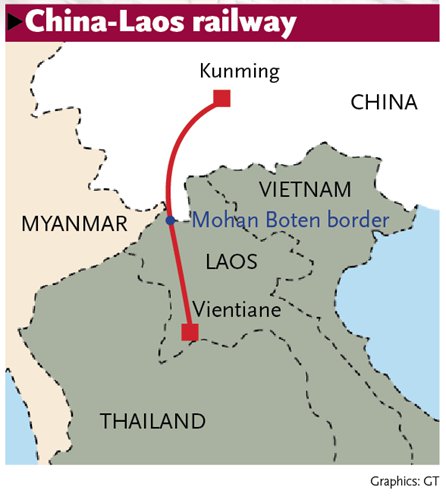
The China-Laos Train: Debt and Collateral

On the ground in the northern province of Oudomxay (Laos), most jeeps roaming the deforested valley bear Chinese and Vietnamese number plates…Investment is flowing into agriculture, typically rubber plantations, market gardening and other cash crops, much of it destined for the huge Chinese population to the north. The side-effects include a loss of forests and biodiversity, serious soil erosion and growing numbers of people in this multi-ethnic province being pushed off their land.

Chinese firms have secured rubber concessions in the province covering 30,000 hectares (74,000 acres). The idea is that tens of thousands of Chinese workers will eventually be needed to tap the rubber. In the past decade the government has granted land concessions across the country for up to 100 years, often at knock-down prices, to Chinese, Vietnamese and, to a lesser extent, Thai operators. More land is now in the hands of foreigners than is used to grow rice. The fear of one expert in Laos is the emergence of a landless poor.

Not all Chinese influence is welcomed by the government. Recently a deputy prime minister, Somsavat Lengsavad, announced the closure of a Chinese-run casino near the border that had attracted drugs and prostitutes along with gamblers. Yet Mr Lengsavad, ethnically Chinese himself, has his own patronage network built on granting concessions for Chinese-run special economic zones. And he is the point man for one of Asia’s most ambitious projects: a proposed 262-mile (421-km) passenger and freight railway connecting Kunming, in the south-western Chinese province of Yunnan, with Vientiane, the Laotian capital. The $7.2 billion price tag (including interest) is nearly as big as Laos’s entire formal economy. It will take 50,000 workers five years just to lay the tracks. Two-thirds of the route will run through 76 planned tunnels or over bridges.

The collateral for such a huge project lies in the mines of Laos. In other words, the extraction of natural resources in this undeveloped country is about to accelerate. Economic rents already accrue to an oligarchy, for which the railway, one way or another, will prove a bonanza… The capital of Laos is on the mighty Mekong river, which forms the border with Thailand. Though it still has a torpid air, Vientiane is growing fast in the hands of a Communist kleptocracy whose members queue up on Saturdays in their big cars to cross the Mekong for a dose of shopping across the border. For many of the remaining 6.6m Laotians, unease and sometimes fear are the predominant emotions.

Last December a well-known democratic activist and advocate of sustainable development, Sombath Somphone, disappeared. At the same time, the government clamped down on foreign NGOs, especially those advocating land rights. Two months ago the American embassy hung a banner from its water tower calling for the return of Mr Somphone. In September the head of the American-based Asia Foundation in Laos was told to pack her bags….The trauma of its long civil war and of American carpet-bombing during the Vietnam war is never far away. One-third of the country is still contaminated by unexploded American ordnance. Hundreds of people lose limbs every year to cluster bombs.In few countries do development agencies have to operate in thinner air than in Laos. In e-mails, foreign residents drop syllables from the names of Politburo members in attempts to outsmart new Chinese surveillance technology. The regime is constantly on guard against foreigners who might be seeking to “change our country through peaceful means”.

The future of Laos: A bleak landscape, Economist, Oct. 26, 2013, at 50

Buying their Way out of Water Crisis: Gulf States

Scientists are now warning of “Peak Salt” – the point at which the Gulf becomes so salty that relying on it for fresh water stops being economically feasible.  “The average Arab citizen has eight times less access to renewable water than the average global citizen, and more than two thirds of surface water resources originate from outside the region,” says the U.N.Development Programme (UNDP) in a new study released this week.  Titled “Water Governance in the Arab Region: Managing Scarcity and Securing the Future,” the report warns that water scarcity in the region is fast reaching “alarming levels, with dire consequences to human development”….

A recent satellite study by the U.S. National Aeronautics and Space Administration (NASA) found the region has lost, since 2003 alone, far more groundwater than previously thought – an amount the size of the Dead Sea…Threatened by future scarcities, several Arab countries, including the UAE, have expanded their use of non-conventional water resources including desalination; treated wastewater; rainwater harvesting; cloud seeding; and irrigation drainage water.

Currently, the Arab region leads the world in desalination, with more than half of global capacity.  Desalinated water is expected to expand from 1.8 percent of the region’s water supply to an estimated 8.5 percent by 2025.  Most of the increase is expected to concentrate in high-income, energy-exporting countries, particularly the Gulf countries, because desalination is energy- and capital-intensive…According to the UNDP study.Arab region’s oil wealth has allowed some states to mask their water poverty, giving them the false impression they can buy their way of out of the coming crisis…

Excerpt, By Thalif Deen, Arab World Sinks Deeper into Water Crisis, Warns UNDP, IPS, Nov. 29, 2013

The Struggle for Water: Tanzania

As farmers and herders fight over dwindling water levels in the Pangani River Basin in northeastern Tanzania, a new dispute is emerging between farmers and the state-run power utility firm over this precious resource. The Tanzania Electric Supply Company or TANESCO manages three hydropower plants located on the Pangani River near Muheza district, which are meant to provide 17 percent of the country’s electricity…For the last four years Tanzania has been experiencing a drought that locals say is the worst to have ever hit the region. Thousands of farmers and herders who earn a living here have been affected.  Jumanne Mujuni, a councilor from Mombo town, which is located a few kilometres from the Hale hydropower station in Muheza district, told IPS that the drought has pushed many to the brink as they compete with TANESCO for dwindling water supplies. He added that many locals are now embroiled in disputes with the state-run utility.“All these problems that we face are rooted in the drought. There were hardly any [problems] when there was enough water in the river,” he said.

Excerpt from Kizito Makoye,Power Struggle Rises Over Tanzania’s Pangani River, IPS, Oct. 24, 2013

The Toxic Herbicides Case: Ecuador v. Colombia

The case brought by the Republic of Ecuador against the Republic of Colombia on 31 March 2008 before the International Court of Justice (ICJ) in respect of a dispute concerning “Colombia’s aerial spraying of toxic herbicides at locations near, at and across its border with Ecuador” was removed from the Court’s List on 13 September 2013 at the request of Ecuador…

According to the letters received from the Parties, the Agreement of 9 September 2013 [between Colombia and Ecuador] establishes, inter alia, an exclusion zone, in which Colombia will not conduct aerial spraying operations, creates a Joint Commission to ensure that spraying operations outside that zone have not caused herbicides to drift into Ecuador and, so long as they have not, provides a mechanism for the gradual reduction in the width of the said zone; according to the letters, the Agreement sets out operational parameters for Colombia’s spraying programme, records the agreement of the two Governments to ongoing exchanges of information in that regard, and establishes a dispute settlement mechanism.  In consequence, the President of the Court, on 13 September 2013, made an Order recording the discontinuance by Ecuador of the proceedings and directing the removal of the case from the Court’s List.

Aerial Herbicide Spraying (Ecuador v. Colombia), Case removed from the Court’s List at the request of the Republic of Ecuador, Press Release International Court of Justice,  Sept. 17, 2013


Mining Gold and Cyanide Pollution

The $4 billion that two Canadian companies, Barrick Gold and Goldcorp, have poured into developing Pueblo Viejo, a gold mine, since 2009 amounts to the largest single foreign investment in the history of the Dominican Republic. The companies say that the money has turned the polluted ruins of what was the state-owned Rosario mine, abandoned in 1999, into a “truly world-class” operation that should provide the country’s government with $10 billion over its 25-year life.

But the project has been controversial. Just weeks after the mining started in January 2013, President Danilo Medina, who was elected last year, declared: “For every $100 of gold exports, Barrick will receive $97 and the Dominican people $3. That is simply unacceptable.” (In fact, Pueblo Viejo Dominicana Corporation, or PVDC, the company operating the mine, is 60% owned by Barrick and 40% by Goldcorp.) Mr Medina demanded that the contract be renegotiated; otherwise, he said, he would raise taxes on the mine’s profits.

This month the two sides agreed to changes that have front-loaded tax payments and could see the government get an extra $1.3 billion in 2013-16 provided that the gold price rises and stays above $1,600 an ounce (it is now around $1,350). Gustavo Montalvo, Mr Medina’s chief of staff, tweeted: “Together we ensured that words like ‘national sovereignty’, ‘justice’ or ‘transparency’ were transformed into something more concrete.”

Yet that may not calm local unrest over the mine, sited about 100 kilometres (60 miles) north of Santo Domingo, the capital. The investment was presented by both the government and company as including a clean-up of Rosario’s toxic mess and the installation of systems to keep local watercourses clean. But residents are suing PVDC, claiming that the new mine is poisoning rivers, causing illnesses and the death of farm animals. They want the government to release the environmental-impact assessment for Pueblo Viejo, which it has so far refused to do.

One farmer, María de la Cruz Mariano, said that she began to suffer skin allergies and other ailments in 2010, after PVDC began work. Tests on her blood conducted by a private laboratory showed high levels of lead, sulphur, cyanide and zinc. Some of her cattle have died from bovine anaemia, which can be caused by ingesting cyanide. Other residents report that previously clean local rivers have become polluted since PVDC built a dam to collect water containing cyanide, which is used to leach gold from crushed rock.

PVDC has signed the international code of practice for the handling of cyanide. It says it is “in the process of capturing all the surface flows” from the old and the new mines, sending the water to storage ponds where it is treated. PVDC says that, together with local people, it conducts regular, public tests on water and air.

But community leaders say they have no knowledge of such tests. The company has not answered requests to provide the dates on which they were conducted. Tests by the environment ministry, released only after a freedom of information request, found the water in the Margajita river downstream from the mine to be highly acidic, as well as containing sulphides and copper above legal limits. The ministry has made little effort to act on these results.

The old Rosario mine left some streams red with acid. PVDC’s clean-up obligations extend only within the mine perimeter; the rest was for the government. The firm points out that it has paid $75m ($37.5m of it a loan) to finance the government’s share of the work. It has also removed around 130,000 cubic metres (4.6m cubic feet) of contaminated soil. But Demóstenes Martínez, a congressman from the ruling party, argues that PVDC is violating both the constitution and the mining law.

It is not clear whether the pollution is being caused by PVDC’s operations, or is a legacy of the past. The government claims to have lost records of past tests on the rivers. But on its own the new agreement may not be enough to ensure that the mine regains the consent of the community. That will require greater candour.

Mining in the Dominican Republic:  Sickness and wealth, Economist, Sept. 21, 2013

Rivers as Fiefs: Dams in China

Though the Chinese authorities have made much progress in evaluating the social and environmental impact of dams, the emphasis is still on building them, even when mitigating the damage would be hard. Critics have called it the “hydro-industrial complex”: China has armies of water engineers (including Hu Jintao, the former president) and at least 300 gigawatts of untapped hydroelectric potential. China’s total generating capacity in 2012 was 1,145GW, of which 758GW came from coal-burning plants.

An important motive for China to pursue hydropower is, ironically, the environment. China desperately needs to expand its energy supply while reducing its dependence on carbon-based fuels, especially coal. The government wants 15% of power consumption to come from clean or renewable sources by 2020, up from 9% now. Hydropower is essential for achieving that goal, as is nuclear power. “Hydro, including large hydro in China, is seen as green,” says Darrin Magee, an expert on Chinese dams at Hobart and William Smith Colleges in New York state.

There is also a political reason why large hydro schemes continue to go ahead. Dambuilders and local governments have almost unlimited power to plan and approve projects, whereas environmental officials have almost no power to stop them.

The problems begin with the planning for China’s rivers, which are divided into fiefs by the state-owned power companies that build dams in much the same way as the Corps of Engineers and the Bureau of Reclamation divided up American rivers in the early 20th century. Though the staff of the water-resources ministry in Beijing know a lot about the environment, they have no say. “Big hydro projects are designed and approved by everybody but the ministry of water resources,” says Mr Magee.

Local governments, meanwhile, view dams as enticing economic development projects. The dambuilders, which have special privileges to borrow, put up the financing. The extra electricity supports industrial expansion and brings in revenues. Local officials are promoted for meeting economic performance targets and some collude for personal gain with the dambuilders. Because of the decentralised nature of the industry, local officials try to include dams in their plans. Once they have done so, they can expect the environmental impact assessments that follow to be a formality—if only because the consultants who undertake them are paid by the hydropower companies.

Environmental officials who have not been financially captured by the dambuilding economy find themselves as scarce as some of the fish they are charged to protect. Environmental activists, meanwhile, can request access to public records and demand public hearings, both required by law. But they say that these avenues are barred when they are most needed—on controversial projects that face vocal opposition. For example, the authorities have rejected requests for public records on Xiaonanhai and they have not granted a public hearing.

If environmental regulators and activists want any hope of halting a project, they must go outside normal bureaucratic channels to lobby powerful Politburo members or the national media. Although that may not always work, it did in 2004, when Wen Jiabao, then prime minister, halted construction of a cascade of 13 dams on the Nu River in south-west China in order to protect the environment. Even then some work on the projects still proceeded. Meanwhile, smaller schemes race ahead unchecked. Promoted by dambuilders and local governments, nearly 100 smaller hydroelectric projects in the Nu river region went forward without needing permission from higher up. Some began before they had even received the final approval.

China’s new leaders in recent months have signalled that they want yet more dams, approving several ambitious new projects, including what would be the highest dam in the world, on the Dadu river. After Mr Wen stepped down from his posts in the party and the government, the dams on the Nu river that he blocked received the go-ahead again.

Chinese leaders have for millennia sought to tame the country’s great rivers, which have sustained and destroyed countless lives with cycles of abundance, famine and floods. Indeed their legitimacy as rulers has long been linked to their ability to do so. The Communist Party has built thousands of large dams since 1949. China is also the world’s leading builder of big dams abroad; International Rivers, a pressure group, says that Chinese companies and financiers are involved in about 300 dam projects in 66 countries.

The politics of dam-building: Opening the floodgates, Economist, Sept. 21, 2013, at 47

The Curse of Displacement

Dhinkia, in the eastern Indian state of Odisha (formerly Orissa) (India)  is a hub of protest. The women, one from every village family, are staging… a sit-in. Sisir Mohapatra, a former sarpanch or village head, makes a rousing speech. He seems respected, though his police record would suggest he is a mafia don: he says he faces 35 criminal charges, and of his 60-strong extended family in Dhinkia, 40 are also wanted by the law. They claim that the charges are all trumped up. Their real crime is to oppose the biggest single foreign-investment project India has ever attracted.

Estimated to cost $12 billion, the project, promoted by POSCO, a South Korean firm, is eventually to produce 12m tonnes of steel a year for export. It will have its own power plant, port and, 200 kilometres (125 miles) inland, its own iron-ore mine. Since an agreement on the project was signed in 2005, it has been mired in controversy—a case study in why

Environmentalists worry about air pollution, coastal erosion, the endangered olive ridley turtle and much else. Many, including the Communist Party of India (CPI), which holds the local parliamentary seat, complain that the ore will be sold too cheaply, at a royalty to the government of just 27 rupees (currently about 40 cents) a tonne. Meanwhile, residents of Dhinkia and nearby villages fear for their livelihoods.

So the project has been delayed, probed by countless committees and subjected to repeated litigation. Just this week it faced hearings in Delhi at the National Green Tribunal, an environmental court. But as so often in India, one of the biggest delays has been acquiring the land. In theory, this should be easier for POSCO than for many other investors, since most of the 1,600 hectares (4,000 acres) it needs are designated as forest (even the scrubby sand dunes) and thus government land.

The residents of Dhinkia, however, claim legal rights as people whose families have been making their living from the forest for at least 75 years (which the government disputes). Some, indeed, make a very good living. Devendra Swain, like many villages, maintains betel vines, from which he earns 50,000 rupees a month selling the leaves. Mr Swain also grows rice, mangoes, cashew nuts, bananas and papaya. He claims not to be against industrialisation—except in his fecund backyard.

The villagers’ resistance to the project has seen ugly violence. In 2010 police fired rubber bullets to clear one dharna. In February there was another clash as police entered a neighbouring village, Govindpur, and started dismantling betel vines. In March three people died in a bomb explosion—victims of pro-project goons, say the villagers. The police allege the victims were blown up while making bombs themselves. Involvement in this incident is one of 61 charges facing the CPI’s Abhay Sahoo, the protesters’ leader, who is now in jail for the third time and trying to secure his release on bail. Fearing arrest or an attack by thugs, the 1,400 others in Dhinkia facing criminal charges dare not leave the village.

Of India’s million mutinies, many involve the emotive issue of land. That is one impulse behind a new law covering land acquisition and the resettlement and rehabilitation of those affected. This week it passed through Parliament’s upper house. Few disagree that some new legislation is needed to replace a much-abused British-era law from 1894.

The new bill, however, has drawn fierce criticism. Business is predictably aghast at what it sees as a populist law timed ahead of looming elections.. Some businessmen think it is simply “unworkable”.

Even some who support the principles behind the bill think their implementation has been botched. N.C. Saxena, a former senior civil servant who sits on a National Advisory Council [claims]  that it does not even cover government land. In other words, it would have no relevance for projects such as POSCO’s. Even if it did, legislation would not solve the fundamental difficulty, a total distrust of government.

“After 66 years of independence,” says Mr Mohapatra, the former sarpanch, “no one has ever been compensated properly. Whoever gave his land and his home later became a beggar.” He points to what he says is the unhappy lot of those displaced by two other projects in Odisha. One is the Hirakud dam across the Mahanadi river. It is India’s longest dam, for which Jawaharlal Nehru poured the first concrete in 1948. As many as 180,000 people had to move. Another is just down the road from Dhinkia, where a big oil refinery has been under construction since 2000. An empty field outside Dhinkia has drains and electricity, put in when plots were offered as compensation to those forced to shift. People found it so unappealing that the field is still empty. Moreover, 52 families who supported the POSCO project, many forced out of Govindpur in 2008, are still in reportedly miserable conditions in a transit camp. Add in heavy-handed police, and those agitating against the project have plenty of ammunition. Even the best-drafted law would find the going tough

This Land is Whose Land? A new law may do little to break India’s land-acquisition logjam, Economist, Sept 7, 2013, at 44

Yasuni National Park Oil Drilling: Ecuador, Amazon

Ecuador’s parliament on Thursday (Oct. 3, 2012) authorized drilling of the nation’s largest oil fields in part of the Amazon rainforest after the failure of President Rafael Correa’s plan to have rich nations pay to avoid its exploitation.  The socialist leader launched the initiative in 2007 to protect the Yasuni jungle area, which boasts some of the planet’s most diverse wildlife, but scrapped it after attracting only a small fraction of the $3.6 billion sought.

The government-dominated National Assembly authorized drilling in blocks 43 and 31, but attached conditions to minimize the impact on both the environment and local tribes. Though Correa says the estimated $22 billion earnings potential will be used to combat poverty in the South American nation, there have been protests from indigenous groups and green campaigners.  About 680,000 people have signed a petition calling for a referendum.  “We want them to respect our territory,” Alicia Cauilla, a representative of the Waorani people who live around the Yasuni area, said in an appeal to the assembly. “Let us live how we want.”  Correa has played down the potential impact of oil drilling in the area, saying it would affect only 0.01 percent of the entire Yasuni basin…

Oil output in OPEC’s smallest member has stagnated since 2010 when the government asked oil investors to sign less-profitable service contracts or leave the country. Since then, oil companies have not invested in exploration.  State oil company Petroamazonas will be in charge of extraction in blocks 43 and 31, which are estimated to hold 800 million barrels of crude and projected to yield 225,000 barrels per day eventually. Ecuador currently produces 540,000 bpd

Excerpt, By Alexandra Valencia, Ecuador congress approves Yasuni basin oil drilling in Amazon, Reuters, Oct. 4, 2013


Antarctica: Environment and Geopolitics

The meeting  (week of July 14, 2013)of the Conservation of Antarctic Marine Living Resources (CCAMLR) offers a “unique opportunity” for representatives of 24 countries and the European Union to…  designate the world’s largest marine reserves  Nature conservation is also a question of geopolitical interests — an arena in which no country wants to lose influence. The countries at the meeting are those active in Antarctica, in either a business or scientific capacity. So far, two opposing camps have remained insistent on their positions.

On the one side, the Western nations have proposed marine reserves. The United States and New Zealand are proposing to protect the Ross Sea area along Antarctica’s east coast. In some areas, fishing would be banned; in other areas, strict limits would be imposed. But China, Japan, Ukraine, Norway and and Russia, in particular, have shown little interest in an agreement. All have considerable business interests in the region.

Norwegian ships also catch vast quantities of krill off the coast of Antarctica to feed large salmon farms back home. The government in Oslo has little interest in major marine reserves on the southern continent. Norway has considerable influence, as well. The CCAMLR negotiations in Oslo are being led by Terje Løbach, an official at the Norwegian Fisheries Ministry. At the last CCAMLR meeting in Australia, his country was among those that offered the most adamant resistance to creating marine reserves. Participants claim Løbach used his advantage as the leader of the meeting to further the positions of his government rather than seek compromises. The conference in Australia ultimately failed to reach any agreement…

Russian representatives, for example, are leading the opposition against the US-New Zealand proposal for a marine protection area in the Ross Sea area. New Zealand and the US are proposing fishing quotas for the 2.3 million-square-kilometer area. But the Russians feel they have been cheated in the considerations. “They fear that the bear skin will be divided up without them,” one participant said.

Antarctica Conference: Deal Could Preserve Pristine Waters, Associated Press, July 15, 2013

Air Pollution: the Palm Oil Conglomerates


Since the mid-1980s, when Indonesia first began to clear its bountiful forests on an industrial scale in favour of lucrative palm-oil plantations, “haze” has become an almost annual occurrence in South-East Asia. The cheapest way to clear logged woodland is to burn it, producing an acrid cloud of foul white smoke that, carried by the wind, can cover hundreds, or even thousands, of square miles.

The intervening decades have seen the passage of numerous national and international regulations to stop the fires, but all, it seems, to no avail. The past two weeks have seen some of the worst smog ever, taking a severe toll not only on peoples’ lungs, throats and tempers, but also on diplomatic relations and Indonesia’s attempts to improve its environmental image. Worse still, despite the outcry, it is hard to see how matters are going to improve over the next few years.

Most of the burning, which starts every dry season, is concentrated this year in Riau province on the east coast of Sumatra. Indonesia is the world’s biggest palm-oil producer and Riau its most productive province. Sadly for Singapore and Malaysia, it lies just across the Strait of Malacca from them. From June 16th Singapore and large parts of Malaysia were smothered in smog from this year’s fires.

In Singapore the pollution was the worst ever, pummelling the previous records set in 1997, when the haze affected six countries and perhaps 70m people. Then, the Pollutants Standard Index (PSI) in Singapore, a measure of air quality, hit a panic-inducing 226, defined as “very unhealthy”. On June 19th, by contrast (the day of the satellite picture above), the PSI climbed to over 300, defined as “hazardous”, before peaking at 401 on June 21st. The government issued face masks and almost everyone took its advice to stay indoors. Malaysia declared a state of emergency in parts of its southern state of Johor when the Air Pollution Index, only slightly different from Singapore’s PSI, exceeded 500; it reached 750 on June 23rd. Kuala Lumpur, the capital, and coastal cities were also badly affected, as was Riau province itself, where hundreds were evacuated.

Fraternal relations within the Association of South-East Asian Nations (ASEAN), the regional political grouping, quickly dissolved into acrimonious finger-pointing. Agung Laksono, the minister in charge of Indonesia’s response to the crisis, said that Singaporeans were behaving “like children, in such a tizzy”. Singaporeans and Malaysians pointed out that Indonesia was the only ASEAN member not to have ratified a 2002 Agreement on Transboundary Haze Pollution. It was only on June 24th, when the damage was done, that its president, Susilo Bambang Yudhoyono, apologised to his irate neighbours.

At least three laws in Indonesia prohibit the burning and clearance of forests, and in particular Sumatra’s extensive peat wetlands. But environmental campaigners argue that the government has never seriously enforced these laws. Despite the arrest in Sumatra this week of eight farmers, supposedly caught red-handed, hardly anyone has been successfully prosecuted over the years for lighting fires. Palm oil’s economic importance to Indonesia seems to afford the industry protection. Last year exports totalled $17.9 billion, second only to coal. Some 5m people live off the industry. These are big numbers in a relatively poor country.

About half of the vast amount of land on which the fires are burning in Sumatra belongs to big palm-oil conglomerates, many of them Malaysian-owned. They have been accused of setting illegal fires in the past, in order to clear more of their concessions for palm oil. Satellite imagery clearly shows fires burning on the land of some of them, and the Indonesian government has named eight companies that it wants to investigate. Even so, it is going to be very difficult to apportion blame. One company, Singapore-based Asia Pacific Resources International Limited, acknowledges that there have been three fires on its land, but claims these had “originally started outside of its concession area”.

Another perennial problem is corruption. This year’s disaster was preceded on June 14th by the arrest of Rusli Zainal, the governor of Riau since 2003. He was charged, among other crimes, with dishing out illegal logging permits to finance a forthcoming re-election campaign. Under the country’s political decentralisation in 2001, generally considered to be good for democracy, the power to regulate land use passed from Jakarta to regional and often district-level politicians. They have often abused this authority to raise money.

Much of the area now burning in Riau is peat wetland, almost all that’s left after years of rampant deforestation. Peat, which can go down to a depth of 30m in Sumatra, is highly combustible, even many metres down. A fire doused on the surface might smoulder underground long after. It is illegal to burn peat for commercial development. But as the past few weeks have proved, the law is not enough. And, ominously for those hoping for clear skies and clean air, a lot of peat is left.

South-East Asia’s smog: Unspontaneous combustion, Economist, June 29, 2013, at 39

Deforestation: Rubber Barons and their Bankers

Along Route 7 in Cambodia’s remote north, dozens of small tractors known as “iron buffaloes” are plying a dilapidated piece of highway. Under cover of darkness, they transport freshly cut timber into nearby sawmills. The drivers wear masks, their tractors fitted with just one dim lamp at the front. Each carries between three and six logs which locals say were felled illegally on or near the Dong Nai rubber plantation, owned by Vietnam Rubber Group (VRG).

Illegal logging and land-grabbing have long been problems in Cambodia. A new report entitled “Rubber Barons” by Global Witness, a London-based environmental watchdog, has highlighted the issue once again. Dong Nai features prominently in the report, which claims that luxury timbers like rosewood, much in demand for furniture in China and guitars in the West, were culled as a 3,000-hectare (7,400-acre) section of forest was illegally cleared.

Global Witness says that local and foreign companies have amassed more than 3.7m hectares of land in Cambodia and Laos since 2000, as governments have handed out huge land concessions, many in opaque circumstances. Two-fifths of this was for rubber plantations, dominated by state companies from Vietnam, the world’s third-largest rubber producer.

The report claims that VRG and another Vietnamese company, HAGL, are among the biggest land-grabbers, and have been logging illegally in both Cambodia and Laos. It says that, through Vietnam-based funds, the two companies have received money from Deutsche Bank, while HAGL also has investment from the IFC, the private-sector arm of the World Bank. The two Vietnamese companies have denied any wrongdoing. Deutsche Bank and the IFC say they are studying the findings.

The report says that the two companies have failed to consult local communities or pay them compensation for land they formerly used. The companies routinely use armed security forces to guard plantations. Large areas of supposedly protected intact forest have been cleared, in violation of forest-protection laws and “apparently in collusion with Cambodia’s corrupt elite”.

Global Witness is urging authorities in Cambodia and Laos to revoke the two companies’ land concessions, which cover 200,000 hectares and are held through a network of subsidiaries. It thinks both companies should be prosecuted.

Logging in South-East Asia: Rubber barons, Economist, May 18, 2013

See also Bankers with Chainsaws


Blackstone, China, Secrecy: Guyana

The government of Guyana wants to move forward with an $840m project at Amaila Falls, deep in the forested interior. At full capacity of 165MW, it could supply more power than Guyana’s present needs.  The lead developer is Sithe Global, part of the Blackstone Group. Sithe wants a guaranteed 19% return on its equity stake, and plans to start construction this year. China Railway First Group signed an engineering contract in September. The China Development Bank will lend most of the money. The Inter-American Development Bank has been asked to chip in $175m; the World Bank was initially involved, but has pulled out.

Amaila’s supporters point out that it will flood less than 55 square km (21 square miles). No villages will be displaced and little wildlife will be disturbed. Guyana would no longer rely on fossil fuels for electricity. After two decades, ownership would pass to the government, construction costs paid off.

Opponents worry that clean electricity will not come cheap. Guyana Power and Light (GPL), the state-owned electricity company, will pay about $100m a year to the Amaila consortium. Electricity bills are unlikely to fall (three people were killed last year in protests over electricity charges). And Amaila’s power may not be reliable. The El Niño weather pattern can bring a year-long drought. In normal years, the plant will run below capacity between October and April. GPL will have to pay for backup thermal power. The IMF has urged “careful consideration of the [financial] risks”.

Plans to build Amaila date from 1997, though Sithe only got involved in 2009. The estimated cost has risen steadily. An access road is unfinished. There is as yet no economic feasibility study for the project; when completed, the study will remain confidential, as is GPL’s outline power-purchase agreement. Opposition parties complain that the government is being “secretive” about Amaila. On April 24th they blocked funds for a government equity-stake in the project. If Amaila is as beneficial as its backers claim, an open debate might generate broader support for the project, and cut its $56m bill for political risk insurance.

Hydropower in Guyana: Shrouded in secrecy, Economist, May, 4, 2013, at 39

Mining Companies Love Least Developed Countries

An expert panel led by Kofi Annan, a former UN secretary-general, looked at five deals struck between 2010 and 2012, and compared the sums for which government-owned mines were sold with independent assessments of their value. It found a gap of $1.36 billion, double the state’s annual budget for health and education. And these deals are just a small subset of all the bargains struck, says the report, which Mr Annan presented in Cape Town, South Africa, on May 10th.

The report highlights some puzzling details. For instance ENRC, a London-listed Kazakh mining firm, waived its rights to buy out a stake in a mining enterprise owned by Gécamines, Congo’s state miner, only to acquire it for $75m from a company owned by Dan Gertler, an Israeli businessman, which had paid $15m for it just months earlier. Mr Gertler is close to Joseph Kabila, Congo’s president. ENRC, which is being investigated by the Serious Fraud Office in Britain, was Congo’s third-largest copper producer last year. Both ENRC and Mr Gertler deny wrongdoing.

African countries often fail to collect reasonable taxes on mining, says Mr Annan’s panel. For example, Zambia’s copper exports were worth $10 billion in 2011, but its tax receipts from mining were a meagre $240m. The widespread use by mining firms of offshore investment vehicles as conduits for profits creates scope for tax avoidance. Their use is not restricted to rich-world companies. Much of the oil that Angola ships to China is via a company called the China International Fund. Its trading prices are not made public…

Congo’s prime minister, Matata Ponyo Mapon, promises change. In January 2013… Mr Ponyo said he would rein in the state-owned mining companies and increase transparency in the industry. “We must avoid situations where we’re not publishing our mining contracts, where our state assets are undervalued, and where the government doesn’t know what its state mining companies are doing,” he told miners and officials at a conference in January….

Last year miners in Congo, which include Freeport-McMoRan and Glencore Xstrata, shipped $6.7 billion-worth of copper and cobalt from the country.

Business in the Democratic Republic of Congo: Murky minerals, Economist, May 18, 2013, at 74


Dams in Brazil

Some 20,000 labourers are working around the clock at Belo Monte on the Xingu river, the biggest hydropower plant under construction anywhere. When complete, its installed capacity, or theoretical maximum output, of 11,233MW will make it the world’s third-largest, behind China’s Three Gorges and Itaipu, on the border between Brazil and Paraguay.  Everything about Belo Monte is outsized, from the budget (28.9 billion reais, or $14.4 billion), to the earthworks—a Panama Canal-worth of soil and rock is being excavated—to the controversy surrounding it. In 2008 a public hearing in Altamira, the nearest town, saw a government engineer cut with a machete. In 2010 court orders threatened to stop the auction for the project. The private-sector bidders pulled out a week before. When officials from Norte Energia, the winning consortium of state-controlled firms and pension funds, left the auction room, they were greeted by protesters—and three tonnes of pig muck.

Since then construction has twice been halted briefly by legal challenges. Greens and Amerindians often stage protests. Xingu Vivo (“Living Xingu”), an anti-Belo Monte campaign group, displays notes from supporters all over the world in its Altamira office… But visit the site and Belo Monte now looks both unstoppable and much less damaging to the environment than some of its foes claim…

Brazil already generates 80% of its electricity from hydro plants—far more than other countries. But two-thirds of its hydro potential is untapped. The snag is that most of it lies in untouched rivers in the Amazon basin. Of 48 planned dams, 30 are in the rainforest. They include the almost completed Jirau and Santo Antônio on the Madeira river, which will add 6,600MW to installed capacity. But it is Belo Monte, the giant among them, that has become the prime target of anti-dams campaigners.Opponents say that dams only look cheap because the impact on locals is downplayed and the value of other uses of rivers—for fishing, transport and biodiversity—is not counted. They acknowledge that hydropower is low-carbon, but worry that reservoirs in tropical regions can release large amounts of methane, a much more powerful greenhouse gas.

In the 20th century thousands of dams were built around the world. Some were disasters: Brazil’s Balbina dam near Manaus, put up in the 1980s, flooded 2,400 square km (930 square miles) of rainforest for a piffling capacity of 250MW. Its vast, stagnant reservoir makes it a “methane factory”, says Philip Fearnside of the National Institute for Amazonian Research, a government body in Manaus. Proportionate to output, it emits far more greenhouse gases than even the most inefficient coal plant.

But many dams were worth it (though the losers rarely received fair compensation). Itaipu, built in the 1970s by Brazil’s military government, destroyed some of the world’s loveliest waterfalls, flooded 1,350 square km and displaced 10,000 families. But it now supplies 17% of Brazil’s electricity and 73% of Paraguay’s. It is highly efficient, producing more energy than the Three Gorges, despite being smaller.

Of Brazil’s total untapped hydropower potential of around 180,000MW, about 80,000MW lies in protected regions, mostly indigenous territories, for which there are no development plans. The government expects to use most of the remaining 100,000MW by 2030, says Mr Ventura. But it will minimise the social and environmental costs, he insists. The new dams will use “run of river” designs, eschewing large reservoirs and relying on the water’s natural flow to power the turbines. And they will not flood any Indian reserves.,,,

The protesters’ legal challenge to Belo Monte is based on the claim that they have not been properly consulted, something the government denies. The constitution says that before exploiting any resource on Amerindian lands, the government must consult the inhabitants. But it is silent on how this should be done. The International Labour Organisation (ILO) has a similar clause in its Convention 169 on indigenous rights, to which Brazil is a signatory.  The government says that since no demarcated territories will be flooded, such formal protections do not apply. “We hold consultations about the projects we’re doing not because we have to, but because it is right,” says Mr Ventura. Between 2007 and 2010 there were four public hearings and 12 public consultations about Belo Monte, as well as explanatory workshops and 30 visits to Indian villages.

In 2011, in response to a complaint filed by Indian groups, the Inter-American Commission on Human Rights called for a halt to construction pending further consultation. That was “precipitate and unjustified”, said the government, refusing the request. The ILO has asked Brazil’s government for more information on how it intends to fulfil its legal obligations.

The legal uncertainty surrounding Belo Monte is bad for both the Indians and contractors, says Mr Sales—not to mention Brazil as a whole. A draft law detailing how to consult indigenous people is expected by the end of the year. But before Congress legislates, ground is likely to have been broken on most of the new dams….

Belo Monte was given an initial budget of 16 billion reais, which had risen to 19 billion reais by the time of the auction. Norte Energia’s winning bid for Belo Monte offered a price of 77.97 reais/MWh. Since then, its budget has risen by a third.  Officials insist that the costs are Norte Energia’s problem. That looks disingenuous. The group is almost wholly state-owned. In November, the national development bank gave Norte Energia a loan of 22.5 billion reais—its largest-ever credit. If Belo Monte turns out to be a white elephant, the bill will fall on the taxpayer.

Dams in the Amazon: the Rights and Wrongs of Belo Monte, Economist, May 4, 2013, at 37

US Government Lobbying for Biotechnology Industry

American diplomats lobbied aggressively overseas to promote genetically modified (GM) food crops such as soy beans, an analysis of official cable traffic revealed on Tuesday.  The review of more than 900 diplomatic cables by the campaign group Food and Water Watch showed a carefully crafted campaign to break down resistance to GM products in Europe and other countries, and so help promote the bottom line of big American agricultural businesses.

The cables, which first surfaced with the Wikileaks disclosures two years ago, described a series of separate public relations strategies, unrolled at dozens of press junkets and biotech conferences, aimed at convincing scientists, media, industry, farmers, elected officials and others of the safety and benefits of GM producs…The public relations effort unrolled by the State Department also ventured into legal terrain, accotrding to the report. US officials stationed overseas opposed GM food labelling laws as well as rules blocking the import of GM foods. The report notes that some of the lobbying effort had direct benefits. About 7% of the cables mentioned specific companies, and 6% mentioned Monsanto. “This corporate diplomacy was nearly twice as common as diplomatic efforts on food aid,” the report said….

In some instances, there was little pretence at hiding that resort to pressure – at least within US government circles. In a 2007 cable, released during the earlier Wikileaks disclosures, Craig Stapleton, a friend and former business partner of George Bush, advised Washington to draw up a target list in Europe in response to a move by France to ban a variety of GM Monsanto corn.  “Country team Paris recommends that we calibrate a target retaliation list that causes some pain across the EU since this is a collective responsibility, but that also focuses in part on the worst culprits,” Stapleton wrote at the time.”The list should be measured rather than vicious and must be sustainable over the long term, since we should not expect an early victory. Moving to retaliation will make clear that the current path has real costs to EU interests and could help strengthen European pro-biotech voices,” he wrote.

Excerpts, Suzanne Goldenberg,Diplomatic cables reveal aggressive GM lobbying by US officials, Guardian, May 15, 2013

The Nuclear Village in Japan

After an earthquake and tsunami created a creeping nuclear catastrophe two years ago the Democratic Party of Japan (DPJ) said it would get the country out of nuclear energy by 2040. Although it quickly backtracked, almost all of Japan’s 50 commercial reactors are still lying idle.

In February this year (2013), Shinzo Abe, leader of the then incoming Liberal Democratic Party (LDP), said the new government would restart reactors after they passed a forthcoming set of new safety tests. The country’s “nuclear village”, a cosy bunch from industry and government, cheered. But now the stricken Fukushima Dai-ichi plant is starting to alarm the public once more. On April 15th, 2013 the International Atomic Energy Agency (IAEA), a UN body, flew in to investigate a series of dangerous incidents.

A power outage in March (2013) left four underground pools that store thousands of the plant’s nuclear fuel rods without fresh cooling water for several hours. A rat, it later emerged, had gnawed through a cable. Workmen laying down rat-proof netting caused another outage. Then this month regulators discovered that thousands of gallons of radioactive water had seeped into the ground; the plant’s operator had installed a jerry-rigged system of plastic sheeting, which sprang leaks. The quantity of contaminated water has become a crisis in its own right, the manager has admitted. And now the pipes used to transfer water to safer storage containers are leaking too.

Experts who examined the causes of the 2011 catastrophe reckon the LDP has paid too little attention to what went wrong. Kiyoshi Kurokawa, the chairman of a parliamentary investigation, says the country may be moving “too hastily back towards nuclear power, without fully regaining the trust of the Japanese public and the international community”. Yoichi Funabashi, a former editor of Asahi Shimbun newspaper who headed a private-sector investigation, says it is unfortunate that the 2012 election, which brought the LDP back to office, did not include a proper debate about the future of nuclear energy.

Now the set of policies known as “Abenomics” is making a return to nuclear power ever more pressing. The LDP is expected to push hard to restart plants if it wins a crucial election for the upper house of parliament this summer. Mr Abe’s focus on the economy has given greater say to the voice of business, including the big utilities whose plants are idle. Smaller firms clamour for cheaper power too.

Japan’s broader economic future may be at stake… [the deterioration of  overall current-account balance]  could affect Japan’s ability to keep funding its huge public debt domestically. A big cause is the cost of energy imported to fill the gap left by nuclear power. A weaker yen, the result of the central bank’s radical loosening of monetary policy, is further pushing up the price of imported oil and gas…[T]he public is still afraid of nuclear power. A nationwide poll  in February 2013 found that around 70% of respondents wanted either to phase out all the plants, or to shut them down immediately. Opposition is likely to be strongest at the local level, as regions move to switch their reactors back on. This week an Osaka court ruled on a suit brought by local residents to have Japan’s only two operating reactors, at the Oi plant in Fukui prefecture, shut down. They lost, but their suit looks like only the first of many battles

Japan’s nuclear future: Don’t look now, Economist, Apr. 20, 2013, at 44.

Multinational Corporations in US Courts: Kiobel v. Shell

The Alien Tort Statute (ATS)… grants American district courts jurisdiction over “any civil action by an alien for a tort only, committed in violation of the law of nations or of a treaty of the United States”. At the age of 190 it sprang back to life on April 6th 1979, when it was used to allow two Paraguayans to sue a former Paraguayan policeman in an American court for acts of torture committed in Paraguay.Since then, roughly 150 lawsuits have been filed against American and foreign corporations for actions committed around the world. Four local plaintiffs used the ATS to sue Unocal in a federal court in Los Angeles for human-rights violations allegedly committed during the construction of an oil pipeline in Myanmar. A human-rights organisation used it to sue Yahoo on behalf of two Chinese democracy activists for actions committed in China by a subsidiary. ATS suits against DaimlerChrysler and Rio Tinto, among others, are pending. Though most ATS cases have been dismissed or settled, the costs of settlements can be high and the negative publicity damaging.

Multinational companies will therefore cheer the Supreme Court’s unanimous decision in Kiobel v Royal Dutch Petroleum (Shell), released on April 17th, 2013. It dramatically limits the ability of plaintiffs to file suit against corporations in American courts for actions committed abroad.  The ruling stems from a case brought in New York by 12 Nigerian plaintiffs living in America. They allege that Shell was complicit in human-rights violations—including murder, rape, theft and destruction of property—committed by Nigeria’s armed forces in the region of Ogoniland. A federal appeals court dismissed their suit, arguing that the ATS provides no grounds for corporate-liability lawsuits. But as the 150 ATS suits show, other courts have disagreed. The Supreme Court agreed to hear the case in order to settle the question.

In an earlier ruling, in 2004, the court cautiously ruled that the ATS permitted lawsuits for “a modest number of international law violations”, such as piracy and crimes involving ambassadors, which would have been recognised when it was adopted. The court’s Kiobel ruling goes much further. It holds that the ATS does not apply to actions committed by foreign companies, and noted a strong presumption against applying American law outside the United States, “There is no indication,” wrote John Roberts, the chief justice, “that the ATS was passed to make the United States a uniquely hospitable forum for the enforcement of international norms”.  In a separate concurrence, four of the court’s liberals took a slightly softer tack, arguing that the ATS should allow suits that prevent America from becoming “a safe harbour…for a torturer or other common enemy of mankind”. But that reasoning still does not permit foreign nationals to use American courts to sue foreign companies for acts committed on foreign soil.

Extraterritoriality: The Shell game ends, Economist, Apr. 20, 2013, at 34

Foreign Corporate Immunity: Chevron/Canada v. Ecuador

A Toronto judge halted on May 1, 2013 an effort to enforce a $19 billion Ecuadorean judgment against U.S. oil company Chevron Corp in Canada, finding that his Ontario provincial court was the wrong place for the case.  The action is the latest skirmish in a two-decade conflict between Chevron and residents of Ecuador’s Lago Agrio region over claims that Texaco, which Chevron acquired in 2001, contaminated the area from 1964 to 1992.

Citing Chevron’s promise to fight the plaintiffs until “hell freezes over, and then fight it out on the ice,” Justice David Brown of the Ontario court foresaw a “bitter, protracted” battle that would be costly and time consuming.  “While Ontario enjoys a bountiful supply of ice for part of each year, Ontario is not the place for that fight,” Brown wrote in his ruling on Wednesday. “Ontario courts should be reluctant to dedicate their resources to disputes where, in dollars and cents terms, there is nothing to fight over.”

Alan Lenczner, principal lawyer in Toronto for the Ecuadorean plaintiffs, said they would definitely appeal, arguing that a multinational company could not be immune from enforcement in a country where it earns so much. “Chevron Corp itself earns no money,” he said in a statement. “All its earnings and profits come from subsidiaries including, importantly, Chevron Canada.”  Chevron Canada’s assets are worth more than $12 billion, the plaintiffs had said, and alongside separate actions in Argentina and Brazil, they had sought to persuade the Ontario court to collect the damages awarded to them by the South American court.

Chevron, the second-largest U.S. oil company, has steadfastly refused to pay, saying the February 2011 ruling by the court in Lago Agrio was influenced by fraud and bribery. A related fraud case goes to trial in New York in October.  The Supreme Court of Canada has ruled that the country’s courts can recognize and enforce foreign judgments in cases where there is a “reasonable and substantial connection” between the cause of the action and the foreign court. Chevron called Brown’s ruling a “significant setback” to the Ecuadoreans’ strategy of seeking enforcement against subsidiaries that were not parties to the Ecuador case.  “The plaintiffs should be seeking enforcement in the United States – where Chevron Corporation resides. In the U.S., however, they would be confronted by the fact that eight federal courts have already found the Ecuador trial tainted by fraud,” Chevron said in a statement. Last month, a consulting firm whose work helped lead to the $19 billion award against Chevron disavowed some environmental claims used to obtain the judgment.

Excerpt, Judge halts Chevron-Ecuador enforcement action in Canada, Reuters, May 1, 2013

Fighting Biopiracy: European Union

The European Union is debating a biopiracy law requiring industry to compensate indigenous people if it makes commercial use of local knowledge such as plant-based medicines.  Under the law – based on the international convention on access to biodiversity, the Nagoya protocol – the pharmaceuticals industry would need the written consent of local or indigenous people before exploring their region’s genetic resources or making use of their traditional know-how. Relevant authorities would have the power to sanction companies which failed to comply, protecting local interests from the predatory attitude of big European companies.

A German pharmaceutical company’s dealings in South Africa [is an example of biopiracy].  Pelargonium sidoides, a variety of geranium known for its antimicrobial and expectorant qualities, has been used traditionally by indigenous communities in South Africa for centuries to treat bronchitis and other respiratory diseases. It also stimulates the nervous system, so has been used in the treatment of AIDS and tuberculosis.  In 2000, the German company Schwabe made significant profits on Umckaloabo, a product derived from the geranium, without compensating local communities. It then filed patents claiming exclusive rights to the medical use of the plant.

But in 2010 the patents were cancelled following appeals from the African Centre for Biosafety in South Africa and the Bern Declaration in Switzerland, calling the patents “an illegitimate and illegal monopolization of genetic resources derived from traditional knowledge and a stark opposition to the Convention on Biodiversity.”…[The] law would help protect biodiversity and ensure that the people from the region are adequately compensated for their resource and their traditional know-how. …The need to ensure the property rights of indigenous populations becomes more pressing as industry looks more and more to plant and animal-based cures to common diseases.Only 16 countries have ratified the Nagoya protocol. The European Union and its 24 of its 27 member states have signed the convention, but are yet to ratify it. When they do, Nagoya should soon reach the 50 states needed for it to come into force…  “The 16 states are countries in the South…

Excerpts, EU ponders biopiracy law to protect indigeneous people, EurActiv, April 26,  2013

See also EU portal on Biodiversity and Benefits Sharing

See also article on Alice v. Schwabe

HardBall: Chevron and the Oil Pollution in Amazon

An environmental case that has pitted Chevron against Ecuadorean Amazon villagers for two decades has taken another bizarre twist, with an American consulting firm now recanting research favorable to the villagers’ claims of pollution in remote tracts of jungle.  The consulting firm, Stratus Consulting of Boulder, Colo., announced late Thursday (April 11, 2013) that it had originally been misled by Steven R. Donziger, a lead lawyer for the Ecuadorean villagers, and had decided to disavow its contributions to scientific research about whether there was groundwater contamination that sickened the residents in swaths of rain forest.

The move prompted the plaintiffs to assert that Chevron was coercing parties to the case, citing this as another example of strong tactics employed by the company as it tries to overturn an Ecuadorean judge’s decision two years ago that it pay $18 billion in damages, one of the largest environmental awards ever. In this instance, the plaintiffs claim that Chevron pressured Stratus to retract its assessment in exchange for dismissal of legal claims in a countersuit filed by Chevron made against the firm — claims that could have pushed the consulting business into bankruptcy.  “Stratus deeply regrets its involvement in the Ecuador litigation,” the firm said. It remains unclear whether this development with Stratus will have much impact on Chevron’s appeals, because the judge also based his ruling on other environmental assessments. The judge ruled that back in the 1970s, Texaco had left an environmental mess in oil drilling operations while operating as a partner with the Ecuadorean state oil company, and that Chevron, which bought Texaco in 2001, must apologize for and was liable for the damage.

Chevron has refused to apologize. In addition to appealing the decision in the Ecuadorean courts, Chevron also filed a countersuit in federal court in New York against Mr. Donziger and Stratus Consulting, accusing them of racketeering and fraud. Because Stratus has now retracted its statements on the Ecuadorean pollution, Chevron agreed not to pursue claims against the firm anymore. On Friday, Chevron filed witness statements from Douglas Beltman, a Stratus vice president, and Ann Maest, a Stratus scientist, in which they now say they were not aware of scientific evidence of groundwater contamination in the former Texaco concession area or of any adverse health impact to people from the operations.

Mr. Beltman stated that “at Donziger’s direction,” he drafted portions of a report in the first person as if it were written by Richard Cabrera, the supposedly independent expert, that detailed environmental damage for the Ecuadorean court. “Donziger stressed to me and Ann Maest the importance of Stratus ensuring that no one learn of Stratus’ involvement in any aspect of the Cabrera Report or Responses,” he said.  In an interview, Mr. Beltman said, “This settlement was extensively negotiated with Chevron and we think it’s fair and it’s not extortion.”  Mr. Donziger said he could not comment since he was a defendant in the racketeering case filed by Chevron.

It was not immediately clear what impact Stratus’s recantation would have on the case. Chevron’s appeal is before Ecuador’s highest court, the National Court of Justice, and the company is defending itself in courts in Canada, Argentina and Brazil to avoid paying damages in those countries. The plaintiffs are waging an international campaign seeking damages because Chevron has no assets in Ecuador itself…

Kent Robertson, a Chevron spokesman, said the statements should uphold the company’s position in the American racketeering case and in the international enforcement proceedings. “The declarations today show there is no scientific evidence to support the plaintiffs’ lawyers’ allegations,” he said.

Craig Smyser, a lawyer for some of the Ecuadorean plaintiffs, said the statements by the consulting firm “should have almost no effect” because the Ecuadorean judge relied on many expert reports other than the one that Stratus was involved in.  He attributed the decision by Stratus to repudiate its earlier work to the “immense financial strain that threatened the financial extinction of the firm, including a campaign by Chevron to discredit Stratus with various government agencies and businesses with which Stratus worked.”

Chevron has been playing hardball for at least four years. The company produced video recordings from pens and watches wired with bugging devices that suggested a bribery scheme surrounding the proceedings and involving a judge hearing the case. An American behind the secret recordings was a convicted drug trafficker.  But the oil company appeared to gain the upper hand three years ago when it won a legal bid to secure the outtakes from a documentary about the case, “Crude,” in which Mr. Donziger was shown describing the need to pressure a Ecuadorean judge and boasting of meetings with Ecuadorean officials.

In a sworn statement filed in an American court, Alberto Guerra, an Ecuadorean judge who heard the Chevron case in 2003 and 2004, accused Nicolas Zambrano, the judge who issued the $18 billion verdict against Chevron, of taking a $500,000 bribe from the plaintiffs. Mr. Zambrano denied the charge, and in his own affidavit, said that Mr. Guerra had told him that Chevron would offer him $1 million in return for a favorable judgment.  Chevron has denied offering any bribes.

By CLIFFORD KRAUSS, Consultant Recants in Chevron Pollution Case in Ecuador, NY Times, April 12, 2013


The War on Dams

An Amazonian community has threatened to “go to war” with the Brazilian government after what they say is a military incursion into their land by dam builders.  The Munduruku indigenous group in Para state say they have been betrayed by the authorities, who are pushing ahead with plans to build a cascade of hydropower plants on the Tapajós river without their permission.  Public prosecutors, human rights groups, environmental organisations and Christian missionaries have condemned what they call the government’s strong-arm tactics.

According to witnesses in the area, helicopters, soldiers and armed police have been involved in Operation Tapajós, which aims to conduct an environmental impact assessment needed for the proposed construction of the 6,133MW São Luiz do Tapajós dam.  The facility, to be built by the Norte Energia consortium, is the biggest of two planned dams on the Tapajós, the fifth-largest river in the Amazon basin. The government’s 10-year plan includes the construction of four larger hydroelectric plants on its tributary, the Jamanxim.

Under Brazilian law, major infrastructure projects require prior consultation with indigenous communities. Federal prosecutors say this has not happened and urge the courts to block the scheme which, they fear, could lead to bloodshed.  “The Munduruku have already stated on several occasions that they do not support studies for hydroelectric plants on their land unless there is full prior consultation,” the prosecutors noted in a statement.

However, a court ruling last week gave the go-ahead for the survey. Government officials say that neither researchers nor logistical and support teams will enter indigenous villages. The closest they will get is about 30 miles from the nearest village, Sawré Maybu.  The ministry of mines and energy noted on its website that 80 researchers, including biologists and foresters, would undertake a study of flora and fauna. The army escort was made possible by President Dilma Rousseff, who decreed this year that military personnel could be used for survey operations. Officials say the security is for the safety of the scientists and the local population.

Missionaries said the presence of armed troops near Sawré Maybu village, Itaituba, was intimidating, degrading and an unacceptable violation of the rights of the residents.  “In this operation, the federal government has been threatening the lives of the people,” the Indigenous Missionary Council said. “It is unacceptable and illegitimate for the government to impose dialogue at the tip of a bayonet.”

The group added that Munduruku leaders ended a phone call with representatives of the president with a declaration of war. They have also issued open letters calling for an end to the military operation. “We are not bandits. We feel betrayed, humiliated and disrespected by all this,” a letter states.  One of the community’s leaders, Valdenir Munduruku, has warned that locals will take action if the government does not withdraw its taskforce by 10 April, when the two sides are set to talk. He has called for support from other indigenous groups, such as the Xingu, facing similar threats from hydroelectric dams.

Environmental groups have expressed concern. The 1,200-mile waterway is home to more than 300 fish species and provides sustenance to some of the most biodiverse forest habitats on Earth. Ten indigenous groups inhabit the basin, along with several tribes in voluntary isolation.  With similar conflicts over other proposed dams in the Amazon, such as those at Belo Monte, Teles Pires, Santo Antônio and Jirau, some compare the use of force to the last great expansion of hydropower during the military dictatorship. “The Brazilian government is making political decisions about the dams before the environmental impact assessment is done,” said Brent Millikan of the International Rivers environmental group.  “The recent military operations illustrate that the federal government is willing to disregard existing legal instruments intended to foster dialogue between government and civil society.”

Jonathan Watts, Amazon tribe threatens to declare war amid row over Brazilian dam project, Guardian, Aprl. 3, 2013


Gated Rainforests: the militarization of conservation

The  Epulu  village  in the Democratic Republic of Congo is situated inside a nature reserve in the Ituri rainforest, an area covering 5,000 square miles that is supposed to be off limits to hunters and gold prospectors. A militia, led by a former elephant poacher called Paul Sadala, has terrorised communities inside the reserve since 2012, employing methods brutal even by the grisly standards of this part of the world.

“The attacks were absolutely terrifying,” said Justin Oganda, a representative of the residents of Epulu who remain displaced in Mambasa, about 50 miles away. By the end of that day in June, the militiamen had murdered, raped, burned people alive and even eaten the flesh and heart of one of their victims. “To have killed so many people, to burn them alive, the cannibalism … Mentally they cannot be normal,” Oganda added.

As ever with Congo, it is not just a simple tale of victims and villains. Sadala, who goes by the nom de guerre Morgan, and his “Mai Mai Morgan” gunmen are thought to have powerful supporters in the security forces who enable their lucrative illegal trade in ivory and smuggled gold. Some local people with an eye on the gold in the ground beneath their feet tacitly support Morgan, who improbably also likes to be called Chuck Norris. “There is complicity between [Morgan] and certain elements within the army,” said Jefferson Abdallah Pene Mbaka, the MP for Mambasa. “With the support of certain army authorities [Mai Mai Morgan] have increased their poaching activities. The sale of ivory is organised by these figures in the army.” Many people in the region believe soldiers have orders not to arrest Morgan.

Morgan’s principal targets are those who operate and police the Unesco-recognised world heritage site known as the Okapi wildlife reserve, or by its French acronym, RFO. The laws of the reserve forbid the hunting of endangered species, especially elephants and okapi, and the exploitation of its gold reserves….The suspicion is that at least some of Morgan’s booty winds up 280 miles south-west of Epulu, in the hands of the Congolese army. At the end of 2012 the United Nations group of experts on Congo issued a report that accused Congolese general Jean Claude Kifwa in the provincial capital, Kisangani, of giving “arms, ammunition, uniforms and communication equipment to Mai Mai Morgan in exchange for ivory”….

Despite the brutality of the attacks, many reserve dwellers express sympathy for Morgan, with some even confessing to outright support for him. “I am behind Morgan,” said an 18-year-old in a small village not far from Epulu who refused to give his name. “Because Morgan is here the rangers cannot patrol and we are free to dig for gold. But I wouldn’t support him if he came here and burned our homes.”  Most people, however, have a more nuanced position, saying that although revolted by his methods, they support his stated desire to see the size of the reserve reduced and more rights given to locals to hunt and dig.  “The forest is where we find what we need to survive,” said Matope Mapilanga, the leader of a Pygmy community on the edge of the reserve. “[The park authorities] have cut our land, there is now a part we cannot access. It has worsened in the last few years, since the RFO got bigger. We would prefer that the people of the RFO weren’t in our forest. We feel like the big non-governmental organisations and the rangers have privileged the animals over the people.”

The conservationists remain unconvinced, though. “The people who say they support Morgan are just those people who want to dig gold and exploit timber,” said Robert Mwinyihali, the project leader for Wildlife Conservation Society’s (WCS) work in the Ituri rainforest. WCS has given financial backing to the park rangers and the Congolese Wildlife Authority’s work in the reserve. “There are laws in Congo about the exploitation of resources,” said Mwinyihali. “These people can either respect those laws, or they can ignore them and commit criminal acts.”  WCS and GIC’s support for the park rangers has led to accusations that they are partly responsible for the militarisation of the conflict. However, Mwinyihali said the biggest problem was the absence of effective intervention by the Congolese state, which meant NGOs and the park rangers had had to fulfil roles that should be the government’s responsibility: for example, bringing in armed guards to track Morgan. Bernard Iyomi Iyatshi, the director of park rangers, complained about a lack of government funds for his anti-poaching operations.

Mwinyihali also accused the Congolese government of doing little to reconcile the park authorities and local communities. As mutual resentment and misunderstanding grows, Morgan and other armed groups are able to exploit the toxic atmosphere and continue their poaching, digging and savage attacks.  “There are no job opportunities created by government investment here,” said Mwinyihali. “This has led to this crisis, where people have no option but to want to dig for gold. This leads to the conflict with the park authorities, and then it is only a small step to people taking up arms and joining militias.”  Despite being a member of the ruling party, Mbaka is an outspoken critic of the government’s policy, or lack of it, in the region. “Swaths of the park are inaccessible, there’s just no infrastructure,” he said. “It’s an absolute scandal, there’s potentially so much wealth here. It also means it is difficult to track and stop men like Morgan.”  Even if Morgan is caught, people fear that his powerful backers in the army will find another militia to continue poaching and stealing gold…

About 70% per cent of the ivory from slaughtered African elephants goes to China, another of the countries warned by Cites. The price of ivory has rocketed. Cites reported that the price more than doubled between 2004 and 2010, from about $300 to $700 (£198 to £462) a kilogramme. An Associated Press investigation in 2010 claimed ivory was being sold in China for $1,800 a kilogramme.

Excerpt, Pete Jones, Gold and poaching bring murder and misery to Congolese wildlife reserve, Guardian, Mar. 31, 2013

How to Divide a Lake: Malawi against Tanzania

Over two million families who solely depend on Lake Malawi for their livelihoods are anxiously putting their hopes into an upcoming mediation between Malawi and Tanzania intended to put an end to a longstanding ownership dispute.  The mediation will start March 2013 after both parties agreed in December 2012 to engage the assistance of the Forum for Former African Heads of State and Government, which is chaired by Mozambique’s former President Joachim Chissano.

According to authorities, about 1.5 million Malawians and 600,000 Tanzanians depend on Africa’s third-largest lake for food, transportation and other daily needs. When IPS visited Karonga District, on the shores of Lake Malawi, surrounding communities said they were worried about the increased tension and keen to see a resolution.

Known as Lake Nyasa in Tanzania and Lago Niassa in Mozambique, the disputed water mass is thought to sit over rich oil and gas reserves, according to recent Malawian government reports.  The mineral potential has rekindled a border dispute between Malawi and Tanzania, which has remained unresolved for almost half a century.

The conflict escalated last July when Malawi awarded oil exploration licenses to United Kingdom-based Surestream Petroleum.  And last December, Malawi awarded the second-largest license to SacOil Holdings Ltd. of South Africa, a move that deepened the crisis.  Twice, the two countries tried to resolve the dispute diplomatically, but to no avail.  Both countries are hoping for the best outcome that will settle the dispute, once and for all when mediation begins this month.

Malawi’s first president, Hastings Kamuzu Banda, was the first to claim that Lake Malawi was part of the southern African nation. He based his claim on the 1890 Heligoland Agreement between Britain and Germany, which stipulated that the border between the countries lay along the Tanzanian side of the lake.  The treaty was reaffirmed at the 1963 Organisation of African Unity Summit in Ethiopia and was reluctantly accepted by Tanzania.  Malawi’s Foreign Affairs Minister Ephraim Chiume told IPS that their position is based on the 1890 Treaty and that the African Union in 2002 and 2007 upheld the colonial agreement.  “The Heligoland Treaty gave the entire lake to us and this is what forms the basis of our position and proof that we own the entire lake,” said Chiume.

Tanzania’s position is that the treaty was flawed. Tanzania has remained resolute that it owns half of the lake – saying that the border runs through the middle of the lake excluding the section that lies in Mozambique.  Tanzania’s position is that a partition drawn in the middle of the lake, stressing that this is the practice among countries which share water bodies.  “Tanzania has sought recourse to international law, which indicates that borders are generally in the middle of a body of water… Tanzania should therefore own half the lake,” Tanzanian Minister of Foreign Affairs Benard Membe told IPS in a telephone interview.  Membe said that the treaty was flawed because it denied Tanzanian’s living on the shores of the lake their given right to utilise proximate water and marine resources to earn their daily living.

These are the positions that Chissano and his two colleagues; former South African President Thabo Mbeki and former Botswana President Ketumire Masire will have to consider.

Meanwhile, the dispute has also brought to the fore the impact oil drilling would have on a fresh water lake blessed with over 2,000 different fish species, which attracts scuba divers the world over. Local environmentalists fear that drilling in the lake will damage eco-tourism and the marine environment affecting the fishing region in the northern part of the country.  “It will endanger the social and economic lives of millions of people directly dependent on the lake for water, transport and most importantly fish for protein,” said Reginald Mumba of Rehabilitation of the Environment — a local environmental non-profit

Excerpts from By Mabvuto Banda,Two Million People Hold their Breath Over Lake Malawi Mediation, Inter Press Service,  Mar. 3, 2013

Water Shortages in the MIddle East: Tigris and Euphrates

According to a study in Water Resources Research, an American scientific journal, between 2003 and 2009 the region that stretches from eastern Turkey to western Iran lost 144 cubic kilometres of fresh water.  That figure is vast. It is equivalent in volume to the Dead Sea and, according to the study’s senior author, Jay Famiglietti of the University of California, Irvine, implies that the region is suffering the world’s second-fastest rate of water depletion after northern India. The water table sank by 0.3 metres (one foot) a year in 2006-09. At the point where the Euphrates crosses from Syria into Iraq, it now flows at only 70% of the rate it once did. All this in an area that already faces severe water shortages.

The study provides the first accurate estimate of all the water in the basin. National statistics are flawed and incomplete; some figures are even state secrets. But the study uses satellite data from America’s NASA which is not subject to these restrictions. These satellites not only measure surface water by photographs but, thanks to precise measurements of the effect of bodies of water on the atmosphere, can even calculate the amount of water in the aquifer below them.

The main reason for the depletion turns out to be that more water is being taken out of the underground aquifer, mainly by farmers. The rate of loss accelerated after drought hit the region in 2007. Between 2007 and 2009, in response to reduced flows of water in the rivers, Iraq’s government dug 1,000 new wells and abstracted four-fifths of all its groundwater reserves. The aquifer is not being replenished at anything like that rate, so this cannot continue for long.

The rapid depletion has implications for managing the basin, which is shared by Turkey, Syria, Iraq and Iran. All the countries have extensive dams, reservoirs and other sorts of infrastructure on both rivers which control the water’s flow. But they have no international treaty governing when and by how much they can shut the flow down.

Over the years, this has not mattered much. The countries have rubbed along, sometimes amicably, sometimes not, with downstream ones (notably Syria and Iraq) assuming there would always be enough water in the upstream reservoirs of Turkey for them all. But if the new study is any guide, that assumption may not hold for much longer.

The Tigris and Euphrates: Less fertile crescent, Economist, Mar. 9, 2013, at 42

The Polar Bear: An Animal or Icon

The Inuit see the animal as a fierce predator, a cultural symbol and a valuable source of food, warmth and money in a part of the world where all three are in short supply.Yet to animal-welfare and green groups in warmer places the polar bears are both an icon in the fight against climate change and an animal under threat of extinction. The melting of the Arctic’s ice cap, which the bears use as a hunting platform, means the estimated population of between 20,000 and 25,000 will decline sharply, they say. They see hunting the bears as an anachronism and want international trade in bear pelts and parts, already severely restricted, completely banned.

These opposing views are set to clash at a meeting of the Convention on International Trade in Endangered Species of Wild Fauna and Flora (CITES), an intergovernmental agreement, between March 3rd and 14th in Bangkok. Having failed at the previous meeting of CITES in 2010, the United States is again leading a move to switch the polar bear from Appendix II of the convention to Appendix I, which would ban trade in all but “exceptional” circumstances. The American proposal is backed by Russia but opposed by Canada, Norway, Denmark (which represents Greenland) and the CITES secretariat.

The debate promises to be emotional. What it lacks are facts. The Americans acknowledge that only eight of the 19 known groups of polar bears have been surveyed since 2000. Of the remaining 11, four have never been surveyed. The submission relies on a controversial forecast undertaken for the US Fish and Wildlife Service in 2007 that suggests the decline in sea ice will lead to the disappearance of two-thirds of the world’s polar bears by 2050.  Should the United States obtain the two-thirds majority needed to change the bear’s status, it will be a blow to the Inuit. Their trade in walrus tusks and narwhal horns has dried up because of curbs on sales of ivory designed largely to protect elephants. The trade in seal pelts and meat was curtailed by a 2009 import ban by the European Union, though this granted a limited exemption to indigenous peoples.

In Canada polar bears are hunted under annual quotas set by territorial governments. The Inuit trade bear pelts, claws and teeth, and sell some of the quota to trophy hunters, who employ local guides and buy local supplies…..

Countries which want to become observers at the Arctic Council, an intergovernmental body, will be reluctant to vote against Canada, Norway and Denmark on the issue. Canada takes over as chairman of the council in May. Still, it will take resolve to stand up to the United States, also a council member, and the array of animal-welfare and environmental groups backing its position.

The Inuit also argue that if the problem is climate change, to ban trade in polar bears is to attack the symptom rather than the cause. That was the argument of the European Union’s environment commissioner, Janez Potocnik, when the European Parliament debated the issue earlier this month. But the MEPs still voted in support of the American position.

Canada’s Inuit: Polar-bear politics, Economist, Feb. 23, at 36

Icesave Case: winners & losers of bank failures

In 2008 Britain’s former prime minister Gordon Brown chose to invoke anti-terrorism laws to freeze the assets of a failed Icelandic bank…In January 28, 2013 a ruling delivered in Luxembourg by the European Free-Trade Association Court, dealt with the collapse of Icesave, an online subsidiary of Iceland’s Landsbanki. Before the crisis Icesave had used a European “passport” to open branches abroad and collected deposits in Britain and the Netherlands with almost no oversight from regulators in those countries. One condition of its passport was that it promised that its deposits were backed by a national deposit-insurance scheme in Iceland. Yet when the bank collapsed Iceland’s deposit scheme was overwhelmed. Icelandic depositors in the bank ended up getting their money back; the British and Dutch governments both had to step in to compensate depositors in their countries.

Many observers had expected the court to rule that Iceland was obliged to stand behind its national deposit-protection plan and not to discriminate against foreign depositors. Instead the court found that Iceland was obliged only to make sure that it had a deposit-insurance scheme. The state was not required to pay out if the scheme had no money because of a banking crisis. Oddly, the court also found that Iceland had not breached an obligation not to discriminate between domestic and foreign depositors, even though it made only the domestic ones whole.

The questions addressed by the court may seem anachronistic: European law on deposit protection has been extensively rewritten since the crisis. Yet the ruling is another warning to those who hope that regulators can strike binding agreements on how they will share the costs of a future banking crisis. Supervisors in America are already trying to ensure that foreign banks there operate as separately capitalised subsidiaries, so they do not have to rely on the vigilance of foreign regulators. Hopes that Europe’s banking union will include a mutual deposit-guarantee scheme are in any case faint. This week’s ruling will only weaken confidence in the willingness of countries to bail out foreign creditor

The Icesave ruling: In the cooler, Economist, Feb. 2, 2013, at 64

Shell Nigeria and the Ogoni People

On January 30th, 2013 a Dutch court ruled that Shell, Nigeria’s biggest oil producer, must compensate Friday Akpan, a farmer from the Delta region, for the pollution of his farmland and destruction of his livelihood. The ruling could open a flood-gate to legal complaints against oil companies.In 2008, five Nigerians, including Mr Akpan, filed suits in The Hague where Shell has its headquarters. The other four cases were dismissed; the court said Shell could not have prevented the spills involved. Environmental campaigners insist the company was negligent. Amnesty International says the dismissal highlights how difficult it is for Nigerians whose lives have been affected by oil pollution to get justice.

Court orders and regulatory fines are rarely enforced in Nigeria. According to a 2011 United Nations report on the Ogoniland region in the Niger Delta, restoring the area, much of which is covered in thick, black oil, could take up to 30 years. It would cost $1billion just to start the clean up. Little progress has been made since the report was published. Bad laws, lax regulation and corporate exploitation make environmental degradation even worse in Nigeria.

Shell says that nearly 26,000 barrels of its oil was spilt last year in 200 incidents in the Delta. Some 55 were the result of “operational mishaps,” including poor maintenance of facilities but 144 were caused by sabotage or people siphoning oil from pipelines. Oil theft is increasingly a cause of oil spills in the region. The illegal refining of stolen oil is common in the Niger Delta. But in a region with few jobs, poor health care and dire schools, it is little wonder people resort to refining stolen oil. For some, it is the only way left to make a living.

John Donovan, A mixed verdict, Economist, Feb 3rd, 2013

How to Save the Lions

In the dark the safest way to attack the lions was to catch them in the headlights of a car and run them over. Once the adults were downed it was easy enough to dispatch the cubs with spears and arrows. When the killing stopped last year in Kitengela, on the plains outside Nairobi National Park, six lions were dead. It was the worst such incident in recent memory.

Killing lions without a licence is a criminal offence in Kenya and the slaughter was witnessed by a trio of park rangers from the Kenya Wildlife Service. Outnumbered, they decided not to try to stop what one of them described as “mob justice” by locals angry that their goats had been eaten. Seven months later no one has been arrested. Whereas elephant and rhino poachers often end up dead or in jail, no lion killer in Kenya has ever ended up behind bars.

Recent estimates put their number (lions) in Africa at 15,000-25,000. LionAid, a conservation group based in Britain, says it knows of only 645 still in west and central Africa.  Paula Kahumbu of Kenya-based Wildlife Direct says their fate Africa-wide will be decided in Kenya, home to one in ten of the surviving beasts. Kenya is losing about 100 every year, its wildlife service estimates, most of them killed by herders whose cattle graze the land where lions hunt. Cheap pesticides, such as Carbofuran, which is tasteless and odourless, have replaced spears as the chief killer. Kenya’s human population, up from 8m at independence in 1964 to 42m-plus today, has deprived the lions of habitat and prey.

Laurence Frank, who runs Living With Lions, a Kenyan charity, says that the big cats are viewed as an expensive nuisance by rural people who see few benefits from tourism.   Compensating owners for livestock lost to lions may have reduced locals’ incentive to look after their herds. Paul Mbugua of the Kenyan Wildlife Service suspects that last year’s Kitengela killings were meant to send a message that the local Masai wanted bigger compensation. Paying them to guard the lions has worked better…..Most successful of all has been the sprouting of private conservancies turning ranches into wildlife havens that earn their keep from tourists as well as farming, and recycle the income into local communities better than national parks do. Several such ventures in Laikipia, a plateau north-west of Mount Kenya, are reversing the downward trend in lion numbers.

Excerpts, Kenya’s lions: Sad for Simba, Economist,  Jan. 26, 2013, at 45

Hunting Down Somali Pirates: British Empire

Times are tough and getting worse for Somali pirates, as their targets take countermeasures. The number of attacks off the Horn of Africa tumbled from 236 in 2011 to no more than 72 in 2012, according to the International Maritime Bureau, a body that monitors crime at sea.

Now a private naval effort is adding to their woes. A company called Typhon will use a 10,000 tonne “mother ship” to accompany convoys of merchant vessels. With 60 mostly armed, mostly British ex-soldiers on board, it will deploy speedboats and unmanned drones to watch and intercept hostile boats.  Anthony Sharp, Typhon’s boss, says customers will find that more efficient than putting armed guards on every ship. It will also spare them keeping guns on board (which is tricky in law). Typhon plans to have three large ships by the year end, with at least one based in the Gulf of Guinea, a hotspot for pirate attacks last year, and ten by 2016.

Its backers include Simon Murray, a former foreign legionnaire who is now chairman of Glencore, a commodities giant due soon to merge with Xstrata, a mining behemoth. The new outfit will be a big potential customer for Typhon. But Mr Sharp downplays comparisons with Britain’s East India Company, which ran a private empire with its own navy. His is “actually quite a boring business,” he claims. Not for the pirates.

Piracy: Privateers,Economist, Jan.12, 2013, at 54

Reversing Deforestation in the Amazon

Brazilian policymakers can take some of the credit for a dramatic slowdown in the deforestation rate in the Brazilian Amazon, say experts – but that’s not the whole story.  In November Brazil (2012) announced deforestation rates in the Amazon declined 27 percent from August 2011 to July 2012, reaching the lowest rates ever recorded for the fourth consecutive year.  According to Brazil’s National Institute for Space Research (INPE), 4656 square kilometres of Amazon rainforest were cleared over the twelve months, compared with 27,772 square kilometres in 2004.

Brazil’s government says this represents a 76 percent reduction since 2004 – coming close to the country’s commitment to reduce deforestation in the Amazon region 80 percent by 2020.  It has attributed the dramatic results to a package of policies known as PPCDAm (The Action Plan for Prevention and Control of Legal Amazon Deforestation) that were first implemented in 2004.

PPCDAm comprises more than 200 initiatives across 14 ministries that together aim to reduce deforestation in the Amazon…Over the last decade, the country has established new protected areas, indigenous lands and sustainable use areas covering 709,000 square kilometres.  This has decreased both deforestation and the incidence of fires – and crucially, more of them than previously are located near particularly threatened areas, making them more effective.We know every day where deforestation is going on in the Amazon…from detection to having people in the field stopping illegal loggers takes just five days….Brazil’s space agency, remote sensing centre, and law enforcement agencies collaborate to detect and precisely locate deforestation and forest degradation, and to apprehend perpetrators.  From detection to having people in the field stopping illegal loggers takes just five days….  Last year [Brazil]  confiscated 110 chainsaws, nine bulldozers, and 329 trucks…

Jorge Hargrave – who  worked with Wunder on the UNEP report (pdf) – and colleagues assessed the effectiveness of the PPPDAm policies.  They found that these policies were responsible for curbing deforestation – and that the command-and-control policies, particularly the issuance of environmental fines, had the most impact.  The government’s decision to focus on 36 specific municipalities where deforestation was most intense was also very effective, they found, as was the cross sector coordination and high-level political support for the program.

However, Hargrave also cautioned against over-confidence about the recent encouraging results. “It’s not clear that if the government changes or the policy changes, deforestation can’t go up again,” he said.  “In addition, the lack of land tenure security in the region was consistently identified as a key problem and the biggest bottleneck to further progress.”

In another recent study, Clarissa Costalonga e Gandour and colleagues from the Climate Policy Initiative showed that environmental policies are important – but are only part of the deforestation-reduction story.  The study found that agricultural prices – particularly meat and soybeans – had a significant impact on deforestation as well…The study makes special mention of a 2008 policy that made rural credit for agricultural activities in the Amazon conditional on proof of compliance with environmental regulations – with exceptions for smallholders.

Excerpts, KATE EVANS, How much credit can Brazil take for slowing Amazon deforestation – and how low can it go?, CIFOR, Jan. 15, 2013

Nigeria and the Oil Companies: the ECOWAS Judgment

Amnesty International and Socio-Economic Rights and Accountability Project (SERAP) have hailed last [Economic Community of West African States] ECOWAS Court of Justice ground-breaking judgment as a “key moment in holding governments and companies to account for pollution.”  In the case, SERAP v. Nigeria, the Court unanimously found the Nigerian government responsible for abuses by oil companies and makes it clear that the government must hold the companies and other perpetrators to account.

The Court also found that Nigeria violated articles 21 (on the right to natural wealth and resources) and 24 (on the right to a general satisfactory environment) of the African Charter on Human and Peoples’ Rights by failing to protect the Niger Delta and its people from the operations of oil companies that have for many years devastated the region.  According to the Court, the right to food and social life of the people of Niger Delta was violated by destroying their environment, and thus destroying their opportunity to earn a living and enjoy a healthy and adequate standard of living. The Court also said that both the government and the oil companies violate the human and cultural rights of the people in the region.

The Court ruled that the government’s failure to enact effective laws and establish effective institutions to regulate the activities of the companies coupled with its failure to bring perpetrators of pollution “to book” amount to a breach of Nigeria’s international human rights obligations and commitments.  The Court emphasized that “the quality of life of people is determined by the quality of the environment. But the government has failed in its duty to maintain a general satisfactory environment conducive to the development of the Niger Delta region”.

“This judgment confirms the persistent failure of the Nigerian government to properly and effectively punish oil companies that have caused pollution and perpetrated serious human rights abuses, and is an important step towards accountability for government and oil companies that continue to prioritise profit-making over and above the well-being of the people of the region,” said Femi Falana SAN, and Adetokunbo Mumuni for SERAP.  “This is a crucial precedent that vindicates the human right to a healthy environment and affirms the human right of the Nigerian people to live a life free from pollution. It also makes it clear that the government must hold the oil companies to account,” said Michael Bochenek, Director of Law and Policy at Amnesty International.  “The judgment makes it clear that the Nigerian government has failed to prevent the oil companies causing pollution. It is a major step forward in holding the government and oil companies accountable for years of devastation and deprivation.” said Bochenek.

The court affirmed that the government must now move swiftly to fully implement the judgment and restore the dignity and humanity of the people of the region.

“The judgment has also come at a time when oil is being discovered in the majority of the member states of the ECOWAS. It is vital that other states take heed of this judgement, which has laid down minimum standards of operations for government and oil companies involved in the exploitation of oil and gas in the region,” Falana and Mumuni also said.  “The time has come for the Nigerian government to stand up to powerful oil companies that have abused the human rights of the people of the Niger Delta with impunity for decades,” said Bochenek.  “We commend the ECOWAS Court for standing up for the rights and dignity of the people of the Niger Delta. We also acknowledge the important legal contribution of Dr Kolawole Olaniyan of Amnesty International, to the case,” said Falana and Mumuni.

he case was filed against the Federal Government and six oil companies over alleged violation of human rights and associated oil pollution in the Niger Delta. Specifically, the plaintiff alleged: “Violations of the right to an adequate standard of living, including the right to food, to work, to health, to water, to life and human dignity, to a clean and healthy environment; and to economic and social development – as a consequence of: the impact of oil-related pollution and environmental damage on agriculture and fisheries.”  SERAP also alleged “oil spills and waste materials polluting water used for drinking and other domestic purposes; failure to secure the underlying determinants of health, including a healthy environment, and failure to enforce laws and regulations to protect the environment and prevent pollution.”

The Court dismissed the government’s objections that SERAP had no locus standi to institute the case; that the ECOWAS Court had no jurisdiction to entertain it; and that the case was statute-barred. The Court also rejected efforts by the government to exclude a 2009  Amnesty International report on oil pollution from being considered. The report was based on an in-depth investigation into pollution caused by the international oil companies, in particular Shell, and the failure of the government of Nigeria to prevent pollution or sanction the companies.

The suit number ECW/CCJ/APP/08/09 was argued by SERAP counsel, Femi Falana SAN, Adetokunbo Mumuni and Sola Egbeyinka.  The judgment was delivered by a panel of 6 judges: Justice Awa Nana Daboya, Justice Benefeito Mosso Ramos, Justice Hansine Donli, Justice Alfred Benin, Justice Clotilde Medegan and Justice Eliam Potey.

Article 15(4) of the ECOWAS Treaty makes the Judgment of the Court binding on Member States, including Nigeria. Also, Article 19(2) of the 1991 Protocol provides that the decisions of the Court shall be final and immediately enforceable. Furthermore, non-compliance with the judgment of the Court can be sanctioned under Article 24 of the Supplementary Protocol of the ECOWAS Court of Justice, and Article 77 of the ECOWAS Treaty.

SERAP Press Release, December 2012

See also decision of the ECOWAS Community Court on Jurisdiction

The Arctic Challenger: ready for Arctic oil spills

Shell Oil has been building and testing equipment designed for the Arctic Ocean in Puget Sound, Seattle, United States.  In September, a key test of underwater oil-spill equipment was a spectacular failure.  It forced the energy giant to postpone drilling into oil-bearing rocks beneath the Arctic Ocean until next summer. Shell and its federal regulators have been tight-lipped about the failed test.  But a freedom-of-information request reveals what happened beneath the surface of Puget Sound.

Before Shell can drill for oil in the Arctic Ocean, it needs to prove to federal officials that it can clean up a massive oil spill there. That proof hinges on a barge being built in Bellingham called the Arctic Challenger.  The barge is only one component of Shell’s plans for handling oil spills off the remote north coast of Alaska. But the Obama Administration won’t let oil drilling get under way until the 36-year-old barge and its brand new oil-spill equipment are in place,  On board the Arctic Challenger is a massive steel “containment dome.” It’s a sort of giant underwater vacuum cleaner. If efforts to cap a blown-out well don’t work, the dome can capture spewing oil and funnel it to a tanker on the surface.

The Arctic Challenger passed several US Coast Guard tests for seaworthiness in September. But it was a different story when its oil-spill containment system was put to the test in 150-foot-deep water near Anacortes, Washington.  The federal Bureau of Safety and Environmental Enforcement required the test of the oil-spill system.

According to BSEE internal emails obtained by KUOW, the containment dome test was supposed to take about a day. That estimate proved to be wildly optimistic.

•Day 1: The Arctic Challenger’s massive steel dome comes unhooked from some of the winches used to maneuver it underwater. The crew has to recover it and repair it.

•Day 2: A remote-controlled submarine gets tangled in some anchor lines. It takes divers about 24 hours to rescue the submarine.

•Day 5: The test has its worst accident. On that dead-calm Friday night, Mark Fesmire, the head of BSEE’s Alaska office, is on board the Challenger. He’s watching the underwater video feed from the remote-control submarine when, a little after midnight, the video screen suddenly fills with bubbles. The 20-foot-tall containment dome then shoots to the surface. The massive white dome “breached like a whale,” Fesmire e-mails a colleague at BSEE headquarters.

Then the dome sinks more than 120 feet. A safety buoy, basically a giant balloon, catches it before it hits bottom. About 12 hours later, the crew of the Challenger manages to get the dome back to the surface. “As bad as I thought,” Fesmire writes his BSEE colleague. “Basically the top half is crushed like a beer can.”

Representatives of Shell Oil and of BSEE declined to answer questions or allow interviews about the mishaps. In an email, Shell spokeswoman Kelly op de Weegh writes:  Our internal investigation determined the Arctic Challenger’s dome was damaged when it descended too quickly due to a faulty electrical connection, which improperly opened a valve. While safety systems ensured it did not hit the bottom, buoyancy chambers were damaged from the sudden pressure change.

Environmental groups say the Arctic Challenger’s multiple problems show that Shell isn’t prepared for an Arctic oil spill.

Excerpt, By John Ryan, Sea Trial Leaves Shell’s Arctic Oil-Spill Gear “Crushed Like A Beer Can”, Kuow.org. Nov. 30, 2012

An Independent Kurdistan? Ask the Oil Companies

Iraq is blessed with abundant oil that is cheap to extract and close to newly built export terminals. Production has hit a three-decade high and continues to rise steadily. By 2035, predicts the International Energy Agency (IEA) Iraqi output could more than double, to 8.3m barrels per day (b/d).  But Western oil firms are increasingly reluctant to play a part in this boom. ExxonMobil appears keen to sell its stake in West Qurna, one of the giant fields in southern Iraq that will provide much of the production growth. Royal Dutch Shell and BP are both still working in the south, but unhappily so. Suffocating bureaucracy and onerous contract terms make life difficult. Heavier-than-expected costs and delays to infrastructure undercut profits.

Three years ago when they signed contracts with the Iraqi government, the oil majors were prepared to accept hiccups. But their patience has thinned with the arrival of an alternative source of Iraqi oil. Kurdistan, the semi-autonomous province in the country’s north, has been offering competing and much more lucrative deals. ExxonMobil’s decision last year to acquire six blocks in the region angered the central government, which considers the deal illegal and lays claim to Kurdish oil. But the world’s largest oil company started a trend. In July Total, Chevron and Gazprom all signed contracts with the Kurdistan regional government, potentially dooming their chances of winning future business in the south. BG, a British firm, was in Erbil, the Kurdish capital, on a scouting mission in late October.

“Kurdistan is 11 years ahead of the rest of Iraq in terms of political and commercial development,” says Luay al-Khatteeb, head of the Iraq Energy Institute, a London-based think-tank. Kurdistan’s potential oil reserves of around 45 billion barrels are less than a third of those in southern Iraq. Still, the Kurdish oil minister, Ashti Hawrami, believes output of 1m b/d is possible within three years.

The tricky part is getting the oil to market. The Kurds today export around 200,000 b/d through pipelines controlled by the central government. Mr Hawrami wants to build a new Kurdish-owned pipe to Turkey, feeding long-held dreams of Kurdish independence. That unnerves Turkey which is fighting Kurdish separatists in its south-east. Some Turkish officials seem to acknowledge the possibility of an eventual Kurdish state in northern Iraq and seek to make it commercially dependent on Turkey. Co-operating with the Iraqi Kurds would also generate lucrative transit fees and offer Turkey an alternative to oil from Russia and Iran.

The Iraqi government is pondering how to respond. It could sweeten the terms of its contracts with the oil firms in the south. That might staunch the flow of Western capital to Kurdistan. In the meantime, the main beneficiaries of the majors’ receding interest in southern Iraq are Asian oil firms. Chinese will account for about 2m b/d of Iraq’s production by 2020. Fatih Birol, the IEA’s chief economist, talks of a “Baghdad-to-Beijing” axis.

Iraq’s oil: The Kurdish opening, Economist,Nov. 3, at 49

Bankers with Chainsaws – logging companies and their banks

Some big banks do little more than pay lip service to environmental issues. HSBC likes to think of itself as different. It has signed up to many initiatives, including the Equator Principles, a set of social and environmental standards launched in 2003 for project financiers….

Sarawak (Malaysia) has lost more than 90% of its “primary” forests to logging and has the fastest rate of deforestation in Asia. Sarawak has only 0.5% of the world’s tropical forest but accounted for 25% of tropical-log exports in 2010. As timber stocks have become depleted, the loggers have moved into the palm-oil business, clearing peat-swamp forests to make way for plantations. The deforestation has been accompanied by abuses against indigenous groups, including harassment and illegal evictions. Allegations of corruption and abuse of public office dog Abdul Taib Mahmud, Sarawak’s chief minister, finance minister and planning-and-resources minister, who is believed to have firm control over the granting of logging licences. Mr Taib has long denied being corrupt.

Global Witness, a campaigning group, has analysed the publicly available financial records of seven of Sarawak’s largest logging and plantation companies.  It identified loans and other financial services from HSBC that it estimates have generated at least $116m in interest payments and $13.6m in fees for the bank since 1977. Although lending has declined over the past decade, HSBC continues to list Sarawak loggers among its clients, in apparent violation of its own Forest Land and Forest Products Sector Policy.

On paper HSBC’s forest policy gets high marks, including from BankTrack, a network of NGOs that monitors lenders. When it was drawn up in 2004, the policy required clients to have 70% of their activities certified by the Forest Stewardship Council (FSC), or equivalent, by 2009, with evidence that the remainder was legal. (The FSC is a global non-profit body that sets standards and does independent certification for logging and forest products.)

Not only did the seven firms analysed fail to meet that deadline, but none has any FSC-certified operations today. Ta Ann Holdings, for example, listed HSBC as a “principal banker” in its 2011 annual report. Ta Ann does not have FSC certification, and has failed to obtain full verification of the legality of its Sarawak concession under the independent “Verified Legal Origin” scheme. The firm has been accused of clear-felling rainforest that is home to endangered orangutan and of cutting down conservation forest for plantations. Ta Ann told Global Witness it is “collaborating closely with HSBC towards achieving full compliance” with its forest policy.

Another forestry conglomerate that is still banking with HSBC, according to its annual report, is WTK Holdings, whose intensive logging is widely believed by pressure groups to have caused landslides that ended up blocking a 50km (31-mile) stretch of river in 2010. None of WTK’s operations is FSC-certified.

In all, Global Witness identified six loans, totalling $25m, made by HSBC to non-compliant Sarawak loggers since the bank introduced its forest policy. HSBC said in 2004 that it would stop doing business with clients that failed to make a reasonable effort to comply by 2009.  The Economist asked HSBC to comment. The bank declined to discuss its clients because of confidentiality, but said it is “not accurate” to state that its clients are in violation of its forestland and forest-products policy. It said current data show that 99% of its forest-sector clients worldwide (by size of lending) are “compliant” or “near-compliant” with its policy. What precisely it means by “near-compliant” is unclear…..HSBC’s  continued involvement, however modest, allows logging firms to claim credentials they don’t deserve. Ta Ann, for instance, has run adverts saying it holds forest-policy certification from HSBC. That looks like a figleaf.

Deforestation in Sarawak: Log tale, Economist, Nov. 3, 2012, at 75

Ship Breaking – Greens against workers

At its height in 2008 Bangladesh’s ship-breaking industry accounted for half of all ships scrapped in the world, according to IHS, a consultancy. Today the country accounts for around a fifth. In these years Bangladeshi ship breakers found themselves at the forefront of criticism as NGOs and pressure groups exposed some of the worst practices causing environmental and human harm. These included high health risks due to injuries, noxious fumes and the handling of asbestos. Critics say one way in which Bangladesh competes on cost is that poor workers are unlikely to file claims for accidents or bad health. Another advantage is (or was) the use of child labour.

In 2009 the Bangladesh Environmental Lawyers Association (BELA), a public-advocacy group, convinced the Supreme Court to ban all ship recycling not meeting certain environmental standards. The court’s decision meant that by 2010 the ship-breaking industry had come to a halt. Zahirul Islam of PHP, a local manufacturer with a big ship-breaking division (the industry prefers to call it ship recycling), says that for 14 months the company was unable to import a single vessel for breaking.  Knock-on effects hurt the wider economy. A World Bank study estimated that ship breaking employed over 200,000 in Bangladesh. Many of the jobs were subsequently lost. And domestic steel prices rose sharply. Half of all Bangladesh’s steel comes from breaking ships.  Under pressure from the ship breakers, Bangladesh’s prime minister, Sheikh Hasina, has since relaxed the regulations. Hefzatur Rahman, president of the Bangladesh Ship Breakers Association, believes this has saved the industry. From just a score of vessels scrapped in the main part of Chittagong two years ago, about 150 were broken up in 2011.

Greens are not happy and want the ban reimposed. Delphine Reuter of the Shipbreaking Platform, an NGO in Brussels, describes ship recycling as “close to slavery”. It and BELA are leading the call for more regulation. That bothers international shipping firms and ship brokers, which argue that Bangladeshi ship breakers have cleaned up their act.

At the International Maritime Organisation, the UN agency responsible for curbing shipping pollution and ensuring safety, the head of pollution prevention, Nikos Mikelis, says environmentalists present Bangladesh with a false choice. “They say they are happy to have the industry, but not on the beaches. Where do they want it? In the mountains?”

Ship breaking in Bangladesh: Hard to break up, Economist, Oct. 27, 2012, at 44

Chevron, 50 Activists and their Email Accounts

The Electronic Frontier Foundation (EFF) and EarthRights International (ERI) asked judges in California and New York today to quash subpoenas issued by Chevron Corporation to three email providers demanding identifying information about the users of more than 100 email accounts, including environmental activists, journalists, and attorneys. The information Chevron wants could be used to create a detailed map of the individuals’ locations and associations over nearly a decade.

The subpoenas are the latest salvo in the long-running battle over damage caused by oil drilling in Ecuador. After years of litigation, an Ecuadorian court last year imposed a judgment of over $17 billion on Chevron for dumping toxic waste into Amazon waterways and causing massive harm to the rainforest. Instead of paying, Chevron sued more than 50 people who were involved in the Ecuador lawsuit, claiming they were part of a conspiracy to defraud the oil giant. None of the individuals represented by EFF and ERI has been sued by Chevron or accused of wrongdoing.

“Environmental advocates have the right to speak anonymously and travel without their every move and association being exposed to Chevron,” said Marcia Hofmann, EFF Senior Staff Attorney. “These sweeping subpoenas create a chilling effect among those who have spoken out against the oil giant’s activities in Ecuador.”

The motions to quash filed today asked the courts to reject the subpoenas, pointing out that anonymous speakers who are not parties in a lawsuit receive particularly strong First Amendment protections. EFF first won court recognition of this protection in Doe v. 2theMart.com in 2001. Chevron’s subpoenas also violate the legal protections for the right of association for political action that were developed during the civil rights era.

“The courts have long recognized that forcing activists to reveal their names and political associations will chill First Amendment rights and can only be done in the most extreme situations,” added Marco Simons, Legal Director of ERI, which has provided legal assistance to third parties affected by the Chevron litigation in two international proceedings. “We look forward to having those longstanding principles applied in this case so that people can engage in journalism and political activism and assist in litigation against environmental destruction without fear that their identities and personal email information will be put at risk.”

EFF and ERI are challenging the subpoenas to Google and Yahoo! in the U.S. District Court for the Northern District of California and the subpoena to Microsoft in the U.S. District Court for the Northern District of New York. .

EFF and ERI Fight to Quash Speech-Chilling Subpoenas from Chevron, Press Release of Electronic Frontier Foundation, Oct. 22, 2012

Palm Oil Industry: environmental and human impacts

Indonesia’s largest palm oil company, Sinar Mas, ran into trouble recently when communities in Liberia complained about a 33,000 ha. operation being developed on their lands by its indirectly-owned subsidiary, Golden Veroleum in Butaw District, Sinoe County. Alfred Brownell, the lawyer from Green Advocates representing the Kru tribes impacted by the project who is attending the 10th Roundtable on Sustainable Palm Oil (RSPO) being held in Singapore this week noted:

Golden Veroleum is in clear violation of the RSPO’s New Planting Procedure as it has not advertised its plans to clear and plant oil palms and carry out and publicise a High Conservation Value Assessment in advance of expanding its operations. Under the RSPO procedure, the company should now cease clearance until due process is followed. The villagers are concerned that their lands are being taken without their fully informed or free consent.

This is the second palm oil development involving a prominent RSPO member to run into controversy in Liberia. Last year, a subsidiary of Malaysia’s largest palm oil consortium, Sime Darby, was criticised for expanding its operations without respecting local peoples’ rights. The company was in the early stages of developing a 220,000 ha. operation but was halted in its tracks by complaints, which, to its credit, the company has responded to by entering into dialogue with the communities.

The spotlight is now on two large palm oil operations in Cameroon. One is planned by a company called BioPalm, a subsidiary of India-based corporation Siva Group which is marking out its planned operations without consultation on the lands of the Bagyeli “Pygmies” in Océan Département in western Cameroon. The company claims to be an RSPO member but does not show up on the RSPO’s membership lists. Messe Venant, Project Coordinator of the community-based indigenous NGO Okani says:  As the affected Bagyeli communities have told us, the forest is their memory. If they lose it, they lose their past, their present and their future. They will no longer be Bagyeli. To destroy the forest is to reduce them to nothingness.

Another palm oil developer is SG Sustainable Oils Cameroon PLC (SGSOC), owned by Herakles Farms from the USA and an affiliate of Herakles Capital, which is also involved in the telecommunications, energy, infrastructure, mining and agro-industrial sectors in Africa. SGSOC is developing an oil palm plantation further north in Cameroon, but has also run into sustained opposition from local communities and concerned NGOs and has announced it will pull out of the RSPO.

Other cases are highlighted in a searching review of 15 companies’ operations carried out by the Forest Peoples Programme and SawitWatch with a consortium of other NGOs and community organisations in Liberia, Cameroon, the Democratic Republic of Congo, the Philippines, Malaysia and Indonesia.

One case examined is the operation being developed by Genting Plantations, a client of HSBC, and a subsidiary of the vast Genting group which runs a casino, hotel and property empire in Malaysia. Both companies are prominent RSPO members. Genting is now in a protracted land dispute with the Dusun and Sungai peoples in Tongod District in Sabah over the imposition of the oil palm plantation. Leonard Alaza representing the Indigenous Peoples Network of Malaysia or Jaringan Orang Asal SeMalaysia (JOAS) at the 10th Roundtable of the RSPO underway in Singapore, says:  The communities have been objecting to this plantation since 2000 and filed a court case 10 years ago asking the court to recognise their rights and freeze the company’s expansion. But instead of recognising our rights, as the RSPO standard requires, the company has been contesting even the admissibility of our case and meanwhile has taken over and planted all the disputed lands.

Excerpt from Press Release of Forest Peoples Programme, New oil palm land grabs exposed: Asian palm oil companies run into trouble in Africa, Nov. 1, 2012

Right to Participate: Indigenous Peoples of Peru

Peru’s official human rights ombudsman, Defender of the People Eduardo Vega, is set to convene the first the first “prior consultation” with Amazonian indigenous peoples on oil development in their territory, under terms of a new law passed earlier this year setting terms for the process. The consultation concerns a planned new round of oil contracts planned for Bloc 1AB, currently held by Argentine firm Pluspetrol, in the watersheds of the Pastaza, Corrientes and Tigre rivers in the northeast of Loreto region. The Regional Organisation of Indigenous Peoples of the East (ORPIO), with an office in the city of Iquitos, it to represent the impacted indigenous peoples. Vega pledged the process would be carried out “with the utmost clarity so that rights of the indigenous peoples will be respected and the same process can serve for other consultations that will subsequently be carried out.”  But after years of conflict over resource extraction in the region and accusations of broken promises by the government, many indigenous residents remain skeptical about the process.

Peru: first “prior consultations” on Amazon oil development, WW4 Report, Sept. 15, 2012

Canada and its Nuclear Waste

Since the 1960s,  Canada’s nuclear power plants have generated more than two million bundles of highly radioactive used fuel. And they’re all still stored on the sites of the plants that produced them.But the pace of finding a site to store Canada’s most potent radioactive waste permanently is about to pick up.  Twenty Canadian communities have said they’ll consider volunteering to host the storage site.  That list is about to close. The Nuclear Waste Management Organization, whose job it is to find and build the site, will stop taking new names on Sept. 30, 2012.  The impending cut-off is ratcheting up the pressure on the technocrats charged with selecting a site; on the boosters who want to snare the multi-billion-dollar repository for their community; on the activists who harbour deep suspicions about safety; and on the aboriginal leaders who say they’ve been cut out of the process….

A fuel bundle for a Candu nuclear power reactor is about the size of a fireplace log. As of June 30, 2011, Canada had 2,273,873 used fuel bundles stored at its nuclear plants in Ontario, Quebec and New Brunswick.  Another 85,000 or so have been added since then.  In total, they’d fill about six NHL hockey rinks, stacked up as high as the boards.

The Nuclear Waste Management Organization, formed by the three electric utilities that run nuclear reactors, wants to bury the waste deep underground in caverns excavated from stable rock, where it can lie undisturbed forever.  The depth will probably depend on the site’s geology. A facility proposed to hold less-potent radioactive waste at the Bruce nuclear site near Kincardine will be 680 metres deep. By comparison, the CN Tower is 553 metres tall.  The NWMO is looking for a “willing” community to agree to take the $16-to-$24-billion project. The host community itself will decide how to define “willing.” Candidate communities will have multiple opportunities to withdraw if they get cold feet, the NWMO says.  As it moves through a nine-stage selection process, the NWMO hopes to have narrowed the field to one or two communities by 2015, then spend until about 2020 deciding on a specific site within the chosen community.  After that, it will take three to five years to do an extensive environmental assessment of the site. The proponents will also have to satisfy the Canadian Nuclear Safety Commission that their plan makes sense, and obtain a license to construct and operate the facility.  Then, it will take six to 10 years to build. The NWMO doesn’t expect the first bundles to be stored until 2035.  The plan is to seal the waste in sturdy, radiation-proof containers and store it deep in a stable rock formation where — even if the containers were to crack and leak — there’s be no danger of contaminating groundwater used by humans. (Although that’s the current strategy, the NWMO says it would consider a different plan if compelling evidence emerged that another technique is superior.)

Current designs call for surface buildings and facilities to cover about 100 hectares (250 acres), says the NWMO’s Michael Krizanc.  “As well, there may be a need to limit activities in the immediate area surrounding the surface facilities in order to meet regulatory or other requirements.”  Underground, the excavated caverns will cover an area of about 2.5 kilometres by 1.5 kilometres. That’s 375 hectares, or 930 acres.  “The NWMO would need to have rights to the land above the repository,” says Krizanc, but “alternative uses could be considered, with the community, for portions of the land.”….

Meanwhile in Saugeen Shores, a lively battle is under way as members of a citizens group dubbed save Save Our Saugeen Shores, or SOS, fights what they see as an attempt to impose the waste site on their community on the shore of the Great Lakes….SOS also worries that U.S. power plants might be able to force Canada to take U.S. nuclear waste in a Canadian waste site, through terms of the free trade agreement between the countries…..Up in Elliot Lake, contractors Stephen Martin and Marc Brunet can’t wait for the project to start….Elliot Lake has been identified with uranium since its founding, he shrugs: “We’re the uranium capital of the world…. This thing will be a tourist attraction. I think it’s the best thing that could happen.”

John Spears, Nuclear waste seeks a home, Toronto Star, Sept. 1, 2012

UNESCO World Heritage: Failed States and Kleptocratic Elites

UNESCO’s World-Heritage regime began life 40 years ago, when dozens of countries signed up to the idea that the world’s cultural and natural patrimony was under threat not only from “traditional causes of decay” but also because of “changing social and economic conditions”. Among those who endorsed the principle was the Republican administration of Richard Nixon, which gave remarkably high priority to conservation and the environment. (Since then, America has had a stormy relationship with UNESCO; it cut off payments to the agency last year, under a law which denies funding to any body that admits Palestine.)

In many poorer countries which host heritage sites, the biggest changes since 1972 have been exploding populations and a huge rise in global tourism, combined with a lack of the governance needed to cope with both phenomena. Angkor Wat, a temple complex in Cambodia, and the Inca fortress of Machu Picchu in Peru (pictured above) are often cited as places of world-historical importance where a vast influx of tourists may be causing serious damage. By recognising and thus publicising individual sites, UNESCO and other cultural watchdogs risk harming the cause of conservation, which would be better served if visitors to the country were spread around a broader range of places.

But there are no easy ways to maintain heritage sites in relatively poor countries; it requires delicate balancing acts, much local diplomacy and long-term engagement, according to organisations that work in that field. Even a well-functioning state, be it democratic or authoritarian, will fail to conserve monuments unless local people see an interest in maintaining their heritage and using it rationally, says Vincent Michael, new chairman of the Global Heritage Fund (GHF), based in California. The effort will collapse if cultural heritage is seen either as a pesky impediment to making money, or as something to be exploited for short-term gain. Nor should local economies ever be too reliant on tourism, which can fall as rapidly as it rises….

But in many places where sites are at risk, government either does not operate at all, or functions only in the interest of a kleptocratic elite. In some such places, so-called non-state players (from warlords to private firms to religious leaders) are about the only things that really function at all…

One of the biggest global challenges to conservation, says the WMF’s president, Bonnie Burnham, is that national agencies which control precious places (culture ministries, for example) often have no say over what goes on—in terms of development, transport or sanitation—in the surrounding areas. That is one of the obstacles to conserving Inca sites in Peru…

As part of her agency’s [UNESCO] effort to stop the traffic in stolen art, Ms Bokova  [UNESCO’s director-general]has started a dialogue—a constructive one, she says—with commercial auction houses. Perhaps she should also be talking more to tour operators, and even darker forces, from the conservationists’ viewpoint, like road-builders and mining companies.

Excerpts, The Heritage Debate: Living Treasure, Economist, July 14, 2012, at 73

Indigenous Peoples Rights and Energy Projects: the Inter-American Court of Human Rights

Deep in the rainforest, the village of Sarayaku is two days by river from the nearest town. But its 1,200 Kichwa Indians are now in the spotlight. On July 25th the Inter-American Court of Human Rights ruled that Ecuador’s government had ignored the rights of Sarayaku’s residents when granting permission for an energy project—putting governments in the Americas on notice that big physical investments are not legal until the indigenous people they affect have had their say.

The dispute began in 1996 when Petroecuador, the state oil firm, signed a prospecting deal with a consortium led by Argentina’s Compañía General de Combustibles (CGC). Much of the area it covered was the ancestral land of Sarayaku’s residents, who were not consulted. CGC later offered locals medical aid for their consent. Some villages signed up, but Sarayaku held out.  Nonetheless, by early 2003 CGC had drilled 467 boreholes around the town for seismic surveying, and packed them with 1,433kg of high explosives. They were never detonated, and remain buried in the forest. As well as felling trees and destroying a sacred site, the company ruined some of Sarayaku’s water sources. Work ceased in 2003, and CGC’s contract ended in 2010.

The court found that the state had breached the villagers’ rights to prior consultation, communal property and cultural identity by approving the project, and that CGC’s tests had threatened their right to life. It ordered the government to pay damages, clear the remaining explosives and overhaul its consultation process. In future affected groups must be heard in a plan’s “first stages…not only when the need arises to obtain the approval of the community.” However, the judges did not ban prospecting on Sarayaku lands. The right to consultation does not grant a veto.

The ruling will be studied closely in the myriad Latin American countries struggling to balance big investments with local rights. A narrow reading of the decision suggests that governments must tiptoe around indigenous concerns, but can act more boldly when other groups protest, since the ruling was based partly on the International Labour Organisation’s Indigenous and Tribal Peoples Convention.

The ruling also shows that the regional justice system has not lost its mettle. In 2011 the Inter-American Commission on Human Rights, which litigates cases at the court, asked Brazil to halt work on the huge Belo Monte dam because its neighbours were not given a sufficient chance to speak up. Brazil’s government, which had authorised the dam only after a long public debate, saw this as a violation of its sovereignty. It did not comply, and stopped contributing money to the commission.  The commission was weakened by angering the region’s biggest country and by the criticism that it had exceeded its mandate. After Brazil presented new evidence in the case, the commission reversed its stance on Belo Monte. Moreover, last month the Organisation of American States voted to draft a reform plan for the commission, which some fear could strip it of important powers. Ecuador was among the commission’s loudest critics.

The Sarayaku case was not as heated as Belo Monte, since Ecuador’s government had already promised to pay damages. However, the court’s decision did strongly reassert its right to intervene in development cases. Moreover, Ecuador’s government plans to tender a big chunk of the Amazon for oil exploration later this year, despite indigenous opposition. If neither side backs down and the protesters appeal, the court’s next ruling on development in Ecuador may be far more contentious.

Indigenous rights in South America: Cowboys and Indians, Economist,July 28, 2012, at 32

Resuscitating Collapsed Fisheries: catch shares

For American fish, this is a good time to be alive. On May 14th, 2012 the National Oceanic and Atmospheric Administration (NOAA) reported that a record six federal fisheries returned to health last year. After a decade of similar progress, 86% of America’s roughly 250 federally monitored commercial fish stocks were not subject to overfishing; 79% were considered healthy…

In the late 1980s cod fisheries in the Gulf of Maine and Georges Bank collapsed. This led to efforts to improve the fishery act, in 1996 and 2006, which forced the eight regional bodies that manage federal fisheries to introduce science-based quotas and ten-year recovery programmes for depleted fisheries. The recent recovery of species, including New England scallops, mid-Atlantic bluefish and summer flounder and Pacific lingcod, is the result. This signals another truth: given a break, the marine environment can often replenish itself spectacularly.

America’s fisheries are probably now managed almost as well as the world’s best, in Norway, Iceland, New Zealand and Australia. Yet there is plenty of room for improvement. State-run fisheries, which tend to be close to shore and dominated by small-scale and inefficient fishermen, are less well funded and well managed and much poorer for it. New England groundfish stocks, including cod, have also not recovered: they account for 13 of the remaining depleted populations. This appears to be partly the result of environmental change, climatic or cyclical.

And the politicians are still interfering. On May 9th the House passed legislation forbidding NOAA from developing an innovative means of apportioning fishing quotas, known as catch shares. These are long-term, aiming to give fishermen a stake in the future of their fisheries; market-based, since they can be traded; and, in practice, good for fish. Sadly, the two Republican congressmen behind the ban consider they have been designed “to destroy every aspect of American freedom under the guise of conservation”.

Fish stocks: Plenty more fish in the sea, Economist, May 26, 2012, at 32

Chevron and Amazon: the $18 billion Ecuador Liability

The D.C. Circuit Court of Appeals  on June 12, 2012  (pdf) dealt another setback to Chevron over its $18 billion Ecuador liability, reversing a lower court decision that allowed the oil giant access to documents from a prominent consulting group for the Amazon rainforest communities that sued the company.