Category Archives: endangered species

Killing Spree of Endangered Species

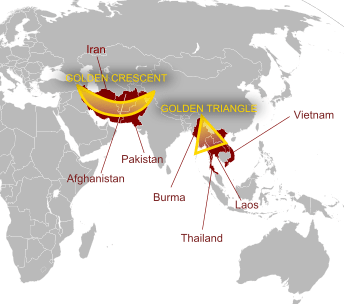
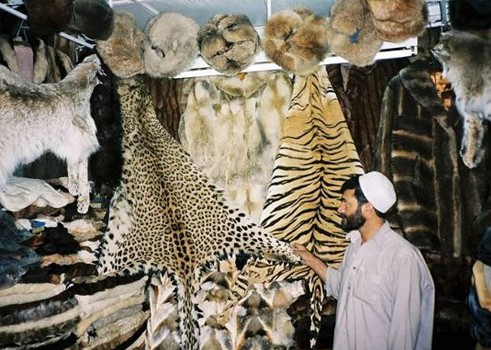
Laos’s biggest breeding facility, near Thakhek, reportedly holds around 400 tigers. Many are bred solely for their parts. The skins are prized as decorations. Farmed-tiger parts mostly move to China through the unruly Golden Triangle where Myanmar, Thailand and Laos converge. The region is a hotspot for trade in protected species: the Environmental Investigation Agency (EIA), an NGO based in UK  visited the Golden Triangle Special Economic Zone in Laos, popular with Chinese tourists. [It] found tiger-bone wine, bear-bile pills, pangolin scales and carvings from the beaks of helmeted hornbills openly on sale. Outside the God of Fortune restaurant was a caged bear-cub that could be killed and cooked to order.

Laos also offers a link to the most lucrative of all illegal wildlife enterprises: the trade in rhinoceros horn, which the UN Office on Drugs and Crime (UNODC) estimated six years ago was worth $8m a year. Since then the number of rhinos slaughtered annually by poachers in Africa has more than tripled (the poaching of Asia’s depleted stock of rhinos is modest). Poachers are sometimes caught; those higher up the chain rarely are. The only high-level trafficker in jail is a Thai, Chumlong Lemtongthai, who is serving a 13-year sentence in South Africa. He was charged in 2011 with bringing Thai prostitutes to South Africa so they could claim they had shot rhinos on legal hunts and were thus entitled under South African law to export horns as trophies. It was the most bizarre of several methods used to get hold of a substance that can fetch up to $70,000 a kilo—almost twice the price of gold.

Mr Chumlong has been linked to a man who has been described as the Pablo Escobar of wildlife-trafficking, Vixay Keosavang, a former soldier in the Lao People’s Army who operates from a walled compound far off the beaten track in the central province of Bolikhamxay. In 2013 the American government offered $1m for information that would help dismantle the network it believes that Mr Vixay heads, which it suspects of trading wild-animal parts across several countries. Mr Vixay has denied wrongdoing.

Some experts believe that the surge in rhino-poaching, which has cut the world’s population by a fifth since 2008, has been driven by a surge in demand in Vietnam. There, rhino-horn shavings are a supposed cure for hangovers; entire horns are given as gifts and displayed as ornaments. Others believe that much of the rhino-horn taken to Vietnam ends up in China.

As their country opened up in recent decades, “some enterprising Vietnamese citizens got residential status in South Africa and very quietly began trading,” says Tom Milliken of Traffic, an NGO. In at least two cases, professional South African hunters have been caught shooting rhino for Vietnamese clients and, in two others, Vietnamese nationals have been arrested trying to smuggle rhino-horns out of South Africa by air. Hunts have been arranged for citizens of the Czech Republic, which has had a large Vietnamese community since the cold war. Since that ruse was discovered, Slovaks, Poles, Ukrainians and Russians have been enlisted as bogus trophy-hunters. “Some Vietnamese residents have bought their own game ranches, so they are now able to buy rhinos at auction and organise sports hunts,” says Mr Milliken.

The international nature of the trade poses big problems for law-enforcement. Documents that would prove decisive in a prosecution for rhino-horn trafficking can sit in a South African office for months awaiting translation, says Mr Milliken; the situation is no better for other animal parts. “None of what we do for drugs do we do for wildlife trafficking,” an international official involved in the fight against organised crime laments. “Extraditions are rare. There are no controlled deliveries. Sophisticated investigative techniques are seldom deployed. We’re not doing any of the things we could be doing to stop it.”

Excerpts from The Trade in Wild Animals: Last Chance to See?, Economist, Apr. 18, 2016, at 49

How to Catch Illegal Fishers: port state measures

The Agreement on Port State Measures to Prevent, Deter and Eliminate Illegal, Unreported and Unregulated Fishing (the Agreement)  entered into force on June 5, 2016.  The main purpose of the Agreement is to prevent, deter and eliminate illegal, unreported and unregulated (IUU) fishing through the implementation of robust port State measures. The Agreement envisages that parties, in their capacities as port States, will apply the Agreement in an effective manner to foreign vessels when seeking entry to ports or while they are in port. …

The Agreement provides an opportunity for port States to check and verify that vessels not flying their flags and that seek permission to enter their ports, or that are already in their ports, have not engaged in IUU fishing.  The Agreement also enhances flag States control over vessels as the Agreement requires the flag State to take certain actions, at the request of the port State, or when vessels flying their flag are determined to have been involved in IUU fishing….

Furthermore, the Agreement’s seeks to prevent the occurrence of so-called ports of non-compliance (formerly known as ports of convenience). Countries operating ports of non compliance do not regulate effectively the fishing and fishing-related activities that take place in the ports, including determining whether IUU-caught fish are landed, transshipped, processed and sold in the ports. Ratifying and acceding to the Agreement and implementing its measures robustly will reduce the number of ports of non compliance and opportunities for vessels to dispose of IUU-caught fish with relative ease. Port state measures are a cost-effective tool in ensuring compliance with national law and regional conservation and management measures adopted by RFMOs. This is because port States do not have to expend time, effort and resources in monitoring, pursuing and inspecting vessels at sea. Port inspections and controls are very much cheaper and safer than alternative, more conventional air and surface compliance tools. Port State measures, if used in conjunction with catch documentation schemes, have the potential to be one of the most cost-effective and efficient means of combating IUU fishing.

The Agreement’s most potent effect in terms of its potential to curb IUU fishing is that through the implementation of its provisions, including those relating to denial of access to ports, port inspections, prohibition of landing, and detention and sanction, can prevent fish caught from IUU fishing activities from reaching national and international markets. By making it more difficult to market fish through the application of port State measures, the economic incentive to engage in IUU fishing is reduced. In addition, many countries have also decided to prohibit trade with countries that do not have port state measures in place.

Excerpt from Food and Agriculture Organization  FAO Website.

Justice 4 Fish

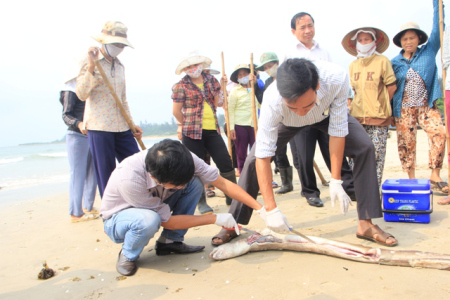
Hundreds of people have held a rare protest in Vietnam against the unexplained mass death of fish on the country’s central coast. Vast numbers of dead fish have appeared across some 200km (125 miles) of coastline since early April. A government investigation has so far found no links to a steel plant owned by Taiwanese firm Formosa Plastics.But many of the demonstrators in Hanoi blamed the company, and carried placards saying “Formosa Out”. Other signs read “Formosa destroying the environment is a crime” and “Who poisoned the central region’s waters?”

Environment Minister Tran Hong Ha said the die-off was “a very huge and serious environment disaster” and admitted that the government had been slow to react.He said Formosa Plastics had been ordered to dig up an illegal waste pipe at its plant.  Fishermen along the affected coastline are banned from selling their stocks, but seafood industry officials said exports, that bring in $6.6b a year, would not be affected.

Excerpt from Vietnam protest over mystery fish deaths, BBC, May 1, 2016

Crocodile Farms for Hermes Bags

Over 20 countries export crocodilian skins, according to statistics from the UN Environment Programme. More than half the global tally is from caimans and alligators farmed in Colombia and the United States. The skins are largely sold to tanners in Italy and France, and also in Singapore.The industry has grown apace since the late 1970s, when conservationists began loosening an export ban designed to defend the animals from hunting (the trade is still controlled under CITES, an intergovernmental effort to protect endangered creatures). Grahame Webb, a biologist, says that many of the 5,000 or so farms are tiny set-ups in Asian villages. The largest outfits, however, now boast as many as 70,000 crocs. Some are getting snapped up by big leather-buyers at fashion houses such as Hermès and Louis Vuitton.

Excerpt from  Crocodile Farming: Snapping Dressers, Economist, May 14, 2016, at 55

Re-Creating the Rhino

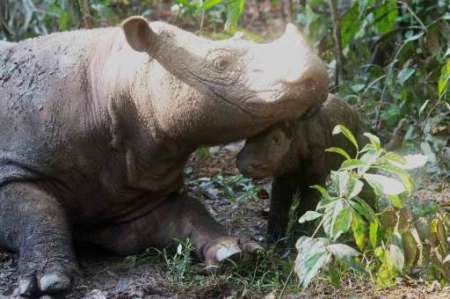
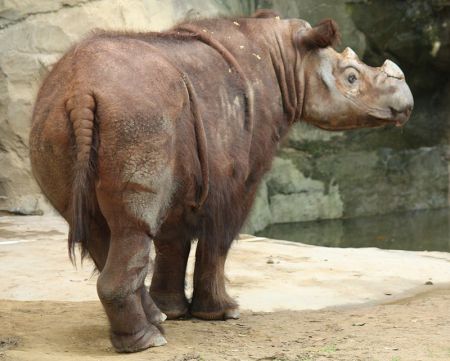
A Sumatran rhinoceros born in Indonesia has given renewed hope to environmentalists looking to save the critically endangered species.  A rhino named Ratu gave birth to the female calf on May 12, 2015, at a rhino sanctuary in the Way Kambas National Park on the island of Sumatra.

The new arrival for 15-year-old Ratu, and her mate Andalas*, follows the couple’s first baby Andatu, who made history in 2012 as the first rhino born in captivity in Indonesia in more than a century.

* Andalas, was born at the Cincinnati Zoo in 2001…. In 2001 he was the first captive Sumatran rhino born in 112 years  He moved to the sanctuary in Indonesia in 2007.

Excerpts from Rare Sumatran rhino born in Indonesia, Reuters,  May 13, 2016

Miners v. Indigenous Peoples: Canada

In 1849 the First Nation of Ojibways, a Canadian indigenous group, fired a cannon into a copper mine that had gone ahead without their approval.These days Canada’s aboriginal groups use public pressure, backed by legal action, to protect their lands against exploitation by outsiders. In February 2016 the government of British Columbia reached agreement with forest companies, environmental groups and 26 First Nations communities to protect from logging an area on the Pacific coast larger than Belgium—newly dubbed the Great Bear Rainforest. The deal, which allows logging and mining in areas aboriginals have agreed to, is the culmination of a long public-relations campaign (choosing the Kermode bear as its mascot was a masterstroke). It would have got nowhere without centuries of treaty-making and decades of case law to back it up….

The federal aboriginal affairs agency is party to 554 proceedings involving such rights (not all of which concern resource firms). That does not include disputes between aboriginal groups and firms. Projects as diverse as seismic testing for mineral deposits in Arctic waters and fracking in the west face challenges. Until 1951 such lawsuits were barred. They are expensive and can drag on for years; the outcome is never assured. The Tsilhqot’in, who filed suit in 1998 against logging on their ancestral lands in British Columbia, finally won in 2014 and now have title to 1,750 square km (1,100 square miles). But the Innu of Ekuanitshit in Quebec last year lost their bid to stop the Muskrat Falls hydropower project, which they say will affect caribou herds.

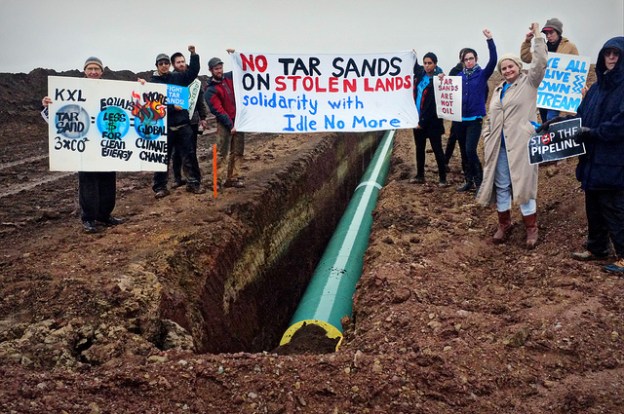
Some big projects are caught in legal limbo. The Northern Gateway pipeline, which is to bring crude oil from Alberta to Canada’s west coast, has been stalled for more than a decade, largely because of opposition from First Nations groups along its route, some of them parties to the Great Bear agreement. The Pacific Northwest liquefied natural gas project, backed by Petronas, a Malaysian state-owned firm, has offered C$1 billion ($726m) in benefits over 40 years to the Lax Kw’alaams nation of northern British Columbia. That has not allayed fears that the project would destroy salmon fisheries.

When such disputes are unresolved, the price can be high. The Northern Gateway pipeline would add C$300 billion to Canada’s GDP over 30 years.

Miners and aboriginals in Canada: I’ll see you in court, Economist, Feb. 6, 2016 at 33

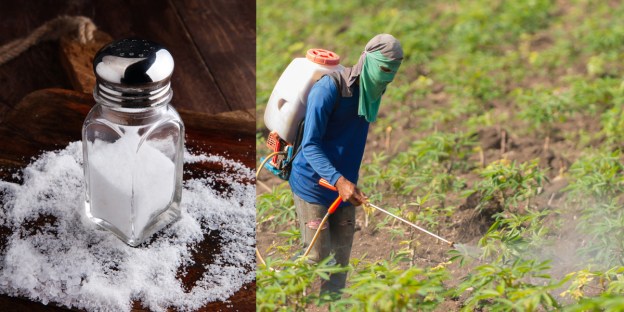
Herbicides: safer than table salt

It’s been a tough year for glyphosate, the world’s most popular weedkiller. In 2015, the International Agency for Research on Cancer (IARC), an arm of the World Health Organization, declared that glyphosate—the key ingredient in Monsanto’s Roundup products—was probably carcinogenic to humans. In the months since, multiple lawsuits have been filed blaming the chemical for causing cancer and birth defects. In February, testing found traces of glyphosate in German beer and organic panty liners sold in France. Other tests have found chemical residue in British bread, as well as in the urine of people across Europe. In early March, the European Union put off a vote to renew a 15-year license for glyphosate after several member states balked.

Monsanto famously advertised Roundup, which was introduced in 1974, as safer than table salt. In 1996 the company stopped making the table salt claim after complaints from New York state….. In September 2016 state officials in California proposed adding the herbicide to a list of known carcinogens. The FDA said in February 2016 that it would begin testing for glyphosate residue in food in the U.S. The results aren’t yet available. The Environmental Protection Agency has been reviewing its use since 2009. The agency, which in 1985 temporarily classified glyphosate as “possibly carcinogenic,” was supposed to wrap up sometime last year; it now says a draft of its decision should be available for public comment sometime this year.

The herbicide industry has mounted an aggressive campaign to discredit the cancer finding and to convince regulators—and the public—that the herbicide should remain in use. …

Glyphosate works by blocking the production of certain amino acids that a plant needs to grow, and it’s nonselective, meaning it kills most plants. It began to dominate the herbicide market only after Monsanto genetically engineered crops to survive it, marketing them under its Roundup Ready brand. Global sales of glyphosate were about $7.8 billion in 2014, 30 percent of the herbicide market, according to Cropnosis, a market-research firm. Monsanto’s dominance of the glyphosate market has declined since the chemical went off patent in 2000. Some weeds have become resistant to glyphosate, triggering the need for other weedkillers. Nonetheless, Roundup remains the primary money-maker for Monsanto’s agricultural productivity segment, which brought in 32 percent of its revenue in fiscal 2015.

A rejection of glyphosate by either the U.S. or Europe would have “massive” ramifications on farming and food production, says Jason Miner, an analyst for Bloomberg Intelligence. “You could quickly take us two decades back in terms of farm yields,” he says. “The world doesn’t have capacity to produce all the alternatives.”

Monsanto’s Roundup Could Get Whacked by European Regulators, Bloomberg BusinessWeek, Mar. 10, 2016

Logging Wars: Tasmania

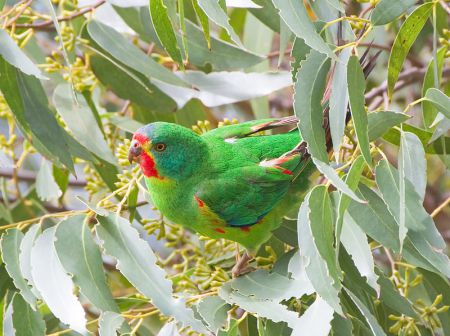
Bruny island, off south-eastern Tasmania, is a home to the swift parrot. Small and green, with patches of red and blue, it breeds only in Tasmania, feeding on nectar from the blue gum tree, a eucalypt, and migrating to south-eastern Australia for the winter. But the logging of Tasmanian forests has destroyed its habitat…Only 2,000 individuals may survive.  In November 2015  the state government stopped logging on Bruny Island after an outcry over the parrot’s plight. An earlier study by Dejan Stojanovic, of the Australian National University, and colleagues had revealed how logging and land-clearing for farms in Tasmania had left swifts, which breed in the trunks of old gum trees, vulnerable to predation by sugar gliders, an introduced possum…. UNESCO-listed world heritage wilderness area was expanded to embrace the Styx valley west of Hobart, thick with eucalyptus trees thought to be 600 years old. The listed region now covers almost a quarter of Tasmania.

But…On becoming premier two years ago, Will Hodgman of the conservative Liberal party said he was tearing up the deal, concerned that his state’s growth lagged the rest of Australia. He now proposes opening up some protected areas for logging.  UNESCO wants commercial logging in the listed forests banned.

Tasmania’s forests: Saving the swift parrot, Economist,  Feb. 13, 2016

Coral Reefs Preservation: Aichi Targets

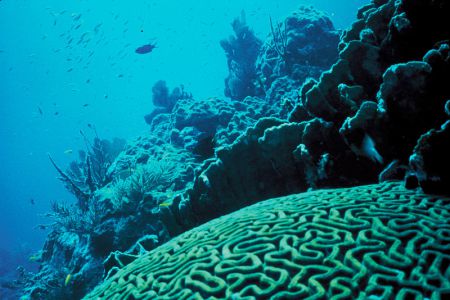
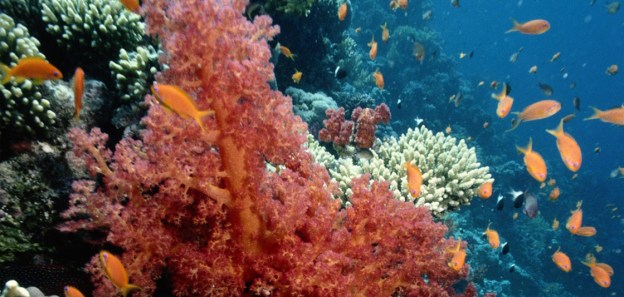
In the past half-century, though, these beautiful, biodiverse structures have been put under pressure by human activity. About a quarter of all coral cover has died. The reefs that are in worst shape are those off the most crowded beaches. “People don’t leave enough time for their sun cream to soak in, so it gets in the water,” says one deckhand with Eo Wai’anae Tours, which organises boat trips off Oahu. More damage is caused by fertiliser-rich run-off from farms, leading to algal blooms which block light the corals need. Fishing near reefs cuts the number of herbivorous fish, allowing vegetation to grow out of control. Some fishing methods are particularly harmful: for example, blast fishermen in Colombia, Tanzania and elsewhere use dynamite to stun and kill fish without regard to the harm done to nearby reefs…In the South China Seaisland-building and fishing for giant clams are crushing some reefs beyond the possibility of recovery (seearticle)….

Tourism generated by the Great Barrier Reef is worth about $4.6 billion annually to nearby Queensland alone. Australian bigwigs bent over backwards last year to keep the UN from listing the reef, a World Heritage Site, as “in danger”. Estimates suggest that the economic value of Martinique and Saint Lucia’s corals comes to $50,000 per square km each year, thanks largely to tourism. But overdevelopment threatens the reefs the visitors come to gawp at. Sediment from construction clouds waters, burying corals and blocking the light they need. Hotels close to the shore may be convenient for tourists, but the process of building them can kill the reefs that snorkellers like to swim over…The three countries with the largest numbers of people who fish on reefs are all in the coral-triangle region: Indonesia, Papua New Guinea and the Philippines. In Indonesia and in the Philippines, up to 1m people’s livelihoods depend on reefs.

Averting a tragedy of the commons means agreeing which activities should be restricted and enforcing the rules. For coral reefs—and other biodiverse marine environments—the usual approach is to give ecologically sensitive areas special status under local or regional laws. In such “marine protected areas” (MPAs), activities that are deemed harmful, such as fishing, drilling and mining, can then be restricted or banned, with penalties for rule-breakers.

The Aichi targets, agreed in 2010 under the UN Convention on Biological Diversity, seek to reduce “anthropogenic pressures” on coral reefs to “maintain their integrity and function”. The aim is to have at least 17% of inland water and 10% of coastal and marine areas under conservation by 2020. Most countries have signed up. But the targets are far from being met. Less than 3% of the ocean’s surface is within an MPA.

The most urgent action is needed close to shore. The nearer humans are to reefs, the worse their effect on the fragile ecosystems. A global register of fishing vessels, long under discussion, would also help identify wrongdoers. And beefing up the UN law of the sea could inspire further action. Decades old, it has little to say about biodiversity.

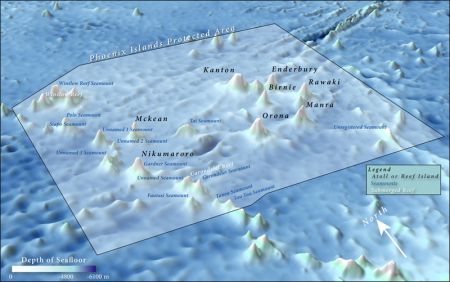
But simply declaring an area protected does not make it so. In 2009 George Bush junior, then president of America, established three national marine monuments in the Pacific, including nearly 518,000 square km of coral islands and surrounding areas. Their remoteness makes it hard to stop vessels entering illegally; Hawaii’s coastguard is already stretched.

Satellites are sometimes used to police MPAs, but they pass over infrequently. In the future, sailing robots could play a larger role. America’s National Oceanic and Atmospheric Administration (NOAA) has been working with a private firm, Saildrone, on hardy models equipped with carbon-fibre fins. They cost less than $500,000 each and can roam remote ocean regions for months, making them far cheaper than manned boats.

Such drones could photograph rogue fishing vessels, obtaining hard-to-gather evidence for any criminal proceedings. And they could carry out other useful work at the same time, such as monitoring ocean temperature and acidity or tracking tagged members of endangered species. Saildrone plans to provide its robots as a service, so that universities and other cash-strapped organisations do not have to buy one outright…

Even if the right policies are adopted to keep corals healthy in the immediate future, longer-term threats loom. Neither oceanic warming nor acidification can be kept out by an MPA. And both may be happening too fast for corals to adapt, especially as recent global climate deals will not slow them much. Back slaps and handshakes accompanied the inclusion of an aim to limit global warming to just 1.5°C above pre-industrial levels in the Paris Agreement last year. But only an incorrigible optimist would bet on that aim being achieved.

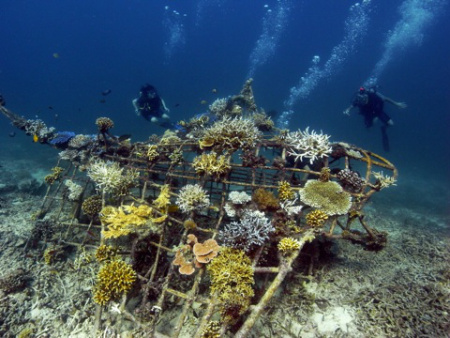
So researchers are turning their attention to ways to help corals cope. Their global diversity, scientists hope, may hold the key. The same coral will grow differently under different conditions: corals of the western Pacific near Indonesia, for example, can withstand higher temperatures than the same species in the eastern Pacific near Hawaii….The characteristics that help some reefs survive unusual conditions could allow others to endure climate change. But tough corals from one place cannot simply be transplanted to another. So a team at the Hawaii Institute of Marine Biology is in the early stages of engineering reef ecosystems, with $4m from the Paul G. Allen Foundation, a charity set up by Bill Gates’s former business partner.

Organisms respond to environmental changes through both genetic processes (adaptation) and non-genetic ones (acclimatisation). With corals, the nature of their symbiotic relationships can also alter. So selectively breeding and conditioning them, and investigating whether certain types of algae confer resistance to heat or acidity, could create hardier varieties faster than they would develop naturally.

These could then be used to repopulate ravaged reefs—once more is known about how and where to transplant them. “We’re assisting evolution,” explains Ruth Gates, who leads the research.

Marine conservation: Rejuvenating reefs, Economist, Feb. 13, 2016, at 57

Trees Worth More Than Gold

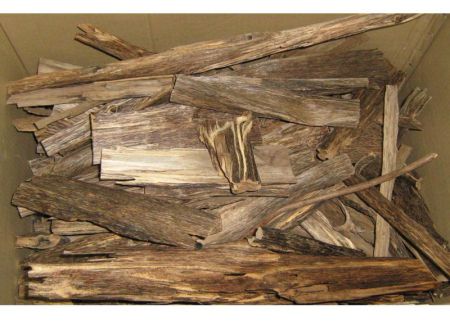
To protect incense trees, the Convention on International Trade in Endangered Species of Wild Fauna and Flora restricts trading in agarwood. But Hong Kong does not single out those who destroy or damage the trees for harsh treatment. If an incense tree is on government-managed land, the maximum sentence for cutting it down is the same as it is for felling any other kind of tree on such property: a fine of HK$25,000 ($3,210) and a year in prison.  Such penalties do little to deter thieves from mainland China, who are encouraged by growing demand for exotic medicines among members of the mainland’s fast-growing middle class. Professor C.Y. Jim of the University of Hong Kong reckons that in 2013 high-grade agarwood was worth $1,600 a gram on the black market. That is more than gold. According to Mr Jim, Hong Kong may be the “last refuge” of the tree, so it has become a “honeypot” for tree-snatchers.

Most of the thieves work for criminal gangs based across the border in mainland China. In recent years a relaxation of restrictions on travel from the mainland to Hong Kong has made their work easier. They often pretend to be hikers, sometimes camping out for weeks while gathering the timber. A local NGO has produced a map showing about 200 sites from which it says around 500 trees were stolen in the past year.

Very few incense trees form agarwood, so they are often destroyed indiscriminately. On Lamma, a plaque marks a spot where three young trees were uprooted. A short scramble up a steep slope reveals a gorier scene: splintered woodchips are all that remain of an aged tree. Mr Yeung, the beekeeper, says “hunters” felled and butchered it in situ. As supplies diminish, the gangs are becoming more desperate. Thieves are raiding private gardens; some residents have begun organising patrols to frighten the thieves away. Alarms and monitoring cameras are being installed.

Excerpts from Trees in Hong Kong: Fragrant Arbour, Economist, Feb. 22, 2016, at 37

Why Illegal Logging Persists

The European Union (EU) adopted in 2010 Regulation (EU) No 995/2010 laying down the obligations of operators who place timber and timber products on the market (the Timber Regulation,, as part of the implementation of the Action Plan on Forest Law Enforcement, Governance and Trade……[The EU adopted the Regulation because] llegal logging is a pervasive problem of major international concern. It has a devastating impact on some of the world’s most valuable remaining forests as well as on the people who live in them and who rely on the resources that forests provide. It contributes to tropical deforestation and forest degradation, which may be responsible for 7 to 14%3 of total CO2 emissions from human activities; it threatens biodiversity and undermines sustainable forest management and has a negative impact on poverty reduction…..

The following major challenges to the effective application of the Timber Regulation have been identified in the evaluation process: insufficient human and financial resources allocated to the [authorities dealing with implementation], varying types and level of sanctions across EU states and a lack of uniform understanding and application of the Regulation throughout the EU. Those challenges have translated into uneven enforcement, which creates a non-level playing field for economic operators….

In order to address the shortcomings identified, EU states should significantly step up their implementation and enforcement efforts. The current level of technical capacity and resources (both human and financial) allocated to the [authorities dealing with implementation] does not match with the needs and must be reinforced in most of the Member States with the aim to increase the number and quality of compliance checks.

Excerpts from REPORT FROM THE COMMISSION TO THE EUROPEAN PARLIAMENT AND THE COUNCIL Regulation EU/995/2010 of the European Parliament and of the Council of 20 October 2010 laying down the obligations of operators who place timber and timber products on the market (the EU Timber Regulation, Feb. 18, 2016,  COM(2016) 74 final


Underwater Robots against Pollution

Subcultron is a swarm of at least 120 self-directing, underwater robots being developed by scientists in six countries to monitor Venice’s polluted waterways and transmit environmental data to government officials.The robots, shaped like fish, mussels, and lily pads to mimic the species’ hydrodynamics, carry sensors to monitor water conditions like temperature and chemical composition…The swarm communicates via the Internet-capable lily pads…
The robots use lithium ion batteries and solar cells for power. (Yes, enough sunlight gets through.)Some of the robots carry cameras. Others have electrodes that allow them to “see” by measuring objects crossing the electric fields they generate.Using wireless signals, human monitors can take over from the swarm’s AI software if something goes wrong. The European Commission has granted the project €4 million ($4.4 million).
Thomas Schmickl, the inventor, …..plans to build robot swarms that can monitor the oceans or even faraway moons that have water.

Excerpts from Innovation Subcultron, Bloomberg Business Week, Jan. 28, 2016

Rhino Poachers Hide in Villages

Lieutenant General Berning Ntlemeza, head of the Directorate for Priority Crime Investigation (better known as the Hawks), of South Africa wants community involvement with poachers stopped.He told the Police Parliamentary Portfolio Committee that impoverished communities on the borders of the Kruger National Park were  “Heavily armed, wealthy poachers avoid hotels and hide in villages, waiting for night to fall before they sneak into the park to kill rhino and harvest horn,…. If communities don’t own or benefit from the park we are not going to win the fight against poaching,” he said.

Excerpts Communities supporting poachers must be targeted – Hawks boss, defenceWeb.com, Feb. 1, 2016

Lawsuits Against Shell, Nigeria

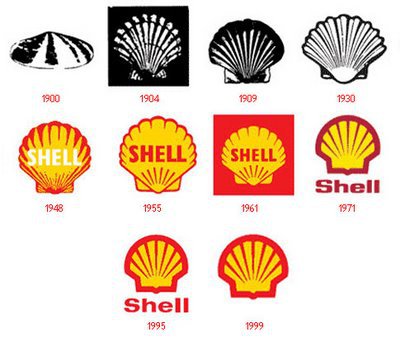
A Dutch appeals court ruled on December 18, 2015 that Royal Dutch Shell can be held liable for oil spills at its subsidiary in Nigeria, potentially opening the way for other compensation claims against the multinational. Judges in The Hague ordered Shell to make available to the court documents that might shed light on the cause of the oil spills and whether leading managers were aware of them.  This ruling overturned a 2013 finding by a lower Dutch court that Shell’s Dutch-based parent company could not be held liable for spills at its Nigerian subsidiary.

The legal dispute dates back to 2008, when four Nigerian farmers and the campaign group Friends of the Earth filed a suit against the oil company in the Netherlands, where its global headquarters is based.  “Shell can be taken to court in the Netherlands for the effects of the oil spills,” the court ruling stated on Friday. “Shell is also ordered to provide access to documents that could shed more light on the cause of the leaks.”  The case will continue to be heard in March 2016.  Judge Hans van der Klooster said the court had found that it “has jurisdiction in the case against Shell and its subsidiary in Nigeria”….

“There are 6,000km of Shell pipelines and thousands of people living along them in the Niger Delta,” he said. “Other people in Nigeria can bring cases and that could be tens of billions of euros in damages.”  In a separate case, Shell agreed in January to pay out £55m ($82 million) in out-of-court compensation for two oil spills in Nigeria in 2008, after agreeing a settlement with the affected community in the Delta.

Excerpt from Dutch appeals court says Shell may be held liable for oil spills in Nigeria, Guardian, Dec. 18, 2015.


Gene Banks: saving world’s crops

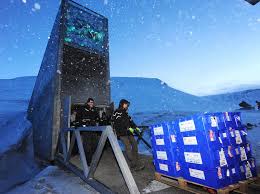
Syria’s civil war has forced scientists to request the first-ever withdrawal of seeds from a Doomsday vault built in the Arctic to safeguard the world’s food supplies…The International Center for Agricultural Research in the Dry Areas (ICARDA) said it has made a request to take back some of its samples from the Svalbard Global Seed Vault. The vault was created by the Norwegian government in 2008 to protect vital crops such as wheat against global disasters, war or disease.

It will be the first time seeds have been withdrawn from the facility, which lies more than 800 miles inside Arctic Circle — midway between Norway and the North Pole — and is the largest vault of its kind in the world. Built into the mountainside on the Svalbard archipelago, it relies on permafrost and thick rock to ensure that the seed samples will remain frozen even without power..,ICARDA has requested approximately 16,500 of its seed samples — one seventh of the total it has stored in Svalbard — and hopes to reproduce them at its other facilities in Morocco and the American University in Beirut, Lebanon. Eventually it will send new samples back to Norway…

He said some scientists were still present at the Aleppo facility but that its one-time headquarters had been occupied by armed groups.  “Fortunately it is not ISIS, they are some fundamentalist groups,” he said. “They seem to co-exist. They are using the land for their own benefit, for example to grow legumes, but we have no control of it…..The Svalbard seed bank has exactly 865,871 samples from every country in the world, Asdal said.  “In fact, we have seeds from more countries than now exist,” he explained, since some of the older seeds are from now-defunct nations such as Czechoslovakia. Syria’s civil war has killed a quarter of a million people since 2011, according to United Nations estimates, and driven 11 million more from their homes.

Excerpts from ALASTAIR JAMIESON, Syria War Forces First Withdrawal from Svalbard Global Seed Vault,NBC News, Sept. 25, 2015

Weather Engineering and Climate Change

Maharashtra is one of the largest and wealthiest of India’s 30 states, with 110 million residents. It encompasses Mumbai and other large cities, plus vast swaths of farmland. Like other agricultural regions of India, it’s in its third consecutive year of drought. More than 80 percent of its farms depend on rain for irrigation, and agriculture production has dropped by almost a third since 2013. The human impact has been severe—1,300 debt-trapped farmers have committed suicide in Maharashtra in just the past six months.In July, 2015 the state’s minister of revenue, Eknath Khadse, took a gamble: He hired Koliwad to carry out a $4.5 million cloud-seeding program over three months and across 100 square miles in the middle of the state, the largest campaign of this kind ever attempted in India.

So Koliwad called Weather Modification Inc., the world’s largest private aerial cloud-seeding company, based in Fargo, N.D. WMI’s chief executive, Patrick Sweeney, developed a five-year technology transfer program with Koliwad that’s now in its first year. Pederson and other WMI staff are training Indian pilots, meteorologists, and Doppler radar technicians to seed clouds.

Sweeney has seeded clouds all over the world for more than 20 years, but the Maharashtra project is unique in that the circumstances are so dire. “The hardest part is managing expectations,” he says. “People in Maharashtra are hoping for a cure-all to drought. They come out and dance in the streets when it rains, they hug our pilots and say, ‘Do it again.’ But we can’t guarantee that the clouds will be there—and willing to cooperate.”..

Despite the uncertainty, the industry is on the rise. According to the World Meteorological Organization, more than 52 countries have active cloud-seeding operations—up from 42 four years ago. In the U.S. last year, 55 cloud-seeding projects were reported to NOAA. There’s even a luxury cloud-seeding market emerging—one European company, for instance, charges a minimum of $150,000 to guarantee good wedding weather by forcing clouds to rain in the days before the event….

Sweeney also built ICE (Ice Crystal Engineering), a company that makes cloud-seeding chemicals and supplies flares to 25 countries. ICE adds a decent sidestream of income for Sweeney, with revenue of about $3 million a year. But the bigger advantage is that it helped WMI become the only aerial seeding company that “does a full turnkey,” says Neil Brackin, WMI’s president—meaning it customizes and operates the planes and radars, manufactures the flares, and flies the missions.

They do have competitors. There are 34 private companies worldwide that do weather modification, but there’s no bigger rival in aerial cloud seeding than the Chinese government, which spends hundreds of millions a year seeding clouds in 22 of its 23 provinces, both to clear pollution above cities and to enhance rainfall for farming. China has yet to allow private companies to enter its market, but Sweeney is making inroads; he sold his first cloud-seeding plane to Beijing last year.

Thailand’s government has a Bureau of Royal Rainmaking, with hundreds of employees that WMI helped train, though the program’s still using old technology—releasing mounds of table salt from trap doors in the bellies of its planes. And when the Argentine government took over the cloud-seeding program WMI built for the country, it cut costs. Soon after, two pilots died seeding clouds above a mountain, and the project was suspended…

Brackin adds that while scientists want to achieve a 99.99 percent probability that a technology consistently works, the industry doesn’t need that kind of certainty or consistency to succeed. He likens cloud seeding to a cutting-edge medication that’s still in development: “If you’re dealing with a serious ailment and you were offered a medicine that had a 60 percent chance of working, or even 20 percent, would you take it? You probably would.”

Excerpts from  Amanda Little, Weather on Demand: Making It Rain Is Now a Global Business, Bloomberg, Oct. 28, 2015

When the Buying Stops the Killing Can too: Endangered Species

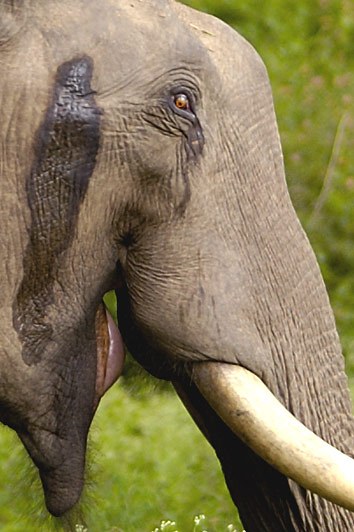
[O]n October 15th, 2015 China announced a one-year ban on the import of ivory hunting trophies from Africa, closing a big loophole. Wildlife activists are delighted….The world’s elephant population has dived from 1.2m in 1980 to under 500,000 today. In 1989 the sale of ivory was banned worldwide. But in 1999 and again in 2008, the Convention on International Trade in Endangered Species (CITES), a conservation pact, allowed the sale of stockpiles of ivory from southern Africa to China. The countries vowed to use the proceeds for conservation; China claimed it had a robust registration system that would keep illegal ivory out. But conservationists rightly predicted the concession would fuel more smuggling and so more killing.  Permitted sales became a cover for illegal ones. In 2010-12 about 100,000 elephants were slain for their tusks. In the past five years, Mozambique and Tanzania have lost half their elephants to poaching…

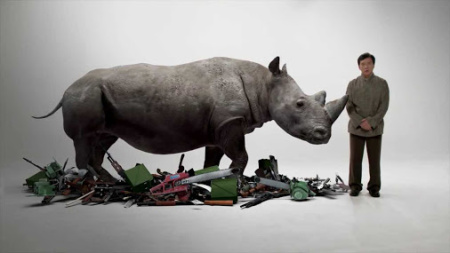
Despite strong demand for ivory among China’s rising middle class, attitudes may gradually be changing. As of 2012, nearly half of Chinese people saw elephant poaching as a problem, according to a survey by WildAid. The figure has been boosted by the support of celebrities. Yao Ming, a basketball player, and Jackie Chan, an actor, appear on posters everywhere with the message: “When the buying stops, the killing can too.” The government has donated $200m worth of media space every year since 2008.

Opinion on ivory has shifted fast, says Mr Knights, partly because of the success of another campaign, to protect sharks. In the markets of Guangzhou, the global centre for the trade, dried shark fins have fallen from 3,000 yuan ($470) per kilo five years ago to 1,000 yuan today, as Chinese people abjure shark-fin soup, a delicacy.  WildAid raised its voice over that issue, too, but more important was the Communist Party’s ban in 2013 of shark-fin soup at official banquets, part of a drive against corruption and excess. The Hong Kong government followed, as did airlines and hotels. A survey in 2013 found 85% of people said they had stopped eating shark-fin soup in the past three years.

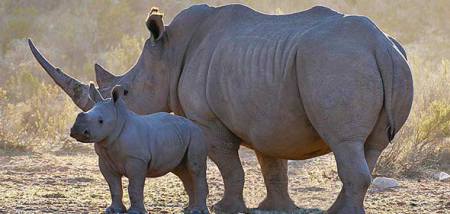
One scourge is untouched by all this: the illegal trade in rhinoceros horn. More than 1,200 rhinos were killed for their horns in 2014 in South Africa alone, up from just 13 killed in 2007. This partly reflects a huge rise in demand in Vietnam, but China is also a consumer. Ground rhino horn is believed to cure fever and improve sexual performance. One kilo can cost up to $70,000.

Ominously, some African nations now want a one-off sale of rhino-horn stocks, as happened twice with ivory. To secure this, South Africa must win two-thirds of the member states at the next CITES conference…

Excerpts from Animal conservation: The elephants fight back, Economist, Nov. 21, 2015, at 44

Sumatran Rhinos

The last Sumatran rhino in the Western Hemisphere began a journey on October 30, 2015 from Ohio, United States to its ancestral southeast Asian homeland on a mission to help preserve the critically endangered species. …Conservationists hope Harapan can mate with one or more of the three females in the Sumatran Rhino Sanctuary in Way Kambas National Park….Numbers of the two-horned “hairy rhinos,” descendants of Ice Age wooly rhinos, have fallen by some 90 percent since the mid-1980s as development of their forest habitat and poachers seeking their horns took their toll. Including three Sumatran rhinos in a sanctuary in Malaysia, only nine are in captivity globally.

Harapan’s departure ends the Cincinnati Zoo’s captive breeding program for the species that produced three rhinos….Indonesian officials are anxious to get Harapan to their sanctuary. They have said they don’t want to be dependent on other countries in conservation efforts by sending rhinos to be bred abroad, but welcome technological or scientific assistance for their breeding program.Conservationists and government officials met in Singapore in 2013 for a Sumatran Rhino Crisis Summit to discuss ways to save the species.

Excerpts from DAN SEWELL, Sumatran Rhino Begins US-Asia Trip to Ancestral Home, Associated Press, Oct. 30, 2015


Climate Change 2015


Global carbon emissions were 58% higher in 2012 than they were in 1990. The atmospheric concentration of carbon dioxide has risen from just under 340 parts per million in 1980 to 400 in 2015.  To stand a fair chance of keeping warming to just 2°C by the end of the century—the goal of global climate policy—cumulative carbon emissions caused by humans must be kept under 1 trillion tonnes. Estimates vary but, according to the Intergovernmental Panel on Climate Change, the total had hit 515 billion tonnes by 2011. Climate Interactive, a research outfit, reckons that if emissions continue on their present course around 140 billion tonnes of greenhouse gases will be released each year and temperatures could rise by 4.5°C by 2100. And even if countries fully honour their recent pledges, temperatures may still increase by 3.5°C by then.

The world is already 0.75°C warmer than before the Industrial Revolution….

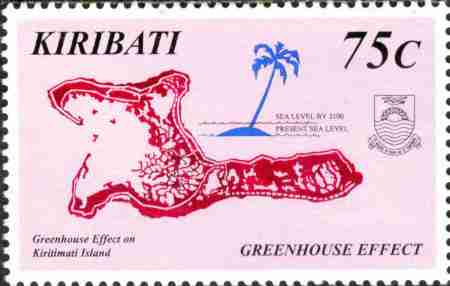
Melting glacier ice, and the fact that warmer water has a larger volume, mean higher sea levels: they have already risen by roughly 20cm since 1880 and could rise another metre by 2100. That is perilous for low-lying islands and flat countries: the government of Kiribati, a cluster of tropical islands, has bought land in Fiji to move residents to in case of flooding. Giza Gaspar Martins, a diplomat from Angola who leads the world’s poorest countries in the climate talks, points out that they are particularly vulnerable to the effects of a warming planet. Money alone, he argues, will not fix their problems. Without steps to reduce emissions, he predicts, “there will be nothing left to adapt for.”…

For every 0.6°C rise in temperature, the atmosphere’s capacity to hold water grows by 4%, meaning storms will pour forth with greater abandon. The rains of the Indian monsoon could therefore intensify, cutting yields of cereals and pulses.

Climate change seems also to be making dry places drier, killing crops and turning forests into kindling. Forest fires in Indonesia, more likely thanks to the current El Niño weather phenomenon, could release 2 billion tonnes of carbon dioxide, about 5% of annual emissions due to human activity, says Simon Lewis of University College London. In recent months fires have swallowed more than 2.4m hectares of American forests. Alaska suffered 80% of the damage—a particular problem because the soot released in these blazes darkens the ice, making it less able to reflect solar radiation away from the Earth.

Developments in the Arctic are worrying for other reasons, too. The region is warming twice as fast as the rest of the world, a trend that could start a vicious cycle. Around 1,700 gigatonnes of carbon are held in permafrost soils as frozen organic matter. If they thaw, vast amounts of methane, which is 25 times more powerful as a global-warming gas than carbon dioxide when measured over a century, will be released. One hypothesis suggests that self-reinforcing feedback between permafrost emissions and Arctic warming caused disaster before: 55m years ago temperatures jumped by 5°C in a few thousand years…

And on September 29th Mark Carney, the governor of the Bank of England, warned that though measures to avoid catastrophic climate change are essential, not least for long-term financial stability, in the shorter term they could cause investors huge losses by making reserves of oil, coal and gas “literally unburnable”.

Excerpts from Climate Change: It’s Getting Hotter, Economst, Oct. 3, 2015, at 63


Markets for Natural Resources: China

A nationwide  carbon-trading scheme, to be set up in 2017, is the most visible example of a broader trend in China towards using market mechanisms in environmental matters…[A] reform plan issued by the government on September 21st, 2015  laying out the basis of future policy, talks about developing “a market system which allows economic levers to play a greater role in environmental governance”. If the plan is to be believed, China will go further than any other country in developing environmental market mechanisms.

The plan talks of selling “green” bonds, ie, those financing projects certified as environmentally sound. The government will improve financial guarantees for low-carbon projects. But those are becoming common. More fundamentally, the reform says China will separate the ownership of all natural resources from the rights to use them—and sell the usage rights at market.

This is much more radical. The idea is rooted in communist dogma, which says all natural resources—land, rivers, minerals and so on—are collectively owned. The reform plan begins by calling for a massive Domesday-like inventory of who owns what, whether central government, provincial governments or lower tiers. It then says, with utter insouciance, that “with the exception of natural resources which are ecologically important [eg, national parks], the ownership rights and use rights for all other natural resources can be separated”. And, having separated them, the usage rights can be bought and sold, rented out, used as collateral or as the basis of loan guarantees, and so on.

The carbon-trading scheme suggests what this could mean in practice. It is like a market in energy-usage rights, with the carbon treated as part of the cost of using fossil fuels. A market in water rights will also be set up. Trials will be held in Gansu and Ningxia, two north-western provinces. The plan talks cryptically of setting up a “natural resource asset exchange”.

Excerpts from Markets and the environment: Domesday scenario, Economist, Oct. 3, 2015, at 46

The Costs of Stopping Biopiracy

Botanists think there are up to 80,000 wild species of flowering plant left to discover. But a scarcity of funds hampers efforts to collect them. The UN Convention on Biological Diversity of 1992, ratified by 195 states and the European Union, made things more complicated. It recognised plants as part of countries’ national heritage and outlawed “biopiracy”—profiting from plants without compensating the countries in which they were found.

That made exploiting plants fairer but collecting them harder. Some officials saw a chance to get rich. “Suddenly everyone thought these plants were incredibly valuable,” says Mr Hawtin. Getting permission to go on a collecting trip became nearly impossible. “Anybody could say no to a collecting expedition and very few people could say yes.”

Permits became sine qua non, but in poorer countries the environment ministries that were expected to issue them did not always exist. Collectors might see their applications bounced from one department to another, each unwilling to wield its rubber stamp. “No one wanted to be accused in their local paper of helping the biopirates,” says Mr Hawtin.

Persistent botanists have since earned some governments’ trust. It is now much easier to get approval for expeditions than it was in the 1990s, though often with restrictions on what may be collected. “Things are much better now than they were ten years ago,” says Sandy Knapp, head of the plants division at the Natural History Museum in London. A three-year permit from the Peruvian government allows her to collect specimens of Solanaceae, the family that includes tomatoes, potatoes and aubergines…The Millennium Seed Bank now holds workshops in many countries on collection and conservation techniques. It collaborates on expeditions and produces guidebooks to help locals locate and collect seeds for themselves. Yet some countries persist in imposing self-defeating restrictions. India’s biodiversity law, passed in 2002, makes exporting seeds very difficult and sits poorly with its international obligations. If governments fail to understand the urgency of preserving—and sharing—their biodiversity, there may soon be precious little left to collect.

Excerpts from Botany and bureaucracy: A dying breed, Economist,  Sept. 12, 2015, at 55

Biodiversity: the wild relatives of crops

“Crop wild relatives”—the wild ancestors of cultivated plants—are a valuable weapon in the fight against hunger. Together with varieties used by traditional farmers, they contain a wealth of genetic diversity. Yet they are under-researched and under-collected. With their survival threatened by population growth and environmental damage, the race is on to find them before it is too late.

Climate change is expected to cause higher temperatures and more frequent droughts, changing the distribution of pests and diseases. Population growth will add to the pressure on productive land: the UN expects the number of people in the world to rise from 7.3 billion today to 9.7 billion by 2050. …Dependence on a few staples worsens the consequences of any crop failure. Just 30 crops provide humans with 95% of the energy they get from food, and just five—rice, wheat, maize, millet and sorghum—provide 60%. A single variety of banana—Cavendish—accounts for 95% of exports. A fast-spreading pest or disease could see some widely eaten foodstuffs wiped out.

That makes it even more important to preserve the genetic diversity found in crop wild relatives and traditional varieties as an insurance policy. Alas, much of it has already disappeared. The FAO estimates that 75% of the world’s crop diversity was lost between 1900 and 2000. As farming intensified, commercial growers favoured a few varieties of each species—those that were most productive and easiest to store and ship.

According to Cary Fowler of the Global Crop Diversity Trust, an international organisation based in Germany, in the 1800s American farmers and gardeners grew 7,100 named varieties of apple. Today, at least 6,800 of them are no longer available, and a study in 2009 found that 11 accounted for more than 90% of those sold in America. Just one, “Red Delicious”, a variety with a thick skin that hides bruises, accounts for 37%.

Seed banks are the best hope of preserving those that remain. Dehydrating and freezing seeds means that they can be kept for hundreds, perhaps even thousands, of years, and still sprout when given light and water (as botanists need to do on occasion). Some 7.4m samples are already in seed banks around the world, but huge gaps exist.

As part of a study to be published later this year, Colin Khoury and Nora Castañeda-Álvarez of the International Centre for Tropical Agriculture (CIAT), a research facility in Colombia, studied the state of conservation of more than a thousand crop wild relatives in seed banks. They found that for over 70% there were either too few samples for safety or none at all.

The Millennium Seed Bank (MSB) in Sussex, part of Britain’s Royal Botanic Gardens, is the world’s largest wild-plant seed bank, housing 76,000 samples from more than 36,000 species. It co-ordinates “Adapting Agriculture to Climate Change”, a $50m, ten-year international programme funded by Norway to collect and store wild relatives of 29 important crops, cross them with their domesticated kin and share the results with breeders and farmers. Its freezers are solar-powered and its vault is built to withstand a direct hit by a plane (Gatwick airport is close by). Other seed banks are more vulnerable. Staff at the International Centre for Agricultural Research in the Dry Areas, an institute once based in Syria, now found in Lebanon, shipped 150,000 samples to save them from being damaged in the former country’s civil war; seed banks in Afghanistan and Iraq have been destroyed. The Philippines lost one to fire.

Located in Cali, Colombia’s third-largest city, CIAT is home to more than 300 scientists. It has a mandate from the UN to protect, research and distribute beans and cassava, staple foodstuffs for 900m people around the world. Its seed bank, housed in a former abattoir, contains over 36,000 samples of beans, more than any other seed bank, and varieties developed there feed 30m people in Africa.

For many years CIAT’s researchers concentrated on creating varieties that could cope with poor soils and drought. But they have now turned their attention to heat resistance. Earlier this year they announced that they had found heat resistance in the tepary bean, a hardy cousin of the common bean cultivated since pre-Columbian times in northern Mexico and America’s south-west. Crosses with commonly cultivated beans such as pinto, black and kidney beans show potential to withstand temperatures up to 5°C higher than those common varieties can cope with. Even a lesser increase in heat resistance, of 3°C, would mean beans could continue to be cultivated in almost all parts of central and eastern Africa, says Steve Beebe of CIAT’s bean-breeding programme…

The International Treaty on Plant Genetic Resources for Food and Agriculture, which came into effect in 2004 and has been signed by 135 countries and the European Union, identifies 35 food crops that are considered so important to global food security and sustainable agriculture that their genetic diversity should be widely shared. But it has worked less well than hoped. In 2013 a group of Norwegian researchers sent letters to 121 countries requesting seeds. Only 44 complied. Communication broke down with 23 and 54 did not even reply.

If a big crop were to fail, a single useful gene lurking in one wild relative could prevent calamity. PwC, an accountancy firm, values the genes derived from the wild relatives of the 29 crops regarded as most important by the MSB at $120 billion. Preserving the genetic diversity that remains would be an excellent investment.

Agricultural Biodiversity, Banks for Bean Counters, Economist, Sept. 12, 2015, at 54

Making Money in the Peruvian Amazon

The Sierra del Divisor region in the Peruvian Amazon was identified as a biodiversity conservation priority back in the early 1990s. More than 20 years later and Peruvians are still waiting – some more desperately than others given all the narco-traffickers, illegal loggers and gold-miners in or near the region.

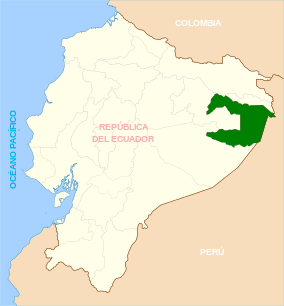
What’s so special about the Sierra del Divisor? It’s the “only mountainous region” anywhere in the lowland rainforest, according to Peruvian NGO Instituto del Bien Comun (IBC), while The Field Museum, in the US, describes it as “a mountain range” rising up “dramatically from the lowlands of central Amazonian Peru” and boasting “rare and diverse geological formations that occur nowhere else in Amazonia.” Its most iconic topographical feature is “El Cono”, an extraordinary peak visible from the Andes on a clear day.

Sierra del Divisor is home to numerous river headwaters feeding into key Amazon tributaries, eco-systems, and a tremendous range of flora and fauna, some of which are endemic, some endangered or threatened – and some with the most wonderful names. Giant armadillos, jaguars, cougars, Acre antshrikes, curl-crested aracaris, blue-throated piping guans and various kinds of monkeys, including the bald – but very red-faced – uakari, all populate the region. Effectively, it forms part of a vast “ecological corridor” running all the way from the Madidi National Park in Bolivia in a north-westerly direction along much of the Peru-Brazil border.

21 indigenous communities and 42 other settlements would benefit from the Sierra del Divisor being properly protected, states the Environment Ministry, while ultimately over 230,000 people in Peru depend on the region for food and water, according to the IBC. In addition, in the absolute remotest parts, it is home to various groups of indigenous peoples living in what Peruvian law calls “isolation.”

In 2006 Peru’s government established a 1.4 million hectare temporary “protected natural area” in this region called the Sierra del Divisor Reserved Zone. Six years later a government commission agreed it would be converted into a national park, and, all that remains now, after a painful administrative process, several key advances made this year and indigenous leaders lobbying various ministries, is for Peru’s Cabinet to approve it and the president, Ollanta Humala, to sign off on it. That is how it has stood since early May 2015 – and still nothing….

Why such a delay indeed, this year or in the past? Might it have something to do with the infrastructure integration plans for the region, such as the proposed – and effectively already underway – road between Pucallpa, the Peruvian Amazon’s current boom city, and Cruzeiro do Sul across the border in Brazil? Or the proposed railway between the same two cities ultimately connecting to Peru’s northern Pacific coast, declared in the “national interest” some years ago? Or the proposed railway running all the way across South America from Peru’s Pacific coast to Brazil’s Atlantic coast, a long-mooted project which has received so much media coverage recently because of Chinese interest in financing it and the visit by China’s premier, Li Keqiang, to Brazil and Peru in May?

Or might the delay be explained by oil and gas industry interests? Perupetro, the state company promoting oil and gas operations, tried to open up what would be the entire southern part of the park for exploration before backtracking in 2008, while the London Stock Exchange-Alternative Investment Market-listed company Maple Energy has been pumping oil for years in a concession just overlapping the west of the proposed park. More significantly, Canadian-headquartered company Pacific Rubiales Energy runs a one million hectare oil concession that would overlap the entire northern part of the park if it was established, and conducted its first phase of exploratory drilling and seismic tests in late 2012 and 2013 in what would be the park’s far north. Clearly, it wouldn’t be good PR for either Pacific or Peru to explore for oil in, or exploit oil from, a national park, although it wouldn’t be the first time a concession and park have overlapped. Indeed, according to the IBC, it has been agreed that Pacific’s “rights” to operate will be respected if the park is created.

Excerpts from David Hill Peru stalling new national park for unique Amazon mountain range, Guardian, July 29, 2015


Regulating Mining in the Deep Seabed

Interest in mining the deep seabed is not new; however, recent technological advances and increasing global demand for metals and rare-earth elements may make it economically viable in the near future  Since 2001, the International Seabed Authority (ISA) has granted 26 contracts (18 in the last 4 years) to explore for minerals on the deep seabed, encompassing ∼1 million km2 in the Pacific, Atlantic, and Indian Oceans in areas beyond national jurisdiction However, as fragile habitat structures and extremely slow recovery rates leave diverse deep-sea communities vulnerable to physical disturbances such as those caused by mining (3), the current regulatory framework could be improved. We offer recommendations to support the application of a precautionary approach when the ISA meets later this July 2015….

The seabed outside of national jurisdictions [called the “Area” in the United Nations Convention on the Law of the Sea (UNCLOS)] is legally part of  the “common heritage of mankind” and is not subject to direct claims by sovereign states. The common-heritage principle imposes a kind of trusteeship obligation on the ISA, created under UNCLOS in 1994, and its member states, wherein “the interests of future generations have to be respected in making use of the international commons”; those interests include both resource exploitation and environmental protection …

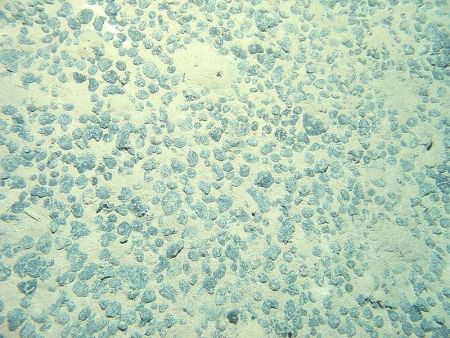
Efforts focused on the Clarion-Clipperton Fracture Zone (CCZ) in the abyssal Pacific provide a useful model. The CCZ as the largest known concentrations of high-grade polymetallic nodules, with potentially great commercial value . The scale of impacts that would be associated with nodule mining in the CCZ may affect 100s to 1000s of km2 per mining operation per year . In 2007, an international workshop brought together expert representatives from ISA and the scientific and international ocean law communities to develop design principles and recommendations for a network of marine protected areas (MPAs) in the CCZ off-limits to mining, to be considered by the ISA as part of a regional environmental management plan. The workshop used a recent assessment of biodiversity, species ranges, and gene flow in the CCZ to develop recommendations honoring existing mining exploration claims while incorporating accepted principles of ecosystem management ..

In 2012, the ISA pioneered a precautionary approach in the CCZ when it provisionally adopted the deep seabed’s first environmental management plan that included Areas of Particular Environmental Interest (APEIs), a modified version of the recommended MPA network from the 2007 workshop. The design principles used in developing the APEIs included (i) compatibility with the existing legal framework of the ISA for managing seabed mining and protecting the marine environment. (ii) minimizing socioeconomic impacts by honoring existing exploration claims; (iii) maintaining sustainable, intact, and healthy marine populations; (iv) accounting for regional ecological gradients; (v) protecting a full range of habitat types; (vi) creating buffer zones to protect against external anthropogenic threats (e.g., mining plumes); and (vii) establishing straight-line boundaries to facilitate rapid recognition and compliance (12)….

Meanwhile, the ISA continues to grant exploration contracts for large areas of other deep-sea habitats in the Indian, Atlantic, and Pacific Oceans. Preexisting or new exploration claims (up to ∼75,000 km2 for nodules) can erode the effectiveness of protected-area networks by preempting protection of critical habitats and by limiting population connectivity by causing excessive spacing between MPAs. We thus recommend that the ISA consider suspending further approval of exploration contracts (and not approve exploitation contracts) until MPA networks are designed and implemented for each targeted region.

Excerpts from L. M. Wedding et al., Managing mining of the deep seabed, Science 10 July 2015:

Building Climate Resilience in Ecosystems

Some ecosystems show little response [to climate change] until a threshold or tipping point is reached where even a small perturbation may trigger collapse into a state from which  recovery is difficult .  ….[S}uch collapse may be altered by conditions that can be managed locally…. [This] provides  potential opportunities for pro-active management.…[C]rises in iconic UNESCO World Heritage sites illustrate that such stewardship is at risk of failing. The term “safe operating space” frames the  problem of managing our planet in terms of staying within acceptable levels or “boundaries” for global stressors [Such as climate change]….

Obviously, local interventions are no panacea for the threats of climatic change. For example, melting of arctic sea ice with its far-reaching ecological consequences cannot be arrested by local management. However, ways of building climate resilience are emerging for a variety of ecosystems, ranging from control of local sources of ocean acidification  to management of grazing pressure on dry ecosystems,World Heritage Areas.

The Doñana wetlands in southern Spain provide the most important wintering site for waterfowl in Europe. They contain the largest temporary pond complex in Europe, with a diversity of amphibians and invertebrates. Despite the site’s protected status, the marshes are threatened by eutrophication due to pollution and reduced flow of incoming streams, promoting toxic cyanobacterial blooms and dominance by invasive floating plants that create anoxic conditions in the water. In addition, groundwater extraction for strawberry culture and beach tourism also has major impacts.  Little has been done to control these local stressors, leaving Doñana unnecessarily vulnerable to climate change. UNESCO has just rated this World Heritage Site as under ‘very high threat’.

The Great Barrier Reef is the largest coral system in the world. In response to multiple threats, fishing has been prohibited since 2004 over 33% of the Great Barrier Reef Marine Park, and efforts have begun to reduce runoff of nutrients, pesticides, herbicides and sediments from land. However, these interventions may be too little, too late. Approximately half of the coral cover has been lost in recent decades, and the outlook is “poor, and declining” with climate change, coastal development and dredging as major future threats. The World Heritage Committee has warned that in the absence of a solid long-term plan, it would consider listing the reef as “in danger” in 2015.

More available online Creating a Safe Operating Space for Iconic Ecosystems By M. Scheffer et al, 2015

Slavery and the Fishing Industry

Maung Toe, an immigrant from Myanmar, laboured unpaid for six months on a Thai ship fishing illegally in Indonesian waters…naval patrols came close, but the crew would evade them. He had been forced aboard at gunpoint and sold by a broker to the captain for $900. It was the first time he had ever seen the sea.

Mr Maung’s story is told by the Environmental Justice Foundation (EJF), a charity, in a recent study of trafficking and piracy in Thailand’s seafood industry. The country hosts tens of thousands of trafficking victims, by conservative estimates, many from Myanmar, as well as from Cambodia and Bangladesh. Many of them sweat on trawlers or in vast fish-processing plants. Some were duped by recruitment agents; a few were kidnapped. Others are migrants who were waylaid by traffickers while travelling through Thailand.

Overfishing is partly to blame. Average catches in Thai waters have fallen by 86% since the industry’s large expansion in the 1960s. Such meagre pickings have driven local workers out of the industry and encouraged captains to seek ultra-cheap alternatives. Boats now fish farther afield and stay at sea for months at a time, making slavery harder to spot.

International pressure is mounting. The American government ranks Thailand among the least effective of all countries in fighting trafficking, along with Iran, North Korea and Syria. Food firms in Europe and North America—who together purchase about a third of Thailand’s fish exports—seem concerned. Last year the prime minister, Prayuth Chan-ocha, promised tougher enforcement. At a press conference this month, the authorities said they had identified nearly 600 trafficking victims in 2014.

But cynics worry that the military government in power since a coup last May will turn a blind eye again once the immediate threat to exports fades. Frank discussion of the business seems to be discouraged. Two journalists in Phuket—an Australian and a Thai—may face a defamation trial for republishing sentences from a Reuters article alleging that navy personnel had helped traffickers. In January  2015 campaigners forced the government to drop a plan to put convicts to work on fishing boats—a policy probably intended to dampen demand for bonded labour. A broader shift towards respecting human rights seems some way off.

Excerpts, Slavery and seafood: Here be monsters, Economist, Mar. 14, 2015, at 62

Catching Illegal Fishers

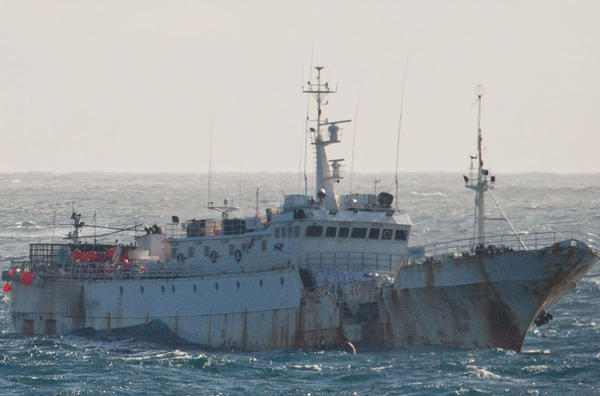
From INTERPOL: Between 6 and 13 January, 2005 a Royal New Zealand Naval Patrol spotted the vessels – the Yongding, the Kunlun and the Songhua – hauling gill nets laden with toothfish in an area regulated by the Convention on the Conservation of Antarctic Marine Living Resources (CCAMLR) where such fishing methods are prohibited.

——

The Pew Charitable Trusts, an American research group… reckons that around one fish in five sold in restaurants or shops has been caught outside the law. That may amount to 26m tonnes of them every year, worth more than $23 billion. This illegal trade, though not the only cause of overfishing, is an important one…

The new monitoring system has been developed by the Satellite Applications Catapult, a British government-backed innovation centre based at Harwell, near Oxford, in collaboration with Pew. In essence, it is a big-data project, pulling together and cross-checking information on tens of thousands of fishing boats operating around the world. At its heart is what its developers call a virtual watch room, which resembles the control centre for a space mission. A giant video wall displays a map of the world, showing clusters of lighted dots, each representing a fishing boat.

The data used to draw this map come from various sources, the most important of which are ships’ automatic identification systems (AIS). These are like the transponders carried by aircraft. They broadcast a vessel’s identity, position and other information to nearby ships and coastal stations, and also to satellites. An AIS is mandatory for all commercial vessels, fishing boats included, with a gross tonnage of more than 300. Such boats are also required, in many cases, to carry a second device, known as a VMS (vessel monitoring system). This transmits similar data directly to the authorities who control the waters in which the vessel is fishing, and carrying it is a condition of a boat’s licence to fish there. Enforcement of the AIS regime is patchy, and captains do sometimes have what they feel is a legitimate reason for turning it off, in order not to alert other boats in the area to profitable shoals. But the VMS transmits only to officialdom, so there can be no excuse for disabling it. Switching off either system will alert the watch room to potential shenanigans.

The watch room first filters vessels it believes are fishing from others that are not. It does this by looking at, for example, which boats are in areas where fish congregate. It then tracks these boats using a series of algorithms that trigger an alert if, say, a vessel enters a marine conservation area and slows to fishing speed, or goes “dark” by turning off its identification systems. Operators can then zoom in on the vessel and request further information to find out what is going on. Satellites armed with synthetic-aperture radar can detect a vessel’s position regardless of weather conditions. This means that even if a ship has gone dark, its fishing pattern can be logged. Zigzagging, for example, suggests it is long-lining for tuna. When the weather is set fair, this radar information can be supplemented by high-resolution satellite photographs. Such images mean, for instance, that what purports to be a merchant ship can be fingered as a transshipment vessel by watching fishing boats transfer their illicit catch to it.

As powerful as the watch room is, though, its success will depend on governments, fishing authorities and industry adopting the technology and working together, says Commander Tony Long, a 27-year veteran of the Royal Navy who is the director of Pew’s illegal-fishing project. Those authorities need to make sure AIS and VMS systems are not just fitted, but are used correctly and not tampered with. This should get easier as the cost of the technology falls.

Enforcing the use of an identification number that stays with a ship throughout its life, even if it changes hands or country of registration, is also necessary. An exemption for fishing boats ended in 2013, but the numbering is still not universally applied. Signatories to a treaty agreed in 2009, to make ports exert stricter controls on foreign-flagged fishing vessels, also need to act. Fishermen seek out ports with lax regulations to land illegal catches….

The watch room will also allow the effective monitoring of marine reserves around small island states that do not have the resources to do it for themselves. The first test of this approach could be to regulate a reserve of 836,000 square kilometres around the Pitcairn Islands group, a British territory in the middle of the South Pacific with only a few dozen inhabitants.

The watch-room system is, moreover, capable of enlargement as new information sources are developed. One such may be nanosats. These are satellites, a few centimetres across, that can be launched in swarms to increase the number of electronic eyes in the sky while simultaneously reducing costs. Closer to the surface, unmanned drones can do the same.

Combating illegal fishing: Dragnet, Economist, Jan 24, 2015, at 70

Demand for Gold Causes Deforestation

The global gold rush, driven by increasing consumption in developing countries and uncertainty in financial markets, is an increasing threat for tropical ecosystems. Gold mining causes significant alteration to the environment, yet mining is often overlooked in deforestation analyses because it occupies relatively small areas. As a result, we lack a comprehensive assessment of the spatial extent of gold mining impacts on tropical forests.

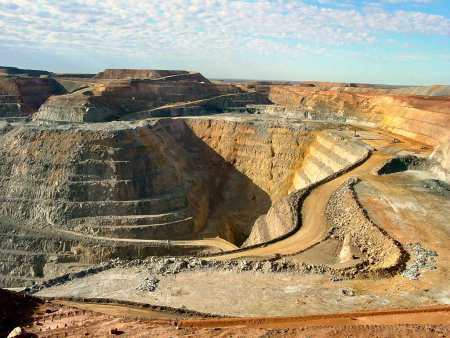
The study Global demand for gold is another threat for tropical forests published in Environmental Research Letters provides a regional assessment of gold mining deforestation in the tropical moist forest biome of South America. Specifically, we analyzed the patterns of forest change in gold mining sites between 2001 and 2013, and evaluated the proximity of gold mining deforestation to protected areas (PAs)….Approximately 1680 km2 of tropical moist forest was lost in these mining sites between 2001 and 2013. Deforestation was significantly higher during the 2007–2013 period, and this was associated with the increase in global demand for gold after the international financial crisis….In addition, some of the more active zones of gold mining deforestation occurred inside or within 10 km of ~32 PAs. There is an urgent need to understand the ecological and social impacts of gold mining because it is an important cause of deforestation in the most remote forests in South America, and the impacts, particularly in aquatic systems, spread well beyond the actual mining sites.

Excerpt from Abstract, Global demand for gold is another threat for tropical forests

Exploiting Himalaya Rivers

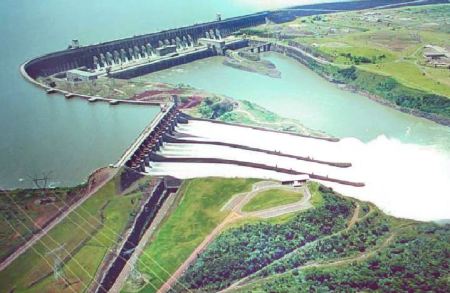
Himalayan rivers, fed by glacial meltwater and monsoon rain, offer an immense resource. They could spin turbines to light up swathes of energy-starved South Asia. Exports of electricity and power for Nepal’s own homes and factories could invigorate the dirt-poor economy. National income per person in Nepal was just $692 last year, below half the level for South Asia as a whole.

Walk uphill for a few hours with staff from GMR, an Indian firm that builds and runs hydropower stations, and the river’s potential becomes clear. An engineer points to grey gneiss and impossibly steep cliffs, describing plans for an 11.2km (7-mile) tunnel, 6 metres wide, to be blasted through the mountain. The river will flow through it, before tumbling 627 metres down a steel-lined pipe. The resulting jet—210 cubic metres of water each second—will run turbines that at their peak will generate 600MW of electricity.  The project would take five years and cost $1.2 billion. It could run for over a century—and produce nearly as much as all Nepal’s installed hydropower.

Trek on and more hydro plants, micro to mighty, appear on the Marsyangdi. Downstream, China’s Sinohydro is building a 50MW plant; blasting its own 5km-long tunnel to channel water to drive it. Nearby is a new German-built one. Upstream, rival Indian firms plan more. They expect to share a transmission line to ill-lit cities in India.

GMR officials in Delhi are most excited by another river, the Upper Karnali in west Nepal, which is due to get a 900MW plant. In September the firm and Nepal’s government agreed to build it for $1.4 billion, the biggest private investment Nepal has seen.

Relations between India and Nepal are improving. Narendra Modi helped in August as the first Indian prime minister in 17 years to bother with a bilateral visit. Urged by him, the countries also agreed in September to regulate power-trade over the border, which is crucial if commercial and other lenders are to fund a hydropower boom…. Another big Indian hydro firm agreed with Nepal’s government, on November 25th, to build a 900MW hydro scheme, in east Nepal, known as Arun 3. Research done for Britain’s Department for International Development suggests four big hydro projects could earn Nepal a total of $17 billion in the next 30 years—not bad considering its GDP last year was a mere $19 billion.

All Nepal’s rivers, if tapped, could feasibly produce about 40GW of clean energy—a sixth of India’s total installed capacity today. Add the rivers of Pakistan, Bhutan and north India and the total trebles.  Bhutan has made progress: 3GW of hydro plants are to be built to produce electricity exports. The three already generating produce 1GW out of a total of 1.5GW from hydro. These rely on Indian loans, expertise and labour….

A second reason, says Raghuveer Sharma of the International Finance Corporation (part of the World Bank), was radical change that opened India’s domestic power market a decade ago. Big private firms now generate and trade electricity there and look abroad for projects. India’s government also presses for energy connections over borders, partly for the sake of diplomacy. There has even been talk of exporting 1GW to Lahore, in Pakistan—but fraught relations between the two countries make that a distant dream.

An official in India’s power ministry says South Asia will have to triple its energy production over the next 20 years. Integrating power grids and letting firms trade electricity internationally would be a big help. It would expand market opportunities and allow more varied use of energy sources to help meet differing peak demand. Nepal could export to India in summer, for example, to run fans and air conditioners. India would export energy back uphill in winter when Nepali rivers dry and turbines stop spinning.

Governments that learn to handle energy investments by the billion might manage to attract other industries, too. Nepal’s abundant limestone, for example, would tempt cement producers once power supplies are sufficient. In the mountains, it is not only treks that are rewarding.

South Asia’s Hydro-Politics: Water in them hills, Economist, Nov. 29, 2014, at 38

Artificial Reefs

Reefs improvised from junk often do not work well. Corals struggle to colonise some metals, and cars and domestic appliances mostly disintegrate in less than a decade. Some organisms do not take to paints, enamels, plastics or rubber. Precious little sea life has attached itself to the 2m or so tyres sunk in the early 1970s to create a reef off Fort Lauderdale, Florida. Tyres occasionally break free, smash into coral on natural reefs and wash ashore.

Yet building artificial reefs that are attractive to marine life can pay dividends. Some of the reefs built in Japanese waters support a biomass of fish that is 20 times greater than similarly sized natural reefs, says Shinya Otake, a marine biologist at Fukui Prefectural University. He expects further gains from a decision by the Japanese government to build new reefs in deep water where they will be bathed in nutrients carried in plankton-rich seawater welling up from below.

The potential bounty was confirmed in a recent study by Occidental College in Los Angeles. Over five to 15 years researchers surveyed marine life in the vicinity of 16 oil and gas rigs off the Californian coast. These were compared with seven natural rocky reefs. The researchers found that the weight of fish supported by each square metre of sea floor was 27 times higher for the rigs. Although much of this increase comes from the rigs providing fish with the equivalent of skyscraper-style living, it suggests that leaving some rigs in place when production ceases might benefit the environment.

Making reefs with hollow concrete modules has been especially successful. Called reef balls, these structures are pierced with holes and range in height up to 2.5 metres. The design is promoted by the Reef Ball Foundation, a non-profit organisation based in Athens, Georgia. Reef balls can be positioned to make the most of photosynthesis and for plankton to drift slowly across their curved inner surface. This improves the nourishment of plants and creatures setting up home within. A hole in the top reduces the chance of them being moved about by storm currents.

Concrete used to make a reef ball is mixed with microsilica, a silicon-dioxide powder, to strengthen the material and lower its acidity level to be more organism-friendly. The balls are cast from fibreglass moulds, which are typically sprayed with a sugary solution before the concrete is poured. This creates tiny hollows which provide a foothold for larval corals. Over 500,000 reef balls have been placed in the waters of more than 60 countries, and each one should last for some 500 years, says the foundation.

The value of artificial reefs has been boosted by the spread of GPS devices and sophisticated sonars on boats. This allows fishermen to locate the subsea structures precisely. It is necessary to be directly above the reef to reel in more fish, says David Walter of Walter Marine, an Alabama company that used to sink vehicles for fishermen but now places pyramid-shaped, hurricane-resistant steel, concrete and limestone structures to create artificial reefs. These constructions can cost nearly $2,000, but many fishermen consider them to be a good investment, especially to catch red snapper.

Using underwater drones for long-term studies of reefs and their associated marine life is also helping improve designs. Sensors can be installed on reefs to monitor boat traffic and activities such as fishing and scuba diving.

Perhaps the most innovative way to build a reef involves anchoring a frame made with steel reinforcing bars to the sea floor and zapping it continuously it with electricity. This causes minerals dissolved in seawater to crystallise on the metal, thickening the structure by several centimetres a year. Biorock, as the resulting material has been trademarked, becomes stronger than concrete but costs less to make. More than 400 “electrified” reefs, many the size of a small garage, have been built this way. Three-quarters of them are in the ocean around Indonesia.

Excerpts, Artificial reefs: Watery dwellings, Economist, Dec.6, 2014,  Technology Quarterly,  at 4

Who Slaughters the Elephants?

Across Africa the illegal slaughter of elephants is accelerating at such a pace—recent estimates put the number killed at 100,000 in just three years—that it threatens to exterminate whole populations. The worst of this butchery takes place in Tanzania, the biggest source of illegal ivory.

Every third poached elephant in Africa dies on the watch of Tanzania’s president, Jakaya Kikwete…One contributing factor may be the government’s failure to investigate and if necessary prosecute high-level offenders. Some of these are said to be closely connected to the ruling Party of the Revolution (CCM), which has dominated the politics of Tanzania since the country’s mainland became independent.  State corruption runs through Tanzania’s illegal ivory trade from savannah to sea. At the bottom of the poaching networks are hired helpers who are often recruited from the armed forces. If caught, officers are transferred to new posts rather than fired. Some allege that soldiers rent out guns to poachers….

Police have even been known to escort convoys of illicit ivory….Other armed forces and governments are also said to be involved. A report by the Environmental Investigation Agency, a non-profit group in London, documents involvement in the illegal ivory trade by Chinese government and military officials. Yet it is allegations of corruption closer to the top of the Tanzanian ruling party that are of the greatest concern

Tanzania’s dwindling elephants: Big game poachers, Economist, Nov. 8, 2014, at 53

Why Rhino Poaching Goes on Forever

Mistrust in police ranks, a shortage of proper intelligence structures and an easy exit through South Africa’s more than nine harbours are all stumbling blocks specialised police experience in the ongoing battle against rhino poaching.

This was how Colonel Johan Jooste, operational commander of the Hawks endangered species unit in South Africa outlined some issues facing his unit. He was addressing the 35th international conference of crime fighters in Cape Town this week, Netwerk24 reports.“…We find instances where police are involved in rhino poaching syndicates,” he said, adding police detailed to anti- and counter-poaching should receive specialist training….

Knowledgeable hunters in South Africa are recruited by buyers of rhino horn. They are also responsible for removing the horn and taking it to the next person in the chain, usually someone responsible for transport.  “It can be someone who knows the area well and can also be either a policeman or a traffic officer,” he said, adding the horn was stored or taken to places such as harbours for illegal export.  The Kruger National Park has this year lost 503 rhinos to poachers out of a national total of 787.

Excerpts, Rhino poachers present different challenges to the Hawks, defenceWeb, Tuesday, Oct. 14 2014

Deforestation: mixed picture

In a new study of the Centre for Global Development (CGD), a Washington think-tank, Jonah Busch and Kalifi Ferretti-Gallon look at 117 cases of deforestation round the world. They find that two of the influences most closely correlated with the loss of forests are population and proximity to cities (the third is proximity to roads). Dramatic falls in fertility in Brazil, China and other well-forested nations therefore help explain why (after a lag) deforestation is slowing, too. Demography even helps account for what is happening in Congo, where fertility is high. Its people are flocking to cities, notably Kinshasa, with the result that the population in more distant, forested areas is thinning out.

Two of the countries that have done most to slow forest decline also have impressive agricultural records: Brazil, which became the biggest food exporter of all tropical countries over the past 20 years; and India, home of the green revolution. Brazil’s agricultural boom took place in the cerrado, the savannah-like region south and east of the Amazon (there is farming in the Amazon, too, but little by comparison). The green revolution took place mostly in India’s north-west and south, whereas its biggest forests are in the east and north.

But if population and agricultural prowess were the whole story, Indonesia, where fertility has fallen and farm output risen, would not be one of the worst failures. Figures published inNature Climate Change in June show that in the past decade it destroyed around 60,000 sq km of primary forests; its deforestation rate overtook Brazil’s in 2011. Policies matter, too—and the political will to implement them.

The central problem facing policymakers is that trees are usually worth more dead than alive; that is, land is worth more as pasture or cropland than as virgin forest. The benefits from forests, such as capturing carbon emissions, cleaning up water supplies and embodying biodiversity, are hard to price….The most successful policies therefore tend to be top-down bans, rather than incentives (though these have been tried, too). India’s national forest policy of 1988 explicitly rejects the idea of trying to make money from stewardship. “The derivation of direct economic benefit”, it says, “must be subordinated to this principal aim” (maintaining the health of the forest). In Brazil 44% of the Amazon is now national park, wildlife reserve or indigenous reserve, where farming is banned; much of that area was added recently. In Costa Rica half the forests are similarly protected. In India a third are managed jointly by local groups and state governments.

Top-down bans require more than just writing a law. Brazil’s regime developed over 15 years and involved tightening up its code on economic activity in forested areas, moratoriums on sales of food grown on cleared land, a new land registry, withholding government-subsidised credit from areas with the worst deforestation and strengthening law enforcement through the public prosecutor’s office. (The most draconian restriction, requiring 80% of any farm in the Amazon to be set aside as a wildlife reserve, is rarely enforced.)

Two developments make bans easier to impose. Cheaper, more detailed satellite imagery shows in real time where the violations are and who may be responsible. Brazil put the data from its system online, enabling green activists to help police the frontier between forest and farmland. Its moratoriums on soyabeans and beef from the Amazon, which require tracing where food is coming from, would not have worked without satellites…

The Forestry Ministry of Indonesia, [on the other hand] is rated the most corrupt among 20 government institutions by Indonesia’s Corruption Eradication Commission in 2012. Some within government are hostile to anti-deforestation schemes, which they see as “foreign”, says Ade Wahyudi of Katadata, an Indonesian firm of analysts. Perhaps the biggest problem is the lack of a single, unified map including all information on land tenure and forest licensing: efforts to create one have been slowed by unco-operative government ministries and difficulties created by overlapping land claims.

Excerpts from Tropical Forests: A Clearing in the Trees, Economist,  Aug. 23, 2014, at 56

Deaths of Rhinos in National Parks

In cold statistics the number of rhinos poached a day in South Africa has now reached three with 769 of these Big Five animals killed to… (Sept 2014).  That equates to 3.027 animals a day and the country’s (South Africa’s) internationally renowned Kruger National Park remains the preferred hunting ground for rhino poachers. Bordering on both Mozambique and Zimbabwe, the park, increased security and patrol activities notwithstanding, offers poachers fairly easy access and egress with their bounty. So far this year Kruger’s rhino population has been decimated by 489 – well over half the national loss.

Statistics released by the Department of Environmental Affairs this week show all nine of South Africa’s provinces, including mostly urban Gauteng, have now been hit by rhino poachers.  The latest kill figures come ahead of next week’s United States-South Africa: Border Surveillance Technology Co-operation Symposium at the CSIR International Convention Centre.  All eyes will be on retired SA Army general Johan Jooste, now Commanding Officer: Special Projects for SANParks based in Kruger. The title of his keynote address is “Turning the tide – borders, poaching, technology”…

US Ambassador to South Africa, Patrick Gaspard, is also carded as a speaker alongside senior representatives (unnamed at the time of publication) from Armscor; the CSIR’s Defence, Peace, Safety and Security section; SA Aerospace, Maritime and Defence Industries Association (AMD); the US Army Research Office and the US Corps of Engineers.

Excerpts from Kim Helfrich, Three rhinos shot every day in South Africa, Defence Web, Sept. 12, 2014

$10 Billion Illegal Market for Wildlife

At $10 billion a year, illegal wildlife makes up the world’s fifth-largest illicit market behind drugs, counterfeit products, trafficked people and smuggled oil. An intergovernmental conference in Geneva from July 7th-11th, 2014 revealed the special worries about ivory smuggling in Thailand, rhino-horn trafficking through Mozambique and trade in tiger parts across South and South-East Asia.

According to TRAFFIC, a lobby group, the street value of rhino horn is $60,000 per kilo—more than the price of gold. Gram for gram, bear-bile flakes or powder sell in Japan [slightly less] than cocaine in Asia. Booming demand from Asia’s growing middle classes is pushing some species close to extinction. As supply dwindles, prices rocket, which tempts criminal gangs to sink their claws in even further.

Elephant ivory is valued for aesthetic reasons. Demand for rhinoceros horns, the paws and bile of Asiatic black bears and sun bears, tiger bones and penises, and deer musk, is stimulated by the healing powers ascribed to them in traditional Chinese medicine. Rhino-horn shavings boiled in water are said to cool and to cure headaches; the brew is akin to fingernail clippings in water (both are mainly keratin, an indigestible protein). Bear bile does help with gallbladder and liver problems—but no more than the synthetic version of ursodeoxycholic acid, its main component.

In February 42 countries, including China and Japan, and the European Union signed a declaration against trade in illegal wildlife products. Chinese law punishes the purchase or consumption of endangered species with up to ten years in jail. But in May, when Philippine forces seized a Chinese vessel carrying sea turtles, giant clamshells and live sharks off the disputed Half Moon Shoal, China expressed outrage at the “provocative action”—not the illegal cargo.

The illegal trade in wild-animal products: Bitter pills, Economist, July 19, 2014, at 54

Palau Fights Big Fishing Countries

The traditional prescription for an ailing reef is a fishing ban called a bul. Local chiefs may declare a bul to rest a busy fishing spot or protect endangered sea turtles. Now Palau’s president has a more drastic plan. He proposes a complete ban on commercial fishing—a bul to turn the 600,000 square kilometres (232,000 square miles) of Palau’s Exclusive Economic Zone (EEZ) into a marine reserve the size of Ukraine. Locals could still fish close to shore, but not for export. The ban would last until world leaders implement programmes “to reverse the devastation to our oceans and seas”, Palau’s president, Tommy Remengesau, recently told the United Nations. Environmentalists have rallied to his cause. Such reserves are usually declared by countries with fishing grounds and cash to spare. Palau has a population of 20,000 and a GDP of $246m. I

A total ban might hurt Palau, which is part of Micronesia, 800km (500 miles) east of the Philippines. Though small, its waters are full of bigeye and yellowfin tuna. Japanese and Taiwanese boats pay to fish there, helping Palau earn $5m in revenue from fishing taxes and licensing fees in 2013. That is a lot for a microstate with an annual government budget of only $70m. And fishing revenues have been growing thanks to a regional negotiating block. Together, eight remote Pacific states control 14m square km of tuna-rich waters. They have forced Asian and American ships into a cap-and-trade scheme that boosts access fees by limiting total fishing days. In an age of collapsing fish stocks, the relative health of fisheries in the western Pacific has given island states a rare measure of economic influence. Palau’s bet, however, is that its fish are worth more in the water than out. Mr Remengesau doubts that small islands will ever capture more than “a drop” of a tuna fishery worth billions but dominated by foreign fleets. Ecotourism, meanwhile, accounts for about half of Palau’s GDP. Palau’s leaders hope that a national marine reserve will lure enough tourists to offset lost fishing revenue….

Palau has only one boat capable of patrolling its EEZ. Many tuna bandits escape detection. Technology could help: last year the country tested surveillance drones. The problem is money. Japan and America have helped fund enforcement. Both have an interest because of their fishing deals with Palau. But they may not want to fund a system that locks them out of its waters altogether,

Marine protection in the Pacific: No bul, Economist, June 7,  2014, at 46

Cheap Wild Meat: Nigeria

Just as the bush meat delicacy is gaining acceptance in all parts of the country [Nigeria] and fast becoming a source of living for many Nigerians, infrastructural development, including roads construction, have also contributed greatly in threatening plant species with most plants going into extinction.  It is a common site when travelling across the country to see hunters, women and children displaying bush meat on the highway for sale.

The bush meat business, according to Mrs Janet Efe, a bush meat merchant a long Okpela-Benin road, has come to stay. “There is no job for our husbands and children and rather than going into robbery and other dubious trades it is better they hunt in the forest where the animals roam about.”  She said that so long as human beings exist, animals will always be available for people to eat.

Bush meat is a recognised trade at rural and urban centres. Wild animals’ meat is the main source of cheap protein for the majority of rural communities in Nigeria. Over 80 per cent of the population are rural dwellers who depend on bush meat, compared with urban dwellers that depend on abattoir supplies of cow and other ruminant meat…

According to the Food and Agriculture Organization (FAO), the present level of information on the status of non-fish aquatic animal resources in Nigeria is still scanty and limited to a few inventories of wild stocks in the National Parks. A holistic approach to their management and conservation is required and recognition that the conservation of aquatic animals, including fish, is important because of their genetic resources, biological, and food values and the socio-economic implications of their extinction.

Excerpts from ALEX ABUTU, Nigeria: Biodiversity – Nigeria’s Wasting Goldmine, AllAfrica, May 21, 2014

Seals Better than Pigs: Seal Hunting

A (World Trade Organization) WTO appeal panel has upheld a decision that the European Union’s ban on the import of seal pelts, oil and meat is justified on moral grounds…The ruling, released Thursday in Geneva by the WTO’s Appellate Body, is one more blow to an industry that has been dying for years as a result of a successful campaign by animal-rights activists to convince international buyers that the Canadian seal hunt is inhumane.

The appeal body reversed some minor portions of a WTO panel decision, but agreed that the EU’s ban on seal products “is necessary to protect public morals” as spelled out in the General Agreement on Tariffs and Trade.  The appeal body agreed with the earlier panel decision that the ban on seal pelts imposed by the EU in 2010 undermines the principles of fair trade, but is justified because it “fulfills the objective of addressing EU public moral concerns on seal welfare.”

Canada and Norway had argued that the ruling sets a dangerous precedent because trade decisions were being made on the basis of morality rather than conservation and science. The federal Conservative government, and the two opposition parties, agree that the seal hunt, which is largely based in Newfoundland, is humane, sustainable and well-regulated…. The sealers say Canada has the highest standards for animal-welfare practices of any hunt in the world. The animal-rights groups, on the other hand, point to reports by veterinary and zoology experts who say the clubbing and shooting of seals in Canada is inhumane and should be prohibited.

The Canadian government set the quota for the seal slaughter this year at 400,000. But it is estimated that fewer than 55,000 of the animals have been killed by hunters as the season nears an end. Rebecca Aldworth, the executive director of Humane Society International/Canada, said… “I think it’s clear that the sealing industry is already over. The only question is whether the Canadian government will continue to keep it on artificial life support in the form of government subsidies, or whether it will invest in a one-time buyout of the commercial sealing industry.

Excerpts from GLORIA GALLOWAY, Canada loses bid to block European ban on seal products,  Globe and Mail, May 22, 2014

Marine Protected Areas: PIPA, Kiribati

After years of claiming untruthfully that the world’s most fished marine protected area was “off limits to fishing and other extractive uses,” President Anote Tong of the Pacific island state of Kiribati and his cabinet have voted to close it to all commercial fishing by the end of the year.  The action, if implemented, would allow populations of tuna and other fish depleted by excessive fishing to return to natural levels in the Phoenix Islands Protected Area (PIPA), a patch of ocean the size of California studded with pristine, uninhabited atolls.

The move comes at a time global fish populations are steadily declining as increasingly efficient vessels are able to extract them wholesale from ever-more-remote and deep waters around the globe.  While no-take zones of comparative size exist in Hawaii, the Chagos Islands and the Coral Sea, none are as rich in marine life, making this potentially the most effective marine reserve in the world.,,,

In a speech still he gave at the Delhi Sustainable Development Summit two years ago still visible on Youtube, Tong mentions “the initiative of my country in closing off 400,000 square kilometres of our [waters] from commercial fishing activities,” calling it “our contribution to global ocean conservation efforts.”

In fact, when PIPA was created, only in the three percent of the reserve that’s around the islands, where virtually no fishing was going on, fishing was banned. In the rest of the reserve, the catch increased, reaching 50,000 tonnes in 2012 – an unheard-of amount in any protected area.

Christopher Pala, Kiribati Bans Fishing in Crucial Marine Sanctuary, IPS, May 15, 2014

Poaching Endangered Species – Namibia

he rising tide of elephant and rhino poaching in Africa is spreading to the sparsely-populated vastness of Namibia in the southeast of the continent, latest official figures show. Between 2005 and 2011 just two elephant were killed, while 121 have been killed in the past two and a half years, according to figures presented by the environment ministry.  And while no rhino were poached between 2005 and 2010, a total of 11 have been killed since then — rising from one in 2011 to four already this year.

Deputy Environment Minister Pohamba Shifeta told AFP that the government is worried by the trend and is working with law enforcement agencies to tackle the problem. “We don’t want the numbers to escalate further,” Shifeta said.  “There is a high probability that attention will shift to Namibia as we have recently experienced.”

Across the border in South Africa, rhino poaching has reached crisis levels, with more than 290 killed already this year.  Most of the poaching in Namibia has taken place in protected areas, such as the Bwabwata National Park in the northeast, where 13 elephant were killed in 2012, the environment ministry report said.

“The immediate requirement is to control the emerging commercial ivory poaching in the northeast part of the country and to prevent the westwards spread of rhino and elephant poaching into the Etosha National Park and beyond,” Shifeta told a meeting of police officers and rangers.  Namibia has 79 conservation areas covering more than 100,000 square kilometres and inhabited by some 300,000 people.

Several poachers have been arrested in recent years, with the latest suspects being two Asian men who were held in March this year allegedly in possession of rhino horn worth around $230,000 (167,000 euros). Asia is a major market for rhino horn, where it is believed to have medicinal value, and for elephant ivory.

Namibia caught in net of elephant, rhino poaching, Agence France Presse, May 13, 2014.

Governing the Oceans Dysfunction

About 3 billion people live within 100 miles (160km) of the sea, a number that could double in the next decade as humans flock to coastal cities like gulls. The oceans produce $3 trillion of goods and services each year and untold value for the Earth’s ecology. Life could not exist without these vast water reserves—and, if anything, they are becoming even more important to humans than before.

Mining is about to begin under the seabed in the high seas—the regions outside the exclusive economic zones administered by coastal and island nations, which stretch 200 nautical miles (370km) offshore. Nineteen exploratory licences have been issued. New summer shipping lanes are opening across the Arctic Ocean. The genetic resources of marine life promise a pharmaceutical bonanza: the number of patents has been rising at 12% a year. One study found that genetic material from the seas is a hundred times more likely to have anti-cancer properties than that from terrestrial life.

But these developments are minor compared with vaster forces reshaping the Earth, both on land and at sea. It has long been clear that people are damaging the oceans—witness the melting of the Arctic ice in summer, the spread of oxygen-starved dead zones and the death of coral reefs. Now, the consequences of that damage are starting to be felt onshore…

More serious is the global mismanagement of fish stocks. About 3 billion people get a fifth of their protein from fish, making it a more important protein source than beef. But a vicious cycle has developed as fish stocks decline and fishermen race to grab what they can of the remainder. According to the Food and Agriculture Organisation (FAO), a third of fish stocks in the oceans are over-exploited; some estimates say the proportion is more than half. One study suggested that stocks of big predatory species—such as tuna, swordfish and marlin—may have fallen by as much as 90% since the 1950s. People could be eating much better, were fishing stocks properly managed.

The forests are often called the lungs of the Earth, but the description better fits the oceans. They produce half the world’s supply of oxygen, mostly through photosynthesis by aquatic algae and other organisms. But according to a forthcoming report by the Intergovernmental Panel on Climate Change (IPCC; the group of scientists who advise governments on global warming), concentrations of chlorophyll (which helps makes oxygen) have fallen by 9-12% in 1998-2010 in the North Pacific, Indian and North Atlantic Oceans.

Climate change may be the reason. At the moment, the oceans are moderating the impact of global warming—though that may not last.,,Changes in the oceans, therefore, may mean less oxygen will be produced. This cannot be good news, though scientists are still debating the likely consequences. The world is not about to suffocate. But the result could be lower oxygen concentrations in the oceans and changes to the climate because the counterpart of less oxygen is more carbon—adding to the build-up of greenhouse gases. In short, the decades of damage wreaked on the oceans are now damaging the terrestrial environment.

Three-quarters of the fish stocks in European waters are over-exploited and some are close to collapse… Farmers dump excess fertiliser into rivers, which finds its way to the sea; there cyanobacteria (blue-green algae) feed on the nutrients, proliferate madly and reduce oxygen levels, asphyxiating all sea creatures. In 2008, there were over 400 “dead zones” in the oceans. Polluters pump out carbon dioxide, which dissolves in seawater, producing carbonic acid. That in turn has increased ocean acidity by over a quarter since the start of the Industrial Revolution. In 2012, scientists found pteropods (a kind of sea snail) in the Southern Ocean with partially dissolved shells…

The high seas are not ungoverned. Almost every country has ratified the UN Convention on the Law of the Sea (UNCLOS), which, in the words of Tommy Koh, president of UNCLOS in the 1980s, is “a constitution for the oceans”. It sets rules for everything from military activities and territorial disputes (like those in the South China Sea) to shipping, deep-sea mining and fishing. Although it came into force only in 1994, it embodies centuries-old customary laws, including the freedom of the seas, which says the high seas are open to all. UNCLOS took decades to negotiate and is sacrosanct. Even America, which refuses to sign it, abides by its provisions.

But UNCLOS has significant faults. It is weak on conservation and the environment, since most of it was negotiated in the 1970s when these topics were barely considered. It has no powers to enforce or punish. America’s refusal to sign makes the problem worse: although it behaves in accordance with UNCLOS, it is reluctant to push others to do likewise.

Specialised bodies have been set up to oversee a few parts of the treaty, such as the International Seabed Authority, which regulates mining beneath the high seas. But for the most part UNCLOS relies on member countries and existing organisations for monitoring and enforcement. The result is a baffling tangle of overlapping authorities that is described by the Global Ocean Commission, a new high-level lobby group, as a “co-ordinated catastrophe”.

Individually, some of the institutions work well enough. The International Maritime Organisation, which regulates global shipping, keeps a register of merchant and passenger vessels, which must carry identification numbers. The result is a reasonably law-abiding global industry. It is also responsible for one of the rare success stories of recent decades, the standards applying to routine and accidental discharges of pollution from ships. But even it is flawed. The Institute for Advanced Sustainability Studies, a German think-tank, rates it as the least transparent international organisation. And it is dominated by insiders: contributions, and therefore influence, are weighted by tonnage.

Other institutions look good on paper but are untested. This is the case with the seabed authority, which has drawn up a global regime for deep-sea mining that is more up-to-date than most national mining codes… The problem here is political rather than regulatory: how should mining revenues be distributed? Deep-sea minerals are supposed to be “the common heritage of mankind”. Does that mean everyone is entitled to a part? And how to share it out?

The biggest failure, though, is in the regulation of fishing. Overfishing does more damage to the oceans than all other human activities there put together. In theory, high-seas fishing is overseen by an array of regional bodies. Some cover individual species, such as the International Commission for the Conservation of Atlantic Tunas (ICCAT, also known as the International Conspiracy to Catch All Tuna). Others cover fishing in a particular area, such as the north-east Atlantic or the South Pacific Oceans. They decide what sort of fishing gear may be used, set limits on the quantity of fish that can be caught and how many ships are allowed in an area, and so on.

Here, too, there have been successes. Stocks of north-east Arctic cod are now the highest of any cod species and the highest they have been since 1945—even though the permitted catch is also at record levels. This proves it is possible to have healthy stocks and a healthy fishing industry. But it is a bilateral, not an international, achievement: only Norway and Russia capture these fish and they jointly follow scientists’ advice about how much to take.  There has also been some progress in controlling the sort of fishing gear that does the most damage. In 1991 the UN banned drift nets longer than 2.5km (these are nets that hang down from the surface; some were 50km long). A series of national and regional restrictions in the 2000s placed limits on “bottom trawling” (hoovering up everything on the seabed)—which most people at the time thought unachievable.

But the overall record is disastrous. Two-thirds of fish stocks on the high seas are over-exploited—twice as much as in parts of oceans under national jurisdiction. Illegal and unreported fishing is worth $10 billion-24 billion a year—about a quarter of the total catch. According to the World Bank, the mismanagement of fisheries costs $50 billion or more a year, meaning that the fishing industry would reap at least that much in efficiency gains if it were properly managed.

Most regional fishery bodies have too little money to combat illegal fishermen. They do not know how many vessels are in their waters because there is no global register of fishing boats. Their rules only bind their members; outsiders can break them with impunity. An expert review of ICCAT, the tuna commission, ordered by the organisation itself concluded that it was “an international disgrace”. A survey by the FAO found that over half the countries reporting on surveillance and enforcement on the high seas said they could not control vessels sailing under their flags. Even if they wanted to, then, it is not clear that regional fishery bodies or individual countries could make much difference.

But it is far from clear that many really want to. Almost all are dominated by fishing interests. The exceptions are the organisation for Antarctica, where scientific researchers are influential, and the International Whaling Commission, which admitted environmentalists early on. Not by coincidence, these are the two that have taken conservation most seriously.

Countries could do more to stop vessels suspected of illegal fishing from docking in their harbours—but they don’t. The FAO’s attempt to set up a voluntary register of high-seas fishing boats has been becalmed for years. The UN has a fish-stocks agreement that imposes stricter demands than regional fishery bodies. It requires signatories to impose tough sanctions on ships that break the rules. But only 80 countries have ratified it, compared with the 165 parties to UNCLOS. One study found that 28 nations, which together account for 40% of the world’s catch, are failing to meet most of the requirements of an FAO code of conduct which they have signed up to.

It is not merely that particular institutions are weak. The system itself is dysfunctional. There are organisations for fishing, mining and shipping, but none for the oceans as a whole. Regional seas organisations, whose main responsibility is to cut pollution, generally do not cover the same areas as regional fishery bodies, and the two rarely work well together. (In the north-east Atlantic, the one case where the boundaries coincide, they have done a lot.) Dozens of organisations play some role in the oceans (including 16 in the UN alone) but the outfit that is supposed to co-ordinate them, called UN-Oceans, is an ad-hoc body without oversight authority. There are no proper arrangements for monitoring, assessing or reporting on how the various organisations are doing—and no one to tell them if they are failing.

Governing the high seas: In deep water, Economist, Feb. 22, 2014, at 51
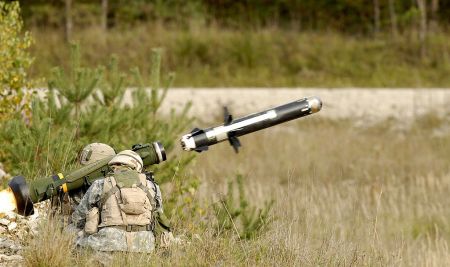
Conservation: a Military Operation

Mander, founder and chief executive officer of the International Anti-Poaching Foundation (IAPF) – registered in Houston, headquartered in Zimbabwe, and training rangers across Southern Africa [states]…”while we’re trying to win people [over], tens of thousands of animals are being killed every year. We need to do something now, on the ground, to stop the hemorrhaging. Otherwise there won’t be anything left by the time we’ve won all the hearts and minds.”

Mander’s urgency is not misplaced. Poachers in South Africa killed the equivalent of one rhino every eight hours in 2013. They hacked or sawed off their horns and sold them on the world market for as much as $27,000 per pound – more than the price of gold. That makes the average horn on the average rhino worth close to a quarter-million dollars.  Across Africa, the number of elephants has fallen from 1.3 million 40 years ago to fewer than 400,000 today. Each year, the continent loses somewhere between 5 and 10 percent of those that remain. This has prompted organizations such as the Convention on International Trade in Endangered Species to predict that Africa will lose a fifth of its elephants in 10 years.  Other groups warn that the African elephant could be extinct within a generation, consigned to picture books, zoos, and eventually fairy tales, like the unicorn.

Mass killings of Africa’s wildlife have happened before, notably in the 1970s and ’80s, a period known as the “ivory holocaust.” In 1989, an international ban on trade in elephant ivory curtailed the supply of illicit animal parts, and populations of the hardest-hit wildlife began creeping up again.  But so did the demand. Asia’s growing middle class increasingly sought out the animal contraband that serves both as ancestral trappings of wealth and a source of traditional medicines.

To supply these expanding markets, poaching has surged again. But this time the sophistication, funding, and malevolence of the poachers and their big-time criminal underwriters have reached new heights. The few who are caught are often found with their own night-vision goggles, sniper rifles, bandoliers of ammunition, and other specialized gear. Big-money backers equip the gunmen with helicopters to land inside the electric fences that guard wildlife. They bribe veterinarians to supply the poachers with powerful animal tranquilizers, which are used to fell the beasts all the more quickly.

In the face of this onslaught, the world’s conservation organizations have significantly increased their efforts despite chronic underfunding. But Mander argues that the conservation “industry,” as he calls it, is “dangerously fragmented” and wasting energy pulling in different directions.”It’s a world wildlife war. Don’t let anyone tell you it’s anything else,” he says back at his main encampment in Zimbabwe. “And the way we’re heading, we’re going to lose.”

Mander is an unlikely poster boy for an environmental conservation movement… At age 19, he joined the Australian Navy and soon transferred into the force’s equivalent of the US Navy SEALs. Six years later, he had become a fully trained Special Forces sniper and specialist diver. But his commission ended, and he shifted into private security and protection of VIPs in Iraq. Twelve tours and three years later, he’d become a wealthy man but decided to quit. …

In Zimbabwe, a wildlife reserve manager with a team of rangers out in the bush decided that hiring Mander was worth a try…Seeing the need to teach rangers about military tactics, and using money from investments he had made during his high-paying days in Iraq, Mander set up the IAPF in 2009. To date, it has trained rangers from 10 separate wilderness areas in Zimbabwe and is expanding into Mozambique. IAPF is also leading efforts from South Africa to create an international standard for wildlife rangers around Africa and beyond….

He teaches intelligence gathering and analysis, as well as overt and covert patrolling. He shows them how to set up observation posts, how to use force properly, and how to deal with battlefield casualties. Mander deploys the gear he used when he was in Iraq, the night scopes and the infrared lights. He’s working on a new gas-driven drone that can spend five hours in the air scouring the landscape for poachers. His rangers go through physical training drills every morning. Their uniforms are new and spotless. “People will try to package it up in a softer way – I don’t know why – but antipoaching is a paramilitary operation,” he says. “Law enforcement should be a ranger’s No. 1 job, but it’s been turned into a minor role.”…
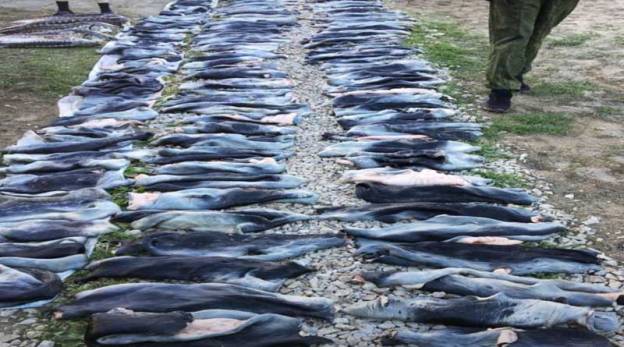
Mander is not the only one militarizing ranger training. In Kenya, the British Army is helping teach similar battlefield techniques. In South Africa, former special forces soldiers are doing the same. Drones are undergoing trials in a dozen wildlife reserves across Africa. The key ingredient in Mander’s approach is a perpetual show of force, which he believes acts as a deterrent…

Critics in the conservation community worry that militarizing the antipoaching movement raises the risk of innocent people getting caught in the crossfire. They think it sidesteps the judicial process at a time when courts are beginning to impose harsher sentences on poachers….

“A lot of people will argue that we need to be focused less on the military approach I’m trying here and more on community work and hearts and minds and sustainable alternatives for communities,” Mander goes on. “Look, I’m all for that. Let’s have people out there working on that. But while they’re at it, I’m going to be here on the ground trying to stop the bleeding and hold on to what we’ve got left before everything’s dead.”

Excerpt, Mike Pflanz, The ivory police, Christian Science Monitor, Mar. 2, 2014

Saving the Elephant: $300 Million

Six tonnes of elephant tusks and ivory trinkets were destroyed in a tarmac crusher in the factory city of Dongguan in China on January 6th, 2014.  Most of the 33-tonne stockpile of Hong Kong—home to many of the world’s most avid buyers of ivory—as well as those of several European countries will soon meet the same fate. In the past few years ivory has also been destroyed in the United States, Gabon, Kenya and the Philippines.

These scenes lack both the curling smoke and dramatic setting of the vast pyre of tusks burned in Kenya’s Nairobi National Park in 1989. (Most ivory is now destroyed by crushing, rather than burning, to avoid polluting the atmosphere.) But they may prove equally significant in the long fight to stop poaching and save the elephant from extinction.  The bonfire near Nairobi was the prelude to a global ban on trade in ivory, a collapse in demand and a lull in poaching that gave the African elephant population time to recover. But in the past five years poaching has picked up again. An estimated 25,000 elephants are killed each year by poachers, many of them linked to organised crime. In some places the species is close to being wiped out…

Links between ivory traffickers and African militias such as the Lord’s Resistance Army, a thuggish band of guerrillas that originated in Uganda, have put the issue on the national-security agenda in America and elsewhere. The result is attention from political heavyweights including Bill and Hillary Clinton; John Kerry, America’s secretary of state; and David Cameron, Britain’s prime minister. African governments have agreed to to beef up park patrols, create anti-poaching police units in the states where elephants roam and strengthen anti-poaching laws. The measures have so far been underfunded. Making them stick would cost an estimated $300m over ten years, much of which it is hoped will come from the rich countries at the conference.

Though campaigners welcome the plan they argue that curbing the supply of ivory is not enough. Since 1989 countries with elephant populations have twice been allowed to sell stockpiled ivory from elephants that died naturally under CITES, a global agreement on international trade in endangered species. Before the second sale, in 2008, conservationists warned that it would revive the market in China, where ivory ornaments have long been prized, and make poaching profitable once more. They were right. The ivory bought by the Chinese government is drip-fed onto the domestic market at a rate of five tonnes a year. That comes nowhere close to meeting demand, estimated at 200 tonnes a year. And the sales have coincided with an explosive increase in poaching.

The ivory trade: Up in smoke, Economist,Feb. 8, 2014, at 60

Madagascar Sells Polluting Rights to Microsoft

Madagascar’s government has agreed to sell forest-related carbon credits to Microsoft and Zurich’s zoo, which will help protect the Makira National Park, in the first sale of state-owned REDD+ credits in Africa, according to the group that manages the park.  The Wildlife Conservation Society (WCS), an international charity headquartered in New York City, said the revenues from selling carbon credits generated by avoided deforestation in Makira will finance the conservation of one of Madagascar’s most pristine rainforest ecosystems, while supporting the livelihoods of local people.

The funds will be used by the government for activities under its Reducing Emissions from Deforestation and Forest Degradation “plus” conservation (REDD+) programme, and by WCS to manage Makira park. But the largest share – half of the proceeds – will go to support local communities in areas around Makira for education, health and other projects, WCS said.

The Makira forest, which spans nearly 400,000 hectares (over 1,500 square miles), is home to an estimated 1 percent of the world’s biodiversity, including 20 lemur species, hundreds of species of birds, and thousands of plant varieties, some unique to the location. The forests also provide clean water to over 250,000 people in the surrounding landscape.

Jonathan Shopley, managing director of The CarbonNeutral Company, which handled the purchase for Microsoft, said its clients are increasingly looking for opportunities to manage the entire environmental impact of their organisation, driven by the need to make their supply chains more resilient…In Madagascar, burning for agricultural land and extraction of wood for household energy leads to around 36,000 hectares (139 square miles) of natural forest being lost each year, WCS said.

BY MEGAN ROWLIN, Madagascar: Microsoft Buys Carbon Credits From Madagascar Rainforest, AllAfrica.com, Feb. 13, 2014

Bonga Oil Spill: the Nigeria v. Shell

The Director General, Nigerian Maritime Administration and Safety Agency (NIMASA) Mr. Patrick Akpobolokemi has slammed Anglo Dutch oil giant, Shell for the way and manner it handles oil spill in the country, especially in the oil and gas rich Niger Delta region.  He said the response of the foremost oil firm to oil spillages in the country fell short of international standards and practices.  The helmsman of Nigeria’s apex maritime regulatory authority spoke against the backdrop of the Bonga oil spill incident which wreaked havoc in many communities in the Niger Delta region in 2011.

The National Assembly had last week through the House of Representatives Committee on Environment, organised a public hearing over the incident.  Recounting NIMASA’s experience during the incident, Akpobolokemi said that the oil giant tried as much as possible to frustrate the agency’s attempts to move to the site of the spill.  As a stop gap measure, he explained that the agency provided some relief material to some of the communities affected by the spill.  Akpobolokemi flayed Shell for it poor response and nonchalant attitude towards spill incidents in the Niger Delta area and called for an immediate stop to this.

Said he: “The kind of impunity Shell and its allies have demonstrated so far in the Niger Delta area in the past must stop if the future of the people of Nigeria and the environment are to be protected,” adding that in other countries when spills like this occur, the first thing is remuneration, attention to the affected communities and finding ways of reducing the sufferings of the people and restoring the ecosystem, which Shell has failed to do. “Shell fell short of all these criteria and of course it is sad that it is only in Nigeria that we can witness this degree of impunity.

“We in NIMASA see this as a serious infraction to our laws, communities and the damage done to the communities and the ecosystem can be seen as genocide. When a similar spill occurred in the gulf of Mexico, Shell was alive to its responsibilities, they were made to pay compensation to the affected communities but today in Nigeria, any spill that occur, a claim of sabotage or third party claims are the order of the day.” He said NIMASA had made presentations before the House Committee on Environment, asking SNEPCO to pay compensation, not an administrative fee, to the communities totalling $6.5 billion.

“The response from Shell was evasive and do not suggest that it is a company that is alive to its responsibility. It believes that the culture of impunity can continue to go on, thereby playing with our legal system. May we use this opportunity to correct the wrong that has been done to the Nigerian environment because of the callousness of this company and we stand by our position that compensation must be paid to the communities.

“What we expect Shell to do is to come to the negotiating table and discuss with the affected communities on the means of payment so that the communities can get back their natural eco-system”.

John Iwori, Bonga Oil Spill: NIMASA Slams Shell, http://www.thisdaylive.com/,  Feb. 14, 2014


Conservation Drones Against Poachers

A South African foundation on Wednesday received a 232.2-million-rand (about 21-million-U.S.- dollar) grant for combatting unchecked rhino poaching in Southern Africa.  The grant was donated to Peace Parks Foundation from the Dutch and Swedish Postcode Lotteries. Of the total donation, 217 million rands (about 19 million dollars) came from the Dutch Postcode Lottery, while 15.2 million rands (about 13.7 million dollars) was contributed by the Swedish Postcode Lottery.

“This is the largest single contribution made by the private sector to combat rhino poaching and wildlife crime. We welcome this public-private partnership to help ensure the survival of the species,” South Africa’s Minister of Water and Environmental Affairs, Edna Molewa said.

The South African government and its public entities—South African National Parks (SANParks) and Ezemvelo KZN (KwaZulu-Natal) Wildlife (Ezemvelo), are working closely with Peace Parks Foundation to develop a multi-pronged approach to combat rhino poaching and wildlife crime, the minister said.

The main focus will be the devaluation of the horns of live rhino, through a combination of methods, including the physical devaluation and contamination of the horn, as well as the use of tracking and monitoring technology…In particular, the emphasis will be on intelligence gathering and on technology applications such as conservation drones and other specialist equipment. It will also include training and capacity building, as well as incentives and rewards for rangers, communities and members of the public who support the conservation of rhino…The Peace Parks Foundation was established in 1997 to assist the region’s governments in their development of transfrontier conservation areas.

South African foundation receives multi-million-dollar grant for fighting rhino poaching, Xinhua, Feb. 8, 2014

The Slow Death of Rhino: South Africa

The Kruger National Park’s rhino population remains under heavy threat from poachers with no less than 63 carcasses found in the world famous game reserve in the first 30 days of the year…This equates to a national kill rate of 2.8 animals a day at the start of the year while arrests in connection with poaching stand at 21 for the first 30 days of the year…One of these gaps is widely seen to be the ease with which poachers come into and leave South Africa from particularly Mozambique. A proposal allowing for hot pursuit of suspected poachers across the international border has been put forward to the SANParks board and the Environmental Affairs Ministry for inclusion in a memorandum of understanding due to be entered into between South Africa and its eastern neighbour.  The memorandum was originally due to have been signed this month but Mozambique has indicated it is not yet in a position to sign.

Excerpt, Kim Helfrich, Rhino killing continues unabated, http://www.defenceweb.co.za/, Jan.  31, 2014

Saving Forests through Forced Evictions

For decades, the Kenyan government has attempted to evict indigenous people from the forests of Embobut and Cherangany, in the western county of Elgeiyo Marakwet. Past tactics have even included torture and setting fire to homes, those affected say…The government – accused in recent weeks of preparing to carry out yet another forced eviction – maintains that communities living in 12 forest glades must leave so it can rehabilitate the degraded forest and the water services it provides to the surrounding regions and beyond.

“This is a government initiative aimed specifically at conserving the country’s second-largest water tower – nothing else,’’ said Inspector Stephen Chessa, who works for the Kenya Forest Service (KFS) and is in charge of the Embobut eviction…

But one forest warder who preferred to remain anonymous told Thomson Reuters Foundation he and his colleagues had been instructed to evict forcefully anyone who resists the move.  The U.N. special rapporteur on the rights of indigenous peoples, James Anaya, expressed deep concern about this prospect, urging the Kenyan government “to ensure that the human rights of the Sengwer indigenous people are fully respected, in strict compliance with international standards protecting the rights of indigenous peoples”.  Most families are asking for more time to assemble their things and harvest crops before leaving the forest.   But Solomon Mibei, head of conservation for the KFS, said families would not be given extra time and the evictions would continue as planned. “They have no reason to continue staying in the forest – they were compensated,’’ he said.

The situation is complex because there are different communities living in Embobut: the Sengwer indigenous people; groups displaced by disasters and political violence; and others who have come to benefit from cultivation opportunities.  “Why should the government treat us equally with the victims of post-election violence and landslides?’’ asked Sengwer spokesperson Yator Kiptum. “The forest is our home – our case is different, it’s not fair at all.”…According to Article 63 of the constitution, community land shall be vested in and held by communities identified on the basis of ethnicity, culture or similar community of interest. Community land consists of ancestral lands and lands traditionally occupied by hunter-gatherers.

Justin Kenrick of the Forest Peoples Programme (FPP), a UK-based rights organisation, said the government’s justification for evicting people is forest conservation, but research has long since shown that forests are best preserved not by evicting ancestral communities but by supporting them to regain secure rights to their land.  Payments to evictees by the government are “intended to distract the public and the communities themselves from addressing the real issues”, Kenrick said. “According to international treaties to which Kenya is a party, the Sengwer should have been consulted, and accepted or rejected the proposal,’’ he added.  Kiptum, however, claims the Sengwer were not consulted, did not sign anything, and have not agreed to hand over their land for the small amount of money that has been paid into some people’s bank accounts.  “You cannot create a humanitarian crisis for the sake of conserving biodiversity while there are other ways of doing it better,” said Stephen Cheboi, coordinator of the North Rift Human Rights Network based in nearby Eldoret town. He also called for an audit of the compensation process.

Excerpts from Caleb Kemboi, Indigenous rights clash with forest protection in Kenya, Reuters, Jan. 17,, 2014

See also Biodiversity and Human Rights

The Scramble for Antarctica

Over the past two decades China’s annual Antarctic spending has tripled to $55m, three times its Arctic investment… The Southern Ocean is full of fish. A large petroleum field was recently discovered in West Antarctica. The continent also has deposits of coal and other valuable minerals. The Protocol on Environmental Protection, a document signed in Madrid in 1991 by countries involved in Antarctica, has imposed a mining ban until 2048, when it is to be reviewed.

China acceded in 1983 to the Antarctic Treaty, which maintains the continent as a demilitarised science preserve and forms the basis of a system of governance. The goal of its current five-year polar plan, says Chen Lianzeng of China’s State Oceanic Administration, is to increase the country’s status and influence. On November 7th China’s 30th Antarctic expedition, complete with construction crew, set sail from Shanghai. It will scout a site for China’s fifth station, in Terra Nova Bay. Its fourth base, Taishan, is still unfinished.

Sovereignty in Antarctica is disputed. States assert themselves by building bases. “You put a huge flag on a flagpole close to the research station,” says Klaus Dodds, a professor of geopolitics at the University of London. “It is not very subtle.” If China builds all five planned stations it will have more than either Britain or Australia, and only one fewer than America.

Science matters, too. It gives cachet and influence in matters of joint governance. In 2008 China built Kunlun station, a base with capabilities for deep-space research in a place so remote that it took six attempts to get there. The ice underneath could help scientists work out the climatic record of the past 1.5m years, which would be a scientific coup.But the influx of new Antarctic actors has rattled the old establishment and its former scientific hegemony. “China is saying, ‘We don’t give a damn about Shackleton, Scott, all these white European heroes. You can keep that. What we’re interested in is the future,” says Mr Dodds. The Chinese have raised even more concerns by giving Chinese names to more than 350 places, including Great Wall Bay.  Chinese scholars call the Antarctic Treaty a “rich man’s club”, in which China has only second-class citizenship—with some justification, says Ms Brady, since the choicest spots for research stations were snapped up by the first countries to arrive. Publicly, though, China buries its grumbles and complies with protocol. An inspection regime installed by the treaty is ineffectual, and there is little check on states’ affairs.

Meanwhile, the exploitation of Antarctic resources may come sooner than predicted. At a recent meeting of the Commission for the Conservation of Antarctic Marine Living Resources, delegates from 24 countries failed to agree on proposals for two marine protected areas. Plans for the reserves have been discussed for decades, but consensus was required and China, Russia and Ukraine withdrew their support. If Antarctica and the Southern Ocean are to remain some of the planet’s last unspoilt wilderness, an updated framework is needed, and quickly.

Antarctic research: They may be some time, Economist, Nov. 16, 2013, at 50

Water Sharing Agreement – Middle East

Drained by farms along its banks, the River Jordan is barely a trickle by the time it dribbles into the Dead Sea, and most of that is sewage coming out of Jerusalem and West Bank settlements. Israeli and Jordanian factories also use the water to recover potash.So fast are the Dead Sea’s briny waters shrinking that it has already shed its southern half. Much of the seabed is now as crusty as the pillar of salt that Lot’s wife turned into after fleeing Gomorrah. Hotels built on the shores in the 1980s have a cliff-top view today. Arthritic pensioners keen on the sea’s therapeutic powers are reduced to swimming in saline hotel pools. By 2050, say Friends of the Earth, a conservation group, the sea will be little more than a pond the size of two football fields.

After years of regional squabbling, Israeli, Jordanian and Palestinian ministers signed a deal ( a Memorandum of Understanding)* on December 9th, 2013 to slow desiccation. Backed by the World Bank, they plan to build a desalination plant on the Red Sea and pipe the run-off 180km (112 miles) north to the Dead Sea.  Some see advantages in diluting the Dead Sea’s nose-twitchingly sulphurous tides with ocean water. But there are drawbacks. Mucky algae might spread, turning the sea red. “It’s playing with an entire ecosystem,” says Mira Edelstein of Friends of the Earth.

The Dead Sea: Emptying out, Economist, Dec. 14, 2013, at 58

*The MoU outlines in broad language three major regional water sharing initiatives that will be pursued over the coming months by the cooperating parties. These initiatives include the development of a desalination plant in Aqaba at the head of the Red Sea, where the water produced will be shared between Israel and Jordan; increased releases of water by Israel from Lake Tiberias for use in Jordan; and the sale of about 20-30 million m3/year of desalinated water from Mekorot (the Israeli water utility) to the Palestinian Water Authority for use in the West Bank. In addition, a pipeline from the desalination plant at Aqaba would convey brine to the Dead Sea to study the effects of mixing the brine with Dead Sea water. In order to proceed with these actions, especially the desalination plant at Aqaba, technical work and studies will need to be undertaken.  See World Bank

Unable to Control its Borders: Amazonas, Venezuela

Amazonas [in Venezuela] has many problems, but those most cited by local people are mainly the responsibility of central government. Frequent and lengthy power-cuts, unpunished violent crime, a precarious air link with Caracas and an almost non-existent internet service are among them. Outside Puerto Ayacucho, in the jungle that extends almost unbroken to the Brazilian border, an even darker mood prevails in the scattered Amerindian villages. Illegal mining is destroying the forest and polluting the water. The armed forces, whose duties include environmental protection, are accused by the Amerindians of complicity with the illegal miners and with the guerrillas of Colombia’s FARC, who have shifted their camps to Venezuela to evade military pressure at home.

“The guerrillas ordered the villagers not to go out at night,” says Uriel Blanco of OPIJKA, an organisation that defends the rights of the Jivi tribe. In the early hours, community leaders claim, boats laden with fuel and food head upriver to guerrilla camps. Neither these boats nor the miners seem to have problems with checkpoints run by Mr Maduro’s National Guard. But the guard seizes game from Amerindian hunters, as well as any fuel or processed food for which they lack receipts. The state’s Catholic bishop, José Angel Divasson, says that for the FARC, Amazonas is more than just a refuge: “It’s clear that they are trafficking drugs. Why else would they need 500-metre airstrips? The light planes go over [to Colombia] with guns and they come back with drugs.”

The cocaine business, along with illegal mining of gold and coltan, a mineral used in the manufacture of electronic devices, creates an almost insatiable demand for petrol and diesel, which are heavily subsidised by the Venezuelan government. The official price of a 200-gallon drum of petrol is just 14 bolívares. But once it leaves the river-port of Samariapo, it sells for at least 2,000 bolívares on the black market. By the time it gets to San Carlos de Río Negro, near the Brazilian border, it can cost five times that. Permits to buy fuel are controlled by the army.

“We get diesel for our generator once a month,” says a villager. “That gives us six hours of electricity.” Shops on the Colombian side of the river are well-stocked with subsidised Venezuelan food, while the people for whom it was intended go hungry. Amerindian groups have demanded a meeting with the president, but there has been no reply.

Venezuela’s Amazonas state: Lawless rivers and forests, Economist, Nov. 30, 2013

The Hot Pursuit of Poachers

More suspected rhino poachers have been arrested so far this year [in South Africa] than were taken into custody for the whole of last year but rhino poaching continues unabated with 825 carcasses bearing mute testimony to the continued slaughter…This translates into 2.7 rhinos a day, with the Kruger National park still the favoured target of poachers, the majority of whom are Mozambicans. This point was stressed by former Mozambican president Joaquim Chissano speaking at the launch of the Joaquim Chissano Foundation Wildlife Preservation Initiative in Maputo earlier this week.  He said 70% of the rhino killed in South Africa can be attributed to Mozambicans. Correspondingly, 68% of suspected poachers arrested in South Africa are from South Africa’s eastern neighbour.

This point was also made earlier this year by retired SA Army general Johan Jooste, now in overall charge of SANParks wildlife anti-poaching operations. He wants a government to government agreement to give Kruger National Park rangers a “hot pursuit” option. This will allow rangers to follow poaching suspects across the border without creating international incidents.The SA National Defence Force (SANDF), via the SA Army and Army Reserves as well as SA Air Force elements, are also active in anti-rhino poaching operations in the world-renowned game reserve. Proof it is the target of choice for poachers comes from Kruger losing by far the largest number of rhinos – 500 – of any area or province.

As of the beginning of this month, 272 arrests of alleged poachers and others suspected of involvement in the horn poaching chain were secured by South African law enforcement agencies. The majority of arrests – 101 – were in Kruger.  The involvement of the wider South African defence sector in counter poaching operations is illustrated by Denel Dynamics deploying a Seeker UAV in Kruger and a Seabird Seeker reconnaissance aircraft compliments of Ivor Ichikowitz’ Paramount Group.

This week saw another side of the national effort to curb and hopefully stop rhino poaching with the first international DNA sampling training workshop… Special focus was given to the increased use of rhinoceros horn DNA sampling to combat wildlife crime.  The officials have been provided with focused training on the identification of rhino horn, horn DNA sampling and wildlife crime scene investigation. Participants were also educated in the utilisation of ICCWC (International Consortium on Combating Wildlife Crime) tools and services to enhance their wildlife crime investigation capabilities.

Excerpt,  Kim Helfrich, Fighting back against rhino poachers – in the bush and in court, DefenceWeb.com,Nov. 8, 2013

Mining Gold and Cyanide Pollution

The $4 billion that two Canadian companies, Barrick Gold and Goldcorp, have poured into developing Pueblo Viejo, a gold mine, since 2009 amounts to the largest single foreign investment in the history of the Dominican Republic. The companies say that the money has turned the polluted ruins of what was the state-owned Rosario mine, abandoned in 1999, into a “truly world-class” operation that should provide the country’s government with $10 billion over its 25-year life.

But the project has been controversial. Just weeks after the mining started in January 2013, President Danilo Medina, who was elected last year, declared: “For every $100 of gold exports, Barrick will receive $97 and the Dominican people $3. That is simply unacceptable.” (In fact, Pueblo Viejo Dominicana Corporation, or PVDC, the company operating the mine, is 60% owned by Barrick and 40% by Goldcorp.) Mr Medina demanded that the contract be renegotiated; otherwise, he said, he would raise taxes on the mine’s profits.

This month the two sides agreed to changes that have front-loaded tax payments and could see the government get an extra $1.3 billion in 2013-16 provided that the gold price rises and stays above $1,600 an ounce (it is now around $1,350). Gustavo Montalvo, Mr Medina’s chief of staff, tweeted: “Together we ensured that words like ‘national sovereignty’, ‘justice’ or ‘transparency’ were transformed into something more concrete.”

Yet that may not calm local unrest over the mine, sited about 100 kilometres (60 miles) north of Santo Domingo, the capital. The investment was presented by both the government and company as including a clean-up of Rosario’s toxic mess and the installation of systems to keep local watercourses clean. But residents are suing PVDC, claiming that the new mine is poisoning rivers, causing illnesses and the death of farm animals. They want the government to release the environmental-impact assessment for Pueblo Viejo, which it has so far refused to do.

One farmer, María de la Cruz Mariano, said that she began to suffer skin allergies and other ailments in 2010, after PVDC began work. Tests on her blood conducted by a private laboratory showed high levels of lead, sulphur, cyanide and zinc. Some of her cattle have died from bovine anaemia, which can be caused by ingesting cyanide. Other residents report that previously clean local rivers have become polluted since PVDC built a dam to collect water containing cyanide, which is used to leach gold from crushed rock.

PVDC has signed the international code of practice for the handling of cyanide. It says it is “in the process of capturing all the surface flows” from the old and the new mines, sending the water to storage ponds where it is treated. PVDC says that, together with local people, it conducts regular, public tests on water and air.

But community leaders say they have no knowledge of such tests. The company has not answered requests to provide the dates on which they were conducted. Tests by the environment ministry, released only after a freedom of information request, found the water in the Margajita river downstream from the mine to be highly acidic, as well as containing sulphides and copper above legal limits. The ministry has made little effort to act on these results.

The old Rosario mine left some streams red with acid. PVDC’s clean-up obligations extend only within the mine perimeter; the rest was for the government. The firm points out that it has paid $75m ($37.5m of it a loan) to finance the government’s share of the work. It has also removed around 130,000 cubic metres (4.6m cubic feet) of contaminated soil. But Demóstenes Martínez, a congressman from the ruling party, argues that PVDC is violating both the constitution and the mining law.

It is not clear whether the pollution is being caused by PVDC’s operations, or is a legacy of the past. The government claims to have lost records of past tests on the rivers. But on its own the new agreement may not be enough to ensure that the mine regains the consent of the community. That will require greater candour.

Mining in the Dominican Republic:  Sickness and wealth, Economist, Sept. 21, 2013

Rivers as Fiefs: Dams in China

Though the Chinese authorities have made much progress in evaluating the social and environmental impact of dams, the emphasis is still on building them, even when mitigating the damage would be hard. Critics have called it the “hydro-industrial complex”: China has armies of water engineers (including Hu Jintao, the former president) and at least 300 gigawatts of untapped hydroelectric potential. China’s total generating capacity in 2012 was 1,145GW, of which 758GW came from coal-burning plants.

An important motive for China to pursue hydropower is, ironically, the environment. China desperately needs to expand its energy supply while reducing its dependence on carbon-based fuels, especially coal. The government wants 15% of power consumption to come from clean or renewable sources by 2020, up from 9% now. Hydropower is essential for achieving that goal, as is nuclear power. “Hydro, including large hydro in China, is seen as green,” says Darrin Magee, an expert on Chinese dams at Hobart and William Smith Colleges in New York state.

There is also a political reason why large hydro schemes continue to go ahead. Dambuilders and local governments have almost unlimited power to plan and approve projects, whereas environmental officials have almost no power to stop them.

The problems begin with the planning for China’s rivers, which are divided into fiefs by the state-owned power companies that build dams in much the same way as the Corps of Engineers and the Bureau of Reclamation divided up American rivers in the early 20th century. Though the staff of the water-resources ministry in Beijing know a lot about the environment, they have no say. “Big hydro projects are designed and approved by everybody but the ministry of water resources,” says Mr Magee.

Local governments, meanwhile, view dams as enticing economic development projects. The dambuilders, which have special privileges to borrow, put up the financing. The extra electricity supports industrial expansion and brings in revenues. Local officials are promoted for meeting economic performance targets and some collude for personal gain with the dambuilders. Because of the decentralised nature of the industry, local officials try to include dams in their plans. Once they have done so, they can expect the environmental impact assessments that follow to be a formality—if only because the consultants who undertake them are paid by the hydropower companies.

Environmental officials who have not been financially captured by the dambuilding economy find themselves as scarce as some of the fish they are charged to protect. Environmental activists, meanwhile, can request access to public records and demand public hearings, both required by law. But they say that these avenues are barred when they are most needed—on controversial projects that face vocal opposition. For example, the authorities have rejected requests for public records on Xiaonanhai and they have not granted a public hearing.

If environmental regulators and activists want any hope of halting a project, they must go outside normal bureaucratic channels to lobby powerful Politburo members or the national media. Although that may not always work, it did in 2004, when Wen Jiabao, then prime minister, halted construction of a cascade of 13 dams on the Nu River in south-west China in order to protect the environment. Even then some work on the projects still proceeded. Meanwhile, smaller schemes race ahead unchecked. Promoted by dambuilders and local governments, nearly 100 smaller hydroelectric projects in the Nu river region went forward without needing permission from higher up. Some began before they had even received the final approval.

China’s new leaders in recent months have signalled that they want yet more dams, approving several ambitious new projects, including what would be the highest dam in the world, on the Dadu river. After Mr Wen stepped down from his posts in the party and the government, the dams on the Nu river that he blocked received the go-ahead again.

Chinese leaders have for millennia sought to tame the country’s great rivers, which have sustained and destroyed countless lives with cycles of abundance, famine and floods. Indeed their legitimacy as rulers has long been linked to their ability to do so. The Communist Party has built thousands of large dams since 1949. China is also the world’s leading builder of big dams abroad; International Rivers, a pressure group, says that Chinese companies and financiers are involved in about 300 dam projects in 66 countries.

The politics of dam-building: Opening the floodgates, Economist, Sept. 21, 2013, at 47

The Global Regulation of Mercury

The Minamata Convention on Mercury – a global, legally binding treaty which opened for signature today – was agreed to by governments in January (2013) and formally adopted as international law…Countries began the recognition for this new treaty at a special ceremonial opening of the Diplomatic Conference in Minamata, the city where many local people were poisoned in the mid-20th Century after eating mercury-contaminated seafood from Minamata Bay. As a consequence, the neurological syndrome caused by severe mercury poisoning has come to be known as Minamata Disease.

The Minamata Convention provides for controls and reductions across a range of products, processes and industries where mercury is used, released or emitted. The treaty also addresses the direct mining of mercury, export and import of the metal, and safe storage of waste mercury.

“Mercury has some severe effects, both on human health and on the environment. UNEP has been proud to facilitate and support the treaty negotiation over the past four years because almost everyone in the world – be they small-scale gold miners, expectant mothers or waste-handlers in developing countries – will benefit from its provisions,” said Achim Steiner, Executive Director of the United Nations Environment Programme (UNEP) and Under-Secretary General of the United Nations….Other potential impacts include impaired thyroid and liver function, irritability, tremors, disturbances to vision, memory loss and cardiovascular problems.

“With the signing of the Minamata Convention on Mercury we will be going a long way in protecting the world forever from the devastating health consequences from mercury,” says WHO Director-General Dr Margaret Chan. “Mercury is one of the top ten chemicals of major public health concern and is a substance which disperses into and remains in ecosystems for generations, causing severe ill health and intellectual impairment to exposed populations.”

Under the provisions of the Minamata Convention, Governments have agreed on a range of mercury-containing products whose production, import and export will be banned by 2020. These items have non-mercury alternatives that will be further phased in as these are phased out. They include:

•Batteries, except for ‘button cell’ batteries used in implantable medical devices

•Switches and relays

•Some compact fluorescent lamps

•Mercury in cold cathode fluorescent lamps and external electrode fluorescent lamps

•Soaps and cosmetics (mercury is used in skin-whitening products)

•Some mercury-containing medical items such as thermometers and blood pressure devices.

Mercury from small-scale gold-mining and from coal-fired power stations represent the biggest source of mercury pollution worldwide. Miners inhale mercury during smelting, and mercury run-off into rivers and streams contaminates fish, the food chain and people downstream.  Under the Minamata Convention, Governments have agreed that countries will draw up strategies to reduce the amount of mercury used by small-scale miners and that national plans will be drawn up within three years of the treaty entering into force to reduce – and if possible eliminate – mercury.

The Convention will also control mercury emission and releases from large-scale industrial plants such as coal-fired power stations, industrial boilers, waste incinerators and cement clinkers facilities.

New global treaty cuts mercury emissions and releases, sets up controls on products, mines and industrial plant, UNEP Press Release, Oct 10, 2013

Yasuni National Park Oil Drilling: Ecuador, Amazon

Ecuador’s parliament on Thursday (Oct. 3, 2012) authorized drilling of the nation’s largest oil fields in part of the Amazon rainforest after the failure of President Rafael Correa’s plan to have rich nations pay to avoid its exploitation.  The socialist leader launched the initiative in 2007 to protect the Yasuni jungle area, which boasts some of the planet’s most diverse wildlife, but scrapped it after attracting only a small fraction of the $3.6 billion sought.

The government-dominated National Assembly authorized drilling in blocks 43 and 31, but attached conditions to minimize the impact on both the environment and local tribes. Though Correa says the estimated $22 billion earnings potential will be used to combat poverty in the South American nation, there have been protests from indigenous groups and green campaigners.  About 680,000 people have signed a petition calling for a referendum.  “We want them to respect our territory,” Alicia Cauilla, a representative of the Waorani people who live around the Yasuni area, said in an appeal to the assembly. “Let us live how we want.”  Correa has played down the potential impact of oil drilling in the area, saying it would affect only 0.01 percent of the entire Yasuni basin…

Oil output in OPEC’s smallest member has stagnated since 2010 when the government asked oil investors to sign less-profitable service contracts or leave the country. Since then, oil companies have not invested in exploration.  State oil company Petroamazonas will be in charge of extraction in blocks 43 and 31, which are estimated to hold 800 million barrels of crude and projected to yield 225,000 barrels per day eventually. Ecuador currently produces 540,000 bpd

Excerpt, By Alexandra Valencia, Ecuador congress approves Yasuni basin oil drilling in Amazon, Reuters, Oct. 4, 2013


Antarctica: Environment and Geopolitics

The meeting  (week of July 14, 2013)of the Conservation of Antarctic Marine Living Resources (CCAMLR) offers a “unique opportunity” for representatives of 24 countries and the European Union to…  designate the world’s largest marine reserves  Nature conservation is also a question of geopolitical interests — an arena in which no country wants to lose influence. The countries at the meeting are those active in Antarctica, in either a business or scientific capacity. So far, two opposing camps have remained insistent on their positions.

On the one side, the Western nations have proposed marine reserves. The United States and New Zealand are proposing to protect the Ross Sea area along Antarctica’s east coast. In some areas, fishing would be banned; in other areas, strict limits would be imposed. But China, Japan, Ukraine, Norway and and Russia, in particular, have shown little interest in an agreement. All have considerable business interests in the region.

Norwegian ships also catch vast quantities of krill off the coast of Antarctica to feed large salmon farms back home. The government in Oslo has little interest in major marine reserves on the southern continent. Norway has considerable influence, as well. The CCAMLR negotiations in Oslo are being led by Terje Løbach, an official at the Norwegian Fisheries Ministry. At the last CCAMLR meeting in Australia, his country was among those that offered the most adamant resistance to creating marine reserves. Participants claim Løbach used his advantage as the leader of the meeting to further the positions of his government rather than seek compromises. The conference in Australia ultimately failed to reach any agreement…

Russian representatives, for example, are leading the opposition against the US-New Zealand proposal for a marine protection area in the Ross Sea area. New Zealand and the US are proposing fishing quotas for the 2.3 million-square-kilometer area. But the Russians feel they have been cheated in the considerations. “They fear that the bear skin will be divided up without them,” one participant said.

Antarctica Conference: Deal Could Preserve Pristine Waters, Associated Press, July 15, 2013

Tracking Illegal Ivory: the Forensics

The atmospheric carbon left over from nuclear bomb testing could help scientists track poached ivory, new research has found.  These bomb tests changed the level of carbon in the atmosphere, which can be traced to date elephant tusks…Scientists say the findings, published in PNAS, could make it easier to enforce the ivory ban.The number of elephants being poached is now at the highest it has been for two decades, according to a UN backed report.  This was highlighted in January when a family of 11 elephants was slaughtered in Kenya, their tusks hacked off with machetes.

Traditional radiocarbon dating determines the age of ancient objects by measuring the amount of carbon-14 (C14).  The approximate time since an organism died can be measured from the amount of C14 left in its remains. But remains from after the Cold War contain higher levels of C14 due to the nuclear bombs.  In a new study Dr Uno and colleagues used this increase in carbon to date herbivore samples, which they matched to corresponding points on the bomb-curve

In the 1980s, more than half of Africa’s elephants are thought to have been wiped out by poachers. This led to an international ban on trading ivory in 1989….Scientists have found that radioactive carbon in the atmosphere emitted during the Cold War bomb tests will make it easier to distinguish between illegal ivory–that acquired after the 1989 ban– and legal ivory– that acquired before the 1989 trade ban.  The amount of radiocarbon in the atmosphere nearly doubled during nuclear weapons tests from 1952 to 1962, which steadily dropped after tests were restricted to underground. This has been dubbed “the bomb-curve”.

The levels have declined since but as they are still absorbed by plant, they enter the food chain and are measurable in plant and animal tissues.  The concentration of radiocarbon found in tiny samples of animal tissue can accurately determine the year of an animals death, from 1955 until today, Kevin Uno from Colombia University, US, explained to BBC News.  “This is different to the traditional dating technique which takes advantage of the loss of radiocarbon through time.”  Traditional radiocarbon dating would only be able to pick up an “imperceptible amount of decay” added Dr Uno, but because the bomb spike doubled the concentration or carbon, they were able to find huge variations over the last 60 years, which enabled accurate dating.Dr Uno said this technique “would dovetail very nicely with DNA testing which tells you the region of origin, but not the date”.  As anti-poaching funding is extremely limited, understanding where the poaching hotspots are, as well as how old the tusks are, could help the international community to direct funding to the places most at risk, he added…

These wildlife forensics are ready to roll, now we need to speak to the organisations who can set up a programme to make it happen.”

Excerpts, Melissa Hogenboom, Carbon from nuclear tests could help fight poacher, BBC News, July 1, 2013

Dams in Brazil

Some 20,000 labourers are working around the clock at Belo Monte on the Xingu river, the biggest hydropower plant under construction anywhere. When complete, its installed capacity, or theoretical maximum output, of 11,233MW will make it the world’s third-largest, behind China’s Three Gorges and Itaipu, on the border between Brazil and Paraguay.  Everything about Belo Monte is outsized, from the budget (28.9 billion reais, or $14.4 billion), to the earthworks—a Panama Canal-worth of soil and rock is being excavated—to the controversy surrounding it. In 2008 a public hearing in Altamira, the nearest town, saw a government engineer cut with a machete. In 2010 court orders threatened to stop the auction for the project. The private-sector bidders pulled out a week before. When officials from Norte Energia, the winning consortium of state-controlled firms and pension funds, left the auction room, they were greeted by protesters—and three tonnes of pig muck.

Since then construction has twice been halted briefly by legal challenges. Greens and Amerindians often stage protests. Xingu Vivo (“Living Xingu”), an anti-Belo Monte campaign group, displays notes from supporters all over the world in its Altamira office… But visit the site and Belo Monte now looks both unstoppable and much less damaging to the environment than some of its foes claim…

Brazil already generates 80% of its electricity from hydro plants—far more than other countries. But two-thirds of its hydro potential is untapped. The snag is that most of it lies in untouched rivers in the Amazon basin. Of 48 planned dams, 30 are in the rainforest. They include the almost completed Jirau and Santo Antônio on the Madeira river, which will add 6,600MW to installed capacity. But it is Belo Monte, the giant among them, that has become the prime target of anti-dams campaigners.Opponents say that dams only look cheap because the impact on locals is downplayed and the value of other uses of rivers—for fishing, transport and biodiversity—is not counted. They acknowledge that hydropower is low-carbon, but worry that reservoirs in tropical regions can release large amounts of methane, a much more powerful greenhouse gas.

In the 20th century thousands of dams were built around the world. Some were disasters: Brazil’s Balbina dam near Manaus, put up in the 1980s, flooded 2,400 square km (930 square miles) of rainforest for a piffling capacity of 250MW. Its vast, stagnant reservoir makes it a “methane factory”, says Philip Fearnside of the National Institute for Amazonian Research, a government body in Manaus. Proportionate to output, it emits far more greenhouse gases than even the most inefficient coal plant.

But many dams were worth it (though the losers rarely received fair compensation). Itaipu, built in the 1970s by Brazil’s military government, destroyed some of the world’s loveliest waterfalls, flooded 1,350 square km and displaced 10,000 families. But it now supplies 17% of Brazil’s electricity and 73% of Paraguay’s. It is highly efficient, producing more energy than the Three Gorges, despite being smaller.

Of Brazil’s total untapped hydropower potential of around 180,000MW, about 80,000MW lies in protected regions, mostly indigenous territories, for which there are no development plans. The government expects to use most of the remaining 100,000MW by 2030, says Mr Ventura. But it will minimise the social and environmental costs, he insists. The new dams will use “run of river” designs, eschewing large reservoirs and relying on the water’s natural flow to power the turbines. And they will not flood any Indian reserves.,,,

The protesters’ legal challenge to Belo Monte is based on the claim that they have not been properly consulted, something the government denies. The constitution says that before exploiting any resource on Amerindian lands, the government must consult the inhabitants. But it is silent on how this should be done. The International Labour Organisation (ILO) has a similar clause in its Convention 169 on indigenous rights, to which Brazil is a signatory.  The government says that since no demarcated territories will be flooded, such formal protections do not apply. “We hold consultations about the projects we’re doing not because we have to, but because it is right,” says Mr Ventura. Between 2007 and 2010 there were four public hearings and 12 public consultations about Belo Monte, as well as explanatory workshops and 30 visits to Indian villages.

In 2011, in response to a complaint filed by Indian groups, the Inter-American Commission on Human Rights called for a halt to construction pending further consultation. That was “precipitate and unjustified”, said the government, refusing the request. The ILO has asked Brazil’s government for more information on how it intends to fulfil its legal obligations.

The legal uncertainty surrounding Belo Monte is bad for both the Indians and contractors, says Mr Sales—not to mention Brazil as a whole. A draft law detailing how to consult indigenous people is expected by the end of the year. But before Congress legislates, ground is likely to have been broken on most of the new dams….

Belo Monte was given an initial budget of 16 billion reais, which had risen to 19 billion reais by the time of the auction. Norte Energia’s winning bid for Belo Monte offered a price of 77.97 reais/MWh. Since then, its budget has risen by a third.  Officials insist that the costs are Norte Energia’s problem. That looks disingenuous. The group is almost wholly state-owned. In November, the national development bank gave Norte Energia a loan of 22.5 billion reais—its largest-ever credit. If Belo Monte turns out to be a white elephant, the bill will fall on the taxpayer.

Dams in the Amazon: the Rights and Wrongs of Belo Monte, Economist, May 4, 2013, at 37

The War on Dams

An Amazonian community has threatened to “go to war” with the Brazilian government after what they say is a military incursion into their land by dam builders.  The Munduruku indigenous group in Para state say they have been betrayed by the authorities, who are pushing ahead with plans to build a cascade of hydropower plants on the Tapajós river without their permission.  Public prosecutors, human rights groups, environmental organisations and Christian missionaries have condemned what they call the government’s strong-arm tactics.

According to witnesses in the area, helicopters, soldiers and armed police have been involved in Operation Tapajós, which aims to conduct an environmental impact assessment needed for the proposed construction of the 6,133MW São Luiz do Tapajós dam.  The facility, to be built by the Norte Energia consortium, is the biggest of two planned dams on the Tapajós, the fifth-largest river in the Amazon basin. The government’s 10-year plan includes the construction of four larger hydroelectric plants on its tributary, the Jamanxim.

Under Brazilian law, major infrastructure projects require prior consultation with indigenous communities. Federal prosecutors say this has not happened and urge the courts to block the scheme which, they fear, could lead to bloodshed.  “The Munduruku have already stated on several occasions that they do not support studies for hydroelectric plants on their land unless there is full prior consultation,” the prosecutors noted in a statement.

However, a court ruling last week gave the go-ahead for the survey. Government officials say that neither researchers nor logistical and support teams will enter indigenous villages. The closest they will get is about 30 miles from the nearest village, Sawré Maybu.  The ministry of mines and energy noted on its website that 80 researchers, including biologists and foresters, would undertake a study of flora and fauna. The army escort was made possible by President Dilma Rousseff, who decreed this year that military personnel could be used for survey operations. Officials say the security is for the safety of the scientists and the local population.

Missionaries said the presence of armed troops near Sawré Maybu village, Itaituba, was intimidating, degrading and an unacceptable violation of the rights of the residents.  “In this operation, the federal government has been threatening the lives of the people,” the Indigenous Missionary Council said. “It is unacceptable and illegitimate for the government to impose dialogue at the tip of a bayonet.”

The group added that Munduruku leaders ended a phone call with representatives of the president with a declaration of war. They have also issued open letters calling for an end to the military operation. “We are not bandits. We feel betrayed, humiliated and disrespected by all this,” a letter states.  One of the community’s leaders, Valdenir Munduruku, has warned that locals will take action if the government does not withdraw its taskforce by 10 April, when the two sides are set to talk. He has called for support from other indigenous groups, such as the Xingu, facing similar threats from hydroelectric dams.

Environmental groups have expressed concern. The 1,200-mile waterway is home to more than 300 fish species and provides sustenance to some of the most biodiverse forest habitats on Earth. Ten indigenous groups inhabit the basin, along with several tribes in voluntary isolation.  With similar conflicts over other proposed dams in the Amazon, such as those at Belo Monte, Teles Pires, Santo Antônio and Jirau, some compare the use of force to the last great expansion of hydropower during the military dictatorship. “The Brazilian government is making political decisions about the dams before the environmental impact assessment is done,” said Brent Millikan of the International Rivers environmental group.  “The recent military operations illustrate that the federal government is willing to disregard existing legal instruments intended to foster dialogue between government and civil society.”

Jonathan Watts, Amazon tribe threatens to declare war amid row over Brazilian dam project, Guardian, Aprl. 3, 2013


Gated Rainforests: the militarization of conservation

The  Epulu  village  in the Democratic Republic of Congo is situated inside a nature reserve in the Ituri rainforest, an area covering 5,000 square miles that is supposed to be off limits to hunters and gold prospectors. A militia, led by a former elephant poacher called Paul Sadala, has terrorised communities inside the reserve since 2012, employing methods brutal even by the grisly standards of this part of the world.

“The attacks were absolutely terrifying,” said Justin Oganda, a representative of the residents of Epulu who remain displaced in Mambasa, about 50 miles away. By the end of that day in June, the militiamen had murdered, raped, burned people alive and even eaten the flesh and heart of one of their victims. “To have killed so many people, to burn them alive, the cannibalism … Mentally they cannot be normal,” Oganda added.

As ever with Congo, it is not just a simple tale of victims and villains. Sadala, who goes by the nom de guerre Morgan, and his “Mai Mai Morgan” gunmen are thought to have powerful supporters in the security forces who enable their lucrative illegal trade in ivory and smuggled gold. Some local people with an eye on the gold in the ground beneath their feet tacitly support Morgan, who improbably also likes to be called Chuck Norris. “There is complicity between [Morgan] and certain elements within the army,” said Jefferson Abdallah Pene Mbaka, the MP for Mambasa. “With the support of certain army authorities [Mai Mai Morgan] have increased their poaching activities. The sale of ivory is organised by these figures in the army.” Many people in the region believe soldiers have orders not to arrest Morgan.

Morgan’s principal targets are those who operate and police the Unesco-recognised world heritage site known as the Okapi wildlife reserve, or by its French acronym, RFO. The laws of the reserve forbid the hunting of endangered species, especially elephants and okapi, and the exploitation of its gold reserves….The suspicion is that at least some of Morgan’s booty winds up 280 miles south-west of Epulu, in the hands of the Congolese army. At the end of 2012 the United Nations group of experts on Congo issued a report that accused Congolese general Jean Claude Kifwa in the provincial capital, Kisangani, of giving “arms, ammunition, uniforms and communication equipment to Mai Mai Morgan in exchange for ivory”….

Despite the brutality of the attacks, many reserve dwellers express sympathy for Morgan, with some even confessing to outright support for him. “I am behind Morgan,” said an 18-year-old in a small village not far from Epulu who refused to give his name. “Because Morgan is here the rangers cannot patrol and we are free to dig for gold. But I wouldn’t support him if he came here and burned our homes.”  Most people, however, have a more nuanced position, saying that although revolted by his methods, they support his stated desire to see the size of the reserve reduced and more rights given to locals to hunt and dig.  “The forest is where we find what we need to survive,” said Matope Mapilanga, the leader of a Pygmy community on the edge of the reserve. “[The park authorities] have cut our land, there is now a part we cannot access. It has worsened in the last few years, since the RFO got bigger. We would prefer that the people of the RFO weren’t in our forest. We feel like the big non-governmental organisations and the rangers have privileged the animals over the people.”

The conservationists remain unconvinced, though. “The people who say they support Morgan are just those people who want to dig gold and exploit timber,” said Robert Mwinyihali, the project leader for Wildlife Conservation Society’s (WCS) work in the Ituri rainforest. WCS has given financial backing to the park rangers and the Congolese Wildlife Authority’s work in the reserve. “There are laws in Congo about the exploitation of resources,” said Mwinyihali. “These people can either respect those laws, or they can ignore them and commit criminal acts.”  WCS and GIC’s support for the park rangers has led to accusations that they are partly responsible for the militarisation of the conflict. However, Mwinyihali said the biggest problem was the absence of effective intervention by the Congolese state, which meant NGOs and the park rangers had had to fulfil roles that should be the government’s responsibility: for example, bringing in armed guards to track Morgan. Bernard Iyomi Iyatshi, the director of park rangers, complained about a lack of government funds for his anti-poaching operations.

Mwinyihali also accused the Congolese government of doing little to reconcile the park authorities and local communities. As mutual resentment and misunderstanding grows, Morgan and other armed groups are able to exploit the toxic atmosphere and continue their poaching, digging and savage attacks.  “There are no job opportunities created by government investment here,” said Mwinyihali. “This has led to this crisis, where people have no option but to want to dig for gold. This leads to the conflict with the park authorities, and then it is only a small step to people taking up arms and joining militias.”  Despite being a member of the ruling party, Mbaka is an outspoken critic of the government’s policy, or lack of it, in the region. “Swaths of the park are inaccessible, there’s just no infrastructure,” he said. “It’s an absolute scandal, there’s potentially so much wealth here. It also means it is difficult to track and stop men like Morgan.”  Even if Morgan is caught, people fear that his powerful backers in the army will find another militia to continue poaching and stealing gold…

About 70% per cent of the ivory from slaughtered African elephants goes to China, another of the countries warned by Cites. The price of ivory has rocketed. Cites reported that the price more than doubled between 2004 and 2010, from about $300 to $700 (£198 to £462) a kilogramme. An Associated Press investigation in 2010 claimed ivory was being sold in China for $1,800 a kilogramme.

Excerpt, Pete Jones, Gold and poaching bring murder and misery to Congolese wildlife reserve, Guardian, Mar. 31, 2013

The Polar Bear: An Animal or Icon

The Inuit see the animal as a fierce predator, a cultural symbol and a valuable source of food, warmth and money in a part of the world where all three are in short supply.Yet to animal-welfare and green groups in warmer places the polar bears are both an icon in the fight against climate change and an animal under threat of extinction. The melting of the Arctic’s ice cap, which the bears use as a hunting platform, means the estimated population of between 20,000 and 25,000 will decline sharply, they say. They see hunting the bears as an anachronism and want international trade in bear pelts and parts, already severely restricted, completely banned.

These opposing views are set to clash at a meeting of the Convention on International Trade in Endangered Species of Wild Fauna and Flora (CITES), an intergovernmental agreement, between March 3rd and 14th in Bangkok. Having failed at the previous meeting of CITES in 2010, the United States is again leading a move to switch the polar bear from Appendix II of the convention to Appendix I, which would ban trade in all but “exceptional” circumstances. The American proposal is backed by Russia but opposed by Canada, Norway, Denmark (which represents Greenland) and the CITES secretariat.

The debate promises to be emotional. What it lacks are facts. The Americans acknowledge that only eight of the 19 known groups of polar bears have been surveyed since 2000. Of the remaining 11, four have never been surveyed. The submission relies on a controversial forecast undertaken for the US Fish and Wildlife Service in 2007 that suggests the decline in sea ice will lead to the disappearance of two-thirds of the world’s polar bears by 2050.  Should the United States obtain the two-thirds majority needed to change the bear’s status, it will be a blow to the Inuit. Their trade in walrus tusks and narwhal horns has dried up because of curbs on sales of ivory designed largely to protect elephants. The trade in seal pelts and meat was curtailed by a 2009 import ban by the European Union, though this granted a limited exemption to indigenous peoples.

In Canada polar bears are hunted under annual quotas set by territorial governments. The Inuit trade bear pelts, claws and teeth, and sell some of the quota to trophy hunters, who employ local guides and buy local supplies…..

Countries which want to become observers at the Arctic Council, an intergovernmental body, will be reluctant to vote against Canada, Norway and Denmark on the issue. Canada takes over as chairman of the council in May. Still, it will take resolve to stand up to the United States, also a council member, and the array of animal-welfare and environmental groups backing its position.

The Inuit also argue that if the problem is climate change, to ban trade in polar bears is to attack the symptom rather than the cause. That was the argument of the European Union’s environment commissioner, Janez Potocnik, when the European Parliament debated the issue earlier this month. But the MEPs still voted in support of the American position.

Canada’s Inuit: Polar-bear politics, Economist, Feb. 23, at 36

How to Save the Lions

In the dark the safest way to attack the lions was to catch them in the headlights of a car and run them over. Once the adults were downed it was easy enough to dispatch the cubs with spears and arrows. When the killing stopped last year in Kitengela, on the plains outside Nairobi National Park, six lions were dead. It was the worst such incident in recent memory.

Killing lions without a licence is a criminal offence in Kenya and the slaughter was witnessed by a trio of park rangers from the Kenya Wildlife Service. Outnumbered, they decided not to try to stop what one of them described as “mob justice” by locals angry that their goats had been eaten. Seven months later no one has been arrested. Whereas elephant and rhino poachers often end up dead or in jail, no lion killer in Kenya has ever ended up behind bars.

Recent estimates put their number (lions) in Africa at 15,000-25,000. LionAid, a conservation group based in Britain, says it knows of only 645 still in west and central Africa.  Paula Kahumbu of Kenya-based Wildlife Direct says their fate Africa-wide will be decided in Kenya, home to one in ten of the surviving beasts. Kenya is losing about 100 every year, its wildlife service estimates, most of them killed by herders whose cattle graze the land where lions hunt. Cheap pesticides, such as Carbofuran, which is tasteless and odourless, have replaced spears as the chief killer. Kenya’s human population, up from 8m at independence in 1964 to 42m-plus today, has deprived the lions of habitat and prey.

Laurence Frank, who runs Living With Lions, a Kenyan charity, says that the big cats are viewed as an expensive nuisance by rural people who see few benefits from tourism.   Compensating owners for livestock lost to lions may have reduced locals’ incentive to look after their herds. Paul Mbugua of the Kenyan Wildlife Service suspects that last year’s Kitengela killings were meant to send a message that the local Masai wanted bigger compensation. Paying them to guard the lions has worked better…..Most successful of all has been the sprouting of private conservancies turning ranches into wildlife havens that earn their keep from tourists as well as farming, and recycle the income into local communities better than national parks do. Several such ventures in Laikipia, a plateau north-west of Mount Kenya, are reversing the downward trend in lion numbers.

Excerpts, Kenya’s lions: Sad for Simba, Economist,  Jan. 26, 2013, at 45

The Arctic Challenger: ready for Arctic oil spills

Shell Oil has been building and testing equipment designed for the Arctic Ocean in Puget Sound, Seattle, United States.  In September, a key test of underwater oil-spill equipment was a spectacular failure.  It forced the energy giant to postpone drilling into oil-bearing rocks beneath the Arctic Ocean until next summer. Shell and its federal regulators have been tight-lipped about the failed test.  But a freedom-of-information request reveals what happened beneath the surface of Puget Sound.

Before Shell can drill for oil in the Arctic Ocean, it needs to prove to federal officials that it can clean up a massive oil spill there. That proof hinges on a barge being built in Bellingham called the Arctic Challenger.  The barge is only one component of Shell’s plans for handling oil spills off the remote north coast of Alaska. But the Obama Administration won’t let oil drilling get under way until the 36-year-old barge and its brand new oil-spill equipment are in place,  On board the Arctic Challenger is a massive steel “containment dome.” It’s a sort of giant underwater vacuum cleaner. If efforts to cap a blown-out well don’t work, the dome can capture spewing oil and funnel it to a tanker on the surface.

The Arctic Challenger passed several US Coast Guard tests for seaworthiness in September. But it was a different story when its oil-spill containment system was put to the test in 150-foot-deep water near Anacortes, Washington.  The federal Bureau of Safety and Environmental Enforcement required the test of the oil-spill system.

According to BSEE internal emails obtained by KUOW, the containment dome test was supposed to take about a day. That estimate proved to be wildly optimistic.

•Day 1: The Arctic Challenger’s massive steel dome comes unhooked from some of the winches used to maneuver it underwater. The crew has to recover it and repair it.

•Day 2: A remote-controlled submarine gets tangled in some anchor lines. It takes divers about 24 hours to rescue the submarine.

•Day 5: The test has its worst accident. On that dead-calm Friday night, Mark Fesmire, the head of BSEE’s Alaska office, is on board the Challenger. He’s watching the underwater video feed from the remote-control submarine when, a little after midnight, the video screen suddenly fills with bubbles. The 20-foot-tall containment dome then shoots to the surface. The massive white dome “breached like a whale,” Fesmire e-mails a colleague at BSEE headquarters.

Then the dome sinks more than 120 feet. A safety buoy, basically a giant balloon, catches it before it hits bottom. About 12 hours later, the crew of the Challenger manages to get the dome back to the surface. “As bad as I thought,” Fesmire writes his BSEE colleague. “Basically the top half is crushed like a beer can.”

Representatives of Shell Oil and of BSEE declined to answer questions or allow interviews about the mishaps. In an email, Shell spokeswoman Kelly op de Weegh writes:  Our internal investigation determined the Arctic Challenger’s dome was damaged when it descended too quickly due to a faulty electrical connection, which improperly opened a valve. While safety systems ensured it did not hit the bottom, buoyancy chambers were damaged from the sudden pressure change.

Environmental groups say the Arctic Challenger’s multiple problems show that Shell isn’t prepared for an Arctic oil spill.

Excerpt, By John Ryan, Sea Trial Leaves Shell’s Arctic Oil-Spill Gear “Crushed Like A Beer Can”, Kuow.org. Nov. 30, 2012

Bankers with Chainsaws – logging companies and their banks

Some big banks do little more than pay lip service to environmental issues. HSBC likes to think of itself as different. It has signed up to many initiatives, including the Equator Principles, a set of social and environmental standards launched in 2003 for project financiers….

Sarawak (Malaysia) has lost more than 90% of its “primary” forests to logging and has the fastest rate of deforestation in Asia. Sarawak has only 0.5% of the world’s tropical forest but accounted for 25% of tropical-log exports in 2010. As timber stocks have become depleted, the loggers have moved into the palm-oil business, clearing peat-swamp forests to make way for plantations. The deforestation has been accompanied by abuses against indigenous groups, including harassment and illegal evictions. Allegations of corruption and abuse of public office dog Abdul Taib Mahmud, Sarawak’s chief minister, finance minister and planning-and-resources minister, who is believed to have firm control over the granting of logging licences. Mr Taib has long denied being corrupt.

Global Witness, a campaigning group, has analysed the publicly available financial records of seven of Sarawak’s largest logging and plantation companies.  It identified loans and other financial services from HSBC that it estimates have generated at least $116m in interest payments and $13.6m in fees for the bank since 1977. Although lending has declined over the past decade, HSBC continues to list Sarawak loggers among its clients, in apparent violation of its own Forest Land and Forest Products Sector Policy.

On paper HSBC’s forest policy gets high marks, including from BankTrack, a network of NGOs that monitors lenders. When it was drawn up in 2004, the policy required clients to have 70% of their activities certified by the Forest Stewardship Council (FSC), or equivalent, by 2009, with evidence that the remainder was legal. (The FSC is a global non-profit body that sets standards and does independent certification for logging and forest products.)

Not only did the seven firms analysed fail to meet that deadline, but none has any FSC-certified operations today. Ta Ann Holdings, for example, listed HSBC as a “principal banker” in its 2011 annual report. Ta Ann does not have FSC certification, and has failed to obtain full verification of the legality of its Sarawak concession under the independent “Verified Legal Origin” scheme. The firm has been accused of clear-felling rainforest that is home to endangered orangutan and of cutting down conservation forest for plantations. Ta Ann told Global Witness it is “collaborating closely with HSBC towards achieving full compliance” with its forest policy.

Another forestry conglomerate that is still banking with HSBC, according to its annual report, is WTK Holdings, whose intensive logging is widely believed by pressure groups to have caused landslides that ended up blocking a 50km (31-mile) stretch of river in 2010. None of WTK’s operations is FSC-certified.

In all, Global Witness identified six loans, totalling $25m, made by HSBC to non-compliant Sarawak loggers since the bank introduced its forest policy. HSBC said in 2004 that it would stop doing business with clients that failed to make a reasonable effort to comply by 2009.  The Economist asked HSBC to comment. The bank declined to discuss its clients because of confidentiality, but said it is “not accurate” to state that its clients are in violation of its forestland and forest-products policy. It said current data show that 99% of its forest-sector clients worldwide (by size of lending) are “compliant” or “near-compliant” with its policy. What precisely it means by “near-compliant” is unclear…..HSBC’s  continued involvement, however modest, allows logging firms to claim credentials they don’t deserve. Ta Ann, for instance, has run adverts saying it holds forest-policy certification from HSBC. That looks like a figleaf.

Deforestation in Sarawak: Log tale, Economist, Nov. 3, 2012, at 75

BP: Culture of Corporate Recklessness

The Obama administration has accused BP of gross negligence and willful misconduct in causing the Deepwater Horizon oil spill of 2010. In a new court filing, the Department of Justice appears bent on blaming BP for the worst oil disaster in U.S. history.  The court document blasts BP’s leadership in no uncertain terms. Referring to “A Culture of Corporate Recklessness,” it states that “The behaviour, words and actions of these BP executives would not have been tolerated in a middling size company manufacturing dry goods for sale in a suburban mall.” It criticizes “the utter lack of any semblance of investigation of the systemic management causes deeply implicating the corporate managers and leadership who caused and allowed the rig-based mechanical causes to fester and ultimately explode in a fireball of death, personal injury, economic catastrophe, and environmental devastation.”

Referring to a “negative pressure test” performed by BP and Transocean hours before the blowout, the report states, “That such a simple, yet fundamental safety-critical test could have been so stunningly, blindingly botched in so many ways, by so many people, demonstrates gross negligence.”  The designation of “gross negligence” under the Clean Water Act, is an important distinction because it would mean the company could face $21 billion in civil damages alone—almost quadruple the penalty if “gross negligence” is not confirmed. BP also faces criminal charges.

The case may not go to trial, which is scheduled to begin January 14. Both sides are negotiating to reach a settlement to resolve both civil and criminal violations.  The Justice Department reportedly sought a $25 billion agreement from BP, but now may be willing to settle for $15 billion.

Justice Dept. Accuses BP of “Gross Negligence” over Gulf Oil Spill, AllGov.com, Sept. 7, 2012

UNESCO World Heritage: Failed States and Kleptocratic Elites

UNESCO’s World-Heritage regime began life 40 years ago, when dozens of countries signed up to the idea that the world’s cultural and natural patrimony was under threat not only from “traditional causes of decay” but also because of “changing social and economic conditions”. Among those who endorsed the principle was the Republican administration of Richard Nixon, which gave remarkably high priority to conservation and the environment. (Since then, America has had a stormy relationship with UNESCO; it cut off payments to the agency last year, under a law which denies funding to any body that admits Palestine.)

In many poorer countries which host heritage sites, the biggest changes since 1972 have been exploding populations and a huge rise in global tourism, combined with a lack of the governance needed to cope with both phenomena. Angkor Wat, a temple complex in Cambodia, and the Inca fortress of Machu Picchu in Peru (pictured above) are often cited as places of world-historical importance where a vast influx of tourists may be causing serious damage. By recognising and thus publicising individual sites, UNESCO and other cultural watchdogs risk harming the cause of conservation, which would be better served if visitors to the country were spread around a broader range of places.

But there are no easy ways to maintain heritage sites in relatively poor countries; it requires delicate balancing acts, much local diplomacy and long-term engagement, according to organisations that work in that field. Even a well-functioning state, be it democratic or authoritarian, will fail to conserve monuments unless local people see an interest in maintaining their heritage and using it rationally, says Vincent Michael, new chairman of the Global Heritage Fund (GHF), based in California. The effort will collapse if cultural heritage is seen either as a pesky impediment to making money, or as something to be exploited for short-term gain. Nor should local economies ever be too reliant on tourism, which can fall as rapidly as it rises….

But in many places where sites are at risk, government either does not operate at all, or functions only in the interest of a kleptocratic elite. In some such places, so-called non-state players (from warlords to private firms to religious leaders) are about the only things that really function at all…

One of the biggest global challenges to conservation, says the WMF’s president, Bonnie Burnham, is that national agencies which control precious places (culture ministries, for example) often have no say over what goes on—in terms of development, transport or sanitation—in the surrounding areas. That is one of the obstacles to conserving Inca sites in Peru…

As part of her agency’s [UNESCO] effort to stop the traffic in stolen art, Ms Bokova  [UNESCO’s director-general]has started a dialogue—a constructive one, she says—with commercial auction houses. Perhaps she should also be talking more to tour operators, and even darker forces, from the conservationists’ viewpoint, like road-builders and mining companies.

Excerpts, The Heritage Debate: Living Treasure, Economist, July 14, 2012, at 73

Resuscitating Collapsed Fisheries: catch shares

For American fish, this is a good time to be alive. On May 14th, 2012 the National Oceanic and Atmospheric Administration (NOAA) reported that a record six federal fisheries returned to health last year. After a decade of similar progress, 86% of America’s roughly 250 federally monitored commercial fish stocks were not subject to overfishing; 79% were considered healthy…

In the late 1980s cod fisheries in the Gulf of Maine and Georges Bank collapsed. This led to efforts to improve the fishery act, in 1996 and 2006, which forced the eight regional bodies that manage federal fisheries to introduce science-based quotas and ten-year recovery programmes for depleted fisheries. The recent recovery of species, including New England scallops, mid-Atlantic bluefish and summer flounder and Pacific lingcod, is the result. This signals another truth: given a break, the marine environment can often replenish itself spectacularly.

America’s fisheries are probably now managed almost as well as the world’s best, in Norway, Iceland, New Zealand and Australia. Yet there is plenty of room for improvement. State-run fisheries, which tend to be close to shore and dominated by small-scale and inefficient fishermen, are less well funded and well managed and much poorer for it. New England groundfish stocks, including cod, have also not recovered: they account for 13 of the remaining depleted populations. This appears to be partly the result of environmental change, climatic or cyclical.

And the politicians are still interfering. On May 9th the House passed legislation forbidding NOAA from developing an innovative means of apportioning fishing quotas, known as catch shares. These are long-term, aiming to give fishermen a stake in the future of their fisheries; market-based, since they can be traded; and, in practice, good for fish. Sadly, the two Republican congressmen behind the ban consider they have been designed “to destroy every aspect of American freedom under the guise of conservation”.

Fish stocks: Plenty more fish in the sea, Economist, May 26, 2012, at 32

Chevron and Amazon: the $18 billion Ecuador Liability

The D.C. Circuit Court of Appeals  on June 12, 2012  (pdf) dealt another setback to Chevron over its $18 billion Ecuador liability, reversing a lower court decision that allowed the oil giant access to documents from a prominent consulting group for the Amazon rainforest communities that sued the company.