Category Archives: War

Nowhere to Hide: Panopticon Satellites

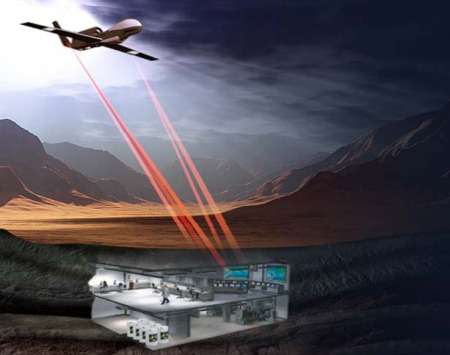
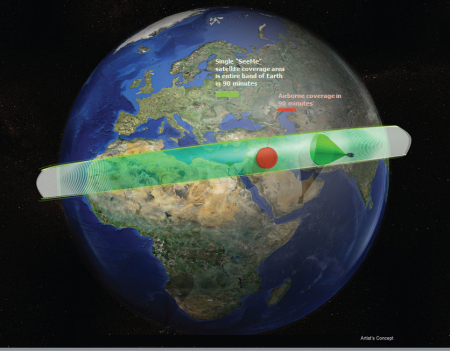
From the DARPA website: DARPA’s Membrane Optical Imager for Real-Time Exploitation (MOIRE) program aims to create technologies that would enable future high-resolution orbital telescopes to provide real-time video and images of the Earth from Geosynchronous Earth Orbit (GEO)—roughly 22,000 miles above the planet’s surface. Size and cost constraints have so far prevented placing large-scale imaging satellites in GEO, so MOIRE is developing technologies that would make orbital telescopes much lighter, more transportable and more cost-effective.

Currently in its second and final phase, the program recently successfully demonstrated a ground-based prototype that incorporated several critical technologies, including new lightweight polymer membrane optics to replace glass mirrors. Membrane optics traditionally have been too inefficient to use in telescope optics. MOIRE has achieved a technological first for membrane optics by nearly doubling their efficiency, from 30 percent to 55 percent. The improved efficiency enabled MOIRE to take the first images ever with membrane optics.

While the membrane is less efficient than glass, which is nearly 90 percent efficient, its much lighter weight enables creating larger lenses that more than make up the difference. The membrane is also substantially lighter than glass. Based on the performance of the prototype, a new system incorporating MOIRE optics would come in at roughly one-seventh the weight of a traditional system of the same resolution and mass. As a proof of concept, the MOIRE prototype validates membrane optics as a viable technology for orbital telescopes.

“Membrane optics could enable us to fit much larger, higher-resolution telescopes in smaller and lighter packages,” said Lt. Col. Larry Gunn, DARPA program manager. “In that respect, we’re ‘breaking the glass ceiling’ that traditional materials impose on optics design. We’re hoping our research could also help greatly reduce overall costs and enable more timely deployment using smaller, less expensive launch vehicles.”

Instead of reflecting light with mirrors or refracting it with lenses, MOIRE’s membrane optics diffract light. Roughly the thickness of household plastic wrap, each membrane serves as a Fresnel lens—it is etched with circular concentric grooves like microscopically thin tree rings, with the grooves hundreds of microns across at the center down to only 4 microns at the outside edge. The diffractive pattern focuses light on a sensor that the satellite translates into an image.

MOIRE technology houses the membranes in thin metal “petals” that would launch in a tightly packed configuration roughly 20 feet in diameter. Upon reaching its destination orbit, a satellite would then unfold the petals to create the full-size multi-lens optics. The envisioned diameter of 20 meters (about 68 feet) would be the largest telescope optics ever made and dwarf the glass mirrors contained in the world’s most famous telescopes.

From GEO, it is believed, a satellite using MOIRE optics could see approximately 40 percent of the earth’s surface at once. The satellite would be able to focus on a 10 km-by-10 km area at 1-meter resolution, and provide real-time video at 1 frame per second.

Ball Aerospace & Technologies Corp. is the prime contractor for the MOIRE program.

Vanishing Electronics: Military

What are VANISHING PROGRAMMABLE RESOURCES (VAPR)?  From the DARPA website

What if these electronics simply disappeared when no longer needed? DARPA announces the Vanishing Programmable Resources (VAPR) program with the aim of revolutionizing the state of the art in transient electronics or electronics capable of dissolving into the environment around them. Transient electronics developed under VAPR should maintain the current functionality and ruggedness of conventional electronics, but, when triggered, be able to degrade partially or completely into their surroundings. Once triggered to dissolve, these electronics would be useless to any enemy who might come across them.

The Vanishing Programmable Resources (VAPR) program seeks electronic systems capable of physically disappearing in a controlled, triggerable manner. These transient electronics should have performance comparable to commercial-off-the-shelf electronics, but with limited device persistence that can be programmed, adjusted in real-time, triggered, and/or be sensitive to the deployment environment.  VAPR seeks to enable transient electronics as a deployable technology. To achieve this goal, researchers are pursuing new concepts and capabilities to enable the materials, components, integration, and manufacturing that will realize this new class of electronics.

Transient electronics may enable a number of revolutionary military capabilities including sensors for conventional indoor/outdoor environments, environmental monitoring over large areas, and simplified diagnosis, treatment, and health monitoring in the field. Large-area distributed networks of sensors that can decompose in the natural environment (ecoresorbable) may provide critical data for a specified duration, but no longer. Alternatively, devices that resorb into the body (bioresorbable) may aid in continuous health monitoring and treatment in the field.

Companies involved IBM: IBM plans is to utilize the property of strained glass substrates to shatter as the driving force to reduce attached CMOS chips into Si and SiO2 powder.

BAE Systems

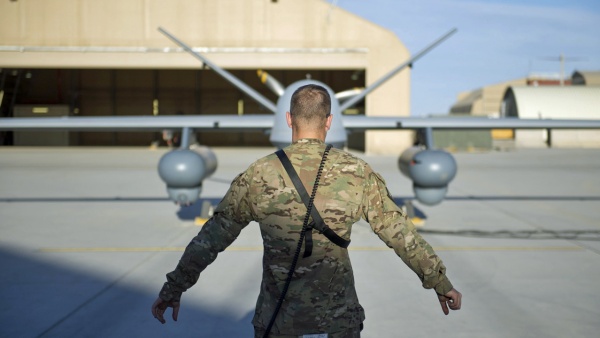
Saudi Arabia Not Happy Iraq Gets Drones

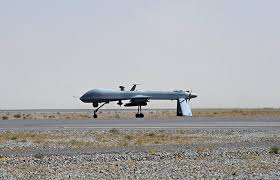
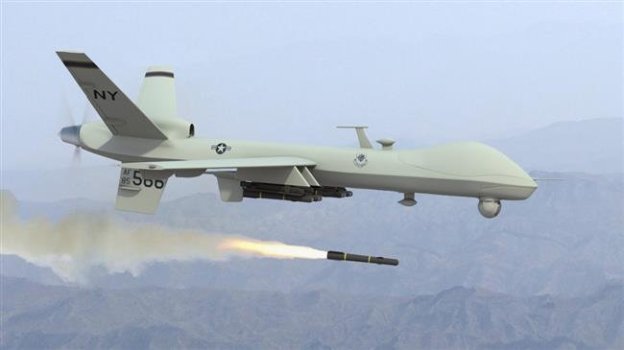
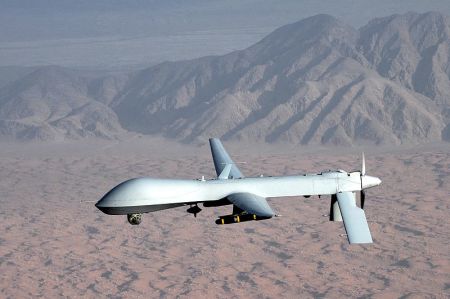
The report that America’s drone war has assumed frightening proportions under President Barack Obama should surprise no one. It took only three days for the new commander-in-chief to order his first covert drone strike.  On Jan. 23, 2009, a CIA drone flattened a house in Pakistan’s tribal region. At least nine civilians died, most of them from one family. The lone survivor, a 14-year-old boy, had shrapnel wounds in his stomach and a fractured skull. He lost one eye. Later that day, the CIA leveled another house killing between five and ten people

A week after Obama received the Nobel Peace Prize, a missile slammed into a hamlet in Yemen, hitting one of the poorest tribes in the poorest country in Arabian Peninsula. At least 41 civilians were killed, including 21 children and five pregnant women.  Not only has the number of drone strikes and the resulting civilian casualties increased under Obama’s watch, but he has also widened the scope of the drone war to include new countries like Yemen and Somalia. Missile strikes from unmanned drones killing unmentionable numbers of people are now the crucial component of America’s war on terror. Across Pakistan, Yemen and Somalia, the Obama administration has launched more than 390 drone strikes in the five years since the first attack On Jan. 23, 2009 – eight times as many as were launched in the entire Bush presidency. These strikes have killed more than 2,400 people, overwhelming majority of them civilians…

A convoy taking a Yemeni bride to her wedding came under attack on Dec. 12, 2013 causing the biggest single loss of civilian life from a US strike for more than a year in that country. President Bush ordered a single drone strike in Yemen, killing six people in 2002. Under Obama, the CIA and the Pentagon have launched at least 58 drone strikes on the country killing more than 281 people, including at least 24 civilians.

The UN General Assembly passed a resolution on Dec. 18, 2013 calling on states using drone strikes as a counterterrorism measure to comply with their obligations under international law and the UN Charter. Amnesty International released a report on Oct. 22, 2013 raising serious concerns about several recent drone strikes that appear to have killed civilians outside the bounds of the law. Pakistan High Court Chief Justice Dost Muhammad Khan issued a ruling on May 9, 2013 declaring the ongoing US drone strikes against tribal areas illegal under international law and saying they amount to “war crimes” when they kill innocents.

But rather than addressing such global concerns, the Obama administration is sending drones to Iraq, adding a sinister dimension to the sectarian strife there. The Iraqi government will get 48 drones this month and 10 surveillance drones in upcoming weeks.

Drone deaths on the rise, Saudi Gazette,  Jan 27, 2014

Covering Up Weapons Sales: Germany

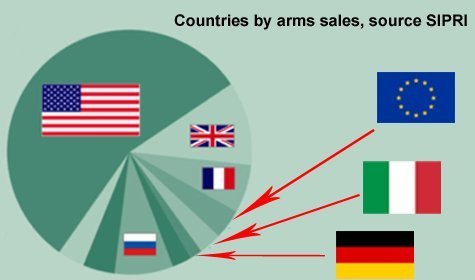
Germany… exports a lot of weapons: more than Britain, France or any other country besides America and Russia. Some German makers of military gear are part of civilian industrial giants, such as Airbus Group (which has dropped its ungainly old name, EADS, to adopt the brand of its commercial-aircraft business), and ThyssenKrupp, a steelmaker. But the biggest German company known mainly for weapons, Rheinmetall, is just 26th in the world league of arms-exporting firms. And Krauss Maffei Wegmann (KMW), which makes the Leopard 2 tank, is 54th.

Germans are, in general, proud of their export prowess. But although foreign sales of weaponry bring in almost €1 billion ($1.4 billion) a year, they are a delicate subject, and lately beset by bad press. Several German firms are accused of bribery in Greece. A former defence official there has said that of €8m in bribes he took, €3.2m came from German firms, including Wegmann (now part of KMW) and Rheinmetall. On January 3rd KMW’s alleged middleman was detained after a court hearing. The firm itself denies any bribery. Atlas, a maker of naval weapons owned jointly by Airbus and ThyssenKrupp, is under fire too. A former representative in Athens has reportedly admitted to bribery; the company says it is investigating the matter.

On another front, the industry faces criticism over the countries it sells to—most recently over a deal to sell Leopard 2s to Saudi Arabia. Arms sales to anywhere other than NATO and “NATO-equivalent” countries are in principle forbidden. But the Federal Security Council, headed by Chancellor Angela Merkel, can approve exceptions when foreign policy dictates, as long as they do not harm human rights.

Peace campaigners fear that the exceptions are becoming less exceptional. NATO countries’ budgets are being squeezed, so Germany’s armsmakers are looking farther abroad. Rheinmetall, for example, has a target of 50% of exports outside Europe by 2015. Asia is a growing target: Singapore recently signed a €1.6 billion deal for ThyssenKrupp submarines.

German small arms are also popular. Heckler & Koch’s G3 rifle (together with its variants) is the world’s most popular after the Russian AK-47….But Germany’s arms exports are probably in little danger, since they have the same reputation for reliability as its cars and other industrial goods.

Moreover, there are ways to lessen the controversy of selling things used to wage war. For example, making guns for a fighter jet assembled elsewhere is less visible than selling a German-made tank. Military transport, logistics, surveillance and protective equipment together account for five times as much of German defence firms’ output as weapons and ammunition—and are less likely to be blamed for civilian casualties. Stephan Boehm, an analyst at Commerzbank, sees such non-lethal materiel as a bright spot for German exporters. The flagging fortunes of Rheinmetall, in particular, should be restored by strong sales of the armoured transporters it produces in a joint venture with MAN, a lorry-maker.

Critics say the government is too willing to let arms firms export to dodgy regimes. The Federation of German Security & Defence Industries argues that strong exports are crucial to spread the development costs of the equipment Germany needs to defend itself. This would be less of a problem, the lobby group admits, if Europe’s fragmented defence industry were consolidated; it says the government should not have vetoed a proposal last year to merge EADS with BAE Systems of Britain. Weapons account for less than 1% of Germany’s exports. But it is a 1% that it, like other countries, is loth to give up.

German weapons firms: No farewell to arms, Economist, Jan. 11, 2014, at 56

The Secret Weapons Production

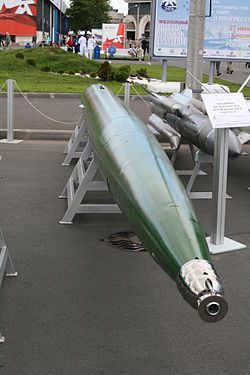
By far the world’s fastest torpedo, Russia’s rocket-powered VA-111 Shkval (Squall) can slice through the sea for more than 11km at a speed above 370 kilometres per hour. It packs a 210kg warhead and cannot be dodged or stopped by the West’s big warships. Christopher Harmer, a commander in the US Navy until 2011, says vessels must therefore remain beyond the Shkval’s “pretty nasty range”, or strike the enemy above or below water quickly enough to prevent a launch.

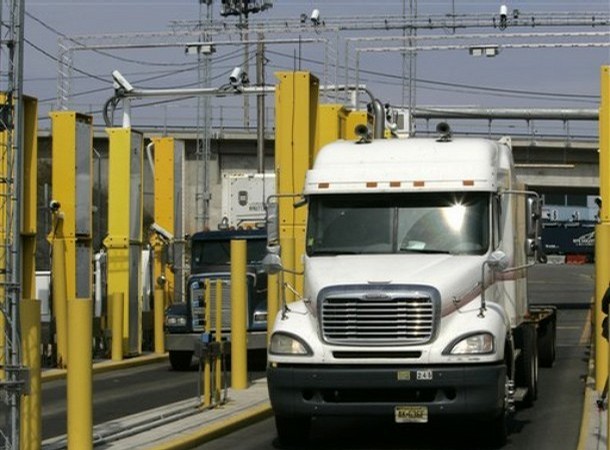
No wonder, he says, that the West tries to keep tabs on each model which leaves its manufacturer, Dastan Engineering, a Russian-owned enterprise in Kyrgyzstan. That is hard: unlike big strategic missiles, the Shkval, 8.2 metres (27 feet) long, fits in an ordinary lorry. The resources used to monitor these facilities cannot be revealed, says a former Western naval chief. But, he adds, given the Shkval’s power, “Why wouldn’t you choose everything you had?”

The tracking of Shkval exports is but one part of a broad and increasing effort by the West to track a class of “showstopper” weapons that are both rare and easy to hide. Russia and other countries have stepped up the lucrative export of advanced weapons, especially missiles, designed with an eye to constraining rival Western forces, says Tor Bukkvoll, head of the Russia programme at Norway’s Defence Research Establishment, a defence-ministry body. Such “area denial” munitions allow an attack to be launched without the giveaway of first having to amass troops or hardware.

These weapons can be user-friendly enough even for non-state groups. On July 14th 2006 Hizbullah militants in Lebanon hit an Israeli corvette more than 15km offshore with an Iranian-made C-802 anti-ship missile, killing four sailors and severely damaging the warship. If Israel had known that Hizbullah possessed this weapon, the corvette’s automated countermeasure systems would not have been switched to standby and the attack would have failed, says Alex Tal, a former head of Israel’s navy.

The subsonic C-802 is not even particularly formidable. It is an old variant of a Chinese missile. Newer anti-ship or land-attack missiles fly faster and farther, and dodge interceptors. Their solid fuel means that they can be launched discreetly on short notice, Mr Tal says. Older types such as China’s widely exported Silkworm missiles require lengthy mixing and loading of volatile liquid propellants, a process which can be spotted from planes or satellites. With the newer models, the satellites have to keep watch on lorries leaving factories, which is costly and uncertain.

Among the most feared exports are Russia’s supersonic Klub (3M-54) and Yakhont guided missiles. Faster than their Western counterparts, they can be launched from land batteries, aircraft, ships and submarines, carry large warheads, and reach targets 300km away. The Klub (called the Sizzler by NATO) accelerates to three times the speed of sound in the stretch before striking. Countries publicly known to have the Klub or Yakhont include Algeria, China, India, Syria and Vietnam.

America has “a pretty good idea” of other secret exports, because it tracks ships worldwide, says Lawrence Korb, an assistant secretary of defence under Ronald Reagan who is now at the Centre for American Progress, a think-tank. But countries without such capabilities (or close ties to America) can be left in the dark. Even top-notch spy services are uncertain about some of the most burning questions. Has Syria’s Assad regime passed along some of its Yakhont missiles to Hizbullah for use against Israel? Is Iran’s boast of possessing the Shkval a bluff? Do North Korean subs have it? (Some reports suggest that a Shkval was used to sink a South Korean ship in 2010.) Mr Harmer, now at the Institute for the Study of War in Washington, DC, says that keeping track of every such device manufactured is impossible.

Uncertainty over arsenals is growing as a result of increasing “clandestinisation” of munitions manufacture and transport, says Jim Thomas, a senior Pentagon official until 2007. Now at the Centre for Strategic and Budgetary Assessments, another Washington think-tank, Mr Thomas says missiles are now emerging from “dual-use” factories that also ship non-military goods, and from factories made to appear as producers of solely civilian ones. This makes it harder for “squints” (intelligence officers who study satellite and drone imagery) to identify munitions of interest.

Manufacturers are marketing and designing munitions with concealment in mind. A Moscow firm called The Klubhas offered a system of four Klub missiles and an erector, with a control compartment for two operators, all concealed inside a standard shipping container. The “Club-K Container Missile System”, can be transported and fired from a merchant ship, freight train, or lorry. An expert at a European missile-maker says, “before you could see a Klub missile from space; now you can’t—you need spies.”

Israel already relies heavily on human sources to detect arms shipments to its enemies, says Shlomo Brom, a former intelligence officer and retired head of strategic planning at Israel’s General Staff. This is partly because Israel does not have enough satellites to monitor all the far-flung facilities where the most worrisome munitions are made. And arms shipments to Israel’s adversaries, he says, are increasingly disguised as civilian products.

The “vast majority” of munitions leaving Russian ports for Syria now travel on merchant ships that call at commercial ports rather than Russia’s naval base at the Syrian city of Tartus, says Farley Mesko, chief operating officer at C4ADS, an American investigative group. In September it published a report on concealed arms shipments calledThe Odessa Network” (pdf). Missiles are separated from their bulky launchers and transporters, and travel in containers that could just as well be carrying televisions, he says. Ten Shkvals could fit in just one container.

The spies’ efforts are bearing fruit. In January, May and July (2013) Israeli air strikes destroyed Russian- and Iranian-made missiles at locations in Syria. In October Sudan’s government accused Israel of bombing a weapons factory in Khartoum. Military-intelligence officials elsewhere are encouraged. They are pushing for more spies to conduct more missions.

Japan wants greater efforts to go into locating missiles in China and North Korea, says Narushige Michishita, a former specialist on the two countries’ arsenals at Japan’s defence ministry. His country’s intelligence on North Korea’s launching pads and procedures is excellent, he says, thanks largely to a 1998 decision to splurge on optical and radar satellites. But more human intelligence is now needed—North Korea has increased its fleet of “transporter-erector-launcher” lorries for Ro-Dong medium-range ballistic missiles from nine to about 50. Mr Michishita, now at Tokyo’s National Graduate Institute for Policy Studies, says these can lurk inconspicuously while Ro-Dong missiles are taking on their liquid fuel—and then pull out and fire.

At least these weapons are broadly known. The next threat is arms developed in secret, so adversaries will not even know what to look for, says Mr Thomas, the former Pentagon official. Such devices may feature targeting systems which use location co-ordinates freely available from Google Earth. This would give even small and poor attackers the chance to deliver formidable weapons accurately.

Amid the growing demand for good intelligence, smaller countries see a role in helping allies. They may not be targeted by the weapons systems in question, says Todor Tagarev, a former Bulgarian defence minister, but passing nuggets along to bigger allies cultivates goodwill.

Outside the spy world, business is booming too. Big countries may be worried about the threat. But they see an upside too. It is their defence industries which are also the best source of countermeasures to the new weapons. Briefing an ally about threats can also be an implicit sales pitch. Seen this way, says the expert at a European missile-maker, insights from military intelligence are also part of defence-industry marketing.

Weaponry and espionage: A shot from the dark, Economist,  Nov. 30, 2013, at 58

Mining in Africa: who gets the money?

Most west African governments have signed—or pledged to sign—the Extractive Industries Transparency Initiative (EITI). The EITI tries to ensure that contracts and accounts of taxes and revenue generated by concessions are open to public scrutiny. But that is easier said than done. Last year Liberia’s government asked a British accounting firm, Moore Stephens, to carry out an audit of Liberian mining contracts signed between the middle of 2009 and the end of 2011. The audit, published in May 2013, found that 62 of the 68 concessions ratified by Liberia’s parliament had not complied with laws and regulations. The government has yet to take action after a string of recommendations emerged from an EITI retreat in July 2013.

Regional governments also fret over a practice known as “concession flipping”, whereby foreign mining companies that do not have the capacity to exploit sites sell their concessions to larger companies for windfall profits. “Every flip is essentially a heist on the government exchequer, with anonymous offshore firms as the getaway car,” says Leigh Baldwin of Global Witness, a London-based lobby that fights for fairer deals for local people and their governments from mining and other resources. Concession flipping, he adds, is widespread in Africa. The Africa Progress Panel, headed by Kofi Annan, a Ghanaian who once led the UN, has put out a report called “Equity in Extractives”. This, too, stresses a need for more openness in mining contracts. As people in the region demand more democracy, better deals from mining are a new priority.

Mining in west Africa: Where’s our cut?, Economist, Dec. 7, 2013, at 51

Trapping the Dirty Bomb

Nuclear and radiological materials slipped out of regulatory control 2,331 times between 1995 and the start of 2013, according to the Incident and  Trafficking Database compiled by the International Atomic Energy Agency (IAEA). The materials are widely used in industry, agriculture and medicine. They are kept in many poorly guarded X-ray and cancer-treatment clinics. Such places are often not overseen with terrorism in min  d. They have even been bought by crooks as front operations, says Rajiv Nayan, of India’s Institute for Defence Studies and Analyses. Raids on abandoned uranium mines in the Democratic Republic of Congo are more frequent, according to that country’s General Atomic-Energy Commission. The problem is most acute in the former Soviet Union: in Ukraine alone, roughly 2,500 organisations use radiological materials.

In Georgia a counter-trafficking unit set up by the interior ministry seven years ago has arrested two or three teams smuggling radiological material every year save 2009. The lure of profits is so strong that some ex-cons get back into the business, says Archil Pavlenishvili, leader of the unit. Interpol has said such trafficking is growing: an acute “real threat to global security”.  It all sounds scary enough. But the reality has been less so. Moreover, by many accounts the most plausible dangers appear to be declining.

For a start, an “overwhelming” number of buyers turn out to be undercover cops, says Mark Hibbs of the Carnegie Endowment for International Peace, a think-tank. A sizeable network of informers helps Georgia’s interior ministry to keep a close eye on the four or five cells in the country currently trying to obtain or sell radiological material, says Mr Pavlenishvili. ..Beyond this, intelligence agencies are hunting down traffickers with help from special “link analysis” computer programs. Also known as “network analysis” software, this crunches data from numerous sources to identify people whose travel, purchases, web searches, communications, schooling and so forth may spell trouble—perhaps an employee in radiation therapy who begins frequenting an inconveniently located bar whose owner receives phone calls from a drug-runner with growing operations.

Half a dozen Western governments “pay huge amounts of attention” to this, says an executive at a developer of the software. At least one spy agency in America, Australia, Britain, Canada, New Zealand, and an unnamed European country pays more than $1m a month to use it. The counter-trafficking units in both Georgia and Romania note that link-analysis software made by i2, owned by the giant IBM computer company, has helped to nab traffickers. Atsuko Nishigaki, the unit’s boss, says Japan’s economy ministry employs ten analysts to use a competitor’s software to identify traffickers in nuclear or radiological material.

America’s National Nuclear Security Administration has sponsored the installation of radiation-detection kit at ports in 23 countries and counting. The Megaports Initiative, as it is called, aims to have half of the world’s maritime container cargo routinely scanned by 2015. Networked systems are also being developed with detectors small enough to be worn on a police officer’s belt. The idea is to relay data on potentially dangerous radiation through a mobile-phone network to a central computer. Knowing each device’s location and the strength of the radiation it detects, the computer can “triangulate” the source’s approximate location.

Difficult problems remain. False alarms triggered by anything from a pallet of cat litter to radiation-therapy patients and nuclear-power-plant shipments have slowed research and development on one such network at the Lawrence Livermore National Laboratory in California, says Simon Labov, a co-ordinator there. Even so, the lab’s work continues to be financed by America’s defence, energy and homeland-security departments. In October 2013 the latter’s Domestic Nuclear Detection Office asked for proposals for a similar system, dubbed Human Portable Tripwire. Other outfits that have developed technology for such schemes include Smiths Detection in Britain and, in America, Berkeley Nucleonics, General Electric, GENTAG, Passport Systems and Purdue University.

The sheer danger of making a dirty bomb is a factor too. Without the right equipment and expertise, the really nasty stuff can kill the maker of a bomb before it is ready—part of the reason, perhaps, that no spectacular dirty-bomb attack has yet been launched. F

Dirty Bombs: Glowing in the dark, Economist, Dec. 14, 2013, at 67

Weapons that Kill Themselves: Arms Control

To help push Soviet forces out of Afghanistan in the 1980s, America’s Central Intelligence Agency (CIA) gave Afghan fighters shoulder-launched Stinger anti-aircraft missiles. Accurate and easy-to-use, the Stingers caused grievous losses. But after the Soviet withdrawal in 1989, the CIA wanted to discourage the use of the leftover missiles. It got hold of some of those circulating on the black market and booby-trapped them, so that anyone who tried to fire one would have his head blown off. The aim, according to a former CIA official, was to deter both the sale and use of the remaining missiles…

[Today] technological tweaks may be able to help limit the spread and use of small arms, making possible weapons that stop working after a certain period of time, or can only be used by specific people or in particular places. Proponents of such technologies believe they have the potential to succeed where political and legislative attempts at arms control have failed.  Perhaps the simplest approach is the use of technological tricks that shorten weapons’ lifespans. “Self-deactivating” landmines, for example, will not detonate after their battery runs down. They have been adopted by America and some of its allies, but constitute only a tiny fraction of mines deployed around the world. In a similar vein, one proposal is that launchers for shoulder-fired missiles should only work with a uniquely configured, non-rechargeable battery manufactured in a single, tightly controlled plant. This would, in theory, limit the lifespan of the weapons for anyone without access to new batteries. But there would be workarounds. This year rebels in Syria posted video online of a portable missile-launcher rigged to an external power supply for target acquisition. It fired a missile that shot down a helicopter near the Abu ad-Duhur military airbase, south of Aleppo. Similarly rigged missiles have been fired by Hamas militants at Israeli aircraft.

Shoulder-fired missiles, RPGs, mortars, and guided anti-tank missiles could also be made to stop working after a while by engineering their chemical propellants to become inert after a predetermined period, says Patrick McCarthy, head of a UN project called the International Small Arms Control Standards. It is hardly likely that governments would buy perishable weapons of the sort for their own use, but rebel groups might accept them from a sympathetic country, at least if nothing better were on offer. This might also allay fears in the donor country that the weapons might end up in undesirable hands many years later.

A second approach to arms control is to track weapons electronically. Almost all illicit small arms were legally manufactured or imported and were later diverted, often with help from corrupt officials and forged documents. Discreet monitoring and tracking of shipping containers carrying weapons makes it harder to steal or reroute them. Jim Giermanski, a former US Air Force colonel, says America’s Defence Department recently began shipping to Afghanistan, on commercial vessels, containers capable of reporting an opened door, vibrations from a break-in attempt and their location, derived from global positioning system (GPS) satellites. A container can, in essence, “report its own hijacking”, says Dr Giermanski, now boss of Powers International, a company based in North Carolina that helps shippers adopt the tracking technology. It is just now becoming practical and inexpensive enough for wide use, he says.

In some cases it is even possible to track individual weapons by building in a transmitter that regularly signals their precise co-ordinates. This is already done for larger weapons deemed “expensive enough and consequential enough”, says Lincoln Bloomfield, a former State Department official for military and political affairs who served as a special envoy under George Bush junior. Doing the same for small arms would be expensive, but the transmitter could be cleverly attached so that removing it disables the weapon.

In RPGs, a GPS transmitter could be concealed in a grip assembly, says Jean-Marc Anzian Kouadja, executive secretary of the National Commission of Small Arms and Light Weapons at Côte d’Ivoire’s interior ministry. Wrench it out, he says, and you break the trigger mechanism. Governments might be willing to foot the bill to secure their stockpiles from insurgent raids or managers who might otherwise cut deals with gunrunners. But a problem, he notes, is that cyber-savvy rebels might work out how to use the technology to track government troops…

Tracking weapons can be done without satellites, however. Some armies have started using tiny radio-frequency identification (RFID) chips, like those found in contactless credit cards and public-transport tickets, which do not require batteries to operate. Instead, when they are passed close to a reader (when passing through a door, for example), the chips absorb enough radio energy to power up and transmit a short burst of identification data. Weapons passing in and out of an armoury can thus be tracked. SkyRFID, a company based in Ontario, notes that its weaponry tags are not damaged by vibration, grime or cleaning solvents. Replacing manual logging makes it harder for armoury staff to pretend munitions sold on the sly are still in stock. (A UN report on improving marking and tracing technologies is due to be published in April 2014.)

Another alternative to GPS transmitters would be to track weapons by outfitting them with the inexpensive SIM cards that allow mobile-phone networks to identify subscribers. A weapon would communicate with nearby mobile-network towers to indicate its position within a rough area, says Mr Kalbusch. And a system of this sort could, in theory, form the basis of a “remote control” feature, allowing weapons to be disabled from a distance.

Kill switches” or “backdoors”, as these features are sometimes known, have so far been associated with expensive weapon systems that must send and receive data to operate. David Kay, America’s most senior arms inspector in post-Saddam Iraq, has noted that one of the reasons why Russia’s best air-defence systems have not been installed in Iran is probably because the Iranians fear that Russia might be capable of countermanding missile launches against certain countries’ aircraft. Now similar “override” systems are being applied to small arms, too.

TriggerSmart, a company based in Limerick, Ireland, has developed a motorised mechanism that can block or unblock the trigger of an assault rifle. It is controlled not by a switch on the weapon itself, but rather by a command sent from an aircraft, satellite, mobile-network tower or radio station. Weighing less than 30 grams (including a standard AAA battery), the mechanism allows an “offending weapon” to be remotely disabled, says Patrick O’Shaughnessy, TriggerSmart’s head of research and development. It costs about $150 to retrofit an existing rifle or build the technology into a new one.

The biggest buyers, Mr O’Shaughnessy reckons, will be armies that work with foreign security forces. American officials have expressed interest. One in six of the Western troops killed last year in Afghanistan was slain in an “insider attack” by a partner in the country’s security forces. TriggerSmart’s technology could allow any member of a unit to block the use of firearms by partner forces. But being expected to use weapons that can be remotely disabled hardly seems likely to engender trust. And it would be impractical to introduce light-weaponry override systems in their current form for large numbers of soldiers or police, says Richard Rowe, a retired US Army major-general who oversaw the instruction and equipping of 550,000 Iraqi security recruits.

Even with further technological advances, few armies will be eager to adopt such kit, Mr Kalbusch says. Governments would worry that their arsenals could be neutered by an adversary, or, more straightforwardly, by the country that supplied the arms. Attempts to mandate use of the technology seem unlikely to succeed, because small arms are made in many countries. And sometimes foreign powers want rebels to steal a government’s weapons and use them against it, as Western-supported opponents of Libya’s Qaddafi regime did in 2011.

Away from the battlefield, other arms-control technologies are being developed to prevent the unintended or unauthorised use of weapons belonging to civilians or police officers. In the decade to 2010, 1,217 American minors were killed in accidental shootings, according to the most recent data from the Centres for Disease Control. And it is not uncommon for a police officer to be shot with a service weapon that has been wrested away.  Accordingly, new “personalised” firearms are being developed which fire only when held by the owner or another authorised person, with the specific aim of preventing a gun owner (and his family or co-workers) from being killed with his own weapon. Because the verification takes place within the weapon itself, its backers note, the technology is more likely to be accepted than remote-override features on military weapons… One example is a .22-calibre pistol called iP1 made by Armatix, a German firm. It only fires if the shooter is wearing a special wristwatch containing an RFID chip, which is detected by the gun. If the gun is more than 40 centimetres from the RFID chip, its trigger locks. Attempting to disable the trigger lock destroys the iP1 “irrevocably”, according to Maximilian Hefner, the firm’s boss. The list price is $1,699.

A similar system for shotguns, called M-2000, has been developed by iGun Technology Corporation, based in Florida. When an RFID chip embedded in a ring is brought near the shotgun, a solenoid switch instantly unlocks the trigger. (Alternatively, the chip could be surgically implanted in the owner’s hand.) The system is seamless, according to Jonathan Mossberg, the firm’s founder. “You pick up the gun, pull the trigger, it goes boom—no thought involved,” he says. The battery inside the gun that powers the RFID reader lasts for more than eight years, and it sounds a warning alarm after six years. It costs about $200 to add to a firearm.

A wristwatch or a ring could be stolen, however, so other smart guns rely instead on biometric characteristics of their owner’s body, such as a fingerprint. The New Jersey Institute of Technology has devised a personalised Beretta pistol. When its magnetic trigger is pulled past a sensor in the trigger guard, a chip is switched on to crunch data from pressure-sensing piezoelectric sensors in the handgrip. Only if they match the owner’s bone geometry and “grip dynamics” does the trigger unlock. All this happens within the tenth of a second it takes to pull the trigger all the way back. The system is not foolproof: on average, around 1% of people with the same hand size will be able to fire a gun personalised for a particular user. But a gun set up for an adult cannot be fired by a child. The US Army is testing the system at an armaments laboratory in Picatinny, New Jersey.

Firearms that are unlocked with a fingerprint reader have been developed by Kodiak Industries, based in Utah, and Safe Gun Technology, based in Georgia. Biomac Systems, a firm based in Los Angeles, California and Ferlach, Austria, is designing a biometric kit to retrofit pistols. Barack Obama has encouraged the development of such technologies and has directed America’s attorney general to review them. Smart-gun technology also received a boost last year when it won the fictional endorsement of James Bond in “Skyfall”. Issued a gun coded to his palmprint that only he can fire, Bond is told that it is “less of a random killing machine, more of a personal statement”.

And yet demand looks weak, especially in America, by far the biggest market for civilian firearms: the iGun M-2000 failed to sell at all. Maxim Popenker, an author of firearm reference books based in St Petersburg, Russia, observes that sooner or later a bad guy will shoot a good guy because the latter’s personalised gun refuses to fire due to “gloves, dirt, sweat, blood or stress”. Gun enthusiasts have raised similar objections: personalised smart guns are simply less effective for self-defence, they argue, because of the risk that the safety technology will fail to work properly. Triggers could be unlocked by voice, but this risks betraying the position of someone hiding.

Smart weapons: Kill switches and safety catches, Economist, Nov. 30, 2013, at 11

.

Getting Rid of Chemical Weapons: logistics and compromises

Nobody thought it would be easy to transport several hundred tonnes of highly toxic chemical agents on a road that runs through territory fought over by two sides in a civil war. Speaking in Oslo on December 9th, a day before collecting the Nobel peace prize awarded to the Organisation for the Prohibition of Chemical Weapons (OPCW), Ahmet Uzumcu, its head, warned that a December 31st deadline for getting the Syrian government’s most lethal substances out of the country would be “quite difficult” to meet.

Yet much has been achieved. A joint team from the UN and The Hague-based OPCW was sent to Syria two months ago as part of a deal to avert an American missile strike in response to President Bashar Assad’s use of chemical weapons on August 21st. Co-operation from the Syrian government, which has a legal responsibility for implementing the plan, has been all that could have been hoped for, says Sigrid Kaag, a Dutch diplomat who leads the mission. Key milestones for the verification of chemical-weapons stockpiles and the functional destruction of the facilities where they have been produced were met on time (October 27th and November 1st, respectively). Of 23 sites, 22 were visited by inspectors. The one that proved inaccessible because of fighting is believed to have been dismantled and abandoned.

Destruction of unfilled munitions will be completed before the target date of January 31st. At least for now (and assuming there has been no cheating), it is unlikely that Syria has the capacity to make or fill any new weapons. However, by the end of this month, 500 tonnes of nerve agents, such as sarin and mustard gas (known as “priority weapons”), have to be removed for safe destruction. This task is daunting.

First, the weapons must be sealed and packaged in special containers brought across the border from Lebanon by Syrian technicians who have been trained there by OPCW specialists. Then they must be transported by road from multiple sites to Syria’s biggest port, Latakia. Once there, they will be loaded onto ships provided by Norway and Denmark and taken to an American government-owned vessel, the Cape Ray* a 200-metre (650-foot) cargo ship that is part of a reserve fleet used for transporting military hardware. The Cape Ray has been fitted with equipment for breaking down lethal chemical agents into a sludge similar to industrial toxic waste. It will eventually be handled by commercial firms in a number of countries, according to Ms Kaag.

The biggest obstacle is getting the lorries carrying the chemicals through to Latakia, because the highway between Damascus and Homs, which they have to use, remains contested. In recent weeks fighting for control of towns along it, such as Qara, Deir Attiyah and al-Nabak, has been fierce. The first two are in government hands but al-Nabak, some 80km from Damascus, is disputed. A pro-government newspaper, al-Watan, claimed this week that the highway had reopened after 20 days of bloody fighting around al-Nabak, but rebels claimed still to be holding on in parts of the town.

Ms Kaag recently met moderate opposition leaders in Turkey, but despite assurances that they support the safe removal of the regime’s chemical weapons it is questionable whether they have any influence in implementing temporary ceasefires that would ensure safe passage. The OPCW is in the uncomfortable position of relying on the military success of regime forces, supported by local militias led by Hizbullah, the Lebanese party-cum-militia, to meet its timelines. A further 800 tonnes of less lethal industrial chemicals destined for incineration at commercial toxic-waste plants outside Syria must also be transported to Latakia by early February.

Ms Kaag says that although “the situation remains complex and the security situation volatile…we intend to forge ahead.” Mr Uzumcu is equally bullish about meeting the overarching objective of destroying the entire Syrian chemical arsenal by the end of next June. However, the UN’s secretary-general, Ban Ki-Moon, in a leaked letter to the Security Council last week, expressed his concern both about the “highly dangerous” nature of this stage of the mission and about the vulnerability of the team’s headquarters in Damascus. An alternative base in nearby Cyprus is being considered.

The joint mission has already achieved a lot in a very short time. Ms Kaag describes a week of the current operation as being the equivalent of several months of any other the OPCW has undertaken since its formation in 1997. But there is no guarantee that it can maintain the momentum. The Syrian government has asked the international community to provide armoured vehicles to help it move the chemicals. The request is understandably being treated with suspicion but it might have to be granted if there is no other way of getting the chemicals to Latakia. Russia, an Assad ally, has said it is willing to step in. Working closely with a regime that has done terrible things to its own people has always been morally compromising. It is becoming even more so.

Syria’s war: An inconvenient truth, Economist,  Dec. 14, 2013, at 58

*The 648-foot Cape Ray, built in 1977, is generally used to transport vehicles to war zones from the United States. The ship has been outfitted, by Army civilians, with two portable hydrolysis systems designed to neutralize chemicals weapons in Syria’s arsenal.
Under the United Nations-backed plan, some 700 metric tons of chemicals will be loaded into shipping containers and moved to Latakia, a Syrian city on the Mediterranean Sea, where they will be placed onto cargo ships and eventually transferred to the Cape Ray. Once the chemicals are destroyed aboard the vessel, the waste, some 1.2 million gallons’ worth, will be offloaded at an unspecified commercial treatment facility. See Official Homepage of the United States Army

Private Military Firms: business in Africa

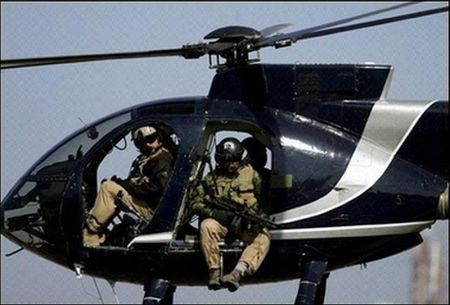
But Blackwater’s demise created space for two rivals: DynCorp International, a 60-year-old firm that diversified into military security, and Triple Canopy, founded in 2003 with a similar business model to Blackwater’s.  Groups such as Human Rights First campaign against governments’ use of private military contractors…Post-Blackwater, two trends have dominated the new industry...globalisation and indigenisation. On the supply side, there are a growing number of private military firms, and not all of the new ones were formed by former special forces from Western powers, such as Aegis and Blue Mountain, two British firms. Warlords in places such as Afghanistan and Somalia ainre creating contracting firms that they staff with local talent. Their embattled national governments are seeing the merits in contracting out security. So America is no longer the only big buyer of private force…

One thing that would greatly improve the industry’s prospects is if the United Nations began using private contractors for peacekeeping missions, as it is said to be considering. Today, such missions are staffed by soldiers from poorer countries, who are often badly trained. Mr Prince thinks that private contracting would make the UN more effective, but he has no intention of going after that business. For him, the new promised land is Africa, where he is investing in firms providing services to the oil and gas industry, in places where he thinks his expertise in providing logistics and security can give him a competitive edge.

Private military contractors: Beyond Blackwater, Economist, Nov. 23, 2013, at  65

China Space Program: Military Apps

Most space programmes are military to some extent. Both America and the Soviet Union used modified missiles to launch their satellites and spacemen in the early days. And even in the days of the Space Shuttle, NASA was employing that device to put spy satellites into orbit, and recover them. For China’s space effort these still are the early days, so civilian and military applications remain intertwined.  In July, for example, the CNSA (China National Space Administration) launched a trio of satellites, allegedly as part of a project to clean up space near Earth by removing orbital debris. Such debris is indeed a problem, given the number of launches that have happened since the hoisting of Sputnik in 1957. Nor did China itself help when, during the testing of an anti-satellite weapon in 2007, it blew one of its own redundant satellites into about 150,000 pieces. So a charitable view might be that this mission was a piece of contrition. Cynics, however, suspect that what was actually launched was another type of antisatellite weapon—or, at most, a piece of dual-use technology which could act as a space-sweeper as well.

One of the newly launched probes was indeed equipped with a robotic arm of the sort that might pick up space litter. The other two were, the story went, to stand in for bits of debris. But once initial tests were over, the satellite with the robotic arm made a number of unusual manoeuvres and approached not one of the devices it was launched with, but rather an ageing satellite in a different orbit—just the sort of behaviour that would be useful if you wanted to eliminate an observation or communication satellite belonging to another country.

The Chinese are not the only ones working on space weaponry, of course. America is busy in the field, too. And that accounted for a slightly more desolate atmosphere at the meeting than is normal at astronautical congresses. American law prohibits NASA from collaborating with China, or even organising bilateral exchanges with it.

Excerpt, China in Space: How Long a Reach?, Economist, Sept. 28, 2013, at 75

The Jihadist View of the World

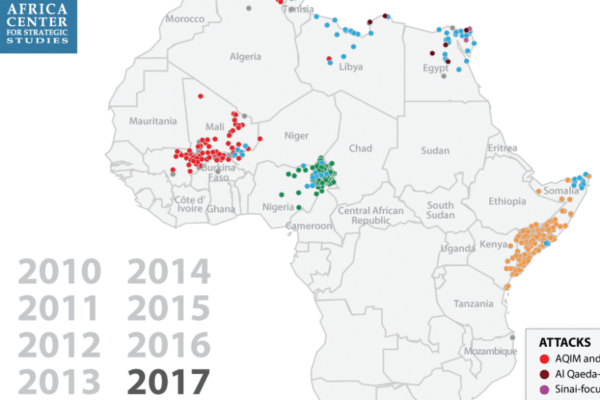
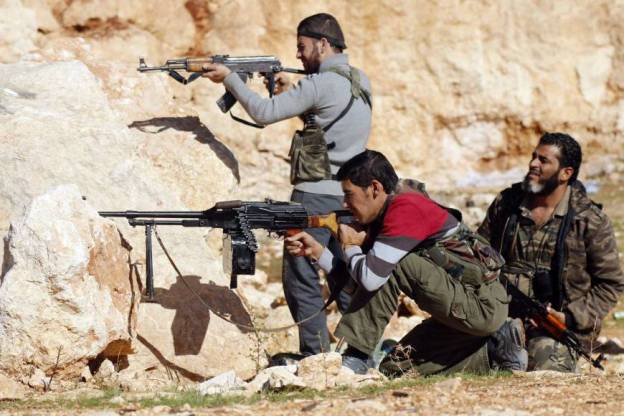
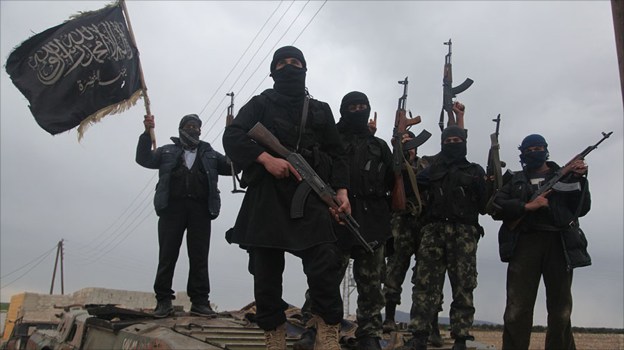
Al-Qaeda.., including militia groups under the umbrella name of Ansar al-Sharia (Partisans of Islamic Law)in Yemen, Libya, Tunisia, Mali and Egypt that both compete and co-operate with the organisation, have recovered momentum and self-confidence as the hopes invested in the Arab spring have withered. Indeed, the reverses of the Arab spring have been a boon to it.Take Egypt. After the coup that toppled President Muhammad Morsi in July, Mr Zawahiri posted a 15-minute message on jihadist websites arguing that “the crusaders” in the West and their allies in the Arab world will never allow the establishment of an Islamist state…Look to the biggest gift the Arab spring has given al-Qaeda: the increasingly sectarian civil war in Syria.  The prospect of overthrowing Bashar Assad is catnip to jihadists; his Alawite regime is an heretical abomination to the hyper-orthodox Salafis from which al-Qaeda draws its support. Western intelligence thinks most of Syria’s effective rebel militias may now be jihadist, with thousands of fighters from other Muslim countries and hundreds from Europe, especially Britain, France and the Netherlands.

The Islamic State of Iraq and al-Sham (ISIS), formerly al-Qaeda in Iraq (AQI), has recently pushed into eastern Syria from Iraq, following a resurgence there that is part of the more general pattern of ineradicability…Al-Qaeda wants to bring Iraq, Syria and Lebanon together into a single “caliphate”, and ISIS uses foreign fighters drawn to Syria on both sides of the porous border with Iraq. It has also tried to merge with Jabhat al-Nusra (JAN), one of the most militarily formidable rebel militias (and the one with which Mr Qunaibi is associated). …For the time being, ISIS and JAN are focused entirely on the would-be caliphate of the Levant. Most of the network’s affiliates are similarly engaged in regional struggles, the most extensive being that of al-Qaeda in the Islamic Maghreb, the north African branch. AQIM is seeking to make use of Libya’s post-revolutionary chaos, and weapons from Muammar Qaddafi’s former arsenal, to create an “arc of instability” across the Sahara and the Sahel. It provides help and advice to jihadist organisations from Boko Haram in Nigeria to the Shabab in Somalia.In 2012 AQIM commanders allied to an indigenous insurgent group, Ansar Eddine, took control of the northern half of Mali. They ruthlessly implemented sharia law and picked an unnecessary fight with the National Movement for the Liberation of Azawad, a grouping of rebel Tuaregs…

An intense drone campaign has killed several of AQAP’s (al-Qaeda in the Arabian Peninsula) senior leaders; its second-in-command, Said al-Shihri, died on July 16th. Yemeni government operations have driven it out of some of the southern tribal areas it overran in 2011. But it has lost none of its ambition….Bruce Riedel, who has advised four presidents and is now at the Saban Centre for Middle East Policy in Washington, DC, recently warned that al-Qaeda in Pakistan remains embedded in a network of local support groups from the Taliban to Lashkar-e-Taiba. After the departure of NATO combat forces in 2014 it may be able to regenerate itself, rather as ISIS did in Iraq….Thomas Sanderson of the Centre for Strategic and International Studies, also in Washington, says al-Qaeda and its allies in Pakistan are weaving a narrative that equates America’s post-2014 withdrawal with the mujahideen defeat of the Soviet Union, another superpower with feet of clay, 25 years earlier…

One counter-terrorism intelligence source recently observed: “Tactically, we may have defeated the central leadership, but strategically, they are winning.”  While attacks on the far enemy are important both as a deterrent and as a source of jihadist inspiration, they are not al-Qaeda’s main purpose. Its overriding aim remains, as it has been since bin Laden saw the retreat of the Soviet Union, the creation of a new caliphate across the Islamic world based on unswerving adherence to sharia law. That requires the corrupting influence of the “Zionist-Crusader alliance” in the region to be extirpated and all apostate Muslim governments removed.

Seen from that point of view, things are not going badly. Al-Qaeda believes America is in retreat not just in Afghanistan but also across the Middle East. The poisoning of the Arab spring has given it new purpose and ideological momentum. Al-Qaeda itself may be divided and in some places depleted. It may be shunned by some with similar ideologies, and its affiliates may increasingly ignore its ageing leadership. But the Salafi jihadist view of the world that al-Qaeda promotes and fights for has never had greater traction.

Excerpts, The state of al-Qaeda: The unquenchable fire, Economist. Sept. 28, 2013, at 21

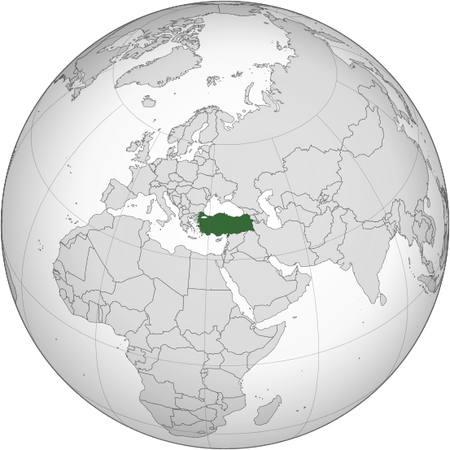
An Islamic Superpower: Turkey

The rift with Washington deepened following Turkey’s announcement in September that it was planning to co-produce a missile-defence system with a Chinese company that is under American sanctions for its dealings with Syria, North Korea and Iran. NATO’s secretary-general, Anders Fogh Rasmussen, has warned that the Chinese equipment, which is meant to protect Turkey against a possible attack by Syria or Iran, is not compatible with those of other NATO members. Aaron Stein, a Geneva-based non-proliferation expert, reckons that the Chinese kit may be “good against drones and aircraft but not against missiles”.Turkey picked the Chinese missile because it was vastly cheaper than its European and American rivals. The Chinese also agreed to share technology that will purportedly enable Turkey to produce and export its own missiles. This fits with Mr Erdogan’s dreams of leading an Islamic superpower.

Excerpt, Turkey and its neighbours: A reset?, Economist, Nov. 9, 2013, at 59

US Operations in North Africa – Strategic Instability

The Defense Department continues to work with nations in North Africa to promote security and increase stability in the region still feeling the effects of the Arab Spring, Amanda J. Dory, the deputy assistant secretary of defense for African affairs, told a Senate panel today. Libya, Tunisia, Algeria and Morocco are confronting instability and the U.S. military is working to build or strengthen their police and military forces, Dory told the Senate Armed Services Subcommittee on Near eastern and South and Central Asian Affairs….T

he effects of the Arab Spring in North Africa continue to reverberate within the region and beyond its borders into the Sahelian states of sub-Saharan Africa, she said. Libya remains a key source of instability in North Africa and the Sahel. After the overthrow of Muammar Gadhafi, there is little government infrastructure inside Libya, Dory said, and certainly no tradition of democracy.Violence is rampant in Libya and the Libyan government is too weak to control its borders and militias provide what security there is. Arms merchants are shipping Libyan weapons out of the country and these arms are fueling instability from Mali westward, Dory said…The United States will provide general-purpose-force military training for 5,000-8,000 Libyan personnel, Dory said.“This training effort is intended to help the [Libyan] government build the military it requires to protect government institutions and maintain order,” she said.  The training of Libyan military personnel may begin next year in Bulgaria.

In Morocco, Algeria and Tunisia, DOD maintains close military-to-military ties with their military counterparts. All three are engaged in a security dialogue with the United States and “they share our goals of countering terrorism and enhancing cross-border security,” Dory said…

Excerpts, By Jim Garamone, Military Continues Work With North African Countries American Forces Press Service, Nov. 21, 2013

Boeing Africanizes its Weapons

Boeing airliners are well known and operated in almost every country of the world, Boeing are more selective as to whom they sell their military products. Up to now, the African activities of Boeing Defence, Space & Security have been restricted to North Africa.This, however, is about to change. Whilst the Middle East and Asia-Pacific are trending, Chris Chadwick, President of Boeing Military Aircraft, has seen an emerging set of needs coming out of Africa, including sub-Sahara countries..“We are looking at ways to Africanise Boeing products,” said Paul Oliver, Vice President, Middle East & Africa. An example would be an AH-6i with certain systems deleted and integrated with local weapons…

Egypt is already a large-scale Boeing military aircraft customer, operating both the CH-47 Chinook and the AH-64 Apache in large numbers. Despite the recent US suspension of some foreign military assistance to Egypt, Boeing is committed to supporting equipment in Egypt.

There are other North African customers that Boeing won’t mention, but Morocco has Boeing weapons integrated onto their F-16s and has ordered additional CH-47s for delivery in 2016….Algeria in particular is interested in acquiring Boeing’s C-17 and evaluated the aircraft earlier this year. The North African country has also expressed interest in transport helicopters and intelligence, surveillance and reconnaissance (ISR) aircraft.

Excerpts, Dean Wingrin, Boeing sows seeds for African growth, DefenceWeb, Nov. 27, 2013

Why Killing Gaddafi was Bad for Africa

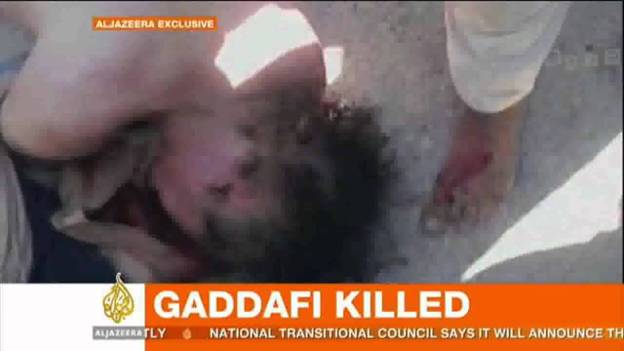
[S]ays Professor Jean-Emmanuel Pondi from the Cameroon Institute for International Relations and author of a new book on Libya, Western nations were above all vexed with Gaddafi because he refused to ‘play the diplomatic game’ and sometimes embarrassed them in public. What made matters worse was that they had no control over him because Libya had no debt – not at the World Bank, the International Monetary Fund or anywhere else. ‘Gaddafi was a problem for the world because he was economically independent and too outspoken,’ Pondi said during a seminar at the Institute for Security Studies on 21 November, 2013.  Pondi believes that even two years after Gaddafi’s death on 20 October 2011, it is important for Africans to reflect on the events that led up to the Nato intervention in Libya and the killing of Gaddafi. ‘We can’t let a long-time leader in Africa be killed on the street like a dog and not reflect on it,’ he says. To him, there is no doubt that Gaddafi was a dangerous human being and that the Gaddafi regime was a political dictatorship. ‘He even called his own people “rats”.’

Yet, at the same time, Libyans benefited from free health care and free education; fuel was almost free as well and housing was heavily subsidised. The country had one of the highest per capita incomes in the world and was second only to Mauritius on the Human Development Index for Africa – all things that were left unsaid during the campaign to topple his regime.

Pondi says it is clear that the aim of the Nato intervention, sanctioned by United Nations Resolution 1973, was primarily to get rid of Gaddafi and not to save the lives of civilians. ‘As soon as Gaddafi was dead, that was the end of the Nato intervention, even though violence was still ongoing. Civilians were still being killed,’ he says. Today, Libya is increasingly chaotic and violent, with more than 1 700 militias operating in various parts of the country – some better armed than the police and the army. Last month Libyan Prime Minister Ali Zeidan was kidnapped and held by gunmen for several hours before being released. Last week more than 40 people were killed and 400 wounded in clashes between rival militias…

In his 2011 book Au Coeur de la Libye de Khaddafi (In the heart of Gaddafi’s Libya), French specialist Patrick Haimzadeh explains the depth of the ‘mafia-like’ structure Gaddafi and his sons maintained and how it was kept going through pay-outs from Libya’s abundant oil revenues. Haimzadeh warns that any new regime that wants to replace Gaddafi will have to continue with such a system or face collapse. Would the Nato-led regime change be justified under such circumstances?

Clearly, the biggest loser after the death of Gaddafi is Africa, especially the region bordering Libya. The weapons that became freely available during the post-Gaddafi chaos have fallen into the hands of the al-Qaeda-linked groups that have been responsible for the occupation of northern Mali and for spectacular terror activities like the attack on the In Amenas gas facility in Algeria in January this year.

The African Union (AU) also lost a lot of credibility in some quarters because it was completely sidelined during the Libyan crisis. Pondi says it is unfair to say the AU had no plan to solve the stalemate between Gaddafi and the rebels controlling the eastern town of Benghazi at the time. ‘The road map was clear, firstly to put a ceasefire in place, secondly to organise a meeting between the protagonists and then to organise elections in Libya. The plan was there, but it wasn’t even given a minute at any of the meetings concerning Libya at the time.’…

Gaddafi’s demise has been tragic for Africa in other ways as well. Libya provided 15% of the budget of the AU (as did Egypt, Algeria, Nigeria and South Africa). Now both Libya and Egypt’s contributions have fallen away and the AU has to rely on European Union funds for much of its programme budget. At times Gaddafi also paid the AU contributions of smaller African states that were in arrears, as he did during the 1999 AU summit in Sirte, his hometown. During his time, Libya also invested heavily in tourism across the continent. Many hotels in the Sahel, but also as far away as South Africa, were built with Libyan funds. The Libyan airline Afriqiyah Airways also operated in several African countries until the 2011 war.

Excerpts from Liesl Louw-Vaudran, Did Nato intervene in Libya just to get rid of Gaddafi? ISS Africa, Nov. 2013

Let them Bleed: Pretend to Care for Peace

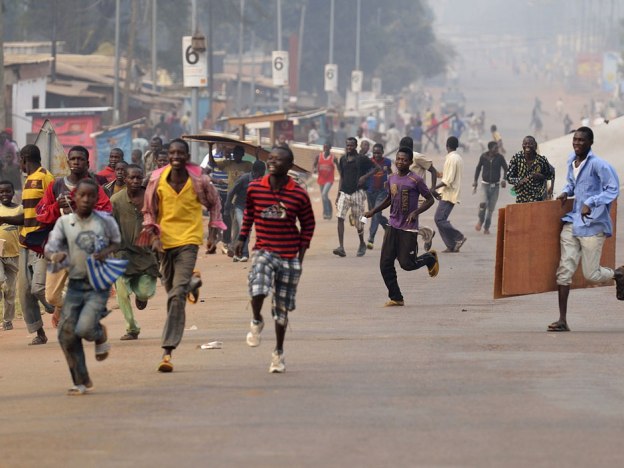
World alarm grew over the Central African Republic (CAR) on November 21, 2013, with France joining a chorus warning of possible genocide in the mineral-rich but poor country torn by strife since a March 2013 coup.  France’s Foreign Minister Laurent Fabius warned that the CAR was “on the verge of genocide”, while the United Nations has mooted sending thousands of peacekeepers to the landlocked nation, where unprecedented sectarian bloodshed has erupted.

In parts of the CAR, fighting has broken out between mainly Muslim former rebels who seized power in March and militia groups set up to protect Christian communities, which make up about 80 percent of the population. Both churches and mosques have been razed to the ground.”It’s total disorder,” Fabius told France 2 television, adding that the UN was considering authorising African and French troops to intervene. A regional peacekeeping force known as MISMA is currently deployed, but consists of only 2,500 men hampered by a lack of funds, arms and training.

In the latest of a long line of rebellions and coups, the Seleka rebel coalition ousted president Francois Bozize in March and put the CAR’s first Muslim leader, President Michel Djotodia, in power.Djotodia, who has officially disbanded the Seleka coalition and incorporated some of its forces into the army, announced “exceptional measures” to quell conflict, but a statement issued by his office gave no details…[The government] formed in the capital Bangui has little control of the rest of the nation, where armed groups – the remnants of successive rebellions, mutinies and insurgencies – hold sway over a people facing atrocities, food shortages and the collapse of health care.”You have seven surgeons for a population of five million, an infant mortality rate of 25 percent in some areas and 1.5 million people who have nothing, not even food, and armed gangs, bandits, etc,” Fabius said of France’s former colony in equatorial Africa.

The UN Security Council plans to vote in early December on a resolution that would allow CAR’s neighbours, the African Union and France to intervene in the sprawling nation….Plans are afoot to place MISMA under the aegis of the African Union and bring it up to 3,600 men, but diplomats and military experts warn that this number will be nowhere near enough. The bulk of MISMA is provided by Chad, with troops from Gabon, Cameroon and Equatorial Guinea.

By Nicholas Barret, France joins global warnings of ‘genocide’ in C. Africa,  Agence France Presse, Nov. 22, 2013

International Criminal Court Only for Africa

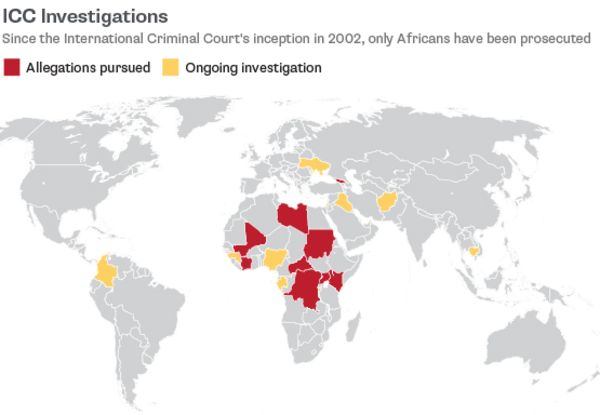
Kenya said the International Criminal Court’s case against its two highest elected officials risked destabilizing the entire east African region at a meeting of the court’s member states.  At a debate to discuss the crisis resulting from the court’s cases against President Uhuru Kenyatta and his deputy William Ruto, the Kenyan attorney-general said the court and its member states were playing “Russian roulette” with the country.  “Our country is the linchpin in the peace and security involving more than 250 million people from Djibouti to Eastern Congo and everybody in between,” Githu Muigai told a special debate called at the request of the African Union. He said Kenya – an ally of the West in the fight against militant Islam in neighboring Somalia – was a “pillar of security” in Eastern Africa, to loud applause from many African delegates at the conference.

Kenyatta and Ruto face separate charges of crimes against humanity for their alleged role in stoking ethnic violence in the aftermath of an election in 2007 when 1,200 people were killed. Kenya is pressing the ICC’s members for an immediate change in the rules to say that heads of state do not have to attend trials, part of a broader campaign to halt the cases against its political leaders.  Officials also want a longer-term amendment to the founding treaty that would ban the prosecution of heads of state, a campaign which has become a rallying point in Africa, where many leaders say they are the target of an overzealous court in The Hague. Kenyatta and Ruto deny the charges of fomenting violence after the election. Ruto’s trial began last month, while Kenyatta’s trial is due to start on February 5 after being delayed for a third time.  “Africa feels marginalized, like toddlers, whom the international community feels has never learned to walk,” Kenyan Foreign Minister Amina Mohamed told Reuters.

Last week, the African Union lost its bid to have the U.N. Security Council defer the cases for a year so the two could deal with the aftermath of an attack on a shopping mall by al Qaeda-linked Somali militants in which at least 67 died.Kenya said the outcome highlighted the need for reform of the Security Council to prevent a few powerful nations imposing their will on the world. It pledged to continue its fight at the ICC’s annual meeting in The Hague.

Human rights groups oppose the proposed changes as well as apparent compromise solutions such as a British proposal that would make it easier for the accused to participate via video link, saying these would weaken the court’s mission to bring to justice those ultimately responsible for war crimes. “The amendments represent an attempt to recreate the ICC in the image of African justice,” said George Kegoro, executive director of the Kenyan section of the International Commission of Jurists.  “Timid, pliable and serving the comfort of leaders rather than justice for victims.”  The court has 34 African members, but any amendment would need the support of two thirds of the court’s 122 members to pass.  But even if the amendments have little chance of passing, Foreign Minister Mohamed said a court composed of members of equal rank should listen to Africa’s concerns. If some members were “more equal than others,” she said, then “we have no business being there.” Since their election, the two men have been defending themselves before the Hague-based court with the help of some of London’s best-known human rights lawyers.  Kenyatta’s legal team has asked judges to throw out the case against him, which they say is based on evidence from bribed witnesses.

By Thomas Escritt, Kenya warns of ICC threat to Eastern Africa’s stability, Reuters, Nov. 21, 2013

Minority Rights in Libya: the Berbers

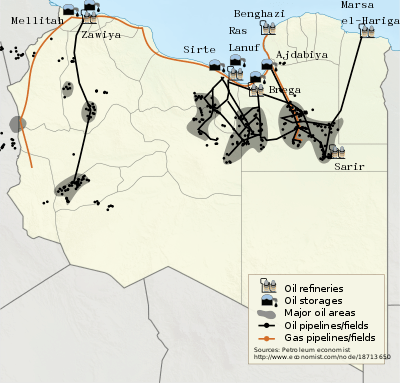
Protesters have shut Libya’s gas export pipeline to Italy, its only customer, demanding more rights for the c, or Berber, minority and depriving the weak government of a major source of income.  The closure worsens turmoil in Libya where Prime Minister Ali Zeidan warned that the government might face budget problems next month after protesters cut oil production to a fraction of its capacity.

The North African country faces anarchy as the government has failed to rein in armed militias and radical Islamists who helped topple Muammar Gaddafi in 2011 but kept their weapons.  Although the closure on Nov. 11, 2013 of the Greenstream pipeline will take several hours to register at the other end, it adds to Italy’s energy headaches after Ukraine halted gas imports from Russia, which could also impact supplies. Italy depends heavily on Russian gas.

Amazigh protesters last month seized the port at the Mellitah complex, some 100 km west of Tripoli, and have already shut down oil exports from there. The oil and gas complex is operated by Libya’s National Oil Corp and Italian energy company Eni.”We tried to convince them not to close the pipeline, but it’s closed now,” Munir Abu Saud, head of the local oil workers’ union, told Reuters…

Tripoli has seen its authority crumbling over its restive regions and fears an exodus of foreign oil companies and investment.  The Amazigh minority in September shut a pipeline feeding gas from Eni’s Wafa field to export facilities at Mellitah. Although this squeezed exports, much of the gas Libya sends to Italy comes from offshore fields.

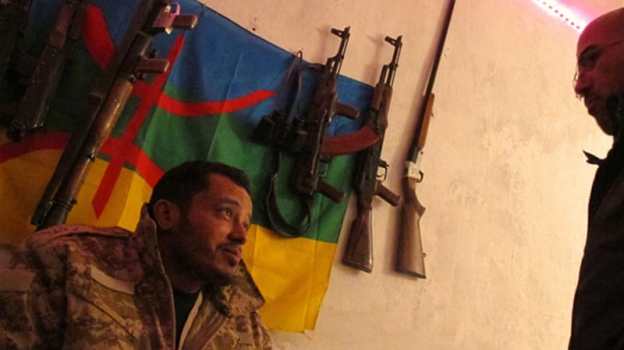
The Amazigh protesters want their language guaranteed under Libya’s planned new constitution and a bigger say in a committee to be elected to draft the constitution. They say Berbers are treated as second-class citizens in the Arab country.

Excerpt, By Ghaith Shennib and Ulf Laessing, Libyan Berbers shut gas pipeline to Italy, cut major income source, Reuters, Nov. 11, 2013


Who is Investing in Drones?

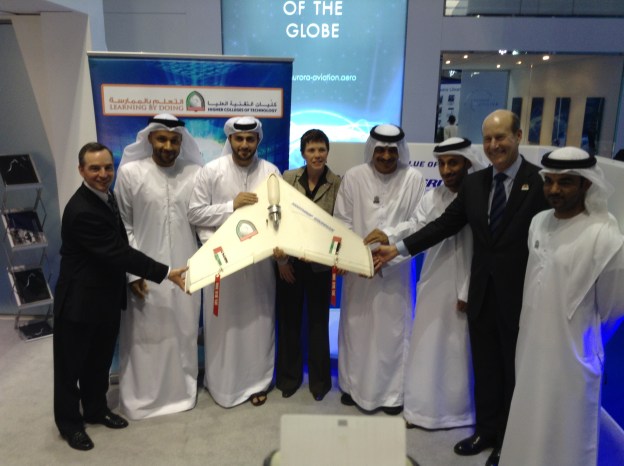
A United Arab Emirates (UAE) investment fund (Mubadala)  has beefed up its stake in Italy-based Piaggio Aero, just as the aeronautics firm gets ready for the debut flight of its P.1HH Hammerhead drone… Mubadala, the US $55 billion fund set up by the Emirate of Abu Dhabi in 2002, increased its stake in Piaggio Aero from 33 to 41 percent on Nov. 12, as part of an equity increase of €190 million (US $255 million).  Also Tata Ltd., a UK offshoot of India’s Tata Group, increase its stake from 33 to 44.5 percent…That means Mubadala and Tata are now the main financial backers of development of the Italian-built Hammerhead, which is an unmanned version of Piaggio Aero’s main seller, the P.180 twin-prop business aircraft….

But the Italian Defense Ministry has not invested in the program, creating an unusual situation in which Indian and Arabian Gulf capital is funding the development of a UAV in which Italy is certifying and showing keen interest….Italy and the UAE have discussed UAV development before. In 2009, the gulf state selected the Italian M-346 jet trainer, but the deal stalled, allegedly over problems related to a side deal on UAVs.  Plans had reportedly been made to co­develop a UAV with specifications that exceeded those set down by the Missile Technology Control Regime, which restricts the sales of missiles and UAVs able to carry a 500-kilogram payload at least 300 kilometers. Italy is a signatory of the treaty.

At the Paris Air Show, Debertolis said Italy would consider arming the Hammerhead, noting that the aircraft was large enough to hold weapons in internal bays and that half of what is cabin space in the manned version would remain unused. But he added that the payload would remain within the 500-kilogram maximum set down by the Missile Technology Control Regime.

Excerpts,Tom Kington UAE Ups Its Stake in Drone-maker Piaggio Aero, Defensenews.com, Nov. 15, 2013

How to Erase a State: Libya

Libyans have become accustomed to chaos in a country flooded with weaponry where militias and tribes call the shots, two years after NATO bombing helped rebels topple Muammar Gaddafi.But the daylight robbery of $55 million from a Central Bank van suggested that Prime Minister Ali Zeidan’s cabinet is losing the struggle to provide security and build state institutions.Ten gunmen intercepted the van when it left the airport in Sirte, a former Gaddafi stronghold, snatching the cash flown in from Tripoli for the local central bank branch…

Sirte, a central coastal town near Gaddafi’s birthplace, has escaped the violence rife in cities such as Benghazi in the east, where assassinations and bombings are part of daily life. But the city showcases the lawlessness engulfing postwar Libya after four decades of Gaddafi’s quirky one-man rule.The fledgling army has largely moved out of Sirte, unable to rein in armed bands or the Islamist militants of Ansar al-Sharia which runs training camps nearby, residents say.

Unable to impose security here and in other cities, the government has co-opted former anti-Gaddafi rebels, putting them on the state payroll to guard public buildings or man checkpoints, nominally as part of state security forces.In fact these gunmen report to their own commanders who have their own agendas. Some are close to Islamists like those who briefly grabbed Zeidan from his Tripoli hotel room this month in protest at a U.S. raid to seize an al Qaeda suspect.Other militias pursue tribal interests or smuggle weapons, drugs and anything else that makes money…

[I]nsecurity in the streets is exacerbated by infighting between supporters of Zeidan, a liberal, and his Islamist opponents in the General National Congress, or parliament. “The government is very weak compared with other political forces, criminals and terrorists,” said Libyan political analyst Rami Mussa.

Exploiting the power vacuum, protesters have shut down oil terminals and oilfields around the country. Oil output, the main source for the budget, is down to a fraction of the 1.6 million barrels a day Libya pumped before the uprising against Gaddafi…In the east, disfavored in Gaddafi’s time, tribes and other armed groups demand autonomy and oil wealth. Regional councils have sprung up which want to sell crude bypassing Tripoli.

Excerpt, Central Bank falls victim to Libya’s rampant crime, anarchy, Reuters, Oct. 29, 2013

Migrants in a Gated World

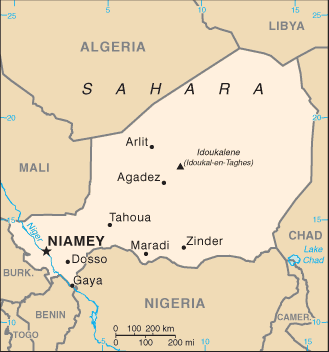
The bodies of 92 people, almost all women and children, have been found in the Sahara desert. Rescuers said the people had died of thirst after their vehicle broke down during their attempt to reach Algeria from Niger…The group was discovered after survivors reached Arlit on foot. Local experts said that the people were victims of human trafficking and were believed to have died two weeks ago as they tried to walk 12 miles in scorching sun to reach a well after the lorry they were travelling in broke down leaving them stranded.  Sources in Niger said that the group, who began their perilous journey across the desert in late September, was comprised of local people from Zinder, the second largest city in southern Niger, close to the border with Nigeria.

One security expert stressed that the group were not economic migrants but victims of trafficking.  Moussa Akfar, a security expert based in Niamey, Niger’s capital, said: “This was in fact a case of poor people and children who were being trafficked to Algeria. There is an inquiry underway but we know that this was trafficking because economic migrants go to Libya – in Libya you find people of all nationalities, from Nigeria, Cameroon and other countries, heading to Europe.  “In this case all the victims were Nigerien from Zinder, and they were being trafficked. The questions that have to be asked now is how officials on road checkpoints did not alert the authorities about this group. There is endemic corruption at work.”..

Niger is one of the poorest countries in the world and has been rocked by repeated food crises in recent years. Last year Save the Children termed Niger the worst place in the world to be a mother amid its warnings that continuing poverty levels were driving people to undertake life-threatening journeys to higher income nations.  While many in Niger said that the October deaths were linked to trafficking, Algeria being the intended destination, Rhissa Feltou, the mayor of Arlit, said the group could have been trying to reach Europe.

Excerpt, Niger migrants died from thirst, after stranding in Sahara desert, Guardian, Oct. 31, 2011

Military Tanks with No U.S. Parts

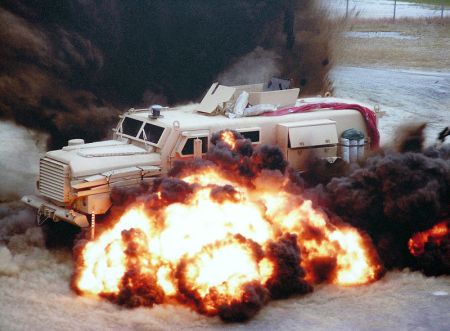
The international armoured vehicles market is facing challenging times, especially as the US and its partners withdraw from Afghanistan, potentially flooding the market with used vehicles, according to  [a South African] company [called] DCD Protected Mobility…A recent Frost & Sullivan report said the world military land vehicle market would only grow at .7% until 2021 as the US cuts back its requirements and western defence markets shrink. Certain market segments, such as armoured fighting vehicles, are projected to actually shrink over the next decade.

However… a market does still exist for armoured vehicles. “There is a requirement out there for more MRAPs [Mine-Resistant Armour Protected vehicles].” Addressing the threat of an ex-US armoured vehicles glut, he pointed out that ex-US Army vehicles are not always suitable for other customers as they are still fairly expensive to maintain and operate and are do not always meet user requirements….

That DCD Protected Mobility intends “becoming owners of the route clearance space internationally,” notably with its Husky vehicle mounted mine detection system…. The system comprises of two Husky vehicles: the first acts as a Mine Detection Vehicle (MDV) (previously a Meerkat). The second vehicle (a Husky) tows a mine-detonating trailer..Hundreds of Huskies have been sold to Canada, the USA, UK, France, Australia, Angola, Kenya, Uganda, Spain and Turkey….[T]he Husky programme has made a significant contribution to poverty alleviation in South Africa, creating 1 320 jobs across the supply chain and earning R10.3 billion in foreign exchange for the South African economy… On the sixth of November, DCD and its partners will demonstrate an unmanned version of the Husky system to the US government, developed in partnership with its partners Critical Solutions International (CSI) and Torc Robotics.

With CSI, DCD is looking at international markets like the European Union and Nato. Austria wants to buy four to six two-seat Husky vehicles through the US Foreign Military Sales (FMS) system to provide a route clearance capability they can offer to Nato.  Turkey recently bought four Huskies and… will purchase more. Turkey will “hopefully” buy around 50 more vehicles sometime next year, he told defenceWeb. Other countries that show great promise regarding the vehicle are India and Iraq.

DCD is also trying to focus on Africa and emerging markets, and places where customers do not want any US components in their vehicles. In Africa, the company is pinning some of its hopes on the Springbuck A202 armoured personnel carrier. This is selling well and is aimed at developing countries that need an “affordable but not inferior” vehicle.

Excerpt,  Guy Martin, Budget cuts, Afghanistan withdrawal negatively affecting MRAP market, DefenceWeb, Oct. 31 2013

An Oil-Rich Virgin Territory: Libya

Libya remains tempting. The oil-rich country is virgin territory. Recent rises in state salaries have made Libyans, already well-off for this part of the world, keen to spend. So is the government, since the country’s infrastructure is so poor. Before the war it signed deals to build roads, railways, houses, hospitals and schools. Now that international sanctions have been lifted, investment should be pouring in.

One problem is insecurity. Benghazi, the country’s second-biggest city, is still a no-go area for Americans, Britons and the French. But rampant militias are not the main deterrent, says Kevin Virgil of Pathfinder Capital: his London-based investment firm also works in Iraq, which is getting much investment despite being at least as dangerous.

Misrata’s militias provide better security than those in bomb-prone Benghazi. The port and free zone have broad autonomy from the central authorities in Tripoli, so decisions are taken more quickly.

Excerpts, Business in Libya: A post-Qaddafi pause, Economist, Oct. 5, 2013, at 69/Business in Misrata The can-do city, Economist, Oct. 5, 2013, at 69

Playing with Fire and Getting Burnt: West in Syria

A a collection of some of Syria’s  most powerful rebel groups have publicly abandoned the opposition’s political leaders, casting their lot with an affiliate of Al Qaeda.  As support for the Western-backed leadership has dwindled, a second, more extreme Al Qaeda group has carved out footholds across parts of Syria, frequently clashing with mainline rebels who accuse it of making the establishment of an Islamic state a priority over the fight to topple President Bashar al-Assad….The deep differences between many of those fighting in Syria and the political leaders who have represented the opposition abroad spilled into the open late Tuesday, when 11 rebel groups issued a statement declaring that the opposition could be represented only by people who have “lived their troubles and shared in what they have sacrificed.”

Distancing themselves from the exile opposition’s call for a democratic, civil government to replace Mr. Assad, they called on all military and civilian groups in Syria to “unify in a clear Islamic frame.” Those that signed the statement included three groups aligned with the Western-backed opposition’s Supreme Military Council….The rebel groups that assailed the political opposition are themselves diverse and include a number that are linked to the coalition’s Supreme Military Council. More troubling to the West, they also include the Nusra Front, a group linked to Al Qaeda. At the same time they include groups that remain opposed to another group linked to Al Qaeda: the Islamic State in Iraq and Syria…

Further complicating the picture is the rise of the new Qaeda franchise, the Islamic State in Iraq and Syria, which has established footholds across northern and eastern Syria with the intention to lay the foundations of an Islamic state.  In recent months, it has supplanted the Nusra Front as the primary destination for foreign jihadists streaming into Syria, according to rebels and activists who have had contact with the group.  Its fighters, who hail from across the Arab world, Chechnya, Europe and elsewhere, have a reputation for being well armed and strong in battle. Its suicide bombers are often sent to strike the first blow against government bases.

But its application of strict Islamic law has isolated rebels and civilians. Its members have executed and beheaded captives in town squares and imposed strict codes, forcing residents to wear modest dress and banning smoking in entire villages.

Excerpts, BEN HUBBARD and MICHAEL R. GORDON, Key Syrian Rebel Groups Abandon Exile Leaders, New York Times, Sept. 25, 2013

Naming the Dead in the CIA Drone War

Naming the Dead is a project run by the Bureau of Investigative Journalism, a not-for-profit research organisation based in London. The project aims to identify those killed in CIA drone strikes on Pakistan.  Over the past nine years, the tribal region of Pakistan’s north west has been hit by hundreds of drone attacks as the CIA has sought to stamp out al Qaeda fighters and the militant groups that have given them shelter.  Missiles launched from these high-tech, unmanned aircraft have hit homes, cars, schools, shops and gatherings. At least 2,500 people have been killed, according to data already collected by the Bureau as part of our wider Covert Drone War research.

Senior US officials have described drones as highly precise weapons that target and kill enemies of the US. John Brennan, who oversaw the development of the drone campaign and is now director of the CIA, has called drone technology an ‘essential tool’ for its ‘surgical precision – the ability, with laser-like focus, to eliminate the cancerous tumour called an al Qaeda terrorist while limiting damage to the tissue around it.’

Those killed by drones include high-ranking militant leaders – figures such as Abu Yahya al Libi, al Qaeda’s feared second-in-command, or Baitullah Mehsud, commander of the Pakistan Taliban (TTP).  But according to credible media reports analysed by the Bureau, the dead also include at least 400 civilians. Some were unlucky enough to be nearby when militants were attacked. Others were killed alongside their husbands or fathers, who were believed to be militants. Still others were mistaken for terrorists by drone operators sitting thousands of miles away.

In most cases, there is little information available about who the drones are really killing. Most of the dead – an estimated four-fifths of those killed – are believed to be militants. But their deaths are typically reported as a number – their names, origins and livelihoods remain a mystery.  For so many people to die in obscurity, unnamed and unacknowledged, is a tragedy. But it is a further tragedy that the public, and even policy makers, are unable to properly test whether drones are ‘highly precise weapons’ when so little is known about who is actually dying.

Through Naming the Dead, the Bureau aims to increase the transparency around this conflict and inform the public debate. Initially this project will record all names published in open-source material – in credible reports by journalists, in legal documents presented in court, in academic studies and in field investigations carried out by human rights groups.  In the future, the Bureau aims to identify more of the dead on a regular basis, and to uncover more details of those who have been killed. Where possible we will provide further identification – where they were killed, and their occupations, full names and ages. In the remote areas of Pakistan where drone strikes take place, official identification is rare. Few people possess identification cards, birth certificates, or even documents recording their relatives’ deaths. But wherever possible this project will provide documentation recording a person’s death.

Photographs of the destruction of a particular site are included in the database. Affidavits, photos, hospital records, student identification and transcripts of interviews with researchers are all provided when available. Over time, the Bureau aims to build on such currently scarce records in an attempt to properly scrutinise the little that is reported, and the claims being made – on all sides.

Bureau of Investigative Journalism

Space – the Wild West

Space is a current and future battleground without terrain, where invisible enemies conceivably could mount undetectable attacks to devastating effect if the right deterrent and defensive plans aren’t pursued now, the assistant defense secretary for global strategic affairs told a think tank audience on Sept. 17, 2013  Madelyn R. Creedon spoke to a Stimson Center gathering whose audience included analysts focused on the question of deterrence in space. The center released a publication this week titled “Anti-satellite Weapons, Deterrence and Sino-American Space Relations,” presenting a number of essays examining various perspectives on space deterrence.

Creedon noted that in Defense Department parlance, deterrence is “the prevention of action by the existence of a credible threat of unacceptable counteraction and/or the belief that the cost of action outweighs the perceived benefits.” In other words, she said, if deterrence is effective, an adversary has or believes he has more to lose than to gain by attacking.  Deterrence remains a core defense strategy for the United States, she added, and the nation’s nuclear deterrent is “still alive and well.”  Creedon acknowledged that one classic approach to considering space deterrence — that is, preventing potential enemies from attacking U.S. or partner satellites and other military or economic assets in space — is to try to apply lessons learned during the Cold War. Then, the United States and the Soviet Union kept an uneasy diplomatic truce and piled up enough nuclear weapons to guarantee mutually assured destruction.

But one flaw to comparing the two deterrent challenges, she said, is that an attack that disables a satellite, unlike one from a nuclear warhead that flattens a major city, doesn’t threaten a nation’s existence. Another is that the two superpowers spent decades constructing an elaborate, mirrored, deterrent Cold War architecture and protocols, while space is still, comparatively, “the Wild West.” A third is that an attack in space or cyberspace may rely on digital rather than conventional weapons, and so could occur without warning or even detection.

“If there is an attack against a space asset, it isn’t visible,” she said. “You can’t watch it on CNN, and unless you’re directly affected by the capability that the space assets provide, you’re probably completely oblivious that the attack happened.”

She said DOD is developing and implementing what safeguards it can implement in space using four mutually supportive elements to deter others from taking action against U.S. assets:

— Working to internationalize norms and establish a code of conduct to enhance stability;

— Building coalitions to enhance security;

— Adding resilience to U.S. space architectures; and

— Preparing for an attack on U.S. and allied space assets using defenses “not necessarily in space.”

“We believe this four-element approach … will bolster deterrence,” Creedon said.

The department is working with the State Department and international partners to define elements of good behavior in space, she said. “States must remain committed to enhance the welfare of humankind by cooperating with others to maintain the long-term sustainability, safety, security and stability of the outer-space environment,” she added.  Creedon said work is underway to build deterrent coalitions and increase space awareness. She said the “Five Eyes” nations, which include the United States, United Kingdom, Canada, Australia and New Zealand, are extending their intelligence cooperation to expand their collective space situational awareness…

The United States is meanwhile working to lower the benefit to potential attackers by employing more satellites, participating in satellite constellations with other countries and purchasing payload space on commercial satellites when feasible.  Creedon said the U.S. approach to space deterrence is similar to its strategy in any domain: take “prudent preparations to survive, and to operate through, and, hopefully, prevail in any conflict.”

By Karen Parrish, Official Describes Evolution of Space Deterrence, American Forces Press Service, Sept. 19, 2013

Space Weapons and Space Law

“Policy, law and understanding of the threat to space is lagging behind the reality of what is out there,” warned Mark Roberts, a former Ministry of Defence official who was in charge of government space policy and the UK’s “offensive cyber portfolio”.….

The disabling of satellites would have a disastrous impact on society, knocking out GPS navigation systems and time signals. Banks, telecommunications, power and many infrastructures could fail, Roberts told the conference….Agreements such as the 1967 Outer Space treaty and the 1979 Moon treaty are supposed to control the arms race in space. Some states have signed but not ratified them, said Maria Pozza, research fellow at the Lauterpacht Centre for International Law at Cambridge University.  Existing treaties do not specify where air space ends and outer space begins – although 100km (62 miles) above the Earth is becoming the accepted limit.

The Navstar constellation of satellites was used to provide surveillance of Iraq during the Gulf war in 1991. Was that, asked Pozza, an aggressive use of space, a “force-multiplier”? Satellites may have also been used to photograph and locate al-Qaida bases, Osama bin Laden or even assess future strikes against Syria.

The Chinese government has recently moved to support a 2012 EU code of conduct for space development, which, Pozza said, was a softer law. The draft Prevention of the Placement of Weapons in Outer Space treaty has not yet been agreed. “Are we dismissing the possibility of a hard law or giving it a good chance?” Pozza asked.

The Chinese tested an anti-satellite weapon in 2007 that destroyed a defunct orbiting vehicle and showered debris across near Earth orbits. Other satellites have been jammed by strong radio signals. BBC transmissions to Iran were disrupted during this year’s elections through ground signals ostensibly sent from Syria.

In 2011, hackers gained control of the Terra Eos and Landsat satellites, Roberts said. The orbiting stations were not damaged. “The threat can now be from a laptop in someone’s bedroom,” he added.

Professor Richard Crowther, chief engineer at the UK Space Agency, said scientists were now exploring the possibility of robotic systems that grapple with and bring down disused satellites or laser weapons to clear away debris in orbit.  Both technologies, he pointed out, had a potential dual use as military weapons. 3D printing technologies would, furthermore, allow satellite operators to develop new hardware remotely in space.

The UK is formulating its space security policy, group captain Martin Johnson, deputy head of space policy at the MoD, said. Fylingdales, the Yorkshire monitoring station, has been cooperating for 50 years with the USA to enhance “space awareness” and early warning systems. The UK, Johnson said, was now working with the EU to develop a complementary space monitoring system.

Excerpt, Owen Bowcott, legal affairs correspondent, The Guardian, Sept. 11, 2013

Undersea Drones: DARPA Hydra

DAPRA’s Hydra Program from Federal Business Opportunities

The Hydra program will develop and demonstrate an unmanned undersea system, providing a novel delivery mechanism for insertion of unmanned air and underwater vehicles into operational environments. Situated underwater, Hydra will use modular payloads within a standardized enclosure to enable scalable, cost-effective deployment of rapid response assets and will integrate existing and emerging technologies in new ways to create an alternate means of delivering a variety of payloads close to the point of use. The Hydra program seeks to develop and demonstrate initial examples of air and undersea payloads while leaving open the potential for accommodating additional payloads in the future.

The rising number of ungoverned states, piracy, and proliferation of sophisticated defenses severely stretches current resources and impacts the nation’s ability to conduct special operations and contingency missions. The Hydra program represents a cost effective way to add undersea capacity that can be tailored to support each mission. Hydra’s communications suite could allow synergistic function with manned platforms, thus increasing their effectiveness, or could allow remote control from over-the-horizon. Technologies are intended to be adaptable to multiple delivery options, including airborne, surface, and subsurface. The Hydra program will enable other new capabilities not currently performed from undersea.

Hydra: Solicitation Number: DARPA-BAA-13-39, Agency: Other Defense Agencies, Office: Defense Advanced Research Projects Agency

s

GPS Jammers and Spoofers

GPS jammers are cheap: a driver can buy a dashboard model for about £50 ($78). They are a growing menace. The bubbles of electromagnetic noise they create interfere with legitimate GPS users. They can disrupt civil aviation and kill mobile-phone signals, too. In America their sale and use is banned. In Britain they are illegal for civilians to use deliberately, but not, yet, to buy: Ofcom, a regulator, is mulling a ban. In recent years Australian officials have destroyed hundreds of jammers.

In the right (or wrong) hands, they are potential weapons. Britain’s armed services test the devices in the Brecon Beacons in Wales, a military training area. North Korea uses big lorry-mounted versions to block GPS signals in South Korea. Starting with a four-day burst in August 2010, the attacks, which come from three positions inside the North, have lengthened. In early 2012 they ran for 16 days, causing 1,016 aircraft and 254 ships to report disruption…Criminals or terrorists could knock out GPS for an entire city or shipping lane anywhere in a flash. Even without North Korean-sized contraptions, the jamming can be substantial. Suitcase-sized devices on sale on the internet claim a range of 300-1,000 metres.

Malfunctioning satellites and natural interference from solar activity have hit GPS signals and sent ships off course. David Last, a navigation expert, says an accidental power cut, perhaps caused by a jammer taken on board a car ferry, could cause a shipwreck. Generating a false signal—spoofing—is another threat. In December 2011 Iran said it had spoofed an American drone before capturing it (most experts dismiss the claim). So far effective spoofing seems confined to laboratories, but Mr Last says some governments are already taking countermeasures.

One solution is a different means of navigation. In April South Korea announced plans for a network of 43 eLoran (enhanced long-range navigation) ground-based radio towers, based on technology first used in the second world war. It uses a far stronger signal than GPS, and should give pilots and ships’ captains a safer alternative by 2016. With Chinese and Russian help, South Korea hopes to expand coverage across the region.  Britain’s General Lighthouse Authorities (GLA) are following suit with seven new eLoran stations. Martin Bransby, an engineer with the GLA, says this will replace visual navigation as the main backup for GPS. It will be working by mid-2014, and cost less than £700,000; receivers cost £2,000 per vessel. By 2019 coverage should reach all big British ports.

America’s military-research agency DARPA has an experimental “single-chip timing and inertial measurement unit” (TIMU). When finished, according to the project’s boss, Andrei Shkel, it will use tiny gyroscopes and accelerometers to track its position without using satellites or radio towers. America’s White Sands missile range in New Mexico is installing a “Non-GPS Based Positioning System”, using ground-based antennae to provide centimetre-level positioning over 2,500 square miles. In May the Canadian government said it would splash out on anti-jam upgrades for military aircraft.

A new version of the US air force’s bunker-busting bomb, designed in part to destroy Iranian nuclear facilities, includes technology to prevent defenders from blocking its satellite-based guidance systems. MBDA, a European missile firm, is working on similar lines.

But for many users, GPS and other space-based navigation systems—which include Russia’s GLONASS, China’s partly complete Beidou, and an as-yet unfinished project by the European Union—remain indispensable and ubiquitous. They are also vulnerable. For those whose lives or livelihoods depend on knowing where they are, more resilient substitutes cannot come fast enough.

GPS jamming: Out of sight, Economist, July 27, 2013, at 51

The Drone War that’s in Full Force

There were more drone strikes in Pakistan last month (July 2013) than any month since January 2013. Three missile strikes were carried out in Yemen in the last week alone. And after Secretary of State John Kerry told Pakistanis on Thursday that the United States was winding down the drone wars there, officials back in Washington quickly contradicted him.  More than two months after President Obama signaled a sharp shift in America’s targeted-killing operations, there is little public evidence of change in a strategy that has come to define the administration’s approach to combating terrorism.  Most elements of the drone program remain in place, including a base in the southern desert of Saudi Arabia that the Central Intelligence Agency continues to use to carry out drone strikes in Yemen. In late May, administration officials said that the bulk of drone operations would shift to the Pentagon from the C.I.A.

But the C.I.A. continues to run America’s secret air war in Pakistan, where Mr. Kerry’s comments underscored the administration’s haphazard approach to discussing these issues publicly. During a television interview in Pakistan on Thursday, Mr. Kerry said the United States had a “timeline” to end drone strikes in that country’s western mountains, adding, “We hope it’s going to be very, very soon.”

But the Obama administration is expected to carry out drone strikes in Pakistan well into the future. Hours after Mr. Kerry’s interview, the State Department issued a statement saying there was no definite timetable to end the targeted killing program in Pakistan, and a department spokeswoman, Marie Harf, said, “In no way would we ever deprive ourselves of a tool to fight a threat if it arises.”

Some of those operations originate from a C.I.A. drone base in the southern desert of Saudi Arabia — the continued existence of which encapsulates the hurdles to changing how the United States carries out targeted-killing operations.  The Saudi government allowed the C.I.A. to build the base on the condition that the Obama administration not acknowledge that it was in Saudi Arabia. The base was completed in 2011, and it was first used for the operation that killed Anwar al-Awlaki, a radical preacher based in Yemen who was an American citizen.

By MARK MAZZETTI and MARK LANDLER,Despite Administration Promises, Few Signs of Change in Drone War, New York Times, Aug. 2, 2013

Secret Info: 94 kids killed by US drones in Pakistan

A secret document obtained by the Bureau of Investigative Journalism  reveals for the first time the Pakistan government’s internal assessment of dozens of drone strikes, and shows scores of civilian casualties.  The United States has consistently claimed only a tiny number of non-combatants have been killed in drone attacks in Pakistan – despite research by the Bureau and others suggesting that over 400 civilians may have died in the nine-year campaign.

The internal document shows Pakistani officials too found that CIA drone strikes were killing a significant number of civilians – and have been aware of those deaths for many years.  Of 746 people listed as killed in the drone strikes outlined in the document, at least 147 of the dead are clearly stated to be civilian victims, 94 of those are said to be children.

The confidential 12-page summary paper, titled Details of Attacks by Nato Forces/Predators in FATA was prepared by government officials in Pakistan’s Federally Administered Tribal Areas (FATA).  Based on confidential reports from a network of government agents in the field, it outlines 75 separate CIA drone strikes between 2006 and late 2009 and provides details of casualties in many of the attacks. Five attacks alleged to be carried out by Nato or other unspecified forces are also listed.

The numbers recorded are much higher than those provided by the US administration, which continues to insist that no more than 50 to 60 ‘non-combatants’ have been killed by the CIA across the entire nine years of Pakistan bombings. New CIA director John Brennan has described claims to the contrary as ‘intentional misrepresentations‘.  The document shows that during the 2006-09 period covered, when Pakistan’s government and military were privately supporting the CIA’s campaign, officials had extensive internal knowledge of high civilian casualties.

Excerpt, Chris Woods, Exclusive: Leaked Pakistani report confirms high civilian death toll in CIA drone strikes, Bureau of Investigative Journalism, July 22, 2013

Weather Modification and the CIA

image from wikipedia

According to US website ‘Mother Jones’ the CIA is helping fund a study by the National Academy of Sciences (NAS) that will investigate whether humans could use geoengineering – which is defined as deliberate and large-scale intervention in the Earth’s climatic system – to stop climate change.The NAS website describes the study as an investigation into “a limited number of proposed geoengineering techniques, including examples of both solar radiation management (SRM) and carbon dioxide removal (CDR) techniques.”  The purpose of this is to comment “generally on the potential impacts of deploying these technologies, including possible environmental, economic, and national security concerns”, the website claims.  Solar radiation management (SRM) is a theoretical branch of geoengineering which moots the idea of reflecting sunlight in an attempt to block infrared radiation and halt rising temperatures.

The cost of the project is reported to be $630,000, which NAS is splitting with the CIA, the National Oceanic and Atmospheric Administration, and NASA reports say.  A reference on the NAS website to “the US intelligence community” funding the project refers to the CIA, an NAS spokesman claimed.

Much speculation has surrounded claims that the US government has long been involved in types of weather manipulation, including a much-discussed attempt to cloud-seed – the process of dispersing substances into the air to create cloud condensation or ice nuclei and subsequently rain or snow – during the Vietnam war.

It was also widely reported that the Chinese government seeded clouds ahead of the 2008 Olympics opening ceremony to create a downpour elsewhere and keep the stadium dry by firing iodide crystals into rain clouds over Beijing.

Weather manipulation was most recently in the news after claims by some American commentators that devastating tornadoes in Oklahoma, along with other extreme weather events like Hurricane Sandy, were created by the US government using the Haarp antenna farm in Alaska.

CIA backs $630,000 study into how to control global weather through geoengineering,The Independent, July 21, 2013

Operation Nomad Shadow: Spying Drones

Operation Nomad Shadow, a …[classified but widely advertised] U.S. military surveillance program. Since November 2011, the U.S. Air Force has been flying unarmed drones from Incirlik Air Base in Turkey…. The camera-equipped Predators hover above the rugged border with Iraq and beam high-resolution imagery to the Turkish armed forces, helping them pursue PKK rebels as they slip back and forth across the mountains.

As the Obama administration dials back the number of drone attacks in Afghanistan, Pakistan and Yemen, the U.S. military is shifting its huge fleet of unmanned aircraft to other hot spots around the world. This next phase of drone warfare is focused more on spying than killing and will extend the Pentagon’s robust surveillance networks far beyond traditional, declared combat zones.

Over the past decade, the Pentagon has amassed more than 400 Predators, Reapers, Hunters, Gray Eagles and other high-altitude drones…Some of the unmanned aircraft will return home with U.S. troops when they leave Afghanistan. But many of the drones will redeploy to fresh frontiers, where they will spy on a melange of armed groups, drug runners, pirates and other targets…

Elsewhere in the Middle East, the U.S. Air Force has drone hubs in Qatar and the United Arab Emirates to conduct reconnaissance over the Persian Gulf. Twice since November, Iran has scrambled fighter jets to approach or fire on U.S. Predator drones that edged close to Iranian airspace.

In Africa, the U.S. Air Force began flying unarmed drones over the Sahara five months ago to track al-Qaeda fighters and rebels in northern Mali. The Pentagon has also set up drone bases in Ethiopia, Djibouti and Seychelles. Even so, the commander of U.S. forces in Africa told Congress in February that he needed a 15-fold increase in surveillance, reconnaissance and intelligence-gathering on the continent.  In an April speech, Deputy Defense Secretary Ashton B. Carter said the Pentagon is planning for the first time to send Reaper drones — a bigger, faster version of the Predator — to parts of Asia other than Afghanistan. He did not give details. A Defense Department spokeswoman said the military “hasn’t made any final decisions yet” but is “committed to increasing” its surveillance in Asia and the Pacific.

One possible destination for more U.S. drones is Colombia. Last year, Colombian armed forces killed 32…[drug traffickers]  after the U.S. military helped pinpoint the targets’ whereabouts with manned surveillance aircraft and other equipment, according to Jose A. Ruiz, a Southern Command spokesman.The U.S. military has occasionally operated small drones — four-foot-long ScanEagles, which are launched by a catapult — in Colombia.

In the fall of 2011, four disassembled Predator drones arrived in crates at Incirlik Air Base in… [Turkey], a joint U.S.-Turkish military installation.The drones came from Iraq, where for the previous four years they had been devoted to surveilling that country’s northern mountains. Along with manned U.S. aircraft, the Predators tracked the movements of PKK fighters, sharing video feeds and other intelligence with the Turkish armed forces.  The Kurdish group has long fought to create a [state]…, launching cross-border attacks from its hideouts in northern Iraq….

In December 2011, Turkish jets bombed a caravan of suspected PKK fighters crossing from Iraq into Turkey, killing 34 people. The victims were smugglers, however, not terrorists — a blunder that ignited protests across Turkey.  The Wall Street Journal reported last year that American drone operators had alerted the Turkish military after a Predator spotted the suspicious caravan…

[In 2013 the PKK claimed to have shot down an American drone patrolling the Turkey/Iraq border as part of Operation Nomad Shadow.]

Excerpts, By Craig Whitlock, U.S. military drone surveillance is expanding to hot spots beyond declared combat zones, Washington Post, July 20, 2013

Digital Bombs: Plan X

The U.S. Defense Advanced Research Projects Agency DARPA has chosen six companies so far to define ways of understanding, planning, and managing military cyber warfare operations in real-time, large-scale, and dynamic networks.  DARPA has awarded six contracts collectively worth nearly $74 million for the Foundational Cyberwarfare (Plan X) project to conduct research into the nature of cyber warfare, and to develop strategies to seize and maintain U.S. cyber security and cyber attack dominance.

The contracts awarded are to Data Tactics, Intific, Raytheon SI Government Solutions,  Aptima, Apogee Research,  and the Northrop Grumman…

Today’s understanding of the cyber domain poses integration challenges with existing military capabilities, and connects computers using traceroute, packet analysis, and other techniques. In fact, current research is just beginning to answer questions about the cyber domain, DARPA officials say.

The Plan X program contractors will define a cyber battlespace as three main concepts: network map, operational units, and capability set.  The network map is a collection of nodes and edges, and shows how computers are connected; the network map is where military planners and operators interact. Operational units are platforms such as ships, aircraft, and armored combat vehicles that are part of the network topology. There are two primary types of operational units: entry nodes and support platforms.  An entry node gives direct physical access into a network, while support platforms control different aspects of an operation — similarly to how military fighters, bombers, and unmanned aircraft control different aspects of air campaigns.

The capability set involves technologies the military uses to control the cyber battlespace, and are divided into three categories: access, functional, and communication.  Access enables a user to run programs or payloads. Functional involves other types of technology that affect computers and networks, such as network scanners, denial-of-service, defense evasion, network and host reconnaissance, and operating system control. Communication helps entry nodes, support platforms, and system capabilities to exchange information.

The Plan X program seeks to integrate the cyber battlespace concepts of the network map, operational unit, and capability set in military cyber operations, and will be developed as an open platform architecture for integration with government and industry technologies.

The Plan X program is structured around an on-site collaborative research space (CRS) in Arlington, Va., where the program contractors will be organized as a virtual technology startup. Several contract awards are expected, and the program will run in four one-year phases.

Excerpt, John Keller, DARPA picks six companies to define enabling technologies for U.S. cyber warfare strategy, Military and Aerospace,  July 11, 2013

Pakistan Knows about US Drone Strikes

Pakistan reached an understanding with the United States on drone strikes targeting Islamist militants and the attacks can be useful, according leaked remarks from a former intelligence chief.

Pakistan publicly condemns US missile attacks on Taliban and Al-Qaeda operatives as a violation of its sovereignty, but the new revelations are the latest sign of double-dealing in private…Ahmed Shuja Pasha, who headed Pakistan’s premier Inter-Services Intelligence (ISI) agency at the time of bin Laden’s killing in 2011, told investigators that drone strikes had their uses.  “The DG (director general) said there were no written agreements. There was a political understanding,” the report said.

The Americans had been asked to stop drone strikes because they caused civilian casualties, but “it was easier to say no to them in the beginning, but ‘now it was more difficult’ to do so,” it quoted the former spymaster as saying.  “Admittedly the drone attacks had their utility, but they represented a breach of national sovereignty. They were legal according to American law but illegal according to international law,” the report quoted the ISI chief as saying.  He also confirmed that Shamsi air base, in southwestern Pakistan, had been used for US drone strikes against people in the country.  Pakistan ordered US personnel to leave the base after botched US air strikes killed 24 Pakistani soldiers in November 2011.

His interviews also laid bare extraordinary levels of distrust between Pakistan and the United States, particularly in 2011 when relations plummeted over the US raid that killed bin Laden and a CIA contractor who shot dead two Pakistanis.  Pasha said US arrogance “knew no limits” and accused the Americans of waging “psychological warfare” over the whereabouts of Taliban leader Mullah Omar and bin Laden’s successor Ayman al-Zawahiri.  He quoted a US intelligence officer as saying “you are so cheap… we can buy you with a visa,” and said himself that systemic failures showed Pakistan was a “failing state”.  The Pakistani report condemned the US raid as an “American act of war” and said the military should have responded much more quickly to a three-hour operation, 100 miles inside its territory.  It was Pakistan’s “greatest humiliation” since East Pakistan seceded in 1971, it said.

Pakistan-US had ‘understanding’ on drone strikes, AFP, July 9, 2013

Cyber-Attacks on South Korea 2009-2013

The massive cyber attacks on South Korean banks and broadcasters earlier this year were part of a broad campaign of cyber espionage which dates back at least to 2009, a US security firm has concluded. The study by the firm McAfee  (Dissecting Operation Troy: Cyberespionage in South Korea) stopped short of blaming specific entities for the March 20 onslaught but said it found a pattern of sophisticated attacks, including efforts to wipe away traces that could lead to detection.  “The level of sophistication would indicate it is above and beyond your average individual or run-of-the mill hacktivism group,” said James Walter, a McAfee researcher and co-author of the study.

An official South Korean investigation in April determined North Korea’s military intelligence agency was responsible for the attacks which shut down the networks of TV broadcasters KBS, MBC and YTN, halted financial services and crippled operations at three banks….

But McAfee said the attacks represented only a small portion of the cyber campaign being carried out since 2009.  “One of the primary activities going on here is theft of intellectual property, data exfiltration, essentially stealing of secrets,” Walter said.  The report said the attacks, known first as Dark Seoul and now as Operation Troy were “more than cybervandalism… South Korean targets were actually the conclusion of a covert espionage campaign.”  McAfee concluded that two groups claiming responsibility for the attack were not credible.  “The clues left behind confirm that the two groups claiming responsibility were a fabrication to throw investigators off the trail and to mask the true source,” the report said.

Walter said that it is possible that with the campaign nearing detection, the hackers launched these attacks to distract the public and then sought to blame them on little-known entities, the NewRomanic Cyber Army Team, and the Whois Hacking Team.  He added that up to now, the cyber espionage effort “has been very successful in being under the radar” and that “what we see now was a more visible activity that is coupled with a distraction campaign.”

McAfee concluded that the remote-access Trojan was compiled January 26, and a component to wipe the records of numerous systems was compiled January 31.”The attackers who conducted the operation remained hidden for a number of years prior to the March 20 incident by using a variety of custom tools,” the report said.  “Our investigation into Dark Seoul has found a long-term domestic spying operation underway since at least 2009… We call this Operation Troy, based on the frequent use of the word ‘Troy’ in the compile path strings in the malware.”  McAfee carried out the study as part of its research into cybersecurity issues, Walter said.

The attack came days after North Korea had accused South Korea and the United States of being behind a “persistent and intensive” hacking assault that temporarily took a number of its official websites offline.  It also coincided with heightened military tensions on the Korean peninsula, following Pyongyang’s nuclear test in February.

South Korean cyber attacks tip of the iceberg: McAfee, Associated Press, Agence France Press, July 10, 2013

Civilian Deaths from Drone Strikes

Despite the touted precision of drone strikes by the Obama Administration, drones were found to be statistically more likely to cause civilian casualties than manned aircraft in Afghanistan, said Center for Civilians in Conflict today.  The finding appeared in an article for PRISM, a journal of the Center for Complex Operations by Dr. Larry Lewis, a CNA analyst advising the US military, and Sarah Holewinski, executive director for Center for Civilians in Conflict. Based on Dr. Lewis’ analysis of air engagements from mid-2010 through mid-2011, strikes by unmanned aerial vehicles (UAVs) or drones were approximately ten times more likely to cause casualties than strikes by manned aircraft.

The data was taken when air engagements during the war in Afghanistan were at their peak and following General McChrystal’s 2009 push to reduce civilian casualties. Drone operators and analysts had limited training on minimizing civilian harm compared to manned aircrews, and faced additional challenges including a limited field of view (the “soda straw” effect) and communications challenges for operators in different locations from the analysts looking at the target.

“We’ve been told over and over that drones by their very nature are better at avoiding civilians, but these findings show that simply isn’t the case,” said Holewinski. “The point is, drones aren’t inherently good or bad for civilians living under them. It all depends on how those drones are used. Without the right inputs and training and directives on civilian protection, drone pilots behind their joysticks have no more advantage in saving civilian lives than any other pilot.”

The study found that in Afghanistan initial battle damage assessments following air strikes are not always accurate with regard to what civilian harm had been caused. On the ground follow-up in some instances contradicted official US assessments of zero civilian casualties. In remote drone operations, such as those found in Pakistan and Yemen, such assessment challenges are compounded by the absence of troops on the ground to investigate any incident and a lack of transparency about the operations generally. According to the Center, this makes claims by the US government on minimum civilian harm from drone strikes outside of Afghanistan questionable.

Excerpt from Press Release Drones More Likely to Harm Civilians than Manned Aircraft in Afghanistan, Center for Civilians in Conflict, July 2, 2013

The Role Military/Industrial Complex in Industrializing Nations

In the last year, a total of 1,653 suspects were arrested and 3,778 illegal refineries destroyed in the in the ongoing anti-illegal bunkering patrols by the Joint Task Force (Operation PULO SHIELD) in the Niger Delta, according to Minister of State for Defence, Dr Olusola Obada.  In addition, 120 barges, 878 Cotonou boats, 161 tanker trucks, 178 illegal fuel dumps and 5,238 surface tanks were also destroyed by the Task Force within the same period.

Obada also said that the Defence Industries Corporation of Nigeria (DICON) will collaborate with the private sector under the Public Private Partnership (PPP) in the production of Armoured Personnel Carriers (APCs).  Obada said on Friday, while featuring in the ongoing ministerial press briefing in Abuja, that the nation’s military has “enhanced protection of oil and gas facilities through air and ground patrols of pipeline networks to deter vandals from sabotage activities. Troops were deployed on most critical platforms on a 24/7 basis to enhance their security. While criminalities in the industry have not been completely eliminated, efforts of the Joint Task Force have reduced the level crude oil theft drastically.”

She stated that towards industrialising Nigeria through the military-industrial complex, “the Federal Government in 2012 set up a high powered committee headed by the Vice President to reposition the Defence Industries Corporation of Nigeria (DICON) for greater efficiency. The report of the committee had been submitted to the President and it is expected that the recommendations would help initiate a transformation in the local production of military equipment.”

Already, Obada noted, DICON has entered into partnership with foreign companies for the manufacture of weapons, bulletproof vests and other equipment.  She also disclosed that under the Ministry of Defence’s health initiatives, 25,000 people had been place on retroviral therapy in the last one year under the Ministry of Defence HIV programme.

Special Task Force Arrest 1,653 Suspects, Destroy 3,778 Illegal Refineries Saturday, The Guardian (Nigeria), June 29, 2013

The Art of Selling Weapons: offsets

[When governments buy weapons] it is standard to supplement the main deal with a side contract, usually undisclosed, that outlines additional investments that the winning bidder must make in local projects or else pay a penalty. Welcome to the murky world of “offsets”.

The practice came of age in the 1950s, when Dwight Eisenhower forced West Germany to buy American-made defence gear to compensate for the costs of stationing troops in Europe. Since then it has grown steadily and is now accepted practice in 120 countries. It has its own industry newsletter and feeds a lively conference circuit. The latest jamboree, hosted by the Global Offset and Countertrade Association, was held in Florida…. Yet its very structure serves to mask a build-up in the unrecognised financial liabilities of companies. It also, critics argue, fosters corruption, especially in poorer parts of the world.

Avascent, a consultancy, reckons that defence and aerospace contractors’ accrued offset “obligations”—investments they have promised but not yet made—are about $250 billion today and could be almost $450 billion by 2016. The industry’s own estimates are lower, but all agree the trajectory is upward.

Offsets come in two types. Direct offsets require investment in or partnerships with local defence firms. The idea is to develop self-sufficiency. Turkey, for instance, now meets half its own defence needs thanks to such arrangements. Indirect (non-defence) offsets include everything from backing new technologies or business parks to building hotels, donating to universities and even supporting condom-makers. Here the stated intention is to achieve more general economic or social goals.

Both types of offset are controversial. Economists view offsets as market-distorting. The World Trade Organisation bans their use as a criterion for contract evaluation in all industries except defence. Anti-corruption groups see them as a clever way to channel bribes. Even if many offset deals are clean, they are widely seen as a “dark art”, admits an industry executive. “Offset” has become a dirty word; the industry now prefers the euphemistic “industrial participation”.

The practice is frowned upon in some advanced economies. The European Commission is trying to impose a ban on all offsets in EU-to-EU contracts, and on indirect offsets when the supplier is from outside the union…

America has long been officially against offsets, though it practises something similar at home under the Buy American Act of 1933, which requires foreign arms-makers to source much of the work locally… And as embassy cables published by WikiLeaks make clear, America’s diplomats are sometimes closely involved in its firms’ discussions with foreign governments, including even squeaky-clean Norway’s, over proposed offsets.

In less developed countries, where defence spending is generally rising, offsets are booming. One appeal is that they can be recorded as foreign direct investment, boosting the government’s economic-management credentials. The two biggest arms-buyers in the Gulf, Saudi Arabia and the United Arab Emirates, have long-standing, sophisticated offset programs…Brazil and India are catching up…

This growth is fuelling a thriving offsets industry. At one end are dozens of small brokers who hawk ideas for offset projects to arms-makers and their clients. With the right contacts in government and the armed forces, even small outfits can service the largest defence firms. Take Dolin International Trade & Capital, a one-man operation run by Dov Hyman from his home in suburban New York. Mr Hyman cut his teeth as a textile trader in Nigeria. Today he advises African governments looking to use offsets while helping multinationals craft offset packages.

Further up the chain are a few sophisticated outfits that structure complex deals and arrange financing. The best known is London-based Blenheim Capital. These are assembling ever more creative packages, including, for instance, helping procuring countries to use contractors’ offset obligations as collateral for loans, backed by the “performance bonds” that firms set aside to cover unfulfilled obligations.

These middlemen are offsets’ most vocal defenders. Mr Hyman cites reams of examples of deals that he believes brought great benefits for purchasing countries’ economies. The best of them are “beautiful solutions”: for instance when arms-sellers satisfy offset obligations by guaranteeing credit lines for local manufacturers, thus reducing their financing costs. Using a multinational’s good standing in this way is “an efficient means of making possible transactions that otherwise wouldn’t be viable,” he argues.

However, some projects take contractors disconcertingly far away from their core competence. Take the shrimp farm set up in Saudi Arabia in 2006 with backing from Raytheon, a maker of radar systems and missiles. Praised at first as a model offset, it reportedly struggled to keep its pools properly maintained in searing temperatures and eventually went bust.

Moreover, the academic literature on offsets suggests that the promised benefits are elusive. There are some technology-transfer success stories: for instance, China has boosted its defence-manufacturing capability by requiring offsets when buying kit from Russia. However, research by Paul Dunne of Bristol Business School and Jurgen Brauer of Augusta State University has found that such deals are generally pricier than “off-the-shelf” arms purchases and create little new or sustainable employment. The offsets associated with the giant South African arms purchases of the late 1990s have created 28,000 direct jobs, claims the country’s government. Even if true, it is well below the 65,000 first envisaged. India’s auditor-general recently concluded that some offsets have produced no value for the country.

Judging performance is hard because of a lack of openness. Asked for confirmation of the fate of the shrimp farm, the Saudi offset authority said it kept “minimum information” on projects after their founding and suggested contacting its commercial backers. Raytheon declined to comment and suggested contacting the Saudis. DevCorp, another backer, did not respond. A study published in February by Transparency International, an anti-graft group, found that a third of governments that use offsets neither audit them nor impose due-diligence requirements on contractors.

Worse, accounting rulemakers have failed to impose any requirement to disclose offset liabilities. Companies can thus choose how, or whether, to put them on the balance-sheet. Defence firms have lobbied successfully for offsets to remain classified as “proprietary”, so they do not have to disclose their obligations. In some ways things have got worse: the Commerce Department’s annual report on American contractors’ offsets no longer even breaks out the numbers country-by-country.

This murkiness makes it hard to determine who really pays for offsets. On the face of it, the defence companies do. But Shana Marshall, an offsets-watcher at George Washington University, believes that they build the cost into their bids. Politicians and officials in procuring countries know that they are paying the bill through padded prices, but they accept this because offsets give them some grand projects to trumpet and sometimes provide palm-greasing opportunities.

A study in Belgium found that the country ended up paying 20-30% more for military gear when offsets were factored in. If the costs are largely borne by taxpayers, the benefits accrue to individuals and institutions chosen by the procuring government. This make offsets a good way to conceal delivery of public subsidies to interest groups, according to Ms Marshall.

A number of deals have been exposed as, or are suspected of being, corrupt. A commission has been set up to look into South African contracts dating back to 1999; the government has already conceded that offset credits changed hands at inflated prices. Since 2006 prosecutors in Portugal have been investigating offsets connected with a €1 billion ($1.3 billion) submarine contract with Germany’s Ferrostaal, HDW and ThyssenKrupp. Three Ferrostaal board members and seven Portuguese businessmen are on trial, charged with fraud and falsifying documents.  EADS, a large European contractor, is facing multiple inquiries over its sale of 15 Eurofighter planes to Austria. Prosecutors in Vienna and Munich are looking into allegations that millions of euros in kickbacks flowed through a web of offshore firms and side-deals, linked to offset agreements worth €3.5 billion, twice the value of the main contract. (In other words, EADS was supposed to generate €2 of business for Austrian firms for every euro it received for the planes—an unusually high ratio even in fiercely bid contracts.) Tom Enders, EADS’s chief executive, told Der Spiegel, a German magazine, that he “knew nothing about the shadowy world of dubious firms allegedly behind this.” The company says it is co-operating fully with prosecutors and that an internal investigation has so far found no evidence of punishable activity.

Prosecutors are also looking into whether AgustaWestland, part of Finmeccanica, an Italian defence firm, paid bribes to secure the sale of 12 helicopters to India in 2010. Finmeccanica’s former chief executive and the former head of AgustaWestland are due to go on trial next month. According to Italian court filings, suspicious payments allegedly flowed through a sham offset contract for software with help from a Swiss-based consultant. The helicopter-maker and the charged individuals deny wrongdoing.

Industry figures point out that all but the Indian case are at least five years old. They argue that corruption is harder to get away with today because of stricter anti-bribery laws and enforcement in America and Europe. Companies’ general counsels pay much more attention to offsets than they did a decade ago, says Grant Rogan, the head of Blenheim Capital.

Even if graft really is on the wane, offsets’ complexities make it hard to measure the true cost of defence deals. Procuring governments may apply generous “multipliers” to give extra credit to projects they deem exceptionally beneficial, especially if they are keen to buy the kit in question. As a result, defence contractors often find their liabilities turn out to be a lot less than their nominal obligations. A $5 billion sale of military kit might come with, say, $4 billion of gross offset requirements, but after multipliers it might only cost $500m to fulfil. A book on the arms trade, “The Shadow World”, by Andrew Feinstein, describes a contract Saab won in South Africa: to receive more than $200m in credits all the planemaker was required to do, the book says, was to spend $3m upgrading pools in Port Elizabeth and marketing the town to Swedish tourists. Saab says the tourism project cost much more, and suggested that it was up to the authorities to decide what value they put on what it achieved.

This sleight-of-hand helps to explain why industry executives are better disposed towards offsets in private than in public, says Ms Marshall. They say they could happily live without them, but they do not lobby to have them banned. Indeed, some big contractors see their ability to craft a package of attractive offsets as a “source of competitive advantage”, as Boeing’s boss, Jim McNerney, puts it.

The largest such firms will employ dozens of offset specialists to give them an edge in bidding. Lockheed, another American contractor, has about 40. As long ago as 2005 the firm was touting its leadership in offsets to win Thai contracts, according to a leaked diplomatic cable.  A downside for the companies is that dealing with national offset agencies can be frustrating. And though the companies’ offset liabilities are smaller in reality than on paper, they can still be daunting: one American contractor, for instance, has $10 billion of nominal obligations in a single Gulf state that will cost $1 billion-2 billion to fulfil, according to a consultant (who will not say which firm or country)….

How long can the offsets boom last?  But in the shorter term, their growth will be fuelled by American and European contractors’ intensifying efforts to sell outside their shrinking home markets, to big developing countries whose defence budgets are growing…. Remarkably, offsets are now said to be the main criterion in contract evaluation in Turkey and some Asian countries—more important than the price or the technical capability of the defence equipment itself.

The defence industry: Guns and sugar, Economist,May 25, 2013, at 63

Business Models of Piracy – Somalia & Niger Delta

The decline in Somali piracy (which, according to a recent World Bank report, may at its peak have cost the world up to $18 billion a year in extra shipping expenses and lost trade) is partly the result of increasingly sophisticated co-ordination by international naval task-forces. Shipping companies are also making their vessels harder to attack thanks to a range of defensive measures, such as razor wire around decks, high-pressure hoses and maintaining speeds that make boarding hazardous. Armed security guards on many of the ships transiting pirate-infested waters have helped too.But the pirates could still make a comeback. The cost of deterring them is high. Shipping companies may lower their guard if they think the threat has passed, and patrolling naval forces could be needed elsewhere. And although Somali piracy has faded, west Africa has seen a surge in attacks on ships passing through the Gulf of Guinea.

Tom Patterson, a maritime security expert at Control Risks, a consultancy, says these pirates, who largely come from militant groups in the Niger Delta, have a different business model to their Somali counterparts. They tend to hold ships for about two to five days, removing as much of their cargo as possible (usually gas oil) and then auctioning it to the highest bidder. Hostages are taken if potentially valuable. This week five Poles and Russians, held since April 25th when pirates attacked the German-operated City of Xiamen container ship off Nigeria’s coast, were released, doubtless after a ransom payment.

International naval forces are unlikely to intervene. Nigeria has a decent navy of its own which claims to be upping its efforts to contain piracy. But foreign diplomats believe that some military officials turn a blind eye to thefts in return for a share of the spoils

Hijackings on the high seas: Westward Ho!, Economist, May 18, 2013, at 67

US Military Laboratory, Djibouti

Other states, such as Singapore and Hong Kong, that also began as ports have diversified in recent decades, but not Djibouti. It lacks the skilled workforce to become a financial-services centre. Yet thanks to three unrelated developments it has turned into an ever more extraordinary transit hub

First, its backdoor leads to the world’s most populous landlocked country, Ethiopia, home to a fast-growing economy that needs access to the sea. Most of the food, oil and consumer goods imported for Ethiopia’s 83m-plus people passes through Djibouti. Instability in Ethiopia’s eastern neighbour, Somalia, and bad blood with Ethiopia’s other old enemy, Eritrea, mean that Djibouti is the only main transit option. Hence a new railway line to Addis Ababa, Ethiopia’s capital, is being built.

At the same time, freighters chugging between Europe and Asia have been seeking an alternative to their traditional halfway stop in Dubai, which involves a detour into the Gulf. Djibouti is more directly en route. In 2009 it spent $400m on a state-of-the-art container terminal, the only one in the region. In the five previous years, trade volume had already doubled and is set to do so again. To expand still more, Djibouti’s port authority is close to securing $4.4 billion from abroad for another five terminals which, it is hoped, will be ready in the next four years.

Third, the woes of Djibouti’s neighbours have brought the world’s most powerful navies to its shores. Piracy in Somalia and anti-terror campaigns on the Arabian peninsula, only 32km (20 miles) away across the water, have created what a new report by Chatham House, a London-based think-tank, calls an “international maritime and military laboratory”.The United States is the biggest lab rat. Djibouti hosts the only permanent American base in Africa, home to 3,200 people, not all of them naval. Since 2010, American drones have been flying from Camp Lemonnier, beside the main airport, making it the busiest base for drones outside Afghanistan. Some 50 military flights take off every day, including a squadron of F-15E jets, which arrived in 2011. The Pentagon has drawn up plans to spend $1.4 billion to expand the base and triple the number of its special forces there to more than 1,000.

France, the former colonial master, still guarantees Djibouti’s security and keeps 2,000 troops there. The port-state also hosts the biggest military presence of Japan and China outside Asia, both drawn by the fight against Somali piracy. Along with Western countries, they co-operate keenly to protect commercial vessels—though everyone spies on each other. Djibouti also often hosts security-minded delegations from Russia, Iran and India. Even in the cold war, rarely was neutral territory so colourful or crowded.

All this toing and froing has brought Djibouti windfall revenues. President Ismail Omar Guelleh, whose family has been in charge since independence in 1977, dishes out a good slice of it to the country’s small elite, which is gratefully compliant. The rest of the almost 1m inhabitants are among the poorest in Africa, with 60% of them unemployed.Rattled by the Arab spring and fearing that even minor instability could frighten away foreign military friends and investors, the president has embarked on a carefully staged course of political reform. During legislative elections in February a fifth of the seats were allocated in proportion to votes cast rather than under the previous winner-takes-all system that has long favoured the president’s allies.

Opposition parties were given access to state media and allowed to hold rallies. They won 16 out of 65 seats but then alleged fraud, leading to demonstrations, street clashes with the police and the incarceration of the leading protesters.

The Horn of Africa: Containers—and containing dissent, Economist, May 4, 2013, at 49

Hunter and Killer Drones

The Pentagon is discussing the possibility of replacing human drone operators with computer algorithms, especially for ‘signature strikes‘ where unknown targets are killed simply because they meet certain criteria. So what characteristics define an ‘enemy combatant’ and where are they outlined in law?

Drone strikes and targeted killings have become the weapon of choice for the Obama administration in their ongoing war against terrorists. But what impact is this technology having, not only on those who are the targets (both intended and unintended), but on the way we are likely to wage war in the future?

John Sifton is the advocacy director for Asia at Human Rights Watch, and says that while drones are currently controlled remotely by trained military personnel, there are already fears that the roving killing machines could be automated in the future.  ‘One of the biggest concerns human rights groups have right now is the notion of a signature strike,’ he says. ‘[This is] the notion that you could make a decision about a target based on its appearance. Say—this man has a Kalashnikov, he’s walking on the side of the road, he is near a military base. He’s a combatant, let’s kill him. That decision is made by a human right now, but the notion that you could write an algorithm for that and then program it into a drone… sounds science fiction but is in fact what the Pentagon is already thinking about. There are already discussions about this, autonomous weapons systems.’‘That is to human rights groups the most terrifying spectre that is currently presented by the drones.’

Sarah Knuckey is the director of the Project on Extrajudicial Executions at New York University Law School and an advisor to the UN. She says the way that drones are used to conduct warfare is stretching the limits of previous international conventions and is likely to require new rules of engagement to be drawn up…The rules of warfare built up after World War II to protect civilians are already hopelessly outdated, she says. The notion of border sovereignty has already been trashed by years of drone strikes, which she estimates have targeted upwards of 3,000 individuals, with reports of between 400 and 800 civilian casualties.

Excerpt from Annabelle Quince, Future of drone strikes could see execution by algorithm, May 21, 2013

The Use of Torture in Afghanistan

Military police at Australia’s detention centre in Afghanistan were pressured to make prisoners more “pliable” by gagging them, depriving them of sleep and denying them exercise…A young male detainee who was deaf mute and possibly intellectually disabled was held in the centre because of pressure from the Special Operations Task Group, despite concerns from medical staff that he was not fit to be detained.  A senior Afghan intelligence officer, a Colonel Hanif, complained vigorously that detainees were being transferred from Australian to Afghan custody on scant evidence that they were insurgents.  The Defence Force denied a teenage boy access to his dying father, a suspected insurgent who had been shot in a battle with Australians. The boy was allegedly turned over to US interrogators, though the ADF denies this.

The claims relate to 2010 and 2011, after Australia took responsibility for managing detainees in Oruzgan province from the withdrawn Dutch troops…..But Fairfax Media has been told that in the first year Australia was running the detention system, tensions flared between the military police who managed the detainees and the forces who captured and interrogated them.  One source said: “We had two very conflicting sets of guidelines: one was to treat them humanely but the other was the pressure from the SOTG [Australian Special Operations Task Group]*** and intelligence guys who wanted us to condition them in such a way as to make them more pliable … so their state of mind was conducive to interrogation. “They wanted us to gag and hood the detainees to stop them from talking to each other.

Excerpt, David Wroe, Deborah Snow,Military police pressured to make prisoners more ‘pliable’,  Sydney Morning Herald, May 18, 2013

***Special Operations Task Group (SOTG)  The Australian Special Operations Task Group (SOTG) is deployed to Southern Afghanistan to conduct population-centric, security and counter-network operations. At around 300 personnel, the SOTG is one of the largest, most potent Special Forces units in Afghanistan. The SOTG is primarily based in Multi-National Base Tarin Kot but has command and liaison elements in Kandahar and Kabul. It consists of approximately 300 personnel from the 1st and 2nd Commando Regiments, the Special Air Service Regiment, the Special Operations Engineer Regiment, the Special Operations Logistic Squadron, and various other services, units and commands around Australia.  The SOTG trains, mentors and partners with Afghan National Police officers from the Uruzgan Provincial Response Company (PRC) and other branches of the Afghan National Security Forces, in order to build their capacity and capability to establish and maintain security and stability in the region.SOTG operations are Afghan Police led in order to build confidence in the ANSF and improve the connection between the local people and the Afghan Government.  The Task Group also works closely with the co-located CT-U providing Special Forces support to operations in Uruzgan province.

Source: http://www.defence.gov.au/op/afghanistan/info/factsheet.htm

Weapons Supply to Syria: CIA & Co.

Qatar, which has taken a lead in arming the Syrian opposition, is coordinating with the CIA and has tightened control of the arms flow to keep weapons out of the hands of al Qaeda-linked Islamist fighters, according to rebels and officials familiar with the operation.  With Britain and France discussing lifting an EU ban on arming the rebels fighting President Bashar al-Assad, Western countries are concerned about making sure no arms end up in the hands of groups like Jabhat al-Nusra, which has pledged support for al Qaeda and which Washington considers a terrorist group.

Rebel fighters in Syria say that in recent months the system for distributing arms has become more centralized, with arms being delivered through opposition National Coalition’s General Command, led by Selim Idriss, a general who defected to the opposition and is a favorite of Washington.

Qatar mostly sends arms to rebels operating in the north of Syria, while Saudi Arabia, another rich Gulf Arab kingdom, sends weapons to fighters operating in the south, several rebel commanders said….”Before the Coalition was formed they were going through liaison offices and other military and civil formations. That was at the beginning. Now it is different – it is all going through the Coalition and the military command.”  Shipments of weapons to Syrian rebels were curbed last year when Washington raised concerns that arms were falling into the hands of groups like Jabhat al-Nusra.

Today, Qatari shipments have resumed with tighter controls exerted from the palace of Qatar’s emir, Sheikh Hamad bin Khalifa al-Thani, in consultation with the U.S. Central Intelligence Agency, said a senior Qatari security official. “There’s an operations room in the Emir’s diwan (office complex), with representatives from every ministry sitting in that room, deciding how much money to allocate for Syria’s aid,” the Qatari official said.  “There’s a lot of consultation with the CIA, and they help Qatar with buying and moving the weapons into Syria, but just as consultants,” he said. The CIA declined to comment.  Rebel commanders contacted by Reuters said they submit their lists of needs to the General Command led by Idriss, which forwards the requests to Qatar or Saudi Arabia.

One Western source involved in the process said the new system of control is not foolproof: sometimes weapons sent in by Qatar do in fact reach hardline groups.Several rebel commanders said they believed wealthy Kuwaiti and Saudi individuals were also sending weapons and money to rebel fighters outside the National Coalition’s distribution channel.  “They usually ask for a video proving that an attack took place with the name of the brigade that did it. Sometimes they ask for a statement expressing gratitude,” said a rebel commander in Damascus.  He said the Saudis and Qataris also occasionally send weapons into each other’s territory, bypassing normal controls. “Sometimes the Qataris manage to send stuff to the southern part and the Saudis to the northern side. When they do so, they send it to brigades that are not part of the military command.”

According to the Qatari official, weapons supplied included small arms including AK-47 rifles, rocket propelled grenades, hand grenades and ammunition. Qatar also provides instructions on battlefield techniques such as how to rig weapons on vehicles.

[How?]

The weapons are purchased mainly from eastern Europe by arms brokers based in Britain and France, and are flown from Qatar to Ankara and then trucked to Syria, the Qatari source added.

[Timeframe]

Hugh Griffiths, a researcher on arms transfers at the Stockholm International Peace Research Institute, said 90 Qatari military air cargo flights were made to Turkey between 3 January 2012 and the end of April 2013.He suggested the Qataris had made no particular effort to disguise the nature of the cargo.  “The Qataris never announced the cargo as ‘humanitarian aid’ as pretence, they’ve always been more forthright in terms of their support in the form of military aid,” he said.

[Military Bases and Mercenaries]

The planes were Qatari air force aircraft flying from Al Udeid, a big air force base shared with the U.S. military.”This is quite unusual for arms deliveries intended for non-state actors in conflict zones, in the last 20 years or so the pattern has been to use private, commercial companies,” he said.

By Amena Bakr and Mariam Karouny, Qatar, allies tighten coordination of arms flows to Syria, Reuters, May 14, 2013

Covert Operations in Iran

Washington believed that covert action against Iran’s nuclear facilities would be more effective and less risky than an all-out war… In fact, Mark Fitzpatrick, former deputy assistant secretary of state for non-proliferation said: “Industrial sabotage is a way to stop the programme, without military action, without fingerprints on the operation, and really, it is ideal, if it works.”The US has a long history of covert operations in Iran, beginning in 1953 with the CIA orchestrated coup d’état that toppled the popularly elected Iranian prime minister Mohammad Mossadegh and installed a dictator, Reza Shah. The US has reorganised its covert operations after the collapse of the shah in 1979…

In January 2011, it was revealed that the Stuxnet cyber-attack, an American-Israeli project to sabotage the Iranian nuclear programme, has been accelerated since President Barack Obama first took office. Referring to comments made by the head of Mossad, then US secretary of state Hillary Clinton confirmed the damages inflicted on Iran’s nuclear programme have been achieved through a combination of “sabotage and sanctions”.

Meanwhile, several Iranian nuclear scientists were assassinated. The New York Times reported that Mossad orchestrated the killings while Iran claimed the attacks were part of a covert campaign by the US, UK and Israel to sabotage its nuclear programme….

There are at least 10 major repercussions arising from the US, West and Israeli policy of launching covert war and cyber-attacks against Iranian nuclear facilities and scientists.

First, cyber war is a violation of international law. According to the UN Charter, the use of force is allowed only with the approval of the UN Security Council in self-defence and in response to an attack by another country. A Nato-commissioned international group of researchers, concluded that the 2009 Stuxnet attack on Iran’s nuclear facilities constituted “an act of force”, noting that the cyber-attack has been a violation of international law.Second, the US covert operations are a serious violation of the Algiers Accord. The 1981 Algiers Accords agreed upon between Iran and the US clearly stated that “it is and from now on will be the policy of the US not to intervene, directly or indirectly, politically or militarily, in Iran’s internal affairs”.

Third, the cyber war has propelled Tehran to become more determined in its nuclear efforts and has made major advancement. According to reports by the International Atomic Energy Agency (IAEA), prior to covert operations targeting the nuclear programme, Iran had one uranium enrichment site, a pilot plant of 164 centrifuges enriching uranium at a level of 3.5 per cent, first generation of centrifuges and approximately 100 kg stockpile of enriched uranium.Today, it has two enrichment sites with roughly 12,000 centrifuges, can enrich uranium up to 20 per cent, possesses a new generation of centrifuges and has amassed a stockpile of more than 8,000kg of enriched uranium.

Fourth, the strategy pursued has constituted a declaration of war on Iran, and a first strike. Stuxnet cyber-attack did cause harm to Iran’s nuclear programme, therefore it can be considered the first unattributed act of war against Iran, a dangerous prelude toward a broader war.

Fifth… [s]uch short-sighted policies thicken the wall of mistrust, further complicating US-Iran rapprochement and confidence-building measures.

Sixth, Iran would consider taking retaliatory measures by launching cyber-counter-attacks against facilities in Israel, the West and specifically the US…

Seventh, Iran is building a formidable domestic capacity countering and responding to western cyber-warfare. Following the Stuxnet attack, Iran’s Supreme Leader issued a directive to establish Iran’s cyber army that is both offensive and defensive. Today, the Islamic Revolutionary Guards Corps (IRGC) has the fourth biggest cyber army in the world. Israel’s Institute for National Security Studies (INSS) acknowledged that IRGC is one of the most advanced nations in the field of cyberspace warfare.

Eighth, Iran now has concluded that information gathered by IAEA inspectors has been used to create computer viruses, facilitate sabotage against its nuclear programme and the assassinations of nuclear scientists. Iranian nuclear energy chief stated that the UN nuclear watchdog [IAEA] has been infiltrated by “terrorists and saboteurs.” Such conclusions have not only discredited the UN Nuclear Watchdog but have pushed Iran to limit its technical and legal cooperation with the IAEA to address outstanding concerns and questions.

Ninth, worsening Iranians siege mentality by covert actions and violations of the country’s territorial sovereignty could strengthen the radicals in Tehran to double down on acquiring nuclear weapons. Iran could be pondering now the reality that the US is not waging a covert war on North Korea (because it possesses a nuclear bomb), Muammar Gaddafi lost his grip on power in Libya after ceding his nuclear programme, and Iraq and Afghanistan were invaded (because they had no nuclear weapon).

Tenth, the combination of cyber-attacks, industrial sabotage and assassination of scientists has turned public opinion within Iran against western interference within the country…[P]rovocative western measures have convinced the Iranian government that the main issue is not the nuclear programme but rather regime change.

Excerpts from  Seyed Hossein Mousavian, Ten consequences of US covert war against Iran, Gulf News, May 11, 2013

U.S. Special Operations in 30 African Countries

The United States Army’s Transportation Command (US-TRANSCOM) is looking for private flight contractors to transport commandos from the Joint Special Taskforce Trans-Sahara as they conduct ‘high risk activities’ in 31 African countries.The pre-solicitation notice, issued by the US-TRANSCOM on 1 April, says the contractor will need to conduct air drops, fly commandos in and out of hostile territory and carry out short notice medical evacuation between 12 August 2013 and 27 June 2017. A 10.5 month base period will start in August this year to be followed by three one-year option periods.  [This is]  under the auspices of the US military’s Africa Command, under which the Joint Special Operations Task Force – Trans Sahara (JSOTF-TF) falls.

TRANSCOM is looking for aircraft able to carry at least six passengers and 2 500 pounds of cargo. From the US intelligence hub located in a military airfield in Ouagadougou, Burkina Faso..…”Services shall be based at Ouagadougou, Burkina Faso, with services provided to, but not limited to, the recognized political boundaries of Algeria, Burkina Faso, Cameroon, Central African Republic, Chad, Democratic Republic of the Congo, Ethiopia, Kenya, Libya, Mali, Mauritania, Morocco, Niger, Nigeria, Senegal, Sudan, South Sudan, Tunisia, and Uganda, as dictated by operational requirements. It is anticipated the most likely additional locations for missions from the above list would be to: Algeria, Burkina Faso, Cameroon, Chad, Libya, Mali, Mauritania, Morocco, Niger, Nigeria, Senegal, and Tunisia,” the Transcom work statement reads.

The expansion of US commando operations is focused on confronting the threat posed by Sahelian and sub-Saharan terror groups which include Al Qaeda in the Islamic Maghreb (AQIM), Ansar al Dine and the Movement for Oneness and Jihad in West Africa (MUJAO), which operate in nearly all north and north-west African countries. The operations are also aimed at confronting Al Qaeda inspired Nigerian Islamist militant groups Boko Haram and its more radical splinter movement Jamā atu Anṣāril Muslimīna fī Bilādis Sūdān (Vanguard for the Protection of Muslims in Black Africa), better known as Ansaru.

In East and Central Africa, the US special forces operations will target renegade rebel groups such as the Lord’s Resistance Army (LRA) and its leader Joseph Kony, Al Shabaab in Somalia, Islamic militant sleeper cells in the coastal areas of Kenya and Tanzania and various regional rebel groups operating in the eastern Democratic Republic of Congo. In yet another sign of intensifying US military and security interest in Africa, the US Defence Logistics Agency on April 12 issued a request for bids to provide the US Air Force with 547,500 gallons of No. 2 diesel fuel “for ongoing deliveries to Niamey Airport, Niger, (Africa).“The fuel is intended for a fleet of unarmed US Predator drones which are presently flying intelligence and surveillance missions from a military airport in Niamey into Mali, Niger, Nigeria, Mauritania, Algeria and other suspected terrorist locations in the Sahel.

Since 2009, private flight contractors engaged by US special operations forces have been operating Pilatus PC-12s on intelligence gathering and image collection missions over Uganda, Sudan, South Sudan, Central Africa Republic and other Central African states from a small airport located near the Ugandan city of Entebbe. 

Excerpt, Oscar Nkala, US Army seeking private contractors for African commando transportation, www.defenceweb.co.z, May 7, 2013

The Nanosecond Decision to Kill: drones

These are excerpts from the report of the UN Special Rapporteur Christof Heyns,  Apr. 9, 2013

What are Lethal Autonomous Robotics?

Robots are often described as machines that are built upon the sense-think-act paradigm: they have sensors that give them a degree of situational awareness; processors or artificial intelligence that “decides” how to respond to a given stimulus; and effectors that carry out those “decisions”. …   Under the currently envisaged scenario, humans will at least remain part of what may be called the “wider loop”: they will programme the ultimate goals into the robotic systems and decide to activate and, if necessary, deactivate them, while autonomous weapons will translate those goals into tasks and execute them without requiring further human intervention. Supervised autonomy means that there is a “human on the loop” (as opposed to “in” or “out”), who monitors and can override the robot‟s decisions. However, the power to override may in reality be limited because the decision-making processes of robots are often measured in nanoseconds and the informational basis of those decisions may not be practically accessible to the supervisor. In such circumstances humans are de facto out of the loop and the machines thus effectively constitute LARs.

Examples of  Lethal Autonomous Robotics

  • The US Phalanx system for Aegis-class cruisers automatically detects, tracks and engages anti-air warfare threats such as anti-ship missiles and aircraft.
  • The US Counter Rocket, Artillery and Mortar (C-RAM) system can automatically destroy incoming artillery, rockets and mortar rounds.
  • Israel‟s Harpy is a “Fire-and-Forget” autonomous weapon system designed to detect, attack and destroy radar emitters.
  • The United Kingdom Taranis jet-propelled combat drone prototype can autonomously search, identify and locate enemies but can only engage with a target when authorized by mission command. It can also defend itself against enemy aircraft.
  • The Northrop Grumman X-47B is a fighter-size drone prototype commissioned by the US Navy to demonstrate autonomous launch and landing capability on aircraft carriers and navigate autonomously.
  • The Samsung Techwin surveillance and security guard robots, deployed in the demilitarized zone between North and South Korea, detect targets through infrared sensors. They are currently operated by humans but have an “automatic mode”.

Advantages of Lethal Autonomous Robotics

LARs will not be susceptible to some of the human shortcomings that may undermine the protection of life. Typically they would not act out of revenge, panic, anger, spite, prejudice or fear. Moreover, unless specifically programmed to do so, robots would not cause intentional suffering on civilian populations, for example through torture. Robots also do not rape.

Disadvantages of Lethal Autonomous Robotics

Yet robots have limitations in other respects as compared to humans. Armed conflict and IHL often require human judgement, common sense, appreciation of the larger picture, understanding of the intentions behind people‟s actions, and understanding of values and anticipation of the direction in which events are unfolding. Decisions over life and death in armed conflict may require compassion and intuition. Humans – while they are fallible – at least might possess these qualities, whereas robots definitely do not.

Full Report PDF

US Special Operations in 70 Countries

Not long after Adm. William H. McRaven led the mission to kill Osama bin Laden, he was put in charge of the nation’s entire contingent of Special Operations forces, and set to work revamping them to face a widening array of new threats as America’s combat role in the Middle East and southwest Asia winds down….Admiral McRaven’s goal is to recast the command from its popular image of commandos killing or capturing terrorists, and expand a force capable of carrying out a range of missions short of combat — including training foreign militaries to counter terrorists, drug traffickers and insurgents, gathering intelligence and assessing pending risk, and advising embassies on security.

But along the way, the ambitious Admiral McRaven has run into critics who say he is overreaching, or as one Congressional critic put it, “empire building” at a time when the military is shrinking its footprint in Afghanistan and refocusing on other hot spots around the world. Congress has blocked, at least temporarily, an idea to consolidate several hundred of the command’s Washington-based staff members in a $10 million-a-year satellite office here, saying it would violate spending limits on such offices.

At the same time, Admiral McRaven has also faced criticism that he is encroaching on the turf of the military’s traditionally powerful regional commanders. Shortly before leaving the Pentagon, former Defense Secretary Leon E. Panetta granted Admiral McRaven new authority to make staffing decisions in the Special Operations units assigned to the regional commanders. While they will still have the final say on missions in their region, Admiral McRaven will now have the ability to allocate the much sought-after 11,000 deployed Special Operations forces where he determines intelligence and world events indicate they are most needed.

Indeed, in the past year, the command has conducted three classified exercises to determine where it can expand Special Operations forces in regions where they have not operated in large numbers for the past decade, especially in Asia, Africa and Latin America.

As for the office he has sought in Washington, Admiral McRaven couches his plans to consolidate the command’s disparate operations into a new “National Capital Region” office in similar reform-minded terms, telling Congress in April that it would “better support coordination and decision-making” with other federal agencies.  Supporters described the plan as a management efficiency for the 373 people serving as liaison officers scattered in dozens of executive branch departments and the intelligence community, as well as members of a legislative affairs office that has operated here since the mid-1980s.  If the plan is approved, an additional 70 Special Operations personnel could be assigned to the Washington office. By comparison, the Central Command, which oversees the Middle East and South Asia, has just 15 people in Washington. The Africa Command has 10. The headquarters would be overseen by a three-star officer and is envisioned to have an annual budget of $10 million, although some of that money is already in the command’s budget for staff assigned to duties here.

Admiral McRaven’s proposals have run afoul of Congress before. Last spring [2012], the Special Operations Command sought approval for new authority from Congress to train foreign internal security forces that had been off limits to the American military… Statistics provided by Special Operations Command noted that in any given week, its personnel were operating in more than 70 countries. During one week in March (2012), for example, the command had teams in 92 nations.  Until now, those troops have been financed through the geographic commands in the Middle East, Africa, Europe or Latin America….The goal, command officials say, is not just improving their quality but also improving their coordination with foreign troops and diplomats. The command has sent liaison officers to 10 United States embassies worldwide – Australia, Canada, Britain, Jordan, Poland, Colombia, France, Turkey, Kenya and Italy – to advise indigenous special forces and coordinate activities with those troops.

Nearly a decade ago a similar experiment to place small teams of Special Operations troops in American embassies to gather intelligence on terrorists and to prepare for potential missions to disrupt, capture or kill them, backfired.  In one case, members of the “military liaison elements” in Paraguay were pulled out of the country after killing an armed robber who attacked them. The shooting had nothing to do with their mission, but the episode embarrassed senior embassy officials, who had not been told the team was operating in the country.

Admiral McRaven says those early problems have been ironed out, and his troops carry out missions only with the approval of the regional American commander and the United States ambassador in that country.

ERIC SCHMITT and THOM SHANKER, A Commander Seeks to Chart a New Path for Special Operations, New York Times, May 1, 2013


A Love Affair with Iran: Glencore and Trafigura

Glencore, a commodity trading house run by the billionaire Ivan Glasenberg, traded $659m (£430m) of goods, including aluminium oxide, to Iran last year, the Guardian has established.  The company…has admitted that some of its aluminium oxide ended up in the hands of Iranian Aluminium Company (Iralco).  Trafigura, another commodity trading house, has also admitted to trading an unspecified aluminium oxide (also known as alumina) with Iralco in the past.

The International Atomic Energy Agency has named Iralco as supplying aluminium to Iran Centrifuge Technology Company (Tesa), which is part of the Atomic Energy Organisation of Iran (AEOI). Aluminium oxide is an important material in gas centrifuges used to enrich uranium.  At the time of the Glencore and Trafigura trades with Iralco, it was not illegal or a breach of sanctions to supply Iran with alumina. It is unknown whether Glencore or Trafigura’s alumina passed from Iralco to Tesa, or whether it was used in centrifuge construction.

Since 2006, AEOI has been subject to UN sanctions designed to prevent Iran’s nuclear armament ambitions. Trading with Tesa has been specifically banned under US, EU and UK sanctions since July 2010. Iralco was added to the EU sanctions list in December 2012.  Glencore said it “ceased transactions” with Iralco immediately when it learned of its links with Tesa, and the last trade was in October 2012. “Prior to EU sanctions in December 2012, we were not aware of a link/contract between Iralco and Tesa,” the company said in a statement.  Glencore said it is “reliant on the relevant regulatory bodies/governments to advise us on developments in who we can/can’t do business with”.

Tehran, which some experts say already has enough enriched uranium to make several nuclear weapons, is in the middle of upgrading its stock of more than 10,000 centrifuges. The IAEA said Iran is replacing outdated centrifuges with thousands of more powerful IR-2m models.  Experts at the Institute for Science and International Security (Isis) in London said: “Iran is trying to replace maraging [super-strong] steel end-caps with high strength aluminium end-caps.”  Mark Fitzpatrick, director of Isis’s nonproliferation and disarmament programme, said the new centrifuges could enrich uranium four to five times faster than the existing ones. Iran insists its enriched material is for peaceful use, not for nuclear weapons, but it has refused to allow IAEA inspectors into several of its atomic facilities.

The Guardian has learned that Glencore traded $659m worth of metals, wheat and coal with Iranian entities during 2012. Buried deep in its annual report, one of Glencore’s US affiliates, Century Aluminium, 46% owned by Glencore, states: “During 2012 non-US affiliates of the largest stockholder of the company [Glencore] entered into sales contracts for wheat and coal as well as sale and purchase contracts for metal oxides and metals with Iranian entities, which are either fully or majority owned by the GOI [government of Iran].”…..

Trafigura, which came to global political attention when it was revealed that a licensed independent contractor of a ship it had chartered dumped tonnes of toxic oil slops in Ivory Coast, said: “We can confirm that Trafigura has traded with Iralco in the past. In October 2011, a physical swap agreement was reached whereby Trafigura provided alumina to Iralco in return for aluminium for Trafigura to export worldwide. No deliveries have been made or exports received since new EU sanctions were published in December 2012.

Excerpts, Rupert Neate, Glencore traded with Iranian supplier to nuclear weapon’s programme, Guardian,  Apr. 21, 2013

The Arms Trade Treaty and $70bn Weapons Market

[T] global Arms Trade Treaty (ATT) … was overwhelmingly approved by 154 countries on April 2nd, 2013 by the General Assembly of the United Nations.  The next stage is for those countries which voted for the treaty to begin formally signing up to it in early June. Each signatory country will then have to ratify it at home. The treaty will come into legal force 90 days after the 50th country has ratified it—perhaps as soon as the end of this year. For some, ratification will be a simple process; for others it could prove harder.

The Obama administration is a strong supporter and likely to sign up soon. But getting the two-thirds majority in the Senate needed for ratification will be a struggle, even though the American Bar Association has confirmed the treaty does not infringe any constitutional right to bear arms (as the NRA claims). America’s defence industry also supports it, hoping to bring other countries’ arms

Whatever difficulties may lie ahead, supporters of the treaty to regulate the $70-billion-a-year trade in arms are jubilant. It is the climax of a campaign that began a decade ago. It had especially strong support from African and Caribbean countries where society has been torn apart by civil war or transnational crime, both stoked by the illicit trade in small arms. The deal involved compromises: for example, a weaker section on munitions. But what a senior diplomat close to the negotiations describes as “the heart” of the treaty—the prohibitions section—is alive and beating.

The ATT requires states to establish regulations for arms imports and exports in eight main categories: battle tanks, armoured combat vehicles, large-calibre artillery, combat aircraft, attack helicopters, warships, missiles and missile launchers, and small arms and light weapons. They must assess whether their transfer could lead to serious violations of international humanitarian law, terrorism or organised crime. They must take into account the risk of serious acts of violence against civilians, particularly women and children. An overriding risk of any of these consequences means states must block the deal.

States must also report annually on all their arms transfers to a UN-run “implementation support unit”. The aim is to shine a light on a previously murky business and make governments accountable under the terms of the treaty. The main sanction is embarrassment. That may seem feeble, but previous treaties on landmines and cluster bombs have set a new global norm which makes it shameful to use such weapons indiscriminately.

The abstainers include big arms exporters (China and Russia) and importers (India, Saudi Arabia, Egypt and Indonesia). But they may sign up later. Russia says it needs more time, while China (surprising some) played a constructive role, apparently influenced by the African countries with which it has forged close commercial ties. Both may find they pay an economic price if their arms industries are increasingly excluded from global supply chains. It will take time for new standards of behaviour to establish themselves, but the push has begun and the treaty can be further strengthened over time. For the moment, says a diplomat involved with the treaty over many years, what has been achieved is “pretty damn good”.

Regulating the weapons trade: A Killer Deal, Economist, April 6, 2013, at 69


Killing Unknown Extremists: drones

The US government was accused of hiding the truth about its drone programme after leaked intelligence files revealed that it was targeting unidentified militants who posed no immediate threat to the United States.

Despite President Barack Obama’s public promise that the CIA’s armed Predators and Reapers were only firing on those suspected of plotting against America, top-secret documents show that in one year alone almost half of those killed were simply listed as “unknown extremists”. The documents, obtained by US news agency McClatchy, also reveal Pakistan’s intelligence agency was co-operating with the US at the same time as its government was condemning drone strikes on its soil.  “There is now mounting evidence that the Obama administration is misleading the American public – and the world at large – about the drone war it is waging in Pakistan,” said Jennifer Gibson, a lawyer working with the British human rights charity Reprieve.

“The reports show a significant number of the strikes have nothing to do with al-Qa’ida. Instead, they may have been a quid pro quo exchange between two countries’ spy agencies. The result is that the US often doesn’t know who it is killing.”

The US has come under increasing international pressure to open up its decision-making process to scrutiny following claims that the drone programme has killed hundreds of civilians among an estimated death toll of 2,500, predominantly in Pakistan and Yemen. Preparations are in place to transfer more control of the programme from the CIA to the Pentagon, in a move said to herald greater transparency.

The US intelligence reports leaked to McClatchy covered, its reporters said, most of the drone strikes in Pakistan during 2006 to 2008 as well as 2010 to 2011. Most of the attacks targeted al-Qa’ida but many were aimed at the Haqqani network and factions of the Pakistani Taliban.  At least 265 of the 482 people killed by the CIA programme in the 12 months up to September 2011 were listed as Afghan, Pakistani or “unknown extremists”.This contrasts sharply with US administration’s claim that drones are only used to target “senior operational leaders” in al-Qa’ida, those involved in the 11 September 2001 attacks or individuals plotting imminent attacks on the US.

Last night a spokesman for the US Department of Defence said neither they nor the CIA commented on intelligence matters

Excerpt, Terri Judd US drones target low-level militants who pose no threat, Independent, April 10, 2013

The Sanctions Busters: Iran and Friends

The past 15 months have been grim for Iranian businesses which trade with the outside world. America has tightened sanctions against Iran’s financial system; the European Union has put an embargo on its oil; and international traders are wary of dealing with the country.Iranian businesses are used to fighting for survival. The Islamic Republic has faced sanctions of one sort or another since its creation in 1979. Parts for Iran’s ageing civilian airliners trickle in from the black market. A host of sanctioned products, from industrial chemicals to anti-aircraft missiles, come from China. Almost any good can be found in Iran, at a price.  Amir, a manager in a mining business, says he regularly meets British and German suppliers in Turkey, to obtain the most advanced equipment to tap Iran’s mineral wealth. “Foreign firms are terrified of doing something illegal, but in the end they are businessmen,” he says. “The Europeans send our cargoes to Dubai, documented as the final destination. From there we are in charge.” Amir uses Gulf middlemen to change the documents, for a fee of 3-5%, before the goods are shipped to Bandar Abbas, Iran’s largest port.

Because few international banks deal with sanctioned Iranian institutions, Iranian importers have to find roundabout ways of paying suppliers. Amir uses a network of Iranian go-betweens who own companies in South Africa and Malaysia to pay his suppliers’ Western banks. He says 30% of his revenues are spent on avoiding sanctions—not counting the time involved.

The sanctions have hit Iran’s oil industry the hardest. Iran’s government depends on oil for more than half of its revenue, but exports have fallen and grown more volatile. The country’s total production is a quarter less than the 3.6m barrels per day it pumped in 2011.  One way of keeping sales going is to dress up Iranian oil as Iraqi. Another trick is to move Iranian oil onto foreign tankers on the open sea. Once crews have switched off their ships’ tracking beacons, this is all but undetectable. The oil is sold at a discount. Fujairah, in the United Arab Emirates (UAE), is a big market for Iranian oil. Business is down, says Sajad, but European firms still trade with Iran, using Swiss subsidiaries which broker deals with the Iranians and collect the crude using tankers under the flag of a third country.

The sanctions have been a fillip for the few institutions still handling Iranian money. One foreign bank charges 5% on cash moving in or out of Iran, says an Iranian shipping source. Normal business rates are a fraction of a percent, but Iranian firms have little choice.

Sometimes the fear of sanctions is more effective than the sanctions themselves. A customer in the UAE owed $1.3m to Sajad’s shipping firm but would only send it in costly small instalments. Sajad flew to the Gulf to pick up the balance in cash. “I was nervous about what I would say to customs from either country if they checked my suitcase,” he says. “I decided I would tell the truth. I am not a criminal.” But no one did.

Dodging sanctions in Iran: Around the block, Economist, Mar. 3, 2013, at 68

Gated Rainforests: the militarization of conservation

The  Epulu  village  in the Democratic Republic of Congo is situated inside a nature reserve in the Ituri rainforest, an area covering 5,000 square miles that is supposed to be off limits to hunters and gold prospectors. A militia, led by a former elephant poacher called Paul Sadala, has terrorised communities inside the reserve since 2012, employing methods brutal even by the grisly standards of this part of the world.

“The attacks were absolutely terrifying,” said Justin Oganda, a representative of the residents of Epulu who remain displaced in Mambasa, about 50 miles away. By the end of that day in June, the militiamen had murdered, raped, burned people alive and even eaten the flesh and heart of one of their victims. “To have killed so many people, to burn them alive, the cannibalism … Mentally they cannot be normal,” Oganda added.

As ever with Congo, it is not just a simple tale of victims and villains. Sadala, who goes by the nom de guerre Morgan, and his “Mai Mai Morgan” gunmen are thought to have powerful supporters in the security forces who enable their lucrative illegal trade in ivory and smuggled gold. Some local people with an eye on the gold in the ground beneath their feet tacitly support Morgan, who improbably also likes to be called Chuck Norris. “There is complicity between [Morgan] and certain elements within the army,” said Jefferson Abdallah Pene Mbaka, the MP for Mambasa. “With the support of certain army authorities [Mai Mai Morgan] have increased their poaching activities. The sale of ivory is organised by these figures in the army.” Many people in the region believe soldiers have orders not to arrest Morgan.

Morgan’s principal targets are those who operate and police the Unesco-recognised world heritage site known as the Okapi wildlife reserve, or by its French acronym, RFO. The laws of the reserve forbid the hunting of endangered species, especially elephants and okapi, and the exploitation of its gold reserves….The suspicion is that at least some of Morgan’s booty winds up 280 miles south-west of Epulu, in the hands of the Congolese army. At the end of 2012 the United Nations group of experts on Congo issued a report that accused Congolese general Jean Claude Kifwa in the provincial capital, Kisangani, of giving “arms, ammunition, uniforms and communication equipment to Mai Mai Morgan in exchange for ivory”….

Despite the brutality of the attacks, many reserve dwellers express sympathy for Morgan, with some even confessing to outright support for him. “I am behind Morgan,” said an 18-year-old in a small village not far from Epulu who refused to give his name. “Because Morgan is here the rangers cannot patrol and we are free to dig for gold. But I wouldn’t support him if he came here and burned our homes.”  Most people, however, have a more nuanced position, saying that although revolted by his methods, they support his stated desire to see the size of the reserve reduced and more rights given to locals to hunt and dig.  “The forest is where we find what we need to survive,” said Matope Mapilanga, the leader of a Pygmy community on the edge of the reserve. “[The park authorities] have cut our land, there is now a part we cannot access. It has worsened in the last few years, since the RFO got bigger. We would prefer that the people of the RFO weren’t in our forest. We feel like the big non-governmental organisations and the rangers have privileged the animals over the people.”

The conservationists remain unconvinced, though. “The people who say they support Morgan are just those people who want to dig gold and exploit timber,” said Robert Mwinyihali, the project leader for Wildlife Conservation Society’s (WCS) work in the Ituri rainforest. WCS has given financial backing to the park rangers and the Congolese Wildlife Authority’s work in the reserve. “There are laws in Congo about the exploitation of resources,” said Mwinyihali. “These people can either respect those laws, or they can ignore them and commit criminal acts.”  WCS and GIC’s support for the park rangers has led to accusations that they are partly responsible for the militarisation of the conflict. However, Mwinyihali said the biggest problem was the absence of effective intervention by the Congolese state, which meant NGOs and the park rangers had had to fulfil roles that should be the government’s responsibility: for example, bringing in armed guards to track Morgan. Bernard Iyomi Iyatshi, the director of park rangers, complained about a lack of government funds for his anti-poaching operations.

Mwinyihali also accused the Congolese government of doing little to reconcile the park authorities and local communities. As mutual resentment and misunderstanding grows, Morgan and other armed groups are able to exploit the toxic atmosphere and continue their poaching, digging and savage attacks.  “There are no job opportunities created by government investment here,” said Mwinyihali. “This has led to this crisis, where people have no option but to want to dig for gold. This leads to the conflict with the park authorities, and then it is only a small step to people taking up arms and joining militias.”  Despite being a member of the ruling party, Mbaka is an outspoken critic of the government’s policy, or lack of it, in the region. “Swaths of the park are inaccessible, there’s just no infrastructure,” he said. “It’s an absolute scandal, there’s potentially so much wealth here. It also means it is difficult to track and stop men like Morgan.”  Even if Morgan is caught, people fear that his powerful backers in the army will find another militia to continue poaching and stealing gold…

About 70% per cent of the ivory from slaughtered African elephants goes to China, another of the countries warned by Cites. The price of ivory has rocketed. Cites reported that the price more than doubled between 2004 and 2010, from about $300 to $700 (£198 to £462) a kilogramme. An Associated Press investigation in 2010 claimed ivory was being sold in China for $1,800 a kilogramme.

Excerpt, Pete Jones, Gold and poaching bring murder and misery to Congolese wildlife reserve, Guardian, Mar. 31, 2013

SeaWeb Live: drones, mules & gliders

UUVs [unmanned underwater vehicles]  will probably play a bigger role as roving wireless nodes that increase the reach of underwater networks. The latest “glider” UUVs consume very little battery power…. Already, gliders serving as “mules” are descending to sensors in deep water where they acoustically collect information. They then ascend to the surface and send the data via radio, says David Kelly, chief executive of Bluefin Robotics, which provides UUVs to half a dozen navies.

The US Navy has ordered several gliders to form underwater mobile networks. With no engine noise, a stealthy “swarm” of gliders could monitor submarines and ships entering a strait, for example, surfacing to transmit their findings. Floating gateway nodes, dropped from the air, allow messages to be sent to submerged devices via low-frequency acoustic signals. This scheme, known as Deep Siren and developed by Raytheon, an American defence contractor, has been tested by the British and American navies.

“Underwater networking will put an end to the ‘data starvation’ experienced by submarines”.  The combination of acoustic signalling and UUVs, which can deliver data physically, will put an end to the “data starvation” experienced by submarines, as America’s submarine command described it in a report last year. Often incommunicado, subs have been condemned to “lone wolf” roles, says Xavier Itard, head of submarine products at DCNS, a French shipbuilder. His firm is developing a funnel-shaped torpedo-tube opening that would make it easier for a UUV to dock with a submarine. Being able to send messages quickly via acoustic networks would enable submarines to take on more tactical roles—inserting special forces when needed to a nearby battlefield, say, or supporting ground operations by launching cruise missiles from the depths.

The Soviet-built ELF radio system remains a “backbone” of Russia’s submarine communications, according to a Norwegian expert. But in a clear vote of confidence in newer technologies, America shut down its own system in 2004. Thanks to steady progress in undersea networks, what was once a technological marvel was, a US Navy statement explained, “no longer necessary”. Whether via sound waves, laser pulses, optical fibres or undersea drones, there are now better ways to deliver data underwater.

Excerpt , Underwater networking: Captain Nemo goes online, Economist Technology Quarterly, Mar. 9, 2013, at 7

A Nuclear Superpower: South Korea

North Korea’s weapons program is not the only nuclear headache for South Korea. The country’s radioactive waste storage is filling up as its nuclear power industry burgeons, but what South Korea sees as its best solution — reprocessing the spent fuel so it can be used again — faces stiff opposition from its U.S. ally.  South Korea fired up its first reactor in 1978 and since then the resource-poor nation’s reliance on atomic energy has steadily grown. It is now the world’s fifth-largest nuclear energy producer, operating 23 reactors. But unlike the rapid growth of its nuclear industry, its nuclear waste management plan has been moving at a snail’s pace.

A commission will be launched before this summer to start public discussion on the permanent storage of spent nuclear fuel rods, which must be locked away for tens of thousands of years. Temporary storage for used rods in spent fuel pools at nuclear power plants is more than 70 percent full.  Undeterred by the Fukushima nuclear disaster or recent local safety failings, South Korea plans to boost atomic power to 40 percent of its energy needs with the addition of 11 reactors by 2024.  South Korea also has big ambitions to export its nuclear knowhow, originally transferred from the U.S. under a 1973 treaty that governs how its East Asian ally uses nuclear technology and explicitly bars reprocessing. The treaty also prohibits enrichment of uranium, a process that uranium must undergo to become a viable nuclear fuel, so South Korea has to get countries such as the U.S. and France to do enrichment for it.

That treaty is at the heart of Seoul’s current dilemma. It wants reprocessing rights to reduce radioactive waste and the right to enrich uranium, which would reduce a hefty import bill and aid its reactor export business. The catch: The technologies that South Korea covets can also be used to develop nuclear weapons.  Accommodating Seoul’s agenda would run counter to the Obama administration’s efforts to prevent the spread of nuclear weapons and also potentially undermine its arguments against North Korea’s attempts to develop warheads and Iran’s suspected nuclear weapons program. South Korea, with its history of dabbling in nuclear weapons development in the 1970s and in reprocessing in the early 1980s, might itself face renewed international suspicion.

“For the United States, this is a nonproliferation issue. For South Korea, this is the issue of high-level radioactive waste management and energy security,” said Song Myung Jae, chief executive officer of state-run Korea Radioactive Waste Management Corp. “For a small country like South Korea, reducing the quantity of waste even just a little is very important.”

Newly elected President Park Geun Hye made revision of the 38-year-old treaty one of her top election pledges in campaigning last year. The treaty expires in March 2014 and a new iteration has to be submitted to Congress before the summer. The two sides have not narrowed their differences on reprocessing and enrichment by much despite ongoing talks.  South Korea also argues that uranium enrichment rights will make it a more competitive exporter of nuclear reactors as the buyers of its reactors have to import enriched uranium separately while rivals such as France and Japan can provide it. It is already big business after a South Korean consortium in 2009 won a $20 billion contract to supply reactors to the United Arab Emirates. Former President Lee Myung Bak set a target of exporting one nuclear reactor a year, which would make South Korea one of the world’s biggest reactor exporters.

Doing South Korea a favor would be a huge exception for the U.S. Congress, which has never given such consent to non-nuclear weapon states that do not already have reprocessing or enrichment technology.  “It is not the case that we think Korea will divert the material. It’s not a question of trust or mistrust,” Sharon Squassoni, director of the Proliferation Prevention Program at the Center for Strategic and International Studies in Washington, said on the sidelines of the Asian Nuclear Forum in Seoul last month. “It’s a question of global policies.”

Nuclear waste storage is highly contentious in densely populated South Korea, as no one welcomes a nuclear waste dump in their backyard. Temporary storage for spent nuclear fuel rods at South Korea’s nuclear plants was 71 percent full in June, with one site in Ulsan — the heartland of South Korea’s nuclear industry — set to hit full capacity in 2016.

To accommodate the 100,000 tons of nuclear waste that South Korea is expected to generate this century, it needs a disposal vault of 20 sq. km in rock caverns some 500 meters underground, according to a 2011 study by analyst Seongho Sheen published in the Korean Journal of Defense Analysis. “Finding such a space in South Korea, a country the size of the state of Virginia, and with a population of about 50 million, would be enormously difficult,” it said.

The country’s first permanent site to dump less-risky, low-level nuclear waste such as protective clothes and shoes worn by plant workers will be completed next year after the government pacified opposition from residents of Gyeongju city, South Korea’s ancient capital, with 300 billion won ($274 million) in cash, new jobs and other economic benefits for the World Heritage city. The 2.1 million sq. meter dump will eventually hold 800,000 drums of nuclear waste.  “Opponents were concerned that the nuclear dump would hurt the reputation of the ancient capital,” said Kim Ik Jung, a medical professor at the Dongguk University in Gyeongju.

To make its demands more palatable to the U.S., South Korea is emphasizing a fledgling technology called pyroprocessing that it hopes will douse concerns about proliferation because the fissile elements that are used in nuclear weapons remain mixed together rather than being separated.  South Korea’s Atomic Energy Research Institute said pyroprocessing technology could reduce waste by 95 percent compared with 20 to 50 percent from existing reprocessing technology.

The U.S. has agreed to conduct joint research with South Korea on managing spent nuclear fuel, including pyroprocessing, but some scientists say the focus on an emerging technology that may not be economically feasible is eclipsing the more urgent need to address permanent storage of spent nuclear fuel.  “Even under the most optimistic scenario, pyroprocessing and the associated fast reactors will not be available options for dealing with South Korea’s spent fuel on a large scale for several decades,” said Ferenc Dalnoki-Veress, Miles Pomper and Stephanie Lieggi in a joint report for the James Martin Center for Nonproliferation Studies at the Monetary Institute of International Studies. “With or without pyroprocessing, South Korea will need additional storage capacity.”

But for South Korea, researching and developing the technology is a bet worth making.  “The U.S. does not need nuclear energy as desperately as South Korea,” said Sheen, a professor at Seoul National University.

YOUKYUNG LEE, Pact stifles South as nuke waste piles up, Japan Times, Mar. 27, 2013

Drone War Moves to West Africa

The newest outpost in the US government’s empire of drone bases sits behind a razor-wire-topped wall outside Niger’s capital Niamey.  The US air force began flying a handful of unarmed Predator drones from here last month (Feb. 2013). The drones emerge sporadically from a borrowed hangar and soar north in search of al-Qaida fighters and guerrillas from other groups hiding in the region’s deserts and hills.  The harsh terrain of north and west Africa is rapidly emerging as yet another front in the long-running US war against terrorist networks, a conflict that has fuelled a revolution in drone warfare.

Since taking office in 2009, President Barack Obama has relied heavily on drones for operations, both declared and covert, in Afghanistan, Iraq, Pakistan, Yemen, Libya and Somalia. US drones also fly from allied bases in Turkey, Italy, Saudi Arabia, Qatar, the United Arab Emirates and the Philippines.  Now they are becoming a fixture in Africa. The US military has built a major drone hub in Djibouti, on the Horn of Africa, and flies unarmed Reaper drones from Ethiopia. Until recently, it conducted reconnaissance flights over east Africa from the island nation of Seychelles.  The Predator drones in Niger, a landlocked and dirt-poor country, give the Pentagon a strategic foothold in west Africa. Niger shares a long border with Mali, where an al-Qaida affiliate and other Islamist groups have taken root. Niger also borders Libya and Nigeria, which are also struggling to contain armed extremist movements.

Like other US drone bases, the Predator operations in Niger are shrouded in secrecy. The White House announced in February that Obama had deployed about 100 military personnel to Niger on an “intelligence collection” mission, but it did not make any explicit reference to drones. Since then, the defense department has publicly acknowledged the presence of drones here but has revealed little else. The Africa Command, which oversees US military missions on the continent, denied requests from a Washington Post reporter to interview American troops in Niger or to tour the military airfield where the drones are based, near Niamey’s international airport.

Government officials in Niger, a former French colony, were slightly more forthcoming. President Issoufou Mahamadou said his government invited Washington to send surveillance drones because he was worried that the country might not be able to defend its borders from Islamist fighters based in Mali, Libya or Nigeria.  “We welcome the drones,” Mahamadou said in an interview at the presidential palace in Niamey. Citing the “feeble capability” of many west African militaries, he said Niger and its neighbors desperately needed foreign help to track the movements of guerrillas across the Sahara and Sahel, an arid territorial belt that covers much of the region.  “Our countries are like the blind leading the blind,” he said. “We rely on countries like France and the United States. We need co-operation to ensure our security.”  The Predator drones in Niger are unarmed, US officials said, though they have not ruled out equipping the aircraft with Hellfire missiles in the future. For now, the drones are conducting surveillance over Mali and Niger….

But the rules of engagement are blurry. Intelligence gathered by the Predators could indirectly help the French fix targets for airstrikes or prompt Nigerien security forces to take action on their territory.  Moreover, US officials have acknowledged that they could use lethal force under certain circumstances. Last month, army general Martin Dempsey, the chairman of the Joint Chiefs of Staff, told Congress that the US military had designated “a handful of high-value individuals” in north Africa for their suspected connections to al-Qaida, making them potential targets for capture or killing.  The Pentagon declined to say exactly how many Predator aircraft it has sent to Niger or how long it intends to keep them there. But there are signs that the US military wants to establish a long-term presence in west Africa.  After years of negotiations, the Obama administration signed an agreement with Niger in January that provides judicial protection and other safeguards for US troops in the country.  Two US defense officials, speaking on the condition of anonymity to discuss internal planning, said the Pentagon ultimately wants to move the Predators to the Saharan city of Agadez, in northern Niger.  Agadez is closer to parts of southern Algeria and southern Libya where fighters and arms traffickers allied with al-Qaida have taken refuge. The airfield in Agadez, however, is rudimentary and needs improvements before it can host drones, officials said.

Excerpts,Craig Whitlock, Drone warfare: Niger becomes latest frontline in US war on terror, Guardian, Mar. 26, 2013

Drone Warfare Goes Mainstream: like it

occupy drone warfare.  Image from https://www.facebook.com/OccupyDroneWarfare

Rand Paul’s filibuster (March 2012) drew renewed attention to the U.S. government’s program of drone warfare. Paul’s focus — whether Obama believed that he could legally authorize a drone strike on a U.S. citizen on American soil — ultimately earned a direct response from Attorney General Eric Holder.

But  the main targets of drones have been mostly foreigners living in countries like Afghanistan, Pakistan and Yemen. The irony, given all the attention and some plaudits given to Paul’s filibuster, is that most Americans support the use of drones to fight terrorists abroad. While Paul inveighed against a hypothetical killing, the actual killings that do happen are not that controversial in the minds of most Americans. An open question, however, is whether their minds could be changed.

Only last month, the Pew Center asked a random sample of Americans whether they supported “the United States conducting missile strikes from pilotless aircraft called drones to target extremists in countries such as Pakistan, Yemen, and Somalia?” A majority, 56 percent, approved while 26 percent disapproved and 18 percent were not sure — numbers similar to two 2012 polls.

In fact, drone strikes attracted roughly similar amounts of support from across the partisan spectrum: 68 percent of Republicans approved, as did 58 percent of Democrats and 51 percent of independents. A pattern of relative bipartisanship is not all that common in public opinion today, but it is predictable in this case. When leaders in the two parties don’t really disagree on something, there is no reason for partisans in the public to disagree either. In John Zaller’s magisterial account of how public opinion is formed and evolves, he refers to a pattern of bipartisanship like this one as a “mainstream effect.” Like it or not, drone warfare has become so common that “mainstream” does not sound inapt.

Thus, there is little reason to expect public opinion about the drone program to change without concerted and prolonged dissent from political leaders. That does not seem to be forthcoming. Paul’s dissent — which didn’t even emphasize foreign targets of American drones — was met with harsh rebuttals from Lindsay Graham, John McCain and the Wall Street Journal editorial page. Democrats were not exactly rushing to stand with Paul either.

Would dissent from Capitol Hill make any difference? Actually, it might. Some evidence suggests public support for drone warfare is soft. The Pew survey provides hints of that. The main concern about drones — one that 53 percent of the public was “very concerned” about — was civilian casualties, which occur with some regularity…

Excerpts from Ezra Klein, Most Americans approve of foreign drone strikes, Washington Post. Mar. 8, 2013

Rape is a Way of Life in Congo

The U.N. peacekeeping mission in the Democratic Republic of Congo has threatened to stop supporting two Congolese army battalions unless soldiers accused of raping scores of women in an eastern town are prosecuted, said a senior U.N. official.  The United Nations said 126 women were raped in Minova in November 2012 after Congolese troops fled to the town as so-called M23 rebels briefly captured the nearby provincial capital of Goma.

The senior U.N. official, speaking on condition of anonymity, said the two Congolese battalions had been told to start prosecuting soldiers accused of raping the women in Minova this month or they would lose the support of U.N. peacekeepers, Reuters reports.  “Many rapes were committed. We have investigated, we have identified a number of cases and we demand that the Congolese authorities take action legally against those people,” said the official. He did not say how many soldiers had been accused. “Since nothing sufficient has happened at this stage we have already put two units of the armed forces of Congo on notice that if they do not act promptly we shall cease supporting them,” he said. “They have to shape up.”

U.N. spokesman Martin Nesirky said in December that alleged human rights abuses were committed in and around Minova between November 20 and November 30, including the 126 rapes and the killing of two civilians. Nesirky said at the time that two soldiers were charged with rape, while seven more were charged with looting.  The U.N. peacekeeping mission in Congo, known as MONUSCO, has a mandate to protect civilians and supports operations by the Congolese army. There are more than 17,000 troops in Congo – a country the size of Western Europe.

Peacekeepers have been stretched thin by the M23 rebellion in the resource-rich east of Congo and the U.N. Security Council is considering creating a special intervention force, which one senior council diplomat has said would be able to “search and destroy” the M23 rebels and other armed groups in the country.  M23 began taking parts of eastern Congo early last year, accusing the government of failing to honor a 2009 peace deal. That deal ended a previous rebellion and led to the rebels’ integration into the army, but they have since deserted.

African leaders signed a U.N.-mediated accord late last month aimed at ending two decades of conflict in eastern Congo and paving the way for the intervention force

U.N. threatens to stop working with Congo army units accused of rape, Reuters, Mar. 8, 2013


Nowhere to Go? Nuclear Waste

Federal officials are looking to ship some 3 million gallons of radioactive waste from Washington state to New Mexico, giving the government more flexibility to deal with leaking tanks at Hanford Nuclear Reservation…The Department of Energy said its preferred plan would ultimately dispose of the waste in a massive repository – called the Waste Isolation Pilot Plant – near Carlsbad, N.M, where radioactive materials are buried in rooms excavated in vast salt beds nearly a half-mile underground.

The federal proposal was quickly met with criticism from a New Mexico environmental group that said the state permit allowing the government to bury waste at the plant would not allow for shipments from Hanford, the nation’s most contaminated nuclear site.  Sen. Tom Udall, D-N.M., said WIPP specifically prohibits waste from Hanford and any proposal to modify permit language in this case would need “strong justification and public input.”  “WIPP has demonstrated success in its handling of defense TRU waste,” Udall said in a statement. “With regard to Hanford waste, I urge all parties involved to exhibit caution and scientific integrity to ensure that DOE is abiding by the law and that the waste classifications are justified.”  The waste near Carlsbad includes such things as clothing, tools and other debris.

The transfer from Washington would target so-called transuranic waste, which is less radioactive than some of the sludge at Hanford, and accounts for a fraction of the roughly 50 million gallons of waste there currently. Federal officials have identified six leaking tanks, and five of the leakers contain transuranic waste, said Tom Fletcher, assistant manager of the tank farms for the Energy Department.  Dave Huizenga, head of the Energy Department’s Environmental Management program, said the transfer would not impact the safe operations of the New Mexico facility.  “This alternative, if selected for implementation in a record of decision, could enable the Department to reduce potential health and environmental risk in Washington State,” said Huizenga.

Don Hancock, of the Albuquerque-based watchdog group Southwest Research and Information opposing the transfer to New Mexico, said this is not the first time DOE has proposed bringing more waste to the plant near Carlsbad.  “This is a bad, old idea that’s been uniformly rejected on a bipartisan basis by politicians when it came up in the past, and it’s been strongly opposed by citizen groups like mine and others,” Hancock said. “It’s also clear that it’s illegal.”

Disposal operations near Carlsbad began in March 1999. Since then, more than 85,000 cubic meters of waste have been shipped to WIPP from a dozen sites around the country.  Any additional waste from Hanford would have to be analyzed to ensure it could be stored at the site because a permit issued by the New Mexico Environment Department dictates what kinds of waste and the volumes that can be stored there…

Washington Gov. Jay Inslee says the proposal is a good start in the process of getting rid of Hanford’s waste… He also said a system is in place to treat the groundwater should contamination from the leaks reach it.  In the meantime, Inslee plans to push Congress to fully fund this proposal, saying “every single dollar of it is justified.”

South-central Washington’s Hanford Nuclear Reservation is home to 177 underground tanks, which hold toxic and radioactive waste left from decades of plutonium production for the country’s nuclear weapons arsenal…In a letter to Inslee, the Department of Energy estimated it will have to eliminate $92 million for its Office of River Protection, which oversees efforts to empty the tanks and build a plant to treat the waste. The cuts will result in furloughs or layoffs impacting about 2,800 contract workers, the agency said…. [Currently]The U.S. government spends some $2 billion each year on cleanup at Hanford – one-third of its entire budget for nuclear cleanup nationally….

Excerpts, Austin Reed Federal proposal for nuclear waste problem in Washington State, Associated Press, Mar. 8, 2013

Lack of Transparency – Drone Strikes

As scrutiny and debate over the use of remotely piloted aircraft (RPA) [drones or UAVs] by the American military increased last month, the Air Force reversed a policy of sharing the number of airstrikes launched from RPAs in Afghanistan and quietly scrubbed those statistics from previous releases kept on their website.  In October 2012, Air Force Central Command started tallying weapons releases from RPAs, broken down into monthly updates.

The Air Force maintained that policy for the statistics reports for November, December and January. But the February numbers, released March 7, contained empty space where the box of RPA statistics had previously been. Additionally, monthly reports hosted on the Air Force website have had the RPA data removed.   Those files still contained the RPA data as of Feb. 16, according to archived web pages accessed via Archive.org. Metadata included in the new, RPA-less versions of the reports show the files were all created Feb. 22.

Defense Department spokesman Cmdr. Bill Speaks said the department was not involved in the decision to remove the statistics. AFCENT did not respond to a request for comment by press time.The data removal coincided with increased scrutiny on RPA policy caused by President Barack Obama’s nomination of John Brennan to head the CIA. Brennan faced opposition in the Senate over the use of RPAs and his defense of their legality in his role as Obama’s deputy national security adviser.

On Feb. 20, two days before the metadata indicates the scrubbed files were created, Sen. Rand Paul, R-Ky., sent a letter to Brennan saying that he would filibuster the nomination over concerns about using RPA strikes inside the U.S., a threat he carried out for over 12 hours on March 6 (Brennan was confirmed the next day).  That same day, Sen. Lindsay Graham, R-S.C., told a crowd in South Carolina that strikes by American RPAs have killed 4,700 people.  “Sometimes you hit innocent people, and I hate that, but we’re at war, and we’ve taken out some very senior members of al-Qaida,” Graham was quoted by the Patch website as saying.

Excerpts, Brian Everstine and Aaron Mehta AF removes RPA airstrike number from summary, Air Force Times, Mar 8, 2013


Keep Talking, the State Listens

DARPA is funding a project that uses crowdsourcing to improve how machines analyze our speech. Even more radical: DARPA wants to make systems so accurate, you’ll be able to easily record, transcribe and recall all the conversations you ever have... But it’s not just about better recordings of what you say. It’ll lead to more recorded conversations, quickly transcribed and then stored in perpetuity — like a Twitter feed or e-mail archive for everyday speech. Imagine living in a world where every errant utterance you make is preserved forever.

University of Texas computer scientist Matt Lease… has attracted enough attention for Darpa to award him a $300,000 award over two years to study the new project, called “Blending Crowdsourcing with Automation for Fast, Cheap, and Accurate Analysis of Spontaneous Speech.” The project envisions a world that is both radically transparent and a little freaky.

The idea is that business meetings or even conversations with your friends and family could be stored in archives and easily searched. The stored recordings could be held in servers, owned either by individuals or their employers….

How? The answer, Lease says, is in widespread use of recording technologies like smartphones, cameras and audio recorders — a kind of “democratizing force of everyday people recording and sharing their daily lives and experiences through their conversations.” But the trick to making the concept functional and searchable, says Lease, is blending automated voice analysis machines with large numbers of human analysts through crowdsourcing. That could be through involving people “strategically,” to clean up transcripts where machines made a mistake. Darpa’s older EARS project relied entirely on automation, which has its drawbacks….

Crowdsourcing is all about harnessing distributed networks of people — crowds — to do tasks better and more efficiently than individuals or machines. Recently, that’s meant harnessing large numbers of people to build digital maps, raising funds for a film project at Kickstarter, or doing odd-jobs at Amazon Mechanical Turk — one system being studied as part of the project. Darpa has also taken an interest in crowdsourcing as a way to analyze vast volumes of intelligence data, and Darpa’s sibling in the intelligence community, IARPA, has researched crowdsourcing as a way to find the best intelligence predictions.

It also raises some thorny legal and social questions about privacy. For one, there is an issue with “respecting the privacy rights of multiple people involved,” Lease says. One solution, for a business conference that’s storing and transcribing everything said by the participants, could be a mutual agreement between all parties. He adds that technical issues when it comes to archiving recorded speech are still open questions, but people could potentially hold their cell phone conversations on remote servers; or on individual, privately-held servers.

The other problem is figuring out how to search massive amounts of transcribed speech, like how search engines such as Google use complex algorithms to match and optimize search queries with results that are likely to be relevant. Fast and cheap web analytics — judging what people type and matching it up to what they click — is one way to do it. Studying focus groups are more precise, but expensive. A third way, Lease suggests, is using more crowdsourcing as a sort of a “middle-ground” between the two methods.

But it’s unknown how the research will be applied to the military. Lease wouldn’t speculate, and it’s still very much a basic research project. Though if it’s similar to EARS at all, then it may not be too difficult to figure out. A 2003 memorandum from the Congressional Research Service described EARS as focusing on speech picked up from broadcasts and telephone conversations, “as well as extract clues about the identity of speakers” for “the military, intelligence and law enforcement communities.” Though Lease didn’t mention automatically recognizing voices. But the research may not have to go that far — if we’re going to be recording ourselves.

Excerpt, BY ROBERT BECKHUSEN, Darpa Wants You to Transcribe, and Instantly Recall, All of Your Conversations, Wired, Mar. 4, 2013

A Bag of Dollars: Afghan Militia,US Special Forces and the CIA

The decision by Afghanistan’s president, Hamid Karzai, on February 24th to expel American special forces from the province of Wardak, south-west of the capital, Kabul, has thrown the NATO coalition into confusion. It has also turned attention to these elite but shadowy American units. The government has given the forces two weeks to leave the province, accusing them of complicity in murders and disappearances.

The order was announced at a hastily convened press conference, and the crimes were blamed especially on Afghan irregulars who had been recruited to work alongside the Americans. Mr Karzai, however, has made it clear that he holds America responsible. The government says residents of the province have long complained of the irregulars’ abuses and that it is taking action only after the NATO coalition failed to do so.

Mr Karzai’s expulsion of the special forces throws into question a principal element of the coalition’s strategy. These units increasingly play the lead role in fighting the Taliban, as other forces are shifted into training and advising Afghan troops ahead of the full withdrawal of American combat forces by the end of 2014. Both NATO and Afghan commanders credit raids by American special forces for weakening the Taliban.

Special forces are also training tens of thousands of civilians for the Afghan Local Police (ALP), a village-based defence force which has become a central part of the effort to shore up security in rural areas. However many American troops remain in Afghanistan for training after 2014, local commanders are expected to want plenty of special forces alongside them.

Both the raids by special forces and the recruiting of militiamen at the local level have always sat uneasily with Mr Karzai. It was only after much arm-twisting that he was persuaded to accept the idea of the ALP at all. As the deadline nears for the Afghan government to assume all responsibility for the country’s security, the president has wanted to be seen exerting Afghan sovereignty and clearly laying down what NATO can and cannot do in the provinces.

What rankles the government about the allegations in Wardak is the suggestion that the Americans are getting unaccountable Afghans to do their dirty work. Such proxy forces have long existed in Afghanistan and, this time around, date from the earliest stages of the American war, when bags of dollars were handed to local strongmen to buy the services of their militias. At the time, hostility towards the Taliban overrode any unsavoury behaviour. Both American special forces and the CIA have murky histories with such paramilitary groups.

Who stands accused of the crimes in Wardak, and whether there are such American-backed groups there at all, is central to the confusion today. “I genuinely don’t know who is operating there,” says one NATO official. The picture is further muddied because the main Kabul-to-Kandahar highway that runs through Wardak is partly secured by another armed force of Afghans known to be working for private-security companies. Whatever crimes were or were not committed in the province, Mr Karzai’s government blames the Americans for creating “parallel groups and structures” of Afghan forces outside the control of the government.

Local leaders from Wardak confirm the abuses took place, but do not know who committed them. The perpetrators sometimes wore uniforms and sometimes not, say locals, who say the men were not part of the Afghan army.Meanwhile America is holding drawn-out negotiations with Mr Karzai over the role and status of American troops who stay beyond 2014. The Afghan announcement about American special forces in Wardak may have something to do with these talks. In previous rounds of negotiations, NATO has sometimes surprised observers by backing down on points which had seemed non-negotiable only a few years earlier. Mr Karzai may now be pressing them to make similar choices about the use of special forces.

Afghanistan: Yankee beards go home, Economist, Mar. 2, 2013, at 42devgru-bodyguards-and-karzai.jpg

The Super Military Helicopter: VTOL-X

From the DARPA website:

The versatility of helicopters and other vertical take-off and landing (VTOL) aircraft make them ideal for a host of military operations. Currently, only helicopters can maneuver in tight areas, land in unprepared areas, move in all directions, and hover in midair while holding a position. This versatility often VTOL aircraft the right aerial platform for transporting troops, surveillance operations, special operations and search-and-rescue missions.

Compared to fixed-wing aircraft, helicopters are slower-leaving them more vulnerable to damage from enemy weapons. Special operations that rely on lightning-quick strikes and medical units that transport patients to care facilities need enhanced speed to shorten mission times, increase mission range, reduce the number of refueling events and, most important, reduce exposure to the adversary.

By their very design, rotary-wing aircraft that take off and land vertically have a disadvantage achieving speeds comparable to fixed-wing aircraft.,,,”For the past 50 years, we have seen jets go higher and faster while VTOL aircraft speeds have flat-lined and designs have become increasingly complex,” said Ashish Bagai, DARPA program manager. “To overcome this problem, DARPA has launched the VTOL X-Plane program to challenge industry and innovative engineers to concurrently push the envelope in four areas: speed, hover efficiency, cruise efficiency and useful load capacity.”  “We have not made this easy,” he continued. “Strapping rockets onto the back of a helicopter is not the type of approach we’re looking for…This time, rather than tweaking past designs, we are looking for true cross-pollinations of designs and technologies from the fixed-wing and rotary-wing worlds.

Excerpt from DARPA EXPERIMENTAL AIRCRAFT PROGRAM TO DEVELOP THE NEXT GENERATION OF VERTICAL FLIGHT, February 25, 2013

See also https://www.fbo.gov/

Leaking Toxics: Hanford Nuclear Site

United States: Washington state Gov. Jay Inslee got a disturbing call Friday (Feb. 15, 2013) from Energy Secretary Steven Chu: Nuclear waste is leaking out of a tank in one of the most contaminated nuclear waste sites in the U.S.  Inslee released a statement, saying a single shell tank at Hanford Nuclear Reservation is slowly losing between 150 and 300 gallons of radioactive waste each year. All of the liquid was removed from the tank in February 1995; what’s left is toxic sludge.  According to Inslee “The leaking tank was built in the 1940’s and was stabilized in February 1995, when all pumpable liquids were removed by agreement with the State. The tank currently contains approximately 447,000 gallons of sludge, a mixture of solids and liquids with a mud-like consistency. This is the first tank which has been documented to be losing liquids since interim stabilization was completed in 2005. There are a total of 177 tanks at the Hanford site, 149 of which are single shell tanks.”

Inslee said “Fortunately, there is no immediate public health risk. The newly discovered leak may not hit the groundwater for many years, and we have a groundwater treatment system in place that provides a last defense for the river. However, the fact that this tank is one of the farthest from the river is not an excuse for delay. It is a call to act now.”

Northwest News Network reporter Anna King, who’s tracking the Hanford site, found activists who say there’s a worse problem than the leak: Now that the tank is breached, where will officials put the toxic waste? “Tom Carpenter heads the Seattle-based watchdog group Hanford Challenge. He says Friday’s news highlights the fact that there’s little space to move highly radioactive waste to. So Carpenter asks, ‘If you have another leak, what do you do? You don’t have any strategy for that.’ And the Hanford Advisory Board and the state of Washington and Hanford Challenge and others have been calling upon the Department of Energy to build new tanks. That call has been met with silence.”

Hanford has been in existence since the 1940s, when the site was used to prepare plutonium for bombs….Federal officials have spent many years and billions of dollars cleaning up the reservation, including efforts to protect the nearby Columbia River. There are 177 tanks holding nuclear waste at the Hanford site; Gov. Inslee says 149 are single shelled, like the leaking one. Worse, they’ve outlived their 20-year life expectancy.

The waste mitigation work now faces a predicament with the impending sequester, the automatic across-the-board federal spending cuts that are set to take effect March 1 unless Congress reaches a different arrangement on a spending plan. Inslee says this will mean layoffs at Hanford and could even stop work there. He termed the combination of the leak and the budget cuts the “perfect radioactive storm,” according to the Seattle Post-Intelligencer.

Excerpts from KORVA COLEMAN, Nuclear Waste Seeping From Container In Hazardous Wash. State Facility, NPR, Feb. 16, 2013 and from Governor Inslee’s statement on news of Hanford leak Feb 15, 2013

Lethal Operations Against US Citizens Lawful: secret memo

A confidential Justice Department memo concludes that the U.S. government can order the killing of American citizens if they are believed to be “senior operational leaders” of al-Qaida or “an associated force” — even if there is no intelligence indicating they are engaged in an active plot to attack the U.S.The 16-page memo, a copy of which was obtained by NBC News, provides new details about the legal reasoning behind one of the Obama administration’s most secretive and controversial polices: its dramatically increased use of drone strikes against al-Qaida suspects abroad, including those aimed at American citizens, such as the September 2011 strike in Yemen that killed alleged al-Qaida operatives Anwar al-Awlaki and Samir Khan. Both were U.S. citizens who had never been indicted by the U.S. government nor charged with any crimes….The undated memo is entitled “Lawfulness of a Lethal Operation Directed Against a U.S. Citizen who is a Senior Operational Leader of Al Qa’ida or An Associated Force.” It was provided to members of the Senate Intelligence and Judiciary committees in June by administration officials on the condition that it be kept confidential and not discussed publicly.

Although not an official legal memo, the white paper was represented by administration officials as a policy document that closely mirrors the arguments of classified memos on targeted killings by the Justice Department’s Office of Legal Counsel, which provides authoritative legal advice to the president and all executive branch agencies. The administration has refused to turn over to Congress or release those memos publicly — or even publicly confirm their existence. A source with access to the white paper, which is not classified, provided a copy to NBC News.

“This is a chilling document,” said Jameel Jaffer, deputy legal director of the ACLU, which is suing to obtain administration memos about the targeted killing of Americans. “Basically, it argues that the government has the right to carry out the extrajudicial killing of an American citizen. … It recognizes some limits on the authority it sets out, but the limits are elastic and vaguely defined, and it’s easy to see how they could be manipulated.”…..

The completeness of the administration’s public accounts of its legal arguments was also sharply criticized last month by U.S. Judge Colleen McMahon in response to a lawsuit brought by the New York Times and the ACLU seeking access to the Justice Department memos on drone strikes targeting Americans under the Freedom of Information Act. McMahon, describing herself as being caught in a “veritable Catch-22,” said she was unable to order the release of the documents given “the thicket of laws and precedents that effectively allow the executive branch of our government to proclaim as perfectly lawful certain actions that seem on their face incompatible with our Constitution and laws while keeping the reasons for the conclusion a secret.”  In her ruling, McMahon noted that administration officials “had engaged in public discussion of the legality of targeted killing, even of citizens.” But, she wrote, they have done so “in cryptic and imprecise ways, generally without citing … any statute or court decision that justifies its conclusions.”……..

“A lawful killing in self-defense is not an assassination,” the white paper reads. “In the Department’s view, a lethal operation conducted against a U.S. citizen whose conduct poses an imminent threat of violent attack against the United States would be a legitimate act of national self-defense that would not violate the assassination ban. Similarly, the use of lethal force, consistent with the laws of war, against an individual who is a legitimate military target would be lawful and would not violate the assassination ban.”

Excerpts from Michael Isikoff. EXCLUSIVE: Justice Department memo reveals legal case for drone strikes on Americans, NBC News, Feb. 6, 2012

Hunting Down Somali Pirates: British Empire

Times are tough and getting worse for Somali pirates, as their targets take countermeasures. The number of attacks off the Horn of Africa tumbled from 236 in 2011 to no more than 72 in 2012, according to the International Maritime Bureau, a body that monitors crime at sea.

Now a private naval effort is adding to their woes. A company called Typhon will use a 10,000 tonne “mother ship” to accompany convoys of merchant vessels. With 60 mostly armed, mostly British ex-soldiers on board, it will deploy speedboats and unmanned drones to watch and intercept hostile boats.  Anthony Sharp, Typhon’s boss, says customers will find that more efficient than putting armed guards on every ship. It will also spare them keeping guns on board (which is tricky in law). Typhon plans to have three large ships by the year end, with at least one based in the Gulf of Guinea, a hotspot for pirate attacks last year, and ten by 2016.

Its backers include Simon Murray, a former foreign legionnaire who is now chairman of Glencore, a commodities giant due soon to merge with Xstrata, a mining behemoth. The new outfit will be a big potential customer for Typhon. But Mr Sharp downplays comparisons with Britain’s East India Company, which ran a private empire with its own navy. His is “actually quite a boring business,” he claims. Not for the pirates.

Piracy: Privateers,Economist, Jan.12, 2013, at 54

What is the High Energy Liquid Laser?

Enemy surface-to-air threats to manned and unmanned aircraft have become increasingly sophisticated, creating a need for rapid and effective response to this growing category of threats. High power lasers can provide a solution to this challenge, as they harness the speed and power of light to counter multiple threats. Laser weapon systems provide additional capability for offensive missions as well—adding precise targeting with low probability of collateral damage. For consideration as a weapon system on today’s air assets though, these laser weapon systems must be lighter and more compact than the state-of-the-art has produced.

The goal of the High Energy Liquid Laser Area Defense System (HELLADS) program is to develop a 150 kilowatt (kW) laser weapon system that is ten times smaller and lighter than current lasers of similar power, enabling integration onto tactical aircraft to defend against and defeat ground threats. With a weight goal of less than five kilograms per kilowatt, and volume of three cubic meters for the laser system, HELLADS seeks to enable high-energy lasers to be integrated onto tactical aircraft, significantly increasing engagement ranges compared to ground-based systems.

The program has completed laboratory testing of a fundamental building block for HELLADS, a single laser module that successfully demonstrated the ability to achieve high power and beam quality from a significantly lighter and smaller laser. The program is now in the final development phase where a second laser module will be built and combined with the first module to generate 150 kW of power.

The plan is for the laser to be transported to White Sands Missile Range for ground testing against rockets, mortars, surface-to-air missiles and to conduct simulated air-to-ground offensive missions.

High Energy Liquid Laser Area Defense System (HELLADS)

Just Hit See-Me: the new military satellites

The Seeme Program from DARPA website:

DARPA’s SeeMe (Space Enabled Effects for Military Engagements) program aims to give mobile individual US warfighters access to on-demand, space-based tactical information in remote and beyond- line-of-sight conditions. If successful, SeeMe will provide small squads and individual teams the ability to receive timely imagery of their specific overseas location directly from a small satellite with the press of a button — something that’s currently not possible from military or commercial satellites.

The program seeks to develop a constellation of small “disposable” satellites, at a fraction of the cost of airborne systems, enabling deployed warfighters overseas to hit ‘see me’ on existing handheld devices to receive a satellite image of their precise location within 90 minutes. DARPA plans SeeMe to be an adjunct to unmanned aerial vehicle (UAV) technology, which provides local and regional very-high resolution coverage but cannot cover extended areas without frequent refueling. SeeMe aims to support warfighters in multiple deployed overseas locations simultaneously with no logistics or maintenance costs beyond the warfighters’ handheld devices.

The SeeMe constellation may consist of some two-dozen satellites, each lasting 60-90 days in a very low-earth orbit before de-orbiting and completely burning up, leaving no space debris and causing no re-entry hazard. The program may leverage DARPA’s Airborne Launch Assist Space Access (ALASA) program, which is developing an aircraft-based satellite launch platform for payloads on the order of 100 lbs. ALASA seeks to provide low-cost, rapid launch of small satellites into any required orbit, a capability not possible today from fixed ground launch sites.

Raytheon Company was awarded a $1.5 million Defense Advanced Research Projects Agency (DARPA) contract for phase one of the agency’s Space Enabled Effects for Military Engagements (SeeMe) program. During the next nine months, the company will complete the design for small satellites to enhance warfighter situational awareness in the battlespace.  Raython News Release, Dec. 13, 2012

Torture in Afghanistan: following the master

The UN report (2013), titled “Treatment of Conflict-Related Detainees in Afghan Custody,” offered a grim tour of Afghanistan’s detention facilities, where even adolescents have reported abuse like beatings with hoses and pipes and threats of sodomy.

In the case of the intelligence service, the United Nations reported a lower incidence of torture. But it was not clear whether that finding reflected improved behavior as much as it did a decrease in the number of detainees handed over to the intelligence service by the international military coalition. And some detainees have alluded to new secret interrogation centers.

The Afghan government rejected the report’s specific allegations but said that there were some abuses, and that it had taken numerous steps to improve the treatment of detainees. The government gave United Nations officials access to those held in all but one detention facility.Among the questions raised by the report is whether the pervasiveness of torture will make it difficult for the American military to hand over those being held in the Parwan Detention Facility, also known as Bagram Prison, as required under the agreement reached last week in Washington between President Obama and President Hamid Karzai of Afghanistan.  The United Nations did not look at the Parwan Detention Facility, in part because it is not yet wholly under Afghan control….

After a United Nations report on torture in 2011, the international coalition suspended transfers of battlefield detainees to 16 Afghan detention sites. ISAF resumed transfers to most of those centers after certifying that they were complying with human rights protocols. Then, in October 2012, the coalition received new reports of torture and abuse and halted some of the transfers that it had restarted only months before, the United Nations report said. The United Nations has briefed ISAF at several points in the course of its research, which included interviews with more than 600 detainees as well as employees of the Afghan intelligence service, the Afghan police, judges and prosecutors….The Afghan government’s 20-page response, which is included in the United Nations report, rejected all specific allegations, including “beating with rubber pipes or water pipes, forced confession, suspension, twisting of the detainees’ penises and wrenching of the detainees’ testicles, death threats, sexual abuse and child abuse.”

ALISSA J. RUBIN, Anti-Torture Efforts in Afghanistan Failed, U.N. Says, NY Times, Jan. 20, 2012

See also Convention against Torture

The Playbook of Targeted Killings

The Obama administration is nearing completion of a detailed counterterrorism manual that is designed to establish clear rules for targeted-killing operations but leaves open a major exemption for the CIA’s campaign of drone strikes in Pakistan, U.S. officials said.  The carve-out would allow the CIA to continue pounding al-Qaeda and Taliban targets for a year or more before the agency is forced to comply with more stringent rules spelled out in a classified document that officials have described as a counterterrorism “playbook.”

The document, which is expected to be submitted to President Obama for final approval within weeks, marks the culmination of a year-long effort by the White House to codify its counterterrorism policies and create a guide for lethal operations through Obama’s second term.

A senior U.S. official involved in drafting the document said that a few issues remain unresolved but described them as minor. The senior U.S. official said the playbook “will be done shortly.”  The adoption of a formal guide to targeted killing marks a significant — and to some uncomfortable — milestone: the institutionalization of a practice that would have seemed anathema to many before the Sept. 11 , 2001, terrorist attacks.Among the subjects covered in the playbook are the process for adding names to kill lists, the legal principles that govern when U.S. citizens can be targeted overseas and the sequence of approvals required when the CIA or U.S. military conducts drone strikes outside war zones.

U.S. officials said the effort to draft the playbook was nearly derailed late last year by disagreements among the State Department, the CIA and the Pentagon on the criteria for lethal strikes and other issues. Granting the CIA a temporary exemption for its Pakistan operations was described as a compromise that allowed officials to move forward with other parts of the playbook.The decision to allow the CIA strikes to continue was driven in part by concern that the window for weakening al-Qaeda and the Taliban in Pakistan is beginning to close, with plans to pull most U.S. troops out of neighboring Afghanistan over the next two years. CIA drones are flown out of bases in Afghanistan.

Excerpt, Greg Miller, Ellen Nakashima and Karen DeYoung, CIA drone strikes will get pass in counterterrorism ‘playbook,’ officials say, Washington Post., Jan 19, 2012

How to Command the Deep Sea: deep sea capsules of DARPA

Distributed systems to hibernate in deep-sea capsules for years, wake up when commanded, and deploy to surface providing operational support and situational awareness.

Today, cost and complexity limit the Navy to fewer weapons systems and platforms, so resources are strained to operate over vast maritime areas. Unmanned systems and sensors are commonly envisioned to fill coverage gaps and deliver action at a distance. However, for all of the advances in sensing, autonomy, and unmanned platforms in recent years, the usefulness of such technology becomes academic when faced with the question, “How do you get the systems there?” DARPA’s Upward Falling Payloads program seeks to address that challenge.

The UFP concept centers on developing deployable, unmanned, distributed systems that lie on the deep-ocean floor in special containers for years at a time. These deep-sea nodes would then be woken up remotely when needed and recalled to the surface. In other words, they “fall upward.”

“The goal is to support the Navy with distributed technologies anywhere, anytime over large maritime areas. If we can do this rapidly, we can get close to the areas we need to affect, or become widely distributed without delay,” said Andy Coon, DARPA program manager. “To make this work, we need to address technical challenges like extended survival of nodes under extreme ocean pressure, communications to wake-up the nodes after years of sleep, and efficient launch of payloads to the surface.”

Source DARPA, Jan. 11, 2013

DARPA will host a Proposers’ Day Conference for the Upward Falling Payload (UFP) program on Friday, January 25, 2012 in Arlington, VA at the DARPA Conference Center, in support of the Broad Agency Announcement (BAA) DARPA-BAA-13-17

Cost and complexity limit the number of ships and weapon systems the Navy can support in forward operating areas. This concentration of force structure is magnified as areas of contested environments grow. A natural response is to develop lower-cost unmanned and distributed systems that can deliver effects and situation awareness at a distance. However, power and logistics to deliver these systems over vast ocean areas limit their utility. The Upward Falling Payload (UFP) program intends to overcome these barriers. The objective of the UFP program is to realize a new approach for enabling forward deployed unmanned distributed systems that can provide non-lethal effects or situation awareness over large maritime areas. The approach centers on pre-deploying deep-ocean nodes years in advance in forward areas which can be commanded from standoff to launch to the surface. The UFP system is envisioned to consist of three key subsystems: (1) The ‘payload’ which executes waterborne or airborne applications after being deployed to the surface, (2) The UFP ‘riser’ which provides pressure tolerant encapsulation and launch (ascent) of the payload, and (3) The UFP communications which triggers the UFP riser to launch. A multi-phase effort is envisioned to design, develop, and demonstrate UFP systems.

Source: Federal Business Opportunities

Inside the CIA: the Scorpions

The rapid collapse of a U.S. diplomatic compound in Libya exposed the vulnerabilities of State Department facilities overseas. But the CIA’s ability to fend off a second attack that same night provided a glimpse of a key element in the agency’s defensive arsenal: a secret security force created after the Sept. 11, 2001, attacks.  Two of the Americans killed in Benghazi were members of the CIA’s Global Response Staff, an innocuously named organization that has recruited hundreds of former U.S. Special Forces operatives to serve as armed guards for the agency’s spies.   The GRS, as it is known, is designed to stay in the shadows, training teams to work undercover and provide an unobtrusive layer of security for CIA officers in high-risk outposts.  But a series of deadly scrapes over the past four years has illuminated the GRS’s expanding role, as well as its emerging status as one of the CIA’s most dangerous assignments.

Of the 14 CIA employees killed since 2009, five worked for the GRS, all as contractors. They include two killed at Benghazi, as well as three others who were within the blast radius on Dec. 31, 2009, when a Jordanian double agent detonated a suicide bomb at a CIA compound in Khost, Afghanistan.  GRS contractors have also been involved in shootouts in which only foreign nationals were killed, including one that triggered a diplomatic crisis. While working for the CIA, Raymond Davis was jailed for weeks in Pakistan last year after killing two men in what he said was an armed robbery attempt in Lahore. (pdf from cryptome.org)

The increasingly conspicuous role of the GRS is part of a broader expansion of the CIA’s paramilitary capabilities over the past 10 years. Beyond hiring former U.S. military commandos, the agency has collaborated with U.S. Special Operations teams on missions including the raid that killed Osama bin Laden and has killed thousands of Islamist militants and civilians with its fleet of armed drones.

CIA veterans said that GRS teams have become a critical component of conventional espionage, providing protection for case officers whose counterterrorism assignments carry a level of risk that rarely accompanied the cloak-and-dagger encounters of the Cold War.  Spywork used to require slipping solo through cities in Eastern Europe. Now, “clandestine human intelligence involves showing up in a Land Cruiser with some [former] Deltas or SEALs, picking up an asset and then dumping him back there when you are through,” said a former CIA officer who worked closely with the security group overseas.  Bodyguard details have become so essential to espionage that the CIA has overhauled its training program at the Farm — its case officer academy in southern Virginia — to teach spies the basics of working with GRS teams.

The security apparatus relies heavily on contractors who are drawn by relatively high pay and flexible schedules that give them several months off each year. In turn, they agree to high-risk assignments in places such as Benghazi and are largely left on their own to take basic precautions, such as finding health and life insurance.

Current and former U.S. intelligence officials said the GRS has about 125 employees working abroad at any given time, with at least that many rotating through cycles of training and off-time in the United States.  At least half are contractors, who often earn $140,000 or more a year and typically serve 90- or 120-day assignments abroad. Full-time GRS staff officers — those who are permanent CIA employees — earn slightly less but collect benefits and are typically put in supervisory roles.  The work is lucrative enough that recruiting is done largely by word of mouth, said one former U.S. intelligence official. Candidates tend to be members of U.S. Special Forces units who have recently retired, or veterans of police department SWAT teams.  Most GRS recruits arrive with skills in handling the weapons they will carry, including Glock handguns and M4 rifles. But they undergo additional training so they do not call attention to the presence or movements of the CIA officers they are in position to protect.

Although the agency created the GRS to protect officers in war zones such as Iraq and Afghanistan, it has been expanded to protect secret drone bases as well as CIA facilities and officers in locations including Yemen, Lebanon and Djibouti.  In some cases, elite GRS units provide security for personnel from other agencies, including National Security Agency teams deploying sensors or eavesdropping equipment in conflict zones, a former special operator said. The most skilled security operators are informally known as “scorpions.”  “They don’t learn languages, they’re not meeting foreign nationals and they’re not writing up intelligence reports,” a former U.S. intelligence official said. Their main tasks are to map escape routes from meeting places, pat down informants and provide an “envelope” of security, the former official said, all while knowing that “if push comes to shove, you’re going to have to shoot.”

The consequences in such cases can be severe. Former CIA officials who worked with the GRS still wince at the fallout from Davis’s inability to avoid capture as well as his decision to open fire in the middle of a busy street in Pakistan. The former security contractor, who did not respond to requests for comment, said he was doing basic “area familiarization” work, meaning learning his surroundings and possibly mapping routes of escape, when he was confronted by two Pakistanis traveling by motorcycle.  Davis became trapped at the scene, and his arrest provoked a diplomatic standoff between two tense allies in the fight against terrorism.  The CIA took heavy criticism for the clumsiness of the Davis episode, temporarily suspending the drone campaign in Pakistan before U.S. payments to the families of the men Davis had killed helped secure his release.

Excerpt, Greg Miller and Julie Tate, CIA’s Global Response Staff emerging from shadows after incidents in Libya and Pakistan, Washington Post. Dec. 26, 2012

The CIA Drone Program in Yemen: cover up

A rickety Toyota truck packed with 14 people rumbled down a desert road from the town of Radda, which al-Qaeda militants once controlled. Suddenly a missile hurtled from the sky and flipped the vehicle over.  Chaos. Flames. Corpses. Then, a second missile struck.  Within seconds, 11 of the passengers were dead, including a woman and her 7-year-old daughter. A 12-year-old boy also perished that day, and another man later died from his wounds.

The Yemeni government initially said that those killed were al-Qaeda militants and that its Soviet-era jets had carried out the Sept. 2 attack. But tribal leaders and Yemeni officials would later say that it was an American assault and that all the victims were civilians who lived in a village near Radda, in central Yemen. U.S. officials last week acknowledged for the first time that it was an American strike.  “Their bodies were burning,” recalled Sultan Ahmed Mohammed, 27, who was riding on the hood of the truck and flew headfirst into a sandy expanse. “How could this happen? None of us were al-Qaeda.”

More than three months later, the incident offers a window into the Yemeni government’s efforts to conceal Washington’s mistakes and the unintended consequences of civilian deaths in American air assaults. In this case, the deaths have bolstered the popularity of al-Qaeda in the Arabian Peninsula, the terrorist network’s Yemen affiliate, which has tried to stage attacks on U.S. soil several times.

Furious tribesmen tried to take the bodies to the gates of the presidential residence, forcing the government into the rare position of withdrawing its assertion that militants had been killed. The apparent target, Yemeni officials and tribal leaders said, was a senior regional al-Qaeda leader, Abdelrauf al-Dahab, who was thought to be in a car traveling on the same road.

U.S. airstrikes have killed numerous civilians in Afghanistan, Pakistan and other parts of the world, and those governments have spoken against the attacks. But in Yemen, the weak government has often tried to hide civilian casualties from the public, fearing repercussions in a nation where hostility toward U.S. policies is widespread. It continues to insist in local media reports that its own aging jets attacked the truck.

Meanwhile, the Obama administration has kept silent publicly, neither confirming nor denying any involvement, a standard practice with most U.S. airstrikes in its clandestine counterterrorism fight in this strategic Middle Eastern country.  In response to questions, U.S. officials in Washington, who spoke on the condition of anonymity because of the sensitivity of the matter, said it was a Defense Department aircraft, either a drone or a fixed-wing warplane, that fired on the truck. The Pentagon declined to comment on the incident, as did senior U.S. officials in Yemen and senior counterterrorism officials in Washington.

Since the attack, militants in the tribal areas surrounding Radda have gained more recruits and supporters in their war against the Yemeni government and its key backer, the United States. The two survivors and relatives of six victims, interviewed separately and speaking to a Western journalist about the incident for the first time, expressed willingness to support or even fight alongside AQAP, as the al-Qaeda group is known.  “Our entire village is angry at the government and the Americans,” Mohammed said. “If the Americans are responsible, I would have no choice but to sympathize with al-Qaeda because al-Qaeda is fighting America.”…

After Osama bin Laden’s death last year, Yemen emerged as a key battlefield in the Obama administration’s war on Islamist militancy. AQAP members are among those on a clandestine “kill list” created by the administration to hunt down terrorism suspects. It is a lethal campaign, mostly fueled by unmanned drones, but it also includes fixed-wing aircraft and cruise missiles fired from the sea.  This year, there have been at least 38 U.S. airstrikes in Yemen, according to the Long War Journal, a nonprofit Web site that tracks American drone attacks. That is significantly more than in any year since 2009, when President Obama is thought to have ordered the first drone strike.

The Radda attack was one of the deadliest since a U.S. cruise missile strike in December 2009 killed dozens of civilians, including women and children, in the mountainous region of al-  Majala in southern Yemen. After that attack, many tribesmen in that area became radicalized and joined AQAP.,,,

“The government is trying to kill the case,” said Abdul Rahman Berman, the executive director of the National Organization for Defending Rights and Freedoms, or HOOD, a local human rights group. “The government wants to protect its relations with the U.S.”  After the 2009 strike in al-Majala, the Yemeni government took responsibility for the assault. “We’ll continue saying the bombs are ours, not yours,” Saleh told Gen. David H. Petraeus, who was then the head of U.S. Central Command, according to a U.S. Embassy e-mail leaked by the anti-secrecy Web site WikiLeaks…

On extremist Web sites and Facebook pages, grisly pictures of the attack’s aftermath, with bodies tossed like rag dolls on the road, have been posted, coupled with condemnations of the government and the United States. In Sabool and Radda, youths have vowed to join al-Qaeda to fight the United States.

Excerpts, Sudarsan Raghavan,When U.S. drones kill civilians, Yemen’s government tries to conceal it, Washington Post, Dec. 24, 2012

The CIA Drone Program and Right to Information

A London court  has ruled against examining intelligence-sharing by [Government Communications Headquarters] GCHQ  that leads to CIA drone strikes, claiming it would ‘imperil relations’ with the US.   The case was brought by Noor Khan, a Pakistani national whose father was killed in a drone strike in March 2011. The strike, which killed over 40 people, mostly civilians who had gathered to resolve a mining dispute, is one of the bloodiest on record. Khan has also launched court action against drone strikes in Pakistan. His UK case was supported by legal charity Reprieve and solicitors Leigh Day & Co.

Khan’s lawyers argued that in cases where the UK shared intelligence with the US security services on the location of suspects, knowing that this may be used to kill them with drone strikes, the GCHQ agents responsible may be committing crimes including accessory to murder. The case was an application for a judicial review of the UK’s intelligence-sharing policy in cases where the information might lead to drone strikes.  But Lord Justice Moses and Mr Justice Simon yesterday rejected the application.  ‘It is plain, from the nature of the claims, that the purpose of the proceedings in England and in Pakistan is to persuade a court to do what it can to stop further strikes by drones operated by the United States,’ said Lord Justice Moses in his written response.  He cited a legal principle whereby ‘the courts will not sit in judgment on the sovereign acts of a foreign state’; breaking with this principle would ‘imperil relations between the states,’ he added.

In order to decide whether GCHQ agents might be open to prosecution if they shared information with the CIA that was used to target drone strikes, a UK court would have to rule on whether the CIA’s campaign in Waziristan could be considered a formal war, as this would allow the agents to claim combatant immunity.  ‘I reject the suggestion that the argument can be confined to an academic discussion as to the status of the conflict in North Waziristan,’ wrote Lord Justice Moses. ‘The claimant cannot demonstrate that his application will avoid, during the course of the hearing and in the judgment, giving a clear impression that it is the United States’ conduct in North Waziristan which is also on trial.’  ‘

The government has never officially confirmed or denied sharing intelligence for drone attacks, although in 2010, a Sunday Times article quoted ‘insiders’ claiming GCHQ had shared information about the locations of al Qaeda and Taliban commanders in both Afghanistan and Pakistan. GCHQ told the Sunday Times all intelligence sharing was in ‘strict accordance’ with the law.

Noor Khan announced he would appeal the decision. Rosa Curling, of Khan’s solicitors Leigh Day & Co, said: ‘We are disappointed that the court has decided not to engage in this very important issue, leaving our client no option but to appeal the decision. This claim raises very serious questions and issues about the UK’s involvement in the CIA drone attacks in Pakistan. This case seeks to determine the legality of intelligence sharing in relation to GCHQ assistance in CIA drone strikes.’  Kat Craig, legal director of Reprieve, said: ‘By avoiding judicial scrutiny over drone attacks, combined with its ongoing attempts to push through secret courts, this government is showing a disturbing desire to put itself above the law… If the Government is supporting the CIA’s campaign of drone strikes which are illegal, the British public have the right to know.’

Alice K Ross, High court rejects first UK challenge to CIA’s drone campaign, Bureau of Investigative Journalism, Dec. 22, 2012

What Iraq and EU have in Common? Toxic Waste

The Iraqi Ministry of Science and Technology on Thursday (December 20, 2012) signed a memorandum of understanding (MoU) with the European Union (EU) to build a $2.6 million landfill for dumping radioactive nuclear waste, according to a ministry statement. During a joint press conference with Iraqi Science and Technology Minister Abdul Karim al-Sammarae, the head of the EU Delegation to Iraq, Ambassador Jana Hybášková, said the memorandum will complete joint activities and programmes that began in 2008.

The grant allocates money to design and prepare a landfill and train Iraqi scientists in the field, she said. Al-Sammarae said the MoU is slated to take effect for a maximum of three years, during which all destroyed nuclear facilities are to be liquidate

EU to build $2.6 million radioactive waste landfill for Iraq, http://www.al-shorfa.com,  Dec, 21, 2012

——-

More than 40 sites across Iraq are contaminated with high levels or radiation and dioxins, with three decades of war and neglect having left environmental ruin in large parts of the country, an official Iraqi study has found.  Areas in and near Iraq’s largest towns and cities, including Najaf, Basra and ­Falluja, account for around 25% of the contaminated sites, which appear to coincide with communities that have seen increased rates of cancer and birth defects over the past five years. The joint study by the environment, health and science ministries found that scrap metal yards in and around Baghdad and Basra contain high levels of ionising radiation, which is thought to be a legacy of depleted uranium used in munitions during the first Gulf war and since the 2003 invasion.

The environment minister, Narmin Othman, said high levels of dioxins on agricultural lands in southern Iraq, in particular, were increasingly thought to be a key factor in a general decline in the health of people living in the poorest parts of the country.  “If we look at Basra, there are some heavily polluted areas there and there are many factors contributing to it,” ­she told the Guardian. “First, it has been a battlefield for two wars, the Gulf war and the Iran-Iraq war, where many kinds of bombs were used. Also, oil pipelines were bombed and most of the contamination settled in and around Basra. “The soil has ended up in people’s lungs and has been on food that people have eaten. Dioxins have been very high in those areas. All of this has caused systemic problems on a very large scale for both ecology and overall health.”…

Ten of those areas have been classified by Iraq’s nuclear decommissioning body as having high levels of radiation. They include the sites of three former nuclear reactors at the Tuwaitha facility – once the pride of Saddam ­Hussein’s regime on the south-eastern outskirts of Baghdad – as well as former research centres around the capital that were either bombed or dismantled between the two Gulf wars.

Bushra Ali Ahmed, director of the Radiation Protection Centre in Baghdad, said only 80% of Iraq had so far been surveyed. “We have focused so far on the sites that have been contaminated by the wars,” he said. “We have further plans to swab sites that have been destroyed by war.  “A big problem for us is when say a tank has been destroyed and then moved, we are finding a clear radiation trail. It takes a while to decontaminate these sites.”

Scrap sites remain a prime concern. Wastelands of rusting cars and war damage dot Baghdad and other cities between the capital and Basra, offering unchecked access to both children and scavengers.

Othman said Iraq’s environmental degradation is being intensified by an acute drought and water shortage across the country that has seen a 70% decrease in the volume of water flowing through the Euphrates and Tigris rivers.  “We can no longer in good conscience call ourselves the land between the rivers,” she said. “A lot of the water we are getting has first been used by Turkey and Syria for power generation. When it reaches us it is poor quality. That water which is used for agriculture is often contaminated. We are in the midst of an unmatched environmental disaster.”

Excerpts from Martin Chulov, Iraq littered with high levels of nuclear and dioxin contamination, study finds, Guardian, Jan. 22, 2010

Another War to Save the Rhino

Retired SA Army Major General Johan Jooste was this week unveiled as the man who will be in overall command of the Kruger national park’s (located in South Africa) efforts to for once and all stop rhino poaching.  So far this year 381 rhino have been killed by poachers in Kruger, well over half the national loss of 618.  Jooste… was his usual straightforward self when commenting on the new task.  “I am no messiah. What I am is a proven leader as well as a team player…The battle lines have been drawn and now the team and I are going to work hard to push back poachers.  It is a fact that South Africa as a sovereign country is under attack by armed foreign nationals. This can be seen as a declaration of war. We are going to take the war to these bandits and we aim to win it,” the highly decorated and respected retired two-star general said in Skukuza.  SANParks chief executive Dr David Mabunda who is on record as saying the country was engaged in “a low intensity war” against poachers, said the arrival of Jooste in Kruger was another indication of the high priority the national conservation agency was giving to the scourge of rhino poaching.  “We are fully aware we will never be able to put a ranger behind every rhino. That’s why we are developing modern and innovative ways of protecting rhino against a well-organised onslaught.”

Jooste’s appointment is in line with SANParks multi-pronged approach to rhino poaching including a single operations command. He brings with him experience in military intelligence, border and area protection as well as contemporary knowledge of modern military technology, its use and integration at operational level as well as conservation knowledge.

Kim Helfric, War on rhino poaching intensifies as general joins the fray, The NewAge, Dec. 13, 2012

Why UN is Failing Congo?

The United Nations said it had launched a comprehensive review of its Congo peacekeeping mission, which suffered a severe blow to its image last month after it stood aside and let rebels seize control of a major eastern city.  But U.N. Security Council diplomats and officials said any changes in the U.N.’s largest peacekeeping force would matter little if authorities in the Democratic Republic of the Congo did not improve their own army, and neighbouring Rwanda and Uganda continued to finance, equip and train rebel groups in mineral-rich eastern Congo.  U.N. officials have defended the U.N. Congo force, MONUSCO, for not preventing the well-equipped M23 rebels from taking the eastern city of Goma last month.  They said any attempt to have done so would have put Goma’s civilian population at risk. But they are painfully aware of the damage to the image of the mission, which U.N. officials say has been quite effective over the years, in Congo and across Africa.  “MONUSCO’s reputation has been severely damaged in the DRC and the region,” a U.N. diplomat told Reuters on condition of anonymity. “The U.N. is looking closely at MONUSCO now to consider whether there can be changes.

U.N. peacekeeping spokesman Kieran Dwyer said the United Nations was launching a comprehensive assessment of MONUSCO, and diplomats said U.N. Secretary-General Ban Ki-moon would present the results to the Security Council early next year…

One idea U.N. officials are considering is the creation of an “enforcement wing” of MONUSCO, that would take a more robust approach to dealing with insurgents in eastern Congo, U.N. diplomats and officials told Reuters on condition of anonymity.  “The idea would be to create a wing of MONUSCO that would do more than simply support the FARDC (Congolese army) but could take on more difficult battlefield tasks,” an envoy said.   Details are sketchy, since the review has just begun. But the idea is that the enforcement wing and the international neutral force could deploy along the Rwandan border, possibly with a separate, beefed-up mandate from the rest of MONUSCO, though they would all be part of the same overall mission.  Diplomats said the idea would have to be approved by troop-contributing countries and the Security Council.

A U.N. panel of experts has said M23 rebels are getting money, sophisticated equipment, training and reinforcements from Rwanda, as well as some additional support from Uganda. Analysts, diplomats and U.N. officials say Rwanda and Uganda have been interfering in eastern Congo for many years.  Rwanda and Uganda deny the charges….

It is not the first time Goma residents have felt let down by blue-helmeted U.N. troops. In 2008, the Security Council increased the size the peacekeeping force by 3,000 troops to help Congo’s weak army confront Tutsi rebels in eastern Congo.  At that time, angry displaced people and residents rioted and hurled stones at the peacekeepers, accusing them of failing to protect them from raping and pillaging Tutsi rebels led by renegade General Laurent Nkunda.  Despite recent setbacks sparked by the M23 rebellion and political instability in Congo, U.N. officials and diplomats say MONUSCO has done much good in Congo, which has seen five different peacekeeping forces over the last five decades…One problem in eastern Congo is that the army itself is in shambles. Not only is it widely seen as incapable of providing security in the region, it routinely faces accusations of rape and other atrocities.  Another problem is the weakness of President Joseph Kabila’s government, which has virtually no control over eastern Congo, an area the size of France. U.N. officials have spoken of Rwanda’s de facto annexation of Congo’s eastern provinces.

By Louis Charbonneau, U.N. launches review of Congo force with battered reputation, Reuters, Dec 13 2012

CIA Torture Program: the case of El-Masri

Nearly a decade after a German man claimed he was snatched off the street, held in secret and tortured as part of the CIA’s extraordinary rendition program — all due to a case of mistaken identity — a panel of international judges said today what Khaled El-Masri has been waiting to hear since 2004: We believe you.  The European Court of Human Rights (ECHR) handed down a unanimous verdict siding with El-Masri (pdf of verdict) in his case against the government of Macedonia, which he claimed first played an integral role in his illegal detention and then ignored his pleas to investigate the traumatic ordeal. For his troubles, the ECHR ordered the government of Macedonia to pay El-Masri 60,000 Euros in damages, about $80,000.

“There’s no question 60,000 Euros does not begin to provide compensation for the harm he has suffered,” James Goldston, executive director of the Open Society Justice Initiative, which is representing El-Masri, told ABC News today. “That said… for Mr. El-Masri, the most important thing that he was hoping for was to have the European court officially acknowledge what he did and say that what he’s been claiming is in fact true and it was in fact a breach of the law… It’s an extraordinary ruling.”

El-Masri’s dramatic story, as detailed in various court and government documents, began in late 2003 when he was snatched off a bus at a border crossing in Macedonia. Plainclothes Macedonian police officers brought him to a hotel in the capital city of Skopje and held him there under guard for 23 days. In the hotel he was interrogated repeatedly and told to admit he was a member of al Qaeda, according to an account provided by the Open Society Justice Initiative.

The German was then blindfolded and taken to an airport where he said he was met by men he believed to be a secret CIA rendition team. In its ruling today, the EHRC recounted how the CIA men allegedly beat and sodomized El-Masri in an airport facility, treatment that the court said “amounted to torture.” The CIA declined to comment for this report.  El-Masri was then put on a plane and claims that the next thing he knew, he was in Afghanistan, where he would stay for four months under what his lawyers called “inhuman and degrading” conditions.  According to the Initiative, it wasn’t until May 28, 2004 that El-Masri was suddenly removed from his cell, put on another plane and flown to a military base in Albania. “On arrival he was driven in a car for several hours and then let out and told not to look back,” the group says on its website. Albanian authorities soon picked El-Masri up and took him to an airport where he flew back to Frankfurt, Germany.  According to El-Masri’s lawyers, the CIA had finally realized they accidentally picked up the wrong man.

In their decision today, the ECHR said El-Masri’s account was established “beyond reasonable doubt,” in part based on the findings of previous investigations into flight logs and forensic evidence.  Before the EHRC, El-Masri and his supporters had tried to bring his case to trial in several courts, including in the U.S. in 2005. There, the American Civil Liberties Union filed a suit on behalf of El-Masri against George Tenet, then director of the CIA, but the case was dismissed in 2006 after the U.S. government claimed hearing it would jeopardize “state secrets.” The U.S. Supreme Court declined to review the case in 2007.The same year, a German prosecutor issued an arrest warrant for 13 CIA agents for their alleged role, according to the New York Times, but the agents were never arrested.

In addition to the money Macedonia has been ordered to pay El-Masri, the Open Society Justice Initiative is calling on Macedonia, the U.S. and Germany to offer official apologies to El-Masri and for Germany to ask the U.S. to hand over the officers allegedly involved in the kidnapping so they may see trial.  Goldston said he hoped the ECHR’s ruling could open the door to further investigations into the CIA’s controversial rendition program and “all these kinds of cases where allegations of abuse arise from counter-terrorism practices.”

LEE FERRAN. Court: CIA Tortured German During Botched Rendition, ABC News, Dec. 13, 2012

Afghanistan: 2012 Report of US Department of Defense

From the Executive summary of 2012 Report

During the period of April 1 to September 30, 2012, the Coalition and our Afghan partners blunted the insurgent summer offensive, continued to transition the Afghan National Security Forces (ANSF) into security lead, pushed violence out of most populated areas, and coalition member nations signed several international agreements to support the long-term stability and security of Afghanistan…

Despite these and other positive trends during the reporting period, the campaign continued to face challenges, including a rise in insider attacks. The rise in insider attacks has the potential to adversely affect the Coalition’s political landscape, but mitigation policies and a collective ISAF-ANSF approach are helping to reduce risks to coalition personnel, and to sustain confidence in the campaign. The cause of and eventual solution to this joint ISAF and ANSF problem will require continuous assessment; it remains clear that the insider threat is both an enemy tactic and has a cultural component. The many mitigation policies recently put in place will require additional time to assess their effects, although the number of insider attacks has dropped off sharply from the peak in August.

The insurgency’s safe havens in Pakistan, the limited institutional capacity of the Afghan  government, and endemic corruption remain the greatest risks to long-term stability and sustainable security in Afghanistan. The Taliban-led insurgency and its al-Qaida affiliates still operate from sanctuaries in Pakistan, however, the insurgency and al-Qaida continue to face U.S. counterterrorism pressure within the safe havens. U.S. relations with Pakistan have begun to improve following the re-opening of Pakistani Ground Lines of Communication (GLOCs), and  there has been nascent improvement with respect to cross-border cooperation between Pakistan and Afghanistan.

Although the insurgency’s kinetic capabilities have declined from their peak in 2010, the insurgents remain resilient and determined, and will likely attempt to regain lost ground and  influence through continued assassinations, intimidation, high-profile attacks, and the  emplacement of improvised explosive devices (IEDs). Widespread corruption continues to limit  the effectiveness and legitimacy of the Afghan government. Despite these challenges, the  Coalition continued to make measured progress toward achieving its strategic goals during the  reporting period.

Excerpt from Report on Progress Toward Security and Stability in Afghanistan, (DOD,  Dec. 2012)

The Third X-37B Space Drone

An experimental robotic space plane developed for the Air Force is slated to be launched Tuesday (Dec. 11, 2012) from Cape Canaveral, Fla., fueling an ongoing mystery about its hush-hush payload and overall mission.  Air Force officials offered few details about the mission. They said the unmanned space plane, which resembles a miniature space shuttle, simply provides a way to test technologies in space, such as satellite sensors and other components.

This is the third time that the Air Force will send an X-37B Orbital Test Vehicle into orbit.   The first X-37B was launched in April 2010 and landed 224 days later on a 15,000-foot airstrip at Vandenberg Air Force Base, northwest of Santa Barbara. The second X-37B spent 469 days in space.  The only information the government released was when the space plane was launched and when it returned.

Because of its clandestine nature, some industry analysts say it could be a precursor to an orbiting weapon, capable of dropping bombs or disabling foreign satellites as it circles the globe.  But the Pentagon has repeatedly said the X-37B is simply a “test bed” for other technologies.

The X-37B is about 29 feet long, about the size of a small school bus, with stubby wings that are about 15 feet from tip to tip. It is one-fifth the size of the space shuttle and is powered by unfolding solar panels. It is designed to stay in orbit for 270 days.  The spacecraft was built in tight secrecy by Boeing Co.’s Space and Intelligence Systems unit in Huntington Beach. Engineering work was done at the company’s facilities in Huntington Beach and Seal Beach. Other components were supplied by its satellite-making plant in El Segundo.

Weather permitting, the plane is set to be launched Tuesday atop a 19-story Atlas V rocket, which will lift the spacecraft into orbit inside the nosecone. Once in orbit, the X-37B will emerge for its estimated nine-month journey.

By W.J. Hennigan, Another secretive space drone is set for launch, LA Times, Dec. 11, 2012

Who is the Master of Mastercard? credit card blockades

A blockade on WikiLeaks payments processor DataCell by Visa, MasterCard and American Express is unlikely to violate EU competition rules.  MasterCard, Visa and American Express, among others, stopped processing payments for WikiLeaks when it started releasing about 250,000 secret US diplomatic cables in 2010. This made it hard to raise funds, and WikiLeaks has said the blockade resulted in a 95 percent donations reduction, which cost the organisation more than US$50 million.

DataCell, the company that processed WikiLeaks donations until the blockade started, last year filed a complaint with the European Commission, suggesting the blockade is a violation of European competition rules.  The Commission, however, does not think that is the case. “On the basis of the information available, the Commission considers that the complaint does not merit further investigation because it is unlikely that any infringement of EU competition rules could be established,” an official of the European Commission said in an email on Tuesday.

he Commission said it looked at the impact of the blockade on DataCell and at the impact on the markets in which it operates. “It appears that DataCell is not prevented from accepting card payments for its own services or for the benefit of other parties; it is only payments for the benefit of WikiLeaks that DataCell cannot process. It seems unlikely that this would lead to harmful effects to competition and to consumers on the payment services markets concerned,” the official said.  It is unclear when the Commission will issue a final decision. “We never announce that in advance,” the official said.

WikiLeaks’ founder, Julian Assange, was displeased with the news. “These companies should not have the power to impose an economic death penalty,” he said during a news conference that was available via a live video link in Brussels. Assange is in self-imposed political asylum in the Ecuadorian embassy in London to avoid being extradited to Sweden, where he is wanted for questioning related to accusations of committing sexual offenses…

While the European Commission is unlikely to decide the payment blockade against WikiLeaks violates competition laws, the European Parliament last week called for legislation to regulate credit card companies’ ability to refuse service to organizations such as WikiLeaks. The Parliament voted in favor of a text that “considers it to be in the public interest to define objective rules describing the circumstances and procedures under which card payment schemes may unilaterally refuse acceptance.” [see European Parliament resolution of 20 November 2012 on ‘Towards an integrated European market for card, internet and mobile payments’ (2012/2040(INI))

“Visa can set the rules of the market”  The Commission will be asked to consider the text for laws limiting the rights of credit card companies to refuse service.  “The Commission’s assessment to not even investigate is in total opposite direction of the political will,” said Andreas Fink, CEO of DataCell, in an email. Fink read the preliminary report send to him by the Commission.

“It basically sounds like they were hunting for an excuse to not have to investigate it,” he said. The Commission essentially reasoned that one less small player in the market doesn’t change the market mechanics, while the intention of competition rules is to avoid powerful, monopoly-like players like Visa dictating to the market, Fink said…. adding that when Visa ordered service providers to stop DataCell payments to WikiLeaks in Iceland, MasterCard and American Express transactions were automatically canceled as well.  “So Visa can set the rules of the market,” dictating to other credit card companies, Fink said. “This is competition control at its finest,” he said, calling the situation “absurd.”

Credit card blockade of WikiLeaks donations likely to be legal, EU says, Computerworld, UK, Nov. 28, 2012

Surveillance State: how China helps Africa

A Chinese surveillance firm Nanjing Les Information Technology has won a $5 million contract to install an integrated urban surveillance system (IUSS) project in the Kenyan city of Nairobi.  The project is planned to be completed by February 2013, a senior Kenyan official disclosed on Tuesday, according to a Baku-APA report.  Nairobi Metropolitan Minister Jamleck Kamau said the security surveillance equipment is planned to help monitor traffic and thwart potential terrorist attacks in the city.  “The system will enable live streaming of video from different areas of the city as well as record and store video for later viewing,” Kamau reportedly told journalists in Nairobi. “The system is of an open architecture which means it will enable scaling up later and connection of existing and/or any other private entities.”

The minister said the system could even capture speeding vehicles’ number plate details in the Nairobi Central Business District (CBD).  Phase one of the project is expected to be installed at 51 traffic lights and crime spots within the CBD.  Kamau said Nanjing Les Information Technologies won the tender among 27 firms which had applied and returned the forms on the grounds of technical capacity and better pricing ($5 million).

In May this year it was announced that Kenya would soon begin installing close-circuit television cameras across the country, starting with the capital Nairobi, after receiving a $100 million grant from China.  “We are going to start the installation almost immediately,” Prime Minister Raila Odinga told Kenya’s parliament at the time. “And this is going to spread to other cities, Mombasa is next, then Kisumu and other cities.”  He said that Kenya had received a US$100 million grant from China for the project, and that the goal is to stop terrorism and improve security.

Nairobi blames Somali-based al Shabaab militants for cross-border raids and kidnappings that have threatened the country’s multi-million dollar tourism industry. Since Kenya sent troops into Somalia last year, militants have threatened reprisals if Kenyan troops do not withdraw.  “The country is at the moment facing a lot of security challenges arising from the operation in Somalia,” Odinga said. “With Al Shabaab’s capability to wage conventional warfare completely degraded, the militia has resorted to guerrilla tactics. This includes the use of grenades, improvised explosive devices and sporadic shootings to attack business premises, security forces and members of the public.”

Chinese firm receives $5 million Nairobi surveillance contract, DefenceWeb, Nov. 30,2012

How the UN failed Sri Lanka Civilians

Between August 2008 and May 2009, as the war between the Government of Sri Lanka and the Liberation Tigers of Tamil Eelam (LTTE) entered its final stages, an estimated 360,000 or more civilians were crowded into an ever smaller part of ‘the Wanni’ area of Northern Sri Lanka where many died as a result of sustained artillery shelling, illness and starvation. Almost 280,000 survivors were forcibly interned in military-run camps outside the area of conflict. The UN responded mainly through its humanitarian assistance and development frameworks; its political and human rights roles were limited. Despite the gravity of events, UN Member States did not formally consider the situation until the war ended. During the final stages, and the aftermath from May 2009 onward, the UN provided assistance to IDPs in internment camps, even as IDP rights and UN principles of intervention were not respected. Most IDPs were eventually allowed to return home. (Annex III provides a detailed account of events and UN actions)

In April 2011, the Secretary-General’s Panel of Experts (POE) on accountability in Sri Lanka issued a report recommending a review of the UN’s own actions. In a letter to the Secretary-General, the POE described UN action as a low point for the organization as a whole, and said that some UN agencies and individuals had failed in their mandates and did not uphold the UN’s founding principles. Pursuant to the POE’s recommendation, the Secretary-General established an “Internal Review Panel on UN action in Sri Lanka” (the Panel), led by Charles Petrie, tasked with providing an assessment of UN action during the final stages of the conflict and its aftermath, identifying institutional and structural strengths and weaknesses, and making recommendations to ensure a more effective UN response in similar situations. The Panel began work in late April 2012 and submitted the present report at the end of September.

For the UN, the last phase of the conflict in Sri Lanka presented a major challenge. The UN struggled to exert influence on the Government which, with the effective acquiescence of a post-9/11 world order, was determined to defeat militarily an organization designated as terrorist. Some have argued that many deaths could have been averted had the Security Council and the Secretariat, backed by the UN country team (UNCT), spoken out loudly early on, notably by publicizing the casualty numbers. Others say that the question is less whether the UN should assume responsibility for the tragedy, but more whether it did everything it could to assist the victims.

The Panel’s conclusion is that events in Sri Lanka mark a grave failure of the UN to adequately respond to early warning and the evolving events during the final stages of the conflict and its aftermath, to the detriment of hundreds of thousands of civilians and in contradiction with the principles and responsibilities adopted by Member States and the Secretariat, agencies and programs.

Decision-making across the UN was dominated by a culture of trade-offs – from the ground to UN headquarters (UNHQ). Options for action were seen less as responsibilities and more in terms of dilemmas. Choosing not to speak up about Government and LTTE broken commitments and violations of international law was seen as the only way to increase UN humanitarian access. Choosing to focus Security Council briefings on the humanitarian situation rather than the causes of the crisis and the obligations of the parties to the conflict was seen as essential to facilitate Secretariat engagement with Member States. There was a sustained and institutionalized reluctance among UNCT actors to stand up for the rights of the people they were mandated to assist. In Colombo, many senior UN staff simply did not perceive the prevention of killing of civilians as their responsibility; and agency and department heads at UNHQ were not instructing their staff in Sri Lanka otherwise.

The UN’s failure to adequately counter the Government’s under-estimation of population numbers in the Wanni, the failure to adequately confront the Government on its obstructions to humanitarian assistance, the unwillingness of the UN in UNHQ and Colombo to address Government responsibility for attacks that were killing civilians, and the tone and content of UN communications with the Government and Member States on these issues, contributed to the unfolding of dramatic events.

UNHQ engagement with Member States regarding Sri Lanka was ineffective and heavily influenced by what UNHQ perceived Member States wanted to hear, rather than by what States needed to know if they were to respond. Reflection on Sri Lanka by UNHQ and States at the UN was conducted on the basis of a mosaic of considerations among which the grave situation of civilians in Sri Lanka competed with extraneous factors such as inconclusive discussions on the concept of the ‘responsibility to protect’ and Security Council ambivalence on its role in such situations. In the absence of clear Security Council support, the UN’s actions lacked adequate purpose and direction amid the many competing factors.

Most crucially, the UN did not use all the political and advocacy tools at its disposal. In particular, it did not keep Member States or the public fully informed. Nor did it warn the Sri Lankan Government or the LTTE of the consequences of their actions, including their responsibility for possible war crimes and crimes against humanity.

Systemic failure in Sri Lanka can be distilled into the following:

(i) a UN system that lacked an adequate and shared sense of responsibility for human rights violations;

(ii)  an incoherent internal UN crisis-management structure which failed to conceive and execute a coherent strategy in response to early warnings and subsequent human rights and international humanitarian law (IHL) violations against civilians, and which did not exercise sufficient oversight for UN action in the field;

(iii)  senior staff on the ground who lacked the necessary armed conflict, political and IHL experience to deal with the challenge presented by Sri Lanka, and who were given insufficient support;

(iv) the ineffective dispersal of coordination of UN action and monitoring of human rights and IHL violations across several different UNHQ entities in Geneva and New York with overlapping mandates;

(v) inadequate political support from Member States and inadequate efforts by the Secretariat to build such support;

and (vi) a framework for Member State engagement with human rights and IHL protection crises that is outdated and often unworkable.

Overview of Recommendations

The Panel’s Terms of Reference imply that it should gather lessons from an historical event that has passed. However, the magnitude of the violence in the Wanni, following decades of strife and injustice, continue to be felt by Sri Lanka’s communities. Sri Lanka’s peaceful and stable progress will require a process of accountability and reconciliation and a political solution to the long-standing grievances of all communities, as well as a response to ongoing and new concerns, and prevention and protection in the future. Working closely with the Government of Sri Lanka, the UN needs to take on this further challenge.

This report’s recommendations for the UN system are designed to be politically feasible and resource neutral, while encouraging profound changes in the institution’s approach to similar situations in the future. The broad lines of the recommendations include the need to:

Restate the vision of the UN: The Secretary-General should restate a vision of the UN’s most fundamental responsibilities to include the defence of human rights. The vision should help frame strategy and policy responses by senior levels of the organization to situations of massive human rights violations.

Embed a UN human rights perspective into UN strategies: The UNHQ needs stronger capacity to include human rights, IHL and international criminal law perspectives in overall analysis and strategy for any situation. It should also have stronger capacity to build political support from Member States for addressing grave concerns.

Strengthen the management of the UN’s crisis response: To ensure coherent UNHQ oversight for UN strategy and action, the Secretary-General should strengthen management of the whole-of-UN response to situations of massive human rights violations.

Promote accountability and responsibility: All staff should be fully informed of, and have easy access to, procedures under which allegations of serious misconduct by staff can be reported and promptly investigated.

Improve UN engagement with Member States and building of political support: For every such crisis, the Secretary-General must have an array of options that will permit him to fully inform Member States and suggest appropriate actions.

Better address violations of privileges and immunities: When a Member State engages in sustained actions against UN personnel and institutions, including violations of UN privileges and immunities, the Secretary-General should review options for response by the Secretariat and invite Member States to consider what action they could also take.

Coming at the beginning of his second term, the Secretary-General’s decision to commission an internal review is an extremely courageous step. The Panel believes that the report’s findings and recommendations provide an urgent and compelling platform for action. The UN’s failure to adequately respond to the events in Sri Lanka should not happen again. When confronted by similar situations, the UN should be able to meet a much higher standard in fulfilling its protection and humanitarian responsibilities. In support of this effort, the Panel strongly urges that its report be made public.

This executive summary was obtained fromhttp://www.innercitypress.com/

Final redacted version of UN report

BBC initial report (unfortunately does not contain the leaked version as a pdf)

An Independent Kurdistan? Ask the Oil Companies

Iraq is blessed with abundant oil that is cheap to extract and close to newly built export terminals. Production has hit a three-decade high and continues to rise steadily. By 2035, predicts the International Energy Agency (IEA) Iraqi output could more than double, to 8.3m barrels per day (b/d).  But Western oil firms are increasingly reluctant to play a part in this boom. ExxonMobil appears keen to sell its stake in West Qurna, one of the giant fields in southern Iraq that will provide much of the production growth. Royal Dutch Shell and BP are both still working in the south, but unhappily so. Suffocating bureaucracy and onerous contract terms make life difficult. Heavier-than-expected costs and delays to infrastructure undercut profits.

Three years ago when they signed contracts with the Iraqi government, the oil majors were prepared to accept hiccups. But their patience has thinned with the arrival of an alternative source of Iraqi oil. Kurdistan, the semi-autonomous province in the country’s north, has been offering competing and much more lucrative deals. ExxonMobil’s decision last year to acquire six blocks in the region angered the central government, which considers the deal illegal and lays claim to Kurdish oil. But the world’s largest oil company started a trend. In July Total, Chevron and Gazprom all signed contracts with the Kurdistan regional government, potentially dooming their chances of winning future business in the south. BG, a British firm, was in Erbil, the Kurdish capital, on a scouting mission in late October.

“Kurdistan is 11 years ahead of the rest of Iraq in terms of political and commercial development,” says Luay al-Khatteeb, head of the Iraq Energy Institute, a London-based think-tank. Kurdistan’s potential oil reserves of around 45 billion barrels are less than a third of those in southern Iraq. Still, the Kurdish oil minister, Ashti Hawrami, believes output of 1m b/d is possible within three years.

The tricky part is getting the oil to market. The Kurds today export around 200,000 b/d through pipelines controlled by the central government. Mr Hawrami wants to build a new Kurdish-owned pipe to Turkey, feeding long-held dreams of Kurdish independence. That unnerves Turkey which is fighting Kurdish separatists in its south-east. Some Turkish officials seem to acknowledge the possibility of an eventual Kurdish state in northern Iraq and seek to make it commercially dependent on Turkey. Co-operating with the Iraqi Kurds would also generate lucrative transit fees and offer Turkey an alternative to oil from Russia and Iran.

The Iraqi government is pondering how to respond. It could sweeten the terms of its contracts with the oil firms in the south. That might staunch the flow of Western capital to Kurdistan. In the meantime, the main beneficiaries of the majors’ receding interest in southern Iraq are Asian oil firms. Chinese will account for about 2m b/d of Iraq’s production by 2020. Fatih Birol, the IEA’s chief economist, talks of a “Baghdad-to-Beijing” axis.

Iraq’s oil: The Kurdish opening, Economist,Nov. 3, at 49

The Yemen Drone War

A U.S.-backed military onslaught may have driven Islamist militants from towns in Yemen they seized last year, but many have regrouped into “sleeper cells” threatening anew the areas they vacated, security officials and analysts say.  The resilience of Al Qaeda in the Arabian Peninsula (AQAP), despite increased U.S. drone strikes to eliminate militants, is worrying for top oil exporter Saudi Arabia next door and the security of major shipping lanes in the seas off Yemen.

When a nationwide uprising against autocratic rule erupted last year, tying up security forces and causing a power vacuum, militants charged into the major south Yemen towns of Zinjibar, Jaar and Shuqra and set up Islamic “emirates”.  To broad their appeal, the militants renamed themselves Ansar al-Sharia (Partisans of Islamic Law), appointed spokesmen to deal with the media and put up signposts and flags. Poverty, unemployment and alienation from a central government seen as aloof and corrupt spurred some young men to join the cause.  Residents said the militants included Saudis, Pakistanis, Egyptians, Chechens and Somalis, hinting at the international scope of the jihadi threat to Saudi and Western interests.

After President Ali Abdullah Saleh finally bowed to popular revolt and stepped down in February, the U.S.-backed Yemeni military swept in and wrested back southern towns from the militants, sometimes after heavy fighting.  But the south, where resentment of tribal domination from the north has long run high and a separatist movement revived in 2007, has since become a more dangerous place, residents say…A rash of deadly violence in the major southern province of Abyan ensued, indicating that Ansar militants were still lurking in the vicinity of the towns they had once controlled.  Nine jihadis including the head of the Jaar “emirate” Nader al-Shaddadi were killed by a U.S. drone missile fired into a farmhouse where they were hiding just outside town on October 19.  Five of the militants were teenagers from Jaar itself who had quietly moved into the farmhouse as a typical sleeper cell, a Yemeni security source told Reuters.

The next day, militants ambushed an army base in Shuqra, killing 16 soldiers, after apparently slipping out of lairs in the barren rugged mountains rearing up above the town.  “Most people are concerned about sleeper cells. We’re aware of it and people have started to be more careful,” said Hasan Ali Hasan, 35, from the Mansoura district of Aden where security forces raided some suspected “safe houses” this month.

In June, the commander of the army’s southern division, a southerner who replaced a Saleh ally from north Yemen in March, was killed by a car bomb in a suburb of Aden, the sprawling main city and port in the south. Security forces subsequently uncovered numerous caches of suicide belts in the area.  There have been dozens of other attacks and kidnappings by undercover militants targeting security and military officials.

Yemeni security sources said the two leading figures in Ansar al-Sharia, Nader al-Shaddadi and Galal Bil-Eidy, are believed to be sheltering in mountains around Shuqra where they form the link between urban cells in Aden and AQAP commanders like Nasser al-Wuhayshi tucked away in mountains to the north.  They said such regional militant chieftains had activated sleeper cells to carry out assassinations of security officials in Aden and attacks like the one in Shuqra.

Formed in 2009, AQAP has carved out a reputation as al Qaeda’s most formidable regional wing with suicide attacks on tourists, diplomats and operations against neighboring Saudi Arabia, the world’s top oil exporter, and U.S. targets abroad….

Excerpt, Andrew Hammond, Al Qaeda goes underground in Yemen against U.S.-driven crackdown, Reuters, Oct 23 2012

Covert Operations in Pakistan Yemen and Somalia

How Iran Copes with Sanctions?

According to the latest figures from the Natural Gas Vehicle Knowledge Base, Iran, with the world’s second-largest natural gas reserves after Russia, in 2011 became the world leader in natural gas vehicles with some 2.9 million on the road, narrowly edging Pakistan, which is trailed by Argentina, Brazil and India, respectively.  Iran’s reliance on its cleaner fossil fuel seems unlikely to diminish as international sanctions continue to bear down on its nuclear program, which in turn have curbed imports of gasoline; though Iran has large oil reserves, its ability to refine its own gasoline falls well short of its needs.  But for ordinary Iranian motorists, natural gas is less a geopolitical or environmental issue than a pocketbook concern. “This sort of fuel is cheap, and it gets me home every day — that’s what I care about,” said Sasan Ahmadi, a 42-year-old office assistant filling up his Iranian-made Kia Pride at a natural-gas station for his hour commute home.

The government began promoting natural gas about a decade ago, and not just in response to American-led sanctions. A big initial reason was the increasingly thick yellow blankets of smog that often engulf greater Tehran and its 12 million inhabitants. That was a result of rising auto sales by domestic carmakers like Iran Khodro and Saipa, which took off as oil revenue began rising sharply around 15 years ago, enriching tens of millions of Iranians…..

As a means to counter outside economic pressure, natural gas’s usefulness is clear. Because of its inadequate investment in oil refineries, Iran has long been forced to refine a portion of its own crude at refineries in Europe to satisfy rising domestic demand for gasoline. So when the European Union in July barred gasoline sales to the country, natural gas helped to blunt the blow.

Despite the sanctions against Iran, motorists like Mr. Ahmadi can make their commute for the equivalent of less than a penny a mile using the alternative fuel at subsidized prices. Gasoline is more expensive, especially because government subsidies have been reduced, but it is still incredibly cheap by Western standards: less than $1 a gallon….

Excerpt, THOMAS ERDBRINK, Oil-Rich Iran, Natural Gas Turns Wheels, New York Times, Oct. 23, 2012

United States Air Dominance

The Pentagon is inviting the aerospace industry to help brainstorm the next era in U.S. air- combat superiority after the F-35 and F-22 fighters are retired, decades from now.  Reflecting the rise of drone warfare, an 18-month evaluation will consider both piloted and unmanned aircraft working in tandem with a network of weapons, sensors, electronic warfare and command-and-control capabilities, according to a memo by Frank Kendall, the under secretary of defense for acquisition, obtained by Bloomberg News.  The intent of the “concept definition” initiative is to start preparing the Pentagon for a time when today’s F-22 jets and the new F-35s still being developed reach the end of their service lives. The Defense Advanced Research Projects Agency will sponsor the effort, providing $20 million to $30 million in funds, according to Kendall…

The Pentagon assumes 8,000 hours of flying time for each of the planned 2,443 F-35s over 30 years. The Air Force, Navy and Marine Corps have their own variations of the aircraft, with the last in the fleet to be produced in 2035.

The F-35 program has been subject to criticism for its ballooning cost, which at $395.7 billion is up 70 percent percent from the $233 billion projected when Lockheed Martin won the program from Boeing Co. (BA) in late 2001, after adjusting for inflation.  The plane, known as the Joint Strike Fighter, has been the Pentagon’s only high-performance aircraft in development for a decade.  The Pentagon has spent $67 billion to buy 188 of the supersonic F-22 jets from Lockheed Martin. The military plans to spend an additional $11.7 billion to upgrade the planes, which were conceived during the Cold War as a fighter for the 21st Century.

The Defense Advanced Research Projects Agency, or Darpa, is the Pentagon research arm dedicated to maintaining the U.S. military’s technology edge. The agency, which played a role in developing the Internet, displays on its website the slogan, “Creating & Preventing Strategic Surprise.”  Agency spokesman Eric Mazzacone said Darpa “is in the early stages of working” with the Navy and Air Force to develop an implementation plan, including the timing of the competition among contractors.  Kendall said the new competition can help sustain the U.S. defense industry’s expertise in military aviation design, which he called “an important national resource.”  “Our ability to design cutting-edge platforms of this type is already atrophying” and the “potential for viable future competition in this area will shrink or be eliminated” if the Pentagon “doesn’t take action soon,” Kendall said.

Excerpt, By Tony Capaccio, U.S. Launches Air-Combat Brainstorm: What’s After F-35?, Bloomerg Businessweek, Oct. 22, 2012

Private Military Firms and their Bonanzas

The past decade – particularly the U.S.-led wars in Iraq and Afghanistan – provided rich pickings for firms providing private armed guards, drivers and other services that would once have been performed by uniformed soldiers.  But as the conflicts that helped create the modern industry wind down, firms are having to adapt to survive. They must also, industry insiders say, work to banish the controversial image of mercenary “dogs of war” that bedevil many firms, particularly in Iraq, Reuters reports. “This industry has always gone up and down,” Doug Brooks, president of the International Stability Operations Association (ISOA), told Reuters on the sidelines of its annual conference in Washington. “What we’re seeing now is that it is becoming much more mature – and much more responsible.”

The free-for-all atmosphere that pervaded the industry, particularly in the early years of the war in Iraq, insiders say, appears gone for good. A string of high profile incidents – often involving armed private guards firing on sometimes unarmed Iraqis – trashed the reputation of firms such as Blackwater, a Virginia-based firm since renamed several times, as well as the wider industry.  Members of the ISOA – which include some but not all of the major contracting firms as well as smaller players – subscribe to a code of conduct that they say helps identify responsible firms.

Despite these efforts, industry insiders and other observers say quality remains mixed. Some firms providing armed guards for merchant ships passing through the Somali pirate-infested Indian Ocean, for example, only hire elite personnel who have served in the Marines or special forces. Others, however, have a reputation for being less discriminating and for unreliable staff and weapons.  In the aftermath of last month’s attack on the U.S. diplomatic mission in Benghazi, which killed the U.S. ambassador to Libya and three other Americans, critics have seized on the hiring of a little-known British private security firm now accused of providing inadequate protection at the mission….

The most vulnerable firms, many in industry say, may be those who have relied on ongoing U.S. military work that is now drying up as the Pentagon “Operational Contingency Allowance” – the additional funding earmarked for the wars – tapers off.  At its peak, the U.S. Commission on Wartime Contracting, a bipartisan legislative commission established to study wartime contracting in Iraq and Afghanistan, estimated there might have been as many as 260,000 contractors in the two countries.

“At the moment, everyone is looking for work that is not OCA-funded,” one industry executive told Reuters on condition of anonymity, saying he expected an era of mergers and even bankruptcies. “It’s going to be like when the tide goes out at the beach and you suddenly find out who has been naked.”  New Pentagon priorities, many believe, will provide fewer openings for traditional private military contractors. Washington’s strategic “pivot” to the Asia-Pacific region will involve mainly warships or uniformed Marines, with little need for extra hired muscle.  Companies that take a broader approach and also provide logistic, intelligence and other functions, however, could have a much better decade.  “If your definition of a private security contractor is only someone with a gun at a checkpoint in Afghanistan, then yes, you may be seeing a decline,” says David Isenberg, an adjunct scholar at the Cato Institute in Washington.  “But if your definition is of private contractors performing tasks that would once have been done almost exclusively by government and military, it’s a very different picture.”

When it comes to conventional security, many in the industry believe the real growth will come from serving the private sector – particularly the oil, gas and mining industries.  Even with U.S. troops gone from Iraq and the number of government contractors down, some companies say they are finding strong demand from energy firms for protection, particularly around Basra in southern Iraq.  “We are as busy as ever and the need has never been greater,” said Pete Dordal, senior vice president at GardaWorld, a global risk management and security services firm. “I don’t want to say it’s a gold rush, but business is very good.”

Private security firms, insiders say, evacuated the vast majority of the thousands of foreign nationals plucked from Libya as its civil war erupted early last year. Most were contracted by other private firms, although governments also used them heavily. London-based Control Risks told Reuters last year that China hired it directly to fly hundreds of its nationals out by airliner.

Some in the industry believe the number of contractors in Afghanistan could even rise with the planned departure of all U.S. combat troops in 2014, as mining companies exploit largely untapped mineral resources.  It’s a similar picture in Africa, where even in war-torn Somalia, a handful of companies are setting up shop. They often work with local tribes and other groups to safeguard visiting journalists, business representatives and prospectors.  Focusing on finding reliable local staff, some say, may ultimately prove both cheaper and more reliable than foreign hired guns. In Libya, some energy firms long turned to local desert tribes to protect their facilities – a tactic that proved remarkably effective during last year’s civil war after foreign security staff were swiftly withdrawn.

The trick may be to avoid having grandiose ambitions.  A handful of British firms in particular have made millions from providing on-board protection teams for Indian Ocean shipping. But those who have tried to go a step further and start their own private navies – hoping to escort merchant ships for cash – have struggled to find sufficient funding.

Within Somalia some credit the hiring of private contractors with Gulf state money to bolster the Coast Guard of the independent enclave of Puntland as being behind recent drops in pirate attacks. But it proved so controversial that funding was eventually pulled, leaving behind half-trained local fighters that some worry could prove a regional security threat in their own right.

Private contractors are increasingly central to operations such as the African Union’s AMISOM peacekeeping mission in Somalia, performing roles such as bomb disposal, logistics and technical support. ISOA and some experts argued they could do much, much more.  The few dozen foreign contractors from the now-defunct British firm “Executive Outcomes,” together with the hundreds of local fighters they trained, are often credited with turning the tide in Sierra Leone’s 2001 civil war.  But after years of discussions at the United Nations, few of the world’s governments appear enthusiastic about the idea of private security firms becoming the norm.  “In some places, contractors might be more effective than some of the troops from contributing nations,” said Edmond Mulet, U.N. Assistant Secretary General for Peacekeeping Operations.  “But the U.N. is simply the sum of its member states and some of them are opposed to the use of contractors in some roles,” he told the conference.

As Iraq and Afghan wars end, private security firms adapt, Reuters, Oct. 22, 2012

Cost per Kill of Drones Armed with Cheap Weapons

Guided missiles are ludicrously expensive. A Tomahawk cruise missile costs about $1.5m, and even the Hellfire, an air-to-ground rocket that weighs a mere 50kg, is $115,000 a pop. In exchange for, say, an enemy tank, that is probably a fair price to pay. To knock out a pick-up truck crewed by a few lightly armed guerrillas, however, it seems a little expensive, and using its shoulder-fired cousin the Javelin ($147,000) to kill individual soldiers in foxholes, as is often the case in Afghanistan, is positively profligate. Clearly, something has to change. And changing it is.

An early sign of this change came in March 2012, with the deployment in Afghanistan of the APKWS II (Advanced Precision Kill Weapons System) made by BAE Systems and Northrop Grumman. The APKWS II is a smart version of the old-fashioned 70mm (2.75-inch) rocket, which has been used by America’s armed forces since 1948. It is also cheap, as guided missiles go, costing $18,000 a shot.  The APKWS II is loaded and fired in the same way (pictured above) as its unguided predecessors, from the same 19-round pods, making its use straightforward. The difference is that it can strike with an accuracy of one metre because it has been fitted with a laser-seeking head which follows a beam pointed at the target by the missile’s operators. This controls a set of fins that can steer the missile to its destination.  Standard practice with unguided 70mm missiles is to use as many as two pods’ worth (ie, 38 rockets, at $1,000 a round) to blanket a target. That means the APKWS II comes in at less than half the cost per kill. It also means that many more targets can be attacked on a single mission.

BAE and Northrop are merely the first to market with this sort of device. ATK, Lockheed Martin and Raytheon are all close behind. Meanwhile, the American navy has been working on its own cheap guided missile, the Low-Cost Imaging Terminal Seeker (LCITS), which it tested successfully last year.  The LCITS is another upgraded 70mm weapon, but instead of laser guidance it picks out its targets by their heat signature. Because the operators do not need to keep pointing a laser at the target, they can fire several missiles in quick succession—a useful feature if a ship is being attacked by a swarm of boats.

Smaller precision weapons are useful, too, in circumstances where weight is a crucial factor. Shadow, a drone used by the American, Australian and Swedish armies, is too light to be able to carry Hellfires and is thus, at the moment, restricted to reconnaissance duties. But not for much longer. Shadows are now being armed with a small, still-classified guided missile. This follows the earlier success of arming Hunter drones with Viper Strike, a laser-guided glide bomb weighing 20kg originally developed by Northrop Grumman as an anti-tank weapon and now owned by MBDA. Viper Strike, along with Raytheon’s Griffin, a similar weapon, also arms the marines’ Harvest Hawk, an aerial gunship based on the Hercules transport aircraft. Viper Strike means these aircraft are capable of hitting a large number of targets with great precision from a distance of several kilometres.

The most determined effort to develop a small, cheap guided weapon, though, is the Forward Firing Miniature Munition (F2M2, or Spike missile), from the Naval Air Weapons Station in China Lake, California. Steve Felix, the F2M2’s project manager, wanted to make such a weapon for just $5,000, using off-the-shelf components. The result, which weighs less than 3kg and is the size of a baguette, is claimed to be the world’s smallest.  Spike has been tested successfully as a shoulder-launched missile, and also fired from drones. It has an ingenious optical-guidance system—a camera that can either lock on to an operator-designated object or can pick up a laser spot and home in on it. It has a range of 1,500 metres and, though the warhead is too small to damage a tank, it can destroy cars and other light targets far more cheaply than the alternatives.

Precision weapons have already changed warfare radically, even though they have sometimes raised the price of battle. Low-cost guided missiles, often carried on small drones rather than expensive piloted aircraft, will change it further still. When such missiles cost a thousand dollars rather than a million, no target will be too cheap to engage.

Excerpts, Cheap smart weapons: Rockets galore, Economist, Sept. 29, 2012, at 85

The Deadly Weapon Dumps

Taking stock of an ammunition depot can be a deadly task…Last year was the worst yet, with 442 victims from 46 explosions. One of the biggest ever happened in March this year: an accident in Congo-Brazzaville that killed 250, showering munitions over a two-mile radius.  Thousands of ill-run weapons stores are in restless parts of Africa and the Middle East, often near towns or cities. The end of the cold war left unneeded weapons all over the Soviet empire. Moldova spends a quarter of its defence budget guarding obsolete munitions. Ukraine alone has half a million tonnes.

Most high explosives are inherently stable. But the propellant that launches projectiles from gun barrels is not. Over time it eats away at the stabilising compounds—especially in hot weather—until spontaneous detonation occurs. In rich and strict countries munitions are tested and dealt with before that happens. In poorer places, the temptation is to trust to luck. Many are also reluctant to give up their arsenals, particularly if they are unsure they can be replaced. Somaliland, an independence-seeking statelet in the Horn of Africa, for example, has curbed the destruction of its ageing weapons because international sanctions stop it buying new ones.

Small slip-ups can have grave consequences. At a weapons dump in the Rajasthan desert in India, a gardener was sacked to save money. Unkempt long grass then caught fire, triggering an explosion in April 2000 that killed two soldiers and destroyed $90m of ammunition.

Bad management of weapons dumps makes life easier for thieves and dodgy customers. It is a big headache for Western countries worried about advanced weapons such as shoulder-launched missiles, or those suitable for use by insurgents or independent militias. This is a particular problem in Libya, where Muammar Qaddafi, the former dictator, spread his arms around more than 500 supply points to avoid NATO’s air strikes.

The simplest means of disposal is to blow weapons up in a hole in a remote location. But they must be expertly stacked to ensure everything explodes properly. And for big stockpiles, and in countries with tough environmental rules, that may not be possible. Alternative solutions include movable facilities that remove explosives from their casings, cut them into small pieces and burn them in a furnace. But for big munitions such schemes are costly and so far still untested.

Landmines get far more money and legal scrutiny than ammunition dumps, because of their dire effects. But perhaps too much. Adrian Wilkinson, a UN explosives specialist, reckons landmines have killed roughly five times as many people, but at least 100 times more is spent on dealing with them.

Ammunition depots: Storing up risk, Economist, Sept. 29, 2012, at 66

Water/Oil/Gas Wars: the Stans of Central Asia

Tajikistan’s president, Emomali Rakhmon, likes things big. He has built the world’s tallest flagpole. Last year he opened the region’s largest library (with few books in it so far). But one gigantic project is proving contentious with the neighbours: building the world’s tallest hydroelectric dam.

Islam Karimov, the strongman who rules downstream Uzbekistan, says the proposed 335-metre Rogun dam, on a tributary of the Amu Darya, will give Tajikistan unfair control over water resources and endanger millions in the event of an earthquake. On September 7th, he said such projects could lead to “not just serious confrontation, but even wars”.  Mr Karimov wasn’t talking only about Tajikistan. Upstream from Uzbekistan on a tributary of the region’s other major river, the Syr Darya, Kyrgyzstan is seeking investment for a project of its own, called Kambarata. The two proposed dams (Rogun at 3.6 gigawatts and Kambarata at 1.9) would theoretically end their respective countries’ frequent power shortages and provide badly needed export earnings.

Both were conceived in the twilight of the communist era and stalled when subsidies from Moscow evaporated at independence. Soviet leaders envisioned managing the region’s water flows, energy trades and competing interests, and their Russian successors still maintain an interest. During a visit to Bishkek on September 20th, Russia’s president, Vladimir Putin, promised help with Kambarata in exchange for, among other things, an extension of military-basing rights in Kyrgyzstan. Tajikistan has sought Russian help for Rogun, too. Mr Putin promised $2 billion for the dam in 2004. But that deal fell apart three years later, when the two countries could not agree about the dam’s height.

Spurring on both projects is Uzbekistan’s bad behaviour, egregious even in a tetchy region. Unlike Uzbekistan, neither Tajikistan nor Kyrgyzstan, the two poorest former Soviet republics, has reliable access to oil or gas. Uzbekistan’s Mr Karimov has a habit of changing gas prices and cutting deliveries during the coldest months. He has prevented electricity supplies to his indigent neighbours from transiting his country’s Soviet-era grid. Uzbekistan has also unilaterally closed most border checkpoints with both upstream countries, set mines along parts of the boundary with Tajikistan, and often holds up commercial traffic. When a rail bridge in southern Uzbekistan mysteriously exploded last autumn, depriving southern Tajikistan of its rail connections, few believed Uzbek claims of a terrorist attack. Indeed, rather than fix the track, the Uzbeks dismantled it. Tajikistan calls the actions a blockade.

Though it seems unlikely Mr Karimov will drive his tanks over the border just yet, shoot-outs on the disputed borders are not uncommon. All of this worries NATO officials. All three countries help supply the war in Afghanistan and will be crucial for NATO’s withdrawal.

Excerpt, Water wars in Central Asia: Dammed if they do, Economist, Sept. 29, 2012, at 44

One the international agreements between states on water and electricity exchanges, see Elli Louka International Environmental Law

Covert Ops in Pakistan, Yemen and Somalia: Civilians Killed

From the Bureau of Investigative Journalism:

Pakistan September 2012 actions: Total CIA strikes in September: 3 Total killed in strikes in September: 12-18, of whom 0-3 were reportedly civilians; All actions 2004 – September 30 2012: Total Obama strikes: 294;Total US strikes since 2004: 346; Total reported killed: 2,570-3,337; Civilians reported killed: 474-884; Children reported killed: 176; Total reported injured: 1,232-1,366

After seven strikes in August – the most in a single month since October 2011 – September saw a pause in the bombing which lasted 20 days. The respite coincided with many and sometimes violent anti-US protests around the world. Muslims were inflamed by a blasphemous film, produced in the US and posted online. Up to 17 people died in riots across Pakistan as public outrage at drone strikes reportedly added to the violence.

On September 24 two named al Qaeda militants were killed by the CIA. Saleh al Turki ’was not on the FBI’s bounty list, but was a mid level AQ guy’. However Abu Kahsha al Iraqi was described as ‘a liaison between al Qaeda and the Taliban’ and ‘long a target of Western counterterrorism agencies.’

Yemen September 2012 actions:Confirmed US drone strikes: 0; Further reported/possible US strike events: 4-5′ Total reported killed in US operations: 0-40;Civilians reported killed in US strikes: 0-12  All actions 2002 – September 30 2012: Total confirmed US operations: 52-62; Total confirmed US drone strikes: 40-50; Possible additional US operations: 117-133; Of which possible additional US drone strikes: 61-71; Total reported killed: 357-1,026; Total civilians killed: 60-163; Children killed: 24-34

US and Yemeni officials were unusually reticent in September in attributing air strikes to United States air assets, including drones. That may have been due to the deaths of eleven named civilians in a botched airstrike in Radaa in central Yemen, the worst loss of civilian life since at least 12 civilians were killed in May. Victims of the strike were buried 18 days later in Dhamar with police pallbearers.  Abdulraouf al Dahab was the supposed target of the strike. But it missed the alleged militant leader’s car and hit civilian vehicles. A ten-year-old girl Daolah Nasser was killed with her parents. Two boys – Mabrook Mouqbal Al Qadari (13) and AbedalGhani Mohammed Mabkhout (12) – were also among those killed.  Some reports said US drones carried out the strike. The Yemen Air Force publicly claimed responsibility for the attack but it lacks the technical capability to strike a moving target.  That fact was confirmed by President Hadi on a visit to Washington, where he also claimed to approve every US strike carried out in Yemen, and downplayed civilian deaths  A suspected US drone killed at least six people, eight days after the Radaa strike. Said al Shehri was initially reported among the dead. But subsequent reports say the former Guantanamo inmate and al Qaeda’s number two in Yemen survived the attack.

Somalia September 2012 actions:  Total reported US operations: 0;All actions 2007 – September 30 2012 Total US operations: 10-23; Total US drone strikes: 3-9; Total reported killed: 58-170;  Civilians reported killed: 11-57; Children reported killed: 1-3

Once again no US combat operations were reported for September, although a former UN official told the Bureau that as much as 50% of secret actions by various forces operating in Somalia go unreported. Two previously unrecorded operations have been added to the Bureau’s data. These relate to possible US strikes on al Shabaab bases in Puntland in August, and in Kismayo in October 2011.  Kenyan Defence Force (KDF) troops finally struck al Shabaab’s last stronghold, Kismayo, in Operations Sledge Hammer alongside soldiers of the Somalia National Army. The KDF is fighting in Somalia as a part of the Amisom peacekeeping force and attacked Kismayo from the land and sea before dawn on September 28. Initial reports said they met with some resistance from al Shabaab but had taken control of the city’s port. It is possible that US forces assisted the operation.  A Somali diplomat told the Bureau that the outgoing Transitional Federal Government opened its doors to the US and others to fight al Shabaab, and in doing so allowed them ‘a licence to completely ignore any local or international law.’ US Special Forces and CIA are operating across Somalia. And the US is supporting proxy forces with training and weapons

Jack Serle and Chris Woods, Bureau of Investigative Journalism, September 2012 update, Oct. 1, 2012
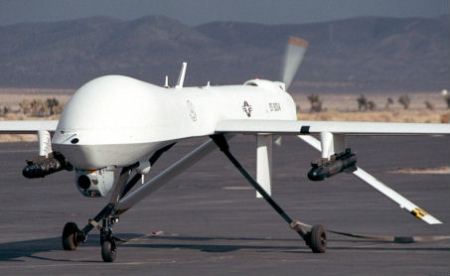
The US Campaigns of Attrition: Iran, Iraq

There is another…theory, that Iran will persist in its drive to achieve a bomb—or at least a break-out capacity to get one quickly if it so desired. The Iranians say they never trusted Mr Obama’s offer of detente early in his presidency because of the heavier sanctions and the campaigns of sabotage and assassination that accompanied the offer. In the same vein,they deplore the American administration’s recent decision to drop its longstanding classification of the exiled People’s Mujahedeen of Iran as a terrorist organisation.

So Iran’s rulers will not easily trust future pledges to lift sanctions in return for nuclear concessions. In any event, Iran’s leaders may now believe that such concessions would destroy the Islamic Republic’s credibility and open it to a recurrence of the unrest that followed Mr Ahmadinejad’s disputed re-election in 2009. So it is possible that an American policy of containment, even an undeclared one, might lead to a long campaign of attrition of the kind that impoverished Iraq in the 1990s, while leaving its leader in power.

Anticipating trouble, Iran’s hardliners have been stifling the remaining repositories of dissent as fiercely as ever. The most notable of these is Akbar Hashemi Rafsanjani, an establishment heavyweight and former president who became an opposition figurehead after the contentious poll of 2009. The two most controversial of his five children—his daughter Faezeh and his son Mehdi—have recently been arrested, undoubtedly with the approval of Iran’s supreme leader, Ali Khamenei. Mr Rafsanjani had been expected to put up a fight when Mr Khamenei tries, as he probably will, to install his own nominee as president in elections that are due next spring. But with his children behind bars, the former president may favour circumspection over principle.

Excerpt, Iran: Behind the rants, uncertainty grows, Economist, Sept. 29,2012, at 54

US Special Forces in Iraq to Stop Russia

The civil war in Syria is testing Iraq’s fragile society and fledgling democracy, worsening sectarian tensions, pushing Iraq closer to Iran… just nine months after American forces ended their long and costly occupation here.  Fearing that Iraq’s insurgents will unite with extremists in Syria to wage a two-front battle for Sunni dominance, Prime Minister Nuri Kamal al-Maliki recently ordered guards at the western border to block adult men…along with thousands of refugees seeking to escape the grinding war next door.  Farther north, Iraqi officials have another concern, also related to the fighting across the border. Turkish warplanes have stepped up attacks on the mountain hide-outs of Kurdish insurgents galvanized by the war in Syria, underscoring Iraq’s inability to control its own airspace.

The hardening of the antagonists’ positions in Syria — reverberating across Iraq — was made clear Monday at the United Nations when the new special envoy for Syria, Lakhdar Brahimi, gave a bleak appraisal of the conflict to the Security Council and said he saw no prospect for a breakthrough anytime soon.

The Syrian war’s spillover has called attention to uncomfortable realities for American officials: despite nearly nine years of military engagement, an effort that continues today with a $19 billion weapons sales program, Iraq’s security is uncertain and its alliance with the theocratic government in Tehran is growing. Iraq’s Shiite-dominated leadership is so worried about a victory by Sunni radicals in Syria that it has moved closer to Iran, which shares a similar interest in supporting the Syrian president, Bashar al-Assad.,,,

In response, the United States has tried to secure its interests in Iraq. It has unsuccessfully pressed Iraq to halt flights from Iran that traverse Iraqi airspace to ferry weapons and fighters to the Assad government, although The Associated Press reported that over the weekend a government spokesman said Iraq would begin random searches of Iranian aircraft.  While some Congressional leaders have threatened to cut off aid to Iraq if the flights do not stop, the United States is trying to speed up weapons sales to Iraq to secure it as an ally, said Lt. Gen. Robert L. Caslen Jr., the American commander in charge of that effort. As regional security deteriorates, the United States is finding it hard to deliver the weapons — especially antiaircraft systems — quickly enough to satisfy the Iraqis, who in some cases are looking elsewhere, including Russia.

“Although they want a strategic partnership with the United States, they recognize the vulnerability, and they are interested in going with the nation that will be able to provide them, and meet their need, their capabilities gap, as quickly as possible,” said General Caslen, who oversees a Pentagon office here, under the authority of the American Embassy, that brokers weapons sales to Iraq.  The United States is providing Iraq with refurbished antiaircraft guns, free of charge, but they will not arrive until June. In the meantime, the Iraqis have collected cold war-era missiles found in a junkyard on an air base north of Baghdad, and they are trying to get them in working order. Iraq is negotiating with Russia to buy air defense systems that could be delivered much more quickly than those bought from the United States.

“Iraq recognizes they don’t control their airspace, and they are very sensitive to that,” General Caslen said. Each time Turkish fighter jets enter Iraq’s airspace to bomb Kurdish targets, he said, Iraqi officials “see it, they know it and they resent it.”  Iskander Witwit, a former Iraqi Air Force officer and member of Parliament’s security committee, said, “God willing, we will be arming Iraq with weapons to be able to shoot down those planes.”

The American military withdrew at the end of last year after negotiations for an extended troop presence collapsed because the Iraqis would not agree to extend legal immunities to any remaining force. Once the Americans left, Iraq celebrated its sovereignty, even as military officials in both countries fretted about the deficiencies of Iraq’s military and sought ways to work together that would not require a public debate about immunities.  Iraq and the United States are negotiating an agreement that could result in the return of small units of American soldiers to Iraq on training missions. At the request of the Iraqi government, according to General Caslen, a unit of Army Special Operations soldiers was recently deployed to Iraq to advise on counterterrorism and help with intelligence.

Excerpts from TIM ARANGO, Syrian War’s Spillover Threatens a Fragile Iraq, NY Times, Sept. 24, 2012

Drones: the Politics of Fear and Complacency

Excerpt from the Executive Summary Living Under Drones Death, Injury, and Trauma to Civilians From US Drone Practices in Pakistan (Stanford and NYU, Sept. 2012)

In the United States, the dominant narrative about the use of drones in Pakistan is of a surgically precise and effective tool that makes the US safer by enabling “targeted killing” of terrorists, with minimal downsides or collateral impacts. This narrative is false…

The US publicly describes its drone program in terms of its unprecedented ability to “distinguish …effectively between an al Qaeda terrorist and innocent civilians,” and touts its missile-armed drones as capable of conducting strikes with “astonishing” and “surgical” precision. First, while civilian casualties are rarely acknowledged by the US government, there is significant evidence that US drone strikes have injured and killed civilians. In public statements, the US states that there have been“no” or “single digit” civilian casualties.” It is difficult to obtain data on strike casualties because of US efforts to shield the drone program from democratic accountability, compounded by the obstacles to independent investigation of strikes in North Waziristan. The best currently available public aggregate data on drone strikes are provided by The Bureau of Investigative Journalism (TBIJ), an independent journalist organization.

TBIJ reports that from June 2004 through mid- September 2012, available data indicate that drone strikes killed 2,562-3,325 people in Pakistan, of whom 474-881 were civilians, including 176 children. TBIJ reports that these strikes also injured an additional 1,228-1,362 individuals….

US drone strike policies cause considerable and under-accounted for harm to the daily lives of ordinary civilians, beyond death and physical injury. Drones hover twenty-four hours a day over communities in northwest Pakistan, striking homes, vehicles, and public spaces without warning. Their presence terrorizes men, women, and children, giving rise to anxiety and psychological trauma among civilian communities. Those living under drones have to face the constant worry that a deadly strike may be fired at any moment, and the knowledge that they are powerless to protect themselves….

Publicly available evidence that the strikes have made the US safer overall is ambiguous at best. The strikes have certainly killed alleged combatants and disrupted armed actor networks. However, serious concerns about the efficacy and counter-productive nature of drone strikes have been raised. The number of “high-level” targets killed as a percentage of total casualties is extremely low—estimated at just 2%. Furthermore, evidence suggests that US strikes have facilitated recruitment to violent non-state armed groups, and motivated further violent attacks…..

Drone strikes have also soured many Pakistanis on cooperation with the US and undermined US-Pakistani relations. One major study shows that 74% of Pakistanis now consider the US an enemy.

Current US targeted killings and drone strike practices undermine respect for the rule of law and international legal protections and may set dangerous precedents. This report casts doubt on the legality of strikes on individuals or groups not linked to the terrorist attacks of September 11, 2011, and who do not pose imminent threats to the US. The US government’s failure to ensure basic transparency and accountability in its targeted killing policies, to provide necessary details about its targeted killing program, or adequately to set out the legal factors involved in decisions to strike hinders necessary democratic debate about a key aspect of US foreign and national security policy. US practices may also facilitate recourse to lethal force around the globe by establishing dangerous precedents for other governments….

In light of these concerns, this report recommends that the US conduct a fundamental re-evaluation of current targeted killing practices, taking into account all available evidence, the concerns of various stakeholders, and the short and long-term costs and benefits. A significant rethinking of current US targeted killing and drone strike policies is long overdue. US policy-makers, and the American public, cannot continue to ignore evidence of the civilian harm and counterproductive impacts of US targeted killings and drone strikes in Pakistan….

The US should fulfill its international obligations with respect to accountability and transparency, and ensure proper democratic debate about key policies. The US should.

–Release the US Department of Justice memoranda outlining the legal basis for US targeted killing in Pakistan;

–Make public critical information concerning US drone strike policies, including as previously and repeatedly requested by various groups and officials: the targeting criteria for so-called “signature” strikes; the mechanisms in place to ensure that targeting complies with international law; whichlaws are being applied; the nature of investigations into civilian deathand injury; and mechanisms in place to track, analyze and publicly recognize civilian casualties;

–Ensure independent investigations into drone strike deaths, consistent with the call made by Ben Emmerson, UN Special Rapporteur on the promotion and protection of human rights and fundamental freedoms while countering terrorism in August 2012

–In conjunction with robust investigations and, where appropriate,prosecutions, establish compensation programs for civilians harmed by US strikes in Pakistan.

–The US should fulfill its international humanitarian and human rights law obligations with respect to the use of force, including by not using lethal force against individuals who are not members of armed groups with whom the US is in an armed conflict, or otherwise against individuals not posing an imminent threat to life. This includes not double-striking targets as first responders arrive.

–Journalists and media outlets should cease the common practice of referring simply to “militant” deaths, without further explanation. All reporting of government accounts of “militant” deaths should include acknowledgment that the US government counts all adult males killed by strikes as “militants,” absent exonerating evidence. Media accounts relying on anonymous government sources should also highlight the fact of their single source information and of the past record of false government reports

Excerpt from the Executive Summary Living Under Drones Death, Injury, and Trauma to Civilians From US Drone Practices in Pakistan (Stanford and NYU, Sept. 2012)
See also http://livingunderdrones.org/

The Legality of Targeted Killings

The CRS memorandum, entitled “Legal Issues Related to the Lethal Targeting of U.S. Citizens Suspected of Terrorist Activities,” was prepared in May 2012 by legislative attorney Jennifer K. Elsea. It presents an overview of the pertinent legal context, and then carefully parses official Administration statements in an attempt to infer a detailed legal rationale for lethal targeting. A copy was obtained by Secrecy News.

“This memorandum is an effort to clarify the debate by providing legal background, setting forth what is known about the Administration’s position and identifying possible points of contention among legal experts and other observers,” the memo states.  In the end, CRS concludes that none of the established legal frameworks is a perfect fit for the Administration’s lethal targeting operations because the current U.S. practice of lethal targeting involves features that are improvised, inconsistent or otherwise questionable.

For example, CRS says the Administration appears to have redefined the meaning of “imminence,” one of the required elements for justifying the use of force in self-defense on the territory of another country. The standard definition of imminence refers to an overwhelming threat that allows “no moment for deliberation.” But the Administration uses imminence idiosyncratically “to refer to the window of opportunity for striking rather than the perceived immediacy of the threat of an armed attack.” This novel usage “may pose some challenge to the international law regarding the use of force,” CRS said.

The CRS memo notes that the U.S. Supreme Court has ruled — in Hamdi v. Rumsfeld — that when a U.S. citizen is detained as a suspected enemy combatant he must be given notice of the factual basis for his detention and an opportunity to rebut it. Yet, in contrast, when a citizen-suspect is to be killed rather than detained the Administration’s position is that no such notice or opportunity is required.  This embrace of unchecked executive authority may prove difficult to reconcile with the majority holding in Hamdi, the memo suggests.  In fact, CRS says, the Administration’s position “seems to conform more with Justice Thomas’s dissenting opinion in Hamdi, in which Justice Thomas argued that in the context of wartime detention for non-punitive purposes, ‘due process requires nothing more than a good-faith executive determination’.”

By withholding its own Office of Legal Counsel opinion on the legality of lethal targeting of suspected terrorists who are U.S. citizens, the Obama Administration seems intent not on protecting sensitive operational details but on suppressing public awareness and debate. The CRS memo is not a substitute for the OLC opinion, but it nonetheless can serve to advance public understanding of the underlying issues.

Excerpt, Steven Aftergood, Legality of Targeted Killing of Suspected Terrorists Reviewed by CRS, SecrecyNews.com, Sept. 10, 2012

United States,Taliban, and the spin doctors

Days after deciding to blacklist an insurgent group linked to the Taliban and responsible for some of the deadliest attacks in Afghanistan, Secretary of State Hillary Clinton declined to say whether she also would brand the Taliban a foreign terrorist organization.  Asked in an interview yesterday with Bloomberg Radio if the Taliban — whose government gave sanctuary to Osama bin Laden and his al-Qaeda terror network before the 2001 U.S. military actions — should be blacklisted, Clinton didn’t directly answer.

“You know, we do a very intensive analysis before we designate someone as a foreign terrorist organization,” she said. “We have reached that conclusion about the Haqqani Network, and we think it’s the right decision.”  Clinton’s decision on Sept. 7 to designate as a terrorist organization the Haqqani Network — a militant group with operations in Afghanistan and Pakistan that is closely affiliated with the Afghan branch of the Taliban [or simply another name for Taliban]– came after months of inter-agency debate.  One issue was the potential impact on already difficult relations with Pakistan. The Haqqanis operate from havens in Pakistan’s North Waziristan tribal region with what U.S. officials have said are ties to Pakistan’s intelligence agency.  Clinton said in the interview that blacklisting the Haqqanis wasn’t a message aimed at Pakistan.  “No, it is about squeezing” the Haqqanis, she said.  “It’s part of the continuing effort to try to send a message to them — not to anyone else, but to them — because of the really incredibly damaging attacks they have waged against us, against other targets inside Afghanistan, and it’s important that we use every tool at our disposal to go after them,” she said in the interview in Vladivostok, Russia, at the end of an 11-day trip through the Asia-Pacific.  The U.S. had already slapped the Haqqani group’s leaders with individual sanctions, and has long targeted them in military operations and clandestine drone strikes.Adding the Haqqanis to the group blacklist “gives us much greater reach into any financial assets or fundraising that they may engage in, it gives us better traction against assets that they might own,” Clinton said. “It’s important that we use every tool at our disposal to go after them.”

Though the Haqqanis were behind some of the highest-profile attacks on American and NATO interests in Afghanistan, including a day-long assault last year on the U.S. embassy in Kabul and an attack on NATO headquarters there, the debate on whether to blacklist them involved arguments that doing so might hinder U.S. policy goals.

The decision followed months of discussion within the White House, State Department, Pentagon, Treasury Department, Justice Department and the intelligence community over the merits and the timing of blacklisting the Haqqanis, according to officials from different agencies who spoke on condition of anonymity to discuss internal deliberations.

Opponents of blacklisting the Haqqanis had argued that slapping them with a label might hinder prospects for engaging them in reconciliation talks to take them off the battlefield. The same may be said of the Taliban…Another concern about blacklisting the Haqqanis — which can also be said of the Taliban — is that affixing a terror label to the group may affect U.S. relations with Pakistan. Some U.S. officials, including former chairman of the Joint Chiefs of Staff Admiral Mike Mullen, have said Pakistani intelligence and security forces have aided the Haqqanis in order to wield influence in Afghanistan. Clinton and Defense Secretary Leon Panetta have said Pakistan needs to do more to crack down on the group.  Pakistan also has ties with the Afghan Taliban, whose leadership is based in the Pakistani city of Quetta, according to U.S. intelligence officials.  The U.S. wants Pakistan to use its influence with the Taliban to engage them in serious peace talks with the Afghan government to help bring an end to the 11-year conflict.

Excerpts, Indira A.R. Lakshmanan, Clinton Doesn’t Say If Taliban Should Be on Terror List, BusinessWeek, Sept. 9, 2012

Drones: Rules and Reality

In his most comprehensive public comments yet on the US covert drone war, President Barack Obama has laid out the five rules he says the United States uses to target and kill alleged terrorists – including US citizens.  The president has also warned of the need to avoid a ‘slippery slope’ when fighting terrorism, ‘in which you end up bending rules, thinking that the ends always justify the means.’  Obama’s comments were made in an on-camera interview with CNN’s chief White House correspondent Jessica Yellin. Only once before has the president publicly discussed the US covert drone policy, when he spoke briefly about strikes in Pakistan’s tribal areas.  Now Obama says there are five rules that need to be followed in covert US drone attacks. In his own words:

1 ’It has to be a target that is authorised by our laws.’

2 ’It has to be a threat that is serious and not speculative.’

3 ’It has to be a situation in which we can’t capture the individual before they move forward on some sort of operational plot against the United States.’

4 ‘We’ve got to make sure that in whatever operations we conduct, we are very careful about avoiding civilian casualties.’

5 ‘That while there is a legal justification for us to try and stop [American citizens] from carrying out plots… they are subject to the protections of the constitution and due process.’

Obama twice referred to what he claims has been ‘misreporting’ by the media of his drones policy.  Apparently responding to recent allegations that his administration prefers to kill rather than capture suspects, the president said that ‘our preference has always been to capture when we can because we can gather intelligence’ but that it’s sometimes ‘very difficult to capture them.’  CNN’s Yellin did not bring up the issue of civilian casualties – despite CNN itself reporting multiple civilian deaths in a suspected Yemen drone strike just hours earlier. However Obama insisted that ‘we are very careful about avoiding civilian casualties, and in fact there are a whole bunch of situations where we will not engage in operations if we think there’s going to be civilian casualties involved.’

Obama also took on the contentious targeted killing of US citizens – the subject of a number of high profile legal cases. Insisting that there was ‘legal justification’ for such killings, the president conceded that ‘as an American citizen, they are subject to the protections of the constitution and due process.’  The US Department of Justice (DoJ) is presently trying to block publication of administration legal opinions which allegedly provided the justification for the killing of US citizen Anwar al Awlaki and others.  In a recent court submission the DoJ insisted that Obama’s January comments on the covert drone war could not be taken as an admission that it was taking place: ‘Plaintiffs speculate that the president must have been speaking about CIA involvement in lethal operations…. This is insufficient to support a claim of official disclosure.’  With Obama now publicly laying out the ground rules for the covert drone war, the DoJ’s position appears further damaged.

The president also discussed in some detail his moral concerns regarding the campaign, admitting that he ‘struggle[s] with issues of war and peace and fighting terrorism.’  Our preference has always been to capture when we can because we can gather intelligence.’  He said that he and his national security team needed to ‘continually ask questions about “Are we doing the right thing? Are we abiding by the rule of law? Are we abiding by due process?”‘  If that failed to happen, the president warned, there was the risk of a ‘slippery slope… in which you end up bending rules, thinking that the ends always justify the means.’  The continuing deaths of civilians – and CIA tactics such as the deliberate targeting of rescuers – have led some to argue that the US is already bending or even breaking those rules.

Chris Woods, Obama’s five rules for covert drone strikes, Bureau of Investigative Journalism, Sept. 6, 2012

CIA Operations in Syria: the leaks

The U.S. is ramping up its presence at Syria’s Turkish border, sending more spies and diplomats to help advise the rebel forces in their mismatched fight against the better armed Syrian regime, and to watch for possible al-Qaida infiltration of rebel ranks.  U.S. officials briefed on the plan said the modest surge in U.S. personnel in the past few weeks — estimated at fewer than a dozen people — has helped improve rebels’ political organizing skills as well as their military organization. The officials spoke anonymously because they were not authorized to discuss the plans publicly.

It’s part of a two-pronged effort by the Obama administration to bolster the rebels militarily without actually contributing weapons to the fight, and politically, to help them stave off internal power challenges by the well-organized and often better-funded hardline Islamic militants who have flowed into the country from Iraq and elsewhere in the Persian Gulf region.  The increased intelligence gathered is intended to help the White House decide whether its current policy of providing only non-lethal aid is enough to keep momentum building in the nearly 18-month revolt against the regime of Syrian President Bashar Assad. Spokesmen for the Pentagon and White House declined to comment Thursday.

The diplomats and intelligence operatives from the CIA and other agencies stay outside war-torn Syria and meet with rebel leaders to help them organize their ranks, while also studying who makes up those ranks, how they are armed and whom they answer to, the officials say.  Information is also gathered from Syrian defectors and refugees as well as rebel troops, officials say.  “The model is to keep case officers away from conflict, and you collect through local forces,” said former CIA officer Reuel Gerecht, now a fellow at the Foundation for Defense of Democracies, a Washington-based policy group that focuses on terrorism.

The effort is concentrated on the Turkish border instead of the border with Jordan where many Syrian refugees are fleeing, a U.S. official said, because the traffic between Syria and Turkey is still far greater…. Syrian rebels have complained they are outgunned by the Syrian military and must rely on contributions in money and small arms from Gulf countries, and increasingly from hardline Islamic militants, including Iraq’s branch of al-Qaida.

US sends more spies, diplomats to help organize, train and study Syria’s rebel ranks, Associated Press, Sept. 6, 2012

The Nuclear Proliferation Potential of Laser Enrichment

The following is being released by Physicians for Social Responsibility:  The U.S. Nuclear Regulatory Commission (NRC) is putting U.S. nuclear non-proliferation policy at risk if it decides not to require a formal nuclear proliferation assessment as part of the licensing process for a uranium laser enrichment facility in Wilmington, N.C.  That’s the message from 19 nuclear non-proliferation experts in a letter sent today asking the NRC to fulfill its statutory responsibility to assess proliferation threats related to the technologies it regulates. The letter is available online at http://www.psr.org/nrcassessment.

Global Laser Enrichment, LLC, a joint venture of General Electric (USA), Hitachi (Japan) and Cameco (Canada), has applied for a license to operate a laser enrichment facility in Wilmington, North Carolina, based on Australian SILEX technology. The NRC licensing review schedule sets September 30, 2012 as the date of license issuance.  One of the authors of the letter, Catherine Thomasson, MD, executive director, Physicians for Social Responsibility, said:“It is a widely shared view that laser enrichment could be an undetectable stepping-stone to a clandestine nuclear weapons program. To strengthen U.S. policy and protect the U.S. and the world from nuclear proliferation, the NRC should systematically and thoroughly assess the proliferation risks of any new uranium enrichment technology BEFORE issuing a license allowing their development.”  Dr. Ira Helfand, co-president of International Physicians for the Prevention of Nuclear War, said: “If the U.S. is going to have moral authority in dealing with proliferation threats in other nations, such as Iran, it must do a better job of taking responsible steps in relation to proliferation threats in our own backyard. In fact, a persuasive case can be made that laser enrichment technology requires even more immediate action, since this is a known danger that can be addressed directly by the NRC under its existing regulatory authority.”

In the letter, the experts note that the NRC has no rules or requirements for a nuclear proliferation assessment as part of this licensing process. The experts are concerned that the Commission is falling short in its duties since a 2008 NRC manual on enrichment technology clearly states that laser enrichment presents “extra proliferation concerns due to the small size and high separation factors.”

Previous letters to the NRC asking for a proliferation assessment, signed by many of today’s signatories, have been rebuffed. NRC is on record stating that the National Environmental Policy Act does not require preparation of a proliferation assessment. However, a March 27, 2012 memorandum from the Congressional Research Service clearly concludes that the NRC has legal authority “to promulgate a regulation” requiring a proliferation assessment as part of the licensing process.  Both the Nuclear Non-Proliferation Act of 1978 and the Atomic Energy Act are cited by the experts as statutory basis of the NRC’s responsibility to assess proliferation risks.

Excerpt, 19 Experts: Nuclear Proliferation Risks Of Laser Enrichment Require Fuller NRC Review, PRNewswire, Sept 5, 2012

Laser Weapons

The notion of using energy as a weapon of war dates back at least as far as the ancient Greeks. In the late 1970s and early 1980s the idea was revived when American strategists began thinking in earnest about the technologies they would need to shoot down nuclear-armed ballistic missiles. Among the more fanciful ideas taken up by Ronald Reagan’s Strategic Defence Initiative (more commonly known as Star Wars) was the X-ray laser, which aimed to harness the energy of an atomic explosion to generate powerful laser beams….

The main appeal of using an energy beam to shoot things is that it travels at the speed of light, which means, in practice, that it will hit whatever it is aimed at. Trying to shoot down an incoming missile or warhead with a physical projectile, by contrast, is much more difficult. The guidance challenges of trying to “hit a bullet with a bullet” are enormous and are only gradually being solved using complex radars and missiles equipped with expensive sensors. A second attraction of lasers and other energy weapons is that in most cases they cannot run out of ammunition, and can keep firing for as long as they are plugged into a power source. The initial costs may be quite high, but each shot may then cost only a few dollars, compared with a price-tag of $3m or more for the latest missiles used to shoot down aircraft or other missiles.

Yet until very recently, despite the billions of dollars invested in them, military lasers have had a less than glowing record. The most famous (and expensive) experiment was America’s Airborne Laser Test Bed. This programme, which cost the Pentagon about $5 billion over more than 15 years, was an effort to cram a huge laser gun into a Boeing 747. It was intended to shoot down ballistic missiles in their “boost phase”, after their launch but before they had picked up enough speed to leave the atmosphere. The logic was that this is a particularly vulnerable time for a missile, since it is moving relatively slowly and because even minor damage to an accelerating rocket could prove fatal given the enormous stresses it is subjected to.

The airborne laser showed some promise in tests, but the programme was ignominiously zapped in 2011 by the Pentagon, which couldn’t quite work out how it would be able to keep a big, slow-moving jumbo jet airborne around the clock, deep within enemy territory, while waiting for a missile to blast off nearby.  Another laser that came close to being practical enough to use was the Tactical High Energy Laser, also known as the Nautilus laser which was designed to shoot down incoming artillery rounds. It was successfully tested in Israel, where it intercepted incoming rockets and shells, but Israel and America decided to pull the plug on it. One reason that it and the airborne laser were shot down was that military planners fell out of love with chemical lasers. These are very large and not especially portable lasers that are powered by a chemical reaction. As well as being bulky, they require large amounts of toxic and perishable chemicals, which can run out, limiting the number of shots that the laser can fire.

For the moment, the idea of shooting down big nuclear-tipped missiles with lasers has been put on hold, and proponents of laser weapons are aiming instead at more flammable targets. Much of the work in this field is now being done by the American navy….

The big trend now is to try to scale up three other sorts of laser that are far more compact than chemical lasers and can fire away merrily as long as they have power and don’t get too hot. The first sort is the fibre laser, in which the beam is generated within an optical fibre. Because this is already used in industry for welding and cutting, prices are falling, power output is increasing and reliability has been steadily improving. Industrial lasers can be turned into weapons pretty easily, simply by strapping them to a weapons mount.  But they are not very powerful. The Tactical Laser System being developed for the American navy by BAE Systems, a British firm, has an output of just 10kW, enough to run a few household kettles. Even so, it might be useful for frightening off (or burning holes in) small boats that look threatening but wouldn’t warrant a hail of machinegun fire. A slightly bigger version puts out about 33kW of power and fits neatly on existing turrets that house the rotary cannons used to shoot down incoming anti-ship missiles. It could blind optical or heat-seeking sensors on enemy missiles, or puncture small boats.  Plans are afoot to scale military fibre lasers up to about 100kW, which would enable them to shoot down small unmanned aircraft. The technology is relatively mature: a study by the Congressional Research Service (CRS), an American government-research body, (pdf) reckons it would cost around $150m to develop a prototype, and that such lasers could be in service by 2017.

The second technology being worked on is the slab laser… It would be less useful for shooting down targets flying directly at the laser because of “thermal blooming”….The Center for Strategic and Budgetary Assessments, a think-tank based in Washington, DC, argues that various sorts of solid-state lasers could be in service on American ships by 2018. It thinks that they could also be used to counter cruise missiles flying directly at a ship, using relay mirrors mounted on nearby unmanned aircraft.

To be really suitable for shooting down ballistic missiles, however, a laser with a power level of more than a megawatt would be needed. That would mean using a third technology, called a free-electron laser….

Although lasers have many advantages, in short, they also suffer from quite severe limitations. The main one is their relatively low power output. So much energy is needed to burn through the armour of a tank, for instance, that it is easier simply to fire a rocket at it. Even people do not make particularly good targets for lasers: human bodies can absorb a lot of energy before heating up substantially. (Eyes make a better target, but international conventions ban lasers designed to blind.)

A further limitation is that laser light can be absorbed or scattered by pollution, fog or smoke. Missiles or other targets can also be protected by coating them with mirrors or wrapping them with insulation. In addition, laser beams travel in a straight line, which means they are less useful than conventional artillery when shooting at something on the other side of a hill. It seems likely that laser weapons will have been deployed on ships by the end of the decade. They will have their uses, but they remain rather less fearsome than their science-fiction reputation might suggest.

Excerpts, Energy weapons: Zap, crackle and pop, Economist Technology Quarterely, Sept. 1, 2012, at 12

Cyberwar: Attacking the Pipelines

The vast U.S. network of natural gas and hazardous liquid pipelines is integral to U.S. energy supply and has vital links to other critical infrastructure. While an efficient and fundamentally safe means of transport, this network is vulnerable to cyber attacks. In particular, cyberinfiltration of supervisory control and data acquisition (SCADA) systems could allow successful “hackers” to disrupt pipeline service and cause spills, explosions, or fires—all from remote locations.

In March 2012, the Department of Homeland Security (DHS) reported ongoing cyber intrusions among U.S. natural gas pipeline operators. These intrusions have heightened congressional concern about cybersecurity in the U.S. pipelines sector. The Transportation Security Administration (TSA) is authorized by federal statute to promulgate pipeline physical security and cybersecurity regulations, if necessary, but the agency has not issued such regulations. TSA officials assert that security regulations could be counterproductive because they could establish a general standard below the level of security already in place for many pipelines…. While the pipelines sector has many cybersecurity issues in common with other critical infrastructure sectors, it is somewhat distinct in several ways:

• Pipelines in the United States have been the target of several confirmed terrorist plots and attempted physical attacks since September 11, 2001.

• Changes to pipeline computer networks over the past 20 years, more sophisticated hackers, and the emergence of specialized malicious software have made pipeline SCADA operations increasingly vulnerable to cyber attacks.

• There recently has been a coordinated series of cyber intrusions specifically targeting U.S. pipeline computer systems.

• TSA already has statutory authority to issue cybersecurity regulations for pipelines if the agency chooses to do so, but it may not have the resources to develop, implement, and enforce such regulations if they are mandated….

In March 2012, the Department of Homeland Security (DHS) reported ongoing cyber intrusions among U.S. natural gas pipeline operators. The incidents drew new attention to an Al Qaeda video obtained in 2011 by the Federal Bureau of Investigation (FBI) reportedly calling for “electronic jihad” against U.S. critical infrastructure.  These cybersecurity events coupled with serious consequences from recent pipeline accidents have heightened congressional concern about cybersecurity measures in the U.S. pipelines sector.

Excerpt, Paul W. Parfomak, Pipeline Cybersecurity: Federal Policy, CRS Report for Congress, Aug. 16, 2012

Killing Civilians: the Crazyhorse

On July 12 2007 a US apache helicopter shot several Iraqi civilians in an incident that shocked the world when footage of the event was published by whistleblower website, Wikileaks.  The footage, taken from the helicopter, shows people fleeing for the safety of buildings being pursued, then the buildings they run to blown up. The attack resulted in 12 dead civilians, including a Reuters’ journalist and cameraman.

In ‘Permission to engage’, Al Jazeera tracks down families of the victims and a former US soldier to tell the story behind the Wikileaks ‘Collateral murder’ film.  But the footage leaked to Wikileaks is just one incident of several involving a unit relating to the call sign ‘Crazyhorse’. The particular incident filmed involved Crazyhorse 18. Through cables leaked to Wikileaks as part of its Iraq war logs cache of documents, the Al Jazeera documentary traces several other incidents involving the call sign. Many of these attacks also resulted in civilian deaths, or collateral damage as they are referred to by US army personnel.

Just 4 days after the death of the two Reuters’ journalists, in a neighbouring area of Baghdad, another incident occurred in which 14 civilians were fatally wounded in an operation involving two helicopter gunships responding to call signs ‘Crazyhorse 20’ and ‘Crazyhorse 21.’  In February 2007, two Iraqi insurgents were killed after attempting to surrender to a helicopter gunship. Soldiers aboard ‘Crazyhorse 18’ were given legal advice from a nearby military base: ‘Lawyer states they can not surrender to aircraft and are still valid targets’. The men fled to a nearby shack after Hellfire missiles were fired at their truck. The men were killed minutes later when the shack was destroyed by further missiles.

The pseudonym ‘Crazyhorse’ has its roots in US Army history. An ‘operation crazyhorse’ took place in Vietnam in 1966, after North Vietnamese plans to ambush a US Army foot patrol were intercepted. About 250 US soldiers from two airborne battalions, defeated and killed 500 NVA soldiers in a fierce firefight.  The commander of one of these battalions, Captain Mozey, instructed his men to put ‘Death from above’ cards on every enemy they killed. ‘Death from above’ and ‘crazyhorse’ were both referred to and made famous by the reckless Lieutenant Colonel Bill Kilgore in ‘Apocalypse now.’The Al Jazeera documentary talks to people directly affected by the reckless, gung-ho nature of the helicopter pilots of the ‘crazyhorse’ battalion, to produce a moving and personal account of the footage.

Excerpt, Permission to Engage: WikiLeaks collateral murder footage examined, Bureau of Investigative Journalism, Aug. 30, 2012

Selling Weapons: US Dominance and Motivations

From 2008 to 2011, the United States and Russia have dominated the arms market in the developing world, with both nations either ranking first or second for each of these four years in the value of arms transfer agreements. From 2008 to 2011, the United States made nearly $113 billion in such agreements, 54.5% of all these agreements (expressed in current dollars). Russia made $31.1 billion, 15% of these agreements. During this same period, collectively, the United States and Russia made 69.5% of all arms transfer agreements with developing nations, ($207.3 billion in current dollars) during this four-year period.

In 2011, the United States ranked first in arms transfer agreements with developing nations with over $56.3 billion or 78.7% of these agreements, an extraordinary increase in market share from 2010, when the United States held a 43.6% market share. In second place was Russia with $4.1 billion or 5.7% of such agreements.

In 2011, the United States ranked first in the value of arms deliveries to developing nations at $10.5 billion, or 37.6% of all such deliveries. Russia ranked second in these deliveries at $7.5 billion or 26.8%.

In worldwide arms transfer agreements in 2011—to both developed and developing nations—the United States dominated, ranking first with $66.3 billion in such agreements or 77.7% of all such agreements. This is the highest single year agreements total in the history of the U.S. arms export program. Russia ranked second in worldwide arms transfer agreements in 2011with $4.8 billion in such global agreements or 5.6%. …..

In 2011, Saudi Arabia ranked first in the value of arms transfer agreements among all developing nations weapons purchasers, concluding $33.7 billion in such agreements. The Saudis concluded $33.4 billion of these agreements with the United States (99%). India ranked second with $6.9 billion in such agreements. The United Arab Emirates (U.A.E) ranked third with $4.5 billion…..

Whereas the principal motivation for arms sales by key foreign suppliers in earlier years might have been to support a foreign policy objective, today that motivation may be based as much, if not more, on economic considerations as those of foreign or national security policy.

Excerpt from, Richard F. Grimmett and Paul K. Kerr,  Conventional Arms Transfers to Developing Nations, 2004-2011, (pdf)-

Mini Bombs: the CLAW

Textron Defense Systems, announced  that it has entered into a cooperative research and development agreement (CRADA) with the U.S. Special Operations Command (USSOCOM) Program Executive Office (PEO) Fixed Wing for development of standoff precision guided munition capability. Initial activities will focus on Textron Defense Systems’ Guided Clean Area Weapon (G-CLAW), a cost-effective, lightweight, guided precision unitary weapon providing anti-personnel and anti-material capabilities, as well as features for low collateral damage and hazardous unexploded ordnance (UXO) prevention.

Under the CRADA, the organizations intend to integrate the G-CLAW into PEO Fixed Wing’s common launch tube dispenser and complete the required testing to secure flight and weapons safety certifications. From there, Textron Defense Systems and USSOCOM will conduct inert and live-fire demonstrations of precision unitary munition delivery from a tactical carrier aircraft such as the MC-130W Dragon Spear. Integration activities will culminate in an end-to-end, live-fire demonstration.

Our G-CLAW allows users to shape the attack over a broad area, and to achieve precision effects using GPS targeting and a powerful warhead,” says Senior Vice President and General Manager Ellen Lord of Textron Defense Systems. “Further, it incorporates all of the safety features we’ve carefully designed, developed, tested and demonstrated to prevent UXO. Integrating this unitary system into the USSOCOM common launch tube could bring G-CLAW capabilities and performance to multiple new aircraft platforms for the gamut of irregular warfare missions.”

Textron Defense Systems’ weapons incorporate multiple, redundant safety features, including self-destruct and self-neutralization mechanisms, to eradicate the threat of UXO. The G-CLAW is designed for flexible integration into tactical munitions dispensers, as well as from unmanned aircraft platforms.

Textron Defense Systems and USSOCOM Enter CRADA for Standoff Precision Guided Munitions, Globe Newswire, Aug. 27, 2012

US Cyberattacks against Enemies: Afghanistan

The U.S. military has been launching cyberattacks against its opponents in Afghanistan, a senior officer says, making an unusually explicit acknowledgment of the oft-hidden world of electronic warfare.  Marine Lt. Gen. Richard P. Mills’ comments came last week at a conference in Baltimore during which he explained how U.S. commanders considered cyber weapons an important part of their arsenal.  “I can tell you that as a commander in Afghanistan in the year 2010, I was able to use my cyber operations against my adversary with great impact,” Mills said. “I was able to get inside his nets, infect his command-and-control, and in fact defend myself against his almost constant incursions to get inside my wire, to affect my operations.”

Mills, now a deputy commandant with the Marine Corps, was in charge of international forces in southwestern Afghanistan between 2010 and 2011, according to his official biography. He didn’t go into any further detail as to the nature or scope of his forces’ attacks, but experts said that such a public admission that they were being carried out was itself striking.  “This is news,” said James Lewis, a cyber-security analyst with the Washington-based Center for Strategic and International Studies. He said that while it was generally known in defense circles that cyberattacks had been carried out by U.S. forces in Afghanistan, he had never seen a senior officer take credit for them in such a way.  “It’s not secret,” Lewis said in a telephone interview, but he added: “I haven’t seen as explicit a statement on this as the one” Mills made.  The Pentagon did not immediately respond to an email seeking comment on Mills’ speech.

U.S. defense planners have spent the past few years wondering aloud about how and under what circumstances the Pentagon would launch a cyber attack against its enemies, but it’s only recently become apparent that a sophisticated program of U.S.-backed cyberattacks is already under way.  A book by The New York Times reporter David Sanger recently recounted how President Barack Obama ordered a wave of electronic incursions aimed at physically sabotaging Iran’s disputed atomic energy program. Subsequent reports have linked the program to a virus dubbed Flame, which prompted a temporary Internet blackout across Iran’s oil industry in April, and another virus called Gauss, which appeared to have been aimed at stealing information from customers of Lebanese banks. An earlier report alleged that U.S. forces in Iraq had hacked into a terrorist group’s computer there to lure its members into an ambush.

Herbert Lin, a cyber expert at the National Research Council, agreed that Mills’ comments were unusual in terms of the fact that they were made publicly. But Lin said that the United States was, little by little, opening up about the fact that its military was launching attacks across the Internet.  “The U.S. military is starting to talk more and more in terms of what it’s doing and how it’s doing it,” he said. “A couple of years ago it was hard to get them to acknowledge that they were doing offense at all — even as a matter of policy, let alone in specific theaters or specific operations.”

Mills’ brief comments about cyberattacks in Afghanistan were delivered to the TechNet Land Forces East conference in Baltimore on Aug. 15, but they did not appear to have attracted much attention at the time. Footage of the speech was only recently posted to the Internet by conference organizers

Marine General: We Launched Cyberattacks Against Afghanistan, CBS News, Aug. 24, 2012

Foreign Soldiers who Die in Afghanistan: the insider attacks

At the height of this dusty summer, American troops are dying at unprecedented rates at the hands of their Afghan allies. And both sides are struggling to explain why, even as they search for ways to stem what are known in military parlance as “insider” attacks.  This month, at least 10 U.S. troops — including a U.S. service member shot Sunday and five members of America’s elite special-operations forces slain earlier — have been killed by Afghan police, soldiers or civilian workers at military installations. As of Sunday, that accounted for a stunning 32% of the 31 American military fatalities in Afghanistan reported thus far in August by the monitoring website icasualties.org.  [I]nsider shootings have wider-ranging repercussions. They have provided a propaganda bonanza to the Taliban, and could threaten a linchpin of the Western exit strategy: training Afghan security forces in preparation for handing over most fighting duties to them by 2014.

The military says only a very small share of insider attacks is carried out by Taliban “sleepers” in the police or army. But that opens the way to perhaps an even more alarming conclusion: that the majority of the assailants are undertaking what are in effect spontaneous, self-assigned suicide missions, because many insider shooters are killed on the spot in return fire.

The military says it is working to address the threat. Changes in recent months have included the posting of armed Western troops — so-called guardian angels — to watch over others in mess halls, sleeping tents and gyms. Last week, the American commander of the NATO force, Gen. John Allen, ordered that NATO troops across Afghanistan keep a loaded magazine in their weapons, even when on base.  This year, an Army captain described an informal buddy system at his base of troops signaling each other to keep a close watch on armed Afghans nearby, especially if one of their comrades was diverted by some task.  “‘Shona-ba-shona,’ OK,” the captain said, invoking the “shoulder-to-shoulder” slogan of the NATO force and its Afghan partners. “But also: ‘Eyes on, all times.'”…..

How to guard against such attacks is the subject of considerable debate in military leadership circles, because overtly heavy-handed measures can send a signal to the Afghans that they are not trusted, which can be taken as an insult. And in traditional Afghan culture, perceived insult can swiftly lead to exactly the sort of violence the attacks represent…The phenomenon is so pervasive that the killings have their own evolving nomenclature. Previously, the military called them green-on-blue attacks, a color-coded reference to Afghan and Western forces. Now the preferred, more encompassing term is “insider threat,” stemming from the fact that assailants have included not only uniformed police and soldiers, but also civilian members of the Afghan security apparatus, or simply someone with access to a coalition base, even in a low-level capacity.

The Taliban movement has noted the rising number of insider shootings with ill-concealed delight, boasting of having infiltrated all branches of the Afghan security forces. In the past, the Taliban leadership claimed responsibility for virtually every such attack, but lately the group’s publicity machine often cites individual initiative by those without links to the insurgency.  “Our fighters are in the ranks of the police, army and intelligence service, but there are also some who carry out attacks on foreign troops only because they are Afghans and Muslims and act on their religious obligation to protect their country from invading forces,” said Zabiullah Mujahid, a spokesman for the group. “It is an indication of utter hatred against the foreigners.”…….

Some analysts believe part of the problem is the sheer longevity of the war, now in its 11th year. In the conflict’s early stages, such attacks were an extreme rarity.  “I wouldn’t say it’s normal, but I think it’s understandable in a war situation which is lasting for more than a decade,” said Fabrizio Foshini of the Afghan Analysts Network. “The conflict has been becoming worse, nastier — and the presence of foreign troops doesn’t seem in the eyes of many Afghans to have brought positive changes.”

Laura King, Afghanistan ‘insider’ attacks pose threat to West’s exit strategy, LA Times, August 20, 2012

Torture Techniques in Clandestine Prisons

The al Qaeda suspects who were subjected to so-called harsh interrogation techniques, and the lawyers charged with defending them at the Guantanamo Bay military tribunals, are not allowed to talk about the treatment they consider torture.  Defense attorneys say that and other Kafkaesque legal restrictions on what they can discuss with their clients and raise in the courtroom undermine their ability to mount a proper defense on charges that could lead to the death penalty.  Those restrictions will be the focus of a pretrial hearing that convenes this week.  Prosecutors say every utterance of the alleged al Qaeda murderers, and what their lawyers in turn pass on to the court, must be strictly monitored precisely because of the defendants’ intimate personal knowledge of highly classified CIA interrogation methods they endured in the agency’s clandestine overseas prisons.  Defense attorneys called that view extreme.  “Everything is presumptively top secret. So if my client had a tuna fish sandwich for lunch, I couldn’t tell you that,” Cheryl Bormann, who represents defendant Walid bin Attash, said after the May arraignment of the men charged with plotting the 9/11 attacks on the World Trade Center.  At one point in the arraignment, another of bin Attash’s attorneys, Air Force Captain Michael Schwartz, was explaining why his client refused to cooperate. Just when things got interesting, a security officer cut the audio feed to the media and others observing the proceedings from behind a soundproof glass wall with a 40-second audio delay.  “The reason for that is the torture that my client was subjected to by the men and women wearing the big-boy pants down at the CIA, it makes it impossible …,” Schwartz said during the blocked portion of the arraignment, according to a partial transcript later declassified.  Prosecutors have said in court filings that any revelations about the defendants’ interrogations could cause “exceptionally grave damage.”

Civil libertarians argue that if those interrogation methods really are top secret, then the CIA had no business revealing them to al Qaeda suspects.  Defense attorneys will challenge the secrecy rules at the pretrial hearing that begins on Wednesday at the Guantanamo Bay U.S. Naval Base.  Prosecutors have about 75,000 pages of evidence to turn over to defense attorneys in the 9/11 case, but they won’t do it until the judge, Army Colonel James Pohl, issues protective orders aimed at safeguarding the material.

Hundreds of men suspected of supporting al Qaeda or the Taliban were rounded up in Afghanistan, Pakistan and elsewhere and shipped to Guantanamo in response to the September 11 attacks. (Of the 779 men who have been held at Guantanamo since the prison operation began in 2002, 168 remain.)  The CIA took custody of the “high-value” captives believed to have top-level information that could help the U.S. and its allies prevent further attacks.  It held them incommunicado for three or four years and transferred them among secret overseas prisons, questioning them with interrogation methods that defense attorneys say amounted to torture and which the Obama administration has since banned.  Some details of the program, including waterboarding, mock executions and sleep deprivation, have already been disclosed by Bush and the CIA itself. Jose Rodriguez, a former CIA official, recently defended them in news interviews to promote his book, “Hard Measures: How Aggressive CIA Action After 9/11 Saved American Lives.”

Yet in both the 9/11 case and that of Abd al Rahim al Nashiri, who is accused of sending suicide bombers to ram a boat full of explosives into the side of the USS Cole off Yemen in 2000, the government presumes that every word spoken by the defendants, in the past and in the future, is classified at the highest level — “Top Secret,” with a “Sensitive Compartmented Information,” which is routinely shortened to TS/SCI.  The defendants’ words are also “born classified,” a status their lawyers said has previously been used only to safeguard details about nuclear weapons. So are all documents and legal motions related to their cases, which cannot be made public unless they’re cleared by a Department of Defense Security Classification Review team.  How that team works is a secret.  “I’ve never seen them. I’ve never communicated (with them). No one has ever been able to tell me that,” said James Connell, a lawyer for 9/11 defendant Ali Abdul Aziz Ali.  The Pentagon would say only that the review team includes both civilians and uniformed military personnel and that it can take up to 15 business days to make its decisions.

Proscribed topics include details of the defendants’ capture, where they were held and under what conditions, the names and descriptions of anyone who transferred, detained or interrogated them and the methods used to get information from them, according to the court documents.

Defense lawyers say the classification system used at Guantanamo violates President Barack Obama’s 2009 order that prohibits using secrecy labels to conceal lawbreaking or prevent political embarrassment. They say it also “eviscerates” the legal defense protections Congress set down in the law that authorizes the Guantanamo tribunals.  The government’s secrecy rules mean that every lawyer, paralegal and expert on the prosecution and defense teams must undergo an extensive background check and obtain a TS/SCI clearance. Once they get clearance, they are briefed on what has to stay secret. The document that forms the basis of the presumptive classification is itself secret.  “It is ridiculous,” said Army Captain Jason Wright, one of the lawyers for accused 9/11 mastermind Khalid Sheikh Mohammed. “The briefing is classified, so I can’t discuss what I can and cannot discuss.”

Mohammed’s lawyers have asked the UN special rapporteur for torture, Juan E. Mendez, to investigate claims that their client was tortured. But they could only share with Mendez the information that has been publicly declassified.  “We are prohibited from sharing any details of his mistreatment, even to the special rapporteur,” Wright said.

The American Civil Liberties Union has filed a challenge arguing that the government has no legal authority to classify information that it not only disclosed to the defendants but forced them to learn.  “The question here is: Can the government subject people to torture and abuse and then prevent them from talking about it?” said Hina Shamsi, director of the ACLU’s National Security Project.  The ACLU said the claim of broad authority to gag defendants infringes on the American public’s right to open trials and goes far beyond what the courts have allowed, namely that censorship must be narrowly tailored and aimed at protecting a compelling government interest.

Excerpt, Jane Sutton and Josh Meyer, Insight: At Guantanamo tribunals, don’t mention the “T” word, Reuters, Aug. 20, 2012

The Y-12: Nuclear Weapons Alive and Well

Nearly three weeks after a stunning security breach shut down the Y-12 nuclear weapons plant, the government on Wednesday (Aug. 15, 2012) authorized the restart of nuclear operations…..B&W Y-12, the managing contractor, ordered a “security stand-down” on Aug. 1, 2012 soon after the unprecedented intrusion July 28 by three Plowshares protesters, who reportedly scaled a ridge on the north side of Y-12 and walked all the way to the plant’s high-security inner core. The protesters …. used bolt-cutters to pass through a series of sensor-laden security fences and reach the fortresslike uranium storehouse, which they defaced with spray-painted protest messages and human blood. The breach raised deep questions about site vulnerabilities and prompted multiple investigations, which are still under way.The approval to restart nuclear operations has no bearing on the “show cause” notice that the National Nuclear Security Administration sent to B&W Y-12 last week, Wyatt said.

In the Aug. 10, 2015 letter to the contractor, the NNSA said security concerns raised by the break-in and the response to it were so severe as to potentially harm the ability to carry out the Y-12 contract. ….It wasn’t clear how long it would take Y-12 to get the uranium operations and other activities, including the dismantlement of old warhead parts, up and running or restart manufacturing programs.  In its “show cause” letter to B&W, the NNSA said a “high number” of cameras associated with the plant’s PIDAS (Perimeter Intrusion Detection and Assessment System) were inoperable at the time of the July 28, 2012intrusion in the predawn hours. ”

Excepts from   Frank Munge, Feds authorize restart of Y-12’s nuke operations,
Knoxville News Sentinel, Aug. 15, 2012

Who is Trapwire? CIA’s surveillance machinery

Trapwire is the name of a program revealed in the latest Wikileaks bonanza—it is the mother of all leaks, by the way….. “Former senior intelligence officials have created a detailed surveillance system more accurate than modern facial recognition technology—and have installed it across the U.S. under the radar of most Americans, according to emails hacked by Anonymous.  Every few seconds, data picked up at surveillance points in major cities and landmarks across the United States are recorded digitally on the spot, then encrypted and instantaneously delivered to a fortified central database center at an undisclosed location to be aggregated with other intelligence. It’s part of a program called TrapWire and it’s the brainchild of the Abraxas, a Northern Virginia company (has been acquired by Cubic corporation) staffed with elite from America’s intelligence community.  The employee roster at Arbaxas reads like a who’s who of agents once with the Pentagon, CIA and other government entities according to their public LinkedIn profiles, and the corporation’s ties are assumed to go deeper than even documented. The details on Abraxas and, to an even greater extent TrapWire, are scarce, however, and not without reason. For a program touted as a tool to thwart terrorism and monitor activity meant to be under wraps, its understandable that Abraxas would want the program’s public presence to be relatively limited. But thanks to last year’s hack of the Strategic Forecasting intelligence agency, or Stratfor, all of that is quickly changing.”  So: those spooky new “circular” dark globe cameras installed in your neighborhood park, town, or city—they aren’t just passively monitoring. They’re plugged into Trapwire and they are potentially monitoring every single person via facial recognition.

Excerpts, David Seaman, WIKILEAKS: Surveillance Cameras Around The Country Are Being Used In A Huge Spy Network, Businessinsider.com, Aug. 10, 2012
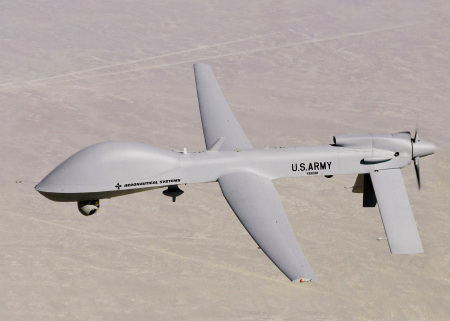
See also Top Secret America

The Alliance between CIA and Pakistan

And, perhaps most crucially, the two fractious allies’ top spies are talking again, with a view to enhancing their cooperation as the 2014 deadline for a withdrawal of U.S. troops from Afghanistan looms.   The relationship between the CIA and Pakistan’s Inter-Services Intelligence (ISI) agency has been at the core of Washington and Islamabad’s alliance for over a decade now — and sometimes the source of the mutual misery. After 9/11, both intelligence agencies collaborated closely to capture scores of al-Qaeda suspects. But over the past two years, as suspicions have grown, the two sides have become near adversaries.

The ISI is often accused of supporting jihadist proxies attacking U.S. and NATO troops in Afghanistan — and is widely considered to have been either incompetent or complicit when it came to Osama bin Laden’s presence in Pakistan. The CIA was found to be operating independently within Pakistan’s jealously guarded territory, running unauthorized contractors, recruiting local informants and showering drones at their fiercest pace yet.  But as bitter memories of those disputes begin to recede and new faces assume leadership roles, there is some cautious optimism going forward now — this despite domestic imperatives in both countries (an election year in the U.S., the heated anti-American populism in Pakistan) making rapprochement difficult. Last month the new head of ISI, Lieut. General Zaheer-ul-Islam, made his first visit to Washington, meeting with top intelligence, defense and Administration officials. Tentative agreements were made in terms of joint operations against militants in the region, the Wall Street Journal reported. But, officials from both sides say, fundamental differences linger.

Little is known about General ul-Islam, but a change at the top of ISI will please U.S. security officials. The previous ISI chief, now retired Lieut. General Ahmad Shuja Pasha, had become fiercely hostile to Washington in his final year — engaging in “shouting matches” with then CIA director Leon Panetta, cutting cooperation down to a minimum, ordering the harassment of U.S. diplomats in Pakistan and locking up Shakil Afridi, the physician who ran a vaccination program in the town where bin Laden was found hiding.

Afridi is currently serving a 33-year sentence handed down to him by a tribal court. The charges were not explicitly for spying for the U.S., but there is little doubt in observers’ minds that this is the reason he was punished. Afridi wasn’t arrested for the alleged offenses he has been convicted for until the ISI discovered his vaccination program and links to the CIA. At one point, according to a Pakistani military official familiar with the discussions, the CIA suggested that the ISI strip Afridi of his nationality and hand him over to the U.S. General Pasha angrily refused, saying it would set a bad precedent — one that could encourage others to spy for foreign countries if there were no consequences. U.S. Congressmen reacted angrily to Afridi’s imprisonment, voting to cut $33 million of U.S. assistance to Pakistan, one million for each year he’s serving in prison. The question of Afridi’s fate will likely have come up during ul-Islam’s visit to the U.S. There may be no movement soon, but if relations between Washington and Islamabad grow warmer, the ISI may eventually be persuaded to arrange for Afridi’s quiet release.

The harassment of U.S. officials hasn’t changed much, says a U.S. official. Vehicles are constantly stopped, security personnel searched with unusual rigor, and there is even pressure on the U.S. to abandon the construction of a new consulate in Peshawar. On other fronts, ul-Islam has maintained a low profile, a decision thought to be influenced by his predecessor’s controversial visibility. “Unlike General Pasha,” says a senior politician from Pakistan’s opposition Pakistan Muslim League-Nawaz party, “we don’t see the new head of the ISI interfering in politics — yet.”

During the new ISI chief’s visit, U.S. officials repeated their long-standing concerns about the Haqqani network, a potent jihadist group linked to al-Qaeda that is based in Pakistan’s North Waziristan tribal territory along the Afghan border. From their sanctuary there, say U.S. officials, the group contentedly plots terrorist attacks on U.S. and NATO troops in Afghanistan, before slipping back across the border. The ISI is widely suspected of offering the group support, with Admiral Mike Mullen, former Chairman of the Joint Chiefs of Staff, even describing the Haqqanis as “a veritable arm of the ISI” in his valedictory testimony before Congress last year.

The Pakistanis deny backing the Haqqanis but concede links with them and their reluctance to confront them. They plaintively cite a lack of resources and insist their priority is targeting militants mounting attacks inside Pakistan, but tellingly add that the Haqqanis will be crucial to any future Afghan settlement that Pakistan hopes to be a part of. But a series of unremitting, violent attacks in and around Kabul, authored by the Haqqanis, has intensified the pressure on the Pakistanis.

Last October, Pakistan’s army chief, General Ashfaq Kayani, discussed the possibility of “limiting the space” given to the Haqqanis in North Waziristan with Clinton during her visit to Islamabad. The Pakistani army said it had certain contingency plans in place for limited, surgical operations to reclaim territory in some of North Waziristan’s main towns. These plans were shelved soon after, with the deaths of the Pakistani soldiers in November 2011. Now, as pressure builds again, with enduring attacks and Congressmen calling for the Haqqani network to be designated as a foreign terrorist organization, the plans will have to be revisited. The new U.S. ambassador to Pakistan, Richard Olson, told U.S. lawmakers during his confirmation hearings last month that he will be committed to taking on the Haqqanis.

Without a Pakistani military operation against the Haqqanis, the CIA has focused on drone strikes against them and other militants in the region. The strikes, U.S. officials insist, are effective. Some Pakistani military officials also have conceded improved accuracy. But there are limits to what can be achieved by a drone-only strategy, and there are political costs. Drone strikes have not only become hugely unpopular in Pakistan, where the parliament has united in denouncing them, but also across the world. A Pew Research Center survey published in June found that majorities in countries as diverse as France, Germany, the Czech Republic, China, Japan, Brazil and Turkey opposed the widespread use of drone strikes.

An acknowledgment of the accumulating political costs may temper the frequency with which the CIA uses drone strikes. General David Petraeus, the new CIA director, is said to appreciate that the program is unsustainable. Previous CIA director Panetta was seen as being indulgent of “the CT guys and their shiny toys,” says the official. Drone strikes increased to a pace of one every four days at their height.

But there are certain points at which they are seen as a necessity — and they will continue to be used despite ul-Islam’s insistence last month in Washington that they stop. Just days after Clinton’s apology and the reopening of the NATO supply lines, a drone strike in North Waziristan reportedly killed 20 suspected militants. The actual figure, the U.S. official says, was lower. But it was a truck packed with explosives heading across the border. “It was a clear shot,” the official says. “We had to take it.” And that is one of the many differences in opinion that both sides will somehow have to learn to live with.

Omar Waraich.The CIA and ISI: Are Pakistan and the U.S.’s Spy Agencies Starting to Get Along?, Time, Aug. 7, 2012

Rogue Army or Rogue Soldiers? Haditha Massacre, Iraq

Defense Secretary Leon Panetta has directed a panel of experts to assess whether reforms are needed in the way the military justice system handles crimes committed by U.S. forces against civilians in combat zones, the Pentagon said on Friday (Aug. 3, 2012).  While the Pentagon said the decision was not linked to any specific case, it follows a spate of incidents in Afghanistan that have outraged the local population, including one in which a soldier is suspected of killing 16 villagers in a shooting rampage.   “There is no one case that motivates this,” said Jeh Johnson, the Pentagon’s top lawyer, who explained Panetta’s decision to undertake the review.  “We’ve now been in deployed areas for over 10 years,” he said. “We want to ask ourselves every once in a while: Is the system working like it should? Are there reforms that could be brought about to better apply military justice in deployed areas when the offense involves civilians?”

Panetta asked a subcommittee of the newly established Defense Legal Policy Board to review cases over the past decade in which U.S. forces committed crimes against civilians in Iraq and Afghanistan to see whether judicial procedures need to be improved.  “Abuses have been rare among our professional fighting force, but they became huge flash points that threatened to undermine our entire mission and the foundation of our relationship with the host government and its people,” Panetta said in a memorandum to the Pentagon leadership.  “For offenses that take place in a country in which we operate alongside the civilian population, it is critical that our system of military justice be efficient, fair, dependable and credible,” he added.

The review is expected to look into cases like the Haditha massacre in Iraq, where Marines killed 24 civilians. Of the eight Marines originally charged in the case, only one was found guilty — of dereliction of duty.  Cases like the one against Army Staff Sergeant Robert Bales, who is accused in the slayings of 16 Afghan civilians earlier this year, may not factor into the investigation. Panetta’s instructions call for the panel not to “intrude upon any pending case or investigation.”

The review panel will be led by former top Pentagon lawyer Judith Miller and retired Major General Walter Huffman, a former Army judge advocate general. While largely made up of lawyers, the panel also includes retired military commanders and a former police criminal investigator.  The group is expected to deliver a report within seven months to the Defense Legal Policy Board, which will review the findings before passing them to the defense secretary.

Panetta orders review of military justice in combat zones, August 03, 2012|David Alexander | Reuters

The Essence of Imperialism: Australia in the Pacific

Nor is it the first time Vanuatu has clashed with the Australian Federal Police (AFP). In 2004 its government closed down the AFP offices in the capital, Port Vila, and expelled officers, after allegations that they were spying and interfering with domestic politics. The AFP’s main concerns in Vanuatu have been over the country marketing itself vigorously as an international tax haven, and over the risk posed by the volatile Vanuatu Mobile Force, the paramilitary wing of the local police force. Protecting Australia’s national interests under the guise of so-called capacity-building can quickly lead to tensions.

The AFP’s activities in Vanuatu have been part of a broader expansion over the past decade of Australian policing across the Pacific. Peacekeeping missions to Timor-Leste since 1999 and to the Solomon Islands, beginning in 2003, boosted police numbers. In the past decade, the AFP has trebled in size and increased its budget fivefold. The AFP commissioner now has an influential role on the Australian cabinet’s national-security committee. In Australia most domestic policing is carried out by state police forces, leaving the federal force largely free, outside aboriginal communities in the Northern Territory, to focus on international deployments.

Their efforts have often led to accusations of heavy-handedness. In 2005 a mission to Papua New Guinea was abandoned after that country’s Supreme Court ruled that legal immunities granted to AFP officers were unconstitutional. In 2006 the Solomon Islands’ police chief, Shane Castles, an Australian, was sacked and declared an “undesirable immigrant” after a raid by his police officers on the office of the prime minister. That raid was connected with the AFP’s long-standing pursuit of the Solomon Islands’ then attorney-general, Julian Moti, on charges of sex with an underage girl. Mr Moti was deported to Australia in 2007, arrested and brought before the courts. In December 2011 the High Court threw the case out, finding that Australian officials had colluded in Mr Moti’s illegal deportation.

The Australian Federal Police in the Pacific: Booting out big brother, Economist, May 19, 2012, at 49

Military Robots and Automated Killing

Military robots come in an astonishing range of shapes and sizes. DelFly, a dragonfly-shaped surveillance drone built at the Delft University of Technology in the Netherlands, weighs less than a gold wedding ring, camera included. At the other end of the scale is America’s biggest and fastest drone, the $15m Avenger, the first of which recently began testing in Afghanistan. It uses a jet engine to carry up to 2.7 tonnes of bombs, sensors and other types of payload at more than 740kph (460mph).

On the ground, robots range from truck-sized to tiny. TerraMax, a robotics kit made by Oshkosh Defense, based in Wisconsin, turns military lorries or armoured vehicles into remotely controlled or autonomous machines. And smaller robotic beasties are hopping, crawling and running into action, as three models built by Boston Dynamics, a spin-out from the Massachusetts Institute of Technology (MIT), illustrate.  By jabbing the ground with a gas-powered piston, the Sand Flea can leap through a window, or onto a roof nine metres up. Gyro-stabilisers provide smooth in-air filming and landings. The 5kg robot then rolls along on wheels until another hop is needed—to jump up some stairs, perhaps, or to a rooftop across the street. Another robot, RiSE, resembles a giant cockroach and uses six legs, tipped with short, Velcro-like spikes, to climb coarse walls. Biggest of all is the LS3, a four-legged dog-like robot that uses computer vision to trot behind a human over rough terrain carrying more than 180kg of supplies. The firm says it could be deployed within three years.

Demand for land robots, also known as unmanned ground vehicles (UGVs), began to pick up a decade ago after American-led forces knocked the Taliban from power in Afghanistan. Soldiers hunting Osama bin Laden and his al-Qaeda fighters in the Hindu Kush were keen to send robot scouts into caves first. Remote-controlled ground robots then proved enormously helpful in the discovery and removal of makeshift roadside bombs in Afghanistan, Iraq, and elsewhere. Visiongain, a research firm, reckons a total of $689m will be spent on ground robots this year. The ten biggest buyers in descending order are America, followed by Israel, a distant second, and Britain, Germany, China, South Korea, Singapore, Australia, France and Canada.

Robots’ capabilities have steadily improved. Upload a mugshot into an SUGV, a briefcase-sized robot than runs on caterpillar tracks, and it can identify a man walking in a crowd and follow him. Its maker, iRobot, another MIT spin-out, is best known for its robot vacuum cleaners. Its latest military robot, FirstLook, is a smaller device that also runs on tracks. Equipped with four cameras, it is designed to be thrown through windows or over walls.

Another throwable reconnaissance robot, the Scout XT Throwbot made by Recon Robotics, based in Edina, Minnesota, was one of the stars of the Ground Robotics Capabilities conference held in San Diego in March. Shaped like a two-headed hammer with wheels on each head, the Scout XT has the heft of a grenade and can be thrown through glass windows. Wheel spikes provide traction on steep or rocky surfaces. In February the US Army ordered 1,100 Scout XTs for $13.9m. Another version, being developed with the US Navy, can be taken to a ship inside a small aquatic robot, and will use magnetic wheels to climb up the hull and onto the deck, says Alan Bignall, Recon’s boss.

Even more exotic designs are in development. DARPA, the research arm of America’s Department of Defence, is funding the development of small, soft robots that move like jerky slithering blobs. EATR, another DARPA project, is a foraging robot that gathers leaves and wood for fuel and then burns it to generate electricity. Researchers at Italy’s Sant’Anna School of Advanced Studies, in Pisa, have designed a snakelike aquatic robot. And a small helicopter drone called the Pelican, designed by German and American companies, could remain aloft for weeks, powered by energy from a ground-based laser….

A larger worry is that countries with high-performance military robots may be more inclined to launch attacks. Robots protect soldiers and improve their odds of success. Using drones sidesteps the tricky politics of putting boots on foreign soil. In the past eight years drone strikes by America’s Central Intelligence Agency (CIA) have killed more than 2,400 people in Pakistan, including 479 civilians, according to the Bureau for Investigative Journalism in London. Technological progress appears to have contributed to an increase in the frequency of strikes. In 2005 CIA drones struck targets in Pakistan three times; last year there were 76 strikes there. Do armed robots make killing too easy?

Not necessarily….. Today’s drones, blimps, unmanned boats and reconnaissance robots collect and transmit so much data, she says, that Western countries now practise “warfare by committee”. Government lawyers and others in operation rooms monitor video feeds from robots to call off strikes that are illegal or would “look bad on CNN”, says Ms Cummings, who is now a robotics researcher at MIT. And unlike pilots at the scene, these remote observers are unaffected by the physical toil of flying a jet or the adrenalin rush of combat.

In March Britain’s Royal Artillery began buying robotic missiles designed by MBDA, a French company. The Fire Shadow is a “loitering munition” capable of travelling 100km, more than twice the maximum range of a traditional artillery shell. It can circle in the sky for hours, using sensors to track even a moving target. A human operator, viewing a video feed, then issues an instruction to attack, fly elsewhere to find a better target, or abort the mission by destroying itself. But bypassing the human operator to automate attacks would be, technologically, in the “realm of feasibility”, an MBDA spokesman says……

Traditional rules of engagement stipulate that a human must decide if a weapon is to be fired. But this restriction is starting to come under pressure. Already, defence planners are considering whether a drone aircraft should be able to fire a weapon based on its own analysis. In 2009 the authors of a US Air Force report suggested that humans will increasingly operate not “in the loop” but “on the loop”, monitoring armed robots rather than fully controlling them. Better artificial intelligence will eventually allow robots to “make lethal combat decisions”, they wrote, provided legal and ethical issues can be resolved…..

Pressure will grow for armies to automate their robots if only so machines can shoot before being shot, says Jürgen Altmann of the Technical University of Dortmund, in Germany, and a founder of the International Committee for Robot Arms Control, an advocacy group. Some robot weapons already operate without human operators to save precious seconds. An incoming anti-ship missile detected even a dozen miles away can be safely shot down only by a robot, says Frank Biemans, head of sensing technologies for the Goalkeeper automatic ship-defence cannons made by Thales Nederland.  Admittedly, that involves a machine destroying another machine. But as human operators struggle to assimilate the information collected by robotic sensors, decision-making by robots seems likely to increase. This might be a good thing, says Ronald Arkin, a roboticist at the Georgia Institute of Technology, who is developing “ethics software” for armed robots. By crunching data from drone sensors and military databases, it might be possible to predict, for example, that a strike from a missile could damage a nearby religious building. Clever software might be used to call off attacks as well as initiate them.

In the air, on land and at sea, military robots are proliferating. But the revolution in military robotics does have an Achilles heel, notes Emmanuel Goffi of the French air-force academy in Salon-de-Provence. As robots become more autonomous, identifying a human to hold accountable for a bloody blunder will become very difficult, he says. Should it be the robot’s programmer, designer, manufacturer, human overseer or his superiors? It is hard to say. The backlash from a deadly and well-publicised mistake may be the only thing that can halt the rapid march of the robots.

Robots go to war: March of the robots, Economist Technology Quarterly, June 2, 2012

Beyond GPS: All Source Positioning and Navigation

DARPA’s All Source Positioning and Navigation (ASPN) program seeks to enable low cost, robust, and seamless navigation solutions for military users on any operational platform and in any environment, with or without GPS. In particular, ASPN will develop the architectures,  abstraction methods, and navigation filtering algorithms needed for rapid integration and reconfiguration of any combination of sensors. This will enable rapid adaptation to evolving missions as well as reduction of the system integration costs and time-to-market for navigation solutions in general.

The goal of Phase 2 of ASPEN is to address the issues of optimization and real-time operation, showing capabilities beyond basic plug-and-play flexibility. Solutions must be capable of adapting to a diverse set of sensor and IMU inputs and selectively choosing the subset of measurements that produces the best possible solution, ideally mirroring the result from a tuned filter solution for that same scenario….Phase 2 solutions will need to demonstrate real-time operation in representative field (non-laboratory) environments. Although adaptability is the main goal of the ASPN program, the possibility of ASPN accuracy being substantially better than current state of art should be considered, given accommodation by ASPN of larger and more diverse sensor suites, ease of optimizing ASPN to immediate applications, and potential synergistic benefits of an open architecture.

What is In-Q-Tel? Technology Branch of CIA

Throughout its lifetime, the CIA has operated at the cutting edge of science and technology. From the U-2 spy plane to the CORONA satellite, CIA’s “wizards of Langley” earned a reputation for bold innovation and risk taking, working in advance of the private sector and other branches of government. Much of CIA’s technology success was a result of identifying gaps and opportunities.  By the late 1990s, the pace of commercial innovation had overtaken the ability of government agencies to develop and incorporate new technologies. Private industry represented technical insights and innovation far too important to ignore. Driven by private sector R&D investment, these commercial technologies addressed many of the same information technology, biotechnology, communications, and energy challenges that faced the Intelligence Community.

In 1998, CIA identified technology as a top strategic priority, and set out a radical plan to create a new venture that would help increase the CIA’s access to private sector innovation. In-Q-Tel was chartered in February 1999 by a group of private citizens at the request of the Director of Central Intelligence and with the support of the U.S. Congress. IQT was tasked with building a bridge between the Agency and a new set of technology innovators.

From the website IQT (2012)

Industrial Revolution in Genetic Engineering: Military

From DARPA’s Website: Living Foundries

Current approaches to engineering biology rely on an ad hoc, laborious, trial-and-error process, wherein one successful project often does not translate to enabling subsequent new designs. As a result, the state of the art development cycle for engineering a new biologically manufactured product often takes 7+ years and tens to hundreds of millions of dollars (e.g. microbial production of artemisinic acid for the treatment of malaria and the non-petroleum-based production 1,3-propanediol).

[DARPA Goal]

Transforming biology into an engineering practice would enable on-demand production of new and high-value materials, devices and capabilities for the Department of Defense (DoD) and address complex challenges that today have no or few solutions.

The Living Foundries Program seeks to create the engineering framework for biology, speeding the biological design-build-test cycle and expanding the complexity of systems that can be engineered. The Program aims to develop new tools, technologies and methodologies to decouple biological design from fabrication, yield design rules and tools, and manage biological complexity through abstraction and standardization. These foundational tools would enable the rapid development of previously unattainable technologies and products, leveraging biology to solve challenges associated with production of new materials, novel capabilities, fuel and medicines. For example, one motivating, widespread and currently intractable problem is that of corrosion/materials degradation. The DoD must operate in all environments, including some of the most corrosively aggressive on Earth, and do so with increasingly complex heterogeneous materials systems. This multifaceted and ubiquitous problem costs the DoD approximately $23 Billion per year. The ability to truly program and engineer biology, would enable the capability to design and engineer systems to rapidly and dynamically prevent, seek out, identify and repair corrosion/materials degradation.

Accomplishing this vision requires an approach that is more than multidisciplinary – it requires a new engineering discipline built upon the integration of new ideas, approaches and tools from fields spanning computer science and electrical engineering to chemistry and the biological sciences. The best innovations will introduce new architectures and tools into an open technology platform to rapidly move new designs from conception to execution.  Performers must ensure and demonstrate throughout the program that all methods and demonstrations of capability comply with national guidance for manipulation of genes and organisms and follow all guidance for biological safety and Biosecurity.

A Broad Agency Announcement (BAA) solicitation for phase one, Advanced Tools and Capabilities for Generalizable Platforms (ATCG), closed in November, 2011. The BAA called for the development of the advanced, translatable tools and capabilities that will make up an end-to-end technology platform for rapidly, safely and predictably engineering biological production systems. The goals of these advanced tools and capabilities are to compress the biological design-build-test cycle by at least 10x in both time and cost while increasing the complexity of the systems that can be designed and executed by orders of magnitude. These advancements should enable the ability to rapidly design and build new systems to create novel capabilities and to address complex challenges.

Kamikaze Drones: Shortening the Kill Chain

The 2-foot-long Switchblade drone [unmanned aerial vehicle (UAV)] is so named because its wings fold into the fuselage for transport and spring out after launch. It is designed to fit into a soldier’s rucksack and is fired from a mortar-like tube. Once airborne, it begins sending back live video and GPS coordinates to a hand-held control set clutched by the soldier who launched it.  When soldiers identify and lock on a target, they send a command for the drone to nose-dive into it and detonate on impact. Because of the way it operates, the Switchblade has been dubbed the “kamikaze drone.”

The Obama administration, notably the CIA, has long been lambasted by critics for its use of combat drones and carelessly killing civilians in targeted strikes in Pakistan, Afghanistan, Iraq, Yemen and Somalia. In 2010, a United Nations official said the CIA in Pakistan had made the United States “the most prolific user of targeted killings” in the world.

The Switchblade drone appears to be an improvement as an alternative to traditional drone strikes, in terms of minimizing civilian harm, but it also raises new concerns, said Naureen Shah, associate director of the Counterterrorism and Human Rights Project at Columbia Law School.  She pointed out that when a drone strike is being considered there are teams of lawyers, analysts and military personnel looking at the data to determine whether lethal force is necessary. But the Switchblade could shorten that “kill chain.”  “It delegates full responsibility to a lower-level soldier on the ground,” she said. “That delegation is worrisome. It’s a situation that could end up in more mistakes being made.”  Arms-control advocates also have concerns. As these small robotic weapons proliferate, they worry about what could happen if the drones end up in the hands of terrorists or other hostile forces.

The Switchblade “is symptomatic of a larger problem that U.S. military and aerospace companies are generating, which is producing various more exotic designs,” said Daryl Kimball, executive director of the Arms Control Assn. “This technology is not always going to be in the sole possession of the U.S. and its allies. We need to think about the rules of the road for when and how these should be used so we can mitigate against unintended consequences.”

The Switchblade is assembled in Simi Valley by AeroVironment Inc., the Pentagon’s top supplier of small drones, which include the Raven, Wasp and Puma. More than 50 Switchblades will be sent to the war zone in Afghanistan this summer under a $10.1-million contract, which also includes the cost of repairs, spare parts, training and other expenses. Officials would not provide details about where the weapons would be used, how many were ordered and precisely when they would be deployed.  AeroVironment, based in Monrovia, developed the weapon on its own, thinking the military could use a lethal drone that could be made cheaply and deployed quickly by soldiers in the field, said company spokesman Steven Gitlin.

“It’s not inexpensive to task an Apache helicopter or F-16 fighter jet from a base to take out an [improvised explosive device] team when you consider fuel, people, logistics support, etc.,” he said.

About a dozen Switchblades were tested last year by special operations units in Afghanistan, according to Army officials, who said the drone proved effective.  The Army is considering buying $100 million worth of the drones in a few years under a program called the Lethal Miniature Aerial Munition System, Nichols said. The Air Force and the Marine Corps have also expressed interest in the technology.

AeroVironment is not the only company pursuing small, lethal drones. Textron Defense Systems is also working on a small kamikaze-style drone. Named the BattleHawk Squad-Level Loitering Munition, the drone is being tested at an Army facility in New Mexico.

Excerpts, W.J. Hennigan, Pentagon to soon deploy pint-sized but lethal Switchblade drones, LA Times, June 11, 2012

International Law-Making by Tacit Consent: Drone Killings

When Thomas de Maizière, the German defense minister, told a gathering of army reservists last month that he considered the U.S. strategy of using drones for targeted killings a “strategic mistake,” his remarks received almost no coverage.  Only the online news edition of the German public television broadcaster ARD carried the story.  According to their reporter, Mr. de Maizière said he thought it was unwise to have U.S. commanders direct such attacks from their base in the United States.  Repeated requests to the reservists’ association for a full transcript of the speech went unanswered. Nor did the Defense Ministry publish the remarks.  Mr. de Maizière is not the only politician in Europe to feel uneasy with the United States’ frequent use of unmanned drones to target what it says are terrorism suspects in Afghanistan, Pakistan and Yemen. But many are reluctant to speak out about their doubts.

The German chancellor, Angela Merkel; the E.U. foreign policy chief, Catherine Ashton; and the new French president, François Hollande, are among the many officials unwilling to publicly criticize the practice of remote control, targeted killings….Even when several German nationals — accused of being militants who had undergone training in terrorist camps in Pakistan — were killed in a U.S. drone attack in Pakistan in 2010, the German government played down the incident.  In an official reply to queries by opposition parties in the German Parliament, the government said on nearly every count that either it had no reliable information or that the information it did have was confidential.

In contrast, the Obama administration has had to start explaining the issue of drone attacks as human rights organizations, security experts and the military have begun asking the White House to justify their legality. John O. Brennan, the president’s counterterrorism chief, gave a major speech on the issue in April. He said that the targeted attacks did not breach international law because the United States has been acting in self-defense since the terrorist attacks in New York and Washington on Sept. 11, 2001.  Mr. Brennan added that the White House was doing everything possible to balance security and transparency.

Legal experts say, however, that most of the targeted killings are carried out by the C.I.A. The agency is not subject to the same transparency or accountability as the military would be.  “The laws of war do not prohibit intelligence agencies from taking part in combat operations,” said James Ross, legal adviser to Human Rights Watch. “But states are obligated to investigate credible allegations of war crimes and actually provide redress for victims of unlawful attacks, and that is difficult in the case of intelligence agencies.”

Apart from the legal issues, the Obama administration has also been accused of leaking details from secret drone attacks to reap political mileage during the presidential election campaign.  Republicans sharply criticized the White House’s announcement last week that Al Qaeda’s deputy leader, Abu Yahya al-Libi, had been killed during a drone attack in Pakistan.

Analysts suggest that European governments prefer to turn a blind eye to the drone attacks because they see the Islamist militants targeted by the United States as a danger to Europe, too. Having this threat eliminated outweighs what qualms they may have about the method employed.  “E.U. countries have their own interests in tacitly condoning these tactics,” said Nathalie Van Raemdonck, a guest researcher at the Istituto Affari Internazionali, an independent research center in Rome. “Since they are not involved in any such operations, they cannot be accused of playing any role in targeted killings. The Europeans are content with letting the U.S. do their dirty work.”

European governments, however, are not united on this issue. Britain has armed drones in Afghanistan, and other European countries also employ them for surveillance purposes so the issue of targeted killings does not directly concern them. Government officials point to this to explain their silence.  Analysts say this approach is short-sighted. The United States intends to arm Italian surveillance drones in Afghanistan beginning next year. France has plans for military drones for reconnaissance and attack missions. NATO is trying to get member states to finance surveillance drones that eventually may also be armed.  Even more importantly, China, Russia and other non-Western countries are also working on developing armed drones.  This could lead to a free-for-all situation unless standards for the use of these weapons are agreed upon, legal experts say. It is time, said Mr. Bütikofer, the European Parliament lawmaker, for Europe to break its silence.

Excerpts, JUDY DEMPSEY, Europe Stays Quiet Despite Unease About Drones, NY Times,June 11, 2012
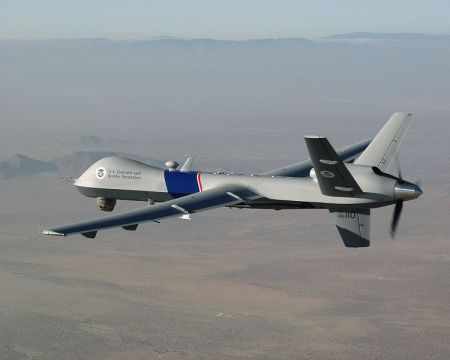
SOCOM: United States Special Operations Command

Admiral McRaven’s [head of the SOCOM] broad goal is to obtain new authority from the Defense Department to move his elite forces faster and outside normal Pentagon deployment channels. That would give him more autonomy to position his personnel and their fighting equipment where intelligence and world events indicate they are most needed. It would also allow the Special Operations forces to expand their presence in regions where they have not operated in large numbers for the past decade, especially in Asia, Africa and Latin America.

At a time of declining Pentagon budgets and a waning public appetite for large wars of occupation, the Obama administration hopes to rely more on foreign troops and security forces to tackle extremist threats abroad. These new realities have led to a larger debate within the military about its future priorities, and not all senior officers welcome Admiral McRaven’s ambitious proposals, suspecting a power grab that might weaken the authority of regional commanders.  “I was trying to figure out how to stand in front of this juggernaut that is the Special Operations Command, particularly in today’s world,” Adm. Timothy J. Keating, a former head of the military’s Northern and Pacific commands, said at a Special Operations conference in April in Washington. “I don’t fundamentally understand what needs fixing.”

While it is not unusual for branches of the armed services or combatant commands to lobby Congress for troop benefits or weaponry, like new fighter jets or artillery systems, the Special Operations Command’s hurried pitch because of the pending legislation did not go down well.  In its request in April 2012, the command sought a new $25 million fund to buy uniforms, build barracks and ferry foreign troops rather than using existing Pentagon and State Department aid programs that could have added months to the process. That required changes in the law, so the command asked to tuck them into a Pentagon budget bill the House was poised to pass.

In a three-page, confidential draft legislative proposal, the command argued that by coupling the proposed changes with its existing special fast-track acquisition authorities, it could provide “a fast turnaround resource for dealing with breaking issues.” Special Operations officers would work closely with American ambassadors in each country and the State Department to support foreign policy goals.  The legislative draft filled in some details of a plan sketched out for Congress on March 27 by the Pentagon’s top civilian Special Operations policy official, Michael A. Sheehan. Citing Africa as a prime example, Mr. Sheehan, a West Point graduate who is assistant secretary of defense for Special Operations and low-intensity conflict, told the Senate Armed Services Committee, “We will need different authorities, we will need different types of programs in order for us to engage with the range of countries, from Libya down through Mali, which is obviously in the middle of chaos right now, to Mauritania, all the way — and, quite frankly, all the way over to Nigeria.”

But lawmakers and State Department officials were puzzled. Only last year, Mr. Gates and Mrs. Clinton, backed by Congress, agreed to pool resources from their two departments in a new fund to respond more quickly to counter emerging threats from Al Qaeda and other militants in places like Yemen and the Horn of Africa.  The program, the Global Security Contingency Fund (pdf), is small as government programs go — $250 million a year, mostly from the Pentagon — but it is meant to address many of the needs the command’s proposal outlined.

A report accompanying the military budget bill that the House approved last month summed up the objections of not only lawmakers in the House and Senate, but also high-ranking administration officials who met on May 7 at the White House to work out the dispute. “The committee is concerned that the proliferation of similar, overlapping and/or competing building partner capacity authorities creates unnecessary confusion and friction,” the House report said.

Excerpt, ERIC SCHMITT, Elite Military Forces Are Denied in Bid for Expansion, New York Times, June 4, 2012
The Kill List and Body Count: Drones

Just days after taking office, the president [Obamaa] got word that the first strike under his administration had killed a number of innocent Pakistanis. “The president was very sharp on the thing, and said, ‘I want to know how this happened,’ “ a top White House adviser recounted.  In response to his concern, the C.I.A. downsized its munitions for more pinpoint strikes. In addition, the president tightened standards, aides say: If the agency did not have a “near certainty” that a strike would result in zero civilian deaths, Mr. Obama wanted to decide personally whether to go ahead.

The president’s directive reinforced the need for caution, counterterrorism officials said, but did not significantly change the program. In part, that is because “the protection of innocent life was always a critical consideration,” said Michael V. Hayden, the last C.I.A. director under President George W. Bush.  It is also because Mr. Obama embraced a disputed method for counting civilian casualties that did little to box him in. It in effect counts all military-age males in a strike zone as combatants, according to several administration officials, unless there is explicit intelligence posthumously proving them innocent.  Counterterrorism officials insist this approach is one of simple logic: people in an area of known terrorist activity, or found with a top Qaeda operative, are probably up to no good. “Al Qaeda is an insular, paranoid organization — innocent neighbors don’t hitchhike rides in the back of trucks headed for the border with guns and bombs,” said one official, who requested anonymity to speak about what is still a classified program.

This counting method may partly explain the official claims of extraordinarily low collateral deaths. In a speech last year Mr. Brennan, Mr. Obama’s trusted adviser, said that not a single noncombatant had been killed in a year of strikes. And in a recent interview, a senior administration official said that the number of civilians killed in drone strikes in Pakistan under Mr. Obama was in the “single digits” — and that independent counts of scores or hundreds of civilian deaths unwittingly draw on false propaganda claims by militants.

But in interviews, three former senior intelligence officials expressed disbelief that the number could be so low. The C.I.A. accounting has so troubled some administration officials outside the agency that they have brought their concerns to the White House. One called it “guilt by association” that has led to “deceptive” estimates of civilian casualties.  “It bothers me when they say there were seven guys, so they must all be militants,” the official said. “They count the corpses and they’re not really sure who they are.”

Excerpt, JO BECKER and SCOTT SHANE, Secret ‘Kill List’ Proves a Test of Obama’s Principles and Will, NY Times, May 29, 2012

United States, Iran and the Stuxnet Worm

From his first months in office, President Obama secretly ordered increasingly sophisticated attacks on the computer systems that run Iran’s main nuclear enrichment facilities, significantly expanding America’s first sustained use of cyberweapons, according to participants in the program.  Mr. Obama decided to accelerate the attacks — begun in the Bush administration and code-named Olympic Games — even after an element of the program accidentally became public in the summer of 2010 because of a programming error that allowed it to escape Iran’s Natanz plant and sent it around the world on the Internet. Computer security experts who began studying the worm, which had been developed by the United States and Israel, gave it a name: Stuxnet.  At a tense meeting in the White House Situation Room within days of the worm’s “escape,” Mr. Obama, Vice President Joseph R. Biden Jr. and the director of the Central Intelligence Agency at the time, Leon E. Panetta, considered whether America’s most ambitious attempt to slow the progress of Iran’s nuclear efforts had been fatally compromised.  “Should we shut this thing down?” Mr. Obama asked, according to members of the president’s national security team who were in the room.  Told it was unclear how much the Iranians knew about the code, and offered evidence that it was still causing havoc, Mr. Obama decided that the cyberattacks should proceed. In the following weeks, the Natanz plant was hit by a newer version of the computer worm, and then another after that. The last of that series of attacks, a few weeks after Stuxnet was detected around the world, temporarily took out nearly 1,000 of the 5,000 centrifuges Iran had spinning at the time to purify uranium.

This account of the American and Israeli effort to undermine the Iranian nuclear program is based on interviews over the past 18 months with current and former American, European and Israeli officials involved in the program, as well as a range of outside experts. None would allow their names to be used because the effort remains highly classified, and parts of it continue to this day.  These officials gave differing assessments of how successful the sabotage program was in slowing Iran’s progress toward developing the ability to build nuclear weapons. Internal Obama administration estimates say the effort was set back by 18 months to two years, but some experts inside and outside the government are more skeptical, noting that Iran’s enrichment levels have steadily recovered, giving the country enough fuel today for five or more weapons, with additional enrichment.

Whether Iran is still trying to design and build a weapon is in dispute. The most recent United States intelligence estimate concludes that Iran suspended major parts of its weaponization effort after 2003, though there is evidence that some remnants of it continue.

Iran initially denied that its enrichment facilities had been hit by Stuxnet, then said it had found the worm and contained it. Last year, the nation announced that it had begun its own military cyberunit, and Brig. Gen. Gholamreza Jalali, the head of Iran’s Passive Defense Organization, said that the Iranian military was prepared “to fight our enemies” in “cyberspace and Internet warfare.” But there has been scant evidence that it has begun to strike back.

The United States government only recently acknowledged developing cyberweapons, and it has never admitted using them. There have been reports of one-time attacks against personal computers used by members of Al Qaeda, and of contemplated attacks against the computers that run air defense systems, including during the NATO-led air attack on Libya last year. But Olympic Games was of an entirely different type and sophistication.

It appears to be the first time the United States has repeatedly used cyberweapons to cripple another country’s infrastructure, achieving, with computer code, what until then could be accomplished only by bombing a country or sending in agents to plant explosives. The code itself is 50 times as big as the typical computer worm, Carey Nachenberg, a vice president of Symantec, one of the many groups that have dissected the code, said at a symposium at Stanford University in April. Those forensic investigations into the inner workings of the code, while picking apart how it worked, came to no conclusions about who was responsible.

A similar process is now under way to figure out the origins of another cyberweapon called Flame that was recently discovered to have attacked the computers of Iranian officials, sweeping up information from those machines. But the computer code appears to be at least five years old, and American officials say that it was not part of Olympic Games. They have declined to say whether the United States was responsible for the Flame attack.

Mr. Obama, according to participants in the many Situation Room meetings on Olympic Games, was acutely aware that with every attack he was pushing the United States into new territory, much as his predecessors had with the first use of atomic weapons in the 1940s, of intercontinental missiles in the 1950s and of drones in the past decade. He repeatedly expressed concerns that any American acknowledgment that it was using cyberweapons — even under the most careful and limited circumstances — could enable other countries, terrorists or hackers to justify their own attacks.

“We discussed the irony, more than once,” one of his aides said. Another said that the administration was resistant to developing a “grand theory for a weapon whose possibilities they were still discovering.” Yet Mr. Obama concluded that when it came to stopping Iran, the United States had no other choice.If Olympic Games failed, he told aides, there would be no time for sanctions and diplomacy with Iran to work. Israel could carry out a conventional military attack, prompting a conflict that could spread throughout the region.

The impetus for Olympic Games dates from 2006, when President George W. Bush saw few good options in dealing with Iran. At the time, America’s European allies were divided about the cost that imposing sanctions on Iran would have on their own economies. Having falsely accused Saddam Hussein of reconstituting his nuclear program in Iraq, Mr. Bush had little credibility in publicly discussing another nation’s nuclear ambitions. The Iranians seemed to sense his vulnerability, and, frustrated by negotiations, they resumed enriching uranium at an underground site at Natanz, one whose existence had been exposed just three years before.

Iran’s president, Mahmoud Ahmadinejad, took reporters on a tour of the plant and described grand ambitions to install upward of 50,000 centrifuges. For a country with only one nuclear power reactor — whose fuel comes from Russia — to say that it needed fuel for its civilian nuclear program seemed dubious to Bush administration officials. They feared that the fuel could be used in another way besides providing power: to create a stockpile that could later be enriched to bomb-grade material if the Iranians made a political decision to do so.  Hawks in the Bush administration like Vice President Dick Cheney urged Mr. Bush to consider a military strike against the Iranian nuclear facilities before they could produce fuel suitable for a weapon. Several times, the administration reviewed military options and concluded that they would only further inflame a region already at war, and would have uncertain results.

For years the C.I.A. had introduced faulty parts and designs into Iran’s systems — even tinkering with imported power supplies so that they would blow up — but the sabotage had had relatively little effect. General James E. Cartwright, who had established a small cyberoperation inside the United States Strategic Command, which is responsible for many of America’s nuclear forces, joined intelligence officials in presenting a radical new idea to Mr. Bush and his national security team. It involved a far more sophisticated cyberweapon than the United States had designed before.

The goal was to gain access to the Natanz plant’s industrial computer controls. That required leaping the electronic moat that cut the Natanz plant off from the Internet — called the air gap, because it physically separates the facility from the outside world. The computer code would invade the specialized computers that command the centrifuges.  The first stage in the effort was to develop a bit of computer code called a beacon that could be inserted into the computers, which were made by the German company Siemens and an Iranian manufacturer, to map their operations. The idea was to draw the equivalent of an electrical blueprint of the Natanz plant, to understand how the computers control the giant silvery centrifuges that spin at tremendous speeds. The connections were complex, and unless every circuit was understood, efforts to seize control of the centrifuges could fail.

Eventually the beacon would have to “phone home” — literally send a message back to the headquarters of the National Security Agency that would describe the structure and daily rhythms of the enrichment plant. Expectations for the plan were low; one participant said the goal was simply to “throw a little sand in the gears” and buy some time. Mr. Bush was skeptical, but lacking other options, he authorized the effort.  It took months for the beacons to do their work and report home, complete with maps of the electronic directories of the controllers and what amounted to blueprints of how they were connected to the centrifuges deep underground.  Then the N.S.A. and a secret Israeli unit respected by American intelligence officials for its cyberskills set to work developing the enormously complex computer worm that would become the attacker from within.  The unusually tight collaboration with Israel was driven by two imperatives. Israel’s Unit 8200, a part of its military, had technical expertise that rivaled the N.S.A.’s, and the Israelis had deep intelligence about operations at Natanz that would be vital to making the cyberattack a success. But American officials had another interest, to dissuade the Israelis from carrying out their own pre-emptive strike against the Iranian nuclear facilities. To do that, the Israelis would have to be convinced that the new line of attack was working. The only way to convince them, several officials said in interviews, was to have them deeply involved in every aspect of the program.

Soon the two countries had developed a complex worm that the Americans called “the bug.” But the bug needed to be tested. So, under enormous secrecy, the United States began building replicas of Iran’s P-1 centrifuges, an aging, unreliable design that Iran purchased from Abdul Qadeer Khan, the Pakistani nuclear chief who had begun selling fuel-making technology on the black market. Fortunately for the United States, it already owned some P-1s, thanks to the Libyan dictator, Col. Muammar el-Qaddafi.  When Colonel Qaddafi gave up his nuclear weapons program in 2003, he turned over the centrifuges he had bought from the Pakistani nuclear ring, and they were placed in storage at a weapons laboratory in Tennessee. The military and intelligence officials overseeing Olympic Games borrowed some for what they termed “destructive testing,” essentially building a virtual replica of Natanz, but spreading the test over several of the Energy Department’s national laboratories to keep even the most trusted nuclear workers from figuring out what was afoot.

Those first small-scale tests were surprisingly successful: the bug invaded the computers, lurking for days or weeks, before sending instructions to speed them up or slow them down so suddenly that their delicate parts, spinning at supersonic speeds, self-destructed. After several false starts, it worked. One day, toward the end of Mr. Bush’s term, the rubble of a centrifuge was spread out on the conference table in the Situation Room, proof of the potential power of a cyberweapon. The worm was declared ready to test against the real target: Iran’s underground enrichment plant.

“Previous cyberattacks had effects limited to other computers,” Michael V. Hayden, the former chief of the C.I.A., said, declining to describe what he knew of these attacks when he was in office. “This is the first attack of a major nature in which a cyberattack was used to effect physical destruction,” rather than just slow another computer, or hack into it to steal data…  Getting the worm into Natanz, however, was no easy trick. The United States and Israel would have to rely on engineers, maintenance workers and others — both spies and unwitting accomplices — with physical access to the plant. “That was our holy grail,” one of the architects of the plan said. “It turns out there is always an idiot around who doesn’t think much about the thumb drive in their hand.”

In fact, thumb drives turned out to be critical in spreading the first variants of the computer worm; later, more sophisticated methods were developed to deliver the malicious code.  The first attacks were small, and when the centrifuges began spinning out of control in 2008, the Iranians were mystified about the cause, according to intercepts that the United States later picked up. “The thinking was that the Iranians would blame bad parts, or bad engineering, or just incompetence,” one of the architects of the early attack said.  The Iranians were confused partly because no two attacks were exactly alike. Moreover, the code would lurk inside the plant for weeks, recording normal operations; when it attacked, it sent signals to the Natanz control room indicating that everything downstairs was operating normally. “This may have been the most brilliant part of the code,” one American official said.

Later, word circulated through the International Atomic Energy Agency, the Vienna-based nuclear watchdog, that the Iranians had grown so distrustful of their own instruments that they had assigned people to sit in the plant and radio back what they saw.  “The intent was that the failures should make them feel they were stupid, which is what happened,” the participant in the attacks said. When a few centrifuges failed, the Iranians would close down whole “stands” that linked 164 machines, looking for signs of sabotage in all of them. “They overreacted,” one official said. “We soon discovered they fired people.”

Imagery recovered by nuclear inspectors from cameras at Natanz — which the nuclear agency uses to keep track of what happens between visits — showed the results. There was some evidence of wreckage, but it was clear that the Iranians had also carted away centrifuges that had previously appeared to be working well.  But by the time Mr. Bush left office, no wholesale destruction had been accomplished. Meeting with Mr. Obama in the White House days before his inauguration, Mr. Bush urged him to preserve two classified programs, Olympic Games and the drone program in Pakistan. Mr. Obama took Mr. Bush’s advice….

But the good luck did not last. In the summer of 2010, shortly after a new variant of the worm had been sent into Natanz, it became clear that the worm, which was never supposed to leave the Natanz machines, had broken free, like a zoo animal that found the keys to the cage. It fell to Mr. Panetta and two other crucial players in Olympic Games — General Cartwright, the vice chairman of the Joint Chiefs of Staff, and Michael J. Morell, the deputy director of the C.I.A. — to break the news to Mr. Obama and Mr. Biden.

“I don’t think we have enough information,” Mr. Obama told the group that day, according to the officials. But in the meantime, he ordered that the cyberattacks continue. They were his best hope of disrupting the Iranian nuclear program unless economic sanctions began to bite harder and reduced Iran’s oil revenues.

American cyberattacks are not limited to Iran, but the focus of attention, as one administration official put it, “has been overwhelmingly on one country.” There is no reason to believe that will remain the case for long. Some officials question why the same techniques have not been used more aggressively against North Korea. Others see chances to disrupt Chinese military plans, forces in Syria on the way to suppress the uprising there, and Qaeda operations around the world. “We’ve considered a lot more attacks than we have gone ahead with,” one former intelligence official said….

Mr. Obama has repeatedly told his aides that there are risks to using — and particularly to overusing — the weapon. In fact, no country’s infrastructure is more dependent on computer systems, and thus more vulnerable to attack, than that of the United States. It is only a matter of time, most experts believe, before it becomes the target of the same kind of weapon that the Americans have used, secretly, against Iran.

DAVID E. SANGER,Obama Order Sped Up Wave of Cyberattacks Against Iran, New York Times, June 1, 2012