Category Archives: hazardous waste

Migrating Nuclear Waste: West Lake Landfill

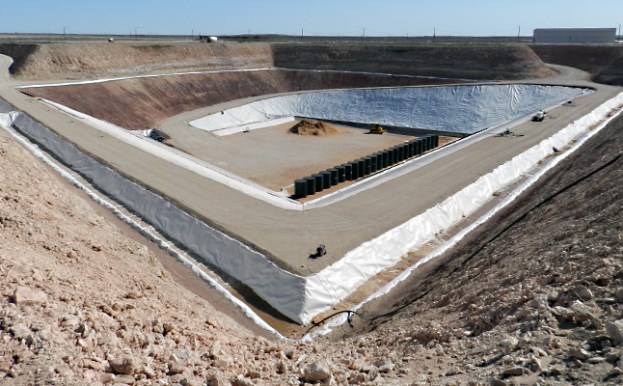
The West Lake Landfill is an unlined mixed-waste landfill located in Bridgeton, Missouri, near St. Louis and the Mississippi River, whose contents have been shown to include radioactive waste; it is thus also an EPA Superfund cleanup. It is operated by Bridgeton Landfill, LLC; Rock Road Industries, Inc.; and CotterCorporation …Contamination from this landfill containing nuclear-weapons-related waste likely has migrated off-site, according to a study published in the Journal of Environmental Radioactivity...The U.S. Environmental Protection Agency, have said their radiation sampling hasn’t shown evidence of the site posing a threat to the public.

The study’s authors, who include Robert Alvarez, a former senior Energy Department official in the Clinton administration, said they gathered more than 200 samples of soil and sediments from a roughly 75-square-mile area around the landfill. Dozens of the samples contained levels of radioactive lead that exceeded a cleanup standard used in the past by the federal government, the study said.  With West Lake being the largest known nearby repository of radioactive material, the findings are “strong evidence” of the landfill being the primary source, the study concluded. Radon gas is likely escaping from the site and decaying into radioactive lead, said the study.  Some of the highest levels were found in dust samples from several homes, said Mr. Alvarez. Those locations ” deserve further attention,” he said.  Mr. Alvarez, who has been critical of many federal nuclear policies, said some of the contamination, particularly in the homes, could be residue from old above-ground weapons-waste storage sites that were in the area until the early 1970s, when what was left was buried at West Lake.

For instance, as previously reported, federal surveys have found yards of some homes near a tainted creek that runs through the area to be contaminated with low levels of radioactive material, mainly thorium…..

Excerpt from John R. Emshwiller Study Finds Radioactive Waste at St. Louis-Area Landfill Has Migrated Off-Site, Nasdaq, Jan. 2, 2016

Nuclear Waste in the Seabed, Sweden


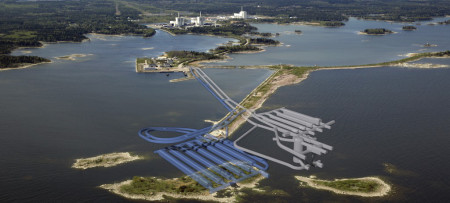
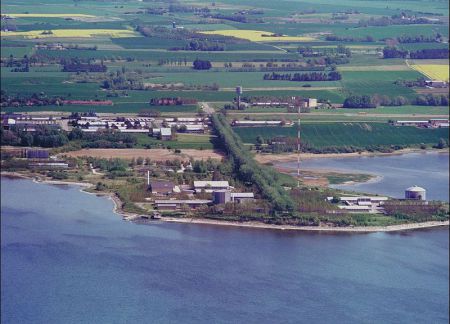
Sweden keeps its radioactive operational waste SKB’s Final Repository for Short-Lived Radioactive Waste is located at Forsmark in the municipality of Östhammar. The facility started operating in 1988 and was then the first of its kind in the world.  The radioactive waste deposited in the SFR is low and medium level waste. This means that unlike spent nuclear fuel it does not have to be cooled and is relatively short-lived.  The SFR is situated 50 metres below the bottom of the Baltic and comprises four 160-metre long rock vaults and a chamber in the bedrock with a 50-metre high concrete silo for the most radioactive waste.  Two parallel kilometre-long access tunnels link the facility to the surface.

Except from http://www.skb.com/our-operations/sfr/

National Security and Nuclear Industry

[A third nuclear reactor is to be built in Flamanville, France  by Electricité de France (EDF)]…Called Flamanville 3, is likely to become the focus of international attention because it is the model for an imminent expansion across the channel…EDF has agreed on October 21st agreed with China General Nuclear Power Corp (CGN), a state-owned entity, to build two reactors of the same design in south-west England called Hinkley Point C. EDF will own two-thirds of the project and CGN a third. The plant in Somerset is supposed to open by 2025, after construction that is forecast to cost £24.5 billion ($37.8 billion)…

The history of Flamanville 3, where work began in 2007, indicates how difficult that might be. It was planned as a five-year scheme, but this month EDF, which is mostly state-owned, formally asked officials to extend the deadline to 2020. Its original budget of €3.3 billion has more than tripled, to €10.5 billion ($11.9 billion). Getting its new European Pressurised Reactor (EPR) into service is proving harder than expected. One problem is the troubled condition of Areva, another mostly state-owned French firm, which supplies reactor components. It reported losses of nearly €5 billion in March, because of soaring costs and long delays at the only other EPR being built in Europe, Olkiluoto 3, in Finland. Work began in 2005 but it will not open before 2018 at the earliest.

The main technical problem at Flamanville 3 concerns suspicions of high levels of carbon in the steel of a crucial component, the vessel, already installed under the dome of the new reactor. Replacing it now, if inspectors conclude it is too brittle, would be costly. In June the company also said it was double-checking the working of safety valves.

Meanwhile EDF’s financial burden grows. It boasts of €73 billion in global revenues, but faces a threefold strain. Demand for electricity is stalling in France, its main market—and, as problematic, the country plans to cut nuclear’s share of electricity generation to half of the total, by 2025, from 75%. Next, though details are not finalised, EDF will absorb the nuclear unit of troubled Areva. Last, it has to upgrade, or at least maintain, France’s stock of ageing reactors. Mr Lévy told French radio on October 18th that capital expenditure for that alone would be around €50 billion.

No wonder ratings agencies judge that EDF’s financial prospects are secure only because of its state backing.  EDF’s prospects, indeed those of any nuclear company, depend on the backing of politicians who want to preserve nuclear expertise and jobs at home.

EDF’s Nuclear Ambitions: French Lessons, Economist,Oct. 24, 2015, at 63

Population Resettlement at Fukushima: who dares?

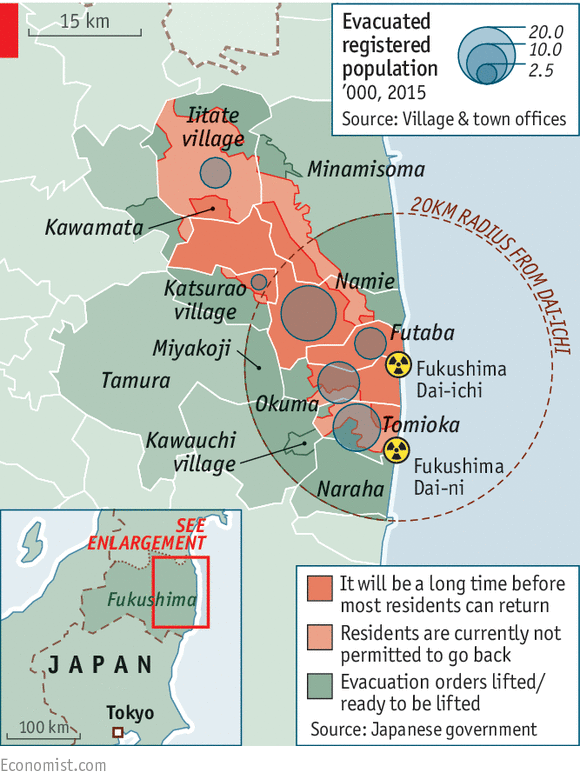
By the time Fukushima prefecture finishes the task of decontaminating houses and farmland around the Dai-ichi plant, it will have spent an estimated $50 billion on the work.  Some argue it would have been wiser to have spent the money on resettling former residents elsewhere. Already many of the 80,000 or so people displaced from the areas around the plant have begun new lives. Those moving back are mainly elderly. Local officials expect that half of the evacuees, especially those with children who are more vulnerable to radiation, may never return.

Fear of radiation, and distrust of data from the government and from the Tokyo Electric Power Company (TEPCO), the Dai-ichi operator, on the risk it poses, are the biggest reasons. On October 20th, 2015 it was announced that a worker who had helped to contain the accident had developed cancer linked to the meltdown. It was the first such diagnosis, but a recent medical study found a huge leap in cases of thyroid cancer among children and adolescents in Fukushima prefecture since the catastrophe.

Public faith in Japan’s institutions suffered a severe blow as a result of the government’s bungled response to the accident in 2011. So when officials of Tamura city wanted to open the Miyakoji district in 2013, residents resisted and demanded more decontamination work.

A year after the lifting of the evacuation order on his village, Yuko Endo, the mayor of Kawauchi, says distrust is so widespread that he doubts his community will return even near to its former size. But he has visited the area around Chernobyl in Ukraine, the site of the world’s worst nuclear disaster 29 years ago. He says the sight there of abandoned villages resembling graveyards has stiffened his resolve to rebuild. Those who have now returned are still deeply sceptical about the assurances they receive. Many ask why, for instance, if the soil is safe, they must take their locally grown produce to be checked for radiation.

There is a particular ray of hope in Naraha—more of one than is evident in Miyakoji and Kawauchi. The town will benefit from jobs related to the decommissioning of the nearby nuclear plants, including Dai-ni, which got through the earthquake and tsunami relatively unscathed. Another of Naraha’s immediate projects is to erect new streetlights. It will be helped by dollops of government aid. Mr Matsumoto, the mayor, talks of luring people back by making his town much more attractive than it was before. But for now, many streetlights do not even work. It is dark at night and the atmosphere is eerie.

Nuclear Power in Japan: Back to the Nuclear Zone, Economist, Oct. 24, 2015, at 39

Stop Fukushima Freeways


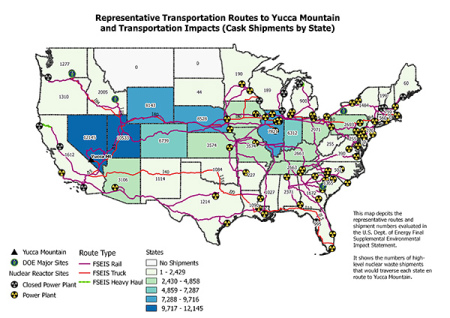
Over 250 intensely radioactive nuclear waste shipments would cross through
the Washington DC metropolitan area and thousands more would travel across the roads, rails  and waterways of the nation, if [the Yucca Mountain permanent repository in Nevada is approved]….The Nuclear Information and Resource Service (NIRS), an NGO, released maps of the likely routes radioactive shipments would use…

According to the map, highly radioactive waste fuel from nuclear power reactors in Virginia and Maryland would pass through the DC area on railroad tracks next to Metro Rail trains, including passing though Union Station. Each shipment contains several times more radioactive material than the Hioshima bomb blast released, with 20 to 50 tons of irradiated fuel assemblies in each  canister….  [Accident may happen during the shipments]…The shipments would also be vulnerable to attack or sabotage….Large-scale nuclear waste transport would also occur if, as some in Congress advocate, a“centralized interim storage” site for high-level radioactive waste were created.

Excerpts from Stop Fukushima Freeways Campaign Kicks Off, Nuclear Information and Resource Service Oct. 27, 2015

Nuclear Waste-Idaho National Laboratory


The U.S. Energy Department has canceled  in October 2015 a plan to ship to the Idaho National Laboratory spent nuclear fuel from commercial reactors out of state, a controversial proposal that drew protests from two former governors and a lawsuit from one of them. Incumbent Governor C.L. “Butch” Otter and state Attorney General Lawrence Wasden in January 2015 expressed conditional support for two proposed deliveries of the high-level radioactive waste, saying it would raise the lab’s profile and boost the local economy around Idaho Falls, where the facility is located.

But talks between the Department of Energy (DOE) and Idaho broke down amid mounting opposition to the plan by two of Idaho’s former governors, one of whom filed a lawsuit last month seeking information he said the federal agency was concealing about the proposal.

Cecil Andrus, a Democrat who served four terms as governor, said at the time that he suspected DOE’s intent was to turn the sprawling research facility along the Snake River into a de facto nuclear dump in the absence of a permanent repository for high-level radioactive waste elsewhere in the United States.  Earlier this year, Andrus and former Governor Phil Batt, a Republican, accused DOE of violating a 1995 agreement that banned such shipments to Idaho.Specifically, they said the Energy Department had not yet complied with a provision of the accord requiring removal of nuclear waste already stored at the lab to reduce impacts on an aquifer that supplies drinking water to tens of thousands of Idaho residents.

In a statement sent Friday to Idaho National Lab workers, the director, Mark Peters, said he had been informed that the state and DOE “were unable to reach an understanding that would have enabled the first of two recently discussed shipments of research quantities of spent nuclear fuel to come to INL.” [see also 2011 Memorandum of Agreement on Storage of Research Quantities of Commercial Spent Fuel at the Idaho National Laboratory]  Peters said in his statement that the spent nuclear fuel in question would be delivered instead to “another DOE facility,” though it was not made clear where the materials were now destined.

Energy Department cancels plan to ship nuclear waste to Idaho, Reuters, Oct. 23, 2015

Mining in Peru: China

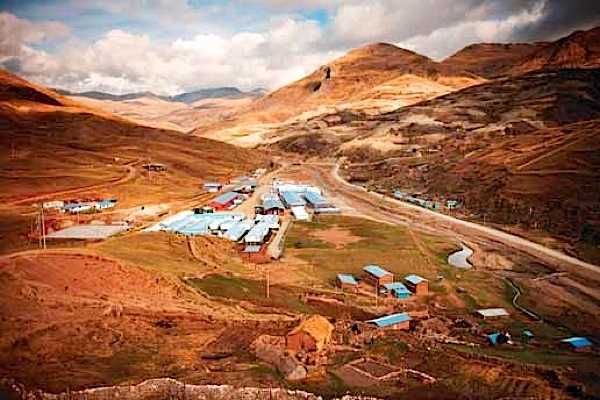
Finance Minister Alonso Segura said in an interview in 2015 that Peru is in good shape to weather the biggest flight of capital from emerging markets in a quarter century. It has foreign exchange reserves of more than $60 billion, or about 30 percent of gross domestic product.  With 2.4 percent growth forecast this year, the Peruvian economy will still easily outperform Latin America, whose overall output the IMF expects to shrink by 0.3 percent… What Peru lacks is both strong innovation and public institutions. The World Economic Forum ranks Peru in the bottom fifth globally in both.And so it remains heavily dependent on wooing mining investment with incentives including comparatively lax regulation.  In June 2014, Peru enacted a law further easing environmental rules.

Carlos Monge, Latin America director for the New York-based nonprofit Natural Resource Governance Institute, blames that law for triggering a protest last month in which four people were killed by police bullets at a $7.4 billion Chinese-owned copper mining project.  Protest leaders complained that Las Bambas’ mine owner, China Minmetals Corp., altered the project’s plans without local consent, eliminating plans for a mineral pipeline. Instead, instead crushed ore was to be trucked through communities, increasing contamination.  In May, 2015 five people were killed as farmers in a rice-growing valley mobilized against another copper-mining project, this one Mexican-owned.  In both disputes, the government declared states of emergency and suspended civil liberties locally.  Said Monge: “More conflicts is a very possible scenario, as the government is seeking mining projects at all costs.”

Excerpts from Celebration of Peru’s economic boom comes late, Associated Press, Oct. 9, 2015

Climate Change 2015


Global carbon emissions were 58% higher in 2012 than they were in 1990. The atmospheric concentration of carbon dioxide has risen from just under 340 parts per million in 1980 to 400 in 2015.  To stand a fair chance of keeping warming to just 2°C by the end of the century—the goal of global climate policy—cumulative carbon emissions caused by humans must be kept under 1 trillion tonnes. Estimates vary but, according to the Intergovernmental Panel on Climate Change, the total had hit 515 billion tonnes by 2011. Climate Interactive, a research outfit, reckons that if emissions continue on their present course around 140 billion tonnes of greenhouse gases will be released each year and temperatures could rise by 4.5°C by 2100. And even if countries fully honour their recent pledges, temperatures may still increase by 3.5°C by then.

The world is already 0.75°C warmer than before the Industrial Revolution….

Melting glacier ice, and the fact that warmer water has a larger volume, mean higher sea levels: they have already risen by roughly 20cm since 1880 and could rise another metre by 2100. That is perilous for low-lying islands and flat countries: the government of Kiribati, a cluster of tropical islands, has bought land in Fiji to move residents to in case of flooding. Giza Gaspar Martins, a diplomat from Angola who leads the world’s poorest countries in the climate talks, points out that they are particularly vulnerable to the effects of a warming planet. Money alone, he argues, will not fix their problems. Without steps to reduce emissions, he predicts, “there will be nothing left to adapt for.”…

For every 0.6°C rise in temperature, the atmosphere’s capacity to hold water grows by 4%, meaning storms will pour forth with greater abandon. The rains of the Indian monsoon could therefore intensify, cutting yields of cereals and pulses.

Climate change seems also to be making dry places drier, killing crops and turning forests into kindling. Forest fires in Indonesia, more likely thanks to the current El Niño weather phenomenon, could release 2 billion tonnes of carbon dioxide, about 5% of annual emissions due to human activity, says Simon Lewis of University College London. In recent months fires have swallowed more than 2.4m hectares of American forests. Alaska suffered 80% of the damage—a particular problem because the soot released in these blazes darkens the ice, making it less able to reflect solar radiation away from the Earth.

Developments in the Arctic are worrying for other reasons, too. The region is warming twice as fast as the rest of the world, a trend that could start a vicious cycle. Around 1,700 gigatonnes of carbon are held in permafrost soils as frozen organic matter. If they thaw, vast amounts of methane, which is 25 times more powerful as a global-warming gas than carbon dioxide when measured over a century, will be released. One hypothesis suggests that self-reinforcing feedback between permafrost emissions and Arctic warming caused disaster before: 55m years ago temperatures jumped by 5°C in a few thousand years…

And on September 29th Mark Carney, the governor of the Bank of England, warned that though measures to avoid catastrophic climate change are essential, not least for long-term financial stability, in the shorter term they could cause investors huge losses by making reserves of oil, coal and gas “literally unburnable”.

Excerpts from Climate Change: It’s Getting Hotter, Economst, Oct. 3, 2015, at 63


Fukushima in Singapore: nuclear accidents

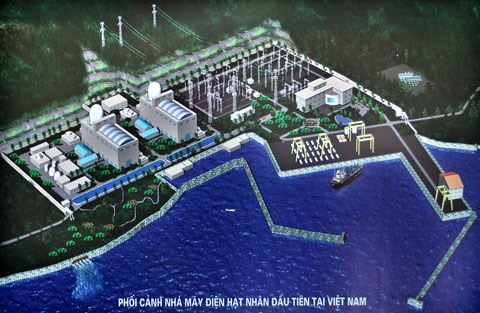
In Asia, plans have been delayed but not derailed. China and India, between them, have almost 50 nuclear plants in operation and are building even more.  In Southeast Asia, Vietnam could have its first power reactors by 2020. Thailand, Indonesia and Malaysia have also made plans.

“Southeast Asia is quasi-completely dependent on fossil fuels,” said Professor Arnoud De Meyer, President of Singapore Management University….Nuclear-based energy can add security and stability to the region’s source of energy. For Singapore, 95 per cent of its electricity comes from natural gas powered plants. Its cost is tied to oil prices.  Experts say Singapore’s choice, although the cleanest among fossil fuels, is also an expensive choice….This is because the cost associated with importing natural gas to run Singapore’s power plants is also higher….

In 2010, Singapore embarked on an extensive study of whether nuclear-based electricity could be added to its energy mix.  Two years later, it concluded that nuclear risks for Singapore outweighed the benefits.  “It was all to do with size,” said Professor Tim White, co-director of Nanyang Technological University’s Energy Research Institute.  “The first factor was that we did not really need a very large single nuclear reactor. Singapore just does not have that need for energy. So we would have had to look at modular designs, but none of those designs are actually operating at the moment – at least for power. So Singapore did not want to be the first one off the rack to take these new designs.

“The other concern was that after Fukushima, it was realised that the exclusion zone around the reactor was in fact as large as Singapore. So that meant one Fukushima accident in Singapore and that’s the end of the country. …But the study also concluded that Singapore needs to build up its nuclear knowledge and capability. In 2014, the government announced it would set aside S$63 million over five years for the Nuclear Safety Research and Education Programme.  The programme would train local scientists and engineers in three key areas – radiochemistry, radiobiology and risk assessment

“Even if Singapore would never have electricity generation by nuclear sources, countries around us will do it, or may well do it,” said Prof De Meyer. “But nuclear radiation is not something that stops at borders. If there is an accident or a problem, Singapore will be automatically influenced by it.,,,

But first, one expert says ASEAN needs a regulatory framework to address transboundary issues such as the management of nuclear fuel, waste and risk management….“If something happens, for example, in Indonesia’s nuclear facility, which will be built very close to Singapore, it will affect the whole country,” said Associate Professor Sulfikar Amir from NTU’s School of Humanities and Social Sciences.

Excerpts from Monica Kotwani, Singapore must be prepared to handle nuclear developments: Experts, Channel NewsAsia,  27 Sep 2015

Nuclear Waste: play for time

The problem now, however, is civilian waste from power plants that came online in the 1960s, 1970s and 1980s. Nuclear power generates a fifth of America’s electricity; its 99 reactors account for almost a third of all nuclear power generated worldwide. Five more are under construction—the first to be approved since the 1970s—partly thanks to federal loan guarantees intended to boost clean energy production. The waste they generate has been stored safely, but it will stay dangerously radioactive for tens of thousands of years. That requires a longer-term plan than leaving it outside, however well encased in concrete.

Under the 1982 Nuclear Waste Policy Act, the federal government pledged to dispose of nuclear waste—both civilian and military—permanently. Several possible plans were drawn up, many involving burying the waste in salt deposits deep under ground. To pay for this eventual cost, a levy was added to the bills of consumers of nuclear power.

But politics got in the way. In 1987 Congress determined that only one place, Yucca Mountain in Nevada, would be considered. This, says Richard Stewart of New York University Law School, was the result of a stich-up between two congressmen who did not want their states to host waste dumps. Tom Foley, the then House majority leader, and Jim Wright, the Speaker, blocked proposals for sites in their home states of Washington and Texas.

Nevadans nickname the 1987 amendment the “screw Nevada” bill, and they have fiercely resisted implementation. Some $15 billion has been spent on building the repository at Yucca Mountain, but no waste has been moved there. Nevadans are quick to point to the damage done to their state by nuclear-weapons tests. Since 2010, the Department of Energy has formally ruled the facility out. In a lawsuit in 2013, the government was forced to stop collecting the levy on nuclear power until a plan exists for a permanent site. It has also been forced to pay utility companies for the costs of storing waste temporarily, since it did not start collecting waste fuel in 1998, as the original law dictated.

Some hope Yucca Mountain might be reopened by a new president. “The only aspect of used fuel in this country that has been problematic is the politics”, says John Keeley of the Nuclear Energy Institute, an industry lobby group. In January the Nuclear Regulatory Commission, the regulator, concluded that the site is safe for the disposal of waste. But the worries of Nevadans—that moving spent fuel on railways might lead to spills, or that radioactivity could leak into the environment—remain.

Recent experience doesn’t help. America already operates one of the world’s few deep storage sites for radioactive waste—near Carlsbad, in New Mexico. It stores waste mostly from nuclear-weapons production. In February 2014 the facility suffered two crippling accidents. One was apparently caused by workers packaging waste with the wrong sort of cat litter. The plant-based “Swheat Scoop” brand they used, unlike the mineral-based kind they were meant to, did not absorb radioactivity very well. The facility has not accepted any new waste since.

Excerpts from Nuclear Waste: Faff and fallout, Economist, August 29, 2015, at 23

Uranium in Central Asia-Water Pollution

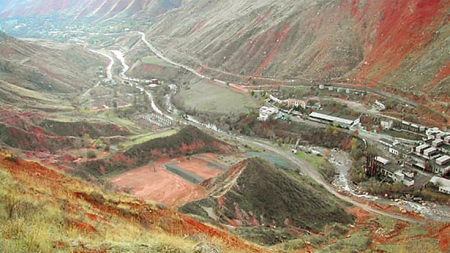
Kyrgyzstan:   Dr Osekeeva’s 38 years practising family medicine in this idyllic-looking valley in southern Kyrgyzstan make her a cataloguer of death. Cancer rates are rising, she says, and she thinks she knows the culprit. Buried along the river in and around Mailuu-Suu, a town of some 20,000 people, lurks the poisonous legacy of the Soviet Union’s first atom bombs: 2m cubic metres of radioactive waste leaching into the water supply.  Mailuu-Suu was once closed to outsiders. Its well-paid workers were treated as members of the elite: they received perks such as handouts of beer and beach vacations in Crimea. Over the years, they mined and milled 10,000 tonnes of uranium ore into yellowcake, ready for conversion into bomb material. Uranium was also sent from as far as East Germany and Czechoslovakia to be processed here.

With the collapse of the Soviet Union and local industry in 1991, the specialists left. Supervision of the town’s 23 tailings sites—dumps containing the hazardous leftovers—became sporadic. Fences and warning signs have been looted for scrap metal. Today, cows graze atop the invisible menace. Goats sleep inside an abandoned uranium mineshaft. Local dairy products and meat are often unsafe; kitchen taps spew silty river water laced with heavy metals.

Neighbouring countries worry. The river through Mailuu-Suu is prone to earthquakes and floods. It is only about 15 miles (25km) upstream from Central Asia’s breadbasket, the Fergana Valley, which is home to over 10m people. Every few years landslides block the flow, threatening to flood the dumps and wash radionuclides over the melon patches and cornfields downstream. A European aid official warns of a “creeping environmental disaster”.

Mailuu-Suu is only a small part of the picture. Dotting hills above the Fergana—straddling the post-Soviet republics of Kyrgyzstan, Tajikistan and Uzbekistan—lie dozens of other tailings dumps. Many also contain other heavy metals such as lead, arsenic and cadmium, which can be more dangerous to the body than radiation. Few are secured or monitored.

The three countries are hardly on speaking terms, so cross-border co-operation is non-existent. …Kyrgyzstan, however, has made a little progress. Between 2010 and 2012, an $8.4m World Bank-led project moved 150,000 cubic metres of waste from one of the most accident-prone tailings dumps in Mailuu-Suu to a safer spot up the hill. But locals complain they were not briefed properly about this. They say workers stirred up radioactive dust; many claim cancers have grown more frequent since the transfer.

The government is appealing to the European Union for $50m to deal with ten sites at Mailuu-Suu it says are in need of “urgent” relocation. Others estimate that even this relatively small project would cost hundreds of millions. Kyrgyz officials grumble that donors are slow to make decisions, spending millions on assessments that take years.

The International Atomic Energy Agency says the landslides and flooding make Mailuu-Suu “high risk” and a top priority. But donors can be forgiven for hesitating. Corruption and inertia have eroded many government institutions in Kyrgyzstan and its neighbours.

Uranium in Central Asia: Poisoned legacy, Economist, July 11, at 40

Nuclear and Toxic Waste-Iraq

Most of the Iraq’s vast deposits of radioactive materials are a legacy of the turbulent regime of former leader Saddam Hussein, and have built up over the last four decades. Other toxic materials can be found in the country’s graveyards of contaminated industrial equipment“The parliament has decided to study the situation again after other provinces [including Dhi Qar] rejected such decision,” said Yahya al-Nasiri, governor of the southern Dhi Qar province.

“The proposals suggest burying the waste outside the country or in the desert…Asked if there are other ways to dispose of the waste, he said “it could possibly be buried in the sea using special containers or be sent to countries willing to take it, in exchange for money.”

While Nasiri said other provinces have rejected a similar request, Dhi Qar’s provincial council voted against the Iraqi parliament’s proposal in early July 2015 to use some of the southern province’s land as a burial site for the radioactive pollutants coming from all other provinces of the country.  Dhi Qar’s health and environment committee head Abdulamir Salim at the time slammed the proposal and said it posed a “real threat to the health and security of the province’s citizens.”..

An official Iraqi study in 2010 found more than 40 sites across the country that were contaminated with high levels or radiation and dioxins.  Iraq “without doubt” suffers from these radioactive pollutants inherited from “continuous wars” starting in the 1980s Iraqi-Iran war to the Gulf War in 1990s till 2003, when the United States used highly advanced weapons – including depleted uranium – in its efforts to topple Hussein’s regime, the governor lamented….However, it is not only war-produced pollutants that harm people’s health in Iraq – in addition, there is a lack of quality controls imposed on imported goods.  Radioactive material is also “the result of imports of car parts from Japan to the province,” he added….Areas around Iraqi cities such as Najaf, Basra and Fallujah accounted for more than 25 percent of the contaminated sites, with the southern city of Basra – the frontline during Iran-Iraq war and the Gulf War – having 11 sites, according to the 2010 study.

The study, carried out by the environment, health and science ministries found that scrap metal yards in and around the capital Baghdad and Basra contain high levels of ionizing radiation, which is thought to come from depleted uranium used in munitions during the first Gulf war and since the 2003 invasion.  “The U.S. army unfortunately caused an increase in these radioactive material by using uranium and its advanced arms that use a lot of harmful radioactive material,” Nasiri said. “But the U.S. army did not help nor support our projects to get rid of these pollutants.”

Excerpts from Dina al-Shibeeb, Iraq studying new plan on where to bury radioactive waste, says official, Al Arabiya News, July 18, 2015

Nuclear Reactors Exports – China

China Power Investment Corporation and State Nuclear Power Technology Corp have officially announced their merger, as Beijing moves to consolidate its nuclear power sector, aiming eventually to export reactors.  China Power producer currently controls about a tenth of China’s nuclear power market, while the State Nuclear was formed in 2007 to handle nuclear technology transferred from U.S.-based Westinghouse Electric Co.

The new company, State Power Investment Corporation, is expected to own assets over 700 billion yuan ($112.94 billion) and to post revenue of over 200 billion yuan annually, state news agency Xinhua said, citing Wang Binghua, the chairman and party secretary of State Power Investment Corporation.

China National Nuclear Power Corp (CNNC) said …that the merger to form State Power Investment Corporation will increase competition between China’s three major nuclear corporations in both domestic and international construction of nuclear infrastructure. The other major player in this sector is China General Nuclear Power Group (CGN).China is contemplating a merger between CNNC and CGN which were set up as rivals to compete for projects at home and overseas but, under government prompting, have cooperated on a single reactor brand, Hualong 1, with the intention of eventually marketing it abroad.

Beijing said in January it would aid the overseas expansion of Chinese firms, in particular in the rail and nuclear power sectors, raising hackles with some trading partners who fear it signals another wave of subsidized Chinese exports.

China nuclear power firms merge to fuel global clout, Reuters, May 30, 2015

Regulating Mining in the Deep Seabed

Interest in mining the deep seabed is not new; however, recent technological advances and increasing global demand for metals and rare-earth elements may make it economically viable in the near future  Since 2001, the International Seabed Authority (ISA) has granted 26 contracts (18 in the last 4 years) to explore for minerals on the deep seabed, encompassing ∼1 million km2 in the Pacific, Atlantic, and Indian Oceans in areas beyond national jurisdiction However, as fragile habitat structures and extremely slow recovery rates leave diverse deep-sea communities vulnerable to physical disturbances such as those caused by mining (3), the current regulatory framework could be improved. We offer recommendations to support the application of a precautionary approach when the ISA meets later this July 2015….

The seabed outside of national jurisdictions [called the “Area” in the United Nations Convention on the Law of the Sea (UNCLOS)] is legally part of  the “common heritage of mankind” and is not subject to direct claims by sovereign states. The common-heritage principle imposes a kind of trusteeship obligation on the ISA, created under UNCLOS in 1994, and its member states, wherein “the interests of future generations have to be respected in making use of the international commons”; those interests include both resource exploitation and environmental protection …

Efforts focused on the Clarion-Clipperton Fracture Zone (CCZ) in the abyssal Pacific provide a useful model. The CCZ as the largest known concentrations of high-grade polymetallic nodules, with potentially great commercial value . The scale of impacts that would be associated with nodule mining in the CCZ may affect 100s to 1000s of km2 per mining operation per year . In 2007, an international workshop brought together expert representatives from ISA and the scientific and international ocean law communities to develop design principles and recommendations for a network of marine protected areas (MPAs) in the CCZ off-limits to mining, to be considered by the ISA as part of a regional environmental management plan. The workshop used a recent assessment of biodiversity, species ranges, and gene flow in the CCZ to develop recommendations honoring existing mining exploration claims while incorporating accepted principles of ecosystem management ..

In 2012, the ISA pioneered a precautionary approach in the CCZ when it provisionally adopted the deep seabed’s first environmental management plan that included Areas of Particular Environmental Interest (APEIs), a modified version of the recommended MPA network from the 2007 workshop. The design principles used in developing the APEIs included (i) compatibility with the existing legal framework of the ISA for managing seabed mining and protecting the marine environment. (ii) minimizing socioeconomic impacts by honoring existing exploration claims; (iii) maintaining sustainable, intact, and healthy marine populations; (iv) accounting for regional ecological gradients; (v) protecting a full range of habitat types; (vi) creating buffer zones to protect against external anthropogenic threats (e.g., mining plumes); and (vii) establishing straight-line boundaries to facilitate rapid recognition and compliance (12)….

Meanwhile, the ISA continues to grant exploration contracts for large areas of other deep-sea habitats in the Indian, Atlantic, and Pacific Oceans. Preexisting or new exploration claims (up to ∼75,000 km2 for nodules) can erode the effectiveness of protected-area networks by preempting protection of critical habitats and by limiting population connectivity by causing excessive spacing between MPAs. We thus recommend that the ISA consider suspending further approval of exploration contracts (and not approve exploitation contracts) until MPA networks are designed and implemented for each targeted region.

Excerpts from L. M. Wedding et al., Managing mining of the deep seabed, Science 10 July 2015:

The Runit Nuclear Tomb

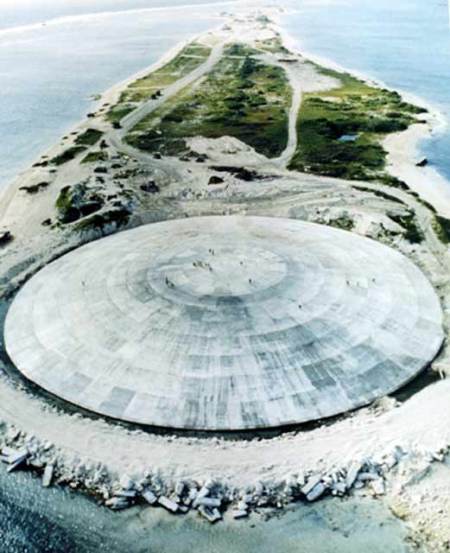
[The debris left by the United States nuclear testing at the Marshall islands  were buried under] a vast structure is known as the Runit Dome. Locals call it The Tomb. Below the 18-inch concrete cap rests the United States’ cold war legacy to this remote corner of the Pacific Ocean: 111,000 cubic yards of radioactive debris left behind after 12 years of nuclear tests.  Brackish water pools around the edge of the dome, where sections of concrete have started to crack away. Underground, radioactive waste has already started to leach out of the crater: according to a 2013 report by the US Department of Energy, soil around the dome is already more contaminated than its contents.  Now locals, scientists and environmental activists fear that a storm surge, typhoon or other cataclysmic event brought on by climate change could tear the concrete mantel wide open, releasing its contents into the Pacific Ocean….

Enewetak Atoll, and the much better-known Bikini Atoll, were the main sites of the United States Pacific Proving Grounds, the setting for dozens of atomic explosions during the early years of the cold war.  The remote islands – roughly halfway between Australia and Hawaii – were deemed sufficiently distant from major population centres and shipping lanes, and in 1948, the local population of Micronesian fishermen and subsistence farmers were evacuated to another atoll 200 km away.  In total, 67 nuclear and atmospheric bombs were detonated on Enewetak and Bikini between 1946 and 1958 – an explosive yield equivalent to 1.6 Hiroshima bombs detonated every day over the course of 12 years.

The detonations blanketed the islands with irradiated debris, including Plutonium-239, the fissile isotope used in nuclear warheads, which has a half-life of 24,000 years.  When the testing came to an end, the US Defence Nuclear Agency carried out an eight-year cleanup, but Congress refused to fund a comprehensive decontamination programme to make the entire atoll fit for human settlement again.

The DNA’s preferred option – deep ocean dumping – was prohibited by international treaties and hazardous waste regulations, and there was little appetite for transporting the irradiated refuse back to the US.  In the end, US servicemen simply scraped off the islands’ contaminated topsoil and mixed it with radioactive debris. The resulting radioactive slurry was then dumped in an unlined 350-foot crater on Runit Island’s northern tip, and sealed under 358 concrete panels.

But the dome was never meant to last. According to the World Health Organization, the $218m plan was designed as temporary fix: a way to store contaminated material until a permanent decontamination plan was devised.  Meanwhile, only three of the atoll’s 40 islands were cleaned up, but not Enjebi, where half of Enewetak’s population had traditionally lived. And as costs spiralled, resettlement efforts of the northern part of the atoll stalled indefinitely.  Nevertheless, in 1980, as the Americans prepared their own departure, the dri-Enewetak (“people of Enewetak”) were allowed to return to the atoll after 33 years.

Three years later, the Marshall Islands signed a compact of free association with the US, granting its people certain privileges, but not full citizenship.  The deal also settled of “all claims, past, present and future” related to the US Nuclear Testing Program – and left the Runit Dome under the responsibility of the Marshallese government.  Today, the US government insists that it has honoured all its obligations, and that the jurisdiction for the dome and its toxic contents lies with the Marshall Islands.  The Marshallese, meanwhile, say that a country with a population of 53,000 people and a GDP of $190m – most of it from US aid programs – is simply incapable of dealing with the potential radioactive catastrophe left behind by the Americans.

Today, Runitis still uninhabited, but it receives regular stream of visitors heading from neighboring islands to its abundant fishing grounds or searching for scrap metal to salvage.…Three decades after the Americans’ departure, abandoned bunkers dot the shoreline, and electric cables encased in black rubber snake across the sand.Nowhere on the beaches or the dome itself is there a warning to stay away – or even an indication of radioactivity.

The US has yet to fully compensate the dri-Enewetak for the irreversible damage to their homeland, a total amounting to roughly $244m as appraised by the Nuclear Claims Tribunal.+++ Many locals are deeply in debt, and dependent on a supplemental food program funded by the US Department of Agriculture, which delivers shipments of process foods such as Spam, flour and canned goods. The destruction a centuries-old lifestyle have lead to both a diabetes epidemic and regular bouts of starvation on the island….

Other – and more worrying – traces of Enewetak’s history have also reached China: according to a 2014 study published in Environmental Science & Technology, plutonium isotopes from the nuclear tests have been found as far a the Pearl River Estuary in Guangdong province.

Many people in Enewetak fear that one day the dome will break open, further spreading highly radioactive debris.  As catastrophic weather events become more frequent, recent studies – including 2013 study of the Runit Dome’s structural integrity carried out by the DoE – have warned that typhoons could destroy or damage the cement panels, or inundate the island. A 2013 report commissioned by the US Department of Energy to the Lawrence Livermore National Laboratory acknowledged that radioactive materials are already leaching out of the dome, but downplays the possibility of serious environmental damage or health risks….

Independent scientists say that salvaging Runit’s scrap metal may expose locals to much higher risks.“Those guys are digging in the dirt breathing in stuff in hot spots. That has to be hundreds of thousands times higher doses of potential health effects than swimming,” said Ken Buessler, a senior scientist and marine chemist at the Woods Hole Oceanographic Institution, who visited Runit and gathered samples of sediment in the lagoon earlier this year…

“Why Enewetak?” asked Ading, Enewetak’s exiled senator during an interview in the nation’s capital. “Every day, I have that same question. Why not go to some other atoll in the world? Or why not do it in Nevada, their backyard? I know why. Because they don’t want the burden of having nuclear waste in their backyard. They want the nuclear waste hundreds of thousands miles away. That’s why they picked the Marshall Islands.” “The least they could’ve done is correct their mistakes.”

Excerpts from Coleen Jose et al., The radioactive dome on Enewetak atoll, Guardian, July 3, 2015

+++In June 1983, the Agreement Between the Government of the United States and the Government of the Marshall Islands for the Implementation of Section 177 of the Compact of Free Association (referred to as 177 Agreement) established the Claims Tribunal “with jurisdiction to ‘render final determination upon all claims past, present and future, of the Government, citizens and nationals of the Marshall Islands which are based on, arise out of, or are in any way related to the Nuclear Testing Program.”The Tribunal was established in 1988.

See also UN Human Rights report Mission to the Marshall Islands

Nuclear Waste Disposal: Japan

The Japanese government will select potential areas to host nuclear dump sites instead of waiting for communities to volunteer, according to the revised policy on permanent disposal of high-level radioactive waste that was adopted by the Cabinet on May 22, 2015  The revision, the first in seven years, was prompted after towns, villages and cities throughout Japan snubbed requests to host nuclear waste dumps. The government has been soliciting offers since 2002.

The move is seen as a sign that the government wants to address the matter as it proceeds with its pursuit of reactor restarts. All commercial units have largely sat idle since the triple meltdown at the Fukushima No. 1 plant in 2011….Prime Minister Shinzo Abe’s administration is seeking to revive atomic power, although the majority of the public remains opposed in light of the Fukushima disaster, which left tens of thousands homeless. Critics have attacked the government for promoting atomic power without resolving where all the waste will end up.

Permanent disposal of high-level nuclear waste requires that a depository be built more than 300 meters underground, where the materials must lie for up to 100,000 years until radiation levels fall to the point where there is no harm to humans or the environment.  About 17,000 tons of spent fuel is stored on the premises of nuclear plants and elsewhere in Japan, but some would run out of space in three years if all the reactors got back online.  Under the revision, the government said it will allow future generations to retrieve high-level waste from such facilities should policy changes or new technologies emerge.

Worldwide, only Finland and Sweden have been able to pick final depository sites.

Excerpts from METI changes tactics after search for nuclear waste host proves futile,  Japan Times, May 22, 2015

100 Years of Oil Leaks: Gulf of Mexico

A decade-old oil leak where an offshore platform toppled during a hurricane could continue spilling crude into the Gulf of Mexico for a century or more if left unchecked, according to government estimates obtained by The Associated Press that provide new details about the scope of the problem.  Taylor Energy Company, which owned the platform and a cluster of oil wells, has played down the extent and environmental impact of the leak. The company also maintains that nothing can be done to completely eliminate the chronic oil slicks that often stretch for miles off the coast of Louisiana….

Federal regulators suspect oil is still leaking from at least one of 25 wells that remain buried under mounds of sediment from an underwater mudslide triggered by waves whipped up by Hurricane Ivan in 2004….A Taylor contractor drilled new wells to intercept and plug nine wells deemed capable of leaking oil. But a company official has asserted that experts agree the “best course of action … is to not take any affirmative action” due to the risks of additional drilling…

The AP’s review of more than 2,300 Coast Guard pollution reports since 2008 showed a dramatic spike in sheen sizes and oil volumes since Sept. 1, 2014. That reported increase came just after federal regulators held a workshop August 2014 to improve the accuracy of Taylor’s slick estimates and started sending government observers on a Taylor contractor’s daily flights over the site.

Presented with AP’s findings, the Coast Guard provided a new leak estimate that is about 20 times greater than one recently touted by the company. In a February 2015 court filing, Taylor cited a year-old estimate that oil was leaking at a rate of less than 4 gallons per day.

A Coast Guard fact sheet says sheens as large as 1.5 miles wide and 14 miles long have been spotted by Taylor since the workshop. Since last September, the estimated daily volume of oil discharged from the site has ranged from roughly 42 gallons to 2,329 gallons, with a daily average of more than 84 gallons.,,, Based on satellite imagery and pollution reports, the watchdog group SkyTruth estimates between 300,000 and 1.4 million gallons have spilled from the site since 2004, with an annual average daily leak rate between 37 and 900 gallons.

Ken Arnold, an industry consultant, said natural oil seeps from cracks in the seabed can last for thousands of years. But he has never heard of another commercial oil spill lasting more than a decade, let alone a century.

In 2008, Taylor set aside hundreds of millions of dollars to pay for leak-related work as part of a trust agreement with the Interior Department. The company says it has spent tens of millions of dollars on its efforts to contain and halt the leak, but it hasn’t publicly disclosed how much money is left in the trust. The company sold all its offshore leases and oil and gas interests in 2008, four years after founder Patrick Taylor died, and is down to only one full-time employee.

Justice Department officials say the company approached the government concerning the trust fund, but they declined to discuss the terms of its proposal. Federal agencies responded that more work needed to be done, including installing a more effective containment dome system, and that the company remained responsible for doing that work, the officials said.

Oil leak that began after 2004 storm could last a century, U.S. says, Chicago Tribune, May 15, 2015


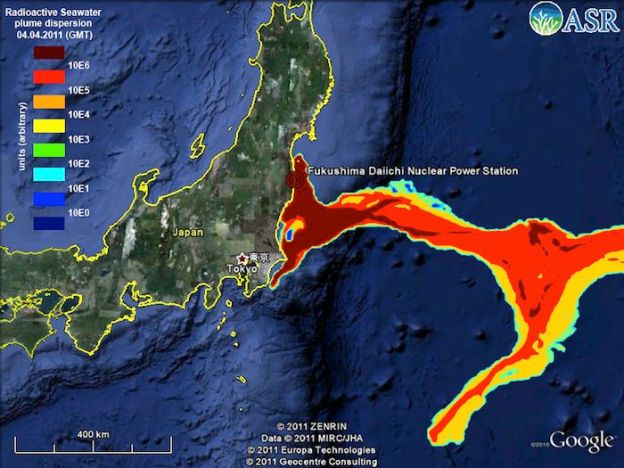
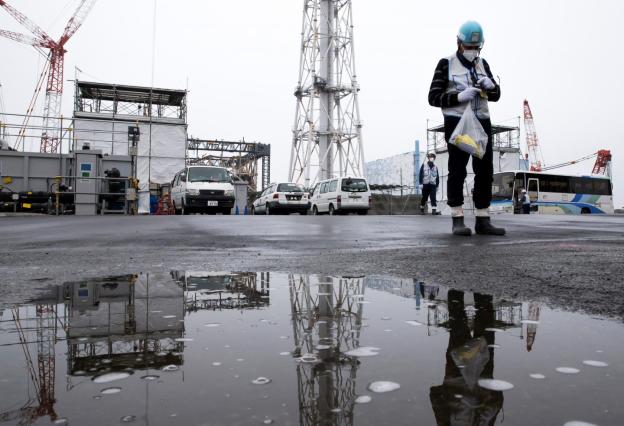
Releasing Nuclear Waste into the Pacific – Fukushima

From the Report of the IAEA regarding  Radioactive Water at Fukushima:

While the IAEA is recognizing the usefulness of the large number of water treatment systems deployed by TEPCO for decontaminating and thereby ensuring highly radioactive water accumulated at the site is not inappropriately released to the environment including the adjacent Pacific Ocean, the IAEA team also notes that currently not all of these systems are operating to their full design capacity and performance. ….The IAEA team is of the opinion that the present plan to store the treated contaminated water containing tritium in above ground tanks, with a capacity of 800,000 m 3 , is at best a temporary measure while a more sustainable solution is needed. Therefore the present IAEA team reiterates the advisory point of the previous decommissioning mission: “The IAEA team believes it is necessary to find a sustainable solution to the problem of managing contaminated water at TEPCO’s Fukushima Daiichi NPS.

This would require considering all options, including the possible resumption of controlled discharges to the sea. TEPCO is advised to perform an assessment of the potential radiological impact to the population and the environment arising from the release of water containing tritium and any other residual radionuclides to the sea in order to evaluate the radiological significance and to have a good scientific basis for taking decisions. It is clear that final decision making will require engaging all stakeholders, including TEPCO, the NRA, the National Government, Fukushima Prefecture Government, local communities and others”.

From the IAEA report Released on May 14, 2015 MISSION REPORT IAEA INTERNATIONAL PEER REVIEW MISSION ON MID-AND-LONG-TERM ROADMAP TOWARDS THE DECOMMISSIONING OF TEPCO’S FUKUSHIMA DAIICHI NUCLEAR POWER STATION UNITS 1-4 (Third Mission) Tokyo and Fukushima Prefecture, Japan 9 – 17 February 2015

Costs of Closing Down Nuclear Plants

According to Callan Investment Institute, underfunded decommissioning costs could amount to $23 billion from investor-owned utilities.  The industry has already set aside $50 billion to fund specific trust funds designated exclusively for decommissioning expenses, mostly collected from ratepayers….

As part of the Nuclear Regulatory Commission commissioning and licensing of a power plant, the plant owners establish a trust fund, known as the Nuclear Decommissioning Trust, or NDT. The sole purpose of this trust fund is to provide funds for the cost to decommission the facility when that time comes. The owners contribute annually to the fund, in relationship to the percent ownership, based on projected costs and length of the license. The companies are the final backstop to shortfalls in funding to these trusts.

The origin of the capital for fund contributions is from customer rate cases – in other words, NDT funding is part of our monthly electric bills. Owners are required to review annually and submit every two years to the NRC both the fund balance and cost estimates for decommissioning. The NRC provides a formula of costs for operators to compare with the balances on the NDT, or the companies can file site-specific cost projections for each facility.

The total industry-wide decommissioning costs are estimated by Callan to be $80 billion….[For instance] Entergy, according to the study, their NDT could be short by about $2 billion and to make up this difference over the average life remaining of their licenses, management should be setting aside $186 million a year rather than the $39 million currently. However, ETR is not alone in the study. The industry contributed $315 million in 2013 when Callan calculates the amount should be closer to $1.6 billion. Below are some shortfall numbers for the five largest nuclear power generators,…

According to Callan, Exelon has potential net deficiencies of $7.7 billion including Constellation Energy; Duke has a potential net deficiency of $2.3 billion; Entergy of $2.0 billion; Dominion Resources  of $1.3 billion; and NextEra has a potential surplus of $208 million. Combined, the largest five producers of nuclear power have a potential decommissioning deficit of $13.1 billion, or 57% of the projected total industry-wide.

Excerpts from George Fisher, A $23 Billion Potential Shortfall For 27 Utilities With Nuclear Power Plants, Seeking Alpha,May. 15, 2015

Full Study (pdf)

Ukraine – Nuclear Power and Waste

UKRAINE, More than 3,000 spent nuclear fuel rods are kept inside metal casks within towering concrete containers in an open-air yard close to a perimeter fence at Zaporizhia, the Guardian discovered on a recent visit to the plant, which is 124 miles (200km) from the current front line.“

With a war around the corner, it is shocking that the spent fuel rod containers are standing under the open sky, with just a metal gate and some security guards waltzing up and down for protection,” said Patricia Lorenz, a Friends of the Earth nuclear spokeswoman who visited the plant on a fact-finding mission.“I have never seen anything like it,” she added. “It is unheard of when, in Germany, interim storage operators have been ordered by the court to terror-proof their casks with roofs and reinforced walls.”  

Industry experts said that ideally the waste store would have a secondary containment system such as a roof.  Ukraine’s conflict in Donbass is 124 miles away from the plant, but Gustav Gressel, a fellow at the European Council of Foreign Relations thinks the front line is too far away – for now – to be at risk from fighting.

However, locals still fear for the potential consequences if the conflict was to spread in the plant’s direction. Just three decades ago, an explosion at the Chernobyl nuclear power plant north of Kiev released a radioactive cloud that poisoned vast tracts of land…

Plant security at Zaporizhia is now at a ‘high readiness’ level, while air force protection and training exercises have been stepped up. Officials say that if fighting reaches the plant, there are plans for the closure of access roads and deployment of soldiers.  But they say that no containment design could take the stresses of military conflict into account. “Given the current state of warfare, I cannot say what could be done to completely protect installations from attack, except to build them on Mars,” Sergiy Bozhko , the chairman of the State Nuclear Regulatory Inspectorate of Ukraine (SNRIU) told the Guardian…..

However, a dry storage container with a resilient roof and in-house ventilation would offer greater protection….

“Nuclear energy is the only possible option for us to replace the generated electricity that we lost [from coal and gas],” a government source told the Guardian. “After the start of open war with Russia, it was understood that all our other strategies in the energy sphere would become impossible.” Some 60% of Ukraine’s electricity is now produced by 15 ageing reactors – concentrated in four giant plants. Nine of these will reach the end of their design lifetimes in the next five years, and three have already.  Most of Ukraine’s nuclear fleet depends on Russia’s Rosatom to supply its enriched uranium fuel – and to whisk away the resulting radioactive waste for storage…

But as fear and loathing in the war-torn region grow, government sources say that in the long term, Ukraine aims to forge a three-way split in nuclear fuel supply contracts between US-company Westinghouse, European companies, such as Areva, and Rosatom. This creates its own safety issues….

Last December (2014), the US firm signed a memo with Ukraine to “significantly increase fuel deliveries” to Ukrainian plants, though the details are sketchy. A similar deal was signed with the French nuclear company Areva on 24 April.  But fears of Russian retaliation have dogged past plans to shift supply or disposal contracts to the West, and market diversification will be a slow process….

The US has provided technology, training and hundreds of millions of dollars to help Ukraine’s push for fuel diversification, according to a US diplomatic cable from 2009, published by Wikileaks.  Westinghouse has also lobbied the Ukrainian government at ministerial level to commit to buying their fuel for at least five reactors. Plant managers say that it will be used in Zaporizhia by 2017.

Excerpts from Nuclear waste stored in ‘shocking’ way 120 miles from Ukrainian front line, Guardian, May 6, 2015

Oil Pollution in Nigeria – Shell

Farmers impacted by the Shell Petroleum Development Company, SPDC, Kolo Creek oil fields spill in Otuasega, Ogbia Local Government Area of Bayelsa State, have gone to court over the April 15, 2015 spill, which polluted their farms.According to the farmers, they were excluded from a Joint Investigation Visit to probe the impact of the spill despite their attempt to draw the attention of the team to their impacted farms.

A fish farmer, Mr. Aku Asei, whose three ponds were impacted, said the affected farmers numbering over 50 resolved to take legal action over the incident in the wake of the alleged claim of sabotage by Shell.”This is a clear case of the powerful and rich oil firm against the weak and poor farmers. They are claiming that the spill was caused by sabotage and abandoned the polluted environment. The regulations which they relied on to absolve themselves clearly stated that the operator of the field where pollution occurs must clean up the site irrespective of the cause but SPDC officials declined to capture the farms as impacted areas….[T]he spill was as a result of negligence by SPDC surveillance contractors deployed to guard the facility…

The farmers, made up of fish farmers, banana and plantain plantation owners in the area also appealed to Bayelsa State Government to assist them in prevailing on the oil firm to clean up the areas and pay compensation to them.

Nigeria: Farmers Take Shell to Court Over Oil Spill Impact in Bayelsa, AllAfrica.com, May 12, 2015

Illegal Waste from Canada to Philippines

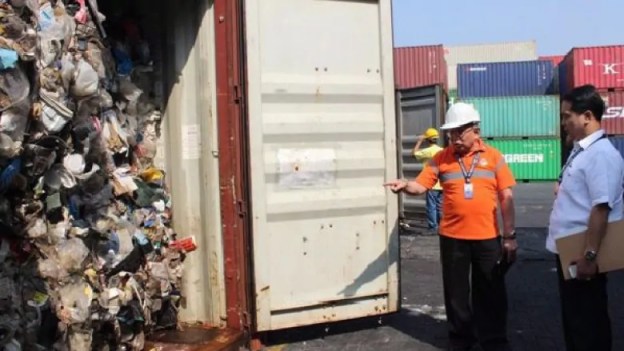
Fifty containers of Canadian garbage, including used adult diapers, have been languishing in the port of Manila in the Philippines for almost two years and setting off recent protests by environmental and public health activists.The activists, among them a Catholic priest, say the containers hold toxic and hazardous waste, although a recent study by Philippines officials suggests they’re simply stuffed with household garbage.

Late last year (2014), the Philippines government recommended the containers be returned to Canada under the provisions of the Basel Convention, which prohibits developed countries from shipping waste to developing nations.“The Basel Convention says, as a developed country, (Canada) cannot export waste,” Filipino environment secretary Ramon Paje said in a televised interview. “That would be considered as dumping.”…

A spokeswoman for Foreign Affairs (Canada) reiterated the government’s long-stated opinion that the case is a private commercial matter involving a Canadian company and its Philippines partner.….Chronic Inc., a plastics exporter based in Whitby, Ontario , shipped the containers — supposedly filled with recyclable Vancouver plastics — to the Philippines in the spring and summer of 2013. But upon inspection, the country’s Bureau of Customs found the containers were filled with stinking household garbage, including used adult diapers and kitchen waste.

The bureau said the material could “pose biohazard risks” and impounded the shipment.
Jim Makris, head of the Lee-Anne Goodmandenied last year that he shipped garbage to the Philippines….The Philippine Daily Inquirer reported in 2014 that the Bureau of Customs is investigating the 150-worker plant in Valenzuela City started by Makris to sort and sell the plastic he ships.

Excerpts from Lee-Anne Goodman, 50 containers of Canadian garbage rots in Manila for two years, Canadian Press, Mar. 20, 2015

Nuclear Industry in Siberia

Professor Leonid Rikhvanov says he has a number of questions about the potential damage to the community from reactors that have been used since the Soviet Era .His plea comes as the Siberian Chemical Combine  (SCC) in Seversk, a secretive city located 15 miles north of Tomsk, prepares for the construction of a new experimental fast reactor  known as BREST-300…

‘I would also like to raise the question of conducting a complex study on how the SCC’s reactors have affected the environment over the past 50 years. Before making a decision on new projects, it’d be worth estimating the outcomes of the old ones’…Siberian Chemical Combine in Seversk, a secretive city located 15 miles north of Tomsk, prepares for the construction of a new experimental fast reactor.

‘And lastly I would ask about warheads [housed at SCC as recently as the 1990s]. Have they been replaced or not? If not, in what conditions are they kept?’He added: ‘I’m not radical and I support the idea of nuclear energy. But the approach to its use, and to estimating risks, should be totally different. Russian nuclear enterprises as they are now are so dangerous that it’d definitely be better if they didn’t exist at all.’

On April 6 2015 it was reported in Seversk that construction was already under way of a pilot plant for the production of fuel for the experimental BREST-300 reactor.The new reactor will work on special ‘pills’ made from the spent nuclear fuel and taken from the old reactors, with officials saying it will allow waste-free production of energy.  It is thought the pilot plant will begin operating in 2017, with the full new BREST-300 reactor up and running from 2020.

Prof Rikhvanov stressed that he is not anti-nuclear but insisted that it has to be used correctly with the proper safety and environmental considerations in place. An accident at a new plant at the Siberian Chemical Combine in February 2015 resulted in an employee receiving burns to his hands.And, of course, a massive explosion at the site in April 1993 resulted in the release of a radioactive gas cloud in an incident listed as one of the world’s worst nuclear accidents.Prof Rikhvanov was one of the experts flown into Seversk following the incident, allowing him a rare glimpse inside the secretive city to analyse the state of the plant.

‘First of all, we got to see what is there,’ he recalled. ‘I visited all the production facilities, I saw the reactors, the well where the waste is put to, and the warehouses where the nuclear warheads were stored with my own eyes.’I saw about 23,000 decommissioned warheads stored there. And I doubt they have been moved elsewhere since then. By the way, at the time, they were stored in terrible conditions and I don’t know what it is like now.’ The professor also found out that a facility for storing liquid radioactive waste in aquifers was located near to where the water supply was sourced on the Tom River.  As far as he is aware, the situation remains the same. He said: ‘We pump water from aquifers on the left side of the river, and store some of the most hazardous elements humanity has ever created in aquifers on the other side of the river…

Another concern he has is that the city is ‘still not prepared’ for a mass evacuation in the event of a major incident.’The road to Maryinsk is terrible, the second branch of the railway hasn’t spring out yet,’ he said. ‘There is also no separate railway to ship the radioactive materials to SCC without going through Tomsk. Such freights are now going through city railway station which creates additional risks.’

Excerpts from Olga Gertcyk & Derek Lambie, Expert raises serious questions over state of the nuclear industry in Siberia,  Siberian Times, May 2, 2015

Kitty Litter and Nuclear Waste: Don’t Mix

The US energy department is to fund $73m in road and other infrastructure projects in New Mexico as compensation for radiation leaks at a nuclear laboratory and underground dump.The deal struck between the department and New Mexico forgoes fines and instead applies funds to upgrade federal nuclear facilities and surrounding communities in the state, according to settlement documents.  Projects include construction of a $5m emergency operations centre in Carlsbad, near where the nuclear waste dump leaked radiation in February 2014.

The leak at the Waste Isolation Pilot Plant, or Wipp, exposed 22 workers to radiation in amounts not expected to threaten their health and led to the indefinite suspension of key operations at the site, which is the energy department’s only permanent underground disposal facility for certain types of waste from US nuclear labs.The radiation accident was caused by “chemically incompatible” contents, including cat litter, which reacted in a barrel of waste and caused it to rupture, according to a federal probe of the mishap.  The breached drum containing radioisotopes such as plutonium was improperly packaged with the wrong sort of absorbent litter at the Los Alamos National Laboratory near Santa Fe before it arrived at WIPP for disposal, investigators found….

The deal includes $34m to improve roads around the Wipp site, $12m to improve nuclear waste transportation routes in and around Los Alamos, and $9.5m in stormwater management upgrades at the lab’s complex.In addition it provides $10m for improvements to water infrastructure in and around Los Alamos and $2.75m for an independent compliance and operational review. Energy department officials have estimated the cost of the initial recovery of the dump at $240m and that it might be two years or more before it is fully operational.

Excerpts from New Mexico radiation accident: $73m compensation deal struck over leak, Guardian, Apr. 30, 2015

Building Climate Resilience in Ecosystems

Some ecosystems show little response [to climate change] until a threshold or tipping point is reached where even a small perturbation may trigger collapse into a state from which  recovery is difficult .  ….[S}uch collapse may be altered by conditions that can be managed locally…. [This] provides  potential opportunities for pro-active management.…[C]rises in iconic UNESCO World Heritage sites illustrate that such stewardship is at risk of failing. The term “safe operating space” frames the  problem of managing our planet in terms of staying within acceptable levels or “boundaries” for global stressors [Such as climate change]….

Obviously, local interventions are no panacea for the threats of climatic change. For example, melting of arctic sea ice with its far-reaching ecological consequences cannot be arrested by local management. However, ways of building climate resilience are emerging for a variety of ecosystems, ranging from control of local sources of ocean acidification  to management of grazing pressure on dry ecosystems,World Heritage Areas.

The Doñana wetlands in southern Spain provide the most important wintering site for waterfowl in Europe. They contain the largest temporary pond complex in Europe, with a diversity of amphibians and invertebrates. Despite the site’s protected status, the marshes are threatened by eutrophication due to pollution and reduced flow of incoming streams, promoting toxic cyanobacterial blooms and dominance by invasive floating plants that create anoxic conditions in the water. In addition, groundwater extraction for strawberry culture and beach tourism also has major impacts.  Little has been done to control these local stressors, leaving Doñana unnecessarily vulnerable to climate change. UNESCO has just rated this World Heritage Site as under ‘very high threat’.

The Great Barrier Reef is the largest coral system in the world. In response to multiple threats, fishing has been prohibited since 2004 over 33% of the Great Barrier Reef Marine Park, and efforts have begun to reduce runoff of nutrients, pesticides, herbicides and sediments from land. However, these interventions may be too little, too late. Approximately half of the coral cover has been lost in recent decades, and the outlook is “poor, and declining” with climate change, coastal development and dredging as major future threats. The World Heritage Committee has warned that in the absence of a solid long-term plan, it would consider listing the reef as “in danger” in 2015.

More available online Creating a Safe Operating Space for Iconic Ecosystems By M. Scheffer et al, 2015

The Nuclearization of Sub-Saharan Africa

Kenya and Uganda are among the countries making progress in nuclear technology in sub-Saharan Africa with both involved with the pre-feasibility study stage in their atomic energy programmes.  According to the the International Atomic Energy Agency (IAEA), Kenya successfully completed its pre-feasibility stage while Uganda is currently conducting its own.

A pre-feasibility stage involves assessing energy needs, proposing roadmaps, developing expertise and training human resources, establishing policy and regulatory frameworks and mobilizing funding as a country prepares to conduct feasibility studies for nuclear plants.

“Kenya and Uganda join their sub-Saharan Africa counter-parts, Ghana, Nigeria, Sudan and Niger while in North Africa – Egypt, Algeria, Morocco, Tunisia and Libya have taken notable steps,” Jin Kwang Lee, African Regional Officer at IAEA told a conference on energy and nuclear power in Kwale….James Banaabe Isingoma, Uganda’s acting Commissioner for Energy Efficiency and Conservation told East African Business Week while it is perceived Uganda will build a nuclear plant by 2026, this projection is too ambitious, because financing for reactors is hard to find.  Kenya aims to have a nuclear plant by 2025…

Kenya hopes to establish a 1,000 MW reactor between 2022 and 2027. Njoroge said, “We are committed to the introduction of nuclear energy to our country’s energy mix which is currently dominated by hydro-power projects. We will soon deplete geothermal and hydro generation hence be left with no choice, but to go nuclear,” he said.  “We are injecting Ksh 300 million (about $3 million) in human resource training annually and we think nuclear will be a game changer. It is economically strategic because all other available resources will be exploited by 2031,” Njoroge said.He said, “It means we will be able to drive ironuclear power plantn and steel production, electric rails, powering mills and petroleum pipelines.”

Currently, the two regional neighbours are grappling with insufficient power supply as demand increases with economic growth and rural electrification programmes that are putting more people on the grid.

Excerpt from Uganda: Kenya and Uganda Eye Nuclear Power, allAfrica.com, Apr. 19, 2015

Corruption Begets Corruption: Nigeria Oil

Dead fish wash up on the once-fertile shores of creeks around Bodo, a town in the Niger delta, that are covered with crude oil more than six years after two massive spills. Locals have only now received compensation from Shell, the oil firm responsible for the leaks. For the first time in half a decade, fishermen have cash to start businesses, repair their houses and send children to school… “Look,” says the chief of a tiny town called B-Dere, just a few miles from Bodo. He gestures to the deathly-black banks still bearing the marks of the slicks. “There is nothing to drink, nowhere to fish. What good has come from it?”

The cash that the oil industry provides has greased Nigerian politics for decades. Gross mismanagement and corruption in the industry are the causes of much of the inequality and discontent with the ruling party in an economy that is not just Africa’s largest but that ought to also be one of its wealthiest…

Nigeria pumps something like 2m barrels of oil a day. These account for most of its exports and about 70% of government revenues. But official figures are as murky as its polluted creeks. Volumes are recorded only at export terminals rather than at the wellhead, says Celestine AkpoBari of the Port Harcourt-based advocacy group, Social Action. Were a proper tally kept, he says, corruption would be exposed on a scale that would shock even the most cynical Nigerian.

It seems likely that more than 100,000 barrels of crude are stolen (or “bunkered” in the local parlance) every day, at a cost to the state and investors of billions of dollars a year. Politicians, oil workers and security forces are said to be behind the complex cartels that steal, illegally refine and sell crude oil. They have amassed almost unimaginable wealth in a country where poverty is still rife.

Oil’s taint has seeped into almost all levels of government and business. Yet the central problem is found in the petroleum ministry, which wields vast unaccountable power. The Nigerian National Petroleum Corporation (NNPC), a state-owned behemoth, is responsible for all aspects of the industry, from exploration to production and regulation. It is among the most secretive oil groups in the world, and is “accountable to no one”, says Inemo Samiama, country head of the Stakeholder Democracy Network, a non-profit group.

In 2013 the former governor of the central bank, Lamido Sanusi, alleged that $20 billion in oil revenues was missing from state coffers. He was fired for his troubles soon after. …

Even where cash has not been nicked, it has often been squandered. Take the Excess Crude Account (ECA), a sovereign-wealth fund intended to cushion Nigeria’s budget against falling oil prices. Most of it was spent over the past two years, despite oil prices being relatively high for most of that period.

The industry itself is in as sorry a state as the government’s finances. Although oil practically gushes from the ground in parts of the delta, oil output has been stagnant for years and billions of dollars of investment are stalled because of uncertainty over a new law for the industry.  This is holding back Nigeria’s economy almost across the board. Because the industry has failed to build the infrastructure to pipe gas to domestic consumers such as power plants, much of it is simply flared and burned: Britain reckons that some $800m worth of Nigeria’s gas a year goes up in smoke. The country is also chronically short of fuel even though it has four state-owned oil refineries. Because of poor maintenance and ageing equipment they operate at well below capacity, forcing Nigeria to import about 70% of the fuel it needs. There is little incentive for reform since the government pays hefty subsidies to NNPC to keep on importing…

But a starting point should be to halt subsidies for fuel imports. At a stroke that would undercut a major source of corruption and crime (both on land and at sea) that spills into neighbouring countries, the destination for smuggled consignments of cheap Nigerian fuel. It should also take a close look at NNPC, which should not be allowed both to participate in the market and regulate it. Some of its assets could be privatised. The ruling party and opposition are considering both….

For communities in Ogoniland, the most pressing problem is cleaning up. Shell has promised to mop up the mess around Bodo, though the process has yet to start. Compensation is one thing, Bodo residents say, but what they really want is their livelihood back.

Nigeria’s oil: Crude politics, Economist,  Mar. 28, 2015, at 54

Nuclear Submarines on Fire

More than 80 firefighters and 20 fire trucks were involved in the work to extinguish the fire [that occurred on nuclear submarine  the “Oryol”], at around 2PM Moscow time during  works on the submarine, at Zvezdochk,  shipyard in Severodvinsk Russia.   The first information that the fire had been put out, came at around 5PM, but this information turned out to be false. The fire was not extinguished until 00:57 Moscow time, after the dock with the submarine had been flooded.  The vessels reactor had been shut down and the fuel had been unloaded before the repairs started. The submarine had no weapons onboard

One of many accidents
This accident that occurred on April 7, 2015 was the latest in a series of accidents that have occurred at Zvezdochka and other ship repair yards in Northwest-Russia during the last years.

On December 29, 2011 a fire broke out on the nuclear-powered Delta IV-class submarine “Yekaterinburg” while it was in a floating dock at the naval yard Roslyakovo just north of the town of Murmansk on the Kola Peninsula. According to the first official reports the fire only harmed the outer rubber coating of the submarine, and all the missiles had removed from the vessel before going in dock. Later Northern Fleet officials admitted that the submarine had both missiles and torpedoes on board. “Yekaterinburg” was re-launchedin June 2014, after two years of repairs.

In March 2014, during decommissioning work on the Oscar-II class nuclear submarine “Krasnodar” at the Nerpa naval yard north of Murmansk, the rubber on the outer hull of the submarine caught fire. There were no radioactive leakages, and no one was hurt in the accident.

Tuesday’s accident was the seventh at Zvezdochka in ten years, according to RIANovosti.  The other accidents were:

February 19 2010: Fire during dismantling of the Akula-class nuclear submarine K-480 “Ak Bars”. No casualties. Cause of fire: violation of fire safety during hot works.
December 11 2009: Leak of two cubic meters of liquid radioactive waste from a broken pipeline. No casualties, no radioactive waste leaked into the environment.
October 6 2009: Fire during dismantling of the Yankee-class nuclear submarine K-403 “Kazan”. The fire occurred during use of gas-flame cutter. Workers evacuated, no casualties.
March 25 2009: Fire during dismantling of the Yankee-class nuclear submarine K-411 “Orenburg”. The rubber coating of the vessel caught fire during hot works. No casualties.
July 26 2007: The main ballast tank of a nuclear submarine in dry dock was punctured as a result of excess air pressure. No casualties.
August 1 2005: Two people died in a fire during dismantling of an Akula-class nuclear submarine. Cause of the fire was ignition of vapors of fuel and lubricants during hot works.

Excerpts  from Trude Pettersen, Fire-struck nuclear submarine to be repaired, Barents Observer, Apr. 8, 2015

Nuclear Waste Nightmare – Germany

Germany aims to phase out its nine remaining reactors by 2022, faster than almost any country. But nobody knows exactly how much it costs to shut and clean up atomic-power plants and all the facilities used over decades to store radioactive waste. Building a depository for the waste deep underground and delivering the waste add additional unknown costs…

“There are still no clear answers to many fundamental questions involving final and intermediate storage, dismantling [reactors] and transporting radioactive waste,” said Frank Mastiaux, chief executive of EnBW Energie Baden-Württemberg AG, one of Germany’s largest utility companies. “Concrete concepts have long been promised, but there is nothing yet in sight.”

Nuclear energy accounts for about 16% of German electricity production, down from a peak of 31% in 1997, according to the federal statistics office. France gets roughly 75% of its electricity from nuclear energy and the U.S. around 20%, according to the World Nuclear Association. The issue of Germany’s decommissioning became urgent in 2011, after the disaster at Japan’s Fukushima power plant, when Ms. Merkel decided to accelerate the shutdown of all German reactors by as much as 14 years, to 2022.

That move forced EnBW and Germany’s other big utilities—E.ON SE, RWE AG and a unit of Sweden’s Vattenfall AB—to book billions of euros in write-downs on nuclear assets and increase their provisions for early decommissioning of the facilities. The provisions now total about €37 billion ($40 billion).

The cost could ultimately top €50 billion, estimates Gerald Kirchner, a nuclear expert previously at Germany’s federal office for radiation protection.And that money might have to be covered by taxpayers if a power company faces insolvency or some other scenarios, the government report warned.

The energy companies are being pummeled by falling electricity demand in Europe and billions of euros in government-subsidized so-called green energy flooding the power grid. Both effects are eroding wholesale power prices, leaving conventional power stations unprofitable…

Germany isn’t alone in tackling decommissioning. The International Energy Agency says roughly half of the world’s 434 nuclear-power plants will be retired by 2040. Most are in Europe, the U.S., Russia and Japan.Despite this global trend, no country yet has a site ready for final disposal of radioactive waste.

Germany is trying to find a deep geological site suitable to store highly radioactive waste for about one million years—the time waste needs to become safe to most living organisms. The country expects about 600,000 cubic meters of radioactive waste by 2080. And that doesn’t include more highly radioactive waste slated to be shipped back soon from France and Britain, where German nuclear fuel had been sent for reprocessing…

Until a final disposal site is found, all waste will be stored temporarily. Keeping interim facilities safe is expensive. E.ON has said delays in finding a disposal site will cost the German nuclear industry €2.6 billion.Utilities have sued the German government to recover some cleanup costs, but verdicts could be years away. And their efforts face political opposition.

Excerpts By NATALIA DROZDIAK and JENNY BUSCHE, Germany’s Nuclear Costs Trigger Fears, Wall Street Journal, Mar. 22, 2015

Nuclear Waste: Divided Europe

Germany, Poland and Sweden are all jumping on the bandwagon to criticise Denmark’s plans to safely dispose of its 5,000-10,000 cubic metres of nuclear waste. The main criticisms concern both the geographical areas being considered for the waste storage and the assessment of the type of waste that is being deposited, reports Ingeniøren.

Currently, Denmark’s nuclear waste is stored in Risø, a town on the west Zealand coastline north of Roskilde, where the country’s DR3 reactor is located. The waste is piling up and is scheduled to be removed by 2023 and put in a final repository. [Note that Denmark doe s not produce nuclear energy.  The radioactive waste has been produced by research reactors at the Risø National Laboratory that are  in the process of being decommissioned].

Based on a report by Rambøll, an engineering consultancy group commissioned by the Ministry of Health to assess waste locations, Denmark is considering six possible locations for the waste site: Rødbyhavn on Lolland, Paradisbakkerne on Bornholm, Thyolm, Thise, Skive and Kertinge Mark Kerteminde. All six municipalities have declined to have the waste deposited on their lands.

German and Polish authorities have been particularly worried about locations near their borders as both countries have said Denmark’s final repository plans would be too close to the surface for nuclear waste and would be a real threat to groundwater contamination.

Umweltsinstitu München, a German environmental group, has said none of the six sites would be suitable for depositing such waste since they are all located in coastal zones, which are prone to danger due to rising sea levels.

The Danish plan is to bury the waste between 30 and 100 metres below the surface, though other nations are recommending the waste be buried between 300 and 800 metres.  Furthermore, the Swedish authorities have called into question Denmark’s classification of special waste.

Part of the waste at Risø includes 233 kilos of special waste, consisting mainly of spent fuel rods, which Sweden would classify as highly radioactive, but Denmark has not. The rods were classified as highly radioactive in 2003, but Dansk Dekommissionering, the group responsible for decommissioning the Risø reactor, later downgraded them.  The Polish and German authorities have also expressed concern over the Danish assessment, claiming greater demands need to be placed on safety for these highly radioactive rods. Denmark has tried to export the special waste over the last 15 years, but has yet to have any takers.

The Danish Parliament will consider three options for disposing of the waste: the final repository, intermediate storage and export, or a combination.

Excerpts from Dwayne Mamo, Neighbouring nations nail Denmark on nuclear waste plan, the Copenhagen Post, Feb. 5, 2015

Land for Nuclear Waste – Fukushima

The March 11, 2011 earthquake and subsequent tsunami tore through coastal towns in northern Japan and set off meltdowns at Tokyo Electric Power’s Fukushima Daiichi plant, which sits partly in Okuma.  Japan has since allocated more than $15 billion to an unprecedented project to lower radiation in towns around the plant, such as Okuma. Every day across Fukushima prefecture, teams of workers blast roads with water, scrub down houses, cut branches and scrape contaminated soil off farmland.  That irradiated trash now sits in blue and black plastic sacks across Fukushima, piled up in abandoned rice paddies, parking lots and even residents’ backyards.  Japan plans to build a more permanent storage facility over the coming years in Okuma and Futaba, another now-abandoned town close to the Fukushima nuclear plant – over the opposition of some local residents.

“This land has our blood and sweat running through it and I can’t just let go of it like that,” said Koji Monma, 60, an Okuma resident who heads a local landowners’ group.  Fukushima’s governor agreed to take the waste facility after Tokyo said it would provide $2.5 billion in subsidies, and promised to take the waste out of the prefecture after 30 years. Mayors of Futaba and Okuma have since agreed to host the 16 square km (6.2 square mile) facility – about five times the size of New York’s Central Park – which will wrap around the Fukushima plant and house multiple incinerators.

Some 2,300 residents who own plots of land in Futaba and Okuma which the government needs for the waste plant face what many describe as an impossible choice...Distrust of government promises runs deep among residents here. …

The ministry has hired around 140 real estate representatives to negotiate land sales with individual owners.

Excerpts from BY MARI SAITO, Fukushima residents torn over nuclear waste storage plan, Reuters, Mar. 9, 2014

400 Nuclear Safety Failures: Nuclear Weapons, U.K.

Britain’s nuclear weapons base has suffered from a dozen serious nuclear safety failures in recent years, according to official records.  Over the last six years HM Naval Base Clyde, where Britain’s Trident nuclear submarine fleet is based, suffered from nearly 400 “widespread” nuclear safety events relating to a “poor safety culture”.

In 12 of these cases the problems involved an “actual or high” risk of unplanned exposure to radiation or contained release of radiation within a building or submarine, according to information released by ministers in the last week.  Last year the number of nuclear safety events involving nuclear propulsion nearly doubled, from 57 in 2013 to 99 in 2014.  In one incident in 2012, contractors working on the base were exposed to radiation while repairing submarine equipment.

The 12 most serious events at the base, classified by the Ministry of Defence as “Category B”, are ones in which there is an “actual or high potential for a contained release [of radiation] within building or submarine or unplanned exposure to radiation”.  According to the Ministry’s own criteria, this classification is used for safety events that involve a “major failure in administrative controls or regulatory compliance”.

Other serious nuclear safety events included the unsafe operation of a crane on a jetty handling explosives, faulty radiation testing, and low-level radioactive contamination around a pipe that dumps supposedly decontaminated waste into the sea.  Despite the problems, the base has not recently suffered from any of the most serious category of safety failures – ‘Category A’ – which would have involved release into the environment in the surrounding area.

Excerpt from JON STONE,Britain’s nuclear weapons base suffers from ‘serious’ nuclear safety incidents and ‘poor safety culture, Independent, Mar. 2, 2015

Spilling Toxic Liquids – Train Accidents

The US federal government predicts that trains hauling crude oil or ethanol will derail an average of 10 times a year over the next two decades, causing more than $4 billion in damage and possibly killing hundreds of people if an accident happens in a densely populated part of the U.S.  The projection comes from a previously unreported analysis by the Department of Transportation that reviewed the risks of moving vast quantities of both fuels across the nation and through major cities. The study completed last July took on new relevance this week after a train loaded with crude derailed in West Virginia, sparked a spectacular fire and forced the evacuation of hundreds of families .  This  accident was the latest in a spate of fiery derailments, and senior federal officials said it drives home the need for stronger tank cars, more effective braking systems and other safety improvements.

The volume of flammable liquids transported by rail has risen dramatically over the last decade, driven mostly by the oil shale boom in North Dakota and Montana. This year, rails are expected to move nearly 900,000 car loads of oil and ethanol in tankers. Each can hold 30,000 gallons of fuel.  Based on past accident trends, anticipated shipping volumes and known ethanol and crude rail routes, the analysis predicted about 15 derailments in 2015, declining to about five a year by 2034.

The 207 total derailments over the two-decade period would cause $4.5 billion in damage, according to the analysis, which predicts 10 “higher consequence events” causing more extensive damage and potential fatalities.  If just one of those more severe accidents occurred in a high-population area, it could kill more than 200 people and cause roughly $6 billion in damage.

The Association of American Railroads  and the Railway Supply Institute, which represents tank car owners and manufacturers, said federal officials had inflated damage estimates and exaggerated risk….Safety officials are pushing to make the tanker-car fleet even stronger and confronting opposition from energy companies and other tank car owners….Derailments can happen in many ways. A rail can break underneath a train. An axle can fail. A vehicle can block a crossing. Having a better tank car will not change that, but it should reduce the odds of a tank car leaking or rupturing,…

Railroads last year voluntarily agreed to reduce oil train speeds to 40 mph in urban areas. Regulators said they are considering lowering the speed limit to 30 mph for trains not equipped with advanced braking systems. Oil and rail industries say it could cost $21 billion to develop and install the brakes, with minimal benefits.

Derailments of trains hauling fuel could kill hundreds, cost billions, Associated Press, Feb. 22, 2015

Russia Improves Nuclear Waste Management

Russia has introduced an automated system for the accounting and control of its radioactive substances and waste that encompasses more than 2000 organizations. The system follows an order by state nuclear corporation Rosatom, 113 subsidiaries of which account for 96% of the country’s radioactive substances and waste.  The system automates the collection and monitoring of the availability, production, transmission, receipt, processing, conditioning, siting and deregistration of radioactive substances and waste, as well as their changes in status, properties and location….Full implementation of the system is scheduled for late 2015…[T]he system is needed for the implementation of a Russian government decree on the procedure for state registration and control of radioactive waste.”The new solution enables a high level of quality control in the movement of radioactive substances and waste and provides complete data for assessment of the financial responsibility for handling them,.”

In June 2011, the Russian legislature passed the Radioactive Waste Management Law developing a unified state radioactive waste management system that brought Russia into compliance with the United Nations Joint Convention on the Safe Management of Spent Nuclear Fuel ( adopted in 1997 entered into force in 2001). In April 2012, the state-run national operator for radioactive waste, NO RAO, was created to manage this process.

Plans for disposal of low- and intermediate-level wastes are to be in place by 2018. It is expected to establish repositories for 300,000 cubic metres of low- and intermediate-level radioactive waste, and an underground research laboratory in Nizhnekansky granitoid massif at Zheleznogorsk near Krasnoyarsk for study into the feasibility of disposal of solid high-level radioactive waste and solid medium-level long-lived wastes by 2021. A decision on final high-level radioactive waste repository is expected by 2025.

Excerpts from Russia makes progress with radwaste data management, World Nuclear News, Feb. 23, 2015


Radioactive Water: Fukushima Leaks to Pacific

Sensors at the Fukushima nuclear plant have detected a fresh leak of highly radioactive water to the sea, the plant’s operator announced on Feb. 22, 2015, highlighting difficulties in decommissioning the plant.  Tokyo Electric Power Co (Tepco) said the sensors, which were rigged to a gutter that pours rain and ground water at the Fukushima Daiichi plant to a nearby bay, detected contamination levels up to 70 times greater than the already-high radioactive status seen at the plant campus.  Tepco said its inspections of tanks storing nuclear waste water did not find any additional abnormalities, but it shut the gutter to prevent radioactive water from going into the Pacific Ocean.

Fresh leak detected at Fukushima N-plant, Agency France, Presse, Feb. 23, 2015

Nuclear Renaissance: Egypt-Russia Deal

Russian President Vladimir Putin and Egyptian President Abdel Fattah el-Sisi signed a preliminary agreement to jointly build Egypt’s first nuclear power plant, after the two leaders met in Cairo on February 9-10, 2015.  This announcement comes after multiple reports last November (2014) about Russia’s state nuclear power company Rosatom’s agreement to help Iran build several nuclear reactors, including reactors at Iran’s Russian-built Bushehr nuclear power plant.

Putin had travelled to Cairo this week upon Sisi’s invitation. Russian-Egyptian relations began improving after the July 2013 military ouster of former president Mohamed Morsi, when U.S.-Egyptian relations began to decline.  Cairo grew increasingly concerned with what it perceived to be U.S. engagement with the Muslim Brotherhood, and felt abandoned in its fight against terrorists, particularly in the restless Sinai—a hotbed of radicalism and instability going back to President Hosni Mubarak’s time. Washington also delayed weapons deliveries to Egypt, withheld military aid, and later halted the nascent bilateral strategic dialogue. The decline of U.S.-Egyptian relations created an opportunity for Putin to step in and assert his national interests in Egypt.

Putin and Sisi see eye to eye on a number of issues. Putin would certainly prefer to see a secular government in Egypt. Unlike President Obama, Putin enthusiastically endorsed Sisi’s bid for Egyptian presidency. Russia’s Supreme Court has designated the Muslim Brotherhood a terrorist organization in February 2003. Russia continues to battle an increasingly-radicalized insurgency in the Caucasus and the Kremlin has long believed the Brotherhood helped arm radical Islamists in Russia. Putin certainly won’t criticize Sisi on his democratic backslide.

Economic relations have significantly improved between Egypt and Russia in recent years….Putin’s trip to Cairo created a political opportunity for him to show to the West, in light of his aggression in Ukraine, that he is not isolated, no matter what the West says…

Cairo used to be Washington’s partner on energy cooperation. This is no longer the case.In February 2006, the George W. Bush administration announced the Global Nuclear Energy Partnership (GNEP). It aimed to create an international partnership, which would advance safe and extensive global expansion of nuclear power through so-called “cradle-to-grave fuel services” within a regulated market for enriched uranium, where several large countries would provide enriched uranium to smaller countries. This plan aimed to address crucial concerns about nuclear weapons proliferation and waste management, and to eliminate the need for smaller countries to build facilities for uranium processing and disposal in the first place, saving them billions. Egypt was among participant countries in GNEP. President Obama, however, effectively scrapped parts of GNEP and now shows little interest in expanding the strategic energy partnership with Egypt. Putin is only too happy to fill the gap, and is not concerned with the safeguards inherent to GNEP.

Excerpt from Anna Borshchevskaya, Russia-Egypt Nuclear Power Plant Deal: Why Ignoring Egypt’s Needs Is Bad For The U.S., Forbes, Feb. 13, 2015

How Ships Dump Oily Waste at Sea

A ship company based in Germany and the chief engineer on one of its vessels have agreed to plead guilty to illegally dumping oily water off Alaska.  The AML Ship Management GMBH and Nicolas Sassin, the chief engineer on the AML-operated ship City of Tokyo, agreed to plead guilty to violating federal clean water law by knowingly dumping 4,500 gallons of oily bilge water south of the Aleutian Islands.  The company and Sassin, 45, face a separate charge of presenting false pollution oversight records to the U.S. Coast Guard when the vessel docked in Portland, Oregon, prosecutors said.  As part of the plea deal, AML agreed to pay $800,000 in fines and community service payments…

Discharge of oily waste from vessels is a worldwide problem, said Kevin Feldis, first assistant U.S. attorney.”This is the first time we have charged Clean Water Act crimes for an actual discharge of oil into the EEZ (exclusive economic zone) off the coast of Alaska,” Feldis said in an email. “As detailed in the court documents, witnesses saw a sheen off the side of the vessel after the chief engineer hooked up a pump to illegally dump oily bilge water overboard.

Water routinely accumulates in the bilge, or bottom, of vessels. Federal law requires ships to store it until it can be treated on shore, or to run it through an onboard oil-water separator. Water that contains less than 15 parts per million of petroleum can be dumped overboard…On Aug. 29, 2015  as the ship passed 165 miles south of Alaska’s Sanak Island, Sassin used an illegal pump system to dump untreated oily bilge water over the side of the 603-foot ship, bypassing the oil-water separator and other pollution control equipment, prosecutors said.

“Nobody knows exactly how much oily waste is illegally dumped from ships, but as this case demonstrates, a determined engineer with a few pieces of equipment who does not have proper oversight can easily circumvent the pollution prevention equipment onboard vessels,” Feldis said.

Excerpt from DAN JOLING, German company, ship’s chief engineer reach plea agreement in Alaska marine pollution case, Associated Press, Feb. 12, 2015

100-Year Nuclear Waste Storage – Texas

A Dallas-based company that handles low-level radioactive waste is taking the first step toward making a West Texas facility the first interim storage site for high-level nuclear waste from around the country.  Waste Control Specialists notified the Nuclear Regulatory Commission of the company’s plan to seek a license to build a facility in rural Andrews County that would store spent fuel rods from power plants for as long as 100 years. The location is about 350 miles west of Dallas and 120 miles south of Lubbock, along Texas’ border with New Mexico…The waste would be stored above ground.

In January 2015, Andrews County commissioners unanimously passed a resolution in support of the company’s latest efforts, County Judge Richard Dolgener said.  “The community is embracing having the high level interim storage here,” he said.  Andrews resident Humberto Acosta said he is one of “very few” in town who are opposed to the plan. Many around town, he said, aren’t informed about the dangers of the waste, which remains radioactive for thousands of years.

Two other efforts are underway in the region to build a similar storage facility. Officials with the Lea-Eddy Energy Alliance in southeastern New Mexico are interested, as is Austin-based AFCI Texas. The latter is looking at two possible sites in Texas, but AFCI’s Monty Humble said it’s “premature to discuss them publicly.”

There is currently no disposal site in the United States for spent rods from the more than 100 operating commercial nuclear reactors across the country…A presidential commission in 2012 recommended the U.S. look for an alternative to Yucca Mountain, preferably in a community that was interested in hosting a nuclear waste facility. For now, spent fuel is stored next to reactors in pools or in dry casks.  The federal government has collected tens of billions of dollars from utilities over the years to fund disposal at Yucca Mountain. Whichever entity builds the site stands to make billions to store the spent fuel rods.

Waste Control Specialists currently disposes of low-level radioactive waste from more than three dozen states and depleted uranium from the U.S. Department of Energy.

Excerpts  from Dallas company seeks to store nation’s spent nuclear fuel at West Texas site,  Associated Press, Feb. 6, 2015


Oil Pollution in Amazon Peru

Hundreds of indigenous people deep in the Peruvian Amazon are blocking a major Amazon tributary following what they say is the government’s failure to address a social and environmental crisis stemming from oil operations.   Kichwa men, women and children from numerous communities have been protesting along the River Tigre for almost a month, barring the river with cables and stopping oil company boats from passing.  Oil companies have operated in the region for over 40 years, and have been linked by local people to pollution that has led the government to declare “environmental emergencies” in the Tigre and other river basins….

The oil concession where the protest is taking place, Lot 1-AB, is Peru’s most productive, but the contract, held by Pluspetrol, expires in August 2015. The government has committed to relicensing it and consulting the indigenous communities involved, but leaders say the contamination and other issues must be addressed first.   “What we want is remediation, compensation, and to be consulted, according to international norms, about the relicensing,” says Fachin. “We won’t permit another 30 years of work otherwise.”…The Kichwas are now they are demanding 100 million Peruvian nuevo soles, from Pluspetrol, for “compensation after almost 45 years of contamination.”

“The state declared an environmental emergency, but hasn’t done anything,” says Guillermo Sandi Tuituy, from indigenous federation Feconat. “It must find a solution to this problem if it wants to relicense the concession.”...Pluspetrol took over Lot 1-AB from Occidental in 2000. It did not respond to requests for comment.

Peru’s indigenous people protest against relicensing of oil concession, Guardian,  Feb, 2, 2012

Costs of Demolishing Nuclear Reactors

/The International Energy Agency (IEA) said late in 2014  (pdf) that almost 200 of the 434 reactors in operation around the globe would be retired by 2040, and estimated the cost of decommissioning them at more than $100 billion.  But many experts view this figure as way too low, because it does not include the cost of nuclear waste disposal and long-term storage and because decommissioning costs – often a decade or more away – vary hugely per reactor and by country…. The IEA’s head of power generation analysis, Marco Baroni, said that even excluding waste disposal costs, the $100 billion estimate was indicative, and that the final cost could be as much as twice as high. He added that decommissioning costs per reactor can vary by a factor of four.Decommissioning costs vary according to reactor type and size, location, the proximity and availability of disposal facilities, the intended future use of the site, and the condition of the reactor at the time of decommissioning….

The U.S. Nuclear Regulatory Commission estimates that the cost of decommissioning in the United States – which has some 100 reactors – ranges from $300 million to $400 million per reactor, but some reactors might cost much more.  France’s top public auditor and the nuclear safety authority estimate the country’s decommissioning costs at between 28 billion and 32 billion euros ($32-37 billion).  German utilities – such as E.ON, which last month said it would split in two, spinning off power plants to focus on renewable energy and power grids – have put aside 36 billion euros. .  Britain’s bill for decommissioning and waste disposal is now estimated at 110 billion pounds ($167 billion) over the next 100 years, double the 50 billion pound estimate made 10 years ago.  Japanese government estimates put the decommissioning cost of the country’s 48 reactors at around $30 billion, but this is seen as conservative. Russia has 33 reactors and costs are seen ranging from $500 million to $1 billion per reactor.

Excerpt, Global nuclear decommissioning cost seen underestimated, may spiral, Reuters, Jan, 19, 2015

Demand for Gold Causes Deforestation

The global gold rush, driven by increasing consumption in developing countries and uncertainty in financial markets, is an increasing threat for tropical ecosystems. Gold mining causes significant alteration to the environment, yet mining is often overlooked in deforestation analyses because it occupies relatively small areas. As a result, we lack a comprehensive assessment of the spatial extent of gold mining impacts on tropical forests.

The study Global demand for gold is another threat for tropical forests published in Environmental Research Letters provides a regional assessment of gold mining deforestation in the tropical moist forest biome of South America. Specifically, we analyzed the patterns of forest change in gold mining sites between 2001 and 2013, and evaluated the proximity of gold mining deforestation to protected areas (PAs)….Approximately 1680 km2 of tropical moist forest was lost in these mining sites between 2001 and 2013. Deforestation was significantly higher during the 2007–2013 period, and this was associated with the increase in global demand for gold after the international financial crisis….In addition, some of the more active zones of gold mining deforestation occurred inside or within 10 km of ~32 PAs. There is an urgent need to understand the ecological and social impacts of gold mining because it is an important cause of deforestation in the most remote forests in South America, and the impacts, particularly in aquatic systems, spread well beyond the actual mining sites.

Excerpt from Abstract, Global demand for gold is another threat for tropical forests

UK Nuclear Tests in Australia: Maralinga

In the mid-1950s, seven bombs were tested at Maralinga in the south-west Australian outback. The combined force of the weapons doubled that of the bomb dropped on the Japanese city of Hiroshima in World War Two.  In archive video footage, British and Australian soldiers can be seen looking on, wearing short sleeves and shorts and doing little to protect themselves other than turning their backs and covering their eyes with their hands.Some reported the flashes of the blasts being so bright that they could see the bones of their fingers, like x-rays as they pressed against their faces.

A cloud hangs over Australia’s Monte Bello Islands after Britain tested its first atomic bomb
Much has been written about the health problems suffered by the servicemen as a result of radiation poisoning. Far less well-documented is the plight of the Aboriginal people who were living close to Maralinga at the time….”A lot of people got sick and died,” said Mima Smart, an aboriginal community leader.”It was like a cancer on them. People were having lung disease, liver problems, and kidney problems. A lot of them died,” she said, adding that communities around Maralinga have been paid little by way of compensation.  It’s a ten hour drive to the nearest big city, Adelaide. But people here say that the Australian government was wrong to let the tests go ahead and that Britain acted irresponsibly…

“They didn’t want to do it in their own back yard because their back yard wasn’t big enough,” said Robin Matthews, caretaker of the Maralinga Nuclear Test Site.”They thought they’d pick a supposedly uninhabited spot out in the Australian desert. Only they got it wrong. There were people here.”During the 1960s and 70s, there were several large clean-up operations to try and decontaminate the site.  All the test buildings and equipment were destroyed and buried. Large areas of the surface around the blast sites was also scraped up and buried.

But Mr Matthews said the clean-up, as well as the tests themselves, were done very much behind closed doors with a high level of secrecy.“You’ve got to remember that this was during the height of the Cold War. The British were terrified that Russian spies might try and access the site,” he said.  The indigenous communities say many locals involved in the clean-up operation also got sick.  Soil at the nuclear site grow so hot from the blast that it melted and turned to silicon has long been declared safe. There are even plans to open up the site to tourism.

But it was only a few months ago that the last of the land was finally handed back to the Aboriginal people. Most, though, say they have no desire to return there….And even almost 60 years on, the land still hasn’t recovered. Huge concrete plinths mark the spots where each of the bombs was detonate

Excerpt from Jon Donnison, Lingering impact of British nuclear tests in the Australian outback, BBC, Dec. 31, 2014

Nuclear Waste Mismanagement: Los Alamos to WIPP

The Timeline

June 2011: Las Conchas Fire threatens transuranic nuclear waste stored at Los Alamos.

Jan. 5, 2012: New Mexico Environment Department and Los Alamos National Laboratory (LANL) prioritize cleanup of above-ground legacy waste and agree on a June 30, 2014, deadline to ship all Cold War-era nuclear waste to the Waste Isolation Pilot Plant (WIPP).

June 26, 2012: Gov. Susana Martinez visits Los Alamos to celebrate the 1,000th shipment of waste to WIPP.

Aug. 1, 2012: LANL changes policy, requiring organic kitty litter instead of the clay-based variety to absorb liquids in packaging of nuclear waste.

September 2012: The lab begins using organic kitty litter exclusively as an absorbent in waste.

August 2013: LANL officials authorize waste packaging contractor EnergySolutions to add neutralizer to acidic waste, despite manufacturer’s warnings about incompatibility.

Dec. 4, 2013: Waste Drum 68660 is packaged at Los Alamos for shipment to WIPP.

Feb. 5, 2014: An underground truck fire forces evacuation at WIPP.

Feb. 14, 2014: A chemical reaction causes the drum to rupture, triggering a radiation leak that exposed more than 20 workers to contamination and indefinitely shut down WIPP.

May 2014: The first public reports emerge that organic kitty litter may have been a factor in the radiation leak at WIPP, and WIPP officials learn details about the waste from LANL that indicate the lab hid certain truths about its contents and their volatility.

June 17, 2014: LANL scientists conclude heat from the ruptured drum at WIPP could have made up to 55 more drums stored nearby more volatile.

July 23, 2014: LANL officials acknowledge a lead-contaminated glove in the waste drum that burst at WIPP has been added to the factors being investigated as the possible cause.

Sept. 30, 2014: U.S. Department of Energy announces full resumption of activities at WIPP could be five years away and estimates the recovery cost at $500 million.

Oct. 1, 2014: U.S. Department of Energy Office of Inspector General issues a report condemning LANL for failing to follow its own internal safety procedures and warnings against mixing volatile components in the drum that ruptured at WIPP.

In the summer of 2012, Gov. Susana Martinez visited the hilltop facilities of Los Alamos National Laboratory to commemorate a milestone. The lab, under an agreement with the state, had just shipped its 1,000th truckload of Cold War-era nuclear waste from the grounds of Los Alamos to a salt cavern deep under the Southern New Mexico desert.  The achievement meant the lab was well on its way to meeting a June 30, 2014, deadline imposed by Martinez to remove radioactive gloves, machinery and other equipment left over from decades of nuclear weapons research.

For Los Alamos National Security LLC, the private consortium that operates the lab, the stakes were high. Meeting the deadline would help it secure an extension of its $2.2 billion annual contract from the U.S. Department of Energy.

But the following summer, workers packaging the waste came across a batch that was extraordinarily acidic, making it unsafe for shipping. The lab’s guidelines called for work to shut down while the batch underwent a rigid set of reviews to determine how to treat it, a time-consuming process that jeopardized the lab’s goal of meeting the deadline.
Instead, the lab and its various contractors took shortcuts in treating the acidic nuclear waste, adding neutralizer and a wheat-based organic kitty litter to absorb excess liquid. The combination turned the waste into a potential bomb that one lab chemist later characterized as akin to plastic explosives, according to a six-month investigation by The New Mexican.

The lab then shipped a 55-gallon drum of the volatile material 330 miles to the Waste Isolation Pilot Plant, the nation’s only underground repository for nuclear waste, southeast of Carlsbad. Documents accompanying the drum, which were supposed to include a detailed description of its contents, were deeply flawed. They made no mention of the acidity or the neutralizer, and they mischaracterized the kitty litter as a clay-based material — not the more combustible organic variety that most chemists would have recognized as hazardous if mixed with waste laden with nitrate salts, according to interviews and a review of thousands of pages of documents and internal emails obtained through a Freedom of Information Act request.

In Feb. 14, with the campaign to clear the waste from Los Alamos more than 90 percent complete, the drum’s lid cracked open. Radiation leaked into the air. Temperatures in the underground chamber soared to 1,600 degrees, threatening dozens of nearby drums. At least 20 workers were contaminated with what federal officials have described as low levels of radiation.

The facility, meanwhile, remains shut down as an estimated $500 million recovery effort expected to last several years gets underway, leaving thousands of containers of nuclear waste destined for WIPP stranded at national laboratories across the country.

Documents and internal emails show that even after the radiation leak, lab officials downplayed the dangers of the waste — even to the Carlsbad managers whose staff members were endangered by its presence — and withheld critical information from regulators and WIPP officials investigating the leak. Internal emails, harshly worded at times, convey a tone of exasperation with LANL from WIPP personnel, primarily employees of the Department of Energy and Nuclear Waste Partnership, the contractor that operates the repository.

Taken together, the documents provide a window into a culture of oversight at the lab that, in the race to clean up the waste, had so broken down that small missteps sometimes led to systemic problems….

The National Nuclear Security Administration’s Accident Investigation Board, an arm of the Energy Department, is expected to soon release findings of its investigation on the cause of the radiation leak. And the New Mexico Environment Department is set to begin levying fines against LANL that some lab officials expect could total $10 million or more.  As its report takes shape, the federal board is exploring what role LANL contractors’ profit motive and the rush to meet the deadline imposed by the state Environment Department — a key objective necessary to fully extend its lucrative contract — played in the missteps that caused the leak.,,,

More than three months after the leak, LANL chemist Steve Clemmons compared the ingredients of the drum, labeled Waste Drum 68660, to a database of federal patents and found that together, the drum’s contents match the makeup of patented plastic, water-gel and slurry explosives, according to a memo.  “All of the required components included in the patent claims would be present,” Clemmons wrote in the May 21 memo.
Personnel at WIPP were oblivious to Clemmons’ discovery….

Frustrations over LANL’s reluctance to share what it knew about Waste Drum 68660 had been percolating at WIPP long before the discovery of the memo that suggested the drum contained all the ingredients of a patented plastic explosive.  A May 5 email between WIPP employee James Willison and federal contractor Fran Williams suggested LANL was reluctant to acknowledge the most basic details about what Waste Drum 68660 held. “LANL used a wheat-based kitty litter rather than clay-based kitty litter as a stabilizer,” Willison wrote. “They fessed up after we nailed down the general area.

Excerpts from Patrick Malone, LANL officials downplayed waste’s dangers even after leak, The New Mexican, Dec. 9, 2014

States Captured by their Energy Companies – Canada

Few governments have aligned their interests so closely to those of their country’s energy and mining firms as Canada’s Conservative administration. The prime minister, Stephen Harper, has boasted of Canada as an “emerging energy superpower”. Under the banner of “responsible resource development”, his government has done its best to ease the way for minerals firms, at home and abroad, including directing some foreign aid to countries where Canadian firms wanted to drill. Ministers point with pride to the C$174 billion ($169 billion) in export revenues from sales of minerals, oil and gas in 2013 and to the fact that Canada is home to more than half of the world’s publicly listed exploration and mining companies.

But the downside of seeming so cosy with extractive firms is that whenever one of them gets in trouble—an inevitable occurrence with 1,500 firms active in more than 100 countries—the country’s image is tarnished too. So the government has recently begun to reduce that vulnerability by taking a stricter line on corporate social responsibility (CSR) and bribery by Canadian firms operating abroad. Protecting the national brand is “a huge part of it,” says Andrew Bauer of the Natural Resource Governance Institute, a group that monitors the industry and lobbies for openness.

Ed Fast, the international trade minister, admitted as much on November 14th, as he introduced new rules that require Canadian resources firms involved in disputes with local communities to take part in a resolution process. If any firms refuse, the government will withdraw its economic diplomacy on their behalf…[In the meantime there are ] protests against Canadian firms’ projects, from Romania where environmentalists are objecting to plans for an opencast gold mine, to Guatemala, where guards at a nickel mine have been accused of gang rape…

A new Canadian law  was introduced in October 2014 to curb bribery by mining and energy firms by demanding more transparency from them. The law, which still must be fleshed out in detailed regulations, requires them to disclose all payments made to domestic and foreign governments…It helped that the law was backed by an unusual coalition of non-government organisations and mining companies themselves. T  It seems that the miners’ experience in dealing with local communities is making them more sensitive to their concerns about corruption and other ills. In contrast, the oil and gas firms are lobbying for the transparency law to be weakened. They want to be given exemptions in countries whose local laws conveniently prohibit the disclosure of such payments. They also want to avoid having to give a project-by-project breakdown of their payments, without which the information would be of little use.

Excerpt Canada’s natural-resources companies: Reputation management, Economist, Nov. 22, 2014

Keystone XL: 2014 Update

Keystone XL makes environmentalists livid… Oil extracted from Canada’s tar sands produces about 17% more carbon dioxide than conventionally-pumped supplies do—largely thanks to the energy needed to get it out of the ground. The process uproots forests and leaves toxic lakes behind. A pipeline carrying Canadian oil to Gulf coast refineries would lower the cost of getting such oil to market, so it might encourage energy firms to extract more…

Canadian oil is already getting to market, points out Charles Ebinger of the Brookings Institution, a think-tank—just mostly by barge and train. A new pipeline would ease the strain on Canada’s railways and increase the profitability of extracting the oil. But compared with swings in global oil prices, the effect will be small. Nor will many jobs be created. Most of those 42,000 are temporary posts; just 35 full-time permanent employees will be needed to run the pipeline.  Oddly, the project may not matter much in Louisiana. If completed, Keystone XL will deliver oil to Texas…

Excerpt from: Keystone XL: Back in the Pipeline, Economist, Nov. 22, 2014, at 26

Nuclear Waste Management in Russia

NO RAO, the Russian state’s national operator for dealing with radioactive waste, has announced it will build an underground research laboratory near Krasnoyarsk to determine the feasibility of building a final disposal point for the country’s high-level radioactive waste by 2024,

The government agency reported it had chosen the Nizhnekansky Rock Mass in the Krasnoyarsk Region of Central Siberia as the site for the lab and eventual long term underground storage repository…The project to build the repository will only go ahead pending the results of the lab studies, NO RAO said.  Russian state nuclear corporation Rosatom said that phase one of the proposed repository would hold 20,000 tons of intermediate and high level nuclear wastes, which would be retrievable, World Nuclear News reported…

Krasnoyarsk Citizens’ Assembly Chairman Alexei Menshikov was reported as saying the decision to build the repository in the region’s Nizhnekansky Rock Mass would not be decided without “wide public discussion and the creation of effective means for civil control, because [the repository] concerns environmental safety and the livelihood of citizens.”  Many of those present at the meeting pressed questions on precisely those points.

This area in Siberia is no stranger to massive nuclear undertakings. The nearby closed nuclear city of Zheleznogorsk through the decades of the Cold War produced bomb grade plutonium.  The city is also gearing up to build a new pilot spent nuclear fuel storage and reprocessing facility, which will reprocess two of Russia’s thorniest types of spent nuclear fuel: that produced by VVER-1000 reactors and spent fuel from Chernobyl-style RBMKs.

The search for a repository to store Russia’s high-level radioactive waste in safe conditions for the coming millennia has been in full swing since late last year when Rosatom in October 2013 unveiled a “roadmap” …This roadmap focused on the possibility of building as many as 30 long-term repositories as well as temporary waste storage facilities, 10 of which would be located in Northwest Russia, close to Norway and Finland, and didn’t discuss citing a repository in Siberia.

Excerpts from Charles Digges, http://www.bellona.org, Oct. 21, 2014

Nuclear Power – Sweden

Sweden may be facing the phase out of nuclear power following agreement by the country’s Social Democrats and their junior coalition partner, the Green Party, to set up an energy commission tasked with achieving a 100% renewable electricity system….The parties said in separate, but identical statements that nuclear power should be replaced with renewable energy and energy efficiency. The goal, they said, should be at least 30 TWh of electricity from renewable energy sources by 2020. A goal for 2030 has yet to be set, they added. Support for offshore wind and solar power are needed “in addition”, they said.

Nuclear power “should bear a greater share of its economic cost”, they said. “Safety requirements should be strengthened and the nuclear waste fee increased.”  Waste management in Sweden is undertaken by SKB while safety regulations are set by the Swedish Radiation Safety Authority. Both of these operate independently of government.  State-owned utility Vattenfall’s plan to build a new nuclear power plant has been “interrupted”and the company will lead the country’s energy system towards a higher share for renewable energy, they said.

Excerpt from Sweden faces future without nuclear, World Nuclear Association, October  12014

The Plastic in the Oceans

The steady build-up of garbage in the world’s oceans is a “tremendous challenge” and a growing threat to the planet’s marine ecosystems with the potential for “significant socio-economic consequences,” the United Nations Environment Programme (UNEP) heard today.  In the final day of the 16th Global Meeting of the Regional Seas Conventions and Action Plans, held in Athens, Greece, scientists, policymakers and delegates gathered amid growing global concern over the accumulation of plastic waste in oceans and seas – a problem that could pose an estimated $13 billion in damage to marine life and habitats, and which demands a comprehensive remedy.

Addressing the meeting, Jacqueline Alder, Coordinator of UNEP’s Freshwater and Marine Ecosystem Branch, applauded the creation of a “visioning roadmap” seeking to chart a way forward for oceans governance in the coming decade, particularly in the areas of extraction, governance, impacts of a changing climate, ocean acidification, and pollution.

The meeting generated broad agreement among experts and policymakers regarding the issue of microplastics – tiny pieces of plastic less than one millimetre in size – which, they said, deserved more attention in order to better grasp their physical and biological impact on the marine ecosystems they pollute.  In addition, they advised a three-tier approach tackling marine litter at the national, regional and municipal levels as municipalities tends to have responsibility for solid-waste management….

The five garbage patches, or gyres, that have amassed in the world’s oceans as plastic waste and other jettisoned materials are carried by the currents. The patches themselves now occupy a total of 15, 915, 933 square kilometres of ocean, threatening the marine environment and the plants and animals living within it.

UN meeting hears call for greater marine protections as plastic waste accrues in oceans, UN Press. Release, Oct. 1, 2014

Mismanaging Nuclear Waste – Germany

Inspectors in northern Germany have found that a third of barrels containing radioactive waste at a decommissioned nuclear plant are damaged, the Schleswig-Holstein Environment Ministry said on Thursday.  Vattenfall, the energy company which manages the Brunsbüttel site in Schlewswig-Holstein, reported that 102 of the 335 barrels stored in the site’s six underground chambers were corroded, leaking or had loose lids.  Some of the containers are so deformed that they can no longer be moved, as they no longer fit into the robotic gripping arms installed at the site, the inspectors reported.  “The chambers are secure and there is no danger for the personnel or the local population,” Vattenfall said in a statement released on Thursday,

The Brunsbüttel site harbours 631 barrels of nuclear waste in its six chambers, which have been used for storing waste since 1979. The nuclear power plant was decommissioned in 2011.  The barrels contain resin used for water filters, residue from contaminated water and various other types of waste.

So far, Vattenfall has only inspected four of the six chambers using remote cameras.  The chambers themselves are built from concrete and have walls over a metre thick to prevent radiation escaping into the surrounding environment.  The energy company has sent a proposal to the Schlewsig-Holstein Environment Ministry for making the storage facility more secure, including by installing dehumidifiers to slow corrosion, which has yet to be approved by government experts.  “The chambers [at Brunsbüttel] were supposed to be a temporary storage facility,” Vattenfall said in a statement on Thursday. “They weren’t designed to for long-term containment.”

It was originally planned to store the barrels at Brunsbüttel until they were moved to the ‘Konrad’ mine shaft site in Lower Saxony.This permanent storage facility was to be completed by the mid- to late 90s, but has been subject to successive delays. Completion dates in 2014 has been missed and a target of 2019 is also unlikely.  The latest estimate for completion is the start of the next decade.

One in three nuclear waste barrels damaged, The Local Germany, Oct. 10, 2014

Orphaned Gold Mines – Canada

Welcome to the Giant Mine, an abandoned gold mine in Yellowknife, capital of the Northwest Territories of Canada. The Canadian government first took charge of it in 1999 after the owner declared bankruptcy and walked away. It is one of an estimated 10,000 orphaned or abandoned mines in Canada’s north that are now the government’s responsibility. And it is full of arsenic trioxide, a compound that is produced by heating arsenopyrite ore, a mineral that has traces of gold. Arsenic trioxide is odourless, tasteless, highly soluble—and lethal. An amount smaller than a pea is enough to kill. The Giant Mine has 237,000 tonnes of the stuff.

The Giant Mine opened in 1948. For the first few years arsenic trioxide went up the smokestack as vapour and came down in the surrounding area as dust. Dust-collecting “scrubbers” were added to capture some of the poisons after newspapers began warning people not to drink water made from melted snow. Once captured, the arsenic, which has the consistency of talcum powder, was blown into underground chambers. As long as the poisonous dust was in the permafrost layer, the thinking went, it would freeze solid and no longer pose a problem.

That might have worked had mine managers not later decided to dig a series of open pits to extract more gold. Now much closer to the surface, the permafrost has melted. With water leaching into and out of the mine it was only a matter of time before the arsenic threatened the waters of Great Slave Lake.

The federal government’s proposed answer, which was approved last month and whose cost has been estimated at C$1 billion ($900m), is a variation on the original plan. The largest open pit will be filled and the 15 sealed vaults containing the arsenic will be refrozen. “

The Dene, the largest group of indigenous people in the territory, in whose homelands the Giant Mine sits, want the dust taken out and reprocessed into a more stable form. Under pressure from the Dene, environmentalists and the city of Yellowknife, the government is to set up an independent body to monitor its work and check every 20 years whether plans should change. It has stopped claiming its solution will last forever, shortening the period a tad, from eternity to 100 years.

If there is a golden lining in this cloud of arsenic dust it is that the studies, remediation work and monitoring create jobs in Yellowknife, now largely a government town. “That mine is still making money,” says Walt Humphries, who is leading a campaign to turn the Giant Mine’s former recreation centre into a museum. “And it will make money for years to come.”

Canada’s Giant Mine: Giant headache, Economist, Sept. 27, 2014, at 38

Gross Negligence: Gulf of Mexico Oil Spill

BP wants its money back — hundreds of millions of dollars of it — but a federal judge said Wednesday (Sept 24. 2014) that the oil giant must stand by the agreement it made with the companies it compensated for losses blamed on the 2010 Gulf oil spill.BP argued that a flawed funding formula enabled nearly 800 businesses to overestimate their spill-related claims.

One construction company hundreds of miles from the coast received $13.2 million, but deserved $4.8 million at most, BP said. Another company selling “animals and animal skins” was overpaid about $14 million, and about 50 others shouldn’t have been paid at all, the company said.  About 150 claimants should return a total of $185 million, and overpayments to the rest haven’t been calculated, attorney Kevin Downey argued.

U.S. District Judge Carl Barbier was not persuaded, thwarting BP’s latest attempt to control potential liabilities now approaching $50 billion.  The judge agreed weeks ago to change the compensation formula for any future payments, but ruled that a deal is a deal when it comes to the money BP has already paid out. Under that deal, claimants agreed not to sue, and BP agreed that no future court action could change their payments….

Barbier said he would rule later on the issue of compensation for cleanup workers whose chronic medical problems weren’t diagnosed until after the deal’s cutoff date of April 16, 2012. The settlement entitled cleanup workers with chronic conditions including rashes and breathing problems to receive up to $60,700 if the problems first surfaced within days of their cleanup work…

BP’s closing share price was $50.20 the day of the explosion, and fell to $22.80 in June 2010, before the well was capped. Shareholders returned after BP set aside $42 billion to cover its liabilities, reassured the financial damage was contained.  That’s no longer so clear: The judge’s ruling this month that BP showed gross negligence and willful misconduct added a new level of uncertainty around BP’s spill-related expenses, reducing its market value by $9 billion in a single day.,,BP’s total potential liabilities now include up to $18 billion in fines and penalties that could be imposed for violating federal pollution laws, and more than $27 billion BP says it has already paid to restore the coast and settle damage claims.

JANET MCCONNAUGHEY and JONATHAN FAHEY,Businesses Won’t Have to Return BP Spill, Associated Press, Sept. 24, 2014


The Nuclear Plants of South Africa

South Africa signed a partnership agreement (Sept 2014) with Russia’s state-owned nuclear company, Rosatom Corp. to build reactors in Africa’s second-biggest economy.  “The agreement lays the foundation for the large-scale nuclear power plants procurement and development program” using Russian VVER reactors with installed capacity of about 9,600 megawatts, or as many as eight nuclear units, Rosatom and the South African government said in an e-mailed statement. The country also has a draft nuclear cooperation pact with China.

South Africa’s integrated resources plan envisions 9,600 megawatts of nuclear energy being added to the national grid to help reduce reliance on coal, which utility Eskom Holdings SOC Ltd. uses to generate 80 percent of the country’s electricity. The state-owned company is struggling to meet power demand,The National Treasury said in February 2013 that a 300 billion-rand ($27 billion) nuclear program was in the final stages of study…

The collaboration will result in orders worth at least $10 billion to local industrial companies, Rosatom Director General Sergei Kirienko said in the statement.In addition to building the nuclear units, the agreement provides for partnerships including the construction of a Russian technology-based research reactor, assistance in the development of South African nuclear infrastructure and education of specialists at Russian universities, the parties said in the statement.  Rosatom currently holds projects for the construction of 29 nuclear power plants, including 19 foreign commissions in countries including India, China, Turkey, Vietnam, Finland and Hungary.

Excerpts from Paul Burkhardt , South Africa Signs Agreement With Russia for Nuclear Power, Bloomberg,  Sep 22, 2014

Nuclear Waste Politics, Secrecy – Canada

Ontario Power Generation is proposing to build a massive underground nuclear waste site at the Bruce nuclear power plant near Kincardine, Ontario (Canada) near lake Huron,a plan that has drawn opposition from environmentalists, aboriginal groups and legislators in Michigan.  At issue were numerous meetings of the “community consultation” advisory group, comprising the mayors who sit on county council and representatives of the Nuclear Waste Management Organization and Ontario Power Generation, that began in 2005.

The citizen groups alleged the discussions were kept secret because the politicians feared damaging their electoral fortunes and pointed to informal notes from one meeting in February 2010 that showed a mayor fretting about “a negative backlash at the polls.”The probe by Amberley Gavel — a company based in London, Ont., that helps municipalities with closed-meeting procedure investigations — concluded the public never knew about any of the meetings.

It also found the discussions had a marked influence on the mayors’ decisions regarding the radioactive waste project despite their contention the meetings were simply information sessions at which they passed no motions.  The citizen groups said the province should be reviewing the conduct of Ontario Power Generation.  They also said the county response — to ask staff to provide annual reminders about the law requiring open meetings — was “appallingly weak.”  Council members have “thus far show defiance with no hint of remorse,” the statement said.

Save our Saugeen Shores and the Southampton Residents Association  called on Ontario’s ombudsman to review the circumstances that led to a report critical of Bruce County council for meeting nuclear waste representatives without telling anyone or documenting the discussions.  “This was a major error of provincewide importance in light of the evidence of an 8.5-year egregious disregard of the law and the public’s right to open and transparent government,” Rod McLeod, the group’s lawyer, said in a statement.

Colin Perkel,  Nuclear waste opponents call for penalties against ‘secret meetings’, The Canadian Press, Sept. 18, 2014

Electronic Waste: 100 million tonnes 2020

Exports of electronic waste or e-waste are banned in Europe, but remain legal in America. The United States is the only developed country that has refused to ratify the 1989 Basel Convention, an international treaty controlling the export of hazardous waste from wealthy countries to poorer ones. America has also refused, along with Canada and Japan, to accept the Basel Convention’s 1995 amendment that imposes an outright ban on such trade.

There have been repeated attempts in Congress to pass legislation that would make it illegal to send toxic waste to other countries. The Responsible Electronics Recycling Act of 2013 failed to gain a consensus. A similar act, introduced in March 2014, remains stuck in the Senate.

Not that the Europeans behave all that ethically. Inspections of 18 European seaports in 2005 found nearly half the e-waste destined for export was actually illegal. Shippers use various tricks to circumvent the Basel ban. For instance, waste labelled as goods for refurbishing or reuse can pass muster, even if it gets incinerated or dumped in landfills on arrival.

Chinese authorities tried, unsuccessfully, to put a stop to such false labeling back in 2000, by banning all imports of e-waste, whatever their intended use. Today, Guiyu, a city in Guangdong province, is the e-waste capital of the world. There, glass-to-glass recycling of computer monitors and television sets costs a tenth of what it does in America. Cathode-ray tubes, with their high concentrations of lead and chemically hazardous phosphors, are the most difficult of all e-waste to process. With an abundance of recycled glass from CRTs, China has become a leading exporter of bottles and jars.

The e-waste industry in Guiyu is said to employ 150,000 people, including large numbers of children, disassembling old computers, phones and other devices by hand to recover whatever metals and parts that can be resold. Circuit boards are soaked in acid to dissolve out the lead, cadmium and other metals. Plastic cases are ground into pellets, and copper wiring is stripped of its plastic coating. Anything not salvageable is burned.

The air pollution and contamination of the local water supply in Guiyu are said to be horrendous. A medical researcher from nearby Shantou University found concentrations of lead in the blood of local children to be on average 49% over the maximum safe level. The highest concentrations were in children living in homes with workshops for recycling circuit boards on the premises.

India is fast becoming another big dumping ground for Western e-waste. Greenpeace reckons there are 25,000 workers employed in recycling computers, phones and other hardware in Delhi alone, where up to 20,000 tonnes of e-waste are processed a year. The preferred method for recycling circuit boards is to toss them into an open fire—to melt the plastics and burn away everything but the gold and copper. Similar recycling dumps have been found in Mumbai, Bangalore and several other cities.

With the global mountain of e-waste growing bigger by 8% a year, the 20m-50m tonnes the EPA reckoned was produced globally in 2009 could easily reach 100m tonnes by 2020.

Excerpts from Where Gadgets Go to Die, Economist, Sept. 6, 2014, at 9

Making Nuclear Power in Vietnam

American firms have urged the US Congress to ratify the Vietnam-US cooperation agreement in the nuclear sector in order to create more jobs, and Russia and Japan have signed nuclear cooperation agreements with Vietnam….  [T]he Vietnamese and US representatives signed a Vietnam-US nuclear cooperation agreement in Hanoi on May 6, 2014 (Agreement 123)….

The US Nuclear Energy Institute (NEI) and the US nuclear energy firms have unanimously urged the US Congress to ratify the agreement soon, emphasizing that the strengthened cooperation with Vietnam in the sector would help boost exports and create more jobs.  The US firms can expect to earn $10-20 billion from the deals with Vietnam.

Vietnam plans to produce 10,000 MW  of nuclear electricity by 2030. It is believed to be the second largest nuclear power market in East Asia following to China, while market value is expected to reach $50 billion in the next two decades.  According to the World Nuclear Association (WNA), rapid modernization in Vietnam has led to a sharp increase in the demand for electricity, estimated to increase by 10-15 percent per annum.  David Durham from GE Hitachi Nuclear Energy (GHE) has warned that if the US Congress does not ratify the agreement, US firms will lose the lucrative market of Vietnam.

Excerpts from Vietnam nuclear power market eyed by three major countries, VietNamNet Bridge, Sept. 7, 2014

Fukushima Mess – Radioactive Water

The [Japanese] government picked three overseas companies to participate in a subsidized project to determine the best available technology for separating radioactive tritium from the toxic water building up at the Fukushima No. 1 nuclear plant.  Tokyo Electric Power Co. is currently test-running a system it says is capable of removing 62 types of radioactive substances from the contaminated water, but not tritium.  Thus tritium-laced water is expected to accumulate at the plant in the absence of any method to remove the isotope.

The three firms chosen from 29 applicants are U.S. firm Kurion Inc., which offers technologies to treat nuclear and hazardous waste; GE Hitachi Nuclear Energy Canada Inc., a joint venture of Hitachi Ltd. and U.S. firm General Electric Co.; and Federal State Unitary Enterprise RosRAO, a Russian radioactive waste management firm.

The government will provide up to ¥1 billion for each examination of the technologies and running costs, and consider whether any of them can be applied to treat the water at Fukushima No. 1, the industry ministry said.  The three companies are to conclude their experiments by the end of March 2016, a ministry official said.  The official cautioned there is no guarantee that any of the technologies will be put to practical use.

Three firms picked to help tackle toxic water at Fukushima No. 1, Japan Times, Aug. 26, 2014

In January 2014 it was made public that a total of 875 terabecquerels (2.45 g) of tritium are on the site of Fukushima Daiichi,and the amount of tritium contained in the contaminated water is increasing by approximately 230 terabecquerel (0.64 g) per year. According to a report by Tepco “Tritium could be separated theoretically, but there is no practical separation technology on an industrial scale.”  See Wikipedia

Pacific Ring of Fire: Nuclear Power in Taiwan

Taiwan’s ruling Kuomintang party agreed with the opposition on suspending construction for a nuclear power plant that attracted tens of thousands in a demonstration in April 2014.  Premier Jiang Yi-huah said the government won’t be seeking additional funding to complete the project, located 40 kilometers (25 miles) east of Taipei, as a gesture of goodwill to the opposition Democratic Progressive Party, during a press briefing carried on cable television networks.

Pressure was mounting on President Ma Ying-jeou’s administration to halt the $9.4 billion project, after about 28,500 people rallied against it in front of the president’s office yesterday, according to police. Opposition DPP Chairman Su Tseng-chang lcalled for a suspension of the project in a televised meeting with Ma. A former chairman of Su’s party has been on a hunger strike since April 22.

“We’re putting the No. 4 nuclear power plant on hold in the spirit of leaving the next generation an option,” President Ma said on a post on his Facebook page yesterday, after a meeting with cabinet members including the premier, ministers of economy and atomic energy, as well as Taipei and Taichung city mayors. “When we need it in the future, it can offer an additional choice.”

Safety inspections on the plant’s first unit will be exempt from the halt, Jiang said, though the start of operations will need to follow a referendum vote. The plant is being built by Taiwan Power Co., a state-run utility.  S

Planning for Taiwan’s Longmen Nuclear Power Plant, the island’s fourth, began in 1980. Its two units have a planned electricity-generation capacity of 2,700 megawatts, which would account for about 6 percent of Taiwan’s installed capacity once completed. Atomic reactors made up 13 percent of the island’s electricity capacity, compared with 27 percent from coal-fired generators and 37 percent from gas-fueled units, according to Taipower’s website.

Like Japan, Taiwan lies on the Pacific Ring of Fire, an area bordering the Pacific Ocean that is tectonically active.

Excerpt, Yu-Huay Sun Taiwan Ruling Party Concedes on Halting Nuclear Power Plant, Economist,  May 3, 2014, at 36

Texas is Thirsty for Nuclear Waste

The company operating Texas’ only radioactive waste dump site is asking state regulators to allow disposal of depleted uranium and triple the capacity of a burial site that accepts waste from dozens of states.  Although Waste Control Specialists says the uranium stored at its West Texas site would have only low-level radioactivity, opponents say the proposal would get the company another step closer to handling more dangerous material that wasn’t part of the original license. The company has already been in talks with county officials about high-level waste disposal.

Meanwhile, the Dallas-based business has also asked the state to reduce the money it’s required to have available to fund potential liability at the site — to about $86 million from $136 million.”The public should be paying attention, but they’re not,” said state Rep. Lon Burnam, a Fort Worth Democrat who has taken an active role in monitoring how the state handles radioactive waste. “We have less and less financial assurances and greater threat for more harm.”…

Environmental groups have long worried about the local geology and contamination of underground water sources near the site, which can accept low-level waste from compact members Texas and Vermont as well as 36 other states.  The site could soon be the resting place for hotter material that’s being stored at Texas’ four commercial nuclear reactors.

In March, Texas Gov. Rick Perry asked lawmakers to explore establishing a location in Texas to store the high-level radioactive waste from these reactors. Two months earlier, House Speaker Joe Straus directed lawmakers to examine the economic impact of permitting such a site.  McDonald said the company has had conversations with Andrews County officials about high-level waste storage. Officials in Loving County, the nation’s least populous county, have interest in building a storage site there

Excerpts from BETSY BLANEY, West Texas site seeks to bury depleted uranium, Associated Press, June 14, 2014

Battle Against Nuclear Waste in Australia

Muckaty Station in the Northern Territory [Australia] was nominated in early 2007 as a site to store low and intermediate radioactive waste under a deal negotiated with the Aboriginal Ngapa clan.

While Australia does not use nuclear power, it needs a site to store waste, including processed fuel rods from the country’s only nuclear reactor at Lucas Heights, on the outskirts of Sydney,…..Opponents have fought against the dump for years, with a trial starting in the Federal Court in Melbourn in June 2014 alleging Muckaty’s nomination was invalid due to a failure of the government and the land council to obtain the consent of all Aboriginal owners.  “What we’re here to say is ‘no more’ and that this process was so legally flawed that it is invalid,” Ron Merkel, who is representing traditional owners, told the court.  “The opposition is in no small part based on a spiritual affiliation to the land and that radioactive waste will poison the land,” he said in comments cited by Australian Associated Press

In Australian Federal Court, Aborigines continue the fight against radioactive waste dumping on their land, Agence France Presse, June 3, 2014

Graves for Nuclear Waste – Fukushima

The central government [of Japan] is compiling a generous compensation plan to overcome the reluctance of two towns to host intermediate storage facilities for radioactive waste from the Fukushima nuclear disaster.  Measures being considered for the municipalities of Okuma and Futaba include buying or renting properties at inflated real estate values and covering the costs to relocate the grave sites of relatives.

Okuma and Futaba are hosts to Tokyo Electric Power Co.’s crippled Fukushima No. 1 nuclear power plant. The two towns and the Fukushima prefectural government have not given their consent for the intermediate storage facilities, with many residents fearing the facilities will become permanent fixtures in their backyards.  The waste, expected to fill the equivalent of 23 Tokyo Domes, is currently being kept temporarily in various locations in Fukushima Prefecture where decontamination work has been conducted.

The government under then Prime Minister Naoto Kan announced in August 2011 that intermediate storage facilities would be needed to take in the waste from those locations.  However, little progress has been made on constructing intermediate storage facilities, and the government says the delay has affected further decontamination efforts and overall reconstruction in Fukushima.

Large parts of Okuma and Futaba continue to have high levels of radiation, and prospects are dim that residents who fled the areas can return to their homes in the near future. The radiation levels have also pushed down real estate values in the two municipalities.  Under the central government’s compensation plan, the real estate values will be calculated on the assumption that the land and buildings will one day be available for use after radiation levels have fallen far enough for the evacuation orders to be lifted.  Government compensation will be separate from the compensation that local residents can receive from TEPCO.

Residents have also raised concerns that they would be unable to visit graves in Okuma and Futaba if the intermediate storage facilities are constructed there.  The central government’s plan would not only cover the costs of moving the gravestones and remains away from the storage facilities, but it would also pay for memorial services that would be needed in line with the transfer. In addition, the government would provide support if the local communities decide to construct a new cemetery in a location where radiation levels are comparatively low.

For families that do not want to move the graves, the central government will consider allowing the graves to remain at their current sites. The intermediate storage facilities could be designed to avoid such grave sites, and family members would be allowed to visit the graves even after the facilities are completed.

Government sweetening the pot for storage of Fukushima radioactive waste, THE ASAHI SHIMBUN, May 18, 2014

Nuclear Waste: Germany to South Carolina

The U.S. Department of Energy said on June 4, 2014 it will study the environmental risk of importing spent nuclear fuel from Germany that contains highly enriched uranium, a move believed to be the first for the United States.  The department said it is considering a plan to ship the nuclear waste from Germany to the Savannah River Site, a federal facility in South Carolina.  The 310-acre site already holds millions of gallons of high-level nuclear waste in tanks. The waste came from reactors in South Carolina that produced plutonium for nuclear weapons from 1953 to 1989.

The Energy Department said it wants to remove 900 kilograms (1,984 pounds) of uranium the United States sold to Germany years ago and render it safe under U.S. nuclear non-proliferation treaties.  A technique for the three-year process of extracting the uranium, which is contained in graphite balls, is being developed at the site in South Carolina, according to the Energy Department.

[The radioactive waste to be imported to the United States from Germany consists of 152 30-tonne CASTOR casks containing 290,000 graphite balls from the  AVR gas-cooled prototype reactor, stored at the Juelich research center [Forschungszentrum Jülich (FZJ)], and 305 CASTOR casks containing 605,000 graphite balls from the THTR-300 reactor, stored at the Ahaus waste site. While the waste contains some US-origin highly enriched uranium (HEU), the amount is unclear as the material was irradiated and has been in storage for over 20 years since the reactors closed.]

Some critics question whether the department has fully developed a clear plan to dispose of the radioactive waste.”They’re proposing to extract the uranium and reuse it as fuel by a process that has never been done before,” said Tom Clements, president of SRS Watch, a nuclear watchdog group in South Carolina….

Sources told Reuters in May that German utilities were in talks with the government about setting up a “bad bank” for nuclear plants, in response to German Chancellor Angela Merkel’s decision to close them all by 2022 after Japan’s Fukushima nuclear disaster.

Excerpt from  Harriet McLeod, German nuclear waste may be headed to South Carolina site, Reuters, June 4, 2014

The Fatal Attraction to Coal: World

Coal is cheap and simple to extract, ship and burn. It is abundant: proven reserves amount to 109 years of current consumption… Just as this wonder-fuel once powered the industrial revolution, it now offers the best chance for poor countries wanting to get rich.  Such arguments are the basis of a new PR campaign launched by Peabody, the world’s largest private coal company (which unlike some rivals is profitable, thanks to its low-cost Australian mines). And coal would indeed be a boon, were it not for one small problem: it is devastatingly dirty. Mining, transport, storage and burning are fraught with mess, as well as danger. Deep mines put workers in intolerably filthy and dangerous conditions. But opencast mining, now the source of much of the world’s coal, rips away topsoil and gobbles water. Transporting coal brings a host of environmental problems.

The increased emissions of carbon dioxide from soaring coal consumption threaten to fry the planet…he CO2 makes the oceans acid; burning coal also produces sulphur dioxide, which makes buildings crumble and lungs sting, and other toxic chemicals. By some counts, coal-fired power stations emit more radioactivity than nuclear ones. They release tiny, lethal particulates. Per unit generated, coal-fired stations cause far more deaths than nuclear ones, and more even than oil-fired ones.

But poverty kills people too, and slow growth can cost politicians their jobs. Two decades of environmental worries are proving only a marginal constraint on the global coal industry. The International Energy Agency has even predicted that, barring policy changes, coal may rival oil in importance by 2017… As countries get richer they tend to look for alternatives—China is scrambling to curb its rising consumption. But others, such as India and Africa, are set to take up the slack

America’s gas boom has prompted its coal miners to seek new export markets, sending prices plunging on world markets. So long as consumers do not pay for coal’s horrible side-effects, that makes it irresistibly cheap. In Germany power from coal now costs half the price of watts from a gas-fired power station. … Its production of power from cheap, dirty brown coal (lignite) is now at 162 billion kilowatt hours, the highest since the days of the decrepit East Germany.  Japan, too, is turning to coal in the wake of the Fukushima nuclear disaster. On April 11th the government approved a new energy plan entrenching its role as a long-term electricity source.

International coal companies face two worries. One is that governments may eventually impose punitive levies, tariffs and restrictions on their mucky product. The other is the global glut. Prices for thermal coal (the kind used for power and heating) are at $80-85 a tonne, which barely covers the cost of capital. Some Australian producers are even mining at a loss, having signed freight contracts with railways and ports that make them pay for capacity whether they use it or not….

Perhaps the biggest hope for all involved in the coal industry is technology. Mining and transporting coal will always be messy, but this could be overlooked were it burned cheaply and cleanly. Promising technologies abound: pulverising coal, extracting gas from it, scrubbing emissions and capturing the CO2. But none of these seems scalable in the way needed to dent the colossal damage done by coal. And all require large subsidies—from consumers, shareholders or taxpayers.

A $5.2 billion taxpayer-supported clean-coal plant in Mississippi incorporates all the latest technology. But at $6,800 per kilowatt, it will be the costliest power plant yet built (a gas-fired power station in America costs $1,000 per kW). At those prices, coal is going to stay dirty.

The fuel of the future, unfortunately: A cheap, ubiquitous and flexible fuel, with just one problem, Economist,  Apr. 19, 2014, at 55

Thorium Reactors are Less Radioactive

Existing  nuclear reactors use uranium or plutonium—the stuff of bombs.  Thorium, though, is hard to turn into a bomb; not impossible, but sufficiently uninviting a prospect that America axed thorium research in the 1970s. It is also three or four times as abundant as uranium. In a world where nuclear energy was a primary goal of research, rather than a military spin-off, it would certainly look worthy of investigation. And it is, indeed, being investigated.

India has abundant thorium reserves, and the country’s nuclear-power programme, which is intended, eventually, to supply a quarter of the country’s electricity (up from 3% at the moment), plans to use these for fuel. This will take time. The Indira Gandhi Centre for Atomic Research already runs a small research reactor in Kalpakkam, Tamil Nadu, and the Bhabha Atomic Research Centre in Mumbai plans to follow this up with a thorium-powered heavy-water reactor that will, it hopes, be ready early next decade.

China’s thorium programme looks bigger. The Chinese Academy of Sciences claims the country now has “the world’s largest national effort on thorium”, employing a team of 430 scientists and engineers, a number planned to rise to 750 by 2015. This team, moreover, is headed by Jiang Mianheng, an engineering graduate of Drexel University in the United States who is the son of China’s former leader, Jiang Zemin (himself an engineer). Some may question whether Mr Jiang got his job strictly on merit. His appointment, though, does suggest the project has political clout. The team plan to fire up a prototype thorium reactor in 2015. Like India’s, this will use solid fuel. But by 2017 the Shanghai Institute of Applied Physics expects to have one that uses a trickier but better fuel, molten thorium fluoride…

One of the cleverest things about (Liquid Fluoride Thorium Reactors) LFTRs is that they work at atmospheric pressure. This changes the economics of nuclear power. In a light-water reactor, the type most commonly deployed at the moment, the cooling water is under extremely high pressure. As a consequence, light-water reactors need to be sheathed in steel pressure vessels and housed in fortress-like containment buildings in case their cooling systems fail and radioactive steam is released. An LFTR needs none of these.

Thorium is also easier to prepare than its rivals… By contrast thorium, once extracted from its ore, is reactor-ready…[T]horium reactors can run non-stop for years, unlike light-water reactors. These have to be shut down every 18 months to replace batches of fuel rods.  Thorium has other advantages, too. Even the waste products of LFTRs are less hazardous than those of a light-water reactor. There is less than a hundredth of the quantity and its radioactivity falls to safe levels within centuries, instead of the tens of millennia for light-water waste.

Paradoxically, though, given thorium’s history, it is the difficulty of weaponising thorium which many see (as it were) as its killer app in civil power stations. One or two 233U bombs were tested in the Nevada desert during the 1950s and, perhaps ominously, another was detonated by India in the late 1990s. But if the American experience is anything to go by, such bombs are temperamental and susceptible to premature detonation because the intense gamma radiation 233U produces fries the triggering circuitry and makes handling the weapons hazardous. The American effort was abandoned after the Nevada tests….. Rogue nations interested in an atom bomb are thus likely to leave thorium reactors well alone when there is so much poorly policed plutonium scattered around the world. So a technology abandoned because it could not be turned into weapons may now, in part for that very reason, be about to resurface.

Excerpts from Thorium reactors: Asgard’s fire, Economist,  April 12, at 78

The Fate of Nuclear Waste from Oil Drilling

Scotoil Services Ltd, a company which disposes of radioactive waste from the North Sea oil industry, inadvertently pumped dangerous particles into Aberdeen Harbour over several months.  The pollution included materials such as lead-210, radium-226 and radium-228, which both glow blue in the dark, and polonium-210, which was used to poison the former Russian spy, Alexander Litvinenko.  An investigation by the Scottish Environment Protection Agency (Sepa) found one “gross” breach and several “major” breaches of the firm’s operating conditions.

However, the public was never told about the leak, which continued unchecked from November 2011 until April 2012, and it also appears that the Scottish Government was not informed either.   While Scotoil had installed equipment to remove solid material from their liquid effluent, in April 2012, they informed Sepa that a final filter they were using had potentially failed Sepa said in a statement.

Scotoil has long been at the centre of concerns about radioactive particles washing up on the southern end of Aberdeen Beach, known as Foot Dee.  Drilling for oil and gas causes Naturally-Occurring Radioactive Material (NORM) to build up on offshore equipment – an estimated 50 to 100 tonnes each year from the North Sea alone.  For years, Scotoil and other operators could allow small particles of NORM to be discharged into the sea with the water they used to clean the drills and other pieces of essential kit.

However, tighter restrictions brought in from October 2011 mean that all particles must now be screened out and sent to secure landfill sites in sealed drums, along with the bulk of the solid waste.  Following a Freedom of Information request by this newspaper, it emerged that Sepa became aware of the potential Scotoil leak in April, 2012.  The company contacted Sepa to report “that particles of NORM have been discharged in their liquid effluent to the marine environment… Scotoil’s view is that the filters failed allowing the solid material into the environment”.

Excerpt  from, Ben Borland, Scots kept in the dark over radiation leak into harbour at Aberdeen, Scottish Express, Apr. 26, 2014

Canada’s Nuclear Waste

Despite the stigma of radioactivity, 22 Canadian municipalities expressed interest in hosting such a facility. Four have now been moved up the list for further evaluation, while seven have been rejected as not suitable. The other 11 are still in the initial assessment phase.

Heading the search for a secure place is the Nuclear Waste Management Organisation (NWMO), funded by Canada’s four nuclear agencies, which describes the situation this way: “If Canada’s entire current inventory of just over two million used fuel bundles could be stacked end-to-end, like cordwood, it would fit into six NHL-sized hockey rinks from the ice surface to the top of the boards.”

At present, spent fuel is stored at seven different sites across Canada, including at the reactors it once powered. But that’s not a long-term solution, because in time those reactors will be decommissioned and dismantled.In its quest for a site, the NWMO took the novel step of asking Canadian communities if they’d think about hosting the highly-radioactive payload.

What also came back were expressions of interest from 22 different municipalities, tempted in part by the promise of employment if they’re chosen. Some were also drawn by the fact that for taking part in the selection process, they’ll get $400,000 even if they’re not chosen, providing they advance far enough in the process and a DGR is ultimately approved.

All those on the list are from Ontario and Saskatchewan, none from the nuclear-power provinces of New Brunswick and Quebec. (Ontario already hosts the Bruce Nuclear Generating Station, where a proposal to construct another DGR on-site for low-to-intermediate level nuclear waste is far more advanced.)…

Three Ontario towns with promising geology are moving to the next level of evaluation for a DGR; Hornepayne, Ignace and Schreiber.  Eleven other Ontario sites are still in the early stages of assessment; Blind River, Brockton, Central Huron, Elliot Lake, Huron-Kinloss, Manitouwadge, Nipigon, North Shore, South Bruce, Spanish, and White River.  Seven sites have been turned down because their geology’s not right, or they lack the 250 acres of land above ground for ventilation buildings. They include English River First Nation, and Pinehouse in Saskatchewan. And in Ontario, Arran-Elderslie, Ear Falls, Saugeen Shores, Wawa, and the Township of Red Rock.

By Rick MacInnes-Rae, Canada narrows list of possible locations for nuclear waste facility; 7 of 22 municipalities dropped from list of potential sites, CBC News, Apr 09, 2014


The Future of Nuclear Waste in Europe

The word “Gorleben” brings up some negative images in the minds of many Germans. It’s the name of a municipality in Lower Saxony and the site of a controversial nuclear waste disposal facility located there, currently used as an intermediate storage facility but intended to become permanent. For more than 30 years, nuclear energy opponents have been trying to stop the site from being turned into a deep geological repository.  And now it looks like they will be getting their way, with Germany’s federal and state governments agreeing on  draft a new law to regulate the search for a final repository.

While only a portion of Germany’s radioactive waste is currently temporarily stored away in Gorleben, the situation in neighboring countries does not look much better. Meanwhile, pressure is increasing around the world to find a permanent solution, but according to geologist Stefan Alt from the Institute for Applied Ecology in Darmstadt “it will still be at least another 20 years before this happens, optimistically speaking.”

Nevertheless, the EU has called on its member states to draw up plans by 2015 outlining how and where they are planning to store nuclear waste. The search for suitable sites is becoming frantic, but in some countries it is even more difficult than in others.

“While Germany has salt, granite and clay deposits that nuclear waste can be stored in, the options in countries like France and Switzerland are more limited,” said Alt. He added that France has been searching nearly exclusively for clay soil and has apparently managed to find something suitable.  In the village of Bure in eastern France, close to the German border, the government is examining the rock layers with the help of an underground laboratory, with a view to creating a permanent repository there by 2025.,  Unlike in Germany, there is no major public resistance against the project. “In France there hasn’t traditionally been any large anti-nuclear movement,” said Alt. “However, people who live in the direct vicinity of the repository site see the situation a bit differently, of course.”

In Switzerland, public discussion on the matter has been lively. “The more precise the suggestion for a location, the more heated the debate becomes,” said Alt. Since 2008, six potential sites have beenpinpointed in the country. Germany has been allowed to provide its input in regards to those located near the German border. A referendum on the issue is being considered for 2019.

In Belgium, 55 percent of power is sourced from nuclear energy. “But Belgium is a very small country with few possibilities for permanent nuclear waste storage,” Alt said. “There is a research facility in the town of Mol, but the problem is that the clay deposits there are too small for a storage site.”  The Netherlands faces a similar problem.

“The situation in the Czech Republic hasn’t been transparent for months,” There is also opposition in the country towards the government’s plans to create nuclear storage facilities  Only the Nordic region has made significant progress in the search for permanent waste storage sites. In Finland, the first facility is already under construction on the island of Olkiluoto.  “The acceptance level among the residents is a lot higher than in Germany and neighboring countries,” said Alt. “But this is not surprising because technological awareness is very high there and there is already a nuclear power plant on the island.”

Aside from that, nuclear energy attracts very different associations in Finland than in Germany…is seen as a source of affluence and jobs.  Still, the construction of the Olkiluoto facility is facing some hurdles. Several investigations are being conducted that could potentially halt the process. At this stage it is also not clear when the facility could realistically begin operations. “A facility like this doesn’t appear overnight.”The Konrad temporary storage facility in Germany was only finished after 20 years, and the preceding considerations and planning took 30 to 40 years.

Excerpts, Christian Ignatzi,  NUCLEAR POWER: Europe searches for nuclear waste storage sites, Deutsche Welle, Apr. 14, 2014

Oil Spills Everyday – the Impact

Silent oil spills” occur daily when oil is released into the environment during use or illegally dumping. Silent oil spills generate around 10 billion gallons of contamination in a single year. According to the Environmental Protection Agency’s “Developing a used oil recycling program” fact sheet, 40 percent of the pollutants in the water come from motor oil.

California’s bill, SB 916, attempts to address this by encouraging the use of bio-based motor oil. Most bio-based motor oils are made from the organic fatty acids found in various plants. The oil is non-toxic and is biodegradable….Very few are aware that 200 million gallons of used motor oil is illegally dumped in the United States every single year…More than twice as much motor oil enters the near shore waters off Los Angeles every year from urban runoff.

According to the EPA, petroleum based lubricants biodegrade slowly, they bioaccumulate in the tissues of marine organisms and they have high levels of aquatic toxicity. They also have much higher GHG [greenhouse gas] emissions relative to bio based alternatives, and of course, they are not renewable…

The fight to bring bio-based motor oil into the mainstream is an uphill battle for those seeking to unseat the deeply entrenched and deep pocketed gas and oil industry. Last year alone, the industry spent $144 million lobbying on legislators at the federal level.

Excerpt from Justin King, California attempts to battle ‘silent oil spills’ SPECIAL, Digital Journal, April 11, 2014

Nuclear Accidents of the Future

Three major atomic accidents [Three Mile Island US 1979, Chernobyl USSR 1986, Fukushima Japan 2011] in 35 years are forcing the world’s nuclear industry to stop imagining it can prevent more catastrophes and to focus instead on how to contain them.  As countries such as China and India embrace atomic power even after the Fukushima reactor meltdowns in 2011 caused mass evacuations because of radiation fallout, scientists warn the next nuclear accident is waiting to happen and could be in a country with little experience to deal with it.

“The cold truth is that, no matter what you do on the technological improvements side, accidents will occur — somewhere, someplace,” said Joonhong Ahn, a professor at the Department of Nuclear Engineering of University of California, Berkeley. The consequences of radiation release, contamination and evacuation of people is “clear and obvious,” Ahn said. That means governments and citizens should be prepared, not just nuclear utilities, he said.

While atomic power has fallen from favor in some western European countries since the Fukushima accident — Germany, for example, is shutting all of its nuclear plants — it’s gaining more traction in Asia as an alternative to coal. China has 28 reactors under construction, while Russia, India, and South Korea are building 21 more, according to the World Nuclear Association. Of the 176 reactors planned, 86 are in nations that had no nuclear plants 20 years ago, WNA data show…

The problem is that the causes of the three events followed no pattern, and the inability to immediately contain them escalated the episodes into global disasters with huge economic, environmental and political consequences. Even if no deaths have yet been officially linked to Fukushima radiation, for example, cleanup costs have soared to an estimated $196 billion and could take more than four decades to complete.

If nuclear is to remain a part of the world’s energy supply, the industry must come up with solutions to make sure contamination — and all other consequences — do not spread beyond station grounds, Gregory Jaczko, ex-chairman of the U.S. Nuclear Regulatory Commission, said in an interview in Tokyo….

Since the introduction of nuclear stations in the 1950s, the industry has focused safety efforts on design and planning. Research and innovation has looked at back-up systems, passive technology that would react even if no human operator did, and strengthened materials used in construction of atomic stations….

The official toll from the reactor explosion at Chernobyl was put at 31 deaths. Radiation clean-up work, however, involved about 600,000 people, while 200,000 locals had to be relocated.  The accident contaminated 150,000 kilometers of land and according to the last Soviet leader Mikhail Gorbachev it was a factor in bringing about the collapse of the Soviet Union in 1991.

In Japan, the meltdown of three Fukushima reactors helped unseat premier Naoto Kan and forced the evacuation of about 160,000 people, destroying local fishing, farming and tourism industries along the way. It also brought tens of thousands of anti-nuclear protesters out onto the streets in the country’s biggest demonstrations since the 1960s. Tokyo Electric Power Co., the plant operator and once the world’s biggest non-state power producer, would have been bankrupted by the Fukushima accident but for billions of dollars in government aid…

Building a plant that would contain an accident within the facility boils down to cold cash, he said.  The review calls for new reactor designs to make a major release of radioactive fallout outside the station site “practically impossible,” the IAEA said. The standard would be “crucial for public acceptance and for the sustainability of nuclear energy.” Specialists on the review met for the first time in March and no conclusions are yet available, IAEA spokesman Greg Webb said by e-mail.

The problem with an engineering solution, an ever better reactor design or grander safety systems, is that based on the premise that all technology is fallible those defense systems can also fail, Berkley’s Ahn said.  “This is an endless cycle,” Ahn said. “Whatever is your technology, however it is developed, we always have residual risk.”  When the next nuclear accident occurs the world needs to have better knowledge of how to limit the spread of radiation and do the clean-up, including removing radiation from the soil, water and having an efficient evacuation drill for the population in danger zones, Ahn said. We also need more understanding of the impact of low-dose radiation on organisms, he said.  “This is about recovery from an accident, not preventing an accident,” Ahn said. “It’s completely different. And I think this concept is very necessary for the future of nuclear utilization.”

Excerpts from Yuriy Humber, World Needs to Get Ready for the Next Nuclear Plant Accident, Bloomberg, Apr. 4, 2014

Benefits of Threshold Nuclear Power: Japan v. China

China has urged Japan to return over 300 kilograms of weapons grade plutonium to the Unites States and to explain how it intends to resolve its surplus plutonium problem. At a regular press briefing in Beijing on 17 February 2014, and in response to a question on Japan’s plutonium stocks, a Foreign Ministry spokeswoman stated:

“China attaches great importance to nuclear proliferation risks and potential threats posed by nuclear materials to regional security. China has grave concerns over Japan’s possession of weapons-grade nuclear materials… Japan’s failure to hand back its stored weapons-grade nuclear materials to the relevant country has ignited concerns of the international community including China.”

As reported in January 2014, agreement has been reached between the United States and Japan for the return of plutonium used in the Fast Critical Assembly (FCA) in JAERI Tokai Research Establishment, Tokai-mura, Ibaraki Prefecture. The formal agreement is expected to be concluded at the Nuclear Security Summit in the Netherlands in March 2014. In its latest declaration to the International Atomic Energy Agency (IAEA) and in its 2012 plutonium management report Japan stated that the FCA facility has the total of 331 kg of plutonium, of which 293 kg is fissile plutonium. The largest share of this plutonium was supplied by the United Kingdom in addition to that supplied by the United States.

Commenting further, the Chinese Foreign Ministry declared:

“China believes that Japan, as a party to the Treaty on the Non-Proliferation of Nuclear Weapons, should strictly observe its international obligations of nuclear non-proliferation and nuclear security. The IAEA requires all parties to maintain a best possible balance of supply and demand of nuclear materials as contained in the Guidelines for the Management of Plutonium. Japan’s large stockpile of nuclear materials including weapons-grade materials on its territory is an issue concerning nuclear material security, proliferation risks and big supply-demand imbalance.”

In addition to the call for the return of the weapon’s grade plutonium, the Chinese statement also raises a question over Japanese fuel cycle policy and its inability to use its existing plutonium stocks. With all 48 nuclear power reactors shutdown there is currently no demand for its separated plutonium as mixed oxide (MOX) fuel. However, Japanese policy continues to plan the commercial operation of the Rokkasho-mura reprocessing plant as early as October 2014, following a safety assessment by the Nuclear Regulatory Authority (NRA). In its latest declaration to the IAEA, Japan’s Atomic Energy Commission reported that as of 31 December 2012, Japan held 44,241 kg of separated unirradiated plutonium, of which 9,295 kg was stored in Japan and 34,946 kg was stored abroad. Japan’s plutonium program, its challenges and alternatives was recently addressed at a Tokyo symposium and in detailed analysis by IPFM.

As yet, there has been no official response from the Japanese government to the Chinese Foreign Ministry statement, which has been extensively reported through Chinese media outlets

By Shaun Burnie with Mycle Schneider, China calls on Japan to return weapons grade plutonium to the United States, International Panel on Fissile Materials, Feb 18, 2014

Angry about Pollution: China

China is now emitting almost twice as much carbon dioxide as the next-biggest polluter, America. At current rates, it will produce 500 billion tonnes of carbon dioxide between 1990 and 2050—as much as the whole world produced between the start of the Industrial Revolution and 1970. Pollutants in the air in Beijing have hit 40 times the level decreed safe by the World Health Organisation. Yet China did not have a ministry devoted to environmental protection until 2008, and the government has done its best to keep information about the levels of filth in the air and water under wraps. Even now, the state is keeping secret a nationwide survey of soil pollution.

The new rules that have just come into effect signal the beginning of a move towards openness. They require 15,000 enterprises, including some of the biggest state-owned ones, to make public in real time details of their air pollution, waste water and heavy-metals discharges…Things are opening up at a local level, too. In 2012 only a few cities, including Beijing, published statistics on air quality. Now 179 do. And more firms are volunteering information about pollution—especially those that need foreign investors.

The impetus behind this new transparency is not a sudden enthusiasm for liberalism. Rather, the government is worried that people are increasingly angry about pollution—a recent Pew survey of the concerns of Chinese citizens found that pollution was fourth, behind inflation, corruption and inequality, but was rising fast—and attempts to clean the country up by central-government fiat are foundering.

China’s environment: A small breath of fresh air, Economist, Feb. 8, 2013, at  14

A Leaking Atom Bomb: Hanford, USA

There are “significant construction flaws” in some newer, double-walled storage tanks at Washington state’s Hanford nuclear waste complex, which could lead to additional leaks, according to documents obtained by The Associated Press.  Those tanks hold some of the worst radioactive waste at the nation’s most contaminated nuclear site.

One of the 28 giant underground tanks was found to be leaking in 2013. But subsequent surveys of other double-walled tanks performed for the U.S. Department of Energy by one of its Hanford contractors found at least six shared defects with the leaking tank that could lead to future leaks, the documents said. Thirteen additional tanks also might be compromised, according to the documents.  Questions about the storage tanks jeopardize efforts to clean up radioactive waste at the southeastern Washington site. Those efforts already cost taxpayers about $2 billion a year.  “It is time for the Department (of Energy) to stop hiding the ball and pretending that the situation at Hanford is being effectively managed,” Sen. Ron Wyden, D-Ore., wrote this week in a letter to Energy Secretary Ernest Moniz…

Hanford contains some 53 million gallons of high-level radioactive wastes from the production of plutonium for nuclear weapons. They are stored in 177 underground storage tanks, many of which date back to World War II and are single-walled models that have leaked. The 28 double-walled tanks were built from the 1960s to the 1980s.

Current plans call for transferring wastes from leaking single-walled tanks to the newer and bigger double-walled tanks, where the waste will be stored while a $13 billion plant for treating the waste is constructed. But the treatment plant is plagued with design problems and construction has stalled.  The situation did not appear dire until the news in October 2012 that the oldest of the double-walled tanks, called AY-102, had leaked, becoming the first of those 28 tanks to do so.

At the time, the Energy Department blamed construction problems with this particular tank for the leak and said it “seems unlikely” that the other double-walled tanks would leak.  However, Wyden said engineering reviews of six other double-walled tanks “found significant construction flaws in those six tanks essentially similar to those at the leaking tank.” Those six tanks contain about 5 million gallons of radioactive wastes, wrote Wyden, who is chairman of the Senate Energy and Natural Resources Committee….

Hanford, located near the city of Richland, stores about two-thirds of the nation’s high-level radioactive waste.  Officials have said the leaking materials pose no immediate risk to public safety or the environment because it would take perhaps years for the chemicals to reach groundwater.  The federal government built Hanford at the height of World War II as part of the Manhattan Project to build the atomic bomb.

Excerpts from Drew Vattiat, Hanford’s worst radioactive waste vulnerable to leaks from flaws in newer storage tanks, Associated Press, Feb. 28, 2014

Living with Nuclear Waste: New Mexico

Unusually high levels of radioactive particles were found at an underground nuclear waste site in New Mexico on Saturday, Feb. 16, 2014 in what a spokesman said looked like the first real alarm since the plant opened in 1999.  U.S. officials were testing for radiation in air samples at the site where radioactive waste, such as plutonium used in defense research and nuclear weapon making, is dumped half a mile below ground in an ancient salt formation.

“They (air monitors) have alarmed in the past as a false positive because of malfunctions, or because of fluctuations in levels of radon (a naturally occurring radioactive gas),” Department of Energy spokesman Roger Nelson said.  “But I believe it’s safe to say we’ve never seen a level like we are seeing. We just don’t know if it’s a real event, but it looks like one,” he said.  It was not yet clear what caused the air-monitoring system to indicate that radioactive particles were present at unsafe levels, Nelson said.

No one was underground at the Department of Energy Waste Isolation Pilot Plant near Carlsbad, in New Mexico’s south east, when the alarm went off at 11:30 p.m. MST on Friday, and none of the 139 employees working above ground at the facility was exposed to radioactive contaminants, he said.  Workers were asked to shelter where they were until the end of their shifts and were allowed to leave the facility at 5 p.m. local time on Saturday, Nelson said. No air exchange with the surface was occurring after the ventilation system automatically switched to filtration, he said…A different part of the site was evacuated this month after a truck used to haul salt caught fire. Several workers suffered smoke inhalation, an agency statement said.

Possible radiation leak at New Mexico military nuclear waste site, Reuters, Feb. 16, 2014

Where? to Place Fukushima Nuclear Waste

Fukushima prefectural authorities have asked the Environment Ministry to reduce from three to two the number of sites it plans for the temporary storage of radioactive debris generated by the Fukushima No. 1 nuclear power plant disaster.  Fukushima Governor Yuhei Sato on Feb. 12 submitted a request to Environment Minister Nobuteru Ishihara and Takumi Nemoto, the minister in charge of post-quake reconstruction, asking them not to build a storage facility in the town of Naraha so that its residents can return home earlier.  Based on the request, Ishihara said the Environment Ministry will review the initial plan to erect facilities in Naraha, as well as the towns of Okuma and Futaba.

The central government intended to construct intermediate storage facilities in the three towns, all in Fukushima Prefecture, that are capable of storing 13.1 million, 12.4 million and 2.5 million cubic meters of debris, respectively. The smallest of the sites was to be built in Naraha.

However, Sato argued in his request that if collected debris were burned to reduce its volume, the two larger sites could accommodate all the waste.  The governor also proposed that the ministry build a plant to process the ash from debris with radioactive values at 100,000 becquerels per kilogram or lower in Naraha instead…Elsewhere though, many other municipalities in the prefecture have urged the prefectural government to quickly facilitate the building of those facilities because radioactive soil and other associated waste generated by the Fukushima nuclear disaster are filling up temporary storage sites throughout the prefecture. The Environment Ministry estimates that 1.6 million cubic meters of debris was stored across Fukushima Prefecture as of the end of last October.

Excerpt, Fukushima seeks limit on radioactive waste disposal sites, THE ASAHI SHIMBUN, Feb. 13, 2014

Bonga Oil Spill: the Nigeria v. Shell

The Director General, Nigerian Maritime Administration and Safety Agency (NIMASA) Mr. Patrick Akpobolokemi has slammed Anglo Dutch oil giant, Shell for the way and manner it handles oil spill in the country, especially in the oil and gas rich Niger Delta region.  He said the response of the foremost oil firm to oil spillages in the country fell short of international standards and practices.  The helmsman of Nigeria’s apex maritime regulatory authority spoke against the backdrop of the Bonga oil spill incident which wreaked havoc in many communities in the Niger Delta region in 2011.

The National Assembly had last week through the House of Representatives Committee on Environment, organised a public hearing over the incident.  Recounting NIMASA’s experience during the incident, Akpobolokemi said that the oil giant tried as much as possible to frustrate the agency’s attempts to move to the site of the spill.  As a stop gap measure, he explained that the agency provided some relief material to some of the communities affected by the spill.  Akpobolokemi flayed Shell for it poor response and nonchalant attitude towards spill incidents in the Niger Delta area and called for an immediate stop to this.

Said he: “The kind of impunity Shell and its allies have demonstrated so far in the Niger Delta area in the past must stop if the future of the people of Nigeria and the environment are to be protected,” adding that in other countries when spills like this occur, the first thing is remuneration, attention to the affected communities and finding ways of reducing the sufferings of the people and restoring the ecosystem, which Shell has failed to do. “Shell fell short of all these criteria and of course it is sad that it is only in Nigeria that we can witness this degree of impunity.

“We in NIMASA see this as a serious infraction to our laws, communities and the damage done to the communities and the ecosystem can be seen as genocide. When a similar spill occurred in the gulf of Mexico, Shell was alive to its responsibilities, they were made to pay compensation to the affected communities but today in Nigeria, any spill that occur, a claim of sabotage or third party claims are the order of the day.” He said NIMASA had made presentations before the House Committee on Environment, asking SNEPCO to pay compensation, not an administrative fee, to the communities totalling $6.5 billion.

“The response from Shell was evasive and do not suggest that it is a company that is alive to its responsibility. It believes that the culture of impunity can continue to go on, thereby playing with our legal system. May we use this opportunity to correct the wrong that has been done to the Nigerian environment because of the callousness of this company and we stand by our position that compensation must be paid to the communities.

“What we expect Shell to do is to come to the negotiating table and discuss with the affected communities on the means of payment so that the communities can get back their natural eco-system”.

John Iwori, Bonga Oil Spill: NIMASA Slams Shell, http://www.thisdaylive.com/,  Feb. 14, 2014


Organized Crime: rhino horn to waste dumping

[A]ccording to America’s Congressional Research Services,  illegal trade
in endangered wildlife products is worth as much as $133 billion annually. Commodities such as rhino horn and caviar offer criminals two benefits rarely found together: high prices and low risk. Rhino horn can fetch up to $50,000 per kilogram, more than gold or the American street value of cocaine. Get caught bringing a kilogram of cocaine into America and you could face 40 years in prison and a $5m fine. On January 10th, by contrast, a New York court sentenced a rhino-horn trafficker to just 14 months…Organised crime is globalising and diversifying. Mono-ethnic, hierarchical mafias are being replaced by multi-ethnic networks that operate across borders and commit many types of offence. In an ongoing investigation into rhino-horn trafficking, the Fish and Wildlife Service (FWS) arrested Irish travellers using indigent Texans to procure material for Chinese and Vietnamese buyers. Europol, the European Union’s law-enforcement agency, estimates that just a quarter of Europe’s roughly 3,600 organised-crime groups have a main nationality, and that some operate in dozens of countries. A third are involved in more than one criminal enterprise, with half of those linked to drug-trafficking.

And though traditional trafficking in drugs, guns and people is still lucrative, gangs are increasingly moving into lower-risk, higher-reward areas—not just wildlife, but fraud and illegal waste-disposal….Gangs in Britain make around £9 billion ($14.8 billion) a year from tax, benefit, excise-duty and other fraud—not much less than the £11 billion they earn from drugs. In America cigarette-trafficking deprives state, local and federal governments of $5 billion in tax revenues annually. The European Union estimates that losses within its borders from cigarette smuggling, tax fraud and false claims on its funds by organised groups total €34 billion ($46.5 billion) a year. But member states bring fewer than ten cases each a year for defrauding the EU, and sentences tend to be light.

According to the FLARE Network, an international group of campaigners against organised crime, criminal groups in Italy make around €14 billion a year from being mixed up in agriculture. In some parts of the country mafias control food production and distribution; Franco La Torre, FLARE’s president, says they also enrich themselves through fraudulent claims on EU agricultural funds. Increasingly strict regulation of waste disposal has created another profitable opportunity for organised crime in Europe—particularly, according to Europol, for the Italian Camorra, ’Ndrangheta and Cosa Nostra…

Old-style loan sharks and drug-dealers are finding a new role as distributors for the modern mobsters who manage the supply chains, marketing, finance and human resources needed to move goods, money and people across borders. “The new generation are very talented businessmen and technologically advanced experts,” says Mr La Torre. They prefer invisibility to showy violence. Many also have legitimate business interests.  Clever criminals acting across borders are extremely difficult to prosecute. They profit from gaps in enforcement and regulation, and conceal their illegal acts in complex supply chains. If a network of Nigerian scammers based in Amsterdam defrauds French, Australian and American credit-card holders, where does the crime occur? And who has the motivation, not to mention the jurisdiction, to prosecute?

A commodity such as oil, ivory or fish will be transported on a ship flying a flag of convenience, explains Mr Leggett. The ship will be owned by a holding company registered in a tax haven with a phoney board. Thus the criminals can disguise the provenance of their ill-gotten goods and middlemen can plead ignorance….

Until then, illicit goods will keep coming in quantities too great for governments to stop. One FWS inspector estimates that for all the peering, prodding and chirping, for all the rewards promised and rhino-horn traffickers caught, the agency picks up perhaps 5% of wildlife brought illicitly into America. For criminals, that is merely a light tax on the profits from the rest.

Excerpts, Organised crime: Earning with the fish,Economist, Jan. 18, 2014, at 59

Mining in Africa: who gets the money?

Most west African governments have signed—or pledged to sign—the Extractive Industries Transparency Initiative (EITI). The EITI tries to ensure that contracts and accounts of taxes and revenue generated by concessions are open to public scrutiny. But that is easier said than done. Last year Liberia’s government asked a British accounting firm, Moore Stephens, to carry out an audit of Liberian mining contracts signed between the middle of 2009 and the end of 2011. The audit, published in May 2013, found that 62 of the 68 concessions ratified by Liberia’s parliament had not complied with laws and regulations. The government has yet to take action after a string of recommendations emerged from an EITI retreat in July 2013.

Regional governments also fret over a practice known as “concession flipping”, whereby foreign mining companies that do not have the capacity to exploit sites sell their concessions to larger companies for windfall profits. “Every flip is essentially a heist on the government exchequer, with anonymous offshore firms as the getaway car,” says Leigh Baldwin of Global Witness, a London-based lobby that fights for fairer deals for local people and their governments from mining and other resources. Concession flipping, he adds, is widespread in Africa. The Africa Progress Panel, headed by Kofi Annan, a Ghanaian who once led the UN, has put out a report called “Equity in Extractives”. This, too, stresses a need for more openness in mining contracts. As people in the region demand more democracy, better deals from mining are a new priority.

Mining in west Africa: Where’s our cut?, Economist, Dec. 7, 2013, at 51

Fukushima at 2013

The building Fukushima Dai-ichi nuclear power plant, is still unstable, and its spent-fuel storage pool highly dangerous. This month (Nov. 2013) Tokyo Electric Power (TEPCO) will start plucking out over 1,500 radioactive rods from the pool in order to store them more safely. Over the pool a crane waits to start the procedure, and a yellow radiation alarm stands at the ready. Experts call the operation the riskiest stage of the plant’s clean-up so far… Engineers will have to take out each fuel assembly one by one without mishap, and overcome the risks of fire, earthquake and the pool boiling dry. The fuel rods can ignite if they lose coolant, or explode if they collide.

The rods are being moved just when trust in the utility that owns Fukushima Dai-ichi is at a low point. A series of leaks of highly radioactive water this year, and other dangerous accidents including a power cut in March—a rat chewed through the wiring—has brought it under fierce attack. In August the Nuclear Regulation Authority (NRA) said leaks of contaminated water were a level-three or “serious” incident on an international scale that goes up to seven. Now some are calling for the removal of spent-fuel rods from reactor four to be closely monitored by foreign experts.

Even the pro-nuclear ruling Liberal Democratic Party (LDP) wants to take TEPCO in its current form out of the decommissioning process, which will take 40 or more years. A new entity, including the utility’s staff but separate from its commercial side, would take charge. Finding a solution to the problem of TEPCO’s structure (among other things, the company is financially precarious) would help the government’s efforts to switch nuclear power back on.

At the moment Japan is entirely without nuclear energy, but that is unlikely to last for long. Shinzo Abe, the prime minister, is pushing for as many of the country’s 50 usable reactors to restart as soon as possible after passing safety checks by the NRA. The need to import energy has pushed up the price of electricity and added to a series of trade deficits since 2011. In September TEPCO won approval from the governor of Niigata prefecture to apply for a safety check in order to restart two reactors at its Kashiwazaki-Kariwa nuclear plant, the world’s biggest… Junichiro Koizumi, a popular LDP former prime minister, has stepped in, calling for an immediate end to nuclear power. After he broadcast his views at a press conference, a poll showed that three-fifths of those who were surveyed backed his plan.

Japan and nuclear power: High alert, Economist, Nov. 16, 2013, at 47

Trapping the Dirty Bomb

Nuclear and radiological materials slipped out of regulatory control 2,331 times between 1995 and the start of 2013, according to the Incident and  Trafficking Database compiled by the International Atomic Energy Agency (IAEA). The materials are widely used in industry, agriculture and medicine. They are kept in many poorly guarded X-ray and cancer-treatment clinics. Such places are often not overseen with terrorism in min  d. They have even been bought by crooks as front operations, says Rajiv Nayan, of India’s Institute for Defence Studies and Analyses. Raids on abandoned uranium mines in the Democratic Republic of Congo are more frequent, according to that country’s General Atomic-Energy Commission. The problem is most acute in the former Soviet Union: in Ukraine alone, roughly 2,500 organisations use radiological materials.

In Georgia a counter-trafficking unit set up by the interior ministry seven years ago has arrested two or three teams smuggling radiological material every year save 2009. The lure of profits is so strong that some ex-cons get back into the business, says Archil Pavlenishvili, leader of the unit. Interpol has said such trafficking is growing: an acute “real threat to global security”.  It all sounds scary enough. But the reality has been less so. Moreover, by many accounts the most plausible dangers appear to be declining.

For a start, an “overwhelming” number of buyers turn out to be undercover cops, says Mark Hibbs of the Carnegie Endowment for International Peace, a think-tank. A sizeable network of informers helps Georgia’s interior ministry to keep a close eye on the four or five cells in the country currently trying to obtain or sell radiological material, says Mr Pavlenishvili. ..Beyond this, intelligence agencies are hunting down traffickers with help from special “link analysis” computer programs. Also known as “network analysis” software, this crunches data from numerous sources to identify people whose travel, purchases, web searches, communications, schooling and so forth may spell trouble—perhaps an employee in radiation therapy who begins frequenting an inconveniently located bar whose owner receives phone calls from a drug-runner with growing operations.

Half a dozen Western governments “pay huge amounts of attention” to this, says an executive at a developer of the software. At least one spy agency in America, Australia, Britain, Canada, New Zealand, and an unnamed European country pays more than $1m a month to use it. The counter-trafficking units in both Georgia and Romania note that link-analysis software made by i2, owned by the giant IBM computer company, has helped to nab traffickers. Atsuko Nishigaki, the unit’s boss, says Japan’s economy ministry employs ten analysts to use a competitor’s software to identify traffickers in nuclear or radiological material.

America’s National Nuclear Security Administration has sponsored the installation of radiation-detection kit at ports in 23 countries and counting. The Megaports Initiative, as it is called, aims to have half of the world’s maritime container cargo routinely scanned by 2015. Networked systems are also being developed with detectors small enough to be worn on a police officer’s belt. The idea is to relay data on potentially dangerous radiation through a mobile-phone network to a central computer. Knowing each device’s location and the strength of the radiation it detects, the computer can “triangulate” the source’s approximate location.

Difficult problems remain. False alarms triggered by anything from a pallet of cat litter to radiation-therapy patients and nuclear-power-plant shipments have slowed research and development on one such network at the Lawrence Livermore National Laboratory in California, says Simon Labov, a co-ordinator there. Even so, the lab’s work continues to be financed by America’s defence, energy and homeland-security departments. In October 2013 the latter’s Domestic Nuclear Detection Office asked for proposals for a similar system, dubbed Human Portable Tripwire. Other outfits that have developed technology for such schemes include Smiths Detection in Britain and, in America, Berkeley Nucleonics, General Electric, GENTAG, Passport Systems and Purdue University.

The sheer danger of making a dirty bomb is a factor too. Without the right equipment and expertise, the really nasty stuff can kill the maker of a bomb before it is ready—part of the reason, perhaps, that no spectacular dirty-bomb attack has yet been launched. F

Dirty Bombs: Glowing in the dark, Economist, Dec. 14, 2013, at 67

Getting Rid of Chemical Weapons: logistics and compromises

Nobody thought it would be easy to transport several hundred tonnes of highly toxic chemical agents on a road that runs through territory fought over by two sides in a civil war. Speaking in Oslo on December 9th, a day before collecting the Nobel peace prize awarded to the Organisation for the Prohibition of Chemical Weapons (OPCW), Ahmet Uzumcu, its head, warned that a December 31st deadline for getting the Syrian government’s most lethal substances out of the country would be “quite difficult” to meet.

Yet much has been achieved. A joint team from the UN and The Hague-based OPCW was sent to Syria two months ago as part of a deal to avert an American missile strike in response to President Bashar Assad’s use of chemical weapons on August 21st. Co-operation from the Syrian government, which has a legal responsibility for implementing the plan, has been all that could have been hoped for, says Sigrid Kaag, a Dutch diplomat who leads the mission. Key milestones for the verification of chemical-weapons stockpiles and the functional destruction of the facilities where they have been produced were met on time (October 27th and November 1st, respectively). Of 23 sites, 22 were visited by inspectors. The one that proved inaccessible because of fighting is believed to have been dismantled and abandoned.

Destruction of unfilled munitions will be completed before the target date of January 31st. At least for now (and assuming there has been no cheating), it is unlikely that Syria has the capacity to make or fill any new weapons. However, by the end of this month, 500 tonnes of nerve agents, such as sarin and mustard gas (known as “priority weapons”), have to be removed for safe destruction. This task is daunting.

First, the weapons must be sealed and packaged in special containers brought across the border from Lebanon by Syrian technicians who have been trained there by OPCW specialists. Then they must be transported by road from multiple sites to Syria’s biggest port, Latakia. Once there, they will be loaded onto ships provided by Norway and Denmark and taken to an American government-owned vessel, the Cape Ray* a 200-metre (650-foot) cargo ship that is part of a reserve fleet used for transporting military hardware. The Cape Ray has been fitted with equipment for breaking down lethal chemical agents into a sludge similar to industrial toxic waste. It will eventually be handled by commercial firms in a number of countries, according to Ms Kaag.

The biggest obstacle is getting the lorries carrying the chemicals through to Latakia, because the highway between Damascus and Homs, which they have to use, remains contested. In recent weeks fighting for control of towns along it, such as Qara, Deir Attiyah and al-Nabak, has been fierce. The first two are in government hands but al-Nabak, some 80km from Damascus, is disputed. A pro-government newspaper, al-Watan, claimed this week that the highway had reopened after 20 days of bloody fighting around al-Nabak, but rebels claimed still to be holding on in parts of the town.

Ms Kaag recently met moderate opposition leaders in Turkey, but despite assurances that they support the safe removal of the regime’s chemical weapons it is questionable whether they have any influence in implementing temporary ceasefires that would ensure safe passage. The OPCW is in the uncomfortable position of relying on the military success of regime forces, supported by local militias led by Hizbullah, the Lebanese party-cum-militia, to meet its timelines. A further 800 tonnes of less lethal industrial chemicals destined for incineration at commercial toxic-waste plants outside Syria must also be transported to Latakia by early February.

Ms Kaag says that although “the situation remains complex and the security situation volatile…we intend to forge ahead.” Mr Uzumcu is equally bullish about meeting the overarching objective of destroying the entire Syrian chemical arsenal by the end of next June. However, the UN’s secretary-general, Ban Ki-Moon, in a leaked letter to the Security Council last week, expressed his concern both about the “highly dangerous” nature of this stage of the mission and about the vulnerability of the team’s headquarters in Damascus. An alternative base in nearby Cyprus is being considered.

The joint mission has already achieved a lot in a very short time. Ms Kaag describes a week of the current operation as being the equivalent of several months of any other the OPCW has undertaken since its formation in 1997. But there is no guarantee that it can maintain the momentum. The Syrian government has asked the international community to provide armoured vehicles to help it move the chemicals. The request is understandably being treated with suspicion but it might have to be granted if there is no other way of getting the chemicals to Latakia. Russia, an Assad ally, has said it is willing to step in. Working closely with a regime that has done terrible things to its own people has always been morally compromising. It is becoming even more so.

Syria’s war: An inconvenient truth, Economist,  Dec. 14, 2013, at 58

*The 648-foot Cape Ray, built in 1977, is generally used to transport vehicles to war zones from the United States. The ship has been outfitted, by Army civilians, with two portable hydrolysis systems designed to neutralize chemicals weapons in Syria’s arsenal.
Under the United Nations-backed plan, some 700 metric tons of chemicals will be loaded into shipping containers and moved to Latakia, a Syrian city on the Mediterranean Sea, where they will be placed onto cargo ships and eventually transferred to the Cape Ray. Once the chemicals are destroyed aboard the vessel, the waste, some 1.2 million gallons’ worth, will be offloaded at an unspecified commercial treatment facility. See Official Homepage of the United States Army

Scavengers or Waste Pickers?

New UN guidelines published in 2013 have formalised the work of scavengers, Scavengers collect between half and all the rubbish in developing countries.  Their activities cut costs to cities, help the environment and reduce poverty….Schemes are afoot in the Philippines and Nepal. In March Colombia’s capital, Bogotá, became the latest metropolis to start compensating its 15,000 waste pickers for their services, paying 82,860 pesos ($44) per tonne of garbage collected.  Brazil made scavenging an official occupation more than a decade ago. Its 1m catadores have raised recycling rates for cardboard and paper to 90%. Co-operatives get grants to buy equipment and can short-circuit the municipal-tendering process. In Belo Horizonte, in Brazil’s south-east, workers transform beer cans and other junk into intricate jewellery for the city’s fashion-conscious. Their motto is “your trash is our luxury”. Catadores there can make 1,700 reais ($800) a month from recycling and craft-making, well above the 678 reais minimum wage.

The scavengers face stiff competition from private firms who use more sophisticated technology to make money from waste. Official disdain remains a problem, too. Corruption in municipal-waste projects rewards the highest bribe, not the best bidder. Humble and often illiterate workers struggle to prove their social, environmental and financial advantages.

Sonia Dias, a rubbish expert from WIEGO, a non-profit global network based at Harvard University’s Kennedy School of Government, says better links between the scavengers’ co-operatives are needed. Informal workers were “largely invisible ten years ago” she says. Now they are talking at international meetings. The Global Alliance of Waste Pickers, which unites co-operatives in Asia, Latin America and Africa, sends representatives to shindigs such as the Rio+20 summit last year.

Excerpts, Money from rubbish:Mucking in, Economist,  Nov. 2, 2013, at 65

Fukushima Nuclear Waste: the storage plan

The Japan’s Environment Ministry officially announced on December 14, 2013 that the government aims to buy 19 sq. km of land around the Fukushima No. 1 nuclear complex to build facilities for the long-term storage of radioactive and other waste churned up in decontamination work…Under the plan, the government will build storage and volume reduction facilities on land bought around the Fukushima No. 1 plant host towns of Futaba and Okuma, as well as a small facility in Naraha, while utilizing an existing disposal site in Tomioka. Those two towns co-host the Fukushima No. 2 power station.

Up to 28 million cu. meters of waste could be stored in the envisaged facilities, whose total cost is estimated at about ¥1 trillion, the officials said.  Providing local consent is secured, the government will take legislative action to ensure that the waste’s final disposal will take place outside the prefecture within 30 years from the start of storage, the ministry said.  With the dim prospects of building interim storage facilities delaying decontamination of areas affected by the March 2011 nuclear disaster, the government hopes to start using the planned facilities in January 2015.  Desperate to begin construction in April, the government will seek ¥100 billion in the fiscal 2014 budget for related expenses, including the cost of acquiring the land, ministry officials said.

Ministry unveils plan to buy 19 sq. km of land around Fukushima No. 1 for waste storage, Japan Times, Dec. 14, 2013

Nuclear Waste Disposal: Michigan v.Ontario

Ordinarily, a proposal to bury radioactive waste in a scenic area that relies on tourism would inspire “not in my backyard” protests from local residents -and relief in places that were spared.  But conventional wisdom has been turned on its head in the Canadian province of Ontario, where a publicly owned power company wants to entomb waste from its nuclear plants 2,230 feet below the surface and less than a mile from Lake Huron.

Some of the strongest support comes from Kincardine and other communities near the would-be disposal site at the Bruce Power complex, the world’s largest nuclear power station, which produces one-fourth of all electricity generated in Canada’s most heavily populated province. Nuclear is a way of life here, and many residents have jobs connected to the industry.  Meanwhile, the loudest objections are coming from elsewhere in Canada and the U.S.- particularly Michigan, which shares the Lake Huron shoreline with Ontario.

Critics are aghast at the idea. They don’t buy assurances that the waste would rest far beneath the lake’s greatest depths and be encased in rock formations that have been stable for 450 million years.  “Neither the U.S. nor Canada can afford the risk of polluting the Great Lakes with toxic nuclear waste,” U.S. Reps. Dan Kildee, Sander Levin, John Dingell and Gary Peters of Michigan said in a letter to a panel that is expected to make a recommendation next spring to Canada’s federal government, which has the final say.  Michigan’s two U.S. senators, Democrats Carl Levin and Debbie Stabenow, have asked the State Department to intervene. Business and environmental groups in Michigan and Ohio submitted letters. An online petition sponsored by a Canadian opposition group has collected nearly 42,000 signatures.

The Canadian “deep geologic repository” would be the only deep-underground storage facility in North America, aside from a military installation in New Mexico. Other U.S. radioactive waste landfills are shallow-usually 100 feet deep or less.  The most highly radioactive waste generated at nuclear plants is spent fuel, which wouldn’t go into the Canadian chamber. Instead, the site would house “low-level” waste  (decay within 300 years) such as ashes from incinerated mop heads, paper towels and floor sweepings. It also would hold “intermediate waste” (decay within 100,000 years)– discarded parts from the reactor core.  The project would be operated by Ontario Power Generation (OPG), a publicly owned company that manages waste generated by its nuclear reactors and others owned by Bruce Power, a private operator. Officials insist it’s the safest way to deal with radioactive material that has been stored above-ground since the late 1960s and needs a permanent resting place.

Company specialists say the waste would be placed in impermeable chambers drilled into sturdy limestone 2,230 feet below the surface, topped with a shale layer more than 600 feet thick. The lake’s maximum depth in the vicinity of the nuclear site is about 590 feet.  But Charles Rhodes, an engineer and physicist, contended seeping groundwater would fill the chamber in as little as a year, become contaminated and eventually reach the lake through tiny cracks in the rock.  “It’s only a question of how long, and how toxic it will be when it gets there,” he said in an interview.

Nuclear waste burial debate produces odd alliances. The Associated Press, Nov. 30, 2013


Nuclear Waste Management in Russia Gets Better

Russia could be moving closer to shutting down its infamous and highly contaminated Mayak Chemical Combine– Russia’s only spent nuclear fuel reprocessing facility – as the government builds a new pilot spent fuel storage and reprocessing facility in the closed city of Zheleznogorsk, near Krasnoyarsk, called RT-2. The Zheleznogorsk facility was once home to one of Russia’s 13 weapons grade plutonium production reactors…The pilot facilities at Zheleznogorsk – known as Krasnoyarsk-26 during the Soviet era – fall under the purview of an industry division called the National Operator, as established by Russia’s 2011 law “On handling spent nuclear fuel and radioactive waste.  The law further stipulates that all spent nuclear fuel and radioactive waste produced prior to 2011 is the government’s financial responsibility, where beyond 2011, the bills go to individual nuclear power plants.

Alexander Nikitin, Chairman of the Environmental Right’s Center (ERC) Bellona in St. Petersburg, who has visited the Zheleznogorsk site twice this year, said after the AtomEco conference held late last month in Moscow that the facility is designed to hold and reprocess two of Russia’s thorniest types of spent nuclear fuel: that produced by VVER-1000 reactors and the spent fuel that comes from RBMKs [Reaktor Bolshoy Moshchnosti Kanalniy], “High Power Channel-type Reactor” is a class of graphite-moderated nuclear power reactor designed and built by the Soviet Union.]  Russia has neither been able to store or reprocess fuel from the Chernobyl-type RBMK – one of the oldest, and most fatally flawed reactor lines in Russia’s civilian line up.

The Zheleznogorsk facility will also be capable of storing spent fuel from VVER-1000 reactors in wet storage. The spent RMBK fuel will be held at RT-2 in dry storage.  Spent VVER-1000 fuel is already arriving at Zheleznogorsk from reactors at the Balakovo, Kalinin, Novovoronezh and Rostov nuclear power plants. RBMK fuel will come from the Leningrad, Kursk, and Smolensk plants.

In all, RT-2 is designed to hold some 50,000 tons of spent nuclear fuel. Russia currently hosts some 23,000 tons of spent nuclear fuel, the majority of it stored on site at the reactors that produced it.

The reclamation of fuel from Soviet built reactors in former Soviet satellite states, which Russia is obligated to take back and either reprocess or store, is also slowing down… In the case of Hungary, for example, the local government has found it more economical to store the fuel itself than to repatriate it to Russia, easing up somewhat the amount of foreign spent fuel flowing to the country.

But Russia’ state nuclear corporation, Rosatom, has finally – and publically – reached the conclusion that Mayak and its legacy of overwhelming radiological pollution is no longer viable…

Nikitin, was told during his visits to RT-2 that the pilot facilities are slated to push through their first batches of reprocessed VVER 1000 and RBMK fuel – while producing no residual radioactive waste – by 2018.  If the test runs prove successful, RT-2 could move on to industrial scale storage and reprocessing   But Nikitin and Rosatom have their doubts about the rosy predictions of the National Operator. For one, Nikitin is skeptical of the value of reprocessing RMBK fuel..

Charles Digges,New spent nuclear fuel storage and reprocessing site in Siberia could end contamination from Mayak,  Bellona,  Nov. 14, 2013

Theft of Nuclear Materials – Mexico

Authorities on December 5, 2013 recovered dangerous radioactive material from a cancer-treating medical device that was on a stolen truck and abandoned in a field, the interior ministry said.  It was in a capsule of two centimeters in diameter and authorities are now trying to isolate it safely before taking it to its original destination at a waste storage facility, the ministry said in a statement.The radioactive cobalt-60 source, which is considered “extremely dangerous” by the United Nations’ nuclear watchdog, the International Atomic Energy Agency (IAEA) was originally inside a device that was in a steel-reinforced box in the truck.

The material was found in the town of Hueypoxtla about one kilometer (0.6 miles) from the truck, which the driver said was stolen by two gunmen at a service station on Monday.  The theft raised concerns about health risks while experts warned that the quantity of cobalt-60 — 60 grams — was enough to build a crude “dirty bomb,” though it was possible the thieves were only after the truck.

The United States said its national security team had monitored the situation “very closely” and that President Barack Obama was briefed throughout the day on December 4, 2013  as the search was on for the missing material.  “We also took appropriate precautionary steps along our shared border with Mexico,” said White House spokesman Jay Carney.  The National Commission for Nuclear Safety and Safeguards (CNSNS) said a family found the open medical device and brought it inside their home.  “We will have to keep this family under medical watch for the sole reason of being near a certain distance from the source,” CNSNS operations director Mardonio Jimenez told Milenio television, without specifying how many members were in the family.

Authorities have warned that whoever removed the radioactive material by hand was probably contaminated and could soon die. Authorities were still looking for the thieves.They said it is not clear if they are the ones who opened the box.  But Jimenez sought to reassure residents in the 40,000-population town of Hueypoxtla.  “The source is far from the population,” he said. “There is a security operation to keep them from getting near it.”

The official blamed the transport company for the incident, saying it had acted with “negligence” by not having a security escort with the truck. The device was driven from a hospital in the northwestern city of Tijuana.  The Vienna-based International Atomic Energy Agency also said the Mexican public “is safe and will remain safe.”  The IAEA said it had been informed by the CNSNS that the cobalt-60 was found to have been removed from its shielding “but there is no indication that it has been damaged or broken up and no sign of contamination to the area.”

The UN agency said that if not securely protected, the 60 grams of material “would be likely to cause permanent injury to a person who handled it or who was otherwise in contact with it for more than a few minutes.”  “It would probably be fatal to be close to this amount of unshielded radioactive material for a period in the range of a few minutes to an hour,” it said.  The IAEA added, however, that people exposed to the radioactive substance “do not represent a contamination risk to others.”  The incident was a reminder of the dangers posed by the huge amounts of nuclear material in hospitals and industry around the world if they are not handled properly and with sufficient security.  In particular, there are fears that extremists could steal the material and put it in a so-called dirty bomb — an explosive device spreading radioactivity over a wide area and sparking mass panic.

Mexico recovers radioactive waste that was on stolen truck, Agence France Presse, Dec. 6, 2013

Shell and the Oil Spills in Nigeria

At Amnesty International and CEHRD’s request, the independent US oil pipeline specialist Accufacts assessed a number of oil spill investigation reports, as well as responses from oil companies operating in the Niger Delta and Nigeria’s national oil spill agency.  The expert found cases where the stated cause of an oil spill appears to be wrongly attributed to sabotage [by the local population]. In many other cases sabotage was listed as the cause when there was little or no data recorded to back up the claim.

Overall, Accufacts concluded that many official investigation reports were “technically incomplete”, and others “appear to be serving another agenda, more driven by politics…than pipeline forensic science”.  Nigeria’s under-resourced regulatory agencies have little oversight or control of the process and are dependent on the oil companies to carry out investigations.

In one incident, a regulator sent a student on work experience as their sole representative to an oil spill investigation.  “This is a system that is wide open to abuse – and abuse happens. There is no one to challenge the oil companies and almost no way to independently verify what they say. In effect it’s ‘trust us – we’re big oil,” said Gaughran.

Shell has made some improvements to its investigation reports since 2011, including the addition of images of oil spills on its corporate website. But serious flaws remain, including weaknesses in the underlying evidence used to attribute spills to sabotage.  Information listed in oil spill investigation reports determines whether oil companies are liable to pay compensation to affected communities.  Despite serious flaws, the reports are cited as evidence in litigation.

Amnesty International and CEHRD found evidence of Shell having changed the officially recorded cause of a spill after an investigation had taken place. In one incident, secretly filmed video of an investigation shows how officials from Shell and the regulator tried to subvert the evidence by persuading community members on the investigation team not to attribute the cause to equipment failure. Video footage of a leak from an oil spill in Bodo from 2008 reviewed by Accufacts shows that Shell seriously under-recorded the volume spilled.  Shell’s official investigation report claims only 1,640 barrels of oil were spilled in total but other evidence points to the amount being at least 60 times higher…

The report argues that companies should be legally liable for failure to take effective action to protect their systems, including from sabotage.

Amnesty International and CEHRD are calling on the oil companies to publish all investigation reports, associated photos and videos. They must provide verifiable evidence of the cause and damage to the impacted area.

Shell’s false claims on Niger Delta oil spills exposed, Amnesty International Press Release, Nov. 7, 2013

Brazil and France Collaborate on Nuclear Plant

Eletrobras Eletronuclear has awarded a contract to Areva to complete the construction of the Angra 3 nuclear reactor, located in Rio de Janeiro, Brazil.  Under the €1.25bn contract, the company will supply engineering services and components, as well as the digital instrumentation and control system for the reactor.  Additional responsibilities include provision of assistance in the supervision of the installation works and the commissioning activities.

Areva president and CEO Luc Oursel said the contract continues the company’s partnership with Eletrobras that started with the construction and the supply of reactor services for the Angra 2 reactor.  ”The completion of Angra 3 confirms Brazil’s engagement in an ambitious nuclear program and illustrates the relevance of this energy source as a solution for sustainable economic development,” Oursel added.

Initiated in 2006, the construction of the 1,405 MWe Angra 3 pressurized water reactor is expected to help the Brazilian government meet the country’s increasing energy demand, and balance the energy mix.  Besides featuring the latest enhancements made to currently operational reactors, especially in terms of safety, the Angra 3 design also responds to the guidelines of the International Atomic Energy Agency (IAEA) and the Brazilian nuclear safety authority’s post-Fukushima standards.  Connected to the grid in 1985 and 2001, the Angra 1 and Angra 2 reactors have an output of 640Mwe and 1,350MWe, respectively.

Areva to support third Angra 3 nuclear reactor construction, EBR Staff Write, Nov. 8, 2013

Illegal Dumping of Nuclear Waste: Turkey

A lead factory in the Aegean province of İzmir has been fined for 5.7 million Turkish Liras ($2.9 million) over allegations of burying high levels of radioactive waste in the land.  The penalty imposed on Aslan Avcı Casting Industry lead factory is the highest environment fine imposed in Turkey to date, Environment and Urban Planning official Mehmet Emin Birpınar told Anadolu Agency Oct. 28.

The site was brought to public attention when reports of the burying of radioactive waste under the ground surfaced, with over 10,000 tons of earth being placed on top of the waste.  The radioactivity levels called for proper containment of the waste, however, despite later reports by Turkey’s Atomic Energy Commission (TAEK), assuring normal levels of radioactivity in the area, the controversy continued to generate public debate.  Recently, new reports have emerged saying the color of the land covering the waste was becoming black, suggesting the radioactive wastes’ continuing to spread in environment through wind and rainfall.

Record fine imposed for radioactive waste burial in Turkey’s Aegean district, Hurriyet Daily News, Oct. 28, 2013

How nuclear waste accumulated in the factory? “Prof. Tolga Yarman from Okan University Faculty of Engineering explains the case: “This product is a nucleus called Europium 152 isotope. It is difficult to understand how this element can be found in Turkey. This is the major question. This product cannot be here just by itself; it must have come with other waste materials, especially with nuclear rods. But why and how can nuclear rods be here in Turkey? Who brought them? This is what we need to know. In addition, what did they melt in the factory together with the waste? They say it was unintentional, but it does not seem possible. This means that it is possible to imagine that the factory used radioactive material for its production. In that case, it is necessary to take under surveillance the production process. We are also facing a potential hazard caused by the products distributed from that company. We should immediately test some of the batteries produced in that factory.”

Mining Gold and Cyanide Pollution

The $4 billion that two Canadian companies, Barrick Gold and Goldcorp, have poured into developing Pueblo Viejo, a gold mine, since 2009 amounts to the largest single foreign investment in the history of the Dominican Republic. The companies say that the money has turned the polluted ruins of what was the state-owned Rosario mine, abandoned in 1999, into a “truly world-class” operation that should provide the country’s government with $10 billion over its 25-year life.

But the project has been controversial. Just weeks after the mining started in January 2013, President Danilo Medina, who was elected last year, declared: “For every $100 of gold exports, Barrick will receive $97 and the Dominican people $3. That is simply unacceptable.” (In fact, Pueblo Viejo Dominicana Corporation, or PVDC, the company operating the mine, is 60% owned by Barrick and 40% by Goldcorp.) Mr Medina demanded that the contract be renegotiated; otherwise, he said, he would raise taxes on the mine’s profits.

This month the two sides agreed to changes that have front-loaded tax payments and could see the government get an extra $1.3 billion in 2013-16 provided that the gold price rises and stays above $1,600 an ounce (it is now around $1,350). Gustavo Montalvo, Mr Medina’s chief of staff, tweeted: “Together we ensured that words like ‘national sovereignty’, ‘justice’ or ‘transparency’ were transformed into something more concrete.”

Yet that may not calm local unrest over the mine, sited about 100 kilometres (60 miles) north of Santo Domingo, the capital. The investment was presented by both the government and company as including a clean-up of Rosario’s toxic mess and the installation of systems to keep local watercourses clean. But residents are suing PVDC, claiming that the new mine is poisoning rivers, causing illnesses and the death of farm animals. They want the government to release the environmental-impact assessment for Pueblo Viejo, which it has so far refused to do.

One farmer, María de la Cruz Mariano, said that she began to suffer skin allergies and other ailments in 2010, after PVDC began work. Tests on her blood conducted by a private laboratory showed high levels of lead, sulphur, cyanide and zinc. Some of her cattle have died from bovine anaemia, which can be caused by ingesting cyanide. Other residents report that previously clean local rivers have become polluted since PVDC built a dam to collect water containing cyanide, which is used to leach gold from crushed rock.

PVDC has signed the international code of practice for the handling of cyanide. It says it is “in the process of capturing all the surface flows” from the old and the new mines, sending the water to storage ponds where it is treated. PVDC says that, together with local people, it conducts regular, public tests on water and air.

But community leaders say they have no knowledge of such tests. The company has not answered requests to provide the dates on which they were conducted. Tests by the environment ministry, released only after a freedom of information request, found the water in the Margajita river downstream from the mine to be highly acidic, as well as containing sulphides and copper above legal limits. The ministry has made little effort to act on these results.

The old Rosario mine left some streams red with acid. PVDC’s clean-up obligations extend only within the mine perimeter; the rest was for the government. The firm points out that it has paid $75m ($37.5m of it a loan) to finance the government’s share of the work. It has also removed around 130,000 cubic metres (4.6m cubic feet) of contaminated soil. But Demóstenes Martínez, a congressman from the ruling party, argues that PVDC is violating both the constitution and the mining law.

It is not clear whether the pollution is being caused by PVDC’s operations, or is a legacy of the past. The government claims to have lost records of past tests on the rivers. But on its own the new agreement may not be enough to ensure that the mine regains the consent of the community. That will require greater candour.

Mining in the Dominican Republic:  Sickness and wealth, Economist, Sept. 21, 2013

The Curse of Displacement

Dhinkia, in the eastern Indian state of Odisha (formerly Orissa) (India)  is a hub of protest. The women, one from every village family, are staging… a sit-in. Sisir Mohapatra, a former sarpanch or village head, makes a rousing speech. He seems respected, though his police record would suggest he is a mafia don: he says he faces 35 criminal charges, and of his 60-strong extended family in Dhinkia, 40 are also wanted by the law. They claim that the charges are all trumped up. Their real crime is to oppose the biggest single foreign-investment project India has ever attracted.

Estimated to cost $12 billion, the project, promoted by POSCO, a South Korean firm, is eventually to produce 12m tonnes of steel a year for export. It will have its own power plant, port and, 200 kilometres (125 miles) inland, its own iron-ore mine. Since an agreement on the project was signed in 2005, it has been mired in controversy—a case study in why

Environmentalists worry about air pollution, coastal erosion, the endangered olive ridley turtle and much else. Many, including the Communist Party of India (CPI), which holds the local parliamentary seat, complain that the ore will be sold too cheaply, at a royalty to the government of just 27 rupees (currently about 40 cents) a tonne. Meanwhile, residents of Dhinkia and nearby villages fear for their livelihoods.

So the project has been delayed, probed by countless committees and subjected to repeated litigation. Just this week it faced hearings in Delhi at the National Green Tribunal, an environmental court. But as so often in India, one of the biggest delays has been acquiring the land. In theory, this should be easier for POSCO than for many other investors, since most of the 1,600 hectares (4,000 acres) it needs are designated as forest (even the scrubby sand dunes) and thus government land.

The residents of Dhinkia, however, claim legal rights as people whose families have been making their living from the forest for at least 75 years (which the government disputes). Some, indeed, make a very good living. Devendra Swain, like many villages, maintains betel vines, from which he earns 50,000 rupees a month selling the leaves. Mr Swain also grows rice, mangoes, cashew nuts, bananas and papaya. He claims not to be against industrialisation—except in his fecund backyard.

The villagers’ resistance to the project has seen ugly violence. In 2010 police fired rubber bullets to clear one dharna. In February there was another clash as police entered a neighbouring village, Govindpur, and started dismantling betel vines. In March three people died in a bomb explosion—victims of pro-project goons, say the villagers. The police allege the victims were blown up while making bombs themselves. Involvement in this incident is one of 61 charges facing the CPI’s Abhay Sahoo, the protesters’ leader, who is now in jail for the third time and trying to secure his release on bail. Fearing arrest or an attack by thugs, the 1,400 others in Dhinkia facing criminal charges dare not leave the village.

Of India’s million mutinies, many involve the emotive issue of land. That is one impulse behind a new law covering land acquisition and the resettlement and rehabilitation of those affected. This week it passed through Parliament’s upper house. Few disagree that some new legislation is needed to replace a much-abused British-era law from 1894.

The new bill, however, has drawn fierce criticism. Business is predictably aghast at what it sees as a populist law timed ahead of looming elections.. Some businessmen think it is simply “unworkable”.

Even some who support the principles behind the bill think their implementation has been botched. N.C. Saxena, a former senior civil servant who sits on a National Advisory Council [claims]  that it does not even cover government land. In other words, it would have no relevance for projects such as POSCO’s. Even if it did, legislation would not solve the fundamental difficulty, a total distrust of government.

“After 66 years of independence,” says Mr Mohapatra, the former sarpanch, “no one has ever been compensated properly. Whoever gave his land and his home later became a beggar.” He points to what he says is the unhappy lot of those displaced by two other projects in Odisha. One is the Hirakud dam across the Mahanadi river. It is India’s longest dam, for which Jawaharlal Nehru poured the first concrete in 1948. As many as 180,000 people had to move. Another is just down the road from Dhinkia, where a big oil refinery has been under construction since 2000. An empty field outside Dhinkia has drains and electricity, put in when plots were offered as compensation to those forced to shift. People found it so unappealing that the field is still empty. Moreover, 52 families who supported the POSCO project, many forced out of Govindpur in 2008, are still in reportedly miserable conditions in a transit camp. Add in heavy-handed police, and those agitating against the project have plenty of ammunition. Even the best-drafted law would find the going tough

This Land is Whose Land? A new law may do little to break India’s land-acquisition logjam, Economist, Sept 7, 2013, at 44

Yasuni National Park Oil Drilling: Ecuador, Amazon

Ecuador’s parliament on Thursday (Oct. 3, 2012) authorized drilling of the nation’s largest oil fields in part of the Amazon rainforest after the failure of President Rafael Correa’s plan to have rich nations pay to avoid its exploitation.  The socialist leader launched the initiative in 2007 to protect the Yasuni jungle area, which boasts some of the planet’s most diverse wildlife, but scrapped it after attracting only a small fraction of the $3.6 billion sought.

The government-dominated National Assembly authorized drilling in blocks 43 and 31, but attached conditions to minimize the impact on both the environment and local tribes. Though Correa says the estimated $22 billion earnings potential will be used to combat poverty in the South American nation, there have been protests from indigenous groups and green campaigners.  About 680,000 people have signed a petition calling for a referendum.  “We want them to respect our territory,” Alicia Cauilla, a representative of the Waorani people who live around the Yasuni area, said in an appeal to the assembly. “Let us live how we want.”  Correa has played down the potential impact of oil drilling in the area, saying it would affect only 0.01 percent of the entire Yasuni basin…

Oil output in OPEC’s smallest member has stagnated since 2010 when the government asked oil investors to sign less-profitable service contracts or leave the country. Since then, oil companies have not invested in exploration.  State oil company Petroamazonas will be in charge of extraction in blocks 43 and 31, which are estimated to hold 800 million barrels of crude and projected to yield 225,000 barrels per day eventually. Ecuador currently produces 540,000 bpd

Excerpt, By Alexandra Valencia, Ecuador congress approves Yasuni basin oil drilling in Amazon, Reuters, Oct. 4, 2013


Texas Accepts Vermont Nuclear Waste

The chairman of the Texas Low-Level Radioactive Waste Disposal Compact Commission says the organization is going to honor a 20-year-old agreement that guarantees space for radioactive waste from Vermont in its Texas disposal facility, a deal that Gov. Peter Shumlin said is critical now that Vermont Yankee nuclear plant is shutting down.  During a Wednesday meeting (October 3, 2012) at the Vermont Statehouse, Commission Chairman Robert Wilson said the commission recognizes Vermont is a partner in the compact.  “This compact is going to be more important than ever,” Gov. Peter Shumlin told the commission. “My concern is we remember Vermont and Texas were there first.”

In 1993 Vermont and Texas formed the compact. Under the agreement, Texas would host a low-level radioactive waste facility and Vermont would have a place to send some of the waste from its nuclear power plant. Most of the materials after the plant is decommissioned would go to the Texas facility, except for the fuel rods and higher radioactive materials, said Public Service Department Commissioner Chris Recchia.  Vermont officials are looking for assurance there will be space in Texas for the low-level radioactive waste from the Vermont Yankee nuclear power plant, which is due to be shut down next year.

Texas commission will honor radioactive waste deal with Vt. ahead of nuke plant shutdown, THE ASSOCIATED PRESS, Oct. 3, 2013

Breaking Up Toxic Ships – Pakistan

WWF-Pakistan has warned Pakistan against the import of a European ship, which is suspected to have burnt containers and cargo that may contain a substantial amount of hazardous materials such as heavy metals or PCBs.  Moreover, the vessel is suspected to carry dangerous substances in fire fighting water as well as a significant amount of fuels and oil. This container ship caught fire in July (2013) and was later towed to Port-Louis in Mauritius. (MV “HANSA BRANDENBURG”,).MV Hansa Brandenburg is a 2002-built Liberian-flagged container ship operated by the German shipping company Leonhardt & Blumberg.

WWF-Pakistan considers that this ship if imported to Pakistan may cause severe marine pollution in the Gadani area, which is already stressed because of a number of economic and industrial activities. Unplanned construction such as Fish harbour has already had serious environmental impact in the area, which is also designated as energy corridor and construction of power plants may have impact on the marine environment of the area unless proper mitigative measures are taken. According to WWF-Pakistan Technical Adviser (Marine Fisheries) Muhammad Moazzam Khan, the area of the Gadani is a part of Sonmiani, which is considered to have a rich marine biodiversity especially around Churna and Kaio islands. Dumping of toxic waste might seriously harm the fragile ecosystem of the area.

Agencies asked not to import vessel loaded with toxic chemicals, Daily Times (Pakistan) October 4, 2013


Cold World Nuclear Experiments in California

Several environmental groups on Aug. 6, 2013 sued state regulators over the cleanup of a former nuclear research lab, saying low-level radioactive waste was improperly shipped to landfills.  Consumer Watchdog, along with other groups, filed a lawsuit Tuesday in Sacramento County Superior Court against the Department of Public Health and Department of Toxic Substances Control, which oversees the cleanup at the Santa Susana Field Laboratory.  Located about 30 miles northwest of Los Angeles, Santa Susana was once home to nuclear research and rocket engine tests. In 1959, one of the reactors suffered a partial nuclear meltdown. Responsible parties including Boeing Co., NASA and the U.S Energy Department have been working with state officials to meet a 2017 deadline to rid the nearly 2,900-acre site of contaminated soil.

In their complaint, the groups contend that materials from several buildings that were demolished were sent to landfills and metal recycling shops that are not licensed to accept radioactive waste. They also sought a temporary restraining order to stop Boeing from tearing down a plutonium fuel fabrication building on the hilltop complex….Officials at the toxic control agency rejected the allegations, saying that debris sent offsite posed no threat to human health or the environment.

Stewart Black, a deputy director at DTSC, said the state followed the rules in the demolishing and disposal of old buildings.   During the Cold War, workers at the site tested thousands of rockets and experimented with nuclear reactors, which were operational until 1980. And by the time the rest of the lab closed in 2006, a toxic legacy of radioactive and chemical contamination had been left.  Former workers and residents in nearby neighborhoods have blamed the lab for a variety of health problems.

Groups sue to block demolition at ex-nuclear site, Associated Press, Aug. 6, 2013

Leaking Radioactive Water into the Pacific Ocean: Fukushima

The operator of the crippled Fukushima nuclear plant on Monday admitted for the first time that radioactive groundwater has leaked out to sea, fuelling fears of ocean contamination…Earlier this month Tokyo Electric Power (TEPCO) said groundwater samples taken at the battered plant showed levels of possibly cancer-causing caesium-134 had shot up more than 110 times in a few days.

TEPCO did not know the exact reasons for the increased readings but had maintained the toxic groundwater was likely contained at the current location, largely by concrete foundations and steel sheets.  “But now we believe that contaminated water has flown out to the sea,” a TEPCO spokesman said Monday (July 22, 2013).  However, the spokesman insisted that the impact of the radioactive water on the ocean would be limited.  “Seawater data have shown no abnormal rise in the levels of radioactivity.”

Radioactive substances released by the meltdowns of reactors at the plant in the aftermath of the huge tsunami of March 2011 have made their way into underground water, which usually flows out to sea.  Environment experts warn that such leakage may affect marine life and ultimately impacting humans who eat sea creatures.

Excerpt, TEPCO admits radioactive water leaked into sea at Fukushima, AFP, July 22, 2013


Shipbreaking Business or Europe Dumps Hazardous Waste in South Asia

Hundreds of European vessels are scrapped under hazardous conditions in South Asia every year. European parliamentarians have approved a new regulation to tackle the problem – but critics say it will have very limited impact…“With this, we will have a safer disposal of ships. About 90 percent of the European vessels are scrapped illegally and the Basel Convention has failed to do something about this,” said Swedish Green MEP Carl Schlyter, who negotiated the agreement with the Council and guided the legislation through the European Parliament. “Last year one European ship was sent to a substandard beaching yard in South Asia every day.”

European Union-registered ships will now have to be recycled at EU-approved facilities that meet specific safety and environmental requirements and are certified and regularly inspected. The European Commission would be obliged to act if NGOs report irregularities.  Both EU ships and non-EU ships would also have to carry an inventory of hazardous materials when calling at ports in the EU. The regulation is likely to enter into force in the beginning of 2014.

Patrizia Heidegger from Shipbreaking Platform, a global coalition of organisations working for safe and sustainable ship recycling, is not pleased with the outcome…She says that the regulation will not have a large impact since ship owners can easily flag out and circumvent the regulation if they don’t want to comply. The coalition wants the regulation to apply to all ships calling at European ports, instead of only the EU-flagged vessels.

Schlyter pushed for an EU fund to subsidise safe recycling of the ships. The fund would have been financed by fees on ships docked in EU ports, but the parliament rejected this part of the proposal.  “Without the ship recycling fund the new regulation won’t be effective. A ship recycling fund would put obligations on the ship owners beyond the flag,” Heidegger said.  “The fund was supported by all the political groups, but then the parliament voted it down after strong lobbying from ship owners and EU ports. The ports claimed that the arrangement would result in over 100 percent increase in fees, which is not true,” Schlyter told IPS.  Schlyter says that with a fund in place it would not pay to flag out. He says that the commission might propose creation of a fund later if the new regulation proves insufficient….

European ship owners dumped 365 toxic ships on South Asian beaches last year, according to the Shipbreaking Platform.  Of the top 10 European “global dumpers” in 2012, Greek ship owners were number one, dumping 167 ships on Asian beaches. German ship owners represented the second largest group of toxic ship dumpers with 48 ships, followed by ship owners from the UK with 30 ships, and Norway with 23 ships scrapped on beaches in South Asia.  According to the coalition most of the end-of-life ships sent by European ship owners did not fly an EU flag but flags from Panama, Liberia, the Bahamas or St Kitts-and-Nevis.  Bangladesh tops the list of countries having the greatest number of ships scrapped every year, with India and Pakistan trailing far behind. Unskilled and unprotected workers manually handle poisonous chemicals and are also exposed to the risk of explosion while dismantling old vessels.

Excerpts,By  Ida Karlsson, New EU Rules ‘Fail’ Against Shipbreaking Dangers, IPS, July 17, 2013


The Renewable Energy Bubble in Japan

The shining light that was once Japan’s renewable energy industry is beginning to dim as reality sets in and it faces competition from a rejuvenated nuclear power industry…According to a February nationwide survey by the Japan Renewable Energy Foundation, 34 of the 79 solar energy producers who responded said they had given up on at least one solar power project. Roughly 45 percent of those respondents cited difficulties in land procurement, followed by 25 percent who said they had problems joining the power grid.

One such project in Hokkaido, located near the New Chitose Airport, called for a 100-hectare solar power generation facility. The site adjacent to the Abiragawa river remains covered in weeds to this day.  “We call it an April 17 crisis,” said Hiroaki Fujii, the 43-year-old executive vice president at SB Energy Corp., a Tokyo-based company that designed the plans.  On that date this year, Hokkaido Electric Power Co. said it would only purchase a total of 400 megawatts of electricity as part of the feed-in tariff system from the so-called mega-solar power plants, each with a generation capacity of 2 megawatts or more. That amounts to turning down as many as 70 percent of the 87 applications to sell it power, filed through March, with a combined output capacity of 1.568 gigawatts.  One Hokkaido Electric official justified the decision: “Our power grid has a limited capacity. Accepting too much power from solar plants, where output levels fluctuate wildly depending on the weather, compromises a stable supply of electricity.”

One Sapporo-based real estate company lost money speculating. The company purchased two plots of land to host solar power plants that never materialized. “We were taken in by a renewable energy bubble,” the company’s president lamented.

The renewable energy feed-in tariff system was introduced in July 2012. It obligates utilities to purchase electricity generated by solar and wind plants at predetermined prices. The then-ruling Democratic Party of Japan initiated the system in a bid to bolster the nation’s renewable energy production, which accounted for less than 2 percent of the total power generation at the time, to 30 percent.

The regional utility’s decision to limit its purchases of solar power cannot be assigned to grid capacity alone. The decision was taken in large part due to Hokkaido Electric’s expectations that all three idled reactors at its Tomari nuclear power plant will eventually go back online…But if utilities revert to relying on nuclear power to levels before the Fukushima disaster, that could leave very little room for the emerging renewable energy industries to grow.

Enter the savior of Japan’s nuclear energy sector: Prime Minister Shinzo Abe’s growth strategy. The Abe administration is eager to export Japan’s nuclear technologies and expertise. Not only did his government help secure a contract to build nuclear reactors in Turkey, but Abe himself, acting as the country’s top salesman, visited Saudi Arabia, India and Central Europe to promote Japanese nuclear capabilities.  In late March, a group representing the Japan Atomic Industrial Forum (JAIF) also visited the Sizewell nuclear power plant 160 kilometers northeast of London. The forum’s constituent members include power utilities and manufacturers dealing in nuclear technologies.  There are plans to build two more nuclear reactors on the grounds of the Sizewell site.

“Expanding our nuclear operations overseas has come to play a larger role in our perspective since the Abe administration came to power,” said Akihiro Matsuzaki, an official in the JAIF Department of International Affairs and a member of the mission to Sizewell. Foundation work is already under way there.  Hitachi Ltd., which acquired Britain’s Horizon Nuclear Power Ltd., said it also hopes to boost the annual sales of its nuclear business division from the current 160 billion yen ($1.64 billion) to 360 billion yen by fiscal 2020.  “We will be part of Abenomics (Abe’s economic policy),” Hitachi Senior Vice President Tatsuro Ishizuka told a briefing session for investors on June 13.

MARI FUJISAKI, Japan’s growth in renewable energy dims as nuclear strives for comeback, Asahi Shimbun July 7, 2013

The Role Military/Industrial Complex in Industrializing Nations

In the last year, a total of 1,653 suspects were arrested and 3,778 illegal refineries destroyed in the in the ongoing anti-illegal bunkering patrols by the Joint Task Force (Operation PULO SHIELD) in the Niger Delta, according to Minister of State for Defence, Dr Olusola Obada.  In addition, 120 barges, 878 Cotonou boats, 161 tanker trucks, 178 illegal fuel dumps and 5,238 surface tanks were also destroyed by the Task Force within the same period.

Obada also said that the Defence Industries Corporation of Nigeria (DICON) will collaborate with the private sector under the Public Private Partnership (PPP) in the production of Armoured Personnel Carriers (APCs).  Obada said on Friday, while featuring in the ongoing ministerial press briefing in Abuja, that the nation’s military has “enhanced protection of oil and gas facilities through air and ground patrols of pipeline networks to deter vandals from sabotage activities. Troops were deployed on most critical platforms on a 24/7 basis to enhance their security. While criminalities in the industry have not been completely eliminated, efforts of the Joint Task Force have reduced the level crude oil theft drastically.”

She stated that towards industrialising Nigeria through the military-industrial complex, “the Federal Government in 2012 set up a high powered committee headed by the Vice President to reposition the Defence Industries Corporation of Nigeria (DICON) for greater efficiency. The report of the committee had been submitted to the President and it is expected that the recommendations would help initiate a transformation in the local production of military equipment.”

Already, Obada noted, DICON has entered into partnership with foreign companies for the manufacture of weapons, bulletproof vests and other equipment.  She also disclosed that under the Ministry of Defence’s health initiatives, 25,000 people had been place on retroviral therapy in the last one year under the Ministry of Defence HIV programme.

Special Task Force Arrest 1,653 Suspects, Destroy 3,778 Illegal Refineries Saturday, The Guardian (Nigeria), June 29, 2013

The Nuclear Village in Japan

After an earthquake and tsunami created a creeping nuclear catastrophe two years ago the Democratic Party of Japan (DPJ) said it would get the country out of nuclear energy by 2040. Although it quickly backtracked, almost all of Japan’s 50 commercial reactors are still lying idle.

In February this year (2013), Shinzo Abe, leader of the then incoming Liberal Democratic Party (LDP), said the new government would restart reactors after they passed a forthcoming set of new safety tests. The country’s “nuclear village”, a cosy bunch from industry and government, cheered. But now the stricken Fukushima Dai-ichi plant is starting to alarm the public once more. On April 15th, 2013 the International Atomic Energy Agency (IAEA), a UN body, flew in to investigate a series of dangerous incidents.

A power outage in March (2013) left four underground pools that store thousands of the plant’s nuclear fuel rods without fresh cooling water for several hours. A rat, it later emerged, had gnawed through a cable. Workmen laying down rat-proof netting caused another outage. Then this month regulators discovered that thousands of gallons of radioactive water had seeped into the ground; the plant’s operator had installed a jerry-rigged system of plastic sheeting, which sprang leaks. The quantity of contaminated water has become a crisis in its own right, the manager has admitted. And now the pipes used to transfer water to safer storage containers are leaking too.

Experts who examined the causes of the 2011 catastrophe reckon the LDP has paid too little attention to what went wrong. Kiyoshi Kurokawa, the chairman of a parliamentary investigation, says the country may be moving “too hastily back towards nuclear power, without fully regaining the trust of the Japanese public and the international community”. Yoichi Funabashi, a former editor of Asahi Shimbun newspaper who headed a private-sector investigation, says it is unfortunate that the 2012 election, which brought the LDP back to office, did not include a proper debate about the future of nuclear energy.

Now the set of policies known as “Abenomics” is making a return to nuclear power ever more pressing. The LDP is expected to push hard to restart plants if it wins a crucial election for the upper house of parliament this summer. Mr Abe’s focus on the economy has given greater say to the voice of business, including the big utilities whose plants are idle. Smaller firms clamour for cheaper power too.

Japan’s broader economic future may be at stake… [the deterioration of  overall current-account balance]  could affect Japan’s ability to keep funding its huge public debt domestically. A big cause is the cost of energy imported to fill the gap left by nuclear power. A weaker yen, the result of the central bank’s radical loosening of monetary policy, is further pushing up the price of imported oil and gas…[T]he public is still afraid of nuclear power. A nationwide poll  in February 2013 found that around 70% of respondents wanted either to phase out all the plants, or to shut them down immediately. Opposition is likely to be strongest at the local level, as regions move to switch their reactors back on. This week an Osaka court ruled on a suit brought by local residents to have Japan’s only two operating reactors, at the Oi plant in Fukui prefecture, shut down. They lost, but their suit looks like only the first of many battles

Japan’s nuclear future: Don’t look now, Economist, Apr. 20, 2013, at 44.

Multinational Corporations in US Courts: Kiobel v. Shell

The Alien Tort Statute (ATS)… grants American district courts jurisdiction over “any civil action by an alien for a tort only, committed in violation of the law of nations or of a treaty of the United States”. At the age of 190 it sprang back to life on April 6th 1979, when it was used to allow two Paraguayans to sue a former Paraguayan policeman in an American court for acts of torture committed in Paraguay.Since then, roughly 150 lawsuits have been filed against American and foreign corporations for actions committed around the world. Four local plaintiffs used the ATS to sue Unocal in a federal court in Los Angeles for human-rights violations allegedly committed during the construction of an oil pipeline in Myanmar. A human-rights organisation used it to sue Yahoo on behalf of two Chinese democracy activists for actions committed in China by a subsidiary. ATS suits against DaimlerChrysler and Rio Tinto, among others, are pending. Though most ATS cases have been dismissed or settled, the costs of settlements can be high and the negative publicity damaging.

Multinational companies will therefore cheer the Supreme Court’s unanimous decision in Kiobel v Royal Dutch Petroleum (Shell), released on April 17th, 2013. It dramatically limits the ability of plaintiffs to file suit against corporations in American courts for actions committed abroad.  The ruling stems from a case brought in New York by 12 Nigerian plaintiffs living in America. They allege that Shell was complicit in human-rights violations—including murder, rape, theft and destruction of property—committed by Nigeria’s armed forces in the region of Ogoniland. A federal appeals court dismissed their suit, arguing that the ATS provides no grounds for corporate-liability lawsuits. But as the 150 ATS suits show, other courts have disagreed. The Supreme Court agreed to hear the case in order to settle the question.

In an earlier ruling, in 2004, the court cautiously ruled that the ATS permitted lawsuits for “a modest number of international law violations”, such as piracy and crimes involving ambassadors, which would have been recognised when it was adopted. The court’s Kiobel ruling goes much further. It holds that the ATS does not apply to actions committed by foreign companies, and noted a strong presumption against applying American law outside the United States, “There is no indication,” wrote John Roberts, the chief justice, “that the ATS was passed to make the United States a uniquely hospitable forum for the enforcement of international norms”.  In a separate concurrence, four of the court’s liberals took a slightly softer tack, arguing that the ATS should allow suits that prevent America from becoming “a safe harbour…for a torturer or other common enemy of mankind”. But that reasoning still does not permit foreign nationals to use American courts to sue foreign companies for acts committed on foreign soil.

Extraterritoriality: The Shell game ends, Economist, Apr. 20, 2013, at 34

The Fault Lines of Nuclear Waste Storage

A bipartisan quartet of senators dropped a draft of a long-awaited bill on April 25, 2013 that would change how the United States stores nuclear waste.  The draft bill would enable the transfer of spent nuclear fuel currently housed at commercial nuclear facilities to intermediate storage sites. It also would allow states and local governments to apply to host the nation’s long-term waste repository.It also proposes creating a new federal agency to manage nuclear waste, taking that responsibility from the Energy Department (DOE). The president would appoint the head of that agency, which would be subject to Senate confirmation…The bill largely implements findings by the Blue Ribbon Commission on America’s Nuclear Future, an expert panel convened by President Obama in 2010. Some of the suggestions that made it into the draft bill will likely run into opposition.

Chiefly, Republicans will not be keen on moving nuclear waste to interim storage sites before a permanent repository has been identified.  The draft legislation calls for a pilot project to take in waste from high-risk areas — such as waste stored near fault lines — by 2021. After that, any nuclear waste could be sent to interim storage units so long as “substantial progress” is being made to site and select a permanent repository.  An alternative proposal by Feinstein and Alexander would require proposals for the pilot program to be submitted no later than six months after the bill becomes law.  But GOP lawmakers worry that interim storage sites would turn into de facto permanent ones without identifying a permanent facility.  They point to the recent flap regarding the Yucca Mountain site as a cautionary tale.  Obama pulled the plug on Nuclear Regulatory Commission reviews of DOE’s application to use the Nevada site in 2009.

Republicans viewed it as a political move — Obama campaigned on shuttering Yucca, and Senate Majority Leader Harry Reid (D-Nev.) opposes the site. They also said it was illegal because federal law identifies Yucca as the nation’s lone permanent repository.  Republicans, therefore, want to ensure a permanent site is selected before transporting waste to interim facilities to avoid a similar political kerfuffle.  GOP lawmakers might also oppose the draft bill’s call for a “consent-based” process that lets states and local governments apply to host the nation’s permanent repository.  Again, they say it’s a legal issue. Since a 1982 federal law fingers Yucca as the nation’s sole permanent nuclear waste dump, some Republicans argue there can be no others.  That’s the line House Republicans have taken.  They say any legislation coming over from the Senate that doesn’t identify Yucca as the nation’s permanent repository won’t move. And Senate legislation has almost no chance of including such a component considering Reid’s virulent opposition to Yucca.

Murkowski and the bill’s other backers have tried to minimize the Yucca issue by contending that more than one permanent storage site is likely necessary to handle the nation’s volume of nuclear waste.  The Alaska Republican has said she doesn’t want to give up on Yucca, but that she wants to do something about nuclear waste. She said the matter is urgent, pointing to leaking nuclear waste containers at the Hanford Nuclear Reservation in Washington state….

Zack Colman, Senators float nuclear waste storage draft bill, The Hill, April 25,  2013

HardBall: Chevron and the Oil Pollution in Amazon

An environmental case that has pitted Chevron against Ecuadorean Amazon villagers for two decades has taken another bizarre twist, with an American consulting firm now recanting research favorable to the villagers’ claims of pollution in remote tracts of jungle.  The consulting firm, Stratus Consulting of Boulder, Colo., announced late Thursday (April 11, 2013) that it had originally been misled by Steven R. Donziger, a lead lawyer for the Ecuadorean villagers, and had decided to disavow its contributions to scientific research about whether there was groundwater contamination that sickened the residents in swaths of rain forest.

The move prompted the plaintiffs to assert that Chevron was coercing parties to the case, citing this as another example of strong tactics employed by the company as it tries to overturn an Ecuadorean judge’s decision two years ago that it pay $18 billion in damages, one of the largest environmental awards ever. In this instance, the plaintiffs claim that Chevron pressured Stratus to retract its assessment in exchange for dismissal of legal claims in a countersuit filed by Chevron made against the firm — claims that could have pushed the consulting business into bankruptcy.  “Stratus deeply regrets its involvement in the Ecuador litigation,” the firm said. It remains unclear whether this development with Stratus will have much impact on Chevron’s appeals, because the judge also based his ruling on other environmental assessments. The judge ruled that back in the 1970s, Texaco had left an environmental mess in oil drilling operations while operating as a partner with the Ecuadorean state oil company, and that Chevron, which bought Texaco in 2001, must apologize for and was liable for the damage.

Chevron has refused to apologize. In addition to appealing the decision in the Ecuadorean courts, Chevron also filed a countersuit in federal court in New York against Mr. Donziger and Stratus Consulting, accusing them of racketeering and fraud. Because Stratus has now retracted its statements on the Ecuadorean pollution, Chevron agreed not to pursue claims against the firm anymore. On Friday, Chevron filed witness statements from Douglas Beltman, a Stratus vice president, and Ann Maest, a Stratus scientist, in which they now say they were not aware of scientific evidence of groundwater contamination in the former Texaco concession area or of any adverse health impact to people from the operations.

Mr. Beltman stated that “at Donziger’s direction,” he drafted portions of a report in the first person as if it were written by Richard Cabrera, the supposedly independent expert, that detailed environmental damage for the Ecuadorean court. “Donziger stressed to me and Ann Maest the importance of Stratus ensuring that no one learn of Stratus’ involvement in any aspect of the Cabrera Report or Responses,” he said.  In an interview, Mr. Beltman said, “This settlement was extensively negotiated with Chevron and we think it’s fair and it’s not extortion.”  Mr. Donziger said he could not comment since he was a defendant in the racketeering case filed by Chevron.

It was not immediately clear what impact Stratus’s recantation would have on the case. Chevron’s appeal is before Ecuador’s highest court, the National Court of Justice, and the company is defending itself in courts in Canada, Argentina and Brazil to avoid paying damages in those countries. The plaintiffs are waging an international campaign seeking damages because Chevron has no assets in Ecuador itself…

Kent Robertson, a Chevron spokesman, said the statements should uphold the company’s position in the American racketeering case and in the international enforcement proceedings. “The declarations today show there is no scientific evidence to support the plaintiffs’ lawyers’ allegations,” he said.

Craig Smyser, a lawyer for some of the Ecuadorean plaintiffs, said the statements by the consulting firm “should have almost no effect” because the Ecuadorean judge relied on many expert reports other than the one that Stratus was involved in.  He attributed the decision by Stratus to repudiate its earlier work to the “immense financial strain that threatened the financial extinction of the firm, including a campaign by Chevron to discredit Stratus with various government agencies and businesses with which Stratus worked.”

Chevron has been playing hardball for at least four years. The company produced video recordings from pens and watches wired with bugging devices that suggested a bribery scheme surrounding the proceedings and involving a judge hearing the case. An American behind the secret recordings was a convicted drug trafficker.  But the oil company appeared to gain the upper hand three years ago when it won a legal bid to secure the outtakes from a documentary about the case, “Crude,” in which Mr. Donziger was shown describing the need to pressure a Ecuadorean judge and boasting of meetings with Ecuadorean officials.

In a sworn statement filed in an American court, Alberto Guerra, an Ecuadorean judge who heard the Chevron case in 2003 and 2004, accused Nicolas Zambrano, the judge who issued the $18 billion verdict against Chevron, of taking a $500,000 bribe from the plaintiffs. Mr. Zambrano denied the charge, and in his own affidavit, said that Mr. Guerra had told him that Chevron would offer him $1 million in return for a favorable judgment.  Chevron has denied offering any bribes.

By CLIFFORD KRAUSS, Consultant Recants in Chevron Pollution Case in Ecuador, NY Times, April 12, 2013


Greening the Shipping Industry

The shipping industry faces the cost of complying with a deluge of new rules(issued by the International Maritime Organisation (IMO)). To make matters worse, it is in the middle of a slump caused by too many ships chasing too little trade.  As the deadlines for all these rules approach, shipping bosses are firing off distress flares. Masamichi Morooka, chairman of the International Chamber of Shipping (ICS), a lobby group, lamented on March 19th that the cost could run into “hundreds of billions” of dollars. He begged regulators to take into account the dire state of shipping

One of the first big expenses will be for cleaner fuel. Ships used to burn the cheap, unrefined crud, laden with sulphur and other nasties, that is left over when oil is refined. The fine soot that such fuel gives off can cause premature deaths from asthma and heart attacks. So in 2005 the IMO started to limit the sulphur content of maritime fuel, especially in “emission-control areas” along heavily populated coasts in North America and Europe. These limits are set to be tightened drastically,  Such fuels currently cost about 50% more than unrefined “residual” grades…

Shipping firms are also under pressure to cut their emissions of carbon dioxide and other greenhouse gases. The IMO reckons that ships cause about 2.7% of total man-made emissions, a bit more than planes but a lot less than cars and trucks. Under a convention it has brought into force this year, ships will have to introduce fuel-economy measures with the aim of reducing their emissions by 20% by 2020 and 50% by 2050….

The IMO is also pressing on with planned new rules on cleaning up ships’ ballast water. These may come into effect this year, once enough national governments have signed up for them. A study last year in the Journal of Marine Engineering and Technology* reckoned that around 60,000 ships worldwide would need refitting with one or more cleansing units, costing up to $1.7m each. In that case, shipping firms could be whacked with a bill of the order of $50 billion…

New proposals to make shipping greener, and push it further into the red, keep popping up. This week the European Parliament’s environment committee backed proposals for recycling levies on vessels calling at EU ports. This would pay for safer scrapping of old ships, which can contain asbestos and other toxic materials….

At a conference in Athens recently John Platsidakis, a Greek shipping boss who chairs an association of bulk-cargo operators, grumbled: “We carry 90% of world trade and we emit only 2.7% of the CO2 but still we are treated as if we are acting with indifference to the environment.”…[A]irlines, for example, have lobbied more shrewdly than shipping firms. But then again, the shipping industry is bigger and more fragmented than aviation, making it harder for it to present a united front. Many small, family-owned shipping firms have publicity-shy bosses and lack the sophisticated public-relations machines that giant firms deploy….[T]he ICS seeks to represent the entire global merchant-shipping fleet with just 20 people. The industry’s sluggish lobbying has meant that rules get passed before it has a chance to object to them. And once they are passed, it is much harder to get them changed.

The shipping industry: Sinking under a big green wave, Economist, Mar. 30, 2013, at 69

It Can Cost Your Life: Shipping Minerals

A dark underbelly exists in Indonesia’s thriving trade with China. Since late 2010 five ships loaded with Indonesian minerals have sunk when bound for China, with huge loss of life. Little has been done to break the deadly trend. Indeed, plenty of interests have an incentive to hush it up. The latest ship to founder is the Harita Bauxite, a bulk carrier which sank on February 17th near the Philippines. Of its 24 crew, who were all or mainly from Myanmar, ten were rescued, one of whom later died. Fourteen were still missing when the search was called off two weeks later.

The vessel is thought to have been carrying nickel ore, a potentially deadly cargo, loaded on Obi island in the remote Indonesian province of Muluku and destined for China’s steel mills. In terms of the global bulk trade, shipments of nickel ore from Indonesia to China are tiny: just 2m-3m tonnes out of more than 4 billion tonnes of bulk goods carried each year on over 9,000 vessels. Yet this backwater trade accounted for four of the 20 bulk freighters lost worldwide during 2010-11, and for 66 of 82 deaths, according to Intercargo, an association of ship owners.

ll four ships were found to have sunk because the cargo had liquefied. Nickel ore is dangerous because if it gets too wet, the fine, claylike particles that are often present in the ore turn the cargo to a liquid gloop that sloshes about the holds with such momentum that even a giant ship can capsize. The four ships had loaded during Indonesia’s rainy season. The ore is typically stockpiled in the open. Quite how the Harita Bauxite foundered is not yet clear, but if liquefaction was a factor, as many in the shipping industry suspect, it will have been another entirely avoidable tragedy.

Preventing liquefaction should be fairly simple. It involves checking the moisture content of susceptible commodities. If they are too wet, a surveyor will deem the cargo unsafe and not to be loaded. Time and again in Indonesia, checks have been inadequate. With the bulk-shipping business in the doldrums, the profitable nickel trade is a siren call for ship owners and charterers. Indonesia’s ministers and mandarins in Jakarta, the capital, refuse to comment on the tragedies and have done little to tighten policing at faraway ports in Sulawesi, Muluku and Papua.

Ship captains report intimidation by miners and agents if they refuse to accept cargo. A leading marine insurer says the ports’ remoteness makes it hard to sample cargoes reliably. Local officials turn a blind eye to unsafe practices. Peter Lundahl Rasmussen at Bimco, a maritime association, says surveyors trying to do their job have been assaulted or arrested.

With insurance claims mounting, shipping bodies and insurers have issued plenty of instructions about how to load nickel ore safely, especially in Indonesia. The International Maritime Organisation (IMO), the UN agency responsible for shipping safety, is also taking steps to tighten the regulations for commodities that can suffer liquefaction.

But the IMO’s process is a glacial one, and the new rules will not clear its various committees and be promulgated until at least 2015. Even then, the organisation relies on its members to enforce regulations. In Indonesia, in other words, the impact of tighter rules may be minimal. Moreover, existing and planned legislation covers ore depots and the ports, but not the transit between the two, where rain may do its dangerous work. Steve Cameron at RTI, a risk consultancy, argues that it would be more effective if mining companies faced charges of corporate manslaughter for not ensuring that their ore reaches ships in good condition.

Shipping: Deadly Trade, Economist, Mar. 23, 2013, at 46.


Anti-Nuclear Protests: Taiwan

In what organizers called the largest anti-nuclear protest in Taiwan, an estimated 200,000 people took to the streets in several parts of the island on March 9, 2013 to call for the scrapping of nuclear power plants.  The protest was held simultaneously in northern, central, southern and eastern Taiwan just two days before the second anniversary of the meltdown of Japan’s Fukushima nuclear power plant in the wake of the big earthquake and tsunami on March 11, 2011.

The march participants demanded that the government not allocate any more funding for the construction of Taiwan’s fourth nuclear power plant in New Taipei City. Construction of the plant has stretched over 14 years and has so far costed taxpayers US$10 billion. It is scheduled to be completed later this year.  But there are increasing concerns over safety, especially given several flooding incidents at the plant being built by the state-run Taipower. Protesters urged the government not to allow fuel rod filling at the new power plant.  More than 6.5 million people, including the residents of Taipei, live within just 80 kilometers of the plant.

Protesters also demanded the speedy decommissioning of Taiwan’s first, second and third nuclear power plants now under operation. All three plants are around three decades old.  In addition, protesters called for the removal of stored nuclear waste from Taiwan’s outlying Orchid Island immediately, as well as a review of the government’s policy to eventually phase out the use of nuclear power, and the government’s implementation of “zero growth for electricity demands.”

A spokeswoman for the Presidential Office said President Ma Ying-jeou was willing to have dialogues with anti-nuclear groups and listen to their suggestions on how Taiwan can find alternatives for nuclear power.Garfi Li cited Ma as saying that the government’s nuclear power policy is based on the premises of “no shortage of electricity, reasonable electricity prices, and honoring the promise to cutting carbon emission to the international community.”…

Previously, the economics ministry, which oversees Taiwan’s state-owned Taipower — the operator of the nuclear power plants — has said Taiwan needs nuclear power so as to avoid being overdependent on imported energy raw material and rising international prices for them. The economics minister has also warned of an energy shortage if the fourth plant is not put into operation….Most importantly, protesters argued that safety, rather than carbon emission reduction and cheap energy prices, should be top priority. They argue that Taiwan’s power plants are among the most dangerous in the world — they are located near fault lines and in densely populated areas, much more densely populated than Fukushima.said they were adamantly opposed to the increase of thermal power, adding that Taichung should increase the use of solar and wind power instead….

In Taitung, eastern Taiwan, the protesters called for nuclear waste to be removed from their area. More than 2,000 people took part in that protest, the largest mass movement in years in Taitung.”We have to take to the streets for the good of the next generation,” one organizer said.Following Orchid Island off the Taitung County, Nantien village in the county’s Dajen township has been slected as one of the possible nuclear waste storage site

200,000 TAKE PART IN TAIWAN’S ANTI-NUCLEAR PROTEST. Focus Taiwan News Channel, Mar. 9, 2013


Nowhere to Go? Nuclear Waste

Federal officials are looking to ship some 3 million gallons of radioactive waste from Washington state to New Mexico, giving the government more flexibility to deal with leaking tanks at Hanford Nuclear Reservation…The Department of Energy said its preferred plan would ultimately dispose of the waste in a massive repository – called the Waste Isolation Pilot Plant – near Carlsbad, N.M, where radioactive materials are buried in rooms excavated in vast salt beds nearly a half-mile underground.

The federal proposal was quickly met with criticism from a New Mexico environmental group that said the state permit allowing the government to bury waste at the plant would not allow for shipments from Hanford, the nation’s most contaminated nuclear site.  Sen. Tom Udall, D-N.M., said WIPP specifically prohibits waste from Hanford and any proposal to modify permit language in this case would need “strong justification and public input.”  “WIPP has demonstrated success in its handling of defense TRU waste,” Udall said in a statement. “With regard to Hanford waste, I urge all parties involved to exhibit caution and scientific integrity to ensure that DOE is abiding by the law and that the waste classifications are justified.”  The waste near Carlsbad includes such things as clothing, tools and other debris.

The transfer from Washington would target so-called transuranic waste, which is less radioactive than some of the sludge at Hanford, and accounts for a fraction of the roughly 50 million gallons of waste there currently. Federal officials have identified six leaking tanks, and five of the leakers contain transuranic waste, said Tom Fletcher, assistant manager of the tank farms for the Energy Department.  Dave Huizenga, head of the Energy Department’s Environmental Management program, said the transfer would not impact the safe operations of the New Mexico facility.  “This alternative, if selected for implementation in a record of decision, could enable the Department to reduce potential health and environmental risk in Washington State,” said Huizenga.

Don Hancock, of the Albuquerque-based watchdog group Southwest Research and Information opposing the transfer to New Mexico, said this is not the first time DOE has proposed bringing more waste to the plant near Carlsbad.  “This is a bad, old idea that’s been uniformly rejected on a bipartisan basis by politicians when it came up in the past, and it’s been strongly opposed by citizen groups like mine and others,” Hancock said. “It’s also clear that it’s illegal.”

Disposal operations near Carlsbad began in March 1999. Since then, more than 85,000 cubic meters of waste have been shipped to WIPP from a dozen sites around the country.  Any additional waste from Hanford would have to be analyzed to ensure it could be stored at the site because a permit issued by the New Mexico Environment Department dictates what kinds of waste and the volumes that can be stored there…

Washington Gov. Jay Inslee says the proposal is a good start in the process of getting rid of Hanford’s waste… He also said a system is in place to treat the groundwater should contamination from the leaks reach it.  In the meantime, Inslee plans to push Congress to fully fund this proposal, saying “every single dollar of it is justified.”

South-central Washington’s Hanford Nuclear Reservation is home to 177 underground tanks, which hold toxic and radioactive waste left from decades of plutonium production for the country’s nuclear weapons arsenal…In a letter to Inslee, the Department of Energy estimated it will have to eliminate $92 million for its Office of River Protection, which oversees efforts to empty the tanks and build a plant to treat the waste. The cuts will result in furloughs or layoffs impacting about 2,800 contract workers, the agency said…. [Currently]The U.S. government spends some $2 billion each year on cleanup at Hanford – one-third of its entire budget for nuclear cleanup nationally….

Excerpts, Austin Reed Federal proposal for nuclear waste problem in Washington State, Associated Press, Mar. 8, 2013

Crying over Spilled Oil; BP Deepwater Horizon

After the Deepwater Horizon oil rig exploded in 2010, killing 11 workers and spewing a lake of oil into the Gulf of Mexico, BP knew it would be punished severely. So far, the British oil firm has set aside $42 billion to pay fines, compensate victims and clean up the mess. Of this, some $36 billion has already been paid out or earmarked. America has also temporarily barred the company from bidding for federal contracts.

In all, BP has shelled out $14 billion to stop the spill and restore the coast to the way it was. It has paid out or earmarked $17.5 billion to compensate individuals and small businesses, plus another $4 billion to settle criminal charges with the Department of Justice. It has also set aside $3.5 billion to pay penalties for oil leaks under America’s Clean Water Act.  These have yet to be determined. A civil trial, set to begin on February 25th in New Orleans, will apportion blame for the accident, determine how much oil gushed out and apply financial penalties. The federal government is demanding $21 billion in compensation for spilt oil. To get that much, it must prove BP was “grossly negligent”. It must also persuade the court to accept its estimate of the size of the leak, rather than

As if that were not enough, BP’s annual results, released on February 5th, harboured another nasty surprise. Tucked away on page 42 were details of hefty new claims against the oil giant. Alabama, Mississippi, Florida and Louisiana are demanding $34 billion for economic losses and property damage. These mainly relate to tax revenues allegedly lost as a result of disruptions to businesses, says BP.  The oil giant knew that a bill was in the post: a three-year statute of limitations will soon expire. However, it was not expecting the bill to be so big. BP disputes the way the sum has been calculated and is ready to fight the claims in court. It reckons that the states will have a tough job substantiating their calculations of forgone taxes.

Both claims seem likely to be settled out of court…BP would far rather end the matter quickly and get on with its business. The uncertainty over the final bill is weighing down its share price. And its sheer size is daunting. If all the claims against it are upheld, BP’s total bill will amount to $90 billion or so. By way of comparison, Saddam Hussein’s Iraq was ordered to pay reparations of $52 billion ($88 billion in today’s money) for invading Kuwait.

One reason why a settlement has proved elusive is that the case is so complex. It involves three pieces of legislation and several layers of federal, state and local government with precious little co-ordination between them. For example, BP notes that 11 tiny Louisiana parishes have made a separate claim for damage to local wildlife. BP’s woes are not over.

The Deepwater Horizon disaster: Spills and bills, Economist, Feb. 9, 2013, at 66

Shell Nigeria and the Ogoni People

On January 30th, 2013 a Dutch court ruled that Shell, Nigeria’s biggest oil producer, must compensate Friday Akpan, a farmer from the Delta region, for the pollution of his farmland and destruction of his livelihood. The ruling could open a flood-gate to legal complaints against oil companies.In 2008, five Nigerians, including Mr Akpan, filed suits in The Hague where Shell has its headquarters. The other four cases were dismissed; the court said Shell could not have prevented the spills involved. Environmental campaigners insist the company was negligent. Amnesty International says the dismissal highlights how difficult it is for Nigerians whose lives have been affected by oil pollution to get justice.

Court orders and regulatory fines are rarely enforced in Nigeria. According to a 2011 United Nations report on the Ogoniland region in the Niger Delta, restoring the area, much of which is covered in thick, black oil, could take up to 30 years. It would cost $1billion just to start the clean up. Little progress has been made since the report was published. Bad laws, lax regulation and corporate exploitation make environmental degradation even worse in Nigeria.

Shell says that nearly 26,000 barrels of its oil was spilt last year in 200 incidents in the Delta. Some 55 were the result of “operational mishaps,” including poor maintenance of facilities but 144 were caused by sabotage or people siphoning oil from pipelines. Oil theft is increasingly a cause of oil spills in the region. The illegal refining of stolen oil is common in the Niger Delta. But in a region with few jobs, poor health care and dire schools, it is little wonder people resort to refining stolen oil. For some, it is the only way left to make a living.

John Donovan, A mixed verdict, Economist, Feb 3rd, 2013

Leaking Toxics: Hanford Nuclear Site

United States: Washington state Gov. Jay Inslee got a disturbing call Friday (Feb. 15, 2013) from Energy Secretary Steven Chu: Nuclear waste is leaking out of a tank in one of the most contaminated nuclear waste sites in the U.S.  Inslee released a statement, saying a single shell tank at Hanford Nuclear Reservation is slowly losing between 150 and 300 gallons of radioactive waste each year. All of the liquid was removed from the tank in February 1995; what’s left is toxic sludge.  According to Inslee “The leaking tank was built in the 1940’s and was stabilized in February 1995, when all pumpable liquids were removed by agreement with the State. The tank currently contains approximately 447,000 gallons of sludge, a mixture of solids and liquids with a mud-like consistency. This is the first tank which has been documented to be losing liquids since interim stabilization was completed in 2005. There are a total of 177 tanks at the Hanford site, 149 of which are single shell tanks.”

Inslee said “Fortunately, there is no immediate public health risk. The newly discovered leak may not hit the groundwater for many years, and we have a groundwater treatment system in place that provides a last defense for the river. However, the fact that this tank is one of the farthest from the river is not an excuse for delay. It is a call to act now.”

Northwest News Network reporter Anna King, who’s tracking the Hanford site, found activists who say there’s a worse problem than the leak: Now that the tank is breached, where will officials put the toxic waste? “Tom Carpenter heads the Seattle-based watchdog group Hanford Challenge. He says Friday’s news highlights the fact that there’s little space to move highly radioactive waste to. So Carpenter asks, ‘If you have another leak, what do you do? You don’t have any strategy for that.’ And the Hanford Advisory Board and the state of Washington and Hanford Challenge and others have been calling upon the Department of Energy to build new tanks. That call has been met with silence.”

Hanford has been in existence since the 1940s, when the site was used to prepare plutonium for bombs….Federal officials have spent many years and billions of dollars cleaning up the reservation, including efforts to protect the nearby Columbia River. There are 177 tanks holding nuclear waste at the Hanford site; Gov. Inslee says 149 are single shelled, like the leaking one. Worse, they’ve outlived their 20-year life expectancy.

The waste mitigation work now faces a predicament with the impending sequester, the automatic across-the-board federal spending cuts that are set to take effect March 1 unless Congress reaches a different arrangement on a spending plan. Inslee says this will mean layoffs at Hanford and could even stop work there. He termed the combination of the leak and the budget cuts the “perfect radioactive storm,” according to the Seattle Post-Intelligencer.

Excerpts from KORVA COLEMAN, Nuclear Waste Seeping From Container In Hazardous Wash. State Facility, NPR, Feb. 16, 2013 and from Governor Inslee’s statement on news of Hanford leak Feb 15, 2013

Haunted by Sellafield, nuclear waste storage in the UK

The government’s long-term hopes of burying nuclear waste in the UK has suffered a major blow after Cumbria county council voted against plans for a £12bn underground site.  Three local authorities – Cumbria county council, Allerdale borough council and Copeland borough council – were set to vote on the search for a site, which would have been the first of its kind in the UK.

Copeland borough councillors voted six-to-one in favour of moving to onto the next stage of the search process. But Cumbria county council took an opposing view, rejecting the proposals by seven votes to three, and in the process ending the county council’s four-year formal involvement in the consultation process.  “As a decision to continue with the process needed the agreement of both the district and county councils, Cumbria county council’s decision has removed both districts from consideration,” councillors said in a statement. The vote triggered huge cheers from environmental campaigners outside the council chamber in Carlisle.

Ed Davey, Secretary of State for Energy and Climate Change, said the decision was “disappointing”….

More than 32,000 people had signed a petition against the £12bn underground storage facility.However, the issue of how to handle nuclear waste remains live in Cumbria.  Sellafield’s nuclear storage facilities remain the largest in the UK, and the ten members of the county council’s cabinet also agreed that the council will encourage the Government to invest in improvements to the existing surface storage facilities at the site while a permanent solution for the country’s higher activity radioactive waste is found.

Campaigners {West Cumbria Friends of the Earth, Greenpeace) argued the underground dump would harm the Lake District national park and its tourism industry. They also claim that studies show Cumbria’s geology is unlikely to be safe for radioactive waste.

Excerpts, Cumbria rejects radioactive waste disposal programme, http://www.channel4.com/news/, Jan. 30, 2012

Rare Earths Pollution: Australia, Malaysia and Lynas Corp.

According to the Oeko Institute, a non-profit association: The facility for refining Australian ore concentrate rich in rare earth metals of Lynas Corporation in Malaysia has several deficiencies concerning the operational environmental impacts. The environment is affected by acidic substances as well as from dust particles, which are emitted into the air in substantially larger concentrations than would be state-of-the-art in off-gas treatment in Europe. The storage of radioactive and toxic wastes on site does not prevent leachate from leaving the facility and entering ground and groundwater. For the long-term disposal of wastes under acceptable conditions concerning radiation safety a sustainable concept is still missing. These are the results of a study of Oeko-Institute on behalf of the Malaysian NGO SMSL.

In its facility in Kuantan/Malaysia Lynas refines ore concentrate for precious rare earth metals. These strategic metals are applied for example to produce catalysts…The ore concentrate to be refined in Malaysia additionally contains toxic and radioactive constituents such as Thorium. The NGO commissioned Oeko-Institute to check whether the processing of the ore leads to hazardous emissions from the plant or will remain as dangerous waste in Malaysia.

Storage of wastes insufficient

The storage of wastes, that are generated in the refining process, shall be stored in designated facilities on the site, separately for three waste categories. According to chemist and nuclear waste expert Gerhard Schmidt, there will be problems with the pre-drying of wastes that is of a high Thorium content. “Especially in the wet and long monsoon season from September to January, this emplacement process doesn’t work”, says Schmidt. “The operator has not demonstrated how this problem can be resolved without increasing the radiation doses for workers”.

Additionally the storages are only isolated with a one-millimeter thick plastic layer and a 30 cm thick clay layer. This is insufficient to reliably enclose the several meters high and wet waste masses. “For the long-term management of these wastes Lynas has urgently to achieve a solution”, claims Gerhard Schmidt, and adds: “in no case those wastes should be marketed or used as construction material, as currently proposed by the operator (Lynas) and the regulator (AELB/MOSTI). According to our calculations this would mean to pose high radioactive doses to the public via direct radiation”.

One of the most serious abnormalities is that in the documents relevant data is missing, which prevents reliably accounting for all toxic materials introduced”, says project manager Gerhard Schmidt. “So it is not stated which and to what amount toxic by-products, besides Thorium, are present in the ore concentrate. Also in the emissions of the facility via wastewater only those constituents are accounted for that are explicitly listed in Malaysian water regulation, but not all emitted substances.” The salt content of the wastewater is as high that it is comparable to seawater. This is discharged without any removal into the river Sungai Balok.

The scientists at Oeko-Institute evaluate the detected deficiencies as very serious. Those deficiencies should have been already detected in the licensing process, when the application documents were being checked. However the operator received a construction license in 2008 and a temporary operating license in 2012.

Especially for the safe long-term disposal of the radioactive wastes a suitable site that meets internationally accepted safety criteria has to be selected urgently. A consensus has to be reached with the affected stakeholders, such as the local public and their representatives. “If it further remains open how to manage those wastes in a long-term sustainable manner, a future legacy associated with unacceptable environmental and health risks is generated”, considers Schmidt. “The liability to prevent those risks and to remove the material is so shifted to future generations, which is not acceptable.”

Rare earths are important metals that are used in future technologies such as efficient electro motors, lighting and catalysts. In its study from 2011 “Study on Rare Earths and Their Recycling” Oeko-Institute showed that no relevant recycling of these metals is performed so far. Albeit recent positive developments in this direction: satisfying the prognosticated global requires the extension of the worldwide primary production.

Rare earth refining in Malaysia without coherent waste management concept, Oeko Institute Press Release, Jan. 28, 2013

See also  Oeko Report on Lynas (pdf)e

Nuclear Waste from Britain to Japan on the Pacific Grebe

Japan Nuclear Fuel Ltd. said Thursday that 28 canisters of high-level radioactive waste produced through the reprocessing of spent Japanese nuclear fuel in Britain will arrive in Aomori Prefecture in the latter half of February.  The 28 canisters of vitrified radioactive waste include 14 for Kansai Electric Power Co. and seven each for Chubu Electric Power Co. and Chugoku Electric Power Co.

The freighter Pacific Grebe carrying the waste left the port of Barrow on Wednesday Jan, 9, 2013) and will travel to Rokkasho, Aomori Prefecture, via the Panama Canal, Japan Nuclear Fuel said.  It will be the third time that vitrified radioactive waste will be brought to Japan from Britain.

Japan has received 104 canisters of such waste from Britain and plans to receive around 800 more. The 104 canisters have been stored at a facility in the village of Rokkasho.

Reprocessed nuclear waste to arrive in Aomori from Britain in late February, The Japan Times, Jan. 11, 2012

Illegal Nuclear Waste Dumping, Japan

Cleanup crews in Fukushima Prefecture have dumped soil and leaves contaminated with radioactive fallout into rivers. Water sprayed on contaminated buildings has been allowed to drain back into the environment. And supervisors have instructed workers to ignore rules on proper collection and disposal of the radioactive waste.  Decontamination is considered a crucial process in enabling thousands of evacuees to return to their homes around the crippled Fukushima No. 1 nuclear power plant and resume their normal lives.  But the decontamination work witnessed by a team of Asahi Shimbun reporters shows that contractual rules with the Environment Ministry have been regularly and blatantly ignored, and in some cases, could violate environmental laws.  “If the reports are true, it would be extremely regrettable,” Fukushima Governor Yuhei Sato said at his first news conference of the year on Jan. 4. “I hope everyone involved will clearly understand how important decontamination is to the people of Fukushima.”

He called on the Environment Ministry to investigate and present a clear report to the prefectural government.  The shoddy practices may also raise questions about the decontamination program itself–and the huge amounts of money pumped into the program.  The central government initially set aside 650 billion yen ($7.4 billion) to decontaminate areas hit by radioactive substances from the March 11, 2011, accident at the Fukushima plant. Since last summer, the Environment Ministry has designated 11 municipalities in Fukushima Prefecture for special decontamination work.  Work has already begun in four municipalities to remove radioactive substances from areas within 20 meters of buildings, roads and farmland.  The Environment Ministry itself does not have the know-how to decontaminate such a large area, so it has given contracts to joint ventures led by major construction companies to do the work.

A contract worth 18.8 billion yen to decontaminate the municipality of Naraha was awarded to a group that includes Maeda Corp. and Dai Nippon Construction. A 7.7-billion-yen contract for Iitate was signed with a group that includes Taisei Corp., while a 4.3-billion-yen contract for Kawauchi was given to a group led by Obayashi Corp. A consortium that includes Kajima Corp. was awarded a 3.3-billion-yen contract to clean up Tamura.  In signing the contracts, the Environment Ministry established work rules requiring the companies to place all collected soil and leaves into bags to ensure the radioactive materials would not spread further. The roofs and walls of homes must be wiped by hand or brushes. The use of pressurized sprayers is limited to gutters to avoid the spread of contaminated water. The water used in such cleaning must be properly collected under the ministry’s rules.

A special measures law for dealing with radioactive contamination of the environment prohibits the dumping of such waste materials. Violators face a maximum prison sentence of five years or a 10-million-yen fine.  From Dec. 11 to 18, four Asahi reporters spent 130 hours observing work at various locations in Fukushima Prefecture.At 13 locations in Naraha, Iitate and Tamura, workers were seen simply dumping collected soil and leaves as well as water used for cleaning rather than securing them for proper disposal. Photographs were taken at 11 of those locations.

Excerpt, CROOKED CLEANUP (1): Radioactive waste dumped into rivers during decontamination work in Fukushima, THE ASAHI SHIMBUN, Jan. 4, 2012

The Lack of Nuclear Waste Confidence

In documents filed Wednesday (Jan. 2, 2012)  with the Nuclear Regulatory Commission (NRC), a wide range of national and grassroots environmental groups said it would be impossible for the NRC to adequately conduct a court-ordered assessment of the environmental implications of long-term storage of spent nuclear reactor fuel in the two short years the federal agency envisions for the process.

In June 2012, the U.S. Court of Appeals for the D.C. Circuit vacated the NRC’s 2010 Waste Confidence Decision and Temporary Storage Rule and remanded them to the agency for study of the environmental impacts of storing spent fuel indefinitely if no permanent nuclear waste repository is licensed or if licensing of a repository is substantially delayed. Spent nuclear fuel remains highly dangerous for prolonged periods. It has long-lived radioactive materials in it that can seriously contaminate the environment and harm public health if released. Additionally, spent nuclear fuel contains plutonium-239, a radiotoxic element that can be used to make nuclear weapons if separated from the other materials in the fuel. Plutonium-239 has a half-life of over 24,000 years.

In their filings, the 24 groups said a full review of the three issues outlined in June 2012 by the U.S. Court of Appeals for the D.C. Circuit – long-term storage risks for spent nuclear fuel, spent fuel pool fire risks, and spent fuel pool leakage risks – would take at least the seven years originally projected by the NRC staff, and likely considerably longer. Current federal law requires that the NRC conduct a comprehensive environmental impact statement (EIS) study before issuing a revised Waste Confidence Decision; the 24 groups submitted their comments about the appropriate “scoping” of the EIS.

In the absence of an adequate EIS review, the NRC has “no choice but to continue to suspend all licensing and re-licensing actions” for U.S. nuclear reactors, according to the 24 organizations. All licensing and re-licensing actions were previously suspended by the NRC until an EIS and revised Waste Confidence Decision have been issued.  The 24 groups jointly filing the comments today with the NRC are the Alliance for Nuclear Accountability, Beyond Nuclear, Blue Ridge Environmental Defense League, Center for a Sustainable Coast, Citizens Allied for Safe Energy, Citizens Environmental Alliance, Don’t Waste Michigan, Ecology Party of Florida, Friends of the Earth, Georgia Women’s Action for New Directions, Hudson River Sloop Clearwater, Missouri Coalition for the Environment, New England Coalition, Nevada Nuclear Waste Task Force, NC WARN, Nuclear Information and Resource Service, Nuclear Watch South, Physicians for Social Responsibility, Public Citizen, Riverkeeper, San Luis Obispo Mothers for Peace, SEED Coalition, Sierra Club Nuclear Free Campaign, and Southern Alliance for Clean Energy.

The expert declarations were made by: Dr. Arjun Makhijani, president of the Institute for Energy and Environmental Research; Dr. Gordon Thompson, executive director for the Institute for Resource and Security Studies; and Phillip Musegaas, Esq., Hudson River program director for Riverkeeper, Inc.

Highlights of the 24-group filings include the following:

•The “hurry-up” two-year timeframe for environmental review falls far short of the 2019 estimate of NRC’s own technical staff for data collecting and analysis on the impacts of long-term storage of spent nuclear fuel. The NRC currently lacks sufficient information to reach scientifically, well-founded conclusions about the impacts of such storage. The agency also lacks information regarding the impacts associated with the eventual disposal of spent nuclear fuel. According to Dr. Makhijani, the NRC will not be able to gather this information within its truncated, self-imposed two-year timeframe.

•The short timeframe provided for environmental review will also not permit post-Fukushima information about U.S. reactors to be fully collected and evaluated. Under the schedule established by the NRC staff in March 2012, reactor licensees are not due to supply post-Fukushima seismic information until September 2013 for reactor sites in the eastern and central U.S. and March 2015 for western reactor sites. According to the groups’ filing with the NRC today: “Given the significant role played by seismic events in accidents ranging from spent fuel pool leaks to pool fires and their potential effects on long-term storage sites, this information is crucial to the NRC’s ability to take a ‘hard look’ at all three topics remanded by the Court.”

•Despite the Court’s order to consider impacts associated with the failure to ever establish a permanent repository for spent nuclear fuel, the NRC proposed only to consider the impacts associated with failing to secure a repository by the end of this century. Dr. Makhijani and Dr. Thompson argue that the NRC should consider the environmental impacts of failing to establish a repository until 2250, requiring approximately 300 years of onsite storage.

•The NRC should consider alternatives to minimize the risks of storage of spent nuclear fuel and high level waste, including placement below ground level, elimination of the current practice of high-density storage of spent fuel in pools, and more robust designs for storage casks.

•The environmental impact statement should assess the radiological risk arising from a range of conventional accidents or attacks, including those conducted by terrorists.

24 Groups: NRC Rushing Nuclear “Waste Confidence” Process, Not Satisfying Court-Ordered Requirements, PRNewswire, Jan. 3, 2013

Finland and Sweden go Ahead with Nuclear Waste Disposal

An application to build a Finnish repository for spent nuclear fuel was filed Friday (December 28, 2012), the government and the company planning to build the storage site said.  The planned location is at Olkiluoto in south-western Finland where two of the country‘s four reactors operate and a fifth is being built.  Company Posiva, owned by energy groups TVO and Fortum, said the envisaged site was to store 9,000 tonnes of spent uranium fuel.  “The construction licence application is based on more than 30 years of research and development work, carried out ever since the commissioning of the existing nuclear power plants,” said Reijo Sundell, president of Posiva.  The waste is to be stored in bedrock at a depth of 400-450 metres. The waste would be cached in canisters that would be able to withstand corrosion, the company said.

The Ministry of Employment and the Economy said it would invite other ministries, authorities and organizations to provide views on the plans, as well as private citizens and the municipality of Eurajoki where Olkiluoto is located.  The Radiation and Nuclear Safety Authority is to assess safety. The process is expected to run until the end of 2014 when the government is to consider the construction licence application.

A similar review is underway in neighbouring Sweden where the Swedish Nuclear Fuel and Waste Management Company (SKB) opted for the municipality of Osthammar, 150 kilometres north of Stockholm, for an envisaged repository to store Swedish waste for 100,000 years.  Osthammar, with some 23,000 inhabitants, is home to three reactors at the Forsmark plant and earlier applied to house the storage site.

Application filed for Finnish nuclear waste repository, Europe Online, Dec. 28, 2012

Nuclear Protesters and the Establishment: Japan

Eight million people signed an Internet petition demanding an end to nuclear power and hundreds of thousands joined public protests. Yet Japan handed an election landslide to the most pro-atomic option on offer.  Anti-nuclear activists have been left licking their wounds after the first national poll since the tsunami-sparked disaster at Fukushima saw an apparent melting away of public anger as the country welcomed back the establishment…

The Liberal Democratic Party bagged 294 of the 480 seats in the lower house, crushing their opponents, the biggest of which won only 57 seats.  Where smaller parties offered an end to nuclear power — immediately, over ten years, or within three decades — the LDP pledged only to “decide” on reactor restarts within three years.

Commentators say the pro-business party is likely to give the green light to power companies. Markets agree, with shares in Fukushima operator Tokyo Electric Power (TECPO) surging around 50 percent in two days after the win.  The problem, said the left-leaning Asahi Shimbun newspaper, was that other issues trumped nuclear; voters were frustrated with Japan’s economic malaise, huge public debts, fragile employment and diplomatic friction with China.  The public were looking for a way to punish the ruling Democratic Party of Japan for its policy failures…In fact, says the Asahi, the anti-nuclear vote was almost completely neutralised because of the fragmentation caused by this mushrooming of parties.

Excerpts from Hiroshi Hiyama, Japan anti-nuclear vote melts away, Agence France Presse, Dec. 23, 2012

What Iraq and EU have in Common? Toxic Waste

The Iraqi Ministry of Science and Technology on Thursday (December 20, 2012) signed a memorandum of understanding (MoU) with the European Union (EU) to build a $2.6 million landfill for dumping radioactive nuclear waste, according to a ministry statement. During a joint press conference with Iraqi Science and Technology Minister Abdul Karim al-Sammarae, the head of the EU Delegation to Iraq, Ambassador Jana Hybášková, said the memorandum will complete joint activities and programmes that began in 2008.

The grant allocates money to design and prepare a landfill and train Iraqi scientists in the field, she said. Al-Sammarae said the MoU is slated to take effect for a maximum of three years, during which all destroyed nuclear facilities are to be liquidate

EU to build $2.6 million radioactive waste landfill for Iraq, http://www.al-shorfa.com,  Dec, 21, 2012

——-

More than 40 sites across Iraq are contaminated with high levels or radiation and dioxins, with three decades of war and neglect having left environmental ruin in large parts of the country, an official Iraqi study has found.  Areas in and near Iraq’s largest towns and cities, including Najaf, Basra and ­Falluja, account for around 25% of the contaminated sites, which appear to coincide with communities that have seen increased rates of cancer and birth defects over the past five years. The joint study by the environment, health and science ministries found that scrap metal yards in and around Baghdad and Basra contain high levels of ionising radiation, which is thought to be a legacy of depleted uranium used in munitions during the first Gulf war and since the 2003 invasion.

The environment minister, Narmin Othman, said high levels of dioxins on agricultural lands in southern Iraq, in particular, were increasingly thought to be a key factor in a general decline in the health of people living in the poorest parts of the country.  “If we look at Basra, there are some heavily polluted areas there and there are many factors contributing to it,” ­she told the Guardian. “First, it has been a battlefield for two wars, the Gulf war and the Iran-Iraq war, where many kinds of bombs were used. Also, oil pipelines were bombed and most of the contamination settled in and around Basra. “The soil has ended up in people’s lungs and has been on food that people have eaten. Dioxins have been very high in those areas. All of this has caused systemic problems on a very large scale for both ecology and overall health.”…

Ten of those areas have been classified by Iraq’s nuclear decommissioning body as having high levels of radiation. They include the sites of three former nuclear reactors at the Tuwaitha facility – once the pride of Saddam ­Hussein’s regime on the south-eastern outskirts of Baghdad – as well as former research centres around the capital that were either bombed or dismantled between the two Gulf wars.

Bushra Ali Ahmed, director of the Radiation Protection Centre in Baghdad, said only 80% of Iraq had so far been surveyed. “We have focused so far on the sites that have been contaminated by the wars,” he said. “We have further plans to swab sites that have been destroyed by war.  “A big problem for us is when say a tank has been destroyed and then moved, we are finding a clear radiation trail. It takes a while to decontaminate these sites.”

Scrap sites remain a prime concern. Wastelands of rusting cars and war damage dot Baghdad and other cities between the capital and Basra, offering unchecked access to both children and scavengers.

Othman said Iraq’s environmental degradation is being intensified by an acute drought and water shortage across the country that has seen a 70% decrease in the volume of water flowing through the Euphrates and Tigris rivers.  “We can no longer in good conscience call ourselves the land between the rivers,” she said. “A lot of the water we are getting has first been used by Turkey and Syria for power generation. When it reaches us it is poor quality. That water which is used for agriculture is often contaminated. We are in the midst of an unmatched environmental disaster.”

Excerpts from Martin Chulov, Iraq littered with high levels of nuclear and dioxin contamination, study finds, Guardian, Jan. 22, 2010

Turning Turkey into an Illegal Nuclear Dump: the evidence

Amid growing public concern about the discovery of radioactive waste buried at an abandoned factory in Izmir (Turkey), experts have pointed out to the possibility that there could be other sites with nuclear waste imported illegally into Turkey from foreign companies that operate nuclear plants.Public concerns about radioactive and other toxic waste began after a news report appeared in the Radikal daily last week about the discovery of highly radioactive waste buried at a defunct factory on Akçay Street, the main thoroughfare running through Izmir’s Gaziemir district. The Turkish Atomic Energy Agency (TAEK), which was assigned to test the plant on Tuesday, stated that the radioactive level at the site did not constitute a dangerous situation, but they didn’t address concerns about a radioactive material that might have been brought into Turkey illegally.   The factory, situated on more than 70 acres, used old batteries and scrap lead to produce cast lead until just a few years ago.

In relation to the inspection, a former senior manager of the Izmir factory, speaking on condition of anonymity to Radikal on Thursday, confirmed the fact that the toxic waste of the factory was buried on the site in an effort to save money by not sending the waste for proper disposal. However, he didn’t comment on the possibility of nuclear materials being brought in illegally.  It was also reported that locals, particularly children playing in the vicinity, had access to the plant as the wire fencing around the factory had corroded over time.

Radikal reported that TAEK had examined the site of the factory in 2007. A radioactive substance called europium, an illegally imported element used in nuclear reactor control rods, found on the site is thought to be the source of the radioactivity, a report from TAEK showed.  A nuclear engineer at Okan University, Tolga Yarman said the radioactive element could have entered the country along with other nuclear waste, as it was illegal to keep this substance in Turkey. In fact, other sites where nuclear waste was buried have been discovered. A similar case was reported in 1987 by Professor Ahmet Yüksel Özemre, a former general director of TAEK and Turkey’s first nuclear engineer….”The ministry should have ideal staffing levels to work more closely on the detection of nuclear waste cases by complying with European Union standards, and a control mechanism should be part of this improvement,” said Ministry of Environment and Urban Planning Deputy Undersecretary Mustafa Öztürk.  Professor Öztürk warned about tons of toxic waste which is illegally buried at many other plants in different provinces around Turkey.  “Toxic waste can only be kept on site at a plant for six months provided that plant authorities take the necessary environmental precautions, and the waste should be moved to disposal centers at the end of the period stated by law. However, plants keep running while their waste is buried in the soil without taking any precautions. This is the case for many provinces, including Istanbul, Samsun, Hatay, Kayseri and Mersin,” answered Öztürk to a question about the legal regulations regarding the conservation and disposal of toxic waste.

A similar case was reported in 1987 by Professor Özemre, who received an anonymous tip that 1,150 tons of radioactive waste, which were imported from Germany, had been buried on the site of the Göltas cement factory in Isparta, a province in southwest Turkey. Özemre had also asserted, in a written document and on several television news programs, that a flour factory in Konya had burned 800 tons of toxic waste on its site in order to generate energy.  He further noted that he would not have given credit to this anonymous tip about the nuclear waste cases in Isparta and Konya if he himself had not received a similar proposal from a German firm who offered him 40 million Deutsche Mark in return for burying 4,000 tons of radioactive waste while he served as the director of TAEK. Özemre asserted that when he did not accept the German firm’s proposal, stating that he “would not let Turkey turn into a nuclear landfill,” the firm told him that the toxic waste would be buried in Turkey one way or another.

A research commission was assigned by the Turkish Parliament to check into the claim that illegal nuclear waste was buried around Isparta and had been burned in Konya. The conclusion of the commission, published in the form of general meeting minutes in 1997, showed that the factory sites did not include radioactive elements.

Excerpt, Izmir Factory Scandal Causes Concern Over Nuclear Waste Elsewhere, http://www.haberler.com, Dec. 9, 2012

The Arctic Challenger: ready for Arctic oil spills

Shell Oil has been building and testing equipment designed for the Arctic Ocean in Puget Sound, Seattle, United States.  In September, a key test of underwater oil-spill equipment was a spectacular failure.  It forced the energy giant to postpone drilling into oil-bearing rocks beneath the Arctic Ocean until next summer. Shell and its federal regulators have been tight-lipped about the failed test.  But a freedom-of-information request reveals what happened beneath the surface of Puget Sound.

Before Shell can drill for oil in the Arctic Ocean, it needs to prove to federal officials that it can clean up a massive oil spill there. That proof hinges on a barge being built in Bellingham called the Arctic Challenger.  The barge is only one component of Shell’s plans for handling oil spills off the remote north coast of Alaska. But the Obama Administration won’t let oil drilling get under way until the 36-year-old barge and its brand new oil-spill equipment are in place,  On board the Arctic Challenger is a massive steel “containment dome.” It’s a sort of giant underwater vacuum cleaner. If efforts to cap a blown-out well don’t work, the dome can capture spewing oil and funnel it to a tanker on the surface.

The Arctic Challenger passed several US Coast Guard tests for seaworthiness in September. But it was a different story when its oil-spill containment system was put to the test in 150-foot-deep water near Anacortes, Washington.  The federal Bureau of Safety and Environmental Enforcement required the test of the oil-spill system.

According to BSEE internal emails obtained by KUOW, the containment dome test was supposed to take about a day. That estimate proved to be wildly optimistic.

•Day 1: The Arctic Challenger’s massive steel dome comes unhooked from some of the winches used to maneuver it underwater. The crew has to recover it and repair it.

•Day 2: A remote-controlled submarine gets tangled in some anchor lines. It takes divers about 24 hours to rescue the submarine.

•Day 5: The test has its worst accident. On that dead-calm Friday night, Mark Fesmire, the head of BSEE’s Alaska office, is on board the Challenger. He’s watching the underwater video feed from the remote-control submarine when, a little after midnight, the video screen suddenly fills with bubbles. The 20-foot-tall containment dome then shoots to the surface. The massive white dome “breached like a whale,” Fesmire e-mails a colleague at BSEE headquarters.

Then the dome sinks more than 120 feet. A safety buoy, basically a giant balloon, catches it before it hits bottom. About 12 hours later, the crew of the Challenger manages to get the dome back to the surface. “As bad as I thought,” Fesmire writes his BSEE colleague. “Basically the top half is crushed like a beer can.”

Representatives of Shell Oil and of BSEE declined to answer questions or allow interviews about the mishaps. In an email, Shell spokeswoman Kelly op de Weegh writes:  Our internal investigation determined the Arctic Challenger’s dome was damaged when it descended too quickly due to a faulty electrical connection, which improperly opened a valve. While safety systems ensured it did not hit the bottom, buoyancy chambers were damaged from the sudden pressure change.

Environmental groups say the Arctic Challenger’s multiple problems show that Shell isn’t prepared for an Arctic oil spill.

Excerpt, By John Ryan, Sea Trial Leaves Shell’s Arctic Oil-Spill Gear “Crushed Like A Beer Can”, Kuow.org. Nov. 30, 2012

Fradulent Quality Certificates for Nuclear Reactors: South Korea

South Korea’s ambitious nuclear energy program is under intensive scrutiny and criticism after the discovery of microscopic cracks in the structure of a nuclear power plant and forgery of quality certificates vouching for thousands of components in at least two reactors.  Officials in all three major agencies responsible for monitoring the program said Friday there’s no danger to nuclear safety, but the government ordered the shutdown of the two reactors with the uncertified parts. At the same time, the head of the state company overseeing the program, Korea Electric Power Corp. has resigned for what he said were personal reasons.

A sequence of problems at a nuclear power plant on the southwestern coast fueled rising doubts about a program that’s been a centerpiece of the government’s energy policy since the first reactors went on line more than 30 years ago. Korea counts on nuclear energy for 30 percent of its electrical power, but critics are now demanding the government shut down some of the older plants and pull back from plans to build enough reactors to fulfill half the country’s power needs.  “I am worried about safety standards,” says Lee Chang-choon, who served as South Korea’s ambassador to the International Atomic Energy Agency during his long diplomatic career. “I do not have confidence and trust in the care of sensitive machinery operations.”

The trouble seemed to begin at the nuclear power plant at Yeonggwang where inspectors this week reported thousands of  “noncore components” were installed on the basis of fraudulent quality certificates. The Korea Hydro and Nuclear Power Corporation, which operates Korea’s four nuclear power plants, including 23 reactors, promised to replace all the parts by the end of the year while asking prosecutors to investigate alleged bribery.

Compounding the difficulties at the Yeonggwang plant, the ministry also reported the discovery of microscopic cracks in passages linking control rods to one of the reactors. An official at the Korea Hydro and Nuclear Power Corporation said the cracks affected warning signals on control panels but not operation of the reactors…

The underlying problem, however, is that South Korea has virtually no oil or natural gas deposits and is running out of coal. Nuclear power has long been seen as the only way to meet the demands of a growing industrial economy. Hong Suk-woon, Korea’s knowledge and economy minister, warned of severe power cuts that might affect industry and individual consumers as a result of shutdown of the two Yeonggwang reactors….

Others are still more critical. Yun Sun-jin, a professor who teaches courses on energy policy at Seoul National University, accuses the Korea Hydro Nuclear Power Corporation of placing higher priority on output with reduced emphasis on safety.  “They are decreasing the time for periodic overhaul of reactors,” she says. “They think a high operation rate means a more competitive strategy.”  She agrees with the view of the nongovernmental Korea Federation for the Environment that the government should shut down older plants and cancel plans to build new ones.  “We cannot believe nuclear power plants are safe,” says Yang-yi Won-young, in charge of the organization’s “nuclear phase-out” campaign. “The government says nuclear energy is the cheapest and cleanest, but they don’t take account of the cost of getting rid of nuclear waste.”…An official at the ministry of knowledge and economy listed 60 forged quality certificates since 2003 including more than 7,600 components, 98.4 percent of which, he says, were for the Yeonggwang plant. “These are noncore parts,” he says, including fuses, switches, and resistors that cannot be used for the core safety-related facility” and therefore “posing no threat of radiation leakage.”  The government, he adds, “will prepare and implement a comprehensive package of measures as soon as possible starting later this month to cope with the possible power shortages during this winte

Excerpts, By Donald Kirk, Cracks at South Korean nuclear plant raise safety concerns, Reuters, Nov. 9, 2012

Tricks of Illegal Waste Dumping

The US Navy has launched its own investigation into allegations that its contractor has been dumping on Subic Bay hazardous wastes which it siphons from US Navy ships docked here.  In an e-mailed statement on Saturday, Cynthia Cook, deputy press attache of the US Embassy in Manila, said the US Navy had “initiated its own inquiry into allegations of hazardous waste dumping by Glenn Defense Marine Philippines, a contractor for the US Navy in the Philippines.”  Cook said the embassy was aware of the investigation being conducted by the Subic Bay Metropolitan Authority (SBMA), and that it would “take appropriate action depending on the outcome of those processes.”
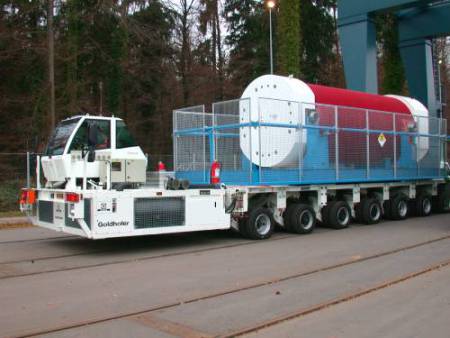
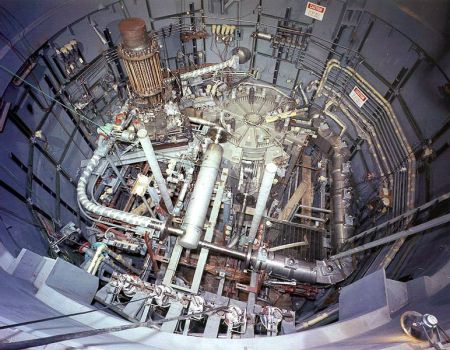
The SBMA board of directors is meeting on Monday to discuss the results of the initial investigation into the reported dumping by Glenn Defense Marine Philippines, the local operator of the Malaysian-owned Glenn Defense Marine Asia, said SBMA Chair Roberto Garcia.  In a letter to the SBMA earlier, the lawyers of Glenn Defense claimed that the Presidential Commission on the Visiting Forces Agreement (VFACOM) was the only agency authorized to address complaints about toxic dumping at Subic Bay.  Also on Saturday, the Subic Bay Freeport Chamber of Commerce announced it had suspended the membership of Glenn Defense, a registered locator of the Subic Bay Freeport.

Danny Piano, SBFCC president, said the group was aware of the alleged dumping in Subic waters since October. He said the chamber’s environmental committee has been on the lookout for potential environmental problems around the freeport.  Piano recounted: “At around 8 a.m. on Oct. 15, members of the committee spotted a marine [vessel] collecting liquid waste from a US Navy ship at Alava Pier. They became curious [as to] why a [ship], and not a [sewage] truck, would be performing waste collection [for] a naval ship already berthed at a pier…  “Sensing potential hazard, the members reported the situation to the SBMA ecology department for a spot check and to make sure that proper procedures were followed in dumping the waste.”

The vessel, MT Glenn Guardian, had been carrying around 50,000 gallons of domestic waste and around 200 gallons of bilge water (or a combination of water, oil, and grease), which were untreated according to laboratory tests, Piano said.

By Robert Gonzaga, US Navy begins inquiry into toxic waste dumping, Inquirer Central Luzon, Nov. 10, 210

Nuclear Waste in Egypt – illegally dumped?

Egypt’s prosecution begins reviewing charges against ousted president Hosni Mubarak and his former prime ministers, Ahmed Nazif and Atef Ebeid, of negligently burying nuclear waste in Egypt, endangering citizens.  The lawsuit was filed by attorneys Hamed Mohamed, Nasser El-Askalani and Tarek Ibrahim, who are members of the Protection of Freedoms Committee of the Lawyers’ Syndicate.

The three lawyers accused Mubarak and his former regime of allowing Egyptian and European businessmen to bury nuclear waste in Egypt, particularily in desert areas close to the Mediterranean known as Al-Alamein and Al-Hamam. These areas are 71km and 106km, respectively, from Egypt’s second-largest city, Alexandria.  Hosni Mubarak is currently serving a life sentence for failing to prevent the killing of protesters during the 18-day uprising that led to his ouster on 11 February 2011.  In September, Nazif, who served as prime minister between 2004 – 2011, was founded guilty of abusing his political position for personal gain and was given a three-year prison sentence.

Prosecution reviews charges against Mubarak of burying nuclear waste, Ahram Online,Nov. 10, 2012

Nuclear Waste and Environmental Justice

After California regulators refused to allow the U.S. Air Force to label residue from radioactive aircraft instruments as “naturally occurring” – declaring it unsuitable for a Bakersfield-area dump – the military turned to Idaho with the same story.  There, military officials met with success. The Air Force is now sending radioactive waste from Sacramento County’s McClellan Air Force Base to a Grand View, Idaho, hazardous waste landfill.

This solution involved a bit of legal semantics rejected in California despite 10 months of Air Force lobbying: The military claimed radium dust left over from glow-in-the-dark aircraft instruments actually was naturally occurring, putting it the same relatively lax regulatory category as mine tailings, according to government memos obtained by California Watch through a public records request.  Larry Morgan, a health physicist with the California Department of Public Health, disagreed with that characterization. Radioactive paint does not “meet the definition” of naturally occurring waste, he wrote in a September 2011 memo.

The Idaho facility’s permit allows it to accept materials defined as natural without notifying state regulators, leaving the state’s hazardous waste manager in the dark.  “I’m not familiar with this particular waste stream. I intend to find out now that you’ve contacted me,” Robert Bullock, hazardous waste permits manager for the Idaho Department of Environmental Quality, said during an October interview.  The redefinition of the waste as natural might not even have been necessary, given Idaho’s different standards for waste containing trace amounts of radium.

Days after the Idaho Department of Environmental Quality told California Watch that the agency was unaware of the Air Force waste, an official went out to inspect the landfill. Interviewed after that visit, engineer Dennis Meier said the dumping was legal because of the low concentration of radium in the soil, despite the source.  “It’s not waste that has to go to a radioactive waste facility,” he said. “The concentration is way below what we would accept.”

Nonetheless,California health officials and environmental activists accused the Air Force of bending the truth to get its way.  “Illuminated instrument dials do not naturally occur,” said Daniel Hirsch, a lecturer on nuclear policy at UC Santa Cruz who leads the environmental group Committee to Bridge the Gap. “I can’t dig into the soil and discover naturally occurring radium instrument dials.”

The radioactive dirt in question hails from the former McClellan Air Force Base northeast of Sacramento,now a commercial development site.“At least 24 sites” on the base “all have low levels of radium mixed in with the soil, and there are many thousands of cubic yards” of contaminated soil, according to Philip Mook, Western region senior representative for the Air Force Civil Engineer Center, which is in charge of cleanups at Air Force installations. “A little bit of radium goes a long way.”  The Air Force has sent 22,000 tons of radioactive dirt from McClellan out of state so far, according to Charlotte Fadipe, a spokeswoman for the California Department of Toxic Substances Control.
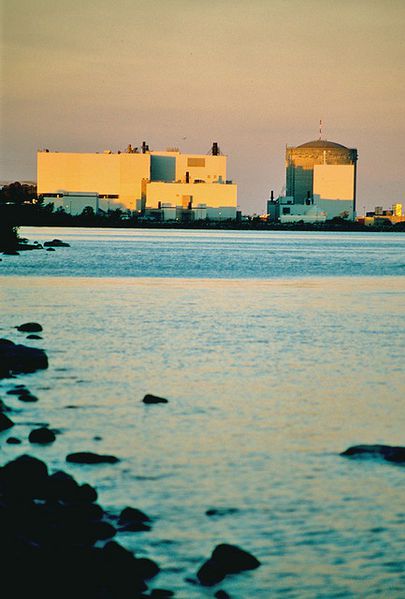
According to the federal Environmental Protection Agency, if significant radium is inhaled or ingested, it can increase the risk of diseases such as lymphoma, bone cancer and leukemia. While the concentrations in the McClellan soil are low, they are above limits the federal government has set to protect human health.  Before these medical effects became evident, aircraft dials and gauges were painted with glowing radium so pilots could see them better at night. Air Force officials speculate that the radium became dispersed in the soil at McClellan “probably in cleanup water, like mop water or solvents that were used to clean the equipment or to clean up spills of radium,” Mook said. Although radium paint wasn’t used on the base after the 1950s, items contaminated with it remained…
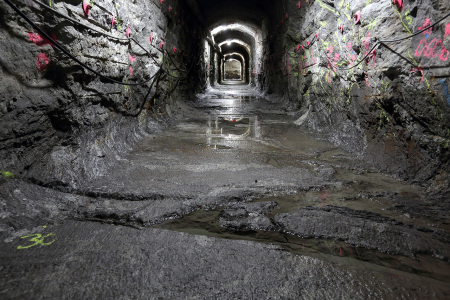
Stephen Woods, chief of the California Department of Public Health’s Division of Food, Drug and Radiation Safety, argued in a Nov. 4, 2011, letter that the dirt should be sent to “a licensed low-level radioactive waste disposal facility.” The Idaho facility where the soil is now going does not meet that criteria. Neither do any California waste disposal facilities.  That’s partly because of vocal opposition from local Kern County residents and environmental groups.  “Hazardous waste landfills in low-income communities of color in California aren’t the right places for” nuclear waste, said Caroline Farrell, executive director of the Center on Race, Poverty & the Environment, which for almost two decades has fought to limit the Buttonwillow landfill’s expansion and impact on local residents.

But in the past, the landfill has accepted nuclear waste. In 1998 and 1999, the Army Corps of Engineers sent residue from the Manhattan Project, the World War II-era research and development program that produced atomic bombs dropped in Japan, to the landfill.  The move outraged civilian officials.  Democratic U.S. Sen. Barbara Boxer testified before a Senate committee on July 25, 2000: “When I learned that the Corps had disposed of 2,200 tons of radioactive waste at an unlicensed hazardous waste facility in Buttonwillow, California, I was shocked. The facility sits atop aquifers that supply water to the Central Valley of California.”  Since the Manhattan Project controversy, the facility’s permit has been tightened. Yet the landfill’s current permit states that it may accept naturally occurring radioactive materials at low concentrations….

US Ecology, which operates the hazardous waste landfill in Grand View, Idaho, seemed to accept the terminology.  Steve Welling, senior vice president of sales and marketing for US Ecology, said in an interview that “state law and our permits” allowed the facility to accept the waste that the Air Force had characterized as naturally occurring.

Katharine Mieszkowski and Matt Smith, Air Force Ships Calif. Radioactive Waste To Idaho Landfill, NBC, Nov. 9, 2012

Japan and the Polluted Radioactive Water

Japan’s crippled nuclear power plant is struggling to find space to store tens of thousands of tonnes of highly contaminated water used to cool the broken reactors, the manager of the water treatment team has said.About 200,000 tonnes of radioactive water, enough to fill more than 50 Olympic-sized swimming pools, are being stored in hundreds of gigantic tanks built around the Fukushima Daiichi plant.

Operator Tokyo Electric Power Company (TEPCO) has already chopped down trees to make room for more tanks and predicts the volume of water will be more than tripled within three years.  “It’s a time-pressing issue because the storage of contaminated water has its limits, there is only limited storage space,” the water-treatment manager, Yuichi Okamura, told the AP news agency in an exclusive interview this week.  The Yotukura fishing village was one of the areas devastated by the Mar. 11, 2011 tsunami that caused the nuclear plant meltdown.

Dumping massive amounts of water into the melting reactors was the only way to avoid an even bigger catastrophe after the meltdown at TEPCO’s Fukushima Daiichi nuclear power reactor, caused by the Mar. 11, 2011 tsunami.  Okamura remembers frantically trying to find a way to get water to spent fuel pools located on the highest floor of the 50m high reactor buildings.  Without water, the spent fuel likely would have overheated and melted, sending radioactive smoke for miles and affecting possibly millions of people.

But the measures to keep the plant under control created another huge headache for the utility: What to do with all the radioactive water that leaked out of the damaged reactors and collected in the basements of reactor buildings and nearby facilities.  “At that time, we never expected high-level contaminated water to turn up in the turbine building,” Okamura said.  He was tasked with setting up a treatment system that would make the water clean enough for reuse as a coolant, and was also aimed at reducing health risks for workers and at curbing environmental damage.  At first, the utility shunted the tainted water into existing storage tanks near the reactors.

Meanwhile, Okamura’s 55-member team scrambled to get a treatment unit up and running within three months of the accident, a project that would normally take about two years, he said.  Using that equipment, TEPCO was able to circulate reprocessed water back into the reactor cores.  But even though the reactors now are being cooled exclusively with recycled water, the volume of contaminated water is still increasing, mostly because groundwater is seeping through cracks into the reactor and turbine basements….

Masashi Goto, a nuclear engineer and university lecturer, said the contaminated water build-up posed a major long-term threat to health and the environment.  He said he was worried that the radioactive water in the basements may already be getting into the underground water system, where it could reach far beyond the plant via underground water channels, possibly reaching the ocean or public water supplies.  “There are pools of some 10,000 or 20,000 tonnes of contaminated water in each plant, and there are many of these, and to bring all of these to one place would mean you would have to treat hundreds of thousands of tonnes of contaminated water which is mind-blowing in itself,” Goto said.  “It’s an outrageous amount, truly outrageous,” Goto added.

The plant will have to deal with contaminated water until all the melted fuel and other debris is removed from the reactor, a process that will easily take more than a decade.

Japan Struggling to Store Nuclear Water, Inter Press Service, Oct. 25, 2012

Nuclear Waste Island, Orchid, Taiwan

Most people on the windswept outpost, 62 kilometres east of Taiwan’s mainland, would love to see the 100,277 barrels of nuclear waste gone. But many admit they are concerned about their livelihoods if that day comes.  Orchid Island has been a flashpoint for Taiwan’s environmental movement since nuclear waste was first shipped there in 1982. Local residents, mostly members of the Tao aboriginal group, say the waste was put on the island without their consent. Periodic protests have claimed negative health and environmental effects.

In response, Taiwan Power Co has showered the community with cash handouts, subsidies, and other benefits.  Orchid Island received subsidies worth 110 million Taiwan dollars in 2011, according to company data. That doubled local government spending, according to township secretary Huang Cheng-de.  “The current situation, basically, is that Taipower gives us quite a bit of money, and our people are becoming pretty reliant,” Huang said.  Most of the funds are divided into government-managed accounts for each of the island’s 4,700 residents, who can apply for it if they have a business or career-oriented need. Residents also receive free electricity, health-related emergency evacuations, scholarships for higher education and a 50-per-cent discount on all transportation costs to Taiwan’s mainland.  Statistics indicate local residents are taking advantage of the benefits. In 2011, they used nearly twice as much electricity per household as the national average, according to company data.

Protests have weakened and for many residents, including Chou the restaurant owner, the existence of nuclear waste has become more acceptable.  “Most people here are against the nuclear waste, but since its already here, they should pay us for using our land,” Chou said. “For now, I’m okay with it as long as they don’t add any more barrels.”  The utility plans to move the waste off the island by 2021, but only if another township in Taiwan agrees by referendum to take it, according to Huang Tian-Huang, a company deputy director.  If it goes to plan, “so goes the compensation,” Huang said, although he acknowledged that gaining consent from another community will be difficult.  Questions remain on what would support Orchid Island’s economy if those subsidies end.

For Taiwan aborigines, nuclear waste is blessing and curse, http://www.timeslive.co.za, Sept. 16, 2012

Nuclear Waste Russia: Andreyeva Bay

Andreyeva Bay, the former naval technical base come solid radioactive waste storage facility has undergone many improvements, but problems also remain. Andreyeva Bay is one of the hottest radioactive spots in Northwest Russia and work deadlines are hard to meet.  Founded in between 1960 and 1964, Andreyeva Bay’s task was to remove, store and ship for reprocessing at the Ural Mountains Mayak Chemical Combine spent nuclear fuel from nuclear submarines. After a 1982 accident in the spent nuclear fuel storage, Russia Ministery of Defense decided to reconstruct the facility. But the turbulent political and economic conditions of the 1980s and 1990s scuttled the plans. Andreyeva Bay was assigned to Minatom, Rosatom’s precursor, in 2000.  The beleaguered facility, which is nearby the Norwegian border is of special concern to Oslo. Norway’s Deputy Ambassador in Moscow, Bård Svendsen, noted that the two countries had cooperated on solving the Andreyeva bay issue for many years.  “Over these years, much has been done and much remains to be done,” said Svendsen. “Norwegian authorities will continue this work, which costs some €10 million euro a year.”  According to Rosatom’s deputy head of Department for Project Implementation and Nuclear and Radiaiton Safety, Anatoly Grigorieyev, the last 10 years have seen the installation of constant radiation monitoring and significant improvements in the conditions in which radioactive waste and spent nuclear fuel is stored.  A new installation for working with spent nuclear fuel is expected to be installed at Andreyeva Bay in 2014, and by 2015 the fuel is slated for removal – the same year a facility for handling radioactive waste should be installed, he said in remarks reported by Regnum news agency.  “The work we have planned will allow for the territory to be brought up to suitable conditions within 10-15 years,” said Grigorieyev.
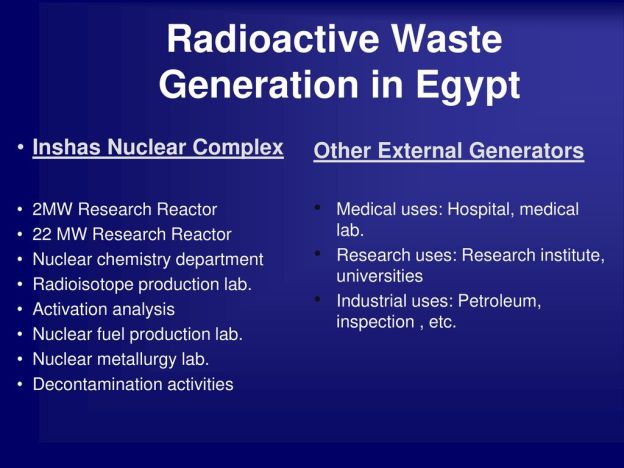
Vladimir Romanov, deputy director of the Federal Medical and Biological Agency, said that studies conducted by his institute confirm that the radiological conditions at Andreyeva Bay and at Gremikha – the second onshore storage site at the Kola Peninsula for spent nuclear fuel from submarines – are indeed on the mend…. According to Valery Panteleyev, head of SevRAO, the Northwest Russian firm responsible for dealing with radioactive waste Some 846 spent fuel assemblies have been taken from storage at the former naval based to the Mayak Chemical Combine for reprocessing thanks to infrastructure built for fuel unloading purposes.  Panteleyev said Gremikha still currently is home to used removable parts from liquid metal cooled reactors submarine reactors, spent fuel assemblies, a reactor from an Alpha class submarine and more than 1000 cubic meters of solid radioactive waste.  Panteleyev said that by the end of 2012, all standard and non-standard fuel will have been sent to Mayak from Gremikha. He said that between 2012 and 2020 the removable parts of the liquid metal cooled reactors would also be gone, and that during the period between 2012 and 2014, 4000 cubic meters of solid radioactive waste would also be removed to long term storage at Saida Bay.  If all goes according to schedule, the Gremikha site will be rehabilitated by 2025.

Rosatom also presented detailed reports on an international project to build long-term storage for reactor compartments at the Saida Bay storage site for aged submarine reactors.  Panteleyev said none of the achievements at either Saida Bay or Gremikha would have been possible without international help.  The projects are being completed with funding from Germany, Italy, France, Norway, Sweden, Great Britain and the EBRD.  “These countries are investing in the creation of infrastructure for handling radioactive waste and spent nuclear fuel, dismantlement of nuclear vessels of the atomic fleet and in the infrastructure for the safe storage or reactor compartments,” said Panteleyev….

Another item of special concern at the Bellona/Rosatom seminar was the disposition of the floating spent nuclear fuel vessel, the Lepse. A former technical support vessel, taken out of service in 1988 the Lepse presents the biggest nuclear and radiation risk of all retired nuclear service ships in Russia. The Lepse’s spent nuclear fuel storage holds – in casks and caissons – 639 spent fuel assemblies, a significant portion of which are severely damaged.  Extraction of these spent fuel assemblies presents special radiological risks and technical innovation. The vessel is currently moored at Atomflot in Murmansk, the base of Russia’s nuclear icebreaker fleet.  Mikhail Repin, group director for the Russian Federal State Unitary Enterprise the Federal Center for Nuclear and Radiation Safety, said work on the Lepse is divided into three categories: transfer of the vessel to the ship repair yard Nerpa in the Murmansk Region, fixing it to an assembly based, removing the spent fuel and dividing into blocks. The work is expected to be complete by 2012.  But the barriers to enacting this project, however, remain largely bureaucratic.  “One gets the impression that international and Russian bureaucrats are capable of muddling any project, as shown by the experience with the Lepse,” said Bellona’s Niktin. The project of dismantling the Lepse have remained on paper since 1995.  The Lepse was built in 1930, and the vessel has been afloat for 75 years, said Repin… The equipment necessary for removing the spent fuel assemblies must be fabricated for specifically this project. The equipment must first ensure the safety of the workers, meaning the work will have to be done essentially remotely to ensure minimum exposure.

The iPhone, radioactive waste and rare earths: the Lynas case

Lynas Corporation, an Australian based mining company are constructing a rare earth processing plant, known as the Lynas Advanced Materials Plant (LAMP) in Gebeng industrial estate in Kuantan, Malaysia. The LAMP will process lanthanide concentrate which will be trucked from the mine site in Mt Weld Western Australia to the Port of Fremantle where it will be shipped to Malaysia. This report provides an assessment of the emissions from the LAMP plant rather than Lynas Corporation‟s activities in Western Australia. The LAMP plant will have significant atmospheric, terrestrial and waterborne emissions of toxic chemicals and radionuclides including uranium, thorium and radon gas.

________________________________________________________

A Malaysian high court put on hold until October 4 a temporary operating license granted to Lynas Corp Ltd’s controversial rare earth plant near the eastern city of Kuantan, prompting an 8 percent fall in the Australian firm’s shares on Tuesday (Sept. 24, 2012).  The rare earth plant – the world’s biggest outside China – has been ready to fire up since early May, but the company has been embroiled in lengthy environmental and safety disputes with local residents since construction began two years ago [regarding the handling of radioactive waste at the plant].

The plant is considered important to breaking China’s grip on the processing of rare earths, which are used in products ranging from smartphones to hybrid cars.

Lynas confirmed the Kuantan High Court’s decision on Tuesday, but said it would not affect production at the plant and that it plans to strongly assert its rights at the next court hearing…Lynas shares plunged more than 8 percent after the court order to A$0.795, their lowest close in almost three weeks as investors closely track each move in the sensitive case. Earlier this month they rose up to 50 percent when Malaysia approved the license.

Activists linked to the environmental group, Save Malaysia Stop Lynas, want the court to suspend the temporary license until two judicial review cases challenging the government’s decision allowing the plant to operate are heard.  “It’s a small victory, but there is still a long way to go,” Tan Bun Teet, a spokesman for the group, told Reuters after the court decision. “We will fight tooth and nail. We have a lot at stake,” he added.  The group’s previous attempts to legally stop the plant had failed.

Lynas received a temporary operating license for its long-delayed $800 million rare earth plant earlier this month, enabling it to start production as early as October.  The Malaysian Atomic Energy Licensing Board (AELB) issued the permit following an earlier recommendation from a government committee.  Protests over possible radioactive residue have drawn thousands of people and the project has become a hot topic ahead of an election that must be held by early next year.

Sources

Lee Bell, Rare Earth and Radioactive Waste: A Preliminary Waste Stream Assessment of the Lynas Advanced Materials Plant, Gebeng, Malaysia, National Toxics Network. April 2012

Siva Sithraputhran, Malaysian court puts license on hold for Lynas rare earth plant, Reuters, Sept. 25, 2012

Canada and its Nuclear Waste

Since the 1960s,  Canada’s nuclear power plants have generated more than two million bundles of highly radioactive used fuel. And they’re all still stored on the sites of the plants that produced them.But the pace of finding a site to store Canada’s most potent radioactive waste permanently is about to pick up.  Twenty Canadian communities have said they’ll consider volunteering to host the storage site.  That list is about to close. The Nuclear Waste Management Organization, whose job it is to find and build the site, will stop taking new names on Sept. 30, 2012.  The impending cut-off is ratcheting up the pressure on the technocrats charged with selecting a site; on the boosters who want to snare the multi-billion-dollar repository for their community; on the activists who harbour deep suspicions about safety; and on the aboriginal leaders who say they’ve been cut out of the process….

A fuel bundle for a Candu nuclear power reactor is about the size of a fireplace log. As of June 30, 2011, Canada had 2,273,873 used fuel bundles stored at its nuclear plants in Ontario, Quebec and New Brunswick.  Another 85,000 or so have been added since then.  In total, they’d fill about six NHL hockey rinks, stacked up as high as the boards.

The Nuclear Waste Management Organization, formed by the three electric utilities that run nuclear reactors, wants to bury the waste deep underground in caverns excavated from stable rock, where it can lie undisturbed forever.  The depth will probably depend on the site’s geology. A facility proposed to hold less-potent radioactive waste at the Bruce nuclear site near Kincardine will be 680 metres deep. By comparison, the CN Tower is 553 metres tall.  The NWMO is looking for a “willing” community to agree to take the $16-to-$24-billion project. The host community itself will decide how to define “willing.” Candidate communities will have multiple opportunities to withdraw if they get cold feet, the NWMO says.  As it moves through a nine-stage selection process, the NWMO hopes to have narrowed the field to one or two communities by 2015, then spend until about 2020 deciding on a specific site within the chosen community.  After that, it will take three to five years to do an extensive environmental assessment of the site. The proponents will also have to satisfy the Canadian Nuclear Safety Commission that their plan makes sense, and obtain a license to construct and operate the facility.  Then, it will take six to 10 years to build. The NWMO doesn’t expect the first bundles to be stored until 2035.  The plan is to seal the waste in sturdy, radiation-proof containers and store it deep in a stable rock formation where — even if the containers were to crack and leak — there’s be no danger of contaminating groundwater used by humans. (Although that’s the current strategy, the NWMO says it would consider a different plan if compelling evidence emerged that another technique is superior.)

Current designs call for surface buildings and facilities to cover about 100 hectares (250 acres), says the NWMO’s Michael Krizanc.  “As well, there may be a need to limit activities in the immediate area surrounding the surface facilities in order to meet regulatory or other requirements.”  Underground, the excavated caverns will cover an area of about 2.5 kilometres by 1.5 kilometres. That’s 375 hectares, or 930 acres.  “The NWMO would need to have rights to the land above the repository,” says Krizanc, but “alternative uses could be considered, with the community, for portions of the land.”….

Meanwhile in Saugeen Shores, a lively battle is under way as members of a citizens group dubbed save Save Our Saugeen Shores, or SOS, fights what they see as an attempt to impose the waste site on their community on the shore of the Great Lakes….SOS also worries that U.S. power plants might be able to force Canada to take U.S. nuclear waste in a Canadian waste site, through terms of the free trade agreement between the countries…..Up in Elliot Lake, contractors Stephen Martin and Marc Brunet can’t wait for the project to start….Elliot Lake has been identified with uranium since its founding, he shrugs: “We’re the uranium capital of the world…. This thing will be a tourist attraction. I think it’s the best thing that could happen.”

John Spears, Nuclear waste seeks a home, Toronto Star, Sept. 1, 2012

Chevron and Amazon: the $18 billion Ecuador Liability

The D.C. Circuit Court of Appeals  on June 12, 2012  (pdf) dealt another setback to Chevron over its $18 billion Ecuador liability, reversing a lower court decision that allowed the oil giant access to documents from a prominent consulting group for the Amazon rainforest communities that sued the company.