What if it were possible to get rid of malaria? Not just bring it under control, but wipe it from the face of the Earth, saving 660,000 lives a year, stopping hitherto endless suffering, and abolishing a barrier to economic development reckoned by the World Bank to cost Africa $12 billion a year in lost production and opportunity? It is an alluring prize, and one that Li Guoqiao, of Guangzhou University of Chinese Medicine, thinks within reach.
Dr Li is one of the researchers who turned a Chinese herbal treatment for the disease into artemisinin, one of the most effective antimalarial drugs yet invented. Now he is supervising experiments in the Comoros, using a combination drug therapy based on artemisinin, to see if malaria can be eradicated from that island country. If it works, he hopes to move on to somewhere on the African mainland, and attempt to repeat the process there….
Dr Li’s approach is to attack not the mosquito, but the disease-causing parasite itself. This parasite’s life cycle alternates between its insect host (the mosquito) and its vertebrate one (human beings). Crucially, as far as is known, humans are its only vertebrate host. Deny it them and it will, perforce, wither away—an approach that worked for the smallpox virus, which had a similarly picky appetite. In the case of smallpox, a vaccine was used to make humans hostile territory for the pathogen. Since there is no vaccine against malaria, Dr Li is instead using drugs.
To deny the parasites their human hosts long enough to exterminate them in a given area, the researchers administer three doses of Artequick, spaced a month apart. To add extra power, the first dose is accompanied by a third drug, primaquine. Dr Li and his colleagues call this approach Fast Elimination of Malaria through Source Eradication, or FEMSE.
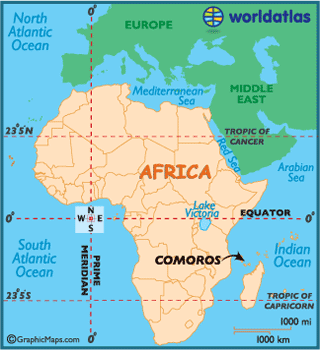
And it works—almost. The Comoros has three islands: Moheli, Anjouan and Grande Comore. Before the experiment started, more than 90% of the inhabitants of some villages on these islands had malaria. Song Jianping, Dr Li’s lieutenant in the Comoros, blitzed Moheli with Artequick in 2007. The number of cases there fell by 95%, though reinfection from other islands caused a small subsequent rebound. In 2012 he did the same thing on Anjouan. There, the number of cases fell by 97%. In October 2013 the campaign moved to Grande Comore, the most populous island. When the process is complete there, nearly all of the 700,000 Comorans will have taken part in FEMSE.
Ninety-five percent, or even 97%, is not eradication. But it is an enormous improvement and creates a position from which eradication can be contemplated. To do that, though, means keeping an effective surveillance programme permanently in being so that those who become infected can be treated quickly, to stop them spreading the parasite…
A more immediate concern is the safety of the drugs. Artemisinin and piperaquine are pretty safe, but primaquine ruptures red blood cells in people with a deficiency of an enzyme called G6PD. That can kill. And a lot of Africans—in particular, 15% of Comorans—are G6PD-deficient….
There is also the question of informed consent to the drugs. Smallpox vaccination permanently protected the person being vaccinated. There was thus an individual as well as a collective benefit to offset any possible side-effects. Prophylactic drug treatment protects only for as long as the drugs stay in the body—which is a few weeks (and explains the need for three rounds of treatment). Dr Song’s results suggest the benefit is real. But it is a collective benefit. That changes the moral calculus. On the one hand, there is the risk of healthy people being harmed by side-effects. On the other, there is the risk of their free-riding, by taking the collective benefits while not taking the drugs themselves.
To avoid such free-riding, a lot of official encouragement to participate has happened—encouragement some people regard as tipping over into pressure and propaganda. In a public meeting in Niumadzaha, a village in the south of Grande Comore, for example, the chief doctor of the local health centre shouted through a megaphone: “This drug is safe and effective. You are not being used as guinea pigs. The WHO would not allow this administration to happen if you were being used as guinea pigs.”
Certainly, there is a lot riding on the project. Dr Mhadji says FEMSE will save the Comoros $11m a year in direct and indirect costs (for comparison, its annual health-care budget is $7.6m), as well as preserving many lives that would otherwise have been lost and saving survivors from the brain damage malaria can cause. The eradication of malaria will also, he hopes, make the Comoros more attractive as a destination for tourists.
Others hope to profit, too. Artepharm has high expectations of Artequick and is using the drug’s success in the Comoros in its marketing campaigns in South America, South-East Asia and Africa. Moreover, the arm of the Chinese government that administers that country’s foreign aid, and is thus helping pay for the project, is the Ministry of Commerce—for Chinese largesse is more explicitly tied to the promotion of the country’s business than is aid from most Western countries.
Not that the West is a disinterested party, for Western firms, too, manufacture artemisinin-based malaria therapies. On that point Dr Mhadji has strong views. He dismisses criticism of the experiment as fuelled by competition between Western and Chinese pharmaceutical companies.
As Nick White, a malaria researcher at Oxford University’s School of Tropical Medicine who has been working for years on eradicating malaria, says, “This research is radical. It is controversial. It is led by a very famous Chinese physician and investigator. There are lots of very serious questions here and a lot of unknowns.” Or, as Oscar Wilde more succinctly put it, “The truth is rarely pure and never simple.”
Malaria eradication: Cure all?, Economist, Jan 25, 2014, at 66







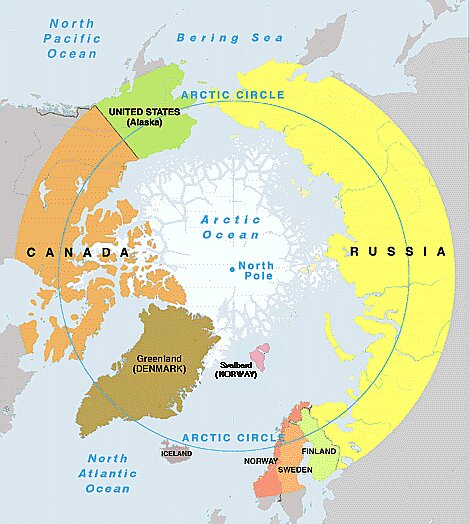



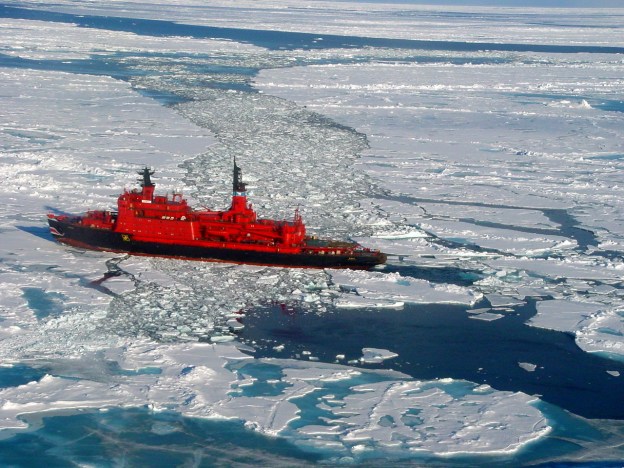
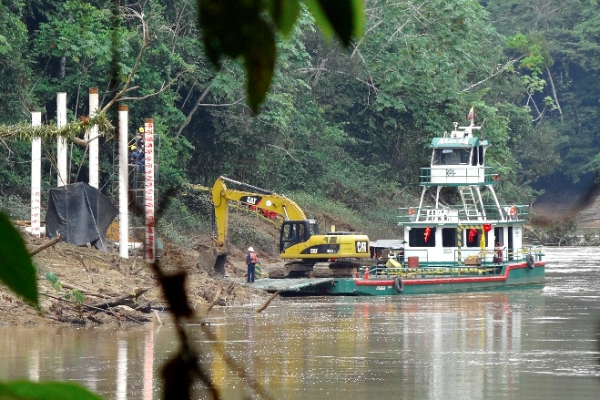



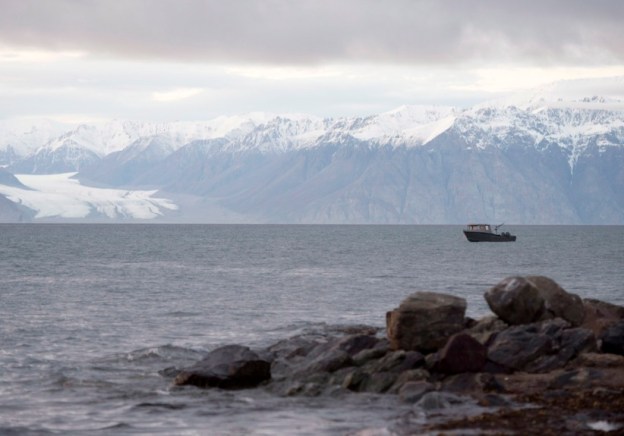
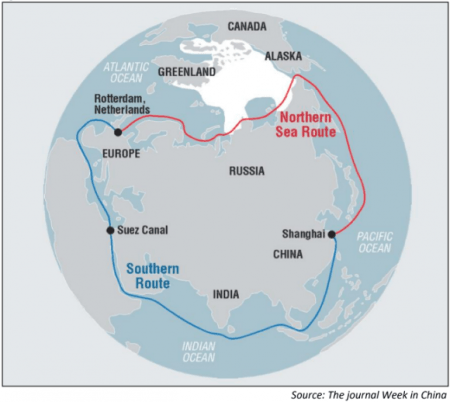
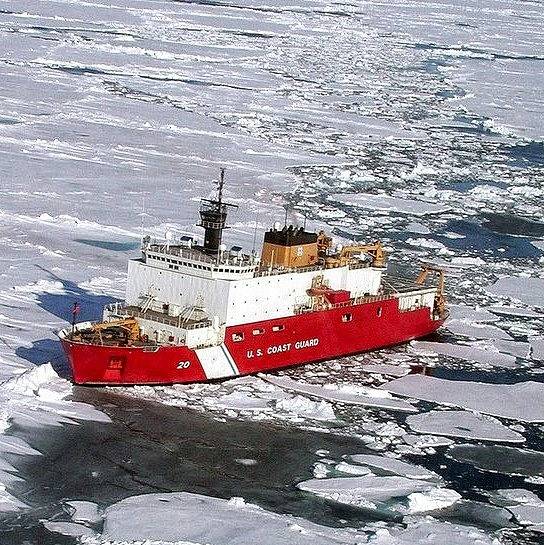
 Mr Xi has been showing a growing interest in Arctic countries. In 2014 he revealed in a speech that China itself wanted to become a “polar great power”..,,In January 2018 the Chinese government published its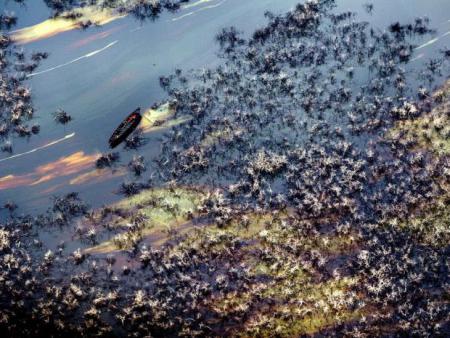
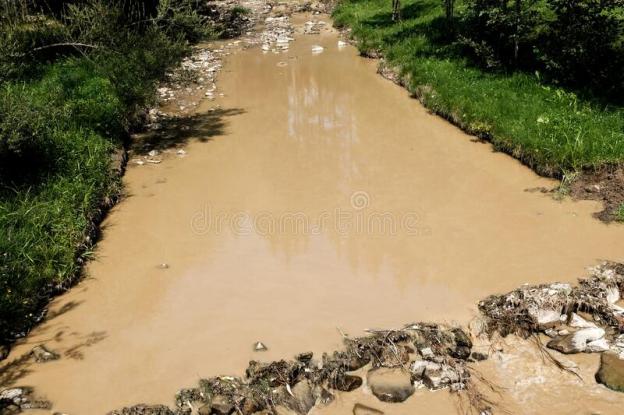
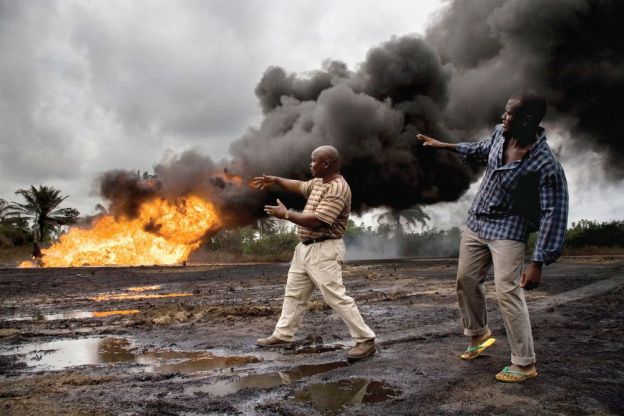
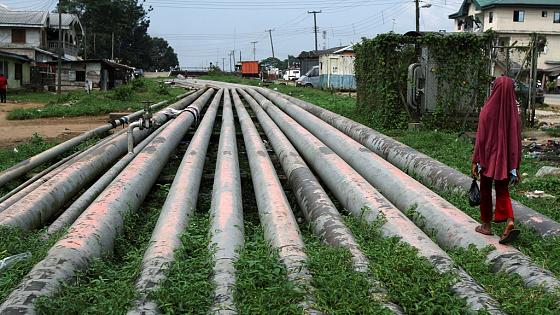
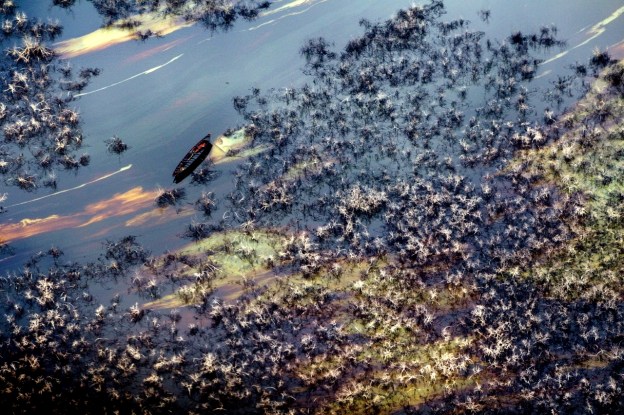
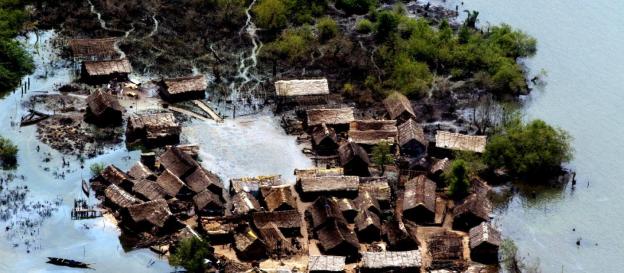
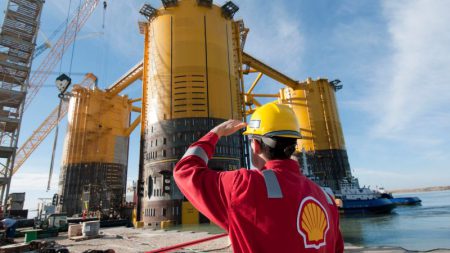
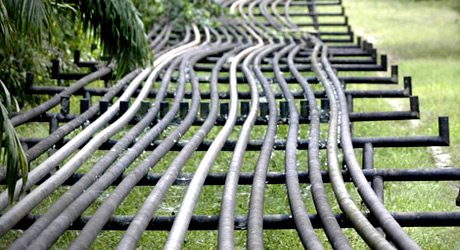
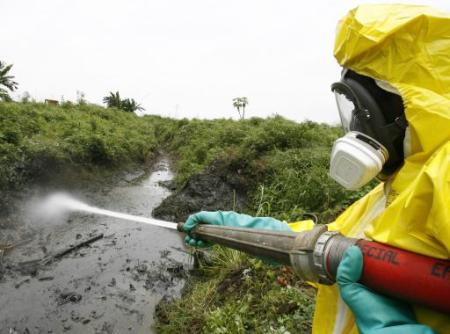
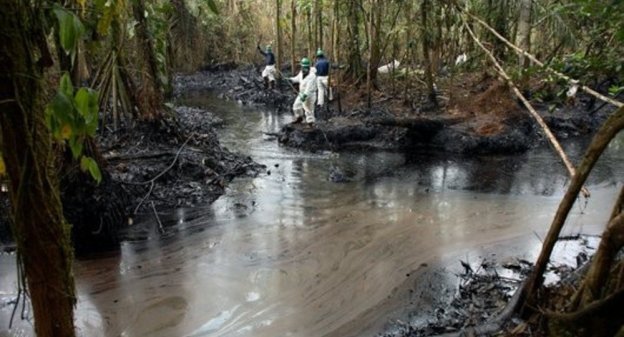
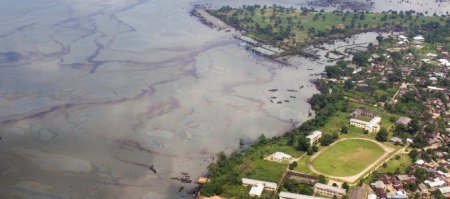
 May 2018: The environmental damage around the site of two Royal Dutch Shell oil spills in Nigeria a decade ago has worsened significantly after years of delay to cleanup efforts, according to a report that the oil giant has been accused of trying to shield from public view. The spills from a ruptured Shell pipeline spewed thousands of barrels of oil over parts of the Bodo fishing community in the crude-rich Niger Delta. Although the company in 2015 reached an out-of-court settlement with the local community, admitting to liability and agreeing
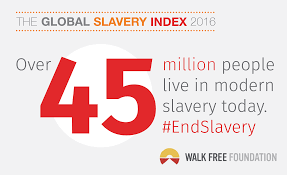
 The African Union on Friday urged Mauritania to make a greater effort to eliminate slavery after the country handed out lenient sentences to a family of slave owners in a landmark conviction….In a statement published online, the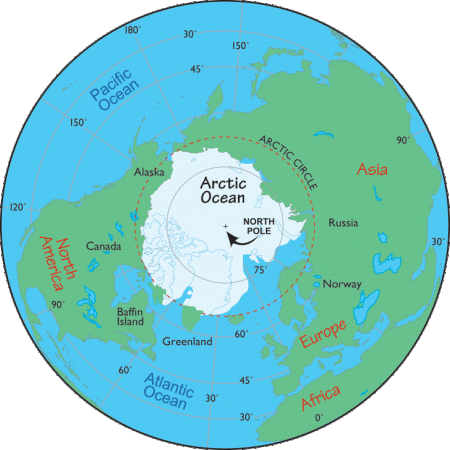
 China on January 25, 2018 outlined its ambitions to extend President Xi Jinping’s signature Belt and Road Initiative to the Arctic by developing shipping lanes opened up by global warming. Releasing its first official Arctic policy white paper, China said it would encourage enterprises to build infrastructure and conduct commercial trial voyages, paving the way for Arctic shipping routes that would form a “Polar Silk Road”…China, despite being a non-Arctic state, is increasingly active in the polar region and became an observer member of the Arctic Council in 2013.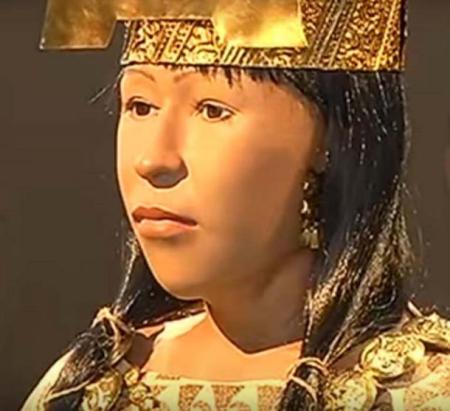
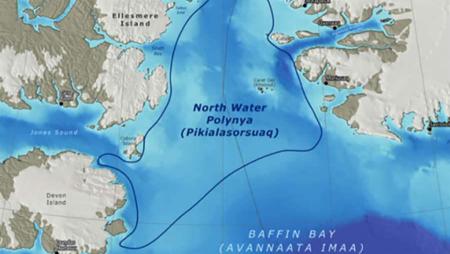
 Europe’s space agency is defending plans to launch two satellites that would drop a rocket stage likely to contain highly toxic fuel in some of the most ecologically sensitive waters of the Canadian Arctic…
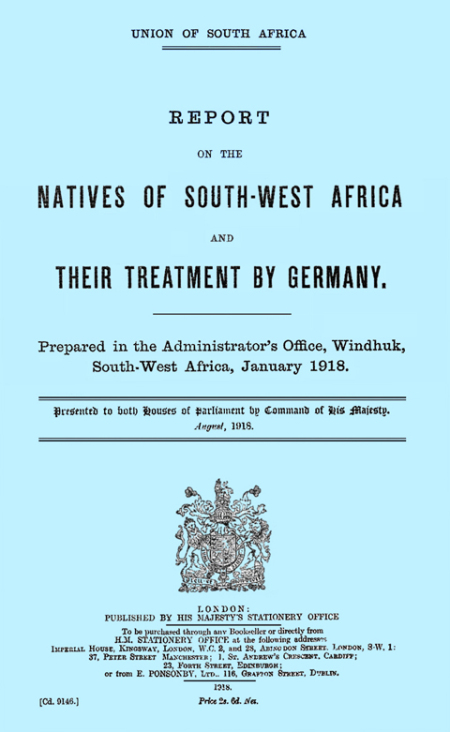

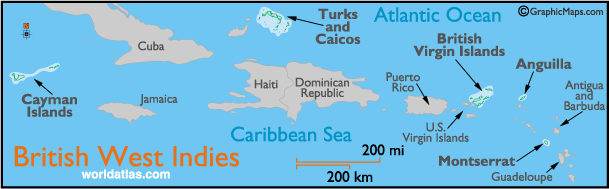
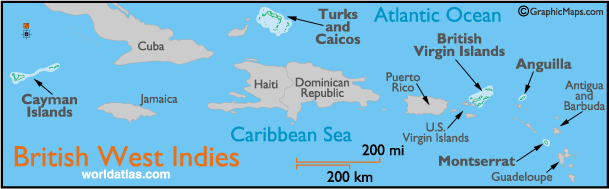 Britain ended its slave trade in 1807, and freed the slaves in its Caribbean colonies by 1838. The British government borrowed £20m, then around 40% of the budget, to meet 47,000 claims for loss of human property. The former slaves got nothing.Close to two centuries on, Caribbean politicians want redress. The Caribbean Community (Caricom) which links former British colonies with Suriname and Haiti, established an official reparations commission in July 2013 and has approached a British legal firm, Leigh Day, for advice…Among the precedents for financial reparations, West Germany and Israel signed a financial agreement in 1952, seven years on from Auschwitz. In June this year, after legal action by Leigh Day, Britain conceded payments averaging £2,600 ($4,000) each for 5,228 now elderly Kenyans who were brutally mistreated during the suppression of the Mau Mau rebellion in the 1950s. Britain’s courts will not now consider claims for atrocities occurring before 1954. Unpicking wrongs from 60 years ago is hard enough.


 Law-In-Action