Category Archives: Energy

Demand for Carbon Tax

“You can argue that Big Oil is becoming Big Gas,” says Occo Roelofsen of McKinsey, a consulting firm. Others are going in for renewables. Total of France has a majority stake in SunPower, one of the world’s biggest solar-power firms. Eldar Saetre, the boss of Statoil, Norway’s state-run oil company, says that in 15 years there may be more opportunities outside oil and gas than within.

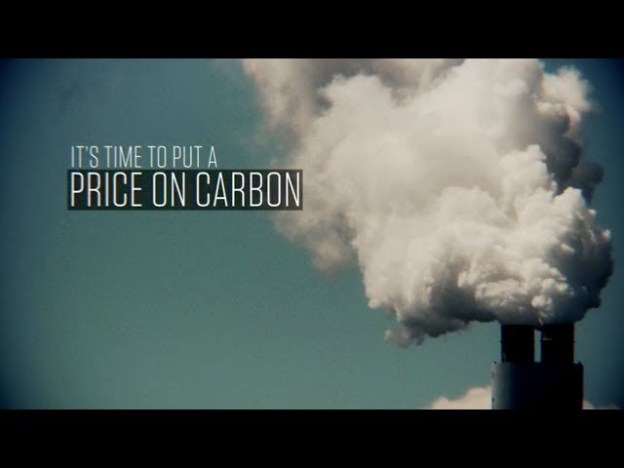
Plenty of oil firms (Exxon among them) are also calling for governments to enact a “carbon tax” on emitters of greenhouse gases. Their critics argue that this is less altruistic than it appears. For one thing, such a tax would hurt the coal industry especially, thereby boosting the oil firms’ gas businesses. And governments, especially in the developing world, where fossil-fuel demand is still surging, may find such a tax politically impossible anyway; the oilmen are calling for it, opponents say, in the knowledge that such countries will never introduce it….

On November 4th New York’s attorney-general, Eric Schneiderman, subpoenaed documents from Exxon to investigate how much it has known since the 1970s about the effects of fossil fuels on the climate. Exxon is reportedly being investigated under the Martin Act, dating back to 1921, which gives prosecutors wide-ranging powers to investigate securities fraud. Exxon says it has long disclosed information about the risks to its business from climate change, and from action to prevent it, in reports to its shareholders. But the firm’s run-in with the New York justice department may be a portent of what is to come.

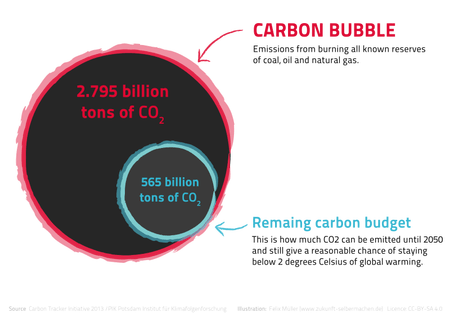
Another worry for oil executives is pressure from investors spooked by the financial risks of climate change. Policymakers, such as Mark Carney, governor of the Bank of England, talk about the possibility of many oilfields turning into “stranded assets”, or “unburnable carbon”, if governments get serious about climate-change action. Anthony Hobley of Carbon Tracker, a climate-advisory firm, says that if the Paris pledges are taken at all seriously, the oil and gas industry may become “ex-growth”. Oil executives dispute that. But shareholders, if motivated, could force the industry to shrink just by limiting the funds they provide for new oil discoveries.

Curiously, the present situation may provide a foretaste of this—though cyclically, because of falling oil prices, rather than structurally, because of rising temperatures. Faced with a world awash in crude, oil majors are abandoning high-cost reserves in the Arctic, Canada, North Sea and Gulf of Mexico. One oil executive ruefully calls it a “practice run” for the day in the distant future when fears of global warming, or the emergence of cheap, clean alternative technologies, mean that demand for fossil fuels starts to wane.

Excerpt from Oil Companies and Climate Change: Nodding Donkeys, Economist, Nov. 14, 2015, at 61

Nuclear Fusion Technologies: ARPA

ARPA-E, or Advanced Research Projects Agency-Energy is a United States government agency tasked with promoting and funding research and development of advanced energy technologies. It is modeled after the Defense Advanced Research Projects Agency (DARPA).

From the ARPA website

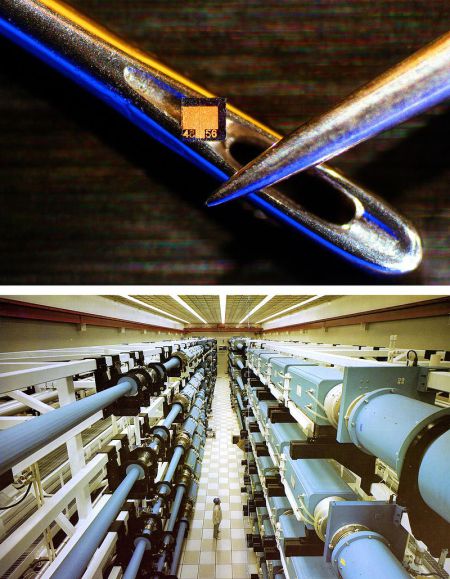
Fusion energy holds the promise of virtually limitless, clean power production. Although fusion has been demonstrated in the laboratory, scientists have been unable to successfully harness it as a power source due to complex scientific and technological challenges and the high cost of research….Attaining [the conditions for the production of fusion] conditions is a very difficult technical challenge. Additionally, many current experimental techniques are destructive, meaning that pieces of the experimental setup are destroyed with each experiment and need to be replaced, adding to the cost and time required for research.

Los Alamos National Laboratory (LANL), along with HyperV Technologies and other partners, will design and build a new driver technology that is non-destructive, allowing for more rapid experimentation and progress toward economical fusion power.   LANL’s innovation could accelerate the development of cost-effective fusion reactors, which may provide a nearly limitless supply of domestic power and eliminate dependence on foreign sources of energy.

Fusion reactors offer nearly zero emissions and produce manageable waste products. If widely adopted, they could significantly reduce or nearly eliminate carbon emissions from the electricity generation sector. LANL’s approach, if viable, could enable a low-cost path to fusion, reducing research costs to develop economical reactors.

Partners
HyperV Technologies Corp.
University of Alabama in Huntsville
University of New Mexico
Brookhaven National Laboratory
Tech-X Corporation

National Security and Nuclear Industry

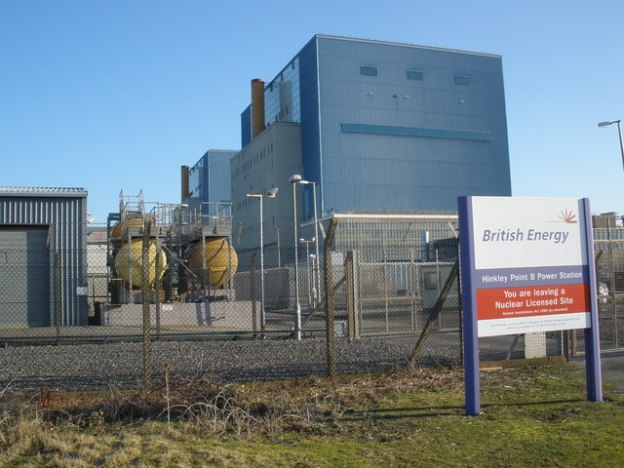
[A third nuclear reactor is to be built in Flamanville, France  by Electricité de France (EDF)]…Called Flamanville 3, is likely to become the focus of international attention because it is the model for an imminent expansion across the channel…EDF has agreed on October 21st agreed with China General Nuclear Power Corp (CGN), a state-owned entity, to build two reactors of the same design in south-west England called Hinkley Point C. EDF will own two-thirds of the project and CGN a third. The plant in Somerset is supposed to open by 2025, after construction that is forecast to cost £24.5 billion ($37.8 billion)…

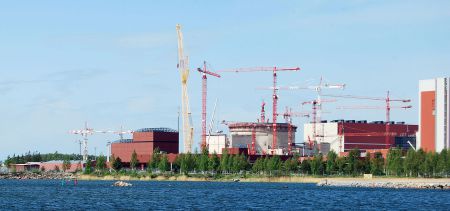
The history of Flamanville 3, where work began in 2007, indicates how difficult that might be. It was planned as a five-year scheme, but this month EDF, which is mostly state-owned, formally asked officials to extend the deadline to 2020. Its original budget of €3.3 billion has more than tripled, to €10.5 billion ($11.9 billion). Getting its new European Pressurised Reactor (EPR) into service is proving harder than expected. One problem is the troubled condition of Areva, another mostly state-owned French firm, which supplies reactor components. It reported losses of nearly €5 billion in March, because of soaring costs and long delays at the only other EPR being built in Europe, Olkiluoto 3, in Finland. Work began in 2005 but it will not open before 2018 at the earliest.

The main technical problem at Flamanville 3 concerns suspicions of high levels of carbon in the steel of a crucial component, the vessel, already installed under the dome of the new reactor. Replacing it now, if inspectors conclude it is too brittle, would be costly. In June the company also said it was double-checking the working of safety valves.

Meanwhile EDF’s financial burden grows. It boasts of €73 billion in global revenues, but faces a threefold strain. Demand for electricity is stalling in France, its main market—and, as problematic, the country plans to cut nuclear’s share of electricity generation to half of the total, by 2025, from 75%. Next, though details are not finalised, EDF will absorb the nuclear unit of troubled Areva. Last, it has to upgrade, or at least maintain, France’s stock of ageing reactors. Mr Lévy told French radio on October 18th that capital expenditure for that alone would be around €50 billion.

No wonder ratings agencies judge that EDF’s financial prospects are secure only because of its state backing.  EDF’s prospects, indeed those of any nuclear company, depend on the backing of politicians who want to preserve nuclear expertise and jobs at home.

EDF’s Nuclear Ambitions: French Lessons, Economist,Oct. 24, 2015, at 63

Population Resettlement at Fukushima: who dares?

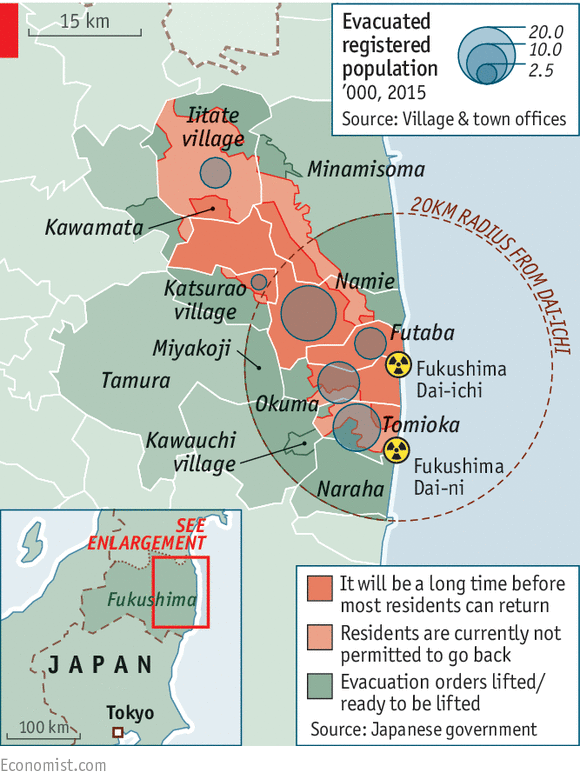
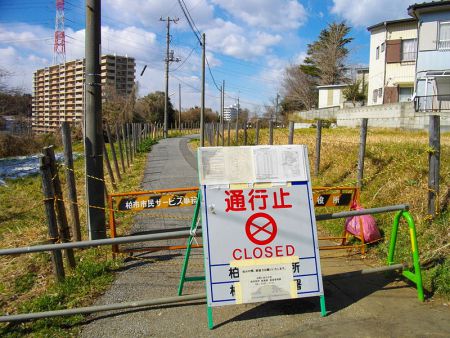
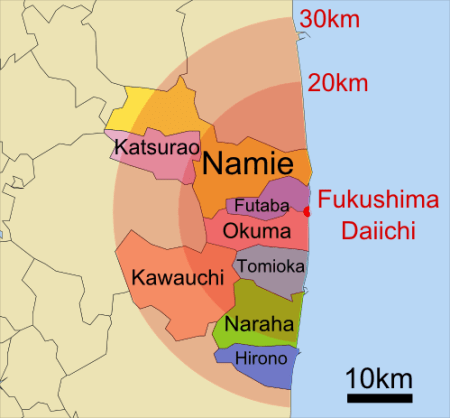
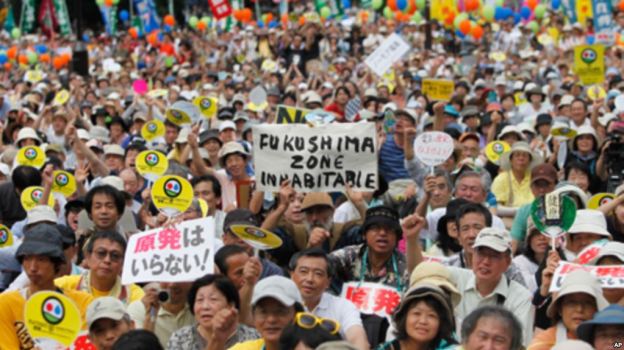
By the time Fukushima prefecture finishes the task of decontaminating houses and farmland around the Dai-ichi plant, it will have spent an estimated $50 billion on the work.  Some argue it would have been wiser to have spent the money on resettling former residents elsewhere. Already many of the 80,000 or so people displaced from the areas around the plant have begun new lives. Those moving back are mainly elderly. Local officials expect that half of the evacuees, especially those with children who are more vulnerable to radiation, may never return.

Fear of radiation, and distrust of data from the government and from the Tokyo Electric Power Company (TEPCO), the Dai-ichi operator, on the risk it poses, are the biggest reasons. On October 20th, 2015 it was announced that a worker who had helped to contain the accident had developed cancer linked to the meltdown. It was the first such diagnosis, but a recent medical study found a huge leap in cases of thyroid cancer among children and adolescents in Fukushima prefecture since the catastrophe.

Public faith in Japan’s institutions suffered a severe blow as a result of the government’s bungled response to the accident in 2011. So when officials of Tamura city wanted to open the Miyakoji district in 2013, residents resisted and demanded more decontamination work.

A year after the lifting of the evacuation order on his village, Yuko Endo, the mayor of Kawauchi, says distrust is so widespread that he doubts his community will return even near to its former size. But he has visited the area around Chernobyl in Ukraine, the site of the world’s worst nuclear disaster 29 years ago. He says the sight there of abandoned villages resembling graveyards has stiffened his resolve to rebuild. Those who have now returned are still deeply sceptical about the assurances they receive. Many ask why, for instance, if the soil is safe, they must take their locally grown produce to be checked for radiation.

There is a particular ray of hope in Naraha—more of one than is evident in Miyakoji and Kawauchi. The town will benefit from jobs related to the decommissioning of the nearby nuclear plants, including Dai-ni, which got through the earthquake and tsunami relatively unscathed. Another of Naraha’s immediate projects is to erect new streetlights. It will be helped by dollops of government aid. Mr Matsumoto, the mayor, talks of luring people back by making his town much more attractive than it was before. But for now, many streetlights do not even work. It is dark at night and the atmosphere is eerie.

Nuclear Power in Japan: Back to the Nuclear Zone, Economist, Oct. 24, 2015, at 39

Stop Fukushima Freeways


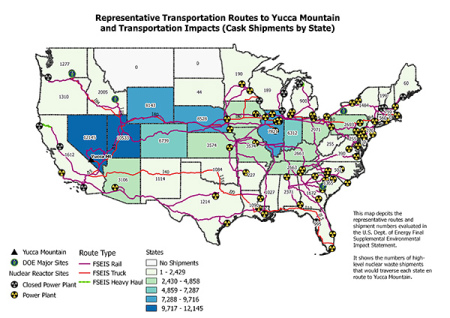
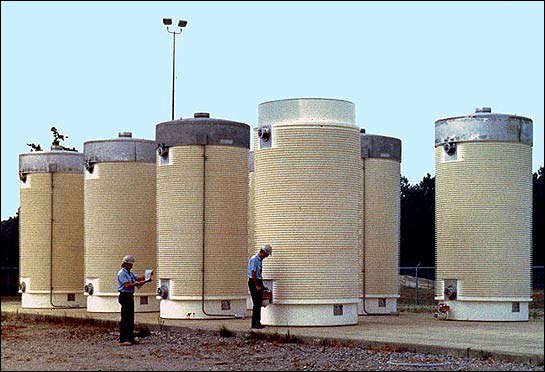
Over 250 intensely radioactive nuclear waste shipments would cross through
the Washington DC metropolitan area and thousands more would travel across the roads, rails  and waterways of the nation, if [the Yucca Mountain permanent repository in Nevada is approved]….The Nuclear Information and Resource Service (NIRS), an NGO, released maps of the likely routes radioactive shipments would use…

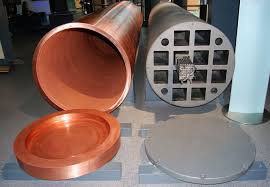
According to the map, highly radioactive waste fuel from nuclear power reactors in Virginia and Maryland would pass through the DC area on railroad tracks next to Metro Rail trains, including passing though Union Station. Each shipment contains several times more radioactive material than the Hioshima bomb blast released, with 20 to 50 tons of irradiated fuel assemblies in each  canister….  [Accident may happen during the shipments]…The shipments would also be vulnerable to attack or sabotage….Large-scale nuclear waste transport would also occur if, as some in Congress advocate, a“centralized interim storage” site for high-level radioactive waste were created.

Excerpts from Stop Fukushima Freeways Campaign Kicks Off, Nuclear Information and Resource Service Oct. 27, 2015

Privatization of Army: Nigeria

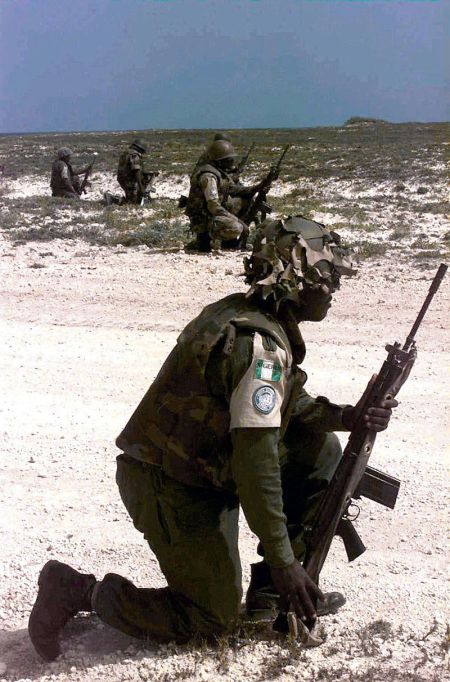
Private security is big business in Nigeria. The country suffers bombings in the north, sectarian violence in the centre and simmering insecurity in the oil-producing south-east. Red24, a Scottish security firm, says more than 600 people are kidnapped in the country every year, putting it among the five worst for that sort of crime…  [There are] 1,500 and 2,000 private security companies in Nigeria. Because they cannot legally carry weapons, armed units must be hired from national forces….Private companies pay the security forces handsomely. But that also encourages commanders to hire out their men. The result is a privatisation of public security, reckons Rita Abrahamsen, a professor at the University of Ottawa. In 2011 a retired deputy inspector-general estimated that up to 100,000 police officers (about a third of the country’s total) were working for “a few fortunate individuals”, and questioned what that meant for regular Nigerians. Martin Ewence, a British naval commander turned consultant, reckons that the navy in effect has “given over its maritime security responsibilities”.

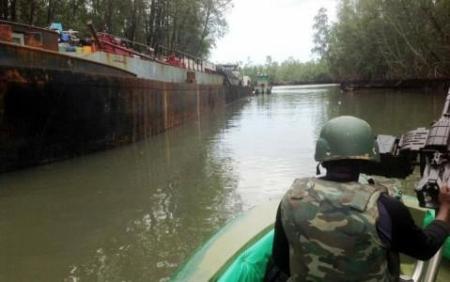
In the worst cases, the private-security culture fuels conflict. Oil companies in the Niger delta have been criticised for arming Nigeria’s Joint Task Force in a bid to secure their assets. The task-force’s combination of police, army and naval personnel, whose houseboats are moored in the delta’s greasy creeks to “tax” passing barges, are accused of human-rights abuses and involvement in the theft of oil.

Private security in Nigeria: Rent-a-cop, Economist, Oct. 17, 2015, at 54

Nuclear Waste-Idaho National Laboratory


The U.S. Energy Department has canceled  in October 2015 a plan to ship to the Idaho National Laboratory spent nuclear fuel from commercial reactors out of state, a controversial proposal that drew protests from two former governors and a lawsuit from one of them. Incumbent Governor C.L. “Butch” Otter and state Attorney General Lawrence Wasden in January 2015 expressed conditional support for two proposed deliveries of the high-level radioactive waste, saying it would raise the lab’s profile and boost the local economy around Idaho Falls, where the facility is located.

But talks between the Department of Energy (DOE) and Idaho broke down amid mounting opposition to the plan by two of Idaho’s former governors, one of whom filed a lawsuit last month seeking information he said the federal agency was concealing about the proposal.

Cecil Andrus, a Democrat who served four terms as governor, said at the time that he suspected DOE’s intent was to turn the sprawling research facility along the Snake River into a de facto nuclear dump in the absence of a permanent repository for high-level radioactive waste elsewhere in the United States.  Earlier this year, Andrus and former Governor Phil Batt, a Republican, accused DOE of violating a 1995 agreement that banned such shipments to Idaho.Specifically, they said the Energy Department had not yet complied with a provision of the accord requiring removal of nuclear waste already stored at the lab to reduce impacts on an aquifer that supplies drinking water to tens of thousands of Idaho residents.

In a statement sent Friday to Idaho National Lab workers, the director, Mark Peters, said he had been informed that the state and DOE “were unable to reach an understanding that would have enabled the first of two recently discussed shipments of research quantities of spent nuclear fuel to come to INL.” [see also 2011 Memorandum of Agreement on Storage of Research Quantities of Commercial Spent Fuel at the Idaho National Laboratory]  Peters said in his statement that the spent nuclear fuel in question would be delivered instead to “another DOE facility,” though it was not made clear where the materials were now destined.

Energy Department cancels plan to ship nuclear waste to Idaho, Reuters, Oct. 23, 2015

Climate Change 2015


Global carbon emissions were 58% higher in 2012 than they were in 1990. The atmospheric concentration of carbon dioxide has risen from just under 340 parts per million in 1980 to 400 in 2015.  To stand a fair chance of keeping warming to just 2°C by the end of the century—the goal of global climate policy—cumulative carbon emissions caused by humans must be kept under 1 trillion tonnes. Estimates vary but, according to the Intergovernmental Panel on Climate Change, the total had hit 515 billion tonnes by 2011. Climate Interactive, a research outfit, reckons that if emissions continue on their present course around 140 billion tonnes of greenhouse gases will be released each year and temperatures could rise by 4.5°C by 2100. And even if countries fully honour their recent pledges, temperatures may still increase by 3.5°C by then.

The world is already 0.75°C warmer than before the Industrial Revolution….

Melting glacier ice, and the fact that warmer water has a larger volume, mean higher sea levels: they have already risen by roughly 20cm since 1880 and could rise another metre by 2100. That is perilous for low-lying islands and flat countries: the government of Kiribati, a cluster of tropical islands, has bought land in Fiji to move residents to in case of flooding. Giza Gaspar Martins, a diplomat from Angola who leads the world’s poorest countries in the climate talks, points out that they are particularly vulnerable to the effects of a warming planet. Money alone, he argues, will not fix their problems. Without steps to reduce emissions, he predicts, “there will be nothing left to adapt for.”…

For every 0.6°C rise in temperature, the atmosphere’s capacity to hold water grows by 4%, meaning storms will pour forth with greater abandon. The rains of the Indian monsoon could therefore intensify, cutting yields of cereals and pulses.

Climate change seems also to be making dry places drier, killing crops and turning forests into kindling. Forest fires in Indonesia, more likely thanks to the current El Niño weather phenomenon, could release 2 billion tonnes of carbon dioxide, about 5% of annual emissions due to human activity, says Simon Lewis of University College London. In recent months fires have swallowed more than 2.4m hectares of American forests. Alaska suffered 80% of the damage—a particular problem because the soot released in these blazes darkens the ice, making it less able to reflect solar radiation away from the Earth.

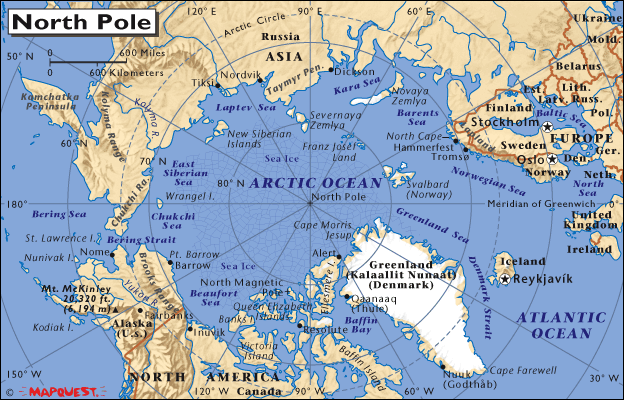
Developments in the Arctic are worrying for other reasons, too. The region is warming twice as fast as the rest of the world, a trend that could start a vicious cycle. Around 1,700 gigatonnes of carbon are held in permafrost soils as frozen organic matter. If they thaw, vast amounts of methane, which is 25 times more powerful as a global-warming gas than carbon dioxide when measured over a century, will be released. One hypothesis suggests that self-reinforcing feedback between permafrost emissions and Arctic warming caused disaster before: 55m years ago temperatures jumped by 5°C in a few thousand years…

And on September 29th Mark Carney, the governor of the Bank of England, warned that though measures to avoid catastrophic climate change are essential, not least for long-term financial stability, in the shorter term they could cause investors huge losses by making reserves of oil, coal and gas “literally unburnable”.

Excerpts from Climate Change: It’s Getting Hotter, Economst, Oct. 3, 2015, at 63


Fukushima in Singapore: nuclear accidents

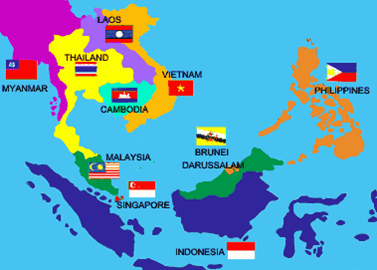
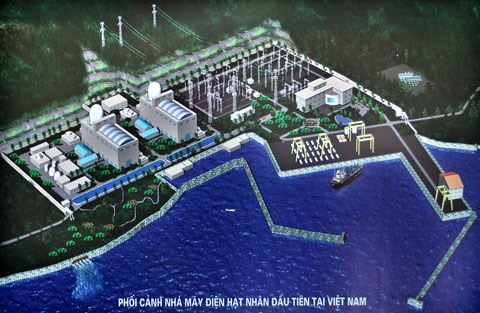
In Asia, plans have been delayed but not derailed. China and India, between them, have almost 50 nuclear plants in operation and are building even more.  In Southeast Asia, Vietnam could have its first power reactors by 2020. Thailand, Indonesia and Malaysia have also made plans.

“Southeast Asia is quasi-completely dependent on fossil fuels,” said Professor Arnoud De Meyer, President of Singapore Management University….Nuclear-based energy can add security and stability to the region’s source of energy. For Singapore, 95 per cent of its electricity comes from natural gas powered plants. Its cost is tied to oil prices.  Experts say Singapore’s choice, although the cleanest among fossil fuels, is also an expensive choice….This is because the cost associated with importing natural gas to run Singapore’s power plants is also higher….

In 2010, Singapore embarked on an extensive study of whether nuclear-based electricity could be added to its energy mix.  Two years later, it concluded that nuclear risks for Singapore outweighed the benefits.  “It was all to do with size,” said Professor Tim White, co-director of Nanyang Technological University’s Energy Research Institute.  “The first factor was that we did not really need a very large single nuclear reactor. Singapore just does not have that need for energy. So we would have had to look at modular designs, but none of those designs are actually operating at the moment – at least for power. So Singapore did not want to be the first one off the rack to take these new designs.

“The other concern was that after Fukushima, it was realised that the exclusion zone around the reactor was in fact as large as Singapore. So that meant one Fukushima accident in Singapore and that’s the end of the country. …But the study also concluded that Singapore needs to build up its nuclear knowledge and capability. In 2014, the government announced it would set aside S$63 million over five years for the Nuclear Safety Research and Education Programme.  The programme would train local scientists and engineers in three key areas – radiochemistry, radiobiology and risk assessment

“Even if Singapore would never have electricity generation by nuclear sources, countries around us will do it, or may well do it,” said Prof De Meyer. “But nuclear radiation is not something that stops at borders. If there is an accident or a problem, Singapore will be automatically influenced by it.,,,

But first, one expert says ASEAN needs a regulatory framework to address transboundary issues such as the management of nuclear fuel, waste and risk management….“If something happens, for example, in Indonesia’s nuclear facility, which will be built very close to Singapore, it will affect the whole country,” said Associate Professor Sulfikar Amir from NTU’s School of Humanities and Social Sciences.

Excerpts from Monica Kotwani, Singapore must be prepared to handle nuclear developments: Experts, Channel NewsAsia,  27 Sep 2015

Lasers for Nuclear Weapons

 Using spinning gas centrifuges to enrich fuel for nuclear bombs requires a structure the size of a department store, and enough electricity for some 10,000 homes. An alternative method being developed would make the search far more difficult...The alternative is to zap the uranium vapour with a powerful infra-red beam from a laser…At least 27 countries, by one tally, have worked on laser enrichment since the 1970s. Most gave up, largely because production batches were tiny. Now, however, two firms say that they have learned how to scale up the process.

Jeffrey Eerkens of Neutrek, a Californian research firm, says its laser process requires around half the space and electricity that centrifuges need. A competing laser method is offered by Global Laser Enrichment (GLE), a consortium of General Electric, Hitachi and Cameco, a Canadian uranium producer. It, too, requires less space. In 2012 GLE was awarded a licence to build a facility in North Carolina for the commercial production of reactor fuel.

America has classified the technology, but that may not stop it spreading. The most important bit of laser-enrichment know-how has already leaked, says Charles Ferguson, head of the Federation of American Scientists—namely, that companies now consider it to be practical. This will reinvigorate efforts by other countries to develop the technology for themselves….

Non-proliferation optimists think laser-enrichment might not work as well as advertised, because GLE has still not begun commercial production. But this may be only temporary, because the company says the price of enriched uranium is too low to justify completing the project. A regime keen for a more discreet path to the bomb would not bother with such considerations.

Monitoring nuclear weapons: Lasering the fuel, Economist Technology Quarterly,  Sept. 5, 2015

Nuclear Weapons Proliferation: the Race

As nuclear blasts go, North Korea’s first test in 2006 was small. The detonation of an underground device produced an explosive force well below one kiloton (less than a tenth of the size of the bomb dropped on Hiroshima in 1945). Even so, the vibrations it caused were recorded half a world away in the centre of Africa. Advances in the sensitivity of seismic sensors and monitoring software are now good enough to distinguish between a distant nuclear detonation and, say, a building being demolished with conventional explosives, says Lassina Zerbo, head of the Preparatory Commission for the Comprehensive Test-Ban-Treaty Organisation (CTBTO), the international organisation that seeks to enforce the agreement ratified, so far, by 163 nations.

The CTBTO operates 170 seismic stations worldwide, 11 underwater hydroacoustic centres detecting sound waves in the oceans, 60 listening stations for atmospheric infrasound (low-frequency acoustic waves that can travel long distances) and 96 labs and radionuclide-sampling facilities. More sensors are being installed. Crucially, however, the optimal number for global coverage was recently reached. It is now impossible, reckons Dr Zerbo, to test even a small nuclear weapon in secret anywhere on Earth. And on top of that, the United States Air Force runs a detection network that includes satellites that can spot nuclear-weapons tests.

It is better, though, to discover a secret weapons programme before testing. Once a country has a nuclear bomb or two, there is not much other governments can do to stop it from making more, says Ilan Goldenberg, a former head of the Iran team at the Pentagon. Plenty of states want such capabilities. The Defence Science Board, an advisory body to the Pentagon, concluded in a report last year that the number of countries that might seek nuclear weapons is higher now than at any time since the cold war. Those states include Saudi Arabia and other Sunni-Arab rivals of Iran, which in July, after long and tortuous negotiations, signed a nuclear deal with America and other nations to restrict its nuclear activities, and to allow enhanced monitoring and inspection of its facilities.

As the technologies to unearth work on clandestine nuclear weapons become more diverse and more powerful, however, the odds of being detected are improving. Innovation is benefiting detection capabilities, says Ramesh Thakur, a former UN assistant secretary-general. The products under development range from spy software that sifts through electronic communications and financial transactions to new scanners that can detect even heavily shielded nuclear material….

Software used for this type of analysis include i2 Analyst’s Notebook from IBM, Palantir from a Californian firm of the same name, and ORA, which was developed with Pentagon funds at Carnegie Mellon University in Pennsylvania. ORA has crunched data on more than 30,000 nuclear experts’ work and institutional affiliations, research collaborations and academic publications, says Kathleen Carley, who leads the ORA work at Carnegie Mellon. Changes, such as a halt in publishing, can tell stories: scientists recruited into a weapons programme typically cannot publish freely. Greater insights appear when classified or publicly unavailable information is sifted too. Credit-card transactions can reveal that, say, a disproportionate number of doctors specialising in radiation poisoning are moving to the same area.

The software uses combinatorial mathematics, the analysis of combinations of discrete items, to score individuals on criteria including “centrality” (a person’s importance), “between-ness” (their access to others), and “degree” (the number of people they interact with). Network members with high between-ness and low degree tend to be central figures: they have access to lots of people, but like many senior figures may not interact with that many. Their removal messes things up for everybody. Five or more Iranian nuclear scientists assassinated in recent years—by Israel’s Mossad, some suspect—were no doubt chosen with help from such software, says Thomas Reed, a former secretary of the United States Air Force and co-author of “The Nuclear Express”, a history of proliferation.

Importantly, the software can also evaluate objects that might play a role in a nuclear programme. This is easier than it sounds, says a former analyst (who asked not to be named) at the Pentagon’s Central Command in Tampa, Florida. Ingredients for homemade conventional bombs and even biological weapons are available from many sources, but building nukes requires rare kit. The software can reveal a manageable number of “chokepoints” to monitor closely, he says. These include links, for instance, between the few firms that produce special ceramic composites for centrifuges and the handful of companies that process the material.

A number of countries, including Japan and Russia, use network analysis. Japan’s intelligence apparatus does so with help from the Ministry of Economy, Trade and Industry, which assists in deciding which “dual use” items that might have both peaceful and military purposes should not be exported. Such work is tricky, says a member of the advisory board (who also asked not to be named) to the security council of the Russian Federation, a body chaired by Vladimir Putin. Individual items might seem innocent enough, he says, and things can be mislabelled.

Data sources are diverse, so the work takes time. Intelligence often coalesces after a ship has left port, so foreign authorities are sometimes asked to board and search, says Rose Gottemoeller, undersecretary for arms control at America’s State Department. The speed of analysis is increasing, however. Software that converts phone conversations into computer-readable text has been “extremely helpful”, says John Carlson, a former head of the Australian foreign ministry’s Safeguards and Non-Proliferation Office.

Would-be nuclear states can also reduce their networks. North Korea helped to keep its centrifuge facility secret by using mostly black-market or domestically manufactured components. Iran is also indigenising its nuclear programme, which undermines what network analysis can reveal, says Alexander Montgomery, a political scientist at Reed College in Portland, Oregon. Iran mines uranium domestically and has produced centrifuge rotors with carbon fibre, instead of importing special maraging steel which is usually required.

A big computer system to make sense of all this would help, says Miriam John, vice-chairman of the Pentagon’s Threat Reduction Advisory Committee. Which is why the Pentagon is building one, called Constellation. Dr John describes it as a “fusion engine” that merges all sorts of data. For instance, computers can comb through years of satellite photos and infra-red readings of buildings to detect changes that might reveal nuclear facilities. Constellation aims to increase the value of such nuggets of information by joining them with myriad other findings. For example, the whereabouts of nuclear engineers who have stopped teaching before retirement age become more interesting if those people now happen to live within commuting distance of a suspect building.

Yet photographs and temperature readings taken from satellites, even in low Earth orbit, only reveal so much. With help from North Korea, Syria disguised construction of a nuclear reactor by assembling it inside a building in which the floor had been lowered. From the outside the roof line appeared to be too low to house such a facility. To sidestep the need for a cooling tower, water pipes ran underground to a reservoir near a river. The concealment was so good the site was discovered not with remote sensing but only thanks to human intelligence, says Dr Tobey, the former National Security Council official. (Israel bombed the building in 2007 before it could be completed.)

Some chemical emissions, such as traces of hydrofluoric acid and fluorine, can escape from even well-built enrichment facilities and, with certain sensors, have been detectable from space for about a decade, says Mr Carlson, the Australian expert. But detecting signs of enrichment via radiation emissions requires using different sorts of devices and getting much closer to suspected sources.

The “beauty” of neutrons and alpha, beta and gamma radiation, is that the energy levels involved also reveal if the source is fit for a weapon, says Kai Vetter, a physicist at the University of California, Berkeley. But air absorbs enough radiation from uranium and plutonium bomb fuel to render today’s detectors mostly useless unless they are placed just a few dozen metres away. (Radiological material for a “dirty bomb” made with conventional explosives is detectable much farther away.) Lead shielding makes detection even harder. Not one of the more than 20 confirmed cases of trafficking in bomb-usable uranium or plutonium has been discovered by a detector’s alarm, says Elena Sokova, head of the Vienna Centre for Disarmament and Non-Proliferation, a think-tank.

Ground-based detectors are becoming more sensitive….. Detectors still need to be close to whatever it is they are monitoring, which mostly restricts their use to transport nodes, such as ports and borders. The range the detectors operate over might stretch to about 100 metres in a decade or so, but this depends on uncertain advances in “active interrogation”—the bombardment of an object with high-energy neutrons or protons to produce other particles which are easier to pick up. One problem is that such detectors might harm stowaways hiding in cargo.

That risk has now been solved, claims Decision Sciences, a Californian company spun out of the Los Alamos National Laboratory in America. It uses 16,000 aluminium tubes containing a secret gas to record the trajectory of muons. These are charged particles created naturally in the atmosphere and which pass harmlessly through people and anything else in their path. However, materials deflect their path in different ways. By measuring their change in trajectory, a computer can identify, in just 90 seconds, plutonium and uranium as well as “drugs, tobacco, explosives, alcohol, people, fill in the blank”, says Jay Cohen, the company’s chief operating officer and a former chief of research for the United States Navy. The ability to unearth common contraband will make the machine’s $5m price tag more palatable for border officials. A prototype is being tested in Freeport, Bahamas.

Other groups are also working on muon detectors, some using technology developed for particle physics experiments at the Large Hadron Collider in Switzerland. Another approach involves detecting neutrinos, which are produced by the sun and nuclear reactors, and seeing how they interact with other forms of matter. The NNSA and other organisations are backing the construction of a prototype device called WATCHMAN in an old salt mine (to shield it from cosmic rays and other interference) in Painesville, Ohio. It will be used to detect neutrinos from limited plutonium production at a nuclear power station 13km away. Such a system might have a 1,000km range, eventually. But even that means it would require a friendly neighbour to house such a facility on the borders of a country being monitored.

Once nuclear facilities have been discovered, declared or made available for inspection as part of a deal, like that signed with Iran, the job of checking what is going on falls to experts from the UN’s International Atomic Energy Agency (IAEA). The equipment available to them is improving, too. The Canadian Nuclear Safety Commission has built a prototype hand-held spectrometer for determining if traces of uranium collected on a cotton swab and blasted with a laser emit a spectral signature that reveals enrichment beyond that allowed for generating electricity. Within three years it will provide an unprecedented ability to assess enrichment without shipping samples back to a lab, says Raoul Awad, director-general of security and safeguards at the commission.

Laser scanning can also reveal other signs of enrichment. A decade ago inspectors began scanning intricate centrifuge piping with surveying lasers. A change between visits can reveal any reconfiguration of the sort necessary for the higher levels of enrichment needed for bombmaking. Secret underground facilities might also be found by wheeling around new versions of ground-penetrating radar.

The remote monitoring of sites made available to inspectors is also getting better. Cameras used to record on videotape, which was prone to breaking—sometimes after less than three months’ use, says Julian Whichello, a former head of the IAEA’s surveillance unit. Today’s digital cameras last longer and they can be programmed to take additional pictures if any movement is detected or certain equipment is touched. Images are encrypted and stamped with sequential codes. If technicians at a monitored facility delete any pictures, the trickery will be noticed by software and the inspectors informed.

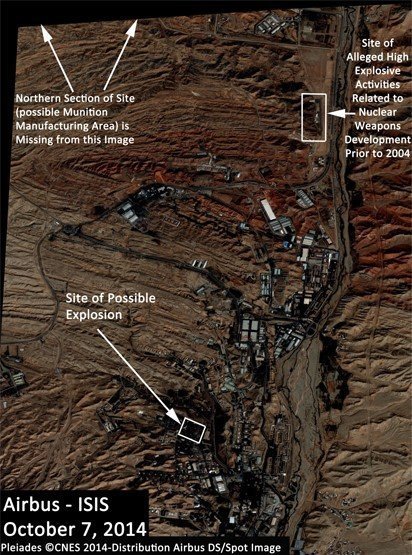
Such technology, however, only goes so far. The IAEA cannot inspect computers and countries can veto the use of some equipment. It does seem that inspectors sent to Iran will get access to Parchin, a site near Tehran where intelligence agencies say tests related to nuclear-weapons making took place. (Iran denies it has a military programme.) But even the best tech wizardry can only reveal so much when buildings have been demolished and earth moved, as in Parchin.

Could nuclear weapons be built in secret today? …. A senior American State Department counter-proliferation official (whose asked to remain anonymous), however, says that it is not impossible…Companies, including a General Electric consortium, are making progress enriching uranium with lasers . If this becomes practical, some worry that it might be possible to make the fuel for a nuclear bomb in smaller facilities with less fancy kit than centrifuges

Monitoring nuclear weapons: The nuke detectives, Economist Technology Quarterly, Sept. 5, 2015, at 10

Nuclear Power in African Countries

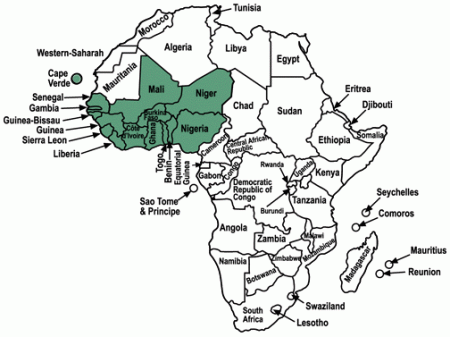
In Democratic Republic of Congo’s nuclear plant is in limbo, after it shut down its reactor in 2004 due to overheating, lack of spares and unwillingness by the US to send parts.  Egypt, Niger, Ghana, Tanzania, Morocco, Algeria and Nigeria have also begun the rollout of projects in this sector.

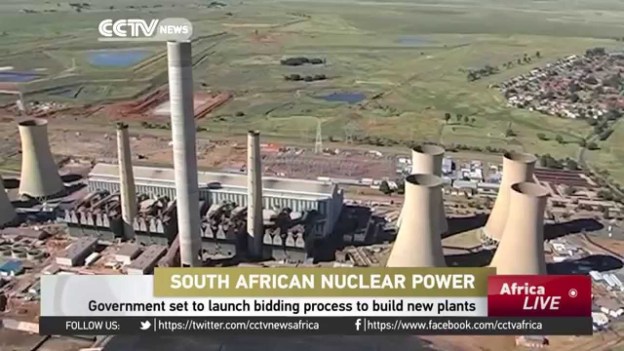
In May 2015, South Africa announced that it will procure a nuclear fleet to generate 9,600MW of power at a cost of $100 billion. The country’s installed nuclear generating capacity of 1,830 MW from its two reactors at Koeberg. These plants were commissioned in 1984 and will be closed in 2025….”We are still on course with our plans to construct an additional eight new nuclear plants by 2023 to produce 9,600MW,” Ms Joemat-Petterson said.[South African Energy Minister ]

Kenya is also planning to construct nuclear power plants that it hopes will generate a minimum of 4,000MW from 2023.  “We have no option but to embrace nuclear early enough to avoid starting the process long after we have exhausted geothermal sources,” Energy Principal Secretary Joseph Njoroge said.

The key question, however, is if the countries on the continent can afford the costs of setting up nuclear plants. Nuclear reactor costs run into billions of dollars but the main cost is in the initial investment and the plant itself. It is a long-term form of energy, with reactors operating for close to 60 years producing electricity with minimal maintenance.

For instance, Nigeria is looking for $32 billion to construct four nuclear plants. However, the project is shrouded in controversy as the country is currently facing a financial deficit, with other key infrastructure projects pending.  Ochilo Ayacko, the chief executive of the Kenya Nuclear Electricity Board, said that the country will need at least $20 million to put up its 4,000MW plants. Uganda is also facing financial hurdle as it seeks to join the nuclear club. According to an AF-Consult Switzerland report, Uganda will require $26 billion to have an installed capacity of 4,300MW from nuclear energy by 2040.  James Isingoma Baanabe, Uganda’s acting Commissioner for Energy Efficiency and Conservation, said it will take the country at least 20 years to build its first nuclear plant, mostly because of financing.

In 2000, Tanzania invited bids to construct its nuclear plant, with South Africa’s South Areva, being touted as a front runner. However, little came of this as the country slowed down in its nuclear bid because of financing challenges.

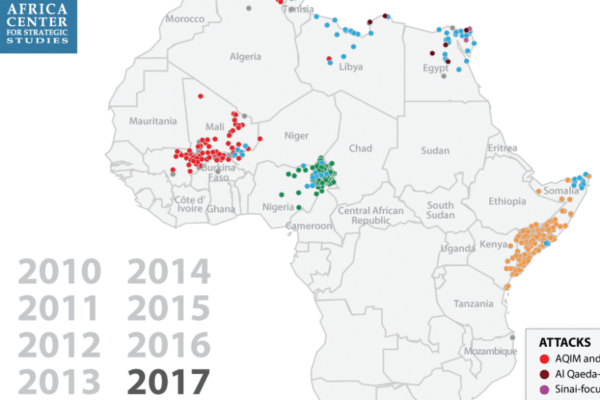
For most nuclear projects, security is key… In 2014, Niger saw militants from Al Qaeda in the Islamic Maghreb attack the Somair uranium mine owned by Areva, killing 26 people.  In April 2015, the Nigerian government announced that it was downscaling its uranium stockpiles and beefing up security around the proposed sites of its nuclear reactors.

Kenya is also facing insecurity from Somali Al Shabaab militants who have in several occasions tried to blow up power plants in Garissa and northern Kenya. Securing these facilities is a key concern in the preliminary report handed to the Kenyan government by Josi Bastos, the International Atomic Energy Agency team leader.

Excerpts  from Allan Olingo,  Africa Now Turns to Nuclear for Power Generation Amid Fears of Insecurity, allafrica.com, Sept. 15, 2015

Making Money in the Peruvian Amazon

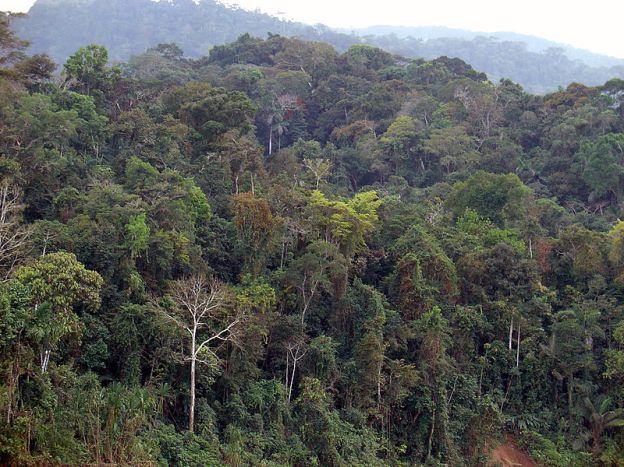
The Sierra del Divisor region in the Peruvian Amazon was identified as a biodiversity conservation priority back in the early 1990s. More than 20 years later and Peruvians are still waiting – some more desperately than others given all the narco-traffickers, illegal loggers and gold-miners in or near the region.

What’s so special about the Sierra del Divisor? It’s the “only mountainous region” anywhere in the lowland rainforest, according to Peruvian NGO Instituto del Bien Comun (IBC), while The Field Museum, in the US, describes it as “a mountain range” rising up “dramatically from the lowlands of central Amazonian Peru” and boasting “rare and diverse geological formations that occur nowhere else in Amazonia.” Its most iconic topographical feature is “El Cono”, an extraordinary peak visible from the Andes on a clear day.

Sierra del Divisor is home to numerous river headwaters feeding into key Amazon tributaries, eco-systems, and a tremendous range of flora and fauna, some of which are endemic, some endangered or threatened – and some with the most wonderful names. Giant armadillos, jaguars, cougars, Acre antshrikes, curl-crested aracaris, blue-throated piping guans and various kinds of monkeys, including the bald – but very red-faced – uakari, all populate the region. Effectively, it forms part of a vast “ecological corridor” running all the way from the Madidi National Park in Bolivia in a north-westerly direction along much of the Peru-Brazil border.

21 indigenous communities and 42 other settlements would benefit from the Sierra del Divisor being properly protected, states the Environment Ministry, while ultimately over 230,000 people in Peru depend on the region for food and water, according to the IBC. In addition, in the absolute remotest parts, it is home to various groups of indigenous peoples living in what Peruvian law calls “isolation.”

In 2006 Peru’s government established a 1.4 million hectare temporary “protected natural area” in this region called the Sierra del Divisor Reserved Zone. Six years later a government commission agreed it would be converted into a national park, and, all that remains now, after a painful administrative process, several key advances made this year and indigenous leaders lobbying various ministries, is for Peru’s Cabinet to approve it and the president, Ollanta Humala, to sign off on it. That is how it has stood since early May 2015 – and still nothing….

Why such a delay indeed, this year or in the past? Might it have something to do with the infrastructure integration plans for the region, such as the proposed – and effectively already underway – road between Pucallpa, the Peruvian Amazon’s current boom city, and Cruzeiro do Sul across the border in Brazil? Or the proposed railway between the same two cities ultimately connecting to Peru’s northern Pacific coast, declared in the “national interest” some years ago? Or the proposed railway running all the way across South America from Peru’s Pacific coast to Brazil’s Atlantic coast, a long-mooted project which has received so much media coverage recently because of Chinese interest in financing it and the visit by China’s premier, Li Keqiang, to Brazil and Peru in May?

Or might the delay be explained by oil and gas industry interests? Perupetro, the state company promoting oil and gas operations, tried to open up what would be the entire southern part of the park for exploration before backtracking in 2008, while the London Stock Exchange-Alternative Investment Market-listed company Maple Energy has been pumping oil for years in a concession just overlapping the west of the proposed park. More significantly, Canadian-headquartered company Pacific Rubiales Energy runs a one million hectare oil concession that would overlap the entire northern part of the park if it was established, and conducted its first phase of exploratory drilling and seismic tests in late 2012 and 2013 in what would be the park’s far north. Clearly, it wouldn’t be good PR for either Pacific or Peru to explore for oil in, or exploit oil from, a national park, although it wouldn’t be the first time a concession and park have overlapped. Indeed, according to the IBC, it has been agreed that Pacific’s “rights” to operate will be respected if the park is created.

Excerpts from David Hill Peru stalling new national park for unique Amazon mountain range, Guardian, July 29, 2015


Nuclear and Toxic Waste-Iraq

Most of the Iraq’s vast deposits of radioactive materials are a legacy of the turbulent regime of former leader Saddam Hussein, and have built up over the last four decades. Other toxic materials can be found in the country’s graveyards of contaminated industrial equipment“The parliament has decided to study the situation again after other provinces [including Dhi Qar] rejected such decision,” said Yahya al-Nasiri, governor of the southern Dhi Qar province.

“The proposals suggest burying the waste outside the country or in the desert…Asked if there are other ways to dispose of the waste, he said “it could possibly be buried in the sea using special containers or be sent to countries willing to take it, in exchange for money.”

While Nasiri said other provinces have rejected a similar request, Dhi Qar’s provincial council voted against the Iraqi parliament’s proposal in early July 2015 to use some of the southern province’s land as a burial site for the radioactive pollutants coming from all other provinces of the country.  Dhi Qar’s health and environment committee head Abdulamir Salim at the time slammed the proposal and said it posed a “real threat to the health and security of the province’s citizens.”..

An official Iraqi study in 2010 found more than 40 sites across the country that were contaminated with high levels or radiation and dioxins.  Iraq “without doubt” suffers from these radioactive pollutants inherited from “continuous wars” starting in the 1980s Iraqi-Iran war to the Gulf War in 1990s till 2003, when the United States used highly advanced weapons – including depleted uranium – in its efforts to topple Hussein’s regime, the governor lamented….However, it is not only war-produced pollutants that harm people’s health in Iraq – in addition, there is a lack of quality controls imposed on imported goods.  Radioactive material is also “the result of imports of car parts from Japan to the province,” he added….Areas around Iraqi cities such as Najaf, Basra and Fallujah accounted for more than 25 percent of the contaminated sites, with the southern city of Basra – the frontline during Iran-Iraq war and the Gulf War – having 11 sites, according to the 2010 study.

The study, carried out by the environment, health and science ministries found that scrap metal yards in and around the capital Baghdad and Basra contain high levels of ionizing radiation, which is thought to come from depleted uranium used in munitions during the first Gulf war and since the 2003 invasion.  “The U.S. army unfortunately caused an increase in these radioactive material by using uranium and its advanced arms that use a lot of harmful radioactive material,” Nasiri said. “But the U.S. army did not help nor support our projects to get rid of these pollutants.”

Excerpts from Dina al-Shibeeb, Iraq studying new plan on where to bury radioactive waste, says official, Al Arabiya News, July 18, 2015

Nuclear Industry: France, Russia and China

[Regarding the French nuclear company Areva] its newest product, the expensive European Pressurised Reactor (EPR), has encountered more than the teething problems common to all big industrial projects. A plant in Finland is almost ten years behind schedule and almost three times over budget: Areva has had to write off billions as a result….Two reactors in China and the only new-build in France, at Flamanville, are also running late. EDF played an important role in managing the Chinese and French projects.

Besides criticism for slack project management, Areva and EDF (Electricite de France) have been questioned over technical standards. The steel in the main reactor vessel at Flamanville is faulty, the Nuclear Safety Authority said in April 2015. EDF disputes the finding and, with Areva, has started new tests. The news added to growing disenchantment in Britain with an agreement, not yet firm, that expensively entrusts the construction of a power station incorporating two Areva EPRs to a consortium led by EDF.  It seems unlikely that Areva will find many more foreign takers for its existing reactor…

[S]ome of Areva’s rivals are racing ahead. Rosatom, a Russian nuclear firm, has built up a fat order-book. Keen pricing, generous financing and relaxed technology transfer help, though Western sanctions do not. China’s two reactor-builders, CNNC and CGN, are peddling their own new design, Hualong One; in February CNNC signed a preliminary agreement to supply a reactor to Argentina.

Areva has little reason to hope for a surge of new orders at home. France’s 58 reactors are elderly but EDF, which operates them, plans to revamp rather than replace them…A new law set to come into force this summer, pledging somehow to cut France’s dependence on nuclear power from 75% to 50% of its electricity needs by 2025, will make Areva’s prospects even bleaker.

Excerpts from France’s nuclear industry: Arevaderci, Economist, May 23, 2015, at 53.

Biofuels Revolution? not really

B]iofuel schemes—ranging from fermenting starch, to recycling cooking oil, to turning algae into jet fuel—have drawn more than $126 billion in investment since 2003, according to Bloomberg New Energy Finance (BNEF), a research outfit… [But]Those biofuels that can best compete commercially are not, in fact, green. Those that are green cannot compete commercially.

The biggest cause of ungreenness is that biofuels made from food crops—or from plants grown on land that might otherwise produce such crops—hurt food supplies. A committee of the European Parliament agreed this week to cap the use of “first-generation” biofuels of this sort. The current European target is for renewables to make up 10% of the energy used in transport by 2020. The new proposal says only seven-tenths of this can come from first-generation fuels. The difference must be made up by more advanced ones based on waste products and other feedstocks that do not impinge on food production. That could mean European demand for advanced biofuels of 14 billion litres by 2020, reckons Claire Curry of BNEF.
Only two such advanced fuels, she thinks, are capable of large-scale production. One is turning waste cooking oil and other fats into diesel—a process for which Europe already has 2 billion litres of capacity. The other involves making ethanol from cellulose by enzymatic hydrolysis. Everything elseis at least four years from commercial production. That includes the much-touted idea of renewable jet fuel.  This is promising on a small scale. South African Airways (SAA), in conjunction with Boeing and other partners, is developing fuel based on the seeds of the tobacco plant—once a big crop in the country, but now fallen on hard times.

Biofuels: Thin harvest, Economist, Apr. 18, 2015, at 72

Plutonium and Space Travel

In places where the sun’s rays do not penetrate…a different power source is required for space travel. One of the favourites used in space missions is a radioisotope thermoelectric generator (RTG).  RTGs were developed by America in the 1950s and work by converting heat produced by the decay of a radioactive material into electricity directly. This is not the same as nuclear fission, a more complex process used in power plants to split radioactive material and release a much larger amount of energy. The former Soviet Union also used RTGs to run hundreds of lighthouses and navigation beacons in remote areas… While the isotopes used are not much use in bombs, they can still make people ill, even when partially depleted.

America’s RTGs use plutonium-238 (238Pu). The American plant that produced it closed in 1988 and the isotope was then imported from Russia. That stopped in 2009, leaving NASA with 35kg in stock, although only about 17kg of that is estimated to be still suitable for RTGs. After years of hand-wringing about being cut off from space without the material to make an RTG, a deal was reached in 2013 for NASA to pay the Department of Energy to resume production…

America has used RTGs in 27 space missions since 1961. Despite continuing improvements in collecting solar energy, NASA says it still needs RTGs—and not just to reach destinations beyond Saturn. The space agency’s planetary-science division has a list of places where solar power cannot be relied upon, including the dark side of Mercury, craters on the Moon and the poles of Mars, which are partly obscured from the sun.  NASA has been working on a system called the Advanced Stirling Radioisotope Generator, which offers four times the efficiency of a current RTG.

Excerpts from Powering space travel: NASA’s dark materials, Economist, Apr. 4, 2015, at  75

Nuclear Reactors Exports – China

China Power Investment Corporation and State Nuclear Power Technology Corp have officially announced their merger, as Beijing moves to consolidate its nuclear power sector, aiming eventually to export reactors.  China Power producer currently controls about a tenth of China’s nuclear power market, while the State Nuclear was formed in 2007 to handle nuclear technology transferred from U.S.-based Westinghouse Electric Co.

The new company, State Power Investment Corporation, is expected to own assets over 700 billion yuan ($112.94 billion) and to post revenue of over 200 billion yuan annually, state news agency Xinhua said, citing Wang Binghua, the chairman and party secretary of State Power Investment Corporation.

China National Nuclear Power Corp (CNNC) said …that the merger to form State Power Investment Corporation will increase competition between China’s three major nuclear corporations in both domestic and international construction of nuclear infrastructure. The other major player in this sector is China General Nuclear Power Group (CGN).China is contemplating a merger between CNNC and CGN which were set up as rivals to compete for projects at home and overseas but, under government prompting, have cooperated on a single reactor brand, Hualong 1, with the intention of eventually marketing it abroad.

Beijing said in January it would aid the overseas expansion of Chinese firms, in particular in the rail and nuclear power sectors, raising hackles with some trading partners who fear it signals another wave of subsidized Chinese exports.

China nuclear power firms merge to fuel global clout, Reuters, May 30, 2015

Unleashing Nuclear Power – Iran

China was expected to build two nuclear power plants for Iran as part of the country’s new nuclear direction under the controversial nuclear deal that was signed July 15, 2015. The plants were set to be located on the Makran coast, near the neighboring Gulf of Oman, Iran’s Atomic Energy Organization head Ali Akbar Salehi announced on July 22, 2015.

Uninhibited by sanctions, Iran announced plans for four new nuclear power plants. Chinese contractors will be building two of the four planned. “We will simultaneously launch construction of four new nuclear power plants in the country in the next two to three years,” Salehi said, according to Indo-Asian News Service. “We plan to engage more than 20,000 workers and engineers in this large-scale construction.”

When it comes to United Nations sanctions, China had always been an advocate for Iran, along with Russia, generally opposing Washington’s proposed restrictions. On July 20, 2015, the United Nations adopted the nuclear deal between Tehran and Washington, after the “P5+1” countries — the U.S., Britain, France, Russia, China and Germany — unanimously approved it, also voting to lift a series of economic sanctions that were previously imposed on Iran.

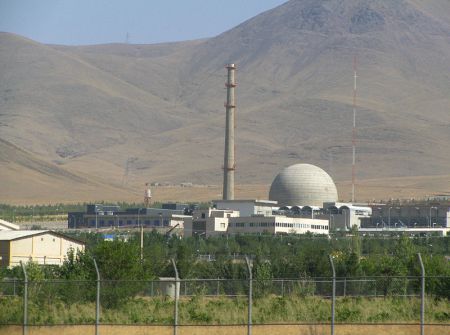
China has played a unique, hands-on role in the nuclear deal involving Iran’s Arak reactor, which has been described previously as a “pathway” to nuclear weapons for Iran.

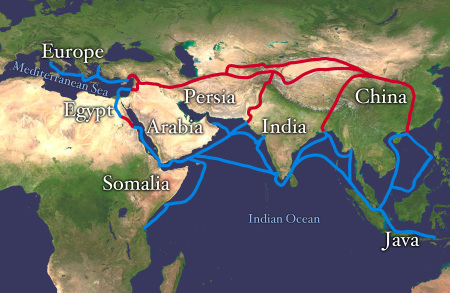
“China has put forward the idea of the modification of the Arak heavy water reactor. … This is the unique role China has played in resolving the Iranian nuclear issue,” Chinese Foreign Minister Wang Yisaid in a statement…..  [The nuclear deal]  has also opened up a door to increased business opportunity in Iran, particularly for China.  Following the announcement of the landmark deal, Wang said that China played a pivotal role in negotiations, and he expressed hope that Iran would take part in China’s “one belt, one road” ambition to revive the Silk Road route.

Excerpts from Michelle FlorCruz, Iran Nuclear Deal: China To Build 2 Nuclear Power Plants For Islamic Republic Following Landmark Agreement, International Business Times, July 22, 2015

Full text of Iran Nuclear Deal Signed July 15, 2015
Joint Comprehensive Plan of Action
Annex I: Nuclear-related commitments
Annex II: Sanctions-related commitments
Attachments to Annex II
Annex III: Civil nuclear cooperation
Annex IV: Joint Commission
Annex V: Implementation Plan

Killing with Liquid Lasers: HELLADS

A high-power laser weapon light enough to be carried by tactical aircraft has moved out of the laboratory and onto the testing ground. General Atomics Aeronautical Systems’ High-Energy Liquid Laser Defense System (HELLADS) has finished its US Government Acceptance Test Procedure and is on its way to the White Sands Missile Range in New Mexico for live-fire tests.

Laser weapons have made great strides in recent years, but one of the most sought after goals has been to marry high power to light weight so the system can be installed in aircraft… patrol ships and armored combat vehicles [and drones] … [T]he all-electric HELLADS punches a 150 kW laser, yet is only a tenth the size and weight of comparable systems.

Excerpts from  David Szondy, Lightweight High-Energy Liquid Laser (HELLADS) prepared for live fire tests, gizmag.com, May 30, 2015


Looking Behind the Brick Wall: Military

From the DARPA website on project  Revolutionary Enhancement of Visibility by Exploiting Active Light-fields (REVEAL) program

Imagine, for example, squad members patrolling a street in a deployed urban environment, and an armed assailant crouching behind a car or a concrete barrier. Without the benefit of different vantage points (from the air, for example), the squad could be blind to the hidden threat. If by chance a glass storefront window were behind the assailant, the squad might spot the assailant’s reflection in the window. But if the backdrop were a brick wall, there would be no visible reflection. By exploiting currently untapped aspects of light and the varied paths of photons bouncing off the brick wall, troops using hardware based on the theoretical foundations provided by REVEAL might someday be able to detect the otherwise hidden assailant [or see clearly what people are doing inside their homes].

Another potential application could be determining an unknown material’s composition and other properties from a safe distance, avoiding the potential danger associated with close proximity and physical examination. Based on information carried by the photons interacting with the material, it may be possible for troops in the future to identify radioactive, biological or chemical threats and camouflaged targets from much farther away than currently possible.

See also FBO

Nuclear Waste Disposal: Japan

The Japanese government will select potential areas to host nuclear dump sites instead of waiting for communities to volunteer, according to the revised policy on permanent disposal of high-level radioactive waste that was adopted by the Cabinet on May 22, 2015  The revision, the first in seven years, was prompted after towns, villages and cities throughout Japan snubbed requests to host nuclear waste dumps. The government has been soliciting offers since 2002.

The move is seen as a sign that the government wants to address the matter as it proceeds with its pursuit of reactor restarts. All commercial units have largely sat idle since the triple meltdown at the Fukushima No. 1 plant in 2011….Prime Minister Shinzo Abe’s administration is seeking to revive atomic power, although the majority of the public remains opposed in light of the Fukushima disaster, which left tens of thousands homeless. Critics have attacked the government for promoting atomic power without resolving where all the waste will end up.

Permanent disposal of high-level nuclear waste requires that a depository be built more than 300 meters underground, where the materials must lie for up to 100,000 years until radiation levels fall to the point where there is no harm to humans or the environment.  About 17,000 tons of spent fuel is stored on the premises of nuclear plants and elsewhere in Japan, but some would run out of space in three years if all the reactors got back online.  Under the revision, the government said it will allow future generations to retrieve high-level waste from such facilities should policy changes or new technologies emerge.

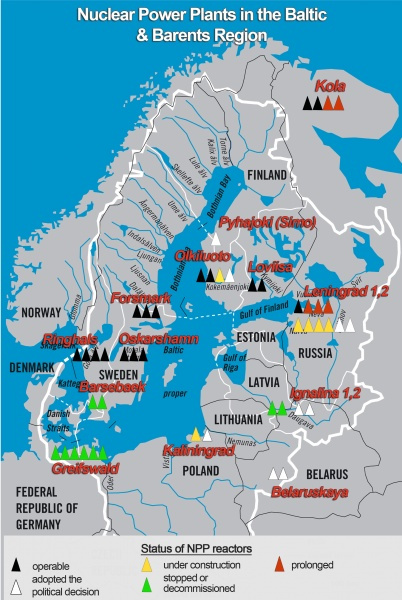
Worldwide, only Finland and Sweden have been able to pick final depository sites.

Excerpts from METI changes tactics after search for nuclear waste host proves futile,  Japan Times, May 22, 2015

100 Years of Oil Leaks: Gulf of Mexico

A decade-old oil leak where an offshore platform toppled during a hurricane could continue spilling crude into the Gulf of Mexico for a century or more if left unchecked, according to government estimates obtained by The Associated Press that provide new details about the scope of the problem.  Taylor Energy Company, which owned the platform and a cluster of oil wells, has played down the extent and environmental impact of the leak. The company also maintains that nothing can be done to completely eliminate the chronic oil slicks that often stretch for miles off the coast of Louisiana….

Federal regulators suspect oil is still leaking from at least one of 25 wells that remain buried under mounds of sediment from an underwater mudslide triggered by waves whipped up by Hurricane Ivan in 2004….A Taylor contractor drilled new wells to intercept and plug nine wells deemed capable of leaking oil. But a company official has asserted that experts agree the “best course of action … is to not take any affirmative action” due to the risks of additional drilling…

The AP’s review of more than 2,300 Coast Guard pollution reports since 2008 showed a dramatic spike in sheen sizes and oil volumes since Sept. 1, 2014. That reported increase came just after federal regulators held a workshop August 2014 to improve the accuracy of Taylor’s slick estimates and started sending government observers on a Taylor contractor’s daily flights over the site.

Presented with AP’s findings, the Coast Guard provided a new leak estimate that is about 20 times greater than one recently touted by the company. In a February 2015 court filing, Taylor cited a year-old estimate that oil was leaking at a rate of less than 4 gallons per day.

A Coast Guard fact sheet says sheens as large as 1.5 miles wide and 14 miles long have been spotted by Taylor since the workshop. Since last September, the estimated daily volume of oil discharged from the site has ranged from roughly 42 gallons to 2,329 gallons, with a daily average of more than 84 gallons.,,, Based on satellite imagery and pollution reports, the watchdog group SkyTruth estimates between 300,000 and 1.4 million gallons have spilled from the site since 2004, with an annual average daily leak rate between 37 and 900 gallons.

Ken Arnold, an industry consultant, said natural oil seeps from cracks in the seabed can last for thousands of years. But he has never heard of another commercial oil spill lasting more than a decade, let alone a century.

In 2008, Taylor set aside hundreds of millions of dollars to pay for leak-related work as part of a trust agreement with the Interior Department. The company says it has spent tens of millions of dollars on its efforts to contain and halt the leak, but it hasn’t publicly disclosed how much money is left in the trust. The company sold all its offshore leases and oil and gas interests in 2008, four years after founder Patrick Taylor died, and is down to only one full-time employee.

Justice Department officials say the company approached the government concerning the trust fund, but they declined to discuss the terms of its proposal. Federal agencies responded that more work needed to be done, including installing a more effective containment dome system, and that the company remained responsible for doing that work, the officials said.

Oil leak that began after 2004 storm could last a century, U.S. says, Chicago Tribune, May 15, 2015


Costs of Closing Down Nuclear Plants

According to Callan Investment Institute, underfunded decommissioning costs could amount to $23 billion from investor-owned utilities.  The industry has already set aside $50 billion to fund specific trust funds designated exclusively for decommissioning expenses, mostly collected from ratepayers….

As part of the Nuclear Regulatory Commission commissioning and licensing of a power plant, the plant owners establish a trust fund, known as the Nuclear Decommissioning Trust, or NDT. The sole purpose of this trust fund is to provide funds for the cost to decommission the facility when that time comes. The owners contribute annually to the fund, in relationship to the percent ownership, based on projected costs and length of the license. The companies are the final backstop to shortfalls in funding to these trusts.

The origin of the capital for fund contributions is from customer rate cases – in other words, NDT funding is part of our monthly electric bills. Owners are required to review annually and submit every two years to the NRC both the fund balance and cost estimates for decommissioning. The NRC provides a formula of costs for operators to compare with the balances on the NDT, or the companies can file site-specific cost projections for each facility.

The total industry-wide decommissioning costs are estimated by Callan to be $80 billion….[For instance] Entergy, according to the study, their NDT could be short by about $2 billion and to make up this difference over the average life remaining of their licenses, management should be setting aside $186 million a year rather than the $39 million currently. However, ETR is not alone in the study. The industry contributed $315 million in 2013 when Callan calculates the amount should be closer to $1.6 billion. Below are some shortfall numbers for the five largest nuclear power generators,…

According to Callan, Exelon has potential net deficiencies of $7.7 billion including Constellation Energy; Duke has a potential net deficiency of $2.3 billion; Entergy of $2.0 billion; Dominion Resources  of $1.3 billion; and NextEra has a potential surplus of $208 million. Combined, the largest five producers of nuclear power have a potential decommissioning deficit of $13.1 billion, or 57% of the projected total industry-wide.

Excerpts from George Fisher, A $23 Billion Potential Shortfall For 27 Utilities With Nuclear Power Plants, Seeking Alpha,May. 15, 2015

Full Study (pdf)

Oil Pollution in Nigeria – Shell

Farmers impacted by the Shell Petroleum Development Company, SPDC, Kolo Creek oil fields spill in Otuasega, Ogbia Local Government Area of Bayelsa State, have gone to court over the April 15, 2015 spill, which polluted their farms.According to the farmers, they were excluded from a Joint Investigation Visit to probe the impact of the spill despite their attempt to draw the attention of the team to their impacted farms.

A fish farmer, Mr. Aku Asei, whose three ponds were impacted, said the affected farmers numbering over 50 resolved to take legal action over the incident in the wake of the alleged claim of sabotage by Shell.”This is a clear case of the powerful and rich oil firm against the weak and poor farmers. They are claiming that the spill was caused by sabotage and abandoned the polluted environment. The regulations which they relied on to absolve themselves clearly stated that the operator of the field where pollution occurs must clean up the site irrespective of the cause but SPDC officials declined to capture the farms as impacted areas….[T]he spill was as a result of negligence by SPDC surveillance contractors deployed to guard the facility…

The farmers, made up of fish farmers, banana and plantain plantation owners in the area also appealed to Bayelsa State Government to assist them in prevailing on the oil firm to clean up the areas and pay compensation to them.

Nigeria: Farmers Take Shell to Court Over Oil Spill Impact in Bayelsa, AllAfrica.com, May 12, 2015

The 2015 US-China Nuclear Deal

President Obama intends to renew a nuclear cooperation agreement with China. The deal would allow Beijing to buy more U.S.-designed reactors and pursue a facility or the technology to reprocess plutonium from spent fuel. China would also be able to buy reactor coolant technology that experts say could be adapted to make its submarines quieter and harder to detect.,,

The Nuclear Energy Institute, an industry trade group, argues that the new agreement will clear the way for U.S. companies to sell dozens of nuclear reactors to China, the biggest nuclear power market in the world.  Yet the new version of the nuclear accord — known as a 123 agreement under the Atomic Energy Act of 1954 — would give China leeway to buy U.S. nuclear energy technology at a sensitive moment: The Obama administration has been trying to rally support among lawmakers and the public for a deal that would restrict Iran’s nuclear program — a deal negotiated with China’s support.,,,

If Congress rejects the deal, “that would allow another country with lower levels of proliferation controls to step in and fill that void,” said a senior administration official…

{T}he current nuclear agreement with China does not expire until the end of the year (2015)…Henry Sokolski, executive director of the Nonproliferation Policy Education Center, has been urging lawmakers to insist on requiring advance consent for the reprocessing of spent fuel from U.S.-designed reactors into plutonium suitable for weapons. He also is concerned about the sale of certain nuclear energy technologies, especially coolant pumps with possible naval use.

Charlotte-based Curtiss-Wright developed advanced coolant pumps for the U.S. Navy’s submarines. The same plant produces a scaled-up version for the Westinghouse AP1000 series reactors, each of which uses four big pumps. These pumps reduce noises that would make a submarine easier to detect…..An Obama administration official said the reactor coolant pumps are much too big to fit into a submarine. However, a 2008 paper by two former nuclear submarine officers working on threat reduction said that “the reverse engineering would likely be difficult” but added that “certainly, the Chinese have already reversed engineered very complex imported technology in the aerospace and nuclear fields.”…

The United States has bilateral 123 agreements with 22 countries, plus Taiwan, for the peaceful use of nuclear power. Some countries that do not have such agreements, including Saudi Arabia, Jordan and Malaysia, have expressed interest in clearing obstacles to building nuclear reactors.

China and the United States reached a nuclear cooperation pact in 1985, before China agreed to safeguards with the International Atomic Energy Agency. IAEA safeguards went into force in 1989, but Congress imposed new restrictions after the Chinese government’s June 1989 crackdown on protesters in Tiananmen Square. The 123 agreement finally went into effect in March 1998; President Bill Clinton waived the 1989 sanctions after China pledged to end assistance to Pakistan’s nuclear weapons program and nuclear cooperation with Iran.

In December 2006, Westinghouse Electric — majority-owned by Toshiba — signed an agreement to sell its AP1000 reactors to China. Four are under construction, six more are planned, and the company hopes to sell 30 others, according to an April report from the Congressional Research Service (CRS)….“Missile proliferation from Chinese entities is a continuing concern.” The United States wants China to refrain from selling missiles capable of carrying nuclear weapons, a payload of 1,100 pounds, as far as 190 miles

China has a pilot plant engaged in reprocessing in Jiu Quan, a remote desert town in Gansu province. Satellite photos show that it is next to a former military reprocessing plant, according to Frank von Hippel, a Princeton University physics professor who specializes in nuclear arms control.

Excerpts from Steven Mufson, Obama’s quiet nuclear deal with China raises proliferation concerns,   Washington Post  May 10, 2015

Energy Self-Sufficiency: Argentina

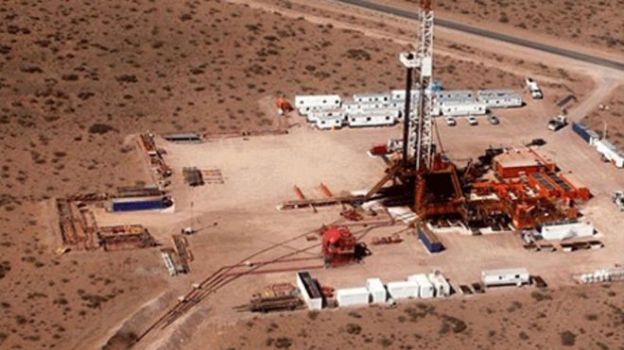
Despite the precipitous fall in global oil prices (from 110 dollars in 2014 to under 50 dollars in 2015), Argentina has continued to follow its strategy of producing unconventional shale oil, although in the short term there could be problems attracting the foreign investment needed to exploit the Vaca Muerta shale deposit,  Argentina’s energy trade deficit climbed to almost seven billion dollars in 2014, partly due to the decline in the country’s conventional oil reserves.  Eliminating that deficit depends on the development of Vaca Muerta, a major shale oil and gas deposit in the Neuquén basin in southwest Argentina. At least 10 billion dollars a year in investment are needed over the next few years to tap into this source of energy…

According to the state oil company Yacimientos Petrolíferos Fiscales (YPF), Vaca Muerta multiplied Argentina’s oil reserves by a factor of 10 and its gas reserves by a factor of 40, which will enable this country not only to be self-sufficient in energy but also to become a net exporter of oil and gas. YPF has been assigned 12,000 of the 30,000 sq km of the shale oil and gas deposit in the province of Neuquén.  The company admits that to exploit the deposit, it will need to partner with transnational corporations capable of providing capital.

It has already done so with the U.S.-based Chevron in the Loma Campana deposit, where it had projected a price of 80 dollars a barrel this year….YPF has also signed agreements for the joint exploitation of shale deposits with Malaysia’s Petronas and Dow Chemical of the United States, while other transnational corporations have announced their intention to invest in Vaca Muerta.

Excerpts from Fabiana Frayssinet, Plunging Oil Prices Won’t Kill Vaca Muerta, PS, Apr. 10, 2015

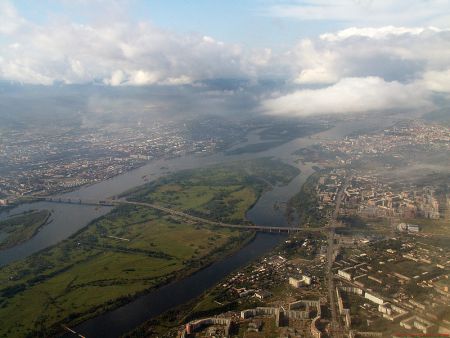
Nuclear Industry in Siberia

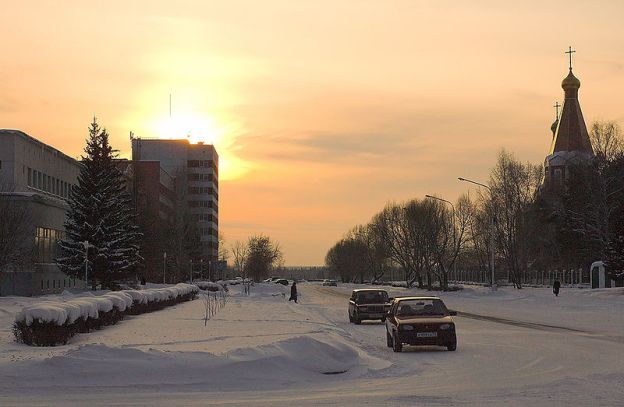
Professor Leonid Rikhvanov says he has a number of questions about the potential damage to the community from reactors that have been used since the Soviet Era .His plea comes as the Siberian Chemical Combine  (SCC) in Seversk, a secretive city located 15 miles north of Tomsk, prepares for the construction of a new experimental fast reactor  known as BREST-300…

‘I would also like to raise the question of conducting a complex study on how the SCC’s reactors have affected the environment over the past 50 years. Before making a decision on new projects, it’d be worth estimating the outcomes of the old ones’…Siberian Chemical Combine in Seversk, a secretive city located 15 miles north of Tomsk, prepares for the construction of a new experimental fast reactor.

‘And lastly I would ask about warheads [housed at SCC as recently as the 1990s]. Have they been replaced or not? If not, in what conditions are they kept?’He added: ‘I’m not radical and I support the idea of nuclear energy. But the approach to its use, and to estimating risks, should be totally different. Russian nuclear enterprises as they are now are so dangerous that it’d definitely be better if they didn’t exist at all.’

On April 6 2015 it was reported in Seversk that construction was already under way of a pilot plant for the production of fuel for the experimental BREST-300 reactor.The new reactor will work on special ‘pills’ made from the spent nuclear fuel and taken from the old reactors, with officials saying it will allow waste-free production of energy.  It is thought the pilot plant will begin operating in 2017, with the full new BREST-300 reactor up and running from 2020.

Prof Rikhvanov stressed that he is not anti-nuclear but insisted that it has to be used correctly with the proper safety and environmental considerations in place. An accident at a new plant at the Siberian Chemical Combine in February 2015 resulted in an employee receiving burns to his hands.And, of course, a massive explosion at the site in April 1993 resulted in the release of a radioactive gas cloud in an incident listed as one of the world’s worst nuclear accidents.Prof Rikhvanov was one of the experts flown into Seversk following the incident, allowing him a rare glimpse inside the secretive city to analyse the state of the plant.

‘First of all, we got to see what is there,’ he recalled. ‘I visited all the production facilities, I saw the reactors, the well where the waste is put to, and the warehouses where the nuclear warheads were stored with my own eyes.’I saw about 23,000 decommissioned warheads stored there. And I doubt they have been moved elsewhere since then. By the way, at the time, they were stored in terrible conditions and I don’t know what it is like now.’ The professor also found out that a facility for storing liquid radioactive waste in aquifers was located near to where the water supply was sourced on the Tom River.  As far as he is aware, the situation remains the same. He said: ‘We pump water from aquifers on the left side of the river, and store some of the most hazardous elements humanity has ever created in aquifers on the other side of the river…

Another concern he has is that the city is ‘still not prepared’ for a mass evacuation in the event of a major incident.’The road to Maryinsk is terrible, the second branch of the railway hasn’t spring out yet,’ he said. ‘There is also no separate railway to ship the radioactive materials to SCC without going through Tomsk. Such freights are now going through city railway station which creates additional risks.’

Excerpts from Olga Gertcyk & Derek Lambie, Expert raises serious questions over state of the nuclear industry in Siberia,  Siberian Times, May 2, 2015

Nuclear Benefits – Pakistan/Saudi Arabia Friendship

The Pakistani Parliament, even while stating its commitment to protect the territory of Saudi Arabia, recently adopted a resolution not to join the Saudi-led coalition fighting Houthi rebels in Yemen….The foreign affairs minister of the United Arab Emirates, Anwar Gargash, blasted the decision as “contradictory and dangerous and unexpected,” accusing Pakistan of advancing Iran’s interests rather than those of its own Persian Gulf allies. Pakistan was choosing neutrality in an “existential confrontation,” he said, and it would pay the price… Millions of Pakistanis work in the Persian Gulf, sending back vast remittances. Many of Pakistan’s politicians and generals have major investments in the region, and some have a deep affinity for Wahhabism. Rich Arabs in Pakistan are treated like royalty, allowed to flout hunting and environmental protection laws… [S]ome backpedaling has begun. The Pakistani military agreed to commit naval vessels to help enforce an arms embargo against the Houthis. This, however, will not undo the damage: The recent deterioration of Pakistan’s ties with its Arab benefactors, even if it turns out to be temporary, is unprecedented.

For Saudi Arabia, the Pakistani Parliament’s surprising assertion of independence was especially worrisome because it came on the heels of the American-backed preliminary nuclear deal with Iran…This development undermines Saudi Arabia’s longstanding nuclear strategy. In the 1970s, partly to extend its influence, partly in the name of Muslim solidarity, it began bankrolling Pakistan’s nuclear program. In gratitude, the Pakistani government renamed the city of Lyallpur as Faisalabad, after King Faisal of Saudi Arabia. When Pakistan seemed to dither after India tested five nuclear bombs in May 1998, the Saudi government pledged to give it 50,000 barrels of oil a day for free. Pakistan soon tested six of its own bombs. Later, the Saudi defense minister at the time, Prince Sultan, visited the secret nuclear and missile facilities at the Kahuta complex near Islamabad… In exchange for its largesse, Saudi Arabia has received Pakistani military assistance in the form of soldiers, expertise and ballistic missiles.

The Saudi government has taken the quid pro quo to imply certain nuclear benefits as well, including, if need be, the delivery at short notice of some of the nuclear weapons it has helped pay for. Some Pakistani warheads are said to have been earmarked for that purpose and reportedly are stocked at the Minhas air force base in Kamra, near Islamabad. (Pakistan, which has as many as 120 nuclear warheads, denies this..)

The Saudis have also come to expect that they fall under the nuclear protection of Pakistan, much like, say, Japan is covered by the United States’s nuclear umbrella. Pakistan’s nuclear forces were developed to target India, but they can strike farther, as was recently demonstrated by the successful test launch of the Shaheen-3 missile, which has a range of 2,750 kilometers.

In March 2015 Saudi Arabia signed an agreement with South Korea “to assess the potential” for the construction of two nuclear reactors in Saudi Arabia. It plans to build 16 nuclear-power reactors over the next 20 years, with the first reactor expected to be on line in 2022, according to the World Nuclear Association. It insists on having a full civilian fuel cycle, leaving open the possibility of reprocessing weapon-grade plutonium from nuclear waste.

Excerpts, Pervez Hoodbhoy, Pakistan, the Saudis’ Indispensable Nuclear Partnership, NY Times, Apr. 21, 2015

The Nuclearization of Sub-Saharan Africa

Kenya and Uganda are among the countries making progress in nuclear technology in sub-Saharan Africa with both involved with the pre-feasibility study stage in their atomic energy programmes.  According to the the International Atomic Energy Agency (IAEA), Kenya successfully completed its pre-feasibility stage while Uganda is currently conducting its own.

A pre-feasibility stage involves assessing energy needs, proposing roadmaps, developing expertise and training human resources, establishing policy and regulatory frameworks and mobilizing funding as a country prepares to conduct feasibility studies for nuclear plants.

“Kenya and Uganda join their sub-Saharan Africa counter-parts, Ghana, Nigeria, Sudan and Niger while in North Africa – Egypt, Algeria, Morocco, Tunisia and Libya have taken notable steps,” Jin Kwang Lee, African Regional Officer at IAEA told a conference on energy and nuclear power in Kwale….James Banaabe Isingoma, Uganda’s acting Commissioner for Energy Efficiency and Conservation told East African Business Week while it is perceived Uganda will build a nuclear plant by 2026, this projection is too ambitious, because financing for reactors is hard to find.  Kenya aims to have a nuclear plant by 2025…

Kenya hopes to establish a 1,000 MW reactor between 2022 and 2027. Njoroge said, “We are committed to the introduction of nuclear energy to our country’s energy mix which is currently dominated by hydro-power projects. We will soon deplete geothermal and hydro generation hence be left with no choice, but to go nuclear,” he said.  “We are injecting Ksh 300 million (about $3 million) in human resource training annually and we think nuclear will be a game changer. It is economically strategic because all other available resources will be exploited by 2031,” Njoroge said.He said, “It means we will be able to drive ironuclear power plantn and steel production, electric rails, powering mills and petroleum pipelines.”
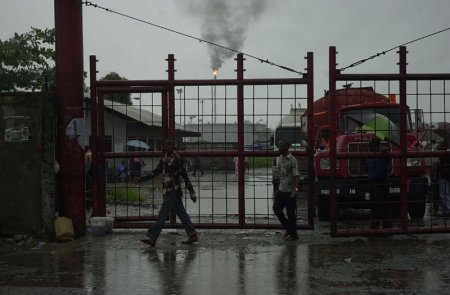
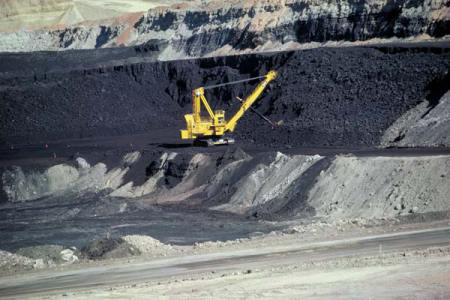
Currently, the two regional neighbours are grappling with insufficient power supply as demand increases with economic growth and rural electrification programmes that are putting more people on the grid.

Excerpt from Uganda: Kenya and Uganda Eye Nuclear Power, allAfrica.com, Apr. 19, 2015

Corruption Begets Corruption: Nigeria Oil

Dead fish wash up on the once-fertile shores of creeks around Bodo, a town in the Niger delta, that are covered with crude oil more than six years after two massive spills. Locals have only now received compensation from Shell, the oil firm responsible for the leaks. For the first time in half a decade, fishermen have cash to start businesses, repair their houses and send children to school… “Look,” says the chief of a tiny town called B-Dere, just a few miles from Bodo. He gestures to the deathly-black banks still bearing the marks of the slicks. “There is nothing to drink, nowhere to fish. What good has come from it?”

The cash that the oil industry provides has greased Nigerian politics for decades. Gross mismanagement and corruption in the industry are the causes of much of the inequality and discontent with the ruling party in an economy that is not just Africa’s largest but that ought to also be one of its wealthiest…

Nigeria pumps something like 2m barrels of oil a day. These account for most of its exports and about 70% of government revenues. But official figures are as murky as its polluted creeks. Volumes are recorded only at export terminals rather than at the wellhead, says Celestine AkpoBari of the Port Harcourt-based advocacy group, Social Action. Were a proper tally kept, he says, corruption would be exposed on a scale that would shock even the most cynical Nigerian.

It seems likely that more than 100,000 barrels of crude are stolen (or “bunkered” in the local parlance) every day, at a cost to the state and investors of billions of dollars a year. Politicians, oil workers and security forces are said to be behind the complex cartels that steal, illegally refine and sell crude oil. They have amassed almost unimaginable wealth in a country where poverty is still rife.

Oil’s taint has seeped into almost all levels of government and business. Yet the central problem is found in the petroleum ministry, which wields vast unaccountable power. The Nigerian National Petroleum Corporation (NNPC), a state-owned behemoth, is responsible for all aspects of the industry, from exploration to production and regulation. It is among the most secretive oil groups in the world, and is “accountable to no one”, says Inemo Samiama, country head of the Stakeholder Democracy Network, a non-profit group.

In 2013 the former governor of the central bank, Lamido Sanusi, alleged that $20 billion in oil revenues was missing from state coffers. He was fired for his troubles soon after. …

Even where cash has not been nicked, it has often been squandered. Take the Excess Crude Account (ECA), a sovereign-wealth fund intended to cushion Nigeria’s budget against falling oil prices. Most of it was spent over the past two years, despite oil prices being relatively high for most of that period.

The industry itself is in as sorry a state as the government’s finances. Although oil practically gushes from the ground in parts of the delta, oil output has been stagnant for years and billions of dollars of investment are stalled because of uncertainty over a new law for the industry.  This is holding back Nigeria’s economy almost across the board. Because the industry has failed to build the infrastructure to pipe gas to domestic consumers such as power plants, much of it is simply flared and burned: Britain reckons that some $800m worth of Nigeria’s gas a year goes up in smoke. The country is also chronically short of fuel even though it has four state-owned oil refineries. Because of poor maintenance and ageing equipment they operate at well below capacity, forcing Nigeria to import about 70% of the fuel it needs. There is little incentive for reform since the government pays hefty subsidies to NNPC to keep on importing…

But a starting point should be to halt subsidies for fuel imports. At a stroke that would undercut a major source of corruption and crime (both on land and at sea) that spills into neighbouring countries, the destination for smuggled consignments of cheap Nigerian fuel. It should also take a close look at NNPC, which should not be allowed both to participate in the market and regulate it. Some of its assets could be privatised. The ruling party and opposition are considering both….

For communities in Ogoniland, the most pressing problem is cleaning up. Shell has promised to mop up the mess around Bodo, though the process has yet to start. Compensation is one thing, Bodo residents say, but what they really want is their livelihood back.

Nigeria’s oil: Crude politics, Economist,  Mar. 28, 2015, at 54

Boycotting Coal

Chinese coal  consumption dipped by 1.6% in 2014, despite economic growth of 7.3%. The country’s voracious appetite for steel is peaking, damping demand for coking coal. Worries about pollution mean that demand for thermal coal, as used in power stations, is slackening too. Water conservation is another concern for policymakers—on current trends coal could account for a quarter of China’s water use by 2020 and coal reserves are mainly in the most parched regions. Its coal-fired plants are running at only 54% of capacity, a 35-year low. In Beijing two big coal-fired plants closed this week; the capital’s last one will shut down next year.

Another prop to demand has been power generation in rich countries. But in America coal now struggles to compete with natural gas, which has fallen by 80% in price since 2008. Domestic coal use there peaked in 2007. European consumption soared after Germany’s hasty decision to close its nuclear-power plants. But gas and renewables are eating into that.

Coalswarm, an environmental think-tank, says in a new report that two-thirds of coal-fired power plants proposed worldwide since 2010 have been stalled or cancelled…. Overall, Europe and America have already cut coal-fired generation capacity by over a fifth in a decade. The output of American coal mines dropped to 1993 levels in 2013.

Political pressure is growing against the most carbon-intensive fossil fuel. Coal provides 40% of the world’s electricity. But of 1,617GW of global capacity, 75% is of the dirtiest kind…. The chimneys of all but the most modern coal plants also emit plenty of other nasties. Mercury emissions stunt young brains. Sulphur and nitrous oxides scald lungs. Overall, coal kills around 800,000 people a year, most of them poor. In China it is responsible for up to a sixth of the particulates most dangerous for human health.

In America the coal and electric-utility industries are fighting the Environmental Protection Agency’s attempts to curb emissions of CO2, mercury and other toxins contained in coal. On March 25th, 2015 the Supreme Court heard arguments by some state governments, backed by the miners and utilities, that the agency has failed duly to consider the cost of its measures against mercury (see article).

Campaigners reckon 80% of the world’s coal reserves must stay in the ground if the planet is to stand a chance of keeping global warming under 2ºC by 2050. A divestment movement akin to the apartheid-era campaign to boycott South Africa is under way in many universities. Stanford may dump its coal investments and Oxford University is under pressure to do likewise. The World Bank no longer invests in coal-fired plants. Last year Norway’s sovereign-wealth fund dumped its holdings in more than 50 coal companies worldwide. South Korea recently introduced a carbon cap-and-trade scheme which punishes coal….

Furthermore, in some emerging markets, India especially, demand for coal is set to continue rising—so overall global demand may not peak until at least the 2030s. This week India’s government predicted a 19% rise in the country’s coal imports in this fiscal year. But thereafter the plan is to bring in private contractors to develop India’s untapped coalfields, and then to phase out all thermal-coal imports. If so, that will be grim news for the Indonesian, Australian and South African mining firms that are supplying India at the moment.

Even though some other developing nations’ coal imports will grow in future, coal companies are having to face up to a crisis now. Some are cutting costs and getting ready for a wave of consolidation. Others are litigating and lobbying against change.

Excerpts from Coal Mining: In the Depths, Economist, Mar. 28, 2015, at 65

Nile Water: Egypt, Sudan, Ethiopia

Egypt, Ethiopia and Sudan on March 23, 2015 signed an initial agreement on sharing water from the Nile River that runs through the three countries, as Addis Ababa presses ahead with its construction of a massive new dam it hopes will help alleviate the country’s power shortages.  The dam had been an issue of contention among the three countries, with Egypt concerned it would reduce its share of the Nile established under a colonial-era agreement that gave Egypt and Sudan the main rights to exploit the river’s water…..

“While you are working for the development of your people, keep in mind the Egyptian people, for whom the Nile is not only a source of water, but a source of life,” el-Sissi said, addressing his Ethiopian counterpart after the three watched a short film about the Grand Renaissance Dam highlighting how it could benefit the region.

Cairo previously had voiced fears that Ethiopia’s $4.2 billion hydro-electric project, announced in 2011, would diminish its share of the Nile, which provides almost all of the desert nation’s water needs, especially under previous governments.

The agreement, hashed out by officials from the three countries weeks beforehand in Khartoum, outlines principles by which they will cooperate to use the water fairly and resolve any potential disputes peacefully, leaving details on specific procedures to be determined later after the release of joint, expert studies.

“The Egyptians don’t really have any other options,” said Ethiopian water researcher Seifulaziz Milas, adding that once the dam had been built and the land behind it flooded, the amount of water flowing down the Nile would return to normal. “It’s just a question of filling up the reservoir, after that there’s nowhere else for the water to go besides downstream.”

Until recently, Ethiopia had abided by the colonial-era agreement that gives downstream Egypt and Sudan rights to the Nile water, with Egypt taking 55.5 billion cubic meters and Sudan 18.5 billion cubic meters of the total of 84 billion cubic meters, with 10 billion lost to evaporation.

That agreement, first signed in 1929, took no account of the eight other nations along the 6,700-kilometer (4,160-mile) river and its basin, which have been agitating for a decade for a more equitable accord.  But in 2013, Ethiopia’s parliament unanimously ratified a new accord that replaced previous deals that awarded Egypt veto powers over Nile projects….  Experts have estimated that Egypt could lose as much as 20 percent percent of its Nile water in the three to five years needed for Ethiopia to fill the dam’s massive reservoir.

Excerpt from MOHAMED OSMAN and BRIAN ROHAN , Egypt, Ethiopia and Sudan Sign Accord Over Nile, Associated Press, Mar. 23, 2015

Global Oil Chokepoints and War in Yemen

Fighters from Yemen’s Houthi militia entered  on March 31, 2015 a coastal military base overlooking the Red Sea’s strategic Bab el-Mandeb strait, local officials told Reuters.  Soldiers of the 17th Armored Division in the Dabab district in Yemen’s southwestern Taiz province opened the gates to the Houthis, whose military advance has been challenged by six days of Saudi-led air strikes. This means that Houthi rebels have a foothold along one of the world’s crucial oil chokepoints.    According to the US Energy Information Administration’s (EIA) fact-sheet on global oil chokepoints, 3.8 million barrels of oil and “refined petroleum products” passed through the Bab el-Mandeb each day on its way to Europe, Asia, and the US, making it the world’s fourth-busiest chokepoint.  The strait controls access to multiple oil terminals and to a oil pipeline co-owned by state companies from Egypt, Saudi Arabia, the United Arab Emirates and Qatar that transits oil between the Red Sea and the Mediterranean Sea, called the Suez-Mediterranean or SUMED pipeline.  The Bab el-Mandeb is 18 miles wide at its narrowest point, “limiting tanker traffic to two 2-mile-wide channels for inbound and outbound shipments,” according to the Energy Information Administration.

“Closure of the Bab el-Mandeb could keep tankers from the Persian Gulf from reaching the Suez Canal or SUMED Pipeline, diverting them around the southern tip of Africa, adding to transit time and cost,” the EIA fact-sheet explains. “In addition, European and North African southbound oil flows could no longer take the most direct route to Asian markets via the Suez Canal and Bab el-Mandeb.”

Recent events in Yemen, where a Saudi-led Arab military coalition is fighting to restore president Abd Rabbu Mansur Hadi against an Iranian-backed insurgent movement, have already jolted global oil prices.

Excerpt from ARMIN ROSEN,  Iran-backed Houthi militants in Yemen just captured a military base along one of the world’s major oil lanes, Reuters, Mar. 31, 2015

More from wikipedia: On February 22, 2008, it was revealed that a company owned by Tarek bin Laden is planning to build a bridge  across the Bab el-Mandeb strait, linking Yemen with Djibouti.  Middle East Development LLC, a Dubai company owned by Tarek bin Laden, would build the bridge. The project has been assigned to engineering company COWI in collaboration with architect studio Dissing+Weitling, both from Denmark.

Green Dams that Kill

A planned mega-dam in Guatemala, whose carbon credits will be tradable under the EU’s emissions trading system, has been linked to grave human rights abuses, including the killing of six indigenous people, two of them children.  Several European development banks and the World Bank’s International Finance Corporation (IFC) have provided funds for the $250m (£170m) Santa Rita dam.

But human rights groups back claims from the Mayan community that they were never consulted about the hydro project, which will forcibly displace thousands of people to generate 25MW of energy, mostly for export to neighbouring countries.  The issue has become a focus of indigenous protest in Guatemala – which has led to a march on the capital and severe political repression.

“At the moment our community is living under the same conditions as they did during the war,” Maximo Ba Tiul, a spokesman for the Peoples’ Council of Tezulutlán told the Guardian. “Our civilian population is once again being terrorised by armed thugs.”  Around 200,000 Mayans died or were “disappeared” during the civil war of the early 1980s, leading to the conviction of the country’s former president, Efraín Ríos Montt, in 2013 on genocide charges.

Augusto Sandino Ponce, the son of a local landowner who community leaders allege worked as a contractor to Montt’s junta during the civil war, is at the centre of new accusations of human rights violations. Last April Ponce and his bodyguards allegedly opened fire on a Mayan community ceremony in which families asked the Earth for permission to plant their crops. One local man, Victor Juc, was killed and several were injured. Ponce reportedly claims he was acting in self defence…

In a letter to the United Nations Framework Convention on Climate Change’s (UNFCCC) clean development mechanism (CDM) executive board,  the People’s Council of Tezulutlán outlined a litany of human rights abuses in the region, including kidnappings, evictions, house burnings, attacks by men wielding machetes and guns, and the arrest of community leaders.  The council also says that an environmental impact assessment for the dam suggests that it would create a 40ft-high wall, flooding local communities and depriving them of access to water, food, transport and recreation.  In approving projects, the CDM board pursues a narrow remit focused on emissions reductions. The reign of terror in the Alta Verapaz region, falls outside it – as did similar events in Honduras….

Perhaps the most shocking incident took place on 23 August 2013, when two children were killed by an allegedly drunken Santa Rita hydroelectricity company worker looking for David Chen, a community leader in the Monte Olivo region.   Chen was meeting with the rapporteur of the Inter American Commission on Human Rights at the time. When the worker could not find him, he is said to have lined up two of Chen’s nephews, David Stuart Pacay Maaz, 11 and Haggai Isaac Guitz Maaz, 13, and killed them with a single bullet to one child’s head that continued through the throat of the other. The killer has since been killed himself.  The annual report of the UN’s High Commissioner for Human Rights implicitly blamed the approval of the dam project for the killings….

Eva Filzmoser, the director of Carbon Market Watch said: “We want the CDM board to take responsibility and establish a grievance and redress mechanism for local communities to appeal, ask for problematic decisions to be rescinded and gain redress. We will be pushing for this at the Paris climate summit to apply to all forms of climate finance in the future.”Efforts to reform the CDM were boosted last month, when 18 countries signed a “Geneva declaration” calling for human rights norms to be integrated into UNFCCC climate decisions….Signatory countries to the declaration include France, Sweden, Ireland, Mexico, Uruguay and Peru.

Excerpts Green’ dam linked to killings of six indigenous people in Guatemala, Guardian, Mar. 26, 2015

Do Not Forget Fukushima

The nuclear disaster was a sensitive subject at the 3rd UN World Conference on Disaster Risk Reduction for Civil Society that took place in Sendai, Japan, March 2015 .  Masaaki Ohashi, the co-chair of   Japan Civil Society Organization Coalition  (JCC) a coalition of humanitarian NGOs formed ahead of the summit, praised the new Sendai disaster reduction framework for stating clearly that it applies to man-made and technological hazards – which covers nuclear power – as well as natural hazards.

He and others also noted the importance of an official presentation made at the conference about the lessons learned from the Fukushima crisis.  “The Japanese government, represented by the Cabinet Office, has clearly indicated that they are breaking away from the ‘safety’ myth around nuclear power plants, so we’re seeing a step forward,” said Takeshi Komino, general secretary of aid agency CWS Japan.

“Our preparedness (for Fukushima) was totally inefficient – we assumed the incident would affect a 10 km radius from the plant, but it was more than 30 km,” he said.The operation to evacuate people living in the danger zone was confused and not enough support was provided, he said. Failings meant that some hospital patients died at evacuation centres, he noted.A disaster prevention and evacuation plan has since been drawn up for 550,000 people, Yamamoto said. The government is continuing with its decontamination work, and is monitoring health in Fukushima, offering tests for thyroid cancer to those aged 18 and under, he added.

Civil society groups supporting Fukushima residents still struggling with the aftermath of the crisis launched a booklet at the Sendai conference containing 10 key lessons from the disaster, available in several languages including English.,,Komino of CWS Japan said it should be up to countries and communities to decide whether they want nuclear power, but “we are against the creation of the safety myth”.  “Pro-active risk identification and risk disclosure to the communities prior to the installation of such facilities is critical,” he emphasised.

JCC2015’s Ohashi said that, as the Japanese government aims to export nuclear energy technology to developing countries, it bears a “producer’s responsibility” to share its knowledge about the risks and how to deal with them….

For example, in some countries that have shown interest in nuclear power, such as Bangladesh and Thailand, it may be difficult for people to shut themselves inside concrete buildings in the event of an accident. And in others, low literacy levels make written public education materials less useful than comic strip versions.  Takeuchi questioned the legitimacy of suggesting that nuclear emergencies could really be prevented.  “Even if you can put risk reduction measures in place, it would cost a ridiculous amount,” he told the Thomson Reuters Foundation in Fukushima…

Of the 160,000 people who left their homes after the nuclear accident, around 120,000 are still classified as evacuees. Some remain in cramped temporary accommodation, in prefabricated buildings erected on parks and other public land.   In places like Iwaki City, south of the evacuation zone, the influx of displaced people seeking new homes and jobs has stirred resentment among residents  Even though local officials have made preparations to revitalize empty towns and villages once they are decreed safe, there is concern that only older generations will want to return, raising questions about their future viability.

Excerpts from MEGAN ROWLING , Japan wants to share the lessons it learned from the Fukushima nuclear disaster, Business Insider Australia, Mar. 27, 2015

Nuclear Waste Nightmare – Germany

Germany aims to phase out its nine remaining reactors by 2022, faster than almost any country. But nobody knows exactly how much it costs to shut and clean up atomic-power plants and all the facilities used over decades to store radioactive waste. Building a depository for the waste deep underground and delivering the waste add additional unknown costs…

“There are still no clear answers to many fundamental questions involving final and intermediate storage, dismantling [reactors] and transporting radioactive waste,” said Frank Mastiaux, chief executive of EnBW Energie Baden-Württemberg AG, one of Germany’s largest utility companies. “Concrete concepts have long been promised, but there is nothing yet in sight.”

Nuclear energy accounts for about 16% of German electricity production, down from a peak of 31% in 1997, according to the federal statistics office. France gets roughly 75% of its electricity from nuclear energy and the U.S. around 20%, according to the World Nuclear Association. The issue of Germany’s decommissioning became urgent in 2011, after the disaster at Japan’s Fukushima power plant, when Ms. Merkel decided to accelerate the shutdown of all German reactors by as much as 14 years, to 2022.

That move forced EnBW and Germany’s other big utilities—E.ON SE, RWE AG and a unit of Sweden’s Vattenfall AB—to book billions of euros in write-downs on nuclear assets and increase their provisions for early decommissioning of the facilities. The provisions now total about €37 billion ($40 billion).

The cost could ultimately top €50 billion, estimates Gerald Kirchner, a nuclear expert previously at Germany’s federal office for radiation protection.And that money might have to be covered by taxpayers if a power company faces insolvency or some other scenarios, the government report warned.

The energy companies are being pummeled by falling electricity demand in Europe and billions of euros in government-subsidized so-called green energy flooding the power grid. Both effects are eroding wholesale power prices, leaving conventional power stations unprofitable…

Germany isn’t alone in tackling decommissioning. The International Energy Agency says roughly half of the world’s 434 nuclear-power plants will be retired by 2040. Most are in Europe, the U.S., Russia and Japan.Despite this global trend, no country yet has a site ready for final disposal of radioactive waste.

Germany is trying to find a deep geological site suitable to store highly radioactive waste for about one million years—the time waste needs to become safe to most living organisms. The country expects about 600,000 cubic meters of radioactive waste by 2080. And that doesn’t include more highly radioactive waste slated to be shipped back soon from France and Britain, where German nuclear fuel had been sent for reprocessing…

Until a final disposal site is found, all waste will be stored temporarily. Keeping interim facilities safe is expensive. E.ON has said delays in finding a disposal site will cost the German nuclear industry €2.6 billion.Utilities have sued the German government to recover some cleanup costs, but verdicts could be years away. And their efforts face political opposition.

Excerpts By NATALIA DROZDIAK and JENNY BUSCHE, Germany’s Nuclear Costs Trigger Fears, Wall Street Journal, Mar. 22, 2015

Nuclear Waste: Divided Europe

Germany, Poland and Sweden are all jumping on the bandwagon to criticise Denmark’s plans to safely dispose of its 5,000-10,000 cubic metres of nuclear waste. The main criticisms concern both the geographical areas being considered for the waste storage and the assessment of the type of waste that is being deposited, reports Ingeniøren.

Currently, Denmark’s nuclear waste is stored in Risø, a town on the west Zealand coastline north of Roskilde, where the country’s DR3 reactor is located. The waste is piling up and is scheduled to be removed by 2023 and put in a final repository. [Note that Denmark doe s not produce nuclear energy.  The radioactive waste has been produced by research reactors at the Risø National Laboratory that are  in the process of being decommissioned].

Based on a report by Rambøll, an engineering consultancy group commissioned by the Ministry of Health to assess waste locations, Denmark is considering six possible locations for the waste site: Rødbyhavn on Lolland, Paradisbakkerne on Bornholm, Thyolm, Thise, Skive and Kertinge Mark Kerteminde. All six municipalities have declined to have the waste deposited on their lands.

German and Polish authorities have been particularly worried about locations near their borders as both countries have said Denmark’s final repository plans would be too close to the surface for nuclear waste and would be a real threat to groundwater contamination.

Umweltsinstitu München, a German environmental group, has said none of the six sites would be suitable for depositing such waste since they are all located in coastal zones, which are prone to danger due to rising sea levels.

The Danish plan is to bury the waste between 30 and 100 metres below the surface, though other nations are recommending the waste be buried between 300 and 800 metres.  Furthermore, the Swedish authorities have called into question Denmark’s classification of special waste.

Part of the waste at Risø includes 233 kilos of special waste, consisting mainly of spent fuel rods, which Sweden would classify as highly radioactive, but Denmark has not. The rods were classified as highly radioactive in 2003, but Dansk Dekommissionering, the group responsible for decommissioning the Risø reactor, later downgraded them.  The Polish and German authorities have also expressed concern over the Danish assessment, claiming greater demands need to be placed on safety for these highly radioactive rods. Denmark has tried to export the special waste over the last 15 years, but has yet to have any takers.

The Danish Parliament will consider three options for disposing of the waste: the final repository, intermediate storage and export, or a combination.

Excerpts from Dwayne Mamo, Neighbouring nations nail Denmark on nuclear waste plan, the Copenhagen Post, Feb. 5, 2015

Land for Nuclear Waste – Fukushima

The March 11, 2011 earthquake and subsequent tsunami tore through coastal towns in northern Japan and set off meltdowns at Tokyo Electric Power’s Fukushima Daiichi plant, which sits partly in Okuma.  Japan has since allocated more than $15 billion to an unprecedented project to lower radiation in towns around the plant, such as Okuma. Every day across Fukushima prefecture, teams of workers blast roads with water, scrub down houses, cut branches and scrape contaminated soil off farmland.  That irradiated trash now sits in blue and black plastic sacks across Fukushima, piled up in abandoned rice paddies, parking lots and even residents’ backyards.  Japan plans to build a more permanent storage facility over the coming years in Okuma and Futaba, another now-abandoned town close to the Fukushima nuclear plant – over the opposition of some local residents.

“This land has our blood and sweat running through it and I can’t just let go of it like that,” said Koji Monma, 60, an Okuma resident who heads a local landowners’ group.  Fukushima’s governor agreed to take the waste facility after Tokyo said it would provide $2.5 billion in subsidies, and promised to take the waste out of the prefecture after 30 years. Mayors of Futaba and Okuma have since agreed to host the 16 square km (6.2 square mile) facility – about five times the size of New York’s Central Park – which will wrap around the Fukushima plant and house multiple incinerators.

Some 2,300 residents who own plots of land in Futaba and Okuma which the government needs for the waste plant face what many describe as an impossible choice...Distrust of government promises runs deep among residents here. …

The ministry has hired around 140 real estate representatives to negotiate land sales with individual owners.

Excerpts from BY MARI SAITO, Fukushima residents torn over nuclear waste storage plan, Reuters, Mar. 9, 2014

Nuclear Energy Politics: the subsidies

A German energy cooperative will take legal action against the European Commission for approving state aid for a 16 billion pound ($25 billion) nuclear power plant in Britain…arguing it threatens to distort competition.  The project, to be built by French utility EDF at Hinkley Point in southwest England, is crucial for Britain’s plan to replace a fifth of its ageing nuclear power and coal plants in the coming decade while reducing carbon emissions. The plan to pay a guaranteed price for power produced at the plant faces opposition from some other countries and some EU policymakers, as well as some other energy suppliers.

“Highly subsided nuclear power from this plant will noticeably distort European competitiveness,” said Soenke Tangermann, managing director of Greenpeace Energy, which describes itself as Germany’s largest national independent energy cooperative. Tangermann said it would affect prices at the power exchange in Germany and could also set a precedent. “This effect will have economic disadvantages for committed green power providers like us,” he said in a statement. He added the group would file a plea for annulment at the European Court of Justice in Luxembourg as soon the Commission’s approval was published.

Excerpt from German energy cooperative plans legal action over UK nuclear plan, Reuters, Mar. 4, 2015

Spilling Toxic Liquids – Train Accidents

The US federal government predicts that trains hauling crude oil or ethanol will derail an average of 10 times a year over the next two decades, causing more than $4 billion in damage and possibly killing hundreds of people if an accident happens in a densely populated part of the U.S.  The projection comes from a previously unreported analysis by the Department of Transportation that reviewed the risks of moving vast quantities of both fuels across the nation and through major cities. The study completed last July took on new relevance this week after a train loaded with crude derailed in West Virginia, sparked a spectacular fire and forced the evacuation of hundreds of families .  This  accident was the latest in a spate of fiery derailments, and senior federal officials said it drives home the need for stronger tank cars, more effective braking systems and other safety improvements.

The volume of flammable liquids transported by rail has risen dramatically over the last decade, driven mostly by the oil shale boom in North Dakota and Montana. This year, rails are expected to move nearly 900,000 car loads of oil and ethanol in tankers. Each can hold 30,000 gallons of fuel.  Based on past accident trends, anticipated shipping volumes and known ethanol and crude rail routes, the analysis predicted about 15 derailments in 2015, declining to about five a year by 2034.

The 207 total derailments over the two-decade period would cause $4.5 billion in damage, according to the analysis, which predicts 10 “higher consequence events” causing more extensive damage and potential fatalities.  If just one of those more severe accidents occurred in a high-population area, it could kill more than 200 people and cause roughly $6 billion in damage.

The Association of American Railroads  and the Railway Supply Institute, which represents tank car owners and manufacturers, said federal officials had inflated damage estimates and exaggerated risk….Safety officials are pushing to make the tanker-car fleet even stronger and confronting opposition from energy companies and other tank car owners….Derailments can happen in many ways. A rail can break underneath a train. An axle can fail. A vehicle can block a crossing. Having a better tank car will not change that, but it should reduce the odds of a tank car leaking or rupturing,…

Railroads last year voluntarily agreed to reduce oil train speeds to 40 mph in urban areas. Regulators said they are considering lowering the speed limit to 30 mph for trains not equipped with advanced braking systems. Oil and rail industries say it could cost $21 billion to develop and install the brakes, with minimal benefits.

Derailments of trains hauling fuel could kill hundreds, cost billions, Associated Press, Feb. 22, 2015

Scramble for Africa II – Secret Cables

Africa emerges as the 21st century theatre of espionage, with South Africa as its gateway, in the cache of secret intelligence documents and cables seen by the Guardian. “Africa is now the El Dorado of espionage,” said one serving foreign intelligence officer.

The continent has increasingly become the focus of international spying as the battle for its resources has intensified, China’s economic role has grown dramatically, and the US and other western states have rapidly expanded their military presence and operations in a new international struggle for Africa…. The leaked documents obtained by al-Jazeera and shared with the Guardian contain the names of 78 foreign spies working in Pretoria, along with their photographs, addresses and mobile phone numbers – as well as 65 foreign intelligence agents identified by the South Africans as working undercover. Among the countries sending spies are the US, India, Britain and Senegal.

The United States, along with its French and British allies, is the major military and diplomatic power on the continent. South Africa spends a disproportionate amount of time focused on Iran and jihadi groups, in spite of internal documents showing its intelligence service does not regard either as a major threat to South Africa. “The Americans get what they want,” an intelligence source said…

Chinese intelligence is identified in one secret South African cable as the suspect in a nuclear break-in. A file dating from December 2009 on South Africa’s counter-intelligence effort says that foreign agencies had been “working frantically to influence” the country’s nuclear energy expansion programme, identifying US and French intelligence as the main players. But due to the “sophistication of their covert operations”, it had not been possible to “neutralise” their activities.

However, a 2007 break-in at the Pelindaba nuclear research centre – where apartheid South Africa developed nuclear weapons in the 1970s – by four armed and “technologically sophisticated criminals” was attributed by South African intelligence to an act of state espionage. At the time officials publicly dismissed the break-in as a burglary.

Several espionage agencies were reported to have shown interest in the progress of South Africa’s Pebble Bed Modular Reactor. According to the file, thefts and break-ins at the PBMR site were suspected to have been carried out to “advance China’s rival project”. It added that China was “now one year ahead … though they started several years after PBMR launch”.

In an October 2009 report by South Africa’s intelligence service, the National Intelligence Agency (NIA), on operations in Africa, Israel is said to be “working assiduously to encircle and isolate Sudan from the outside, and to fuel insurrection inside Sudan”. Israel “has long been keen to capitalise on Africa’s mineral wealth”, the South African spying agency says, and “plans to appropriate African diamonds and process them in Israel, which is already the world’s second largest processor of diamonds”.  The document reports that members of a delegation led by then foreign minister Avigdor Lieberman had been “facilitating contracts for Israelis to train various militias” in Africa…

[According to leaked documents]: “Foreign governments and their intelligence services strive to weaken the state and undermine South Africa’s sovereignty. Continuing lack of an acceptable standard of security … increases the risk.” It lists theft of laptop computers, insufficient lock-up facilities, limited vetting of senior officials in sensitive institutions, no approved encryption on landlines or mobiles, total disregard by foreign diplomats for existing regulations, ease of access to government departments allowed to foreign diplomats, and the lack of proper screening for foreigners applying for sensitive jobs.  According to one intelligence officer with extensive experience in South Africa, the NIA is politically factionalised and “totally penetrated” by foreign agencies: “Everyone is working for someone else.” The former head of the South African secret service, Mo Shaik, a close ally of the president, Jacob Zuma, was described as a US confidant and key source of information on “the Zuma camp” in a leaked 2008 Wikileaks cable from the American embassy in Pretoria.

Excerpts Seumas Milne and Ewen MacAskill Africa is new ‘El Dorado of espionage’, leaked intelligence files , Guardian, Feb. 23, 2015

Radioactive Water: Fukushima Leaks to Pacific

Sensors at the Fukushima nuclear plant have detected a fresh leak of highly radioactive water to the sea, the plant’s operator announced on Feb. 22, 2015, highlighting difficulties in decommissioning the plant.  Tokyo Electric Power Co (Tepco) said the sensors, which were rigged to a gutter that pours rain and ground water at the Fukushima Daiichi plant to a nearby bay, detected contamination levels up to 70 times greater than the already-high radioactive status seen at the plant campus.  Tepco said its inspections of tanks storing nuclear waste water did not find any additional abnormalities, but it shut the gutter to prevent radioactive water from going into the Pacific Ocean.

Fresh leak detected at Fukushima N-plant, Agency France, Presse, Feb. 23, 2015

70 000 Nuclear Refugees: Fukushima

The first three of Fukushima Dai-ichi’s six reactors melted down in March 2011 and the fourth was damaged. TEPCO’s early guess was that decommissioning would take 30-40 years. That is certainly optimistic.

Engineers are grappling with problems with little precedent. Akira Ono, the plant manager, says cameras have begun peeking into the first reactor to check the state of 100 tonnes of molten fuel. A robot needs to be developed to extract the fuel. Last October the utility pushed back the start of this removal work by five years, to 2025. Dale Klein, a former chairman of America’s Nuclear Regulatory Commission, says that the schedule for decommissioning the plant is pure supposition until engineers figure out how to remove all the fuel.

One victory for engineers is with reactor four. Late last year the last of 1,535 highly toxic fuel rods was plucked from the spent-fuel pool a year ahead of schedule. The fear was that the complex could not withstand another strong earthquake.  Solutions create new problems. Water is pumped in to keep melted uranium at the bottom of reactors one, two and three from overheating. A purification system, known on-site as the “seven samurai”, is struggling to keep up with the flow of contaminated water being produced—370,000 tonnes and rising is stored in vast tanks. Even when the worst nuclides are filtered out, TEPCO will face huge opposition with plans to dump the water into the Pacific.

Then there is the ice wall. TEPCO is attempting to freeze the ground in a huge ring around the four damaged reactors to prevent toxins from reaching the groundwater and flowing into the sea. Workers have dug vast holes and filled them with coolant. In May they will begin refrigerating the coolant to up to -40ºC. Whether the wall can take another big earthquake or work in the baking summer is not proven. The cost for this so far: ¥32 billion ($272m).

Meanwhile, a lower-tech clean-up is taking place beyond the Dai-ichi site over a big swathe of Fukushima’s rolling countryside. Armed with Geiger counters, men in mechanical diggers or with shovels are skimming off contaminated soil. Once the land is clean, at least some residents have a hope of returning home—71,000 nuclear refugees remain in temporary housing. But it could take years.

The price tag for the whole clean-up is as uncertain as its duration. For one, decontamination costs depend on lowering annual radiation to 1 millisievert, a goal now widely seen as unrealistic, says Tatsujiro Suzuki, a former vice-chairman of the Japan Atomic Energy Commission.

TEPCO says decommissioning Dai-ichi’s four damaged reactors will cost ¥980 billion, but that does not include the clean-up, fuel storage or compensation. On a broader reckoning, the Japan Centre for Economic Research, a private research institute, puts the bill over the next decade at ¥5.7 trillion-¥20 trillion, but that still excludes compensation to the fisheries and farming industries. A still broader calculation by the same institute puts the entire cost of the disaster at ¥40 trillion-¥50 trillion. Thanks to government bail-outs, the company that so mismanaged Fukushima Dai-ichi carries on. It even says it will make a profit this year.

Fukushima Daiichi: Mission impossible, Economist, Feb.7, 2015, at 36

100-Year Nuclear Waste Storage – Texas

A Dallas-based company that handles low-level radioactive waste is taking the first step toward making a West Texas facility the first interim storage site for high-level nuclear waste from around the country.  Waste Control Specialists notified the Nuclear Regulatory Commission of the company’s plan to seek a license to build a facility in rural Andrews County that would store spent fuel rods from power plants for as long as 100 years. The location is about 350 miles west of Dallas and 120 miles south of Lubbock, along Texas’ border with New Mexico…The waste would be stored above ground.

In January 2015, Andrews County commissioners unanimously passed a resolution in support of the company’s latest efforts, County Judge Richard Dolgener said.  “The community is embracing having the high level interim storage here,” he said.  Andrews resident Humberto Acosta said he is one of “very few” in town who are opposed to the plan. Many around town, he said, aren’t informed about the dangers of the waste, which remains radioactive for thousands of years.

Two other efforts are underway in the region to build a similar storage facility. Officials with the Lea-Eddy Energy Alliance in southeastern New Mexico are interested, as is Austin-based AFCI Texas. The latter is looking at two possible sites in Texas, but AFCI’s Monty Humble said it’s “premature to discuss them publicly.”

There is currently no disposal site in the United States for spent rods from the more than 100 operating commercial nuclear reactors across the country…A presidential commission in 2012 recommended the U.S. look for an alternative to Yucca Mountain, preferably in a community that was interested in hosting a nuclear waste facility. For now, spent fuel is stored next to reactors in pools or in dry casks.  The federal government has collected tens of billions of dollars from utilities over the years to fund disposal at Yucca Mountain. Whichever entity builds the site stands to make billions to store the spent fuel rods.

Waste Control Specialists currently disposes of low-level radioactive waste from more than three dozen states and depleted uranium from the U.S. Department of Energy.

Excerpts  from Dallas company seeks to store nation’s spent nuclear fuel at West Texas site,  Associated Press, Feb. 6, 2015


Costs of Demolishing Nuclear Reactors

/The International Energy Agency (IEA) said late in 2014  (pdf) that almost 200 of the 434 reactors in operation around the globe would be retired by 2040, and estimated the cost of decommissioning them at more than $100 billion.  But many experts view this figure as way too low, because it does not include the cost of nuclear waste disposal and long-term storage and because decommissioning costs – often a decade or more away – vary hugely per reactor and by country…. The IEA’s head of power generation analysis, Marco Baroni, said that even excluding waste disposal costs, the $100 billion estimate was indicative, and that the final cost could be as much as twice as high. He added that decommissioning costs per reactor can vary by a factor of four.Decommissioning costs vary according to reactor type and size, location, the proximity and availability of disposal facilities, the intended future use of the site, and the condition of the reactor at the time of decommissioning….

The U.S. Nuclear Regulatory Commission estimates that the cost of decommissioning in the United States – which has some 100 reactors – ranges from $300 million to $400 million per reactor, but some reactors might cost much more.  France’s top public auditor and the nuclear safety authority estimate the country’s decommissioning costs at between 28 billion and 32 billion euros ($32-37 billion).  German utilities – such as E.ON, which last month said it would split in two, spinning off power plants to focus on renewable energy and power grids – have put aside 36 billion euros. .  Britain’s bill for decommissioning and waste disposal is now estimated at 110 billion pounds ($167 billion) over the next 100 years, double the 50 billion pound estimate made 10 years ago.  Japanese government estimates put the decommissioning cost of the country’s 48 reactors at around $30 billion, but this is seen as conservative. Russia has 33 reactors and costs are seen ranging from $500 million to $1 billion per reactor.

Excerpt, Global nuclear decommissioning cost seen underestimated, may spiral, Reuters, Jan, 19, 2015

Iceland as a Privacy Haven

A former NATO airbase in Iceland  looks  like nothing more than a huge warehouse from the outside.  But the barbed-wire fence surrounding it and surveillance cameras atop its gates betray  its importance.  This facility, which began operating in February 2012, is one of several data centres in Iceland. It’s run by Verne Global, a company that allows its customers to store data on servers here.

Tate Cantrell, the company’s chief technical officer, explained why Verne Global favoured this tiny Nordic nation of all places. “In Iceland, you’ve got this ideal situation: energy, excellent connectivity for data, and a constant cool climate. So Iceland was an obvious choice.”  Iceland’s abundant renewable energy from geothermal and hydroelectric plants means the costs of running these data centres are low. And the Gulf Stream current keeps the temperature in Iceland more or less stable throughout the year, avoiding the need to provide cooling for the servers and computers.

Data centres based here have another advantage, too: Iceland is in the initial stage of implementing the most progressive data-privacy laws in the world, a major selling point especially after whistleblower Edward Snowden’s revelations regarding widespread surveillance by the United States’ National Security Agency (NSA).  A recent paper published by Verne Global stated that Iceland was “uniquely positioned as a data privacy haven” because of the new regulations.

The International Modern Media Institute (IMMI), a non-profit organisation, has played an instrumental role in designing and promoting the legal framework for Iceland’s new data privacy laws….Birgitta Jónsdóttir is IMMI’s spokeswoman and now represents the Pirate Party in the Icelandic parliament.  In 2010, the IMMI, then known as the Icelandic Modern Media Initiative, proposed a resolution to change Icelandic law to ensure data privacy and freedom of speech. The proposal includes protection for whistleblowers and journalists’ sources, as well as an “ultra-modern Freedom of Information Act” based on elements from existing laws in Estonia, the United Kingdom, and Norway.

The data centres would benefit from a clause in the law that ensures the protection of intermediaries such as internet service providers and telecommunications carriers.The resolution was passed by the Icelandic parliament that same year, and is now being implemented into law, piece by piece.  “A bit more than half of what IMMI proposed has been made into law – somewhere between 50 and 70 percent,” Jonsdottir said…

Despite the new measures, Icelandic journalist Jón Bjarki Magnusson said he thinks his country still has a long way to go when it comes to media freedom.  “IMMI for me is a bit like a fairy tale, reality on the ground is different from the idea,” he told Al Jazeera at a café in downtown Reykjavik. “I like the idea but Iceland is far from being a haven for free journalism.”Earlier this year, Magnusson worked on an investigative story for DV newspaper, in which he wrongly identified an assistant to Iceland’s interior minister as being under police investigation.  Magnusson and his colleagues quickly realised their mistake and issued an apology within a few hours of publishing. But that didn’t stop the official from pressing criminal libel charges against Magnusson and a colleague of his, Johann Pall Johannsson, demanding a sentence of up to two years in prison.

Watchdog group Reporters Without Borders (RSF) has issued a statement condemning the steps against the reporters as disproportionate. The group said that freedom of information in Iceland has declined over the past two years, citing the libel case and budget cuts for public broadcasters.

Excerpt from Felix Gaedtke, Can Iceland become the ‘Switzerland of data’?, Al Jazeera, Dec. 28, 2014

Hacking Nuclear Plants – South Korea

Korea Hydro & Nuclear Power Co Ltd said it would beef up cybersecurity by hiring more IT security experts and forming an oversight committee, as it came in for fresh criticism from lawmakers following recent hacks against its headquarters.  The nuclear operator, part of state-run utility Korea Electric Power Corp, said earlier this month that non-critical data had been stolen from its systems, while a hacker threatened in Twitter messages to close three reactors.

The control systems of the two complexes housing those reactors had not been exposed to any malignant virus, Seoul’s energy ministry and nuclear watchdog said in a joint statement, adding the systems were inaccessible from external networks.  Energy Minister Yoon Sang-jick told a parliamentary session that evidence of the presence and removal of a “worm” — which the ministry said was probably inadvertently introduced by workers using unauthorized USB devices — was unrelated to the recent hacking incidents, drawing scepticism from some lawmakers.  “I doubt control systems are perfectly safe as said,” Lee Jung-hyun, a lawmaker in the ruling Saenuri party, told the committee hearing.

Worries about nuclear safety in South Korea, which relies on nuclear reactors for a third of its power and is the world’s fifth-largest nuclear power user, have mounted since the 2011 Fukushima disaster in Japan and a domestic scandal in 2012 over the supply of reactor parts with fake security certificates…Korea Hydro and Nuclear Power President and CEO Cho Seok told the hearing that all control systems of the country’s 23 nuclear reactors were safe against malignant codes. Recently, he said that cyberattacks on non-critical operations at the company’s headquarters were continuing, although he did not elaborate for security reasons.

Excerpt from South Korea nuclear operator finds computer ‘worm’ in control system, Reuters, Jan, 1, 2015

Exploiting Himalaya Rivers

Himalayan rivers, fed by glacial meltwater and monsoon rain, offer an immense resource. They could spin turbines to light up swathes of energy-starved South Asia. Exports of electricity and power for Nepal’s own homes and factories could invigorate the dirt-poor economy. National income per person in Nepal was just $692 last year, below half the level for South Asia as a whole.

Walk uphill for a few hours with staff from GMR, an Indian firm that builds and runs hydropower stations, and the river’s potential becomes clear. An engineer points to grey gneiss and impossibly steep cliffs, describing plans for an 11.2km (7-mile) tunnel, 6 metres wide, to be blasted through the mountain. The river will flow through it, before tumbling 627 metres down a steel-lined pipe. The resulting jet—210 cubic metres of water each second—will run turbines that at their peak will generate 600MW of electricity.  The project would take five years and cost $1.2 billion. It could run for over a century—and produce nearly as much as all Nepal’s installed hydropower.

Trek on and more hydro plants, micro to mighty, appear on the Marsyangdi. Downstream, China’s Sinohydro is building a 50MW plant; blasting its own 5km-long tunnel to channel water to drive it. Nearby is a new German-built one. Upstream, rival Indian firms plan more. They expect to share a transmission line to ill-lit cities in India.

GMR officials in Delhi are most excited by another river, the Upper Karnali in west Nepal, which is due to get a 900MW plant. In September the firm and Nepal’s government agreed to build it for $1.4 billion, the biggest private investment Nepal has seen.

Relations between India and Nepal are improving. Narendra Modi helped in August as the first Indian prime minister in 17 years to bother with a bilateral visit. Urged by him, the countries also agreed in September to regulate power-trade over the border, which is crucial if commercial and other lenders are to fund a hydropower boom…. Another big Indian hydro firm agreed with Nepal’s government, on November 25th, to build a 900MW hydro scheme, in east Nepal, known as Arun 3. Research done for Britain’s Department for International Development suggests four big hydro projects could earn Nepal a total of $17 billion in the next 30 years—not bad considering its GDP last year was a mere $19 billion.

All Nepal’s rivers, if tapped, could feasibly produce about 40GW of clean energy—a sixth of India’s total installed capacity today. Add the rivers of Pakistan, Bhutan and north India and the total trebles.  Bhutan has made progress: 3GW of hydro plants are to be built to produce electricity exports. The three already generating produce 1GW out of a total of 1.5GW from hydro. These rely on Indian loans, expertise and labour….

A second reason, says Raghuveer Sharma of the International Finance Corporation (part of the World Bank), was radical change that opened India’s domestic power market a decade ago. Big private firms now generate and trade electricity there and look abroad for projects. India’s government also presses for energy connections over borders, partly for the sake of diplomacy. There has even been talk of exporting 1GW to Lahore, in Pakistan—but fraught relations between the two countries make that a distant dream.

An official in India’s power ministry says South Asia will have to triple its energy production over the next 20 years. Integrating power grids and letting firms trade electricity internationally would be a big help. It would expand market opportunities and allow more varied use of energy sources to help meet differing peak demand. Nepal could export to India in summer, for example, to run fans and air conditioners. India would export energy back uphill in winter when Nepali rivers dry and turbines stop spinning.

Governments that learn to handle energy investments by the billion might manage to attract other industries, too. Nepal’s abundant limestone, for example, would tempt cement producers once power supplies are sufficient. In the mountains, it is not only treks that are rewarding.

South Asia’s Hydro-Politics: Water in them hills, Economist, Nov. 29, 2014, at 38

Indigenization of Nuclear Energy: China

China General Nuclear Power (CGN), a state-owned enterprise (SOE) that is the country’s largest nuclear firm, is planning to float shares on the Hong Kong stock exchange on December 10th. Market rumours suggest it will raise well over $3 billion. Dealogic, a research firm, reckons this is likely to be the biggest listing in Hong Kong as well as the largest utility IPO globally so far this year.

Some see in the flotation a harbinger of a nuclear renaissance. If true, this would bring cheer to a gloomy industry. The shale-gas revolution has undercut the economics of building new nuclear reactors in North America. And since the deadly tsunami and nuclear fiasco at the Fukushima site in Japan nearly four years ago, confidence in this technology has waned in many places. Germany, for example, is getting out of nuclear power (see article).

China put a moratorium on new plants after that accident too, but the boosters have now prevailed over the doubters. The State Council, the country’s ruling body, wants a big expansion of nuclear power along the country’s coast to triple capacity by 2020 (see map). This plan is not as ambitious as before Fukushima, but Moody’s, a credit-ratings agency, nevertheless calls it an “aggressive nuclear expansion”. Some analysts look beyond 2020 and predict an even bigger wave of nuclear power plants will be built in inland provinces, giving a boost to this type of energy worldwide….One factor that could slow growth is cost. In the past Chinese governments were happy to throw endless pots of money at favoured state firms in industries deemed “strategic”. Times are changing, however. Economic growth is slowing, and the government must now deal with massive debts left over from previous investment binges. Since the export-oriented and investment-led model of growth is sputtering, officials may soon be keen to boost domestic consumption rather than merely shovel subsidised capital at big investment projects.

And it is not just that China may—and should—be starting to pay attention to the true cost of infrastructure projects. Rapid technological advances are also making low-carbon alternatives to nuclear power appear more attractive. Bloomberg New Energy Finance, an industry publisher, forecasts that onshore wind will be the cheapest way to make electricity in the country by 2030. Though coal will remain China’s leading fuel for some time, Bloomberg’s analysts think that renewables could produce three times as much power as nuclear in the country by that year.

What is more, as a latecomer, China had the chance to standardise designs of new nuclear plants to gain economies of scale and minimise risk. But rather than build copies of safe and proven designs from Westinghouse of America or Areva of France, it is insisting on “indigenisation”. This approach is in line with China’s desire to create national champions in key industries, as it has in high-speed rail.

Excerpts from Nuclear power in China Promethean perils, Economist, Dec. 6, 2014, at 75

Who is Afraid of China? the Silk Road

Xi Jinping, China’s president, is leading the new charge. In September 2013 he outlined plans to reinvigorate the ancient Silk Road with a modern network of high-speed rail, motorways, pipelines, ports and fibre-optic cables stretching across the region. The economic highway he envisages follows three routes: one running from central China through Central Asia and the Middle East; a maritime route extending from the southern coast; and a third branching out from Yunna…

Countries bordering on China are wary of its ambitions. They are concerned partly about China’s economic clout, fretting that it will derive disproportionate benefits from the links. (Many of the goods, such as drugs and guns, which Laos and Myanmar have to trade are illegal.) Chinese goods, they worry, may flood their markets and drown their own nascent industries. China enjoys the electricity generated by dams that raise the risk of flash floods downstream. Neighbours grumble that China’s emphasis is on laying tarmac and iron rather than sharing technical know-how, and that it often uses Chinese workers rather than their own citizens.

Stretching the Threads: The New Silk Road, Economist,  Nov. 29, 2014, at 41

States Captured by their Energy Companies – Canada

Few governments have aligned their interests so closely to those of their country’s energy and mining firms as Canada’s Conservative administration. The prime minister, Stephen Harper, has boasted of Canada as an “emerging energy superpower”. Under the banner of “responsible resource development”, his government has done its best to ease the way for minerals firms, at home and abroad, including directing some foreign aid to countries where Canadian firms wanted to drill. Ministers point with pride to the C$174 billion ($169 billion) in export revenues from sales of minerals, oil and gas in 2013 and to the fact that Canada is home to more than half of the world’s publicly listed exploration and mining companies.

But the downside of seeming so cosy with extractive firms is that whenever one of them gets in trouble—an inevitable occurrence with 1,500 firms active in more than 100 countries—the country’s image is tarnished too. So the government has recently begun to reduce that vulnerability by taking a stricter line on corporate social responsibility (CSR) and bribery by Canadian firms operating abroad. Protecting the national brand is “a huge part of it,” says Andrew Bauer of the Natural Resource Governance Institute, a group that monitors the industry and lobbies for openness.

Ed Fast, the international trade minister, admitted as much on November 14th, as he introduced new rules that require Canadian resources firms involved in disputes with local communities to take part in a resolution process. If any firms refuse, the government will withdraw its economic diplomacy on their behalf…[In the meantime there are ] protests against Canadian firms’ projects, from Romania where environmentalists are objecting to plans for an opencast gold mine, to Guatemala, where guards at a nickel mine have been accused of gang rape…

A new Canadian law  was introduced in October 2014 to curb bribery by mining and energy firms by demanding more transparency from them. The law, which still must be fleshed out in detailed regulations, requires them to disclose all payments made to domestic and foreign governments…It helped that the law was backed by an unusual coalition of non-government organisations and mining companies themselves. T  It seems that the miners’ experience in dealing with local communities is making them more sensitive to their concerns about corruption and other ills. In contrast, the oil and gas firms are lobbying for the transparency law to be weakened. They want to be given exemptions in countries whose local laws conveniently prohibit the disclosure of such payments. They also want to avoid having to give a project-by-project breakdown of their payments, without which the information would be of little use.

Excerpt Canada’s natural-resources companies: Reputation management, Economist, Nov. 22, 2014

Keystone XL: 2014 Update

Keystone XL makes environmentalists livid… Oil extracted from Canada’s tar sands produces about 17% more carbon dioxide than conventionally-pumped supplies do—largely thanks to the energy needed to get it out of the ground. The process uproots forests and leaves toxic lakes behind. A pipeline carrying Canadian oil to Gulf coast refineries would lower the cost of getting such oil to market, so it might encourage energy firms to extract more…

Canadian oil is already getting to market, points out Charles Ebinger of the Brookings Institution, a think-tank—just mostly by barge and train. A new pipeline would ease the strain on Canada’s railways and increase the profitability of extracting the oil. But compared with swings in global oil prices, the effect will be small. Nor will many jobs be created. Most of those 42,000 are temporary posts; just 35 full-time permanent employees will be needed to run the pipeline.  Oddly, the project may not matter much in Louisiana. If completed, Keystone XL will deliver oil to Texas…

Excerpt from: Keystone XL: Back in the Pipeline, Economist, Nov. 22, 2014, at 26

The Division of Libya

Libya’s self-proclaimed prime minister [Omar al-Hassi] has warned that attempts by a rival government in the east to assert control over the oil industry could escalate the political conflict dividing the OPEC member state and force it to break in two.  Libya has had two governments competing for power since August 2014 when a group called Operation Libya Dawn, which opponents say is backed by Islamists, seized Tripoli and forced the elected Prime Minister Abdullah al-Thinni to flee 1,000 km to a small city near the border with Egypt.

The warning by Omar al-Hassi, prime minister of the rival government, came after Thinni’s government claimed air strikes on Tripoli’s Mitigate airport this week, escalating a confrontation that started with an attack by Libya Dawn on a rival force in Tripoli in July.  The new rulers in the capital are not recognised by the United Nations and world powers but have taken over ministries, oil facilities, airports and much of western and central Libya.

In a step to assert control over the oil industry, Thinni’s government said it had appointed a new chairman of the National Oil Corp. Thinni had initially retained the state oil firm’s previous head, Mustafa Sanallah, but he remains in Tripoli.  The conflict gripping Libya three years after the overthrow of Muammar Gaddafi poses a legal dilemma for oil traders, who are left wondering who owns Libya’s oil exports, worth more that $10 billion a year. The country sits on Africa’s largest oil reserves…

“There are attempts (by Thinni) to set up an eastern Supreme Court, there are attempts to launch a central bank in the east, there are attempts to establish a separate oil ministry in the east,” said Hassi, who said he was against partition.

Thinni’s government has sought to move heads of state-run institutions to the east as he is recognised by the international community, but he too denies any plans for secession.

But Hassi said Thinni’s government had shown it intended to control oil facilities in the eastern rump state by picking al-Mabrook Bou Seif as new NOC Chairman, since he was from the same tribe as Ibrahim Jathran, a former rebel leader who seized eastern ports for a year to press for regional autonomy.

Struggle over Libya’s oil risks breaking up country -rival PM, Reuters,  Nov. 28, 2014

India as a Nuclear Power

In a major step towards realizing its nuclear energy ambitions, India is engaged in talks with the European Union to sign a civil nuclear cooperation agreement and the deal is expected to be inked by next year.  “An agreement is expected to be signed between the India’s department of atomic energy and joint research centre of the European Union. It will mostly focus on areas of research and energy,” EU’s ambassador to India Joao Cravinho told PTI…Cravinho said talks between the two sides are on and the agreement should be signed next year (2015). He, however, did not give any specific time frame on when the agreement will be inked.”There were concerns raised by few countries about signing an agreement because India is not a signatory of the Non-Proliferation Treaty, but there is a consensus on this now,” he said….

The deal would provide a major boost to India’s efforts in getting an entry to the elite Nuclear Suppliers Group, considering the clout of the EU on the global platform.  After the landmark Indo-US nuclear deal, India has signed nuclear deals with Russia, Kazakhstan, United Kingdom, South Korea, Mongolia, and France.  It also signed a nuclear cooperation agreement with Australia in September, paving way to import uranium for its reactors.

India, EU to sign civil nuclear pact by next year, PTI,  Nov 16, 2014

Nuclear Waste Management in Russia

NO RAO, the Russian state’s national operator for dealing with radioactive waste, has announced it will build an underground research laboratory near Krasnoyarsk to determine the feasibility of building a final disposal point for the country’s high-level radioactive waste by 2024,

The government agency reported it had chosen the Nizhnekansky Rock Mass in the Krasnoyarsk Region of Central Siberia as the site for the lab and eventual long term underground storage repository…The project to build the repository will only go ahead pending the results of the lab studies, NO RAO said.  Russian state nuclear corporation Rosatom said that phase one of the proposed repository would hold 20,000 tons of intermediate and high level nuclear wastes, which would be retrievable, World Nuclear News reported…

Krasnoyarsk Citizens’ Assembly Chairman Alexei Menshikov was reported as saying the decision to build the repository in the region’s Nizhnekansky Rock Mass would not be decided without “wide public discussion and the creation of effective means for civil control, because [the repository] concerns environmental safety and the livelihood of citizens.”  Many of those present at the meeting pressed questions on precisely those points.

This area in Siberia is no stranger to massive nuclear undertakings. The nearby closed nuclear city of Zheleznogorsk through the decades of the Cold War produced bomb grade plutonium.  The city is also gearing up to build a new pilot spent nuclear fuel storage and reprocessing facility, which will reprocess two of Russia’s thorniest types of spent nuclear fuel: that produced by VVER-1000 reactors and spent fuel from Chernobyl-style RBMKs.

The search for a repository to store Russia’s high-level radioactive waste in safe conditions for the coming millennia has been in full swing since late last year when Rosatom in October 2013 unveiled a “roadmap” …This roadmap focused on the possibility of building as many as 30 long-term repositories as well as temporary waste storage facilities, 10 of which would be located in Northwest Russia, close to Norway and Finland, and didn’t discuss citing a repository in Siberia.

Excerpts from Charles Digges, http://www.bellona.org, Oct. 21, 2014

Surveillance – Undress People Remotely

Officials from Guinness World Records today recognized DARPA’s Terahertz Electronics program for creating the fastest solid-state amplifier integrated circuit ever measured. The ten-stage common-source amplifier operates at a speed of one terahertz (1012 GHz), or one trillion cycles per second—150 billion cycles faster than the existing world record of 850 gigahertz set in 2012.…Developed by Northrop Grumman Corporation, the Terahertz Monolithic Integrated Circuit (TMIC) exhibits power gains several orders of magnitude beyond the current state of the art…  For years, researchers have been looking to exploit the tremendously high-frequency band beginning above 300 gigahertz where the wavelengths are less than one millimeter. The terahertz level has proven to be somewhat elusive though due to a lack of effective means to generate, detect, process and radiate the necessary high-frequency signals.  Current electronics using solid-state technologies have largely been unable to access the sub-millimeter band of the electromagnetic spectrum due to insufficient transistor performance…

According to  Dev Palmer, DARPA program manager. “This breakthrough could lead to revolutionary technologies such as high-resolution security imaging systems, improved collision-avoidance radar, communications networks with many times the capacity of current systems and spectrometers that could detect potentially dangerous chemicals and explosives with much greater sensitivity.”

DARPA has made a series of strategic investments in terahertz electronics through itsHiFIVE, SWIFT and TFAST programs. Each program built on the successes of the previous one, providing the foundational research necessary for frequencies to reach the terahertz threshold.

Excerpts from DARPA CIRCUIT ACHIEVES SPEEDS OF 1 TRILLION CYCLES PER SECOND, EARNS GUINNESS WORLD RECORD, DARPA website, http://www.darpa.mil, Oct. 28, 2014

This technology can be used for Security and Communications (including military communications): Here from Wikipedia

Security:
Terahertz radiation can penetrate fabrics and plastics, so it can be used in surveillance, such as security screening, to uncover concealed weapons on a person, remotely. This is of particular interest because many materials of interest have unique spectral “fingerprints” in the terahertz range…. In January 2013, the NYPD announced plans to experiment with the newfound technology to detect concealed weapons, prompting Miami blogger and privacy activist Jonathan Corbett to file a lawsuit against the department in Manhattan federal court that same month, challenging such use: “For thousands of years, humans have used clothing to protect their modesty and have quite reasonably held the expectation of privacy for anything inside of their clothing, since no human is able to see through them.” He seeks a court order to prohibit using the technology without reasonable suspicion or probable cause.


Nuclear Power – Sweden

Sweden may be facing the phase out of nuclear power following agreement by the country’s Social Democrats and their junior coalition partner, the Green Party, to set up an energy commission tasked with achieving a 100% renewable electricity system….The parties said in separate, but identical statements that nuclear power should be replaced with renewable energy and energy efficiency. The goal, they said, should be at least 30 TWh of electricity from renewable energy sources by 2020. A goal for 2030 has yet to be set, they added. Support for offshore wind and solar power are needed “in addition”, they said.

Nuclear power “should bear a greater share of its economic cost”, they said. “Safety requirements should be strengthened and the nuclear waste fee increased.”  Waste management in Sweden is undertaken by SKB while safety regulations are set by the Swedish Radiation Safety Authority. Both of these operate independently of government.  State-owned utility Vattenfall’s plan to build a new nuclear power plant has been “interrupted”and the company will lead the country’s energy system towards a higher share for renewable energy, they said.

Excerpt from Sweden faces future without nuclear, World Nuclear Association, October  12014

Floating Power Plants: Cayman Islands

A United States company OTEC International is in talks with Caribbean Utilities Company (CUC), Grand Cayman’s electrical provider, to supply renewable energy to the island via Ocean Thermal Energy from a platform at North Side.  According to the company:

“The Cayman Islands has documented its storm history with precision, which made it easier for OTEC International to identify locations where  Floating Power Platforms (FPPs) can be securely sited and appropriately designed to survive strong storm conditions.  The first phase of the Cayman project would be the generation of 6.25-MW renewable electricity* from an FPP that would be permanently moored less than a mile from shore. At this distance from shore, the plant’s visual impact will be minimal because of the platform’s overall low profile. The power generated would be transported to a substation onshore via cable and connected to the island’s CUC grid…..A comprehensive Environmental Impact Assessment (EIA) will be completed before the project can receive all necessary licenses and permits from various governmental authorities.”

*This type of ocean-thermal electricity plant takes advantage of the temperature difference between warm surface water and cold deep seawater.

Excerpts from Company providing floating ocean power platform technology to supply renewable energy to Cayman Islands in talks, Cayman inews, Sept. 21, 2014


Sabotaging Iran’s Nuclear Program

A U.S. security institute said it has located via satellite imagery a section of a sprawling Iranian military complex where it said an explosion or fire might have taken place earlier this week. (pdf).

Iran’s official IRNA news agency on Monday cited an Iranian defence industry body as saying that two workers were killed in a fire at an explosives factory in an eastern district of Tehran.  Iran’s Defence Industries Organisation said the fire broke out on Sunday evening, IRNA said, giving no further detail.  An Iranian opposition website, Saham, described the incident as a strong explosion that took place near the Parchin military complex around 30 km southeast of the capital. It did not give a source and the report could not be independently verified….  The dissident National Council of Resistance of Iran (NCRI) exposed Iran’s uranium enrichment plant at Natanz and a heavy water facility at Arak in 2002. But analysts say it has a mixed track record and a clear political agenda.

The Washington-based Institute for Science and International Security (ISIS) said it had obtained commercially available satellite imagery on which six buildings at Parchin appeared damaged or destroyed.  However, the images ISIS issued indicated the site of the possible blast was not the same location in Parchin where the U.N. nuclear agency suspects that Iran, possibly a decade ago, carried out explosives tests that could be relevant for developing a nuclear arms capability. Iran denies any such aim.

The U.N. International Atomic Energy Agency wants to visit this area of Parchin, but Iran has so far not granted access. Iran says Parchin is a conventional military facility and that its nuclear programme is entirely peaceful. It has often accused its enemies of seeking to sabotage its atomic activities.

ISIS said its analysis of the satellite imagery from Oct. 7 and 8 indicated an explosion could have taken place at a southern section of Parchin.  “Several signatures that coincide with those expected from an explosion site are visible here,” it said on its website.  “Two buildings that were present in August 2014 are no longer there, while a third building appears to be severely damaged. In total at least six buildings appear damaged or destroyed,” ISIS added.

Israel and the United States have not ruled out military action against Iran if diplomacy fails to resolve a decade-old dispute over Tehran’s nuclear programme. Israel is widely believed to be the Middle East’s only nuclear-armed power.

U.S. think-tank says it located possible blast at Iran military site, Reuters, Oct. 9, 2014

The Benefits of War

[I]n Kurdish-run Iraq, three Western oil firms, Genel Energy, DNO and Gulf Keystone, continue to pump out crude that is piped or sent by road to Turkey. Their combined market value plunged after IS seized the city of Mosul in June, but has recovered to $8.3 billion, down 29% from the start of the year—a hefty fall, but not so bad for firms on the front line of fanaticism.“We’ve gone from a place that was a bit tricky in terms of security to a full-on war,” says the chief of one firm. But he is confident that the Kurdish region’s well-armed militia will protect his business. So far investors have tweaked their financial models, not run for the door. Analysts now assume a cost of capital of 15%, up from 12.5% before IS struck, he says….

For a start, it is possible to grind out profits in troubled places. Lafarge, a French cement giant, has operations across the Middle East and north Africa. Sales there have risen slightly since 2009 and gross operating profits are now $1.5 billion a year. MTN, a South African mobile-telecoms firm with a thirst for danger, has a division in Syria (and in Sudan and Iran) where gross operating profits rose by 56% in the first six months of this year….

[But]  And strife in Libya and Egypt has damaged north Africa’s hopes of becoming a production hub for Europe. Like countries, multinational companies have no permanent allies—only permanent interests.

Companies and geopolitical risk: Profits in a time of war, Economist, Sept 20, 2014, at 59

The Nuclear Plants of South Africa

South Africa signed a partnership agreement (Sept 2014) with Russia’s state-owned nuclear company, Rosatom Corp. to build reactors in Africa’s second-biggest economy.  “The agreement lays the foundation for the large-scale nuclear power plants procurement and development program” using Russian VVER reactors with installed capacity of about 9,600 megawatts, or as many as eight nuclear units, Rosatom and the South African government said in an e-mailed statement. The country also has a draft nuclear cooperation pact with China.

South Africa’s integrated resources plan envisions 9,600 megawatts of nuclear energy being added to the national grid to help reduce reliance on coal, which utility Eskom Holdings SOC Ltd. uses to generate 80 percent of the country’s electricity. The state-owned company is struggling to meet power demand,The National Treasury said in February 2013 that a 300 billion-rand ($27 billion) nuclear program was in the final stages of study…

The collaboration will result in orders worth at least $10 billion to local industrial companies, Rosatom Director General Sergei Kirienko said in the statement.In addition to building the nuclear units, the agreement provides for partnerships including the construction of a Russian technology-based research reactor, assistance in the development of South African nuclear infrastructure and education of specialists at Russian universities, the parties said in the statement.  Rosatom currently holds projects for the construction of 29 nuclear power plants, including 19 foreign commissions in countries including India, China, Turkey, Vietnam, Finland and Hungary.

Excerpts from Paul Burkhardt , South Africa Signs Agreement With Russia for Nuclear Power, Bloomberg,  Sep 22, 2014

Nuclear Waste Politics, Secrecy – Canada

Ontario Power Generation is proposing to build a massive underground nuclear waste site at the Bruce nuclear power plant near Kincardine, Ontario (Canada) near lake Huron,a plan that has drawn opposition from environmentalists, aboriginal groups and legislators in Michigan.  At issue were numerous meetings of the “community consultation” advisory group, comprising the mayors who sit on county council and representatives of the Nuclear Waste Management Organization and Ontario Power Generation, that began in 2005.

The citizen groups alleged the discussions were kept secret because the politicians feared damaging their electoral fortunes and pointed to informal notes from one meeting in February 2010 that showed a mayor fretting about “a negative backlash at the polls.”The probe by Amberley Gavel — a company based in London, Ont., that helps municipalities with closed-meeting procedure investigations — concluded the public never knew about any of the meetings.

It also found the discussions had a marked influence on the mayors’ decisions regarding the radioactive waste project despite their contention the meetings were simply information sessions at which they passed no motions.  The citizen groups said the province should be reviewing the conduct of Ontario Power Generation.  They also said the county response — to ask staff to provide annual reminders about the law requiring open meetings — was “appallingly weak.”  Council members have “thus far show defiance with no hint of remorse,” the statement said.

Save our Saugeen Shores and the Southampton Residents Association  called on Ontario’s ombudsman to review the circumstances that led to a report critical of Bruce County council for meeting nuclear waste representatives without telling anyone or documenting the discussions.  “This was a major error of provincewide importance in light of the evidence of an 8.5-year egregious disregard of the law and the public’s right to open and transparent government,” Rod McLeod, the group’s lawyer, said in a statement.

Colin Perkel,  Nuclear waste opponents call for penalties against ‘secret meetings’, The Canadian Press, Sept. 18, 2014

Making Nuclear Power in Vietnam

American firms have urged the US Congress to ratify the Vietnam-US cooperation agreement in the nuclear sector in order to create more jobs, and Russia and Japan have signed nuclear cooperation agreements with Vietnam….  [T]he Vietnamese and US representatives signed a Vietnam-US nuclear cooperation agreement in Hanoi on May 6, 2014 (Agreement 123)….

The US Nuclear Energy Institute (NEI) and the US nuclear energy firms have unanimously urged the US Congress to ratify the agreement soon, emphasizing that the strengthened cooperation with Vietnam in the sector would help boost exports and create more jobs.  The US firms can expect to earn $10-20 billion from the deals with Vietnam.

Vietnam plans to produce 10,000 MW  of nuclear electricity by 2030. It is believed to be the second largest nuclear power market in East Asia following to China, while market value is expected to reach $50 billion in the next two decades.  According to the World Nuclear Association (WNA), rapid modernization in Vietnam has led to a sharp increase in the demand for electricity, estimated to increase by 10-15 percent per annum.  David Durham from GE Hitachi Nuclear Energy (GHE) has warned that if the US Congress does not ratify the agreement, US firms will lose the lucrative market of Vietnam.

Excerpts from Vietnam nuclear power market eyed by three major countries, VietNamNet Bridge, Sept. 7, 2014

China in the North Pole

China is interested in the Arctic. On July 11th, 2014 its icebreaker, Xue Long (“Snow Dragon”), embarked on the country’s sixth Arctic expedition, with 65 scientists on board. A new 1.3 billion yuan ($210m) icebreaker will soon be launched, and last December  [2013] a China-Nordic research centre was opened in Shanghai.

New freight opportunities interest China along the Northern Sea Route (NSR) as ice recedes. In 2010 four ships took the route. Last summer 71 vessels did so. Each ship that takes the route must, at certain points, be accompanied by an ice-breaker, so it is unclear how soon the NSR will be suitable for mass transit, if at all.

Some climate models predict the Arctic Ocean could be ice-free in summer by the middle of this century. The route cuts the distance between Rotterdam and Shanghai by 22% and Yang Huigen of the Polar Research Institute of China has predicted that 5-15% of China’s international trade will use the NSR by 2020. But Linda Jakobson, of the US Studies Centre at the University of Sydney, says that is a “rather optimistic assessment” and that talk of the NSR as a new Suez Canal is overblown. Weather conditions and environmental sensitivities will make the route a difficult one.

As for energy, China is one of the biggest investors in mining in Greenland. A deal with Rosneft, a state-controlled Russian company, will explore offshore Arctic fields for oil. But the undersea resources in the Arctic are largely within the Exclusive Economic Zones of the littoral states (notably Russia), so if China wants to look for energy it will have to do so jointly…

But the new Chinese presence is not without concerns. Huang Nubo, a tycoon, recently bought 100 hectares (250 acres) of land in northern Norway and has bid for a plot on the island of Svalbard, where China has a research station. He aims to develop a resort for Chinese tourists. Mr Huang had similar plans in Iceland in 2011, but local protests quashed them. A Norwegian newspaper has called him a “suspected imperialist”.

China and the Arctic: Polar bearings, Economist, July 12, 2014, at 39


Interim Disposal of Fukushima Nuclear Waste

anti-nuclear protesters in Japan pushing fake nuclear waste

Fukushima Prefecture is set to accept the construction of an interim facility to store radioactive waste from cleanup work due to the nuclear disaster, advancing the stalled process of decontaminating the affected areas.  The prefectural government has decided to shoulder the difference between the appraised value of land in Okuma and Futaba, where the structure will be built, and the price it would have fetched before the 2011 accident at the Fukushima No. 1 nuclear power plant.

The decision came after landowners insisted that the land should be bought at a fair market value because the current appraisals are much lower than pre-disaster estimates.  Consent from local governments is expected to move forward the central government’s plan to start transporting radioactive soil and other contaminated waste to the storage site in January.

Okuma and Futaba host the crippled Fukushima No. 1 nuclear power plant. The residents of the two towns are still living as evacuees due to high levels of radiation in their hometowns. Talks between local officials and the central government over the planned facility reached an impasse after Environment Minister Nobuteru Ishihara enraged landowners with a comment in June.  “In the end, it will come down to money,” Ishihara said, referring to efforts to gain local approval for the storage facilities. Residents were angry because of the implication they could be easily bought.

The stalemate threatened to jeopardize the entire decontamination operation in the prefecture since the storage site is indispensable to advance the work to clean up and rebuild the affected communities.  In an effort to break the stalemate, the central government on Aug. 8 offered to double the funds to be provided to the local governments to 301 billion yen ($2.9 billion).

Fukushima Prefecture to accept intermediate storage facility for radioactive waste, THE ASAHI SHIMBUN, August 23, 2014

The Oil Curse – South Sudan

South Sudan’s oil fields have become a battleground in the struggle for power in Africa’s newest nation, encouraging Western nations and regional mediators to consider international monitoring of crude revenues as a way to remove a major bone of contention from such conflicts.  South Sudan sits on Sub-Saharan Africa’s third-biggest crude reserves, and its oil fields were early targets in fighting that erupted in December 2013 and has rumbled on despite two ceasefire deals and U.N. warnings that a man-made famine looms.

It marks an alarming slide into dysfunction by a nation whose creation three years ago the United States hailed as a foreign policy success. Instead of lifting the nation out of grinding poverty, oil is blamed for stoking a war…Diplomats and regional mediators said monitoring revenues was gaining traction as an idea for discussion, though the mechanics of such a system and how the warring sides would be pushed towards a deal have not been determined….

South Sudan’s oil output has tumbled by about a third to 160,000 barrels a day since the fighting began in December 2013, but it remains the main source of cash for President Salva Kiir’s government both by selling crude and by borrowing against future earnings, digging the nation deeper into debt.  As of June 25, 2013 South Sudan owed $256 million to China’s National Petroleum Corp, which has 40 percent of a venture developing South Sudan’s oil fields, and a further $78 million to oil trader Trafigura. [a Dutch multinational commodity trading company] It plans to borrow about $1 billion from oil firms in fiscal year 2014/15, equal to about a quarter of forecast revenues.

Rebel leader Machar, who was fired as deputy president last year, said oil sites would be a “legitimate target” unless funds were put into a neutral escrow account pending any deal.

But President Salva Kiir’s government says such outside intervention would violate its sovereignty and insists it has not bought arms since fighting began.  “We are not the protectorate of anyone,” presidential spokesman Ateny Wek Ateny said. “We have the right to buy arms, but we haven’t bought anything since December,” he said, despite rebel claims of weapon shipments arriving in recent months.  Kiir and Machar come from rival ethnic groups, and the conflict has re-opened deep ethnic divisions in the country.

Monitoring revenues is on the table for talks sponsored by the regional African grouping IGAD, though diplomats acknowledge it can only be part of a broader deal on how to share wealth and power in the divided nation…South Sudan has already lost billions of petrodollars in its young life. Kiir wrote to 75 former and serving officials in 2012 seeking the return of $4 billion that disappeared since 2005. No significant amounts were repaid, diplomats said.  Though the country – the size of France – has almost no roads and only a third of its 11 million people can read, South Sudanese now watch more wealth frittered away on fighting than on building roads or paying for schools….Fighting has killed at least 10,000 people, displaced 1.5 million and left a third of the population facing the prospect of famine as they have not planted crops…

But Western diplomats say pressure for a deal on oil monitoring needs to come from the region, led by heavyweight neighbours such as Kenya and Ethiopia.China, with its oil interests, would need to support the move, though diplomats said it had worked with the West during the crisis. Alongside China, other oil investors are India’s ONGC Videsh and Malaysia’s Petronas.”  If they can get the oil sector right, share the oil revenues in a much more inclusive manner, then that will dictate the country’s future,” said Luke Patey, author of a book on Sudan and South Sudan’s oil industry.

Excerpts from South Sudan conflict drives idea of oil wealth monitoring, Reuters, Aug. 1, 2014]

India’s Drones and Nukes

Washington-based Institute for Science and International Security (ISIS) suggests that India appeared to have followed through on its publicly announced intention to build the  Special Material Enrichment Facility (SMEF) and started constructing a large enrichment centrifuge complex near Chitradurga, Karnataka.  Furthermore, [o]n June 20, 2014 IHS Jane’s revealed that India was possibly extending Mysore’s Indian Rare Metals Plant into clandestine production of uranium hexafluoride that could theoretically be channelled towards the manufacture of hydrogen bombs.

This week the Washington-based Institute for Science and International Security (ISIS) suggested that the country appeared to have followed through on its publicly announced intention to build the SMEF and started constructing a large enrichment centrifuge complex near Chitradurga, Karnataka, where, between 2009 and 2010, approximately 10,000 acres of land were allegedly diverted for various defence purposes.

Within this walled-off tract, 1,410 acres in Ullarthi Kaval and 400 acres in Khudapura were allocated to the Bhabha Atomic Research Centre for the purpose of developing the SMEF, the ISIS said, adding that a further 4,000 acres in Varavu Kaval and 290 acres in Khudapura were allocated to the Defence Research and Development Organisation for the purpose of developing and testing “long-endurance (48-72 hours) Unmanned Aerial Vehicles and Unmanned Combat Aerial Vehicles.”…

The report’s authors, David Albright and Serena Kelleher-Vergantini, said that the new facility “will significantly increase India’s ability to produce enriched uranium for both civil and military purposes, including nuclear weapons”, urging India to therefore announce that the SMEF would be subject to International Atomic Energy Agency safeguards, committed only to peaceful uses….At the heart of India’s apparently strong enrichment thrust is an urgent need for Highly Enriched Uranium for the indigenously developed INS Arihant nuclear-powered ballistic missile submarine and probably for nuclear and thermonuclear weapons.

Excerpt from NARAYAN LAKSHMAN. Karnataka home to second covert nuke site, drone testing: report,  The  Hindu, July 2, 2014

Tar Sands from Canada to Europe

Canada and the US have threatened to pull out of TTIP [Transatlantic Trade and Investment Partnership] trade talks unless the EU ignores the massive emissions of oil from tar sands – and the EU is collapsing under the pressure…For five long years the federal government and the oil industry have lobbied against the European Union labeling oilsands (also called tar sands) bitumen as ‘dirty oil’ in its Fuel Quality Directive (FQD).  A new report [authored by environmental groups] reveals the how recent involvement of the US in the lobby offensive to keep the EU market open for bitumen exports has tipped the scales in favour of oilsands proponents….

The report shows the EU Fuel Quality Directive, a piece of legislation designed to reduce global warming greenhouse gas (GHG) emissions in the EU’s transportation sector, is unlikely to acknowledge fuels from different sources of oil – conventional oil, oilsands, oil shale – have different carbon footprints.  All oil is the same – no matter how great the disparity in emissions  Instead all oils will more than likely be treated as having the same GHG emissions intensity ‘value’ in the Directive. This is exactly what Canada, the oil industry and now the US have been pushing for…

The EU has not fallen for the federal government’s argument that bitumen produces only marginally more GHG emissions than conventional oil in extraction, processing, and use.  A European Commission study found bitumen’s carbon footprint is between 12% – 40% higher than conventional oil as so much of the bitumen produced from the tar sands is burnt to fuel the energy-intensive extraction process.  The report reveals trade, not science, is the cause of the EU backing off from implementing the Fuel Quality Directive as it was originally meant to be implemented.

The US in some ways has been more open [than Canada] about its lobbying against the Fuel Quality Directive.  US Trade Representative Michael Froman confirmed he “raised these issues [of the FQD implementation] with senior Commission officials on several occasions, including in the context of the Transatlantic Trade and Investment Partnerships (TTIP).” The TTIP is the highly controversial trade agreement between the US and the EU currently under negotiation.  European Commission documents obtained by Friends of the Earth Europe reveal the US trade missions has “substantive concerns” with the Fuel Quality Directive singling out fuels produced from bitumen as having a higher carbon footprint than conventional oil.    Like Canada and the oil industry, the US wants all oil – regardless of GHG emissions – to be treated the same as conventional oil in the Directive…Recently eleven members of US Congress sent a letter to the US trade mission expressing their concerns “that official US trade negotiations could undercut the EU’s commendable efforts to reduce carbon pollution.”
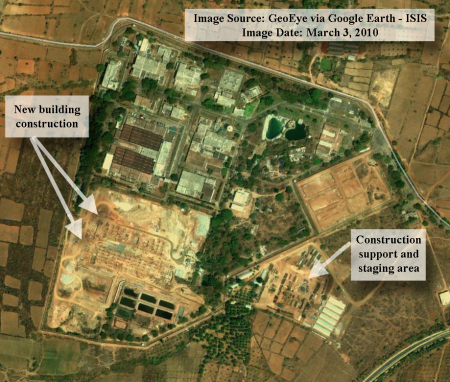

Excerpts, Derek LeahyIgnore tar sands emissions! EU buckles under US, Canada pressure in TTIP talks, Ecologist, July 23, 2014

Oil Shale: Costs and Benefits

[A] second shale revolution is in prospect, in which cleaner and more efficient ways are being found to squeeze the oil and gas out of the stone. The Jordanian government said on June 12th that it had reached agreement with Enefit, an Estonian company, and its partners on a $2.1 billion contract to build a 540MW shale-fuelled power station. Frustratingly for Jordan, as it eyes its rich, oil-drenched Gulf neighbours, the country sits on the world’s fifth-largest oil-shale reserves but has to import 97% of its energy needs.

In Australia, Queensland Energy Resources, another oil-shale company, has just applied for permission to upgrade its demonstration plant to a commercial scale. Production is expected to start in 2018. Questerre Energy, a Canadian company, also said recently that it would start work on a commercial demonstration project, in Utah in the United States.

In all these projects, the shale is “cooked” cheaply, cleanly and productively in oxygen-free retorts to separate much of the oil and gas. In Enefit’s process the remaining solid is burned to raise steam, which drives a generator. So the process produces electricity, natural gas (a big plus in Estonia, a country otherwise dependent on Russian supplies) and synthetic crude, which can be used to make diesel and aviation fuel. The leftover ash can be used to make cement. Enefit’s chief executive, Sandor Liive, says his plants, the first of which started production in December 2012, should be profitable so long as oil prices stay above $75 a barrel (North Sea Brent oil was around $113 this week).

Although the new methods of exploiting the rock are cleaner than old ones, environmentalists still have plenty to worry about. Oil shale varies hugely in quality. Estonia’s is clean, Jordan’s has a high sulphur content, Utah’s is laden with arsenic. Like opencast coal mining, digging up oil shale scars the landscape. Enefit has solved that in green-minded Estonia, by landscaping and replacing the topsoil. Other countries may be less choosy.

Some of the world’s biggest energy firms have also experimented with mining and processing oil shale, only to give up, after finding that it took so much energy that the sums did not add up. However, Shell says it is making progress with a new method it is trying, also in Jordan, in which the shale is heated underground with an electric current to extract the oil.

These rival technologies have yet to prove their reliability at large scale—and they are far from cheap. Mr Liive reckons it will cost $100m to get a pilot project going in Utah (where his firm has bought a disused oil-shale mine), and another $300m to reach a commercial scale. A fall in the oil price could doom the industry, as happened in the 1980s when a lot of shale mines went out of business…America this week loosened its ban on crude exports. If the second shale revolution succeeds, it will have a lot more oil to sell.

Oil shale: Flaming rocks, Economist, June  28, 2014, at 58

Iran Nuclear Talks: the Khamenei Card

On July 7, 1014 as critical nuclear negotiations got underway in Vienna between Iran, the United States, Europe, Russia and China, Khamenei (Iranian Supreme Leader) started talking hard numbers.  The Supreme Leader’s remarks were unprecedented both because they represented a blatant intervention from his perch in Tehran in the super-sensitive talks in Vienna, and because they relayed confidential technical details that had not been aired publicly before by Iranian officials.

The moment could not be more critical. An agreement is supposed to be reached before July 20, 2014 that will rein in the threat of Iran acquiring nuclear weapons and end or curtail the Western sanctions that have put so much pressure on Tehran. Failure to reach an accord will add yet more potentially apocalyptic uncertainties to the Middle Eastern scene…

The Supreme Leader started talking about SWUs, which it is fair to say few Iranians, or for that matter Americans, Europeans, Russians or Chinese ever have heard of.  In this context the acronym stands for “separative work units,” which relates directly to Iran’s ability to enrich uranium to levels that might feed into nuclear weapons. SWU defines the capability derived from the number of uranium-enriching centrifuges and their efficiency. For example one thousand AR1 centrifuges with the efficiency of 0.9 translates into 900 SWU, whereas 225 AR2 centrifuges with an efficiency of 4 translates into 900 SW…

“They want us to be content with 10,000 SWUs,” he said. That is, he estimates the bottom line the West will accept. “But they have started from 500 and 1000 SWUs,” he added. “Our people say that we need 190,000 SWUs,” he went on. That’s a big spread to try to close.  Khamenei then raised the problem of American and European objections to the more-or-less bomb-proof underground facility Iran has built at Fordo, where much of its enrichment goes on. “They emphasize Fordo because they cannot get to it,” said Khamenei. “They say you must not have a place which we cannot strike. Isn’t this ridiculous?”

Last December [2013] Khamenei said publicly he would not interfere in the negotiations and would leave the details to the diplomats. Now it appears he is playing a more shadowy game, either dictating terms to the Iranian team in Vienna or, perhaps, providing them the cover they need to stand firm.

A source close to the negotiations told IranWire that the numbers Khamenei cited are precisely what American negotiators have put on the table, and constitute one of the confidential topics being discussed over the past few months. Two days before Khamenei spoke, Under Secretary of States for Political Affairs Wendy Sherman, the senior American negotiator, said that Iran must end up with a fraction of the centrifuges it currently runs, but she did not cite any numbers.

The source said that Khamenei’s statements are technically significant, and are in line with the terms of the negotiations, which deal with SWUs rather than the number of centrifuges as such.

According to a European diplomat who is a member of his country’s nuclear negotiating team, the accuracy of the numbers leaked by Khamenei is both astonishing and worrisome, because he is limiting publicly the concessions that might be made by Iranian President Hassan Rouhani’s team….

It is clear Khamenei wants to leave no doubt about his regime’s red lines in the negotiations…  But Khamenei doesn’t see this crisis only in terms of nukes. For the West, he says, the nuclear issue “is just an excuse” to pressure Iran, he said. “If it is not the nuclear issue they will come up with another excuse—human rights, women’s right, etc.”

Excerpts from Reza HaghighatNejad, Iran Supreme Leader Spills the Nuke Talk Secrets, Daily Beast, July 9, 2014

Un-addicted to Coal – United States

The U.S. Environmental Protection Agency released on June 2, 2014 the Clean Power Plan proposal, which for the first time cuts carbon pollution from existing power plants, the single largest source of carbon pollution in the United States…

Power plants account for roughly one-third of all domestic greenhouse gas emissions in the United States. While there are limits in place for the level of arsenic, mercury, sulfur dioxide, nitrogen oxides, and particle pollution that power plants can emit, there are currently no national limits on carbon pollution levels.

[Goals to be achieved by 2030]

· Cut carbon emission from the power sector by 30 percent nationwide below 2005 levels, which is equal to the emissions from powering more than half the homes in the United States for one year;

· Cut particle pollution, nitrogen oxides, and sulfur dioxide by more than 25 percent as a co-benefit;

· Avoid up to 6,600 premature deaths, up to 150,000 asthma attacks in children, and up to 490,000 missed work or school days—providing up to $93 billion in climate and public health benefits; and

· Shrink electricity bills roughly 8 percent by increasing energy efficiency and reducing demand in the electricity system.

The Clean Power Plan will be implemented through a state-federal partnership under which states identify a path forward using either current or new electricity production and pollution control policies to meet the goals of the proposed program. The proposal provides guidelines for states to develop plans to meet state-specific goals to reduce carbon pollution and gives them the flexibility to design a program that makes the most sense for their unique situation. States can choose the right mix of generation using diverse fuels, energy efficiency and demand-side management to meet the goals and their own needs. It allows them to work alone to develop individual plans or to work together with other states to develop multi-state plans.

Also included in today’s proposal is a flexible timeline for states to follow for submitting plans to the agency—with plans due in June 2016, with the option to use a two-step process for submitting final plans if more time is needed. States that have already invested in energy efficiency programs will be able to build on these programs during the compliance period to help make progress toward meeting their goal.

Excerpt, EPA Proposes First Guidelines to Cut Carbon Pollution from Existing Power Plants/Clean Power Plan is flexible proposal to ensure a healthier environment, spur innovation and strengthen the economy, US EPA Press Release, June 2, 2014

Peru Pipelines and Indigenous Peoples

Peru’s government said in June 2014 that three companies have qualified to submit bids for a contract to build and operate a multi-billion dollar gas pipeline project in the country’s southern region, the state news agency Andina reported.  State investment promotion agency ProInversion said that two of the contenders for the Southern Peru Gas Pipeline concession are consortia.

The consortium Gasoducto Sur Peruano is made up of Brazilian construction giant Odebrecht and the firm Enegas. The consortium Gasoducto Peruano del Sur is made up of France’s GDF Suez, as well as the firms Sempra, Techint and TGI. The third contender is Energy Transfer.  The technical proposals are expected to be submitted on June 26, 2014 and the concession is scheduled to be awarded on June 30, 2014. The bid consists in the design, financing, construction and maintenance of a 32″ pipeline, in three sections.

The Southern Peru Gas Pipeline will extend some 1,000 kilometers, transporting natural gas from the Camisea fields in Peru’s south-eastern Amazon region to the Peruvian coast. The project is expected to require an investment of some $4 billion.  The government says the pipeline is to provide inexpensive gas to southern Peru, helping to spur development in one of the country’s poorer regions.  [However NGOS have argued that the project will harm indigenous peoples living in the region].

According to the UN Special Rapporteur on the rights of indigenous peoples,, James Anaya (see Remarks on the extension of exploration and extraction of natural gas  in Block 88 of the Camisea project, March 24, 2014)

“[S]everal national and international NGOs have claimed a number of environmental and health problems in relation to the expansion plan of the project, in some cases stating that any activity of extractive industry within the reserve is simply incompatible with its protection goals. The Special Rapporteur has found that in many cases these claims are speculative and vague, and without relation to the information contained in the EIA of the company or the findings of government.”

But the rapporteur stated also that:

“Assessing the impacts that mining activity could have on indigenous peoples within the reserve and to establish effective safeguards, it is necessary to have adequate knowledge beforehand, to the extent possible, these peoples and their dynamics, in observance the principle of non-contact remote villages. However, while there is relatively extensive information on indigenous reserves within the sustained or sporadic contact with settlements, the available information on indigenous peoples in isolation is outdated and incompleteThis information gap has generated divergent opinions and a lack of trust in relation to the protective measures that the Government has demanded that Pluspetrol is committed to implement in the context of extractive activities in the reserve.

Excerpts, Three Contenders for Peru’s Southern Gas Pipeline,  Peruvian Times, June 6, 2014 and the Remarks on the extension of exploration and extraction of natural gas in Block 88 of the Camisea project, March 24, 2014

Geopolitics of Nuclear Weapons: India

The United States, Britain and others have argued that nuclear-armed India should join the secretive 48-nation Nuclear Suppliers Group (NSG) – established in 1975 to ensure that civilian atomic trade is not diverted for military purposes.  But other NSG states have voiced doubt about accepting a country that built up a nuclear arsenal outside a 189-nation treaty set up four decades ago to prevent states from acquiring such weapons of mass destruction.

Days ahead of the June 26-27 NSG meeting in Buenos Aires, India said it was ratifying an agreement, a so-called Additional Protocol, with the International Atomic Energy Agency to expand oversight over its civilian nuclear programme.  The United States said this marked another “important step in bringing India into the international non-proliferation mainstream”. But some critics questioned the step’s significance, as it would not affect India’s nuclear weapons programme and sensitive atomic fuel activities.  They said the Indian agreement was a much weaker version of a deal most other IAEA members have, giving the U.N. watchdog wide inspection powers to make sure there are no covert nuclear activities in a country.  “India’s version of the Additional Protocol is a paper tiger,” said Daryl Kimball of the U.S.-based Arms Control Association, a research and advocacy group….

The diplomatic tussle centres on whether the emerging power should be allowed into a key forum deciding rules for civilian nuclear trade, even though it never joined the 1970 Non-Proliferation Treaty (NPT), under which it would have to give up its nuclear weapons…

India – Asia’s third-largest economy – would need the support of all NSG states to join the cartel that has a pivotal role in countering nuclear threats and proliferation.  If India eventually were to become a member, it would boost its standing as an atomic power. It would be the only member of the suppliers group that has not signed up to the NPT.

Supporters say it is better if the country is inside than outside the NSG as it is already an advanced nuclear energy power and will in future become a significant exporter as well.  Those who are sceptical argue it could erode the credibility of the NPT, which is a cornerstone of global nuclear disarmament efforts.

Diplomats have said that China and some others have been doubtful. Beijing’s reservations are believed to be influenced by its ties to its ally Pakistan, India’s rival, which has also tested atomic bombs and is also outside the NPT, analysts say.

Excerpts,Nuclear Suppliers Group to discuss ties with India,Reuters, Jun 24, 2014

Battle Against Nuclear Waste in Australia

Muckaty Station in the Northern Territory [Australia] was nominated in early 2007 as a site to store low and intermediate radioactive waste under a deal negotiated with the Aboriginal Ngapa clan.

While Australia does not use nuclear power, it needs a site to store waste, including processed fuel rods from the country’s only nuclear reactor at Lucas Heights, on the outskirts of Sydney,…..Opponents have fought against the dump for years, with a trial starting in the Federal Court in Melbourn in June 2014 alleging Muckaty’s nomination was invalid due to a failure of the government and the land council to obtain the consent of all Aboriginal owners.  “What we’re here to say is ‘no more’ and that this process was so legally flawed that it is invalid,” Ron Merkel, who is representing traditional owners, told the court.  “The opposition is in no small part based on a spiritual affiliation to the land and that radioactive waste will poison the land,” he said in comments cited by Australian Associated Press

In Australian Federal Court, Aborigines continue the fight against radioactive waste dumping on their land, Agence France Presse, June 3, 2014

Protecting Foreign Oil Companies – Somaliland

U.N. experts warn that plans by Somalia’s breakaway enclave Somaliland to deploy special forces to protect foreign oil companies could worsen conflicts in the long unstable Horn of Africa.  A confidential May 27, 2014 letter to the U.N. Security Council sanctions committee on Somalia and Eritrea, obtained by Reuters on May 30, 2014, recommends the panel consider whether the planned armed unit could be viable or not.

“The deployment of an Oil Protection Unit could play into internal and regional conflicts that appear to be brewing within Somaliland and between Somaliland and other regional authorities, if its deployment is not handled carefully or accompanied by mitigating measures,” the coordinator of the expert monitoring group, Jarat Chopra, wrote.  The experts, who monitor sanctions violations, said in July that Western commercial oil exploration in disputed areas and discrepancies over which authorities can issue licenses to companies could cause more fighting in Somalia.  Chopra’s letter repeated that “legal and constitutional discrepancies in respect of oil licensing throughout Somalia have opened the door for potential conflicts between the Federal Government of Somalia and regional authorities, and between regional authorities themselves.”
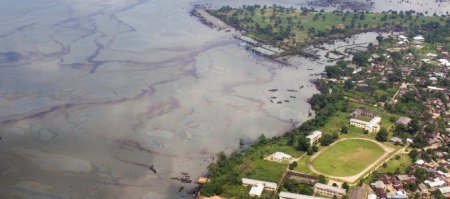
The overthrow of a dictator in 1991 plunged Somalia into two decades of violence, first at the hands of clan warlords and then Islamist militants, while two semi-autonomous regions – Puntland and Somaliland – have cropped up in northern Somalia.  About a dozen companies, including many multinational oil and gas majors, had licenses to explore Somalia before 1991, but since then Somaliland, Puntland and other authorities have granted their own licenses for the same blocks….

Excerpt, MICHELLE NICHOLS AND LOUIS CHARBONNEA, Exclusive: U.N. experts wary of Somaliland plan for armed oil protection unit, Reuters, May 30, 2014

The Fatal Attraction to Coal: World

Coal is cheap and simple to extract, ship and burn. It is abundant: proven reserves amount to 109 years of current consumption… Just as this wonder-fuel once powered the industrial revolution, it now offers the best chance for poor countries wanting to get rich.  Such arguments are the basis of a new PR campaign launched by Peabody, the world’s largest private coal company (which unlike some rivals is profitable, thanks to its low-cost Australian mines). And coal would indeed be a boon, were it not for one small problem: it is devastatingly dirty. Mining, transport, storage and burning are fraught with mess, as well as danger. Deep mines put workers in intolerably filthy and dangerous conditions. But opencast mining, now the source of much of the world’s coal, rips away topsoil and gobbles water. Transporting coal brings a host of environmental problems.

The increased emissions of carbon dioxide from soaring coal consumption threaten to fry the planet…he CO2 makes the oceans acid; burning coal also produces sulphur dioxide, which makes buildings crumble and lungs sting, and other toxic chemicals. By some counts, coal-fired power stations emit more radioactivity than nuclear ones. They release tiny, lethal particulates. Per unit generated, coal-fired stations cause far more deaths than nuclear ones, and more even than oil-fired ones.

But poverty kills people too, and slow growth can cost politicians their jobs. Two decades of environmental worries are proving only a marginal constraint on the global coal industry. The International Energy Agency has even predicted that, barring policy changes, coal may rival oil in importance by 2017… As countries get richer they tend to look for alternatives—China is scrambling to curb its rising consumption. But others, such as India and Africa, are set to take up the slack

America’s gas boom has prompted its coal miners to seek new export markets, sending prices plunging on world markets. So long as consumers do not pay for coal’s horrible side-effects, that makes it irresistibly cheap. In Germany power from coal now costs half the price of watts from a gas-fired power station. … Its production of power from cheap, dirty brown coal (lignite) is now at 162 billion kilowatt hours, the highest since the days of the decrepit East Germany.  Japan, too, is turning to coal in the wake of the Fukushima nuclear disaster. On April 11th the government approved a new energy plan entrenching its role as a long-term electricity source.

International coal companies face two worries. One is that governments may eventually impose punitive levies, tariffs and restrictions on their mucky product. The other is the global glut. Prices for thermal coal (the kind used for power and heating) are at $80-85 a tonne, which barely covers the cost of capital. Some Australian producers are even mining at a loss, having signed freight contracts with railways and ports that make them pay for capacity whether they use it or not….

Perhaps the biggest hope for all involved in the coal industry is technology. Mining and transporting coal will always be messy, but this could be overlooked were it burned cheaply and cleanly. Promising technologies abound: pulverising coal, extracting gas from it, scrubbing emissions and capturing the CO2. But none of these seems scalable in the way needed to dent the colossal damage done by coal. And all require large subsidies—from consumers, shareholders or taxpayers.

A $5.2 billion taxpayer-supported clean-coal plant in Mississippi incorporates all the latest technology. But at $6,800 per kilowatt, it will be the costliest power plant yet built (a gas-fired power station in America costs $1,000 per kW). At those prices, coal is going to stay dirty.

The fuel of the future, unfortunately: A cheap, ubiquitous and flexible fuel, with just one problem, Economist,  Apr. 19, 2014, at 55

Thorium Reactors are Less Radioactive

Existing  nuclear reactors use uranium or plutonium—the stuff of bombs.  Thorium, though, is hard to turn into a bomb; not impossible, but sufficiently uninviting a prospect that America axed thorium research in the 1970s. It is also three or four times as abundant as uranium. In a world where nuclear energy was a primary goal of research, rather than a military spin-off, it would certainly look worthy of investigation. And it is, indeed, being investigated.

India has abundant thorium reserves, and the country’s nuclear-power programme, which is intended, eventually, to supply a quarter of the country’s electricity (up from 3% at the moment), plans to use these for fuel. This will take time. The Indira Gandhi Centre for Atomic Research already runs a small research reactor in Kalpakkam, Tamil Nadu, and the Bhabha Atomic Research Centre in Mumbai plans to follow this up with a thorium-powered heavy-water reactor that will, it hopes, be ready early next decade.

China’s thorium programme looks bigger. The Chinese Academy of Sciences claims the country now has “the world’s largest national effort on thorium”, employing a team of 430 scientists and engineers, a number planned to rise to 750 by 2015. This team, moreover, is headed by Jiang Mianheng, an engineering graduate of Drexel University in the United States who is the son of China’s former leader, Jiang Zemin (himself an engineer). Some may question whether Mr Jiang got his job strictly on merit. His appointment, though, does suggest the project has political clout. The team plan to fire up a prototype thorium reactor in 2015. Like India’s, this will use solid fuel. But by 2017 the Shanghai Institute of Applied Physics expects to have one that uses a trickier but better fuel, molten thorium fluoride…

One of the cleverest things about (Liquid Fluoride Thorium Reactors) LFTRs is that they work at atmospheric pressure. This changes the economics of nuclear power. In a light-water reactor, the type most commonly deployed at the moment, the cooling water is under extremely high pressure. As a consequence, light-water reactors need to be sheathed in steel pressure vessels and housed in fortress-like containment buildings in case their cooling systems fail and radioactive steam is released. An LFTR needs none of these.

Thorium is also easier to prepare than its rivals… By contrast thorium, once extracted from its ore, is reactor-ready…[T]horium reactors can run non-stop for years, unlike light-water reactors. These have to be shut down every 18 months to replace batches of fuel rods.  Thorium has other advantages, too. Even the waste products of LFTRs are less hazardous than those of a light-water reactor. There is less than a hundredth of the quantity and its radioactivity falls to safe levels within centuries, instead of the tens of millennia for light-water waste.

Paradoxically, though, given thorium’s history, it is the difficulty of weaponising thorium which many see (as it were) as its killer app in civil power stations. One or two 233U bombs were tested in the Nevada desert during the 1950s and, perhaps ominously, another was detonated by India in the late 1990s. But if the American experience is anything to go by, such bombs are temperamental and susceptible to premature detonation because the intense gamma radiation 233U produces fries the triggering circuitry and makes handling the weapons hazardous. The American effort was abandoned after the Nevada tests….. Rogue nations interested in an atom bomb are thus likely to leave thorium reactors well alone when there is so much poorly policed plutonium scattered around the world. So a technology abandoned because it could not be turned into weapons may now, in part for that very reason, be about to resurface.

Excerpts from Thorium reactors: Asgard’s fire, Economist,  April 12, at 78

Loans-for-Oil: China and Latin America

China’s demand for commodities has entrenched Latin America’s position as a supplier of raw materials. The country guzzles oil from Venezuela and Ecuador, copper from Chile, soyabeans from Argentina, and iron ore from Brazil—with which it signed a corn-import deal on April 8th.   Chinese lending to the region also has a strong flavour of natural resources. Data are patchy, but according to new figures from the China-Latin America Finance Database, a joint effort between the Inter-American Dialogue, a think-tank, and Boston University, China committed almost $100 billion to Latin America between 2005 and 2013 (see chart). The biggest dollops by far have come from the China Development Bank (CDB). These sums are meaningful. Chinese lenders committed some $15 billion last year; the World Bank $5.2 billion in fiscal year 2013; foreign commercial banks lent an estimated $17 billion.

More than half of China’s lending to Latin America has been swallowed by Venezuela, which pays much of the loan back from the proceeds of long-term oil sales to China. Ecuador has struck similar deals, as has Petrobras, Brazil’s state-controlled oil firm, which negotiated a $10 billion credit line from CDB in 2009.

Such loan-for-oil arrangements suit the Chinese, and not simply because they help secure long-term energy supplies. They also reduce the risk of lending to less creditworthy countries like Venezuela and Argentina. Money from oil sales is deposited in the oil firm’s Chinese account, from where payments can be directly siphoned.  It is no surprise that Chinese money is welcome in places where financial markets are wary. Ecuador, which defaulted on its debts in 2008, has used Chinese loans both to fill in holes in its budget and to re-establish a record of repayment in advance of trying to tap bond markets again.

But Chinese credit has its attractions in other economies, too. It often makes sense for countries to diversify sources of lending. Loans can open the door to direct investment. And as Kevin Gallagher of Boston University points out, the Chinese banks operate in largely different sectors to the multilaterals. Of the money China has lent in the region since 2005, 85% has gone to infrastructure, energy and mining. Borrowers may have to spend a proportion of their loan on Chinese goods in return; some observers worry about the laxer environmental standards of Chinese banks. But the main thing is that money is available. Expect the loan figures to rise.

Chinese lending to Latin America: Flexible friends, Economist,  Apr. 12, 2014, at 27

The Fate of Nuclear Waste from Oil Drilling

Scotoil Services Ltd, a company which disposes of radioactive waste from the North Sea oil industry, inadvertently pumped dangerous particles into Aberdeen Harbour over several months.  The pollution included materials such as lead-210, radium-226 and radium-228, which both glow blue in the dark, and polonium-210, which was used to poison the former Russian spy, Alexander Litvinenko.  An investigation by the Scottish Environment Protection Agency (Sepa) found one “gross” breach and several “major” breaches of the firm’s operating conditions.

However, the public was never told about the leak, which continued unchecked from November 2011 until April 2012, and it also appears that the Scottish Government was not informed either.   While Scotoil had installed equipment to remove solid material from their liquid effluent, in April 2012, they informed Sepa that a final filter they were using had potentially failed Sepa said in a statement.

Scotoil has long been at the centre of concerns about radioactive particles washing up on the southern end of Aberdeen Beach, known as Foot Dee.  Drilling for oil and gas causes Naturally-Occurring Radioactive Material (NORM) to build up on offshore equipment – an estimated 50 to 100 tonnes each year from the North Sea alone.  For years, Scotoil and other operators could allow small particles of NORM to be discharged into the sea with the water they used to clean the drills and other pieces of essential kit.

However, tighter restrictions brought in from October 2011 mean that all particles must now be screened out and sent to secure landfill sites in sealed drums, along with the bulk of the solid waste.  Following a Freedom of Information request by this newspaper, it emerged that Sepa became aware of the potential Scotoil leak in April, 2012.  The company contacted Sepa to report “that particles of NORM have been discharged in their liquid effluent to the marine environment… Scotoil’s view is that the filters failed allowing the solid material into the environment”.

Excerpt  from, Ben Borland, Scots kept in the dark over radiation leak into harbour at Aberdeen, Scottish Express, Apr. 26, 2014

The Future of Nuclear Waste in Europe

The word “Gorleben” brings up some negative images in the minds of many Germans. It’s the name of a municipality in Lower Saxony and the site of a controversial nuclear waste disposal facility located there, currently used as an intermediate storage facility but intended to become permanent. For more than 30 years, nuclear energy opponents have been trying to stop the site from being turned into a deep geological repository.  And now it looks like they will be getting their way, with Germany’s federal and state governments agreeing on  draft a new law to regulate the search for a final repository.

While only a portion of Germany’s radioactive waste is currently temporarily stored away in Gorleben, the situation in neighboring countries does not look much better. Meanwhile, pressure is increasing around the world to find a permanent solution, but according to geologist Stefan Alt from the Institute for Applied Ecology in Darmstadt “it will still be at least another 20 years before this happens, optimistically speaking.”

Nevertheless, the EU has called on its member states to draw up plans by 2015 outlining how and where they are planning to store nuclear waste. The search for suitable sites is becoming frantic, but in some countries it is even more difficult than in others.

“While Germany has salt, granite and clay deposits that nuclear waste can be stored in, the options in countries like France and Switzerland are more limited,” said Alt. He added that France has been searching nearly exclusively for clay soil and has apparently managed to find something suitable.  In the village of Bure in eastern France, close to the German border, the government is examining the rock layers with the help of an underground laboratory, with a view to creating a permanent repository there by 2025.,  Unlike in Germany, there is no major public resistance against the project. “In France there hasn’t traditionally been any large anti-nuclear movement,” said Alt. “However, people who live in the direct vicinity of the repository site see the situation a bit differently, of course.”

In Switzerland, public discussion on the matter has been lively. “The more precise the suggestion for a location, the more heated the debate becomes,” said Alt. Since 2008, six potential sites have beenpinpointed in the country. Germany has been allowed to provide its input in regards to those located near the German border. A referendum on the issue is being considered for 2019.

In Belgium, 55 percent of power is sourced from nuclear energy. “But Belgium is a very small country with few possibilities for permanent nuclear waste storage,” Alt said. “There is a research facility in the town of Mol, but the problem is that the clay deposits there are too small for a storage site.”  The Netherlands faces a similar problem.

“The situation in the Czech Republic hasn’t been transparent for months,” There is also opposition in the country towards the government’s plans to create nuclear storage facilities  Only the Nordic region has made significant progress in the search for permanent waste storage sites. In Finland, the first facility is already under construction on the island of Olkiluoto.  “The acceptance level among the residents is a lot higher than in Germany and neighboring countries,” said Alt. “But this is not surprising because technological awareness is very high there and there is already a nuclear power plant on the island.”

Aside from that, nuclear energy attracts very different associations in Finland than in Germany…is seen as a source of affluence and jobs.  Still, the construction of the Olkiluoto facility is facing some hurdles. Several investigations are being conducted that could potentially halt the process. At this stage it is also not clear when the facility could realistically begin operations. “A facility like this doesn’t appear overnight.”The Konrad temporary storage facility in Germany was only finished after 20 years, and the preceding considerations and planning took 30 to 40 years.

Excerpts, Christian Ignatzi,  NUCLEAR POWER: Europe searches for nuclear waste storage sites, Deutsche Welle, Apr. 14, 2014

Oil Spills Everyday – the Impact

Silent oil spills” occur daily when oil is released into the environment during use or illegally dumping. Silent oil spills generate around 10 billion gallons of contamination in a single year. According to the Environmental Protection Agency’s “Developing a used oil recycling program” fact sheet, 40 percent of the pollutants in the water come from motor oil.

California’s bill, SB 916, attempts to address this by encouraging the use of bio-based motor oil. Most bio-based motor oils are made from the organic fatty acids found in various plants. The oil is non-toxic and is biodegradable….Very few are aware that 200 million gallons of used motor oil is illegally dumped in the United States every single year…More than twice as much motor oil enters the near shore waters off Los Angeles every year from urban runoff.

According to the EPA, petroleum based lubricants biodegrade slowly, they bioaccumulate in the tissues of marine organisms and they have high levels of aquatic toxicity. They also have much higher GHG [greenhouse gas] emissions relative to bio based alternatives, and of course, they are not renewable…

The fight to bring bio-based motor oil into the mainstream is an uphill battle for those seeking to unseat the deeply entrenched and deep pocketed gas and oil industry. Last year alone, the industry spent $144 million lobbying on legislators at the federal level.

Excerpt from Justin King, California attempts to battle ‘silent oil spills’ SPECIAL, Digital Journal, April 11, 2014

Nuclear Accidents of the Future

Three major atomic accidents [Three Mile Island US 1979, Chernobyl USSR 1986, Fukushima Japan 2011] in 35 years are forcing the world’s nuclear industry to stop imagining it can prevent more catastrophes and to focus instead on how to contain them.  As countries such as China and India embrace atomic power even after the Fukushima reactor meltdowns in 2011 caused mass evacuations because of radiation fallout, scientists warn the next nuclear accident is waiting to happen and could be in a country with little experience to deal with it.

“The cold truth is that, no matter what you do on the technological improvements side, accidents will occur — somewhere, someplace,” said Joonhong Ahn, a professor at the Department of Nuclear Engineering of University of California, Berkeley. The consequences of radiation release, contamination and evacuation of people is “clear and obvious,” Ahn said. That means governments and citizens should be prepared, not just nuclear utilities, he said.

While atomic power has fallen from favor in some western European countries since the Fukushima accident — Germany, for example, is shutting all of its nuclear plants — it’s gaining more traction in Asia as an alternative to coal. China has 28 reactors under construction, while Russia, India, and South Korea are building 21 more, according to the World Nuclear Association. Of the 176 reactors planned, 86 are in nations that had no nuclear plants 20 years ago, WNA data show…

The problem is that the causes of the three events followed no pattern, and the inability to immediately contain them escalated the episodes into global disasters with huge economic, environmental and political consequences. Even if no deaths have yet been officially linked to Fukushima radiation, for example, cleanup costs have soared to an estimated $196 billion and could take more than four decades to complete.

If nuclear is to remain a part of the world’s energy supply, the industry must come up with solutions to make sure contamination — and all other consequences — do not spread beyond station grounds, Gregory Jaczko, ex-chairman of the U.S. Nuclear Regulatory Commission, said in an interview in Tokyo….

Since the introduction of nuclear stations in the 1950s, the industry has focused safety efforts on design and planning. Research and innovation has looked at back-up systems, passive technology that would react even if no human operator did, and strengthened materials used in construction of atomic stations….

The official toll from the reactor explosion at Chernobyl was put at 31 deaths. Radiation clean-up work, however, involved about 600,000 people, while 200,000 locals had to be relocated.  The accident contaminated 150,000 kilometers of land and according to the last Soviet leader Mikhail Gorbachev it was a factor in bringing about the collapse of the Soviet Union in 1991.

In Japan, the meltdown of three Fukushima reactors helped unseat premier Naoto Kan and forced the evacuation of about 160,000 people, destroying local fishing, farming and tourism industries along the way. It also brought tens of thousands of anti-nuclear protesters out onto the streets in the country’s biggest demonstrations since the 1960s. Tokyo Electric Power Co., the plant operator and once the world’s biggest non-state power producer, would have been bankrupted by the Fukushima accident but for billions of dollars in government aid…

Building a plant that would contain an accident within the facility boils down to cold cash, he said.  The review calls for new reactor designs to make a major release of radioactive fallout outside the station site “practically impossible,” the IAEA said. The standard would be “crucial for public acceptance and for the sustainability of nuclear energy.” Specialists on the review met for the first time in March and no conclusions are yet available, IAEA spokesman Greg Webb said by e-mail.

The problem with an engineering solution, an ever better reactor design or grander safety systems, is that based on the premise that all technology is fallible those defense systems can also fail, Berkley’s Ahn said.  “This is an endless cycle,” Ahn said. “Whatever is your technology, however it is developed, we always have residual risk.”  When the next nuclear accident occurs the world needs to have better knowledge of how to limit the spread of radiation and do the clean-up, including removing radiation from the soil, water and having an efficient evacuation drill for the population in danger zones, Ahn said. We also need more understanding of the impact of low-dose radiation on organisms, he said.  “This is about recovery from an accident, not preventing an accident,” Ahn said. “It’s completely different. And I think this concept is very necessary for the future of nuclear utilization.”

Excerpts from Yuriy Humber, World Needs to Get Ready for the Next Nuclear Plant Accident, Bloomberg, Apr. 4, 2014

Dumping Coal in the Sea

Until recently Colombia was lax in enforcing its environmental laws. So it came as a shock to the country’s mining industry when, in January, the government halted coal exports from a port operated by Drummond, an American miner, in a row over pollution. The suspension has been costly not only for Drummond: its operations generate $66m a month in royalties and taxes for the Colombian treasury.

The mining minister, Amylkar Acosta, confirmed this week that the government would let the company resume its exports later this month, when it completes improvements to the port facility to prevent contamination of nearby beaches. The government has been under pressure to take action since environmentalists photographed an incident last year in which more than 500 tonnes of coal were dumped into the Bay of Santa Marta to stop a barge from sinking. Last month six employees at the port were charged, and face possible jail sentences. Drummond has been fined $3.6m and told to clean up the mess.

The case is an illustration of how the government, having welcomed foreign miners, is now having to contend with public disquiet over both pollution and the way the country’s mineral wealth is shared. In an election in May, President Juan Manuel Santos will seek a second term. So he cannot ignore the “hostile” climate of public opinion on the issue, says Alvaro Ponce, a Colombian mining expert.

Protests by nearby residents have delayed several big projects, including AngloGold Ashanti’s proposed gold mine in Tolima province and Eco Oro’s planned gold and silver mine in Santander province. A study by Colombia’s national audit office, published in January, found that economic and social development in towns next to large mining operations is worse than in places where illegal coca crops are grown for making cocaine.

The environment ministry is seeking new powers to require licences for exploration as well as extraction. Mining firms grumble that the process of getting projects approved is already tortuous enough. This and the recent fall in world prices of some minerals mean that up to $7.3 billion of investments are stalled, they say. Mr Acosta says the miners must accept that besides getting their official permits, they have to convince local communities to accept their presence, earning a “social licence” to operate. “Without that, the projects become unviable,” he says.

The backlash against mining has been building for some years. In the mid-2000s, when commodity prices were booming and Colombia’s internal conflicts were subsiding, the government offered incentives for foreign firms to come in and create mining jobs. It awarded exploration permits for swathes of territory, including in areas hitherto off limits, such as the fragile páramo tundra in the Andes. “The floodgates were opened,” says James Lockhart-Smith of Maplecroft, a risk-analysis firm.

But Colombia’s regulators were ill-prepared. In 2011 the government stopped accepting new applications for licences while it dealt with a backlog of 19,000. It rejected 90% of these, then turned its attention to 10,000 projects that had already been given licences, finding that 92% were failing in some way to comply with their conditions.

Despite all the stumbles and setbacks, Colombia is getting somewhere in its drive to exploit its mineral reserves. In 2013 mining investment was $3.6 billion, 21% more than in 2012. Mining already accounts for 2.3% of GDP and 7% of exports, and foreign companies are still lining up to explore new prospects. By the standards of resource-rich emerging economies, it is a fairly well-run place, so the chances are that it will succeed in coming up with a licensing regime that eases public worries without deterring investment. As in richer countries, mining projects will still be welcomed, but not at any price.

Mining in Colombia: Digging itself out of a hole, Economist, Mar. 15, 2014, at 61

The Power of Batteries and Micro-Grids

Who needs the power grid when you can generate and store your own electricity cheaply and reliably? Such a world is drawing nearer: good news for consumers, but a potential shock for utility companies. That is the conclusion of a report this week by Morgan Stanley, an investment bank, which predicts that ever-cheaper solar and other renewable-energy sources, combined with better and more plentiful batteries, will allow many businesses and other electricity users to cut the cord on their electricity providers.

Tesla Motors, an American maker of electric cars, recently said it will build a “gigafactory”, which by 2020 will turn out as many lithium-ion batteries as the whole world produced last year (2013). These batteries can do more than power cars; they can also store electricity which is produced when it is not needed, and discharge it when it is….

In poor, volt-starved countries, a lorry-mounted aircraft engine can become a mobile gas-fired power station. GE recently installed 24 such units in Algeria, providing 30MW of power. Local difficulties meant it took six months; that was fast by the standards of big power stations, “but we could have done it in ten days,” says Lorraine Bolsinger, who heads GE’s new distributed-generation business….

Morgan Stanley reckons that if Tesla’s factory provides the cheap batteries it promises, Californian households will be able to run off a solar-plus-storage system costing just $350 a year. Buying electricity off the grid may cost them around $750 a year by then.

Morningstar, an investment-research firm, says that though distributed generation represents only 1% of America’s installed capacity now (compared with 20% in Germany), it could make up a third by 2017 and could “kill” utilities in their current form. Small-scale producers will dump their surplus power on the market at prices below those at which the utilities can recoup their cost of capital—and thus pay to maintain the grid.

America’s Electric Power Research Institute last month produced a paper highlighting the dangers of an unplanned move to distributed generation, using Germany as an example. The dash for renewables there has strained the power network and made life hard for utilities. This week one of the country’s largest, RWE, announced that it made a net loss of €2.8 billion ($3.8 billion) in 2013, its first annual loss in more than 60 years, as the rising supply of electricity from (subsidised) renewable sources undercut its prices.

Distributed generation: Devolving power, Economist,  Mar. 8, 2014, at 69

Russia and Poland – the nuclear option

On January 28th, 2014 the [Polish] economics ministry presented a detailed 150-page plan paving the way for the construction of two nuclear-power plants. By 2016 the sites of the two plants will be picked. Two areas close to the Baltic coast, Choczewo and Zarnowiec, are on the shortlist. Three years later construction is to begin and, by 2024, the first plant should be producing power. A state-owned energy company, PGE, will manage the project, which will cost an estimated 40 billion-60 billion zloty ($13 billion-19 billion)….

Until now, the exploration of shale gas in northern Poland has moved at a snail’s pace, thanks to a combination of bureaucracy and environmental worries, much to the frustration of foreign investors. The government is trying to change this. On February 5th the environment ministry announced a new shale-gas law intended to cut red tape and regulatory obstacles. To investors’ relief, NOKE, a state operator, will not be part of the licensing process. “I believe this will encourage exploration,” says Kamlesh Parmar, chief executive of 3Legs Resources, an investor.

Krzysztof Kilian, a former boss of PGE, doubts that the government can embark on the production of nuclear power and shale gas at the same time, as both require gargantuan investments. Meanwhile, Russia is building a nuclear-power plant in Kaliningrad, the Russian exclave north of Poland. So far Poland and Lithuania have both declined Russian offers to export power to their countries, as both are trying to reduce their dependence on Russian energy, which is overwhelming in Lithuania’s case and considerable in Poland’s. In June last year (2013) the construction of the plant was temporarily suspended.

Polish energy policy: A different Energiewende, Economist, Feb. 8, 2014, at 52

The OPEC Cartel and the US

The OPEC often described as a cartel, it is better seen as an anti-glut group. When demand is weak, its members can curb production to prevent the price plummeting. But when demand is healthy, its ability to curb new producers is limited. And new producers abound.

America’s domestic production of crude (and gas, which displaces some oil) is rocketing. The IEA says the country will produce 14m barrels a day (b/d) next year, on a par with Saudi Arabia . That has reduced America’s imports, as well as boosting exports of fuels (exports of crude oil are mostly banned). That frees crude from other places, such as West Africa, to go to Europe instead. Similarly, Latin American and Middle Eastern oil that once would have gone to America now goes to Asian customers.

For the oil-rich, even worse is in store. Other factors that have propped up the price over the past decade are likely to wane in importance. Even the slightest easing of sanctions helps Iran, potentially a huge producer….The Economist Intelligence Unit…forecasts a “significant boost” in 2014 from 2.4m b/d last year. This assumes new investment pays off, and a deal with the semi-autonomous Kurdish region. Libya could be another source of production: its exports have collapsed to only a few hundred thousand barrels a day, against 1.6m in June last year…

An alternative for Saudi Arabia would be to increase production sharply. That would send the price down: painful for the kingdom, but even more painful for higher-cost producers (not least America, where the “tight oil” now coming on stream requires prices of $50 and above to be profitable).  OPEC’s best hope is continued American protectionism. Any easing of the restrictions on the export of liquefied natural gas (LNG) or crude will exert more downward pressure on the oil price. That might be good for the world economy, but it is not a priority for American consumers, who would like cheaper petrol for cars and propane for heating…

OPEC and oil prices: Leaky barrels, Economist, Feb. 22, 2014, at 63

US Subsidies for Nuclear Energy

U.S. Secretary of Energy Ernest Moniz today announced at the National Press Club that he will be traveling to Waynesboro, Georgia tomorrow, February 20, 2014 to mark the issuance of approximately $6.5 billion in loan guarantees for the construction of two new nuclear reactors at the Alvin W. Vogtle Electric Generating Plant. The project represents the first new nuclear facilities in the U.S. to begin construction and receive NRC license in nearly three decades. In addition, the deployment of two new 1,100 megawatt Westinghouse AP1000 nuclear reactors is a first-mover for a new generation of advanced nuclear reactors.

“The construction of new nuclear power facilities like this one – which will provide carbon-free electricity to well over a million American energy consumers – is not only a major milestone in the Administration’s commitment to jumpstart the U.S. nuclear power industry, it is also an important part of our all-of-the-above approach to American energy as we move toward a low-carbon energy future,” said Secretary Moniz. “The innovative technology used in this project represents a new generation of nuclear power with advanced safety features and demonstrates renewed leadership from the U.S. nuclear energy industry.”

The two new 1,100 megawatt Westinghouse AP1000 nuclear reactors at the Alvin W. Vogtle Electric Generating Plant will supplement the two existing reactor units at the facility. According to industry projections, the project will create approximately 3,500 onsite construction jobs and approximately 800 permanent jobs once the units begin operation. When the new nuclear reactors come on line, they will provide enough reliable electricity to power nearly 1.5 million American homes.  Project partners include Georgia Power Company (GPC), Oglethorpe Power Corporation (OPC), the Municipal Electric Authority of Georgia (MEAG), and the City of Dalton, Georgia (Dalton)….

The Energy Policy Act of 2005 authorized the Department to issue loan guarantees for projects that avoid, reduce or sequester greenhouse gases and employ new or significantly-improved technologies as compared to technologies in service in the United States at the time the guarantee is issued.  The nuclear facility is eligible for loan guarantees since it is expected to avoid nearly 10 million metric tons of carbon dioxide emissions annually, which is the equivalent of removing more than two million vehicles from the roads. In addition, the Westinghouse AP1000 reactor has incorporated numerous innovations resulting in significant operational and safety improvements.

Currently, the Department’s Loan Programs Office (LPO) supports a large, diverse portfolio of more than $30 billion in loans, loan guarantees, and commitments, supporting more than 30 closed and committed projects. The projects that LPO has supported include one of the world’s largest wind farms; several of the world’s largest solar generation and thermal energy storage systems; and more than a dozen new or retooled auto manufacturing plants across the country.

Sec. Moniz to Georgia, Energy Department Scheduled to Close on Loan Guarantees to Construct New Nuclear Power Plant Reactors, Press Release, US Energy Department, Feb. 19, 2014.

Where? to Place Fukushima Nuclear Waste

Fukushima prefectural authorities have asked the Environment Ministry to reduce from three to two the number of sites it plans for the temporary storage of radioactive debris generated by the Fukushima No. 1 nuclear power plant disaster.  Fukushima Governor Yuhei Sato on Feb. 12 submitted a request to Environment Minister Nobuteru Ishihara and Takumi Nemoto, the minister in charge of post-quake reconstruction, asking them not to build a storage facility in the town of Naraha so that its residents can return home earlier.  Based on the request, Ishihara said the Environment Ministry will review the initial plan to erect facilities in Naraha, as well as the towns of Okuma and Futaba.

The central government intended to construct intermediate storage facilities in the three towns, all in Fukushima Prefecture, that are capable of storing 13.1 million, 12.4 million and 2.5 million cubic meters of debris, respectively. The smallest of the sites was to be built in Naraha.

However, Sato argued in his request that if collected debris were burned to reduce its volume, the two larger sites could accommodate all the waste.  The governor also proposed that the ministry build a plant to process the ash from debris with radioactive values at 100,000 becquerels per kilogram or lower in Naraha instead…Elsewhere though, many other municipalities in the prefecture have urged the prefectural government to quickly facilitate the building of those facilities because radioactive soil and other associated waste generated by the Fukushima nuclear disaster are filling up temporary storage sites throughout the prefecture. The Environment Ministry estimates that 1.6 million cubic meters of debris was stored across Fukushima Prefecture as of the end of last October.

Excerpt, Fukushima seeks limit on radioactive waste disposal sites, THE ASAHI SHIMBUN, Feb. 13, 2014

Bonga Oil Spill: the Nigeria v. Shell

The Director General, Nigerian Maritime Administration and Safety Agency (NIMASA) Mr. Patrick Akpobolokemi has slammed Anglo Dutch oil giant, Shell for the way and manner it handles oil spill in the country, especially in the oil and gas rich Niger Delta region.  He said the response of the foremost oil firm to oil spillages in the country fell short of international standards and practices.  The helmsman of Nigeria’s apex maritime regulatory authority spoke against the backdrop of the Bonga oil spill incident which wreaked havoc in many communities in the Niger Delta region in 2011.

The National Assembly had last week through the House of Representatives Committee on Environment, organised a public hearing over the incident.  Recounting NIMASA’s experience during the incident, Akpobolokemi said that the oil giant tried as much as possible to frustrate the agency’s attempts to move to the site of the spill.  As a stop gap measure, he explained that the agency provided some relief material to some of the communities affected by the spill.  Akpobolokemi flayed Shell for it poor response and nonchalant attitude towards spill incidents in the Niger Delta area and called for an immediate stop to this.

Said he: “The kind of impunity Shell and its allies have demonstrated so far in the Niger Delta area in the past must stop if the future of the people of Nigeria and the environment are to be protected,” adding that in other countries when spills like this occur, the first thing is remuneration, attention to the affected communities and finding ways of reducing the sufferings of the people and restoring the ecosystem, which Shell has failed to do. “Shell fell short of all these criteria and of course it is sad that it is only in Nigeria that we can witness this degree of impunity.

“We in NIMASA see this as a serious infraction to our laws, communities and the damage done to the communities and the ecosystem can be seen as genocide. When a similar spill occurred in the gulf of Mexico, Shell was alive to its responsibilities, they were made to pay compensation to the affected communities but today in Nigeria, any spill that occur, a claim of sabotage or third party claims are the order of the day.” He said NIMASA had made presentations before the House Committee on Environment, asking SNEPCO to pay compensation, not an administrative fee, to the communities totalling $6.5 billion.

“The response from Shell was evasive and do not suggest that it is a company that is alive to its responsibility. It believes that the culture of impunity can continue to go on, thereby playing with our legal system. May we use this opportunity to correct the wrong that has been done to the Nigerian environment because of the callousness of this company and we stand by our position that compensation must be paid to the communities.

“What we expect Shell to do is to come to the negotiating table and discuss with the affected communities on the means of payment so that the communities can get back their natural eco-system”.

John Iwori, Bonga Oil Spill: NIMASA Slams Shell, http://www.thisdaylive.com/,  Feb. 14, 2014


The Scramble for Antarctica

Over the past two decades China’s annual Antarctic spending has tripled to $55m, three times its Arctic investment… The Southern Ocean is full of fish. A large petroleum field was recently discovered in West Antarctica. The continent also has deposits of coal and other valuable minerals. The Protocol on Environmental Protection, a document signed in Madrid in 1991 by countries involved in Antarctica, has imposed a mining ban until 2048, when it is to be reviewed.

China acceded in 1983 to the Antarctic Treaty, which maintains the continent as a demilitarised science preserve and forms the basis of a system of governance. The goal of its current five-year polar plan, says Chen Lianzeng of China’s State Oceanic Administration, is to increase the country’s status and influence. On November 7th China’s 30th Antarctic expedition, complete with construction crew, set sail from Shanghai. It will scout a site for China’s fifth station, in Terra Nova Bay. Its fourth base, Taishan, is still unfinished.

Sovereignty in Antarctica is disputed. States assert themselves by building bases. “You put a huge flag on a flagpole close to the research station,” says Klaus Dodds, a professor of geopolitics at the University of London. “It is not very subtle.” If China builds all five planned stations it will have more than either Britain or Australia, and only one fewer than America.

Science matters, too. It gives cachet and influence in matters of joint governance. In 2008 China built Kunlun station, a base with capabilities for deep-space research in a place so remote that it took six attempts to get there. The ice underneath could help scientists work out the climatic record of the past 1.5m years, which would be a scientific coup.But the influx of new Antarctic actors has rattled the old establishment and its former scientific hegemony. “China is saying, ‘We don’t give a damn about Shackleton, Scott, all these white European heroes. You can keep that. What we’re interested in is the future,” says Mr Dodds. The Chinese have raised even more concerns by giving Chinese names to more than 350 places, including Great Wall Bay.  Chinese scholars call the Antarctic Treaty a “rich man’s club”, in which China has only second-class citizenship—with some justification, says Ms Brady, since the choicest spots for research stations were snapped up by the first countries to arrive. Publicly, though, China buries its grumbles and complies with protocol. An inspection regime installed by the treaty is ineffectual, and there is little check on states’ affairs.

Meanwhile, the exploitation of Antarctic resources may come sooner than predicted. At a recent meeting of the Commission for the Conservation of Antarctic Marine Living Resources, delegates from 24 countries failed to agree on proposals for two marine protected areas. Plans for the reserves have been discussed for decades, but consensus was required and China, Russia and Ukraine withdrew their support. If Antarctica and the Southern Ocean are to remain some of the planet’s last unspoilt wilderness, an updated framework is needed, and quickly.

Antarctic research: They may be some time, Economist, Nov. 16, 2013, at 50

Fukushima at 2013

The building Fukushima Dai-ichi nuclear power plant, is still unstable, and its spent-fuel storage pool highly dangerous. This month (Nov. 2013) Tokyo Electric Power (TEPCO) will start plucking out over 1,500 radioactive rods from the pool in order to store them more safely. Over the pool a crane waits to start the procedure, and a yellow radiation alarm stands at the ready. Experts call the operation the riskiest stage of the plant’s clean-up so far… Engineers will have to take out each fuel assembly one by one without mishap, and overcome the risks of fire, earthquake and the pool boiling dry. The fuel rods can ignite if they lose coolant, or explode if they collide.

The rods are being moved just when trust in the utility that owns Fukushima Dai-ichi is at a low point. A series of leaks of highly radioactive water this year, and other dangerous accidents including a power cut in March—a rat chewed through the wiring—has brought it under fierce attack. In August the Nuclear Regulation Authority (NRA) said leaks of contaminated water were a level-three or “serious” incident on an international scale that goes up to seven. Now some are calling for the removal of spent-fuel rods from reactor four to be closely monitored by foreign experts.

Even the pro-nuclear ruling Liberal Democratic Party (LDP) wants to take TEPCO in its current form out of the decommissioning process, which will take 40 or more years. A new entity, including the utility’s staff but separate from its commercial side, would take charge. Finding a solution to the problem of TEPCO’s structure (among other things, the company is financially precarious) would help the government’s efforts to switch nuclear power back on.

At the moment Japan is entirely without nuclear energy, but that is unlikely to last for long. Shinzo Abe, the prime minister, is pushing for as many of the country’s 50 usable reactors to restart as soon as possible after passing safety checks by the NRA. The need to import energy has pushed up the price of electricity and added to a series of trade deficits since 2011. In September TEPCO won approval from the governor of Niigata prefecture to apply for a safety check in order to restart two reactors at its Kashiwazaki-Kariwa nuclear plant, the world’s biggest… Junichiro Koizumi, a popular LDP former prime minister, has stepped in, calling for an immediate end to nuclear power. After he broadcast his views at a press conference, a poll showed that three-fifths of those who were surveyed backed his plan.

Japan and nuclear power: High alert, Economist, Nov. 16, 2013, at 47

What is the Cost of Carbon?

The market price of carbon is €4.90 ($6.70) per tonne of CO2 in the EU, $11.50 in California. Big oil companies charge $34 or more. That is closer to the “social cost of carbon”—the damage from an extra tonne of CO2—than to the market price. America’s administration recently estimated the social cost at $37 a tonne. These prices change behaviour. A huge amount of attention is paid to government action. But the sort of carbon price some companies are using for planning would, if it became a market price, have a much bigger impact than any of the policies that governments are now talking about.

Companies and Emissions: Carbon Copy, Economist, Dec. 14, 2013, at 70

Unable to Control its Borders: Amazonas, Venezuela

Amazonas [in Venezuela] has many problems, but those most cited by local people are mainly the responsibility of central government. Frequent and lengthy power-cuts, unpunished violent crime, a precarious air link with Caracas and an almost non-existent internet service are among them. Outside Puerto Ayacucho, in the jungle that extends almost unbroken to the Brazilian border, an even darker mood prevails in the scattered Amerindian villages. Illegal mining is destroying the forest and polluting the water. The armed forces, whose duties include environmental protection, are accused by the Amerindians of complicity with the illegal miners and with the guerrillas of Colombia’s FARC, who have shifted their camps to Venezuela to evade military pressure at home.

“The guerrillas ordered the villagers not to go out at night,” says Uriel Blanco of OPIJKA, an organisation that defends the rights of the Jivi tribe. In the early hours, community leaders claim, boats laden with fuel and food head upriver to guerrilla camps. Neither these boats nor the miners seem to have problems with checkpoints run by Mr Maduro’s National Guard. But the guard seizes game from Amerindian hunters, as well as any fuel or processed food for which they lack receipts. The state’s Catholic bishop, José Angel Divasson, says that for the FARC, Amazonas is more than just a refuge: “It’s clear that they are trafficking drugs. Why else would they need 500-metre airstrips? The light planes go over [to Colombia] with guns and they come back with drugs.”
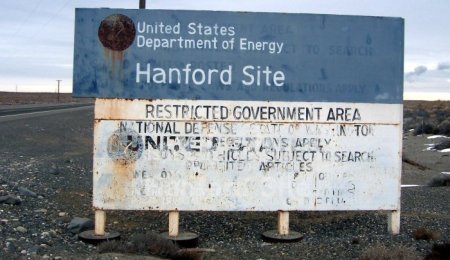
The cocaine business, along with illegal mining of gold and coltan, a mineral used in the manufacture of electronic devices, creates an almost insatiable demand for petrol and diesel, which are heavily subsidised by the Venezuelan government. The official price of a 200-gallon drum of petrol is just 14 bolívares. But once it leaves the river-port of Samariapo, it sells for at least 2,000 bolívares on the black market. By the time it gets to San Carlos de Río Negro, near the Brazilian border, it can cost five times that. Permits to buy fuel are controlled by the army.

“We get diesel for our generator once a month,” says a villager. “That gives us six hours of electricity.” Shops on the Colombian side of the river are well-stocked with subsidised Venezuelan food, while the people for whom it was intended go hungry. Amerindian groups have demanded a meeting with the president, but there has been no reply.
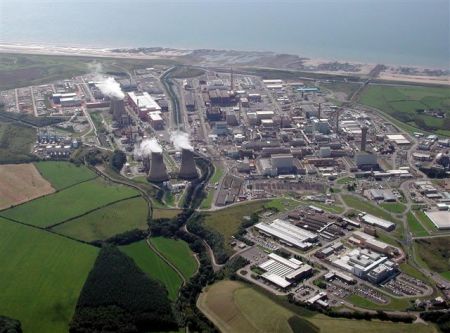
Venezuela’s Amazonas state: Lawless rivers and forests, Economist, Nov. 30, 2013

Nuclear Waste Disposal: Michigan v.Ontario

Ordinarily, a proposal to bury radioactive waste in a scenic area that relies on tourism would inspire “not in my backyard” protests from local residents -and relief in places that were spared.  But conventional wisdom has been turned on its head in the Canadian province of Ontario, where a publicly owned power company wants to entomb waste from its nuclear plants 2,230 feet below the surface and less than a mile from Lake Huron.
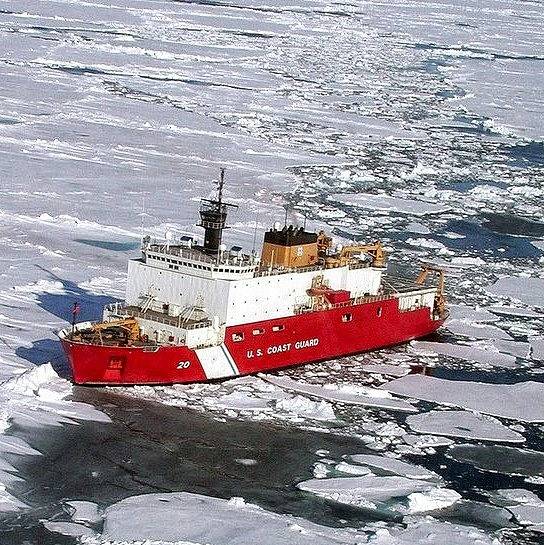
Some of the strongest support comes from Kincardine and other communities near the would-be disposal site at the Bruce Power complex, the world’s largest nuclear power station, which produces one-fourth of all electricity generated in Canada’s most heavily populated province. Nuclear is a way of life here, and many residents have jobs connected to the industry.  Meanwhile, the loudest objections are coming from elsewhere in Canada and the U.S.- particularly Michigan, which shares the Lake Huron shoreline with Ontario.

Critics are aghast at the idea. They don’t buy assurances that the waste would rest far beneath the lake’s greatest depths and be encased in rock formations that have been stable for 450 million years.  “Neither the U.S. nor Canada can afford the risk of polluting the Great Lakes with toxic nuclear waste,” U.S. Reps. Dan Kildee, Sander Levin, John Dingell and Gary Peters of Michigan said in a letter to a panel that is expected to make a recommendation next spring to Canada’s federal government, which has the final say.  Michigan’s two U.S. senators, Democrats Carl Levin and Debbie Stabenow, have asked the State Department to intervene. Business and environmental groups in Michigan and Ohio submitted letters. An online petition sponsored by a Canadian opposition group has collected nearly 42,000 signatures.

The Canadian “deep geologic repository” would be the only deep-underground storage facility in North America, aside from a military installation in New Mexico. Other U.S. radioactive waste landfills are shallow-usually 100 feet deep or less.  The most highly radioactive waste generated at nuclear plants is spent fuel, which wouldn’t go into the Canadian chamber. Instead, the site would house “low-level” waste  (decay within 300 years) such as ashes from incinerated mop heads, paper towels and floor sweepings. It also would hold “intermediate waste” (decay within 100,000 years)– discarded parts from the reactor core.  The project would be operated by Ontario Power Generation (OPG), a publicly owned company that manages waste generated by its nuclear reactors and others owned by Bruce Power, a private operator. Officials insist it’s the safest way to deal with radioactive material that has been stored above-ground since the late 1960s and needs a permanent resting place.

Company specialists say the waste would be placed in impermeable chambers drilled into sturdy limestone 2,230 feet below the surface, topped with a shale layer more than 600 feet thick. The lake’s maximum depth in the vicinity of the nuclear site is about 590 feet.  But Charles Rhodes, an engineer and physicist, contended seeping groundwater would fill the chamber in as little as a year, become contaminated and eventually reach the lake through tiny cracks in the rock.  “It’s only a question of how long, and how toxic it will be when it gets there,” he said in an interview.

Nuclear waste burial debate produces odd alliances. The Associated Press, Nov. 30, 2013


US Operations in North Africa – Strategic Instability

The Defense Department continues to work with nations in North Africa to promote security and increase stability in the region still feeling the effects of the Arab Spring, Amanda J. Dory, the deputy assistant secretary of defense for African affairs, told a Senate panel today. Libya, Tunisia, Algeria and Morocco are confronting instability and the U.S. military is working to build or strengthen their police and military forces, Dory told the Senate Armed Services Subcommittee on Near eastern and South and Central Asian Affairs….T

he effects of the Arab Spring in North Africa continue to reverberate within the region and beyond its borders into the Sahelian states of sub-Saharan Africa, she said. Libya remains a key source of instability in North Africa and the Sahel. After the overthrow of Muammar Gadhafi, there is little government infrastructure inside Libya, Dory said, and certainly no tradition of democracy.Violence is rampant in Libya and the Libyan government is too weak to control its borders and militias provide what security there is. Arms merchants are shipping Libyan weapons out of the country and these arms are fueling instability from Mali westward, Dory said…The United States will provide general-purpose-force military training for 5,000-8,000 Libyan personnel, Dory said.“This training effort is intended to help the [Libyan] government build the military it requires to protect government institutions and maintain order,” she said.  The training of Libyan military personnel may begin next year in Bulgaria.

In Morocco, Algeria and Tunisia, DOD maintains close military-to-military ties with their military counterparts. All three are engaged in a security dialogue with the United States and “they share our goals of countering terrorism and enhancing cross-border security,” Dory said…

Excerpts, By Jim Garamone, Military Continues Work With North African Countries American Forces Press Service, Nov. 21, 2013

Why Killing Gaddafi was Bad for Africa

[S]ays Professor Jean-Emmanuel Pondi from the Cameroon Institute for International Relations and author of a new book on Libya, Western nations were above all vexed with Gaddafi because he refused to ‘play the diplomatic game’ and sometimes embarrassed them in public. What made matters worse was that they had no control over him because Libya had no debt – not at the World Bank, the International Monetary Fund or anywhere else. ‘Gaddafi was a problem for the world because he was economically independent and too outspoken,’ Pondi said during a seminar at the Institute for Security Studies on 21 November, 2013.  Pondi believes that even two years after Gaddafi’s death on 20 October 2011, it is important for Africans to reflect on the events that led up to the Nato intervention in Libya and the killing of Gaddafi. ‘We can’t let a long-time leader in Africa be killed on the street like a dog and not reflect on it,’ he says. To him, there is no doubt that Gaddafi was a dangerous human being and that the Gaddafi regime was a political dictatorship. ‘He even called his own people “rats”.’

Yet, at the same time, Libyans benefited from free health care and free education; fuel was almost free as well and housing was heavily subsidised. The country had one of the highest per capita incomes in the world and was second only to Mauritius on the Human Development Index for Africa – all things that were left unsaid during the campaign to topple his regime.

Pondi says it is clear that the aim of the Nato intervention, sanctioned by United Nations Resolution 1973, was primarily to get rid of Gaddafi and not to save the lives of civilians. ‘As soon as Gaddafi was dead, that was the end of the Nato intervention, even though violence was still ongoing. Civilians were still being killed,’ he says. Today, Libya is increasingly chaotic and violent, with more than 1 700 militias operating in various parts of the country – some better armed than the police and the army. Last month Libyan Prime Minister Ali Zeidan was kidnapped and held by gunmen for several hours before being released. Last week more than 40 people were killed and 400 wounded in clashes between rival militias…

In his 2011 book Au Coeur de la Libye de Khaddafi (In the heart of Gaddafi’s Libya), French specialist Patrick Haimzadeh explains the depth of the ‘mafia-like’ structure Gaddafi and his sons maintained and how it was kept going through pay-outs from Libya’s abundant oil revenues. Haimzadeh warns that any new regime that wants to replace Gaddafi will have to continue with such a system or face collapse. Would the Nato-led regime change be justified under such circumstances?

Clearly, the biggest loser after the death of Gaddafi is Africa, especially the region bordering Libya. The weapons that became freely available during the post-Gaddafi chaos have fallen into the hands of the al-Qaeda-linked groups that have been responsible for the occupation of northern Mali and for spectacular terror activities like the attack on the In Amenas gas facility in Algeria in January this year.

The African Union (AU) also lost a lot of credibility in some quarters because it was completely sidelined during the Libyan crisis. Pondi says it is unfair to say the AU had no plan to solve the stalemate between Gaddafi and the rebels controlling the eastern town of Benghazi at the time. ‘The road map was clear, firstly to put a ceasefire in place, secondly to organise a meeting between the protagonists and then to organise elections in Libya. The plan was there, but it wasn’t even given a minute at any of the meetings concerning Libya at the time.’…

Gaddafi’s demise has been tragic for Africa in other ways as well. Libya provided 15% of the budget of the AU (as did Egypt, Algeria, Nigeria and South Africa). Now both Libya and Egypt’s contributions have fallen away and the AU has to rely on European Union funds for much of its programme budget. At times Gaddafi also paid the AU contributions of smaller African states that were in arrears, as he did during the 1999 AU summit in Sirte, his hometown. During his time, Libya also invested heavily in tourism across the continent. Many hotels in the Sahel, but also as far away as South Africa, were built with Libyan funds. The Libyan airline Afriqiyah Airways also operated in several African countries until the 2011 war.

Excerpts from Liesl Louw-Vaudran, Did Nato intervene in Libya just to get rid of Gaddafi? ISS Africa, Nov. 2013

Shell and the Oil Spills in Nigeria

At Amnesty International and CEHRD’s request, the independent US oil pipeline specialist Accufacts assessed a number of oil spill investigation reports, as well as responses from oil companies operating in the Niger Delta and Nigeria’s national oil spill agency.  The expert found cases where the stated cause of an oil spill appears to be wrongly attributed to sabotage [by the local population]. In many other cases sabotage was listed as the cause when there was little or no data recorded to back up the claim.

Overall, Accufacts concluded that many official investigation reports were “technically incomplete”, and others “appear to be serving another agenda, more driven by politics…than pipeline forensic science”.  Nigeria’s under-resourced regulatory agencies have little oversight or control of the process and are dependent on the oil companies to carry out investigations.

In one incident, a regulator sent a student on work experience as their sole representative to an oil spill investigation.  “This is a system that is wide open to abuse – and abuse happens. There is no one to challenge the oil companies and almost no way to independently verify what they say. In effect it’s ‘trust us – we’re big oil,” said Gaughran.

Shell has made some improvements to its investigation reports since 2011, including the addition of images of oil spills on its corporate website. But serious flaws remain, including weaknesses in the underlying evidence used to attribute spills to sabotage.  Information listed in oil spill investigation reports determines whether oil companies are liable to pay compensation to affected communities.  Despite serious flaws, the reports are cited as evidence in litigation.

Amnesty International and CEHRD found evidence of Shell having changed the officially recorded cause of a spill after an investigation had taken place. In one incident, secretly filmed video of an investigation shows how officials from Shell and the regulator tried to subvert the evidence by persuading community members on the investigation team not to attribute the cause to equipment failure. Video footage of a leak from an oil spill in Bodo from 2008 reviewed by Accufacts shows that Shell seriously under-recorded the volume spilled.  Shell’s official investigation report claims only 1,640 barrels of oil were spilled in total but other evidence points to the amount being at least 60 times higher…

The report argues that companies should be legally liable for failure to take effective action to protect their systems, including from sabotage.

Amnesty International and CEHRD are calling on the oil companies to publish all investigation reports, associated photos and videos. They must provide verifiable evidence of the cause and damage to the impacted area.

Shell’s false claims on Niger Delta oil spills exposed, Amnesty International Press Release, Nov. 7, 2013

Brazil and France Collaborate on Nuclear Plant

Eletrobras Eletronuclear has awarded a contract to Areva to complete the construction of the Angra 3 nuclear reactor, located in Rio de Janeiro, Brazil.  Under the €1.25bn contract, the company will supply engineering services and components, as well as the digital instrumentation and control system for the reactor.  Additional responsibilities include provision of assistance in the supervision of the installation works and the commissioning activities.

Areva president and CEO Luc Oursel said the contract continues the company’s partnership with Eletrobras that started with the construction and the supply of reactor services for the Angra 2 reactor.  ”The completion of Angra 3 confirms Brazil’s engagement in an ambitious nuclear program and illustrates the relevance of this energy source as a solution for sustainable economic development,” Oursel added.

Initiated in 2006, the construction of the 1,405 MWe Angra 3 pressurized water reactor is expected to help the Brazilian government meet the country’s increasing energy demand, and balance the energy mix.  Besides featuring the latest enhancements made to currently operational reactors, especially in terms of safety, the Angra 3 design also responds to the guidelines of the International Atomic Energy Agency (IAEA) and the Brazilian nuclear safety authority’s post-Fukushima standards.  Connected to the grid in 1985 and 2001, the Angra 1 and Angra 2 reactors have an output of 640Mwe and 1,350MWe, respectively.

Areva to support third Angra 3 nuclear reactor construction, EBR Staff Write, Nov. 8, 2013

An Oil-Rich Virgin Territory: Libya

Libya remains tempting. The oil-rich country is virgin territory. Recent rises in state salaries have made Libyans, already well-off for this part of the world, keen to spend. So is the government, since the country’s infrastructure is so poor. Before the war it signed deals to build roads, railways, houses, hospitals and schools. Now that international sanctions have been lifted, investment should be pouring in.

One problem is insecurity. Benghazi, the country’s second-biggest city, is still a no-go area for Americans, Britons and the French. But rampant militias are not the main deterrent, says Kevin Virgil of Pathfinder Capital: his London-based investment firm also works in Iraq, which is getting much investment despite being at least as dangerous.

Misrata’s militias provide better security than those in bomb-prone Benghazi. The port and free zone have broad autonomy from the central authorities in Tripoli, so decisions are taken more quickly.

Excerpts, Business in Libya: A post-Qaddafi pause, Economist, Oct. 5, 2013, at 69/Business in Misrata The can-do city, Economist, Oct. 5, 2013, at 69

The Strategic Value of Helium

Helium  is used in a range of applications from welding and fibre-optic technology to deep-sea diving. Super-cold liquid helium is essential to making and running the superconducting magnets for MRI scanners and to manufacturing electronic devices from TVs to phones… A third of the world’s helium [ 2.1 billion cubic feet a year  out of a global market of 6.3 billion] comes from an underground reservoir in Texas built up under government auspices and run by the Bureau of Land Management. Such was the supposed strategic value of helium, a by-product of natural gas, that a reserve was created in 1925 to supply the gas to inflate airships. So jealously did America guard its helium that other countries had to fill dirigibles with flammable hydrogen—the Hindenburg was one of dozens that went up in flames as a result.

Once airships had drifted out of fashion, helium remained crucial to the space race and nuclear-weapons development. Nonetheless overall demand tapered. By the mid-1990s the cost of running the Federal Helium Reserve, which bought all the helium that gas firms could produce, was too steep to justify a buffer that was not needed. Lawmakers decided to close it and sell most of the accumulated helium to pay off debts of $1.4 billion….

Helium demand has grown by around 5% a year since 2000 with the advent of new applications, such as MRI scanners. Prices have doubled over the past five years. America’s conventional gasfields, the source of most helium, are depleting and ways to plug the gap left by the rundown of the reserve have proved difficult to develop. New plants in America and Australia are producing the gas but mishaps and technical difficulties at other new refineries in Qatar and Algeria have crimped supplies. This has encouraged firms such as Siemens and GE to look for substitutes for helium. As a result demand may expand by only 2.5% a year for the next decade or two, according to John Raquet of Spiritus Group, a consultancy.

Relief for the helium market seems destined to come from Russia, long a minor producer. The country has the wherewithal to create a reserve of its own. Gazprom appears to be gearing up to become a big supplier by 2018, just as America’s reserve is set to run dry (if it secures the cash to continue past October). Not everyone will be pleased that an arm of the Russian state may in future hold sway over their medical treatment and their children’s parties.

Helium: Inflation Warning, Economist, Sept. 28, 2013, at 68

Rivers as Fiefs: Dams in China

Though the Chinese authorities have made much progress in evaluating the social and environmental impact of dams, the emphasis is still on building them, even when mitigating the damage would be hard. Critics have called it the “hydro-industrial complex”: China has armies of water engineers (including Hu Jintao, the former president) and at least 300 gigawatts of untapped hydroelectric potential. China’s total generating capacity in 2012 was 1,145GW, of which 758GW came from coal-burning plants.

An important motive for China to pursue hydropower is, ironically, the environment. China desperately needs to expand its energy supply while reducing its dependence on carbon-based fuels, especially coal. The government wants 15% of power consumption to come from clean or renewable sources by 2020, up from 9% now. Hydropower is essential for achieving that goal, as is nuclear power. “Hydro, including large hydro in China, is seen as green,” says Darrin Magee, an expert on Chinese dams at Hobart and William Smith Colleges in New York state.

There is also a political reason why large hydro schemes continue to go ahead. Dambuilders and local governments have almost unlimited power to plan and approve projects, whereas environmental officials have almost no power to stop them.

The problems begin with the planning for China’s rivers, which are divided into fiefs by the state-owned power companies that build dams in much the same way as the Corps of Engineers and the Bureau of Reclamation divided up American rivers in the early 20th century. Though the staff of the water-resources ministry in Beijing know a lot about the environment, they have no say. “Big hydro projects are designed and approved by everybody but the ministry of water resources,” says Mr Magee.

Local governments, meanwhile, view dams as enticing economic development projects. The dambuilders, which have special privileges to borrow, put up the financing. The extra electricity supports industrial expansion and brings in revenues. Local officials are promoted for meeting economic performance targets and some collude for personal gain with the dambuilders. Because of the decentralised nature of the industry, local officials try to include dams in their plans. Once they have done so, they can expect the environmental impact assessments that follow to be a formality—if only because the consultants who undertake them are paid by the hydropower companies.

Environmental officials who have not been financially captured by the dambuilding economy find themselves as scarce as some of the fish they are charged to protect. Environmental activists, meanwhile, can request access to public records and demand public hearings, both required by law. But they say that these avenues are barred when they are most needed—on controversial projects that face vocal opposition. For example, the authorities have rejected requests for public records on Xiaonanhai and they have not granted a public hearing.

If environmental regulators and activists want any hope of halting a project, they must go outside normal bureaucratic channels to lobby powerful Politburo members or the national media. Although that may not always work, it did in 2004, when Wen Jiabao, then prime minister, halted construction of a cascade of 13 dams on the Nu River in south-west China in order to protect the environment. Even then some work on the projects still proceeded. Meanwhile, smaller schemes race ahead unchecked. Promoted by dambuilders and local governments, nearly 100 smaller hydroelectric projects in the Nu river region went forward without needing permission from higher up. Some began before they had even received the final approval.

China’s new leaders in recent months have signalled that they want yet more dams, approving several ambitious new projects, including what would be the highest dam in the world, on the Dadu river. After Mr Wen stepped down from his posts in the party and the government, the dams on the Nu river that he blocked received the go-ahead again.

Chinese leaders have for millennia sought to tame the country’s great rivers, which have sustained and destroyed countless lives with cycles of abundance, famine and floods. Indeed their legitimacy as rulers has long been linked to their ability to do so. The Communist Party has built thousands of large dams since 1949. China is also the world’s leading builder of big dams abroad; International Rivers, a pressure group, says that Chinese companies and financiers are involved in about 300 dam projects in 66 countries.

The politics of dam-building: Opening the floodgates, Economist, Sept. 21, 2013, at 47

Biofuels from Agricultural Waste

Ethanol, for instance, is an alcoholic biofuel easily distilled from sugary or starchy plants. It has been used to power cars since Ford’s Model T and, blended into conventional petrol, constitutes about 10% of the fuel burned by America’s vehicles today. Biodiesel made from vegetable fats is similarly mixed (at a lower proportion of 5%) into conventional diesel in Europe. But these “first generation” biofuels have drawbacks. They are made from plants rich in sugar, starch or oil that might otherwise be eaten by people or livestock. Ethanol production already consumes 40% of America’s maize (corn) harvest and a single new ethanol plant in Hull is about to become Britain’s largest buyer of wheat, using 1.1m tonnes a year. Ethanol and biodiesel also have limitations as vehicle fuels, performing poorly in cold weather and capable of damaging unmodified engines.

In an effort to overcome these limitations, dozens of start-up companies emerged over the past decade with the aim of developing second-generation biofuels. They hoped to avoid the “food versus fuel” debate by making fuel from biomass feedstocks with no nutritional value, such as agricultural waste or fast-growing trees and grasses grown on otherwise unproductive land. Other firms planned to make “drop in” biofuels that could replace conventional fossil fuels directly, rather than having to be blended in…..

Even if second-generation processes can be economically scaled up, however, that might in turn highlight a further problem. To make a significant dent in the 2,500m litres of conventional oil that American refineries churn through each day, biofuel factories would have to be able to get hold of a staggering quantity of feedstock. Mr Ghisolfi of Beta Renewables points out that a factory with an annual output of 140m litres needs 350,000 tonnes of biomass a year to operate. “There are only certain areas, in Brazil and some parts of the US and Asia, where you can locate this much biomass within a close radius,” says Mr Ghisolfi. “I am sceptical of scaling to ten times that size, because getting 3.5m tonnes of biomass to a single collection point is going to be a very big undertaking.”

Billions of tonnes of agricultural waste are produced worldwide each year, but such material is thinly spread, making it expensive to collect and transport. Moreover, farms use such waste to condition the soil, feed animals or burn for power. Diverting existing sources of wood to make biofuels will annoy builders and paper-makers, and planting fuel crops on undeveloped land is hardly without controversy: one man’s wasteland is another’s pristine ecosystem. Dozens of environmental groups have protested against the EPA’s recent decision to permit plantations of fast-growing giant reed for biofuels, calling it a noxious and highly invasive weed. Just as the food-versus-fuel argument has proved controversial for today’s biofuels, flora-versus-fuel could be an equally tough struggle for tomorrow’s.

Biofuels: What happened to biofuels?, Economist Technology Quarterly, Sept. 7, 2013

Texas Accepts Vermont Nuclear Waste

The chairman of the Texas Low-Level Radioactive Waste Disposal Compact Commission says the organization is going to honor a 20-year-old agreement that guarantees space for radioactive waste from Vermont in its Texas disposal facility, a deal that Gov. Peter Shumlin said is critical now that Vermont Yankee nuclear plant is shutting down.  During a Wednesday meeting (October 3, 2012) at the Vermont Statehouse, Commission Chairman Robert Wilson said the commission recognizes Vermont is a partner in the compact.  “This compact is going to be more important than ever,” Gov. Peter Shumlin told the commission. “My concern is we remember Vermont and Texas were there first.”

In 1993 Vermont and Texas formed the compact. Under the agreement, Texas would host a low-level radioactive waste facility and Vermont would have a place to send some of the waste from its nuclear power plant. Most of the materials after the plant is decommissioned would go to the Texas facility, except for the fuel rods and higher radioactive materials, said Public Service Department Commissioner Chris Recchia.  Vermont officials are looking for assurance there will be space in Texas for the low-level radioactive waste from the Vermont Yankee nuclear power plant, which is due to be shut down next year.

Texas commission will honor radioactive waste deal with Vt. ahead of nuke plant shutdown, THE ASSOCIATED PRESS, Oct. 3, 2013

Water Conflicts: Tajikistan versus Uzbekistan

Rogun is both a town [in Tajikistan], some 100km (60 miles) from the capital, Dushanbe, and a long-stalled dream: to build the world’s tallest hydropower dam.  Dirt-poor but water-rich, Tajikistan hopes to sell electricity to Afghanistan and South Asia. In theory, the dam, 335 metres high, could save the country from poverty and isolation, doubling Tajikistan’s power-generating capacity. But the project seems quixotic, if not outright delusional: it would cost up to $6 billion (GDP in 2012 was about $7.6 billion); Uzbekistan, a big neighbour, is fiercely opposed; and the investment climate is clouded by corruption.

Plans for the dam were drawn up long before the collapse of the Soviet Union, but were revived in the early 2000s as Tajikistan recovered from civil war. Each winter energy shortages shave an estimated 3% off GDP. Rogun will solve all problems, state propaganda and many Tajiks say.

But international donors struggle to trust Mr Rakhmon [Tajikistan’s president]. Two-fifths of Tajikistan’s electricity is diverted to a state-run aluminium smelter, TALCO. Each year, TALCO produces hundreds of millions of dollars in profits that are routed to a shell company in the British Virgin Islands. Mr Rakhmon personally oversees TALCO. Why does he not use that cash for his dam?

Central Asia’s energy and water resources were once run from Moscow. In summer upstream republics such as Tajikistan and neighbouring Kyrgyzstan released water from their dams to generate electricity and help irrigate downstream republics, such as Uzbekistan. So Tajikistan already boasts the world’s highest dam, the 300-metre Nurek, built in the 1970s. In winter Uzbekistan delivered gas. That deal broke down after independence. Mr Rakhmon and Uzbekistan’s Islam Karimov do not get along. It is the custom among autocrats in these parts.

Uzbekistan thinks Rogun would parch its cotton crop and give Tajikistan political leverage. In protest, Uzbekistan has halted gas sales to Tajikistan and blocked shipments of construction materials for Rogun. Mr Karimov has warned the dispute could lead to war.

Into this morass has waded the World Bank, sponsoring two three-year assessments of the project on condition that construction is suspended. When completed, probably later this year, the studies are expected to judge the project itself feasible, but to present nine other options—of differing heights and turbine capacities—that may offer better value.  But questioning the dam’s height does not go down well with Mr Rakhmon. In 2004 Russia offered to get RusAL, an aluminium giant, to build Rogun. But after RusAL said the dam should be 50 metres lower (and perhaps tried to muscle into TALCO), the president told them to leave…

Tajikistan cannot build Rogun alone. A brain drain has left it woefully ill-equipped to handle such a project. One of Rogun’s chief engineers, asked to confirm a few statistics, consults Wikipedia. The only realistic patrons for the project are outsiders who might be able to stomach the corruption, such as Russia or China. But neither wants to anger Uzbekistan, Central Asia’s most populous country, with its largest army.

Hydropower in Tajikistan: Folie de grandeur, Economist, July 27, 2013, at 36

Australia the Big Brother of Timor-Leste

The future finances of the young, poor nation of Timor-Leste, formerly East Timor, have become embroiled in allegations of skulduggery by Australia nearly a decade ago. Timor-Leste has taken its big, wealthy neighbour to arbitration over a 2006 agreement on the exploitation of oil and gas in the sea between them. Speaking on a visit to Singapore this week, Timor-Leste’s oil minister, Alfredo Pires, claimed to have “irrefutable proof” that, during negotiations in 2004, Australia’s secret services had illegally obtained information. His lawyer claims the Timorese prime minister’s offices were bugged. Whatever the truth, leaders in Timor-Leste feel Australia took advantage of them. In 2004 the tiny nation was still recovering from the devastation that followed its vote for independence from Indonesia in a UN-organised referendum in 1999. The Indonesian army and supporting militias had sought revenge in a rampage of killing and destruction.

Ever since, Timor-Leste’s hopes of prosperity have rested on offshore oil and gas reserves. But most are located in the Timor Gap, under waters also claimed by Australia. Cash-strapped and desperate for revenue to start flowing, leaders saw no option but to agree to treaties with Australia that many in Timor-Leste see as unfair. In all, three linked treaties covering the Timor Gap were signed, but the maritime boundaries were never agreed upon.

The first, the Timor Sea Treaty, signed in 2002, gives Timor-Leste 90% of the revenue from a Joint Petroleum Development Area (JPDA). This meant that revenues could start flowing.  The JPDA was a compromise between Australia’s insistence the maritime boundary be the deepest point as agreed with Indonesia in 1972, and Timor-Leste’s hope to use the “median line”, halfway across the sea. Only 20% of one of the largest fields, Greater Sunrise, is within the JPDA.

Then another treaty[Treaty between Australia and Timor-Leste on Certain Maritime Arrangements in the Timor Sea (CMATS)] was signed in 2006, after two years of tortuous negotiations, during which the alleged spying took place. This one gives each country an equal share of revenue from Greater Sunrise on condition that they waive their rights to assert sovereignty, or pursue any legal claim over the border, for 50 years.  It is this treaty that rankles with the Timorese. If the median line were the border, Greater Sunrise and many other fields would fall in Timorese waters. Mr Pires says that the uncertainty about the maritime boundary makes it hard to plan for the long term or to attract investment. Despite its growing oil wealth (its petroleum fund already contains $13 billion) Timor-Leste remains one of Asia’s poorest countries. It is pinning its hopes on the Tasi Mane project, an ambitious plan to build a gas plant to process gas from Greater Sunrise, and a refinery and associated petrochemical industry. That is a gamble as long as the sovereignty issue is unresolved and an impasse persists over the route of a gas pipeline from Greater Sunrise. Timor-Leste wants a pipeline to Tasi Mane to bring jobs and income. Australia wants a pipeline to Darwin. The bugging allegation and arbitration proceedings seem intended to force Australia to the negotiating table. Leaders in Timor-Leste hope to break the logjam and perhaps to win a better deal.

Timor-Leste and Australia: Bugs in the pipeline, Economist, June 8, 2013, at 44

Response of Australia


Leaking Radioactive Water into the Pacific Ocean: Fukushima

The operator of the crippled Fukushima nuclear plant on Monday admitted for the first time that radioactive groundwater has leaked out to sea, fuelling fears of ocean contamination…Earlier this month Tokyo Electric Power (TEPCO) said groundwater samples taken at the battered plant showed levels of possibly cancer-causing caesium-134 had shot up more than 110 times in a few days.

TEPCO did not know the exact reasons for the increased readings but had maintained the toxic groundwater was likely contained at the current location, largely by concrete foundations and steel sheets.  “But now we believe that contaminated water has flown out to the sea,” a TEPCO spokesman said Monday (July 22, 2013).  However, the spokesman insisted that the impact of the radioactive water on the ocean would be limited.  “Seawater data have shown no abnormal rise in the levels of radioactivity.”

Radioactive substances released by the meltdowns of reactors at the plant in the aftermath of the huge tsunami of March 2011 have made their way into underground water, which usually flows out to sea.  Environment experts warn that such leakage may affect marine life and ultimately impacting humans who eat sea creatures.

Excerpt, TEPCO admits radioactive water leaked into sea at Fukushima, AFP, July 22, 2013


The Role Military/Industrial Complex in Industrializing Nations

In the last year, a total of 1,653 suspects were arrested and 3,778 illegal refineries destroyed in the in the ongoing anti-illegal bunkering patrols by the Joint Task Force (Operation PULO SHIELD) in the Niger Delta, according to Minister of State for Defence, Dr Olusola Obada.  In addition, 120 barges, 878 Cotonou boats, 161 tanker trucks, 178 illegal fuel dumps and 5,238 surface tanks were also destroyed by the Task Force within the same period.

Obada also said that the Defence Industries Corporation of Nigeria (DICON) will collaborate with the private sector under the Public Private Partnership (PPP) in the production of Armoured Personnel Carriers (APCs).  Obada said on Friday, while featuring in the ongoing ministerial press briefing in Abuja, that the nation’s military has “enhanced protection of oil and gas facilities through air and ground patrols of pipeline networks to deter vandals from sabotage activities. Troops were deployed on most critical platforms on a 24/7 basis to enhance their security. While criminalities in the industry have not been completely eliminated, efforts of the Joint Task Force have reduced the level crude oil theft drastically.”

She stated that towards industrialising Nigeria through the military-industrial complex, “the Federal Government in 2012 set up a high powered committee headed by the Vice President to reposition the Defence Industries Corporation of Nigeria (DICON) for greater efficiency. The report of the committee had been submitted to the President and it is expected that the recommendations would help initiate a transformation in the local production of military equipment.”

Already, Obada noted, DICON has entered into partnership with foreign companies for the manufacture of weapons, bulletproof vests and other equipment.  She also disclosed that under the Ministry of Defence’s health initiatives, 25,000 people had been place on retroviral therapy in the last one year under the Ministry of Defence HIV programme.

Special Task Force Arrest 1,653 Suspects, Destroy 3,778 Illegal Refineries Saturday, The Guardian (Nigeria), June 29, 2013

Mining Companies Love Least Developed Countries

An expert panel led by Kofi Annan, a former UN secretary-general, looked at five deals struck between 2010 and 2012, and compared the sums for which government-owned mines were sold with independent assessments of their value. It found a gap of $1.36 billion, double the state’s annual budget for health and education. And these deals are just a small subset of all the bargains struck, says the report, which Mr Annan presented in Cape Town, South Africa, on May 10th.

The report highlights some puzzling details. For instance ENRC, a London-listed Kazakh mining firm, waived its rights to buy out a stake in a mining enterprise owned by Gécamines, Congo’s state miner, only to acquire it for $75m from a company owned by Dan Gertler, an Israeli businessman, which had paid $15m for it just months earlier. Mr Gertler is close to Joseph Kabila, Congo’s president. ENRC, which is being investigated by the Serious Fraud Office in Britain, was Congo’s third-largest copper producer last year. Both ENRC and Mr Gertler deny wrongdoing.

African countries often fail to collect reasonable taxes on mining, says Mr Annan’s panel. For example, Zambia’s copper exports were worth $10 billion in 2011, but its tax receipts from mining were a meagre $240m. The widespread use by mining firms of offshore investment vehicles as conduits for profits creates scope for tax avoidance. Their use is not restricted to rich-world companies. Much of the oil that Angola ships to China is via a company called the China International Fund. Its trading prices are not made public…

Congo’s prime minister, Matata Ponyo Mapon, promises change. In January 2013… Mr Ponyo said he would rein in the state-owned mining companies and increase transparency in the industry. “We must avoid situations where we’re not publishing our mining contracts, where our state assets are undervalued, and where the government doesn’t know what its state mining companies are doing,” he told miners and officials at a conference in January….

Last year miners in Congo, which include Freeport-McMoRan and Glencore Xstrata, shipped $6.7 billion-worth of copper and cobalt from the country.

Business in the Democratic Republic of Congo: Murky minerals, Economist, May 18, 2013, at 74


Collusion in the Oil Market

The European Commission declared that it feared oil companies had “colluded” to distort benchmark prices for crude, oil products and biofuels. Royal Dutch Shell, BP, Norway’s Statoil and Italy’s ENI  all said that they were co-operating with the commission. The competition authorities also called on the London offices of Platts, a subsidiary of McGraw Hill, an American publisher and business-information firm, which sets reference prices for these commodities.

The volumes of oil and products linked to these benchmark prices are vast. Futures and derivatives markets are also built on the price of the underlying physical commodity. At least 200 billion barrels a year, worth in the order of $20 trillion, are priced off the Brent benchmark, the world’s biggest, according to Liz Bossley, chief executive of Consilience, an energy-markets consultancy. The commission has said that even small price distortions could have a “huge impact” on energy prices. Statoil has said that the commission’s interest goes all the way back to 2002. If it is right, then the sums involved could be huge, too.

The authorities are tight-lipped about their focus, but they seem to be examining the integrity of benchmark prices. Each day Platts’s reporters establish a reference price by following the value of public bids and offers during a half-hour “window” before a set time—4:30pm in London, for example. This “Market-on-Close” (MOC) method is based on the idea that using published, verifiable deals to set the price is more reliable than having reporters ring around their pals, who might be tempted to talk their own books.  Platts keenly defends the MOC method. It points out that it ignores bids, offers and deals that are anomalous or suspicious. “We are not aware of any evidence that our price assessments are not reflective of market value,” it says, before declaring that it stands behind its method.

Yet such price-setting mechanisms have come in for criticism. The International Organisation of Securities Commissions (IOSCO), a grouping of financial regulators, said last year that the potential for false reporting “is not mere conjecture.” Total, a French oil giant…told IOSCO that benchmark prices were out of line with the underlying market “several times a year”.

Nobody knows what, if anything, the present investigation will find. The authorities should be scouring firms’ books for trades within the half-hour window that are offset in the futures markets. Perhaps they will find deals used in Platts’s assessment that are quietly unwound by the oil companies in private. They should also check shipping registers to see that cargoes have actually changed hands, or whether deals are fictitious. If any of these tricks could distort the benchmark by even a few cents, it might create a handy profit on contracts that are priced off it.

Oil consumers have been quick to rage at news of this week’s raids. The belief that oil companies rip off consumers is as unshakable as the idea that Rockefeller was good with money. “Our members…will be incandescent if what many have long suspected—that is price fixing—proves to be true,” said Robert Downes, of the Forum of Private Business, a British group that backs small firms. In fact, if there have indeed been price distortions, then these could as well have nudged prices down as forced them up—because oil traders make money on price movements, not just rises.

It is a complicated picture and the EU’s competition authorities are likely to take months or years before deciding whether they suspect any oil companies of having committed a crime. Meanwhile, a reform of the oil markets is unlikely to come anytime soon. Despite IOSCO’s fears of price distortion, it backed away from recommending changes—after fierce lobbying from the industry.

Trading in oil: Libor in a barrel, Economist,, May 18, 2013, at 77

Himalayas and Climate Change: the Third Pole

Though the amount of ice on the plateau of Tibet and its surrounding mountains, such as the Himalayas, Karakoram and Pamirs, is a lot smaller than that at the poles, it is still huge. The area’s 46,000 glaciers cover 100,000 square kilometres (40,000 square miles)—about 6% of the area of the Greenland ice cap. Another 1.7m square kilometres is permafrost, which can be up to 130 metres deep. That is equivalent to 7% of the Arctic’s permafrost. Unlike the ice at the poles, the fate of this ice affects a lot of people directly. The area is known by some as Asia’s water tower, because it is the source of ten of the continent’s biggest rivers. About 1.5 billion people, in 12 countries, live in the basins of those rivers. Welcome, then, to the Earth’s “Third Pole”.

Until recently studies of the Third Pole were piecemeal—not surprising, given its remoteness, the altitude, the harsh weather and the fact that little love is lost between the countries among which it is divided. In 2009, however, Yao Tandong of the Institute of Tibetan Plateau Research, in Beijing, Lonnie Thompson of the Ohio State University and Volker Mosbrugger of the Senckenberg World of Biodiversity, in Frankfurt, started an international programme involving these countries, called the Third Pole Environment (TPE). Last month, its fourth workshop met in Dehradun, India.

One question on everyone’s mind is whether the glaciers are retreating, as is happening in parts of the real polar regions. The Intergovernmental Panel on Climate Change’s report in 2007 foolishly suggested that the Himalayas’ glaciers could disappear as early as 2035. Given the amount of ice they contain, it would take weather gods armed with blow torches to melt them that quickly, and this suggestion was rapidly discredited…..

One outcome of the workshop, then, has been to establish that the overall ice cover of the Third Pole, like that of the two real poles, is shrinking. Another is to show how precarious and piecemeal data about the area are. Its role as the source of so many rivers means that absence of data matters. The Chinese Academy of Sciences, of which both Dr Yao’s and Dr Wu’s institutes are part, has therefore set up a fund of 400m yuan ($65m) for research on the Third Pole and, crucially, a quarter of this is earmarked for work outside China.

The TPE’s researchers will now monitor a set of bellwether glaciers every six months. They will set up observatories to measure solar radiation, snowfall, meltwater and changes in the soil, as well as air temperature, pressure, humidity and wind. And they plan to take cores from the ice on the Tibetan plateau. These will let them reconstruct the area’s climate over the past few hundred thousand years. Together, these data will give them a better grip on how much—and why—the Third Pole is changing.

The climate of Tibet: Pole-land, Economist,, May 11, 2013,  at 84

Dams in Brazil

Some 20,000 labourers are working around the clock at Belo Monte on the Xingu river, the biggest hydropower plant under construction anywhere. When complete, its installed capacity, or theoretical maximum output, of 11,233MW will make it the world’s third-largest, behind China’s Three Gorges and Itaipu, on the border between Brazil and Paraguay.  Everything about Belo Monte is outsized, from the budget (28.9 billion reais, or $14.4 billion), to the earthworks—a Panama Canal-worth of soil and rock is being excavated—to the controversy surrounding it. In 2008 a public hearing in Altamira, the nearest town, saw a government engineer cut with a machete. In 2010 court orders threatened to stop the auction for the project. The private-sector bidders pulled out a week before. When officials from Norte Energia, the winning consortium of state-controlled firms and pension funds, left the auction room, they were greeted by protesters—and three tonnes of pig muck.

Since then construction has twice been halted briefly by legal challenges. Greens and Amerindians often stage protests. Xingu Vivo (“Living Xingu”), an anti-Belo Monte campaign group, displays notes from supporters all over the world in its Altamira office… But visit the site and Belo Monte now looks both unstoppable and much less damaging to the environment than some of its foes claim…

Brazil already generates 80% of its electricity from hydro plants—far more than other countries. But two-thirds of its hydro potential is untapped. The snag is that most of it lies in untouched rivers in the Amazon basin. Of 48 planned dams, 30 are in the rainforest. They include the almost completed Jirau and Santo Antônio on the Madeira river, which will add 6,600MW to installed capacity. But it is Belo Monte, the giant among them, that has become the prime target of anti-dams campaigners.Opponents say that dams only look cheap because the impact on locals is downplayed and the value of other uses of rivers—for fishing, transport and biodiversity—is not counted. They acknowledge that hydropower is low-carbon, but worry that reservoirs in tropical regions can release large amounts of methane, a much more powerful greenhouse gas.

In the 20th century thousands of dams were built around the world. Some were disasters: Brazil’s Balbina dam near Manaus, put up in the 1980s, flooded 2,400 square km (930 square miles) of rainforest for a piffling capacity of 250MW. Its vast, stagnant reservoir makes it a “methane factory”, says Philip Fearnside of the National Institute for Amazonian Research, a government body in Manaus. Proportionate to output, it emits far more greenhouse gases than even the most inefficient coal plant.

But many dams were worth it (though the losers rarely received fair compensation). Itaipu, built in the 1970s by Brazil’s military government, destroyed some of the world’s loveliest waterfalls, flooded 1,350 square km and displaced 10,000 families. But it now supplies 17% of Brazil’s electricity and 73% of Paraguay’s. It is highly efficient, producing more energy than the Three Gorges, despite being smaller.

Of Brazil’s total untapped hydropower potential of around 180,000MW, about 80,000MW lies in protected regions, mostly indigenous territories, for which there are no development plans. The government expects to use most of the remaining 100,000MW by 2030, says Mr Ventura. But it will minimise the social and environmental costs, he insists. The new dams will use “run of river” designs, eschewing large reservoirs and relying on the water’s natural flow to power the turbines. And they will not flood any Indian reserves.,,,

The protesters’ legal challenge to Belo Monte is based on the claim that they have not been properly consulted, something the government denies. The constitution says that before exploiting any resource on Amerindian lands, the government must consult the inhabitants. But it is silent on how this should be done. The International Labour Organisation (ILO) has a similar clause in its Convention 169 on indigenous rights, to which Brazil is a signatory.  The government says that since no demarcated territories will be flooded, such formal protections do not apply. “We hold consultations about the projects we’re doing not because we have to, but because it is right,” says Mr Ventura. Between 2007 and 2010 there were four public hearings and 12 public consultations about Belo Monte, as well as explanatory workshops and 30 visits to Indian villages.

In 2011, in response to a complaint filed by Indian groups, the Inter-American Commission on Human Rights called for a halt to construction pending further consultation. That was “precipitate and unjustified”, said the government, refusing the request. The ILO has asked Brazil’s government for more information on how it intends to fulfil its legal obligations.

The legal uncertainty surrounding Belo Monte is bad for both the Indians and contractors, says Mr Sales—not to mention Brazil as a whole. A draft law detailing how to consult indigenous people is expected by the end of the year. But before Congress legislates, ground is likely to have been broken on most of the new dams….

Belo Monte was given an initial budget of 16 billion reais, which had risen to 19 billion reais by the time of the auction. Norte Energia’s winning bid for Belo Monte offered a price of 77.97 reais/MWh. Since then, its budget has risen by a third.  Officials insist that the costs are Norte Energia’s problem. That looks disingenuous. The group is almost wholly state-owned. In November, the national development bank gave Norte Energia a loan of 22.5 billion reais—its largest-ever credit. If Belo Monte turns out to be a white elephant, the bill will fall on the taxpayer.

Dams in the Amazon: the Rights and Wrongs of Belo Monte, Economist, May 4, 2013, at 37

The Risk of Unburnable Carbon

Several  reports suggest that markets are overlooking the risk of “unburnable carbon”. The share prices of oil, gas and coal companies depend in part on their reserves. The more fossil fuels a firm has underground, the more valuable its shares. But what if some of those reserves can never be dug up and burned?

If governments were determined to implement their climate policies, a lot of that carbon would have to be left in the ground, says Carbon Tracker, a non-profit organisation, and the Grantham Research Institute on Climate Change, part of the London School of Economics. Their analysis starts by estimating the amount of carbon dioxide that could be put into the atmosphere if global temperatures are not to rise by more than 2°C, the most that climate scientists deem prudent. The maximum, says the report, is about 1,000 gigatons (GTCO2) between now and 2050. The report calls this the world’s “carbon budget”.

Existing fossil-fuel reserves already contain far more carbon than that. According to the International Energy Agency (IEA), in its “World Energy Outlook”, total proven international reserves contain 2,860GTCO2—almost three times the carbon budget. The report refers to the excess as “unburnable carbon”.

Most of the reserves are owned by governments or state energy firms; they could be left in the ground by public-policy choice (ie, if governments took the 2°C target seriously). But the reserves of listed oil companies are different. These are assets developed using money raised from investors who expect a return. Proven reserves of listed firms contain 762GTCO2—most of what can prudently be burned before 2050. Listed potential reserves have 1,541GTCO2 embedded in them.

So companies and governments already have far more oil, gas and coal than they need (again, assuming temperatures are not to rise by more than 2°C). Logically, the response to this would be for governments to leave their reserves untouched and for companies to run theirs slowly down, returning more of what they earn to shareholders. Neither of these things is happening. State-owned companies are taking an increasing share of total energy output. And in 2012, says Carbon Tracker, the 200 largest listed oil, gas and coal companies spent five times as much—$674 billion—on developing new reserves as they did returning money to shareholders ($126 billion). ExxonMobil alone plans to spend $37 billion a year on exploration in each of the next three years.

Such behaviour, on the face of it, makes no sense. One possible explanation is that companies are betting that government climate policies will fail; they will be able to burn all their reserves, including new ones, after all. This implies that global temperatures would either soar past the 2°C mark, or be restrained by a technological fix, such as carbon capture and storage, or geo-engineering.Recent events make such a bet seem rational. On April 16th the European Parliament voted against attempts to shore up Europe’s emissions trading system against collapse. The system is the EU’s flagship environmental policy and the world’s largest carbon market.  Putting it at risk suggests that Europeans have lost their will to endure short-term pain for long-term environmental gain. Nor is this the only such sign. Several cash-strapped EU countries are cutting subsidies for renewable energy. And governments around the world have failed to make progress towards a new global climate-change treaty. Betting against tough climate policies seems almost prudent.

The markets are [also] mispricing risk by valuing companies as if all their reserves will be burned. Investors treat reserves as an indicator of future revenues. They therefore require companies to replace reserves depleted by production, even though this runs foul of emission-reduction policies. Fossil-fuel firms live and die by a measure called the reserve replacement ratio, which must remain above 100%. Companies see their shares marked down if the ratio falls, even when they pull the plug on dodgy, expensive projects. This happened to Shell, for example, when it suspended drilling in the Arctic in February….

At the moment neither public policies nor markets reflect the risks of a warmer world.

Energy Firms and Climate Change: Unburnable Fuel, Economist, May 4, 2013, at 68

China – Australia Dependency

China’s demand for iron and coal has helped to turn it into Australia’s biggest trading partner and to keep Australia more economically robust than most other rich countries. But in some parts of the country the new relationship with China came as a reminder of the unwelcome side-effects of the boom… Chinese trade not only helped Australia survive the global downturn. It has also boosted the currency’s strength, and made it harder for manufacturers to find markets for their exports. The problem is unevenly distributed around the country. ‘

South Australia has suffered the greatest pain: in no other state does manufacturing account for such a big share of the economy…. Five years ago, Mitsubishi closed its plant in Adelaide. Australia’s remaining carmakers, Holden, Ford and Toyota, have shed jobs steadily since then. Australians are buying imported cars more cheaply than ever, especially from Japan; their dollar has risen by 26% against the yen since October.  Even wine, South Australia’s third-biggest export, has suffered: exports in fiscal 2012 dropped in value by A$62m ($65m), or 2%. Codan, an electronics company based in Adelaide, has done better. By making many high-tech products in Malaysia, it has been able to protect itself from the strong Aussie dollar.

The Australian dollar: Resources boomerang, Economist, Apr. 20, 2013, at 44

The Nuclear Village in Japan

After an earthquake and tsunami created a creeping nuclear catastrophe two years ago the Democratic Party of Japan (DPJ) said it would get the country out of nuclear energy by 2040. Although it quickly backtracked, almost all of Japan’s 50 commercial reactors are still lying idle.

In February this year (2013), Shinzo Abe, leader of the then incoming Liberal Democratic Party (LDP), said the new government would restart reactors after they passed a forthcoming set of new safety tests. The country’s “nuclear village”, a cosy bunch from industry and government, cheered. But now the stricken Fukushima Dai-ichi plant is starting to alarm the public once more. On April 15th, 2013 the International Atomic Energy Agency (IAEA), a UN body, flew in to investigate a series of dangerous incidents.

A power outage in March (2013) left four underground pools that store thousands of the plant’s nuclear fuel rods without fresh cooling water for several hours. A rat, it later emerged, had gnawed through a cable. Workmen laying down rat-proof netting caused another outage. Then this month regulators discovered that thousands of gallons of radioactive water had seeped into the ground; the plant’s operator had installed a jerry-rigged system of plastic sheeting, which sprang leaks. The quantity of contaminated water has become a crisis in its own right, the manager has admitted. And now the pipes used to transfer water to safer storage containers are leaking too.

Experts who examined the causes of the 2011 catastrophe reckon the LDP has paid too little attention to what went wrong. Kiyoshi Kurokawa, the chairman of a parliamentary investigation, says the country may be moving “too hastily back towards nuclear power, without fully regaining the trust of the Japanese public and the international community”. Yoichi Funabashi, a former editor of Asahi Shimbun newspaper who headed a private-sector investigation, says it is unfortunate that the 2012 election, which brought the LDP back to office, did not include a proper debate about the future of nuclear energy.

Now the set of policies known as “Abenomics” is making a return to nuclear power ever more pressing. The LDP is expected to push hard to restart plants if it wins a crucial election for the upper house of parliament this summer. Mr Abe’s focus on the economy has given greater say to the voice of business, including the big utilities whose plants are idle. Smaller firms clamour for cheaper power too.

Japan’s broader economic future may be at stake… [the deterioration of  overall current-account balance]  could affect Japan’s ability to keep funding its huge public debt domestically. A big cause is the cost of energy imported to fill the gap left by nuclear power. A weaker yen, the result of the central bank’s radical loosening of monetary policy, is further pushing up the price of imported oil and gas…[T]he public is still afraid of nuclear power. A nationwide poll  in February 2013 found that around 70% of respondents wanted either to phase out all the plants, or to shut them down immediately. Opposition is likely to be strongest at the local level, as regions move to switch their reactors back on. This week an Osaka court ruled on a suit brought by local residents to have Japan’s only two operating reactors, at the Oi plant in Fukui prefecture, shut down. They lost, but their suit looks like only the first of many battles

Japan’s nuclear future: Don’t look now, Economist, Apr. 20, 2013, at 44.

Choking Uranium Markets to Stop Nuclear Weapons

Making nuclear weapons requires access to materials—highly enriched uranium or plutonium—that do not exist in nature in a weapons-usable form.   The most important suppliers of nuclear technology have recently agreed guidelines to restrict access to the most sensitive industrial items, in the framework of the Nuclear Suppliers Group (NSG). Nevertheless, the number of countries proficient in these industrial processes has increased over time, and it is now questionable whether a strategy based on close monitoring of technology ‘choke points’ is by itself a reliable barrier to nuclear proliferation.  Time to tighten regulation of the uranium market?

Not all the states that have developed a complex nuclear fuel cycle have naturally abundant uranium. This has created a global market for uranium that is relatively free—particularly compared with the market for sensitive technologies….

Many African states have experienced increased investment in their uranium extractive sectors in recent years. Many, though not all, have signed and ratified the 1996 African Nuclear Weapon Free Zone (Pelindaba) Treaty, which entered into force in 2009. Furthermore, in recent years, the relevant countries have often worked with the IAEA to introduce an Additional Protocol to their safeguards agreement with the agency…

One proliferation risk inherent in the current system is that inadequate or falsified information connected to what appear to be legitimate transactions will facilitate uranium acquisition by countries that the producer country would not wish to supply….

A second risk is that uranium ore concentrate (UOC) is diverted, either from the site where it was processed or during transportation, so the legitimate owners no longer have control over it. UOC is usually produced at facilities close to mines—often at the mining site itself—to avoid the cost and inconvenience of transporting large quantities of very heavy ore in raw form to a processing plant.,,,UOC is usually packed into steel drums that are loaded into standard shipping containers for onward movement by road, rail or sea for further processing. The loss of custody over relatively small quantities of UOC represents a serious risk if diversion takes place regularly. The loss of even one full standard container during transport would be a serious proliferation risk by itself. There is thus a need for physical protection of the ore concentrate to reduce the risk of diversion at these stages.

A third risk is that some uranium extraction activity is not covered by the existing rules. For example, uranium extraction can be a side activity connected to gold mining or the production of phosphates. Regulations should cover all activities that could lead to uranium extraction, not only those where uranium extraction is the main stated objective.

Restricting access to natural uranium could be an important aspect of the global efforts to obstruct the spread of nuclear weapons

Excerpts, from  Ian Anthony and Lina Grip, The global market in natural uranium—from proliferation risk to non-proliferation opportunity, SIPRI, Apr. 13, 2013

Covert Operations in Iran

Washington believed that covert action against Iran’s nuclear facilities would be more effective and less risky than an all-out war… In fact, Mark Fitzpatrick, former deputy assistant secretary of state for non-proliferation said: “Industrial sabotage is a way to stop the programme, without military action, without fingerprints on the operation, and really, it is ideal, if it works.”The US has a long history of covert operations in Iran, beginning in 1953 with the CIA orchestrated coup d’état that toppled the popularly elected Iranian prime minister Mohammad Mossadegh and installed a dictator, Reza Shah. The US has reorganised its covert operations after the collapse of the shah in 1979…

In January 2011, it was revealed that the Stuxnet cyber-attack, an American-Israeli project to sabotage the Iranian nuclear programme, has been accelerated since President Barack Obama first took office. Referring to comments made by the head of Mossad, then US secretary of state Hillary Clinton confirmed the damages inflicted on Iran’s nuclear programme have been achieved through a combination of “sabotage and sanctions”.

Meanwhile, several Iranian nuclear scientists were assassinated. The New York Times reported that Mossad orchestrated the killings while Iran claimed the attacks were part of a covert campaign by the US, UK and Israel to sabotage its nuclear programme….

There are at least 10 major repercussions arising from the US, West and Israeli policy of launching covert war and cyber-attacks against Iranian nuclear facilities and scientists.

First, cyber war is a violation of international law. According to the UN Charter, the use of force is allowed only with the approval of the UN Security Council in self-defence and in response to an attack by another country. A Nato-commissioned international group of researchers, concluded that the 2009 Stuxnet attack on Iran’s nuclear facilities constituted “an act of force”, noting that the cyber-attack has been a violation of international law.Second, the US covert operations are a serious violation of the Algiers Accord. The 1981 Algiers Accords agreed upon between Iran and the US clearly stated that “it is and from now on will be the policy of the US not to intervene, directly or indirectly, politically or militarily, in Iran’s internal affairs”.

Third, the cyber war has propelled Tehran to become more determined in its nuclear efforts and has made major advancement. According to reports by the International Atomic Energy Agency (IAEA), prior to covert operations targeting the nuclear programme, Iran had one uranium enrichment site, a pilot plant of 164 centrifuges enriching uranium at a level of 3.5 per cent, first generation of centrifuges and approximately 100 kg stockpile of enriched uranium.Today, it has two enrichment sites with roughly 12,000 centrifuges, can enrich uranium up to 20 per cent, possesses a new generation of centrifuges and has amassed a stockpile of more than 8,000kg of enriched uranium.

Fourth, the strategy pursued has constituted a declaration of war on Iran, and a first strike. Stuxnet cyber-attack did cause harm to Iran’s nuclear programme, therefore it can be considered the first unattributed act of war against Iran, a dangerous prelude toward a broader war.

Fifth… [s]uch short-sighted policies thicken the wall of mistrust, further complicating US-Iran rapprochement and confidence-building measures.

Sixth, Iran would consider taking retaliatory measures by launching cyber-counter-attacks against facilities in Israel, the West and specifically the US…

Seventh, Iran is building a formidable domestic capacity countering and responding to western cyber-warfare. Following the Stuxnet attack, Iran’s Supreme Leader issued a directive to establish Iran’s cyber army that is both offensive and defensive. Today, the Islamic Revolutionary Guards Corps (IRGC) has the fourth biggest cyber army in the world. Israel’s Institute for National Security Studies (INSS) acknowledged that IRGC is one of the most advanced nations in the field of cyberspace warfare.

Eighth, Iran now has concluded that information gathered by IAEA inspectors has been used to create computer viruses, facilitate sabotage against its nuclear programme and the assassinations of nuclear scientists. Iranian nuclear energy chief stated that the UN nuclear watchdog [IAEA] has been infiltrated by “terrorists and saboteurs.” Such conclusions have not only discredited the UN Nuclear Watchdog but have pushed Iran to limit its technical and legal cooperation with the IAEA to address outstanding concerns and questions.

Ninth, worsening Iranians siege mentality by covert actions and violations of the country’s territorial sovereignty could strengthen the radicals in Tehran to double down on acquiring nuclear weapons. Iran could be pondering now the reality that the US is not waging a covert war on North Korea (because it possesses a nuclear bomb), Muammar Gaddafi lost his grip on power in Libya after ceding his nuclear programme, and Iraq and Afghanistan were invaded (because they had no nuclear weapon).

Tenth, the combination of cyber-attacks, industrial sabotage and assassination of scientists has turned public opinion within Iran against western interference within the country…[P]rovocative western measures have convinced the Iranian government that the main issue is not the nuclear programme but rather regime change.

Excerpts from  Seyed Hossein Mousavian, Ten consequences of US covert war against Iran, Gulf News, May 11, 2013

Multinational Corporations in US Courts: Kiobel v. Shell

The Alien Tort Statute (ATS)… grants American district courts jurisdiction over “any civil action by an alien for a tort only, committed in violation of the law of nations or of a treaty of the United States”. At the age of 190 it sprang back to life on April 6th 1979, when it was used to allow two Paraguayans to sue a former Paraguayan policeman in an American court for acts of torture committed in Paraguay.Since then, roughly 150 lawsuits have been filed against American and foreign corporations for actions committed around the world. Four local plaintiffs used the ATS to sue Unocal in a federal court in Los Angeles for human-rights violations allegedly committed during the construction of an oil pipeline in Myanmar. A human-rights organisation used it to sue Yahoo on behalf of two Chinese democracy activists for actions committed in China by a subsidiary. ATS suits against DaimlerChrysler and Rio Tinto, among others, are pending. Though most ATS cases have been dismissed or settled, the costs of settlements can be high and the negative publicity damaging.

Multinational companies will therefore cheer the Supreme Court’s unanimous decision in Kiobel v Royal Dutch Petroleum (Shell), released on April 17th, 2013. It dramatically limits the ability of plaintiffs to file suit against corporations in American courts for actions committed abroad.  The ruling stems from a case brought in New York by 12 Nigerian plaintiffs living in America. They allege that Shell was complicit in human-rights violations—including murder, rape, theft and destruction of property—committed by Nigeria’s armed forces in the region of Ogoniland. A federal appeals court dismissed their suit, arguing that the ATS provides no grounds for corporate-liability lawsuits. But as the 150 ATS suits show, other courts have disagreed. The Supreme Court agreed to hear the case in order to settle the question.

In an earlier ruling, in 2004, the court cautiously ruled that the ATS permitted lawsuits for “a modest number of international law violations”, such as piracy and crimes involving ambassadors, which would have been recognised when it was adopted. The court’s Kiobel ruling goes much further. It holds that the ATS does not apply to actions committed by foreign companies, and noted a strong presumption against applying American law outside the United States, “There is no indication,” wrote John Roberts, the chief justice, “that the ATS was passed to make the United States a uniquely hospitable forum for the enforcement of international norms”.  In a separate concurrence, four of the court’s liberals took a slightly softer tack, arguing that the ATS should allow suits that prevent America from becoming “a safe harbour…for a torturer or other common enemy of mankind”. But that reasoning still does not permit foreign nationals to use American courts to sue foreign companies for acts committed on foreign soil.

Extraterritoriality: The Shell game ends, Economist, Apr. 20, 2013, at 34

Foreign Corporate Immunity: Chevron/Canada v. Ecuador

A Toronto judge halted on May 1, 2013 an effort to enforce a $19 billion Ecuadorean judgment against U.S. oil company Chevron Corp in Canada, finding that his Ontario provincial court was the wrong place for the case.  The action is the latest skirmish in a two-decade conflict between Chevron and residents of Ecuador’s Lago Agrio region over claims that Texaco, which Chevron acquired in 2001, contaminated the area from 1964 to 1992.

Citing Chevron’s promise to fight the plaintiffs until “hell freezes over, and then fight it out on the ice,” Justice David Brown of the Ontario court foresaw a “bitter, protracted” battle that would be costly and time consuming.  “While Ontario enjoys a bountiful supply of ice for part of each year, Ontario is not the place for that fight,” Brown wrote in his ruling on Wednesday. “Ontario courts should be reluctant to dedicate their resources to disputes where, in dollars and cents terms, there is nothing to fight over.”

Alan Lenczner, principal lawyer in Toronto for the Ecuadorean plaintiffs, said they would definitely appeal, arguing that a multinational company could not be immune from enforcement in a country where it earns so much. “Chevron Corp itself earns no money,” he said in a statement. “All its earnings and profits come from subsidiaries including, importantly, Chevron Canada.”  Chevron Canada’s assets are worth more than $12 billion, the plaintiffs had said, and alongside separate actions in Argentina and Brazil, they had sought to persuade the Ontario court to collect the damages awarded to them by the South American court.

Chevron, the second-largest U.S. oil company, has steadfastly refused to pay, saying the February 2011 ruling by the court in Lago Agrio was influenced by fraud and bribery. A related fraud case goes to trial in New York in October.  The Supreme Court of Canada has ruled that the country’s courts can recognize and enforce foreign judgments in cases where there is a “reasonable and substantial connection” between the cause of the action and the foreign court. Chevron called Brown’s ruling a “significant setback” to the Ecuadoreans’ strategy of seeking enforcement against subsidiaries that were not parties to the Ecuador case.  “The plaintiffs should be seeking enforcement in the United States – where Chevron Corporation resides. In the U.S., however, they would be confronted by the fact that eight federal courts have already found the Ecuador trial tainted by fraud,” Chevron said in a statement. Last month, a consulting firm whose work helped lead to the $19 billion award against Chevron disavowed some environmental claims used to obtain the judgment.

Excerpt, Judge halts Chevron-Ecuador enforcement action in Canada, Reuters, May 1, 2013

HardBall: Chevron and the Oil Pollution in Amazon

An environmental case that has pitted Chevron against Ecuadorean Amazon villagers for two decades has taken another bizarre twist, with an American consulting firm now recanting research favorable to the villagers’ claims of pollution in remote tracts of jungle.  The consulting firm, Stratus Consulting of Boulder, Colo., announced late Thursday (April 11, 2013) that it had originally been misled by Steven R. Donziger, a lead lawyer for the Ecuadorean villagers, and had decided to disavow its contributions to scientific research about whether there was groundwater contamination that sickened the residents in swaths of rain forest.

The move prompted the plaintiffs to assert that Chevron was coercing parties to the case, citing this as another example of strong tactics employed by the company as it tries to overturn an Ecuadorean judge’s decision two years ago that it pay $18 billion in damages, one of the largest environmental awards ever. In this instance, the plaintiffs claim that Chevron pressured Stratus to retract its assessment in exchange for dismissal of legal claims in a countersuit filed by Chevron made against the firm — claims that could have pushed the consulting business into bankruptcy.  “Stratus deeply regrets its involvement in the Ecuador litigation,” the firm said. It remains unclear whether this development with Stratus will have much impact on Chevron’s appeals, because the judge also based his ruling on other environmental assessments. The judge ruled that back in the 1970s, Texaco had left an environmental mess in oil drilling operations while operating as a partner with the Ecuadorean state oil company, and that Chevron, which bought Texaco in 2001, must apologize for and was liable for the damage.

Chevron has refused to apologize. In addition to appealing the decision in the Ecuadorean courts, Chevron also filed a countersuit in federal court in New York against Mr. Donziger and Stratus Consulting, accusing them of racketeering and fraud. Because Stratus has now retracted its statements on the Ecuadorean pollution, Chevron agreed not to pursue claims against the firm anymore. On Friday, Chevron filed witness statements from Douglas Beltman, a Stratus vice president, and Ann Maest, a Stratus scientist, in which they now say they were not aware of scientific evidence of groundwater contamination in the former Texaco concession area or of any adverse health impact to people from the operations.

Mr. Beltman stated that “at Donziger’s direction,” he drafted portions of a report in the first person as if it were written by Richard Cabrera, the supposedly independent expert, that detailed environmental damage for the Ecuadorean court. “Donziger stressed to me and Ann Maest the importance of Stratus ensuring that no one learn of Stratus’ involvement in any aspect of the Cabrera Report or Responses,” he said.  In an interview, Mr. Beltman said, “This settlement was extensively negotiated with Chevron and we think it’s fair and it’s not extortion.”  Mr. Donziger said he could not comment since he was a defendant in the racketeering case filed by Chevron.

It was not immediately clear what impact Stratus’s recantation would have on the case. Chevron’s appeal is before Ecuador’s highest court, the National Court of Justice, and the company is defending itself in courts in Canada, Argentina and Brazil to avoid paying damages in those countries. The plaintiffs are waging an international campaign seeking damages because Chevron has no assets in Ecuador itself…

Kent Robertson, a Chevron spokesman, said the statements should uphold the company’s position in the American racketeering case and in the international enforcement proceedings. “The declarations today show there is no scientific evidence to support the plaintiffs’ lawyers’ allegations,” he said.

Craig Smyser, a lawyer for some of the Ecuadorean plaintiffs, said the statements by the consulting firm “should have almost no effect” because the Ecuadorean judge relied on many expert reports other than the one that Stratus was involved in.  He attributed the decision by Stratus to repudiate its earlier work to the “immense financial strain that threatened the financial extinction of the firm, including a campaign by Chevron to discredit Stratus with various government agencies and businesses with which Stratus worked.”

Chevron has been playing hardball for at least four years. The company produced video recordings from pens and watches wired with bugging devices that suggested a bribery scheme surrounding the proceedings and involving a judge hearing the case. An American behind the secret recordings was a convicted drug trafficker.  But the oil company appeared to gain the upper hand three years ago when it won a legal bid to secure the outtakes from a documentary about the case, “Crude,” in which Mr. Donziger was shown describing the need to pressure a Ecuadorean judge and boasting of meetings with Ecuadorean officials.

In a sworn statement filed in an American court, Alberto Guerra, an Ecuadorean judge who heard the Chevron case in 2003 and 2004, accused Nicolas Zambrano, the judge who issued the $18 billion verdict against Chevron, of taking a $500,000 bribe from the plaintiffs. Mr. Zambrano denied the charge, and in his own affidavit, said that Mr. Guerra had told him that Chevron would offer him $1 million in return for a favorable judgment.  Chevron has denied offering any bribes.

By CLIFFORD KRAUSS, Consultant Recants in Chevron Pollution Case in Ecuador, NY Times, April 12, 2013


Gas as Tool of Foreign Policy: Gazprom

The good times for Gazprom once seemed like they would never end. The world’s largest natural-gas producer, founded out of the old Soviet gas ministry, enjoyed sky-high gas prices for years. The gas flowed along pipelines into Europe; the profits flowed back. Gazprom began work on a $1.9 billion headquarters in St Petersburg and acted as a bottomless wallet for Russia’s rulers. Whatever problems it encountered, it could “drown with money”, as Natalia Volchkova of the New Economic School in Moscow puts it.  All this is now under threat. Its ageing gasfields are in decline. Thanks to America’s shale boom, gas is more plentiful on the world market. Gazprom’s European customers are realising that they have other choices. The prices it can charge are falling, and with them the firm’s prospects.

Years of easy money have made Gazprom fat and slow. It dominates its domestic market, producing 75% of Russia’s gas. It enjoys a monopoly over exports of the stuff. Until recently, it had a tight grip on western Europe, where it supplies around 25% of gas. It retains an even tighter grip on former Soviet-bloc countries in eastern Europe. For a long time, this insulated Gazprom from shifts in global gas markets.

Gazprom is not a normal company. It serves two masters. As a firm that issues shares to outside investors, it should in theory strive to maximise profits in the long run. But since it is majority-owned by the Russian state, it pursues political goals, too.  In practice, it serves one master more assiduously than the other. As President Vladimir Putin consolidated his power in the early 2000s, he built Gazprom into a main instrument of Russia’s new state capitalism. He appointed allies to top positions. He used Gazprom as a tool of foreign policy, for example by cutting off gas supplies to Georgia, Ukraine, Belarus and Moldova during political rows.  Gazprom’s deep pockets have helped Mr Putin at home, too. It sells gas cheaply in Russia, so that the poor do not freeze in winter. Oddly for an energy company, it has bought television stations and newspapers, all of which are now friendly to the Kremlin. Mikhail Krutikhin of RusEnergy, a consultancy, says, “Gazprom has one manager: Putin.”

With friends in high places, Gazprom has enjoyed low taxes and privileged access to gasfields. But its costs are startlingly high…And some projects favoured by Mr Putin are of questionable economic value. For example, he is dead set on building a $21-billion South Stream pipeline between southern Russia and Austria via eastern Europe. This project has political appeal because it would bypass troublesome Ukraine as the main transit route for gas to Europe. But given weak prices and demand, it is “commercial idiocy”, says Mr Krutikhin. The opening in 2011 of Nord Stream, an offshore pipeline to Germany, was a diplomatic coup for Mr Putin, but it is still running far below capacity….

Gas on the spot market is often much cheaper than Russian gas delivered under long-term contracts… Because so many of its customers are tied to contracts, the full effects of the global gas glut on Gazprom’s bottom line will not be felt straight away….   The final threat to Gazprom’s old way of doing business is legal. An antitrust probe launched by the European Commission alleges that Gazprom is using its dominant position in central and eastern Europe to restrict competition and hike prices. If it loses the case, it could face a fine of up to $14 billion and lose the mighty lever of being able to charge some European countries more than others.  An adverse ruling might also threaten its strategy of trying to dominate the European gas market by owning both the supplies and the means of distributing them. Gazprom has quietly bought gas pipelines and storage facilities. It has tried to strike deals whereby it lends money to impoverished European utilities in order to secure their custom. If this strategy stops working, Gazprom will no longer be such a potent foreign-policy tool for the Kremlin….

Gazprom’s future may involve more robust competition even at home. Two domestic rivals have emerged: Novatek, a gas producer part owned by Gennady Timchenko, an old acquaintance of Mr Putin’s, and Rosneft, a state-owned oil firm led by Mr Putin’s trusted adviser, Igor Sechin. Put together, non-Gazprom firms now account for a quarter of all Russian gas production….

The other way to get gas to Asia would be via pipeline. The obvious destination is China, which sits on Russia’s doorstep and is potentially the world’s biggest market for gas. The two countries have haggled unsuccessfully for a decade. In February they revealed they had agreed to everything related to pipeline exports apart from the price. China has signed up to import gas from Central Asia, Australia, the Middle East and west Africa; almost everywhere, in fact, except Russia. China refuses to pay Asian prices; Gazprom won’t budge.

Gazprom: Russia’s wounded giant, Economist, Mar. 30, 2013, at 69

The War on Dams

An Amazonian community has threatened to “go to war” with the Brazilian government after what they say is a military incursion into their land by dam builders.  The Munduruku indigenous group in Para state say they have been betrayed by the authorities, who are pushing ahead with plans to build a cascade of hydropower plants on the Tapajós river without their permission.  Public prosecutors, human rights groups, environmental organisations and Christian missionaries have condemned what they call the government’s strong-arm tactics.

According to witnesses in the area, helicopters, soldiers and armed police have been involved in Operation Tapajós, which aims to conduct an environmental impact assessment needed for the proposed construction of the 6,133MW São Luiz do Tapajós dam.  The facility, to be built by the Norte Energia consortium, is the biggest of two planned dams on the Tapajós, the fifth-largest river in the Amazon basin. The government’s 10-year plan includes the construction of four larger hydroelectric plants on its tributary, the Jamanxim.

Under Brazilian law, major infrastructure projects require prior consultation with indigenous communities. Federal prosecutors say this has not happened and urge the courts to block the scheme which, they fear, could lead to bloodshed.  “The Munduruku have already stated on several occasions that they do not support studies for hydroelectric plants on their land unless there is full prior consultation,” the prosecutors noted in a statement.

However, a court ruling last week gave the go-ahead for the survey. Government officials say that neither researchers nor logistical and support teams will enter indigenous villages. The closest they will get is about 30 miles from the nearest village, Sawré Maybu.  The ministry of mines and energy noted on its website that 80 researchers, including biologists and foresters, would undertake a study of flora and fauna. The army escort was made possible by President Dilma Rousseff, who decreed this year that military personnel could be used for survey operations. Officials say the security is for the safety of the scientists and the local population.

Missionaries said the presence of armed troops near Sawré Maybu village, Itaituba, was intimidating, degrading and an unacceptable violation of the rights of the residents.  “In this operation, the federal government has been threatening the lives of the people,” the Indigenous Missionary Council said. “It is unacceptable and illegitimate for the government to impose dialogue at the tip of a bayonet.”

The group added that Munduruku leaders ended a phone call with representatives of the president with a declaration of war. They have also issued open letters calling for an end to the military operation. “We are not bandits. We feel betrayed, humiliated and disrespected by all this,” a letter states.  One of the community’s leaders, Valdenir Munduruku, has warned that locals will take action if the government does not withdraw its taskforce by 10 April, when the two sides are set to talk. He has called for support from other indigenous groups, such as the Xingu, facing similar threats from hydroelectric dams.

Environmental groups have expressed concern. The 1,200-mile waterway is home to more than 300 fish species and provides sustenance to some of the most biodiverse forest habitats on Earth. Ten indigenous groups inhabit the basin, along with several tribes in voluntary isolation.  With similar conflicts over other proposed dams in the Amazon, such as those at Belo Monte, Teles Pires, Santo Antônio and Jirau, some compare the use of force to the last great expansion of hydropower during the military dictatorship. “The Brazilian government is making political decisions about the dams before the environmental impact assessment is done,” said Brent Millikan of the International Rivers environmental group.  “The recent military operations illustrate that the federal government is willing to disregard existing legal instruments intended to foster dialogue between government and civil society.”

Jonathan Watts, Amazon tribe threatens to declare war amid row over Brazilian dam project, Guardian, Aprl. 3, 2013


A Nuclear Superpower: South Korea

North Korea’s weapons program is not the only nuclear headache for South Korea. The country’s radioactive waste storage is filling up as its nuclear power industry burgeons, but what South Korea sees as its best solution — reprocessing the spent fuel so it can be used again — faces stiff opposition from its U.S. ally.  South Korea fired up its first reactor in 1978 and since then the resource-poor nation’s reliance on atomic energy has steadily grown. It is now the world’s fifth-largest nuclear energy producer, operating 23 reactors. But unlike the rapid growth of its nuclear industry, its nuclear waste management plan has been moving at a snail’s pace.

A commission will be launched before this summer to start public discussion on the permanent storage of spent nuclear fuel rods, which must be locked away for tens of thousands of years. Temporary storage for used rods in spent fuel pools at nuclear power plants is more than 70 percent full.  Undeterred by the Fukushima nuclear disaster or recent local safety failings, South Korea plans to boost atomic power to 40 percent of its energy needs with the addition of 11 reactors by 2024.  South Korea also has big ambitions to export its nuclear knowhow, originally transferred from the U.S. under a 1973 treaty that governs how its East Asian ally uses nuclear technology and explicitly bars reprocessing. The treaty also prohibits enrichment of uranium, a process that uranium must undergo to become a viable nuclear fuel, so South Korea has to get countries such as the U.S. and France to do enrichment for it.

That treaty is at the heart of Seoul’s current dilemma. It wants reprocessing rights to reduce radioactive waste and the right to enrich uranium, which would reduce a hefty import bill and aid its reactor export business. The catch: The technologies that South Korea covets can also be used to develop nuclear weapons.  Accommodating Seoul’s agenda would run counter to the Obama administration’s efforts to prevent the spread of nuclear weapons and also potentially undermine its arguments against North Korea’s attempts to develop warheads and Iran’s suspected nuclear weapons program. South Korea, with its history of dabbling in nuclear weapons development in the 1970s and in reprocessing in the early 1980s, might itself face renewed international suspicion.

“For the United States, this is a nonproliferation issue. For South Korea, this is the issue of high-level radioactive waste management and energy security,” said Song Myung Jae, chief executive officer of state-run Korea Radioactive Waste Management Corp. “For a small country like South Korea, reducing the quantity of waste even just a little is very important.”

Newly elected President Park Geun Hye made revision of the 38-year-old treaty one of her top election pledges in campaigning last year. The treaty expires in March 2014 and a new iteration has to be submitted to Congress before the summer. The two sides have not narrowed their differences on reprocessing and enrichment by much despite ongoing talks.  South Korea also argues that uranium enrichment rights will make it a more competitive exporter of nuclear reactors as the buyers of its reactors have to import enriched uranium separately while rivals such as France and Japan can provide it. It is already big business after a South Korean consortium in 2009 won a $20 billion contract to supply reactors to the United Arab Emirates. Former President Lee Myung Bak set a target of exporting one nuclear reactor a year, which would make South Korea one of the world’s biggest reactor exporters.

Doing South Korea a favor would be a huge exception for the U.S. Congress, which has never given such consent to non-nuclear weapon states that do not already have reprocessing or enrichment technology.  “It is not the case that we think Korea will divert the material. It’s not a question of trust or mistrust,” Sharon Squassoni, director of the Proliferation Prevention Program at the Center for Strategic and International Studies in Washington, said on the sidelines of the Asian Nuclear Forum in Seoul last month. “It’s a question of global policies.”

Nuclear waste storage is highly contentious in densely populated South Korea, as no one welcomes a nuclear waste dump in their backyard. Temporary storage for spent nuclear fuel rods at South Korea’s nuclear plants was 71 percent full in June, with one site in Ulsan — the heartland of South Korea’s nuclear industry — set to hit full capacity in 2016.

To accommodate the 100,000 tons of nuclear waste that South Korea is expected to generate this century, it needs a disposal vault of 20 sq. km in rock caverns some 500 meters underground, according to a 2011 study by analyst Seongho Sheen published in the Korean Journal of Defense Analysis. “Finding such a space in South Korea, a country the size of the state of Virginia, and with a population of about 50 million, would be enormously difficult,” it said.

The country’s first permanent site to dump less-risky, low-level nuclear waste such as protective clothes and shoes worn by plant workers will be completed next year after the government pacified opposition from residents of Gyeongju city, South Korea’s ancient capital, with 300 billion won ($274 million) in cash, new jobs and other economic benefits for the World Heritage city. The 2.1 million sq. meter dump will eventually hold 800,000 drums of nuclear waste.  “Opponents were concerned that the nuclear dump would hurt the reputation of the ancient capital,” said Kim Ik Jung, a medical professor at the Dongguk University in Gyeongju.

To make its demands more palatable to the U.S., South Korea is emphasizing a fledgling technology called pyroprocessing that it hopes will douse concerns about proliferation because the fissile elements that are used in nuclear weapons remain mixed together rather than being separated.  South Korea’s Atomic Energy Research Institute said pyroprocessing technology could reduce waste by 95 percent compared with 20 to 50 percent from existing reprocessing technology.

The U.S. has agreed to conduct joint research with South Korea on managing spent nuclear fuel, including pyroprocessing, but some scientists say the focus on an emerging technology that may not be economically feasible is eclipsing the more urgent need to address permanent storage of spent nuclear fuel.  “Even under the most optimistic scenario, pyroprocessing and the associated fast reactors will not be available options for dealing with South Korea’s spent fuel on a large scale for several decades,” said Ferenc Dalnoki-Veress, Miles Pomper and Stephanie Lieggi in a joint report for the James Martin Center for Nonproliferation Studies at the Monetary Institute of International Studies. “With or without pyroprocessing, South Korea will need additional storage capacity.”

But for South Korea, researching and developing the technology is a bet worth making.  “The U.S. does not need nuclear energy as desperately as South Korea,” said Sheen, a professor at Seoul National University.

YOUKYUNG LEE, Pact stifles South as nuke waste piles up, Japan Times, Mar. 27, 2013

Anti-Nuclear Protests: Taiwan

In what organizers called the largest anti-nuclear protest in Taiwan, an estimated 200,000 people took to the streets in several parts of the island on March 9, 2013 to call for the scrapping of nuclear power plants.  The protest was held simultaneously in northern, central, southern and eastern Taiwan just two days before the second anniversary of the meltdown of Japan’s Fukushima nuclear power plant in the wake of the big earthquake and tsunami on March 11, 2011.

The march participants demanded that the government not allocate any more funding for the construction of Taiwan’s fourth nuclear power plant in New Taipei City. Construction of the plant has stretched over 14 years and has so far costed taxpayers US$10 billion. It is scheduled to be completed later this year.  But there are increasing concerns over safety, especially given several flooding incidents at the plant being built by the state-run Taipower. Protesters urged the government not to allow fuel rod filling at the new power plant.  More than 6.5 million people, including the residents of Taipei, live within just 80 kilometers of the plant.

Protesters also demanded the speedy decommissioning of Taiwan’s first, second and third nuclear power plants now under operation. All three plants are around three decades old.  In addition, protesters called for the removal of stored nuclear waste from Taiwan’s outlying Orchid Island immediately, as well as a review of the government’s policy to eventually phase out the use of nuclear power, and the government’s implementation of “zero growth for electricity demands.”

A spokeswoman for the Presidential Office said President Ma Ying-jeou was willing to have dialogues with anti-nuclear groups and listen to their suggestions on how Taiwan can find alternatives for nuclear power.Garfi Li cited Ma as saying that the government’s nuclear power policy is based on the premises of “no shortage of electricity, reasonable electricity prices, and honoring the promise to cutting carbon emission to the international community.”…

Previously, the economics ministry, which oversees Taiwan’s state-owned Taipower — the operator of the nuclear power plants — has said Taiwan needs nuclear power so as to avoid being overdependent on imported energy raw material and rising international prices for them. The economics minister has also warned of an energy shortage if the fourth plant is not put into operation….Most importantly, protesters argued that safety, rather than carbon emission reduction and cheap energy prices, should be top priority. They argue that Taiwan’s power plants are among the most dangerous in the world — they are located near fault lines and in densely populated areas, much more densely populated than Fukushima.said they were adamantly opposed to the increase of thermal power, adding that Taichung should increase the use of solar and wind power instead….

In Taitung, eastern Taiwan, the protesters called for nuclear waste to be removed from their area. More than 2,000 people took part in that protest, the largest mass movement in years in Taitung.”We have to take to the streets for the good of the next generation,” one organizer said.Following Orchid Island off the Taitung County, Nantien village in the county’s Dajen township has been slected as one of the possible nuclear waste storage site

200,000 TAKE PART IN TAIWAN’S ANTI-NUCLEAR PROTEST. Focus Taiwan News Channel, Mar. 9, 2013


Crying over Spilled Oil; BP Deepwater Horizon

After the Deepwater Horizon oil rig exploded in 2010, killing 11 workers and spewing a lake of oil into the Gulf of Mexico, BP knew it would be punished severely. So far, the British oil firm has set aside $42 billion to pay fines, compensate victims and clean up the mess. Of this, some $36 billion has already been paid out or earmarked. America has also temporarily barred the company from bidding for federal contracts.

In all, BP has shelled out $14 billion to stop the spill and restore the coast to the way it was. It has paid out or earmarked $17.5 billion to compensate individuals and small businesses, plus another $4 billion to settle criminal charges with the Department of Justice. It has also set aside $3.5 billion to pay penalties for oil leaks under America’s Clean Water Act.  These have yet to be determined. A civil trial, set to begin on February 25th in New Orleans, will apportion blame for the accident, determine how much oil gushed out and apply financial penalties. The federal government is demanding $21 billion in compensation for spilt oil. To get that much, it must prove BP was “grossly negligent”. It must also persuade the court to accept its estimate of the size of the leak, rather than

As if that were not enough, BP’s annual results, released on February 5th, harboured another nasty surprise. Tucked away on page 42 were details of hefty new claims against the oil giant. Alabama, Mississippi, Florida and Louisiana are demanding $34 billion for economic losses and property damage. These mainly relate to tax revenues allegedly lost as a result of disruptions to businesses, says BP.  The oil giant knew that a bill was in the post: a three-year statute of limitations will soon expire. However, it was not expecting the bill to be so big. BP disputes the way the sum has been calculated and is ready to fight the claims in court. It reckons that the states will have a tough job substantiating their calculations of forgone taxes.

Both claims seem likely to be settled out of court…BP would far rather end the matter quickly and get on with its business. The uncertainty over the final bill is weighing down its share price. And its sheer size is daunting. If all the claims against it are upheld, BP’s total bill will amount to $90 billion or so. By way of comparison, Saddam Hussein’s Iraq was ordered to pay reparations of $52 billion ($88 billion in today’s money) for invading Kuwait.

One reason why a settlement has proved elusive is that the case is so complex. It involves three pieces of legislation and several layers of federal, state and local government with precious little co-ordination between them. For example, BP notes that 11 tiny Louisiana parishes have made a separate claim for damage to local wildlife. BP’s woes are not over.

The Deepwater Horizon disaster: Spills and bills, Economist, Feb. 9, 2013, at 66

Shell Nigeria and the Ogoni People

On January 30th, 2013 a Dutch court ruled that Shell, Nigeria’s biggest oil producer, must compensate Friday Akpan, a farmer from the Delta region, for the pollution of his farmland and destruction of his livelihood. The ruling could open a flood-gate to legal complaints against oil companies.In 2008, five Nigerians, including Mr Akpan, filed suits in The Hague where Shell has its headquarters. The other four cases were dismissed; the court said Shell could not have prevented the spills involved. Environmental campaigners insist the company was negligent. Amnesty International says the dismissal highlights how difficult it is for Nigerians whose lives have been affected by oil pollution to get justice.

Court orders and regulatory fines are rarely enforced in Nigeria. According to a 2011 United Nations report on the Ogoniland region in the Niger Delta, restoring the area, much of which is covered in thick, black oil, could take up to 30 years. It would cost $1billion just to start the clean up. Little progress has been made since the report was published. Bad laws, lax regulation and corporate exploitation make environmental degradation even worse in Nigeria.

Shell says that nearly 26,000 barrels of its oil was spilt last year in 200 incidents in the Delta. Some 55 were the result of “operational mishaps,” including poor maintenance of facilities but 144 were caused by sabotage or people siphoning oil from pipelines. Oil theft is increasingly a cause of oil spills in the region. The illegal refining of stolen oil is common in the Niger Delta. But in a region with few jobs, poor health care and dire schools, it is little wonder people resort to refining stolen oil. For some, it is the only way left to make a living.

John Donovan, A mixed verdict, Economist, Feb 3rd, 2013

Leaking Toxics: Hanford Nuclear Site

United States: Washington state Gov. Jay Inslee got a disturbing call Friday (Feb. 15, 2013) from Energy Secretary Steven Chu: Nuclear waste is leaking out of a tank in one of the most contaminated nuclear waste sites in the U.S.  Inslee released a statement, saying a single shell tank at Hanford Nuclear Reservation is slowly losing between 150 and 300 gallons of radioactive waste each year. All of the liquid was removed from the tank in February 1995; what’s left is toxic sludge.  According to Inslee “The leaking tank was built in the 1940’s and was stabilized in February 1995, when all pumpable liquids were removed by agreement with the State. The tank currently contains approximately 447,000 gallons of sludge, a mixture of solids and liquids with a mud-like consistency. This is the first tank which has been documented to be losing liquids since interim stabilization was completed in 2005. There are a total of 177 tanks at the Hanford site, 149 of which are single shell tanks.”

Inslee said “Fortunately, there is no immediate public health risk. The newly discovered leak may not hit the groundwater for many years, and we have a groundwater treatment system in place that provides a last defense for the river. However, the fact that this tank is one of the farthest from the river is not an excuse for delay. It is a call to act now.”

Northwest News Network reporter Anna King, who’s tracking the Hanford site, found activists who say there’s a worse problem than the leak: Now that the tank is breached, where will officials put the toxic waste? “Tom Carpenter heads the Seattle-based watchdog group Hanford Challenge. He says Friday’s news highlights the fact that there’s little space to move highly radioactive waste to. So Carpenter asks, ‘If you have another leak, what do you do? You don’t have any strategy for that.’ And the Hanford Advisory Board and the state of Washington and Hanford Challenge and others have been calling upon the Department of Energy to build new tanks. That call has been met with silence.”

Hanford has been in existence since the 1940s, when the site was used to prepare plutonium for bombs….Federal officials have spent many years and billions of dollars cleaning up the reservation, including efforts to protect the nearby Columbia River. There are 177 tanks holding nuclear waste at the Hanford site; Gov. Inslee says 149 are single shelled, like the leaking one. Worse, they’ve outlived their 20-year life expectancy.

The waste mitigation work now faces a predicament with the impending sequester, the automatic across-the-board federal spending cuts that are set to take effect March 1 unless Congress reaches a different arrangement on a spending plan. Inslee says this will mean layoffs at Hanford and could even stop work there. He termed the combination of the leak and the budget cuts the “perfect radioactive storm,” according to the Seattle Post-Intelligencer.

Excerpts from KORVA COLEMAN, Nuclear Waste Seeping From Container In Hazardous Wash. State Facility, NPR, Feb. 16, 2013 and from Governor Inslee’s statement on news of Hanford leak Feb 15, 2013

Haunted by Sellafield, nuclear waste storage in the UK

The government’s long-term hopes of burying nuclear waste in the UK has suffered a major blow after Cumbria county council voted against plans for a £12bn underground site.  Three local authorities – Cumbria county council, Allerdale borough council and Copeland borough council – were set to vote on the search for a site, which would have been the first of its kind in the UK.

Copeland borough councillors voted six-to-one in favour of moving to onto the next stage of the search process. But Cumbria county council took an opposing view, rejecting the proposals by seven votes to three, and in the process ending the county council’s four-year formal involvement in the consultation process.  “As a decision to continue with the process needed the agreement of both the district and county councils, Cumbria county council’s decision has removed both districts from consideration,” councillors said in a statement. The vote triggered huge cheers from environmental campaigners outside the council chamber in Carlisle.

Ed Davey, Secretary of State for Energy and Climate Change, said the decision was “disappointing”….

More than 32,000 people had signed a petition against the £12bn underground storage facility.However, the issue of how to handle nuclear waste remains live in Cumbria.  Sellafield’s nuclear storage facilities remain the largest in the UK, and the ten members of the county council’s cabinet also agreed that the council will encourage the Government to invest in improvements to the existing surface storage facilities at the site while a permanent solution for the country’s higher activity radioactive waste is found.

Campaigners {West Cumbria Friends of the Earth, Greenpeace) argued the underground dump would harm the Lake District national park and its tourism industry. They also claim that studies show Cumbria’s geology is unlikely to be safe for radioactive waste.

Excerpts, Cumbria rejects radioactive waste disposal programme, http://www.channel4.com/news/, Jan. 30, 2012

Arctic Oil Spills are Not Preventable

The Arctic Council Oil Spill Task Force, jointly led by the US, Norway and Russia, has finalized its work with drafting an agreement on oil pollution incidents in Arctic waters.  The agreement is to be presented and signed during the upcoming Arctic Council Ministerial meeting in Kiruna, Sweden, in May. The agreement comes as a result of a decision made by ministers of the 8 Arctic Countries at their previous meeting, i.e., in May 2011 in Nuuk, Greenland, to develop an international instrument on Arctic marine oil pollution preparedness and response.

The agreement will cover Arctic marine areas of the 8 Arctic Countries and apply to all kind of possible pollution sources, oilrigs and ships, except ships operated by a state such as naval vessels. The oil spill agreement will stipulate that each Arctic country must have a system in place that takes into account activities or places that are particularly likely to give rise to or suffer from incidents as well as areas of special ecological significance. Among other things, the agreement will contain rules for notifying about, monitoring, and assisting in responses to oil pollution incidents. It also will have stipulations regarding information exchange, the carrying out of joint exercises and training, and meetings of the parties to the agreement.

While advocating a moratorium on Arctic marine oil and gas extraction, environmentalist groups that have been following the preparation of the agreement text are welcoming it as a step forward in fighting oil spills. According to environmentalists, given that resource exploration and extraction in Arctic waters is increasing, oil spill incidents will inevitably happen. These groups also praises the fact that the agreement will recognize the role of indigenous peoples and other Arctic residents in supporting oil spill preparedness and response. Yet, at the same time, they criticize the agreement for not facilitating the use of privately owned – i.e., by oil companies – response equipment. NGOs furthermore point out that while the agreement goes a good long way to maintain and harmonize national procedures, it fails to commit its parties to actually raise their preparedness and response standards.

From the website of Arctic Council Indigenous Peoples Secretariat

Nuclear Waste from Britain to Japan on the Pacific Grebe

Japan Nuclear Fuel Ltd. said Thursday that 28 canisters of high-level radioactive waste produced through the reprocessing of spent Japanese nuclear fuel in Britain will arrive in Aomori Prefecture in the latter half of February.  The 28 canisters of vitrified radioactive waste include 14 for Kansai Electric Power Co. and seven each for Chubu Electric Power Co. and Chugoku Electric Power Co.

The freighter Pacific Grebe carrying the waste left the port of Barrow on Wednesday Jan, 9, 2013) and will travel to Rokkasho, Aomori Prefecture, via the Panama Canal, Japan Nuclear Fuel said.  It will be the third time that vitrified radioactive waste will be brought to Japan from Britain.

Japan has received 104 canisters of such waste from Britain and plans to receive around 800 more. The 104 canisters have been stored at a facility in the village of Rokkasho.

Reprocessed nuclear waste to arrive in Aomori from Britain in late February, The Japan Times, Jan. 11, 2012

What Transocean Pays for the Gulf Oil Spill

Transocean Ltd. appeared in federal court in New Orleans after reaching a $1.4 billion settlement with the U.S. over the 2010 Gulf of Mexico oil spill….The company agreed last week to plead guilty to a misdemeanor count of violating the Clean Water Act and to pay $400 million in criminal fines and $1 billion plus interest in civil penalties. Under the agreement, Transocean will undergo five years’ probation and establish a technology innovation group to focus on drilling safety, devoting a minimum of $10 million to this effort…..

The agreement doesn’t cover costs to Transocean for natural-resources damage under the Oil Pollution Act of 1990, the company said. That law requires responsible parties to reimburse governments for restoring natural resources to pre- incident conditions.  Transocean said last week that the company’s liability for these damages was limited by a 2012 court ruling that it wouldn’t be liable under the Oil Pollution Act for subsurface discharge from the well.

The blowout and explosion aboard Transocean’s drilling rig sent millions of barrels of crude leaking into the gulf. The accident prompted hundreds of lawsuits against Transocean, London-based BP, the well’s owner, and Houston-based Halliburton Co. (HAL), which provided cementing services. BP previously agreed to pay $4 billion to the Justice Department to resolve charges connected to the spill and $525 million to settle the U.S. Securities and Exchange Commission’s claim that the company misled investors about the rate of oil flowing into the gulf.  BP announced Nov. 15 that it reached a deal with the Justice Department to plead guilty to 14 counts, including 11 for felony seaman’s manslaughter. U.S. District Judge Sarah S. Vance said last month that she would determine at a Jan. 29 hearing whether to accept BP’s plea.

The criminal case is U.S. v. Transocean Deepwater Inc., 13- cr-001, U.S. District Court, Eastern District of Louisiana (New Orleans). (pdf)

Margaret Cronin Fisk & Allen Johnson Jr, Transocean Appears in Court After $1.4 Billion Spill Pact, Bloomberg, Jan. 9, 2013

Nuclear Energy and the Supplies of Uranium: 2013

Uranium is poised to rebound from a second annual decline as Japan considers restarting its atomic plants almost two years after the Fukushima disaster and China pushes ahead with the world’s biggest nuclear building program…A revival in demand from Japan is raising the prospect that supplies of the radioactive metal will shrink at the same time as China continues with a project to increase its nuclear power capacity at least fivefold by 2020. That’s a boost for uranium producers such as Perth, Australia-based Paladin (PDN) Energy Ltd. It’s also a blow for liquefied natural gas exporters including Qatar and Australia, which have helped plug Japan’s power shortage since the earthquake that led to the meltdown at the Fukushima Dai-Ichi plant in March 2011.,,,

The uranium forecasts for 2013 ranged from $45 to $62.60 a ton in the Bloomberg survey conducted Dec. 10 to Dec. 19. That compares with a three-year high of $73 in February 2011, according to data from Roswell, Georgia-based Ux Consulting, which advises the nuclear industry. The fuel averaged $56.80 in 2011 and was $43 a pound on Jan. 3.  The price plunged as low as $49.75 a ton in March 2011 after Japan’s biggest earthquake on record and a subsequent tsunami damaged reactors at the Fukushima site run by Tokyo Electric Power Co. (9501), releasing radiation and causing the evacuation of 160,000 people. The government responded to the disaster by keeping all 54 of the nation’s then-functioning atomic plants shut after safety checks, while countries from China to France reviewed their nuclear policies and Germany said it would close its facilities….

Speculation that uranium demand will rebound has grown since Dec. 16, when Japan’s Liberal Democrat Party won a landslide election victory. The previous administration of the Democratic Party of Japan, which ordered the shutdowns, planned to phase out nuclear power by the end of the 2030s…

Stockmarket investors have been betting that the resumptions will occur and boost uranium demand just as China pushes on with plans to build at least 26 new reactors. At the same time, analysts are predicting a drop in the price of LNG as Japan’s utilities seek to reduce their electricity-generation costs by switching back to nuclear.

Paladin, which operates two uranium mines in Africa and has exploration assets in Australia, rose 22 percent in Sydney in the two days through Dec. 18. Energy Resources of Australia Ltd. (ERA), whose Ranger mine in the Northern Territory produces about 10 percent of the world’s mined uranium, advanced 13 percent over the same period. Australia has the world’s largest known deposits of the fuel, according to the World Nuclear Association.

The cost of Japan’s LNG imports almost doubled in the past three years, reaching a record $18.07 per million Btu in July, according to Finance Ministry data. Purchases for the first 11 months of last year increased 11.5 percent from the same period in 2011 to a record 79.5 million tons, according to data from the ministry….The country must restart reactors quickly because of the price of fossil fuels, LDP General Council Chairman Hiroyuki Hosoda said Nov. 27.

Ben Sharples. Uranium Rebound Seen as Japan Considers Nuclear: Energy Markets, Bloomberg, Jan. 4, 2012

Illegal Nuclear Waste Dumping, Japan

Cleanup crews in Fukushima Prefecture have dumped soil and leaves contaminated with radioactive fallout into rivers. Water sprayed on contaminated buildings has been allowed to drain back into the environment. And supervisors have instructed workers to ignore rules on proper collection and disposal of the radioactive waste.  Decontamination is considered a crucial process in enabling thousands of evacuees to return to their homes around the crippled Fukushima No. 1 nuclear power plant and resume their normal lives.  But the decontamination work witnessed by a team of Asahi Shimbun reporters shows that contractual rules with the Environment Ministry have been regularly and blatantly ignored, and in some cases, could violate environmental laws.  “If the reports are true, it would be extremely regrettable,” Fukushima Governor Yuhei Sato said at his first news conference of the year on Jan. 4. “I hope everyone involved will clearly understand how important decontamination is to the people of Fukushima.”

He called on the Environment Ministry to investigate and present a clear report to the prefectural government.  The shoddy practices may also raise questions about the decontamination program itself–and the huge amounts of money pumped into the program.  The central government initially set aside 650 billion yen ($7.4 billion) to decontaminate areas hit by radioactive substances from the March 11, 2011, accident at the Fukushima plant. Since last summer, the Environment Ministry has designated 11 municipalities in Fukushima Prefecture for special decontamination work.  Work has already begun in four municipalities to remove radioactive substances from areas within 20 meters of buildings, roads and farmland.  The Environment Ministry itself does not have the know-how to decontaminate such a large area, so it has given contracts to joint ventures led by major construction companies to do the work.

A contract worth 18.8 billion yen to decontaminate the municipality of Naraha was awarded to a group that includes Maeda Corp. and Dai Nippon Construction. A 7.7-billion-yen contract for Iitate was signed with a group that includes Taisei Corp., while a 4.3-billion-yen contract for Kawauchi was given to a group led by Obayashi Corp. A consortium that includes Kajima Corp. was awarded a 3.3-billion-yen contract to clean up Tamura.  In signing the contracts, the Environment Ministry established work rules requiring the companies to place all collected soil and leaves into bags to ensure the radioactive materials would not spread further. The roofs and walls of homes must be wiped by hand or brushes. The use of pressurized sprayers is limited to gutters to avoid the spread of contaminated water. The water used in such cleaning must be properly collected under the ministry’s rules.

A special measures law for dealing with radioactive contamination of the environment prohibits the dumping of such waste materials. Violators face a maximum prison sentence of five years or a 10-million-yen fine.  From Dec. 11 to 18, four Asahi reporters spent 130 hours observing work at various locations in Fukushima Prefecture.At 13 locations in Naraha, Iitate and Tamura, workers were seen simply dumping collected soil and leaves as well as water used for cleaning rather than securing them for proper disposal. Photographs were taken at 11 of those locations.

Excerpt, CROOKED CLEANUP (1): Radioactive waste dumped into rivers during decontamination work in Fukushima, THE ASAHI SHIMBUN, Jan. 4, 2012

The Lack of Nuclear Waste Confidence

In documents filed Wednesday (Jan. 2, 2012)  with the Nuclear Regulatory Commission (NRC), a wide range of national and grassroots environmental groups said it would be impossible for the NRC to adequately conduct a court-ordered assessment of the environmental implications of long-term storage of spent nuclear reactor fuel in the two short years the federal agency envisions for the process.

In June 2012, the U.S. Court of Appeals for the D.C. Circuit vacated the NRC’s 2010 Waste Confidence Decision and Temporary Storage Rule and remanded them to the agency for study of the environmental impacts of storing spent fuel indefinitely if no permanent nuclear waste repository is licensed or if licensing of a repository is substantially delayed. Spent nuclear fuel remains highly dangerous for prolonged periods. It has long-lived radioactive materials in it that can seriously contaminate the environment and harm public health if released. Additionally, spent nuclear fuel contains plutonium-239, a radiotoxic element that can be used to make nuclear weapons if separated from the other materials in the fuel. Plutonium-239 has a half-life of over 24,000 years.

In their filings, the 24 groups said a full review of the three issues outlined in June 2012 by the U.S. Court of Appeals for the D.C. Circuit – long-term storage risks for spent nuclear fuel, spent fuel pool fire risks, and spent fuel pool leakage risks – would take at least the seven years originally projected by the NRC staff, and likely considerably longer. Current federal law requires that the NRC conduct a comprehensive environmental impact statement (EIS) study before issuing a revised Waste Confidence Decision; the 24 groups submitted their comments about the appropriate “scoping” of the EIS.

In the absence of an adequate EIS review, the NRC has “no choice but to continue to suspend all licensing and re-licensing actions” for U.S. nuclear reactors, according to the 24 organizations. All licensing and re-licensing actions were previously suspended by the NRC until an EIS and revised Waste Confidence Decision have been issued.  The 24 groups jointly filing the comments today with the NRC are the Alliance for Nuclear Accountability, Beyond Nuclear, Blue Ridge Environmental Defense League, Center for a Sustainable Coast, Citizens Allied for Safe Energy, Citizens Environmental Alliance, Don’t Waste Michigan, Ecology Party of Florida, Friends of the Earth, Georgia Women’s Action for New Directions, Hudson River Sloop Clearwater, Missouri Coalition for the Environment, New England Coalition, Nevada Nuclear Waste Task Force, NC WARN, Nuclear Information and Resource Service, Nuclear Watch South, Physicians for Social Responsibility, Public Citizen, Riverkeeper, San Luis Obispo Mothers for Peace, SEED Coalition, Sierra Club Nuclear Free Campaign, and Southern Alliance for Clean Energy.

The expert declarations were made by: Dr. Arjun Makhijani, president of the Institute for Energy and Environmental Research; Dr. Gordon Thompson, executive director for the Institute for Resource and Security Studies; and Phillip Musegaas, Esq., Hudson River program director for Riverkeeper, Inc.

Highlights of the 24-group filings include the following:

•The “hurry-up” two-year timeframe for environmental review falls far short of the 2019 estimate of NRC’s own technical staff for data collecting and analysis on the impacts of long-term storage of spent nuclear fuel. The NRC currently lacks sufficient information to reach scientifically, well-founded conclusions about the impacts of such storage. The agency also lacks information regarding the impacts associated with the eventual disposal of spent nuclear fuel. According to Dr. Makhijani, the NRC will not be able to gather this information within its truncated, self-imposed two-year timeframe.

•The short timeframe provided for environmental review will also not permit post-Fukushima information about U.S. reactors to be fully collected and evaluated. Under the schedule established by the NRC staff in March 2012, reactor licensees are not due to supply post-Fukushima seismic information until September 2013 for reactor sites in the eastern and central U.S. and March 2015 for western reactor sites. According to the groups’ filing with the NRC today: “Given the significant role played by seismic events in accidents ranging from spent fuel pool leaks to pool fires and their potential effects on long-term storage sites, this information is crucial to the NRC’s ability to take a ‘hard look’ at all three topics remanded by the Court.”

•Despite the Court’s order to consider impacts associated with the failure to ever establish a permanent repository for spent nuclear fuel, the NRC proposed only to consider the impacts associated with failing to secure a repository by the end of this century. Dr. Makhijani and Dr. Thompson argue that the NRC should consider the environmental impacts of failing to establish a repository until 2250, requiring approximately 300 years of onsite storage.

•The NRC should consider alternatives to minimize the risks of storage of spent nuclear fuel and high level waste, including placement below ground level, elimination of the current practice of high-density storage of spent fuel in pools, and more robust designs for storage casks.

•The environmental impact statement should assess the radiological risk arising from a range of conventional accidents or attacks, including those conducted by terrorists.

24 Groups: NRC Rushing Nuclear “Waste Confidence” Process, Not Satisfying Court-Ordered Requirements, PRNewswire, Jan. 3, 2013

Finland and Sweden go Ahead with Nuclear Waste Disposal

An application to build a Finnish repository for spent nuclear fuel was filed Friday (December 28, 2012), the government and the company planning to build the storage site said.  The planned location is at Olkiluoto in south-western Finland where two of the country‘s four reactors operate and a fifth is being built.  Company Posiva, owned by energy groups TVO and Fortum, said the envisaged site was to store 9,000 tonnes of spent uranium fuel.  “The construction licence application is based on more than 30 years of research and development work, carried out ever since the commissioning of the existing nuclear power plants,” said Reijo Sundell, president of Posiva.  The waste is to be stored in bedrock at a depth of 400-450 metres. The waste would be cached in canisters that would be able to withstand corrosion, the company said.

The Ministry of Employment and the Economy said it would invite other ministries, authorities and organizations to provide views on the plans, as well as private citizens and the municipality of Eurajoki where Olkiluoto is located.  The Radiation and Nuclear Safety Authority is to assess safety. The process is expected to run until the end of 2014 when the government is to consider the construction licence application.

A similar review is underway in neighbouring Sweden where the Swedish Nuclear Fuel and Waste Management Company (SKB) opted for the municipality of Osthammar, 150 kilometres north of Stockholm, for an envisaged repository to store Swedish waste for 100,000 years.  Osthammar, with some 23,000 inhabitants, is home to three reactors at the Forsmark plant and earlier applied to house the storage site.

Application filed for Finnish nuclear waste repository, Europe Online, Dec. 28, 2012

Nuclear Protesters and the Establishment: Japan

Eight million people signed an Internet petition demanding an end to nuclear power and hundreds of thousands joined public protests. Yet Japan handed an election landslide to the most pro-atomic option on offer.  Anti-nuclear activists have been left licking their wounds after the first national poll since the tsunami-sparked disaster at Fukushima saw an apparent melting away of public anger as the country welcomed back the establishment…

The Liberal Democratic Party bagged 294 of the 480 seats in the lower house, crushing their opponents, the biggest of which won only 57 seats.  Where smaller parties offered an end to nuclear power — immediately, over ten years, or within three decades — the LDP pledged only to “decide” on reactor restarts within three years.

Commentators say the pro-business party is likely to give the green light to power companies. Markets agree, with shares in Fukushima operator Tokyo Electric Power (TECPO) surging around 50 percent in two days after the win.  The problem, said the left-leaning Asahi Shimbun newspaper, was that other issues trumped nuclear; voters were frustrated with Japan’s economic malaise, huge public debts, fragile employment and diplomatic friction with China.  The public were looking for a way to punish the ruling Democratic Party of Japan for its policy failures…In fact, says the Asahi, the anti-nuclear vote was almost completely neutralised because of the fragmentation caused by this mushrooming of parties.

Excerpts from Hiroshi Hiyama, Japan anti-nuclear vote melts away, Agence France Presse, Dec. 23, 2012

Nigeria and the Oil Companies: the ECOWAS Judgment

Amnesty International and Socio-Economic Rights and Accountability Project (SERAP) have hailed last [Economic Community of West African States] ECOWAS Court of Justice ground-breaking judgment as a “key moment in holding governments and companies to account for pollution.”  In the case, SERAP v. Nigeria, the Court unanimously found the Nigerian government responsible for abuses by oil companies and makes it clear that the government must hold the companies and other perpetrators to account.

The Court also found that Nigeria violated articles 21 (on the right to natural wealth and resources) and 24 (on the right to a general satisfactory environment) of the African Charter on Human and Peoples’ Rights by failing to protect the Niger Delta and its people from the operations of oil companies that have for many years devastated the region.  According to the Court, the right to food and social life of the people of Niger Delta was violated by destroying their environment, and thus destroying their opportunity to earn a living and enjoy a healthy and adequate standard of living. The Court also said that both the government and the oil companies violate the human and cultural rights of the people in the region.

The Court ruled that the government’s failure to enact effective laws and establish effective institutions to regulate the activities of the companies coupled with its failure to bring perpetrators of pollution “to book” amount to a breach of Nigeria’s international human rights obligations and commitments.  The Court emphasized that “the quality of life of people is determined by the quality of the environment. But the government has failed in its duty to maintain a general satisfactory environment conducive to the development of the Niger Delta region”.

“This judgment confirms the persistent failure of the Nigerian government to properly and effectively punish oil companies that have caused pollution and perpetrated serious human rights abuses, and is an important step towards accountability for government and oil companies that continue to prioritise profit-making over and above the well-being of the people of the region,” said Femi Falana SAN, and Adetokunbo Mumuni for SERAP.  “This is a crucial precedent that vindicates the human right to a healthy environment and affirms the human right of the Nigerian people to live a life free from pollution. It also makes it clear that the government must hold the oil companies to account,” said Michael Bochenek, Director of Law and Policy at Amnesty International.  “The judgment makes it clear that the Nigerian government has failed to prevent the oil companies causing pollution. It is a major step forward in holding the government and oil companies accountable for years of devastation and deprivation.” said Bochenek.

The court affirmed that the government must now move swiftly to fully implement the judgment and restore the dignity and humanity of the people of the region.

“The judgment has also come at a time when oil is being discovered in the majority of the member states of the ECOWAS. It is vital that other states take heed of this judgement, which has laid down minimum standards of operations for government and oil companies involved in the exploitation of oil and gas in the region,” Falana and Mumuni also said.  “The time has come for the Nigerian government to stand up to powerful oil companies that have abused the human rights of the people of the Niger Delta with impunity for decades,” said Bochenek.  “We commend the ECOWAS Court for standing up for the rights and dignity of the people of the Niger Delta. We also acknowledge the important legal contribution of Dr Kolawole Olaniyan of Amnesty International, to the case,” said Falana and Mumuni.

he case was filed against the Federal Government and six oil companies over alleged violation of human rights and associated oil pollution in the Niger Delta. Specifically, the plaintiff alleged: “Violations of the right to an adequate standard of living, including the right to food, to work, to health, to water, to life and human dignity, to a clean and healthy environment; and to economic and social development – as a consequence of: the impact of oil-related pollution and environmental damage on agriculture and fisheries.”  SERAP also alleged “oil spills and waste materials polluting water used for drinking and other domestic purposes; failure to secure the underlying determinants of health, including a healthy environment, and failure to enforce laws and regulations to protect the environment and prevent pollution.”

The Court dismissed the government’s objections that SERAP had no locus standi to institute the case; that the ECOWAS Court had no jurisdiction to entertain it; and that the case was statute-barred. The Court also rejected efforts by the government to exclude a 2009  Amnesty International report on oil pollution from being considered. The report was based on an in-depth investigation into pollution caused by the international oil companies, in particular Shell, and the failure of the government of Nigeria to prevent pollution or sanction the companies.

The suit number ECW/CCJ/APP/08/09 was argued by SERAP counsel, Femi Falana SAN, Adetokunbo Mumuni and Sola Egbeyinka.  The judgment was delivered by a panel of 6 judges: Justice Awa Nana Daboya, Justice Benefeito Mosso Ramos, Justice Hansine Donli, Justice Alfred Benin, Justice Clotilde Medegan and Justice Eliam Potey.

Article 15(4) of the ECOWAS Treaty makes the Judgment of the Court binding on Member States, including Nigeria. Also, Article 19(2) of the 1991 Protocol provides that the decisions of the Court shall be final and immediately enforceable. Furthermore, non-compliance with the judgment of the Court can be sanctioned under Article 24 of the Supplementary Protocol of the ECOWAS Court of Justice, and Article 77 of the ECOWAS Treaty.

SERAP Press Release, December 2012

See also decision of the ECOWAS Community Court on Jurisdiction

The Battery of Europe – Swiss hydroelectricity is not Green

Swiss energy companies are determined to turn the country into a ‘battery for Europe’. Vast investments are made in big-scale water power projects. But it is not certain they will eventually pay off.  With the decision for a nuclear shutdown, the spotlight in Switzerland and Germany has switched to renewable energy sources. In Germany there’s a massive boost to solar and wind energy production, while Switzerland’s energy companies focus on increasing their storage capacities in the Alps.  About 11 percent of Europe’s electricity flows through Switzerland. The Swiss electricity industry stresses the advantages of the country’s central location in Europe and its topography. On the European energy map, Swiss mountain lakes could function as a huge battery for unsteadily generated renewable energy, and generate high revenues.

Natural and artificial mountain lakes are an essential component of Switzerland’s energy supply. Water power makes up 57 percent of the country’s electricity production. Some of these lakes aren’t just natural water reservoirs though, but serve as basins for pumped-storage hydro power plants (PSPs).  The system is simple and has long been a good business. Throughout the day, cheap, spare electricity is bought on the market and then used to pump water from a lower reservoir to a basin further up the mountain. At times when demand for electricity is high, stored water is released and drives turbines that produce electricity, which can then be sold on the market for a higher price.  Currently, 11 such plants are running in Switzerland with a combined 1400 megawatt capacity. Three other projects are under construction, to increase Swiss pumped-storage capacity to 3500 megawatts by 2017. Two more PSPs are being planned: ‘Grimsel 3′ at the Grimsel Pass in the Bernese Alps and ‘Lago Bianco’ at the Bernina Pass in Grisons.

“The symbiosis between nature and technology has defined the character of this landscape,” writes the Grimsel region’s tourism agency. Ernst Baumberger, press officer at the regional energy company KWO looks at Grimsel through two lenses: while praising the region’s beauty, Baumberger points out that a plenty of precipitation, glaciation, rock as building ground and the immense altitude difference make it ideal for water power use. KWO put its first power plant at Grimsel in operation 80 years ago.  The company recently was licenced to implement its 1.2 billion Swiss francs project ‘KWOplus’, including the construction of a second PSP (‘Grimsel 3′). The plant will have a 660 megawatt capacity, which is about the power of an average Swiss nuclear plant. The plan is controversial, both politically and economically.

“Switzerland doesn’t need any additional PSPs. There’s neither a lack of batteries, nor a grid stability problem,” argues Jürg Buri, managing director of the Swiss Energy Foundation (SES). He says that no country operates as many flexible power stations as Switzerland….Environmental organisations say that mainly cheap electricity from coal and nuclear plants is used for the pumping and that during the process, about a quarter of the energy is lost. Even worse, at windy times, PSPs keep coal and nuclear plants running.  There’s nothing green about pumped-storage hydroelectricity anyway. “If today’s PSPs were supplied with clean energy, that business would be unprofitable,” Buri says. “The revenues of the peak current wouldn’t make up for the purchase price and the energy lost for pumping.”

According to the licence, KWO is obliged to run Grimsel 3 with as much renewable energy as “economically and technically possible.” No fixed share was defined however. KWO’s Baumberger stresses that in the long term, the company’s PSPs should run solely with green electricity. “However, the primary criteria will remain the profitability,” he adds.  While the energy company praises Grimsel 3 as an important contribution to the security of energy supply for the country, Jürg Buri claims that the pumped-storage business further strains transmission lines. “In fact, to run Grimsel 3, even more lines would have to be built, something which people often forget about….

The Swiss Association for Water Management (SWV) views investments in PSPs as risky and their profitability as volatile. At the Bernische Kraftwerke (BKW), which holds half of KWO’s shares and manages electricity trade, the media officer declines to comment on the prospects of pumped-storage hydroelectricity…

In contrast to environmental organisations, KWO’s Baumberger remains optimistic. He stresses that in the light of booming wind and solar energy in Europe, the demand for further storage capacities will grow. “What Switzerland so far offers in terms of energy storage is nothing but a drop in the ocean.”  While opinions on the future of Swiss pumped-storage hydroelectricity differ sharply, one thing seems sure: the industry’s prospects lie in the hands of European, not Swiss politicians and businessmen.

Excerpts from Ray Smith, Swiss Battery May Lose Power, IPS, Dec. 8, 2012

Coerced Transparency: Leaked Climate Change Report

The fifth assessment report (AR5) by the Intergovernmental Panel on Climate Change, which is not due to be published in full until September 2013, was uploaded onto a website called Stop Green Suicide on Thursday and has since been mirrored elsewhere on the internet.  The IPCC, which confirmed the draft is genuine, said in a statement: “The IPCC regrets this unauthorized posting which interferes with the process of assessment and review. We will continue not to comment on the contents of draft reports, as they are works in progress.”

A little-known US-based climate sceptic called Alex Rawls, who had been accepted by the IPCC to be one of the report’s 800 expert reviewers, admitted to leaking the document. In a statement posted online, he sought to justify the leak: “The addition of one single sentence [discussing the influence of cosmic rays on the earth’s climate] demands the release of the whole. That sentence is an astounding bit of honesty, a killing admission that completely undercuts the main premise and the main conclusion of the full report, revealing the fundamental dishonesty of the whole.”  Climate sceptics have heralded the sentence – which they interpret as meaning that cosmic rays could have a greater warming influence on the planet than mankind’s emissions – as “game-changing”.

The isolation by climate sceptics of one sentence in the 14-chapter draft report was described as “completely ridiculous” by one of the report’s lead authors. Prof Steve Sherwood, a director of the Climate Change Research Centre at the University of New South Wales, told ABC Radio in Australia: “You could go and read those paragraphs yourself and the summary of it and see that we conclude exactly the opposite, that this cosmic ray effect that the paragraph is discussing appears to be negligible … It’s a pretty severe case of [cherry-picking], because even the sentence doesn’t say what [climate sceptics] say and certainly if you look at the context, we’re really saying the opposite.”  The leaked draft “summary for policymakers” contains a statement that appears to contradict the climate sceptics’ interpretation.  It says: “There is consistent evidence from observations of a net energy uptake of the earth system due to an imbalance in the energy budget. It is virtually certain that this is caused by human activities, primarily by the increase in CO2 concentrations. There is very high confidence that natural forcing contributes only a small fraction to this imbalance.”  By “virtually certain”, the scientists say they mean they are now 99% sure that man’s emissions are responsible. By comparison, in the IPCC’s last report, published in 2007, the scientists said they had a “very high confidence” – 90% sure – humans were principally responsible for causing the planet to warm.

Richard Betts, a climate scientist at the Met Office Hadley Centre and an AR5 lead author, tweeted that the report is still a draft and could well change: “Worth pointing out that the wording in the leaked IPCC WG1 [working group 1, which examines the “physical science basis” of climate change] draft chapters may still change in the final versions, following review comments.”  Bob Ward, policy and communications director at the Grantham Research Institute on Climate Change and the Environment at London School of Economics and Political Science, said that Rawls appeared to have broken the confidentiality agreement signed by reviewers: “As a registered reviewer of the IPCC report, I condemn the decision by a climate change sceptic to violate the confidentiality of the review process. The review of the IPCC report is being carried out in line with the principles of peer review which operate throughout academic science, including an expectation of high standards of ethical behaviour by reviewers. It is disappointing, if not surprising, that climate change sceptics have been unable to meet these high standards of ethical behaviour.”

The IPCC, which publishes a detailed synthesis of the latest climate science every seven years to help guide policy makers, has experienced leaks before. In 2000, the third assessment report was leaked to the New York Times, while the fourth assessment report was published in 2006 by the US government a year ahead of its official publication.

Prof Bill McGuire, Professor of Geophysical & Climate Hazards at University College London and contributing author on the recent IPCC report on climate change and extreme events, said that sceptics’ reading of the draft was incorrect: “Alex Rawls’ interpretation of what IPCC5 says is quite simply wrong. In fact, while temperatures have been ramping up in recent decades, solar activity has been pretty subdued, so any interaction with cosmic rays is clearly having minimal – if any – effects. IPCC AR5 reiterates what we can be absolutely certain of: that contemporary climate change is not a natural process, but the consequence of human activities.”

Prof Piers Forster, Professor of Climate Change at the University of Leeds, said: “Although this may seem like a ‘leak’, the draft IPCC reports are not kept secret and the review process is open. The rationale in not disseminating the findings until the final version is complete, is to try and iron out all the errors and inconsistencies which might be inadvertently included. Personally, I would be happy if the whole IPCC process were even more open and public, and I think we as scientists need to explore how we can best match the development of measured critical arguments with those of the Twitter generation.”

Landmark climate change report leaked online, Guardian, Dec. 14,2012

Turning Turkey into an Illegal Nuclear Dump: the evidence

Amid growing public concern about the discovery of radioactive waste buried at an abandoned factory in Izmir (Turkey), experts have pointed out to the possibility that there could be other sites with nuclear waste imported illegally into Turkey from foreign companies that operate nuclear plants.Public concerns about radioactive and other toxic waste began after a news report appeared in the Radikal daily last week about the discovery of highly radioactive waste buried at a defunct factory on Akçay Street, the main thoroughfare running through Izmir’s Gaziemir district. The Turkish Atomic Energy Agency (TAEK), which was assigned to test the plant on Tuesday, stated that the radioactive level at the site did not constitute a dangerous situation, but they didn’t address concerns about a radioactive material that might have been brought into Turkey illegally.   The factory, situated on more than 70 acres, used old batteries and scrap lead to produce cast lead until just a few years ago.

In relation to the inspection, a former senior manager of the Izmir factory, speaking on condition of anonymity to Radikal on Thursday, confirmed the fact that the toxic waste of the factory was buried on the site in an effort to save money by not sending the waste for proper disposal. However, he didn’t comment on the possibility of nuclear materials being brought in illegally.  It was also reported that locals, particularly children playing in the vicinity, had access to the plant as the wire fencing around the factory had corroded over time.

Radikal reported that TAEK had examined the site of the factory in 2007. A radioactive substance called europium, an illegally imported element used in nuclear reactor control rods, found on the site is thought to be the source of the radioactivity, a report from TAEK showed.  A nuclear engineer at Okan University, Tolga Yarman said the radioactive element could have entered the country along with other nuclear waste, as it was illegal to keep this substance in Turkey. In fact, other sites where nuclear waste was buried have been discovered. A similar case was reported in 1987 by Professor Ahmet Yüksel Özemre, a former general director of TAEK and Turkey’s first nuclear engineer….”The ministry should have ideal staffing levels to work more closely on the detection of nuclear waste cases by complying with European Union standards, and a control mechanism should be part of this improvement,” said Ministry of Environment and Urban Planning Deputy Undersecretary Mustafa Öztürk.  Professor Öztürk warned about tons of toxic waste which is illegally buried at many other plants in different provinces around Turkey.  “Toxic waste can only be kept on site at a plant for six months provided that plant authorities take the necessary environmental precautions, and the waste should be moved to disposal centers at the end of the period stated by law. However, plants keep running while their waste is buried in the soil without taking any precautions. This is the case for many provinces, including Istanbul, Samsun, Hatay, Kayseri and Mersin,” answered Öztürk to a question about the legal regulations regarding the conservation and disposal of toxic waste.

A similar case was reported in 1987 by Professor Özemre, who received an anonymous tip that 1,150 tons of radioactive waste, which were imported from Germany, had been buried on the site of the Göltas cement factory in Isparta, a province in southwest Turkey. Özemre had also asserted, in a written document and on several television news programs, that a flour factory in Konya had burned 800 tons of toxic waste on its site in order to generate energy.  He further noted that he would not have given credit to this anonymous tip about the nuclear waste cases in Isparta and Konya if he himself had not received a similar proposal from a German firm who offered him 40 million Deutsche Mark in return for burying 4,000 tons of radioactive waste while he served as the director of TAEK. Özemre asserted that when he did not accept the German firm’s proposal, stating that he “would not let Turkey turn into a nuclear landfill,” the firm told him that the toxic waste would be buried in Turkey one way or another.

A research commission was assigned by the Turkish Parliament to check into the claim that illegal nuclear waste was buried around Isparta and had been burned in Konya. The conclusion of the commission, published in the form of general meeting minutes in 1997, showed that the factory sites did not include radioactive elements.

Excerpt, Izmir Factory Scandal Causes Concern Over Nuclear Waste Elsewhere, http://www.haberler.com, Dec. 9, 2012

The Arctic Challenger: ready for Arctic oil spills

Shell Oil has been building and testing equipment designed for the Arctic Ocean in Puget Sound, Seattle, United States.  In September, a key test of underwater oil-spill equipment was a spectacular failure.  It forced the energy giant to postpone drilling into oil-bearing rocks beneath the Arctic Ocean until next summer. Shell and its federal regulators have been tight-lipped about the failed test.  But a freedom-of-information request reveals what happened beneath the surface of Puget Sound.

Before Shell can drill for oil in the Arctic Ocean, it needs to prove to federal officials that it can clean up a massive oil spill there. That proof hinges on a barge being built in Bellingham called the Arctic Challenger.  The barge is only one component of Shell’s plans for handling oil spills off the remote north coast of Alaska. But the Obama Administration won’t let oil drilling get under way until the 36-year-old barge and its brand new oil-spill equipment are in place,  On board the Arctic Challenger is a massive steel “containment dome.” It’s a sort of giant underwater vacuum cleaner. If efforts to cap a blown-out well don’t work, the dome can capture spewing oil and funnel it to a tanker on the surface.

The Arctic Challenger passed several US Coast Guard tests for seaworthiness in September. But it was a different story when its oil-spill containment system was put to the test in 150-foot-deep water near Anacortes, Washington.  The federal Bureau of Safety and Environmental Enforcement required the test of the oil-spill system.

According to BSEE internal emails obtained by KUOW, the containment dome test was supposed to take about a day. That estimate proved to be wildly optimistic.

•Day 1: The Arctic Challenger’s massive steel dome comes unhooked from some of the winches used to maneuver it underwater. The crew has to recover it and repair it.

•Day 2: A remote-controlled submarine gets tangled in some anchor lines. It takes divers about 24 hours to rescue the submarine.

•Day 5: The test has its worst accident. On that dead-calm Friday night, Mark Fesmire, the head of BSEE’s Alaska office, is on board the Challenger. He’s watching the underwater video feed from the remote-control submarine when, a little after midnight, the video screen suddenly fills with bubbles. The 20-foot-tall containment dome then shoots to the surface. The massive white dome “breached like a whale,” Fesmire e-mails a colleague at BSEE headquarters.

Then the dome sinks more than 120 feet. A safety buoy, basically a giant balloon, catches it before it hits bottom. About 12 hours later, the crew of the Challenger manages to get the dome back to the surface. “As bad as I thought,” Fesmire writes his BSEE colleague. “Basically the top half is crushed like a beer can.”

Representatives of Shell Oil and of BSEE declined to answer questions or allow interviews about the mishaps. In an email, Shell spokeswoman Kelly op de Weegh writes:  Our internal investigation determined the Arctic Challenger’s dome was damaged when it descended too quickly due to a faulty electrical connection, which improperly opened a valve. While safety systems ensured it did not hit the bottom, buoyancy chambers were damaged from the sudden pressure change.

Environmental groups say the Arctic Challenger’s multiple problems show that Shell isn’t prepared for an Arctic oil spill.

Excerpt, By John Ryan, Sea Trial Leaves Shell’s Arctic Oil-Spill Gear “Crushed Like A Beer Can”, Kuow.org. Nov. 30, 2012

Oil Sands of Canada

Canada’s oil sands contain some 170 billion barrels of oil that can be recovered economically with today’s technology (and perhaps ten times that in total). Canada thus has the world’s third-largest proven oil reserves, after Saudi Arabia and Venezuela. And since most oil-rich nations’ reserves are under state control, Canada has the largest reserves that private companies are free to invest in—more than half of the global total, reckons Ken Hughes, Alberta’s energy minister.

Other countries welcome the idea of plentiful energy from a stable democracy. It could reduce the rich world’s dependence on the Middle East. There are “no bribes or body bags”, grins an oil-industry booster. And the potential is immense. A new study by the Alberta Geological Survey estimates that the province has huge resources in its shale beds as well as its oil sands: 3,400 trillion cubic feet of natural gas and 420 billion barrels of oil—numbers comparable to America’s.  However, Canada’s output of 3.5m barrels of oil a day is less than half that of America. (America’s output is set to exceed Saudi Arabia’s; see article.) Several problems hobble Canadian energy: geology, capital, people and pipes.

First, geology. Canadian oil is hard to extract. It mostly comes in the form of bitumen, which is “hard as a hockey puck” at 10°C, as the Canadian Association of Petroleum Producers (CAPP), an industry body, puts it. If it is far below ground, it must be blasted with steam to make it flow, and then pumped out. This process (known as “steam-assisted gravity drainage”) was developed in Alberta. In the past decade, with high oil prices, it has made the oil sands economical to exploit. But precariously so: the best projects break even when oil is $30 a barrel, but many new ones need it to be $80 or more. (West Texas Intermediate is currently $85.)

Canada gets less than it should for its oil because it lacks enough pipelines. Environmentalists oppose them, arguing that pipes leak (which is always possible) and that Canada’s heavy oil causes more greenhouse-gas emissions than other oil (which is true, but not by much). President Barack Obama has delayed the approval of a pipeline called Keystone XL, which would move Canadian oil to America’s Gulf coast. A decision is expected soon.

Alex Pourbaix of TransCanada, the firm behind the Keystone pipeline, insists that the project will be good for both countries. Canada forgoes a fortune—perhaps $20 a barrel—because it cannot get its oil to the sea. Canadian gas sells at a discount, too: North American prices are far lower than those in Asia.  Another proposed pipeline, Northern Gateway, would carry oil to Canada’s west coast, whence it could be shipped to Asia. Canada would benefit from having a choice of customers. But the government of British Columbia, and various aboriginal groups, have yet to say yes.

To exploit its hydrocarbons, Canada needs capital: some $50 billion-60 billion a year, on recent trends. Such sums are “far more than Canadian capital markets can raise,” says Dave Collyer of the CAPP. Canada gets plenty of foreign investment: Syncrude, one of the biggest oil-sands developers, is a joint venture that includes American, Chinese and Japanese partners. But lately the country has grown frostier towards foreign capital.

In October Canada’s federal government temporarily blocked a $5.2 billion bid by Petronas, Malaysia’s state energy giant, for Progress Energy Resources, a Canadian natural-gas company. It has yet to approve a $15 billion offer by CNOOC, a Chinese state-owned firm, for Nexen, a Canadian oil-and-gas firm. A deadline passed last week; a decision may come next month. Mr Hughes says he is keen on foreign investment so long as foreign firms abide by the same rules as Canadians; but it is not up to the provincial government.

The other big bottleneck is human capital. Hardly anyone lives near the oil sands, so labour must be imported, from other parts of Canada and from abroad. People from 127 countries live in Fort McMurray, says Ken Chapman of the Oil Sands Developers’ Group. They speak 69 languages. The Walmart in town looks like the United Nations, except that all the shivering Africans are buying woolly hats. Mr Hughes expects to see a skills shortfall of 100,000 people in Alberta by 2017. Canada’s immigration rules are more liberal than America’s, but firms still gripe about delays. An Irish worker in Fort McMurray complains of having to fly to Calgary to sit a test of English proficiency. It’s her native language, and the test is online.

Companies poach staff from each other, bidding up labour costs. It would be easier to attract workers to Fort McMurray if the town were more liveable; a one-bedroom flat can cost $2,000 a month. To build more homes, however, the town must wrestle with provincial red tape—and also attract legions of builders, plumbers and electricians, all at inflated wages.

Working conditions in the oil sands are tough. Touch a metal pipe with your bare hand at minus 40 and it sticks. “It’s not for everybody,” shrugs an oil-firm boss. At remote work camps, companies provide hot food, warm cabins, broadband and squash courts. All this is costly. Many firms make equipment elsewhere and truck it in, so that fewer people have to toil in the cold. Some are hoping dramatically to raise the proportion of man-hours worked off-site.

With so many bottlenecks and a volatile oil price, firms are growing cautious. Suncor Energy and Canadian Natural Resources, among others, are putting new investments on hold. “It’s the uncertainty,” says Marcel Coutu, the boss of Canadian Oil Sands, a firm that owns 37% of Syncrude. “No one knows when or whether those pipelines will be built.”

Canadian energy: The sands of grime, Economist, Nov. 17, 2012, at 62

Wall Street Manipulation of Energy Markets

The U.S. Federal Energy Regulatory Commission (FERC) is taking on big banks for their questionable energy trade.  The Federal Energy Regulatory Commission has slammed Barclays (pdf) with a demand to pay $470 million in fines for allegedly manipulating electricity markets in the western US to benefit the bank’s financial swap positions from 2006 to 2008.  Messages and email exchanges between Barclays energy traders released earlier this month reflect their efforts to manipulate and cheat their way to profits. What’s more disturbing is the glee the Barclay’s traders took in manipulating the energy markets with a total disregard for the costs to consumers.

The Barclays traders’ own words are damning:

“I totally f**kked with the Palo mrkt today. . . . Was fun. Need to do that more often.”

The attitude expressed doesn’t get much clearer than that.

In another instant message, the same Barclays trader wrote, “I’m gonna try to crap on the NP light and it should drive the SP light lower.”

The response from his colleague: “That is fine.”

Enron’s energy traders could have written the Barclays’ traders’ scripts. Remember Enron traders gloating, “He just f—s California,” and “He steals money from California to the tune of about a million” a day?  Only the traders’ attitudes are more obscene than their language. So saturated in arrogance, the traders had no concern they might get caught — which makes it even better that they did.

Though FERC hasn’t historically had much to do with regulating Wall Street, that is changing. FERC now also is going after JPMorgan Chase (pdf) and Deutsche Bank  (pdf) on similar charges.  The Los Angeles Times reports that JP Morgan’s questionable trades in the power market in 2010 and 2011 may have cost California residents and businesses more than $200 million. The no-holds-barred pursuit of profiteering no matter what laws and regulations are violated or what the cost is to the public has become a hallmark of Wall Street from Enron to Barclays.

While Wall Street may not have gotten the message that Enron-esque conduct is wrong, it’s gratifying to see FERC step up to hold banks accountable using the power from a post-Enron law. The 2005 Energy Policy Act gave FERC the authority to prevent market manipulation in the energy markets.  Not only does FERC have the power to fine companies as much as $1 million a day per violation, but it also has the ultimate weapon: the ability to suspend authorization to sell. JP Morgan knows that FERC is not afraid to flex this muscle.

Just last week, FERC suspended the authorization for a JPMorgan unit, J.P. Morgan Ventures Energy Corp., to sell electricity at market-based rates for six months beginning next April. FERC took this step because it found that JPMorgan had filed “factual misrepresentations” and omitted material information in filing with FERC and in communications with the California Independent System Operator. JPMorgan will be able to offer electricity for sale only at prices based on specified factors, so that utilities can continue to be able to meet demand.  FERC is relatively new to dealing with Wall Street, but it is quickly learning that a strong jolt is necessary to get banks to comply.

The Commodity Futures Trading Commission, which often works side-by-side with FERC, is expected to see similar cases of energy market manipulation as a result of whistleblower information provided to the CFTC’s new whistleblower reward program created under Dodd-Frank. The outcome of the FERC cases against Wall Street could provide a useful roadmap for future whistleblowers.

Excerpt from, Erika Kelton, Barclays’ Traders Show How Much Fun Wall Street Has Manipulating Markets, Forbes, Nov. 20, 2012

Top Five Worst Polluters in Gas Flaring

An international coalition led by the World Bank is calling for state-backed and private oil producers to reduce “gas flaring” by an additional 30 percent over the next five years, saying that doing so would be equivalent to taking 60 million cars off of the roads.  Analysts widely characterised the goal as both ambitious and significant, though it follows on an apparent levelling out in flaring reductions in recent years.

Since a major new push began in 2005, the World Bank-led Global Gas Flaring Reduction (GGFR)* partnership estimates that, through 2011, its actions have brought down gas flaring by 20 percent, eliminating around 274 million tonnes of carbon dioxide emissions.  But according to the GGFR – a coalition of 20 major oil companies and 19 countries..both the economic and environmental impacts of gas flaring require far greater reductions.  “A 30 percent cut in five years is a realistic goal,” Rachel Kyte, the World Bank’s vice-president for sustainable development, said…

Oil producers resort to flaring when gas, a by-product of oil, is brought up to the surface but cannot easily be repurposed for consumers. Instead, producers simply burn off the product, the value of which the World Bank, based here in Washington, puts at some 50 billion dollars a year.  The total amount of gas estimated to have been flared last year, about five trillion cubic feet, is said to equal the amount of natural gas used in the United States over a full year.

Environmentalists have long called for the outright banning of the practice, though flaring does in fact release far lower levels of greenhouse gases than simply allowing the gas to evaporate. However, the process does not deal with one notorious pollutant, nitrogen oxide, and still releases significant carbon dioxide, and thus significant greenhouse gas-related worries remain.

Alternative uses for this gas range from producing power, refining it for use in local markets, or even putting it back into the ground. But analysts say the economic benefits for companies in doing so are low.  Nonetheless, the World Bank reports slow but steady success in reductions, particularly since 2005. According to data released Mexico has cut its flaring by two-thirds and Azerbaijan by half in just two years, while Kuwait gotten its flaring down to just one percent of previous levels.  In addition, Qatar and Congo have been singled out for using the gas to make electricity.

Significant improvements have also been seen in many of the world’s worst flaring offenders. “Huge investments” by GGFR partners have reportedly helped Nigeria to reduce its flaring by nearly a quarter through 2011, while Russia, the most significant culprit in this regard, has reduced flaring by around 40 percent, though those figures rose last year.  Still, the World Bank warned that both of these countries, particularly Russia, in addition to Mexico, Iraq and Kazakhstan, need to make significant improvements.

Missing from this list, however, is one of the most significant outliers in the global push against gas flaring: the United States, which has increased its gas flaring by more than three times since 2007, more than any other country.  The U.S. is currently in the midst of a sea-changing boom in natural gas production, thanks almost entirely to new technologies (so-called hydraulic fracturing or “fracking”) that have allowed for the exploitation of previously off-limits gas deposits in shale and other geological formations.

Against the promising country-by-country numbers, total global gas flaring actually increased last year by around two billion cubic metres, which World Bank analysts have put down to output from Russia and, specifically, the U.S. state of North Dakota.  “The small increase underlines the importance for countries and companies to sustain and even accelerate efforts to reduce flaring of gas associated with oil production,” Bent Svensson, manager of the GGFR partnership, said when the 2011 figures became available in July. “It is a warning sign that major gains over the past few years could be lost if oil-producing countries and companies don’t step up their efforts.”

The U.S. is now the fifth-largest flarer, behind Russia, Nigeria, Iran and Iraq. While part of this is due to the multifold increase in production in recent years, it also appears to be due to a lag in implementing the necessary infrastructure.  “Due to insufficient natural gas pipeline capacity and processing facilities … over 35% of North Dakota’s natural gas production … has been flared or otherwise not marketed,” the U.S. government reported in late 2011. “The percentage of flared gas in North Dakota is considerably higher than the national average; in 2009, less than 1% of natural gas produced in the United States was vented or flared.”…But based on new EPA rules, “the U.S. is going to have 100 percent no-flaring by 2015, which will be pretty good in terms of the rest of the world,” Kyle Ash, a Washington-based legislative analyst with Greenpeace, an advocacy group, told IPS.

Excerpts, By Carey L. Biron, U.S. Outlier in New Push to Reduce Gas Flaring,Inter Press Service,Oct. 24, 2012

*The GGFR partners include: Algeria (Sonatrach), Angola (Sonangol), Azerbaijan, Cameroon (SNH), Ecuador (PetroEcuador), Equatorial Guinea, European Bank for Reconstruction and Development (EBRD), France, Gabon, Indonesia, Iraq, Kazakhstan, Khanty-Mansijsysk (Russia), Mexico (SENER), Nigeria, Norway, Qatar, the United States (DOE) and Uzbekistan; BP, Chevron, ConocoPhillips, ENI, ExxonMobil, Marathon Oil, Maersk Oil & Gas, Pemex, Qatar Petroleum, Shell, Statoil, TOTAL; European Union, the World Bank Group; Associated partner: Wärtsilä.

How Iran Copes with Sanctions?

According to the latest figures from the Natural Gas Vehicle Knowledge Base, Iran, with the world’s second-largest natural gas reserves after Russia, in 2011 became the world leader in natural gas vehicles with some 2.9 million on the road, narrowly edging Pakistan, which is trailed by Argentina, Brazil and India, respectively.  Iran’s reliance on its cleaner fossil fuel seems unlikely to diminish as international sanctions continue to bear down on its nuclear program, which in turn have curbed imports of gasoline; though Iran has large oil reserves, its ability to refine its own gasoline falls well short of its needs.  But for ordinary Iranian motorists, natural gas is less a geopolitical or environmental issue than a pocketbook concern. “This sort of fuel is cheap, and it gets me home every day — that’s what I care about,” said Sasan Ahmadi, a 42-year-old office assistant filling up his Iranian-made Kia Pride at a natural-gas station for his hour commute home.

The government began promoting natural gas about a decade ago, and not just in response to American-led sanctions. A big initial reason was the increasingly thick yellow blankets of smog that often engulf greater Tehran and its 12 million inhabitants. That was a result of rising auto sales by domestic carmakers like Iran Khodro and Saipa, which took off as oil revenue began rising sharply around 15 years ago, enriching tens of millions of Iranians…..

As a means to counter outside economic pressure, natural gas’s usefulness is clear. Because of its inadequate investment in oil refineries, Iran has long been forced to refine a portion of its own crude at refineries in Europe to satisfy rising domestic demand for gasoline. So when the European Union in July barred gasoline sales to the country, natural gas helped to blunt the blow.

Despite the sanctions against Iran, motorists like Mr. Ahmadi can make their commute for the equivalent of less than a penny a mile using the alternative fuel at subsidized prices. Gasoline is more expensive, especially because government subsidies have been reduced, but it is still incredibly cheap by Western standards: less than $1 a gallon….

Excerpt, THOMAS ERDBRINK, Oil-Rich Iran, Natural Gas Turns Wheels, New York Times, Oct. 23, 2012

Water/Oil/Gas Wars: the Stans of Central Asia

Tajikistan’s president, Emomali Rakhmon, likes things big. He has built the world’s tallest flagpole. Last year he opened the region’s largest library (with few books in it so far). But one gigantic project is proving contentious with the neighbours: building the world’s tallest hydroelectric dam.

Islam Karimov, the strongman who rules downstream Uzbekistan, says the proposed 335-metre Rogun dam, on a tributary of the Amu Darya, will give Tajikistan unfair control over water resources and endanger millions in the event of an earthquake. On September 7th, he said such projects could lead to “not just serious confrontation, but even wars”.  Mr Karimov wasn’t talking only about Tajikistan. Upstream from Uzbekistan on a tributary of the region’s other major river, the Syr Darya, Kyrgyzstan is seeking investment for a project of its own, called Kambarata. The two proposed dams (Rogun at 3.6 gigawatts and Kambarata at 1.9) would theoretically end their respective countries’ frequent power shortages and provide badly needed export earnings.

Both were conceived in the twilight of the communist era and stalled when subsidies from Moscow evaporated at independence. Soviet leaders envisioned managing the region’s water flows, energy trades and competing interests, and their Russian successors still maintain an interest. During a visit to Bishkek on September 20th, Russia’s president, Vladimir Putin, promised help with Kambarata in exchange for, among other things, an extension of military-basing rights in Kyrgyzstan. Tajikistan has sought Russian help for Rogun, too. Mr Putin promised $2 billion for the dam in 2004. But that deal fell apart three years later, when the two countries could not agree about the dam’s height.

Spurring on both projects is Uzbekistan’s bad behaviour, egregious even in a tetchy region. Unlike Uzbekistan, neither Tajikistan nor Kyrgyzstan, the two poorest former Soviet republics, has reliable access to oil or gas. Uzbekistan’s Mr Karimov has a habit of changing gas prices and cutting deliveries during the coldest months. He has prevented electricity supplies to his indigent neighbours from transiting his country’s Soviet-era grid. Uzbekistan has also unilaterally closed most border checkpoints with both upstream countries, set mines along parts of the boundary with Tajikistan, and often holds up commercial traffic. When a rail bridge in southern Uzbekistan mysteriously exploded last autumn, depriving southern Tajikistan of its rail connections, few believed Uzbek claims of a terrorist attack. Indeed, rather than fix the track, the Uzbeks dismantled it. Tajikistan calls the actions a blockade.

Though it seems unlikely Mr Karimov will drive his tanks over the border just yet, shoot-outs on the disputed borders are not uncommon. All of this worries NATO officials. All three countries help supply the war in Afghanistan and will be crucial for NATO’s withdrawal.

Excerpt, Water wars in Central Asia: Dammed if they do, Economist, Sept. 29, 2012, at 44

One the international agreements between states on water and electricity exchanges, see Elli Louka International Environmental Law

Nuclear Waste Island, Orchid, Taiwan

Most people on the windswept outpost, 62 kilometres east of Taiwan’s mainland, would love to see the 100,277 barrels of nuclear waste gone. But many admit they are concerned about their livelihoods if that day comes.  Orchid Island has been a flashpoint for Taiwan’s environmental movement since nuclear waste was first shipped there in 1982. Local residents, mostly members of the Tao aboriginal group, say the waste was put on the island without their consent. Periodic protests have claimed negative health and environmental effects.

In response, Taiwan Power Co has showered the community with cash handouts, subsidies, and other benefits.  Orchid Island received subsidies worth 110 million Taiwan dollars in 2011, according to company data. That doubled local government spending, according to township secretary Huang Cheng-de.  “The current situation, basically, is that Taipower gives us quite a bit of money, and our people are becoming pretty reliant,” Huang said.  Most of the funds are divided into government-managed accounts for each of the island’s 4,700 residents, who can apply for it if they have a business or career-oriented need. Residents also receive free electricity, health-related emergency evacuations, scholarships for higher education and a 50-per-cent discount on all transportation costs to Taiwan’s mainland.  Statistics indicate local residents are taking advantage of the benefits. In 2011, they used nearly twice as much electricity per household as the national average, according to company data.

Protests have weakened and for many residents, including Chou the restaurant owner, the existence of nuclear waste has become more acceptable.  “Most people here are against the nuclear waste, but since its already here, they should pay us for using our land,” Chou said. “For now, I’m okay with it as long as they don’t add any more barrels.”  The utility plans to move the waste off the island by 2021, but only if another township in Taiwan agrees by referendum to take it, according to Huang Tian-Huang, a company deputy director.  If it goes to plan, “so goes the compensation,” Huang said, although he acknowledged that gaining consent from another community will be difficult.  Questions remain on what would support Orchid Island’s economy if those subsidies end.

For Taiwan aborigines, nuclear waste is blessing and curse, http://www.timeslive.co.za, Sept. 16, 2012

Nuclear Waste Russia: Andreyeva Bay

Andreyeva Bay, the former naval technical base come solid radioactive waste storage facility has undergone many improvements, but problems also remain. Andreyeva Bay is one of the hottest radioactive spots in Northwest Russia and work deadlines are hard to meet.  Founded in between 1960 and 1964, Andreyeva Bay’s task was to remove, store and ship for reprocessing at the Ural Mountains Mayak Chemical Combine spent nuclear fuel from nuclear submarines. After a 1982 accident in the spent nuclear fuel storage, Russia Ministery of Defense decided to reconstruct the facility. But the turbulent political and economic conditions of the 1980s and 1990s scuttled the plans. Andreyeva Bay was assigned to Minatom, Rosatom’s precursor, in 2000.  The beleaguered facility, which is nearby the Norwegian border is of special concern to Oslo. Norway’s Deputy Ambassador in Moscow, Bård Svendsen, noted that the two countries had cooperated on solving the Andreyeva bay issue for many years.  “Over these years, much has been done and much remains to be done,” said Svendsen. “Norwegian authorities will continue this work, which costs some €10 million euro a year.”  According to Rosatom’s deputy head of Department for Project Implementation and Nuclear and Radiaiton Safety, Anatoly Grigorieyev, the last 10 years have seen the installation of constant radiation monitoring and significant improvements in the conditions in which radioactive waste and spent nuclear fuel is stored.  A new installation for working with spent nuclear fuel is expected to be installed at Andreyeva Bay in 2014, and by 2015 the fuel is slated for removal – the same year a facility for handling radioactive waste should be installed, he said in remarks reported by Regnum news agency.  “The work we have planned will allow for the territory to be brought up to suitable conditions within 10-15 years,” said Grigorieyev.

Vladimir Romanov, deputy director of the Federal Medical and Biological Agency, said that studies conducted by his institute confirm that the radiological conditions at Andreyeva Bay and at Gremikha – the second onshore storage site at the Kola Peninsula for spent nuclear fuel from submarines – are indeed on the mend…. According to Valery Panteleyev, head of SevRAO, the Northwest Russian firm responsible for dealing with radioactive waste Some 846 spent fuel assemblies have been taken from storage at the former naval based to the Mayak Chemical Combine for reprocessing thanks to infrastructure built for fuel unloading purposes.  Panteleyev said Gremikha still currently is home to used removable parts from liquid metal cooled reactors submarine reactors, spent fuel assemblies, a reactor from an Alpha class submarine and more than 1000 cubic meters of solid radioactive waste.  Panteleyev said that by the end of 2012, all standard and non-standard fuel will have been sent to Mayak from Gremikha. He said that between 2012 and 2020 the removable parts of the liquid metal cooled reactors would also be gone, and that during the period between 2012 and 2014, 4000 cubic meters of solid radioactive waste would also be removed to long term storage at Saida Bay.  If all goes according to schedule, the Gremikha site will be rehabilitated by 2025.

Rosatom also presented detailed reports on an international project to build long-term storage for reactor compartments at the Saida Bay storage site for aged submarine reactors.  Panteleyev said none of the achievements at either Saida Bay or Gremikha would have been possible without international help.  The projects are being completed with funding from Germany, Italy, France, Norway, Sweden, Great Britain and the EBRD.  “These countries are investing in the creation of infrastructure for handling radioactive waste and spent nuclear fuel, dismantlement of nuclear vessels of the atomic fleet and in the infrastructure for the safe storage or reactor compartments,” said Panteleyev….

Another item of special concern at the Bellona/Rosatom seminar was the disposition of the floating spent nuclear fuel vessel, the Lepse. A former technical support vessel, taken out of service in 1988 the Lepse presents the biggest nuclear and radiation risk of all retired nuclear service ships in Russia. The Lepse’s spent nuclear fuel storage holds – in casks and caissons – 639 spent fuel assemblies, a significant portion of which are severely damaged.  Extraction of these spent fuel assemblies presents special radiological risks and technical innovation. The vessel is currently moored at Atomflot in Murmansk, the base of Russia’s nuclear icebreaker fleet.  Mikhail Repin, group director for the Russian Federal State Unitary Enterprise the Federal Center for Nuclear and Radiation Safety, said work on the Lepse is divided into three categories: transfer of the vessel to the ship repair yard Nerpa in the Murmansk Region, fixing it to an assembly based, removing the spent fuel and dividing into blocks. The work is expected to be complete by 2012.  But the barriers to enacting this project, however, remain largely bureaucratic.  “One gets the impression that international and Russian bureaucrats are capable of muddling any project, as shown by the experience with the Lepse,” said Bellona’s Niktin. The project of dismantling the Lepse have remained on paper since 1995.  The Lepse was built in 1930, and the vessel has been afloat for 75 years, said Repin… The equipment necessary for removing the spent fuel assemblies must be fabricated for specifically this project. The equipment must first ensure the safety of the workers, meaning the work will have to be done essentially remotely to ensure minimum exposure.

Safety of Nuclear Fuel at Pools: From Fukushima to Yucca Mountain

An Entergy Corp.  unit sued the U.S. for $100 million alleging the government breached a contract for disposal of nuclear waste at two plants in Michigan.  Entergy Nuclear Palisades LLC, owner of the Palisades Nuclear Plant and the Big Rock Point plant, alleged yesterday that the Energy Department collected fees under a 1983 contract without ever starting to dispose of the radioactive material. The suit is in the U.S. Court of Federal Claims in Washington.  Entergy and a previous owner of the shuttered Big Rock Point plant “have fully complied with all their fee payment obligations under the contract,” according to the complaint. “The government, however, has failed to perform its reciprocal obligation to dispose of spent nuclear fuel, and currently has no plan to meet these obligations.”

Entergy’s lawsuit is the latest legal challenge stemming from the federal government’s failure to create a central, long- term facility to store nuclear waste.  Most nuclear-plant owners continue to store spent nuclear fuel onsite despite contributing for decades into a fund meant to finance a central waste depository.

The U.S. Nuclear Regulatory Commission is freezing U.S. operating licenses for at least two years as it reassesses waste-storage risks and strategies in response to a June 8 order by the U.S. Court of Appeals in Washington.  See US Court of Appeals

Entergy Corp., based in New Orleans, is the second-largest owner of nuclear plants in the U.S.  Through June 30, Entergy and Consumers Energy Co., the former owner of Big Rock Point, have paid about $274 million into the fund under the contract, the company said. Charles Miller, a Justice Department spokesman, declined to comment on the lawsuit.

The case is Entergy Nuclear Palisades LLC v. U.S., 12-cv- 1641, U.S. Court of Federal Claims (Washington).

By Tom Schoenberg and Julie Johnsson, Entergy Sues U.S. for Failure to Dispose of Nuclear Waste, Bloomberg, Sep 27, 2012

WTO and the Level Playing Field: Europe v. Russia

Europe’s trade chief threatened to take Russia to the World Trade Organization over a string of restrictive practices saying Moscow needed to play by the rules now it was a member of the global body.  Trade Commissioner Karel De Gucht singled out Russia’s ban on European live animal imports, plans to levy fees on imported vehicles, two anti-dumping cases and another trade defense case launched by Moscow against Europe in recent months.  In the same week that the European Commission opened an investigation into Russia’s Gazprom and China’s solar panel exports, De Gucht said the measures sent “the wrong signal”, Reuters reports.

“Membership of the WTO means a country is subject to the dispute settlement mechanism of that organization,” he told an EU-Russia seminar in Helsinki. “Russia should understand that Europe takes that mechanism very seriously and that we will not hesitate to enforce our rights where they are violated,” he added.

Russia joined the WTO last month after an 18-year wait. President Vladimir Putin said on Wednesday the country would use its membership to try to develop freer trade across the world, but he’ll also be hoping it will further boost the energy-driven $1.9 trillion economy.  De Gucht said Russia was violating WTO rules by keeping its markets closed to competitors.  “What these and other measures … have in common is that they affect products where significant market opening is due to take place under Russia’s WTO commitments,” De Gucht said.  “This is the wrong signal to send at a time when liberalization is supposed to be moving forward.”

Russia and the EU are deeply intertwined, with Europe relying heavily on Russian energy exports and Russians hungry for EU products and access to its 500 million consumers.  But the two sides argue over issues ranging from energy supplies, trade and market access to human rights. While relations are at times frosty, both refer to each other as “strategic partners” and meet for twice-yearly summits.  Negotiations between Russia and the EU towards closer economic and political ties have also stalled, and Brussels is concerned by Putin’s plan to develop a “Eurasian union” of ex-Soviet states, including Kazakhstan and Belarus.

EU warns Russia to play by WTO rules or face action, Reuters, Sept. 7, 2012

Russian President Vladimir Putin signed a decree giving the government the right to protect its natural gas-export monopoly, OAO Gazprom (GAZP), from an anti-trust inquiry by the European Union.  Putin’s measure bans strategic companies from disclosing information, disposing of assets or amending contracts without government approval in case claims are made by foreign states or entities, the president’s office said in an e-mailed statement from Moscow today. The Russian leader on Sept. 9 warned the EU, which relies on Russia for a quarter of its gas needs, that there would be “losses on both sides” if the issue isn’t resolved. He accused the 27-nation bloc of trying to shift responsibility for subsidizing former communist EU members onto Russia by forcing Gazprom to cut prices for customers in eastern and central Europe.

Excerpt, By Henry Meyer, Putin Moves to Protect Gazprom From EU Pricing Dispute, Bloomberg, Sept. 11, 2012