Category Archives: geoeconomics

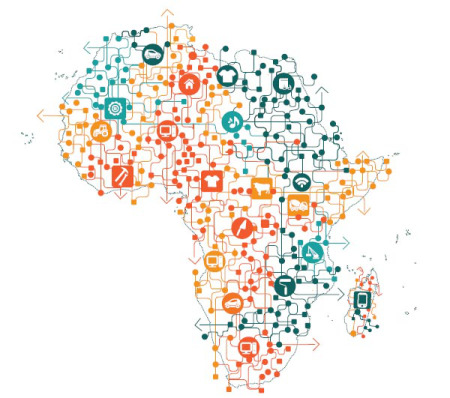
Premature De-industrialization in Africa

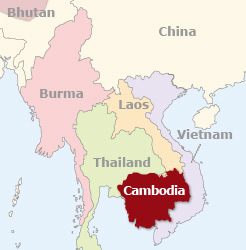
“Name any country in Africa, and I could have found a world-class firm there a decade ago,” says John Page of the Brookings Institution, a think tank, the co-author of a forthcoming book on African manufacturing. “The problem is, two years later, I’d go back and still find just the one firm. In Cambodia or Vietnam, I would go back and find 50 new ones.”

To be sure, many countries deindustrialise as they grow richer (growth in service-based parts of the economy, such as entertainment, helps shrink manufacturing’s slice of the total). But many African countries are deindustrialising while they are still poor, raising the worrying prospectthat they will miss out on the chance to grow rich by shifting workers from farms to higher-paying factory jobs.

Thi is not just happening in Africa—other developing countries are also seeing the growth of factories slowing, partly because technology is reducing the demand for low-skilled workers. “Manufacturing has become less labour intensive across the board,” says Margaret McMillan of Tufts University. That means that it is hard, and getting harder, for African firms to create jobs in the same numbers that Asian ones did from the 1970s onwards.

Yet deindustrialisation appears to be hitting African countries particularly hard. This is partly because weak infrastructure drives up the costs of making things. The African Development Bank found in 2010 that electricity, a large cost for most manufacturers, costs three times more on average in Africa than it does even in South Asia. Poor roads and congested ports also drive up the cost of moving raw materials about and shipping out finished goods.

Africa’s second disadvantage is, perversely, its bounty of natural riches. Booming commodity prices over the past decade brought with them the “Dutch disease”: economies benefiting from increased exports of oil and the like tend to see their exchange rates driven up, which then makes it cheaper to import goods such as cars and fridges, and harder to produce and export locally manufactured goods.

Excerpt from Industrialisation in Africa: More a marathon than a sprint, Economist, Nov. 7, 2015, at 41

Natural Gas and Freedom

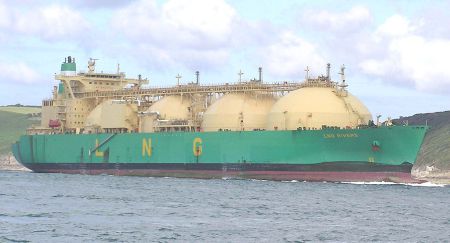
[A] tanker chartered by Cheniere Energy, an American company, left a Louisiana port this week with the first major exports of U.S. liquefied natural gas, or LNG. This shipment isn’t going to Europe, but others are expected to arrive by spring.  “Like shale gas was a game changer in the U.S., American gas exports could be a game changer for Europe,” said Maros Sefcovic, the European Union’s energy chief.

Many in Europe see U.S. entry into the market as part of a broader effort to challenge Russian domination of energy supplies and prices in this part of the world. Moscow has for years used its giant energy reserves as a strategic tool to influence former satellite countries, including Lithuania, one of the countries on the fringes of Russia that now see a chance to break away.

Some are building the capacity to handle seaborne LNG, including Poland, which opened its first import terminal in 2015. In Bulgaria, which buys about 90% of its gas from Russia, Prime Minister Boyko Borissov said last month that supplies of U.S. gas could arrive via Greek LNG facilities, “God willing.”… Deutsche Bank estimates the U.S. could catch up with Russia as Europe’s biggest gas supplier within a decade, with each nation controlling around a fifth of the market. Russia supplies about a third of Europe’s gas via pipeline….The U.S. will compete with Russia, Norway, U.K., Australia and others in Europe’s gas market. Germany, for example, gets half its gas and Italy a third from Russia.Low prices also mean natural gas could compete with coal and help Europe achieve its commitment to reducing greenhouse gas emissions .In Lithuania, officials have accused Moscow of engaging in a campaign of espionage and cyberwarfare to keep its share of the lucrative energy market….

Bulgarian officials allege Russia bankrolled a wave of street protests in 2012 that forced the government to impose a moratorium on shale gas exploration. In 2014, Anders Fogh Rasmussen, then-head of NATO, told reporters that Russia was covertly funding European environmental organizations to campaign against shale gas to help maintain dependence on Russian gas.

Until 2014, Gazprom owned 37% of Lithuania’s national gas company, Lietuvos Dujos, and dominated its boardroom, said current and former officials.“There was no negotiation about gas prices,” said Jaroslav Neverovic, Lithuania’s energy minister from 2012 to 2014. He said Gazprom would send Lietuvos Dujos a list of gas prices, which the board automatically approved..  In 2015,  [though] Lithuania began receiving Norwegian LNG, reducing Gazprom’s gas monopoly to a market share of less than 80%. In the months before the terminal opened, Gazprom lowered Lithuanian gas prices by 23% and it remained cheaper than Norwegian gas. Still, Lithuania plans to increase its purchase of Norwegian gas this year. The U.S. is next….

Klaipeda’s mayor, Mr. Grubliauskas, said during a recent interview at his office, decorated with photographs of U.S. naval drills in the port: “U.S. LNG is more than just about gas. It’s about freedom.”

Excerpts With U.S. Gas, Europe Seeks Escape From Russia’s Energy Grip, WSJ, Feb. 26, 2016

Shut-out, Cut-off and Suicidal: Aliens v. America

The United States leads the world in punishing corruption, money-laundering and sanctions violations. In the past decade it has increasingly punished foreign firms for misconduct that happens outside America. Scores of banks have paid tens of billions of dollars in fines. In the past 12 months several multinationals, including Glencore and ZTE, have been put through the legal wringer. The diplomatic row over Huawei, a Chinese telecoms-equipment firm, centres on the legitimacy of America’s extraterritorial reach.

America has taken it upon itself to become the business world’s policeman, judge and jury. It can do this because of its privileged role in the world economy. Companies that refuse to yield to its global jurisdiction can find themselves shut out of its giant domestic market, or cut off from using the dollar payments system and by extension from using mainstream banks. For most big companies that would be suicidal.

But as the full extent of extraterritorial legal activity has become clearer, so have three glaring problems.  First, the process is disturbingly improvised and opaque. Cases rarely go to court and, when they are settled instead, executives are hit with gagging orders. Facing little scrutiny, prosecutors have applied ever more expansive interpretations of what counts as the sort of link to America that makes an alleged crime punishable there; indirect contact with foreign banks with branches in America, or using Gmail, now seems to be enough. Imagine if China fined Amazon $5bn and jailed its executives for conducting business in Africa that did not break American law, but did offend Chinese rules and was discussed on WeChat.

Second, the punishments can be disproportionate. In 2014 bnp Paribas, a French bank, was hit with a sanctions-related fine of $8.9bn, enough to threaten its stability. In April ZTE, a Chinese tech firm with 80,000 employees, was banned by the Trump administration from dealing with American firms; it almost went out of business. The ban has since been reversed, underlining the impression that the rules are being applied on the hoof.

Third, America’s legal actions can often become intertwined with its commercial interests. As our investigation this week explains, a protracted bribery probe into Alstom, a French champion, helped push it into the arms of General Electric, an American industrial icon. American banks have picked up business from European rivals left punch-drunk by fines. Sometimes American firms are in the line of fire—Goldman Sachs is being investigated by the doj for its role in the 1mdb scandal in Malaysia. But many foreign executives suspect that American firms get special treatment and are wilier about navigating the rules.

America has much to be proud of as a corruption-fighter. But, for its own good as well as that of others, it needs to find an approach that is more transparent, more proportionate and more respectful of borders. If it does not, its escalating use of extraterritorial legal actions will ultimately backfire. It will discourage foreign firms from tapping American capital markets. It will encourage China and Europe to promote their currencies as rivals to the dollar and to develop global payments systems that bypass Uncle Sam…. Far from expressing geopolitical might, America’s legal overreach would then end up diminishing American power.

Excerpts from Tackling Corruption: Judge Dread, Economist, Jan. 19, 2019

Genetically Modified Crops in Africa: opponents

According to the acting director, Andrew Kigundu,  of Uganda’s National Agricultural Research Organisation (NARO): “The idea of work on genetically engineered bananas is a result of many years of testing of Banana production.” The experiments started in 2005 and work is still ongoing to improve on the content of the fruit and resistance to parasites….The East African country is the first African country to turn toward GM to improve its production of bananas. An option which should make the country remain the first producer in the world .

The adoption of restrictive policies across Africa has been pursued under the pretext of protecting the environment and human health. So far there has been little evidence to support draconian biosafety rules. It is important that the risks of new products be assessed. But the restrictions should proportionate and consistent with needs of different countries.

Africa’s needs are different from those of the EU. There are certain uniquely African problems where GM should be considered as an option.   The Xanthomonas banana wilt bacterial disease causes early ripening and discoloration of bananas, a staple crop for Uganda. This costs the Great Lakes region nearly US $500m annually in losses. There is no treatment for the disease, which continues to undermine food security.  Ugandan scientists at Kawanda Agricultural Research Institute have developed a GM approach but their efforts to further their research in the technology are hampered by opposition to it. Those opposed to the technology advocate the adoption of an EU biosafety approach that would effectively stall the adoption of the technology. In fact, some of opponents using scare tactics against the technology are EU-based non-governmental organizations.

Genetically modified bananas solve Uganda’s productivity problems, AllAfricanews, May 24, 2016; See also Excerpt FromHow the EU starves Africa into submission,” by Calestous Juma, a professor of the practice of international development at the Harvard Kennedy School of Government:  “EU policy undermines African agricultural innovation …in the field of genetically modified (GM) crops. The EU exercises its right not to cultivate transgenic crops but only to import them as animal feed. However, its export of restrictive policies on GM crops has negatively affected Africa.”

The Internet Was Never Open

Rarely has a manifesto been so wrong. “A Declaration of the Independence of Cyberspace”, written 20 years ago by John Perry Barlow, a digital civil-libertarian, begins thus: “Governments of the Industrial World, you weary giants of flesh and steel, I come from Cyberspace, the new home of Mind. On behalf of the future, I ask you of the past to leave us alone. You are not welcome among us. You have no sovereignty where we gather.”

At the turn of the century, it seemed as though this techno-Utopian vision of the world could indeed be a reality. It didn’t last… Autocratic governments around the world…have invested in online-surveillance gear. Filtering systems restrict access: to porn in Britain, to Facebook and Google in China, to dissent in Russia.

Competing operating systems and networks offer inducements to keep their users within the fold, consolidating their power. Their algorithms personalise the web so that no two people get the same search results or social media feeds, betraying the idea of a digital commons. Five companies account for nearly two-thirds of revenue from advertising, the dominant business model of the web.

The open internet accounts for barely 20% of the entire web. The rest of it is hidden away in unsearchable “walled gardens” such as Facebook, whose algorithms are opaque, or on the “dark web”, a shady parallel world wide web. Data gathered from the activities of internet users are being concentrated in fewer hands. And big hands they are too. BCG, a consultancy, reckons that the internet will account for 5.3% of GDP of the world’s 20 big economies this year, or $4.2 trillion.

How did this come to pass? The simple reply is that the free, open, democratic internet dreamed up by the optimists of Silicon Valley was never more than a brief interlude. The more nuanced answer is that the open internet never really existed.

[T]e internet, it was developed “by the US military to serve US military purposes”… The decentralised, packet-based system of communication that forms the basis of the internet originated in America’s need to withstand a massive attack on its soil. Even the much-ballyhooed Silicon Valley model of venture capital as a way to place bets on risky new businesses has military origins.

In the 1980s the American military began to lose interest in the internet…. The time had come for the hackers and geeks who had been experimenting with early computers and phone lines.  Today they are the giants. Google, Apple, Facebook, Amazon and Microsoft—together with some telecoms operators—help set policy in Europe and America on everything from privacy rights and copyright law to child protection and national security. As these companies grow more powerful, the state is pushing back…

The other big risk is that the tension between states and companies resolves into a symbiotic relationship. A leaked e-mail shows a Google executive communicating with Hillary Clinton’s state department about an online tool that would be “important in encouraging more [Syrians] to defect and giving confidence to the opposition.”+++ If technology firms with global reach quietly promote the foreign-policy interests of one country, that can only increase suspicion and accelerate the fracturing of the web into regional internets….

Mr Malcomson describes the internet as a “global private marketplace built on a government platform, not unlike the global airport system”.

Excerpts from Evolution of the internet: Growing up, Economist, Mar. 26, 2016

+++The email said Google would be “partnering with Al Jazeera” who would take “primary ownership” of the tool, maintaining it and publicizing it in Syria.  It was eventually published by Al Jazeera in English and Arabic.

How to Stop the Expoitation of Internet Users

Data breaches at Facebook and Google—and along with Amazon, those firms’ online dominance—crest a growing wave of anxiety around the internet’s evolving structure and its impact on humanity…The runaway success of a few startups has created new, proprietized one-stop platforms. Many people are not really using the web at all, but rather flitting among a small handful of totalizing apps like Facebook and Google. And those application-layer providers have dabbled in providing physical-layer internet access. Facebook’s Free Basics program has been one of several experiments that use broadband data cap exceptions to promote some sites and services over others.

What to do? Columbia University law professor Tim Wu has called upon regulators to break up giants like Facebook, but more subtle interventions should be tried first…Firms that do leverage users’ data should be “information fiduciaries,” obliged to use what they learn in ways that reflect a loyalty to users’ interests…The internet was designed to be resilient and flexible, without need for drastic intervention. But its trends toward centralization, and exploitation of its users, call for action

Excerpts from Jonathan Zittrain, Fixing the internet, Science, Nov. 23, 2018

American Oligarchs

Warren Buffett, the 21st century’s best-known investor, extols firms that have a “moat” around them—a barrier that offers stability and pricing power.One way American firms have improved their moats in recent times is through creeping consolidation. The Economist has divided the economy into 900-odd sectors covered by America’s five-yearly economic census. Two-thirds of them became more concentrated between 1997 and 2012 (see charts 2 and 3). The weighted average share of the top four firms in each sector has risen from 26% to 32%…

These data make it possible to distinguish between sectors of the economy that are fragmented, concentrated or oligopolistic, and to look at how revenues have fared in each case. Revenues in fragmented industries—those in which the biggest four firms together control less than a third of the market—dropped from 72% of the total in 1997 to 58% in 2012. Concentrated industries, in which the top four firms control between a third and two-thirds of the market, have seen their share of revenues rise from 24% to 33%. And just under a tenth of the activity takes place in industries in which the top four firms control two-thirds or more of sales. This oligopolistic corner of the economy includes niche concerns—dog food, batteries and coffins—but also telecoms, pharmacies and credit cards.

The ability of big firms to influence and navigate an ever-expanding rule book may explain why the rate of small-company creation in America is close to its lowest mark since the 1970s … Small firms normally lack both the working capital needed to deal with red tape and long court cases, and the lobbying power that would bend rules to their purposes….

Another factor that may have made profits stickier is the growing clout of giant institutional shareholders such as BlackRock, State Street and Capital Group. Together they own 10-20% of most American companies, including ones that compete with each other. Claims that they rig things seem far-fetched, particularly since many of these funds are index trackers; their decisions as to what to buy and sell are made for them. But they may well set the tone, for example by demanding that chief executives remain disciplined about pricing and restraining investment in new capacity. The overall effect could mute competition.

The cable television industry has become more tightly controlled, and many Americans rely on a monopoly provider; prices have risen at twice the rate of inflation over the past five years. Consolidation in one of Mr Buffett’s favourite industries, railroads, has seen freight prices rise by 40% in real terms and returns on capital almost double since 2004. The proposed merger of Dow Chemical and DuPont, announced last December, illustrates the trend to concentration. //

Roughly another quarter of abnormal profits comes from the health-care industry, where a cohort of pharmaceutical and medical-equipment firms make aggregate returns on capital of 20-50%. The industry is riddled with special interests and is governed by patent rules that allow firms temporary monopolies on innovative new drugs and inventions. Much of health-care purchasing in America is ultimately controlled by insurance firms. Four of the largest, Anthem, Cigna, Aetna and Humana, are planning to merge into two larger firms.

The rest of the abnormal profits are to be found in the technology sector, where firms such as Google and Facebook enjoy market shares of 40% or more

But many of these arguments can be spun the other way. Alphabet, Facebook and Amazon are not being valued by investors as if they are high risk, but as if their market shares are sustainable and their network effects and accumulation of data will eventually allow them to reap monopoly-style profits. (Alphabet is now among the biggest lobbyists of any firm, spending $17m last year.)…

Perhaps antitrust regulators will act, forcing profits down. The relevant responsibilities are mostly divided between the Department of Justice (DoJ) and the Federal Trade Commission (FTC), although some …[But]Lots of important subjects are beyond their purview. They cannot consider whether the length and security of patents is excessive in an age when intellectual property is so important. They may not dwell deeply on whether the business model of large technology platforms such as Google has a long-term dependence on the monopoly rents that could come from its vast and irreproducible stash of data. They can only touch upon whether outlandishly large institutional shareholders with positions in almost all firms can implicitly guide them not to compete head on; or on why small firms seem to be struggling. Their purpose is to police illegal conduct, not reimagine the world. They lack scope.

Nowhere has the alternative approach been articulated. It would aim to unleash a burst of competition to shake up the comfortable incumbents of America Inc. It would involve a serious effort to remove the red tape and occupational-licensing schemes that strangle small businesses and deter new entrants. It would examine a loosening of the rules that give too much protection to some intellectual-property rights. It would involve more active, albeit cruder, antitrust actions. It would start a more serious conversation about whether it makes sense to have most of the country’s data in the hands of a few very large firms. It would revisit the entire issue of corporate lobbying, which has become a key mechanism by which incumbent firms protect themselves.

Excerpts from Too Much of a Good Thing, Economist, Mar. 26, 2016, at 23

The Sanctions Busters: Germany and France

The steps by Europe’s most powerful countries are part of their campaign to salvage the 2015 Iran nuclear deal after President Trump withdrew the U.S. in May. Their goal is to help European companies continue some business activity with Iran despite sweeping new U.S. sanctions on the country and any company that does business with it.

France or Germany will host the corporation that would handle the payments channel, the diplomats said. If France hosts it, a German official will head the corporation and vice versa. Both countries will help fund the corporation.  The payments channel, known as a special purpose vehicle, or SPV, would use a system of credits to facilitate compensation for goods traded between Iran and Europe—allowing some trade to proceed without the need for European commercial banks to make or receive payments to Iran.

U.S. pressure on Austria and Luxembourg recently prompted those countries to reject European Union requests to host it, raising the prospect that the initiative might collapse, the diplomats said.  The company would be owned directly by participating European governments—an arrangement intended to dissuade the U.S. from directly targeting it with sanctions, diplomats said.

Laurence Norman , France and Germany Step In to Circumvent Iran Sanctions, WSJ, Nov. 26, 2018

New Cold War over the Pacific

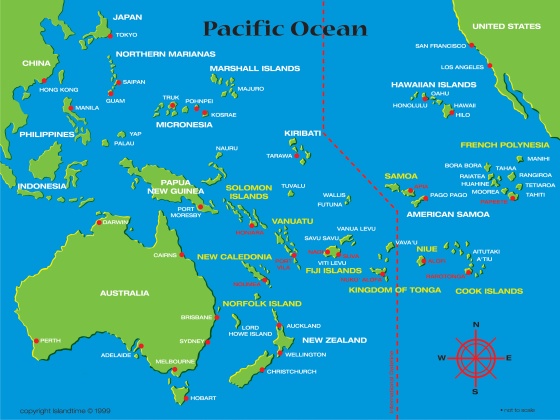
Australia said it would establish a development fund and offer Pacific island nations more than $2 billion for infrastructure projects while bolstering military cooperation, as U.S. allies take a more assertive stance against China in the region. Also Thursday, Australia said it would open new diplomatic posts across the Pacific, while New Zealand announced new funding to boost cultural engagement with small Pacific states.

The U.S. and its allies are increasingly coordinating to counter what officials in Washington and elsewhere see as Beijing’s attempts to gain influence over smaller nations through infrastructure loans under its Belt and Road initiative. Last month President Trump signed the Build Act, which expands American development financing for private companies to up to $60 billion….

Beijing, which says its goal is to help Pacific countries achieve peace, stability and prosperity, has urged other countries to “discard the Cold War mentality” and view its relations with Pacific states in an objective way.But old Western allies are concerned about its intentions toward impoverished island nations whose strategic value outstrips their size and wealth.  The U.K. recently announced three new diplomatic posts in the Pacific, while France gained a de facto seat in a key regional group—the Pacific Islands Forum—when its Pacific territories joined…

In September 2018, a senior U.S. official said the U.S., along with Japan and Australia, is vying to build an internet network in Papua New Guinea to block a Chinese telecom company.

Exceprts from U.S. Allies Vie With China to Make Pacific Island Friends, WSJ, Nov. 8, 2018 Continue reading

Military Bunkers for the Rich

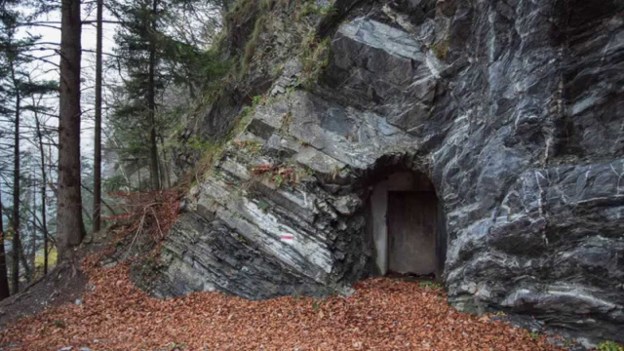
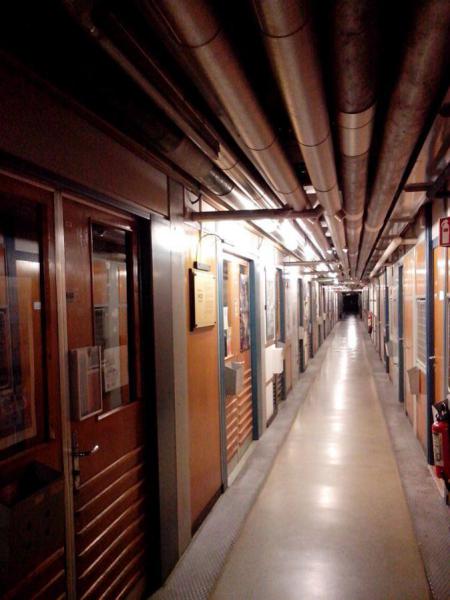
Deep in the Swiss Alps, next to an old airstrip suitable for landing Gulfstream and Falcon jets, is a vast bunker that holds what may be one of the world’s largest stashes of gold. The entrance, protected by a guard in a bulletproof vest, is a small metal door set into a granite mountain face at the end of a narrow country lane. Behind two farther doors sits a 3.5-ton metal portal that opens only after a code is entered and an iris scan and a facial-recognition screen are performed. A maze of tunnels once used by Swiss armed forces lies within.

The owner of this gold vault wants to remain anonymous for fear of compromising security, and he worries that even disclosing the name of his company might lead thieves his way…

Demand for gold storage has risen since the 2008 financial crisis. Many of the wealthy see owning gold as a hedge against the insecurity of banks and a reasonable investment at a time when markets are volatile and bank accounts and low-risk bonds pay almost no yield. It may also be a way to avoid the increasing scrutiny of tax authorities. In high-profile cases, U.S., French, and German prosecutors have gone after citizens of those countries with undeclared Swiss bank accounts.

Swiss storage operations such as these don’t have the same obligation that Swiss banks do to report suspicious transactions to federal regulators. Americans aren’t required under the U.S. Foreign Account Tax Compliance Act to declare gold stored outside financial institutions.
Of the roughly 1,000 former military bunkers still in existence across Switzerland, a few hundred have been sold in recent years, and about 10 are now storage sites holding gold as well as computer data, according to the Swiss defense department.

Few match the opulence of the airstrip setup, whose owner claims to run the largest store of gold for private clients—and the seventh-largest gold vault in the world. Near the runway sits the VIP lounge and a pair of luxurious apartments for clients. The walls of the apartments are lined with aged wood from Polish barns. South African quartzite was chosen for the floors to match the faded gray timber, and the amenities—bathroom mirror, TV screens—can retract into the ceiling, counter, or wall. The owner offers a place for clients to sleep and eat, because “many do not want to leave a paper trail of credit card receipts and passports” at hotels and restaurants…

Some miles away, Dolf Wipfli, the founder and chief executive officer of a different company, Swiss Data Safe, is one of the few operators willing to be interviewed about his business. The gold Swiss Data Safe stores for clients is kept in a mountainside bunker outside the hamlet of Amsteg.

Excerpts from Secret Alpine Gold Vaults Are the New Swiss Bank Accounts, Bloomberg, Sept. 30, 2016

Congo Uranium and the CIA

America’s interest in the Congo—and, specifically, in the resource-rich south-eastern province of Katanga—was one of the best-kept secrets of the second world war. Beneath its verdant soil lay a prize that the Americans believed held the key to victory…The Germans, they feared, might be after it, too: uranium. Congo was by far the richest source of it in the world. As the architects of America’s nuclear programme (the “Manhattan Project”) knew, uranium was the atom bomb’s essential ingredient. But almost everybody else was kept entirely in the dark, including the spies sent to Africa to find out if the heavy metal was being smuggled out of the Congo into Nazi Germany.

The men—and one woman—charged with protecting America’s monopoly of Congolese uranium worked for the Office of Strategic Services (OSS), an organisation set up by President Franklin Roosevelt as the wartime intelligence agency, and the precursor to what in peacetime became the Central Intelligence Agency (CIA).

Shortly after the war ended the focus of America’s nuclear rivalry shifted. In 1949 the Soviet Union tested its own nuclear bomb, launching a new era for America, Congo and the rest of the African continent. Huge sums were pumped into Katanga to facilitate uranium export and to prop up Belgian defences. After Congo became independent in 1960 the CIA lingered there for decades to keep uranium and, later, other minerals out of Russian hands. Much of Congo’s tragic late-20th-century history is attributable to these machinations…. A little-known story, but one with a terribly familiar ring—and ultimately devastating consequences.

Excerpt from Congo’s uranium: Rich pickings, Economist, Aug. 27, 2016 (Book review of
Spies in the Congo: America’s Atomic Mission in World War II. By Susan Williams, 2017)

Skip Pakistan: new way into Afghanistan

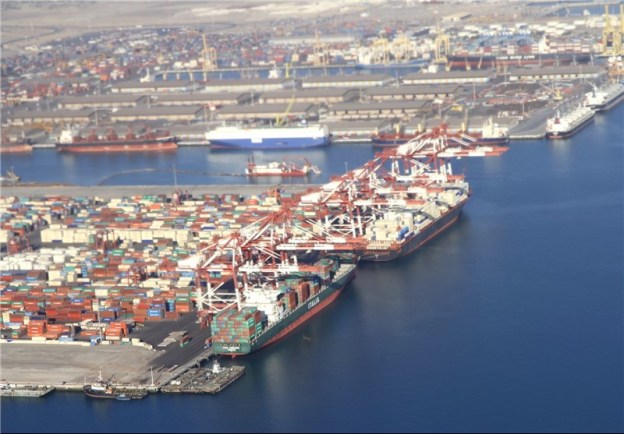
A port being developed in the southern Iranian city of Chabahar underscores some of the dilemmas U.S. policy makers face in implementing sanctions against Tehran.  Strategically located on the Gulf of Oman and named for an Iranian revolutionary war hero, the Shahid Beheshti Port is exactly the sort of Iranian economic development the Trump administration wants to stop with sanctions that kick in on Nov. 5, 2018…

Once completed, the port—a small part of which started initial operations in December—could help Iran by strengthening economic ties with South and Central Asia, providing an export point for its oil beyond the Persian Gulf and functioning as a strategic military asset.   But it could also be a critical economic lifeline for Afghanistan, where the U.S. has tried for 16 years to strengthen and stabilize the government so thousands of U.S. troops can come home.

The port also could be a big boon to India, an increasingly close partner of the U.S. in Asia. India wants Chabahar port activities exempted from sanctions. Indian companies are mostly equipping and operating the facility. If the port is completed, they are expected to be among the biggest users of the port in order to participate in the reconstruction of Afghanistan—something the Trump administration has asked India to get more involved in—and establish a stronger economic presence in Central Asia.

The Chabahar port has long been seen as a potential way around Pakistan, a sworn enemy of India that believes holding sway over Afghanistan is critical to its own security.  Pakistan has squelched trade between India and Afghanistan across its territory. It wants Afghanistan to eventually transport goods through a competing Pakistani port on the Gulf of Oman that is being developed with China…

“If you stop Chabahar, you make Afghanistan permanently dependent on Pakistan,” said Barnett Rubin, a New York University expert on South Asia who has advised Western governments on policy in Afghanistan and the surrounding region.

Exceprts from Iranian Port Project Poses a Dilemma for U.S., WSJ, Oct. 29, 2018

Favorite of the West: Niger as Police State

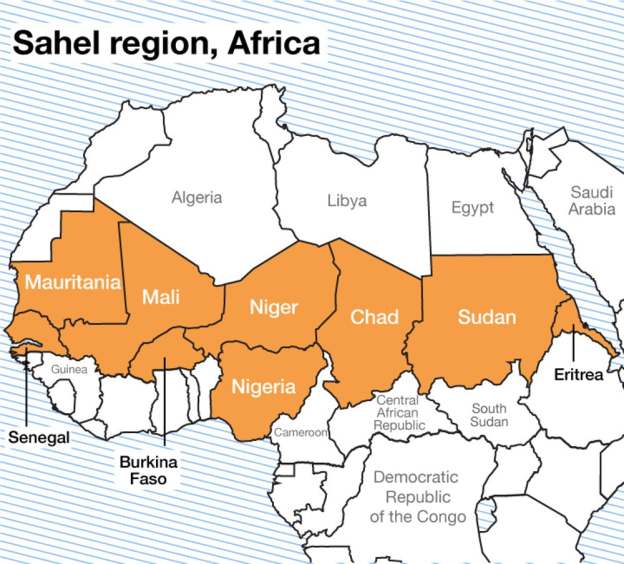
Niger, a poverty-stricken nation perched on the southern belt of the Sahara, is rapidly being transformed into one of the world’s most strategic security hubs….“This place is a nest of spies,” said one contractor … “Below the radar, it’s become a key country for the West.”  A surge in financial assistance from European nations seeking to stem the flow of African migrants has made Niger the world’s largest per capita recipient of European Union aid…Western military forces operate from at least nine bases in Niger, government officials said…. The U.S. is finishing a large air base in Agadez, while the Central Intelligence Agency has begun flying armed drones from an airstrip outside the northern town of Dirkou, Nigerien officials said.

U.S. and European policy makers praise the government as a good partner that has welcomed foreign military personnel and slashed the migrant flow by almost 90% from 2015 highs. …Locals, nongovernmental organizations and opposition activists say the government is using international backing to neutralize dissent and embezzle millions of dollars in aid, charges the government denies. The opposition—backed by rights group Amnesty International—says President Mahamadou Idriss Issoufou, in power since 2011, is arbitrarily jailing activists and spending Western aid on bolstering his elite Presidential Guard…

Swaths of the nation’s centuries-old transportation economy—the movement of people and goods from West Africa through the Sahara—has essentially been criminalized by the EU crackdown on migration.  Some of the desert-dwelling Tuareg people, who have transported goods for centuries, are now smuggling weapons, men and money for cash-rich jihadist insurgencies. Migrants are dying in the desert in failed attempts to find new routes.

“The West is pleased because Niger’s government is a willing partner,but as Niger’s security chief, Mohammed Bazoum, says “We have become a hinge country, a geostrategic hub, but it is a disaster for us. We are known as a land of terrorism and migrant traffic.”

Across Niger’s western border with Mali, jihadist groups including Islamic State and al Qaeda franchises control stretches of territory around the northern city of Gao. Along the southern frontier with Nigeria, a rejuvenated Boko Haram is mounting intensifying attacks against security forces, including around the city of Diffa, where the U.S. has dozens of troops stationed. To the north lies Libya, which has become a hotbed of instability, weapons and radicalization.

The European Development Fund last year awarded $1 billion to Niger through 2020, and unusually for a country governance watchdogs deem chronically corrupt, 75% is now infused directly into the Nigerien budget instead of through nongovernmental organizations.The money funds hundreds of off-road vehicles, motorcycles and satellite phones for Nigerien security forces as well as new infrastructure and technology along the borders and countrywide development programs.

In Niamey’s central Plateau district, tall black screens block the soaring new U.S. Embassy headquarters, which will be one of the largest in West Africa. Saudi Arabia has broken ground on its own huge mission, while buildings belonging to EU agencies occupy whole city blocks. Hotels and conference centers are rising in tandem, reconfiguring the economic and political landscape of a nation ranked the world’s second-poorest behind the Central African Republic.

The government says the building boom is creating jobs. Locals say it has stoked runaway inflation and priced them out of their neighborhoods. In the past year, the cost of a kilogram of rice has risen 29%, sending shock waves through homes where the average wage is $2.66 a day.

“The cost to live here rises with each new European coming,” lamented Abdulraham Mamoudou, repairing his motor scooter on a dusty corner near the expanding U.S. Embassy compound.

A similar pattern is playing out further north in the smuggling hub of Agadez, where the EU-coordinated migration crackdown has transformed a boomtown into a simmering bust.  The city’s jails are bursting with men who have been convicted of smuggling. Vast depots on the town’s outskirts house hundreds of trucks confiscated by authorities…“This place is now for the Americans and French,” said Sadiq, a former migrant smuggler who evaded arrest and is now unemployed. “They took our livelihood and don’t give us anything in return.”

Excerpts from ‘A Nest of Spies’: Niger’s Deserts Become Front Line of Fight Against Jihadis, Wall Street Journal, Sept. 12, 2018

One Player, Many Pawns: the thirst for nuclear technology

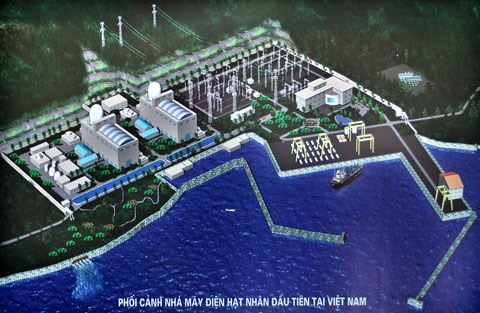
The nuclear power industry, which had been in the doldrums since the 1980s, suffered a devastating blow in 2011 when a tsunami engulfed the Fukushima power plant in Japan, ultimately causing a meltdown. The amount of electricity generated by nuclear power worldwide plunged 11% in two years, and has not recovered since. Within this declining industry, one country now dominates the market for design and export of nuclear plants: Russia.

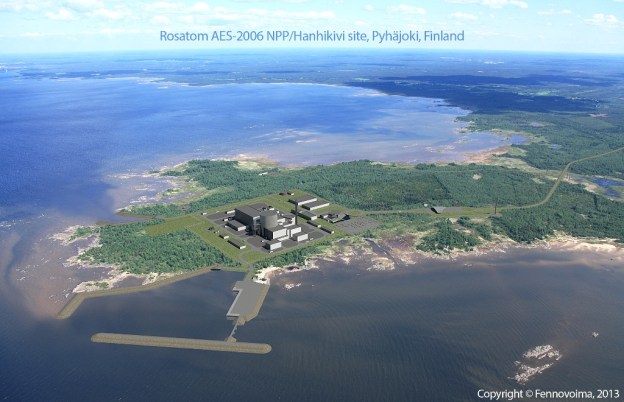
Rosatom, Russia’s state-owned nuclear-power company,  is focused on what some call the “great grand middle”: countries that are close allies of neither the United States nor Russia. In April Russia started building Turkey’s first nuclear plant, worth $20bn. Its first reactor is due for completion in 2023. Rosatom says it has 33 new plants on its order book, worth some $130bn. A dozen are under construction, including in Bangladesh, India and Hungary…. Once completed the plants offer an obvious diplomatic lever in the form of sway over a large portion of a country’s electricty generation… The relationship betweeen exporter and customer is particularly close in a nuclear plant’s early years, when local employees are still being trained and the exporting country is direclty involved in the plant’s operation….

Russia’s nuclear programme has endured for two main reasons. Its designs are cheap, and Rosatom enjoys the backing of the state, which helps it absorb hard-to-insure risks like nuclear meltdowns. Its competitors trail hopelessly: France’s Areva (now Orano) has started building only two plants in the past ten years, in Finland and China; both are delayed and over budget. KEPCO, South Korea’s energy company, is facing a domestic backlash against nuclear power, while Westinghouse, in America, is only now emerging from bankruptcy.

Russia’s only real competitor is China..Yet although China will surely catch up, for now Russia has no serious rivals in the export of nuclear technology. In a world that needs to generate much more electricity from nuclear power if it is to take decarbonisation seriously, that is a sobering though

Excerpts from  Atoms for Peace: Russia and Nuclear Power, Economist, Aug. 4, 2018, at 43

How Many Uranium Mines Do We Need?

At the height of activity in 1980, U.S. companies produced nearly 44 million pounds of uranium concentrate and provided most of the supplies purchased by nuclear power plants. In 2017, American miners produced 2.4 million pounds and supplied just 7 percent of the uranium bought by domestic plants.  The industry, which once supported nearly 22,000 jobs, now employs just a few hundred people each year…

In July 2018, the U.S. Commerce Department opened an investigation to determine whether the nation’s growing dependence on foreign uranium supplies poses a risk to national security….The two miners that petitioned Commerce to conduct the review, Energy Fuels and UR-Energy, want the United States to take steps to ensure U.S. producers control 25 percent of the market. They say they can’t compete with subsidized supplies from places like Russia, Kazakhstan and Uzbekistan.

To be sure, nearly half of the uranium used in the United States comes from allies like Canada and Australia. From the moment they lost trade protections, U.S. miners had trouble competing with these foreign supplies.
“It’s been government-sponsored, government-subsidized just since the beginning. Trying to sort that out and find where there’s a free market in uranium — I find that very questionable.”-Luke Danielson, Sustainable Development Strategies Group president

The U.S. uranium mining industry is relatively young. It went through a brief golden age between about 1955 and 1980, beginning when the United States offered generous incentives to shore up its stockpiles of the nuclear weapons fuel during the Cold War….By the 1960s, the program had packed U.S. storehouses so full of uranium stockpiles that the government stopped paying the incentives. However, it left in place rules barring the use of foreign uranium until 1975, when it began to allow a growing percentage of overseas supplies into the market.  That opened the door to high-quality, low-cost supplies from Canada and Australia. By 1987, the United States was importing nearly 15 million pounds of uranium, and domestic output fell by about a third to roughly 13 million pounds.

While competition weighed on U.S. uranium production, the excitement around nuclear energy in the 1970s kept mines busy. However, the American love affair with atomic power proved short-lived. The 1979 meltdown of a reactor at Three Mile Island in Pennsylvania sparked fierce backlash against nuclear energy. Seven years later, the Chernobyl nuclear disaster turned a Ukrainian city into a ghost town…

By the early 2000s, U.S. uranium production was at its lowest in a half century.  Around that time, the former Soviet state Kazakhstan was ramping up uranium mining. In just a few short years, it would become the world’s top uranium producer and the second biggest supplier to the United States.
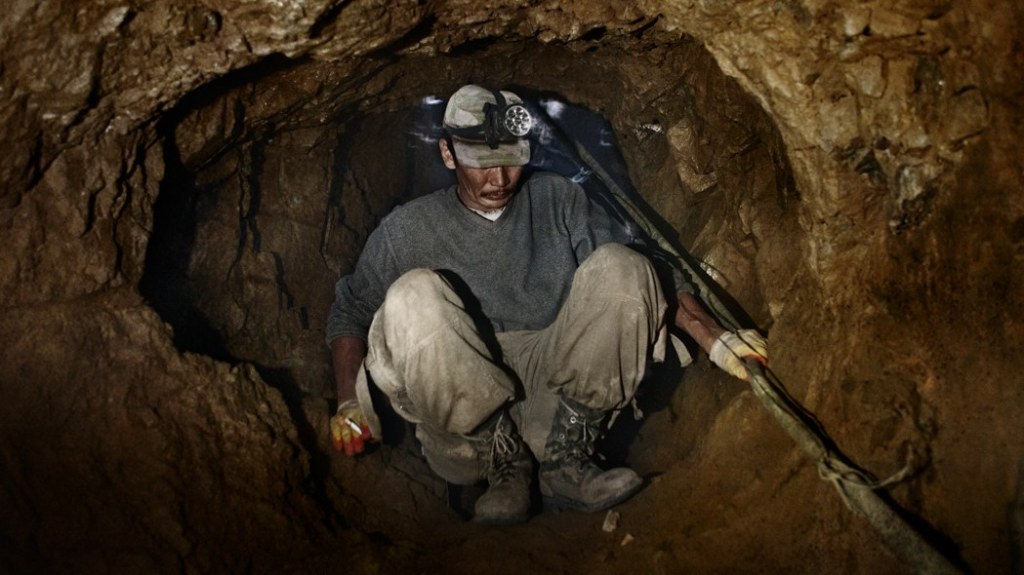
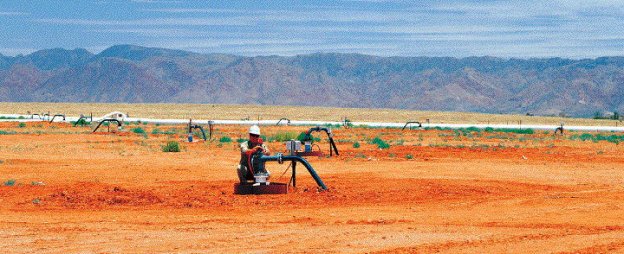
The Central Asian nation accomplished that feat in large part by exploiting a process called “in situ leaching” (ISL) or in situ recovery  (ISR)*** increasingly being used to extract uranium.  Along with countries like Niger, Mali and Mongolia, Kazakhstan has an advantage: lax regulations that allow it to process uranium cheaply from in situ leaching, which involves pumping chemicals into uranium reserves and carries serious risks to the environment if it’s not carried out responsibly…

And then in 2011, the Fukushima nuclear disaster in Japan created a backlash unlike anything seen since Three Mile Island and Chernobyl. In the aftermath, Japan shut down all of its nuclear reactors, and Germany decided to phase out nuclear energy by 2022.  The U.S. nuclear renaissance has also fizzled as flagship projects have turned into costly boondoggles. The venerable Westinghouse Electric Company filed for bankruptcy last year under the weight of billions of dollars in losses tied to its troubled nuclear power plant projects in Georgia and South Carolina. “There’s such a glut of inventory in the market that it’s just not profitable for some of the mines to produce, so the price has just really plummeted as a result of that,” said Sean Davis, a research analyst at IHS Markit who tracks the chemicals used in uranium mining.

Since their peak in 2007, uranium prices have crashed from nearly $140 per pound to $20-$25.

Excerpts from Nuclear wasteland: The explosive boom and long, painful bust of American uranium mining, CNBC, Aug. 4, 2018

***”No remediation of an ISR operation in the United States has successfully returned the aquifer to baseline conditions.”

Can’t Touch This! America FANG v. China BATX

The Economist magazine has considered four measures of Chinese corporate unfairness, using data from Morgan Stanley and Bloomberg. The first is the weight of China in the foreign sales that American firms bring in. It stands at 15%; if it was in line with China’s share of world GDP, it would be 20%. This shortfall amounts to a small 1% of American firms’ global sales (both foreign and domestic). America Inc is similarly underweight in the rest of Asia, but there is much less fighting talk about South Korea or Japan.

The second test is whether there is parity in the commercial relationship. Firms based in China make sales to America almost exclusively through goods exports, which were worth $506bn last year. American companies make their sales to China both through exports and through their subsidiaries there, which together delivered about $450bn-500bn in revenue. Again, there is not much of a gap. American firms’ aggregate market share in China, of 6%, is almost double Chinese firms’ share in America, based on the sales of all listed firms.

The third yardstick is whether American firms underperform other multinationals and local firms. In some cases failure is not China-specific. Walmart has had a tough time in China, but has also struggled in Brazil and Britain. Uber sold out to a competitor in China, but has done the same in South-East Asia. American consumer and industrial blue chips are typically of a similar scale in China to their nearest rivals. Thus the sales of Boeing and Airbus, Nike and Adidas, and General Electric and Siemens are all broadly in line with each other. Where America has a comparative advantage—tech—it leads (Facebook, Amazon, Netflix, Google (FANG)). Over half of USA Inc’s sales in China are from tech firms, led by Apple, Intel and Qualcomm. Overall, American firms outperform. For the top 50 that reveal data, sales in China have risen at a compound annual rate of 12% since 2012. That is higher than local firms (9%) and European ones (5%).

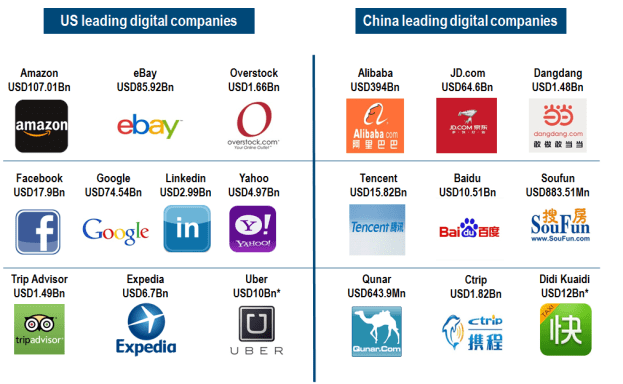
The final measure is whether American firms are shut out of some sectors. This is important as China shifts towards services and as the smartphone market, a goldmine, matures. The answer is clearly “yes”. Alphabet, Facebook and Netflix are nowhere, and Wall Street firms are all but excluded from the mainland. Chinese firms, however, can make a similar complaint. The market share of all foreign firms (incuding China’s Baidu, Alibaba,Tencent and Xiaomi popularly called BATX) in Silicon Valley’s software and internet activities, and on Wall Street, is probably below 20%. America’s national-security rules, thickets of regulation, lobbying culture and political climate make it inconceivable that a Chinese firm could play a big role in the internet or in finance there.

Far-sighted bosses know their stance on China must reflect a balanced assessment, not a delusional vision of globalisation in which anything less than a triumph is considered a travesty. But their voices are being drowned out. The shift of the business establishment to hawkishness on China has probably emboldened the White House and also led the Treasury and Department of Commerce to be more combative. Most big firms are blasé about tariffs; they can pass on the cost to clients. Few export lots to China. But soon China will run out of American imports to subject to retaliatory tariffs; in a tit-for-tar war, beating up American firms’ Chinese subsidiaries is a logical next step. USA Inc’s Sino-strop would then end up enabling the opposite of what it wants.

Excerpts from Raging Against Beijing, Economist,  June 30, 2018, at 58

Fish, Gas and Minerals: the Arctic

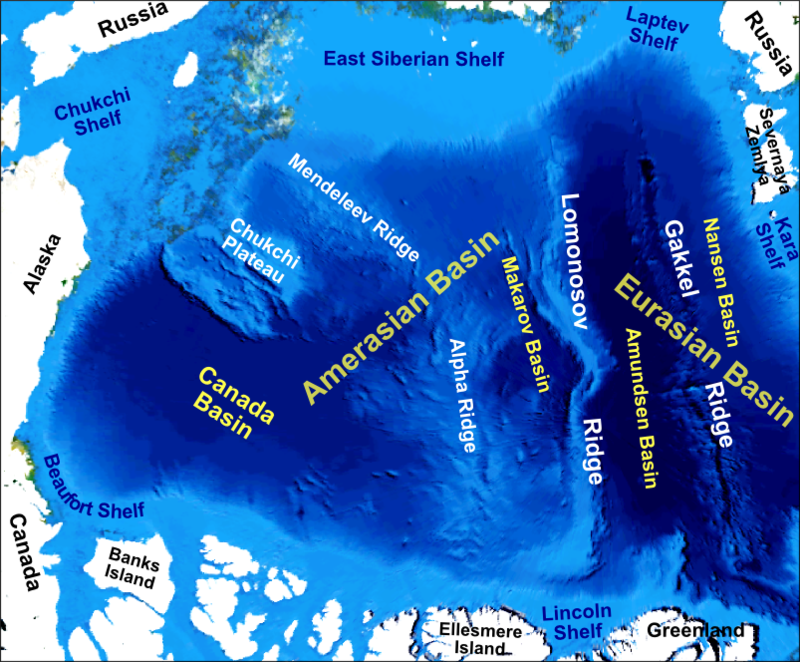
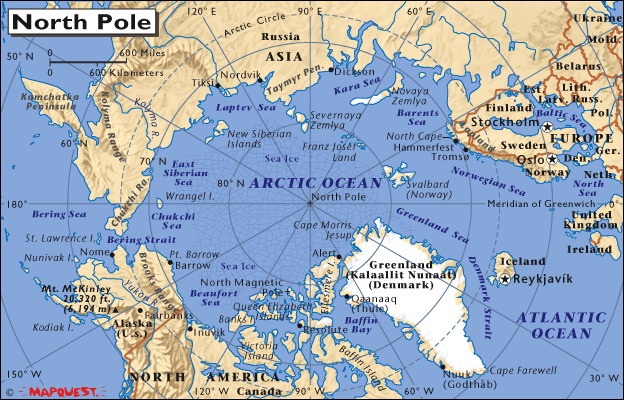
Mr Xi has been showing a growing interest in Arctic countries. In 2014 he revealed in a speech that China itself wanted to become a “polar great power”..,,In January 2018 the Chinese government published its first policy document outlining its Arctic strategy.

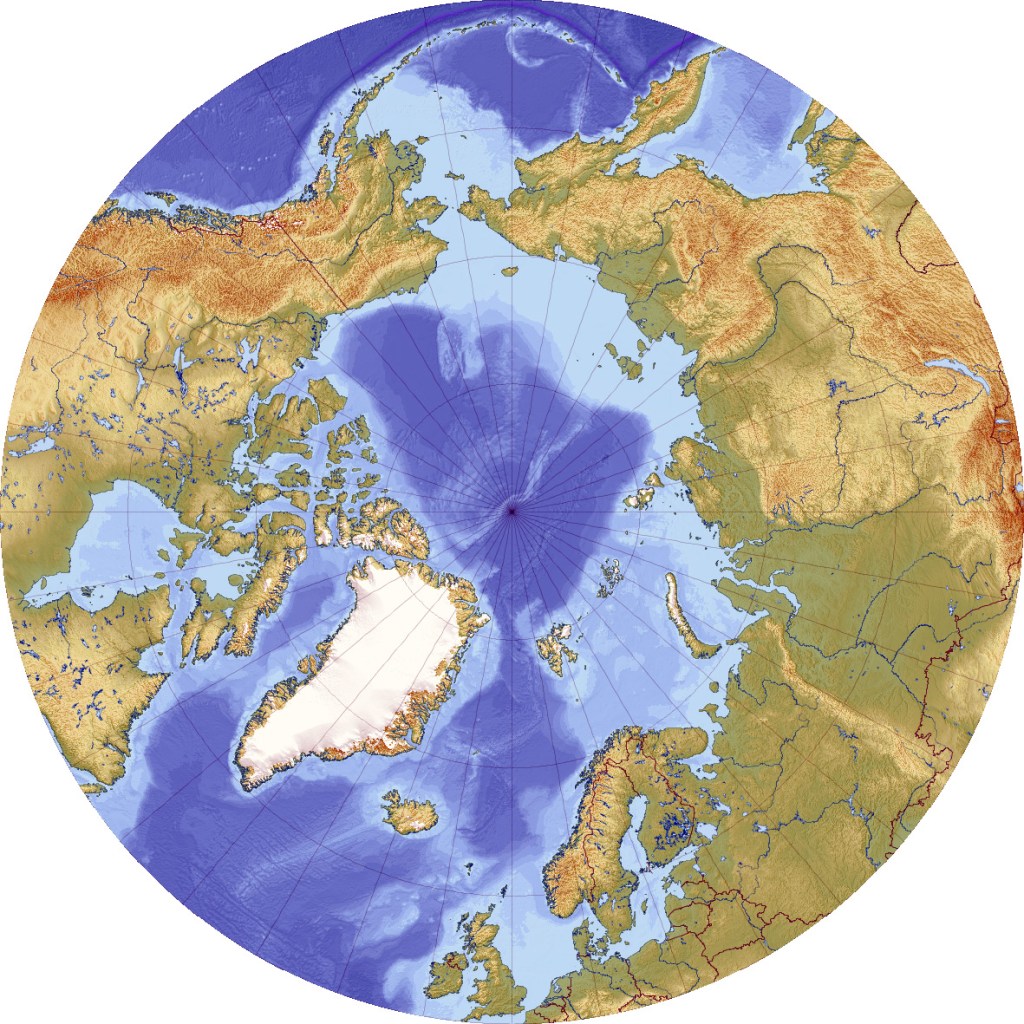
China is also keen to tap into the Arctic resources that will become easier to exploit as the ice cap retreats. They include fish, minerals, oil and gas. The region could hold a quarter of the world’s as-yet-undiscovered hydrocarbons, according to the United States Geological Survey. Chinese firms are interested in mining zinc, uranium and rare earths in Greenland.

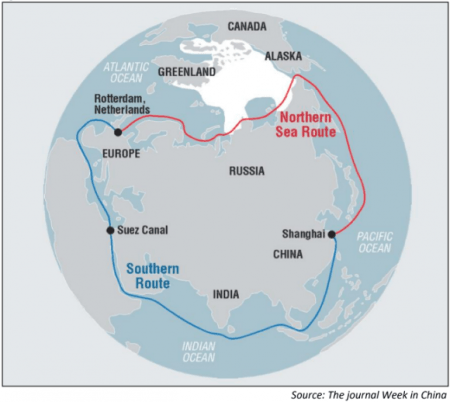
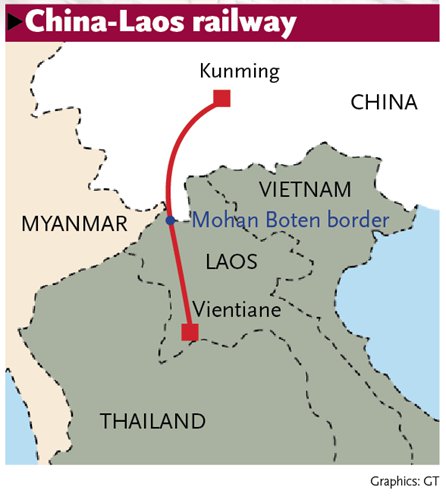
As the ice melts, it may become more feasible for cargo ships to sail through Arctic waters. China is excited by this possibility (its media speak of an “ice silk road”). In the coming decades such routes could cut several thousand kilometres off journeys between Shanghai and Europe. Sending ships through the Arctic could also help to revive port cities in China’s north-eastern rustbelt… China is thinking of building ports and other infrastructure in the Arctic to facilitate shipping. State-linked firms in China talk of building an Arctic railway across Finland.

Chinese analysts believe that using Arctic routes would help China strategically, too. It could reduce the need to ship goods through the Malacca Strait, a choke-point connecting the Pacific and Indian oceans. Much of China’s global shipping passes through the strait. It worries endlessly about the strait’s vulnerability to blockade—for example, should war break out with America.

There are no heated territorial disputes in the Arctic, but there are sensitivities, including Canada’s claim to the North-West Passage, a trans-Arctic waterway that America regards as international—ie, belonging to no single state.

Plenty of non-Arctic countries, including European ones, have similar dreams. But China is “by far the outlier” in terms of the amount of money it has pledged or already poured into the region, says Marc Lanteigne of Massey University in New Zealand. Its biggest investments have been in Russia, including a gas plant that began operating in Siberia in December 2017. Russia was once deeply cynical about China’s intentions. But since the crisis in Ukraine it has had to look east for investment in its Arctic regions.

The interest shown by Chinese firms could be good news for many Arctic communities. Few other investors have shown themselves willing to stomach the high costs and slow pay-offs involved in developing the far north…. The main concern of Arctic countries is that China’s ambitions will result in a gradual rewiring of the region’s politics in ways that give China more influence in determining how the Arctic is managed. Greenland is a place to watch. Political elites there favour independence from Denmark but resist taking the plunge because the island’s economy is so dependent on Danish support. The prospect of Chinese investment could change that. Should Greenland become independent, China could use its clout there to help further its own interests at meetings of Arctic states, in the same way that it uses its influence over Cambodia and Laos to prevent the Association of South-East Asian Nations from criticising Chinese behaviour in their neighbourhood.

Excerpts from The Arctic: A Silk Road through Ice, Economist, Apr. 14, 2018, at 37

Onerous Debt and its Consequences

A Beijing-funded wharf in Vanuatu  is big enough to allow powerful warships to dock alongside it, heightening fears the port could be converted into a Chinese naval installation.  Fairfax Media inspected the $114 million Luganville wharf and was told US coastguard officials and Marines recently visited the sprawling facility and took a keen interest in its specifications.  The Chinese and Vanuatu governments have strenuously denied they have discussed a military base…

The Vanuatu government has taken on significant debt to China, though it appears to have stopped taking large loans since getting a stern warning from the International Monetary Fund in 2016.  The wharf expected to be used to accept container and cruise ships was constructed by the Shanghai Construction Company and opened with fanfare in the middle of 2017.   It is unclear whether the wharf loan contract with the Vanuatu government includes a so-called debt-equity swap clause, which would mean China could take over the facility if Vanuatu defaults on its payments. It has recently taken over the major port of Hambantota from Sri Lanka in these circumstances.

Malcolm Davis, a defence expert at the Australian Strategic Policy Institute, said it was “not by accident” that wharf had been built for large vessels.
“My guess is there’s a Trojan horse operation here that eventually will set up a large facility that is very modern and very well-equipped. They’ve done this before in other parts of the world. “Their hope is that the debt of the Vanuatu government will be so onerous that they can’t pay it back. The Chinese will say, ‘the facility is ours for 99 years’ and the next thing you’ve got a PLA Navy Luang III class [destroyer] docking there.

Excerpts from China and the Pacific: The Great Wharf, Economist, Apr. 21, 2018, at 33.

Congo, China and Battery Minerals

The demand of cobalt is bound to increase because of the batteries needed to power  electric vehicles (EVs).  Each battery uses about 10kg of cobalt. It is widely known that more than half of the world’s cobalt reserves and production are in one dangerously unstable country, the Democratic Republic of Congo. What is less well known is that four-fifths of the cobalt sulphates and oxides used to make the all-important cathodes for lithium-ion batteries are refined in China. (Much of the other 20% is processed in Finland, but its raw material, too, comes from a mine in Congo, majority-owned by a Chinese firm, China Molybdenum.)

On March 14t, 2018 concerns about China’s grip on Congo’s cobalt production deepened when GEM, a Chinese battery maker, said it would acquire a third of the cobalt shipped by Glencore, the world’s biggest producer of the metal, between 2018 and 2020—equivalent to almost half of the world’s 110,000-tonne production in 2017. This is likely to add momentum to a rally that has pushed the price of cobalt up from an average of $26,500 a tonne in 2016 to above $90,000 a tonne

South Korean and Japanese tech firms and it’s a big concern of theirs that so much of the world’s cobalt sulphate comes from China. Memories are still fresh of a maritime squabble in 2010, during which China restricted exports of rare-earth metals vital to Japanese tech firms. China produces about 85% of the world’s rare earths.

Few analysts expect the cobalt market to soften soon. Production in Congo is likely to increase in the next few years, but some investment may be deterred by a recent five-fold leap in royalties on cobalt. Investment elsewhere is limited because cobalt is almost always mined alongside copper or nickel. Even at current prices, the quantities needed are not enough to justify production for cobalt alone.

But demand could explode if EVs surge in popularity… the use of cobalt for EVs could jump from 9,000 tonnes in 2017 to 107,000 tonnes in 2026.  The resulting higher prices would eventually unlock new sources of supply. But already non-Chinese battery manufacturers are looking for ways to protect themselves from potential shortages. Their best answer to date is nickel.

The materials most commonly used for cathodes in EV batteries are a combination of nickel, manganese and cobalt known as NMC, and one of nickel, cobalt and aluminium known as NCA. As cobalt has become pricier and scarcer, some battery makers have produced cobalt-lite cathodes by raising the nickel content—to as much as eight times the amount of cobalt. This allows the battery to run longer on a single charge, but makes it harder to manufacture and more prone to burst into flames. The trick is to get the balance right.

Strangely, nickel has not had anything like cobalt’s price rise. Nor do the Chinese appear to covet it… Nickel prices plummeted from $29,000 a tonne in 2011 to below $10,000 a tonne 2017…. But by 2025 McKinsey expects EV-related nickel demand to rise 16-fold to 550,000 tonnes.

In theory, the best way to ensure sufficient supplies of both nickel and cobalt would be for prices to rise enough to make mining them together more profitable. But that would mean more expensive batteries, and thus electric vehicles.

Excerpts from The Scramble for Battery Minerals, Economist, Mar. 24, 2018

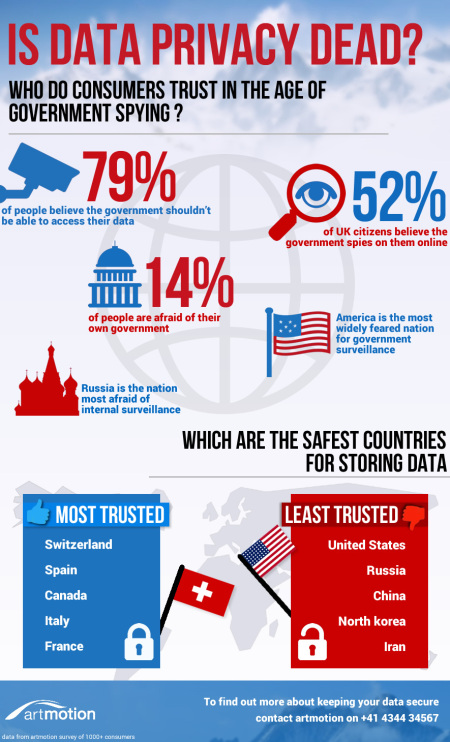
Who Controls Peoples’ Data?

The McKinsey Global Institute estimates that cross-border flows of goods, services and data added 10 per cent to global gross domestic product in the decade to 2015, with data providing a third of that increase. That share of the contribution seems likely to rise: conventional trade has slowed sharply, while digital flows have surged. Yet as the whole economy becomes more information-intensive — even heavy industries such as oil and gas are becoming data-driven — the cost of blocking those flows increases…

Yet that is precisely what is happening. Governments have sharply increased “data localisation” measures requiring information to be held in servers inside individual countries. The European Centre for International Political Economy, a think-tank, calculates that in the decade to 2016, the number of significant data localisation measures in the world’s large economies nearly tripled from 31 to 84.

Even in advanced economies, exporting data on individuals is heavily restricted because of privacy concerns, which have been highlighted by the Facebook/ Cambridge Analytica scandal. Many EU countries have curbs on moving personal data even to other member states. Studies for the Global Commission on Internet Governance, an independent research project, estimates that current constraints — such as restrictions on moving data on banking, gambling and tax records — reduces EU GDP by half a per cent.

In China, the champion data localiser, restrictions are even more severe. As well as long-established controls over technology transfer and state surveillance of the population, such measures form part of its interventionist “ Made in China 2025 ” industrial strategy, designed to make it a world leader in tech-heavy sectors such as artificial intelligence and robotics.

China’s Great Firewall has long blocked most foreign web applications, and a cyber security law passed in 2016 also imposed rules against exporting personal information, forcing companies including Apple and LinkedIn to hold information on Chinese users on local servers. Beijing has also given itself a variety of powers to block the export of “important data” on grounds of reducing vaguely defined economic, scientific or technological risks to national security or the public interest.   “The likelihood that any company operating in China will find itself in a legal blind spot where it can freely transfer commercial or business data outside the country is less than 1 per cent,” says ECIPE director Hosuk Lee-Makiyama….

Other emerging markets, such as Russia, India, Indonesia and Vietnam, are also leading data localisers. Russia has blocked LinkedIn from operating there after it refused to transfer data on Russian users to local servers.

Business organisations including the US Chamber of Commerce want rules to restrain what they call “digital protectionism”. But data trade experts point to a serious hole in global governance, with a coherent approach prevented by different philosophies between the big trading powers. Susan Aaronson, a trade academic at George Washington University in Washington, DC, says: “There are currently three powers — the EU, the US and China — in the process of creating separate data realms.”

The most obvious way to protect international flows of data is in trade deals — whether multilateral, regional or bilateral. Yet only the World Trade Organization laws governing data flows predate the internet and have not been thoroughly tested through litigation. It recently recruited Alibaba co-founder Jack Ma to front an ecommerce initiative, but officials involved admit it is unlikely to produce anything concrete for a long time. In any case, Prof Aaronson says: “While data has traditionally been addressed in trade deals as an ecommerce issue, it goes far wider than that.”

The internet has always been regarded by pioneers and campaigners as a decentralised, self-regulating community. Activists have tended to regard government intervention with suspicion, except for its role in protecting personal data, and many are wary of legislation to enable data flows.  “While we support the approach of preventing data localisation, we need to balance that against other rights such as data protection, cyber security and consumer rights,” says Jeremy Malcolm, senior global policy analyst at the Electronic Frontier Foundation, a campaign for internet freedom…

Europe has traditionally had a very different philosophy towards data and privacy than the US. In Germany, for instance, public opinion tends to support strict privacy laws — usually attributed to lingering memories of surveillance by the Stasi secret police in East Germany. The EU’s new General Data Protection Regulation (GDPR), which comes into force on May 25, 2018 imposes a long list of requirements on companies processing personal data on pain of fines that could total as much as 4 per cent of annual turnover….But trade experts warn that the GDPR is very cautiously written, with a blanket exemption for measures claiming to protect privacy. Mr Lee-Makiyama says: “The EU text will essentially provide no meaningful restriction on countries wanting to practice data localisation.”

Against this political backdrop, the prospects for broad and binding international rules on data flow are dim. …In the battle for dominance over setting rules for commerce, the EU and US often adopt contrasting approaches.  While the US often tries to export its product standards in trade diplomacy, the EU tends to write rules for itself and let the gravity of its huge market pull other economies into its regulatory orbit. Businesses faced with multiple regulatory regimes will tend to work to the highest standard, known widely as the “Brussels effect”.  Companies such as Facebook have promised to follow GDPR throughout their global operations as the price of operating in Europe.

Excerpts from   Data protectionism: the growing menace to global business, Financial Times, May 13, 2018

Somalia as Security Flank for the Gulf

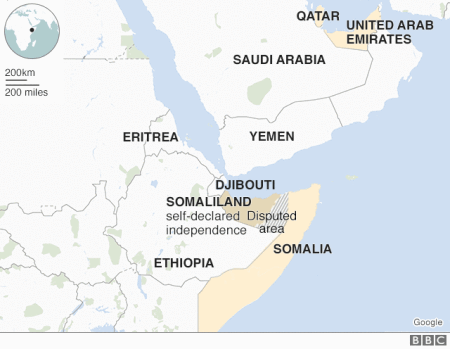
A battle for access to seaports is underway in one of the world’s unlikeliest places: Somalia, now caught in a regional struggle between Saudi Arabia and the United Arab Emirates on one side with Qatar backed by Turkey on the other.  At stake: not just the busy waters off the Somali coast but the future stability of the country itself.

In 2017, a company owned by the United Arab Emirates government signed a $336 million contract to expand the port of Bosaso, north of Mogadishu in the semi-autonomous Somali region of Puntland.   In 2016, another UAE-owned firm took control of Berbera port in the breakaway northern region of Somaliland and pledged up to $440 million to develop it. In March 2017, Ethiopia took a stake in the port for an undisclosed sum.  The federal government in Mogadishu has long been at odds with the semi-autonomous regions of Puntland and Somaliland. The money could destabilise the country further by deepening tensions between central government, aligned with Turkey and Qatar, and Puntland and Somaliland, which both receive money from the UAE.

At the same time, Turkey, an ally of Qatar, is ramping up a multi-billion dollar investment push in Somalia. A Turkish company has run the Mogadishu port since 2014, while other Turkish firms built roads, schools and hospitals.   The rivalries have intensified since June 2017, when the most powerful Arab states, led by Saudi Arabia and including the UAE, cut diplomatic ties with Qatar, accusing it of supporting Iran and Islamist militants…

Saudi Arabia and the UAE increasingly view the Somali coastline – and Djibouti and Eritrea to the north – as their “western security flank”, according to a senior western diplomat in the Horn of Africa region…

Excerpts from  Gulf States Scramble for Somalia, Reuters, May 2, 2018

How to Profit from Chaos: the case for Libyan oil

On February 26, 2018, the U.S. Department of the Treasury’s Office of Foreign Assets Control (OFAC) today sanctioned six individuals, 24 entities, and seven vessels pursuant to Executive Order (E.O.) 13726 for threatening the peace, security, or stability of Libya through the illicit production, refining, brokering, sale, purchase, or export of Libyan oil or for being owned or controlled by designated persons.  Oil smuggling undermines Libya’s sovereignty, fuels the black market and contributes to further instability in the region while robbing the population of resources that are rightly theirs.  Illicit exploitation of Libyan oil is condemned by United Nations Security Council Resolutions (UNSCRs) 2146 (2014) as modified by 2362 (2017).  As a result of today’s actions, any property or interest in property of those designated by OFAC within U.S. jurisdiction is blocked.  Additionally, U.S. persons are generally prohibited from engaging in transactions with blocked persons, including entities owned or controlled by designated persons.

OFAC designated Darren Debono, Gordon Debono, Rodrick Grech, Fahmi Ben Khalifa, Ahmed Ibrahim Hassan Ahmed Arafa, and Terence Micallef pursuant to E.O. 13726 for their involvement in the smuggling of petroleum products from Libya to Europe.  In 2016, Maltese nationals Darren and Gordon Debono formed an unofficial consortium for illicit fuel smuggling from Zuwarah, Libya, to Malta and Italy in an operation that reportedly earned the group over 30 million eurosLibyan national Fahmi Ben Khalifa managed the Libya side of the fuel smuggling operation, and Maltese national Rodrick Grech transported the Libya-originated fuel to European ports where it was sold using falsified fuel certificates, reportedly forged by Egyptian-Maltese citizen Ahmed Ibrahim Hassan Arafa, to obfuscate the fuel’s origin.  Additionally, Maltese national Terence Micallef operated a Malta-based shell company to sell the smuggled petroleum products in Europe.

The February 26, 2018 Treasury action also targeted 21 companies for being owned or controlled by Darren and Gordon Debono and three additional companies for being involved in the illicit exploitation of crude oil or any other natural resources in Libya, including the illicit production, refining, brokering, sale, purchase, or export of Libyan oil.  [These included]….the Malta-based Scoglitti Restaurant, Marie De Lourdes Company Limited, World Water Fisheries Limited, and Andrea Martina Limited for being owned or controlled by Darren Debono.

Excerpts from Press Release, Treasury Sanctions International Network Smuggling Oil from Libya to Europe, Feb. 26, 2018

The Geopolitics of Enriched Uranium: controlling Urenco

The Japanese government has entered into negotiations to acquire U.K.-based Urenco, a major European producer of enriched uranium, in a deal that is expected to be worth several billions of dollars.  The state-owned Japan Bank for International Cooperation is expected to make an offer together with U.S. nuclear energy company Centrus Energy [formely known as United States Enrichment Corporation].  The not-so-ulterior motive is to block companies from Russia and China — two countries that are increasing their influence in the global nuclear power market — from taking control of the company.

The Japanese government is holding talks with major shareholders of Urenco, sources close to the matter said. Ownership of Urenco is evenly split by three parties — the governments of the U.K. and the Netherlands as well as German electric utilities including RWE.The German side is exploring a sale as the government plans to phase out nuclear power. The U.K. government, working on fiscal consolidation, is also looking for a buyer.  Urenco is engaged in turning natural uranium into enriched uranium, which is critical in generating nuclear power [and nuclear weapons]. The company ranks second in the world after Tenex — a unit of Russian nuclear concern Rosatom — in terms of capacity to produce enriched uranium, holding a global share of around 30%…

According to the Japan Atomic Industrial Forum, China had 35 nuclear reactors in operation as of January 2017, while Russia had 30. Including reactors in the planning stage, however, the numbers grow to 82 in China and 55 in Russia, surpassing Japan’s 53.

Excerpts from Japan in talks over bid for UK uranium powerhouse, Nikkei Asian Review, Jan. 19, 2018

The Right to Drinkable Water and Uranium Mining in the USA

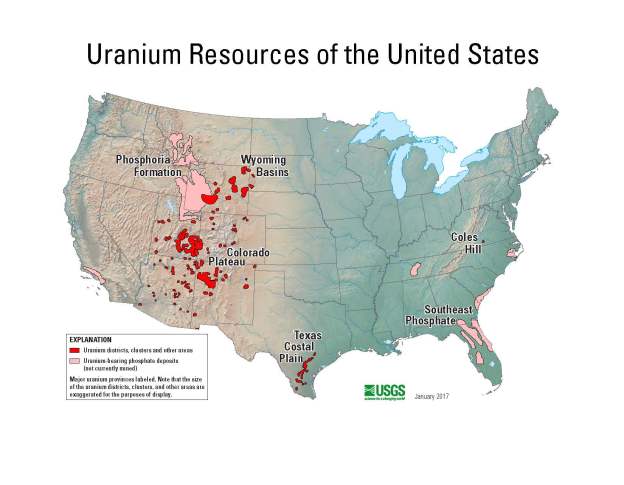
[T]he uranium mining industry in the United States is renewing a push into the areas adjacent to Navajo Nation, Utah: the Grand Canyon watershed to the west, where a new uranium mine is preparing to open, and the Bears Ears National Monument to the north.

The Trump administration is set to shrink Bears Ears National Monument by 85 percent in February 2018, potentially opening more than a million acres to mining, drilling and other industrial activity….[T]here were more than 300 uranium mining claims inside the monument, according to data from Utah’s Bureau of Land Management (B.L.M.) office that was reviewed by The New York Times.  The vast majority of those claims fall neatly outside the new boundaries of Bears Ears set by the [Trump] administration. And an examination of local B.L.M. records, including those not yet entered into the agency’s land and mineral use authorizations database, shows that about a third of the claims are linked to Energy Fuels, a Canadian uranium producer. Energy Fuels also owns the Grand Canyon mine, where groundwater has already flooded the main shaft.

Energy Fuels, together with other mining groups, lobbied extensively for a reduction of Bears Ears, preparing maps that marked the areas it wanted removed from the monument and distributing them during a visit to the monument by Mr. Zinke, Energy Secretary,  in May 2017.

The Uranium Producers of America, an industry group, is pushing the Environmental Protection Agency to withdraw regulations proposed by the Obama administration to strengthen groundwater protections at uranium mines. Mining groups have also waged a six-year legal battle against a moratorium on new uranium mining on more than a million acres of land adjacent to the Grand Canyon…

Supporters of the mining say that a revival of domestic uranium production, which has declined by 90 percent since 1980 amid slumping prices and foreign competition, will make the United States a larger player in the global uranium market.  It would expand the country’s energy independence, they say, and give a lift to nuclear power, still a pillar of carbon-free power generation. Canada, Kazakhstan, Australia, Russia and a few other countries now supply most of America’s nuclear fuel.

The dwindling domestic market was thrust into the spotlight by the contentious 2010 decision under the Obama administrationthat allowed Russia’s nuclear agency to buy Uranium One, a company that has amassed production facilities in the United States. The Justice Department is examining allegations that donations to the Clinton Foundation were tied to that decision.

“If we consider nuclear a clean energy, if people are serious about that, domestic uranium has to be in the equation,” said Jon J. Indall, a lawyer for Uranium Producers of America. “But the proposed regulations would have had a devastating impact on our industry.” “Countries like Kazakhstan, they’re not under the same environmental standards. We want a level playing field.”…

In Sanders, Arizona, hundreds of people were exposed to potentially dangerous levels of uranium in their drinking water for years, until testing by a doctoral researcher at Northern Arizona University named Tommy Rock exposed the contamination.  “I was shocked,” Mr. Rock said. “I wasn’t expecting that reading at all.”

Mr. Rock and other scientists say they suspect a link to the 1979 breach of a wastewater pond at a uranium mill in Church Rock, N.M., now a Superfund site. That accident is considered the single largest release of radioactive material in American history, surpassing the crisis at Three Mile Island.

It wasn’t until 2003, however, that testing by state regulators picked up uranium levels in Sanders’s tap water. Still, the community was not told. Erin Jordan, a spokeswoman for the Arizona Department of Environmental Quality, said the department had urged the now-defunct local water company for years to address the contamination, but it had been up to that company to notify its customers….The town’s school district, whose wells were also contaminated with uranium, received little state or federal assistance. It shut off its water fountains and handed out bottled water to its 800 elementary and middle-school students.  “I still don’t trust the water,” said Shanon Sangster, who still sends her 10-year-old daughter, Shania, to school with bottled water. “It’s like we are all scarred by it, by the uranium.”

Excerpts from HIROKO TABUCHIJAN,  Uranium Miners Pushed Hard for a Comeback. They Got Their Wish,  NY Times, Jan. 13, 2018

Controlling Submarine Cables

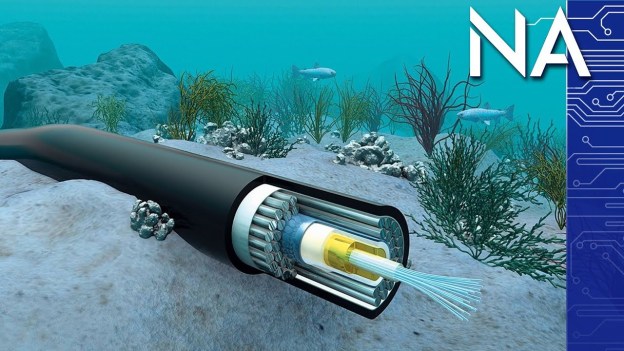
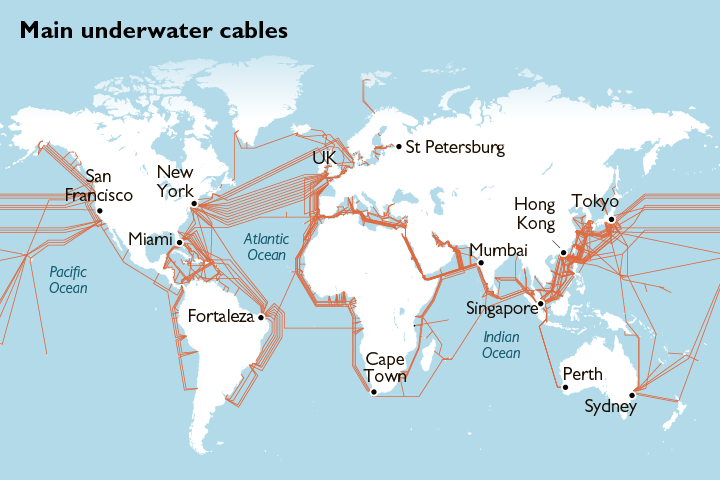
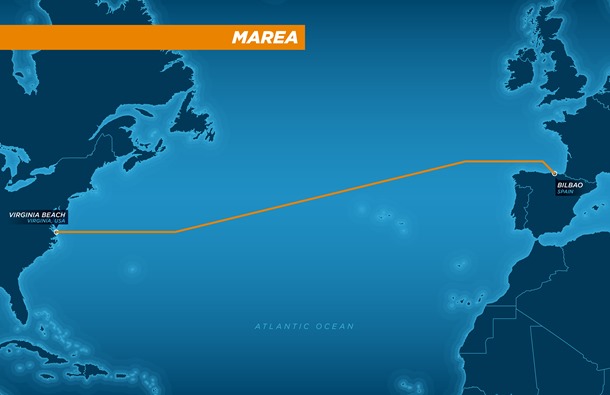
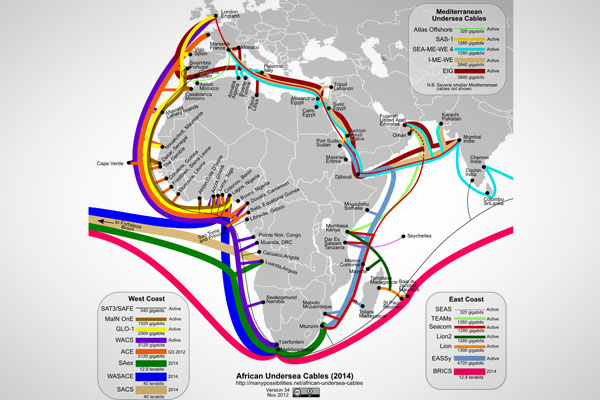
September 21, 2017: the completion of another trans-Atlantic cable…dubbed Marea, Spanish for “tide”, the 6,600km bundle of eight fibre-optic threads, roughly the size of a garden hose, is the highest-capacity connection across the ocean. Stretching from Virginia Beach, Virginia, to Bilbao, Spain, it is capable of transferring 160 terabits of data every second, the equivalent of more than 5,000 high-resolution movies. Facebook and Microsoft each own 25% of Marea, and the rest is owned by Telxius, a telecom infrastructure firm that is controlled by Spain’s Telefónica….

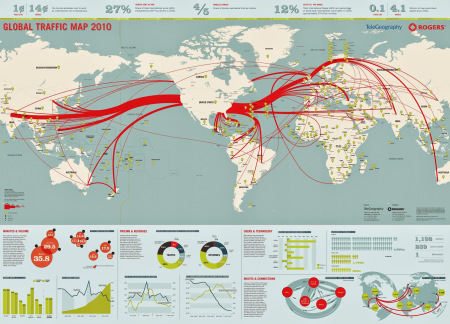
Such ultra-fast fibre networks are needed to keep up with the torrent of data flowing around the world. In 2016 traffic reached 3,544 terabits per second, roughly double the figure in 2014, according to TeleGeography, a market-research firm. And demand for international bandwidth is growing by 45% annually. Much traffic still comes from internet users, but a large and growing share is generated by big internet and cloud-computing companies syncing data across their networks of data centres around the world.

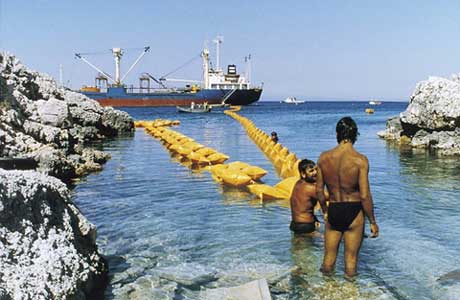
These firms used to lease all of their bandwidth from carriers such as BT and Level 3. But now they need so much network capacity that it makes more sense to lay their own dedicated pipes, particularly on long routes between their data centres. The Submarine Telecoms Forum, an industry body, reckons that 100,000km of submarine cable was laid in 2016, up from just 16,000km in 2015. TeleGeography predicts that a total of $9.2bn will be spent on such cable projects between 2016 and 2018, five times as much as in the previous three years.

Owning a private subsea fibre-optic network has several advantages, including more bandwidth, lower costs, and reduced delay, or “latency”. Having access to multiple cables on different routes also provides redundancy. If a cable is severed—by fishing nets, sharks, or an earthquake, among other things—traffic can be rerouted to another line. Most important, however, owning cables gives companies greater say over how their data traffic is managed and how equipment is upgraded. “The motivation is not so much saving money. It’s more about control,” says Julian Rawle, a submarine cable-industry expert…

“Within the next 20 years,” predicts Mr Rawle, “the whole concept of the telecom carrier as the provider of the network is going to disappear.”

Excerpts from Internet Infrastructure: Pipe Dreams, Economist, Oct. 7, 2017

The Power Plays in Africa

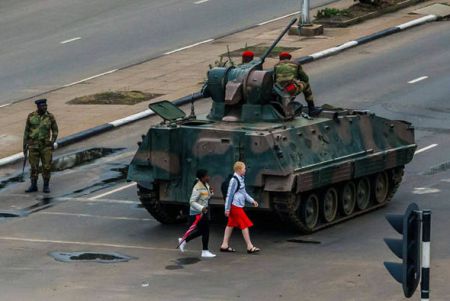
As the overthrow of despot Robert Mugabe entered a stalemate on November 17,  2017, eyes turned to China — Zimbabwe’s largest foreign investor and a key ally — amid speculation over its role in the military coup.Source in Harare believe the Zimbabwean conflict within the ruling party Zanu PF is involving two rival camps has direct links to China and Russia with both countries trying to control and protect their own economic interests.

The army chief General Constantino Chiwenga, visited Beijing l — just days before tanks rolled into the streets of Harare. President Mugabe has been been hostile to the Chinese in recent years accusing them of plundering the countries diamonds worth $15 billion.  On October 2017 First Lady Grace Mugabe was in Russia where she represented her 93-year-old husband at a function where he was honoured with some accolade in Russia at the World Federation of Democratic Youth (WFDY) in Moscow.

“It is a BRICS internal rivalry with both Russia and South Africa on one side trying to protect their economic interests and China on the other side,” a regional think-tank in London said on November 17, 2017… Russia has been investing in several projects in southern African nations, for example, the ALROSA group of diamond mining companies is engaged in several projects in Zimbabwe, while mining and steelmaking company Evraz and Severstal steel and steel-related mining company conduct their business in South Africa.

Russia and South Africa, which together control about 80% of the world’s reserves of platinum group metals, have created a trading bloc similar to OPEC to control the flow of exports according to Bloomberg.

Zimbabwe, Canada, and the U.S. are among other major platinum group metals producers.

Russian and South African officials signed a memorandum of understanding today to cooperate in the industry.South Africa mines about 70 percent of the world’s platinum, while Russia leads in palladium, a platinum group metal used in autocatalysts, with about 40% of output, according to a 2012 report by Johnson Matthey Plc.

According to the Chamber of Mines of Zimbabwe (CMZ) and geologists, Zimbabwe has far bigger platinum reserves than Russia. The country currently has the second known largest platinum reserves after South Africa. Experts say underfunding and limited exploration has over the years stifled growth of the mining sector.

The Zimbabwe chamber is on record saying it seeks to increase production to the targeted 500 000 ounces per annum requires the setting up of base and precious metal smelters and refineries, investment of $2,8 billion in mines, $2 billion in processing plants and between $200 and $500 million to ensure adequate power supply. Already, the country’s major platinum miners – Zimplats, Unki and Mimosa who are currently processing the metal in neighbouring South Africa – have undertaken to construct the refinery….

Miles Blessing Tendi, a lecturer in African history and politics at the University of Oxford, says there is no way to be certain if China knew about Mugabe’s fate but believes China’s respect for sovereignty would make their involvement uncharacteristic.

Excerpt, It gets ugly as Russia and South Africa gang-up against China over Zimbabwe coup, http://www.thezimbabwemail.com/, November 17, 2017

Staying in Svalbard

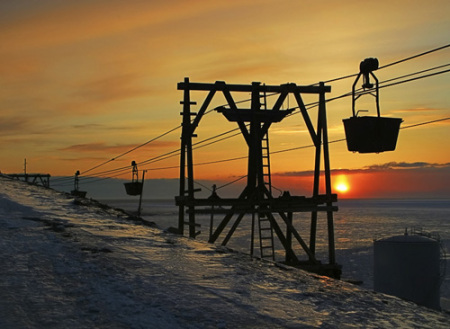
Svalbard has an unusual status that makes it a flashpoint of an escalating face-off in the Arctic between Russia and the West.  Norway, a member of the North Atlantic Treaty Organization, and Russia subsidize unprofitable mines to keep a strategic footprint on an icy group of islands where Oslo and Moscow have been the main players since a 1920 treaty among multiple nations recognized Norwegian sovereignty but allowed other nations to develop some commercial interests. (pdf).

NATO has described its lack of maritime resources in the region as a weakness.  “Svalbard is part of Norway and therefore it’s part of NATO,” Secretary-General Jens Stoltenberg. “So, of course, all the NATO security guarantees apply to Svalbard. When it comes to the question of coal mining, that’s for the Norwegian authorities to decide.”…

Oslo is planning to buy new submarines and has increased the number of troops on its border with Russia.  But Norway, one of the world’s richest countries on a per capita basis, is debating whether to keep financing coal mining on Svalbard. A renewed commitment to mining would be controversial, not just for the cost but also because of Norwegians’ vision of themselves as champions of environmental causes…

“It’s a question of how much are we going to spend doing something irrational versus how great do we feel the need to counter Russian Arctic activity,” said Indra Overland, head of energy at the Norwegian Institute of International Affairs, a think tank that is partially funded by the state…

Some 800 miles from the North Pole, the islands are barren, with temperatures that dip to minus-20 degrees Celsius (minus-4 degrees Fahrenheit) in winter months when the sun doesn’t rise.  Miners on both sides are attracted by relatively high salaries. Barentsburg’s 400 inhabitants are also provided with health care, a school and low-cost housing.Russia, which started mining here in the 1930s, focused on Barentsburg and another settlement called Pyramiden. The towns housed swimming pools, 24-hour canteens and food products that were then largely unavailable elsewhere in the Soviet Union…

Russia’s government has ordered coal production to slow to stretch reserves out until 2032, and will then face a decision similar to Norway’s on whether to invest in a new mine…

Both countries are turning to tourism.  In Russia’s settlements, visitor numbers have doubled in the past four years, and income from tourism stood at $2.4 million last year, more than from mining. Arktikugol received $8 million in government subsidies in 2016….Norway has opened a university, and one closed coal mine has become a museum and film archive. Old miners’ cabins have been renovated for holiday accommodation and a warehouse is now a restaurant.

But Norwegian politicians and academics admit that without a coal mine, their country’s presence will diminish, in part because tourism is so seasonal.  “To put it bluntly, the purpose of the Norwegian settlements is to assert Norwegian sovereignty over Svalbard,” said Torbjørn Pedersen, a political scientist at Nord University in Bodø, Norway

Excerpts from A New Cold War Grip Arctic Enclave, Wall Street Journal, Oct. 11, 2017

Lithium Resources and Markets

Lithium is a coveted commodity. Lithium-ion batteries store energy that powers mobile phones, electric cars and electricity grids (when attached to wind turbines and photovoltaic cells). Joe Lowry, an expert on the lightest metal, expects demand to nearly triple by 2025. Supply is lagging, which has pushed up the price. Annual contract prices for lithium carbonate and lithium hydroxide doubled in 2017, according to Industrial Minerals, a journal. That is attracting investors to the “lithium triangle” that overlays Argentina, Bolivia and Chile .  The region holds 54% of the world’s “lithium resources”, an initial indication of potential supply before assessing proven reserves.

Chile dominated the world lithium markets for decades. The Atacama salt flat has the largest and highest-quality proven reserves. The desert’s blazing sun, scarce rainfall and mineral-rich brines make Chile’s production costs the world’s lowest. Allied to this is the region’s most benign investment climate. Chile is far ahead in rankings of ease of doing business, levels of corruption, and the quality of its bureaucracy and courts (see charts). Its lithium deposits are close to Antofagasta and other Chilean ports;

But growth has flattened, allowing Australia to threaten Chile’s position as the world’s top producer…Laws enacted in the 1970s and 1980s classify lithium as a “strategic” material on the ground that it can be used in future nuclear-fusion power plants. There is little prospect that Chile will soon build one of these, but controls on lithium production remain as a way of protecting the desert’s fragile ecosystem.

Just two companies, Chile’s SQM and Albemarle of the United States, are allowed to extract brine under leases that were signed in the 1980s. In addition, they are subject to quotas on the lithium they can produce from the brine, which also yields other minerals

Argentina: Under the constitution, provinces, not the federal government, own the country’s minerals. Mining firms had to find their way through a confusion of provincial rules and regulations. “It was like the Tower of Babel,” says Daniel Meilán, the country’s current mining secretary. I Argentina’s newish president, Mauricio Macri, has tried to unblock investment, including that in lithium….  The federal government is trying to harmonise provincial regulations. It has hammered out agreement on a standard royalty (3% of revenue, plus 1.5% to improve local infrastructure)…

These advances have started to unfreeze investment in lithium. In 2016 the sector attracted $1.5bn; production rose by nearly 60%……..Ending the metal’s strategic status and getting rid of quotas would make still more sense. So would improving Chile’s institutions and infrastructure.

Under the left-wing government led by President Evo Morales since 2006, Bolivia has pulled out of numerous bilateral investment treaties, denying investors access to international arbitration. His government has nationalised parts of the oil and gas industries, along with the biggest telecoms company and most of the electricity sector.  The government keeps an even tighter grip on lithium than it does on gas, its biggest export. YPFB, the state-owned natural-gas company, at least enters into joint ventures with private-sector firms. Since 2010 the right to extract lithium brine has been reserved for the state. Private firms can now do no more than gaze longingly upon the Uyuni salt flat near Potosí, the largest in the world…

Like Chile, Bolivia hopes to form partnerships with private firms to make value-added products, including batteries and electric cars, through a new lithium enterprise, Yacimientos de Litio Bolivianos. But the government’s insistence on keeping a controlling stake is discouraging potential investors. In 2016 Bolivia sold 25 tonnes of lithium carbonate to China, pocketing a princely $208,000.

The white gold rush: The lithium triangle, Economist, June 17, 2017

Secret Trade Deals – Role of Wikileaks

On August 11, 2015 WikiLeaks has launched a campaign to crowd-source a €100,000 reward for Europe’s most wanted secret: the Transatlantic Trade and Investment Partnership (TTIP).

Starting pledges have already been made by a number of high profile activists and luminaries from Europe and the United States….Since it began to face opposition from BRICS countries at the World Trade Organisation, US policy has been to push through a triad of international “trade agreements” outside of the WTO framework, aimed at radically restructuring the economies of negotiating countries, and cutting out the rising economies of Brazil, Russia, India, China and South Africa (BRICS).

The three treaties, the “Three Big T’s”, aim to create a new international legal regime that will allow transnational corporations to bypass domestic courts, evade environmental protections, police the internet on behalf of the content industry, limit the availability of affordable generic medicines, and drastically curtail each country’s legislative sovereignty.  Two of these super-secret trade deals have already been published in large part by WikiLeaks – the Transpacific Partnership Agreement (TPP) and the Trade in Services Agreement (TISA) – defeating unprecedented efforts by negotiating governments to keep them under wraps.

But for Europeans the most significant of these agreements remains shrouded in almost complete secrecy. The Transatlantic Trade and Investment Partnership (TTIP), which is currently under negotiation between the US and the European Union, remains closely guarded by negotiators and big corporations have been given privileged access. The public cannot read it.

Today WikiLeaks is taking steps to ensure that Europeans can finally read the monster trade deal, which has been dubbed an “economic NATO” by former US Secretary of State Hillary Clinton.  Using the new WikiLeaks pledge system everyone can help raise the bounty for Europe’s most wanted leak. The system was deployed in June to raise a $100,000 bounty for the TTIP’s sister-treaty for the Pacific Rim, the TPP.

The pledge system has been hailed by the New York Times as “a great disrupter”, which gives “millions of citizens… the ability to debate a major piece of public policy,” and which “may be the best shot we have at transforming the [treaty negotiation] process from a back-room deal to an open debate.”

WikiLeaks founder Julian Assange said,

“The secrecy of the TTIP casts a shadow on the future of European democracy. Under this cover, special interests are running wild, much as we saw with the recent financial siege against the people of Greece. The TTIP affects the life of every European and draws Europe into long term conflict with Asia. The time for its secrecy to end is now.”

Excerpts from WikiLeaks goes after hyper-secret Euro-American trade pact

The Bloody Battle for Chip Hegemony

China’s Tsinghua Unigroup Ltd., a state-owned firm is spending $24 billion to build the country’s first advanced memory-chip factories. It’s part of the Chinese government’s plan to become a major player in the global chip market and the move is setting off alarms in Washington.  When Unigroup tried to buy U.S. semiconductor firms in 2015 and 2016, Washington shot down the bids. It is considering other moves to counter Beijing’s push.

China is aiming “to take over more and more segments of the semiconductor market,” says White House trade adviser Peter Navarro, who fears Beijing will flood the market with inexpensive products and bankrupt U.S. companies.  Unigroup’s CEO Zhao Weiguo says he is only building his own factories due to Washington’s refusal to let him invest in the U.S. “Chinese companies have faced discrimination in many areas,” of technology, he says. “Abnormal discrimination.”

Semiconductors—the computer chips that enabled the digital age and power the international economy—have long been among the most globalized of industries, with design and manufacturing spread across dozens of countries.

Today, the industry is riven by a nationalist battle between China and the U.S., one that reflects broad currents reshaping the path of globalization. Washington accuses Beijing of using government financing and subsidies to try to dominate semiconductors as it did earlier with steel, aluminum, and solar power. China claims U.S. complaints are a poorly disguised attempt to hobble China’s development. Big U.S. players like Intel Corp. and Micron Technology Inc. find themselves in a bind—eager to expand in China but wary of losing out to state-sponsored rivals…

The new semiconductor battle marks a shift toward nationalism, trade battles and protected markets…The U.S. estimates China will eventually spend $150 billion [on developing s its indigenous semiconductor industry]  a figure equal to about half of global semiconductor sales annually.

Though Republicans and Democrats are at odds on many economic policy issues, they’re unified on this. An interagency working group on semiconductors, started by the Obama administration in 2015, has continued meeting under President Donald Trump. The group is weighing policies to make it more difficult for China to scoop up U.S. technology, according to people involved in the discussions.

One idea is tightening the rules covering U.S. approval of foreign investments to make it tougher for Chinese firms seen as security risks. Other options include trade sanctions, stricter export controls and added federal research spending

The U.S. views China as its biggest semiconductor challenge since Japan in the late 1980s. The U.S. triumphed then through trade sanctions and technological advances. Japanese firms couldn’t match U.S. microprocessor technology, which powered the personal computer revolution, and fell behind South Korea in low-margin memory chips.

China has advantages Japan didn’t. It is the world’s biggest chip market, consuming 58.5% of the global $354 billion semiconductor sales in 2015 according to PricewaterhouseCoopers LLP. That gives Beijing power to discriminate, if it wants, against overseas suppliers…Beijing’s semiconductor program shifted into high gear in 2012, when the value of its chip imports surged past its bill for crude oil for the first time…

Nearly 90% of the $190 billion worth of chips used in China are imported or produced in China by foreign-owned firms…The top 10 chip vendors in China by revenue are foreign.

“We cannot be reliant on foreign chips,” said China’s vice premier, Ma Kai in 2017…Beijing created a $20 billion national chip financing fund—dubbed the “Big Fund”— and set goals for China to become internationally competitive by 2030, with some companies becoming market leaders.  Local governments created at least 30 additional semiconductor funds, with announced financing of more than $100 billion. If all these projects are realized, the global supply of memory chips would outstrip demand by about 25% in 2020, estimates Bernstein Research, pushing prices down and battering profits of semiconductor companies globally… Beijing has been consolidating 600 small Chinese chip makers, many unprofitable, into a handful of larger companies China wants to compete internationally.

When the Big Fund financed an acquisition blitz, Unigroup was in the lead, bidding in 2015 for memory-chip maker Micron Technology, and then for a 15% stake in data storage firm Western Digital Corp.Some bids were so overvalued U.S. government officials joked the Chinese were willing to pay an “espionage premium.”  After a Chinese plan to buy a Royal Philips NV semiconductor-material unit fell apart, Phillips sold the unit to a U.S. private-equity group for about half the earlier price. Philips declined to comment.

The bids spooked Washington and the industry. In private meetings, Micron, Intel and others warned they faced an “existential threat” from China, say industry and government officials. The companies feared they were trapped in a prisoner’s dilemma. Each company was under pressure to sell to China for fear its competitors would sell if it didn’t.

In July 2017, Germany approved restrictions on foreign technology purchases, aimed at China, and the European Union also is considering barriers… The U.S. Committee on Foreign Investment in the U.S (CFIUS), an interagency review group, made clear most proposed acquisitions wouldn’t pass muster.

According to Rhodium Group, only about $4.4 billion in Chinese semiconductor acquisitions were completed since 2015. Unigroup’s bid for Micron fell apart. South Korea, Taiwan and Japan also blocked Chinese acquisition bids…

Mr. Trump proposed a 13% decrease in federal funding for basic research to $28.9 billion in fiscal year 2018, but semiconductor lobbyists say they hope to eke out an increase for chip-related research.

Chinese chip executives argue South Korea is a bigger threat to the U.S. chip industry due to its advanced technology.

After Unigroup’s plan to acquire Micron fell apart, it hired Charles Kau, the former head of Micron’s Taiwan joint-venture, and other experts from the island. It announced it would build its own memory chip facility—the mammoth Wuhan factories—at about the same price it would have paid for Micron.  Unigroup now has a new plan for Micron. It says it no longer wants to buy the firm, recognizing the chances of regulatory approval in the U.S. are nil, but says the two should work together to battle market leader Samsung Electronics Co. The combination of Micron technology and Chinese capital would help both companies take on the South Koreans, says Mr. Zhao, the Unigroup CEO.

Micron says the Federal Bureau of Investigation has begun investigating whether Micron employees in Taiwan who went to work for other firms, including Unigroup, have taken Micron technology with them.”

Excerpts from Bob Davis and Eva Dou, CHINA’S NEXT TARGET: U.S. MICROCHIP HEGEMONY, Wall Street Journal, July 28, 2017

The Power of Submarine Cables

Access to ultra-fast internet cables in London is likely to make financial firms reluctant to move out of London even after Britain leaves the European Union, a study by the European Central Bank has found.

But an ECB study found that any withdrawal from London would likely be gradual as firms would be loath to give up on Britain’s fibre-optic cables, crucial for ultra-fast electronic trading.

“The UK’s advantage as a hub for trading using fibre-optic cables, combined with institutional inertia, suggest that any relocation of trading after Brexit, if at all, would likely be gradual,” the ECB said in its study.  Around 84 percent of transactions in euro are initiated outside the euro area, with Britain taking the lion’s share at 43 percent, according to a survey by the Bank for International Settlement cited in the ECB study.

“Technology has economically important implications for the distribution of foreign exchange transactions across financial centres, as a result,” the ECB said.   “Undersea fibre-optic cables provide a competitive advantage to financial centres located near oceans, like Singapore, because they are directly connected to the internet backbone, at the expense of landlocked cities like Zurich,” it added.

Excerpts from Fast Internet Likely to Keep Trading in London After Brexit: ECB, Reuters, July 5, 2017.

Seaborne Gas: LNG

One day in March 2017, he Rioja Knutsen tanker, filled with liquefied natural gas, was traveling from the U.S. to Portugal. Suddenly, Mexico’s power company lobbed in a higher bid for its cargo. At the Bahamas, the ship abruptly made a starboard turn and headed south.  How natural gas is bought and sold in the world’s scattered regional markets for the fuel is changing rapidly. Ships such as the Rioja Knutsen are stitching those regions together and a single global market is emerging.  This is already how nearly every other hydrocarbon, from crude oil to obscure petrochemicals, is sold. As gas joins the club, the effects will ripple through energy prices, company profits, the environment and geopolitics.

Behind the evolution is improving technology for moving gas as a liquid, which means it can go to many more places rather than simply where a pipeline runs. …The share of gas moving by sea reached 40% of total trades in 2015, and the International Energy Agency forecasts that seaborne gas will account for a bigger share of trading than pipelines by 2040.

Thirty-nine countries now import LNG, up from 17 a decade ago, according to data and analytics firm IHS Markit. Several more, among them Uruguay, Bahrain and Bangladesh, are expected to lift the total to 46 in the next couple of years.

In one sign of how gas is going global, the U.S. and China are working on a trade deal that could send vast quantities of gas pumped in Texas and Pennsylvania to factories in Shanghai and Guangdong. Improved access for U.S. exporters to China’s giant energy markets could boost overall global shipments…

As LNG import terminals open in more locations, gas pricing and trading mechanisms are developing as well. Some investors are increasingly using the gas price at a pipeline intersection in Louisiana, called the Henry Hub, as a global benchmark.  Trading in the New York Mercantile Exchange’s Henry Hub gas futures contract is becoming more global, said Peter Keavey, global head of energy at Nymex owner CME Group . In May, Standard & Poor’s and the Intercontinental Exchange launched the first futures contract based on LNG produced in the U.S.

Seaborne gas is reducing some countries’ historic dependence on pipelines that run through potentially unfriendly territory. Poland, for instance, opened its first import terminal a year ago, lessening its reliance on gas piped from Russia.

When global trade in LNG began in the 1960s, the cost of liquefying gas was so high it was a niche product, affordable only by developed countries such as Japan.  As the technology proved reliable, trade in LNG became more common, but contracts to deliver the fuel by ship were decades long and had ironclad destination clauses. Gas contracted for Tokyo couldn’t be rerouted to Seoul. Traders called gas tankers “pipelines at sea.Now, contracts are getting shorter and starting to allow gas to be diverted to where demand is greatest. Earlier this year, three large LNG buyers in Japan, China and South Korea agreed to work together to push sellers for more contract flexibility and fewer onerous restrictions.

At any given time, there are about 170 tankers filled with LNG on the world’s oceans,… At the heart of the changes is supply. Huge new discoveries in the U.S., Middle East, East Africa and Australia, along with recovery techniques such as fracking, have expanded the amount of gas available for export….One pioneer is Houston-based Cheniere Energy Inc. FBy next year, Sabine Pass and other LNG terminals are expected to turn the U.S. into a net gas exporter….In a quest for customers, Cheniere has invested in a Chilean project to build a power plant, LNG terminal, storage facility and pipeline.   Oil titans Total SA and Royal Dutch Shell PLC also are offering to build facilities to burn gas. The two and their partners are building an import terminal and pipeline for an estimated $200 million in Ivory Coast, which will feed a power plant in the West African country’s economic hub of Abidjan. Qatar, the longtime LNG leader, recently lifted a self-imposed moratorium on the development of its North Field, the single largest gas reservoir in the world. So far there is little indication Qatar’s diplomatic spat with Arab neighbors will affect the gas market.

Helping make gas more accessible is a relatively new technology—floating LNG facilities. ..The first floating terminal was christened in 2005. Today there are 25….Excelerate Energy, a Houston company that developed this technology, is working on new floating terminals in Namibia, Bangladesh, Pakistan and elsewhere. The equipment to liquefy gas can also now be put on a large vessel that can be anchored offshore.

Excerpts from Long Promised, the Global Market for Natural Gas Has Finally Arrived, Wall Street Journal, June 7, 2017

Qatar-Russia Financial Alliance

Russia’s sale of one-fifth of its state-owned oil company to Qatar and commodities giant Glencore PLC last year had an unusual provision: Moscow and Doha agreed Russia would buy a stake back, people familiar with the matter said.  Russian President Vladimir Putin hailed the $11.5 billion sale of the Rosneft stake in December 2016 as a sign of investor confidence in his country. But the people with knowledge of the deal say it functioned as an emergency loan to help Moscow through a budget squeeze.

Moscow agreed with Qatar that Russia would buy back at least a portion of the stake from the rich Persian Gulf emirate, the people said. The Qatar Investment Authority and Glencore, the Swiss-based commodities giant, formed a partnership to buy the 19.5% stake in Russia’s energy jewel at a time when Mr. Putin’s government needed cash. The people with knowledge of the deal say the buyback arrangement was negotiated with involvement from Mr. Putin and the emir of Qatar, Sheikh Tamim bin Hamad Al Thani. Russia and Qatar saw it as an opportunity to build a bridge between countries that had taken up opposite sides in the Syrian civil war, the people said. One of the people said the buyback would happen in the next 10 years…

Rosneft, the world’s largest listed oil producer, is traded publicly in Moscow, but it isn’t easy to buy and sell large pieces of the company because it remains majority-owned by the Russian state and is an instrument of economic power for Mr. Putin.  The people familiar with the deal said a time-limited structure and a buyback agreement for the deal worked for both Qatar and Russia.

Qatar wanted its Rosneft stake to be temporary, the people said. The emirate believes it will profit from selling the shares back to Russia at a later date, the people said, betting that oil prices will rise and push up Rosneft’s share price. Qatar saw the political benefits of giving Russia access to quick cash as a sort of loan to address a budget deficit that had widened due to lower oil prices, the people said.  After the deal, a range of talks opened between Russian and Qatari businesses on a scale not seen before, Russian news agencies have reported….The deal was called the largest-ever foreign investment in a Russian company.

In an unusual arrangement, the rest of the financing was provided by Russian banks, which contributed EUR2.2 billion, and Italian bank Intesa Sanpaolo SpA, which lent EUR5.2 billion to the Glencore-Qatar consortium, according to a Dec. 10, 2016 new release issued by Glencore. The financing is “non-recourse,” Glencore said in the release, meaning the lenders couldn’t pursue Glencore and the Qatar Investment Authority if they weren’t repaid….Under the deal, the Rosneft shares aren’t held directly by Glencore and Qatar but by a U.K. limited liability partnership, according to British corporate records….

After the deal was announced, Mr. Putin awarded one of Russia’s top honors for foreigners — the Order of Friendship — to Qatar Investment Authority’s chief executive, Sheikh Abdullah bin Mohammed bin Saud Al-Thani, Intesa’s chief executive, Carlo Messina, and Glencore’s chief executive, Ivan Glasenberg.

Excepts from Russia’s Rosneft Stake Sale Had a Twist , Wall Street Journal, June 8, 2017


Ecological Hooliganism: smashing the coral triangle

Giant clams are one of Buddhism’s “seven treasures”, along with gold and lapis lazuli. China’s new rich prize their shells as showy ornaments. Each can fetch as much as $3,000, so each haul was worth a fortune to the fishermen of Tanmen, a little fishing port on the island province of Hainan in Southern China.  But Chinese government banned the clam fishing…
The ban is surely welcome. [S]ome of the most biodiverse coral reefs on Earth have been destroyed in the South China Sea thanks to giant-clam poachers. In the shallow waters of the reefs, crews use the propellers of small boats launched from each mother-ship to smash the surrounding coral and thus free the clams anchored fast to the reef. Though the practice has received little attention, it is ecological hooliganism, and most of it has been perpetrated by boats from Tanmen.

The fishermen have not been the reefs’ only adversaries. China’s huge and (to its neighbours) controversial programme since late 2013 of building artificial islands around disputed rocks and reefs in the South China Sea has paved over another 22 square miles of coral. When the two activities are taken together, Mr McManus says, about 10% of the reefs in the vast Spratly archipelago to the south of Hainan, and 8% of those in the Paracel islands, between Hainan and Vietnam, have been destroyed. Given that Asia’s Coral Triangle, of which the South China Sea forms the apex, is a single, interconnected ecosystem, the repercussions of these activities, environmentalists say, will be huge…

But still..A few streets back from the waterfront in Tanmen, elegant boutiques sell jewellery and curios fashioned from the giant clams—and clam shells are still stacked outside. And the provincial money that is so clearly being lavished on Tanmen sits oddly with the illegality of its townsfolk’s way of life. .. [I] n 2013 President Xi Jinping himself showed up in Tanmen. Boarding one of the trawlers he declared to the crew, according to state media, “You guys do a great job!” The media did not report that a year earlier the trawler in question had been caught in the territorial waters of Palau, and in the confrontation with local police that followed one of the crew members had been shot dead. In Chinese propaganda, Tanmen’s fishermen are patriots and model workers.

Over the years Tanmen’s fishermen have become part of China’s power projection in the South China Sea, an unofficial but vital adjunct to the Chinese navy and coastguard. The biggest trawlers are organised into a maritime militia ready to fight a “people’s war” at sea. Though generally unarmed, they undergo training and take orders from the navy.

They are facts on the water, and have been involved in China’s growing aggression in the South China Sea. In 2012 boats from Tanmen were part of a navy-led operation to wrest control of Scarborough Shoal from the Philippines, chasing Philippine fishing vessels away. In 2014 they escorted a Chinese oil rig that was being towed provocatively into Vietnamese waters. On land, Vietnamese expressed their rage by ransacking factories they thought were Chinese-owned. At sea, boats from Tanmen rammed and sank one of the rickety Vietnamese vessels coming out to protest.

Mysteriously, though, the giant trawlers of the Tanmen militia are now rafted up, their crews sent home. Perhaps China is keen to lower tensions in the region….A policy introduced in January aims to cut the catch from China’s fishing fleet, the world’s largest, by a sixth, in the name of sustainability. That will hit Tanmen’s fishermen hard, making them less willing to defend China’s claims. Francis Drake would have understood: pirates are patriotic, but usually only when it pays.

Excerpts from Clamshell Phoneys, Economist, Mar. 25, 2017

Internet Cables and US Security

A real-estate magnate is financing Google’s and Facebook Inc.’s new trans-Pacific internet cable, the first such project that will be majority-owned by a single Chinese company.  Wei Junkang, 56, is the main financier of the cable between Los Angeles and Hong Kong, a reflection of growing interest from China’s investors in high-tech industries.   It will be the world’s highest-capacity internet link between Asia and the U.S.

For Alphabet Inc.’s Google and Facebook, the undersea cable provides a new data highway to the booming market in Southeast Asia. Google and Facebook, which are blocked in China but seeking ways back in, declined to comment on market possibilities in China. Google said the project, called the Pacific Light Cable Network, will be its sixth cable investment and will help it provide faster service to Asian customers…

Backers hope to have Pacific Light operating in late 2018. The elder Mr. Wei’s company, Pacific Light Data Communication Co., will own 60%, Eric Wei said, and Google and Facebook will each own 20%. The project cost is estimated at $500 million, and the Chinese company hired U.S. contractor TE SubCom to manufacture and lay the 17-millimeter wide, 7,954-mile long cable…

The cable project requires U.S. government approval, including a landing license from the Federal Communications Commission and a review by Team Telecom, a committee of officials from the departments of defense, homeland security and justice….

Pacific Light will likely face higher scrutiny from Team Telecom due to the controlling interest by a foreign investor, said Bruce McConnell, global vice president of the EastWest Institute and a former senior cybersecurity official with the Department of Homeland Security.

Team Telecom rarely rejects a landing license application, Mr. McConnell said, but cable operators must agree to security terms.“The agreement is usually heavily conditioned to ensure that (U.S.) security concerns are met,” he said.

The terms often require an American operator of the cable to assist U.S. authorities in legal electronic surveillance, including alerting regulators if foreign governments are believed to have accessed domestic data, according to copies of agreements filed with the FCC. The U.S. landing party usually must also be able to cut off U.S. data from the international network if asked…

More than 99% of the world’s internet and phone communications rely on fiber-optic cables crisscrossing continents and ocean floors. That makes these cables critical infrastructure to governments and a target for espionage.

One of the Eric Wei’s businesses is a Chinese alternative to the QR code called a D9 code, which the company promotes as a “safe” alternative to foreign technology.

Excerpts from  China Firm Backs Asia-US Cable, Wall Street Journal, Mar. 16, 2017

Client States: China-Cambodia

China provides military aid to Cambodia:  uniforms, vehicles, loans to buy helicopters and a training facility in southern Cambodia. Between 2011 and 2015 Chinese firms funnelled nearly $5bn in loans and investment to Cambodia, accounting for around 70% of the total industrial investment in the country. Chinese firms run garment and food-processing factories and are also heavily involved in construction, mining, infrastructure and hydropower. Others hold at least 369,000 hectares of land concessions on which they grow sugar, rubber, paper and other crops.

The government is often willing to bend the rules for Chinese firms. One is developing a luxury resort inside a national park on the edges of Sihanoukville, the country’s main port. Another has won development rights over some 20% of Cambodia’s coastline. Human-rights groups allege that fishermen who had lived in the area for generations were summarily evicted, taken inland and told that they were now farmers.

Each side gets something out of the relationship. For Cambodia, the most obvious benefit is economic: it is poor and aid-dependent; Chinese money lets it buy and build things it could not otherwise afford. Phay Siphan, a government spokesman, said last year: “Without Chinese aid, we go nowhere.”  But there are also two strategic benefits. First, Cambodia uses China as a counterweight to Vietnam. Among ordinary Cambodians, anti-Vietnamese sentiment runs deep.   Cambodia also uses China as a hedge against the West. Chinese money comes with no strings attached, unlike most Western donations, which are often linked to the government’s conduct….

As for China, it gets a proxy within the ten-country Association of South-East Asian Nations (ASEAN). Cambodia has repeatedly blocked ASEAN from making statements that criticise China’s expansive territorial claims in the South China Sea, even though they conflict with those of several other ASEAN members. In 2016, less than a week after Cambodia endorsed China’s stance that competing maritime claims should be solved bilaterally, China gave Cambodia an aid package worth around $600m.

China also seems to be eroding America’s clout in the region.  ASEAN’s long-standing complaint, that Chinese influence on Cambodia hinders regional unity, is growing moot: over the South China Sea, at least, that unity appears to have disintegrated anyway. The Philippines, which took China to an international tribunal over its maritime claims, has reversed course. Its new president, Rodrigo Duterte, expresses contempt for America and affection for China. Vietnam, China’s other main adversary in the sea, recently pledged to resolve its maritime dispute bilaterally. Nobody yet knows what America’s policy on the South China Sea will be under Donald Trump, but increasingly it looks as if Cambodia has picked the winning side.

Excerpts, Chinese Influence in South-East Asia: The Giant’s Client,  Economist, Jan. 21, 2017

Debt and Coal: China-Mongolia friendship

Mongolia recently reached a new deal to sell coal to China, helping it boost its faltering economy and start repaying billions of dollars it owes Wall Street lenders.  Under the landmark agreement completed late 2016, Mongolia’s state-owned mining company will sell coal to China at roughly double the previously agreed-upon rate.  The deal follows a devastating four-year period when Mongolian miners exported coal to China at deeply-discounted prices, sometimes for as little as 11% of the global benchmark price, undercutting Mongolia’s economic growth. Mongolia agreed to those punitive terms to get the loan from China and has been struggling to repay it.

The new export agreement will help Mongolia pay its mounting debt, including bonds held by BlackRock Inc., Fidelity Investments, UBS Global Asset Management and other global investors that bought the debt for its double-digit yields, according to bond investors.

But the export deal has a downside for Mongolia: It effectively transfers much coal production from China, which is bent on cleaning up its environment, to its poorer neighbor…  Trucks carrying coal are backed up for nearly 40 miles at Mongolia’s southern border with China, in what some analysts call the world’s largest traffic jam…Yet Mongolia seems willing to make that trade-off, with coal prices soaring since China has begun cutting production, analysts say. Market prices for the type of coal produced in Mongolia, which is used in steel- and iron-making operations, skyrocketed 200% in 2016 to $225 a ton.

Mongolia is also in talks with some Asian firms to develop its Tavan Tolgoi coal reserves, analysts say. The Gobi desert site is one of the world’s largest untapped coal mines, with more than six billion tons of coal deposits.

Excerpts from the New China-Mongolia Mining Deal: Economic Windfall or Environmental Threat?, Wall Street Journal, Jan. 21, 2017

The Power of Data Pipelines: google, facebook and co.

The ships that lay electronic cables across the ocean floor look like cargo vessels with a giant fishing reel on one end. They move ponderously across the open water, lowering insulated wire into shallow trenches in the seabed as they go. This low-tech process hasn’t changed much since 1866, when the SS Great Eastern laid the first reliable trans-Atlantic telegraph cable, capable of transmitting eight words per minute. These days, the cables are made of optical fiber, can carry 100 terabits of data or more in a second, and aren’t owned only by telephone companies.

Among the newcomers are a few of the world’s leading internet companies, which have concluded that, given the cost of renting bandwidth, they may as well make their own connections. Facebook and Microsoft have joined with Spanish broadband provider Telefónica to lay a private trans-Atlantic fiber cable known as Marea. The three companies will divide up the cable’s eight fiber strands, with Facebook and Microsoft each getting two. The project, slated to be completed by the end of 2017, marks the first time Facebook has taken an active role in building a cable, rather than investing in existing projects or routing data through pipes controlled by traditional carriers. Marea will be Microsoft’s second private cable; a trans-Pacific one is scheduled to come online in 2017.

In June 2016, Google said it had finished a data pipeline running from Oregon to Taiwan, and it has at least two more coming: one from the U.S. to Brazil; the other, a joint project with Facebook, will connect Los Angeles and Hong Kong. Amazon.com made its first cable investment in May, announcing plans for a link between Australia and New Zealand and the U.S. Worldwide, 33 cable projects worth an estimated $8.1 billion are scheduled to be online by 2018, according to TeleGeography. That’s up from $1.6 billion worth of cables in the previous three years. And bandwidth demand is expected to double every two years. ..

Cables are just one way to increase the supply of bandwidth and cut costs, says Chetan Sharma, an analyst and telecom consultant. Facebook is also working on satellites, lasers, and drones to deliver internet access to remote places, and Google has experimented with hot air balloons. So far, undersea cables remain the best option for crossing oceans—they’re cheaper, far more reliable, and largely unregulated. The United Nations treats ocean cables in much the same manner as boat traffic, meaning companies can lay and repair cables in international waters pretty much wherever they please, provided they don’t damage existing ones.So Silicon Valley will continue to pour money into technology pioneered in the telegraph era. “It’s about taking control of our destiny,” says Mark Russinovich, chief technology officer for Microsoft’s cloud services division, Azure. “We’re nowhere near being built out.”

Excerpt from Bet you Own Broadband, Bloomberg, Oct. 20, 2016

The Internet: from Subversive to Submissive

Free-Speech advocates were aghast—and data-privacy campaigners were delighted—when the European Court of Justice (ECJ) embraced the idea of a digital “right to be forgotten” in May 2014. It ruled that search engines such as Google must not display links to “inadequate, irrelevant or no longer relevant” information about people if they request that they be removed, even if the information is correct and was published legally.

The uproar will be even louder should France’s highest administrative court, the Conseil d’État, soon decide against Google. The firm currently removes search results only for users in the European Union. But France’s data-protection authority, CNIL, says this is not enough: it wants Google to delete search links everywhere. Europe’s much-contested right to be forgotten would thus be given global reach. The court… may hand down a verdict by January.

The spread of the right to be forgotten is part of a wider trend towards the fragmentation of the internet. Courts and governments have embarked on what some call a “legal arms race” to impose a maze of national or regional rules, often conflicting, in the digital realm
The internet has always been something of a subversive undertaking. As a ubiquitous, cross-border commons, it often defies notions of state sovereignty. A country might decide to outlaw a certain kind of service—a porn site or digital currency, say—only to see it continue to operate from other, more tolerant jurisdictions.

As long as cyberspace was a sideshow, governments did not much care. But as it has penetrated every facet of life, they feel compelled to control it. The internet—and even more so cloud computing, ie, the storage of vast amounts of data and the supply of myriad services online—has become the world’s über-infrastructure. It is creating great riches: according to the Boston Consulting Group, the internet economy (e-commerce, online services and data networks, among other things) will make up 5.3% of GDP this year in G20 countries. But it also comes with costs beyond the erosion of sovereignty. These include such evils as copyright infringement, cybercrime, the invasion of privacy, hate speech, espionage—and perhaps cyberwar.

IIn response, governments are trying to impose their laws across the whole of cyberspace. The virtual and real worlds are not entirely separate. The term “cloud computing” is misleading: at its core are data centres the size of football fields which have to be based somewhere….

New laws often include clauses with extraterritorial reach. The EU’s General Data Protection Regulation will apply from 2018 to all personal information on European citizens, even if the company holding it is based abroad.

In many cases, laws seek to keep data within, or without, national borders. China has pioneered the blocking of internet addresses with its Great Firewall, but the practice has spread to the likes of Iran and Russia. Another approach is “data localisation” requirements, which mandate that certain types of digital information must be stored locally or remain in the country. A new law in Russia, for instance, requires that the personal information of Russian citizens is kept in national databases…Elsewhere, though, data-localisation polices are meant to protect citizens from snooping by foreign powers. Germany has particularly stringent data-protection laws which hamper attempts by the European Commission, the EU’s civil service, to reduce regulatory barriers to the free flow of data between member-states.

Fragmentation caused by government action would be less of a concern if other factors were not also pushing in the same direction–new technologies, such as firewalls and a separate “dark web”, which is only accessible using a special browser. Commercial interests, too, are a dividing force. Apple, Facebook, Google and other tech giants try to keep users in their own “walled gardens”. Many online firms “geo-block” their services, so that they cannot be used abroad….

Internet experts distinguish between governance “of” the internet (all of the underlying technical rules that make it tick) and regulation “on” the internet (how it is used and by whom). The former has produced a collection of “multi-stakeholder” organisations, the best-known of which are ICANN, which oversees the internet’s address system, and the Internet Engineering Task Force, which comes up with technical standards…..

Finding consensus on technical problems, where one solution often is clearly better than another, is easier than on legal and political matters. One useful concept might be “interoperability”: the internet is a network of networks that follow the same communication protocols, even if the structure of each may differ markedly.

Excerpts from Online governance: Lost in the splinternet, Economist, Nov. 5, 2016

Disputes between States and Foreign Investors

Investor-state dispute settlement (ISDS)cases*are decided by extrajudicial tribunals composed of three corporate lawyers. Although ISDS has existed for decades, its scope and impact has grown sharply in the last decade. As ISDS has been written into over 3,000 Bilateral Investment Treaties (BITs) and numerous Free Trade Agreements (FTAs), the opportunities for ISDS claims are huge and growing.

Originally justified as necessary to protect foreign corporate investments abroad from nationalization or expropriation by governments controlling national judiciaries, [it is claimed that] foreign corporations have used ISDS to change sovereign laws and undermine national regulations...Already, India, Indonesia and Ecuador have advised their treaty partners that they are considering ending their BITs because of ISDS. To reduce abuses, investors could be required to first prove discrimination in national courts before being allowed to proceed to ISDS arbitration. Alternatively, national courts could exercise judicial review over ISDS awards. Also, arbitrators could be required to be independent of the ISDS process, with set salaries, security of tenure and no financial ties to litigants while investor status for ISDS claims could be defined more strictly.

Excerpts from Jomo Kwame Sundaram ISDS Corporate Rule of Law, IPS, Dec. 1, 2016

*While ISDS is often associated with international arbitration under the rules of ICSID (the International Centre for Settlement of Investment Disputes of the World Bank), it often takes place under the auspices of international arbitral tribunals governed by different rules or institutions, such as the London Court of International Arbitration, the International Chamber of Commerce, the Hong Kong International Arbitration Centre or the UNCITRAL Arbitration Rules. ISDS has been criticized because the United States has never lost any of its ISDS cases. Some say the system is biased to favor American companies and American trade over other Western countries, and Western countries over the rest of the world (wikipedia)

Tin, Tantalum and Tungsten: Congo

Congo’s tin, tantalum and tungsten are used in electronics around the world. Although some of these minerals come from big industrial copper mines in Katanga, Congo’s south, and a gold mine in South Kivu, there is not yet a single modern mine in North Kivu.

Until now the province’s metal has been dug out almost entirely by hand. Yet Alphamin hopes to show that it can run a modern industrial mine in a part of the world that scares other modern miners away.

Alphamin says that the investment is attractive—even at a time of low commodity prices—because the ore that it plans to extract is richer than that found anywhere else in the world. Behind the company’s camp on the hill are stacks of carefully ordered cylinders of rock drilled out to map the riches beneath the mountain. (Like almost everything else in the camp, the drill rig had to be lifted in by helicopter.) The ore they contain is 4.5% grade. That means that for every 100 tonnes of ore extracted, the firm will be able to sell 3.25 tonnes of tin (not all the tin can be extracted from the rock). Most other mines would be happy to produce 0.7 tonnes…..

If the gamble pays off Alphamin’s investors will make juicy returns. But to do so they may have to convince locals that the project is in their interest. If not, they risk protests and sabotage  .In 2007 some 18,000 people lived at Bisie, working the site with pickaxes and shovels. They produced some 14,000 tonnes of tin that year—or perhaps 5% of world production. To get it to market people carried concentrated ore on their heads through the jungle to an airstrip where small planes could land to carry it out. It was back-breaking work but lucrative for many Congolese. That era began to come to an end in 2011, thanks in part to an American law.

Under the Dodd-Frank act, a law aimed mainly at tightening bank regulation, firms operating in the United States must be able to show where the minerals used in their products came from. The idea was to stop rebels in poor countries from selling gold and diamonds to fund wars. The law all but shut down artisanal mining in much of eastern Congo.

Elsewhere in eastern Congo artisanal mines have gradually reopened thanks to a verification scheme under which the UN and the government check mines and allow certified ones to “tag and bag” minerals. The site at Bisie has, however, never been certified. And although Alphamin will provide some well-paid jobs to locals, as well as pay taxes to the central government, its mechanised operations will never employ anything like the thousands of people who once toiled there with pick and shovel. Alphamin has promised to fund local projects, such as a new school, that are intended to benefit 44 villages.

Excerpts from Mining in the Democratic Republic of Congo: The richest, riskiest tin mine on Earth, Economist, Aug. 27, 2016

China’s Infrastructure Investment Bank

The Asian Infrastructure Investment Bank (AIIB ) reflects China’s new eagerness to institutionalise its official lending abroad, which has been generous but contentious….It is billed as China’s “21st-century” answer to lenders like the World Bank (always led by Americans) and the Asian Development Bank (dominated by Japan)…

China’s financial commitment to the AIIB is equivalent to less than one percent of its remaining reserves. Almost 70% of the institution’s $100 billion of capital is drawn from its other 56 participants. It will also raise money by issuing bonds of its own. Far from being a fair-weather folly, the AIIB appears well-timed. Global capital has retreated from emerging markets, leaving a gap the AIIB will help fill. By the same token, the retreating dollars are sheltering in safe assets, such as the highly rated bonds the AIIB proposes to sell.

Unlike the World Bank, which is pulled hither and thither by its members, the AIIB will keep a tighter focus on infrastructure. It has no sitting board or permanent branch offices in borrowing countries. It is also quick, approving four projects within six months of its launch date. More established multilateral lenders can take a year or two to do the same. Some fear the AIIB will deviate from prevailing norms in other, more troubling ways—undercutting environmental standards, say. But of its first four projects, three are joint ventures with existing institutions, subject to their protocols. Its $217m project to improve slum-life in 154 Indonesian cities, led by a veteran of the World Bank, seems alert to the dangers of soil erosion and groundwater pollution. Likewise, its road-improvement plan in Tajikistan, administered by the European Bank for Reconstruction and Development, will tactfully relocate a monument to Avicenna, a Persian polymath who memorised the Koran by the age of ten….

If international financial institutions make room for China, it may bypass them anyway, but if they do not, it definitely will. The AIIB’s first solo venture will bring electricity to 2.5m rural homes in Bangladesh. That is not the only kind of power distribution that needs modernising.

Excerpt from The AIIB: The infrastructure of power, Economist, July 2, 2016

Predators: Tax Avoidance in Luxembourg

Antoine Deltour and Raphaël Halet, two ex-employees of PwC, an accounting firm, and Edouard Perrin, a French journalist, had been tried in Luxembourg for their role in leaking documents that revealed sweetheart tax deals the Grand Duchy had offered to dozens of multinationals. ..The whistle-blowers faced up to ten years behind bars. However, the prosecutor—perhaps sensitive to the strong public and, in some places, political support for them abroad—called for suspended sentences of 18 months. In the end the judge handed Messrs Deltour and Halet suspended sentences of 12 months and nine months, respectively. But a conviction is a conviction; Transparency International, an anti-corruption group, called it “appalling”. Mr Perrin, who had published an article that drew on the leaked documents, was acquitted.

The “LuxLeaks” affair has highlighted the role played by certain European Union countries, including Ireland and the Netherlands as well as Luxembourg, in facilitating tax avoidance. Luxembourg is not a typical tax haven levying no or minimal income tax; its statutory rate is 29%. Instead, it is a haven “by administrative practice”, argues Omri Marian of the University of California, Irvine, who has studied LuxLeaks in detail. Luxembourg’s tax authority in effect sold tax-avoidance services to large firms by rubber-stamping opaque arrangements that helped them to cut their tax bills dramatically in both their countries of residence and their countries of operation.]

Excerpt from Tax avoidance: Grand dodgy, Economist, July 2, 2016

Who Controls dot.Africa?

Now a virtual version of this scramble for Africa is taking place in a court in California, over ownership of the continent’s internet address, or technically its “generic top-level domain” (gTLD).The .africa name, which would grace the end of web and e-mail addresses, was meant to have joined existing ones such as .com about two years ago…But a dispute over who should control the .africa address has dragged on for years and been further delayed by a recent ruling.

At issue was a decision by the Internet Corporation for Assigned Names and Numbers (ICANN), a non-profit organisation that manages the web’s address book, to give control of the name to ZA Central Registry (ZACR), a South African non-profit that was one of two applicants for the name. ZACR’s ace was not just that it had the support of almost three-quarters of African countries (it needed 60%) but that it had been chosen by the African Union to look after the address book for the continent.The other applicant, DotConnectAfrica (DCA), a Mauritius-registered non-profit, was turned down because, among other things, it could not prove that it had enough support and because several African governments objected to it. Although it was clearly the weaker of the two applicants, DCA was thrown a legal lifeline when ICANN blundered, failing to halt its selection process when DCA appealed against the decision. Instead it went ahead and gave the rights to ZACR, opening the way to a further string of appeals and reconsiderations that have finally landed before a court in America. Judges there ordered ICANN not to hand out the name to anyone while the case drags tortuously on.

At stake is more than the money that would flow to whoever gets the right to sell .africa website addresses, but also an important principle over who should control regional names that are, in a sense, a virtual commons. African states have every right to feel aggrieved that, having decided who should control the web address of the continent, they are as powerless to enforce their wishes as they were in Berlin in 1884.

Excerpts from A virtual turf war: The scramble for .africa, Economist, June 10, 2016

Illegal Genetically Modified Crops: China

In 2013 President Xi Jinping of China…recounted his own experience of hunger during China’s great famine in the early 1960s…..He said that guaranteeing China’s “food security” was still a serious worry. Hinting at what he saw as a possible remedy, he said China must “occupy the commanding heights of transgenic technology” and not yield that ground to “big foreign firms”….

Since then, however, Chinese policy had grown much more conservative, for two main reasons. The first is anxiety among some members of the public about the safety of GM foods. The other is a worry that China’s food market might become reliant on foreign GM technology. True, a large share of the soyabeans imported by China are genetically modified. So is the vast majority of the cotton it grows. In 2015 there were more than 6.6m farmers growing GM cotton, and a total of 3.7m hectares of GM crops under cultivation, including cotton and papaya, according to Randy Hautea of the International Service for the Acquisition of Agri-biotech Applications, an industry group. But the government has been reluctant to approve the growing of GM staples such as maize (corn) and rice.   …

Worries about foreign domination of GM technology may ease if a $43 billion deal reached in February 2016 goes ahead for the takeover of Syngenta, a Swiss agricultural firm, by a Chinese company, ChemChina. The acquisition must still be approved by regulators in several countries, but it could give China control of Syngenta’s valuable GM-seed patents.

China’s policymakers may be trying to bring belated order to what is already thought to be the widespread, illegal, growing of GM crops. Greenpeace, an NGO, reported in January 2016 that 93% of samples taken from maize fields in Liaoning province in the north-east tested positive for genetic modification, as did nearly all the seed samples and maize-based foods it gathered at supermarkets in the area.

Excerpts from Genetically Modified Crops: Gene-Policy Transfer, Economist,  Apr. 23, 2016


Data Security: Real Fear

On its website, ProfitBricks touts what it calls “100 percent German data protection,” underneath the black, red, and gold colors of the German flag. “Having a German cloud helps tremendously,” says Markus Schaffrin, an IT security expert at Eco, a lobbying group for Internet companies. “Germany has some of the most stringent data-protection laws, and cloud-service providers with domestic data centers are of course highlighting that.”

The companies known as the Mittelstand—the small and midsize enterprises that form the backbone of the German economy—are rapidly embracing the idea of the networked factory. Yet they remain wary of entrusting intellectual property to a cloud controlled by global technology behemoths and possibly subject to government snooping. “Small and medium enterprises are afraid that those monsters we sometimes call Internet companies will suck out the brain of innovation,” says Joe Kaeser, chief executive officer of Siemens, which in March began offering cloud services using a network managed by German software powerhouse SAP.

In a case being closely watched in Germany, the U.S. Department of Justice has demanded that Microsoft hand over e-mails stored on a data server in Ireland. The software maker argues that the U.S. has no jurisdiction there; the U.S. government says it does, because Microsoft is an American company. …

U.S. companies aren’t ceding the market. Microsoft will offer its Azure public cloud infrastructure in German data centers, with T-Systems acting as a trustee of customer data. The companies say the arrangement will keep information away from non-German authorities. And IBM in December opened a research and sales hub for Watson, its cloud-based cognitive computing platform, in Munich—a move intended to reassure Mittelstand buyers about the security of their data. “If a customer wants data never to leave Bavaria, then it won’t,” says Harriet Green, IBM’s general manager for Watson. “I’m being invited in by many, many customers in Germany, because fear about security is very, very real.”

Excerpts from Building a National Fortress in the Cloud, Bloomberg, May 19, 2016

Micro-States as Sacrificial Lambs

On March 2015 Financial Crimes Enforcement Network (FinCEN), part of America’s Treasury branded Banca Privada d’Andorra (BPA) as a “primary money-laundering concern”, saying its top managers had moved cash for criminal groups. This so-called “311” measure (after the relevant section of the Patriot Act of 2001) is usually crippling for the bank concerned, because in effect it cuts it off from the American financial system and any banks that participate in it. BPA was no exception: the government of Andorra, a mountainous financial haven nestled between France and Spain, ended up taking over the bank despite objections from its majority shareholders, the Cierco family; its Madrid-based wealth-management arm was liquidated. The Ciercos, insisting there was no legal basis for FinCEN’s move, sued in the American courts.

On February 19, 2016, the FinCEN withdrew its designation of BPA as a money-laundering concern….FinCEN’s explanation for its reversal was that Andorra had taken steps to protect BPA from money-laundering risks, and the bank therefore no longer poses a threat. The Ciercos are having none of this. They argue that it was instead a “blatant effort to avoid judicial scrutiny” of the 311 measure. They point to the timing: the court was to hear a motion to dismiss the case next month. That would have required much more detailed evidence to be aired in support of the 311 action.

The Americans wanted to avoid this because their case was flimsy, critics say. The Ciercos have argued from the start that it was based on cases of suspected money-laundering which the bank itself had reported to Andorran regulators and had brought in KPMG, an accounting firm, to investigate.

If BPA was already cleaning up its act, why go after it at all? Some suspect the bank was a pawn in a tussle between governments: miffed that Andorra was slow to adopt American-style anti-money-laundering rules, including limits on cash transactions, America decided to show who was boss by selecting a bank to pick on. There is some evidence to support this sacrificial-lamb theory. In unscripted comments last year, for instance, an American diplomat suggested that America chose to “use the hammer” on BPA as a way of resolving wider concerns about Andorra.

The Treasury has been challenged in another 311-designation case. FBME Bank of Tanzania sued it after being accused of servicing all manner of bad guys. In the fall of 2015  an American court issued an injunction blocking the government’s action until the bank received more information about why it was deemed a threat to the financial system. The case continues. Meanwhile, FBME’s operations have been severely disrupted: it has sought an injunction to stop the authorities closing an important subsidiary in Cyprus.

These cases highlight two problems with FinCEN’s money-laundering cudgel. The first is double-standards. It tends to go after only small banks in strategically unimportant countries; its use of 311 has been likened to using a sledgehammer to crack nuts. The second is its lack of openness. It faces no requirement to make detailed evidence public, or even available to a court, at the time of action. By the time any challenge is heard, it may be too late for the bank in question.

Whoops Apocalypse, Banks and Money Laundering, Economist, Feb. 27, 2016, at 60

Nuclear Power to Relish: China

On February 23, 2016, China General Nuclear Power Group, hosted dozens of business executives from Kenya, Russia, Indonesia and elsewhere, as well as diplomats and journalists, at its Daya Bay nuclear-power station to promote the Hualong One for export.  Asked how much of the global market share for new nuclear reactors CGN wants Hualong One to win, Zheng Dongshan, CGN’s deputy general manager in charge of international business, said: “The more the better.”

The move marks a turnaround for China and the nuclear-power industry. For three decades, China served as a big market for nuclear giants including U.S.-based, Japanese-owned Westinghouse Electric Co. and France’s Areva SA. More than 30 reactors have been built across China since the 1990s with reliance on foreign design and technology.

China’s push into nuclear power comes as many nations have been re-examining the risks of nuclear energy and its costs compared with natural gas and other fuels. Two dozen reactors are under construction across China today, representing more than one-third of all reactors being built globally, according to the International Atomic Energy Agency.

The scale and pace of building has given CGN and other Chinese companies opportunities to bulk up on experience in the home market and gain skills in developing reactor parts, technologies and systems. That experience, combined with China’s lower costs of labor and capital, makes the new Chinese reactor potentially attractive to international customers, industry experts said…

[T]he first of Hualong One model reactor won’t enter service in China for several more years.  But the Hualong One reactor marks a big leap by China’s national nuclear champions to move up the export value chain. Jointly designed by CGN and China National Nuclear Corp., the reactor, also known as the HPR1000, has similar specifications to other so-called Generation 3 reactors such as Westinghouse’s AP1000, like advanced so-called passive safety systems.

China Inc’s Nuclear Power Push, Wall Street Journal, Feb. 24, 2016

Airstrikes on Money Vaults: Monsul

More than a year of U.S.-led airstrikes and financial sanctions haven’t stopped Islamic State from ordering supplies for its fighters, importing food for its subjects or making quick profits in currency arbitrage.  This is because of men such as Abu Omar, one of the militant group’s de facto bankers. The Iraqi businessman is part of a network of financiers stretching across northern and central Iraq who for decades have provided money transfers and trade finance for the many local merchants who shun conventional banks….

U.S. Assistant Secretary for Terrorist Financing Daniel Glaser said these businesses—there are more than 1,600 in Iraq alone—serve as a worrisome portal for Islamic State, also known as ISIS or ISIL, to connect with the world outside its declared caliphate…..People pay cash in one office and a recipient draws the equivalent funds at a distant locale, a Middle Eastern practice known as hawala that predates the modern banking system.  Three Iraqi money-exchange operators say they pay Shiite militias, who are at war with Islamic State, to guard cash shipments that travel the road from Baghdad across their front lines to militant-controlled territory in Anbar province. Iraqi Kurdish fighters, also at war with Islamic State, are bribed to grant passage of cash shipments across their front lines into militant-held areas around Mosul. Both Shiite and Kurdish commanders negotiate flat fees from $1,000 to $10,000, the money changers said.

Islamic State imposes a 2% tax on cash shipments entering its territory, which buys the smuggler protection on the final leg to the exchange houses….

The Cash Routes:  One begins in the narrow streets behind Istanbul’s Grand Bazaar and, via Iraqi Kurdish towns, reaches Mosul, the largest city under Islamic State control. Another connects Jordan’s capital of Amman with Baghdad and Islamic State-controlled parts of Iraq’s Anbar province. A third links the city of Gaziantep in southern Turkey with Syrian regions around Raqqa, the administrative capital of Islamic State…

The US financial containment effort is one element of a campaign that includes U.S. airstrikes against Islamic State oil wells. There have also been strikes on vaults in downtown Mosul, which U.S. officials suspect store cash to pay fighters….The Central Bank of Iraq named 142 currency-exchange houses in December that the U.S. suspected of moving funds for Islamic State. The central bank banned them from its twice-monthly dollar auctions, hoping to keep U.S. bank notes from the terror group, which, like much of Iraq, operates as a cash economy….

Before Islamic State seized Mosul, the city of nearly two million people had 40 banks and around 120 licensed money changers and remittance facilities, according to Iraq’s central bank and money changers.Only banks and remittance facilities are licensed to transfer money domestically or abroad. But money changers have long flouted these rules and provided such services in Mosul, the economic powerhouse of northern Iraq.  Islamic State’s takeover of Mosul in June 2014, followed by other cities in Iraq and eastern Syria, swiftly shut down local banks. The terror group looted bank vaults of hundreds of millions of dollars, according to U.S. estimates.  The U.S. and regional governments took immediate steps to sever bank branches in Islamic State territory from the international banking network, declaring off-limits transactions with the identification code of seized branches.That left money changers as the sole providers for a region covering several million people. A currency office owner from Anbar province said in late summer of 2014 his offices were handling $500,000 a week in money transfers in and out of Islamic State. Fees for such services were 10%, he said. Before the Islamic State takeover, fees were between 3% and 5%….

ISIS  in 2015 banned exchange houses from approving the transfer of funds outside of Islamic State without a receipt showing the client had paid a 10% religious tax, known as “zakat.”..

For years, participants in the twice-monthly dollar auction by the central bank included money-exchange houses that would buy dollars at the official rate and sell them for a profit on the street. The rate difference in the past year was as much as 7 percentage points….

The Central Bank of Iraq has an account at the Fed, funded largely by oil reserves, and regularly withdraws large shipments of new $100 bills from a Fed facility in Rutherford, N.J. They travel by chartered plane to Baghdad.The Fed last summer (2015) temporarily shut off deliveries over concerns the notes were going to Islamic State through the exchange houses. A cash crisis loomed until shipments resumed in August, 2015 when Iraq agreed to turn over more records.

Many exchange companies based in Islamic State territory—or their correspondent offices elsewhere in Iraq—participated in the auctions until mid-December 2015, when the U.S. pressured Iraq to ban dozens of companies believed to be working with the terror group.Money changers who still participate in the currency auction doubt the effectiveness of the black list. Iraq has no mechanism to ensure that the owners of banned companies don’t get around the restrictions by simply opening new firms or by hidden ownership stakes in other exchange firms.“Iraq doesn’t have investigators or auditors,” said Abu Omar, the money-exchange owner. “Iraq has officials who expect bribes.”

Excerpts from Local Cash Network Fuels Islamic State Finances, Wall Street Journal , Feb. 25, 2016

Facebook Grabs Land: India

And then there’s Free Basics, the two-year-old project Chief Executive Officer Mark Zuckerberg has called an online 911. In about three dozen developing countries so far, Free Basics—also known as Internet.org—includes a stripped-down version of Facebook and a handful of sites that provide news, weather, nearby health-care options, and other info. One or two carriers in a given country offer the package for free at slow speeds, betting that it will help attract new customers who’ll later upgrade to pricier data plans…

Facebook says Free Basics is meant to make the world more open and connected, not to boost the company’s growth….On Dec. 21, 2016,  the Indian government suspended the program, offered in the country by carrier Reliance Communications….“Who could possibly be against this?”

Opponents, including some journalists and businesspeople, say Free Basics is dangerous because it fundamentally changes the online economy. If companies are allowed to buy preferential treatment from carriers, the Internet is no longer a level playing field, says Vijay Shekhar Sharma, founder of Indian mobile-payment company Paytm....“We don’t see Free Basics as philanthropy. We see it as a land grab,” says Pahwa.

[On Feb. 8, 2016, the Telecom Regulatory Authority of India ruled against Facebook’s scheme.]

Adi Narayan, Facebook’s Fight to Be Free, Bloomberg Business Week, Jan. 14, 2016

Tax Havens in the USA

After years of lambasting other countries for helping rich Americans hide their money offshore, the U.S. is emerging as a leading tax and secrecy haven for rich foreigners. By resisting new global disclosure standards, the U.S. is creating a hot new market, becoming the go-to place to stash foreign wealth. Everyone from London lawyers to Swiss trust companies is getting in on the act, helping the world’s rich move accounts from places like the Bahamas and the British Virgin Islands to Nevada, Wyoming, and South Dakota.

Rothschild, the centuries-old European financial institution, has opened a trust company in Reno, Nevada a few blocks from the Harrah’s and Eldorado casinos. It is now moving the fortunes of wealthy foreign clients out of offshore havens such as Bermuda, subject to the new international disclosure requirements, and into Rothschild-run trusts in Nevada, which are exempt.  Others are also jumping in: Geneva-based Cisa Trust Co. SA, which advises wealthy Latin Americans, is applying to open in Pierre, S.D., to “serve the needs of our foreign clients,” said John J. Ryan Jr., Cisa’s president.  Trident Trust Co., one of the world’s biggest providers of offshore trusts, moved dozens of accounts out of Switzerland, Grand Cayman, and other locales and into Sioux Falls, S.D., in December, ahead of a Jan. 1 disclosure deadline….

No one expects offshore havens to disappear anytime soon. Swiss banks still hold about $1.9 trillion in assets not reported by account holders in their home countries, … Still, the U.S. is one of the few places left where advisers are actively promoting accounts that will remain secret from overseas authorities….The offices of Rothschild Trust North America LLC aren’t easy to find. They’re on the 12th floor of Porsche’s former North American headquarters building, a few blocks from the casinos. (The U.S. attorney’s office is on the sixth floor.) Yet the lobby directory does not list Rothschild. Instead, visitors must go to the 10th floor, the offices of McDonald Carano Wilson LLP, a politically connected law firm. Several former high-ranking Nevada state officials work there, as well as the owner of some of Reno’s biggest casinos and numerous registered lobbyists. One of the firm’s tax lobbyists is Robert Armstrong, viewed as the state’s top trusts and estates attorney, and a manager of Rothschild Trust North America.

“There’s a lot of people that are going to do it,” said Cripps. “This added layer of privacy is kicking them over the hurdle” to move their assets into the U.S. For wealthy overseas clients, “privacy is huge, especially in countries where there is corruption.”….

Rothschild’s Penney wrote that the U.S. “is effectively the biggest tax haven in the world.” The U.S., he added in language later excised from his prepared remarks, lacks “the resources to enforce foreign tax laws and has little appetite to do so.”….The U.S. failure to sign onto the OECD information-sharing standard is “proving to be a strong driver of growth for our business” …

In a section originally titled “U.S. Trusts to Preserve Privacy,” he included the hypothetical example of an Internet investor named “Wang, a Hong Kong resident,” originally from the People’s Republic of China, concerned that information about his wealth could be shared with Chinese authorities.  Putting his assets into a Nevada LLC, in turn owned by a Nevada trust, would generate no U.S. tax returns, Penney wrote. Any forms the IRS would receive would result in “no meaningful information to exchange under” agreements between Hong Kong and the U.S., according to Penney’s PowerPoint presentation reviewed by Bloomberg.  Penney offered a disclaimer: At least one government, the U.K., intends to make it a criminal offense for any U.K. firm to facilitate tax evasion.

Excerpt from Jesse Drucker, The World’s Favorite New Tax Haven Is the United States, Bloombert, Jan. 27, 2016

The Hunger for Rare Metals

Indium, part of an iPhone’s screen, is an “invisible link…between the phone and your finger”. Just a pinch of niobium, a soft, granite-grey metal mined mostly in Brazil, greatly strengthens a tonne of steel used in bridges and pipelines. Lithium is so light that it has become essential for rechargeable car-batteries. Dysprosium, as well as making an electric toothbrush whirr, helps power wind turbines. Military technology depends on numerous rare metals. Tungsten, for instance, is crucial for armour-piercing bullets. America’s forthcoming F-35 fighter planes are “flying periodic tables”, Mr Abraham writes….[T]he “long tailpipe” of pollution left in the wake of mining and refining, rare metals..

Supplies are also a worry. In 2010 a Chinese trawler rammed Japanese coastguard vessels in waters near islands called the Senkakus in Japanese and the Diaoyu in Chinese (their ownership is disputed by both countries). After the Chinese captain was detained, supplies of rare metals from the mainland to Japan suspiciously dried up. Though China never acknowledged an export ban, the incident caused rare-metal prices to spike, and unsettled manufacturers around the world. …

[The business of rare metals] generates $4 billion of revenues a year and also plays a critical role in systems worth about $4 trillion. China, which develops more rare metals than any other country, understands the calculus. The West, his book suggests, does not.

Excerpts from Rare metals: Unobtainiums, Economist, Jan. 16,  2016 (Book Review of ‘The Elements of Power by  D. Abraham]

Currency Wars: the Yuan

A handful of mainly U.S.-based macro hedge funds have led bets against China’s yuan since late last year (2015) and the coming weeks should tell how right they are in predicting a devaluation of between 20 and 50 percent. Texas-based Corriente Partners… [bets against the yuan].The firm reckons rush by domestic savers and businesses to withdraw money from China will prove too strong for authorities to resist and control, even with $3.3 trillion in FX reserves, the biggest ever accumulated.  London-based Omni Macro Fund has been betting against the yuan since the start of 2014. Several London-based traders said U.S. funds, including the $4.6 billion Moore Capital Macro Fund, have also swung behind the move.  Data from Citi, meanwhile, shows leveraged funds have taken money off the table since offshore rates hit 6.76 yuan per dollar three weeks ago…

That has prompted comparisons with the victories of George Soros-led funds over European governments in the early 1990s. Chinese state media on Tuesday warned Soros and other “vicious” speculators against betting on yuan falls.

“China has an opportunity now to allow a very sharp devaluation. The wise move would be to do it quickly,” Corriente chief Mark Hart said on Real Vision TV this month.”If they wait to see if things change, they will be doing it increasingly from a position of weakness. That’s how you invite the speculators. Every month that they hemorrhage cash, people look at it and say, ‘well now if they weren’t able to defend the currency last month, now they’re even weaker’.”

“It’s a popular trade. I can’t imagine a single western hedge fund has got short dollar-(yuan),” Omni’s Chris Morrison said.Derivatives traders say large bets have been placed in the options market on the yuan reaching 8.0 per dollar and data shows a raft of strikes between 7.20 and 7.60. The big division is over pace and scale.  Corriente and Omni both say if China continues to resist, it may be forced this year into a large one-off devaluation as reserves dwindle….

China’s response to yuan pressure has underlined a difference with earlier currency crises: Beijing has an offshore market separate from “onshore” China into which it can pump up interest rates at minimal harm to the mainland economy.  Earlier this month, it raised offshore interest rates, making it prohibitively expensive for funds to leverage overnight positions against the yuan. That sent many reaching for China proxies, including for the first time in years, the Hong Kong dollar.“We have a direct position in the (yuan) but it’s much easier to trade second-round effects of China,” said Mark Farrington, portfolio manager with Macro Currency Group in London. “The Korean won, Malaysia, Taiwan, are all easier plays.” … [Hedge funds] say Beijing may have spent another $200 billion of its reserves in January 2015; at that rate, most of its war chest would evaporate this year and the yuan weaken by a further 18-20 percent. Omni’s Morrison states “That is a fundamental misconception [to believe that Chinese authorities control the yuan]. They’re not making the tide, they’re just desperately holding it back.”

Excerpts from PATRICK GRAHAM, Hedge funds betting against China eye ‘Soros moment, Reuters, Jan. 26, 2016

Tax Havens Europe Love Stolen Cash

Authorities in Switzerland are in talks to arrange the return to Nigeria of $300 million confiscated from the family of its former military ruler, Sani Abacha, Nigeria’s foreign minister said.  The corruption watchdog Transparency International has accused Abacha of stealing up to $5 billion of public money during his five years running the oil-rich nation, from 1993 until his death in 1998.  Foreign Minister Geoffrey Onyeama said $700 million had already been repatriated from Switzerland, adding that he met Swiss representatives last week for further talks.  “They have also now recovered, in the same context, another $300 million of which there is ongoing discussion to have that repatriated as well,” he told journalists on Monday.

In 2014, Nigeria and the Abacha family reached an agreement for the West African country to get back the funds, which had been frozen, in return for dropping a complaint against Abba Abacha, the son of the former military ruler.  He was charged by a Swiss court with money-laundering, fraud and forgery in April 2005, after being extradited from Germany, and subsequently spent 561 days in custody. In 2006, Luxembourg ordered that funds held by the younger Abacha be frozen….He has asked the Britain and the United States for help recovering money stolen from Africa’s biggest economy by some of the country’s elite over several years.

Switzerland and Nigeria discuss return of $300 million stolen by Abacha, Reuters, Jan. 13, 2016

Lawsuits Against Shell, Nigeria

A Dutch appeals court ruled on December 18, 2015 that Royal Dutch Shell can be held liable for oil spills at its subsidiary in Nigeria, potentially opening the way for other compensation claims against the multinational. Judges in The Hague ordered Shell to make available to the court documents that might shed light on the cause of the oil spills and whether leading managers were aware of them.  This ruling overturned a 2013 finding by a lower Dutch court that Shell’s Dutch-based parent company could not be held liable for spills at its Nigerian subsidiary.

The legal dispute dates back to 2008, when four Nigerian farmers and the campaign group Friends of the Earth filed a suit against the oil company in the Netherlands, where its global headquarters is based.  “Shell can be taken to court in the Netherlands for the effects of the oil spills,” the court ruling stated on Friday. “Shell is also ordered to provide access to documents that could shed more light on the cause of the leaks.”  The case will continue to be heard in March 2016.  Judge Hans van der Klooster said the court had found that it “has jurisdiction in the case against Shell and its subsidiary in Nigeria”….

“There are 6,000km of Shell pipelines and thousands of people living along them in the Niger Delta,” he said. “Other people in Nigeria can bring cases and that could be tens of billions of euros in damages.”  In a separate case, Shell agreed in January to pay out £55m ($82 million) in out-of-court compensation for two oil spills in Nigeria in 2008, after agreeing a settlement with the affected community in the Delta.

Excerpt from Dutch appeals court says Shell may be held liable for oil spills in Nigeria, Guardian, Dec. 18, 2015.


ISIS Money

So while Islamic State probably maintains some refining capacity, the majority of the oil in IS territory is refined by locals who operate thousands of rudimentary, roadside furnaces that dot the Syrian desert.  Pentagon officials also acknowledge that for more than a year they avoided striking tanker trucks to limit civilian casualties. “None of these guys are ISIS. We don’t feel right vaporizing them, so we have been watching ISIS oil flowing around for a year,” says Knights. That changed on Nov. 16, 2015 when four U.S. attack planes and two gunships destroyed 116 oil trucks. A Pentagon spokesman says the U.S. first dropped leaflets warning drivers to scatter.

Beyond oil, the caliphate is believed by U.S. officials to have assets including $500 million to $1 billion that it seized from Iraqi bank branches last year, untold “hundreds of millions” of dollars that U.S. officials say are extorted and taxed out of populations under the group’s control, and tens of millions of dollars more earned from looted antiquities and ransoms paid to free kidnap victims….

Arguably the least appreciated resource for Islamic State is its fertile farms. Before even starting the engine of a single tractor, the group is believed to have grabbed as much as $200 million in wheat from Iraqi silos alone.  paid on black markets. And how do you conduct airstrikes on farm fields?  For his part, Bahney contends that the group’s real financial strength is its fanatical spending discipline. Rand estimates the biggest and most important drain on Islamic State’s budget is the salary line for up to 100,000 fighters. But the oil revenue alone could likely pay those salaries almost two times over, Bahney says.

Excerpts from Cam Simpson, Why U.S. Efforts to Cut Off Islamic State’s Funds Have Failed: It’s more than just oil, WSJ, Nov. 19, 2015

Platform Capitalism: FANG

Hardly a day goes by without some tech company proclaiming that it wants to reinvent itself as a platform. …Some prominent critics even speak of “platform capitalism” – a broader transformation of how goods and services are produced, shared and delivered.   Such is the transformation we are witnessing across many sectors of the economy: taxi companies used to transport passengers, but Uber just connects drivers with passengers. Hotels used to offer hospitality services; Airbnb just connects hosts with guests. And this list goes on: even Amazon connects booksellers with buyers of used books.d innovation, the latter invariably wins….

But Uber’s offer to drivers in Seoul does raise some genuinely interesting questions. What is it that Uber’s platform offers that traditional cabs can’t get elsewhere? It’s mostly three things: payment infrastructure to make transactions smoother; identity infrastructure to screen out any unwanted passengers; and sensor infrastructure, present on our smartphones, which traces the location of the car and the customer in real time. This list has hardly anything to do with transport; they are the kind of peripheral activity that traditional taxi companies have always ignored.

However, with the transition to knowledge-based economy, these peripherals are no longer really peripherals – they are at the very centre of service provision.There’s a good reason why so many platforms are based in Silicon Valley: the main peripherals today are data, algorithms and server power. And this explains why so many renowned publishers would team up with Facebook to have their stories published there in a new feature called Instant Articles. Most of them simply do not have the know-how and the infrastructure to be as nimble, resourceful and impressive as Facebook when it comes to presenting the right articles to the right people at the right time – and doing it faster than any other platform.

Few industries could remain unaffected by the platform fever. The unspoken truth, though, is that most of the current big-name platforms are monopolies, riding on the network effects of operating a service that becomes more valuable as more people join it. This is why they can muster so much power; Amazon is in constant power struggles with publishers – but there is no second Amazon they can turn to.

Venture capitalists such as Peter Thiel want us to believe that this monopoly status is a feature, not a bug: if these companies weren’t monopolies, they would never have so much cash to spend on innovation.  This, however, still doesn’t address the question of just how much power we should surrender to these companies.

Making sure that we can move our reputation – as well as our browsing history and a map of our social connections – between platforms would be a good start. It’s also important to treat other, more technical parts of the emerging platform landscape – from services that can verify our identity to new payment systems to geolocational sensors – as actual infrastructure (and thus ensuring that everybody can access it on the same, nondiscriminatory terms) is also badly needed.

Most platforms are parasitic: feeding off existing social and economic relations. They don’t produce anything on their own – they only rearrange bits and pieces developed by someone else. Given the enormous – and mostly untaxed – profits made by such corporations, the world of “platform capitalism”, for all its heady rhetoric, is not so different from its predecessor. The only thing that’s changed is who pockets the money.

Excerpt from Evgeny Morozov, Where Uber and Amazon rule: welcome to the world of the platform, Guardian, Nov. 15, 2015

Organized Corruption: Moldova

During the country’s previous general-election campaign November 2014, Moldova was hit by a bombshell. A leaked report revealed that up to $1 billion, equivalent to more than one-eighth of the country’s GDP, had been stolen from three banks. It named the 28-year-old Mr Shor, an Israeli-born financier who is one of Moldova’s richest men, as being at the centre of a web of companies connected to the heist. Mr Shor denies any involvement. The government, trying and failing to stave off the banks’ collapse, pumped in money, leaving Moldovans, whose average salary is $200 a month, to foot the bill. According to the Organised Crime and Corruption Reporting Project, a watchdog, the banks were part of a scheme which, in the seven years up to 2014, laundered $20 billion of Russian money using a British shell company and a Latvian bank account.

Although nobody has been convicted of any crime, Moldovans are seething with rage that their political leaders did not see fit to police the banking system better….Under the leadership of the purportedly pro-European parties, Moldova has inched forward on some fronts. It secured visa-free entry to Europe’s passportless Schengen zone and signed a key integration deal with the European Union in 2013. Now the banking scandal has discredited both the politicians and their cause. Igor Botan, an analyst, says they are “blackmailing” Moldovans. “They say, ‘We are pro-European thieves, but if you don’t like us the pro-Russians will come’.”

Excerpt from Moldova on the edge: Small enough to fail, Economist,  Nov. 21, 2015, at 50

How to Kill a Country-Zimbabwe

Zimbabwe: Deflation has taken root as consumer demand shrinks and the economy struggles with a shortage of dollars. Once bustling factories in Harare are now rusty shells, devastated by the 1999-2008 recession that cut GDP by about half.  In addition, the mines are reeling from the fall in commodity prices and a drought has left 16% of the population needing food aid. Formal unemployment stands at more than 80% and power shortages are getting worse…

A year ago, Mugabe, the President of Zimbabwe,  turned to “old friend” China, but behind the official warmth Beijing made clear the days of blank cheques were over, forcing Zimbabwe to make repayments on $1 billion of loans made over the previous five years….

Zimbabwe has also opened talks on fresh loans from the World Bank, IMF and African Development Bank for the first time since 2009, when it started defaulting on its foreign debt, which now stands at $10.4 billion or 74% of GDP….

In the past, Mugabe parcelled out land seized from white commercial farmers, raised wages for state workers and printed money to finance government spending to shore up his support. Now he has little room to manoeuvre after the adoption of the US dollar in 2009. The government can no longer devalue the currency, print money to stimulate the economy or influence interest rates…

But new international loans will require reforms, including selling some loss-making state firms, which are a constant drain on the public purse, analysts said.Harare would need to plug leaks in its finances, increase transparency in mining revenue, redistribute idle farms to competent farmers and ease black economic empowerment laws requiring foreign-owned firms to sell majority shares to locals.  “By far the biggest reform is that of the civil service. The government needs to cut spending on salaries, which the authorities are conscious of,” said a Western diplomat who has helped Harare in discussions with foreign creditors.  Wages take up 83% of Zimbabwe’s $4 billion annual budget. Finance Minister Patrick Chinamasa has said the bill should be cut in half, but there is no consensus within cabinet on how to do it.  The government is now the biggest employer with 550,000 workers of the total 800,000 formal jobs. Most Zimbabweans earn a living in the informal sector and on the streets.

Excerpts from Zimbabwe’s Mugabe warms to the West as economy wobbles, Reuters, Oct. 22, 2015

Mining in Peru: China

Finance Minister Alonso Segura said in an interview in 2015 that Peru is in good shape to weather the biggest flight of capital from emerging markets in a quarter century. It has foreign exchange reserves of more than $60 billion, or about 30 percent of gross domestic product.  With 2.4 percent growth forecast this year, the Peruvian economy will still easily outperform Latin America, whose overall output the IMF expects to shrink by 0.3 percent… What Peru lacks is both strong innovation and public institutions. The World Economic Forum ranks Peru in the bottom fifth globally in both.And so it remains heavily dependent on wooing mining investment with incentives including comparatively lax regulation.  In June 2014, Peru enacted a law further easing environmental rules.

Carlos Monge, Latin America director for the New York-based nonprofit Natural Resource Governance Institute, blames that law for triggering a protest last month in which four people were killed by police bullets at a $7.4 billion Chinese-owned copper mining project.  Protest leaders complained that Las Bambas’ mine owner, China Minmetals Corp., altered the project’s plans without local consent, eliminating plans for a mineral pipeline. Instead, instead crushed ore was to be trucked through communities, increasing contamination.  In May, 2015 five people were killed as farmers in a rice-growing valley mobilized against another copper-mining project, this one Mexican-owned.  In both disputes, the government declared states of emergency and suspended civil liberties locally.  Said Monge: “More conflicts is a very possible scenario, as the government is seeking mining projects at all costs.”

Excerpts from Celebration of Peru’s economic boom comes late, Associated Press, Oct. 9, 2015

China in Latin America

A plan for a…railway across the Amazon, from Brazil’s Atlantic coast to Peru, is among a sheaf of infrastructure projects that China is offering to finance in Latin America. Li Keqiang, China’s prime minister, signed an agreement for a feasibility study for the railway during an eight-day trip through South America that began on May 18th, 2015 in Brazil and took him to Colombia, Peru and Chile…

The same goes for Chinese loans. The $22 billion lent last year outstripped credits from traditional multilateral development banks, according to China-Latin America Economic Bulletin, published by Boston University. Apart from Brazil, the money has mainly gone to Venezuela, Ecuador and Argentina, where it has helped to sustain left-wing governments. Mr Li’s trip suggests a new interest in the business-minded countries of the Pacific Alliance.

Many governments in Latin America have embraced the Chinese dragon as a welcome alternative to the United States and the conditions imposed by the IMF and the World Bank. For a region with huge shortcomings in infrastructure, China’s investment, like its trade, is potentially a boon. But both have pitfalls.  An obvious one is sweetheart deals. In 2014 Cristina Fernández de Kirchner, Argentina’s president, negotiated a currency swap with China, as an alternative to settling her dispute with foreign bondholders. The price is high: the money is tied to 15 infrastructure deals in which Chinese firms face no competition.

Excerpts, The Chinese Chequebook, Economist,  May 23, 2015, at 29

Nuclear Reactors Exports – China

China Power Investment Corporation and State Nuclear Power Technology Corp have officially announced their merger, as Beijing moves to consolidate its nuclear power sector, aiming eventually to export reactors.  China Power producer currently controls about a tenth of China’s nuclear power market, while the State Nuclear was formed in 2007 to handle nuclear technology transferred from U.S.-based Westinghouse Electric Co.

The new company, State Power Investment Corporation, is expected to own assets over 700 billion yuan ($112.94 billion) and to post revenue of over 200 billion yuan annually, state news agency Xinhua said, citing Wang Binghua, the chairman and party secretary of State Power Investment Corporation.

China National Nuclear Power Corp (CNNC) said …that the merger to form State Power Investment Corporation will increase competition between China’s three major nuclear corporations in both domestic and international construction of nuclear infrastructure. The other major player in this sector is China General Nuclear Power Group (CGN).China is contemplating a merger between CNNC and CGN which were set up as rivals to compete for projects at home and overseas but, under government prompting, have cooperated on a single reactor brand, Hualong 1, with the intention of eventually marketing it abroad.

Beijing said in January it would aid the overseas expansion of Chinese firms, in particular in the rail and nuclear power sectors, raising hackles with some trading partners who fear it signals another wave of subsidized Chinese exports.

China nuclear power firms merge to fuel global clout, Reuters, May 30, 2015

Power of Indigenous Defense Industry

Even though Colombia, Kuwait, Malaysia, Morocco and Singapore have very different perspectives and agendas, they are all expected to sharply increase their defence spending over the next 10 years. Due to the arms race and an increasing threat perception, the effects of the 2008 financial slowdown on defence spending in these transitioning markets are gradually reducing.

“Unlike leading transitioning economies like India, South Korea, Turkey, the United Arab Emirates and Brazil, the five countries selected for this study are still attempting to develop an industrial base …,” said Frost & Sullivan Aerospace & Defence Industry AnalystAlix Leboulanger. “Upon a closer look at these countries’ dynamics, it is found that their political intent is stronger than their financial and infrastructure capabilities.”  Several factors are dampening indigenisation plans. The increasingly competitive marketplace has left little room for emerging local players unless they can distinguish themselves appropriately – for instance, with price in Colombia and technology in Singapore. Moreover, weak market prospects beyond local demand, along with the absence of small- and medium-sized enterprises, have restricted partnership opportunities and transfer-of-technology ventures with foreign companies.

Investing in high-end foreign technology is perceived as the way forward to fulfil three objectives: achieving modernisation programmes, consolidating the domestic industrial base, and providing employment to locals,” explained Leboulanger. “This will require efficient and easily-applicable regulations to create an attractive and stable environment for foreign investments and industrial partnerships. The lack of skilled personnel and infrastructure, also need to be addressed.”… Financial constraints mean that governments will try to reduce armed forces and invest in combat-proven platforms, surplus material and second-hand equipment…

“As a matter of fact Colombia, Kuwait, Malaysia, Morocco and Singapore are expected to spend 21 percent of their total budget, circa 9.77 billion USD per year, on new equipment.”

Combat Readiness Plans Win Over Defence Indigenisation Targets in Select Markets, Finds Frost & Sullivan, PR Newswire, July 22, 2015

Subsidize Exports: US Export-Import Bank

[T]he Export-Import Bank of the U.S., which was so successful at expanding exports that scores of other nations have copied the model. Now — for the second time in a year — small-government advocates are trying to abolish the bank, saying it distorts the free market by using tax dollars to pick business winners and losers. …

Unless Congress acts, the Export-Import Bank’s lending authority will expire June 30, 2015. Tea Party Republicans, who want to limit government intervention in the free market, say the bank provides a form of corporate welfare. Some airlines, including Delta, say the bank’s loan guarantees for Boeing jets unfairly subsidize its international competitors. Congress is now considering four bills that would reauthorize the lender with some reforms. But Republican Representative Jeb Hensarling, head of the House committee that oversees the bank, is still calling for its abolition.

The Export-Import Bank was started by President Franklin D. Roosevelt in 1934 as a New Deal program to boost exports….It provides loan guarantees, loans and insurance to help foreign companies — sometimes those with less-than-perfect credit — buy U.S. goods when private banks can’t or won’t make loans in industries including aerospace, energy and manufacturing. Though Democrats widely support Ex-Im, Barack Obama criticized it while campaigning for president in 2008, calling it “little more than a fund for corporate welfare” at a time when opposition to government spending, triggered by the bailouts that year, was growing. Ex-Im authorizationssoared, reaching a peak of $114 billion in total outstanding financial commitments at the end of fiscal 2013, from $58 billion in 2008. President Obama now supports Ex-Im reauthorization.

In May 2015, the U.S. Chamber of Commerce began a national ad campaign in favor of the bank, arguing that without it, jobs might be lost to competitors in China or Russia. …[Another issue] is “corruption” at Ex-Im, after a former bank employee pleaded guilty to accepting over $78,000 in bribes between 2006 and 2013. While about 90 percent of Ex-Im’s deals help U.S. small businesses, an analysis by Veronique de Rugy, a bank critic at George Mason University, found that Boeing benefited from about 30 percent of the bank’s authorizations in 2013.

Excerpt from : Brian Wingfield, U.S. Export-Import Bank: From Apple Pie to Endangered Species, Bloomberg, June 25, 2015

Ukraine – Nuclear Power and Waste

UKRAINE, More than 3,000 spent nuclear fuel rods are kept inside metal casks within towering concrete containers in an open-air yard close to a perimeter fence at Zaporizhia, the Guardian discovered on a recent visit to the plant, which is 124 miles (200km) from the current front line.“

With a war around the corner, it is shocking that the spent fuel rod containers are standing under the open sky, with just a metal gate and some security guards waltzing up and down for protection,” said Patricia Lorenz, a Friends of the Earth nuclear spokeswoman who visited the plant on a fact-finding mission.“I have never seen anything like it,” she added. “It is unheard of when, in Germany, interim storage operators have been ordered by the court to terror-proof their casks with roofs and reinforced walls.”  

Industry experts said that ideally the waste store would have a secondary containment system such as a roof.  Ukraine’s conflict in Donbass is 124 miles away from the plant, but Gustav Gressel, a fellow at the European Council of Foreign Relations thinks the front line is too far away – for now – to be at risk from fighting.

However, locals still fear for the potential consequences if the conflict was to spread in the plant’s direction. Just three decades ago, an explosion at the Chernobyl nuclear power plant north of Kiev released a radioactive cloud that poisoned vast tracts of land…

Plant security at Zaporizhia is now at a ‘high readiness’ level, while air force protection and training exercises have been stepped up. Officials say that if fighting reaches the plant, there are plans for the closure of access roads and deployment of soldiers.  But they say that no containment design could take the stresses of military conflict into account. “Given the current state of warfare, I cannot say what could be done to completely protect installations from attack, except to build them on Mars,” Sergiy Bozhko , the chairman of the State Nuclear Regulatory Inspectorate of Ukraine (SNRIU) told the Guardian…..

However, a dry storage container with a resilient roof and in-house ventilation would offer greater protection….

“Nuclear energy is the only possible option for us to replace the generated electricity that we lost [from coal and gas],” a government source told the Guardian. “After the start of open war with Russia, it was understood that all our other strategies in the energy sphere would become impossible.” Some 60% of Ukraine’s electricity is now produced by 15 ageing reactors – concentrated in four giant plants. Nine of these will reach the end of their design lifetimes in the next five years, and three have already.  Most of Ukraine’s nuclear fleet depends on Russia’s Rosatom to supply its enriched uranium fuel – and to whisk away the resulting radioactive waste for storage…

But as fear and loathing in the war-torn region grow, government sources say that in the long term, Ukraine aims to forge a three-way split in nuclear fuel supply contracts between US-company Westinghouse, European companies, such as Areva, and Rosatom. This creates its own safety issues….

Last December (2014), the US firm signed a memo with Ukraine to “significantly increase fuel deliveries” to Ukrainian plants, though the details are sketchy. A similar deal was signed with the French nuclear company Areva on 24 April.  But fears of Russian retaliation have dogged past plans to shift supply or disposal contracts to the West, and market diversification will be a slow process….

The US has provided technology, training and hundreds of millions of dollars to help Ukraine’s push for fuel diversification, according to a US diplomatic cable from 2009, published by Wikileaks.  Westinghouse has also lobbied the Ukrainian government at ministerial level to commit to buying their fuel for at least five reactors. Plant managers say that it will be used in Zaporizhia by 2017.

Excerpts from Nuclear waste stored in ‘shocking’ way 120 miles from Ukrainian front line, Guardian, May 6, 2015

Brazil as Space Power

The Brazilian government is ending a decade-long project to operate Ukraine’s Cyclone-4 rocket from Brazilian territory following a government review that found too many open questions about its cost and future market success, the deputy chief of the Brazilian Space Agency (AEB) said.  It remains unclear whether the decision will force Brazil to pay Ukraine any financial penalties for a unilateral cancellation of a bilateral agreement. Over the years, the work to build a launch facility for Ukraine’s Cyclone at Brazil’s Alcantara spaceport has suffered multiple stops and starts as one side or the other fell short on its financial obligations to the effort…

Noronha de Souza said the idea of making a profit in the launch business is now viewed as an illusion. The project, he said, was unlikely ever to be able to support itself on commercial revenue alone.  “Do you really believe launchers make money in any part of the world? I don’t believe so. If the government doesn’t buy launches and fund the development of technology, it does not work,” he said.  “Everybody talks about SpaceX [of Hawthorne, California] like it’s magic, somehow different. It’s no different. Their connections with NASA have been important. If NASA had stopped the funding, where would they be? I really appreciate what they are doing, but I doubt whether launch bases can make money and survive on their own without government support.”…

While the Cyclone-4 project is about to end, Brazil has maintained as a strategic goal the development of a space-launch vehicle from the Brazilian military-owned Alcantara facility. As such it is continuing work with the German Aerospace Center, DLR, on a small solid-fueled vehicle, called VLM-1 for Microsatellite Launch Vehicle, that began as a launcher for suborbital missions and has evolved to a small-satellite-launch capability…

AEB is a purely civilian agency funded through the Science and Technology Ministry. Until a few years ago, the Brazilian military had not been a player in the nation’s space policy. That is starting to change with the Brazilian Defense Ministry’s establishment of space-related operational requirements.  Among those requirements is a radar Earth observation satellite, which AEB has penciled into its program for around 2020. Aside from allowing the use of its Alcantara site, the Brazilian military is not yet financing any AEB work, but the military is expected to pay for launches of its satellites once the development is completed

AEB is finishing design of a small multimission satellite platform whose first launch will be of the Amazonia-1 Earth observation payload, with a medium-resolution imager of 10-meter-resolution, similar to the capacity of today’s larger China-Brazil CBERS-4 satellite, which is in orbit.

Brazil and Argentina’s CONAE space agency will be dividing responsibility for an ocean-observation satellite system, using the same multimission platform, called Sabia-Mar. The first Sabia-Mar is scheduled for launch in 2017, with a second in 2018, according to AEB planning.

Excerpts from Peter B. de Selding Brazil Pulling Out of Ukrainian Launcher Project,  Space News, Apr. 16, 2015

Russia has rushed to take advantage of the cancellation of space agreement between Brazil and Ukraine. [Russia] wants bot build  joint projects and space programs on the long term with BRICS Group member countries, particularly Brazil.  Brazil attempts to build its own cosmodrome, and unfortunately for the loss of Ukraine and its technology, the Brazilian-Ukrainian Project for the use of the Cyclone rocket in coastal launchings is practically minimalized…Russia proposed its variant of work, consisting in principle on the installation, already existent, of several satellite navigation stations Glonass and tbe idea of helping Brasilia in some way to the construction of the cosmodrome.

Excerpt from  Odalys Buscarón Ochoa, Russia Interested in Space Coop with BRICS Countries, Prensa Latina, Apr. 24, 2015

Fighting U.S. Sanctions: national payment systems

International payment operators Visa and MasterCard have started processing domestic payments inside Russia’s new national processing system, launched in response to U.S. sanctions against Moscow that saw cards from several Russian banks blocked in 2014. Observers see the creation of the National Card Payment System as the first step towards an autonomous financial system in Russia.

“The national system has already been introduced, quickly and at a little cost, and it has fully resolved the problem of payments inside the country,” says Sergei Khestanov, professor of finance and banking at the Russian Presidential Academy of National Economy and Public Administration.  If Visa and Mastercard do not fulfill the requirements of the Central Bank, they will have to pay a security deposit, whose size will be linked directly to the turnover of the credit card systems. Morgan Stanley estimated the figure at $950 million for Visa and $500 million for MasterCard.

According to Khestanov, processing Visa transactions through the national system should be viewed as a compromise: The Russian government’s control of the transactions will strengthen, but the international systems will continue to operate in Russia.  “The potential of the development of the Russian cashless payment market is still enormous,” explains Anton Soroko, an analyst at Finam Investment Holding.,,,For the time being, experts are avoiding any clear-cut predictions of success, and say that Visa’s protocols are more complex than MasterCard’s. “We will see if this will be successful only after the infrastructure assumes the full burden,” says chief analyst at UFS IS Ilya Balakirev.

The next stage should be the Russian national payment system’s issuance of plastic cards, which is slated for December 2015.The picture is further complicated by the emergence of Asian operators as an alternative to western payment systems. Immediately after the introduction of sanctions against Russia by the U.S., the Chinese bank card system UnionPay entered the Russian market in April 2014, followed in March 2015 by Japan Credit Bureau (JCB). By 2017 Russia is planning to issue about two million UnionPay cards and three million JCB cards.

Excerpts from Alexei Lossan, Visa and MasterCard join Russia’s National Card Payment System, Russia Beyond the Headlines, Apr.  2, 2015

The Weapons Business

The United States has taken a firm lead as the major arms exporter globally, according to new data on international arms transfers published by Stockholm International Peace Research Institute (SIPRI) on March 16, 2014. Overall, the volume of international transfers of major conventional weapons grew by 16 per cent between 2005–2009 and 2010–14.

The volume of US exports of major weapons rose by 23 per cent between 2005–2009 and 2010–14. The USA’s share of the volume of international arms exports was 31 per cent in 2010–14, compared with 27 per cent for Russia. Russian exports of major weapons increased by 37 per cent between 2005–2009 and 2010–14. During the same period, Chinese exports of major arms increased by 143 per cent, making it the third largest supplier in 2010–14, however still significantly behind the USA and Russia.  ‘The USA has long seen arms exports as a major foreign policy and security tool, but in recent years exports are increasingly needed to help the US arms industry maintain production levels at a time of decreasing US military expenditure’, said Dr Aude Fleurant, Director of the SIPRI Arms and Military Expenditure Programme.

Arms imports to Gulf Cooperation Council (GCC) states increased by 71 per cent from 2005–2009 to 2010–14, accounting for 54 per cent of imports to the Middle East in the latter period. Saudi Arabia rose to become the second largest importer of major weapons worldwide in 2010–14, increasing the volume of its arms imports four times compared to 2005–2009.

‘Mainly with arms from the USA and Europe, the GCC states have rapidly expanded and modernized their militaries’, said Pieter Wezeman, Senior Researcher with the SIPRI Arms and Military Expenditure Programme. ‘The GCC states, along with Egypt, Iraq, Israel and Turkey in the wider Middle East, are scheduled to receive further large orders of major arms in the coming years.’

Asian arms imports continue to increase.  Of the top 10 largest importers of major weapons during the 5-year period 2010–14, 5 are in Asia: India (15 per cent of global arms imports), China (5 per cent), Pakistan (4 per cent), South Korea (3 per cent) and Singapore (3 per cent). …

African arms imports increased by 45 per cent between 2005–2009 to 2010–14.Between 2005–2009 and 2010–14 Algeria was the largest arms importer in Africa, followed by Morocco, whose arms imports increased elevenfold.  Deliveries and orders for ballistic missile defence systems increased significantly in 2010–14, notably in the GCC and North East Asia.

More information at SIPRI

Scramble for Africa II – Secret Cables

Africa emerges as the 21st century theatre of espionage, with South Africa as its gateway, in the cache of secret intelligence documents and cables seen by the Guardian. “Africa is now the El Dorado of espionage,” said one serving foreign intelligence officer.

The continent has increasingly become the focus of international spying as the battle for its resources has intensified, China’s economic role has grown dramatically, and the US and other western states have rapidly expanded their military presence and operations in a new international struggle for Africa…. The leaked documents obtained by al-Jazeera and shared with the Guardian contain the names of 78 foreign spies working in Pretoria, along with their photographs, addresses and mobile phone numbers – as well as 65 foreign intelligence agents identified by the South Africans as working undercover. Among the countries sending spies are the US, India, Britain and Senegal.

The United States, along with its French and British allies, is the major military and diplomatic power on the continent. South Africa spends a disproportionate amount of time focused on Iran and jihadi groups, in spite of internal documents showing its intelligence service does not regard either as a major threat to South Africa. “The Americans get what they want,” an intelligence source said…

Chinese intelligence is identified in one secret South African cable as the suspect in a nuclear break-in. A file dating from December 2009 on South Africa’s counter-intelligence effort says that foreign agencies had been “working frantically to influence” the country’s nuclear energy expansion programme, identifying US and French intelligence as the main players. But due to the “sophistication of their covert operations”, it had not been possible to “neutralise” their activities.

However, a 2007 break-in at the Pelindaba nuclear research centre – where apartheid South Africa developed nuclear weapons in the 1970s – by four armed and “technologically sophisticated criminals” was attributed by South African intelligence to an act of state espionage. At the time officials publicly dismissed the break-in as a burglary.

Several espionage agencies were reported to have shown interest in the progress of South Africa’s Pebble Bed Modular Reactor. According to the file, thefts and break-ins at the PBMR site were suspected to have been carried out to “advance China’s rival project”. It added that China was “now one year ahead … though they started several years after PBMR launch”.

In an October 2009 report by South Africa’s intelligence service, the National Intelligence Agency (NIA), on operations in Africa, Israel is said to be “working assiduously to encircle and isolate Sudan from the outside, and to fuel insurrection inside Sudan”. Israel “has long been keen to capitalise on Africa’s mineral wealth”, the South African spying agency says, and “plans to appropriate African diamonds and process them in Israel, which is already the world’s second largest processor of diamonds”.  The document reports that members of a delegation led by then foreign minister Avigdor Lieberman had been “facilitating contracts for Israelis to train various militias” in Africa…

[According to leaked documents]: “Foreign governments and their intelligence services strive to weaken the state and undermine South Africa’s sovereignty. Continuing lack of an acceptable standard of security … increases the risk.” It lists theft of laptop computers, insufficient lock-up facilities, limited vetting of senior officials in sensitive institutions, no approved encryption on landlines or mobiles, total disregard by foreign diplomats for existing regulations, ease of access to government departments allowed to foreign diplomats, and the lack of proper screening for foreigners applying for sensitive jobs.  According to one intelligence officer with extensive experience in South Africa, the NIA is politically factionalised and “totally penetrated” by foreign agencies: “Everyone is working for someone else.” The former head of the South African secret service, Mo Shaik, a close ally of the president, Jacob Zuma, was described as a US confidant and key source of information on “the Zuma camp” in a leaked 2008 Wikileaks cable from the American embassy in Pretoria.

Excerpts Seumas Milne and Ewen MacAskill Africa is new ‘El Dorado of espionage’, leaked intelligence files , Guardian, Feb. 23, 2015

Nuclear Renaissance: Egypt-Russia Deal

Russian President Vladimir Putin and Egyptian President Abdel Fattah el-Sisi signed a preliminary agreement to jointly build Egypt’s first nuclear power plant, after the two leaders met in Cairo on February 9-10, 2015.  This announcement comes after multiple reports last November (2014) about Russia’s state nuclear power company Rosatom’s agreement to help Iran build several nuclear reactors, including reactors at Iran’s Russian-built Bushehr nuclear power plant.

Putin had travelled to Cairo this week upon Sisi’s invitation. Russian-Egyptian relations began improving after the July 2013 military ouster of former president Mohamed Morsi, when U.S.-Egyptian relations began to decline.  Cairo grew increasingly concerned with what it perceived to be U.S. engagement with the Muslim Brotherhood, and felt abandoned in its fight against terrorists, particularly in the restless Sinai—a hotbed of radicalism and instability going back to President Hosni Mubarak’s time. Washington also delayed weapons deliveries to Egypt, withheld military aid, and later halted the nascent bilateral strategic dialogue. The decline of U.S.-Egyptian relations created an opportunity for Putin to step in and assert his national interests in Egypt.

Putin and Sisi see eye to eye on a number of issues. Putin would certainly prefer to see a secular government in Egypt. Unlike President Obama, Putin enthusiastically endorsed Sisi’s bid for Egyptian presidency. Russia’s Supreme Court has designated the Muslim Brotherhood a terrorist organization in February 2003. Russia continues to battle an increasingly-radicalized insurgency in the Caucasus and the Kremlin has long believed the Brotherhood helped arm radical Islamists in Russia. Putin certainly won’t criticize Sisi on his democratic backslide.

Economic relations have significantly improved between Egypt and Russia in recent years….Putin’s trip to Cairo created a political opportunity for him to show to the West, in light of his aggression in Ukraine, that he is not isolated, no matter what the West says…

Cairo used to be Washington’s partner on energy cooperation. This is no longer the case.In February 2006, the George W. Bush administration announced the Global Nuclear Energy Partnership (GNEP). It aimed to create an international partnership, which would advance safe and extensive global expansion of nuclear power through so-called “cradle-to-grave fuel services” within a regulated market for enriched uranium, where several large countries would provide enriched uranium to smaller countries. This plan aimed to address crucial concerns about nuclear weapons proliferation and waste management, and to eliminate the need for smaller countries to build facilities for uranium processing and disposal in the first place, saving them billions. Egypt was among participant countries in GNEP. President Obama, however, effectively scrapped parts of GNEP and now shows little interest in expanding the strategic energy partnership with Egypt. Putin is only too happy to fill the gap, and is not concerned with the safeguards inherent to GNEP.

Excerpt from Anna Borshchevskaya, Russia-Egypt Nuclear Power Plant Deal: Why Ignoring Egypt’s Needs Is Bad For The U.S., Forbes, Feb. 13, 2015

Who is Afraid of China? the Silk Road

Xi Jinping, China’s president, is leading the new charge. In September 2013 he outlined plans to reinvigorate the ancient Silk Road with a modern network of high-speed rail, motorways, pipelines, ports and fibre-optic cables stretching across the region. The economic highway he envisages follows three routes: one running from central China through Central Asia and the Middle East; a maritime route extending from the southern coast; and a third branching out from Yunna…

Countries bordering on China are wary of its ambitions. They are concerned partly about China’s economic clout, fretting that it will derive disproportionate benefits from the links. (Many of the goods, such as drugs and guns, which Laos and Myanmar have to trade are illegal.) Chinese goods, they worry, may flood their markets and drown their own nascent industries. China enjoys the electricity generated by dams that raise the risk of flash floods downstream. Neighbours grumble that China’s emphasis is on laying tarmac and iron rather than sharing technical know-how, and that it often uses Chinese workers rather than their own citizens.

Stretching the Threads: The New Silk Road, Economist,  Nov. 29, 2014, at 41

States Captured by their Energy Companies – Canada

Few governments have aligned their interests so closely to those of their country’s energy and mining firms as Canada’s Conservative administration. The prime minister, Stephen Harper, has boasted of Canada as an “emerging energy superpower”. Under the banner of “responsible resource development”, his government has done its best to ease the way for minerals firms, at home and abroad, including directing some foreign aid to countries where Canadian firms wanted to drill. Ministers point with pride to the C$174 billion ($169 billion) in export revenues from sales of minerals, oil and gas in 2013 and to the fact that Canada is home to more than half of the world’s publicly listed exploration and mining companies.

But the downside of seeming so cosy with extractive firms is that whenever one of them gets in trouble—an inevitable occurrence with 1,500 firms active in more than 100 countries—the country’s image is tarnished too. So the government has recently begun to reduce that vulnerability by taking a stricter line on corporate social responsibility (CSR) and bribery by Canadian firms operating abroad. Protecting the national brand is “a huge part of it,” says Andrew Bauer of the Natural Resource Governance Institute, a group that monitors the industry and lobbies for openness.

Ed Fast, the international trade minister, admitted as much on November 14th, as he introduced new rules that require Canadian resources firms involved in disputes with local communities to take part in a resolution process. If any firms refuse, the government will withdraw its economic diplomacy on their behalf…[In the meantime there are ] protests against Canadian firms’ projects, from Romania where environmentalists are objecting to plans for an opencast gold mine, to Guatemala, where guards at a nickel mine have been accused of gang rape…

A new Canadian law  was introduced in October 2014 to curb bribery by mining and energy firms by demanding more transparency from them. The law, which still must be fleshed out in detailed regulations, requires them to disclose all payments made to domestic and foreign governments…It helped that the law was backed by an unusual coalition of non-government organisations and mining companies themselves. T  It seems that the miners’ experience in dealing with local communities is making them more sensitive to their concerns about corruption and other ills. In contrast, the oil and gas firms are lobbying for the transparency law to be weakened. They want to be given exemptions in countries whose local laws conveniently prohibit the disclosure of such payments. They also want to avoid having to give a project-by-project breakdown of their payments, without which the information would be of little use.

Excerpt Canada’s natural-resources companies: Reputation management, Economist, Nov. 22, 2014

Old and New Colonialists in Africa

External [states]…often come with predefined programmes and they tend to interfere when things do not develop as they would like to see it….Analysis of the security activities of seven major actors in Africa—China, France, Russia, the United Kingdom, the United States, the European Union and the United Nations—shows an increasing use of multilateral approaches, support for the ‘Africanization’ of African security, and the privatization of external security support. These are the main findings of a new SIPRI monograph edited by Olawale Ismail and Elisabeth Sköns and supported by the Open Society Foundation.

Data on Chinese security activities in Africa are difficult to obtain. UN data on peace operations show a strong growth in Chinese contributions to UN peace operations in Africa since 2000. SIPRI data on transfers of major weapons show that China’s arms transfers have focused on a few large deliveries to 2–3 countries at a time (e.g. Namibia, Sudan and Zimbabwe in 2004-2008; and Tanzania, Nigeria and Ghana in 2009–13) and have increased significantly since the early 2000s…. China’s arms sales to some  countries, such as the Democratic Republic of the Congo (DRC), Sudan and Zimbabwe, have come under scrutiny from human rights advocacy groups and Western governments…

France has a long-term engagement in African security affairs, especially in the countries it previously colonized….  France still retains significant military capacities in sub-Saharan Africa. It is a major contributor of troops and logistical support for military operations in Africa and a trainer of African military and security forces. Rather than renouncing its role as a key actor in Africa’s security, France has found alternative and more cost-effective ways to remain influential.

Russian security-related activities in sub-Saharan Africa seem to have intensified in recent years. These include arms transfers, military training, peacekeeping and anti-piracy operations, and are primarily undertaken in areas that developed strong links with the Soviet Union in the 1970s and 1980s (i.e. the Horn of Africa and southern Africa). However, there are also signs of intensified security relations with states across subSaharan Africa that have relations with Russian firms involved in mineral exploration and exploitation.  Russia is the largest supplier of major weapons to sub-Saharan Africa apart from South Africa, accounting for 30 per cent of the total in 2009-2013.

British security activities in Africa have been placed within a security and development framework and pursued at arms length: the UK has provided training for African forces and support for security sector reform (SSR) and peacebuilding efforts, while committing few troops to peace operations.  The main exception to direct British military involvement in Africa during the 2000s is the UK’s bilateral intervention in Sierra Leone in 2000, which involved a total of 2500 British troops, backed by a naval force. The UK has also participated in EU NAVFOR, the multilateral anti-piracy operation that was launched under the auspices of the EU in 2008. While the SSR agenda is relatively new, British involvement in training African armed forces has been ongoing since the colonial era.

US policies  have included the initiation of counter-terrorism programmes in east Africa and the Sahel in 2001 and of maritime security programmes in east and west Africa during the 2000s; the establishment of a military base in Djibouti in 2002 and the gradual implementation since the early 2000s of a basing system providing access to African military facilities.  The increased US strategic view of Africa is reflected in the establishment in 2008 of AFRICOM, a separate unified military command for Africa,…

Excerpts from SECURITY ACTIVITIES OF EXTERNAL ACTORS IN AFRICA, Stockholm International Peace Research Institute (SIPRI), Nov. 25, 2014

China in Tanzania: Modern Colonization

China and Tanzania have concluded (November 2014) a month-long naval training exercise, the first joint training exercise in the history of bilateral military relations between the two countries. The closing ceremony of exercise Beyond/Transcend 2014 was held on November 14 at Kigamboni Naval Base, Tanzania  and attended by guests that included China’s ambassador to Tanzania, the chief of the Tanzanian military and heads of the navy and air force.

The exercise between the Chinese People’s Liberation Army Navy (PLAN) and Tanzanian People’s Defence Force (TPDF) kicked off on October 16 in Tanzania’s capital Dar es Salaam, with more than 100 navy officers and seamen participating, although the official opening ceremony was held on October 21….

Tanzanian has emerged as a key ally to the PLAN as it intensifies partnerships and operational deployments in the Indian Ocean Region (IOR) and conducts anti-piracy patrols in the area. In December last year the 15th Chinese naval task force charged with escorting ships and patrolling for pirates visited Dar es Salaam on its way back to China.

China’s strong relationship with Tanzanian can be seen in its support for the military. China has recently sold the East African country 24 Type 63A light amphibious tanks, 12 Type 07PA 120 mm self-propelled mortars, FB-6A mobile short-range air defence systems and A100 300 mm multiple rocket launchers. This follows military hardware delivered earlier in the decade, including tanks, armoured personnel carriers and combat aircraft.

The Chinese government also built the Tanzanian Military Academy (TMA) and the Shanghai Construction Group has been contracted by the Tanzanian Ministry of Defence and National Service to construct 12 000 housing units financed by a $550 million loan from the Exim Bank of China.

On the economic side, China has invested in various Tanzanian projects and late last month signed investment deals worth more than $1.7 billion, including one to build a satellite city to ease congestion in Dar es Salaam. The money will be used to develop infrastructure, power distribution and business cooperation. Tanzania also announced $85 million in grants and zero-interest loans from China, Reuters reports.  In recent years, Chinese companies have signed deals to build a rail network and a 532 km (330 mile) natural gas pipeline. Between July and September 2014, Chinese investments totalled $534 million, compared to $124 million during the same period last year.

China says it will “speed up the construction” of the Bagamoyo port, a new Indian Ocean project being built north of Dar es Salaam, and begin offshore oil and gas exploration off Tanzania.  China’s exports to Tanzania, which totalled $1.099 billion from 2012 to 2013, were roughly double the $495.74 million worth of goods China imported from Tanzania.

China and Tanzania conclude historic naval exercise, defenceWeb, Nov. 18, 2014

The Benefits of War

[I]n Kurdish-run Iraq, three Western oil firms, Genel Energy, DNO and Gulf Keystone, continue to pump out crude that is piped or sent by road to Turkey. Their combined market value plunged after IS seized the city of Mosul in June, but has recovered to $8.3 billion, down 29% from the start of the year—a hefty fall, but not so bad for firms on the front line of fanaticism.“We’ve gone from a place that was a bit tricky in terms of security to a full-on war,” says the chief of one firm. But he is confident that the Kurdish region’s well-armed militia will protect his business. So far investors have tweaked their financial models, not run for the door. Analysts now assume a cost of capital of 15%, up from 12.5% before IS struck, he says….

For a start, it is possible to grind out profits in troubled places. Lafarge, a French cement giant, has operations across the Middle East and north Africa. Sales there have risen slightly since 2009 and gross operating profits are now $1.5 billion a year. MTN, a South African mobile-telecoms firm with a thirst for danger, has a division in Syria (and in Sudan and Iran) where gross operating profits rose by 56% in the first six months of this year….

[But]  And strife in Libya and Egypt has damaged north Africa’s hopes of becoming a production hub for Europe. Like countries, multinational companies have no permanent allies—only permanent interests.

Companies and geopolitical risk: Profits in a time of war, Economist, Sept 20, 2014, at 59

Andaman Islands as a Chokepoint

Hawks in Delhi who are suspicious of Chinese long-term aims say bluntly that India and its friends will acquire some sway over China only once the Andamans are treated as a “chokepoint”, a place to disrupt Chinese trade in the event of any future confrontation. Four-fifths of Chinese oil imports go through the strait. Chinese naval strategists warn of Indian designs to drop an “iron curtain” there…. Certainly, activity on the islands is growing. An air base that opened two years ago in Campbell Bay, Great Nicobar, has taken Indian military aircraft 300km closer than before to the Malacca Strait. Other airstrips are reportedly being built or lengthened to handle big aircraft, including the Hercules transport plane. Airfields for helicopters will follow. The navy wants to deploy drones to track passing ships. New coastguard stations serve a similar purpose. Regular naval exercises with neighbours are interspersed with big international training manoeuvres hosted in the Andamans and named “Millan”. The most recent involved 17 navies in a disaster-relief exercise meant to mark a decade after the 2004 Asian tsunami.

Such expansion, however, lacks clear purpose. The Andamans have a population of 400,000 and can support a large military presence only with difficulty. Communications are poor—at least until a long-promised submarine cable from the mainland arrives. And the economy is dependent on money and goods from mainland India. Mr Singh argues that for the Andamans to become robust, their economy must first develop. For that, he wants a big boost to tourism, including direct flights from Phuket in Thailand, only 45 minutes’ flying time away. Fisheries should also grow. One businessman in Port Blair shows off a haul of several dozen carcasses of huge yellowfin tuna. Yet real development faces all sorts of hurdles. They include a lack of available land because of strict—and certainly necessary—protection for indigenous tribal groups and valuable rainforest. India may yet develop the islands into a big military asset, but it has to balance the interests of civilians, too. It is going to be a slow boat.

The Andaman Islands: From outpost to springboard, Economist, Sept. 13, 2014, at 46


Bitcoin and US Military

The global policy counsel of the Bitcoin Foundation flew to Florida to meet with officials from U.S. Special Operations Command for a daylong discussion  on the role of so-called cryptocurrencies—of which bitcoin is the best known—in illicit finance… The military’s interest in virtual currency is part of an overall effort by special operations forces to understand how their enemies finance themselves, and what intelligence special operators can glean by following the illicit money…Defense officials said ISIS is part of a global dark network on the Internet that is involved in the use of virtual currency—although ISIS itself is “principally funded through means other than virtual currency.”

The invitation-only event, called simply the “Virtual Currency Workshop,” was held at an office building in downtown Tampa near MacDill Air Force Base where Special Operations Command is based,…It was organized by a little-known but highly influential group called Business Executives for National Security, which facilitates connections between American business leaders and the U.S. military.The group’s members include a who’s who of America’s corporate and financial elite, according to its website, including Jeff Bezos of Amazon, former AIG CEO Hank Greenberg and David Koch of Koch Industries.,,,

A key question for the officers in the room: Can the U.S. military trace bitcoin? “That’s a difficult question,”…  For the Bitcoin Foundation, which represents a broad array of libertarian technologists who can be skeptical of the U.S. government, meeting face-to-face with the national security establishment carries certain risks.  “This is the first time I’ve talked in an organized way with the U.S. military,” said Jim Harper, global policy counsel of the Bitcoin Foundation. For their part, the special operations officers said it’s their job to dive into and understand new communities. ” … The military officials said they are mindful of the civil liberties concerns involved in monitoring private financial transactions on the Internet. “Anytime we come across information about a U.S. citizen, that information is to be disposed of if it is discovered,” the official said. “Our purpose is never to disrupt legitimate businesses.”

Participants in the event said they agreed to hold it under “Chatham House rules” that barred them from identifying other attendees or revealing what was said.

Excerpts, Eamon Javers , Special Ops grill bitcoin for its terror fight, CNBC, Sept. 27, 2014

Making Nuclear Power in Vietnam

American firms have urged the US Congress to ratify the Vietnam-US cooperation agreement in the nuclear sector in order to create more jobs, and Russia and Japan have signed nuclear cooperation agreements with Vietnam….  [T]he Vietnamese and US representatives signed a Vietnam-US nuclear cooperation agreement in Hanoi on May 6, 2014 (Agreement 123)….

The US Nuclear Energy Institute (NEI) and the US nuclear energy firms have unanimously urged the US Congress to ratify the agreement soon, emphasizing that the strengthened cooperation with Vietnam in the sector would help boost exports and create more jobs.  The US firms can expect to earn $10-20 billion from the deals with Vietnam.

Vietnam plans to produce 10,000 MW  of nuclear electricity by 2030. It is believed to be the second largest nuclear power market in East Asia following to China, while market value is expected to reach $50 billion in the next two decades.  According to the World Nuclear Association (WNA), rapid modernization in Vietnam has led to a sharp increase in the demand for electricity, estimated to increase by 10-15 percent per annum.  David Durham from GE Hitachi Nuclear Energy (GHE) has warned that if the US Congress does not ratify the agreement, US firms will lose the lucrative market of Vietnam.

Excerpts from Vietnam nuclear power market eyed by three major countries, VietNamNet Bridge, Sept. 7, 2014

China in the North Pole

China is interested in the Arctic. On July 11th, 2014 its icebreaker, Xue Long (“Snow Dragon”), embarked on the country’s sixth Arctic expedition, with 65 scientists on board. A new 1.3 billion yuan ($210m) icebreaker will soon be launched, and last December  [2013] a China-Nordic research centre was opened in Shanghai.

New freight opportunities interest China along the Northern Sea Route (NSR) as ice recedes. In 2010 four ships took the route. Last summer 71 vessels did so. Each ship that takes the route must, at certain points, be accompanied by an ice-breaker, so it is unclear how soon the NSR will be suitable for mass transit, if at all.

Some climate models predict the Arctic Ocean could be ice-free in summer by the middle of this century. The route cuts the distance between Rotterdam and Shanghai by 22% and Yang Huigen of the Polar Research Institute of China has predicted that 5-15% of China’s international trade will use the NSR by 2020. But Linda Jakobson, of the US Studies Centre at the University of Sydney, says that is a “rather optimistic assessment” and that talk of the NSR as a new Suez Canal is overblown. Weather conditions and environmental sensitivities will make the route a difficult one.

As for energy, China is one of the biggest investors in mining in Greenland. A deal with Rosneft, a state-controlled Russian company, will explore offshore Arctic fields for oil. But the undersea resources in the Arctic are largely within the Exclusive Economic Zones of the littoral states (notably Russia), so if China wants to look for energy it will have to do so jointly…

But the new Chinese presence is not without concerns. Huang Nubo, a tycoon, recently bought 100 hectares (250 acres) of land in northern Norway and has bid for a plot on the island of Svalbard, where China has a research station. He aims to develop a resort for Chinese tourists. Mr Huang had similar plans in Iceland in 2011, but local protests quashed them. A Norwegian newspaper has called him a “suspected imperialist”.

China and the Arctic: Polar bearings, Economist, July 12, 2014, at 39


The Oil Curse – South Sudan

South Sudan’s oil fields have become a battleground in the struggle for power in Africa’s newest nation, encouraging Western nations and regional mediators to consider international monitoring of crude revenues as a way to remove a major bone of contention from such conflicts.  South Sudan sits on Sub-Saharan Africa’s third-biggest crude reserves, and its oil fields were early targets in fighting that erupted in December 2013 and has rumbled on despite two ceasefire deals and U.N. warnings that a man-made famine looms.

It marks an alarming slide into dysfunction by a nation whose creation three years ago the United States hailed as a foreign policy success. Instead of lifting the nation out of grinding poverty, oil is blamed for stoking a war…Diplomats and regional mediators said monitoring revenues was gaining traction as an idea for discussion, though the mechanics of such a system and how the warring sides would be pushed towards a deal have not been determined….

South Sudan’s oil output has tumbled by about a third to 160,000 barrels a day since the fighting began in December 2013, but it remains the main source of cash for President Salva Kiir’s government both by selling crude and by borrowing against future earnings, digging the nation deeper into debt.  As of June 25, 2013 South Sudan owed $256 million to China’s National Petroleum Corp, which has 40 percent of a venture developing South Sudan’s oil fields, and a further $78 million to oil trader Trafigura. [a Dutch multinational commodity trading company] It plans to borrow about $1 billion from oil firms in fiscal year 2014/15, equal to about a quarter of forecast revenues.

Rebel leader Machar, who was fired as deputy president last year, said oil sites would be a “legitimate target” unless funds were put into a neutral escrow account pending any deal.

But President Salva Kiir’s government says such outside intervention would violate its sovereignty and insists it has not bought arms since fighting began.  “We are not the protectorate of anyone,” presidential spokesman Ateny Wek Ateny said. “We have the right to buy arms, but we haven’t bought anything since December,” he said, despite rebel claims of weapon shipments arriving in recent months.  Kiir and Machar come from rival ethnic groups, and the conflict has re-opened deep ethnic divisions in the country.

Monitoring revenues is on the table for talks sponsored by the regional African grouping IGAD, though diplomats acknowledge it can only be part of a broader deal on how to share wealth and power in the divided nation…South Sudan has already lost billions of petrodollars in its young life. Kiir wrote to 75 former and serving officials in 2012 seeking the return of $4 billion that disappeared since 2005. No significant amounts were repaid, diplomats said.  Though the country – the size of France – has almost no roads and only a third of its 11 million people can read, South Sudanese now watch more wealth frittered away on fighting than on building roads or paying for schools….Fighting has killed at least 10,000 people, displaced 1.5 million and left a third of the population facing the prospect of famine as they have not planted crops…

But Western diplomats say pressure for a deal on oil monitoring needs to come from the region, led by heavyweight neighbours such as Kenya and Ethiopia.China, with its oil interests, would need to support the move, though diplomats said it had worked with the West during the crisis. Alongside China, other oil investors are India’s ONGC Videsh and Malaysia’s Petronas.”  If they can get the oil sector right, share the oil revenues in a much more inclusive manner, then that will dictate the country’s future,” said Luke Patey, author of a book on Sudan and South Sudan’s oil industry.

Excerpts from South Sudan conflict drives idea of oil wealth monitoring, Reuters, Aug. 1, 2014]

The Battle for Iron Ore: Guinea

Buried beneath the mist-capped mountains of south-eastern Guinea is one of the world’s biggest deposits of iron ore. Estimated at around 2.2 billion tonnes, the Simandou concession contains almost as much as the entire global iron-ore industry produced in 2013. Thanks to its size and unusually high quality, some experts say that whoever controls Simandou may dominate the world’s iron-ore sector for a generation.

After a decade of wrangling, Guinea has now struck a deal worth $20 billion with Rio Tinto, a British-Australian metals and mining giant, to exploit the southern half of the deposit. This should enable the company to mine 95m tonnes of ore from the jungle-matted mountains every year, creating 45,000 jobs and doubling the west African state’s GDP. Rio Tinto has also agreed to build a deepwater port and a railway line to take the ore 650km (400 miles) to the sea. Guinea’s government hopes it will create a “growth corridor” stretching the length of the country.

Until recently it had looked as though Guinea would gain little from its abundant natural resources, which also include diamonds, bauxite and gold. The dirt-poor country has been a classic case of the “resource curse”: blessed with natural riches but still languishing at the bottom of almost every development index, thanks to corrupt, warmongering rulers.

Days before he died in 2008, Guinea’s then dictator, Lansana Conté, signed over the rights to mine the northern half of Simandou, which Rio Tinto then owned, to an Israeli businessman, Benny Steinmetz, for $160m. Mr Steinmetz soon sold a 51% share on to a big Brazilian mining company, Vale, for $2.5 billion, prompting Mo Ibrahim, a Sudanese-born British telecoms billionaire and philanthropist, to remark, “Are the Guineans who did that deal idiots, or criminals, or both?”

In April 2014 the democratically elected government of President Alpha Condé stripped Mr Steinmetz and Vale of their concession. Mr Steinmetz has begun arbitration proceedings against the government of Guinea; Rio Tinto is suing both Steinmetz and Vale, accusing them of conspiring to steal its rights. The Guinean government has said that Vale may not have known about the various allegations of dishonesty against Mr Steinmetz and is therefore free to bid in the future for the rights to blocks in the Simandou area that have yet to be allocated.

Excerpts, Guinea and its iron ore: Let the people benefit, for once, Economist, June 7, 2014, at 57

Killing off Foreign Tech Firms – China

E-commerce companies and banks in China are scrapping hardware and uninstalling software for mainframe servers made by American suppliers in favor of homegrown brands said to be safe, advanced and a lot less expensive.  Domestic rivals of these companies such as Huawei Technology Co. and Inspur Co. are winning contracts from state company and bank IT departments at an accelerating rate.

Some companies, such as e-commerce giant Alibaba Group, have been building internal computer networks with open-source software and commonly available hardware.  The movement dates to 2008, when Alibaba’s computer-network department director Wang Jian proposed cutting back on foreign suppliers and replacing their wares with equipment and technology developed almost entirely in-house. What Wang wanted to get rid of most was the so-called IOE system, an acronym for an IT network based on the names of three suppliers: IBM, whose servers are packaged with the Unix operating system; Oracle, which supplies database-management systems; and EMC, the maker of data-storage hardware. Wang dubbed his campaign the “De-IOE Movement.”

Wang decided to revamp Alibaba’s network by replacing its Unix-based servers with less expensive, X86-based PC servers running on the open-source Linux operating system. In such a system, several PCs with X86 microprocessors inside can be linked in a chain to function as a server, replacing a mainframe server. The e-commerce company also built a database management-system of its own with an open-source structure, and started storing data on an internal cloud-storage system…

De-IOE Movement milestones were reached in May 2013 when Alibaba pulled the plug on its last IBM server, and two months later when Alibaba’s advertising department abandoned its Oracle database. The rest of the company’s databases are scheduled to switch to a homegrown system from Oracle’s by 2015.

IT departments at companies and banks across the country are now following Alibaba’s example — and hitting their longtime American suppliers in the pocketbook.  The switch to servers made at home has been a slow process for Chinese banks. Ultimately, the banks’ IT experts have been making these decisions, although they’re being encouraged by the government to choose Chinese suppliers, according to a source close to the China Banking Regulatory Commission.  [But]

“Getting rid of IOE means that all of the software must be moved and made compatible to domestic server systems, which seems to be a mission impossible,” said the consultant…And replacement costs can be astronomical. “The basic technology networks for an IOE system and a ‘De-IOE’ system are totally different,” said another source a state bank. “De-IOE will lead to transforming personnel and management. It’s hard to estimate how high the costs will be.”  Ultimately, said the IT consultant, Chinese banks will only manage to kill off IOE systems if products made by Chinese suppliers can provide comparable security and capacity levels, and if the new hardware and software are compatible.

China pulling the plug on IBM, Oracle, others, MarketWatch June 26, 2014

Protecting Foreign Oil Companies – Somaliland

U.N. experts warn that plans by Somalia’s breakaway enclave Somaliland to deploy special forces to protect foreign oil companies could worsen conflicts in the long unstable Horn of Africa.  A confidential May 27, 2014 letter to the U.N. Security Council sanctions committee on Somalia and Eritrea, obtained by Reuters on May 30, 2014, recommends the panel consider whether the planned armed unit could be viable or not.

“The deployment of an Oil Protection Unit could play into internal and regional conflicts that appear to be brewing within Somaliland and between Somaliland and other regional authorities, if its deployment is not handled carefully or accompanied by mitigating measures,” the coordinator of the expert monitoring group, Jarat Chopra, wrote.  The experts, who monitor sanctions violations, said in July that Western commercial oil exploration in disputed areas and discrepancies over which authorities can issue licenses to companies could cause more fighting in Somalia.  Chopra’s letter repeated that “legal and constitutional discrepancies in respect of oil licensing throughout Somalia have opened the door for potential conflicts between the Federal Government of Somalia and regional authorities, and between regional authorities themselves.”

The overthrow of a dictator in 1991 plunged Somalia into two decades of violence, first at the hands of clan warlords and then Islamist militants, while two semi-autonomous regions – Puntland and Somaliland – have cropped up in northern Somalia.  About a dozen companies, including many multinational oil and gas majors, had licenses to explore Somalia before 1991, but since then Somaliland, Puntland and other authorities have granted their own licenses for the same blocks….

Excerpt, MICHELLE NICHOLS AND LOUIS CHARBONNEA, Exclusive: U.N. experts wary of Somaliland plan for armed oil protection unit, Reuters, May 30, 2014

The Fatal Attraction to Coal: World

Coal is cheap and simple to extract, ship and burn. It is abundant: proven reserves amount to 109 years of current consumption… Just as this wonder-fuel once powered the industrial revolution, it now offers the best chance for poor countries wanting to get rich.  Such arguments are the basis of a new PR campaign launched by Peabody, the world’s largest private coal company (which unlike some rivals is profitable, thanks to its low-cost Australian mines). And coal would indeed be a boon, were it not for one small problem: it is devastatingly dirty. Mining, transport, storage and burning are fraught with mess, as well as danger. Deep mines put workers in intolerably filthy and dangerous conditions. But opencast mining, now the source of much of the world’s coal, rips away topsoil and gobbles water. Transporting coal brings a host of environmental problems.

The increased emissions of carbon dioxide from soaring coal consumption threaten to fry the planet…he CO2 makes the oceans acid; burning coal also produces sulphur dioxide, which makes buildings crumble and lungs sting, and other toxic chemicals. By some counts, coal-fired power stations emit more radioactivity than nuclear ones. They release tiny, lethal particulates. Per unit generated, coal-fired stations cause far more deaths than nuclear ones, and more even than oil-fired ones.

But poverty kills people too, and slow growth can cost politicians their jobs. Two decades of environmental worries are proving only a marginal constraint on the global coal industry. The International Energy Agency has even predicted that, barring policy changes, coal may rival oil in importance by 2017… As countries get richer they tend to look for alternatives—China is scrambling to curb its rising consumption. But others, such as India and Africa, are set to take up the slack

America’s gas boom has prompted its coal miners to seek new export markets, sending prices plunging on world markets. So long as consumers do not pay for coal’s horrible side-effects, that makes it irresistibly cheap. In Germany power from coal now costs half the price of watts from a gas-fired power station. … Its production of power from cheap, dirty brown coal (lignite) is now at 162 billion kilowatt hours, the highest since the days of the decrepit East Germany.  Japan, too, is turning to coal in the wake of the Fukushima nuclear disaster. On April 11th the government approved a new energy plan entrenching its role as a long-term electricity source.

International coal companies face two worries. One is that governments may eventually impose punitive levies, tariffs and restrictions on their mucky product. The other is the global glut. Prices for thermal coal (the kind used for power and heating) are at $80-85 a tonne, which barely covers the cost of capital. Some Australian producers are even mining at a loss, having signed freight contracts with railways and ports that make them pay for capacity whether they use it or not….

Perhaps the biggest hope for all involved in the coal industry is technology. Mining and transporting coal will always be messy, but this could be overlooked were it burned cheaply and cleanly. Promising technologies abound: pulverising coal, extracting gas from it, scrubbing emissions and capturing the CO2. But none of these seems scalable in the way needed to dent the colossal damage done by coal. And all require large subsidies—from consumers, shareholders or taxpayers.

A $5.2 billion taxpayer-supported clean-coal plant in Mississippi incorporates all the latest technology. But at $6,800 per kilowatt, it will be the costliest power plant yet built (a gas-fired power station in America costs $1,000 per kW). At those prices, coal is going to stay dirty.

The fuel of the future, unfortunately: A cheap, ubiquitous and flexible fuel, with just one problem, Economist,  Apr. 19, 2014, at 55

Loans-for-Oil: China and Latin America

China’s demand for commodities has entrenched Latin America’s position as a supplier of raw materials. The country guzzles oil from Venezuela and Ecuador, copper from Chile, soyabeans from Argentina, and iron ore from Brazil—with which it signed a corn-import deal on April 8th.   Chinese lending to the region also has a strong flavour of natural resources. Data are patchy, but according to new figures from the China-Latin America Finance Database, a joint effort between the Inter-American Dialogue, a think-tank, and Boston University, China committed almost $100 billion to Latin America between 2005 and 2013 (see chart). The biggest dollops by far have come from the China Development Bank (CDB). These sums are meaningful. Chinese lenders committed some $15 billion last year; the World Bank $5.2 billion in fiscal year 2013; foreign commercial banks lent an estimated $17 billion.

More than half of China’s lending to Latin America has been swallowed by Venezuela, which pays much of the loan back from the proceeds of long-term oil sales to China. Ecuador has struck similar deals, as has Petrobras, Brazil’s state-controlled oil firm, which negotiated a $10 billion credit line from CDB in 2009.

Such loan-for-oil arrangements suit the Chinese, and not simply because they help secure long-term energy supplies. They also reduce the risk of lending to less creditworthy countries like Venezuela and Argentina. Money from oil sales is deposited in the oil firm’s Chinese account, from where payments can be directly siphoned.  It is no surprise that Chinese money is welcome in places where financial markets are wary. Ecuador, which defaulted on its debts in 2008, has used Chinese loans both to fill in holes in its budget and to re-establish a record of repayment in advance of trying to tap bond markets again.

But Chinese credit has its attractions in other economies, too. It often makes sense for countries to diversify sources of lending. Loans can open the door to direct investment. And as Kevin Gallagher of Boston University points out, the Chinese banks operate in largely different sectors to the multilaterals. Of the money China has lent in the region since 2005, 85% has gone to infrastructure, energy and mining. Borrowers may have to spend a proportion of their loan on Chinese goods in return; some observers worry about the laxer environmental standards of Chinese banks. But the main thing is that money is available. Expect the loan figures to rise.

Chinese lending to Latin America: Flexible friends, Economist,  Apr. 12, 2014, at 27

Internet or Equinet?

“The Internet governance should be multilateral, transparent, democratic,and representative, with the participation of governments, private sector, civil society, and international organizations, in their respective roles. This should be one of the foundational principles of Internet governance,” the external affairs ministry says in its initial submission to the April 23-24 Global Multistakeholder Meeting on the Future of Internet Governance, also referred as NETmundial, in Sao Paulo, Brazil.  The proposal for a decentralised Internet is significant in view of Edward Snowden’s Wikileaks revelations of mass surveillance in recent months.

“The structures that manage and regulate the core Internet resources need to be internationalized, and made representative and democratic. The governance of the Internet should also be sensitive to the cultures and national interests of all nations.”The mechanism for governance of the Internet should therefore be transparent and should address all related issues. The Internet must be owned by the global community for mutual benefit and be rendered impervious to possible manipulation or misuse by any particular stake holder, whether state or non-state,” the ministry note says.  NETmundial will see representatives from nearly 180 countries participating to debate the future of Internet…

The US announced last month of its intent to relinquish control of a vital part of Internet Corporation for Assigned Names and Numbers (ICANN) – the Internet Assigned Numbers Authority (IANA).  “Many nations still think that a multilateral role might be more suitable than a multistakeholder approach and two years back India had proposed a 50-nation ‘Committee of Internet Related Policies’ (CIRP) for global internet governance,” Bhattacharjee added.

The concept of Equinet was first floated by Communications Minister Kapil Sibal in 2012 at the Internet Governance Forum in Baku, Azerbaijan.  Dr. Govind, chief executive officer, National Internet Exchange of India, is hopeful that Equinet is achievable. “Equinet is a concept of the Internet as a powerful medium benefiting people across the spectrum.It is all the more significant for India as we have 220 million Internet users, standing third globally after China and the US.””Moreover, by the year-end India’s number of Internet users are expected to surpass that of the US. The word Equinet means an equitable Internet which plays the role of an equaliser in the society and not limited only to the privileged people.”

He said the role of government in Internet management is important as far as policy, security and privacy of the cyber space is concerned, but the roles of the private sector, civil society and other stakeholders are no less. “Internet needs to be managed in a more collaborative, cooperative, consultative and consensual manner.”  Talking about the global strategy of renaming Internet as Equinet, he said: “Globally the US has the largest control over the management of the Internet, which is understandable since everything about Internet started there. Developing countries have still not much say over the global management of the Internet. But it is important that the Internet management be more decentralised and globalised so that the developing countries have more participation, have a say in the management where their consent be taken as well.”  The ministry note said: “A mechanism for accountability should be put in place in respect of crimes committed in cyberspace, such that the Internet is a free and secure space for universal benefaction. A ‘new cyber jurisprudence’ needs to be evolved to deal with cyber crime, without being limited by political boundaries and cyber-justice can be delivered in near real time.”

But other experts doubt the possibility of an Equinet or equalising the Internet globally.  Sivasubramanian Muthusamy, president, Internet Society India, Chennai, who is also a participant in the NETmundial, told IANS that the idea of Equinet is not achievable.  “Totally wrong idea. Internet provides a level playing field already. It is designed and operated to be universally accessible, free and open. Internet as it is operated today offers the greatest hope for developing countries to access global markets and prosper.”  “The idea of proposing to rename the Internet as Equinet has a political motive, that would pave way for telecom companies to have a bigger role to bring in harmful commercial models that would destabilize the open architecture of the Internet. If India is considering such a proposal, it would be severely criticized. The proposal does not make any sense. It is wrong advice or misplaced input that must have prompted the government of India to think of such a strange idea,” he said.

Excerpt from India wants Internet to become Equinet, Business Standard, Apr. 20, 2014

Satellites for Africa

Africa’s demand for bandwidth is doubling every year, outpacing the laying of terrestrial telecom fibre links and encouraging commercial satellite operators to launch more units into orbit.   The arrival of submarine cables on Africa’s eastern shore just five years ago (see e.g. Eastern Africa Submarine Cable System (EASSy)) was largely expected to herald the end of satellite connections, which had been the region’s only link to the outside world for decades.  But the opposite is happening with Africa’s political geography – notably its many landlocked countries, such as Zambia, South Sudan and Rwanda – bringing undersea cable plans back to earth.

“If you are to provide connectivity to the masses, fibre is not the way to do it. Do you think that it would make economical sense to take fibre to every village in Kenya?” said Ibrahima Guimba-Saidou, a senior executive for Africa at Luxembourg-based satellite operator SES SA “Satellite is still around and will continue to be around because it’s the best medium to extend connectivity to the masses.”  Hundreds of millions of people on the continent still have no access to the Internet, he said….

SES, one of the world’s largest commercial satellite operators, expects to launch its Astra2G satellite in 2014 after sending three others dedicated to Africa into orbit in the last year. Nine of its 56 satellites orbiting the earth are allocated for Africa.  Europe’s biggest satellite operator Eutelsat plans to fire off its tri-band EUTELSAT 3B this month after launching another to extend sub-Saharan Africa coverage in 2013.

The demand for Internet and data services in Africa has been driven by affordable mobile broadband connections. Mobile broadband users could grow by nearly eight times to 806 million by the end of 2018, according to Informa estimates.  New services such as digital television, onboard Internet connection for passenger aircraft, and delivering education and health services electronically will also drive demand.

The private sector has several initiatives to extend the capacity from submarine cables inland using terrestrial cables, but until that bottleneck is addressed, satellite operators are innovating to plug that black hole. One operator, O3B, or Other 3 Billion, has launched four of the next-generation medium earth orbit (MEO) satellites and plans two other launches in 2014 to make an orbital constellation of 12.  At a height of 8,000 kms (5,000 miles), the MEO units allow for faster speeds than traditional stationary satellites at 36,000 kms.  O3B’s tests have delivered capacity five times better than what traditional satellites can manage, making its technology suitable for both voice and interactive applications, said Omar Trujillo, vice president for Africa and Latin America….”A lot of applications for mining, oil and gas, will continue to be done by satellite,” he said. “The main market may not be international links for Nairobi or Johannesburg but will be communication for some of these remote areas that have had very low demand before, but now have fast-growing demand.

Excerpts from Helen Nyambura-Mwaura AFRICA INVESTMENT-Africa’s hunger for data sends satellites into orbit, Reuters, Apr. 17, 2014

Why Germany Loves Russia

Chancellor Angela Merkel’s deputy chided Siemens AG (SIE) Chief Executive Officer Joe Kaeser for traveling to Moscow, saying German companies shouldn’t sell out European values to protect business with Russia.   The conflict over Kaeser’s meeting with President Vladimir Putin last week underscores the rival forces tugging at Merkel during the crisis in Ukraine. While the European Union and the U.S. seek to punish Russia for annexing Crimea, many German corporate leaders view Putin as an economic partner.

Frankly, I found the scene a bit off-key,” Economy and Energy Minister Sigmar Gabriel, a Social Democrat who is also vice chancellor, said of Kaeser’s trip to Moscow in an interview with ARD television yesterday, according to an e-mailed transcript. “We don’t want economic sanctions, but we also have to show the Russian president that we can’t accept” his “imperial policy.”

Merkel, who learned Russian while growing up in communist East Germany, heads Russia’s biggest EU trading partner during the worst standoff since the end of the Cold War. Putin risks a “tough reaction” from EU governments if he escalates the crisis over Ukraine, she said on March 26.  While Merkel has said Germany could withstand the economic impact of European economic sanctions against Russia, the heads of Adidas , ThyssenKrupp  and Deutsche Post questioned the need for sanctions, according to the transcript of a round-table interview with the Die Welt newspaper published two days ago. It showed the CEOs saying EU policy makers mishandled their engagement with Ukraine while affronting Russia.

Asked if Putin must be stopped, Adidas CEO Herbert Hainer said, “I’d turn the question around,” according to Die Welt. “I wonder if one shouldn’t have included Putin in the process much earlier, rather than starting talks when it’s too late.” ThyssenKrupp CEO Heinrich Hiesinger said “Russia felt cornered.” Deutsche Post CEO Frank Appel said the U.S. and its allies had meddled “in the front yard of another big power” and questioned calls by EU leaders including Merkel to review Europe’s energy ties with Russia, saying Germany “will always be dependent on others” for fossil fuel, according to Die Welt.

Kaeser said meeting with Putin showed that Munich-based Siemens, Europe’s biggest engineering company, “won’t be overly influenced by short-term turbulences” involving Russia. “We’re counting on dialogue and mutual understanding,” he said in a ZDF television interview after returning from his trip, which he said Merkel’s chancellery knew about in advance.

By Tony Czuczka, Siemens CEO Rebuked as German Business Defends Putin Partnership Bloomberg, Mar 30, 2014

Benefits of Threshold Nuclear Power: Japan v. China

China has urged Japan to return over 300 kilograms of weapons grade plutonium to the Unites States and to explain how it intends to resolve its surplus plutonium problem. At a regular press briefing in Beijing on 17 February 2014, and in response to a question on Japan’s plutonium stocks, a Foreign Ministry spokeswoman stated:

“China attaches great importance to nuclear proliferation risks and potential threats posed by nuclear materials to regional security. China has grave concerns over Japan’s possession of weapons-grade nuclear materials… Japan’s failure to hand back its stored weapons-grade nuclear materials to the relevant country has ignited concerns of the international community including China.”

As reported in January 2014, agreement has been reached between the United States and Japan for the return of plutonium used in the Fast Critical Assembly (FCA) in JAERI Tokai Research Establishment, Tokai-mura, Ibaraki Prefecture. The formal agreement is expected to be concluded at the Nuclear Security Summit in the Netherlands in March 2014. In its latest declaration to the International Atomic Energy Agency (IAEA) and in its 2012 plutonium management report Japan stated that the FCA facility has the total of 331 kg of plutonium, of which 293 kg is fissile plutonium. The largest share of this plutonium was supplied by the United Kingdom in addition to that supplied by the United States.

Commenting further, the Chinese Foreign Ministry declared:

“China believes that Japan, as a party to the Treaty on the Non-Proliferation of Nuclear Weapons, should strictly observe its international obligations of nuclear non-proliferation and nuclear security. The IAEA requires all parties to maintain a best possible balance of supply and demand of nuclear materials as contained in the Guidelines for the Management of Plutonium. Japan’s large stockpile of nuclear materials including weapons-grade materials on its territory is an issue concerning nuclear material security, proliferation risks and big supply-demand imbalance.”

In addition to the call for the return of the weapon’s grade plutonium, the Chinese statement also raises a question over Japanese fuel cycle policy and its inability to use its existing plutonium stocks. With all 48 nuclear power reactors shutdown there is currently no demand for its separated plutonium as mixed oxide (MOX) fuel. However, Japanese policy continues to plan the commercial operation of the Rokkasho-mura reprocessing plant as early as October 2014, following a safety assessment by the Nuclear Regulatory Authority (NRA). In its latest declaration to the IAEA, Japan’s Atomic Energy Commission reported that as of 31 December 2012, Japan held 44,241 kg of separated unirradiated plutonium, of which 9,295 kg was stored in Japan and 34,946 kg was stored abroad. Japan’s plutonium program, its challenges and alternatives was recently addressed at a Tokyo symposium and in detailed analysis by IPFM.

As yet, there has been no official response from the Japanese government to the Chinese Foreign Ministry statement, which has been extensively reported through Chinese media outlets

By Shaun Burnie with Mycle Schneider, China calls on Japan to return weapons grade plutonium to the United States, International Panel on Fissile Materials, Feb 18, 2014

Russia and Poland – the nuclear option

On January 28th, 2014 the [Polish] economics ministry presented a detailed 150-page plan paving the way for the construction of two nuclear-power plants. By 2016 the sites of the two plants will be picked. Two areas close to the Baltic coast, Choczewo and Zarnowiec, are on the shortlist. Three years later construction is to begin and, by 2024, the first plant should be producing power. A state-owned energy company, PGE, will manage the project, which will cost an estimated 40 billion-60 billion zloty ($13 billion-19 billion)….

Until now, the exploration of shale gas in northern Poland has moved at a snail’s pace, thanks to a combination of bureaucracy and environmental worries, much to the frustration of foreign investors. The government is trying to change this. On February 5th the environment ministry announced a new shale-gas law intended to cut red tape and regulatory obstacles. To investors’ relief, NOKE, a state operator, will not be part of the licensing process. “I believe this will encourage exploration,” says Kamlesh Parmar, chief executive of 3Legs Resources, an investor.

Krzysztof Kilian, a former boss of PGE, doubts that the government can embark on the production of nuclear power and shale gas at the same time, as both require gargantuan investments. Meanwhile, Russia is building a nuclear-power plant in Kaliningrad, the Russian exclave north of Poland. So far Poland and Lithuania have both declined Russian offers to export power to their countries, as both are trying to reduce their dependence on Russian energy, which is overwhelming in Lithuania’s case and considerable in Poland’s. In June last year (2013) the construction of the plant was temporarily suspended.

Polish energy policy: A different Energiewende, Economist, Feb. 8, 2014, at 52

The OPEC Cartel and the US

The OPEC often described as a cartel, it is better seen as an anti-glut group. When demand is weak, its members can curb production to prevent the price plummeting. But when demand is healthy, its ability to curb new producers is limited. And new producers abound.

America’s domestic production of crude (and gas, which displaces some oil) is rocketing. The IEA says the country will produce 14m barrels a day (b/d) next year, on a par with Saudi Arabia . That has reduced America’s imports, as well as boosting exports of fuels (exports of crude oil are mostly banned). That frees crude from other places, such as West Africa, to go to Europe instead. Similarly, Latin American and Middle Eastern oil that once would have gone to America now goes to Asian customers.

For the oil-rich, even worse is in store. Other factors that have propped up the price over the past decade are likely to wane in importance. Even the slightest easing of sanctions helps Iran, potentially a huge producer….The Economist Intelligence Unit…forecasts a “significant boost” in 2014 from 2.4m b/d last year. This assumes new investment pays off, and a deal with the semi-autonomous Kurdish region. Libya could be another source of production: its exports have collapsed to only a few hundred thousand barrels a day, against 1.6m in June last year…

An alternative for Saudi Arabia would be to increase production sharply. That would send the price down: painful for the kingdom, but even more painful for higher-cost producers (not least America, where the “tight oil” now coming on stream requires prices of $50 and above to be profitable).  OPEC’s best hope is continued American protectionism. Any easing of the restrictions on the export of liquefied natural gas (LNG) or crude will exert more downward pressure on the oil price. That might be good for the world economy, but it is not a priority for American consumers, who would like cheaper petrol for cars and propane for heating…

OPEC and oil prices: Leaky barrels, Economist, Feb. 22, 2014, at 63

Food Security Strategies: the Gulf

Feliance on food imports is problematic when countries such as Argentina suddenly restrict their exports in response to rising prices. Buying farmland in countries such as Sudan, Tanzania and Pakistan is another Gulf ploy. The UAE and Saudi Arabia are among the top ten investors in land abroad, according to Land Matrix, a body that tracks such deals. But this has drawbacks, too. Getting big projects off the ground in places that lack infrastructure is tricky. And Gulf states who fund them have sometimes been accused of being neocolonial.

Many of the region’s rulers are now considering investing in food companies abroad, often in more developed countries. The UAE’s Al Dahra Agriculture, which works closely with the government and owns land abroad, recently bought eight farm companies in Serbia for $400m. It has also invested in an Indian rice producer. In addition, countries like Saudi Arabia are looking at ways of keeping strategic food reserves.

Gulf rulers may end up following a mixture of such strategies to fill their peoples’ stomachs. They should at least be commended for grappling with the problem, says a regional food expert. Poorer and hungrier Arab countries, like Egypt and Yemen, are far less willing to address it.

Food security in the Gulf: How to keep stomachs full, Economist,  Feb. 22, 2014

Bonga Oil Spill: the Nigeria v. Shell

The Director General, Nigerian Maritime Administration and Safety Agency (NIMASA) Mr. Patrick Akpobolokemi has slammed Anglo Dutch oil giant, Shell for the way and manner it handles oil spill in the country, especially in the oil and gas rich Niger Delta region.  He said the response of the foremost oil firm to oil spillages in the country fell short of international standards and practices.  The helmsman of Nigeria’s apex maritime regulatory authority spoke against the backdrop of the Bonga oil spill incident which wreaked havoc in many communities in the Niger Delta region in 2011.

The National Assembly had last week through the House of Representatives Committee on Environment, organised a public hearing over the incident.  Recounting NIMASA’s experience during the incident, Akpobolokemi said that the oil giant tried as much as possible to frustrate the agency’s attempts to move to the site of the spill.  As a stop gap measure, he explained that the agency provided some relief material to some of the communities affected by the spill.  Akpobolokemi flayed Shell for it poor response and nonchalant attitude towards spill incidents in the Niger Delta area and called for an immediate stop to this.

Said he: “The kind of impunity Shell and its allies have demonstrated so far in the Niger Delta area in the past must stop if the future of the people of Nigeria and the environment are to be protected,” adding that in other countries when spills like this occur, the first thing is remuneration, attention to the affected communities and finding ways of reducing the sufferings of the people and restoring the ecosystem, which Shell has failed to do. “Shell fell short of all these criteria and of course it is sad that it is only in Nigeria that we can witness this degree of impunity.

“We in NIMASA see this as a serious infraction to our laws, communities and the damage done to the communities and the ecosystem can be seen as genocide. When a similar spill occurred in the gulf of Mexico, Shell was alive to its responsibilities, they were made to pay compensation to the affected communities but today in Nigeria, any spill that occur, a claim of sabotage or third party claims are the order of the day.” He said NIMASA had made presentations before the House Committee on Environment, asking SNEPCO to pay compensation, not an administrative fee, to the communities totalling $6.5 billion.

“The response from Shell was evasive and do not suggest that it is a company that is alive to its responsibility. It believes that the culture of impunity can continue to go on, thereby playing with our legal system. May we use this opportunity to correct the wrong that has been done to the Nigerian environment because of the callousness of this company and we stand by our position that compensation must be paid to the communities.

“What we expect Shell to do is to come to the negotiating table and discuss with the affected communities on the means of payment so that the communities can get back their natural eco-system”.

John Iwori, Bonga Oil Spill: NIMASA Slams Shell, http://www.thisdaylive.com/,  Feb. 14, 2014


The Malaria Experiment at Comoros Islands

What if it were possible to get rid of malaria? Not just bring it under control, but wipe it from the face of the Earth, saving 660,000 lives a year, stopping hitherto endless suffering, and abolishing a barrier to economic development reckoned by the World Bank to cost Africa $12 billion a year in lost production and opportunity? It is an alluring prize, and one that Li Guoqiao, of Guangzhou University of Chinese Medicine, thinks within reach.

Dr Li is one of the researchers who turned a Chinese herbal treatment for the disease into artemisinin, one of the most effective antimalarial drugs yet invented. Now he is supervising experiments in the Comoros, using a combination drug therapy based on artemisinin, to see if malaria can be eradicated from that island country. If it works, he hopes to move on to somewhere on the African mainland, and attempt to repeat the process there….

Dr Li’s approach is to attack not the mosquito, but the disease-causing parasite itself. This parasite’s life cycle alternates between its insect host (the mosquito) and its vertebrate one (human beings). Crucially, as far as is known, humans are its only vertebrate host. Deny it them and it will, perforce, wither away—an approach that worked for the smallpox virus, which had a similarly picky appetite. In the case of smallpox, a vaccine was used to make humans hostile territory for the pathogen. Since there is no vaccine against malaria, Dr Li is instead using drugs.

To deny the parasites their human hosts long enough to exterminate them in a given area, the researchers administer three doses of Artequick, spaced a month apart. To add extra power, the first dose is accompanied by a third drug, primaquine. Dr Li and his colleagues call this approach Fast Elimination of Malaria through Source Eradication, or FEMSE.

And it works—almost. The Comoros has three islands: Moheli, Anjouan and Grande Comore. Before the experiment started, more than 90% of the inhabitants of some villages on these islands had malaria. Song Jianping, Dr Li’s lieutenant in the Comoros, blitzed Moheli with Artequick in 2007. The number of cases there fell by 95%, though reinfection from other islands caused a small subsequent rebound. In 2012 he did the same thing on Anjouan. There, the number of cases fell by 97%. In October 2013 the campaign moved to Grande Comore, the most populous island. When the process is complete there, nearly all of the 700,000 Comorans will have taken part in FEMSE.

Ninety-five percent, or even 97%, is not eradication. But it is an enormous improvement and creates a position from which eradication can be contemplated. To do that, though, means keeping an effective surveillance programme permanently in being so that those who become infected can be treated quickly, to stop them spreading the parasite…

A more immediate concern is the safety of the drugs. Artemisinin and piperaquine are pretty safe, but primaquine ruptures red blood cells in people with a deficiency of an enzyme called G6PD. That can kill. And a lot of Africans—in particular, 15% of Comorans—are G6PD-deficient….

There is also the question of informed consent to the drugs. Smallpox vaccination permanently protected the person being vaccinated. There was thus an individual as well as a collective benefit to offset any possible side-effects. Prophylactic drug treatment protects only for as long as the drugs stay in the body—which is a few weeks (and explains the need for three rounds of treatment). Dr Song’s results suggest the benefit is real. But it is a collective benefit. That changes the moral calculus. On the one hand, there is the risk of healthy people being harmed by side-effects. On the other, there is the risk of their free-riding, by taking the collective benefits while not taking the drugs themselves.

To avoid such free-riding, a lot of official encouragement to participate has happened—encouragement some people regard as tipping over into pressure and propaganda. In a public meeting in Niumadzaha, a village in the south of Grande Comore, for example, the chief doctor of the local health centre shouted through a megaphone: “This drug is safe and effective. You are not being used as guinea pigs. The WHO would not allow this administration to happen if you were being used as guinea pigs.”

Certainly, there is a lot riding on the project. Dr Mhadji says FEMSE will save the Comoros $11m a year in direct and indirect costs (for comparison, its annual health-care budget is $7.6m), as well as preserving many lives that would otherwise have been lost and saving survivors from the brain damage malaria can cause. The eradication of malaria will also, he hopes, make the Comoros more attractive as a destination for tourists.

Others hope to profit, too. Artepharm has high expectations of Artequick and is using the drug’s success in the Comoros in its marketing campaigns in South America, South-East Asia and Africa. Moreover, the arm of the Chinese government that administers that country’s foreign aid, and is thus helping pay for the project, is the Ministry of Commerce—for Chinese largesse is more explicitly tied to the promotion of the country’s business than is aid from most Western countries.

Not that the West is a disinterested party, for Western firms, too, manufacture artemisinin-based malaria therapies. On that point Dr Mhadji has strong views. He dismisses criticism of the experiment as fuelled by competition between Western and Chinese pharmaceutical companies.

As Nick White, a malaria researcher at Oxford University’s School of Tropical Medicine who has been working for years on eradicating malaria, says, “This research is radical. It is controversial. It is led by a very famous Chinese physician and investigator. There are lots of very serious questions here and a lot of unknowns.” Or, as Oscar Wilde more succinctly put it, “The truth is rarely pure and never simple.”

Malaria eradication: Cure all?, Economist, Jan 25, 2014, at 66

Vanishing Electronics: Military

What are VANISHING PROGRAMMABLE RESOURCES (VAPR)?  From the DARPA website

What if these electronics simply disappeared when no longer needed? DARPA announces the Vanishing Programmable Resources (VAPR) program with the aim of revolutionizing the state of the art in transient electronics or electronics capable of dissolving into the environment around them. Transient electronics developed under VAPR should maintain the current functionality and ruggedness of conventional electronics, but, when triggered, be able to degrade partially or completely into their surroundings. Once triggered to dissolve, these electronics would be useless to any enemy who might come across them.

The Vanishing Programmable Resources (VAPR) program seeks electronic systems capable of physically disappearing in a controlled, triggerable manner. These transient electronics should have performance comparable to commercial-off-the-shelf electronics, but with limited device persistence that can be programmed, adjusted in real-time, triggered, and/or be sensitive to the deployment environment.  VAPR seeks to enable transient electronics as a deployable technology. To achieve this goal, researchers are pursuing new concepts and capabilities to enable the materials, components, integration, and manufacturing that will realize this new class of electronics.

Transient electronics may enable a number of revolutionary military capabilities including sensors for conventional indoor/outdoor environments, environmental monitoring over large areas, and simplified diagnosis, treatment, and health monitoring in the field. Large-area distributed networks of sensors that can decompose in the natural environment (ecoresorbable) may provide critical data for a specified duration, but no longer. Alternatively, devices that resorb into the body (bioresorbable) may aid in continuous health monitoring and treatment in the field.

Companies involved IBM: IBM plans is to utilize the property of strained glass substrates to shatter as the driving force to reduce attached CMOS chips into Si and SiO2 powder.

BAE Systems

How to Evade Capital Controls: China

Is capital fleeing China? The recent crackdown on official corruption might suggest that fat cats are busy whisking their money out of the country to avoid scrutiny. That impression is strengthened by the apparently endless flow of Chinese money into luxury goods, penthouses and other trophies in London, New York and Paris.  Lots of money is undoubtedly leaving China, despite the country’s strict currency controls. However, a close look at the official figures suggests that, on balance, more hot money… has been flowing in.

A new study by Global Financial Integrity (GFI), a research firm, highlights one popular way illicit flows enter the mainland.   It claims that well over $400 billion has poured into China since 2006 outside the official channels, with inflows in the first quarter of 2013 alone topping $50 billion. GFI believes exporters on the mainland exaggerate the prices of goods sent to Hong Kong in order to evade China’s strict currency controls and bring back pots of cash.  Why would they bring money into China? One reason is to take advantage of a steadily appreciating yuan. Once punters sneak money into China, eye-catching if risky investments beckon in the overheated property market and poorly regulated shadow-banking sector.

Another explanation relates to the prolonged period of low interest rates in America. GFI notes that flows of hot money into China surged when the Federal Reserve began trying to suppress rates by buying up government bonds and other securities. Now that the Fed is “tapering” its asset purchases, it is reasonable to ask if the flow of hot money will slow or even reverse.  Chinese regulators have noisily complained about the illicit inflows. In December they promised a crackdown on over-invoicing and other such scams.

Chinese capital flows: Hot and hidden, Economist, Jan 18, 2014, at  73

Covering Up Weapons Sales: Germany

Germany… exports a lot of weapons: more than Britain, France or any other country besides America and Russia. Some German makers of military gear are part of civilian industrial giants, such as Airbus Group (which has dropped its ungainly old name, EADS, to adopt the brand of its commercial-aircraft business), and ThyssenKrupp, a steelmaker. But the biggest German company known mainly for weapons, Rheinmetall, is just 26th in the world league of arms-exporting firms. And Krauss Maffei Wegmann (KMW), which makes the Leopard 2 tank, is 54th.

Germans are, in general, proud of their export prowess. But although foreign sales of weaponry bring in almost €1 billion ($1.4 billion) a year, they are a delicate subject, and lately beset by bad press. Several German firms are accused of bribery in Greece. A former defence official there has said that of €8m in bribes he took, €3.2m came from German firms, including Wegmann (now part of KMW) and Rheinmetall. On January 3rd KMW’s alleged middleman was detained after a court hearing. The firm itself denies any bribery. Atlas, a maker of naval weapons owned jointly by Airbus and ThyssenKrupp, is under fire too. A former representative in Athens has reportedly admitted to bribery; the company says it is investigating the matter.

On another front, the industry faces criticism over the countries it sells to—most recently over a deal to sell Leopard 2s to Saudi Arabia. Arms sales to anywhere other than NATO and “NATO-equivalent” countries are in principle forbidden. But the Federal Security Council, headed by Chancellor Angela Merkel, can approve exceptions when foreign policy dictates, as long as they do not harm human rights.

Peace campaigners fear that the exceptions are becoming less exceptional. NATO countries’ budgets are being squeezed, so Germany’s armsmakers are looking farther abroad. Rheinmetall, for example, has a target of 50% of exports outside Europe by 2015. Asia is a growing target: Singapore recently signed a €1.6 billion deal for ThyssenKrupp submarines.

German small arms are also popular. Heckler & Koch’s G3 rifle (together with its variants) is the world’s most popular after the Russian AK-47….But Germany’s arms exports are probably in little danger, since they have the same reputation for reliability as its cars and other industrial goods.

Moreover, there are ways to lessen the controversy of selling things used to wage war. For example, making guns for a fighter jet assembled elsewhere is less visible than selling a German-made tank. Military transport, logistics, surveillance and protective equipment together account for five times as much of German defence firms’ output as weapons and ammunition—and are less likely to be blamed for civilian casualties. Stephan Boehm, an analyst at Commerzbank, sees such non-lethal materiel as a bright spot for German exporters. The flagging fortunes of Rheinmetall, in particular, should be restored by strong sales of the armoured transporters it produces in a joint venture with MAN, a lorry-maker.

Critics say the government is too willing to let arms firms export to dodgy regimes. The Federation of German Security & Defence Industries argues that strong exports are crucial to spread the development costs of the equipment Germany needs to defend itself. This would be less of a problem, the lobby group admits, if Europe’s fragmented defence industry were consolidated; it says the government should not have vetoed a proposal last year to merge EADS with BAE Systems of Britain. Weapons account for less than 1% of Germany’s exports. But it is a 1% that it, like other countries, is loth to give up.

German weapons firms: No farewell to arms, Economist, Jan. 11, 2014, at 56

The Scramble for Antarctica

Over the past two decades China’s annual Antarctic spending has tripled to $55m, three times its Arctic investment… The Southern Ocean is full of fish. A large petroleum field was recently discovered in West Antarctica. The continent also has deposits of coal and other valuable minerals. The Protocol on Environmental Protection, a document signed in Madrid in 1991 by countries involved in Antarctica, has imposed a mining ban until 2048, when it is to be reviewed.

China acceded in 1983 to the Antarctic Treaty, which maintains the continent as a demilitarised science preserve and forms the basis of a system of governance. The goal of its current five-year polar plan, says Chen Lianzeng of China’s State Oceanic Administration, is to increase the country’s status and influence. On November 7th China’s 30th Antarctic expedition, complete with construction crew, set sail from Shanghai. It will scout a site for China’s fifth station, in Terra Nova Bay. Its fourth base, Taishan, is still unfinished.

Sovereignty in Antarctica is disputed. States assert themselves by building bases. “You put a huge flag on a flagpole close to the research station,” says Klaus Dodds, a professor of geopolitics at the University of London. “It is not very subtle.” If China builds all five planned stations it will have more than either Britain or Australia, and only one fewer than America.

Science matters, too. It gives cachet and influence in matters of joint governance. In 2008 China built Kunlun station, a base with capabilities for deep-space research in a place so remote that it took six attempts to get there. The ice underneath could help scientists work out the climatic record of the past 1.5m years, which would be a scientific coup.But the influx of new Antarctic actors has rattled the old establishment and its former scientific hegemony. “China is saying, ‘We don’t give a damn about Shackleton, Scott, all these white European heroes. You can keep that. What we’re interested in is the future,” says Mr Dodds. The Chinese have raised even more concerns by giving Chinese names to more than 350 places, including Great Wall Bay.  Chinese scholars call the Antarctic Treaty a “rich man’s club”, in which China has only second-class citizenship—with some justification, says Ms Brady, since the choicest spots for research stations were snapped up by the first countries to arrive. Publicly, though, China buries its grumbles and complies with protocol. An inspection regime installed by the treaty is ineffectual, and there is little check on states’ affairs.

Meanwhile, the exploitation of Antarctic resources may come sooner than predicted. At a recent meeting of the Commission for the Conservation of Antarctic Marine Living Resources, delegates from 24 countries failed to agree on proposals for two marine protected areas. Plans for the reserves have been discussed for decades, but consensus was required and China, Russia and Ukraine withdrew their support. If Antarctica and the Southern Ocean are to remain some of the planet’s last unspoilt wilderness, an updated framework is needed, and quickly.

Antarctic research: They may be some time, Economist, Nov. 16, 2013, at 50

The Transparent Individual

By integrating data you want into the visual field in front of you Google Glass is meant to break down the distinction between looking at the screen and looking at the world. When switched on, its microphones will hear what you hear, allowing Glass to, say, display on its screen the name of any song playing nearby…It could also contribute a lot to the company’s core business. Head-mounted screens would let people spend time online that would previously have been offline. They also fit with the company’s interest in developing “anticipatory search” technology—ways of delivering helpful information before users think to look for it. Glass will allow such services to work without the customer even having to reach for a phone, slipping them ever more seamlessly into the wearer’s life. A service called Google Now already scans a user’s online calendar, e-mail and browsing history as a way of providing information he has not yet thought to look for. How much more it could do if it saw through his eyes or knew whom he was talking to…

People may in time want to live on camera in ways like this, if they see advantages in doing so. But what of living on the cameras of others? “Creep shots”—furtive pictures of breasts and bottoms taken in public places—are a sleazy fact of modern life. The camera phone has joined the Chinese burn in the armamentarium of the school bully, and does far more lasting damage. As cameras connect more commonly, sometimes autonomously, to the internet, hackers have learned how to take control of them remotely, with an eye to mischief, voyeurism or blackmail.  More wearable cameras probably mean more possibilities for such abuse.

Face-recognition technology, which allows software to match portraits to people, could take things further. The technology is improving, and is already used as an unobtrusive, fairly accurate way of knowing who people are. Some schools, for example, use it to monitor attendance. It is also being built into photo-sharing sites: Facebook uses it to suggest the names with which a photo you upload might be tagged. Governments check whether faces are turning up on more than one driver’s licence per jurisdiction; police forces identify people seen near a crime scene. Documents released to the Electronic Frontier Foundation, a campaign group, show that in August 2012 the Federal Bureau of Investigation’s “Next Generation Identification” database contained almost 13m searchable images of about 7m subjects.

Face recognition is a technology, like that of drones, which could be a boon to all sorts of surveillance around the world, and may make mask-free demonstrations in repressive states a thing of the past. The potential for abuse by people other than governments is clear, too…In America, warrants to seize user data from Facebook often also request any stored photos in which the suspect has been tagged by friends (though the firm does not always comply). Warrants as broad as some of those from which the National Security Agency and others have benefited in the past could allow access to all stored photos taken in a particular place and time.

The people’s panopticon, Economist,  Nov. 16, 2013, at 27

BlackRock Owns Almost Everything

BlackRock, an investment manager, owns a stake in almost every listed company not just in America but globally. (Indeed, it is the biggest shareholder in Pearson, in turn the biggest shareholder in The Economist magazine.) Its reach extends further: to corporate bonds, sovereign debt, commodities, hedge funds and beyond. It is easily the biggest investor in the world, with $4.1 trillion of directly controlled assets (almost as much as all private-equity and hedge funds put together) and another $11 trillion it oversees through its trading platform, Aladdin.

Established in 1988 by a group of Wall Streeters led by Larry Fink, BlackRock succeeded in part by offering “passive” investment products, such as exchange-traded funds, which aim to track indices such as the S&P 500. These are cheap alternatives to traditional mutual funds, which often do more to enrich money managers than clients (though BlackRock offers plenty of those, too). The sector continues to grow fast, and BlackRock, partly through its iShares brand, is the largest competitor in an industry where scale brings benefits. Its clients, ranging from Arab sovereign-wealth funds to mom-and-pop investors, save billions in fees as a result.

The other reason for its success is its management of risk in its actively managed portfolio. Early on, for instance, it was a leader in mortgage-backed securities. But because it analysed their riskiness zipcode by zipcode, it not only avoided a bail-out in the chaos that followed the collapse of Lehman, but also advised the American government and others on how to keep the financial system ticking in the darkest days of 2008, and picked up profitable money-management units from struggling financial institutions in the aftermath of the crisis.

Compared with the many banks which are flourishing only thanks to state largesse, BlackRock’s success—based on providing value to customers and paying attention to detail—is well-deserved. Yet when taxpayers have spent billions rescuing financial institutions deemed too big to fail, a 25-year-old company that has grown so vast so quickly sets nerves jangling. American regulators are therefore thinking about designating BlackRock and some of its rivals as “systemically important”. The tag might land them with hefty regulatory requirements.

If the regulators’ concern is to avoid a repeat of the last crisis, they are barking up the wrong tree. Unlike banks, whose loans and deposits go on their balance-sheets as assets and liabilities, BlackRock is a mere manager of other people’s money. It has control over investments it holds on behalf of others—which gives it great influence—but it neither keeps the profits nor suffers the losses on them. Whereas banks tumble if their assets lose even a fraction of their value, BlackRock can pass on any shortfalls to its clients, and withstand far greater shocks. In fact, by being on hand to pick up assets cheaply from distressed sellers, an unleveraged asset manager arguably stabilises markets rather than disrupting them.

But for regulators that want not merely to prevent a repeat of the last blow-up but also to identify the sources of future systemic perils, BlackRock raises another, subtler issue, concerning not the ownership of assets but the way buying and selling decisions are made. The $15 trillion of assets managed on its Aladdin platform amount to around 7% of all the shares, bonds and loans in the world. As a result, those who oversee many of the world’s biggest pools of money are looking at the financial world, at least in part, through a lens crafted by BlackRock. Some 17,000 traders in banks, insurance companies, sovereign-wealth funds and others rely in part on BlackRock’s analytical models to guide their investing.

That is a tribute to BlackRock’s elaborate risk-management models, but it is also discomfiting. A principle of healthy markets is that a cacophony of diverse actors come to different conclusions on the price of things, based on their own idiosyncratic analyses. The value of any asset is discovered by melding all these different opinions into a single price. An ecosystem which is dominated by a single line of thinking is not healthy,

The rise of BlackRock, Ecomomist, Dec. 7, 2013, at 13

In Fear of China: UK, France, Germany

China sees human rights] as a self-serving diplomatic optional extra, to be discarded as soon as they jeopardise other interests. And China, unlike Sri Lanka, is powerful enough to make Western leaders hold their tongues.  Of course Western governments would deny this stoutly. Discussion of human rights, Britain says, is an integral part of its relationship with China. The two countries have held 20 rounds of a bilateral dialogue on the issue and British leaders raise it at every opportunity. But the 20th round was two years ago; and there is little evidence that Chinese leaders see the harping on human rights in private exchanges as more than an irritating quirk, like the British fondness for talking about the weather.

So the version of Mr Cameron’s visit to China believed by many observers is one in which he has swallowed a big chunk of humble pie. After he met Tibet’s exiled spiritual leader, the Dalai Lama, in London last year, an incensed China froze him and his country out. British business complained it was losing out to European competitors. Mr Cameron had to reconfirm that Britain does not advocate Tibetan independence and say that he had no plans to meet the Dalai Lama again.  Only then did China welcome him back, at the head of the biggest British trade mission ever to go there. In the circumstances, he could not risk making provocative public statements about China’s “internal affairs”. It seems unlikely that the leader of any big European country will receive the Dalai Lama again. This week Global Times, a Communist Party paper, crowed that Britain, France and Germany dare not jointly provoke China “over the Dalai Lama issue. Even America’s Barack Obama delayed meeting the Dalai Lama until after his first visit to China in 2009, tacitly conceding China’s point that the meeting was not a matter of principle, but a bargaining chip.

If China is getting its way diplomatically on Tibet, it is not because repression there has eased. Over the past two years, more than 120 Tibetans have set fire to themselves in protest. This week, exiles reported the sentencing of nine Tibetans for alleged separatist activity. Similarly, although freedoms for the majority in China have expanded, dissidents are still persecuted. The most famous of them, Liu Xiaobo, winner of the 2010 Nobel peace prize, remains in jail for no more than advocating peaceful, incremental political reform.

China has succeeded in shifting human rights and Tibet far down the agenda of its international relations for three reasons. One, of course, is its enormous and still fast-growing commercial clout. Not only is it an important market for sluggish Western economies. It is also a big potential investor—in high-speed rail and nuclear projects in Britain, for example.

Second, alarm at China’s expanding military capacity and its assertive approach to territorial disputes is also demanding foreign attention. Joe Biden, the American vice-president, arrived in Beijing from Tokyo on December 4th. Liu Xiaobo and Tibet may have been among his talking-points, but a long way below China’s declaration last month of an Air Defence Identification Zone (ADIZ) over islands disputed with Japan, and the economic issues on which he had hoped to concentrate.

A third factor is China’s tactic of linking foreign criticism to economic and strategic issues. Global Times, not satisfied with Mr Cameron’s contrition, used his visit to chide Britain for the support it has shown Japan over the ADIZ, and for its alleged fomenting of trouble in Hong Kong. China might argue that linkage is something it learned from the West, and the days when its normal trading ties with America were hostage to human-rights concerns. But now China itself seems happy to use commercial pressure to bully Japan or Britain, for example.

Banyan: Lip Service, Economist, Dec. 7, 2013, at 48

Mining in Africa: who gets the money?

Most west African governments have signed—or pledged to sign—the Extractive Industries Transparency Initiative (EITI). The EITI tries to ensure that contracts and accounts of taxes and revenue generated by concessions are open to public scrutiny. But that is easier said than done. Last year Liberia’s government asked a British accounting firm, Moore Stephens, to carry out an audit of Liberian mining contracts signed between the middle of 2009 and the end of 2011. The audit, published in May 2013, found that 62 of the 68 concessions ratified by Liberia’s parliament had not complied with laws and regulations. The government has yet to take action after a string of recommendations emerged from an EITI retreat in July 2013.

Regional governments also fret over a practice known as “concession flipping”, whereby foreign mining companies that do not have the capacity to exploit sites sell their concessions to larger companies for windfall profits. “Every flip is essentially a heist on the government exchequer, with anonymous offshore firms as the getaway car,” says Leigh Baldwin of Global Witness, a London-based lobby that fights for fairer deals for local people and their governments from mining and other resources. Concession flipping, he adds, is widespread in Africa. The Africa Progress Panel, headed by Kofi Annan, a Ghanaian who once led the UN, has put out a report called “Equity in Extractives”. This, too, stresses a need for more openness in mining contracts. As people in the region demand more democracy, better deals from mining are a new priority.

Mining in west Africa: Where’s our cut?, Economist, Dec. 7, 2013, at 51

Genetically Modified Food – China v. US

Public unease about genetic modification is common around the world. In China, alongside rising concerns about food safety, it has taken on a strongly political hue. Chinese anti-GM activists often describe their cause as patriotic, aimed not just at avoiding what they regard as the potential harm of tinkering with nature, but at resisting control of China’s food supply by America through American-owned biotech companies and their superior technology. Conspiracy theories about supposed American plots to use dodgy GM food to weaken China

They are even believed by some in the government. In October an official video made for army officers was leaked on the internet and widely watched until censors scrubbed it. “America is mobilising its strategic resources to promote GM food vigorously,” its narrator grimly intoned. “This is a means of controlling the world by controlling the world’s food production.”  Peng Guangqian, a retired major-general and prominent think-tanker, echoed these sentiments in an article published by official media in August. He said America might be setting a “trap”. The result, he said, could be “far worse than the Opium War” between Britain and China in the 1840s that Chinese historians regard as the beginning of a “century of humiliation” at the hands of foreign powers.

China already uses plenty of GM products. More than 70% of its cotton is genetically modified. Most of the soyabeans consumed in China are imported, and most of those imports are GM (often from America). The technology is widely used for growing papayas. The government wants to develop home-grown GM varieties and has spent heavily on research, eager to maintain self-sufficiency in food. Officials see GM crops as a way of boosting yields on scarce farmland.

In 2009 China granted safety certificates for two GM varieties of rice and one of maize. This raised expectations that it might become the first country in the world to use GM technology in the production of a main staple. But further approvals needed for commercial growing have yet to be granted. To the consternation of GM supporters, the safety certificates for the rice are due to expire next August.

Public opinion is a big reason for the delay. Environmental groups in China have rarely succeeded in changing government policy. Officials have long treated such NGOs with suspicion and made it hard for them to register or set up offices in more than one place. The only NGO in China that devotes much time to the GM issue is an international one: Greenpeace. But the anti-GM lobby has thrived, thanks not least to the adoption of the cause by conservatives in the establishment as well as by informal groups of diehard Maoists who see America as a threat.

To the Maoists, opposing GM food is an urgent priority. Hardly a speech is made by one of them without mentioning it. “I support Mao Zedong thought,” shouted one of the protesters outside the agriculture ministry. The police usually treat them with kid gloves; unlike others who protest in public, they are ardent supporters of Communist Party rule. And on this issue, at least, the Maoists enjoy much sympathy; public anxiety about food safety has soared in recent years thanks to a series of scares. Of 100,000 respondents to an online poll in November, nearly 80% said they opposed GM technology.

Since a change of China’s leadership a year ago, however, supporters of GM food inside the government and among the public have begun fighting back. In October Chinese media reported that 61 senior academics, in a rare concerted effort, had petitioned the government to speed up the commercialisation of GM crops. The Ministry of Agriculture was also said to be preparing a new public-education campaign on the merits of GM food…One of the recent petitioners, Li Ning of China Agricultural University, laments that the issue remains ensnared by nationalist sentiment.

Excerpts, Genetically Modified Crops, Food Fight, Ecomomist,  Dec. 14, 2013, at 53

Why the Rich Love Dubai

But Dubai…has an asset that counts as much as location, infrastructure, an eager multinational workforce, business-friendly rules and an absence of politics. With much of the region in distress, skilled workers and capital are pouring in faster than ever. Recent arrivals include rich Syrian and Egyptian exiles, and if Western sanctions on Iran are eased, Dubai is poised to cash in mightily, too. “The Arab spring has been great for us,” says Mishaal Gargawi, a young Emirati from a notable merchant family who is launching a private think-tank. “Everyone comes here, from Colonel Qaddafi’s lieutenants to Saudis getting a government payrise and blowing it on iPads in the Dubai Mall.”

Dubai:It’s bouncing back, Economist, Nov. 23, 2013, at  52

The Airport as a Tax Haven

The world’s rich are increasingly investing in expensive stuff, and “freeports” such as Luxembourg’s are becoming their repositories of choice. Their attractions are similar to those offered by offshore financial centres: security and confidentiality, not much scrutiny, the ability for owners to hide behind nominees, and an array of tax advantages. This special treatment is possible because goods in freeports are technically in transit, even if in reality the ports are used more and more as permanent homes for accumulated wealth. If anyone knows how to game the rules, it is the super-rich and their advisers.

Because of the confidentiality, the value of goods stashed in freeports is unknowable. It is thought to be in the hundreds of billions of dollars, and rising. Though much of what lies within is perfectly legitimate, the protection offered from prying eyes ensures that they appeal to kleptocrats and tax-dodgers as well as plutocrats. Freeports have been among the beneficiaries as undeclared money has fled offshore bank accounts as a result of tax-evasion crackdowns in America and Europe.

Several factors have fuelled this buying binge. One is growing distrust of financial assets. Collectibles have outperformed stocks over the past decade, with some, like rare coins, doing a lot better, according to The Economist’s valuables index. Another factor is the steady growth of the world’s ultra-wealthy population. According to Wealth-X, a provider of data on the very rich, and UBS, a financial-services firm, a record 199,235 individuals have assets of $30m or more, a 6% increase over 2012.

The goods they stash in the freeports range from paintings, fine wine and precious metals to tapestries and even classic cars. (Data storage is offered, too.) Clients include museums, galleries and art investment funds as well as private collectors. Storage fees vary, but are typically around $1,000 a year for a medium-sized painting and $5,000-12,000 to fill a small room.

These giant treasure chests were pioneered by the Swiss, who have half a dozen freeports, among them sites in Chiasso, Geneva and Zurich. Geneva’s, which was a grain store in the 19th century, houses luxury goods in two sites with floor space equivalent to 22 football pitches.  Luxembourg is not alone in trying to replicate this success. A freeport that opened at Changi airport in Singapore in 2010 is already close to full. Monaco has one, too. A planned “freeport of culture” in Beijing would be the world’s largest art-storage facility.

The early freeports were drab warehouses. But as the contents have grown glitzier, so have the premises themselves. A giant twisting metal sculpture, “Cage sans Frontières”, spans the lobby in Singapore, which looks more like the interior of a modernist museum or hotel than a storehouse. Luxembourg’s will be equally fancy, displaying concrete sculptures by Vhils, a Portuguese artist. Like Singapore and the Swiss it will offer state-of-the-art conservation, including temperature and humidity control, and an array of on-site services, including renovation and valuation.

The idea is to turn freeports into “places the end-customer wants to be seen in, the best alternative to owning your own museum,” says David Arendt, managing director of the Luxembourg freeport. The newest facilities are dotted with private showrooms, where art can be shown to potential buyers….Iron-clad security goes along with style. The Luxembourg compound will sport more than 300 cameras. Access to strong-rooms will be by biometric reading. Singapore has vibration-detection technology and seven-tonne doors on some vaults. “You expect Tom Cruise to abseil from the ceiling at any moment,” says Mark Smallwood of Deutsche Bank, which leases space for clients to store up to 200 tonnes of gold at the Singapore freeport.

Gold storage is part of Singapore’s strategy to become the Switzerland of the East. The city-state’s moneymen want to take its share of global gold storage and trading to 10-15% within a decade, from 2% in 2012. To spur this growth, it has removed a 7% sales tax on precious metals. (The Economist understands that the Luxembourg freeport’s gold-storage ambitions will get a fillip from the Grand Duchy’s central bank, which plans to move its reserves—now sitting in the Bank of England—to the facility once it opens. The bank declined to comment.)

Switzerland remains the world’s leading gold repository. Its imports of the yellow metal have exceeded exports by some 13,000 tonnes—worth $650 billion at today’s price—since the late 1960s, says the customs agency. The gap has widened sharply since the mid-2000s. But trade statistics do not tell the whole story, since they fail to capture the quantities of gold that go straight from runways to the freeports.

Wealth piled up in freeports is a headache for insurers. The main building in Geneva holds art worth perhaps $100 billion. The Nahmad art-dealing dynasty alone is said to have dozens of Picassos there. More art is stored in Geneva than insurers are comfortable covering, says Robert Read of Hiscox, an art insurer. Coverage for new items is hard to come by at any price….In a bid to soothe worries about concentrated storage, the private firm that operates Geneva’s freeport (which leases it from the majority owner, the local canton) is building a new warehouse a short distance from its existing structures. Most of the art is now stored in vaults under the main building. These were built in the 1970s as a way for banks to avoid a planned tax on gold held in their own vaults. The levy was repealed, the banks took back their gold, and paintings and sculptures soon began to fill the void. Luxembourg’s freeport, which is scheduled to open next summer, recently conducted a roadshow for insurers that highlighted the facility’s state-of-the-art safety features, including fire-fighting systems that suck oxygen from the air while releasing inert gas instead of water, so as not to damage art.

Insurance is cheaper for those willing to park assets in remote places. Switzerland is dotted with disused military bunkers, blasted into the Alpine rock during the second world war and cold war. The government has been selling these, and some have been bought by firms hoping to convert them into high-altitude treasure chests. One is Swiss Data Safe, which sells storage for valuables and digital archives at several undisclosed sites deep in the Gotthard granite. It claims to offer protection from “the forces of nature, civil unrest, disasters and terrorist attack”. Such places have a low risk of fire or being hit by a plane. But they cannot offer the tax advantages that freeports can.

Freeports are something of a fiscal no-man’s-land. The “free” refers to the suspension of customs duties and taxes…. this is all legal—though some countries have had to alter their statute books to accommodate the concept. Luxembourg amended its laws in 2011 to codify its freeport’s tax perks. That, plus the offer of land by the airport, helped persuade the project’s backers to put it there rather than in London or Amsterdam….Luxembourg’s government views the freeport as a useful adjunct to its burgeoning financial centre, which has been built on tax-friendliness. Deloitte, which helps firms and rich individuals minimise taxes, brokered the deal. Mr Arendt believes the freeport could help Luxembourg compete with London and New York in art finance, which includes structuring loans with paintings as collateral… As Swiss banks come under pressure to shop tax-dodgers, for instance, some are said to have been recommending clients to move money from bank accounts to vaults, in the form of either cash or bought objects, since these are not covered by information-exchange pacts with other countries. A sign that this practice may be on the increase is the voracious demand for SFr1,000 ($1,100) notes—the largest denomination—which now account for 60% of the value of Swiss-issued paper cash in circulation. Andreas Hensch of Swiss Data Safe says demand for its mountain vaults has been accelerating over the past year. The firm is not required to investigate the provenance of stuff stored there.

Western countries have started to clamp down on those who try to use such repositories to keep undeclared assets in the shadows. America has led the way. Under a bilateral accord, Swiss banks will have to deliver information on the transfer of funds from accounts, including cash withdrawals. Tax authorities are growing more interested in the contents of vaults. Americans with untaxed offshore wealth who sign on to an IRS voluntary-disclosure programme are required to list foreign holdings of art, says Bruce Zagaris of Berliner, Corcoran & Rowe, a law firm.

Tax-evaders are one thing, drug traffickers and kleptocrats another. In many ways the art market is custom-made for money laundering: it is unregulated, opaque (buyers and sellers are often listed as “private collection”) and many transactions are settled in cash or in kind. Investigators say it has become more widely used as a vehicle for ill-gotten gains since the 1980s, when it proved a hit with Latin American drug cartels. It is “one of the last wild-West businesses”, sighs an insurer.  This makes freeports a “very interesting” part of the dirty-money landscape, though also “a black hole”, says the head of one European country’s financial-intelligence agency. In a report in 2010 the Financial Action Task Force, which sets global anti-money-laundering standards, fretted that free-trade zones (of which freeports are a subset) were “a unique money-laundering and terrorist-financing threat” because they were “areas where certain administrative and oversight procedures are reduced or eliminated”.

Numerous investigations into tainted treasures have led to freeports. In the 1990s hundreds of objects plundered from tombs in Italy and elsewhere were tracked down to Geneva’s warehouse (along with papers showing that some had been laundered by being sold at auction to straw buyers, then handed straight back with the legitimate purchase documents). In 2003 a cache of stolen Egyptian treasures, including two mummies, was discovered in Geneva; in 2010 a Roman sarcophagus turned up there, perhaps pinched from Turkey.

Under pressure to respond, the Swiss have tightened up their laws on money-laundering and the transfer of cultural property. A law that took effect in 2009 brought Switzerland’s freeports into its customs territory for the first time. They must now keep a register of handling agents and end-customers using their space. Handlers must keep inventories, which customs can request to see.

In practice, however, clients can still be sure of a high degree of secrecy. Swiss customs agents still care more about drugs, arms or explosives than about the provenance of a Pollock. They do not have to share information with foreign authorities. Much of it is of limited value anyway, since items can be registered in the name of any person “entitled” to dispose of them—not necessarily the real owner.

Even greater secrecy is on offer in Singapore. Goods coming in to the freeport must be declared to customs, but only in a vague way: there is no requirement to disclose owners, their stand-ins or the value or precise nature of the goods (“wine” or “antiques” is enough). “We offer more confidentiality than Geneva,” Mr Vandeborre declared when the facility opened.  However, it is not quite true to say that Singapore and other new sites are in arm’s-length competition with the more established facilities. In fact, they share the same tight-knit group of mostly Swiss owners, managers, advisers and contractors. Yves Bouvier, the largest private shareholder in the Geneva freeport, is also the main owner and promoter of the Luxembourg freeport, a key shareholder in Singapore and a consultant to Beijing. His Geneva-based art-handling firm, Natural Le Coultre, is closely involved in running or setting up all these operations. Singapore’s architects and engineers were Swiss, as are its security consultants.

This has fuelled speculation that Swiss interests have deliberately developed a strategy to globalise the high-end freeport concept as a way to continue to benefit, even as the crackdown on undeclared money in Zurich and Geneva drives some of it to other countries. Franco Momente of Natural Le Coultre rejects this interpretation. “It’s nothing more than supply and demand,” he says. “Today many countries see the advantages of freeports for the local economy and to have a place in the global art market. They’re looking for solutions with experienced operators, and [the Swiss] have long experience.”

Barring dramatic regulatory intervention or moves to end their tax benefits, freeports are likely to grow, driven primarily by clients in emerging markets. At current growth rates the collective wealth of Asia’s rich will overtake Europe’s by 2017, reckon UBS and Wealth-X (see chart 2). As this population grows, so too could wealth taxes in the region, which are now low or non-existent. That could drive yet more Indians, Chinese and Indonesians towards the discreet duty-free depots which—if they aren’t already there—may soon be coming to an airport near you.

Freeports: Über-warehouses for the ultra-rich, Economist, Nov. 23, 2013, at 27

The China-Laos Train: Debt and Collateral

On the ground in the northern province of Oudomxay (Laos), most jeeps roaming the deforested valley bear Chinese and Vietnamese number plates…Investment is flowing into agriculture, typically rubber plantations, market gardening and other cash crops, much of it destined for the huge Chinese population to the north. The side-effects include a loss of forests and biodiversity, serious soil erosion and growing numbers of people in this multi-ethnic province being pushed off their land.

Chinese firms have secured rubber concessions in the province covering 30,000 hectares (74,000 acres). The idea is that tens of thousands of Chinese workers will eventually be needed to tap the rubber. In the past decade the government has granted land concessions across the country for up to 100 years, often at knock-down prices, to Chinese, Vietnamese and, to a lesser extent, Thai operators. More land is now in the hands of foreigners than is used to grow rice. The fear of one expert in Laos is the emergence of a landless poor.

Not all Chinese influence is welcomed by the government. Recently a deputy prime minister, Somsavat Lengsavad, announced the closure of a Chinese-run casino near the border that had attracted drugs and prostitutes along with gamblers. Yet Mr Lengsavad, ethnically Chinese himself, has his own patronage network built on granting concessions for Chinese-run special economic zones. And he is the point man for one of Asia’s most ambitious projects: a proposed 262-mile (421-km) passenger and freight railway connecting Kunming, in the south-western Chinese province of Yunnan, with Vientiane, the Laotian capital. The $7.2 billion price tag (including interest) is nearly as big as Laos’s entire formal economy. It will take 50,000 workers five years just to lay the tracks. Two-thirds of the route will run through 76 planned tunnels or over bridges.

The collateral for such a huge project lies in the mines of Laos. In other words, the extraction of natural resources in this undeveloped country is about to accelerate. Economic rents already accrue to an oligarchy, for which the railway, one way or another, will prove a bonanza… The capital of Laos is on the mighty Mekong river, which forms the border with Thailand. Though it still has a torpid air, Vientiane is growing fast in the hands of a Communist kleptocracy whose members queue up on Saturdays in their big cars to cross the Mekong for a dose of shopping across the border. For many of the remaining 6.6m Laotians, unease and sometimes fear are the predominant emotions.

Last December a well-known democratic activist and advocate of sustainable development, Sombath Somphone, disappeared. At the same time, the government clamped down on foreign NGOs, especially those advocating land rights. Two months ago the American embassy hung a banner from its water tower calling for the return of Mr Somphone. In September the head of the American-based Asia Foundation in Laos was told to pack her bags….The trauma of its long civil war and of American carpet-bombing during the Vietnam war is never far away. One-third of the country is still contaminated by unexploded American ordnance. Hundreds of people lose limbs every year to cluster bombs.In few countries do development agencies have to operate in thinner air than in Laos. In e-mails, foreign residents drop syllables from the names of Politburo members in attempts to outsmart new Chinese surveillance technology. The regime is constantly on guard against foreigners who might be seeking to “change our country through peaceful means”.

The future of Laos: A bleak landscape, Economist, Oct. 26, 2013, at 50

Buying their Way out of Water Crisis: Gulf States

Scientists are now warning of “Peak Salt” – the point at which the Gulf becomes so salty that relying on it for fresh water stops being economically feasible.  “The average Arab citizen has eight times less access to renewable water than the average global citizen, and more than two thirds of surface water resources originate from outside the region,” says the U.N.Development Programme (UNDP) in a new study released this week.  Titled “Water Governance in the Arab Region: Managing Scarcity and Securing the Future,” the report warns that water scarcity in the region is fast reaching “alarming levels, with dire consequences to human development”….

A recent satellite study by the U.S. National Aeronautics and Space Administration (NASA) found the region has lost, since 2003 alone, far more groundwater than previously thought – an amount the size of the Dead Sea…Threatened by future scarcities, several Arab countries, including the UAE, have expanded their use of non-conventional water resources including desalination; treated wastewater; rainwater harvesting; cloud seeding; and irrigation drainage water.

Currently, the Arab region leads the world in desalination, with more than half of global capacity.  Desalinated water is expected to expand from 1.8 percent of the region’s water supply to an estimated 8.5 percent by 2025.  Most of the increase is expected to concentrate in high-income, energy-exporting countries, particularly the Gulf countries, because desalination is energy- and capital-intensive…According to the UNDP study.Arab region’s oil wealth has allowed some states to mask their water poverty, giving them the false impression they can buy their way of out of the coming crisis…

Excerpt, By Thalif Deen, Arab World Sinks Deeper into Water Crisis, Warns UNDP, IPS, Nov. 29, 2013

Why Chinese Banks Love the UK

Britain’s banks, heirs to empire, have long coveted the riches of China. On October 15, 2013 their hopes of reaping them rose greatly when the chancellor of the exchequer, George Osborne, announced a deal with China that is intended to make Britain the main offshore hub for trading in China’s currency and bonds and for foreign institutions investing in China’s fast-growing economy.But there was a price. Mr Osborne conceded that British regulators would “consider” (which tends to mean “approve”) applications from Chinese banks wanting to enter Britain as branches of their parent banks rather than as subsidiaries. The difference may seem arcane but in the world of banking regulation it is hugely important. Branches are overseen by their parents’ bank supervisors at home. They are not required to have thick cushions of capital to absorb losses or large chunks of cash to see them through hard times. Instead they are expected to call on their parents for help if they run into difficulties. This makes branches much cheaper and more attractive for banks than subsidiaries.

It also explains why regulators generally dislike them. The laxer rules on branches leave them more vulnerable if they or their parent banks get into difficulties. In allowing Chinese banks to use branches, British authorities are in effect betting that if anything goes wrong the Chinese government will bail them out, says Simon Gleeson of Clifford Chance, a law firm.

The chancellor’s decision has raised eyebrows in London’s financial district. Some worry that a supposedly independent regulator has been subjected to political interference and has been forced to lower its standards. Yet critics of the deal overlook two important points. The first is that there is an inevitable tension between a bank regulator’s mission of maintaining financial stability and the wider aim of promoting economic growth. Tension between a regulator and elected officials is not just inevitable but healthy.

Just as important is the tricky balance regulators must find between protecting their own banking systems and encouraging the smooth functioning of global capital markets. Letting banks use branches allows capital to flow more easily around the world. Forcing them into subsidiaries can lead to the creation of stagnant pools of cash and capital.  Although Britain has cast a more sceptical eye over branches of foreign banks since the crisis—particularly after its taxpayers were left out of pocket by the collapse of Icelandic banks and their British branches—it has generally stood on the side of financial globalisation. In this it is increasingly lonely. American regulators are likely soon to force foreign banks to establish fully-capitalised units. EU officials are threatening to do the same. Given this trend, Britain’s stance looks less like an opportunistic grab for Chinese business and more like a last, probably hopeless, stab at keeping alive the dream of a seamless global financial market.

Chinese banks: Open for business, Economist, Oct. 19, 2013, at 62

An Islamic Superpower: Turkey

The rift with Washington deepened following Turkey’s announcement in September that it was planning to co-produce a missile-defence system with a Chinese company that is under American sanctions for its dealings with Syria, North Korea and Iran. NATO’s secretary-general, Anders Fogh Rasmussen, has warned that the Chinese equipment, which is meant to protect Turkey against a possible attack by Syria or Iran, is not compatible with those of other NATO members. Aaron Stein, a Geneva-based non-proliferation expert, reckons that the Chinese kit may be “good against drones and aircraft but not against missiles”.Turkey picked the Chinese missile because it was vastly cheaper than its European and American rivals. The Chinese also agreed to share technology that will purportedly enable Turkey to produce and export its own missiles. This fits with Mr Erdogan’s dreams of leading an Islamic superpower.

Excerpt, Turkey and its neighbours: A reset?, Economist, Nov. 9, 2013, at 59

US Operations in North Africa – Strategic Instability

The Defense Department continues to work with nations in North Africa to promote security and increase stability in the region still feeling the effects of the Arab Spring, Amanda J. Dory, the deputy assistant secretary of defense for African affairs, told a Senate panel today. Libya, Tunisia, Algeria and Morocco are confronting instability and the U.S. military is working to build or strengthen their police and military forces, Dory told the Senate Armed Services Subcommittee on Near eastern and South and Central Asian Affairs….T

he effects of the Arab Spring in North Africa continue to reverberate within the region and beyond its borders into the Sahelian states of sub-Saharan Africa, she said. Libya remains a key source of instability in North Africa and the Sahel. After the overthrow of Muammar Gadhafi, there is little government infrastructure inside Libya, Dory said, and certainly no tradition of democracy.Violence is rampant in Libya and the Libyan government is too weak to control its borders and militias provide what security there is. Arms merchants are shipping Libyan weapons out of the country and these arms are fueling instability from Mali westward, Dory said…The United States will provide general-purpose-force military training for 5,000-8,000 Libyan personnel, Dory said.“This training effort is intended to help the [Libyan] government build the military it requires to protect government institutions and maintain order,” she said.  The training of Libyan military personnel may begin next year in Bulgaria.

In Morocco, Algeria and Tunisia, DOD maintains close military-to-military ties with their military counterparts. All three are engaged in a security dialogue with the United States and “they share our goals of countering terrorism and enhancing cross-border security,” Dory said…

Excerpts, By Jim Garamone, Military Continues Work With North African Countries American Forces Press Service, Nov. 21, 2013

Boeing Africanizes its Weapons

Boeing airliners are well known and operated in almost every country of the world, Boeing are more selective as to whom they sell their military products. Up to now, the African activities of Boeing Defence, Space & Security have been restricted to North Africa.This, however, is about to change. Whilst the Middle East and Asia-Pacific are trending, Chris Chadwick, President of Boeing Military Aircraft, has seen an emerging set of needs coming out of Africa, including sub-Sahara countries..“We are looking at ways to Africanise Boeing products,” said Paul Oliver, Vice President, Middle East & Africa. An example would be an AH-6i with certain systems deleted and integrated with local weapons…

Egypt is already a large-scale Boeing military aircraft customer, operating both the CH-47 Chinook and the AH-64 Apache in large numbers. Despite the recent US suspension of some foreign military assistance to Egypt, Boeing is committed to supporting equipment in Egypt.

There are other North African customers that Boeing won’t mention, but Morocco has Boeing weapons integrated onto their F-16s and has ordered additional CH-47s for delivery in 2016….Algeria in particular is interested in acquiring Boeing’s C-17 and evaluated the aircraft earlier this year. The North African country has also expressed interest in transport helicopters and intelligence, surveillance and reconnaissance (ISR) aircraft.

Excerpts, Dean Wingrin, Boeing sows seeds for African growth, DefenceWeb, Nov. 27, 2013

Why Killing Gaddafi was Bad for Africa

[S]ays Professor Jean-Emmanuel Pondi from the Cameroon Institute for International Relations and author of a new book on Libya, Western nations were above all vexed with Gaddafi because he refused to ‘play the diplomatic game’ and sometimes embarrassed them in public. What made matters worse was that they had no control over him because Libya had no debt – not at the World Bank, the International Monetary Fund or anywhere else. ‘Gaddafi was a problem for the world because he was economically independent and too outspoken,’ Pondi said during a seminar at the Institute for Security Studies on 21 November, 2013.  Pondi believes that even two years after Gaddafi’s death on 20 October 2011, it is important for Africans to reflect on the events that led up to the Nato intervention in Libya and the killing of Gaddafi. ‘We can’t let a long-time leader in Africa be killed on the street like a dog and not reflect on it,’ he says. To him, there is no doubt that Gaddafi was a dangerous human being and that the Gaddafi regime was a political dictatorship. ‘He even called his own people “rats”.’

Yet, at the same time, Libyans benefited from free health care and free education; fuel was almost free as well and housing was heavily subsidised. The country had one of the highest per capita incomes in the world and was second only to Mauritius on the Human Development Index for Africa – all things that were left unsaid during the campaign to topple his regime.

Pondi says it is clear that the aim of the Nato intervention, sanctioned by United Nations Resolution 1973, was primarily to get rid of Gaddafi and not to save the lives of civilians. ‘As soon as Gaddafi was dead, that was the end of the Nato intervention, even though violence was still ongoing. Civilians were still being killed,’ he says. Today, Libya is increasingly chaotic and violent, with more than 1 700 militias operating in various parts of the country – some better armed than the police and the army. Last month Libyan Prime Minister Ali Zeidan was kidnapped and held by gunmen for several hours before being released. Last week more than 40 people were killed and 400 wounded in clashes between rival militias…

In his 2011 book Au Coeur de la Libye de Khaddafi (In the heart of Gaddafi’s Libya), French specialist Patrick Haimzadeh explains the depth of the ‘mafia-like’ structure Gaddafi and his sons maintained and how it was kept going through pay-outs from Libya’s abundant oil revenues. Haimzadeh warns that any new regime that wants to replace Gaddafi will have to continue with such a system or face collapse. Would the Nato-led regime change be justified under such circumstances?

Clearly, the biggest loser after the death of Gaddafi is Africa, especially the region bordering Libya. The weapons that became freely available during the post-Gaddafi chaos have fallen into the hands of the al-Qaeda-linked groups that have been responsible for the occupation of northern Mali and for spectacular terror activities like the attack on the In Amenas gas facility in Algeria in January this year.

The African Union (AU) also lost a lot of credibility in some quarters because it was completely sidelined during the Libyan crisis. Pondi says it is unfair to say the AU had no plan to solve the stalemate between Gaddafi and the rebels controlling the eastern town of Benghazi at the time. ‘The road map was clear, firstly to put a ceasefire in place, secondly to organise a meeting between the protagonists and then to organise elections in Libya. The plan was there, but it wasn’t even given a minute at any of the meetings concerning Libya at the time.’…

Gaddafi’s demise has been tragic for Africa in other ways as well. Libya provided 15% of the budget of the AU (as did Egypt, Algeria, Nigeria and South Africa). Now both Libya and Egypt’s contributions have fallen away and the AU has to rely on European Union funds for much of its programme budget. At times Gaddafi also paid the AU contributions of smaller African states that were in arrears, as he did during the 1999 AU summit in Sirte, his hometown. During his time, Libya also invested heavily in tourism across the continent. Many hotels in the Sahel, but also as far away as South Africa, were built with Libyan funds. The Libyan airline Afriqiyah Airways also operated in several African countries until the 2011 war.

Excerpts from Liesl Louw-Vaudran, Did Nato intervene in Libya just to get rid of Gaddafi? ISS Africa, Nov. 2013

Who is Investing in Drones?

A United Arab Emirates (UAE) investment fund (Mubadala)  has beefed up its stake in Italy-based Piaggio Aero, just as the aeronautics firm gets ready for the debut flight of its P.1HH Hammerhead drone… Mubadala, the US $55 billion fund set up by the Emirate of Abu Dhabi in 2002, increased its stake in Piaggio Aero from 33 to 41 percent on Nov. 12, as part of an equity increase of €190 million (US $255 million).  Also Tata Ltd., a UK offshoot of India’s Tata Group, increase its stake from 33 to 44.5 percent…That means Mubadala and Tata are now the main financial backers of development of the Italian-built Hammerhead, which is an unmanned version of Piaggio Aero’s main seller, the P.180 twin-prop business aircraft….

But the Italian Defense Ministry has not invested in the program, creating an unusual situation in which Indian and Arabian Gulf capital is funding the development of a UAV in which Italy is certifying and showing keen interest….Italy and the UAE have discussed UAV development before. In 2009, the gulf state selected the Italian M-346 jet trainer, but the deal stalled, allegedly over problems related to a side deal on UAVs.  Plans had reportedly been made to co­develop a UAV with specifications that exceeded those set down by the Missile Technology Control Regime, which restricts the sales of missiles and UAVs able to carry a 500-kilogram payload at least 300 kilometers. Italy is a signatory of the treaty.

At the Paris Air Show, Debertolis said Italy would consider arming the Hammerhead, noting that the aircraft was large enough to hold weapons in internal bays and that half of what is cabin space in the manned version would remain unused. But he added that the payload would remain within the 500-kilogram maximum set down by the Missile Technology Control Regime.

Excerpts,Tom Kington UAE Ups Its Stake in Drone-maker Piaggio Aero, Defensenews.com, Nov. 15, 2013

Shell and the Oil Spills in Nigeria

At Amnesty International and CEHRD’s request, the independent US oil pipeline specialist Accufacts assessed a number of oil spill investigation reports, as well as responses from oil companies operating in the Niger Delta and Nigeria’s national oil spill agency.  The expert found cases where the stated cause of an oil spill appears to be wrongly attributed to sabotage [by the local population]. In many other cases sabotage was listed as the cause when there was little or no data recorded to back up the claim.

Overall, Accufacts concluded that many official investigation reports were “technically incomplete”, and others “appear to be serving another agenda, more driven by politics…than pipeline forensic science”.  Nigeria’s under-resourced regulatory agencies have little oversight or control of the process and are dependent on the oil companies to carry out investigations.

In one incident, a regulator sent a student on work experience as their sole representative to an oil spill investigation.  “This is a system that is wide open to abuse – and abuse happens. There is no one to challenge the oil companies and almost no way to independently verify what they say. In effect it’s ‘trust us – we’re big oil,” said Gaughran.

Shell has made some improvements to its investigation reports since 2011, including the addition of images of oil spills on its corporate website. But serious flaws remain, including weaknesses in the underlying evidence used to attribute spills to sabotage.  Information listed in oil spill investigation reports determines whether oil companies are liable to pay compensation to affected communities.  Despite serious flaws, the reports are cited as evidence in litigation.

Amnesty International and CEHRD found evidence of Shell having changed the officially recorded cause of a spill after an investigation had taken place. In one incident, secretly filmed video of an investigation shows how officials from Shell and the regulator tried to subvert the evidence by persuading community members on the investigation team not to attribute the cause to equipment failure. Video footage of a leak from an oil spill in Bodo from 2008 reviewed by Accufacts shows that Shell seriously under-recorded the volume spilled.  Shell’s official investigation report claims only 1,640 barrels of oil were spilled in total but other evidence points to the amount being at least 60 times higher…

The report argues that companies should be legally liable for failure to take effective action to protect their systems, including from sabotage.

Amnesty International and CEHRD are calling on the oil companies to publish all investigation reports, associated photos and videos. They must provide verifiable evidence of the cause and damage to the impacted area.

Shell’s false claims on Niger Delta oil spills exposed, Amnesty International Press Release, Nov. 7, 2013

Brazil and France Collaborate on Nuclear Plant

Eletrobras Eletronuclear has awarded a contract to Areva to complete the construction of the Angra 3 nuclear reactor, located in Rio de Janeiro, Brazil.  Under the €1.25bn contract, the company will supply engineering services and components, as well as the digital instrumentation and control system for the reactor.  Additional responsibilities include provision of assistance in the supervision of the installation works and the commissioning activities.

Areva president and CEO Luc Oursel said the contract continues the company’s partnership with Eletrobras that started with the construction and the supply of reactor services for the Angra 2 reactor.  ”The completion of Angra 3 confirms Brazil’s engagement in an ambitious nuclear program and illustrates the relevance of this energy source as a solution for sustainable economic development,” Oursel added.

Initiated in 2006, the construction of the 1,405 MWe Angra 3 pressurized water reactor is expected to help the Brazilian government meet the country’s increasing energy demand, and balance the energy mix.  Besides featuring the latest enhancements made to currently operational reactors, especially in terms of safety, the Angra 3 design also responds to the guidelines of the International Atomic Energy Agency (IAEA) and the Brazilian nuclear safety authority’s post-Fukushima standards.  Connected to the grid in 1985 and 2001, the Angra 1 and Angra 2 reactors have an output of 640Mwe and 1,350MWe, respectively.

Areva to support third Angra 3 nuclear reactor construction, EBR Staff Write, Nov. 8, 2013

An Oil-Rich Virgin Territory: Libya

Libya remains tempting. The oil-rich country is virgin territory. Recent rises in state salaries have made Libyans, already well-off for this part of the world, keen to spend. So is the government, since the country’s infrastructure is so poor. Before the war it signed deals to build roads, railways, houses, hospitals and schools. Now that international sanctions have been lifted, investment should be pouring in.

One problem is insecurity. Benghazi, the country’s second-biggest city, is still a no-go area for Americans, Britons and the French. But rampant militias are not the main deterrent, says Kevin Virgil of Pathfinder Capital: his London-based investment firm also works in Iraq, which is getting much investment despite being at least as dangerous.

Misrata’s militias provide better security than those in bomb-prone Benghazi. The port and free zone have broad autonomy from the central authorities in Tripoli, so decisions are taken more quickly.

Excerpts, Business in Libya: A post-Qaddafi pause, Economist, Oct. 5, 2013, at 69/Business in Misrata The can-do city, Economist, Oct. 5, 2013, at 69

The Strategic Value of Helium

Helium  is used in a range of applications from welding and fibre-optic technology to deep-sea diving. Super-cold liquid helium is essential to making and running the superconducting magnets for MRI scanners and to manufacturing electronic devices from TVs to phones… A third of the world’s helium [ 2.1 billion cubic feet a year  out of a global market of 6.3 billion] comes from an underground reservoir in Texas built up under government auspices and run by the Bureau of Land Management. Such was the supposed strategic value of helium, a by-product of natural gas, that a reserve was created in 1925 to supply the gas to inflate airships. So jealously did America guard its helium that other countries had to fill dirigibles with flammable hydrogen—the Hindenburg was one of dozens that went up in flames as a result.

Once airships had drifted out of fashion, helium remained crucial to the space race and nuclear-weapons development. Nonetheless overall demand tapered. By the mid-1990s the cost of running the Federal Helium Reserve, which bought all the helium that gas firms could produce, was too steep to justify a buffer that was not needed. Lawmakers decided to close it and sell most of the accumulated helium to pay off debts of $1.4 billion….

Helium demand has grown by around 5% a year since 2000 with the advent of new applications, such as MRI scanners. Prices have doubled over the past five years. America’s conventional gasfields, the source of most helium, are depleting and ways to plug the gap left by the rundown of the reserve have proved difficult to develop. New plants in America and Australia are producing the gas but mishaps and technical difficulties at other new refineries in Qatar and Algeria have crimped supplies. This has encouraged firms such as Siemens and GE to look for substitutes for helium. As a result demand may expand by only 2.5% a year for the next decade or two, according to John Raquet of Spiritus Group, a consultancy.

Relief for the helium market seems destined to come from Russia, long a minor producer. The country has the wherewithal to create a reserve of its own. Gazprom appears to be gearing up to become a big supplier by 2018, just as America’s reserve is set to run dry (if it secures the cash to continue past October). Not everyone will be pleased that an arm of the Russian state may in future hold sway over their medical treatment and their children’s parties.

Helium: Inflation Warning, Economist, Sept. 28, 2013, at 68

Offshore Tax Evasion: US v. Switzerland

Fearful that other banks could suffer the same fate as Wegelin, a venerable private bank that was indicted in New York in 2012 and put out of business, the Swiss government has been seeking an agreement with America that would allow the industry to pay its way out of trouble in one go. Instead, it has had to make do with one covering banks that are not already under investigation, which excludes some of the country’s biggest institutions.

The deal is cleverly structured. Of Switzerland’s 300 banks, 285 will be able to avoid prosecution if they provide certain information about American clients and their advisers, and pay penalties of 20-50% of the clients’ undeclared account balances, depending on when the account was opened and other factors. Banks that persuade clients to make disclosures before the programme starts will get reduced fines. Banks will not have to take part but the legal risks are daunting for those that don’t, even if they hold little undeclared American money. Those with no foreign clients will have to produce independent reports proving they have nothing to hide if they want a clean bill of health.

One Swiss newspaper likened the deal to “swallowing toads”. Another called it “the start of an organised surrender”. The bankers’ association sees it as a necessary evil: the only way to end legal uncertainty, albeit at a cost that will strain some institutions. Small and medium-sized Swiss private banks are already struggling. In 2012 their average return on equity was 3%; the number of private banks fell by 13, to 148, mostly because of voluntary liquidations. KPMG, a consultancy, expects this to fall by a further 25-30% by 2016 as receding legal threats encourage the return of mergers.

Some of the prospective buyers in any future M&A wave still have to make their peace with the Americans. Excluded from the deal are 14 mostly large banks that have been under investigation for some time, including Credit Suisse and Julius Bär. They will have to settle individually, with fines expected to be steep, some perhaps comparable to the $780m paid by UBS in 2009. These banks are also under pressure from European countries that have suffered tax leakage, including Germany, whose parliament has rejected a deal that would have allowed the Swiss to make regular payments of tax withheld from clients while avoiding having to name names.

Swiss bankers gamely argue that bank secrecy remains intact, pointing out that privacy laws have not been dismantled. But banks are being bullied into providing enough information, short of actual client names, to allow the Americans to make robust “mutual legal assistance” requests that leave Swiss courts with no option but to order banks to provide clients’ personal details. The courts still have some flexibility because America has yet to ratify an amended tax treaty with Switzerland, thanks to blocking tactics by Rand Paul, a senator who argues it would violate Americans’ right to privacy. But this obstacle will eventually be cleared or circumvented.

All of which fuels speculation that Switzerland could lose its crown as the leading offshore financial centre, even though it is still well ahead of fast-growing rivals in Asia. It may find comfort in the fact that the Americans plan to use information harvested from the Swiss— including “leaver lists”, which contain data on account closures and transfers to banks abroad—to go after other jurisdictions. This is part of a “domino effect” strategy, says Jeffrey Neiman, a former federal prosecutor, aimed at forcing tax evaders “so far off the beaten path that they can’t be sure if the pirate waiting to take their money will be there when they return.”

Offshore tax evasion: Swiss finished?, Economist, Sept. 7, 2013, at 72

Ports for Sale – China Buys

The old port of Colombo, Sri Lanka took centuries to reach its present capacity. China will have almost doubled it in under 30 months. Operated at full capacity, it would make Colombo one of the world’s 20 biggest container ports.  In the eyes of some Indians, Colombo is part of a “string of pearls”—an American-coined phrase that suggests the deliberate construction of a network of Chinese built, owned or influenced ports that could threaten India. These include a facility in Gwadar and a port in Karachi (both in Pakistan); a container facility in Chittagong (Bangladesh); and ports in Myanmar.

Is this string theory convincing? Even if the policy exists, it might not work. Were China able to somehow turn ports into naval bases, it might struggle to keep control of a series of Gibraltars so far from home. And host countries have mood swings. Since Myanmar opened up in 2012, China’s influence there has decreased. China love-bombed the Seychelles and Mauritius with presidential visits in 2007 and 2009 respectively. But since then India has successfully buttered up these island states and reasserted its role in the Maldives. Besides, China’s main motive may be commerce. C. Raja Mohan, the author of “Samudra Manthan”, a book on Sino-Indian rivalry in the Indian and Pacific Oceans, argues that China’s port bases partly reflect a desire to get easier sea access for trade to and from west China.

State-owned firms are in charge of most of China’s maritime activity, and their motives are at least partly commercial…China’s maritime interests already reflect its status as the world’s largest exporter and second-largest importer. Many of the world’s biggest container ports are in China. It controls a fifth of the world’s container fleet mainly through giant state-owned lines. By weight, 41% of ships built in 2012 were made in China.

The next step is to own and run ports. Hutchison Whampoa, a buccaneering, privately owned Hong Kong conglomerate, has long had a global network of ports. The pioneer among mainland firms was Cosco Pacific, an affiliate of state-owned Cosco, China’s biggest shipping line. In 2003-07 it took minority stakes in terminals in Antwerp, Suez and Singapore. In 2009 it took charge of half of Piraeus Port in Greece. It has invested about $1 billion abroad. China Merchants Holdings International, a newcomer, has spent double that. It invested in Nigeria, as well as Colombo, in 2010. Last year it took stakes in ports in Togo and Djibouti. In January it bought 49% of Terminal Link, a global portfolio of terminals run by CMA CGM, an indebted French container line.

The pace is quickening. In March another firm, China Shipping Terminal, bought a stake in a terminal in Zeebrugge in Belgium. On May 30th China Merchants struck a multi-billion deal to create a port in Tanzania. Even the more cautious Cosco Pacific is thinking about deals in South-East Asia and investing more in Greece.

China Shipping Terminal has small stakes in facilities in Seattle and Los Angeles, according to Drewry, a consultancy. But the experience of Dubai’s DP World suggests that America would not roll out a red carpet. In 2006 DP abandoned plans to buy American ports after a political backlash. Some Americans worry that China wants to take over the Panama canal.

Chinese firms may also subscribe to a supersized vision of the industry in which an elite group of ports caters to a new generation of mega-vessels. These will be more fuel-efficient and link Asia and Europe (they can just squeeze through the Suez Canal). After a decade of hype these behemoths are now afloat. In May CMA CGM received the Jules Verne, the world’s largest container ship. It can handle 16,000 containers and has a 16-metre (52-feet) draft. In July Maersk, a Danish line, will launch an 18,000-container monster. It has ordered 20 from Daewoo, in Korea. China Shipping Container Lines, the country’s second biggest firm, has just ordered five 18,400-container vessels from Hyundai.  Some ports may struggle to cater to these ships. Some of China’s new terminals may try to exploit that. Cosco Pacific is building a dock at Piraeus that can handle mega-ships. Colombo is deep enough for ships with an 18-metre draft. Its cranes can cope with ships 24 containers wide. Nothing in India compares with that…

After political tensions in the South China Sea, China Merchants has withdrawn from a port project in Vietnam. But Cosco’s Piraeus investment, once controversial, is a success, with profits rising and the firm winning plaudits for investing and creating jobs for Greeks.

China’s port strategy is mainly motivated by commercial impulses. It is natural that a country of its clout has a global shipping and ports industry. But it could become a flashpoint for diplomatic tensions. That is the pessimistic view. The optimistic one is that the more it invests, the more incentive China has to rub along better with its trading partners. This, not deliberate expansionism, is what the locals are betting on in Colombo.

China’s foreign ports: The new masters and commanders, Economist,  June 8, 2013

Open, Free, and American: the Internet

[T]he odds are almost zero that the NSA hasn’t tried to influence Intel’s chips.” In 2012 a paper from two British researchers described an apparent backdoor burned into a chip designed by an American firm called Actel and manufactured in China. The chip is widely used in military and industrial applications. Actel says the feature is innocent: a tool to help its engineers fix hardware bugs…

Now America’s tech giants stand accused not just of mishandling their customers’ data, but, in effect, of knowingly selling them flawed software. Microsoft has always denied installing backdoors. It says it has “significant concerns” about the latest leaks and will be “pressing the government for an explanation”. The damage goes well beyond individual companies’ brands. American technology executives often use their economic clout to shape global standards in ways that suit their companies. Now that will be harder. American input to international cryptographic standards, for example, will have to overcome sceptical scrutiny: are these suggestions honest, or do they have a hidden agenda? More broadly still, America has spent years battling countries such as Russia, China and Iran which want to wrest control of the internet from the mainly American engineers and companies who run it now, and give a greater role to governments. America has fought them off, claiming that its influence keeps the internet open and free. Now a balkanisation of the web seems more likely. Jason Healey of the Atlantic Council, a think-tank, says that the denizens of Washington, DC, have lost sight of the fact that the true source of American cyber-power is neither the NSA and its code-breaking prowess nor the offensive capabilities that produced the Stuxnet virus, which hit centrifuges at an Iranian nuclear plant; it is the hugely successful firms which dominate cyberspace and help disseminate American culture and values worldwide. By tarnishing the reputations of these firms, America’s national-security apparatus has scored an own goal.

NSA and Cryptography: Cracked Credibility, Economist, Sept. 14, 2013, at 65

Water Conflicts: Tajikistan versus Uzbekistan

Rogun is both a town [in Tajikistan], some 100km (60 miles) from the capital, Dushanbe, and a long-stalled dream: to build the world’s tallest hydropower dam.  Dirt-poor but water-rich, Tajikistan hopes to sell electricity to Afghanistan and South Asia. In theory, the dam, 335 metres high, could save the country from poverty and isolation, doubling Tajikistan’s power-generating capacity. But the project seems quixotic, if not outright delusional: it would cost up to $6 billion (GDP in 2012 was about $7.6 billion); Uzbekistan, a big neighbour, is fiercely opposed; and the investment climate is clouded by corruption.

Plans for the dam were drawn up long before the collapse of the Soviet Union, but were revived in the early 2000s as Tajikistan recovered from civil war. Each winter energy shortages shave an estimated 3% off GDP. Rogun will solve all problems, state propaganda and many Tajiks say.

But international donors struggle to trust Mr Rakhmon [Tajikistan’s president]. Two-fifths of Tajikistan’s electricity is diverted to a state-run aluminium smelter, TALCO. Each year, TALCO produces hundreds of millions of dollars in profits that are routed to a shell company in the British Virgin Islands. Mr Rakhmon personally oversees TALCO. Why does he not use that cash for his dam?

Central Asia’s energy and water resources were once run from Moscow. In summer upstream republics such as Tajikistan and neighbouring Kyrgyzstan released water from their dams to generate electricity and help irrigate downstream republics, such as Uzbekistan. So Tajikistan already boasts the world’s highest dam, the 300-metre Nurek, built in the 1970s. In winter Uzbekistan delivered gas. That deal broke down after independence. Mr Rakhmon and Uzbekistan’s Islam Karimov do not get along. It is the custom among autocrats in these parts.

Uzbekistan thinks Rogun would parch its cotton crop and give Tajikistan political leverage. In protest, Uzbekistan has halted gas sales to Tajikistan and blocked shipments of construction materials for Rogun. Mr Karimov has warned the dispute could lead to war.

Into this morass has waded the World Bank, sponsoring two three-year assessments of the project on condition that construction is suspended. When completed, probably later this year, the studies are expected to judge the project itself feasible, but to present nine other options—of differing heights and turbine capacities—that may offer better value.  But questioning the dam’s height does not go down well with Mr Rakhmon. In 2004 Russia offered to get RusAL, an aluminium giant, to build Rogun. But after RusAL said the dam should be 50 metres lower (and perhaps tried to muscle into TALCO), the president told them to leave…

Tajikistan cannot build Rogun alone. A brain drain has left it woefully ill-equipped to handle such a project. One of Rogun’s chief engineers, asked to confirm a few statistics, consults Wikipedia. The only realistic patrons for the project are outsiders who might be able to stomach the corruption, such as Russia or China. But neither wants to anger Uzbekistan, Central Asia’s most populous country, with its largest army.

Hydropower in Tajikistan: Folie de grandeur, Economist, July 27, 2013, at 36

Australia the Big Brother of Timor-Leste

The future finances of the young, poor nation of Timor-Leste, formerly East Timor, have become embroiled in allegations of skulduggery by Australia nearly a decade ago. Timor-Leste has taken its big, wealthy neighbour to arbitration over a 2006 agreement on the exploitation of oil and gas in the sea between them. Speaking on a visit to Singapore this week, Timor-Leste’s oil minister, Alfredo Pires, claimed to have “irrefutable proof” that, during negotiations in 2004, Australia’s secret services had illegally obtained information. His lawyer claims the Timorese prime minister’s offices were bugged. Whatever the truth, leaders in Timor-Leste feel Australia took advantage of them. In 2004 the tiny nation was still recovering from the devastation that followed its vote for independence from Indonesia in a UN-organised referendum in 1999. The Indonesian army and supporting militias had sought revenge in a rampage of killing and destruction.

Ever since, Timor-Leste’s hopes of prosperity have rested on offshore oil and gas reserves. But most are located in the Timor Gap, under waters also claimed by Australia. Cash-strapped and desperate for revenue to start flowing, leaders saw no option but to agree to treaties with Australia that many in Timor-Leste see as unfair. In all, three linked treaties covering the Timor Gap were signed, but the maritime boundaries were never agreed upon.

The first, the Timor Sea Treaty, signed in 2002, gives Timor-Leste 90% of the revenue from a Joint Petroleum Development Area (JPDA). This meant that revenues could start flowing.  The JPDA was a compromise between Australia’s insistence the maritime boundary be the deepest point as agreed with Indonesia in 1972, and Timor-Leste’s hope to use the “median line”, halfway across the sea. Only 20% of one of the largest fields, Greater Sunrise, is within the JPDA.

Then another treaty[Treaty between Australia and Timor-Leste on Certain Maritime Arrangements in the Timor Sea (CMATS)] was signed in 2006, after two years of tortuous negotiations, during which the alleged spying took place. This one gives each country an equal share of revenue from Greater Sunrise on condition that they waive their rights to assert sovereignty, or pursue any legal claim over the border, for 50 years.  It is this treaty that rankles with the Timorese. If the median line were the border, Greater Sunrise and many other fields would fall in Timorese waters. Mr Pires says that the uncertainty about the maritime boundary makes it hard to plan for the long term or to attract investment. Despite its growing oil wealth (its petroleum fund already contains $13 billion) Timor-Leste remains one of Asia’s poorest countries. It is pinning its hopes on the Tasi Mane project, an ambitious plan to build a gas plant to process gas from Greater Sunrise, and a refinery and associated petrochemical industry. That is a gamble as long as the sovereignty issue is unresolved and an impasse persists over the route of a gas pipeline from Greater Sunrise. Timor-Leste wants a pipeline to Tasi Mane to bring jobs and income. Australia wants a pipeline to Darwin. The bugging allegation and arbitration proceedings seem intended to force Australia to the negotiating table. Leaders in Timor-Leste hope to break the logjam and perhaps to win a better deal.

Timor-Leste and Australia: Bugs in the pipeline, Economist, June 8, 2013, at 44

Response of Australia


Economic Choking: US in Somalia

For Mohamed Abdulle, sending money to his family in Somalia means a trip to a high street in Stratford, East London, home to a large expatriate community. Once there he hands over cash, a telephone number and a name, usually that of his grandmother who lives in Somalia’s capital, Mogadishu, to an agent. A few minutes later Mr Abdulle, who works as a shop assistant, gets a text message letting him know the cash has arrived on the other side. This fast and reliable system, developed during decades of war in Somalia, is used by hundreds of thousands in the global diaspora, as well as by some UN offices and aid agencies to pay staff.

Perhaps not for much longer. Barclays, a big retail bank, has served notice that it will close the accounts of some 250 money-transfer businesses. The bank said the decision followed a routine legal review. Some money remitters “don’t have the proper checks in place to spot criminal activity,” the bank says, or could “unwittingly” be financing terrorists.

Barclays was among the last British banks willing to deal with agents who cheaply transfer money to poor countries. Many European banks have become nervous about such cash transfers after the American government last year forced HSBC, another big British bank, into a $1.9 billion settlement over allegedly shoddy money-laundering controls…..

Meanwhile, a group of 100 academics and other notables [petition] written to the British government asking it to avert a humanitarian crisis in the Horn of Africa. An estimated 40% of Somalia’s population depends on money sent from abroad. A recent study showed that three-quarters of recipients need the money to buy essentials, such as food and medicine.

“This will mean children being pulled out of school, people going hungry or not getting medicines they need,” said Laura Hammond, a lecturer at the University of London. The Somali Money Services Association, another British trade body, warned that the consequences of the closure of the accounts would be “worse than the drought” that ravaged Somalia two years ago and killed tens of thousands.

So far attention has focused on Somalia, where years of conflict have destroyed the banks and left no real alternatives to cheap money transfers. But the 250 firms put on notice by Barclays also include some serving Ghana and Nigeria, as well as India and Bangladesh. More sophisticated and expensive competitors such as Western Union may now benefit. A reduction in competition in the African remittance market will drive up prices.  Africans already pay more than any other migrant group to send money home. The cost of remitting to sub-Saharan Africa, typically around 12%, is three percentage points higher than the global average…

Some observers are calling for the creation of new institutions that could replace private banks. One suggestion is a “remittance bank” hosted by the UN or a multilateral agency. Another is a code of conduct worked out by remitters, banks and regulators. “This needs to be driven by government,” says Leon Isaacs of the International Association of Money Transfer Networks. “Or the banks won’t get the comfort they want.”

African money transfers: Let them remit, Economist, July 20, 2013, at 43

See also Family Ties: Remittances and Livelihoods Support in Puntland and Somaliland Study Report (pdf)

The Rape of Europe by Internet Giants: tax avoiding, data mining

The raid by the European Commission’s antitrust gumshoes this month on Orange (formerly France Telecom), Deutsche Telekom and Telefónica of Spain seemed to come out of the blue. The companies professed a surprise verging on stupefaction. Even some Brussels insiders were caught on the hop.  Naming no names, the commission said the inquiry involved internet connectivity. The question is whether entrenched telecoms firms are abusing their strength in the market for internet traffic to deny video-streaming websites and other content providers full access to their networks to reach consumers. Besides the content providers themselves, the other potential plaintiffs are the “wholesalers” that the content providers use to ship their data across borders (and usually the Atlantic). These rely on incumbent internet-service providers (ISPs) such as Orange to take the data the last bit of the way to subscribers’ screens and mobiles.

All eyes turned to Cogent Communications, an American wholesaler which handles data for the likes of YouTube. Cogent has complained, fruitlessly, to French and German regulators that their former monopolies were asking too much to handle data, and throttling the flow to consumers when bigger fees were not forthcoming. It is appealing against the French decision.  In theory Orange and the other network providers might simply pass on to their customers the cost of all their streaming and downloading… But Europe’s market is fiercely competitive; and regulators place all sorts of constraints on how networks can charge for their services, while haranguing them to invest in new technology and new capacity to keep up with rising traffic. Though there are similar spats in America (for instance between Cogent and Verizon, a big network operator), it looks to some Europeans like another example of the rape of the old continent by America’s data-mining, tax-avoiding internet giants.

The broader issue—and the reason, perhaps, why the antitrust watchdogs chose to weigh in—is that Europe is on the brink of big regulatory change. A draft law to be published in September will subtly alter the principle of “net neutrality”, the idea that companies which own the infrastructure cannot give priority to some traffic (eg, from their own websites) over that of others.;”

Internet access: Congestion on the line, Economist, July 20, 2013

Shadow Oil Deals and Safe-Sex Transactions: Nigeria

Deals for oilfields can be as opaque as the stuff that is pumped from them. But when partners fall out and go to court, light is sometimes shed on the bargaining process—and what it exposes is not always pretty. That is certainly true in the tangled case of OPL245, a massive Nigerian offshore block with as much as 9 billion barrels of oil—enough to keep all of Africa supplied for seven years.

After years of legal tussles, in 2011 Shell, in partnership with ENI of Italy, paid a total of $1.3 billion for the block. The Nigerian government acted as a conduit for directing most of that money to the block’s original owner, a shadowy local company called Malabu Oil and Gas. Two middlemen hired by Malabu, one Nigerian, one Azerbaijani, then sued the firm separately in London—in the High Court and in an arbitration tribunal, respectively—claiming unpaid fees for brokering the deal.

The resulting testimony and filings make fascinating reading for anyone interested in the uses and abuses of anonymous shell companies, the dilemmas that oil firms face when operating in ill-governed countries and the tactics they feel compelled to employ to obfuscate their dealings with corrupt bigwigs. They also demonstrate the importance of the efforts the G8 countries will pledge to make, at their summit next week, to put a stop to hidden company ownership and to make energy and mining companies disclose more about the payments they make to win concessions. On June 12th the European Parliament voted to make EU-based resources companies disclose all payments of at least €100,000 ($130,000) on any project.

The saga of block OPL245 began in 1998 when Nigeria’s then petroleum minister, Dan Etete, awarded it to Malabu, which had been established just days before and had no employees or assets. The price was a “signature bonus” of $20m (of which Malabu only ever paid $2m).

The firm intended to bring in Shell as a 40% partner, but in 1999 a new government took power and two years later it cried foul and cancelled the deal. The block was put out to bid and Shell won the right to operate it, in a production-sharing contract with the national petroleum company, subject to payment of an enlarged signature bonus of $210m. Shell did not immediately pay this, for reasons it declines to explain, but began spending heavily on exploration in the block.

Malabu then sued the government. After much legal wrangling, they reached a deal in 2006 that reinstated the firm as the block’s owner. This caught Shell unawares, even though it had conducted extensive due diligence and had a keen understanding of the Nigerian operating climate thanks to its long and often bumpy history in the country. It responded by launching various legal actions, including taking the government to the World Bank’s International Centre for the Settlement of Investment Disputes.

Malabu ploughed on, hiring Ednan Agaev, a former Soviet diplomat, to find other investors. Rosneft of Russia and Total of France, among others, showed interest but were put off by Malabu’s disputes with Shell and the government. Things moved forward again when Emeka Obi, a Nigerian subcontracted by Mr Agaev, brought in ENI (which already owned a nearby oil block). After further toing and froing—and no end of meetings in swanky European hotels—ENI and Shell agreed in 2011 to pay $1.3 billion for the block. Malabu gave up its rights to OPL245 and Shell dropped its legal actions (see timeline).

The deal was apparently split into two transactions. Shell and ENI paid $1.3 billion to the Nigerian government. Then, once Malabu had signed away its rights to the block, the government clipped off its $210m unpaid signature bonus and transferred just under $1.1 billion to Malabu.  Tom Mayne of Global Witness, an NGO, has followed the case closely; he believes things were structured this way so that Shell and ENI could obscure their deal with Malabu by inserting a layer between them. Mr Agaev, Malabu’s former fixer, lends weight to this interpretation. It was, he says, structured to be a “safe-sex transaction”, with the government acting as a “condom” between the buyers and seller.

Oil companies in emerging markets: Safe sex in Nigeria, Economist, June 15, 2013, at 63

The Renewable Energy Bubble in Japan

The shining light that was once Japan’s renewable energy industry is beginning to dim as reality sets in and it faces competition from a rejuvenated nuclear power industry…According to a February nationwide survey by the Japan Renewable Energy Foundation, 34 of the 79 solar energy producers who responded said they had given up on at least one solar power project. Roughly 45 percent of those respondents cited difficulties in land procurement, followed by 25 percent who said they had problems joining the power grid.

One such project in Hokkaido, located near the New Chitose Airport, called for a 100-hectare solar power generation facility. The site adjacent to the Abiragawa river remains covered in weeds to this day.  “We call it an April 17 crisis,” said Hiroaki Fujii, the 43-year-old executive vice president at SB Energy Corp., a Tokyo-based company that designed the plans.  On that date this year, Hokkaido Electric Power Co. said it would only purchase a total of 400 megawatts of electricity as part of the feed-in tariff system from the so-called mega-solar power plants, each with a generation capacity of 2 megawatts or more. That amounts to turning down as many as 70 percent of the 87 applications to sell it power, filed through March, with a combined output capacity of 1.568 gigawatts.  One Hokkaido Electric official justified the decision: “Our power grid has a limited capacity. Accepting too much power from solar plants, where output levels fluctuate wildly depending on the weather, compromises a stable supply of electricity.”

One Sapporo-based real estate company lost money speculating. The company purchased two plots of land to host solar power plants that never materialized. “We were taken in by a renewable energy bubble,” the company’s president lamented.

The renewable energy feed-in tariff system was introduced in July 2012. It obligates utilities to purchase electricity generated by solar and wind plants at predetermined prices. The then-ruling Democratic Party of Japan initiated the system in a bid to bolster the nation’s renewable energy production, which accounted for less than 2 percent of the total power generation at the time, to 30 percent.

The regional utility’s decision to limit its purchases of solar power cannot be assigned to grid capacity alone. The decision was taken in large part due to Hokkaido Electric’s expectations that all three idled reactors at its Tomari nuclear power plant will eventually go back online…But if utilities revert to relying on nuclear power to levels before the Fukushima disaster, that could leave very little room for the emerging renewable energy industries to grow.

Enter the savior of Japan’s nuclear energy sector: Prime Minister Shinzo Abe’s growth strategy. The Abe administration is eager to export Japan’s nuclear technologies and expertise. Not only did his government help secure a contract to build nuclear reactors in Turkey, but Abe himself, acting as the country’s top salesman, visited Saudi Arabia, India and Central Europe to promote Japanese nuclear capabilities.  In late March, a group representing the Japan Atomic Industrial Forum (JAIF) also visited the Sizewell nuclear power plant 160 kilometers northeast of London. The forum’s constituent members include power utilities and manufacturers dealing in nuclear technologies.  There are plans to build two more nuclear reactors on the grounds of the Sizewell site.

“Expanding our nuclear operations overseas has come to play a larger role in our perspective since the Abe administration came to power,” said Akihiro Matsuzaki, an official in the JAIF Department of International Affairs and a member of the mission to Sizewell. Foundation work is already under way there.  Hitachi Ltd., which acquired Britain’s Horizon Nuclear Power Ltd., said it also hopes to boost the annual sales of its nuclear business division from the current 160 billion yen ($1.64 billion) to 360 billion yen by fiscal 2020.  “We will be part of Abenomics (Abe’s economic policy),” Hitachi Senior Vice President Tatsuro Ishizuka told a briefing session for investors on June 13.

MARI FUJISAKI, Japan’s growth in renewable energy dims as nuclear strives for comeback, Asahi Shimbun July 7, 2013

The Role Military/Industrial Complex in Industrializing Nations

In the last year, a total of 1,653 suspects were arrested and 3,778 illegal refineries destroyed in the in the ongoing anti-illegal bunkering patrols by the Joint Task Force (Operation PULO SHIELD) in the Niger Delta, according to Minister of State for Defence, Dr Olusola Obada.  In addition, 120 barges, 878 Cotonou boats, 161 tanker trucks, 178 illegal fuel dumps and 5,238 surface tanks were also destroyed by the Task Force within the same period.

Obada also said that the Defence Industries Corporation of Nigeria (DICON) will collaborate with the private sector under the Public Private Partnership (PPP) in the production of Armoured Personnel Carriers (APCs).  Obada said on Friday, while featuring in the ongoing ministerial press briefing in Abuja, that the nation’s military has “enhanced protection of oil and gas facilities through air and ground patrols of pipeline networks to deter vandals from sabotage activities. Troops were deployed on most critical platforms on a 24/7 basis to enhance their security. While criminalities in the industry have not been completely eliminated, efforts of the Joint Task Force have reduced the level crude oil theft drastically.”

She stated that towards industrialising Nigeria through the military-industrial complex, “the Federal Government in 2012 set up a high powered committee headed by the Vice President to reposition the Defence Industries Corporation of Nigeria (DICON) for greater efficiency. The report of the committee had been submitted to the President and it is expected that the recommendations would help initiate a transformation in the local production of military equipment.”

Already, Obada noted, DICON has entered into partnership with foreign companies for the manufacture of weapons, bulletproof vests and other equipment.  She also disclosed that under the Ministry of Defence’s health initiatives, 25,000 people had been place on retroviral therapy in the last one year under the Ministry of Defence HIV programme.

Special Task Force Arrest 1,653 Suspects, Destroy 3,778 Illegal Refineries Saturday, The Guardian (Nigeria), June 29, 2013

The Art of Selling Weapons: offsets

[When governments buy weapons] it is standard to supplement the main deal with a side contract, usually undisclosed, that outlines additional investments that the winning bidder must make in local projects or else pay a penalty. Welcome to the murky world of “offsets”.

The practice came of age in the 1950s, when Dwight Eisenhower forced West Germany to buy American-made defence gear to compensate for the costs of stationing troops in Europe. Since then it has grown steadily and is now accepted practice in 120 countries. It has its own industry newsletter and feeds a lively conference circuit. The latest jamboree, hosted by the Global Offset and Countertrade Association, was held in Florida…. Yet its very structure serves to mask a build-up in the unrecognised financial liabilities of companies. It also, critics argue, fosters corruption, especially in poorer parts of the world.

Avascent, a consultancy, reckons that defence and aerospace contractors’ accrued offset “obligations”—investments they have promised but not yet made—are about $250 billion today and could be almost $450 billion by 2016. The industry’s own estimates are lower, but all agree the trajectory is upward.

Offsets come in two types. Direct offsets require investment in or partnerships with local defence firms. The idea is to develop self-sufficiency. Turkey, for instance, now meets half its own defence needs thanks to such arrangements. Indirect (non-defence) offsets include everything from backing new technologies or business parks to building hotels, donating to universities and even supporting condom-makers. Here the stated intention is to achieve more general economic or social goals.

Both types of offset are controversial. Economists view offsets as market-distorting. The World Trade Organisation bans their use as a criterion for contract evaluation in all industries except defence. Anti-corruption groups see them as a clever way to channel bribes. Even if many offset deals are clean, they are widely seen as a “dark art”, admits an industry executive. “Offset” has become a dirty word; the industry now prefers the euphemistic “industrial participation”.

The practice is frowned upon in some advanced economies. The European Commission is trying to impose a ban on all offsets in EU-to-EU contracts, and on indirect offsets when the supplier is from outside the union…

America has long been officially against offsets, though it practises something similar at home under the Buy American Act of 1933, which requires foreign arms-makers to source much of the work locally… And as embassy cables published by WikiLeaks make clear, America’s diplomats are sometimes closely involved in its firms’ discussions with foreign governments, including even squeaky-clean Norway’s, over proposed offsets.

In less developed countries, where defence spending is generally rising, offsets are booming. One appeal is that they can be recorded as foreign direct investment, boosting the government’s economic-management credentials. The two biggest arms-buyers in the Gulf, Saudi Arabia and the United Arab Emirates, have long-standing, sophisticated offset programs…Brazil and India are catching up…

This growth is fuelling a thriving offsets industry. At one end are dozens of small brokers who hawk ideas for offset projects to arms-makers and their clients. With the right contacts in government and the armed forces, even small outfits can service the largest defence firms. Take Dolin International Trade & Capital, a one-man operation run by Dov Hyman from his home in suburban New York. Mr Hyman cut his teeth as a textile trader in Nigeria. Today he advises African governments looking to use offsets while helping multinationals craft offset packages.

Further up the chain are a few sophisticated outfits that structure complex deals and arrange financing. The best known is London-based Blenheim Capital. These are assembling ever more creative packages, including, for instance, helping procuring countries to use contractors’ offset obligations as collateral for loans, backed by the “performance bonds” that firms set aside to cover unfulfilled obligations.

These middlemen are offsets’ most vocal defenders. Mr Hyman cites reams of examples of deals that he believes brought great benefits for purchasing countries’ economies. The best of them are “beautiful solutions”: for instance when arms-sellers satisfy offset obligations by guaranteeing credit lines for local manufacturers, thus reducing their financing costs. Using a multinational’s good standing in this way is “an efficient means of making possible transactions that otherwise wouldn’t be viable,” he argues.

However, some projects take contractors disconcertingly far away from their core competence. Take the shrimp farm set up in Saudi Arabia in 2006 with backing from Raytheon, a maker of radar systems and missiles. Praised at first as a model offset, it reportedly struggled to keep its pools properly maintained in searing temperatures and eventually went bust.

Moreover, the academic literature on offsets suggests that the promised benefits are elusive. There are some technology-transfer success stories: for instance, China has boosted its defence-manufacturing capability by requiring offsets when buying kit from Russia. However, research by Paul Dunne of Bristol Business School and Jurgen Brauer of Augusta State University has found that such deals are generally pricier than “off-the-shelf” arms purchases and create little new or sustainable employment. The offsets associated with the giant South African arms purchases of the late 1990s have created 28,000 direct jobs, claims the country’s government. Even if true, it is well below the 65,000 first envisaged. India’s auditor-general recently concluded that some offsets have produced no value for the country.

Judging performance is hard because of a lack of openness. Asked for confirmation of the fate of the shrimp farm, the Saudi offset authority said it kept “minimum information” on projects after their founding and suggested contacting its commercial backers. Raytheon declined to comment and suggested contacting the Saudis. DevCorp, another backer, did not respond. A study published in February by Transparency International, an anti-graft group, found that a third of governments that use offsets neither audit them nor impose due-diligence requirements on contractors.

Worse, accounting rulemakers have failed to impose any requirement to disclose offset liabilities. Companies can thus choose how, or whether, to put them on the balance-sheet. Defence firms have lobbied successfully for offsets to remain classified as “proprietary”, so they do not have to disclose their obligations. In some ways things have got worse: the Commerce Department’s annual report on American contractors’ offsets no longer even breaks out the numbers country-by-country.

This murkiness makes it hard to determine who really pays for offsets. On the face of it, the defence companies do. But Shana Marshall, an offsets-watcher at George Washington University, believes that they build the cost into their bids. Politicians and officials in procuring countries know that they are paying the bill through padded prices, but they accept this because offsets give them some grand projects to trumpet and sometimes provide palm-greasing opportunities.

A study in Belgium found that the country ended up paying 20-30% more for military gear when offsets were factored in. If the costs are largely borne by taxpayers, the benefits accrue to individuals and institutions chosen by the procuring government. This make offsets a good way to conceal delivery of public subsidies to interest groups, according to Ms Marshall.

A number of deals have been exposed as, or are suspected of being, corrupt. A commission has been set up to look into South African contracts dating back to 1999; the government has already conceded that offset credits changed hands at inflated prices. Since 2006 prosecutors in Portugal have been investigating offsets connected with a €1 billion ($1.3 billion) submarine contract with Germany’s Ferrostaal, HDW and ThyssenKrupp. Three Ferrostaal board members and seven Portuguese businessmen are on trial, charged with fraud and falsifying documents.  EADS, a large European contractor, is facing multiple inquiries over its sale of 15 Eurofighter planes to Austria. Prosecutors in Vienna and Munich are looking into allegations that millions of euros in kickbacks flowed through a web of offshore firms and side-deals, linked to offset agreements worth €3.5 billion, twice the value of the main contract. (In other words, EADS was supposed to generate €2 of business for Austrian firms for every euro it received for the planes—an unusually high ratio even in fiercely bid contracts.) Tom Enders, EADS’s chief executive, told Der Spiegel, a German magazine, that he “knew nothing about the shadowy world of dubious firms allegedly behind this.” The company says it is co-operating fully with prosecutors and that an internal investigation has so far found no evidence of punishable activity.

Prosecutors are also looking into whether AgustaWestland, part of Finmeccanica, an Italian defence firm, paid bribes to secure the sale of 12 helicopters to India in 2010. Finmeccanica’s former chief executive and the former head of AgustaWestland are due to go on trial next month. According to Italian court filings, suspicious payments allegedly flowed through a sham offset contract for software with help from a Swiss-based consultant. The helicopter-maker and the charged individuals deny wrongdoing.

Industry figures point out that all but the Indian case are at least five years old. They argue that corruption is harder to get away with today because of stricter anti-bribery laws and enforcement in America and Europe. Companies’ general counsels pay much more attention to offsets than they did a decade ago, says Grant Rogan, the head of Blenheim Capital.

Even if graft really is on the wane, offsets’ complexities make it hard to measure the true cost of defence deals. Procuring governments may apply generous “multipliers” to give extra credit to projects they deem exceptionally beneficial, especially if they are keen to buy the kit in question. As a result, defence contractors often find their liabilities turn out to be a lot less than their nominal obligations. A $5 billion sale of military kit might come with, say, $4 billion of gross offset requirements, but after multipliers it might only cost $500m to fulfil. A book on the arms trade, “The Shadow World”, by Andrew Feinstein, describes a contract Saab won in South Africa: to receive more than $200m in credits all the planemaker was required to do, the book says, was to spend $3m upgrading pools in Port Elizabeth and marketing the town to Swedish tourists. Saab says the tourism project cost much more, and suggested that it was up to the authorities to decide what value they put on what it achieved.

This sleight-of-hand helps to explain why industry executives are better disposed towards offsets in private than in public, says Ms Marshall. They say they could happily live without them, but they do not lobby to have them banned. Indeed, some big contractors see their ability to craft a package of attractive offsets as a “source of competitive advantage”, as Boeing’s boss, Jim McNerney, puts it.

The largest such firms will employ dozens of offset specialists to give them an edge in bidding. Lockheed, another American contractor, has about 40. As long ago as 2005 the firm was touting its leadership in offsets to win Thai contracts, according to a leaked diplomatic cable.  A downside for the companies is that dealing with national offset agencies can be frustrating. And though the companies’ offset liabilities are smaller in reality than on paper, they can still be daunting: one American contractor, for instance, has $10 billion of nominal obligations in a single Gulf state that will cost $1 billion-2 billion to fulfil, according to a consultant (who will not say which firm or country)….

How long can the offsets boom last?  But in the shorter term, their growth will be fuelled by American and European contractors’ intensifying efforts to sell outside their shrinking home markets, to big developing countries whose defence budgets are growing…. Remarkably, offsets are now said to be the main criterion in contract evaluation in Turkey and some Asian countries—more important than the price or the technical capability of the defence equipment itself.

The defence industry: Guns and sugar, Economist,May 25, 2013, at 63
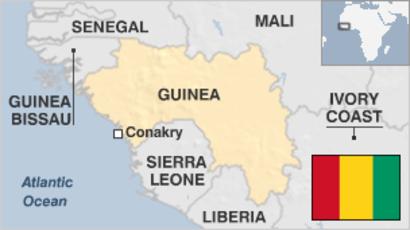
Business Models of Piracy – Somalia & Niger Delta

The decline in Somali piracy (which, according to a recent World Bank report, may at its peak have cost the world up to $18 billion a year in extra shipping expenses and lost trade) is partly the result of increasingly sophisticated co-ordination by international naval task-forces. Shipping companies are also making their vessels harder to attack thanks to a range of defensive measures, such as razor wire around decks, high-pressure hoses and maintaining speeds that make boarding hazardous. Armed security guards on many of the ships transiting pirate-infested waters have helped too.But the pirates could still make a comeback. The cost of deterring them is high. Shipping companies may lower their guard if they think the threat has passed, and patrolling naval forces could be needed elsewhere. And although Somali piracy has faded, west Africa has seen a surge in attacks on ships passing through the Gulf of Guinea.

Tom Patterson, a maritime security expert at Control Risks, a consultancy, says these pirates, who largely come from militant groups in the Niger Delta, have a different business model to their Somali counterparts. They tend to hold ships for about two to five days, removing as much of their cargo as possible (usually gas oil) and then auctioning it to the highest bidder. Hostages are taken if potentially valuable. This week five Poles and Russians, held since April 25th when pirates attacked the German-operated City of Xiamen container ship off Nigeria’s coast, were released, doubtless after a ransom payment.

International naval forces are unlikely to intervene. Nigeria has a decent navy of its own which claims to be upping its efforts to contain piracy. But foreign diplomats believe that some military officials turn a blind eye to thefts in return for a share of the spoils

Hijackings on the high seas: Westward Ho!, Economist, May 18, 2013, at 67

Tax Havens under Attack

[In] the Cayman Islands,  corruption would have been high on the list of election issues in a society where “everybody expects that you are going into politics to make your money”, as a former auditor-general recently put it. But there is plenty more to worry Caymanians and the inhabitants of Britain’s other remaining scraps of empire in the Caribbean: Anguilla, the British Virgin Islands (BVI), Montserrat and the Turks and Caicos Islands. Tourism and international finance have brought prosperity but the “twin pillars” are showing cracks. Fiscal fumbling has compounded the problem and has strained relations with Britain, which has long provided an economic backstop. The region’s two big tax havens, Cayman and the BVI, are under attack as never before.

The world economic slowdown hit these small, open economies hard…. In some cases Britain has pushed for income taxes to supplement the fees and indirect taxes that the territories rely on. But these do not go down well with footloose offshore types. Under pressure from the Foreign Office, Cayman’s government last year proposed a 10% levy for foreigners, who make up half the 38,000 workforce. This was scrapped when businesses squealed. Wary of scaring away business, the BVI has not raised the $350 fee for incorporation since 2004.

Avoiding fee rises is seen as important at a time when tax havens are under bombardment, especially from Europe. The five territories, Bermuda and others have been arm-twisted into backing a multilateral scheme for the automatic exchange of tax information. A longer-term threat is the growing international call for public registration of the “beneficial” (ie real) owners of companies and trusts. Standards must be applied evenly, says Orlando Smith, premier of the BVI, “otherwise, businesses will simply go to other jurisdictions.”

Offshore optimists note that China and Russia, whose citizens are big users of Caribbean havens, have not signed up to the information-sharing pact. But remaining attractive to clients while complying with ever more stringent international rules is “an increasingly difficult needle to thread”, says Andrew Morriss of the University of Alabama. No wonder the territories are trying to diversify away from finance, which in the BVI’s case accounts for 60% of government revenues. Anguilla is looking at fishing, Cayman toying with medical tourism. But hip replacements will not be as lucrative as hedge funds.

Britain is gently encouraging these efforts, while recognising that, as an official puts it, “There isn’t a long list of options.” It is trying to improve governance, too. After it threatened to veto a Cayman port project which had been awarded to a Chinese company without an open tender, bidding was restarted. Britain retains the power to block laws, suspend constitutions and dismiss governments. The Turks and Caicos constitution has been suspended twice, most recently in 2009 after an inquiry found “a high probability of systemic corruption”. This led to three years of direct rule by the British-appointed governor.

Putting your man in charge is one thing, putting money on the table quite another. To avoid it, Britain will have to play its hand carefully. It has to be seen to join the likes of France and Germany in taking a firm stand against offshore financial shenanigans, especially now that the prime minister, David Cameron, has made tax and transparency themes of this year’s G8 agenda. On May 20th he told Britain’s dependencies to “get [their] houses in order”. But if the havens lose their cash cow, they might have to go cap-in-hand to London. “Taxpayers Bail Out Tax Havens” is the last headline Mr Cameron wants to see.

The Caribbean: Treasure islands in trouble, Economist, May25, 2013, at 35

Blackstone, China, Secrecy: Guyana

The government of Guyana wants to move forward with an $840m project at Amaila Falls, deep in the forested interior. At full capacity of 165MW, it could supply more power than Guyana’s present needs.  The lead developer is Sithe Global, part of the Blackstone Group. Sithe wants a guaranteed 19% return on its equity stake, and plans to start construction this year. China Railway First Group signed an engineering contract in September. The China Development Bank will lend most of the money. The Inter-American Development Bank has been asked to chip in $175m; the World Bank was initially involved, but has pulled out.

Amaila’s supporters point out that it will flood less than 55 square km (21 square miles). No villages will be displaced and little wildlife will be disturbed. Guyana would no longer rely on fossil fuels for electricity. After two decades, ownership would pass to the government, construction costs paid off.

Opponents worry that clean electricity will not come cheap. Guyana Power and Light (GPL), the state-owned electricity company, will pay about $100m a year to the Amaila consortium. Electricity bills are unlikely to fall (three people were killed last year in protests over electricity charges). And Amaila’s power may not be reliable. The El Niño weather pattern can bring a year-long drought. In normal years, the plant will run below capacity between October and April. GPL will have to pay for backup thermal power. The IMF has urged “careful consideration of the [financial] risks”.

Plans to build Amaila date from 1997, though Sithe only got involved in 2009. The estimated cost has risen steadily. An access road is unfinished. There is as yet no economic feasibility study for the project; when completed, the study will remain confidential, as is GPL’s outline power-purchase agreement. Opposition parties complain that the government is being “secretive” about Amaila. On April 24th they blocked funds for a government equity-stake in the project. If Amaila is as beneficial as its backers claim, an open debate might generate broader support for the project, and cut its $56m bill for political risk insurance.

Hydropower in Guyana: Shrouded in secrecy, Economist, May, 4, 2013, at 39

Mining Companies Love Least Developed Countries

An expert panel led by Kofi Annan, a former UN secretary-general, looked at five deals struck between 2010 and 2012, and compared the sums for which government-owned mines were sold with independent assessments of their value. It found a gap of $1.36 billion, double the state’s annual budget for health and education. And these deals are just a small subset of all the bargains struck, says the report, which Mr Annan presented in Cape Town, South Africa, on May 10th.

The report highlights some puzzling details. For instance ENRC, a London-listed Kazakh mining firm, waived its rights to buy out a stake in a mining enterprise owned by Gécamines, Congo’s state miner, only to acquire it for $75m from a company owned by Dan Gertler, an Israeli businessman, which had paid $15m for it just months earlier. Mr Gertler is close to Joseph Kabila, Congo’s president. ENRC, which is being investigated by the Serious Fraud Office in Britain, was Congo’s third-largest copper producer last year. Both ENRC and Mr Gertler deny wrongdoing.

African countries often fail to collect reasonable taxes on mining, says Mr Annan’s panel. For example, Zambia’s copper exports were worth $10 billion in 2011, but its tax receipts from mining were a meagre $240m. The widespread use by mining firms of offshore investment vehicles as conduits for profits creates scope for tax avoidance. Their use is not restricted to rich-world companies. Much of the oil that Angola ships to China is via a company called the China International Fund. Its trading prices are not made public…

Congo’s prime minister, Matata Ponyo Mapon, promises change. In January 2013… Mr Ponyo said he would rein in the state-owned mining companies and increase transparency in the industry. “We must avoid situations where we’re not publishing our mining contracts, where our state assets are undervalued, and where the government doesn’t know what its state mining companies are doing,” he told miners and officials at a conference in January….

Last year miners in Congo, which include Freeport-McMoRan and Glencore Xstrata, shipped $6.7 billion-worth of copper and cobalt from the country.

Business in the Democratic Republic of Congo: Murky minerals, Economist, May 18, 2013, at 74


Bay of Bengal: fishermen v. port builders

Bangladesh’s Chittagong, has… become a bottleneck. The Bangladeshis are modernising it… China is putting $200m towards upgrading the airport at Cox’s Bazar, the country’s southernmost tip, to attract investment and tourists.  Myanmar’s …new government, keen for foreign inflows to help rebuild the economy, has been approving projects that sat idle for years. Sittwe is one, but it looks small compared with the Dawei project on Myanmar’s Tenasserim coast… a deepwater port, industrial zone and highways to connect it with distant Bangkok, estimated to cost $8.5 billion.Thailand’s rulers dabbled for centuries with the idea of building a canal across the Kra isthmus, which would link their own gulf directly to the Andaman Sea and save days of costly shipping through the Strait of Malacca. Dawei should do the trick…. The Japanese are taking advantage of Myanmar’s opening to build a riverine port called Thilawa, south of Yangon.

The Chinese are exploring ways round their own Malacca-strait dilemma. They have been building new oil and gas pipelines across the whole of Myanmar starting from a new port-terminal at Kyaukphyu, near Sittwe….China’s activity in the Bay of Bengal is purely “defensive” [some say] but Indians versed in the “string of pearls” theory, which sees Chinese-built ports encircling India, will not be much comforted.

Amid the sometimes airy speculation, it is relatively easy to predict the effects on the repurposed waters of the bay. Yugraj Yadava, the director of an environmental watchdog in Chennai, says increased shipping is already eroding traditional livelihoods and polluting the sea. About 31% of the world’s coastal fishermen live and work on the Bay of Bengal, and they stand to lose huge tracts to the port-builders (and to rising sea levels, too). Mr Yadava says the bay still has some of the world’s healthiest natural fisheries, but they are under threat, not least from non-native species that stow away in long-haulers’ ballast.

Collisions between fishing vessels and commercial ships are becoming more frequent, as are snagged nets. All this will probably accelerate in the next few years. Before the Bay of Bengal falls victim to its new-found popularity, it might be good if some of its beneficiaries were to build a transnational maritime authority, to limit the damage.

Excerpts, The Bay of Bengal: New bay dawning, Economist,Apr. 27, 2013, at 40

The Risk of Unburnable Carbon

Several  reports suggest that markets are overlooking the risk of “unburnable carbon”. The share prices of oil, gas and coal companies depend in part on their reserves. The more fossil fuels a firm has underground, the more valuable its shares. But what if some of those reserves can never be dug up and burned?

If governments were determined to implement their climate policies, a lot of that carbon would have to be left in the ground, says Carbon Tracker, a non-profit organisation, and the Grantham Research Institute on Climate Change, part of the London School of Economics. Their analysis starts by estimating the amount of carbon dioxide that could be put into the atmosphere if global temperatures are not to rise by more than 2°C, the most that climate scientists deem prudent. The maximum, says the report, is about 1,000 gigatons (GTCO2) between now and 2050. The report calls this the world’s “carbon budget”.

Existing fossil-fuel reserves already contain far more carbon than that. According to the International Energy Agency (IEA), in its “World Energy Outlook”, total proven international reserves contain 2,860GTCO2—almost three times the carbon budget. The report refers to the excess as “unburnable carbon”.

Most of the reserves are owned by governments or state energy firms; they could be left in the ground by public-policy choice (ie, if governments took the 2°C target seriously). But the reserves of listed oil companies are different. These are assets developed using money raised from investors who expect a return. Proven reserves of listed firms contain 762GTCO2—most of what can prudently be burned before 2050. Listed potential reserves have 1,541GTCO2 embedded in them.

So companies and governments already have far more oil, gas and coal than they need (again, assuming temperatures are not to rise by more than 2°C). Logically, the response to this would be for governments to leave their reserves untouched and for companies to run theirs slowly down, returning more of what they earn to shareholders. Neither of these things is happening. State-owned companies are taking an increasing share of total energy output. And in 2012, says Carbon Tracker, the 200 largest listed oil, gas and coal companies spent five times as much—$674 billion—on developing new reserves as they did returning money to shareholders ($126 billion). ExxonMobil alone plans to spend $37 billion a year on exploration in each of the next three years.

Such behaviour, on the face of it, makes no sense. One possible explanation is that companies are betting that government climate policies will fail; they will be able to burn all their reserves, including new ones, after all. This implies that global temperatures would either soar past the 2°C mark, or be restrained by a technological fix, such as carbon capture and storage, or geo-engineering.Recent events make such a bet seem rational. On April 16th the European Parliament voted against attempts to shore up Europe’s emissions trading system against collapse. The system is the EU’s flagship environmental policy and the world’s largest carbon market.  Putting it at risk suggests that Europeans have lost their will to endure short-term pain for long-term environmental gain. Nor is this the only such sign. Several cash-strapped EU countries are cutting subsidies for renewable energy. And governments around the world have failed to make progress towards a new global climate-change treaty. Betting against tough climate policies seems almost prudent.

The markets are [also] mispricing risk by valuing companies as if all their reserves will be burned. Investors treat reserves as an indicator of future revenues. They therefore require companies to replace reserves depleted by production, even though this runs foul of emission-reduction policies. Fossil-fuel firms live and die by a measure called the reserve replacement ratio, which must remain above 100%. Companies see their shares marked down if the ratio falls, even when they pull the plug on dodgy, expensive projects. This happened to Shell, for example, when it suspended drilling in the Arctic in February….

At the moment neither public policies nor markets reflect the risks of a warmer world.

Energy Firms and Climate Change: Unburnable Fuel, Economist, May 4, 2013, at 68

China – Australia Dependency

China’s demand for iron and coal has helped to turn it into Australia’s biggest trading partner and to keep Australia more economically robust than most other rich countries. But in some parts of the country the new relationship with China came as a reminder of the unwelcome side-effects of the boom… Chinese trade not only helped Australia survive the global downturn. It has also boosted the currency’s strength, and made it harder for manufacturers to find markets for their exports. The problem is unevenly distributed around the country. ‘

South Australia has suffered the greatest pain: in no other state does manufacturing account for such a big share of the economy…. Five years ago, Mitsubishi closed its plant in Adelaide. Australia’s remaining carmakers, Holden, Ford and Toyota, have shed jobs steadily since then. Australians are buying imported cars more cheaply than ever, especially from Japan; their dollar has risen by 26% against the yen since October.  Even wine, South Australia’s third-biggest export, has suffered: exports in fiscal 2012 dropped in value by A$62m ($65m), or 2%. Codan, an electronics company based in Adelaide, has done better. By making many high-tech products in Malaysia, it has been able to protect itself from the strong Aussie dollar.

The Australian dollar: Resources boomerang, Economist, Apr. 20, 2013, at 44

US Government Lobbying for Biotechnology Industry

American diplomats lobbied aggressively overseas to promote genetically modified (GM) food crops such as soy beans, an analysis of official cable traffic revealed on Tuesday.  The review of more than 900 diplomatic cables by the campaign group Food and Water Watch showed a carefully crafted campaign to break down resistance to GM products in Europe and other countries, and so help promote the bottom line of big American agricultural businesses.

The cables, which first surfaced with the Wikileaks disclosures two years ago, described a series of separate public relations strategies, unrolled at dozens of press junkets and biotech conferences, aimed at convincing scientists, media, industry, farmers, elected officials and others of the safety and benefits of GM producs…The public relations effort unrolled by the State Department also ventured into legal terrain, accotrding to the report. US officials stationed overseas opposed GM food labelling laws as well as rules blocking the import of GM foods. The report notes that some of the lobbying effort had direct benefits. About 7% of the cables mentioned specific companies, and 6% mentioned Monsanto. “This corporate diplomacy was nearly twice as common as diplomatic efforts on food aid,” the report said….

In some instances, there was little pretence at hiding that resort to pressure – at least within US government circles. In a 2007 cable, released during the earlier Wikileaks disclosures, Craig Stapleton, a friend and former business partner of George Bush, advised Washington to draw up a target list in Europe in response to a move by France to ban a variety of GM Monsanto corn.  “Country team Paris recommends that we calibrate a target retaliation list that causes some pain across the EU since this is a collective responsibility, but that also focuses in part on the worst culprits,” Stapleton wrote at the time.”The list should be measured rather than vicious and must be sustainable over the long term, since we should not expect an early victory. Moving to retaliation will make clear that the current path has real costs to EU interests and could help strengthen European pro-biotech voices,” he wrote.

Excerpts, Suzanne Goldenberg,Diplomatic cables reveal aggressive GM lobbying by US officials, Guardian, May 15, 2013

Choking Uranium Markets to Stop Nuclear Weapons

Making nuclear weapons requires access to materials—highly enriched uranium or plutonium—that do not exist in nature in a weapons-usable form.   The most important suppliers of nuclear technology have recently agreed guidelines to restrict access to the most sensitive industrial items, in the framework of the Nuclear Suppliers Group (NSG). Nevertheless, the number of countries proficient in these industrial processes has increased over time, and it is now questionable whether a strategy based on close monitoring of technology ‘choke points’ is by itself a reliable barrier to nuclear proliferation.  Time to tighten regulation of the uranium market?

Not all the states that have developed a complex nuclear fuel cycle have naturally abundant uranium. This has created a global market for uranium that is relatively free—particularly compared with the market for sensitive technologies….

Many African states have experienced increased investment in their uranium extractive sectors in recent years. Many, though not all, have signed and ratified the 1996 African Nuclear Weapon Free Zone (Pelindaba) Treaty, which entered into force in 2009. Furthermore, in recent years, the relevant countries have often worked with the IAEA to introduce an Additional Protocol to their safeguards agreement with the agency…

One proliferation risk inherent in the current system is that inadequate or falsified information connected to what appear to be legitimate transactions will facilitate uranium acquisition by countries that the producer country would not wish to supply….

A second risk is that uranium ore concentrate (UOC) is diverted, either from the site where it was processed or during transportation, so the legitimate owners no longer have control over it. UOC is usually produced at facilities close to mines—often at the mining site itself—to avoid the cost and inconvenience of transporting large quantities of very heavy ore in raw form to a processing plant.,,,UOC is usually packed into steel drums that are loaded into standard shipping containers for onward movement by road, rail or sea for further processing. The loss of custody over relatively small quantities of UOC represents a serious risk if diversion takes place regularly. The loss of even one full standard container during transport would be a serious proliferation risk by itself. There is thus a need for physical protection of the ore concentrate to reduce the risk of diversion at these stages.

A third risk is that some uranium extraction activity is not covered by the existing rules. For example, uranium extraction can be a side activity connected to gold mining or the production of phosphates. Regulations should cover all activities that could lead to uranium extraction, not only those where uranium extraction is the main stated objective.

Restricting access to natural uranium could be an important aspect of the global efforts to obstruct the spread of nuclear weapons

Excerpts, from  Ian Anthony and Lina Grip, The global market in natural uranium—from proliferation risk to non-proliferation opportunity, SIPRI, Apr. 13, 2013

Multinational Corporations in US Courts: Kiobel v. Shell

The Alien Tort Statute (ATS)… grants American district courts jurisdiction over “any civil action by an alien for a tort only, committed in violation of the law of nations or of a treaty of the United States”. At the age of 190 it sprang back to life on April 6th 1979, when it was used to allow two Paraguayans to sue a former Paraguayan policeman in an American court for acts of torture committed in Paraguay.Since then, roughly 150 lawsuits have been filed against American and foreign corporations for actions committed around the world. Four local plaintiffs used the ATS to sue Unocal in a federal court in Los Angeles for human-rights violations allegedly committed during the construction of an oil pipeline in Myanmar. A human-rights organisation used it to sue Yahoo on behalf of two Chinese democracy activists for actions committed in China by a subsidiary. ATS suits against DaimlerChrysler and Rio Tinto, among others, are pending. Though most ATS cases have been dismissed or settled, the costs of settlements can be high and the negative publicity damaging.

Multinational companies will therefore cheer the Supreme Court’s unanimous decision in Kiobel v Royal Dutch Petroleum (Shell), released on April 17th, 2013. It dramatically limits the ability of plaintiffs to file suit against corporations in American courts for actions committed abroad.  The ruling stems from a case brought in New York by 12 Nigerian plaintiffs living in America. They allege that Shell was complicit in human-rights violations—including murder, rape, theft and destruction of property—committed by Nigeria’s armed forces in the region of Ogoniland. A federal appeals court dismissed their suit, arguing that the ATS provides no grounds for corporate-liability lawsuits. But as the 150 ATS suits show, other courts have disagreed. The Supreme Court agreed to hear the case in order to settle the question.

In an earlier ruling, in 2004, the court cautiously ruled that the ATS permitted lawsuits for “a modest number of international law violations”, such as piracy and crimes involving ambassadors, which would have been recognised when it was adopted. The court’s Kiobel ruling goes much further. It holds that the ATS does not apply to actions committed by foreign companies, and noted a strong presumption against applying American law outside the United States, “There is no indication,” wrote John Roberts, the chief justice, “that the ATS was passed to make the United States a uniquely hospitable forum for the enforcement of international norms”.  In a separate concurrence, four of the court’s liberals took a slightly softer tack, arguing that the ATS should allow suits that prevent America from becoming “a safe harbour…for a torturer or other common enemy of mankind”. But that reasoning still does not permit foreign nationals to use American courts to sue foreign companies for acts committed on foreign soil.

Extraterritoriality: The Shell game ends, Economist, Apr. 20, 2013, at 34

Foreign Corporate Immunity: Chevron/Canada v. Ecuador

A Toronto judge halted on May 1, 2013 an effort to enforce a $19 billion Ecuadorean judgment against U.S. oil company Chevron Corp in Canada, finding that his Ontario provincial court was the wrong place for the case.  The action is the latest skirmish in a two-decade conflict between Chevron and residents of Ecuador’s Lago Agrio region over claims that Texaco, which Chevron acquired in 2001, contaminated the area from 1964 to 1992.

Citing Chevron’s promise to fight the plaintiffs until “hell freezes over, and then fight it out on the ice,” Justice David Brown of the Ontario court foresaw a “bitter, protracted” battle that would be costly and time consuming.  “While Ontario enjoys a bountiful supply of ice for part of each year, Ontario is not the place for that fight,” Brown wrote in his ruling on Wednesday. “Ontario courts should be reluctant to dedicate their resources to disputes where, in dollars and cents terms, there is nothing to fight over.”
Alan Lenczner, principal lawyer in Toronto for the Ecuadorean plaintiffs, said they would definitely appeal, arguing that a multinational company could not be immune from enforcement in a country where it earns so much. “Chevron Corp itself earns no money,” he said in a statement. “All its earnings and profits come from subsidiaries including, importantly, Chevron Canada.”  Chevron Canada’s assets are worth more than $12 billion, the plaintiffs had said, and alongside separate actions in Argentina and Brazil, they had sought to persuade the Ontario court to collect the damages awarded to them by the South American court.

Chevron, the second-largest U.S. oil company, has steadfastly refused to pay, saying the February 2011 ruling by the court in Lago Agrio was influenced by fraud and bribery. A related fraud case goes to trial in New York in October.  The Supreme Court of Canada has ruled that the country’s courts can recognize and enforce foreign judgments in cases where there is a “reasonable and substantial connection” between the cause of the action and the foreign court. Chevron called Brown’s ruling a “significant setback” to the Ecuadoreans’ strategy of seeking enforcement against subsidiaries that were not parties to the Ecuador case.  “The plaintiffs should be seeking enforcement in the United States – where Chevron Corporation resides. In the U.S., however, they would be confronted by the fact that eight federal courts have already found the Ecuador trial tainted by fraud,” Chevron said in a statement. Last month, a consulting firm whose work helped lead to the $19 billion award against Chevron disavowed some environmental claims used to obtain the judgment.

Excerpt, Judge halts Chevron-Ecuador enforcement action in Canada, Reuters, May 1, 2013

Tax Havens: Micro-States in Europe

Armed with a cache of more than 2m documents, leaked from two offshore service providers, a group of investigative journalists has spent the past week publishing articles that lift the lid on thousands of companies and trusts set up in the British Virgin Islands and Cook Islands. The vast client list ranges from Asian politicians to Canadian lawyers—and no fewer than 4,000 Americans. For an industry that peddles secrecy and likes to operate in the shadows it is all rather embarrassing.

Opinions vary on the impact of the leaks. Tax campaigners have cheered it as a “game changer”. Offshore operators counter that most of the activity uncovered is legal. So what if President François Hollande’s former campaign treasurer has a Cayman Islands company? So do thousands of banks and hedge funds. Nevertheless, the affair will add to international scrutiny of tax havens. The pressure on them has grown as governments scramble to plug fiscal holes and push for the systematic exchange of tax information across borders. Germany’s finance minister welcomed the leak, hopeful that it would provide leverage to force more co-operation from “those who have been more reticent” to rein in the havens.

Faced with an end to the days of easy money, offshore jurisdictions are being forced to rethink their strategies. One of the more proactive has been Liechtenstein, nestled between Switzerland and Austria. The principality has long been popular with European tax dodgers, but growth accelerated when Swiss banks hawked Liechtenstein foundations to clients worldwide. This lucrative niche was damaged in 2008 when the former head of Germany’s postal service and many others were caught hiding money in the principality.

Under pressure from Germany and America, Liechtenstein buckled, agreeing to dilute bank secrecy and to exchange tax information. It has since signed many bilateral tax agreements and clamped down on money-laundering. The local financial industry has paid a high price for this. Liechtenstein banks’ client assets declined by almost 30% in the five years to 2011, to SFr110 billion ($118 billion)…

Other offshore centres must also attempt to square this circle. Next may be Luxembourg, a leader in offshore banking and tax avoidance. Bowing to greatly intensified pressure from its neighbours since the Cyprus debacle, the Grand Duchy has dropped its long-held opposition to swapping information about non-resident depositors with other EU countries. Jean-Claude Juncker, the prime minister, said the policy shift was about “following a global movement”, not caving in to German demands. Whether automatic information exchange can be introduced “without great damage”, as he confidently declared, remains to be seen.

Offshore finance: Leaky devils, Economist, April 13, 2013, at 71

Tibet – Mineral Resources, Fragile Ecology

The ecology of the Tibetan plateau, noted the Ministry of Land and Resources two years ago, is “extremely fragile”. Any damage, it warned, would be difficult or impossible to reverse. But, it went on, the China National Gold Group, a state-owned company, had achieved “astonishing results” in working to protect the environment around its mine near the region’s capital, Lhasa. On March 29th at least 83 of the mine’s workers lay buried under a colossal landslide. Its cause is not yet certain, but critics of Tibet’s mining frenzy feel vindicated.

The disaster at the Jiama copper and gold mine, about 70km (45 miles) north-west of Lhasa, has clearly embarrassed the government in Beijing. According to China Digital Times, a California-based media-monitoring website, the Communist Party ordered newspapers to stick to reports issued by the government and the state-owned news agency, Xinhua.

Foreign reporters are rarely allowed into Tibet, least of all to cover sensitive incidents. The official media have avoided speculation about any possible link between the landslide and mining activities in the area. They say the landslide covered a large area with 2m cubic metres of rubble. By the time The Economist went to press, 66 bodies had been pulled out by teams of rescuers with sniffer dogs. The high altitude and lack of oxygen made rescue work hard. A deputy minister of land and resources, Xu Deming, said preliminary investigations had shown that the landslide was caused by a “natural geological disaster”. Fragments of rock left behind by receding glaciers are being blamed, though officials do not explain why the workers’ camp was set up so close to such an apparent hazard.

The Tibetan government-in-exile based in India says it fears the disaster was caused by work related to the mine, which appears to have grown rapidly since construction began in 2008. It was formally opened two years later, at a ceremony attended by Tibet’s most senior officials. The $520m investment was described at the time as the biggest in Tibet’s mining industry by a firm belonging to the central government. The mine is owned by China Gold International Resources, a company listed in Hong Kong and Toronto. China National Gold Group is the controlling shareholder.

Tibet has been trying hard in recent years to encourage such companies to dig up the plateau’s metals and minerals. It has a lot of them to offer: China’s biggest reserves of copper and chromite (used in steel production), among the world’s biggest of lithium (used to make batteries), as well as abundant reserves of uranium, gold, borax (a component of ceramics and glass) and oil. Extracting these, however, often involves boring into a landscape considered sacred by Tibetans.

The Jiama mine, in a valley known to Tibetans as Gyama and revered as the birthplace of a seventh-century Tibetan king, has been the focus of protests by locals angered by environmental and other issues. Water from the valley flows into the Lhasa river. Woeser, a Tibetan activist based in Beijing, has blogged about locals’ fear that their water supplies will be polluted.

Tibetan resentment has been fuelled by the mining industry’s failure to provide much direct employment.

Excerpts, Mining in Tibet: The price of gold, Economist, April 6, 2013, at 54

Gas as Tool of Foreign Policy: Gazprom

The good times for Gazprom once seemed like they would never end. The world’s largest natural-gas producer, founded out of the old Soviet gas ministry, enjoyed sky-high gas prices for years. The gas flowed along pipelines into Europe; the profits flowed back. Gazprom began work on a $1.9 billion headquarters in St Petersburg and acted as a bottomless wallet for Russia’s rulers. Whatever problems it encountered, it could “drown with money”, as Natalia Volchkova of the New Economic School in Moscow puts it.  All this is now under threat. Its ageing gasfields are in decline. Thanks to America’s shale boom, gas is more plentiful on the world market. Gazprom’s European customers are realising that they have other choices. The prices it can charge are falling, and with them the firm’s prospects.

Years of easy money have made Gazprom fat and slow. It dominates its domestic market, producing 75% of Russia’s gas. It enjoys a monopoly over exports of the stuff. Until recently, it had a tight grip on western Europe, where it supplies around 25% of gas. It retains an even tighter grip on former Soviet-bloc countries in eastern Europe. For a long time, this insulated Gazprom from shifts in global gas markets.

Gazprom is not a normal company. It serves two masters. As a firm that issues shares to outside investors, it should in theory strive to maximise profits in the long run. But since it is majority-owned by the Russian state, it pursues political goals, too.  In practice, it serves one master more assiduously than the other. As President Vladimir Putin consolidated his power in the early 2000s, he built Gazprom into a main instrument of Russia’s new state capitalism. He appointed allies to top positions. He used Gazprom as a tool of foreign policy, for example by cutting off gas supplies to Georgia, Ukraine, Belarus and Moldova during political rows.  Gazprom’s deep pockets have helped Mr Putin at home, too. It sells gas cheaply in Russia, so that the poor do not freeze in winter. Oddly for an energy company, it has bought television stations and newspapers, all of which are now friendly to the Kremlin. Mikhail Krutikhin of RusEnergy, a consultancy, says, “Gazprom has one manager: Putin.”

With friends in high places, Gazprom has enjoyed low taxes and privileged access to gasfields. But its costs are startlingly high…And some projects favoured by Mr Putin are of questionable economic value. For example, he is dead set on building a $21-billion South Stream pipeline between southern Russia and Austria via eastern Europe. This project has political appeal because it would bypass troublesome Ukraine as the main transit route for gas to Europe. But given weak prices and demand, it is “commercial idiocy”, says Mr Krutikhin. The opening in 2011 of Nord Stream, an offshore pipeline to Germany, was a diplomatic coup for Mr Putin, but it is still running far below capacity….

Gas on the spot market is often much cheaper than Russian gas delivered under long-term contracts… Because so many of its customers are tied to contracts, the full effects of the global gas glut on Gazprom’s bottom line will not be felt straight away….   The final threat to Gazprom’s old way of doing business is legal. An antitrust probe launched by the European Commission alleges that Gazprom is using its dominant position in central and eastern Europe to restrict competition and hike prices. If it loses the case, it could face a fine of up to $14 billion and lose the mighty lever of being able to charge some European countries more than others.  An adverse ruling might also threaten its strategy of trying to dominate the European gas market by owning both the supplies and the means of distributing them. Gazprom has quietly bought gas pipelines and storage facilities. It has tried to strike deals whereby it lends money to impoverished European utilities in order to secure their custom. If this strategy stops working, Gazprom will no longer be such a potent foreign-policy tool for the Kremlin….

Gazprom’s future may involve more robust competition even at home. Two domestic rivals have emerged: Novatek, a gas producer part owned by Gennady Timchenko, an old acquaintance of Mr Putin’s, and Rosneft, a state-owned oil firm led by Mr Putin’s trusted adviser, Igor Sechin. Put together, non-Gazprom firms now account for a quarter of all Russian gas production….

The other way to get gas to Asia would be via pipeline. The obvious destination is China, which sits on Russia’s doorstep and is potentially the world’s biggest market for gas. The two countries have haggled unsuccessfully for a decade. In February they revealed they had agreed to everything related to pipeline exports apart from the price. China has signed up to import gas from Central Asia, Australia, the Middle East and west Africa; almost everywhere, in fact, except Russia. China refuses to pay Asian prices; Gazprom won’t budge.

Gazprom: Russia’s wounded giant, Economist, Mar. 30, 2013, at 69

Hunting Down Somali Pirates: British Empire

Times are tough and getting worse for Somali pirates, as their targets take countermeasures. The number of attacks off the Horn of Africa tumbled from 236 in 2011 to no more than 72 in 2012, according to the International Maritime Bureau, a body that monitors crime at sea.

Now a private naval effort is adding to their woes. A company called Typhon will use a 10,000 tonne “mother ship” to accompany convoys of merchant vessels. With 60 mostly armed, mostly British ex-soldiers on board, it will deploy speedboats and unmanned drones to watch and intercept hostile boats.  Anthony Sharp, Typhon’s boss, says customers will find that more efficient than putting armed guards on every ship. It will also spare them keeping guns on board (which is tricky in law). Typhon plans to have three large ships by the year end, with at least one based in the Gulf of Guinea, a hotspot for pirate attacks last year, and ten by 2016.

Its backers include Simon Murray, a former foreign legionnaire who is now chairman of Glencore, a commodities giant due soon to merge with Xstrata, a mining behemoth. The new outfit will be a big potential customer for Typhon. But Mr Sharp downplays comparisons with Britain’s East India Company, which ran a private empire with its own navy. His is “actually quite a boring business,” he claims. Not for the pirates.

Piracy: Privateers,Economist, Jan.12, 2013, at 54

Rare Earths Pollution: Australia, Malaysia and Lynas Corp.

According to the Oeko Institute, a non-profit association: The facility for refining Australian ore concentrate rich in rare earth metals of Lynas Corporation in Malaysia has several deficiencies concerning the operational environmental impacts. The environment is affected by acidic substances as well as from dust particles, which are emitted into the air in substantially larger concentrations than would be state-of-the-art in off-gas treatment in Europe. The storage of radioactive and toxic wastes on site does not prevent leachate from leaving the facility and entering ground and groundwater. For the long-term disposal of wastes under acceptable conditions concerning radiation safety a sustainable concept is still missing. These are the results of a study of Oeko-Institute on behalf of the Malaysian NGO SMSL.

In its facility in Kuantan/Malaysia Lynas refines ore concentrate for precious rare earth metals. These strategic metals are applied for example to produce catalysts…The ore concentrate to be refined in Malaysia additionally contains toxic and radioactive constituents such as Thorium. The NGO commissioned Oeko-Institute to check whether the processing of the ore leads to hazardous emissions from the plant or will remain as dangerous waste in Malaysia.

Storage of wastes insufficient

The storage of wastes, that are generated in the refining process, shall be stored in designated facilities on the site, separately for three waste categories. According to chemist and nuclear waste expert Gerhard Schmidt, there will be problems with the pre-drying of wastes that is of a high Thorium content. “Especially in the wet and long monsoon season from September to January, this emplacement process doesn’t work”, says Schmidt. “The operator has not demonstrated how this problem can be resolved without increasing the radiation doses for workers”.

Additionally the storages are only isolated with a one-millimeter thick plastic layer and a 30 cm thick clay layer. This is insufficient to reliably enclose the several meters high and wet waste masses. “For the long-term management of these wastes Lynas has urgently to achieve a solution”, claims Gerhard Schmidt, and adds: “in no case those wastes should be marketed or used as construction material, as currently proposed by the operator (Lynas) and the regulator (AELB/MOSTI). According to our calculations this would mean to pose high radioactive doses to the public via direct radiation”.

One of the most serious abnormalities is that in the documents relevant data is missing, which prevents reliably accounting for all toxic materials introduced”, says project manager Gerhard Schmidt. “So it is not stated which and to what amount toxic by-products, besides Thorium, are present in the ore concentrate. Also in the emissions of the facility via wastewater only those constituents are accounted for that are explicitly listed in Malaysian water regulation, but not all emitted substances.” The salt content of the wastewater is as high that it is comparable to seawater. This is discharged without any removal into the river Sungai Balok.

The scientists at Oeko-Institute evaluate the detected deficiencies as very serious. Those deficiencies should have been already detected in the licensing process, when the application documents were being checked. However the operator received a construction license in 2008 and a temporary operating license in 2012.

Especially for the safe long-term disposal of the radioactive wastes a suitable site that meets internationally accepted safety criteria has to be selected urgently. A consensus has to be reached with the affected stakeholders, such as the local public and their representatives. “If it further remains open how to manage those wastes in a long-term sustainable manner, a future legacy associated with unacceptable environmental and health risks is generated”, considers Schmidt. “The liability to prevent those risks and to remove the material is so shifted to future generations, which is not acceptable.”

Rare earths are important metals that are used in future technologies such as efficient electro motors, lighting and catalysts. In its study from 2011 “Study on Rare Earths and Their Recycling” Oeko-Institute showed that no relevant recycling of these metals is performed so far. Albeit recent positive developments in this direction: satisfying the prognosticated global requires the extension of the worldwide primary production.

Rare earth refining in Malaysia without coherent waste management concept, Oeko Institute Press Release, Jan. 28, 2013

See also  Oeko Report on Lynas (pdf)e

The Arctic Challenger: ready for Arctic oil spills

Shell Oil has been building and testing equipment designed for the Arctic Ocean in Puget Sound, Seattle, United States.  In September, a key test of underwater oil-spill equipment was a spectacular failure.  It forced the energy giant to postpone drilling into oil-bearing rocks beneath the Arctic Ocean until next summer. Shell and its federal regulators have been tight-lipped about the failed test.  But a freedom-of-information request reveals what happened beneath the surface of Puget Sound.

Before Shell can drill for oil in the Arctic Ocean, it needs to prove to federal officials that it can clean up a massive oil spill there. That proof hinges on a barge being built in Bellingham called the Arctic Challenger.  The barge is only one component of Shell’s plans for handling oil spills off the remote north coast of Alaska. But the Obama Administration won’t let oil drilling get under way until the 36-year-old barge and its brand new oil-spill equipment are in place,  On board the Arctic Challenger is a massive steel “containment dome.” It’s a sort of giant underwater vacuum cleaner. If efforts to cap a blown-out well don’t work, the dome can capture spewing oil and funnel it to a tanker on the surface.

The Arctic Challenger passed several US Coast Guard tests for seaworthiness in September. But it was a different story when its oil-spill containment system was put to the test in 150-foot-deep water near Anacortes, Washington.  The federal Bureau of Safety and Environmental Enforcement required the test of the oil-spill system.

According to BSEE internal emails obtained by KUOW, the containment dome test was supposed to take about a day. That estimate proved to be wildly optimistic.
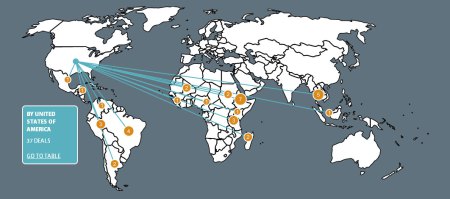
•Day 1: The Arctic Challenger’s massive steel dome comes unhooked from some of the winches used to maneuver it underwater. The crew has to recover it and repair it.

•Day 2: A remote-controlled submarine gets tangled in some anchor lines. It takes divers about 24 hours to rescue the submarine.

•Day 5: The test has its worst accident. On that dead-calm Friday night, Mark Fesmire, the head of BSEE’s Alaska office, is on board the Challenger. He’s watching the underwater video feed from the remote-control submarine when, a little after midnight, the video screen suddenly fills with bubbles. The 20-foot-tall containment dome then shoots to the surface. The massive white dome “breached like a whale,” Fesmire e-mails a colleague at BSEE headquarters.

Then the dome sinks more than 120 feet. A safety buoy, basically a giant balloon, catches it before it hits bottom. About 12 hours later, the crew of the Challenger manages to get the dome back to the surface. “As bad as I thought,” Fesmire writes his BSEE colleague. “Basically the top half is crushed like a beer can.”

Representatives of Shell Oil and of BSEE declined to answer questions or allow interviews about the mishaps. In an email, Shell spokeswoman Kelly op de Weegh writes:  Our internal investigation determined the Arctic Challenger’s dome was damaged when it descended too quickly due to a faulty electrical connection, which improperly opened a valve. While safety systems ensured it did not hit the bottom, buoyancy chambers were damaged from the sudden pressure change.

Environmental groups say the Arctic Challenger’s multiple problems show that Shell isn’t prepared for an Arctic oil spill.

Excerpt, By John Ryan, Sea Trial Leaves Shell’s Arctic Oil-Spill Gear “Crushed Like A Beer Can”, Kuow.org. Nov. 30, 2012

An Independent Kurdistan? Ask the Oil Companies

Iraq is blessed with abundant oil that is cheap to extract and close to newly built export terminals. Production has hit a three-decade high and continues to rise steadily. By 2035, predicts the International Energy Agency (IEA) Iraqi output could more than double, to 8.3m barrels per day (b/d).  But Western oil firms are increasingly reluctant to play a part in this boom. ExxonMobil appears keen to sell its stake in West Qurna, one of the giant fields in southern Iraq that will provide much of the production growth. Royal Dutch Shell and BP are both still working in the south, but unhappily so. Suffocating bureaucracy and onerous contract terms make life difficult. Heavier-than-expected costs and delays to infrastructure undercut profits.
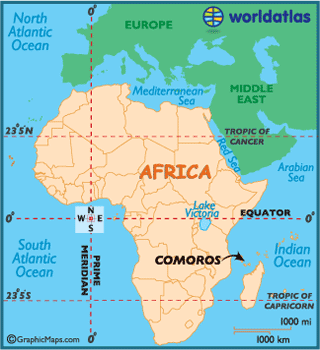
Three years ago when they signed contracts with the Iraqi government, the oil majors were prepared to accept hiccups. But their patience has thinned with the arrival of an alternative source of Iraqi oil. Kurdistan, the semi-autonomous province in the country’s north, has been offering competing and much more lucrative deals. ExxonMobil’s decision last year to acquire six blocks in the region angered the central government, which considers the deal illegal and lays claim to Kurdish oil. But the world’s largest oil company started a trend. In July Total, Chevron and Gazprom all signed contracts with the Kurdistan regional government, potentially dooming their chances of winning future business in the south. BG, a British firm, was in Erbil, the Kurdish capital, on a scouting mission in late October.

“Kurdistan is 11 years ahead of the rest of Iraq in terms of political and commercial development,” says Luay al-Khatteeb, head of the Iraq Energy Institute, a London-based think-tank. Kurdistan’s potential oil reserves of around 45 billion barrels are less than a third of those in southern Iraq. Still, the Kurdish oil minister, Ashti Hawrami, believes output of 1m b/d is possible within three years.

The tricky part is getting the oil to market. The Kurds today export around 200,000 b/d through pipelines controlled by the central government. Mr Hawrami wants to build a new Kurdish-owned pipe to Turkey, feeding long-held dreams of Kurdish independence. That unnerves Turkey which is fighting Kurdish separatists in its south-east. Some Turkish officials seem to acknowledge the possibility of an eventual Kurdish state in northern Iraq and seek to make it commercially dependent on Turkey. Co-operating with the Iraqi Kurds would also generate lucrative transit fees and offer Turkey an alternative to oil from Russia and Iran.

The Iraqi government is pondering how to respond. It could sweeten the terms of its contracts with the oil firms in the south. That might staunch the flow of Western capital to Kurdistan. In the meantime, the main beneficiaries of the majors’ receding interest in southern Iraq are Asian oil firms. Chinese will account for about 2m b/d of Iraq’s production by 2020. Fatih Birol, the IEA’s chief economist, talks of a “Baghdad-to-Beijing” axis.

Iraq’s oil: The Kurdish opening, Economist,Nov. 3, at 49