Author Archives: Stoa

Stealing from Central Banks: hacking attacks

A little-noticed lawsuit details a hacking attack similar to one that stole $81 million from Bangladesh’s central bank, saying cybercriminals stole about $9 million in 2015 from a bank in Ecuador…..…A third attack, from December 2015 at a commercial bank in Vietnam, was detailed last week by the Society for Worldwide Interbank Financial Telecommunication, or Swift. That bank detected the fraudulent requests and stopped the movement of funds, the central bank in Vietnam said.  In the January 2015 Ecuador hack, as with the Bangladesh case, hackers managed to get the bank’s codes for using Swift, the global bank messaging service, to procure funds from another bank, according to court papers.

The Ecuadorean bank, Banco del Austro, filed a lawsuit in New York federal court in 2016 accusing Wells Fargo & Co. of failing to notice “red flags’’ in a dozen January 2015 transactions and to stop them before the thieves transferred about $12 million, most of it to banks in Hong Kong.  Lawyers for the two banks didn’t immediately return phone calls asking to comment about the case and Swift’s complaints that they had failed to notify the messaging network….

There are similarities in method, including thieves accessing the bank’s system to log on to the Swift network through customer sites, and doing so after bankers’ hours, apparently to reduce the likelihood someone would ask questions about specific transactions…

According to that filing on behalf of Banco del Austro, or BDA, “For each of the unauthorized transfers, an unauthorized user, using the Internet, hacked into BDA’s computer system after hours using malware that allowed remote access, logged onto the Swift network purporting to be BDA, and redirected transactions to new beneficiaries with new amounts.” Using that method, just before midnight on Jan. 14, 2015, a payment order made to a Miami company for less than $3,000 was altered to send $1.4 million to an account in Hong Kong, according to the court filing. There were 12 suspect transfers carried out over a 10-day period in January 2015, according to the lawsuit.  BDA’s lawsuit argues Wells Fargo should have noticed several anomalies in the transfers and, at a minimum, asked questions about them.  “The unauthorized transfers were made in unusual times of the day, in unusual amounts, to unusual beneficiaries in unusual geographic locations,’’ the bank’s lawyers argued in the filing. “Despite the numerous anomalies in the unauthorized transfers, [Wells Fargo] inexplicably failed to block them and/or alert BDA of the suspicious activity.’’

Excerpts from DEVLIN BARRETT and KATY BURNE, Now It’s Three: Ecuador Bank Hacked via Swift, Wall Street Journal, May 19, 2016

Nuclear-Powered Aircraft Carrier, India

India’s navy has finalised plans for a nuclear-powered super-carrier, which is scheduled to be built in Kochi with US help.  In preparation for the long-gestation project, estimated for the year 2028, the navy is setting up the building blocks that will identify the aircraft to be based on the carrier.  The carrier is  to be called the INS-Vishal.

Nuclear energy enables a carrier to sail for months without needing to dock for refuelling. The navy wants a nuclear-powered carrier….to enhance its reach beyond territorial waters.  It has determined that the carrier will need a nuclear reactor generating 180MW for propulsion, and may go for two reactors of 90MW each. Talks with the Bhabha Atomic Research Centre (Barc) are at an advanced stage.

The navy has bolstered its case for a nuclear-powered carrier by citing the nuclear deals India has signed not only with the US but also with Japan and Germany, albeit for peaceful uses of nuclear technology…The navy had invited preliminary inquiries from foreign entities for the design and development of the Vishal: DCNS of France, Rosoboronexport of Russia, Lockheed Martin of the US. Within the top brass, however, there is now a congealing of opinion that the US option may be the one to go after.

This is as much because of the technology regime that India promises to enter following the nuclear deals as because the US is actually operating carriers and building them, the latest being the Gerald R Ford class

“In the Arihant (the Indian nuclear submarine now in sea trials) we have gained, with some Russian help, the ability to develop a reactor for our purpose. Barc is confident that it can build for the carrier too,” the officer said…The only Indian operational carrier now is the Vikramaditya. At 45,000 tonnes it has a flight deck that is still too small for the new dimensions of carrier operations the navy is envisaging from the Vishal, the officer said.

Excerpts from Plan for nuclear-driven carrier with US help, the Telegraph (Calcutta) May 16, 2016


Defenses Against the Sea: Bangladesh

Facing the bleak prospect of millions of its citizens being displaced in coming years due to storms and sea level rise caused by climate change, Bangladesh is building up existing coastal embankments in a bid to protect coastal lands and people. On November 2015, the Bangladesh Water Development Board (BWDB) signed a deal with the Chinese firm First Engineering Bureau of Henan Water Conservancy to start work on the Coastal Embankment Improvement Project-1… And as per the agreement, the Chinese firm is helping rebuild four polders in two coastal districts – Khulna and Bagerhat.

Bangladesh is a low-lying delta, making it one of the most vulnerable countries to climate change. The coastal region adjoining the Bay of Bengal is characterised by a vast network of active tidal rivers. The strength of the tides and the flatness of the delta causes the tides to influence river processes a long way upstream in the southern estuaries. And climate change has intensified the tides in recent years.

“We will repair all 139 coastal polders considering the climate-induced changes presumed to take place by 2050 to protect coastal people from recurrent climatic disasters like cyclone and storm surge,” Water Resources Minister Anisul Islam Mahmud told IPS.  He said the water development board is currently working to rebuild 17 coastal embankments in its first phase, and the remaining polders will be repaired gradually.

The Coastal Embankment Improvement Project Phase-1 (CEIP-1) involving 400 million dollars to rebuild 17 polders in six coastal districts – Khulna, Satkhira, Begerhat, Pirojpur, Barguna and Patuakhali. The height of 200-kilometre-long embankments will be increased by one to two metres and 58 regulators will be set up in the first phase.

Since the 1960s, Bangladesh built 139 polders to protect about 1.2 million hectares of land from seawater…

Excerpts from Rafiqul Islam , Raising Walls Against the Sea, IPS News Service, May 12, 2016

Destruction of Chemical Weapons: DARPA

Chemical weapons are banned by treaties, though that hasn’t stopped a few countries from maintaining stockpiles. Right now it’s possible to clean up that mess, but it’s a tremendous amount of work, and expensive work too….[DARPA] has in the works the “Agnostic Compact Demilitarization of Chemical Agents” or ACDC. Their goal: a machine that turns chemical-weapon-tainted soil into fertile soil, that can fit roughly in a shipping container, and is a fraction of the cost to process the chemicals today…

After chemical weapons were used in the Syrian civil war, the Syrian government, under international supervision, revealed their stockpile and turned it over to an international team. That team, using the U.S. Navy’s Cape Ray ship, incinerated and neutralized tons of chemical agents over the better part of a year, while at sea. The cost was around $250 million.

[Southwest Research Institute]’s approach combines a commercially available reforming-engine technology that, along with local soil, can convert organic molecules to non-hazardous components. The engine is designed such that, as part of the destruction process, the organic molecules act as a fuel and efficiently generate recoverable energy that can be converted to electricity. The SwRI process is agnostic to the chemical to be degraded, and is a much greener process than either conventional hydrolysis or incineration, both of which are logistically intensive and require subsequent secondary treatment of large amounts of hazardous waste.

The project is only nine months along. Next year, the team is hopeful they’ll have a demonstration of the technology, and then, when the project’s 36 months are up, they are aiming for a chemical cleaning tool just 1 percent as expensive as the Cape Ray mission. The cost of ACDC, if all goes according to plan, is expected to be just $2.6 million.

Excerpt from Kelsey D. Atherton, DARPA WANTS TO TRANSFORM CHEMICAL WAR SITES INTO FERTILE SOIL, Popular Science, May 12, 2016

Re-Creating the Rhino

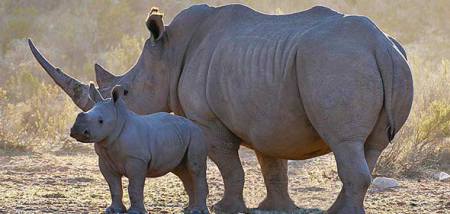
A Sumatran rhinoceros born in Indonesia has given renewed hope to environmentalists looking to save the critically endangered species.  A rhino named Ratu gave birth to the female calf on May 12, 2015, at a rhino sanctuary in the Way Kambas National Park on the island of Sumatra.

The new arrival for 15-year-old Ratu, and her mate Andalas*, follows the couple’s first baby Andatu, who made history in 2012 as the first rhino born in captivity in Indonesia in more than a century.

* Andalas, was born at the Cincinnati Zoo in 2001…. In 2001 he was the first captive Sumatran rhino born in 112 years  He moved to the sanctuary in Indonesia in 2007.

Excerpts from Rare Sumatran rhino born in Indonesia, Reuters,  May 13, 2016

Messaging Secrecy: US Military

The United States Department of Defense and DARPA [seek to establish] a secure messaging system that can provide repudiation or deniability, perfect forward and backward secrecy, time to live/self delete for messages, one time eyes only messages, a decentralized infrastructure to be resilient to cyber-attacks, and ease of use for individuals in less than ideal situations….The messaging platform will transfer messages via a secure decentralized protocol that will be secured across multiple channels, including but not limited to: 1) Transport protocol, 2) Encryption of messages via various application protocols, 3) Customized blockchain implementation of message deconstruction and reconstruction, and decentralized ledger implementation

Excerpts from SBIR.defense business. org

A Barbed Wire for Outer Space

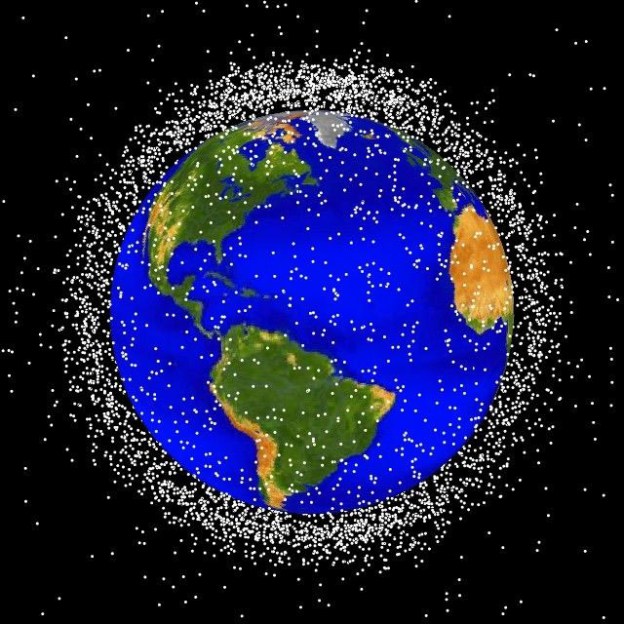
In 2007 a missile launch by the Chinese in 2007 blew up a dead satellite and littered space with thousands of pieces of debris. But it was another Chinese launch  in 2013 that made the Pentagon really snap to attention, opening up the possibility that outer space would become a new front in modern warfare.  This time, the rocket reached close to a far more distant orbit — one that’s more than 22,000 miles away — and just happens to be where the United States parks its most sensitive national security satellites, used for tasks such as guiding precision bombs and spying on adversaries.

The flyby served as a wake-up call and prompted the Defense Department and intelligence agencies to begin spending billions of dollars to protect what Air Force Gen. John Hyten in an interview called the “most valuable real estate in space.”..[I]nstead of relying only on large and expensive systems, defense officials plan to send swarms of small satellites into orbit that are much more difficult to target–GPS III is the next generation of GPS satellites..

At the same time..[a]gencies have begun participating in war-game scenarios involving space combat at the recently activated Joint Interagency Combined Space Operations Center. The Pentagon is even developing what is known as the “Space Fence,” which would allow it to better track debris in space.

National security officials are not only concerned that missiles could take out their satellites but also that a craft’s equipment could be easily jammed. Potential enemies could “dazzle” sensors, temporarily blinding them, or deploy tiny “parasitic satellites” that attach to host satellites and do their worst. That could lead to soldiers stranded on the battlefield with little means of communication or missiles that would not be able to find their targets.  “We have considered space a sanctuary for quite some time. And therefore a lot of our systems are big, expensive, enormously capable, but enormously vulnerable,” said Deputy Defense Secretary Robert O. Work.

Pentagon officials say that Russia and China have been developing the capability to attack the United States in space…Pentagon officials fear its satellites could be sitting ducks. Navy Adm. Cecil Haney, commander of the U.S. Strategic Command, said recently that North Korea has successfully jammed GPS satellites, that Iran was busy building a space program and that “violent extremist organizations” were able to access space-based technologies to help them encrypt communications, among other things.

The Pentagon spends $22 billion on space programs and is investing an additional $5 billion in space efforts this year, including $2 billion for what is known as “space control,” which includes its highly classified offensive programs. Hyten declined to discuss the ways in which the United States is preparing to attack other countries in space. But the United States has had the capability to blow up satellites since 1985, when an F-15 fighter pilot fired a missile into space that took out an old military observation satellite.

Excerpts from  Christian Davenport: A fight to protect ‘the most valuable real estate in space, Washington Post, May 9, 2016

Biometrics Gone Wrong

Despite their huge potential, artificial intelligence and biometrics still very much need human input for accurate identification, according to the director of the Defense Advanced Research Projects Agency.  Speaking at  an Atlantic Council event, Arati Prabhakar said that while the best facial recognition systems out there are statistically better than most humans at image identification, that when they’re wrong, “they are wrong in ways that no human would ever be wrong”….

“You want to embrace the power of these new technologies but be completely clear-eyed about what their limitations are so that they don’t mislead us,” Prabhakar said. That’s a stance humans must take with technology writ large, she said, explaining her hesitance to take for granted what many of her friends in Silicon Valley often assume  — that more data is always a good thing.  More data could just mean that you have so much data that whatever hypothesis you have you can find something that supports it,” Prabhakar said

DARPA director cautious over AI, biometrics, Planet Biometrics, May 4, 2016

Blowing up Fishing Boats: illegal fishing

On April 5th, 2016, Indonesia’s maritime-affairs minister, Susi Pudjiastuti, watched live feed from seven different places as 23 Malaysian and Vietnamese trawlers, seized for illegal fishing in Indonesian waters, were blown to smithereens…

Indonesia is already seething with anger at China’s reaction to an incident last month in which a Chinese coastguard cutter rammed free a Chinese fishing boat as the Indonesian authorities were towing it to port, having just caught it poaching in waters off Indonesia’s Natuna islands…. In fact, it seems almost certain. Indonesia’s possession of the Natunas is undisputed, and under international law the Chinese were well inside its “exclusive economic zone”. Yet China defended the crew by claiming they were in waters that were “traditional Chinese fishing grounds”. The waters are inside the sweeping “nine-dash line” that China draws on its maps (and even passports) to mark its claim over almost the entire South China Sea.

Chinese fishermen have been detained in Japan, the Philippines, Taiwan and Vietnam, all of whose maritime claims overlap with or mirror China’s. But it is not just in contested waters that they get into trouble. Chinese have also been detained in the Russian Far East, North Korea and Sri Lanka in recent years. In 2011 a Chinese fisherman stabbed a South Korean coastguard to death. The next year one was killed by the police in Palau, a tiny Pacific republic. Farther afield, on December of 2015 two dozen African countries called on China to stop illegal fishing off west Africa. And on April 2016 our Chinese fishermen were freed from detention in Argentina.

China’s government sees food security as a priority and fishing as a good source of jobs (14m of them). In 2013 the president, Xi Jinping, visited Tanmen, a fishing port on the southern island of Hainan, and urged fishermen there to “build bigger ships and venture even farther into the oceans and catch bigger fish.” The government provides subsidies for new boats, fuel and navigation aids….Fishing can have strategic uses. Like China’s splurge on building artificial islands on reefs in the South China Sea, the habitual presence of big numbers of Chinese boats in disputed waters…underpins the notion that China has “traditional” claims. And at times fishermen have indeed been used to advance those claims. In 1974 armed fishing trawlers acted as China’s advance guard as it seized the southern part of the Paracel archipelago from the regime of the former South Vietnam. Similar tactics worked in driving the Philippines out of two other parts of the South China Sea: Mischief Reef in 1995 and Scarborough Shoal in 2012.

Giving state backing to poaching or to fishing in contested waters is a dangerous ploy, however. The grave rise in tension with Japan over the uninhabited Senkaku, or Diaoyu, islands in the East China Sea dates back to September 2010, when a Chinese trawler, apprehended for illegal fishing, rammed a Japanese coastguard vessel. As the seas become more militarised, the risks of clashes mount. To date, the Chinese navy has rarely been involved. But some Chinese fishing ports have expanded their “maritime militias”—ie, armed civilian vessels—and both China and other coastguards are becoming better armed.

Excerpts from Trawling for trouble: Why do Chinese fishermen keep getting arrested, Economist,  Apr. 16, 2016, at 34

Unhackable GPS

South Korea has revived a project to build a backup ship navigation system that would be difficult to hack after a recent wave of GPS signal jamming attacks it blamed on North Korea disrupted fishing vessel operations, officials say.Global Positioning System (GPS) and other electronic navigation aids are vulnerable to signal loss from solar weather effects, radio and satellite interference and deliberate jamming.

South Korea, which says it has faced repeated attempts by the rival North to interfere with satellite signals, will award a 15 billion won ($13 million) contract this month to secure technology required to build an alternative land-based radio system called eLoran (enhanced LOng-RAnge Navigation), which it hopes will provide reliable alternative position and timing signals for navigation….

GPS vulnerability poses security and commercial risks, especially for ships whose crews are not familiar with traditional navigation techniques or using paper charts.The General Lighthouse Authorities of the UK and Ireland, which tried to pioneer an eLoran system in Europe, conducted simulated communications attacks on ships at sea and said the results “demonstrated the devastating effects of jamming on the ships’ electronic bridge systems”.The United States, Russia and India are all looking into deploying versions of eLoran, which sends a much stronger signal and is harder to jam, as backup.

Installing an eLoran receiver and antenna on a ship would cost thousands of dollars, although cheaper options could include incorporating eLoran systems into satnav devices, according to technical specialists.

Excerpts from South Korea Revives GPS Backup After Cyber Attack  , euters, May 1, 2016

Hacking German Nuclear Plants

A computer virus has been found in a nuclear power plant in Bavaria…The virus was found in Block B of the nuclear reactor at Gundremmingen in western Bavaria, a statement released by the power plant said.  The malware is well known to IT specialists and it attempts to create a connection to the internet without the user of the computer choosing to do so, the statement added…[T]he virus posed no danger to the public as all the computers which are responsible for controlling the plant are disconnected from one another and not connected to the internet. The virus is also not capable of manipulating the functions of the power plant, the statement claims. State authorities have been informed about the issues and specialists from the energy firm RWE are examining the computer system to asses how it became infected with the virus..

Germans are very sensitive to the dangers of nuclear technology… As recent as 2010, officials found traces of radioactivity connected to the 1986 Chernobyl catastrophe in German wildlife, like wild boar…Shortly after the Fukushima meltdown in 2011, Chancellor Angela Merkel announced that the country would phase out nuclear power by 2021…

Several newspapers reported that the terrorists behind the Paris attacks had the plans for a German nuclear facility, a claim later denied by German intelligence. Then, days later, it was found that inspectors responsible for carrying out safety checks at two nuclear plants had submitted fake reports.

Excerpts from Computer Virus in Bavarian Nuclear Plant, http://www.thelocal.de/, Apr. 26, 2016

Biometrics: Behavioral and Physical

From DARPA pdf document available at  FedBizOpps. Gov Enhanced Attribution
Solicitation Number: DARPA-BAA-16-34

Malicious actors in cyberspace currently operate with little fear of being caught due to the fact that it is extremely difficult, in some cases perhaps even impossible, to reliably and confidently attribute actions in cyberspace to individuals. The reason cyber attribution is difficult stems at least in part from a lack of end-to-end accountability in the current Internet infrastructure…..The identities of malicious cyber operators are largely obstructed by the use of multiple layers of indirection… The lack of detailed information about the actions and identities of the adversary cyber operators inhibits policymaker considerations and decisions for both cyber and non-cyber response options (e.g., economic sanctions under EO-13694).

The DARPA’s Enhanced Attribution program aims to make currently opaque malicious cyber adversary actions and individual cyber operator attribution transparent by providing high-fidelity visibility into all aspects of malicious cyber operator actions and to increase the Government’s ability to publicly reveal the actions of individual malicious cyber operators without damaging sources and methods….

The program seeks to develop:

–technologies to extract behavioral and physical biometrics from a range of devices and
vantage points to consistently identify virtual personas and individual malicious cyber
operators over time and across different endpoint devices and C2 infrastructures;
–techniques to decompose the software tools and actions of malicious cyber operators into semantically rich and compressed knowledge representations;
–scalable techniques to fuse, manage, and project such ground-truth information over time,toward developing a full historical and current picture of malicious activity;

–algorithms for developing predictive behavioral profiles within the context of cyber campaigns; and
–technologies for validating and perhaps enriching this knowledge base with other sources of data, including public and commercial sources of information.

Excerpts from Enhanced Attribution, Solicitation Number: DARPA-BAA-16-34, April 22, 2016

Chernobyl Nuclear Accident: 1986 to 2016

A workforce of around 2,500 people is finishing a massive steel enclosure that will cover Chernobyl’s reactor 4, where the radioactive innards of the nuclear plant are encased in a concrete sarcophagus hastily built after the disaster.  If all goes to plan, the new structure—an arch more than 350 feet high and 500 feet long—will be slid into place late next year over the damaged reactor and its nuclear fuel, creating a leak-tight barrier designed to contain radioactive substances for at least the next 100 years.

The project, known as the New Safe Confinement,  is a feat of engineering.  [see also the Chernobyl Gallery] It will take two or three days to slide the 36,000-ton structure into place. The arch, which looks something like a dirigible hangar, is large enough to cover a dozen football fields. “You could put Wembley Stadium underneath here, with all the car parks,” said David Driscoll, the chief safety officer for the French consortium running the construction site.

Three decades ago, an army of workers scrambled to build a concrete sarcophagus around Chernobyl Reactor 4, which released a radioactive plume after a reactor fire and explosion on April 26, 1986.  At least 30 people died as an immediate result of the accident, which contaminated parts of Ukraine, Belarus and Russia and sent radioactive dust and debris over Europe. Pripyat, the company town of 50,000, was completely evacuated.

Emergency workers and evacuees received doses of radiation significantly above natural background levels, according to the World Health Organization. Researchers acknowledge high levels of thyroid cancer among people who were children at the time of the accident, from exposure to radioactive iodine…

Nicolas Caille, project director for Novarka, the consortium of Vinci SA and Bouygues SA, the French contractors running the project, said about 1,000 people work on a typical shift at the construction site, keeping to a schedule of 15 days in and 15 out….

A new facility to safely and securely store spent nuclear rods is being built at the nuclear power complex. The Interim Spent Fuel Storage Facility, or ISF2, is intended to store spent fuel rods for a minium of 100 years…..The Liquid Radioactive Waste Treatment Plant in Chernobyl…retrieves highly active liquids from their current tanks, processes them into a solid state and moves them to containers for long-term storage. …

Wildlife has flourished in the forest [surrounding Chernobyl], which is largely off limits to humans. Officials say species such as lynx, wild boar, wolves, elk, bear and European bison have rebounded.

Excerpts from Nathan Hodge, 30 Years After Chernobyl Disaster, an Arch Rises to Seal Melted Reactor, Wall Street Journal, Apr. 25, 2016

Water: the White Gold

Considered as the “white gold” –as opposed to the “black gold”—oil, water scarcity has become one of the major concerns of Bahrain in spite of the fact that it has a high Human Development Index and was recognized by the World Bank as a high-income economy.  It’s Gross Domestic Product (GDP) per capita amounts to 29,140 US Dollars. And it is home to the headquarters for the United States Naval Forces Central Command/United States Fifth Fleet.

All the above does not suffice to make Bahrainis happy. In fact, their country leads the list of 14 out of the 33 countries most likely to be water-stressed in 2040 –all of them situated in the Middle East– including nine considered extremely highly stressed according to the World Resources Institute (WRI).  After Bahrain comes Kuwait, Lebanon, Palestine, Oman, Qatar, Saudi Arabia, and the United Arab Emirates.  Other Middle East Arab countries more or less share with Bahrain this front line position of water-stressed states. These are Algeria, Iraq, Jordan, Libya, Morocco, Syria, Tunisia and Yemen. All of them hold a very close second position in the region’ s water-stress ranking. The total represents two thirds of the 22 Arab countries. Not that the remaining Arab states are water-safe. Not at all: Mauritania, in the far Maghreb West, and Egypt, at the opposite end, are already under heavy threat as well.

The whole region, already arguably the least water-secure in the world, draws heavily on groundwater and desalinated sea water, and faces exceptional water-related challenges for the foreseeable future, says the WRI’s report: Ranking the World’s Most Water-Stressed Countries in 2040. The report’s authors Andrew Maddocks, Robert Samuel Young and Paul Reig foresee that world’s demand for water, including of course the Middle East, is likely to surge in the next few decades…This comes at a time when the Arab region has not taken advantage of its water resources of about 340 billion cubic meters, using only 50 per cent. The rest is lost and wasted.

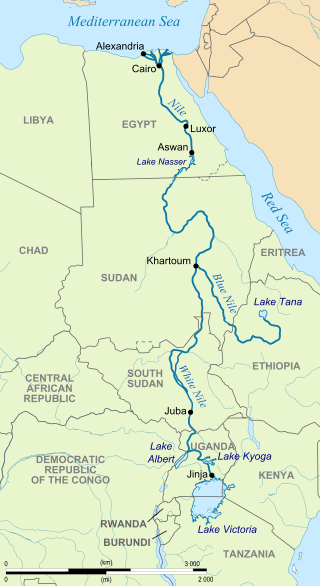
Regarding the North of Africa, the Egyptian Ministry for Environment has recently admitted that large extensions of the country’s Northern area of the Nile Delta, which represents the most important and extensive agricultural region in Egypt, is already heavily exposed to two dangerous effects: salinasation and flooding. This is due to the rise of the Mediterranean Sea water levels and the land depression.

The impact of global warming and growing heat waves is particularly worrying the Egyptian authorities as it might reduce the flow of the Nile water in up to 80 per cent according to latest estimates

Excerpts from Baher Kamal, Climate Change and the Middle East (II), No Water in the Kingdom of the Two Seas—Nor Elsewhere, IPS, Apr. 18, 2016

Nuclear Power Crossing Borders: Belgium-Germany

Germany asked Belgium to take Engie SA’s Tihange-2 and Doel-3 atomic plants offline until the safety concerns can be addressed, Environment Minister Barbara Hendricks said on April 20, 2016 in an emailed statement. The two facilities, which were shut for investigations for 20 months, are safe to operate, Belgium’s nuclear regulator AFCN said in response to the request…

Engie’s Belgian unit Electrabel operates the two reactors. AFCN decided Nov. 17, 2015 that the reactors were safe to restart after investigations of the steel walls of the reactor vessels. With the approval, AFCN concluded the defects don’t affect safety. The two units account for about 14 percent of the nation’s installed power capacity…

Germany is phasing out nuclear energy in the wake of the Fukushima meltdowns in Japan in 2011, instead developing an energy market built on wind and solar power. The nation is set to close down its remaining eight reactors by 2022.

The plants resumed output by the end of last year. Germany wasn’t satisfied with AFCN’s assessment and called for a Belgium-German working group and for the national independent reactor safety commission, known as RSK, to examine the security issue. The commission concluded that in case of an incident it is unclear that safety provisions are adequate….Doel-3 has a capacity of 1,006 megawatts, while Tihange-2 has a capacity of 1,008 megawatts. The units have permission to operate until their retirement on Oct. 1, 2022, and Feb. 1, 2023, respectively, according to AFCN’s website

Excerpts In unprecedented move, Germany asks Belgium to halt two reactors over safety concerns, Bloomberg, Apr. 20, 2016

Monsanto in India, the royalties

Monsanto Co, the world’s biggest seed company, threatened to pull out of India on March 2016 if the government imposed a big cut in royalties that local firms pay for its genetically modified cotton seeds.

Mahyco Monsanto Biotech (India)(MMB), a joint venture with India’s Mahyco, licenses a gene that produces its own pesticide to a number of local seed companies in lieu of royalties and an upfront payment. MMB also markets the seeds directly, though the local licensees together command 90 percent of the market.  Acting on complaints of local seeds companies that MMB was charging high fees, the farm ministry last year formed a committee to look into the matter.

The committee has now recommended about a 70 percent cut in royalty, or trait fee, that the seed companies pay to MMB, government sources said. The farm ministry is yet to take a decision on the committee’s recommendation.  “If the committee recommends imposing a sharp, mandatory cut in the trait fees paid on Bt-cotton seeds, MMB will have no choice but to re-evaluate every aspect of our position in India,” Shilpa Divekar Nirula, Monsanto’s chief executive for the India region, said in a statement…

Separately, MMB has filed a case in a Delhi court, challenging the authority of the committee to determine the trade fee agreed upon by MMB and a number of Indian seed companiesIn a partnership with Mahyco, U.S.-based Monsanto launched a GM cotton variety in India in 2002 despite opposition from critics who questioned its safety, helping transform the country into the world’s top producer and second-largest exporter of the fiber.

In a ruling on Feburary 2016, the Competition Commission of India, the antitrust regulator, said there were indications that MMB had abused its dominant position in the country and asked its director general to complete an investigation within two months.  The government-appointed committee has also recommended cutting Bt cotton seed prices to about 800 rupees for a packet of 400 grams. Currently Bt cotton seeds are being sold between 830 and 1100 rupees in different parts of the country.

Excerpts from MAYANK BHARDWAJ, Monsanto threatens to exit India over GM royalty row, Reuters, Mar. 4, 2016

t

Who is Watching North Korea

The 38 North, a US institute monitoring North Korea said that the country appears to be beginning or planning to extract plutonium, the core material of a nuclear bomb, at a nuclear plant in Yongbyon, north of Pyongyang.  Satellite imagery dated April 11,  2016 shows a vehicle loaded with tanks or casks in the premises of a nuclear reprocessing facility, according to the 38 North website operated by Johns Hopkins University’s US-Korea Institute in Washington.  “Such tanks or casks could be used to supply chemicals used in a reprocessing campaign intended to produce additional plutonium, haul out waste products or a number of other related activities,” the institute said.  Similar vehicles were observed in the early 2000s, it said, when North Korea extracted plutonium apparently as part of its nuclear programmes.

On April 4, 2016 the institute said plumes were detected from the reprocessing facility fueling the speculation that Pyongyang has engaged in additional production of plutonium.

Excerpts from Satellite images show North Korea may have begun extracting plutonium at nuclear facility, says US institute, Associated Press, Apr. 16, 2016

Data Mining: CIA, Facebook, Instagram and Twitter

Among the 38 previously undisclosed companies receiving In-Q-Tel funding, the research focus that stands out is social media mining and surveillance; the portfolio document lists several tech companies pursuing work in this area, including Dataminr, Geofeedia, PATHAR, and TransVoyant….The investments appear to reflect the CIA’s increasing focus on monitoring social media. In September 2015, David Cohen, the CIA’s second-highest ranking official, spoke at length at Cornell University about a litany of challenges stemming from the new media landscape. The Islamic State’s “sophisticated use of Twitter and other social media platforms is a perfect example of the malign use of these technologies,” he said…

The latest round of In-Q-Tel investments comes as the CIA has revamped its outreach to Silicon Valley, establishing a new wing, the Directorate of Digital Innovation…

Dataminr directly licenses a stream of data from Twitter to visualize and quickly spot trends on behalf of law enforcement agencies and hedge funds, among other clients.  Geofeedia collects geotagged social media messages to monitor breaking news events in real time.Geofeedia specializes in collecting geotagged social media messages, from platforms such as Twitter and Instagram, to monitor breaking news events in real time. The company, which counts dozens of local law enforcement agencies as clients, markets its ability to track activist protests on behalf of both corporate interests and police departments.PATHAR mines social media to determine networks of association…

PATHAR’s product, Dunami, is used by the Federal Bureau of Investigation to “mine Twitter, Facebook, Instagram and other social media to determine networks of association, centers of influence and potential signs of radicalization,” according to an investigation by Reveal.

TransVoyant analyzes data points to deliver insights and predictions about global events.  TransVoyant, founded by former Lockheed Martin Vice President Dennis Groseclose, provides a similar service by analyzing multiple data points for so-called decision-makers. The firm touts its ability to monitor Twitter to spot “gang incidents” and threats to journalists. A team from TransVoyant has worked with the U.S. military in Afghanistan to integrate data from satellites, radar, reconnaissance aircraft, and drones….

The recent wave of investments in social media-related companies suggests the CIA has accelerated the drive to make collection of user-generated online data a priority. Alongside its investments in start-ups, In-Q-Tel has also developed a special technology laboratory in Silicon Valley, called Lab41, to provide tools for the intelligence community to connect the dots in large sets of data.  In February, Lab41 published an article exploring the ways in which a Twitter user’s location could be predicted with a degree of certainty through the location of the user’s friends. On Github, an open source website for developers, Lab41 currently has a project to ascertain the “feasibility of using architectures such as Convolutional and Recurrent Neural Networks to classify the positive, negative, or neutral sentiment of Twitter messages towards a specific topic.”

Collecting intelligence on foreign adversaries has potential benefits for counterterrorism, but such CIA-supported surveillance technology is also used for domestic law enforcement and by the private sector to spy on activist groups.

Palantir, one of In-Q-Tel’s earliest investments in the social media analytics realm, was exposed in 2011 by the hacker group LulzSec to be innegotiation for a proposal to track labor union activists and other critics of the U.S. Chamber of Commerce, the largest business lobbying group in Washington. The company, now celebrated as a “tech unicorn” …

Geofeedia, for instance, promotes its research into Greenpeace activists, student demonstrations, minimum wage advocates, and other political movements. Police departments in Oakland, Chicago, Detroit, and other major municipalities havecontracted with Geofeedia, as well as private firms such as the Mall of America and McDonald’s.

Lee Guthman, an executive at Geofeedia, told reporter John Knefel that his company could predict the potential for violence at Black Lives Matter protests just by using the location and sentiment of tweets. Guthman said the technology could gauge sentiment by attaching “positive and negative points” to certain phrases, while measuring “proximity of words to certain words.”

Privacy advocates, however, have expressed concern about these sorts of automated judgments.“When you have private companies deciding which algorithms get you a so-called threat score, or make you a person of interest, there’s obviously room for targeting people based on viewpoints or even unlawfully targeting people based on race or religion,” said Lee Rowland, a senior staff attorney with the American Civil Liberties Union.”

Excerpt from Lee Fang, THE CIA IS INVESTING IN FIRMS THAT MINE YOUR TWEETS AND INSTAGRAM PHOTOS, Intercept, Apr. 14, 2016

Deep Horizon Oil Spill: final settlement

U.S. District Judge Carl Barbier in New Orleans gave his final approval April 4, 2016 to an estimated $20 billion settlement over BP’s massive 2010 oil spill. On July 2015, BP reached the $20 billion settlement with the federal government and five gulf states. The Justice Department has called it the largest environmental settlement in U.S. history as well as the largest-ever civil settlement with a single entity.  Barbier presided over a multiphase trial for the spill litigation before last summer’s settlement agreement resolved the bulk of the remaining civil claims against BP. The judge heard testimony from rig workers who survived the blast and from company executives who worked on the ill-fated drilling project off Louisiana’s coast. Barbier set the stage for the settlement when he ruled BP acted with “gross negligencein the disaster….

In addition BP pleaded guilty in 2013 to manslaughter for the rig workers’ deaths and agreed to pay a record $4 billion in criminal fines and penalties.

In BP reached a multibillion-dollar settlement agreement with businesses and residents who claim the spill cost them money. That deal didn’t have a cap***, and a court-supervised claims administrator is still processing many of the claims.

***There is no limit on the total dollar amount of the Settlement, but BP will pay no more than $2.3 billion to compensate qualified claimants who are in the Seafood Compensation Program.

While BP has estimated that the total costs of the Settlement will be approximately $7.8 billion, there is no limit on the total amount of the Settlement (with the exception of the Seafood Compensation Program). The actual total amount paid out will depend on the number of qualified claims made, and could be higher or lower than BP’s estimate.***

Excerpts from Judge approves $20 billion settlement in gulf oil spill, Associated Press, April 4, 2016

Nuclear Weapons: Belgium

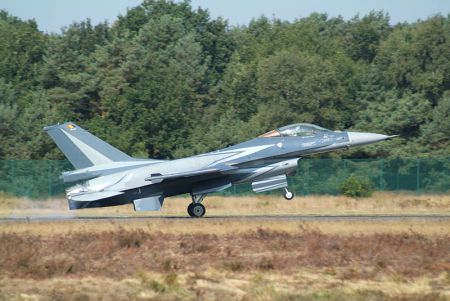
The US has approximately 180 B61 bombs – more than 10 times as powerful as those dropped on Hiroshima – at six locations in five countries across Europe.  An unknown number of these weapons are stored at the Kleine Brogel airbase in Belgium.  And Belgium has been the focus of European security services due to its reputation as a hotbed of radicalisation. During the first breach in 2010, anti-nuclear campaigners spent up to an hour wandering around the air base before security personnel moved in.A few months later activists again managed to sneak onto the site, this time reportedly gaining access to one of the hardened shelters used to house F-16 fighter jets as well as atomic weapons….

The US has stored non-strategic or tactical forward-deployed weapons at European facilities since the Cold War.The US Defence Department maintains about 4,760 nuclear warheads; an estimated 2,080 warheads are deployed while 2,680 warheads are held in storage….US bases have also been hit by worrying security breaches, including the break-in at the Y-12 site in Tennessee in 2012, one of the United States’ most sensitive sites. …….

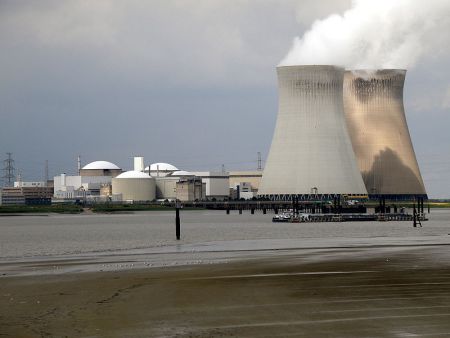
Belgian authorities evacuated nuclear power plants at Doel, which houses four reactors, and Tihange, which houses three, in the immediate aftermath of terrorist attacks of March 2016…

Excerpts from TOM BATCHELOR, Security breaches uncovered at EUROPEAN bases storing US nuclear warheads, Express UK, Apr. 4, 2016

Nuclear Reactors: Small + Modular

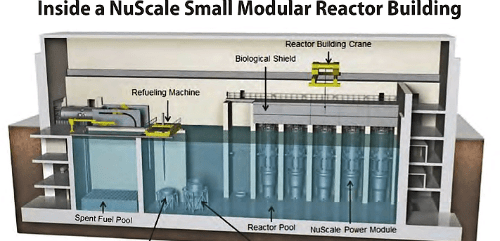
Small Modular Reactors (SMRs) are nuclear power plants that are smaller in size (300 MWe or less) than current generation base load plants (1,000 MWe or higher). These smaller, compact designs are factory-fabricated reactors that can be transported by truck or rail to a nuclear power site. SMRs will play an important role in addressing the energy security, economic and climate goals of the U.S. if they can be commercially deployed within the next decade….

Because of their smaller size, they also can use passive safety systems and be built underground to limit the dangers of radioactive leaks. The modular design could allow parts of the plant to be made in a factory to ensure consistent design and cheaper costs.

Tennessee Valley Authority (TVA) is in a joint pilot project with the U.S. Department of Energy to help test the new technology. Dan Stout, senior manager of SMR technology at TVA, said working with DOE to test the new power plant “is part of TVA’s mission,” although he said any final decision will require that the power source is also cost effective. “We’re focused on providing an option that provides reliable, affordable and carbon-free energy, and so we want to pursue this early site permit to give us the option for possibly locating SMRs on the site for 10 to 20 years,” Stout said.

Excerpts from US Department of Energy

and Oak Ridge could take lead in new TVA nuclear design, but critics question secrecy, need

Miners v. Indigenous Peoples: Canada

In 1849 the First Nation of Ojibways, a Canadian indigenous group, fired a cannon into a copper mine that had gone ahead without their approval.These days Canada’s aboriginal groups use public pressure, backed by legal action, to protect their lands against exploitation by outsiders. In February 2016 the government of British Columbia reached agreement with forest companies, environmental groups and 26 First Nations communities to protect from logging an area on the Pacific coast larger than Belgium—newly dubbed the Great Bear Rainforest. The deal, which allows logging and mining in areas aboriginals have agreed to, is the culmination of a long public-relations campaign (choosing the Kermode bear as its mascot was a masterstroke). It would have got nowhere without centuries of treaty-making and decades of case law to back it up….

The federal aboriginal affairs agency is party to 554 proceedings involving such rights (not all of which concern resource firms). That does not include disputes between aboriginal groups and firms. Projects as diverse as seismic testing for mineral deposits in Arctic waters and fracking in the west face challenges. Until 1951 such lawsuits were barred. They are expensive and can drag on for years; the outcome is never assured. The Tsilhqot’in, who filed suit in 1998 against logging on their ancestral lands in British Columbia, finally won in 2014 and now have title to 1,750 square km (1,100 square miles). But the Innu of Ekuanitshit in Quebec last year lost their bid to stop the Muskrat Falls hydropower project, which they say will affect caribou herds.

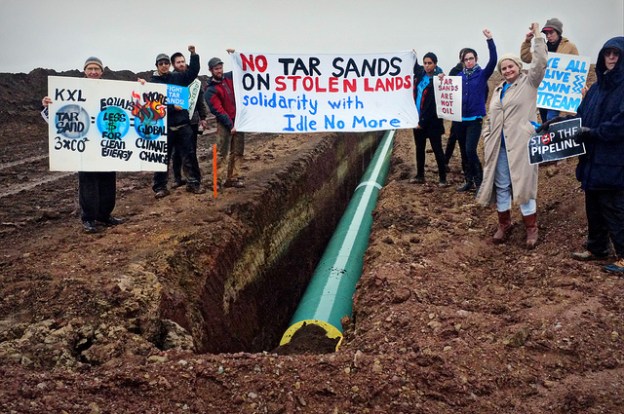
Some big projects are caught in legal limbo. The Northern Gateway pipeline, which is to bring crude oil from Alberta to Canada’s west coast, has been stalled for more than a decade, largely because of opposition from First Nations groups along its route, some of them parties to the Great Bear agreement. The Pacific Northwest liquefied natural gas project, backed by Petronas, a Malaysian state-owned firm, has offered C$1 billion ($726m) in benefits over 40 years to the Lax Kw’alaams nation of northern British Columbia. That has not allayed fears that the project would destroy salmon fisheries.

When such disputes are unresolved, the price can be high. The Northern Gateway pipeline would add C$300 billion to Canada’s GDP over 30 years.

Miners and aboriginals in Canada: I’ll see you in court, Economist, Feb. 6, 2016 at 33

Herbicides: safer than table salt

It’s been a tough year for glyphosate, the world’s most popular weedkiller. In 2015, the International Agency for Research on Cancer (IARC), an arm of the World Health Organization, declared that glyphosate—the key ingredient in Monsanto’s Roundup products—was probably carcinogenic to humans. In the months since, multiple lawsuits have been filed blaming the chemical for causing cancer and birth defects. In February, testing found traces of glyphosate in German beer and organic panty liners sold in France. Other tests have found chemical residue in British bread, as well as in the urine of people across Europe. In early March, the European Union put off a vote to renew a 15-year license for glyphosate after several member states balked.

Monsanto famously advertised Roundup, which was introduced in 1974, as safer than table salt. In 1996 the company stopped making the table salt claim after complaints from New York state….. In September 2016 state officials in California proposed adding the herbicide to a list of known carcinogens. The FDA said in February 2016 that it would begin testing for glyphosate residue in food in the U.S. The results aren’t yet available. The Environmental Protection Agency has been reviewing its use since 2009. The agency, which in 1985 temporarily classified glyphosate as “possibly carcinogenic,” was supposed to wrap up sometime last year; it now says a draft of its decision should be available for public comment sometime this year.

The herbicide industry has mounted an aggressive campaign to discredit the cancer finding and to convince regulators—and the public—that the herbicide should remain in use. …

Glyphosate works by blocking the production of certain amino acids that a plant needs to grow, and it’s nonselective, meaning it kills most plants. It began to dominate the herbicide market only after Monsanto genetically engineered crops to survive it, marketing them under its Roundup Ready brand. Global sales of glyphosate were about $7.8 billion in 2014, 30 percent of the herbicide market, according to Cropnosis, a market-research firm. Monsanto’s dominance of the glyphosate market has declined since the chemical went off patent in 2000. Some weeds have become resistant to glyphosate, triggering the need for other weedkillers. Nonetheless, Roundup remains the primary money-maker for Monsanto’s agricultural productivity segment, which brought in 32 percent of its revenue in fiscal 2015.

A rejection of glyphosate by either the U.S. or Europe would have “massive” ramifications on farming and food production, says Jason Miner, an analyst for Bloomberg Intelligence. “You could quickly take us two decades back in terms of farm yields,” he says. “The world doesn’t have capacity to produce all the alternatives.”

Monsanto’s Roundup Could Get Whacked by European Regulators, Bloomberg BusinessWeek, Mar. 10, 2016

Nuclear-Powered Submarines of India

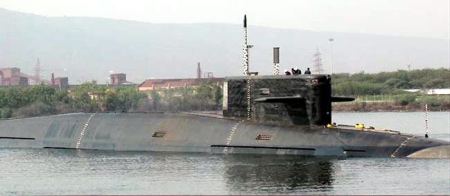
The INS Arihant, India’s first nuclear-powered submarine armed with ballistic missiles (SSBN, in military jargon)… is a 6,000-tonne boat that will provide India with the third leg of its nuclear “triad”—it already has land- and air-launched nukes….India believes SSBNs are a vital part of its nuclear strategy, which forswears the first use of nuclear weapons….Because they can readily avoid detection, SSBNs can survive a surprise attack and thus ensure India’s ability to launch a retaliatory “second strike”….Some nuclear theorists argue that submarine-based deterrents promote peace by making the other side more frightened to attack first. …

China is ahead of the game. It has a fleet of four second-generation Jin-class SSBNs and is testing JL-2 missiles to install in them. These weapons have a range of 7,400km (4,600 miles)—too short, for now, to reach the American mainland from the relative safety of the South China Sea. Pakistan, for its part, is in the early stages of a lower-cost approach. This involves arming diesel-powered subs with nuclear-armed cruise missiles with a range of 700km.

A more immediate worry to India is Pakistan’s development and deployment of smaller “tactical” nuclear weapons for use on the battlefield. These may make it more likely that any war between India and Pakistan will go nuclear. They also increase the risk of Pakistan’s weapons being used accidentally—or falling into the hands of extremists (such weapons are under the control of lower-level commanders whose professionalism and loyalty may be dubious)….

India says it will not develop battlefield nukes of its own. Instead, it will rely on the threat of massive retaliation against any use of nuclear weapons by Pakistan. Still, it may be another decade before India has a fully-fledged sea-based deterrent. Arihant’s Russian nuclear-power generator is unsuited to long patrols. Initially, the sub is due to be armed with the K-15 missile, with a range of 750km—not enough to reach big cities in northern Pakistan. Striking Chinese ones would be harder still.

Asian Nuclear Weapons: What Lurks Beneathh, Economist, Feb. 6, 2016, at 36

Micro-States as Sacrificial Lambs

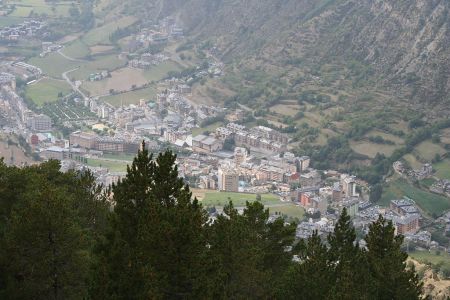
On March 2015 Financial Crimes Enforcement Network (FinCEN), part of America’s Treasury branded Banca Privada d’Andorra (BPA) as a “primary money-laundering concern”, saying its top managers had moved cash for criminal groups. This so-called “311” measure (after the relevant section of the Patriot Act of 2001) is usually crippling for the bank concerned, because in effect it cuts it off from the American financial system and any banks that participate in it. BPA was no exception: the government of Andorra, a mountainous financial haven nestled between France and Spain, ended up taking over the bank despite objections from its majority shareholders, the Cierco family; its Madrid-based wealth-management arm was liquidated. The Ciercos, insisting there was no legal basis for FinCEN’s move, sued in the American courts.

On February 19, 2016, the FinCEN withdrew its designation of BPA as a money-laundering concern….FinCEN’s explanation for its reversal was that Andorra had taken steps to protect BPA from money-laundering risks, and the bank therefore no longer poses a threat. The Ciercos are having none of this. They argue that it was instead a “blatant effort to avoid judicial scrutiny” of the 311 measure. They point to the timing: the court was to hear a motion to dismiss the case next month. That would have required much more detailed evidence to be aired in support of the 311 action.

The Americans wanted to avoid this because their case was flimsy, critics say. The Ciercos have argued from the start that it was based on cases of suspected money-laundering which the bank itself had reported to Andorran regulators and had brought in KPMG, an accounting firm, to investigate.

If BPA was already cleaning up its act, why go after it at all? Some suspect the bank was a pawn in a tussle between governments: miffed that Andorra was slow to adopt American-style anti-money-laundering rules, including limits on cash transactions, America decided to show who was boss by selecting a bank to pick on. There is some evidence to support this sacrificial-lamb theory. In unscripted comments last year, for instance, an American diplomat suggested that America chose to “use the hammer” on BPA as a way of resolving wider concerns about Andorra.

The Treasury has been challenged in another 311-designation case. FBME Bank of Tanzania sued it after being accused of servicing all manner of bad guys. In the fall of 2015  an American court issued an injunction blocking the government’s action until the bank received more information about why it was deemed a threat to the financial system. The case continues. Meanwhile, FBME’s operations have been severely disrupted: it has sought an injunction to stop the authorities closing an important subsidiary in Cyprus.

These cases highlight two problems with FinCEN’s money-laundering cudgel. The first is double-standards. It tends to go after only small banks in strategically unimportant countries; its use of 311 has been likened to using a sledgehammer to crack nuts. The second is its lack of openness. It faces no requirement to make detailed evidence public, or even available to a court, at the time of action. By the time any challenge is heard, it may be too late for the bank in question.

Whoops Apocalypse, Banks and Money Laundering, Economist, Feb. 27, 2016, at 60

Nothing Outlasts the Fukushima Disaster

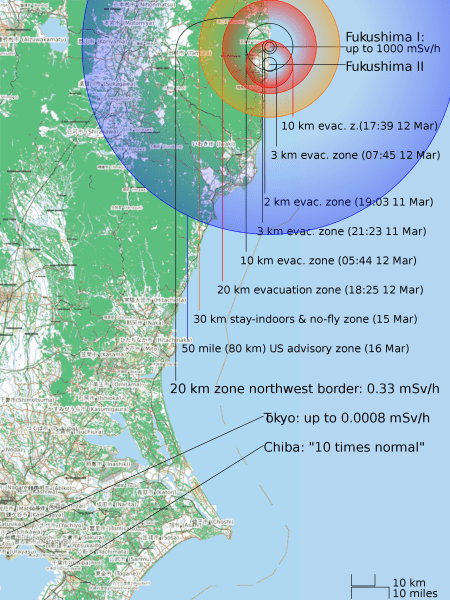
As Prime Minister Shinzo Abe moves to reopen Japanese nuclear plants that were all shut after the disaster on March 11, 2011, a distrustful public is pushing back. A court on March 9, 2016ordered Kansai Electric Power Co. to halt two of the four reactors that have been restarted, saying the utility had failed to show the public they were safe. The utility called the ruling “unacceptable” and said it would appeal….However, near the ruined Fukushima reactors……Growing swaths of land are covered with black bags full of slightly radioactive soil.

The hardest parts of the cleanup haven’t even begun. Tepco, as Tokyo Electric is known, has yet to draw up plans for removing highly radioactive nuclear fuel that melted through steel containment vessels and now sits at the bottom of three Fukushima reactors.The company estimates that the nearly $20 billion job of decommissioning the plant could take another three or four decades. That is not counting damages and cleanup costs expected to reach some $100 billion or more, including about $50 billion paid to evacuees. Legal wrangling over the disaster continues. In February 2016, three former Tepco executives were charged with professional negligence.

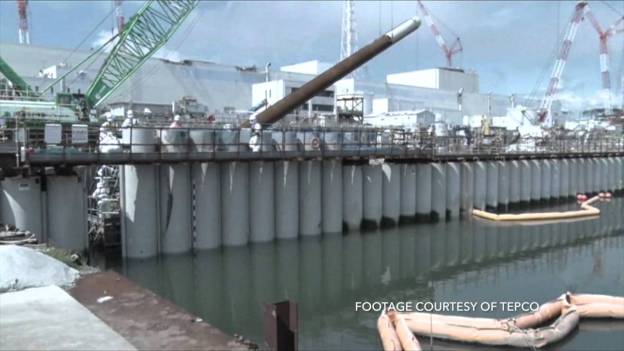
Tepco also is working to reduce a total 400 tons of rain and groundwater that breach the plant’s defenses daily, becoming contaminated and requiring treatment and storage. But a wall of frozen earth meant to reduce the flow has run into resistance from regulators.On large parts of the site, workers can now walk around without full-face shields or hazmat suits, using simple surgical masks for protection.Fukushima was once a prized post for elite engineers and technicians in Japan’s nuclear heyday. Now, unskilled laborers make up the bulk of a workforce of about 6,000 workers, down from a peak of 7,450 in 2014. “There’s a constant stream of people who can’t find work elsewhere,” said Hiroyuki Watanabe, a Communist city councilman in Iwaki, about 30 miles away. “They drift and collect in Fukushima.”…

Looking ahead, the biggest issue remains the reactors. No one knows exactly where the molten nuclear debris sits or how to clean it. Humans couldn’t survive a journey inside the containment vessels, so Tepco hopes to use robots guided by computer simulations and video images. But two attempts had to be abandoned after the robots got tripped up on rubble.“The nature of debris may depend on when the nuclear fuel and concrete reacted,” said Pascal Piluso, an official of France’s Alternative Energies and Atomic Energy Commission. “We are talking about extremely varied and complex debris.”….A government panel recently questioned Tepco’s ability to tackle the daunting task of decommissioning while seeking profit for its shareholders. The disaster nearly pushed the company to bankruptcy, prompting the government to buoy it with ¥1 trillion ($9 billion  (really????) in public money and pledge government grants and guarantees to help Tepco compensate victims.”…

Excerpts  from Fukushima Still Rattles Japan, Five Years After Nuclear Disaster, Wall Street Journal, Mar. 8, 2016

Virgin Digital Land to Invade: Google

Google’s Project Loon is an effort to develop high-altitude balloons that can bring Internet connectivity to remote areas. The technology has been tested over the past couple of years, but not at scale. Rama, a quasi–public company controlled by venture capitalist Chamath Palihapitiya [who runs Silicon Valley venture firm Social Capital] and the Sri Lankan government, aims to do just that. Google sent the first Loon balloon above Sri Lanka in February 2016, and the government says it’s working with the company to blanket the country with coverage from another dozen. …Under a deal Palihapitiya negotiated, Google is leading the Loon launches, development, and maintenance, and Rama will run the software to control access to the balloons’ Internet connections and handle billing. People will still pay local operators for data, and carriers will pay Rama an as-yet-undisclosed fee to help ferry traffic.

The Loon fleet could offer a cheaper alternative to undersea Internet cables, which pass through the regional choke points of Singapore and Hong Kong. Carriers in developing Asian and South American nations pay more than 10 times the bandwidth prices their European and U.S. counterparts do, researcher TeleGeography estimates. (The median wholesale price for a monthly 10-gigabit-per-second connection in Los Angeles or Frankfurt is $1; in Mumbai, it’s $15.) Sri Lanka’s data use is growing 45 percent a year and will likely do so for the next decade, the United Nations estimates.

Excerpts from  A Would Be Wi-Fi Paradise, Bloomberg Business Week, Mar. 27, 2016

The Illusion of Transparent Markets

Investors worry that, in many cases, competition has brought down the visible price of trading by adding hidden costs. Two anxieties stand out. One is the worry that the current set-up of the markets allows high-speed traders to anticipate big orders and “front-run” them, moving prices in an unfavourable direction before an order can be executed. The other is the question of how robust the system is, with regulators still unable fully to explain events like the “flash crash” of 2010, when the Dow Jones Industrial Average plunged by 9% in minutes before rebounding.

Start with fears of front-running. Many institutional investors complain that ultra-fast traders spot big orders entering the market, and race ahead of them to adjust their prices accordingly. Attempts to hide from the speedsters can go awry. In January Credit Suisse and Barclays, two big banks, agreed to pay $154m in fines for misleading clients about the workings of their “dark pools”, where offers to sell and bids to buy are not published. In theory, that protects investors from front-running; in practice, several of the firms running such venues had concealed the central role that high-frequency traders played on them. (Credit Suisse didn’t admit or deny wrongdoing in the settlement.)

There is another, less-often-told side to the story. Speed is necessary to knit together a dispersed set of exchanges, so that investors are immediately routed towards the best price available and so that their orders are the first to get filled. And plenty of high-frequency traders are market-makers; it is their job to adjust prices in response to new information. Nonetheless, the idea that markets are rigged is widespread, not least thanks to the publication of “Flash Boys”, a book by Michael Lewis on the evils of high-speed trading.

One proferred solution is to level the field by slowing things down deliberately. IEX, whose founder is the hero of Mr Lewis’s book, is a trading platform that has applied to the SEC to become an exchange. It uses miles of coiled cable to create a “speed bump” that delays trades to the advantage of institutional investors. The SEC has received more than 400 letters in support of its application, but there is a vigorous debate about whether IEX’s system complies with the requirements of Regulation National Market System (Reg NMS). Some think that the better solution would be to get rid of Rule 611, which in effect requires orders to be sent to the exchange showing the best price, even though such quotes can sometimes be unobtainable in practice. The SEC will vote on IEX’s application by March 21st.

Share Trading, Complicate, then Prevaricate, Economist, Feb. 27, 2016

Logging Wars: Tasmania

Bruny island, off south-eastern Tasmania, is a home to the swift parrot. Small and green, with patches of red and blue, it breeds only in Tasmania, feeding on nectar from the blue gum tree, a eucalypt, and migrating to south-eastern Australia for the winter. But the logging of Tasmanian forests has destroyed its habitat…Only 2,000 individuals may survive.  In November 2015  the state government stopped logging on Bruny Island after an outcry over the parrot’s plight. An earlier study by Dejan Stojanovic, of the Australian National University, and colleagues had revealed how logging and land-clearing for farms in Tasmania had left swifts, which breed in the trunks of old gum trees, vulnerable to predation by sugar gliders, an introduced possum…. UNESCO-listed world heritage wilderness area was expanded to embrace the Styx valley west of Hobart, thick with eucalyptus trees thought to be 600 years old. The listed region now covers almost a quarter of Tasmania.

But…On becoming premier two years ago, Will Hodgman of the conservative Liberal party said he was tearing up the deal, concerned that his state’s growth lagged the rest of Australia. He now proposes opening up some protected areas for logging.  UNESCO wants commercial logging in the listed forests banned.

Tasmania’s forests: Saving the swift parrot, Economist,  Feb. 13, 2016

Coral Reefs Preservation: Aichi Targets

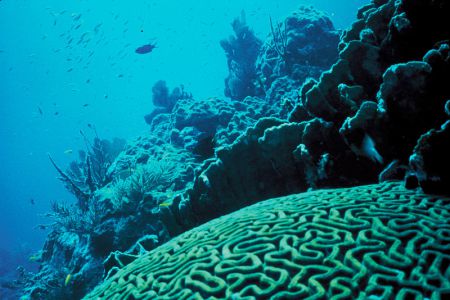
In the past half-century, though, these beautiful, biodiverse structures have been put under pressure by human activity. About a quarter of all coral cover has died. The reefs that are in worst shape are those off the most crowded beaches. “People don’t leave enough time for their sun cream to soak in, so it gets in the water,” says one deckhand with Eo Wai’anae Tours, which organises boat trips off Oahu. More damage is caused by fertiliser-rich run-off from farms, leading to algal blooms which block light the corals need. Fishing near reefs cuts the number of herbivorous fish, allowing vegetation to grow out of control. Some fishing methods are particularly harmful: for example, blast fishermen in Colombia, Tanzania and elsewhere use dynamite to stun and kill fish without regard to the harm done to nearby reefs…In the South China Seaisland-building and fishing for giant clams are crushing some reefs beyond the possibility of recovery (seearticle)….

Tourism generated by the Great Barrier Reef is worth about $4.6 billion annually to nearby Queensland alone. Australian bigwigs bent over backwards last year to keep the UN from listing the reef, a World Heritage Site, as “in danger”. Estimates suggest that the economic value of Martinique and Saint Lucia’s corals comes to $50,000 per square km each year, thanks largely to tourism. But overdevelopment threatens the reefs the visitors come to gawp at. Sediment from construction clouds waters, burying corals and blocking the light they need. Hotels close to the shore may be convenient for tourists, but the process of building them can kill the reefs that snorkellers like to swim over…The three countries with the largest numbers of people who fish on reefs are all in the coral-triangle region: Indonesia, Papua New Guinea and the Philippines. In Indonesia and in the Philippines, up to 1m people’s livelihoods depend on reefs.

Averting a tragedy of the commons means agreeing which activities should be restricted and enforcing the rules. For coral reefs—and other biodiverse marine environments—the usual approach is to give ecologically sensitive areas special status under local or regional laws. In such “marine protected areas” (MPAs), activities that are deemed harmful, such as fishing, drilling and mining, can then be restricted or banned, with penalties for rule-breakers.

The Aichi targets, agreed in 2010 under the UN Convention on Biological Diversity, seek to reduce “anthropogenic pressures” on coral reefs to “maintain their integrity and function”. The aim is to have at least 17% of inland water and 10% of coastal and marine areas under conservation by 2020. Most countries have signed up. But the targets are far from being met. Less than 3% of the ocean’s surface is within an MPA.

The most urgent action is needed close to shore. The nearer humans are to reefs, the worse their effect on the fragile ecosystems. A global register of fishing vessels, long under discussion, would also help identify wrongdoers. And beefing up the UN law of the sea could inspire further action. Decades old, it has little to say about biodiversity.

But simply declaring an area protected does not make it so. In 2009 George Bush junior, then president of America, established three national marine monuments in the Pacific, including nearly 518,000 square km of coral islands and surrounding areas. Their remoteness makes it hard to stop vessels entering illegally; Hawaii’s coastguard is already stretched.

Satellites are sometimes used to police MPAs, but they pass over infrequently. In the future, sailing robots could play a larger role. America’s National Oceanic and Atmospheric Administration (NOAA) has been working with a private firm, Saildrone, on hardy models equipped with carbon-fibre fins. They cost less than $500,000 each and can roam remote ocean regions for months, making them far cheaper than manned boats.

Such drones could photograph rogue fishing vessels, obtaining hard-to-gather evidence for any criminal proceedings. And they could carry out other useful work at the same time, such as monitoring ocean temperature and acidity or tracking tagged members of endangered species. Saildrone plans to provide its robots as a service, so that universities and other cash-strapped organisations do not have to buy one outright…

Even if the right policies are adopted to keep corals healthy in the immediate future, longer-term threats loom. Neither oceanic warming nor acidification can be kept out by an MPA. And both may be happening too fast for corals to adapt, especially as recent global climate deals will not slow them much. Back slaps and handshakes accompanied the inclusion of an aim to limit global warming to just 1.5°C above pre-industrial levels in the Paris Agreement last year. But only an incorrigible optimist would bet on that aim being achieved.

So researchers are turning their attention to ways to help corals cope. Their global diversity, scientists hope, may hold the key. The same coral will grow differently under different conditions: corals of the western Pacific near Indonesia, for example, can withstand higher temperatures than the same species in the eastern Pacific near Hawaii….The characteristics that help some reefs survive unusual conditions could allow others to endure climate change. But tough corals from one place cannot simply be transplanted to another. So a team at the Hawaii Institute of Marine Biology is in the early stages of engineering reef ecosystems, with $4m from the Paul G. Allen Foundation, a charity set up by Bill Gates’s former business partner.

Organisms respond to environmental changes through both genetic processes (adaptation) and non-genetic ones (acclimatisation). With corals, the nature of their symbiotic relationships can also alter. So selectively breeding and conditioning them, and investigating whether certain types of algae confer resistance to heat or acidity, could create hardier varieties faster than they would develop naturally.

These could then be used to repopulate ravaged reefs—once more is known about how and where to transplant them. “We’re assisting evolution,” explains Ruth Gates, who leads the research.

Marine conservation: Rejuvenating reefs, Economist, Feb. 13, 2016, at 57

The Most Dangerous Dam

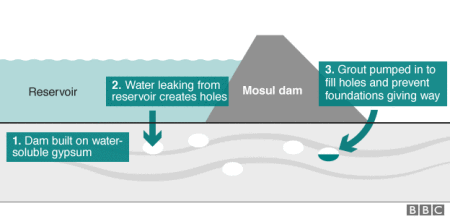
Sensors installed by American army engineers in December 2015 show widening fissures in the fragile gypsum base underneath the Mosul dam,  though no one can predict when a breach might occur….The Iraqi government has now contracted with the Trevi Group, an Italian firm, which it hopes will offer a more advanced and permanent method of plugging cavities in the stone base than the constant maintenance it has required for the past 30 years. That maintenance came to an abrupt halt after IS seized the dam in August 2014, and has continued only intermittently after it was seized back three weeks later. Essential equipment went missing then, and half its staff decided not to return to work.

One study says that if the dam collapses, Mosul would be submerged within hours. Another warns that half a million Iraqis could be killed by floodwaters, and more than a million forced from their homes. Disease and looting as the floodwaters raced through Baiji, Tikrit, Samarra and even parts of Baghdad would complete that dreadful scenario.

The dam was built by an Italian-German consortium and started operating in 1986. Because of the high proportion of gypsum in the area, the construction included a grouting tunnel to allow almost constant injection of cement and drilling mud into crevices in the base that are widened by the water flowing through them. America’s Army Corps of Engineers warned in 2005 that the “extraordinary engineering measures” needed to maintain its structural integrity made the structure potentially the most dangerous in the world.*** But taking the dam out of commission is not an attractive option. Emptying the reservoir would leave Iraqis seriously short of drinking and unpolluted irrigation water in the summer.

Excerpts from The Mosul dam: A watery time-bomb, Economist, Feb. 13, 2016, at 42

***  The dam was constructed on a foundation of water soluble gypsum!!! More than 50,000 tonnes  of material have been injected into the dam since leaks began forming shortly after the reservoir was filled in 1986, and 24 machines currently continuously pump grout into the dam base. Between 1992 and 1998 four sinkholes formed downstream of the dam and a fifth sinkhole developed east of the dam in February 2003 which was filled several times. In August 2005 another sinkhole developed to the east (Wikipedia).

Trees Worth More Than Gold

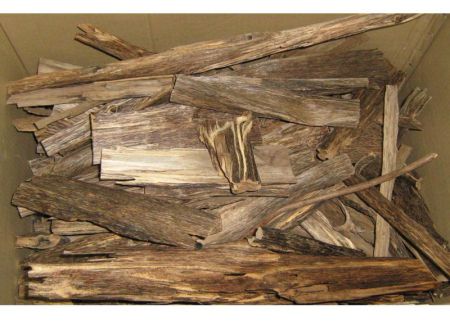
To protect incense trees, the Convention on International Trade in Endangered Species of Wild Fauna and Flora restricts trading in agarwood. But Hong Kong does not single out those who destroy or damage the trees for harsh treatment. If an incense tree is on government-managed land, the maximum sentence for cutting it down is the same as it is for felling any other kind of tree on such property: a fine of HK$25,000 ($3,210) and a year in prison.  Such penalties do little to deter thieves from mainland China, who are encouraged by growing demand for exotic medicines among members of the mainland’s fast-growing middle class. Professor C.Y. Jim of the University of Hong Kong reckons that in 2013 high-grade agarwood was worth $1,600 a gram on the black market. That is more than gold. According to Mr Jim, Hong Kong may be the “last refuge” of the tree, so it has become a “honeypot” for tree-snatchers.

Most of the thieves work for criminal gangs based across the border in mainland China. In recent years a relaxation of restrictions on travel from the mainland to Hong Kong has made their work easier. They often pretend to be hikers, sometimes camping out for weeks while gathering the timber. A local NGO has produced a map showing about 200 sites from which it says around 500 trees were stolen in the past year.

Very few incense trees form agarwood, so they are often destroyed indiscriminately. On Lamma, a plaque marks a spot where three young trees were uprooted. A short scramble up a steep slope reveals a gorier scene: splintered woodchips are all that remain of an aged tree. Mr Yeung, the beekeeper, says “hunters” felled and butchered it in situ. As supplies diminish, the gangs are becoming more desperate. Thieves are raiding private gardens; some residents have begun organising patrols to frighten the thieves away. Alarms and monitoring cameras are being installed.

Excerpts from Trees in Hong Kong: Fragrant Arbour, Economist, Feb. 22, 2016, at 37

Nuclear Waste: Ukraine

A consortium of four German companies has been awarded a contract to improve infrastructure for managing radioactive waste, the rehabilitation of contaminated areas and the decommissioning of nuclear power plants in Ukraine.  The consortium – comprising Brenk Systemplanung, DMT, Plejades and TÜV Nord EnSys – was awarded the contract for the project, which is within the framework of the European Union-funded Instrument for Nuclear Safety Cooperation (INSC). The INSC is designed to support non-EU countries in improving nuclear safety. The contract will run for an initial two-year period and have a maximum budget of €1.5 million ($1.6 million).

According to the tender notice, the main objectives of the contract are to support the Ukrainian State Corporation ‘Radon’ in establishing an emergency response system for “radiation incidents involving unauthorized radioactive materials that are not related to nuclear power plant operation”. It also calls for the establishment of integrated, automated monitoring systems for radiation and environmental protection at Radon facilities, as well as the remediation of radioactive waste storage sites resulting from the Chernobyl nuclear power plant accident and situated outside the exclusion zone.

In a statement yesterday, DMT said it will jointly lead with TÜV Nord EnSys Hannover the assessment of some 50 radioactive waste storage sites.

Excerpts from German consortium awarded Ukrainian waste contract, World Nuclear News, Mar. 2, 2016

Fishermen + Farmers Against Shell

Tens of thousands of Nigerian fishermen and farmers are suing multinational oil giant Shell in two new lawsuits filed on March 2, 2016 in a British High Court, alleging that decades of uncleaned oil spills have destroyed their lives.  London law firm Leigh Day & Co. is representing them after winning an unprecedented $83.5 million in damages from Shell in a landmark ruling by the same court last year. Shell originally offered villagers $50,000.

In a statement on March 2, 2016 before the trial opened, Shell blamed sabotage and oil theft for the ongoing pollution and noted it had halted oil production in 1993 in Ogoniland, the area where the two communities are located in Nigeria’s oil-rich southern Niger Delta.  Shell said it will challenge the jurisdiction of the British court.

The Ogoni are among the most traumatized of millions of Nigerians suffering oil pollution since the late 1950s….

Excerpts from  MICHELLE FAUL, Nigerians sue Shell in UK court for oil spills contamination, Associated Press, Mar. 2, 2016

Nuclear Power to Relish: China

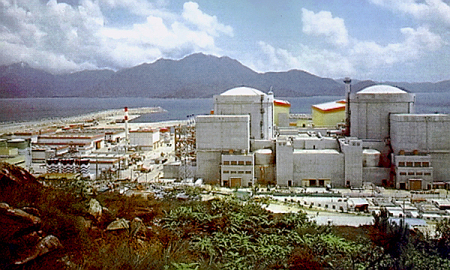
On February 23, 2016, China General Nuclear Power Group, hosted dozens of business executives from Kenya, Russia, Indonesia and elsewhere, as well as diplomats and journalists, at its Daya Bay nuclear-power station to promote the Hualong One for export.  Asked how much of the global market share for new nuclear reactors CGN wants Hualong One to win, Zheng Dongshan, CGN’s deputy general manager in charge of international business, said: “The more the better.”

The move marks a turnaround for China and the nuclear-power industry. For three decades, China served as a big market for nuclear giants including U.S.-based, Japanese-owned Westinghouse Electric Co. and France’s Areva SA. More than 30 reactors have been built across China since the 1990s with reliance on foreign design and technology.

China’s push into nuclear power comes as many nations have been re-examining the risks of nuclear energy and its costs compared with natural gas and other fuels. Two dozen reactors are under construction across China today, representing more than one-third of all reactors being built globally, according to the International Atomic Energy Agency.

The scale and pace of building has given CGN and other Chinese companies opportunities to bulk up on experience in the home market and gain skills in developing reactor parts, technologies and systems. That experience, combined with China’s lower costs of labor and capital, makes the new Chinese reactor potentially attractive to international customers, industry experts said…

[T]he first of Hualong One model reactor won’t enter service in China for several more years.  But the Hualong One reactor marks a big leap by China’s national nuclear champions to move up the export value chain. Jointly designed by CGN and China National Nuclear Corp., the reactor, also known as the HPR1000, has similar specifications to other so-called Generation 3 reactors such as Westinghouse’s AP1000, like advanced so-called passive safety systems.

China Inc’s Nuclear Power Push, Wall Street Journal, Feb. 24, 2016

Airstrikes on Money Vaults: Monsul

More than a year of U.S.-led airstrikes and financial sanctions haven’t stopped Islamic State from ordering supplies for its fighters, importing food for its subjects or making quick profits in currency arbitrage.  This is because of men such as Abu Omar, one of the militant group’s de facto bankers. The Iraqi businessman is part of a network of financiers stretching across northern and central Iraq who for decades have provided money transfers and trade finance for the many local merchants who shun conventional banks….

U.S. Assistant Secretary for Terrorist Financing Daniel Glaser said these businesses—there are more than 1,600 in Iraq alone—serve as a worrisome portal for Islamic State, also known as ISIS or ISIL, to connect with the world outside its declared caliphate…..People pay cash in one office and a recipient draws the equivalent funds at a distant locale, a Middle Eastern practice known as hawala that predates the modern banking system.  Three Iraqi money-exchange operators say they pay Shiite militias, who are at war with Islamic State, to guard cash shipments that travel the road from Baghdad across their front lines to militant-controlled territory in Anbar province. Iraqi Kurdish fighters, also at war with Islamic State, are bribed to grant passage of cash shipments across their front lines into militant-held areas around Mosul. Both Shiite and Kurdish commanders negotiate flat fees from $1,000 to $10,000, the money changers said.

Islamic State imposes a 2% tax on cash shipments entering its territory, which buys the smuggler protection on the final leg to the exchange houses….

The Cash Routes:  One begins in the narrow streets behind Istanbul’s Grand Bazaar and, via Iraqi Kurdish towns, reaches Mosul, the largest city under Islamic State control. Another connects Jordan’s capital of Amman with Baghdad and Islamic State-controlled parts of Iraq’s Anbar province. A third links the city of Gaziantep in southern Turkey with Syrian regions around Raqqa, the administrative capital of Islamic State…

The US financial containment effort is one element of a campaign that includes U.S. airstrikes against Islamic State oil wells. There have also been strikes on vaults in downtown Mosul, which U.S. officials suspect store cash to pay fighters….The Central Bank of Iraq named 142 currency-exchange houses in December that the U.S. suspected of moving funds for Islamic State. The central bank banned them from its twice-monthly dollar auctions, hoping to keep U.S. bank notes from the terror group, which, like much of Iraq, operates as a cash economy….

Before Islamic State seized Mosul, the city of nearly two million people had 40 banks and around 120 licensed money changers and remittance facilities, according to Iraq’s central bank and money changers.Only banks and remittance facilities are licensed to transfer money domestically or abroad. But money changers have long flouted these rules and provided such services in Mosul, the economic powerhouse of northern Iraq.  Islamic State’s takeover of Mosul in June 2014, followed by other cities in Iraq and eastern Syria, swiftly shut down local banks. The terror group looted bank vaults of hundreds of millions of dollars, according to U.S. estimates.  The U.S. and regional governments took immediate steps to sever bank branches in Islamic State territory from the international banking network, declaring off-limits transactions with the identification code of seized branches.That left money changers as the sole providers for a region covering several million people. A currency office owner from Anbar province said in late summer of 2014 his offices were handling $500,000 a week in money transfers in and out of Islamic State. Fees for such services were 10%, he said. Before the Islamic State takeover, fees were between 3% and 5%….

ISIS  in 2015 banned exchange houses from approving the transfer of funds outside of Islamic State without a receipt showing the client had paid a 10% religious tax, known as “zakat.”..

For years, participants in the twice-monthly dollar auction by the central bank included money-exchange houses that would buy dollars at the official rate and sell them for a profit on the street. The rate difference in the past year was as much as 7 percentage points….

The Central Bank of Iraq has an account at the Fed, funded largely by oil reserves, and regularly withdraws large shipments of new $100 bills from a Fed facility in Rutherford, N.J. They travel by chartered plane to Baghdad.The Fed last summer (2015) temporarily shut off deliveries over concerns the notes were going to Islamic State through the exchange houses. A cash crisis loomed until shipments resumed in August, 2015 when Iraq agreed to turn over more records.

Many exchange companies based in Islamic State territory—or their correspondent offices elsewhere in Iraq—participated in the auctions until mid-December 2015, when the U.S. pressured Iraq to ban dozens of companies believed to be working with the terror group.Money changers who still participate in the currency auction doubt the effectiveness of the black list. Iraq has no mechanism to ensure that the owners of banned companies don’t get around the restrictions by simply opening new firms or by hidden ownership stakes in other exchange firms.“Iraq doesn’t have investigators or auditors,” said Abu Omar, the money-exchange owner. “Iraq has officials who expect bribes.”

Excerpts from Local Cash Network Fuels Islamic State Finances, Wall Street Journal , Feb. 25, 2016

The Biggest Flaw of Africa

Investors are yanking their cash from African assets, until recently a popular play for the adventurous, as a toxic confluence of factors overhangs the continent.Crashing commodity prices, a Chinese slowdown and a string of policy failures are forcing investors to reassess the risk of investing in Africa after years of optimism about its growth prospects.Stock markets and currencies have been selling off across the continent, especially in commodity-dependent economies. Nigeria, the continent’s largest economy and longtime investor darling, has one of the world’s worst-performing stock indexes this year, down by 14% since the start of 2016. The S&P Zambia Index has fared even worse over the past year, plunging 45% as the country’s copper exports tumbled on softening Chinese demand. President Edgar Lungu last September called for a day of national prayer to petition God to shore up Zambia’s currency, the kwacha. At the time, the kwacha had lost 45% of its value against the dollar in 2015.  The declines mean African equities are performing worse than any other frontier markets. The MSCI Africa index tumbled 19% last year, significantly more than the overall MSCI Frontier Markets index….The upshot is that frontier investors are moving their money from Africa to Asian countries like Pakistan, Bangladesh and Vietnam; net energy and commodity importers which have shown more commitment to industrialization….

The shift has also pushed up the costs of sovereign borrowing, even as African countries slow down their issuance of bonds in international capital markets. In 2014, African sovereigns issued $12 billion worth of bonds in international capital markets; last year it was half that, according to Deutsche Bank.Ghana, mired in an economic crisis, issued the most expensive African Eurobond in history late last year, paying a whopping 10.75% for $1 billion; far higher than the single-digit interest rates the government had become accustomed to paying for international bonds in recent years….

[T]here are important exceptions to the rule: Kenya, which has a more diversified economy, and Ivory Coast, the world’s top producer of cocoa, are still attracting frontier investors…..

“One of the biggest flaws when investors look at Africa is that they think of it as a country and not a continent composed of very unique countries and companies,” says Laura Geritz, who runs U.S.-based Wasatch Frontier Emerging Small Countries with $1.1 billion under management.

Excerpts from  Africa Bruised by Investor Exodus, Wall Street Journal, Feb. 26, 2016

Eating Plastics

The importance of multi-million dollar industries to Australia’s economy is hampering efforts to protect threatened species of marine life from plastics, a problem that has been described as on par with global warming, a government inquiry has heard.  An Australian federal parliament inquiry, sitting in Sydney on is investigating the threat of marine plastic pollution on animals and ecosystems, fisheries, small business and human health in Australia and its waters.…The inquiry heard evidence from scientists and ecologists that micro-plastics, or micro-beads such as those commonly found in common scrubs, face washes, soaps and toothpastes, can affect human health and health of marine animals.  Dr Jennifer Lavers from the University of Tasmania said the scale of marine pollution is on par with major environmental challenges such as global warming and sea level rise, however research was chronically underfunded.  “This is a very, very significant, ubiquitous threat that is rapidly increasing in pace, showing absolutely no signs of stopping,” Lavers told the public inquiry.  “Our understanding of the complex issues, including things like chemical pollution, is so incredibly poor, we’re really just starting at the basic level,” she added….Lavers suspected efforts to protect the threatened species will be continually hampered if they come up against industries worth millions of dollars to the Australian economy….”(Plastic) is a fantastic product … but it is a horrific waste material,” Clean Up Australia executive chairman Ian Kiernan told the inquiry.  “It is so durable, it is so cumulative. We have got to change our behaviour to address these problems.”

However until then, the conservative estimate of 56,000 tons of plastic entering Australia’s environment annually will continue.  And with 30 percent of marine fish in the world’s oceans considered to have plastic in their gut, Lavers said there is “no doubt we are eating residual plastic contamination.”

Excerpts from Industry interests hampering efforts to reduce marine plastics: Australian inquiry, Xinhua, Feb. 18, 2016

Why Illegal Logging Persists

The European Union (EU) adopted in 2010 Regulation (EU) No 995/2010 laying down the obligations of operators who place timber and timber products on the market (the Timber Regulation,, as part of the implementation of the Action Plan on Forest Law Enforcement, Governance and Trade……[The EU adopted the Regulation because] llegal logging is a pervasive problem of major international concern. It has a devastating impact on some of the world’s most valuable remaining forests as well as on the people who live in them and who rely on the resources that forests provide. It contributes to tropical deforestation and forest degradation, which may be responsible for 7 to 14%3 of total CO2 emissions from human activities; it threatens biodiversity and undermines sustainable forest management and has a negative impact on poverty reduction…..

The following major challenges to the effective application of the Timber Regulation have been identified in the evaluation process: insufficient human and financial resources allocated to the [authorities dealing with implementation], varying types and level of sanctions across EU states and a lack of uniform understanding and application of the Regulation throughout the EU. Those challenges have translated into uneven enforcement, which creates a non-level playing field for economic operators….

In order to address the shortcomings identified, EU states should significantly step up their implementation and enforcement efforts. The current level of technical capacity and resources (both human and financial) allocated to the [authorities dealing with implementation] does not match with the needs and must be reinforced in most of the Member States with the aim to increase the number and quality of compliance checks.

Excerpts from REPORT FROM THE COMMISSION TO THE EUROPEAN PARLIAMENT AND THE COUNCIL Regulation EU/995/2010 of the European Parliament and of the Council of 20 October 2010 laying down the obligations of operators who place timber and timber products on the market (the EU Timber Regulation, Feb. 18, 2016,  COM(2016) 74 final


Hot Nuclear Waste Deep in the Earth

The federal government plans to spend $80 million ( assessing whether its hottest nuclear waste can be stored in 3-mile-deep holes, a project that could provide an alternative strategy to a Nevada repository plan that was halted in 2010.  The five-year borehole project was tentatively slated to start later this year on state-owned land in rural North Dakota, but it has already been met with opposition from state and local leaders who want more time to review whether the plan poses any public danger…The Department of Energy wants to conduct its work just south of the Canadian border on 20 acres near Rugby, North Dakota — in part because it’s in a rural area not prone to earthquakes — but is prepared to look elsewhere if a deal can’t be reached. Some sites in West Texas and New Mexico have expressed interest in becoming interim sites for above-ground nuclear waste storage, but it’s not clear if they would be considered for borehole technology.

Project leaders say the research will require months of drilling deep into the earth but will not involve any nuclear waste. Instead, dummy canisters without radioactive material would be used in the project’s third and final phase.  The research team will look at deep rock to check its water permeability, stability, geothermal characteristics and seismic activity — a central concern with burying the hot radioactive waste deep underground….

If the technology proves successful and the government moves forward with deep borehole disposal, there must be no fracking-related injection wells in the vicinity…which some research has linked to seismic activity.

Currently, high-level radioactive waste — both from government sources and utilities’ nuclear power plants — is without a final burial site. The waste at power plants is stored on site in pools of water or in heavily fortified casks, while the government’s waste remains at its research labs.

But the 16,000-foot-deep boreholes could be used for high-level radioactive waste from the department’s decades of nuclear work originally slated to go to Yucca, including nearly 2,000 canisters of cesium and strontium now being stored in water at the department’s Hanford Site in Washington state.

Excerpts from , Feds seek borehole test for potential hot nuke waste burial, Associated Press, Feb. 14, 2016

Foreign Nuclear Waste: the benefits

The storage and disposal of used nuclear fuel from other countries is likely to deliver substantial economic benefits for South Australia, a royal commission into the nuclear fuel cycle has found.  On Monday, the South Australian royal commission released its tentative findings, which backed nuclear fuel storage and left the door open to further uranium mining and processing but came down against the use of nuclear power for electricity generation.

The findings said a nuclear storage and disposal facility would be commercially viable and South Australia could store nuclear waste as early as the late 2020s. It suggested the state set up a sovereign wealth fund “to accumulate and equitably share the profits from the storage and disposal of waste”.  The royal commission noted the main hazard from developing an industry storing other countries’ used fuel rods was emission of radiation into the natural environment, including that particles emitting radiation could be inhaled or ingested by humans and other organisms.  But it said Finland and Sweden had both developed safe facilities for long-term disposal of nuclear waste. Risks could be mitigated by storing waste in solid form in geologically stable areas, and several layers of packaging and containers to prevent waste contaminating groundwater.  South Australia was suitable because of its low levels of seismic activity, arid environment in many parts of the state, stable political structure and frameworks for securing long-term agreement with landowners and the community.

The draft findings were that nuclear waste storage and disposal could generate $5bn a year for the first 30 years of operation and about $2bn a year until waste receipts conclude. This would result in $51bn profit over the life of the project, it said.  The report predicted nuclear storage would create approximately 1,500 full-time jobs during a construction period of about 25 years, peaking at 4,500, and leaving more than 600 jobs once operations begin.

The report also said expansion of uranium mining could be economically beneficial but “it is not the most significant opportunity”.  The royal commission said uranium processing could not be developed in the next decade as a standalone industry as the market was already oversupplied and uncertain, but uranium leasing, which links uranium processing with its eventual return for disposal, is more likely to be commercially attractive….

Federal minister for resources and energy Josh Frydenberg …the federal government’s proposed national nuclear waste facility would only store low and intermediate level waste. “It cannot and will not be built to store radioactive waste generated overseas or high level waste,” he said.

Excerpts Paul Karp,  Inquiry backs plan to store world’s nuclear waste in outback Australia, Guardian, Feb. 14, 2016

The Sea Hunter Drone

The Anti-Submarine Warfare (ASW) Continuous Trail Unmanned Vessel (ACTUV) is developing an unmanned vessel optimized to robustly track quiet diesel electric submarines. … capable of missions spanning thousands of kilometers of range and months of endurance under a sparse remote supervisory control model. This includes…autonomous interactions with an intelligent adversary.
Excerpts from Anti-Submarine Warfare (ASW) Continuous Trail Unmanned Vessel (ASW Continuous Trail Unmanned Vessel (ACTUV))


Stolen Nuclear Materials: Iraq

Iraq is searching for “highly dangerous” radioactive material stolen in 2015, according to an environment ministry document and seven security, environmental and provincial officials who fear it could be used as a weapon if acquired by Islamic State.

The material, stored in a protective case the size of a laptop computer, went missing in November 2015 from a storage facility near the southern city of Basra belonging to U.S. oilfield services company Weatherford WFT.N, the document seen by Reuters showed and officials confirmed…

The material, which uses gamma rays to test flaws in materials used for oil and gas pipelines in a process called industrial gamma radiography, is owned by Istanbul-based SGS Turkey, according to the document and officials.  A U.S. official said separately that Iraq had reported a missing specialized camera containing highly radioactive Iridium-192 to the International Atomic Energy Agency (IAEA), the Vienna-based U.N. nuclear watchdog, in November 2015….The environment ministry document, dated Nov. 30 and addressed to the ministry’s Centre for Prevention of Radiation, describes “the theft of a highly dangerous radioactive source of Ir-192 with highly radioactive activity belonging to SGS from a depot belonging to Weatherford in the Rafidhia area of Basra province”…

A senior environment ministry official based in Basra, who declined to be named as he is not authorised to speak publicly, told Reuters the device contained up to 10 grams (0.35 ounces) of Ir-192 “capsules”, a radioactive isotope of iridium also used to treat cancer.

The material is classed as a Category 2 radioactive source by the IAEA, meaning that if not managed properly it could cause permanent injury to a person in close proximity to it for minutes or hours, and could be fatal to someone exposed for a period of hours to days….

Large quantities of Ir-192 have gone missing before in the United States, Britain and other countries, stoking fears among security officials that it could be used to make a dirty bomb…..“They could simply attach it to explosives to make a dirty bomb,” said the official, who works at the interior ministry…But the official said the initial inquiry suggested the perpetrators had specific knowledge of the material and the facility. “No broken locks, no smashed doors and no evidence of forced entry,” he said….

Besides the risk of a dirty bomb, the radioactive material could cause harm simply by being left exposed in a public place for several days, said David Albright, a physicist and president of the Washington-based Institute for Science and International Security…The senior environmental official said authorities were worried that whoever stole the material would mishandle it, leading to radioactive pollution of “catastrophic proportions”.

Excerpts from Exclusive: Radioactive material stolen in Iraq raises security fears, Reuters, Feb. 17, 2016


Super Semiconductor Chips: Military

Competition for scarce electromagnetic (EM) spectrum is increasing, driven by a growing military and civilian demand for connected devices. As the spectrum becomes more congested, the Department of Defense (DoD) will need better tools for managing the EM environment and for avoiding interference from competing signals. One recent DARPA-funded advance, an exceptionally high-speed analog-to-digital converter (ADC), represents a major step forward. The ADC could help ensure the uninterrupted operation of spectrum-dependent military capabilities, including communications and radar, in contested EM environments. The advance was enabled by 32 nm silicon-on-insulator (SOI) semiconductor technologies available through DARPA’s ongoing partnership with GlobalFoundries, a manufacturer of highly-advanced semiconductor chips.

The EM spectrum, whose component energy waves include trillionth-of-a-meter-wavelength gamma rays to multi-kilometer-wavelength radio waves, is an inherently physical phenomenon. ADCs convert physical data—that is, analog data—on the spectrum into numbers that a digital computer can analyze and manipulate, an important capability for understanding and adapting to dynamic EM environments. Today’s ADCs, however, only process data within a limited portion of the spectrum at a given time. As a result, they can temporarily overlook critical information about radar, jamming, communications, and other potentially problematic EM signals. DARPA’s Arrays at Commercial Timescales (ACT) program addressed this challenge by supporting the development of an ADC with a processing speed nearly ten times that of commercially available, state-of-the-art alternatives. By leveraging this increased speed, the resulting ADC can analyze data from across a much wider spectrum range, allowing DoD systems to better operate in congested spectrum bands and to more rapidly react to spectrum-based threats.

How fast is fast? The new ADC samples and digitizes spectrum signals at a rate of over 60 billion times per second (60 GigaSamples/sec). …The new ADC can provide a “one-stop shop” for processing radar, communications and electronic warfare signals.

Desirable as these blazing sampling speeds are, they also pose challenges. The amount of data generated is staggering, reaching nearly a terabyte per second. This high data rate requires on-chip data-management circuitry that allows signals to be processed locally on the ADC, reducing the amount of data that must be communicated to neighboring electronics. This on-board digital signal processing burns quite a bit of power and also demands state-of-the-art transistors. The 32 nm SOI technology offered by Global Foundries, the only certified DoD supplier of this circuit technology, provided ACT with the leading-edge transistors needed to sample and process the RF spectrum without exceeding power or data-transfer limitations.

Upcoming ACT designs will go further. By using GlobalFoundries’ even more advanced 14 nm technology, ACT’s next generation of ADCs aim to reduce power requirements by an additional 50 percent and enable yet smaller and lighter systems that can sample even greater swaths of the spectrum.

Excerpts from New Chips Ease Operations In Electromagnetic Environs, Jan. 11, 2016

Hacking the Power Grid

In Ukraine on Dec. 23, 2015 the power suddenly went out for thousands of people in the capital, Kiev, and western parts of the country. While technicians struggled for several hours to turn the lights back on, frustrated customers got nothing but busy signals at their utilities’ call centers….Hackers had taken down almost a quarter of the country’s power grid, claimed Ukrainian officials.  Specifically, the officials blamed Russians for tampering with the utilities’ software, then jamming the power companies’ phone lines to keep customers from alerting anyone….Several of the firms researching the attack say signs point to Russians as the culprits. The malware found in the Ukrainian grid’s computers, BlackEnergy3, is a known weapon of only one hacking group—dubbed Sandworm by researcher ISight Partners—whose attacks closely align with the interests of the Russian government. The group carried out attacks against the Ukrainian government and NATO in 2014…

The more automated U.S. and European power grids are much tougher targets. To cloak Manhattan in darkness, hackers would likely need to discover flaws in the systems the utilities themselves don’t know exist before they could exploit them. In the Ukrainian attack, leading security experts believe the hackers simply located the grid controls and delivered a command that shut the power off. Older systems may be more vulnerable to such attacks, as modern industrial control software is better at recognizing and rejecting unauthorized commands, says IOActive’s Larsen.

That said, a successful hack of more advanced U.S. or European systems would be a lot harder to fix. Ukrainian utility workers restored power by rushing to each disabled substation and resetting circuit breakers manually. Hackers capable of scrambling New York’s power plant software would probably have to bypass safety mechanisms to run a generator or transformer hotter than normal, physically damaging the equipment. That could keep a substation offline for days or weeks, says Michael Assante, former chief security officer for the nonprofit North American Electric Reliability.

Hackers may have targeted Ukraine’s grid for the same reason NATO jets bombed Serbian power plants in 1999: to show the citizenry that its government was too weak to keep the lights on. The hackers may even have seen the attack as in-kind retaliation after sabotage left 1.2 million people in Kremlin-controlled Crimea without lights in November 2015. In that case, saboteurs blew up pylons with explosives, then attacked the repair crews that came to fix them, creating a blackout that lasted for days. Researchers will continue to study the cyber attack in Ukraine, but the lesson may be that when it comes to war, a bomb still beats a keyboard.

Excerpts How Hackers Took Down a Power Grid, Bloomberg Business Week, Jan. 14, 2016

Underwater Robots against Pollution

Subcultron is a swarm of at least 120 self-directing, underwater robots being developed by scientists in six countries to monitor Venice’s polluted waterways and transmit environmental data to government officials.The robots, shaped like fish, mussels, and lily pads to mimic the species’ hydrodynamics, carry sensors to monitor water conditions like temperature and chemical composition…The swarm communicates via the Internet-capable lily pads…
The robots use lithium ion batteries and solar cells for power. (Yes, enough sunlight gets through.)Some of the robots carry cameras. Others have electrodes that allow them to “see” by measuring objects crossing the electric fields they generate.Using wireless signals, human monitors can take over from the swarm’s AI software if something goes wrong. The European Commission has granted the project €4 million ($4.4 million).
Thomas Schmickl, the inventor, …..plans to build robot swarms that can monitor the oceans or even faraway moons that have water.

Excerpts from Innovation Subcultron, Bloomberg Business Week, Jan. 28, 2016

GeoProfile as a Surveillance Tool

Guerrillas and terrorists are not fools. They are aware they may be under surveillance, and take what they hope are appropriate counter-measures. They are unlikely, for example, to make calls from inside a safe house in which they are living. Instead, they typically make calls from roughly spaced out nearby locations, taking care not to call too often from the same spot. They hope, thereby, that if their activity is being monitored, it will appear random and therefore meaningless.

Spacing things out like this is, in mathematical fact, anything but random: that, in itself, is suspicious. But true randomness would also be odd. As Ian Laverty, the boss of ECRI, a geoprofiling-software firm in Vancouver, observes, innocent phone calls have geographical patterns, because people have routines. Those who take steps to elude the authorities thus often end up unwittingly creating a profile of where their home base is—a profile that a piece of ECRI’s software called Rigel Analyst can spot. This software is used by more than 90 intelligence agencies around the world. Its applications include searching for Taliban rocket caches in Afghanistan.

Geoprofiling is thus already an important counter-insurgency tool…according to a geoprofiler in Denmark’s intelligence apparatus who prefers to remain anonymous. This operative uses geoprofiling software called ArcGIS that analyses Global Positioning System (GPS) data provided unwittingly by insurgents’ growing use of smartphones and other gadgets that are equipped, by default, with GPS kit. For example, simply right-clicking on propaganda images posted online often obtains a GPS “geocode” that reveals where the picture was taken.

Excerpts from Counter-Terrorism, Shrinking the Haystack,  /Economist,Jan. 16, 2016, at 86

Eco-Peace for the Middle East?

EcoPeace, a joint Israeli, Jordanian and Palestinian NGO thinks it just might. In December it presented an ambitious, if far from fully developed, $30 billion plan to build a number of desalination plants on the Mediterranean shore of Israel and the Gaza Strip. At the same time, large areas in Jordan’s eastern desert would host a 200 square km (75 square mile) solar-energy plant, which would provide power for desalination (and for Jordan) in exchange for water from the coast. “A new peaceful economy can be built in our region around water and energy” says Gidon Bromberg, EcoPeace’s Israeli director. Jordan and the Palestinian Authority are already entitled to 120 million cubic meters of water a year from the Jordan river and West Bank aquifers but this is not enough to meet demand, particularly in Jordan, which regularly suffers from shortages….

The main drawback to making fresh water from the sea is that it takes lots of energy. Around 25% of Jordan’s electricity and 10% of Israel’s goes on treating and transporting water. Using power from the sun could fill a sizeable gap, and make Palestinians less dependent on Israeli power. Renewables supply just 2% of Israel’s electricity needs, but the government is committed to increasing that share to 17% by 2030. Jordan, which has long relied on oil supplies from Arab benefactors, is striving for 10% by 2020.,,, Over the past 40 years there has been a series of plans to build a Red Sea-Dead Sea canal that would have irrigated the Jordan Valley and generated power, none of which have been built.

Beyond many logistical and financial obstacles, the plan’s boosters also have to navigate a political minefield.

Excerpts from Utilities in the Middle East: Sun and Sea, Economist, Jan. 16, 2016, at 54

Facebook Grabs Land: India

And then there’s Free Basics, the two-year-old project Chief Executive Officer Mark Zuckerberg has called an online 911. In about three dozen developing countries so far, Free Basics—also known as Internet.org—includes a stripped-down version of Facebook and a handful of sites that provide news, weather, nearby health-care options, and other info. One or two carriers in a given country offer the package for free at slow speeds, betting that it will help attract new customers who’ll later upgrade to pricier data plans…

Facebook says Free Basics is meant to make the world more open and connected, not to boost the company’s growth….On Dec. 21, 2016,  the Indian government suspended the program, offered in the country by carrier Reliance Communications….“Who could possibly be against this?”

Opponents, including some journalists and businesspeople, say Free Basics is dangerous because it fundamentally changes the online economy. If companies are allowed to buy preferential treatment from carriers, the Internet is no longer a level playing field, says Vijay Shekhar Sharma, founder of Indian mobile-payment company Paytm....“We don’t see Free Basics as philanthropy. We see it as a land grab,” says Pahwa.

[On Feb. 8, 2016, the Telecom Regulatory Authority of India ruled against Facebook’s scheme.]

Adi Narayan, Facebook’s Fight to Be Free, Bloomberg Business Week, Jan. 14, 2016

Tax Havens in the USA

After years of lambasting other countries for helping rich Americans hide their money offshore, the U.S. is emerging as a leading tax and secrecy haven for rich foreigners. By resisting new global disclosure standards, the U.S. is creating a hot new market, becoming the go-to place to stash foreign wealth. Everyone from London lawyers to Swiss trust companies is getting in on the act, helping the world’s rich move accounts from places like the Bahamas and the British Virgin Islands to Nevada, Wyoming, and South Dakota.

Rothschild, the centuries-old European financial institution, has opened a trust company in Reno, Nevada a few blocks from the Harrah’s and Eldorado casinos. It is now moving the fortunes of wealthy foreign clients out of offshore havens such as Bermuda, subject to the new international disclosure requirements, and into Rothschild-run trusts in Nevada, which are exempt.  Others are also jumping in: Geneva-based Cisa Trust Co. SA, which advises wealthy Latin Americans, is applying to open in Pierre, S.D., to “serve the needs of our foreign clients,” said John J. Ryan Jr., Cisa’s president.  Trident Trust Co., one of the world’s biggest providers of offshore trusts, moved dozens of accounts out of Switzerland, Grand Cayman, and other locales and into Sioux Falls, S.D., in December, ahead of a Jan. 1 disclosure deadline….

No one expects offshore havens to disappear anytime soon. Swiss banks still hold about $1.9 trillion in assets not reported by account holders in their home countries, … Still, the U.S. is one of the few places left where advisers are actively promoting accounts that will remain secret from overseas authorities….The offices of Rothschild Trust North America LLC aren’t easy to find. They’re on the 12th floor of Porsche’s former North American headquarters building, a few blocks from the casinos. (The U.S. attorney’s office is on the sixth floor.) Yet the lobby directory does not list Rothschild. Instead, visitors must go to the 10th floor, the offices of McDonald Carano Wilson LLP, a politically connected law firm. Several former high-ranking Nevada state officials work there, as well as the owner of some of Reno’s biggest casinos and numerous registered lobbyists. One of the firm’s tax lobbyists is Robert Armstrong, viewed as the state’s top trusts and estates attorney, and a manager of Rothschild Trust North America.

“There’s a lot of people that are going to do it,” said Cripps. “This added layer of privacy is kicking them over the hurdle” to move their assets into the U.S. For wealthy overseas clients, “privacy is huge, especially in countries where there is corruption.”….

Rothschild’s Penney wrote that the U.S. “is effectively the biggest tax haven in the world.” The U.S., he added in language later excised from his prepared remarks, lacks “the resources to enforce foreign tax laws and has little appetite to do so.”….The U.S. failure to sign onto the OECD information-sharing standard is “proving to be a strong driver of growth for our business” …

In a section originally titled “U.S. Trusts to Preserve Privacy,” he included the hypothetical example of an Internet investor named “Wang, a Hong Kong resident,” originally from the People’s Republic of China, concerned that information about his wealth could be shared with Chinese authorities.  Putting his assets into a Nevada LLC, in turn owned by a Nevada trust, would generate no U.S. tax returns, Penney wrote. Any forms the IRS would receive would result in “no meaningful information to exchange under” agreements between Hong Kong and the U.S., according to Penney’s PowerPoint presentation reviewed by Bloomberg.  Penney offered a disclaimer: At least one government, the U.K., intends to make it a criminal offense for any U.K. firm to facilitate tax evasion.

Excerpt from Jesse Drucker, The World’s Favorite New Tax Haven Is the United States, Bloombert, Jan. 27, 2016

The Hunger for Rare Metals

Indium, part of an iPhone’s screen, is an “invisible link…between the phone and your finger”. Just a pinch of niobium, a soft, granite-grey metal mined mostly in Brazil, greatly strengthens a tonne of steel used in bridges and pipelines. Lithium is so light that it has become essential for rechargeable car-batteries. Dysprosium, as well as making an electric toothbrush whirr, helps power wind turbines. Military technology depends on numerous rare metals. Tungsten, for instance, is crucial for armour-piercing bullets. America’s forthcoming F-35 fighter planes are “flying periodic tables”, Mr Abraham writes….[T]he “long tailpipe” of pollution left in the wake of mining and refining, rare metals..

Supplies are also a worry. In 2010 a Chinese trawler rammed Japanese coastguard vessels in waters near islands called the Senkakus in Japanese and the Diaoyu in Chinese (their ownership is disputed by both countries). After the Chinese captain was detained, supplies of rare metals from the mainland to Japan suspiciously dried up. Though China never acknowledged an export ban, the incident caused rare-metal prices to spike, and unsettled manufacturers around the world. …

[The business of rare metals] generates $4 billion of revenues a year and also plays a critical role in systems worth about $4 trillion. China, which develops more rare metals than any other country, understands the calculus. The West, his book suggests, does not.

Excerpts from Rare metals: Unobtainiums, Economist, Jan. 16,  2016 (Book Review of ‘The Elements of Power by  D. Abraham]

Illegal Fishing and Failed States

Mauritania has some of West Africa’s richest fishing waters yet overfishing by foreign trawlers means hundreds of pirogues, or wooden canoes used by small-scale fishermen, must go further out to sea to net ever smaller catches.  Fishing is an important part of the mostly desert country’s economy, accounting for seven percent of gross domestic product and providing about 40,000 jobs, according to the World Bank…

West Africa alone loses at least $1.3 billion a year from illegal, unreported and unregulated fishing, according to a 2014 report by the Africa Progress Panel, which campaigns for sustainable development in Africa.Widespread corruption and few resources for enforcement mean huge foreign trawlers often venture into areas near the coast which are reserved for artisanal fishermen.  This allows them to drag off tonnes of catch in waters rich in snapper, sardines, mackerel and shrimp – putting the livelihoods and food security of millions of locals at risk…One way of improving governance is for more information to be disclosed on the quotas being sold to foreign fishing firms and how licensing agreements are being implemented,..

[T]he Extractives Industries Transparency Initiative (EITI) [is] a pioneering project that sets standards for companies to publish what they pay for oil, gas and minerals and for governments to disclose what they receive.  Modelled on EITI, a Fisheries Transparency Initiative (FITI) is in the works with Mauritania due to announce this week that it has set up a group of government officials, industry figures and campaigners to promote transparency in fisheries contracts….

“Transparency is just one component,” said Andre Standing, who works for the Coalition for Fair Fisheries Arrangements.”A lot depends on how people are able to use that information and whether they can put pressure on governments and companies to change behaviours where needs be,” he told the Thomson Reuters Foundation.

Excerpts from Mauritania’s depleted seas highlight need for fishing transparency, Reuters, Feb. 1, 2015

Rhino Poachers Hide in Villages

Lieutenant General Berning Ntlemeza, head of the Directorate for Priority Crime Investigation (better known as the Hawks), of South Africa wants community involvement with poachers stopped.He told the Police Parliamentary Portfolio Committee that impoverished communities on the borders of the Kruger National Park were  “Heavily armed, wealthy poachers avoid hotels and hide in villages, waiting for night to fall before they sneak into the park to kill rhino and harvest horn,…. If communities don’t own or benefit from the park we are not going to win the fight against poaching,” he said.

Excerpts Communities supporting poachers must be targeted – Hawks boss, defenceWeb.com, Feb. 1, 2016

Stealing Patent-Protected Seeds

A Chinese man pleaded guilty in a US court on January 27, 2016 to stealing patent-protected corn seed from agribusiness giants Monsanto and DuPont to take back to China for commercial use.  Mo Hailong, 46, participated in a plot to steal inbred corn seeds from the two US companies so that his then employer, Beijing Dabeinong Technology Group, could use them in its own seed business, the US Department of Justice said.Mo “admitted to participating in the theft of inbred – or parent – corn seeds from fields in the southern district of Iowa for the purpose of transporting those seeds to China,” the department said in a statement.“The stolen inbred seeds constitute the valuable intellectual property of DuPont Pioneer and Monsanto.”..

Man admits stealing patented corn seeds from US fields to take to China, Guardian, Jan. 27, 2016

Dams on Nile: winners and losers

Egyptian politicians discussed sabotaging the Grand Ethiopian Renaissance Dam in 2013, they naturally assumed it was a private meeting. But amid all the scheming, and with a big chuckle, Muhammad Morsi, then president, informed his colleagues that their discussion was being broadcast live on a state-owned television channel.

Embarrassment apart, it was already no secret that Egypt wanted to stop the largest hydroelectric project in Africa. When Ethiopia completes construction of the dam in 2017, it will stand 170 metres tall (550 feet) and 1.8km (1.1 miles) wide. Its reservoir will be able to hold more than the volume of the entire Blue Nile, the tributary on which it sits. And it will produce 6,000 megawatts of electricity, more than double Ethiopia’s current measly output, which leaves three out of four people in the dark…

This boon for Ethiopia is the bane of Egypt, which for millennia has seen the Nile as a lifeline snaking across its vast desert. The river still provides nearly all of Egypt’s water. Egypt claims two-thirds of that flow based on a treaty it signed with Sudan in 1959. But even that is no longer enough to satisfy the growing population and sustain thirsty crops. Annual water supply per person has fallen by well over half since 1970. The UN warns of a looming crisis. Officials in Egypt, while loth to fix leaky pipes, moan that the dam will leave them high and dry.,,

Only recently has the Egyptian government adopted a more conciliatory tone. In March of last year Abdel-Fattah al-Sisi, who ousted Mr Morsi in a coup, joined Hailemariam Desalegn, Ethiopia’s prime minister, and Omar al-Bashir, Sudan’s president, to sign a declaration that tacitly blesses construction of the dam so long as there is no “significant harm” to downstream countries. The agreement was affirmed in December. 2015, when the three countries settled on two French firms to study the dam’s potential impact. The impact studies were meant to be completed last year, but bickering over the division of labour, and the withdrawal of one firm, caused delays. Many Egyptians believe that Ethiopia is stalling so that the dam becomes a fait accompli. Already half-finished, experts worry that it may be too late to correct any problems. Representatives of the three countries are now meeting to discuss “technical” issues. The contracts for studying the dam are not yet signed.

A sense of mistrust hangs over the dam’s ultimate use. Ethiopia insists that it will produce only power and that the water pushing its turbines (less some evaporation during storage) will ultimately come out the other side. But Egypt fears it will also be used for irrigation, cutting downstream supply.  …A more reasonable concern is over the dam’s large reservoir. If filled too quickly, it would for a time significantly reduce Egypt’s water supply and affect the electricity-generating capacity of its own Aswan Dam. But the Ethiopian government faces pressure to see a quick return on its investment. The project, which is mostly self-funded, costs $4.8 billion….

A potential wild card in the negotiations is Sudan, which long sided with Egypt in opposition to the dam, some 20km from its border. But as the potential benefits to Sudan have become clear, it has backed Ethiopia…Short on energy itself, Sudan will receive some of the power produced by the dam. By stabilising the Nile’s flow, it will also allow Sudan to prevent flooding, consume more water and increase agricultural output (once old farming methods are updated). Currently much of the country’s allocation of water under the 1959 treaty is actually consumed by Egyptians…

The Renaissance Dam is merely the latest test of countries’ willingness to share water. There may soon be more difficulties. Ethiopia plans to build other dams on the river, which could further affect downstream supply. Sudan has promised foreign investors an abundance of water for irrigation…

Sharing the Nile, Economist, January 16, 2016, at 49

Currency Wars: the Yuan

A handful of mainly U.S.-based macro hedge funds have led bets against China’s yuan since late last year (2015) and the coming weeks should tell how right they are in predicting a devaluation of between 20 and 50 percent. Texas-based Corriente Partners… [bets against the yuan].The firm reckons rush by domestic savers and businesses to withdraw money from China will prove too strong for authorities to resist and control, even with $3.3 trillion in FX reserves, the biggest ever accumulated.  London-based Omni Macro Fund has been betting against the yuan since the start of 2014. Several London-based traders said U.S. funds, including the $4.6 billion Moore Capital Macro Fund, have also swung behind the move.  Data from Citi, meanwhile, shows leveraged funds have taken money off the table since offshore rates hit 6.76 yuan per dollar three weeks ago…

That has prompted comparisons with the victories of George Soros-led funds over European governments in the early 1990s. Chinese state media on Tuesday warned Soros and other “vicious” speculators against betting on yuan falls.

“China has an opportunity now to allow a very sharp devaluation. The wise move would be to do it quickly,” Corriente chief Mark Hart said on Real Vision TV this month.”If they wait to see if things change, they will be doing it increasingly from a position of weakness. That’s how you invite the speculators. Every month that they hemorrhage cash, people look at it and say, ‘well now if they weren’t able to defend the currency last month, now they’re even weaker’.”

“It’s a popular trade. I can’t imagine a single western hedge fund has got short dollar-(yuan),” Omni’s Chris Morrison said.Derivatives traders say large bets have been placed in the options market on the yuan reaching 8.0 per dollar and data shows a raft of strikes between 7.20 and 7.60. The big division is over pace and scale.  Corriente and Omni both say if China continues to resist, it may be forced this year into a large one-off devaluation as reserves dwindle….

China’s response to yuan pressure has underlined a difference with earlier currency crises: Beijing has an offshore market separate from “onshore” China into which it can pump up interest rates at minimal harm to the mainland economy.  Earlier this month, it raised offshore interest rates, making it prohibitively expensive for funds to leverage overnight positions against the yuan. That sent many reaching for China proxies, including for the first time in years, the Hong Kong dollar.“We have a direct position in the (yuan) but it’s much easier to trade second-round effects of China,” said Mark Farrington, portfolio manager with Macro Currency Group in London. “The Korean won, Malaysia, Taiwan, are all easier plays.” … [Hedge funds] say Beijing may have spent another $200 billion of its reserves in January 2015; at that rate, most of its war chest would evaporate this year and the yuan weaken by a further 18-20 percent. Omni’s Morrison states “That is a fundamental misconception [to believe that Chinese authorities control the yuan]. They’re not making the tide, they’re just desperately holding it back.”

Excerpts from PATRICK GRAHAM, Hedge funds betting against China eye ‘Soros moment, Reuters, Jan. 26, 2016

The Scramble for Lithium

SQM, Chile’s biggest lithium producer [has]Its headquarters in the military district of Santiago bears no name. The man who for years ran the business, Julio Ponce, is the former son-in-law of the late dictator, Augusto Pinochet. He quit as chairman in 2015, during an investigation into SQM for alleged tax evasion. (The company is co-operating with the inquiry.) Last month it emerged that CITIC, a Chinese state-controlled firm, may bid for part of Mr Ponce’s controlling stake in SQM, as part of China’s bid to secure supplies of a vital raw material…

SQM is part of a global scramble to secure supplies of lithium by the world’s largest battery producers, and by end-users such as carmakers. That has made it the world’s hottest commodity. The price of 99%-pure lithium carbonate imported to China more than doubled in the two months to the end of December, to $13,000 a tonne…

The industry is fairly concentrated, which adds to the worry. Last year Albermarle, the world’s biggest lithium producer, bought Rockwood, owner of Chile’s second-biggest lithium deposit. It and three other companies—SQM, FMC of America and Tianqi—account for most of the world supply of lithium salts, according to Citigroup, a bank. What is more, a big lithium-brine project in Argentina, run by a joint venture of Orocobre, an Australian miner, and Toyota, Japan’s largest carmaker, is behind schedule. Though the Earth contains plenty of lithium, extracting it can be costly and time-consuming, so higher prices may not automatically stimulate a surge in supply.

Demand is also on the up. At the moment, the main lithium-ion battery-makers are Samsung and LG of South Korea, Panasonic and Sony of Japan, and ATL of Hong Kong. But China also has many battery-makers…Tesla Motors, an American maker of electric cars founded by Elon Musk, a tech tycoon, is also on the prowl. It is preparing this year to start production at its “Gigafactory” in Nevada, which it hopes will supply lithium-ion batteries for 500,000 cars a year within five years….[I]n August Bacanora, a Canadian firm, said it had signed a conditional agreement to supply Tesla with lithium hydroxide from a mine that it plans to develop in northern Mexico. Bacanora’s shares jumped on the news—though analysts noted that shipping fine white powder across the United States border would need careful handling.Bigger carmakers also have a growing appetite for lithium…

Another big source of demand may be for electricity storage. The holy grail of renewable electricity is batteries cheap and capacious enough to overcome the intermittency of solar and wind power—for example, to store enough power from solar panels to keep the lights on all night.

Excerpts from  An increasingly precious metal, Economist, January 16, 2016

Threshold Nuclear Weapon States: Japan

See also Security Strategies of Threshold Nuclear Weapon States

Japan…had 54 reactors in operation before the Fukushima accident..,,. After the accident, which was of unprecedented scale, Japan promptly decided to stop all remaining nuclear power reactors in the country, but was not able to phase out nuclear energy like Germany. Instead, operation of these halted reactors has resumed since Shinzo Abe returned to the Prime Minister’s office in spite of massive protests and the objection of the majority of the public; Sendai 1 Reactor in Kagoshima Prefecture was restarted on August 11, 2015 and Sendai 2 Reactor successively went online on October 15, 2015….

Japan is the only country in the world that is permitted to reprocess its spent fuel, which means it can possess plutonium — a weapon-usable material…Originally, Japan envisioned fast breeder reactors (FBR) for generating electricity with plutonium separated from reprocessing. Japan’s sodium-cooled FBR Monju, which is supposed to produce more fuel than it consumes and thus is regarded as a dream reactor, has never been realized mainly because of insuperable technical problems, despite astronomical investment that exceeded 1 trillion Japanese Yen….

Meanwhile, it has never been easy to start up the reprocessing plant in Rokkasho Village, Aomori Prefecture. This reprocessing plant was initially planned to start its operation in 2000, but completion of reprocessing plant construction has been delayed more than twenty times. Moreover, the construction cost has surged up to approximately 22 billion USD, almost four times higher than the original cost planned back in 1989. And on November 16, 2015, Japan Nuclear Fuel Ltd. (JNFL), the operator of reprocessing plant, announced that the operation of the reprocessing plant is postponed again to as late as September 2018. JNFL’s President Kenji Kudo reported that a separate plant for producing MOX fuel had also been delayed by early 2019….

Nonetheless, the Japanese government still shows reluctance to withdraw from reprocessing with the excuse of its scarcity of natural resources. Without a technical way out, however, the plutonium stockpile of Japan continues to rise. As for July 2015, its plutonium stockpile reached 47.8 metric tons – 10.8 tons in Japan, 16.3 tons in France, and 20.7 tons in the United Kingdom –  the fifth largest next to the United Kingdom, France, Russia, and the United States. Considering the fact that Japan is not a nuclear-armed state, this number is obviously an outlier. For instance, Germany, which also does not possess nuclear weapons, only had 3 tons of separated plutonium at the end of 2013…. [B]oth Rokkasho Village and Aomori Prefecture intimidated the central government into adhering to [opening the Rokkasho reprocessing plant]. [T]hey contended that the more than 3,000 tons of spent fuel in the area should otherwise be transferred back to the reactors where the spent fuel was originally produced. This alternative however, is politically and technically implausible because the host communities of reactors also expect spent fuel to be removed from their backyards almost immediately…Japan’s unusual surplus of plutonium creates tremendous political pressures for the Japanese government. Japan’s neighbors like China and South Korea often become suspicious of Japan’s real reasons for having that amount of plutonium.

Furthermore, Japan’s recent performance triggered a backlash even from the IAEA, whose head is a former Japanese diplomat; 640 kilogram of unused plutonium was not included in Japan’s annual reports to IAEA in 2012 and 2013. IAEA experts criticized this as “inappropriate omission” though JAEC explained that the stock was part of MOX fuel stored in a reactor that was not in operation during that period of time, and accordingly assumed exempt from reporting requirements. Japan has insisted that it would be impossible to inappropriately separate plutonium at the reprocessing plant in Rokkasho Village under the IAEA’s 24-hour surveillance. However, surveillance burdens for safeguards have aggravated simply because of the absolute amount of stockpile.

Excerpts from  Eunjung Lim, Japan’s Nuclear Trilemma,  Jan. 19, 2016

Nuclear Weapons Politics

The fourth and most likely the final Nuclear Security Summit will be held March 31-April 1, 2016 in Washington, DC. The three previous summits in Washington (2010), Seoul (2012), and The Hague (2014) have been the most visible features of an accelerated international effort to help prevent nuclear terrorism. President Obama, who launched the effort in a speech in Prague in April 2009 and set the aim to ‘secure all vulnerable nuclear material around the world within four years’, has expressed his intention to ‘finish strong in 2016’. …

Further ratifications of legally binding instruments such as the 2005 Amendment to the Convention on the Physical Protection of Nuclear Material (CPPNM) are necessary to sustain attention on the issue. With regards to the 2005 Amendment, the United States’ ratification in July 2015 brings entry into force one step closer but more states need to ratify it before the amendment can take effect….The group of 35 countries that signed the Joint Statement on ‘Strengthening Nuclear Security Implementation’ at the 2014 Summit can take its contents as a template to implement a more ambitious agenda. The Joint Statement, also known as the Trilateral Initiative, is an initiative through which states agreed to implement the major recommendations of the International Atomic Energy Agency (IAEA) for nuclear and radiological source security. In October 2014, these 35 countries requested that the Joint Statement be circulated by the IAEA Secretariat as an IAEA Information Circular.
…How to include in the nuclear security system all nuclear materials, military as well as civilian. The mechanisms that already exist apply to only 17 percent of weapons-usable nuclear materials, those that are used in civilian applications..…[but do not apply to] the remaining 83 percent, commonly categorised as ‘military materials’. ..

The third potential challenge for the 2016 Nuclear Security Summit is Russia’s decision not to attend.,,[ and justification for abstaining from the summit]*,US cooperation with the Russian nuclear regulator continues; the US and Russia will continue to work to repatriate HEU from Kazakhstan and Poland. Also, Russia and the United States will continue to co-chair the Global Initiative to Combat Nuclear Terrorism (GICNT).

Excerpts from Ana Alecsandru, 2016 Nuclear Security Summit: Can Obama ‘Finish Strong’? , European Leadership Network,  Jan. 7, 2016

*According  to Russian Foreign Ministry spokeswoman Maria Zakharova Nuclear Security Summits, “have played their role” and that their political agenda has been exhausted.  The International Atomic Energy Agency (IAEA) must be a central force “to coordinate the world’s efforts in global nuclear security,” Zakharova added.  She also said that the nuclear summits try to interfere in the activities of international organizations, including the IAEA, and impose the “opinions of a limited group of states” on international structures, which is “unacceptable.”  (Radio Free Europe, January 21, 2016)


Why Japan Likes its Monju: nuclear reactors

Monju  is a Japanese sodium-cooled fast reactor, located in Tsuruga Nuclear Power Plant, Fukui Prefecture..  Monju is a sodium cooled, MOX-fueled, loop-type reactor with three primary coolant loops…The reactor has been inoperative for most of the time since it has been built [due to accidents and resulting public suspicion].  On December 8, 1995, the reactor suffered a serious accident. Intense vibration caused a thermowell inside a pipe carrying sodium coolant to break… [T]he sodium was not radioactive. However, there was massive public outrage in Japan when it was revealed that Power Reactor and Nuclear Fuel Development Corporation (PNC), the semigovernmental agency then in charge of Monju, had tried to cover up the extent of the accident and resulting damage. This coverup included falsifying reports and the editing of a videotape taken immediately after the accident, as well as issuing a gag order that aimed to stop employees revealing that tapes had been edited.

More  Problems

On 16 February 2012 Nuclear and Industrial Safety Agenbcy reported that a sodium-detector malfunctioned.  On 30 April 2013 an operating error rendered two of the three emergency generators unusable.  On Monday 16 September 2013 before 3 a.m. the data transmission of the reactor stopped to the government’s Emergency Response Support System.

Excerpts from Wikipedia

A panel of experts set up by the Education, Culture, Sports, Science and Technology Ministry has begun discussions on what should be done about the Monju reactor. The panel is expected to reach a conclusion by the summer 2016.  Since 2012, the Nuclear Regulation Authority (NRA) has repeatedly conducted on-the-spot inspections of Monju, which is now operated by the Japan Atomic Energy Agency (JAEA). Every time these inspections were conducted, however, they have identified faulty maintenance checks of the reactor and others that violated related laws and regulations.,Monju’s maintenance and inspection program was drawn up in 2009. What is a serious issue is the program had a large number of defects.About 50,000 pieces of equipment must be inspected at the reactor. Without a carefully thought-out plan, these inspections will be far from smooth. It is crucial to review the maintenance and inspection plan, which is the foundation for ensuring safety…

Under the government’s Strategic Energy Plan, Monju is considered a key research base to reduce the volume of nuclear waste. The development of nuclear reactors similar to Monju is under way in Russia, China and India, as uranium resources can be effectively utilized with the fast breeder reactor.Can Japan afford to stop development of the fast breeder reactor and let these countries lead the way? This is indeed a crucial moment.

New organization needed to regain public trust in Monju management, The Yomiuri Shimbun, Jan 18, 2015

US Nuclear Revitalization

As North Korea dug tunnels at its nuclear test site last fall, watched by American spy satellites, the Obama administration was preparing a test of its own in the Nevada desert.

A fighter jet took off with a mock version of the nation’s first precision-guided atom bomb. Adapted from an older weapon, it was designed with problems like North Korea in mind: Its computer brain and four maneuverable fins let it zero in on deeply buried targets like testing tunnels and weapon sites. And its yield, the bomb’s explosive force, can be dialed up or down depending on the target, to minimize collateral damage.

Mr. Obama has long advocated a “nuclear-free world.” His lieutenants argue that modernizing existing weapons can produce a smaller and more reliable arsenal while making their use less likely because of the threat they can pose. The changes, they say, are improvements rather than wholesale redesigns, fulfilling the president’s pledge to make no new nuclear arms.

But critics, including a number of former Obama administration officials, look at the same set of facts and see a very different future. The explosive innards of the revitalized weapons may not be entirely new, they argue, but the smaller yields and better targeting can make the arms more tempting to use — even to use first, rather than in retaliation.

The United States military is replacing the fixed tail section of the B61 bomb with steerable fins and adding other advanced technology. The result is a bomb that can make more accurate nuclear strikes and a warhead whose destructive power can be adjusted to minimize collateral damage and radioactive fallout…

The B61 Model 12, the bomb flight-tested last year in Nevada, is the first of five new warhead types planned as part of an atomic revitalization estimated to cost up to $1 trillion over three decades. As a family, the weapons and their delivery systems move toward the small, the stealthy and the precise.  Already there are hints of a new arms race. Russia called the B61 tests “irresponsible” and “openly provocative.” China is said to be especially worried about plans for a nuclear-tipped cruise missile….The advanced cruise missile are estimated to cost up to $30 billion for roughly 1,000 weapons….Because the missile comes in nuclear and non-nuclear varieties, a foe under attack might assume the worst and overreact, initiating nuclear war.

Excerpt from WILLIAM J. BROAD and DAVID E. SANGERJAN, As U.S. Modernizes Nuclear Weapons, ‘Smaller’ Leaves Some Uneasy, NY Times, Jan. 11, 2016

see also Nuclear Weapons, Justice and the Law

Sexual Violence in Burundi

UN High Commissioner for Human Rights Zeid Ra’ad Al Hussein warned on January 15, 2016 that deeply worrying new trends are emerging in Burundi, including cases of sexual violence by security forces and a sharp increase in enforced disappearances and torture cases. He also called for an urgent investigation into the events that took place in Bujumbura on 11-12 December,2015  including the reported existence of at least nine mass graves.

“We have documented 13 cases of sexual violence against women, which began during the search and arrest operations that took place after the December events in the neighbourhoods perceived as supportive of the opposition. The pattern was similar in all cases:  security forces allegedly entered the victims’ houses, separated the women from their families, and raped – in some cases gang-raped – them,” Zeid said…

“Despite these allegations of large-scale arrests, my Office is finding that only a small proportion of them appear to be in official places of detention,” said the High Commissioner. “The increasing number of enforced disappearances, coupled with allegations of secret detention facilities and mass graves is extremely alarming,” he said……In addition, he said, witnesses had reported the existence of at least nine mass graves in Bujumbura and its surroundings – including one in a military camp –containing more than 100 bodies in total, all of them allegedly killed on 11 December 2015. …“My Office is analysing satellite images in an effort to shed more light on these extremely serious allegations,” Zeid said. “All the alarm signals, including the increasing ethnic dimension of the crisis, are flashing red,” he added.

According to information gathered from inhabitants of various neighbourhoods, some of the victims of human rights violations during the search operations that followed the 11 December, 2015 events were targeted because they were Tutsis.

Excerpts from Press Release, Alarming new patterns of violations emerging in Burundi – Zeid , Jan. 15, 2016

Tax Havens Europe Love Stolen Cash

Authorities in Switzerland are in talks to arrange the return to Nigeria of $300 million confiscated from the family of its former military ruler, Sani Abacha, Nigeria’s foreign minister said.  The corruption watchdog Transparency International has accused Abacha of stealing up to $5 billion of public money during his five years running the oil-rich nation, from 1993 until his death in 1998.  Foreign Minister Geoffrey Onyeama said $700 million had already been repatriated from Switzerland, adding that he met Swiss representatives last week for further talks.  “They have also now recovered, in the same context, another $300 million of which there is ongoing discussion to have that repatriated as well,” he told journalists on Monday.

In 2014, Nigeria and the Abacha family reached an agreement for the West African country to get back the funds, which had been frozen, in return for dropping a complaint against Abba Abacha, the son of the former military ruler.  He was charged by a Swiss court with money-laundering, fraud and forgery in April 2005, after being extradited from Germany, and subsequently spent 561 days in custody. In 2006, Luxembourg ordered that funds held by the younger Abacha be frozen….He has asked the Britain and the United States for help recovering money stolen from Africa’s biggest economy by some of the country’s elite over several years.

Switzerland and Nigeria discuss return of $300 million stolen by Abacha, Reuters, Jan. 13, 2016

Drones Inside Ships: Military

Small-deck ships such as destroyers and frigates could greatly increase their effectiveness if they had their own unmanned air systems (UASs) to provide intelligence, surveillance and reconnaissance (ISR) and other capabilities at long range around the clock. Current state-of-the-art UASs, however, lack the ability to take off and land from confined spaces in rough seas and achieve efficient long-duration flight. TERN (Tactically Exploited Reconnaissance Node) , a joint program between DARPA and the U.S. Navy’s Office of Naval Research (ONR), seeks to provide these and other previously unattainable capabilities. As part of Tern’s ongoing progress toward that goal, DARPA has awarded Phase 3 of Tern to a team led by the Northrop Grumman Corporation….  The Tern Phase 3 design envisions a tail-sitting, flying-wing aircraft with twin counter-rotating, nose-mounted propellers. The propellers would lift the aircraft from a ship deck, orient it for horizontal flight and provide propulsion to complete a mission. They would then reorient the craft upon its return and lower it to the ship deck. The system would fit securely inside the ship when not in use.

Tern’s potentially groundbreaking capabilities have been on the Navy’s wish list in one form or another since World War II. The production of the first practical helicopters in 1942 helped the U.S. military realize the potential value of embedded vertical takeoff and landing (VTOL) aircraft to protect fleets and reduce the reliance on aircraft carriers and land bases.  The Tern demonstrator will bear some resemblance to the Convair XFY-1 Pogo, an experimental ship-based VTOL fighter designed by the Navy in the 1950s to provide air support for fleets. Despite numerous successful demonstrations, the XFY-1 never advanced beyond the prototype stage, in part because the Navy at the time was focusing on faster jet aircraft and determined that pilots would have needed too much training to land on moving ships in rough seas….Moving to [drones removes the need for training aircraft pilots].

Excerpt from DARPA Tern Moves Closer to Full-Scale Demonstration of Unmanned VTOL Aircraft Designed for Small Ships

Destroying ISIS Cash: death toll

In an extremely unusual airstrike, the U.S. dropped bombs on January 10, 2016 in central Mosul, Iraq, destroying a building containing huge amounts of cash ISIS was using to pay its troops and for ongoing operations, two U.S. defense officials told CNN.  The officials could not say exactly how much money was there or in what currency, but one described it as “millions.”Two 2,000-pound bombs destroyed the site quickly. But the longstanding impact may be even more significant. The officials said the U.S. plans to strike more financial targets like this one to take away ISIS’s ability to function as a state-like entity.  This is a similar expansion to the target list as happened several weeks ago, when U.S. warplanes began hitting ISIS oil trucks…U.S. aircraft and drones watched the site for days trying to determine when the fewest number of civilians would be in the area.  Because civilians were nearby during the daylight hours, and ISIS personnel were working there at night, the decision was made to strike at dawn on Sunday.

U.S. commanders had been willing to consider up to 50 civilian casualties from the airstrike due to the importance of the target. But the initial post-attack assessment indicated that perhaps five to seven people were killed.  In recent weeks, the U.S. has said it will assess all targets on a case-by-case basis and may be more willing to tolerate civilians casualties for more significant targets.

Excerpts from U.S. bombs ‘millions’ in ISIS currency holdings, CNN, January 11, 2016

Marine Nuclear Power: China

China’s first marine nuclear power platform  is sponsored by China Shipbuilding Industry Corporation, which began the R&D process in 2014. Military analyst Shi Hong explains the technology….”A marine nuclear power platform is a floating nuclear power plant, built on a mobile platform on the ocean…It can provide energy for ocean water purification and electricity generation on islands….”Marine nuclear power platforms can also provide safe and reliable energy for oceanic oil exploration.

Shi Hong says beyond serving civil functions, the technology also has military applications.“The development of such nuclear power platforms can present new opportunities for war ships…”Two construction plans have been drawn up by the developer. One is for a power plant built on a mobile platform in the ocean. The other is for a submersible plant that can operate below the ocean surface under harsh conditions.

Excerpt from China to Build First Marine Nuclear Power Platform, CRIENGLISH.com , Jan 10, 2016

Lawsuits Against Shell, Nigeria

A Dutch appeals court ruled on December 18, 2015 that Royal Dutch Shell can be held liable for oil spills at its subsidiary in Nigeria, potentially opening the way for other compensation claims against the multinational. Judges in The Hague ordered Shell to make available to the court documents that might shed light on the cause of the oil spills and whether leading managers were aware of them.  This ruling overturned a 2013 finding by a lower Dutch court that Shell’s Dutch-based parent company could not be held liable for spills at its Nigerian subsidiary.

The legal dispute dates back to 2008, when four Nigerian farmers and the campaign group Friends of the Earth filed a suit against the oil company in the Netherlands, where its global headquarters is based.  “Shell can be taken to court in the Netherlands for the effects of the oil spills,” the court ruling stated on Friday. “Shell is also ordered to provide access to documents that could shed more light on the cause of the leaks.”  The case will continue to be heard in March 2016.  Judge Hans van der Klooster said the court had found that it “has jurisdiction in the case against Shell and its subsidiary in Nigeria”….

“There are 6,000km of Shell pipelines and thousands of people living along them in the Niger Delta,” he said. “Other people in Nigeria can bring cases and that could be tens of billions of euros in damages.”  In a separate case, Shell agreed in January to pay out £55m ($82 million) in out-of-court compensation for two oil spills in Nigeria in 2008, after agreeing a settlement with the affected community in the Delta.

Excerpt from Dutch appeals court says Shell may be held liable for oil spills in Nigeria, Guardian, Dec. 18, 2015.


Migrating Nuclear Waste: West Lake Landfill

The West Lake Landfill is an unlined mixed-waste landfill located in Bridgeton, Missouri, near St. Louis and the Mississippi River, whose contents have been shown to include radioactive waste; it is thus also an EPA Superfund cleanup. It is operated by Bridgeton Landfill, LLC; Rock Road Industries, Inc.; and CotterCorporation …Contamination from this landfill containing nuclear-weapons-related waste likely has migrated off-site, according to a study published in the Journal of Environmental Radioactivity...The U.S. Environmental Protection Agency, have said their radiation sampling hasn’t shown evidence of the site posing a threat to the public.

The study’s authors, who include Robert Alvarez, a former senior Energy Department official in the Clinton administration, said they gathered more than 200 samples of soil and sediments from a roughly 75-square-mile area around the landfill. Dozens of the samples contained levels of radioactive lead that exceeded a cleanup standard used in the past by the federal government, the study said.  With West Lake being the largest known nearby repository of radioactive material, the findings are “strong evidence” of the landfill being the primary source, the study concluded. Radon gas is likely escaping from the site and decaying into radioactive lead, said the study.  Some of the highest levels were found in dust samples from several homes, said Mr. Alvarez. Those locations ” deserve further attention,” he said.  Mr. Alvarez, who has been critical of many federal nuclear policies, said some of the contamination, particularly in the homes, could be residue from old above-ground weapons-waste storage sites that were in the area until the early 1970s, when what was left was buried at West Lake.

For instance, as previously reported, federal surveys have found yards of some homes near a tainted creek that runs through the area to be contaminated with low levels of radioactive material, mainly thorium…..

Excerpt from John R. Emshwiller Study Finds Radioactive Waste at St. Louis-Area Landfill Has Migrated Off-Site, Nasdaq, Jan. 2, 2016

ISIS Money

So while Islamic State probably maintains some refining capacity, the majority of the oil in IS territory is refined by locals who operate thousands of rudimentary, roadside furnaces that dot the Syrian desert.  Pentagon officials also acknowledge that for more than a year they avoided striking tanker trucks to limit civilian casualties. “None of these guys are ISIS. We don’t feel right vaporizing them, so we have been watching ISIS oil flowing around for a year,” says Knights. That changed on Nov. 16, 2015 when four U.S. attack planes and two gunships destroyed 116 oil trucks. A Pentagon spokesman says the U.S. first dropped leaflets warning drivers to scatter.

Beyond oil, the caliphate is believed by U.S. officials to have assets including $500 million to $1 billion that it seized from Iraqi bank branches last year, untold “hundreds of millions” of dollars that U.S. officials say are extorted and taxed out of populations under the group’s control, and tens of millions of dollars more earned from looted antiquities and ransoms paid to free kidnap victims….

Arguably the least appreciated resource for Islamic State is its fertile farms. Before even starting the engine of a single tractor, the group is believed to have grabbed as much as $200 million in wheat from Iraqi silos alone.  paid on black markets. And how do you conduct airstrikes on farm fields?  For his part, Bahney contends that the group’s real financial strength is its fanatical spending discipline. Rand estimates the biggest and most important drain on Islamic State’s budget is the salary line for up to 100,000 fighters. But the oil revenue alone could likely pay those salaries almost two times over, Bahney says.

Excerpts from Cam Simpson, Why U.S. Efforts to Cut Off Islamic State’s Funds Have Failed: It’s more than just oil, WSJ, Nov. 19, 2015

Gene Banks: saving world’s crops

Syria’s civil war has forced scientists to request the first-ever withdrawal of seeds from a Doomsday vault built in the Arctic to safeguard the world’s food supplies…The International Center for Agricultural Research in the Dry Areas (ICARDA) said it has made a request to take back some of its samples from the Svalbard Global Seed Vault. The vault was created by the Norwegian government in 2008 to protect vital crops such as wheat against global disasters, war or disease.

It will be the first time seeds have been withdrawn from the facility, which lies more than 800 miles inside Arctic Circle — midway between Norway and the North Pole — and is the largest vault of its kind in the world. Built into the mountainside on the Svalbard archipelago, it relies on permafrost and thick rock to ensure that the seed samples will remain frozen even without power..,ICARDA has requested approximately 16,500 of its seed samples — one seventh of the total it has stored in Svalbard — and hopes to reproduce them at its other facilities in Morocco and the American University in Beirut, Lebanon. Eventually it will send new samples back to Norway…

He said some scientists were still present at the Aleppo facility but that its one-time headquarters had been occupied by armed groups.  “Fortunately it is not ISIS, they are some fundamentalist groups,” he said. “They seem to co-exist. They are using the land for their own benefit, for example to grow legumes, but we have no control of it…..The Svalbard seed bank has exactly 865,871 samples from every country in the world, Asdal said.  “In fact, we have seeds from more countries than now exist,” he explained, since some of the older seeds are from now-defunct nations such as Czechoslovakia. Syria’s civil war has killed a quarter of a million people since 2011, according to United Nations estimates, and driven 11 million more from their homes.

Excerpts from ALASTAIR JAMIESON, Syria War Forces First Withdrawal from Svalbard Global Seed Vault,NBC News, Sept. 25, 2015

Nuclear Waste in the Seabed, Sweden


Sweden keeps its radioactive operational waste SKB’s Final Repository for Short-Lived Radioactive Waste is located at Forsmark in the municipality of Östhammar. The facility started operating in 1988 and was then the first of its kind in the world.  The radioactive waste deposited in the SFR is low and medium level waste. This means that unlike spent nuclear fuel it does not have to be cooled and is relatively short-lived.  The SFR is situated 50 metres below the bottom of the Baltic and comprises four 160-metre long rock vaults and a chamber in the bedrock with a 50-metre high concrete silo for the most radioactive waste.  Two parallel kilometre-long access tunnels link the facility to the surface.

Except from http://www.skb.com/our-operations/sfr/

Platform Capitalism: FANG

Hardly a day goes by without some tech company proclaiming that it wants to reinvent itself as a platform. …Some prominent critics even speak of “platform capitalism” – a broader transformation of how goods and services are produced, shared and delivered.   Such is the transformation we are witnessing across many sectors of the economy: taxi companies used to transport passengers, but Uber just connects drivers with passengers. Hotels used to offer hospitality services; Airbnb just connects hosts with guests. And this list goes on: even Amazon connects booksellers with buyers of used books.d innovation, the latter invariably wins….

But Uber’s offer to drivers in Seoul does raise some genuinely interesting questions. What is it that Uber’s platform offers that traditional cabs can’t get elsewhere? It’s mostly three things: payment infrastructure to make transactions smoother; identity infrastructure to screen out any unwanted passengers; and sensor infrastructure, present on our smartphones, which traces the location of the car and the customer in real time. This list has hardly anything to do with transport; they are the kind of peripheral activity that traditional taxi companies have always ignored.

However, with the transition to knowledge-based economy, these peripherals are no longer really peripherals – they are at the very centre of service provision.There’s a good reason why so many platforms are based in Silicon Valley: the main peripherals today are data, algorithms and server power. And this explains why so many renowned publishers would team up with Facebook to have their stories published there in a new feature called Instant Articles. Most of them simply do not have the know-how and the infrastructure to be as nimble, resourceful and impressive as Facebook when it comes to presenting the right articles to the right people at the right time – and doing it faster than any other platform.

Few industries could remain unaffected by the platform fever. The unspoken truth, though, is that most of the current big-name platforms are monopolies, riding on the network effects of operating a service that becomes more valuable as more people join it. This is why they can muster so much power; Amazon is in constant power struggles with publishers – but there is no second Amazon they can turn to.

Venture capitalists such as Peter Thiel want us to believe that this monopoly status is a feature, not a bug: if these companies weren’t monopolies, they would never have so much cash to spend on innovation.  This, however, still doesn’t address the question of just how much power we should surrender to these companies.

Making sure that we can move our reputation – as well as our browsing history and a map of our social connections – between platforms would be a good start. It’s also important to treat other, more technical parts of the emerging platform landscape – from services that can verify our identity to new payment systems to geolocational sensors – as actual infrastructure (and thus ensuring that everybody can access it on the same, nondiscriminatory terms) is also badly needed.

Most platforms are parasitic: feeding off existing social and economic relations. They don’t produce anything on their own – they only rearrange bits and pieces developed by someone else. Given the enormous – and mostly untaxed – profits made by such corporations, the world of “platform capitalism”, for all its heady rhetoric, is not so different from its predecessor. The only thing that’s changed is who pockets the money.

Excerpt from Evgeny Morozov, Where Uber and Amazon rule: welcome to the world of the platform, Guardian, Nov. 15, 2015

The Japan-India Nuclear Deal, 2015


Prime Minister Shinzo Abe’s agreement in principle to supply nuclear power technology to India may run counter to Japan’s stated commitment against the proliferation of nuclear weapons.  The deal was reached on Dec. 12, 2015 during a meeting between Abe, who is visiting New Delhi, and his Indian counterpart, Narendra Modi. If an actual nuclear power agreement is signed, it would mark the first for Japan with a nation that has not signed the Nuclear Nonproliferation Treaty. The latest move by Japan was met swiftly with criticism in Hiroshima and Nagasaki.

Japan and India began negotiating a nuclear power agreement in 2010 when the Democratic Party of Japan was still in power. Japan had wanted a provision in any such deal that would allow it to immediately stop any nuclear power cooperation should India resume testing of nuclear weapons, which has been on hold since 1998.  Although a joint declaration and a memorandum regarding a nuclear power agreement were released on Dec. 12, 2015 no provisions were included regarding a suspension of cooperation should India resume nuclear testing.  In the joint declaration, the two leaders confirmed that a nuclear power agreement would be signed after completion of the technological details through further negotiations between the two nations.

Excerpt from Japan’s nuclear power deal in principle with India a first with an NPT non-signer,  ASAHI SHIMBUN, Dec. 13, 2015


Fukushima Waste Disposal under Ocean Floor

The industry ministry will consider the feasibility of burying high-level radioactive waste from nuclear power plants under the seabed, which a working panel said Dec. 11, 2015 could be a “highly appropriate” solution.  In an interim report on disposal methods of highly contaminated materials from spent nuclear fuel, the panel said such waste could be disposed of in adjacent waters within 20 kilometers of the coastline.

It called the disposal method relatively realistic because the circulation of groundwater at sea is not as strong as on land. The panel said the site should be created in adjacent waters so that nuclear waste can easily be transported by ships.  The panel included the under-the-seabed disposal plan in nearby waters as a viable option for the final disposal site.

Based on this proposal, the ministry will set up an expert panel in January 2016 to discuss what specific technical challenges lay ahead.  The expert panel will discuss locations of active faults under the seabed and the impact of sea level changes to evaluate the feasibility of the project. It is expected to issue its recommendations by next summer.

While the government has encouraged municipalities to submit candidate sites for nuclear waste disposal, it is being forced to rethink this policy because no local government has come forward to provide a realistic disposal site.  Instead, it will hand-pick the “candidate sites from scientific perspectives” and unilaterally request local governments to comply with its research and inspection efforts.

Japan to consider ocean disposal of nuclear waste, THE ASAHI SHIMBUN, Dec. 12, 2015

The New Saddam Husseins

[The] intelligence network Islamic State has put in place since it seized vast stretches of Iraq and neighbouring Syria… [is overseen by] former army and intelligence officers, many of whom helped keep former Iraqi strongman Saddam Hussein and his Baath Party in power for years. …The Baathists have strengthened the group’s spy networks and battlefield tactics and are instrumental in the survival of its self-proclaimed Caliphate, according to interviews with dozens of people, including Baath leaders, former intelligence and military officers, Western diplomats and 35 Iraqis who recently fled Islamic State territory for Kurdistan.  Of Islamic State’s 23 portfolios – equivalent to ministries – former Saddam regime officers run three of the most crucial: security, military and finance, according to Hisham al-Hashimi, an Iraqi analyst who has worked with the Iraqi government….In many ways, it is a union of convenience. Most former Baathist officers have little in common with Islamic State. Saddam promoted Arab nationalism and secularism for most of his rule.  But many of the ex-Baathists working with Islamic State are driven by self preservation and a shared hatred of the Shi’ite-led government in Baghdad. Others are true believers who became radicalised in the early years after Saddam’s ouster, converted on the battlefield or in U.S. military and Iraqi prisons….

Baathists began collaborating with al Qaeda in Iraq – the early incarnation of what would become Islamic State – soon after Saddam Hussein was ousted in 2003. Saddam had run a brutal police state. The U.S. occupation dissolved the Baath Party and barred senior and even middling party officials from joining the new security services. Some left the country, others joined the anti-American insurgency…..By 2014, the Baathists and the jihadists were back to being allies. As Islamic State fighters swept through central Iraq, they were joined by the Army of the Men of the Naqshbandi Order, a group of Baathist fighters..That has boosted Islamic State’s firepower and tactical prowess….Emma Sky, a former adviser to the U.S. military, believes Islamic State has effectively subsumed the Baathists. “The mustached officers have grown religious beards. I think many have genuinely become religious,” she said.

Among the most high profile Baathists to join Islamic State are Ayman Sabawi, the son of Saddam Hussein’s half brother, and Raad Hassan, Saddam’s cousin, said the senior Salahuddin security official and several tribal leaders. Both were children during Saddam’s time, but the family connection is powerfully symbolic. More senior officers now in Islamic State include Walid Jasim (aka Abu Ahmed al-Alwani) who was a captain of intelligence in Saddam’s time, and Fadhil al-Hiyala (aka Abu Muslim al-Turkmani) whom some believe was a deputy to Islamic State leader Abu Bakr al-Baghdadi until he was killed in an airstrike earlier this year.

The group’s multi-layered security and intelligence agencies in Mosul, the biggest city in northern Iraq, are overseen by an agency called Amniya – literally ‘Security’. The agency has six branches, each responsible for maintaining a different aspect of security…..They also run a network of informants, placing children such as 14-year-old Mohannad in mosques and markets, and women at funerals and family gatherings, according to residents of Mosul…

Islamic State execution squads often arrive in a large bus with tinted windows, another resident said. Police seal off streets surrounding the place where a killing is to be carried out. Men dressed in black with balaclavas either shoot people, or behead them with swords.The bodies of those deemed to have committed the worst offences – cursing God or the group – are thrown in an area called al-Khafsa, a deep natural crater in the desert just south of Mosul, residents in the city said. Those killed for lesser crimes are returned to their families wrapped in a blanket.

Excerpts from  Isabel Coles and Ned Parker, The Baathists: How Saddam’s men help Islamic State rule, Reuters, Dec. 11, 2015

Weather Engineering and Climate Change

Maharashtra is one of the largest and wealthiest of India’s 30 states, with 110 million residents. It encompasses Mumbai and other large cities, plus vast swaths of farmland. Like other agricultural regions of India, it’s in its third consecutive year of drought. More than 80 percent of its farms depend on rain for irrigation, and agriculture production has dropped by almost a third since 2013. The human impact has been severe—1,300 debt-trapped farmers have committed suicide in Maharashtra in just the past six months.In July, 2015 the state’s minister of revenue, Eknath Khadse, took a gamble: He hired Koliwad to carry out a $4.5 million cloud-seeding program over three months and across 100 square miles in the middle of the state, the largest campaign of this kind ever attempted in India.

So Koliwad called Weather Modification Inc., the world’s largest private aerial cloud-seeding company, based in Fargo, N.D. WMI’s chief executive, Patrick Sweeney, developed a five-year technology transfer program with Koliwad that’s now in its first year. Pederson and other WMI staff are training Indian pilots, meteorologists, and Doppler radar technicians to seed clouds.

Sweeney has seeded clouds all over the world for more than 20 years, but the Maharashtra project is unique in that the circumstances are so dire. “The hardest part is managing expectations,” he says. “People in Maharashtra are hoping for a cure-all to drought. They come out and dance in the streets when it rains, they hug our pilots and say, ‘Do it again.’ But we can’t guarantee that the clouds will be there—and willing to cooperate.”..

Despite the uncertainty, the industry is on the rise. According to the World Meteorological Organization, more than 52 countries have active cloud-seeding operations—up from 42 four years ago. In the U.S. last year, 55 cloud-seeding projects were reported to NOAA. There’s even a luxury cloud-seeding market emerging—one European company, for instance, charges a minimum of $150,000 to guarantee good wedding weather by forcing clouds to rain in the days before the event….

Sweeney also built ICE (Ice Crystal Engineering), a company that makes cloud-seeding chemicals and supplies flares to 25 countries. ICE adds a decent sidestream of income for Sweeney, with revenue of about $3 million a year. But the bigger advantage is that it helped WMI become the only aerial seeding company that “does a full turnkey,” says Neil Brackin, WMI’s president—meaning it customizes and operates the planes and radars, manufactures the flares, and flies the missions.

They do have competitors. There are 34 private companies worldwide that do weather modification, but there’s no bigger rival in aerial cloud seeding than the Chinese government, which spends hundreds of millions a year seeding clouds in 22 of its 23 provinces, both to clear pollution above cities and to enhance rainfall for farming. China has yet to allow private companies to enter its market, but Sweeney is making inroads; he sold his first cloud-seeding plane to Beijing last year.

Thailand’s government has a Bureau of Royal Rainmaking, with hundreds of employees that WMI helped train, though the program’s still using old technology—releasing mounds of table salt from trap doors in the bellies of its planes. And when the Argentine government took over the cloud-seeding program WMI built for the country, it cut costs. Soon after, two pilots died seeding clouds above a mountain, and the project was suspended…

Brackin adds that while scientists want to achieve a 99.99 percent probability that a technology consistently works, the industry doesn’t need that kind of certainty or consistency to succeed. He likens cloud seeding to a cutting-edge medication that’s still in development: “If you’re dealing with a serious ailment and you were offered a medicine that had a 60 percent chance of working, or even 20 percent, would you take it? You probably would.”

Excerpts from  Amanda Little, Weather on Demand: Making It Rain Is Now a Global Business, Bloomberg, Oct. 28, 2015

Organized Corruption: Moldova

During the country’s previous general-election campaign November 2014, Moldova was hit by a bombshell. A leaked report revealed that up to $1 billion, equivalent to more than one-eighth of the country’s GDP, had been stolen from three banks. It named the 28-year-old Mr Shor, an Israeli-born financier who is one of Moldova’s richest men, as being at the centre of a web of companies connected to the heist. Mr Shor denies any involvement. The government, trying and failing to stave off the banks’ collapse, pumped in money, leaving Moldovans, whose average salary is $200 a month, to foot the bill. According to the Organised Crime and Corruption Reporting Project, a watchdog, the banks were part of a scheme which, in the seven years up to 2014, laundered $20 billion of Russian money using a British shell company and a Latvian bank account.

Although nobody has been convicted of any crime, Moldovans are seething with rage that their political leaders did not see fit to police the banking system better….Under the leadership of the purportedly pro-European parties, Moldova has inched forward on some fronts. It secured visa-free entry to Europe’s passportless Schengen zone and signed a key integration deal with the European Union in 2013. Now the banking scandal has discredited both the politicians and their cause. Igor Botan, an analyst, says they are “blackmailing” Moldovans. “They say, ‘We are pro-European thieves, but if you don’t like us the pro-Russians will come’.”

Excerpt from Moldova on the edge: Small enough to fail, Economist,  Nov. 21, 2015, at 50

From Cities to Shantytowns: Basra, Iraq

Basra should be Iraq’s most successful province. It lies furthest from IS’s front lines and has a tradition as the country’s most cosmopolitan city. It remains the country’s dynamo. It has Iraq’s only ports, and oil production that generates around 95% of the government’s oil revenues. But four decades of war, sanctions, occupation, neglect and Shia infighting have rendered it decrepit and dysfunctional. Its utilities are worse than those of Mosul, Iraq’s second city, which is controlled by IS. Power cuts last most of the day. The water is stickily saline. The air is acrid from oil plumes and from sewage that dribbles into collapsed canals which once saw Basra called “the Venice of the East”. Cholera is back. “Our health was better under sanctions and Saddam Hussein,” says a local councillor.

With nothing to do, the city’s youth turn to militias for jobs. They are probably the province’s largest employer...International oil companies might have kick-started the economy, but chose to locate all but essential operations abroad. Though local hire is cheaper, under their oil contracts, whoever they hire the Iraqi government pays. Such are the inflated costs that producing a barrel of Iraqi oil costs twice as much as in Saudi Arabia.

The oil companies argue that foreign labour is more reliable. But had the security environment been better and had Iraq paid its dues, they might have established training centres and universities in Iraq just as they did in Saudi Arabia. By sealing themselves off from Iraq, they are creating a vicious circle. As the gap between them and the locals widen, grievances mount. Worried about the prospects, Occidental Petroleum Corp, America’s fourth-largest producer, asked the government to buy back its stake in Zubair, a large southern oilfield, last month.

Iraqi politics compounds the lack of opportunity. The ruling parties in Baghdad divvy up the oil revenues before they trickle south. Their local representatives immobilise the rest. Basra’s governor, council head and mayor all belong to rival religious Shia parties. Each vetoes the others’ decisions and projects. Their militiamen jostle for control on the streets. In October 2014 Badr, the most powerful militia group, took over Saddam’s palace, from where the British ran their occupation in 2003, and pinned portraits of Iran’s supreme leader, Ali Khamenei, and Shia Iraq’s own religious leader, Ali al-Sistani, on its walls. Posters of their martyrs line Basra’s highways. The limited political freedoms gained since Saddam’s fall are receding…

“The middle class are selling what assets they still have and are fleeing the country,” says a local journalist, who is toying with following them. Flights bound for Istanbul leave full and return half empty. But the numbers in Basra are quickly replenished. Land clearance for oilfields has triggered a rural flight, ringing the city in shantytowns. More arrive from poorer neighbouring provinces with no oil. As an urban middle class is replaced by more conservative, poorer people from the countryside, Basra’s character is changing…. Restoration of the city’s grand old Jewish and Greek palaces stopped when Saddam was overthrown.

An hour’s drive north of Basra, the city of Amara shows what could be possible. There, the Shia religious parties co-operate, holding each other to account rather than blocking each others’ projects. The province has revamped its roads and sewage system and sports flashy government buildings. Chinese contractors shop in the markets without their security escorts. Two new gas-powered plants are set to fire up next year. But much worse can happen, too. In 2013 Iraqis in the disenfranchised north-west staged months of protests, which the authorities ignored and then fiercely repressed. Islamic State took their place, offering another way.

Excerpts from Iraq: The blighted city, Economist,  Nov. 21, 2015, at 48.

When the Buying Stops the Killing Can too: Endangered Species

[O]n October 15th, 2015 China announced a one-year ban on the import of ivory hunting trophies from Africa, closing a big loophole. Wildlife activists are delighted….The world’s elephant population has dived from 1.2m in 1980 to under 500,000 today. In 1989 the sale of ivory was banned worldwide. But in 1999 and again in 2008, the Convention on International Trade in Endangered Species (CITES), a conservation pact, allowed the sale of stockpiles of ivory from southern Africa to China. The countries vowed to use the proceeds for conservation; China claimed it had a robust registration system that would keep illegal ivory out. But conservationists rightly predicted the concession would fuel more smuggling and so more killing.  Permitted sales became a cover for illegal ones. In 2010-12 about 100,000 elephants were slain for their tusks. In the past five years, Mozambique and Tanzania have lost half their elephants to poaching…

Despite strong demand for ivory among China’s rising middle class, attitudes may gradually be changing. As of 2012, nearly half of Chinese people saw elephant poaching as a problem, according to a survey by WildAid. The figure has been boosted by the support of celebrities. Yao Ming, a basketball player, and Jackie Chan, an actor, appear on posters everywhere with the message: “When the buying stops, the killing can too.” The government has donated $200m worth of media space every year since 2008.

Opinion on ivory has shifted fast, says Mr Knights, partly because of the success of another campaign, to protect sharks. In the markets of Guangzhou, the global centre for the trade, dried shark fins have fallen from 3,000 yuan ($470) per kilo five years ago to 1,000 yuan today, as Chinese people abjure shark-fin soup, a delicacy.  WildAid raised its voice over that issue, too, but more important was the Communist Party’s ban in 2013 of shark-fin soup at official banquets, part of a drive against corruption and excess. The Hong Kong government followed, as did airlines and hotels. A survey in 2013 found 85% of people said they had stopped eating shark-fin soup in the past three years.

One scourge is untouched by all this: the illegal trade in rhinoceros horn. More than 1,200 rhinos were killed for their horns in 2014 in South Africa alone, up from just 13 killed in 2007. This partly reflects a huge rise in demand in Vietnam, but China is also a consumer. Ground rhino horn is believed to cure fever and improve sexual performance. One kilo can cost up to $70,000.

Ominously, some African nations now want a one-off sale of rhino-horn stocks, as happened twice with ivory. To secure this, South Africa must win two-thirds of the member states at the next CITES conference…

Excerpts from Animal conservation: The elephants fight back, Economist, Nov. 21, 2015, at 44

The CIA Khost Force in Afghanistan

The CIA continues to run a shadow war in the eastern part of Afghanistan, overseeing an Afghan proxy called the Khost Protection Force (KPF), according to local officials, former commanders of that militia and Western advisers.  The highly secretive paramilitary unit has been implicated in civilian killings, torture, questionable detentions, arbitrary arrests and use of excessive force in controversial night raids, abuses that have mostly not been previously disclosed.

Here in Khost–the strategic eastern border province, which has long served as a key gateway for militants entering from Pakistan, the KPF fights in conjunction with the CIA out of Forward Operating Base Chapman.In Khost, the KPF is more influential than the Afghan army and police, and is unaccountable to the provincial government, often acting outside normal chains of command. Locally, militias such as the KPF are called “campaign forces,” an informal name Afghans use for pro-government armed groups….

But a visit to Khost last month revealed that although there is coordination with the security directorate — the NDS — the CIA is still directing the KPF’s operations, paying fighters’ salaries, and training and equipping them. American personnel were gathering biometric data of alleged suspects, according to witnesses, former KPF commanders and local officials who regularly meet with the force and their American overseers.

The KPF was one of several large paramilitary forces created by the CIA in the months after the Taliban was ousted following the 9/11 attacks. Recruits were drawn from local tribes in Khost with promises of salaries, equipment and conditions that were better than in the Afghan military.The force largely operates along the border with North Waziristan, the Pakistani tribal region that is a nerve center for the Taliban, its ally, the Haqqani Network, and al-Qaeda. Fighters receive as much as $400 a month in salary, twice what a soldier in the Afghan security forces earns. Commanders earn $1,000 or more a month, as much as an Afghan army general. Equipped with night-vision goggles, they drive tan Humvees and armored trucks mounted with machine guns.CIA operatives often travel along on raids with the KPF in order to call in airstrikes, from U.S. warplanes or drones, if needed, said Sardar Khan Zadran, a former top KPF commander who still maintains close links to the force.  “They are accountable to no one but the Americans,” Zadran said…

On Nov. 7, 2015 hundreds of angry villagers took to the streets of Khost city. There had been another night raid in which the KPF killed two people, described by the protesters as civilians. The corpses were placed in pickup trucks, and the crowd moved toward Camp Chapman. Some clutched sticks and tree branches. Others carried white Taliban flags.“Death to Americans,” they chanted. “Death to American slaves.”

It was the latest sign of a growing backlash against the CIA and its proxy.The provincial council, several of its members said, has received thousands of complaints about the KPF, not just about the deadly night raids, but also about strict roadblocks that can last for hours. “If their problems are not solved, those people might start cooperating with the insurgents,” said Bostan Walizai, a human rights activist.

Excerpts from  Sudarsan Raghavan, CIA runs shadow war with Afghan militia implicated in civilian killings, Washington Post,  Dec. 3, 2015

The Science of Killing: snipers


TrackingPoint, a Texan firm has a system that collects and crunches almost all the variables (distance to target; air temperature and pressure; compass bearing, to allow for the Earth’s spin; and even the size of the area on the target that will produce a kill) which might cause a dumb round to miss. The sniper has only to add wind speed and direction, and then pull the trigger. The gun waits until its calculations suggest all is well before firing the bullet. According to John McHale, TrackingPoint’s boss, a marksman can “close his eyes at this point and just wiggle his gun” until it fires….TrackingPoint’s system is now available—and more than 45 of the world’s defence ministries would, indeed, like to avail themselves of it. At the moment, unless their address is in Arlington, Virginia, they cannot; the American government has forbidden the system’s export. This, though, has not stopped people trying. TrackingPoint has suffered so many cyber attacks that details are now kept strictly offline. Yet sooner or later, the secret will out. When it does, the mystique of the sniper may simply evaporate, as every infantry grunt in an army that can afford it becomes a sharpshooter in his own right.

Excerpt, The Future of Sniping: Enemy at the Gates, Economist, Nov. 21, 2015 at 73

Anadarko Fined for Gulf of Mexico Spill

Anadarko Petroleum Corp. was ordered to pay almost $160 million for its role as part-owner of the doomed Gulf of Mexico well that in 2010 caused the biggest offshore oil spill in U.S. history.  The fine was the last big uncertainty hanging over Anadarko from the disaster. The order on November 30, 2015  comes after the government told U.S. District Judge Carl Barbier in New Orleans that the company should be fined more than $1 billion for its role in the well’s blowout, which killed 11 people and spewed oil for almost three months. Anadarko, which had a 25 percent stake in the Macondo well, argued it shouldn’t be required to pay fines simply because it owned part of the well, as the accident wasn’t its fault. In 2014, The Woodlands, Texas-based company set aside $90 million for the case when it offered to settle for that amount.

Barbier said the fine reflected his finding that Anadarko didn’t have a role in causing the spill. Under the law, he could have imposed as much as $1,100 per barrel of oil spilled, or about $3.5 billion.  The fine is “only 4.5 percent of the maximum penalty, and therefore on the low end of the spectrum,” Barbier said in his order. “The court finds this amount strikes the appropriate balance between Anadarko’s lack of culpability and the extreme seriousness of this spill.”

Barbier rejected Anadarko’s argument that a heavy penalty could cause minority partners to seek a larger role in offshore operations, which might complicate safety and drilling decisions. “A penalty of this size might encourage non-operators to avoid investing with careless operators,” he said.  The company said it’s pleased the penalty is less than what the government sought and that it’s reviewing whether to file an appeal. “While we respect the court’s decision, we continue to believe that penalizing a non-operator for events beyond its control is inconsistent with the intent of the Clean Water Act,” Anadarko said in a statement posted on its website.

David Berg, a Houston attorney who has tracked the oil spill litigation and often sues polluters on behalf of municipalities, said given the damage from the spill, the fine is “not a slap on the wrist; it’s a tongue kiss from the judge.”  David Uhlmann, former head of the Justice Department’s environmental crimes unit, said the fine is “too small to be an effective deterrent.” It “will not have a significant effect on a company worth approximately $30 billion,” said Uhlmann, now a University of Michigan law professor.

The professor said Anadarko wasn’t a silent partner in its dealings with BP Plc, which owned 65 percent of the well.  “Anadarko urged BP to continue drilling deeper, even when BP wanted to stop,” he said. “Yet the judge refused to consider evidence of Anadarko’s risky behavior, which may explain the small size of Anadarko’s fine.”

Excerpt from Anadarko Ordered to Pay $159.5 Million for 2010 Gulf Spill, Bloomberg Business, Nov. 30, 2015

Demand for Carbon Tax

“You can argue that Big Oil is becoming Big Gas,” says Occo Roelofsen of McKinsey, a consulting firm. Others are going in for renewables. Total of France has a majority stake in SunPower, one of the world’s biggest solar-power firms. Eldar Saetre, the boss of Statoil, Norway’s state-run oil company, says that in 15 years there may be more opportunities outside oil and gas than within.

Plenty of oil firms (Exxon among them) are also calling for governments to enact a “carbon tax” on emitters of greenhouse gases. Their critics argue that this is less altruistic than it appears. For one thing, such a tax would hurt the coal industry especially, thereby boosting the oil firms’ gas businesses. And governments, especially in the developing world, where fossil-fuel demand is still surging, may find such a tax politically impossible anyway; the oilmen are calling for it, opponents say, in the knowledge that such countries will never introduce it….

On November 4th New York’s attorney-general, Eric Schneiderman, subpoenaed documents from Exxon to investigate how much it has known since the 1970s about the effects of fossil fuels on the climate. Exxon is reportedly being investigated under the Martin Act, dating back to 1921, which gives prosecutors wide-ranging powers to investigate securities fraud. Exxon says it has long disclosed information about the risks to its business from climate change, and from action to prevent it, in reports to its shareholders. But the firm’s run-in with the New York justice department may be a portent of what is to come.

Another worry for oil executives is pressure from investors spooked by the financial risks of climate change. Policymakers, such as Mark Carney, governor of the Bank of England, talk about the possibility of many oilfields turning into “stranded assets”, or “unburnable carbon”, if governments get serious about climate-change action. Anthony Hobley of Carbon Tracker, a climate-advisory firm, says that if the Paris pledges are taken at all seriously, the oil and gas industry may become “ex-growth”. Oil executives dispute that. But shareholders, if motivated, could force the industry to shrink just by limiting the funds they provide for new oil discoveries.

Curiously, the present situation may provide a foretaste of this—though cyclically, because of falling oil prices, rather than structurally, because of rising temperatures. Faced with a world awash in crude, oil majors are abandoning high-cost reserves in the Arctic, Canada, North Sea and Gulf of Mexico. One oil executive ruefully calls it a “practice run” for the day in the distant future when fears of global warming, or the emergence of cheap, clean alternative technologies, mean that demand for fossil fuels starts to wane.

Excerpt from Oil Companies and Climate Change: Nodding Donkeys, Economist, Nov. 14, 2015, at 61

Chinese Drones

China has displayed its latest and biggest military unmanned aircraft at an industry expo in Shenzhen, Guangdong province…Considering the rule that China’s defence sector never publicly displays advanced weapons solely designed for the People’s Liberation Army (PLA), the public debut of CH-5 at the China (Shenzhen) International Unmanned Vehicle Systems Trade Fair has an unmistakable indication: China is eager to sell it.  “We have sold the CH-3 to several foreign nations and now we plan to launch the export version of the CH-5 to the international market. It can perform air-to-ground strike, reconnaissance and transport operations,” said Shi Wen, chief designer of the CH series at China Academy of Aerospace Aerodynamics..  They did not disclose which countries have introduced the CH series, but earlier reports quoted Vasily Kashin, a senior analyst with the Moscow-based Centre for Analysis of Strategies and Technologies, as saying Egypt, Saudi Arabia and Iraq have deployed drones from the CH family.…[T]he drone can stay in the air for as long as about 40 hours and operate at an altitude of up to 10 km.  Compared with other military drones that usually have a maximum take-off weight of less than 1,500 kg, the CH-5 is much more powerful-it is able to fly with a weight of 3,000 kg and carry 900 kg of equipment and weapons.

Excerpt from China displays biggest drone, The Hindu, Nov. 21, 2015

Concentration-Camp Approach to Migration

In 2012, Australia’s Human Rights Commission concluded that the country’s “system of mandatory detention breaches fundamental human rights.” Christmas Island, which the commission found “is not an appropriate place in which to hold people in immigration detention“, is at the centre of that system.

While little is known about what actually happened during the November 2015  riots, and after them, what preceded them is revealing.  Fazel Chegeni, an Iranian Kurd who’d been tortured in Iran and granted refugee status in Australia, still found himself in the immigration detention system.  Over four years, in which, as Fairfax Media discovered, five immigration ministers “defied repeated advice that this was the last place he should be”, the damaged and vulnerable asylum-seeker was incarcerated beyond hope and understanding.  Fazel Chegeni escaped the centre. But escaping here is not really escaping. There’s nowhere to go, and no way to get there.

His body was found two days later. How did he die? No one has said. But his death appears to have triggered a furious reaction from some of the men he was incarcerated with. Riots. $10 million worth of damage. Seven detainees, including New Zealanders, handcuffed and flown out to a maximum security prison in Perth.  And then the clean-up, and the consequences, including reports of men who hadn’t rioted, but couldn’t escape the riots, being held in cages

Back in New Zealand, United Future leader Peter Dunne wrote: “The modern concentration camp approach Australia has taken is simply wrong. It was wrong when the British tried it in Northern Ireland in the 1970s; it is wrong in Guantanamo Bay, or in Israel today. Australia is no different.”

His words have had widespread coverage in Australia, with a surprising amount of agreement. But, Gordon Thomson (head of the local government at Christmas island) who wants the centre gone from his beloved island, said: “That’s the whole purpose of it. The remote location is ideal for the government’s purposes – that’s to have a secret, the most secretive regime that they can possibly achieve within our legal system, and Christmas Island is the place they can do that best.”

Excerpts from  John Campbell, Unlocking Christmas Island’s secrets, Radio New Zealand News, Nov. 16, 2015

Nuclear Fusion Technologies: ARPA

ARPA-E, or Advanced Research Projects Agency-Energy is a United States government agency tasked with promoting and funding research and development of advanced energy technologies. It is modeled after the Defense Advanced Research Projects Agency (DARPA).

From the ARPA website

Fusion energy holds the promise of virtually limitless, clean power production. Although fusion has been demonstrated in the laboratory, scientists have been unable to successfully harness it as a power source due to complex scientific and technological challenges and the high cost of research….Attaining [the conditions for the production of fusion] conditions is a very difficult technical challenge. Additionally, many current experimental techniques are destructive, meaning that pieces of the experimental setup are destroyed with each experiment and need to be replaced, adding to the cost and time required for research.

Los Alamos National Laboratory (LANL), along with HyperV Technologies and other partners, will design and build a new driver technology that is non-destructive, allowing for more rapid experimentation and progress toward economical fusion power.   LANL’s innovation could accelerate the development of cost-effective fusion reactors, which may provide a nearly limitless supply of domestic power and eliminate dependence on foreign sources of energy.

Fusion reactors offer nearly zero emissions and produce manageable waste products. If widely adopted, they could significantly reduce or nearly eliminate carbon emissions from the electricity generation sector. LANL’s approach, if viable, could enable a low-cost path to fusion, reducing research costs to develop economical reactors.

Partners
HyperV Technologies Corp.
University of Alabama in Huntsville
University of New Mexico
Brookhaven National Laboratory
Tech-X Corporation

National Security and Nuclear Industry

[A third nuclear reactor is to be built in Flamanville, France  by Electricité de France (EDF)]…Called Flamanville 3, is likely to become the focus of international attention because it is the model for an imminent expansion across the channel…EDF has agreed on October 21st agreed with China General Nuclear Power Corp (CGN), a state-owned entity, to build two reactors of the same design in south-west England called Hinkley Point C. EDF will own two-thirds of the project and CGN a third. The plant in Somerset is supposed to open by 2025, after construction that is forecast to cost £24.5 billion ($37.8 billion)…

The history of Flamanville 3, where work began in 2007, indicates how difficult that might be. It was planned as a five-year scheme, but this month EDF, which is mostly state-owned, formally asked officials to extend the deadline to 2020. Its original budget of €3.3 billion has more than tripled, to €10.5 billion ($11.9 billion). Getting its new European Pressurised Reactor (EPR) into service is proving harder than expected. One problem is the troubled condition of Areva, another mostly state-owned French firm, which supplies reactor components. It reported losses of nearly €5 billion in March, because of soaring costs and long delays at the only other EPR being built in Europe, Olkiluoto 3, in Finland. Work began in 2005 but it will not open before 2018 at the earliest.

The main technical problem at Flamanville 3 concerns suspicions of high levels of carbon in the steel of a crucial component, the vessel, already installed under the dome of the new reactor. Replacing it now, if inspectors conclude it is too brittle, would be costly. In June the company also said it was double-checking the working of safety valves.

Meanwhile EDF’s financial burden grows. It boasts of €73 billion in global revenues, but faces a threefold strain. Demand for electricity is stalling in France, its main market—and, as problematic, the country plans to cut nuclear’s share of electricity generation to half of the total, by 2025, from 75%. Next, though details are not finalised, EDF will absorb the nuclear unit of troubled Areva. Last, it has to upgrade, or at least maintain, France’s stock of ageing reactors. Mr Lévy told French radio on October 18th that capital expenditure for that alone would be around €50 billion.

No wonder ratings agencies judge that EDF’s financial prospects are secure only because of its state backing.  EDF’s prospects, indeed those of any nuclear company, depend on the backing of politicians who want to preserve nuclear expertise and jobs at home.

EDF’s Nuclear Ambitions: French Lessons, Economist,Oct. 24, 2015, at 63

Slavery Markets for Kids

Crowdsourcing project Tomnod (part of the DigitalGlobe company) is working with the public-private partnership The Global Fund to End Slavery to produce accurate and public data on slavery.More than 20,000 children are forced into slavery on Lake Volta, Ghana, the International Labour Organization estimates.They work 19-hour days and carry out dangerous tasks which leave many disabled, disfigured or even dead, campaigners say. Yet the size of the lake, 8,500  square kilometres (3,280 sq miles), makes it difficult to map from the ground and provide an exact figure of the number of child slaves, said Caitlyn Milton at Tomnod, part of the satellite company DigitalGlobe..  More than 10,000 volunteers have contributed to the campaign since it launched in mid-October 2015.

Although child labour is illegal in Ghana, thousands of children are sent away by parents who believe traffickers’ promises of an education and a better life.  In reality, children as young as four years old risk their lives diving into the lake’s murky waters to untangle nets, and end up working in such horrendous conditions that many die.  For other parents, selling some of their children into slavery is the only way to feed the rest of their family.  The average couple in the Lake Volta region earns little over $2,000 a year, meaning that a family with eight children will have only $2 a week – the price of a loaf of bread – to feed each child, according to The Global Fund to End Slavery….

“Unfortunately you don’t have to look hard to find children working on the lake, but it takes a lot to mount rescue operations that are backed up by the long-term support necessary to ensure children are not retrafficked,” Kofi Annan said.  Yet hard data could increase the government’s efforts to end slavery, by prosecuting traffickers and providing social support so that there is somewhere for children to escape to, he added.

Tomnod has run other projects including monitoring illegal fishing in Costa Rica and locating elephant poachers in the Democratic Republic of Congo…

Excerpts from Eyes in the sky: online “mappers” track child slavery in Ghana, Reuters, Oct. 28, 2015

How to Kill a Country-Zimbabwe

Zimbabwe: Deflation has taken root as consumer demand shrinks and the economy struggles with a shortage of dollars. Once bustling factories in Harare are now rusty shells, devastated by the 1999-2008 recession that cut GDP by about half.  In addition, the mines are reeling from the fall in commodity prices and a drought has left 16% of the population needing food aid. Formal unemployment stands at more than 80% and power shortages are getting worse…

A year ago, Mugabe, the President of Zimbabwe,  turned to “old friend” China, but behind the official warmth Beijing made clear the days of blank cheques were over, forcing Zimbabwe to make repayments on $1 billion of loans made over the previous five years….

Zimbabwe has also opened talks on fresh loans from the World Bank, IMF and African Development Bank for the first time since 2009, when it started defaulting on its foreign debt, which now stands at $10.4 billion or 74% of GDP….

In the past, Mugabe parcelled out land seized from white commercial farmers, raised wages for state workers and printed money to finance government spending to shore up his support. Now he has little room to manoeuvre after the adoption of the US dollar in 2009. The government can no longer devalue the currency, print money to stimulate the economy or influence interest rates…

But new international loans will require reforms, including selling some loss-making state firms, which are a constant drain on the public purse, analysts said.Harare would need to plug leaks in its finances, increase transparency in mining revenue, redistribute idle farms to competent farmers and ease black economic empowerment laws requiring foreign-owned firms to sell majority shares to locals.  “By far the biggest reform is that of the civil service. The government needs to cut spending on salaries, which the authorities are conscious of,” said a Western diplomat who has helped Harare in discussions with foreign creditors.  Wages take up 83% of Zimbabwe’s $4 billion annual budget. Finance Minister Patrick Chinamasa has said the bill should be cut in half, but there is no consensus within cabinet on how to do it.  The government is now the biggest employer with 550,000 workers of the total 800,000 formal jobs. Most Zimbabweans earn a living in the informal sector and on the streets.

Excerpts from Zimbabwe’s Mugabe warms to the West as economy wobbles, Reuters, Oct. 22, 2015

Population Resettlement at Fukushima: who dares?

By the time Fukushima prefecture finishes the task of decontaminating houses and farmland around the Dai-ichi plant, it will have spent an estimated $50 billion on the work.  Some argue it would have been wiser to have spent the money on resettling former residents elsewhere. Already many of the 80,000 or so people displaced from the areas around the plant have begun new lives. Those moving back are mainly elderly. Local officials expect that half of the evacuees, especially those with children who are more vulnerable to radiation, may never return.

Fear of radiation, and distrust of data from the government and from the Tokyo Electric Power Company (TEPCO), the Dai-ichi operator, on the risk it poses, are the biggest reasons. On October 20th, 2015 it was announced that a worker who had helped to contain the accident had developed cancer linked to the meltdown. It was the first such diagnosis, but a recent medical study found a huge leap in cases of thyroid cancer among children and adolescents in Fukushima prefecture since the catastrophe.

Public faith in Japan’s institutions suffered a severe blow as a result of the government’s bungled response to the accident in 2011. So when officials of Tamura city wanted to open the Miyakoji district in 2013, residents resisted and demanded more decontamination work.

A year after the lifting of the evacuation order on his village, Yuko Endo, the mayor of Kawauchi, says distrust is so widespread that he doubts his community will return even near to its former size. But he has visited the area around Chernobyl in Ukraine, the site of the world’s worst nuclear disaster 29 years ago. He says the sight there of abandoned villages resembling graveyards has stiffened his resolve to rebuild. Those who have now returned are still deeply sceptical about the assurances they receive. Many ask why, for instance, if the soil is safe, they must take their locally grown produce to be checked for radiation.

There is a particular ray of hope in Naraha—more of one than is evident in Miyakoji and Kawauchi. The town will benefit from jobs related to the decommissioning of the nearby nuclear plants, including Dai-ni, which got through the earthquake and tsunami relatively unscathed. Another of Naraha’s immediate projects is to erect new streetlights. It will be helped by dollops of government aid. Mr Matsumoto, the mayor, talks of luring people back by making his town much more attractive than it was before. But for now, many streetlights do not even work. It is dark at night and the atmosphere is eerie.

Nuclear Power in Japan: Back to the Nuclear Zone, Economist, Oct. 24, 2015, at 39

Sumatran Rhinos

The last Sumatran rhino in the Western Hemisphere began a journey on October 30, 2015 from Ohio, United States to its ancestral southeast Asian homeland on a mission to help preserve the critically endangered species. …Conservationists hope Harapan can mate with one or more of the three females in the Sumatran Rhino Sanctuary in Way Kambas National Park….Numbers of the two-horned “hairy rhinos,” descendants of Ice Age wooly rhinos, have fallen by some 90 percent since the mid-1980s as development of their forest habitat and poachers seeking their horns took their toll. Including three Sumatran rhinos in a sanctuary in Malaysia, only nine are in captivity globally.

Harapan’s departure ends the Cincinnati Zoo’s captive breeding program for the species that produced three rhinos….Indonesian officials are anxious to get Harapan to their sanctuary. They have said they don’t want to be dependent on other countries in conservation efforts by sending rhinos to be bred abroad, but welcome technological or scientific assistance for their breeding program.Conservationists and government officials met in Singapore in 2013 for a Sumatran Rhino Crisis Summit to discuss ways to save the species.

Excerpts from DAN SEWELL, Sumatran Rhino Begins US-Asia Trip to Ancestral Home, Associated Press, Oct. 30, 2015


Stop Fukushima Freeways


Over 250 intensely radioactive nuclear waste shipments would cross through
the Washington DC metropolitan area and thousands more would travel across the roads, rails  and waterways of the nation, if [the Yucca Mountain permanent repository in Nevada is approved]….The Nuclear Information and Resource Service (NIRS), an NGO, released maps of the likely routes radioactive shipments would use…

According to the map, highly radioactive waste fuel from nuclear power reactors in Virginia and Maryland would pass through the DC area on railroad tracks next to Metro Rail trains, including passing though Union Station. Each shipment contains several times more radioactive material than the Hioshima bomb blast released, with 20 to 50 tons of irradiated fuel assemblies in each  canister….  [Accident may happen during the shipments]…The shipments would also be vulnerable to attack or sabotage….Large-scale nuclear waste transport would also occur if, as some in Congress advocate, a“centralized interim storage” site for high-level radioactive waste were created.

Excerpts from Stop Fukushima Freeways Campaign Kicks Off, Nuclear Information and Resource Service Oct. 27, 2015

Cannibalism and Rape in South Sudan

The African Union Commission of Inquiry on South Sudan, Excerpt on Human Rights Violations, released October 27,2015

The Commission found cases of sexual and gender based violence committed by both parties against women. It also documented extreme cruelty exercised through mutilation of bodies, burning of bodies, draining human blood from people who had just been killed and forcing others from one ethnic community to drink the blood or eat burnt human flesh. Such claims were registered during interviews of witnesses of crimes committed in Juba.

Elsewhere, witnesses of crimes committed in Bor Town, also provided evidence of brutal killings and cruel mutilations of dead bodies. In Malakal town, reports of abduction and disappearance of women from churches and the hospital where communities had sought refuge during the hostilities that began in December 2013 were rife. In Unity State, Bentiu, the capital has been the focus of much of the fighting, having changed hands several times between government and opposition soldiers during the course of the conflict. Bentiu town is largely destroyed. In Leer county, the Commission heard testimony of civilians, including children and teenagers killed, houses, farms and cattle burned, and of sexual violence.

The Commission found that most of the atrocities were carried out against civilian populations taking no active part in the hostilities. Places of religion and hospitals were attacked, humanitarian assistance was impeded, towns pillaged and destroyed, places of protection were attacked and there was testimony of possible conscription of children under 15 years old….

The Commission also found that civilians were targeted in Malakal, which was under the control of both parties at different times during the conflict. Serious violations were committed in Malakal Teaching Hospital through the killings of civilians and women were raped at the Malakal Catholic Church between 18th and 27th February 2014. In Bentiu the Commission heard testimony of the extremely violent nature of the rape of women and girls – that in some instances involved maiming and dismemberment of limbs. Testimony from women in UNMISS PoC Site in Unity State detailed killings, abductions, disappearances, rapes, beatings, stealing by forces and being forced to eat dead human flesh.

Privatization of Army: Nigeria

Private security is big business in Nigeria. The country suffers bombings in the north, sectarian violence in the centre and simmering insecurity in the oil-producing south-east. Red24, a Scottish security firm, says more than 600 people are kidnapped in the country every year, putting it among the five worst for that sort of crime…  [There are] 1,500 and 2,000 private security companies in Nigeria. Because they cannot legally carry weapons, armed units must be hired from national forces….Private companies pay the security forces handsomely. But that also encourages commanders to hire out their men. The result is a privatisation of public security, reckons Rita Abrahamsen, a professor at the University of Ottawa. In 2011 a retired deputy inspector-general estimated that up to 100,000 police officers (about a third of the country’s total) were working for “a few fortunate individuals”, and questioned what that meant for regular Nigerians. Martin Ewence, a British naval commander turned consultant, reckons that the navy in effect has “given over its maritime security responsibilities”.

In the worst cases, the private-security culture fuels conflict. Oil companies in the Niger delta have been criticised for arming Nigeria’s Joint Task Force in a bid to secure their assets. The task-force’s combination of police, army and naval personnel, whose houseboats are moored in the delta’s greasy creeks to “tax” passing barges, are accused of human-rights abuses and involvement in the theft of oil.

Private security in Nigeria: Rent-a-cop, Economist, Oct. 17, 2015, at 54

Nuclear Waste-Idaho National Laboratory


The U.S. Energy Department has canceled  in October 2015 a plan to ship to the Idaho National Laboratory spent nuclear fuel from commercial reactors out of state, a controversial proposal that drew protests from two former governors and a lawsuit from one of them. Incumbent Governor C.L. “Butch” Otter and state Attorney General Lawrence Wasden in January 2015 expressed conditional support for two proposed deliveries of the high-level radioactive waste, saying it would raise the lab’s profile and boost the local economy around Idaho Falls, where the facility is located.

But talks between the Department of Energy (DOE) and Idaho broke down amid mounting opposition to the plan by two of Idaho’s former governors, one of whom filed a lawsuit last month seeking information he said the federal agency was concealing about the proposal.

Cecil Andrus, a Democrat who served four terms as governor, said at the time that he suspected DOE’s intent was to turn the sprawling research facility along the Snake River into a de facto nuclear dump in the absence of a permanent repository for high-level radioactive waste elsewhere in the United States.  Earlier this year, Andrus and former Governor Phil Batt, a Republican, accused DOE of violating a 1995 agreement that banned such shipments to Idaho.Specifically, they said the Energy Department had not yet complied with a provision of the accord requiring removal of nuclear waste already stored at the lab to reduce impacts on an aquifer that supplies drinking water to tens of thousands of Idaho residents.

In a statement sent Friday to Idaho National Lab workers, the director, Mark Peters, said he had been informed that the state and DOE “were unable to reach an understanding that would have enabled the first of two recently discussed shipments of research quantities of spent nuclear fuel to come to INL.” [see also 2011 Memorandum of Agreement on Storage of Research Quantities of Commercial Spent Fuel at the Idaho National Laboratory]  Peters said in his statement that the spent nuclear fuel in question would be delivered instead to “another DOE facility,” though it was not made clear where the materials were now destined.

Energy Department cancels plan to ship nuclear waste to Idaho, Reuters, Oct. 23, 2015

Mining in Peru: China

Finance Minister Alonso Segura said in an interview in 2015 that Peru is in good shape to weather the biggest flight of capital from emerging markets in a quarter century. It has foreign exchange reserves of more than $60 billion, or about 30 percent of gross domestic product.  With 2.4 percent growth forecast this year, the Peruvian economy will still easily outperform Latin America, whose overall output the IMF expects to shrink by 0.3 percent… What Peru lacks is both strong innovation and public institutions. The World Economic Forum ranks Peru in the bottom fifth globally in both.And so it remains heavily dependent on wooing mining investment with incentives including comparatively lax regulation.  In June 2014, Peru enacted a law further easing environmental rules.

Carlos Monge, Latin America director for the New York-based nonprofit Natural Resource Governance Institute, blames that law for triggering a protest last month in which four people were killed by police bullets at a $7.4 billion Chinese-owned copper mining project.  Protest leaders complained that Las Bambas’ mine owner, China Minmetals Corp., altered the project’s plans without local consent, eliminating plans for a mineral pipeline. Instead, instead crushed ore was to be trucked through communities, increasing contamination.  In May, 2015 five people were killed as farmers in a rice-growing valley mobilized against another copper-mining project, this one Mexican-owned.  In both disputes, the government declared states of emergency and suspended civil liberties locally.  Said Monge: “More conflicts is a very possible scenario, as the government is seeking mining projects at all costs.”

Excerpts from Celebration of Peru’s economic boom comes late, Associated Press, Oct. 9, 2015

Drones in Peacekeeping Operations: South Sudan

The U.N. Security Council is urging the use of unarmed drones in the peacekeeping mission in South Sudan, but the government there says that could cause “disagreement and hostility” as a peace deal tries to take hold.  The council on October 9, 2015 adopted a U.S.-drafted resolution requesting the U.N. secretary-general to “prioritize” the deployment of remaining troops, plus military helicopters and drones. The U.N. is exploring the use of drones in a growing number of peacekeeping missions after first using them in Congo in 2013.  But deploying the drones — even getting them into South Sudan — needs government consent. “The mission requires the collaboration and cooperation from the host authorities for its operations, including air and aviation ones,” a U.N. official said. The official spoke on condition of anonymity because they were not authorized to speak publicly.  Ambassador Francis Deng told the council that requesting drones without consulting his government is “to invite controversy.”

South Sudan’s rival sides signed a peace deal in August 2015, but numerous cease-fire violations have been reported. Each side blames the other for the violations. Meanwhile, more than 100,000 civilians remain sheltered in U.N. bases throughout the country. Thousands have been killed in the conflict fueled by the rivalry between President Salva Kiir and former vice president Riek Machar.  The council resolution also extends the peacekeeping mission’s mandate until Dec. 15 while supporting the implementation of the peace deal. The mission has more than 12,500 uniformed personnel on the ground.

Excerpts from UN Wants Peacekeeping Drones in South Sudan, Which Objects, Associated Press, Oct. 10, 2015

Climate Change 2015


Global carbon emissions were 58% higher in 2012 than they were in 1990. The atmospheric concentration of carbon dioxide has risen from just under 340 parts per million in 1980 to 400 in 2015.  To stand a fair chance of keeping warming to just 2°C by the end of the century—the goal of global climate policy—cumulative carbon emissions caused by humans must be kept under 1 trillion tonnes. Estimates vary but, according to the Intergovernmental Panel on Climate Change, the total had hit 515 billion tonnes by 2011. Climate Interactive, a research outfit, reckons that if emissions continue on their present course around 140 billion tonnes of greenhouse gases will be released each year and temperatures could rise by 4.5°C by 2100. And even if countries fully honour their recent pledges, temperatures may still increase by 3.5°C by then.

The world is already 0.75°C warmer than before the Industrial Revolution….

Melting glacier ice, and the fact that warmer water has a larger volume, mean higher sea levels: they have already risen by roughly 20cm since 1880 and could rise another metre by 2100. That is perilous for low-lying islands and flat countries: the government of Kiribati, a cluster of tropical islands, has bought land in Fiji to move residents to in case of flooding. Giza Gaspar Martins, a diplomat from Angola who leads the world’s poorest countries in the climate talks, points out that they are particularly vulnerable to the effects of a warming planet. Money alone, he argues, will not fix their problems. Without steps to reduce emissions, he predicts, “there will be nothing left to adapt for.”…

For every 0.6°C rise in temperature, the atmosphere’s capacity to hold water grows by 4%, meaning storms will pour forth with greater abandon. The rains of the Indian monsoon could therefore intensify, cutting yields of cereals and pulses.

Climate change seems also to be making dry places drier, killing crops and turning forests into kindling. Forest fires in Indonesia, more likely thanks to the current El Niño weather phenomenon, could release 2 billion tonnes of carbon dioxide, about 5% of annual emissions due to human activity, says Simon Lewis of University College London. In recent months fires have swallowed more than 2.4m hectares of American forests. Alaska suffered 80% of the damage—a particular problem because the soot released in these blazes darkens the ice, making it less able to reflect solar radiation away from the Earth.

Developments in the Arctic are worrying for other reasons, too. The region is warming twice as fast as the rest of the world, a trend that could start a vicious cycle. Around 1,700 gigatonnes of carbon are held in permafrost soils as frozen organic matter. If they thaw, vast amounts of methane, which is 25 times more powerful as a global-warming gas than carbon dioxide when measured over a century, will be released. One hypothesis suggests that self-reinforcing feedback between permafrost emissions and Arctic warming caused disaster before: 55m years ago temperatures jumped by 5°C in a few thousand years…

And on September 29th Mark Carney, the governor of the Bank of England, warned that though measures to avoid catastrophic climate change are essential, not least for long-term financial stability, in the shorter term they could cause investors huge losses by making reserves of oil, coal and gas “literally unburnable”.

Excerpts from Climate Change: It’s Getting Hotter, Economst, Oct. 3, 2015, at 63


Leaked Papers on US Drone War: 2015

The Obama administration has portrayed drones as an effective and efficient weapon in the ongoing war with al Qaeda and other radical groups. Yet classified Pentagon documents obtained by The Intercept reveal that the U.S. military has faced “critical shortfalls” in the technology and intelligence it uses to find and kill suspected terrorists in Yemen and Somalia.
Those shortfalls stem from the remote geography of Yemen and Somalia and the limited American presence there. As a result, the U.S. military has been overly reliant on signals intelligence from computers and cellphones, and the quality of those intercepts has been limited by constraints on surveillance flights in the region.

The documents are part of a study by a Pentagon Task Force on Intelligence, Surveillance, and Reconnaissance. They provide details about how targets were tracked for lethal missions carried out by the Joint Special Operations Command, or JSOC, in Yemen and Somalia between January 2011 and summer 2012. When the study was circulated in 2013, the Obama administration was publicly floating the idea of moving the bulk of its drone program to the Pentagon from the CIA, and the military was eager to make the case for more bases, more drones, higher video quality, and better eavesdropping equipment.

Yet by identifying the challenges and limitations facing the military’s “find, fix, finish” operations in Somalia and Yemen — the cycle of gathering intelligence, locating, and attacking a target — the conclusions of the ISR study would seem to undermine the Obama administration’s claims of a precise and effective campaign, and lend support to critics who have questioned the quality of intelligence used in drone strikes.

One of the most glaring problems identified in the ISR study was the U.S. military’s inability to carry out full-time surveillance of its targets in the Horn of Africa and Yemen. Behind this problem lies the “tyranny of distance” — a reference to the great lengths that aircraft must fly to their targets from the main U.S. air base in Djibouti, the small East African nation that borders Somalia and sits just across the Gulf of Aden from Yemen. Surveillance flights are limited by fuel — and, in the case of manned aircraft, the endurance of pilots. In contrast with Iraq, where more than 80 percent of “finishing operations” were conducted within 150 kilometers of an air base, the study notes that “most objectives in Yemen are ~ 500 km away” from Djibouti and “Somalia can be over 1,000 km.” The result is that drones and planes can spend half their air time in transit, and not enough time conducting actual surveillance….

Compounding the tyranny of distance, the ISR study complained, was the fact that JSOC had too few drones in the region to meet the requirements mandated for carrying out a finishing operation.  The “sparse” available resources meant that aircraft had to “cover more potential leads — stretching coverage and leading to [surveillance] ‘blinks.’” Because multiple aircraft needed to be “massed” over one target before a strike, surveillance of other targets temporarily ceased, thus breaking the military’s ideal of a “persistent stare” or the “unblinking eye” of around-the-clock tracking.

JSOC relied on manned spy planes to fill the orbit gap over Yemen. In June 2012 there were six U-28 spy planes in operation in East Africa and the Arabian Peninsula,..Only in the summer of 2012, with the addition of contractor-operated drones based in Ethiopia and Fire Scout unmanned helicopters, did Somalia have the minimum number of drones commanders wanted. The number of Predator drones stationed in Djibouti doubled over the course of the study, and in 2013, the fleet was moved from the main U.S. air base, Camp Lemonnier, to another Djibouti airstrip because of overcrowding and a string of crashes.

Expanding the use of aircraft launched from ships.

JSOC already made use of Fire Scout helicopter drones and small Scan Eagle drones off the coast of Somalia, as well as “Armada Sweep,” which a 2011 document from the National Security Agency, provided by former contractor Edward Snowden, describes as a “ship-based collection system” for electronic communications data. (The NSA declined to comment on Armada Sweep.)…

The find, fix, finish cycle is known in the military as FFF, or F3. But just as critical are two other letters: E and A, for “exploit and analyze,” referring to the use of materials collected on the ground and in detainee interrogations..  F3EA became doctrine in counterinsurgency campaigns in Iraq and Afghanistan in the mid-2000s…

[But] Assassinations are intelligence dead ends.  The ISR study shows that after a “kill operation” there is typically nobody on the ground to collect written material or laptops in the target’s house, or the phone on his body, or capture suspects and ask questions. Yet collection of on-the-ground intelligence of that sort — referred to as DOMEX, for “document and media exploitation,” and TIR, for “tactical interrogation report” — is invaluable for identifying future targets.,,,[Another issue is whether the US government can rely on foreign governments for intelligence]….In 2011, for example, U.S. officials told the Wall Street Journal that they had killed a local governor because Yemeni officials didn’t tell them he was present at a gathering of al Qaeda figures. “We think we got played,” one official said. (The Yemeni government disputed the report.)…
With limited ability to conduct raids or seize materials from targeted individuals in Yemen and Somalia, JSOC relied overwhelmingly on monitoring electronic communications to discover and ultimately locate targets.  The documents state bluntly that SIGINT is an inferior form of intelligence. Yet signals accounted for more than half the intelligence collected on targets, with much of it coming from foreign partners. The rest originated with human intelligence, primarily obtained by the CIA. “These sources,” the study notes, “are neither as timely nor as focused as tactical intelligence” from interrogations or seized materials.  Making matters worse, the documents refer to “poor” and “limited”capabilities for collecting SIGINT, implying a double bind in which kill operations were reliant on sparse amounts of inferior intelligence.

The disparity with other areas of operation was stark, as a chart contrasting cell data makes clear: In Afghanistan there were 8,900 cell data reports each month, versus 50 for Yemen and 160 for Somalia. Despite that, another chart shows SIGINT comprised more than half the data sources that went into developing targets in Somalia and Yemen in 2012.  Cellphone data was critical for finding and identifying targets, yet a chart from a Pentagon study shows that the military had far less information in Yemen and Somalia than it was accustomed to having in Afghanistan….

After locating a target, usually by his cellphone or other electronics, analysts would study video feeds from surveillance aircraft “to build near-certainty via identification of distinguishing physical characteristics.”

A British intelligence document on targeted killing in Afghanistan, which was among the Snowden files, describes a similar process of “monitoring a fixed location, and tracking any persons moving away from that location, and identifying if a similar pattern is experienced through SIGINT collect.” The document explains that “other visual indicators may be used to aid the establishment of [positive identification]” including “description of clothing” or “gait.” After a shot, according to the British document and case studies in the Pentagon’s ISR report, drones would hover to determine if their target had been hit, collecting video and evidence of whether the cellphone had been eliminated...  Yet according to the ISR study, the military faced “critical shortfalls of capabilities” in the technologies enabling that kind of precise surveillance and post-strike assessment. At the time of the study, only some of the Reaper drones had high-definition video, and most of the aircraft over the region lacked the ability to collect “dial number recognition” data.

Excerpts from Firing Blind, Intercept, the Drone Papers, Oct. 2015

Markets for Natural Resources: China

A nationwide  carbon-trading scheme, to be set up in 2017, is the most visible example of a broader trend in China towards using market mechanisms in environmental matters…[A] reform plan issued by the government on September 21st, 2015  laying out the basis of future policy, talks about developing “a market system which allows economic levers to play a greater role in environmental governance”. If the plan is to be believed, China will go further than any other country in developing environmental market mechanisms.

The plan talks of selling “green” bonds, ie, those financing projects certified as environmentally sound. The government will improve financial guarantees for low-carbon projects. But those are becoming common. More fundamentally, the reform says China will separate the ownership of all natural resources from the rights to use them—and sell the usage rights at market.

This is much more radical. The idea is rooted in communist dogma, which says all natural resources—land, rivers, minerals and so on—are collectively owned. The reform plan begins by calling for a massive Domesday-like inventory of who owns what, whether central government, provincial governments or lower tiers. It then says, with utter insouciance, that “with the exception of natural resources which are ecologically important [eg, national parks], the ownership rights and use rights for all other natural resources can be separated”. And, having separated them, the usage rights can be bought and sold, rented out, used as collateral or as the basis of loan guarantees, and so on.

The carbon-trading scheme suggests what this could mean in practice. It is like a market in energy-usage rights, with the carbon treated as part of the cost of using fossil fuels. A market in water rights will also be set up. Trials will be held in Gansu and Ningxia, two north-western provinces. The plan talks cryptically of setting up a “natural resource asset exchange”.

Excerpts from Markets and the environment: Domesday scenario, Economist, Oct. 3, 2015, at 46

Bio-Electrical Brains: Military

DARPA has selected seven teams of researchers to begin work on the Agency’s Electrical Prescriptions (ElectRx) program, which has as its goal the development of a closed-loop system that treats diseases by modulating the activity of peripheral nerves…. Ultimately, the program envisions a complete system that can be tested in human clinical trials aimed at conditions such as chronic pain, inflammatory disease, post-traumatic stress and other illnesses that may not be responsive to traditional treatments.

“The peripheral nervous system is the body’s information superhighway, communicating a vast array of sensory and motor signals that monitor our health status and effect changes in brain and organ functions to keep us healthy,“ said Doug Weber, the ElectRx program manager and a biomedical engineer who previously worked as a researcher for the Department of Veterans Affairs. “We envision technology that can detect the onset of disease and react automatically to restore health by stimulating peripheral nerves to modulate functions in the brain, spinal cord and internal organs.”

The oldest and simplest example of this concept is the cardiac pacemaker, which uses brief pulses of electricity to stimulate the heart to beat at a healthy rate. Extending this concept to other organs like the spleen may offer new opportunities for treating inflammatory diseases such as rheumatoid arthritis. Fighting inflammation may also provide new treatments for depression, which growing evidence suggests might be caused in part by excess levels of inflammatory biomolecules. Peripheral nerve stimulation may also be used to regulate production of neurochemicals that regulate learning and memory in the brain, offering new treatments for post-traumatic stress and other mental health disorders.

Circuit Therapeutics (Menlo Park, Calif.), a start-up co-founded by Karl Deisseroth and Scott Delp, is a new DARPA performer. The team plans to further develop its experimental optogenetic methods for treating neuropathic pain, building toward testing in animal models before seeking to move to clinical trials in humans.

A team at Columbia University (New York), led by Elisa Konofagou, will pursue fundamental science to support the use of non-invasive, targeted ultrasound for neuromodulation. The team aims to elucidate the underlying mechanisms that may make ultrasound an option for chronic intervention, including activation and inhibition of nerves.

A team at the Florey Institute of Neuroscience and Mental Health (Parkville, Australia), led by John Furness, is a first-time DARPA performer. Team members will seek to map the nerve pathways that underlie intestinal inflammation, with a focus on determining the correlations between animal models and human neural circuitry. They will also explore the use of neurostimulation technologies based on the cochlear implant —developed by Cochlear, Inc. to treat hearing loss, but adapted to modulate activity of the vagus nerve in response to biofeedback signals—as a possible treatment for inflammatory bowel disease.

A team at the Johns Hopkins University (Baltimore), led by Jiande Chen, aims to explore the root mechanisms of inflammatory bowel disease and the impact of sacral nerve stimulation on its progression. The team will apply a first-of-its-kind approach to visualize intestinal responses to neuromodulation in animal models.

A team at the Massachusetts Institute of Technology (Cambridge, Mass.), led by Polina Anikeeva, will aim to advance its established work in magnetic nanoparticles for localized, precision in vivo neuromodulation through thermal activation of neurons in animal models. The team’s work will target the adrenal gland and the splanchnic nerve circuits that govern its function. To increase specificity and minimize potential side effects of this method of stimulation, the team seeks to develop nanoparticles with the ability to bind to neuronal membranes. Dr. Anikeeva was previously a DARPA Young Faculty Awardee.

A team at Purdue University (West Lafayette, Ind.), led by Pedro Irazoqui, will leverage an existing collaboration with Cyberonics to study inflammation of the gastrointestinal tract and its responsiveness to vagal nerve stimulation through the neck. Validation of the mechanistic insights that emerge from the effort will take place in pre-clinical models in which novel neuromodulation devices will be applied to reduce inflammation in a feedback-controlled manner. Later stages of the effort could advance the design of clinical neuromodulation devices.

A team at the University of Texas, Dallas, led by Robert Rennaker and Michael Kilgard, will examine the use of vagal nerve stimulation to induce neural plasticity for the treatment of post-traumatic stress. As envisioned, stimulation could enhance learned behavioral responses that reduce fear and anxiety when presented with traumatic cues. Dr. Rennaker is a U.S. Marine Corps veteran who served in Liberia, Kuwait and Yugoslavia.

“Using the peripheral nervous system as a medium for delivering therapy is largely new territory and it’s rich with potential to manage many of the conditions that impact the readiness of our military and, more generally, the health of the nation,” Weber said. “It will be an exciting path forward.”

Press Release: Work Begins to Support Self-Healing of Body and Mind
Integrated, international efforts under ElectRx program blend mapping of neural circuits and development of novel bio-electrical interfaces  OUTREACH@DARPA.MIL, Oct. 5, 2015

The Costs of Stopping Biopiracy

Botanists think there are up to 80,000 wild species of flowering plant left to discover. But a scarcity of funds hampers efforts to collect them. The UN Convention on Biological Diversity of 1992, ratified by 195 states and the European Union, made things more complicated. It recognised plants as part of countries’ national heritage and outlawed “biopiracy”—profiting from plants without compensating the countries in which they were found.

That made exploiting plants fairer but collecting them harder. Some officials saw a chance to get rich. “Suddenly everyone thought these plants were incredibly valuable,” says Mr Hawtin. Getting permission to go on a collecting trip became nearly impossible. “Anybody could say no to a collecting expedition and very few people could say yes.”

Permits became sine qua non, but in poorer countries the environment ministries that were expected to issue them did not always exist. Collectors might see their applications bounced from one department to another, each unwilling to wield its rubber stamp. “No one wanted to be accused in their local paper of helping the biopirates,” says Mr Hawtin.

Persistent botanists have since earned some governments’ trust. It is now much easier to get approval for expeditions than it was in the 1990s, though often with restrictions on what may be collected. “Things are much better now than they were ten years ago,” says Sandy Knapp, head of the plants division at the Natural History Museum in London. A three-year permit from the Peruvian government allows her to collect specimens of Solanaceae, the family that includes tomatoes, potatoes and aubergines…The Millennium Seed Bank now holds workshops in many countries on collection and conservation techniques. It collaborates on expeditions and produces guidebooks to help locals locate and collect seeds for themselves. Yet some countries persist in imposing self-defeating restrictions. India’s biodiversity law, passed in 2002, makes exporting seeds very difficult and sits poorly with its international obligations. If governments fail to understand the urgency of preserving—and sharing—their biodiversity, there may soon be precious little left to collect.

Excerpts from Botany and bureaucracy: A dying breed, Economist,  Sept. 12, 2015, at 55

Kill Without Leaving Fingerpints: Iraq War

The Iraq war was, in part, a proxy battle between the US and Iran….By early 2007, some US intelligence estimates held that as many as 150 Iranian operatives were in Iraq. Many were member of the Quds Force, the covert arm of Iran’s Shi’ite theocracy. Their mission was to coordinate the violent campaign being waged against US forces by Iraq’s Shi’ite militias.“It was 100 percent, ‘Are you willing to kill Americans and are you willing to coordinate attacks?’ ” said an officer who studied the Quds Force’s approach closely. “ ‘If the answer is “yes,” here’s arms, here’s money.’ ”

The Joint Special Operations Command (JSOC) set up a new task force, named Task Force 17.Its mandate was simple: go after “anything that Iran is doing to aid in the destabilization of Iraq,” said a Task Force 17 officer…But political restrictions hobbled Task Force 17, particularly as the US lowered its profile in Iraq. The country’s Shi’ite-dominated government, headed by Prime Minister Nouri al-Maliki, wasn’t happy with any attacks that targeted Iran operatives or their Iraqi proxies.  But for a small number of Shi’ite targets, JSOC found a way around the political restrictions by killing its enemies without leaving any US fingerprints.  The command did this using a device called the “Xbox.”

Developed jointly by Delta Force and SEAL Team 6, the Xbox was a bomb designed to look and behave exactly like one made by Iraqi insurgents, using materials typically found in locally made improvised explosive devices…[The Xbox] was made by the Delta and Team 6 explosive ordnance disposal (EOD) personnel… After capturing some IEDs intact on the Afghan and Iraqi battlefields, the EOD troops set about taking them apart.  It wasn’t long before they realized they could build them as well..  At first, the officer said, JSOC’s bomb makers used components typically found in the Afghanistan-Pakistan theater: “Chinese circuits and Pakistani parts . . . and explosives from old Soviet munitions, et cetera.”  The intent was to create a device that if it were sent to the FBI’s Terrorist Explosive Device Analytical Center in Quantico, Va., the Bureau’s experts would mistakenly trace the bomb back to a particular terrorist bomb maker because of certain supposedly telltale signature elements of the design that JSOC’s explosive ordnance disposal gurus had managed to re-create.

But the Xbox was different from regular IEDs in several ways… First, unlike many IEDs, such as those detonated by vehicles running over pressure plates, it had to be command detonated, meaning an operator somewhere was watching the target and then pressing a button. Another design requirement was that the Xbox device had to be extremely stable, to avoid the sort of premature explosions that often kill terrorists.

JSOC wanted to use the device to kill individuals, rather than crowds…JSOC used reconnaissance operators, who are typically some of Delta’s most experienced, because getting the device into position, by placing it in the target’s vehicle, for example, was “a lot of work,” he said. It usually involved surveillance of the target for days on end, understanding his pattern of life — his daily routines — so that the operators could predict when they would be able to gain access to his vehicle unobserved….[A] senior Team 6 source, who questioned the morality of using the device [said]: “[It’s] a great tool, but as many of us have said — hey, we’re no different than the enemy if we’re just blowing people up with booby traps.”

Excerpted from Sean Naylor “Relentless Strike: The Secret History of Joint Special Operations Command” (2015)

Biodiversity: the wild relatives of crops

“Crop wild relatives”—the wild ancestors of cultivated plants—are a valuable weapon in the fight against hunger. Together with varieties used by traditional farmers, they contain a wealth of genetic diversity. Yet they are under-researched and under-collected. With their survival threatened by population growth and environmental damage, the race is on to find them before it is too late.

Climate change is expected to cause higher temperatures and more frequent droughts, changing the distribution of pests and diseases. Population growth will add to the pressure on productive land: the UN expects the number of people in the world to rise from 7.3 billion today to 9.7 billion by 2050. …Dependence on a few staples worsens the consequences of any crop failure. Just 30 crops provide humans with 95% of the energy they get from food, and just five—rice, wheat, maize, millet and sorghum—provide 60%. A single variety of banana—Cavendish—accounts for 95% of exports. A fast-spreading pest or disease could see some widely eaten foodstuffs wiped out.

That makes it even more important to preserve the genetic diversity found in crop wild relatives and traditional varieties as an insurance policy. Alas, much of it has already disappeared. The FAO estimates that 75% of the world’s crop diversity was lost between 1900 and 2000. As farming intensified, commercial growers favoured a few varieties of each species—those that were most productive and easiest to store and ship.

According to Cary Fowler of the Global Crop Diversity Trust, an international organisation based in Germany, in the 1800s American farmers and gardeners grew 7,100 named varieties of apple. Today, at least 6,800 of them are no longer available, and a study in 2009 found that 11 accounted for more than 90% of those sold in America. Just one, “Red Delicious”, a variety with a thick skin that hides bruises, accounts for 37%.

Seed banks are the best hope of preserving those that remain. Dehydrating and freezing seeds means that they can be kept for hundreds, perhaps even thousands, of years, and still sprout when given light and water (as botanists need to do on occasion). Some 7.4m samples are already in seed banks around the world, but huge gaps exist.

As part of a study to be published later this year, Colin Khoury and Nora Castañeda-Álvarez of the International Centre for Tropical Agriculture (CIAT), a research facility in Colombia, studied the state of conservation of more than a thousand crop wild relatives in seed banks. They found that for over 70% there were either too few samples for safety or none at all.

The Millennium Seed Bank (MSB) in Sussex, part of Britain’s Royal Botanic Gardens, is the world’s largest wild-plant seed bank, housing 76,000 samples from more than 36,000 species. It co-ordinates “Adapting Agriculture to Climate Change”, a $50m, ten-year international programme funded by Norway to collect and store wild relatives of 29 important crops, cross them with their domesticated kin and share the results with breeders and farmers. Its freezers are solar-powered and its vault is built to withstand a direct hit by a plane (Gatwick airport is close by). Other seed banks are more vulnerable. Staff at the International Centre for Agricultural Research in the Dry Areas, an institute once based in Syria, now found in Lebanon, shipped 150,000 samples to save them from being damaged in the former country’s civil war; seed banks in Afghanistan and Iraq have been destroyed. The Philippines lost one to fire.

Located in Cali, Colombia’s third-largest city, CIAT is home to more than 300 scientists. It has a mandate from the UN to protect, research and distribute beans and cassava, staple foodstuffs for 900m people around the world. Its seed bank, housed in a former abattoir, contains over 36,000 samples of beans, more than any other seed bank, and varieties developed there feed 30m people in Africa.

For many years CIAT’s researchers concentrated on creating varieties that could cope with poor soils and drought. But they have now turned their attention to heat resistance. Earlier this year they announced that they had found heat resistance in the tepary bean, a hardy cousin of the common bean cultivated since pre-Columbian times in northern Mexico and America’s south-west. Crosses with commonly cultivated beans such as pinto, black and kidney beans show potential to withstand temperatures up to 5°C higher than those common varieties can cope with. Even a lesser increase in heat resistance, of 3°C, would mean beans could continue to be cultivated in almost all parts of central and eastern Africa, says Steve Beebe of CIAT’s bean-breeding programme…

The International Treaty on Plant Genetic Resources for Food and Agriculture, which came into effect in 2004 and has been signed by 135 countries and the European Union, identifies 35 food crops that are considered so important to global food security and sustainable agriculture that their genetic diversity should be widely shared. But it has worked less well than hoped. In 2013 a group of Norwegian researchers sent letters to 121 countries requesting seeds. Only 44 complied. Communication broke down with 23 and 54 did not even reply.

If a big crop were to fail, a single useful gene lurking in one wild relative could prevent calamity. PwC, an accountancy firm, values the genes derived from the wild relatives of the 29 crops regarded as most important by the MSB at $120 billion. Preserving the genetic diversity that remains would be an excellent investment.

Agricultural Biodiversity, Banks for Bean Counters, Economist, Sept. 12, 2015, at 54

Big Brothers of Pacific Islands

Australia and New Zealand have never found it easy to corral Pacific-island leaders into supporting their initiatives. It is getting harder….[The Pacific Island Forum (PIF) was held in September 2015].  It was attended by both Australia’s prime minister, Tony Abbott, and New Zealand’s, John Key. They were probably relieved not to be joined by Frank Bainimarama, the former military commander who led a coup in Fiji in 2006. Fiji was suspended from the forum in 2009, but readmitted after Mr Bainimarama won a general elections in 2014. Some of his officials attended, but he himself is boycotting PIF meetings until the forum is reformed—and Australia and New Zealand are expelled. Other Pacific nations are less strident. But they too want to reshape the PIF’s agenda, particularly on climate change.

Mr Bainimarama has launched a rival group, the Pacific Island Development Forum, which held its third annual meeting in Fiji from September 2nd to 4th, 2015. The resultant communiqué endorsed the goal of keeping global average temperatures no more than 1.5˚Celsius above pre-industrial levels (the existing goal agreed among developed countries is 2˚). It is part of a strategy of “deep decarbonisation” that Mr Bainimarama hopes to take to the UN’s climate-change conference to be held in Paris in December. Tony De Brum, the Marshall Islands’ foreign minister, says Australia’s proposed 26-28% cut in emissions from 2005 levels is far too low to stop the atoll states from disappearing beneath the waves. He wants much bolder targets. Anote Tong, president of Kiribati, said that island leaders might ask Australia to leave the PIF; or they might stage a walkout if it refuses to sign up to the 1.5˚ target.

Australia’s moral authority in the region has been dented. It has cut its foreign-aid budget and disbanded its specialised aid agency, AusAID, with greater aid emphasis now on Australia’s commercial interests. And the shunting of Australia’s unwanted refugees to “Offshore Processing Centres” on Nauru and in PNG has looked mean-minded, despite sweeteners such as refurbished hospitals, roads and local jobs for the host countries.

On tiny Nauru, with a population of only 10,000, the refugee centres have supplanted phosphates as the biggest source of earnings. Electoral self-interest means no politician dares oppose the centres. Nauru’s politics are troubled. An authoritarian government, led by Baron Waqa, has removed most opposition MPs from parliament. One MP, Roland Kun, has had his passport seized and been prevented from rejoining his family in New Zealand. The Australian government has refrained from criticising its island ally. But, in a rare Pacific-policy split with Australia, New Zealand suspended its aid to Nauru’s judicial sector in early September 2015.

Unlike Nauru, Papua New Guinea, which, with 7.2m people is the largest Pacific Island state, has other sources of foreign exchange, including a $19 billion ExxonMobil liquefied-natural-gas project. But PNG’s politicians are more likely to turn on the unpopular detention centre on Manus island. Relations with Australia are often frosty. In July 2015 the prime minister, Peter O’Neill, announced a ban on foreign (mostly Australian) consultants. Then PNG stopped Australian vegetable imports.

New donors, such as Indonesia and, most noticeably, China, are offering money to the island states. So island leaders have greater leeway to pursue independent foreign policies.

Excerpts from The Pacific Islands Forum: Australasia feels the heat, Economist, Sept. 12, 2015, at 39.

Fukushima in Singapore: nuclear accidents

In Asia, plans have been delayed but not derailed. China and India, between them, have almost 50 nuclear plants in operation and are building even more.  In Southeast Asia, Vietnam could have its first power reactors by 2020. Thailand, Indonesia and Malaysia have also made plans.

“Southeast Asia is quasi-completely dependent on fossil fuels,” said Professor Arnoud De Meyer, President of Singapore Management University….Nuclear-based energy can add security and stability to the region’s source of energy. For Singapore, 95 per cent of its electricity comes from natural gas powered plants. Its cost is tied to oil prices.  Experts say Singapore’s choice, although the cleanest among fossil fuels, is also an expensive choice….This is because the cost associated with importing natural gas to run Singapore’s power plants is also higher….

In 2010, Singapore embarked on an extensive study of whether nuclear-based electricity could be added to its energy mix.  Two years later, it concluded that nuclear risks for Singapore outweighed the benefits.  “It was all to do with size,” said Professor Tim White, co-director of Nanyang Technological University’s Energy Research Institute.  “The first factor was that we did not really need a very large single nuclear reactor. Singapore just does not have that need for energy. So we would have had to look at modular designs, but none of those designs are actually operating at the moment – at least for power. So Singapore did not want to be the first one off the rack to take these new designs.

“The other concern was that after Fukushima, it was realised that the exclusion zone around the reactor was in fact as large as Singapore. So that meant one Fukushima accident in Singapore and that’s the end of the country. …But the study also concluded that Singapore needs to build up its nuclear knowledge and capability. In 2014, the government announced it would set aside S$63 million over five years for the Nuclear Safety Research and Education Programme.  The programme would train local scientists and engineers in three key areas – radiochemistry, radiobiology and risk assessment

“Even if Singapore would never have electricity generation by nuclear sources, countries around us will do it, or may well do it,” said Prof De Meyer. “But nuclear radiation is not something that stops at borders. If there is an accident or a problem, Singapore will be automatically influenced by it.,,,

But first, one expert says ASEAN needs a regulatory framework to address transboundary issues such as the management of nuclear fuel, waste and risk management….“If something happens, for example, in Indonesia’s nuclear facility, which will be built very close to Singapore, it will affect the whole country,” said Associate Professor Sulfikar Amir from NTU’s School of Humanities and Social Sciences.

Excerpts from Monica Kotwani, Singapore must be prepared to handle nuclear developments: Experts, Channel NewsAsia,  27 Sep 2015

Lasers for Nuclear Weapons

 Using spinning gas centrifuges to enrich fuel for nuclear bombs requires a structure the size of a department store, and enough electricity for some 10,000 homes. An alternative method being developed would make the search far more difficult...The alternative is to zap the uranium vapour with a powerful infra-red beam from a laser…At least 27 countries, by one tally, have worked on laser enrichment since the 1970s. Most gave up, largely because production batches were tiny. Now, however, two firms say that they have learned how to scale up the process.

Jeffrey Eerkens of Neutrek, a Californian research firm, says its laser process requires around half the space and electricity that centrifuges need. A competing laser method is offered by Global Laser Enrichment (GLE), a consortium of General Electric, Hitachi and Cameco, a Canadian uranium producer. It, too, requires less space. In 2012 GLE was awarded a licence to build a facility in North Carolina for the commercial production of reactor fuel.

America has classified the technology, but that may not stop it spreading. The most important bit of laser-enrichment know-how has already leaked, says Charles Ferguson, head of the Federation of American Scientists—namely, that companies now consider it to be practical. This will reinvigorate efforts by other countries to develop the technology for themselves….

Non-proliferation optimists think laser-enrichment might not work as well as advertised, because GLE has still not begun commercial production. But this may be only temporary, because the company says the price of enriched uranium is too low to justify completing the project. A regime keen for a more discreet path to the bomb would not bother with such considerations.

Monitoring nuclear weapons: Lasering the fuel, Economist Technology Quarterly,  Sept. 5, 2015

Regulation of Deep-Sea Fishing

A study published in 2009 suggested that in all but the deepest of their waters—those with a seabed closer than 1,500 metres to the surface—yields had dropped by 70% over 25 years. Even in the abyss below that depth, the fall was 20%. To try to stem this decline the European Union, which regulates fishing in much of the area, is proposing to limit the depth at which trawling can take place. This would, in effect, create a marine reservoir below that level, a form of protection additional to the system of species-specific quotas that already exists. The question is where the line below which trawl-gear is forbidden should be drawn. And, until now, there have been few scientific data to inform that decision.
This has just changed, however, with the timely publication, in Current Biology, of a study by Jo Clarke of Glasgow University and Francis Neat of Marine Scotland Science, a government agency. Their work suggests that the appropriate cut-off would be at a depth of 600 metres—below which the ecological damage caused by trawling increases substantially.

Ms Clarke and Dr Neat derive their conclusion from data collected between 1978 and 2013 by Marine Scotland Science and the Universities of Aberdeen and St Andrews. These data record species caught, and also the depths of the trawls that caught them, which ranged from 250 to 1,500 metres.

The researchers note that biodiversity increases with depth. On average, an extra 18 fish species show up with each 100-metre increase. Many of these, though, are of little commercial value. Such so-called by-catch gets thrown back, but by then most of it is dead. And that, particularly because deep-sea species tend to grow more slowly than those which live near the surface, and have lower fecundity rates, can have profound effects on ocean ecology.  Trawls at 300 metres, Ms Clarke and Dr Neat found, have a ratio of catch to by-catch (in terms of weight) of five to one. At 600 metres the ratio is around three to one. At 800 metres, though, it is ten to nine; at 1,000 metres one to one; and at 1,200 metres, one to two.

Based on these findings, Ms Clarke and Dr Neat suggest that a trawl limit of 600 metres would be a suitable compromise between commercial reality and ecological necessity.

Excerpts from Fisheries: Drawing the line, Economist, Sept.  5, 2015, at 80

Nuclear Weapons Proliferation: the Race

As nuclear blasts go, North Korea’s first test in 2006 was small. The detonation of an underground device produced an explosive force well below one kiloton (less than a tenth of the size of the bomb dropped on Hiroshima in 1945). Even so, the vibrations it caused were recorded half a world away in the centre of Africa. Advances in the sensitivity of seismic sensors and monitoring software are now good enough to distinguish between a distant nuclear detonation and, say, a building being demolished with conventional explosives, says Lassina Zerbo, head of the Preparatory Commission for the Comprehensive Test-Ban-Treaty Organisation (CTBTO), the international organisation that seeks to enforce the agreement ratified, so far, by 163 nations.

The CTBTO operates 170 seismic stations worldwide, 11 underwater hydroacoustic centres detecting sound waves in the oceans, 60 listening stations for atmospheric infrasound (low-frequency acoustic waves that can travel long distances) and 96 labs and radionuclide-sampling facilities. More sensors are being installed. Crucially, however, the optimal number for global coverage was recently reached. It is now impossible, reckons Dr Zerbo, to test even a small nuclear weapon in secret anywhere on Earth. And on top of that, the United States Air Force runs a detection network that includes satellites that can spot nuclear-weapons tests.

It is better, though, to discover a secret weapons programme before testing. Once a country has a nuclear bomb or two, there is not much other governments can do to stop it from making more, says Ilan Goldenberg, a former head of the Iran team at the Pentagon. Plenty of states want such capabilities. The Defence Science Board, an advisory body to the Pentagon, concluded in a report last year that the number of countries that might seek nuclear weapons is higher now than at any time since the cold war. Those states include Saudi Arabia and other Sunni-Arab rivals of Iran, which in July, after long and tortuous negotiations, signed a nuclear deal with America and other nations to restrict its nuclear activities, and to allow enhanced monitoring and inspection of its facilities.

As the technologies to unearth work on clandestine nuclear weapons become more diverse and more powerful, however, the odds of being detected are improving. Innovation is benefiting detection capabilities, says Ramesh Thakur, a former UN assistant secretary-general. The products under development range from spy software that sifts through electronic communications and financial transactions to new scanners that can detect even heavily shielded nuclear material….

Software used for this type of analysis include i2 Analyst’s Notebook from IBM, Palantir from a Californian firm of the same name, and ORA, which was developed with Pentagon funds at Carnegie Mellon University in Pennsylvania. ORA has crunched data on more than 30,000 nuclear experts’ work and institutional affiliations, research collaborations and academic publications, says Kathleen Carley, who leads the ORA work at Carnegie Mellon. Changes, such as a halt in publishing, can tell stories: scientists recruited into a weapons programme typically cannot publish freely. Greater insights appear when classified or publicly unavailable information is sifted too. Credit-card transactions can reveal that, say, a disproportionate number of doctors specialising in radiation poisoning are moving to the same area.

The software uses combinatorial mathematics, the analysis of combinations of discrete items, to score individuals on criteria including “centrality” (a person’s importance), “between-ness” (their access to others), and “degree” (the number of people they interact with). Network members with high between-ness and low degree tend to be central figures: they have access to lots of people, but like many senior figures may not interact with that many. Their removal messes things up for everybody. Five or more Iranian nuclear scientists assassinated in recent years—by Israel’s Mossad, some suspect—were no doubt chosen with help from such software, says Thomas Reed, a former secretary of the United States Air Force and co-author of “The Nuclear Express”, a history of proliferation.

Importantly, the software can also evaluate objects that might play a role in a nuclear programme. This is easier than it sounds, says a former analyst (who asked not to be named) at the Pentagon’s Central Command in Tampa, Florida. Ingredients for homemade conventional bombs and even biological weapons are available from many sources, but building nukes requires rare kit. The software can reveal a manageable number of “chokepoints” to monitor closely, he says. These include links, for instance, between the few firms that produce special ceramic composites for centrifuges and the handful of companies that process the material.

A number of countries, including Japan and Russia, use network analysis. Japan’s intelligence apparatus does so with help from the Ministry of Economy, Trade and Industry, which assists in deciding which “dual use” items that might have both peaceful and military purposes should not be exported. Such work is tricky, says a member of the advisory board (who also asked not to be named) to the security council of the Russian Federation, a body chaired by Vladimir Putin. Individual items might seem innocent enough, he says, and things can be mislabelled.

Data sources are diverse, so the work takes time. Intelligence often coalesces after a ship has left port, so foreign authorities are sometimes asked to board and search, says Rose Gottemoeller, undersecretary for arms control at America’s State Department. The speed of analysis is increasing, however. Software that converts phone conversations into computer-readable text has been “extremely helpful”, says John Carlson, a former head of the Australian foreign ministry’s Safeguards and Non-Proliferation Office.

Would-be nuclear states can also reduce their networks. North Korea helped to keep its centrifuge facility secret by using mostly black-market or domestically manufactured components. Iran is also indigenising its nuclear programme, which undermines what network analysis can reveal, says Alexander Montgomery, a political scientist at Reed College in Portland, Oregon. Iran mines uranium domestically and has produced centrifuge rotors with carbon fibre, instead of importing special maraging steel which is usually required.

A big computer system to make sense of all this would help, says Miriam John, vice-chairman of the Pentagon’s Threat Reduction Advisory Committee. Which is why the Pentagon is building one, called Constellation. Dr John describes it as a “fusion engine” that merges all sorts of data. For instance, computers can comb through years of satellite photos and infra-red readings of buildings to detect changes that might reveal nuclear facilities. Constellation aims to increase the value of such nuggets of information by joining them with myriad other findings. For example, the whereabouts of nuclear engineers who have stopped teaching before retirement age become more interesting if those people now happen to live within commuting distance of a suspect building.

Yet photographs and temperature readings taken from satellites, even in low Earth orbit, only reveal so much. With help from North Korea, Syria disguised construction of a nuclear reactor by assembling it inside a building in which the floor had been lowered. From the outside the roof line appeared to be too low to house such a facility. To sidestep the need for a cooling tower, water pipes ran underground to a reservoir near a river. The concealment was so good the site was discovered not with remote sensing but only thanks to human intelligence, says Dr Tobey, the former National Security Council official. (Israel bombed the building in 2007 before it could be completed.)

Some chemical emissions, such as traces of hydrofluoric acid and fluorine, can escape from even well-built enrichment facilities and, with certain sensors, have been detectable from space for about a decade, says Mr Carlson, the Australian expert. But detecting signs of enrichment via radiation emissions requires using different sorts of devices and getting much closer to suspected sources.

The “beauty” of neutrons and alpha, beta and gamma radiation, is that the energy levels involved also reveal if the source is fit for a weapon, says Kai Vetter, a physicist at the University of California, Berkeley. But air absorbs enough radiation from uranium and plutonium bomb fuel to render today’s detectors mostly useless unless they are placed just a few dozen metres away. (Radiological material for a “dirty bomb” made with conventional explosives is detectable much farther away.) Lead shielding makes detection even harder. Not one of the more than 20 confirmed cases of trafficking in bomb-usable uranium or plutonium has been discovered by a detector’s alarm, says Elena Sokova, head of the Vienna Centre for Disarmament and Non-Proliferation, a think-tank.

Ground-based detectors are becoming more sensitive….. Detectors still need to be close to whatever it is they are monitoring, which mostly restricts their use to transport nodes, such as ports and borders. The range the detectors operate over might stretch to about 100 metres in a decade or so, but this depends on uncertain advances in “active interrogation”—the bombardment of an object with high-energy neutrons or protons to produce other particles which are easier to pick up. One problem is that such detectors might harm stowaways hiding in cargo.

That risk has now been solved, claims Decision Sciences, a Californian company spun out of the Los Alamos National Laboratory in America. It uses 16,000 aluminium tubes containing a secret gas to record the trajectory of muons. These are charged particles created naturally in the atmosphere and which pass harmlessly through people and anything else in their path. However, materials deflect their path in different ways. By measuring their change in trajectory, a computer can identify, in just 90 seconds, plutonium and uranium as well as “drugs, tobacco, explosives, alcohol, people, fill in the blank”, says Jay Cohen, the company’s chief operating officer and a former chief of research for the United States Navy. The ability to unearth common contraband will make the machine’s $5m price tag more palatable for border officials. A prototype is being tested in Freeport, Bahamas.

Other groups are also working on muon detectors, some using technology developed for particle physics experiments at the Large Hadron Collider in Switzerland. Another approach involves detecting neutrinos, which are produced by the sun and nuclear reactors, and seeing how they interact with other forms of matter. The NNSA and other organisations are backing the construction of a prototype device called WATCHMAN in an old salt mine (to shield it from cosmic rays and other interference) in Painesville, Ohio. It will be used to detect neutrinos from limited plutonium production at a nuclear power station 13km away. Such a system might have a 1,000km range, eventually. But even that means it would require a friendly neighbour to house such a facility on the borders of a country being monitored.

Once nuclear facilities have been discovered, declared or made available for inspection as part of a deal, like that signed with Iran, the job of checking what is going on falls to experts from the UN’s International Atomic Energy Agency (IAEA). The equipment available to them is improving, too. The Canadian Nuclear Safety Commission has built a prototype hand-held spectrometer for determining if traces of uranium collected on a cotton swab and blasted with a laser emit a spectral signature that reveals enrichment beyond that allowed for generating electricity. Within three years it will provide an unprecedented ability to assess enrichment without shipping samples back to a lab, says Raoul Awad, director-general of security and safeguards at the commission.

Laser scanning can also reveal other signs of enrichment. A decade ago inspectors began scanning intricate centrifuge piping with surveying lasers. A change between visits can reveal any reconfiguration of the sort necessary for the higher levels of enrichment needed for bombmaking. Secret underground facilities might also be found by wheeling around new versions of ground-penetrating radar.

The remote monitoring of sites made available to inspectors is also getting better. Cameras used to record on videotape, which was prone to breaking—sometimes after less than three months’ use, says Julian Whichello, a former head of the IAEA’s surveillance unit. Today’s digital cameras last longer and they can be programmed to take additional pictures if any movement is detected or certain equipment is touched. Images are encrypted and stamped with sequential codes. If technicians at a monitored facility delete any pictures, the trickery will be noticed by software and the inspectors informed.

Such technology, however, only goes so far. The IAEA cannot inspect computers and countries can veto the use of some equipment. It does seem that inspectors sent to Iran will get access to Parchin, a site near Tehran where intelligence agencies say tests related to nuclear-weapons making took place. (Iran denies it has a military programme.) But even the best tech wizardry can only reveal so much when buildings have been demolished and earth moved, as in Parchin.

Could nuclear weapons be built in secret today? …. A senior American State Department counter-proliferation official (whose asked to remain anonymous), however, says that it is not impossible…Companies, including a General Electric consortium, are making progress enriching uranium with lasers . If this becomes practical, some worry that it might be possible to make the fuel for a nuclear bomb in smaller facilities with less fancy kit than centrifuges

Monitoring nuclear weapons: The nuke detectives, Economist Technology Quarterly, Sept. 5, 2015, at 10
Nuclear Power in African Countries

In Democratic Republic of Congo’s nuclear plant is in limbo, after it shut down its reactor in 2004 due to overheating, lack of spares and unwillingness by the US to send parts.  Egypt, Niger, Ghana, Tanzania, Morocco, Algeria and Nigeria have also begun the rollout of projects in this sector.

In May 2015, South Africa announced that it will procure a nuclear fleet to generate 9,600MW of power at a cost of $100 billion. The country’s installed nuclear generating capacity of 1,830 MW from its two reactors at Koeberg. These plants were commissioned in 1984 and will be closed in 2025….”We are still on course with our plans to construct an additional eight new nuclear plants by 2023 to produce 9,600MW,” Ms Joemat-Petterson said.[South African Energy Minister ]

Kenya is also planning to construct nuclear power plants that it hopes will generate a minimum of 4,000MW from 2023.  “We have no option but to embrace nuclear early enough to avoid starting the process long after we have exhausted geothermal sources,” Energy Principal Secretary Joseph Njoroge said.

The key question, however, is if the countries on the continent can afford the costs of setting up nuclear plants. Nuclear reactor costs run into billions of dollars but the main cost is in the initial investment and the plant itself. It is a long-term form of energy, with reactors operating for close to 60 years producing electricity with minimal maintenance.

For instance, Nigeria is looking for $32 billion to construct four nuclear plants. However, the project is shrouded in controversy as the country is currently facing a financial deficit, with other key infrastructure projects pending.  Ochilo Ayacko, the chief executive of the Kenya Nuclear Electricity Board, said that the country will need at least $20 million to put up its 4,000MW plants. Uganda is also facing financial hurdle as it seeks to join the nuclear club. According to an AF-Consult Switzerland report, Uganda will require $26 billion to have an installed capacity of 4,300MW from nuclear energy by 2040.  James Isingoma Baanabe, Uganda’s acting Commissioner for Energy Efficiency and Conservation, said it will take the country at least 20 years to build its first nuclear plant, mostly because of financing.

In 2000, Tanzania invited bids to construct its nuclear plant, with South Africa’s South Areva, being touted as a front runner. However, little came of this as the country slowed down in its nuclear bid because of financing challenges.

For most nuclear projects, security is key… In 2014, Niger saw militants from Al Qaeda in the Islamic Maghreb attack the Somair uranium mine owned by Areva, killing 26 people.  In April 2015, the Nigerian government announced that it was downscaling its uranium stockpiles and beefing up security around the proposed sites of its nuclear reactors.

Kenya is also facing insecurity from Somali Al Shabaab militants who have in several occasions tried to blow up power plants in Garissa and northern Kenya. Securing these facilities is a key concern in the preliminary report handed to the Kenyan government by Josi Bastos, the International Atomic Energy Agency team leader.

Excerpts  from Allan Olingo,  Africa Now Turns to Nuclear for Power Generation Amid Fears of Insecurity, allafrica.com, Sept. 15, 2015

Nuclear Waste: play for time

The problem now, however, is civilian waste from power plants that came online in the 1960s, 1970s and 1980s. Nuclear power generates a fifth of America’s electricity; its 99 reactors account for almost a third of all nuclear power generated worldwide. Five more are under construction—the first to be approved since the 1970s—partly thanks to federal loan guarantees intended to boost clean energy production. The waste they generate has been stored safely, but it will stay dangerously radioactive for tens of thousands of years. That requires a longer-term plan than leaving it outside, however well encased in concrete.

Under the 1982 Nuclear Waste Policy Act, the federal government pledged to dispose of nuclear waste—both civilian and military—permanently. Several possible plans were drawn up, many involving burying the waste in salt deposits deep under ground. To pay for this eventual cost, a levy was added to the bills of consumers of nuclear power.

But politics got in the way. In 1987 Congress determined that only one place, Yucca Mountain in Nevada, would be considered. This, says Richard Stewart of New York University Law School, was the result of a stich-up between two congressmen who did not want their states to host waste dumps. Tom Foley, the then House majority leader, and Jim Wright, the Speaker, blocked proposals for sites in their home states of Washington and Texas.

Nevadans nickname the 1987 amendment the “screw Nevada” bill, and they have fiercely resisted implementation. Some $15 billion has been spent on building the repository at Yucca Mountain, but no waste has been moved there. Nevadans are quick to point to the damage done to their state by nuclear-weapons tests. Since 2010, the Department of Energy has formally ruled the facility out. In a lawsuit in 2013, the government was forced to stop collecting the levy on nuclear power until a plan exists for a permanent site. It has also been forced to pay utility companies for the costs of storing waste temporarily, since it did not start collecting waste fuel in 1998, as the original law dictated.

Some hope Yucca Mountain might be reopened by a new president. “The only aspect of used fuel in this country that has been problematic is the politics”, says John Keeley of the Nuclear Energy Institute, an industry lobby group. In January the Nuclear Regulatory Commission, the regulator, concluded that the site is safe for the disposal of waste. But the worries of Nevadans—that moving spent fuel on railways might lead to spills, or that radioactivity could leak into the environment—remain.

Recent experience doesn’t help. America already operates one of the world’s few deep storage sites for radioactive waste—near Carlsbad, in New Mexico. It stores waste mostly from nuclear-weapons production. In February 2014 the facility suffered two crippling accidents. One was apparently caused by workers packaging waste with the wrong sort of cat litter. The plant-based “Swheat Scoop” brand they used, unlike the mineral-based kind they were meant to, did not absorb radioactivity very well. The facility has not accepted any new waste since.

Excerpts from Nuclear Waste: Faff and fallout, Economist, August 29, 2015, at 23

Uranium in Central Asia-Water Pollution

Kyrgyzstan:   Dr Osekeeva’s 38 years practising family medicine in this idyllic-looking valley in southern Kyrgyzstan make her a cataloguer of death. Cancer rates are rising, she says, and she thinks she knows the culprit. Buried along the river in and around Mailuu-Suu, a town of some 20,000 people, lurks the poisonous legacy of the Soviet Union’s first atom bombs: 2m cubic metres of radioactive waste leaching into the water supply.  Mailuu-Suu was once closed to outsiders. Its well-paid workers were treated as members of the elite: they received perks such as handouts of beer and beach vacations in Crimea. Over the years, they mined and milled 10,000 tonnes of uranium ore into yellowcake, ready for conversion into bomb material. Uranium was also sent from as far as East Germany and Czechoslovakia to be processed here.

With the collapse of the Soviet Union and local industry in 1991, the specialists left. Supervision of the town’s 23 tailings sites—dumps containing the hazardous leftovers—became sporadic. Fences and warning signs have been looted for scrap metal. Today, cows graze atop the invisible menace. Goats sleep inside an abandoned uranium mineshaft. Local dairy products and meat are often unsafe; kitchen taps spew silty river water laced with heavy metals.

Neighbouring countries worry. The river through Mailuu-Suu is prone to earthquakes and floods. It is only about 15 miles (25km) upstream from Central Asia’s breadbasket, the Fergana Valley, which is home to over 10m people. Every few years landslides block the flow, threatening to flood the dumps and wash radionuclides over the melon patches and cornfields downstream. A European aid official warns of a “creeping environmental disaster”.

Mailuu-Suu is only a small part of the picture. Dotting hills above the Fergana—straddling the post-Soviet republics of Kyrgyzstan, Tajikistan and Uzbekistan—lie dozens of other tailings dumps. Many also contain other heavy metals such as lead, arsenic and cadmium, which can be more dangerous to the body than radiation. Few are secured or monitored.

The three countries are hardly on speaking terms, so cross-border co-operation is non-existent. …Kyrgyzstan, however, has made a little progress. Between 2010 and 2012, an $8.4m World Bank-led project moved 150,000 cubic metres of waste from one of the most accident-prone tailings dumps in Mailuu-Suu to a safer spot up the hill. But locals complain they were not briefed properly about this. They say workers stirred up radioactive dust; many claim cancers have grown more frequent since the transfer.

The government is appealing to the European Union for $50m to deal with ten sites at Mailuu-Suu it says are in need of “urgent” relocation. Others estimate that even this relatively small project would cost hundreds of millions. Kyrgyz officials grumble that donors are slow to make decisions, spending millions on assessments that take years.

The International Atomic Energy Agency says the landslides and flooding make Mailuu-Suu “high risk” and a top priority. But donors can be forgiven for hesitating. Corruption and inertia have eroded many government institutions in Kyrgyzstan and its neighbours.

Uranium in Central Asia: Poisoned legacy, Economist, July 11, at 40

US Sanctions and Russian Titanium

The United States imposed sanctions on Russia’s state arms export agency and four defense industry enterprises for alleged violations of international arms control regimes restricting export of nuclear and missile technologies to Iran, North Korea and Syria on Wednesday.

A notice posted on the U.S. government’s Federal Register on the State Department’s behalf on September 2, 2015 said the move was a response to violations of the Iran, North Korea and Syrian Nonproliferation Act (INKSNA).  The act prohibits the transfer of goods, services and technologies restricted under international arms control agreements such as the Missile Technology Control Regime to Iran, North Korea and Syria.

A spokesman from the U.S. Embassy in Moscow, Will Stevens, told The Moscow Times that the Russian entities sanctioned under the act were among 23 foreign entities — including firms and entities based in China, Turkey and the United Arab Emirates — found to be engaging in violations of arms export conventions.

Russian arms export agency Rosoboronexport said it was unable to comment on the issue at this time.  The Russian defense industry firms that were involved in the alleged INKSNA violations were fighter jet manufacturer MiG, the high-precision weapons maker Instrument Design Bureau (KBP) Tula, NPO Mashinostroyenia — a rocket and missile design bureau in Reutov, outside Moscow — and Katod in Novosibirsk, which makes night-vision optics, among other things. The sanctions prevent any U.S. companies or government agencies from doing business with the sanctioned Russian arms entities.

The U.S. did not specify which arms deals in particular triggered the latest sanctions actions imposed on Russia’s defense industry…

Vadim Kozyulin of the Moscow-based PIR Center think tank argued that the imposition of sanctions under the Iran, North Korea and Syria Non-Proliferation Act was politically motivated …Kozyulin speculated that the arms transfers in question are deliveries to Syrian President Bashar Assad’s embattled regime, or the expected future delivery of advanced S-300 air defense systems to Iran — which, he pointed out, is not prohibited by any United Nations resolutions governing arms sales to Iran…

Russia’s largest arms export partners are nations such as China, India and Algeria…“This is not the first time that the U.S. has imposed sanctions on Russian defense companies,” Kozyulin noted. “I used to compile a list of such cases and I guess that you can count about 40 to 50 times when Russian companies were sanctioned by the U.S. since 1998.”…

However, Yury Barmin, an independent Russian expert on the global arms trade, said that “some Russian companies may import spare parts from the U.S. and the latest sanctions may force them to revise their procurement strategies and delay some outstanding orders.”…

Russians responded to the timing of the U.S. decision to place sanctions on 23 global entities for alleged INKSNA violations by accusing Washington of pursuing and protecting its own interests in the global arms market. Barmin argued that Wednesday’s sanctions were only implemented after the completion of a Pentagon contract with Rosoboronexport to deliver 30 Russian-built Mi-17 helicopters to the Afghan military in the wake of NATO’s withdrawal.“Now that this deal has been concluded the U.S. deemed it possible to impose sanctions,” he said.

The CEO of Russian defense firm Katod, which was producing night-vision goggles for sale on the U.S. market, told  that his company was sanctioned because the U.S. feared Russian competition in this segment of the arms market….

Barmin too pointed to the lack of contact with U.S. financial institutions and argued that existing measures will have little impact, “unless Rosoboronexport [is] prevented from performing banking transactions globally, which would imply cutting Russia off from SWIFT altogether.”

If the tit-for-tat game of sanctions with Russia continues, and the U.S. manages to cause significant damage to the Russian defense industry, Kozyulin pointed out that Russia holds certain trump cards that it could use to fight back at the U.S. defense industry.  “For example, Russian titanium,” which is used for Boeing aircraft, “and engines for space rockets might be prohibited for export to the U.S.”

Excerpts from Matthew Bodner, U.S. Sanctions Russian Arms Export Agency for Non-Proliferation Violation, Moscow Times, Sept. 2, 2015

Recyclable, Mini and Lethal: Drones

From DARPA Website:  An ability to send large numbers of small unmanned air systems (UAS) with coordinated, distributed capabilities could provide U.S. forces with improved operational flexibility at much lower cost than is possible with today’s expensive, all-in-one platforms—especially if those unmanned systems could be retrieved for reuse while airborne. So far, however, the technology to project volleys of low-cost, reusable systems over great distances and retrieve them in mid-air has remained out of reach.

To help make that technology a reality, DARPA has launched the Gremlins program….The program envisions launching groups of gremlins from large aircraft such as bombers or transport aircraft, as well as from fighters and other small, fixed-wing platforms while those planes are out of range of adversary defenses. When the gremlins complete their mission, a C-130 transport aircraft would retrieve them in the air and carry them home, where ground crews would prepare them for their next use within 24 hours….With an expected lifetime of about 20 uses, Gremlins could fill an advantageous design-and-use space between existing models of missiles and conventional aircraft…

Excerpts from Friendly “Gremlins” Could Enable Cheaper, More Effective, Distributed Air Operations, DARPA Website, Aug. 28, 2015


Making Money in the Peruvian Amazon

The Sierra del Divisor region in the Peruvian Amazon was identified as a biodiversity conservation priority back in the early 1990s. More than 20 years later and Peruvians are still waiting – some more desperately than others given all the narco-traffickers, illegal loggers and gold-miners in or near the region.

What’s so special about the Sierra del Divisor? It’s the “only mountainous region” anywhere in the lowland rainforest, according to Peruvian NGO Instituto del Bien Comun (IBC), while The Field Museum, in the US, describes it as “a mountain range” rising up “dramatically from the lowlands of central Amazonian Peru” and boasting “rare and diverse geological formations that occur nowhere else in Amazonia.” Its most iconic topographical feature is “El Cono”, an extraordinary peak visible from the Andes on a clear day.

Sierra del Divisor is home to numerous river headwaters feeding into key Amazon tributaries, eco-systems, and a tremendous range of flora and fauna, some of which are endemic, some endangered or threatened – and some with the most wonderful names. Giant armadillos, jaguars, cougars, Acre antshrikes, curl-crested aracaris, blue-throated piping guans and various kinds of monkeys, including the bald – but very red-faced – uakari, all populate the region. Effectively, it forms part of a vast “ecological corridor” running all the way from the Madidi National Park in Bolivia in a north-westerly direction along much of the Peru-Brazil border.

21 indigenous communities and 42 other settlements would benefit from the Sierra del Divisor being properly protected, states the Environment Ministry, while ultimately over 230,000 people in Peru depend on the region for food and water, according to the IBC. In addition, in the absolute remotest parts, it is home to various groups of indigenous peoples living in what Peruvian law calls “isolation.”

In 2006 Peru’s government established a 1.4 million hectare temporary “protected natural area” in this region called the Sierra del Divisor Reserved Zone. Six years later a government commission agreed it would be converted into a national park, and, all that remains now, after a painful administrative process, several key advances made this year and indigenous leaders lobbying various ministries, is for Peru’s Cabinet to approve it and the president, Ollanta Humala, to sign off on it. That is how it has stood since early May 2015 – and still nothing….

Why such a delay indeed, this year or in the past? Might it have something to do with the infrastructure integration plans for the region, such as the proposed – and effectively already underway – road between Pucallpa, the Peruvian Amazon’s current boom city, and Cruzeiro do Sul across the border in Brazil? Or the proposed railway between the same two cities ultimately connecting to Peru’s northern Pacific coast, declared in the “national interest” some years ago? Or the proposed railway running all the way across South America from Peru’s Pacific coast to Brazil’s Atlantic coast, a long-mooted project which has received so much media coverage recently because of Chinese interest in financing it and the visit by China’s premier, Li Keqiang, to Brazil and Peru in May?

Or might the delay be explained by oil and gas industry interests? Perupetro, the state company promoting oil and gas operations, tried to open up what would be the entire southern part of the park for exploration before backtracking in 2008, while the London Stock Exchange-Alternative Investment Market-listed company Maple Energy has been pumping oil for years in a concession just overlapping the west of the proposed park. More significantly, Canadian-headquartered company Pacific Rubiales Energy runs a one million hectare oil concession that would overlap the entire northern part of the park if it was established, and conducted its first phase of exploratory drilling and seismic tests in late 2012 and 2013 in what would be the park’s far north. Clearly, it wouldn’t be good PR for either Pacific or Peru to explore for oil in, or exploit oil from, a national park, although it wouldn’t be the first time a concession and park have overlapped. Indeed, according to the IBC, it has been agreed that Pacific’s “rights” to operate will be respected if the park is created.

Excerpts from David Hill Peru stalling new national park for unique Amazon mountain range, Guardian, July 29, 2015


Uranium Fuel Bank: IAEA-Kazakhstan Deal

The IAEA and Kazakhstan on August 27, 2015  signed an agreement to set up the IAEA Low Enriched Uranium (LEU) Bank in Oskemen, Kazakhstan.  The IAEA LEU Bank, operated by Kazakhstan, will be a physical reserve of LEU available for eligible IAEA Member States. It will host a reserve of LEU, the basic ingredient of nuclear fuel, and act as a supplier of last resort for Member States in case they cannot obtain LEU on the global commercial market or otherwise. It will not disrupt the commercial market.

“I am confident that the IAEA LEU Bank will operate safely and securely, in line with the applicable IAEA nuclear safety standards and nuclear security guidance,” said IAEA Director General Yukiya Amano following the signature of a Host State Agreement with Foreign Minister Erlan Idrissov in Astana. “As the world’s largest uranium producer, with expertise in peaceful nuclear technology, Kazakhstan is well suited to hosting the IAEA LEU Bank.”

The Host State Agreement, a related technical agreement signed by Mr Amano and Energy Minister Vladimir Shkolnik, and a contract between the IAEA and Kazakhstan’s Ulba Metallurgical Plant comprise the legal framework for the IAEA LEU Bank….The IAEA LEU Bank will be a physical reserve of up to 90 metric tons of LEU, sufficient to run a 1,000 MWe light-water reactor. Such a reactor can power a large city for three years. The IAEA LEU Bank will be located at the Ulba Metallurgical Plant in Oskemen in north-eastern Kazakhstan. The plant has been handling and storing nuclear material, including LEU, safely and securely for more than 60 years.

The establishment and operation of the IAEA LEU Bank is fully funded through US $150 million of voluntary contributions from the Nuclear Threat Initiative, the United States, the European Union, the United Arab Emirates, Kuwait, Norway and Kazakhstan…

The IAEA LEU Bank is part of global efforts to create an assured supply of nuclear fuel to countries in case of disruptions to the open market or other existing supply arrangements for LEU. Other assurance of supply mechanisms established with IAEA approval include a guaranteed physical reserve of LEU maintained by the Russian Federation at the International Uranium Enrichment Centre in Angarsk, and a UK assurance of supply guarantee for supplies of LEU enrichment services. The United States also operates its own LEU reserve.

The IAEA Board of Governors authorized the establishment and operation of the IAEA LEU Bank on 3 December 2010. On 29 July 2011, Kazakhstan offered to host the IAEA LEU Bank in response to the Agency’s request for Expressions of Interest.

Since 2011, Kazakhstan and the IAEA have been working on the technical details for the establishment of the IAEA LEU Bank and have negotiated the Host State Agreement governing the establishment and hosting of the Bank.  In June 2015, the IAEA and the Russian Federation signed an agreement allowing transit of LEU and equipment through Russian territory to and from the IAEA LEU Bank.
Exceprts from Miklos Gaspar, IAEA and Kazakhstan Sign Agreement to Establish Low Enriched Uranium Bank , IAEA Office of Public Information and Communication, Aug. 27, 2015


How to Wipe Out Space Junk

Half a century of rocket launches has turned the space into a junkyard. Around 3,000 tonnes of empty rocket stages, defunct satellites, astronauts’ toothbrushes and flecks of paint are thought to be in orbit.

Besides being messy, such debris can be dangerous. Anything circling Earth is moving pretty quickly, so collisions between space junk and satellites can happen at closing velocities of 10km a second or more. Large bits of junk are routinely tracked by radar. The International Space Station (ISS), for instance, regularly tweaks its orbit to avoid a particularly menacing piece of litter. But at such high speeds, even a small, hard-to-follow object can do tremendous damage.

Rocket scientists have been pondering how to deal with this problem for years. But a paper just published in Acta Astronautica by Toshikazu Ebisuzaki and his colleagues at RIKEN, a big Japanese research institute, has gone further and proposed actually building a test device.

Dr Ebisuzaki’s plan involves zapping things with lasers. He proposes to point these lasers in the right direction using a telescope intended for a different job entirely. This is the Extreme Universe Space Observatory (EUSO). It is designed to be bolted on to the ISS. From that vantage point it will monitor Earth’s atmosphere, looking for showers of radiation caused by cosmic rays hitting air molecules. Dr Ebisuzaki, however, realised that the characteristics of a telescope designed for this job—namely a wide field of view and the ability to register even fleeting flashes of light—would also be well-suited for spotting small bits of debris as they whizz past the ISS.

Having identified something, the next step is to get it out of orbit—and that is where the zapping comes in… Fire a laser head-on at a piece of space debris for long enough, then, and you can slow it down to the point where its orbit will decay and it will burn up in Earth’s atmosphere.  This idea is not new. But putting lasers into orbit is tricky. Those powerful enough to do the job need lots of electricity and this is hard to deliver with the solar panels from which satellites typically draw their power. Dr Ebisuzaki proposes instead to employ a new, more efficient laser called a coherent-amplification network device, which was developed for use in high-energy physics.

He and his colleagues suggest a three-stage test. The first, with a smaller version of the EUSO and a fairly weedy laser, would serve as a proof of concept. The second would use the actual EUSO telescope and a much more potent laser. Finally, he says, the equipment could be mounted on a purpose-built satellite, from which it would be able to shoot down tens of thousands of bits of space junk every year, thus gradually sweeping the skies clean .

Orbiting debris: Char wars, Economist Apr. 25, 2015, at 75

United States Military Strategy: 2015 and beyond

The United States [is developing]  a “third offset strategy”… It is the third time since the second world war that America has sought technological breakthroughs to offset the advantages of potential foes and reassure its friends. The first offset strategy occurred in the early 1950s, when the Soviet Union was fielding far larger conventional forces in Europe than America and its allies could hope to repel. The answer was to extend America’s lead in nuclear weapons to counter the Soviet numerical advantage—a strategy known as the “New Look”.

A second offset strategy was conceived in the mid-1970s. American military planners, reeling from the psychological defeat of the Vietnam war, recognised that the Soviet Union had managed to build an equally terrifying nuclear arsenal. They had to find another way to restore credible deterrence in Europe. Daringly, America responded by investing in a family of untried technologies aimed at destroying enemy forces well behind the front line. Precision-guided missiles, the networked battlefield, reconnaissance satellites, the Global Positioning System (GPS) and radar-beating “stealth” aircraft were among the fruits of that research…The second offset strategy,  the so-called “revolution in military affairs” was hammered home in 1991 during the first Gulf war. Iraqi military bunkers were reduced to rubble and Soviet-style armoured formations became sitting ducks. Watchful Chinese strategists, who were as shocked as their Soviet counterparts had been, were determined to learn from it.

The large lead that America enjoyed then has dwindled. Although the Pentagon has greatly refined and improved the technologies that were used in the first Gulf war, these technologies have also proliferated and become far cheaper. Colossal computational power, rapid data processing, sophisticated sensors and bandwidth—some of the components of the second offset—are all now widely available.

And America has been distracted. During 13 years of counter-insurgency and stabilisation missions in Afghanistan and Iraq, the Pentagon was more focused on churning out mine-resistant armoured cars and surveillance drones than on the kind of game-changing innovation needed to keep well ahead of military competitors. America’s combat aircraft are 28 years old, on average. Only now is the fleet being recapitalised with the expensive and only semi-stealthy F-35 Joint Strike Fighter.  China, in particular, has seized the opportunity to catch up. With a defence budget that tends to grow by more than 10% a year, it has invested in an arsenal of precision short- to medium-range ballistic and cruise missiles, submarines equipped with wake-homing torpedoes and long-range anti-ship missiles, electronic warfare, anti-satellite weapons, modern fighter jets, integrated air defences and sophisticated command, control and communications systems.

The Chinese call their objective “winning a local war in high-tech conditions”. In effect, China aims to make it too dangerous for American aircraft-carriers to operate within the so-called first island chain (thus pushing them out beyond the combat range of their tactical aircraft) and to threaten American bases in Okinawa and South Korea. American strategists call it “anti-access/area denial”, or A2/AD.  The concern for America’s allies in the region is that, as China’s military clout grows, the risks entailed in defending them from bullying or a sudden aggressive act—a grab of disputed islands to claim mineral rights, say, or a threat to Taiwan’s sovereignty—will become greater than an American president could bear. Some countries might then decide to throw in their lot with the regional hegemon.

Although China is moving exceptionally quickly, Russia too is modernising its forces after more than a decade of neglect. Increasingly, it can deploy similar systems. Iran and North Korea are building A2/AD capabilities too, albeit on a smaller scale than China. Even non-state actors such as Hizbullah in Lebanon and Islamic State in Syria and Iraq are acquiring some of the capabilities that until recently were the preserve of military powers.

Hence the need to come up with a third offset strategy.….America needs to develop new military technologies that will impose large costs on its adversaries

The programme needs to overcome at least five critical vulnerabilities.

  • The first is that carriers and other surface vessels can now be tracked and hit by missiles at ranges from the enemy’s shore which could prevent the use of their cruise missiles or their tactical aircraft without in-flight refuelling by lumbering tankers that can be picked off by hostile fighters.
  • The second is that defending close-in regional air bases from a surprise attack in the opening stages of a conflict is increasingly hard.
  • Third, aircraft operating at the limits of their combat range would struggle to identify and target mobile missile launchers.
  • Fourth, modern air defences can shoot down non-stealthy aircraft at long distances.
  • Finally, the satellites America requires for surveillance and intelligence are no longer safe from attack.

It is an alarming list. Yet America has considerable advantages…. Those advantages include unmanned systems, stealthy aircraft, undersea warfare and the complex systems engineering that is required to make everything work together.

Over the next decade or so, America will aim to field unmanned combat aircraft that are stealthy enough to penetrate the best air defences and have the range and endurance to pursue mobile targets. Because they have no human pilots, fewer are needed for training. Since they do not need to rest, they can fly more missions back to back. And small, cheaper American drones might be used to swarm enemy air defences.

Drones are widespread these days, but America has nearly two decades of experience operating them. And the new ones will be nothing like the vulnerable Predators and Reapers that have been used to kill terrorists in Yemen and Waziristan. Evolving from prototypes like the navy’s “flying wing” X-47B and the air force’s RQ-180, they will be designed to survive in the most hostile environments. The more autonomous they are, the less they will have to rely on the control systems that enemies will try to disrupt—though autonomy also raises knotty ethical and legal issues.

Some of the same technologies could be introduced to unmanned underwater vehicles. These could be used to clear mines, hunt enemy submarines in shallow waters, for spying and for resupplying manned submarines, for example, with additional missiles. They can stay dormant for long periods before being activated for reconnaissance or strike missions. Big technical challenges will have to be overcome:.. [T]he vehicles will require high-density energy packs and deep undersea communications.

Contracts will be awarded this summer for a long-range strike bomber, the first new bomber since the exotic and expensive B-2 began service two decades ago. The B-3, of which about 100 are likely to be ordered, will also have a stealthy, flying-wing design…

If surface vessels, particularly aircraft-carriers, are to remain relevant, they will need to be able to defend themselves against sustained attack from precision-guided missiles. The navy’s Aegis anti-ballistic missile-defence system is capable but expensive: each one costs $20m or so. If several of them were fired to destroy an incoming Chinese DF-21D anti-ship ballistic missile, the cost for the defenders might be ten times as much as for the attackers.

If carriers are to stay in the game, the navy will have to reverse that ratio. Hopes are being placed in two technologies: electromagnetic rail guns, which fire projectiles using electricity instead of chemical propellants at 4,500mph to the edge of space, and so-called directed-energy weapons, most likely powerful lasers. The rail guns are being developed to counter ballistic missile warheads; the lasers could protect against hypersonic cruise missiles. In trials, shots from the lasers cost only a few cents. The navy has told defence contractors that it wants to have operational rail guns within ten years.

Defending against salvoes of incoming missiles will remain tricky and depend on other technological improvements, such as compact long-range radars that can track multiple targets. Finding ways to protect communications networks, including space-based ones, against attack is another priority. Satellites can be blinded by lasers or disabled by exploding missiles. One option would be to use more robust technologies to transmit data—such as chains of high-altitude, long-endurance drones operating in relays….

As Elbridge Colby of the Centre for a New American Security argues: “The more successful the offset strategy is in extending US conventional advantages, the more attractive US adversaries will find strategies of nuclear escalation.” The enemy always gets a vote.

Weapons Technology: Who’s Afraid of America, Economist, June 13, 2015, at 57.

The B-3 Nuclear Capable Bomber

The US Air Force wants to to build a new long-range strike bomber. The B-3, as it is likely to be named, will be a nuclear-capable aircraft designed to penetrate the most sophisticated air defences. The contract [that would be signed by the  US Air Force and  a weapons company] itself will be worth $50 billion-plus in revenues to the successful bidder, and there will be many billions of dollars more for work on design, support and upgrades. The plan is to build at least 80-100 of the planes at a cost of more than $550m each.

The stakes could not be higher for at least two of the three industrial heavyweights… On one side is a team of Boeing and Lockheed Martin; on the other, Northrop Grumman. The result could lead to a shake-out in the defence industry, with one of the competitors having to give up making combat aircraft for good.  After the B-3 contract is awarded, the next big deal for combat planes—for a sixth-generation “air-dominance fighter” to replace the F-22 and F-18 Super Hornet—will be more than a decade away. So Richard Aboulafia of the Teal Group, an aviation-consulting firm, believes it will be hard for the loser to stay in the combat-aircraft business. ..

Usually in a contest of this kind, particularly this close to its end, a clear favourite emerges. Industry-watchers rate this one as still too close to call. That is partly because the degree of secrecy surrounding what is still classified as a “black programme” has remained high. Only the rough outlines of the aircraft’s specification have been revealed. It will be stealthy, subsonic, have a range of around 6,000 miles (9,650km) and be able to carry a big enough payload to destroy many targets during a single sortie. …

The target for the plane to come into operation is the mid-2020s—if possible, even earlier. In part this is because of fast-emerging new threats and in part because the average age of America’s current bomber fleet, consisting of 76 geriatric B-52s, 63 B-1s and 20 B-2s, is 38 years. Keeping such ancient aircraft flying in the face of metal fatigue and corrosion is a constant struggle: just 120 are deemed mission-ready. None of these, except the B-2s, can penetrate first-rate air defences without carrying cruise missiles—and the missiles are of little use against mobile targets.

In the kind of one-sided wars that America and its allies fought in the years after the September 11th 2001 attacks, such deficiencies were not a problem. But during that period China, in particular, has invested heavily in “anti-access/area-denial” (A2/AD) capabilities. These include thousands of precision-guided missiles of increasing range that could threaten America’s bases in the Western Pacific, and any carriers sailing close enough to shore to launch their short-range tactical aircraft….A new long-range bomber that can penetrate the most advanced air defences is thus seen as vital in preserving America’s unique ability to project power anywhere in the world.

Excerpts from Military aircraft: Battle joined, Economist, May 2, 2015, at 55.

China in Latin America

A plan for a…railway across the Amazon, from Brazil’s Atlantic coast to Peru, is among a sheaf of infrastructure projects that China is offering to finance in Latin America. Li Keqiang, China’s prime minister, signed an agreement for a feasibility study for the railway during an eight-day trip through South America that began on May 18th, 2015 in Brazil and took him to Colombia, Peru and Chile…

The same goes for Chinese loans. The $22 billion lent last year outstripped credits from traditional multilateral development banks, according to China-Latin America Economic Bulletin, published by Boston University. Apart from Brazil, the money has mainly gone to Venezuela, Ecuador and Argentina, where it has helped to sustain left-wing governments. Mr Li’s trip suggests a new interest in the business-minded countries of the Pacific Alliance.

Many governments in Latin America have embraced the Chinese dragon as a welcome alternative to the United States and the conditions imposed by the IMF and the World Bank. For a region with huge shortcomings in infrastructure, China’s investment, like its trade, is potentially a boon. But both have pitfalls.  An obvious one is sweetheart deals. In 2014 Cristina Fernández de Kirchner, Argentina’s president, negotiated a currency swap with China, as an alternative to settling her dispute with foreign bondholders. The price is high: the money is tied to 15 infrastructure deals in which Chinese firms face no competition.

Excerpts, The Chinese Chequebook, Economist,  May 23, 2015, at 29

Nuclear and Toxic Waste-Iraq

Most of the Iraq’s vast deposits of radioactive materials are a legacy of the turbulent regime of former leader Saddam Hussein, and have built up over the last four decades. Other toxic materials can be found in the country’s graveyards of contaminated industrial equipment“The parliament has decided to study the situation again after other provinces [including Dhi Qar] rejected such decision,” said Yahya al-Nasiri, governor of the southern Dhi Qar province.

“The proposals suggest burying the waste outside the country or in the desert…Asked if there are other ways to dispose of the waste, he said “it could possibly be buried in the sea using special containers or be sent to countries willing to take it, in exchange for money.”

While Nasiri said other provinces have rejected a similar request, Dhi Qar’s provincial council voted against the Iraqi parliament’s proposal in early July 2015 to use some of the southern province’s land as a burial site for the radioactive pollutants coming from all other provinces of the country.  Dhi Qar’s health and environment committee head Abdulamir Salim at the time slammed the proposal and said it posed a “real threat to the health and security of the province’s citizens.”..

An official Iraqi study in 2010 found more than 40 sites across the country that were contaminated with high levels or radiation and dioxins.  Iraq “without doubt” suffers from these radioactive pollutants inherited from “continuous wars” starting in the 1980s Iraqi-Iran war to the Gulf War in 1990s till 2003, when the United States used highly advanced weapons – including depleted uranium – in its efforts to topple Hussein’s regime, the governor lamented….However, it is not only war-produced pollutants that harm people’s health in Iraq – in addition, there is a lack of quality controls imposed on imported goods.  Radioactive material is also “the result of imports of car parts from Japan to the province,” he added….Areas around Iraqi cities such as Najaf, Basra and Fallujah accounted for more than 25 percent of the contaminated sites, with the southern city of Basra – the frontline during Iran-Iraq war and the Gulf War – having 11 sites, according to the 2010 study.

The study, carried out by the environment, health and science ministries found that scrap metal yards in and around the capital Baghdad and Basra contain high levels of ionizing radiation, which is thought to come from depleted uranium used in munitions during the first Gulf war and since the 2003 invasion.  “The U.S. army unfortunately caused an increase in these radioactive material by using uranium and its advanced arms that use a lot of harmful radioactive material,” Nasiri said. “But the U.S. army did not help nor support our projects to get rid of these pollutants.”

Excerpts from Dina al-Shibeeb, Iraq studying new plan on where to bury radioactive waste, says official, Al Arabiya News, July 18, 2015

Nuclear Industry: France, Russia and China

[Regarding the French nuclear company Areva] its newest product, the expensive European Pressurised Reactor (EPR), has encountered more than the teething problems common to all big industrial projects. A plant in Finland is almost ten years behind schedule and almost three times over budget: Areva has had to write off billions as a result….Two reactors in China and the only new-build in France, at Flamanville, are also running late. EDF played an important role in managing the Chinese and French projects.

Besides criticism for slack project management, Areva and EDF (Electricite de France) have been questioned over technical standards. The steel in the main reactor vessel at Flamanville is faulty, the Nuclear Safety Authority said in April 2015. EDF disputes the finding and, with Areva, has started new tests. The news added to growing disenchantment in Britain with an agreement, not yet firm, that expensively entrusts the construction of a power station incorporating two Areva EPRs to a consortium led by EDF.  It seems unlikely that Areva will find many more foreign takers for its existing reactor…

[S]ome of Areva’s rivals are racing ahead. Rosatom, a Russian nuclear firm, has built up a fat order-book. Keen pricing, generous financing and relaxed technology transfer help, though Western sanctions do not. China’s two reactor-builders, CNNC and CGN, are peddling their own new design, Hualong One; in February CNNC signed a preliminary agreement to supply a reactor to Argentina.

Areva has little reason to hope for a surge of new orders at home. France’s 58 reactors are elderly but EDF, which operates them, plans to revamp rather than replace them…A new law set to come into force this summer, pledging somehow to cut France’s dependence on nuclear power from 75% to 50% of its electricity needs by 2025, will make Areva’s prospects even bleaker.

Excerpts from France’s nuclear industry: Arevaderci, Economist, May 23, 2015, at 53.

Water Transfers: Submarine Pipelines

Taiwan’s Kinmen, a cluster of tiny islands two kilometres (just over a mile) off the coast of China’s Fujian Province…is facing a new threat: a water shortage. Officials say that groundwater on its largest island is being depleted. Tourism from the mainland China, which has grown rapidly since 2008…, is putting pressure on its reservoirs…. Kinmen’s water authorities are ready to sign a 30-year agreement with their counterparts in Fujian to buy water from Longhu Lake in Jinjiang city.  Taiwan is to build a submarine pipeline 17km long from Fujian’s coast to Kinmen at a budgeted cost of 1.35 billion Taiwanese dollars ($44m). After 2017, when it is scheduled to be finished, China will eventually provide up to 40% of Kinmen’s water. The signing is expected soon after a meeting on Kinmen on May 23rd between ministers from China and Taiwan, the first such encounter on the islands since the time of Mao.

When Taiwan’s parliament approved the budget for the pipeline in January 2015, the opposition Democratic Progressive Party (DPP), which supports independence, made surprisingly few objections. Only the small, hardline Taiwan Solidarity Union voiced concerns about having such a large share of Kinmen’s water supplied by China. Pragmatists see the deal as the best way to boost Kinmen’s economy: piping water from China is much cheaper than using desalination plants. Taiwanese officials would be allowed to carry out inspections in China, such as testing water in the lake.

The Politics of Water: Peace Pipe, Economist, May 23, 2015, at 32.

Detecting Plutonium: the Watchman

The Water Cherenkov Monitor for Antineutrinos, or WATCHMAN, brainchild of the energy department and the National Nuclear Security Administration, should be able to spot a suspicious nuclear reactor up to 1,000km away. A network of such devices, set up within range of someone who might be producing plutonium, should indeed verify whether he can be trusted.

The WATCHMAN is a neutrino detector—or, to be precise, an antineutrino detector….No amount of shielding can stop them [neutrinos] escaping from a nuclear reactor. If it were possible to tell both where the particles were coming from, and whether that source was natural or artificial, then it would be impossible to hide a nuclear reactor. The WATCHMAN’s designers think they can do that…

A prototype WATCHMAN is under construction in an old salt mine (to shield it from cosmic rays and other sources of interference) in Painesville, Ohio. This is 13km from a nuclear power station at North Perry, on Lake Erie. Though the Perry reactor is built for electricity generation rather than plutonium production, all reactors create some plutonium as a by-product, so its proximity will be a good test for the WATCHMAN system.

If that system works, and the decision is taken to deploy it, then there will still be the question of where and how. The predicted 1,000km range means quite a bit of diplomatic arm-wrestling may be involved, for the detectors would be of little use if built on American soil. But if, say, a country like Turkey could be persuaded to house one, the nuclear activities of a neighbour such as Iran might thus be monitored without inspectors having to set foot on the soil of the country in question. If that can be done, the WATCHMAN may help make the world a safer place.

Nuclear proliferation:The watcher in the water, Economist, May 16, 2015, at 73

Biofuels Revolution? not really

B]iofuel schemes—ranging from fermenting starch, to recycling cooking oil, to turning algae into jet fuel—have drawn more than $126 billion in investment since 2003, according to Bloomberg New Energy Finance (BNEF), a research outfit… [But]Those biofuels that can best compete commercially are not, in fact, green. Those that are green cannot compete commercially.

The biggest cause of ungreenness is that biofuels made from food crops—or from plants grown on land that might otherwise produce such crops—hurt food supplies. A committee of the European Parliament agreed this week to cap the use of “first-generation” biofuels of this sort. The current European target is for renewables to make up 10% of the energy used in transport by 2020. The new proposal says only seven-tenths of this can come from first-generation fuels. The difference must be made up by more advanced ones based on waste products and other feedstocks that do not impinge on food production. That could mean European demand for advanced biofuels of 14 billion litres by 2020, reckons Claire Curry of BNEF.
Only two such advanced fuels, she thinks, are capable of large-scale production. One is turning waste cooking oil and other fats into diesel—a process for which Europe already has 2 billion litres of capacity. The other involves making ethanol from cellulose by enzymatic hydrolysis. Everything elseis at least four years from commercial production. That includes the much-touted idea of renewable jet fuel.  This is promising on a small scale. South African Airways (SAA), in conjunction with Boeing and other partners, is developing fuel based on the seeds of the tobacco plant—once a big crop in the country, but now fallen on hard times.

Biofuels: Thin harvest, Economist, Apr. 18, 2015, at 72

Plutonium and Space Travel

In places where the sun’s rays do not penetrate…a different power source is required for space travel. One of the favourites used in space missions is a radioisotope thermoelectric generator (RTG).  RTGs were developed by America in the 1950s and work by converting heat produced by the decay of a radioactive material into electricity directly. This is not the same as nuclear fission, a more complex process used in power plants to split radioactive material and release a much larger amount of energy. The former Soviet Union also used RTGs to run hundreds of lighthouses and navigation beacons in remote areas… While the isotopes used are not much use in bombs, they can still make people ill, even when partially depleted.

America’s RTGs use plutonium-238 (238Pu). The American plant that produced it closed in 1988 and the isotope was then imported from Russia. That stopped in 2009, leaving NASA with 35kg in stock, although only about 17kg of that is estimated to be still suitable for RTGs. After years of hand-wringing about being cut off from space without the material to make an RTG, a deal was reached in 2013 for NASA to pay the Department of Energy to resume production…

America has used RTGs in 27 space missions since 1961. Despite continuing improvements in collecting solar energy, NASA says it still needs RTGs—and not just to reach destinations beyond Saturn. The space agency’s planetary-science division has a list of places where solar power cannot be relied upon, including the dark side of Mercury, craters on the Moon and the poles of Mars, which are partly obscured from the sun.  NASA has been working on a system called the Advanced Stirling Radioisotope Generator, which offers four times the efficiency of a current RTG.

Excerpts from Powering space travel: NASA’s dark materials, Economist, Apr. 4, 2015, at  75

Right to Water and Indigenous People: New Zealand

The Maori claim a special relationship with New Zealand’s fresh water, based on their historical use of its rivers for drinking water, spiritual beliefs, fishing and shellfish harvest, transport and trade, among other things. Their case goes back to 1840, when the British Crown and most of the Maori tribes signed the Waitangi treaty, which first formalised the colonists’ settling of the islands. Maori rights were enshrined in the treaty. An interim ruling by the Waitangi tribunal, set up in 1975 to deal with Maori grievances about land and related issues, says that the Maori have freshwater rights “for which full ownership was the closest cultural equivalent in 1840.”

Although the government has been willing to discuss water rights with some Maori groups, John Key, the prime minister, says that “full ownership” will not be ceded. In 2012 the government sought to part-privatise Mighty River Power, an electricity company with dams on the longest river, the Waikato, which has particular spiritual value for the Tainui tribe. The Maori Council, with representatives from each Maori district, tried to have the sale stopped or postponed. But in 2013 the high court ruled in the government’s favour….

One proposal is that the Maori get a specified water allocation from regional councils, just as farms do. But Federated Farmers, a lobby group, argues that all available water has already been allocated and that specifying a share for the Maori would mean others losing out. New Zealand’s farms rely heavily on water—especially in the dairy sector, which is now the country’s biggest export earner, worth $10 billion a year.

Growing Chinese demand for milk powder means farmers are increasingly switching from meat production to dairy, thereby increasing their water use. Dairy farming is also polluting freshwater supplies, as phosphates and nitrates seep into groundwater. This has become a political issue, not just for the Maori: many of the rivers and lakes loved by all Kiwis are no longer safe to swim in. The most likely outcome is a fudge that avoids saying anyone owns New Zealand’s fresh water. But the Maori may get more influence over some water, or even an allocation.

Excerpts from Maori rights in New Zealand Water, water everywhere, Economist, May 9, 2015 at 34.

Nuclear Reactors Exports – China

China Power Investment Corporation and State Nuclear Power Technology Corp have officially announced their merger, as Beijing moves to consolidate its nuclear power sector, aiming eventually to export reactors.  China Power producer currently controls about a tenth of China’s nuclear power market, while the State Nuclear was formed in 2007 to handle nuclear technology transferred from U.S.-based Westinghouse Electric Co.

The new company, State Power Investment Corporation, is expected to own assets over 700 billion yuan ($112.94 billion) and to post revenue of over 200 billion yuan annually, state news agency Xinhua said, citing Wang Binghua, the chairman and party secretary of State Power Investment Corporation.

China National Nuclear Power Corp (CNNC) said …that the merger to form State Power Investment Corporation will increase competition between China’s three major nuclear corporations in both domestic and international construction of nuclear infrastructure. The other major player in this sector is China General Nuclear Power Group (CGN).China is contemplating a merger between CNNC and CGN which were set up as rivals to compete for projects at home and overseas but, under government prompting, have cooperated on a single reactor brand, Hualong 1, with the intention of eventually marketing it abroad.

Beijing said in January it would aid the overseas expansion of Chinese firms, in particular in the rail and nuclear power sectors, raising hackles with some trading partners who fear it signals another wave of subsidized Chinese exports.

China nuclear power firms merge to fuel global clout, Reuters, May 30, 2015

Unleashing Nuclear Power – Iran

China was expected to build two nuclear power plants for Iran as part of the country’s new nuclear direction under the controversial nuclear deal that was signed July 15, 2015. The plants were set to be located on the Makran coast, near the neighboring Gulf of Oman, Iran’s Atomic Energy Organization head Ali Akbar Salehi announced on July 22, 2015.

Uninhibited by sanctions, Iran announced plans for four new nuclear power plants. Chinese contractors will be building two of the four planned. “We will simultaneously launch construction of four new nuclear power plants in the country in the next two to three years,” Salehi said, according to Indo-Asian News Service. “We plan to engage more than 20,000 workers and engineers in this large-scale construction.”

When it comes to United Nations sanctions, China had always been an advocate for Iran, along with Russia, generally opposing Washington’s proposed restrictions. On July 20, 2015, the United Nations adopted the nuclear deal between Tehran and Washington, after the “P5+1” countries — the U.S., Britain, France, Russia, China and Germany — unanimously approved it, also voting to lift a series of economic sanctions that were previously imposed on Iran.

China has played a unique, hands-on role in the nuclear deal involving Iran’s Arak reactor, which has been described previously as a “pathway” to nuclear weapons for Iran.

“China has put forward the idea of the modification of the Arak heavy water reactor. … This is the unique role China has played in resolving the Iranian nuclear issue,” Chinese Foreign Minister Wang Yisaid in a statement…..  [The nuclear deal]  has also opened up a door to increased business opportunity in Iran, particularly for China.  Following the announcement of the landmark deal, Wang said that China played a pivotal role in negotiations, and he expressed hope that Iran would take part in China’s “one belt, one road” ambition to revive the Silk Road route.

Excerpts from Michelle FlorCruz, Iran Nuclear Deal: China To Build 2 Nuclear Power Plants For Islamic Republic Following Landmark Agreement, International Business Times, July 22, 2015

Full text of Iran Nuclear Deal Signed July 15, 2015
Joint Comprehensive Plan of Action
Annex I: Nuclear-related commitments
Annex II: Sanctions-related commitments
Attachments to Annex II
Annex III: Civil nuclear cooperation
Annex IV: Joint Commission
Annex V: Implementation Plan

Power of Indigenous Defense Industry

Even though Colombia, Kuwait, Malaysia, Morocco and Singapore have very different perspectives and agendas, they are all expected to sharply increase their defence spending over the next 10 years. Due to the arms race and an increasing threat perception, the effects of the 2008 financial slowdown on defence spending in these transitioning markets are gradually reducing.

“Unlike leading transitioning economies like India, South Korea, Turkey, the United Arab Emirates and Brazil, the five countries selected for this study are still attempting to develop an industrial base …,” said Frost & Sullivan Aerospace & Defence Industry AnalystAlix Leboulanger. “Upon a closer look at these countries’ dynamics, it is found that their political intent is stronger than their financial and infrastructure capabilities.”  Several factors are dampening indigenisation plans. The increasingly competitive marketplace has left little room for emerging local players unless they can distinguish themselves appropriately – for instance, with price in Colombia and technology in Singapore. Moreover, weak market prospects beyond local demand, along with the absence of small- and medium-sized enterprises, have restricted partnership opportunities and transfer-of-technology ventures with foreign companies.

Investing in high-end foreign technology is perceived as the way forward to fulfil three objectives: achieving modernisation programmes, consolidating the domestic industrial base, and providing employment to locals,” explained Leboulanger. “This will require efficient and easily-applicable regulations to create an attractive and stable environment for foreign investments and industrial partnerships. The lack of skilled personnel and infrastructure, also need to be addressed.”… Financial constraints mean that governments will try to reduce armed forces and invest in combat-proven platforms, surplus material and second-hand equipment…

“As a matter of fact Colombia, Kuwait, Malaysia, Morocco and Singapore are expected to spend 21 percent of their total budget, circa 9.77 billion USD per year, on new equipment.”

Combat Readiness Plans Win Over Defence Indigenisation Targets in Select Markets, Finds Frost & Sullivan, PR Newswire, July 22, 2015

Foreign-Funded NGOs as Foreign Agents

Since Russia annexed Crimea last year, it has become almost impossible for scientists in Russia to buy anything in the United States or Japan that has a dual purpose, said physicist Alexander Shilov, who works in the Institute of Laser Physics in Russia’s scientific hub of Akademgorodok, or Academy Town — part of Russia’s third-largest city of Novosibirsk…The U.S. and EU sanctions were designed to halt exports to the Russian defense sector. When announcing a new round of sanctions in July 2014, the European Union noted specifically that they “should not affect the exports of dual-use goods and technology” to Russia for “non-military use.” In reality, many Western companies were so spooked by the sanctions and the penalties they could face for violating them that the door was shut completely, the scientists say….

What’s more, foreign-made equipment is now less affordable for Russian scientists because of the depreciation in the Russian ruble, which lost nearly half of its value since the Crimean annexation.

The scientists’ plight has been compounded by the Kremlin’s own crackdown on Russian private funding of science, stemming from suspicions of Western influence. The government this year labeled the Dynasty foundation, Russia’s largest source of private funding for science, a “foreign agent” — which makes the group vulnerable to an array of surprise checks and audits. It is a Cold War term that carries connotations of spying. The foundation fell afoul of the officialdom because its Russian founder funds the organization from money transferred from his foreign bank accounts.  “If Dynasty was named a foreign agent, then everyone who had contracts with Dynasty is an accomplice of a foreign agent,” said Shilov. “We are all spies now.”

The government has become increasingly suspicious of foreign-funded non-governmental organizations, seeing them as potential agents of a hostile West. Russia has brushed off the sanctions imposed by the United States and European Union, saying that Russia has plenty of resources to replace banned imports with its own production.

Excerpts from  NATALIYA VASILYEVA5, Russian scientists squeezed by sanctions, Kremlin policies, Associated Press, July 20, 2015

Al Qaeda Arabian Peninsula as Benefactor

Yemen: Local militias backed by Saudi Arabia, special forces from the United Arab Emirates and Al Qaeda Arabian Peninsula (AQAP) militants all fought on the same side this week to wrest back control over most of Yemen’s second city, Aden, from pro-Iranian Houthi rebels, according to local residents and Houthi forces.

The U.S. has backed a Saudi-led coalition that launched airstrikes against the Houthis…. [But at the same time],  the U.S. continues to conduct separate airstrikes targeting AQAP militants in Yemen.  Meanwhile, Saudi-backed militias are spearheading efforts to roll back Houthi gains and reinstate the government that the rebels drove into exile in neighboring Saudi Arabia. But they have turned to Yemen-based al Qaeda in the Arabian Peninsula, or AQAP, for help, according to local residents and a senior Western diplomat. This puts the U.S.-allied Gulf kingdom on the same side as one of the world’s most notorious extremist groups…

The AQAP militants are exploiting the chaos to expand across Yemen, according to Western officials. At the same time, the regional coalition has been criticized for ignoring the group’s territorial gains since the onset of the conflict, while relentlessly targeting Houthi rebels.

The local militias used trucks and weapons supplied by the Saudi-led military coalition to finally push the Houthis out of the Aden ports after a five-month battle, local residents said. AQAP militants celebrated the victory alongside the militias, parading cadavers of Houthis on a main commercial street in the city to a cheering crowd, according to residents and video posted online.

Aden wasn’t the first victory for AQAP in this conflict. In April, the group captured al-Mukalla, the country’s largest eastern seaport. The Saudi-backed militias have also acknowledged that they fought with AQAP against the Houthis in Ataq, the capital of Shabwa province, earlier this year.

Since 2011, the U.S. has spent nearly $500 million to train and equip Yemen’s security forces to battle AQAP. The U.S. has also backed the Saudi-led regional coalition with intelligence and logistical support since it formed in March 2015, imposing a crippling aerial and naval blockade across Yemen.  American officials acknowledge that AQAP is one of the war’s biggest benefactor…

Excerpts from Al Qaeda Helps Saudi-Backed Forces in Yemen, Dow Jones Business News, July 16, 2015.

Thyroid Cancer + Nuclear Plants: Korea

South Korea:  After a medical checkup, Hwang, 67, a resident of Gyeongju, was diagnosed with thyroid cancer and had to have immediate surgery to remove the tumor. Several other people from her village, which is the closest human settlement to the Wolseong nuclear power plant, were also diagnosed with thyroid cancer.  Hwang is among an increasing number of South Koreans who live near the country’s four nuclear power plants and are joining civil suits against the operator of the plants, demanding compensation for cancer and other adverse health effects.

The citizen’s legal actions were prompted by a landmark ruling by the Busan[where the Kori Nuclear Plant is located]  district court October 2014, which ordered Korea Electric Power Corp., the government-owned operator of the nuclear plants, to pay 15 million won (1.68 million yen, or $13,500) in damages to a thyroid cancer patient. The number of plaintiffs seeking compensation from KEPCO for health damages incurred by radioactive emissions from the plants has now swelled to more than 2,500.   In demanding compensation from KEPCO, she argues that radioactive emissions from the Wolseong nuclear power plant in Gyeongju, with its five reactors, have caused her thyroid cancer.

Lawyer Kim Yeong-hui, who has encouraged residents living near nuclear plants to join the litigation, said that epidemiological surveys in South Korea have shown that residents living 5 to 30 km from nuclear power plants have 1.8 times a higher incidence of thyroid cancer than people from other areas.

Excerpt from  AKIRA NAKANO, More residents joining lawsuits seeking damages from South Korean nuclear plants, Asahi Shimbum, July 15, 2015

Buying the Media – the Saudi Cable

Buying Silence: How the Saudi Foreign Ministry controls Arab media (wikileaks website)

Saudi Arabia controls its image by monitoring media and buying loyalties from Australia to Canada and everywhere in between.  Documents reveal the extensive efforts to monitor and co-opt Arab media, making sure to correct any deviations in regional coverage of Saudi Arabia and Saudi-related matters. Saudi Arabia’s strategy for co-opting Arab media takes two forms, corresponding to the “carrot and stick” approach, referred to in the documents as “neutralisation” and “containment”. The approach is customised depending on the market and the media in question.

The initial reaction to any negative coverage in the regional media is to “neutralise” it. The term is used frequently in the cables and it pertains to individual journalists and media institutions whose silence and co-operation has been bought. “Neutralised” journalists and media institutions are not expected to praise and defend the Kingdom, only to refrain from publishing news that reflects negatively on the Kingdom, or any criticism of its policies. The “containment” approach is used when a more active propaganda effort is required. Journalists and media institutions relied upon for “containment” are expected not only to sing the Kingdom’s praises, but to lead attacks on any party that dares to air criticisms of the powerful Gulf state.

One of the ways “neutralisation” and “containment” are ensured is by purchasing hundreds or thousands of subscriptions in targeted publications. These publications are then expected to return the favour by becoming an “asset” in the Kingdom’s propaganda strategy. A document listing the subscriptions that needed renewal by 1 January 2010 details a series of contributory sums meant for two dozen publications in Damascus, Abu Dhabi, Beirut, Kuwait, Amman and Nouakchott. The sums range from $500 to 9,750 Kuwaiti Dinars ($33,000). The Kingdom effectively buys reverse “shares” in the media outlets, where the cash “dividends” flow the opposite way, from the shareholder to the media outlet. In return Saudi Arabia gets political “dividends” – an obliging press.

An example of these co-optive practices in action can be seen in an exchange between the Saudi Foreign Ministry and its Embassy in Cairo. On 24 November 2011 Egypt’s Arabic-language broadcast station ONTV hosted the Saudi opposition figure Saad al-Faqih, which prompted the Foreign Ministry to task the embassy with inquiring into the channel. The Ministry asked the embassy to find out how “to co-opt it or else we must consider it standing in the line opposed to the Kingdom’s policies”.  The document reports that the billionaire owner of the station, Naguib Sawiris, did not want to be “opposed to the Kingdom’s policies” and that he scolded the channel director, asking him “never to host al-Faqih again”. He also asked the Ambassador if he’d like to be “a guest on the show”.

The Saudi Cables are rife with similar examples, some detailing the figures and the methods of payment. These range from small but vital sums of around $2000/year to developing country media outlets – a figure the Guinean News Agency “urgently needs” as “it would solve many problems that the agency is facing” – to millions of dollars, as in the case of Lebanese right-wing television station MTV.

The “neutralisation” and “containment” approaches are not the only techniques the Saudi Ministry is willing to employ. In cases where “containment” fails to produce the desired effect, the Kingdom moves on to confrontation. In one example, the Foreign Minister was following a Royal Decree dated 20 January 2010 to remove Iran’s new Arabic-language news network, Al-Alam, from the main Riyadh-based regional communications satellite operator, Arabsat. After the plan failed, Saud Al Faisal sought to “weaken its broadcast signal”.

The documents show concerns within the Saudi administration over the social upheavals of 2011, which became known in the international media as the “Arab Spring”. The cables note with concern that after the fall of Mubarak, coverage of the upheavals in Egyptian media was “being driven by public opinion instead of driving public opinion”. The Ministry resolved “to give financial support to influential media institutions in Tunisia”, the birthplace of the “Arab Spring”.

The Rule of Law in Afghanistan?

Office of the Special Inspector General for Afghanistan Reconstruction, known as SIGAR: Rule of Law in Afghanistan: U.S. Agencies Lack a Strategy and Cannot Fully Determine the Effectiveness of Programs Costing More Than $1 Billion

U.S. efforts to develop the rule of law in Afghanistan have been impaired by four significant factors. First, U.S agencies lack a comprehensive rule of law strategy to help plan and  guide their efforts. Second, DOD [US Department of Defense] is unable to account for the total amount of funds it spent to support rule of law development. Third, DOD, DOJ [US Department of Justice], State Department, and USAID all have had problems measuring the performance of their respective rule of law programs.

Fourth, U.S. efforts are undermined by significant challenges from pervasive corruption in Afghanistan’s justice sector and the uncertainty regarding whether the Afghan government can or will sustain U.S. program activities and reforms.

U.S. agencies—led by DOD, DOJ, State, and USAID—lack a current, comprehensive interagency rule of law strategy to help plan and guide U.S. rule of law development efforts in Afghanistan….SIGAR determined that DOD, DOJ, State, and USAID have spent more than $1 billion on at least 66 programs since 2003 to develop the rule of law in Afghanistan.

Regulating Mining in the Deep Seabed

Interest in mining the deep seabed is not new; however, recent technological advances and increasing global demand for metals and rare-earth elements may make it economically viable in the near future  Since 2001, the International Seabed Authority (ISA) has granted 26 contracts (18 in the last 4 years) to explore for minerals on the deep seabed, encompassing ∼1 million km2 in the Pacific, Atlantic, and Indian Oceans in areas beyond national jurisdiction However, as fragile habitat structures and extremely slow recovery rates leave diverse deep-sea communities vulnerable to physical disturbances such as those caused by mining (3), the current regulatory framework could be improved. We offer recommendations to support the application of a precautionary approach when the ISA meets later this July 2015….

The seabed outside of national jurisdictions [called the “Area” in the United Nations Convention on the Law of the Sea (UNCLOS)] is legally part of  the “common heritage of mankind” and is not subject to direct claims by sovereign states. The common-heritage principle imposes a kind of trusteeship obligation on the ISA, created under UNCLOS in 1994, and its member states, wherein “the interests of future generations have to be respected in making use of the international commons”; those interests include both resource exploitation and environmental protection …

Efforts focused on the Clarion-Clipperton Fracture Zone (CCZ) in the abyssal Pacific provide a useful model. The CCZ as the largest known concentrations of high-grade polymetallic nodules, with potentially great commercial value . The scale of impacts that would be associated with nodule mining in the CCZ may affect 100s to 1000s of km2 per mining operation per year . In 2007, an international workshop brought together expert representatives from ISA and the scientific and international ocean law communities to develop design principles and recommendations for a network of marine protected areas (MPAs) in the CCZ off-limits to mining, to be considered by the ISA as part of a regional environmental management plan. The workshop used a recent assessment of biodiversity, species ranges, and gene flow in the CCZ to develop recommendations honoring existing mining exploration claims while incorporating accepted principles of ecosystem management ..

In 2012, the ISA pioneered a precautionary approach in the CCZ when it provisionally adopted the deep seabed’s first environmental management plan that included Areas of Particular Environmental Interest (APEIs), a modified version of the recommended MPA network from the 2007 workshop. The design principles used in developing the APEIs included (i) compatibility with the existing legal framework of the ISA for managing seabed mining and protecting the marine environment. (ii) minimizing socioeconomic impacts by honoring existing exploration claims; (iii) maintaining sustainable, intact, and healthy marine populations; (iv) accounting for regional ecological gradients; (v) protecting a full range of habitat types; (vi) creating buffer zones to protect against external anthropogenic threats (e.g., mining plumes); and (vii) establishing straight-line boundaries to facilitate rapid recognition and compliance (12)….

Meanwhile, the ISA continues to grant exploration contracts for large areas of other deep-sea habitats in the Indian, Atlantic, and Pacific Oceans. Preexisting or new exploration claims (up to ∼75,000 km2 for nodules) can erode the effectiveness of protected-area networks by preempting protection of critical habitats and by limiting population connectivity by causing excessive spacing between MPAs. We thus recommend that the ISA consider suspending further approval of exploration contracts (and not approve exploitation contracts) until MPA networks are designed and implemented for each targeted region.

Excerpts from L. M. Wedding et al., Managing mining of the deep seabed, Science 10 July 2015:
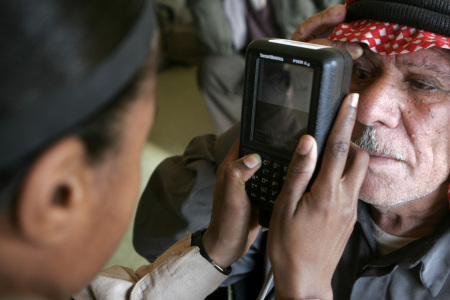
The Runit Nuclear Tomb

[The debris left by the United States nuclear testing at the Marshall islands  were buried under] a vast structure is known as the Runit Dome. Locals call it The Tomb. Below the 18-inch concrete cap rests the United States’ cold war legacy to this remote corner of the Pacific Ocean: 111,000 cubic yards of radioactive debris left behind after 12 years of nuclear tests.  Brackish water pools around the edge of the dome, where sections of concrete have started to crack away. Underground, radioactive waste has already started to leach out of the crater: according to a 2013 report by the US Department of Energy, soil around the dome is already more contaminated than its contents.  Now locals, scientists and environmental activists fear that a storm surge, typhoon or other cataclysmic event brought on by climate change could tear the concrete mantel wide open, releasing its contents into the Pacific Ocean….

Enewetak Atoll, and the much better-known Bikini Atoll, were the main sites of the United States Pacific Proving Grounds, the setting for dozens of atomic explosions during the early years of the cold war.  The remote islands – roughly halfway between Australia and Hawaii – were deemed sufficiently distant from major population centres and shipping lanes, and in 1948, the local population of Micronesian fishermen and subsistence farmers were evacuated to another atoll 200 km away.  In total, 67 nuclear and atmospheric bombs were detonated on Enewetak and Bikini between 1946 and 1958 – an explosive yield equivalent to 1.6 Hiroshima bombs detonated every day over the course of 12 years.

The detonations blanketed the islands with irradiated debris, including Plutonium-239, the fissile isotope used in nuclear warheads, which has a half-life of 24,000 years.  When the testing came to an end, the US Defence Nuclear Agency carried out an eight-year cleanup, but Congress refused to fund a comprehensive decontamination programme to make the entire atoll fit for human settlement again.

The DNA’s preferred option – deep ocean dumping – was prohibited by international treaties and hazardous waste regulations, and there was little appetite for transporting the irradiated refuse back to the US.  In the end, US servicemen simply scraped off the islands’ contaminated topsoil and mixed it with radioactive debris. The resulting radioactive slurry was then dumped in an unlined 350-foot crater on Runit Island’s northern tip, and sealed under 358 concrete panels.

But the dome was never meant to last. According to the World Health Organization, the $218m plan was designed as temporary fix: a way to store contaminated material until a permanent decontamination plan was devised.  Meanwhile, only three of the atoll’s 40 islands were cleaned up, but not Enjebi, where half of Enewetak’s population had traditionally lived. And as costs spiralled, resettlement efforts of the northern part of the atoll stalled indefinitely.  Nevertheless, in 1980, as the Americans prepared their own departure, the dri-Enewetak (“people of Enewetak”) were allowed to return to the atoll after 33 years.

Three years later, the Marshall Islands signed a compact of free association with the US, granting its people certain privileges, but not full citizenship.  The deal also settled of “all claims, past, present and future” related to the US Nuclear Testing Program – and left the Runit Dome under the responsibility of the Marshallese government.  Today, the US government insists that it has honoured all its obligations, and that the jurisdiction for the dome and its toxic contents lies with the Marshall Islands.  The Marshallese, meanwhile, say that a country with a population of 53,000 people and a GDP of $190m – most of it from US aid programs – is simply incapable of dealing with the potential radioactive catastrophe left behind by the Americans.

Today, Runitis still uninhabited, but it receives regular stream of visitors heading from neighboring islands to its abundant fishing grounds or searching for scrap metal to salvage.…Three decades after the Americans’ departure, abandoned bunkers dot the shoreline, and electric cables encased in black rubber snake across the sand.Nowhere on the beaches or the dome itself is there a warning to stay away – or even an indication of radioactivity.

The US has yet to fully compensate the dri-Enewetak for the irreversible damage to their homeland, a total amounting to roughly $244m as appraised by the Nuclear Claims Tribunal.+++ Many locals are deeply in debt, and dependent on a supplemental food program funded by the US Department of Agriculture, which delivers shipments of process foods such as Spam, flour and canned goods. The destruction a centuries-old lifestyle have lead to both a diabetes epidemic and regular bouts of starvation on the island….

Other – and more worrying – traces of Enewetak’s history have also reached China: according to a 2014 study published in Environmental Science & Technology, plutonium isotopes from the nuclear tests have been found as far a the Pearl River Estuary in Guangdong province.

Many people in Enewetak fear that one day the dome will break open, further spreading highly radioactive debris.  As catastrophic weather events become more frequent, recent studies – including 2013 study of the Runit Dome’s structural integrity carried out by the DoE – have warned that typhoons could destroy or damage the cement panels, or inundate the island. A 2013 report commissioned by the US Department of Energy to the Lawrence Livermore National Laboratory acknowledged that radioactive materials are already leaching out of the dome, but downplays the possibility of serious environmental damage or health risks….

Independent scientists say that salvaging Runit’s scrap metal may expose locals to much higher risks.“Those guys are digging in the dirt breathing in stuff in hot spots. That has to be hundreds of thousands times higher doses of potential health effects than swimming,” said Ken Buessler, a senior scientist and marine chemist at the Woods Hole Oceanographic Institution, who visited Runit and gathered samples of sediment in the lagoon earlier this year…

“Why Enewetak?” asked Ading, Enewetak’s exiled senator during an interview in the nation’s capital. “Every day, I have that same question. Why not go to some other atoll in the world? Or why not do it in Nevada, their backyard? I know why. Because they don’t want the burden of having nuclear waste in their backyard. They want the nuclear waste hundreds of thousands miles away. That’s why they picked the Marshall Islands.” “The least they could’ve done is correct their mistakes.”

Excerpts from Coleen Jose et al., The radioactive dome on Enewetak atoll, Guardian, July 3, 2015

+++In June 1983, the Agreement Between the Government of the United States and the Government of the Marshall Islands for the Implementation of Section 177 of the Compact of Free Association (referred to as 177 Agreement) established the Claims Tribunal “with jurisdiction to ‘render final determination upon all claims past, present and future, of the Government, citizens and nationals of the Marshall Islands which are based on, arise out of, or are in any way related to the Nuclear Testing Program.”The Tribunal was established in 1988.

See also UN Human Rights report Mission to the Marshall Islands

Animal Diseases as Biological Weapons

The World Health Organisation (WHO), animal health and national defence officers called for wider international co-operation to avoid the spread of animal diseases that could be used as biological weapons.  Sixty percent of human diseases come from animal agents and 80% of the agents that could be used for bio-terrorism are of animal origin, said Bernard Vallat, director general of the World Organisation for Animal Health (OIE).

“History has shown animal diseases have often been used as weapons before. Advances in genetics can now make them even more harmful. So we are calling for further investment to be made at national level on bio-security,” Vallat said at a conference on biological threat reduction.  Diseases have spread from animals to humans for millennia, with latest examples including the bird flu virus that has killed hundreds of people around the globe.

The OIE and the WHO warned animal disease agents could escape naturally, accidentally but also intentionally from laboratories, to be used as bio-weapons….Security breaches involving animal diseases are not rare.  The Pentagon said in May 2015 and June the US military had sent live samples of anthrax, which can be used as biological weapon, to five countries outside the United States and to dozens of US labs.

Excerpts from Beware of animal diseases as biological weapons, health experts say, Reuters, June 30, 2015

Subsidize Exports: US Export-Import Bank

[T]he Export-Import Bank of the U.S., which was so successful at expanding exports that scores of other nations have copied the model. Now — for the second time in a year — small-government advocates are trying to abolish the bank, saying it distorts the free market by using tax dollars to pick business winners and losers. …

Unless Congress acts, the Export-Import Bank’s lending authority will expire June 30, 2015. Tea Party Republicans, who want to limit government intervention in the free market, say the bank provides a form of corporate welfare. Some airlines, including Delta, say the bank’s loan guarantees for Boeing jets unfairly subsidize its international competitors. Congress is now considering four bills that would reauthorize the lender with some reforms. But Republican Representative Jeb Hensarling, head of the House committee that oversees the bank, is still calling for its abolition.

The Export-Import Bank was started by President Franklin D. Roosevelt in 1934 as a New Deal program to boost exports….It provides loan guarantees, loans and insurance to help foreign companies — sometimes those with less-than-perfect credit — buy U.S. goods when private banks can’t or won’t make loans in industries including aerospace, energy and manufacturing. Though Democrats widely support Ex-Im, Barack Obama criticized it while campaigning for president in 2008, calling it “little more than a fund for corporate welfare” at a time when opposition to government spending, triggered by the bailouts that year, was growing. Ex-Im authorizationssoared, reaching a peak of $114 billion in total outstanding financial commitments at the end of fiscal 2013, from $58 billion in 2008. President Obama now supports Ex-Im reauthorization.

In May 2015, the U.S. Chamber of Commerce began a national ad campaign in favor of the bank, arguing that without it, jobs might be lost to competitors in China or Russia. …[Another issue] is “corruption” at Ex-Im, after a former bank employee pleaded guilty to accepting over $78,000 in bribes between 2006 and 2013. While about 90 percent of Ex-Im’s deals help U.S. small businesses, an analysis by Veronique de Rugy, a bank critic at George Mason University, found that Boeing benefited from about 30 percent of the bank’s authorizations in 2013.

Excerpt from : Brian Wingfield, U.S. Export-Import Bank: From Apple Pie to Endangered Species, Bloomberg, June 25, 2015

United States Forces in Gabon

The [United States] Marines worked with the government of Gabon to test the full-scale employment of the force on the continent. Their forward-staged compound, known as a Cooperative Security Location, (CSL)…also provides the Marines with easy access to their MV-22 Osprey and KC-130J aircraft, which are critical in providing a crisis-response capability over a geographically dispersed area.  “For this particular CSL, we planned to support up to 200 personnel,” said 1st Lt. Micah Tate, the combat logistics detachment’s executive officer. “From those personnel, we have around 20 logistics Marines who are providing direct support and two platoons of infantrymen that are able to embark on the Ospreys. That’s the point of these CSLs.”

Excerpt from Marines test forward-staging abilities in Gabon, June 23 2015 

How to Engineer Mars to Become Earth

Modifying a planet’s atmosphere to make it habitable for humans could be a possibility, according to the Pentagon’s Defense Advanced Research Projects Agency.  Darpa has announced it is developing terraforming technology in a bid to recreate the conditions needed for live to thrive….[DARPA is developing]…  a ‘technological toolkit’ to transform hostile places. It will involve genetically engineering a wide variety of organisms.   Alicia Jackson, the deputy director of Darpa’s Biological Technologies Office in Virginia, made comments alluding to the technology at a biotech conference on June 22, 2015

‘For the first time, we have the technological toolkit to transform not just hostile places here on Earth, but to go into space not just to visit, but to stay,’ she was quoted as saying…This ‘toolkit’ will involve genetically engineering organisms of all types, of which there are up to 30 billion on Earth. On Earth, most synthetic biology projects use just two at the moment – e. coli and yeast. A newly developed software called DTA GView, dubbed the ‘Google Maps of genomes,’ will help scientists correlate information on organisms.  And the ultimate goal is to choose organisms with specific genes to create something with certain characteristics.

For example, it has been theorised that some organisms could be bio-engineered to pull certain gases out of the Martian atmosphere – like carbon dioxide – and create nitrogen and oxygen.  Both are abundant in Earth’s atmosphere – and would be needed for any humans hoping to breathe on Mars without a spacesuit.  NASA has toyed with the idea before; last year, they unveiled the Mars Ecopoiesis Test Bed concept, which would create ecosystems capable of supporting life within biodomes on Mars.   But Darpa’s technology would creative liveable environments outside in the open air on the Martian surface.

The technology has other uses, too; it could be used to repair an environment on Earth after a manmade or natural disaster, although Darpa did not specify what these could be.

Excerpts from: JONATHAN O’CALLAGHAN Could we turn Mars into Earth 2.0? Darpa is working on designer organisms to terraform the red planet, Daily Mail, June 26, 2015

The Torture Sites: CIA

The existence of the approximately 14,000 photographs will probably cause yet another delay in the military commissions at Guantanamo Bay, Cuba, as attorneys for the defendants demand all of the images be turned over to them and the government wades through the material to decide what it thinks is relevant to the proceedings.  Defence attorneys said they have not yet been informed about the photographs and said it is unacceptable that they should come to light only now, more than three years after the arraignment of Khalid Sheik Mohammed and four other defendants accused of planing the September 11 attacks.

The electronic images depict external and internal shots of facilities where the CIA held al-Qaeda suspects after 9/11…They do include images of naked detainees during transport, …The pictures also show CIA personnel and members of foreign intelligence services, as well as psychologists Bruce Jessen and James Mitchell, among the architects of the interrogation program. …Among the images are those of cells and bathrooms at the detention sites, including a facility in Afghanistan known as “Salt Pit“, where the waterboard was photographed.

A US official described the photographs of the Salt Pit as looking like a dungeon. The official added that many of the pictures appear to have been taken for budgetary reasons to document how money was being spent.  The bulk of the photographs depict black sites in Thailand, Afghanistan and Poland. There are fewer shots of prisons in Romania and Lithuania, which were among the last to be used before they were closed in 2006.  A US official said there are also photographs of confinement boxes where detainees such as Abu Zubaydah, who is now at Guantanamo, were forced into for hours.

Also among the photographs are images of Zubaydah shortly after he was captured in 2002; he was wounded in the leg during a shootout with Pakistani security forces. The pictures show his injury. Later shots show him wearing an eye patch. A former CIA official said Zubaydah had a pre-existing eye injury that was infected when the agency captured him. The eye was later removed.

Excerpts from Adam Goldman ,Photos of CIA ‘black sites’ come to light, Washington Post, June 28, 2015

Biodiversity in the Lawless Seas

The United Nations General Assembly adopted a resolution on May 2015 (reissued on June 2015) aimed at drafting a legally binding international treaty for the conservation of marine biodiversity and to govern the mostly lawless high seas beyond national jurisdiction.The resolution was the result of more than nine years of negotiations by an Ad Hoc Informal Working Group, which first met in 2006.

If and when the treaty is adopted, it will be the first global treaty to include conservation measures such as marine protected areas and reserves, environmental impact assessments, access to marine genetic resources and benefit sharing, capacity building and the transfer of marine technology.

The High Seas Alliance (HSA), a coalition of some 27 non-governmental organisations (NGOs), played a significant role in pushing for negotiations on the proposed treaty and has been campaigning for this resolution since 2011…The General Assembly will decide by September of 2018 on the convening of an intergovernmental conference to finalise the text of the agreement and set a start date for the conference….

A new treaty would help to organise and coordinate conservation and management [in the high seas].  That includes the ability to create fully protected marine reserves that are closed off to harmful activities. Right now there is no way to arrange for such legally binding protections, she added….In a statement released Friday, the HSA said the resolution follows the Rio+20 conference in 2012 where Heads of State committed to address high seas protection.The conference came close to agreeing to a new treaty then, but was prevented from doing so by a few governments which have remained in opposition to a Treaty ever since.

The U.N. Convention on the Law of the Sea (UNCLOS), which is recognised as the “constitution” for global ocean governance, has a broad scope and does not contain the detailed provisions necessary to address specific activities, nor does it establish a management mechanism and rules for biodiversity protection in the high seas.  Since the adoption of UNCLOS in 1982, there have been two subsequent implementing agreements to address gaps and other areas that were not sufficiently covered under UNCLOS, one related to seabed mining and the other related to straddling and highly migratory fish stocks, she added. This new agreement will be the third implementing agreement developed under UNCLOS….

The “high seas” is the ocean beyond any country’s exclusive economic zone (EEZ) ‑ amounting to 64 percent of the ocean…

Excerpts from Thalif Deen, U.N. Takes First Step Towards Treaty to Curb Lawlessness in High Seas, IPS, June 19 2015

Surgically Implanted Explosive Devices and Drone Strikes

The documents, provided to the Guardian by NSA whistleblower Edward Snowden and reported in partnership with the New York Times, discuss how a joint US, UK and Australian programme codenamed Overhead supported the strike in Yemen in 2012….

British officials and ministers follow a strict policy of refusing to confirm or deny any support to the targeted killing programme, and evidence has been so scant that legal challenges have been launched on the basis of single paragraphs in news stories.

The new documents include a regular series of newsletters – titled Comet News – which are used to update GCHQ personnel on the work of Overhead, an operation based on satellite, radio and some phone collection of intelligence. Overhead began as a US operation but has operated for decades as a partnership with GCHQ and, more recently, Australian intelligence.

The GCHQ memos, which span a two-year period, set out how Yemen became a surveillance priority for Overhead in 2010, in part at the urging of the NSA, shortly after the failed 2009 Christmas Day bomb plot in which Umar Farouk Abdulmutallab attempted to detonate explosives hidden in his underpants on a transatlantic flight.  Ten months later a sophisticated plot to smuggle explosives on to aircraft concealed in printer cartridges was foiled at East Midlands airport. Both plots were the work of al-Qaida in the Arabian Peninsula (AQAP), the Yemen-based al-Qaida offshoot.

One Comet News update reveals how Overhead’s surveillance networks supported an air strike in Yemen that killed two men on 30 March 2012. The men are both described as AQAP members.  In the memo, one of the dead men is identified as Khalid Usama – who has never before been publicly named – a “doctor who pioneered using surgically implanted explosives”. The other is not identified…

US officials confirmed to Reuters in 2012 that there had been a single drone strike in Yemen on 30 March of that year. According to a database of drone strikes maintained by the not-for-profit Bureau of Investigative Journalism, the only incident in Yemen on that date targeted AQAP militants, causing between six and nine civilian casualties, including six children wounded by shrapnel.  Asked whether the strike described in the GCHQ documents was the same one as recorded in the Bureau’s database, GCHQ declined to comment.

The incident is one of more than 500 covert drone strikes and other attacks launched by the CIA and US special forces since 2002 in Pakistan, Yemen and Somalia – which are not internationally recognised battlefields.  The GCHQ documents also suggest the UK was working to build similar location-tracking capabilities in Pakistan, the country that has seen the majority of covert strikes, to support military operations “in-theatre”.

A June 2009 document indicates that GCHQ appeared to accept the expanded US definition of combat zones, referring to the agency’s ability to provide “tactical and strategic SIGINT [signals intelligence] support to military operations in-theatre, notably Iraq and Afghanistan, but increasingly Pakistan”. The document adds that in Pakistan, “new requirements are yet to be confirmed, but are both imminent and high priority”….

By this point NSA and GCHQ staff working within the UK had already prioritised surveillance of Pakistan’s tribal areas, where the majority of US covert drone strikes have been carried out. A 2008 memo lists surveillance of two specific sites and an overview of satellite-phone communications of the Federally Administered Tribal Areas, in which nearly all Pakistan drone strikes have taken place, among its key projects.

British intelligence-gathering in Pakistan is likely to have taken place for a number of reasons, not least because UK troops in Afghanistan were based in Helmand, on the Pakistani border.One of the teams involved in the geo-location of surveillance targets was codenamed “Widowmaker”, whose task was to “discover communications intelligence gaps in support of the global war on terror”, a note explains.

Illustrating the close links between the UK, US and Australian intelligence services, Widowmaker personnel are based at Menwith Hill RAF base in Yorkshire, in the north of England, in Denver, Colorado, and in Alice Springs in Australia’s Northern Territory.

Other Snowden documents discuss the difficult legal issues raised by intelligence sharing with the US….The UK has faced previous legal challenges over the issue. In 2012, the family of a tribal elder killed in Pakistan, Noor Khan, launched a court case in England in which barristers claimed GCHQ agents who shared targeting intelligence for covert strikes could be “accessory to murder”. Judges twice refused to rule on the issue on the grounds it could harm the UK’s international relations.

Excerpts from Alice Ross and James Ball,  GCHQ documents raise fresh questions over UK complicity in US drone strikes,  Guardian, June 24, 2015

War against the Islamic State – All Out

Excerpts from David A. Deptula,  How to Defeat the Islamic State, Washington Post

From the U.S. perspective, the most important goal is not the maintenance of the Iraqi government but the destruction of the Islamic State.  The current U.S.-led coalition is following the counterinsurgency model used in Iraq and Afghanistan for more than a decade, but the Islamic State is not an insurgency. The Islamic State is a self-declared sovereign government. We must stop trying to fight the last war and develop a new strategy.

The Islamic State can be decomposed through a comprehensive and robust air campaign designed to: (1) terminate its expansion; (2) paralyze and isolate its command-and-control capability; (3) undermine its ability to control the territory it occupies; and (4) eliminate its ability to export ­terror.

But to do these things, air power has to be applied like a thunderstorm, not a drizzle. In the campaign against the Islamic State, we are averaging 12 strike sorties per day. During Operation Desert Storm in Iraq and Kuwait in 1991, the average was 1,241; in Operation Allied Force in Kosovo in 1999, it was 298; in the first 30 days of Operation Iraqi Freedom in 2003, 691; during Operation Enduring Freedom in Afghanistan in 2001, 86.

In the past two decades, several strategic victories were brought about by air power operating in conjunction with indigenous ground forces — none of which were better than the Iraqi army. Robust air power, along with a few air controllers, carried the Northern Alliance to victory over the Taliban, at minimal cost in blood and treasure to the United States. Bosnia, Kosovo and Libya similarly involved airstrikes well in excess of those being used against the Islamic State.

Complicating the effort to defeat the Islamic State is an excessive focus on the avoidance of collateral damage and casualties. In an armed conflict, the military establishes rules of engagement designed to balance the moral imperative to minimize damage and unintentional casualties against what’s required to accomplish the mission. Recently reported by pilots actually fighting the Islamic State is that the current rules — which far exceed accepted “Law of War” standards — impose excessive restrictions that work to the advantage of the enemy. The ponderous and unnecessary set of procedures in place is allowing the Islamic State to exploit our desire to avoid civilian causalities to commit atrocities on the ground…

The best way to improve our force effectiveness while still minimizing collateral damage and casualties is to allow them to use their judgment. This is called “mission command,” and the Pentagon should empower our aviators to employ it.

The fastest way to end the inhumanity of war is to eliminate its source — in this case, the Islamic State — as quickly as possible. Gradualism doomed the effectiveness of air power in the “Rolling Thunder” air campaign from 1965 to 1968 during the Vietnam War. The current gradualist approach is worsening the suffering and increasing the loss of innocent life. While unintended casualties of war are regrettable, those associated with airstrikes pale in comparison with the savage acts being carried out by the Islamic State. What is the logic of a policy that restricts the use of air power to avoid the possibility of collateral damage while allowing the certainty of the Islamic State’s crimes against humanity?

This does not have to be a “long war,” as has been claimed by those whose politics benefit from that assertion, as well as those whose experience is rooted in counterinsurgency. The counterinsurgency operations in Iraq and Afghanistan went on for eight and 14 years, respectively. Desert Storm took 43 days; Bosnia’s Operation Deliberate Force, 22 days; Allied Force, 78 days; the decisive phase of Enduring Freedom took 60 days. A robust air campaign can devastate the Islamic State to the point where Iraqi and Kurdish forces can end the occupation.

Excerpts from David A. Deptula How to defeat the Islamic State, Washington Post, June 5, 2015

Nuclear Weapons are Here to Stay

[D]espite the establishment in 2009 of [a process to] discuss multilateral disarmament, not much has happened. The main reason is the chilling of relations between Russia and the West, which predated Russia’s annexation of Crimea. An offer by Mr Obama in 2013 of new negotiations to reduce each side’s stock of warheads by a third was met with stony silence.

More recently Russia has, according to America, violated both the 1987 Intermediate Nuclear Forces treaty, by testing a banned missile, and the Budapest Memorandum of 1994 that guaranteed Ukraine’s security when it gave up the nuclear weapons it had inherited on the break-up of the Soviet Union. The Russians are also refusing to attend next year’s Nuclear Security Summit, a meeting to prevent fissile material falling into the wrong hands.

Without further cuts in American and Russian nuclear forces (which account for more than 90% of the world’s nuclear weapons), China, the most opaque of the P5 power (US, UK, Russia, China, France), will block attempts to get multilateral disarmament talks going. However, Rose Gottemoeller, America’s under-secretary of state for arms control, praises China for its leading role in producing a common glossary of nuclear terminology. This may not sound much, but it is seen within the P5 as essential for future negotiations.

Ms Gottemoeller is also keen to stress that, despite the Russian impasse, America has tried to meet its obligations. It is eliminating “excess” warheads at the rate of almost one a day and closing down old bits of nuclear infrastructure. …It is doubtful whether these modest, incremental efforts will cut much ice with the Humanitarian Impacts of Nuclear Weapons Initiative, a movement supported by civil-society groups and championed by Austria, Norway and Mexico. Faced with what they see as foot-dragging by the P5 (which are modernising their nuclear forces to maintain their long-term effectiveness), the initiative’s backers, some of which want to make nuclear weapons illegal, may question whether working through the NPT serves any purpose…

Another source of friction is the failure to hold the conference on creating a WMD-free zone in the Middle East that was promised in 2010. Israel,…insists that regional security arrangements must precede any talks on disarmament, whereas Egypt says the first step is for Israel to accede to the NPT—a non-starter.

Excerpts from Nuclear weapons: Fractious, divided but still essential, Economist, May 2, 2015, at 54

Poaching Fishing Boats, Blow them Up

The tiny Pacific nation of Palau, fighting a rising tide of illegal fishing in its waters, has set fire to four boats of Vietnamese caught poaching sea cucumbers and other marine life in its waters. Palau’s president, Tommy Remengesau Jr., said..he hopes to turn most of the island nation’s territorial waters into a national marine sanctuary, banning commercial fishing and exports apart from limited areas to be used by domestic fishermen and tourists. “We wanted to send a very strong message. We will not tolerate any more these pirates who come and steal our resources,” Remengesau said in a phone interview with The Associated Press from Washington, D.C., where he was visiting.

The country created the world’s first shark sanctuary in 2009, but until recently had only one patrol boat to help protect its great hammerheads, leopard sharks and more than 130 other species of shark and rays fighting extinction.

The four boats destroyed  were among 15 Palau authorities have caught fishing illegally in their waters since 2014  with loads of sharks and shark fins, lobsters, sea cucumbers and reef fish. Several of the boats that it seized, stripped of their fishing gear, are due to carry 77 crew members of the boats back to Vietnam.  Remengesau said that the stream of poachers showed that just stripping the rogue boats of their nets and confiscating their catches was not enough”I think it’s necessary to burn the boats,” he said.

Palau, about 600 miles miles east of the Philippines, is one of the world’s smallest countries, its 20,000 people scattered across a tropical archipelago of 250 islands that is considered a biodiversity hotspot. In 2012, its Rock Islands Southern Lagoon was named a UNESCO World Heritage site.

Driven by rising demand from China and elsewhere in Asia, overfishing threatens many species of fish. ..[A]bout a fifth of the global market for marine products caught and sold, or about $23.5 billion, is caught illegally.  Advances in telecommunications and vessel tracking technology have improved surveillance, but enforcing restrictions on unauthorized fishing is costly and difficult, especially given the many “pockets” of high seas in the area….From Palau to Japan is a vast expanse of seas that nobody controls and nobody owns, areas that serve as refuges for illegal fishing vessels.

One way to counter that tactic is to create a “geofence” using vessel identification systems that could trigger alerts when vessels cross into national waters.

Nearby Indonesia also is taking harsher action, recently blowing up and sinking 41 foreign fishing vessels from China, Malaysia, the Philippines, Thailand and Vietnam, as a warning against poaching in the country’s waters.

In Hanoi, Foreign Ministry spokesman Le Hai Binh recently told reporters the government was seeking to protect the rights of the fishermen. He urged other governments to “render humanitarian treatment toward the Vietnamese fishing trawlers and fishermen on the basis of international law as well as humanitarian treatment toward fishermen who were in trouble at sea.”  While burning and sinking such ships seems drastic, the International Tribunal for the Law of the Sea has backed such moves, ruling that countries can be held liable for not taking necessary measures to prevent illegal, unreported or unregulated, so-called IUU, fishing operations by their vessels in the waters of other countries.

In a report on IUU fishing last year, the Indonesia government outlined a slew of tactics used by poachers, including fake use of Indonesian flags on foreign vessels, forgery of documents and use of bogus fishing vessels using duplicate names and registration numbers of legitimate ships.

Excerpts from Elaine KurtenbachPalau burns Vietnamese boats caught fishing illegally, Associated Press, June 12, 2015

Chlorine Attacks in Syria

The U.N. Security Council should make sure that the people allegedly responsible for chlorine attacks in Syria are brought to justice, Russia’s U.N. ambassador said on June 3, 2015….The United States has been promoting Security Council action to assess blame for alleged chlorine attacks, which Syrian activists and doctors say have been increasingly used in recent weeks.

The Organization for the Prohibition of Chemical Weapons, the global chemical weapons watchdog based in The Hague, Netherlands, has condemned the use of chlorine in Syria as a breach of international law. But the OPCW does not have a mandate to determine responsibility for the use of chemical weapons.  In its latest report, the OPCW said a fact-finding team would visit Syria to look into recent allegations of attacks using toxic chemicals. Syria’s U.N. Ambassador Bashar Ja’afari told The Associated Press that the team had arrived and would visit areas that the two parties agreed on.

The United States has been pressing for “an accountability mechanism” to attribute blame and has been discussing council action with the Russians and other council members.  A Security Council diplomat… said there is no single view yet on how best to achieve accountability. The diplomat said Russia favors a weaker approach while Western council members are insisting on a resolution that puts accountability under the Security Council, in consultation with the OPCW.

EDITH M. LEDERER , Russia Wants Accountability for Chlorine Attacks in Syria, Associated Press, June 3, 2015

Nuclear Capability of Iran – Natanz, Fordow, Parchin

One [of the problems] is the ambiguity about what rights the Iranians will have to continue nuclear research and development. They are working on centrifuges up to 20 times faster than today’s, which they want to start deploying when the agreement’s [the currently negotiated agreement between Iran and United States/Europe]  first ten years are up. The worry is that better centrifuges reduce the size of the clandestine enrichment facilities that Iran would need to build if it were intent on escaping the agreement’s strictures.

That leads to the issue on which everything else will eventually hinge. Iran has a long history of lying about its nuclear programme. It only declared its two enrichment facilities, Natanz and Fordow, after Western intelligence agencies found out about them. A highly intrusive inspection and verification regime is thus essential, and it would have to continue long after other elements of an agreement expire. Inspectors from the IAEA would have to be able to inspect any facility, declared or otherwise, civil or military, on demand…

For a deal to be done in June 2015, Iran will have to consent to an [intrusive] inspection regime. It will also have to answer about a dozen questions already posed by the IAEA about the “possible military dimensions” of its nuclear programme. Yet on March 23, 2015Yukiya Amano, the agency’s director, said that Iran had replied to only one of those questions. Parchin, a military base which the IAEA believes may have been used for testing the high-explosive fuses that are needed to implode, and thus set off, the uranium or plutonium at the core of a bomb, remains out of bounds. Nor has the IAEA been given access to Mohsen Fakhrizadeh, the physicist and Revolutionary Guard officer alleged to be at the heart of the weapons development research. The IAEA’s February 19, 2015 report on Iran stated that it “remains concerned about the possible existence…of undisclosed nuclear-related activities…including activities related to the development of a nuclear payload for a missile.”

Excerpts from, The Iran Nuclear Talks: Not Yet the Real Deal, Economist, Apr. 4, 2015, at 43

Iran Wants to Be North Korea: nuclear weapons

The US tried to deploy a version of the Stuxnet computer virus to attack North Korea’s nuclear weapons programme five years  (2010) ago but ultimately failed, according to people familiar with the covert campaign.  The operation began in tandem with the now-famous Stuxnet attack that sabotaged Iran’s nuclear programme in 2009 and 2010 by destroying a thousand or more centrifuges that were enriching uraniumc. Reuters and others have reported that the Iran attack was a joint effort by US and Israeli forces.
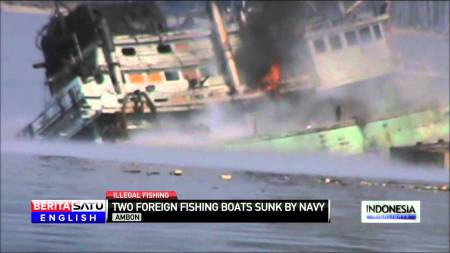
According to one US intelligence source, Stuxnet’s developers produced a related virus that would be activated when it encountered Korean-language settings on an infected machine…But the National Security Agency-led campaign was stymied by North Korea’s utter secrecy, as well as the extreme isolation of its communications systems...North Korea has some of the most isolated communications networks in the world. Just owning a computer requires police permission, and the open internet is unknown except to a tiny elite. The country has one main conduit for internet connections to the outside world, through China.  In contrast, Iranians surfed the net broadly and had interactions with companies from around the globe.

The US has launched many cyber espionage campaigns, but North Korea is only the second country, after Iran, that the NSA is now known to have targeted with software designed to destroy equipment.

Experts in nuclear programmes said there were similarities between North Korea and Iran’s operations, and the two countries continue to collaborate on military technology. Both countries use a system with P-2 centrifuges, obtained by Pakistani nuclear scientist AQ Khan, who is regarded as the father of Islamabad’s nuclear bomb, they said. Like Iran, North Korea probably directs its centrifuges with control software developed by Siemens AG that runs on Microsoft Corp’s Windows operating system, the experts said. Stuxnet took advantage of vulnerabilities in both the Siemens and Microsoft programmes…

Despite modest differences between the programmes, “Stuxnet can deal with both of them. But you still need to get it in,” said Olli Heinonen, senior fellow at Harvard University’s Belfer Center for Science and International Affairs and former deputy director general of the International Atomic Energy Agency…

The Stuxnet campaign against Iran, code-named Olympic Games, was discovered in 2010. It remains unclear how the virus was introduced to the Iranian nuclear facility in Natanz, which was not connected to the Internet.,,,According to cybersecurity experts, Stuxnet was found inside industrial companies in Iran that were tied to the nuclear effort. As for how Stuxnet got there, a leading theory is that it was deposited by a sophisticated espionage programme developed by a team closely allied to Stuxnet’s authors, dubbed the Equation Group by researchers at Kaspersky Lab…

In addition, North Korea likely has plutonium, which does not require a cumbersome enrichment process depending on the cascading centrifuges that were a fat target for Stuxnet, they said.

Excerpts from NSA tried Stuxnet cyber-attack on North Korea five years ago but failed, Reuters, May 29, 2015