Category Archives: Espionage

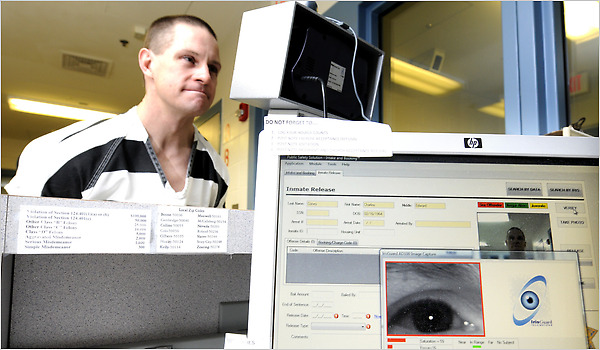
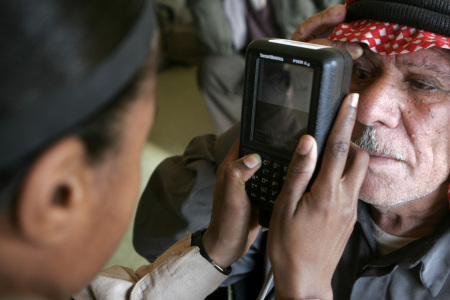
The Biometrics Bonanza: Measuring and Identifying Humans

Many African  governments have unwisely bought biometric proprietary systems of private companies, meaning that they are forced to go back to the seller for maintenance, upgrades and new components. That can be expensive. When Nigeria wanted to use its own card-printing machines, the firm that had sold it software tried to insist that Nigeria buy its machines as well… They eventually got help from Pakistan, which had software that worked on any machine.

But there are signs of change coming from within the industry itself, spurred by developments in an entirely different part of the world: India. Like Africa, it is vast, poor and home to more than a billion people. Yet as a single country India has tremendous negotiating power. When India developed its “Aadhaar” identity programme it invited leading firms to bid—but with the caveat that they provide open-source software, or code that can be examined and changed by others. This allowed engineers to knit together different bits of a system such as databases, enrollment software, fingerprint scanners and so on. The suppliers agreed because they did not want to miss out on the biggest identity bonanza the world had ever seen. Moreover, India’s spending led to a big increase in production, which caused prices to fall across the industry.

Even as governments think about the technical problems of recording identity, they also need to grapple with the far more consequential ones around rights, governance and privacy. The starkest warning of the misuse of identity was in the Rwandan genocide, where ID papers listed ethnicity, making it easy to target Tutsis. Since data on religion and ethnicity are not needed to provide services, governments should not be hoovering it up.

States should also be wary of denying people their rights by creating a class of citizens without papers. In Kenya, for example, the government wants everyone to register for ID  cards, but it discriminates against members of the Nubian minority by forcing them to appear before a security panel to prove their nationality. Modern identity systems promise to bring many benefits to Africa. But as they proliferate, so too will the temptation for politicians to misuse them

Excerpts from Identity Documentation in Africa: Papers Please, Economist, Dec. 7, 2019

Assassinations and Top Secret Chemicals: the case of Novichok Nerve Agent

In 2018, one of the Novichok nerve agents was used in an attempt to assassinate a former Russian spy on U.K. soil—spurring the United States and allies to lift the veil of secrecy and mount a drive to outlaw the obscure class of nerve agents, concocted in a Soviet weapons lab during the height of the Cold War. Now, their effort to amend the Chemical Weapons Convention (CWC) is about to pay off.

On 9 October, the Executive Council of the Organisation for the Prohibition of Chemical Weapons (OPCW), the body that administers the treaty, reviewed a revised proposal from Russia that would bring Novichoks under the treaty’s verification regime, along with a class of potential weapons known as carbamates. If the Russian proposal and a similar one from the United States, Canada, and the Netherlands are approved at a treaty review meeting in December 2019.

The newfound glasnost on Novichoks, also known as fourth-generation nerve agents, should spur research on their mechanism of action and on countermeasures and treatments.   Chemical weapons experts had been whispering about Novichoks for decades.   Treaty nations have long resisted adding Novichoks to the CWC’s so-called Schedule 1 list of chemical weapons, which compels signatories to declare and destroy any stockpiles. “People were worried about a Pandora’s box,” fearing such a listing would force them to regulate ingredients of the weapons, Koblentz says. That could hamper the chemical industry and might clue in enemies on how to cook them up. (Who has the agents now is anyone’s guess.) Indeed, the U.S. government for years classified the Novichok agents as top secret. “There was a desire among Western countries to keep the information as limited as possible to avoid proliferation issues,” Koblentz says.

The 2018 assassination attempt against former Russian spy Sergei Skripal in Salisbury, U.K., thrust the Novichok agents into the spotlight. The botched attack gravely sickened Skripal, his daughter Yulia, two police officers who investigated the crime scene, and a couple—Charlie Rowley and Dawn Sturgess—who a few months later happened on a perfume bottle containing the agent. After long hospitalizations, the Skripals, the officers, and Rowley recovered; Sturgess died. The United Kingdom charged two Russian men, reportedly military intelligence officers, as the alleged assailants, and obtained a European warrant for their arrest; they remain at large in Russia.

Excerpts from Richard Stone, Obscure Cold War nerve agents set to be banned, Science, Oct. 25, 2019

How to Engineer Bacteria to Search for Underground Chemical Weapons: DARPA

U.S. military researchers asked in 2019 two companies to develop new kinds of biological sensors that can detect underground disturbances or the presence of buried chemicals or weapons.

Officials of the U.S. Defense Advanced Research Projects Agency (DARPA) in Arlington, Va., are looking to Raytheon BBN Technologies, and Signature Science, for the BioReporters for Subterranean Surveillance program.  This project seeks to use indigenous and engineered organisms to sense changes of interest to military commanders in natural and built environments. Raytheon BBN and Signature Science won separate $1.6 million contracts for the Subterranean Surveillance progam.

The two companies will perform laboratory research and proof-of-concept demonstrations of biological sensing systems in well- controlled field tests that take advantage of recent advances in microbial science and synthetic biology to develop biological sensors, signal transducers, and reporters that can reveal subterranean phenomena at a distance.  Bio Reporters should be able to sense a phenomenon at least one meter below the surface, propagate a signal to the surface within seven days, and be continuously detectable on the surface at a distance of 10 meters over the subsequent seven days.

DARPA researchers want Raytheon BBN and Signature Science experts to take advantage of the extensive biological networks that exist underground to monitor large areas to increase the military’s ability to detect subterranean events without the need for precise coordinates.

Excerpts from John Keller, Researchers eye new biological sensors to to detect underground objects like buried chemicals and weapons, https://www.militaryaerospace.com,  Nov. 6, 2019

In more detail  Signature Science and its partner, the Texas A&M University Center for Phage Technology, aim to leverage modern and synthetic phage biology and the straightforward molecular genetics of the harmless soil bacterium Bacillus subtilis to generate a new platform to recognize and report on specific chemical threats underground. The Spore-Phage Amplified Detection (SPADe) method, potentially extensible to explosives, radiation or physical disturbance sensing, seeks to substantially advance currently used techniques which rely heavily on manual soil testing. 

The Ocean-Based Internet: Data Mining the Ocean

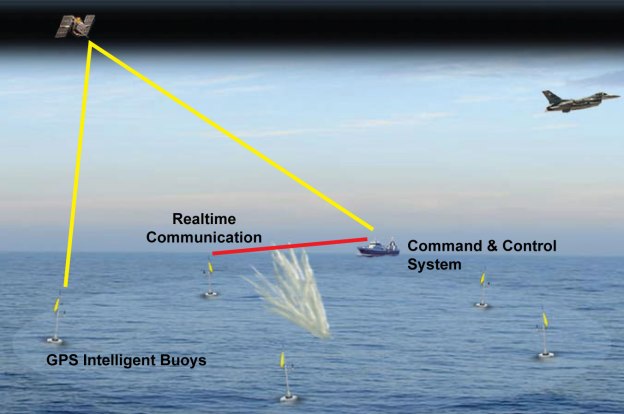
The U.S. Defense Department could one day place thousands of low-cost, floating sensors into the ocean to collect environmental data, such as water temperature, as well as activity data about commercial vessels, aircraft and even fish or maritime mammals moving through the area. But others also are dropping similar sensors in the world’s oceans, and defense researchers suggest many of those systems could be integrated into an even more comprehensive ocean-based Internet of Things.

The growing Internet of Things is mostly a land-based phenomenon, frequently in large cities with loads of sensors. But researchers at the Defense Advanced Research Projects Agency (DARPA) foresee a wide range of military and civil benefits from extending the Internet of Things out to sea.  The agency announced its Ocean of Things program in 2017. John Waterston, a program manager within DARPA’s Strategic Technology Office, says the sensors will float along the surface for at least one year, transmitting short messages via the Iridium satellite constellation back to a central location for analysis. “It’s a 280-byte in and 340-byte out message, so it’s a little bit more than a tweet. I like to say these things tweet about their environment,” he says.

The goal is to increase maritime awareness in a cost-effective way. Using existing systems to continuously monitor vast regions of the ocean would be cost prohibitive…. By coupling powerful analytical tools with commercial sensor technology, the agency intends to create floating sensor networks that significantly expand maritime awareness at a fraction of the cost of current approaches.

Waterston says one of the most interesting missions for the sensor might be to simply determine whether GPS signals are available in an area of interest for military operations. …The program also could help improve ocean modeling, which is important for forecasting weather, finding people who have fallen overboard or locating debris from a crashed aircraft. …The agency has yet to determine how many sensors it might eventually deploy, but they could number in the tens of thousands. To put that into perspective, DARPA officials compare the final density to placing a penny on the national mall, which Wikipedia says covers about 309 acres between the Ulysses S. Grant Memorial and the Lincoln Memorial….

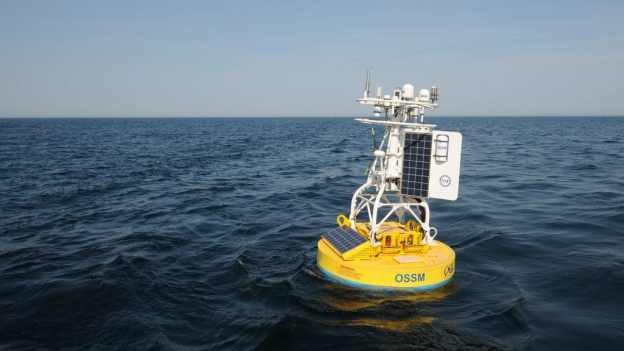
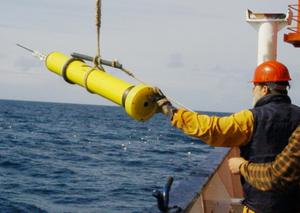
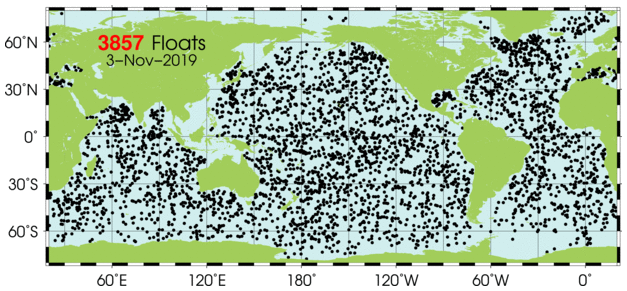
In addition, Argo, an international program, uses several thousand battery-powered, robotic floating devices to measure temperature, salinity and current for climate and oceanographic research. The floats mostly drift 10 days at a time below the ocean surface. After rising and transmitting their data to satellites, they return to depth to drift for another 10 days. The floats go as deep as 2,000 meters, according to the Argo website. 

Argo Floating Device

It is possible an ocean-based Internet could provide data on demand to a variety of customers inside and outside the Defense Department. If, for example, a government agency needs the water temperature in a given area reported every six hours, or a combatant command needs to know what’s happening in the Mediterranean, or NATO officials want information between Gibraltar and Sicily, or commercial fishermen need data on where the shrimp or tuna are, they could simply request it. “It’s about serving the end users. If you can use that data, we can generate it for you,” he offers. “It’s a little bit like floats-as-a-service or data-as-a-service.”

Argo’s Ocean Sensors

Another option is that other organizations could purchase and deploy the DARPA-developed sensors. “I hope people want to come up with their own sensors or want to buy these. I imagine a marketplace where you get many commercial people buying these. Everyone could buy 500 and then take advantage of the service provided by the thousands that are out there. I could imagine this as that foundational community,” Waterston suggests.

DARPA currently is working with three teams led by the Palo Alto Research Center, better known as PARC***, Areté Associates and Numurus LLC to develop the floats. Leidos, Draper Laboratory, SoarTech and Geometric Data Analytics are providing software for data visualization, performance prediction, float command and control and detection. 

Excerpts from George Seffers, DARPA’s Ocean of Things Ripples Across Research Areas, AFCEA.org, Nov. 1, 2019

***See also DARPA’s Vanishing Programmable Resources (VAPR) program. According to one scientist that works in the PARC’s disappearing electronics platform (called DUST) “Imagine being able to cover a large area, like the ocean floor, with billions of tiny sensors to ‘hear’ what is happening within the earth’s crust, and have them quickly disintegrate into, essentially, sand, leaving no trace and not harming the planet or sea life,  

Dodging the Camera: How to Beat the Surveillance State in its Own Game

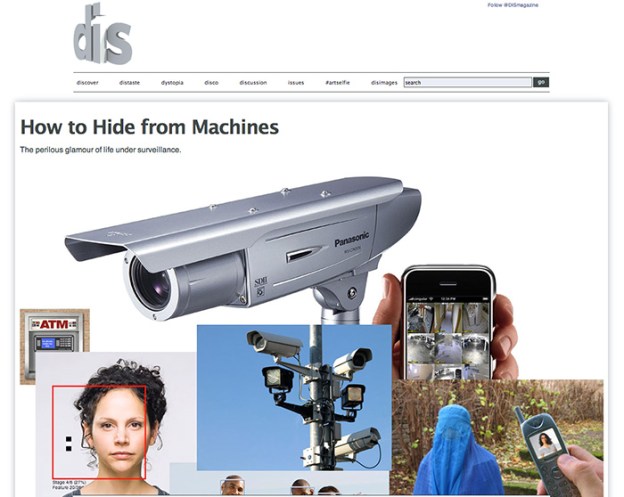
Powered by advances in artificial intelligence (AI), face-recognition systems are spreading like knotweed. Facebook, a social network, uses the technology to label people in uploaded photographs. Modern smartphones can be unlocked with it… America’s Department of Homeland Security reckons face recognition will scrutinise 97% of outbound airline passengers by 2023. Networks of face-recognition cameras are part of the police state China has built in Xinjiang, in the country’s far west. And a number of British police forces have tested the technology as a tool of mass surveillance in trials designed to spot criminals on the street.  A backlash, though, is brewing.

Refuseniks can also take matters into their own hands by trying to hide their faces from the cameras or, as has happened recently during protests in Hong Kong, by pointing hand-held lasers at cctv cameras. to dazzle them. Meanwhile, a small but growing group of privacy campaigners and academics are looking at ways to subvert the underlying technology directly…

Laser Pointers Used to Blind CCTV cameras during the Hong Kong Protests 2019

In 2010… an American researcher and artist named Adam Harvey created “cv [computer vision] Dazzle”, a style of make-up designed to fool face recognisers. It uses bright colours, high contrast, graded shading and asymmetric stylings to confound an algorithm’s assumptions about what a face looks like. To a human being, the result is still clearly a face. But a computer—or, at least, the specific algorithm Mr Harvey was aiming at—is baffled….

Modern Make-Up to Hide from CCTV cameras

HyperFace is a newer project of Mr Harvey’s. Where cv Dazzle aims to alter faces, HyperFace aims to hide them among dozens of fakes. It uses blocky, semi-abstract and comparatively innocent-looking patterns that are designed to appeal as strongly as possible to face classifiers. The idea is to disguise the real thing among a sea of false positives. Clothes with the pattern, which features lines and sets of dark spots vaguely reminiscent of mouths and pairs of eyes are available…

Hyperface Clothing for Camouflage

 Even in China, says Mr Harvey, only a fraction of cctv cameras collect pictures sharp enough for face recognition to work. Low-tech approaches can help, too. “Even small things like wearing turtlenecks, wearing sunglasses, looking at your phone [and therefore not at the cameras]—together these have some protective effect”. 

Excerpts from As face-recognition technology spreads, so do ideas for subverting it: Fooling Big Brother,  Economist, Aug. 17, 2019

Who Owns Your Voice? Grabbing Biometric Data

Increasingly sophisticated technology that detects nuances in sound inaudible to humans is capturing clues about people’s likely locations, medical conditions and even physical features.Law-enforcement agencies are turning to those clues from the human voice to help sketch the faces of suspects. Banks are using them to catch scammers trying to imitate their customers on the phone, and doctors are using such data to detect the onset of dementia or depression.  That has… raised fresh privacy concerns, as consumers’ biometric data is harnessed in novel ways.

“People have known that voice carries information for centuries,” said Rita Singh, a voice and machine-learning researcher at Carnegie Mellon University who receives funding from the Department of Homeland Security…Ms. Singh measures dozens of voice-quality features—such as raspiness or tremor—that relate to the inside of a person’s vocal tract and how an individual voice is produced. She detects so-called microvolumes of air that help create the sound waves that make up the human voice. The way they resonate in the vocal tract, along with other voice characteristics, provides clues on a person’s skull structure, height, weight and physical surroundings, she said.

Nuance’s voice-biometric and recognition software is designed to detect the gender, age and linguistic background of callers and whether a voice is synthetic or recorded. It helped one bank determine that a single person was responsible for tens of millions of dollars of theft, or 18% of the fraud the firm encountered in a year, said Brett Beranek, general manager of Nuance’s security and biometrics business.

Audio data from customer-service calls is also combined with information on how consumers typically interact with mobile apps and devices, said Howard Edelstein, chairman of behavioral biometric company Biocatch. The company can detect the cadence and pressure of swipes and taps on a smartphone.  How a person holds a smartphone gives clues about their age, for example, allowing a financial firm to compare the age of the normal account user to the age of the caller…

If such data collected by a company were improperly sold or hacked, some fear recovering from identity theft could be even harder because physical features are innate and irreplaceable.

Sarah Krouse, What Your Voice Reveals About You, WSJ, Aug. 13, 2019

Nuclear Submarines on Fire (2)

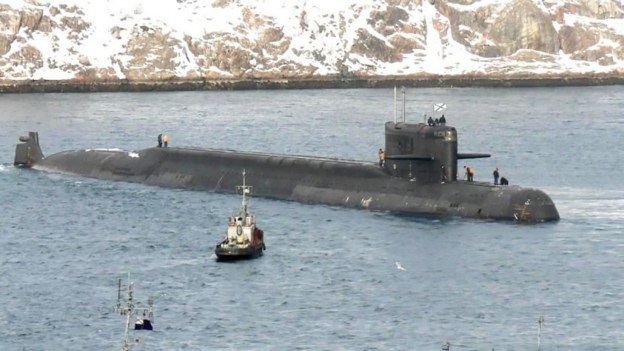
Vladimir Putin has confirmed  on July 4, 2019  that the top-secret submarine that suffered a deadly fire was nuclear-powered, but Russia’s defence minister said the nuclear unit had been sealed off and was in “working order.”  The incident, which left 14 Russian sailors dead,  The Russian government has been slow to reveal information about the incident because the submersible, thought to be a deep-diving vessel used for research and reconnaissance, is among Russia’s most secret military projects.  The fire aboard the “Losharik” AS-31 submersible began in the battery compartment and spread through the vessel…The vessel is thought to be made of a series of orb-like compartments, which increase the submersible’s resilience and allow it to dive to the ocean floor. Once there, it can perform topographical research and participate in rescue missions. It may even be able to tap and sever communications cables on the seabed.

Officials claim the submariners sealed themselves in one of the compartments to battle the blaze and toxic fumes…A Norwegian official told Reuters there had been no “formal communication” from Russia about an incident aboard a nuclear-powered vessel, but “we would have been happy to have been informed of such incidents”….Accidents aboard submarines invariably evoke comparisons to Putin’s clumsy handling of the sinking of the Kursk nuclear submarine in 2000, which left 118 dead and families desperate for information about their loved ones.

Excerpt Putin confirms fire-hit Russian submarine was nuclear-powerered, Guardian, July 4, 2019

Black Operations are Getting Blacker: US Military

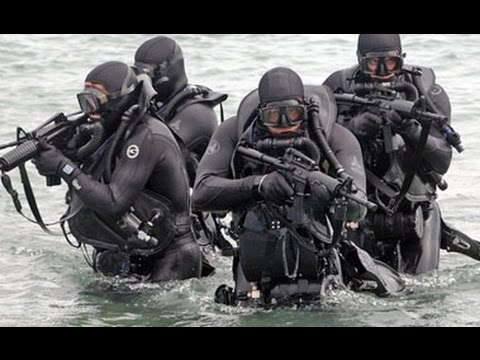
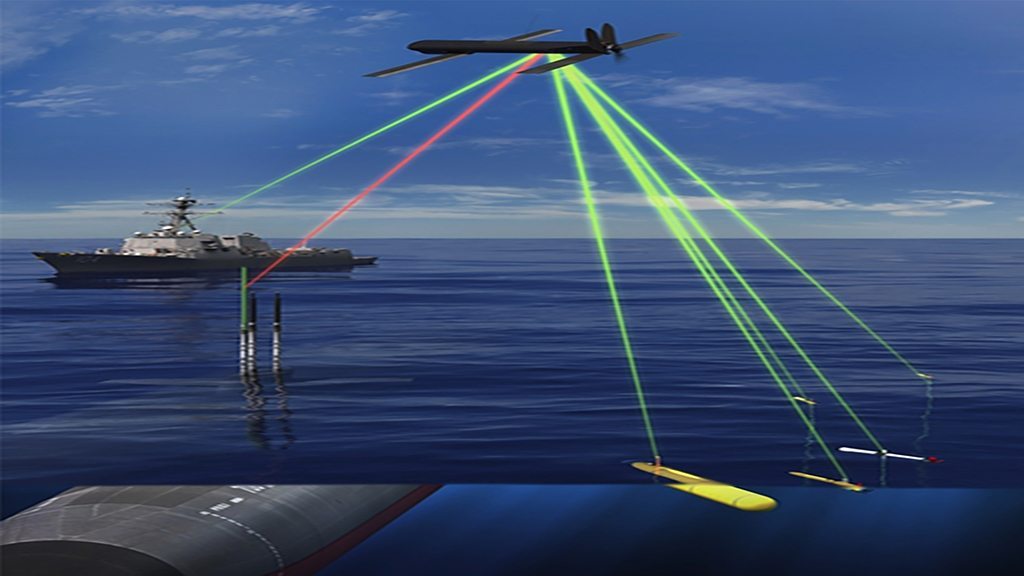
Heterogeneous Collaborative Unmanned Systems (HCUS), as these drones will be known, would be dropped off by either a manned submarine or one of the navy’s big new Orca robot submersibles.

Logo for Orca Submarine by Lockheed Martin

They could be delivered individually, but will more often be part of a collective system called an encapsulated payload. Such a system will then release small underwater vehicles able to identify ships and submarines by their acoustic signatures, and also aerial drones similar to the BlackWing reconnaissance drones already flown from certain naval vessels.

BlackWing

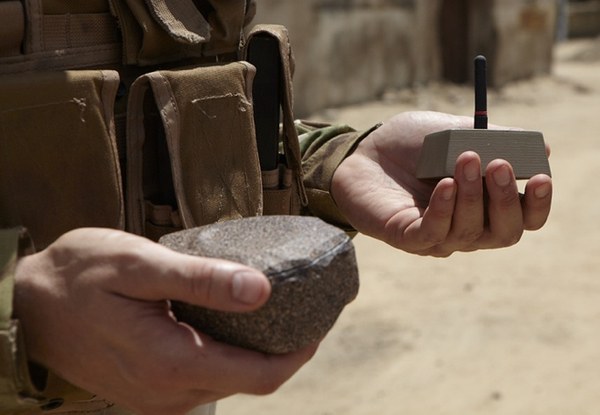
Once the initial intelligence these drones collect has been analysed, a payload’s operators will be in a position to relay further orders. They could, for example, send aerial drones ashore to drop off solar-powered ground sensors at specified points. These sensors, typically disguised as rocks, will send back the data they collect via drones of the sort that dropped them off. Some will have cameras or microphones, others seismometers which detect the vibrations of ground vehicles, while others still intercept radio traffic or Wi-Fi.

Lockheed Martin Ground Sensor Disguised as Rock

HCUS will also be capable of what are described as “limited offensive effects”. Small drones like BlackWing can be fitted with warheads powerful enough to destroy an SUV or a pickup truck. Such drones are already used to assassinate the leaders of enemy forces. They might be deployed against fuel and ammunition stores, too.

Unmanned systems such as HCUS thus promise greatly to expand the scope of submarine-based spying and special operations. Drones are cheap, expendable and can be deployed with no risk of loss of personnel. They are also “deniable”. Even when a spy drone is captured it is hard to prove where it came from. Teams of robot spies and saboteurs launched from submarines, both manned and unmanned, could thus become an important feature of the black-ops of 21st-century warfare.

Excerpts from Submarine-launched drone platoons will soon be emerging from the sea: Clandestine Warfare, Economist, June 22, 2019

If You Control Space, You Control Everything: Space as War Domain

The North Atlantic Treaty Organization (NATO) is looking to classify space as a domain for warfare in an attempt to deter China’s growing military power.  If NATO’s proposal succeeds, the international alliance could move forward with the development and use of space weapons.  According to NATO diplomats, the international organization is preparing to release an agreement that will officially declare space as a war domain. This means that aside from land, air and sea, space could also be used for military operations during times of war.

Although NATO’s partner countries currently own 65% of the satellites in space, China is reportedly preparing to launch a massive project that involves releasing constellations of satellites in low Earth orbit.  China Aerospace Science and Industry Corp (CASIC)  is planning to put in orbit 150 or more Hongyun satellites by 2023. Some of these satellites will provide commercial services like high-speed internet while others would be controlled by the Chinese military. These militarized satellites can be used to coordinate ground forces and to track approaching missiles.

“You can have warfare exclusively in space, but whoever controls space also controls what happens on land, on the sea and in the air,” according to Jamie Shea, a former NATO official. “If you don’t control space, you don’t control the other domains either.”

Excerpts from Inigo Monzon , NATO Prepares For Space Warfare By Militarizing Low Earth Orbit, International Business Times, June 24, 2019

How Companies Buy Social License: the ExxonMobil Example

The Mobil Foundation sought to use its tax-exempt grants to shape American laws and regulations on issues ranging from the climate crisis to toxic chemicals – with the explicit goal of benefiting Mobil, documents obtained by the Guardian newspaper show.  Recipients of Mobil Foundation grants included Ivy League universities, branches of the National Academies and well-known civic organizations and environmental researchers.  Benefits for Mobil included – in the foundation’s words – funding “a counterpoint to so-called ‘public interest’ groups”, helping Mobil obtain “early access” to scientific research, and offering the oil giant’s executives a forum to “challenge the US Environmental Protection Agency (EPA) behind-the-scenes”….

A third page reveals Mobil Foundation’s efforts to expand its audience inside environmental circles via a grant for the Environmental Law Institute, a half-century-old organization offering environmental law research and education to lawyers and judges.  “Institute publications are widely read in the environmental community and are helpful in communicating industry’s concerns to such organizations,” the entry says. “Mobil Foundation grants will enhance environmental organizations’ views of Mobil, enable us to reach through ELI activities many groups that we do not communicate with, and enable Mobil to participate in their dialogue groups.”

The documents also show Mobil Foundation closely examining the work of individual researchers at dozens of colleges and universities as they made their funding decisions, listing ways that foundation grants would help shape research interests to benefit Mobil, help the company recruit future employees, or help combat environmental and safety regulations that Mobil considered costly.  “It should be a wake-up call for university leaders, because what it says is that fossil fuel funding is not free,” said Geoffrey Supran, a postdoctoral researcher at Harvard and MIT.  “When you take it, you pay with your university’s social license,” Supran said. “You pay by helping facilitate these companies’ political and public relations tactics.”

In some cases, the foundation described how volunteer-staffed not-for-profits had saved Mobil money by doing work that would have otherwise been performed by Mobil’s paid staff, like cleaning birds coated in oil following a Mobil spill.  In 1987, the International Bird Rescue Research Center’s “rapid response and assistance to Mobil’s West Coast pipeline at a spill in Lebec, CA not only defused a potential public relations problem”, Mobil Foundation said, “but saved substantial costs by not requiring our department to fly cross country to respond”.d of trustees at the Woods Hole Oceanographic Institution (recipient of listed donations totalling over $200,000 from Mobil) and a part of UN efforts to study climate change.

Wise ultimately co-authored two UN Intergovernmental Panel on Climate Change reports, serving as a lead author on one. One report chapter Wise co-authored prominently recommended, among other things, burning natural gas (an ExxonMobil product) instead of coal as a way to combat climate change.

Excerpts from How Mobil pushed its oil agenda through ‘charitable giving’, Guardian, June 12, 2019

Your Typing Discloses Who You Are: Behavioral Biometrics

Behavioural biometrics make it possible to identify an individual’s “unique motion fingerprint”,… With the right software, data from a phone’s sensors can reveal details as personal as which part of someone’s foot strikes the pavement first, and how hard; the length of a walker’s stride; the number of strides per minute; and the swing and spring in the walker’s hips and step. It can also work out whether the phone in question is in a handbag, a pocket or held in a hand.

Using these variables, Unifyid, a private company, sorts gaits into about 50,000 distinct types. When coupled with information about a user’s finger pressure and speed on the touchscreen, as well as a device’s regular places of use—as revealed by its gps unit—that user’s identity can be pretty well determined, ction….Behavioural biometrics can, moreover, go beyond verifying a user’s identity. It can also detect circumstances in which it is likely that a fraud is being committed. On a device with a keyboard, for instance, a warning sign is when the typing takes on a staccato style, with a longer-than-usual finger “flight time” between keystrokes. This, according to Aleksander Kijek, head of product at Nethone, a firm in Warsaw that works out behavioural biometrics for companies that sell things online, is an indication that the device has been hijacked and is under the remote control of a computer program rather than a human typist…

Used wisely, behavioural biometrics could be a boon…Used unwisely, however, the system could become yet another electronic spy on people’s privacy, permitting complete strangers to monitor your every action, from the moment you reach for your phone in the morning, to when you fling it on the floor at night.

Excerpts from Behavioural biometrics: Online identification is getting more and more intrusive, Economist, May 23, 2019

How Un-American: Attacking Private Companies because they are Chinese

America is no fan of Huawei. Its officials have spent months warning that the Chinese giant’s smartphones and networking gear could be Trojan horses for Chinese spies (something Huawei has repeatedly denied). They have threatened to withhold intelligence from any ally that allows the firm in.

On May 15th, 2019  they raised the stakes. President Donald Trump barred American firms from using telecoms equipment made by firms posing a “risk to national security”. His order named no names. But its target was plain.  More significant was the announcement by the Commerce Department, on the same day, that it was adding Huawei to a list of firms with which American companies cannot do business without official permission. That amounts to a prohibition on exports of American technology to Huawei.  It is a seismic decision, for no technology firm is an island. Supply chains are highly specialised and globally connected. Cutting them off—“weaponising interdependence”, in the jargon—can cause serious disruption. When ZTE, another Chinese technology company, received the same treatment in 2018 for violating American sanctions on Iran, it was brought to the brink of ruin. It survived only because Mr Trump intervened, claiming it was a favour to Xi Jinping, China’s president.

By May 20th, 2019  the impact of the ban was becoming clear. Google said it had stopped supplying the proprietary components of its Android mobile operating system to Huawei. A string of American chipmakers, including Intel, Qualcomm and Micron, have also ceased sales. Later that day the Commerce Department softened its line slightly, saying that firms could continue to supply Huawei for 90 days, but for existing products—for instance, with software updates for Huawei phones already in use. New sales, on which Huawei’s future revenue depends, remain banned…

 Without Google’s co-operation, new Huawei phones will lack the latest versions of Android, and popular apps such as Gmail or Maps. That may not matter in China, where Google’s apps are forbidden. But it could be crippling in Europe, Huawei’s second-biggest market. Its telecoms business needs beefy server chips from Intel. The supply of software to manage those networks could dry up too. Huawei is developing replacements for all three, but they are far from ready….Accrording to Paul Triolo of Eurasia Group, the Huawei ban as “the logical end-game of the US campaign to take down Huawei”. A long-lasting ban would force the firm to look for alternative chips and software that Chinese suppliers would struggle to provide.

The second question concerns the reach of American power. The tangled nature of chip-industry supply chains means that many non-American companies make use of American parts or intellectual property. They may therefore consider themselves covered, wholly or partially, by the ban. Take Arm, a Britain-based firm whose technology powers chips in virtually every phone in the world, including those made by HiSilicon. Arm says that it will comply with the Commerce Department’s rules. That suggests that Arm will not grant Huawei new licences. It is unclear if Arm will offer support for existing licences, however. As Arm’s technology advances, Huawei risks being left behind.

Other non-American companies are as important. One industry insider with contacts in Taiwan says that American officials are pressing Taiwan Semiconductor Manufacturing Company (tsmc), a big and cutting-edge chipmaker, to drop Huawei, which is its third-biggest customer. That would be a crushing blow, for Chinese chip factories are not up to the task of manufacturing HiSilicon’s sophisticated designs. tsmc’s only peer is Samsung—and South Korea is another of America’s allies. tsmc said on May 23rd that it would continue supplying Huawei for now.

Even if the optimists are right, and the ban is lifted in exchange for trade concessions, a return to business as usual seems unlikely. America has twice demonstrated a willingness to throttle big Chinese companies. Trust in American technology firms has been eroded, says Mr Triolo. China has already committed billions of dollars to efforts to boost its domestic capabilities in chipmaking and technology. For its rulers, America’s bans highlight the urgency of that policy. Catching up will not be easy, believes Mr Ernst, for chips and software are the most complicated products that humans make. But, he says, if you talk to people in China’s tech industry they all say the same thing: “We no longer have any other option.”

Excerpts from Huawei has been cut off from American technology, Economist, May 25,  2019.

Who is Afraid of the United States?

In 2018 America imposed sanctions on about 1,500 people, firms, vessels and other entities, nearly triple the number in 2016. The past six months of 2019 have been particularly eventful. America began imposing sanctions on Iran in November, and in January on Venezuela, another big oil exporter. On May 9th 2019, for the first time, it seized a ship accused of transporting banned North Korean coal.

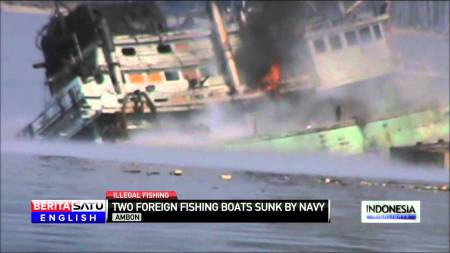
Second, blackballed countries and unscrupulous middlemen are getting better at evasion. In March 2019advisers to the un, relying in part on Windward data, and American Treasury officials published separate reports that described common ways of doing it. Boats turn off their transmissions systems to avoid detection. Oil is transferred from one ship to another in the middle of the ocean—ships trading on behalf of North Korea find each other in the East China Sea using WeChat, a popular Chinese messaging service. Captains disguise a ship’s identity by manipulating transponder data to transmit false locations and identity numbers of different vessels.

Such methods have helped Iran and Russia transport oil to Syria, American officials say. In 2018 North Korea managed to import refined petroleum far in excess of the level allowed by multilateral sanctions. The situation in Venezuela is different—technically, America’s sanctions still allow foreigners to do business with the country. But fear that sanctions will expand mean that traditional trading partners are scarce. Nicolás Maduro’s regime this month found a shipowner to transport crude to India, according to a shipbroker familiar with the deal, but Venezuela had to pay twice the going rate.

Businesses keen to understand such shenanigans can be roughly divided into two categories. The first includes those who can profit from grasping sanctions’ impact on energy markets, such as hedge funds, analysts and traders. A squadron of firms is ready to assist them, combing through ship transmission data, commercial satellite imagery and other public and semi-public information. They do not specialise in sanctions, but sanctions are boosting demand for their tracking and data-crunching expertise.

A main determinant of Venezuela’s output, for instance, is access to the diluent it needs to blend with its heavy crude. A firm called Clipper Data has noted Russian ships delivering diluent to vessels near Malta, which then transport it to Venezuela. Kpler, a French rival, uses satellite images of shadows on lids of storage tanks to help estimate the volume of oil inside. Using transmissions data, images, port records and more, Kpler produces estimates of Iran’s exports for customers such as the International Energy Agency and Bernstein, a research firm—including a recent uptick in Iranian exports without a specific destination (see chart).

The second category of companies are wary of violating sanctions themselves. They need assistance of a different sort. Latham & Watkins, a firm that advised the chairman of EN+, which controls a Russian aluminium giant, as he successfully removed the company from America’s sanctions list this year, has seen a surge in sanctions-related business. Refinitiv, a data company, offers software which permits clients to screen partners and customers against lists of embargoed entities. Windward uses machine learning to pore over data such as ships’ travel patterns, transmissions gaps (some of which may be legitimate) and name changes to help firms identify suspicious activity. Kharon, founded last year by former United States Treasury officials, offers detailed analysis of anyone or anything on sanctions lists.

HIde and Seek: Sanctions Inc, Economist, May 18, 2019

US v. China: The Slow and Sure Conquest of Internet Infrastructure


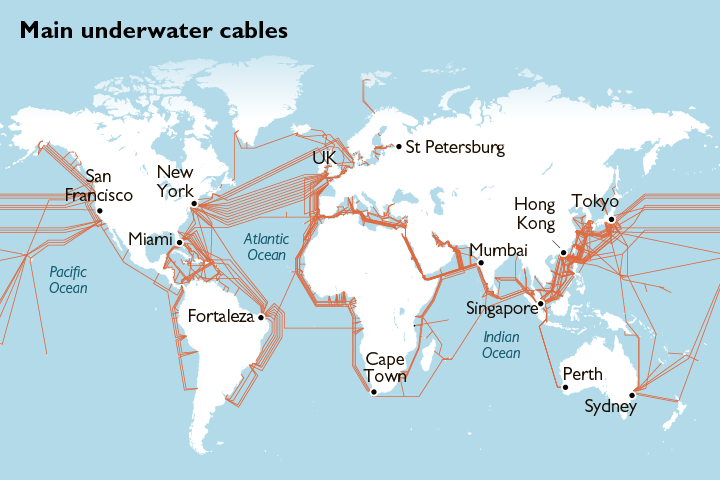
A new front has opened in the battle between the U.S. and China over control of global networks that deliver the internet. This one is beneath the ocean. While the U.S. wages a high-profile campaign to exclude China’s Huawei Technologies Co. from next-generation mobile networks over fears of espionage, the company is embedding itself into undersea cable networks that ferry nearly all of the world’s internet data.

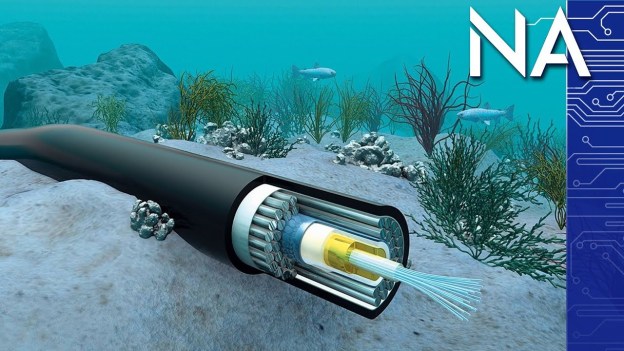
About 380 active submarine cables—bundles of fiber-optic lines that travel oceans on the seabed—carry about 95% of intercontinental voice and data traffic, making them critical for the economies and national security of most countries. 

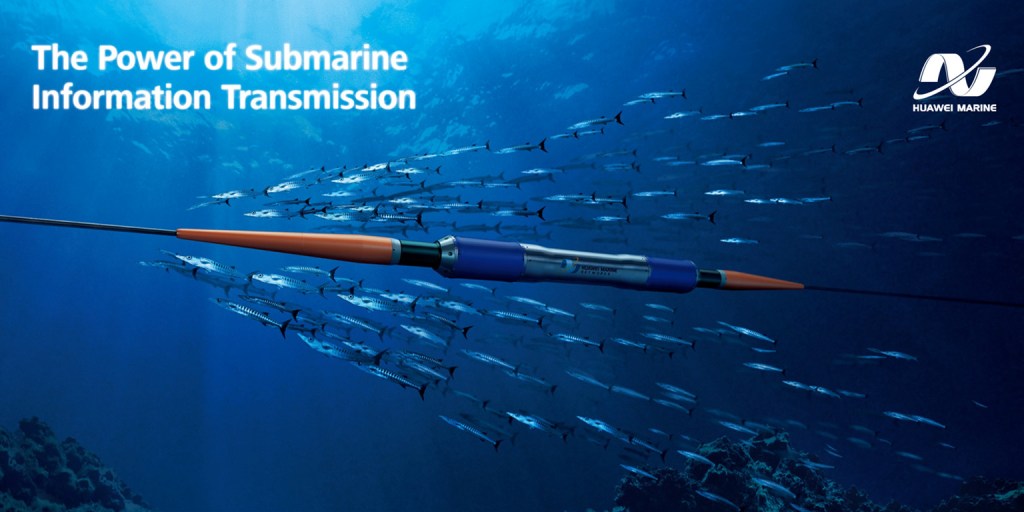
The Huawei Marine’s Undersea Cable Network majority owned by Huawei Technologies, has worked on some 90 projects to build or upgrade submarine cables around the world…US o fficials say the company’s knowledge of and access to undersea cables could allow China to attach devices that divert or monitor data traffic—or, in a conflict, to sever links to entire nations.  Such interference could be done remotely, via Huawei network management software and other equipment at coastal landing stations, where submarine cables join land-based networks, these officials say.

Huawei Marine said in an email that no customer, industry player or government has directly raised security concerns about its products and operations.Joe Kelly, a Huawei spokesman, said the company is privately owned and has never been asked by any government to do anything that would jeopardize its customers or business. “If asked to do so,” he said, “we would refuse.”

The U.S. has sought to block Huawei from its own telecom infrastructure, including undersea cables, since at least 2012. American concerns about subsea links have since deepened—and spread to allies—as China moves to erode U.S. dominance of the world’s internet infrastructure…..Undersea cables are owned mainly by telecom operators and, in recent years, by such content providers as Facebook and Google. Smaller players rent bandwidth.Most users can’t control which cable systems carry their data between continents. A handful of switches typically route traffic along the path considered best, based on available capacity and agreements between cable operators.

In June 2017, Nick Warner, then head of Australia’s Secret Intelligence Service, traveled to the Solomon Islands, a strategically located South Pacific archipelago. His mission, according to people familiar with the visit, was to block a 2016 deal with Huawei Marine to build a 2,500-mile cable connecting Sydney to the Solomons.  Mr. Warner told the Solomons’ prime minister the deal would give China a connection to Australia’s internet grid through a Sydney landing point, creating a cyber risk, these people said. Australia later announced it would finance the cable link and steered the contract to an Australian company.  In another recent clash, the U.S., Australia and Japan tried unsuccessfully in September 2018 to quash an undersea-cable deal between Huawei Marine and Papua New Guinea.

U.S. and allied officials point to China’s record of cyber intrusions, growing Communist Party influence inside Chinese firms and a recent Chinese law requiring companies to assist intelligence operations. Landing stations are more exposed in poorer countries where cyber defenses tend to be weakest, U.S. and allied officials said. And network management systems are generally operated using computer servers at risk of cyber intrusion. Undersea cables are vulnerable, officials said, because large segments lie in international waters, where physical tampering can go undetected. At least one U.S. submarine can hack into seabed cables, defense experts said. In 2013, former National Security Agency contractor Edward Snowden alleged that Britain and the U.S. monitored submarine cable data. The U.S. and its allies now fear such tactics could be used against them. American and British military commanders warned recently that Russian submarines were operating near undersea cables. In 2018, the U.S. sanctioned a Russian company for supplying Russian spies with diving equipment to help tap seabed cables.


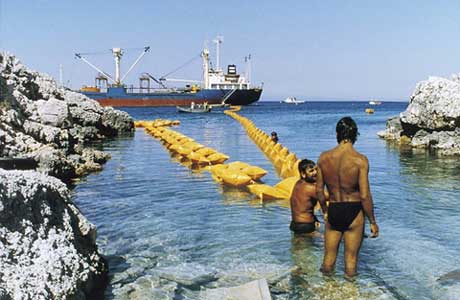
The Ionian Sea Submarine Cable Project (Greece) 

China seeks to build a Digital Silk Road, including undersea cables, terrestrial and satellite links, as part of its Belt and Road plan to finance a new global infrastructure network. Chinese government strategy papers on the Digital Silk Road cite the importance of undersea cables, as well as Huawei’s role in them. A research institute attached to China’s Ministry of Industry and Information Technology, in a paper published in September, praised Huawei’s technical prowess in undersea cable transmission and said China was poised to become “one of the world’s most important international submarine cable communication centers within a decade or two.” China’s foreign and technology ministries didn’t respond to requests for comment…

Huawei Marine Networks

Bjarni Thorvardarson, then chief executive of the cable’s Ireland-based operator, said U.S. authorities raised no objections until 2012, when a congressional report declared Huawei Technologies a national security threat. Mr. Thorvardarson wasn’t convinced. “It was camouflaged as a security risk, but it was mostly about a preference for using U.S. technology,” he said. Under pressure, Mr. Thorvardarson dropped Huawei Marine from Project Express in 2013. The older cable network continued to use Huawei equipment.

The company is now the fourth-biggest player in an industry long dominated by U.S.-based SubCom and Finnish-owned Alcatel Submarine Networks. Japan’s NEC Corp is in third place.Huawei Marine is expected to complete 28 cables between 2015 and 2020—nearly a quarter of all those built globally—and it has upgraded many more, according to TeleGeography, a research company.

Excerpts from America’s Undersea Battle With China for Control of the Global Internet Grid , WSJ, Mar. 12, 2019

Who Has the Right to Free Speech? Let Credit Cards Decide The Wikileaks Saga from 2010 to 2019

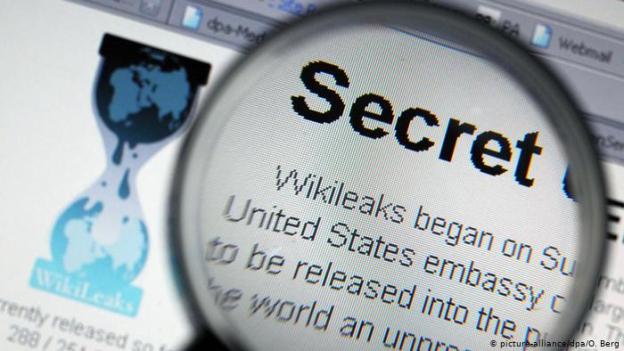
Visa and Mastercard’s partner company in Iceland, Valitor was found guilty by the Reykjavik District Court for illegally blocking payments to the controversial international nonprofit WikiLeaks – a media outlet that publishes classified documents provided by anonymous sources The case against Valitor began sometime in 2010 when a data hosting company named DataCell was given the responsibility to handle donations sent to WikiLeaks.The year 2010 was a particularly important one for the publishing company as its famous Chelsea Manning leaks made rounds in media houses across the world. However, soon after the leaks, Valitor blocked transactions from Visa card holders in Iceland to WikiLeaks, thus starting a legal tug-of-war that would last for years.

Fast forward to 2019, DataCell has finally won the legal battle against Valitor which has now been ordered to pay approximately $9.85 million to both DataCell and Wikileaks’ publishing firm, Sunshine Press Productions.

Excerpts from Iceland: Debit Card Company Fined $9.85 Million for Blocking WikiLeaks Payment, April 30, 2019

5,000 Eyes in the Sky: environmental monitoring

The most advanced satellite to ever launch from Africa will soon be patrolling South Africa’s coastal waters to crack down on oil spills and illegal dumping.  Data from another satellite, this one collecting images from the Texas portion of a sprawling oil and gas region known as the Permian Basin, recently delivered shocking news: Operators there are burning off nearly twice as much natural gas as they’ve been reporting to state officials.

With some 5,000 satellites now orbiting our planet on any given day…. They will help create a constantly innovating industry that will revolutionize environmental monitoring of our planet and hold polluters accountable…

A recent study by Environmental Defense Fund focused on natural gas flares from the wells in the Permian Basin, located in Western Texas and southeastern New Mexico. Our analysis proved that the region’s pollution problem was much larger than companies had revealed.  A second study about offshore gas flaring in the Gulf of Mexico, published by a group of scientists in the Geophysical Research Letters, showed that operators there burn off a whopping 40% of the natural gas they produce.

Soon a new satellite will be launching that is specifically designed not just to locate, but accurately measure methane emissions from human-made sources, starting with the global oil and gas industry.  MethaneSAT, a new EDF affiliate unveiled in 2018, will launch a future where sensors in space will find and measure pollution that today goes undetected. This compact orbital platform will map and quantify methane emissions from oil and gas operations almost anywhere on the planet at least weekly.

Excerpts from Mark Brownstein, These pollution-spotting satellites are just a taste of what’s to come, EDF, Apr. 4, 2019

An Affordable and Risk Free Way to Kill: Drones

Armed drones have become ubiquitous in the Middle East, say Aniseh Bassiri Tabrizi and Justin Bronk of the Royal United Services Institute, a British think-tank, in a recent report. America has jealously guarded the export of such aircraft for fear that they might fall out of government hands, be turned on protesters or used against Israel. America has also been constrained by the Missile Technology Control Regime, an arms-control agreement signed by 35 countries, including Russia, that restricts the transfer of particularly capable missiles and drones (both rely on the same underlying technology).

China…has sold missile-toting drones to Egypt, Jordan, Iraq, Saudi Arabia and the United Arab Emirates (UAE). All are American security partners…. Other countries, such as Israel, Turkey and Iran, have filled the gap with their own models.  America wants to muscle its way back into the market. In April 2018 the Trump administration began loosening export rules to let countries buy armed drones directly from defence companies rather than through official channels. Drones with “strike-enabling technology”, such as lasers to guide bombs to their targets, were reclassified as unarmed. American drones are costlier and require more paperwork than Chinese models, but are more capable. ..The flood of drones into the market is already making an impact—sometimes literally. Ms Tabrizi and Mr Bronk say some Middle Eastern customers see drones as an “affordable and risk-free” way to strike across borders… 

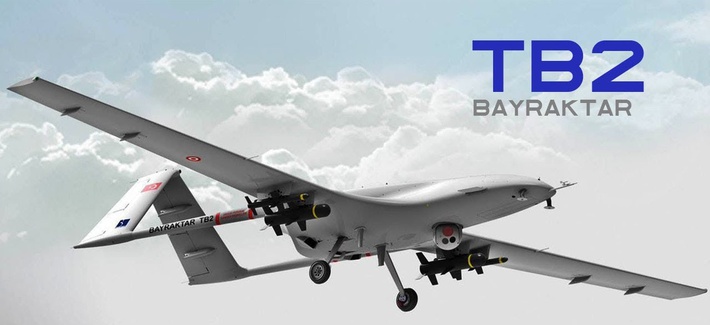
Drone Bayraktar made by Turkey

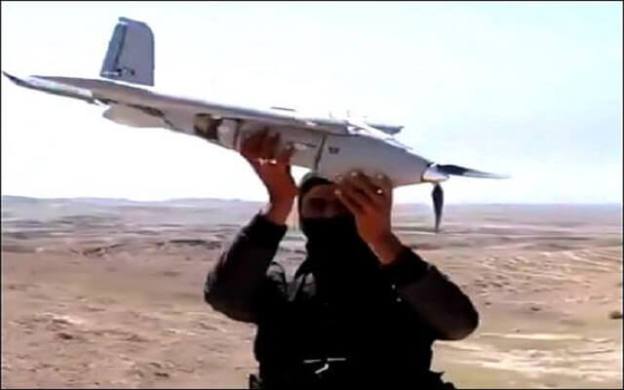
Non-state actors are unwilling to be left out of the party. The jihadists of Islamic State often used drones in Iraq and Syria. Hizbullah used drones when it hit 23 fighters linked to al-Qaeda in Syria in 2014. The Houthi drone that bombed Al-Anad looked a lot like an Iranian model. Last year the Houthis sent a similar one more than 100km (60 miles) into Saudi Arabia before it was shot down. ..

Excerpts from Predator Pricing: Weapon Sales, Economist,  Mar. 9, 2019

The Secret Powers of Saudi Arabia — Murder not Included

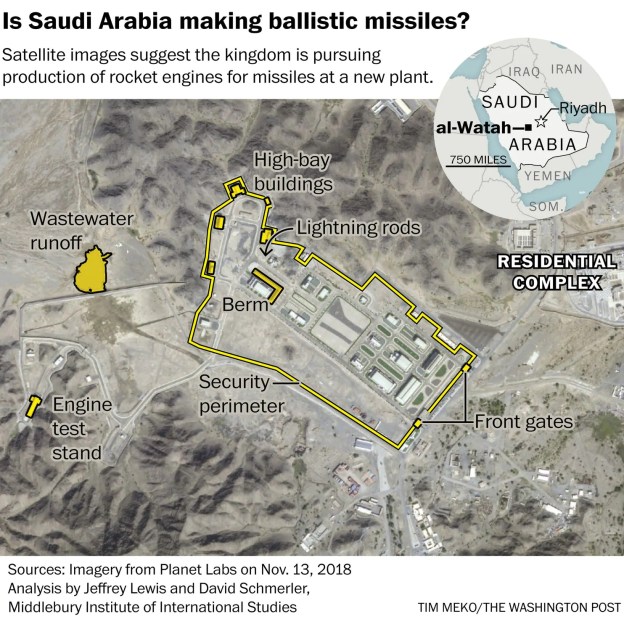
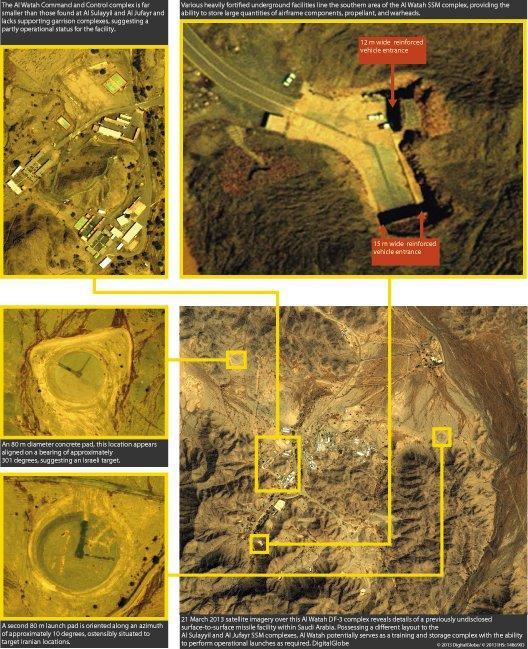
In 2016 Muhammad bin Salman, Saudi Arabia’s crown prince and de facto ruler, announced the latest stage of “Saudisation”—the replacement of foreign workers with Saudi ones. It now appears the policy does not stop at swapping out bankers and bakers, but extends to ballistic missiles.  Satellite photos analysed by researchers from the Middlebury Institute of International Studies, and reported by the Washington Post, appear to show that Saudi Arabia has been building a factory for rocket engines, at an existing missile base in al-Watah, south-west of Riyadh. It seems to be configured for solid-fuel rockets, which can be launched more quickly than liquid-fuelled ones….he rocket factory was “designed, equipped and constructed by an outside entity”. Saudi Arabia has “no capacity” for such a project. The facility, he notes, closely resembles a Chinese one in Lantian.

Saudi Arabia is no newcomer to missiles. Having watched Iran and Iraq fling them at each other during the 1980s, it bought a few dozen df-3 missiles from China in 1987. It came close to unleashing them after being struck by Iraqi Scud missiles during the Gulf war in 1991. In the 2000s it probably picked up a batch of newer, more accurate Chinese df-21s.

Iran, the kingdom’s arch-rival, has been honing its missile force despite Western opposition and un rebukes, conducting 135 test launches since 1990. On December 1st, 2018  it tested one thought capable of comfortably reaching any corner of Saudi soil….Nor is Iran the only concern. Hizbullah, a Lebanese militant group nurtured and armed by Iran, has a growing arsenal of missiles; some can already reach the north-western parts of Saudi Arabia. Israel is also armed to the teeth. Though Prince Muhammad is on good terms with the Jewish state, satellite images published in 2013 reportedly showed that one of the Saudi df-3 launching pads at al-Watah was set in the direction of Tel Aviv.

Because missiles are ideal delivery systems for nuclear weapons, news of the plant has also revived worries about Saudi Arabia’s atomic intentions…Without a doubt if Iran developed a nuclear bomb,” warned Prince Muhammad last March, “we will follow suit

So the Saudis may turn to other nuclear friends. Western diplomats and spooks have long been concerned that Pakistan, whose own nuclear programme was bankrolled by Saudi Arabia, might be a ready supplier of know-how, fuel or bombs. In 1999 Saudi Arabia’s then defence minister horrified American officials by touring Pakistan’s nuclear facilities and meeting A.Q. Khan, the scientist who sold nuclear technology to North Korea, Iran and Libya. Ties remain close. Prince Muhammad was due to agree on $14bn of investment in Pakistan during a visit to the country on February 16th.  2019. ….

Excerpts from Protection rocket Saudi Arabia’s missile race, Economist, Feb. 16, 2019

How Iranian Oil Escapes US Sanctions

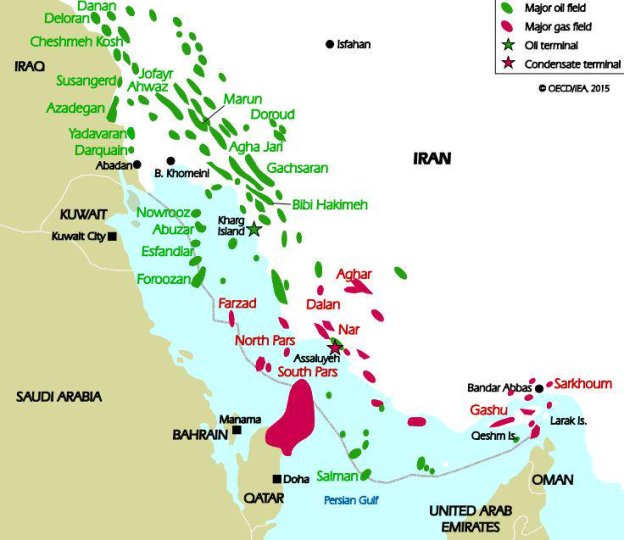
 At least two tankers have ferried Iranian fuel oil to Asia in February 2019 despite U.S. sanctions against such shipments, according to a Reuters analysis of ship-tracking data and port information, as well as interviews with brokers and traders.  The shipments were loaded onto tankers with documents showing the fuel oil was Iraqi. But three Iraqi oil industry sources and Prakash Vakkayil, a manager at United Arab Emirates (UAE) shipping services firm Yacht International Co, said the papers were forged.  The people said they did not know who forged the documents, nor when.

“Some buyers…will want Iranian oil regardless of U.S. strategic objectives to deny Tehran oil revenue, and Iran will find a way to keep some volumes flowing,” said Peter Kiernan, lead energy analyst at the Economist Intelligence Unit.  While the United States has granted eight countries temporary waivers allowing limited purchases of Iranian crude oil, these exemptions do not cover products refined from crude, including fuel oil, mainly used to power the engines of large ships. Documents forwarded to Reuters by ship owners say a 300,000 tonne-supertanker, the Grace 1, took on fuel oil at Basra, Iraq, between Dec. 10 and 12, 2018. But Basra port loading schedules reviewed by Reuters do not list the Grace 1 as being in port during those dates.  One Iraqi industry source with knowledge of the port’s operations confirmed there were no records of the Grace 1 at Basra during this period. 

Grace 1 oil tanker

Reuters examined data from four ship-tracking information providers – Refinitiv, Kpler, IHS Markit and Vessel Finder – to locate the Grace 1 during that time. All four showed that the Grace 1 had its Automatic Identification System (AIS), or transponder, switched off between Nov. 30 and Dec. 14, 2018, meaning its location could not be tracked.  The Grace 1 then re-appeared in waters near Iran’s port of Bandar Assaluyeh, fully loaded, data showed. The cargo was transferred onto two smaller ships in UAE waters in January, from where one ship delivered fuel oil to Singapore in February 2019.  Shipping documents showed about 284,000 tonnes of fuel oil were transferred in the cargoes tracked by Reuters, worth about $120 million at current prices…

One of those vessels, the 130,000 tonne-capacity Kriti Island, offloaded fuel oil into a storage terminal in Singapore around Feb. 5 to 7. Reuters was unable to determine who purchased the fuel oil for storage in Singapore.  The Kriti Island is managed by Greece’s Avin International SA… Avin International’s Chief Executive Officer George Mylonas told Reuters. Mylonas confirmed the Kriti Island took on fuel oil from the Grace 1.There is no indication that Avin International knowingly shipped Iranian fuel oil. Mylonas said his firm had conducted all necessary due diligence to ensure the cargo’s legitimate origin….

Kriti Island oil tanker

Excerpts from Roslan Khasawneh et al, Exclusive: How Iran fuel oil exports beat U.S. sanctions in tanker odyssey to Asia, Reuters, Mar. 20, 2019

Satellites and Algorithms against Slaveholders

Brick kilns, tens of thousands across South Asia are often run on forced labor.  Satellite imagery of such kilns can help tally the kilns, enabling organizations on the ground to target slaveholders at the sites…

Some 40.3 million people are held in bondage today, according to the latest estimates from the International Labor Organization, headquartered in Geneva, Switzerland. But finding them is hard… Boyd who works for the Rights Lab estimates, however, that one-third of all slavery is visible from space, whether in the scars of kilns or illegal mines or the outlines of transient fish-processing camps.

Boyd is now using artificial intelligence to speed up the search. As a pilot project, she and her colleagues at the Rights Lab used crowdsourced visual searchers to identify brick kilns. The oval shape of the large ovens, sometimes 150 meters long, and their chimneys are distinctive, even from space. “You cannot mix them up with something else,” Boyd says.

Since then, Boyd has turned to machine-learning algorithms that recognize the kilns after being trained on the human-tagged examples. Last month, in the journal Remote Sensing, she and her colleagues reported that the algorithms could correctly identify 169 of 178 kilns in Google Earth data on one area of Rajasthan, although it also output nine false positives…

Another company, called Planet, has about 150 small satellites that snap images of the globe’s entire landmass daily. The images are lower-resolution than DigitalGlobe’s, but their frequency opens up opportunities to identify changes over time.With Planet data, Boyd and the Rights Lab plan to investigate fast moving signatures of slavery. From space, you can watch a  harvest in Turkmenistan and, based on how quickly the cotton disappears, you can tell whether machines or hands picked it. In the Sundarbans, an area spanning India and Bangladesh, shrimp farms and fish-processing camps employ slave labor to clear mangrove trees—a process satellites can capture.

Excerpts from Sarah Scoles, Researchers Spy Signs of Slavery from Space, Science, Feb. 21, 2018

After Khashoggi: the Saudi Missiles

Satellite images suggest that Saudi Arabia has constructed its first known ballistic missile factory, according to weapons experts and image analysts, a development that raises questions about the kingdom’s increasing military and nuclear ambitions under its 33-year-old crown prince.  If operational, the suspected factory at a missile base in al-Watah, southwest of Riyadh, would allow Saudi Arabia to manufacture its own ballistic missiles, fueling fears of an arms race against its regional rival Iran.  Saudi Arabia currently does not possess nuclear weapons, so any missiles produced at the apparent factory are likely to be conventionally armed. But a missile-making facility would be a critical component of any eventual Saudi nuclear weapons program, hypothetically giving the kingdom capability to produce the preferred delivery systems for nuclear warheads.

Two additional missile experts who reviewed the satellite images for The Washington Post… agreed that the high-resolution photographs of the al-Watah site appear to depict a ­rocket-engine production and test facility, probably using solid fuel…The complex…highlights the nation’s intention to make its own advanced missiles after years of seeking to purchase them abroad, at times successfully….

Saudi Arabia has been pursuing a nuclear power-plant deal with the United States that would potentially include allowing it to produce nuclear fuel. The kingdom’s insistence on domestic fuel production has raised worries among U.S. officials that the kingdom wants the atomic power project not only for civil use but also for covert weapon-making purposes. ..

How the Saudis obtained the technological expertise necessary to build the facility is unclear. One potential supplier: China…China has sold ballistic missiles to Saudi Arabia in the past and has helped supply ballistic missile production capabilities to other nations. In the 1990s, Pakistan secretly built a plant for medium-range missiles using blueprints and equipment supplied by China. The factory in Pakistan has long drawn the attention of top Saudi officials. ..

The main way the United States seeks to prevent the spread of drone and missile technology is through the Missile Technology Control Regime, or the MTCR, an informal multicountry pact designed to prevent the transfer of certain missile technologies. China is not a member but has agreed to abide by some of its stipulations.   While the United States sells an array of weaponry to Saudi Arabia, Washington has not sold ballistic missiles to Riyadh, in part because such missiles traditionally have been seen as destabilizing for the region. Saudi Arabia has turned to China in the past when met with refusals from the United States for certain weapons requests.

For example, the United States declined repeated Saudi requests to purchase what are known as category-one American drones, including Predators and Reapers, partly because of MTCR’s regulations. Instead, the kingdom turned to China, first purchasing drones and later striking a deal in which China will build a drone factory that will produce a Chinese copycat of the Predator in Saudi Arabia.

Excerpts Paul Sonne, Can Saudi Arabia produce ballistic missiles? Satellite imagery raises suspicions, Washington Post, Jan. 22, 2019

Natural Gas and Freedom

[A] tanker chartered by Cheniere Energy, an American company, left a Louisiana port this week with the first major exports of U.S. liquefied natural gas, or LNG. This shipment isn’t going to Europe, but others are expected to arrive by spring.  “Like shale gas was a game changer in the U.S., American gas exports could be a game changer for Europe,” said Maros Sefcovic, the European Union’s energy chief.

Many in Europe see U.S. entry into the market as part of a broader effort to challenge Russian domination of energy supplies and prices in this part of the world. Moscow has for years used its giant energy reserves as a strategic tool to influence former satellite countries, including Lithuania, one of the countries on the fringes of Russia that now see a chance to break away.

Some are building the capacity to handle seaborne LNG, including Poland, which opened its first import terminal in 2015. In Bulgaria, which buys about 90% of its gas from Russia, Prime Minister Boyko Borissov said last month that supplies of U.S. gas could arrive via Greek LNG facilities, “God willing.”… Deutsche Bank estimates the U.S. could catch up with Russia as Europe’s biggest gas supplier within a decade, with each nation controlling around a fifth of the market. Russia supplies about a third of Europe’s gas via pipeline….The U.S. will compete with Russia, Norway, U.K., Australia and others in Europe’s gas market. Germany, for example, gets half its gas and Italy a third from Russia.Low prices also mean natural gas could compete with coal and help Europe achieve its commitment to reducing greenhouse gas emissions .In Lithuania, officials have accused Moscow of engaging in a campaign of espionage and cyberwarfare to keep its share of the lucrative energy market….

Bulgarian officials allege Russia bankrolled a wave of street protests in 2012 that forced the government to impose a moratorium on shale gas exploration. In 2014, Anders Fogh Rasmussen, then-head of NATO, told reporters that Russia was covertly funding European environmental organizations to campaign against shale gas to help maintain dependence on Russian gas.

Until 2014, Gazprom owned 37% of Lithuania’s national gas company, Lietuvos Dujos, and dominated its boardroom, said current and former officials.“There was no negotiation about gas prices,” said Jaroslav Neverovic, Lithuania’s energy minister from 2012 to 2014. He said Gazprom would send Lietuvos Dujos a list of gas prices, which the board automatically approved..  In 2015,  [though] Lithuania began receiving Norwegian LNG, reducing Gazprom’s gas monopoly to a market share of less than 80%. In the months before the terminal opened, Gazprom lowered Lithuanian gas prices by 23% and it remained cheaper than Norwegian gas. Still, Lithuania plans to increase its purchase of Norwegian gas this year. The U.S. is next….

Klaipeda’s mayor, Mr. Grubliauskas, said during a recent interview at his office, decorated with photographs of U.S. naval drills in the port: “U.S. LNG is more than just about gas. It’s about freedom.”

Excerpts With U.S. Gas, Europe Seeks Escape From Russia’s Energy Grip, WSJ, Feb. 26, 2016

Shut-out, Cut-off and Suicidal: Aliens v. America

The United States leads the world in punishing corruption, money-laundering and sanctions violations. In the past decade it has increasingly punished foreign firms for misconduct that happens outside America. Scores of banks have paid tens of billions of dollars in fines. In the past 12 months several multinationals, including Glencore and ZTE, have been put through the legal wringer. The diplomatic row over Huawei, a Chinese telecoms-equipment firm, centres on the legitimacy of America’s extraterritorial reach.

America has taken it upon itself to become the business world’s policeman, judge and jury. It can do this because of its privileged role in the world economy. Companies that refuse to yield to its global jurisdiction can find themselves shut out of its giant domestic market, or cut off from using the dollar payments system and by extension from using mainstream banks. For most big companies that would be suicidal.

But as the full extent of extraterritorial legal activity has become clearer, so have three glaring problems.  First, the process is disturbingly improvised and opaque. Cases rarely go to court and, when they are settled instead, executives are hit with gagging orders. Facing little scrutiny, prosecutors have applied ever more expansive interpretations of what counts as the sort of link to America that makes an alleged crime punishable there; indirect contact with foreign banks with branches in America, or using Gmail, now seems to be enough. Imagine if China fined Amazon $5bn and jailed its executives for conducting business in Africa that did not break American law, but did offend Chinese rules and was discussed on WeChat.

Second, the punishments can be disproportionate. In 2014 bnp Paribas, a French bank, was hit with a sanctions-related fine of $8.9bn, enough to threaten its stability. In April ZTE, a Chinese tech firm with 80,000 employees, was banned by the Trump administration from dealing with American firms; it almost went out of business. The ban has since been reversed, underlining the impression that the rules are being applied on the hoof.

Third, America’s legal actions can often become intertwined with its commercial interests. As our investigation this week explains, a protracted bribery probe into Alstom, a French champion, helped push it into the arms of General Electric, an American industrial icon. American banks have picked up business from European rivals left punch-drunk by fines. Sometimes American firms are in the line of fire—Goldman Sachs is being investigated by the doj for its role in the 1mdb scandal in Malaysia. But many foreign executives suspect that American firms get special treatment and are wilier about navigating the rules.

America has much to be proud of as a corruption-fighter. But, for its own good as well as that of others, it needs to find an approach that is more transparent, more proportionate and more respectful of borders. If it does not, its escalating use of extraterritorial legal actions will ultimately backfire. It will discourage foreign firms from tapping American capital markets. It will encourage China and Europe to promote their currencies as rivals to the dollar and to develop global payments systems that bypass Uncle Sam…. Far from expressing geopolitical might, America’s legal overreach would then end up diminishing American power.

Excerpts from Tackling Corruption: Judge Dread, Economist, Jan. 19, 2019

The Space Rat Race

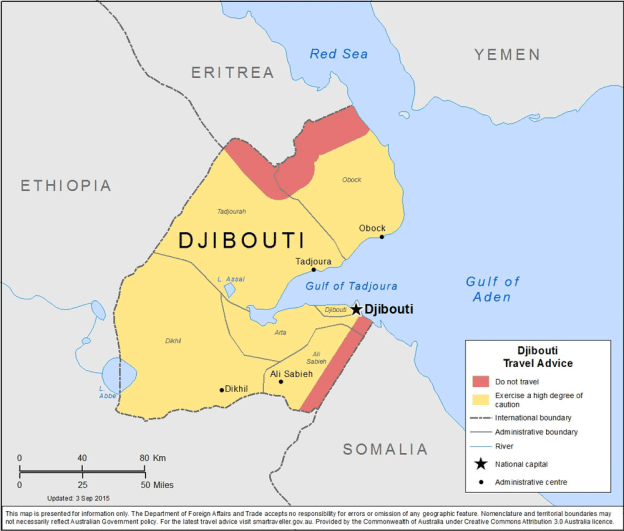
India, Japan and other space-faring countries are waking up to a harsh reality: Earth’s orbit is becoming a more dangerous place as the U.S., China and Russia compete for control of the final frontier…New Delhi is nervous because China has made no secret of its desire for influence in the Indian Ocean. China set up a naval base in Djibouti, a gateway to the ocean at the Horn of Africa. It secured a 99-year lease to the port of Hambantota in Sri Lanka. It is deeply involved in development projects in Maldives.

India has established itself as a player in the budget satellite business. It even put a probe into orbit around Mars in 2014, in a U.S.-assisted project that cost just $76 million. But it is scurrying to enhance its ability to monitor China’s activities, and the partnership with Japan is part of this.  Another sign that space is becoming a defense focus for India came on Dec. 19, when the country launched its third military communications satellite, the GSAT-7A. The satellite will connect with ground-based radar, bases and military aircraft, along with drone control networks.

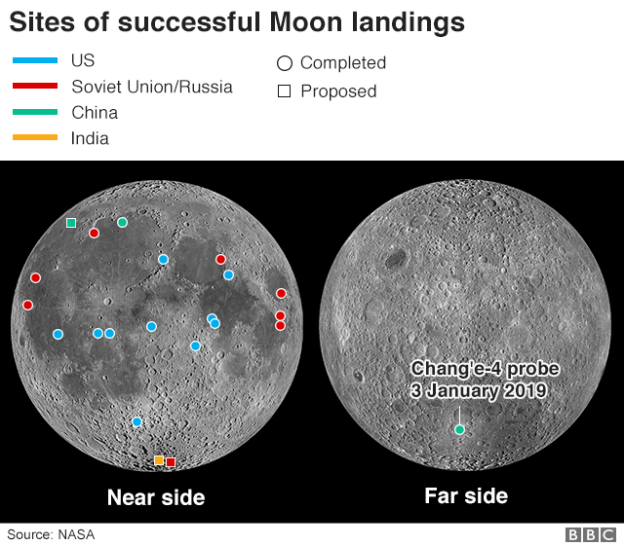
China’s success in landing a craft on the far side of the moon on Jan. 3, 2019 came as a fresh reminder of its growing prowess. In late December, China also achieved global coverage with its BeiDou Navigation Satellite System. Only the U.S., Russia and the European Union had that capability.China aims to launch a Mars explorer in 2020 and complete its own Earth-orbiting space station around 2022.  In the back of Indian and Japanese officials’ minds is likely a stunning test China conducted in 2007. Beijing successfully destroyed one of its own weather satellites with a weapon, becoming only the third nation to pull off such a feat, after the Soviet Union and the U.S.

In December 2018, President Donald Trump ordered the Department of Defense to create a Space Command, widely seen as a precursor to a full-fledged Space Force.  There were 1,957 active satellites orbiting Earth as of Nov. 30, 2018 according to the Union of Concerned Scientists, a nonprofit U.S. advocacy group. America had the most by far, with 849, or 43% of the total. China was No. 2, with 284, followed by Russia with 152.  Japan and India had a combined 132 — 75 for the former and 57 for the latter.

Excerpts fromNUPUR SHAW India and Japan awaken to risks of superpower space race, Nikkei Asian Review, Jan. 8, 2019

Your Biometric Data in Facebook

A federal judge has dismissed a class action lawsuit against Facebook after the California-based social media site claimed there was a lack of personal jurisdiction in Illinois.The plaintiff in the case, Fredrick William Gullen, filed the complaint alleging violations of the Illinois Biometric Information Privacy Act. Gullen is not a Facebook user, but he alleged that his image was uploaded to the site and that his biometric identifiers and biometric information was collected, stored and used by Facebook without his consent. The Illinois Biometric Information Privacy Act, implemented in 2008, regulates the collection, use, and storage of biometric identifiers and biometric information such as scans of face or hand geometry. The act specifically excludes photographs, demographic information, and physical descriptions….

In the Facebook case, no ruling has been made on whether the information on Facebook counts as biometric identifiers and biometric information under the Illinois Biometric Information Privacy Act. Instead, the judge agreed with Facebook that the case could not be tried in Illinois.

However, the company is currently facing a proposed class action in California relating to some of the same questions….How the California class action will play out remains to be seen. California does not yet have a clear policy on biometric privacy.A bill pending in the state’s legislature would extend the scope of the data security law to include biometric data as well as geophysical location, but it has not yet become law.  The question of privacy in regards to biometric information is one that has garnered increasing attention in recent months. On Feb. 4, 2016 the Biomterics Institute, an independent research and analysis organization, released revised guidelines comprising 16 privacy principles for companies that gather and use biometrics data.

Excerpts from Emma Gallimore, Federal judge boots Illinois biometrics class action against Facebook, Legal Newswire, Feb. 22, 2016, 12:15pm

See also the case (pdf)

The Internet Was Never Open

Rarely has a manifesto been so wrong. “A Declaration of the Independence of Cyberspace”, written 20 years ago by John Perry Barlow, a digital civil-libertarian, begins thus: “Governments of the Industrial World, you weary giants of flesh and steel, I come from Cyberspace, the new home of Mind. On behalf of the future, I ask you of the past to leave us alone. You are not welcome among us. You have no sovereignty where we gather.”

At the turn of the century, it seemed as though this techno-Utopian vision of the world could indeed be a reality. It didn’t last… Autocratic governments around the world…have invested in online-surveillance gear. Filtering systems restrict access: to porn in Britain, to Facebook and Google in China, to dissent in Russia.

Competing operating systems and networks offer inducements to keep their users within the fold, consolidating their power. Their algorithms personalise the web so that no two people get the same search results or social media feeds, betraying the idea of a digital commons. Five companies account for nearly two-thirds of revenue from advertising, the dominant business model of the web.

The open internet accounts for barely 20% of the entire web. The rest of it is hidden away in unsearchable “walled gardens” such as Facebook, whose algorithms are opaque, or on the “dark web”, a shady parallel world wide web. Data gathered from the activities of internet users are being concentrated in fewer hands. And big hands they are too. BCG, a consultancy, reckons that the internet will account for 5.3% of GDP of the world’s 20 big economies this year, or $4.2 trillion.

How did this come to pass? The simple reply is that the free, open, democratic internet dreamed up by the optimists of Silicon Valley was never more than a brief interlude. The more nuanced answer is that the open internet never really existed.

[T]e internet, it was developed “by the US military to serve US military purposes”… The decentralised, packet-based system of communication that forms the basis of the internet originated in America’s need to withstand a massive attack on its soil. Even the much-ballyhooed Silicon Valley model of venture capital as a way to place bets on risky new businesses has military origins.

In the 1980s the American military began to lose interest in the internet…. The time had come for the hackers and geeks who had been experimenting with early computers and phone lines.  Today they are the giants. Google, Apple, Facebook, Amazon and Microsoft—together with some telecoms operators—help set policy in Europe and America on everything from privacy rights and copyright law to child protection and national security. As these companies grow more powerful, the state is pushing back…

The other big risk is that the tension between states and companies resolves into a symbiotic relationship. A leaked e-mail shows a Google executive communicating with Hillary Clinton’s state department about an online tool that would be “important in encouraging more [Syrians] to defect and giving confidence to the opposition.”+++ If technology firms with global reach quietly promote the foreign-policy interests of one country, that can only increase suspicion and accelerate the fracturing of the web into regional internets….

Mr Malcomson describes the internet as a “global private marketplace built on a government platform, not unlike the global airport system”.

Excerpts from Evolution of the internet: Growing up, Economist, Mar. 26, 2016

+++The email said Google would be “partnering with Al Jazeera” who would take “primary ownership” of the tool, maintaining it and publicizing it in Syria.  It was eventually published by Al Jazeera in English and Arabic.

How to Stop the Expoitation of Internet Users

Data breaches at Facebook and Google—and along with Amazon, those firms’ online dominance—crest a growing wave of anxiety around the internet’s evolving structure and its impact on humanity…The runaway success of a few startups has created new, proprietized one-stop platforms. Many people are not really using the web at all, but rather flitting among a small handful of totalizing apps like Facebook and Google. And those application-layer providers have dabbled in providing physical-layer internet access. Facebook’s Free Basics program has been one of several experiments that use broadband data cap exceptions to promote some sites and services over others.

What to do? Columbia University law professor Tim Wu has called upon regulators to break up giants like Facebook, but more subtle interventions should be tried first…Firms that do leverage users’ data should be “information fiduciaries,” obliged to use what they learn in ways that reflect a loyalty to users’ interests…The internet was designed to be resilient and flexible, without need for drastic intervention. But its trends toward centralization, and exploitation of its users, call for action

Excerpts from Jonathan Zittrain, Fixing the internet, Science, Nov. 23, 2018

Killing Machines: Tiny Spy Satellites

As long as we’ve been launching spy satellites into space, we’ve been trying to find ways to hide them from the enemy. Now, thanks to the small satellite revolution—and a growing amount of space junk—America has a new way to mask its spying in orbit…

The National Reconnaissance Office, the operator of many of the U.S.’s spy sats, refused to answer any questions about ways to hide small satellites in orbit.  In 2014, Russia launched a trio of communications satellites. Like any other launch, spent stages and space debris were left behind in space. Air Force Space Command dutifully catalogued them, including a nondescript piece of debris called Object 2014-28E.  Nondescript until it started to move around in space, that is. One thing about orbits; they are supposed to be predictable. When something moves in an unexpected way, the debris is not debris but a spacecraft. And this object was flying close to the spent stages, maneuvering to get closer.  This fueled speculation that the object could be a prototype kamikaze-style sat killer. Other less frantic speculation postulated that it could be used to examine other sats in orbit, either Russia’s or those operated by geopolitical foes. Either way, the lesson was learned…

Modern tracking radar is supposed to map space junk better than ever before. But small spy satellites that will hide in the cloud of space debris may go undetected, even by the most sophisticated new radar or Earth-based electronic signals snooping.

Excerpts from Joe Pappalardo, Space Junk Could Provide a Perfect Hiding Spot for Tiny Spy Satellites, Popular Mechanics, Nov. 30, 2018

Skip Pakistan: new way into Afghanistan

A port being developed in the southern Iranian city of Chabahar underscores some of the dilemmas U.S. policy makers face in implementing sanctions against Tehran.  Strategically located on the Gulf of Oman and named for an Iranian revolutionary war hero, the Shahid Beheshti Port is exactly the sort of Iranian economic development the Trump administration wants to stop with sanctions that kick in on Nov. 5, 2018…

Once completed, the port—a small part of which started initial operations in December—could help Iran by strengthening economic ties with South and Central Asia, providing an export point for its oil beyond the Persian Gulf and functioning as a strategic military asset.   But it could also be a critical economic lifeline for Afghanistan, where the U.S. has tried for 16 years to strengthen and stabilize the government so thousands of U.S. troops can come home.

The port also could be a big boon to India, an increasingly close partner of the U.S. in Asia. India wants Chabahar port activities exempted from sanctions. Indian companies are mostly equipping and operating the facility. If the port is completed, they are expected to be among the biggest users of the port in order to participate in the reconstruction of Afghanistan—something the Trump administration has asked India to get more involved in—and establish a stronger economic presence in Central Asia.

The Chabahar port has long been seen as a potential way around Pakistan, a sworn enemy of India that believes holding sway over Afghanistan is critical to its own security.  Pakistan has squelched trade between India and Afghanistan across its territory. It wants Afghanistan to eventually transport goods through a competing Pakistani port on the Gulf of Oman that is being developed with China…

“If you stop Chabahar, you make Afghanistan permanently dependent on Pakistan,” said Barnett Rubin, a New York University expert on South Asia who has advised Western governments on policy in Afghanistan and the surrounding region.

Exceprts from Iranian Port Project Poses a Dilemma for U.S., WSJ, Oct. 29, 2018

Under-Sea Nuclear Deterrence: China

China for decades has struggled to develop nuclear ballistic-missile submarines . The country finally might be on the cusp of deploying reliable boomers.  An effective Chinese ballistic-missile submarine fleet over the long term could have a stabilizing influence on the world’s nuclear balance. But in the short term, it might heighten tensions. Especially if Beijing lets popular fervor drive its build-up.n n That’s the surprising conclusion of a new report from Tong Zhao. …Beijing began developing boomers as far back as 1958. It wasn’t until the late 1980s that the country completed its first boat….A Type 094 apparently conducted China’s first undersea deterrence patrol in 2015. “China has obtained, for the first time, a demonstrably operational underwater nuclear capability. This represents the start of a new era for China’s sea-based nuclear forces.”  As of late 2018 there are four Type 094s in service. Beijing has not publicly released a detailed plan for its SSBN fleet expansion, but the U.S. military expects China to build between five and eight of the vessels, in total, according to Tong and various military reports and statements.

The U.S. military has responded to the China’s new boomers by boosting its own anti-submarine capabilities. “Between Chinese efforts to create a credible sea-based nuclear deterrent and U.S. endeavors to strengthen anti-submarine countermeasures, tensions are brewing under the surface of the South China Sea and the broader Pacific Ocean,” Tong explains.

Exceprts from David Axe China Is Building More Submarines That Carry Nuclear Weapons. And It Could Be a Good Thing, The National Interest, Oct. 27, 2018

Favorite of the West: Niger as Police State

Niger, a poverty-stricken nation perched on the southern belt of the Sahara, is rapidly being transformed into one of the world’s most strategic security hubs….“This place is a nest of spies,” said one contractor … “Below the radar, it’s become a key country for the West.”  A surge in financial assistance from European nations seeking to stem the flow of African migrants has made Niger the world’s largest per capita recipient of European Union aid…Western military forces operate from at least nine bases in Niger, government officials said…. The U.S. is finishing a large air base in Agadez, while the Central Intelligence Agency has begun flying armed drones from an airstrip outside the northern town of Dirkou, Nigerien officials said.

U.S. and European policy makers praise the government as a good partner that has welcomed foreign military personnel and slashed the migrant flow by almost 90% from 2015 highs. …Locals, nongovernmental organizations and opposition activists say the government is using international backing to neutralize dissent and embezzle millions of dollars in aid, charges the government denies. The opposition—backed by rights group Amnesty International—says President Mahamadou Idriss Issoufou, in power since 2011, is arbitrarily jailing activists and spending Western aid on bolstering his elite Presidential Guard…

Swaths of the nation’s centuries-old transportation economy—the movement of people and goods from West Africa through the Sahara—has essentially been criminalized by the EU crackdown on migration.  Some of the desert-dwelling Tuareg people, who have transported goods for centuries, are now smuggling weapons, men and money for cash-rich jihadist insurgencies. Migrants are dying in the desert in failed attempts to find new routes.

“The West is pleased because Niger’s government is a willing partner,but as Niger’s security chief, Mohammed Bazoum, says “We have become a hinge country, a geostrategic hub, but it is a disaster for us. We are known as a land of terrorism and migrant traffic.”

Across Niger’s western border with Mali, jihadist groups including Islamic State and al Qaeda franchises control stretches of territory around the northern city of Gao. Along the southern frontier with Nigeria, a rejuvenated Boko Haram is mounting intensifying attacks against security forces, including around the city of Diffa, where the U.S. has dozens of troops stationed. To the north lies Libya, which has become a hotbed of instability, weapons and radicalization.

The European Development Fund last year awarded $1 billion to Niger through 2020, and unusually for a country governance watchdogs deem chronically corrupt, 75% is now infused directly into the Nigerien budget instead of through nongovernmental organizations.The money funds hundreds of off-road vehicles, motorcycles and satellite phones for Nigerien security forces as well as new infrastructure and technology along the borders and countrywide development programs.

In Niamey’s central Plateau district, tall black screens block the soaring new U.S. Embassy headquarters, which will be one of the largest in West Africa. Saudi Arabia has broken ground on its own huge mission, while buildings belonging to EU agencies occupy whole city blocks. Hotels and conference centers are rising in tandem, reconfiguring the economic and political landscape of a nation ranked the world’s second-poorest behind the Central African Republic.

The government says the building boom is creating jobs. Locals say it has stoked runaway inflation and priced them out of their neighborhoods. In the past year, the cost of a kilogram of rice has risen 29%, sending shock waves through homes where the average wage is $2.66 a day.

“The cost to live here rises with each new European coming,” lamented Abdulraham Mamoudou, repairing his motor scooter on a dusty corner near the expanding U.S. Embassy compound.

A similar pattern is playing out further north in the smuggling hub of Agadez, where the EU-coordinated migration crackdown has transformed a boomtown into a simmering bust.  The city’s jails are bursting with men who have been convicted of smuggling. Vast depots on the town’s outskirts house hundreds of trucks confiscated by authorities…“This place is now for the Americans and French,” said Sadiq, a former migrant smuggler who evaded arrest and is now unemployed. “They took our livelihood and don’t give us anything in return.”

Excerpts from ‘A Nest of Spies’: Niger’s Deserts Become Front Line of Fight Against Jihadis, Wall Street Journal, Sept. 12, 2018

Slyly Conquering East Africa

The rulers of United Arab Emirates (UAE), one of whose components, Dubai, own a majority stake in DP World, one of the world’s largest maritime firms with perations in 40 countries.It is one of several Gulf states trying to gain a strategic foothold in east Africa through ports. Controlling these offers commercial and military advantages but risks exacerbating tensions in the region…

DP World thinks the region from Sudan to Somalia needs 10-12 ports. It has just half that. The firm’s first foray was on Djibouti’s coast. When DP World won its first concessions there in the 1990s, the Emiratis were among the few investors interested in the small and poor former French colony. DP World built and operated a new container terminal, Doraleh,and helped finance roads and other infrastructure. Doraleh is now the country’s largest employer and the government’s biggest source of revenue. It runs at nearly full capacity, handling 800,000 containers a year. Much of its cargo travels along a Chinese-built railway from Addis Ababa, Ethiopia’s capital.

Djibouti’s profile rose further after the terrorist attacks on America of September 11th, 2001, when America opened a military base there. France and China also have bases; other navies patrol off its coast to deter Somali pirates. But when the Emiratis wanted to open their own naval base they were rebuffed, partly because of their close ties to Djibouti’s rival, Eritrea (the two states had a bloody border dispute in 2008). In 2015 the UAE started building a naval base in Assab, in southern Eritrea. The base has been used in the Saudi-led war against Houthi rebels in Yemen….In 2016 DP World won a 30-year concession to operate the port of Berbera in Somaliland, which declared independence in 1991 (though no foreign government recognises it). Critics said the deal would hasten the break-up of Somalia.

The Horn ports all sit near the Bab al-Mandab strait, a vital choke-point at the mouth of the Red Sea: 4.8m barrels of oil passed through it every day in 2016. Competition is getting fierce, though. Qatar and its ally, Turkey, are building ports in Sudan. Saudi Arabia is in talks to set up a naval base in Djibouti. All three Gulf states are trying to snap up farmland in east Africa, part of a broader effort to secure food supplies for their arid countries. Emirati-built ports could one day export crops from Emirati-owned farms…

Gulf states could also find themselves in competition with China…In February 2018 Djibouti seized the Doraleh port, a concession to the UAE… Shippers believe it took Doraleh as a sop to China, to which it is heavily indebted. In July 2018, Djibouti opened the first phase of a new $3.5bn free-trade zone, set to be the largest in Africa when it is finished. Built mostly by state-owned Chinese firms, it sits next to Doraleh. DP World says the project violates the terms of its concession and is threatening to sue.

Excerpts from Red Sea Scamble: Ports on the Horn, Economist, July 21, 2018, at 33

How to Navigate the Rubble: DARPA

Imagine a natural disaster scenario, such as an earthquake, that inflicts widespread damage to buildings and structures, critical utilities and infrastructure, and threatens human safety. Having the ability to navigate the rubble and enter highly unstable areas could prove invaluable to saving lives or detecting additional hazards among the wreckage.

Dr. Ronald Polcawich, a DARPA program manager in the Microsystems Technology Office (MTO):”There are a number of environments that are inaccessible for larger robotic platforms. Smaller robotics systems could provide significant aide, but shrinking down these platforms requires significant advancement of the underlying technology.”

Technological advances in microelectromechanical systems (MEMS), additive manufacturing, piezoelectric actuators, and low-power sensors have allowed researchers to expand into the realm of micro-to-milli robotics. However, due to the technical obstacles experienced as the technology shrinks, these platforms lack the power, navigation, and control to accomplish complex tasks proficiently

To help overcome the challenges of creating extremely [Size, Weight and Power] SWaP-constrained microrobotics, DARPA is launching a new program called SHort-Range Independent Microrobotic Platforms (SHRIMP). The goal of SHRIMP is to develop and demonstrate multi-functional micro-to-milli robotic platforms for use in natural and critical disaster scenarios. To achieve this mission, SHRIMP will explore fundamental research in actuator materials and mechanisms as well as power storage components, both of which are necessary to create the strength, dexterity, and independence of functional microrobotics platforms.

“The strength-to-weight ratio of an actuator influences both the load-bearing capability and endurance of a micro-robotic platform, while the maximum work density characterizes the capability of an actuator mechanism to perform high intensity tasks or operate over a desired duration,” said Polcawich. “

Excerpts from Developing Microrobotics for Disaster Recovery and High-Risk Environments: SHRIMP program seeks to advance the state-of-the art in micro-to-milli robotics platforms and underlying technology, OUTREACH@DARPA.MIL, July 17, 2018

The Right Way to Steal

Chinese government hackers have compromised the computers of a Navy contractor, stealing massive amounts of highly sensitive data related to undersea warfare — including secret plans to develop a supersonic anti-ship missile for use on U.S. submarines by 2020, according to American officials.   The breaches occurred in January and February  2018, the officials said… The hackers targeted a contractor who works for the Naval Undersea Warfare Center, a military organization headquartered in Newport, R.I., that conducts research and development for submarines and underwater weaponry.

Taken were 614 gigabytes of material relating to a closely held project known as Sea Dragon, as well as signals and sensor data, submarine radio room information relating to cryptographic systems, and the Navy submarine development unit’s electronic warfare library…This fact raises concerns about the Navy’s ability to oversee contractors tasked with developing ­cutting-edge weapons.

For years, Chinese government hackers have siphoned information on the U.S. military, underscoring the challenge the Pentagon faces in safeguarding details of its technological advances. Over the years, the Chinese have snatched designs for the F-35 Joint Strike Fighter; the advanced Patriot PAC-3 missile system; the Army system for shooting down ballistic missiles known as Terminal High Altitude Area Defense; and the Navy’s new Littoral Combat Ship, a small surface vessel designed for near-shore operations, according to previous reports prepared for the Pentagon.  In some cases, suspected Chinese breaches appear to have resulted in copycat technologies…

Investigators say the hack was carried out by the Chinese Ministry of State Security, a civilian spy agency responsible for counterintelligence, foreign intelligence and domestic political security. The hackers operated out of an MSS division in the province of Guangdong, which houses a major foreign hacking department….

In September 2015, in a bid to avert economic sanctions, Chinese President Xi Jinping pledged to President Barack Obama that China would refrain from conducting commercial cyberespionage against the United States. …Both China and the United States consider spying on military technology to fall outside the pact.

Excerpts from Ellen Nakashima and Paul Sonne, China hacked a Navy contractor and secured a trove of highly sensitive data on submarine warfare, Washington Post, June 8, 2018

Onerous Debt and its Consequences

A Beijing-funded wharf in Vanuatu  is big enough to allow powerful warships to dock alongside it, heightening fears the port could be converted into a Chinese naval installation.  Fairfax Media inspected the $114 million Luganville wharf and was told US coastguard officials and Marines recently visited the sprawling facility and took a keen interest in its specifications.  The Chinese and Vanuatu governments have strenuously denied they have discussed a military base…

The Vanuatu government has taken on significant debt to China, though it appears to have stopped taking large loans since getting a stern warning from the International Monetary Fund in 2016.  The wharf expected to be used to accept container and cruise ships was constructed by the Shanghai Construction Company and opened with fanfare in the middle of 2017.   It is unclear whether the wharf loan contract with the Vanuatu government includes a so-called debt-equity swap clause, which would mean China could take over the facility if Vanuatu defaults on its payments. It has recently taken over the major port of Hambantota from Sri Lanka in these circumstances.

Malcolm Davis, a defence expert at the Australian Strategic Policy Institute, said it was “not by accident” that wharf had been built for large vessels.
“My guess is there’s a Trojan horse operation here that eventually will set up a large facility that is very modern and very well-equipped. They’ve done this before in other parts of the world. “Their hope is that the debt of the Vanuatu government will be so onerous that they can’t pay it back. The Chinese will say, ‘the facility is ours for 99 years’ and the next thing you’ve got a PLA Navy Luang III class [destroyer] docking there.

Excerpts from China and the Pacific: The Great Wharf, Economist, Apr. 21, 2018, at 33.

Flying off the Shelves: the entrenching of drone warfare

A 2018 report published by Drone Wars UK reveals that over the last five years the number of countries actively using armed drones has quadrupled. Drone Wars: The Next Generation demonstrates that from just three states (US, UK and Israel) in 2013, there are now a further nine who have deployed armed drones in a variety of roles including for armed conflict and counter-terror operations. The report also shows that a further nine states are very close to having armed drone capabilities, almost doubling the number of existing users. To this number, we have added five non-state actors who have used armed drones, which will take the number of active operators of armed drones to over 25 in the next few years.

As is well known, China has sold armed drones to a number of countries around the world. Since 2013, Nigeria, Pakistan, Saudi Arabia, Iraq, UAE and Egypt have begun operating armed Chinese drones whilst another four countries (Jordan, Myanmar, Kazakhstan and Turkmenistan) are thought to have recently taken possession of, or be in discussion about the sale of, Chinese drones. These Wing Loong and CH series drones are cheaper and less powerful than US Predators and Reapers.  As, according to their specifications, they are not capable of delivering a payload of at least 500 kg to a range of at least 300 km they do not fall into the category of systems that would be refused under Category 1 of the Missile Technology Control Regime (MTCR) as the US systems do.

Turkey, Pakistan and Iran are actively using their own manufactured drones. Iran has, it seems, supplied Hamas, Hezbollah and the Houthis with armed drones while ISIS and the PKK  (Kurdistan Workers’ Party) have attached small explosives to off-the-shelf drones. Turkey are thought to be concluding deal with Qatar and the Ukrain eand South Korea are very close to beginning production of their own armed drones.

As for the larger countries that one might expect to have already deployed armed drones, such as Russia and India, they still appear to be some distance from producing workable models…Several cross-European projects are underway to develop indigenous armed drones within the EU.

Excerpts from New research shows rise in number of states deploying armed drones, Press Release from Drone Wars UK, May 17, 2018

Who Controls Peoples’ Data?

The McKinsey Global Institute estimates that cross-border flows of goods, services and data added 10 per cent to global gross domestic product in the decade to 2015, with data providing a third of that increase. That share of the contribution seems likely to rise: conventional trade has slowed sharply, while digital flows have surged. Yet as the whole economy becomes more information-intensive — even heavy industries such as oil and gas are becoming data-driven — the cost of blocking those flows increases…

Yet that is precisely what is happening. Governments have sharply increased “data localisation” measures requiring information to be held in servers inside individual countries. The European Centre for International Political Economy, a think-tank, calculates that in the decade to 2016, the number of significant data localisation measures in the world’s large economies nearly tripled from 31 to 84.

Even in advanced economies, exporting data on individuals is heavily restricted because of privacy concerns, which have been highlighted by the Facebook/ Cambridge Analytica scandal. Many EU countries have curbs on moving personal data even to other member states. Studies for the Global Commission on Internet Governance, an independent research project, estimates that current constraints — such as restrictions on moving data on banking, gambling and tax records — reduces EU GDP by half a per cent.

In China, the champion data localiser, restrictions are even more severe. As well as long-established controls over technology transfer and state surveillance of the population, such measures form part of its interventionist “ Made in China 2025 ” industrial strategy, designed to make it a world leader in tech-heavy sectors such as artificial intelligence and robotics.

China’s Great Firewall has long blocked most foreign web applications, and a cyber security law passed in 2016 also imposed rules against exporting personal information, forcing companies including Apple and LinkedIn to hold information on Chinese users on local servers. Beijing has also given itself a variety of powers to block the export of “important data” on grounds of reducing vaguely defined economic, scientific or technological risks to national security or the public interest.   “The likelihood that any company operating in China will find itself in a legal blind spot where it can freely transfer commercial or business data outside the country is less than 1 per cent,” says ECIPE director Hosuk Lee-Makiyama….

Other emerging markets, such as Russia, India, Indonesia and Vietnam, are also leading data localisers. Russia has blocked LinkedIn from operating there after it refused to transfer data on Russian users to local servers.

Business organisations including the US Chamber of Commerce want rules to restrain what they call “digital protectionism”. But data trade experts point to a serious hole in global governance, with a coherent approach prevented by different philosophies between the big trading powers. Susan Aaronson, a trade academic at George Washington University in Washington, DC, says: “There are currently three powers — the EU, the US and China — in the process of creating separate data realms.”

The most obvious way to protect international flows of data is in trade deals — whether multilateral, regional or bilateral. Yet only the World Trade Organization laws governing data flows predate the internet and have not been thoroughly tested through litigation. It recently recruited Alibaba co-founder Jack Ma to front an ecommerce initiative, but officials involved admit it is unlikely to produce anything concrete for a long time. In any case, Prof Aaronson says: “While data has traditionally been addressed in trade deals as an ecommerce issue, it goes far wider than that.”

The internet has always been regarded by pioneers and campaigners as a decentralised, self-regulating community. Activists have tended to regard government intervention with suspicion, except for its role in protecting personal data, and many are wary of legislation to enable data flows.  “While we support the approach of preventing data localisation, we need to balance that against other rights such as data protection, cyber security and consumer rights,” says Jeremy Malcolm, senior global policy analyst at the Electronic Frontier Foundation, a campaign for internet freedom…

Europe has traditionally had a very different philosophy towards data and privacy than the US. In Germany, for instance, public opinion tends to support strict privacy laws — usually attributed to lingering memories of surveillance by the Stasi secret police in East Germany. The EU’s new General Data Protection Regulation (GDPR), which comes into force on May 25, 2018 imposes a long list of requirements on companies processing personal data on pain of fines that could total as much as 4 per cent of annual turnover….But trade experts warn that the GDPR is very cautiously written, with a blanket exemption for measures claiming to protect privacy. Mr Lee-Makiyama says: “The EU text will essentially provide no meaningful restriction on countries wanting to practice data localisation.”

Against this political backdrop, the prospects for broad and binding international rules on data flow are dim. …In the battle for dominance over setting rules for commerce, the EU and US often adopt contrasting approaches.  While the US often tries to export its product standards in trade diplomacy, the EU tends to write rules for itself and let the gravity of its huge market pull other economies into its regulatory orbit. Businesses faced with multiple regulatory regimes will tend to work to the highest standard, known widely as the “Brussels effect”.  Companies such as Facebook have promised to follow GDPR throughout their global operations as the price of operating in Europe.

Excerpts from   Data protectionism: the growing menace to global business, Financial Times, May 13, 2018

Who’s Fighting over Djibouti?

The top US general for Africa told lawmakers the American military could face “significant” consequences should China take a key port in Djibouti….  In Febuary 2018, Djibouti ended its contract with Dubai’s DP World, one of the world’s biggest port operators, to run the Doraleh Container Terminal, citing failure to resolve a dispute that began in 2012.  DP World called the move an illegal seizure of the terminal and said it had begun new arbitration proceedings before the London Court of International Arbitration.

During a congressional hearing on March 7, 2018, dominated by concerns about China’s role in Africa, lawmakers said they had seen reports that Djibouti seized control of the port to give it to China as a gift. China has already built a military base in Djibouti, just miles from a critical US military base.

Djibouti is strategically located at the southern entrance to the Red Sea on the route to the Suez Canal.  Marine General Thomas Waldhauser, the top US military commander overseeing troops in Africa, said if China placed restrictions on the port’s use, it could affect resupplying the US base in Djibouti and the ability of Navy ships to refuel there.  Djibouti hosts a vital US military base home to about 4,000 personnel,[Camp Lemonnier] including special operations forces, and is a launchpad for operations in Yemen and Somalia.

China has sought to be visible in Africa, including through high-profile investment in public infrastructure projects, as it deepens trade ties.  Waldhauser said the United States would be unable to match the scale of Chinese investment throughout Africa, noting Beijing’s construction of shopping malls, government buildings and even soccer stadiums.  “We’ll never outspend the Chinese in Africa,” Waldhauser said, noting some Chinese investments in Djibouti.

In 2018, the US military put countering China, along with Russia, at the centre of a new national defence strategy.  The Pentagon said China was a part of “revisionist powers” that “seek to create a world consistent with authoritarian models.”

Excerpts from  Significant consequences if China takes port in Djibouti, Reuters, Mar. 7, 2018

Up, Close and Personal: How to Destroy the Enemy

Deep southern Negev desert, Israel, there is a small town called Baladia, with a main square, five mosques, cafés, a hospital, multi-storey blocks of flats, a kasbah and a cemetery. Oddly, it also has a number of well-constructed tunnels. The only people milling around in its streets are Israeli Defence Force (IDF) soldiers. Baladia, the Arab word for city, is part of the Tze’elim army base**. It has been built to provide a realistic training ground for the next time the IDF is required to go into Gaza to destroy Hamas missile launchers…Acceptance among Western armies that future fights are most likely to take place in cities. Megacities with populations of more than 10m are springing up across Africa and Asia. They are often ringed by closely packed slums controlled by neighbourhood gangs. Poor governance, high unemployment and criminality make them fertile territory for violent extremism.

It is hardly surprising that non-state adversaries of the West and its allies should seek asymmetric advantage by taking the fight into cities. Air power and precision-guided munitions lose some of their effectiveness in urban warfare because their targets can hide easily and have no scruples about using a densely packed civilian population as a shield.

Valuable lessons have been learned from the battle for Sadr City, a large suburb of Baghdad, in 2008, Israel going into Gaza in 2014 and the defeat of Islamic State (IS) in Mosul 2017….As General Mark Milley, the head of the US Army, puts it, “it took the infantry and the armour and the special operations commandos to go into that city, house by house, block by block, room by room…and it’s taken quite a while to do it, and at high cost.” He thinks that his force should now focus less on fighting in traditional environments such as woodland and desert and more on urban warfare.

To that end, he advocates smaller but well-armoured tanks that can negotiate city streets, and helicopters with a narrower rotor span that can fly between buildings. At the organisational level, that means operating with smaller, more compartmentalised fighting units with far more devolved decision-making powers…

Western military forces should still enjoy a significant technological edge. They will have a huge range of kit, including tiny bird- or insect-like unmanned aerial vehicles that can hover outside buildings or find their way in. Unmanned ground vehicles can reduce the risk of resupplying troops in contested areas and provide medical evacuation for injured soldiers, and some of them will carry weapons….

For all the advances that new technologies can offer, General Milley says it is a fantasy to think that wars can now be won without blood and sacrifice: “After the shock and awe comes the march and fight…to impose your political will on the enemy requires you…to destroy that enemy up close with ground forces.”

Excerpt from House to House in the The New Battlegrounds, Economist Special Report, the Future of War, Jan. 27, 2018

***In 2005, the Israeli Defense Forces, with assistance from the United States, built the Urban Warfare Training Center at the Tze’elim Army Base, at a cost of $45 million. Nicknamed “Baladia” it is a 7.4 square mile training center used to instruct soldiers in urban warfare techniques, and consists of an imitation Middle Eastern style city with multiple multistory buildings. It has been used to train various military organizations, including the US Army and UN peacekeepers.  Wikipedia

The Perfect Spies: Animals as Mobile Sensors of US Enemies

The world’s vast oceans and seas offer seemingly endless spaces in which adversaries of the United States can maneuver undetected. The U.S. military deploys networks of manned and unmanned platforms and sensors to monitor adversary activity, but the scale of the task is daunting and hardware alone cannot meet every need in the dynamic marine environment. Sea life, however, offers a potential new advantage. Marine organisms are highly attuned to their surroundings—their survival depends on it—and a new program out of DARPA’s Biological Technologies Office aims to tap into [marine animals] natural sensing capabilities to detect and signal when activities of interest occur in strategic waters such as straits and littoral regions.

The Persistent Aquatic Living Sensors (PALS) program, led by program manager Lori Adornato, will study natural and modified organisms to determine which ones could best support sensor systems that detect the movement of manned and unmanned underwater vehicles. PALS will investigate marine organisms’ responses to the presence of such vehicles, and characterize the resulting signals or behaviors so they can be captured, interpreted, and relayed by a network of hardware devices.

Beyond sheer ubiquity, sensor systems built around living organisms would offer a number of advantages over hardware alone. Sea life adapts and responds to its environment, and it self-replicates and self-sustains. Evolution has given marine organisms the ability to sense stimuli across domains—tactile, electrical, acoustic, magnetic, chemical, and optical. Even extreme low light is not an obstacle to organisms that have evolved to hunt and evade in the dark.

However, evaluating the sensing capabilities of sea life is only one of the challenges for PALS researchers. Performer teams supporting DARPA will also have to develop hardware, software, and algorithms to translate organism behavior into actionable information and then communicate it to end users…. The complete sensing systems must also discriminate between target vehicles and other sources of stimuli, such as debris and other marine organisms, to limit the number of false positives.

Adornato is aiming to demonstrate the approach and its advantages in realistic environments to convey military utility. “Our ideal scenario for PALS is to leverage a wide range of native marine organisms, with no need to train, house, or modify them in any way, which would open up this type of sensing to many locations,” Adornato said.

Excerpt from PALS Turns to Marine Organisms to Help Monitor Strategic Waters: Highly adapted sea life could help U.S. military detect adversary activity over large areas, Feb. 2, 2018

The Power of Yes-Men

American military engagement in Niger is a $110 million drone base the U.S. is building about 450 miles northeast of Niamey in Agadez…Its existence was partially confirmed in February 2018, inadvertently, when it was discovered that Strava, a fitness app used mostly  by westerners, had released location data that showed the global movements of the users of workout trackers like Fitbit — and the data showed unusual activity in far-off Aguelal, Agadez, Niger.

On the southeast edge of the civilian airport, accessible by tracks in the sand used mainly to exit the town, is Nigerien Air Base 201, or in common parlance “the American base.” The base, scheduled for completion in late 2018, is technically the property of the Nigerien military, though it is paid for, built, and operated by Americans. It is being constructed on land formerly used by Tuareg cattle-herders. … The U.S. currently flies drones out of an airport in Niamey, but those operations will be shifted to Agadez once the new base is completed.

When asked to confirm the American presence in those areas of Niger, U.S. Africa Command spokesperson Samantha Reho replied, “I can confirm there are approximately 800 Department of Defense personnel (military, civilian, and contractor) currently working in Niger, making that country the second-highest concentration of DoD people across the continent, with the first being in Djibouti at Combined Joint Task Force-Horn of Africa.”

The U.S. is just one of several Western militaries that have established and strengthened military ties to Niger over the past few years. France has had soldiers in the country since 2013, when it launched Opération Serval in neighboring Mali. In 2015, France reopened a colonial fort in Madama, close to the border with Libya — unthinkable during the times of Moammar Gadhafi; the Libyan leader maintained a sphere of influence in the region that would have been at odds with a French military presence. Germany sent its own troops in Niger to support the United Nations peacekeeping mission across the border in Mali, and German Chancellor Angela Merkel even visited Niger in 2017. And Italy recently announced it would send 470 troops to a French base in the north of Niger to fight migrant transporters….

The base in Agadez is about 6 square kilometers, though most of the land is yet to be developed. ….. The base is tucked away and hidden from Agadez first by the 8-to-10-foot wall that separates the city of 125,000 from the airport, and it is surrounded by a barbed wire fence with sandbags, so despite there being a few hundred Americans in Agadez, you would hardly know they were there unless you went looking. Both the Nigerien and the American governments prefer to keep it this way…

The man the middle is Mahamadou Issoufou, the president of Niger. In power for six years, he has adopted a clear strategy for trying to keep control of things – by aligning himself closely with Europe and the United States, while presiding over an electoral system that his opponents describe as rigged. This is not a recipe for stability in a country that has had little of it since its founding in 1960, at the end of French colonial rule.

Issoufou is a trained engineer and a former secretary-general of Somaïr, a uranium mine that was run by the French company Areva. Until migration and terrorism, uranium was the focal point of outside, particularly French, interest in Niger. France’s electricity grid is powered by nuclear energy, and Areva’s uranium concessions in Niger provide up to one-fifth of the uranium necessary to power that grid. Issoufou’s predecessor, Mamadou Tandja, had sparred with the French over the concession, and in 2009, then-French President Nicholas Sarkozy visited Niger to negotiate a deal on opening a new mine called Imouraren. After a $1.2 billion deal was struck, Tandja tried to reverse the constitution to stay in power for a third term, and after street protests, a group of low-ranking army officers carried out a coup d’état.

When the transition period ended with Issoufou’s election in 2011, the Fukushima nuclear disaster in Japan caused a sharp downturn in global uranium prices. Areva dropped its plans for Imouraren, and Issoufouacquiesced to the French firm’s plans for delaying the mine until prices rose, denting economic growth prospects for the country. But despite losing out on Imouraren, Issoufou quickly became a donor darling and found that the closer he was to France and the West, the better his image and the more firm his hold on political power. Issoufou was criticized heavily for going to Paris to attend the “Je Suis Charlie” march in January 2015, and some human rights organizations view him as a lackey of the West. He works with Image Sept, a French firm with close ties to the Parisian political elite, to manage his image.A couple of months before his re-election in 2016, Issoufou jailed his main political opponent and former close ally, Hama Amadou of the Moden Lumana party….

Many people I spoke to in Niger feel their country has had its autonomy usurped by Westerners. “The reality is that Niger is not at a level where it can say yes or no to the French or Americans. … We only have sovereignty on paper,” said Djibril Abarché, president of the Nigerien Human Rights Association.

Exceprts from Joe Penny, Drones in the Sahara, the Intercept, Feb. 18, 2018

The First to Shoot…from Space

North Korea’s preparations to launch a more advanced reconnaissance satellite with a high-resolution scanning capability threaten to push Asia’s space race deeper into the military theater.  The Kwangmyongsong-5 Earth-exploration satellite, likely to be packaged with a separate communications satellite, will technically allow North Korea to transmit data down to the ground for the first time, thus offering real-time intelligence for potential ballistic-missile strikes.

This is well short of the technological capacity needed to deploy orbital weapon systems, but will cause some unease among Asian power-brokers China, Japan and India as they pour money into the last strategic frontier of outer space.  Space programs in Asia have largely been driven by competition for the US$300 billion global commercial transponders market, which is expected to double by 2030 if demand holds.

A shift toward miniature satellites of less than 20 kilograms, mostly used by governments and smaller companies, has drawn nations as diverse as Singapore, Pakistan, Vietnam and South Korea into a field led by Japan and China, with India a more recent player.

Japan placed two satellites in different orbits for the first time on December 2017, displaying a technical edge aimed at reducing launch costs for commercial clients. India announced this week that it had successfully tested a GSLV Mark III rocket that can lift a 4-ton satellite into orbit. In 2017, it managed to launch 104 satellites of varying sizes in just one operation. China has loftier ambitions, including a lunar landing some time in 2018, after sending a roving module down a steep crater on the moon in 2013. About 40 Chinese launches are likely in 2018, mainly to boost communications.  India and Japan are both locked in undeclared space races with China that go well beyond commercial rivalries and have muddied the debate over North Korea’s shadowy aims….

“Militarization” refers to any systems that enhance the capability of forces in a conventional setting, such as intelligence, communications and surveillance. “Weaponization” is the physical deployment of weapons in outer space or in a ground mode where they can be used to attack and destroy targets in orbit.  The United Nations Treaty on Outer Space prohibits the deployment of weapons of mass destruction in space, but the US has blocked efforts to ban space weapons outright. In 2007, Washington said it would “preserve its rights, capabilities, and freedom of action in space.”

Excerpts from  ALAN BOYD,  Asia’s Space Race Gathers Pace, Asia Times, Jan. 6, 2018

Killer Robotic Insects

On November 12, 2017,  a video called “Slaughterbots” was uploaded to YouTube. … It is set in a near-future in which small drones fitted with face-recognition systems and shaped explosive charges can be programmed to seek out and kill known individuals or classes of individuals (those wearing a particular uniform, for example). In one scene, the drones are shown collaborating with each other to gain entrance to a building. One acts as a petard, blasting through a wall to grant access to the others…

[M]ilitary laboratories around the planet are busy developing small, autonomous robots for use in warfare, both conventional and unconventional. In America, in particular, a programme called MAST (Micro Autonomous Systems and Technology), which has been run by the US Army Research Laboratory in Maryland, is wrapping up this month after ten successful years….. Its successor, the Distributed and Collaborative Intelligent Systems and Technology (DCIST) programme, which began earlier this year, is now getting into its stride….Along with flying drones, MAST’s researchers have been developing pocket-sized battlefield scouts that can hop or crawl ahead of soldiers. DCIST’s purpose is to take these autonomous robots and make them co-operate. The result, if the project succeeds, will be swarms of devices that can take co-ordinated action to achieve a joint goal.

If swarms of small robots can be made to collaborate autonomously, someone, somewhere will do it…[Many of these small robots are today] cyclocopters …of less than 30 grams. Such machines can outperform polycopters...Cyclocopter aerodynamics is more like that of insects than of conventional aircraft…Cyclocopters get better as they get smaller. They are also quieter…[Another innovation involves] robots…that hop.One of the most advanced is Salto, developed by the Biomimetic Millisystems Laboratory at the University of California, Berkeley. Salto… has the agility to bounce over uneven surfaces and also to climb staircases…

Bouncing over the rubble of a collapsed building is not the only way to explore it. Another is to weave through the spaces between the debris. Researchers at the Biomimetic Millisystems lab are working on that, too. Their solution resembles a cockroach.

Getting into a building, whether collapsed or intact, is one thing. Navigating around it without human assistance is quite another. For this purpose MAST has been feeding its results to the Defence Advanced Research Projects Agency (DARPA)… The next challenge…is getting the robots to swarm and co-ordinate their behavior effectively.

Excerpt from Miniature Robots: Bot Flies, Economist, Dec. 16, 2017

The Subterraneans

Underground settings are becoming increasingly relevant to global security and safety. Rising populations and urbanization are requiring military and civilian first responders to perform their duties below ground in human-made tunnels, underground urban spaces [e.g. mass transit, water infrastructure] and natural cave networks. Recognizing that innovative, enhanced technologies could accelerate development of critical lifesaving capabilities, DARPA today announced its newest challenge: the DARPA Subterranean Challenge.

The DARPA Subterranean or “SubT” Challenge aims to explore new approaches to rapidly map, navigate, and search underground environments. Teams from around the world will be invited to propose novel methods for tackling time-critical scenarios through unknown courses in mapping subsurface networks and unpredictable conditions, which are too hazardous for human first responders.

“One of the main limitations facing warfighters and emergency responders in subterranean environments is a lack of situational awareness; we often don’t know what lies beneath us,” said Timothy Chung, program manager in DARPA’s Tactical Technology Office (TTO). “The DARPA Subterranean Challenge aims to provide previously unimaginable situational awareness capabilities for operations underground.”

“We’ve reached a crucial point where advances in robotics, autonomy, and even biological systems could permit us to explore and exploit underground environments that are too dangerous for humans,” said TTO Director Fred Kennedy.“Instead of avoiding caves and tunnels, we can use surrogates to map and assess their suitability for use. Through the DARPA Subterranean Challenge, we are inviting the scientific and engineering communities—as well as the public—to use their creativity and resourcefulness to come up with new technologies and concepts to make the inaccessible accessible.

Excerpts from DARPA Subterranean Challenge Aims to Revolutionize Underground Capabilities, Dec. 21, 2017

Who is Afraid of North Korea

President Trump agreed in September 2017 to send more of the Pentagon’s “strategic assets” to South Korea on a rotational basis to deter North Korean provocations, but what exactly that means remains something of a mystery.

The U.S. assets — typically defined as submarines, aircraft carriers, nuclear weapons or bombers — have long been involved in the standoff that began with the 1953 Korean Armistice Agreement after open warfare subsided between the two Koreas.

The U.S. Navy typically keeps the movements of its submarines secret, but it also has periodically sent them to port in South Korea. The USS Michigan, an Ohio-class nuclear-powered submarine, has appeared at Busan Naval Base in South Korea at least twice in 2017. It is capable of carrying cruise missiles and elite Navy SEALs, although not ballistic missiles.

More recently, the Navy announced last week it has plans for a massive exercise involving three aircraft carriers — the USS Nimitz, the USS Theodore Roosevelt and the USS Ronald Reagan — and their associated strike groups, each of which include dozens of aircraft and thousands of sailors and Marines.

Excerpts from  Dan Lamothe, In standoff with North Korea, the U.S. keeps deployment of ‘strategic assets’ mysterious, Washington Post, Oct. 29, 2017

The Bloody Battle for Chip Hegemony

China’s Tsinghua Unigroup Ltd., a state-owned firm is spending $24 billion to build the country’s first advanced memory-chip factories. It’s part of the Chinese government’s plan to become a major player in the global chip market and the move is setting off alarms in Washington.  When Unigroup tried to buy U.S. semiconductor firms in 2015 and 2016, Washington shot down the bids. It is considering other moves to counter Beijing’s push.

China is aiming “to take over more and more segments of the semiconductor market,” says White House trade adviser Peter Navarro, who fears Beijing will flood the market with inexpensive products and bankrupt U.S. companies.  Unigroup’s CEO Zhao Weiguo says he is only building his own factories due to Washington’s refusal to let him invest in the U.S. “Chinese companies have faced discrimination in many areas,” of technology, he says. “Abnormal discrimination.”

Semiconductors—the computer chips that enabled the digital age and power the international economy—have long been among the most globalized of industries, with design and manufacturing spread across dozens of countries.

Today, the industry is riven by a nationalist battle between China and the U.S., one that reflects broad currents reshaping the path of globalization. Washington accuses Beijing of using government financing and subsidies to try to dominate semiconductors as it did earlier with steel, aluminum, and solar power. China claims U.S. complaints are a poorly disguised attempt to hobble China’s development. Big U.S. players like Intel Corp. and Micron Technology Inc. find themselves in a bind—eager to expand in China but wary of losing out to state-sponsored rivals…

The new semiconductor battle marks a shift toward nationalism, trade battles and protected markets…The U.S. estimates China will eventually spend $150 billion [on developing s its indigenous semiconductor industry]  a figure equal to about half of global semiconductor sales annually.

Though Republicans and Democrats are at odds on many economic policy issues, they’re unified on this. An interagency working group on semiconductors, started by the Obama administration in 2015, has continued meeting under President Donald Trump. The group is weighing policies to make it more difficult for China to scoop up U.S. technology, according to people involved in the discussions.

One idea is tightening the rules covering U.S. approval of foreign investments to make it tougher for Chinese firms seen as security risks. Other options include trade sanctions, stricter export controls and added federal research spending

The U.S. views China as its biggest semiconductor challenge since Japan in the late 1980s. The U.S. triumphed then through trade sanctions and technological advances. Japanese firms couldn’t match U.S. microprocessor technology, which powered the personal computer revolution, and fell behind South Korea in low-margin memory chips.

China has advantages Japan didn’t. It is the world’s biggest chip market, consuming 58.5% of the global $354 billion semiconductor sales in 2015 according to PricewaterhouseCoopers LLP. That gives Beijing power to discriminate, if it wants, against overseas suppliers…Beijing’s semiconductor program shifted into high gear in 2012, when the value of its chip imports surged past its bill for crude oil for the first time…

Nearly 90% of the $190 billion worth of chips used in China are imported or produced in China by foreign-owned firms…The top 10 chip vendors in China by revenue are foreign.

“We cannot be reliant on foreign chips,” said China’s vice premier, Ma Kai in 2017…Beijing created a $20 billion national chip financing fund—dubbed the “Big Fund”— and set goals for China to become internationally competitive by 2030, with some companies becoming market leaders.  Local governments created at least 30 additional semiconductor funds, with announced financing of more than $100 billion. If all these projects are realized, the global supply of memory chips would outstrip demand by about 25% in 2020, estimates Bernstein Research, pushing prices down and battering profits of semiconductor companies globally… Beijing has been consolidating 600 small Chinese chip makers, many unprofitable, into a handful of larger companies China wants to compete internationally.

When the Big Fund financed an acquisition blitz, Unigroup was in the lead, bidding in 2015 for memory-chip maker Micron Technology, and then for a 15% stake in data storage firm Western Digital Corp.Some bids were so overvalued U.S. government officials joked the Chinese were willing to pay an “espionage premium.”  After a Chinese plan to buy a Royal Philips NV semiconductor-material unit fell apart, Phillips sold the unit to a U.S. private-equity group for about half the earlier price. Philips declined to comment.

The bids spooked Washington and the industry. In private meetings, Micron, Intel and others warned they faced an “existential threat” from China, say industry and government officials. The companies feared they were trapped in a prisoner’s dilemma. Each company was under pressure to sell to China for fear its competitors would sell if it didn’t.

In July 2017, Germany approved restrictions on foreign technology purchases, aimed at China, and the European Union also is considering barriers… The U.S. Committee on Foreign Investment in the U.S (CFIUS), an interagency review group, made clear most proposed acquisitions wouldn’t pass muster.

According to Rhodium Group, only about $4.4 billion in Chinese semiconductor acquisitions were completed since 2015. Unigroup’s bid for Micron fell apart. South Korea, Taiwan and Japan also blocked Chinese acquisition bids…

Mr. Trump proposed a 13% decrease in federal funding for basic research to $28.9 billion in fiscal year 2018, but semiconductor lobbyists say they hope to eke out an increase for chip-related research.

Chinese chip executives argue South Korea is a bigger threat to the U.S. chip industry due to its advanced technology.

After Unigroup’s plan to acquire Micron fell apart, it hired Charles Kau, the former head of Micron’s Taiwan joint-venture, and other experts from the island. It announced it would build its own memory chip facility—the mammoth Wuhan factories—at about the same price it would have paid for Micron.  Unigroup now has a new plan for Micron. It says it no longer wants to buy the firm, recognizing the chances of regulatory approval in the U.S. are nil, but says the two should work together to battle market leader Samsung Electronics Co. The combination of Micron technology and Chinese capital would help both companies take on the South Koreans, says Mr. Zhao, the Unigroup CEO.

Micron says the Federal Bureau of Investigation has begun investigating whether Micron employees in Taiwan who went to work for other firms, including Unigroup, have taken Micron technology with them.”

Excerpts from Bob Davis and Eva Dou, CHINA’S NEXT TARGET: U.S. MICROCHIP HEGEMONY, Wall Street Journal, July 28, 2017

Cyberwar: government hackers

The mysterious hacking group that supplied a critical component of the WannaCry “ransomware” software attack that spread across the globe in mid-May 2017 has been releasing alleged National Security Agency secrets for the past eight months.  Former intelligence officials now fear that the hackers, who go by the name Shadow Brokers, are taking a new tack: exposing the identities of the NSA’s computer-hacking team. That potentially could subject these government experts to charges when traveling abroad.

The Shadow Brokers on April 14, 2017 posted on a Russian computer file-sharing site what they said were NSA files containing previously unknown attack tools and details of an alleged NSA hack affecting Middle Eastern and Panamanian financial institutions.

But something went largely unnoticed outside the intelligence community. Buried in the files’ “metadata”—a hidden area that typically lists a file’s creators and editors—were four names. It isn’t clear whether the names were published intentionally or whether the files were doctored. At least one person named in the metadata worked for the NSA, a person familiar with the matter said.  Additionally, the hacking group in April, 2017 sent several public tweets that seemingly threatened to expose the activities of a fifth person, former NSA employee Jake Williams, who had written a blog post speculating the group has ties to Russia… Security experts who have examined the documents believe they contain legitimate information, including code that can be used in hacks, as well as the names of the files’ creators and editors.

Because nation-state hackers might run afoul of other countries’ laws while discharging their duties, they could, if identified, face charges when outside their country. So, to keep their own people safe, governments for decades have abided by a “gentleman’s agreement” that allows government-backed hackers to operate in anonymity, former intelligence officials say….

Some former intelligence officials suggested the U.S. prompted the outing of state-sponsored hackers when it indicted five Chinese military hackers by name in 2014, and more recently brought charges against two officers with Russia’s Federal Security Service over a 2014 Yahoo Inc. breach.  By exposing cyberagents, the Shadow Brokers appear to be taking a page from the U.S. playbook, said Mr. Williams, who worked for the NSA’s Tailored Access Operations hacking group until 2013. An NSA spokesman said the agency doesn’t comment about “most individuals’ possible current, past or future employment with the agency.”  “We’ve fired first,” Mr. Williams said, referring to the U.S. charging the alleged Chinese hackers by name. “This is us taking flak.”…

The documents revealed jealously guarded tactics and techniques the NSA uses to access computer systems…For example, the files include source code for software designed to give its creators remote access to hacked machines, and to evade detection from antivirus software. If the code was created by the NSA, it now gives security professionals a digital fingerprint they can use to track the NSA’s activities prior to the leak.

That could prove disruptive to NSA activities, forcing the agency to consider pulling its software from others’ networks and taking other steps to erase its tracks. And while the information could help companies determine whether they have been hacked by the NSA, it could also be used to create more malicious software. The Shadow Brokers tools, for example, are now being used to install malicious software such as WannaCry on corporate networks.

Mr. Williams initially thought the Shadow Brokers had access only to a limited set of NSA tools. His assessment changed after three tweets directed at him April 9, 2017 included terms suggesting the group had “a lot of operational data or at least operational insight” into his work at the NSA, he said.  The tweets, which are public, are cryptic. They express displeasure over an article Mr. Williams wrote attempting to link the Shadow Brokers to Russia. They also mention apparent software code names, including “OddJob” and “Windows BITS persistence.”…..OddJob is a reference to software released by the Shadow Brokers five days after the tweets. “Windows BITS persistence” is a term whose meaning isn’t publicly known.

Excerpts from In Modern Cyber War, the Spies Can Become Targets, Too, Wall Street Journal, May 25, 2017


Behavior Mining

Understanding and assessing the readiness of the warfighter is complex, intrusive, done relatively infrequently, and relies heavily on self-reporting. Readiness is determined through medical intervention with the help of advanced equipment, such as electrocardiographs (EKGs) and otherspecialized medical devices that are too expensive and cumbersome to employ continuously without supervision in non-controlled environments. On the other hand, currently 92% of adults in the United States own a cell phone, which could be used as the basis for continuous, passive health and readiness assessment.  The WASH program will use data collected from cellphone sensors to enable novel algorithms that conduct passive, continuous, real-time assessment of the warfighter.

DARPA’s WASH [Warfighter Analytics using Smartphones for Health] will extract physiological signals, which may be weak and noisy, that are embedded in the data obtained through existing mobile device sensors (e.g., accelerometer, screen, microphone). Such extraction and analysis, done on a continuous basis, will be used to determine current health status and identify latent or developing health disorders. WASH will develop algorithms and techniques for identifying both known indicators of physiological problems (such as disease, illness, and/or injury) and deviations from the warfighter’s micro-behaviors that could indicate such problems.

Excerpt from Warfighter Analytics using Smartphones for Health (WASH)
Solicitation Number: DARPA-SN-17-4, May, 2, 2018

See also Modeling and discovering human behavior from smartphone sensing life-log data for identification purpose

SpaceX Falcon

A SpaceX Falcon rocket lifted off from the Kennedy Space Center in Florida on May , 2017 to boost a classified spy satellite into orbit for the U.S. military, then turned around and touched down at a nearby landing pad.

It was the 34th mission for SpaceX, but its first flight for the Department of Defense, a customer long-pursued by company founder Elon Musk. The privately owned SpaceX once sued the Air Force over its exclusive launch services contract with United Launch Alliance (ULA), a partnership of Lockheed-Martin and Boeing.)  The liftoff of a classified satellite for the National Reconnaissance Office (NRO) officially broke ULA’s 10-year monopoly on launching U.S. military and national security satellites.

In addition to the NRO’s business, SpaceX has won two Air Force contracts to launch Global Positioning System satellites in 2018 and 2019.  For now, the military’s business is a fraction of more than 70 missions, worth more than $10 billion, slated to fly on SpaceX rockets. But with up to 13 more military satellite launches open for competitive bidding in the next few years and ULA’s lucrative sole-source contract due to end in 2019, SpaceX is angling to become a majo launch service provider to the Department of Defense.

A month ago, SpaceX for the first time launched one of its previously flown rockets to send an SES communications satellite into orbit, a key step in Musk’s quest to demonstrate reusability and slash launch costs.

Excertps, SpaceX Launches US Spy Satellite on Secret Mission, Nails Rocket Landing, Space.com, May 1, 2017

Internet Cables and US Security

A real-estate magnate is financing Google’s and Facebook Inc.’s new trans-Pacific internet cable, the first such project that will be majority-owned by a single Chinese company.  Wei Junkang, 56, is the main financier of the cable between Los Angeles and Hong Kong, a reflection of growing interest from China’s investors in high-tech industries.   It will be the world’s highest-capacity internet link between Asia and the U.S.

For Alphabet Inc.’s Google and Facebook, the undersea cable provides a new data highway to the booming market in Southeast Asia. Google and Facebook, which are blocked in China but seeking ways back in, declined to comment on market possibilities in China. Google said the project, called the Pacific Light Cable Network, will be its sixth cable investment and will help it provide faster service to Asian customers…

Backers hope to have Pacific Light operating in late 2018. The elder Mr. Wei’s company, Pacific Light Data Communication Co., will own 60%, Eric Wei said, and Google and Facebook will each own 20%. The project cost is estimated at $500 million, and the Chinese company hired U.S. contractor TE SubCom to manufacture and lay the 17-millimeter wide, 7,954-mile long cable…

The cable project requires U.S. government approval, including a landing license from the Federal Communications Commission and a review by Team Telecom, a committee of officials from the departments of defense, homeland security and justice….

Pacific Light will likely face higher scrutiny from Team Telecom due to the controlling interest by a foreign investor, said Bruce McConnell, global vice president of the EastWest Institute and a former senior cybersecurity official with the Department of Homeland Security.

Team Telecom rarely rejects a landing license application, Mr. McConnell said, but cable operators must agree to security terms.“The agreement is usually heavily conditioned to ensure that (U.S.) security concerns are met,” he said.

The terms often require an American operator of the cable to assist U.S. authorities in legal electronic surveillance, including alerting regulators if foreign governments are believed to have accessed domestic data, according to copies of agreements filed with the FCC. The U.S. landing party usually must also be able to cut off U.S. data from the international network if asked…

More than 99% of the world’s internet and phone communications rely on fiber-optic cables crisscrossing continents and ocean floors. That makes these cables critical infrastructure to governments and a target for espionage.

One of the Eric Wei’s businesses is a Chinese alternative to the QR code called a D9 code, which the company promotes as a “safe” alternative to foreign technology.

Excerpts from  China Firm Backs Asia-US Cable, Wall Street Journal, Mar. 16, 2017

Small Satellites-Big Data

Built by the Indian Space Research Organisation, the Polar Satellite Launch Vehicle threw itself into the sky at 3.58am GMT on February 15th, 2017 It took with it a record-breaking 104 satellites—88 of which belonged to a single company, Planet, a remote sensing business based in San Francisco. Planet now has 149 satellites in orbit—enough for it to provide its customers with new moderately detailed images of all the Earth’s land surface every single day.  The satellites Planet makes—it calls them “doves”—measure 10cm by 10cm by 30cm.

Providing daily updated images of the earth is not enough… Processing the images to answer pressing questions: what has changed since yesterday? Is that illegal logging? What does the number of containers in these ports suggest about trade balances? Planet will be providing more such analysis itself, but there are also third parties eager to play. SpaceKnow, a startup which focuses on turning satellite data into analysis the financial community will pay for, has just raised $4m….

Planet is not the only company using small satellites to produce big data; the launch on February 15th also carried up eight ship-tracking satellites owned by Spire, just a couple of streets away from Planet. The companies hope that, as more and more customers come to see the value of an endlessly updated, easily searchable view of the world, insights from satellites will become ever more vital to the data-analysis market. The more normal their wares start to seem, the more spectacular their future may be

Excerpts from  Space Firms: Eyes on Earth ,Economist, Feb. 18, 2017

Power Grid: smart and sensitive

Raytheon Company  and Utilidata have formed a strategic alliance to help power utilities proactively detect, defend against and respond to cyber threats.  The effort will combine Utilidata’s experience in the use of real-time data from the electrical grid to detect and respond to cyber attacks and Raytheon’s expertise in proactive cyber threat hunting, automation and managed security services to provide world-class cybersecurity, analytics and other innovative technologies….

[According to] Scott DePasquale, chairman and CEO of Utilidata. “With more and more devices and systems connected to the internet, and all of them needing electrical power, these challenges are increasing exponentially. This new alliance will help define the future of cybersecurity in the power utilities sector.”  In December 2015, a cyber attack shut down a large section of the Ukrainian power grid – an incident that the Department of Energy identified in the 2017 installment of the Quadrennial Energy Review as an ‘indicator of what is possible.’

Excerpts from  Raytheon, Utilidata to deliver defense-grade cybersecurity for utilities, PRNewswire, Feb. 8, 2017

The Power of Data Pipelines: google, facebook and co.

The ships that lay electronic cables across the ocean floor look like cargo vessels with a giant fishing reel on one end. They move ponderously across the open water, lowering insulated wire into shallow trenches in the seabed as they go. This low-tech process hasn’t changed much since 1866, when the SS Great Eastern laid the first reliable trans-Atlantic telegraph cable, capable of transmitting eight words per minute. These days, the cables are made of optical fiber, can carry 100 terabits of data or more in a second, and aren’t owned only by telephone companies.

Among the newcomers are a few of the world’s leading internet companies, which have concluded that, given the cost of renting bandwidth, they may as well make their own connections. Facebook and Microsoft have joined with Spanish broadband provider Telefónica to lay a private trans-Atlantic fiber cable known as Marea. The three companies will divide up the cable’s eight fiber strands, with Facebook and Microsoft each getting two. The project, slated to be completed by the end of 2017, marks the first time Facebook has taken an active role in building a cable, rather than investing in existing projects or routing data through pipes controlled by traditional carriers. Marea will be Microsoft’s second private cable; a trans-Pacific one is scheduled to come online in 2017.

In June 2016, Google said it had finished a data pipeline running from Oregon to Taiwan, and it has at least two more coming: one from the U.S. to Brazil; the other, a joint project with Facebook, will connect Los Angeles and Hong Kong. Amazon.com made its first cable investment in May, announcing plans for a link between Australia and New Zealand and the U.S. Worldwide, 33 cable projects worth an estimated $8.1 billion are scheduled to be online by 2018, according to TeleGeography. That’s up from $1.6 billion worth of cables in the previous three years. And bandwidth demand is expected to double every two years. ..

Cables are just one way to increase the supply of bandwidth and cut costs, says Chetan Sharma, an analyst and telecom consultant. Facebook is also working on satellites, lasers, and drones to deliver internet access to remote places, and Google has experimented with hot air balloons. So far, undersea cables remain the best option for crossing oceans—they’re cheaper, far more reliable, and largely unregulated. The United Nations treats ocean cables in much the same manner as boat traffic, meaning companies can lay and repair cables in international waters pretty much wherever they please, provided they don’t damage existing ones.So Silicon Valley will continue to pour money into technology pioneered in the telegraph era. “It’s about taking control of our destiny,” says Mark Russinovich, chief technology officer for Microsoft’s cloud services division, Azure. “We’re nowhere near being built out.”

Excerpt from Bet you Own Broadband, Bloomberg, Oct. 20, 2016

The Internet: from Subversive to Submissive

Free-Speech advocates were aghast—and data-privacy campaigners were delighted—when the European Court of Justice (ECJ) embraced the idea of a digital “right to be forgotten” in May 2014. It ruled that search engines such as Google must not display links to “inadequate, irrelevant or no longer relevant” information about people if they request that they be removed, even if the information is correct and was published legally.

The uproar will be even louder should France’s highest administrative court, the Conseil d’État, soon decide against Google. The firm currently removes search results only for users in the European Union. But France’s data-protection authority, CNIL, says this is not enough: it wants Google to delete search links everywhere. Europe’s much-contested right to be forgotten would thus be given global reach. The court… may hand down a verdict by January.

The spread of the right to be forgotten is part of a wider trend towards the fragmentation of the internet. Courts and governments have embarked on what some call a “legal arms race” to impose a maze of national or regional rules, often conflicting, in the digital realm
The internet has always been something of a subversive undertaking. As a ubiquitous, cross-border commons, it often defies notions of state sovereignty. A country might decide to outlaw a certain kind of service—a porn site or digital currency, say—only to see it continue to operate from other, more tolerant jurisdictions.

As long as cyberspace was a sideshow, governments did not much care. But as it has penetrated every facet of life, they feel compelled to control it. The internet—and even more so cloud computing, ie, the storage of vast amounts of data and the supply of myriad services online—has become the world’s über-infrastructure. It is creating great riches: according to the Boston Consulting Group, the internet economy (e-commerce, online services and data networks, among other things) will make up 5.3% of GDP this year in G20 countries. But it also comes with costs beyond the erosion of sovereignty. These include such evils as copyright infringement, cybercrime, the invasion of privacy, hate speech, espionage—and perhaps cyberwar.

IIn response, governments are trying to impose their laws across the whole of cyberspace. The virtual and real worlds are not entirely separate. The term “cloud computing” is misleading: at its core are data centres the size of football fields which have to be based somewhere….

New laws often include clauses with extraterritorial reach. The EU’s General Data Protection Regulation will apply from 2018 to all personal information on European citizens, even if the company holding it is based abroad.

In many cases, laws seek to keep data within, or without, national borders. China has pioneered the blocking of internet addresses with its Great Firewall, but the practice has spread to the likes of Iran and Russia. Another approach is “data localisation” requirements, which mandate that certain types of digital information must be stored locally or remain in the country. A new law in Russia, for instance, requires that the personal information of Russian citizens is kept in national databases…Elsewhere, though, data-localisation polices are meant to protect citizens from snooping by foreign powers. Germany has particularly stringent data-protection laws which hamper attempts by the European Commission, the EU’s civil service, to reduce regulatory barriers to the free flow of data between member-states.

Fragmentation caused by government action would be less of a concern if other factors were not also pushing in the same direction–new technologies, such as firewalls and a separate “dark web”, which is only accessible using a special browser. Commercial interests, too, are a dividing force. Apple, Facebook, Google and other tech giants try to keep users in their own “walled gardens”. Many online firms “geo-block” their services, so that they cannot be used abroad….

Internet experts distinguish between governance “of” the internet (all of the underlying technical rules that make it tick) and regulation “on” the internet (how it is used and by whom). The former has produced a collection of “multi-stakeholder” organisations, the best-known of which are ICANN, which oversees the internet’s address system, and the Internet Engineering Task Force, which comes up with technical standards…..

Finding consensus on technical problems, where one solution often is clearly better than another, is easier than on legal and political matters. One useful concept might be “interoperability”: the internet is a network of networks that follow the same communication protocols, even if the structure of each may differ markedly.

Excerpts from Online governance: Lost in the splinternet, Economist, Nov. 5, 2016

Secrets of the Ocean Floor

Three billion dollars sounds a lot to spend on a map. But if it is a map of two-thirds of Earth’s surface, then the cost per square kilometre, about $8.30, is not, perhaps, too bad. And making such a map at such a cost is just what an organisation called the General Bathymetric Chart of the Oceans (GEBCO) is proposing to do. GEBCO, based in Monaco, has been around since 1903. Its remit, as its name suggests, is to chart the seabed completely. Until now, it has managed less than a fifth of that task in detail. But means of mapping the depths have improved by leaps and bounds over recent decades. So, with the aid of the Nippon Foundation, a large, Japanese philanthropic outfit, GEBCO now proposes to do the job properly. It plans to complete its mission by 2030….

Despite water’s apparent transparency, the sea absorbs light so well that anywhere below 200 metres is in pitch darkness. Radio waves (and thus radar) are similarly absorbed. Sound waves do not suffer from this problem, which is why sonar works for things like hunting submarines. But you cannot make sonic maps from a satellite. For that, you have to use the old-fashioned method of pinging sonar from a ship. Which is just what GEBCO plans to do.,,,

[The technique used to map the sea floor] is “echo sounding”, using sonar reflected from the seabed. Marie Tharp and Bruce Heezen of Columbia University, in New York, pioneered the technique in the 1950s and 1960s by using technology developed during the second world war. With it, they mapped part of the Mid Atlantic Ridge, an underwater mountain chain…

Cable-laying companies, oil firms, academic oceanography laboratories, national hydrographic surveys and the world’s navies all have oodles of sounding data. One of GEBCO’s jobs is to gather this existing information together and sew it into a new database, to create a coherent portrayal of the known ocean floor.  The organisation is also keen to include data collected by helpful volunteers. A new digital platform overseen by America’s National Oceanic and Atmospheric Administration encourages the crowdsourcing of bathymetric data, letting mariners upload their findings easily. Recent political initiatives, such as a deal made in Galway in 2013 between America, Canada and the European Union to support transatlantic floor-mapping, will also boost efforts. National icebreakers are gathering information in parts of the ocean too frozen for other vessels to reach. And GEBCO is trying to persuade governments and companies with proprietary data on the sea floor to share them. One such firm, a cable-laying outfit called Quintillion, has already agreed to do so…

[A] accurate map of the seabed may help open this unknown two-thirds of Earth’s surface to economic activity. ..[T]he world’s navies (or, at least, those among them with submarine capability) will also take an interest—for an accurate seabed map will both show good places for their boats to hide and suggest where their rivals’ vessels might be secreted. Whether they will welcome GEBCO making this information public is a different question

Excerpt from Bathymetry: In an octopus’s garden, Economist,  Oct. 29, 2016

Nationalizing the Internet

Seeking to cut dependence on companies such as Google, Microsoft, and LinkedIn, Putin in recent years has urged the creation of domestic versions of everything from operating systems and e-mail to microchips and payment processing. Putin’s government says Russia needs protection from U.S. sanctions, bugs, and any backdoors built into hardware or software. “It’s a matter of national security,” says Andrey Chernogorov, executive secretary of the State Duma’s commission on strategic information systems. “Not replacing foreign IT would be equivalent to dismissing the army.”

Since last year, Russia has required foreign internet companies to store Russian clients’ data on servers in the country. In January 2016 the Kremlin ordered government agencies to use programs for office applications, database management, and cloud storage from an approved list of Russian suppliers or explain why they can’t—a blow to Microsoft, IBM, and Oracle. Google last year was ordered to allow Android phone makers to offer a Russian search engine. All four U.S. companies declined to comment.

And a state-backed group called the Institute of Internet Development is holding a public contest for a messenger service to compete with text and voice apps like WhatsApp and Viber. Russia’s Security Council has criticized the use of those services by state employees over concerns that U.S. spies could monitor the encrypted communications while Russian agencies can’t,,

On Nov. 10, 2016, Russia’s communications watchdog said LinkedIn would be blocked for not following the data-storage rules….. That same day, the Communications Ministry published draft legislation that would create a state-controlled body to monitor .ru domains and associated IP addresses. The proposal would also mandate that Russian internet infrastructure be owned by local companies and that cross-border communication lines be operated only by carriers subject to Russian regulation…

The biggest effect of the Kremlin’s internet campaign can be seen in the Moscow city administration, which is testing Russian-made e-mail and calendar software MyOffice Mail on 6,000 machines at City Hall. The city aims to replace Microsoft Outlook with the homegrown alternative, from Moscow-based New Cloud Technologies, on as many as 600,000 computers in schools, hospitals, and local agencies….“Money from Russian taxpayers and state-controlled companies should be spent primarily on domestic software,” Communications Minister Nikolay Nikiforov told reporters in September. “It’s a matter of jobs, of information security, and of our strategic leadership in IT.”

Excerpts from Microsoft Isn’t Feeling Any Russian Thaw, Bloomberg, Nov. 17, 2016

Kidnapper Satellites: war in space

It was May 2014 when a small team of American airmen monitoring a Russian satellite launch saw something they had never seen before. An object the team thought was a piece of debris from the launch suddenly came to life.  “The one object that we assumed was a piece of debris started to maneuver in close proximity to the (rocket) booster,” recalled Lt. Gen. David Buck …at Vandenberg Air Force Base in California. Buck… said the deliberate maneuvers the mystery object made close to the rocket’s booster were a red flag. Getting that close to another object in space is a complex feat, as objects can move as fast as 17,500 miles per hour….[W]hat the US military was witnessing was not debris at all, but instead a satellite with a dangerous capability, one that could allow it to cozy up next to another satellite and potentially destroy it….

The Russian satellite is officially known as Kosmos 2499 but it has been given a more daunting nickname: “kamikaze,” a spacecraft expressly designed to maneuver up close to another satellite to disable or destroy it. In other words, it’s a satellite that could go on the attack.Retired Gen. William Shelton, the former commander of Air Force space command, likened the satellite to a space Trojan horse. “You could have something on orbit that, for all intents and purposes, looks like a communications satellite, when in actuality, it is also a weapon,” said Shelton.

Kosmos 2499 is far from the only threat. In September 2014, just a few months after Kosmos was placed in orbit, Russia launched an additional satellite named Luch with both maneuvering and spying capabilities.  “This satellite has been maneuvering through geosynchronous space … cozying up close to various communications satellites, listening to what traffic is flowing over those,” said Paul Graziani, CEO of civilian satellite tracker Analytical Graphics, Inc. (AGI).

Over the course of a year, Graziani’s team has watched as Luch parked itself next to three US commercial satellites and one European satellite. The Russians flew the satellite close enough to collect both civilian and, possibly, sensitive military information.  Graziani was charged with delivering the bad news to US-owned commercial satellite company Intelsat…

“If the operators of this spacecraft so chose, they could direct it to actually hit another spacecraft,” said Graziani.  Like Kosmos, Luch’s ability to maneuver has the potential to make it into a satellite killer.

 Launched in 2013, the Shiyan, meaning “experiment” in Chinese, was “experimenting” shadowing the smaller satellite, according to AGI. But then something unexpected happened: The smaller satellite repeatedly disappeared and then reappeared on their screens.“We saw the approach, we saw the larger spacecraft come close to the smaller spacecraft, and then we no longer saw the smaller spacecraft,” said Graziani.

The only reasonable explanation, experts say, is that the Shiyan has a robotic arm that was repeatedly grabbing and then releasing its smaller partner.  The Chinese government acknowledged the satellite’s robotic arm, saying the satellite is “mainly used in space debris observation,” according to the state-run Xinhua News Agency.

But space watchers like Graziani see a more sinister application.  “You could grab and hold of a satellite and maneuver it out of its mission,” said Graziani  If true, it would be a new threatening capability, allowing the Shiyan to essentially kidnap another satellite….

Lasers:  “You can aim a laser at a satellite’s sensor and try to make it hard to see,” said Laura Grego, a scientist with the Union of Concerned Scientists. “Like someone shining a flashlight in your eyes.”With power dialed up high that same laser could permanently fry the satellite’s sensor. But “very expensive and important satellites should have shutters” to block this kind of threat, said Grego, who considers these types of activities more of a nuisance than a space attack.

Space drone: Moving further into the realm of science fiction, the US military has developed the first space drone, the X-37B. Bearing a striking resemblance to the space shuttle, the drone is officially a reusable spacecraft for carrying payloads into space…Its other missions are classified, but the drone’s maneuverability, payload space and ability to stay in orbit for hundreds of days have space watchers and countries like Russia and China wondering whether the X-37B would one day be used as a space fighter jet,

Excerpts from Jim Sciutto and Jennifer Rizzo War in space: Kamikazes, kidnapper satellites and lasers, CNN, Nov. 29, 2016

The Yemen Files

On November 25, 2016,  WikiLeaks released the Yemen Files.The Yemen Files are a collection of more than 500 documents from the United States embassy in Sana’a, Yemen. Comprising more than 200 emails and 300 PDFs, the collection details official documents and correspondence pertaining to the Office for Military Cooperation (OMC) located at the US embassy. The collection spans the period from 2009 until just before the war in Yemen broke out in earnest during March 2015.

Julian Assange said: “The war in Yemen has produced 3.15 million internally displaced persons. Although the United States… is deeply involved in the conduct of the war itself reportage on the war in English is conspicuously rare.”

Yemen is of significant strategic interest as Yemen controls a narrow choke-point to the Red Sea and the Suez Canal through which 11% of the world’s petroleum passes each day. In addition, Yemen borders Saudi Arabia (to the north) and Oman (to the east) and has access to the Arabian Sea, through which another 20% of the world’s petroleum passes from the Strait of Hormuz (including the oil of Saudi Arabia and Iran). Saudi Arabia seeks to control a port in Yemen to avoid the potential constriction of its oil shipments byIran along the Strait of Hormuz or by countries which can control its other oil shipment path along the Red Sea.The Yemen Files offer documentary evidence of the US arming, training and funding of Yemeni forces in the years building up to the war. The documents reveal, among other things, procurement of many different weapon types: aircraft, vessels, vehicles, proposals for maritime border security control and Yemeni procurement of US biometric systems.

See also Yemen File


The Quiet Revolution in Space

National security critically depends on space, and the Defense Advanced Research Projects Agency (DARPA) is focused today on creating the capabilities needed to help make that environment a real-time operational domain, DARPA Director Dr. Arati Prabhakar…

“The questions we ask ourselves at DARPA about the space domain … is what would it take to make the space domain robust for everything that we need militarily and for intelligence, and what would it take to make space a real-time operational domain, which it’s not at all today,” the director said, noting that many other nation-states now are active in orbit and space is a domain where conflict is becoming a real possibility.

Through a national security lens, she added, nothing needed from an intelligence or military perspective can be done effectively without access to space. Something as simple as navigation completely depends on GPS in nearly every part of the world and in every operating regime.

In an era of declining budgets and adversaries’ evolving capabilities, quick, affordable and routine access to space is increasingly critical for national and economic security. Today’s satellite launch systems require scheduling years in advance for a limited inventory of available slots and launches often cost hundreds of millions of dollars each. The Defense Advanced Research Projects Agency created its Experimental Spaceplane, or XS-1, program to help overcome these challenges and reduce the time to get capabilities to space. DARPA artist-concept graphics  “Because of the demands on launch, from the day you know you have to put an asset on orbit to the time you can plan on a launch today is still unacceptably long,” Prabhakar said.

Commercial capabilities will help, she added, “but if in a time of war we imagine if we could go to space not in a month or next week but tomorrow, think about how that would completely change the calculus for an adversary that’s thinking about [using an antisatellite] weapon to take out one of our satellites

”With that ambition in mind, DARPA is now starting Phase 2 of its Experimental Spaceplane, or XS-1.“It’s a reusable first stage that’s designed to be able to put 3,000 or 5,000 pounds into low earth orbit … at a very low cost point — a few million dollars — but very significantly the objective on the DARPA program is by the end of the program to fly that spacecraft 10 times in 10 days,” Prabhakar said, “something that’s inconceivable with any of the spacecraft we have today.”

A second piece of the puzzle is what can be done in orbit, she added, referring to low earth orbit, or LEO, an orbit around Earth whose altitude is between 99 and 1,200 miles.

“We’re doing some amazing work with geo[synchronous]-robotics and rethinking [geostationary Earth orbit]-architectures once you have an asset that would allow you to extend the life or do inspection or simple repairs at GEO, which is something you can’t do today.  GEO [geostationary orbit]is a stable region of space 22,370 miles from Earth.  And because GEO is a stable environment for machines — but hostile for people because of high radiation levels — DARPA thinks the key technology there is space robotics.  DARPA’s Phoenix program seeks to enable GEO robotics servicing and asset life extension while developing new satellite architectures to reduce the cost of space-based systems.

The program’s goal is to develop and demonstrate technologies that make it possible to inspect and robotically service cooperative space systems in GEO and to validate new satellite assembly architectures. Phoenix has validated the concept that new satellites could be built on orbit by physically aggregating “satlets” in space, according to DARPA.

Satlets are small independent modules that can attach together to create a new low-cost, modular satellite architecture, DARPA says. Satlets incorporate essential satellite functionality — power supplies, movement controls, sensors and others — and share data, power and thermal management capabilities. DARPA now is working to validate the technical concept of satlets in LEO [Low earth orbit an orbit around Earth whose altitude is between 99 and 1,200 miles.]

Excerpts from  Cheryl Pellerin Director: DARPA Space Projects Critical to Shifting Trajectories , US DOD News, Nov. 22, 2016


Mega Data to Uncover Terrorists

DARPA is soliciting research proposals in the area of modeling adversarial activity for the purpose of producing high-confidence indications and warnings of efforts to acquire, fabricate, proliferate, and/or deploy weapons of mass terrorism (WMT)….

The goal of the Modeling Adversarial Activity (MAA) program is  to develop mathematical and computational techniques for the integration and analysis of multiple sources of transaction data … Currently, transaction data is used as a means to validate leads developed from traditional sources such as Signals Intelligence (SIGINT). MAA assumes that an adversary’s WMT activities will result in observable transactions. …

MAA may draw on related domains, including human trafficking, smuggling of drugs, antiquities or rare wildlife species, and illegal arms dealing, during the creation of synthetic data sets to meet the need for a large amount and diverse types of synthetic data….

Excerpt from Broad Agency Announcement Modeling Adversarial Activity (MAA) DARPA-BAA-16-61, September 30, 2016

Conspiracy as Government

WikiLeaks founder Julian Assange first outlined the hypothesis nearly a decade ago: Can total transparency defeat an entrenched group of insiders?“Consider what would happen,” Assange wrote in 2006, if one of America’s two major parties had their emails, faxes, campaign briefings, internal polls and donor data all exposed to public scrutiny.”They would immediately fall into an organizational stupor,” he predicted, “and lose to the other.”

A decade later, various organs of the Democratic Party have been hacked; several staffers have resigned and Democratic presidential candidate Hillary Clinton has seen the inner workings of her campaign exposed to the public, including disclosures calling into question her positions on trade and Wall Street and her relationship with the party’s left . Many of these emails have been released into the public domain by WikiLeaks.

Some see the leaks as a sign that Assange has thrown his lot in with Republican rival Donald Trump or even with Russia. But others who’ve followed Assange over the years say he’s less interested in who wins high office than in exposing — and wearing down — the gears of political power that grind away behind the scenes.  “He tends not to think about people, he thinks about systems,” said Finn Brunton, an assistant professor at New York University who has tracked WikiLeaks for years. “What he wants to do is interfere with the machinery of government regardless of who is in charge.”WikiLeaks’ mission was foreshadowed 10 years ago in “Conspiracy as Governance,” a six-page essay Assange posted to his now-defunct blog.

In the essay, Assange described authoritarian governments, corporations, terrorist organizations and political parties as “conspiracies” — groups that hoard secret information to win a competitive advantage over the general public. Leaks cut these groups open like a double-edged knife, empowering the public with privileged information while spreading confusion among the conspirators themselves, he said. If leaking were made easy, Assange argued, conspiratorial organizations would be gripped by paranoia, leaving transparent groups to flourish…

It’s possible that malicious sources are using WikiLeaks for their own ends, said Lisa Lynch, an associate professor at Drew University who has also followed Assange’s career. But she noted that a lifetime far from public service and an aversion to email make Trump a more difficult target.”If Trump had a political career, he’d be more available for Wikileaking,” she said…

He has targeted Republican politicians in the past; in the run-up to the 2008 election his group published the contents of vice presidential candidate Sarah Palin’s inbox. Her reaction at the time anticipated the Democrats’ outrage today. “What kind of a creep would break into a person’s files, steal them, read them, then give them to the press to broadcast all over the world to influence a presidential campaign?” Palin wrote in her autobiography, “Going Rogue.”

Excerpt fro RAPHAEL SATTER,With email dumps, WikiLeaks tests power of full transparency, Associated Press, Oct. 24, 2016

China as a Space Achiever

China’s experimental space lab Tiangong-2 orbiting the Earth with two astronauts on board has successfully launched a micro-satellite, roughly the size of a desktop printer. Weighing 47 kilogrammes, the micro satellite has a series of visible light cameras, including a 25 megapixel camera and wide-angle imagers. Its mission is to take photographs of Tiangong II and the Shenzhou 11 spacecraft, which docked with the lab on Wednesday.

The Tiangong II space laboratory released its companion satellite, Banxing-2, at 7:31 am local time on October 23, 2016. The satellite, which the media has nicknamed “Selfie Stick”, also has an infrared camera that is temperature-sensitive…“Like a private nurse for Tiangong II and Shenzhou XI, the companion satellite monitors their conditions all the time, which is helpful in detecting failures”

China’s space lab launches micro-satellite, Indian Express, Oct. 24, 2016

Space Surveillance Telescope: military use

The most sophisticated space surveillance telescope ever developed is ready to begin tracking thousands of space objects as small as a softball. It’s a boon to space surveillance and science and a new military capability important to the nation and the globe, an Air Force general says.

Developed by the Defense Advanced Research Projects Agency, the Space Surveillance Telescope  (SST) is the most sophisticated instrument of its kind ever developed. It was transferred to the Air Force on Oct. 18, 2016, which has plans to operate it jointly with the Royal Australian Air Force….The Air Force will move the SST to Harold E. Holt Naval Communication Station in Western Australia, operating and maintaining the telescope jointly with the Royal Australian Air Force.The SST also will be a dedicated sensor in the U.S. Space Surveillance Network, operated by the Air Force Space Command.

SST has increased space situational awareness from a narrow view of a few large objects at a time to a widescreen view of 10,000 objects as small as softballs, DARPA says. The telescope also can search an area larger than the continental United States in seconds and survey the entire geosynchronous belt in its field of view –– a quarter of the sky –– multiple times in a night.

Excerpt Advanced Space Surveillance Telescope Has Critical Military Applications, US Department of Defense News, Oct. 22, 2016

Killing Civilians in Theory and Practice

[T]he long list of errant airstrikes carried out by American warplanes: Weddings, funerals, hospitals and friendly forces have been mistakenly attacked, with each strike prompting fresh outrage.

While most of those killed have been civilians — in Afghanistan alone, the United Nations recorded 1,243 civilians killed in airstrikes between 2009 and 2015 — American-led forces have repeatedly struck friendly forces. It is a pattern that was repeated last weekend with a pair of separate airstrikes in Syria and Afghanistan that have again cast a harsh spotlight on the seeming inability of the United States to avoid hitting the wrong targets in its air campaigns.

[A]lmost all the mistaken strikes over the years have come down to two main reasons: Faulty intelligence, and what military strategists call “the fog of war,” referring to the confusion of the battlefield.

WRONG TARGETS

Many of the deadliest American airstrikes to hit civilians in the last 15 years have taken place in Afghanistan.

·         JULY 1, 2002

An American AC-130 gunship struck an engagement party in the village of Kakrak in Uruzgan Province, killing 48 people.

·         MAY 4, 2009

American airstrikes in the village of Granai in Farah Province killed 147 civilians, the Afghan government said. The United States estimated that 20 to 30 civilians and as many as 65 Taliban fighters had been killed.

·         SEPT. 4, 2009

An American F-15E fighter jet, acting on orders from a German commander, dropped a 500-pound bomb on a tanker truck outside the village of Haji Sakhi Dedby in Kunduz Province, killing at least 70 people, and possibly dozens more.

·         OCT. 3, 2015

An American AC-130 gunship, called in by American Special Forces, struck a hospital run by Doctors Without Borders in Kunduz, killing 42 people…

No matter what the intent, killing civilians by mistake can amount to a war crime, though the military almost never brings criminal charges against those involved. That was the case with the strike on a hospital run by Doctors Without Borders in Kunduz, in northern Afghanistan, in 2015, that killed 42 people. The military’s own investigation found that those who took part in the attack “failed to comply with the” laws of armed conflict, and though 12 service members were disciplined, none faced criminal charges…

One of the issues, experts say, is the culture of the Air Force itself….“One of the core aspects of air power theory is this idea that with enough reconnaissance, with enough data with enough data crunching, we can paint an extremely hyper-accurate picture of the battlefield that is going to not only eliminate accidental strikes, but it’s going to make it so we can strike directly and precisely,” Mr. Farley said.“So in some sense, that kind of extreme optimism about air-power targeting is baked into Air Force culture, is baked into the Air Force cake,” he added.

But bad information leads to bad outcomes. Faulty readings of surveillance from drones and other sources appear to have been involved in the strike in Syria, which infuriated the Syrian government and its Russian backers, further undermining an already shaky cease-fire there.

The attack occurred on September 17, 2016  when fighter jets from the American-led coalition struck what the military believed was an Islamic State position. The attack was methodical and merciless — the jets took run after run over the camp in an effort destroy it, cutting down men as they fled.But about 20 minutes into the strike, Russia notified the United States that the jets were hitting troops loyal to the Syrian government, not the Islamic State. Russia and Syria have since said that more than 60 Syrian troops were killed.

Excerpts from  MATTHEW ROSENBERG,It’s Not Like Hollywood: Why U.S. Airstrikes Go Awry 20, NY Times Sept. 20, 2016

Predators: Tax Avoidance in Luxembourg

Antoine Deltour and Raphaël Halet, two ex-employees of PwC, an accounting firm, and Edouard Perrin, a French journalist, had been tried in Luxembourg for their role in leaking documents that revealed sweetheart tax deals the Grand Duchy had offered to dozens of multinationals. ..The whistle-blowers faced up to ten years behind bars. However, the prosecutor—perhaps sensitive to the strong public and, in some places, political support for them abroad—called for suspended sentences of 18 months. In the end the judge handed Messrs Deltour and Halet suspended sentences of 12 months and nine months, respectively. But a conviction is a conviction; Transparency International, an anti-corruption group, called it “appalling”. Mr Perrin, who had published an article that drew on the leaked documents, was acquitted.

The “LuxLeaks” affair has highlighted the role played by certain European Union countries, including Ireland and the Netherlands as well as Luxembourg, in facilitating tax avoidance. Luxembourg is not a typical tax haven levying no or minimal income tax; its statutory rate is 29%. Instead, it is a haven “by administrative practice”, argues Omri Marian of the University of California, Irvine, who has studied LuxLeaks in detail. Luxembourg’s tax authority in effect sold tax-avoidance services to large firms by rubber-stamping opaque arrangements that helped them to cut their tax bills dramatically in both their countries of residence and their countries of operation.]

Excerpt from Tax avoidance: Grand dodgy, Economist, July 2, 2016

Data Security: Real Fear

On its website, ProfitBricks touts what it calls “100 percent German data protection,” underneath the black, red, and gold colors of the German flag. “Having a German cloud helps tremendously,” says Markus Schaffrin, an IT security expert at Eco, a lobbying group for Internet companies. “Germany has some of the most stringent data-protection laws, and cloud-service providers with domestic data centers are of course highlighting that.”

The companies known as the Mittelstand—the small and midsize enterprises that form the backbone of the German economy—are rapidly embracing the idea of the networked factory. Yet they remain wary of entrusting intellectual property to a cloud controlled by global technology behemoths and possibly subject to government snooping. “Small and medium enterprises are afraid that those monsters we sometimes call Internet companies will suck out the brain of innovation,” says Joe Kaeser, chief executive officer of Siemens, which in March began offering cloud services using a network managed by German software powerhouse SAP.

In a case being closely watched in Germany, the U.S. Department of Justice has demanded that Microsoft hand over e-mails stored on a data server in Ireland. The software maker argues that the U.S. has no jurisdiction there; the U.S. government says it does, because Microsoft is an American company. …

U.S. companies aren’t ceding the market. Microsoft will offer its Azure public cloud infrastructure in German data centers, with T-Systems acting as a trustee of customer data. The companies say the arrangement will keep information away from non-German authorities. And IBM in December opened a research and sales hub for Watson, its cloud-based cognitive computing platform, in Munich—a move intended to reassure Mittelstand buyers about the security of their data. “If a customer wants data never to leave Bavaria, then it won’t,” says Harriet Green, IBM’s general manager for Watson. “I’m being invited in by many, many customers in Germany, because fear about security is very, very real.”

Excerpts from Building a National Fortress in the Cloud, Bloomberg, May 19, 2016

Stealing from Central Banks: hacking attacks

A little-noticed lawsuit details a hacking attack similar to one that stole $81 million from Bangladesh’s central bank, saying cybercriminals stole about $9 million in 2015 from a bank in Ecuador…..…A third attack, from December 2015 at a commercial bank in Vietnam, was detailed last week by the Society for Worldwide Interbank Financial Telecommunication, or Swift. That bank detected the fraudulent requests and stopped the movement of funds, the central bank in Vietnam said.  In the January 2015 Ecuador hack, as with the Bangladesh case, hackers managed to get the bank’s codes for using Swift, the global bank messaging service, to procure funds from another bank, according to court papers.

The Ecuadorean bank, Banco del Austro, filed a lawsuit in New York federal court in 2016 accusing Wells Fargo & Co. of failing to notice “red flags’’ in a dozen January 2015 transactions and to stop them before the thieves transferred about $12 million, most of it to banks in Hong Kong.  Lawyers for the two banks didn’t immediately return phone calls asking to comment about the case and Swift’s complaints that they had failed to notify the messaging network….

There are similarities in method, including thieves accessing the bank’s system to log on to the Swift network through customer sites, and doing so after bankers’ hours, apparently to reduce the likelihood someone would ask questions about specific transactions…

According to that filing on behalf of Banco del Austro, or BDA, “For each of the unauthorized transfers, an unauthorized user, using the Internet, hacked into BDA’s computer system after hours using malware that allowed remote access, logged onto the Swift network purporting to be BDA, and redirected transactions to new beneficiaries with new amounts.” Using that method, just before midnight on Jan. 14, 2015, a payment order made to a Miami company for less than $3,000 was altered to send $1.4 million to an account in Hong Kong, according to the court filing. There were 12 suspect transfers carried out over a 10-day period in January 2015, according to the lawsuit.  BDA’s lawsuit argues Wells Fargo should have noticed several anomalies in the transfers and, at a minimum, asked questions about them.  “The unauthorized transfers were made in unusual times of the day, in unusual amounts, to unusual beneficiaries in unusual geographic locations,’’ the bank’s lawyers argued in the filing. “Despite the numerous anomalies in the unauthorized transfers, [Wells Fargo] inexplicably failed to block them and/or alert BDA of the suspicious activity.’’

Excerpts from DEVLIN BARRETT and KATY BURNE, Now It’s Three: Ecuador Bank Hacked via Swift, Wall Street Journal, May 19, 2016

Messaging Secrecy: US Military

The United States Department of Defense and DARPA [seek to establish] a secure messaging system that can provide repudiation or deniability, perfect forward and backward secrecy, time to live/self delete for messages, one time eyes only messages, a decentralized infrastructure to be resilient to cyber-attacks, and ease of use for individuals in less than ideal situations….The messaging platform will transfer messages via a secure decentralized protocol that will be secured across multiple channels, including but not limited to: 1) Transport protocol, 2) Encryption of messages via various application protocols, 3) Customized blockchain implementation of message deconstruction and reconstruction, and decentralized ledger implementation

Excerpts from SBIR.defense business. org

A Barbed Wire for Outer Space

In 2007 a missile launch by the Chinese in 2007 blew up a dead satellite and littered space with thousands of pieces of debris. But it was another Chinese launch  in 2013 that made the Pentagon really snap to attention, opening up the possibility that outer space would become a new front in modern warfare.  This time, the rocket reached close to a far more distant orbit — one that’s more than 22,000 miles away — and just happens to be where the United States parks its most sensitive national security satellites, used for tasks such as guiding precision bombs and spying on adversaries.

The flyby served as a wake-up call and prompted the Defense Department and intelligence agencies to begin spending billions of dollars to protect what Air Force Gen. John Hyten in an interview called the “most valuable real estate in space.”..[I]nstead of relying only on large and expensive systems, defense officials plan to send swarms of small satellites into orbit that are much more difficult to target–GPS III is the next generation of GPS satellites..

At the same time..[a]gencies have begun participating in war-game scenarios involving space combat at the recently activated Joint Interagency Combined Space Operations Center. The Pentagon is even developing what is known as the “Space Fence,” which would allow it to better track debris in space.

National security officials are not only concerned that missiles could take out their satellites but also that a craft’s equipment could be easily jammed. Potential enemies could “dazzle” sensors, temporarily blinding them, or deploy tiny “parasitic satellites” that attach to host satellites and do their worst. That could lead to soldiers stranded on the battlefield with little means of communication or missiles that would not be able to find their targets.  “We have considered space a sanctuary for quite some time. And therefore a lot of our systems are big, expensive, enormously capable, but enormously vulnerable,” said Deputy Defense Secretary Robert O. Work.

Pentagon officials say that Russia and China have been developing the capability to attack the United States in space…Pentagon officials fear its satellites could be sitting ducks. Navy Adm. Cecil Haney, commander of the U.S. Strategic Command, said recently that North Korea has successfully jammed GPS satellites, that Iran was busy building a space program and that “violent extremist organizations” were able to access space-based technologies to help them encrypt communications, among other things.

The Pentagon spends $22 billion on space programs and is investing an additional $5 billion in space efforts this year, including $2 billion for what is known as “space control,” which includes its highly classified offensive programs. Hyten declined to discuss the ways in which the United States is preparing to attack other countries in space. But the United States has had the capability to blow up satellites since 1985, when an F-15 fighter pilot fired a missile into space that took out an old military observation satellite.

Excerpts from  Christian Davenport: A fight to protect ‘the most valuable real estate in space, Washington Post, May 9, 2016

Biometrics Gone Wrong

Despite their huge potential, artificial intelligence and biometrics still very much need human input for accurate identification, according to the director of the Defense Advanced Research Projects Agency.  Speaking at  an Atlantic Council event, Arati Prabhakar said that while the best facial recognition systems out there are statistically better than most humans at image identification, that when they’re wrong, “they are wrong in ways that no human would ever be wrong”….

“You want to embrace the power of these new technologies but be completely clear-eyed about what their limitations are so that they don’t mislead us,” Prabhakar said. That’s a stance humans must take with technology writ large, she said, explaining her hesitance to take for granted what many of her friends in Silicon Valley often assume  — that more data is always a good thing.  More data could just mean that you have so much data that whatever hypothesis you have you can find something that supports it,” Prabhakar said

DARPA director cautious over AI, biometrics, Planet Biometrics, May 4, 2016

Blowing up Fishing Boats: illegal fishing

On April 5th, 2016, Indonesia’s maritime-affairs minister, Susi Pudjiastuti, watched live feed from seven different places as 23 Malaysian and Vietnamese trawlers, seized for illegal fishing in Indonesian waters, were blown to smithereens…

Indonesia is already seething with anger at China’s reaction to an incident last month in which a Chinese coastguard cutter rammed free a Chinese fishing boat as the Indonesian authorities were towing it to port, having just caught it poaching in waters off Indonesia’s Natuna islands…. In fact, it seems almost certain. Indonesia’s possession of the Natunas is undisputed, and under international law the Chinese were well inside its “exclusive economic zone”. Yet China defended the crew by claiming they were in waters that were “traditional Chinese fishing grounds”. The waters are inside the sweeping “nine-dash line” that China draws on its maps (and even passports) to mark its claim over almost the entire South China Sea.

Chinese fishermen have been detained in Japan, the Philippines, Taiwan and Vietnam, all of whose maritime claims overlap with or mirror China’s. But it is not just in contested waters that they get into trouble. Chinese have also been detained in the Russian Far East, North Korea and Sri Lanka in recent years. In 2011 a Chinese fisherman stabbed a South Korean coastguard to death. The next year one was killed by the police in Palau, a tiny Pacific republic. Farther afield, on December of 2015 two dozen African countries called on China to stop illegal fishing off west Africa. And on April 2016 our Chinese fishermen were freed from detention in Argentina.

China’s government sees food security as a priority and fishing as a good source of jobs (14m of them). In 2013 the president, Xi Jinping, visited Tanmen, a fishing port on the southern island of Hainan, and urged fishermen there to “build bigger ships and venture even farther into the oceans and catch bigger fish.” The government provides subsidies for new boats, fuel and navigation aids….Fishing can have strategic uses. Like China’s splurge on building artificial islands on reefs in the South China Sea, the habitual presence of big numbers of Chinese boats in disputed waters…underpins the notion that China has “traditional” claims. And at times fishermen have indeed been used to advance those claims. In 1974 armed fishing trawlers acted as China’s advance guard as it seized the southern part of the Paracel archipelago from the regime of the former South Vietnam. Similar tactics worked in driving the Philippines out of two other parts of the South China Sea: Mischief Reef in 1995 and Scarborough Shoal in 2012.

Giving state backing to poaching or to fishing in contested waters is a dangerous ploy, however. The grave rise in tension with Japan over the uninhabited Senkaku, or Diaoyu, islands in the East China Sea dates back to September 2010, when a Chinese trawler, apprehended for illegal fishing, rammed a Japanese coastguard vessel. As the seas become more militarised, the risks of clashes mount. To date, the Chinese navy has rarely been involved. But some Chinese fishing ports have expanded their “maritime militias”—ie, armed civilian vessels—and both China and other coastguards are becoming better armed.

Excerpts from Trawling for trouble: Why do Chinese fishermen keep getting arrested, Economist,  Apr. 16, 2016, at 34

Unhackable GPS

South Korea has revived a project to build a backup ship navigation system that would be difficult to hack after a recent wave of GPS signal jamming attacks it blamed on North Korea disrupted fishing vessel operations, officials say.Global Positioning System (GPS) and other electronic navigation aids are vulnerable to signal loss from solar weather effects, radio and satellite interference and deliberate jamming.

South Korea, which says it has faced repeated attempts by the rival North to interfere with satellite signals, will award a 15 billion won ($13 million) contract this month to secure technology required to build an alternative land-based radio system called eLoran (enhanced LOng-RAnge Navigation), which it hopes will provide reliable alternative position and timing signals for navigation….

GPS vulnerability poses security and commercial risks, especially for ships whose crews are not familiar with traditional navigation techniques or using paper charts.The General Lighthouse Authorities of the UK and Ireland, which tried to pioneer an eLoran system in Europe, conducted simulated communications attacks on ships at sea and said the results “demonstrated the devastating effects of jamming on the ships’ electronic bridge systems”.The United States, Russia and India are all looking into deploying versions of eLoran, which sends a much stronger signal and is harder to jam, as backup.

Installing an eLoran receiver and antenna on a ship would cost thousands of dollars, although cheaper options could include incorporating eLoran systems into satnav devices, according to technical specialists.

Excerpts from South Korea Revives GPS Backup After Cyber Attack  , euters, May 1, 2016

Hacking German Nuclear Plants

A computer virus has been found in a nuclear power plant in Bavaria…The virus was found in Block B of the nuclear reactor at Gundremmingen in western Bavaria, a statement released by the power plant said.  The malware is well known to IT specialists and it attempts to create a connection to the internet without the user of the computer choosing to do so, the statement added…[T]he virus posed no danger to the public as all the computers which are responsible for controlling the plant are disconnected from one another and not connected to the internet. The virus is also not capable of manipulating the functions of the power plant, the statement claims. State authorities have been informed about the issues and specialists from the energy firm RWE are examining the computer system to asses how it became infected with the virus..

Germans are very sensitive to the dangers of nuclear technology… As recent as 2010, officials found traces of radioactivity connected to the 1986 Chernobyl catastrophe in German wildlife, like wild boar…Shortly after the Fukushima meltdown in 2011, Chancellor Angela Merkel announced that the country would phase out nuclear power by 2021…

Several newspapers reported that the terrorists behind the Paris attacks had the plans for a German nuclear facility, a claim later denied by German intelligence. Then, days later, it was found that inspectors responsible for carrying out safety checks at two nuclear plants had submitted fake reports.

Excerpts from Computer Virus in Bavarian Nuclear Plant, http://www.thelocal.de/, Apr. 26, 2016

Biometrics: Behavioral and Physical

From DARPA pdf document available at  FedBizOpps. Gov Enhanced Attribution
Solicitation Number: DARPA-BAA-16-34

Malicious actors in cyberspace currently operate with little fear of being caught due to the fact that it is extremely difficult, in some cases perhaps even impossible, to reliably and confidently attribute actions in cyberspace to individuals. The reason cyber attribution is difficult stems at least in part from a lack of end-to-end accountability in the current Internet infrastructure…..The identities of malicious cyber operators are largely obstructed by the use of multiple layers of indirection… The lack of detailed information about the actions and identities of the adversary cyber operators inhibits policymaker considerations and decisions for both cyber and non-cyber response options (e.g., economic sanctions under EO-13694).

The DARPA’s Enhanced Attribution program aims to make currently opaque malicious cyber adversary actions and individual cyber operator attribution transparent by providing high-fidelity visibility into all aspects of malicious cyber operator actions and to increase the Government’s ability to publicly reveal the actions of individual malicious cyber operators without damaging sources and methods….

The program seeks to develop:

–technologies to extract behavioral and physical biometrics from a range of devices and
vantage points to consistently identify virtual personas and individual malicious cyber
operators over time and across different endpoint devices and C2 infrastructures;
–techniques to decompose the software tools and actions of malicious cyber operators into semantically rich and compressed knowledge representations;
–scalable techniques to fuse, manage, and project such ground-truth information over time,toward developing a full historical and current picture of malicious activity;

–algorithms for developing predictive behavioral profiles within the context of cyber campaigns; and
–technologies for validating and perhaps enriching this knowledge base with other sources of data, including public and commercial sources of information.

Excerpts from Enhanced Attribution, Solicitation Number: DARPA-BAA-16-34, April 22, 2016

Who is Watching North Korea

The 38 North, a US institute monitoring North Korea said that the country appears to be beginning or planning to extract plutonium, the core material of a nuclear bomb, at a nuclear plant in Yongbyon, north of Pyongyang.  Satellite imagery dated April 11,  2016 shows a vehicle loaded with tanks or casks in the premises of a nuclear reprocessing facility, according to the 38 North website operated by Johns Hopkins University’s US-Korea Institute in Washington.  “Such tanks or casks could be used to supply chemicals used in a reprocessing campaign intended to produce additional plutonium, haul out waste products or a number of other related activities,” the institute said.  Similar vehicles were observed in the early 2000s, it said, when North Korea extracted plutonium apparently as part of its nuclear programmes.

On April 4, 2016 the institute said plumes were detected from the reprocessing facility fueling the speculation that Pyongyang has engaged in additional production of plutonium.

Excerpts from Satellite images show North Korea may have begun extracting plutonium at nuclear facility, says US institute, Associated Press, Apr. 16, 2016

Data Mining: CIA, Facebook, Instagram and Twitter

Among the 38 previously undisclosed companies receiving In-Q-Tel funding, the research focus that stands out is social media mining and surveillance; the portfolio document lists several tech companies pursuing work in this area, including Dataminr, Geofeedia, PATHAR, and TransVoyant….The investments appear to reflect the CIA’s increasing focus on monitoring social media. In September 2015, David Cohen, the CIA’s second-highest ranking official, spoke at length at Cornell University about a litany of challenges stemming from the new media landscape. The Islamic State’s “sophisticated use of Twitter and other social media platforms is a perfect example of the malign use of these technologies,” he said…

The latest round of In-Q-Tel investments comes as the CIA has revamped its outreach to Silicon Valley, establishing a new wing, the Directorate of Digital Innovation…

Dataminr directly licenses a stream of data from Twitter to visualize and quickly spot trends on behalf of law enforcement agencies and hedge funds, among other clients.  Geofeedia collects geotagged social media messages to monitor breaking news events in real time.Geofeedia specializes in collecting geotagged social media messages, from platforms such as Twitter and Instagram, to monitor breaking news events in real time. The company, which counts dozens of local law enforcement agencies as clients, markets its ability to track activist protests on behalf of both corporate interests and police departments.PATHAR mines social media to determine networks of association…

PATHAR’s product, Dunami, is used by the Federal Bureau of Investigation to “mine Twitter, Facebook, Instagram and other social media to determine networks of association, centers of influence and potential signs of radicalization,” according to an investigation by Reveal.

TransVoyant analyzes data points to deliver insights and predictions about global events.  TransVoyant, founded by former Lockheed Martin Vice President Dennis Groseclose, provides a similar service by analyzing multiple data points for so-called decision-makers. The firm touts its ability to monitor Twitter to spot “gang incidents” and threats to journalists. A team from TransVoyant has worked with the U.S. military in Afghanistan to integrate data from satellites, radar, reconnaissance aircraft, and drones….

The recent wave of investments in social media-related companies suggests the CIA has accelerated the drive to make collection of user-generated online data a priority. Alongside its investments in start-ups, In-Q-Tel has also developed a special technology laboratory in Silicon Valley, called Lab41, to provide tools for the intelligence community to connect the dots in large sets of data.  In February, Lab41 published an article exploring the ways in which a Twitter user’s location could be predicted with a degree of certainty through the location of the user’s friends. On Github, an open source website for developers, Lab41 currently has a project to ascertain the “feasibility of using architectures such as Convolutional and Recurrent Neural Networks to classify the positive, negative, or neutral sentiment of Twitter messages towards a specific topic.”

Collecting intelligence on foreign adversaries has potential benefits for counterterrorism, but such CIA-supported surveillance technology is also used for domestic law enforcement and by the private sector to spy on activist groups.

Palantir, one of In-Q-Tel’s earliest investments in the social media analytics realm, was exposed in 2011 by the hacker group LulzSec to be innegotiation for a proposal to track labor union activists and other critics of the U.S. Chamber of Commerce, the largest business lobbying group in Washington. The company, now celebrated as a “tech unicorn” …

Geofeedia, for instance, promotes its research into Greenpeace activists, student demonstrations, minimum wage advocates, and other political movements. Police departments in Oakland, Chicago, Detroit, and other major municipalities havecontracted with Geofeedia, as well as private firms such as the Mall of America and McDonald’s.

Lee Guthman, an executive at Geofeedia, told reporter John Knefel that his company could predict the potential for violence at Black Lives Matter protests just by using the location and sentiment of tweets. Guthman said the technology could gauge sentiment by attaching “positive and negative points” to certain phrases, while measuring “proximity of words to certain words.”

Privacy advocates, however, have expressed concern about these sorts of automated judgments.“When you have private companies deciding which algorithms get you a so-called threat score, or make you a person of interest, there’s obviously room for targeting people based on viewpoints or even unlawfully targeting people based on race or religion,” said Lee Rowland, a senior staff attorney with the American Civil Liberties Union.”

Excerpt from Lee Fang, THE CIA IS INVESTING IN FIRMS THAT MINE YOUR TWEETS AND INSTAGRAM PHOTOS, Intercept, Apr. 14, 2016

The Sea Hunter Drone

The Anti-Submarine Warfare (ASW) Continuous Trail Unmanned Vessel (ACTUV) is developing an unmanned vessel optimized to robustly track quiet diesel electric submarines. … capable of missions spanning thousands of kilometers of range and months of endurance under a sparse remote supervisory control model. This includes…autonomous interactions with an intelligent adversary.
Excerpts from Anti-Submarine Warfare (ASW) Continuous Trail Unmanned Vessel (ASW Continuous Trail Unmanned Vessel (ACTUV))


Stolen Nuclear Materials: Iraq

Iraq is searching for “highly dangerous” radioactive material stolen in 2015, according to an environment ministry document and seven security, environmental and provincial officials who fear it could be used as a weapon if acquired by Islamic State.

The material, stored in a protective case the size of a laptop computer, went missing in November 2015 from a storage facility near the southern city of Basra belonging to U.S. oilfield services company Weatherford WFT.N, the document seen by Reuters showed and officials confirmed…

The material, which uses gamma rays to test flaws in materials used for oil and gas pipelines in a process called industrial gamma radiography, is owned by Istanbul-based SGS Turkey, according to the document and officials.  A U.S. official said separately that Iraq had reported a missing specialized camera containing highly radioactive Iridium-192 to the International Atomic Energy Agency (IAEA), the Vienna-based U.N. nuclear watchdog, in November 2015….The environment ministry document, dated Nov. 30 and addressed to the ministry’s Centre for Prevention of Radiation, describes “the theft of a highly dangerous radioactive source of Ir-192 with highly radioactive activity belonging to SGS from a depot belonging to Weatherford in the Rafidhia area of Basra province”…

A senior environment ministry official based in Basra, who declined to be named as he is not authorised to speak publicly, told Reuters the device contained up to 10 grams (0.35 ounces) of Ir-192 “capsules”, a radioactive isotope of iridium also used to treat cancer.

The material is classed as a Category 2 radioactive source by the IAEA, meaning that if not managed properly it could cause permanent injury to a person in close proximity to it for minutes or hours, and could be fatal to someone exposed for a period of hours to days….

Large quantities of Ir-192 have gone missing before in the United States, Britain and other countries, stoking fears among security officials that it could be used to make a dirty bomb…..“They could simply attach it to explosives to make a dirty bomb,” said the official, who works at the interior ministry…But the official said the initial inquiry suggested the perpetrators had specific knowledge of the material and the facility. “No broken locks, no smashed doors and no evidence of forced entry,” he said….

Besides the risk of a dirty bomb, the radioactive material could cause harm simply by being left exposed in a public place for several days, said David Albright, a physicist and president of the Washington-based Institute for Science and International Security…The senior environmental official said authorities were worried that whoever stole the material would mishandle it, leading to radioactive pollution of “catastrophic proportions”.

Excerpts from Exclusive: Radioactive material stolen in Iraq raises security fears, Reuters, Feb. 17, 2016


GeoProfile as a Surveillance Tool

Guerrillas and terrorists are not fools. They are aware they may be under surveillance, and take what they hope are appropriate counter-measures. They are unlikely, for example, to make calls from inside a safe house in which they are living. Instead, they typically make calls from roughly spaced out nearby locations, taking care not to call too often from the same spot. They hope, thereby, that if their activity is being monitored, it will appear random and therefore meaningless.

Spacing things out like this is, in mathematical fact, anything but random: that, in itself, is suspicious. But true randomness would also be odd. As Ian Laverty, the boss of ECRI, a geoprofiling-software firm in Vancouver, observes, innocent phone calls have geographical patterns, because people have routines. Those who take steps to elude the authorities thus often end up unwittingly creating a profile of where their home base is—a profile that a piece of ECRI’s software called Rigel Analyst can spot. This software is used by more than 90 intelligence agencies around the world. Its applications include searching for Taliban rocket caches in Afghanistan.

Geoprofiling is thus already an important counter-insurgency tool…according to a geoprofiler in Denmark’s intelligence apparatus who prefers to remain anonymous. This operative uses geoprofiling software called ArcGIS that analyses Global Positioning System (GPS) data provided unwittingly by insurgents’ growing use of smartphones and other gadgets that are equipped, by default, with GPS kit. For example, simply right-clicking on propaganda images posted online often obtains a GPS “geocode” that reveals where the picture was taken.

Excerpts from Counter-Terrorism, Shrinking the Haystack,  /Economist,Jan. 16, 2016, at 86

ISIS Money

So while Islamic State probably maintains some refining capacity, the majority of the oil in IS territory is refined by locals who operate thousands of rudimentary, roadside furnaces that dot the Syrian desert.  Pentagon officials also acknowledge that for more than a year they avoided striking tanker trucks to limit civilian casualties. “None of these guys are ISIS. We don’t feel right vaporizing them, so we have been watching ISIS oil flowing around for a year,” says Knights. That changed on Nov. 16, 2015 when four U.S. attack planes and two gunships destroyed 116 oil trucks. A Pentagon spokesman says the U.S. first dropped leaflets warning drivers to scatter.

Beyond oil, the caliphate is believed by U.S. officials to have assets including $500 million to $1 billion that it seized from Iraqi bank branches last year, untold “hundreds of millions” of dollars that U.S. officials say are extorted and taxed out of populations under the group’s control, and tens of millions of dollars more earned from looted antiquities and ransoms paid to free kidnap victims….

Arguably the least appreciated resource for Islamic State is its fertile farms. Before even starting the engine of a single tractor, the group is believed to have grabbed as much as $200 million in wheat from Iraqi silos alone.  paid on black markets. And how do you conduct airstrikes on farm fields?  For his part, Bahney contends that the group’s real financial strength is its fanatical spending discipline. Rand estimates the biggest and most important drain on Islamic State’s budget is the salary line for up to 100,000 fighters. But the oil revenue alone could likely pay those salaries almost two times over, Bahney says.

Excerpts from Cam Simpson, Why U.S. Efforts to Cut Off Islamic State’s Funds Have Failed: It’s more than just oil, WSJ, Nov. 19, 2015

Buying the Media – the Saudi Cable

Buying Silence: How the Saudi Foreign Ministry controls Arab media (wikileaks website)

Saudi Arabia controls its image by monitoring media and buying loyalties from Australia to Canada and everywhere in between.  Documents reveal the extensive efforts to monitor and co-opt Arab media, making sure to correct any deviations in regional coverage of Saudi Arabia and Saudi-related matters. Saudi Arabia’s strategy for co-opting Arab media takes two forms, corresponding to the “carrot and stick” approach, referred to in the documents as “neutralisation” and “containment”. The approach is customised depending on the market and the media in question.

The initial reaction to any negative coverage in the regional media is to “neutralise” it. The term is used frequently in the cables and it pertains to individual journalists and media institutions whose silence and co-operation has been bought. “Neutralised” journalists and media institutions are not expected to praise and defend the Kingdom, only to refrain from publishing news that reflects negatively on the Kingdom, or any criticism of its policies. The “containment” approach is used when a more active propaganda effort is required. Journalists and media institutions relied upon for “containment” are expected not only to sing the Kingdom’s praises, but to lead attacks on any party that dares to air criticisms of the powerful Gulf state.

One of the ways “neutralisation” and “containment” are ensured is by purchasing hundreds or thousands of subscriptions in targeted publications. These publications are then expected to return the favour by becoming an “asset” in the Kingdom’s propaganda strategy. A document listing the subscriptions that needed renewal by 1 January 2010 details a series of contributory sums meant for two dozen publications in Damascus, Abu Dhabi, Beirut, Kuwait, Amman and Nouakchott. The sums range from $500 to 9,750 Kuwaiti Dinars ($33,000). The Kingdom effectively buys reverse “shares” in the media outlets, where the cash “dividends” flow the opposite way, from the shareholder to the media outlet. In return Saudi Arabia gets political “dividends” – an obliging press.

An example of these co-optive practices in action can be seen in an exchange between the Saudi Foreign Ministry and its Embassy in Cairo. On 24 November 2011 Egypt’s Arabic-language broadcast station ONTV hosted the Saudi opposition figure Saad al-Faqih, which prompted the Foreign Ministry to task the embassy with inquiring into the channel. The Ministry asked the embassy to find out how “to co-opt it or else we must consider it standing in the line opposed to the Kingdom’s policies”.  The document reports that the billionaire owner of the station, Naguib Sawiris, did not want to be “opposed to the Kingdom’s policies” and that he scolded the channel director, asking him “never to host al-Faqih again”. He also asked the Ambassador if he’d like to be “a guest on the show”.

The Saudi Cables are rife with similar examples, some detailing the figures and the methods of payment. These range from small but vital sums of around $2000/year to developing country media outlets – a figure the Guinean News Agency “urgently needs” as “it would solve many problems that the agency is facing” – to millions of dollars, as in the case of Lebanese right-wing television station MTV.

The “neutralisation” and “containment” approaches are not the only techniques the Saudi Ministry is willing to employ. In cases where “containment” fails to produce the desired effect, the Kingdom moves on to confrontation. In one example, the Foreign Minister was following a Royal Decree dated 20 January 2010 to remove Iran’s new Arabic-language news network, Al-Alam, from the main Riyadh-based regional communications satellite operator, Arabsat. After the plan failed, Saud Al Faisal sought to “weaken its broadcast signal”.

The documents show concerns within the Saudi administration over the social upheavals of 2011, which became known in the international media as the “Arab Spring”. The cables note with concern that after the fall of Mubarak, coverage of the upheavals in Egyptian media was “being driven by public opinion instead of driving public opinion”. The Ministry resolved “to give financial support to influential media institutions in Tunisia”, the birthplace of the “Arab Spring”.

Surgically Implanted Explosive Devices and Drone Strikes

The documents, provided to the Guardian by NSA whistleblower Edward Snowden and reported in partnership with the New York Times, discuss how a joint US, UK and Australian programme codenamed Overhead supported the strike in Yemen in 2012….

British officials and ministers follow a strict policy of refusing to confirm or deny any support to the targeted killing programme, and evidence has been so scant that legal challenges have been launched on the basis of single paragraphs in news stories.

The new documents include a regular series of newsletters – titled Comet News – which are used to update GCHQ personnel on the work of Overhead, an operation based on satellite, radio and some phone collection of intelligence. Overhead began as a US operation but has operated for decades as a partnership with GCHQ and, more recently, Australian intelligence.

The GCHQ memos, which span a two-year period, set out how Yemen became a surveillance priority for Overhead in 2010, in part at the urging of the NSA, shortly after the failed 2009 Christmas Day bomb plot in which Umar Farouk Abdulmutallab attempted to detonate explosives hidden in his underpants on a transatlantic flight.  Ten months later a sophisticated plot to smuggle explosives on to aircraft concealed in printer cartridges was foiled at East Midlands airport. Both plots were the work of al-Qaida in the Arabian Peninsula (AQAP), the Yemen-based al-Qaida offshoot.

One Comet News update reveals how Overhead’s surveillance networks supported an air strike in Yemen that killed two men on 30 March 2012. The men are both described as AQAP members.  In the memo, one of the dead men is identified as Khalid Usama – who has never before been publicly named – a “doctor who pioneered using surgically implanted explosives”. The other is not identified…

US officials confirmed to Reuters in 2012 that there had been a single drone strike in Yemen on 30 March of that year. According to a database of drone strikes maintained by the not-for-profit Bureau of Investigative Journalism, the only incident in Yemen on that date targeted AQAP militants, causing between six and nine civilian casualties, including six children wounded by shrapnel.  Asked whether the strike described in the GCHQ documents was the same one as recorded in the Bureau’s database, GCHQ declined to comment.

The incident is one of more than 500 covert drone strikes and other attacks launched by the CIA and US special forces since 2002 in Pakistan, Yemen and Somalia – which are not internationally recognised battlefields.  The GCHQ documents also suggest the UK was working to build similar location-tracking capabilities in Pakistan, the country that has seen the majority of covert strikes, to support military operations “in-theatre”.

A June 2009 document indicates that GCHQ appeared to accept the expanded US definition of combat zones, referring to the agency’s ability to provide “tactical and strategic SIGINT [signals intelligence] support to military operations in-theatre, notably Iraq and Afghanistan, but increasingly Pakistan”. The document adds that in Pakistan, “new requirements are yet to be confirmed, but are both imminent and high priority”….

By this point NSA and GCHQ staff working within the UK had already prioritised surveillance of Pakistan’s tribal areas, where the majority of US covert drone strikes have been carried out. A 2008 memo lists surveillance of two specific sites and an overview of satellite-phone communications of the Federally Administered Tribal Areas, in which nearly all Pakistan drone strikes have taken place, among its key projects.

British intelligence-gathering in Pakistan is likely to have taken place for a number of reasons, not least because UK troops in Afghanistan were based in Helmand, on the Pakistani border.One of the teams involved in the geo-location of surveillance targets was codenamed “Widowmaker”, whose task was to “discover communications intelligence gaps in support of the global war on terror”, a note explains.

Illustrating the close links between the UK, US and Australian intelligence services, Widowmaker personnel are based at Menwith Hill RAF base in Yorkshire, in the north of England, in Denver, Colorado, and in Alice Springs in Australia’s Northern Territory.

Other Snowden documents discuss the difficult legal issues raised by intelligence sharing with the US….The UK has faced previous legal challenges over the issue. In 2012, the family of a tribal elder killed in Pakistan, Noor Khan, launched a court case in England in which barristers claimed GCHQ agents who shared targeting intelligence for covert strikes could be “accessory to murder”. Judges twice refused to rule on the issue on the grounds it could harm the UK’s international relations.

Excerpts from Alice Ross and James Ball,  GCHQ documents raise fresh questions over UK complicity in US drone strikes,  Guardian, June 24, 2015

The Cyber-Intelligence Ruling Class

[The] Intelligence National Security Alliance. INSA is a powerful but 
little-known coalition established in 2005 by companies working for the National Security Agency. In recent years, it has become the premier organization for the men and women who run the massive cyberintelligence-industrial complex that encircles Washington, DC…[One such company is founded by]  former Navy SEAL named Melchior Baltazar, the CEO of an up-and-coming company called SDL Government. Its niche, an eager young flack explained, is providing software that military agencies can use to translate hundreds of thousands of Twitter and Facebook postings into English and then search them rapidly for potential clues to terrorist plots or cybercrime.

It sounded like the ideal tool for the NSA. Just a few months earlier, Snowden had leaked documents revealing a secret program called PRISM, which gave the NSA direct access to the servers of tech firms, including Facebook and Google. He had also revealed that the NSA and its British counterpart, the GCHQ, had special units focused on cracking encryption codes for social media globally….

This small company, and INSA itself, are vivid examples of the rise of a new class in America: the cyberintelligence ruling class.  These are the people—often referred to as “intelligence professionals”—who do the actual analytical and targeting work of the NSA and other agencies in America’s secret government. Over the last 15 years, thousands of former high-ranking intelligence officials and operatives have left their government posts and taken up senior positions at military contractors, consultancies, law firms, and private-equity firms. In their new jobs, they replicate what they did in government—often for the same agencies they left. But this time, their mission is strictly for-profit.

Take Olsen, who served as general counsel for the NSA and as a top lawyer for the Justice Department before joining the National Counter-Terrorism Center (NCTC). He is now the president for consulting services of IronNet Cybersecurity, the company founded last year by Army Gen. Keith Alexander, the longest-
serving director in the history of the NSA. The  firm is paid up to $1 million a month to consult with major banks and financial institutions in a “cyber war council” that will work with the NSA, the Treasury Department, and other agencies to deter cyberattacks that “could trigger financial panic,” Bloomberg reported last July 2014.

Some members of this unique class are household names. Most cable-news viewers, for example, are familiar with Michael Chertoff and Michael Hayden, two of the top national-security officials in the Bush administration. In 2009, they left their positions at the Justice Department and the NSA, respectively, and created the Chertoff Group, one of Washington’s largest consulting firms, with a major emphasis on security..

Well, enough, you might say: Isn’t this simply a continuation of Washington’s historic revolving door? The answer is no. As I see it, the cyberintelligence- industrial complex is qualitatively different from—and more dangerous than—the military-industrial complex identified by President Eisenhower in his famous farewell address. This is because its implications for democracy, inequality, and secrecy are far more insidious….To confront the surveillance state, we also have to confront the cyberintelligence ruling class and expose it for what it really is: a joint venture of government officials and private-sector opportunists with massive power and zero accountability.

Excerpts from Tim Shorrock, How Private Contractors Have Created a Shadow NSA, Nation, May  27, 2015.

Surveillance State: US

Were it not for Edward Snowden or someone like him, the N.S.A. would likely still be collecting the records of almost every phone call made in the United States, and no one outside of government would know it. A handful of civil-liberties-minded representatives and senators might drop hints in hearings and ask more pointed questions in classified settings. Members of the public would continue making phone calls, unaware that they were contributing to a massive government database that was supposedly intended to make their lives safer but had not prevented a single terrorist attack. And, on Monday June 1, 2015  the government’s Section 215 powers, used to acquire records from hundred of billions of phone calls, among other “tangible things,” would be quietly renewed.

Snowden shouldn’t have been necessary. The Foreign Intelligence Surveillance Court (or FISA Court), which evaluates Section 215 requests, is supposed to be interpreting the law to make sure that government surveillance doesn’t go outside of it. Congressional intelligence committees, which review the activities of the N.S.A., are supposed to be providing some oversight. The N.S.A. itself reports to the Department of Defense, which reports to the White House, all of which have dozens of lawyers, who are all supposed to apply the law. The government, in other words, is supposed to be watching itself…

The government enshrouds the details of its surveillance programs in a technical vocabulary (“reasonable articulable suspicion,” “seeds,” “queries,” “identifiers”) that renders them too dull and opaque for substantive discussion by civilians. …Little is known about how other authorities, including Executive Order 12333, which some consider the intelligence community’s most essential charter, are being interpreted to permit spying on Americans. And a redacted report, released last week by the Department of Justice’s Office of the Inspector General, hints at how much we still don’t know about Section 215. Nearly two years into the congressional debate over the use and legality of Section 215, the report provides the first official confirmation that the “tangible things” obtained by the F.B.I. through Section 215 include not just phone metadata but “email transactional records” and two full lines of other uses, all of which the F.B.I. saw fit to redact.

Excerpts from MATTATHIAS SCHWARTZ, Who Needs Edward Snowden?,  New Yorker, MAY 28, 2015

The X-37B Drone: 4th Mission

The unmanned X-37B spacecraft was launched May 20 2015  atop a United Launch Alliance Atlas 5 rocket from Florida’s Cape Canaveral Air Force Station. The liftoff will begin the reusable space plane’s fourth mission, which is known as OTV-4 (short for Orbital Test Vehicle-4).  Most of the X-37B’s payloads and specific activities are classified, so it’s not clear what the space plane will be doing once it leaves Earth. This secrecy has led to some speculation that the vehicle might be some sort of space weapon. Air Force officials have repeatedly rejected that notion, saying that the X-37B flights simply test a variety of new space technologies.

For example, the space plane is carrying a type of ion engine called a Hall thruster on OTV-4, Air Force officials said. This Hall thruster is an advanced version of the one that powered the first three Advanced Extremely High Frequency military communications satellites, the officials added.  NASA is also flying an experiment on OTV-4. The agency’s Materials Exposure and Technology Innovation in Space investigation will see how exposure to the space environment affects nearly 100 different types of materials. The results should aid in the design of future spacecraft, NASA says.

The X-37B looks like a miniature version of NASA’s now-retired space shuttle. The robotic, solar-powered space plane is about 29 feet long by 9.5 feet tall (8.8 by 2.9 meters), with a wingspan of 15 feet (4.6 meters) and a payload bay the size of a pickup-truck bed. Like the space shuttle, the X-37B launches vertically and lands horizontally, on a runway.

Excerpts from Mike Wall, Air Force Gets X-37B Space Plane Ready for Its Next Mystery,  SPACE.COM, May 18, 2015

Brazil as Space Power

The Brazilian government is ending a decade-long project to operate Ukraine’s Cyclone-4 rocket from Brazilian territory following a government review that found too many open questions about its cost and future market success, the deputy chief of the Brazilian Space Agency (AEB) said.  It remains unclear whether the decision will force Brazil to pay Ukraine any financial penalties for a unilateral cancellation of a bilateral agreement. Over the years, the work to build a launch facility for Ukraine’s Cyclone at Brazil’s Alcantara spaceport has suffered multiple stops and starts as one side or the other fell short on its financial obligations to the effort…

Noronha de Souza said the idea of making a profit in the launch business is now viewed as an illusion. The project, he said, was unlikely ever to be able to support itself on commercial revenue alone.  “Do you really believe launchers make money in any part of the world? I don’t believe so. If the government doesn’t buy launches and fund the development of technology, it does not work,” he said.  “Everybody talks about SpaceX [of Hawthorne, California] like it’s magic, somehow different. It’s no different. Their connections with NASA have been important. If NASA had stopped the funding, where would they be? I really appreciate what they are doing, but I doubt whether launch bases can make money and survive on their own without government support.”…

While the Cyclone-4 project is about to end, Brazil has maintained as a strategic goal the development of a space-launch vehicle from the Brazilian military-owned Alcantara facility. As such it is continuing work with the German Aerospace Center, DLR, on a small solid-fueled vehicle, called VLM-1 for Microsatellite Launch Vehicle, that began as a launcher for suborbital missions and has evolved to a small-satellite-launch capability…

AEB is a purely civilian agency funded through the Science and Technology Ministry. Until a few years ago, the Brazilian military had not been a player in the nation’s space policy. That is starting to change with the Brazilian Defense Ministry’s establishment of space-related operational requirements.  Among those requirements is a radar Earth observation satellite, which AEB has penciled into its program for around 2020. Aside from allowing the use of its Alcantara site, the Brazilian military is not yet financing any AEB work, but the military is expected to pay for launches of its satellites once the development is completed

AEB is finishing design of a small multimission satellite platform whose first launch will be of the Amazonia-1 Earth observation payload, with a medium-resolution imager of 10-meter-resolution, similar to the capacity of today’s larger China-Brazil CBERS-4 satellite, which is in orbit.

Brazil and Argentina’s CONAE space agency will be dividing responsibility for an ocean-observation satellite system, using the same multimission platform, called Sabia-Mar. The first Sabia-Mar is scheduled for launch in 2017, with a second in 2018, according to AEB planning.

Excerpts from Peter B. de Selding Brazil Pulling Out of Ukrainian Launcher Project,  Space News, Apr. 16, 2015

Russia has rushed to take advantage of the cancellation of space agreement between Brazil and Ukraine. [Russia] wants bot build  joint projects and space programs on the long term with BRICS Group member countries, particularly Brazil.  Brazil attempts to build its own cosmodrome, and unfortunately for the loss of Ukraine and its technology, the Brazilian-Ukrainian Project for the use of the Cyclone rocket in coastal launchings is practically minimalized…Russia proposed its variant of work, consisting in principle on the installation, already existent, of several satellite navigation stations Glonass and tbe idea of helping Brasilia in some way to the construction of the cosmodrome.

Excerpt from  Odalys Buscarón Ochoa, Russia Interested in Space Coop with BRICS Countries, Prensa Latina, Apr. 24, 2015

Under-sea GPS: DARPA POSYDON

The objective of the POSYDON program is to develop an undersea system that provides omnipresent, robust positioning. DARPA envisions that the POSYDON program will distribute a small number of acoustic sources, analogous to GPS satellites, around an ocean basin.  By measuring the absolute range to multiple source signals, an undersea platform can obtain continuous, accurate positioning without surfacing for a GPS fix.

DARPA program  April 14, 2015


Investigating the Deep Dark Web

DARPA’s Memex search technologies have garnered much interest due to their initial mainstream application: to uncover human trafficking operations taking place on the “dark web”, the catch-all term for the various internet networks the majority of people never use, such as Tor, Freenet and I2P. And a significant number of law enforcement agencies have inquired about using the technology. But Memex promises to be disruptive across both criminal and business worlds.

Christopher White, who leads the team of Memex partners, which includes members of the Tor Project, a handful of prestigious universities, NASA and research-focused private firms, tells FORBES the project is so ambitious in its scope, it wants to shake up a staid search industry controlled by a handful of companies: Google, Microsoft,  and Yahoo.

Putting those grandiose ideas into action, DARPA will today open source various components of Memex, allowing others to take the technologies and adapt them for their own use. As is noticeable from the list of technologies below, there’s great possibility for highly-personalised search, whether for agents trying to bring down pedophiles or the next Silk Road, or anyone who wants a less generic web experience.

Uncharted Software, University of Southern California and Next Century Corporation
These three have produced the front-end interfaces, called TellFinder and DIG, currently being used by Memex’s law enforcement partners. “They’re very good at making things look slick and shiny. Processing and displaying information is really hard and quite subjective,” says White.

The ArrayFire tech is a software library designed to support accelerated computing, turbo-boosting web searches over GPUs. “A few lines of code in ArrayFire can replace dozens of lines of parallel computing code, saving users valuable time and lowering development costs,” the blurb for the technology reads.

Carnegie Mellon University (CMU) is building various pieces of the Memex puzzle, but its TJBatchExtractor is what’s going open source today. It allows a user to extract data, such as a name, organisation or location, from advertisements. It was put to good use in the anti-human trafficking application already in use by law enforcement agencies.

Diffeo’s Dossier Stack learns what a user wants as they search the internet. “Instead of relying on Google’s ranking to tell you what’s important, you can say, “I want the Thomas that’s in the UK not the US, so don’t send me anything that has US-oriented information,” explains White.

Hyperion Gray’s crawlers are designed to replicate human interaction with websites. “Think of what they do as web crawling on steroids,” says White. Its AutoLogin component takes authentication credentials funnelled into the system to crawl into password-protected areas of websites, whilst Formasaurus does the same but for web forms, determining what happens when fields are filled in. The Frontera, SourcePin and Splash tools make it easy for the average user to organise and view the kind of content they want in their results. Its HG Profiler code looks for matches of data across different pages where there’s no hyperlink making it obvious. Hyperion Gray also built Scrapy-­Dockerhub, which allows easy repackaging of crawlers into Docker containers, allowing for “better and easier web crawling”, notes White.

IST Research and Parse.ly: “These tools [Scrapy Cluster, pykafka and steamparse] are major infrastructure components so that you can build a very scalable, real-time web crawling architecture.”

Jet Propulsion Laboratory (JPL). This NASA-based organisation has crafted a slew of Memex building blocks, four of which – ImageCat, FacetSpace, LegisGATE and ImageSpace – are applications built on top of Apache Software Foundation projects that allow users to analyse and manipulate vast numbers of images and masses of text. JPL also created a video and image analysis system called SMQTK to rank that kind of visual content based on relevance, making it easy for the user to connect files to the topic they care about. Its Memex Explorer brings all those tools together under a common interface.

MIT Lincoln Laboratory.  Three of MIT’s contributions – Text.jl, MITIE, Topic – are natural language processing tools. They allow the user, for example, to search for where two organisations are mentioned in different documents, or to ask for terse descriptions of what a document or a webpage is about.

New York University.  NYU, in collaboration with JPL and Continuum Analytics, has created an interface called Topic, which lets the user interact with “focused crawlers”, which consistently update indexes to produce what’s relevant to the user, always “narrowing the thing they’re crawling”, notes White. “We have a few of these different kinds of crawlers as it’s not clear for every domain what the right crawling strategy is.

Qadium.  This San Francisco firm has submitted a handful of utilities that allow for “data marshalling”, a way to organise data so it can be inspected in different ways.

Sotera Defense Solutions. This government contractor has created the aptly-named DataWake. It collects all links that the user didn’t click on but could, and maybe should, have. This “wake” includes the data behind those links.

SRI International.  SRI is working alongside the Tor Project, the US Navy and some of the original creators of Tor, the anonymising browser that encrypts traffic and loops users through a number of servers to protect their identities. SRI has developed a “dark crawler” called the Hidden Service Forum Spider, that grabs content from Hidden Services – those sites hosted on Tor nodes and are used for especially private services, be they drug markets or human rights forums for those living under repressive regimes. The HSProbe, meanwhile, looks for Hidden Service domains. The Memex team is keen to learn more about the darker corners of the web, partly to help law enforcement clean it of illegal content, but also to get a better understanding of how big the unmapped portions of the internet are.

DARPA is funding the Tor Project, which is one of the most active supporters of privacy in the technological world, and the US Naval Research Laboratory to test the Memex tools. DARPA said Memex wasn’t about destroying the privacy protections offered by Tor, even though it wanted to help uncover criminals’ identities. “None of them [Tor, the Navy, Memex partners] want child exploitation and child pornography to be accessible, especially on Tor. We’re funding those groups for testing,” says White.

DeepDive from Stanford turns text and multimedia into “knowledge bases”, creating connections between relationships of the different people or groups being searched for. “It’s machine learning tech for inferring patterns, working relationships… finding links across a very large amount of documents,” adds White.

Excerpts from Thomas Fox-Brewster, Watch Out Google, DARPA Just Open Sourced All This Swish ‘Dark Web’ Search Tech,Forbes, Apr. 17, 2015

For extensive information see DARPA MEMEX

The Train Wreck of Yemen – War

Secret files held by Yemeni security forces that contain details of American intelligence operations in the country have been looted by Iran-backed militia leaders, exposing names of confidential informants and plans for U.S.-backed counter-terrorism strikes, U.S. officials say.U.S. intelligence officials believe additional files were handed directly to Iranian advisors by Yemeni officials who have sided with the Houthi militias that seized control of Sana, the capital, in September 2014, which led the U.S.-backed president to flee to Aden…. President Obama had hailed Yemen last fall as a model for counter-terrorism operations elsewhere….

Houthi leaders in Sana took over the offices of Yemen’s National Security Bureau, which had worked closely with the CIA and other intelligence agencies, according to two U.S. officials who spoke on the condition of anonymity to discuss sensitive operations.

The loss of the intelligence networks, in addition to the escalating conflict, contributed to the Obama administration’s decision to halt drone strikes in Yemen for two months, to vacate the U.S. Embassy in Sana last month and to evacuate U.S. special operations and intelligence teams from a Yemeni air base over the weekend.

The Houthis claimed on March 25, 2015 that they had captured that air base, Al Anad, as new fighting broke out in and around the southern seaport of Aden, the country’s financial hub, where Hadi had taken refuge. Over the weekend, the Houthis seized the central city of Taizz…..Foreign Minister Riad Yassin said Hadi was overseeing the city’s defense from an undisclosed safe location. The Associated Press reported that he had fled the country on a boat….

As the turmoil deepened, Yemen appeared to be descending into a civil war that could ignite a wider regional struggle.,,,Saudi Arabia launched airstrikes against Iran-backed militias in Yemen to bolster the positions of the Yemeni government against the rapid advance of the Shiite militias,…Saudi Arabia reportedly moved troops, armored vehicles and artillery to secure its border with Yemen, which sits alongside key shipping routes.,,,,

The Houthis and their allies, backed by tanks and artillery, advanced Wednesday to within a few miles of Aden after battles north of the city, officials and witnesses said. Much of the rebels’ heavy weaponry was provided by Yemeni military units that remained loyal to former President Ali Abdullah Saleh, who was toppled in 2012 and is a bitter opponent of Hadi [who is supported by the US]…..

Four U.S. drone strikes have been reported in Yemen this year, according to the Long War Journal, a website that tracks the attacks. That compares with 23 in the first 10 months of 2014. The Houthi takeover of Sana forced a pause in the program. … [T}he Houthis may have captured a “significant portion” of the $500 million in military equipment that the U.S. has given Hadi’s government.The equipment approved included Huey II helicopters, Humvees, M-4 rifles, night-vision goggles, body armor and hand-launched Raven drones….

“It was a train wreck that anyone who knows anything about Yemen could see happening. It seems we put our head in the sand, and the train wreck has happened and now we are saying, ‘How did this happen?’” said Ali Soufan, a former senior FBI agent.

Excerpts from By BRIAN BENNETT AND ZAID AL-ALAYA, Iran-backed rebels loot Yemen files about U.S. spy operations, Associated Press

Online Anonymity Guaranteed by DARPA

From the DARPA website—DARPA “BRANDEIS” PROGRAM AIMS TO ENSURE ONLINE PRIVACY

DARPA announced plans on March 11, 2015 to research and develop tools for online privacy, one of the most vexing problems facing the connected world as devices and data proliferate beyond a capacity to be managed responsibly. Named for former Supreme Court Justice Louis Brandeis, who while a student at Harvard law school co-developed the concept of a “right to privacy”…The goal of DARPA’s newly launched Brandeis program is to enable information systems that would allow individuals, enterprises and U.S. government agencies to keep personal and/or proprietary information private.

Existing methods for protecting private information fall broadly into two categories: filtering the release of data at the source, or trusting the user of the data to provide diligent protection. Filtering data at the source, such as by removing a person’s name or identity from a data set or record, is increasingly inadequate because of improvements in algorithms that can cross-correlate redacted data with public information to re-identify the individual. According to research conducted by Dr. Latanya Sweeney at Carnegie Mellon University, birthdate, zip code and gender are sufficient to identify 87% of Americans by name.

On the other side of the equation, trusting an aggregator and other data recipients to diligently protect their store of data is also difficult. In the past few months alone, as many as 80 million social security numbers were stolen from a health insurer, terabytes of sensitive corporate data (including personnel records) were exfiltrated from a major movie studio and many personal images were illegitimately downloaded from cloud services.

“Currently, most consumers do not have effective mechanisms to protect their own data, and the people with whom we share data are often not effective at providing adequate protection’

Currently, we do not have effective mechanisms to protect data ourselves, and the people with whom we share data are often not effective at providing adequate protection.The vision of the Brandeis program is to break the tension between (a) maintaining privacy and (b) being able to tap into the huge value of data. Rather than having to balance between them, Brandeis aims to build a third option, enabling safe and predictable sharing of data in which privacy is preserved. Specifically, Brandeis will develop tools and techniques that enable us to build systems in which private data may be used only for its intended purpose and no other. The potential for impact is dramatic.

Assured data privacy can open the doors to personal medicine (leveraging cross-linked genotype/phenotype data), effective smart cities (where buildings, energy use, and traffic controls are all optimized minute by minute), detailed global data (where every car is gathering data on the environment, weather, emergency situations, etc.), and fine grained internet awareness (where every company and device shares network and cyber-attack data). Without strong privacy controls, every one of these possibilities would face systematic opposition [it should].

From the DARPA website

Wikipedia Lawsuit against U.S. NSA

Excerpts from the Lawsuit of Wikipedia against the NSA

UNITED STATES DISTRICT COURT DISTRICT OF MARYLAND, Case 1:15-cv-00662-RDB, Filed 03/10/15

The government conducts at least two kinds of surveillance under the The Foreign Intelligence Surveillance Amendments Act of 2008 (FAA).  Under a program called “PRISM,” the government obtains stored and real-time communications directly from U.S. companies—such as Google, Yahoo, Facebook, and Microsoft—that provide communications services to targeted accounts.

This case concerns a second form of surveillance, called Upstream. Upstream surveillance involves the NSA’s seizing and searching the internet communications of U.S. citizens and residents en masse as those communications travel across the internet “backbone” in the United States. The internet backbone is the network of high-capacity cables, switches, and routers that facilitates both domestic and international communication via the internet.The NSA conducts Upstream surveillance by connecting surveillance devices to multiple major internet cables, switches, and routers inside the United States. These access points are controlled by the country’s largest telecommunications providers, including Verizon Communications, Inc. and AT&T, Inc. ….

. With the assistance of telecommunications providers, the NSA intercepts a wide variety of internet communications, including emails, instant messages, webpages, voice calls, and video chats. It copies and reviews substantially all international emails and other “text-based” communications—i.e., those whose content includes searchable text.

More specifically, Upstream surveillance encompasses the following processes, some of which are implemented by telecommunications providers acting at the NSA’s direction:

• Copying. Using surveillance devices installed at key access points, the NSA makes a copy of substantially all international text-based communications—and many domestic ones—flowing across certain high-capacity cables, switches, and routers. The copied traffic includes email, internet-messaging communications, web-browsing content, and search-engine queries.

• Filtering. The NSA attempts to filter out and discard some wholly domestic communications from the stream of internet data, while preserving international communications. The NSA’s filtering out of domestic communications is incomplete, however, for multiple reasons. Among them, the NSA does not eliminate bundles of domestic and international communications that transit the internet backbone together. Nor does it eliminate domestic communications that happen to be routed abroad.

• Content Review. The NSA reviews the copied communications—including their full content—for instances of its search terms. The search terms, called “selectors,” include email addresses, phone numbers, internet protocol (“IP”) addresses, and other identifiers that NSA analysts believe to be associated with foreign intelligence targets. Again, the NSA’s targets are not limited to suspected foreign agents and terrorists, nor are its selectors limited to individual email addresses. The NSA may monitor or “task” selectors used by large groups of people who are not suspected of any wrongdoing— such as the IP addresses of computer servers used by hundreds of different people.

• Retention and Use. The NSA retains all communications that contain selectors associated with its targets, as well as those that happened to be bundled with them in transit….

NSA analysts may read, query, data-mine, and analyze these communications with few restrictions, and they may share the results of those efforts with the FBI, including in aid of criminal investigations….. In other words, the NSA copies and reviews the communications of millions of innocent people to determine whether they are discussing or reading anything containing the NSA’s search terms. The NSA’s practice of reviewing the content of communications for selectors is sometimes called “about” surveillance. This is because its purpose is to identify not just communications that are to or from the NSA’s targets but also those that are merely “about” its targets. Although it could do so, the government makes no meaningful effort to avoid the interception of communications that are merely “about” its targets; nor does it later purge those communications.

PDF document of Lawsuit

Forecast a CyberAtttack: IARPA

From the website of IARPA (Intelligence Advanced Research Projects Activity (IARPA) — a US research agency under the Director of National Intelligence.

“Approaches to cyber defense typically focus on post-mortem analysis of the various attack vectors utilized by adversaries. As attacks have evolved and increased over the years, established approaches (e.g., signature-based detection, anomaly detection) have not adequately enabled cybersecurity practitioners to get ahead of these threats. This has led to an industry that has invested heavily in analyzing the effects of cyber-attacks instead of analyzing and mitigating the “cause” of cyber-attacks,

The CAUSE   (Cyber-attack Automated Unconventional Sensor Environment)Program seeks to develop cyber-attack forecasting methods and detect emerging cyber phenomena to assist cyber defenders with the earliest detection of a cyber-attack (e.g., Distributed Denial of Service (DDoS), successful spearphishing, successful drive-by, remote exploitation, unauthorized access, reconnaissance). T

he CAUSE Program aims to develop and validate unconventional multi-disciplined sensor technology (e.g., actor behavior models, black market sales) that will forecast cyber-attacks and complement existing advanced intrusion detection capabilities. Anticipated innovations include: methods to manage and extract huge amounts of streaming and batch data, the application and introduction of new and existing features from other disciplines to the cyber domain, and the development of models to generate probabilistic warnings for future cyber events. Successful proposers will combine cutting-edge research with the ability to develop robust forecasting capabilities from multiple sensors not typically used in the cyber domain…”

Excerpt from IARPA website


Scramble for Africa II – Secret Cables

Africa emerges as the 21st century theatre of espionage, with South Africa as its gateway, in the cache of secret intelligence documents and cables seen by the Guardian. “Africa is now the El Dorado of espionage,” said one serving foreign intelligence officer.

The continent has increasingly become the focus of international spying as the battle for its resources has intensified, China’s economic role has grown dramatically, and the US and other western states have rapidly expanded their military presence and operations in a new international struggle for Africa…. The leaked documents obtained by al-Jazeera and shared with the Guardian contain the names of 78 foreign spies working in Pretoria, along with their photographs, addresses and mobile phone numbers – as well as 65 foreign intelligence agents identified by the South Africans as working undercover. Among the countries sending spies are the US, India, Britain and Senegal.

The United States, along with its French and British allies, is the major military and diplomatic power on the continent. South Africa spends a disproportionate amount of time focused on Iran and jihadi groups, in spite of internal documents showing its intelligence service does not regard either as a major threat to South Africa. “The Americans get what they want,” an intelligence source said…

Chinese intelligence is identified in one secret South African cable as the suspect in a nuclear break-in. A file dating from December 2009 on South Africa’s counter-intelligence effort says that foreign agencies had been “working frantically to influence” the country’s nuclear energy expansion programme, identifying US and French intelligence as the main players. But due to the “sophistication of their covert operations”, it had not been possible to “neutralise” their activities.

However, a 2007 break-in at the Pelindaba nuclear research centre – where apartheid South Africa developed nuclear weapons in the 1970s – by four armed and “technologically sophisticated criminals” was attributed by South African intelligence to an act of state espionage. At the time officials publicly dismissed the break-in as a burglary.

Several espionage agencies were reported to have shown interest in the progress of South Africa’s Pebble Bed Modular Reactor. According to the file, thefts and break-ins at the PBMR site were suspected to have been carried out to “advance China’s rival project”. It added that China was “now one year ahead … though they started several years after PBMR launch”.

In an October 2009 report by South Africa’s intelligence service, the National Intelligence Agency (NIA), on operations in Africa, Israel is said to be “working assiduously to encircle and isolate Sudan from the outside, and to fuel insurrection inside Sudan”. Israel “has long been keen to capitalise on Africa’s mineral wealth”, the South African spying agency says, and “plans to appropriate African diamonds and process them in Israel, which is already the world’s second largest processor of diamonds”.  The document reports that members of a delegation led by then foreign minister Avigdor Lieberman had been “facilitating contracts for Israelis to train various militias” in Africa…

[According to leaked documents]: “Foreign governments and their intelligence services strive to weaken the state and undermine South Africa’s sovereignty. Continuing lack of an acceptable standard of security … increases the risk.” It lists theft of laptop computers, insufficient lock-up facilities, limited vetting of senior officials in sensitive institutions, no approved encryption on landlines or mobiles, total disregard by foreign diplomats for existing regulations, ease of access to government departments allowed to foreign diplomats, and the lack of proper screening for foreigners applying for sensitive jobs.  According to one intelligence officer with extensive experience in South Africa, the NIA is politically factionalised and “totally penetrated” by foreign agencies: “Everyone is working for someone else.” The former head of the South African secret service, Mo Shaik, a close ally of the president, Jacob Zuma, was described as a US confidant and key source of information on “the Zuma camp” in a leaked 2008 Wikileaks cable from the American embassy in Pretoria.

Excerpts Seumas Milne and Ewen MacAskill Africa is new ‘El Dorado of espionage’, leaked intelligence files , Guardian, Feb. 23, 2015

Hacked to be Framed: N. Korea – Wapomi Worm

Foreign hackers could have broken into North Korean computers and used them to make the country look responsible for hacking Sony, experts have said.  Any attempt to blame North Korea for the attack because hackers used a North Korean IP address “must be treated as suspect”, security firm Cloudmark said. That is one of the reasons that the FBI has given for suspecting the country for the attack, which took down Sony Pictures’ systems for weeks.  Security experts have continued to be dubious of the claim, but FBI officials have continued to blame North Korea.

The country has a very small connection to the internet, run by its national telecom ministry and a Thai firm. As a demonstration of how few connections North Korea has to the internet, Cloudmark said that it has the same amount of IP addresses allocated to it as the entire country.  Cloudmark said that the North Korean addresses it traces tend to send out spam, which is usually the sign of an infected machine. It identified the Wapomi worm, which is transmitted by USB drives and file server shares, as the code that is allowing outside people to control the machine.

While there is no guarantee that the same worm is present on the computers that have carried out the attack, the prevalence of infected computers in the country shows how easy it could have been for Sony’s hackers to give the impression they were based on North Korea.  Cloud mark said that “unless the FBI releases more specific details of their case against North Korea, including email headers and mail server logs, some experts will continue to question if they are in fact correct”.

ANDREW GRIFFIN ,North Korea might have been hacked to frame it for Sony cyberattack, say experts, Independent, January 12, 2015

Militarization of Space: Japan

Japan is shifting its space program toward potential military uses in a new policy hailed on as a “historic turning point” by Prime Minister Shinzo Abe, who wants to strengthen defence and boost exports.  The move comes as emerging powers such as China and India join the United States to expand space activities for commercial and security purposes.

Last year, Abe eased a postwar curb on arms exports and on allowing troops to fight overseas, as part of a more robust military and diplomatic posture for Japan…

The new measures will see Tokyo increase its fleet of global-positioning satellites to seven over the next decade, up from one now, to make Japan independent of other countries for uses from navigating vehicles to guiding weapons systems. Japan will also step up the number of its information gathering satellites, which collect pictures of vessels and military facilities and measure sea surface temperatures for submarine detection, from four now.  “The security environment surrounding Japan is getting tougher, and the importance of space is getting bigger for safeguarding our security,” the government said in a report.

Japan is targeting sales of five trillion yen ($42 billion) of space-related hardware over the next decade by stimulating domestic demand and helping manufacturers win overseas orders, the report said.  It did not give a comparative figure for the past 10 years. But such sales are estimated to total a little more than 300 billion yen annually now, a Cabinet Secretariat official said.  Japan’s major satellite manufacturers include Mitsubishi Electric Corp and NEC Co

Japan reorients space effort to bolster security, drive exports, Reuters, Jan. 9, 2014

How to Manipulate People in War

“We have, in my view, exquisite capabilities to kill people,” said Lt. Gen. Charles Cleveland. “We need exquisite capabilities to manipulate them.”  Psychological subtlety and the US military don’t always go hand-in-hand. Worldwide, we’ve become better known for drone strikes and Special Operations raids to kill High Value Targets. But that wasn’t enough for the last 13 years of war, according to a RAND study …“We’ve built a great apparatus for terrorism and to some degree we’ve got to be careful that doesn’t create blind spots,” Cleveland said… during a panel discussion at RAND. “There’s a cottage industry that’s built up around it [counter-terrorism]. You run the risk of basically taking on an entrenched infrastructure” whenever you try to broaden the focus killing and capturing the bad guys, he said, but we have to try.

“I don’t think we understand completely the fight we’re in,” Cleveland said. …In the US, though, “we’re horrible at ‘influence operations,’” said Cleveland. The US approach is “fractured” among multiple specialties and organizations, he said. Some key elements are in Cleveland’s USASOC — civil affairs, for example, and Military Information Support Operations (MISO), formerly known as psychological operations — while others lie entirely outside — such as cyber and electronic warfare.

To the extent US forces address psychology, propaganda, and politics at all, we tend to do it as an afterthought. “We routinely write a plan for kinetic action, and buried in there is the information operations annex,” said William Wechsler, deputy assistant secretary of Defense for special operations and combating terrorism. “Many times, it should be the opposite…. When you’re dealing with these types of adversaries [e.g. ISIL], that is often the decisive line of operations.”

That’s just one example of how the US ties its own hands with organizations, processes, even laws — indeed, an entire national security culture — designed for a very different kind of warfare. All warfare is a clash of wills, Clausewitz famously said, but Americans tend to fixate on technology and targets, not winning — or intimidating — hearts and minds….” Even when unconditional surrender is the goal, victory always means convincing the enemy to stop fighting….

Likewise, local partners are rarely reliable allies, but they aren’t the enemy either. Commanders need to understand the good, bad, and ugly of partners who may be corrupt, inept, or grinding their own political axes on the heads of rival ethnic groups. US intelligence, however, is still geared to figuring out “the enemy,” defined as a clear-cut foe. “…Where combat advisors are allowed, their roles must be negotiated between the host government and the US country by country, case by case, and there are usually strict restrictions — often imposed by American political leaders fearful of putting US troops in harm’s way.  “Putting people on the ground to do this kind of work is inherently more risky than flying an Unmanned Aerial Vehicle and dropping a Hellfire, but we have to learn how to accept that risk, because this at the end of the day is much more often the decisive line of operation,” said Wechsler….

“We are shooting behind the target in almost every case,” said Hix, because we have to grind through our methodical, outdated planning process while adversaries innovate. A new Joint Concept does away with the traditional “Phase 0″ through “Phase 5″ system, which conceives the world in terms of before, during, and after major conflicts, Hix told me after the panel. In the new world disorder, “we need those resources and authorities in what we consider to be ‘peace,”” he said. If you don’t have them, he warned, “your enemy’s playing chess while you’re playing checkers.”

By SYDNEY J. FREEDBERG JR., Killing Is Not Enough: Special Operators, Breaking Defense, Dec. 16, 2014

DARPA for Transparent Computing

From the DARPA website
Modern computing systems act as black boxes in that they accept inputs and generate outputs but provide little to no visibility of their internal workings. This greatly limits the potential to understand...advanced persistent threats (APTs). APT adversaries act slowly and deliberately over a long period of time to expand their presence in an enterprise network and achieve their mission goals (e.g., information exfiltration, interference with decision making and denial of capability). Because modern computing systems are opaque, APTs can remain undetected for years if their individual activities can blend with the background “noise” inherent in any large, complex environment. ..

The Transparent Computing (TC) program aims to make currently opaque computing systems transparent by providing high-fidelity visibility into component interactions during system operation across all layers of software abstraction, while imposing minimal performance overhead. The program will develop technologies to record and preserve the provenance of all system elements/components (inputs, software modules, processes, etc.); dynamically track the interactions and causal dependencies among cyber system components; assemble these dependencies into end-to-end system behaviors; and reason over these behaviors, both forensically and in real-time. By automatically or semi-automatically “connecting the dots” across multiple activities that are individually legitimate but collectively indicate malice or abnormal behavior, TC has the potential to enable the prompt detection of APTs and other cyber threats, and allow complete root cause analysis and damage assessment once adversary activity is identified. In addition, the TC program will integrate its basic cyber reasoning functions in an enterprise-scale cyber monitoring and control construct that enforces security policies at key ingress/exit points, e.g., the firewall.

Excerpt from http://www.darpa.mil/Our_Work/I2O/Programs/Transparent_Computing.aspx

CyberWeapons: Regin Malware

An advanced piece of malware, newly uncovered, has been in use since as early as 2008 to spy on governments, companies and individuals, Symantec said in a report .  The Regin cyberespionage tool uses several stealth features to avoid detection, a characteristic that required a significant investment of time and resources and that suggests it’s the product of a nation-state, Symantec warned, without hazarding a guess about which country might be behind it. The malware’s design makes it highly suited for long-term mass surveillance, according to the maker of antivirus software…

The highly customizable nature of Regin, which Symantec labeled a “top-tier espionage tool,” allows for a wide range of remote access Trojan capabilities, including password and data theft, hijacking the mouse’s point-and-click functions, and capturing screenshots from infected computers. Other infections were identified monitoring network traffic and analyzing email from Exchange databases….

The malware’s targets are geographically diverse, Symantec said, observing more than half of the infections in Russia and Saudi Arabia. Among the other countries targeted are Ireland, Mexico and India. [ Regin have been identified also in Afghanistan, Algeria, Belgium, Brazil, Fiji, Germany,Indonesia, Iran, Kiribati, Malaysia, Pakistan, Syria]

Regin is composed of five attack stages that are hidden and encrypted, with the exception of the first stage, which begins a domino chain of decrypting and executing the next stage. Each individual stage contains little information about malware’s structure. All five stages had to be acquired to analyze the threat posed by the malware.  The multistage architecture of Regin, Symantec said, is reminiscent of Stuxnet, a sophisticated computer virus discovered attacking a nuclear enrichment facility in Iran in 2010, and Duqu, which has identical code to Stuxnet but which appeared designed for cyber espionage instead of sabotage.  Symantec said it believes that many components of Regin remain undiscovered and that additional functionality and versions may exist.  “Regin uses a modular approach,” Symantec said, “giving flexibility to the threat operators as they can load custom features tailored to individual targets when required.”

Excerpt from Steven Musil Stealthy Regin malware is a ‘top-tier espionage tool’, CNET, Nov. 23, 2014

Destroy Emails: CIA

A CIA plan to erase tens of thousands of its internal emails — including those sent by virtually all covert and counterterrorism officers after they leave the agency — is drawing fire from Senate Intelligence Committee members concerned that it would wipe out key records of some of the agency’s most controversial operations.  The agency proposal, which has been tentatively approved by the National Archives, “could allow for the destruction of crucial documentary evidence regarding the CIA’s activities,” Senate Intelligence Committee Chair Dianne Feinstein and ranking minority member Sen. Saxby Chambliss, R-Ga., wrote in a letter to Margaret Hawkins,  (pdf) the director of records and management services at the archives.

But agency officials quickly shot back, calling the committee’s concerns grossly overblown and ill informed. They insist their proposal is completely in keeping with — and in some cases goes beyond — the email retention policies of other government agencies. “What we’ve proposed is a totally normal process,” one agency official told Yahoo News.

The source of the controversy may be that the CIA, given its secret mission and rich history of clandestine operations, is not a normal agency. And its proposal to destroy internal emails comes amid mounting tensions between the CIA and its Senate oversight panel, stoked by continued bickering over an upcoming committee report — relying heavily on years-old internal CIA emails — that is sharply critical of the agency’s use of waterboarding and other aggressive interrogation techniques against al-Qaida suspects in the aftermath of the 9/11 terror attacks.

In this case, however, Chambliss — a conservative Republican who has sided with the CIA on the interrogation issue — joined with Feinstein in questioning the agency’s proposed new email policy, which would allow for the destruction of email messages sent by all but a relatively small number of senior agency officials.  “In our experience, email messages are essential to finding CIA records that may not exist in other so-called permanent records,” the two senators wrote in their letter, a copy of which was also sent this week to CIA Director John Brennan and Director of National Intelligence James Clapper. …

Under the new proposal, only the emails of 22 senior agency officials would be permanently retained; all others, including all covert officers except the director of the National Clandestine Service, could be deleted three years after the employees leave the CIA “or when no longer needed, whichever is sooner,” according to a copy of the agency’s plan….

But the plan has sparked criticism from watchdog groups and historians who note the agency’s track record of destroying potentially embarrassing material: In 2007, it was disclosed that agency officials had destroyed hundreds of hours of videotapes documenting the waterboarding of two high-value detainees. The disclosure prompted a criminal investigation by the Justice Department as well as a separate National Archives probe into whether the agency had violated the Federal Records Act. Neither inquiry led to any federal charges.

The CIA has a history of destroying records “that are embarrassing” and “disclose mistakes” or “reflect poorly on the conduct of the CIA,” said Tim Weiner, the author of “Legacy of Ashes, a history of the CIA,” in comments filed with the National Archives by Open the Government, a watchdog group that is seeking to block the CIA proposal. He noted that during the Iran-Contra Affair, for example, those involved “fed so many records into the shredder that they jammed the shredder.” “It cannot be left to the CIA to determine what is a record of historical significance,” Weiner said.

Excerpts from Michael Isikoff,The CIA wants to destroy thousands of internal emails covering spy operations and other activities, Yahoo News, Nov. 20, 2014

Covert Ops Inside the United States

The federal government has significantly expanded undercover operations in recent years, with officers from at least 40 agencies posing as business people, welfare recipients, political protesters and even doctors or ministers to ferret out wrongdoing, records and interviews show.  At the Supreme Court, small teams of undercover officers dress as students at large demonstrations outside the courthouse and join the protests to look for suspicious activity, according to officials familiar with the practice.

At the Internal Revenue Service, dozens of undercover agents chase suspected tax evaders worldwide, by posing as tax preparers, accountants drug dealers or yacht buyers and more, court records show.  At the Agriculture Department, more than 100 undercover agents pose as food stamp recipients at thousands of neighborhood stores to spot suspicious vendors and fraud, officials said…But outside public view, changes in policies and tactics over the last decade have resulted in undercover teams run by agencies in virtually every corner of the federal government, according to officials, former agents and documents….

“Done right, undercover work can be a very effective law enforcement method, but it carries serious risks and should only be undertaken with proper training, supervision and oversight,” said Michael German, a former F.B.I. undercover agent who is a fellow at New York University’s law school. “Ultimately it is government deceitfulness and participation in criminal activity, which is only justifiable when it is used to resolve the most serious crimes.”…

the Drug Enforcement Administration stoked controversy after disclosures that an undercover agent had created a fake Facebook page from the photos of a young woman in Watertown, N.Y. — without her knowledge — to lure drug suspects.  And in what became a major political scandal for the Obama administration, agents from the Bureau of Alcohol, Tobacco, Firearms and Explosives allowed guns to slip into Mexico in 2011 in an operation known as Fast and Furious that involved undercover operations.  In response to that episode, the Justice Department issued new guidelines to prosecutors: …Before prosecutors approve such tactics, the previously undisclosed guidelines require that they consider whether an operation identifies a “clearly defined” objective, whether it is truly necessary, whether it targets “significant criminal actors or entities,” and other factors, the officials said.

Those guidelines apply only to the law enforcement agencies overseen by the Justice Department. Within the Treasury Department, undercover agents at the I.R.S., for example, appear to have far more latitude than do those at many other agencies. I.R.S. rules say that, with prior approval, “an undercover employee or cooperating private individual may pose as an attorney, physician, clergyman or member of the news media.”…

Oversight, though, can be minimal…Detailed reviews of the money spent by IRS in some of its undercover operations took as long as four and a half years to complete, according to a 2012 review by the Treasury Department’s inspector general.  Across the federal government, undercover work has become common enough that undercover agents sometimes find themselves investigating a supposed criminal who turns out to be someone from a different agency, law enforcement officials said. In a few situations, agents have even drawn their weapons on each other before realizing that both worked for the federal government…

It is impossible to tell how effective the government’s operations are or evaluate whether the benefits outweigh the costs, since little information about them is publicly disclosed. Most federal agencies declined to discuss the number of undercover agents they employed or the types of investigations they handled. The numbers are considered confidential and are not listed in public budget documents, and even Justice Department officials say they are uncertain how many agents work undercover….

At the Supreme Court, all of the court’s more than 150 police officers are trained in undercover tactics, according to a federal law enforcement official speaking on condition of anonymity because it involved internal security measures. At large protests over issues like abortion, small teams of undercover officers mill about — usually behind the crowd — to look for potential disturbances.The agents, often youthful looking, will typically “dress down” and wear backpacks to blend inconspicuously into the crowd, the official said…. The use of undercover officers is seen as a more effective way of monitoring large crowds.

A Supreme Court spokesman, citing a policy of not discussing security practices, declined to talk about the use of undercover officers. Mr. German, the former F.B.I. undercover agent, said he was troubled to learn that the Supreme Court routinely used undercover officers to pose as demonstrators and monitor large protests.  “There is a danger to democracy,” he said, “in having police infiltrate protests when there isn’t a reasonable basis to suspect criminality

Excerpt from ERIC LICHTBLAU and WILLIAM M. ARKINNOV,  More Federal Agencies Are Using Undercover Operations, NY Times, Nov 15, 2014

Surveillance: Private Web Spiders

With so many cheap or free tools out there, it is easy for anyone to set up their own NSA-esque operations and collect data. Though breaching systems and taking data without authorisation is against the law, it is possible to do a decent amount of surveillance entirely legally using open-source intelligence (OSINT) tools…. Daniel Cuthbert, chief operating officer of security consultancy Sensepost, has been happily using OSINT tool Maltego (its open-source version is charmingly called Poortego) [pdf] to track a number of people online.

Over a few days this summer, he was “stalking” a Twitter user who appeared to be working at the Central Intelligence Agency. Maltego allowed him to collect all social media messages sent out into the internet ether in the area around the CIA’s base in Langley, Virginia. He then picked up on the location of further tweets from the same user, which appeared to show her travelling between her own home and a friend or partner’s house. Not long after Cuthbert started mapping her influence, her account disappeared.

But Cuthbert has been retrieving far more illuminating data by running social network accounts related to Islamic State through Maltego. By simply adding names to the OSINT software and asking it to find links between accounts using commands known as “transforms”, Maltego draws up real-time maps showing how users are related to each other and then uncovers links between their followers. It is possible to gauge their level of influence and which accounts are bots rather than real people. Where GPS data is available, location can be ascertained too, though it is rare to find accounts leaking this – only about 2% of tweets have the feature enabled, says Cuthbert.

He has been trying, with mixed results thanks to Twitter’s deletion of accounts spreading Isis propaganda, to determine how tech savvy its members are and how they operate online. Over the past month, Cuthbert has looked at links between a number of pro-Isis users, including one with the handle @AbuHussain104, who has only tweeted 28 times, yet has more than 1,300 followers already. The prominent pro-sharia law Islamic activist Anjem Choudary has been a keen retweeter of Hussain’s words.  The London-based professional hacker has noted the group’s ability to attract followers online; his research shows how a handful of Isis-affiliated accounts have myriad links and wide influence.

Cuthbert is now on the lookout for slipups that reveal the true identity or location of the tweeter. “This is a concern for high-ranking Isis leaders, so much so, they issued a guide on using social media,” he notes, referring to reports of an as-yet unconfirmed document.,,,

Metagoofil, which runs on Linux or Mac machines, is an ideal software for uncovering data businesses have mistakenly leaked onto the internet. Running this free tool in a Linux distribution, hackers can command it to hunt for files related to a particular domain, specifying how many Google searches to look through and how many documents to download. It will then extract whatever metadata the user is looking for and store it all in a file for perusal later on.

For those who want instant visual results, the Shodan search tool is a remarkable piece of work. Simple searches can reveal miraculous details. For instance, type “IP camera” into the search bar and more than 1.3m internet-connected IP cameras show up from across the world. Add “country:gb” and you’ll be shown more than 54,000 based in Great Britain. You could specify a manufacturer too, such as Samsung. That provides just 13 results. From there, it’s a matter of clicking on the IP addresses to see which ones allow you to view live footage either with or without a password (if you guess the password, even if it’s a default one such as “admin”, it will mean you are likely to have broken the Computer Misuse Act).  Either way, it is very easy to find poorly secured cameras – many have a username of “admin” and no password whatsoever, according to previous research. It is that straightforward: no coding skills required….

“The tools are mostly for reconnaissance,” says Christian Martorella, creator of Metagoofil and theHarvester, another OSINT software that pentesters – or “ethical hackers” – use to map their clients’ internet footprint. “This helps the pentester to have as much information as possible about the targets and plan the attacks. This phase is very important but … pentesters usually overlook this phase or dedicate little time, while attackers seem to spend more time in this phase.”

Privacy-conscious folk can also benefit from OSINT. While looking into how his internet service provider [ISP] was interfering with his internet connection, in a method similar to that used by Verizon for its controversial “permacookie” tracking software, researcher Lee Brotherston last month used Shodan to find servers that intercepted his traffic. The wide range of Perftech servers he found were based across the world, and though his ISP was simply using a “man-in-the-middle” technique to add a warning banner to a website he visited, … But what if the ISP was coerced by a government and dropped malware onto people’s machines as they tried to access websites? The much-maligned surveillance tool FinSpy is used for just for that purpose: it is placed into the data centres of ISPs and intercepts traffic to force surreptitious downloads of surveillance software. Instead of dropping banners, as Brotherston’s ISP did, it injects malicious JavaScript.  “When you hear about repressive governments that start installing malware on activists’ machines and then arresting them… it’s the same technique. They’re injecting data into a webpage,” says Brotherston, a Canada-based Brit. “If you’re injecting this, you may have a valid business case for doing, it but someone could break in and start dropping malware on people’s machines.”

A number of developers, inspired by the success of Shodan creator John Matherly, have drawn up search sites for hackable systems. Perhaps the most useful for security professionals, whether of the blackhat or whitehat variety, is the Kickstarter-funded PunkSPIDER, a web app vulnerability search engine, which issues an alert as soon as the visitor arrives: “Please do not use this site for malicious purposes … use it wisely or we’ll have to take it away”. It’s remarkably simple. Type or paste in a URL and it will reveal what vulnerabilities have been documented for the related site.

Such is the openness of the web, and such is the carelessness of so many web denizens, any determined citizen can gather up reams of sensitive information on others and collect enough data to create a decent picture of who they are, where they are and what they are doing. The tools are now accessible for the typical web user.

Excerpts fromTom, Fox-Brewster, Tracking Isis, stalking the CIA: how anyone can be big brother online, Guardian, Nov. 12, 2014

Sabotaging Iran’s Nuclear Program

A U.S. security institute said it has located via satellite imagery a section of a sprawling Iranian military complex where it said an explosion or fire might have taken place earlier this week. (pdf).

Iran’s official IRNA news agency on Monday cited an Iranian defence industry body as saying that two workers were killed in a fire at an explosives factory in an eastern district of Tehran.  Iran’s Defence Industries Organisation said the fire broke out on Sunday evening, IRNA said, giving no further detail.  An Iranian opposition website, Saham, described the incident as a strong explosion that took place near the Parchin military complex around 30 km southeast of the capital. It did not give a source and the report could not be independently verified….  The dissident National Council of Resistance of Iran (NCRI) exposed Iran’s uranium enrichment plant at Natanz and a heavy water facility at Arak in 2002. But analysts say it has a mixed track record and a clear political agenda.

The Washington-based Institute for Science and International Security (ISIS) said it had obtained commercially available satellite imagery on which six buildings at Parchin appeared damaged or destroyed.  However, the images ISIS issued indicated the site of the possible blast was not the same location in Parchin where the U.N. nuclear agency suspects that Iran, possibly a decade ago, carried out explosives tests that could be relevant for developing a nuclear arms capability. Iran denies any such aim.

The U.N. International Atomic Energy Agency wants to visit this area of Parchin, but Iran has so far not granted access. Iran says Parchin is a conventional military facility and that its nuclear programme is entirely peaceful. It has often accused its enemies of seeking to sabotage its atomic activities.

ISIS said its analysis of the satellite imagery from Oct. 7 and 8 indicated an explosion could have taken place at a southern section of Parchin.  “Several signatures that coincide with those expected from an explosion site are visible here,” it said on its website.  “Two buildings that were present in August 2014 are no longer there, while a third building appears to be severely damaged. In total at least six buildings appear damaged or destroyed,” ISIS added.

Israel and the United States have not ruled out military action against Iran if diplomacy fails to resolve a decade-old dispute over Tehran’s nuclear programme. Israel is widely believed to be the Middle East’s only nuclear-armed power.

U.S. think-tank says it located possible blast at Iran military site, Reuters, Oct. 9, 2014

Bitcoin and US Military

The global policy counsel of the Bitcoin Foundation flew to Florida to meet with officials from U.S. Special Operations Command for a daylong discussion  on the role of so-called cryptocurrencies—of which bitcoin is the best known—in illicit finance… The military’s interest in virtual currency is part of an overall effort by special operations forces to understand how their enemies finance themselves, and what intelligence special operators can glean by following the illicit money…Defense officials said ISIS is part of a global dark network on the Internet that is involved in the use of virtual currency—although ISIS itself is “principally funded through means other than virtual currency.”

The invitation-only event, called simply the “Virtual Currency Workshop,” was held at an office building in downtown Tampa near MacDill Air Force Base where Special Operations Command is based,…It was organized by a little-known but highly influential group called Business Executives for National Security, which facilitates connections between American business leaders and the U.S. military.The group’s members include a who’s who of America’s corporate and financial elite, according to its website, including Jeff Bezos of Amazon, former AIG CEO Hank Greenberg and David Koch of Koch Industries.,,,

A key question for the officers in the room: Can the U.S. military trace bitcoin? “That’s a difficult question,”…  For the Bitcoin Foundation, which represents a broad array of libertarian technologists who can be skeptical of the U.S. government, meeting face-to-face with the national security establishment carries certain risks.  “This is the first time I’ve talked in an organized way with the U.S. military,” said Jim Harper, global policy counsel of the Bitcoin Foundation. For their part, the special operations officers said it’s their job to dive into and understand new communities. ” … The military officials said they are mindful of the civil liberties concerns involved in monitoring private financial transactions on the Internet. “Anytime we come across information about a U.S. citizen, that information is to be disposed of if it is discovered,” the official said. “Our purpose is never to disrupt legitimate businesses.”

Participants in the event said they agreed to hold it under “Chatham House rules” that barred them from identifying other attendees or revealing what was said.

Excerpts, Eamon Javers , Special Ops grill bitcoin for its terror fight, CNBC, Sept. 27, 2014

The Space Belongs to Drones

Zephyr– high-altitude “pseudo-satellite” ( HAPS) —  is actually an unmanned, ultra-light, solar-powered, propeller-driven aircraft. But it is designed, just as some satellites are, to hover indefinitely over the same part of the world. With a 23-metre wingspan and a weight of only 50kg, it is fragile and must remain above the ravages of the weather and the jet stream both by day and by night. It therefore flies at an altitude of around 21km (70,000 feet) during daylight hours, and then glides slowly down to around 15km when the sun is unavailable to keep it aloft….

The main uses for satellites are observation and communication. Both are appealing markets for HAPS. Hovering drones could act as relays for telephone calls and internet traffic in places that do not have good enough infrastructure on the ground. And there is never a shortage of customers who would like to snoop on various parts of the Earth’s surface, whether for commercial or military reasons.

By satellite, such snooping is done from an altitude of about 800km. Zephyr flies at one-fortieth of that, so the optics its needs to take pictures are far less demanding. (Just as well, of course, for it is unlikely to be able to carry a huge payload.)

Airbus is not alone in the HAPS game. Google and Facebook are involved as well—and with similar customers in mind—though Google will also be its own customer, since keeping its Google Earth imagery up to date is a demanding task. Paul Brooks, spokesman for Airbus’s HAPS programme, says he does not see these firms as competitors, but rather as collaborators in proving the idea of endurance flight and promoting the changes in regulations needed to permit its safe use. Once this has happened, and the world’s aviation authorities have agreed common operating standards, HAPS should prove a cheap and reliable alternative to blasting things into orbit.

Excerpts, Pseudo-satellites: The west wind blows afresh, Economist, Aug. 30, 2014

Militarization of Japan: the Fourth Force

Japan will add a new division to its military or Self-Defense Forces in 2019, to protect equipment in orbit from space debris as well as other attacks, a source familiar with Japan-U.S. relations said, according to a report by the South China Morning Post.

Japan revised a law regarding its non-military activities in space in 2008, allowing the creation of a “space force,” which will initially be responsible for monitoring dangerous debris floating within close vicinity of the Earth, as well as protect satellites from collisions or attacks, according to the report, which added that the U.S. has been informed of the development by the Japanese Defense Ministry. There are around 3,000 fragments of space debris currently at risk of smashing into reconnaissance or communication satellites around the Earth.  Japan will assist the U.S. military with the information it obtains through this program, and looks to strengthen bilateral cooperation in space, or the “fourth battlefield,” the report said.  The “fourth force” will initially use radar and telescope facilities in the Okayama prefecture that the defense ministry acquired from the Japan Space Forum, which also owns the Spaceguard Center radar facility in Kagamino and a telescope facility in Ihara.

Units from Japan’s Air Self-Defense Force are currently being considered by the defense ministry to make up parts of the new space force. And, the Japanese ministries of defense, education, culture, sports, science and technology, along with the Japan Aerospace Exploration Agency, or JAXA, will jointly acquire the radar and telescope facilities from the Japan Space Forum, a Tokyo-based think tank that coordinates aerospace-related activities among government, industry and academia.

Japan and the U.S. have reportedly been working on a space force since 2007, when China tested its satellite destruction capabilities by launching a missile against one of its own satellites and destroyed it.  In May, at a space development cooperation meeting held in Washington, the Japanese and U.S. governments agreed to increase cooperation in using satellites for monitoring space debris, marine surveillance, and to protect one another’s space operations. Japan also pledged to share information acquired by JAXA with the U.S. Strategic Command.

Excerpts from Alroy Menezes, Japan’s ‘Space Force’ To Protect Satellites In Orbit, International Business Times, Aug. 4, 2014

West versus Islamic State – the Apostles

Undercover warriors [led by the US spy agency CIA] will aim to “cut the head off the snake” by hitting the command structure of the Islamist terror group responsible for a trail of atrocities across Iraq and Syria, reports the Sunday People.  PM David Cameron has told the SAS and UK spy agencies to direct all their ­resources at defeating IS [Islamic State] after a video of US journalist James Foley being beheaded shocked the world.

British special forces will work with America’s Delta Force and Seal Team 6. The move sees a rebirth of top secret Task Force Black, which helped defeat al-Qaeda terrorists in Iraq .This time the counter-terrorist ­experts will be targeting Abu Bakr ­al-Baghdadi, leader of IS and now the world’s most wanted terrorist.

A source said: “We need to go into Syria and Iraq and kill as many IS members as we can. You can’t ­negotiate with these people.  “This is not a war of choice. They are cash rich and have a plentiful ­supply of arms. If we don’t go after them, they will soon come after us…You have to get on the ground and take out the commanders – cut off the snake’s head.

The new task force will comprise a squadron of the SAS, special forces aircrews from the RAF and agents from MI5 and MI6. The operation will be led by America’s CIA spy agency.

One of the first jobs will be to identify the British Muslim shown on an IS video released last week apparently cutting Foley’s head off with a knife. UK intelligence sources confirmed that the killer, believed to be a British-born Pakistani from London, is already at the top of a CIA “kill list”…

Troops will also train Kurdish Peshmerga fighters…There are also moves to revive a defunct Iraqi special forces unit called the Apostles, which was ­created by the first Task Force Black a­fter the Iraq War.

Excerpts from Aaron Sharp, SAS and US special forces forming hunter killer unit to ‘smash Islamic State’, Mirror, Aug.23, 2014

India’s Drones and Nukes

Washington-based Institute for Science and International Security (ISIS) suggests that India appeared to have followed through on its publicly announced intention to build the  Special Material Enrichment Facility (SMEF) and started constructing a large enrichment centrifuge complex near Chitradurga, Karnataka.  Furthermore, [o]n June 20, 2014 IHS Jane’s revealed that India was possibly extending Mysore’s Indian Rare Metals Plant into clandestine production of uranium hexafluoride that could theoretically be channelled towards the manufacture of hydrogen bombs.

This week the Washington-based Institute for Science and International Security (ISIS) suggested that the country appeared to have followed through on its publicly announced intention to build the SMEF and started constructing a large enrichment centrifuge complex near Chitradurga, Karnataka, where, between 2009 and 2010, approximately 10,000 acres of land were allegedly diverted for various defence purposes.

Within this walled-off tract, 1,410 acres in Ullarthi Kaval and 400 acres in Khudapura were allocated to the Bhabha Atomic Research Centre for the purpose of developing the SMEF, the ISIS said, adding that a further 4,000 acres in Varavu Kaval and 290 acres in Khudapura were allocated to the Defence Research and Development Organisation for the purpose of developing and testing “long-endurance (48-72 hours) Unmanned Aerial Vehicles and Unmanned Combat Aerial Vehicles.”…

The report’s authors, David Albright and Serena Kelleher-Vergantini, said that the new facility “will significantly increase India’s ability to produce enriched uranium for both civil and military purposes, including nuclear weapons”, urging India to therefore announce that the SMEF would be subject to International Atomic Energy Agency safeguards, committed only to peaceful uses….At the heart of India’s apparently strong enrichment thrust is an urgent need for Highly Enriched Uranium for the indigenously developed INS Arihant nuclear-powered ballistic missile submarine and probably for nuclear and thermonuclear weapons.

Excerpt from NARAYAN LAKSHMAN. Karnataka home to second covert nuke site, drone testing: report,  The  Hindu, July 2, 2014

VTOL-X Plane Phantom Swift

The US Defense Advanced Research Projects Agency (DARPA) is to undertake in July 2014 conceptual design reviews for the four vertical take-off and landing (VTOL) X-Plane contenders a Boeing programme official disclosed on 24 June 2014.  Announced by DARPA in early 2013, the VTOL X-Plane programme is geared at demonstrating efficient hover and high-speed flight. The specific requirements are that the aircraft achieve a top sustained flight speed of 300 kt to 400 kt; raise aircraft hover efficiency from 60% to at least 75%; present a more favourable cruise lift-to-drag ratio of at least 10, up from the current 5-6; and carry a useful load of at least 40% of the vehicle’s projected gross weight of 10,000-12,000 lb (4,500-5,450 kg).

Of the four contenders, Boeing’s Phantom Swift is currently the only one to have been built (as a 17% scale model) and flown…While DARPA did not specify whether the aircraft be manned or unmanned, all of the entrants have opted for unmanned.

Excerpt from DARPA to progress VTOL X-Plane as Boeing reveals Phantom Swift details,  IHS Jane’s International Defence Review, June 25, 2014

CIA in the New Kurdistan

Western contractors hired to expand the facility and a local intelligence official confirmed the construction project, which is visible from the main highway linking Erbil/Irbil to Mosul, the city whose fall June 10, 2014 triggered the Islamic State’s sweep through northern and central Iraq. Residents around the airport say they can hear daily what they suspect are U.S. drones taking off and landing at the facility.  Expansion of the facility comes as it seems all but certain that the autonomous Kurdish regional government and the central government in Baghdad, never easy partners, are headed for an irrevocable split — complicating any U.S. military hopes of coordinating the two entities’ efforts against the Islamic State…

The peshmerga Kurds has worked closely over the years with the CIA, U.S. Special Forces and the Joint Special Operations Command, the military’s most secretive task force, which has become a bulwark of counterterrorism operations. Peshmerga forces already are staffing checkpoints and bunkers to protect the CIA station, which sits a few hundred yards from the highway.

“Within a week of the fall of Mosul we were being told to double or even triple our capacities,” said one Western logistics contractor who spoke on condition of anonymity because he’d signed nondisclosure agreements with the U.S. government on the matter.  “They needed everything from warehouse space to refrigeration capacity, because they operate under a different logistics command than the normal military or embassy structures,” the contractor said. “The expansion was aggressive and immediate.”…The local Kurdish intelligence official described what was taking place as a “long-term relationship with the Americans.”

U.S. Secretary of Defense Chuck Hagel said July 3, 2014 that Irbil would host such a center, in addition to one being set up in Baghdad, and suggested it had already begun operating. “We have personnel on the ground in Irbil, where our second joint operations center has achieved initial operating capability,” he said then.

The Kurdish official, who spoke on condition of anonymity, said: “It’s no secret that the American special forces and CIA have a close relationship with the peshmerga.” He added that the facility had operated even “after the Americans were forced out of Iraq by al-Maliki,” a reference to the 2011 U.S. troop withdrawal after the Obama administration and the Iraqi government couldn’t agree on a framework for U.S. forces to remain in the country.

The official refused to directly identify the location of the facility but when he was shown the blurred-out location on an online satellite-mapping service he joked: “The peshmerga do not have the influence to make Google blur an area on these maps. I will leave the rest to your conclusions.

Expansion of ‘secret’ CIA post suggests closer U.S.-Kurd ties, Seattle Times, July 11, 2014

Killing off Foreign Tech Firms – China

E-commerce companies and banks in China are scrapping hardware and uninstalling software for mainframe servers made by American suppliers in favor of homegrown brands said to be safe, advanced and a lot less expensive.  Domestic rivals of these companies such as Huawei Technology Co. and Inspur Co. are winning contracts from state company and bank IT departments at an accelerating rate.

Some companies, such as e-commerce giant Alibaba Group, have been building internal computer networks with open-source software and commonly available hardware.  The movement dates to 2008, when Alibaba’s computer-network department director Wang Jian proposed cutting back on foreign suppliers and replacing their wares with equipment and technology developed almost entirely in-house. What Wang wanted to get rid of most was the so-called IOE system, an acronym for an IT network based on the names of three suppliers: IBM, whose servers are packaged with the Unix operating system; Oracle, which supplies database-management systems; and EMC, the maker of data-storage hardware. Wang dubbed his campaign the “De-IOE Movement.”

Wang decided to revamp Alibaba’s network by replacing its Unix-based servers with less expensive, X86-based PC servers running on the open-source Linux operating system. In such a system, several PCs with X86 microprocessors inside can be linked in a chain to function as a server, replacing a mainframe server. The e-commerce company also built a database management-system of its own with an open-source structure, and started storing data on an internal cloud-storage system…

De-IOE Movement milestones were reached in May 2013 when Alibaba pulled the plug on its last IBM server, and two months later when Alibaba’s advertising department abandoned its Oracle database. The rest of the company’s databases are scheduled to switch to a homegrown system from Oracle’s by 2015.

IT departments at companies and banks across the country are now following Alibaba’s example — and hitting their longtime American suppliers in the pocketbook.  The switch to servers made at home has been a slow process for Chinese banks. Ultimately, the banks’ IT experts have been making these decisions, although they’re being encouraged by the government to choose Chinese suppliers, according to a source close to the China Banking Regulatory Commission.  [But]

“Getting rid of IOE means that all of the software must be moved and made compatible to domestic server systems, which seems to be a mission impossible,” said the consultant…And replacement costs can be astronomical. “The basic technology networks for an IOE system and a ‘De-IOE’ system are totally different,” said another source a state bank. “De-IOE will lead to transforming personnel and management. It’s hard to estimate how high the costs will be.”  Ultimately, said the IT consultant, Chinese banks will only manage to kill off IOE systems if products made by Chinese suppliers can provide comparable security and capacity levels, and if the new hardware and software are compatible.

China pulling the plug on IBM, Oracle, others, MarketWatch June 26, 2014

Cyber-Warriors: US and China

On May 19th, 2014 the Justice Department unveiled 31 charges against five members of China’s People’s Liberation Army (PLA), involving breaking six laws, from relatively minor counts of identity theft to economic espionage, which carries a maximum sentence of 15 years. This is the first time the government has charged employees of a foreign government with cybercrime. The accused are unlikely ever to stand trial. Even so, the Justice Department produced posters with mugshots of the men beneath the legend “wanted by the FBI”. They may never be punished, but that is not the point. Google any of their names and the mugshots now appear, the online equivalent of a perp walk.

That China’s government spies on the commercial activities of companies in America is not news in itself. Last year Mandiant, a cyber-security firm based in Virginia, released a report that identified Unit 61398 of the PLA as the source of cyber-attacks against 140 companies since 2006. But the indictment does reveal more details about what sorts of things the Chinese cybersnoops have been snaffling.

Hackers stole designs for pipes from Westinghouse, an American firm, when it was building four nuclear power stations in China, and also took e-mails from executives who were negotiating with a state-owned company. They took financial information from SolarWorld, a maker of solar panels; gained access to computers owned by US Steel while it was in a trade dispute with a state-owned company; and took files from Alcoa, an aluminium producer, while it was in a joint venture with another Chinese government-backed firm. ATI, another metal firm, and the United Steelworkers union were hacked, too.

American firms that do business in China have long lobbied behind closed doors for Uncle Sam to do something about Chinese hackers. America’s government has hitherto followed a similar logic, pressing China in private. The decision to make a fuss reflects the failure of that approach. When the existence of Unit 61398 became public its troops paused for a while, then continued as before.

Confronting the PLA’s hackers comes at a cost. China has pulled out of a bilateral working group on cyber-security in response to the indictments. Global Times, a Chinese English-language daily, denounced America as: “a mincing rascal”. But doing nothing has a cost, too. Companies like Westinghouse and US Steel have a hard enough time competing with Chinese firms, without having their business plans and designs pinched by thieves in uniform. Nor is the spying limited to manufacturers: tech companies have been targeted by the same group…

Second, America’s spying on Huawei, a Chinese maker of telecoms and networking equipment, makes China’s government doubt that America follows its own rules.

Chinese spying: Cybersnoops and mincing rascals,  Economist, May 24, at 28

A New GPS for the Military

Teaming up with Northrop Grumman as its primary contractor, DARPA is working today to integrate micro-electro-mechanical systems, called MEMS, and atomic inertial guidance technologies, forming a new “single inertial measurement unit” in a project designated the “Chip-Scale Combinatorial Atomic Navigator” — C-SCAN.

Translated into plain English, what C-SCAN aims to accomplish is to create a chip that performs the functions today served by orbiting GPS satellites. The chip would constantly “know” where it is in space-time, and would have this knowledge without having to ping a satellite (and maintain line-of-sight communication with a satellite) to do it… Elimination of the need to rely on satellites to determine one’s location would similarly enable the use of “GPS-like” technology for getting directions within buildings and underground — for example, in subway systems…

One of the primary vulnerabilities in today’s hi-tech, ultra-accurate weapons systems, you see, is their dependence upon GPS signals to guide them to their destinations. American “smart bombs” and guided missiles all depend greatly on GPS to know where they are, and to get where they’re going. American dominance in drone technology, similarly, depends on GPS.  Problem is, while we know this is a problem, the “bad guys” know it, too — and can sometimes hack GPS signals so as to confuse, and even hijack, American weapons systems. Case in point: in 2011, Iran boasted that it had commandeered and captured a Lockheed Martin RQ-170 Sentinel — one of our most advanced “stealth” surveillance drones — in flight over Iranian territory. The Iranians didn’t have to shoot the drone down, either. Instead, they forced it to land in Iran, and captured it intact. According to Iranian engineers, this was accomplished by first jamming communications with the Sentinel’s remote controllers, then “spoofing” GPS signals, tricking the drone into landing at what it thought was its home base in Afghanistan — but what was actually an Iranian airfield.

Drones equipped with a future C-SCAN technology would be less likely to fall victim to such a trap. While their communications might be cut off, forcing them to default to autopilot and return to base, they’d at least return to the right base, because an internal chip would tell them how to get there.

Current weapons systems often include internal gyroscopes, granted, that perform some of the functions that C-SCAN aims to perfect. But as DARPA observes, present-day gyroscopes are “bulky” equipment, “expensive,” and don’t perform with the kind of accuracy that DARPA wants to see.  The objective, therefore, is to explore cutting edge technologies to put gyroscope-like functionality on a chip, resulting in “small size, low power consumption, high resolution of motion detection and a fast start up time” — all loaded onto one small microchip….

Microchip-based guidance could be the solution the military is seeking to an oft-discussed problem with the nation’s newest generation of Mach 7 railguns, whose great range, speed, power — and cheapness — make them an attractive weapons system… if we can only figure a way to guide their projectiles accurately

Rich Smith, Why Is the U.S. Government Working Frantically to Get Rid of GPS?, Motley Fool, June 15, 2015

Controlling Protesters – the Skunk Drone

South African company Desert Wolf yesterday unveiled its Skunk riot control drone at the IFSEC security exhibition outside Johannesburg. Armed with four paintball guns, it can fire a variety of ammunition to subdue unruly crowds.The Skunk is designed to control crowds without endangering the lives of security staff. Bright strobe lights and on-board speakers enable operators to communicate with and warn the crowd. If things get out of control the Skunk can use its four paintball guns to disperse or mark people in the crowd. Four ammunition hoppers can load different types of ammunition such as dye marker balls, pepper spray balls or solid plastic balls. Payload capacity of the unmanned aerial vehicle (UAV) is 40 kg but since the gun assembly weighs around 15 kg the aircraft has an excess of power.

In addition to two high definition day cameras, the Skunk carries a FLIR thermal camera for night vision capability. A camera and microphone on the operator’s station records the operators (a pilot and payload operator) so their behaviour can be monitored. Hennie Kieser, Director of Desert Wolf, said people tend to be less aggressive when they are monitored.

Desert Wolf will soon deliver the first 25 units to customers in the mining industry and the UAV will enter service around June/July. Kieser said it was sad that the mines are in a predicament with strike related violence and this is why the mines are the biggest market for the system. A full system including cameras, ground control station etc. will cost around R500 000.

Kieser said Desert Wold will definitely export the Skunk into Africa, primarily for mining operations, and that South African success will lead to other orders. He felt the best market is not in South Africa because of the current legislation restricting drone use.

Desert Wolf Unveils Riot Control UAS, UAS Vision, May 16, 2014

Drones, Weddings and the Bad Guys

Soon after a U.S. military drone killed about a dozen people on a remote road in central Yemen on Dec. 12, 2013, a disturbing narrative emerged.  Witnesses and tribal leaders said the four Hellfire missiles had hit a convoy headed to a wedding, and the Yemeni government paid compensation to some of the victims’ families. After an investigation, Human Rights Watch charged that “some, if not all those killed and wounded were civilians.”…

As a result, the Yemen attack has become fodder in a growing debate about the White House proposal for the CIA to eventually turn over its armed drones and targeted killing program to the military.  The Pentagon’s Joint Special Operations Command (JSOC), which carried out the December strike, insists that everyone killed or wounded in the attack was an Al Qaeda militant and therefore a lawful military target, U.S. officials say.  “This was not a wedding,” said a congressional aide briefed by the military. “These were bad guys.”

The CIA, which runs a separate drone killing program in Yemen, saw it differently.  According to two U.S. officials who would not be quoted discussing classified matters, the CIA informed the command before the attack that the spy agency did not have confidence in the underlying intelligence.  After the missiles hit, CIA analysts assessed that some of the victims may have been villagers, not militants. The National Counterterrorism Center, which coordinates terrorism intelligence from multiple agencies, is somewhere in the middle, saying the evidence is inconclusive.

By all accounts, the target was Shawqi Ali Ahmad Badani, a mid-level leader of Al Qaeda in the Arabian Peninsula, a virulent offshoot of Al Qaeda.  Badani, who escaped unharmed, is suspected of being the ringleader of plots that forced the State Department to temporarily close 19 U.S. diplomatic missions in the Mideast and Africa in August 2013.

The disagreement among U.S. intelligence analysts — all of whom have access to aerial video, communications intercepts, tips from Yemenis and other intelligence — shows that drone targeting is sometimes based on shaky evidence. To some members of Congress, the Yemen strike shows something else: The Joint Special Operations Command is not as careful as the CIA and shouldn’t be given responsibility for drone killings.

Yemen’s government apparently agrees. It demanded that the command stop drone strikes in the country, but let the CIA continue. The CIA launched three strikes last month (April 2014) that killed as many as 67 people.  “The amount of time that goes into a strike package at CIA is longer and more detailed than a strike package put together” at the Defense Department, said the same congressional aide. “Their standards of who is a combatant are different. Standards for collateral damage are different.”  Pentagon officials dispute that, saying that the joint command follows the policy President Obama disclosed in a speech a year ago. It bars drone strikes unless there is a “near certainty” that civilians won’t be killed.

Excerpt from KEN DILANIAN , Debate grows over proposal for CIA to turn over drones to Pentagon, LA Times, May, 11, 2014


China’s Anti-Satellite Capabilities

Chinese media claimed on May 3, 2014 without reference to specific sources…that China has destroyed the control chip of a Japanese spy satellite with a secret weapon.  The attack reportedly happened when the satellite was tracking a Chinese J-20 stealth fighter jet in northwestern China. The satellite is the third Japanese spy satellite launched from Kagoshima, Japan….Chinese media goes on to claim that US analysts believe that China used the electromagnetic pulse weapon Poacher One in the attack. That is China’s top secret military research and development project.

The PLA’s electromagnetic weapon Poacher One is able to transmit an electromagnetic pulse of several megawatt continuously for one minute to destroy all military and civil electronic information and communications systems operating within a few kilometres. It can also destroy an enemy’s internal chips.  The report claims further that US military previously revealed that the PLA had sent a satellite near a US spy satellite and blinded it with spray of coating on its camera. PLA has lots of means to attack and interfere with satellites. US military is concerned that neutralisation of US satellites by PLA’s space force will be its nightmare in war.  However, the development of anti-satellite technology does not stop there. It may be the basis for the technology to intercept an ICBM. That will be a much greater worry for the US military.

Excerpt from CHANKAIYEE2 , China claims successful attack on Japanese military satellite; destroyed control chip with “secret weapon”, China Daily,  MAY 3, 2014

The FBI as a Paramilitary Force

With the war in Afghanistan ending, FBI officials have become more willing to discuss a little-known alliance between the bureau and the Joint Special Operations Command (JSOC) that allowed agents to participate in hundreds of raids in Iraq and Afghanistan.  The relationship benefited both sides. JSOC used the FBI’s expertise in exploiting digital media and other materials to locate insurgents and detect plots, including any against the United States. The bureau’s agents, in turn, could preserve evidence and maintain a chain of custody should any suspect be transferred to the United States for trial.

The FBI’s presence on the far edge of military operations was not universally embraced, according to current and former officials familiar with the bureau’s role. As agents found themselves in firefights, some in the bureau expressed uneasiness about a domestic law enforcement agency stationing its personnel on battlefields.

FBI’s Hostage Rescue Team (HRT)

The team’s mission was largely domestic, although it did participate in select operations to arrest fugitives overseas, known in FBI slang as a “habeas grab.” In 1987, for instance, along with the CIA, agents lured a man suspected in an airline hijacking to a yacht off the coast of Lebanon and arrested him.  In 1989, a large HRT flew to St. Croix, Virgin Islands, to reestablish order after Hurricane Hugo. That same year, at the military’s request, it briefly deployed to Panama before the U.S. invasion…

After Sept. 11, the bureau took on a more aggressive posture.

In early 2003, two senior FBI counterterrorism officials traveled to Afghanistan to meet with the Joint Special Operations Command’s deputy commander at Bagram air base. The commander wanted agents with experience hunting fugitives and HRT training so they could easily integrate with JSOC forces…Then-Lt. Gen. Stanley A. McChrystal gradually pushed the agency to help the military collect evidence and conduct interviews during raids…In 2005, all of the HRT members in Iraq began to work under JSOC. At one point, up to 12 agents were operating in the country, nearly a tenth of the unit’s shooters..But the FBI’s alliance with JSOC continued to deepen. HRT members didn’t have to get approval to go on raids, and FBI agents saw combat night after night in the hunt for targets…

FBI-JSOC operations continue in other parts of the world. When Navy SEALs raided a yacht in the Gulf of Aden that Somali pirates had hijacked in 2011, an HRT agent followed behind them. After a brief shootout, the SEALs managed to take control of the yacht.  Two years later, in October 2013, an FBI agent with the HRT was with the SEALs when they stormed a beachfront compound in Somalia in pursuit of a suspect in the Nairobi mall attack that had killed dozens.  That same weekend, U.S. commandos sneaked into Tripoli, Libya, and apprehended a suspected al-Qaeda terrorist named Nazih Abdul-Hamed al-Ruqai as he returned home in his car after morning prayers. He was whisked to a Navy ship in the Mediterranean and eventually to New York City for prosecution in federal court.  Word quickly leaked that Delta Force had conducted the operation. But the six Delta operators had help. Two FBI agents were part of the team that morning on the streets of Tripoli.

Adam Goldman and Julie Tate, Inside the FBI’s secret relationship with the military’s special operations, The Washington Post, Apr. 10, 2014

Militarization of the Deep Sea

U.S. military researchers are moving forward with a program to hide ruggedized electronic devices at the bottom of the world’s oceans that when called on will float to the surface to jam, disrupt, and spy on enemy forces.  Officials of the U.S. Defense Advanced Research Projects Agency (DARPA) in Arlington, Va., this week released a formal solicitation (DARPA-BAA-14-27) for the second and third phases of the Upward Falling Payloads (UFP) project to hide sensors and other devices on the ocean floor that will last for as long as five years concealed at depths to 20,000 feet.

Last summer (2013) DARPA awarded UFP phase-one contracts to Sparton Electronics of De Leon Springs, Fla., and to Zeta Associates Inc. in Fairfax, Va., to develop conceptual designs of a future system with the potential to launch sensors, electronic jammers, laser dazzlers, and other devices surreptitiously and quickly in any of the world’s maritime hot spots…

Sparton and Zeta experts designed UFP concepts that not only would float sensors to the ocean’s surface, but also potentially launch a wave of distracting light strobes, blinding lasers, electronic warfare jammers, or other kinds of non-lethal weapons able to pop up without warning in the middle of an adversary’s naval battle group.

“The goal is to support the Navy with distributed technologies anywhere, anytime over large maritime areas. If we can do this rapidly, we can get close to the areas we need to affect, or become widely distributed without delay,” says Andy Coon, the DARPA UFP program manager. “To make this work, we need to address technical challenges like extended survival of nodes under extreme ocean pressure, communications to wake-up the nodes after years of sleep, and efficient launch of payloads to the surface.”…

DARPA moves forward with project to lay sea-based electronic ambushes for enemy naval forces,  Indian Defence, March 27, 2014

See also https://www.fbo.gov/index?s=opportunity&mode=form&id=234431690a8c824d7b67a24d95596e7c&tab=core&tabmode=list&=


Cyberwar: USA Official Doctrine


In his first major speech [March 28, 2014] on cyber policy, Defense Secretary Chuck Hagel sough to project strength but also to tame perceptions of the United States as an aggressor in computer warfare, stressing that the government “does not seek to militarize cyberspace.”…

Hagel said that the fighting force at U.S. Cyber Command will number more than 6,000 people by 2016, making it one of the largest such ­forces in the world. The force will help expand the president’s options for responding to a crisis with “full-spectrum cyber capabilities,” Hagel said, a reference to cyber operations that can include destroying, damaging or sabotaging an adversary’s computer systems and that can complement other military operations.

But, Hagel said, the military’s first purpose is “to prevent and de-escalate conflict.” The Pentagon will maintain “an approach of restraint to any cyber operations outside of U.S. government networks.”  Although some U.S. adversaries, notably China and Russia, which also have formidable cyber capabilities, may view his remarks with skepticism, Hagel said the Pentagon is making an effort to be “open and transparent” about its cyber­forces and doctrine. The hope, senior officials said, is that transparency will lead to greater stability in cyberspace.  To underscore the point, Hagel’s speech was broadcast live from NSA headquarters at Fort Meade, the first such broadcast from the agency…

Tensions over U.S. cyber operations intensified again last weekend after a report that the NSA had penetrated the networks of a Chinese telecommunications giant, Huawei Technologies, in search of evidence that it was involved in espionage operations for Beijing and to use its equipment to spy on adversaries such as Iran. After the disclosure, first reported by the New York Times and Der Spiegel, China demanded a halt to any such activity and called for an explanation…

Analysts said that China and Russia were unlikely to be convinced by Hagel’s remarks. Revelations about the NSA’s activities, based on documents provided by former contractor Edward Snowden, make U.S. assertions that it is focused on protecting U.S. national security — and not actively infiltrating others’ networks — that much harder to accept, they said.

Excerpts from: Ellen Nakashima, U.S. cyberwarfare force to grow significantly, defense secretary says, Washington Post, Mar. 28, 2014

See also http://www.defense.gov/news/newsarticle.aspx?id=121928


What is Stratobus: a drone + satellite

StratoBus, a surprising vehicle halfway between a drone and a satellite, will be able to carry out a wide range of missions, including observation, security, telecommunications, broadcasting and navigation… and it offers a lifespan of five years.   The StratoBus project is led by Thales Alenia Space, along with partners Airbus Defence & Space, Zodiac Marine and CEA-Liten. It embodies a new concept for an autonomous airship, operating at an altitude of about 20 kilometers. This is in the lower reaches of the stratosphere, but well above air traffic and jet streams. StratoBus will be able to carry payloads up to 200 kg. The project is part of the creation of an airship company by the Pégase competitiveness cluster in southern France…

The platform itself is a high-altitude airship measuring 70 to 100 meters long and 20 to 30 meters in diameter. It will feature a number of technological innovations, in particular to make sure it captures the Sun’s rays in all seasons: a power generation system (coupling the solar panels to a solar power amplification system patented by Thales), an ultra-light reversible fuel cell for energy storage, etc.  The StratoBus platform will require continuous significant energy input to offset the wind: two electric motors will automatically adjust their output power depending on wind speed (up to 90 km/h).

STRATOBUS – HALFWAY BETWEEN A DRONE AND A SATELLITE, Thalesgroup.com, Mar. 10, 2014

How to Spot Secret Nuclear Reactors

The International Atomic Energy Agency (IAEA) works with its Member States to promote safe, secure and peaceful nuclear technologies. In a context of international tension and nuclear renaissance, neutrino detectors could help IAEA to enforce the Treaty on the Non-Proliferation of Nuclear Weapons (NPT)…[A] futuristic neutrino application could help detect and localize an undeclared nuclear reactor from across borders. The SNIF (Secret Neutrino Interactions Finder) concept proposes to use a few hundred thousand tons neutrino detectors to unveil clandestine fission reactors….The proposed detector will fit inside an oil supertanker. The main challenge would be to operate such a huger detector (138,000 tons) underwater.

Excerpt Thierry Lasserre et al, SNIF: A Futuristic Neutrino Probe for Undeclared Nuclear Fission Reactors, Nov. 16, 2010


Your Biosignature and the Military

Human-Centered Intelligence, Surveillance & Reconnaissance (ISR) Leveraged Science & Technology (S&T) Program

The overall RHX (Human Effectiveness Directorate, Anticipate & Influence Behavior Division of the Air Force Research Laboratory) research objective is to develop human-centered S&T that enables the Air Force to more effectively execute the ISR mission…   Current ISR systems are ideal for identifying and tracking entities such as aircraft and vehicles but are less capable of identifying and tracking the human. This research will develop technologies to enable the Air Force to identify, locate and track humans of interest within the operational environment….The scope of human-centered ISR research spans the complete range of human performance starting at the individual molecular, cellular, genomic level and progressing to complex human-to-human and human-to-machine interactions. Human-centered ISR reaches across multiple domains (air, space, cyber) and has broad application to other DoD organizations and the Intelligence Community (IC).  Human-centered ISR research encompasses three major research areas: (1) human signatures, (2) human trust and interaction and (3) human analyst augmentation. The human signatures research develops technologies to sense and exploit human bio-signatures at both the molecular level and macro (anthropometric) level. The human trust and interaction research develops technologies to improve human-to-human interactions as well as human-to-machine interactions. The human analyst augmentation research develops technologies to enhance analyst performance and to test the efficacy of newly developed technologies within a simulated operational environment.

OBJECTIVE 1: Human Signatures

The objective of the Human Signatures Program is to develop technologies to discover, characterize and transition biological-based signatures (biosignatures) to enable effective human and environmental threat detection, identification and exploitation, and operator performance assessment across a variety of Air Force mission areas. Human signatures research seeks to identify and characterize unique biosignatures that can be exploited to identify, locate and track specific individuals or groups of people possessing certain characteristics of operational interest. Bioignatures range from the micro-level (molecular, cellular, genomic) up to whole body physiological signatures based on anthropometric and biomechanical properties and characteristics.

Exploitation of biosignatures also requires development of (1) sensors designed to detect and collect biosignatures; (2) analytics and informatics to process, analyze, fuse and utilize biosignature sensor data; (3) end user systems that integrate biosignatures into the layered sensor network and provide analysis, visualization, and prediction tools to exploit biosignature data.

OBJECTIVE 2: Human Trust and Interaction

The Human Trust and Interaction Program conducts research examining human-to-human interactions and human-to-machine interactions with the focus on developing technological solutions to enhance ISR capabilities and human performance assessments. Research is divided into two major areas: (1) human insight and trust and (2) human language technologies.  The objectives of the Human Interaction and Trust Program are broken down into three subareas. These are: (1) Trust and Suspicion; (2) Trust in Automation; and (3) Social Signature Exploitation. Trust and Suspicion research focuses on the recognition of suspicious activities in the cyberspace realm. The needs include the full gamut of open source data including social media to the more traditional intelligence sources. Trust in Automation is driven by human-machine teams and how humans relate to technology. A key need in this area is the establishment of trust between human operators and the machines/software they are teamed with to complete their mission. Finally, the Social Signature Exploitation theme focuses on recognizing behavior indicators that are based on social and cultural factors to assess and predict military relevant events. The need includes the use of open and closed data resources to assist decision making on the use of force or non-physical actions.

Excerpt  from Human-Centered Intelligence, Surveillance & Reconnaissance (ISR) Leveraged Science & Technology (S&T) Program, Solicitation Number: BAA-HPW-RHX-2014-0001, Agency: Department of the Air Force, Office: Air Force Materiel Command, Location: AFRL/RQK – WPAFB, available online

How to Search the Deep Web: DARPA MEMEX

From the DARPA website

Today’s web searches use a centralized, one-size-fits-all approach that searches the Internet with the same set of tools for all queries. While that model has been wildly successful commercially, it does not work well for many government use cases. For example, it still remains a largely manual process that does not save sessions, requires nearly exact input with one-at-a-time entry, and doesn’t organize or aggregate results beyond a list of links. Moreover, common search practices miss information in the deep web—the parts of the web not indexed by standard commercial search engines—and ignore shared content across pages.

To help overcome these challenges, DARPA has launched the Memex program. Memex seeks to develop the next generation of search technologies and revolutionize the discovery, organization and presentation of search results. The goal is for users to be able to extend the reach of current search capabilities and quickly and thoroughly organize subsets of information based on individual interests. Memex also aims to produce search results that are more immediately useful to specific domains and tasks, and to improve the ability of military, government and commercial enterprises to find and organize mission-critical publically available information on the Internet…

Initially, DARPA intends to develop Memex to address a key Defense Department mission: fighting human trafficking. Human trafficking is a factor in many types of military, law enforcement and intelligence investigations and has a significant web presence to attract customers. The use of forums, chats, advertisements, job postings, hidden services, etc., continues to enable a growing industry of modern slavery. An index curated for the counter-trafficking domain, along with configurable interfaces for search and analysis, would enable new opportunities to uncover and defeat trafficking enterprises.

The Memex program gets its name and inspiration from a hypothetical device described in “As We May Think,” a 1945 article for The Atlantic Monthly written by Vannevar Bush, director of the U.S. Office of Scientific Research and Development (OSRD) during World War II. Envisioned as an analog computer to supplement human memory, the memex (a combination of “memory” and “index”) would store and automatically cross-reference all of the user’s books, records and other information.

Excerpt, MEMEX AIMS TO CREATE A NEW PARADIGM FOR DOMAIN-SPECIFIC SEARCH,  DARPA Website, February 9, 2014

The Nationalization of Internet

The Swiss government has ordered tighter security for its own computer and telephone systems that could block foreign companies from key technology and communications contracts.  The governing Federal Council’s decision Wednesday cited concerns about foreign spies targeting Switzerland.

National Security Agency leaker Edward Snowden, who worked for the CIA at the U.S. mission to the U.N. in Geneva from 2007 to 2009, has released documents indicating that large American and British IT companies cooperated with those countries’ intelligence services.According to a Swiss government statement, contracts for critical IT infrastructure will “where possible, only be given to companies that act exclusively according to Swiss law, where a majority of the ownership is in Switzerland and which provides all of its services from within Switzerland’s borders.”

Swiss govt tightens tech security over NSA spying, Associated Press, Feb. 5, 2014

Nowhere to Hide: Panopticon Satellites

From the DARPA website: DARPA’s Membrane Optical Imager for Real-Time Exploitation (MOIRE) program aims to create technologies that would enable future high-resolution orbital telescopes to provide real-time video and images of the Earth from Geosynchronous Earth Orbit (GEO)—roughly 22,000 miles above the planet’s surface. Size and cost constraints have so far prevented placing large-scale imaging satellites in GEO, so MOIRE is developing technologies that would make orbital telescopes much lighter, more transportable and more cost-effective.

Currently in its second and final phase, the program recently successfully demonstrated a ground-based prototype that incorporated several critical technologies, including new lightweight polymer membrane optics to replace glass mirrors. Membrane optics traditionally have been too inefficient to use in telescope optics. MOIRE has achieved a technological first for membrane optics by nearly doubling their efficiency, from 30 percent to 55 percent. The improved efficiency enabled MOIRE to take the first images ever with membrane optics.

While the membrane is less efficient than glass, which is nearly 90 percent efficient, its much lighter weight enables creating larger lenses that more than make up the difference. The membrane is also substantially lighter than glass. Based on the performance of the prototype, a new system incorporating MOIRE optics would come in at roughly one-seventh the weight of a traditional system of the same resolution and mass. As a proof of concept, the MOIRE prototype validates membrane optics as a viable technology for orbital telescopes.

“Membrane optics could enable us to fit much larger, higher-resolution telescopes in smaller and lighter packages,” said Lt. Col. Larry Gunn, DARPA program manager. “In that respect, we’re ‘breaking the glass ceiling’ that traditional materials impose on optics design. We’re hoping our research could also help greatly reduce overall costs and enable more timely deployment using smaller, less expensive launch vehicles.”

Instead of reflecting light with mirrors or refracting it with lenses, MOIRE’s membrane optics diffract light. Roughly the thickness of household plastic wrap, each membrane serves as a Fresnel lens—it is etched with circular concentric grooves like microscopically thin tree rings, with the grooves hundreds of microns across at the center down to only 4 microns at the outside edge. The diffractive pattern focuses light on a sensor that the satellite translates into an image.

MOIRE technology houses the membranes in thin metal “petals” that would launch in a tightly packed configuration roughly 20 feet in diameter. Upon reaching its destination orbit, a satellite would then unfold the petals to create the full-size multi-lens optics. The envisioned diameter of 20 meters (about 68 feet) would be the largest telescope optics ever made and dwarf the glass mirrors contained in the world’s most famous telescopes.

From GEO, it is believed, a satellite using MOIRE optics could see approximately 40 percent of the earth’s surface at once. The satellite would be able to focus on a 10 km-by-10 km area at 1-meter resolution, and provide real-time video at 1 frame per second.

Ball Aerospace & Technologies Corp. is the prime contractor for the MOIRE program.

Fiber Optic Cables and Surveillance

[T]he technology known as distributed acoustic sensing (DAS)… allows underground fibre-optic cables, like those used by telecoms companies, to be turned into a giant string of microphones. They can then be used to monitor all sorts of sensitive locations, from oil and gas pipelines to railway tracks, military bases and international borders. In its latest guise, DAS is even being used to help make hydraulic fracturing, or “fracking” as it is known, more efficient at releasing natural gas and oil trapped in rocks.

There are some limitations to the technology. Its powers of hearing are not sufficiently acute to pick up a conversation, for example. And since the cables inside buildings are typically a tangle of short lengths interrupted by junction-boxes, it is unlikely to work there. However, a long cable buried outdoors can provide the equivalent of a microphone every ten metres.  Algorithms are used to establish acoustic “fingerprints” for the sounds that are detected; and depending where and when they occur, each is assigned a level of risk, says Magnus McEwen-King, OptaSense’s managing director. Footsteps around a guarded facility at midday may not be unusual, but at 2am they would be.

OptaSense is also using the system to monitor sounds coming from below ground, in particular those produced by the water, sand and chemicals pumped under high pressure to fracture rock during fracking. There is concern about exactly what is going on underground, and in particular if the process might contaminate aquifers. Various seismic sensors can be used to monitor the fracking process, sometimes from test bores drilled nearby. But it is a costly and tricky process.

Shell and other oil companies are using a DAS system, which OptaSense calls vertical seismic profiling, to monitor their fracking. It uses a fibre-optic cable inserted into a well bore to build up an acoustic picture of the fracking fluid going into the rock at multiple levels. This means that potential problems, such as blockages, or leaks from one layer of rock to another, can be spotted before they become serious. And by having a clearer idea of how much fluid is going where, the fracking process can be constantly adjusted so that it runs in the most efficient way.

Listening for intruders and monitoring the efficiency of fracking are just two of the potentially lucrative applications of DAS technology. No doubt there will be others in the pipeline.

Acoustic sensing: The ear underground, Economist,  January 4, 2014, at 62

The Transparent Individual

By integrating data you want into the visual field in front of you Google Glass is meant to break down the distinction between looking at the screen and looking at the world. When switched on, its microphones will hear what you hear, allowing Glass to, say, display on its screen the name of any song playing nearby…It could also contribute a lot to the company’s core business. Head-mounted screens would let people spend time online that would previously have been offline. They also fit with the company’s interest in developing “anticipatory search” technology—ways of delivering helpful information before users think to look for it. Glass will allow such services to work without the customer even having to reach for a phone, slipping them ever more seamlessly into the wearer’s life. A service called Google Now already scans a user’s online calendar, e-mail and browsing history as a way of providing information he has not yet thought to look for. How much more it could do if it saw through his eyes or knew whom he was talking to…

People may in time want to live on camera in ways like this, if they see advantages in doing so. But what of living on the cameras of others? “Creep shots”—furtive pictures of breasts and bottoms taken in public places—are a sleazy fact of modern life. The camera phone has joined the Chinese burn in the armamentarium of the school bully, and does far more lasting damage. As cameras connect more commonly, sometimes autonomously, to the internet, hackers have learned how to take control of them remotely, with an eye to mischief, voyeurism or blackmail.  More wearable cameras probably mean more possibilities for such abuse.

Face-recognition technology, which allows software to match portraits to people, could take things further. The technology is improving, and is already used as an unobtrusive, fairly accurate way of knowing who people are. Some schools, for example, use it to monitor attendance. It is also being built into photo-sharing sites: Facebook uses it to suggest the names with which a photo you upload might be tagged. Governments check whether faces are turning up on more than one driver’s licence per jurisdiction; police forces identify people seen near a crime scene. Documents released to the Electronic Frontier Foundation, a campaign group, show that in August 2012 the Federal Bureau of Investigation’s “Next Generation Identification” database contained almost 13m searchable images of about 7m subjects.

Face recognition is a technology, like that of drones, which could be a boon to all sorts of surveillance around the world, and may make mask-free demonstrations in repressive states a thing of the past. The potential for abuse by people other than governments is clear, too…In America, warrants to seize user data from Facebook often also request any stored photos in which the suspect has been tagged by friends (though the firm does not always comply). Warrants as broad as some of those from which the National Security Agency and others have benefited in the past could allow access to all stored photos taken in a particular place and time.

The people’s panopticon, Economist,  Nov. 16, 2013, at 27

Weapons that Kill Themselves: Arms Control

To help push Soviet forces out of Afghanistan in the 1980s, America’s Central Intelligence Agency (CIA) gave Afghan fighters shoulder-launched Stinger anti-aircraft missiles. Accurate and easy-to-use, the Stingers caused grievous losses. But after the Soviet withdrawal in 1989, the CIA wanted to discourage the use of the leftover missiles. It got hold of some of those circulating on the black market and booby-trapped them, so that anyone who tried to fire one would have his head blown off. The aim, according to a former CIA official, was to deter both the sale and use of the remaining missiles…

[Today] technological tweaks may be able to help limit the spread and use of small arms, making possible weapons that stop working after a certain period of time, or can only be used by specific people or in particular places. Proponents of such technologies believe they have the potential to succeed where political and legislative attempts at arms control have failed.  Perhaps the simplest approach is the use of technological tricks that shorten weapons’ lifespans. “Self-deactivating” landmines, for example, will not detonate after their battery runs down. They have been adopted by America and some of its allies, but constitute only a tiny fraction of mines deployed around the world. In a similar vein, one proposal is that launchers for shoulder-fired missiles should only work with a uniquely configured, non-rechargeable battery manufactured in a single, tightly controlled plant. This would, in theory, limit the lifespan of the weapons for anyone without access to new batteries. But there would be workarounds. This year rebels in Syria posted video online of a portable missile-launcher rigged to an external power supply for target acquisition. It fired a missile that shot down a helicopter near the Abu ad-Duhur military airbase, south of Aleppo. Similarly rigged missiles have been fired by Hamas militants at Israeli aircraft.

Shoulder-fired missiles, RPGs, mortars, and guided anti-tank missiles could also be made to stop working after a while by engineering their chemical propellants to become inert after a predetermined period, says Patrick McCarthy, head of a UN project called the International Small Arms Control Standards. It is hardly likely that governments would buy perishable weapons of the sort for their own use, but rebel groups might accept them from a sympathetic country, at least if nothing better were on offer. This might also allay fears in the donor country that the weapons might end up in undesirable hands many years later.

A second approach to arms control is to track weapons electronically. Almost all illicit small arms were legally manufactured or imported and were later diverted, often with help from corrupt officials and forged documents. Discreet monitoring and tracking of shipping containers carrying weapons makes it harder to steal or reroute them. Jim Giermanski, a former US Air Force colonel, says America’s Defence Department recently began shipping to Afghanistan, on commercial vessels, containers capable of reporting an opened door, vibrations from a break-in attempt and their location, derived from global positioning system (GPS) satellites. A container can, in essence, “report its own hijacking”, says Dr Giermanski, now boss of Powers International, a company based in North Carolina that helps shippers adopt the tracking technology. It is just now becoming practical and inexpensive enough for wide use, he says.

In some cases it is even possible to track individual weapons by building in a transmitter that regularly signals their precise co-ordinates. This is already done for larger weapons deemed “expensive enough and consequential enough”, says Lincoln Bloomfield, a former State Department official for military and political affairs who served as a special envoy under George Bush junior. Doing the same for small arms would be expensive, but the transmitter could be cleverly attached so that removing it disables the weapon.

In RPGs, a GPS transmitter could be concealed in a grip assembly, says Jean-Marc Anzian Kouadja, executive secretary of the National Commission of Small Arms and Light Weapons at Côte d’Ivoire’s interior ministry. Wrench it out, he says, and you break the trigger mechanism. Governments might be willing to foot the bill to secure their stockpiles from insurgent raids or managers who might otherwise cut deals with gunrunners. But a problem, he notes, is that cyber-savvy rebels might work out how to use the technology to track government troops…

Tracking weapons can be done without satellites, however. Some armies have started using tiny radio-frequency identification (RFID) chips, like those found in contactless credit cards and public-transport tickets, which do not require batteries to operate. Instead, when they are passed close to a reader (when passing through a door, for example), the chips absorb enough radio energy to power up and transmit a short burst of identification data. Weapons passing in and out of an armoury can thus be tracked. SkyRFID, a company based in Ontario, notes that its weaponry tags are not damaged by vibration, grime or cleaning solvents. Replacing manual logging makes it harder for armoury staff to pretend munitions sold on the sly are still in stock. (A UN report on improving marking and tracing technologies is due to be published in April 2014.)

Another alternative to GPS transmitters would be to track weapons by outfitting them with the inexpensive SIM cards that allow mobile-phone networks to identify subscribers. A weapon would communicate with nearby mobile-network towers to indicate its position within a rough area, says Mr Kalbusch. And a system of this sort could, in theory, form the basis of a “remote control” feature, allowing weapons to be disabled from a distance.

Kill switches” or “backdoors”, as these features are sometimes known, have so far been associated with expensive weapon systems that must send and receive data to operate. David Kay, America’s most senior arms inspector in post-Saddam Iraq, has noted that one of the reasons why Russia’s best air-defence systems have not been installed in Iran is probably because the Iranians fear that Russia might be capable of countermanding missile launches against certain countries’ aircraft. Now similar “override” systems are being applied to small arms, too.

TriggerSmart, a company based in Limerick, Ireland, has developed a motorised mechanism that can block or unblock the trigger of an assault rifle. It is controlled not by a switch on the weapon itself, but rather by a command sent from an aircraft, satellite, mobile-network tower or radio station. Weighing less than 30 grams (including a standard AAA battery), the mechanism allows an “offending weapon” to be remotely disabled, says Patrick O’Shaughnessy, TriggerSmart’s head of research and development. It costs about $150 to retrofit an existing rifle or build the technology into a new one.

The biggest buyers, Mr O’Shaughnessy reckons, will be armies that work with foreign security forces. American officials have expressed interest. One in six of the Western troops killed last year in Afghanistan was slain in an “insider attack” by a partner in the country’s security forces. TriggerSmart’s technology could allow any member of a unit to block the use of firearms by partner forces. But being expected to use weapons that can be remotely disabled hardly seems likely to engender trust. And it would be impractical to introduce light-weaponry override systems in their current form for large numbers of soldiers or police, says Richard Rowe, a retired US Army major-general who oversaw the instruction and equipping of 550,000 Iraqi security recruits.

Even with further technological advances, few armies will be eager to adopt such kit, Mr Kalbusch says. Governments would worry that their arsenals could be neutered by an adversary, or, more straightforwardly, by the country that supplied the arms. Attempts to mandate use of the technology seem unlikely to succeed, because small arms are made in many countries. And sometimes foreign powers want rebels to steal a government’s weapons and use them against it, as Western-supported opponents of Libya’s Qaddafi regime did in 2011.

Away from the battlefield, other arms-control technologies are being developed to prevent the unintended or unauthorised use of weapons belonging to civilians or police officers. In the decade to 2010, 1,217 American minors were killed in accidental shootings, according to the most recent data from the Centres for Disease Control. And it is not uncommon for a police officer to be shot with a service weapon that has been wrested away.  Accordingly, new “personalised” firearms are being developed which fire only when held by the owner or another authorised person, with the specific aim of preventing a gun owner (and his family or co-workers) from being killed with his own weapon. Because the verification takes place within the weapon itself, its backers note, the technology is more likely to be accepted than remote-override features on military weapons… One example is a .22-calibre pistol called iP1 made by Armatix, a German firm. It only fires if the shooter is wearing a special wristwatch containing an RFID chip, which is detected by the gun. If the gun is more than 40 centimetres from the RFID chip, its trigger locks. Attempting to disable the trigger lock destroys the iP1 “irrevocably”, according to Maximilian Hefner, the firm’s boss. The list price is $1,699.

A similar system for shotguns, called M-2000, has been developed by iGun Technology Corporation, based in Florida. When an RFID chip embedded in a ring is brought near the shotgun, a solenoid switch instantly unlocks the trigger. (Alternatively, the chip could be surgically implanted in the owner’s hand.) The system is seamless, according to Jonathan Mossberg, the firm’s founder. “You pick up the gun, pull the trigger, it goes boom—no thought involved,” he says. The battery inside the gun that powers the RFID reader lasts for more than eight years, and it sounds a warning alarm after six years. It costs about $200 to add to a firearm.

A wristwatch or a ring could be stolen, however, so other smart guns rely instead on biometric characteristics of their owner’s body, such as a fingerprint. The New Jersey Institute of Technology has devised a personalised Beretta pistol. When its magnetic trigger is pulled past a sensor in the trigger guard, a chip is switched on to crunch data from pressure-sensing piezoelectric sensors in the handgrip. Only if they match the owner’s bone geometry and “grip dynamics” does the trigger unlock. All this happens within the tenth of a second it takes to pull the trigger all the way back. The system is not foolproof: on average, around 1% of people with the same hand size will be able to fire a gun personalised for a particular user. But a gun set up for an adult cannot be fired by a child. The US Army is testing the system at an armaments laboratory in Picatinny, New Jersey.

Firearms that are unlocked with a fingerprint reader have been developed by Kodiak Industries, based in Utah, and Safe Gun Technology, based in Georgia. Biomac Systems, a firm based in Los Angeles, California and Ferlach, Austria, is designing a biometric kit to retrofit pistols. Barack Obama has encouraged the development of such technologies and has directed America’s attorney general to review them. Smart-gun technology also received a boost last year when it won the fictional endorsement of James Bond in “Skyfall”. Issued a gun coded to his palmprint that only he can fire, Bond is told that it is “less of a random killing machine, more of a personal statement”.

And yet demand looks weak, especially in America, by far the biggest market for civilian firearms: the iGun M-2000 failed to sell at all. Maxim Popenker, an author of firearm reference books based in St Petersburg, Russia, observes that sooner or later a bad guy will shoot a good guy because the latter’s personalised gun refuses to fire due to “gloves, dirt, sweat, blood or stress”. Gun enthusiasts have raised similar objections: personalised smart guns are simply less effective for self-defence, they argue, because of the risk that the safety technology will fail to work properly. Triggers could be unlocked by voice, but this risks betraying the position of someone hiding.

Smart weapons: Kill switches and safety catches, Economist, Nov. 30, 2013, at 11

.

China Space Program: Military Apps

Most space programmes are military to some extent. Both America and the Soviet Union used modified missiles to launch their satellites and spacemen in the early days. And even in the days of the Space Shuttle, NASA was employing that device to put spy satellites into orbit, and recover them. For China’s space effort these still are the early days, so civilian and military applications remain intertwined.  In July, for example, the CNSA (China National Space Administration) launched a trio of satellites, allegedly as part of a project to clean up space near Earth by removing orbital debris. Such debris is indeed a problem, given the number of launches that have happened since the hoisting of Sputnik in 1957. Nor did China itself help when, during the testing of an anti-satellite weapon in 2007, it blew one of its own redundant satellites into about 150,000 pieces. So a charitable view might be that this mission was a piece of contrition. Cynics, however, suspect that what was actually launched was another type of antisatellite weapon—or, at most, a piece of dual-use technology which could act as a space-sweeper as well.

One of the newly launched probes was indeed equipped with a robotic arm of the sort that might pick up space litter. The other two were, the story went, to stand in for bits of debris. But once initial tests were over, the satellite with the robotic arm made a number of unusual manoeuvres and approached not one of the devices it was launched with, but rather an ageing satellite in a different orbit—just the sort of behaviour that would be useful if you wanted to eliminate an observation or communication satellite belonging to another country.

The Chinese are not the only ones working on space weaponry, of course. America is busy in the field, too. And that accounted for a slightly more desolate atmosphere at the meeting than is normal at astronautical congresses. American law prohibits NASA from collaborating with China, or even organising bilateral exchanges with it.

Excerpt, China in Space: How Long a Reach?, Economist, Sept. 28, 2013, at 75

The Damaged Credibility of Internet

On Nov. 6, 2013,  the Internet Engineering Task Force (IETF), an organisation which brings together the scientists, technicians and programmers who built the internet in the first place and whose behind-the-scenes efforts keep it running, debated what to do about all this. A strong streak of West Coast libertarianism still runs through the IETF, and the tone was mostly hostile to the idea of omnipresent surveillance. Some of its members were involved in creating the parts of the internet that spooks are now exploiting. “I think we should treat this as an attack,” said Stephen Farrell, a computer scientist from Trinity College, Dublin, in his presentation to the delegates. Discussion then moved on to what should be done to thwart it….

Even America’s government is getting in on the act. The credibility of its National Institute of Standards and Technology, which sets American cryptographic standards with the help of the NSA, has been dented by Mr Snowden’s revelations. On November 1st it announced it would review the way it carries out its work, in an effort to rebuild trust. The unspoken implication was that it would try harder to stop spooks attempting to slip “unreliable” technology past its vetting procedures.Other security experts are re-examining existing products. Dr Green and his colleague Kenn White are leading a forensic audit of Truecrypt, a popular program that enciphers a user’s hard disks but which displays some odd-looking behaviour and has rather murky origins (it is open-source, but its designers are anonymous, and are thought to live in eastern Europe).

Fixing cryptography is only part of the problem. Intelligence agencies can also tap data cables, allowing them to capture unscrambled information being sent between a user and a server, regardless of whether it is later encrypted.  Mr Snowden’s leaks seem to have boosted the market for better ways of dealing with this behaviour, too. Mike Janke, a former commando who now runs Silent Circle, a firm that offers “end-to-end” encryption software (meaning all messages are transmitted pre-scrambled), counts everything from corporations worried about industrial espionage to the Dalai Lama among his customers. He says that “business is up about 400% since the summer of Snowden”. In the wake of Mr Snowden’s revelations, his firm shut down its e-mail service and is preparing a new one that will transmit all messages pre-scrambled, meaning that only the recipient, not even the company itself, will be able to decode them…

On October 30th the Washington Post reported that America’s spies have bugged private, unencrypted fibre-optic cables which carry bits and bytes between the data centres in the worldwide networks of Google and Yahoo, without the companies’ knowledge. Google, which, of course, must be able to read its customers’ e-mail in order to inflict advertisements on them, nevertheless relies on people trusting it to guard their data, observes Dr Green.  “There’s a lot of anger out there,” says Christopher Soghoian, principal technologist at the American Civil Liberties Union, a lobbying group. “I’ve seen two blog posts by Google engineers in the last three days that contained the words ‘fuck you, NSA’.”

Excerpts, Internet security: Besieged, Economist, Nov. 9, 2013 at 83

Who is Investing in Drones?

A United Arab Emirates (UAE) investment fund (Mubadala)  has beefed up its stake in Italy-based Piaggio Aero, just as the aeronautics firm gets ready for the debut flight of its P.1HH Hammerhead drone… Mubadala, the US $55 billion fund set up by the Emirate of Abu Dhabi in 2002, increased its stake in Piaggio Aero from 33 to 41 percent on Nov. 12, as part of an equity increase of €190 million (US $255 million).  Also Tata Ltd., a UK offshoot of India’s Tata Group, increase its stake from 33 to 44.5 percent…That means Mubadala and Tata are now the main financial backers of development of the Italian-built Hammerhead, which is an unmanned version of Piaggio Aero’s main seller, the P.180 twin-prop business aircraft….

But the Italian Defense Ministry has not invested in the program, creating an unusual situation in which Indian and Arabian Gulf capital is funding the development of a UAV in which Italy is certifying and showing keen interest….Italy and the UAE have discussed UAV development before. In 2009, the gulf state selected the Italian M-346 jet trainer, but the deal stalled, allegedly over problems related to a side deal on UAVs.  Plans had reportedly been made to co­develop a UAV with specifications that exceeded those set down by the Missile Technology Control Regime, which restricts the sales of missiles and UAVs able to carry a 500-kilogram payload at least 300 kilometers. Italy is a signatory of the treaty.

At the Paris Air Show, Debertolis said Italy would consider arming the Hammerhead, noting that the aircraft was large enough to hold weapons in internal bays and that half of what is cabin space in the manned version would remain unused. But he added that the payload would remain within the 500-kilogram maximum set down by the Missile Technology Control Regime.

Excerpts,Tom Kington UAE Ups Its Stake in Drone-maker Piaggio Aero, Defensenews.com, Nov. 15, 2013

US Punishment for Civil Disobedience: the Jeremy Hammond case

Cyber-activist Jeremy Hammond was sentenced to 10 years in federal prison on November 15, 2013 by Judge Loretta A. Preska in a federal courtroom in lower Manhattan for hacking the private intelligence firm Stratfor. When released, Hammond will be placed under supervised control, the terms of which include a prohibition on encryption or attempting to anonymize his identity online.Hammond has shown a “total lack of respect for the law,” Judge Preska said in her ruling, citing Hammond’s criminal record – which includes a felony conviction for hacking from when he was 19 – and what she called “unrepentant recidivism.” There is a “desperate need to promote respect for the law,” she said, as well as a “need for adequate public deterrence.”

Prior to the verdict, [Hammond] read from a prepared statement and said it was time for him to step away from hacking as a form of activism, but recognized that tactic’s continuing importance. “Those in power do not want the truth exposed,” Hammond said from the podium, wearing black prison garb. He later stated that the injustices he has fought against “cannot be cured by reform, but by civil disobedience and direct action.” He spoke out against capitalism and a wide range of other social ills, including mass incarceration and crackdowns on protest movements.

The Stratfor hack exposed previously unknown corporate spying on activists and organizers, including PETA and the Yes Men, and was largely constructed by the FBI using an informant named Hector Monsegur, better known by his online alias Sabu. Co-defendants in the U.K. were previously sentenced to relatively lighter terms. Citing Hammond’s record, Judge Preska said “there will not be any unwarranted sentencing disparity” between her ruling and the U.K. court’s decision.

Hammond’s supporters and attorneys had previously called on Judge Preska to recuse herself following the discovery that her husband was a victim of the hack she was charged with ruling on. That motion was denied….Hammond’s defense team repeatedly stressed that their client was motivated by charitable intentions, a fact they said was reflected in his off-line life as well. Hammond has previously volunteered at Chicago soup kitchens, and has tutored fellow inmates in GED training during his incarceration.

Rosemary Nidiry, speaking for the prosecution, painted a picture of a malicious criminal motivated by a desire to create “maximum mayhem,” a phrase Hammond used in a chat log to describe what he hoped would come from the Stratfor hack. Thousands of private credit card numbers were released as a result of the Stratfor hack, which the government argued served no public good.

Sarah Kunstler, a defense attorney for Hammond, takes issue with both the prosecution and judge’s emphasis on the phrase “maximum mayhem” to the exclusion of Hammond’s broader philosophy shows an incomplete picture. “Political change can be disruptive and destructive,” Kunstler says. “That those words exclude political action is inaccurate.”

Many supporters see Hammond’s case as part of a broader trend of the government seeking what they say are disproportionately long sentences for acts that are better understood as civil disobedience than rampant criminality. Aaron Swartz, who faced prosecution under the Computer Fraud and Abuse Act – the same statute used to prosecute Hammond – took his own life last year, after facing possible decades in prison for downloading academic journals from an MIT server. “The tech industry promised open access and democratization,” says Roy Singham, Swartz’s old boss and executive chairman of ThoughtWorks, a software company that advocates for social justice. “What we’ve given the world is surveillance and spying.” Singham says it’s “shameful” that “titans of the tech world” have not supported Hammond.

Following his first conviction for hacking, Hammond said, he struggled with returning to that life, but felt it was his responsibility. That decision ultimately lead to the Stratfor hack. “I had to ask myself, if Chelsea Manning fell into the abysmal nightmare of prison fighting for the truth, could I in good conscience do any less, if I was able?” he said, addressing the court. “I thought the best way to demonstrate solidarity was to continue the work of exposing and confronting corruption.”

Cyber-Activist Jeremy Hammond Sentenced to 10 Years In Prison, Rolling Stone, Nov. 15, 2013

Getting Rid of Hacktivists: US Approach

Thirteen members of a hacking collective that calls itself Anonymous were indicted on Thursday (October 3, 2013) on charges that they conspired to coordinate attacks against prominent Web sites.The 13 are accused of bringing down at least six Web sites, including those belonging to the Recording Industry Association of America, Visa and MasterCard.  The attacks caused “significant damage to the victims,” the indictment said.

The attacks, carried out from September 2010 to January 2011, were part of campaign called Operation Payback, which started as an effort to support file-sharing sites but later rallied around WikiLeaks and its founder, Julian Assange.  Hackers took down the sites by inflicting a denial of service, or DDoS, attack, in which they fired Web traffic at a site until it collapsed under the load. Though the indictment mentions 13 hackers, thousands more participated in the attack by clicking on Web links that temporarily turned their computers into a digital fire hose aimed [at the websites of the companies].

According to the indictment, which was handed up at Federal District Court in Alexandria, Va., the hackers’ tool of choice was a simple open-source application known as Low Orbit Ion Cannon, which requires very little technical know-how.  Hackers simply posted a Web link online that allowed volunteers to download an application that turned their computer into a “botnet,” or network of computers, that flooded targets like Visa.com and MasterCard.com with traffic until they crashed…

By BRIAN X. CHEN and NICOLE PERLROT, U.S. Accuses 13 Hackers in Web Attacks, New York Times, October 3, 2013

Excerpt from indictment

“In connection with planning various DDoS cyber-attacks, members of the conspiracy posted fliers captioned “OPERATION PAYBACK” and claimed that: “We sick and tired of these corporations seeking to control the internet in their pursuit of profit. Anonymous cannot sit by and do nothing while these organizations stifle the spread of ideas and attack those who wish to exercise their rights to share with others.”

PDF of Indictment on Scribd

Open, Free, and American: the Internet

[T]he odds are almost zero that the NSA hasn’t tried to influence Intel’s chips.” In 2012 a paper from two British researchers described an apparent backdoor burned into a chip designed by an American firm called Actel and manufactured in China. The chip is widely used in military and industrial applications. Actel says the feature is innocent: a tool to help its engineers fix hardware bugs…

Now America’s tech giants stand accused not just of mishandling their customers’ data, but, in effect, of knowingly selling them flawed software. Microsoft has always denied installing backdoors. It says it has “significant concerns” about the latest leaks and will be “pressing the government for an explanation”. The damage goes well beyond individual companies’ brands. American technology executives often use their economic clout to shape global standards in ways that suit their companies. Now that will be harder. American input to international cryptographic standards, for example, will have to overcome sceptical scrutiny: are these suggestions honest, or do they have a hidden agenda? More broadly still, America has spent years battling countries such as Russia, China and Iran which want to wrest control of the internet from the mainly American engineers and companies who run it now, and give a greater role to governments. America has fought them off, claiming that its influence keeps the internet open and free. Now a balkanisation of the web seems more likely. Jason Healey of the Atlantic Council, a think-tank, says that the denizens of Washington, DC, have lost sight of the fact that the true source of American cyber-power is neither the NSA and its code-breaking prowess nor the offensive capabilities that produced the Stuxnet virus, which hit centrifuges at an Iranian nuclear plant; it is the hugely successful firms which dominate cyberspace and help disseminate American culture and values worldwide. By tarnishing the reputations of these firms, America’s national-security apparatus has scored an own goal.

NSA and Cryptography: Cracked Credibility, Economist, Sept. 14, 2013, at 65

Space – the Wild West

Space is a current and future battleground without terrain, where invisible enemies conceivably could mount undetectable attacks to devastating effect if the right deterrent and defensive plans aren’t pursued now, the assistant defense secretary for global strategic affairs told a think tank audience on Sept. 17, 2013  Madelyn R. Creedon spoke to a Stimson Center gathering whose audience included analysts focused on the question of deterrence in space. The center released a publication this week titled “Anti-satellite Weapons, Deterrence and Sino-American Space Relations,” presenting a number of essays examining various perspectives on space deterrence.

Creedon noted that in Defense Department parlance, deterrence is “the prevention of action by the existence of a credible threat of unacceptable counteraction and/or the belief that the cost of action outweighs the perceived benefits.” In other words, she said, if deterrence is effective, an adversary has or believes he has more to lose than to gain by attacking.  Deterrence remains a core defense strategy for the United States, she added, and the nation’s nuclear deterrent is “still alive and well.”  Creedon acknowledged that one classic approach to considering space deterrence — that is, preventing potential enemies from attacking U.S. or partner satellites and other military or economic assets in space — is to try to apply lessons learned during the Cold War. Then, the United States and the Soviet Union kept an uneasy diplomatic truce and piled up enough nuclear weapons to guarantee mutually assured destruction.

But one flaw to comparing the two deterrent challenges, she said, is that an attack that disables a satellite, unlike one from a nuclear warhead that flattens a major city, doesn’t threaten a nation’s existence. Another is that the two superpowers spent decades constructing an elaborate, mirrored, deterrent Cold War architecture and protocols, while space is still, comparatively, “the Wild West.” A third is that an attack in space or cyberspace may rely on digital rather than conventional weapons, and so could occur without warning or even detection.

“If there is an attack against a space asset, it isn’t visible,” she said. “You can’t watch it on CNN, and unless you’re directly affected by the capability that the space assets provide, you’re probably completely oblivious that the attack happened.”

She said DOD is developing and implementing what safeguards it can implement in space using four mutually supportive elements to deter others from taking action against U.S. assets:

— Working to internationalize norms and establish a code of conduct to enhance stability;

— Building coalitions to enhance security;

— Adding resilience to U.S. space architectures; and

— Preparing for an attack on U.S. and allied space assets using defenses “not necessarily in space.”

“We believe this four-element approach … will bolster deterrence,” Creedon said.

The department is working with the State Department and international partners to define elements of good behavior in space, she said. “States must remain committed to enhance the welfare of humankind by cooperating with others to maintain the long-term sustainability, safety, security and stability of the outer-space environment,” she added.  Creedon said work is underway to build deterrent coalitions and increase space awareness. She said the “Five Eyes” nations, which include the United States, United Kingdom, Canada, Australia and New Zealand, are extending their intelligence cooperation to expand their collective space situational awareness…

The United States is meanwhile working to lower the benefit to potential attackers by employing more satellites, participating in satellite constellations with other countries and purchasing payload space on commercial satellites when feasible.  Creedon said the U.S. approach to space deterrence is similar to its strategy in any domain: take “prudent preparations to survive, and to operate through, and, hopefully, prevail in any conflict.”
By Karen Parrish, Official Describes Evolution of Space Deterrence, American Forces Press Service, Sept. 19, 2013

FISA Court and Transparency

According to the Opinion of Judge F. Dennis Saylor of the FISA (Foreign Intelligence Surveillance) court, of Sept. 13, 2013 in response to a motion by the ACLU for release of certain opinions of the FISA court:

“The unauthorized disclosure in June 2013 [Edward Snowden disclosure] of a Section 215 order, and government statements in response to that disclosure, have engendered considerable public interest and debate about Section 215 of the Partiot Act. Publication of FISC opinions relating to this provision would contribute to an informed debate. Congressional amici emphasize the value public information and debate in representing their constituents and discharging their legislative responsibilities. Publication would also assure citizens of the integrity of this Court’s proceedings.

In addition, publication with only limited redactions may now be feasible, given the extent of the government’s recent public disclosures about how Section 215 is implemented. Indeed, the government advises that a declassification review process is already underway.  In view of these circumstances, and as an exercise of discretion, the Court has determinedthat it is appropriate to take steps toward publication of any Section 215 Opinions that are not subject to the ongoing FOIA litigation…”

Excerpt, See United States Foreign Intelligence Surveillance Court, In Re Orders of this Court Interpreting Section 215 of the Patriot Act, Docket No. Misc. 13-02

Space Weapons and Space Law

“Policy, law and understanding of the threat to space is lagging behind the reality of what is out there,” warned Mark Roberts, a former Ministry of Defence official who was in charge of government space policy and the UK’s “offensive cyber portfolio”.….

The disabling of satellites would have a disastrous impact on society, knocking out GPS navigation systems and time signals. Banks, telecommunications, power and many infrastructures could fail, Roberts told the conference….Agreements such as the 1967 Outer Space treaty and the 1979 Moon treaty are supposed to control the arms race in space. Some states have signed but not ratified them, said Maria Pozza, research fellow at the Lauterpacht Centre for International Law at Cambridge University.  Existing treaties do not specify where air space ends and outer space begins – although 100km (62 miles) above the Earth is becoming the accepted limit.

The Navstar constellation of satellites was used to provide surveillance of Iraq during the Gulf war in 1991. Was that, asked Pozza, an aggressive use of space, a “force-multiplier”? Satellites may have also been used to photograph and locate al-Qaida bases, Osama bin Laden or even assess future strikes against Syria.

The Chinese government has recently moved to support a 2012 EU code of conduct for space development, which, Pozza said, was a softer law. The draft Prevention of the Placement of Weapons in Outer Space treaty has not yet been agreed. “Are we dismissing the possibility of a hard law or giving it a good chance?” Pozza asked.

The Chinese tested an anti-satellite weapon in 2007 that destroyed a defunct orbiting vehicle and showered debris across near Earth orbits. Other satellites have been jammed by strong radio signals. BBC transmissions to Iran were disrupted during this year’s elections through ground signals ostensibly sent from Syria.

In 2011, hackers gained control of the Terra Eos and Landsat satellites, Roberts said. The orbiting stations were not damaged. “The threat can now be from a laptop in someone’s bedroom,” he added.

Professor Richard Crowther, chief engineer at the UK Space Agency, said scientists were now exploring the possibility of robotic systems that grapple with and bring down disused satellites or laser weapons to clear away debris in orbit.  Both technologies, he pointed out, had a potential dual use as military weapons. 3D printing technologies would, furthermore, allow satellite operators to develop new hardware remotely in space.

The UK is formulating its space security policy, group captain Martin Johnson, deputy head of space policy at the MoD, said. Fylingdales, the Yorkshire monitoring station, has been cooperating for 50 years with the USA to enhance “space awareness” and early warning systems. The UK, Johnson said, was now working with the EU to develop a complementary space monitoring system.

Excerpt, Owen Bowcott, legal affairs correspondent, The Guardian, Sept. 11, 2013

Undersea Drones: DARPA Hydra

DAPRA’s Hydra Program from Federal Business Opportunities

The Hydra program will develop and demonstrate an unmanned undersea system, providing a novel delivery mechanism for insertion of unmanned air and underwater vehicles into operational environments. Situated underwater, Hydra will use modular payloads within a standardized enclosure to enable scalable, cost-effective deployment of rapid response assets and will integrate existing and emerging technologies in new ways to create an alternate means of delivering a variety of payloads close to the point of use. The Hydra program seeks to develop and demonstrate initial examples of air and undersea payloads while leaving open the potential for accommodating additional payloads in the future.

The rising number of ungoverned states, piracy, and proliferation of sophisticated defenses severely stretches current resources and impacts the nation’s ability to conduct special operations and contingency missions. The Hydra program represents a cost effective way to add undersea capacity that can be tailored to support each mission. Hydra’s communications suite could allow synergistic function with manned platforms, thus increasing their effectiveness, or could allow remote control from over-the-horizon. Technologies are intended to be adaptable to multiple delivery options, including airborne, surface, and subsurface. The Hydra program will enable other new capabilities not currently performed from undersea.

Hydra: Solicitation Number: DARPA-BAA-13-39, Agency: Other Defense Agencies, Office: Defense Advanced Research Projects Agency

s

Hunting Down Hackers in US: Barrett Brown

A federal court in Dallas, Texas has imposed a gag order on the jailed activist-journalist Barrett Brown [pdf] and his legal team that prevents them from talking to the media about his prosecution in which he faces up to 100 years in prison for alleged offences relating to his work exposing online surveillance.

The court order, imposed by the district court for the northern district of Texas at the request of the US government, prohibits the defendant and his defence team, as well as prosecutors, from making “any statement to members of any television, radio, newspaper, magazine, internet (including, but not limited to, bloggers), or other media organization about this case, other than matters of public interest.”  It goes on to warn Brown and his lawyers that “no person covered by this order shall circumvent its effect by actions that indirectly, but deliberately, bring about a violation of this order”…

But media observers seen the hearing in the opposite light: as the latest in a succession of prosecutorial moves under the Obama administration to crack-down on investigative journalism, official leaking, hacking and online activism.Brown’s lead defence attorney, Ahmed Ghappour, has countered in court filings, the most recent of which was lodged with the court Wednesday, that the government’s request for a gag order is unfounded as it is based on false accusations and misrepresentations.

The lawyer says the gagging order is a breach of Brown’s first amendment rights as an author who continues to write from his prison cell on issues unconnected to his own case for the Guardian and other media outlets.In his memo to the court for today’s hearing, Ghappour writes that Brown’s July article for the Guardian “contains no statements whatsoever about this trial, the charges underlying the indictment, the alleged acts underlying the three indictments against Mr Brown, or even facts arguably related to this prosecution.”

Brown, 32, was arrested in Dallas on 12 September last year and has been in prison ever since, charged with 17 counts that include threatening a federal agent, concealing evidence and disseminating stolen information. He faces a possible maximum sentence of 100 years in custody.  Before his arrest, Brown became known as a specialist writer on the US government’s use of private military contractors and cybersecurity firms to conduct online snooping on the public. He was regularly quoted by the media as an expert on Anonymous, the loose affiliation of hackers that caused headaches for the US government and several corporate giants, and was frequently referred to as the group’s spokesperson, though he says the connection was overblown.

In 2011, through the research site he set up called Project PM, he investigated thousands of emails that had been hacked by Anonymous from the computer system of a private security firm, HB Gary Federal. His work helped to reveal that the firm had proposed a dark arts effort to besmirch the reputations of WikiLeaks supporters and prominent liberal journalists and activists including the Guardian’s Glenn Greenwald.

In 2012, Brown similarly pored over millions of emails hacked by Anonymous from the private intelligence company Stratfor. It was during his work on the Stratfor hack that Brown committed his most serious offence, according to US prosecutors – he posted a link in a chat room that connected users to Stratfor documents that had been released online. The released documents included a list of email addresses and credit card numbers belonging to Stratfor subscribers. For posting that link, Brown is accused of disseminating stolen information – a charge with media commentators have warned criminalises the very act of linking.

As Geoffrey King, Internet Advocacy Coordinator for the Committee to Protect Journalists, has put it, the Barrett Brown case “could criminalize the routine journalistic practice of linking to documents publicly available on the internet, which would seem to be protected by the first amendment to the US constitution under current doctrine”.

Excerpt, Ed Pilkington, US stops jailed activist Barrett Brown from discussing leaks prosecution, Guardian, Sept. 4, 2014


GPS Jammers and Spoofers

GPS jammers are cheap: a driver can buy a dashboard model for about £50 ($78). They are a growing menace. The bubbles of electromagnetic noise they create interfere with legitimate GPS users. They can disrupt civil aviation and kill mobile-phone signals, too. In America their sale and use is banned. In Britain they are illegal for civilians to use deliberately, but not, yet, to buy: Ofcom, a regulator, is mulling a ban. In recent years Australian officials have destroyed hundreds of jammers.

In the right (or wrong) hands, they are potential weapons. Britain’s armed services test the devices in the Brecon Beacons in Wales, a military training area. North Korea uses big lorry-mounted versions to block GPS signals in South Korea. Starting with a four-day burst in August 2010, the attacks, which come from three positions inside the North, have lengthened. In early 2012 they ran for 16 days, causing 1,016 aircraft and 254 ships to report disruption…Criminals or terrorists could knock out GPS for an entire city or shipping lane anywhere in a flash. Even without North Korean-sized contraptions, the jamming can be substantial. Suitcase-sized devices on sale on the internet claim a range of 300-1,000 metres.

Malfunctioning satellites and natural interference from solar activity have hit GPS signals and sent ships off course. David Last, a navigation expert, says an accidental power cut, perhaps caused by a jammer taken on board a car ferry, could cause a shipwreck. Generating a false signal—spoofing—is another threat. In December 2011 Iran said it had spoofed an American drone before capturing it (most experts dismiss the claim). So far effective spoofing seems confined to laboratories, but Mr Last says some governments are already taking countermeasures.

One solution is a different means of navigation. In April South Korea announced plans for a network of 43 eLoran (enhanced long-range navigation) ground-based radio towers, based on technology first used in the second world war. It uses a far stronger signal than GPS, and should give pilots and ships’ captains a safer alternative by 2016. With Chinese and Russian help, South Korea hopes to expand coverage across the region.  Britain’s General Lighthouse Authorities (GLA) are following suit with seven new eLoran stations. Martin Bransby, an engineer with the GLA, says this will replace visual navigation as the main backup for GPS. It will be working by mid-2014, and cost less than £700,000; receivers cost £2,000 per vessel. By 2019 coverage should reach all big British ports.

America’s military-research agency DARPA has an experimental “single-chip timing and inertial measurement unit” (TIMU). When finished, according to the project’s boss, Andrei Shkel, it will use tiny gyroscopes and accelerometers to track its position without using satellites or radio towers. America’s White Sands missile range in New Mexico is installing a “Non-GPS Based Positioning System”, using ground-based antennae to provide centimetre-level positioning over 2,500 square miles. In May the Canadian government said it would splash out on anti-jam upgrades for military aircraft.

A new version of the US air force’s bunker-busting bomb, designed in part to destroy Iranian nuclear facilities, includes technology to prevent defenders from blocking its satellite-based guidance systems. MBDA, a European missile firm, is working on similar lines.

But for many users, GPS and other space-based navigation systems—which include Russia’s GLONASS, China’s partly complete Beidou, and an as-yet unfinished project by the European Union—remain indispensable and ubiquitous. They are also vulnerable. For those whose lives or livelihoods depend on knowing where they are, more resilient substitutes cannot come fast enough.

GPS jamming: Out of sight, Economist, July 27, 2013, at 51

Australia the Big Brother of Timor-Leste

The future finances of the young, poor nation of Timor-Leste, formerly East Timor, have become embroiled in allegations of skulduggery by Australia nearly a decade ago. Timor-Leste has taken its big, wealthy neighbour to arbitration over a 2006 agreement on the exploitation of oil and gas in the sea between them. Speaking on a visit to Singapore this week, Timor-Leste’s oil minister, Alfredo Pires, claimed to have “irrefutable proof” that, during negotiations in 2004, Australia’s secret services had illegally obtained information. His lawyer claims the Timorese prime minister’s offices were bugged. Whatever the truth, leaders in Timor-Leste feel Australia took advantage of them. In 2004 the tiny nation was still recovering from the devastation that followed its vote for independence from Indonesia in a UN-organised referendum in 1999. The Indonesian army and supporting militias had sought revenge in a rampage of killing and destruction.

Ever since, Timor-Leste’s hopes of prosperity have rested on offshore oil and gas reserves. But most are located in the Timor Gap, under waters also claimed by Australia. Cash-strapped and desperate for revenue to start flowing, leaders saw no option but to agree to treaties with Australia that many in Timor-Leste see as unfair. In all, three linked treaties covering the Timor Gap were signed, but the maritime boundaries were never agreed upon.

The first, the Timor Sea Treaty, signed in 2002, gives Timor-Leste 90% of the revenue from a Joint Petroleum Development Area (JPDA). This meant that revenues could start flowing.  The JPDA was a compromise between Australia’s insistence the maritime boundary be the deepest point as agreed with Indonesia in 1972, and Timor-Leste’s hope to use the “median line”, halfway across the sea. Only 20% of one of the largest fields, Greater Sunrise, is within the JPDA.

Then another treaty[Treaty between Australia and Timor-Leste on Certain Maritime Arrangements in the Timor Sea (CMATS)] was signed in 2006, after two years of tortuous negotiations, during which the alleged spying took place. This one gives each country an equal share of revenue from Greater Sunrise on condition that they waive their rights to assert sovereignty, or pursue any legal claim over the border, for 50 years.  It is this treaty that rankles with the Timorese. If the median line were the border, Greater Sunrise and many other fields would fall in Timorese waters. Mr Pires says that the uncertainty about the maritime boundary makes it hard to plan for the long term or to attract investment. Despite its growing oil wealth (its petroleum fund already contains $13 billion) Timor-Leste remains one of Asia’s poorest countries. It is pinning its hopes on the Tasi Mane project, an ambitious plan to build a gas plant to process gas from Greater Sunrise, and a refinery and associated petrochemical industry. That is a gamble as long as the sovereignty issue is unresolved and an impasse persists over the route of a gas pipeline from Greater Sunrise. Timor-Leste wants a pipeline to Tasi Mane to bring jobs and income. Australia wants a pipeline to Darwin. The bugging allegation and arbitration proceedings seem intended to force Australia to the negotiating table. Leaders in Timor-Leste hope to break the logjam and perhaps to win a better deal.

Timor-Leste and Australia: Bugs in the pipeline, Economist, June 8, 2013, at 44

Response of Australia


Operation Nomad Shadow: Spying Drones

Operation Nomad Shadow, a …[classified but widely advertised] U.S. military surveillance program. Since November 2011, the U.S. Air Force has been flying unarmed drones from Incirlik Air Base in Turkey…. The camera-equipped Predators hover above the rugged border with Iraq and beam high-resolution imagery to the Turkish armed forces, helping them pursue PKK rebels as they slip back and forth across the mountains.
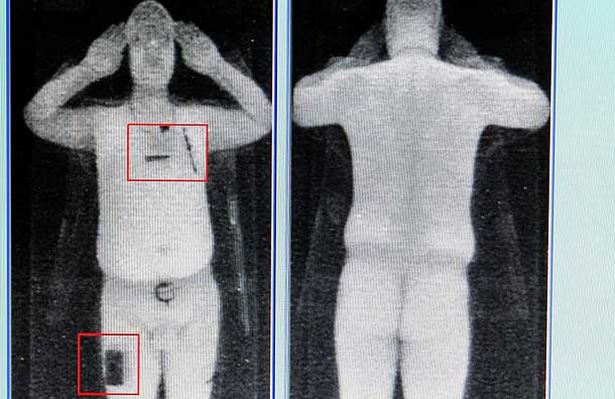
As the Obama administration dials back the number of drone attacks in Afghanistan, Pakistan and Yemen, the U.S. military is shifting its huge fleet of unmanned aircraft to other hot spots around the world. This next phase of drone warfare is focused more on spying than killing and will extend the Pentagon’s robust surveillance networks far beyond traditional, declared combat zones.

Over the past decade, the Pentagon has amassed more than 400 Predators, Reapers, Hunters, Gray Eagles and other high-altitude drones…Some of the unmanned aircraft will return home with U.S. troops when they leave Afghanistan. But many of the drones will redeploy to fresh frontiers, where they will spy on a melange of armed groups, drug runners, pirates and other targets…

Elsewhere in the Middle East, the U.S. Air Force has drone hubs in Qatar and the United Arab Emirates to conduct reconnaissance over the Persian Gulf. Twice since November, Iran has scrambled fighter jets to approach or fire on U.S. Predator drones that edged close to Iranian airspace.
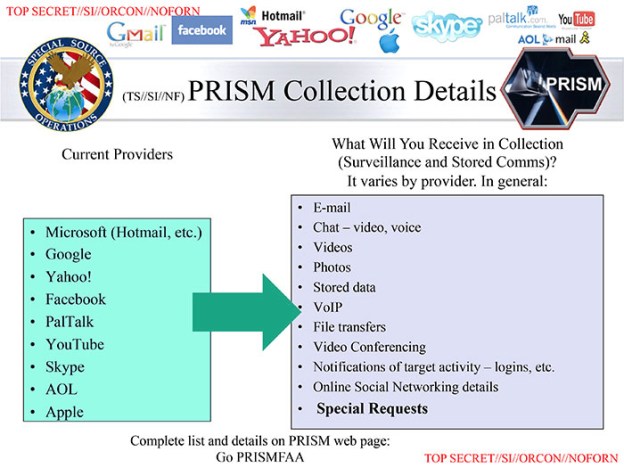
In Africa, the U.S. Air Force began flying unarmed drones over the Sahara five months ago to track al-Qaeda fighters and rebels in northern Mali. The Pentagon has also set up drone bases in Ethiopia, Djibouti and Seychelles. Even so, the commander of U.S. forces in Africa told Congress in February that he needed a 15-fold increase in surveillance, reconnaissance and intelligence-gathering on the continent.  In an April speech, Deputy Defense Secretary Ashton B. Carter said the Pentagon is planning for the first time to send Reaper drones — a bigger, faster version of the Predator — to parts of Asia other than Afghanistan. He did not give details. A Defense Department spokeswoman said the military “hasn’t made any final decisions yet” but is “committed to increasing” its surveillance in Asia and the Pacific.
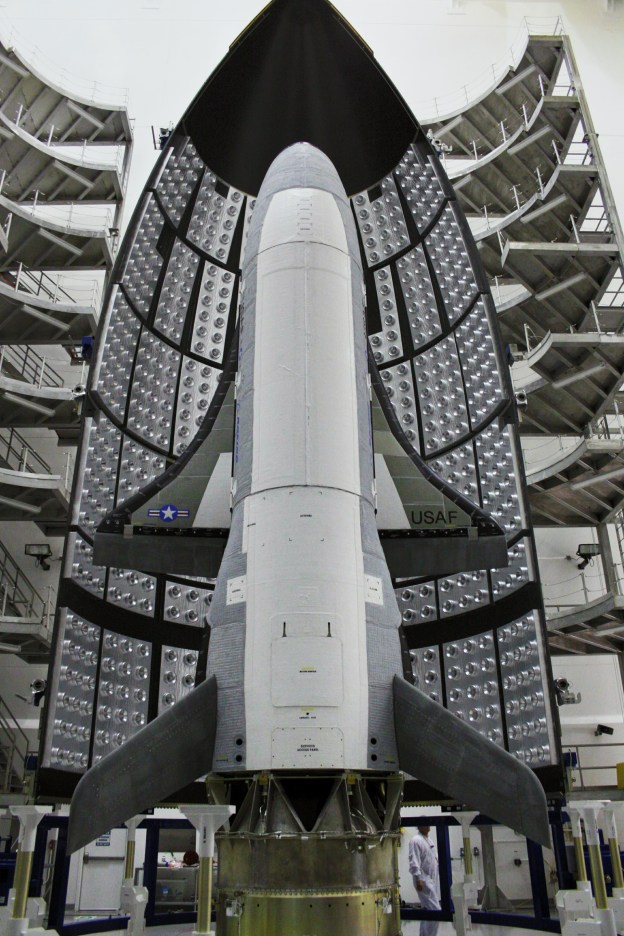
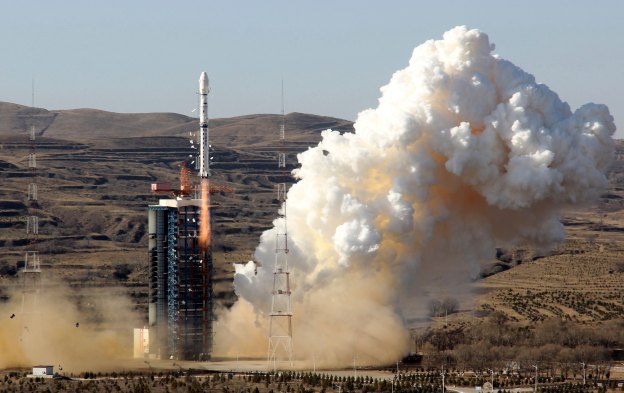
One possible destination for more U.S. drones is Colombia. Last year, Colombian armed forces killed 32…[drug traffickers]  after the U.S. military helped pinpoint the targets’ whereabouts with manned surveillance aircraft and other equipment, according to Jose A. Ruiz, a Southern Command spokesman.The U.S. military has occasionally operated small drones — four-foot-long ScanEagles, which are launched by a catapult — in Colombia.
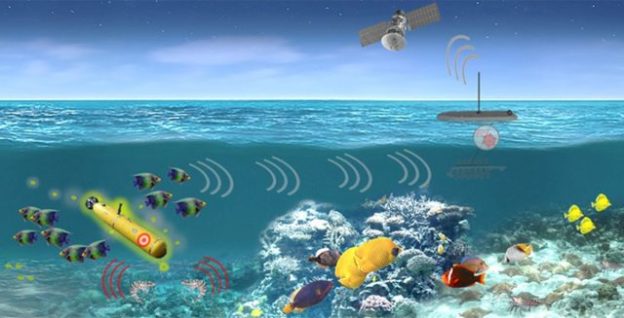


In the fall of 2011, four disassembled Predator drones arrived in crates at Incirlik Air Base in… [Turkey], a joint U.S.-Turkish military installation.The drones came from Iraq, where for the previous four years they had been devoted to surveilling that country’s northern mountains. Along with manned U.S. aircraft, the Predators tracked the movements of PKK fighters, sharing video feeds and other intelligence with the Turkish armed forces.  The Kurdish group has long fought to create a [state]…, launching cross-border attacks from its hideouts in northern Iraq….

In December 2011, Turkish jets bombed a caravan of suspected PKK fighters crossing from Iraq into Turkey, killing 34 people. The victims were smugglers, however, not terrorists — a blunder that ignited protests across Turkey.  The Wall Street Journal reported last year that American drone operators had alerted the Turkish military after a Predator spotted the suspicious caravan…

[In 2013 the PKK claimed to have shot down an American drone patrolling the Turkey/Iraq border as part of Operation Nomad Shadow.]

Excerpts, By Craig Whitlock, U.S. military drone surveillance is expanding to hot spots beyond declared combat zones, Washington Post, July 20, 2013

Cyber-Attacks on South Korea 2009-2013

The massive cyber attacks on South Korean banks and broadcasters earlier this year were part of a broad campaign of cyber espionage which dates back at least to 2009, a US security firm has concluded. The study by the firm McAfee  (Dissecting Operation Troy: Cyberespionage in South Korea) stopped short of blaming specific entities for the March 20 onslaught but said it found a pattern of sophisticated attacks, including efforts to wipe away traces that could lead to detection.  “The level of sophistication would indicate it is above and beyond your average individual or run-of-the mill hacktivism group,” said James Walter, a McAfee researcher and co-author of the study.

An official South Korean investigation in April determined North Korea’s military intelligence agency was responsible for the attacks which shut down the networks of TV broadcasters KBS, MBC and YTN, halted financial services and crippled operations at three banks….

But McAfee said the attacks represented only a small portion of the cyber campaign being carried out since 2009.  “One of the primary activities going on here is theft of intellectual property, data exfiltration, essentially stealing of secrets,” Walter said.  The report said the attacks, known first as Dark Seoul and now as Operation Troy were “more than cybervandalism… South Korean targets were actually the conclusion of a covert espionage campaign.”  McAfee concluded that two groups claiming responsibility for the attack were not credible.  “The clues left behind confirm that the two groups claiming responsibility were a fabrication to throw investigators off the trail and to mask the true source,” the report said.

Walter said that it is possible that with the campaign nearing detection, the hackers launched these attacks to distract the public and then sought to blame them on little-known entities, the NewRomanic Cyber Army Team, and the Whois Hacking Team.  He added that up to now, the cyber espionage effort “has been very successful in being under the radar” and that “what we see now was a more visible activity that is coupled with a distraction campaign.”

McAfee concluded that the remote-access Trojan was compiled January 26, and a component to wipe the records of numerous systems was compiled January 31.”The attackers who conducted the operation remained hidden for a number of years prior to the March 20 incident by using a variety of custom tools,” the report said.  “Our investigation into Dark Seoul has found a long-term domestic spying operation underway since at least 2009… We call this Operation Troy, based on the frequent use of the word ‘Troy’ in the compile path strings in the malware.”  McAfee carried out the study as part of its research into cybersecurity issues, Walter said.

The attack came days after North Korea had accused South Korea and the United States of being behind a “persistent and intensive” hacking assault that temporarily took a number of its official websites offline.  It also coincided with heightened military tensions on the Korean peninsula, following Pyongyang’s nuclear test in February.

South Korean cyber attacks tip of the iceberg: McAfee, Associated Press, Agence France Press, July 10, 2013

Covert Operations in Iran

Washington believed that covert action against Iran’s nuclear facilities would be more effective and less risky than an all-out war… In fact, Mark Fitzpatrick, former deputy assistant secretary of state for non-proliferation said: “Industrial sabotage is a way to stop the programme, without military action, without fingerprints on the operation, and really, it is ideal, if it works.”The US has a long history of covert operations in Iran, beginning in 1953 with the CIA orchestrated coup d’état that toppled the popularly elected Iranian prime minister Mohammad Mossadegh and installed a dictator, Reza Shah. The US has reorganised its covert operations after the collapse of the shah in 1979…

In January 2011, it was revealed that the Stuxnet cyber-attack, an American-Israeli project to sabotage the Iranian nuclear programme, has been accelerated since President Barack Obama first took office. Referring to comments made by the head of Mossad, then US secretary of state Hillary Clinton confirmed the damages inflicted on Iran’s nuclear programme have been achieved through a combination of “sabotage and sanctions”.

Meanwhile, several Iranian nuclear scientists were assassinated. The New York Times reported that Mossad orchestrated the killings while Iran claimed the attacks were part of a covert campaign by the US, UK and Israel to sabotage its nuclear programme….

There are at least 10 major repercussions arising from the US, West and Israeli policy of launching covert war and cyber-attacks against Iranian nuclear facilities and scientists.

First, cyber war is a violation of international law. According to the UN Charter, the use of force is allowed only with the approval of the UN Security Council in self-defence and in response to an attack by another country. A Nato-commissioned international group of researchers, concluded that the 2009 Stuxnet attack on Iran’s nuclear facilities constituted “an act of force”, noting that the cyber-attack has been a violation of international law.Second, the US covert operations are a serious violation of the Algiers Accord. The 1981 Algiers Accords agreed upon between Iran and the US clearly stated that “it is and from now on will be the policy of the US not to intervene, directly or indirectly, politically or militarily, in Iran’s internal affairs”.

Third, the cyber war has propelled Tehran to become more determined in its nuclear efforts and has made major advancement. According to reports by the International Atomic Energy Agency (IAEA), prior to covert operations targeting the nuclear programme, Iran had one uranium enrichment site, a pilot plant of 164 centrifuges enriching uranium at a level of 3.5 per cent, first generation of centrifuges and approximately 100 kg stockpile of enriched uranium.Today, it has two enrichment sites with roughly 12,000 centrifuges, can enrich uranium up to 20 per cent, possesses a new generation of centrifuges and has amassed a stockpile of more than 8,000kg of enriched uranium.

Fourth, the strategy pursued has constituted a declaration of war on Iran, and a first strike. Stuxnet cyber-attack did cause harm to Iran’s nuclear programme, therefore it can be considered the first unattributed act of war against Iran, a dangerous prelude toward a broader war.

Fifth… [s]uch short-sighted policies thicken the wall of mistrust, further complicating US-Iran rapprochement and confidence-building measures.

Sixth, Iran would consider taking retaliatory measures by launching cyber-counter-attacks against facilities in Israel, the West and specifically the US…

Seventh, Iran is building a formidable domestic capacity countering and responding to western cyber-warfare. Following the Stuxnet attack, Iran’s Supreme Leader issued a directive to establish Iran’s cyber army that is both offensive and defensive. Today, the Islamic Revolutionary Guards Corps (IRGC) has the fourth biggest cyber army in the world. Israel’s Institute for National Security Studies (INSS) acknowledged that IRGC is one of the most advanced nations in the field of cyberspace warfare.

Eighth, Iran now has concluded that information gathered by IAEA inspectors has been used to create computer viruses, facilitate sabotage against its nuclear programme and the assassinations of nuclear scientists. Iranian nuclear energy chief stated that the UN nuclear watchdog [IAEA] has been infiltrated by “terrorists and saboteurs.” Such conclusions have not only discredited the UN Nuclear Watchdog but have pushed Iran to limit its technical and legal cooperation with the IAEA to address outstanding concerns and questions.

Ninth, worsening Iranians siege mentality by covert actions and violations of the country’s territorial sovereignty could strengthen the radicals in Tehran to double down on acquiring nuclear weapons. Iran could be pondering now the reality that the US is not waging a covert war on North Korea (because it possesses a nuclear bomb), Muammar Gaddafi lost his grip on power in Libya after ceding his nuclear programme, and Iraq and Afghanistan were invaded (because they had no nuclear weapon).

Tenth, the combination of cyber-attacks, industrial sabotage and assassination of scientists has turned public opinion within Iran against western interference within the country…[P]rovocative western measures have convinced the Iranian government that the main issue is not the nuclear programme but rather regime change.

Excerpts from  Seyed Hossein Mousavian, Ten consequences of US covert war against Iran, Gulf News, May 11, 2013

U.S. Special Operations in 30 African Countries

The United States Army’s Transportation Command (US-TRANSCOM) is looking for private flight contractors to transport commandos from the Joint Special Taskforce Trans-Sahara as they conduct ‘high risk activities’ in 31 African countries.The pre-solicitation notice, issued by the US-TRANSCOM on 1 April, says the contractor will need to conduct air drops, fly commandos in and out of hostile territory and carry out short notice medical evacuation between 12 August 2013 and 27 June 2017. A 10.5 month base period will start in August this year to be followed by three one-year option periods.  [This is]  under the auspices of the US military’s Africa Command, under which the Joint Special Operations Task Force – Trans Sahara (JSOTF-TF) falls.

TRANSCOM is looking for aircraft able to carry at least six passengers and 2 500 pounds of cargo. From the US intelligence hub located in a military airfield in Ouagadougou, Burkina Faso..…”Services shall be based at Ouagadougou, Burkina Faso, with services provided to, but not limited to, the recognized political boundaries of Algeria, Burkina Faso, Cameroon, Central African Republic, Chad, Democratic Republic of the Congo, Ethiopia, Kenya, Libya, Mali, Mauritania, Morocco, Niger, Nigeria, Senegal, Sudan, South Sudan, Tunisia, and Uganda, as dictated by operational requirements. It is anticipated the most likely additional locations for missions from the above list would be to: Algeria, Burkina Faso, Cameroon, Chad, Libya, Mali, Mauritania, Morocco, Niger, Nigeria, Senegal, and Tunisia,” the Transcom work statement reads.

The expansion of US commando operations is focused on confronting the threat posed by Sahelian and sub-Saharan terror groups which include Al Qaeda in the Islamic Maghreb (AQIM), Ansar al Dine and the Movement for Oneness and Jihad in West Africa (MUJAO), which operate in nearly all north and north-west African countries. The operations are also aimed at confronting Al Qaeda inspired Nigerian Islamist militant groups Boko Haram and its more radical splinter movement Jamā atu Anṣāril Muslimīna fī Bilādis Sūdān (Vanguard for the Protection of Muslims in Black Africa), better known as Ansaru.

In East and Central Africa, the US special forces operations will target renegade rebel groups such as the Lord’s Resistance Army (LRA) and its leader Joseph Kony, Al Shabaab in Somalia, Islamic militant sleeper cells in the coastal areas of Kenya and Tanzania and various regional rebel groups operating in the eastern Democratic Republic of Congo. In yet another sign of intensifying US military and security interest in Africa, the US Defence Logistics Agency on April 12 issued a request for bids to provide the US Air Force with 547,500 gallons of No. 2 diesel fuel “for ongoing deliveries to Niamey Airport, Niger, (Africa).“The fuel is intended for a fleet of unarmed US Predator drones which are presently flying intelligence and surveillance missions from a military airport in Niamey into Mali, Niger, Nigeria, Mauritania, Algeria and other suspected terrorist locations in the Sahel.

Since 2009, private flight contractors engaged by US special operations forces have been operating Pilatus PC-12s on intelligence gathering and image collection missions over Uganda, Sudan, South Sudan, Central Africa Republic and other Central African states from a small airport located near the Ugandan city of Entebbe. 

Excerpt, Oscar Nkala, US Army seeking private contractors for African commando transportation, www.defenceweb.co.z, May 7, 2013

The Nanosecond Decision to Kill: drones

These are excerpts from the report of the UN Special Rapporteur Christof Heyns,  Apr. 9, 2013

What are Lethal Autonomous Robotics?

Robots are often described as machines that are built upon the sense-think-act paradigm: they have sensors that give them a degree of situational awareness; processors or artificial intelligence that “decides” how to respond to a given stimulus; and effectors that carry out those “decisions”. …   Under the currently envisaged scenario, humans will at least remain part of what may be called the “wider loop”: they will programme the ultimate goals into the robotic systems and decide to activate and, if necessary, deactivate them, while autonomous weapons will translate those goals into tasks and execute them without requiring further human intervention. Supervised autonomy means that there is a “human on the loop” (as opposed to “in” or “out”), who monitors and can override the robot‟s decisions. However, the power to override may in reality be limited because the decision-making processes of robots are often measured in nanoseconds and the informational basis of those decisions may not be practically accessible to the supervisor. In such circumstances humans are de facto out of the loop and the machines thus effectively constitute LARs.

Examples of  Lethal Autonomous Robotics

  • The US Phalanx system for Aegis-class cruisers automatically detects, tracks and engages anti-air warfare threats such as anti-ship missiles and aircraft.
  • The US Counter Rocket, Artillery and Mortar (C-RAM) system can automatically destroy incoming artillery, rockets and mortar rounds.
  • Israel‟s Harpy is a “Fire-and-Forget” autonomous weapon system designed to detect, attack and destroy radar emitters.
  • The United Kingdom Taranis jet-propelled combat drone prototype can autonomously search, identify and locate enemies but can only engage with a target when authorized by mission command. It can also defend itself against enemy aircraft.
  • The Northrop Grumman X-47B is a fighter-size drone prototype commissioned by the US Navy to demonstrate autonomous launch and landing capability on aircraft carriers and navigate autonomously.
  • The Samsung Techwin surveillance and security guard robots, deployed in the demilitarized zone between North and South Korea, detect targets through infrared sensors. They are currently operated by humans but have an “automatic mode”.

Advantages of Lethal Autonomous Robotics

LARs will not be susceptible to some of the human shortcomings that may undermine the protection of life. Typically they would not act out of revenge, panic, anger, spite, prejudice or fear. Moreover, unless specifically programmed to do so, robots would not cause intentional suffering on civilian populations, for example through torture. Robots also do not rape.

Disadvantages of Lethal Autonomous Robotics

Yet robots have limitations in other respects as compared to humans. Armed conflict and IHL often require human judgement, common sense, appreciation of the larger picture, understanding of the intentions behind people‟s actions, and understanding of values and anticipation of the direction in which events are unfolding. Decisions over life and death in armed conflict may require compassion and intuition. Humans – while they are fallible – at least might possess these qualities, whereas robots definitely do not.

Full Report PDF

Exploiting Digital Fingerprints: Military

Backed by a $5.6 million grant from the US Defense Advanced Research Projects Agency, a  team at Stanford is embarking on a four-year project to better understand and model complex communication patterns in social networks in real time…The new project is called MEGA: Modern Graph Analysis for Dynamic Networks, and is led by Associate Professor Ashish Goel.   A team of seven principal investigators… will develop algorithms which model human communication and detect subtle patterns in huge data sets from social media.

DARPA is interested because, from a national security standpoint, big data holds the promise of recognizing threats in unusual or suspicious social interactions of terrorists and other foreign adversaries.   Our daily social communication is spread across many forms of interaction. E-mails, tweets, text messages and Facebook posts define our modern social lives. More than ever, information about this correspondence and behavior can be collected, stored, and made available to computer scientists.With access to billions of tweets, e-mails and text messages, a project like MEGA can build reliable mathematical models of social phenomena, like the way news spreads through a network for instance, or even how people choose their social connections, Goel said.

One goal of the MEGA project is to model human online behavior and find how it shapes social networks… The second component of MEGA’s research: writing the step-by-step procedures for processing distributed data in real time….Some of their algorithms and programs will be passed directly to DARPA to be used in a security context…

Excerpt, DARPA Grant Will Help Stanford Dig Deep into the Big Data in Social Networks, Stanford.edu, April 24, 2013


Killing Unknown Extremists: drones

The US government was accused of hiding the truth about its drone programme after leaked intelligence files revealed that it was targeting unidentified militants who posed no immediate threat to the United States.

Despite President Barack Obama’s public promise that the CIA’s armed Predators and Reapers were only firing on those suspected of plotting against America, top-secret documents show that in one year alone almost half of those killed were simply listed as “unknown extremists”. The documents, obtained by US news agency McClatchy, also reveal Pakistan’s intelligence agency was co-operating with the US at the same time as its government was condemning drone strikes on its soil.  “There is now mounting evidence that the Obama administration is misleading the American public – and the world at large – about the drone war it is waging in Pakistan,” said Jennifer Gibson, a lawyer working with the British human rights charity Reprieve.

“The reports show a significant number of the strikes have nothing to do with al-Qa’ida. Instead, they may have been a quid pro quo exchange between two countries’ spy agencies. The result is that the US often doesn’t know who it is killing.”

The US has come under increasing international pressure to open up its decision-making process to scrutiny following claims that the drone programme has killed hundreds of civilians among an estimated death toll of 2,500, predominantly in Pakistan and Yemen. Preparations are in place to transfer more control of the programme from the CIA to the Pentagon, in a move said to herald greater transparency.

The US intelligence reports leaked to McClatchy covered, its reporters said, most of the drone strikes in Pakistan during 2006 to 2008 as well as 2010 to 2011. Most of the attacks targeted al-Qa’ida but many were aimed at the Haqqani network and factions of the Pakistani Taliban.  At least 265 of the 482 people killed by the CIA programme in the 12 months up to September 2011 were listed as Afghan, Pakistani or “unknown extremists”.This contrasts sharply with US administration’s claim that drones are only used to target “senior operational leaders” in al-Qa’ida, those involved in the 11 September 2001 attacks or individuals plotting imminent attacks on the US.

Last night a spokesman for the US Department of Defence said neither they nor the CIA commented on intelligence matters

Excerpt, Terri Judd US drones target low-level militants who pose no threat, Independent, April 10, 2013

The Secret Bugs: Exploits

Packets of computer code, known as “exploits”, allow hackers to infiltrate or even control computers running software in which a design flaw, called a “vulnerability”, has been discovered. Criminal and, to a lesser extent, terror groups purchase exploits on more than two dozen illicit online forums or through at least a dozen clandestine brokers, says Venkatramana Subrahmanian, a University of Maryland expert in these black markets. He likens the transactions to “selling a gun to a criminal”.

Just a dozen years ago the buying and selling of illicit exploits was so rare that India’s Central Bureau of Investigation had not yet identified any criminal syndicates involved in the trade, says R.K. Raghavan, a former director of the bureau. Underground markets are now widespread, he says. Exploits empower criminals to steal data and money. Worse still, they provide cyber-firepower to hostile governments that would otherwise lack the expertise to attack an advanced country’s computer systems, worries Colonel John Adams, head of the Marine Corps’ Intelligence Integration Division in Quantico, Virginia.

Exploits themselves are generally legal. Several legitimate businesses sell them. A Massachusetts firm called Netragard last year sold more than 50 exploits to businesses and government agencies in America for prices ranging from $20,000 to more than $250,000. Adriel Desautels, Netragard’s founder, describes some of the exploits sold as “weaponised”. The firm buys a lot from three dozen independent hackers who, like clients, are carefully screened to make sure they are not selling code to anyone else, and especially not to a criminal group or unfriendly government.

More than half of exploits sold are now bought from bona fide firms rather than from freelance hackers, says Roy Lindelauf, a researcher at the Netherlands Defence Academy. He declines to say if Dutch army or intelligence agencies buy exploits, noting that his government is still figuring out “what we’re allowed to do offensively”.Laws to ban the trade in exploits are being mooted. Marietje Schaake, a Dutch member of the European Parliament, is spearheading an effort to pass export-control laws for exploits. It is gathering support, she says, because they can be used as “digital weapons” by despotic regimes. For example, they could be used to monitor traffic on a dissident’s smartphone. However, for a handful of reasons, new laws are unlikely to be effective.

Exploits are a form of knowledge, expressed in computer code. Attempting to stop people from generating and spreading knowledge is futile, says Dave Aitel, a former computer scientist at America’s National Security Agency (NSA) who went on to found Immunity, a computer-security firm in Florida. He says that legal systems would not even agree on which code is good and which is bad. Many legal experts say code should be protected by free-speech laws—it is, after all, language expressed as strings of zeros and ones.

Moreover, tracking down exploits is hard. Hackers keep them secret so that the intended victim doesn’t identify and fix the vulnerability, thereby rendering the exploit worthless. As a French exploit developer puts it, those liable to be rapidly detected are about as useful as a “disposable gun” that can be fired just once. Secrecy surrounding the design, sale and use of exploits makes protecting computer networks from them akin to finding “unknown unknowns”, says Kenneth Geers, a cyber-security specialist at America’s Naval Criminal Investigative Service.

Several governments want firms to develop exploits. In 2010 a computer worm called Stuxnet was revealed to have attacked Iran’s nuclear kit. It used four main exploits to get in; at least one appears to have been bought rather than developed in-house by the government that launched the attack (presumably America or Israel), says David Lindahl, an IT expert at the Swedish Defence Research Agency, a government body in Stockholm. An unprecedented weapon, Stuxnet remained undetected for years by quietly erasing its tracks after “planting sabotage charges at exactly the right place” in Iran’s uranium-enrichment centrifuges, Mr Lindahl says.

Nearly all well-financed intelligence agencies buy exploits, says Eric Filiol, a lieutenant-colonel in computer intelligence for France’s army until 2009. Computer experts who years ago would reveal software vulnerabilities for mere prestige have realised that they were treating “diamonds as pebbles”, says Mr Filiol, now head of the Operational Cryptography and Computer Virology Lab in Laval. His lab is partly financed by France’s defence ministry to provide it with exploits.

The price of exploits has risen more than fivefold since 2004, Mr Filiol says, referring to a confidential document. They vary greatly, depending on three main factors: how hard the exploit is to develop; the number of computers to which it provides access; and the value of those computers. An exploit that can stealthily provide administrator privileges to a distant computer running Windows XP, a no-longer-fashionable operating system, costs only about $40,000. An exploit for Internet Explorer, a popular browser, can cost as much as $500,000 (see chart).

Software firms also buy exploits to identify and repair vulnerabilities in their products before others take advantage of them. A small Vancouver firm called Tarsnap, for example, has paid 30 people who pointed out flaws in its encryption software for online PC backups. To develop better defences for its clients’ computer systems, HP, an American giant, has spent more than $7m since 2005 buying hundreds of “zero days”, as undiscovered exploits are also known in hacker slang. (Once discovered, an exploit’s days are numbered, literally: it becomes a “one day”, then a “two day”, and so on until the vulnerability it exploits is patched.)

Such “bug bounty” schemes, however, will struggle to compete with buyers who want to exploit rather than seal vulnerabilities. Tarsnap’s biggest payout was just $500. Last year Google offered Vupen, a French firm, $60,000 for an exploit that burrowed into its Chrome browser. Vupen’s boss, Chaouki Bekrar, balked, noting that he could get more elsewhere.

Other reputable customers, such as Western intelligence agencies, often pay higher prices. Mr Lindelauf reckons that America’s spies spend the most on exploits. Vupen and other exploit vendors decline to name their clients. However, brisk sales are partly driven by demand from defence contractors that see cyberspace as a “new battle domain”, says Matt Georgy, head of technology at Endgame, a Maryland firm that sells most of its best exploits for between $100,000 and $200,000. He laments a rise in sales by unscrupulous vendors to dangerous groups.

On March 12th the head of the Pentagon’s Cyber Command, General Keith Alexander, warned the Senate Armed Services Committee that state-sponsored groups are stepping up efforts to steal and destroy data using “cybertools” purchased in illicit online markets. As an American military-intelligence official points out, governments that buy exploits are “building the black market”, thereby bankrolling dangerous R&D. For this reason, governments appear increasingly keen to develop exploits in-house. Paulo Shakarian, a cyberwar expert at West Point, an American military academy, says China appears to be moving in this direction.

Developing exploits in-house reduces the risk that a double-dealing vendor will resell code meant to be exclusive. Even so, the trade isn’t likely to fade away. When developers work out a trick that gives them control over the targeted software, they like to yell out a celebratory “who’s your daddy?” notes Pierre Roberge, boss of Arc4dia, a Quebec firm that sells exploits to spy agencies. Exploit trading will continue as long as people pay big money for the opportunity to utter the same joke—this time at the expense of a victim who has been hacked.

Cyber-security: The digital arms trade, Economist, Mar. 30, 2013, at 65.

Drone War Moves to West Africa

The newest outpost in the US government’s empire of drone bases sits behind a razor-wire-topped wall outside Niger’s capital Niamey.  The US air force began flying a handful of unarmed Predator drones from here last month (Feb. 2013). The drones emerge sporadically from a borrowed hangar and soar north in search of al-Qaida fighters and guerrillas from other groups hiding in the region’s deserts and hills.  The harsh terrain of north and west Africa is rapidly emerging as yet another front in the long-running US war against terrorist networks, a conflict that has fuelled a revolution in drone warfare.

Since taking office in 2009, President Barack Obama has relied heavily on drones for operations, both declared and covert, in Afghanistan, Iraq, Pakistan, Yemen, Libya and Somalia. US drones also fly from allied bases in Turkey, Italy, Saudi Arabia, Qatar, the United Arab Emirates and the Philippines.  Now they are becoming a fixture in Africa. The US military has built a major drone hub in Djibouti, on the Horn of Africa, and flies unarmed Reaper drones from Ethiopia. Until recently, it conducted reconnaissance flights over east Africa from the island nation of Seychelles.  The Predator drones in Niger, a landlocked and dirt-poor country, give the Pentagon a strategic foothold in west Africa. Niger shares a long border with Mali, where an al-Qaida affiliate and other Islamist groups have taken root. Niger also borders Libya and Nigeria, which are also struggling to contain armed extremist movements.

Like other US drone bases, the Predator operations in Niger are shrouded in secrecy. The White House announced in February that Obama had deployed about 100 military personnel to Niger on an “intelligence collection” mission, but it did not make any explicit reference to drones. Since then, the defense department has publicly acknowledged the presence of drones here but has revealed little else. The Africa Command, which oversees US military missions on the continent, denied requests from a Washington Post reporter to interview American troops in Niger or to tour the military airfield where the drones are based, near Niamey’s international airport.

Government officials in Niger, a former French colony, were slightly more forthcoming. President Issoufou Mahamadou said his government invited Washington to send surveillance drones because he was worried that the country might not be able to defend its borders from Islamist fighters based in Mali, Libya or Nigeria.  “We welcome the drones,” Mahamadou said in an interview at the presidential palace in Niamey. Citing the “feeble capability” of many west African militaries, he said Niger and its neighbors desperately needed foreign help to track the movements of guerrillas across the Sahara and Sahel, an arid territorial belt that covers much of the region.  “Our countries are like the blind leading the blind,” he said. “We rely on countries like France and the United States. We need co-operation to ensure our security.”  The Predator drones in Niger are unarmed, US officials said, though they have not ruled out equipping the aircraft with Hellfire missiles in the future. For now, the drones are conducting surveillance over Mali and Niger….

But the rules of engagement are blurry. Intelligence gathered by the Predators could indirectly help the French fix targets for airstrikes or prompt Nigerien security forces to take action on their territory.  Moreover, US officials have acknowledged that they could use lethal force under certain circumstances. Last month, army general Martin Dempsey, the chairman of the Joint Chiefs of Staff, told Congress that the US military had designated “a handful of high-value individuals” in north Africa for their suspected connections to al-Qaida, making them potential targets for capture or killing.  The Pentagon declined to say exactly how many Predator aircraft it has sent to Niger or how long it intends to keep them there. But there are signs that the US military wants to establish a long-term presence in west Africa.  After years of negotiations, the Obama administration signed an agreement with Niger in January that provides judicial protection and other safeguards for US troops in the country.  Two US defense officials, speaking on the condition of anonymity to discuss internal planning, said the Pentagon ultimately wants to move the Predators to the Saharan city of Agadez, in northern Niger.  Agadez is closer to parts of southern Algeria and southern Libya where fighters and arms traffickers allied with al-Qaida have taken refuge. The airfield in Agadez, however, is rudimentary and needs improvements before it can host drones, officials said.

Excerpts,Craig Whitlock, Drone warfare: Niger becomes latest frontline in US war on terror, Guardian, Mar. 26, 2013

Who is Cryptome?

Cryptome unfamiliar to the general public, is well-known in circles where intelligence tactics, government secrets and whistle-blowing are primary concerns. Since its creation in 1996, Cryptome has amassed more than 70,000 files — including lists of secret agents, high-resolution photos of nuclear power plants, and much more.

Its co-founder and webmaster, a feisty 77-year-old architect, doesn’t hesitate when asked why.  “I’m a fierce opponent of government secrets of all kinds,” says John Young. “The scale is tipped so far the other way that I’m willing to stick my neck out and say there should be none.”  Young describes several exchanges with federal agents over postings related to espionage and potential security breaches, though no charges have ever been filed. And he notes that corporate complaints of alleged copyright violations and efforts to shut Cryptome down have gone nowhere.

For Young, there’s a more persistent annoyance than these: the inevitable comparisons of Cryptome to WikiLeaks, the more famous online secret-sharing organization launched by Julian Assange and others in 2006.  Young briefly collaborated with WikiLeaks’ creators but says he was dropped from their network after questioning plans for multimillion-dollar fundraising. Cryptome operates on a minimal budget — less than $2,000 a year, according to Young, who also shuns WikiLeaks-style publicity campaigns.  “We like the scholarly approach — slow, almost boring,” says Young. He likens Cryptome to a “dusty, dimly lit library.”  That’s not quite the image that Reader’s Digest evoked in 2005, in an article titled “Let’s Shut Them Down.” Author Michael Crowley assailed Cryptome as an “invitation to terrorists,” notably because of its postings on potential security vulnerabilities.Cryptome’s admirers also don’t fully buy into Young’s minimalist self-description….

Young considers himself a freedom-of-information militant, saying he is unbothered by “the stigma of seeming to go too far.” Claims that Cryptome aids terrorists or endangers intelligence agents are “hokum,” he said. “We couldn’t possibly publish information to aid terrorists that they couldn’t get on their own,” he said, depicting his postings about security gaps as civic-minded.  “If you know a weakness, expose it, don’t hide it,” he said…

As a motto of sorts, the Cryptome home page offers a quote from psychiatrist Carl Jung: “The maintenance of secrets acts like a psychic poison which alienates the possessor from the community.”  The website says Cryptome welcomes classified and confidential documents from governments worldwide, “in particular material on freedom of expression, privacy, cryptology, dual-use technologies, national security, intelligence, and secret governance.”  Young attributes Cryptome’s longevity and stature to its legion of contributors, most of them anonymous, who provide a steady stream of material to post.  Among the most frequently downloaded of Cryptome’s recent postings were high-resolution photos of the Fukushima Dai-ichi nuclear plant in Japan after it was badly damaged in the March 2011 tsunami/earthquake disaster.

Cryptome also was a pivotal outlet last year for amorous emails between national security expert Brett McGurk and Wall Street Journal reporter Gina Chon, which led McGurk to withdraw as the Obama administration’s nominee to be ambassador to Iraq.  Other documents on the site list names of people purported to be CIA sources, officers of Britain’s MI6 spy agency, and spies with Japan’s Public Security Investigation Agency….

Another exchange with the FBI came in November 2003, according to Young, when two agents paid him a visit to discuss recent Cryptome postings intended to expose national security gaps. The postings included maps and photos of rail tunnels and gas lines leading toward New York’s Madison Square Garden, where the Republican National Convention was to be held the next year….Another confrontation occurred in 2010, when Cryptome posted Microsoft’s confidential Global Criminal Compliance Handbook, outlining its policies for conducting online surveillance on behalf of law enforcement agencies. Contending that the posting was a copyright violation, Microsoft asked that Cryptome be shut down by its host, Network Solutions. Criticism of Microsoft followed, from advocates of online free speech, and the complaint was withdrawn within a few days….

Moreover, Young urges Cryptome’s patrons to be skeptical of anything placed on the site, given that the motives of the contributors may not be known.  “Cryptome, aspiring to be a free public library, accepts that libraries are chock full of contaminated material, hoaxes, forgeries, propaganda,” Young has written on the site. “Astute readers, seeking relief from manufactured and branded information, will pick and choose…”

Excerpts from DAVID CRARY, Older, Quieter Than WikiLeaks, Cryptome Perseveres, Associated Press, Mar. 9, 2013