Category Archives: Espionage

The Silent Spying Device in Your Pocket: Who is Afraid of Pegasus?

NSO Group, the Israeli company behind Pegasus spyware, says a group of investors led by Hollywood producer Robert Simonds has acquired a controlling stake in the firm, which has named a former Trump official to lead an effort to restore its battered reputation. The company, which has faced lawsuits and U.S. government sanctions since revelations that its technology was used to spy on political dissidents, human-rights advocates, journalists and American officials, declined to disclose the purchase price.

NSO’s new executive chairman, David Friedman, a former U.S. ambassador to Israel and onetime bankruptcy lawyer for President Trump, said he wants to use his ties to the Trump administration to help rebuild the company’s spyware business in the U.S…NSO’s flagship product, Pegasus, has used WhatsApp to infiltrate phones without the target having to do or tap on anything. The spyware has also been sent to phones via links in messages, according to security researchers. Pegasus can turn a smartphone into a silent spying device by gaining access to its files, messages, microphone and camera, they say.

In 2021, the Biden administration placed NSO on an export-prohibition list that restricted the firm from obtaining some types of technology from the U.S. In 2023, President Biden signed an executive order banning government agencies and departments from using commercial spyware that “poses risks to national security or has been misused by foreign actors to enable human rights abuses around the world.” Unless Biden’s executive order is rescinded, it is unlikely U.S. government agencies would do business with NSO.

Intelligence agencies such as the U.S. National Security Agency and the U.K.’s Government Communications Headquarters routinely use hacking tools. NSO often sells such cyber capabilities to countries that don’t have their own. Friedman said his pitch to the U.S. government is that NSO’s products will make America safer. NSO says its products can be used by government agencies to fight terrorism and crime by allowing them access to encrypted messaging systems such as WhatsApp….

In 2019, WhatsApp’s parent company, now called Meta, sued NSO over what it alleged was a breach of its servers to install NSO’s malware on target devices. In July 2025, the six-year trial came to an end, with a federal jury in California ordering NSO to pay Meta $168 million in damages. In October 2025, the U.S. District Court for the Northern District of California reduced the fine NSO was ordered to pay Meta down to $4 million. But in the same ruling, the judge ordered NSO to stop targeting WhatsApp, in a move that the company said during its defense could put it out of business. NSO is appealing the decision against targeting WhatsApp, and is filing for a stay.

Excerpt from Dov Lieber, Israeli Spyware Maker NSO Gets New Owners, Leadership and Seeks to Mend Reputation, WSJ, Nov. 9, 2025

The Underground War

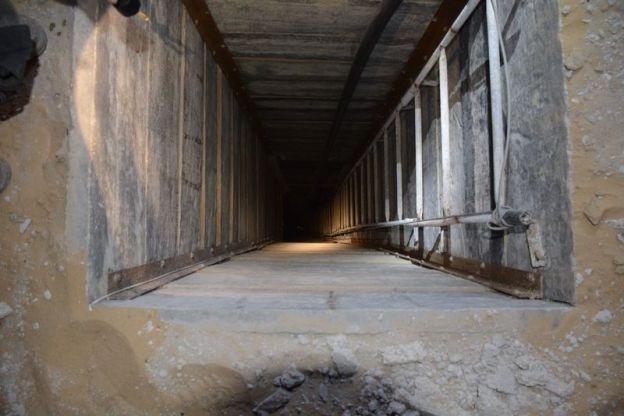
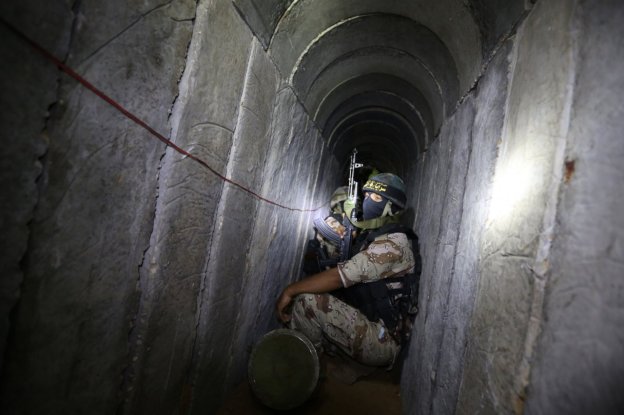
Israeli troops are mapping out the tunnels of eastern Rafah [December 2025], where the local Hamas brigade is trapped, and using massive drills to dig into the underground system and destroy it with explosives, according to Israeli military statements. Israel estimates there were around 100 to 200 fighters in the tunnels when the cease-fire began in October 2025…In some areas, Israel is flooding tunnels with water to push out the trapped fighters…

Rafah, where Hamas first began digging tunnels around two decades ago, has a particularly complicated underground system. Despite having full control above ground in Rafah, Israel’s military is still struggling to fully map out the underground network where the Hamas fighters are hiding…

Excerpt from Summer Said, srael Closes In on Hamas Fighters Trapped in Tunnels, Testing Cease-Fire, WSJ, Dec. 7, 2025

Next Wild West: Monetizing Mental Data

Some  brain–computer interfaces (BCI) are capable not only to record conscious thoughts but also the impulses of the preconscious. Most BCIs are connected the brain’s motor cortex, the part of the brain that initiates and controls voluntary movements by sending signals to the body’s muscles. But some people have volunteered to have an extra interface implanted in their posterior parietal cortex, a brain region associated with reasoning, attention and planning…The ability of these devices to access aspects of a person’s innermost life, including preconscious thought, raises the stakes on concerns about how to keep neural data private. It also poses ethical questions about how neurotechnologies might shape people’s thoughts and actions — especially when paired with artificial intelligence…

Consumer neurotech products capture less-sophisticated data than implanted BCIs do. Unlike implanted BCIs, which rely on the firings of specific collections of neurons, most consumer products rely on electroencephalography (EEG). This measures ripples of electrical activity that arise from the averaged firing of huge neuronal populations and are detectable on the scalp. Rather than being created to capture the best recording possible, consumer devices are designed to be stylish (such as in sleek headbands) or unobtrusive (with electrodes hidden inside headphones or headsets for augmented or virtual reality).

Still, EEG can reveal overall brain states, such as alertness, focus, tiredness and anxiety levels. Companies already offer headsets and software that give customers real-time scores relating to these states, with the intention of helping them to improve their sports performance, meditate more effectively or become more productive, for example. AI has helped to turn noisy signals from suboptimal recording systems into reliable data, explains Ramses Alcaide, chief executive of Neurable, a neurotech company in Boston, Massachusetts, that specializes in EEG signal processing and sells a headphone-based headset for this purpose…

With regard to EEG, “There’s a wild west when it comes to the regulatory standards”… A 2024 analysis of the data policies of 30 consumer neurotech companies by the Neurorights Foundation, a non-profit organization in New York City, showed that nearly all had complete control over the data users provided. That means most firms can use the information as they please, including selling it.

The government of Chile and the legislators of four US states have passed laws that give direct recordings of any form of nerve activity protected status. But ethicists fear that such laws are insufficient because they focus on the raw data and not on the inferences that companies can make by combining neural information with parallel streams of digital data. Inferences about a person’s mental health, say, or their political allegiances could still be sold to third parties and used to discriminate against or manipulate a person.

“The data economy, in my view, is already quite privacy-violating and cognitive- liberty-violating,” Ienca says. Adding neural data, he says, “is like giving steroids to the existing data economy”.

Excerpt from Liam Drew, Mind-reading devices can now predict preconscious thoughts: is it time to worry?, Nature, Nov. 19, 2025

Nationalizing a Crown Jewel: the case of Nexperia

U.S. officials’ warning to their Dutch counterparts was stark: If they wanted a Netherlands-based chip maker to avoid being put on a trade blacklist, it would almost certainly have to remove its Chinese owner as CEO. “The fact that the company’s CEO is still that same Chinese owner is problematic,” American officials said in a June 2025 meeting on the topic. The Americans soon got their wish. In September 25, 2025, the Dutch economy ministry seized control of Nexperia from China’s Wingtech Technology. The next day, a Dutch court granted an emergency petition to suspend Wingtech founder Zhang Xuezheng as Nexperia’s CEO and put all but one of the semiconductor company’s shares under external management.

China quickly fired back at the seizure, ordering Wingtech in early October to suspend exports of Nexperia of chips that the company has long sent for packaging and testing in China…The Dutch economy minister said in a letter to parliament that he moved to seize control of Nexperia based on evidence that the CEO was moving quickly to shift production capacity, financial resources and intellectual property to China, not because of pressure from any other country… The Dutch government and Dutch and German executives of the company had tried for months to ringfence the company’s business from Chinese control to accommodate domestic concerns—and avoid being hit by the U.S. blacklist… Dutch officials told Nexperia that the coming expansion of U.S. trade restrictions could lead to restrictions on the business, unless measures were taken to limit the transfer of knowledge and capabilities to China.

In the past, Nexperia relied on its European factories and contract manufacturers in Taiwan to make chips for China. In 2020, Zhang set up a wafer factory in Shanghai. The business, called Wingskysemi, started production in 2023 and has become one of Nexperia’s key suppliers….

Excerpt from Sam Schechner et al, , How U.S. Pressured Netherlands to Oust CEO of Chinese-Owned Chip Maker, WSJ, Oct. 14, 2025

Overlords of the Internet: Botnet Warfare

U.S. Federal authorities disrupted in August 2025 a network of hacked devices used by criminals in some of the largest online attacks yet seen… Law-enforcement agencies and technology companies are waging a war against increasingly powerful networks of hacked devices, called botnets, that can knock websites offline for a fee. They are used for extortion and by disreputable companies to knock rivals offline… These botnets are leveraging new types of internet-connected devices with faster processors and more network bandwidth, offering them immense power. The criminals controlling the botnets now have the capabilities to move beyond website takedowns to target internet connectivity and disrupt very large swaths of the internet.“Before the concern was websites; now the concern is countries,” said Craig Labovitz, head of technology with Nokia’s Deepfield division. 

Apprehending botnet criminals in August 2025 appeared to have an unwanted consequence: freeing up as many as 95,000 devices to be taken over by new botnet overlords. That led to a free-for-all to take over the machines “as fast as possible,” said Damian Menscher, a Google engineer. The operators of a rival botnet, called Aisuru, seized control of more than one-fourth of them and immediately started launching attacks that are “breaking records,” he said.

On Sept. 1, 2025 the network services company Cloudflare said it had measured an attack that clogged up computer networks with 11.5 trillion bits of junk information per second. That is enough to consume the download bandwidth of more than 50,000 consumer internet connections. Cloudflare declared this attack, known as a distributed denial of service, or DDoS, a “world record” in terms of intensity. Some analysts see it almost as an advertisement of the botnet’s capabilities…

Botnets such as Aisuru are made up of a range of internet-connected devices—routers or security cameras, for example—rather than PCs, and often these machines can only join one botnet at a time. Their attacks can typically be fended off by the largest cloud-computing providers. One massive network that Google disrupted in 2025 had mushroomed from at least 74,000 Android devices in 2023 to more than 10 million devices in two years. That made it the “largest known botnet of internet-connected TV devices,” according to a July 2025 Google court filing.

Excerpts from Robert McMillan, The Feds Destroyed an Internet Weapon, but Criminals Picked Up the Pieces, WSJ, Sept. 15, 2025

Which Tech Companies Work for the Military? All

Companies including Nokia, Dell, and Oracle are eager to apply decades of experience in civilian technology to the rapidly evolving battlefield. Drones, bodycams and digital sensors now stream real-time intelligence in volumes no human can digest. Military headquarters are crunching through that using artificial intelligence and pumping back to troops situational updates, tactical guidance and battle plans, constantly updated on computer screens and hand-held devices.  “We understand that the future weapon is data,” said Giorgi Tskhakaia, an adviser to Ukraine’s minister of digital transformation 

The first step is connectivity….Nokia is packaging 5G technology for ultra-secure use on battlefields and in national-security applications. It has developed backpacks with small 5G nodes and vehicle-based systems that can handle up to 1,000 users for a sort of tactical communications bubble. In 2025, it announced partnerships with military-equipment giants Lockheed Martin and Rheinmetall to integrate 5G communications into their systems.

Ericsson, the West’s only other maker of 5G networks and a producer of military radios going back to World War II, is also pushing into digital defense applications.

NATO is now working to adopt 5G as a military-communications standard across its 32 members. Alliance experts say the volume of military data is so great that 5G is best for transmission because the standard has at least 10 times the data capacity of earlier systems. It is also much more resilient against jamming

The second step is the extraction of data….Ukraine has spent three years developing AI systems to churn through all it collects… The Pentagon in 2017 launched a significant effort to adopt AI, Project Maven, tapping machine learning to digest mountains of data. Google’s role in the work sparked employee protests at the time…

Oracle, like many of its rivals, is no stranger to working with governments and militaries. The company began in 1977 out of a Central Intelligence Agency program—Project Oracle. But for decades it focused on corporate customers. Now, it and other cloud providers including Google, Amazon.com and IBM are applying to government and national-security work many lessons from their fierce commercial competition to move and process data fastest.

The final step in exploiting battlefield data is delivering it to fighters via gear that can handle combat conditions. Screens are proliferating on the battlefield, just as they did in offices and homes several decades ago, but warfare puts demands on equipment unlike any other environment…One Dell laptop is built to Pentagon standards for resistance to shocks, dust, sand, water and “explosive atmosphere,” meaning it won’t ignite flammable vapor. It can handle temperatures between minus 20 degrees and 145 degrees Fahrenheit.

Excerpt from Daniel Michaels, That 1990s Tech Brand? Its New Gig Is in Battlefield Data, WSJ, Sept. 9, 2025

Big Tech and Military: Microsoft – Israel Force

Microsoft terminated in September 2025 the Israeli military’s access to technology it used to operate a powerful surveillance system that collected millions of Palestinian civilian phone calls made each day in Gaza and the West Bank, according to Guardian. Microsoft told Israeli officials that Unit 8200, the military’s elite spy agency, had violated the company’s terms of service by storing the vast trove of surveillance data in its Azure cloud platform.

Equipped with Azure’s near-limitless storage capacity and computing power, Unit 8200 had built an indiscriminate new system allowing its intelligence officers to collect, play back and analyze the content of cellular calls of an entire population.

The project was so expansive that, according to sources from Unit 8200 – which is equivalent in its remit to the US National Security Agency – a mantra emerged internally that captured its scale and ambition: “A million calls an hour.

The enormous repository of intercepted calls – which amounted to as much as 8,000 terabytes of data – was held in a Microsoft data center in the Netherlands. Within days of the Guardian publishing, Unit 8200 appears to have swiftly moved the surveillance data out of the country.

Excerpt from Harry Davies and Yuval Abraham, Microsoft blocks Israel’s use of its technology in mass surveillance of Palestinians, Guardian, Sept. 25, 2025

Blackmail and Espionage: rogue AI

Today I am reading on how AI models can blackmail and spy.

See How LLMs could be insider threats

DECEPTION IN LLMS: SELF-PRESERVATION AND AUTONOMOUS GOALS IN LARGE LANGUAGE MODELS

Chilling…

Secrecy in Space

A Pentagon spaceplane called X-37B zoomed into orbit this week for its eighth mission. When it will come back is a secret. The uncrewed vehicle can spend months or years in space before it re-enters the atmosphere.. That combination of flexibility and endurance has made it a favorite tool for military officials looking to quickly deploy new technologies on the final frontier. A SpaceX rocket launched X-37B on August 21, 2025 from Florida’s Kennedy Space Center. Government and commercial engineers have spent years experimenting with lasers that allow satellites to share large amounts of data in space. The Pentagon is also testing tools like the inertial sensor, which could help improve navigation in situations where Global Positioning System signals aren’t available.

The spacecraft has spent the last five months on Earth after a 434-day mission that included tests of orbital maneuvers known as “aerobraking.” The move helps the vehicle use the drag from the planet’s atmosphere to change its orbit without using much fuel.  Military officials haven’t disclosed many details about the payloads that X-37B carries, but past missions included testing different materials in orbit and an experiment that transmitted solar energy to the ground. Its fifth flight released three small satellites that government officials didn’t acknowledge until they had fallen back to Earth. There’s a global strategic interest in saying what you’re putting in space,” said Jonathan McDowell, a researcher at the Harvard-Smithsonian Center for Astrophysics. If the U.S. hides its satellites, “then the Chinese are going to start doing it too, and that’s not in our interest.”

China now fields more than 1,000 satellites and has developed a range of radio jammers, antisatellite missiles and other weapons capable of targeting Pentagon assets, according to a U.S. Air Force document released in May 2025. It also operates a competing spaceplane, called Shenlong, that has flown several missions.]

Excerpt from Drew FitzGerald, The Pentagon’s Mysterious X-37B Space Plane Embarks on New Mission, WSJ, Aug. 22, 205

Out-of-Date: Academic Cooperation

Mr. Trump noted in the summer of 2025  that “the United States is in a race to achieve global dominance in artificial intelligence,” which Joe Biden called “a defining technology of our era.” Universities help drive that race. Meta’s chief AI officer, Alexandr Wang, has argued that the rate of AI progress may be such that “you need to prevent all of our secrets from going over to our adversaries and you need to lock down the labs.”

Thousands of Chinese citizens are working and studying in such labs….In AI specifically, nearly 40% of top-tier researchers at U.S. institutions are of Chinese origin. Beijing is aggressively cultivating American-educated and American-employed researchers via the Thousand Talents program.

Blindly embracing academic cooperation with a geopolitical rival is absurd. Nobody suggests we should train Iranian nuclear physicists or Russian ballistics engineers. The U.S. wouldn’t have been better off collaborating more with Nazi Germany in the 1930s or with the Soviet Union during the Cold War. Why make an exception for a nation dedicated to surpassing the U.S. in emerging technologies?

Excerpt from  Mike Gallagher, Send Harvard’s Chinese Students Home, WSJ, Aug. 19, 2025

Paranoia: What Happens When the Enemy Can See You Naked

During the 2025 Israel/U.S. war against Iran, Israeli authorities, and a pro-Israeli hacking group called Predatory Sparrow, targeted financial organizations that Iranians use to move money and sidestep the U.S.-led economic blockade…Predatory Sparrow…crippled Iran’s state-owned Bank Sepah, which services Iran’s armed forces and helps them pay suppliers abroad, knocking out its online banking services and cash machines…The group also breached Nobitex, Iran’s largest cryptocurrency exchange, popular with locals for transferring money overseas. The hackers extracted about $100 million in funds and forced the platform to shut down, according to the exchange.

Iran’s government pulled the plug on much of the country’s online activities to prevent further attacks… Non-Iranian websites were blocked. Citizens were warned against using foreign phones or messaging platforms that it claimed could collect audio and location data for Israeli spies. Government officials were banned from using laptops and smartwatches.

Paranoia swept through the Iranian population as the attacks, both physical and cyber, mounted. “It’s better to cut [the internet] off. Israel can see everything,” said Mohammad Ghorbaniyan, a Tehran-based money changer whom the U.S. sanctioned several years ago for allegedly aiding Iranian hackers…Predatory Sparrow has been wreaking havoc on Iran since at least 2021. In earlier hacks, the group disabled gas-station payment systems across the country and triggered a fire at an Iranian steel plant. 

For their operation against Nobitex, the hackers managed to obtain the keys for the exchange’s cryptocurrency wallets, which were held by key personnel within the company…Predatory Sparrow then “burned” the stolen $100 million by sending the tokens to other digital wallets the group itself couldn’t access. These wallets’ addresses, which are made up of long strings of numbers and letters, contained profane phrases like “F—IRGCterrorists.”

Excerpt from Angus Berwick, How Israel-Aligned Hackers Hobbled Iran’s Financial System, WSJ, June 29, 2025

Password Prevents Spilling out Private Thoughts

A brain–computer interface (BCI) can decipher the imagined sentences of people who have conditions that interfere with speech — and it comes with password protection to avoid revealing private thoughts. The system begins decoding users’ internal speech only after they think of a specific keyword. This internally spoken “keyword” can enable a user to “lock” and “unlock” the BCI to prevent the broadcasting of their private thoughts or spontaneous ‘self-talk’.

Excerpt from Gemma Conroy, A mind-reading brain implant that comes with password protection, Nature, Aug. 14, 2025

The Trump-China Hidden Romance: the companies behind USD1

The Trump family’s crypto venture has generated more wealth since the election—some $4.5 billion—than any other part of the president’s business empire.

A major reason for the success is a partnership with an under-the-radar trading platform quietly administered by Binance, the world’s largest crypto exchange, whose founder is seeking a pardon from President Trump…The online trading platform, PancakeSwap, serves as an incubator of sorts, drumming up interest among traders to use coins issued by the Trump family’s main crypto company, World Liberty Financial.  The more World Liberty’s flagship coin, USD1, is used, the greater demand to increase its circulation, and the greater the profit for World Liberty and its owners, including the Trump family. 

Crypto trading platforms, like PancakeSwap, often offer rewards or prizes to drum up interest in new coins, similar to the way brokerages offer free trades or casinos give first-time customers free chips…

Binance’s majority owner and founder, Changpeng Zhao, spent four months in jail in the U.S. last year after Binance agreed to pay a $4.3 billion fine for becoming a global money-laundering hub for criminals, terrorists and sanctions evaders. His company has deepened its relationship with World Liberty at the same time Zhao has ramped up efforts to secure a pardon from Trump…Zhao—considered the richest person in the crypto industry and worth over $70 billion.

USD1 got its first big break when Binance accepted a $2 billion investment from an outside investor paid in the World Liberty coin. The deal caused the amount of the cryptocurrency in circulation to erupt 15-fold and overnight become one of the world’s largest.  USD1 is what is known as a stablecoin, a privately invented digital currency that is backed 1:1 with U.S. dollars. World Liberty invests the money backing the coin in government bonds and money-market funds, without paying interest to users of the coin. With more than $2 billion of USD1 in circulation, it can earn around $80 million a year based on current interest rates. Binance has been holding the $2 billion in USD1 on its platform…By not cashing in the stablecoin, this ensures that World Liberty continues to earn money from investing the dollars that back them.

World Liberty’s relationship with PancakeSwap, whose website was registered in Shanghai, and Binance is one of several in which entities and individuals with strong ties to China have supported the Trump family crypto business. One of World Liberty’s largest investors is Justin Sun, the Hong Kong-based billionaire…This comes even as the White House pushes a trade war against China and seeks to curtail U.S. corporations’ ties to the country over national-security fears…

China is Binance’s largest market by trading volume. It has been a main base for its software developers, with hundreds of coders…Binance has long maintained that it isn’t a Chinese company, saying it left Shanghai shortly after its 2017 launch. Zhao… has said he is no longer a Chinese citizen, and holds Canadian and United Arab Emirates citizenship. The company, which has employees around the world, doesn’t have an official headquarters…

PancakeSwap doesn’t disclose its ownership…According to former Binance employees, Binance staff created PancakeSwap in-house in 2020 because the exchange wanted to establish a foothold in crypto’s so-called decentralized finance craze. The platform has remained under Binance’s supervision…

Excerpt from Angus Berwick et al., The Recipe Behind the Trump Family’s Crypto Riches: PancakeSwap, WSJ, Aug. 12, 2025

Who Trusts Microsoft? The Locked-In

In 2024, the Department of Homeland Security released a scathing report detailing Microsoft’s mistakes during a 2023 hack in which China stole thousands of emails from top government officials. Two years before that, China-linked cyberattackers compromised more than 250,000 Microsoft Exchange servers. In response to the 2024 report, Nadella, the CEO of Microsoft, promised to rededicate Microsoft to protecting its products and its customers from bad actors…

Shortly after Nadella took the reins, Microsoft eliminated the group that had companywide responsibility for Microsoft’s security work, pushing security decisions to the individual business units. Around the same time, Microsoft changed the way it developed software, laying off many of the test engineers charged with uncovering bugs before products ship to customers…

With regard to the July 2025 Microsoft hack, researchers said more than 400 SharePoint servers had been hacked—many of them belonging to government entities—and Microsoft had linked some of the attacks to the Chinese government

In previous episodes, such as the massive 2021 hack of the Microsoft Exchange email system, China pulled off impressive technical feats before being caught…

Regarding the 2025 SharePoint cyberattack, Eye Security researchers discovered, on July 18, 2025 an unauthorized script on a SharePoint server belonging to one of their customers. As the Eye team dug in, they started finding the same script on about 150 other SharePoint servers all over the internet…The script opened a back door to the SharePoint servers, creating an encryption key that could be used later to run commands on the machine. “It was just like a door key left on the street,” said Kerkhofs. “It was accessible for everybody. We just started scanning and we grabbed all the keys.”…Microsoft, learning that hackers were exploiting the bugs, called in its security team.

Eventually the Eye team discovered 80 infected organizations. European government agencies were compromised, as were U.S. federal agencies, municipalities and universities…

On July 20, 2025, the Energy Department confirmed that it was a victim… News of the compromise was reported by Bloomberg, which said that the National Nuclear Security Administration was specifically victimized.

Excerpt from Robert McMillan, A Failed Microsoft Security Patch Is the Latest Win for Chinese Hackers, WSJ, July 25, 2025

When a State Collapses, Who Survives: the case of Iran

In mid-June 2025, Iran flew at least four civilian aircraft to the Omani capital of Muscat for safekeeping. One of the planes included Iran’s presidential Airbus A340, which landed in Muscat on June 18, 2025 according to flight trackers. 

Arab officials were surprised to learn the planes were empty of passengers. Instead, they said, they carried cash and assets, which Iranians weren’t allowed to offload because of sanctions. The planes themselves were also valuable as emergency exits for top officials. The precautions show the level of pressure on Iran’s rulers during the war (Israel-Iran war of 2025). They had to find a way forward with no control of their own airspace and no help from their militias

Excerpt from S. Raghavan et al., Life in Iran After the Strikes: Executions, Arrests and Paranoia, WSJ, June 28, 2025

Can AI Do That? Knowledge Impossible to Copy

Zuckerberg hasn’t had much success in his efforts to hire the field’s biggest stars, including OpenAI’s co-founder Ilya Sutskever and its chief research officer, Mark Chen. Many candidates are happy to take a meeting at Zuckerberg’s homes in Palo Alto and Lake Tahoe. In private, they are comparing gossip and calculating Meta’s chances of winning the AI race.

The handful of researchers who are smartest about AI have built up what one described as “tribal knowledge” that is almost impossible to replicate. Rival researchers have lived in the same group houses in San Francisco, where they discuss papers that might provide clues for achieving the next great breakthrough. 

Excerpt from Ben Coen et al, It’s Known as ‘The List’—and It’s a Secret File of AI Geniuses, WSJ, June 27, 2025

Israel’s Killing Machine and the Enemies Within

Israel stunned and hobbled Iran starting on June 13, 2025 when it pulled off an intelligence and military operation years in the making that struck high-level targets with precision. Guided by spies and artificial intelligence, the Israeli military unleashed a nighttime fusillade of warplanes and armed drones smuggled into Iran to quickly incapacitate many of its air defenses and missile systems. With greater freedom to fly over Iran, Israel bombarded key nuclear sites and killed top generals and scientists. By the time Iran mustered a response hours later, its ability to retaliate — already weakened by past Israeli strikes — was greatly diminished.

The Mossad and the military worked together for at least three years to lay the operational groundwork…To further diminish Iranian air defenses and missile systems, Mossad agents had smuggled precision weapons into Iran that were prepositioned to strike from close range…Those weapons included small, armed drones, which agents snuck into the country in vehicles…Mossad agents stationed weapons close to Iranian surface-to-air missile sites…To analyze information gathered from various sources, Israel used the latest artificial-intelligence…AI was used to help Israelis quickly sift through troves of data they had obtained….An investigation by The Associated Press conducted in early 2025 uncovered that the Israeli military uses U.S.-made AI models in war to sift through intelligence and intercept communications to learn the movements of its enemies. It’s been used in the wars with Hamas in Gaza and with Hezbollah in Lebanon.

In addition to AI, the Mossad relied on spies to identify top nuclear scientists and members of Iran’s Revolutionary Guard… At least eight members of the Guard, including the head of its missile program, were killed in a single Israeli strike on an underground bunker.

Another facet of the attack was to strike Iranian vehicles used to transport and launch missiles. The strategy was similar to a Ukrainian operation earlier this month in Russia. In that operation, nearly a third of Moscow’s strategic bomber fleet was destroyed or damaged with cheaply made drones snuck into Russian territory…In an interview with Iranian state-run television, the country’s police chief, Gen. Ahmadreza Radan, said “several vehicles carrying mini-drones and some tactical drones have been discovered.” ….

In the 2000s, Iranian centrifuges used for enriching uranium were destroyed by the so-called Stuxnet computer virus, believed to be an Israeli and American creation….In 2018, Israel stole an archive of Iranian nuclear research that included tens of thousands of pages of records…In July 2024, Israel killed a senior leader of Hamas, Ismail Haniyeh, with a bomb in a bedroom of a government guesthouse in Tehran.

Excerpts from JULIA FRANKEL and SAM MEDNICK, How Israel used spies, smuggled drones and AI to stun and hobble Iran, AP, June 17, 2025

Why U.S. Government Invented the UFOs

Evidence is emerging in June 2025 that US  government efforts to propagate UFO disinformation date back all the way to the 1950s. The WSJ account is based on interviews with two dozen current and former U.S. officials, scientists and military contractors involved in the inquiry, as well as thousands of pages of documents, recordings, emails and text messages.  At times, military officers spread false documents to create a smokescreen [of flying extraterrestrial saucers] for real secret-weapons programs. In other cases, officials allowed UFO myths to take root in the interest of national security—for instance, to prevent the Soviet Union from detecting vulnerabilities in the systems protecting nuclear installations…

Investigators are still trying to determine whether the spread of disinformation was the act of local commanders and officers or a more centralized, institutional program. The Pentagon omitted key facts in the public version of the 2024 report it released about UFOS that could have helped put some UFO rumors to rest, both to protect classified secrets and to avoid embarrassment… The Air Force in particular pushed to omit some details it believed could jeopardize secret programs and damage careers…

As Sean Kirkpatrick head of the All-domain Anomaly Resolution Office (AARO) pursued his investigation between 2022 and 2023, he started to uncover a hall of mirrors within the Pentagon, cloaked in official and nonofficial cover. On one level, the secrecy was understandable. The U.S., after all, had been locked in an existential battle with the Soviet Union for decades, each side determined to win the upper hand in the race for ever-more-exotic weapons….But Kirkpatrick soon discovered that some of the obsession with secrecy verged on the farcical. A former Air Force officer was visibly terrified when he told Kirkpatrick’s investigators that he had been briefed on a secret alien project decades earlier, and was warned that if he ever repeated the secret he could be jailed or executed. The claim would be repeated to investigators by other men who had never spoken of the matter, even with their spouses. It turned out the witnesses had been victims of a bizarre hazing ritual.  For decades, certain new commanders of the Air Force’s most classified programs, as part of their induction briefings, would be handed a piece of paper with a photo of what looked like a flying saucer. The craft was described as an antigravity maneuvering vehicle. …Many never learned it was fake.

Kirkpatrick found the practice had begun decades before, and appeared to continue still. The defense secretary’s office sent a memo out across the service in the spring of 2023 ordering the practice to stop immediately, but the damage was done. 

Excerpt from Joel Schectman et al., The Pentagon Disinformation That Fueled America’s UFO Mythology, WSJ, June 6, 2025

The Nasty Fight over Satellite Spectrum

Telecom mogul Charlie Ergen’s war chest is at risk after a U.S. regulator questioned his company’s use of cellular and satellite spectrum licenses—including a chunk of airwaves long sought by Elon Musk’s SpaceX. The Federal Communications Commission told Ergen, the chairman and co-founder of network operator EchoStar that the agency’s staff would investigate the company’s compliance with federal requirements to build a nationwide 5G network. EchoStar owns both the Dish Network pay-TV brand and Boost Mobile’s wireless service. 

The U.S. government in 2019 set several construction milestones for Dish to maintain cellular licenses worth billions of dollars. The company has spent years wiring thousands of cellphone towers to help Boost become a wireless operator that could rival AT&T, Verizon and T-Mobile, but the project has been slow-going. Boost’s subscriber base has shrunk in the five years since Ergen bought the brand from Sprint.

“The terms of the deal were clear,” FCC Chairman Brendan Carr wrote to Ergen in a letter viewed by The Wall Street Journal. “The FCC structured the buildout obligations to prevent spectrum warehousing and to ensure that Americans would gain broader access to high-speed wireless services, including in underserved and rural areas.”…

Ergen and Musk have been sparring for years in regulatory filings over spectrum rights. The battle has intensified as Apple and other big technology companies press for an edge in orbit….SpaceX said in an April 2025 letter that EchoStar’s spectrum in the 2 gigahertz band “remains ripe for sharing among next-generation satellite systems.” EchoStar accused SpaceX of seeking to “cloak another land grab for even more free spectrum.”

Excerpts from Drew FitzGerald, FCC Threatens Charlie Ergen’s Hold on Satellite, 5G Spectrum Licenses, May 14, 2025

What is the Real Trump Card of China

Chinese officials acknowledged in a secret December 2024 meeting that Beijing was behind a widespread series of alarming cyberattacks on U.S. infrastructure, according to people familiar with the matter, underscoring how hostilities between the two superpowers are continuing to escalate. The Chinese delegation linked years of intrusions into computer networks at U.S. ports, water utilities, airports and other targets, to increasing U.S. policy support for Taiwan, the people, who declined to be named, said.  …The Chinese official’s remarks at the December meeting were indirect and somewhat ambiguous, but most of the American delegation in the room interpreted it as a tacit admission and a warning to the U.S. about Taiwan, a former U.S. official familiar with the meeting said.

Excerpts from Dustin Volz, In Secret Meeting, China Acknowledged Role in U.S. Infrastructure Hacks, WSJ, Apr. 10, 2025

North Korea: Hacking Superpower — Crypto Billionaire

At 11:49 a.m. on July 18, 2024, North Korean hackers pounced on a major cryptocurrency exchange handling hundreds of millions of dollars. The hackers slipped into the exchange’s virtual vault, took control and then started pilfering cryptocurrency tokens. Within a little more than an hour, the hackers had disappeared—and with them, more than $200 million for the Kim Jong Un regime. 

The shocking theft at WazirX, India’s largest cryptocurrency exchange, along with several other major recent heists, has made it clear: North Korea is now the world’s most dangerous crypto thief. It has swiped more than $6 billion in cryptocurrency over the past decade—a sum so large that no one else compares. The country’s hackers are both patient and brazen, according to investigators. To get into companies’ computers, they comb through employees’ Facebook and Instagram pages and invent tailor-made stories to trick them into clicking on links with viruses. Some North Korean hackers have even become employees themselves, fooling U.S. companies into hiring them as remote IT workers and gaining access to their networks.

After grabbing their bounty, North Korean hackers are masters at escaping. At WazirX, investigators believe they used algorithms to spread funds through global crypto networks faster than any human could, making it almost impossible for authorities to catch up. Once the crypto is dispersed, North Koreans often lie low until investigators lose interest and move on, waiting months or years to convert their haul into traditional money that can be spent….Pyongyang’s crowning achievement came in February with a $1.5 billion raid of Bybit, one of the world’s biggest cryptocurrency exchanges, in the largest-ever such heist. That followed several hackings in 2024, when North Korea stole more than $6 out of every $10 lost by the cryptocurrency industry, according to Chainalysis, which tracks crypto theft.

North Korea’s success reflects the major resources dedicated to the task. The regime commands more than 8,000 hackers as though they were in a military unit, with the country’s brightest minds. State support means its hackers can wait months or years to exploit a single slip in a company’s digital security. Pyongyang’s desperation for cash, and its lack of concern for diplomatic blowback, have fueled its drive to be better than anyone else. 

Excerpts from How North Korea Cheated Its Way to Crypto Billions, WSJ, Apr. 3, 2025

The Cat-and-Mouse Game: US-China, Chip Giants

The U.S. on March 28 2025 added dozens of Chinese companies to a trade blacklist over national security concerns. American businesses seeking to sell technology to these companies will need approval from the government. Among those added were subsidiaries of Inspur Group, China’s largest server maker and a major customer for U.S. chip makers such as Nvidia, Intel and Advanced Micro Devices. Companies linked to China’s largest supercomputer maker, Sugon, were also added…

Nearly 80 companies were put on the Commerce Department’s blacklist, known as the entity list…including the U.S. server maker Aivres Systems that is wholly owned by Inspur Electronic. The latter is one-third owned by Inspur Group, according to corporate records. Aivres has been assembling high-end artificial-intelligence equipment for Nvidia. The AI-chip giant has said that Aivres will make servers using chips in the Blackwell family, Nvidia’s newest and most powerful processors.  Aivres advertises on its website that it sells servers and infrastructure powered by Blackwell chips, which are banned from sale into China…About two months after Inspur Group was added to the trade blacklist in March 2023, California-based Inspur Systems changed its name to Aivres Systems.

Excerpts from Liza Lin, Trump Takes Tough Approach to Choking Off China’s Access to U.S. Tech, WSJ, Mar. 26, 2025

Mapping the Seafloor: Why Is It Important for War?

China’s fleet has triggered protests from Japan, India and others, but that hasn’t stopped Beijing from launching long missions to map the sea floor. The data they obtain has numerous applications, from science to the emerging industry of deep-sea mining, but it is the Chinese government’s commandeering of civilian research for military use that threatens American allies.

India’s navy drove a Chinese research ship away in 2019, but more have returned. In recent weeks, two of China’s most advanced research vessels, the Xiang Yang Hong 01 and the newer Dong Fang Hong 3 have conducted lawnmower-style sweeps across vast stretches of the eastern Indian Ocean.

Chinese civilian vessels are pursuing expeditions around the world—there are as many as a dozen or so active at any given time. The data they gather, including on currents, temperature and salinity, can have an array of applications. Detailed scanning of the seabed, for instance, can provide information about the visibility of naval mines and the accuracy of sonar.  The surveys can also help determine what minerals could be extracted…Recent missions have spurred complaints by at least half a dozen governments. China says its marine research activities fully comply with the United Nations Convention on the Law of the Sea, the international treaty that established the legal regime for the world’s oceans….

The U.S. Navy also carries out maritime surveys for military purposes…. Under the U.N. convention, coastal states have jurisdiction over research in their exclusive economic zones, which extend 200 miles from the coast. The U.S., which recognizes but hasn’t ratified the convention, argues that military surveys are exempt and U.S. Navy oceanographic ships regularly conduct studies near China. China appears to be moving closer to the American stance, “as they’re doing more oceanographic research without the permission of coastal states.”

Excerpts from Austin Ramzy, China Is Mapping the Seabed to Unlock New Edge in Warfare, WSJ, Mar. 12, 2025

Mourning the Loss of Dark and Quiet Sky

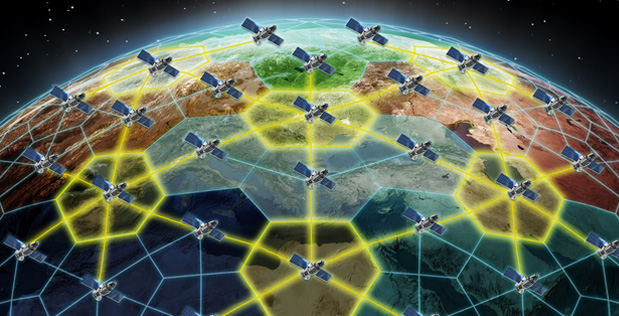
The number of working satellites has soared in the past five years to around 11,000, mostly because of constellations of orbiters that provide Internet connectivity around the globe. Just one company, SpaceX in Hawthorne, California, has more than 7,000 operational Starlink satellites, all launched since 2019; OneWeb, a space communications company in London, has more than 630 satellites in its constellation. On paper, tens to hundreds of thousands more are planned from a variety of companies and nations, although probably not all of these will be launched.

Satellites interfere with ground-based astronomical observations, by creating bright streaks on images and electromagnetic interference with radio telescopes. The satellite boom also poses other threats, including adding pollution to the atmosphere…

Before the launch of Starlinks, astronomers had no centralized reference for tracking satellites. Now, the International Astronomical Union (IAU) has a virtual Centre for the Protection of the Dark and Quiet Sky from Satellite Constellation Interference (CPS), which serves as an information hub…One of the centre’s tools, called SatChecker, draws on a public database of satellite orbits, fed by information from observers and companies that track objects in space. Astronomers can use SatChecker to confirm what satellite is passing overhead during their observations…Tools such as SatChecker help telescope operators avoid problems by allowing them to target a different part of the sky when a satellite passes overhead or by simply pausing observations as it flies by. It would aid astronomers if SatChecker had even more accurate information about satellite positions, but there are constraints on improving the system. SatChecker data come from the US Space Force, which draws on a global network of sensors that tracks objects in orbit and issues updates on satellite locations as often as several times a day. The frequency of these updates is limited by factors such as how often a sensor can observe an object and whether the sensor can distinguish what it’s looking at.

Excerpts from   Alexandra Witze, Swarms of satellites are harming astronomy. Here’s how researchers are fighting back, Nature, Mar. 18, 2025


The Drone Experiment of Ukraine

U.S. startups have spent billions of venture-capital dollars in hopes of developing the small drones that the Pentagon says it needs for future conflicts, but many have produced only expensive aircraft that don’t fly very well. Ukrainian drone makers, meanwhile, have mastered mass-producing drones despite limited resources and are looking for new customers and capital…

“No U.S. company is keeping up with Ukraine,” said CX2 co-founder Nathan Mintz. “You know their stuff works. They’ve got the ultimate high-stakes laboratory meant to battle-proof all this stuff.”

The U.S. has the capacity to build up to 100,000 drones a year, according to one Defense Department estimate. In 2024, Ukraine built more than two million drones. Some of the Ukraine-built drones that the Defense Department wants can fly hundreds of miles with explosives and have been used in attacks inside Russia…“Ukraine has made it pretty clear that they intend on being the drone capital of the planet once this war is over,” said Derek Whitley, co-founder of startup Vivum, which sells its AI software for autonomous systems to the Defense Department.

Ukrainian drones often sell for one-tenth the price of American options. They have proven on the battlefield that they can work when radio and satellite communication is blocked by electronic jamming…American startups are slower to build, deliver and update their drones, which also have often failed to weather severe electronic warfare. Many U.S. companies that brought their drones to Ukraine watched them fall out of the sky or fail to complete missions.

Excerpt from Heather Somerville, America Turns to Ukraine to Build Better Drones, WSJ, Mar. 11, 2025


The Shadow War: Cutting Underwater Data Cables

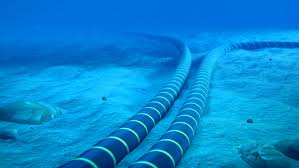
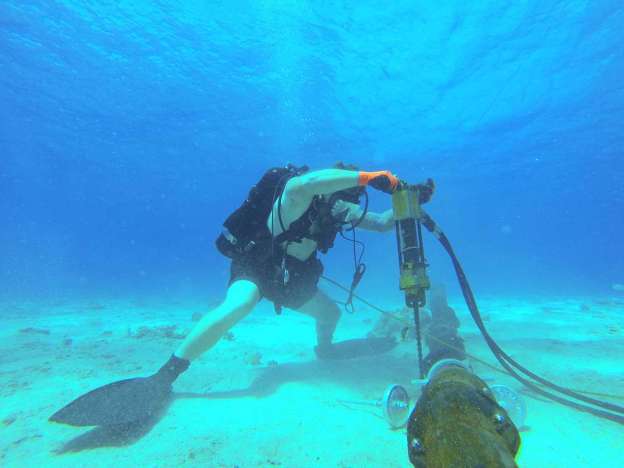
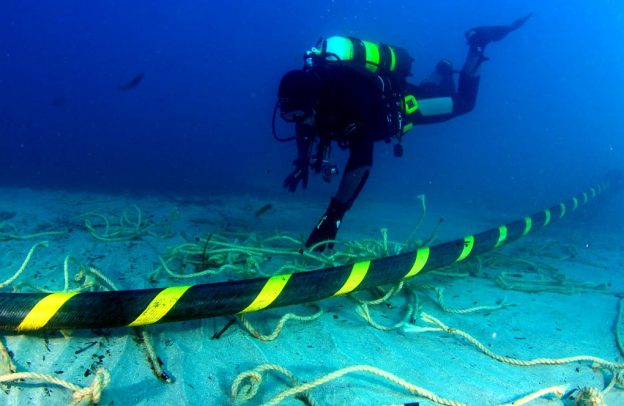
The North Atlantic Treaty Organization (NATO) mounted its first coordinated response to the suspected sabotage campaign against critical infrastructure, after another underwater data cable was severed in the Baltic Sea in 2025. NATO vessels raced to the site of a damaged fiber-optic cable in Swedish waters on January 26, 2025 where a trio of ships carrying Russian cargo, including one recently sanctioned by the U.S., were nearby. All three vessels are now being investigated as part of a probe into suspected sabotage of the fiber optic cable.

The incident is the latest in a string of alleged underwater attacks in the region that prompted NATO to announce earlier this month the formation of a surveillance mission called Baltic Sentry. It includes regular naval patrols, as well as enhanced drone, satellite and electronic surveillance of Baltic areas that are crisscrossed by critical infrastructure such as data and power cables, along with gas pipelines and offshore wind farms…Under international maritime law, a ship in international waters is under the jurisdiction of the country of its registration and can be boarded by foreign enforcement officials only with explicit permission of its owner or flag country. The captain of the Pskov, one of the ships suspected to have cut the undersea cables, cited the international law of the sea when he argued against an official request to steer his ship into a port in Finland…

In December 2024, Finland detained a vessel called Eagle S, an oil tanker belonging to Russia’s shadow fleet that is registered in the Cook Islands, on suspicion that it had deliberately used its anchor to cut a power cable connecting Finland and Estonia. In a midnight raid, Finnish special forces dropped from a helicopter onto the deck of Eagle S and captured the ship and its crew, which have since been detained in a Finnish port. 

In November 2024, an investigation was launched against a Chinese bulk carrier called Yi Peng 3, which cut two data cables in the Baltic after dragging its anchor for several hours, according to investigators. The vessel was loaded with Russian fertilizer. The probe continues. 

Excerpt from Bojan Pancevski, Suspected Sabotage of Deep-Sea Cable Triggers First NATO-Led Response, WSJ, Jan. 27, 2025

Like a Lamb to the Slaughter: DeepSeek Collects Personal Data–Nobody Cares

Amid ongoing fears over TikTok, Chinese generative AI platform DeepSeek says it’s sending heaps of US user data straight to its home country, potentially setting the stage for greater scrutiny. The United States’ recent regulatory action against the Chinese-owned social video platform TikTok prompted mass migration to another Chinese app, the social platform “Rednote.” Now, a generative artificial intelligence platform from the Chinese developer DeepSeek is exploding in popularity, posing a potential threat to US AI dominance and offering the latest evidence that moratoriums like the TikTok ban will not stop Americans from using Chinese-owned digital services…In many ways, DeepSeek is likely sending more data back to China than TikTok has in recent years, since the social media company moved to US cloud hosting to try to deflect US security concerns “It shouldn’t take a panic over Chinese AI to remind people that most companies set the terms for how they use your private data” says John Scott-Railton, a senior researcher at the University of Toronto’s Citizen Lab. “And that when you use their services, you’re doing work for them, not the other way around.”To be clear, DeepSeek is sending your data to China. The English-language DeepSeek privacy policy, which lays out how the company handles user data, is unequivocal: “We store the information we collect in secure servers located in the People’s Republic of China.”

In other words, all the conversations and questions you send to DeepSeek, along with the answers that it generates, are being sent to China or can be. DeepSeek’s privacy policies also outline the information it collects about you, which falls into three sweeping categories: information that you share with DeepSeek, information that it automatically collects, and information that it can get from other source…DeepSeek is largely free… “So what do we pay with? What… do we usually pay with: data, knowledge, content, information.” …

As with all digital platforms—from websites to apps—there can also be a large amount of data that is collected automatically and silently when you use the services. DeepSeek says it will collect information about what device you are using, your operating system, IP address, and information such as crash reports. It can also record your “keystroke patterns or rhythm.”…

Excerpts from John Scott-Railton, DeepSeek’s Popular AI App Is Explicitly Sending US Data to China, Wired, Jan. 27, 2025


The Under-the-Hood Cyberattacks

The Biden administration sanctioned a Chinese company in January 2025  it said was behind the vast cyber intrusions into U.S. telecommunications networks that swept up phone calls of scores of U.S. government officials as well as those of incoming President Donald Trump.

The U.S. Treasury Department said that Sichuan Juxinhe Network Technology Co. was directly involved in the deep compromises of the telecommunications firms, which U.S. officials and lawmakers have said is a historically damaging espionage campaign carried out on behalf of the Chinese government. The firm is based in the Sichuan province of China and advertises itself as a technology-services and cybersecurity company.

Separately, U.S. authorities sanctioned a Shanghai-based hacker, Yin Kecheng, whom they allege was involved in an unrelated breach of sensitive systems within the Treasury Department itself. Neither Sichuan Juxinhe nor Yin Kecheng could immediately be reached for comment.

The sanctions… are the most direct public response to the telecom hacks, which were first revealed by The Wall Street Journal in 2024 and have been attributed to a hacking group dubbed Salt Typhoon. The sanctions will block U.S. transactions with Sichuan Juxinhe and allow for the seizure of any property or interests the firm has within the U.S. It couldn’t be immediately established whether the firm, for which little information was available online, had any U.S.-held assets or property.

Hackers compromised at least nine American telecommunications firms, scooping up enormous amounts of call-log data and the unencrypted texts and call audio from several dozen specific high-value targets. They also accessed wiretap-surveillance systems at victim companies Verizon Communications and AT&T in an apparent effort to learn how much the FBI and others understood about Beijing’s spies operating in the U.S. and internationally, according to investigators.

In the Treasury Department hack, China is believed to have accessed unclassified files located on compromised work computers of a range of senior officials, including Secretary Janet Yellen… The intrusion occurred through a hacked third-party software vendor called BeyondTrust, which was able to remotely access virtually any Treasury work computer, the people said. The department’s sanctions office itself—the same one that imposed penalties—was breached in the hack, as were other offices that possess sensitive nonpublic information. 

Excerpt from The U.S. Sanctions Beijing Firm Behind Major ‘Salt Typhoon’ Telecom Hacks, WSJ, Jan. 17, 2025

Who Knew that UFOs are Real? Many

Unidentified flying objects (UFOs) are called today unidentified anomalous phenomena (UAP).  

It seems that have have been thousands of UAP and efforts to intimidate whistleblowers that report UAP in what seems to be a  government disinformation campaign.  Here is an excerpt of the testimony of Dr. Tim Gallaudet,  Rear Admiral, US Navy, before the Committee on Oversight & Accountability, US Congress 

According to Dr. Gallaudet: “We know from [the 2023 UAP Hearing before Congress] and recent statements and publications by credible whistleblowers that UAP…and their technology of unknown origin (TUO) represent a new realization that we are not the only advanced intelligence in the universe. Unelected officials in the U.S. government do not have an exclusive right to this knowledge about the nature of reality. The American people have a right to that knowledge. There is a public safety requirement for more government UAP transparency. 

There is a national security need for more UAP transparency as well.  In 2025, the U.S. will spend over $900 billion on national defense, yet we still have an incomplete understanding of what is in our airspace and water space. I add the term “water space” because UAP have been observed in the ocean and are known to exhibit transmedium travel through the air-sea interface. These are often referred to as unidentified submerged objects (USOs). Whether aerial or undersea, UAP are operating unhindered in our seas and skies and American taxpayers have a right to know why our military’s massive budget is inadequately addressing this national defense deficiency.”

What is the Purpose of Graveyards in Space

Launched in 1969, just a few months after humans first set foot on the Moon, Skynet-1A was put high above Africa’s east coast to relay communications for British forces. When the spacecraft ceased working a few years later, gravity might have been expected to pull it even further to the east, out over the Indian Ocean. But today, curiously, Skynet-1A is actually half a planet away, in a position 22,369 miles (36,000km) above the Americas. Orbital mechanics mean it’s unlikely the half-tonne military spacecraft simply drifted to its current location. Almost certainly, it was commanded to fire its thrusters in the mid-1970s to take it westwards. The question is who that was and with what authority and purpose?…

You might also reasonably ask why it still matters. After all, we’re talking about some discarded space junk from 50 years ago…No matter how Skynet-1A  got shifted to its present position, it was ultimately allowed to die in an awkward place when really it should have been put in an “orbital graveyard“. This refers to a region even higher in the sky where old space junk runs zero risk of running into active telecommunications satellites. Graveyarding is now standard practice, but back in the 1970s no-one gave much thought to space sustainability.

Attitudes have since changed because the space domain is getting congested and  collisions between defunct satellites  generate large amounts of space debris or space junk…”We need to avoid…super-spreader events. When these things explode or something collides with them, it generates thousands of pieces of debris that then become a hazard to something else that we care about.”

Excerpt from Jonathan Amos, Somebody moved UK’s oldest satellite, and no-one knows who or why, Science, Nov. 8, 2024

The Disempowering Effects of Experimentation on Humans

Whenever we go online, we might find ourselves part of an experiment — without knowing it. Digital platforms track what users do and how they respond to features. Increasingly, these tests are having real-world consequences for its participants.

In a paper published in the Journal Academy of Management, it was reported that platforms that offer paid tasks and jobs to freelancers (H. A. Rahman et al. Acad. Mgmt. J. 66, 1803–1830; 2023) are experimenting  with using different methods for scoring people’s work, as well as changing how their skills would be listed on their profile page and how they could interact with their contractors. These changes affected people’s ratings and the amount of work they received. Twenty years ago, such experimentation was transparent. Gig workers could opt in or out of tests. But today, these experiments are done covertly. Gig workers waive their rights when they create an account.

Being experimented on can be disconcerting and disempowering. Imagine that, every time you enter your office, it has been redesigned. So has how you are evaluated, and how you can speak with your superiors, but without your knowledge or consent. Such continual changes affect how you do and feel about your job.

Gig workers expressed that, after noticing frequent changes on the listing platforms that were made without their consent, they started to see themselves as laboratory rats rather than valued users. Because their messages were blocked by chatbots, they were unable to speak to the platform to complain or opt out of the changes. Frustration flared and apathy set in. Their income and well-being declined.

This is concerning, not only because of how it affects gig workers, but also because academics are increasingly becoming involved in designing digital experiments. Social scientists follow strict Institutional Review Board (IRB) procedures that govern the ethics of experiments involving people — such as informing them and requiring consent — but these rules don’t apply to technology companies. And that’s leading to questionable practices and potentially unreliable results.

Excerpt from Tim Weiss, Why we are all lab rats in the digital world, Nature, Nov. 12, 2024

Crossing the Pacific: the Logistics of War

Every two weeks since 2023, US officers convene a classified intelligence briefing about fighting in the Red Sea. The attendees aren’t politicians, policymakers or spies. They are private shipping executives. The meetings are part of a push by the Pentagon’s Transportation Command, or Transcom, to integrate shipping lines as crisis supply lines. The policy stems from a dire need in an unloved but vital corner of America’s military behemoth. A House select committee in February 2024 called Transcom’s sea-cargo capacity “woefully inadequate.” The U.S. is investing heavily in new weapons systems, but missiles, warships and jet fighters are only a fraction of what the military worries about. Troops sent to battle also need food and water. Their equipment devours fuel and spare parts. Guns without ammunition are dead weight. Wounded fighters require evacuation.

Moving all of that—and keeping supplies flowing for months or years—demands vast and complex support infrastructure, broadly termed logistics. If it doesn’t function, even a battle-proven force will grind to a halt…China’s rise has exposed America’s shipping weakness. Beijing isn’t just Washington’s biggest military rival. It is also by far the world’s biggest logistics operation. Within China’s centrally directed economy, the government controls commercial shippers, foreign port facilities and a globe-spanning cargo-data network that in a conflict could be repurposed for military aims or to undermine the U.S., including on home soil. Transcom’s fleet of planes and cargo ships, meanwhile, is aging and insufficient.

In conflict with China, the Pentagon would send roughly 90% of its provisions by sea. Among 44 government-owned ships for moving vehicles that Transcom can tap, 28 will retire within eight years. Replacements have faced repeated delays. But military logistics isn’t “just logistics” because in wartime, supply lines are prime targets. During Russia’s assault on Kyiv in 2022, Ukrainians crippled Moscow’s forces by destroying their provisions.

Robust logistics, in contrast, can deter attacks. If adversaries believe the U.S. can quickly mobilize a massive response, they are less likely to initiate hostilities. During the Cold War, North Atlantic Treaty Organization allies routinely made a show of flooding Europe with American troops and gear before exercises.

The U.S. has decades of experience working with NATO allies to send military supplies to Europe for a potential conflict with Russia. Cargo ships generally need about two weeks to cross the Atlantic. For a conflict with China, logistics would be more complicated because distances are far greater. Crossing the Pacific takes much longer than the Atlantic, and shipping routes could face greater danger of attack.

In 1990, at the Cold War’s end, the U.S. had roughly 600 available merchant ships. In 1960, it had more than 3,000. China today has more than 7,000 commercial ships. Chinese entities own every sixth commercial vessel on the seas—including ships flying other countries’ flags—a share comparable only to Greece.

Excerpts from Daniel Michaels and Nancy A. Youssef, Pentagon’s limited capacity to support a potential China conflict forces planners to tap private cargo companies, WSJ, Nov. 1, 2024

When Phones Become Useless: the Attack on US Telecommunications Infrastructure

The Consumer Financial Protection Bureau  has issued a directive to employees to reduce the use of their phones for work matters because of China’s recent hack of U.S. telecommunications infrastructure. In an email to staff sent November 7, 2024, the chief information officer at the Consumer Financial Protection Bureau warned that internal and external work-related meetings and conversations that involve nonpublic data should only be held on platforms such as Microsoft Teams and Cisco WebEx and not on work-issued or personal phones.

“Do NOT conduct CFPB work using mobile voice calls or text messages,” the email said, while referencing a recent government statement acknowledging the telecommunications infrastructure attack. “While there is no evidence that CFPB has been targeted by this unauthorized access, I ask for your compliance with these directives so we reduce the risk that we will be compromised,” said the email, which was sent to all CFPB employees and contractors.

The alert is the latest demonstration of concerns within the federal government about the scale and scope of the hack, which investigators are still endeavoring to fully understand and have attributed to a group dubbed Salt Typhoon.  The hackers are said to have compromised data about calls and in some cases recorded phone audio from certain high-value targets, including individuals affiliated with both the Trump and Harris presidential campaigns… A directive to avoid cellphone use in response to a specific threat is rare for a government agency and reflects the level of concern among investigators about the severity of the breaches of telecommunications companies, including Verizon and AT&T…U.S. investigators believe hackers tied to a Chinese intelligence agency are responsible for the breaches and that they have targeted an array of senior national security and policy officials across the U.S. government in addition to politicians.

Excerpts from Anna Maria Andriotis and Dustin Vole, US Agency Warns About Chinese Phone Hacks, WSJ, Nov. 8, 2024

Under the Radar: How the U.A.E. is Colonizing Africa

The petrostate, United Arab Emirates, has invested billions of dollars on the other side of the Arabian peninsula, in Africa, where it is now emerging as a significant player, at times muscling out China and annoying the U.S. and others. It has taken sides in local wars and spent heavily on buying farmland, ports and other projects that could help reduce its own dependence on oil in the decades to come.

The U.A.E. government says investments in Africa amounted to about $110 billion over the past decade….Its portfolio includes renewable-energy projects in Egypt, leased rice and wheat farmlands in the muddy plains of northern Angola and a majority stake in one of Zambia’s largest copper mines. U.A.E.-backed port projects are dotted around the coasts of the Atlantic, the Red Sea and the Indian Ocean. The Gulf state is also trying to become a key supplier of the minerals used in a new generation of batteries.  

The Wall Street Journal has reported that the U.A.E. shipped weapons including antiaircraft missiles and drones, to Sudan’s Rapid Support Forces, which is waging a civil war against the Iran-backed Sudanese military and has perpetrated a series of well-documented atrocities against civilian populations, especially in Darfur. It also sold armed drones to Ethiopia’s government, while the U.S. was pushing for a peace deal with Ethiopian rebel groups. Before that, U.N. investigators say it transferred arms to Libyan militia leader Khalifa Haftar in violation of a United Nations Security Council arms embargo…

There are signs of pushback in parts of Africa, too. In Chad, local Zaghawa communities have repeatedly staged protests against the U.A.E.’s use of Amdjarass airport in the east of the country to ship supplies to the RSF, according to activists and videos shared online. .

Excerpts from Nicholas Bariyo, The New Investment Superpower Outflanking China and the U.S. in Africa, WSJ, Nov. 6, 2024

Who is Ready for Q-Day?

It isn’t certain when quantum computers will be able to break the encryption used to protect the world’s most sensitive data, but corporate technology leaders need to assess the risks of this scenario now…Even the most powerful traditional computers use binary digits, or bits, which can either be 0s or 1s. Quantum computers use quantum bits, or qubits, which represent and store information in both 0s and 1s simultaneously, known as superposition. Such machines have the potential to sort through a vast number of possible solutions to a problem within a fraction of a second to come up with a likely answer…

A fault tolerant quantum computer will be able to hammer away at problems indefinitely, giving them wherewithal to break encryption algorithms that companies and governments use to protect their most price-sensitive and important information… That moment might reasonably occur by around 2035

Why worry about a scenario that’s looming perhaps a decade or more in the future? Because of a scenario some call “harvest now, decrypt later.” It envisions hackers stealing encrypted data today and sitting on it for years, hoping to realize its value at some point in the future when quantum computers are able to decrypt the information…Quantum computing has already progressed enough that companies can begin strategizing now for Q Day, the point at which quantum computers can break classic encryption…In August 2024, the National Institute of Standards and Technology (NIST), an agency of the Commerce Department, published three new algorithms for post-quantum encryption. Some companies are already moving ahead, including IBM and Apple….

Excerpts from Steven Rosenbush, Q Day’ Is Coming. It’s Time to Worry About Quantum Security, WSJ, Oct. 9, 2024

How to Become Biosecure

A bill approved by the House of Representatives in September 2024 would make it difficult for U.S. drug companies to contract with five major Chinese biotechnology companies. Academic researchers say they, too, would be hampered. The new rules could threaten projects that rely on sequencing in China or involve Chinese scientists who use services or machines from the companies. It would also cut off one source of genome sequencers used in U.S. labs. The Senate is considering a similar measure, raising the odds the rule could become law. “It could have a chilling effect on science,” says Gene Robinson, director of the Carl R. Woese Institute for Genomic Biology at the University of Illinois Urbana-Champaign.

Known as the Biosecure Act, the legislation would prevent federal funds from going to biotech companies linked to five “foreign adversaries”: China, Russia, Iran, North Korea, and Cuba. It bans purchases from five specific Chinese companies—BGI, MGI, WuXi Biologics, Wu Xi AppTec, and Complete Genomics—beginning in 2032. It would also prevent federal funds from going to other organizations that use services and equipment from the companies. The White House Office of Management and Budget would update the list of companies of concern at least once a year.

The act’s proponents argue that the named biotech companies are stealing intellectual property from U.S. biotech equipment makers or are directing health and genetic data to centers affiliated with the Chinese Communist Party (CCP) and other adversaries. “This bill is a necessary step towards protecting Americans’ sensitive health care data from the CCP before these companies become more embedded in the U.S. economy, university systems, and federal contracting base,” said Representative James Comer (R–KY) on the House floor before the bill passed 306 to 81 with broad bipartisan support.

The biggest impact, says Aaron Cummings, a lobbyist with Crowell & Moring, is likely to be felt by U.S. biotech and pharmaceutical companies. Beyond genome sequencing, Chinese firms such as WuXi AppTec provide services that support clinical research, such as manufacturing pharmaceutical ingredients and cell therapies, as well as providing research cell lines. According to a survey released in May by BIO, a biotech industry trade group, 79% of 124 biopharma companies surveyed have at least one Chinese biotech contractor. Academic scientists, for their part, worry they will be forced to sever valuable research collaborations with Chinese scientists at the companies of concern or with academic groups that use their equipment or services.

Excerpts Robert F. Service from Bill Targeting Chinese Firms Worries US Researchers, Science, Sept. 13, 2024


How to Create Panic? China’s Typhoons

Hackers linked to the Chinese government have broken into a handful of U.S. internet-service providers in 2024 in pursuit of sensitive information…The hacking campaign, called Salt Typhoon by investigators, hasn’t previously been publicly disclosed and is the latest in a series of incursions that U.S. investigators have linked to China in recent years. The intrusion is a sign of the stealthy success Beijing’s massive digital army of cyberspies has had breaking into valuable computer networks in the U.S. and around the globe.

In Salt Typhoon, the actors linked to China burrowed into America’s broadband networks. In this type of intrusion, bad actors aim to establish a foothold within the infrastructure of cable and broadband providers that would allow them to access data stored by telecommunications companies or launch a damaging cyberattack…Investigators are exploring whether the intruders gained access to Cisco Systems routers, core network components that route much of the traffic on the internet, according to people familiar with the matter. Microsoft is investigating the intrusion and what sensitive information may have been accessed, people familiar with the matter said.

China has made a practice of gaining access to internet-service providers around the world. But if hackers gained access to service providers’ core routers, it would leave them in a powerful position to steal information, redirect internet traffic, install malicious software or pivot to new attacks.

In September 2024, U.S. officials said they had disrupted a network of more than 200,000 routers, cameras and other internet-connected consumer devices that served as an entry point into U.S. networks for a China-based hacking group called Flax Typhoon. And in January 2024, federal officials disrupted Volt Typhoon, yet another China-linked campaign that has sought to quietly infiltrate a swath of U.S. critical infrastructure. “The cyber threat posed by the Chinese government is massive,” said Christopher Wray, the Federal Bureau of Investigation’s director, speaking earlier this year at a security conference in Germany. “China’s hacking program is larger than that of every other major nation, combined.”

U.S. security officials allege that Beijing has tried and at times succeeded in burrowing deep into U.S. critical infrastructure networks ranging from water-treatment systems to airports and oil and gas pipelines. Top Biden administration officials have issued public warnings over the past year that China’s actions could threaten American lives and are intended to cause societal panic. The hackers could also disrupt the U.S.’s ability to mobilize support for Taiwan in the event that Chinese leader Xi Jinping orders his military to invade the island….

Excerpts from Sarah Krouse et al., China-Linked Hackers Breach U.S. Internet Providers in New ‘Salt Typhoon’ Cyberattack, WSJ, Sept. 26, 2024

Can Your Smartphone Kill You? You Bet.

On September 17, 2024, nine people, including a child, have been killed after handheld pagers used by members of the armed group Hezbollah to communicate exploded across Lebanon, the country’s health minister says. Iran’s ambassador to Lebanon was among 2,800 other people who were wounded by the simultaneous blasts in Beirut and several other regions. Hezbollah, which is backed by Iran, said the pagers belonged “to employees of various Hezbollah units and institutions” and confirmed the deaths of eight fighters…Hours before the explosions, Israel’s security cabinet said stopping Hezbollah attacks on the north of the country to allow the safe return of displaced residents was an official war goal.

Hezbollah said an unspecified number of pagers – which the group relies on heavily for communications due to the risk of mobile phones being hacked or tracked – exploded at around 15:30 local time (12:30 GMT) (September 17, 2024) in the capital Beirut and many other areas. One CCTV video showed an explosion in a man’s bag or pocket at a supermarket. He is then seen falling backwards to the ground and crying out in pain as other shoppers run for cover. Hours later, ambulances were still rushing to hospitals overwhelmed with the number of casualties, 200 of whom the health minister said were in a critical condition. Most of the wounds were at the level of the waist, face, eyes and hands, he said, adding: “A lot of casualties have lost fingers, in some cases all of them.”

Overheated lithium-ion batteries can catch fire, but experts said hacking into the pagers and making them overheat would not usually cause such explosions. A former British Army munitions expert, who asked not to be named, told the BBC the pagers would have likely been packed with between 10g and 20g of military-grade high explosive, hidden inside a fake electronic component. Once armed by a signal, called an alphanumeric text message, the next person to use the device would have triggered the explosive, the expert said.

On September 18, 2024, walkie-talkies detonated in Lebanon, killing at least 20 people and wounding 450 in a fresh attack targeting Hezbollah, a day after pager blasts killed at least 12 people, including children, and injured thousands across the country

Excerpt from David Gritten, Hezbollah blames Israel after pager explosions kill nine and injure thousands in Lebanon, BBC, Sept. 18, 2024

What does Silicon Valley and the Israeli Army have In Common

Members of Unit 8200 of the Israeli Army, known for its advanced cybersecurity and cyberwarfare capabilities, have founded dozens of cybersecurity companies in the United States. Others have become influential venture capitalists in their own rights and are mentors to entrepreneurial graduates.  There are at least five tech companies started by Unit 8200 alumni publicly traded in the U.S., together worth around $160 billion. Private companies started by ex-8200 soldiers are worth billions more.  The largest, cloud-security company Wiz, in July 2024 came close to signing a $23 billion deal to be bought by Google. It would have been Google’s biggest acquisition ever. After the talks fell apart, Wiz Chief Executive and 8200 veteran Assaf Rappaport told employees he wants to hit $1 billion in revenue before planning a public-market listing. 

Wiz and the 8200 alumni are targeting a massive business problem—how to keep big companies secure—with skills and an intensity they learned from their time in the military. They and the companies they’ve built have become hot commodities as more industries move huge amounts of business documents to the cloud—which is constantly under attack from opportunistic hackers. While Unit 8200 alumni once talked about their service in hushed tones, they now tout it in press releases to attract clients and investment money for their startups.

Palo Alto Networks, the biggest publicly traded cybersecurity company, and itself a product of the 8200 pipeline, has purchased several companies led by alumni of the unit in recent years. Greylock Partners and Sequoia Capital, two of Silicon Valley’s most storied venture-capital firms, have recently hired Israel-based partners…

Elsewhere, alumni of other Israeli military units founded cybersecurity company NSO Group. It created software called Pegasus, which has been used by governments to access the devices of journalists and embassy workers, according to the U.S. Department of Commerce. The department put NSO Group on an export prohibition list three years ago, a decision its executives are working to reverse. This means exports from the U.S. to the company of both hardware and software will be blocked, unless the Commerce Department grants a license for a transaction.  

Excerpt from Miles Kruppa and Alex Perry, Silicon Valley in Love with Israeli Army, WSJ, Aug. 31, 2024

The Role of Telegram in the Russia-Ukraine War

Russian authorities have reacted with unusual fury to the arrest of Telegram founder Pavel Durov by French authorities on August 2024. Telegram is more than a mere social-media app to Moscow. Russian soldiers and spies depend on it for battlefield communications, including the guidance of artillery, the coordination of movements and intelligence gathering. “Many are joking that the arrest of Pavel Durov is essentially the arrest of the chief signals officer of the Russian armed forces,” said Aleksey Rogozin, a Russian parliament adviser and former senior military industry executive.

“As wild as it sounds, the transmission of intelligence, the targeting of artillery, the broadcasting of drone feeds and many other things are currently very frequently done via Telegram,” Rogozin said on Telegram… 

Both the Russian and the Ukrainian militaries started relying on commercial platforms. While the Ukrainians prefer Western providers such as Signal or Discord, the Russians chose Telegram because it is based in the United Arab Emirates, which maintains good relations with Moscow. They think the app is more impervious to Western signals intelligence.

Russian volunteers who supply drones, night-vision scopes, vehicles and other aid to military units operate almost exclusively through Telegram. The service also has offered a lucrative social-media platform to Russian war propagandists, with millions of subscribers, who work in close cooperation with the Russian Ministry of Defense.

“The detention of Durov, by itself, wouldn’t have necessarily caused such a resonance in Russia, except for one circumstance. De facto, it is the main messenger of this war, an alternative to the classified military network,” Andrey Medvedev, a correspondent for Russian state TV and a deputy chair of the Moscow city council, wrote on Telegram…

The Russian government has reacted to Durov’s detention in France with far more outrage and fury than would be expected given the circumstances of the entrepreneur’s departure from Russia in 2014…The director of Russia’s SVR external intelligence service, Sergey Naryshkin, said recently that he expects Durov not to share with French and other Western governments any information that would harm the Russian state. “I very much count on him not to allow it,” the Russian spymaster said in an interview with TASS news agency.

Excerpt from Yaroslav Trofimov, Telegram Arrest Sows Russian War Worries, WSJ, Aug. 31, 2024

Who is Ready for War with China in 2027: Venture Capitalists

Anduril Industries—named after a magical sword from J.R.R. Tolkien’s “Lord of the Rings” novels—is central to Silicon Valley’s quest to take on weapons makers like Lockheed Martin and Northrop Grumman. Since its founding in 2017, Anduril has raised $3.7 billion in venture funding, incl The newcomers’ hope is that the Pentagon will eventually kill off what Luckey, the CEO of Anduril, calls “old legacy zombie programs,” like expensive jet fighters and attack helicopters, and instead buy autonomous weapons, like drones and uncrewed submarines. The U.S. military, Luckey and others say, needs large numbers of cheaper and more intelligent systems that can be effective over long stretches of ocean and against a manufacturing and technological power like China. 

Many teams inside Anduril are building only weapons that can be completed by 2027—the year Chinese President Xi Jinping has said his country should be prepared to invade Taiwan. The fictional sword for which Anduril is named is also called the “Flame of the West.” For decades, the U.S. government funded defense companies, like Lockheed Martin, to develop new weapons, ranging from stealth aircraft to spy satellites. But as the private-sector money available for research and development has outstripped federal-government spending, particularly in areas like AI, a new cohort of defense startups is using private capital to develop technology for the Pentagon. The amount of private capital flowing into the venture-backed defense-tech industry has ballooned, with investors spending at least 70% more on the sector each of the past three years than any prior year. From 2021 through mid-June 2024, venture capitalists invested a total of $130 billion in defense-tech startups, according to data firm PitchBook. The Pentagon spends about $90 billion on R&D annually.

The Pentagon is credited with helping to create Silicon Valley by plowing money into tech companies in the 1950s and ’60s, investing in electronics and buying microchips used in nuclear-missile guidance systems, satellites, and computers. That investment, says Paul Bracken, an emeritus professor of management and political science at Yale University, led the Defense Department to become, in effect, the “mother of all venture-capital firms.

Excerpt from Sharon Weinberger, Tech Bros Are Betting They Can Help Win a War With China, WSJ, Aug. 9, 2024

Worldcoins for Your Eyes: How Sam Altman is Saving us from the Robots

Sam Altman wants to save us from the AI-dominated world he is building. The trouble is, governments aren’t buying his plan, which involves an attempt to scan the eyeballs of every person on Earth and pay them with his own cryptocurrency-the Worldcoin. But Worldcoin has come under assault by authorities over its mission. It has been raided in Hong Kong, blocked in Spain, fined in Argentina and criminally investigated in Kenya. A ruling looms on whether it can keep operating in the European Union….Among the concerns: How does the Cayman Islands-registered Worldcoin Foundation handle user data, train its algorithms and avoid scanning children? 

Worldcoin verifies “humanness” by scanning irises using a basketball-sized chrome device called the Orb. Worldcoin says irises, which are complex and relatively unchanging in adults, can better distinguish humans than fingerprints or faces. Users receive immutable codes held in an online “World ID” passport, to use on other platforms to prove they are human, plus payouts in Worldcoin’s WLD cryptocurrency. Worldcoin launched in 2023 and says it has verified more than six million people across almost 40 countries. Based on recent trading prices, the total pool of WLD is theoretically worth some $15 billion.

Altman says his technology is completely private: Orbs delete all images after verification, and iris codes contain no personal information—unless users permit Worldcoin to train its algorithms with their scans. Encrypted servers hold the anonymized codes and images. However, several authorities have accused Worldcoin of telling Orb operators, typically independent contractors, to encourage users to hand over iris images. Privacy advocates say these could be used to build a global biometric database with little oversight.

Excerpt from Angus Berwick, Sam Altman’s Worldcoin Is Battling With Governments Over Your Eyes, WSJ, Aug. 18, 2024

The Billionaires Who Conquer the World One Country at a Time

Elon Musk is so popular in this farming region of Brazil that his face is plastered in stores alongside herds of cows, and local magazines depict him as a superhero. The billionaire’s appeal is simple: His satellite company Starlink has connected Brazil’s vast rural and jungle expanses to the internet.  “We were all rooting for Starlink to come to Brazil…we knew what a big change it would make,” said Arthur Cursino, a ginger farmer here who once had to climb a tree to get a cellphone signal and now, thanks to Starlink, runs one of Brazil’s most popular YouTube channels on farming.

But Starlink’s rapid expansion has come as officials in the administration of leftist President Luiz Inácio Lula da Silva have raised concerns about Musk’s growing influence over the country. After getting regulatory approval two years ago, Starlink eclipsed competitors in May 2024 to become the country’s biggest satellite internet provider.  Musk, a billionaire whose companies include social-media platform X and electric-car maker Tesla, has courted right-wing leaders around the world, including da Silva’s predecessor and rival, Jair Bolsonaro. Musk threw his support behind the candidacy of former President Donald Trump.

The regions where Starlink has become popular—Brazil’s agricultural heartland and the Amazon rainforest—are Bolsonaro strongholds where da Silva faces deep political opposition. Now, Brazil’s federal audit court is investigating Starlink’s use by public authorities in the country, threatening to place restrictions on the service. Anatel, the telecoms regulator, has opened a separate inquiry into Starlink, saying that its rapid growth in subscribers of more than 20% a month could crowd out new players.

Excerpt from Samantha Pearson, Brazil Sees Elon Musk’s Starlink as a Political Threat, July 26, 2024

Why Americans Love Chinese Drones

China’s DJI drones  have been labeled a national-security risk by Republicans and Democrats, military officials and federal regulators. The U.S. government has placed tariffs on the drones and largely prohibited federal agencies from using DJIs. 

Yet DJI accounts for around 70% to 90% of the American commercial, local government and hobbyist drone market. Real-estate agents, movie producers, firefighters, roof inspectors, utilities and law enforcement have all come to depend on the brand. The Secret Service bought more than 20 of them in 2022 just before restrictions were put in place, according to federal purchasing records…Small drones have become essential tools in U.S. commerce and emerged as critical weapons in modern combat, handing the world’s largest supplier—DJI—enormous power. National-security experts say reliance on Chinese drones creates a dangerous dependency that China could exploit in a conflict.  Ukrainians have relied on DJI, while American models have often failed on the front lines—although soldiers have had to contend with security vulnerabilities…

American drones are in short supply with long wait times. Drone buyers say they sometimes have to wait close to five months for a U.S. drone, while DJIs are available immediately. “Are American drone companies ready to fill the void?” said Trevor Perrott, chief executive of Florida drone maker Censys Technologies. “No, we’re not ready. But DJI may very well be a Band-Aid we need to rip off for long-term gain.” 

Excerpts from Heather Somerville, Why First Responders Don’t Want the U.S. to Ban Chinese Drones, WSJ, Aug. 8, 2024

How to Categorize Individuals: Surveillance Pricing

The United States Federal Trade Commission issued orders to eight companies offering surveillance pricing products and services that incorporate data about consumers’ characteristics and behavior. The orders seek information about the potential impact these practices have on privacy, competition, and consumer protection.

The orders are aimed at helping the FTC better understand the opaque market for products by third-party intermediaries that claim to use advanced algorithms, artificial intelligence and other technologies, along with personal information about consumers—such as their location, demographics, credit history, and browsing or shopping history—to categorize individuals and set a targeted price for a product or service. The study is aimed at helping the FTC better understand how surveillance pricing is affecting consumers, especially when the pricing is based on surveillance of an individual’s personal characteristics and behavior.

“Firms that harvest Americans’ personal data can put people’s privacy at risk. Now firms could be exploiting this vast trove of personal information to charge people higher prices,” said FTC Chair Lina M. Khan. “Americans deserve to know whether businesses are using detailed consumer data to deploy surveillance pricing, and the FTC’s inquiry will shed light on this shadowy ecosystem of pricing middlemen.”

The FTC is using its 6(b) authority, which authorizes the Commission to conduct wide-ranging studies that do not have a specific law enforcement purpose, to obtain information from eight firms that advertise their use of AI and other technologies along with historical and real-time customer information to target prices for individual consumers. The orders were sent to: Mastercard, Revionics, Bloomreach, JPMorgan Chase, Task Software, PROS, Accenture, and McKinsey & Co.

FTC Issues Orders to Eight Companies Seeking Information on Surveillance Pricing, Press Release, July 23, 2024

The US-China Supercomputer Rivalry

For decades, American and Chinese scientists collaborated on supercomputers, tennis-court-size machines essential to improving artificial intelligence, developing vaccines and predicting hurricanes. But Chinese scientists have become more secretive as the U.S. has tried to hinder China’s technological progress, and they have stopped participating altogether in a prominent international supercomputing forum.

The new secrecy also makes it harder for the U.S. government to answer a question it deems essential to national security: Does the U.S. or China have faster supercomputers? Some academics have taken it upon themselves to hunt for clues about China’s supercomputing progress, scrutinizing research papers and cornering Chinese peers at conferences.

Supercomputers have become central to the U.S.-China technological Cold War because the country with the faster supercomputers can also hold an advantage in developing nuclear weapons and other military technology. “If the other guy can use a supercomputer to simulate and develop a fighter jet or weapon 20% or even 1% better than yours in terms of range, speed and accuracy, it’s going to target you first, and then it’s checkmate,” said Jimmy Goodrich, a senior adviser for technology analysis to Rand Corp., a think tank.

The forum that China recently stopped participating in is called the Top500, which ranks the world’s 500 fastest supercomputers. While the latest ranking, released in June 2024, says the world’s three fastest computers are in the U.S., the reality is probably different. Officially, the fastest computer on the Top500 sits at the Energy Department-sponsored Oak Ridge National Laboratory, in Tennessee. Called Frontier, it is about the size of two tennis courts, cost $600 million to construct and has an electricity bill of about $20 million a year, said Dongarra, who also works at Oak Ridge. It uses tens of thousands of computer chips.

Dongarra doesn’t think Frontier is actually the world’s fastest supercomputer. Scientific papers suggest that certain Chinese machines are better. One has been referred to in state media as a prototype Tianhe-3, after a Chinese term for the Milky Way galaxy, while the other is a model in the Sunway series of supercomputers.

Excerpts from Stu Woo ,US China Rift Hits Supercomputer Ties, WSJ, July 24, 2024

China-Is-The-Virus: the Secret Propaganda Campaign of the United States

At the height of the COVID-19 pandemic, the U.S. military launched a secret campaign to counter what it perceived as China’s growing influence in the Philippines, a nation hit especially hard by the deadly virus. The clandestine operation has not been previously reported. It aimed to sow doubt about the safety and efficacy of vaccines and other life-saving aid that was being supplied by China, a Reuters investigation found. Through phony internet accounts meant to impersonate Filipinos, the military’s propaganda efforts morphed into an anti-vax campaign. Social media posts decried the quality of face masks, test kits and the first vaccine that would become available in the Philippines – China’s Sinovac inoculation. Reuters identified at least 300 accounts on X, formerly Twitter, that matched descriptions shared by former U.S. military officials familiar with the Philippines operation. Almost all were created in the summer of 2020 and centered on the slogan #Chinaangvirus – Tagalog for China is the virus.

The U.S. military’s anti-vax effort began in the spring of 2020 and expanded beyond Southeast Asia before it was terminated in mid-2021, Reuters determined. Tailoring the propaganda campaign to local audiences across Central Asia and the Middle East, the Pentagon used a combination of fake social media accounts on multiple platforms to spread fear of China’s vaccines among Muslims at a time when the virus was killing tens of thousands of people each day. A key part of the strategy: amplify the disputed contention that, because vaccines sometimes contain pork gelatin, China’s shots could be considered forbidden under Islamic law.

The military program started under former President Donald Trump and continued months into Joe Biden’s presidency, Reuters found – even after alarmed social media executives warned the new administration that the Pentagon had been trafficking in COVID misinformation. The Biden White House issued an edict in spring 2021 banning the anti-vax effort, which also disparaged vaccines produced by other rivals, and the Pentagon initiated an internal review, Reuters found….

Excerpts from CHRIS BING and JOEL SCHECTMAN, Pentagon ran secret anti-vax campaign to undermine China during pandemic, Reuters, June 14, 2024


How Europe Gave In to Musk Space X

A new European rocket is poised to blast into space with a mission that officials here say is vitally important: reducing the region’s reliance on Elon Musk and SpaceX. Europe’s satellites and military intelligence have come to depend on the U.S. company after delays and malfunctions left the continent unable to get to orbit with its own rockets. Officials fear that dependence could extend to the battlefield: SpaceX’s Starlink internet service has been crucial for Ukraine to fight off Russia, fanning worries in Europe that its armies might also need Musk for satellite communications in a war.  Governments say the Ariane 6 rocket, operated by the European consortium Arianespace, will begin to change that equation. It is set to lift off from French Guiana on in July 2024, Europe’s first rocket to launch in a year.

“Clearly, we must deliver. We must restore autonomous access to space” for Europe, Stéphane Israël, chief executive of Arianespace, said in an interview.  With European rockets stuck on the ground, SpaceX stepped in to fill the void. Its Falcon 9 rocket has launched all of Europe’s most important satellites over the past year, including two that were supposed to be handled by Arianespace. The most recent blow came last month when Europe’s weather-satellite agency canceled a contract to launch in 2025 with Ariane 6 and hired SpaceX instead. The decision left European space officials crestfallen, with the head of the French space agency saying: “How far will we, Europeans, go in our naivety?”…

The rise of SpaceX has upended Europe’s rocket industry and its champion, Arianespace, which used to lead the world in commercial launch services. SpaceX’s mastery of reusable rocket technology has left Arianespace struggling to compete on price and more than a decade behind with its own reusable rocket.  The French government is the biggest backer of Arianespace and is aiming to keep the consortium in business amid doubts in Germany that it is still worth subsidizing. French officials say they fear the continent would be happy to let SpaceX keep launching for Europe. ArianeGroup, Arianespace’s parent company, is vital to what France calls its strategic autonomy because it has a military arm that provides the rocket technology for France’s nuclear arsenal.

Excerpts from Matthew Dalton, The Mission for Europe’s New Rocket: Challenge SpaceX, WSJ, July 8, 2024

Is Russia Developing Nuclear Anti-Satellite Weapons?

Russia launched a satellite, Cosmos-2553, into space in February 2022 . The satellite is designed to test components for a potential antisatellite weapon that would carry a nuclear device, U.S. officials said, according to the WSJ. The satellite that was launched doesn’t carry a nuclear weapon…The eventual weapon, if and when deployed in orbit, could wipe out satellites in a part of space dominated by American government and commercial assets, they said, including SpaceX’s Starlink constellation, which has proved critical for Ukraine’s war effort.

Excerpt from Warren P. Strobel, Russia Launched Research Spacecraft for Antisatellite Nuclear Weapon Two Years Ago, U.S. Officials Say, WSJ, May 16, 2024

A Spy in Plain Sight: Internet Cables

U.S. officials are privately delivering an unusual warning to telecommunications companies: Undersea cables that ferry internet traffic across the Pacific Ocean could be vulnerable to tampering by Chinese repair ships. State Department officials said a state-controlled Chinese company that helps repair international cables, S.B. Submarine Systems (SSB), appeared to be hiding its vessels’ locations from radio and satellite tracking services, which the officials and others said defied easy explanation.

The warnings highlight an overlooked security risk to undersea fiber-optic cables, according to these officials: Silicon Valley giants, such as Google and Meta Platforms, partially own many cables and are investing in more. But they rely on specialized construction and repair companies, including some with foreign ownership that U.S. officials fear could endanger the security of commercial and military data.

Hundreds of thousands of miles of underwater fiber-optic cables carry almost all the world’s international internet traffic. Dozens of lines lace the Pacific Ocean floor, shuttling data between the Americas, Asia and many island chains. SBSS is part of a regional consortium of companies that provides ships to fix undersea cables, including some belonging to major U.S. companies, by winching them to the surface, resplicing broken fibers that carry internet data and returning the lines to the sea floor… Underwater cables are vulnerable to tampering when they are brought to the surface for repairs, U.S. officials say. Tapping global data flows is still far easier on land, industry experts say. But at-sea repair could still offer an opportunity to install a device to remotely disable a cable or to study the technology in advanced signal repeaters installed by other companies.

SBSS was formed in 1995 as a Chinese-British joint venture. State-owned China Telecom has long held 51% of the business and is in the process of buying the remainder from U.K.-based Global Marine Systems, according to people familiar with the matter. A member of the Chinese Communist Party serves on the SBSS management team, according to the company’s website.

Safeguarding underwater cables has been a focus of U.S. national-security officials since the Cold War, when fears of Soviet espionage were paramount. In the 1970s, the U.S. secretly placed wiretaps on underwater Soviet lines in an intelligence coup known as Operation Ivy Bells….

SubCom, a U.S. cable ship company owned by private-equity giant Cerberus Capital Management, receives $10 million in annual U.S. government payments for participating in the Cable Security Fleet, a program partly overseen by the Pentagon…

Overall, cable owners have few choices with regard to repairing damaged undersea cables, as most repairing is done by an aging fleet of roughly 50 ships around the world…


Excerpts from U.S. Fears Undersea Cables Are Vulnerable to Espionage From Chinese Repair Ships, WSJ, May 19, 2024

Why Zuckerberg is Always Winning? the Magic of Free

Mark Zuckerberg has an unusual plan for winning the artificial-intelligence race: giving away his company’s technology free betting that providing the hottest new technology free will drive down competitors’ prices and spread Meta’s version of AI more broadly, giving Zuckerberg more control over the way people interact with machines in the future… Meta felt the cost of not controlling its own destiny when Apple decided in 2021 to cut off its ability to gather data on their users without asking for permission—something Meta had relied on to target ads. The company said it took a hit of more than $10 billion in revenue in 2022 as a direct result. The company’s stock swooned 26%.

For the AI-giveaway strategy to work, Meta must get its billions of users to look to those free AI services in the same way they flocked to Facebook, Instagram and WhatsApp. It wagers that advertising can come later, as it did in the past. Meta’s ability to turn eyeballs into ad dollars is well established

Meta in April 2024 released its most recent generative AI tool—dubbed Llama 3—free for any company to use and repurpose so long as they have fewer than 700 million users. And it integrated chatbots based on Llama 3 into Instagram, WhatsApp, Facebook, Messenger and on the web.  “All of our properties are free, we help people connect with each other, and we want to help connect people with AIs that can help them get things done,” Ahmad Al-Dahle, Meta’s vice president of generative AI, told The Wall Street Journal. “That’s always been our playbook. That’s what the company ethos is about…

Excerpts from Excepts from Salvador Rodriguez, Facebook Parent’s Plan to Win AI Race: Give Its Tech Away Free, WSJ May 19, 2024

How They Sold Us Out: Mobile Companies and Data Privacy

On April 29, 2024, the US Federal Communications Commission (FCC) fined the
nation’s largest wireless carriers for illegally sharing access to customers’ location information without consent and without taking reasonable measures to protect that information against unauthorized disclosure. Sprint and T-Mobile – which have merged since the investigation began – face fines of more than $12 million and $80 million, respectively. AT&T is fined more than $57 million, and Verizon is fined almost $47 million.

The FCC Enforcement Bureau investigations of the four carriers found that each carrier sold access to its customers’ location information to “aggregators,” who then resold access to such information to third-party location-based service providers. In doing so, each carrier attempted to offload its obligations to obtain customer consent onto downstream recipients of location information, which in many instances meant that no valid customer consent was obtained.

This initial failure was compounded when, after becoming aware that their safeguards were ineffective, the carriers continued to sell access to location information without taking reasonable measures to protect it from unauthorized access. Under the law, including section 222 of the Communications Act, carriers are required to take reasonable measures to protect certain customer information, including location information. Carriers are also required to maintain the confidentiality of such customer information and to obtain affirmative, express customer consent before using, disclosing, or allowing access to such information. These obligations apply equally when carriers share customer information with third parties.

“The protection and use of sensitive personal data such as location information is sacrosanct,” said Loyaan A. Egal, Chief of the FCC Enforcement Bureau and Chair of its Privacy and Data Protection Task Force. “

Excerpts from FCC Fines, ATT&T, Sprint, T-Mobile, and Verizon Nearly $200 billion for Illegally Sharing Access to Customers’ Location Data, FCC Press Release, Apr. 29, 2024

Algorithmic Cartels and the Rentiers

Legal pressure is mounting on a property-management software company, RealPage, facing allegations that it illegally fixes apartment rent prices at buildings across the U.S….The Justice Department  has opened a criminal investigation into the company, according to people familiar with the matter….RealPage’s algorithmic pricing system analyzes huge troves of information about the apartment rental market. It then recommends to landlords how much to increase rent for each lease renewal, or what to ask for newly vacated apartments. At issue is whether the use of this pricing system amounts to an illegal rent-setting cartel among landlords, artificially boosting the rents paid by apartment tenants over many years. 

Arizona Attorney General Kris Mayes alleges that, in Phoenix and Tucson, RealPage pooled nonpublic pricing data from competing building owners, then fed the data into an algorithm that told landlords to push rents higher than they might have otherwise. RealPage then discouraged landlords from deviating from the algorithm’s suggested rents, according to the attorney general’s filing.“There is no competitive rental market in Arizona anymore, ” Mayes said in an interview. “Because RealPage sets the price.”

Texas-based RealPage was founded in 1998. It acquired the YieldStar pricing platform from publicly traded landlord Camden Property Trust in 2002. Private-equity firm Thoma Bravo purchased RealPage in 2021 for nearly $10 billion.  Federal charges could prove disastrous not only for RealPage but also for the many landlords and property managers who use its technology. That includes some of the largest real-estate companies on Wall Street. 

Excerpts from Will Parker, Alleged Rent-Fixing of Apartments Nationwide Draws More Legal Scrutiny, WSJ, Apr. 15, 2024

How Russia Invaded Microsoft

Microsoft  said in March 2024 a Russian state-sponsored hacking group that stole information from its senior leadership team is still using that information to gain unauthorized access to its internal systems. The technology company disclosed in January  2024 that the group, which it has identified as Midnight Blizzard, had extracted information from a small percentage of employee email accounts, including members of its senior leadership team and employees in its cybersecurity and legal teams. Since that disclosure, the group has used that information to gain access to Microsoft’s source code repositories and internal systems. The volume of some aspects of the attack, including password sprays, jumped 10-fold in February compared with the already large volume Microsoft encountered in January, it said.

“Midnight Blizzard’s ongoing attack is characterized by a sustained, significant commitment of the threat actor’s resources, coordination, and focus,” Microsoft said. The company said that its investigations of Midnight Blizzard activities are continuing and that it is coordinating efforts with federal law enforcement. In a blog post last August 2023, Microsoft said it had detected Midnight Blizzard, previously known as Nobelium, launching targeted social-engineering attacks that used Microsoft Teams chats to phish for credentials. The former Nobelium group has been linked by U.S. authorities to the Foreign Intelligence Service of the Russian Federation and is known for its involvement in the massive SolarWinds hack of 2020.

Excerpts from Dean Seal, Microsoft Says Russian-Sponsored Hackers Still Using Stolen Information, WSJ, Mar. 9, 2024

If the United States is a Surveillance State How Does it Differ from China?

In November 2023, Michael Morell, a former deputy director of the Central Intelligence Agency (CIA), hinted at a big change in how the agency now operates. “The information that is available commercially would kind of knock your socks off…if we collected it using traditional intelligence methods, it would be top secret-sensitive. And you wouldn’t put it in a database, you’d keep it in a safe.”

In recent years, U.S. intelligence agencies, the military and even local police departments have gained access to enormous amounts of data through shadowy arrangements with brokers and aggregators. Everything from basic biographical information to consumer preferences to precise hour-by-hour movements can be obtained by government agencies without a warrant.

Most of this data is first collected by commercial entities as part of doing business. Companies acquire consumer names and addresses to ship goods and sell services. They acquire consumer preference data from loyalty programs, purchase history or online search queries. They get geolocation data when they build mobile apps or install roadside safety systems in cars. But once consumers agree to share information with a corporation, they have no way to monitor what happens to it after it is collected. Many corporations have relationships with data brokers and sell or trade information about their customers. And governments have come to realize that such corporate data not only offers a rich trove of valuable information but is available for sale in bulk.

Earlier generations of data brokers vacuumed up information from public records like driver’s licenses and marriage certificates. But today’s internet-enabled consumer technology makes it possible to acquire previously unimaginable kinds of data. Phone apps scan the signal environment around your phone and report back, hourly, about the cell towers, wireless earbuds, Bluetooth speakers and Wi-Fi routers that it encounters….The National Security Agency recently acknowledged buying internet browsing data from private brokers, and several sources have told me about programs allowing the U.S. to buy access to foreign cell phone networks. Those arrangements are cloaked in secrecy, but the data would allow the U.S. to see who hundreds of millions of people around the world are calling.

Car companies, roadside assistance services and satellite radio companies also collect geolocation data and sell it to brokers, who then resell it to government entities. Even tires can be a vector for surveillance. That little computer readout on your car that tells you the tire pressure is 42 PSI? It operates through a wireless signal from a tiny sensor, and government agencies and private companies have figured out how to use such signals to track people…

It’s legal for the government to use commercial data in intelligence programs because data brokers have either gotten the consent of consumers to collect their information or have stripped the data of any details that could be traced back to an individual. Much commercially available data doesn’t contain explicit personal information. But the truth is that there are ways to identify people in nearly all anonymized data sets. If you can associate a phone, a computer or a car tire with a daily pattern of behavior or a residential address, it can usually be associated with an individual.

And while consumers have technically consented to the acquisition of their personal data by large corporations, most aren’t aware that their data is also flowing to the government, which disguises its purchases of data by working with contractors. One giant defense contractor, Sierra Nevada, set up a marketing company called nContext which is acquiring huge amounts of advertising data from commercial providers. Big data brokers that have reams of consumer information, like LexisNexis and  Thomson Reuters, market products to government entities, as do smaller niche players. Companies like Babel Street, Shadowdragon, Flashpoint and Cobwebs have sprung up to sell insights into what happens on social media or other web forums. Location data brokers like Venntel and Safegraph have provided data on the movement of mobile phones…

A group of U.S. lawmakers is trying to stop the government from buying commercial data without court authorization by inserting a provision to that effect in a spy law, FISA Section 702, that Congress needs to reauthorize by April 19. The proposal would ban U.S. government agencies from buying data on Americans but would allow law-enforcement agencies and the intelligence community to continue buying data on foreigners…But many in the national security establishment think that it makes no sense to ban the government from acquiring data that everyone from the Chinese government to Home Depot can buy on the open market. The data is valuable—in some cases, so valuable that the government won’t even discuss what it’s buying. “Picture getting a suspect’s phone, then in the extraction [of data] being able to see everyplace they’d been in the last 18 months plotted on a map you filter by date ranges,” wrote one Maryland state trooper in an email obtained under public records laws. “The success lies in the secrecy.”

For spies and police officers alike, it is better for people to remain in the dark about what happens to the data generated by their daily activities—because if it were widely known how much data is collected and who buys it, it wouldn’t be such a powerful tool. Criminals might change their behavior. Foreign officials might realize they’re being surveilled. Consumers might be more reluctant to uncritically click “I accept” on the terms of service when downloading free apps. And the American public might finally demand that, after decades of inaction, their lawmakers finally do something about unrestrained data collection.

Excerpts from Byron Tau, US Spy Agencies Know Your Secrets. They Bought Them, WSJ, Mar. 8, 2024

See also Means of Control: How the Hidden Alliance of Tech and Government Is Creating a New American Surveillance State by Byron Tau (published 2024).

How Much Are Your Eyes Worth? Altman has an answer

Worldcoin is appealing a decision from Spain that temporarily banned it from scanning people’s eyes in exchange for cryptocurrency tokens…The Spanish Data Protection Agency, or AEPD, ordered a precautionary measure prohibiting Worldcoin’s activities in the country for up to three months after it received several complaints on the collection of data from minors, and what it said were other infringements.

Worldcoin operates as an open-source protocol, according to its website. Users download a wallet app that supports a digital identity known as World ID. To get their identity verified, users stand in front of a physical imaging device known as the orb that relies on sensors to scan their eyes “to verify humanness and uniqueness.” More than 4 million users across 120 countries signed up for World ID, with orb verifications taking place in 36 countries, according to Worldcoin’s website.

The AEPD said its precautionary measure effectively called on Tools for Humanity—the company of which OpenAI Chief Executive Sam Altman is a co-founder—to cease the collection and processing of personal data through its Worldcoin project and to stop using the data it had gathered so far in Spain.

Excerpts from  Mauro Orru, Sam Altman’s Eye-Scanning Worldcoin Venture Appeals, WSJ, Mar. 7, 2024

Delete America: China’s Document 79

A 2022 Chinese government directive aims to get US technology out of China—an effort some refer to as “Delete A,” for Delete America.  Document 79 was so sensitive that high-ranking officials and executives were only shown the order and weren’t allowed to make copies… It requires state-owned companies in finance, energy and other sectors to replace foreign software in their IT systems by 2027. 

American tech giants had long thrived in China as they hot-wired the country’s meteoric industrial rise with computers, operating systems and software. Chinese leaders want to sever that relationship, driven by a push for self-sufficiency and concerns over the country’s long-term security…Document 79, named for the numbering on the paper, targets companies that provide software—enabling daily business operations from basic office tools to supply-chain management. The likes of  Microsoft  and Oracle are losing ground in China

Excerpts from Liza Lin, China Intensifies Push to ‘Delete America’ From Its Technology, Mar. 7, 2024

Darfur Forever: when a country is not a country

Iran unsuccessfully pressed Sudan to let it build a permanent naval base on the African country’s Red Sea coast, something that would have allowed Tehran to monitor maritime traffic to and from the Suez Canal and Israel, according to a senior Sudanese intelligence official. Iran has supplied Sudan’s military with explosive drones to use in its fight with a rebel warlord and offered to provide a helicopter-carrying warship if Sudan had granted permission for the base…

Sudan had close ties with Iran and its Palestinian ally Hamas under longtime strongman Omar al-Bashir. After Bashir’s ouster in a 2019 coup, the leader of the country’s military junta, Gen. Abdel Fattah al-Burhan, initiated a rapprochement with the U.S. in an effort to end international sanctions. He also moved to normalize relations with Israel. Iran’s request to build a base highlights how regional powers are seeking to take advantage of Sudan’s 10-month-old civil war to gain a foothold in the country, a strategic crossroads between the Middle East and sub-Saharan Africa with a 400-mile Red Sea coastline.  Sudan’s military has been fighting the paramilitary Rapid Support Forces (RSF), led by Burhan’s former second-in-command, Lt. Gen. Mohamed Hamdan Dagalo, since mid-April 2023. The conflict has killed tens of thousands of people, displaced millions and triggered one of the world’s worst humanitarian crises The Biden administration has accused both the Sudanese military and the RSF of committing war crimes. The U.S. alleges the RSF also has committed crimes against humanity, including murder, rape and ethnic cleansing in the Darfur region in western Sudan.  U.N. officials have criticized Sudan for aerial bombing of civilian neighborhoods and depriving Sudanese civilians of desperately needed humanitarian aid. U.N. agencies have also accused the RSF of atrocities, including ethnically motivated attacks in Darfur…

The Wall Street Journal reported in October 2023 that Egypt has supplied drones to the Sudanese military and trained Sudanese troops in how to use them. The United Arab Emirates, meanwhile, has been sending weapons to the RSF, the Journal reported in August 2023…Dubai is the biggest importer of Sudanese gold and in 2022 a U.A.E.-based consortium signed a $6 billion deal to build a new port facility on Sudan’s Red Sea coast.

Excerpts from Nicholas Bariyo, Iran Tried to Persuade Sudan to Allow Naval Base on Its Red Sea Coast, WSJ, Mar. 3, 2024

Cars as a National Security Risk: Tesla v. BYD

In February 2024, President Biden ordered the Commerce Department to open an investigation into foreign-made software in cars, citing Chinese technology as a potential national-security risk. Chinese efforts to dominate the global auto industry posed clear security risks to the U.S. “Connected vehicles from China could collect sensitive data about our citizens and our infrastructure and send this data back to the People’s Republic of China,” Biden said in a statement. “These vehicles could be remotely accessed or disabled.”

The Biden administration has been trying to reduce the U.S. auto industry’s reliance on China, including using tax credits to boost electric-vehicle sales and pushing automakers away from Chinese suppliers. China became the world’s biggest auto exporter, shipping an estimated 5.26 million domestically made vehicles overseas, according to the China Passenger Car Association. Part of that growth came in the electric-vehicle market, where the country sold more than one million China-made EVs overseas.

Tesla Chief Executive Elon Musk has said Chinese car companies have already had much success outside of China and that they are now the “most competitive” globally.  “If there are not trade barriers established, they will pretty much demolish most other car companies in the world,” Musk said during Tesla’s earnings call in January 2024.

The Chinese government has also raised national-security concerns about Western-designed cars sold to its own citizens, saying they could be used for gathering data and information. In 2021, China restricted the use of Tesla vehicles by military staff and employees of key state-owned companies, saying the car’s cameras record images constantly and obtain data, including when, how and where the vehicles are used.

Excerpts from Gareth Vipers, Chinese Automakers Pose U.S. National-Security Threat, Biden Says, WSJ, Feb. 29, 2024

Underground Empires: Hamas v. Israel

Senior members of Hamas’s leadership in exile met in Doha, Qatar, earlier in February 2024 amid concerns that its fighters were getting mauled by an Israeli offensive in the Gaza Strip. Enemy troops were killing dozens of militants each day as they methodically overran Hamas strongholds. Then a courier arrived with a message from Yahya Sinwar, the head of Hamas in Gaza, saying, in effect: Don’t worry, we have the Israelis right where we want them.  Hamas’s fighters, the Al-Qassam Brigades, were doing fine, the upbeat message said. The militants were ready for Israel’s expected assault on Rafah, a city on Gaza’s southern edge. High civilian casualties would add to the worldwide pressure on Israel to stop the war, Sinwar’s message said, according to people informed about the meeting… 

Hamas fighters are now trying to avoid large firefights and instead use small-scale ambushes—using tools ranging from rocket-propelled grenades to recorded voices of hostages to lure Israeli troops into traps.  The ambushes have little chance of holding territory against Israel’s armored maneuvers. But they’re tailored to Hamas’s limited capabilities…Many in Israel’s military, from senior commanders to ordinary soldiers who spoke to The Wall Street Journal, worry that their accumulation of tactical wins on the battlefield might not add up to a lasting strategic victory. After nearly five months of intense fighting, Israel is still far from its declared war aim of eliminating Hamas as a significant military and political entity. “Fighting the enemy is like a game of whack-a-mole,” said an Israeli reservist in Khan Younis with the 98th Division….

Degrading Hamas’s capabilities is a realistic goal for Israel’s military, said Hussein Ibish, a scholar at the Arab Gulf States Institute, a think tank in Washington. But sustaining it would require fully occupying Gaza, which would give Hamas a target for a never-ending insurgency, he said. “Recent history shows that you can be an effective insurgency on a shoestring,” said Ibish. “Anyone can make an IED,” or homemade bomb, he said. “It’s easy to get a pistol. If you’re willing to die, you can kill soldiers.” 

Hamas… has shifted to hit-and-run attacks by tiny groups of two or three men, sometimes just one individual….Other Hamas ambushes use so-called sticky bombs, improvised explosives that attach themselves to Israeli armored vehicles with magnets or duct tape.…Hamas also tries to kill Israeli troops by putting booby traps in buildings throughout Gaza, many Israeli soldiers say. Booby traps have been widely found in the homes of Hamas operatives, but also in many civilians’ homes, Israeli soldiers said. Early on the explosives were placed around the buildings’ entrances. The Israelis soon stopped using the front door, instead blasting or bulldozing their way through the walls of a house. Hamas has adapted, placing explosive traps in items inside buildings, from gas storage balloons to children’s’ toys, Israeli soldiers said….In other cases, Hamas used voice recordings of hostages begging for help in Hebrew to try to draw soldiers into an ambush…

The Israelis have made only partial progress in finding and destroying Hamas’s vast tunnel network. Israeli officials now estimate that Hamas built around 350 miles of tunnels under Gaza, which is less than 30 miles long and up to 8 miles wide. There are thought to be several hundred tunnels under Khan Younis alone, which occupies an area roughly the size of the Bronx in New York…Hamas uses the tunnels as military headquarters, to maneuver across the enclave’s cities, protect its leaders, hide Israeli and other hostages, manufacture weapons and conduct hit-and-run attacks. The tunnels also contain a fixed-line phone system that Hamas used to communicate earlier in the war, along with walkie-talkies, burner SIMs and satellite phones. But with Israel hacking into those systems, the militants have increasingly shifted to using runners to convey verbal or written messages. 

The Israeli army has found no systematic solution for finding and destroying Hamas’s tunnels, many soldiers said. Tunnel entrances have been found in homes, schools, mosques, courtyards, streets and farm fields. Some are covered by steel doors, others by mattresses in a home. Israeli forces have mostly relied on drones and robots to search tunnels, only sending soldiers in later to avoid firefights in the narrow passages.

Excepts from Marcus Walker, Why Hamas Thinks it Still Could Win the War, WSJ, Feb.29, 2024

Sinophobia or Rational Paranoia: the Cranes

The Biden administration plans to invest billions in 2024 in the domestic manufacturing of cargo cranes, seeking to counter fears that the prevalent use of China-built cranes with advanced software at many U.S. ports poses a potential national-security risk. The move is part of a set of actions taken by the administration that is intended to improve maritime cybersecurity….Administration officials said more than $20 billion would be invested in port security, including domestic cargo-crane production, over the next five years. The money, tapped from the $1 trillion bipartisan infrastructure bill passed in 2021, would support a U.S. subsidiary of  Mitsui, a Japanese company, to produce the cranes, which officials said would be the first time in 30 years that they would be built domestically.

Cranes at some ports used by the U.S. military were flagged as surveillance threats. Officials also raised the concern that the software on the cranes could be manipulated by China to impede American shipping or, worse, temporarily disrupt the operation of the crane.  “By design these cranes may be controlled, serviced and programmed from remote locations,” said Rear Adm. John Vann, who leads the Coast Guard cyber command, during a press briefing….

The U.S. military has been concerned about the cranes for years and has made efforts to skirt ports with the China-made cranes as best as possible, according to the senior U.S. military commander who oversees the military’s logistics operations.The Chinese can track the origin, destination and other data of the U.S. military’s containerized materiel to determine exactly where the military is shipping it, Cranes made by China-based ZPMC contain sensors that can register and track the origin and destination of containers…

China’s military doctrine gives priority to targeting “systems that move enemy troops,” including harbors and airports, Craig Singleton, a senior fellow at the Foundation for Defense of Democracies, a Washington think tank, said during congressional testimony in February 2023…“Increasingly, the Chinese are not merely seeking access to our networks; they are pre-emptively positioning to compromise and control them,” Singleton said in his testimony. “As a result, China is poised to impede the mobilization of American military forces, foment a state of disarray, and redirect national attention and resources in both war and short-of-war scenarios.”

Excerpts from Dustin Volz, U.S. to Invest Billions to Replace China-Made Cranes at Nation’s Ports, WSJ, Feb. 21, 2024

Guess Who Benefits from the Russo-Ukrainian War?

In the two years since Russia invaded Ukraine, the U.S. defense industry has experienced a boom in orders for weapons and munitions. Business is coming from European allies trying to build out their military capabilities as well as from the Pentagon, which is both buying new equipment from defense manufacturers and replenishing military stocks depleted by deliveries to Ukraine. Industrial production in the U.S. defense and space sector has increased 17.5% since Russia launched its full-scale invasion of Ukraine two years ago, according to Federal Reserve data.  Biden administration officials say that of the $60.7 billion earmarked for Ukraine in a $95 billion supplemental defense bill, 64% will actually flow back to the U.S. defense industrial base.  Recent spending by European governments on U.S. jet fighters and other military hardware represents “a generational-type investment. The past few years are equal to the prior 20 years,” said Myles Walton, a military industry analyst at Wolfe Research….Poland has placed orders worth about $30 billion for Apache helicopters, High Mobility Artillery Rocket Systems, or Himars, M1A1 Abrams tanks and other hardware, the department said. Germany spent $8.5 billion on Chinook helicopters and related equipment, while the Czech Republic bought $5.6 billion of F-35 jets and munitions.

The boost to the U.S. defense industry is just one way the fragmentation of the world economy along geopolitical lines is tightening U.S.-European relations, often to the benefit of the U.S. The U.S. became the world’s largest LNG exporter in 2023, and its LNG exports are expected to almost double by 2030 on already-approved projects. Around two-thirds of those exports go to Europe….

 The Ukraine war served as a warning for American defense strategists, said Cynthia Cook, a defense industry expert at the Center for Strategic and International Studies, a Washington-based think tank. “What Russia’s war pointed out relatively quickly is the constraints in the U.S. defense industrial base especially in terms of surging production rapidly. The good news is that this lesson has been learned when the U.S. is not directly at war.”

Excerpts from Tom Fairless, How War in Europe Boosts the U.S. Economy, WSJ, Feb. 20, 2024

The Secret Fight over the Atlantic

In August 2023, Ali Bongo, then-president of the Central African nation of Gabon, made a startling revelation to a top White House aide: During a meeting at his presidential palace, Bongo admitted he had secretly promised Chinese leader Xi Jinping that Beijing could station military forces on Gabon’s Atlantic Ocean coast. Alarmed, U.S. principal deputy national security adviser Jon Finer urged Bongo to retract the offer, according to an American national security official. The U.S. considers the Atlantic its strategic front yard and sees a permanent Chinese military presence there—particularly a naval base, where Beijing could rearm and repair warships—as a serious threat to American security. “Any time the Chinese start nosing around a coastal African country, we get anxious,” a senior U.S. official said…

 China is conducting a backroom campaign to secure a naval base on the continent’s western shores, American officials say. And, for more than two years, the U.S. has been running a parallel effort to persuade African leaders to deny the People’s Liberation Army Navy a port in Atlantic waters. It’s a battle American officials say they are winning. So far, no African country with an Atlantic coastline has signed a deal with China, U.S. officials say. Authorities in Equatorial Guinea, a repressive, family-run oil state, have “consistently assured us that they will not have the P.R.C. construct a base,” the official said…

Only one African port, however, serves as a permanent base for Chinese ships and troops: The P.L.A.’s seven-year-old facility in Djibouti, which overlooks the strategic Red Sea where the U.S. and its allies are currently defending shipping routes against attacks from Iran-backed Houthi rebels from Yemen. The Chinese base, capable of docking an aircraft carrier or nuclear submarines, sits a short drive from the largest American base in Africa, Camp Lemonnier, a hub for the U.S. campaign against al-Shabaab, the virulent al Qaeda affiliate operating in Somalia.

Excerpt from Michael M. Phillips, U.S.-China Tensions Have a New Front: A Naval Base in Africa, WSJ, Feb. 10, 2024

Unstoppable: How the FBI Mines Personal Information

The Federal Bureau of Investigation’s access to a controversial intelligence trove of intercepted emails, texts, and other electronic data should be curtailed following serial missteps that have damaged public and congressional trust in the surveillance tool, a White House panel of intelligence advisers has concluded. in July 2023. The recommendation and others made by the panel come as a challenge to the Biden administration, which has spent months aggressively lobbying lawmakers to preserve the spying program, which is set to expire at the end of 2023. At issue is the FBI’s access to a cache of data collected under what is known as Section 702 of the Foreign Intelligence Surveillance Act.(FISA)..Top Biden administration officials have said the program—classified details of which were revealed 10 years ago by former intelligence contractor Edward Snowden—is among the most vital national security tools in their possession, critical to preventing terrorism, thwarting cyberattacks and understanding the aims of adversaries such as China and Russia. It allows the National Security Agency to siphon streams of electronic data from U.S. technology providers such as Meta and Apple. The data, collected in intelligence repositories, can then be searched without a warrant by spy agencies including the FBI, which has a robust counterintelligence mission.

The board was critical of the FBI’s history of wrongfully plumbing American data in the Section 702 trove, which have included improper searches of George Floyd protesters and sitting lawmakers, and said reforms needed to be adopted and codified in law.

Excerpts from Dustin Volz, FBI Access to Spying Tool Should Be Restricted, Panel Advises, WSJ, July 31, 2023
See also pdf

Planning for the Invasion: Taiwan

If China were to invade Taiwan, it might start by severing the 14 undersea internet cables that keep the island connected to the world. Taiwan is adding cables and planning how to defend their landing points. But it is also testing antennae in 700 locations, including some outside Taiwan. These would be able to send and receive signals by means of satellites in low orbit, like the ones Starlink uses. The goal is to make the antennae “as mobile as possible” to survive an attack…China has the capability to shoot down satellites. But Starlink developed by SpaceX (Elon Musk) is made up of over 4,000 of them and aims eventually to have tens of thousands…Unsurprisingly, Taiwan is looking to reduce its dependence on others including Starlink. Its space agency is developing its own low-orbit communication satellites. The first is expected to be launched in 2025.

China’s low-orbit ambitions are much larger. In 2020 the government filed papers with the International Telecommunication Union, a UN body, for a 12,992-satellite constellation. A year later the government established China Satellite Networks Group Limited and tasked it with developing satellite internet. At least seven state-owned and private Chinese companies are building satellite factories, with the expectation that they will soon be able to produce several hundred small communications satellites per year.

Officials in Beijing have developed a space-race mentality. Specific orbits and radio frequencies are “rare strategic resources” that Starlink wants to “monopolize”, warned the Liberation Army Daily in 2022….The Liberation Army Daily complains that there is only room for 50,000 satellites in low-Earth orbit and that Starlink may eventually take up more than 80% of that space. But the calculation is not that straightforward, says Juliana Suess of the Royal United Services Institute, a think-tank in Britain. Imagine low orbit as a highway, she says. What needs to be calculated is how many moving cars that highway can safely accommodate. Much will depend on the size of satellites and their trajectories.” But at this moment, there is lack of norms surrounding traffic in low orbit.

Spacex has an important advantage. Satellites in low orbit don’t last very long, so the company replaces them on a regular basis. That entails a large number of rocket launches. Spacex has the world’s best system for that, the partially reusable Falcon 9 rocket. Now it is working on a much larger, fully reusable spacecraft called Starship which could launch hundreds of satellites at a time. Some Chinese companies appear to be trying to build knock-offs.

Excerpts from China in Space: A New Mandate in the Heavens, Economist, May 20, 2023


Squeezing the U.S.–China’s Foothold in Latin America

China has gone from from hardly trading with Latin America at the turn of the century to overtaking the United States to become the top trading partner for South America, and the second almost everywhere else in Latin America. Annual goods trade between China and Latin America rose to $445bn in 2021, up from $12bn in 2000…. Latin America is increasingly useful to China in geopolitical terms, too.

On June 8th, 2023 the Wall Street Journal reported that the Communist government of Cuba had secretly agreed to allow China to set up an electronic-spying facility in the country. At first American and Cuban officials denied the story. Two days later the White House admitted that a base has existed for some time…China has long been thought to have a small military presence in Cuba and access to listening stations. It has several satellite ground-stations in Latin America, which are believed to also have spying purposes. A space observatory in Argentina is run by the Chinese army and its activities are opaque.

Deepening geopolitical ties follow closer economic ones. China is a big source of cash for the region. Between 2005 and 2021 Chinese state-owned banks loaned $139bn to Latin American governments. It has invested billions of dollars in the region, mainly in energy and mining. Some 21 countries in Latin America and the Caribbean have signed up to China’s Belt and Road Initiative, a massive global infrastructure-building spree.

Latin American countries are also turning to the yuan for trade and to include in their central-bank reserves. On June 2nd, 2023 Argentina doubled its currency-swap line with China, meaning that around a third of its central-bank reserves, which stand at $32bn, will effectively be in yuan. Last year, the yuan surpassed the euro to become the second-most important foreign currency in Brazil’s central-bank vaults… In April 2023 a Chinese state-owned power company reached an agreement to purchase two power suppliers in Peru that would give China a near-monopoly over the country’s energy grid. Some fret over Chinese construction of ports in the region, such as the Chancay megaport near Lima in Peru, fearing that they could be repurposed to military ends….China…has trained police forces from countries including Argentina and Brazil, donated cars and investigative equipment to Nicaragua and Costa Rica, and sold surveillance equipment to Ecuador….

Excerpts from China and Latin America: Comrades Across Continents, Economist, June 15, 2023

Invisible CyberAttack: Volt Typhoon

Cybersecurity agencies in the U.S., the U.K., Canada, Australia and New Zealand—an intelligence-sharing group of countries known as the Five Eyes—said a Chinese state-sponsored actor is employing a tactic known as “living off the land,” which involves using built-in network administration tools to gain access to systems. The activity blends in with normal Windows system activities, allowing the actor to evade detection. The campaign is impacting communications, manufacturing, transportation, maritime and other sectors in parts of the U.S. and Guam, the American territory that hosts major military installations in the Pacific, according to a blog post from Microsoft, publisher of the Windows operating system. The tech giant said the Chinese actor, known as Volt Typhoon, is pursuing capabilities that could disrupt communication infrastructure between the U.S. and Asia in a future crisis.

China has consistently denied carrying out cyberattacks and has accused the U.S. of being the biggest culprit of such efforts…By gaining access to a system through the “living off the land” approach—and maintaining that access while remaining undetected—hackers can glean intelligence about how the system operates. It could also give them the ability to disrupt the system later with no warning—though the intent could just be information gathering…

Excerpts from Mike Cherney and Austin Ramzy, Hack Hurts Bid for Beijing Reset, WSJ, May 26, 2023

The Law of the Jungle for Personal Data: Who Benefits?

The vast amount of Americans’ personal data available for sale has provided a rich stream of intelligence for the U.S. government but created significant threats to privacy, according to a newly released report by the U.S.’s top spy agency. Commercially available information, or CAI, has grown in such scale that it has begun to replicate the results of intrusive surveillance techniques once used on a more targeted and limited basis, the report found. “In a way that far fewer Americans seem to understand, and even fewer of them can avoid, CAI includes information on nearly everyone that is of a type and level of sensitivity that historically could have been obtained” through targeted collection methods such as wiretaps, cyber espionage or physical surveillance, the report concluded. 

In recent years, data brokers’ offerings have grown from basic address history and demographic information to include the trail of information generated by smartphone devices and apps, social-media platforms, automobiles and location trackers such as fitness watches. Such detailed information can now “cause harm to an individual’s reputation, emotional well-being, or physical safety,” said the report, which urged the intelligence community to develop better policies, procedures and safeguards around its acquisition of such information.  Virtually anyone can purchase the data, and the marketplace is loosely regulated in the U.S., which has no comprehensive national privacy law. 

Much of that data is sold to the government by vendors who claim it is “anonymized”—stripped of personal information such as names or addresses. But privacy advocates and researchers say that in the case of geolocation information on phones or cars, a name can often be inferred: Individuals typically park their cars at night and set down their phones at their homes. In the case of certain internet data, browsing behavior also can reveal personal information.

“If the government can buy its way around Fourth Amendment due-process, there will be few meaningful limits on government surveillance,” Wyden said in a statement, referring to the U.S. Constitution’s protections against “unreasonable searches and seizures.”

Excerpts from Byron Tau and Dustin Volz, U.S. Spy Agencies Buy Vast Quantities of Americans’ Personal Data, WSJ,, June 13, 2023

Genetic Surveillance based on Stray DNA

Everywhere they go, humans leave stray DNA. Police have used genetic sequences retrieved from cigarette butts and coffee cups to identify suspects; archaeologists have sifted DNA from cave dirt to identify ancient humans. But for scientists aiming to capture genetic information not about people, but about animals, plants, and microbes, the ubiquity of human DNA and the ability of even partial sequences to reveal information most people would want to keep private is a growing problem, researchers from two disparate fields warn this week. Both groups are calling for safeguards to prevent misuse of such human genomic “bycatch.”

Genetic sequences recovered from water, soil, and even air can reveal plant and animal diversity, identify pathogens, and trace past environments, sparking a boom in studies of this environmental DNA (eDNA). But the samples can also contain significant amounts of human genes, researchers report today in Nature Ecology & Evolution. In some cases, the DNA traces were enough to determine the sex and likely ancestry of the people who shed them, raising ethical alarms…Similarly, scientists have for decades analyzed the genetic information in fecal matter to reveal the microbes in people’s intestines—the gut microbiome, which plays dramatic roles in human health and development.

The power to extract personal data from eDNA and microbiome samples will continue to increase, both groups of authors warn. That raises concerns about misuse by police or other government agencies, collection by commercial companies, or even mass genetic surveillance, says Natalie Ram, a law and bioethics scholar at the University of Maryland Francis King Carey School of Law. In the United States, she says, researchers and funding agencies should make greater use of federal Certificates of Confidentiality. They prohibit the disclosure of “identifiable, sensitive research information” to anyone not connected with a study, such as law enforcement, without the subject’s consent….

“Which companies and governments are going to pay and license to have poop-based surveillance technology?” he asks. “Imputing people’s identity based on their poop is compelling and interesting, for a number of reasons, and most of them are all the wrong reasons.”

Excerpts from Gretchen Vogel, Privacy concerns sparked by human DNA accidentally collected in studies of other Species, Science, May 15, 2023

Perpetual Attack: 25-Year Cyberattack, Russia v. US

They US Federal Bureau of Investigation (FBI)  disabled a piece of malware Russia’s intelligence agency has allegedly used for two decades (!) to steal documents from NATO-allied governments and others, in an operation that highlights the FBI’s increasing efforts to go beyond arresting hackers and find new ways to disrupt cyberattacks.

In an affidavit filed in federal court in Brooklyn, a Federal Bureau of Investigation agent said the bureau had identified a long-running cyber-espionage campaign by officers in a unit of Russia’s Federal Security Service, or FSB, to take documents from other governments’ defense and foreign ministries, journalists and others, and route them through infected computers in the U.S. to cover their tracks. Security researchers have sometimes referred to the group of hackers as “Turla,” who are known to use a malware called “Snake.”

FBI agents identified U.S. computers infiltrated with the Snake malware, including in Oregon, South Carolina and Connecticut, and obtained court approval to issue commands to the malware to permanently disable it on those computers, officials said. The operation is the latest example of the FBI using an obscure legal authority to proactively disrupt Russian or Chinese cyberattacks by essentially infiltrating their systems. Investigators tracked the group’s daily activities to an FSB facility in Ryazan, outside Moscow.

Cybersecurity experts and U.S. officials said that Turla’s espionage activities can be traced back more than 25 years, though with rare exception the group’s hackers are adept at infiltrating systems without being noticed. For example, the group was linked to a major breach of U.S. classified systems in the late 1990s that compromised the Pentagon, other government agencies and defense contractors and was considered a watershed cyberattack that demonstrated the national security threat posed by Russian government hackers. In that case, it took years before the U.S. discovered the campaign (!).

Aruna Viswanatha and Dustin Volz, FBI Disables Malware Russia Allegedly Used to Steal Documents from NATO Allies, WSJ, May 9, 2023

The Problem with Military Efficiency

United States military suppliers consolidated at the Cold War’s end, under pressure to reduce defense costs and streamline the nation’s industrial base. Over the past three decades, the number of fixed wing aircraft suppliers in the U.S. has declined from eight to three. During the same period, major surface ship producers fell from eight to two, and today, only three American companies supply over 90% of the Pentagon’s missile stockpile. 

Lower-tier defense firms are often the sole maker of vital parts—such as black powder—and a single crisis can bring production to a standstill. Today that’s emerging as a gnawing problem for the U.S., whether in supplying weapons and ammunition to Ukraine or in restocking reserves to prepare for a potential confrontation with China in the new era of great-power competition…The Pentagon describes this vulnerability  as the “single source” problem. Only one foundry in the U.S. makes the titanium castings used in howitzers, and only one company makes the rocket motor used in the Javelin antitank weapon widely used in Ukraine…

U.S. defense contractors’ inability to quickly replenish weaponry such as missiles and munitions for Ukraine has led Pentagon officials to argue that industry consolidation has gone too far and raised questions about how prepared America is for conflict. 

Excerpts from Gordon Lubold, US Military Has Explosive Problem, WSJ, Apr. 27, 202

How to Track 1,000 People at the Same Time

DARPA is striving to help the military keep track of up to 1,000 targets on earth through the development of new satellite software–a program called ‘Oversight.’

From the DARPA website: DARPA, the U.S. Space Force, and the Space Development Agency (SDA) are developing new satellite constellations to increase the tactical capabilities of U.S. space systems…’Oversight’ seeks software solutions to enable autonomous constant custody, or knowledge of target location within accuracies necessary for mission needs, of up to 1,000 targets from space assets through management of available satellite hardware resources. The project aims to support both peacetime and wartime monitoring of high value targets in contested environments where resources and targets may be highly dynamic.

Current practices require human operators for exquisite satellite solutions. This arrangement does not scale well for the numbers of targets that Oversight is considering. Reliance on individual ground station operators significantly increases latency and minimizes tactical utility of satellite sensor data. Oversight will develop the autonomy necessary to track targets with the operator overseeing at an aggregate level. It will also leverage existing and/or state-of-the-art networks to provide collaboration between satellite and ground resources.

Why China Lags Behind in Artificial Intelligence

China is two or three years behind America in building foundation models of AI. There are three reasons for this underperformance. The first concerns data. A centralized autocracy should be able to marshal lots of it—the government was, for instance, able to hand over troves of surveillance information on Chinese citizens to firms such as SenseTime or Megvii that, with the help of China’s leading computer-vision labs, then used it to develop top-notch facial-recognition systems.

That advantage has proved less formidable in the context of generative AIs, because foundation models are trained on the voluminous unstructured data of the web. American model-builders benefit from the fact that 56% of all websites are in English, whereas just 1.5% are written in Chinese, according to data from w3Techs, an internet-research site. As Yiqin Fu of Stanford University points out, the Chinese interact with the internet primarily through mobile super-apps like WeChat and Weibo. These are “walled gardens”, so much of their content is not indexed on search engines. This makes that content harder for ai models to suck up. Lack of data may explain why Wu Dao 2.0, a model unveiled in 2021 by the Beijing Academy of Artificial Intelligence, a state-backed outfit, failed to make a splash despite its possibly being computationally more complex than GPT-4.

The second reason for China’s lackluster generative achievements has to do with hardware. In 2022 America imposed export controls on technology that might give China a leg-up in AI. These cover the powerful microprocessors used in the cloud-computing data centrers where foundation models do their learning, and the chipmaking tools that could enable China to build such semiconductors on its own.

That hurt Chinese model-builders. An analysis of 26 big Chinese models by the Centre for the Governance of ai, a British think-tank, found that more than half depended on Nvidia, an American chip designer, for their processing power. Some reports suggest that SMIC, China’s biggest chipmaker, has produced prototypes just a generation or two behind TSMC, the Taiwanese industry leader that manufactures chips for Nvidia. But SMIC can probably mass-produce only chips which TSMC was churning out by the million three or four years ago.

Chinese AI firms are having trouble getting their hands on another American export: know-how. America remains a magnet for the world’s tech talent; two-thirds of ai experts in America who present papers at the main ai conference are foreign-born. Chinese engineers made up 27% of that select group in 2019. Many Chinese AI boffins studied or worked in America before bringing expertise back home. The covid-19 pandemic and rising Sino-American tensions are causing their numbers to dwindle. In the first half of 2022 America granted half as many visas to Chinese students as in the same period in 2019.

The triple shortage—of data, hardware and expertise—has been a hurdle for China. Whether it will hold Chinese ai ambitions back much longer is another matter.

Excerpts from Artificial Intelligence: Model Socialists, Economist,  May 13, 2023, at 49

Late Paranoia Better than None: US v. Chinese Cranes

In recent years, U.S. national-security officials have pointed to a range of equipment manufactured in China that could facilitate either surveillance or disruptions in the U.S., including baggage-screening systems and electrical transformers, as well as broader concerns about China’s growing control of ports around the world through strategic investments. China makes almost all of the world’s new shipping containers and controls a shipping-data service. In that context, the giant ship-to-shore cranes have drawn new attention. The $850 billion defense policy bill lawmakers passed in December requires the Transportation Department’s maritime administrator, in consultation with the defense secretary and others, to produce an unclassified study by the end of this year on whether foreign-manufactured cranes pose cybersecurity or national-security threats at American ports.

ZPMC cranes entered the U.S. market around two decades ago, offering what industry executives described as good-quality cranes that were significantly cheaper than Western suppliers. In recent years, ZPMC has grown into a major player in the global automated-ports industry, working with Microsoft Corp. and others to connect equipment and analyze data in real time…Today, ZPMC says it controls around 70% of the global market for cranes and has sold its equipment in more than 100 countries. A U.S. official said the company makes nearly 80% of the ship-to-shore cranes in use at U.S. ports…

The huge cranes are generally delivered to U.S. ports fully assembled on ships and are operated through Chinese-made software. In some cases, U.S. officials said, they are supported by Chinese nationals working on two-year U.S. visas, factors they described as potential avenues through which intelligence could be collected…Early in the Trump administration, officials in the National Security Council’s strategic planning office came to consider cranes as a unique point of interest, said Sean Plankey, a former cybersecurity official who was involved in those discussions. “Where would someone attack first and how would they do it?” he asked, characterizing the discussion. He said the officials determined that if Beijing’s military could access the cranes, they could potentially shut down U.S. ports without drawing on their navy.

A National Maritime Cybersecurity Plan, released in December 2020, found that no single U.S. agency had responsibility for maritime network security, leaving port directors without enforceable standards on cybersecurity and generally free to buy equipment from any vendor.

Excerpts from Aruna Viswanatha, Pentagon Sees Giant Cargo Cranes as Possible Chinese Spying Tools, WSJ, Mar. 6, 2023.

Fear of the Enemy Within: Unrestricted Surveillance

The Supreme Court declined to hear a constitutional challenge to a secretive government surveillance program, dealing a setback to privacy groups including the American Civil Liberties Union ahead of a looming debate in Congress over whether to renew the law that authorizes the intelligence tool.

In a brief order issued on February 2023, the high court said it wouldn’t hear arguments challenging the legality of the National Security Agency program known as “Upstream,” in which the intelligence agency collects and monitors internet communications without obtaining search warrants. Classified details about the program were among those exposed a decade ago by former intelligence contractor Edward Snowden, who has been charged with theft of government property and violating espionage laws and lives in Russia.

The legal challenge was brought by Wikimedia, the nonprofit owner of the Wikipedia online encyclopedia. Wikimedia was represented by lawyers at the ACLU, Cooley LLP and the Knight First Amendment Institute at Columbia University. Wikimedia’s lawyers urged the high court to rein in the “state secrets privilege,” a legal doctrine that allows the government to shut down lawsuits that could jeopardize sensitive national-security information. 

“The Supreme Court’s refusal to grant our petition strikes a blow against an individual’s right to privacy and freedom of expression—two cornerstones of our society and the building blocks of Wikipedia,” said James Buatti, Wikimedia’s legal director, in a statement.

Excerpts from  Jan Wolfe  and Dustin Volz, Justices Won’t Hear Challenged to NSA Surveillance, Feb. 22, 2023

Visible and Vulnerable: the Power Grid and Terrorism

Physical attacks on the U.S. power grid rose 71% last year compared with 2021 and will likely increase this year, according to a confidential industry analysis viewed by The Wall Street Journal. A division of the grid oversight body known as the North American Electric Reliability Corporation found that ballistic damage, intrusion and vandalism largely drove the increase. The analysis also determined that physical security incidents involving power outages have increased 20% since 2020, attributed to people frustrated by the onset of the pandemic, social tensions and economic challenges.

The NERC division, known as the Electricity Information Sharing and Analysis Center, or E-ISAC, recorded the sharp increase in incidents in 2022, driven in part by a series of clustered attacks on infrastructure in the Southeast, Midwest and Pacific Northwest. One of the most significant incidents occurred in early December 2022 when attackers targeted several substations in North Carolina with gunfire, leaving roughly 45,000 people in the dark…The number of politically or ideologically motivated attacks appears to be growing though it is difficult to identify the reasons for each one.  There seems to be a pattern where people are targeting critical infrastructure, probably with the intent to disrupt. In 2013, snipers targeted a large-scale transmission substation near San Jose, Calif., and raised fears that the country’s power grid was vulnerable to terrorism. The attack took out 17 transformers critical to supplying power to Silicon Valley, authorities said. A former federal regulator at the time called the event “the most significant incident of domestic terrorism involving the grid that has ever occurred.”

Excerpts from Katherine Blunt, Power-Grid Attacks Surge and Are Likely to Continue, Study Finds, WSJ, Feb. 22, 2023

The Military Internet: DARPA, Amazon and Space X

Satellites are crucial military infrastructure for spying and communications. They are also vulnerable to attack and disruption. In November 2021, three months before it invaded Ukraine, Russia fired a missile into a defunct satellite. Then, in October, a Russian diplomat declared even commercial satellites could be legitimate targets. Satellite systems used by Ukraine have been hacked and jammed. Ground antennae have been attacked.

In light of this sort of thing, America’s military establishment is worried that its satellite network is not up to snuff. But it has a plan. The Space-Based Adaptive Communications Node (Space-BACN, or “Space Bacon”) will, if successful, create a laser-enabled military internet in orbit around Earth by piggybacking on a number of satellites that would have been launched anyway.

Space Bacon is a brainchild of DARPA, the special-projects research arm of the Department of Defense, and is an intriguing orbiting echo of the original, terrestrial ARPNET, which evolved into the internet…The plan is to fit as many newly launched satellites as possibly with laser transceivers that will be able to communicate with counterparts as far away as 5,000km. Satellite owners will pay for these transceivers, but will then receive payments from the American government for their use.

Space Bacon promises many benefits. Unlike radio, the normal mode of communication with and between satellites, transmissions by laser beam are hard to intercept and almost impossible to jam. Indeed, adversaries might not even know when a transmission is taking place, a bonus for operational secrecy.

DARPA wants Space Bacon to cost a maximum of $100,000 a satellite, the better to encourage participation. It bodes well that Amazon, SpaceX and Viasat are all designing command-and-control architectures for Space Bacon.

Excerpts from DARPA, lasers and an internet in orbit, Economist, Feb. 11, 2023

The Economics and Conflicts of Near Space: US Balloons

American military and civilian agencies have flown balloons over the U.S. for a growing range of national-security applications, scientific research, intelligence collection and commercial uses… Less known is the extent to which the U.S. has floated balloons over foreign countries, though there are examples in history. In the 1950s during the Cold War, the U.S. flew balloons outfitted with cameras over Soviet airspace, an operation sometimes referred to as Project Moby Dick, before later switching to U-2 spy planes…

The diplomatic confrontation with China over the alleged spy balloon the U.S. shot down off the South Carolina coast in February 2022 is likely to fuel greater interest from government and the private sector in surveillance balloon manufacturing and detection, analysts said. “We’re seeing the exploitation of near space,” said retired Gen. John Jumper…

World View Enterprises Inc., a Tucson, Arizona company that says it has launched more than 120 high-altitude balloon missions in the last decade, rigs balloons with cameras to inspect natural-gas and oil pipelines and sensors to sniff the atmosphere for traces of gases like methane. Balloons hover far closer to earth than satellites’ orbits, enabling them to gather higher quality data…The company says it has provided its remote sensing services to civilian and government agencies and private companies…

Twice a day, meteorologists across the world launch weather balloons to collect information about the atmosphere’s temperature, pressure and humidity to feed short-term weather forecasts as well as longer-term seasonal climate predictions. These simple latex balloons carry a device called a radiosonde that weighs a few ounces and transmits the data back to ground stations as they float up to 115,000 feet before popping after a two-hour flight… 

NASA and research agencies from several other Western nations also operate massive research balloons that spend several weeks circling the globe in the stratosphere at altitudes of up to 120,000 feet. Since these balloons travel beyond the limit of a traditional commercial aircraft—which travel generally between 30,000 and 40,000 feet—they can give vital information about atmospheric conditions and chemistry, as well as astronomical observations, that drones or high-altitude aircraft can’t obtain… 

The Pentagon’s Defense Innovation Unit has contracted Aerostar to explore military applications. Aerostar has said its balloons can loiter for weeks or even months in position, using solar panels to recharge onboard batteries.

“Now the stratosphere is very clearly a new and contested domain,” says Mr. Hartman, referring to the region of the atmosphere that runs roughly from four to 30 miles in altitude. “We call it the stratosphere economy.”

Excerpts from Dustin Volz et al., What Does the U.S. Do With Its Own Balloons?, WSJ, Feb. 14, 2023

How Countries Dissolve: the Conquest of Africa

As Wagner fighters, a Russian mercenary group, play a central role in Russia’s war in Ukraine, the group is quietly expanding its alliances in Africa, penetrating new mineral-rich areas, exploiting the exit of Western powers and creating alliances with local fighters. Wagner fighters and instructors are working with the government of the Central African Republic in a bid to seize areas rich with precious minerals that could be exported through Sudan, say Western security officials. Wagner is also looking to expand its influence in Burkina Faso and Ivory Coast, while consolidating its relationship with the military junta in Mali

With an estimated 5,000 men stationed across Africa, Wagner’s footprint is now almost as large as the U.S.’s 6,000 troops and support personnel on the continent. ..The push aims to create a corridor from Wagner-controlled mines in the Central African Republic through Sudan, where the group works closely with a local strongman, and onto the mineral trading hub of Dubai.

In January 2023,  Mr. Prigozhin, head of Wagner, stressed that sending fighters to Africa was “absolutely necessary.” “There are presidents to whom I gave my word that I would defend them,” he said on his Telegram channel. “If I now withdraw one hundred, two hundred or five hundred fighters from there, then this country will simply cease to exist.”  

Excerpts from Benoit Faucon & Joe Parkinson, Wagner Group Aims to Bolster Putin’s Influence in Africa, WSJ, Feb. 14, 2023

Sanctions Busters for Russia

In the year since the war in Ukraine began, once-dominant Western firms have pulled back from trading, shipping and insuring Russian oil. In their place, mysterious newcomers have helped sell the country’s crude. They are based not in Geneva, but in Hong Kong or Dubai. Many have never dealt in the stuff before. The global energy system is becoming more dispersed, divided—and dangerous.

Russia’s need for this alternative supply chain, present since the war started, became more pressing after December 5th, 2022 when a package of Western sanctions came into effect. The measures ban European imports of seaborne crude, and allow Russian ships to make use of the West’s logistics and insurance firms only if their cargo is priced below $60 a barrel. More sanctions on diesel and other refined products will come into force on February 5th, 2023 making the new back channels more vital still.

The Economist has spoken to a range of intermediaries in the oil market, and studied evidence from across the supply chain, to assess the effect of the sanctions and get a sense of what will happen next. We find, to the West’s chagrin and Russia’s relief, that the new “shadow” shipping and financing infrastructure is robust and extensive. Rather than fade away, the grey market stands ready to expand when the next set of sanctions is enforced.

As expected, China and India are picking up most of Russian embargoed oil barrels. Yet there is a surprise: the volume of cargo with unknown destinations has jumped. Russian oil, once easy to track, is now being moved through more shadowy channels….Battered tankers as much as half a century old sail to clandestine customers with their transponders off. They are renamed and repainted, sometimes several times a journey. They often transit via busy terminals where their crude is blended with others, making it harder to detect. Recently, several huge tankers formerly anchored in the Gulf were spotted taking cargo from smaller Russian ships off Gibraltar. Oman and the United Arab Emirates (UAE), which imported more Russian oil in the first ten months of 2022 than in the previous three years combined, seem to have blended and re-sold some to Europe. Malaysia is exporting twice as much crude to China as it can produce. Much of it is probably Iranian, but ship-watchers suspect a few Russian barrels have snuck in, too.

Most of Russia’s crude runs through grey networks which do not recognize the price cap but are not illegal, because they use non-Western logistics and deliver to countries that are not part of the blockade. friendlier locations…More than 30 Russian trading outfits have set up shop in Dubai—some under new names—since the war started. As Western traders have withdrawn, newcomers have emerged to sell to India, Sri Lanka, Turkey and others. Most have no history of trading Russian oil, or indeed any oil; insiders suspect the majority to be fronts for Russian state firms….

For Russia, growth in the grey trade has advantages. It puts more of its export machine outside the control of Western intermediaries. And it makes pricing less transparent.  Meanwhile, Russia’s sanctions-dodging will have nasty side-effects for the rest of the world. A growing portion of the world’s petroleum is being ferried by firms with no reputation, on ageing ships that make longer and dicer journeys than they have ever done before. Were they to cause an accident, the insurers may be unwilling or unable to cover the damage. Ukraine’s allies have good reasons for wanting to wash their hands of Russian oil. But that will not prevent debris from nearby wreckages floating to their shores. 

Excerpts from the The Economic War: Ships in the Night, Economist, Feb. 4, 2023

The Chinese Balloon and the American Psyche

The U.S. blacklisted six Chinese companies on February 10, 2023  that it said were involved in Beijing’s surveillance-balloon program, in a move taken in retaliation for the suspected spy balloon that traversed the U.S. The companies blacklisted are Beijing Nanjiang Aerospace Technology; China Electronics Technology Group Corporation 48th Research Institute; Dongguan Lingkong Remote Sensing Technology; Eagles Men Aviation Science & Technology Group; Guangzhou Tian-Hai-Xiang Aviation Technology; and Shanxi Eagles Men Aviation Science & Technology Group.

The Commerce Department’s Bureau of Industry and Security said the Chinese entities were added over their support for the People’s Liberation Army’s aerospace programs, including airships and balloons and related materials and components.  “The PLA is utilizing High Altitude Balloons (HAB) for intelligence and reconnaissance activities,” it said….  While many national-security analysts have been sounding the alarm about China’s surveillance practices in recent years, the balloon offered the American public a visible picture of the Chinese threat as it crossed much of the nation.

The newly formed House Select Committee on the Strategic Competition Between the U.S. and the Chinese Communist Party is likely to press for tougher U.S. measures to slow China’s advance, said Emily Benson, a senior fellow at the Center for Strategic and International Studies. “This is a really concrete example of an issue that Washington has so far not succeeded in penetrating the American public’s mind,” Ms. Benson said. “This could be kind of a pivotal moment for the American psyche to really start to realize that China is important and that this is a policy area they should be tuning in to.”

Excerpts from Ian Talley and Vivian Salama, U.S. Blacklists Chinese Companies It Links to Balloon Program, WSJ, Feb. 11, 2023

Money and Power: First Spaceport in Africa Built by China in Djibouti

When China began building its first overseas military outpost—a naval base in Djibouti—America and its allies were alarmed. The facility, which opened in 2017, sits just 13km (eight miles) from America’s largest base in Africa. France, Japan and Italy have bases there, too. Before long the Americans accused China’s forces of shining lasers at their pilots. China complained that Western aircraft were overflying its outpost to photograph it.

That friction has since lapsed into grudging coexistence in the former French colony, which is not much bigger than New Jersey. But a new threat to this uneasy balance has emerged with the announcement on January 9, 2023 that a Hong Kong-based company with links to Huawei, a Chinese telecoms giant, will build and operate a spaceport covering at least ten square kilometers (four square miles) in Djibouti.

The facility will include seven launch-pads and three rocket-testing pads, says Hong Kong Aerospace Technology Group Ltd (HKATG), which signed a memorandum of understanding on the project with Djibouti’s government and a Chinese company that operates a special economic zone there. In March they will sign a contract for the deal, which allows construction of power stations, water plants, roads and seaports.

Ismail Omar Guelleh, Djibouti’s president, said on Twitter that the $1bn spaceport will take five years to build and be transferred to the government after 30 years. If completed, the spaceport offers Djibouti a chance to claim a piece of the multi-billion-dollar global space industry. There are about two dozen active spaceports worldwide. Africa has none…Djibouti has much to offer. It is not far from the equator, where the Earth rotates fastest, giving rockets a boost. Access to the sea would enable clients to import rockets and other bulky equipment by ship. They could also launch eastwards over the ocean, minimizing risks for people in surrounding areas while taking advantage of the Earth’s rotation.

For China, which hopes to develop a private space industry to rival America’s, Djibouti could provide an alternative to the four launch sites on its own soil. These are operating at capacity…

Excerpts from China, Africa and Space: Preparing for Launch, Economist, Jan. 21, 2023

Space Control in the Future of War: Ukraine

The Starlink constellation of SpaceX currently consists of 3,335 active satellites and has become an integral part of Ukraine’s military and civil response to Russia’s invasion…Appropriately enough, the story started with a tweet, one sent by Mykhailo Fedorov, Ukraine’s minister of digital transformation, two days after the invasion:

@elonmusk, while you try to colonize Mars —Russia try to occupy Ukraine! While your rockets successfully land from space—Russian rockets attack Ukrainian civil people! We ask you to provide Ukraine with Starlink stations and to address sane Russians to stand.

Mr Musk replied to him within hours, saying that the Starlink service had been turned on over Ukraine and that the hardware would follow. Within days lorries full of the pizza-sized flat dishes used to access the satellites began to arrive in Ukraine.

By May 2022 around 150,000 people were using the system every day. The government quickly grew to rely on it for various communication needs, including, on occasion, the transmission of the nightly broadcast by Volodymyr Zelensky, Ukraine’s president. Because the dishes and their associated terminals are easily portable and can be rigged to run off a car battery, they are ideal for use in a country where the electricity and communication networks are regularly pounded by Russian missiles. When Kherson was liberated in November 2022 Starlink allowed phone and internet services to resume within days.

Crucially, Starlink has become the linchpin of what military types call C4ISR (command, control, communications, computers, intelligence, surveillance and reconnaissance). Armies have long relied on satellite links for such things…But Most satellite communications make use of big satellites which orbit up at 36,000km. Perched at such a height a satellite seems to sit still in the sky, and that vantage allows it to serve users spread across very large areas. But even if such a satellite is big, the amount of bandwidth it can allocate to each user is often quite limited.

The orbits used by Starlink’s much smaller satellites are far lower: around 550km. This means that the time between a given satellite rising above the horizon and setting again is just minutes. To make sure coverage is continuous thus requires a great many satellites, which is a hassle. But because each satellite is serving only a small area the bandwidth per user can be high. And the system’s latency—the time taken for signals to get up to a satellite and back down to Earth—is much lower than for high-flying satellites. 

Franz-Stefan Gady, of the International Institute for Strategic Studies, a think-tank, recently visited the Ukrainian front lines and saw an example of what cheap, ubiquitous connectivity makes possible: a sort of Uber for howitzers. .. “Ukrainian military operations are hugely dependent on having access to the internet,” says Mr Gady, “so Starlink is a most critical capability.” A Ukrainian soldier puts it more starkly. “Starlink is our oxygen,” he says. Were it to disappear “Our army would collapse into chaos.”…

Starlink signals are strong compared with those from higher flying satellites, which makes jamming them harder. And the way that the dishes use sophisticated electronics to create narrow, tightly focused beams that follow satellites through the sky like invisible searchlights provides further resistance to interference…

If its signals cannot be jammed, the system itself could be attacked instead….Cyber-attacks like the one aimed at Ukraine’s legacy satellite system on February 24, 2022 are one possibility. So far, though, similar sallies against Starlink appear to have been ineffective, in part thanks to SpaceX’s ability to quickly update the system’s software. Dave Tremper, director of electronic warfare for the Office of the Secretary of Defense, has said the speed of the software response he witnessed to one attack was “eye-watering”.

And then there are the satellites themselves. America, China, India and Russia have missiles that can shoot satellites out of the sky. Again, though, using them would seem a severe escalation. It would also be a lot less useful against a constellation like Starlink than against older systems. Knocking out a single Starlink would achieve more or less nothing. If you want to damage the space-based bit of the system, you need to get rid of lots of them…

In 2020 China filed documents with the International Telecommunication Union, a UN body, for a 13,000-satellite constellation of its own.

Excerpts from The Satellites that Saved Ukraine, Economist, Jan. 7, 2023

Banning Anti-Satellite Missiles

The UN General Assembly has overwhelmingly approved the US-proposed resolution calling on states to commit to a moratorium on testing of destructive anti-satellite missiles, with 155 countries voting yes, nine voting no including Russia, China and Iran, and nine nations abstaining including India.  The UN vote to support the resolution does not commit individual nations to the moratorium, but signals that there is widespread support for the concept. Canada, New Zealand, Germany, Japan, the United Kingdom, South Korea, Switzerland, Australia and, France have now made such pledges…

France and Germany are Europe’s two biggest European space players, but Italy is also a major space operator of both civil and military satellites, and so far Rome has remained uncommitted. Luxembourg also is emerging as a European space hub and has yet to sign up.

Excerpts from THERESA HITCHENS, US call for halting kinetic anti-satellite tests gets boost from UN vote, Reuters, Dec. 9, 2022 

How Come Space is Full of Human Junk?

Getting rid of the deadly debris orbiting the Earth should become a priority for firms trying to do business there. If only they knew exactly where it is. The space race comes with a growing litter problem: U.S. officials expect the number of satellites to increase almost tenfold to 58,000 by 2030, many of them with lifespans not much longer than five years.

Space trash could potentially trigger devastating chain reactions, posing a significant threat to a space economy that is forecast by Morgan Stanley to generate $1 trillion in revenues by 2040. Only three big collisions have happened to date, but close calls are increasingly common. In November 2021, denizens of the International Space Station (ISS) had to take refuge in their capsules after a Russian antisatellite missile test created a cloud of wreckage.

In September 2022, the U.S. Federal Communications Commission ruled that operators of satellites in the “low Earth orbit,” or LEO—below 1,200 miles of altitude—will, in two years’ time, be required to remove them “as soon as practicable, and no more than five years following the end of their mission.” The National Aeronautics and Space Administration, or NASA, did ask for space junk to be disposed of within 25 years, but these were voluntary guidelines. NASA said in a 2021 report that compliance has averaged under 30% over the past decade. Yet 90% compliance would be required just to slow the pace at which dead satellites, rocket bodies and loose fragments are accumulating. There may be little choice but to mount a cleanup operation. The main questions are who will do it and how the junk will be found.

With only limited interest from big aerospace companies, startups have stepped up. Months after its inception in 2018, Switzerland’s ClearSpace signed a €86.2 million ($86.3 million) contract with the European Space Agency, or ESA, to eliminate remains of a Vega rocket by 2025. ClearSpace will use a robot to get hold of the debris and burn it in the atmosphere. Then there is Tokyo-based Astroscale, which has raised $300 million in venture capital since its inception nine years ago. This September, the U.K. Space Agency awarded £4 million, equivalent to $4.6 million, to both companies to remove defunct British satellites by 2026.

The LEO revolution unleashed by Elon Musk’s SpaceX, which has launched over 3,000 of its miniaturized Starlink satellites, may suddenly turn this into a viable commercial market. Officials are getting spooked by all the extra clutter. In orbits lower than 375 miles, re-entry into the Earth naturally happens after a few years, but these will be crowded by Starlink alone. Many players will need to go higher, and set up “deorbit” plans that regulators—and sustainability-minded investors—find solid.

That still leaves satellite operators and trash-removal firms with a fundamental problem: Their information on an object, including position, shape and mass, involves a lot of guesswork. Most observations come from ground radars, which firms access through government agencies like the U.S. Space Command. But this data is often several hours old and can miss the mark by miles, so satellites and stations can’t swerve out of the way of approaching debris with full confidence. For removal missions, this will mean accommodating extra fuel and allowing for the possibility that an object is spinning faster than estimated, making it impossible to grab.

And this is for pieces larger than 10 centimeters, which according to the ESA number above 30,000 and are the only ones visible from Earth. Mathematical models suggest there are a million additional fragments measuring between one and 10 centimeters, and 100 million even smaller than that, often traveling many times faster than a bullet. Yet the ISS’s “Whipple shield” can be pierced by anything larger than one centimeter…

[A]ny company aspiring to profit from the final frontier will need to better understand the risks of the terrain. The alternative is a true tragedy of the commons that ends a promising new space age before it has really begun.

Excerpts from Jon Sindreu, The Difficult Search for Dangerous Space Junk, WSJ, Nov. 14, 2022

The Act of Successful Sabotage: cables and pipelines

On October 12, 2022 Vladimir Putin, Russia’s president, gave an ominous warning. Energy infrastructure around the world was now “at risk”, he said. Mr Putin’s warning came a month after explosions tore through Nord Stream 1 and 2, a pair of gas pipelines running from Russia to Europe under the Baltic Sea. The pipes were not in use at the time. But the ruptures left plumes of methane bubbling to the surface for days…

Subsea pipelines and cables have proliferated since the first one was laid, in 1850…There are more than 530 active or planned submarine telecoms cables around the world. Spanning over 1.3m kilometers they carry 95% of the world’s internet traffic. In November 2021, cables serving underwater acoustic sensors off the coast of northern Norway—an area frequented by Russian submarines—were cut.

Western officials say that a particular source of concern is Russia’s Main Directorate of Deep-Sea Research, known by its Russian acronym GUGI. It has a variety of spy ships and specialist submarines—most notably the Belgorod, the world’s biggest submarine, commissioned in July 2022—which can work in unusually deep water. They can deploy divers, mini-submarines or underwater drones, which could be used to cut cables. 

Cable chicanery, though, is not a Russian invention. One of Britain’s first acts during the first world war was to tear up German telecoms cables laid across the Atlantic. Germany responded with attacks on Allied cables in the Pacific and Indian Oceans.

More recently, espionage has been the order of the day..I.n 2013 Edward Snowden, a contractor for the National Security Agency (NSA), America’s signals intelligence agency, revealed an Anglo-American project had tapped at least 200 fiber-optic cables around the world. Yet the seabed is not amenable to control. A paper published in 2021 noted that Estonia and other Baltic states had only a limited grasp of what was going on under the Baltic because of quirks of hydrology, scarce surveillance platforms and limited information-sharing between countries. It concluded, perhaps presciently: “It would be difficult to prevent Russian [drones] deployed in international waters from damaging critical undersea infrastructure.”…

The first step in a sabotage mission is finding the target. With big, heavy pipelines, which are typically made from concrete-lined metal sections, that is relatively easy. Older communication cables, being smaller and lighter, can shift with the currents. Newer ones are often buried, It is also increasingly possible for operators to detect tampering, through  “distributed fiber-optic sensing”, which can detect vibrations in the cable or changes in its temperature. But that will not reveal whether the problem is a geological event or an inquisitive drone—or which country might have sent it. Underwater attribution is slow and difficult.

Determined attackers, in other words, are likely to get through. The effects of a successful attack will differ. Pipelines and subsea electricity cables are few in number. If one is blown up, gas, oil or electricity cannot easily be rerouted through another. Communication cables are different. The internet was designed to allow data to flow through alternative paths if one is blocked. And at least when it comes to connections between big countries, plenty of alternatives exist. At least 18 communication cables link America and Europe…There is significant redundancy on these routes. But  “There’s no collective institution that records all the incidents that are going on, and what is behind them—we don’t have any statistics behind it.” according to  Elisabeth Braw of the American Enterprise Institute.

Excerpts from Sabotage at Sea: Underwater Infrastructure, Economist, Oct. 22, 2022

Unbeatable Fusion: Big Tech and US Armed Forces

Big tech equips the armed forces and United States law enforcement with cloud storage, databases, app support, admin tools and logistics. Now it is moving closer to the battlefield. Alphabet, Amazon, Microsoft and Oracle are expected to divvy up the $9bn five-year contract to operate the Pentagon’s Joint Warfighting Cloud Capability (JWCC). In 2021 Microsoft was awarded a $22bn contract to supply its HoloLens augmented-reality headset to simulate battles for army training for up to ten years. It is also helping develop the air force’s battle-management system, which aims to integrate data sources from across the battlefield. In June 2022 Alphabet launched a new unit, Google Public Sector, which will compete for the DOD’s battle-networks contracts. In a departure from Google’s earlier wariness of the Pentagon, its cloud chief, Thomas Kurian, has insisted: “We wouldn’t be working on a programme like JWCC purely to do back-office work.”

Except from  Defense Technology: Can Tech Reshape the Pentagon, Economist, Aug. 13, 2022

God’s Channels: How to Hear Whales and Bomb Explosions

About 1 kilometer under the sea lies a sound tunnel that carries the cries of whales and the clamor of submarines across great distances. Ever since scientists discovered this Sound Fixing and Ranging (SOFAR) channel in the 1940s, they’ve suspected a similar conduit exists in the atmosphere. But few have bothered to look for it, aside from one top-secret Cold War operation.

Today by listening to distant rocket launches with solar-powered balloons, researchers say they have finally detected hints of an aerial sound channel, although it does not seem to function as simply or reliably as the ocean SOFAR. If confirmed, the atmospheric SOFAR may pave the way for a network of aerial receivers that could help researchers detect remote explosions from volcanoes, bombs, and other sources that emit infrasound—acoustic waves below the frequency of human hearing.

After geophysicist Maurice Ewing discovered the SOFAR channel in 1944, he set out to find an analogous layer in the sky. At an altitude of between 10 and 20 kilometers is the tropopause, the boundary between the troposphere, the lowest layer of the atmosphere (where weather occurs), and the stratosphere. Like the marine SOFAR, the tropopause represents a cold region, where sound waves should travel slower and farther. An acoustic waveguide in the atmosphere, Ewing reasoned, would allow the U.S. Air Force to listen for nuclear weapon tests detonated by the Soviet Union. He instigated a top-secret experiment, code-named Project Mogul, that sent up hot air balloons equipped with infrasound microphones. The instruments often malfunctioned in the high winds, and in 1947, debris from one balloon crashed just outside of Roswell, New Mexico; that crash sparked one of the most famous UFO conspiracy theories in history. Soon after, the military disbanded the project. But the mission wasn’t declassified for nearly 50 years…

[Today] researchers plan to listen to launches of rockets with multiple solar-powered balloons staggered at different altitudes to figure out where the channel’s effects are strongest. They also plan to test the range of the signals and investigate the mysterious background noise. Understanding how the channel functions could help lay the groundwork for a future aerial infrasound network, which would monitor Earth constantly for major explosions and eruptions.

Excerpts from Zack Savisky, Balloon Detects First Signs of a ‘Sound Tunnel’ in the Sky, Science, Apr. 27, 2022

Everybody and their Watch Box: State Surveillance

Aerial surveillance can reach backwards in time, by the expedient of indiscriminately recording everything that is going on in a particular neighborhood, and then looking for useful patterns in the resulting footage. This technique, called wide-area motion imagery (Wami), has been around since 2006. But improvements in both the recording equipment used and the means by which the images are analysed are making it more and more valuable.

Wami was first employed by American forces in Iraq to track down those placing roadside bombs. When such a bomb went off, it was possible to run the relevant footage in reverse and trace the events that led up to the explosion. That often allowed the bombers to be identified and dealt with…Wami began with an aircraft-borne system called Constant Hawk, which was developed by Lawrence Livermore National Laboratory, in California. Constant Hawk’s success in Iraq begat more powerful versions. Gorgon Stare, carried by drone, was designed by the armed forces themselves…

But there is a problem. Explosions are easy to see. For many tasks, however, an awful lot of staring at screens looking for things that are out-of-the-ordinary is involved. People are bad at this…So AI is here to help…. Chips called graphic-processing units, borrowed from the video-game industry, are helping. So is machine learning, the basis of much modern artificial intelligence. .

l3Harris, a company in Florida, sells Wami sensors for use as automatic sentries. Their software monitors the coming and going of vehicles and pedestrians into and out of so-called watch boxes. These are protected areas surrounded by virtual trip wires, the triggering of which will cause a vehicle or individual of interest to be tracked…This approach can detect immediate threats. It can also, working over a longer period, carry out “pattern of life” analysis by building up a picture of what normal daily traffic looks like in an area. That permits the identification of anomalies which might signal hostile agents whose movements would otherwise be masked by the hurly-burly around them.

The sensors themselves are getting better, too….The latest version includes a so-called hyperspectral sensor, which sees simultaneously across many different wavelengths, including infrared and ultraviolet. It is thus able to distinguish things which the naked eye cannot, such as the difference between camouflage and vegetation. This approach’s real power, however, lies in software which automatically passes data between sensors…Future multi-sensor pods may include other instruments, such as signals-intelligence receivers. These are bits of equipment which can detect radio-frequency communicators like mobile phones and walkie-talkies, enabling particular devices to be identified and located. That would permit the individual carrying the phone, and also those he or she came into contact with, to be tracked and photographed. 

So far, the costs and complexity of Wami have kept it as a predominantly military technology. But that is starting to change. Smaller and more affordable versions are now within the reach of police, fire services and other non-military users…The most famous examples were in Baltimore, where the local cops experimented with the idea twice—first in 2016 and then in 2020. The second time around they made the mistake of monitoring a political protest as well as looking for crimes such as vehicle theft. 

Excerpts from Aerial Surveillance: The Spies in the Sky that See Backwards in Time, Economist, May 7, 2022

Why China Fears Elon Musk More than the U.S.

Chinese military observers have been increasingly concerned about the potential of SpaceX’s Starlink satellite network in helping the US military dominate space, especially so, in the wake of the Ukraine war, where Elon Musk activated Starlink satellites to restore communications that had stopped because of shelling by the Russian troops…. 

“SpaceX has decided to increase the number of Starlink satellites from 12,000 to 42,000 – the program’s unchecked expansion and the company’s ambition to use it for military purposes should put the international community on high alert,” said the article on China Military Online, the official news website affiliated with the Central Military Commission (CMC), China’s highest national defense organization headed by President Xi Jinping himself.

The article notes the SpaceX Starlink’s role during the Russia-Ukraine war, where Elon Musk provided Starlink terminals to restore communications…However, there have also been reports of Starlink aiding the Ukrainian armed forces in precision strikes against Russian tanks and positions, which has not been unnoticed by Chinese military observers.

“In addition to supporting communication, Starlink, as experts estimated, could also interact with UAVs [Unmanned Aerial Vehicles] and, using big data and facial recognition technology, might have already played a part in Ukraine’s military operations against Russia,” said the China Military Online article…..Another remarkable event was SpaceX’s swift response to a Russian jamming effort targeting its Starlink Satellite service which was appreciated by the Pentagon’s Director for Electromagnetic Warfare. Elon Musk had claimed that Russia had jammed Starlink terminals in Ukraine for hours at a time, following which he also said that after a software update, Starlink was operating normally….“And suddenly that [Russian jamming attack] was not effective anymore. From [the] EW technologist’s perspective, that is fantastic … and how they did that was eye-watering to me,” said Dave Tremper, the Director of electronic warfare  (EW)for the Office of the Secretary of Defense.

The China Military Online commentary listed the numerous instances since 2019 when Starlink has cooperated with the US military, which also included the successful data transmission test conducted by the US Air Force (USAF) on March 3, 2022…It also raised a possibility that Starlink could form a second and independent internet that threatened states’ cyberspace sovereignty.

Another concern for Chinese military analysts has been the scarcity of frequency bands and orbital slots for satellites to operate, which they believe are being quickly acquired by other countries. “Orbital position and frequency are rare strategic resources in space,” said the article, while noting, “The LEO can accommodate about 50,000 satellites, over 80% of which would be taken by Starlink if the program were to launch 42,000 satellites as it has planned.” “SpaceX is undertaking an enclosure movement in space to take a vantage position and monopolize strategic resources,” the article further added.

Excerpts from Tanmay Kadam, China ‘Deeply Alarmed’ By SpaceX’s Starlink Capabilities That Is Helping US Military Achieve Total Space Dominance, EurAsian Times, May 9, 2022

Who Cares? Clicking Away Privacy Rights

The latest developments in a high-profile criminal probe by  US special counsel John Durham show the extent to which the world’s internet traffic is being monitored by a coterie of network researchers and security experts inside and outside the US government. The monitoring is made possible by little-scrutinized partnerships, both informal and formal, among cybersecurity companies, telecommunications providers and government agencies.

The U.S. government is obtaining bulk data about network usage, according to federal contracting documents and people familiar with the matter, and has fought disclosure about such activities. Academic and independent researchers are sometimes tapped to look at data and share any findings with the government without warrants or judicial authorization…

Unlike the disclosures by former intelligence contractor Edward Snowden from nearly a decade ago, which revealed U.S. intelligence programs that relied on covert access to private data streams, the sharing of internet records highlighted by Mr. Durham’s probe concerns commercial information that is often being shared with or sold to the government in bulk. Such data sets can possess enormous intelligence value, according to current and former government officials and cybersecurity experts, especially as the power of computers to derive insights from massive data sets has grown in recent years.

Such network data can help governments and companies detect and counter cyberattacks. But that capability also has privacy implications, despite assurances from researchers that most of the data can’t be traced back to individuals or organizations.

At issue are several kinds of internet logs showing the connections between computers, typically collected on networking devices such as switches or routers. They are the rough internet equivalent of logs of phone calls—showing which computers are connecting and when, but not necessarily revealing anything about the content of the transmissions. Modern smartphones and computers generate thousands of such logs a day just by browsing the web or using consumer apps…

“A question worth asking is: Who has access to large pools of telecommunications metadata, such as DNS records, and under what circumstances can those be shared with the government?…Surveillance takes the path of least resistance…,” according to Julian Sanchez, a senior fellow at the Cato Institute.

Excerpts from Byron Tau et al., Probe Reveals Unregulated Access to Data Streams, WSJ, Feb.. 28, 2022

Living in the Russian Digital Bubble

Vladimir Putin, Russia’s president, has portrayed his aggression on the Ukrainian border as pushing back against Western advances. For some time he has been doing much the same online. He has long referred to the internet as a “CIA project”. His deep belief that the enemy within and the enemy without are in effect one and the same… Faced with such “aggression”, Mr Putin wants a Russian internet that is secure against external threat and internal opposition. He is trying to bring that about on a variety of fronts: through companies, the courts and technology itself.

In December 2021, VK, one of Russia’s online conglomerates, was taken over by two subsidiaries of Gazprom, the state-owned gas giant. In the same month a court in Moscow fined Alphabet, which owns Google, a record $98m for its repeated failure to delete content the state deems illegal. And Mr Putin’s regime began using hardware it has required internet service providers (ISPS) to install to block Tor, a tool widely used in Russia to mask online activity. All three actions were part of the country’s effort to assure itself of online independence by building what some scholars of geopolitics, borrowing from Silicon Valley, have begun calling a “stack”.

In technology, the stack is the sum of all the technologies and services on which a particular application relies, from silicon to operating system to network. In politics it means much the same, at the level of the state. The national stack is a sovereign digital space made up not only of software and hardware (increasingly in the form of computing clouds) but also infrastructure for payments, establishing online identities and controlling the flow of information

China built its sovereign digital space with censorship in mind. The Great Firewall, a deep-rooted collection of sophisticated digital checkpoints, allows traffic to be filtered with comparative ease. The size of the Chinese market means that indigenous companies, which are open to various forms of control, can successfully fulfil all of their users’ needs. And the state has the resources for a lot of both censorship and surveillance. Mr Putin and other autocrats covet such power. But they cannot get it. It is not just that they lack China’s combination of rigid state control, economic size, technological savoir-faire and stability of regime. They also failed to start 25 years ago. So they need ways to achieve what goals they can piecemeal, by retrofitting new controls, incentives and structures to an internet that has matured unsupervised and open to its Western begetters.

Russia’s efforts, which began as purely reactive attempts to lessen perceived harm, are becoming more systematic. Three stand out: (1) creating domestic technology, (2) controlling the information that flows across it and, perhaps most important, (3) building the foundational services that underpin the entire edifice.

Russian Technology

The government has made moves to restart a chipmaking plant in Zelenograd near Moscow, the site of a failed Soviet attempt to create a Silicon Valley. But it will not operate at the cutting edge. So although an increasing number of chips are being designed in Russia, they are almost all made by Samsung and TSMC, a South Korean and a Taiwanese contract manufacturer. This could make the designs vulnerable to sanctions….

For crucial applications such as mobile-phone networks Russia remains highly reliant on Western suppliers, such as Cisco, Ericsson and Nokia. Because this is seen as leaving Russia open to attacks from abroad, the industry ministry, supported by Rostec, a state-owned arms-and-technology giant, is pushing for next-generation 5g networks to be built with Russian-made equipment only. The country’s telecoms industry does not seem up to the task. And there are internecine impediments. Russia’s security elites, the siloviki, do not want to give up the wavelength bands best suited for 5g. But the only firm that could deliver cheap gear that works on alternative frequencies is Huawei, an allegedly state-linked Chinese electronics group which the siloviki distrust just as much as security hawks in the West do.

It is at the hardware level that Russia’s stack is most vulnerable. Sanctions imposed may treat the country, as a whole,  like Huawei is now treated by America’s government. Any chipmaker around the world that uses technology developed in America to design or make chips for Huawei needs an export license from the Commerce Department in Washington—which is usually not forthcoming. If the same rules are applied to Russian firms, anyone selling to them without a license could themselves risk becoming the target of sanctions. That would see the flow of chips into Russia slow to a trickle.

When it comes to software the Russian state is using its procurement power to amp up demand. Government institutions, from schools to ministries, have been encouraged to dump their American software, including Microsoft’s Office package and Oracle’s databases. It is also encouraging the creation of alternatives to foreign services for consumers, including TikTok, Wikipedia and YouTube. Here the push for indigenization has a sturdier base on which to build. Yandex, a Russian firm which splits the country’s search market with Alphabet’s Google, and VK, a social-media giant, together earned $1.8bn from advertising last year, more than half of the overall market. VK’s vKontakte and Odnoklassniki trade places with American apps (Facebook, Instagram) and Chinese ones (Likee, TikTok) on the top-ten downloads list.

This diverse system is obviously less vulnerable to sanctions—which are nothing like as appealing a source of leverage here as they are elsewhere in the stack. Making Alphabet and Meta stop offering YouTube and WhatsApp, respectively, in Russia would make it much harder for America to launch its own sorties into Russian cyberspace. So would disabling Russia’s internet at the deeper level of protocols and connectivity. All this may push Russians to use domestic offerings more, which would suit Mr Putin well.

As in China, Russia is seeing the rise of “super-apps”, bundles of digital services where being local makes sense. Yandex is not just a search engine. It offers ride-hailing, food delivery, music-streaming, a digital assistant, cloud computing and, someday, self-driving cars. Sber, Russia’s biggest lender, is eyeing a similar “ecosystem” of services, trying to turn the bank into a tech conglomerate. In the first half of 2021 alone it invested $1bn in the effort, on the order of what biggish European banks spend on information technology (IT). Structural changes in the IT industry are making some of this Russification easier. Take the cloud. Its data centres use cheap servers made of off-the-shelf parts and other easily procured commodity kit. Much of its software is open-source. Six of the ten biggest cloud-service providers in Russia are now Russian…The most successful ones are “moving away from proprietary technology” sold by Western firms (with the exception of chips)…

Information Flow

If technology is the first part of Russia’s stack, the “sovereign internet” is the second. It is code for how a state controls the flow of information online. In 2019 the government amended several laws to gain more control of the domestic data flow. In particular, these require ISPS to install “technical equipment for counteracting threats to stability, security and functional integrity”. This allows Roskomnadzor, Russia’s internet watchdog, to have “middle boxes” slipped into the gap between the public internet and an ISPS’ customers. Using “deep packet inspection” (DPI), a technology used at some Western ISPS to clamp down on pornography, these devices are able to throttle or block traffic from specific sources (and have been deployed in the campaign against Tor). DPI kit sits in rooms with restricted access within the ISPS’ facilities and is controlled directly from a command center at Roskomnadzor. This is a cheap but imperfect version of China’s Great Firewall.

Complementing the firewall are rules that make life tougher for firms. In the past five years Google has fielded 20,000-30,000 content-removal requests annually from the government in Russia, more than in any other country. From this year 13 leading firms—including Apple, TikTok and Twitter—must employ at least some content moderators inside Russia. This gives the authorities bodies to bully should firms prove recalcitrant. The ultimate goal may be to push foreign social media out of Russia altogether, creating a web of local content… But this Chinese level of control would be technically tricky. And it would make life more difficult for Russian influence operations, such as those of the Internet Research Agency, to use Western sites to spread propaganda, both domestically and abroad.

Infrastructure

Russia’s homegrown stack would still be incomplete without a third tier: the services that form the operating system of a digital state and thus provide its power. In its provision of both e-government and payment systems, Russia puts some Western countries to shame. Gosuslugi (“state services”) is one of the most-visited websites and most-downloaded apps in Russia. It hosts a shockingly comprehensive list of offerings, from passport application to weapons registration. Even critics of the Kremlin are impressed, not least because Russia’s offline bureaucracy is hopelessly inefficient and corrupt. The desire for control also motivated Russia’s leap in payment systems. In the wake of its annexation of Crimea, sanctions required MasterCard and Visa, which used to process most payments in Russia, to ban several banks close to the regime. In response, Mr Putin decreed the creation of a “National Payment Card System”, which was subsequently made mandatory for many transactions. Today it is considered one of the world’s most advanced such schemes. Russian banks use it to exchange funds. The “Mir” card which piggybacks on it has a market share of more than 25%, says GlobalData, an analytics firm.

Other moves are less visible. A national version of the internet’s domain name system, currently under construction, allows Russia’s network to function if cut off from the rest of the world (and gives the authorities a new way to render some sites inaccessible). Some are still at early stages. A biometric identity system, much like India’s Aadhaar, aims to make it easier for the state to keep track of citizens and collect data about them while offering new services. (Muscovites can now pay to take the city’s metro just by showing their face.) A national data platform would collect all sorts of information, from tax to health records—and could boost Russia’s efforts to catch up in artificial intelligence (AI).

Excerpt from Digital geopolitics: Russia is trying to build its own great firewall, Economist, Feb. 19, 2022


The EU and US Bait and Switch Operation in Ukraine

What Is Bait and Switch?
Bait and switch is a morally suspect sales tactic that lures customers [Ukraine] in with specific claims about the quality or low prices on items [joining NATO and the EU] that turn out to be unavailable in order to upsell them on a similar, pricier item [Russian invasion]. It is considered a form of retail sales fraud, though it takes place in other contexts…From the Investopedia

Q-Day: the Behind-The-Scenes Internet

In cybersecurity circles, they call it Q-day: the day when quantum computers will break the Internet. Almost everything we do online is made possible by the quiet, relentless hum of cryptographic algorithms. These are the systems that scramble data to protect our privacy, establish our identity and secure our payments. And they work well: even with the best supercomputers available today, breaking the codes that the online world currently runs on would be an almost hopeless task.

But machines that will exploit the quirks of quantum physics threaten that entire deal. If they reach their full scale, quantum computers would crack current encryption algorithms exponentially faster than even the best non-quantum machines can. “A real quantum computer would be extremely dangerous,” says Eric Rescorla, chief technology officer of the Firefox browser team at Mozilla in San Francisco, California.

As in a cheesy time-travel trope, the machines that don’t yet exist endanger not only our future communications, but also our current and past ones. Data thieves who eavesdrop on Internet traffic could already be accumulating encrypted data, which they could unlock once quantum computers become available, potentially viewing everything from our medical histories to our old banking records. “Let’s say that a quantum computer is deployed in 2024,” says Rescorla. “Everything you’ve done on the Internet before 2024 will be open for discussion.”

But the risk is real enough that the Internet is being readied for a makeover, to limit the damage if Q-day happens. That means switching to stronger cryptographic systems, or cryptosystems. Fortunately, decades of research in theoretical computer science has turned up plenty of candidates. These post-quantum algorithms seem impervious to attack: even using mathematical approaches that take quantum computing into account, programmers have not yet found ways to defeat them in a reasonable time.

Which of these algorithms will become standard could depend in large part on a decision soon to be announced by the US National Institute of Standards and Technology (NIST) in Gaithersburg, Maryland. In 2015, the US National Security Agency (NSA) announced that it considered current cryptosystems vulnerable, and advised US businesses and the government to replace them. The following year, NIST invited computer scientists globally to submit candidate post-quantum algorithms to a process in which the agency would test their quality, with the help of the entire crypto community. It has since winnowed down its list from 65 to 15. In the next couple of months, it will select a few winners, and then publish official versions of those algorithms. Similar organizations in other countries, from France to China, will make their own announcements…

Although NIST is a US government agency, the broader crypto community has been pitching in. “It is a worldwide effort,” says Philip Lafrance, a mathematician at computer-security firm ISARA Corporation in Waterloo, Canada. This means that, at the end of the process, the surviving algorithms will have gained wide acceptance. “The world is going to basically accept the NIST standards,” he says. He is part of a working group that is monitoring the NIST selection on behalf of the European Telecommunications Standards Institute, an umbrella organization for groups worldwide. “We do expect to see a lot of international adoption of the standard that we’ll create,” says Moody…

China is said to be planning its own selection process, to be managed by the Office of State Commercial Cryptography Administration... “The consensus among researchers in China seems to be that this competition will be an open international competition, so that the Chinese [post-quantum cryptography] standards will be of the highest international standards,” says Jintai Ding, a mathematician at Tsinghua University in Beijing. Meanwhile, an organization called the Chinese Association for Cryptologic Research has already run its own competition for post-quantum algorithms. Its results were announced in 2020, leading some researchers in other countries to mistakenly conclude that the Chinese government had already made an official choice…

Fully transitioning all technology to be quantum resistant will take a minimum of five years and whenever Q-day happens, there are likely to be gadgets hidden somewhere that will still be vulnerable, he says. “Even if we were to do the best we possibly can, a real quantum computer will be incredibly disruptive.”

Excerpts from Davide Castelvecchi, The race to save the Internet from quantum hackers, Nature, Feb. 8, 20202

Alas! Computers that Really Get You

 Artificial intelligence (AI) software can already identify people by their voices or handwriting. Now, an AI has shown it can tag people based on their chess-playing behavior, an advance in the field of “stylometrics” that could help computers be better chess teachers or more humanlike in their game play. Alarmingly, the system could also be used to help identify and track people who think their online behavior is anonymous

The researchers are aware of the privacy risks posed by the system, which could be used to unmask anonymous chess players online…In theory, given the right data sets, such systems could identify people based on the quirks of their driving or the timing and location of their cellphone use.

Excerpt from  Matthew Hutson, AI unmasks anonymous chess players, posing privacy risks, Science, Jan. 14, 2022

Nuclear Power Invades Space

The Defense Advanced Research Projects Agency (DARPA) is testing a technology known as “nuclear thermal propulsion”… DARPA spacecraft will carry a small nuclear reactor. Inside, uranium atoms will be split to generate tremendous heat…to produce thrust. Such a spacecraft could climb to a geostationary orbit above the Earth, nearly 36,000km up, in mere hours. Satellites that burn normal rocket fuel need several days for the same trip. Nuclear-powered satellites with abundant power would also be hard to destroy—their trajectories could be changed often enough to become unpredictable. DARPA  wants to test its spacecraft, dubbed DRACO  (Demonstration Rocket for Agile Cislunar Operations), in orbit in 2025.

Other proposals are for radioisotope thermoelectric generators (RTGs). These kinds of “nuclear batteries” have long been used to power probes sent into deep space, where solar power is especially feeble. Instead of building a nuclear reactor, an RTG uses devices called thermocouples to produce a modest wattage from heat released by the decay of radioactive isotopes. Plutonium-238, which is a by-product of weapons development, has been used by NASA to power both the Voyager probes, launched in the 1970s and still functioning, as well as the Curiosity rover currently trundling around Mars. Plutonium-238, however, is heavily regulated and in short suppl..Cobalt-60, with a half-life of 5.3 years, is a promising alternative and available commercially.

DARPA Draco Image https://www.youtube.com/watch?v=h3ubR9F55nk

How safe is it, however, to send nuclear devices, especially reactors, into space?…A danger is accidental atmospheric re-entry. The Soviet Union flew at least 33 spy satellites with nuclear reactors for onboard power (but not propulsion). In one accident, the reactor in a satellite named Kosmos 954 failed to ascend into a high-enough “disposal orbit” at the end of its mission. In 1978 it ended up spraying radioactive debris over a swathe of Canada’s Northwest Territories…The fuel for the Soviet Kosmos 954…was 90% uranium-235, similar to the material used in the atom bomb detonated over Hiroshima in 1945…

America is not alone in its nuclear quest. China and Russia are also developing nuclear power for space. China’s wish list includes a fleet of nuclear-powered space shuttles. Russia is designing an electric-propulsion cargo spacecraft called Zeus, which will be powered by a nuclear reactor. Roscosmos, Russia’s space agency, hopes to launch it in 2030. The prospect of more capable satellites will, no doubt, raise suspicions among spacefaring nations. Nuclear spacecraft with abundant electrical energy could be used to jam satellite communications…..

And not all of the interest in nuclear power comes from the armed forces. NASA…wants a nuclear plant to power a base on the Moon

Excerpt from Faster, higher, stronger: Why space is about to enter its nuclear age, Economist, Feb. 5, 2022

Who Owns the Real Information System

In January 2022, the head of the UK’s armed forces has warned that Russia submarine activity is threatening underwater cables that are crucial to communication systems around the world. Admiral Sir Tony Radakin said undersea cables that transmit internet data are ‘the world’s real information system,’ and added that any attempt to damage then could be considered an act of war.

The internet seems like a post- physical environment where things like viral posts, virtual goods and metaverse concerts just sort of happen. But creating that illusion requires a truly gargantuan—and quickly-growing—web of physical connections. Fiber-optic cable, which carries 95% of the world’s international internet traffic, links up pretty much all of the world’s data centers…

Where those fiber-optic connections link up countries across the oceans, they consist almost entirely of cables running underwater—some 1.3 million kilometers (or more than 800,000 miles) of bundled glass threads that make up the actual, physical international internet. And until recently, the overwhelming majority of the undersea fiber-optic cable being installed was controlled and used by telecommunications companies and governments. Today, that’s no longer the case.

In less than a decade, four tech giants— Microsoft, Google parent Alphabet, Meta (formerly Facebook ) and Amazon —have become by far the dominant users of undersea-cable capacity. Before 2012, the share of the world’s undersea fiber-optic capacity being used by those companies was less than 10%. Today, that figure is about 66%.  In the next three years, they are on track to become primary financiers and owners of the web of undersea internet cables connecting the richest and most bandwidth-hungry countries on the shores of both the Atlantic and the Pacific.

By 2024, the four are projected to collectively have an ownership stake in more than 30 long-distance undersea cables, each up to thousands of miles long, connecting every continent on the globe save Antarctica. In 2010, these companies had an ownership stake in only one such cable—the Unity cable partly owned by Google, connecting Japan and the U.S. Traditional telecom companies have responded with suspicion and even hostility to tech companies’ increasingly rapacious demand for the world’s bandwidth. Industry analysts have raised concerns about whether we want the world’s most powerful providers of internet services and marketplaces to also own the infrastructure on which they are all delivered. This concern is understandable. Imagine if Amazon owned the roads on which it delivers packages.

But the involvement of these companies in the cable-laying industry also has driven down the cost of transmitting data across oceans for everyone, even their competitors….Undersea cables can cost hundreds of millions of dollars each. Installing and maintaining them requires a small fleet of ships, from surveying vessels to specialized cable-laying ships that deploy all manner of rugged undersea technology to bury cables beneath the seabed. At times they must lay the relatively fragile cable—at some points as thin as a garden hose—at depths of up to 4 miles.

All of this must be done while maintaining the right amount of tension in the cables, and avoiding hazards as varied as undersea mountains, oil-and-gas pipelines, high-voltage transmission lines for offshore wind farms, and even shipwrecks and unexploded bombs…In the past, trans-oceanic cable-laying often required the resources of governments and their national telecom companies. That’s all but pocket change to today’s tech titans. Combined, Microsoft, Alphabet, Meta and Amazon poured more than $90 billion into capital expenditures in 2020 alone…

Most of these Big Tech-funded cables are collaborations among rivals. The Marea cable, for example, which stretches approximately 4,100 miles between Virginia Beach in the U.S. and Bilbao, Spain, was completed in 2017 and is partly owned by Microsoft, Meta and Telxius, a subsidiary of Telefónica, the Spanish telecom.  Sharing bandwidth among competitors helps ensure that each company has capacity on more cables, redundancy that is essential for keeping the world’s internet humming when a cable is severed or damaged. That happens around 200 times a year, according to the International Cable Protection Committee, a nonprofit group. 

There is an exception to big tech companies collaborating with rivals on the underwater infrastructure of the internet. Google, alone among big tech companies, is already the sole owner of three different undersea cables

Excerpts from Christopher Mims, Google, Amazon, Meta and Microsoft Weave a Fiber-Optic Web of Power, WSJ, Jan. 15, 2022

The Space Internet: Space Bacon-DARPA

DARPA’s  Space-Based Adaptive Communications Node (Space-BACN) would allow seamless communication between various constellations of satellites that currently cannot talk to each other.

“There could be tens of thousands of small satellites launched into Low Earth Orbit over the next decade as the demand around the world for affordable space-based capabilities grows,” said Greg Kuperman, Space-BACN program manager in DARPA’s Strategic Technology Office. “The problem with this growth is that optical communications links are currently engineered to only connect satellites within a given constellation – they can’t dynamically adapt waveforms to communicate with satellites in other constellations. This lack of standardization results in a fragmented, stove-piped ‘Wild West’ space domain with new satellite constellations that can’t interoperate, government satellites that can’t communicate between one another, and government satellites unable to take advantage of emerging commercial communications capabilities.”

Space-BACN envisions an adaptable communications terminal that could be reconfigured on-orbit to talk across different standards, presenting a leap in technology from the current state of the art. Space-BACN will involve inter alia a novel cross-constellation command and control approach to automate interactions between government and commercial satellites

Space-BACN has significant military and civilian uses.

Excerpts from Adaptable Optical Communications to Facilitate Future Low-Earth Orbit Networks

See also DARPA solicitation Nov. 2021a

Companies and institutions that are working on this are: Analog Photonics, Arizona State University; CACI; II-VI Aerospace & Defense; Intel Federal; L3 Harris and Northrop Grumman.

The New Alliance: SaudiChina

Saudi Arabia has imported sensitive missile technology from the Chinese military and is manufacturing its own ballistic missiles…The Saudi government has sought help from the missile branch of the Chinese military, the People’s Liberation Army Rocket Force…Ballistic missiles are powered by rockets that propel them in an arch-shaped trajectory upward before descending toward their target on the surface of the earth. They can be used to deploy both conventional and nuclear weapons.

The U.S. has long refused to sell ballistic missiles to Riyadh over proliferation concerns. The kingdom obtained Dong Feng-3 missiles in the 1980s from China and displayed them publicly in 2014. The Chinese military has also transferred multiple batches of finished Dong Feng-series missiles since around 2018 up to as recently as the spring of 2021….China also has helped Saudi Arabia construct a facility to fabricate uranium yellowcake, an early step along the path to a civil nuclear energy program or a nuclear arms capability, the Journal reported last year.

Excerpt from Jared Malsin et al, Saudis Begin Making Ballistic Missiles With Chinese Help, WSJ, Dec. 24, 2021

The Neck and Neck Race in Africa

Classified American intelligence reports suggest China intends to establish its first permanent military presence on the Atlantic Ocean in the tiny Central African country of Equatorial Guinea. The officials…said the reports raise the prospect that Chinese warships would be able to rearm and refit opposite the East Coast of the U.S.—a threat that is setting off alarm bells at the White House and Pentagon. Principal deputy U.S. national security adviser Jon Finer visited Equatorial Guinea in October 2021 on a mission to persuade President Teodoro Obiang Nguema Mbasogo and his son and heir apparent, Vice President Teodoro “Teodorin” Nguema Obiang Mangue, to reject China’s overtures…

In Equatorial Guinea, the Chinese likely have an eye on Bata, according to a U.S. official. Bata already has a Chinese-built deep-water commercial port on the Gulf of Guinea, and excellent highways link the city to Gabon and the interior of Central Africa….

Equatorial Guinea, a former Spanish colony with a population of 1.4 million, secured independence in 1968. The capital, Malabo, is on the island of Bioko, while Bata is the largest city on the mainland section of the country, which is wedged between Gabon and Cameroon. Mr. Obiang has ruled the country since 1979. The discovery of huge offshore gas and oil reserves in 1996 allegedly allowed members of his family to spend lavishly on exotic cars, mansions and other luxuries…The State Department has accused the Obiang regime of extrajudicial killings, forced disappearances, torture and other abuses. A U.S. Senate committee issued a report in 2004 criticizing Washington-based Riggs Bank for turning “a blind eye to evidence suggesting the bank was handling the proceeds of foreign corruption” in accepting hundreds of millions of dollars in deposits controlled by Mr. Obiang, his wife and other relatives……

Equatorial Guinea relies on American oil companies to extract offshore resources that have made the country the richest on the sub-Saharan mainland, as measured by per capita annual gross domestic product….Chinese state-owned companies have built 100 commercial ports around Africa in the past two decades, according to Chinese government data….

The State Department recently raised Equatorial Guinea’s ranking in the annual assessment of how diligently countries combat human trafficking. The upgrade could allow the Biden administration to offer maritime-security assistance to help win Equatorial Guinea’s cooperation.

Excerpts from MICHAEL M. PHILLIPS, China Seeks First Military Base on Africa’s Atlantic Coast, U.S. Intelligence Finds, WSJ, Dec. 5, 2021

Nobody Can Escape the Nuclear Rat Race

When America and the Soviet Union raced each other to build ever-larger nuclear arsenals during the cold war, China ambled disdainfully. It did not detonate its first nuclear weapon until 1964, kept only a few hundred warheads compared with the tens of thousands piled up by the superpowers, and to this day maintains it will never be the first to use nukes in a war. Now China is sprinting to catch up.

In its 2021 annual assessment, the Pentagon says China’s stockpile of nuclear warheads, which last year it reckoned to be in the “low-200s”, could triple to about 700 by 2027 and will probably quintuple to about 1,000 or more by 2030… Even so, it would still be smaller than America’s or Russia’s. Those countries each have about 4,000 warheads. The Pentagon believes China is building fast-breeder reactors to make the necessary plutonium; may already have created a full “triad”, ie, the ability to launch nuclear weapons from the land, sea and air; and is expanding its early-warning systems, with help from Russia.

All told, China is shifting to a “launch on warning” doctrine. Rather than rely on a minimal nuclear deterrent to retaliate after an initial nuclear attack, China would henceforth fire at the first sign of an incoming nuclear strike, even before the enemy warheads have landed. This posture is akin to that of America and Russia… Why is China building up its nukes at a time when America and Russia have extended the New START treaty, which limits their arsenals…? One reason is China’s worry that its arsenal is too small to survive an American first strike…

Excerpt from Military Strategy: An Unpacific Contest, Economist, Nov. 6, 2021

How to Buy the Global Yes-Men

China will finance the construction of an outpost for a special forces unit of Tajikistan’s police near the Tajik-Afghan border. The post will be located in Tajikistan’s eastern Gorno-Badakhshan Autonomous Province in the Pamir mountains, which border China’s Xinjiang province as well as the northeastern Afghan province of Badakhshan. No Chinese troops will be stationed at the facility.

The plan to build the post comes amid tension between the Dushanbe government and Afghanistan’s new Taliban rulers. Tajik President Emomali Rakhmon has refused to recognise the Taliban government, calling for a broader representation of Afghanistan’s ethnic groups – of which Tajiks are the second-biggest. Kabul, in turn, has warned Dushanbe against meddling in its domestic affairs. According to Russian media, the Taliban have struck an alliance with an ethnic Tajik militant group based in northern Afghanistan which seeks to overthrow Tajikistan’s current government.

China is a major investor in Tajikistan and Beijing has also acted as a donor on several occasions, handing over, for example, a new parliament building free of charge.

Excerpts from China to build outpost for Tajikistan special forces near Afghan border, Reuters, Oct. 28, 2021

Surveillance by the Masses for the Masses

New sensors, from dashboard cameras to satellites that can see across the electromagnetic spectrum, are examining the planet and its people as never before. The information they collect is becoming cheaper. Satellite images cost several thousand dollars 20 years ago, today they are often provided free and are of incomparably higher quality….

Human Rights Watch has analysed satellite imagery to document ethnic cleansing in Myanmar. Nanosatellites tag the automatic identification system of vessels that are fishing illegally. Amateur sleuths have helped Europol, the European Union’s policing agency, investigate child sexual exploitation by identifying geographical clues in the background of photographs. Even hedge funds routinely track the movements of company executives in private jets, monitored by a web of amateurs around the world, to predict mergers and acquisitions. OSINT (open-source intelligence) thus bolsters civil society, strengthens law enforcement and makes markets more efficient. It can also humble some of the world’s most powerful countries.

In the face of vehement denials from the Kremlin, Bellingcat, an investigative group, meticulously demonstrated Russia’s role in the downing of Malaysian Airlines Flight mh17 over Ukraine in 2014, using little more than a handful of photographs, satellite images and elementary geometry. It went on to identify the Russian agents who attempted to assassinate Sergei Skripal, a former Russian spy, in England in 2018. Amateur analysts and journalists used OSINT to piece together the full extent of Uyghur internment camps in Xinjiang. In recent weeks researchers poring over satellite imagery have spotted China constructing hundreds of nuclear-missile silos in the desert.

Such an emancipation of information promises to have profound effects. The decentralised and egalitarian nature of OSINT erodes the power of traditional arbiters of truth and falsehood, in particular governments and their spies and soldiers. The likelihood that the truth will be uncovered raises the cost of wrongdoing for governments. Although osint might not prevent Russia from invading Ukraine or China from building its gulag, it exposes the flimsiness of their lies

Liberal democracies will also be kept more honest. Citizens will no longer have to take their governments on trust. News outlets will have new ways of holding them to account. Today’s open sources and methods would have shone a brighter light on the Bush administration’s accusation in 2003 that Iraq was developing chemical, biological and nuclear weapons. That would have subjected America’s invasion of the country to greater scrutiny. It might even have prevented it.,,

The greatest worry is that the explosion of data behind open-source investigations also threatens individual privacy. The data generated by phones and sold by brokers let Bellingcat identify the Russian spies who last year poisoned Alexei Navalny, an opposition leader. Similar data were exploited to pick out a senior Catholic priest in America, who resigned last month after his location was linked to his use of Grindr, a gay dating app.

Excerpts from The people’s panopticon: The promise of open-source intelligence, Economist, Aug. 7, 2021

When the Cat’s Away the Mice Pollute

Police don’t share schedules of planned raids. Yet America’s Environmental Protection Agency (EPA) does not seem convinced of the value of surprise in deterring bad behavior. Every year it publishes a list of dates, spaced at six-day intervals, on which it will require state and local agencies to provide data on concentrations of harmful fine particulate matter (pm2.5), such as soot or cement dust…

A new paper by Eric Zou of the University of Oregon makes use of satellite images to spy on polluters at times when they think no one is watching. NASA, America’s space agency, publishes data on the concentration of aerosol particles—ranging from natural dust to man-made toxins—all around the world, as seen from space. For every day in 2001-13, Mr Zou compiled these readings in the vicinity of each of America’s 1,200 air-monitoring sites.

Although some stations provided data continuously, 30-50% of them sent reports only once every six days. For these sites, Mr Zou studied how aerosol levels varied based on whether data would be reported. Sure enough, the air was consistently cleaner in these areas on monitoring days than it was the rest of the time, by a margin of 1.6%. Reporting schedules were almost certainly the cause….The size of this “pollution gap” differed by region. It was biggest in parts of Appalachia and the Midwest with lots of mining, and in the northern Mountain West, where paper and lumber mills are common.

The magnitude of the gap also depended on the cost of being caught. Every year, the EPA produces a list of counties whose average air quality falls below minimum standards. The punishments for inclusion are costly: factories become subject to burdensome clean-technology requirements, and local governments can be fined. When firms risked facing sanctions, they seemed to game the system more aggressively. In counties that exceeded the pm2.5 limit in a given month, the pollution gap in the following month swelled to 7%. In all other cases, it was just 1.2%….

Excerpts from Poorly devised regulation lets firms pollute with abandon: We Were Expecting you, Economist, Sept. 4, 2021

How to Exclude China from the Global Technology Base: the Role of IMEC

The Interuniversity Microelectronics Centre (IMEC) located in Leuven, Belgium, does not design chips (like America’s Intel), manufacture them (like TSMC of Taiwan) or make any of the complicated gear (like ASML, a Dutch firm). Instead, it creates knowledge used by everyone in the $550bn chip business. Given chips’ centrality to the modern economy and increasingly to modern geopolitics, too, that makes it one of the most essential industrial research-and-development (R&D) center on the planet. Luc Van den hove, IMEC’s boss, calls it the “Switzerland of semiconductors”.

IMEC was founded in 1984 by a group of electronics engineers from the Catholic University of Leuven who wanted to focus on microprocessor research. In the early days it was bankrolled by the local Flemish government. Today IMEC maintains its neutrality thanks to a financial model in which no single firm or state controls a big share of its budget. The largest chunk comes from the Belgian government, which chips in some 16%. The top corporate contributors provide no more than 4% each. Keeping revenue sources diverse (partners span the length and breadth of the chip industry) and finite (its standard research contracts last three to five years) gives IMEC the incentive to focus on ideas that help advance chipmaking as a whole rather than any firm in particular.

A case in point is the development of extreme ultraviolet lithography (EUV)…It took 20 years of R&D to turn the idea into manufacturing reality. IMEC acted as a conduit in that process… Advanced toolmakers want a way to circulate their intellectual property (IP) without the large companies gaining sway over it. The large companies, meanwhile, do not want to place all their bets on any one experimental idea that is expensive (as chipmaking processes are) and could become obsolete.

IMEC’s neutrality allows both sides to get around this problem. It collects all the necessary gear in one place, allowing producers to develop their technology in tandem with others. And everyone gets rights to the IP the institute generates. Mr Van den hove says that progress in the chip industry has been driven by the free exchange of knowledge, with IMEC acting as a “funnel” for ideas from all over the world…IMEC’s revenues, which come from the research contracts and from prototyping and design services, doubled between 2010 and 2020, to €678m ($773m).

The deepening rift between America, home to some of the industry’s biggest firms, and China, which imported $378bn-worth of chips last year, threatens IMEC’s spirit of global comity. China’s chip industry is increasingly shielded by an overbearing Communist Party striving for self-sufficiency, and ever more ostracized by outsiders as a result of American and European export controls. All this limits the extent to which IMEC can work with Chinese semiconductor companies…IMEC would not comment on individual partnerships but says it has “a few engagements with Chinese companies, however not on the most sensitive technologies, and always fully compliant with current European and US export regulations and directives”.

Excerpts from Neutral but not idle: IMEC offers neutral ground amid chip rivalries, Economist, Sept. 25, 2021

Tracking and Removing Polluting Space Junk

At orbital speeds a tennis-ball-sized piece of space junk packs enough energy to obliterate a satellite…Even tiny bits of debris can do damage. In May 2021 the Canadian Space Agency said an untracked piece of junk had punched a hole 5mm across in Canadarm2, a robotic limb attached to the International Space Station (ISS).

As orbiting objects multiply, the danger grows. Roughly a dozen sizeable pieces of space debris break up every year as a result of collisions, exploding rocket fuel, or the rupturing of pressurized tanks or old batteries. Solar radiation chips off bits of paint and metal…Today there 4,500 active satellites orbiting Earth and this does not include defunct satellites…There could be 100,000 active satellites in orbit by the end of the decade…

Radars operated by the US Department of Defense have improved ‘space situational awareness’…One big advance has been “Space Fence”. This is a system built in the Marshall Islands for America’s air force. It is billed as the world’s most advanced radar…In April 2021, LeoLabs, a firm in Silicon Valley, switched on its fourth debris-tracking radar station. ..LeoLabs sells data to satellite operators, space agencies, America’s armed forces and insurers keen to calculate better actuarial tables for spacecraft….

Besides using radar, debris can also be tracked optically. In collaboration with Curtin University, in Perth, Lockheed Martin runs FireOpal, a system of 20 cheap cameras aimed at the sky from various parts of Australia. For several hours at dawn and dusk, when these cameras are in the dark but sunlight still illuminates debris orbiting above, the cameras take pictures every ten seconds. The closer an object, the more it appears to move relative to the stars, allowing triangulation of its position…fire

Lasers are another option….For finding stuff in high orbits, though, neither lasers nor radars are much help. But telescopes work. ExoAnalytic Solutions, a Californian firm, tracks junk up to 170,000km away—nearly halfway to the Moon—using instruments “just laying on the shelves” at astronomy shops...Northstar Earth & Space, a new firm in Montreal, is to raise money to build, at $25m a pop, three 100kg satellites that will use telescopic cameras to track junk from orbit..

Naturally, this orbital-tracking technology has military value as well. Knowing objects’ orbits can reveal much about an adversary’s capabilities—including, perhaps, orbital combat. Movements that represent any deviation from normal patterns are most telling…To illustrate why, he points to an object that had been considered to be just a piece of debris from a Russian military launch. In May 2014 the “debris” sprang to life. Its movements since then have fuelled fears that it could be an anti-satellite weapon. Whether other such “sleepers” are hidden in plain sight among the clouds of rubbish orbiting Earth remains to be seen. 

Excerpts from Orbital housekeeping: Tracking space debris is a growing business, Economist, Sept. 18, 2021

The Transparency of Oceans and Nuclear Submarines

There are warnings that different technologies will render the ocean “transparent”, so even the stealthiest submarines could be spotted by an enemy force… China has already developed submarine-spotting lasers. CSIRO is working with a Chinese marine science institute that has separately developed satellite technology that can find submarines at depths of up to 500 meters.   But others say submarines are just a base platform for a range of new and evolving technologies. The Australian Strategic Policy Institute’s outgoing head, Peter Jennings, said the nuclear-propelled submarines that Australia will get as part of the Aukus alliance have more space and energy for being “motherships” than conventional submarines.

“They’re significantly bigger and the reactors give you the energy not just for the propulsion but for everything else inside the boat,” he said. “You then have a huge amount of space for weapons, for vertical launch tubes for cruise missiles and for autonomous systems that can be stored on board. Not only is it a fighting unit but you might have half a dozen remote systems fanned out at quite a distance. They’ll be operating a long distance away from potential targets, potentially hundreds of kilometers. According to the taskforce set up under Aukus, the new submarines will have “superior characteristics of stealth, speed, manoeuvrability, survivability, and almost limitless endurance”, with better weapons, the ability to deploy drones and “a lower risk of detection”.

Excerpts from Tory Shepherd, Will all submarines, even nuclear ones, be obsolete and ‘visible’ by 2040?, Oct. 4, 2021

Conquering Virgin Digital Lands a Cable at a Time

Facebook  said it would back two new underwater cable projects—one in Africa and another in Asia in collaboration with Alphabet — that aim to give the Silicon Valley giants greater control of the global internet infrastructure that their businesses rely on.

The 2Africa project, a partnership between Facebook and several international telecom operators, said that it would add four new branches: the Seychelles, Comoro Islands, Angola and Nigeria. The project’s overall plan calls for 35 landings in 26 countries, with the goal of building an underwater ring of fiber-optic cables around Africa. It aims to begin operating in 2023… Separately, Facebook that it would participate in a 7,500-mile-long underwater cable system in Asia, called Apricot, that would connect Japan, Taiwan, Guam, the Philippines, Indonesia and Singapore. Google said that it would also join the initiative, which is scheduled to go live in 2024.

Driving the investments are costs and control. More than 400 commercially operated underwater cables, also known as submarine cables, carry almost all international voice and data traffic, making them critical for the economies and national security of most countries…Telecom companies own and operate many of these cables, charging fees to businesses that use them to ferry data. Facebook and Google used so much bandwidth that they decided about a decade ago that it would make sense to cut out the middleman and own some infrastructure directly.

Excerpts from Stu Woo, Facebook Backs Underwater Cable Projects to Boost Internet Connectivity, WSJ, Aug. 17, 2021

Decoding Brain Signals with a Credit Card

A man unable to speak after a stroke has produced sentences through a system that reads electrical signals from speech production areas of his brain, researchers reported in July 2021…The participant had a stroke more than a decade ago that left him with anarthria—an inability to control the muscles involved in speech. Because his limbs are also paralyzed, he communicates by selecting letters on a screen using small movements of his head, producing roughly five words per minute.

To enable faster, more natural communication, neurosurgeon Edward Chang of the University of California, San Francisco, tested an approach that uses a computational model known as a deep-learning algorithm to interpret patterns of brain activity in the sensorimotor cortex, a brain region involved in producing speech . The approach has so far been tested in volunteers who have electrodes surgically implanted for non-research reasons such as to monitor epileptic seizures.

In the new study, Chang’s team temporarily removed a portion of the participant’s skull and laid a thin sheet of electrodes smaller than a credit card directly over his sensorimotor cortex. To “train” a computer algorithm to associate brain activity patterns with the onset of speech and with particular words, the team needed reliable information about what the man intended to say and when….So the researchers repeatedly presented one of 50 words on a screen and asked the man to attempt to say it on cue. Once the algorithm was trained with data from the individual word task, the man tried to read sentences built from the same set of 50 words, such as “Bring my glasses, please.” 


With the new approach, the man could produce sentences at a rate of up to 18 words per minute, Chang says…The system isn’t ready for use in everyday life, Chang notes. Future improvements will include expanding its repertoire of words and making it wireless, so the user isn’t tethered to a computer roughly the size of a minifridge.

Excerpts from Kelly Servick, Brain signals ‘speak’ for person with paralysis, Science, July 16, 2021

The Uses and Abuses of Alexa

Excerpts from the Interview with Robert Lewis Shayon author of “The Voice Catchers: How Marketers Listen In to Exploit Your Feelings, Your Privacy, and Your Wallet” published  at the Pennsylvania Gazette July 2021

There is  emerging industry that is deploying immense resources and breakthrough technologies based on the idea that voice is biometric—a part of your body that those in the industry believe can be used to identify and evaluate you instantly and permanently. Most of the focus in voice profiling technology today is on emotion, sentiment, and personality. But experts tell me it is scientifically possible to tell the height of a person, the weight, the race, and even some diseases. There are actually companies now trying to assess, for example, whether you have Alzheimer’s based upon your voice…

The issue is that this new voice intelligence industry—run by companies you know, such as Amazon and Google, and some you don’t, such as NICE and Verint—is sweeping across society, yet there is little public discussion about the implications. The need for this conversation becomes especially urgent when we consider the long-term harms that could result if voice profiling and surveillance technologies are used not only for commercial marketing purposes, but also by political marketers and governments, to say nothing of hackers stealing data.

There are hundreds of millions of smart speakers out there, and far more phones with assistants, listening to you and capturing your voice. Voice technology already permeates virtually every important area of personal interaction—as assistants on your phone and in your car, in smart speakers at home, in hotels, schools, even stores instead of salespeople. 

Amazon and Google have several patents centering around voice profiling that describe a rich future for the practice…But consider the downside: we could be denied loans, have to pay much more for insurance, or be turned away from jobs, all on the basis of physiological characteristics and linguistic patterns that may not reflect what marketers believe they reflect.

The first thing to realize is that voice assistants are not our friends no matter how friendly they sound. I argue, in fact, that voice profiling marks a red line for society that shouldn’t be crossed.

From Pegasus to Pariah: Israeli Spying is Not Sexy

When international news organizations revealed that at least ten governments had used Pegasus, a powerful software tool created by Israel’s NSO Group, to hack into the smartphones of thousands of people around the world, including politicians, human-rights activists and journalists, the Israeli government shrugged. None of its ministers has publicly commented….Israeli defence exporters privately expressed ridicule. “Arms companies can’t keep track of every rifle and bullet they sell to legitimate customers,” said one. “Why should we have higher expectations when it comes to software?…Israeli spying is a sexy subject and these reports are the price for doing business.”

Countries that have received Pegasus software include Brazil, Hungary and India, along with Sunni Arab regimes with whom Israel recently established diplomatic relations: Bahrain, Morocco and the United Arab Emirates. Saudi Arabia, a fellow enemy of Iran, is listed, too. “Deals on cyber-surveillance are the kind of sweetener you can throw into a diplomatic package with a foreign leader,” says a former NSO consultant.

Excerpts from Let Pegasus fly: Israel is loth to regulate its spyware exports, Economist, July 31, 2021

How to Detect Humans Under-the-Ground: Surveillance Best

Tunnel-digging in times of conflict has a long history. These days, secret tunnels are used to move weapons and people between Gaza and Egypt, and by Kurdish militia operating on the frontier between Syria and Turkey. But the same principle applies. What happens underground is hard for the enemy to observe. Digging for victory is therefore often a good idea…

That, though, may be about to change. Real-time Subsurface Event Assessment and Detection (RESEAD), a project being undertaken at Sandia National Laboratories in New Mexico, uses novel sensors to make accurate maps of what is happening underground. This will, no doubt, have many civilian applications. But Sandia is principally a weapons lab…The sensors themselves are a mixture of accelerometers, which pick up vibrations, current detectors, which measure the electrical-resistance of rocks and soil, and subsurface radar…

Exactly how RESEAD sensors would be put in place in a zone of active conflict remains to be seen. But the system could certainly be useful for other sorts of security. In particular, America has a problem with tunnels under its border with Mexico being used to smuggle drugs and migrants into the country. RESEAD would be able to detect existing tunnels and nip new ones in the bud. 

Excerpts from Tunnel Vision: How to detect the enemy when they are underground, Economist, June 24, 2021

How to Spy on Your Own Country for $1.25 per day

San Francisco-based Premise Data Corp. pays users, many of them in the developing world, to complete basic tasks for small payments. Typical assignments involve snapping photos, filling out surveys or doing other basic data collection or observational reporting such as counting ATMs or reporting on the price of consumer goods like food.

About half of the company’s clients are private businesses seeking commercial information, Premise says. That can involve assignments like gathering market information on the footprint of competitors, scouting locations and other basic, public observational tasks. Premise in recent years has also started working with the U.S. military and foreign governments, marketing the capability of its flexible, global, gig-based workforce to do basic reconnaissance and gauge public opinion.

Premise is one of a growing number of companies that straddle the divide between consumer services and government surveillance and rely on the proliferation of mobile phones as a way to turn billions of devices into sensors that gather open-source information useful to government security services around the world.

Premise launched in 2013,, As of 2019, the company’s marketing materials said it has 600,000 contributors operating in 43 countries, including global hot spots such as Iraq, Afghanistan, Syria and Yemen. According to federal spending records, Premise has received at least $5 million since 2017 on military projects—including from contracts with the Air Force and the Army and as a subcontractor to other defense entities. In one pitch on its technology, prepared in 2019 for Combined Joint Special Operations Task Force-Afghanistan, Premise proposed three potential uses that could be carried out in a way that is “responsive to commander’s information requirements”: gauge the effectiveness of U.S. information operations; scout and map out key social structures such as mosques, banks and internet cafes; and covertly monitor cell-tower and Wi-Fi signals in a 100-square-kilometer area. The presentation said tasks needed to be designed to “safeguard true intent”—meaning contributors wouldn’t necessarily be aware they were participating in a government operation…

 Another Premise document says the company can design “proxy activities” such as counting bus stops, electricity lines or ATMs to provide incentives for contributors to move around as background data is gathered. Data from Wi-Fi networks, cell towers and mobile devices can be valuable to the military for situational awareness, target tracking and other intelligence purposes. There is also tracking potential in having a distributed network of phones acting as sensors, and knowing the signal strength of nearby cell towers and Wi-Fi access points can be useful when trying to jam communications during military operations. Nearby wireless-network names can also help identify where a device is, even if the GPS is off, communications experts say.

Mr. Blackman said gathering open-source data of that nature doesn’t constitute intelligence work. “Such data is available to anyone who has a cellphone,” he said. “It is not unique or secret.” Premise submitted a document last July to the British government describing its capabilities, saying it can capture more than 100 types of metadata from its contributors’ phones and provide them to paying customers—including the phone’s location, type, battery level and installed apps. 

Users of the Premise app aren’t told which entity has contracted with the company for the information they are tasked with gathering. The company’s privacy policy discloses that some clients may be governments and that it may collect certain types of data from the phone, according to a spokesman…Currently the app assigns about five tasks a day to its users in Afghanistan, according to interviews with users there, including taking photos of ATMs, money-exchange shops, supermarkets and hospitals. One user in Afghanistan said he and others there are typically paid 20 Afghani per task, or about 25 cents—income for phone and internet services. A few months ago, some of the tasks on the site struck him as potentially concerning. He said the app posted several tasks of identifying and photographing Shiite mosques in a part of western Kabul populated largely by members of the ethnic Hazara Shiite minority. The neighborhood was attacked several times by Islamic State over the past five years…. Because of the nature and location of the tasks in a hot spot for terrorism, the user said he thought those tasks could involve spying and didn’t take them on.

Excerpt from Byron Tau, App Users Unwittingly Collect Intelligence, WSJ,  June 25, 2010

Do It 100 Trillion Times Faster! Race Quantum Supremacy

The Defense Advanced Research Projects Agency (DARPA) initiative is looking in a full picture of how quantum computing will shape the next 30 years of computing.  In April 2021, the agency embarked on a new initiative to support the development of quantum computers. Called the Quantum Benchmarking program, the effort aims to establish key quantum-computing metrics and then make those metrics testable.

“It’s really about developing quantum computing yardsticks that can accurately measure what’s important to focus on in the race toward large, fault-tolerant quantum computers,” Joe Altepeter, program manager in DARPA’s Defense Sciences Office, said in an agency announcement. Historically, the U.S. has invested heavily in quantum science research, but it has not had a full national strategy to coordinate those efforts. The December 2018 National Quantum Initiative Act kickstarted the federal approach to accelerate quantum research and development for an initial five-year period.

Developing metrics would also help quantify and understand how transformative large quantum computers could be. ..The 2018 legislation also established various research centers and partnerships for quantum computing, such as the Quantum Economic Development Consortium comprising government, private and public entities. Under these partnerships, researchers have explored how quantum computing interacts with other technologies, like artificial intelligence, to impact health care. “One of the applications we’re excited about is enabling drug discovery. We want to investigate if we can help the pharmaceuticals industry,” said Altepeter…

“[Quantum computers] could be transformative and the most important technology we’ve ever seen, or they can be totally useless and these gigantic paperweights that are sitting in labs across the country. That window of potential surprise is the key. That’s the kind of surprise that DARPA cannot allow to exist,” said Altepeter. “It’s our job to make sure that we eliminate those kinds of surprises — hence why we wanted to do this program.”

Excerpts from Sarah Sybert, DARPA Aims for Quantum-Computing Benchmarks in New Program, https://governmentciomedia.com/, June 21, 2021

A team of Chinese scientists has developed the most powerful quantum computer in the world, capable of performing at least one task 100 trillion times faster than the world’s fastest supercomputers…In 2019, Google said it had built the first machine to achieve “quantum supremacy,” the first to outperform the world’s best supercomputers at quantum calculation. In December 2020, a Chinese team, based at the University of Science and Technology of China in Hefei, reported their quantum computer, named Jiuzhang, is 10 billion times faster than Google’s. Assuming both claims hold up, Jiuzhang would be the second quantum computer to achieve quantum supremacy anywhere in the world.

The Reckless Gambles that Changed the World: darpa

Using messenger RNA to make vaccines was an unproven idea. But if it worked, the technique would revolutionize medicine, not least by providing protection against infectious diseases and biological weapons. So in 2013 America’s Defense Advanced Research Projects Agency (DARPA) gambled. It awarded a small, new firm called Moderna $25m to develop the idea. Eight years, and more than 175m doses later, Moderna’s covid-19 vaccine sits alongside weather satellites, GPS, drones, stealth technology, voice interfaces, the personal computer and the internet on the list of innovations for which DARPA can claim at least partial credit.

It is the agency that shaped the modern world, and this success has spurred imitators. In America there are ARPAS for homeland security, intelligence and energy, as well as the original defense one…Germany has recently established two such agencies: one civilian (the Federal Agency for Disruptive Innovation, or SPRIN-d) and another military (the Cybersecurity Innovation Agency). Japan’s interpretation is called Moonshot R&D. 

As governments across the rich world begin, after a four-decade lull, to spend more on research and development, the idea of an agency to invent the future (and, in so doing, generate vast industries) is alluring and, the success of DARPA suggests, no mere fantasy. In many countries there is displeasure with the web of bureaucracy that entangles funding systems, and hope that the DARPA model can provide a way of getting around it. But as some have discovered, and others soon will, copying DARPA requires more than just copying the name. It also needs commitment to the principles which made the original agency so successful—principles that are often uncomfortable for politicians.

On paper, the approach is straightforward. Take enormous, reckless gambles on things so beneficial that only a handful need work to make the whole venture a success. As Arun Majumdar, founding director of ARPA-e, America’s energy agency, puts it: “If every project is succeeding, you’re not trying hard enough.” Current (unclassified) DAROA projects include mimicking insects’ nervous systems in order to reduce the computation required for artificial intelligence and working out how to protect soldiers from the enemy’s use of genome-editing technologies.

The result is a mirror image of normal R&D agencies. Whereas most focus on basic research, DARPA builds things. Whereas most use peer review and carefully selected measurements of progress, DARPA strips bureaucracy to the bones (the conversation in 1965 which led the agency to give out $1m for the first cross-country computer network, a forerunner to the internet, took just 15 minutes). All work is contracted out. DARPA has a boss, a small number of office directors and fewer than 100 program managers, hired on fixed short-term contracts, who act in a manner akin to venture capitalists, albeit with the aim of generating specific outcomes rather than private returns.

Excerpt from Inventing the future: A growing number of governments hope to clone America’s DARPA, Economist, June 5, 2021

Tesla as Catfish: When China Carps-Tech CEOs Fall in Line

Many countries are wrestling with how to regulate digital records. Some economies, including in Europe, emphasize the need for data privacy, while others, such as China and Russia, put greater focus on government control. The U.S. currently doesn’t have a single federal-level law on data protection or security; instead, the Federal Trade Commission is broadly empowered to protect consumers from unfair or deceptive data practices.

Behind China’s moves is a growing sense among leaders that data accumulated by the private sector should in essence be considered a national asset, which can be tapped or restricted according to the state’s needs, according to the people involved in policy-making. Those needs include managing financial risks, tracking virus outbreaks, supporting state economic priorities or conducting surveillance of criminals and political opponents. Officials also worry companies could share data with foreign business partners, undermining national security.


Beijing’s latest economic blueprint for the next five years, released in March 2021, emphasized the need to strengthen government sway over private firms’ data—the first time a five-year plan has done so. A key element of Beijing’s push is a pair of laws, one passed in June 2021, the Data Security Law,  and the other a proposal updated by China’s legislature in Apr0il 2021. Together, they will subject almost all data-related activities to government oversight, including their collection, storage, use and transmission. The legislation builds on the 2017 Cybersecurity Law that started tightening control of data flows.

The law will “clearly implement a more stringent management system for data related to national security, the lifeline of the national economy, people’s livelihood and major public interests,” said a spokesman for the National People’s Congress, the legislature. The proposed Personal Information Protection Law, modeled on the European Union’s data-protection regulation, seeks to limit the types of data that private-sector firms can collect. Unlike the EU rules, the Chinese version lacks restrictions on government entities when it comes to gathering information on people’s call logs, contact lists, location and other data.

In late May 2021, citing concerns over user privacy, the Cyberspace Administration of China singled out 105 apps—including ByteDance’s video-sharing service Douyin and Microsoft Corp.’s Bing search engine and LinkedIn service—for excessively collecting and illegally accessing users’ personal information. The government gave the companies named 15 days to fix the problems or face legal consequences….

Beijing’s pressure on foreign firms to fall in line picked up with the 2017 Cybersecurity Law, which included a provision calling for companies to store their data on Chinese soil. That requirement, at least initially, was largely limited to companies deemed “critical infrastructure providers,” a loosely defined category that has included foreign banks and tech firms….Since 2021, Chinese regulators have formally made the data-localization requirement a prerequisite for foreign financial institutions trying to get a foothold in China. Citigroup Inc. and BlackRock Inc. are among the U.S. firms that have so far agreed to the rule and won licenses to start wholly-owned businesses in China…

Senior officials have publicly likened Tesla to a “catfish” rather than a “shark,” saying the company could uplift the auto sector the way working with Apple and Motorola Mobility LLC helped elevate China’s smartphone and telecommunications industries. To ensure Tesla doesn’t become a security risk, China’s Cyberspace Administration recently issued a draft rule that would forbid electric-car makers from transferring outside China any information collected from users on China’s roads and highways. It also restricted the use of Tesla cars by military personnel and staff of some state-owned companies amid concerns that the vehicles’ cameras could send information about government facilities to the U.S. In late May 2021, Tesla confirmed it had set up a data center in China and would domestically store data from cars it sold in the country. It said it joined other Chinese companies, including Alibaba and Baidu Inc., in the discussion of the draft rules arranged by the CyberSecurity Association of China, which reports to the Cyberspace Administration…

Increasingly, China’s president, Mr. Xi, leaned toward voices advocating greater digital control. He now labels big data as another essential element of China’s economy, on par with land, labor and capital.  “From the point of view of the state, anti-data monopoly must be strengthened,” said Li Lihui, a former president of state-owned Bank of China Ltd. and now a member of China’s legislature. He said he expects China to establish a “centralized and unified public database” to underpin its digital economy.

Excerpts from China’s New Power Play: More Control of Tech Companies’ Troves of Data, WSJ, June 12, 2021

UFOs: Aliens or Just Enemies?

A forthcoming U.S. intelligence report contains no evidence that unexplained objects moving through the skies and witnessed by U.S. Navy pilots are alien spacecraft, but offers no conclusive explanation for the mysterious sightings, according to people familiar with its contents. The report, due to be delivered to Congress on June 25, 2021, appears unlikely to quell a debate over what the Pentagon calls “Unidentified Aerial Phenomena,” which pilots have observed moving at hypersonic speeds and conducting maneuvers that would be impossible using known technology.

Former President Barack Obama acknowledged in May 2021 that the U.S. government has no explanation for the strange objects. “What is true, and I’m actually being serious here, is that there is footage and records of objects in the skies that we don’t know exactly what they are,” Mr. Obama told CBS. “We can’t explain how they move, their trajectory,” he said. The draft report, the people familiar with it said, finds no evidence that the objects are alien spacecraft, but also no firm proof that they are not.

The New York Times, which first reported the study’s contents, said that it concludes that the most of the incidents didn’t originate from any advanced U.S. technology programs that might have been unknown to the pilots who witnessed them. One possibility officials have debated is that the craft are the result of secret research programs by a foreign adversary, such as Russia or China, both of which are believed to have experimented with hypersonic craft, which can travel more than five times the speed of sound.  The Pentagon last summer revived a small, secretive unit, called the Unidentified Aerial Phenomena Task Force, to study the encounters.

Excerpts from Gordon Lubold and Nancy A. Youssef, U.S. UFO Report Doesn’t Explain Mystery Sightings but Finds No Sign of Aliens, WSJ, June 5, 2021

The Most Radioactive Sea on Earth and How to Save it

No other places in the world’s oceans have more radioactive and nuclear waste than the Kara Sea. The reactors from the submarines K-11, K-19, and K-140, plus the entire submarine K-27 and spent uranium fuel from one of the old reactors of the Lenin-icebreaker have to be lifted from the seafloor and secured. While mentality in Soviet times was «out of sight, out of mind», the Kara Sea seemed logical. Ice-covered most of the year, and no commercial activities. That is changing now with rapidly retreating sea ice, drilling for oil-, and gas and increased shipping.

The submarine reactors dumped in shallow bays east of the closed-off military archipelago of Novaya Zemlya… had experienced accidents and posed a radiation threat at the navy yards where people were working.  Dumping the reactors in shallow waters, someplace at only 50 meters, meant they could be lifted one day when technology allowed.

A worst-case scenario would be a failed lifting attempt, causing criticality in the uranium fuel, again triggering an explosion with following radiation contamination of Arctic waters.  

A Russian-Norwegian expedition to the K-27 submarine in Stepovogo bay in 2012 took samples for studying possible radioactive leakages. Now, the Bellona group, an environmental NGOs, calls  an expedition in 2021  to thoroughly study the strength of the hull and look for technical options on how to lift the heavy submarine and reactor compartments. A previous study report made for Rosatom and the European Commission roughly estimated the costs of lifting all six objects, bringing them safely to a yard for decommissioning, and securing the reactors for long-term storage.

The estimated price-tag for all six is €278 million, of which the K-159 in the Barents Sea is the most expensive with a cost of €57.5 million. Unlike the submarines and reactors that are dumped in relatively shallow waters in the Kara Sea, the K-159 is at about 200 meters depth, and thus will be more difficult to lift.

Excerpt from Tackling dumped nuclear waste gets priority in Russia’s Arctic Council leadership in 2021, BarentsObserver, May 23, 2021

The Wild West Mentality of Companies Running the U.S. Oil and Gas Infrastructure — and Who Pays for It

The ransomware attack on Colonial Pipeline Co. in May 2021 has hit an industry that largely lacks federal cybersecurity oversight, leading to uneven digital defenses against such hacks.

The temporary shutdown of Colonial’s pipeline, the largest conduit for gasoline and diesel to the East Coast, follows warnings by U.S. officials in recent months of the danger of cyberattacks against privately held infrastructure. It also highlights the need for additional protections to help shield the oil-and-gas companies that power much of the country’s economic activity, cyber experts and lawmakers say. “The pipeline sector is a bit of the Wild West,” said John Cusimano, vice president of cybersecurity at aeSolutions, a consulting firm that works with energy companies and other industrial firms on cybersecurity. Mr. Cusimano called for rules similar to the U.S. Coast Guard’s 2020 regulations for the maritime sector that required companies operating ports and terminals to put together cybersecurity assessments and plans for incidents.

 More than two-thirds of executives at companies that transport or store oil and gas said their organizations are ready to respond to a breach, according to a 2020 survey by the law firm Jones Walker LLP. But many don’t take basic precautions such as encrypting data or conducting dry runs of attacks, said Andy Lee, who chairs the firm’s privacy and security team. “The overconfidence issue is a serious phenomenon,” Mr. Lee said.

Electric utilities are governed by rules enforced by the North American Electric Reliability Corp., a nonprofit that reviews companies’ security measures and has the power to impose million-dollar fines if they don’t meet standards. There is no such regulatory body enforcing standards for oil-and-gas companies, said Tobias Whitney, vice president of energy security solutions at Fortress Information Security. “There aren’t any million-dollar-a-day potential fines associated with oil-and-gas infrastructure at this point,” he said. “There’s no annual audit.”

Excerpt from David Uberti and Catherine Stupp, Colonial Pipeline Hack Sparks Questions About Oversight, WSJ, May 11, 2021

A War Like No Other: the Covert Invasion of Iran

Within hours of Iran proudly announcing the launch of its latest centrifuges, on April 10, 2021, a power blackout damaged some of the precious machines at its site in Natanz…One thing reports seem to agree on is that an “incident” affected the power distribution network at Natanz.

Natanz is critical to Iran’s nuclear program. The heavily secured site is protected by anti-aircraft guns and has two large centrifuge halls buried more than 50 feet underground to protect them from airstrikes. Despite the conflicting reports, it appears the facility’s main power distribution equipment — Natanz has its own grid — was taken out with explosives. Backup emergency electricity also was taken down, and power cut out across the multibuilding compound, Behrouz Kamalvandi, spokesperson for Iran’s Atomic Energy Organization, told Iran’s state-run TV.

A blackout may not sound that serious, but it can be at an enrichment plant. Centrifuges are slender machines linked up in what are called cascades which enrich uranium gas by spinning it at incredibly high speeds using rotors. The stress on the advanced materials involved is intense and the process is technically immensely challenging. A small problem can send a centrifuge spinning out of control, with parts smashing into each other and damaging a whole cascade.

The question is: what caused the blackout – a cyber-attack or a physical act of sabotage, like a bomb?

Israel has a long history of sabotaging nuclear facilities in Iraq, Syria, and Iran, both through cyber means — including the sophisticated Stuxnet attack against Iran, which Israel conducted with U.S. and Dutch intelligence agencies — and with conventional bombs and explosives. Israel is also reportedly behind a number of assassinations of Iranian nuclear scientists and officials over the last decade. The Stuxnet attack was particularly significant because it launched the era of cyberwarfare, as it was the first cyberattack known to use a digital weapon that could leap into the physical realm to cause actual destruction of equipment. The highly skilled covert operation was conducted in lieu of a kinetic attack to avoid attribution and an escalation in hostilities with Iran; it remained undetected for three years..

Excerpts from Gordon Corera, Iran nuclear attack: Mystery surrounds nuclear sabotage at Natanz, BBC, Apr. 12, 2021, Kim Zetter, Israel may have Destroyed Iran Centrifuges Simply by Cutting Power, Intercept, Apr. 13, 2021

The Moon Miners

The joint announcement by China and Russia in March 20211 on their collaboration to explore the moon has the potential to scramble the geopolitics of space exploration, once again setting up competing programs and goals for the scientific and, potentially, commercial exploitation of the moon. This time, though, the main players will be the United States and China, with Russia as a supporting player.

In recent years, China has made huge advances in space exploration, putting its own astronauts in orbit and sending probes to the moon and to Mars. It has effectively drafted Russia as a partner in missions that it has already planned, outpacing a Russian program that has stalled in recent years. In December 2020, China’s Chang’e-5 mission brought back samples from the moon’s surface, which have gone on display with great fanfare in Beijing. That made China only the third nation, after the United States and the Soviet Union, to accomplish the feat. In the coming months, it is expected to send a lander and rover to the Martian surface, hard on the heels of NASA’s Perseverance, which arrived there in February 2021..

 According to a statement by the China National Space Administration, they agreed to “use their accumulated experience in space science research and development and use of space equipment and space technology to jointly formulate a route map for the construction of an international lunar scientific research station.”

After the Soviet Union’s collapse, Russia became an important partner in the development of the International Space Station. With NASA having retired the space shuttle in 2011, Russia’s Soyuz rockets were the only way to get to the International Space Station until SpaceX, a private company founded by the billionaire Elon Musk, sent astronauts into orbit on its own rocket last year. China, by contrast, was never invited to the International Space Station, as American law prohibits NASA from cooperating with Beijing. 

China pledged to keep the joint project with Russia “open to all interested countries and international partners,” as the statement put it, but it seemed all but certain to exclude the United States and its allies in space exploration. The United States has its own plans to revisit the moon by 2024 through an international program called Artemis. With Russia by its side, China could now draw in other countries across Asia, Africa and Latin America, establishing parallel programs for lunar development….

Excerpts from China and Russia Agree to Explore the Moon Together, NYT, Mar. 10, 2021

Hearing the Naked Truth: Earth Observation

In the middle of last year, Ecuadorians watched with concern as 340 foreign boats, most of them Chinese, fished just outside the Exclusive Economic Zone (EEZ) around their country’s westernmost province, the Galapagos Islands. The law of the sea requires such vessels to carry GPS-based automatic identification systems (AIS) that broadcast where they are, and to keep those systems switched on. Some boats, however, failed to comply. There were more than 550 instances of vessels not transmitting their locations for over a day. This regular radio silence stoked fears that the boats concerned were sneaking into Ecuador’s waters to plunder its fish.

Both local officials and China’s ambassador to Ecuador denied this, and said all the boats were sticking to the rules. In October 2020, however, HawkEye 360, a satellite operator based in Virginia, announced it had detected vessels inside Ecuador’s EEZ on 14 occasions when the boats in question were not transmitting AIS. HawkEye’s satellites could pinpoint these renegades by listening for faint signals emanating from their navigation radars and radio communications.

HawkEye’s satellites are so-called smallsats, about the size of a large microwave oven. They are therefore cheap to build and launch. HawkEye deployed its first cluster, of three of them, in 2018. They are now in an orbit that takes them over both of Earth’s poles. This means that, as the planet revolves beneath them, every point on its surface can be monitored at regular intervals…Unlike spy satellites fitted with optical cameras, RF satellites can see through clouds. Their receivers are not sensitive enough to detect standard mobile phones. But they can pick up satellite phones, walkie-talkies and all manner of radar. And, while vessels can and do illicitly disable their AIS, switching off their communications gear and the radar they use for navigation and collision-avoidance is another matter entirely. “Even pirates don’t turn those things off,” says John Beckner, boss of Horizon Technologies….

RF data are also cheap to collect. Satellites fitted with robotic high-resolution cameras are costly. Flying microwave ovens that capture and timestamp radio signals are not. America’s National Geospatial-Intelligence Agency (NGA), one of that country’s numerous spying operations, is a big user of RF intelligence. It employs HawkEye’s data to find guerrilla camps and mobile missile-launchers, and to track both conventional warships and unconventional ones, like the weaponised speedboats sometimes deployed by Iran. Robert Cardillo, a former director of the agency who now advises HawkEye, says dozens of navies, Russia’s included, spoof AIS signals to make warships appear to be in places which they are not. RF intelligence is not fooled by this. Mr Cardillo says, too, that the tininess of RF satellites makes them hard for an enemy to destroy.

Beside matters military, the NGA also uses RFdata to unearth illicit economic activity—of which unauthorised fishing is merely one instance. Outright piracy is another. And the technique also works on land. In 2019, for example, it led to the discovery of an illegal gold mine being run by a Chinese company in a jungle in Gabon. And in 2020 the managers of Garamba National Park in the Democratic Republic of Congo began using HawkEye data to spot elephant poachers and dispatch rangers to deal with them…

Horizon also plans to compile a library of unique radar-pulse “fingerprints” of the world’s vessels, for the tiny differences in componentry that exist even between examples of the same make and model of equipment mean that signals can often be linked to a specific device. It will thus be able to determine not merely that a vessel of some sort is in a certain place, but which vessel it is, and where else it has been…

Excerpt from Espionage: Ears in the Sky, Economist, Mar. 20, 2021

The Techno-spheres: Westerners against the Chinese

Lithuania’s government on Feb. 17 prohibited Chinese security-scanner maker Nuctech Co. from supplying equipment to the country’s two airports, saying a proposed deal was “not in line with national-security interests.” State-controlled Nuctech, which the U.S. government in December 2020 listed among Chinese entities banned from certain transactions with U.S. parties, had won a tender launched a year ago by state-owned Lithuanian Airports.

Canada last year also abandoned a plan to buy Nuctech scanners for its embassies following controversy around the announced deal. Norway, Croatia and an EU directorate in recent months have also stopped scanner tenders involving Nuctech, although none publicly linked the cancellations to security, as Lithuania did. Lithuania banned China’s Nuctech from supplying security-scanning equipment to its two airports.

“We are choosing the Western technosphere. We are not choosing the Chinese technosphere,” said Laurynas Kasciunas, chairman of the Lithuanian parliament’s national-security and defense committee, which oversees a national-security review board that had recommended banning Nuctech. Such policy reversals remain a minority amid extensive Chinese business activity across the EU. 

Excerpt from Daniel Michaels and Valentina Pop, China Faces European Obstacles as Some Countries Heed U.S. Pressure, WSJ, Feb. 23, 2021

Genomic Surveillance

The use of DNA profiling for individual cases of law enforcement has helped to identify suspects and to exonerate the innocent. But retaining genetic materials in the form of national DNA databases, which have proliferated globally in the past two decades, raises important human rights questions.

Privacy rights are fundamental human rights. Around the world, the unregulated collection, use, and retention of DNA has become a form of genomic surveillance. Kuwait passed a now-repealed law mandating the DNA profiling of the entire population. In China, the police systematically collected blood samples from the Xinjiang population under the guise of a health program, and the authorities are working to establish a Y-chromosome DNA database covering the country’s male population. Thailand authorities are establishing a targeted genetic database of Muslim minorities. Under policies set by the previous administration, the U.S. government has been indiscriminately collecting the genetic materials of migrants, including refugees, at the Mexican border.

Governments should reform surveillance laws and draft comprehensive privacy protections that tightly regulate the collection, use, and retention of DNA and other biometric identifiers .They should ban such activities when they do not meet international human rights standards of lawfulness, proportionality, and necessity.

Excerpts from Yves Moreau and Maya Wong, Risks of Genomic Surveillance and How to Stop it, Science, Feb. 2021

A Lethal Combination: Pentagon and NASA

U.S. government and aerospace-industry officials are removing decades-old barriers between civilian and military space projects, in response to escalating foreign threats beyond the atmosphere. The Pentagon and the National Aeronautics and Space Administration (NASA) are joining forces to tackle efforts such as exploring the region around the moon and extending the life of satellites. Many details are still developing or remain classified.  Driving the changes are actions by Moscow and Beijing to challenge American space interests with antisatellite weapons, jamming capabilities and other potentially hostile technology. Eventually, according to government and industry officials briefed on the matter, civil-military cooperation is expected to extend to defending planned NASA bases on the lunar surface, as well as protecting U.S. commercial operations envisioned to extract water or minerals there…

Large and small contractors are maneuvering to take advantage of opportunities to merge military and nonmilitary technologies. They include established military suppliers that already have a foot in both camps, such as Northrop Grumman,  the Dynetics unit of Leidos Holdings, and Elon Musk’s Space Exploration Technologies Corp. Smaller companies such as Maxar Technologies Holdings,  closely held robotic-lander maker Astrobotic Technology, and small-satellite producer Blue Canyon Technologies, recently acquired by Raytheon Technologies, also seek to diversify in the same way…

The U.S. astronaut corps always has included many military officers, some previous NASA scientists quietly shared data with military counterparts and NASA’s now-retired Space Shuttle fleet was supposed to launch Pentagon satellites. But today, veteran industry and government experts describe the cooperation as much more extensive, covering burgeoning capabilities such as repairing and repurposing satellites in orbit, or moving them around with nuclear propulsion. Intelligence agencies are more involved than ever in leveraging civilian technology, including artificial intelligence, robotic capabilities and production know-how.

Excerpt from Pentagon, NASA Knock Down Barriers Impeding Joint Space Projects, WSJ, Feb. 1, 2021

A Worldwide Web that Kills with Success

Doubts are growing about the satellites, warships and other big pieces of hardware involved in the command and control of America’s military might. For the past couple of decades the country’s generals and admirals have focused their attention on defeating various forms of irregular warfare. For this, these castles in the sky and at sea have worked well. In the meantime, however, America’s rivals have been upgrading their regular forces—including weapons that can destroy such nodes of power. Both China and Russia have successfully blown up orbiting satellites. And both have developed, or are developing, sophisticated long-range anti-aircraft and anti-ship missiles.

As a result, America is trying to devise a different approach to C2, as command and control is known in military jargon. The Department of Defense has dubbed this idea “Joint All-Domain Command and Control”, or JADC2. It aims to eliminate vulnerable nodes in the system (e.g., satellites) by multiplying the number of peer-to-peer data links that connect pieces of military hardware directly to one another, rather than via a control center that might be eliminated by a single, well-aimed missile.

The goal, officials say, is to create a network that links “every sensor and every shooter”. When complete, this will encompass sensors as small as soldiers’ night-vision gear and sonar buoys drifting at sea, and shooters as potent as ground-based artillery and aerial drones armed with Hellfire missiles.

One likely beneficiary of the jadc2 approach is Anduril Industries, a Californian firm…Its products include small spy helicopter drones; radar, infrared and optical systems constructed as solar-powered towers; and paperback-sized ground sensors that can be disguised as rocks
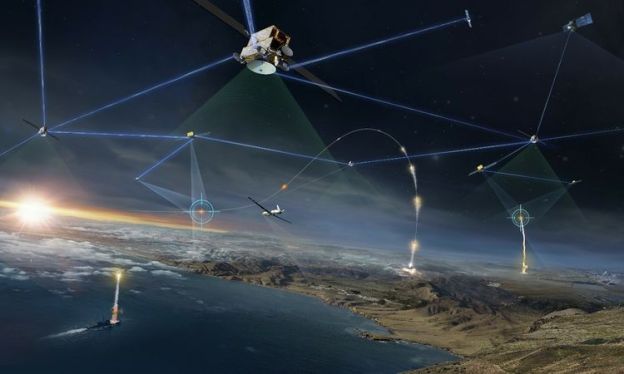
Sensors come in still-more-diverse forms than Anduril’s, though. An autonomous doglike robot made by Ghost Robotics of Philadelphia offers a hint of things to come. In addition to infrared and video systems, this quadruped, dubbed v60 q-ugv, can be equipped with acoustic sensors (to recognise, among other things, animal and human footsteps), a millimetre-wave scanner (to see through walls) and “sniffers” that identify radiation, chemicals and electromagnetic signals. Thanks to navigation systems developed for self-driving cars, v60 q-ugv can scamper across rough terrain, climb stairs and hide from people. In a test by the air force this robot was able to spot a mobile missile launcher and pass its location on directly to an artillery team…

Applying Artificial Intelligence (AI) to more C2 processes should cut the time required to hit a target. In a demonstration in September 2020, army artillery controlled by AI and fed instructions by air-force sensors shot down a cruise missile in a response described as “blistering”…

There are, however, numerous obstacles to the success of all this. For a start, developing unhackable software for the purpose will be hard. Legions of machines containing proprietary and classified technologies, new and old, will have to be connected seamlessly, often without adding antennae or other equipment that would spoil their stealthiness…America’s technologists must, then, link the country’s military equipment into a “kill web” so robust that attempts to cripple it will amount to “trying to pop a balloon with one finger”, as Timothy Grayson, head of strategic technologies at DARPA, the defense department’s main research agency, puts it…

Excerpts from The future of armed conflict: Warfare’s worldwide web, Economist,  Jan. 9, 2021

How to Denude a Country: Military Invasions Dressed Up As Revolutions

“In wartime, truth is so precious that she should always be attended by a bodyguard of lies.”said Winston Churchill…Deception is still practiced in war.

In its conflict with Azerbaijan, Armenia has bamboozled drones with dummy missiles. During a stand-off with India, China published images of missile launchers that, on closer inspection, turned out to be wobbly inflatables. Indian and Chinese forces alike covered equipment with multispectral nets, which block visible light and other electromagnetic emissions. Engineers keep working on new gadgets. BAE Systems, a defense firm, boasts that its Adaptiv camouflage—a set of thermoelectric tiles that change temperature to match their surroundings—amounts to a “cloak of invisibility”.

European and American military officials describe Russian and Chinese practices with a mixture of distaste and envy. Whereas America’s use of decoys “is currently at a low after two decades of neglect”, notes Walker Mills, an officer in the us Marine Corps, China has invested in them, including a 35kg tank that fits in a backpack and inflates in four minutes. One report by America’s army says that Chinese forces “have the highest fidelity decoys seen to date”.

The laws of armed conflict are fairly clear about battlefield deception. Whereas “perfidy” (such as faking surrender to lure an enemy into an ambush, or disguising a tank as a Red Cross ambulance) is forbidden, “ruses” like decoys, feints and ambushes are fair game. But other laws can be bent or bypassed. Russia snatched Crimea from Ukraine in 2014 by cleverly using unmarked personnel—the so-called little green men—and a synchronized blitz of disinformation. The entire campaign was a deception: an invasion masquerading as a nationalist uprising.

Western armies want to catch up, in some ways at least. “We’ll re-learn deception,” promises General David Berger, head of America’s Marine Corps, who is reforming his force to better evade Chinese sensors in the Pacific. But this cuts against the grain. “There’s a cultural problem here,” says a veteran cia officer who specialized in deception. “I do think you’ll find generals who would feel that it’s fundamentally not a very respectable activity.”

Excerpt from Military Deception: Bodyguard of Lies, Economist, Dec. 19, 2020

Satellites Shed Light on Modern Slavery in Fishing

While forced labor, a form of modern slavery, in the world’s fishing fleet has been widely documented, its extent remains unknown. No methods previously existed for remotely identifying individual fishing vessels potentially engaged in these abuses on a global scale. By combining expertise from human rights practitioners and satellite vessel monitoring data, scientists have showed in an recent study that vessels reported to use forced labor behave in systematically different ways from other vessels. Scientists used machine learning to identify high-risk vessels from among 16,000 industrial longliner, squid jigger, and trawler fishing vessels.

The study concluded that 14% and 26% of vessels were high-risk. It also revealed patterns of where these vessels fished and which ports they visited. Between 57,000 and 100,000 individuals worked on these vessels, many of whom may have been forced labor victims. This information provides unprecedented opportunities for novel interventions to combat this humanitarian tragedy….

The study found, inter alia, that longliners and trawlers using forced labor travel further from port and shore, fish more hours per day than other vessels, and have fewer voyages and longer voyage durations…  Taiwanese longliners, Chinese squid jiggers, and Chinese, Japanese, and South Korean longliners are consistently the five fisheries with the largest number of unique high-risk vessels. This pattern is consistent with reports on the abuses seen within distant water fleets that receive little legal oversight and often use marginalized migrant workers .

Excerpts from Gavin G. McDonald et, al, Satellites can reveal global extent of forced labor in the world’s fishing fleet, Dec. 21, 2020

Winning Strategy: How China Uses US Firms to Get What it Wants

Xi Jinping, China’s leader, has described the creation of fully domestic supply chains as a matter of national security. The question is how to build them. Chinese officials know that they cannot turn their backs on the world. Exports are still an important source of revenue for many firms. And China must attract technology and investment from abroad. Pushing too transparently for “indigenous innovation”, a term once bandied about by the government, only makes foreigners wary. Striking the right balance is tough.

Enter the newest of China’s big economic policies: the “dual-circulation” strategy. At its most basic it refers to keeping China open to the world (the “great international circulation”), while reinforcing its own market (the “great domestic circulation”). If that sounds rather vague, it is: the government has not spelled out the details.  In May 2020, at a meeting of the Politburo, Mr Xi described dual circulation as the framework for economic policy… More recent comments by Mr Xi on the economy have been less about promoting consumption and more about bolstering China’s defences. China needs “self-developed, controllable” supply chains, with at least one alternative source for vital products, he said in a speech published on October 3, 2020.

Even more striking was his inversion of the idea of international circulation. Instead of talking about it in terms of the economic benefits China reaps from globalisation, he emphasized only the strategic purpose of opening China’s doors to foreign firms, ie that making them more dependent on the Chinese market would deter foreign powers from putting pressure on the country.

Excerpts from Economic Policy: Circling Back, Economist, Nov. 7, 2020

See also China Has One Powerful Friend Left in the U.S.: Wall Street—Trade deal left many U.S. industries disappointed, but financial firms such as BlackRock see a potential windfall

Your Phone Is Listening: smart-phones as sniffers

U. S. government agencies from the military to law enforcement have been buying up mobile-phone data from the private sector to use in gathering intelligence, monitoring adversaries and apprehending criminals. Now, the U.S. Air Force is experimenting with the next step.

The Air Force Research Laboratory is testing a commercial software platform that taps mobile phones as a window onto usage of hundreds of millions of computers, routers, fitness trackers, modern automobiles and other networked devices, known collectively as the “Internet of Things.” SignalFrame, a Washington, D.C.-based wireless technology company, has developed the capability to tap software embedded on as many as five million cellphones to determine the real-world location and identity of more than half a billion peripheral devices. The company has been telling the military its product could contribute to digital intelligence efforts that weave classified and unclassified data using machine learning and artificial intelligence.

The Air Force’s research arm bought the pitch, and has awarded a $50,000 grant to SignalFrame as part of a research and development program to explore whether the data has potential military applications, according to documents reviewed by The Wall Street Journal. Under the program, the Air Force could provide additional funds should the technology prove useful.

SignalFrame has largely operated in the commercial space, but the documents reviewed by the Journal show the company has also been gunning for government business. A major investor is Razor’s Edge, a national-security-focused venture-capital firm. SignalFrame hired a former military officer to drum up business and featured its products at military exhibitions, including a “pitch day” sponsored by a technology incubator affiliated with U.S. Special Operations command in Tampa, Fla.

SignalFrame’s product can turn civilian smartphones into listening devices—also known as sniffers—that detect wireless signals from any device that happens to be nearby. The company, in its marketing materials, claims to be able to distinguish a Fitbit from a Tesla from a home-security device, recording when and where those devices appear in the physical world. Using the SignalFrame technology, “one device can walk into a bar and see all other devices in that place,” said one person who heard a pitch for the SignalFrame product at a marketing industry event…

“The capturing and tracking of unique identifiers related to mobile devices, wearables, connected cars—basically anything that has a Bluetooth radio in it—is one of the most significant emerging privacy issues,” said Alan Butler, the interim executive director and general counsel of the Electronic Privacy Information Center, a group that advocates for stronger privacy protections. “Increasingly these radios are embedded in many, many things we wear, use and buy,” Mr. Butler said, saying that consumers remain unaware that those devices are constantly broadcasting a fixed and unique identifier to any device in range.

Byron Tau,  Military Tests New Way of Tracking, WSJ, Nov. 28, 2020

Who is the Boss? Cyber-War

A new National Cyber Power Index by the Belfer Centre at Harvard University ranks 30 countries on their level of ambition and capability…That America stands at the top of the list is not surprising. Its cyber-security budget for fiscal year 2020 stood at over $17bn and the National Security Agency (NSA) probably gets well over $10bn. The awesome scale of America’s digital espionage was laid bare in leaks by Edward Snowden, a former NSA contractor, in 2013, which showed the agency hoovering up vast amounts of the world’s internet traffic and trying to weaken encryption standards.

China, in second place, has demonstrated a voracious appetite for commercial cyber-espionage abroad and an iron grip on the internet at home. Britain, whose National Cyber Security Centre has parried over 1,800 cyber-attacks since its creation in 2016, is third. Russia, whose spies interfered with America’s last election, is in fourth place. The big surprise is the Netherlands in fifth place, ahead of France, Germany and Canada. Dutch expertise in analyzing malware is particularly sharp…

Many countries outsource the dirtiest work to deniable proxies, like “hacktivists” and criminals….But while stealing things and disrupting networks is important, what matters most over the longer term is control of digital infrastructure, such as the hardware that runs mobile telecommunications and key apps. Dominance there will be crucial to economic strength and national security.

Excerpt from Digital dominance: A new global ranking of cyber-power throws up some surprises, Economist, Sept. 19, 2020

How to Exploit the Secrets of the Ocean: DARPA

PARC, A Xerox Company, announced on October 22, 2020,  it has been awarded a contract by the Defense Advanced Research Projects Agency (DARPA) for the next development phase in the Ocean of Things. Initially announced by DARPA in 2017, the Ocean of Things project is deploying small, low-cost floats in the Southern California Bight and Gulf of Mexico to collect data on the environment and human impact. This includes sea surface temperature, sea state, surface activities, and even information on marine life moving through the area.

Xerox Ocean Float is Equipped with Camera, GPS and other sensors. Ocean of Things

“Oceans cover more than 70 percent of the earth’s surface, but we know very little about them,” said Ersin Uzun, vice president and general manager of the Internet of Things team at Xerox. “The floats gather data that we could never track before, enabling persistent maritime situational awareness.” Each solar-powered drifter has approximately 20 onboard sensors, including a camera, GPS, microphone, hydrophone, and accelerometer. The different  sensors can provide data for a broad array of areas including ocean pollution, aquafarming and transportation routes…Among other things, the float needed to be made of environmentally safe materials, be able to survive in harsh maritime conditions for a year or more before safely sinking itself, and use advanced analytic techniques to process and share the data gathered…PARC built 1,500 drifters for the first phase of the project and will deliver up to 10,000 that are more compact and cost-effective for the next phase. 

Excerpt from DARPA Awards PARC Contract to Expand Ocean Knowledge, XEROX Press Release, Oct. 22, 2020

What is the Sea Train? DARPA

DARPA’s The Sea Train program aims to demonstrate long range deployment capabilities for a distributed fleet of tactical unmanned surface vessels. The program seeks to enable extended transoceanic transit and long-range naval operations by exploiting the efficiencies of a system of connected vessels (Sea Train). The goal is to develop and demonstrate approaches that exploit wave-making resistance reductions to overcome the range limitations inherent in medium unmanned surface vessels. DARPA envisions sea trains formed by physically connecting vessels with various degrees of freedom between the vessels, or vessels sailing in collaborative formations at various distances between the vessels. The weak of October 5, 2020, DARPA awarded Gibbs & Cox a separate $9.5 million contract to develop a “Connectorless Sea Train” concept. 

Dr. Andrew Nuss, Sea Train

Government Intervention is Great: What China is Learning from the United States

A study published by the China Aerospace Studies Institute in September 2020′China’s Space Narrative: Examining the Portrayal of the US-China Space Relationship in Chinese Sources‘ used publicly available Chinese language resources to draw insights on how the Chinese view the U.S.-China space relationship. According to the study:

“Chinese sources weave a space narrative that portrays China as a modernizing nation
committed to the peaceful uses of space and serving the broader interests of advancing humankind through international space cooperation, economic development, and scientific discovery. Chinese sources minimize the military role of China’s space program.

In contrast, the same sources portray the United States as the leading
space power bent on dominating space, restricting access to space, and limiting international space cooperation to countries with similar political systems and level of economic development.

The report concludes that the United States and China are in a long-term competition in space in which China is attempting to become a global power, in part, through the use of space. China’s primary motivation for developing space technologies is national security…China’s space program is one element of its efforts to transition the current U.S.-dominated international system to a multipolar world….

Many Chinese writings on commercial space analyze the experiences of U.S. companies, with a particular focus on SpaceX. Chinese space experts call SpaceX the “major representative company” for commercial space worldwide. A report from Hong Kong media claims that Chinese investors view SpaceX as the “benchmark company” for emerging commercial space companies in the mainland. Chinese authors also follow developments in other U.S. commercial space companies, such as Digital Globe
and Rocket Lab.

Chinese authors also pay attention to the ways in which the U.S. government uses various policies and incentives to create a favorable ecosystem for the growth of new commercial space companies. Chinese writings analyze ways in which NASA has supported private companies with funding, technology transfer, consulting, and infrastructure leasing. Although their specific recommendations vary, Chinese authors view strong government oversight and intervention as crucial toward the success of the domestic commercial space industry.”

Addictive Ads and Digital Dignity

Social-media firms make almost all their money from advertising. This pushes them to collect as much user data as possible, the better to target ads. Critics call this “surveillance capitalism”. It also gives them every reason to make their services as addictive as possible, so users watch more ads…

The new owner could turn TikTok from a social-media service to a digital commonwealth, governed by a set of rules akin to a constitution with its own checks and balances. User councils (a legislature, if you will) could have a say in writing guidelines for content moderation. Management (the executive branch) would be obliged to follow due process. And people who felt their posts had been wrongfully taken down could appeal to an independent arbiter (the judiciary). Facebook has toyed with platform constitutionalism now has an “oversight board” to hear user appeals…

Why would any company limit itself this way? For one thing, it is what some firms say they want. Microsoft in particular claims to be a responsible tech giant. In January  2020 its chief executive, Satya Nadella, told fellow plutocrats in Davos about the need for “data dignity”—ie, granting users more control over their data and a bigger share of the value these data create…Governments increasingly concur. In its Digital Services Act, to be unveiled in 2020, the European Union is likely to demand transparency and due process from social-media platforms…In the United States, Andrew Yang, a former Democratic presidential candidate, has launched a campaign to get online firms to pay users a “digital dividend”. Getting ahead of such ideas makes more sense than re-engineering platforms later to comply.

Excerpt from: Reconstituted: Schumpeter, Economist, Sept 5, 2020

See also Utilities for Democracy: WHY AND HOW THE ALGORITHMIC
INFRASTRUCTURE OF FACEBOOK AND GOOGLE MUST BE REGULATED
(2020)

A Perpetual State of Competition: US-China-Russia

The US Secretary of Defense stated in September 2020 that America’s air, space and cyber warriors “will be at the forefront of tomorrow’s high-end fight.” That means confronting near-peer competitors China and Russia. That means shifting the focus from defeating violent extremist groups to deterring great power competitors. It means fighting a high-intensity battle that combines all domains of warfare. “In this era of great power competition, we cannot take for granted the United States’ long-held advantages,” Esper said. 

The last time an enemy force dropped a bomb on American troops was in the Korean War. “China and Russia, seek to erode our longstanding dominance in air power through long-range fires, anti-access/area-denial systems and other asymmetric capabilities designed to counter our strengths,” he said. “Meanwhile, in space, Moscow and Beijing have turned a once peaceful arena into a warfighting domain.” China and Russia have placed weapons on satellites and are developing directed energy weapons to exploit U.S. systems “and chip away at our military advantage,” he said.

Russia, China, North Korea, Iran and some violent extremist groups also look to exploit cyberspace to undermine U.S. security without confronting American conventional overmatch. “They do this all in an increasingly ‘gray zone’ of engagement that keeps us in a perpetual state of competition,’ the secretary said…The fiscal 2020 Defense Department research and development budget is the largest in history, he said, and it concentrates on critical technologies such as hypersonic weapons, directed energy and autonomous systems. 

“In the Air Force, specifically, we are modernizing our force for the 21st century with aircraft such as the B-21, the X-37 and the Next Generation Air Dominance platform,” Esper said. “Equally important, we are transforming the way we fight through the implementation of novel concepts such as Dynamic Force Employment, which provides scalable options to employ the joint force while preserving our capabilities for major combat.”

To realize the full potential of new concepts the department must be able to exchange and synchronize information across systems, services and platforms, seamlessly across all domains, he said. “The Department of the Air Force is leading on this front with the advancement of Joint All-Domain Command and Control,” Esper said.  This concept is part of the development of a Joint Warfighting concept that will drive transition to all-domain operations, he said. “

For these breakthroughs to succeed in any future conflict … we must maintain superiority in the ultimate high ground — space,” Esper said…In collaboration with academia and industry, the Air Force’s AI Accelerator program is able to rapidly prototype cutting-edge innovation,” Esper said. One example of this was the AI technology used to speed-up the development of  F-15EX.


F-15EX

Excerpts from Esper: Air Force, Space Force Leading Charge to New Technologies, DOD News, Sept. 16, 2020

Conquering Space: China’s X-37B and the United States

Ever since China claimed success in the secretive launch of an experimental spacecraft, experts have been pondering over what it could be and what it did in space.The spacecraft – mounted on a Long March 2F rocket – was launched from the Jiuquan Satellite Launch Centre in northern China on Sept. 4, 2020 and safely returned to Earth after two days in orbit…Unlike recent Chinese high-profile space missions, very few details have emerged about the vehicle and no visuals have been released. Chinese authorities have been tight-lipped about the nature of the short-duration excursion and what technologies were tested. The exact launch and landing times were not revealed, nor was the landing site although it is thought to be the Taklamakan Desert, which is in northwest China.

Three years ago, China said it would launch a space vessel in 2020 that “will fly into the sky like an aircraft” and be reusable. A reusable spacecraft – as the name implies can undertake multiple trips to space – thereby potentially lowering the overall cost of launch activity. A traditional one-off spacecraft – costing tens of millions of dollars – is practically rendered useless after a single mission.

The experimental vessel reached an altitude of about 350km, which is in line with China’s previous crewed flights. The spacecraft also released an unknown object into the orbit before returning to Earth…Once the testing is complete, such a vehicle could be used to launch and repair satellites, survey the Earth, as well as take astronauts and goods to and from orbit, possibly to a planned future Chinese space station.

The Chinese craft’s size and shape remain unclear but it is widely believed to be some sort of uncrewed space plane similar to the X-37B Orbital Test Vehicle operated by the US Air Force. The recent mission could be linked to the Shenlong – or divine dragon – space plane project, which has been in development for some time, according to reports. A second Chinese reusable space plane called Tengyun, or cloud climber, is also in the works. If confirmed as a space plane, China would become only the third country to have successfully launched such a vehicle into orbit after the US and the former Soviet Union. The European Space Agency is working on its own reusable orbital vehicle called Space Rider, while India is also said to be developing a space shuttle-like craft.

The X-37B, resembling a miniature space shuttle, has been in orbit since late May 2020 following its launch on its sixth assignment. Very little is known about the X-37B’s missions, prompting speculation that the planes could be used for spying activity or testing space weapons.

x-37b

According to Bleddyn Bowen, China’s spacecraft launch is “just another part of China becoming a comprehensive space power that utilizes space technology for the purposes of war, development, and prestige like all others”.

Pratik Jakhar, China claims ‘important breakthrough’ in space mission shrouded in mystery, BBC, Sept. 9, 2020

How to Fight: Laugh, Bleed, Kill

The U.S. response to the 9/11 attacks launched an Air Force special operations unit into more than 6,900 days, or nearly two decades, of continuous deployments and combat operations in the Middle East, officials said. Within weeks of the terrorist attacks on the U.S., the 17th Special Tactics Squadron deployed with Army Rangers on raids into southern Afghanistan on Oct. 19, 2001. Since then, the squadron has had no breaks in deployment. “We fight, bleed and laugh beside [the Rangers],” said Staff Sgt. Ryan Duhon, a tactical air control party operator quoted in last month’s statement. “We win as a team or fail as a team.”….

The Special Tactics community, whose airmen conduct personnel recovery, precision strike missions and battlefield surgery, is the most highly decorated in the Air Force since the Vietnam War. 

Excerpt from CHAD GARLAND, Air Force special ops members ‘fight, bleed and laugh’ on nearly 7,000 days of deployments, Stars and Stripes, Sept. 10, 2020

China’s Nuclear Triad: Land, Sumbarines and Bombers

Based on United States Report released in 2020 “Military and Security Developments Involving the People’s Republic of China” by the Secretary of Defense, China’s progress in upgrading its strategic bombers to carry nuclear payloads puts it on the cusp of achieving a “triad” of delivery systems ((1) land-launched nuclear missiles, (2) nuclear-armed submarines, and (3) aircraft delivered nuclear bombs).  The development of a nuclear triad raises the long-term stakes in the complex relationship between Beijing and Washington. …The heavy emphasis on China’s nuclear improvements will probably be used by the Pentagon to press lawmakers and the public to support the massive reinvestment already underway in modernized nuclear weapons. This includes the B-21 bomber, an $85 billion Ground Based Strategic Deterrent ICBM program and the $128 billion Columbia-class ballistic missile submarine.

China’s defense ministry denounced the report as a document created with a “zero-sum-game mindset and Cold War mentality,” saying that the U.S. had “misinterpreted” the country’s nuclear policy and stirred up confrontation with Taiwan. “It’s extremely wrong and China firmly rejects it.”  As part of President Xi Jinping’s efforts to build a “world class” military by 2049, the Defense Department report said the People’s Liberation Army has already achieved parity with or exceeded the U.S. in at least three key areas: shipbuilding, land-based conventional ballistic and cruise missiles and integrated air defense systems.

While the country has one overseas military base, in the East African nation of Djibouti, China’s government “is very likely already considering and planning for additional overseas military logistics facilities to support naval, air and ground forces…”.  China’s current nuclear arsenal includes 100 silo or road-mobile intercontinental ballistic missiles, as many as six Jin-class nuclear missile submarines capable of carrying 12 missiles each and a new air-refuelable H-6N long-range bomber. The bomber is an upgrade on a previous model and comes with a modified fuselage “that allows it to carry either a drone or an air-launched ballistic missile that may be nuclear-capable. 

Excerpts from Anthony Capaccio, Pentagon Warns China Is Nearing a Milestone in Nuclear Weapons Buildup, Bloomberg, Sept. 1, 2020

China denounced the Pentagon report. According to Xinhua, the Pentagon report is crowded with anti-China hogwash. Fear-mongering over China has always been the Pentagon’s trick to demand more appropriations from the U.S. Congress. A fabricated grave threat to world peace can also help Washington sell more weapons to its allies, and serves as an excuse for America’s pursuit of global domination…While Washington is selling its latest “China-scare” fiction to the world, it is hard to overlook such facts that the United States spent more on military than 144 countries combined in 2018 and maintains nearly 800 military bases in over 70 countries.

Excerpt from Commentary: Lies, conspiracies behind Pentagon’s China military report, Xinhua, Sept. 5, 2020


Under Zero Trust: the U.S. Chip Resurgence

The Defense Advanced Research Projects Agency launched its Electronic Resurgence Initiative (ERI)  to help reboot a domestic chip industry that has been moving steadily offshore for decades…. Program officials and chip industry executives foresee the emergence of a “5th generation of computing” based on current cloud infrastructure while combining AI, the Internet of Things (IoT) and 5G wireless networks to deliver big data.

“The U.S. microelectronics industry is at an inflection point,” Ellen Lord, undersecretary of defense for acquisition and sustainment, told the virtual ERI summit. After decades of offshoring of chip fabrication, packaging and testing capabilities, “How do we reverse this trend?”  The Defense Department is expanding its technology base efforts by implementing a “step-by-step process for reconstituting the microelectronics supply chain,” focusing on various segments of the semiconductor ecosystem, including memory devices, logic, ICs and advanced packaging along with testing and assembly.

“While DoD does not drive the electronics market,” constituting only about 1 percent of demand, “we can drive significant R&D,” ERI is advancing public-private partnerships that provide a framework for commercial innovation. The result would be “pathfinder projects” geared toward a renewal of U.S. chip manufacturing. As trade frictions with China grow, ERI is placing greater focus on ensuring the pedigree of U.S. electronics supply chain. “We need to find a path to domestic sources,” said Lord.

While nurturing government-industry partnerships as part of an emerging next-generation U.S. industrial policy, this year’s DARPA summit also emphasized chip standards and processes for securing fabs, foundry services, devices and foundational microelectronics. In that vein, U.S. officials stressed new chips metrics like “quantifiable assurance” to secure dual-use devices that could end up in weapons or an IoT device.

“Our interests to protect both the confidentiality and the integrity of our supply chain are aligned with commercial interests, and we will continue to work across government and industry to develop and implement our quantitative assurance strategy based on zero trust,” said Nicole Petta, principal director of DoD’s microelectronics office. The “zero trust” approach assumes no device is safe, and that all microelectronics components must be validated before deployment. The framework marks a philosophical departure from DoD’s “trusted foundry” approach instituted in the 1990s, largely because “perimeter defenses” failed to account for insider threats…

DARPA Chip Efforts Pivots to Securing US Supply Chain, https://www.hpcwire.com, Aug. 24, 2020

Selling War Services: the Mercenaries

Despite a UN treaty banning mercenaries, their day is far from over. Some analysts think there are now more of them in Africa than ever. But can they ever be a force for good?  ….In the years after most African countries gained independence, mercenaries were notorious for supporting secessionist movements and mounting coups. 

Western governments have in the past winked at mercenary activity that served their commercial interests. But nowadays Russia is seen as the leading country egging on mercenaries to help it wield influence. It does so mainly through Wagner, ***whose founder, Yevgeny Prigozhin, is close to President Vladimir Putin.

Wagner has been hired to prop up a number of shaky African regimes. In Sudan it tried to sustain the blood-drenched dictatorship of Omar al-Bashir. He was ousted last year after big protests. In 2018 hundreds of Wagner men arrived in the Central African Republic to guard diamond mines, train the army and provide bodyguards for an embattled president, Faustin-Archange Touadéra. In Guinea, where Rusal, a Russian aluminium giant, has a big stake, Wagner has cosied up to President Alpha Condé, who has bloodily faced down protests against a new constitution that lets him have a third term in office. In Libya, despite a un arms embargo, Wagner is reported to have deployed 800-1,200 operatives in support of a rebel general, Khalifar Haftar, who has been trying to defeat the UN-recognised government….

Mercenaries have three main advantages over regular armies. First, they give plausible deniability. Using them, a government such as Russia’s can sponsor military action abroad while pretending not to. Second, they tend to be efficient, experienced, nimble and flexible. Third, they are cheaper than regular armies. Whereas soldiers receive lifelong contracts and pensions, mercenaries are often paid by the job..

***Other firms include Dyke Advisory Group (DAG) , OAM Middle East

See also The UN Working Group on the Use of Mercenaries

Excerpts from Soldiers of misfortune: Why African governments still hire mercenaries, Economist, May 30, 2020

Strangling China with Hong Kong: the Politics of Fear

The U.S. determination  that Hong Kong is no longer autonomous from mainland China, under the Hong Kong Policy Act of 1992, will have significant implications for the city’s exporters and businesses.  Sensitive U.S. technologies could no longer be imported into Hong Kong, and the city’s exports might be hit with the same tariffs levied on Chinese trade.

But the act doesn’t cover the far more extensive role Hong Kong plays as China’s main point of access to global finance.  As of 2019, mainland Chinese banks held 8,816 trillion Hong Kong dollars ($1.137 trillion) in assets in the semiautonomous city, an amount that has risen 373% in the last decade…. China’s banks do much of their international business, mostly conducted in U.S. dollars, from Hong Kong. With Shanghai inside China’s walled garden of capital controls, there is no obvious replacement.

While the U.S. doesn’t directly control Hong Kong’s status as a financial center, Washington has demonstrated its extensive reach over the dollar system, with penalties against Korean, French and Lebanese financiers for dealing with sanctioned parties. The U.S. recently threatened Iraq’s access to the New York Federal Reserve, demonstrating a growing willingness to use financial infrastructure as a tool of foreign policy.  Even though the U.S. can’t legislate Hong Kong’s ability to support Chinese banks out of existence, the role of an international funding hub is greatly reduced if your counterparties are too fearful to do business with you.

Putting the ability of Chinese banks to conduct dollar-denominated activities at risk would be deleterious to China’s ability to operate financially overseas, posing a challenge for the largely dollar-denominated Belt and Road global infrastructure initiative. It would also put the more financially fragile parts of the country, like its debt-laden property developers, under strain.  China’s hope to develop yuan into an influential currency also centers on Hong Kong’s remaining a viable global financial center—more than 70% of international trade in the yuan is done in the city.

Excerpts from Mike Bird, How the US Could Really Hurt China, WSJ, May 290, 2020

Mining the Moon: The First Mover Advantage

The US government is starting to lay down the groundwork for diplomacy on the moon. On 15 May, 2020 NASA administrator Jim Bridenstine released a set of principles that will govern the Artemis Accords on the exploration of the moon. The accords are named after NASA’s Artemis programme, the US initiative to explore the moon, with a planned launch of astronauts to the lunar surface in 2024. Other countries are also increasingly turning towards the moon, which is concerning when a landing on the moon can send up clouds of potentially hazardous dust that travel a long way across the surface and even into orbit…

At the moment, there is little practical international law governing activities on the moon. The Outer Space Treaty of 1967 deals with general space exploration, while the more specific Moon Agreement of 1984 states that “the moon and its natural resources are the common heritage of all mankind”, prohibiting the ownership of any part of the moon or any resources from the moon….However, no nation capable of human space flight has signed the Moon Agreement, effectively rendering it moot. In fact, in April 2020, US president Donald Trump issued an executive order supporting moon mining and taking advantage of the natural resources of space.

The Artemis Accords aim to protect historic locations like the Apollo landing sites but encourage mining in other areas. They also promote transparency and communication between nations, requiring signatories to share their lunar plans, register any spacecraft sent to or around the moon and release scientific data to the public.  That transparency requirement might be a stumbling block for potential parties to the accords, says Forczyk. “I really don’t know how much countries are going to be willing to share some of their more delicate, sensitive information,” she says. “

The rest of the stipulations of the Artemis Accords are about safety: nations will be able to set “safety zones” to protect their activities on the moon, they will have to work to mitigate the effects of debris in orbit around the moon and they will agree to provide emergency assistance to any astronauts in distress.

Rather than attempting to put together an international treaty, which could be difficult to negotiate before NASA’s next crewed launch to the moon, the US will sign bilateral agreements with individual countries.

Excerpts from Leah Crane, NASA’s Artemis Accords aim to lay down the law of the land on the moon, New Scientist, May 20, 2020

Our Cold War Roots: Weaponizing China’s One Child Policy

The elite US special operations forces are ill-equipped for high-tech warfare with China and Russia, experts warn, as the Trump administration pivots from the “war on terror” to a struggle with geopolitical rivals. Special operations, known for kicking down doors and eliminating high-value targets, number 70,000 personnel, cost $13bn a year and have carried much of the burden of the war on terror. But it is unclear what role they will play as the Pentagon moves to redeploy troops from Afghanistan to the Indo-Pacific to counter China’s regional ambitions.

General Richard Clarke, commander of special operations command (Socom), told an industry conference this week that the US needed to develop new capabilities to “compete and win” with Russia and China. He added that Socom must develop cyber skills and focus on influence campaigns rather than “the kill-capture missions” that characterised his own time in Afghanistan after the September 11 2001 attacks. Socom’s fighters include US Navy Seals, Army Green Berets and Marine Corps Raiders. Defence officials say China has raised military spending and research with the aim of exploiting American vulnerabilities, while Russia has tested out new technology during combat in Syria. “Maybe we are further behind than we know,” Colonel Michael McGuire told the annual Special Operations Industry Conference

McGuire highlighted US vulnerabilities in cyber security, and soft-power tactics by America’s enemies that could “drive fissures through some of our alliances”. He proposed shifting focus to defence over attack.   “You could have hundreds and thousands of engagements every single day in a fight against China. We are just not fast enough, dynamic enough or scaleable enough to handle that challenge,” said Chris Brose, chief strategy officer at Anduril…. He added “Most of the US-China competition is not going to be fighting world war three,” he said. “It’s going to be kicking each other under the table.”….

US special operators have for years had the run of the battlefield. But they face very different conditions in any fight against China, which has developed an arsenal of missiles, fighter jets, spy planes and other eavesdropping and jamming techniques that would make it hard for America to conceal troops, transport and communications. Special operations forces are not ready for operations against a near-peer foe, such as China, in a direct engagement… He called for a return to their cold war roots. “Vintage special operations forces is about stealth, cunning and being able to blend in — they were triathletes rather than muscle-bound infantrymen with tattoos,” said the former officer. 

David Maxwell, a former Green Beret and military analyst, is among those who favour a shift towards political warfare.One such idea of his would involve a popular writer being commissioned to pen fictionalised war stories based in Taiwan intended to discourage Beijing from invading the self-governing island. He told a gathering of Pacific special forces operators in February 2020 that fictional losses could “tell the stories of the demise of Chinese soldiers who are the end of their parents’ bloodline”. He argued that Beijing’s former one-child policy could be weaponised to convince China that war would be too costly. But Mr Maxwell said such ideas have yet to catch on. He added that psyops officers lamented to him that it was “easier to get permission to put a hellfire missile on the forehead of a terrorist than it is to get permission to put an idea between his ears”.

Excerpts from Katrina Manson , US elite forces ill-equipped for cold war with China, FT, May 16, 2020

A Nasty Divorce: US-China Internet Cables

United States officials granted Google permission to turn on a high-speed internet link to Taiwan but not to the Chinese territory of Hong Kong, citing national-security concerns in a ruling that underscores fraying ties between Washington and Beijing.“There is a significant risk that the grant of a direct cable connection between the United States and Hong Kong wouldpose an unacceptable risk to the national security and law enforcement interests of the United States,” the U.S. Department of Justice said in its decision, which was backed by the departments of Homeland Security and Defense. The agencies instead urged the Federal Communications Commission to grant Google owner Alphabet  permission to start using the portion of its 8,000-mile underwater Pacific Light cable that connects California to Taiwan. .

The decision threatens to end Hong Kong’s dominance as a top destination for U.S. internet cables and puts at risk several ongoing projects, including a Facebook backed fiber-optic line linking Los Angeles to Hong Kong and a Google-backed project linking Hong Kong to the U.S. territory of Guam.

Washington is turning to the self-ruling island of Taiwan, which the U.S. supports with arms sales and unofficial political ties despite Beijing’s claims that it is part of China. U.S. officials are also considering alternatives such as Indonesia, Philippines, Thailand, and Vietnam.

Google and Facebook originally teamed up to build Pacific Light to Hong Kong in 2016, continuing the Silicon Valley giants’ long-term strategy to take more control of the network pipes that connect their data centers. The web companies and their Chinese investment partners kept building the cable even as U.S. authorities withheld the regulatory approvals they needed to start using it.

Major international data projects are subject to review by Team Telecom, a coalition of federal agencies with national-security oversight. The panel has taken a hard line against China in recent years. Team Telecom in 2018 recommended for the first time the denial of a Chinese application—that of China Mobile —to provide telecom services through U.S. networks, citing national-security and law-enforcement concerns.

President Trump on April 4 2020 signed an executive order that puts the attorney general in charge of overseeing Team Telecom and gives the panel direct authority to review existing licenses to provide such services, including those issued earlier to Chinese state-owned operators China Telecom and China Unicom.

Excerpts from Drew FitzGerald and Kate O’Keeffe, U.S. Allows Google Internet Project to Advance Only if Hong Kong Is Cut Out, WSJ, Apr. 9, 2020

Even the Oceans are not Free: Swarming the Seas

The Ocean of Things of Defence Advanced Research Projects Agency (DARPA) aims to  wire up the high seas with swarms of floating, connected sensors.  Such devices are not in themselves new. There are around 6,000 floating sensors deployed around the world’s oceans, run by navies and research institutes. What is unprecedented is the scale of  DARPA’s ambition. Over the next few years it hopes to deploy 50,000 sensors across 1m square kilometres of sea, an area considerably larger than Texas. The eventual goal—much more distant—is to enable the continuous monitoring and analysis of a significant fraction of the world’s oceans.

Existing “floating instrument packages”, known as floats or drifters, are often custom-built, and usually contain the highest-quality instruments available. They therefore tend to be expensive, and are bought only in small numbers. A typical existing float, designed for scientific research, is the Argo. It costs around $20,000, and can measure water temperature and salinity.  The Ocean of Things takes the opposite approach. The aim is to cram as many cheap, off-the-shelf components as possible into a single low-cost package. Current float prototypes cost around $750…That would allow tens of thousands to be deployed without breaking the bank. Large numbers are crucial for coverage. They also help compensate for inaccuracies in individual instruments.

The project’s researchers are evaluating three designs from different manufacturers, ranging in size from about six to 18 litres. One, proposed by Xerox’s Palo Alto Research Centre, is made of glass, like a traditional Japanese fishing float. A second, from a firm called Areté Associates, has an aluminium shell, and uses wood for buoyancy. Both models feature solar panels. The third, made by a company called Numurus, is made of lacquered cardboard, and relies entirely on its batteries. All three are designed to last for a year or so and are made to be as environmentally friendly as possible, with minimal use of plastics. That is important because, at the end of their mission, the floats are designed to scuttle themselves

With 361m square kilometres of ocean on the planet, a true Ocean of Things, monitoring everything on and under the water, would require about 18m floats.

Excerpts from Big Wet Data: The Ocean of Things, Economist, Mar. 14, 2020

Breath and Sweat: the Biometrics of All Private Things

It is not just DNA that people scatter to the wind as they go about their business. They shed a whole range of other chemicals as well, in their breath, their urine, their faeces and their sweat. Collectively, these molecules are referred to as metabolites….

The most common way of analysing metabolite content is gas chromatography-mass spectrometry. This technique sorts molecules by their weight, producing a pattern of peaks that correspond to different substances….There are, however, a lot of information sources out there, in the form of publicly available metabolite databases. The databases themselves are getting better, too…. A study just published by Feliciano Priego-Capote at University of Cordoba, in Spain, for example, shows it is possible to extract much meaningful information from even a dried-up drop of sweat. “The day is coming soon”, observes Cecil Lewis, a molecular anthropologist at University of Oklahoma, who is studying the matter, “when it will be possible to swab a person’s desk, steering wheel or phone and determine a wide range of incredibly private things about them….


The police may be tempted to push the boundaries as well. The fourth amendment to America’s constitution protects against unwarranted searches and seizure of evidence. This means it is hard to force someone to give a sample. But if obtaining such merely requires taking a swab of a surface in a public place—perhaps a keyboard someone has just used—the 4th amendment is unlikely to apply.

That is not necessarily wrong, if it means more criminals are caught and convicted. But it needs to be thought about carefully, because many metabolites are sticky. Cocaine is a case in point. Studies have shown that as many as two-thirds of the dollar bills in circulation in America carry traces of this substance, which might thus end up on the fingertips of the innocent, as well as the guilty.

Excerpts from Metabolites and You, Economist, Feb. 15, 2019

Biometrics Run Amok: Your Heartbeat ID, please

Before pulling the trigger, a sniper planning to assassinate an enemy operative must be sure the right person is in the cross-hairs. Western forces commonly use software that compares a suspect’s facial features or gait with those recorded in libraries of biometric data compiled by police and intelligence agencies. Such technology can, however, be foiled by a disguise, head-covering or even an affected limp. For this reason America’s Special Operations Command (SOC), which oversees the units responsible for such operations in the various arms of America’s forces, has long wanted extra ways to confirm a potential target’s identity. Responding to a request from soc, the Combating Terrorism Technical Support Office (CTTSO), an agency of the defence department, has now developed a new tool for the job.

This system, dubbed Jetson, is able to measure, from up to 200 metres away, the minute vibrations induced in clothing by someone’s heartbeat. Since hearts differ in both shape and contraction pattern, the details of heartbeats differ, too. The effect of this on the fabric of garments produces what Ideal Innovations, a firm involved in the Jetson project, calls a “heartprint”—a pattern reckoned sufficiently distinctive to confirm someone’s identity.

To measure heartprints remotely Jetson employs gadgets called laser vibrometers. These work by detecting minute variations in a laser beam that has been reflected off an object of interest. They have been used for decades to study things like bridges, aircraft bodies, warship cannons and wind turbines—searching for otherwise-invisible cracks, air pockets and other dangerous defects in materials. However, only in the past five years or so has laser vibrometry become good enough to distinguish the vibrations induced in fabric by heartprints….

Candice Tresch, a spokeswoman for the cttso…. cannot discuss the process by which heartprint libraries might be built up in the first place. One starting point, presumably, would be to catalogue the heartbeats of detainees in the way that fingerprints and dna samples are now taken routinely.

Excerpts from Personal identificationPeople can now be identified at a distance by their heartbeat, Economist, Jan 23, 2020

Stasi Reborn: Democratizing Internet Censorship

The internet is the “spiritual home” of hundreds of millions of Chinese people. So China’s leader, Xi Jinping, described it in 2016. He said he expected citizens to help keep the place tidy. Many have taken up the challenge. In December 2019 netizens reported 12.2m pieces of “inappropriate” content to the authorities—four times as many as in the same month of 2015. The surge does not indicate that the internet in China is becoming more unruly. Rather, censorship is becoming more bottom-up

Officials have been mobilising people to join the fight in this “drawn-out war”, as a magazine editor called it in a speech in September to Shanghai’s first group of city-appointed volunteer censors. “Internet governance requires that every netizen take part,” an official told the gathering. It was arranged by the city’s cyber-administration during its first “propaganda month” promoting citizen censorship. The 140 people there swore to report any online “disorder”…

 Information-technology rules, which took effect on December 1st, 2019 oblige new subscribers to mobile-phone services not only to prove their identities, as has long been required, but also to have their faces scanned. That, presumably, will make it easier for police to catch the people who post the bad stuff online.

Excerpt from  The Year of the Rat-fink: Online Censorship, Economist, Jan 18, 2020

Algorithms as Weapons –Tracking,Targeting Nuclear Weapons

 
New and unproved technologies—this time computer systems capable of performing superhuman tasks using machine learning and other forms of artificial intelligence (AI)—threaten to destabilise the global “strategic balance”, by seeming to offer ways to launch a knockout blow against a nuclear-armed adversary, without triggering an all-out war.

A report issued in November by America’s National Security Commission on Artificial Intelligence, a body created by Congress and chaired by Eric Schmidt, a former boss of Google, and Robert Work, who was deputy defence secretary from 2014-17, ponders how AI systems may reshape global balances of power, as dramatically as electricity changed warfare and society in the 19th century. Notably, it focuses on the ability of AI to “find the needle in the haystack”, by spotting patterns and anomalies in vast pools of data…In a military context, it may one day find the stealthiest nuclear-armed submarines, wherever they lurk. The commission is blunt. Nuclear deterrence could be undermined if AI-equipped systems succeed in tracking and targeting previously invulnerable military assets. That in turn could increase incentives for states, in a crisis, to launch a devastating pre-emptive strike. China’s rise as an AI power represents the most complex strategic challenge that America faces, the commission adds, because the two rivals’ tech sectors are so entangled by commercial, academic and investment ties.

Some Chinese officials sound gung-ho about AI as a path to prosperity and development, with few qualms about privacy or lost jobs. Still, other Chinese fret about AI that might put winning a war ahead of global stability, like some game-playing doomsday machine. Chinese officials have studied initiatives such as the “Digital Geneva Convention” drafted by Microsoft, a technology giant. This would require states to forswear cyber-attacks on such critical infrastructure as power grids, hospitals and international financial systems.  AI would make it easier to locate and exploit vulnerabilities in these…

One obstacle is physical. Warheads or missile defences can be counted by weapons inspectors. In contrast, rival powers cannot safely show off their most potent algorithms, or even describe AI capabilities in a verifiable way….Westerners worry especially about so-called “black box” algorithms, powerful systems that generate seemingly accurate results but whose reasoning is a mystery even to their designers.

Excerpts from Chaguan: The Digital Divide, Economist, Jan 18, 2019